

Submitted:
12 April 2026
Posted:
13 April 2026
You are already at the latest version
Abstract
Patients with inflammatory bowel disease (IBD) and primary sclerosing cholangitis (PSC) sharea characteristic depletion of bile acid-transforming bacteria, undermining intestinal mucosalimmune tolerance. These organisms convert lithocholic acid into immunomodulatory secondarybile acid species through distinct enzymatic pathways: 3-oxolithocholic acid and isolithocholicacid suppress Th17 differentiation through RORγt binding, while isoallolithocholic acidpromotes Foxp3⁺ regulatory T cell differentiation through mitochondrial reactive oxygen speciessignaling.This paper proposes that committed dietary patterns at either metabolic pole, verified nutritionalketosis or traditional Mediterranean diet, are hypothesized to restore coherent signaling acrossmultiple interdependent receptor and metabolic sensing networks (FXR, TGR5, S1PR2, RORγt,and an intersecting oxysterol-LXR axis) and thereby support mucosal immune tolerance. Bileacid signaling is the best-characterized candidate mechanism for one arm of this network and theprimary testable intermediate the experimental program interrogates. Under committed ketosis,lipoprotein remodeling is most directly attributable to malonyl-CoA depletion and CPT-1disinhibition; bile acid pool restructuring is a parallel candidate for immune effects.Mediterranean diet co-directional lipid and immune improvements are supported by IBD-specificrandomized controlled trials. The equivalent prediction for committed ketosis, that both domainsimprove simultaneously in the same subjects under BHB-verified conditions, has not beendemonstrated; IBD-specific clinical evidence for the ketogenic pole currently rests on a ten-patient case series, making it the primary hypothesis under experimental test rather than anestablished parallel. Intermediate carbohydrate restriction, defined by the absence of verifiedketosis, is hypothesized to produce oscillating rather than coherent receptor engagement,producing neither lipid nor immune improvement reliably.No study has simultaneously characterized dietary metabolic state, the bile acid metabolome, andTh17/Treg balance in the same IBD patients. A staged experimental program is proposed; across-sectional design in quiescent IBD patients constitutes the immediate test. The framework isdirectly falsified if committed and intermediate dietary groups do not differ in species-levelimmunomodulatory bile acid concentrations despite differing in lipid and immune outcomes;such a result would redirect Stage 3 design toward BHB-direct NLRP3 inhibition and Kbhb-mediated mTOR signaling as the primary mechanistic candidates. The Host-Microbe Counter-Regulation Index (HMCRI) — a candidate index requiring empirical validation, with nocurrently established reference ranges — is proposed as a systems-level index of signalingcoherence whose reference ranges and dietary responsiveness constitute primary Stage 1analytical objectives.
Keywords:
bile acids
; FXR
; TGR5
; gut microbiome
; immune tolerance
; Treg
; inflammatory bowel disease
; primary sclerosing cholangitis
; oxysterols
; ketogenic diet
; Mediterranean diet
Introduction
1. The mucosal immune problem: why Th17/Treg balance matters in IBD
Crohn's disease and ulcerative colitis are characterized by a breakdown of mucosal immune tolerance, specifically a shift in the intestinal Th17/Treg balance toward pro-inflammatory Th17 dominance that sustains and amplifies epithelial injury. The success of anti-IL-12/23 therapy (ustekinumab) and IL-23–selective blockade (risankizumab, mirikizumab) in both conditions strongly implicates Th17 pathway activation as a proximate driver of pathological inflammation rather than an epiphenomenon [1,2,3]. The parallel failure of broader immune suppression strategies to induce durable remission in substantial patient fractions suggests that restoring tolerance mechanisms, rather than simply attenuating inflammatory effectors, is the more productive therapeutic aim.
Two convergent lines of evidence implicate the gut microbiome and its bile acid–transforming capacity as upstream regulators of this Th17/Treg imbalance. First, Paik et al. (2022) identified specific human gut bacteria (primarily Gordonibacter pamelaeae and related Coriobacteriaceae) and their 3α/3β-hydroxysteroid dehydrogenase enzyme pairs as responsible for biosynthetic conversion of lithocholic acid into 3-oxolithocholic acid (3-oxoLCA) and isolithocholic acid (isoLCA), demonstrated this pathway in human stool samples, and found that both metabolites and their biosynthetic genes were significantly depleted in Crohn's disease patients across two independent cohorts, with levels inversely correlating with IL-17-related host gene expression [4]; the statistical signal was driven predominantly by CD, with UC depletion emerging in secondary analyses of a smaller dysbiotic UC subset.
Second, fecal microbiome analysis in primary sclerosing cholangitis, an immune-mediated cholestatic cholangiopathy in which 50–80% of affected patients carry concurrent IBD, predominantly ulcerative colitis [79,84], and consistently demonstrates depletion of Eubacterium spp. and Ruminococcus obeum, genera encoding enzymatic machinery for secondary bile acid transformation, independent of IBD status [5]. Chan et al. (2024) also confirmed lower fecal deoxycholic acid correlating with Blautia and Lachnoclostridium in PSC patients [6]. Mousa et al. (2021), analyzing 400 PSC patients vs. 302 controls at Mayo Clinic, found significantly elevated primary-to-secondary bile acid ratios confirming deficient conversion at population scale [7].
Wang et al. (2025) demonstrated that isoalloLCA attenuates intestinal inflammation in pediatric UC patients by metabolically reprogramming macrophages from glycolysis toward oxidative phosphorylation through ETS2-HIF1A/PFKFB3 inhibition [80]. Separately, Kabil et al. (2025) identified an ILC3-selective role in intestinal fibrosis through RORγt-dependent signaling in CD11c+ myeloid cells [82], extending the relevance of this pathway beyond luminal inflammation to fibrotic complications of Crohn's disease. The mechanistic inference is well-supported but incomplete: depletion of the bacteria that produce immunomodulatory secondary bile acids plausibly removes a constitutive tolerogenic signal from the colonic mucosal environment, shifting the Th17/Treg equilibrium toward inflammation; the middle link in this chain, direct species-level metabolite measurement, remains unmeasured in PSC and IBD tissue. Whether dietary pattern influences this depletion, and whether restoring the bile acid signaling environment through dietary commitment could represent a tractable adjunctive strategy, is the question this paper addresses.
Three empirical patterns motivate the broader hypothesis. First, committed Mediterranean diet reduces cardiovascular events by approximately 30% with simultaneous improvements across lipid, inflammatory, and glycemic domains [8,9]. Second, carbohydrate restriction in a cohort managed toward nutritional ketosis produced an internally coherent metabolic profile including decreased small LDL particle number, reduced large VLDL particles, and improved inflammatory markers at one year [10,11]; the committed-ketosis threshold was not universally reached in that cohort, as discussed in Section 11. Third, strict ketogenic diet produces marked microbiome restructuring with near-complete Bifidobacterium depletion through substrate deprivation and BHB-mediated growth inhibition, with confirmed downstream small-intestinal Th17 cell reduction via fecal transplant [12]; whether this effect extends to colonic Th17 populations (the compartment most directly relevant to IBD) has not been established. The co-directional nature of these improvements (metabolic and immune outcomes moving together under dietary commitment) motivates the search for a shared upstream coordinating mechanism. That the improvements are co-directional rather than independent points toward a proposed coupled regulatory network in which bile acid signaling, oxysterol biology, microbiome ecology, and mucosal immune tone are mutually constraining and collectively responsive to dietary pattern.
Whether a shared upstream mechanism — bile acid signaling — coordinates the co-directional metabolic and immune improvements under committed dietary patterns, or is merely a correlate of those patterns, remains untested: no study has simultaneously verified metabolic state, characterized the bile acid metabolome, and measured Th17/Treg balance in the same subjects. This paper proposes bile acid signaling as a coordinating mechanism, not an established one, and offers a staged experimental program designed to test or falsify that claim.
Hypothesis Development
2. Bile acid signaling as the proposed mechanistic link
Bile acids, once understood as passive fat-absorption facilitators, are now recognized as a multi-receptor signaling network influencing lipid metabolism, mucosal immunity, and systemic inflammatory tone. The gut microbiome generates the majority of bile acid structural diversity through bacterial deconjugation (BSH enzymes), 7α-dehydroxylation (Clostridium scindens, C. hylemonae), and further epimerization producing immunomodulatory species including 3-oxolithocholic acid, isoallolithocholic acid, and isodeoxycholic acid [18,19,20]. Germ-free animals lack secondary bile acids entirely, confirming the microbiome's obligate role [90,74]. Critically, Won et al. (2025) discovered that the host simultaneously produces bile acid–methylcysteamine (BA-MCY) conjugates via VNN1 that act as potent FXR antagonists, revealing a host–microbe metabolic counterbalance modulating bile acid homeostasis [21]. The bile acid signaling landscape is therefore shaped by both microbial transformation (generating FXR agonists) and host counter-regulation (generating FXR antagonists), with dietary pattern influencing the balance. Directly relevant to IBD, Won et al. (2025) found BA-MCY conjugates significantly elevated in DSS colitis [21]. Separately, bsh gene variants enriched in Crohn's disease alter inflammatory outcomes through bile acid conjugation and hydrolysis activity [81].
Four primary receptor systems transduce bile acid signals into metabolic and immune outputs across tissues. (VDR also responds to secondary bile acids, specifically lithocholic acid, with tolerogenic effects on dendritic cells, but its contribution is not mechanistically developed in the present framework.) Hepatic FXR (NR1H4) governs bile acid synthesis (CYP7A1/CYP8B1 repression via SHP), lipogenesis (SREBP-1c suppression), and lipoprotein remodeling. Intestinal FXR inhibition improves metabolic outcomes in obesity models, while hepatic FXR activation is protective; the same receptor produces opposing metabolic effects depending on tissue context [22,23]. FXR's metabolic and anti-inflammatory programs are mediated by distinct post-translational modifications: SUMO2 modification at K277 redirects individual FXR molecules from RXRα-dependent metabolic gene transactivation to NF-κB transrepression [24]. Both programs can coexist within the same cell; the SUMO2 switch therefore operates at the level of individual molecules rather than cell populations. TGR5 (GPBAR1) on enteroendocrine L-cells stimulates GLP-1 secretion, while TGR5 on macrophages drives cAMP/PKA-mediated NLRP3 phosphorylation (Ser291 in mouse; Ser295 in human ortholog), blocking inflammasome assembly [25]. TGR5 activation also reduces oxidized LDL uptake and macrophage lipid loading in atherosclerosis models [26], representing the clearest example of cell-autonomous coupling of metabolic and immune functions in this receptor class. Protein kinase D phosphorylates the same residue at the Golgi in an activating rather than inhibitory context [27], underscoring that the anti-inflammatory output of TGR5 is pathway- and compartment-dependent.
A third receptor, S1PR2, mediates hepatic lipid metabolism and immune cell trafficking: under dietary conditions, conjugated bile acids signal through hepatocyte S1PR2 via SphK2 to upregulate lipid metabolism genes [28], a metabolic-protective role distinct from S1PR2’s pro-inflammatory behavior in pathological injury contexts via SphK1 in macrophages [29]; these are two mechanistically separate pathways detailed in Table 1.
The fourth pathway operates at the Th17/Treg interface directly. Microbially generated 3-oxolithocholic acid directly binds RORγt to suppress Th17 differentiation [18]. Isoallolithocholic acid promotes Foxp3+ Treg differentiation through mitochondrial reactive oxygen species signaling and the Foxp3 CNS3 enhancer [18]. Li et al. (2021) identified NR4A1 as the nuclear hormone receptor required for isoalloLCA-mediated Treg differentiation, operating through a mitochondrial ROS and chromatin remodeling mechanism at the Foxp3 locus, independently of both FXR and VDR [30]. Isolithocholic acid (isoLCA) is a structurally related but functionally distinct stereoisomer that also inhibits Th17 differentiation via RORγt binding; the human cohort evidence for both 3-oxoLCA and isoLCA depletion in Crohn's disease is described in the Introduction [4]. Wang et al. (2025) found fecal isoalloLCA significantly depleted in pediatric UC patients in proportion to disease severity, with ex vivo TNF-α suppression confirmed in PBMCs from pediatric CD patients; reduced Parabacteroides distasonis, Parabacteroides merdae, and Parabacteroides gordonii abundance was separately demonstrated in adult IBD patients from the PRISM cohort, extending the isoalloLCA evidence base across age groups and disease subtypes [80]. The nomenclature distinction matters: isoalloLCA (Hang et al. 2019 [18]) and isoLCA (Paik et al. 2022 [4]) are distinct bile acid stereoisomers with distinct immune mechanisms: the former promotes Treg differentiation via mitochondrial ROS and the latter suppresses Th17 differentiation via RORγt, and both contribute to the framework's predicted Th17/Treg balance.
Isodeoxycholic acid illustrates the network's cell-type-dependent complexity. Campbell et al. (2020) demonstrated that isoDCA promotes peripheral Treg generation by acting as a functional antagonist of FXR on dendritic cells, though Campbell et al. themselves noted that additional FXR-independent pathways contribute and transcriptional changes persist in FXR-deficient DCs [19]. This cell-type specificity matters: Dong et al. (PNAS 2024) showed potent FXR agonism by isoDCA in HEK293 cells cotransfected with FXR/RXR, with activity at low micromolar concentrations suppressing Wnt signaling and colorectal cancer cell growth [31]; 3-oxo-LCA shows the same FXR-agonist activity in intestinal epithelial cells, confirmed in vivo and in patient-derived organoids, with fecal 3-oxo-LCA depletion documented in IBD patients with colorectal adenomas [91]. Cell-type context determines whether these species act as FXR agonists or antagonists. A microbiome-responsive RORγt⁺ antigen-presenting cell population ('Thetis cells') independently induces peripheral Treg differentiation via MHCII and ITGB8-mediated TGFβ1 activation [32,96,97], reinforcing that tolerogenic signaling at the mucosal interface operates through redundant, parallel mechanisms beyond the bile acid pathways described. Rodrigues et al. (2025) demonstrated, using targeted RORγt⁺ DC deletion, that this population is functionally required for peripheral Treg induction and oral tolerance [95].
Bile acid–mediated immune tolerance carries an important constraint in oncological contexts. Varanasi et al. (2025) demonstrated that primary bile acids, principally taurochenodeoxycholic acid (TCDCA), impair CD8+ T cell function in hepatocellular carcinoma through oxidative stress, while LCA (and isoalloLCA) also operates through ER stress via ATF6, IRE1α, and PERK signaling, and that blocking BAAT enhanced anti-PD-1 immunotherapy [33]. Of note, UDCA was protective, enhancing rather than suppressing T cell function. This means the same bile acid signaling that promotes immune tolerance via Treg expansion and Th17 suppression may simultaneously suppress beneficial anti-tumor immunity depending on which bile acid species predominate. The framework proposed here applies to metabolic and autoimmune contexts; its extension to oncology requires additional consideration of this trade-off. Within the metabolic and autoimmune contexts that define this paper's scope, the four receptor systems described above (FXR, TGR5, S1PR2, and RORγt, with the oxysterol-LXR axis as an intersecting regulatory layer) constitute the mechanistic scaffold through which dietary commitment is proposed to generate coherent immune and metabolic outcomes. (Figure 1)
3. Primary sclerosing cholangitis as a disease model for bile acid–immune axis disruption
Primary sclerosing cholangitis, a progressive fibro-inflammatory cholangiopathy in which IBD, predominantly ulcerative colitis, affects 50–80% of patients [79,84] (rates up to 88% are reported in cohorts using systematic endoscopic screening to detect subclinical disease), provides a naturally occurring human model of the bile acid signaling–immune tolerance breakdown this framework proposes. In PSC, fibro-inflammatory biliary stricturing disrupts the enterohepatic circulation, reducing colonic exposure to secondary bile acids and impairing the microbiome's capacity to generate immunomodulatory trace species. Kummen et al. (2021) demonstrated by shotgun metagenomics across German and Norwegian centers that PSC patients show depletion of Eubacterium spp. and Ruminococcus obeum, genera encoding the 3α/3β-HSDH and 7α-dehydroxylation enzymes required for 3-oxoLCA and isoLCA biosynthesis, independent of concurrent IBD status [5]. Chan et al. (2024) confirmed lower fecal deoxycholic acid in PSC vs. controls correlating with Blautia and Lachnoclostridium abundance, and Mousa et al. (2021) documented elevated primary-to-secondary bile acid ratios at population scale in 400 PSC patients, providing quantitative confirmation of deficient secondary bile acid conversion [6,7].
The immunological consequences are consistent with predicted downstream effects of this bile acid depletion. Poch et al. (2021), using single-cell RNA sequencing and ATAC-seq of intrahepatic T cells, found that PSC-expanded naive-like CD4+ T cells had the highest trajectory probability (0.57) of differentiating toward Th17 rather than Foxp3+Treg, with chromatin accessibility confirming Th17-biased imprinting [34]. Shaw et al. (2023, Nature Medicine) identified a pathogenic IL-17A+FoxP3+ CD4+ T cell population enriched in PSC colon tissue that was significantly less frequent in patients with IBD without concurrent PSC (P = 0.024) and was associated with dysplasia risk [35]. These findings are mechanistically consistent with a deficit in 3-oxoLCA and isoLCA, whose RORγt-binding activity would be expected to suppress precisely this Th17-biased differentiation program. The causal contribution of specific gut pathobionts to hepatic Th17 responses has been demonstrated in a gnotobiotic mouse model: Nakamoto et al. (2019) showed that PSC-derived Klebsiella pneumoniae transferred to gnotobiotic mice produced Th17 responses and hepatobiliary injury, reversed by targeted antibiotic treatment [76].
Critically, no published study has directly measured 3-oxoLCA, isoalloLCA, isoLCA, or isoDCA in PSC stool or tissue. The inference chain (depleted secondary bile acid–producing bacteria → reduced trace immunomodulatory bile acids → Th17/Treg imbalance) is compelling, but the middle link remains an untested prediction. This gap (verified ketosis, simultaneous multi-domain characterization, ≥12 weeks) is one this framework identifies as a high-priority measurement target in the Stage 1 experimental design described below.
Mechanistic Framework
4. The OCA dissociation and bile acid sequestrant evidence
The pharmacological record of FXR agonism provides a natural experiment in what happens when one node of the combined signaling network is activated in isolation at sustained supraphysiological concentrations. In the REGENERATE Phase III trial (n=931), obeticholic acid achieved its primary endpoint of statistically significant hepatic fibrosis improvement (22.4% vs. 9.6%, p<0.0001) while simultaneously producing an atherogenic lipid shift [39]; the concurrent deterioration in the lipid domain, even as the hepatic inflammatory domain improved, is precisely what a multi-receptor framework predicts when signaling coherence across the full receptor network is not established. Regulatory rejection reflected an unfavorable benefit-risk profile: the atherogenic lipid shift, pruritus burden (likely attributable to off-target TGR5/MRGPRX4 activation rather than FXR-related toxicity), and uncertain long-term outcomes; this does not reflect the absence of pharmacodynamic FXR engagement. The FDA issued a Complete Response Letter in June 2023 for the NASH indication, and Intercept subsequently abandoned all NASH development. The EMA revoked Ocaliva's conditional marketing authorization for primary biliary cholangitis in August 2024 following the failed COBALT confirmatory trial (HR 1.01, 95% CI 0.68–1.51) [40]; the FDA withdrew approval of the PBC indication in November 2025 after a 13-to-1 advisory committee vote finding that clinical benefit could not be verified, and a subsequent 10-to-1 benefit-risk vote; Intercept voluntarily withdrew the marketing authorization following FDA notification of intent to withdraw approval. Obeticholic acid no longer holds a marketing authorization in any jurisdiction. No next-generation FXR agonist has resolved the atherogenic dyslipidemia observed across FXR agonists evaluated to date; resmetirom (a THR-β agonist, not an FXR agonist) was approved for MASH in March 2024 and received European Commission authorization in August 2025, effectively supplanting the FXR agonist class for this indication [41]. INT-767, the first dual FXR/TGR5 agonist to enter human trials (Phase 1, initiated 2015), was discontinued without published results; a second dual agonist, BAR502, has since entered Phase 1 evaluation (NCT05203367) but has not reported clinical outcomes.
Conversely, bile acid sequestrants provide indirect evidence that modifying the bile acid signaling environment can improve cardiovascular outcomes. The LRC-CPPT (n=3,806; 7.4-year follow-up) demonstrated 19% relative CHD risk reduction with cholestyramine [42]. However, absolute risk reduction was 1.6 percentage points, statistical significance relied on a one-tailed test, and all-cause mortality was not reduced. The LRC-CPPT's principal contemporary relevance lies not in its cardiovascular outcome data but in its mechanistic implication: bile acid pool modification through pharmacological sequestration alters the same enterohepatic circuit that this framework proposes to be modifiable by dietary commitment, a parallel that, while speculative, is directly testable in the Stage 1 design.
5. Two committed dietary configurations and their bile acid environments
5.1. Mediterranean configuration
High-fiber Mediterranean diet sustains saccharolytic fermenters producing millimolar colonic butyrate, which activates GPR109A on colonocytes and macrophages, indirectly supporting Foxp3+ Treg expansion [43]. The diverse microbiome generates secondary bile acids including isoDCA, which promotes Treg differentiation via FXR antagonism on dendritic cells [19]. The DIRECT-PLUS trial (Gao et al., n=284) demonstrated that baseline fecal bile acid levels significantly modified the cardiometabolic response to Mediterranean diet; this was the first RCT evidence of bile acid profile-mediated modification of a dietary intervention's effect [44].
New RCT-level evidence specifically in IBD populations strengthens this picture. Seethaler et al. (2025, LIBRE-1 RCT, n=68 women with impaired intestinal barrier) demonstrated that Mediterranean diet decreased fecal deoxycholic acid and lithocholic acid while increasing UDCA, and that formal mediation analysis confirmed bile acid changes mediated beneficial effects on intestinal barrier integrity [45]. This is the first RCT demonstration that Mediterranean diet-induced bile acid compositional shifts mechanistically mediate a gut-specific endpoint; this is distinct from the DIRECT-PLUS finding, in which baseline bile acid levels modified the magnitude of cardiometabolic response [44]. Haskey et al. (2023, n=28 quiescent UC, randomized; a pilot study requiring confirmatory replication) found that 20% of Mediterranean diet participants had fecal calprotectin >100 μg/g vs. 75% of controls after 12 weeks, with bile acid profiles within a WGCNA-identified metabolite cluster mediating the relationship between diet and calprotectin [46,47]. Haskey et al. (2025) subsequently characterized the metabolomic signatures of Mediterranean diet response in UC, identifying fiber-degrading Bacteroides species (B. vulgatus, B. uniformis, B. acidifaciens) as baseline predictors of dietary responsiveness [102]. Sphingolipid, steroid hormone, and folate biosynthesis pathways were the principal metabolomic perturbations identified [102]. Godny et al. (2025, prospective cohort, n=271 newly diagnosed CD patients) found MedDiet adherence inversely correlated with primary bile acids and pro-inflammatory kynurenines, while correlating positively with Faecalibacterium and SCFAs, and inversely with CDAI, fecal calprotectin, and CRP [48].
In a prospective cohort of 693 IBD outpatients (median 27 months), adherence to a healthy lifestyle combining Mediterranean diet and physical activity was associated with a 75% reduction in moderate-to-severe relapse risk (aHR 0.250, 95% CI 0.093–0.670) [83]; Mediterranean diet adherence alone did not reach significance for severe relapse endpoints in the separate analysis. Bretin et al. (2023) demonstrated that psyllium fiber, a characteristic Mediterranean diet component, protects against both DSS and T-cell-transfer colitis specifically through FXR activation, with protection abolished in FXR-knockout mice and independent of fermentation or SCFA production [49].
Mediterranean benefits also operate through bile acid-independent pathways: polyphenols directly inhibit NF-κB via AMPK/Nrf2, and monounsaturated fatty acids reduce inflammatory cytokines through membrane-receptor mechanisms. Bile acid signaling is one channel among several, though it is now among the better-supported mechanistic channels with direct IBD-relevant human evidence. The lipid profile improvements associated with Mediterranean diet adherence (reduced triglycerides, improved HDL metrics, and favorable LDL particle distribution) carry independent cardiovascular risk significance, particularly relevant to IBD patients who bear excess cardiovascular morbidity relative to the general population. These lipid benefits do not depend on the bile acid hypothesis, but their co-occurrence with immune improvements is the empirical observation this framework sets out to explain mechanistically.
5.2. Committed ketogenic configuration
The ketogenic configuration lacks IBD-specific clinical evidence above case-series level. Preclinical mouse models constitute the remaining evidence base; none of this material satisfies the data quality criteria applied throughout this paper. The mechanistic discussion below draws on it for biological plausibility only, not as documentation of committed-ketosis steady-state outcomes in human IBD populations.
Sustained carbohydrate restriction below 35 g/day depletes malonyl-CoA, disinhibits CPT-1, enabling enhanced hepatic β-oxidation with systemic BHB reaching 0.5–5.0 mM under nutritional ketosis as defined by the field [14,89]. The microbiome undergoes dramatic restructuring: Bifidobacterium is markedly depleted through substrate deprivation and community-level ecological effects rather than direct selective growth inhibition; pure-culture experiments showed similar BHB sensitivity across gut bacterial species [12], reducing intestinal Th17 cells in mouse models [12: Combined human (n=17, 4-week inpatient controlled feeding, 5% carbohydrate; blood BHB confirmed elevated in all participants P<0.001) and mouse mechanistic study; 4-week duration below the manuscript's ≥8-week threshold; microbiome restructuring confirmed beginning within one day of transition]. Li et al. (2024) identified specific serum taurine-conjugated bile acid species (TDCA and TUDCA) elevated under low-carbohydrate dietary conditions in mice, with correlational support from two human cohorts (n=416 observational; n=25 interventional in overweight women; ketosis not verified by blood BHB in either cohort, and carbohydrate intake in the interventional arm escalated to 36% of energy by week 12) [50: RED — no BHB verification, non-IBD obese population; admissible as mechanistic plausibility for the BSH-TGR5 pathway only]. TUDCA is a characterized TGR5 agonist and cytoprotective bile acid with demonstrated protective effects in ER stress contexts. Two recent studies directly characterize the consequences of Clostridium scindens abundance for intestinal physiology: Jalil et al. (2025) demonstrated that 7α-dehydroxylating bacteria accelerate injury-induced mucosal healing in the colon through TGR5-dependent secondary bile acid signaling [98], and Xiao et al. (2025) showed that C. scindens protects against cholestasis-induced liver fibrosis by activating intestinal FXR–FGF15/19 signaling [99]. BHB directly inhibits the NLRP3 inflammasome by preventing potassium efflux and ASC oligomerization, a finding replicated across laboratories independent of GPR109A, AMPK, and autophagy [51].
The most detailed lipoprotein subfraction data under strict carbohydrate restriction in humans come from a study whose ketosis was verified by urinary ketones only. Westman et al. (2006), in a 24-week RCT comparing a <20g/day ketogenic program against a low-fat diet (n=119, overweight hyperlipidemic adults, compliance monitored via urinary ketones only; blood BHB not measured), demonstrated using NMR subfraction analysis statistically significant between-group reductions in large VLDL and small VLDL (both p=0.01 vs. comparator), medium LDL (−42%, p=0.02), and an increase in large LDL (+54%, p=0.004); reductions in small LDL (−78%) and large HDL (+21%) were observed within the LCKD arm but did not reach between-group significance; the LCKD arm also received fish, borage, and flaxseed oil supplementation, confounding attribution of these lipoprotein changes to ketosis per se; the study is classified TIER 2 under C-11 [86]. Favorable Treg immunology has also been separately documented: Hirschberger et al. (2021), in a prospective intervention with 44 healthy volunteers on a self-managed <30g/day protocol (counseled but not ward-controlled) with BHB verified ≥0.5 mM at days 7, 14, and 21, showed by flow cytometry that Foxp3+ Treg cells expanded significantly alongside increased IL-10 expression, with immunometabolic reprogramming toward oxidative phosphorylation confirmed by RNAseq [87]. These two findings (favorable lipoprotein subfractions and Treg expansion) have been demonstrated separately in humans under strict carbohydrate restriction: the lipoprotein finding under urinary-ketone verification only [86]; the Treg finding under confirmed blood BHB ≥ 0.5 mM [87]. No study has yet measured both domains simultaneously in the same subjects under BHB-verified conditions sustained long enough to allow completed microbiome restructuring. The minimum duration for microbiome stabilization under ketogenic conditions remains unestablished in humans; Ang et al. [12] demonstrated rapid microbiome restructuring beginning within one day of diet transition in both the human and mouse components, with the 3–4-week sampling confirming structural stability rather than ongoing transition; the relevant threshold for committed-configuration signaling is not a gradual arc but a discrete shift requiring sustained maintenance. Certain early metabolic perturbations under KD resolved by week 12, while impaired glucose tolerance, Bifidobacterium depletion, and skeletal muscle insulin signaling changes persisted or emerged at that timepoint [73]; the full outcome-dependent temporal profile is discussed in Section 6. The lipoprotein remodeling observed under strict carbohydrate restriction is most directly attributable to sustained malonyl-CoA depletion suppressing VLDL production and promoting β-oxidation; bile acid pool restructuring through microbiome changes, BHB-direct NLRP3 inhibition, and Kbhb-mediated mTOR signaling represent parallel candidate mechanisms for the immune effects, none of which has been established as the upstream coordinator. The co-directional nature of lipid and immune improvements under dietary commitment is the observation this framework sets out to explain; the mechanism remains a candidate hypothesis. This gap (verified ketosis, simultaneous multi-domain characterization, ≥12 weeks) is among the three specific design failures the Stage 1 experimental program is structured to correct.
Two IBD-relevant findings support the ketogenic configuration's biological plausibility, both from murine models. Huang et al. (2022) demonstrated that BHB levels are significantly reduced in colonic mucosa of UC and CD patients and inversely correlate with disease activity, with rectal BHB enema ameliorating DSS colitis via STAT6-dependent M2 macrophage polarization independent of gut microbiota [52: GREEN for IBD relevance of local colonic BHB deficit; does not measure dietary ketosis]. Kong et al. (2021) showed that ketogenic diet alleviates DSS colitis by reducing colonic RORγt+CD3− ILC3s and inflammatory cytokines through microbiome-dependent mechanisms confirmed by fecal microbiota transfer into germ-free mice [53: RED — mouse DSS colitis model, no BHB verification; admissible as mechanistic context for ILC3 reduction pathway]. The ILC3 reduction finding is particularly notable given ILC3s' established role in sustaining colonic Th17 programs in IBD and warrants prospective human investigation.
Clinical evidence in IBD patients currently rests at case-series level. Norwitz and Soto-Mota (2024) reported 10 IBD patients (6 UC, 4 CD) on carnivore-ketogenic diets achieving universal clinical improvement, with most discontinuing medications [54: AMBER — signal only; no BHB documentation in C-11 format; the only IBD-specific human clinical signal for the ketogenic pole]. These data are insufficient for clinical inference but provide signal warranting prospective investigation.
Critical caveats on ketogenic lipid and atherosclerosis data
Most published studies reporting lipid outcomes under 'ketogenic' or 'low-carbohydrate' diets did not verify sustained ketosis. Bravata et al. reviewed 107 studies captured by low-carbohydrate search terms with carbohydrate content ranging from 0 to 901 g/day; of these, only 38 diets prescribed ≤60 g/day [13]. A 2025 narrative review of BHB testing in ketogenic metabolic therapies reports daily compliance ranging from 63% to 89% across psychiatric case reports and small pilot studies [14]; these figures derive from studies of one to approximately twenty participants and cannot be generalized to clinical trial populations. The KETO trial (Budoff et al., n=80 per arm) found no coronary plaque difference between Lean Mass Hyper-Responder individuals (mean LDL-C 272 mg/dL) and matched controls in cross-sectional comparison within this self-selected phenotype [15]. The longitudinal follow-up study (Soto-Mota et al., 2025) was subsequently retracted by JACC Advances due to methodological concerns; no reliable longitudinal plaque progression data from this cohort are currently available [16].
The lipid and atherosclerosis claims in this paper are therefore stated with appropriate uncertainty: whether strict ketosis consistently produces favorable cardiovascular outcomes across populations remains an open and actively contested question. Studies that appear to show ketogenic diets producing adverse or null inflammatory outcomes typically share one or more characteristics: the dietary intervention was not verified through blood BHB measurement; the carbohydrate intake studied exceeded the threshold required to establish sustained β-oxidation; or inflammatory markers were measured during the early transition period rather than at metabolic steady state. The Virta Health cohort demonstrated the metabolic and lipid benefits achievable under a nutritional ketosis intervention [10,11], but mean laboratory BHB at one year was 0.30 mmol/L across the full cohort [75], below the ≥0.5 mM committed-ketosis threshold, indicating that a substantial proportion of participants did not achieve committed ketosis as defined here, and that the reported lipid and immune outcomes should be interpreted accordingly [AMBER].
The adverse lipid signal in lean individuals merits specific attention. Burén et al. (2021), in a randomized controlled feeding trial providing all food to healthy normal-weight women (n=17, mean BMI 21.9 kg/m²) on a verified ketogenic diet (<25g/day carbohydrates, BHB confirmed ≥0.5 mM by blood measurement in every participant at study endpoint (day 29); daily compliance monitored throughout by urinary ketones), found that both large buoyant LDL (+31.56 mg/dL, p<0.001) and small dense LDL (+4.51 mg/dL, p<0.01) increased significantly, alongside a rise in ApoB (+0.50 g/L, p<0.001) [88]. The predominant increase was in large buoyant particles, consistent with the LMHR phenotype, but the small dense LDL fraction also increased significantly, and total atherogenic particle burden rose. This finding, in the population most likely to achieve verified ketosis under controlled conditions, indicates that the lipid response to committed ketosis in lean individuals cannot be characterized as uniformly favorable by conventional metrics, and that NMR subfraction analysis is required to distinguish between qualitatively different lipid responses across individuals.
The timing issue is particularly important in the IBD context. Ang et al. [12] established that microbiome restructuring is a gradual ecological process requiring weeks to stabilize. A recent report documented increased small intestinal permeability and elevated serum LPS in obese subjects following eight weeks of very low calorie ketogenic diet [17]; the study was conducted without blood BHB verification. This finding is consistent with the transition-state inflammatory signal this framework predicts prior to microbiome stabilization, rather than with the post-stabilization committed configuration the hypothesis describes. Whether eight weeks falls within or beyond the microbiome restructuring window in the IBD colon, where baseline dysbiosis may alter the stabilization trajectory, cannot be determined from currently available data. This observation is neither confirmatory nor contradictory with respect to the framework's IBD-relevant predictions; it confirms the need for longitudinal studies with verified ketosis and sufficient follow-up.
The metabolic lipid benefits of verified sustained ketosis (decreased small LDL particle number, reduced large VLDL particle concentration, and sustained triglyceride and HDL improvements) represent clinically meaningful outcomes in metabolically appropriate populations, independent of any immunological claim. That these improvements occur alongside immune remodeling in the committed-ketosis configuration is the empirical co-occurrence motivating the shared-mechanism hypothesis; each dimension retains clinical significance whether or not they prove mechanistically linked, and whether or not the lipid response is uniformly favorable across lean versus metabolically dysregulated individuals.
The widely cited claim that BHB inhibits class I HDACs [55] has been directly challenged [56], and subsequent research has converged on lysine β-hydroxybutyrylation (Kbhb) as the operative BHB-specific epigenetic modification, with Qin et al. (2024) demonstrating that ketogenic diet reshapes metabolism primarily through Kbhb (including ALDOB K108bhb inhibiting mTOR signaling) rather than classical HDAC inhibition [57,58]. The Kbhb evidence reinforces rather than complicates the dietary commitment argument: metabolic reshaping through whole-diet microbiome and bile acid remodeling, rather than circulating BHB concentration per se, is the operative mechanism the framework proposes.
6. The intermediate zone: a question, not a claim
The intermediate zone hypothesis did not originate in the literature. It originated in a clinical anomaly. O’Neill, Westman, and Bernstein (2003) documented a divergence between strictly enforced and loosely enforced low-carbohydrate protocols directly: a ≤30g carbohydrate protocol produced favorable shifts across all atherogenic lipid indices [77], while published low-carbohydrate trials frequently reported the opposite. Generalizability to non-diabetic and IBD-specific populations remains to be established. Most published “ketogenic” trials studied carbohydrate-restricted (but non-ketotic) subjects, not individuals under the strict restriction more likely to yield favorable lipid outcomes.
Among studies reviewed by Bravata et al. [13], the 69 studies prescribing more than 60 g/day of carbohydrate constitute the majority of the low-carbohydrate literature and contain the bulk of reports of elevated LDL and worsened atherogenic indices. The Virta Health cohort, with mean BHB of 0.30 mmol/L at one year [75], falls below the committed-ketosis threshold; yet its outcomes are routinely cited as evidence of ketogenic diet effects. LDL increases under low-carbohydrate diets are pronounced specifically in lean individuals [78], consistent with their over-representation in the intermediate zone within any nominally ketogenic trial.
Alternative explanations including differences in dietary protein, omega-6:omega-3 ratio, total fiber, and caloric restriction between strictly- and loosely-enforced protocols cannot be excluded without controlled comparison.
The mechanistic basis for intermediate-zone instability is not merely the absence of ketosis. Periodic carbohydrate intake generates rapid malonyl-CoA elevation (documented at approximately 2.7-fold within hours of hyperglycemia with hyperinsulinemia [59]) that intermittently inhibits CPT-1, preventing the establishment of sustained β-oxidation. Each carbohydrate exposure resets this inhibition, so the metabolic state oscillates between partial fat oxidation and glucose utilization without stabilizing in either committed configuration. The microbiome responds to this substrate oscillation by occupying a transitional community state, neither the Bifidobacterium-depleted ketogenic configuration nor the diverse saccharolytic Mediterranean configuration, producing a bile acid signaling environment that is neither coherently pro-tolerogenic nor coherently immunostimulatory. The net effect, under this framework, is predicted to default toward immunostimulation through the same mechanisms that generate coherent tolerance under committed patterns, operating in reverse: incomplete secondary bile acid generation, partial rather than sustained NLRP3 suppression, and oscillating rather than stable FXR and TGR5 receptor engagement. Whether this metabolic instability constitutes a reproducible and distinct signaling configuration, rather than simply the expected variance of incomplete dietary commitment, is the central empirical question Section 9's Stage 1 design addresses.
The duration of dietary commitment matters independently of carbohydrate gram count. Hengist et al. (2024, Cell Reports Medicine) demonstrated in an RCT that certain early metabolic perturbations under KD (including fasting glucose, apoB, and CRP) resolved by week 12 [73]; however, impaired glucose tolerance upon carbohydrate re-exposure, Bifidobacterium depletion, and skeletal muscle insulin signaling changes persisted or emerged at that timepoint in the same trial, indicating that temporal resolution of KD-associated metabolic effects is outcome-dependent. Ang et al. [12] established that microbiome restructuring begins within one day of KD transition and stabilizes over weeks; the Hengist et al. data indicate that metabolic outcome trajectories in humans follow a similar outcome-dependent temporal pattern, though the IBD-specific timeline remains uncharacterized.
The observation: intermediate carbohydrate restriction has not been shown to produce the lipid or inflammatory improvements seen with committed patterns, and most 'ketogenic' trials reporting adverse lipid effects likely studied this zone rather than verified ketosis. The mechanistic hypothesis: bile acid signaling incoherence contributes to these suboptimal outcomes and, specifically, to insufficient restoration of the immunomodulatory trace bile acid species depleted in IBD. Both levels of claim require prospective testing; neither is established.
Before proceeding, the framework's three qualitative groups warrant explicit definition, because the gram-count boundaries used throughout the literature are imprecise proxies for distinct physiological states.
The committed ketogenic group is defined primarily by a metabolic criterion: sustained blood BHB ≥0.5 mM [14,89]. This threshold is a clinical convention marking reliable entry into nutritional ketosis as a metabolic state; it is not a validated immunological switch. Published in vitro data for BHB-dependent immune mechanisms (NLRP3 inhibition, Kbhb-mediated epigenetic Treg programming) largely use concentrations of 1–10 mM; the immunologically relevant BHB range in committed ketosis is therefore likely the upper portion of the 0.5–5.0 mM physiological range rather than the threshold itself. The committed Mediterranean group is defined by documented adherence to the dietary pattern associated with the PREDIMED and CORDIOPREV outcomes: high fiber, predominantly plant-based, rich in MUFAs, limited in ultra-processed foods. The intermediate zone is defined by the absence of verified ketosis in an individual nominally following a low-carbohydrate approach. The gram-count boundaries cited here (50–150 g/day as a rough intermediate range) are practical reference points for study design, not biologically precise thresholds. No human study has characterized the intermediate zone for bile acid metabolomics, Th17/Treg ratio, or BHB verification (including large carbohydrate-intake cohort studies [60,61]), leaving whether a mechanistically distinct intermediate zone exists as the primary empirical question Stage 1 addresses.
The intermediate zone conflates two biologically distinct sub-states that current measurement practices do not distinguish. The first is consistent moderate restriction: stable carbohydrate intake at 20–45% of energy, maintained such that blood BHB remains below 0.5 mM throughout. The second is oscillating restriction: nominally low-carbohydrate intake in which carbohydrate varies across days, causing BHB to fluctuate above and below the 0.5 mM ketotic threshold. These sub-states have divergent predicted effects. Consistent moderate restriction may better preserve SCFA-producing microbiota. It may also avoid the impaired glucose tolerance documented in keto-adapted subjects upon carbohydrate re-exposure [92,93]. This pattern has been demonstrated in rodent models and cross-sectional human data but not in longitudinal dietary cycling protocols. Oscillating restriction may intermittently engage BHB-dependent immune mechanisms, including NLRP3 suppression [51] and Treg differentiation through epigenetic programming [94: murine IL-10 KO model; no human data]. At the same time, repeated dietary transitions subject the microbiome to reconfiguration events whose net consequences for mucosal immune status are uncertain. Whether either sub-state is superior across the metabolic and immune outcomes relevant to IBD, or whether any advantage is outcome-dependent, cannot be determined from available data; no published study has directly compared these sub-states against each other or against committed ketosis in a single trial. The Intermediate Oscillation Index is designed to capture this variability within the intermediate group; sub-stratification by dietary pattern stability is a planned secondary analysis. Westman et al. (2006) [86] is cited in Section 5.2 as the only available NMR subfraction dataset under a strictly enforced carbohydrate protocol, despite verification resting on urinary ketones alone rather than blood BHB measurement; this is the same verification gap that places other studies in the intermediate zone. That citation is retained not as committed-ketosis evidence but as the sole available source for NMR subfraction analysis under strict carbohydrate restriction, with its limitation disclosed; it is classified as TIER 2 accordingly. (Figure 2)
7. Oxysterols, LXR, and the cholesterol–bile acid–immune interface
Bile acids and oxysterols share a common biosynthetic origin: both derive from hepatic cholesterol, with bile acid synthesis proceeding via CYP7A1 and CYP8B1 under FXR-mediated feedback control, and oxysterol generation proceeding via CYP27A1 and CYP7B1 under LXR-mediated regulation. This shared substrate creates a coupled regulatory circuit in which dietary patterns that shift hepatic cholesterol flux alter both the bile acid pool and the oxysterol landscape simultaneously, engaging FXR, TGR5, LXRα, and LXRβ as co-equal nodes in the same network rather than as parallel independent systems. The oxysterol-LXR axis described in this section is therefore not a supplementary layer intersecting the bile acid framework; it is part of the same coupled network, sharing substrates, regulatory nodes, and immune effectors, whose integrative architecture is considered in the Discussion.
Parigi et al. (2021, Mucosal Immunology) provided the most mechanistically relevant demonstration in gut-specific context, showing that LXRα deficiency increased mesenteric Th17 cells specifically, while LXRβ deficiency increased RORγt+ Tregs specifically, through signaling in CD11c+ myeloid cells [62]. These are non-overlapping isoform-specific functions with distinct downstream cell types. Jacobse et al. (2023) extended this by demonstrating that IL-23R signaling downregulates LXR target genes in colonic Tregs, impairing their stability and function; an LXR inverse agonist decreased colonic Treg frequency, and human scRNA-seq of Crohn's ileal lamina propria confirming IL-23R expression on Tregs [63]. LXR thus connects sterol metabolism, cytokine signaling, and mucosal Treg maintenance in IBD-relevant tissue.
The specific oxysterol 27-hydroxycholesterol (27-OHC), produced from cholesterol by CYP27A1 in macrophages and hepatocytes, upregulates RORγt and promotes Th17 differentiation while suppressing Tregs [64,65] (data from neurological and cognitive mouse models; direct demonstration in gut-relevant colonic immune cell populations has not been established); this effect is reversed by the RORγt inhibitor SR1001, confirming the RORγt-dependent mechanism. 27-OHC thus stands in functional antagonism with 3-oxoLCA and isoLCA at the RORγt binding site; whether they compete for the same site or act through distinct conformational mechanisms has not been established. In tumor-associated macrophages, lysosomal 25-hydroxycholesterol (25-HC) competes with cholesterol for GPR155 binding, inhibiting mTORC1 and activating AMPKα to drive STAT6-dependent immunosuppressive reprogramming [66]; whether this pathway operates in colonic macrophages under dietary conditions relevant to IBD has not been studied. The structurally related oxysterol 7α,25-dihydroxycholesterol signals through GPR183/EBI2 on innate lymphoid cells, directing their positioning in colonic lymphoid tissue [67]. GPR183-mediated ILC3 positioning in colonic lymphoid tissue has been demonstrated as a pathogenic driver in experimental colitis [67], and 7α,25-dihydroxycholesterol administration significantly decreased immune cell counts in mesenteric lymph nodes in a sex-specific manner during DSS colitis [68].
These oxysterol-LXR-immune interactions are speculative in the specific context of dietary pattern modulation; no published study has directly measured oxysterol profiles under committed KD or Mediterranean diet conditions in IBD patients. The framework proposes that dietary patterns producing coherent bile acid environments also remodel the cholesterol intermediate and oxysterol landscape through altered CYP7A1 flux reducing cholesterol availability for oxysterol synthesis, and through FXR-LXR crosstalk at shared gene regulatory networks. Committed KD, by depleting malonyl-CoA and shifting hepatic lipid flux toward β-oxidation, would be expected to reduce de novo cholesterol synthesis and potentially alter 27-OHC production in macrophages. This prediction is testable and should be incorporated into the Stage 1 metabolomic panel. The oxysterol-LXR circuit described here is therefore not a parallel or supplementary framework but a proposed component of the same coupled network, sharing substrates, regulatory nodes, and immune effectors with the bile acid axis, whose integrative architecture is considered in the Discussion. Whether committed ketogenic diet reduces hepatic cholesterol synthesis sufficiently to alter macrophage 27-OHC production at immunologically relevant magnitudes remains a speculative prediction requiring direct oxysterol profiling in human subjects.
Mendelian randomization provides indirect support for this cholesterol–immune node: HMGCR-mediated LDL-C lowering did not increase IBD risk, while PCSK9-mediated LDL-C lowering paradoxically did [69], suggesting that the cholesterol synthesis pathway modulates IBD-relevant inflammatory signals through pleiotropic mechanisms beyond simple lipid reduction, consistent with the framework’s predicted FXR–LXR crosstalk at shared gene regulatory networks. These receptor-level findings point toward a broader coordination problem, one the following section attempts to address at the anatomical level.
8. Systems-level coordination: the hepatic-vagal-colonic arc
Distributed coordination between metabolism and immunity operates across multiple anatomical layers. At the humoral level, GLP-1 secreted by L-cells in response to bile acids (TGR5) and SCFAs (GPR43) suppresses hepatic lipogenesis and modulates innate immune tone; GLP-1 analogue therapy reduces inflammatory cytokine production in immune cells [72], providing biological plausibility for bile acid-driven GLP-1 secretion as a candidate link to systemic immune regulation. This humoral layer complements the receptor-mediated signaling through FXR, TGR5, S1PR2, and RORγt described in Section 2, together constituting the two best-supported coordination mechanisms by which dietary commitment generates coherent metabolic and immune outputs across tissue compartments.
A neural coordination layer has also been proposed: hepatic vagal afferents detecting portal metabolites relay through the nucleus tractus solitarius to maintain the colonic Treg niche [70], though this finding has not been independently replicated outside the originating laboratory and carries proportionally lower structural weight than the receptor-mediated and humoral evidence. A distinct spinal axis has been demonstrated in murine models: TRPV1⁺ dorsal root ganglion neurons suppress colonic RORγt⁺ Treg proliferation via CGRP–RAMP1 signaling, with nociceptor activation worsening experimental colitis [71: murine; human demonstration absent].
Experimental Program
9. A staged experimental program
Prior studies of ketogenic diet effects on lipid and immune outcomes share three specific design failures that have prevented interpretable results in IBD-relevant populations. First, the majority did not verify sustained ketosis through blood BHB measurement, leaving committed-ketosis physiology indistinguishable from intermediate-zone biology in their outcomes [13]. Second, most measured outcomes during the microbiome transition period rather than at metabolic steady state. Ang et al. [12] demonstrated rapid microbiome restructuring beginning within one day of KD transition, with 3–4-week sampling confirming structural stability; the outcome-dependent temporal profile shown in a human RCT [73] together set a minimum duration threshold that most published trials did not reach. Third, no study has simultaneously characterized dietary metabolic state, the bile acid and SCFA metabolome, and Th17/Treg balance in the same subjects, the three measurement domains whose co-variation is necessary to test whether the co-directional improvements observed under committed dietary patterns share a common mechanistic basis. A planned secondary analysis will stratify enrolled committed-ketosis participants by BHB quartile within the ≥0.5 mM range to test whether bile acid and immune endpoints scale with BHB concentration within the committed group; this addresses the acknowledged gap between the 0.5 mM enrollment floor and the 1–10 mM range at which BHB-dependent immune mechanisms have been demonstrated in vitro. The staged program described here is designed to correct all three failures in sequence.
This staged program is practical, sequentially informative, and feasible at academic core facility rates. The program tests two related but separable questions: first, whether committed dietary patterns produce systematically different co-directional lipid and immune outcomes than intermediate carbohydrate restriction (the empirical question, which has value independent of the mechanistic hypothesis); and second, whether bile acid profile changes mediate those differences if they are confirmed (the mechanistic question). A negative finding on the mechanistic question would not nullify a positive finding on the empirical question. The study design incorporates an IBD-enriched arm specifically to test whether the bile acid–Treg axis is disrupted in a manner consistent with the framework's predictions in disease-relevant tissue. (Figure 3)
Stage 1: Cross-sectional bile acid profiling across dietary patterns with an IBD cohort. Recruit four cohorts of 50–75 individuals each: persons on verified strict ketogenic diet (≥12 weeks, documented BHB ≥0.5 mM [14,89]); persons on documented Mediterranean diet (≥12 weeks, MEDAS score ≥9 with ASA24 24-hour dietary recall); persons consuming intermediate carbohydrate restriction (50–150 g/day) without verified ketosis; and patients with quiescent IBD (Mayo score ≤1 for UC and Harvey-Bradshaw ≤4 for CD; endoscopy confirming Mayo Endoscopic Score 0 [UC] or absence of ulceration [CD] within 12 months of enrollment is the preferred criterion, with fecal calprotectin <150 μg/g as the minimum criterion where recent endoscopy is unavailable; on stable maintenance therapy) consuming either committed or intermediate dietary patterns. The IBD arm will be stratified by maintenance therapy class at enrollment: biologic therapy (anti-IL-23 agents including ustekinumab, risankizumab, and mirikizumab; anti-TNF agents), aminosalicylate monotherapy, and no maintenance therapy. Sensitivity analyses will examine Th17/Treg and bile acid outcomes within each stratum separately, to distinguish pharmacological suppression of the Th17 axis from dietary effects. Perform targeted bile acid metabolomics (including 3-oxoLCA, isoalloLCA, isoLCA, isoDCA, BA-MCY conjugates, conjugated and unconjugated primary and secondary species), oxysterol profiling (27-OHC, 25-HC, 7α,25-diHC), NMR lipoprotein subfraction analysis, and targeted immune panel (Th17/Treg ratio by flow cytometry, hsCRP, IL-6, fecal calprotectin for IBD arm). All bile acid and oxysterol samples will be collected at a single standardized fasting timepoint; this design is powered to detect mean-level group differences but not temporal signaling stability, which requires serial sampling deferred to Stage 3 (see Section 11). Peripheral blood Th17/Treg ratios reflect systemic immune status; in the IBD arm, where mucosal Treg sequestration may reduce peripheral counts independently of dietary effect, fecal calprotectin serves as the complementary mucosal marker (see Section 11). Statin use (any statin at stable dose) will be recorded for all participants and used as a stratification variable in sensitivity analyses of the oxysterol panel findings, given the pleiotropic effects of HMG-CoA reductase inhibition on S1PR2/SphK1 signaling and LXR-mediated Treg stability in IBD [36,37,38,62]. Within the intermediate carbohydrate restriction cohort, a candidate Intermediate Oscillation Index (IOI) is proposed to sub-stratify participants by degree of metabolic instability. IOI combines BHB response to a standardized oral glucose challenge (75g anhydrous dextrose; see Supplementary File 1 S1.3 for full protocol) (fasting BHB at baseline, re-measured at 2 hours post-challenge) with intra-individual carbohydrate intake variance across a 7-day ASA24 dietary recall period. The index captures the degree to which BHB fluctuates across the 0.5 mM threshold as dietary carbohydrate varies. IOI is a novel construct with no prior validation; the operational formula and full challenge protocol are provided in Supplementary File 1. IOI validation is a Stage 1 secondary objective, not a Stage 1 assumption: a feasibility assessment in n=10–15 intermediate-zone participants is proposed before committing IOI to the primary analytical plan. If feasible within Stage 1, IOI values will be tested for correlation with HMCRI and Th17/Treg ratio as an exploratory probe of whether metabolic oscillation within the intermediate zone tracks with the signaling disruption the framework predicts. The primary analytical aim is to measure bile acid species, lipoprotein subfractions, and Th17/Treg ratios simultaneously across dietary groups, and test whether bile acid variation mediates the between-group differences in the other two. The primary SEM analysis will pool all four cohorts and incorporate informative priors derived from the Hang, Campbell, and Paik mechanistic prior data [18,19,4]; per-arm mediation analysis is underpowered at Stage 1 enrollment targets and is deferred to Stage 3. The IBD arm will test whether patients with quiescent IBD on committed dietary patterns demonstrate restoration of immunomodulatory trace bile acid species relative to those on intermediate patterns. The IBD arm will be enriched with a PSC sub-cohort (n=30–40, contingent on hepatology center collaboration), stratified by VNN1 genotype and BA-MCY conjugate levels (subject to platform feasibility). VNN1 encodes pantetheinase, one enzyme responsible for BA-MCY conjugate production; its expression is elevated in IBD colonic tissue and may directly modulate the host counter-regulatory bile acid pool [21,100,101]. Specific VNN1 variants for genotyping will be selected based on platform feasibility and published functional annotation at the time of Stage 1 protocol development, and will be pre-registered as a secondary analytical objective before enrollment begins. Genotype-stratified analysis of immunomodulatory trace bile acid concentrations and Th17/Treg outcomes will provide a direct test of the inference chain identified in Section 3 as the framework’s most critical unmeasured gap: whether depletion of bile acid-transforming bacteria in PSC produces quantifiably reduced immunomodulatory trace species that correlate with Th17/Treg imbalance independently of dietary pattern. Estimated cost: $200,000–$400,000 at academic core facility rates, dominated by targeted LC-MS/MS bile acid metabolomics, NMR lipoprotein subfraction analysis, and multi-parameter flow cytometry across four cohorts of 50–75 participants. Recruitment of quiescent IBD patients already committed to a verified ketogenic diet for ≥12 weeks represents a practical challenge unlikely to be resolved within a single gastroenterology practice; multi-center enrollment across academic IBD centers and patient advocacy network partnerships are the anticipated recruitment solutions.
Stage 2: Bile acid mediation analysis in existing trial biobanks. The PREDIMED, DIRECT-PLUS, Virta Health, and, critically, the Haskey UC Mediterranean diet RCT (NCT03053713) cohorts have stored biological samples. Retrospective bile acid metabolomics on stored samples, combined with existing lipid and inflammatory marker data, could test whether bile acid profile changes mediate observed dietary effects through structural equation modeling. Estimated cost: $100,000–$300,000 per biobank accessed.
Stage 3: Prospective three-arm dietary intervention with multi-omic profiling. If Stages 1–2 confirm bile acid–mediated correlations, a prospective RCT with three arms (strict KD with daily BHB verification, Mediterranean with dietary recall, intermediate restriction at 75–100 g carbohydrate) and serial sampling at weeks 0, 2, 4, 8, and 12 would provide definitive causal evidence. Required sample size depends on effect sizes observed in Stages 1–2. The design must include a planned mediation arm testing BHB-direct vs. bile acid–mediated immune effects, because BHB-direct NLRP3 inhibition (Youm et al. [51]) and Kbhb-mediated mTOR signaling (Qin et al. [58]) represent currently more parsimonious explanations for some ketosis-associated anti-inflammatory effects; Stage 3 must formally distinguish these mechanisms from the bile acid hypothesis. Estimated cost: $1–5 million depending on design.
The staged experimental program measures BA-MCY conjugates and the four principal immunomodulatory secondary bile acid species as separate analytes. The HMCRI is proposed to capture the net balance between the host counter-regulatory pool (BA-MCY conjugates, acting as FXR antagonists) and the microbially generated immunomodulatory pool. The underlying hypothesis is that this balance determines net receptor engagement and Th17/Treg outcomes more directly than absolute species concentrations. HMCRI is a mixed-mechanism immunomodulatory index, not a pharmacologically uniform FXR balance ratio; its biological rationale is empirical: the four denominator species are those specifically depleted in IBD cohorts [4], selected on the basis of observed depletion rather than shared receptor pharmacology. Individual species concentrations will be reported alongside HMCRI to permit interpretation independent of the aggregate ratio. Because BA-MCY fecal quantification protocols have not been independently validated in humans, HMCRI’s status as a Stage 1 primary analytical objective is contingent on platform validation at participating facilities; if fecal BA-MCY measurement proves infeasible, HMCRI will be reclassified as exploratory with serum-based numerator substitution. HMCRI is defined as:
HMCRI = BA-MCY conjugates / (3-oxoLCA + isoalloLCA + isoLCA + isoDCA)
The numerator is the host counter-regulatory antagonist pool. Won et al. (2025) identified VNN1 as one mechanism by which the host generates BA-MCY conjugates that act as potent FXR antagonists [21]; VNN1 may not be the sole source, and the full enzymatic landscape of BA-MCY production remains under active characterization. The denominator is the microbially generated immunomodulatory pool. These four species are produced through two enzymatically distinct pathways: 3-oxoLCA and isoalloLCA arise through Coriobacteriaceae-mediated 3α/3β-hydroxysteroid dehydrogenase activity, while isoLCA and isoDCA require Clostridium scindens and related taxa for 7α-dehydroxylation and subsequent epimerization [4,18,19].
A low HMCRI indicates that microbially generated immunomodulatory species predominate, the predicted configuration under committed dietary patterns at either pole, where intact Coriobacteriaceae and Clostridium scindens populations sustain secondary bile acid biosynthesis. A high HMCRI can arise through two distinct mechanisms that the ratio alone cannot separate: depletion of the microbial denominator species, or elevation of host BA-MCY production, or both simultaneously. In IBD and PSC patients with documented Coriobacteriaceae depletion [4,5,7], a high HMCRI driven primarily by denominator depletion is the predicted pattern regardless of dietary commitment, a finding that would indicate host counter-regulatory activity operates as a disease-state phenomenon separable from the dietary signal, requiring explicit integration into the framework. In the intermediate carbohydrate restriction zone, incomplete microbiome restructuring is the primary predicted driver. Distinguishing these two mechanisms requires examining numerator and denominator components separately alongside the ratio, which the Stage 1 measurement panel is designed to permit.
All five components are quantifiable by targeted LC-MS/MS. BA-MCY fecal quantification protocols have not been independently validated in humans; serum-based measurement is confirmed feasible per Won et al. [21]. Matrix selection for BA-MCY analytes will depend on platform validation at participating core facilities prior to Stage 1. If serum BA-MCY is used as the numerator while denominator species are measured from fecal samples, the ratio spans two biological compartments: serum BA-MCY reflects systemic FXR antagonist load, while fecal denominator species reflect luminal immunomodulatory availability. This limits HMCRI’s interpretation as a luminal signaling coherence index. Numerator and denominator will be reported separately to permit interpretation independent of the cross-compartment ratio. Human population reference ranges for HMCRI do not exist; establishing them across the four Stage 1 cohorts is a specific analytical objective. HMCRI is a candidate measurement construct requiring empirical validation and not a validated clinical tool. Its falsification criterion: if HMCRI does not differ between committed and intermediate dietary groups despite differing lipid and immune outcomes, bile acid signaling coherence is non-operative as the proposed intermediate. That interpretation requires ruling out assay sensitivity limitations and population heterogeneity as alternative explanations before the mechanistic conclusion is drawn.
10. Testable predictions
The framework generates specific predictions that distinguish it from the null hypothesis of independent metabolic and immune effects. Prediction 1: committed dietary patterns at either pole will differ from intermediate carbohydrate restriction in co-directional improvements in both lipoprotein subfractions and Th17/Treg balance. Structural equation modeling will test whether immunomodulatory bile acid concentrations mediate this relationship across all four cohorts [18,19,4]. Per-arm mediation analysis is deferred to Stage 3. A negative result on mediation does not invalidate the empirical dietary signal. Instead, it simply redirects mechanistic focus to BHB-direct NLRP3 inhibition and Kbhb-mediated mTOR signaling as Stage 3 candidates.
Prediction 2: bile acid mediation will operate through multiple receptor-specific pathways (3-oxoLCA/RORγt, isoDCA/FXR antagonism, TGR5/GLP-1), not through a single FXR-SHP pathway. Prediction 3: host BA-MCY conjugate levels (Won et al. 2025 [21]) will differ between dietary groups and contribute to the host-microbe immunomodulatory balance. Prediction 4: during dietary transition (weeks 1–4), a transient inflammatory elevation will coincide with microbiome restructuring and will be most pronounced in the intermediate arm, where restructuring is predicted to be incomplete. The anti-inflammatory effect of the committed ketogenic arm is predicted to require whole-diet microbiome remodeling rather than circulating BHB alone, consistent with evidence that exogenous BHB supplementation does not replicate the ketogenic diet's anti-colitis effects [85]. Prediction 5: PSC patients and IBD patients with documented microbiome depletion of Gordonibacter and Eggerthella (per Paik et al. [4]) will have lower concentrations of 3-oxoLCA, isoLCA, and isoalloLCA than patients with intact Coriobacteriaceae populations; the PSC microbiome depletion of Eubacterium spp. and Ruminococcus obeum documented by Kummen et al. [5] represents the upstream loss of enzymatic capacity predicted to produce this deficit. Th17/Treg ratios should inversely correlate with trace bile acid levels across both disease contexts. Prediction 6: oxysterol profiles, specifically 27-OHC, will differ between dietary groups in a direction consistent with reduced hepatic cholesterol intermediate availability under committed KD, and will correlate inversely with immunomodulatory secondary bile acid concentrations. Prediction 6 is designated exploratory, consistent with the H4 designation in Table 3; supporting evidence derives from neurological and cognitive mouse models and direct demonstration in gut-relevant colonic immune cell populations has not been established.
Competing mechanistic hypotheses make distinguishable predictions across the Stage 1 outcome domains (Table 3).
H1 is the primary hypothesis; citations establish the mechanistic rationale generating each prediction, not observed dietary-group findings. H2 and H4 generate predictions directly testable in Stage 1. H3 is not directly testable cross-sectionally; BHB concentration provides an indirect proxy only, with formal mechanistic testing planned for Stage 3. H4 predictions are exploratory: supporting evidence derives from mouse models and neurological contexts; gut-specific demonstration has not been established. The hypotheses are not mutually exclusive; a finding consistent with H1 does not exclude contributions from H2, H3, or H4.
H1 enters Stage 1 with substantially stronger Bayesian prior weight for the specific Th17/Treg mechanism: four independent Nature-tier publications across two laboratories directly establish immunomodulatory bile acid species as Th17/Treg regulators in gut-relevant contexts [18,19,20,4]. H2, H3, and H4 have replicated mechanistic evidence in their respective contexts but have not been tested specifically for Th17/Treg balance. This asymmetry in prior support is distinct from the equivalence of dietary-group predictions, which are untested for all four hypotheses.
11. Discussion and limitations
The empirical case for committed dietary patterns at either pole is asymmetric: Mediterranean diet has IBD-specific RCT support for co-directional lipid and immune improvements [45,46,47,48]; the equivalent demonstration for committed ketosis has not been made in IBD patients, and that gap is what this program addresses.
The mechanistic foundation rests on four independent Nature-tier publications demonstrating that microbially generated bile acid species modulate Th17/Treg balance through RORγt binding and mitochondrial ROS signaling in controlled experimental contexts [18,19,20,4], extended to human gut bacteria and two independent IBD cohorts by Paik et al. [4]. Host counter-regulation through BA-MCY conjugate production [21] and the DIRECT-PLUS bile acid pool modification [44] anchor the framework in human biology. Confidence in these component mechanisms is substantially higher than confidence in the integrative dietary hypothesis, which is why the latter is framed as such rather than as an established finding.
The hypothesis is most directly falsified if committed dietary groups do not differ in species-level immunomodulatory bile acid concentrations — specifically 3-oxoLCA, isoalloLCA, isoLCA, and isoDCA, despite differing in lipid and immune outcomes; such a finding would indicate that bile acid signaling is non-operative as the primary proposed intermediate, and BHB-direct NLRP3 inhibition [51] and Kbhb-mediated mTOR signaling [58] would become the primary candidates for Stage 3 prospective testing.
Two sets of findings that appear contradictory warrant explicit interpretation. First, the regulatory withdrawal of obeticholic acid following REGENERATE Phase III [39] does not contradict dietary multi-receptor modulation; OCA achieved statistically significant fibrosis improvement but was withdrawn on risk-benefit grounds: atherogenic dyslipidemia, pruritus burden, and uncertain long-term outcomes. This is consistent with the interpretation that pharmacological activation of a single receptor at sustained supraphysiological concentrations produces a different benefit-risk profile than the coordinated physiological shifts generated by dietary commitment across multiple receptor systems simultaneously. Second, reports of transient CRP elevation during ketogenic dietary interventions [73] and increased small intestinal permeability in unverified ketosis conditions [17] are consistent with Prediction 4 rather than contradictory to the framework; both are predicted consequences of the microbiome transition period described in Section 5.2.
Prior studies of this question share three design failures: no BHB verification, insufficient duration, and no simultaneous multi-domain characterization. Correcting all three is the primary methodological contribution of Stage 1.
The intermediate zone hypothesis carries no direct empirical support and is the most speculative element of the framework. The retrospective inference that prior KD trials reporting inconsistent results were studying intermediate-zone participants without verification is explanatory rather than evidential; these historical datasets cannot be retroactively confirmed for BHB status. Its importance lies precisely in what has not been studied: no trial of self-described ketogenic diet participants has verified sustained ketosis [13], and none has characterized this population for the measurements most directly relevant to IBD disease activity. Both CD and UC converge on Th17 expansion and Treg insufficiency as the proximal mediator of mucosal injury; bile acid signaling is proposed to operate at that convergence point.
Most mechanistic evidence for bile acid immune regulation derives from mouse models; 6-hydroxylated bile acids constitute roughly half the murine bile acid pool but are absent in humans, substantially altering the signaling landscape [74,103]. The BHB-HDAC inhibition mechanism has failed direct replication [56] and has been reconsidered in light of lysine β-hydroxybutyrylation as a distinct BHB-specific epigenetic program [57,58]. Lipid claims for strict ketosis rest on limited datasets, specifically the Virta Health cohort with 53% attrition and the KETO trial [15], whose longitudinal follow-up data [16] were retracted by JACC Advances due to methodological concerns; the cross-sectional KETO finding of no coronary plaque difference in the LMHR phenotype remains unretracted. The ketogenic configuration’s IBD-specific evidence base is substantially weaker than the Mediterranean diet’s [45,46,47,48,52,53,54]; claims regarding the ketogenic configuration in IBD warrant proportionally lower confidence pending prospective IBD-specific data. Mediterranean diet benefits operate through multiple parallel channels (polyphenols, MUFAs, fiber, and bile acids), with the bile acid contribution not yet isolated quantitatively in humans.
The four receptor systems described capture the best-characterized pathways but omit others including PXR, CAR, and CHRM2/3. The liver–brain–gut neural arc has not been independently replicated outside the originating laboratory [70]. Bile acid–mediated tolerance may suppress anti-tumor immunity in oncological contexts [33], requiring caution beyond metabolic and autoimmune disease. The microbiome–bile acid relationship is bidirectional; BA-MCY counter-regulation [21] adds a host-derived antagonist layer that any unidirectional dietary model underestimates.
Within-person bile acid concentrations vary substantially across a single day (CVs 91–190% in healthy individuals); single fasting timepoint sampling captures mean-level group differences, not temporal signaling stability, with serial sampling deferred to Stage 3. The IOI captures intra-individual carbohydrate variance, not the duration and frequency of above-threshold BHB elevation; continuous BHB monitoring is a Stage 3 requirement. Peripheral blood Th17/Treg ratios may not reflect mucosal immune status in active IBD, where Treg sequestration to the mucosa reduces peripheral counts; Stage 1 Th17/Treg data reflect systemic immune status, with fecal calprotectin as the complementary mucosal marker in the IBD arm. The IBD arm enrolls patients on stable maintenance therapy including biologic agents that directly modulate the Th17 axis; a null Th17/Treg difference in the IBD arm requires stratum-specific sensitivity analysis by maintenance therapy class to be interpretable. Inter-individual microbiome variation will increase noise in Stage 1 comparisons, necessitating adequate cohort sizing. MEDAS scoring in the IBD arm may underestimate Mediterranean adherence in patients who restrict fiber or avoid trigger foods; the ≥9 threshold has not been validated in IBD populations.
Group definitions depend on BHB verification; carbohydrate gram counts in published studies and in intermediate zone enrollment reflect dietary recall rather than verified intake, adding a prior layer of measurement uncertainty independent of BHB threshold variability. Mediterranean diet adherence relies on self-reported recall and adherence scoring; unlike the ketogenic arm’s BHB verification, the Mediterranean diet arm has no equivalent objective confirmation step, and arm misclassification is possible.
The author declares no conflicts of interest. The author has ulcerative colitis and type 1 diabetes, conditions directly relevant to the biological pathways discussed.
Author Contributions
Paul S. Mueller: Conceptualization, Methodology, Investigation, Writing — original draft, Writing — review and editing.
Funding
This work received no external funding.
AI Assistance Disclosure
The author used Claude (Anthropic, 2026) as the primary AI assistant for systematic literature search, iterative adversarial analysis of the hypothesis, temporal validation of claims against 2025–2026 literature, and manuscript drafting and revision. Grok (xAI, 2026) served as an independent adversarial check, primarily to identify and resolve discrepancies in reasoning and evidence, with Claude as the primary AI assistant throughout. All AI outputs were independently evaluated by the author against primary sources. Figure schematics were generated using Python-based computational pipelines (matplotlib, seaborn, and graphviz libraries) operating under structured prompts developed by the author; manuscript tables were constructed using python-docx under the same pipeline. All data values, scientific claims, and reference citations originate from the manuscript text and the author’s cited sources; no data were generated or interpolated by the computational pipeline. All AI-assisted outputs were reviewed, verified, and approved by the author before submission. The AI-assisted workflow is documented in an internal audit log available upon request. The integrative framework, all testable predictions, the staged experimental program, and all revision decisions are solely the author’s intellectual contributions. No AI system is listed as an author, consistent with ICMJE and COPE guidelines.
Data Availability Statement
No original data were generated or analyzed in this study. All referenced data derive from previously published primary sources.
Ethics Statement
This study does not involve human participants, animal subjects, or clinical trials and therefore did not require ethical approval.
References
- Feagan, BG; Sandborn, WJ; Gasink, C; et al. Ustekinumab as induction and maintenance therapy for Crohn's disease. N Engl J Med. 2016, 375(20), 1946–1960. [Google Scholar] [CrossRef]
- Sands, BE; Peyrin-Biroulet, L; Kierkus, J; et al. Efficacy and safety of mirikizumab in a randomized phase 2 study of patients with Crohn's disease. Gastroenterology 2022, 162(2), 495–508. [Google Scholar] [CrossRef]
- D'Haens, G; Panaccione, R; Baert, F; et al. Risankizumab as induction therapy for Crohn's disease: results from the phase 3 ADVANCE and MOTIVATE induction trials. Lancet 2022, 399(10340), 2015–2030. [Google Scholar] [CrossRef]
- Paik, D; Yao, L; Zhang, Y; et al. Human gut bacteria produce TH17-modulating bile acid metabolites. Nature 2022, 603(7903), 907–912. [Google Scholar] [CrossRef]
- Kummen, M; Thingholm, LB; Rühlemann, MC; et al. Altered gut microbial metabolism of essential nutrients in primary sclerosing cholangitis. Gastroenterology 2021, 160(5), 1784–1798.e0. [Google Scholar] [CrossRef]
- Chan, C; Lemos, M; Finnegan, P; et al. Fecal deoxycholic acid associates with diet, intestinal microbes, and total bilirubin in primary sclerosing cholangitis. JHEP Rep. 2024, 6(12), 101188. [Google Scholar] [CrossRef]
- Mousa, OY; Juran, BD; McCauley, BM; et al. Bile acid profiles in primary sclerosing cholangitis and their ability to predict hepatic decompensation. Hepatology 2021, 74(1), 281–295. [Google Scholar] [CrossRef] [PubMed]
- Estruch, R; Ros, E; Salas-Salvadó, J; et al. Primary prevention of cardiovascular disease with a Mediterranean diet supplemented with extra-virgin olive oil or nuts. N Engl J Med. 2018, 378(25), e34. [Google Scholar] [CrossRef] [PubMed]
- Delgado-Lista, J; Alcala-Diaz, JF; Torres-Peña, JD; et al. Long-term secondary prevention of cardiovascular disease with a Mediterranean diet and a low-fat diet (CORDIOPREV). Lancet 2022, 399(10338), 1876–1885. [Google Scholar] [CrossRef]
- Bhanpuri, NH; Hallberg, SJ; Williams, PT; et al. Cardiovascular disease risk factor responses to a type 2 diabetes care model including nutritional ketosis induced by sustained carbohydrate restriction at 1 year: an open label, non-randomized, controlled study. Cardiovasc Diabetol. 2018, 17(1), 56. [Google Scholar] [CrossRef] [PubMed]
- McKenzie, AL; Athinarayanan, SJ; Van Tieghem, MR; et al. 5-year effects of a novel continuous remote care model with carbohydrate-restricted nutrition therapy including nutritional ketosis in type 2 diabetes: an extension study. Diabetes Res Clin Pract. 2024, 217, 111898. [Google Scholar] [CrossRef]
- Ang, QY; Alexander, M; Newman, JC; et al. Ketogenic diets alter the gut microbiome resulting in decreased intestinal Th17 cells. Cell. 2020, 181(6), 1263–1275.e16. [Google Scholar] [CrossRef] [PubMed]
- Bravata, DM; Sanders, L; Huang, J; et al. Efficacy and safety of low-carbohydrate diets: a systematic review. JAMA 2003, 289(14), 1837–1850. [Google Scholar] [CrossRef]
- Fante C, Spritzler F, Calabrese L, Laurent N, Roberts C, Deloudi S. The role of β-hydroxybutyrate testing in ketogenic metabolic therapies. Front Nutr. 2025;12:1629921. [COI: all authors affiliated with commercial ketogenic therapy entities including Keto-Mojo/Keto-Check and Virta Health; compliance figures cited as mechanistic context only.]. [CrossRef]
- Budoff, MJ; Manubolu, VS; Kinninger, A; et al. Carbohydrate restriction-induced elevations in LDL-cholesterol and atherosclerosis: the KETO trial. JACC Adv. 2024, 3(8), 101109. [Google Scholar] [CrossRef] [PubMed]
- Soto-Mota A, Norwitz NG, Manubolu VS, et al. Longitudinal data from the KETO-CTA study: Plaque predicts plaque, ApoB does not. JACC Adv. 2025;4(7):101686. [RETRACTED: Full retraction issued by JACC Advances due to methodological concerns.]. [CrossRef]
- Linsalata, M; Russo, F; Riezzo, G; et al. The effects of a very-low-calorie ketogenic diet on the intestinal barrier integrity and function in patients with obesity: a pilot study. Nutrients 2023, 15(11), 2561. [Google Scholar] [CrossRef]
- Hang, S; Paik, D; Yao, L; et al. Bile acid metabolites control TH17 and Treg cell differentiation. Nature 2019, 576(7785), 143–148. [Google Scholar] [CrossRef] [PubMed]
- Campbell, C; McKenney, PT; Konstantinovsky, D; et al. Bacterial metabolism of bile acids promotes generation of peripheral regulatory T cells. Nature 2020, 581(7809), 475–479. [Google Scholar] [CrossRef] [PubMed]
- Song, X; Sun, X; Oh, SF; et al. Microbial bile acid metabolites modulate gut RORγ+ regulatory T cell homeostasis. Nature 2020, 577(7790), 410–415. [Google Scholar] [CrossRef]
- Won, TH; Arifuzzaman, M; Parkhurst, CN; et al. Host metabolism balances microbial regulation of bile acid signalling. Nature 2025, 638(8049), 216–224. [Google Scholar] [CrossRef]
- Gonzalez, FJ; Jiang, C; Patterson, AD. An intestinal microbiota–farnesoid X receptor axis modulates metabolic disease. Gastroenterology 2016, 151(5), 845–859. [Google Scholar] [CrossRef]
- Schmitt, J; Kong, B; Stieger, B; et al. Protective effects of farnesoid X receptor (FXR) on hepatic lipid accumulation are mediated by hepatic FXR and independent of intestinal FGF15 signal. Liver Int. 2015, 35(4), 1133–1144. [Google Scholar] [CrossRef]
- Kim, DH; Xiao, Z; Kwon, S; et al. A dysregulated acetyl/SUMO switch of FXR promotes hepatic inflammation in obesity. EMBO J 2015, 34(2), 184–199. [Google Scholar] [CrossRef]
- Guo, C; Xie, S; Chi, Z; et al. Bile acids control inflammation and metabolic disorder through inhibition of NLRP3 inflammasome. Immunity 2016, 45(4), 802–816. [Google Scholar] [CrossRef]
- Pols, TWH; Nomura, M; Harach, T; et al. TGR5 activation inhibits atherosclerosis by reducing macrophage inflammation and lipid loading. Cell Metab. 2011, 14(6), 747–757. [Google Scholar] [CrossRef]
- Zhang, Z; Meszaros, G; He, WT; et al. Protein kinase D at the Golgi controls NLRP3 inflammasome activation. J Exp Med. 2017, 214(9), 2671–2693. [Google Scholar] [CrossRef] [PubMed]
- Nagahashi, M; Takabe, K; Liu, R; et al. Conjugated bile acid-activated S1P receptor 2 is a key regulator of sphingosine kinase 2 and hepatic gene expression. Hepatology 2015, 61(4), 1216–1226. [Google Scholar] [CrossRef] [PubMed]
- Hou, L; Yang, L; Chang, N; et al. Macrophage sphingosine 1-phosphate receptor 2 blockade attenuates liver inflammation and fibrogenesis triggered by NLRP3 inflammasome. Front Immunol. 2020, 11, 1149. [Google Scholar] [CrossRef]
- Li, W; Hang, S; Fang, Y; et al. A bacterial bile acid metabolite modulates Treg activity through the nuclear hormone receptor NR4A1. Cell Host Microbe 2021, 29(9), 1366–1377.e9. [Google Scholar] [CrossRef] [PubMed]
- Dong, X; Sun, F; Secaira-Morocho, H; et al. The dichotomous roles of microbial-modified bile acids 7-oxo-DCA and isoDCA in intestinal tumorigenesis. Proc Natl Acad Sci USA 2024, 121(47), e2317596121. [Google Scholar] [CrossRef] [PubMed]
- Akagbosu, B; Tayyebi, Z; Shibu, G; et al. Novel antigen-presenting cell imparts Treg-dependent tolerance to gut microbiota. Nature 2022, 610(7933), 752–760. [Google Scholar] [CrossRef]
- Varanasi, SK; Chen, D; Liu, Y; et al. Bile acid synthesis impedes tumor-specific T cell responses during liver cancer. Science 2025, 387(6730), 192–201. [Google Scholar] [CrossRef]
- Poch, T; Krause, J; Casar, C; et al. Single-cell atlas of hepatic T cells reveals expansion of liver-resident naive-like CD4+ T cells in primary sclerosing cholangitis. J Hepatol. 2021, 75(2), 414–423. [Google Scholar] [CrossRef]
- Shaw, DG; Aguirre-Gamboa, R; Vieira, MC; et al. Antigen-driven colonic inflammation is associated with development of dysplasia in primary sclerosing cholangitis. Nat Med. 2023, 29(6), 1520–1529. [Google Scholar] [CrossRef] [PubMed]
- AlRasheed, HA; El-Haggar, SM; Hegazy, SK; et al. Repurposing atorvastatin, HMGCO-A reductase inhibitor, in patients with ulcerative colitis: a randomized controlled study. J Clin Med. 2025, 14(9), 3077. [Google Scholar] [CrossRef]
- Alarfaj, SJ; El-Haggar, SM; Hegazy, SK; et al. Effect of a high dose atorvastatin as adjuvant therapy to mesalamine in attenuating inflammation and symptoms in patients with ulcerative colitis: a randomized controlled pilot study. Front Med. 2025, 11, 1490178. [Google Scholar] [CrossRef] [PubMed]
- Khrieba, MO; Abdulelah, FM; Alsaleh, NA; et al. Atorvastatin as an immunomodulatory adjunct in ulcerative colitis, beyond lipid lowering to inflammation control: a randomized controlled pilot study. Front Pharmacol. 2025, 16, 1690513. [Google Scholar] [CrossRef] [PubMed]
- Younossi, ZM; Ratziu, V; Loomba, R; et al. Obeticholic acid for the treatment of non-alcoholic steatohepatitis: interim analysis from a multicenter, randomized, placebo-controlled phase 3 trial. Lancet 2019, 394(10215), 2184–2196. [Google Scholar] [CrossRef] [PubMed]
- European Medicines Agency. Recommendation to revoke conditional marketing authorization for Ocaliva. EMA website. 2024. Accessed 21 March 2026. https://www.ema.europa.eu/en/documents/referral/ocaliva-article-20-procedure-recommendation-revoke-conditional-marketing-authorization-ocaliva_en.pdf.
- Harrison, SA; Bedossa, P; Guy, CD; et al. A phase 3, randomized, controlled trial of resmetirom in NASH with liver fibrosis. N Engl J Med. 2024, 390(6), 497–509. [Google Scholar] [CrossRef]
- The Lipid Research Clinics Coronary Primary Prevention Trial results. I. Reduction in incidence of coronary heart disease. JAMA 1984, 251(3), 351–364. [CrossRef] [PubMed]
- Singh, N; Gurav, A; Sivaprakasam, S; et al. Activation of Gpr109a, receptor for niacin and the commensal metabolite butyrate, suppresses colonic inflammation and carcinogenesis. Immunity 2014, 40(1), 128–139. [Google Scholar] [CrossRef]
- Gao, P; Rinott, E; Dong, D; et al. Gut microbial metabolism of bile acids modifies the effect of Mediterranean diet interventions on cardiometabolic risk in a randomized controlled trial. Gut Microbes 2024, 16(1), 2426610. [Google Scholar] [CrossRef] [PubMed]
- Seethaler, B; Neyrinck, AM; Basrai, M; et al. Elucidating the effect of the Mediterranean diet on fecal bile acids and their mediating role on biomarkers of intestinal barrier function: an exploratory analysis of a randomized controlled trial. Life Sci. 2025, 379, 123855. [Google Scholar] [CrossRef]
- Haskey, N; Estaki, M; Ye, J; et al. A Mediterranean diet pattern improves intestinal inflammation concomitant with reshaping of the bacteriome in ulcerative colitis: a randomized controlled trial. J Crohns Colitis 2023, 17(10), 1569–1578. [Google Scholar] [CrossRef]
- Strauss, JC; Haskey, N; Ramay, HR; et al. Weighted gene co-expression network analysis identifies a functional guild and metabolite cluster mediating the relationship between mucosal inflammation and adherence to the Mediterranean diet in ulcerative colitis. Int J Mol Sci. 2023, 24(8), 7323. [Google Scholar] [CrossRef] [PubMed]
- Godny, L; Elial-Fatal, S; Arrouasse, J; Sharar Fischler, T; Reshef, L; Kutukov, Y; Cohen, S; Pfeffer-Gik, T; et al. Mechanistic implications of the Mediterranean diet in patients with newly diagnosed Crohn's disease: multiomic results from a prospective cohort. Gastroenterology 2025, 168(5), 952–964.e2. [Google Scholar] [CrossRef]
- Bretin, A; Zou, J; Yeoh, BS; et al. Psyllium fiber protects against colitis via activation of bile acid sensor farnesoid X receptor. Cell Mol Gastroenterol Hepatol 2023, 15(6), 1421–1442. [Google Scholar] [CrossRef]
- Li, X; Yang, J; Zhou, X. Ketogenic diet-induced bile acids protect against obesity through reduced calorie absorption . Nat Metab. 2024, 6(7), 1397–1414, [RED under C-11 data quality filter: no BHB verification, non-IBD obese population, carbohydrate intake escalated to 36% energy by week 12. Admissible as mechanistic context for BSH-TGR5 pathway only.]. [Google Scholar] [CrossRef] [PubMed]
- Youm, YH; Nguyen, KY; Grant, RW; et al. The ketone metabolite β-hydroxybutyrate blocks NLRP3 inflammasome-mediated inflammatory disease. Nat Med. 2015, 21(3), 263–269. [Google Scholar] [CrossRef] [PubMed]
- Huang, C; Wang, J; Liu, H; et al. Ketone body β-hydroxybutyrate ameliorates colitis by promoting M2 macrophage polarization through the STAT6-dependent signaling pathway. BMC Med. 2022, 20(1), 148. [Google Scholar] [CrossRef] [PubMed]
- Kong, C; Yan, X; Liu, Y; et al. Ketogenic diet alleviates colitis by reduction of colonic group 3 innate lymphoid cells through altering gut microbiome. Signal Transduct Target Ther. 2021, 6(1), 154. [Google Scholar] [CrossRef] [PubMed]
- Norwitz, NG; Soto-Mota, A. Case report: carnivore–ketogenic diet for the treatment of inflammatory bowel disease: a case series of 10 patients. Front Nutr. 2024, 11, 1467475. [Google Scholar] [CrossRef]
- Shimazu, T; Hirschey, MD; Newman, J; et al. Suppression of oxidative stress by β-hydroxybutyrate, an endogenous histone deacetylase inhibitor. Science 2013, 339(6116), 211–214. [Google Scholar] [CrossRef] [PubMed]
- Chriett, S; Dąbek, A; Wojtala, M; et al. Prominent action of butyrate over β-hydroxybutyrate as histone deacetylase inhibitor, transcriptional modulator and anti-inflammatory molecule. Sci Rep. 2019, 9(1), 742. [Google Scholar] [CrossRef] [PubMed]
- Xie, Z; Zhang, D; Chung, D; et al. Metabolic regulation of gene expression by histone lysine β-hydroxybutyrylation. Mol Cell. 2016, 62(2), 194–206. [Google Scholar] [CrossRef]
- Qin, J; Huang, X; Gou, S; et al. Ketogenic diet reshapes cancer metabolism through lysine β-hydroxybutyrylation. Nat Metab. 2024, 6(8), 1505–1528. [Google Scholar] [CrossRef] [PubMed]
- Rasmussen, BB; Holmbäck, UC; Volpi, E; et al. Malonyl coenzyme A and the regulation of functional carnitine palmitoyltransferase-1 activity and fat oxidation in human skeletal muscle. J Clin Invest. 2002, 110(11), 1687–1693. [Google Scholar] [CrossRef] [PubMed]
- Seidelmann, SB; Claggett, B; Cheng, S; et al. Dietary carbohydrate intake and mortality: a prospective cohort study and meta-analysis. Lancet Public Health 2018, 3(9), e419–e428. [Google Scholar] [CrossRef] [PubMed]
- Angelotti, A; Kowalski, C; Johnson, LK; et al. Restricted carbohydrate diets below 45% energy are not associated with risk of mortality in the National Health and Nutrition Examination Survey, 1999–2018. Front Nutr. 2024, 11, 1225674. [Google Scholar] [CrossRef]
- Parigi, SM; Das, S; Frede, A; et al. Liver X receptor regulates Th17 and RORγt+ Treg cells by distinct mechanisms. Mucosal Immunol. 2021, 14(2), 411–419. [Google Scholar] [CrossRef] [PubMed]
- Jacobse, J; Brown, RE; Li, J; et al. Interleukin-23 receptor signaling impairs the stability and function of colonic regulatory T cells. Cell Rep. 2023, 42(2), 112128. [Google Scholar] [CrossRef] [PubMed]
- Wang, T; Cui, S; Hao, L; et al. Regulation of Th17/Treg balance by 27-hydroxycholesterol and 24S-hydroxycholesterol correlates with learning and memory ability in mice. Int J Mol Sci. 2022, 23(8), 4370. [Google Scholar] [CrossRef]
- Wang, T; Feng, W; Ju, M; et al. 27-hydroxycholesterol causes cognitive deficits by disturbing Th17/Treg balance and the related immune responses in mild cognitive impairment patients and C57BL/6J mice. J Neuroinflammation 2023, 20(1), 305. [Google Scholar] [CrossRef]
- Xiao, J; Wang, S; Chen, L; et al. 25-hydroxycholesterol regulates lysosome AMP kinase activation and metabolic reprogramming to educate immunosuppressive macrophages. Immunity 2024, 57(5), 1087–1104.e7. [Google Scholar] [CrossRef] [PubMed]
- Emgård, J; Kammoun, H; García-Cassani, B; et al. Oxysterol sensing through the receptor GPR183 promotes the lymphoid-tissue-inducing function of innate lymphoid cells and colonic inflammation. Immunity 2018, 48(1), 120–132.e8. [Google Scholar] [CrossRef]
- Ameraoui, H; Bestard-Escalas, J; Roumain, M; et al. Oxysterol-mediated modulation of intestinal inflammation: insights into sex differences and GPR183 signaling. Cell Mol Life Sci. 2025, 83(1), 69. [Google Scholar] [CrossRef]
- Tao, H; Yu, Z; Dong, Y; Liu, L; Peng, L; Chen, X. Lipids, lipid-lowering agents, and inflammatory bowel disease: a Mendelian randomization study. Front Immunol. 2023, 14, 1160312. [Google Scholar] [CrossRef]
- Teratani, T; Mikami, Y; Nakamoto, N; et al. The liver–brain–gut neural arc maintains the Treg cell niche in the gut. Nature 2020, 585(7826), 591–596. [Google Scholar] [CrossRef] [PubMed]
- Zhu, Y; Meerschaert, KA; Galvan-Pena, S; et al. A chemogenetic screen reveals that Trpv1-expressing neurons control regulatory T cells in the gut. Science 2024, 385(6708), eadk1679. [Google Scholar] [CrossRef] [PubMed]
- Hogan, AE; Gaoatswe, G; Lynch, L; et al. Glucagon-like peptide 1 analogue therapy directly modulates innate immune-mediated inflammation in individuals with type 2 diabetes mellitus. Diabetologia 2014, 57(4), 781–784. [Google Scholar] [CrossRef]
- Hengist, A; Davies, RG; Walhin, JP; et al. Ketogenic diet but not free-sugar restriction alters glucose tolerance, lipid metabolism, peripheral tissue phenotype, and gut microbiome: RCT. Cell Rep Med. 2024, 5(8), 101667. [Google Scholar] [CrossRef] [PubMed]
- Li, J; Dawson, PA. Animal models to study bile acid metabolism. Biochim Biophys Acta Mol Basis Dis. 2019, 1865(5), 895–911. [Google Scholar] [CrossRef] [PubMed]
- Hallberg, SJ; McKenzie, AL; Williams, PT; et al. Effectiveness and safety of a novel care model for the management of type 2 diabetes at 1 year: an open-label, non-randomized, controlled study. Diabetes Ther. 2018, 9(2), 583–612. [Google Scholar] [CrossRef] [PubMed]
- Nakamoto, N; Sasaki, N; Aoki, R; et al. Gut pathobionts underlie intestinal barrier dysfunction and liver T helper 17 cell immune response in primary sclerosing cholangitis. Nat Microbiol. 2019, 4(3), 492–503. [Google Scholar] [CrossRef]
- O'Neill, DF; Westman, EC; Bernstein, RK. The effects of a low-carbohydrate regimen on glycemic control and serum lipids in diabetes mellitus. Metabolic Syndrome and Related Disorders 2003, 1(4), 291–298. [Google Scholar] [CrossRef] [PubMed]
- Soto-Mota, A; Flores-Jurado, Y; Norwitz, NG; Feldman, D; Pereira, MA; Danaei, G; Ludwig, DS. Increased low-density lipoprotein cholesterol on a low-carbohydrate diet in adults with normal but not high body weight: a meta-analysis. Am J Clin Nutr. 2024, 119(3), 740–747. [Google Scholar] [CrossRef]
- European Association for the Study of the Liver. EASL Clinical Practice Guidelines on sclerosing cholangitis. J Hepatol. 2022, 77(3), 761–806. [Google Scholar] [CrossRef] [PubMed]
- Wang, Y; Yan, W; Zhao, H; et al. Isoallolithocholic acid ameliorates intestinal inflammation via metabolically reprogrammed macrophages. Commun Biol. 2025, 8, 1718. [Google Scholar] [CrossRef] [PubMed]
- Fu, Y; Guzior, DV; Okros, M; et al. Balance between bile acid conjugation and hydrolysis activity can alter outcomes of gut inflammation. Nat Commun. 2025, 16(1), 3434. [Google Scholar] [CrossRef]
- Kabil, A; Nayyar, N; Xu, C; et al. Functional targeting of ILC2s and ILC3s reveals selective roles in intestinal fibrosis and homeostasis. J Exp Med. 2025, 222(7), e20241671. [Google Scholar] [CrossRef] [PubMed]
- García-Mateo, S; Martínez-Domínguez, SJ; Gargallo-Puyuelo, CJ; et al. Healthy lifestyle is a protective factor from moderate and severe relapses and steroid use in inflammatory bowel disease: a prospective cohort study. Inflamm Bowel Dis. 2025, 31(1), 95–104. [Google Scholar] [CrossRef] [PubMed]
- Manns, MP; Bergquist, A; Karlsen, TH; et al. Primary sclerosing cholangitis. Nat Rev Dis Primers 2025, 11(1), 17. [Google Scholar] [CrossRef] [PubMed]
- Toivio, L; Toivio, J; Lindén, J; et al. Free acid β-hydroxybutyrate supplementation does not ameliorate dextran sodium sulfate-induced colitis similar to ketogenic diet in male mice. PharmaNutrition 2025, 31, 100437. [Google Scholar] [CrossRef]
- Westman, EC; Yancy, WS, Jr.; Olsen, MK; Dudley, T; Guyton, JR. Effect of a low-carbohydrate, ketogenic diet program compared to a low-fat diet on fasting lipoprotein subclasses. Int J Cardiol. 2006, 110(2), 212–216. [Google Scholar] [CrossRef]
- Hirschberger, S; Strauß, G; Effinger, D; et al. Very-low-carbohydrate diet enhances human T-cell immunity through immunometabolic reprogramming. EMBO Mol Med. 2021, 13(8), e14323. [Google Scholar] [CrossRef]
- Burén, J; Ericsson, M; Damasceno, NRT; Sjödin, A. A ketogenic low-carbohydrate high-fat diet increases LDL cholesterol in healthy, young, normal-weight women: a randomized controlled feeding trial. Nutrients 2021, 13(3), 814. [Google Scholar] [CrossRef]
- Volek, JS; Noakes, T; Phinney, SD. Rethinking fat as a fuel for endurance exercise. Eur J Sport Sci. 2015, 15(1), 13–20. [Google Scholar] [CrossRef]
- Sayin, SI; et al. Gut microbiota regulates bile acid metabolism by reducing the levels of tauro-beta-muricholic acid, a naturally occurring FXR antagonist. Cell Metab. 2013, 17(2), 225–235. [Google Scholar] [CrossRef] [PubMed]
- Sun, F; et al. The microbial bile acid metabolite 3-oxo-LCA inhibits colorectal cancer progression. Cancer Res. 2025, 85(24), 4937–4957. [Google Scholar] [CrossRef] [PubMed]
- Kinzig, KP; Honors, MA; Hargrave, SL. Insulin sensitivity and glucose tolerance are altered by maintenance on a ketogenic diet. Endocrinology 2010, 151(7), 3105–3114. [Google Scholar] [CrossRef] [PubMed]
- Webster, CC; et al. Reduced glucose tolerance and skeletal muscle GLUT4 and IRS1 content in cyclists habituated to a long-term low-carbohydrate, high-fat diet. Int J Sport Nutr Exerc Metab. 2020, 30(3), 210–217. [Google Scholar] [CrossRef] [PubMed]
- Cheng, S; et al. Intermittent ketogenic diet promotes Treg differentiation and alleviates Crohn’s disease via the β-hydroxybutyrate driven AHCY–DNMT1–Foxp3 axis. J Crohns Colitis 2026, jjag003. [Google Scholar] [CrossRef]
- Rodrigues, PF; et al. Rorγt-positive dendritic cells are required for the induction of peripheral regulatory T cells in response to oral antigens. Cell. 2025, 188(10), 2720–2737.e22. [Google Scholar] [CrossRef]
- Cabric, V; et al. A wave of Thetis cells imparts tolerance to food antigens early in life. Science 2025, 389(6757), 268–274. [Google Scholar] [CrossRef]
- Abramson, J; Dobeš, J; Lyu, M; Sonnenberg, GF. The emerging family of RORγt+ antigen-presenting cells. Nat Rev Immunol. 2024, 24(1), 64–77. [Google Scholar] [CrossRef] [PubMed]
- Jalil, A; et al. Bile acid 7α-dehydroxylating bacteria accelerate injury-induced mucosal healing in the colon. EMBO Mol Med. 2025, 17(5), 889–908. [Google Scholar] [CrossRef]
- Xiao, J; et al. Clostridium scindens protects against vancomycin-induced cholestasis and liver fibrosis by activating intestinal FXR-FGF15/19 signaling. Adv Sci (Weinh) 2025, 12(5), e2406445. [Google Scholar] [CrossRef]
- Lv, L; et al. Revealing VNN1: An emerging and promising target for inflammation and redox balance. Immun Inflamm Dis. 2025, 13(10), e70274. [Google Scholar] [CrossRef] [PubMed]
- Millet, V; et al. Harnessing the Vnn1 pantetheinase pathway boosts short chain fatty acids production and mucosal protection in colitis. Gut 2023, 72(6), 1115–1128. [Google Scholar] [CrossRef]
- Haskey, N; Ye, J; Josephson, J; Raman, M; Ghosh, S; Gibson, DL. Metabolomic signatures highlight fiber-degrading Bacteroides species in Mediterranean diet response among ulcerative colitis. Gastro Hep Adv. 2025, 4(4), 100606. [Google Scholar] [CrossRef] [PubMed]
- Straniero, S; Laskar, A; Savva, C; Härdfeldt, J; Angelin, B; Rudling, M. Of mice and men: murine bile acids explain species differences in the regulation of bile acid and cholesterol metabolism. J Lipid Res. 2020, 61(4), 480–491. [Google Scholar] [CrossRef] [PubMed]
Figure 1.
The coupled bile acid receptor network. Dietary pattern-responsive bile acid signals converge on four receptor systems (FXR, TGR5, S1PR2, and RORγt) and an intersecting oxysterol-LXR sterol-immune axis to coordinately regulate hepatic lipid metabolism, NLRP3 inflammasome assembly, and intestinal Th17/Treg balance across three anatomical compartments: liver (left), gut lumen with microbial bile acid biotransformation (center), and the colonic immune compartment (right). The hepatic-vagal-colonic arc (dashed arrow) represents the neural relay identified by Teratani et al. [70]; this finding has not been independently replicated outside the originating laboratory and is shown as a putative connection only. The host counter-regulatory bile acid–methylcysteamine (BA-MCY) signal is shown as an annotated arrow from the hepatic compartment to the luminal bile acid pool; its full enzymatic landscape remains under active characterization and it is not depicted as a primary receptor node. S1PR2 is shown as a labeled network node; its downstream pathway detail and the disambiguation between dietary and injury-context S1PR2 signaling are provided in Table 1.
Figure 1.
The coupled bile acid receptor network. Dietary pattern-responsive bile acid signals converge on four receptor systems (FXR, TGR5, S1PR2, and RORγt) and an intersecting oxysterol-LXR sterol-immune axis to coordinately regulate hepatic lipid metabolism, NLRP3 inflammasome assembly, and intestinal Th17/Treg balance across three anatomical compartments: liver (left), gut lumen with microbial bile acid biotransformation (center), and the colonic immune compartment (right). The hepatic-vagal-colonic arc (dashed arrow) represents the neural relay identified by Teratani et al. [70]; this finding has not been independently replicated outside the originating laboratory and is shown as a putative connection only. The host counter-regulatory bile acid–methylcysteamine (BA-MCY) signal is shown as an annotated arrow from the hepatic compartment to the luminal bile acid pool; its full enzymatic landscape remains under active characterization and it is not depicted as a primary receptor node. S1PR2 is shown as a labeled network node; its downstream pathway detail and the disambiguation between dietary and injury-context S1PR2 signaling are provided in Table 1.
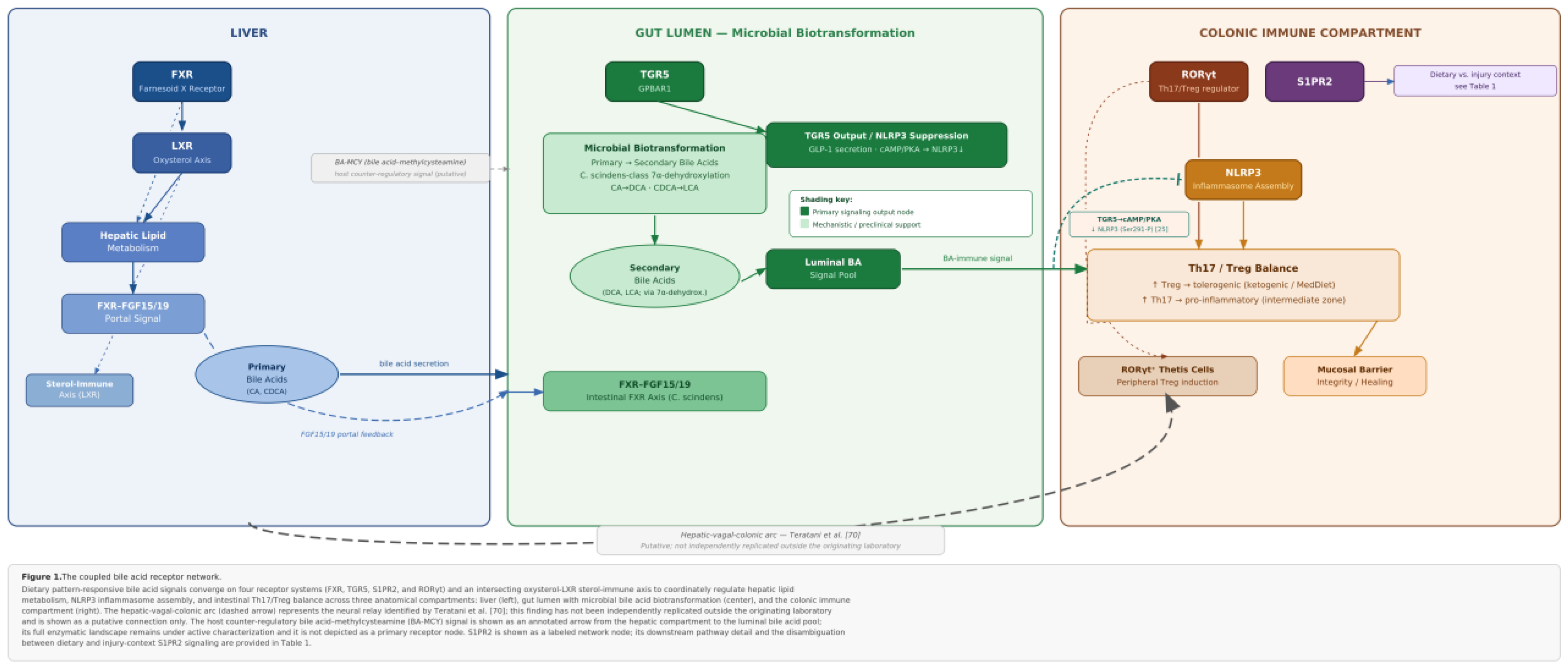
Figure 2.
Predicted bile acid signaling environments across three dietary configurations. Three-column comparative schematic contrasting the committed ketogenic configuration (verified blood BHB ≥0.5 mM), the intermediate zone (carbohydrate restriction without verified ketosis), and traditional Mediterranean diet across five dimensions: microbiome state, dominant bile acid species, predicted RORγt signal, predicted Th17/Treg balance, and lipid metabolic profile. Full green shading indicates coherent tolerogenic signaling supported by IBD-specific human evidence; lighter green shading indicates predicted coherent signaling supported by non-IBD human data or preclinical evidence only; amber indicates uncertain or transitional states; the intermediate zone column carries a footnote annotation confirming that no human study has yet characterized this group for bile acid profiles, Th17/Treg ratio, or fecal calprotectin. Within the committed ketogenic column, cells supported by IBD-specific human evidence are shaded in full green; cells supported by non-IBD human data or preclinical evidence only are shaded in lighter green to reflect the evidentiary asymmetry documented in the manuscript text and Table 2.
Figure 2.
Predicted bile acid signaling environments across three dietary configurations. Three-column comparative schematic contrasting the committed ketogenic configuration (verified blood BHB ≥0.5 mM), the intermediate zone (carbohydrate restriction without verified ketosis), and traditional Mediterranean diet across five dimensions: microbiome state, dominant bile acid species, predicted RORγt signal, predicted Th17/Treg balance, and lipid metabolic profile. Full green shading indicates coherent tolerogenic signaling supported by IBD-specific human evidence; lighter green shading indicates predicted coherent signaling supported by non-IBD human data or preclinical evidence only; amber indicates uncertain or transitional states; the intermediate zone column carries a footnote annotation confirming that no human study has yet characterized this group for bile acid profiles, Th17/Treg ratio, or fecal calprotectin. Within the committed ketogenic column, cells supported by IBD-specific human evidence are shaded in full green; cells supported by non-IBD human data or preclinical evidence only are shaded in lighter green to reflect the evidentiary asymmetry documented in the manuscript text and Table 2.
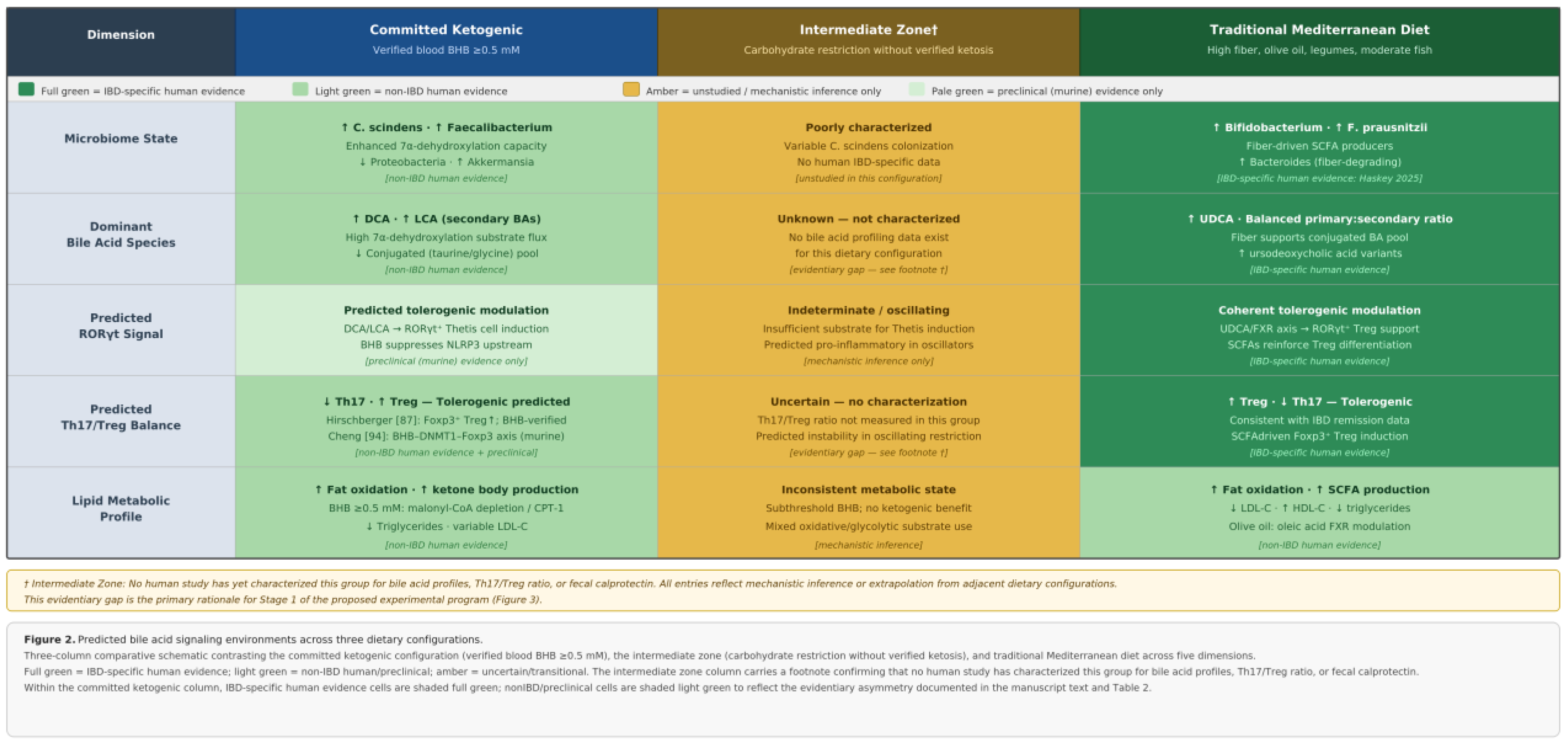
Figure 3.
A staged experimental program for testing bile acid-mediated simultaneous dietary effects. Vertical flow diagram with an entry node summarizing the current evidentiary gap, three major stage nodes, and two decision branches. Stage 1: cross-sectional bile acid metabolomics across four cohorts including a quiescent IBD arm. Stage 2: retrospective mediation analysis in stored biobank samples. Stage 3: prospective three-arm RCT with serial sampling at weeks 0, 2, 4, 8, and 12. A negative finding at any decision node does not nullify the empirical dietary hypothesis; it identifies the non-operative mechanism and redirects experimental design accordingly.
Figure 3.
A staged experimental program for testing bile acid-mediated simultaneous dietary effects. Vertical flow diagram with an entry node summarizing the current evidentiary gap, three major stage nodes, and two decision branches. Stage 1: cross-sectional bile acid metabolomics across four cohorts including a quiescent IBD arm. Stage 2: retrospective mediation analysis in stored biobank samples. Stage 3: prospective three-arm RCT with serial sampling at weeks 0, 2, 4, 8, and 12. A negative finding at any decision node does not nullify the empirical dietary hypothesis; it identifies the non-operative mechanism and redirects experimental design accordingly.
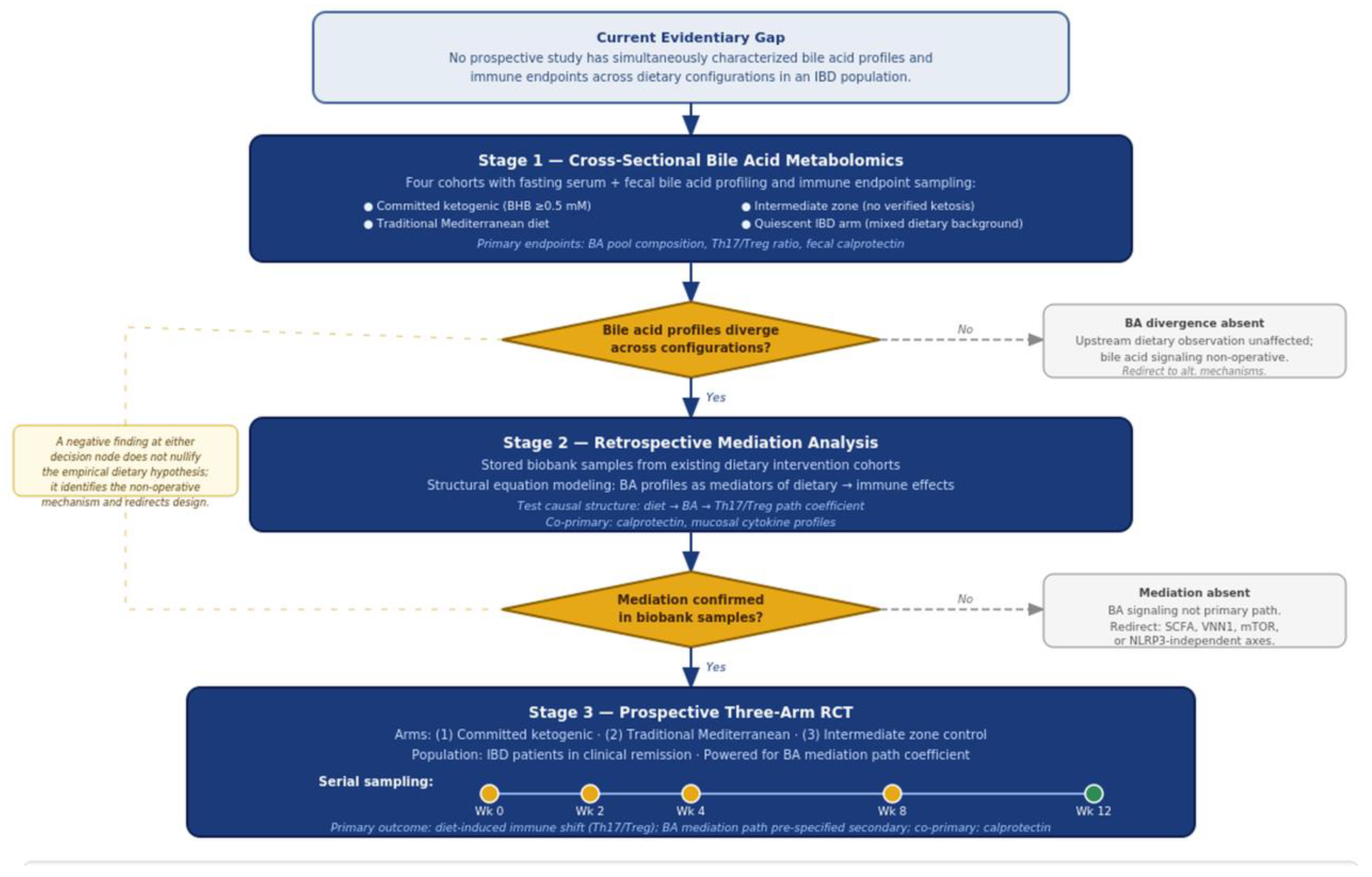

Table 1.
Receptor systems mediating bile acid and oxysterol signals across metabolic and immune domains.
Table 1.
Receptor systems mediating bile acid and oxysterol signals across metabolic and immune domains.
| Receptor | Primary Dietary Ligands | Tissue / Cell Type | Key Downstream Pathway | Supporting Evidence | Predicted Dietary Effect | Key Ref(s) |
|---|---|---|---|---|---|---|
| FXR (NR1H4) — FARNESOID X RECEPTOR | ||||||
|
FXR (hepatic) |
CDCA, DCA, LCA (secondary bile acids) | Hepatocytes | CYP7A1/CYP8B1 repression via SHP → bile acid synthesis suppression; SREBP-1c suppression → reduced lipogenesis; SUMO2-K277 → NF-κB transrepression | OCA (REGENERATE) improved hepatic fibrosis despite atherogenic lipid shift — confirms hepatic FXR engagement at pharmacological concentrations [39]; DIRECT-PLUS [44]: baseline fecal BAs modified MedDiet cardiometabolic response |
KD: elevated secondary BAs activate hepatic FXR; suppresses CYP7A1, reduces VLDL production MedDiet: diverse secondary BA pool maintains hepatic FXR tone Intermediate zone: oscillating BA environment — predicted incomplete FXR activation |
[22,23,24] |
|
FXR (intestinal) |
Secondary bile acids (same ligands; opposing functional context to hepatic FXR) | Intestinal epithelial cells | Intestinal FXR inhibition improves metabolic outcomes in obesity models; FGF15/19 signaling to liver; psyllium → intestinal FXR activation → colitis protection abolished in FXR-KO mice | Bretin et al. 2023 [49]: psyllium protects against DSS and T-cell-transfer colitis through FXR activation; first direct IBD-relevant demonstration of dietary fiber acting via intestinal FXR |
KD: substrate-depleted microbiome alters secondary BA profile at intestinal epithelium MedDiet: psyllium and soluble fiber components activate intestinal FXR; Bretin 2023 confirms FXR-dependent colitis protection |
[22,23,49] |
| TGR5 (GPBAR1) — G PROTEIN-COUPLED BILE ACID RECEPTOR | ||||||
|
TGR5 (L-cell) |
LCA, DCA, TDCA, TUDCA (secondary and taurine-conjugated species) | Enteroendocrine L-cells (ileum and colon) | cAMP → GLP-1 secretion → hepatic lipogenesis suppression, insulin sensitization, innate immune modulation; GLP-1 analogue therapy reduces inflammatory cytokines in immune cells [72] | TDCA and TUDCA elevated in KD-fed mice; correlational support n=416 observational and n=25 interventional human cohorts (Li et al. [50]: RED — no BHB verification; admissible as mechanistic plausibility for BSH-TGR5 pathway) |
KD: elevated TDCA/TUDCA provide TGR5 agonism; predicted enhanced GLP-1 output MedDiet: diverse secondary BA pool maintains TGR5 stimulation Intermediate zone: oscillating environment — predicted incomplete TGR5 activation |
[25,26,50,72] |
|
TGR5 (macrophage) |
LCA, DCA, TLCA (potent agonists) | Macrophages (intestinal and systemic) | cAMP/PKA → NLRP3 phosphorylation (Ser291 mouse; Ser295 human ortholog) → inflammasome assembly blocked [25]; PKD phosphorylates same residue at Golgi in activating context [27] — anti-inflammatory output is pathway- and compartment-dependent | TGR5 activation reduces oxidized LDL uptake and macrophage lipid loading in atherosclerosis models [26] — clearest example of cell-autonomous metabolic-immune coupling in this receptor class |
Both committed patterns: secondary BAs maintain TGR5-mediated NLRP3 suppression Intermediate zone: oscillating BA environment — predicted incomplete inflammasome suppression |
[25,26,27] |
| S1PR2 — SPHINGOSINE-1-PHOSPHATE RECEPTOR 2 | ||||||
|
S1PR2 (hepatocyte, dietary context) |
Conjugated bile acids (taurine- and glycine-conjugated primary and secondary species) | Hepatocytes | SphK2 → nuclear S1P → HDAC1/2 inhibition → SREBP-1c, FAS, LDLR upregulation → lipid metabolism gene activation [28] | Metabolic-protective role under dietary bile acid signaling [28]; distinct from injury-context S1PR2 behavior (see row below; see footnote¹) |
KD: elevated TDCA/TUDCA modulate hepatocyte S1PR2 tone MedDiet: diverse conjugated pool; S1PR2 hepatic signaling maintained |
[28] |
|
S1PR2 (macrophage, injury context — see footnote¹) |
Sphingosine-1-phosphate (S1P) — not a bile acid ligand in this context | Infiltrating macrophages (pathological liver injury) | SphK1 → NLRP3 inflammasome priming → pro-inflammatory cytokine expression [29] | Atorvastatin RCTs in UC [36,37,38]: serum S1P significantly reduced alongside IL-6 and TNF-α, linking HMG-CoA reductase inhibition to S1PR2/SphK1 pathway in colonic macrophages; included for disambiguation only Injury-context findings do not extrapolate to dietary signaling physiology |
Injury-context row; no dietary prediction applicable. Included to make the S1PR2 disambiguation visible at the table level. | [29,36,37,38] |
| RORΓT — RAR-RELATED ORPHAN RECEPTOR GAMMA T | ||||||
|
RORγt (colonic Th17 cell) |
3-oxolithocholic acid (3-oxoLCA), isolithocholic acid (isoLCA) — direct binding; competitive RORγt antagonists; 27-OHC (oxysterol) is a RORγt agonist in functional antagonism | Colonic Th17 cells | 3-oxoLCA and isoLCA bind RORγt → suppress Th17 differentiation [18]; 27-OHC activates RORγt → promotes Th17, suppresses Tregs [64,65] — functional antagonism at same receptor | Paik et al. 2022 [4]: 3-oxoLCA and isoLCA depleted in CD patients across two independent cohorts; depletion inversely correlated with IL-17-related gene expression Wang et al. 2025 [80]: isoalloLCA depleted in pediatric UC in proportion to disease severity |
KD: predicted increased 3-oxoLCA/isoLCA availability under committed microbiome configuration; 27-OHC production may decrease if hepatic cholesterol synthesis reduced (speculative) MedDiet: fiber substrate maintains Coriobacteriaceae; sustained 3-oxoLCA/isoLCA production Intermediate zone: incomplete microbiome restructuring — insufficient or oscillating 3-oxoLCA/isoLCA |
[4,18,64,65,80] |
|
RORγt (Foxp3⁺ Treg / isoalloLCA axis — see footnote²) |
Isoallolithocholic acid (isoalloLCA) — distinct stereoisomer from isoLCA; see footnote² | Foxp3⁺ regulatory T cells (colonic) | isoalloLCA → mitochondrial ROS → Foxp3 CNS3 enhancer → Foxp3⁺ Treg differentiation [18]; NR4A1 identified as downstream effector via distinct bacterial metabolite, independently of FXR and VDR [30] | Hirschberger et al. 2021 [87]: BHB-verified (self-managed ad libitum KD after counseling; BHB ≥0.5 mM confirmed at days 7, 14, 21), 44 healthy volunteers — Foxp3⁺ Treg expansion by flow cytometry, IL-10 upregulation, RNAseq-confirmed immunometabolic reprogramming (3 weeks; below 8-week threshold) Kabil et al. 2025 [82]: ILC3 suppression via RORγt-dependent mechanism attenuates intestinal fibrosis |
KD: committed microbiome may reduce isoalloLCA-producing Coriobacteriaceae; Treg-expanding signal may be partially replaced by BHB-direct immunometabolic reprogramming (Hirschberger [87]) MedDiet: high-fiber substrate maintains Coriobacteriaceae; sustained isoalloLCA production and Foxp3⁺ Treg expansion |
[18,30,82,87] |
| LXR (NR1H3/NR1H2) — LIVER X RECEPTOR (OXYSTEROL–STEROL IMMUNE AXIS) | ||||||
|
LXR-α (CD11c⁺ myeloid, mesenteric) |
Oxysterols: 27-hydroxycholesterol, 25-hydroxycholesterol (derived from cholesterol via CYP27A1/CYP7B1) | CD11c⁺ myeloid cells (mesenteric lymph node) | LXRα deficiency increases mesenteric Th17 cells via isoform-specific mechanism [62]; Jacobse et al. [63]: IL-23R signaling downregulates LXR target genes in colonic Tregs → impairs Treg stability | Parigi et al. 2021 [62]: LXRα deficiency increases mesenteric Th17 cells specifically; LXRβ deficiency increases RORγt⁺ Tregs specifically through CD11c⁺ myeloid signaling (non-overlapping isoform-specific functions); human scRNA-seq confirms IL-23R on colonic Tregs [63] |
KD: sustained malonyl-CoA depletion and β-oxidation predicted to reduce de novo cholesterol synthesis; potential 27-OHC reduction in macrophages (speculative; no direct human data) MedDiet: oxysterol remodeling not directly characterized under MedDiet No study has measured oxysterol profiles under committed dietary patterns in human IBD patients. |
[62,63,64,65,66,67,68] |
|
LXR-β (CD11c⁺ myeloid, mesenteric) |
Same oxysterol ligands as LXRα; broader tissue distribution | CD11c⁺ myeloid cells; also intestinal epithelium | LXRα deficiency increases mesenteric Th17 cells specifically; LXRβ deficiency increases RORγt⁺ Tregs specifically through CD11c⁺ myeloid signaling [62]; FXR-LXR crosstalk at shared gene regulatory networks predicted when bile acid and oxysterol precursor flux both altered | Parigi et al. 2021 [62]: LXRα-null mice show increased Th17 cells; LXRβ-null mice show increased RORγt⁺ Tregs — non-overlapping isoform-specific functions with distinct downstream cell types |
Both LXR isoforms: framework proposes committed dietary patterns shift hepatic cholesterol flux, altering both the bile acid pool and oxysterol landscape simultaneously, engaging FXR, TGR5, LXRα, and LXRβ as co-equal nodes in the coupled network All LXR dietary predictions are speculative; no direct measurement in human IBD under committed dietary conditions |
[62,63] |
¹ S1PR2 dietary (hepatocyte) and injury-context (macrophage) rows represent distinct signaling pathways through distinct kinases (SphK2 vs. SphK1) and must not be conflated. The injury-context row is included exclusively to make this disambiguation visible at the table level. ² isoalloLCA (Hang et al. 2019 [18]) and isoLCA (Paik et al. 2022 [4]) are distinct bile acid stereoisomers with distinct immune mechanisms: isoalloLCA promotes Foxp3⁺ Treg differentiation via mitochondrial ROS; isoLCA suppresses Th17 differentiation via RORγt binding. ³ All entries in the Predicted Dietary Effect column are mechanistic inferences from receptor pharmacology and preclinical evidence — not direct measurements under committed dietary conditions in human IBD populations. Additional abbreviations: SHP, small heterodimer partner (NR0B2; nuclear co-repressor mediating FXR transcriptional output via CYP7A1/CYP8B1 repression); CNS3, conserved noncoding sequence 3 (Foxp3 gene enhancer required for peripheral Treg induction by isoalloLCA); VDR, vitamin D receptor (responds to secondary bile acids, tolerogenic effects on dendritic cells).
Table 2.
Clinical evidence: bile acid, microbiome, and immune outcomes under dietary and pharmacological interventions.
Table 2.
Clinical evidence: bile acid, microbiome, and immune outcomes under dietary and pharmacological interventions.
| Study / Year | Design | Population (n) | Intervention or Exposure | Bile Acid or Microbiome Outcome | Immune or Clinical Outcome |
|---|---|---|---|---|---|
| IBD AND PSC HUMAN COHORT DATA — BILE ACID AND MICROBIOME EVIDENCE | |||||
|
Paik et al. Nature 2022 |
Cross-sectional; two independent IBD cohorts | CD patients and healthy controls | Gordonibacter pamelaeae and Coriobacteriaceae abundance; 3α/3β-HSDH enzyme gene expression | 3-oxoLCA and isoLCA biosynthetic genes and fecal metabolite levels significantly depleted in CD across both cohorts vs. controls | Depletion inversely correlated with IL-17-related host gene expression; most direct human translational evidence for the bile acid–Th17 regulatory axis in IBD [4] |
|
Kummen et al. Gastroenterology 2021 |
Shotgun metagenomics; multicenter | PSC patients and controls; n≈300 combined | PSC microbiome composition; stratified by concurrent IBD status | Eubacterium spp. and Ruminococcus obeum depleted in PSC independent of IBD status; genera encode 3α/3β-HSDH and 7α-dehydroxylation enzymes for 3-oxoLCA/isoLCA biosynthesis | IBD-independent depletion: bile acid-transforming capacity impaired upstream of diet-microbiome interaction; establishes PSC as human model of the proposed bile acid–immune tolerance breakdown [5] |
|
Mousa et al. Hepatology 2021 |
Population-scale cross-sectional; Mayo Clinic | 400 PSC vs. 302 controls | Fecal and serum bile acid profiles; primary-to-secondary bile acid ratios | Markedly elevated primary-to-secondary bile acid ratios in PSC; quantitative confirmation of deficient secondary bile acid conversion at population scale | Quantitative confirmation of the bile acid environment predicted by microbiome depletion findings; strengthens PSC-as-model-disease argument [7] |
|
Chan et al. JHEP Rep 2024 |
Cross-sectional with 16S microbiome profiling | 26 early-stage PSC patients and controls | Fecal bile acids; gut microbiota; dietary intake; BA synthesis and FXR activity markers | Fecal DCA significantly lower in PSC vs. controls (pₐₑⱼ=0.04); Blautia and Lachnoclostridium abundance positively correlated with fecal DCA; DCA negatively correlated with total bilirubin (p=0.006) | DCA reduction not mediated by BA synthesis or FXR activation; microbiome-driven mechanism; Blautia and Lachnoclostridium as candidate restorative genera under dietary intervention [6] |
| ⚠MEASUREMENT GAP — No published study has directly measured 3-oxoLCA, isoalloLCA, isoLCA, or isoDCA in PSC stool or tissue. The inference chain (depleted secondary BA-producing bacteria → reduced immunomodulatory trace bile acids → Th17/Treg imbalance) is the central untested prediction of this framework. Direct trace bile acid measurement in PSC stool is a Stage 1 priority target. | |||||
| MEDITERRANEAN DIET — RCT AND COHORT EVIDENCE IN IBD-RELEVANT POPULATIONS | |||||
|
Seethaler et al. Life Sci 2025 |
Exploratory analysis of RCT (LIBRE trial; NCT02087592) | 68 women with impaired intestinal barrier (n=33 MedDiet, n=35 control) | Mediterranean diet vs. standard diet; 12 weeks | MedDiet decreased fecal DCA and LCA; increased UDCA; formal mediation analysis confirmed bile acid changes mediated beneficial effects on intestinal barrier integrity (zonulin, LBP) | First RCT demonstrating that MedDiet-induced bile acid compositional shifts mechanistically mediate a gut-specific endpoint; distinct from DIRECT-PLUS (baseline BAs modified response magnitude) [45] |
|
Strauss, Haskey et al. Int J Mol Sci 2023 |
WGCNA metabolomics; randomized pilot (NCT04474561; small n¹) | n=29 quiescent UC; MedDiet n=13 responders, n=16 non-responders | Mediterranean diet vs. Canadian habitual diet; 12 weeks | Bile acid profiles within a WGCNA-identified metabolite cluster mediated the relationship between Mediterranean diet score and fecal calprotectin | Pilot-scale signal for bile acid-mediated immunological response; Faecalibacterium prausnitzii, Dorea longicatena, Roseburia inulinivorans identified as functional mediators [47] |
|
Haskey et al. J Crohns Colitis 2023 |
Randomized controlled trial (NCT03053713; pilot study¹) | n=28 quiescent UC; 12 weeks | Mediterranean diet vs. control diet; 12 weeks | Microbiome reshaped toward Mediterranean-associated taxa; dysbiosis markers improved in MedDiet arm; no direct bile acid metabolomics | 20% of MedDiet participants had fecal calprotectin >100 μg/g vs. 75% of controls; IBD-specific RCT-level evidence for MedDiet effect on mucosal inflammatory activity [46] |
|
Godny et al. Gastroenterology 2025 |
Prospective cohort; dietary recall-based adherence scoring (no dietary assignment) | 271 newly diagnosed CD patients; median 27-month follow-up | Mediterranean diet adherence score; bile acid profiles, kynurenines, Faecalibacterium, SCFAs | Higher MedDiet adherence inversely correlated with primary bile acids and pro-inflammatory kynurenines; positively correlated with Faecalibacterium and SCFAs | MedDiet adherence inversely correlated with CDAI, fecal calprotectin, and CRP; largest IBD-specific cohort with simultaneous favorable shifts in lipid-adjacent and immune markers [48] |
|
DIRECT-PLUS Trial (Gao P et al.) Gut Microbes 2024 |
Multi-omics RCT analysis; n=284 | 284 adults; healthy dietary guidelines or two MedDiet variants; 18-month follow-up | Longitudinal fecal bile acid metabolomics (44 species); gut microbiome shotgun sequencing | Baseline fecal BA levels significantly modified cardiometabolic response to MedDiet; 14 fecal BAs prospectively associated with BMI and lipid profiles | First RCT evidence of bile acid profile-mediated modification of a dietary intervention's cardiometabolic effect; mechanistically distinct from Seethaler 2025 [44] |
| KETOGENIC DIET — PRECLINICAL AND IBD-RELEVANT EVIDENCE | |||||
|
Hirschberger et al. EMBO Mol Med 2021 |
Prospective intervention; BHB-verified (TIER 1) | 44 healthy volunteers; ≤30g/day CHO; BHB verified ≥0.5 mM throughout | Strictly enforced very-low-carbohydrate diet; blood BHB verified ≥0.5 mM throughout; 3 weeks | No bile acid metabolomics conducted | Foxp3⁺ Treg expansion by flow cytometry; IL-10 upregulation; RNAseq-confirmed immunometabolic reprogramming toward oxidative phosphorylation. Only human study with BHB-verified committed ketosis demonstrating Treg expansion; 3 weeks (below 8-week threshold); healthy volunteers, not IBD patients [87] |
|
Westman et al. Int J Cardiol 2006 |
24-week RCT vs. low-fat diet; urinary ketone monitoring (TIER 2 — blood BHB not measured²) | 119 overweight hyperlipidemic adults (n=60 KD, n=59 low-fat); NMR lipoprotein subfraction analysis | Low-carbohydrate ketogenic program (≤20g/day CHO) vs. low-fat diet | Urinary ketones positive throughout; blood BHB not measured — committed-ketosis threshold unconfirmed (TIER 2) | KD arm: large VLDL −78%, small LDL −78%, medium LDL −42%, large HDL +21% by NMR; most detailed lipoprotein subfraction data under strict carbohydrate restriction; no immune outcomes measured [86] |
|
Norwitz and Soto-Mota Front Nutr 2024 |
Case series (AMBER — signal only; no BHB documentation in C-11 format³) | 10 IBD patients (6 UC, 4 CD) | Carnivore-ketogenic diet; clinical outcomes reported; no BHB verification | No bile acid or microbiome measurements; metabolic state not verified by blood BHB meeting C-11 criteria | Universal clinical improvement reported; most discontinued medications; only IBD-specific human clinical signal for the ketogenic pole. Insufficient for clinical inference; provides signal for prospective investigation [54] |
|
Kong et al. Signal Transduct Target Ther 2021 |
Mouse DSS colitis model (RED — murine; 6-hydroxylated BA pool absent in humans) | C57BL/6 mice; DSS colitis model | Ketogenic diet vs. control; fecal microbiota transfer to germ-free mice | KD restructured gut microbiota; fecal microbiota transfer confirmed microbiome-dependent mechanism | KD reduced colonic RORγt⁺CD3⁾ ILC3s and inflammatory cytokines; ILC3 reduction warrants prospective human investigation given ILC3 role in sustaining colonic Th17 programs in IBD [53] |
|
Huang et al. BMC Med 2022 |
Human tissue + murine DSS model (GREEN for IBD relevance of BHB deficit; murine intervention component RED) | IBD patients and healthy controls (tissue); C57BL/6 mice (DSS model) | Colonic mucosal BHB measurement in IBD patients; rectal BHB enema in DSS colitis mice | BHB significantly reduced in colonic mucosa of UC and CD patients; inversely correlated with disease activity | Colonic mucosal BHB deficit in IBD patients is the primary IBD-specific translational finding (GREEN); STAT6/M2 mechanism in mice requires human validation; colonic BHB deficit is distinct from measuring dietary ketosis [52] |
| ⚠MEASUREMENT GAP — No study has simultaneously verified blood BHB ≥0.5 mM, characterized the bile acid and SCFA metabolome, and measured Th17/Treg balance in the same subjects under committed ketosis sustained ≥12 weeks. Hirschberger [87]: BHB-verified and Treg measured, but healthy volunteers, 3 weeks, no bile acid metabolomics. Westman [86]: lipoprotein subfractions documented (urinary ketone compliance only; blood BHB not measured; omega-3 supplementation confound) but no immune outcomes. This three-failure design gap is the primary methodological motivation for the Stage 1 experimental program. | |||||
| CHOLESTEROL–IMMUNE NODE — STATIN RCT EVIDENCE IN UC (INDIRECT SUPPORT FOR OXYSTEROL-LXR AXIS) | |||||
|
AlRasheed, Alarfaj, Khrieba et al. J Clin Med / Front Med / Front Pharmacol 2025 |
Three independent RCTs (same clinical program, Tanta and Horus University) | Active UC; combined n≈300; atorvastatin 80mg added to standard mesalamine | Atorvastatin adjunctive therapy vs. mesalamine alone; multiple biomarker panels | Alarfaj et al. [37]: significant reduction in serum S1P in atorvastatin arm — links HMG-CoA reductase inhibition to S1PR2/SphK1 pathway in colonic macrophages; Mendelian randomization [69]: HMGCR-mediated LDL-C lowering does not increase IBD risk; PCSK9-mediated LDL-C lowering paradoxically does | All three trials: significant reductions in disease activity, IL-6, TNF-α, and fecal calprotectin vs. mesalamine alone; converging evidence that cholesterol pathway interventions alter IBD-relevant inflammatory signals through pleiotropic mechanisms [36,37,38,69] |
¹ Haskey 2023 [46] (NCT03053713) and Strauss/Haskey 2023 [47] (NCT04474561) were pilot studies; results require confirmatory replication in adequately powered cohorts. ² Westman [86] is TIER 2 under C-11: urinary ketone monitoring only; blood BHB not measured; committed-ketosis threshold unconfirmed. ³ Norwitz and Soto-Mota [54] is AMBER: case series; no BHB documentation in C-11 format; insufficient for clinical inference. RED entries (Kong [53], Huang [52] murine intervention) derive from DSS mouse models with 6-hydroxylated BA pools absent in humans; mechanistic inferences require prospective human validation. The Soto-Mota et al. 2025 longitudinal KETO-CTA study [16] was retracted by JACC Advances; no reliable longitudinal plaque data are available from that cohort. TIER 1 classification for Burén 2021 [88] reflects blood BHB ≥0.5 mM confirmed in every participant at study endpoint (day 29) with daily compliance monitored by urinary ketones; it does not reflect continuous blood BHB verification throughout the study. Evidence classification key: TIER 1, blood BHB verified ≥0.5 mM throughout study duration; TIER 2, urinary ketone monitoring only; AMBER, uncontrolled clinical signal (case series); RED, murine model without direct human translational value for this pathway; GREEN, IBD-relevant human biological finding. Additional abbreviations: CDAI, Crohn’s Disease Activity Index; CRP, C-reactive protein; ILC3, group 3 innate lymphoid cells; BSH, bile salt hydrolase; WGCNA, weighted gene co-expression network analysis.
Table 3.
Discriminative predictions of competing mechanistic hypotheses across Stage 1 outcome domains.
Table 3.
Discriminative predictions of competing mechanistic hypotheses across Stage 1 outcome domains.
| Outcome Domain | H1: Bile Acid Signaling | H2: BHB-Direct NLRP3 Inhibition | H3: Kbhb-mTOR / Epigenetic | H4: Oxysterol-LXR (Exploratory) | Decision Rule |
|---|---|---|---|---|---|
| Immunomodulatory bile acid concentrations (3-oxoLCA, isoalloLCA, isoLCA, isoDCA) | Predicted higher in committed vs. intermediate groups; HMCRI predicted lower. Mechanistic rationale: these species suppress Th17 via RORγt binding and expand Tregs via mitochondrial ROS [18,19]; their depletion is documented in IBD cohorts [4], not in dietary adherence groups. BA-MCY FXR antagonist biology established in mouse and limited human serum data [21]; dietary-group predictions are untested. | No specific prediction; BHB-direct NLRP3 inhibition operates through K⁺ efflux blockade [51]; relationship to bile acid pool composition not tested. | No specific prediction; Kbhb operates through histone modification [57] and ALDOB K108bhb-mediated mTOR inhibition [58]; relationship to bile acid concentrations untested. | Predicted to correlate inversely with 27-OHC via shared RORγt competition; mechanistic rationale from mouse models [62,64]; gut-specific demonstration not established. Exploratory. | Bayesian SEM + LOO-CV |
| Th17/Treg balance (flow cytometry) | Predicted improved in committed vs. intermediate; immunomodulatory bile acid concentrations predicted to mediate this improvement in SEM [18,19]. HMCRI predicted to track direction of effect [21]. Discriminating feature: H1 predicts bile acid mediation of both lipid and immune outcomes simultaneously; neither H2 nor H4 predicts this co-mediation. All dietary-group predictions are untested. | BHB inhibits NLRP3 assembly via K⁺ efflux blockade in macrophages and human monocytes [51]; predicts Th17/Treg benefit in committed KD arm specifically, not Mediterranean arm (BHB concentration-dependent). Bile acid independence inferred, not directly tested. | Not directly testable in Stage 1; BHB concentration serves as indirect proxy for Kbhb substrate availability only [57,58]. Formal test planned for Stage 3 (sorted Treg Kbhb ChIP-seq). | LXR deficiency increases mesenteric Th17 in mouse models [62]; IL-23R suppresses LXR target genes in colonic Tregs [63]. 27-OHC promotes Th17 via RORγt in neurological models [64,65]; gut demonstration not established. Exploratory. | Bayesian SEM + LOO-CV |
| Lipoprotein subfractions (NMR) | Favorable subfraction profile predicted in committed groups. FXR activation suppresses VLDL-TG secretion via SHP-SREBP-1c repression [22,23] and is a candidate partial mediator; malonyl-CoA/CPT-1 disinhibition is the more direct explanation for KD remodeling and is not a bile acid mechanism. H1 predicts both outcomes co-mediated; this is the discriminative claim. | No direct lipid prediction; NLRP3 mechanism is primarily immune. Lipoprotein subfraction differences between groups attributable to malonyl-CoA/CPT-1, not to NLRP3 [51]. | ALDOB K108bhb-mediated mTOR inhibition demonstrated in cancer cell lines [58]; specific lipoprotein subfraction prediction in human dietary contexts is untested. | 27-OHC predicted lower in committed KD via reduced hepatic cholesterol availability; co-directional lipid improvement is a speculative downstream inference. No human dietary oxysterol-lipoprotein data in IBD. Exploratory. | Bayesian SEM + LOO-CV; exploratory for H4 |
| HMCRI (BA-MCY / immunomodulatory secondary BA sum) | Predicted lower in committed vs. intermediate groups; predicted higher in IBD/PSC regardless of dietary pattern (Coriobacteriaceae depletion as driver). BA-MCY FXR antagonist biology established [21]; HMCRI as a named construct is manuscript-derived and requires Stage 1 empirical validation. Reference ranges do not yet exist. | No prediction; BHB-direct NLRP3 mechanism does not engage BA-MCY counter-regulation. | No prediction; Kbhb-mTOR mechanism does not engage BA-MCY counter-regulation. | No prediction; oxysterol-LXR mechanism does not engage BA-MCY counter-regulation. | Bayesian SEM + LOO-CV |
H1 is designated the primary hypothesis; H2, H3, and H4 are explicitly ranked by prior probability as detailed in the text following this table. Bayesian SEM: structural equation model with weakly informative priors; LOO-CV: leave-one-out cross-validation; LOO information criterion (LOOIC) difference ≥4 constitutes meaningful hypothesis discrimination. SEM: structural equation model. Kbhb: lysine β-hydroxybutyrylation. 27-OHC: 27-hydroxycholesterol. BA-MCY: bile acid–N-acetylcysteine-taurine conjugates (host counter-regulatory FXR antagonist pool). All H1 predictions are derived from mechanistic rationale in primary references cited; citations indicate the basis for each prediction, not observed dietary-group data.
Disclaimer/Publisher’s Note: The statements, opinions and data contained in all publications are solely those of the individual author(s) and contributor(s) and not of MDPI and/or the editor(s). MDPI and/or the editor(s) disclaim responsibility for any injury to people or property resulting from any ideas, methods, instructions or products referred to in the content. |
© 2026 by the authors. Licensee MDPI, Basel, Switzerland. This article is an open access article distributed under the terms and conditions of the Creative Commons Attribution (CC BY) license (http://creativecommons.org/licenses/by/4.0/).
Copyright: This open access article is published under a Creative Commons CC BY 4.0 license, which permit the free download, distribution, and reuse, provided that the author and preprint are cited in any reuse.


