
Submitted:
02 July 2023
Posted:
04 July 2023
You are already at the latest version
Abstract
This article presents a state-of-the-art literature review to understand people’s perceptions and opinions of Autonomous Vehicles (AVs) and the factors that influence AV adoption. A strategic literature search was conducted to select articles for this review. Most of the articles were published within the last five years and they used a household questionnaire survey to collect data. Mostly, they used statistical and econometric methods to evaluate the factors that affect people’s intentions to adopt AVs. The results show that psychological factors often appear as the most important internal factors of people’s willingness to adopt AVs. Additionally, other internal factors such as the socioeconomic profile of individuals and their household, and knowledge and familiarity with AV technologies would affect AV adoption tendencies. User attributes also indirectly affect AV adoption by influencing the psychological factors of users. We identify several critical external factors such as opportunities (e.g., safety and security, low congestion, energy use) and challenges (e.g., system failure, privacy breach, and legal issues), while another influential group includes transportation factors (e.g., travel mode, distance, and time), urban form (e.g., urban/rural, density, land use diversity), affinity to new technology, and the institutional regulatory environment. We discuss some recommendations for policy makers, auto industries, and private stakeholders to formulate policies and strategies to increase market share of AVs. Finally, we identify some limitations of previous studies and provide a blueprint for future research on AV adoption.
Keywords:
Autonomous vehicle
; self-driving car
; public perceptions
; willingness to use
; human factors
; new technologies
1. Introduction
In this age dominated by motorization, policy priorities on traffic safety, congestion mitigation, and carbon emission reduction motivate business and civic leaders to seek the deployment of alternative mobility options. Recent technologies and services such as Electric Vehicles (EV), Connected Vehicles (CV), Autonomous Vehicles (AV), and shared mobility are the most significant advances in modern transportation; they are expected to transform overall transportation systems in the coming years [1,2,3,4,5,6]. These technological breakthroughs may bring transformational changes in vehicle ownership, travel patterns, parking demand, infrastructure supply, energy use, emissions, and accidents [7,8,9]. However, as some of them remain to be deployed commercially, such as in the case of AVs, the extent of the impacts put forth on personal mobility, on vehicular movement, and on urban development patterns is still quite uncertain and often assessed with computer simulations only [10]. While it is envisioned that people will interact with AVs actively as passengers or passively as road users [1], an assessment of their willingness to accept this new technology is crucial to predict trends in the market penetration of AVs [11] and to plan for ensuing degrees of departure from business as usual scenarios in urban and territorial organization. Thus, this study seeks to review and interpret the fast growing body of literature aimed at understanding the factors that influence people’s willingness to adopt AVs, and by doing so, at understanding people’s perceptions and opinions on AV functionalities.
In a narrow sense, AVs (also known as self-driving, driverless, and robotic cars) are vehicles that can drive and navigate themselves without human control by using sensing technologies (e.g., radar, Global Positioning System (GPS), and computer vision) and control systems (i.e., sensors) [8,12,13]. More broadly, according to the National Highway Traffic Safety Administration (NHTSA), AVs are those vehicles in which at least one of the critical safety control functions (e.g., steering, acceleration/deceleration, or braking) are performed without human input [14]. AVs have some level of automation to assist drivers or replace drivers to take full control of the vehicle [15]. The Society of Automotive Engineers (SAE) differentiates between 5 levels1 of vehicle autonomy ranges, from Level 0 (No autonomy) to Level 5 (Full autonomy) [16]. In this paper, we analyze and discuss factors of adoption of AVs at levels 2 to 5, as the propensity to adopt is a rather fluid phenomenon and so are human perceptions and opinions vis-à-vis AV functionalities.
Researchers have echoed the expectation that AVs would offer a wide range of social, economic, and environmental benefits to city dwellers, despite some concerns about system security and data privacy [17]. They have projected a reduction in traffic crashes, congestion, vehicle ownership, parking demand, energy consumption and emissions, and an increase in human mobility and convenience [18,19,20]. Additionally, Shared AVs (SAVs) have the potentials to reduce overall travel distance and time by reducing empty Vehicle Miles Traveled (VMT). Considering the enormous possibilities of AVs as a new mobility option, governments and manufacturers around the world are showing a growing interest in formulating AV policies, in adopting AV technology elements and in on-road vehicle testing [21,22]. Most automobile companies have retrofitted existing vehicles by incorporating some extent of autonomy and some companies have developed and tested full AVs. Thus, AVs are not a fantasy anymore and it is expected that very soon (i.e., Level 2 vehicle by 2025, Level 3 by 2040, and Level 4 or 5 by 2050), they would be used by millions of people for their daily travels. At present, most commercially operated AVs include Level 1 ~ Level 3 autonomy (e.g., emergency braking, blind-spot detection, lane-keeping) only, due to limited progress in technology and to the high cost of sensors [23]. Researchers have argued that a higher level of vehicle autonomy would induce people to raise their outlook on adoption [17]. Although many studies have investigated the level of human acceptance of AVs, they often do so inadequately, particularly with regard to the pace this new technology would be accepted and adopted [23,24,25]. It is also postulated that intricate regulations, technical difficulties, public perceptions, and safety concerns would restrain the broad base adoption of AVs [26]. However, public perceptions of AVs are rather fluid, evolving rapidly with increasing access to vehicles and more widespread discourse on this mobility technology [25].
Over the past years, a few review studies have sought to synthesize the state of knowledge on people’s perceptions of AVs and on the factors that influence people’s intention to adopt AVs. However, they have seldom discussed the external factors of AVs (e.g., environment, institutions) [27]; they have overlooked significant psychological factors such as perceived benefits, perceived behavioral control, and social influence [28,29]. Additionally, people’s perceptions and determinants of AVs have been changing rapidly due to the evolving nature of this novel technology [30]. A recent article reviewed studies on public acceptance of AVs and investigated the spatio-temporal distribution of publications and emerging research trends by using bibliometric techniques; however meritorious this undertaking was, the study disregarded the key factors of AV adoption themselves [31]. Thus, an updated review study centering on people’s perception and on all factors of AVs is needed to understand the current state of affairs on AV adoption and to outline a pertinent agenda for future research. The structured identification of the factors that condition public perception lead to an evidence-based understanding of the likelihood and pace of AV adoption by the public at large and lay the pathway to the successful integration of AVs with existing traffic management systems and practices [24]. Therefore, in this review, we will:
- 1)
- Evaluate the state of perceptions and opinions of people on AV functionality in different study contexts;
- 2)
- Identify the internal and external factors that condition people’s proclivity towards AVs and the functionality they provide; and
- 3)
- Specify research gaps in the existing literature and where opportunities exist for future research on willingness to adopt AVs.
This state-of-the-art review study makes significant contributions to the literature by synthesizing existing published works on public perception and determinants of AVs. It has five specific contributions. First, the study critically evaluates the selected articles to understand people’s perceptions and opinions about AVs. Second, it determines the key internal and external factors that influence people’s intention to adopt and use AVs. Third, a conceptual framework is proposed articulating the external and internal factors of AV adoption, which will be helpful for policy makers to conceptualize this complex ecosystem. Fourth, the study presents some guidelines for transportation planners, policy makers, auto industries, and concerned private stakeholders to formulate appropriate policy strategies to encourage people to use AVs and increase market penetration. Finally, the paper identifies several shortcomings in the literature and frames directions for future research.
The rest of the paper is outlined as follows. The second section introduces our search strategies and different attributes of reviewed articles and reports. A synthesis of the results from previous studies is presented in the third section. Research gaps and shortcomings of prior research and directions for future study are drawn in section four. Finally, conclusions are drawn in section five.
2. Materials and Methods
2.1. Study approach
This state-of-the-art literature review is conducted to identify, evaluate, and critically analyze relevant scholarship to understand people’s perceptions and opinions about AVs and to identify the factors that influence AV adoption. The overall study approach is illustrated in Figure 1. First, a scan of the literature was conducted to select published articles and reports to be included in the review process. Some keywords (e.g., autonomous vehicle, connected and autonomous vehicle, self-driving car, driverless car, public perceptions, opinions, willingness, attitude, opportunities, and challenges) were used as search terms to identify relevant articles. Widely used databases such as ScienceDirect, Scopus, SAGE Journals, SpringerLink, Taylor & Francis, and Web of Science, Google Scholar, and the website of different organizations, are the main platforms to identify articles and reports suitable for inclusion in the review process. Items were selected based on these additional criteria:
- 1)
- Whether the article/report is written in English;
- 2)
- Whether the study was conducted within the last five years; and
- 3)
- Whether the study has evaluated perceptions and opinions on AVs.
A few studies conducted before 2015 are included in this review for a more comprehensive scan of scenarios and technological developments related to AVs and Connected and Autonomous Vehicles (CAVs). The search identified more than 100 articles and reports. However, after closer examination, 50 were deemed pertinent to the objectives of the study and are included in this state-of-the-art review study. Of these items, 62% have been published in just two periodicals, namely Transportation Research Part C: Emerging Technologies (32%) and Transportation Research Part F: Traffic Psychology and Behaviour (30%). About 90% of the selected items were published between 2015 and 2020, the rest being published before 2015. During the process of filtering published works, the researchers were careful to select them from different study contexts to get a comprehensive review. Finally, these research items were critically analyzed to assess their contribution to the understanding of public perceptions and opinions on AVs and of the factors that influence AV adoption.
2.2. Attributes of reviewed articles and reports
Different attributes (e.g., authors, study contexts, data sources, sample size, and methods) of articles and reports reviewed here are reported in Table 1. The table indicates that 32.31%, 27.69%, and 26.15% of articles/reports have been conducted on North American, European, and Asian countries, respectively; 13.85% of studies are about the Australian context. Most studies (80%) conducted web-based or face-to-face household questionnaire surveys to collect primary data on people’s perceptions and opinions on AVs. However, a handful of studies (14%) performed experiments and collected data from the participants of driving simulators. There is high variability in sample sizes across studies. The smallest sample (i.e., 19) is used in Hilgarter and Granig [24], while Shin, Tada [32] collected data on 246,642 individuals, which adequately represent the population of the study area. Table 1 also indicates that studies have used a variety of statistical and econometric models to conceptualize people’s perceptions of AVs and associated factors.
The core themes discussed in the reviewed papers are identified in Figure 2. The majority of studies (80%) collected socioeconomic information on the respondents and investigated their effects on the decision-making process to adopt AVs. A considerable number of studies explored people’s awareness and knowledge of AVs and their features (42%) and opportunities and challenges (40%) towards the increase of AV market share. A nearly equal number of studies (34% and 32%) investigated the influence of psychological and transportation factors on AVs adoption, respectively. About 24% of studies discussed people’s inclination to adopt and use AVs. The influence of urban form (20%) and technology savviness (14%) on AVs adoption was mentioned in a relatively small number of studies. The condition and effects of institutional settings were described by only 4% of studies. Considering the significant implications of psychological and socioeconomic attributes, transportation factors, urban form, technological innovation, and institutional regulations and guidelines in motivating people towards AVs, their detailed discussion in different study contexts with a diverse background of customers is crucial.
3. Synopsis of the literature
3.1. Contextualization of the factors of AV adoption
A conceptual framework is proposed to cohesively articulate the web of factors that influence people towards adoption and use of AVs. Figure 3 shows the factors that fit this framework and the interactions between them. This framework is grounded in the evidence-based research reported in this literature review. It is centered on the individual person and/or household positioning themselves with respect to the AV mobility option and associated functionalities by either espousing the adoption and use of AVs or standing against it. Some factors are internal and pertain to the psychology and cognition of technological change, or to innovation receptiveness, risk aversion, trust, sense of usefulness of AV technologies. Affinity with new technologies also predisposes individuals towards AVs. For example, people are more interested to adopt and use certain vehicles if these vehicles are equipped with advanced automation and connectivity technologies (e.g., automated speed control, braking and parking, collision warning, blind-spot detection, lane-changing warning). Deeper trust in automation and in connectivity technologies to safeguard from traffic crashes induces people to use AVs. Perceived ease of use and usefulness of AVs, prior experience or knowledge of AVs, attitudes, and perception of AVs significantly influence the willingness of people to adopt AVs. Thus, evidence supports that all these factors significantly affect the decision-making process of consumers to adopt and use AVs.
Other internal factors include various user attributes (i.e., socioeconomic features) that condition attitudes and willingness to adopt. For example, people with higher income and higher educational attainment are more willing to adopt and use AVs. User attributes also affect AV adoption and use indirectly, by conditioning psychological factors of potential users regarding AVs.
Other factors are exogeneous, such as factors of urban form (e.g., urban/rural, density, land-use diversity), which may also influence AV adoption outcomes by shaping people’s preferences. For example, all other things being equal, urban residents may be more inclined to adopt and use AVs than rural populations.
Exogeneous factors also encompass transportation factors (e.g., travel mode, distance, and time), affordability of new technologies, and the institutional context of public policies and politics. For example, frequent users of public transportation systems may be more likely to also use SAVs owing to the shared properties between these modes, while people who drive to destinations are more interested in owning their personal AVs. The affordable access to cutting-edge AV safety technologies could also motivate people to use AVs. The ambient technologies, their affordability, and deep-seated and learned personal attitudes towards them form a powerful dynamic socio-technical context out of which opportunities and challenges of AVs are articulated by potential users. These, in turn, frame their willingness to use and adopt AV technologies. Similarly, effective institutional supports (e.g., precise and updated traffic regulations, financial incentives) could positively affect the AV adoption tendency of people. The various considerations boxed together in Figure 3 are discussed in turn in the subsequent sections.
3.2. People’s willingness to use AVs and associated factors
Many studies have investigated the willingness of people to expand their transportation budget to take advantage of AV functionalities and have found a certain reluctance to do so [47,48,55]. They show that people are more interested in riding an AV than in owning or leasing one [47]. However, despite the higher price in personal AVs in the near term, close to half the respondents (48.72%) in Washington State showed an interest in them for commuting purposes due to their greater convenience [48]. Surveying potential users in the US, Bansal and Kockelman [55] also found that 45.8 to 50.7% of respondents showed a certain interest in AV technologies. More specifically, 24 to 57% of respondents would like to add Level 3 or Level 4 automation in their vehicles [36] and 41 to 59% of respondents are interested to own or share AVs in Austin, TX [72].
As indicated in more detail in Table 2, studies have found several factors that rather consistently stand out as meaningful controls of people’s willingness to use AVs. These include several socio-economic traits (e.g., higher household income, children in the household), personal attitudes like being tech savvy, mobility conditions (car ownership, driving alone, disability status (given the travel assistance benefits provided by AVs), well connected street network, permit to AVs to drive on local streets as well as on freeways), and technological advancements embedded in AVs (higher traffic safety and reduced burden of driving) [32,36,44]. In contrast, the most prominent factors that dampen people’s willingness to use AVs include certain socio-economic traits (holding a driver’s license), personal attitudes (security concerns, ride sharing attitudes), mobility aspects (driver’s license, AV license to drive on local roads only), costs (vehicle purchase and operational cost), and technological advancements of AVs (cybersecurity) [25,32,36]. Studies suggest that the drop in purchase and operating costs would increase people’s willingness to use AVs. For example, reducing travel costs from $1/mile to $3/mile can increase people’s interest in using AVs from 3% to 41% in the US [36]. Thus, it is expected that overall ownership and maintenance costs will strongly determine future adoption and use of AVs.
Considering attitudes and perceptions of populations along with other factors, researchers have reported that many people would be interested to adopt the novel technologies embedded in AVs. These studies have applied various existing cognition and decision theories, such as the Theory of Reasoned Action (TRA), Theory of Planned Behavior (TPB), Technology Acceptance Model [73,74,75], to conceptualize and understand the factors that influence people’s Behavioral Intention (BI) (i.e., willingness) to adopt AVs. According to these theories, human BI to actual AV use is directly influenced by behavioral control factors (e.g., socioeconomic and travel factors), objective factors (i.e., urban form), and psychological factors (i.e., perceived usefulness and perceived ease of use). Additionally, these models indicate that the actual use of AVs also depends on the availability of novel technologies (e.g., EV, solar panel) and people’s affinity towards them. Socioeconomic factors also indirectly affect AV use by influencing objective factors, psychological factors, and the affinity of people towards technology.
3.3. Psychological factors of AV adoption
A number of studies have investigated the behavioral intentions to adopt and use AVs by estimating the impacts of Perceived Usefulness (PU), Perceived Trust (PT), Perceived Ease of Use (PEU), Social Influence (SI), and Traffic Safety (TS). These studies have demonstrated the critical role of a rich array of psychological factors, as indicated below. Compared to other factors (e.g., socioeconomic and demographic, built environment), psychological factors alone explain 43.7% [33], 67.8% [59], 69% [70], 71% [35], and 76% [51] of the variation in people’s BI towards AVs. Xu, Zhang [34] estimated that sociodemographic factors (e.g., age, gender, income, and driving experience) have a very limited influence on BI to AV adoption compared to psychological factors, which is also supported by other studies [51,52]. Table 3 shows the impacts of different psychological factors on the BI towards AVs, as expressed by their standardized coefficients.
Table 3 indicates that PU has the strongest impact on BI compared to other factors. A sense of usefulness garnered by adding autonomous features to vehicles such as Adaptive Cruise Control (ACC), self-parking assistance, and vocal interactions positively influences people’s BI to use AVs [26,44,63]. Usefulness also increases when people can engage in other activities (e.g., talking on the phone, reading, working, responding to email, engaging in social media or checking the day’s news) while riding in an AV [53]. Additionally, the PEU of AVs has a significantly positive effect on their PU [69] and familiarity with smart phone and smart vehicle technologies, prior knowledge, and experience of AVs could all increase the impacts of PU and PEU on BI [26,63]. Performing a study considering before and after AV experience, Xu, Zhang [34] mentioned that prior AV experience increases PU by 0.08 unit, PEU by 0.12 unit, and BI by 0.02 unit.
Researchers have identified PT on technology as one of the most important psychological factors that induce people to adopt AVs (Table 3). Vehicles equipped with ADAS increase the trust of the users by reducing the probability of crashes and by increasing the controllability of risky driving compared to vehicles without ADAS technology [1,64,65]. Moreover, an external human-machine interface that displays information could increase BI towards AVs by increasing safety, trust, intelligence, and transparency [61]. Trust rises when AVs become predictable and understandable, when they complete tasks accurately and correctly, and when they allow users to take control of the vehicle when they so desire [46,70]. Confidence in intelligent robots, perceived social benefits, and structural assurance of technologies from implemented policies and regulations are essential to build initial trust in AVs [76]. Researchers [52] mentioned that personality traits have a significant influence on the trust that individuals place in AVs. For example, open-mindedness and sensation seeking have a positive effect on trust, while neuroticism (i.e., frequently changing mode) and agreeableness have a negative effect on trust. Thus, it is imperative to solidify the trust of users by promoting safety measures of AVs rather than only focusing on usefulness and ease of use to increase acceptance of AVs.
PR has been reported to affect the BI towards AVs (Table 3). The fear of crashes, cyber-attack, operating speed, inclement weather, and the apprehension about sharing space in an AV with strangers could be the main causes of perceived risk. People perceive a higher risk when AVs are operated at a slow speed on a clear day, whereas people perceive a lower risk when AVs are operated at a slow speed on a snowy night [65]. Also, self-identity concern (i.e., AV is a threat to their personal identity as a driver) adversely influences users’ willingness to use AV technologies [66]. People are emotionally concerned about the perceived invasion of their personal space when an AV is shared with strangers [68]. For these various reasons, people are inclined to show a negative disposition towards AVs.
Many studies have reported that social norm and conformity (i.e., influence from relatives, friends, and neighbors) imposes checks on BI to use AV (Table 3). Bansal and Kockelman [2] found that 47% of Texans are willing to adopt AVs when their friends also do so, and similar results are reported by Bansal, Kockelman [36]. Hence, people’s willingness to use AVs is partly influenced by social norms and AV as a status symbol. Social influence positively affects PU, PEU, and PT, and consequently determines whether people would use AVs or not [52].
The higher price of the vehicle and higher usage costs could negatively affect BI to use AVs. Kapser and Abdelrahman [51] reported that price sensitivity has the strongest influence on BI to use AVs compared to other factors like performance expectancy, hedonic motivation, perceived risk, social influence, and facilitating conditions.
Some studies have delved deeper to single out the cognitive concepts that shape the views on AVs and AV functionality. It is mentioned that the confidence and self-efficacy of users (i.e., belief in one’s own capability to handle an AV), the perceived advantages of AVs over conventional vehicles, the observability of the benefits of using AVs, the compatibility of smart vehicle technologies with one’s lifestyle, past experiences and travel needs), the possibility to test AVs before their actual use, and pro-AV attitudes directly drive people’s intentions towards adopt and use AVs [67,69,70]. Also, extant studies have observed that enjoyment, comfort and convenience, and hedonic motivation (i.e., fun, enjoyable, entertaining) positively influence people’s BI to use AVs [51,69,71]. People’s willingness to adopt and use AVs also increases because of the perceived value (i.e., superior benefits) and the performance of AVs [35,70]. Besides direct effects, the perceived value also indirectly increases people’s BI by raising trust and reducing risks; this pathway operates by addressing individuals’ expectations, offering more incentives, and increasing safety and reliability. In contrast, when the car experience is dominated by emotions of fascination with luxury, image, and prestige, then the loss of vehicle control and the greater complexity of the vehicle reduce people’s intentions to use AVs [12,18].
To sum up, previous studies have underscored that PU, PT PEU, SI, and TS motivate people to use AVs, while PR, TA, and high price turn their intentions against AV use. Thus, psychological factors make a significant contribution to defining people’s BI to adopt AVs.
3.4. People’s attitudes and perceptions of AVs
Some studies have specifically investigated people’s attitudes (i.e., positive, negative) towards AVs. On the basis of user opinion surveys, it is often found that most people have a positive intention to adopt and use AVs owing to the absence of barriers to their ubiquitous use in the population, to various amenities for multitasking while riding, to cutting-edge technologies, and to the potential for better traffic safety [12,68,71]. Surveys in multiple countries point that 52.2 to 61.9% of respondents in Australia, the US, and the UK [17] and 43 to 87.4% of respondents in China, India, and Japan [38] have a positive impression of vehicle automation. Conversely, only 11.3 to 16.4% of respondents have some negative impression in Australia, the US, and the UK, due in large part to legal liabilities, privacy concerns, and safety issues [17]. Investigating positive and negative attitudes towards automated driving in 112 countries, Bazilinskyy, Kyriakidis [41] found that 39% of respondents showed a positive attitude and only 23% showed a negative attitude to AVs.
In their study of the US, Wang, Jiang [68] found that 36.7% of respondents who own smart devices and are familiar with AVs have a positive outlook on AVs and 21.8% have a negative outlook on shared AVs. However, a large fraction of the population (44.7%) is not yet ready to use an AV with no driver, and there is overall reluctance to sharing a ride in an AV taxi. Over 40% of respondents in Berkeley, California were positive to either purchasing self-driving technology in their next vehicle or retrofitting their current vehicle with such technology [12]. Overall, 70% of respondents accepted the technology in California due to its usefulness and ease of use, 30.2% of respondents accepted it conditionally, and 24.5% were not accepting the technology at all [1]. Surveying vulnerable road users (e.g., pedestrians, cyclists) in Pittsburgh, PA, Penmetsa, Adanu [11] found that many respondents (nearly 70%) approve of AVs on the street because they did not find any difference between AVs and human-operated vehicles and did not experience any negative interaction with AVs (i.e., unexpected maneuvering of AVs). However, some researchers [2,68] have argued that many Americans are not yet confident and ready to use AVs for work and non-work trips due to associated legal and safety uncertainties; but they would still be major consumers of AVs compared to people from other parts of the world.
Researchers in Athens, Greece [33] found that 58% and 12% of respondents have positive and negative perceptions about AVs, respectively. Piao, McDonald [42] observed that 66.67% of respondents in the city of La Rochelle, France, would like to experience automated buses, even if there are human-operated buses on the street. These studies demonstrate that people’s perception of AVs is more positive than negative, and people are interested to use AVs in the near future as it seems safe, comfortable, fun, and easy to navigate, despite some uncertainties (e.g., emergency reactions, technical failure, and cyber-vulnerability attack) [71].
People’s attitudes and perceptions on AVs have a commanding hold on the anticipated opportunities and challenges that individuals associate with AVs. Admittedly, this is a direct influence, but another set of more complex (indirect) influences are mediated by other internal factors. Opportunities that people envision strengthen their willingness to use and adopt AVs as a pathway to capitalize on their technological possibilities in a real-world context. On the other hand, anticipated challenges are the flip side of negative perceptions and deter people to adopt AVs. However, with the benefit of time, challenges could be turned into opportunities once ways to provide appropriate solutions are identified. Thus, understanding them properly is necessary for the rapid development and adoption of AVs.
3.5. Opportunities and challenges to adopting autonomous vehicles
Many studies have striven to identify the opportunities and challenges of AV deployment that affect people’s intention to adopt and use these technologies. Drawing findings from previous literature, different social, economic, transportation, environmental, technical, legal, and institutional opportunities and challenges are outlined in Table 4 for the successful development and implementation of AVs. Opportunities and challenges to adopting AVs are expressed in percentage of mentions by respondents.
Traffic safety, reliability and confidence in technology, system robustness against internet instability and virus attacks, and loss of control of one’s car stand out as people’s prime concerns [2,50,57]. Nazari, Noruzoliaee [48] found safety concerns to have the highest marginal effect on AV adoption (i.e., a one-unit decrease in safety concern may reduce the willingness to adopt AVs by over 100%). Unattended drop-offs and pick-ups of children and the anticipated increased number of pedestrian traffic crashes may make AV adoption more challenging [57]. Similar to traffic safety concerns, the lack of personal data privacy from hackers (i.e., location tracking, surveillance) poses a major threat to adopt and use AVs [24,46,62]. Thus, it is imperative to raise the perception of safety, security, and privacy of people to boost AV adoption.
A considerable number of studies have mentioned that the current state of immature development of AV technologies, insufficient institutional infrastructure, and absence of integration with the existing traffic environment would cause major legal challenges for vehicle owners, manufacturers, and insurance companies [1,12,47]. The inadequate legal resolutions and institutional setup are leading causes of lagging deployment of AV technologies and of the lower level of acceptance in the public [24]. However, people who are passengers of a vehicle have fewer legal concerns than vehicle drivers due to the legal liability for the drivers and vehicle owners [17]. Many AV users have argued that manufacturers and operators should be 100% legally liable for any damages to AVs and SAVs [77].
Besides, the high price of AVs and their high maintenance cost would inhibit people --particularly from low- and medium-income groups-- to purchase and use AVs [12,24,50]. Thus, affordability among certain socio-economic groups could be another major challenge to increasing the market share of AVs [2].
Researchers also mentioned that people who value fuel economy [12] and greener transportation [46,50] are more interested in adopting and using AVs compared to their counterparts as AVs are anticipated to reduce energy consumption, pollution, and transport costs. The same can be said of the possibility afforded by AVs to reduce traffic congestion and travel time, thus enabling people’s engagement in other activities [47,48,62]. Finally, AVs are touted for providing mobility to disadvantaged people (e.g., elderly, disabled) [47,50] and improved amenities and services [12,62] motivate people to use AVs.
The extant literature shows that the potentiality of AVs to reduce traffic crashes and congestion, better amenities to engage in other activities, and proper integration with public transportation could be strong motivations to use AVs. On the other hand, high costs, security issues, risk of system failure, and violation of personal privacy discourage people to adopt AVs.
3.6. People’s knowledge and experience of AVs
Prior knowledge and awareness of AVs is considered as a precondition for firming up one’s disposition towards AVs. The overwhelming majority of people (i.e., 99%) have never had any experience of a full AV in their life [35,57]. Furthermore, recent studies have reported that most people are unfamiliar with AVs at all and are unaware of autonomous cars that are already plying the streets of a number of cities [2,54,78]. There is strong evidence that awareness and information on the perceived benefits of AVs may motivate AV adoption and willingness to pay for AV services [8,24,71]. Thus, there is an imperative need to better and more comprehensively inform the general population about AVs and their functionalities to level the playing field and increase their market share.
The status of people’s basic knowledge of AVs across various studies is summarized in Table 5. Although it shows that many people (from 49 to 98.8%) have heard of AVs, in reality, most of them have very limited conscious awareness of this technology and have seldom experienced AV rides. Knowledge of AVs and of their level of autonomy is lacking due to the limited availability of AVs for private use. Instead, people mainly receive generic information on AVs from mass media and social media, which indicates that AVs are still not a tangible reality that people can well relate to [67].
Conducting a survey in eight European countries, Nordhoff, Louw [63] investigated the experience of drivers with different ADAS features (Figure 4). While features like parking assistance and adaptive cruise control are now increasingly common in vehicles, most drivers do not have any ADAS, but 47-64% of survey respondents expected to have them in their vehicles and use them in the future. Nevertheless, they have enough awareness of ADAS features to confirm their affinity towards advanced technology, which may translate into adoption in the near future.
3.7. Socio-economic features
The socio-economic community of each individual tends to predispose them vis-à-vis adopting AVs above and beyond the intrinsic effect of individual factors rooted in awareness, cognition and psychology. Thus, many studies have explored diverse socio-economic features of people and their impact on AV adoption.
3.7.1. Age differentiation
Most studies have reported that young cohorts of people are more interested in using AVs, compared to the elderly [56,62,63,68,79]. Specifically, Panagiotopoulos and Dimitrakopoulos [33] reported that respondents in the 18-40 age cohort (60.1%) are more likely to adopt and use AVs compared to people over 40 (55.5%). Researchers in [42] found that 56% of respondents aged over 65 would use automated cars compared to 62% aged 18 to 34 and 61% aged between 35-64. They also reported that 52% of respondents aged 18-34 would own an AV compared to 39% aged 34-65, and 43% aged over 65. Thus, young adults are more interested to adopt and use personal AVs and SAVs than the elderly [45,46,48].
Modulating the results of the above studies, Shin, Bhat [44] reported however that younger people would be less inclined to adopt technologically advanced vehicles (e.g., EVs) due to their higher purchase price, low driving range, and accessibility to charging stations. Also, a few studies have mentioned no significant associations between age and public acceptance of AVs [43,53]. Zmud and Sener [72] observed almost an AV adoption trend almost similar among the younger (less than 30 years) and elderly (65+) persons (i.e., 53% of 30-45 years, 55% of 45-65 years). Researchers argued that elderly people are pragmatists (positive), while the young are either conservatives (negative and skeptical) or enthusiasts (positive) [24]. Thus, the acceptance and rejection of AVs may in fact comprise a balanced distribution of elderly and young people.
3.7.2. Gender differentiation
Studies have investigated the disparities in AV adoption and use between males and females. Gender analysis shows that men are more likely to adopt and use personal AVs and SAVs compared to women due to their better economic conditions, their affinity to technology, and their higher risk threshold towards perceived safety and security of AVs [12,48,63]. For example, Piao, McDonald [42] found that 64% of males would use AVs compared to 55% of females; the respective shares were 49% and 39% for outright ownership. Additionally, many females hold the view that most of the expected benefits from AVs are unlikely to materialize [17]. This can be further qualified, however, as researchers have argued that the likelihood of AV use by females depends on perceived safety, in-vehicle security, and emergency management systems [43,56]. Thus, it is crucial to improve AVs’ safety and security and their perception in the public in these respects to overcome female apprehensions.
3.7.3. Marital status
Studies have observed that married couples are more likely to adopt and use AVs and SAVs compared to singles due to improved safety measures, amenities such as multi-tasking opportunity, and scope to share AVs among household members, which could reduce overall travel costs [12,48,56]. Moreover, married people are usually economically better off than single and non-married people, which conditions their greater affinity to personal AVs [12]. On the other hand, Gurumurthy and Kockelman [25] reported that singles are more likely to use AVs and SAVs with dynamic ride sharing services, which have the potential to reduce travel costs. Thus, splitting travel costs by sharing mobility with ride companions may induce more single individuals to use AVs and SAVs.
3.7.4. Educational attainment
Many studies have assessed how much educational attainment regulates the AV adoption rate. The level of education is seen to be positively associated with people’s intention to adopt and use AVs and SAVs for personal travel purposes because they may already know about AVs and are more receptive to new ideas (e.g., shared mobility) and technologies [8,25,48]. For example, Piao, McDonald [42] reported that 71% of respondents with higher education (bachelor’s degree and above) are interested to use AVs compared to 52% of respondents with lower education. Moreover, 28% of respondents with higher education would consider using SAVs compared to 8% among others.
People with higher education perceive that AVs would reduce the number and severity of traffic crashes, congestion, travel times, and operational cost [17]. The perceived benefits of AVs are relatively greater among the highly educated persons and users of on-demand mobility services compared to less educated persons and users of conventional Internal Combustion Engine (ICE) vehicles [70,80]. Thus, it can be argued that the level of education has a significant impact on the AV market share, as demonstrated by a large number of studies.
3.7.5. Household income
Among socioeconomic covariates, employment status and household income are critical factors to determine AV ownership. Many studies have found that household income is positively associated with AV adoption and use because high-income people can better afford AVs and they are more willing to pay a premium for more advanced facilities in cars [36,62,70]. Zmud and Sener [72] found that 56% of people with income under $25K are unwilling to use AVs while 54% of people with income $25k-$50k are more likely to use AVs. However, people with higher income are less interested to share AVs with strangers [68]. Overall, low-income people, unemployed, homemakers, and retired persons are less likely to adopt and use AVs compared to ICE vehicles [8,44,48,79,81].
Some studies also mentioned that full-time employment status is positively associated with AV ownership and use due to their higher ability to pay [17,25,48]. Employed people are more likely to own and use AVs compared to the unemployed, students, and retired persons due to higher purchase prices and operating costs of AVs. Also, single-income households are less interested to own and use AVs [25]. Thus, along with a higher household income, the employment status is crucial to the adoption and use of AVs.
3.7.6. Household size and composition
Some studies also investigated how the size, composition, and type of households influence AV adoption. These studies have reported that households with children and disabled persons have a positive disposition towards AVs due to their better safety measures and driverless services [8,68,79,82]. Moreover, people in larger households, and those from Hispanic and Asian communities are more interested in AVs and highly appreciate their advanced technology to improve mobility of the disadvantaged segments of society [12]. However, some evidence also suggests that some larger households (more than 4 members) are less likely to adopt and use AVs and SAVs due to safety and security reasons [25,62]. Along the same line, it has been reported that some parents with children are exceedingly cautious with AV and SAV usage due to the perceived heightened safety risk for children left with reduced parental supervision [53,56,72]. Thus, household size and composition of the household have a notable influence on the behavioral intention towards using AVs and SAVs.
In addition, families holding conservative views are less likely to use AVs until it becomes more mainstream and people gain experience of it [8]. Thus, besides the status of the households, some other factors (e.g., progressive attitudes, technology) also determine AV adoption and use tendency of a family.
3.8. Transportation and travel factors
Many studies have investigated the impacts of various travel factors on AV adoption and use. These factors include vehicle ownership, driving habits, shared mobility, modal choice, travel distance, vehicle costs, operation and maintenance costs, and trip purposes. This subsection discusses the role of these factors in determining people’s intentions to adopt AVs.
Some studies have argued that owning a vehicle and how many vehicles are owned are positively associated with AVs and SAVs due to the availed benefits of cars [8,53,68]. Researchers in [44] mentioned that drivers are more interested in alternative fuel vehicles (e.g., hybrid, and electric) than non-drivers due to their familiarity with alternative fuel vehicles and their proven track record of driving. Consequently, it is assumed that people who drive regularly have strong preferences for AVs and other alternative fuel vehicles, compared to people who seldom drive a car [47,72].
Researchers also found that people professing an interest and preference for public transportation, car sharing, and walking are also favorably disposed towards SAV and AV technologies due to pro-environmental and multi-modality attitudes [48]. Similarly, researchers have found a slightly higher tendency to use AVs among the people who walk and carpool (57%) compared to driving (52%) [72]. As for drivers of cars, motorcycles, and scooters, the attraction to SAVs is rooted in their interests for ride-sourcing shared mobility. Some studies also observed that SOV drivers are less likely to adopt AVs than others, considering their habit and preference for driving, and the potential loss of the excitement and pleasure of driving [12,36,56]. Thus, preferences for particular travel modes may be critical determinants for AV and SAV adoption.
Gurumurthy and Kockelman [25] reported a positive association of long-distance commute with SAV usage. Some researchers have found that people with higher total daily VMT are not favorably disposed towards AV technology for daily use [48]. Taken together, this suggests that people would prefer personal AVs for short-distance commuting trips and SAVs for long-distance business and recreation trips. Some studies have found that travel time is positively associated with AV use. For example, Rahimi, Azimi [62] observed that daily travel for longer times (above 30 min) have positive effects on AV use due to low travel costs and the multi-tasking features of AV riding. Similarly, Nazari, Noruzoliaee [48] and Haboucha, Ishaq [46] reported that travel time has a positive association with preference for personal AVs and SAVs. Although a low in and outside vehicle waiting time (around 5 minutes) has insignificant influence on SAV use [45], researchers elsewhere found that the extra time added to travel time when SAV is used reduces people’s interest in this travel mode option [25]. Thus, smooth travel with minimum travel and waiting time would encourage people to use SAV for their daily travel purposes.
As discussed in subsection 3.2, researchers have reported that high purchase, operation and maintenance costs dissuade people to travel by AVs and SAVs. In contrast, providing subsidized or free parking at the workplace and close to the workplace may increase the use of AVs and SAVs by reducing parking costs, parking search time, and walking distance [48]. However, people are more interested to use SAVs than private AVs to reduce overall travel costs [8,46].
Some studies have also found that people are not keen on using SAVs for discretionary trips such as shopping, medical, business, and recreation trips due to privacy issues [25,45]. When given the opportunity, people mostly use existing personal ICE vehicles for work commuting and grocery trips, public transport for traveling to large cities, and bicycle for free time relaxation trips [24]. Still, many respondents consider AV as a secondary mode of transportation which could delay AV adoption by a majority of people. However, respondents envision a greater potential for AVs for tourism, healthcare, and last-mile passenger transportation to and from public transit stations.
In summary, the extant literature shows that different travel factors are likely to condition people’s intentions to use AVs and SAVs. Yet, people are unlikely to adopt AVs as their primary household’s means of transportation. AV would be used for business and recreation travel purposes first and foremost.
3.9. Impacts of the built environment on AV adoption
Many studies have evaluated whether the built environment and its properties may be associated with AV adoption and use. Researchers have observed that people who live in urban areas are more likely to adopt and use AVs and SAVs than others because these new mobility options reduce parking costs and searching time, and because of people’s openness to accept promising alternatives that can reduce travel externalities (e.g., accidents, congestions) [36,47,48]. Recent evidence shows that people who live in areas with high population and employment density (e.g., Central Business District (CBD)) and mixed land-uses are favorably inclined towards AVs [25,56,82]. However, some research found that people who live in urban areas may have a negative attitude towards SAV due to their unwillingness to ride with strangers [68]. Affluent urban residents can afford to own a personal AV due to their better socioeconomic condition compared to households who live in rural areas. On the other hand, people living outside of urban areas may embrace the availability of SAVs due to the lack of public and nonmotorized transportation in these environments [24]. Researchers also demonstrated that people living or working close to the infrastructure of alternative fuel vehicles (e.g., charging stations, hydrogen fueling stations) are more likely to adopt AVs [81]. Thus, the built environment provides a context that may be quite influential in shaping behavioral intentions to adopt AVs and SAVs.
3.10. Impacts of cutting-edge technology on AV adoption and use
The extant literature suggests that the extensiveness of development and availability of cutting-edge technologies accelerates the adoption of AV and SAV [44,62,68]. The enhanced services (e.g., convenience, less travel time and cost, high driving range) and improved safety features enabled by cutting-edge technology motivate people to be positively disposed towards AVs [8,62,83]. However, a somewhat different scenario is in fact observed in the US despite being the largest manufacturer of high-technology products [72,84]. Conducting an on-line based survey, Zmud and Sener [72] found that 66% of respondents identified as late adopters of AV technologies, while 13% are outright laggards who would adopt at the very last moment, considering the uncertainties associated with AVs. In contrast, only 21% considered themselves as early adopters (i.e., first to adopt). Thus, it would appear that most people would wait and observe the trend of AV adoption in the country before banding the wagon. However, it is believed that Americans would ultimately be the first adopters of AVs internationally when these vehicles will be available on the road for public use, considering their greater affinity to new technologies.
3.11. Impacts of institutional factors on AV adoption
Recent literature has reported that an effective organizational infrastructure and institutional framework (e.g., pertinent policies, regulations, financial incentives, research & development) could positively affect AV adoption and related technologies [12,85,86]. Institutional and policy entrepreneurs consisting of industries, government agencies, business organizations, and knowledge institutions can achieve public supports and implement policies and strategies to facilitate growth of AVs [85]. Interventions at the national level (e.g., release of a plan for safety applications in CAVs) and state level (e.g., research and testing) in addition to initiatives from auto manufacturers are crucial for increasing the market share of AVs [87]. Conducting an online survey in the US, Wang, Jiang [68] reported that people who support stringent traffic regulations (e.g., lower speed limits, higher speeding fines) have a positive disposition towards adopting and using AVs. Thus, state and city authorities should implement efficient institutional regulations to manage transportation system and provide adequate infrastructure to support the increase in the market share of AVs.
4. Discussion
4.1. Summary
Considering the higher social and environmental costs of conventional vehicles to individuals, decision makers are thinking of the possible introduction of AVs and this alternative mode of transportation would be a reality shortly. Considering the critical role of the users, this study investigated the perceptions and opinions of people and identified the factors that influence them to adopt and use AVs through a review of the extant literature. A strategic literature search was conducted to select articles and reports for this review. Most of the articles were published within the last five years and used a household questionnaire survey to collect data. Mostly, they used statistical and econometric methods to evaluate the factors that affect people’s intention to adopt AVs.
The review results show that various user socioeconomic features, knowledge and familiarity with AV technologies and psychological factors (e.g., usefulness, ease of use, trust, risk) would affect people’s AV adoption tendency. User attributes also affect AV adoption indirectly by influencing their psychological factors. The study identified critical opportunities (e.g., safety and security, low congestion, energy use, and emission) and challenges (e.g., system failure, privacy breach, and legal issues) that stand out in AV adoption decisions. External factors such as urban form (e.g., urban/rural, density, land-use diversity), transportation factors (e.g., travel mode, distance, and time), affinity to new technology, and the institutional settings would also condition AV adoption rates.
4.2. Policy recommendations
Since AVs are not yet available for public use and since many people have very limited knowledge about AVs, the overall acceptance of AVs is convoluted. Thus, researchers are formulating alternative strategies to increase public acceptance and adoption of AVs. This subsection discusses some recommendations for policy makers, auto industries, and private stakeholders to formulate pertinent policies and strategies to encourage people to use AVs and increase market penetration.
- 1)
- 2)
- Policy makers, manufacturers, and transport operators can arrange hands-on test drive opportunities for the people to engage and interact with the technology [88,89,90,91,92]. Thereby, it can increase public acceptance of AVs by enhancing the familiarity, trust, and effort expectancy of AVs and reducing misconceptions of safety barriers.
- 3)
- An efficient and transparent administration comprising officials from industry and government sectors can facilitate this inevitable transformation in the automotive industry by allocating subsidies for initial launching, for providing supporting environment, and for integrating with existing transport infrastructure and design [89,93,94]. By doing so, they can significantly increase AV adoption and use.
- 4)
- Concerned authorities can appoint an independent and certified tester to test maturity standards of AVs and AV producers and set some baseline standards to be maintained in order to achieve trust in AVs and increase their performance [92].
- 5)
- 6)
- Transportation engineers and designers should simplify the design and positioning of SAVs by providing clear video instructions, internet cafes, conference rooms, social networking place through engaging all people to make their journey fun and enjoyable [90,94]. Consequently, it can improve user experience and increase public acceptance and use of SAVs.
- 7)
- Auto manufacturers and interested stakeholders should invest more and strengthen research and development of this evolving technology to improve the reliability of the technology constantly and increase people’s trust to enhance public acceptance of AVs [90].
- 8)
- Practitioners should establish a set of comprehensive mitigation strategies such as limiting personal data acquisition, anonymize users’ identity before sharing data, strict regulatory framework in cyberspace to safeguard consumer data from cyber-attack, alleviate cyber worries. [95]. This can increase the acceptance and use of AVs by all cohorts of the society.
- 9)
- AV manufacturers should be accountable, ease users’ ethical concerns (e.g., privacy, cybersecurity, human rights), and prepare liability rules involving AVs, human drivers, and other road users before introducing AVs to the market [96]. This intervention can increase social welfare of AVs and thereby encourage people to adopt and use AVs.
4.3. Study limitations and directions for future research
The body of research synthesized in this article has contributed solid evidence-based knowledge on the socio-technical interface of AVs and populations of potential users as far as their willingness to adopt this complex set of cutting-edge technologies. It is expected that this study will inform transportation planners and policy makers with advanced knowledge on AVs and SAVs to take appropriate policies even before they are fully operated on the roads [79]. Results from empirical studies could assist policy makers to identify the section of people who will be early adopter of this novel technology [81]. Additionally, the synthesis of study results from developed countries will provide significant insights to adopt AVs and SAVs in less developed countries where it is a new concept and limited information is available on peoples’ perceptions and acceptance of AVs [97,98]. Considering the diversity of preferences that reflect people’s socioeconomic status, the results articulated in this study would suitably assist producers, government institutions, and other stakeholders in segmentation, targeting, and promoting AVs [99]. Yet, because of the transformative nature of these technologies and because much of them remain to be commercially available, much remains to be uncovered at this interface. Analyzing the findings and methodologies of previous studies, we have identified some limitations and some gaps that may guide future research in this area. We believe the following aspects articulate a compelling research agenda on people’s perceptions, opinions and preferences on AVs.
- 1)
- Some studies selected samples from a specific stratum (e.g., higher educated people, experts, tech-savvy, visitors of pilot vehicles, geographically focused samples), thus overlooking large segments of the population. In short, data collectionmay reflect a self-selection bias and non-response bias under a controlled environment [57,61,67]. Thus, large, diverse, and representative segments of people should be included in the sample to obtain unbiased, true, and insightful results [34,46,66]. Doing so would enable reliable inference in a larger population, study diversity in human response to the innovation of autonomous mobility technologies, and be in a position to address disparities across population segments, particularly to the extent these disparities may be exacerbated by artificial intelligence (AI) and information technologies.
- 2)
- Psychological factors are often inadequately measured in studies [60,64,65],failing to capture their complete effects on the behavioral intentions to adopt AVs. Thus, it is recommended to include a more complete range of factors of human psychology to understand fully their effects on AVs adoption. Moreover, Given that AV technologies and the modalities of their deployment are still in flux and that the legal, infrastructural, and human factors are in the process of adjusting to the subtleties of immersion in a mobility context shaped by AI, researchers suggested to survey the same panel of respondents repeatedly over time to be in a position to trace trends in attitudes and perceptions based on their understanding from peers, relatives, and social and digital media, real-life experience of AVs, availability of cutting-edge technology, sense of personal risks, and changes in household locations (i.e., rural versus urban) [68]. This would also enable a more direct assessment of causal pathways and also deepen our understanding of socio-technological systems of designing and adopting AVs [100]. In turn, this would support the design of time-sensitive information sharing on the opportunities presented by AVs and better policies on AV deployment that mitigate risks, uncertainties, and disparities.
- 3)
- By keeping the questionnaire and other survey instruments short and simple, a number of important questions were omitted (also reflected in Figure 2) that could significantly shed light on people’s perceptions. Thus, the effects on willingness to adopt and willingness to pay should be investigated considering different costs, urban form, traffic scenarios, technological advancement and uncertainty in technology, and institutional settings [64,67,101]. Moreover, productivity, efficiency, and all types of impacts of AVs should be considered to estimate consumer’s psychology and intentions to adopt AVs [18,67].
- 4)
- As full-scale AVs are not yet commercially available to people, most studies collected data based on the imaginary of travelers, assuming hypothetical driving and urban setting (i.e., a typical road segment, same speed, homogeneous traffic scenario), and educating respondents about AVs beforehand, which may be at variance from the real-world scenario and could influence perceptions [26,70,102]. Moreover, some studies also generated synthetic data using driving simulators where participants just sit behind the wheel without doing any direct maneuver, which does not capture a real representation of the population [34,49,65].Thus, further studies should consider mixed methods integrating simulation and statistical analysis and relevant user-behavior data reflecting real-world urban environment and traffic scenarios (e.g., mixed traffic) which can provide a higher level of accuracy in assessing perceptions and opinions of people on AVs [43,61,103].
- 5)
- Major legal and ethical aspects (e.g., requirement of driving license, responsibility for crashes involving AVs, whether to sacrifice one to save more, fair access to AV services for all, etc.) are largely unexplored in the extant literature which could affect implementation of AVs [100,104,105]. Thus, future studies should investigate different legal and ethical values in socio-political, spatial, environmental, and technological dimensions to facilitate future AV adoption.
- 6)
- Given the number of existing studies on AVs and the conflicting nature of results of some of these studies, a systematic econometric meta-analysis would highlight the consistencies embedded in this body of literature so as to generalize the results of individual studies and tailor more robust public policies and business practices for the successful deployment of AVs. Furthermore, most analytic approaches used to study data on willingness to adopt AVs are econometric and share stiff distributional and linearity requirement. Given the complexity of the topic of study, it is our contention that empirical studies using machine learning and deep learning based techniques would enhance our ability to understand the complex relationship between different internal and external factors operating at multiple levels and the AV adoption tendency of people.
- 7)
- As discussed in Table 1, an increasing number of studies are conducted in the developed countries, where government, auto industries, and concerned private stakeholders are financing for testing and implementing AVs. However, AVs and SAVs are relatively new concepts in developing countries and information on people’s perceptions and opinions on AVs and the factors that influence people’s BI towards AVs are unavailable [97,98]. People’s perceptions, attitudes and determinants of AVs would be different in developing countries compared to developed countries due to differences in their socioeconomic status, cultures, and attitudes [98]. Thus, research should be conducted to understand people’s perceptions and internal and external factors of AVs in developing contexts.
- 8)
- Considering the deep ripple effects of the recent health crises due to the COVID-19 pandemic on human mobility [106,107,108,109,110], future research should investigate how this pandemic may shift perceptions and opinions of people to share AVs with others amidst the fear of disease transmission and how a more resilient transportation and mobility system can be fostered. Although electrification and automation of vehicles have the potential to reduce energy consumption and carbon emissions, some researchers are skeptical about the net energy and emission effects of vehicles automation due to increased travel demand [6]. Thus, future studies should investigate how these potential health effects may change the perception and motivation of people to use these technologies.
5. Conclusions
This state-of-the-art literature review investigated the internal and external factors that influence people’s AV adoption tendency. The synopsis of the extant literature was presented systematically in this paper by developing a conceptual framework. Analyzing results and methodologies, we also identified key limitations of previous studies, gaps in our knowledge base, and provided some directions for future research. This research would be helpful for policy makers and other stakeholders to take appropriate policy actions to promote zero-emission vehicles, manage transportation demand, and promote smart and sustainable built environments.
Credit authorship contribution statement
MMR: Conceptualization, Methodology, Software, Formal analysis, Visualization, Writing – Original draft, Review & Editing; JCT: Conceptualization, Methodology, Supervision, Writing – Original draft, Review & Editing.
Funding
This research received no external funding.
Institutional Review Board Statement
Not applicable.
Informed Consent Statement
Not applicable.
Declarations of interest
The authors have no conflicts of interest to declare.
References
- Castritius, S.-M., et al., Public acceptance of semi-automated truck platoon driving. A comparison between Germany and California. Transportation Research Part F: Traffic Psychology and Behaviour, 2020. 74: p. 361-374. [CrossRef]
- Bansal, P. and K.M. Kockelman, Are we ready to embrace connected and self-driving vehicles? A case study of Texans. Transportation, 2018. 45(2): p. 641-675. [CrossRef]
- Gruel, W. and J.M. Stanford, Assessing the Long-term Effects of Autonomous Vehicles: A Speculative Approach. Transportation Research Procedia, 2016. 13: p. 18-29. [CrossRef]
- Wali, B. and A.J. Khattak, A joint behavioral choice model for adoption of automated vehicle ride sourcing and carsharing technologies: Role of built environment & sustainable travel behaviors. Transportation Research Part C: Emerging Technologies, 2022. 136. [CrossRef]
- Pan, S., et al., Shared use of electric autonomous vehicles: Air quality and health impacts of future mobility in the United States. Renewable and Sustainable Energy Reviews, 2021. 149. [CrossRef]
- Wang, J. and H. Yang, Low carbon future of vehicle sharing, automation, and electrification: A review of modeling mobility behavior and demand. Renewable and Sustainable Energy Reviews, 2023. 177. [CrossRef]
- Compostella, J., et al., Near-(2020) and long-term (2030–2035) costs of automated, electrified, and shared mobility in the United States. Transport Policy, 2020. 85: p. 54-66. [CrossRef]
- Daziano, R.A., M. Sarrias, and B. Leard, Are consumers willing to pay to let cars drive for them? Analyzing response to autonomous vehicles. Transportation Research Part C: Emerging Technologies, 2017. 78: p. 150-164. [CrossRef]
- Rahman, M.M. and J.-C. Thill, Impacts of Connected and Autonomous Vehicles on Urban Transportation and Environment: A Comprehensive Review. Sustainable Cities and Society, 2023. 96. [CrossRef]
- Cyganski, R., et al., Simulation of automated transport offers for the city of Brunswick. Procedia Computer Science, 2018. 130: p. 872-879. [CrossRef]
- Penmetsa, P., et al., Perceptions and expectations of autonomous vehicles–A snapshot of vulnerable road user opinion. Technological Forecasting and Social Change, 2019. 143: p. 9-13. [CrossRef]
- Howard, D. and D. Dai. Public perceptions of self-driving cars: The case of Berkeley, California. in Transportation Research Board 93rd Annual Meeting. 2014. Washington, DC, USA: Transportation Research Board.
- Van den Berg, V.A. and E.T. Verhoef, Autonomous cars and dynamic bottleneck congestion: The effects on capacity, value of time and preference heterogeneity. Transportation Research Part B: Methodological, 2016. 94: p. 43-60. [CrossRef]
- Kopelias, P., et al., Connected & autonomous vehicles–Environmental impacts–A review. Science of The Total Environment, 2020. 712: p. 135237. [CrossRef]
- Narayanan, S., E. Chaniotakis, and C. Antoniou, Shared autonomous vehicle services: A comprehensive review. Transportation Research Part C: Emerging Technologies, 2020. 111: p. 255-293. [CrossRef]
- SAE International, Taxonomy and definitions for terms related to on-road motor vehicle automated driving systems. 2018, SAE International Warrendale, Pa.
- Schoettle, B. and M. Sivak, A survey of public opinion about autonomous and self-driving vehicles in the US, the UK, and Australia. 2014, University of Michigan, Ann Arbor, Transportation Research Institute: Ann Arbor, Michigan.
- Sparrow, R. and M. Howard, When human beings are like drunk robots: Driverless vehicles, ethics, and the future of transport. Transportation Research Part C: Emerging Technologies, 2017. 80: p. 206-215. [CrossRef]
- Tafidis, P., et al., Safety implications of higher levels of automated vehicles: a scoping review. Transport Reviews, 2021: p. 1-23. [CrossRef]
- Soteropoulos, A., M. Berger, and F. Ciari, Impacts of automated vehicles on travel behaviour and land use: an international review of modelling studies. Transport reviews, 2019. 39(1): p. 29-49. [CrossRef]
- Hess, D.J., Incumbent-led transitions and civil society: Autonomous vehicle policy and consumer organizations in the United States. Technological Forecasting and Social Change, 2020. 151: p. 119825. [CrossRef]
- Cohen, T. and C. Cavoli, Automated vehicles: Exploring possible consequences of government (non) intervention for congestion and accessibility. Transport Reviews, 2019. 39(1): p. 129-151. [CrossRef]
- Van Brummelen, J., et al., Autonomous vehicle perception: The technology of today and tomorrow. Transportation research part C: emerging technologies, 2018. 89: p. 384-406. [CrossRef]
- Hilgarter, K. and P. Granig, Public perception of autonomous vehicles: a qualitative study based on interviews after riding an autonomous shuttle. Transportation Research Part F: Traffic Psychology and Behaviour, 2020. 72: p. 226-243. [CrossRef]
- Gurumurthy, K.M. and K.M. Kockelman, Modeling Americans’ autonomous vehicle preferences: A focus on dynamic ride-sharing, privacy & long-distance mode choices. Technological Forecasting and Social Change, 2020. 150.
- Clark, J.R., N.A. Stanton, and K.M. Revell, Directability, eye-gaze, and the usage of visual displays during an automated vehicle handover task. Transportation Research Part F: Traffic Psychology and Behaviour, 2019. 67: p. 29-42. [CrossRef]
- Nordhoff, S., et al., A multi-level model on automated vehicle acceptance (MAVA): A review-based study. Theoretical Issues in Ergonomics Science, 2019. 20(6): p. 682-710. [CrossRef]
- Jing, P., et al., The determinants behind the acceptance of autonomous vehicles: A systematic review. Sustainability, 2020. 12(5). [CrossRef]
- Chen, Y., et al., State-of-the-art of factors affecting the adoption of automated vehicles. Sustainability, 2022. 14(11). [CrossRef]
- Gkartzonikas, C. and K. Gkritza, What have we learned? A review of stated preference and choice studies on autonomous vehicles. Transportation Research Part C: Emerging Technologies, 2019. 98: p. 323-337. [CrossRef]
- Ho, J.S., et al., Public Acceptance towards Emerging Autonomous Vehicle Technology: A Bibliometric Research. Sustainability, 2023. 15(2). [CrossRef]
- Shin, K.J., N. Tada, and S. Managi, Consumer demand for fully automated driving technology. Economic Analysis and Policy, 2019. 61: p. 16-28. [CrossRef]
- Panagiotopoulos, I. and G. Dimitrakopoulos, An empirical investigation on consumers’ intentions towards autonomous driving. Transportation Research Part C: Emerging Technologies, 2018. 95: p. 773-784. [CrossRef]
- Xu, Z., et al., What drives people to accept automated vehicles? Findings from a field experiment. Transportation research part C: Emerging Technologies, 2018. 95: p. 320-334. [CrossRef]
- Rahman, M.M., et al., Assessing the utility of TAM, TPB, and UTAUT for advanced driver assistance systems. Accident Analysis & Prevention, 2017. 108: p. 361-373. [CrossRef]
- Bansal, P., K.M. Kockelman, and A. Singh, Assessing public opinions of and interest in new vehicle technologies: An Austin perspective. Transportation Research Part C: Emerging Technologies, 2016. 67: p. 1-14. [CrossRef]
- Kyriakidis, M., R. Happee, and J.C. de Winter, Public opinion on automated driving: Results of an international questionnaire among 5000 respondents. Transportation Research Part F: Traffic Psychology and Behaviour, 2015. 32: p. 127-140. [CrossRef]
- Schoettle, B. and M. Sivak, Public opinion about self-driving vehicles in China, India, Japan, the US, the UK, and Australia. 2014, Transportation Research Institute, The University of Michigan: Ann Arbor, Michigan.
- Underwood, S. and D. Firmin, Automated vehicles forecast: vehicle symposium opinion survey. 2014.
- Begg, D., A 2050 Vision for London: What are the implications of driverless transport? 2014, Clear Channel: London, United Kingdom.
- Bazilinskyy, P., M. Kyriakidis, and J. de Winter, An international crowdsourcing study into people’s statements on fully automated driving. Procedia Manufacturing, 2015. 3: p. 2534-2542. [CrossRef]
- Piao, J., et al., Public views towards implementation of automated vehicles in urban areas. Transportation Research Procedia, 2016. 14: p. 2168-2177. [CrossRef]
- Salonen, A.O., Passenger’s subjective traffic safety, in-vehicle security and emergency management in the driverless shuttle bus in Finland. Transport Policy, 2018. 61: p. 106-110. [CrossRef]
- Shin, J., et al., Consumer preferences and willingness to pay for advanced vehicle technology options and fuel types. Transportation Research Part C: Emerging Technologies, 2015. 60: p. 511-524. [CrossRef]
- Krueger, R., T.H. Rashidi, and J.M. Rose, Preferences for shared autonomous vehicles. Transportation Research Part C: Emerging Technologies, 2016. 69: p. 343-355. [CrossRef]
- Haboucha, C.J., R. Ishaq, and Y. Shiftan, User preferences regarding autonomous vehicles. Transportation Research Part C: Emerging Technologies, 2017. 78: p. 37-49. [CrossRef]
- König, M. and L. Neumayr, Users’ resistance towards radical innovations: The case of the self-driving car. Transportation Research Part F: Traffic Psychology and Behaviour, 2017. 44: p. 42-52. [CrossRef]
- Nazari, F., M. Noruzoliaee, and A. Mohammadian, Shared versus private mobility: Modeling public interest in autonomous vehicles accounting for latent attitudes. Transportation Research Part C: Emerging Technologies, 2018. 97: p. 456-477. [CrossRef]
- Zhang, W., S. Guhathakurta, and E.B. Khalil, The impact of private autonomous vehicles on vehicle ownership and unoccupied VMT generation. Transportation Research Part C: Emerging Technologies, 2018. 90: p. 156-165. [CrossRef]
- Talebian, A. and S. Mishra, Predicting the adoption of connected autonomous vehicles: A new approach based on the theory of diffusion of innovations. Transportation Research Part C: Emerging Technologies, 2018. 95: p. 363-380. [CrossRef]
- Kapser, S. and M. Abdelrahman, Acceptance of autonomous delivery vehicles for last-mile delivery in Germany–Extending UTAUT2 with risk perceptions. Transportation Research Part C: Emerging Technologies, 2020. 111: p. 210-225. [CrossRef]
- Zhang, T., et al., Automated vehicle acceptance in China: Social influence and initial trust are key determinants. Transportation Research Part C: Emerging Technologies, 2020. 112: p. 220-233. [CrossRef]
- Wadud, Z. and F.Y. Huda, Fully automated vehicles: the use of travel time and its association with intention to use. Proceedings of the Institution of Civil Engineers: Transport, 2019. [CrossRef]
- Laidlaw, K., M. Sweet, and T. Olsen, Forecasting the outlook for automated vehicles in the Greater Toronto and Hamilton Area using a 2016 consumer survey. Retrieved on September, 2018. 3: p. 2018.
- Bansal, P. and K.M. Kockelman, Forecasting Americans’ long-term adoption of connected and autonomous vehicle technologies. Transportation Research Part A: Policy and Practice, 2017. 95: p. 49-63. [CrossRef]
- Webb, J., C. Wilson, and T. Kularatne, Will people accept shared autonomous electric vehicles? A survey before and after receipt of the costs and benefits. Economic Analysis and Policy, 2019. 61: p. 118-135. [CrossRef]
- Kaur, K. and G. Rampersad, Trust in driverless cars: Investigating key factors influencing the adoption of driverless cars. Journal of Engineering and Technology Management, 2018. 48: p. 87-96. [CrossRef]
- Hulse, L.M., H. Xie, and E.R. Galea, Perceptions of autonomous vehicles: Relationships with road users, risk, gender and age. Safety Science, 2018. 102: p. 1-13. [CrossRef]
- Kaye, S.-A., et al., Assessing the feasibility of the theory of planned behaviour in predicting drivers’ intentions to operate conditional and full automated vehicles. Transportation Research Part F: Traffic Psychology and Behaviour, 2020. 74: p. 173-183. [CrossRef]
- Xu, X. and C.-K. Fan, Autonomous vehicles, risk perceptions and insurance demand: An individual survey in China. Transportation Research Part A: Policy and Practice, 2019. 124: p. 549-556. [CrossRef]
- Faas, S.M., L.-A. Mathis, and M. Baumann, External HMI for self-driving vehicles: which information shall be displayed? Transportation Research Part F: Traffic Psychology and Behaviour, 2020. 68: p. 171-186. [CrossRef]
- Rahimi, A., G. Azimi, and X. Jin, Examining human attitudes toward shared mobility options and autonomous vehicles. Transportation Research Part F: Traffic Psychology and Behaviour, 2020. 72: p. 133-154. [CrossRef]
- Nordhoff, S., et al., Using the UTAUT2 model to explain public acceptance of conditionally automated (L3) cars: A questionnaire study among 9,118 car drivers from eight European countries. Transportation Research Part F: Traffic Psychology and Behaviour, 2020. 74: p. 280-297. [CrossRef]
- Hagl, M. and D.R. Kouabenan, Safe on the road–Does Advanced Driver-Assistance Systems Use affect Road Risk Perception? Transportation Research Part F: Traffic Psychology and Behaviour, 2020. 73: p. 488-498. [CrossRef]
- Ha, T., et al., Effects of explanation types and perceived risk on trust in autonomous vehicles. Transportation Research Part F: Traffic Psychology and Behaviour, 2020. 73: p. 271-280. [CrossRef]
- Wang, X., et al., This is not me! Technology-identity concerns in consumers’ acceptance of autonomous vehicle technology. Transportation Research Part F: Traffic Psychology and Behaviour, 2020. 74: p. 345-360. [CrossRef]
- Zhu, G., Y. Chen, and J. Zheng, Modelling the acceptance of fully autonomous vehicles: A media-based perception and adoption model. Transportation Research Part F: Traffic Psychology and Behaviour, 2020. 73: p. 80-91. [CrossRef]
- Wang, S., et al., Attitudes towards privately-owned and shared autonomous vehicles. Transportation Research Part F: Traffic Psychology and Behaviour, 2020. 72: p. 297-306. [CrossRef]
- Chen, C.-F., Factors affecting the decision to use autonomous shuttle services: Evidence from a scooter-dominant urban context. Transportation Research Part F: Traffic Psychology and Behaviour, 2019. 67: p. 195-204. [CrossRef]
- Yuen, K.F., et al., The determinants of public acceptance of autonomous vehicles: An innovation diffusion perspective. Journal of Cleaner Production, 2020. [CrossRef]
- Feys, M., E. Rombaut, and L. Vanhaverbeke, Experience and Acceptance of Autonomous Shuttles in the Brussels Capital Region. Sustainability, 2020. 12(20). [CrossRef]
- Zmud, J.P. and I.N. Sener, Towards an understanding of the travel behavior impact of autonomous vehicles. Transportation Research Procedia, 2017. 25: p. 2500-2519. [CrossRef]
- Ajzen, I., From intentions to actions: A theory of planned behavior. 1985: Springer. [CrossRef]
- Fisbein, M. and I. Ajzen, Belief, attitude, intention and behavior: An introduction to theory and research. 1975, Reading, Massachusetts, US: Addison-Wiley Publishing Company.
- Davis, F.D., A technology acceptance model for empirically testing new end-user information systems: Theory and results, in Sloan School of Management. 1985, Massachusetts Institute of Technology.
- Xie, H., et al., The formation of initial trust by potential passengers of self-driving taxis. Journal of Decision Systems, 2022: p. 1-30. [CrossRef]
- Bakioglu, G., et al., Examination of the role of safety concerns from autonomous vehicle ownership choice: results of a stated choice experiment in Istanbul, Turkey. Transportation Letters, 2022. 14(10): p. 1172-1183. [CrossRef]
- Rejali, S., et al., Comparison of technology acceptance model, theory of planned behavior, and unified theory of acceptance and use of technology to assess a priori acceptance of fully automated vehicles. Transportation Research Part A: Policy and Practice, 2023. 168. [CrossRef]
- Etminani-Ghasrodashti, R., et al., Modeling users’ adoption of shared autonomous vehicles employing actual ridership experiences. Transportation Research Record, 2022. 2676(11): p. 462-478. [CrossRef]
- Krueger, R., T.H. Rashidi, and V.V. Dixit, Autonomous driving and residential location preferences: Evidence from a stated choice survey. Transportation Research Part C: Emerging Technologies, 2019. 108: p. 255-268. [CrossRef]
- Xiao, J. and K.G. Goulias, Perceived usefulness and intentions to adopt autonomous vehicles. Transportation Research Part A: Policy and Practice, 2022. 161: p. 170-185. [CrossRef]
- Laidlaw, K., M. Sweet, and T. Olsen, Forecasting the outlook for automated vehicles in the Greater Toronto and Hamilton Area using a 2016 consumer survey. Ryesron School of Urban and Regional Planning, 2018.
- Alsghan, I., et al., The determinants of consumer acceptance of autonomous vehicles: A case study in Riyadh, Saudi Arabia. International Journal of Human–Computer Interaction, 2022. 38(14): p. 1375-1387. [CrossRef]
- National Science Foundation. Report shows United States leads in science and technology as China rapidly advances. 2018 [cited 2021 4/15/2021]; Available from: www.sciencedaily.com/releases/2018/01/180124113951.htm.
- Gironés, E.S., R. van Est, and G. Verbong, The role of policy entrepreneurs in defining directions of innovation policy: A case study of automated driving in the Netherlands. Technological Forecasting and Social Change, 2020. 161: p. 120243. [CrossRef]
- Schippl, J., B. Truffer, and T. Fleischer, Potential impacts of institutional dynamics on the development of automated vehicles: Towards sustainable mobility? Transportation Research Interdisciplinary Perspectives, 2022. 14: p. 100587. [CrossRef]
- Jin, P.J., et al., Policy Implications of Emerging Vehicle and Infrastructure Technology. 2014, Center for Transportation Research, The University of Texas at Austin.
- Acharya, S. and M. Mekker, Public acceptance of connected vehicles: An extension of the technology acceptance model. Transportation Research Part F: Traffic Psychology and Behaviour, 2022. 88: p. 54-68. [CrossRef]
- Rahman, M., S. Polunsky, and S. Jones, Chapter 8 - Transportation policies for connected and automated mobility in smart cities, in Smart Cities Policies and Financing, J. R.Vacca, Editor. 2022, Elsevier. p. 97-116. [CrossRef]
- Cai, L., K.F. Yuen, and X. Wang, Explore public acceptance of autonomous buses: An integrated model of UTAUT, TTF and trust. Travel Behaviour and Society, 2023. 31: p. 120-130. [CrossRef]
- Camps-Aragó, P., et al., Encouraging the sustainable adoption of autonomous vehicles for public transport in Belgium: citizen acceptance, business models, and policy aspects. Sustainability, 2022. 14(2). [CrossRef]
- Foroughi, B., et al., Determinants of intention to use autonomous vehicles: Findings from PLS-SEM and ANFIS. Journal of Retailing and Consumer Services, 2023. 70. [CrossRef]
- Ljubi, K. and A. Groznik, Role played by social factors and privacy concerns in autonomous vehicle adoption. Transport Policy, 2023. 132: p. 1-15. [CrossRef]
- Yuen, K.F., et al., A theoretical investigation of user acceptance of autonomous public transport. Transportation, 2022: p. 1-25. [CrossRef]
- Khan, S.K., et al., A multinational empirical study of perceived cyber barriers to automated vehicles deployment. Scientific Reports, 2023. 13(1). [CrossRef]
- Qian, L., et al., The role of values and ethics in influencing consumers’ intention to use autonomous vehicle hailing services. Technological Forecasting and Social Change, 2023. 188. [CrossRef]
- Kovács, P. and M. Lukovics, Factors influencing public acceptance of self-driving vehicles in a post-socialist environment: Statistical modelling in Hungary. Regional Statistics, 2022. 12(2): p. 149-176. [CrossRef]
- Farzin, I., A.R. Mamdoohi, and F. Ciari, Autonomous Vehicles Acceptance: A Perceived Risk Extension of Unified Theory of Acceptance and Use of Technology and Diffusion of Innovation, Evidence from Tehran, Iran. International Journal of Human–Computer Interaction, 2022: p. 1-10. [CrossRef]
- Modliński, A., E. Gwiaździński, and M. Karpińska-Krakowiak, The effects of religiosity and gender on attitudes and trust toward autonomous vehicles. The Journal of High Technology Management Research, 2022. 33(1). [CrossRef]
- Thurner, T., K. Fursov, and A. Nefedova, Early adopters of new transportation technologies: Attitudes of Russia’s population towards car sharing, the electric car and autonomous driving. Transportation Research Part A: Policy and Practice, 2022. 155: p. 403-417. [CrossRef]
- Maeng, K. and Y. Cho, Who will want to use shared autonomous vehicle service and how much? A consumer experiment in South Korea. Travel Behaviour and Society, 2022. 26: p. 9-17. [CrossRef]
- Hossain, M.S. and M.R. Fatmi, Modelling the adoption of autonomous vehicle: How historical experience inform the future preference. Travel Behaviour and Society, 2022. 26: p. 57-66. [CrossRef]
- Li, T., et al., Sharing the roads: Robot drivers (vs. human drivers) might provoke greater driving anger when they perform identical annoying driving behaviors. International Journal of Human–Computer Interaction, 2022. 38(4): p. 309-323. [CrossRef]
- Soh, E. and K. Martens, Value dimensions of autonomous vehicle implementation through the Ethical Delphi. Cities, 2022. [CrossRef]
- Wexler, N. and Y. Fan, Gauging Public Attitudes and Preferences Toward a Hypothetical Future Public Shared Automated Vehicle System: Examining the Roles of Gender, Race, Income, and Health. Transportation Research Record, 2022: p. 1-13. [CrossRef]
- Rahman, M., J.-C. Thill, and K.C. Paul, COVID-19 pandemic severity, lockdown regimes, and people’s mobility: Early evidence from 88 countries. Sustainability, 2020. 12(21). [CrossRef]
- Rahman, M.M., et al., Machine Learning on the COVID-19 Pandemic, Human Mobility and Air Quality: A Review. IEEE Access, 2021. [CrossRef]
- Chan, H.F., et al., Risk attitudes and human mobility during the COVID-19 pandemic. Scientific Reports, 2020. 10(1): p. 1-13. [CrossRef]
- Hu, S., et al., A big-data driven approach to analyzing and modeling human mobility trend under non-pharmaceutical interventions during COVID-19 pandemic. Transportation Research Part C: Emerging Technologies, 2021. 124: p. 102955. [CrossRef]
- Bhouri, M.A., et al., COVID-19 dynamics across the US: A deep learning study of human mobility and social behavior. Computer Methods in Applied Mechanics and Engineering, 2021. 382. [CrossRef]
Figure 1.
Selection procedures of scholarly work and study approach.

Figure 2.
Core themes discussed in the reviewed articles.
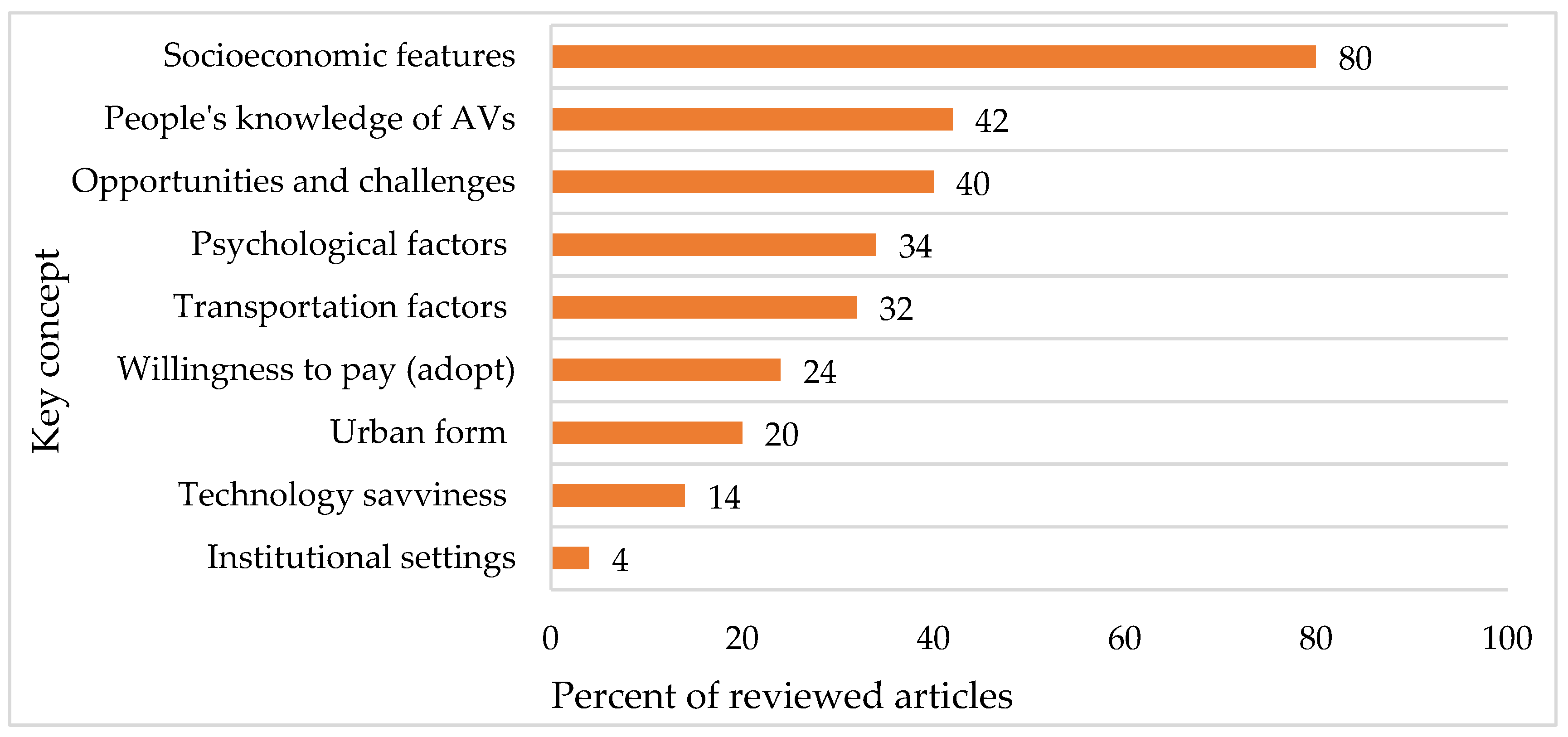
Figure 3.
Contextualization of the factors that influence AV adoption and use.
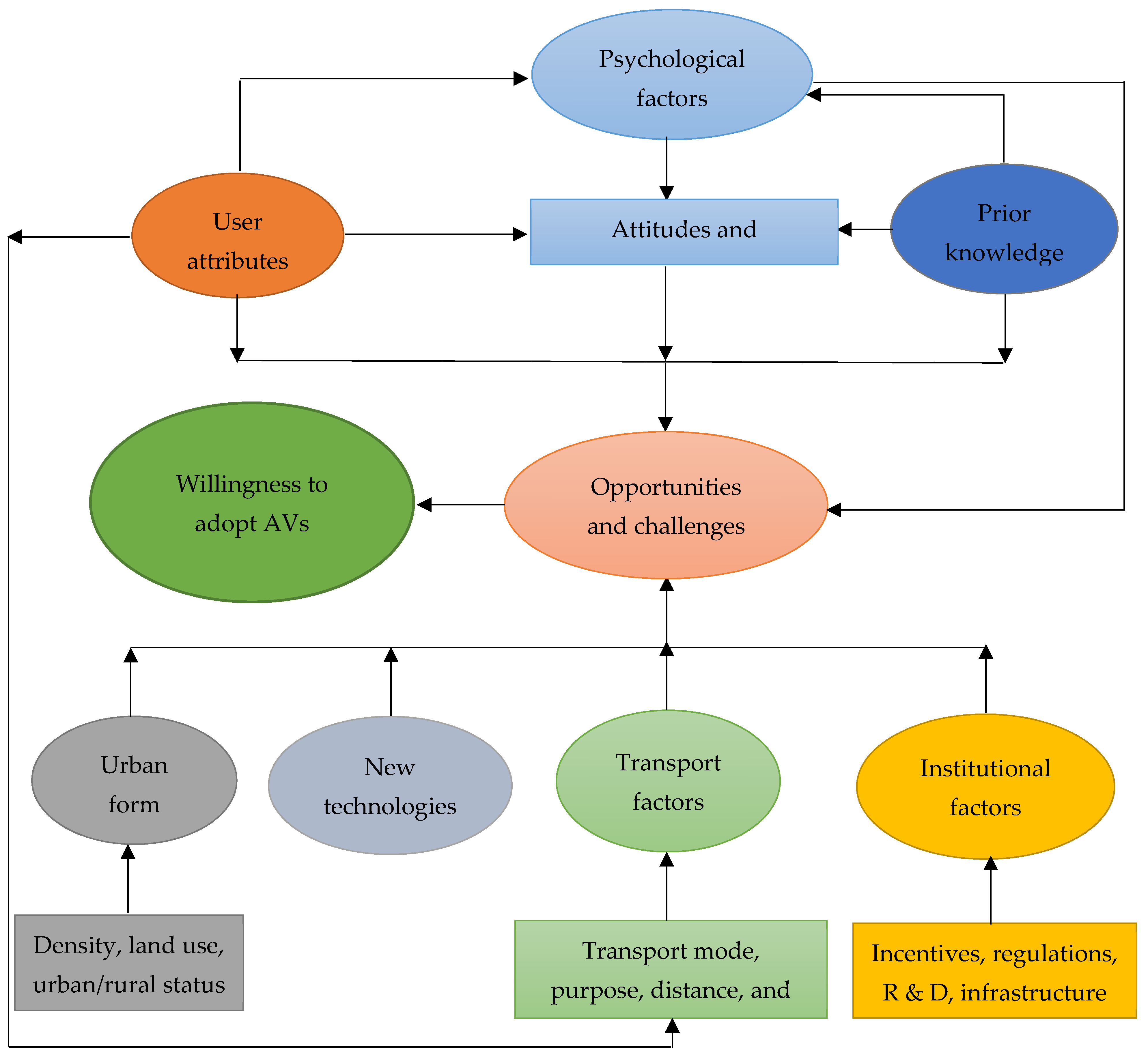
Figure 4.
Experience with ADAS, adopted from Nordhoff, Louw [63].
Figure 4.
Experience with ADAS, adopted from Nordhoff, Louw [63].
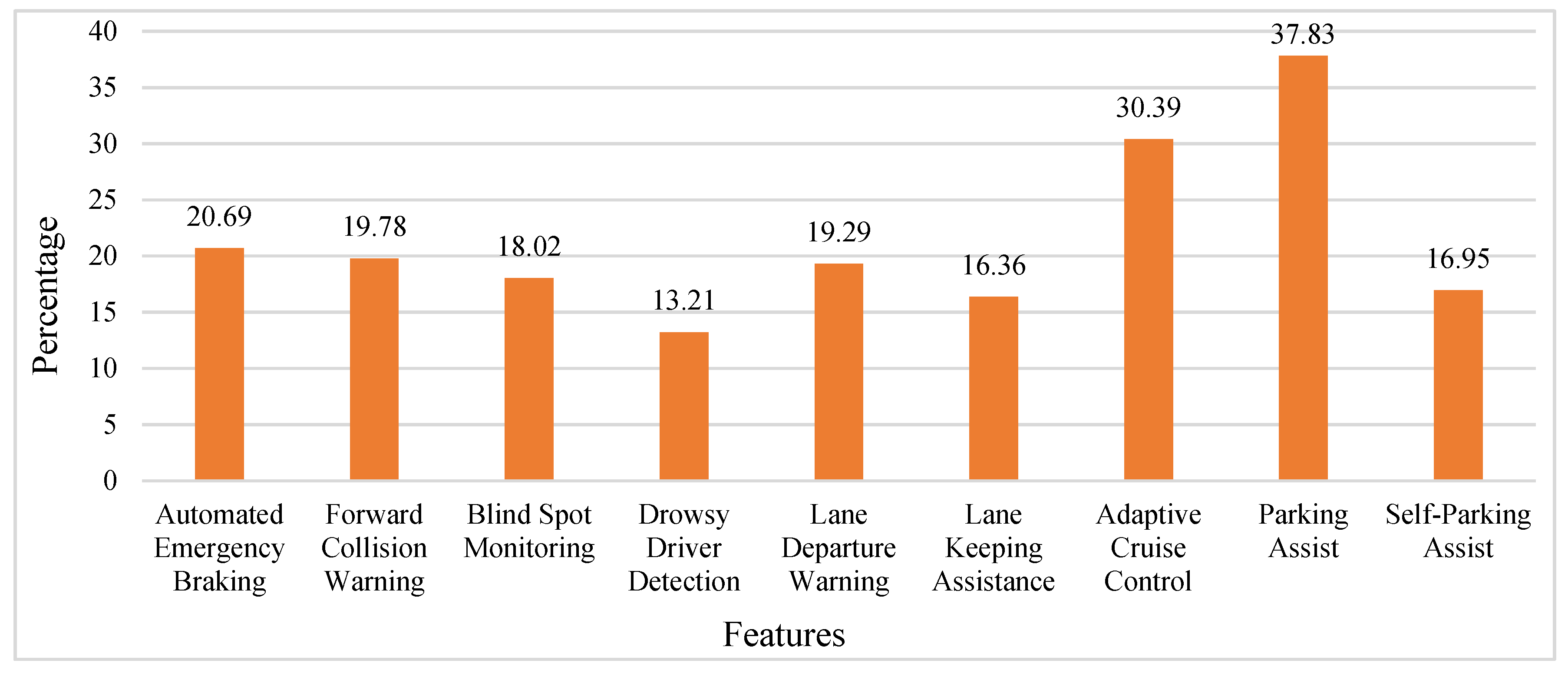

Table 1.
Characteristics of reviewed articles and reports.
| Author | Study area | Data source | Sample size | Methodologies |
|---|---|---|---|---|
| [33] | Athens, Greece | Online survey | 483 | SEM, FA |
| [34] | Xi’an, China | Participants in a field test | 300 | SEM, FA, MLR |
| [35] | Boston, MA | Participants in driving simulator, online survey | 430 | SEM, FA, MLR |
| [36] | Austin, USA | Online survey | 347 | OPM, SUM |
| [37] | 109 countries | Online survey | 4886 | DS |
| [17] | US, UK, and Australia | Online survey | 1533 | DS, ANOVA |
| [38] | China, India, and Japan | Online survey | 1722 | DS, ANOVA |
| [39] | Expert around the world | Expert opinions from AV Symposium, 2014 | 217 | DS |
| [12] | Berkeley, California | Opinion of museum visitors | 107 | MNL, LLM |
| [40] | London, UK | Survey of transport professionals | 3500 | DS |
| [41] | 112 countries of the world | Online survey | 8862 | DS |
| [42] | La Rochelle, France | Online and phone survey | 425 | DS |
| [43] | Vantaa, Finland | Participants with experience of driverless shuttle | 197 | DS, ANOVA |
| [44] | Six cities in South Korea | Stated preference survey | 633 | MDCP, MNP |
| [45] | Adelaide, Brisbane, Melbourne, Perth, Sydney | Stated preference survey | 435 | MLM |
| [46] | Israel and North America | Stated preference survey | 721 | LKM, FA |
| [8] | USA | Online survey | 1260 | CLM, PRPLM, SRPLM |
| [47] | 33 countries | Online survey | 489 | DS |
| [48] | Washington, USA | Travel survey | 2726 | OPM, SEM |
| [49] | Atlanta, USA | Travel survey | 10278 | LRM, MIP |
| [50] | Memphis, USA | Questionnaire survey | 327 | DS |
| [51] | Germany | Online survey | 501 | SEM |
| [52] | China | Questionnaire survey | 647 | SEM |
| [25] | USA | Online survey | 2588 | MNL |
| [32] | Japan | Online survey | 246642 | MLR, OLR |
| [53] | Bangladesh | Online survey | 621 | MLR |
| [54] | Toronto and Hamilton Area, Canada | Online survey | 3201 | PM |
| [55] | USA | Online survey | 2167 | BLM, WMNL |
| [56] | Brisbane, Australia | Household survey | 447 | MNL |
| [2] | Texas, USA | Online survey | 1088 | OPM |
| [57] | Adelaide, Australia | Online survey | 101 | FA |
| [58] | UK | Online survey | 916 | MNL |
| [59] | Australia | Online survey | 505 | MLR |
| [60] | China | Online survey | 1164 | DS, ANOVA |
| [26] | UK | Experimental study | 30 | ANOVA, PC |
| [61] | Germany | Experimental study | 59 | ANOVA, HLM |
| [62] | US | Stated preference survey | 1390 | SEM |
| [24] | Austria | Face-to-face interviews | 19 | DS, qualitative analysis |
| [1] | Germany and California | Online survey | 536 | FA, SEM, LRM |
| [11] | Pennsylvania, USA | General public survey | 798 | DS |
| [63] | Eight European countries | Online survey | 9118 | FA, SEM |
| [64] | Germany | Experimental study | 101 | DS, FA, ANOVA |
| [65] | Korea | Experimental study | 48 | DS, FA, ANOVA, MLR |
| [66] | Singapore | Face-to-face interviews | 353 | FA, SEM |
| [67] | Beijing, China | Face-to-face interviews | 355 | FA, SEM |
| [68] | USA | Online survey | 721 | FA, MNL |
| [69] | Taiwan | Face-to-face interviews | 700 | FA, SEM, ANOVA |
| [70] | Seoul, Republic of Korea | Online survey | 526 | FA, SEM |
| [71] | Brussels, Belgium | Online survey | 529 | DS, HLM |
| [72] | Austin, TX, USA | Online survey | 556 | DS |
DS = Descriptive Statistics, ANOVA = Analysis of Variance, PC = Pearson Correlation, SEM = Structural Equation Model, FA = Factor Analysis, MLR = Multiple Linear Regression, BLM = Binary Logit Model, MNL = Multinomial Logit, WMNL = Weighted Multinomial Logit Model, PM = Probit Model, OPM = Ordered Probit Model, OLR = Ordered Logistic Regression, SUM = Seemingly Unrelated Model, MDCP = Multiple Discrete–Continuous Probit, MNP = Multinomial Probit Model, MLM = Mixed Logit Model, LKM = Logit Kernel Model, CLM = Conditional Logit Model, PRPLM = Parametric Random Parameter Logit Model, SRPLM = Semiparametric Random Parameter Logit Model, LLM = Log-Linear Regression, LRM = Logistic Regression Model, MIP = Mixed-Integer Programming, HLM = Hierarchical Linear Model.
Table 2.
Factors influencing people’s willingness to use AVs (selected studies).
| Study | Positive factors | Negative factors |
|---|---|---|
| [36] | Social acceptance, reliability, high income, tech savvy, presence of children, driving alone, urban living, higher VMT, long commute. | Holding a driver’s license, living in job-dense areas, being elderly, familiarity with carsharing and ridesharing. |
| [2] | Familiarity with Google car, being supportive of government intervention, high income, higher VMT, experienced fatal crashes, digital connectivity. | Holding a driver’s license, being elderly, living in dense area, living far away from transit stations, familiarity with ride-sourcing services. |
| [37] | Higher VMT, experience with automatic cruise control feature, male, higher income. | - |
| [44] | Cutting edge AV features. | High purchase price, concerned about safety. |
| [25] | Long-distance business travel, high income, college educated, employment density. | Higher travel time, elderly, presence of a worker in household, holding driver’s license, population density. |
| [32] | Male, travel assistance for elderly, high income, children in household, car ownership, availability of AV features. | Higher purchase and maintenance cost, information leakage to third parties, long travel time, driving on local roads, holding a driver’s license. |
| [54] | High income, male, possession of a smartphone, employment density, familiarity with and user of shared mobility. | Unaware of Google car. |
| [56] | High income, environmentally aware, open to public transport and ride-sharing options. | - |
| [55] | Long travel distance, experienced with automated features. | - |
Table 3.
Impacts (standardized coefficient) of psychological factors on BI to adopt AVs.
| Studies | PU | PT | PEU | SI | TS | PR | PBC | TA | PS |
|---|---|---|---|---|---|---|---|---|---|
| [33] | 0.52 | 0.15 | 0.13 | 0.14 | |||||
| [34] | 0.43 | 0.12 | 0.19 | 0.14 | |||||
| [35] | 0.80 | 0.13 | 0.10 | ||||||
| [52] | 0.13 | 0.37 | 0.14 | 0.10 | |||||
| [51] | 0.23 | -0.05 | 0.17 | -0.17 | -0.28 | ||||
| [1] | 0.49 | 0.29 | |||||||
| [63] | 0.14 | 0.05 | 0.40 | ||||||
| [67] | 0.42 | -0.11 | |||||||
| [69] | 0.35 | 0.04 | |||||||
| [70] | 0.45 | 0.47 | |||||||
| [59] | 0.64 | 0.30 | -0.05 | ||||||
| [35] | 0.29 | 0.05 | -0.05 | ||||||
| [69] | 0.22 | 0.13 | 0.43 | ||||||
| [52] | 0.20 | 0.10 | |||||||
| [58] | -0.24 | ||||||||
| [66] | -0.11 | ||||||||
| [67] | 0.42 | 0.09 | -0.11 |
BI = Behavioral Intention, PU = Perceived Usefulness, PT = Perceived Trust, PEU = Perceived Ease of Use, SI = Social Influence, TS = Traffic Safety, PR = Perceived Risk, PBC = Perceived Behavioral Control, TA = Technology Anxiety, PS = Price Sensitivity.
Table 4.
Respondent opinions on opportunities and challenges to adopt AVs.
| Author | Opportunities (%) | Challenges (%) |
|---|---|---|
| [33] | Solution to many problems (88%), easy to operate (64%), clear and understandable interaction (69%), easy to become skillful (66%), useful to meet driving needs (46%), safe travel (44%), interesting travel (38.3%), low crashes (55.3%) | Safety concern (55%), waste of time (65.6%), make life more complicated (58.8%), do not increase social status (33%) |
| [36] | Reduction in crashes (63%), talk or text to others (75%), surf the internet 36%), email while driving (45.2%) | Interactions with conventional vehicles (48%), affordability (38%), equipment or system failure (50%) |
| [17] | Fuel economy (72%), travel time saving (43%), few crashes (70.4%), reduced crash severity (71.4%), improved emergency response (66.9%), low emission (66.3%), low insurance cost (55.5%), less traffic congestion (51.8%) | System failure (80.7%), legal liability (74.1%), system security (68.7%), vehicle security (67.8%), data privacy (63.7%), interacting with conventional vehicles (69.7%), interacting with pedestrians/bicyclists (69.8%), learning to use AV (53.5%), system performance in poor weather conditions (62.8%), unexpected situation (75.7%), no driver control (54.3%) |
| [38] | China: Few crashes (85.7%), reduced crash severity (85.1%), improved emergency response to crash (88.8%), shorter travel time (78.3%), low insurance cost (78.5%). India: less traffic congestion (72.3%), better fuel economy (85.9%) |
China: system failure (68.0%), legal liability (55.1%), interacting with pedestrians and bicyclists (42.6%), system performance in poor weather (59.6%), AVs confused by unexpected situations (56.1%) India: system security (54.6%), Vehicle security (57.3%), data privacy (50.9%), learning to use AVs (43.6%) |
| [12] | Safe (75%), convenience (61%), amenities (e.g. ability to text messages or multitask while riding) (53%) | Liability (70%), cost (60%), lack of control (53%) |
| [42] | Increased mobility (58%), reduced fuel consumption and emission (56%), low bus fares (64%), low insurance rates (53%), low parking costs (49%), safer driving (36%), reduced taxi fares (36%), allows to do other things (20%), improved safety (80% for automated bus, 89% for automated car) | Equipment/system failures (66%), legal liability (56%), vehicle security (54%) |
| [25] | Comfortable with data sharing for policy purpose (48%) | Privacy concern (89%), unwilling to pay to anonymize location (39.8%), oppose data sharing for advertising purposes (50%) |
| [32] | Reduced traffic crashes and improved comfort and convenience (37.3%), no need for driver’s license (12%), reduced mobility and crashes related problems of elderly persons (50%) | Technological dependability (43.48%), vehicle safety (31.43%) of Full AV, cost of new and not-yet-available technology (25.26%) |
| [55] | Enjoyable (75.7%), advance technology (54.4%), comfortable (19.5%), reliable (49%), omnipresent in future (41.4%), comfortable to transmit information to other vehicles (50.4%), to vehicle manufacturers (42.9%), to insurance companies (36.4%) and to toll operators (33.3%), trust technology companies (62.3%) and luxury vehicle manufacturers (49.5%), willing to use for everyday trips (40%) | Fear of technology (58.4%), not realistic (44%), unwilling to use for short distance (42.5%) and long-distance (40%) trips |
| [2] | Talking to others (59.5%), looking out the window (59.4%), fuel economy (53.9%), crash reduction (53.1%), emergency notification (71.5%), vehicle health reporting (68.5%), use of AVs for all trips (33.9%) and social or recreational trips (24.7%) | Street congestion (36.1%) |
| [62] | Improved safety (43.3%), reduced driving stress (40.6%), better technology (30.8%), collision avoidance (52.9%), improved fuel efficiency (46.5%), lane-keep assistance (26.5%). | Data privacy (58.4%), trust issue (46.6%), reliability (48.7%), higher travel time (64.8%) |
| [59] | Reduction of human error in crashes (35.64%), multi-tasking (30%), reduction of risk-taking behaviors (29.3%) | High cost (59.21%), lack of trust (32.1%), no control of vehicle (37.22%), technology malfunction (34.26%), safety for self and others (20%), safety of vehicle (21.39%), loss of driving skill (14.1%) |
| [1] | Reliability (California: 30.1%, Germany: 25.0%), problems when entering/exiting the highway (Cal: 23.9%, Ger 25.4%), issues with cut-in vehicles (Cal: 15.3%, Ger: 18.7%) | |
| [24] | Feel safe (84.2%) | Lack of confidence in technology (10.5%) |
| [72] | Lack of trust in technology (41%), safety (24%), cost (22%), Concern about using internet and internet enabled technologies (51%), privacy concerns (71%) | |
| [63] | Easy to use (71.06%), easy to become skillful using AV (60.35%), use of travel time for secondary activities (41.85%), fun to drive (53.21%), enjoyable (52.54%), use for everyday trips (53.45%), meet daily mobility needs (53.27%), entertaining (51.04%), reach destination safely (48.67%) | |
| [11] | Improved traffic safety (62%), safe to share with other modes of transportation (43%), reduced traffic fatalities and injuries (67%) | Set regulation for AV testing (70%) |
| [60] | Trust (51.32%), lower insurance rates (45.28%), willing to pay more (69.24%) | Increased risk (43.86%) |
| [48] | Reduced congestion (22.96%) | |
| [69] | Novelty technology (75.7%), low pollution (18.4%), integration with public transportation (3.7%) |
Table 5.
Basic knowledge on AVs.
| Author | Heard of AVs (%) |
|---|---|
| [33] | 71.4% |
| [34] | 94.3% |
| [35] | 63% |
| [36] | 80% (Google car), 47% (CAV) |
| [37] | 52.2% |
| [17] | 66% overall (70.9% in USA, 66% in UK and 61% in Australia) |
| [38] | 87% (China), 73.8% (India), 57.4% (Japan) |
| [42] | 87% |
| [47] | Over 95% |
| [52] | 98.8% |
| [51] | 49% |
| [53] | 90% |
| [2] | 59% |
| [60] | 94.67% |
| [59] | 78.4% |
| 1 | Level 0 indicates no automation and the vehicle is fully controlled by a human driver. In Level 1 of autonomy, the vehicle has some driver assistance system for either steering or acceleration/deceleration. Partial autonomy is ascribed in Level 2, where the vehicle has driver assistance systems for both steering and acceleration/deceleration. In Level 3, the vehicle has a specific performance by the automated driving system with the expectation that the driver will respond. Level 4 indicates higher automation of the vehicle, which has a specific performance by an automated driving system, even if a driver does not respond. Level 5 indicates the full automation of the vehicle and the vehicle is operated by an automated driving system without human interventions. |
Disclaimer/Publisher’s Note: The statements, opinions and data contained in all publications are solely those of the individual author(s) and contributor(s) and not of MDPI and/or the editor(s). MDPI and/or the editor(s) disclaim responsibility for any injury to people or property resulting from any ideas, methods, instructions or products referred to in the content. |
© 2023 by the authors. Licensee MDPI, Basel, Switzerland. This article is an open access article distributed under the terms and conditions of the Creative Commons Attribution (CC BY) license (http://creativecommons.org/licenses/by/4.0/).
Copyright: This open access article is published under a Creative Commons CC BY 4.0 license, which permit the free download, distribution, and reuse, provided that the author and preprint are cited in any reuse.


