

Submitted:
30 November 2023
Posted:
04 December 2023
You are already at the latest version
Abstract
The inherited ‘EIA’ process at Brexit is based on a ‘Project’ period from Inception tothe start of construction works. The ‘Incompleteness’ of the process covers andidentifies stages that will impact on the environmental cycle: construction period,operational life, de-commissioning and a return to acceptable environmental footprint.A master environment structure-plan framework is required to commence with theupgrading of the complete ‘EIA’ process, embracing separate limbs for the UK’spriority environmental targets for climate change, and other major adverse effectswhich result in serious ‘harm’ to the UK environment. The identification of the processfor ‘incompleteness’ requires effective sustainability, and inclusion of effectivemanagement tools, for the essential ‘monitoring/control/recording’ proceduresthroughout the project life and the natural environmental cycle. This will allow theopportunity for a new approach to a structured ‘Suite of EIAR Directives’, to enable a‘EIAR’ regime that ‘will remain fit and proper for UK purpose’.
Keywords:
incompleteness
; sustainability
; legal services regulations
; climate change
; renewable energy
; environmental impact assessment
; advanced project management services (APMS)
| Contents |
- Chapter 1 - Introduction ……………………….……………. page 1
- Chapter 2 - Review……………………………….……………. page 5
- Chapter 3 - Incompleteness…………………………………. page 10
- Chapter 4 - Restructure of “EIA” ……………………………page 24
- Chapter 5: Skeletal reference Charts for ‘EIA’ process...page 33
- Figure 1: UK agricultural legislation controls reference chart
- Figure 2: Environmental Chart for Structure of ‘Suite of EIA Handbooks’
- Figure 3: Full Anthropogenic Environmental Impact Analysis -Chart for a Project
- Figure 4: Framework for ‘EIA’ towards substantial Completion
- Chapter 6 - Conclusions………………………………………page 37
- Bibliography
Chapter 1 - Introduction
1.1. Introduction:
The concept for a development within a particular set of surroundings requires careful investigation and analysis, and the general strategy of policy making, and the follow-up administrative process requires impact analysis1. Everything we see and understand in those surroundings is the environment into which the development and its process must be aligned, to ensure the minimum disturbance to the virgin state. The approach towards that policy is through an ‘impact assessment’ which requires careful thought, and its significance has been widely recognised by lawyers, applied biologists and engineers2.
‘Environmental Impact analysis’ (EIA) is an approach to policy development that incorporates analytical techniques, and its main purpose is to protect3 the public and the environment from the consequences of mankind’s actions causing damage to, and an imbalance of, the environmental surroundings.
The first documented legislation for ‘environmental impact analyses was introduced by the United States of America ‘National Environmental Policy Act’ (NEPA) 1969 and came into force on 1st January 1970. It was certified through an ‘environmental impact statement’ (EIS). Errors were made in learning how to implement the EIA requirement, resulting in amending the ‘environmental impact assessment’ EIA-EIS provisions through executive order 1991 on 24 May 1977, giving the regulations by the ‘Council of Environmental Quality’ (CEQ) (guidelines covering research / surveys / monitoring / public participation) the effectiveness of administrative law.4 It remains today incomplete, as an evolving process.5
A structure for European regulations was formulated in 1985, through their EIA Directive (85/337/EEC), where disparities6 between the laws in force in the various member states necessitated linkage to Article 100 of the ‘Treaty of the European Union’, to approximate national laws about assessments of environmental impacts for public / private projects. To ensure this regulatory tool remains “fit for purpose”, several amendments were necessary in 1997 / 2003 / 2009, with codification in 2011, and the last amendment in 2014, as (2014/52/EU).
As a member state the United Kingdom (UK) adopted the ‘Town and Country Planning Regulations’ format, to enable the effective transposition of the EEC EIA Directive into English Law, which was initiated in 1988 as the ‘Town and Country Planning (Environmental Impact Assessment) Regulations’ 1988 (EIAR 1988). They were duly amended in 1999 / 2011 / 2017 as (EIAR)2017, and a further minor amendment7 in 2018 to allow for changes to thresholds for industrial estate development projects. The ‘incompleteness’ and ‘ineffectiveness’ of this structured legislation requires a comprehensive review.
The withdrawal of the UK from the EU took place at 11-00pm (GMT) on 31st January 2020, central European time (CET), when the UK ceased to be a member state of the EU, and Britain’s exit day followed 11 months later 1st January 2021, at the end of the transition period, when a new Island sovereign state was formed adjacent to the EU’s 27 member states Block.
1.2. Brexit legislation, and an opportunity for a ‘National Environmental Structure Plan Framework Model’ towards future UK Environmental Legislation
The ‘Great Repeal Bill’8 to repeal the European Communities Act 19729 (ECA1972), and transpose EU Law into UK Law, was announced by the United Kingdom (UK) in October 2016, following a Referendum on 23rd June 2016, when the British electorate voted to leave the EU (52% / 48%). The main reasons were identified as Immigration, Independence from the ECJ in Brussels, and opportunities for Free Trade. On 29th June 2017, Prime Minister, Theresa May, triggered Article 5010 of the Treaty of the European Community11 (TEU), to start the 2-year period of negotiations for a deal for exit from the European Union, and on 18th June 2018 the European Union (Withdrawal) Act 201812 came into force, after nearly a year of deliberations.
This set-in motion structure plans for new policy, including the UK Government’s ‘25 Year Environmental Plan’13 Paper on 18th January 2018. The UK left the EU on 31st January 2020 and entered a 1-year transition period when nothing changed, and the rules governing the new relationship between the EU and UK took effect on 1st January 2021. A policy statement for the Environment Bill 2020 was made on 30th January 2020, with the Environment Act 202114 coming into force on 17th November 2021.
This Environment Bill 2020 set out a new domestic framework for environmental governance, aimed at maximising UK’s opportunities, created by leaving the EU, and to deliver the government’s commitment, envisaged in the 25-year Environmental Plan. The new system to embed environmental principles15 in future policy making is to help to ensure the protection and improvement of the environment and includes for a UK Environmental Protection policy regarding future environmental legislation, with Ministers to be required to make a statement to Parliament for setting out the impact of new primary legislation on existing levels of environmental protection. This to include reviews of significant developments in the environmental protection legislation of other countries and prepare linked reports to parliament every 2 years. Statutory Environmental Improvement Plans and a new framework for defining long term legally binding targets to then follow. The Bill set out new legally binding targets in four priority areas of the natural environment, being: air quality / waste and resource efficiency / water / nature. The Environmental Improvement Plans and legally binding targets are to be reviewed every 5 years16.
The Environmental Bill proposed a new public body as the independent UK watchdog, called the ‘Office for Environmental Protection’ (OEP)17. Failures by public authorities to implement environmental law were no longer to be considered through European processes and instead OEP was to engage with public authorities to reach a solution. Legal proceedings will be taken only in urgent cases, or as a last resort18.
The Environment Act 2021 embeds in law the policy statement on five important environmental principles19: environmental protection to be integrated into making of policies / principle of preventative action / precautionary principle / principle that environmental damage is rectified at source / polluters pay principle. Chapter 2 covers the ‘Office of Environmental Protection’, which covers scrutiny, advice and enforcement functions, covering monitoring20 and reporting procedures on environmental improvement plans and targets.
This is now the opportunity for a new approach towards major environmental strategies for UK under new supreme legislative controls, and to tackle important ‘climate change’ policies, urgently required, and to address new ideas for ‘global renewable energy’, with the UK’s location at the northern end of the Atlantic Gulf Stream offering major opportunities.
Chapter 2 - Review
2. A summary Review of various operating international EIA Processes
2.1 ‘Impact Analysis’ was recognised as a realistic tool towards implementing International Law Principles in the first Earth Summit in Stockholm 197221. It recognised the importance for proper planning to be applied for integrating development with environmental needs, with the aim to avoid adverse effects on the environment and obtain important social and economic benefits for anthropogenic projects. In the second Earth Summit in Rio22, Principle 17 sought for a mandatory EIA to be included in national law for any activities that are likely to have a significant adverse effect on the environmental surroundings, while Agenda 2123, called on all countries to assess environmental surroundings for all development projects through EIA prior to deciding.
The ‘Protocol on Environmental Protection to the Antarctic Treaty’ 24 came into force in 1998 and designates the Antarctic as a natural reserve, devoted purely for peace and science. Article 825 embraces the essential aspect of the management of ‘Impact Analysis’ of the natural environment. Annex 1 identifies the logical steps towards the ‘Environmental Impact Assessment’ process as: preliminary stage / Initial environmental evaluation / followed, if necessary, by a comprehensive evaluation, with the decision to be based upon the comprehensive evaluation of that environment. Next are the structured ‘monitoring-control’ procedures for an essential element towards sustainability, together with complete registration and circulation of all information. The protocol requires ‘Cases of all Emergency’ to be identified and actioned to the acceptable environmental standard requirement, and to result in satisfactory environmental adjustments to record a required amendment / modification. This structure could be adopted as the basis for formulation of an approach towards an environmental structure plan for a suite of handbooks, and to embrace the global monitoring / control procedures, towards environmental protection.
The Espoo Convention in 200326 recognised the need for forward planning to set out defined strategies for consideration of co-ordinated programmes and structured linkage plans, to include transboundary effects in strategic environmental impact analysis, while the ‘World Charter for Nature’ 27 scrutinised what might have an impact on nature shall be controlled, and the best technologies made available to minimize significant risks to nature, including EIA techniques28
Also, for the Marine Environment, UNCLOS considered that countries should have reasonable grounds for considering the planned activities under their jurisdiction or control that may cause substantial pollution of, or significant and harmful changes to, the marine environment, and they shall be able to assess the potential effects of such activities on the marine environment, including communicating reports of the results of assessments and reviews, to competent authorities29. In New Zealand v France [1974] ICJ Rep 457 the International Court of Justice was required to make judgement on France’s proposals for carrying out atmospheric tests in the South Pacific, though France withdrew their proposals and judgement was not necessary. Further, in 1986 the Noumea Convention required each country to assess and review the potential effects of any likely projects which might affect the marine environment, to allow appropriate measures to be taken to prevent substantial pollution and significant harm within their domain30. In the MOX Plant Case (Ireland v UK) 2002, Ireland’s concerns related to the failure of the 1993 ‘Environmental Impact Statement’ regarding assessment of the ‘impacts’ of radioactive discharges into the Irish Sea. The impacts and potential adverse effects were missing from the statement. Ireland withdrew its claim before the tribunal31, pending judgement of the ICJ, who legally dismissed the case and terminated proceedings in June 2008.
While all the major international EIA structured Instruments struggle to achieve a comfortable approach for the screening32 process for anthropogenic projects, the UN’s Biodiversity Convention33 approaches ways to minimize activities likely to have any significant adverse impact towards nature’s conservation, and sustainable use of biological diversity.34 It requires appropriate procedures for EIA to any proposed project, with a view to avoiding or minimising significant adverse effects and maximising public participation in that process.35 Importantly, it identifies the monitoring36 process for sustainability and conservation through the life of biological diversity, which is an integral part towards ‘substantial completion’ of an effective EIA process towards ‘satisfactory completion’ for acceptable performance.
Many leading International Organizations, such as World Bank37 (WB), have developed their own assessment / review environmental procedures for proposed projects they wish to fund, and require environmental assessments, for their Bank financing, to ensure they are environmentally sound and sustainable for the full life period, which is an adaptation of the presently accepted EIA structure. This type of ‘International Financial Institution’ (IFI) EA structure is to ensure Insurance of their Funding to the Borrower, who is responsible for carrying out the ‘EA’. This must embrace a range of types of Impact analysis, including environmental audit, degree of hazard and risk, as well as an environmental structure plan embracing all the surroundings and of course taking into account various ‘cultural types.
World Bank Environmental Systems are described in a report study by ‘ECA and ESSDD(WB)38’ titled ‘Environmental Impact Assessment Systems in Europe and Central Asia Countries', to examine EIA systems of 28 countries in Europe and Central Asia (ECA) Region. Some main findings were the lack of public consultation and participation, and lack of the environmental management plan mechanism, to ensure that necessary monitoring and mitigation measures, for avoiding or controlling adverse environmental impacts, are implemented39.
2.2 Other International EIA Systems: By the mid-1970s other countries such as Canada, India, France, Australia and New Zealand developed their own EIA processes40, and the various structured approaches towards environmental law controls, from differing ethics and culture backgrounds, require careful examination, comparison and review for ‘impact analysis’ process of different development styles.
In Canada the EIA process, introduced in 1973 by the Federal ‘Environmental Assessment and Review Process’ (EARP) was replaced in law, to strengthen EIA, with the Canadian Environmental Assessment Act41(CEAA). Changes in Government in 2012 resulted in a modified CEAA 2012, and in 2019 it was repealed by the ‘Impact Assessment Act’ (IAA) 201942, with the approach to include additional steps to assess the environmental, social, health, economic, and cultural impacts of major projects, and importantly, the effects those projects had on the indigenous population and their cultural well-being.43
The environmental legislation of Canada, from its outset, evolved through distinct changes of environmental policy. The EIA process structure remained consistent with steps adopted by all the main international systems44, particularly including monitoring, and as such is incomplete. The adjustments to environmental targets, based on international strategies, were considered weaker45 for the 2012 / 2019 era, and Canadians who recognised the climate crisis46 were instrumental in lobbying the government to restore and improve the legislation to the IAA 2019, which covers four types of Impact Assessment used in Canada: Health Impact Assessment / Environmental Impact Assessment / Strategic Impact Assessment / Risk Assessment.
The initial approach of the Canadian Environmental Act (CEAA) forbids responsible authorities from exercising any power, or performing any duty, in relation to the project until the EIA process has been completed47. Like the USA it has federal EIA legislation that applies only to federal projects and approvals,48 and applies the transboundary EIA provisions of CEAA in relation to non-parties to the Espoo Convention,49 as well as parties to that convention without differentiation50, and EIAs are transnational legal processes51. The harm principle in International Environmental Law was used in the Trail Smelter Arbitration (United States and Canada, 16 April 1938, 3 RIAA 1907(1941), between Canada and the US, arising from air pollution from a smelter located in Canada, regarding state responsibility for transboundary harm.
In India the Union Ministry of Environment and Forests (MoEF)52, under the Environmental (Protection) Act 198653, promulgated an EIA notification making Environmental Clearance (EC) mandatory for expansion or modernisation of any activity or for setting up new projects listed in Schedule 1 of the notification54. The ‘Bhopal Gas Tragedy’,198455, led to many thousands of deaths and triggered India’s EPA 1986 legislation56. Since then, there have been 12 amendments made in the ‘EIA’57 notification of 1994, starting when MoEF notified EIA legislation in September 2006. That notification made it mandatory for various projects such as mining, thermal power plants, river valley, infrastructure (road, highway, ports, harbours and airports) and industries including very small electroplating, or foundry units, to get ‘environment clearance’. Unlike the EIA Notification of 1994, this legislation has put the onus of clearing projects on the state government, depending on size/capacity of the project.
Certain activities permissible under the Coastal Regulation Zone Act 1991, also required clearance. International Financial Institutions (IFI) operating in India (like World Bank / Asian Development Bank (ADB)) have a different set of requirements for giving ‘environmental clearance’ to projects that are funded by them. Most EIA processes have a common structure, and the application of the main stages is a basic standard of good practice. In India, the ‘environment impact assessment’ consists of eight steps, with each equally important in determining the overall performance of the project: Screening / Scoping / Impact Analysis / Mitigation / Reporting / Review of EIA / Decision-making / Post Monitoring. (This last term requires definition, though could suggest sustainability which leads towards ‘substantial completion’). Also recommended are other Forms of Impact Assessment: Health Impact Assessment (HIA), Social Impact Assessment (SIA) .... so that they are taken into consideration along with the environmental assessment.
Strategic Environment Assessment (SEA) refers to systematic analysis of the environmental effects of development policies, plans, programmes and other proposed strategic actions. In India this process is beyond the project level and covers for when major alternatives are still open. ‘SEA’ is a proactive approach to integrating environmental considerations into the higher levels of decision-making. India says “EIA has certain shortcomings as a tool for minimising environmental effects of development proposals. It takes place relatively late at the downstream end of the decision-making process, after major alternatives and directions have been chosen.”58 On 23 March 2020, the Indian Ministry of Environment, Forest, and Climate Change issued a ‘Draft Environmental Impact Assessment Notification’, 2020 (‘Draft EIA Notification’), which was intended to replace the existing EIA Notification, 2006. The Supreme Court of India dismissed the appeal, filed by the Ministry, against the order of the Delhi High Court59.
Evaluation of the Draft EIA Notification argued that “the Draft EIA Notification dilutes the very premise of EIA and emboldens violation of the core principles that are part of national and international environmental jurisprudence” in India.
The major dilutions include removing several activities from the purview of public consultation and EIA. These projects may require, for example, deforestation, or the dredging of major rivers, which do not need prior clearance for such activities.
Chapter 3 - ‘Incompleteness’
3. Incompleteness of the EIA process
3.1 The EIA process inherited after Brexit is based on a structure initiated by United States60 statute to reform policy-making procedures and adapted61 to suit the European culture comprising a multiple number of mainly landlocked states. It concentrates on anthropogenic principles for developing a project in a transboundary context, internationally following the UN’s international environmental principles to prevent harm to the worldwide environmental surroundings. The path inherited for the EIA process starts at its conception and is analysed in defined steps through to the completion of the decision process for the anthropogenic project, which remains incomplete for the life of the designed project when built, and the chosen environmental surroundings.
The incompleteness of the UK inherited EIA process requires several necessary changes to ensure an effective and flexible EIA structure is achievable towards ‘substantial completeness’, which must cover the project period up to end of project life and return to acceptable environmental conditions. It also must embrace ‘climate change’ and ‘renewable energy’ possibilities around the UK coastlines, together with the real difficulties encountered from river and coastal waters pollution, and shortcomings to UK Environmental Law.
UK ‘Environmental Law’ is a gradual evolving process lacking a structure plan and inherited from international sources, loosely based on Environmental Principles established at global conferences62 over the last 50 years. The present structure is fragmented, based on uncertain definitions63 and sets of planning regulations, which require many changes and amendments to enable it to remain ‘fit for purpose’.
The ‘splendid isolation’ of a sovereign Island country status, to which the United Kingdom has now returned, possesses a different set of environmental surroundings to the landlocked EU block of States, including mapping of UK coastal areas which is missing from the EU Mapping and Assessment of Ecosystems and their Services64. New renewable energy opportunities are already under consideration, and now require important and necessary legislature changes under the UK Supreme Court, following the repeal from the EU’s European Court of Justice.
This dissertation paper will cover just the anthropogenic project life inherited at Brexit, but it is necessary to outline a skeletal basic structure for the proposed impact analysis procedures necessary for the UK today and describe the requirements for important main topics discussed in this paper.
3.2. EIA process continuation to end of project life/return to acceptable environmental conditions
Initial preparatory works should embrace a ‘project management plan’ and ‘programme of works for the construction period, followed by a comprehensive ‘Commissioning’ to allow for commencement of ‘commercial operation’. This requires a comprehensive ‘project supervision structure plan’ covering all the various phases of the construction period, to mitigate possible ‘slippage’ and delays to works activities, culminating in a ‘defects liability period’, to record and ensure satisfactory performance. The Commissioning of the completed construction works is essential to confirm the effective reliability of the works / plant, together with accurate records endorsed through a comprehensive ‘Tests on Completion’ (‘ToC’)65 structure plan, which is important as a reference throughout the ‘operation period’.
The life of the project to be operated needs reference to a comprehensive set of ‘Operation and Maintenance’ Manuals (O&M), and effective ’monitoring/control’ procedures which it is important to maintain throughout the ‘operational life’. Annual ‘Operation Inspection Reports’ furnishing all essential records (events and data) need to be prepared and held as a project record. They are essential management services tools which should be utilised for any identified malfunctions. This allows adjustments and corrections to the ongoing operational facilities, as and when it is desirably necessary, to provide a continued satisfactory balance to the project with the environmental surroundings.
The ‘decommissioning’ structured programme for certain projects is essential to ensure safe and proper environmental conditions are achieved and recorded. This will allow a satisfactory return to safe and balanced environmental surroundings. It needs to embrace any demolition / taking down of all defined materials (incl. harmful waste) for safe removal, recycling whenever possible, and return to acceptable environmental surroundings. Harmful, hazardous and radio-active wastes require separate planned proposals following identification, for separation, transportation and placement to specially prepared long term modular storage sites.
3.2.1). Air Pollution:
UK Air pollution legislation has evolved over the last 30 years with Part 1 of the EPA 1990 seeking prevention of Air pollution through permit-based control, leading to the Environmental Permitting Regulations for England and Wales, and progressive amendments. This was followed by the Clean Air Act 199366 to address vehicle emissions. The Environment Act 1995 created the establishment and operation for ‘GHG’ emissions trading scheme, embracing the importance of transboundary effects around the globe. After Brexit the Environment Act 202167 recalled the importance of Air Quality and smoke control regulations in England and Wales.
Pollutants causing concern are carbon monoxide, nitrogen oxide and ozone68. Fine particles in vehicle emissions, each less than 10 micrometres across, ‘PM10’, cause respiration problems by entry of chemicals into the lungs. Ozone at ground or at tropospheric levels is a highly corrosive pollution, based on reaction between sunlight / NO2 / volatile organic compounds (VOCs) causing summer problems in cities, and ‘photochemical smog’ comprising micro particles of VOCs/ NOx.
The Secretary of State’s Guidance Note 6/9 (04)69 issued conditions for emissions into the air and guidance on Best Available Techniques (BAT) not entailing excessive cost.
Defra’s ‘Air Pollution in the UK 2019’70 was issued in September 2020, as the UK was required to report air quality data on an annual basis under various71 EU Directives. The Report provides background information on pollutants covered by various EU Directives and UK’s Air Quality Strategy: covering the sources / effects / monitoring networks / UKs modelling methodology. The pollutants covered in the report are SO2 / NO/ NO2 /PM10 & PM2.5 particles/ Benzene / 1,3-Butadiene CO / Metals/ PAH/ O3.
Sulphur dioxide is another major pollutant produced by chemical plants and not effectively controlled under earlier legislation of the 1950s. The method of control was to discharge at height over the surroundings, which dispersed over a wide area and fell as acid rain, harming freshwater and terrestrial ecosystems in UK, and beyond into Europe, indicating incompleteness.
The earth’s wind pattern forces72 change, North / South, at 30o and 60o latitudes along ‘fronts’, while rotational deflections travel great distances around East / West hemispheres in what is called the ‘Coriolis’73 effect over the surface, spreading man’s pollution. Careful global organization from all cultures is now urgently required.
The fragmented progress of UK Air Pollution legislation has lacked structure and remains incomplete, also lacking any unified co-ordinated directive from the global stage. It is now essential to restructure an intelligent approach towards setting out a UK structured framework for ‘air pollution’ controls, based upon the ‘common but differential responsibility’.74
3.2.2). Climate Change
Over a decade ago, the UK put into force the Climate Change Act (CCA) 200875, setting targets for a reduction of Greenhouse Gases (GHG) by 2050, to provide for a system of carbon budgeting76 for the purpose of limiting GHG from the atmosphere. The Act established ‘The Committee on Climate Change’77(CCC) to assist in ‘carbon management’, to monitor, advise and report with ‘carbon budgets’ and on ‘monitoring / control’ procedures towards the ‘2050 target’78 for reduction of GHG.
Under general ancillary powers79 the committee may exercise its duties to take action to ensure it carries out its functions under the guidance of National Authorities and the Secretary of State. The British Standards Institute (BSI) fast tracked their Specification for ‘Carbon management in Infrastructure’80 in May 2016, to enable accuracy, transparency, consistency, relevance and completeness of carbon management and GHG emissions quantification. The scope of PAS 2080 is about Carbon management as part of wider climate change mitigation; it is not about wider environmental or sustainability issues81.
Under the specification the management of ‘whole life carbon’ in UK, infrastructure is defined as embracing the ‘transport’, ‘energy’, ‘water’, ‘waste’’ and ‘communication’ sectors82, and the management services covers the assessment, removal and reduction of GHG emissions measured as ‘carbon dioxide equivalent’, which relates and covers for the 6 gases quoted in the Kyoto protocol83.
The methodology control procedures for the ‘practitioner’ calculating Infrastructure GHG emissions, is covered in the specification,84 which were responsible for over half of the UK’s GHG consumption in 2010 emissions, a total: 981 million tonnes Mt CO2e85 and a programmed emissions target of 178 Mt CO2e in 2050. CO2e is a unit for comparing the radiative forcing of a greenhouse gas to carbon dioxide86 and is calculated using the mass of a given GHG, multiplied by its global warming potential. ‘GWP’ which is the factor describing the radiative forcing impact of one mass-based unit of a given greenhouse gas relative to an equivalent unit of CO2 over a given period87. In 2019 the Climate Change Committee (CCC) Report, ‘Net Zero - The UK’s contribution to stopping global warming’88, led to the (CCC) committing the UK Government by law to reduce greenhouse gas emissions by at least 100% of 1990 levels by 2050, which relates to ‘net zero’.
The ‘Office of Environmental Protection’89 (OEP) is responsible for Environmental governance, including environmental targets, environmental improvement plans, environmental monitoring, and importantly to embrace compliance with the five main environmental principles90 recorded in the Environment Act 2021.
Following Brexit, and the one-year transition period, the ECJ responsibility as the supreme court in UK ceased. This is now the opportunity for the UK to set out a new structure plan framework for climate change, based on CCA 2008 and augmented to include relevant latest global ‘climate change’ targets, all as set out under the UNFCCC on climate change91. It is important to ensure comprehensive environmental analysis on climate change is included in a suite of EIA handbooks.
3.2.3). Renewable Energy:
After Brexit the UK government published its new strategy for renewable energy, “The British Energy Security Strategy”,92 which is aimed at a faster decarbonization with the approach towards earlier energy security and independence. This early strategy so soon after Brexit had been triggered because of Russia’s special operations in Ukraine, together with UK’s increasing reliance on foreign sources, and its principal target is to secure clean and affordable British energy for the long term. The energy renewables93 targets included offshore & onshore wind power, solar and related technologies, Nuclear94 and Hydrogen, though with coastal tidal power conspicuously omitted.
The European Commission issued the 2nd Report on ‘Mapping and Assessment of Ecosystems and their Services95 - Biodiversity Strategy to 2020’ in February 2014, which solely concentrates on mapping the land mass and was based on river basins for their UK state at that time.
Following Brexit, the UK has once again become an Island State, and located at the northern end of the Atlantic gulf stream, has massive potential for large renewable energy projects around the irregular shaped coastline and smaller Islands. While it remains premature to consider major marine opportunities for the Irish and North Seas at this time, the estuaries and jagged coastlines are already being discussed96 and legislation should now be in place. These near future projects will also probably embrace the causation factor to erosion along the south and east coasts of England and the need to readdress methodologies for proper and correct adaptation of potential tidal energy.
3.2.4). Water Pollution
Present UK water pollution control legislation is fragmented, unclear and inefficient, and compounded by extremes relating to agriculture pollution effects and discharging of badly treated and untreated sewage into rivers and coastal areas. The Water Framework Directive97 (WFD) regulatory controls, transposed in 200398 and updated in 201799, focuses target performance100 for member states to undertake to achieve ‘good status’101, whereas regulatory controls based on specification standards to harness nutrient controls appears to be the preferred choice for ‘protecting the water, soil and air’102, covered in (DEFRA) ‘A Code of Good Agricultural Practice’ in 2009. In the case C-461/13 Bund fur Umwelt und Naturschutz Deutschland, Advocate General Jaaskinen said ‘The WFD is a complex and particularly elaborate measure which is unusually difficult to understand’103. However, the EU WFD does cover all the main aspects relating to Water Pollution control, and it is the presentation and structure of the EU Framework that requires further thought towards a preferred approach for a restructured water framework for the UK after Brexit?
After Brexit there is an opportunity for UK policy and regulatory control to give greater emphasis to specification and process standards, followed by performance targets, through a clearer programme of measures104 for ‘River Basin Management Plans’ (RBMP) for nutrient control defined standard levels. A comprehensive updated co-ordinated planned framework is required to embrace the ‘UK Implementation of the Nitrates Directive in England’.105 This, with the follow up ‘Explanatory Memorandum’ of NPPR 2008106 and ‘Consultation Guidance’107, together with ‘several important Nitrate Pollution Regulations' (NPPR 2016108, RPADPR 2018109, FW (EU Exit) R 2019110). Following exit from the EU, an approach to reference these important pieces of legislation in a ‘reference Chart for environmental legislation for agricultural nutrient controls chart’ would be a useful tool, reference, Figure 1111. This coordinated structure plan approach requires as a starting point a particular ‘environmental impact analysis tool mechanism for managing UK Water Pollution’ which would embrace a UK Common Agricultural Policy (CAPUK), good agricultural and environmental conditions for UK farms (GAECUK)112 and to be a part of a suite of Impact Analysis reference books for adoption after Brexit, though this is beyond the scope of this paper.
3.2.5). Waste:
UK waste regulation has evolved through early domestic regulations (EPA 1990)113 relating to the management of solid waste. This covers ‘household, industrial and commercial’ waste, with waste defined as ‘controlled waste’114, for collection, handling, transportation and disposal or recovery, and as amended by (EA 1995)115, (CW(RCSV)R 1991)116, HWR 2005117 and (EP(E&W) R 2010)118. Whereas through the EU ‘Waste Framework Directive’119 the definition of waste is the term ‘discarded’120 from substances, materials and articles, where the approach considers a ‘duty of care’ for handleability of waste. The confusion of the definition of waste and what is waste, required UK clarification through the Waste (England and Wales) 2011 Regulations,121 and following freedom from the EU States this important definition and waste handleability will require a completely fresh approach for a ‘national structure plan for waste management’.
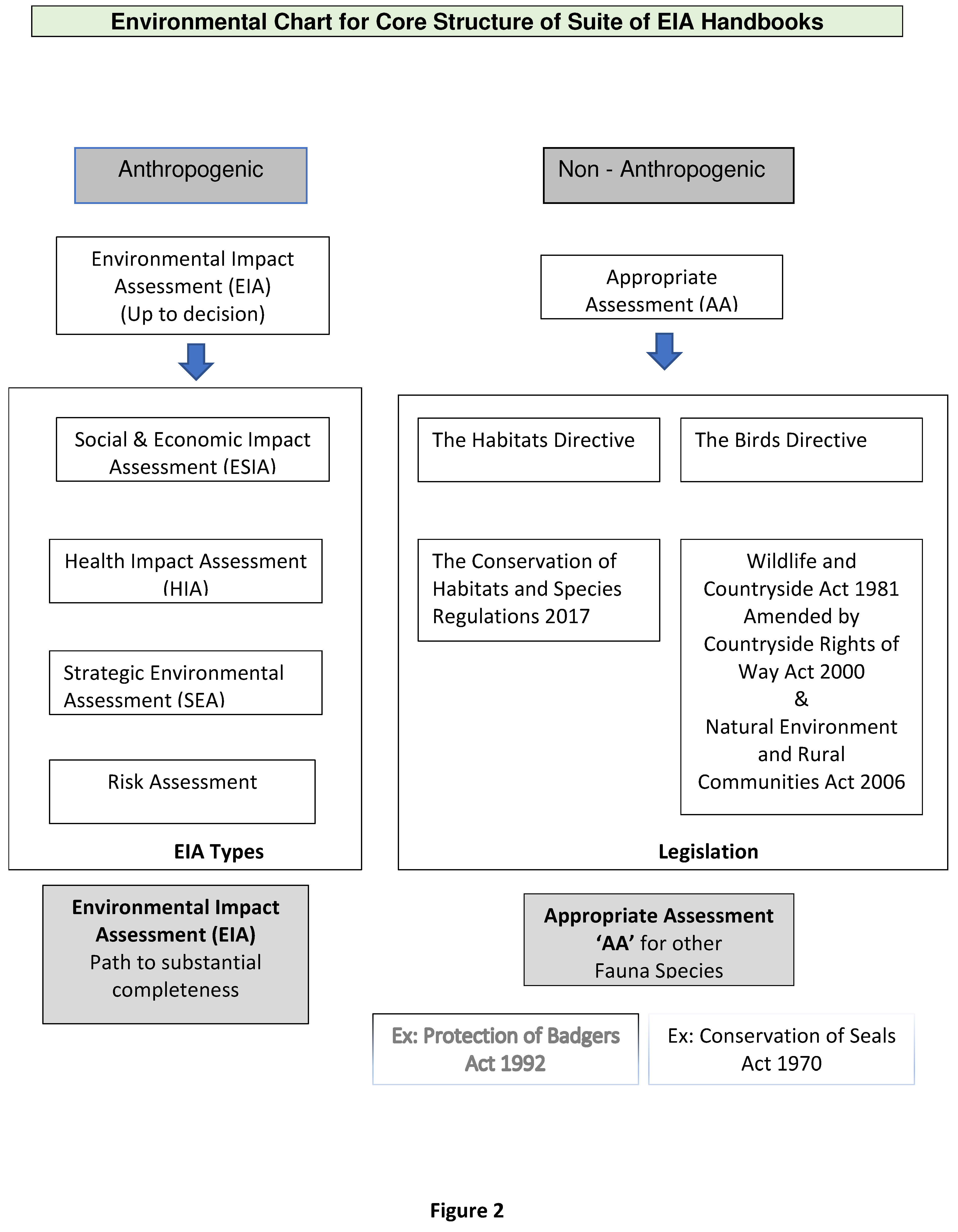
The mix of various types of environmental assessments could be presented as a co-ordinated framework of linked EIA documents, presented in a suite of ‘environmental impact analysis’ books, including a Guidelines Handbook, for UK environmental policy for the present time, and adjusted to suit future environmental change, though this is outside the scope of this paper. (Figure 2)
3.3. Approach towards an effective structure for ‘EIA’ after Brexit
UK Environmental Law is an evolving and fragmented process lacking a structure plan and based on various international principles and global conferences, which for the last 50 years has evolved through the EU, with the European Court of Justice (ECJ) implementing EU Law, consisting of judges from all member states. The main purpose is to protect the environmental surroundings and is aimed at preventing harm or minimising any damage within permissible limits, through planning law,122 and management of the anthropogenic effects, resulting from the changing use of its land, using tools and mechanisms set up to analyse the impacts that could be caused. But the impact of planning control is, in many ways, inadequate123,and indeed, incomplete as adequate environmental protection is failing the present process.
A new structured ‘Environmental Impact Analysis’ process structure needs to be developed to embrace the range of conditions and situations that are now applicable for a modern advanced UK Island State, following exit from the EU land block of member states. This new structure must embrace a range of impact analysis options related to both anthropogenic and non-anthropogenic cases (Figure 2), which will result in a creative suite of ‘Impact Analysis’ processes covering the range of options required for the UK. The structure of the ‘Impact Analysis’ process must be integrated into a modern and updated set of UK legislative environmental planning regulations that is suitable for use and fit for purpose after Brexit for an Island state, and with options to consider a special environmental court to provide guidance in the full judicial process.
The scope for any EIA must embrace the effects of the proposed project on the conservation of species or their habitats124, as the EIA regime must assess and review such interlinked environmental effects. This effectively means that a complete EIA analysis appropriately covers several separate smaller EIA compilations and are termed ‘Appropriate Assessments’, to analyse the individual plans and programmes of those parts; this approach was adopted in the 1992 European Directive125, relating to species habitats.
The methodology for the full analysis and evaluation of this environmental process needs to be a simple, compact, uncluttered and precise document, presented in clear linked parts leading to sound findings, which may be understood through any public participation process, and for the anthropogenic projects needs to embrace the social, health and economic parts.
The excellent structure of the ‘Protocol on Environmental Protection to the Antarctic Treaty’, particularly its approach to ‘EIA’, is covered in Annex1126 and identifies the importance to limit the size and quantity of information for the EIA Document: to furnish preparatory collation of information, to conclude with an initial environmental evaluation, and in particular cases to be followed by a comprehensive impact analysis evaluation.
3.4. UK and International Cases embracing Project Reviews
It is first necessary to examine and reflect on initial performances of some international cases, upon where much of UK legislation is founded. In an important case Gabcikovo-Nagymaros Project (Hungary/Slovakia) ICJ Rep 7 (80), this involved a project to build a cross-border system of dams between Gabcikovo and Nagymaros on the Danube and the history is summed up by two press releases of the International Court of Justice (ICJ), on 3 September 1998 to confirm Slovakia requesting an additional judgement and later in 2017 “placed on record the discontinuance by the Slovak Republic of the procedure begun by means of its Request for an additional judgment”.127
A history of political change in the region was a cause for the failure and incompleteness of the project, though analysis of the fragmented approach indicates a poor coordinated structure lacking in ‘management control’ and wrong decisions of various international bodies as real reasons for failure, as follows:
- Should construction of part of a project be modified and allowed to proceed without contractual verification? Under FIDIC procedures, Contract Law’s structured approach is unlikely to permit such action.
- Did the ICJ take the correct approach130 and could the Court have pronounced on the ‘principle of continuity’131 to allow automatic succession of the Treaty? Was it contractually correcting for the 1977 Treaty ever to have been in force132? The ICJ was asked to determine the legal consequences arising from its consequences.133
The ICJ referred to the concept of ‘sustainable development’, remarking the Parties should look afresh at the effects on the environment of the operation of the Gabcikovo power plant.134 However, the ICJ was referring to the law as it applied in 1989 and in 1992 and it did recognise the concept of ‘ecological necessity’,135 and the need to analyse environmental risks through a structured management process, particularly as even today such management services tools require an effective updating set of procedures.
In another case, Pulp Mills of the River Uruguay Case (Argentina v Uruguay) [2006] ICJ involved international treaties and the disagreement surrounding the Statute of the River Uruguay [1975]136. This was signed under article 7 of the 1961 Treaty that establishes articles to the boundary between the two Countries on the river Uruguay. It concerned Uruguay’s 2 No. pulp mills on the river, both in proximity to the Argentine City of Gualaguaychu, named ‘Boricuas (MBC) mill’ and the other a few kilometres downstream called ‘Botnia mill’137. Argentina considered Uruguay in breach of the 1975 Statute and referred to the ICJ in accordance with Article 60138 for preventing pollution, and activating measures including: prior notification of action, preparation of an EIA, to cease to act in breach and suspend construction of the pulp mills. In July 2006 the International Court rejected on the grounds that there was insufficient evidence to show any real ‘harm to the river Uruguay’ had been caused, and construction on the MBC mill was subsequently abandoned in September 2006.
The Court did find that Uruguay had violated substantial obligations of the 1975 Statute concerning coordination with the river commission, and the requirement to protect and preserve the aquatic environment. However, the Court stated the obligations only held until the end of the negotiating period provided by the statute, and Uruguay was free to proceed139 to construct and operate the mill, though noted that a precautionary approach140 may be relevant in interpretation of the statute. These findings were criticised and supported by several Judges, though Judge Keith141 felt otherwise, which reflect a recognition that the judicial assessment of complex, technical and scientific matters that arise in many international environmental cases, could pose significant challenges142.
This was a classic case in ‘International Environmental Law’, as part of the judgement explicitly recognised143 EIA as an important practice in International Law, when considering the intent to prevent pollution under Chapter X, article 41 a)144; also, a further point discussed in the case was the question of the use of experts by ICJ. The Case particularly highlighted the importance of following exactly the procedural obligations furnished in Environmental Law Cases145.
In a further International case, Lac Lanoux Arbitration (France v Spain) (1975) 24 ILR 101, the French Government proposed construction of a barrage to channel water through a Hydroelectric power plant, diverting 25% of flow of the River Carol and returning the same quantity of water to the river, prior to its use by farmers in Spain, and the ‘community of interests’146 approach invoked by the PCIJ147 in 1929 was reflected in the arbitral award.148 The Arbitral tribunal held that proposed French work did not constitute an infringement of Spain’s rights under earlier treaties, although the tribunal did suggest that may not be so if Spain’s claim to infringements of rights had been stronger, by saying it pollutes the river waters of the Carol, or changes chemical composition in a way to cause harm.
The award considered whether riparian states have any obligation to notify and consult with others affected prior to engaging in activities which may harm the watercourse.
The tribunal held that France is entitled to exercise her rights, but she cannot ignore Spain’s interests. Spain is entitled to demand that her rights be respected, and interests taken into consideration. Although not in breach, the tribunal did state that ‘the rule that states may utilise hydraulic power of international watercourses only on condition of a prior agreement between interested states cannot be established as a custom, even less as a general principle of law’149. The award heralded provisions now set forth in 1992 UNECE Convention and 1997 UN Watercourses Convention and reflects limited state of customary law in 1957.150
In a European context an example to performance standard is the case Kraaijeveld BV v Zuid-Holland (1996) C-72/95 and remains a central case in the jurisprudence of EIA151. Kraaijeveld challenged zoning plans concerning the Merwede dyke on the basis that no EIA had been carried out. Netherlands took the view that EIA was not necessary as the proposed works fell below the relevant national thresholds152. ECJ made several findings based on the original EIA Directive153 making it clear that while Article 4(2) confers to a national discretion to set thresholds, it is limited to its obligations154 to ensure projects with significant effects are subject to EIA155.
It is noted that Article 4(1), Annex I for major projects stipulates ‘National’ Projects under the classes156 listed, such as Netherlands National Zuider Zee Project157 1st phase to claim land and controlled waters from the North Sea, which was started in 1918, with completion of a 19-mile-long closing Dam in 1932. This national Project is being carried out by the Dutch Government according to a law introduced to the parliament by Lely158, a former employee of the Zuiderzeeverereniging,159 which reclaims wetlands and produces fertile rich soils.
The judgement was made in answer to 4 questions submitted by Netherlands’s state Council to ensure the Directive was complied with, although no individual has invoked it160. Why was there no question relating to waterway access services to the Kraaijeveld's premises, as it was alleged the new plan would be ‘ruinous to the business’?161 The judgement also raised the various language versions to the Directive’s Annex II (10e), indicating that it fell into 2 categories concerning interpretation, and given that divergence, one must go to the purpose and general scheme of the Directive162, and further that the wording of the Directive indicates that ‘it has a wide scope and broad purpose’163, and this indicates incompleteness.
The EIA Directive has been amended 3 times in 1997 bringing it into line with UN ECE Espoo Convention for EIA in a Transboundary Context, in 2003 to cover public participation in line with the Aarhus convention and in 2009 to amend the Annexes 1 and II, before codification in 2011 with a further amendment in 2014. It is unclear why the ICJ findings did not acknowledge the specialization of Holland in Maritime Works and all Canalization projects which are already embraced within the Country’s blanket Policy164. The Government of Netherlands did contend there is a distinction between work on a ‘dyke and flood-relief and canalization work’ and referred the Dutch language version ‘the Rivierenwet Law on Rivers’ for the directive as the version, and stated “as far as it is concerned, it was the only authentic language version”165.
The ever evolving and fragmentated process surrounding EU EIA Policy, inherited by UK after Brexit, demonstrates the need for a comprehensive approach based upon a coordinated structure plan framework, adopting the latest ‘advanced project management services’ techniques, to assist Courts in wise judgements to environmental cases.
A history of the performance of existing records covering UK Environmental Law over the last 50 years must be examined and analysed, to ascertain and determine the requirements, if a fresh approach is to be taken. Present shortcomings and failings must be identified and recorded, particularly ‘unclear’ and ‘ineffective procedures’, together with failings to the present system, including failings to ‘Sentences’ for Water Pollution Offences. A comprehensive and fresh approach for ‘Sentencing’ is required for the Courts and must be aimed at quality ‘performance results. Specialist Environmental Panels must be established to assist UK’s senior Judges and to become an integral part of future court proceedings for environmental matters. Indeed, such specialist courts166 have already been established in New Zealand167 and some Australian states. Integrated management services techniques must be adopted by the Courts to effectively utilise these Impact Analysis tools, to handle sentencing procedures in effective ways to produce satisfactory performance levels.
The approach towards a restructured plan for EIA on anthropogenic projects has also to consider and embrace those projects which have been completed to a satisfactory performance level in the UK, and Internationally, and carried out under Contract Law procedures with the use of ‘modern advanced project management services’ (APMS), and in line with and supported by fiscal government policy. “Advanced Project Management Services (APMS) are an integrated set of project management tools which have been used in an integrated and co-ordinated way, and proven on a number of major Projects, to achieve good performance standards over a number of years”.
In the UK the Salford Quays Project covered the reclamation and redevelopment of a redundant inner city brownfield site including contaminated land168. Once Salford City Council (SCC) had presented a comprehensive ‘Project Co-ordinate Programme’169 to the ‘Department of the Environment’ (DoE), ‘derelict land grant funding’170 was released to carry out the five-year programme of works and attract EU and other support funding packages. The full project embraced over 100 No. Infrastructure Contracts and attracted over 20 separate development projects and was completed within the 5-year programme without any major claims. All major Contracts in the UK use the structured Institution of Civil Engineers (ICE) model form of General Conditions of Contract171 and were used with proven management services tools and procedures. The ‘project co-ordinate programme’ is one such integrated APMS document tool, which achieved proven performance over a 4-year period by the City Council (SCC) and the Department of the Environment (DoE).
The International Islamabad Sewage Treatment Plant172 Project covered the construction of an integrated Sewage Treatment Plant carried out under a French Soft Loan to the Capital Development Authority (CDA), Islamabad, and the Whole of the Works went into Commercial Operation in accordance with the time programme on 18th August 2007, despite the major Earthquake in the region in early October 2005. APMS tools included ‘critical path analysis monitoring/control’ procedures, which are used to trace accurate critical path records through a ‘project co-ordinate programme’ embracing all Contracts, including the ‘On-Shore’ and ‘Off-shore’ Contracts. Such performance indicates the advantages for specialised Environmental Courts to embrace such procedures, to ensure correct decisions are achieved, thus avoiding major extensions of time, and avoiding major delay and major additional project costs.
Two further major environmental IFI Projects, funded by the German Bank (KfW), demonstrate the effectiveness for adopting APMS integrated tools to achieve quality / timescale / budget targets for high performance standards.
In the Fethiye Sewerage Project, Supervision Services APMS tools were used, including: ‘Tests on Completion Structure Plan’, ‘Project Coordinate Programme’ and ‘monitoring / control procedures’, to achieve the Municipality (FESKI)173 requirements for ‘early commercial operation’ for Fethiye’s Wastewater Treatment Plant174, in December 2003; to be achieved prior to Turkey’s National Elections in 2004. The aim of this project was to eliminate the discharge of raw sewage to the Mediterranean Sea prior to the start of the Tourist season in 2004, for this popular Mediterranean resort.
While in another environmental project the ‘Greater Irbid double Project’ for the City of Irbid, in Jordan, and the adjacent town of An-Nu’ayyima and collecting villages of Kitm and Shatana, for which the purpose was to build new Wastewater Treatment Plants for Wadi Arab and Wadi Hassan. ‘APMS’ tools were used and included: ‘Project Supervision Structure Plan’, ‘Tests on Completion Structure Plan’ and an ‘Approach towards the target Project Completion’, in order to recover the heavily delayed project comprising of 7 No. separate Contracts, to achieve a completion of the Wadi Arab Project175, to an adjusted timescale deadline, for the soft opening by Prince Hassan of Jordan and President Roman Herzog of Germany, during the commissioning period in 1999/2000. Project Completion Reports were submitted and endorsed to the satisfaction of the Employer, ‘’Water Authority of Jordan’ (WAJ) and the ‘German Financing Agency’176 (KfW). This type of technical expertise is required within the make-up of specialized Environmental Courts177 to assist and provide guidance to legislate on future UK environmental projects, for improved performance.
Chapter 4 - Restructure of the Environmental Impact Process
4.0. Environmental Impact Assessment Structure Review, following Brexit
The EIAR 2017178 Regulations are to be used as the reference structure for the examination analysis towards the restructuring process for the UK after EU Exit. [ A further amendment was issued in 2018179 to cover minor defects for which the key changes180 related to the applicable thresholds criteria in Schedule 2 in relation to industrial estate development projects, and for decommissioning to nuclear reactors, and the EIA (Amendment) (Northern Ireland) (Eu Exit) Regulations,181 which were revoked in 2019.]
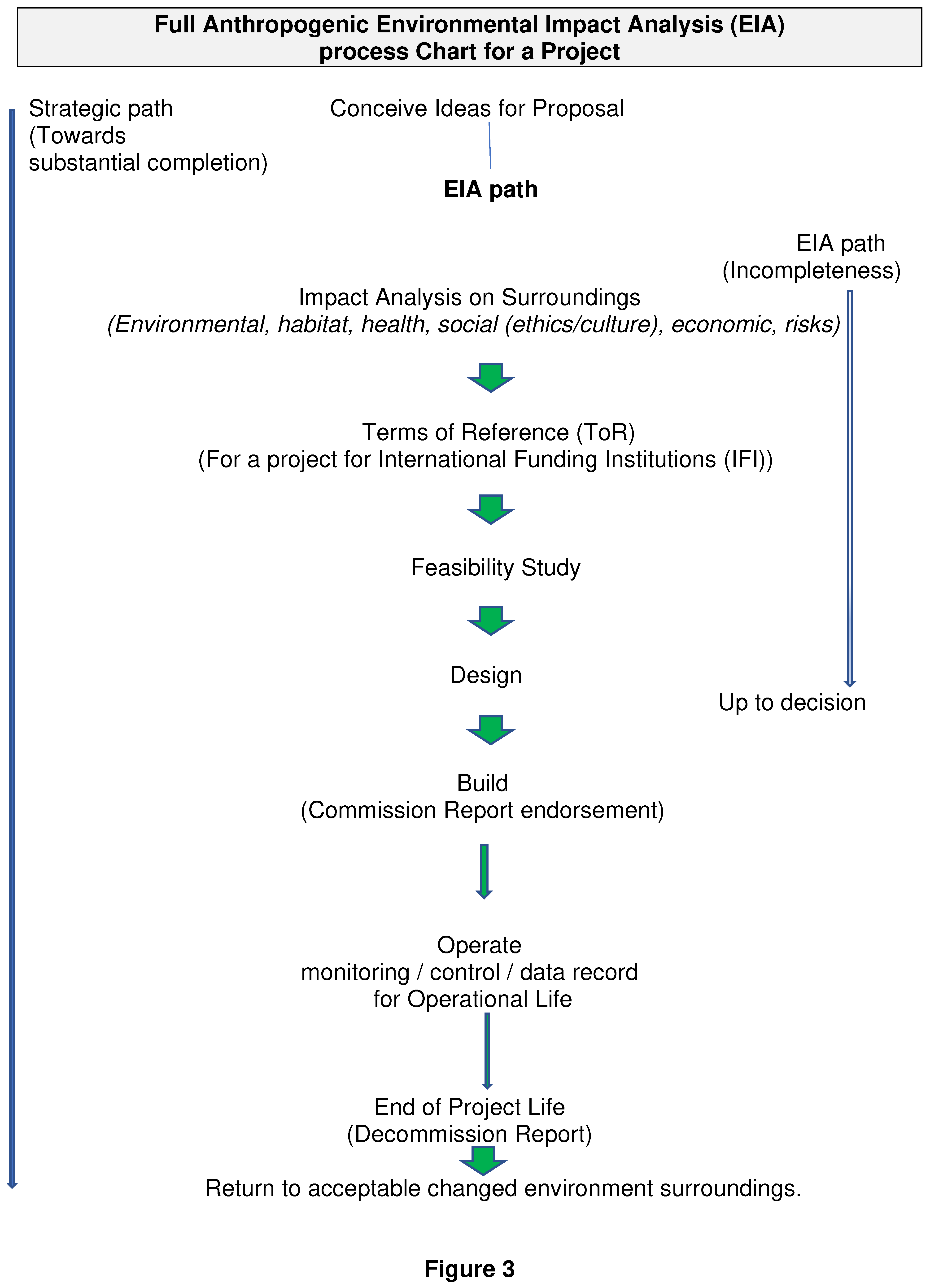
The path for the EIA process for the UK and other worldwide EIA processes runs from project identification through to the end of the ‘decision-making’ process but is ‘incomplete’, as the implementation of the anthropogenic project process requires definition and development for the construction period, the project life cycle, the decommissioning process and return to acceptable environmental surroundings.
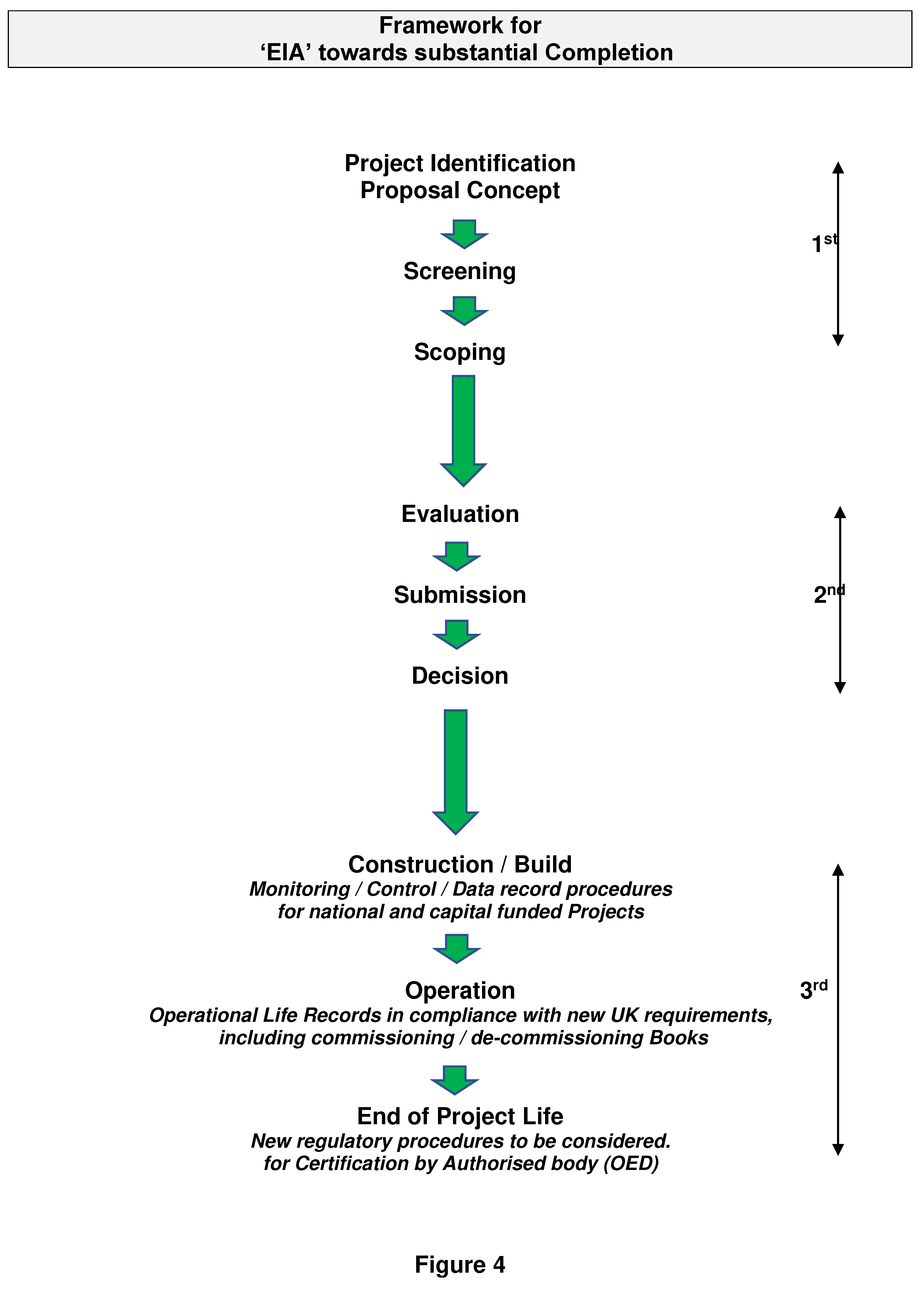
The structure for EIAR 2017 may be summarised as, 3 parts for pre-submission to prepare the environmental statement, and 3 parts covering post-submission for Approval; as: [project Identification / Screening / Scoping // Evaluation / Consenting / Decision].
For ‘completeness’ of the ‘environmental impact analysis’ process, a comprehensive EIA Structure Plan Framework is required and will need to be developed together with a co-ordinated process to be set up to embrace the overall strategy, planning and sustained operation throughout the project life, and closure. This requires 3 additional parts, namely: Construction / Operation / ‘End of project Life’ with return to acceptable environmental surroundings. This also must include and address ‘climate change’ which requires urgent action for proper ‘carbon management’ legislation.
‘Construction Period’ The Impact analysis of a contract period is assessed-reviewed in 3 parts: ‘start-up’ - ‘construction’ - ‘substantial completion’, and the construction period is governed by a set ‘Form of Contract’ document, which is a legally binding contract between two Parties183. ‘Start-up’ requires a proper strategy at commencement which embraces plans and programme(s) for the contract period and beyond into effective operation. Additional information for climate change legislation is required since Brexit and COP26 and requires to be included in the ‘project supervision structure plan’. ‘Construction phase’: the construction works covering all ‘works disciplines’ are supervised under ‘construction management services’ which require effective [monitoring - control - recording] procedures endorsed by a compiled set of records. ‘Completion phase’: covers the commissioning for taking-over and handing-over for a liability period, usually termed Defects Notification Period (DNP) or Defects Liability Period (DLP).
‘Operational Life’: [The Initial Operation period may include a ‘commissioning period’, endorsed by a Report]. The main Operational life of a Project requires regular reporting and records for sustained monitoring / control procedures together with [assessment / review / evaluation] of these records through the project life, and to regulate the decision for the desired closure.
‘End of Project Life’ requires a [decommissioning / removal (taking down or demolition) / disposal or storage or recycling] of all materials, plant, equipment, to return to acceptable environmental surroundings. Important Climate Change legislation since Brexit requires careful integration into the restructured EIA process Model.
4.01. Clarification for terms used and adopted in this Paper:
i.) The definition of ‘Environment’ is important towards a structure and understanding for ‘Environmental Law’ and is taken as the substance and physicality of ‘surroundings’,184 and our perception of the law for protecting the land, water and air on the planet, including all ‘flora and fauna’; indeed, it is our perception of ‘everything we see and understand’.
The structured approaches, and views, for prospective projects will differ between Employers, large Companies and Individuals, but will have the Intention for common responsibility. As such, a singular definition of ‘the environment’ is problematic185 and indicates ‘incompleteness’ outlined in various environmental books186, though the intention to protect and ‘avoid’ harm to the environment is a clear and common responsibility.
ii.) The ‘monitoring process' is an important mechanism and management tool, and ‘monitoring’ is highlighted in several sections of environmental legislation.187 Monitoring requires both accurate readings and measurements to be effectively taken and published. This is to ensure effective operation and sustainability, which may require further action to ensure proper ‘monitoring / control procedures’ are taken, and to allow for an ‘assessment / review’ of the activity, or range of activities. This is to allow suitable adjustments to be made, to improve that activity or related substance, and / or the rate of that activity. Effective ‘monitoring/ control’ of ‘works programmes’ and ‘co-ordinated programmes’ may also avoid ‘critical ‘slippage’ to the progress of construction works of projects, and any changes required to material substances related to environmental activities, would be identified to manage and enhance performance standards during the construction period and project life.
iii.) Definition of Project: Construction Projects are governed in some form by a contract, or several integrated contracts for multi-disciplined works, or staged construction, to a particular designated area to suit planning policies, or as required by site conditions. Very large projects require permission at National Level188 by the responsible Secretary of State, and are known as ‘Nationally Significant Infrastructure Projects’ (NSIPs), and automatically need an ‘EIA’189.
In the case ‘Regina v Rochdale Metropolitan Borough Council, Ex parte Milne (2): QBD 31 Jul 2000’ a large project development was to be carried out in stages and outline planning permission was granted based on bare facts. In a separate case, ‘R. v. Rochdale MBC, ex parte Tew and Others’ local residents successfully opposed the outline planning application for development of a business park, on grounds of inadequate information and that no EIAs were submitted. Such a development may be termed a ‘multi-project’ type, and a structured co-ordinated approach, furnishing information related to the ‘project life’, together with as much ‘structured information’ as possible at the outline planning stage, may have avoided rejection and the developer loosing available EU funding at the time.
In the case EU v Ireland (C-50/09) [2011] Env LR 25, the EU ruled that ‘demolition works may constitute a ‘project’, irrespective that ‘demolition works was not expressly mentioned in Annexes I and II190. The ECJ was referring to the stated categories, rather than the exact activity and nature of the work.191
iv.) Forms of Contract: The UK use two separate forms of construction contract, now referred to as ‘Infrastructure Conditions of Contract’ (ICC), and the ‘New Engineering Contract’ (NEC), which offer a fundamental review of alternative strategies for good practice. For International constructional projects, the ‘Federation Internationale des Ingenieurs-Conseils’ (FIDIC), ‘The International Federation of Consulting Engineers’, published a traditional FIDIC ‘Conditions of Contract for civil engineering construction’, known as the Red Book. In 1999 this was followed by the FIDIC ‘Conditions of Contract for a Construction’ suite of contract books also embracing Electrical & Mechanical Works which embraced: ‘Red Book’ for Construction Works, ‘Yellow Book’ for a Design-Build Contract (embracing mechanical and electrical works), ‘Silver Book’ for a Turnkey Contract and a ‘White Book’ for Model Services Agreement between Employer and Contractor192. In 2017 the UK and FIDIC193 Forms of Contract were updated, and the suite(s) of Contracts expanded including also for project management services requirements, though this is beyond the scope of this paper.
World Bank signed a five-year agreement to use FIDIC standard contracts194 for some projects they finance for FIDIC documents, AND to be used as part of their standard bidding documents.
4.1 The restructured UK ‘EIA’ Project path for ‘substantial completeness’ after Brexit is for a structured presentation in the following stages: ‘project preparation’, ‘legal and administrative process’, and ‘construction works, and project life’. (anthropogenic) See Figure 4195.
4.1.1) 1st Stage: the recognised process remains and is described under 3 structured steps:
Step 1, Project Identification: Conception and location of the project footprint
Step 2, Screening: Identifies whether Environmental Impact Analysis is required.
Step 3, Scoping: Identifies the scope of the project work.
4.1.2) 2nd Stage: the legal and administrative process:
Step 4, the ‘Evaluation’: to assess and review the Impact on the environmental surroundings, together with mitigating circumstances and the preparation of a standard structured environmental ‘EIA’ report, with classified findings.
Step 5, the ‘Submission’: in a standard format, recorded through the local authority to the ‘Office for Environmental Protection’.
Step 6, Decision to be recorded by the local authority and the Office for Environmental Protection.
4.1.3) 3rd Stage covers ‘the build’ and ‘operate’ for the duration of the project life. This is the implementation of the plans and programme envisaged in the ‘incomplete’ part of the process and must embrace nature and man’s environmental changes throughout the lifetime, including ‘climate change’, and other non-anthropogenic changes that must be monitored and recorded, and control procedures undertaken, to ensure sustainability, and an acceptable environmental balance.
Step 7: Construction Works Period: The analysis for this period is considered in three phases: the ‘commencement period’, the main ‘’construction works period and the ‘completion stage’ of the works, leading into the operational and commercial life of the project.
The ‘Commencement to the Works’196 in contract law terms, is structured for a start date record in the Contract data record, and a ‘programme of works’197 is agreed between the Employer198 and the Contractor199, and a comprehensive set of administrative procedures is in place to record a full set of contract records, usually under the management of an ‘Engineer’ to the Contract. For major, national and international projects a ‘Project Co-ordinate Programme’200 is adopted, together with a ‘Project Supervision Structure Plan, ‘to describe the complete methodology to be used for the duration of the project works. This may embrace a multiple number of individual contracts.
The construction works are carried out by the Contractor under the supervision of the Engineer201 and his duties and authority are stipulated in the general conditions of contract between the two parties to the contract. Important duties include ‘monitoring’ of the ‘whole of the works’ and ‘collection and recording’ of data records.
The completion stage of the Works includes the ‘testing of all materials, plant and equipment’ and the issue of certificates for Completion of the Works at ‘taking-over’ followed by completion of proven ‘performance’.
Step 8: For the ‘Operational Life’ Period a structured set of ‘operation management procedures’ are required for monitoring, controlling and recording, during the operational life, and for larger and industrial projects a set of Operation and Maintenance (O&M) Manuals are adopted. Guidelines for monitoring, review and control procedures, to achieve sustainability for the environment, and including emissions and discharge of substances and materials, require proper regulation.
Step 9: End of Project Life: A new structure plan framework for the ‘decommissioning’ for all projects to be set up, to enable a satisfactory return to acceptable environmental surroundings, and full ‘Decommissioning’, accompanied by closure reports for Industrial and national projects.
4.2. Existing Environmental Regulations for restructure process
The following important primary and secondary legislation has to be embraced in the identification process, and inclusion of additional regulations in the structure plan for a restructured framework, covering the Climate Change Act 2008,202 and the Environment Act 2021203, and including the Public Available Specification (PAS), commissioned by the Green Construction Board (GCB), under the auspices of the British Standards Institution (BSI).204 For the ‘Construction period’, ‘Operation period’’ and End of life period’, a number of the regulations may apply:
4.2.1) Climate Change Act 2008, Carbon targeting and budgeting205: carbon budgeting206, limit on use of carbon units207, proposals and policies for meeting carbon budgets208, targeting greenhouse gases209, carbon units, carbon accounting and net UK carbon account, and for (EA 2021):
PART 1 Environmental Governance: Chapter 1, Improving the natural environment: Environmental targets210, Environmental improvement plans 211, Environmental monitoring212, Policy statement on environmental principles213, Environmental protection: statements and reports214.
PART 3 Waste and resource efficiency, Producer responsibility215, Resource efficiency216, Managing waste217, Waste enforcement and regs.218
PART 4 Air quality and enforcement recall: Air quality219, Environmental recall of motor vehicles etc.220
PART 5 Water: Plans and proposals221, Storm Overflows222, Regulation of water and sewerage undertakers223, Abstraction224, Water quality225, Land drainage226 s94-s97
SCHEDULES - Schedule 1 through to Schedule 21.
4.2.2) For Environment Act 2021229 PART 1 - Environmental Governance:
CHAPTER 1- Improving the natural environment, Environmental targets230, Environmental Improvement plans231, Environmental monitoring232, Policy statement on environmental principles233, Environmental protection, statements and reports234. CHAPTER 2- The Office for Environmental Protection,
PART 3 Waste and resource efficiency, Producer responsibility 50 51, Resource efficiency 52 53 54 55 56, Managing waste 57 58 59 60 61 62 63, Waste enforcement and regulations 64 65 66 67 68 69 70 71235
PART 5 Water, Plans and proposals238, storm overflows239, Regulation of water and sewerage undertakers240, Abstraction241, Water quality242, Land drainage243
PART 8 Miscellaneous and general provisions - Regulation of chemicals - 140. Amendment of REACH legislation244
Schedule 10 - Enforcement Powers, Schedule 11 - Local Air Quality management framework, Schedule 12 - Smoke control in England and Wales, Schedule 13 - Modifying water and sewerage undertakers’ appointments: procedures for appeals,
Schedule 21 - Amendment of REACH legislation
4.3. New identified Environmental Regulations under a restructured process
This paper is confined to analysing a restructure for the actual ‘EIA’ skeletal path towards ‘substantial completion. ’A new UK National EIA structured process is beyond the scope of this paper, though it is important to highlight the parts to be addressed. See Figure 3. The present format and contents of EIAR 2017 comprises 12 Parts and 4 Schedules and the following additions245 are identified for inclusion, see Table 1.
| Table 1 |
|
The changes will require a new Amendment for EIAR 2017 / 2018 to be triggered under EA 2021 containing aspects of new environmental law252 through the Office for Environmental Protection, and to involve the relevant Minister253 (EA 2021 s40). The restructure to require a sequential order for 4 additional Parts and to embrace provisions under CCA 2008., as listed in Tables 2, 3, 4 and 5.
|
Table 2 Records and procedures during construction Works and Operational Life: |
|
|
Table 3 New Part: Procedures for Decommissioning and End of Project Life |
|
|
Table 4 New Part: Procedures for climate change requirements. |
|
Table 5 Schedule 5: Decommissioning, ‘end of project life and return to environmental footprint’. |
Characteristics of the demolition and removal of materials.
|
Chapter 5 - Skeletal reference Charts for ‘EIA’ structured process

Conclusions
UK Environmental Law is a gradual evolving and fragmented process, lacking a comprehensive structure plan, and is ‘incomplete.’ It’s development through nearly half a century as a member state of the European Union, being heavily influenced and altered by ECJ jurisprudence, resulting in a compounded legal regime linked to International Environmental Law, and the mix of International Environmental Conventions, and uncertain environmental definitions.
The ‘incompleteness’ of the essential ‘environmental impact analysis’ (EIA) tool is not structured to include ‘sustainability’ and ‘monitoring techniques’ for the full project life of the anthropogenic process, to allow a return to ‘acceptable changed environmental surroundings. The same also relates to the present failure to embrace and co-ordinate essential ‘climate change’ requirements into the impact analysis process, which requires rectification, together with tackling the real difficulties encountered from river and coastal pollution, and possibilities for renewable energy projects around the UK coastline.
Indeed, there is a plentiful supply of energy on our planet, it is our lack of knowledge and understanding at this present time that does not allow us to harness that energy for mankind. For ‘substantial completeness’ man must harness the renewable energy, which is available on earth, as a fuller definition of ‘environment’ is “everything we see and understand and what we don’t see and don’t understand is the energy that integrates together our environment”.
Recommendations:
Following Brexit there is an opportunity to restructure the UK ‘Environmental Impact Process’ (EIA), to enable an effective tool to assist in the environmental impact management of this Island State, and to consider a suite of handbooks to embrace an augmented EIA Services mechanism, to identify and address protection to, and risk of, harm of the environment.
It is important and logical to include a ‘structure plan methodology’ for embracing ‘Climate Change’ in the restructure process for the ‘environmental impact analysis’ tool, to be based on, and structured around, the British Standard Institute’s publication ‘Carbon Management in Infrastructure’, and now to be relaunched as “Reduce Carbon with Confidence”.
The worsening situation of ‘water pollution’ to the United Kingdom’s Rivers and Coastal Waters caused by present agricultural procedures from ineffective management controls of nutrients, will need a new approach, and it is recommended that it is included into the EIA restructuring process and embraced within the suite of specialist handbooks, which should also embrace a clear programme of measures for comprehensive ‘River Basin Management Plans’.
The important subject of ‘renewable energy’ for UK as an independent Island Country highlights a requirement for ‘Mapping and Assessment of Ecosystems and their Services’ around the Coastal and Island regions, as an initial step towards addressing the United Kingdom’s Energy needs, and the methodologies and ‘environmental impact analysis’ procedures that will follow.
| BIBLIOGRAPHY |
| Table of Cases: |
- MOX Plant Case (Ireland v UK) 2002
- New Zealand v France [1974] ICJ Rep 457
- Trail Smelter Arbitration (United States and Canada, 16 April 1938, 3 RIAA 1907(1941)
- ‘Regina v Rochdale Metropolitan Borough Council, Ex parte Milne (2): QBD 31 Jul 2000’
- ‘R. v. Rochdale MBC, ex parte Tew and Others
- EU v Ireland (C-50/09) [2011] Env LR 25
- C-461/13 Bund fur Umwelt und Naturschutz Deutschland, Advocate General Jaaskinen
- Gabcikovo-Nagymaros Project (Hungary/Slovakia) ICJ Rep 7 (80)
- Pulp Mills of the River Uruguay Case (Argentina v Uruguay) [2006] ICJ
- Lac Lanoux Arbitration (France v Spain) (1975) 24 ILR 101
- Kraaijeveld BV v Zuid-Holland (1996) C-72/95
| Table of Legislation: |
- The Town and Country Planning and Infrastructure Planning (Environmental Impact Assessment) (Amendment) Regulations 2018, UK Statutory Instruments, 2018, No 695
- The Council of the European Communities, June 1985, on the assessment of the effects of certain public and private projects on the environment, 85/337/EEC
- European Communities Act 1972, UK Public General Acts, 1972 c. 68
- European Union (Withdrawal) Act 2018, UK Public General Acts, 2018 c. 16
- The Environment Act 2021 (Commencement No. 1) Regulations 2021, UK Statutory Instruments, 2021 No. 1274
- Environment Bill 2020 policy statement - Gov.UK, 2. Environmental Governance, para 3, line 1, 4
- Canadian Environmental Assessment Act, 1992, in force 1995
- Impact Assessment Act (S.C. 2019, C. S. 1), Government of Canada
- Union Ministry of Environment and Forests (MoEF), Government of India, 27 January 1994
- India’s Environment Protection Act 1986; Indian Constitution
- Environmental Impact Assessment Notification, Ministry of Environment and forests, Notification, New Delhi, 27th January 1994
- National Environmental Policy Act, United States of America, in force 1st January 1970
- EIA Directive (85/337/EEC)
- Environmental Protection Act 1990, UK Public General Acts, 1990 c. 43
- Pollution Prevention and Control Act 1999
- The England Permitting (England and Wales) Regulations 2016, UK Statutory Instruments, 2016, No. 1154
- Clean Air Act 1993, UK Public General Acts, 1993, c 11
- Environment Act 1995, UK Public General Acts, 1995 c 25
- Climate Change Act 2008, UK Public General Acts, 2008, c 27
- Directive 2000/60/EC of the European Parliament and the Council establishing a framework for the Community action in the field of water policy 23 October 2000, L327/1; EU Water Framework Directive (WFD)
- Water Environment (Water Framework Directive) (England and Wales) Regulations 2003, SI 2003 No. 3242
- Nitrate Pollution Prevention (Amendment)(No.2) Regulations 2016 (SI No. 1254)
- Reduction and Prevention of Agricultural Diffuse Pollution (England) Regulations 2018 (SI 2018 No. 151)
- Floods and Water (Amendment etc.) (EU Exit) Regulations 2019 (SI 2019 No. 558)
- Controlled Waste (Registration of Carriers and Seizure of Vehicles) Regulations 1991, UK Statutory Instruments, 1991, No. 1624
- Hazardous Waste Regulations 2005, UK Statutory Instruments, 2005, No. 894
- Environmental Permitting (England and Wales) Regulations 2010, UK Statutory Instruments, ISBN 978-0-11-149142
- Directive 2008/98/EC of the European Parliament and the Council, 19 November 2008, on waste and repealing certain Directives.
- The Waste (England and Wales) Regulations 2011, UK Statutory Instruments, 2011 No. 988
- Budapest Treaty of 16 September 1977 between Hungary/ Czechoslovakia on the Construction and Operation of the Gabčíkovo- Nagymaros Barrage System.
- Uruguay and Argentina, Statute of the River Uruguay. Signed at Salto in February 1975, No. 21425
- THE RIVER URUGUAY EXECUTIVE COMMISSION COMISIÓN ADMINISTRADORA DEL RIO URUGUAY, C.A.R.U
- Susan Wolf and Neil Stanley, Wolf and Stanley on Environmental Law, sixth edition 2016, published by Routledge.
- The Town and Country Planning (Environmental Impact Assessment) Regulations 2017, UK Statutory Instruments 2017 No. 571
- The Town and Country Planning and Infrastructure Planning (Environmental Impact Assessment) (Amendment) Regulations 2018, Statutory Instruments, No. 695
- The EIA Regulations: Two Years On, 16 May 2019, https://npaconsult.co.uk/article-type/environmental-design/>,
- The Environmental Impact Assessment (Amendment) (Northern Ireland) (EU Exit) Regulations 2019 (revoked), UK Statutory Instruments 2019 No 123
| Bibliography: |
- Barr B, and Grutters L, Institution of Civil Engineers, FIDIC User’s Guide, Third Edition, Thomas Telford Ltd.
- Bartlett R, (1988) SYMPOSIUM: POLICY AND IMPACT ASSESSMENT, Impact Assessment
- Boyle S, The Case for Regulation of Agricultural Water Pollution
- British Energy Security Strategy, HM Government, April 2022
- Caldwell L, (1988) Environmental Impact Analysis (EIA): Origins, Evolution, and Future Directions, Impact Assessment
- Convention on Environmental Impact Assessment in a Transboundary context United Nations 1991, a United Nations Economic Commission for Europe, signed in Espoo, Finland in 1991, in force in 1997.
- Council Directive 92/43/EEC, 21 May 1992, on the Conservation of natural habitats and of wild fauna and flora, Official Journal of the European Communities, No L 206/7
- Craik N, The International Law of Environmental Impact Assessment, Process, Substance and Integration, 2010
- Cross-Compliance under the Common Agricultural Policy: A possible mechanism for stronger standards
- Department of Environment food and rural affairs (defra), Code of Good Agriculture Practice, 1st published 2009 ISBN 978 0 11 243284
- Department of Environment, Food and Rural Affairs, ‘Air Pollution in the UK 2019’ published September 2020.
- Directive 2011/92/EU of European Parliament and the Council, 13 December 2011, on the assessment of the effects of certain public and private projects on the environment (codification).
- Ecojustice Blog, breaking down Canada’s Impact Assessment Act, posted December 7, 2021
- EIA (https://www.cseindia.org/page/eia) > Story, 3 History of EIA in India
- Environmental Impact Assessment Draft Notification 2020, India: A Critique
- Environmental Impact Assessment Systems in Europe and Central Asia Countries, May 2002
- Europe and Central Asia Environmentally and Socially Sustainable Development Department (World Bank)
- European Commission, Mapping and Assessment of Ecosystems and their Services, Indicators for ecosystem assessments
- European Commission, Mapping and Assessment of Ecosystems and their Services, Indicators for ecosystem assessments and their services, 2nd Report - Final 2014
- Fethiye Municipality; ‘Project Completion Report’ ‘Wastewater Collection and Treatment Facilities for Fethiye’, February 2004, archived.
- FIDIC Conditions of Contract for Plant and Design-Build, 1st Edition 1999, ISBN 2-88432-023-07
- FIDIC EPC/Turnkey Projects, 1st Edition 1999, ISBN 2-88432-021-0
- General Contract Conditions of Contract, produced by the UK Institution of Civil Engineers
- Glasson j and Therivel R, Introduction to Environmental Impact Assessment, 5th Edition
- Hindle R, Johnstone D, Kempton R, Morgan J, Institution of Civil Engineers, Proceedings, Part 1, Design and Construction, December 1989, Volume 86, Salford docks urban renewal: design, construction and management of civil engineering works.
- HM Government, A Green Future: Our 25 Year Plan to Improve the Environment, 2018
- House of Commons Library, Briefing Paper, Number 7793, 2 May 2017, Legislating for Brexit: The Great Repeal Bill
- Hughes D Jewell T, Lowther J, Parpworth N, Prez P, Environmental Law, 4th edition.
- International Court of Justice, Press Release (Unofficial), No. 2017/31, dated 21 July 2017
- International Court of Justice, Press Release, No 2010/10, 20 April 2010
- International Tribunal for the Law of the Sea (ITLOS)
- Legal vacuum and the Bhopal Gas tragedy, 10 June 2010, PRS Legislative Research
- Lely the Minister of Waterstaat, which is the department for the maintenance of Dikes, roads, bridges, canals, etc.
- Nagy B, The ICJ Judgement in the Gabcikovo-Nagymaros Project Case and its Aftermath
- National Geographic, Learn with us. The Coriolis Effect: Earth’s Rotation and Its Effects on Weather.
- Net Zero, The UK’s contribution to stopping global warming, Committee on Climate Change, May 2019
- Noumea Convention 1986
- PAS 2080:2016, British Standard Institute Publicly Available Specification.
- Process Guidance Note 6/9 (04), Crown copyright 2004, defra, Scottish Executive, Welsh Assembly Government; (BATNEEC)
- Protocol on Strategic Environmental Assessment in 2003, in force in 2011
- Sands P and Peel J with Fabra A and Mackenzie R, Principles of International Environmental Law, fourth edition.
- Stockholm Earth Summit, 1972
- TECO Group web page; https://tecogrp.com/wadi-arab-waste-water-treatment-plant/
- The Hague Justice Portal, Dr. Panos Merkouris, ‘Case concerning Pulp Mills on the River Uruguay: Of Environmental Impacts Assessments and Phantom Experts’
- The International Federation of Consulting Engineers (FIDIC) https://fidic.org>
- The Netherlands’ Zuiderzee - Project - WUR depot
- The Protocol on Environmental Protection to the Antarctic Treaty, in force 1998
- The Treaty on European Union, signed in Maastricht, 7th February 1992, in force 1 November 1993
- Tromans S QC, Environmental Impact Assessment, 2nd Edition, Bloomsbury Professional Ltd 2012
- UN, Convention on Biological Diversity, 1992
- UNFCCC, Convention of Biodiversity, Earth Summit, Rio de Janeiro, 5 June 1992
- UNFCCC, The Rio Declaration on Environment and Development, June 1992
- UNFCCC, United Nations, FCCC/INFORMAL/84, GE.05-622200 (E) 200705
- United Nations Conference on Environment and Development, Rio de Janeiro, 3-14 June 1992, Annex I, Rio Declaration on Environment and Development
- United Nations Convention on the Law of the Sea (UNCLOS), 10 December 1982, Section 4, Monitoring and Environmental Assessment
- Vienna Convention on Succession of States in respect of Treaties, 23 August 1978
- Weather, Government Webpage, Flight Environment, Prevailing Winds, Hemispheric Prevailing Winds
- White K, E. Bellinger, Saul A, Symes M and Hendry K, Urban Waterside Regeneration, problems and prospects
- World Charter for Nature, United Nations, A/RES/37/7, General Assembly 28 October.
| 1 | Robert V Bartlett (1988) SYMPOSIUM: POLICY AND IMPACT ASSESSMENT, Impact Assessment, 6:3-4, 73-74, DOI: 10.1080/07349165.1988.9725647, line 1, 73 |
| 2 | Bartlett R, n2, para 3, line 2, 73 |
| 3 | Lynton K. Caldwell (1988) Environmental Impact Analysis (EIA): Origins, Evolution, and Future Directions, Impact Assessment, 6:3-4, 75-83, DOI: 10.1080/07349165.1988.9725648, 2nd para, 75 |
| 4 | Caldwell K, n4, A Learning process, para 1, 79 |
| 5 | ibid, concluding sentence, p 83 |
| 6 | The Council of the European Communities, June 1985, on the assessment of the effects of certain public and private projects on the environment, 85/337/EEC, para 6,” Whereas the disparities……to Article 100 of the Treaty”
|
| 7 | The Town and Country Planning and Infrastructure Planning (Environmental Impact Assessment) (Amendment) Regulations 2018, UK Statutory Instruments, 2018, No 695, Explanatory Note, insert new regulations 33A and 33B into SI 2017/571 |
| 8 | House of Commons Library, Briefing Paper, Number 7793, 2 May 2017, Legislating for Brexit: The Great Repeal Bill |
| 9 | European Communities Act 1972, UK Public General Acts, 1972 c. 68 |
| 10 | Ref: Miller (No 1) Case - Supreme Court decision: may not be used to nullify rights that Parliament enacted through primary legislation - Prime Minister’s right.
|
| 11 | The Treaty on European Union, signed in Maastricht, 7th February 1992, in force 1 November 1993 |
| 12 | European Union (Withdrawal) Act 2018, UK Public General Acts, 2018 c. 16 |
| 13 | HM Government, A Green Future: Our 25 Year Plan to Improve the Environment, 2018 |
| 14 | The Environment Act 2021 (Commencement No. 1) Regulations 2021, UK Statutory Instruments, 2021 No. 1274 |
| 15 | Environment Bill 2020 policy statement - Gov.UK, 2. Environmental Governance, para 3, line 1, 4 https://www.gov.uk/government/publications/environment-bill-2020/30-january-2020-environment-bill-2020-policy-statement//contents
|
| 16 | Environment Bill 2020 policy statement - Gov.UK, 2. Environmental Governance, last para, penultimate line, 4; EA 2021, Part I, Chapter 1, Environmental Improvement Plans, s10 (4) |
| 17 | Environment Act 2021, UK Public General Acts, 2021 c 30, Part I Environmental Governance, Chapter 2, The Office for Environmental Protection, ss 22 - 43. https://www.theoep.org.uk/office-environmental-protection
|
| 18 | EA 2021, s 39 (1)(a)(b), Judicial review: powers in urgent cases and to intervene. |
| 19 | EA 2021, PART 1 Chapter 1, Section 17, Policy statement on environmental principles, 17 (1)(2)(3)(4)(5) |
| 20 | EA 2021, PART 1 Chapter 2, s 28-30 and 31-36 |
| 21 | Stockholm Earth Summit, 1972, Principles 14 and 15 |
| 22 | United Nations Conference on Environment and Development, Rio de Janeiro, 3-14 June 1992, Annex I, Rio Declaration on Environment and Development, Principle 17 |
| 23 | Ibid, Annex II, Agenda 21 |
| 24 | The Protocol on Environmental Protection to the Antarctic Treaty, in force 1998, 27 No. Articles, Article 8 - Environmental Impact Assessment. https://www.ats.aq/e/protocol.html
|
| 25 | ibid, Article 8 - Environmental Impact Assessment. |
| 26 | Convention on Environmental Impact Assessment in a Transboundary context United Nations 1991, a United Nations Economic Commission for Europe, signed in Espoo, Finland in 1991, in force in 1997; Conference was supplemented by the Protocol on Strategic Environmental Assessment in 2003, in force in 2011. |
| 27 | World Charter for Nature, United Nations, A/RES/37/7, General Assembly 28 October 2003, 11 Functions, 11 |
| 28 | Ibid, 11(b)(c) |
| 29 | United Nations Convention on the Law of the Sea (UNCLOS), 10 December 1982, Section 4, Monitoring and Environmental Assessment, Articles 205, 206 |
| 30 | Noumea Convention 1986, Article 16 |
| 31 | International Tribunal for the Law of the Sea (ITLOS), created by mandate of United Nations Conference on the Law of the Sea. (UNCLOS) |
| 32 | Neil Craik, The International Law of Environmental Impact Assessment, Process, Substance and Integration, 2010, para 2 137 |
| 33 | UNFCCC, Convention of Biodiversity, Earth Summit, Rio de Janeiro, 5 June 1992, in force December 1993. |
| 34 | Philippe Sands and Jacqueline Peel with Adrianna Fabra and Ruth Mackenzie, Principles of International Environmental Law, fourth edition, 1992 Biodiversity Convention, first sentence 673, |
| 35 | UN, Convention on Biological Diversity, 1992, Article 14, Impact Assessment and Minimizing Adverse Impacts, 1(a) |
| 36 | ibid, Article 7, Identification and monitoring, (a)(b)(c)(d) |
| 37 | Phillippe Sands et al, Part III, 14, Impact Environmental Assessment, World Bank and other multilateral lending institutions 675 |
| 38 | Europe and Central Asia Environmentally and Socially Sustainable Development Department (World Bank) |
| 39 | Environmental Impact Assessment Systems in Europe and Central Asia Countries, May 2002, Chapter 6. Conclusions and recommendations, 6.1 para 1, last 4 lines 34 http://web.worldbank.org/archive/website00983A/WEB/PDF/EIA_IN_E.PDF
|
| 40 | Neil Craik, The International Law of Environmental Impact Assessment, Process Substance and Integration, Cambridge University Press, paperback 2010, Part II Background norms, 2.1 Introduction, para 1, lines 6-8 23 |
| 41 | Canadian Environmental Assessment Act, 1992, in force 1995 |
| 42 | Impact Assessment Act (S.C. 2019, C. S. 1), Government of Canada, Justice Laws Website |
| 43 | Ecojustice Blog, breaking down Canada’s Impact Assessment Act, posted December 7, 2021, https://ecojustice.ca/category/special.update
|
| 44 | Article - environmental impact assessment, EIA Process; https://www.thecanadianencyclopedia.ca, |
| 45 | Ecojustice Blog, breaking down Canada’s Impact Assessment Act, where did the IAA come from? lines 6-7 |
| 46 | Neil Craig, The International Law of EIA, 207 - 208 |
| 47 | Neil Craig, The International Law of EIA, 2nd para, 2nd sentence, fn28 32. |
| 48 | Neil Craig, The International Law of EIA, lines 3-4 105 |
| 49 | Neil Craig, The International Law of EIA, 130 |
| 50 | Ibid, fn 184 131 |
| 51 | Neil Craig, The International Law of EIA, fn 96 201 |
| 52 | Union Ministry of Environment and Forests (MoEF), Government of India, 27 January 1994, https://www.cseindia.org/understanding-eia-383
|
| 53 | India’s Environment Protection Act 1986; Indian Constitution Article 48(a) and 51(A)g. |
| 54 | EIA (https://www.cseindia.org/page/eia) > Story, 3 History of EIA in India, para2 |
| 55 | Legal vacuum and the Bhopal Gas tragedy, 10 June 2010, PRS Legislative Research; reference: change started https://changestarted.com/indias-environment-impact-assessment-eia-2020-amendments-and-contentions/
|
| 56 | Act No. 29 of 1986, Government of India. |
| 57 | Environmental Impact Assessment Notification, Ministry of Environment and forests, Notification, New Delhi, 27th January 1994 (Incorporating the amendments) |
| 58 | n53, https://www.cseindia.org/understanding-eia-383, 5. Forms of impact assessment, para 3 |
| 59 | Environmental Impact Assessment Draft Notification 2020, India: A Critique |
| 60 | National Environmental Policy Act, United States of America, in force 1st January 1970 |
| 61 | EIA Directive (85/337/EEC) |
| 62 | Earth Summits 1972, 1992 |
| 63 | Stuart Bell, Donald McGillvray, Ole W. Pedersen, Emma Lees, Elen Stokes, Environmental Law, 9th Edition, The Importance of Definitions 7 |
| 64 | European Commission, Mapping and Assessment of Ecosystems and their Services, Indicators for ecosystem assessments under Action 5 of the EU Biodiversity Strategy to 2020 |
| 65 | Ex: Greater Irbid Wastewater Project, Jordan, Project Completion Report, Volume One, June 2001, Contract 174/95, completed May 1999, ‘Tests on Completion’ Structure Plan. / Ex: Wastewater Collection and Treatment Facilities for Fethiye, Turkey, Project Completion Report, February 2004, Tests on Completion Structure Plan - FESKI Municipality, Fethiye, Turkey / German Funding (archived) |
| 66 | Clean Air Act 1993, UK Public General Acts, 1993, c 11 |
| 67 | Environment Act 2021, UK Public General Acts, 2021 c 30, PART 4 Air quality and environmental recall s72 - schedule 11 - local air quality framework & s73 schedule 12 - smoke control in E&W |
| 68 | David Hughes, Tim Jewell, Jason Lowther, Neil Parpworth, Paula de Prez, fourth edition, Further issues in atmospheric pollution, 548 |
| 69 | Process Guidance Note 6/9 (04), Crown copyright 2004, defra, Scottish Executive, Welsh Assembly Government; (BATNEEC) |
| 70 | Department of Environment, Food and Rural Affairs, ‘Air Pollution in the UK 2019’ published September 2020. |
| 71 | Ibid, 1 Introduction, para 3; Directive 2008/50/EC; Fourth Daughter Directive (2004/107/EC) reference endnote 2. |
| 72 | Weather, Government Webpage, Flight Environment, Prevailing Winds, Hemispheric Prevailing Winds. https://www.weather.gov/source/zhu/ZHU_Training_Page/winds/Wx_Terms/Flight_Environment.htm#:~:text=The%20pressure%20gradient%20causes%20the,flow%20parallel%20to%20the%20isobars. |
| 73 | National Geographic, Learn with us. The Coriolis Effect: Earth’s Rotation and Its Effects on Weather https://www.nationalgeographic.org/encyclopedia/coriolis-effect/
|
| 74 | UNFCCC, The Rio Declaration on Environment and Development, June 1992, Principle 7 |
| 75 | Climate Change Act 2008, UK Public General Acts, 2008, c 27 |
| 76 | ibid, Part 1, Carbon Budgeting, regs, 4-10 |
| 77 | ibid, Part 2, The Committee on Climate Change, regs (32((33)(34)(35)(36)(37)(38)(39)(40)(41)(42) (43). |
| 78 | ibid, Part 1, Carbon Targeting and budgeting, The target for 2050, s1 |
| 79 | ibid, Part 6, General supplementary provisions, regs (89)(90)(91)(92)(93)(94)(95)(96)(97)(98)(99) (100) (101) |
| 80 | PAS 2080:2016, British Standard Institute Publicly Available Specification, Carbon Management in infrastructure, Construction Leadership Council, The Green Construction Board, 31 May 2016 |
| 81 | Ibid, 1 Scope, Table 1, The scope of PAS 2080 |
| 82 | Ibid, 1 Scope, lines 1-2 |
| 83 | Ibid, 3.17 greenhouse gases (GHGs), NOTE 2. |
| 84 | ibid, 7 Quantification of GHG emissions, 7.1.4 Study period. |
| 85 | ibid, 0 Introduction, 0.1 Infrastructure and greenhouse gas emissions, Figure 1, [figures extrapolated from chart]; CO2e means Carbon Dioxide equivalent,
|
| 86 | Ibid, 3.7 carbon dioxide equivalent (CO2e); [BS ISO 14064-1]: 2006; pas 2050: 2011] |
| 87 | Ibid,3.16 global warming potential (GWP); BS ISO 14084-1: 2006 |
| 88 | Net Zero, The UK’s contribution to stopping global warming, Committee on Climate Change, May 2019. |
| 89 | Environment Act 2021, UK Public General Acts, 2021, c 30, Chapter 2, The Office for Environmental Protection, s 22 - 43 |
| 90 | ibid, Reg. 17(1)(2)(3)(4)(a)(b)(5)(a)(b)(c)(d)(e) |
| 91 | UNFCCC, United Nations, FCCC/INFORMAL/84, GE.05-622200 (E) 200705 |
| 92 | British Energy Security Strategy, HM Government, April 2022 |
| 93 | British Energy Security Strategy, Renewables, pages 16-23 |
| 94 | British Energy Security Strategy, Renewables, page 21, advanced new small modular Reactors (SMRs) (AMRs) |
| 95 | European Commission, Mapping and Assessment of Ecosystems and their Services, Indicators for ecosystem assessments and their services, 2nd Report - Final 2014 |
| 96 | Examples: Severn Estuary Barrage / Mersey Estuary Tidal Project-Liverpool Bay Lagoons / Swanage Bay Tidal Lagoon |
| 97 | “Directive 2000/60/EC of the European Parliament and the Council establishing a framework for the Community action in the field of water policy” 23 October 2000, L327/1; EU Water Framework Directive (WFD) |
| 98 | Water Environment (Water Framework Directive) (England and Wales) Regulations 2003, SI 2003 No. 3242 |
| 99 | Water Environment (Water Framework Directive) (England and Wales) Regulations 2017, SI 2017, No. 407 |
| 100 | Sam Boyle, The Case for Regulation of Agricultural Water Pollution, Performance standards under the Water Framework Directive, lines 1-2 7 |
| 101 | Stuart Bell et al, p 627, para 2, line 6. |
| 102 | Department of Environment food and rural affairs (defra), Code of Good Agriculture Practice, 1st published 2009 ISBN 978 0 11 243284 5 |
| 103 | Stuart Bell et al, The Water Framework Directive, CONSIDER THIS 626 |
| 104 | n 96, Part 6, ss 26-33 |
| 105 | Implementation of the Nitrates Directive in England, 7th Report 2007-8, from Council Directive 91/676/EEC (OJ L375, 31.12.1991, P1) |
| 106 | The Nitrate Pollution Prevention Regulations 2008 No. 2349 |
| 107 | The Protection of Waters against Pollution from Agriculture - Consultation on Implementation of the Nitrates Directive (Dec’ 2011) |
| 108 | Nitrate Pollution Prevention (Amendment)(No.2) Regulations 2016 (SI No. 1254) |
| 109 | Reduction and Prevention of Agricultural Diffuse Pollution (England) Regulations 2018 (SI 2018 No. 151) |
| 110 | Floods and Water (Amendment etc.) (EU Exit) Regulations 2019 (SI 2019 No. 558) |
| 111 | Ref. Chapter 5 - Skeletal reference Charts for EIA structured process, UK agricultural legislation controls reference chart, 34. |
| 112 | Cross-Compliance under the Common Agricultural Policy: A possible mechanism for stronger standards |
| 113 | Environmental Protection Act 1990, UK Public General Acts - 1990 c 43 |
| 114 | ibid, reg 75(4) |
| 115 | Environmental Act 1995, UK Public General Acts, 1995 c. 25 |
| 116 | Controlled Waste (Registration of Carriers and Seizure of Vehicles) Regulations 1991, UK Statutory Instruments, 1991, No. 1624 |
| 117 | Hazardous Waste Regulations 2005, UK Statutory Instruments, 2005, No. 894 |
| 118 | Environmental Permitting (England and Wales) Regulations 2010, UK Statutory Instruments, ISBN 978-0-11-149142-3 |
| 119 | Directive 2008/98/EC of the European Parliament and the Council, 19 November 2008, on waste and repealing certain Directives. |
| 120 | ibid, article 3(1) |
| 121 | The Waste (England and Wales) Regulations 2011, UK Statutory Instruments, 2011 No. 988 |
| 122 | David Hughes et al, Environmental Law, 4th edition, Chapter 2, The ethical basis of environmental law and its principles, lines 1-2 17 |
| 123 | Stuart Bell et al, Environmental Law, 9th Edition, Town and Country Planning as a tool to environmental policy, 3rd para, line1 400 |
| 124 | Stephen Tromans QC, Environmental Impact Assessment, 2nd Edition, Chapter 9, Conservation and Habitats law in the EIA context, 9.1 lines 1-2 345 |
| 125 | Council Directive 92/43/EEC, 21 May 1992, on the Conservation of natural habitats and of wild fauna and flora, Official Journal of the European Communities, No L 206/7 |
| 126 | The Protocol on Environmental Protection to the Antarctic Treaty, Document, annex I (EIA) |
| 127 | International Court of Justice, Press Release (Unofficial), No. 2017/31, dated 21 July 2017 |
| 128 | Budapest Treaty of 16 September 1977 between Hungary/ Czechoslovakia on the Construction and Operation of the Gabčíkovo- Nagymaros Barrage System. |
| 129 | Hungary/Slovakia Treaty of 1997 - Gabčikovo-Nagymaros Project |
| 130 | Bolddizsar Nagy, The ICJ Judgement in the Gabcikovo-Nagymaros Project Case and its Aftermath: Success or Failure? 5 |
| 131 | Vienna Convention on Succession of States in respect of Treaties, 23 August 1978, Article 12 Other territorial regimes 2 (a)(b) |
| 132 | Bolddizsar Nagy, fn12 5 |
| 133 | Philippe Sands et al, Case concerning the Gabcikovo-Nagymaros Project, 2nd para, lines 7-8 346 |
| 134 | Ibid, end 1st para 350 |
| 135 | Ibid, para 1 351 |
| 136 | Uruguay and Argentina, Statute of the River Uruguay. Signed at Salto in February 1975, No. 21425 |
| 137 | Philippe Sands et al, The Case Concerning Pulp Mills on the Uruguay River, 351-356 |
| 138 | Article 60, Any dispute concerning the interpretation or application of the Treaty and the Statute which cannot be settled by direct negotiations may be submitted by either Party to the ICJ |
| 139 | Philippe Sands et al, 1st para, last line 352 |
| 140 | ibid, 3rd para, line 7 352 |
| 141 | Ibid, para 2, line 21, fn 131 354 |
| 142 | Ibid, The Case Concerning Pulp Mills on the Uruguay River, last para, 1st sentence 355. |
| 143 | The Hague Justice Portal, Dr. Panos Merkouris, ‘Case concerning Pulp Mills on the River Uruguay: Of Environmental Impacts Assessments and Phantom Experts’, I Introduction, page 2, last para, reference fn10 on Precautionary principle; http://haguejusticeportal.net/Docs/Commentaries%20PDF/Merkouris_Pulp%20Mills_EN.pdf |
| 144 | THE RIVER URUGUAY EXECUTIVE COMMISSION COMISIÓN ADMINISTRADORA DEL RIO URUGUAY, C.A.R.U., Chapter X, Pollution, article 41a), page 28 Ratified by Act No. 21.413 of the Argentine Republic dated September 9, 1976, and Act 14.S21 of the Oriental Republic of Uruguay dated May 20, 1975. |
| 145 | International Court of Justice, Press Release, no 2010/10, 20 April 2010, reference 1) ‘breach of procedural obligations under Articles 7 to 12 of the 1975 Statute of the River Uruguay and that the declaration by the Court of this breach constitutes appropriate satisfaction’. |
| 146 | Philippe Sands et al, Lac Lanoux Arbitration, line 1 341 |
| 147 | The Statute of the International Court of Justice (ICJ) counted on historical antecedents to be kept in mind, in respect of the Statute of its predecessor, the Permanent Court of International Justice (PCIJ).; The PCIJ was created under the auspices of the League of Nations pursuant to Article 14 of the Covenant of the League of Nations |
| 148 | Philippe Sands et al, Lac Lanoux Arbitration, line 2 341 |
| 149 | Ibid, 342, 2nd para |
| 150 | Ibid, last para 342 |
| 151 | Stephen Tromans QC, Environmental Impact Assessment, 2nd Edition, Table of European Cases, 2.158, Aannemersbedrijf P.K. Kraaijeveld BV ea v Gedeputeerde Staten van Zuid-Holland C-72/95 ECR [1996] 1-05404, line 1 78 |
| 152 | Ibid, lines 4-5 |
| 153 | EIA Directive (85/337/EEC), Council Directive of 27 June 1985, on the assessment of the effects of certain public and private projects on the environment, (85/337//EEC), No L 175/40 Official Journal of the European Union, Article 4 (2) |
| 154 | Stephen Tromans QC, (c), lines1-2 79 |
| 155 | ibid, lines 4-5 79 |
| 156 | (85/337/EEC), ANNEX 1, Projects subjected to Articles 4 (1), Annex 1, projects subject to Article 4 (1) 1, 2, 3, 4, 5, 6, 7, 8, 9. |
| 157 | ‘The Netherlands’ Zuiderzee - Project - WUR depot’, Chapter 7, The Netherlands’ Zuiderzee- Project, 2nd para https://edepot.wur.nl/22570
|
| 158 | Lely the Minister of Waterstaat, which is the department for the maintenance of Dikes, roads, bridges, canals, etc. |
| 159 | Zuiderzeevereniging is a private association for the study and the promotion of the reclamation of the Zuiderzee. |
| 160 | Judgement of the Court, 24 October 1996, Judgement 1; https://eur-lex.europa.eu/legal-content/EN/TXT/PDF/?uri=ecli:ECLI%3AEU%3AC%3A1996%3A404
|
| 161 | Ibid, judgement 18 |
| 162 | Ibid, 30 |
| 163 | Ibid, 31 |
| 164 | Ibid, refer to judgement s 26. |
| 165 | Ibid, judgement 24, 25 |
| 166 | Ref: Article by Don C Smith published 1 April 2018. fn. 1: George Pring and Catherine Pring, Environmental Courts and Tribunal: A Guide for Policy Makers (UN Environmental Programme 2016). |
| 167 | Susan Wolf and Neil Stanley, Wolf and Stanley on environmental law, 2.8, A specialist environmental court, lines 2-3 60 |
| 168 | B. R. Hindle, D. T. Johnstone, R.C. Kempton, J. H. Morgan, Institution of Civil Engineers, Proceedings, Part 1, Design and Construction, December 1989, Volume 86, Salford docks urban renewal: design, construction and management of civil engineering works 1067-1087 |
| 169 | Ibid, 1081-1087 |
| 170 | Editors K.N. White, E.G. Bellinger, A.J. Saul, M. Symes and K Hendry, Urban Waterside Regeneration, problems and prospects, 10.7 Funding, para (1.) 89. |
| 171 | Contract conditions produced by the UK Institution of Civil Engineers; https://civilengineeringx.com/project-managment/contract-conditions-produced-by-the-uk-institution-of-civil-engineers/
|
| 172 | French funded project: “Improvement/Refurbishing of Sewage Treatment Plant Phase-I, II, Rehabilitation of Sewage Treatment Plant Phase - III, and Construction of Sewage Treatment Plant Phase-IV, Islamabad, 2005 - 2007 (the Project) |
| 173 | Fethiye Municipality; ‘Project Completion Report’ ‘Wastewater Collection and Treatment Facilities for Fethiye’, February 2004, archived; important statistics: date of commencement ‘Lot 1 Contract’ 4 June 2002, original date of completion 29 January 2004, actual completion date 12 December 2003, |
| 174 | Reference: Fethiye Advanced Biological Wastewater Treatment Plant, 2nd Stage Units Application Project, Final Environmental and Social Impact Assessment Report https://documents.worldbank.org/curated/en/353601590561579771/text/Environmental-and-Social-Impact-Assessment-for-Fethiye-Advanced-Biological-Waste-Water-Treatment-Plant-Second-Stage-Units-Application-Project.txt
|
| 175 | Wadi Arab Project Completion Report, Volumes 1,2,3 and 4, submitted in June 2001 for both Projects to Water Authority of Jordan (WAJ); https://tecogrp.com/wadi-arab-waste-water-treatment-plant/
|
| 176 | Project Financed by Kreditanstalt fur Wiederaufbau (KfW), in the framework of the German Jordanian Cooperation |
| 177 | Susan Wolf and Neil Stanley, Wolf and Stanley on Environmental Law, sixth edition 2016, published by Routledge, 2.8 - A specialist environmental court? 60 |
| 178 | The Town and Country Planning (Environmental Impact Assessment) Regulations 2017, UK Statutory Instruments 2017 No. 571 |
| 179 | The Town and Country Planning and Infrastructure Planning (Environmental Impact Assessment) (Amendment) Regulations 2018, Statutory Instruments, No. 695 |
| 180 | The EIA Regulations: Two Years On, 16 May 2019, https://npaconsult.co.uk/article-type/environmental-design/>, |
| 181 | The Environmental Impact Assessment (Amendment) (Northern Ireland) (EU Exit) Regulations 2019 (revoked), UK Statutory Instruments 2019 No 123 |
| 182 | Ref: Full Anthropogenic Environmental Impact Analysis (EIA) process Chart for a Project, 36. |
| 183 | Brian Barr and Leo Grutters, Institution of Civil Engineers, FIDIC User’s Guide, Third Edition, Thomas Telford Ltd, Ch. 1, 1.1 Construction contracts, line2 3 |
| 184 | Stuart Bell et al, Environmental, lines 8-12 7 |
| 185 | Stuart Bell et al, Box 1.1, Definitions of the environment, 8 |
| 186 | Ref: Richard Card and Jill Molloy, (Card, Cross & Jones), Criminal Law: (22nd edition, OUP 2016), Codification, 1.70 lines 1-7, 30; Stuart Bell et al, Environmental Principles, para 1, 55; Lynton K. Caldwell (1988) Environmental Impact Analysis (EIA): Origins, Evolution, and Future Directions, Impact Assessment, 6:3-4, 75-83, DOI: 10.1080/07349165.1988.9725648, concluding sentence, p 83. |
| 187 | EA 2021, Part 1, c 1, s 16 environmental monitoring (1)(a)(b)(c)(2)(3)(4)(5); Antarctic Protocol, Annex 1, Environmental Impact Assessment, article 5, monitoring (1)(2)(a)(b) |
| 188 | John Glasson and Riki Therivel, Introduction to Environmental Impact Assessment, 5th Edition, 3.8 Infrastructure Planning (EIA) Regulations 2017, column2, para 1 76 |
| 189 | EIAR 2017, Schedule 1 |
| 190 | Directive 2011/92/EU of European Parliament and the Council, 13 December 2011, on the assessment of the effects of certain public and private projects on the environment (codification) Article 4(1)(2) Annex 1, Annex 2 |
| 191 | Stephen Tromans QC, Environmental Impact Assessment, 2nd Edition, 2.7, lines 1-4 17 |
| 192 | Brian Barr and Leo Grutters, FIDIC Users’ Guide, Third Edition, ICE publishing through Thomas Telford 2014, 1.3 The Traditional FIDIC Conditions of Contract 5 |
| 193 | ‘The International Federation of Consulting Engineers’ (FIDIC) https://fidic.org> |
| 194 | FIDIC, International Federation of Consulting Engineers, The Global Voice of Consulting Engineers.; https://fidic.org/world-bank-signs-five-year-agreement-use-fidic-standard-contracts
|
| 195 | Ref: Chapter 5, “Framework for ‘EIA’ towards substantial Completion”. |
| 196 | FIDIC EPC/Turnkey Projects, 1st Edition 1999, ISBN 2-88432-021-0, 8 Commencement of Works, 8.1 Commencement of Works |
| 197 | Ibid, 8.3, programme |
| 198 | Ibid, 3 The Employer’s Administration, 3.1 The Employer’s Representative (International Consultant) |
| 199 | Ibid, 4, The Contractor |
| 200 | Example: Ref: The Institution of Civil Engineers, Proceedings, Part 1, Design and Construction, December 1989, Volume 86, The co-ordinate programme (for the ‘Salford Quays Project) for Salford Docks Urban Renewal 1082 |
| 201 | FIDIC Conditions of Contract for Plant and Design-Build, 1st Edition 1999, ISBN 2-88432-023-07, 3 The Engineer, 3.1 Engineer’s Duties and Authority |
| 202 | Climate Change Act 2008, UK Public General Acts 2008 c 27 |
| 203 | Environment Act 2021, UK Public General Act 2021 c 30 |
| 204 | PAS 2080:2016 - Carbon Management in Infrastructure, Construction Leadership Council, The Green Construction Board, published by British Standards Institution, ISBN 978 0 580 90155 3, 4th May 2016 |
| 205 | Climate Change Act 2008, UK Public General Acts 2008 c 27, Part 1 Carbon Targeting and budgeting, s1 - s31 |
| 206 | Ibid, s4, s10 |
| 207 | Ibid, s11 |
| 208 | Ibid, s13, s15 |
| 209 | Ibid, s24, s25 |
| 210 | Environment Act 2021, UK Public General Act 2021 c 30, Chapter 1 Improving the natural environment, Environmental targets, s1 - s7. |
| 211 | Ibid, s8, s15 |
| 212 | Ibid, s16 |
| 213 | Ibid, s17, s19 |
| 214 | Ibid, s20, s21 |
| 215 | Ibid, PART 3, S50, S51 |
| 216 | ibid, s52, s56 |
| 217 | Ibid, s57, s63 |
| 218 | Ibid, s64, s71 |
| 219 | Ibid, PART 4, s72, s73 |
| 220 | Ibid, s74, s77 |
| 221 | Ibid PART 5, S78, s79 |
| 222 | Ibid, s80, s84 |
| 223 | Ibid, s95, s87 |
| 224 | Ibid, s88, |
| 225 | Ibid, s89, s93 |
| 226 | Ibid, s94, s97 |
| 227 | Ibid, PART 6, s98, s101 |
| 228 | Ibid, s142, s149 |
| 229 | Environmental Act 2021, UK Public General Acts, 2021 c 30 |
| 230 | EA 2021, PART 1, Environmental Governance, Chapter 1, Improving the natural environment, s 1. |
| 231 | Ibid, s 8 |
| 232 | ibid, s 16 |
| 233 | ibid, s 17 |
| 234 | ibid, s20, s21. |
| 235 | ibid, PART 3 |
| 236 | ibid, PART 4, s72, 73 |
| 237 | ibid, s74, 75,76,77 |
| 238 | ibid, PART 5, 78, 79 |
| 239 | ibid, s80, 81, 82 83 84 |
| 240 | ibid,85, 86 87 |
| 241 | ibid, 88 |
| 242 | ibid, 89, 90, 91, 92, 93 |
| 243 | ibid, 94, 95, 96, 97 |
| 244 | ibid, PART 8, s140 |
| 245 | EIAR 2017, General, s4. Environmental impact process. |
| 246 | Climate Change Act 2008, UK Public General Acts, 2008, c. 27 |
| 247 | ibid, Part 1 Carbon target and budgeting, The target for 2050, 1, 2, 3, Carbon budgeting, 4,5,6,7,8,9,10, limit on use of carbon units, 11, indicative annual ranges, 12, Proposals and policies for meeting carbon budgets, 13,14,15, Determination whether objectives met, 16,17,18,19,20, Alteration of budgets or budgetary periods, 21,22,23, Targeting greenhouse gases, 24,25, Carbon units, carbon accounting and the net UK carbon account, 26,27,28, Other supplementary provisions, 29,30,31. |
| 248 | ibid, Part 2, The Committee,32, Functions of the Committee,33,34,35,36,37,38, Supplementary provisions,39,40,41,42, Interpretation,43. |
| 249 | ibid, Part 3, Trading Schemes,44,45,46, Authorities and regulations,47,48,49, Other supplementary provisions, 50,51,52,53,54, Interpretation,55 |
| 250 | ibid Part 4, National reports and programmes,56,57,58,59,60, Reporting authorities: non-devolved functions,61,62,63,64,65, Interpretation 70. |
| 251 | ibid Part 5, Other provisions, Waste reduction schemes, 71,72,73,74,75, Collection of household waste,76 Charges for carrier bags,77, Renewable transport fuel obligations,78, Carbon emissions reduction targets,79, Miscellaneous,80,81,82,83,84,85,86,87,8, Part 6, General supplementary provisons,89,90,91,92,93,94,95,96,97,98,99,100,101. |
| 252 | EA 2021, s20 |
| 253 | ibid, s40 |
| 254 | Carbon Management in Infrastructure, PAS 2080: 2016, Construction Leadership Council, The Green Construction Board, British Standard Institute, (bsi), 9 Reporting 9.1, 9.2, 9.3, 9.4, 9.5. |
| 255 | Ibid, Part 1, Other supplementary provisions, 29, 30 |
| 256 | Carbon Management in Infrastructure, PAS 2080: 2016, Construction Leadership Council, The Green Construction Board, British Standard Institute, (bsi) |
| 257 | Climate Change Act 2008, UK Public General Acts, 2008, c 27, Part 1, Carbon budgeting 4,5,6,7,8,9,10. |
Disclaimer/Publisher’s Note: The statements, opinions and data contained in all publications are solely those of the individual author(s) and contributor(s) and not of MDPI and/or the editor(s). MDPI and/or the editor(s) disclaim responsibility for any injury to people or property resulting from any ideas, methods, instructions or products referred to in the content. |
© 2023 by the authors. Licensee MDPI, Basel, Switzerland. This article is an open access article distributed under the terms and conditions of the Creative Commons Attribution (CC BY) license (http://creativecommons.org/licenses/by/4.0/).
Copyright: This open access article is published under a Creative Commons CC BY 4.0 license, which permit the free download, distribution, and reuse, provided that the author and preprint are cited in any reuse.


