

Submitted:
27 December 2023
Posted:
03 January 2024
You are already at the latest version
Abstract
Chen, et al., compared two modified polyurethane-based wound dressings (PUE and PUESi), both intended for use in chronic wounds, with a negative control (gauze) and a positive control (PolyMem) via a series of preliminary in vitro and rodent model tests. Future studies may find that one or both of these two new dressings are beneficial. However, the results of this first study cannot be relied upon. Although they exhibited in-depth knowledge of manufacturing techniques, the study designers seem far less familiar with the science of wound healing and with PolyMem wound dressings. This helps explain the flaws in the methods that lead to many of their tests not being translatable to real-world settings. In addition, the interpretation of some of the test results is questionable.
Keywords:
polyurethane
; negative pressure
; non-adherent
; diabetic foot ulcer
; PolyMem
; wound cleansing
; moisture balancing
; APTES
; wound healing
; chronic wounds
; interactive dressing
; multifunctional
; inflammation
; polymeric membrane dressing
1. Introduction
A novel wound dressing technology was featured in a 2023 article by Chen, et al.[1] It is admirable that these investigators/manufacturers were bold enough to compare their new dressing technology (PUE and PUESi) to PolyMem, which is increasingly being seen as the gold standard for wound care, rather than only comparing it to gauze.[1,2,3,4,5] However, the authors seem not to have researched this comparator product (PolyMem) and instead, they stated that they “speculated” about its attributes. Consequently, they used PolyMem inappropriately, which led to results that will not translate into real-world applications.[1,6]
In addition, Chen, et al., applied an overly simplified model of diabetic wound healing. Based upon a correlational study in which inflammation and bacterial infection were associated with increased exudate, they created a dressing with high absorption activity and very high evaporation rates (MVTR) in order to control inflammation and infection in wounds.[1] Although they at one point acknowledge that exudate is often beneficial, the new dressings are designed to remove as much exudate as possible.[1] In fact, exudate is necessary for wound healing, and excess exudate is a symptom, rather than a cause, of inflammation and infection.[7,8,9,10,11]
Although it is true that bacteria thrive in moisture, human immune cells, fibroblasts, endothelial cells, and granulocytes require a moist environment as well.[2,3,4,5,6,7,8] In 1962, Winter sparked a “dressings revolution” by demonstrating that wounds healed twice as fast when they were kept sufficiently moist.[2,9,10,11] Hinman and Maibach confirmed these results in human volunteers in 1963.[12] In a 1990 review of 115 studies, Hutchinson and McGucken found that, regardless of wound type, infection rates were dramatically reduced when occlusive rather than non-occlusive dressings were used, eliminating this concern about moist wound management.[2] A rigorously designed survey found that although the general public continues to believe that wounds should be kept dry, wound experts consistently support the principle of moist wound management.[7] In the 60 years following Winter’s study, the evidence that moist wound management leads to superior outcomes has become overwhelming.[3,5,11,13,14,15,16,17,18]
Chen et al. reject this principle, asserting that drying wounds will decrease infection and inflammation and improve healing.[1] Their test found that dry gauze decreases inflammation, rather than increasing it, as is usually the case.[1,19] A detailed exploration of how this could have happened is published elsewhere. However, simply reading the methods section and examining the illustrations in Chen, et al., carefully will reveal that the differences between groups may have had more to do with the study design than with any inherent advantages of the test dressings.
Because desiccation is a cause of increased inflammation and infection, optimal wound healing relies on an environment that is moist – not too wet, and not too dry.[8,10,12,13,14,15,16] PolyMem interacts with the body to balance wound moisture, control inflammation, and continuously cleanse wounds (which addresses infection), all while concentrating nutrients, proteins, and growth factors at the wound site.[5,7,17,18]
The authors state that PolyMem is a “commercial PU foam product,” implying that it is a conventional foam dressing, which is how they treated it throughout the study.[1] In fact, PolyMem dressings are so different from conventional foam dressings that they are consistently referred to by the generic name, “polymeric membrane dressings.”[3,5,6,12,13,14,15,16,17,18] In the Discussion, Chen, et al., refer to “some” wound dressings containing glycerin, apparently unaware that glycerin is one of the components of PolyMem.[1,2,5,19,20] PolyMem’s multiple components work synergistically with each other and with the body.[5,7,12,21,22] When used appropriately, PolyMem delivers all of the benefits mentioned in the article, including extra absorption, non-adherence to the wound bed, conforming to the wound, controlling inflammation, and promoting brisk wound healing, even when used on challenging wounds, such as chronic diabetic foot ulcers.[5,7,12,22,23]
2. Specific Issues
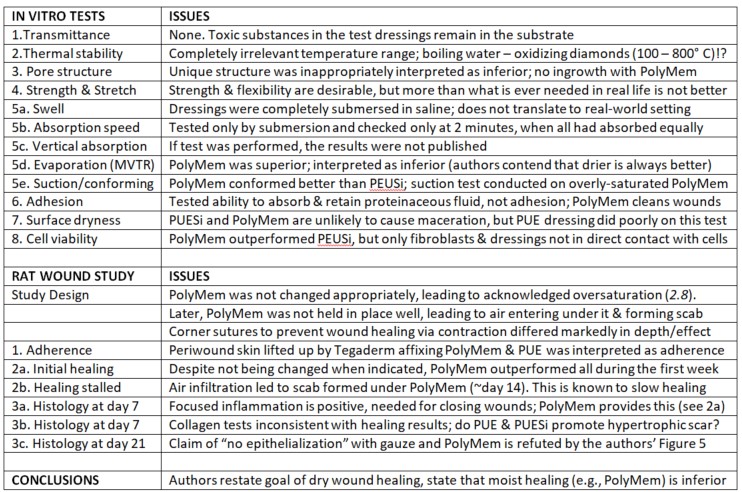
This lack of understanding of the complex multifunctional interactive nature of PolyMem dressings, and the need for wound moisture to be balanced rather than eliminated, may help to explain the errors in the investigators’ study design and interpretation of their findings. The results of eight in-vitro tests: (1. Fourier transform-infrared spectroscopy, 2. thermomechanical analyses, 3. scanning electron microscopy, 4. tensile strength, 5. water absorption, 6. anti-protein absorption, 7. surface dryness, and 8. biocompatibility), and three tests in diabetic and non-diabetic rodent models: (1. dressing adhesion, 2. wound closure rate, and 3. histology for inflammation and collagen formation), were reported.[1] Although a few of these tests provided useful information, most were of dubious value or do not mimic real-world settings. In addition, some test results were misinterpreted.
2.1. How the in vitro test results translate to real-world clinical settings
- PolyMem and the two study dressings performed similarly on the transmittance (spectroscopy) test, which is interesting, but relevant only because the new dressings contain triethoxysilane (APTES). APTES is potentially fatal if inhaled, and even mild skin exposures can lead to systemic effects.[24] In contrast, PolyMem’s components are gentle on skin and completely nontoxic.[3,6,25,26]
- Thermal stability was tested at temperatures ranging from 100° C (the boiling point of water) to 800° C, which is hot enough to oxidize diamonds. PolyMem is designed for use on humans and animals, who cannot withstand such temperature extremes. PolyMem performs well when stored and used in a tropical environment.[22,27,28]
- The authors noted that PolyMem has a very unique pore structure, as if this were an inherent problem. Independent researchers have found that this unique pore structure allows PolyMem to absorb fluids almost instantly while completely avoiding ingrowth of tissue into the dressing, features not tested in this study.[12,21,29,30]
- Both test dressings outperformed PolyMem on strength and stretch tests. Although it is true that an ideal dressing should possess excellent flexibility and mechanical strength, it is not true that the best dressing is the one that is the strongest and the most flexible. Other criteria are important as well. PolyMem is renowned for how comfortable and conformable it is.[3,5,31] Its flexibility and strength are more than adequate for real-world applications.[12,26,29,32,33]
- Although the authors used Simulated Body Fluid for the swelling test, inexplicably, absorption was tested with buffered saline.[1] To prevent maceration, dressings should absorb fluid both vertically and quickly.[14] No test results of these aspects of absorption were reported. Absorption was tested by completely immersing the dressings, which would not happen in real-life settings. PolyMem and both of the test dressings absorbed large quantities of saline and were fully saturated at 2 minutes, which was the first time interval assessed.[1] The authors speculated about reasons for PolyMem’s excellent absorption performance, again indicating a lack of knowledge of the complex moisture-balancing system PolyMem provides wound patients.[30,33,34,35]
The evaporation (MVTR) test was interpreted through the lens that drier is always better, when in fact, wound closure is fastest when the dressing MVTR is less than 720g/m2 in 24hrs.[1,36] PolyMem is specifically designed to prevent desiccation in dry wounds, which is a common problem for diabetic wounds in patients with arterial insufficiency, while absorbing and allowing the evaporation of excess fluid from overly wet wound areas.[12,22,25,37,38] In real-world settings, PolyMem’s “intelligent” backing adjusts the MVTR based upon the moisture in the dressing to promote an ideally moist wound healing environment.[12,20,34,35]
PolyMem gently swells to conform to the contours of the wound bed, performing as well as the PEUSi dressing in this regard.[1] The micro-negative pressure tests were conducted after saturating the dressings fully by turning a simulated body fluid filled test tube over onto the pad for 10 seconds. This rendered the results meaningless. Although PolyMem provides mild negative-pressure as it works with the body to optimize the wound healing environment,[12,31,37,39,40,41] this “water flux” is disabled if the dressings become overly saturated (e.g., if they are left in place far longer than indicated)[34].
- 6.
- The “anti-adhesion test” in this study did not assess for adherence to the wound bed directly, but rather, the ability of the dressing to absorb and retain proteinaceous fluid was used as a surrogate.[1] Equating absorption of cellular debris with adherence has already been repudiated.[42] This test is invalid for testing adhesion because PolyMem is designed to break the chemical bonds between the slough and other wound contaminants in the wound bed and pull these contaminants up into the dressing, and many of these substances contain protein.[26,33,42,43,44,45] PolyMem dramatically outperformed the PUE and PUESi dressings in its ability to absorb proteinaceous fluid (like debris-containing chronic wound fluid).[1] PolyMem’s ability to continuously atraumatically cleanse and debride wounds is a beneficial feature, and is completely unrelated to adherence to the wound bed.[42] Independent clinicians and researchers consistently find that PolyMem does not adhere to the wound bed.[2,12,19,20,25,29,31,33,39,40,41,44,46,47,48]
- 7.
- 8.
- PolyMem outperformed the PUESi dressing (as well as gauze) on the “cell viability” at 24 hours test, but this does not appear to be a meaningful test.[1] Keratinocytes and, importantly, white blood cells, were excluded from the test, which was conducted by “treating” fibroblasts with fluid extracted from dressings soaked for an unstated period of time with an unstated fluid. Why were the dressings not placed in direct contact with any living cells?
2.2. How the test results in rats translate to real-world clinical settings
PolyMem was not used according to the Instructions for Use in the tests on rodent models, rendering the results irrelevant in real-world situations.[6] The continuous wound cleansing system is expected to cause an increase in exudate when PolyMem is first applied; the dressing draws fresh nutrient-filled fluid from the body to replace the chronic wound fluid and cellular debris that is absorbed by the dressing.[5,6,12,22] Changing a PolyMem interactive dressing on a rigid schedule is as nonsensical as changing a baby’s diaper on a rigid schedule; instead, change when the absorbed wound fluid, visible through the dressing backing, reaches any of the wound edges, as per the Instructions for Use.[6] Dressing change intervals can vary from twice a day to every 7 days as the PolyMem facilitates wound debridement, cleansing, and healing.[6]
Using Tegaderm across the entire surface of the dressing, as was done in this study, limits the PolyMem backing’s ability to adjust the MVTR to keep the wound ideally moist, shortening the effective lifespan of the dressings. As the authors themselves noted, the PolyMem dressings shown in Figure 4 are clearly so overly-saturated that fluid is leaking out from under the dressings, indicating that they were not changed at the appropriate intervals.[1]
- In contrast to the gauze dressing, the PolyMem pad did not adhere to the wound beds at all.[1] However, because the Tegaderm affixing the dressings was inconsistently loosened from the skin prior to the photos being taken, the periwound skin was lifted up by the Tegaderm in the photos of PolyMem on the Non-DM rat (upper left), PolyMem on the DM rat (lower right), and PUE on the DM rat (lower right). See Figure 4.[1]
- Despite PolyMem not being changed at appropriate intervals, during the first week it outperformed all three other dressings in the non-DM model and matched the performance of the PUESi and PUE dressings in the DM model, with clear signs of granulation and measurable brisk healing.[1] However, around day 14, healing under the PolyMem dressings slowed. The authors note (2.11) that the wounds covered with PolyMem developed “eschar” in the wound bed.[1] Eschar (or more likely, scab) is an indication that the wound bed became dry. It seems likely that the PolyMem dressings were not securely affixed to the wound bed at that time. This would explain why the healing under PolyMem, which had been the most rapid of all the groups, suddenly stalled.
In addition, unlike human wounds, rat wounds close primarily by contraction, rather than epithelialization and granulation.[49] It appears as if the sutures on the corners of the PolyMem-managed wounds were deep enough that they dramatically inhibited contraction, while the wounds managed with PUESi closed almost entirely by contraction (see Figure 5).[1]
- 3.
- The histological analyses reported here raise many questions. The biopsies were taken on day 7, at which time, according to Figure 5, the wounds managed with PolyMem had improved more than all the other wounds in the non-DM rats and more than all except the PUE-managed DM rat.[1] Why are the collagen test results in Figure 7 so dramatically inconsistent with these results and the images in Figure 5, especially when compared with the gauze-managed DM rat?[1] Could it be that PolyMem is the only study dressing that is not promoting excess collagen formation (which leads to hypertrophic scarring)? Or is the test simply inaccurate? Would conducting biopsies during the middle of the healing process (on day 7 of 21) affect the results of the healing study? Did the unblinded investigators conduct the biopsies without bias?
Focused inflammation is required for brisk wound healing.[9,23] Substantial elimination of inflammation is one of the main reasons systemic steroids are detrimental to healing.[50] It is well documented that PolyMem controls the diffuse secondary inflammation that causes edema, bruising, and pain without eliminating the focused inflammation required for keeping the wound clean and healing.[3,12,22,23] Chen, et al., failed to differentiate between detrimental and beneficial inflammation.[1] Moreover, gauze increases wound inflammation both as a result of the foreign body reaction and because with gauze, wounds become too dry.[9,51] Why did these tests find so little inflammation under the gauze dressings (significantly less than under the PUE dressing)?[1] The authors suggested that the gauze decreased inflammation by decreasing maceration, which is consistent with their theory, but is inconsistent with the clinical literature and with the photos of the gauze and PUE managed wounds in Figure 4.[1,9]
3. Discussion
In the discussion section of the paper, the authors asserted that because PolyMem had a lower absorption capability and water vapor permeability than PUE and PUESi, these new dressings can potentially provide a better wound healing environment than PolyMem.[1] However, thirty years of real-world research evidence demonstrates that PolyMem’s complex moisture balancing system, which redistributes fluid across the wound bed and adjusts the evaporation rate of the backing, is an integral factor in PolyMem’s ability to consistently provide an optimal wound healing environment.[12,42,52]
Chen, et al., also speculated that an advantage of their new PUE and PUESi dressings could be that they “may generate a repulsive protein effect and further prevent tissue-wound dressing adhesion.” However, by repulsing protein, these dressings would concentrate the biofilm matrix, slough, and other cellular debris in the wound bed, providing a growth medium and habitat for bacteria.[53,54] The authors state that adhesion was observed with the comparator dressings, but as stated earlier, protein absorption is not a reliable test for adherence to the wound bed. In the rat models, the PolyMem pad did not adhere to the wound bed: rather, the adhesive Tegaderm adhered to the rodent skin and hair on both PolyMem managed rats and on the PUE managed DM rat. Only the gauze dressing adhered to the wound bed (see figures 3d and 4).
Finally, a clear conflict of interest exists. Even if the authors and their institutions do not intend to profit financially from producing these novel wound dressings, as the inventors and manufacturers they certainly had a vested interest in the test dressings appearing to outperform the comparators when they designed and implemented their unblinded tests.
Author Contributions
Linda Benskin is solely responsible for every aspect of this commentary.
Funding
No special funding was received for this Commentary.
Acknowledgments
Richard Benskin, Research Associate for the Benskin Research Group, helped edit this document.
Conflicts of Interest
As a result of her extensive experience managing wound patients while working for five years in a remote clinic in northern Ghana, West Africa, Linda Benskin became so passionate about the benefits of PolyMem Dressings that she is currently an employee of Ferris Mfg. Corp., the makers of PolyMem. Linda Benskin also works independently creating an evidence base and educational materials for village health worker training programs in remote and conflict areas of impoverished tropical countries. She is the developer of the Available Technology Dressing (ATD) technique, a sustainable system that empowers patients to manage their own wounds using household materials in an intentional, evidence-based, way.
References
- Chen, C.-F.; Chen, S.-H.; Chen, R.-F.; Liu, K.-F.; Kuo, Y.-R.; Wang, C.-K.; Lee, T.-M.; Wang, Y.-H. A Multifunctional Polyethylene Glycol/Triethoxysilane-Modified Polyurethane Foam Dressing with High Absorbency and Antiadhesion Properties Promotes Diabetic Wound Healing. International Journal of Molecular Sciences 2023, 24, 12506. [Google Scholar] [CrossRef]
- Nair, H.K.R.; Chong, S.S.; Hasbullah, M. A Unique, Multifunctional Dressing in Chronic Wound Management. Wounds Asia 2021, 4, 42–47. [Google Scholar]
- Dechant, E.D. Considerations for Skin and Wound Care in Pediatric Patients. Phys Med Rehabil Clin N Am 2022, 33, 759–771. [Google Scholar] [CrossRef] [PubMed]
- Haze, A.; Gavish, L.; Elishoov, O.; Shorka, D.; Tsohar, T.; Gellman, Y.N.; Liebergall, M. Treatment of Diabetic Foot Ulcers in a Frail Population with Severe Co-Morbidities Using at-Home Photobiomodulation Laser Therapy: A Double-Blind, Randomized, Sham-Controlled Pilot Clinical Study. Lasers Med Sci 2021. [Google Scholar] [CrossRef] [PubMed]
- Rafter, L.; Rafter, M. Achieving Effective Patient Outcomes with PolyMem® Silicone Border. Br J Community Nurs 2021, 26, 498–509. [Google Scholar] [CrossRef] [PubMed]
- Hess, C.T. Product Guide to Skin & Wound Care, 8th edition; Woltors Kluwer: Philadelphia, PA USA, 2020; ISBN 978-1-4963-8809-4. [Google Scholar]
- Cutting, K.F.; Gefen, A. PolyMem and Countering Inflammation. Wounds International 2019, 1–6. [Google Scholar]
- Bishop, S. m.; Walker, M.; Rogers, A. a.; Chen, W. y. j. Importance of Moisture Balance at the Wound-Dressing Interface. J Wound Care 2003, 12, 125–128. [Google Scholar] [CrossRef] [PubMed]
- Hutchinson, J.J.; McGuckin, M. Occlusive Dressings: A Microbiologic and Clinical Review. Am J Infect Control 1990, 18, 257–268. [Google Scholar] [CrossRef] [PubMed]
- Jones, M.L. Exudate: Friend or Foe? Br J Community Nurs 2014, 19, S18–S23. [Google Scholar] [CrossRef]
- Bolton, L.L. Common Nonsense: Rediscovering Moist Wound Healing | Wound Management & Prevention. Wound Management & Prevention Journal 2012. [Google Scholar]
- Benskin, L.L. Evidence for Polymeric Membrane Dressings as a Unique Dressing Subcategory, Using Pressure Ulcers as an Example. Adv Wound Care (New Rochelle) 2018, 7, 419–426. [Google Scholar] [CrossRef] [PubMed]
- Lee, B. The Diabetic Foot: A Comprehensive Approach. In The wound management manual; McGraw-Hill: New York, 2005; pp. 360–361. [Google Scholar]
- Dabiri, G.; Damstetter, E.; Phillips, T. Choosing a Wound Dressing Based on Common Wound Characteristics. Advances in Wound Care 2014, 5, 32–41. [Google Scholar] [CrossRef] [PubMed]
- Mulder, M. The Selection of Wound Care Products for Wound Bed Preparation. Wound Healing Southern Africa 2009, 2, 76–78. [Google Scholar]
- Thomas, S. Surgical Dressings and Wound Management, 2nd ed.; Kestrel Health Information: Hinesburg VT, 2012; ISBN 978-0-9728414-0-5. [Google Scholar]
- Maniya, S.D.; Aw, D.; Chen, Wee; Chowdhury, A.R. Pressure Injury. In The Geriatric Admission A Handbook for Hospitalists; WORLD SCIENTIFIC, 2023; pp. 299–309. ISBN 9789811270697. [Google Scholar]
- Jeevan, J.; Saleh, W.S.W.; Ghani, N.A. Managing Chronic, Autoimmune Disease-Related Wounds with a Polymeric Membrane Dressing - Wounds Asia. Wounds Asia 2019, 2, 34–37. [Google Scholar]
- Kim, Y.J.; Lee, S.W.; Hong, S.H.; Lee, H.K.; Kim, E.K. The Effects of PolyMem(R) on the Wound Healing. Journal of the Korean Society of Plastic and Reconstructive Surgeons 1999, 26, 1165–1172. [Google Scholar]
- Sibbald, R.G.; Persaud Jaimangal, R.; Coutts, P.M.; Elliott, J.A. Evaluating a Surfactant-Containing Polymeric Membrane Foam Wound Dressing with Glycerin in Patients with Chronic Pilonidal Sinus Disease. Adv Skin Wound Care 2018, 31, 298–305. [Google Scholar] [CrossRef] [PubMed]
- Skrinjar, E.; Duschek, N.; Bayer, G.S.; Assadian, O.; Koulas, S.; Hirsch, K.; Basic, J.; Assadian, A. Randomized Controlled Trial Comparing the Combination of a Polymeric Membrane Dressing plus Negative Pressure Wound Therapy against Negative Pressure Wound Therapy Alone: The WICVAC Study. Wound Rep and Reg 2016, n/a–n/a. [Google Scholar] [CrossRef]
- Benskin, L.L. Polymeric Membrane Dressings for Topical Wound Management of Patients With Infected Wounds in a Challenging Environment: A Protocol With 3 Case Examples. Ostomy Wound Manage 2016, 62, 42–50. [Google Scholar] [CrossRef]
- Cahn, A.; Kleinman, Y. A Novel Approach to the Treatment of Diabetic Foot Abscesses - a Case Series. J Wound Care 2014, 23, 394, 396–399. [Google Scholar] [CrossRef]
- National Center for Biotechnology Information Triethoxysilane. Available online:. Available online: https://pubchem.ncbi.nlm.nih.gov/compound/6327710 (accessed on 5 October 2023).
- Fowler, E.; Papen, J.C. Clinical Evaluation of a Polymeric Membrane Dressing in the Treatment of Dermal Ulcers. Ostomy Wound Manage 1991, 35, 35–38, 40–44. [Google Scholar]
- Denyer, J.E.; Pillay, E.; Clapham, J. Best Practice Guidelines for Skin and Wound Care in Epidermolysis Bullosa. An International Consensus 2017.
- Benskin, L. A Test of the Safety, Effectiveness, and Acceptability of an Improvised Dressing for Sickle Cell Leg Ulcers in a Tropical Climate; clinicaltrials.gov, 2021.
- Nair, H.K.R. Pyoderma Gangrenosum. In Uncommon Ulcers of the Extremities; Khanna, A.K., Tiwary, S.K., Eds.; Springer Nature: Singapore, 2023; pp. 225–230. ISBN 978-981-9917-82-2. [Google Scholar]
- Phillips, P.P. Postoperative Endonasal Dressing with Polymeric Membrane Material. Presented at the American Rhinologic Society 49th Fall Scientific Meeting, Orlando, FL, 2003.
- Yastrub, D.J. Relationship between Type of Treatment and Degree of Wound Healing among Institutionalized Geriatric Patients with Stage II Pressure Ulcers. Care Manag J 2004, 5, 213–218. [Google Scholar] [CrossRef] [PubMed]
- Rafter, L.; Oforka, E. Standard versus Polymeric Membrane Finger Dressing and Outcomes Following Pain Diaries. Wounds UK 2014, 10, 40–49. [Google Scholar]
- Lonie, G. Polymeric Membrane Tube Site Dressings Improve Tracheostomy Site Management While Increasing Patient Comfort. Presented at the Australian Wound Management Association, Perth, Australia, 2010.
- Weissman, O.; Hundeshagen, G.; Harats, M.; Farber, N.; Millet, E.; Winkler, E.; Zilinsky, I.; Haik, J. Custom-Fit Polymeric Membrane Dressing Masks in the Treatment of Second Degree Facial Burns. Burns 2013, 39, 1316–1320. [Google Scholar] [CrossRef]
- Benskin, L.L. Commentary: First-Line Interactive Wound Dressing Update: A Comprehensive Review of the Evidence. Front. Pharmacol. 2020, 11. [Google Scholar] [CrossRef] [PubMed]
- Denyer, J.; White, R.; Ousey, K.; Agathangelou, C.; HariKrishna, R. PolyMem Dressings Made Easy. Wounds International 2015. [Google Scholar]
- Bolton, L. Operational Definition of Moist Wound Healing. J Wound Ostomy Continence Nurs 2007, 34, 23–29. [Google Scholar] [CrossRef]
- Obagi, Z.; Damiani, G.; Grada, A.; Falanga, V. Principles of Wound Dressings: A Review. Surg Technol Int 2019, 35. [Google Scholar]
- Grey, J.E.; Harding, K.G.; Enoch, S. Venous and Arterial Leg Ulcers. BMJ 2006, 332, 347–350. [Google Scholar] [CrossRef]
- Scott, A. Polymeric Membrane Dressings for Radiotherapy-Induced Skin Damage. Br J Nurs 2014, 23, S24, S26-31. [Google Scholar] [CrossRef]
- Hegarty, F.; Wong, M. Polymeric Membrane Dressing for Radiotherapy-Induced Skin Reactions. Br J Nurs 2014, 23 Suppl 20, S38-46. [Google Scholar] [CrossRef]
- Man, D.; Aleksinko, P. Use of Polymeric Membrane Dressings Immediately After Fractionated Facial Laser Resurfacing Procedures Improves Outcomes. Presented at the Symposium on Advanced Wound Care(SAWC) SPRING, Orlando, FL USA, 2010.
- Benskin, L.L. Methods Used in the Study, Evaluation of a Polyurethane Foam Dressing Impregnated with 3% Povidone-Iodine (Betafoam) in a Rat Wound Model, Led to Unreliable Results. Ann Surg Treat Res 2018, 95, 230–232. [Google Scholar] [CrossRef]
- Agathangelou, C. Treating Fungating Breast Cancer Wounds with Polymeric Membrane Dressings, an Innovation in Fungating Wound Management. Presented at the SAWC (Symposium on Advanced Wound Care), Atlanta, GA USA, 2016.
- Carr, R.D.; Lalagos, D.E. Clinical Evaluation of a Polymeric Membrane Dressing in the Treatment of Pressure Ulcers. Decubitus 1990, 3, 38–42. [Google Scholar]
- Vanwalleghem, G. A New Protocol for the Treatment of Pilonidal Cysts. Presented at the European Wound Management Asssociation (EWMA), Brussels Belgium, 2011.
- Rafter, L.; Oforka, E. Trauma-Free Fingertip Dressing Changes. Wounds UK 2013, 9, 96–100. [Google Scholar]
- Edwards, J.; Mason, S. An Evaluation of the Use of PolyMem Silver in Burn Management. Journal of Community Nursing 2010, 24, 16–19. [Google Scholar]
- Campton-Johnston, S.; Wilson, J.; Ramundo, J.M. Treatment of Painful Lower Extremity Ulcers in a Patient with Sickle Cell Disease. J Wound Ostomy Continence Nurs 1999, 26, 98–104. [Google Scholar]
- Yao, Z.; Huang, Y.; Luo, G.; Wu, J.; He, W. A Biological Membrane-Based Novel Excisional Wound-Splinting Model in Mice (With Video). Burn Trauma 2014, 2, 196–200. [Google Scholar] [CrossRef]
- Anstead, G.M. Steroids, Retinoids, and Wound Healing. Adv Wound Care 1998, 11, 277–285. [Google Scholar] [PubMed]
- Laird, J.R.; Cavros, N.; Gallino, R.; McCormick, D.; Elliott, K.W.; Holton, M. Foreign Body Contamination During Interventional Procedures. Endovascular Today 2012. [Google Scholar]
- Blackman, J.D.; Senseng, D.; Quinn, L.; Mazzone, T. Clinical Evaluation of a Semipermeable Polymeric Membrane Dressing for the Treatment of Chronic Diabetic Foot Ulcers. Diabetes Care 1994, 17, 322–325. [Google Scholar] [CrossRef] [PubMed]
- Thomas Hess, C. Checklist for Factors Affecting Wound Healing. Advances in Skin & Wound Care 2011, 24, 192. [Google Scholar] [CrossRef]
- Swanson, T.; Ousey, K.; Haesler, E.; Bjarnsholt, T.; Carville, K.; Idensohn, P.; Kalan, L.; Keast, D.H.; Larsen, D.; Percival, S.; et al. IWII Wound Infection in Clinical Practice Consensus Document: 2022 Update. J Wound Care 2022, 31, S10–S21. [Google Scholar] [CrossRef] [PubMed]
Disclaimer/Publisher’s Note: The statements, opinions and data contained in all publications are solely those of the individual author(s) and contributor(s) and not of MDPI and/or the editor(s). MDPI and/or the editor(s) disclaim responsibility for any injury to people or property resulting from any ideas, methods, instructions or products referred to in the content. |
© 2024 by the authors. Licensee MDPI, Basel, Switzerland. This article is an open access article distributed under the terms and conditions of the Creative Commons Attribution (CC BY) license (https://creativecommons.org/licenses/by/4.0/).
Copyright: This open access article is published under a Creative Commons CC BY 4.0 license, which permit the free download, distribution, and reuse, provided that the author and preprint are cited in any reuse.


