

Submitted:
30 January 2024
Posted:
31 January 2024
You are already at the latest version
Abstract
The current work reports the upper bound of the state variable of the of the Pointwise Steady Fluid Flow Approximation (PSFFA) model of non-stationary M/Ek/1 queueing system.
Keywords:
PSFFA Model
; Non-stationary M/Ek/1 queueing system
; threshold
; upper and lower bounds
; set of phases
1. Introduction
In the given context, a mathematical model called PSFFA is used to solve a non-linear differential equation that represents the average number of entities in a queueing system. The PSFFA method utilizes steady state queueing relationships to determine the structure of the fluid flow differential equation. This approach is accurate and offers advantages such as versatility, simplicity in simulating queueing systems, and computational efficiency. Additionally, these techniques have the potential to serve as a fundamental mathematical framework for developing dynamic network control mechanisms[1].
Think about a queueing system for a single server that has a non-stationary arrival process. Let reads as the time-dependent mean service rate and denotes the time-dependent mean arrival rate. As the system's ensemble average number at time t, we define as the state variable. The rate of change of the state variable with respect to time is . Let and stand for, respectively, the time-dependent the system’s flow in and out. , are equationally related as:
relates to server utilization, by
For an infinite queue waiting space, we have
Thus, (1.1) rewrites to:
In (1.4), approaching a steady state zone, implies 0, that is
Additonally, supposing the numerical invertibility of
Consequently,
For the time varying queueing system, the functional relationship (c.f., [1]) is determined by:
Therefore, the PSFFA model of the time varying system with set of phases is determined by:
with
Both Figure 1 and Figure 2 (c.f., [2]) provide two real life applictions of Time Varying queueing systems. In Figure 1, the Mean number of calls per minute at a central office switch – measured in 15 minutes intervals averaged over 10 work days are observed. Furthermore, Figure 2 describes the associated Mean call holding times.
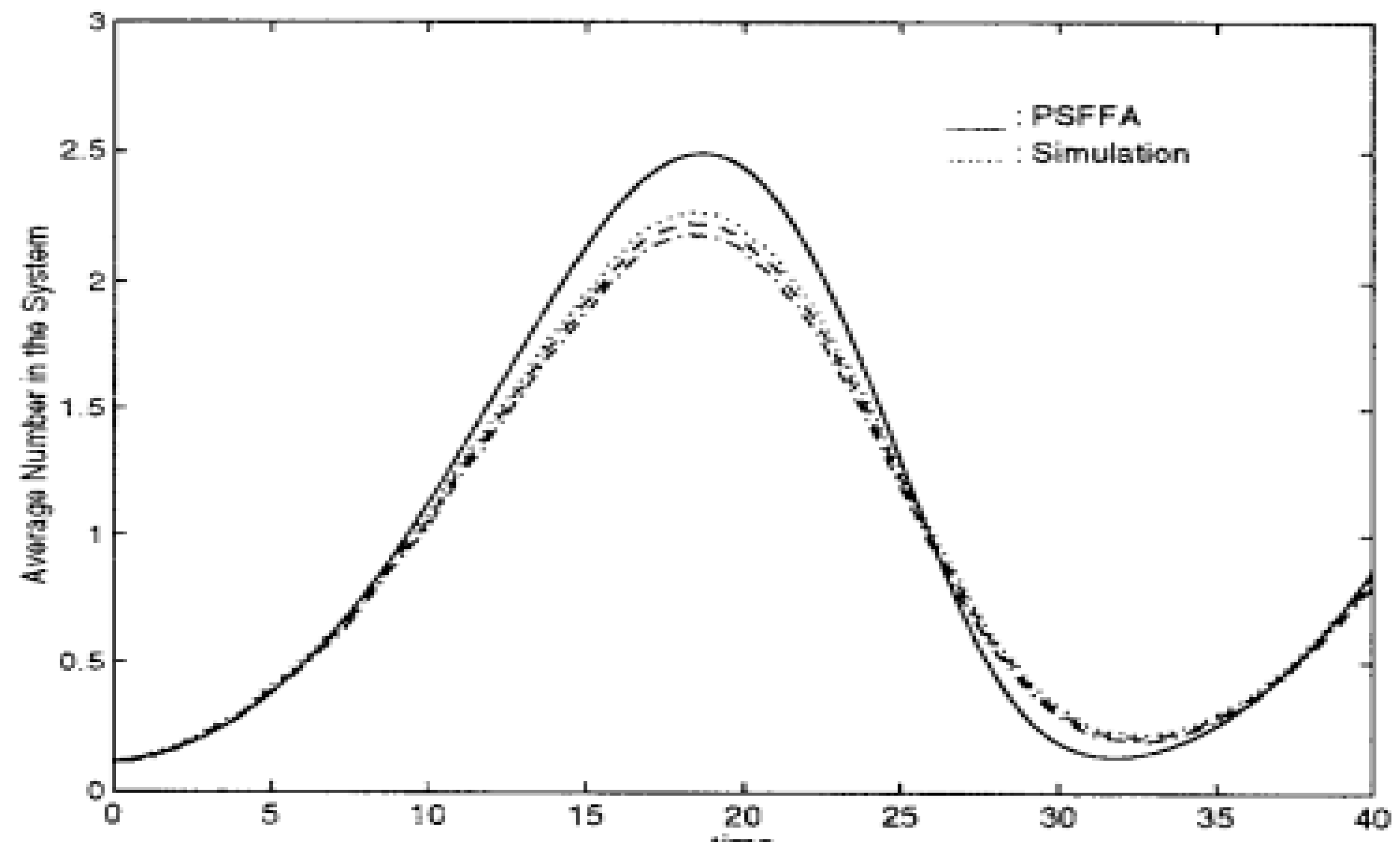
Figure 3 draws a simulation comparison for the model corresponding to non-stationary traffic.
The following theorem is necessary to prove the new results in the current paper.
1.Preliminary Theorem (PT) [3]
Let f be a function that is defined and differentiable on an open interval (c,d).
2. Upper and Lower Bounds of (c.f., (1.9))
Theorem 1. of the non-stationary queueing system satisfies the following inequality:
Proof:
We have
By PT, is increasing . Consequently
Hence, it follows that:
Therefore,
(2.5) implies:
By the Preliminary Theorem (PT), is decreasing if and only if . Consequently
Hence, it follows that:
Therefore,
Hence, the proof follows.
It is noted by (2.1), that at the instability phase ()
(2.8) interprets as the limit as () has an upper bound which is dependent. As (k),
Moreover, assuming , (2.1) reduces to
Clearly, (2.10) shows that the derived bounds inequality of the underlying model of the non-stationary queueing system is a special case of that of the non-stationary queueing system.
3. Conclusions and Future Work
The upper bound of the state variable of the non-stationary queueing system's PSFFA model is reported in the current study for the first time ever. Additionally, it is found that the state variable of the PSFFA model of the non-stationary queueing system is a special case of the state variable of the derived bounds inequality of the state variable of the M/G/1 PSFFA model of the non-stationary queueing system. The boundaries of the state variable in the non-stationary PSFFA model will be determined in future study directions.
References
- A Mageed, D.I. Effect of the root parameter on the stability of the Non-stationary D/M/1 queue’s GI/M/1 model with PSFFA applications to the Internet of Things (IoT). Preprints 2024, 2024011835. [CrossRef]
- A Mageed , D.I, Q Zhang,D. K. Solving the open problem for GI/M/1 pointwise stationary fluid flow approximation model (PSFFA) of the non-stationary D/M/1 queueing system. electronic Journal of Computer Science and Information Technology. 2023 Apr 23;9(1):1-6.
- A Mageed , D.I, Q Zhang,D. K. The Rényian-Tsallisian Formalisms of the Stable M/G/1 Queue with Heavy Tails Entropian Threshold Theorems for the Squared Coefficient of Variation. electronic Journal of Computer Science and Information Technology. 2023 Apr 23;9(1):7-14.
Figure 1.
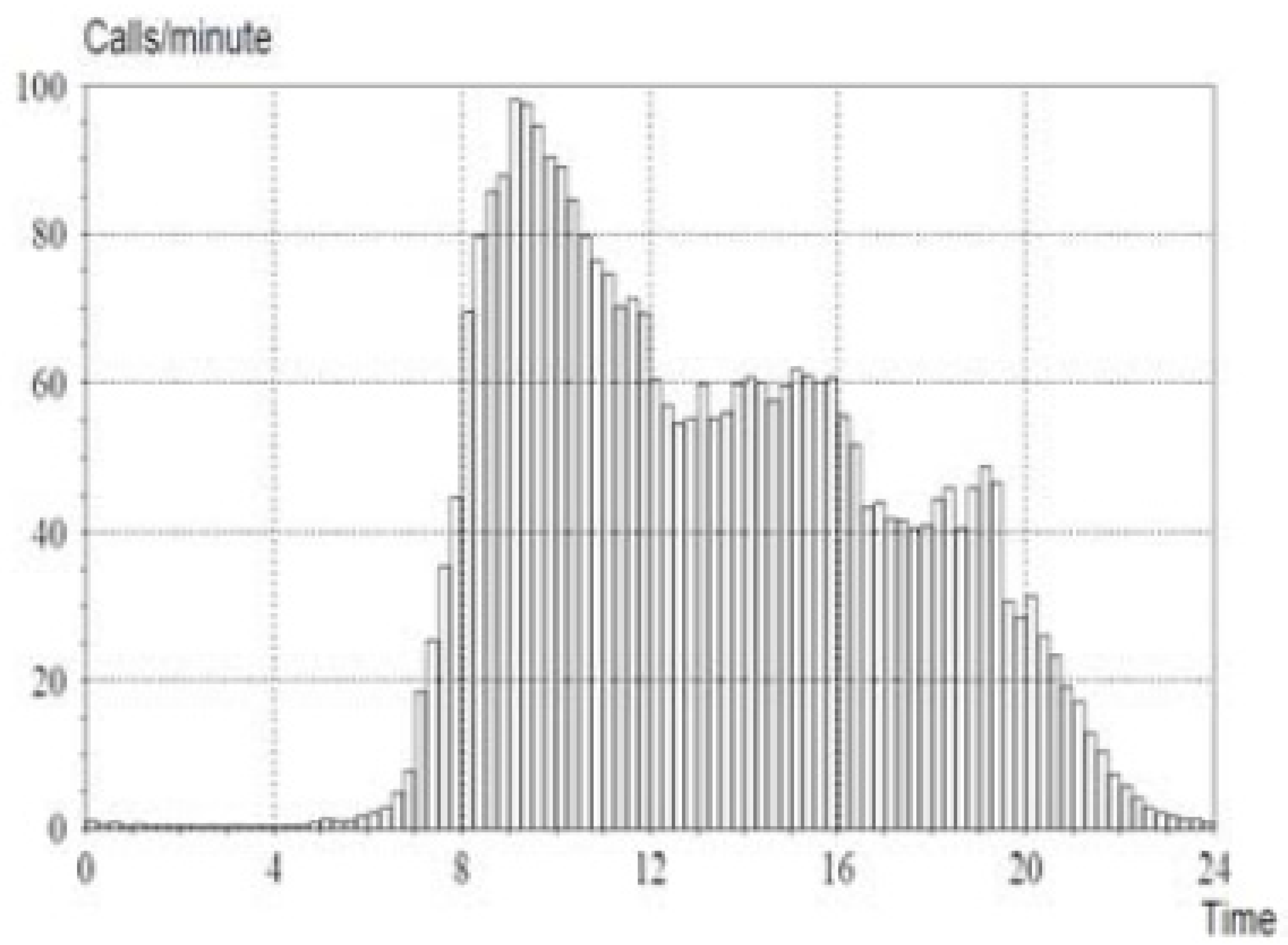
Figure 2.
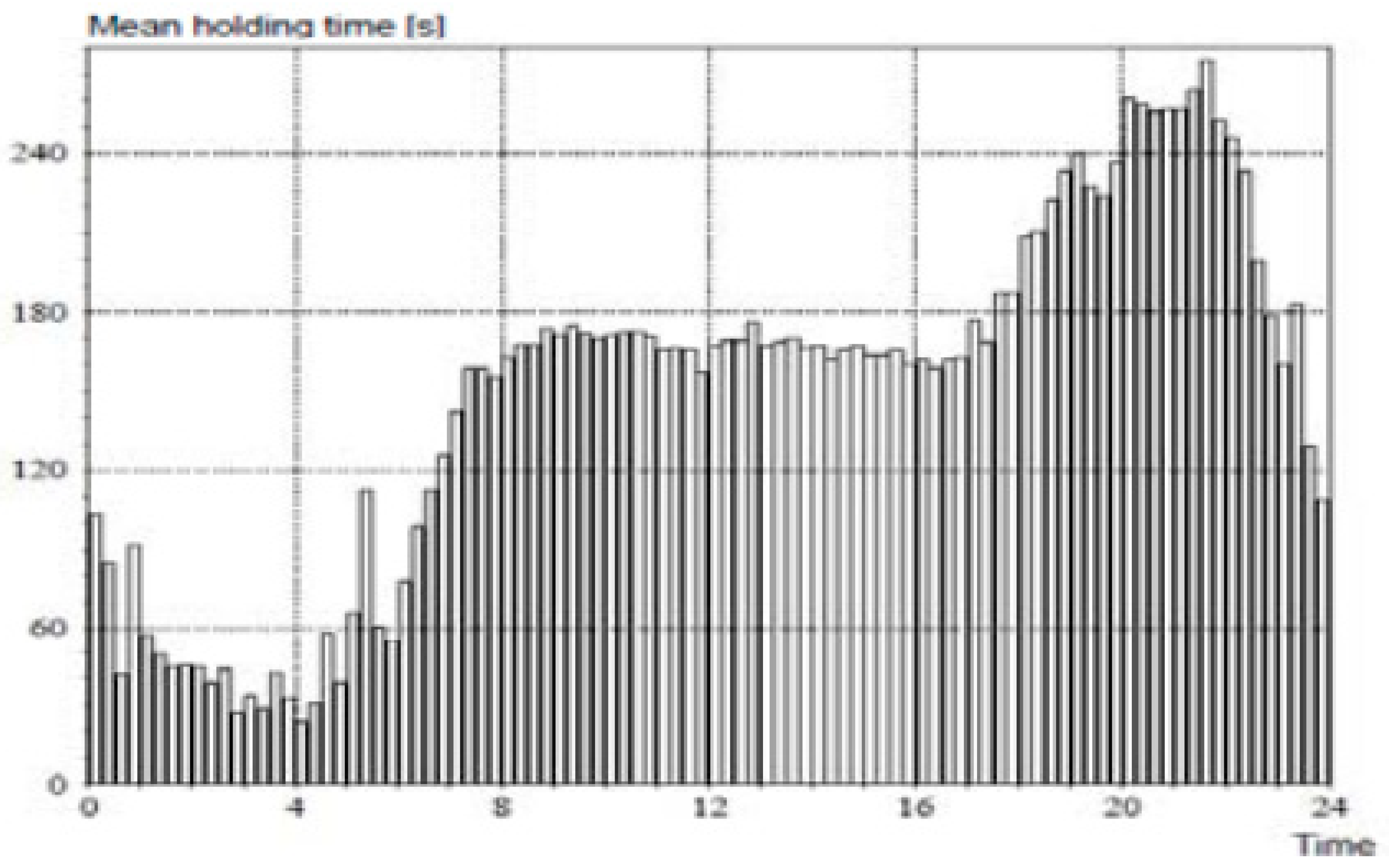
Figure 3.
(c,f., [1]).
Figure 3.
(c,f., [1]).
Disclaimer/Publisher’s Note: The statements, opinions and data contained in all publications are solely those of the individual author(s) and contributor(s) and not of MDPI and/or the editor(s). MDPI and/or the editor(s) disclaim responsibility for any injury to people or property resulting from any ideas, methods, instructions or products referred to in the content. |
© 2024 by the authors. Licensee MDPI, Basel, Switzerland. This article is an open access article distributed under the terms and conditions of the Creative Commons Attribution (CC BY) license (http://creativecommons.org/licenses/by/4.0/).
Copyright: This open access article is published under a Creative Commons CC BY 4.0 license, which permit the free download, distribution, and reuse, provided that the author and preprint are cited in any reuse.


