

Submitted:
01 July 2024
Posted:
02 July 2024
You are already at the latest version
Abstract
This paper reviews the requirements for the production, quality, and quality assurance of solid recovered fuels (SRF) that are increasingly used for the substitution of fossil fuels in the indus-trial utilities. The economical, technological and environmental aspects should be considered before using SRF as an alternative fuel. In general, the most important factors determining the commercial production of SRF referred to the calorific values and their available amounts adopted in the starting materials. Furthermore, the low-melting impurities and undesired constituents/elements, including chlorine, sulfur, potassium and sodium, may pose negative impacts on air pollutant emission and slagging & fouling in the process utilities. In this regard, the vent emitted from the industrial utilities must comply with the effluent standards of station-ary sources like particulate, sulfur oxides, nitrogen oxides, heavy metals (e.g., lead, cadmium, and mercury) and dioxins. For these reasons, this work will summarize the legal or regulatory requirements under development in Asian countries (i.e., Japan, South Korea, and Taiwan) and European Union (EU). Finally, the outlook of solid recovered fuel (SRF) in the waste manage-ment and industrial sectors will be addressed to echo the sustainable development goals (SDGs).
Keywords:
solid recovered fuel
; industrial utility
; energy recovery
; air pollution concern
; slagging & foul-ing
; regulatory measure
1. Introduction
To manage waste generation and treatment efficiently, and also reduce greenhouse gas (GHG) emissions or dependence on fossil fuels that contribute to global warming (or climate change), sustainable material management approach has been developed by ranking waste management hierarchy [1]. For non-hazardous waste management, its hierarchy focuses on the order as follows: source reduction & reuse, recycling, energy recovery, and treatment & disposal. In the waste recycling phase, however, it is not technically or economically feasible to recycle all the components (including paper, plastics, textiles, and other combustible materials) of municipal solid waste (MSW) and non-hazardous industrial waste as materials for producing derived products. Therefore, the MSW recycling plants or material recovery facilities may be designed to produce a refuse derived fuel (RDF) as the end material, which has been developed throughout North America and European Union (EU) countries during the 1980s and 1990s [2]. These RDF pellets were extensively used in paper mill furnaces, cement kilns, power plants and also in district heating plants. However, there were concerns about the heterogeneity of RDF in its waste material types, calorific value and heavy metal emissions during the co-incineration or co-combustion. To promote the applications of waste-to-fuel by defining its standards or specifications, the European Commission mandated the CEN Technical Committee CEN/TC 343 for classifying solid recovered fuels (SRF) in the early 2000s [3,4]. In brief, SRF is a subgroup of RDF which comprises solid fuels from non-hazardous waste, only aiming at reusing it for energy recovery purposes with high efficiency [5].
With the announcement of SRF standards, its production and use indicated a growing industry in the EU countries since the early 2000 because it was used as alternative fuels in dedicated fluidized bed incinerators like cement kilns and coal-fired power plants [6]. The production and use of SRF not only converts non-recyclable waste materials into electricity and heat, but also reduces GHG emissions by offsetting the need for energy from fossil fuels [7,8]. On the other hand, this waste treatment approach also called waste-to-energy (WTE) system, which must be subject to stringent air pollution standards regarding particulate, sulfur oxides (SOx), nitrogen oxides (NOx), hydrogen chloride (HCl), heavy metals, and air toxics (including dioxins and furans) [9,10]. Table 1 summarizes the characteristics of solid recovered fuels (SRF) and their environmental and combustion effects [11,12]. To mitigate the environmental, technological and health concerns from the SRF use (co-incineration or co-firing) in high energy-intensive industries (i.e., paper-making, cement-making and steel-making), the classification codes and standards of SRF were announced or revised by several developed countries over the past decade [5,13,14,15,16,17,18].
This paper summarizes the legal or regulatory requirements of SRF based on the economical, technological and environmental aspects in European Union (EU) and Asian countries (i.e., Japan, South Korea, and Taiwan). The regulatory measures for controlling emissions and residues (remains as ash) from SRF combustion were also discussed [19,20,21,22,23]. Finally, the outlook and suggestions of SRF in the waste management, industrial and energy sectors were further addressed to echo the sustainable development goals (SDGs) and the mitigation of GHG emissions.
2. SRF Development in Developed Countries/Regions
Over the past three decades, waste-to-energy (WTE) option may make complementary contribution to non-hazardous combustible waste (e.g., waste plastics, waste fiber, waste paper, and other biological residues) management by adopting material recovery and disposal in landfills. In this regard, the production of waste-derived fuels (i.e., RDF, SRF) has become a quite popular waste treatment approach in different countries and regions because of the growing market demand for the energy-intensive industrial sectors under the considerations of global warming mitigation and operation cost [24]. In response to the sustainable waste management and GHG emission mitigation, the SRF production and use by some developed countries or regions were briefly reviewed [13,15,16,25], focusing on the criteria, specifications and standards for producing qualified SRF products.
2.1. European Union (EU)
Since the early 1990s, the quality standards of SRF have been drawn up by some EU countries, including German, Finland and Italy. In order to establish a comparable guideline within EU region, the European Standardization Committee (CEN) announced the Technical Committee CEN/TC 343 “Solid Recovered Fuels” in 2002. Furthermore, the quality requirements of SRF are based on the technical standard UNI EN 15359 (“Solid recovered fuels — Specifications and classes”) in 2011 [25]. In 2021, the international standard ISO 21640 (“Solid recovered fuels — Specifications and classes”), listed in Table 2, has already announced to replace the EN 15359.
- -
- Lower heating value (LHV) or lower calorific value (LCV), which is related to energy property and displayed in MJ/kg.
- -
- Chlorine (Cl) content, which is associated with the degree of fouling on WTE facilities and expressed in percentage by weight (wt%).
- -
- Mercury (Hg) content, which is correlated to the significance of environmental concerns and expressed as median or 80th percentile value in mg/MJ.
2.2. Japan
In Japan, the term “Refuse derived paper and plastics densified fuel (RPF)” was adopted to be different from RDF. The new types of alternative fuels were used in Japanese mills since the early 2000s [26]. To promote the use of RPF, the Japan RPF Industry Association was thus established in 2012. According to the Japanese Industrial Standards JIS Z7311:2010, the types, classes and quality standards of refuse plastics-paper fuel (RPF) are listed in Table 3. The main materials of RPF are paper (e.g., newspaper, corrugated board) and plastics from refuse (MSW). The mixture of wood scraps, fiber waste and rubber waste are also acceptable if the quality of RPF meets quality requirements in Table 3. It should be noted that the limit values shown in Table 3 are average values of the latest six test results. Notably, there were no heavy metal standards including Hg, which was relatively simpler than in other countries
2.3. South Korea
To increase the proportion of WTE (or solid refuse fuel, also abbreviated as SRF) in South Korea, the production of SRF from combustible waste via physical separation (e.g., magnetic separation) and mechanical processes (i.e., crushing, shredding, and sorting) have been well developed over the past two decades [27]. Prior to 2013, the SRF was grouped into refused plastic fuel (RPF), refuse-derived fuel (RDF), tyre-derived fuel (TDF), and wood chip fuel (WCF). Since January of 2013, the term SRF (solid recovered fuel) was introduced in South Korea by the national legislation (“Act on the Promotion of Saving and Recycling of Resources Enforcement Regulation”) where two types of SRF are currently recognized as an SRF and a bio-SRF (or biomass-SRF). Table 4 shows the relevant parameters and limit values for SRF adopted in South Korea. As listed in Table 4, this country has standards for 10–12 parameters, including lower heating value (LHV), shape and size, and chlorine, mercury, moisture, sulfur, ash, cadmium, lead, and arsenic contents, as well as biomass and chromium contents for bio-SRF [15].
2.4. Taiwan
In the previous study [18], the promotion of SRF and its quality standards (Table 5) in Taiwan have been addressed to reduce the dependence on imported fossil fuels, alleviate the environmental loadings from MSW incineration facilities and also mitigate GHG emissions by higher energy efficiency. In 2023, the Taiwan government announced the draft guidelines/standards for promoting bio-SRF and adding new items into the regulation (“Standards for Air Pollutant Emission from Boiler”). In order to step up the international net-zero trends by 2050, the Taiwan government declared the “2050 Net-Zero Transition in Taiwan” in April 2021. In March 2022, the National Development Council further announced “Taiwan’s Pathway to Net-Zero Emissions in 2050 - 12 Key Strategies” [28], as shown in Figure 1. Obviously, the production of SRF and its use in the energy-intensive industries are very close to the key strategies of resource recycling & zero waste and energy saving & efficiency. When using bio-SRF in the energy and industry sectors, the key strategies of carbon sink and carbon capture, utilization & storage (CCUS) may be gained by enhancing forest management and photosynthesis.
3. SRF Production and Use in Connection with Sustainable Development Goals (SDGs)
In June 1992, the Earth Summit, also called as the United Nations Conference on Environment and Development (UNCED), was held in Rio de Janeiro (Brazil), spotlighting a new blueprint for international action on environmental and development issues in the 21 century. Subsequently, the Commission on Sustainable Development (CSD) was created in December 1992 to ensure effective follow-up of UNCED. Thereafter, the World Summit on Sustainable Development (WSSD), held in Johannesburg (South Africa) in 2002, reaffirmed the full implementation of Agenda 21 and also declared the “United Nations Decade for Education for Sustainable Development (DESD)” (2005-2014). Based on the implementation results of DESD, the 17 Sustainable Development Goals (SDGs) were further set by UN in September 2015, which focuses on targeting the 2030 Agenda for Sustainable Development by integrating all aspects of social well-being, economic growth, and environmental protection [29]. More significantly, every issue like activity, course, policy, plan and program can be related to these SDGs in some aspects, even becoming strategic frameworks for sustainable development of a country, region, or area. For instance, the food loss & waste (FLW) management and valorization are relevant to SDG-2 (organic fertilizer by food waste valorization), SDG-7 (biogas-to-power by anaerobic digestion of food waste) and SDG-12 (responsible consumption & production by FLW promotion) [30].
As mentioned above, the use of SRF in the combustion system will bring about significant environmental advantages in terms of fossil fuel saving (thus reducing GHG emissions) and urban infrastructure supporting due to the shortage of non-hazardous waste (including MSW) treatment facilities [31,32,33]. Figure 2 depicts the SRF production and use with relevance to the SDGs, which are briefly stated as follows:
- -
- SDG-2 (Zero hunger): Relevant to the organic fertilizer by reusing non-hazardous bottom ash derived from RF (especially in bio-SRF) combustion due to its richness in plant nutrients like potassium, calcium, magnesium and phosphorus.
- -
- SDG-7 (affordable and clean energy): Relevant to the energy recovery from SRF (especially in bio-SRF) by the forms of electricity or steam (heat) in the industrial boilers or co-generation utilities.
- -
- SDG-9 (Industries, innovation & infrastructure): Relevant to the use of SRF in the energy-intensive industries.
- -
- SDG-9 (Sustainable cities & communities): Relevant to the production of SRF for mitigating the shortage of MSW treatment facilities (incineration plants and sanitary landfills).
- -
- SDG-12 (Responsible consumption & production): Relevant to the recyclable materials from MSW (e.g., waste paper, waste plastics, woody discards) for producing SRF.
- -
- SDG-13 (Climate action): Relevant to the reduction in GHG emissions due to the use of SRF in replacement of fossil fuels.
4. Regulatory Measures for Controlling Emissions and Residues from SRF Combustion
4.1. Emissions of Air Pollutants from SRF Combuistion
The industrial combustion systems by using SRF co-firing or co-incineration must meet very stringent air emission standards due to the relevant elements and constituents contained (as summarized in Table 1). In this regard, some starting materials for producing SRF are not reprocessed into the production line. They include waste tire, plastics containing polyvinyl chloride (PVC), and woody residues containing heavy metals like chromated copper arsenate (CCA). Therefore, these waste-to-energy facilities should install the air pollution control based on the maximum available control technology (BACT) like baghouse (bag filter), scrubber, selective non-catalytic reduction (SNCR) and carbon injection. In addition, they have elaborate monitoring systems for accomplishing the acceptable levels of criteria air pollutants and air toxics. Table 6 listed the air pollutants from SRF combustion and their environmental and health Impacts [9,11,15,34].
4.2. Treatment and Disposal of Residual Ash Waste from SRF Combuistion
The bottom ash residue from the WTE facilities using SRF may represent 15-30 wt% of the incoming fuels, depending on the ash contents and combustion conditions. The ash is typically passed through a magnetic separator to remove ferrous materials and over grates to screen bulky pieces. Due to the SRF derived from non-hazardous waste and/or MSW, the recycling possibilities for the bottom ash include natural aggregate substitutes, cement-based applications and vitrified products because the main constituents consist of silica (SiO2), alumina (Al2O3), calcium oxide (CaO) and ferric oxide (Fe2O3) [11,35,36]. On the other hand, the slagging and fouling tendency in the industrial utilities shall be considered when using SRF [19,20,21,22,23]. In the previous study [18], several slagging & fouling indices have been summarized to evaluate the operational problems during the coal/SRF co-firing in the combustion systems. Among these alkali metal and alkaline earth metal elements, the contents of oxides of potassium (K), sodium (Na), calcium (Ca) and magnesium (Mg) have been incorporated into these slagging ratings. Table 7 summarizes the data on the melting temperature of K/Na/Ca/Mg oxide/fluoride/chloride/sulfate/nitrate possibly formed during SRF combustion. As seen in Table 7, it was found that some of these inorganic compounds have lower melting points which may be lower than the operation temperature in the combustion systems, thus causing significant slagging and agglomeration problems associated with SRF co-firing or co- combustion. Regarding the fouling tendency, some starting materials containing the high contents of chlorine and/or sulfur should be excluded from the SRF production, including PVC and waste tire.
5. Conclusions and Outlook
Traditionally, the term “refuse derived fuels” (RDF) has been used in the waste-to-energy (WTE) facilities. However, the term “solid recovered fuels” (SRF) differs from RDF because it is a regulated fuel that must meet the quality requirements (i.e. classification and specification) by the national regulations or standards in some developed countries like EU, Japan, South Korea. SRF can be produced locally from individual or mixed streams of municipal (MSW), commercial (CW), non-hazardous industrial (IW) and construction & demolition (CDW) wastes. These input streams will influence their elemental compositions, thus characterizing the air pollutants and ash residues from SRF combustion in the end-users (e.g. cement kilns, power plants, gasification plants, and paper & pulp mills). In conclusions, the use of SRF not only reduces the consumption of fossil fuels and their GHG emissions in the energy-intensive industries, but also alleviates the environmental loadings from MSW incineration plants and sanitary landfills in the urban infrastructure. In this regard, the SRF production and use may be an available path to a circular economy in combination with some aspects of sustainable development goals (SDGs).
In order to promote the production and use of SRF in response to the industrial market demand for reducing fossil fuel use and also mitigating GHG emissions, some trends or approaches were addressed below:
- -
- Expanding the available combustible and lignocellulosic waste streams, including bamboo residues, fruit tree trimmings, crop residues (e.g., rice husk, crop straws), regenerated oils (i.e., purification/separation of spent lubricating oil and spent motorcycle oil from the commercial and services sectors).
- -
- Avoiding the low environment-friendly starting materials for producing SRF like woody materials/timbers containing copper chrome arsenic (CCA) and Pb-based paints, waste plastics containing Cd/Pb-based plasticizers.
- -
- Revising the quality standards of SRF by listing the elements related to heavy metals (including copper, zinc, and nickel) and slagging & fouling tendency (including potassium, sodium, and sulfur).
- -
- Using X-ray fluorescence spectrometry (XRF) as a preliminary screening tool in the determinations of heavy metals (e.g., Hg, Cd, Pb) and chlorine based on the quality standards of SRF.
- -
- Increasing the use of cleaner SRF (e.g., bio-SRF) in the energy-intensive industrial sectors like paper-making, petrochemical industry, steel-manufacturing and cement-making.
- -
- Co-firing bio-SRF in the coal-fired power plants for reducing the use of fossil fuels and the emissions of GHGs.
- -
- Setting the stricter standards (or limits) of the air pollutants emitted from the stationary source of the industrial utilities with using SRF.
- -
- Adopting other thermochemical processes (e.g., gasification, pyrolysis) for upgrading the added value of SRF via the production of valuable materials/fuels like syngas and pyrolytic oils.
Author Contributions
Conceptualization, W.-T.T.; data curation and analysis, T.-J.J. and C.-C.P.; writing—original draft preparation, W.-T.T.; writing—review and editing, W.-T.T.; visualization, H.-L.H.; supervision, W.-T.T.
Funding
This research was partially funded by the official project (“Program for funding industry college promotion by technical & vocational universities”, Ministry of Education, Taiwan) in 2023.
Institutional Review Board Statement
Not applicable.
Informed Consent Statement
Not applicable.
Data Availability Statement
Data is contained within the article.
Acknowledgments
Sincere appreciation was expressed to acknowledge the undergraduate students (i.e., Miss Qian-Yun Zhang, Miss Hsiang=Yun Shih, and Bo-Nian Chen; Department of Environmental Engineering and Science, National Pingtung University of Science and Technology) for their assistances in the related information collection.
Conflicts of Interest
The authors declare no conflict of interest.
References
- Sustainable Materials Management: Non-Hazardous Materials and Waste Management Hierarchy. Available online: https://www.epa.gov/smm/sustainable-materials-management-non-hazardous-materials-and-waste-management-hierarchy (accessed on 27 June 2024).
- Williams, P.T. Waste Treatment and Disposal, 2nd ed.; John Wiley & Sons: West Sussex, England, 2005; pp. 130–142. [Google Scholar]
- Gawlik, B.M.; Sobiecka, E.; Vaccaro, S.; Giovanni Ciceri, G. Quality management organisation, validation of standards, developments and inquiries for solid-recovered fuels - An overview on the QUOVADIS-Project. Energy Policy 2007, 35(12), 6293–6298. [Google Scholar] [CrossRef]
- Wagland, S.T.; Kilgallon, P.; Coveney, R.; Garg, A.; Smith, R.; Longhurst, P.J.; Pollard, S.J.T.; Simms, N. Comparison of coal/solid recovered fuel (SRF) with coal/refuse derived fuel (RDF) in a fluidised bed reactor. Waste Manag 2011, 31(6), 1176–1183. [Google Scholar] [CrossRef] [PubMed]
- Sarc, R.; Viczek, S.K. Co-processing of solid recovered fuels from mixed municipal and commercial waste in the cement industry – A pathway to a circular economy. Waste Manag Res 2024, 42(3), 260–272. [Google Scholar] [CrossRef] [PubMed]
- Sarc, R.; Seidler, I.M.; Kandlbauer, L.; Lorber, K.E.; Pomberger, R. Design, quality and quality assurance of solid recovered fuels for the substitution of fossil feedstock in the cement industry - Update 2019. Waste Manag Res 2019, 37(9), 885–897. [Google Scholar] [CrossRef] [PubMed]
- Ahmad, W.; Hassan, M.; Zeshan, Masud, S.F.B.; Kanwal, S.; Singh, R.S.; Anwar, M.; Mehryar, E.; Zhao, C. Proximate and elemental analysis of solid recovered fuel, its comparison with existing fossil fuels in terms of physical characteristics and economic benefits. Bioresour Technol Rep 2022, 18, 101049.
- Ferronato, N.; Mendoza, I.J.C.; Siñani, N.G.M.; Portillo, M.A.G.; Torretta, V. Perspectives in solid recovered fuel production in Bolivia: Analysis of characteristics and potential benefits. Waste Manag 2022, 144, 324–335. [Google Scholar] [CrossRef] [PubMed]
- Velis, C.; Wagland, S.; Longhurst, P.; Robson, B.; Sinfield, K.; Wise, S.; Pollard, S. Solid recovered fuel: influence of waste stream composition and processing on chlorine content and fuel quality. Environ Sci Technol 2012, 46, 1923–1931. [Google Scholar] [CrossRef] [PubMed]
- Kuo, Y.M.; Huang, S.W.; Kuan, W.Y. Characteristics of emissions from reclamation of solid-recovered fuel (SRF) in a cogeneration plant. Aerosol Air Qual Res 2021, 21, 210112. [Google Scholar] [CrossRef]
- Grover, V.I.; Grover, V.K.; Hongland, W. (eds.). Recovering Energy from Waste: Various Aspects. Science Publishers: Enfield, USA, 2002.
- Loo, S.V.; Koppejam, J. The Handbook of Biomass Combustion and Co-firing. Routledge: London, 2007.
- Flamme, S.; Geiping, J. Quality standards and requirements for solid recovered fuels: a review. Waste Manag Res 2012, 30(4), 335–353. [Google Scholar] [CrossRef] [PubMed]
- Lorber, K.E.; Sarc, R.; Aldrian, A. Design and quality assurance for solid recovered fuel. Waste Manag Res 2012, 30, 370–380. [Google Scholar] [CrossRef] [PubMed]
- Yang, W.S.; Lee, Y.J.; Kang, J.G.; Shin, S.K.; Jeon, T.W. Assessment of quality test methods for solid recovered fuel in South Korea. Waste Manag 2020, 103, 240–250. [Google Scholar] [CrossRef] [PubMed]
- Gerassimidou, S.; Velis, C.A.; Williams, P.T.; Castaldi, M.J.; Black, L.; Komilis, D. Chlorine in waste-derived solid recovered fuel (SRF), co-combusted in cement kilns: A systematic review of sources, reactions, fate and implications. Crit Rev Environ Sci Technol 2021, 51(2), 140–186. [Google Scholar] [CrossRef]
- Japan RPF Industry Association. Available online: https://www.jrpf.gr.jp/en/ (accessed on 27 June 2024).
- Tsai, W.T. Perspectives on the promotion of solid recovered fuels in Taiwan. Energies 2023, 16(7), 2944. [Google Scholar] [CrossRef]
- Pedersen, M.N.; Jensen, P.A.; Hjuler, K.; Nielsen, M.; Dam-Johansen, K. Agglomeration and deposition behavior of solid recovered fuel. Energy Fuels 2016, 30(10), 7858–7866. [Google Scholar] [CrossRef]
- Viczek, S.A.; Aldrian, A.; Pomberger, R.; Sarc, R. Origins of major and minor ash constituents of solid recovered fuel for co-processing in the cement industry. Waste Manag 2021, 126, 423–432. [Google Scholar] [CrossRef]
- Szydełko, A.; Ferens, W.; Rybak, W. Effects of calcium, sodium and potassium on ash fusion temperatures of solid recovered fuels (SRF). Waste Manag 2022, 150, 161–173. [Google Scholar] [CrossRef] [PubMed]
- Ghazidin, H.; Suyatno, S.; Prismantoko, A.; Karuana, F.; Sarjono; Prabowo; Setiyawan, A.; Darmawan, A.; Aziz, M.; Vuthaluru, H.; Hariana, H. Impact of additives in mitigating ash-related problems during co-combustion of solid recovered fuel and high-sulfur coal. Energy 2024, 292, 130510.
- Prismantoko, A.; Karuana, F.; Ghazidin, H.; Ruhiyat, A.S.; Adelia, N.; Prayoga, M.Z.E.; Romelan, R.; Utomo, S.M.; Cahyo, N.; Hartono, J.; Darmawan, A.; Muflikhun, M.A.; Aziz, M.; Hariana, H. Ash deposition behavior during co-combustion of solid recovered fuel with different coals. Therm Sci Eng Prog 2024, 48, 102404. [Google Scholar] [CrossRef]
- Trends in the Use of Solid Recovered Fuels. Available online: https://www.ieabioenergy.com/wp-content/uploads/2020/05/Trends-in-use-of-solid-recovered-fuels-Main-Report-Task36.pdf (accessed on 20 June 2024).
- Beckmann, M.; Pohl, M.; Bernhardt, D.; Gebauer, K. Criteria for solid recovered fuels as a substitute for fossil fuels - A review. Waste Manag Res 2012, 30, 354–369. [Google Scholar] [CrossRef]
- Takei, T. Analysis of chlorine content in RPF by the X-ray fluorescence spectrometry. Japan TAPPI J 2014, 68(12), 1424–1429. [Google Scholar] [CrossRef]
- Chae, J.S.; Kim, S.W.; Ohm, T.I. Combustion characteristics of solid refuse fuels from different waste sources. J Renew Mater 2020, 8, 789–799. [Google Scholar] [CrossRef]
- Taiwan’s Pathway to Net-Zero Emissions in 2050 – 12 Key Strategies (National Development Council, Taiwan). Available online: https://www.ndc.gov.tw/Content_List.aspx?n=6BA5CC3D71A1BF6F/ (accessed on June 2024).
- United Nations. Take Action for the Sustainable Development Goals. Available online: https://www.un.org/sustainabledevelopment/sustainable-development-goals/ (accessed on 20 June 2024).
- Tsai, W.T.; Tsai, C.H. New trends in food-derived waste valorization with relevance to Taiwan’s sustainable development goals. Trends Food Sci Technol 2024, 147, 104424. [Google Scholar] [CrossRef]
- Garg, A.; Smith, R.; Hill, D.; Simms, N.; Pollard, S. Wastes as co-fuels: The policy framework for solid recovered fuel (SRF) in Europe, with UK implications. Environ Sci Technol 2007, 41(14), 4868–4874. [Google Scholar] [CrossRef] [PubMed]
- Hilber, T.; Maier, J.; Scheffknecht, G.; Agraniotis, M.; Grammelis, P.; Kakaras, E.; Glorius, T.; Becker, U.; Derichs, W.; Schiffer, H.P.; de Jong, M.; Torri, L. Advantages and possibilities of solid recovered fuel cocombustion in the European energy sector. J Air Waste Manage Assoc 2007, 57, 1178–1189. [Google Scholar] [CrossRef] [PubMed]
- Khan, M.M.H.; Havukainen, J.; Horttanainen, M. Impact of utilizing solid recovered fuel on the global warming potential of cement production and waste management system: A life cycle assessment approach. Waste Manag Res 2021, 39(4), 561–572. [Google Scholar] [CrossRef] [PubMed]
- Conesa, J.A.; Rey, L.; Egea, S.; Rey, M.D. Pollutant formation and emissions from cement kiln stack using a solid recovered fuel from municipal solid waste. Environ Sci Technol 2011, 45(13), 5878–5884. [Google Scholar] [CrossRef] [PubMed]
- Collivignarelli, M.C.; Abbà, A.; Sorlini, S.; Bruggi, M. Evaluation of concrete production with solid residues obtained from fluidized-bed incineration of MSW-derived solid recovered fuel (SRF). J Mater Cycles Waste Manag 2017, 19, 1374–1383. [Google Scholar] [CrossRef]
- Viczek, S.A.; Aldrian, A.; Pomberger, R.; Sarc, R. Determination of the material-recyclable share of SRF during co-processing in the cement industry. Resour Conserv Recycl 2020, 156, 104696. [Google Scholar] [CrossRef]
Figure 1.
Twelev key strategies for promotion 2050 carbon neutrality policy in Taiwan [28].
Figure 1.
Twelev key strategies for promotion 2050 carbon neutrality policy in Taiwan [28].
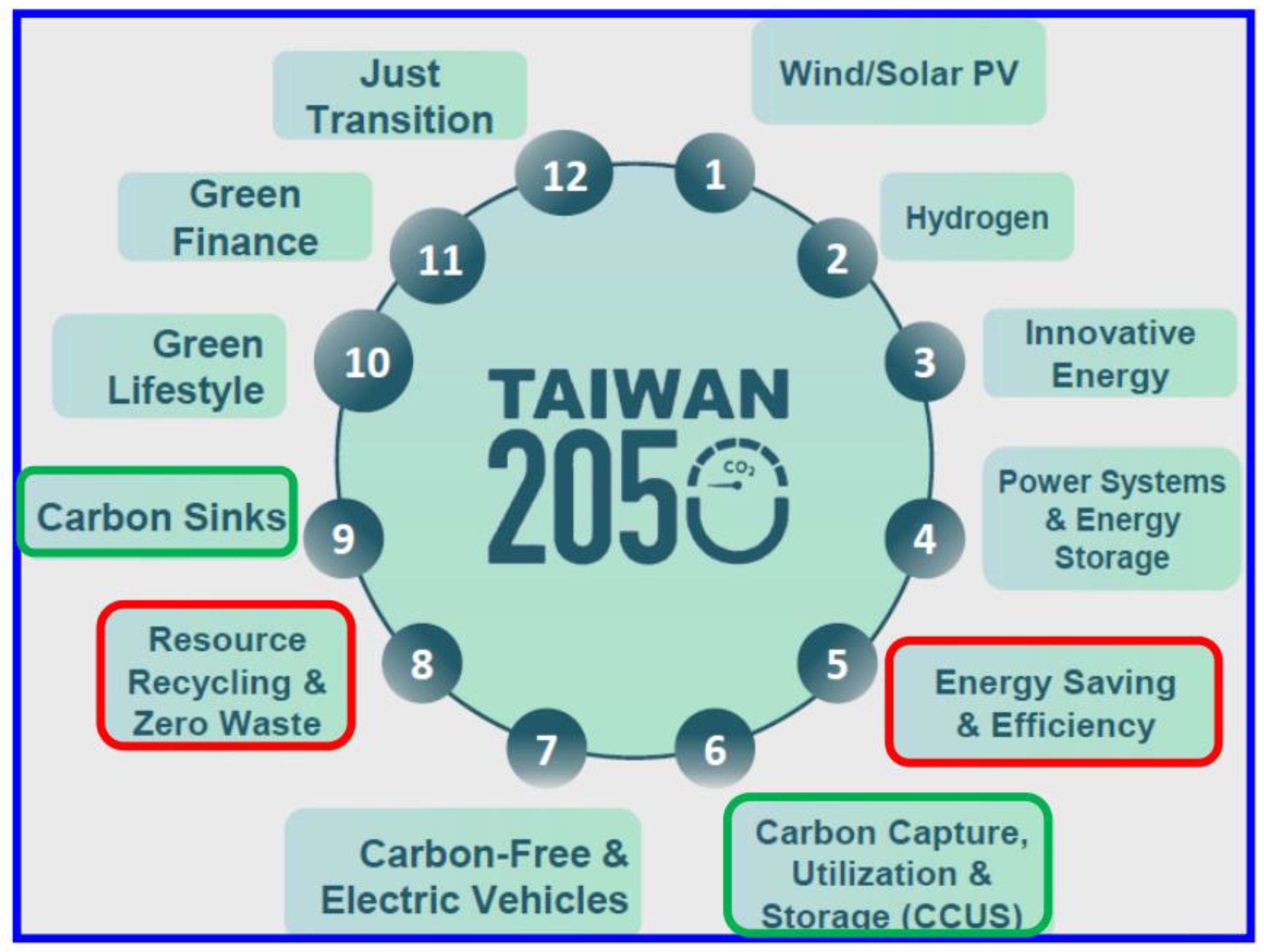
Figure 2.
Production and use of SRF in relevance with sustainable development goals (SDGs).
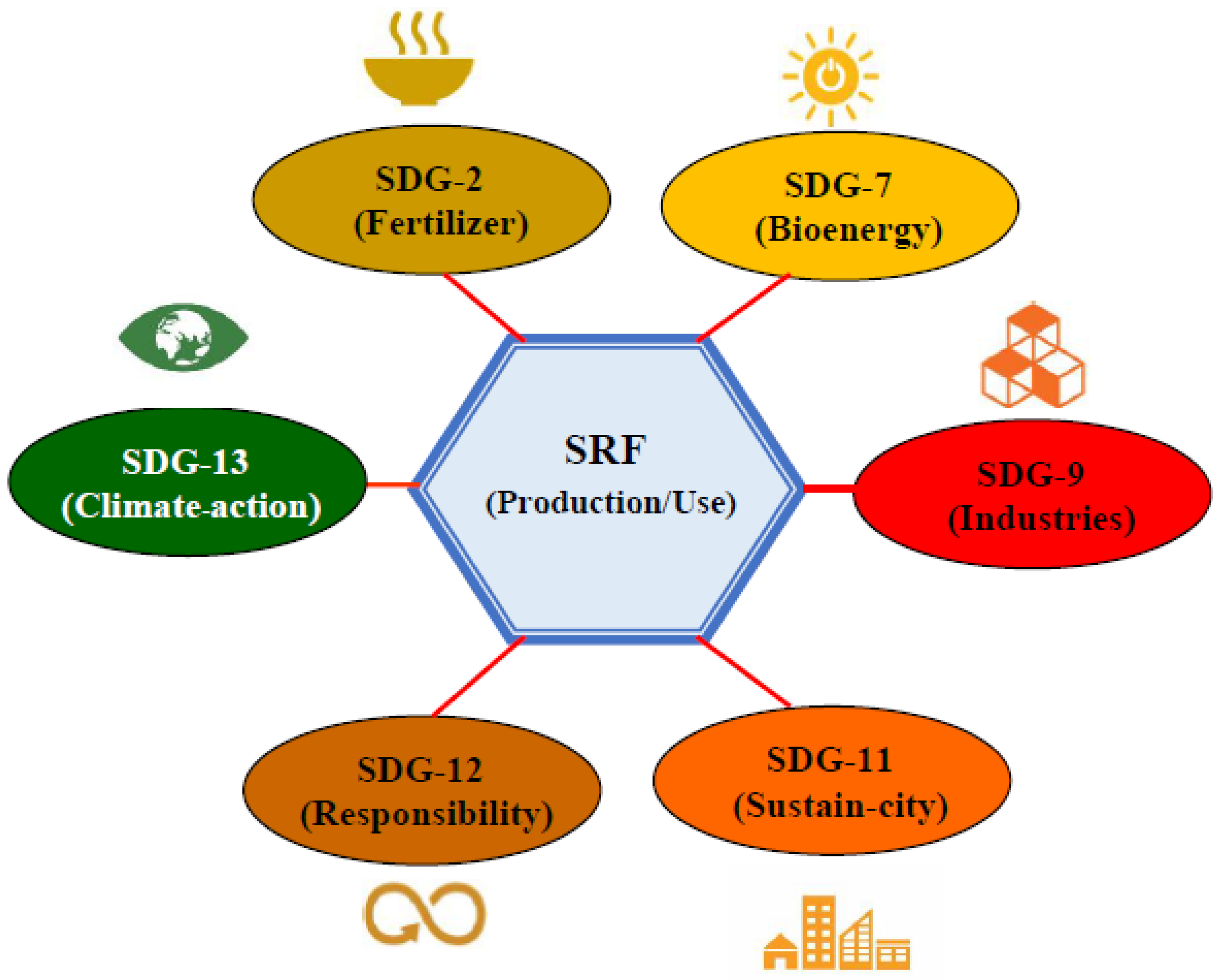

Table 1.
Characteristics of solid recovered fuel (SRF) and their environmental and combustion effects.
Table 1.
Characteristics of solid recovered fuel (SRF) and their environmental and combustion effects.
| Characteristics | Effects | Comments | |
| Physical properties | Moisture content | Storage durability and dry-matter losses, calorific value, self-ignition | |
| Calorific value (CV) 1 | SRF utilization | Including gross calorific value (GCV) and net calorific value (NCV). | |
| Ash content | Particulate emissions, ash utilization/disposal, combustion technology | ||
| Physical dimension, forms | Hoisting and conveying, combustion technology, bridging | ||
| Density | SRF logistics (storage, transport, handling) | Including bulk density and particle density. | |
| Chemical properties | Carbon (C) | Calorific value | Based on Dulong's Formula |
| Hydrogen (H) | Calorific value | Based on Dulong's Formula | |
| Oxygen (O) | Calorific value | Based on Dulong's Formula | |
| Nitrogen (N) | Emissions of NOX, N2O and NH3. Corrosion | Acid precipitation due to formation of nitric acid | |
| Chlorine (Cl) | Emissions of HCl, PCDD/PCDF and trace gases (e.g., COCl2). Corrosion. Lowering ash-melting temperature | KCl–FeCl2 and NaCl–FeCl2 systems having low temperature eutectics in the range 340–390°C. | |
| Sulfur (S) | Calorific value. Emissions of SOX. Corrosion | Based on Dulong's Formula. Acid precipitation due to formation of sulfuric acid. | |
| Fluorine (F) | Emissions of HF and trace gases (e.g., COF2). Corrosion | ||
| Potassium (K) | Corrosion (heat exchangers, superheaters). Lowering ash-melting temperature. Aerosol formation. Ash utilization. | One of alkali metals. Used as plant nutrient | |
| Sodium (Na) | Corrosion (heat exchangers, superheaters). Lowering ash-melting temperature. Aerosol formation. | One of alkali metals. | |
| Calcium (Ca) | Increase of ash-melting temperature. Ash utilization. | Used as plant nutrient | |
| Magnesium (Mg) | Increase of ash-melting temperature. Ash utilization. | Used as plant nutrient | |
| Phosphorus (P) | Ash utilization. | Used as plant nutrient | |
| Heavy metals 2 | Emissions of toxic/carcinogenic metals. Ash utilization. Aerosol formation | Possibly regarded as hazardous waste | |
| Other relevant elements 3 | Emissions of particles containing silica, alumina and oxides (e.g., Fe2O3, TiO2, MnO). | Depending on starting materials of SRF. | |
1 Contents of organic/inorganic elements. 2 Including mercury (Hg), cadmium (Cd), chromium (Cr), nickel (Ni), copper (Cu), lead (Pb), zinc (Zn), and so on. 3 Including silicon (Si), aluminum (Al), titanium (Ti), manganese (Mn), and so on.
Table 2.
Quality standards of solid recovered fuel (SRF) in European Union (EU).
| Quality item | Limit 1 | Unit | ||||
| 1 | 2 | 3 | 4 | 5 | ||
| Lower heating value | ≧ 25 | ≧ 20 | ≧ 15 | ≧ 10 | ≧ 3 | MJ/kg (as received, Mean) |
| ≧ 5,981 | ≧ 4,785 | ≧ 3,589 | ≧ 2,392 | ≧ 718 | Kcal/kg (as received, Mean) | |
| Chlorine content | ≦ 0.2 | ≦ 0.6 | ≦ 1.0 | ≦ 1.5 | ≦ 3 | wt% (dry basis, Mean) |
| Mercury content | ≦ 0.02 | ≦ 0.03 | ≦ 0.05 | ≦ 0.10 | ≦ 0.15 | mg/MJ (as received, Median) |
| ≦ 0.04 | ≦ 0.06 | ≦ 0.10 | ≦ 0.20 | ≦ 0.30 | mg/MJ (as received, 80% percentile) | |
1 Based on ISO 21640 (“Solid recovered fuels – Specifications and classes”, 2021).
Table 3.
Quality standards of refuse plastics-paper fuel (RPF) in Japan. 1.
| RPF-grade | RPF-coke | RPF | Unit | ||
| Grade | A | B | C | ||
| Higher heating value 2 | ≧ 33 | ≧ 25 | ≧ 25 | ≧ 25 | MJ/kg |
| ≧ 7,883 | ≧ 5,972 | ≧ 5,972 | ≧ 5,972 | Kcal/kg | |
| Moisture | ≦ 3 | ≦ 5 | ≦ 5 | ≦ 5 | wt% |
| Ash | ≦ 5 | ≦ 10 | ≦ 10 | ≦ 10 | wt% |
| Residual chlorine | ≦ 0.6 | ≦ 0.3 | > 0.3, ≦ 0.6 | > 0.6, ≦ 2.0 | wt% |
1 JIS Z 7311 (“Refuse Derived Paper and Plastics Densified Fuel”, 2010). 2 Also called gross calorific value (GCV).
Table 4.
Quality standards of solid recovered fuel (SRF) in South Korea.
| Quality item | Limit 1 | Unit | |
| SRF 2 | Bio-SRF 2 | ||
| Diameter | ≦ 50 | ≦ 50 | mm |
| Length | ≦ 100 | ≦ 100 | mm |
| Moisture | ≦ 20 | ≦ 15 | wt% (as received) |
| Biomass content | - 3 | ≧ 95 | wt% (dry basis) |
| Ash | ≦ 20 | ≦ 15 | wt% (dry basis) |
| Lower heating value | ≧ 14.65 | ≧ 12.56 | MJ/kg (as received) |
| ≧ 3,500 | ≧ 3,000 | Kcal/kg (as received) | |
| Chlorine content | ≦ 2 | ≦ 0.5 | wt% (dry basis) |
| Mercury content | ≦ 1.0 | ≦ 0.6 | mg/kg (dry basis) |
| Lead content | ≦ 150 | ≦ 100 | mg/kg (dry basis) |
| Cadmium content | ≦ 5 | ≦ 5 | mg/kg (dry basis) |
| Sulfur content | ≦ 0.6 | ≦ 0.6 | mg/kg (dry basis) |
| Arsenic content | ≦ 13 | ≦ 5 | mg/kg (dry basis) |
| Chromium | - 3 | ≦ 70 | mg/kg (dry basis) |
1 Based on “Act on the Promotion of Saving and Recycling of Resources Enforcement Regulation”. 2 Pellet form. 3 Not available.
Table 5.
Quality standards of solid recovered fuel (SRF) in Taiwan.
| Quality item | Limit | Unit | Standard method 2 |
| Lower heating value 1 | ≧ 10 | MJ/kg (as received) | NIEA M216.00C |
| ≧ 2,392 | Kcal/kg (as received) | ||
| Chlorine content | ≦ 3 | wt% (dry basis) | NIEA M217.00C |
| Mercury content | ≦ 5 | mg/kg (dry basis) | NIEA M360.01C |
| Lead content | ≦ 150 | mg/kg (dry basis) | NIEA M360.01C |
| Cadmium content | ≦ 5 | mg/kg (dry basis) | NIEA M360.01C |
1 Also called net calorific value (NCV). 2 Set by Ministry of Environment (Taiwan).
Table 6.
Air pollutants from solid recovered fuel (SRF) combustion and their environmental and health Impacts.
Table 6.
Air pollutants from solid recovered fuel (SRF) combustion and their environmental and health Impacts.
| Air pollutants | Sources | Environmental Impacts | Health Impacts |
| Carbon dioxide (CO2) | Major combustion product | Direct greenhouse effect. However, its emissions from bio-SRF are regarded as C-neutral. | An asphyxiant gas, not classified as toxic or harmful. |
| Carbon monoxide (CO) | Incomplete combustion | Indirect greenhouse gas through O3 formation | A poisonous gas, especially in influencing people with asthma, and suffocation. |
| Methane (CH4) | Incomplete combustion | Direct greenhouse effect. Indirect greenhouse gas through O3 formation. | High CH4 concentrations can displace oxygen in the air, thus causing hypoxia. |
| Non-methane volatile organic compounds (NMVOC) | Incomplete combustion | Indirect greenhouse gas through O3 formation. | Negative effect on the human respiratory system, central nervous system and organs (e.g., kidney). |
| Polycyclic aromatic hydrocarbons (PAHs) | Incomplete combustion | Beneficial to smog formation. | Carcinogenic effects (especially exposed to benzo(a) pyrene). |
| Particles | Combustion products as forms of soot, char and tar and also from SRF containing inorganics | Reversed greenhouse effect through aerosol formation. Indirect effects of heavy-metal levels in deposited particles. | Negative effect on the human respiratory system. Carcinogenic effects due to toxic metals attached. |
| Nitrogen oxides (NOx) | Minor combustion products from SRF containing nitrogen and in the air under certain conditions | Acid precipitation (rain) 1. Reversed greenhouse gas effect through aerosol formation. Indirect greenhouse gas through O3 formation. Smog formation. | Negative effect on the human respiratory system. NO2 is a mildly poisonous gas like CO. |
| Nitrous oxide (N2O) | Minor combustion products from SRF containing nitrogen | Direct greenhouse effect | Indirect effect through O3 (ozone layer) depletion in the stratosphere. |
| Ammonia (NH3) | Small amounts generated from combustion of SRF containing | Acid precipitation (rain). | Negative effect on the human respiratory system. |
| Sulfur oxides (SOx) | Minor combustion product from SRF containing sulfur | Acid precipitation (rain) 1. Reversed greenhouse gas effect through aerosol formation. | Negative effect on the human respiratory system, including asthmatic effect. |
| Heavy metals | Minor combustion products from SRF containing them due to evaporation and attach onto particles | May pose catalytic effects on the formations of secondary air pollutants. | Due to the food chain, some (e.g., Hg, Pb, Cd) are toxic. Some (e.g., As, Cr, Ni) have carcinogenic effects. |
| Ozone (O3) 2 | Second combustion product from atmospheric reactions of CO, CH4, NMVOC and NOx | Direct greenhouse effect. Vegetation damage. Smog formation. Material damage. | Negative effect on the human respiratory system, including asthmatic effect. |
| Hydrogen chloride (HCl) | Minor combustion product from SRF containing chlorine | Acid precipitation (rain). | Negative effect on the human respiratory system. |
| Dioxins and furans (PCDD/PCDF) | Trace combustion products from SRF containing C, Cl and O in the presence of catalysts | Indirect effects of PCDD/PCDF levels in deposited particles. | Due to respiratory route and food chain, they are highly toxic and carcinogenic. |
1 Including vegetation damage, and corrosion and material damage. 2 Ground level.
Table 7.
Melting temperature of mineral salts possibly formed during SRF combustion.
| Element | Mineral salt | Melting temperature (°C) |
| Potassium (K) | Potassium nitrate, KNO3 | 334 |
| Potassium oxide, K2O | 740 | |
| Potassium chloride, KCl | 770 | |
| Potassium sulfate, K2SO4 | 1,069 | |
| Sodium (Na) | Sodium nitrate, NaNO3 | 308 |
| Sodium chloride, NaCl | 801 | |
| Sodium sulfate, Na2SO4 | 884 | |
| Sodium oxide, Na2O | 1,132 | |
| Calcium (Ca) | Calcium nitrate, Ca(NO3)2 | 561 |
| Calcium fluoride, CaF2 | 1,418 | |
| Calcium sulfate, CaSO4 | 1,460 | |
| Calcium chloride, CaCl2 | 772 | |
| Magnesium (Mg) | Magnesium fluoride, MgF2 | 1,263 |
| Magnesium chloride, MgCl2 | 714 | |
| Magnesium nitrate | 129 (dihydrate) 89 (hexahydrate) |
Disclaimer/Publisher’s Note: The statements, opinions and data contained in all publications are solely those of the individual author(s) and contributor(s) and not of MDPI and/or the editor(s). MDPI and/or the editor(s) disclaim responsibility for any injury to people or property resulting from any ideas, methods, instructions or products referred to in the content. |
© 2024 by the authors. Licensee MDPI, Basel, Switzerland. This article is an open access article distributed under the terms and conditions of the Creative Commons Attribution (CC BY) license (http://creativecommons.org/licenses/by/4.0/).
Copyright: This open access article is published under a Creative Commons CC BY 4.0 license, which permit the free download, distribution, and reuse, provided that the author and preprint are cited in any reuse.


