

Submitted:
16 July 2024
Posted:
16 July 2024
You are already at the latest version
Abstract
The overall comfort experienced by an individual in an n-dimensional space can be theoretically constructed using a mathematical equation, that relates the comfort experienced by an individual in a particular point in space with spatial points associated with higher comfort attributes and the desirable factors affecting the current environmental space.
Keywords:
comfort
; happiness
; perception
; human
; model
; geometric analysis
; applied mathematics
1. Introduction
The Basis:
Confined room spaces will cause feelings of restriction and discomfort. However, the method in which the objects are placed or organized within the room can significantly impact this perception. Similarly, the presence of direct access to open spaces, by means of a window or door can also lessen the feeling of discomfort. [1][2]
Previous Studies
A similar study to this one was conducted by Molina et al. which proposed a quantitative model for the feeling of comfort in residential settings, but it is yet to portray accurately how the geometrical aspects of each object’s structure could affect the overall comfort and a few other human-dependent factors are also yet to be included. But, it does include a time-dependent relation, which this paper shall not discuss. [3]
The Theroretical Construct:
Therefore, the aforementioned basis can be theoretically formulated and a numerical index of comfort can be obtained. Firstly, from the initial position of the individual, all possible “means" of obtaining comfort via spatial escapism points could be obtained. Afterward, the sum of desirability-weighed comfort due to the objects in the space is calculated: desirability capability. Then a desirability density is obtained for each spatial escapism point. Finally, by combining the last two terms with an additional term accounting for scaling: visual range, the overall comfort index is obtained.
Difficulties:
In this theoretical formulation, the most important factor is the desirability-weighing measure. This depends on several psychological aspects of the human mind, including individual preferences, cognitive biases, emotional states, and perception of risks and rewards. These psychological factors influence how desirability is weighted in spatial analysis, affecting comfort based on subjective assessments rather than objective criteria. Understanding and accurately measuring these aspects is crucial for predicting and guiding human behavior in various contexts. (The paper shall rather focus more on the theoretical formulation than discussing the psychological factors in depth.) [4]
2. Example
Dimension:
The paper shall focus on a 3-D example with 2-D diagrams to facilitate visualization but keep in mind that the theoretical formulation is applicable to any dimension n, ensuring that the individual perceives the space as an n-1 dimensional projection. (Humans see 3-D World as a 2-D image.)
The Scenario:
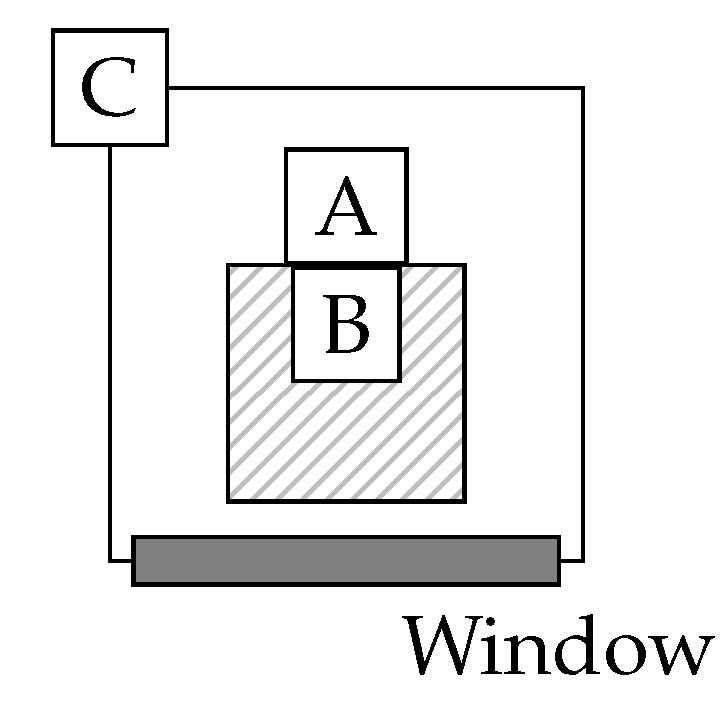
Throughout this paper, we shall compare the comfort experienced by an individual in a particular room (inspired by a simplified version of a typical room in Japan) and numerically analyze satisfaction by means of several factors. It is highly encouraged that the problem be related to this figure at all times. The mathematical construct could be extrapolated and applied to any scenario by means of finding corresponding values for a few extra human-dependent coefficients or unconsidered factors (desirability factors). The figure and shading scheme for this scenario is given below.
3. Spatial Escapism
The following section deals with the method to find the previously mentioned “means" of receiving comfort. One way of doing so is to maximize the comfort obtained due to open spaces. We could assume a giant sphere that acts as a circumsphere for the entire space in consideration. Since open space can be thought of as having a direction and magnitude, spatial escapism will be a tiny area section with direction in the outward normal direction: is the area vector(consisting of a tiny cross-section) or corresponding n-1 dimension cross-section in an n-dimensional sphere, joining current position of the individual (Me) to the endpoint where the vector can’t penetrate anymore (due to presence of object, undesirable wall or desirable open space). One important thing to note is that in dimensions higher than 2-D (as depicted in the diagram), there are additional axes through which the vector could penetrate, in spite of there being an object. For, the existence of a table in front of one doesn’t prevent one from being able to see the wall behind it. (Note that each vector end-point is a tiny circular cross-sectional area.)
4. Desirability Field
Spatial Escapism Points may either be taken to open spaces or highly undesirable walls. So there must be a way to distinguish the two. Also, this brings us to the second way of receiving comfort: minimizing discomfort due to objects in one’s environment. The aforementioned two applications call for the necessity of a numerical measure of the desirability(d) (amount of comfort or satisfaction received at a particular point in an n-dimensional space).
4.1. Meaning of Numerical Value of Desirability
The value of desirability is a non-negative integer value that defines the comfort at that particular point in space. It could be thought of as a scalar that could be multiplied with a vector to get the vector’s comfort potential in that direction. Some ranges and what they symbolize are given below:
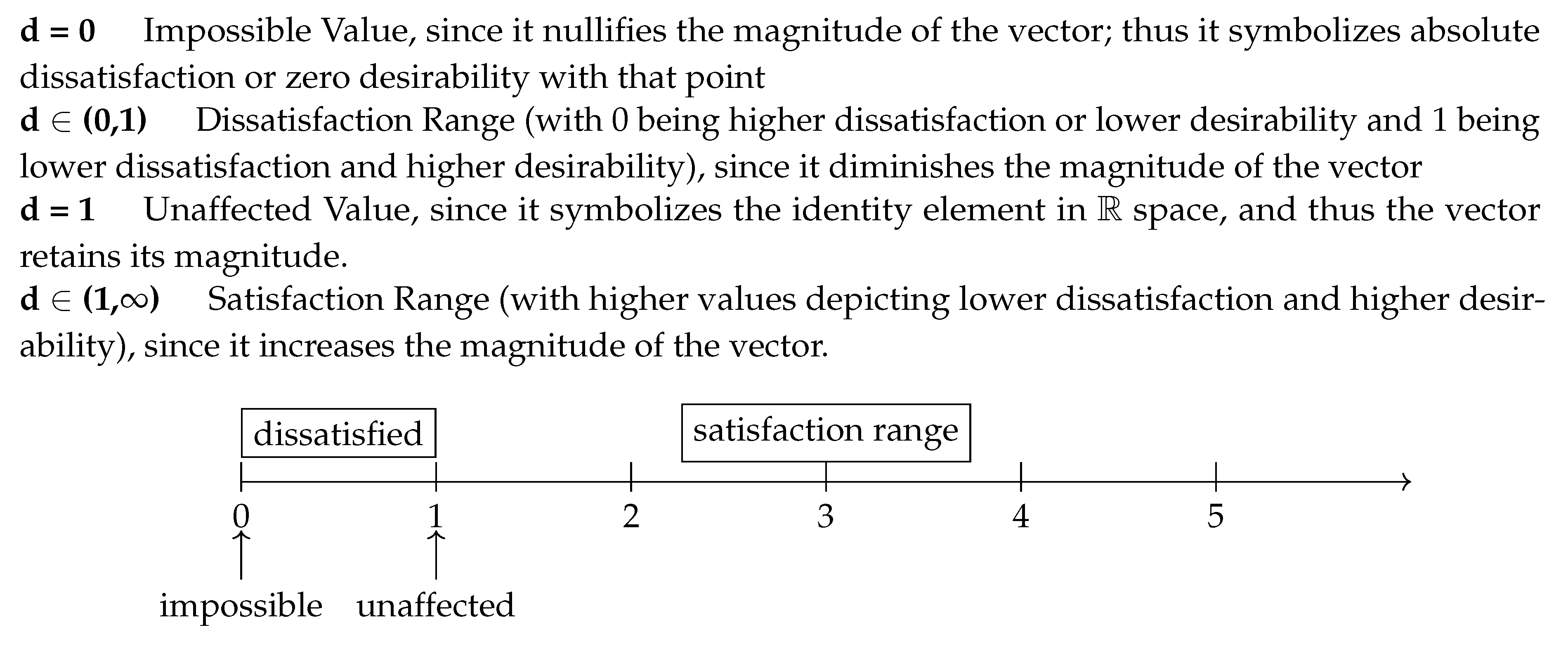
Another numerical value derivable from the desirability index is the dissatisfaction factor (), whose value is simply: . Its numerical values also have similar physical interpretations to that of desirability.
4.2. Factors Affecting Desirability
Since desirability is the amount of comfort an individual receives at a particular point, it is a psychological aspect that can be thought to be controlled by two main factors: the part that ubiquitously affects every individual and the part that is specific to the individual’s personality or current situation. Also, the desirability is position-dependent. The first two factors are extremely hard to calculate owing to the human mind’s complex nature. Simplistic versions of them can be obtained by means of thinking about various situations logically.
4.2.1. Situational-Tolerance Factor
The factors that are thought to be situation-dependent mainly refer to attributes of the objects that are associated with their geometry. Let us go back to the initially mentioned room scenario and discuss the situational-tolerance factors in detail. [5]
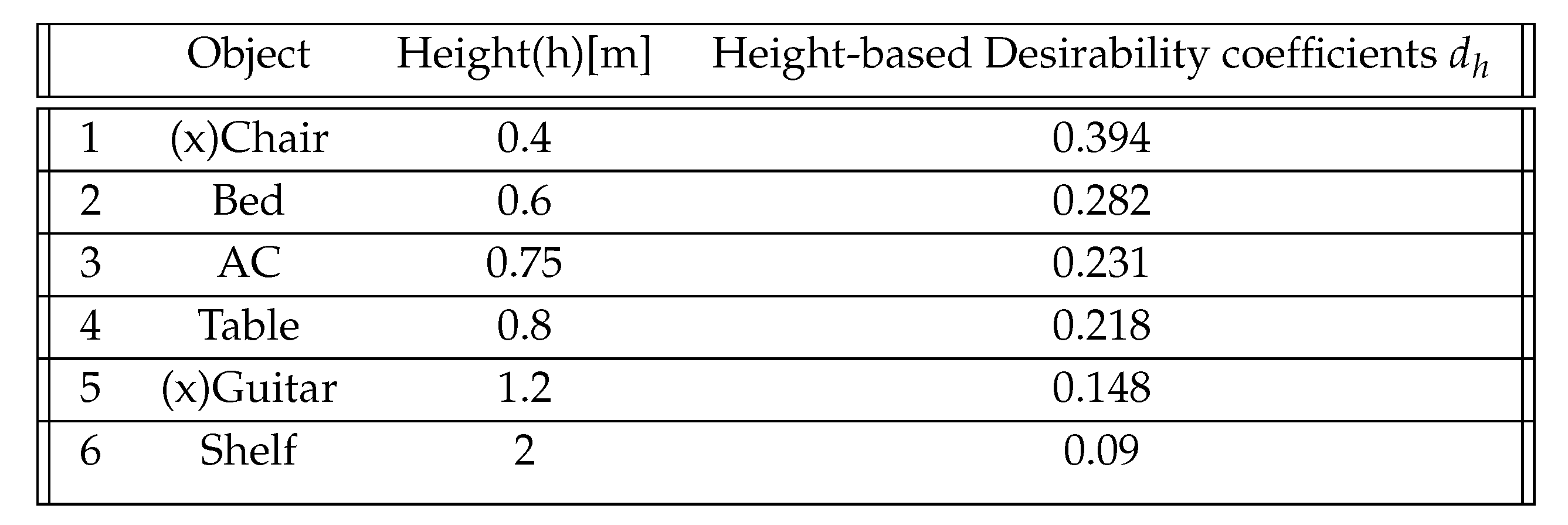
Height The existence of height or depth to each of the objects means that they need not fully nullify the ability of the individual to perceive the open spaces behind them. This means that they may diminish the full comfort the open space behind it provides. Thus depending on the height of the individual we can attribute a numeric that could be used to decrease the overall geometric-dependent comfort. Owing to the geometric nature of the height dependence, an appropriate function would be the function. We know the expected desirability values for certain heights; these can be used to model the function accordingly. Below are some values for height(h)-based desirability coefficients(). H is the height of the individual.
- h = 0
- ⇒ d=1, since the object is of the same height as the floor and thus doesn’t affect the desirability
- h = H
- ⇒ d=, this value of reduced desirability coefficient is so chosen based on the average anatomical structure of a human body and the ability to see and perceive objects above one’s head-level (an overall desirability reduction of 10 folds is appropriate: =0.1)
Using these values, we can successfully modify the (h is the height) function. Thus getting the final formula for the height-based desirability coefficient ().
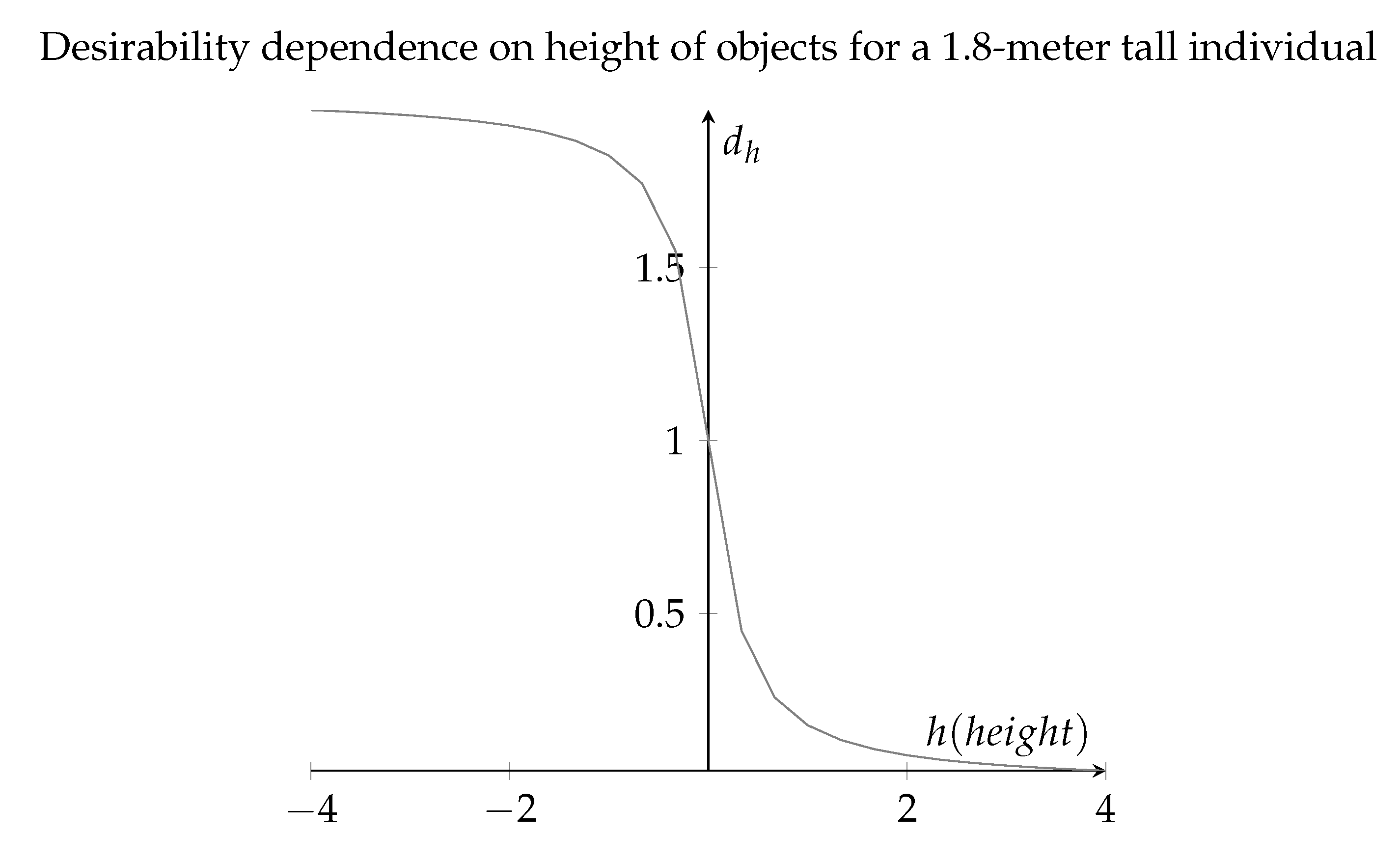
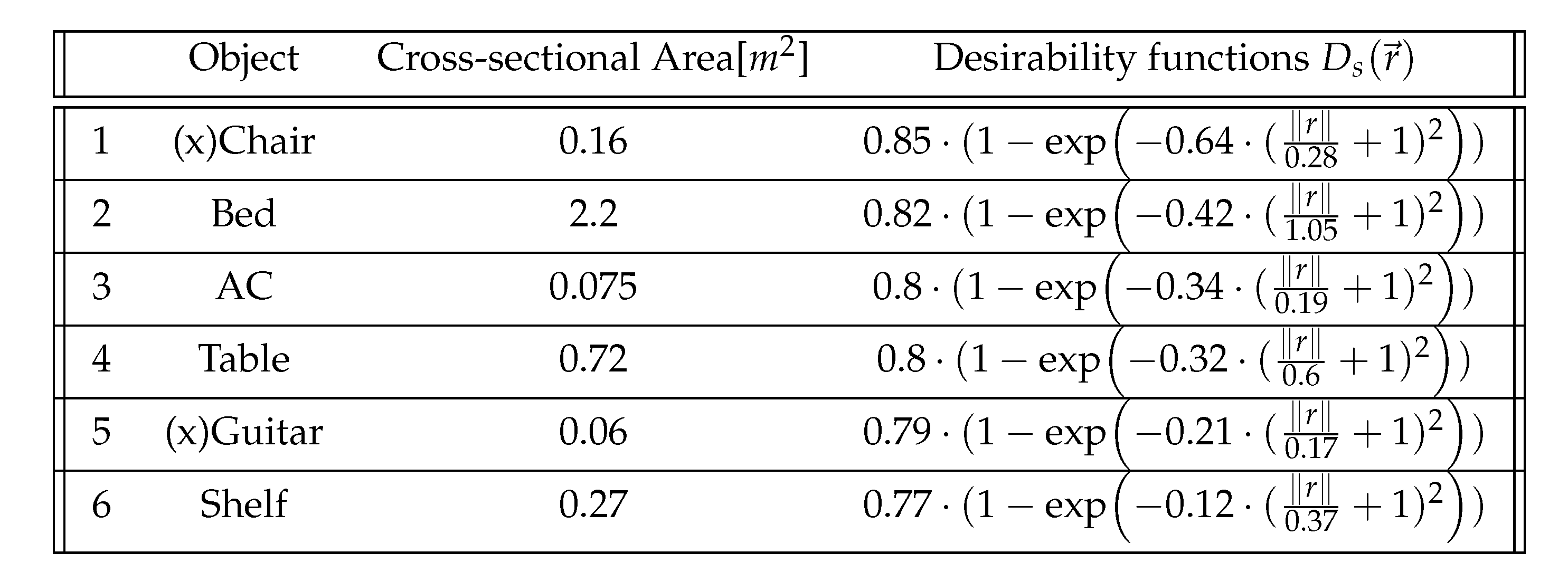
The negative values of height also have a physical meaning: Shallow pits within a room would increase comfort due to the increased amount of perceived space; thus, they have a desirability factor greater than 1. [6] Using the above-estimated graph, the height-based desirability coefficients of the objects in the room scenario with some additional objects (given with x in parentheses) are:
Size The size of the object greatly determines the function that will propagate or decide the value of the desirability index throughout space. The function can easily be modeled by thinking about the boundary conditions. Imagine you are outside the bed, then the bed does indeed obstruct the open space as it blocks the lower half. Now imagine that you are on the bed, the bed does not actually obstruct any open space (unless below the bed is a giant hole, which is unlikely), therefore the bed’s desirability does not affect the overall spatial escapism vectors in a size-dependent manner.
Value
Similar to how the height-dependence value was an integer, the size-dependence will be a function (()) since it will determine how the desirability index will propagate through space and will be later on used for summation across tiny volume sections in the n-dimensional space. The previous paragraph suggests the implication of a square-wave-like structure since at the boundary, there exists a sudden jump. To simplify the discussion, let us consider a square with a side (a) with a window on the bottom side.
Now, we shall begin to analytically find values of the function at various points in space. We shall limit the discussion to only how the object affects the overall desirability factor and not how the distance from the window affects it.
- A
- Since it is directly obstructed by the object in front of it, the size-dependence function will have the value of the height-based desirability coefficient. .
- B
- Since it is on the object, the object itself doesn’t obstruct the access. Thus the geometrical aspects alone will not affect the overall vector. (Note that the body is on the object and not over the object.) .
- C
- Since it is further away from the window than A, it is affected less by the object; the individual feels more open due to the presence of space. No matter how far one goes away, the object’s height still has some validity. So at large distances (within our room scale), if we assume we only lose a certain percent of the maximum unaffected desirability This implies that the peak value for this curve would be a value greater than by % of the difference between the maximum possible value(value on the object=1) and . Hence, at “infinity" (In reality, it will not be affected at all, owing to the object not being enclosed in the spatial escapism n-dimensional sphere.) (Typically a value of 0.75 can be used for )
Function
Due to the spreading nature of the function, a Gaussian distribution seems to be the appropriate function at points other than on the object. The function simplified in 1-D, such that the distance is taken from the origin of the cartesian system ( is the component in that direction and c is the size of the object along the dimension; it is symmetric about the y-axis) would be:
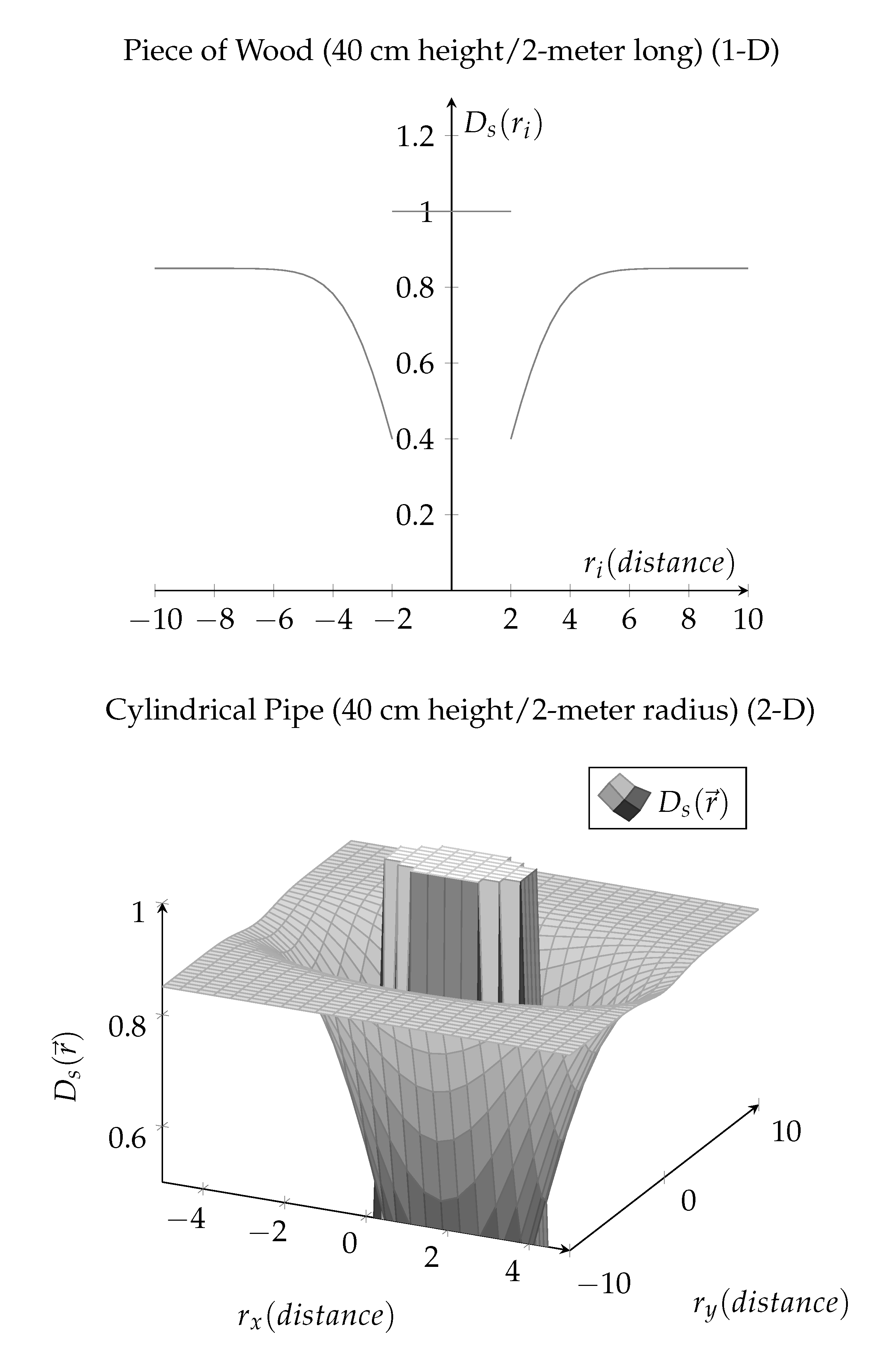
The exact same equation can be generalized in an n-dimensional space by evaluating the replacement parameter for x. Since, it defines the distance from the origin, now for ease of future calculation, we could change the parameter such that it defines the shortest (perpendicular, in most cases) distance from the object: magnitude of vector (r).
If we assume the size-based reduction coefficient to be 0.75 and get the size for the objects as the average radius of the ellipse that encloses the rectangular cross-section area of the objects, then we get for the objects as:
The values for all these functions when the individual is directly on (not over) the object is 1.
4.2.2. Human-Tolerance Factor
The factors that are thought to be different for each individual mainly refer to their state at the time of testing; it could also include the way that a particular individual would perceive the said object. The following are some factors that affect the overall desirability. It could be assumed to be a scalar coefficient, whose overall value is calculated by weighing the importance of all the factors.
Emotional
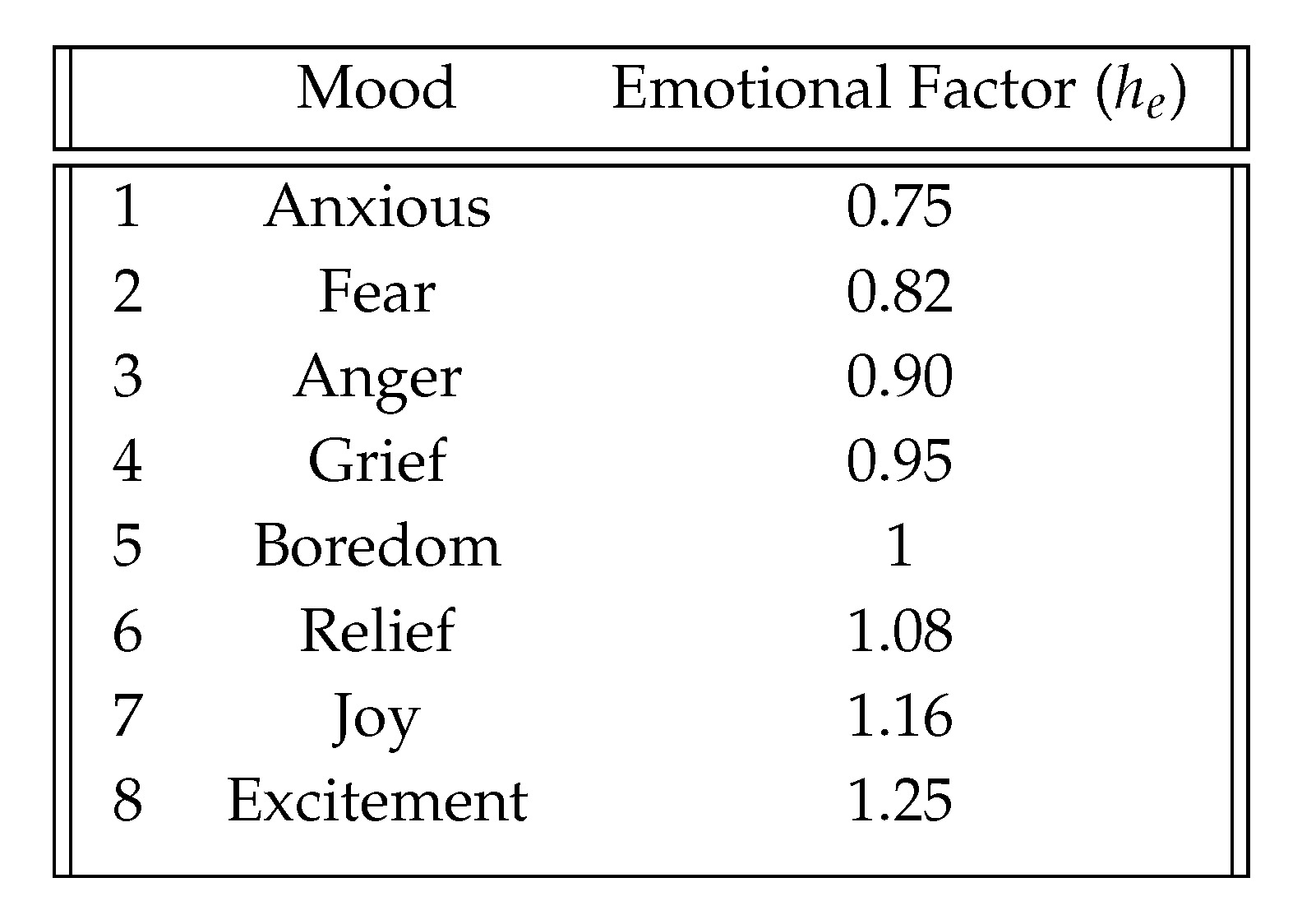
The Emotional Factor () refers to the quantification of an individual’s mood at the time with respect to how it would affect the desirability index. For example, anxiety often leads to a feeling of nausea, whilst happiness and joy often lead to a sense of freedom and relief. This means that, though, at this moment the exact quantification for each mood cannot be accurately found, an overall relative rating of the same can be found by comparing the causation of physiological symptoms in any environment due to the mood. [7]

Based on this relative ranking, hypothetical values may be given to each mood assuming a fixed-interval relation between each emotion, and a 25% decrease in desirability when anxious and a 25% increase in desirability when excited, then we have the values as:
Lighting
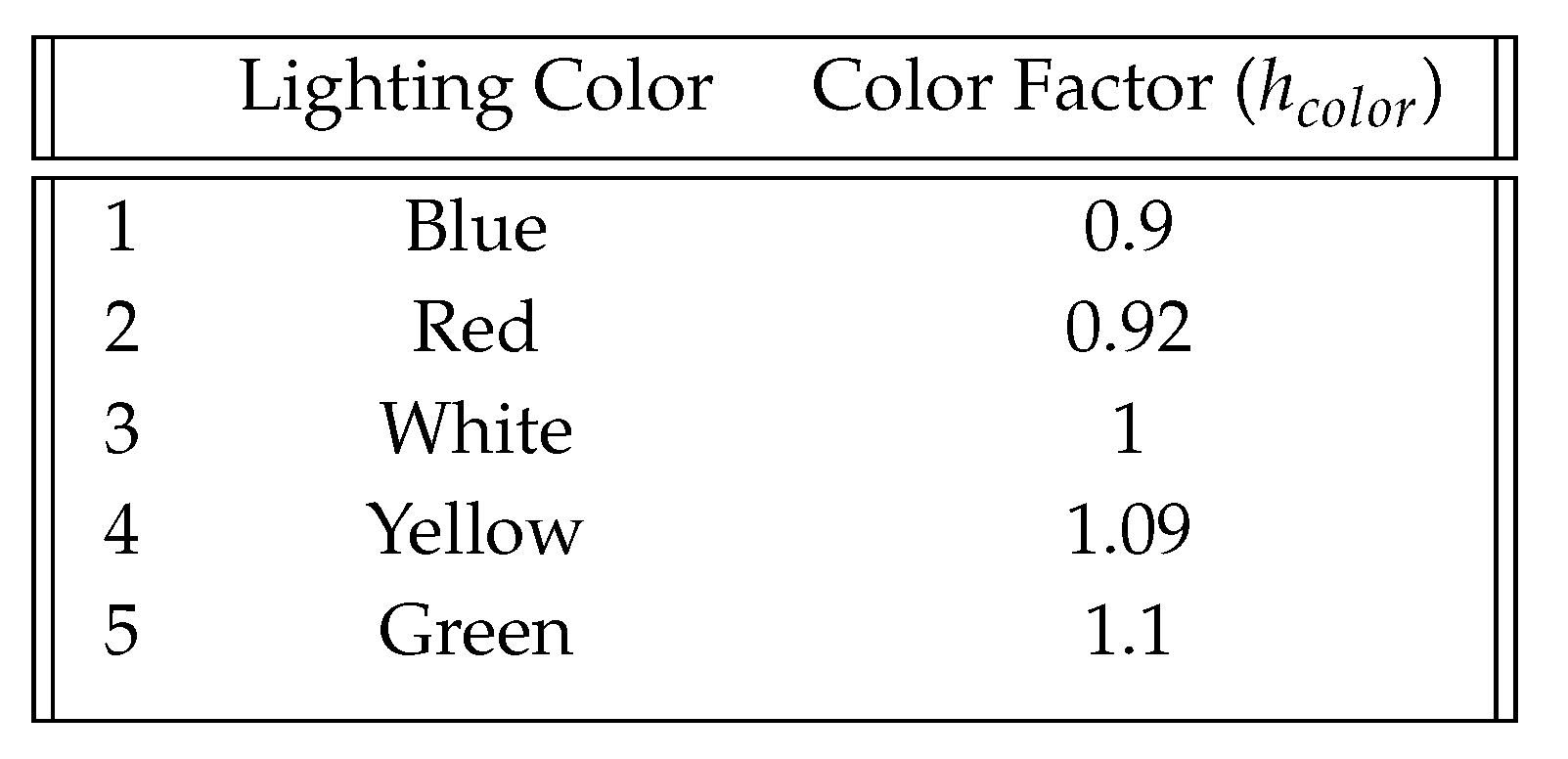
The lighting () is primarily responsible for determining the desirability of the spatial escapism points. Although, it may affect the desirabilities of the objects in the pathway. This is much less in comparison to the level at which it affects how desirable and how open the vector endpoints are considered. This relation and the next are hard to compute due to their strong dependence on an individual’s personal preferences. But, general statements can be made about this topic regarding the impact of brightness as well as the color of the light source: typically brighter sources of light indicate more open spaces (but at some limit, excessive brightness could be a source of pain); also yellow and green are typically associated with a higher sense of calm and relief, in comparison to blue or red light. [8] From the cited study, it is obvious that color has a very rich affective change and cognitive response in humans and thus, it cannot be quantified merely on the basis of which color code corresponds to which desirability. Despite this, if we try to absorb the simplified version of the conclusion, it can be assumed that red and blue lights have a slightly less desirable nature as they increase irritation, while green and yellow lights do the exact opposite. Similarly, we could also put white light as neutral. Some suggested values based on this slight reduction and increase (approximately 10% decrease or increase) could be hypothesized. Also, all colors are assumed to be in moderate intensity and not in the manner of a glaringly undesirable extreme. Thus, assuming a pseudo-boolean-like dependence, one may refer to the following table for values of color factor (the table may also be improved based on the situations: in cases where the light sources to be compared are of negligible color variations).
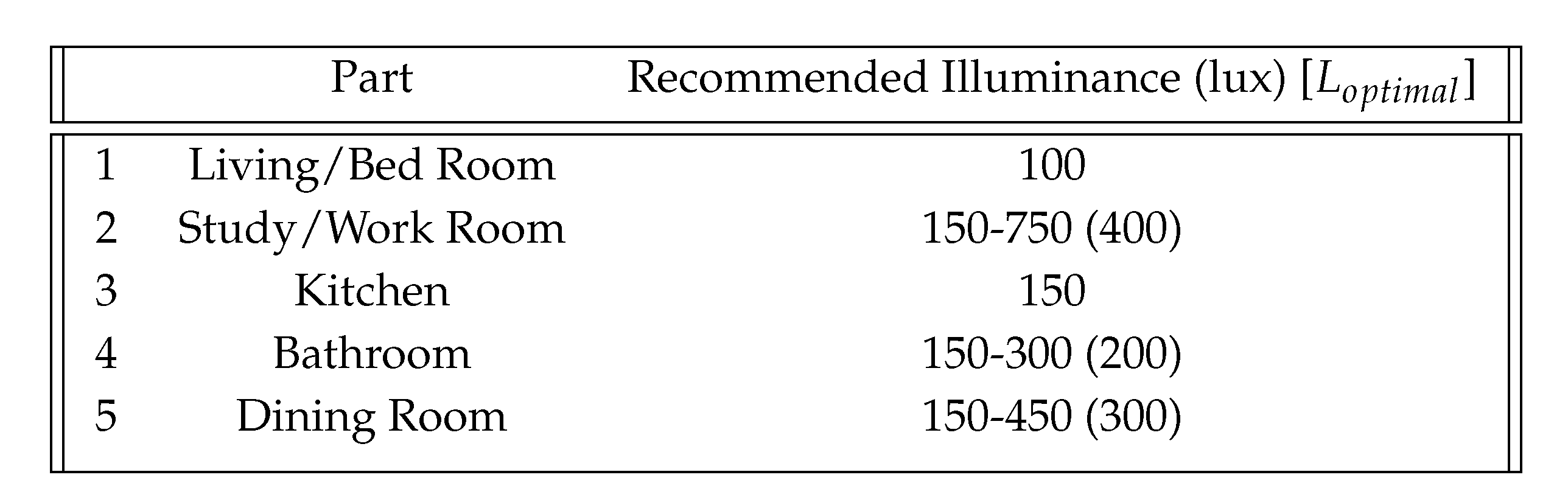
The dependence of the intensity of the light source on the human tolerance factor could be characterized based on the Weber-Fechner Law, specifically the Fechner Law of logarithm intensity perception by the mind [9]. But, since this law clearly only describes the variational aspect of perception, a function must be described to describe the initially perceived stimulus of light intensity as a source of human-tolerance. To calculate this, data points from a home-lighting reference could be used to define the optimal intensities()[10] and based upon that model a linear relationship, such that the optimal intensity provides a 10% increase in comfort ( = 1.1), whilst for each 50 lux () change, there could be a differential decrease of 5% from the maximum ( = 0.05).
In the aforementioned equation, L refers to the current illuminance, whilst refers to the recommended illuminance for each part of the house.
To calculate the overall light-based human-tolerance factor, the mean of the color and intensity-based factors are found, assuming they both contribute equally:
Accoustic
The acoustic dependence of the human-tolerance factor (), similar to the light intensity dependence, cannot be modeled using the Weber-Fechner Law. Thus, from a study, an optimal noise level of 15 dB () may be inferred [11]. And, due to the comparative nature of the envisioned end result, a linear relation could be approximated, similar to that of the light-intensity factor with a maximum being 1 () and a decrease of 0.05 () for each 10 dB change (), such that the audio-levels are measured in decibels (A). Thus, getting the formula:
Climate
Another important factor that directly affects one’s comfort in a particular environment is the environmental climate () within the room. The prevalence of ambient comfortable temperature can greatly affect the amount of satisfaction the individual feels irrespective of the environmental objects. This is because factors like temperature, humidity, wind, and other similar weather-like factors either assist in physiological calmness or worsen it.[12] For this, let us consider three main factors: temperature, humidity, and wind speed. Firstly, wind speed is usually only desirable when it is provided by a cooler, ceiling fan, or another such safe appliance and its optimal value can be estimated to be around 0.1 () [13]. Typically, a value lower than this will not be undesirable, as such is the condition in a calm environment: which is assumed to be equally desirable for the individual. Thus, let us assume this is an unaffected desirability and increased wind speeds would correspond to a lower desirability. A speed increase of 0.02 () could correspond to 0.05 decrease ()in desirability until three deviations.
Now, considering a temperature-humidity relation, instead of using a separate measure for each, they can be combined into a single measure using the Heat Index equation. [14]. According to the WHO fact sheets, a temperature of 23C () is suggested as the ambient room temperature. [15] A similar equation to that of the illuminance could be modeled with the maximum value possible being 1.24 ()due to overall comfort being measurably relied on thermal comfort, with step-value of 1C() and a deviation decrease of 0.06 (). Let us assume, there exists no bound state for this formula:
From the wind-speed and heat-index-based temperature factors, we can obtain the final equation for climate-based human-tolerance factor as their mean of:
Nasal
The nasal relation () is a particularly difficult one to calculate since its measurability is comparatively low with respect to the other factors at play. But, the dependence of smell on resting brain activity and thus our comfort is a clear one [16]. Due to its vastly dependent nature on the individuals themselves, one may not obtain a clear definition of what could be perceived as a comforting or dissatisfying smell. Thus, a pseudo-boolean relation, similar to the color relation could not be obtained with each type of smell being associated with a particular comfort value. There also exists the problem of what level of smell is perceived as maximum comforting. Thus, the nasal relation should be assumed to be 1 in most cases, except in cases where the smell could be obviously assumed to be lesser (0.8-0.9) or higher (1.1-1.2) than the norm.
Desirable Objects
The presence of an object with a higher personal comfort will greatly increase the desirability index by a coefficient (). Similar objects present in the open spaces will also lead to more desire and higher potential for happiness in those points. Since this factor is also highly dependent on an individual and is difficult to calculate even for said individual, it could also be ignored, or an approximation of a 25% increase or decrease could be assumed. In the case of a large number of such objects, an intermediate value could be pseudo-analytically assigned to each such object based on their relative desirability value from the range: (0.75, 1.25).
Visual Appeal
These refer to hypothetical visual factors () that are affected by how the objects look like: color, texture, and other visual factors. These can be thought to only affect the overall desirability in niche scenarios and thus can be neglected in most situations. Therefore, it is a value very close to 1. It is also a factor highly dependent on the individual in consideration. In our room scenario, we are not going to attribute this factor a value for any object.
Human-Tolerance Coefficient
This measure is the value-weighted mean of the various human-tolerance factors: , . Thus, the overal human-tolerance coefficient ():
Here, is the weighing measure for each index and the value can be adjusted based on the individual themselves. Usually, a value of =1 can be used for most factors, except factors that can be neglected in a simplistic scenario, which need not be weighted (=0). Suggest weighing for the factors are:
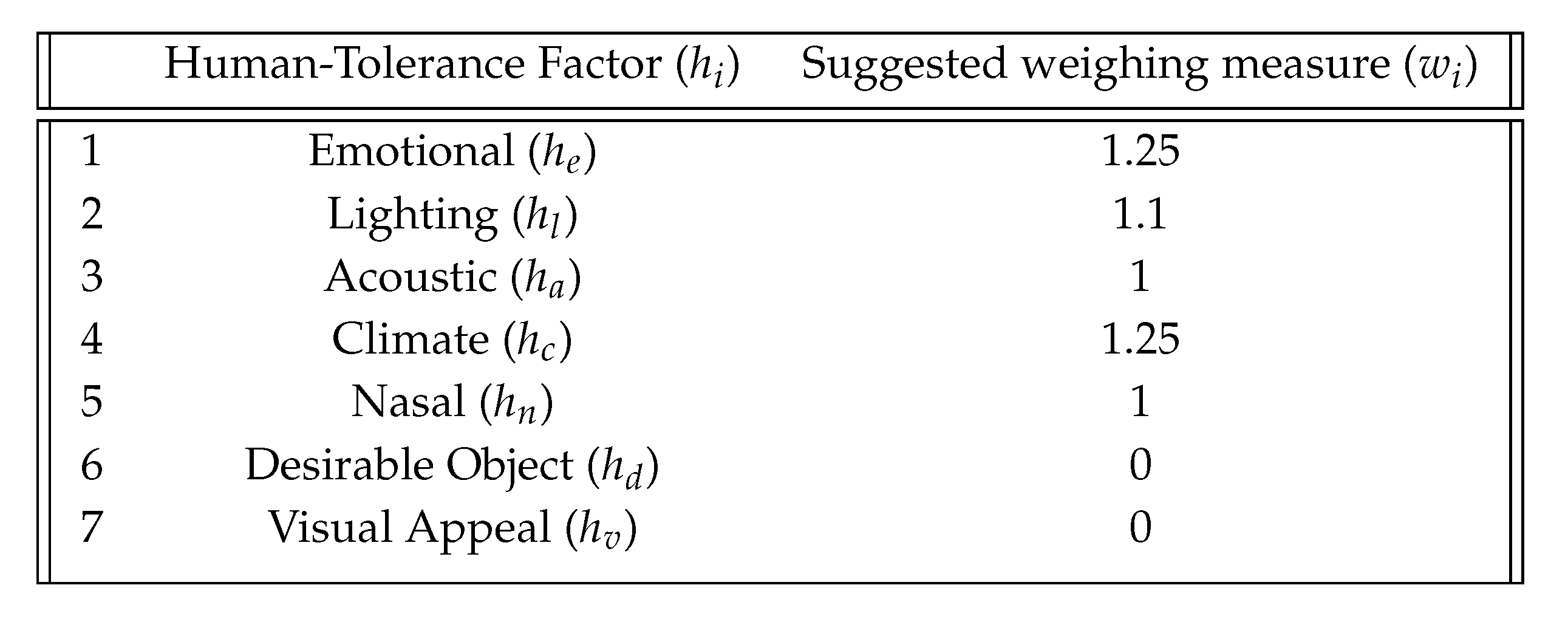
Any other weighing measure may also be used depending on the nature of the comfort comparisons to be done.
4.2.3. Position
The position dependence of the desirability is already outlined in the size-dependent function. There also exists the need to allow it to tend to 1, as the distance becomes infinity; this is ignored within the realms of this discussion for it hinders the fact that the perception of the object still exists at relatively large distances compared to the room frame. Since, for the purposes of this paper, such discussions are unimportant, we may leave the original function in its current form.
4.2.4. Other Factors
There could be several other factors that affect the desirability index, but they are either not of relevance, importance or prevalent in common scenarios. As a result, they are not mentioned or included in the calculation of the final desirability index.
4.3.3. Final Form
To sum up the entire section, we will need to find out the value of Desirability-field at a particular point. This depends on the function of size-dependent desirability () which in turn depends on the Height-dependent desirability coefficient (). In addition to this, it all depends on the human-tolerance coefficient (). The discussion up until now was only for a single object; thus, to find the actual desirability, there needs to be a summation across every object in the room environment, including the flooring and if it will affect the outcome, the ceiling. A more complicated form could be analyzed based on the Bayesian interference of the desirabilities of the objects considered.
Desirability Index
Thus we get the final formula for desirability:
5. Desirability Density
Since spatial escapism points could be thought of as being perceived all at once in the case of an exterior region, they could be assumed to be uniform, and as such a desirability density could be obtained in an n-dimensional space. Now to avoid confusion, the spatial escapism desirability shall be described by ). The overall desirability is also, thus, either dependent on the exterior characteristics of the non-room space the point is a part of, or the interior characteristics of the room in case the point does not lead to an open space (walls, floors, or ceilings).
Above is the generalized equation for desirability density in an n-dimensional space. ( is the volume equivalent in n-dimension)
6. Desirability Capability
The desirability capability is the sum of the desirability characteristics of all points in space from the individual’s current position along the n-dimensional volume enclosed by the n-dimensional angle till the spatial escapism point (n-1 dimensional cross-section); let the volume this angle encompasses be called .
The above is the equation needed to calculate desirability capability along each n-dimensional angle or spatial escapism point.
7. Comfort Index
The comfort index could be thought of as the integral across all the n-dimensional angles in space having the properties:
Another important thing to note is the extent to which the desirability density affects the overall comfort: it only affects a certain visual range. This distance will be the distance until the next obstruction (), or it will be a certain maximum possible distance, so chosen to minimize scaling problems of the comfort index in case of open area-based exterior regions ( = = 5m, if distance ≥ 5 meters). In the case of points within the room space, it could be assumed to be around the average perceived openness of the walls, ceilings, or flooring () Thus, the comfort index is:
8. Conclusion
Thus, a Hypothetical Theoretical Construct for Spatial Human Comfort in Confined Room Spaces has been successfully modeled. It is based on a key concept called the Desirability Field, which is also quantified based on several complex psychological and geometrical aspects. A concept called spatial escapism points was also introduced to structurally analyze vectors that are associated with open spaces. The model, thus created, achieves its full potential not in comparing completely different confined spaces, but rather in comparing how an individual object’s presence or absence will affect the overall comfort. The theoretical construct created, with statistical analysis could be used in the real-life analysis of confined spaces like rooms and office cubicles, to model such places in order to maximize the satisfaction of the individuals present in those areas to promote optimal performance.
References
- Foye, C. The Relationship Between Size of Living Space and Subjective Well-Being. Journal of Happiness Studies 2017, 18. [Google Scholar] [CrossRef]
- Du, Y.; Li, N.; Zhou, L.; A, Y.; Jiang, Y.; He, Y. Impact of natural window views on perceptions of indoor environmental quality: An overground experimental study. Sustainable Cities and Society 2022, 86, 104133. [Google Scholar] [CrossRef]
- Molina, G.; Donn, M.; Johnstone, M.L.; MacGregor, C. The feeling of comfort in residential settings II: a quantitative model. Buildings and Cities 2023. [Google Scholar] [CrossRef]
- Ellsworth-Krebs, K.; Reid, L.; Hunter, C. Integrated framework of home comfort: relaxation, companionship and control. Building Research and Information 2018, 47, 1–17. [Google Scholar] [CrossRef]
- Altaş, N.E.; Özsoy, A. Spatial adaptability and flexibility as parameters of user satisfaction for quality housing. Building and Environment 1998, 33, 315–323. [Google Scholar] [CrossRef]
- Nevzati, F.; Demirbas, O.; Hasirci, D. BIOPHILIC INTERIOR DESIGN: A CASE STUDY ON THE RELATION BETWEEN WATER ELEMENTS AND WELL-BEING OF THE USERS IN AN EDUCATIONAL BUILDING. Anadolu Üniversitesi Sanat and Tasarım Dergisi 2021, 11, 450–467. [Google Scholar] [CrossRef]
- Gloss, T. Calm, Cool, and Collected: Research on Affect and Emotion Regulation. Association for Psychological Science: Observer.
- Xie, X.; Cai, J.; Fang, H.; Tang, X.; Yamanaka, T. Effects of colored lights on an individual’s affective impressions in the observation process. Frontiers in Psychology 2022, 13. [Google Scholar] [CrossRef] [PubMed]
- Fechner, G.T. Elemente der Psychophysik; Vol. 2, Leipzig: Breitkopf und Härtel, 1860. [Google Scholar]
- Ledrise Led Professional. Home lighting guide and recommended light levels. Feb. 2023.
- Rozzi, C. A., F. F.B.L.M.S.G.D..F.J. Indoor noise level measurements and subjective comfort: Feasibility of smartphone-based participatory experiments. PloS one, 17(1), e0262835, 2022. [CrossRef]
- Arsad, F.; Hod, R.; Ahmad, N.; Baharom, M.; Jaafar, M. Assessment of indoor thermal comfort temperature and related behavioural adaptations: a systematic review. Environmental science and pollution research international 2023, 30. [Google Scholar] [CrossRef] [PubMed]
- Raftery, P.; Fizer, J.; Wenhua, C.; He, Y.; Zhang, H.; Arens, E.; Paliaga, G. Ceiling fans: Predicting indoor air speeds based on full scale laboratory measurements. Building and Environment 2019, 155. [Google Scholar] [CrossRef]
- Rothfusz, L.P.; Headquarters, N.S.R. The heat index equation (or, more than you ever wanted to know about heat index). Fort Worth, Texas: National Oceanic and Atmospheric Administration, National Weather Service, Office of Meteorology 1990, 9023, 640. [Google Scholar]
- Organization, W.H. Heat and health 2024.
- Carlson, H.; Leitão, J.; Delplanque, S.; Cayeux, I.; Sander, D.; Vuilleumier, P. Sustained effects of pleasant and unpleasant smells on resting state brain activity. Cortex 2020, 132, 386–403. [Google Scholar] [CrossRef] [PubMed]
Figure 1.
Room Scenario.
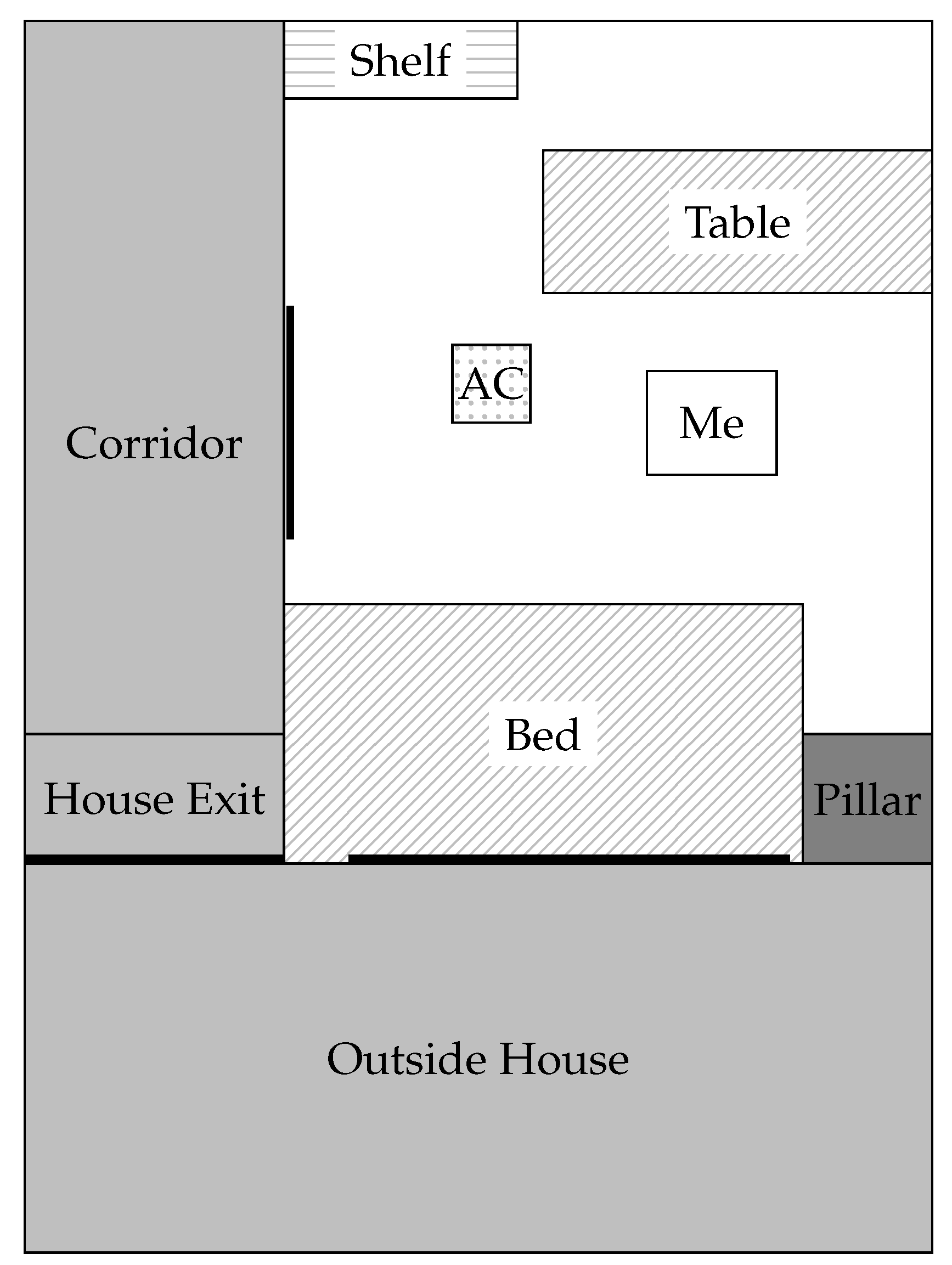
Figure 2.
Spatial Escapism.
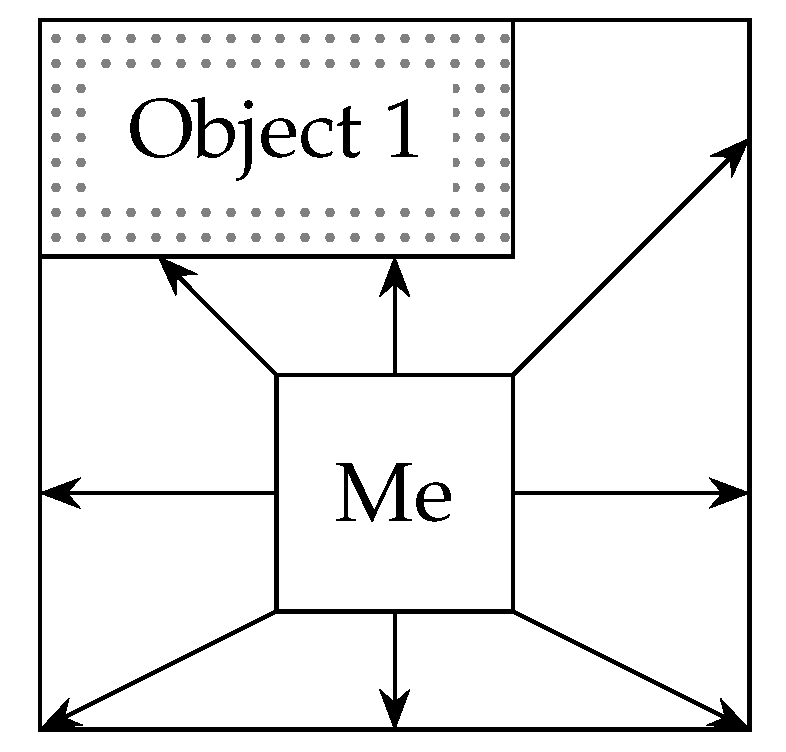
Figure 3.
Simplified Diagram for Object.
Disclaimer/Publisher’s Note: The statements, opinions and data contained in all publications are solely those of the individual author(s) and contributor(s) and not of MDPI and/or the editor(s). MDPI and/or the editor(s) disclaim responsibility for any injury to people or property resulting from any ideas, methods, instructions or products referred to in the content. |
© 2024 by the authors. Licensee MDPI, Basel, Switzerland. This article is an open access article distributed under the terms and conditions of the Creative Commons Attribution (CC BY) license (http://creativecommons.org/licenses/by/4.0/).
Copyright: This open access article is published under a Creative Commons CC BY 4.0 license, which permit the free download, distribution, and reuse, provided that the author and preprint are cited in any reuse.


