

Submitted:
27 August 2024
Posted:
28 August 2024
You are already at the latest version
Abstract
Embracing Fourth Industrial Revolution(4IR) techniques is a need for a long-term sustainability and to do automation in the processes of Industrial and education sector. Rapid advancement in the information technology and other engineering technologies demand more proactive steps in the education institutes. In the post pandemic world, there is an increasing demand of changes in teaching and learning methodologies with the support of modern digital technologies. So, all of the teaching institutes need to have a significant step change in the areas of learning and teaching. The impact of 4 IR is more on the education sectors compared to previous generation’s industrial revolution. Keeping track of key technologies can be quite a challenge as they keep evolving at a very fast pace. Fourth Industrial revolution is the current technological digital revolution in which major focus is on cyber physical and biological systems such as Artificial Intelligence, Robotics, Internet on Things, Virtual Reality etc., The educators and institutions should establish the pedagogies and teaching with the aid of Industry 4.0 techniques to evolve education 4.0. So, it is very important to understand the challenges and competencies required about the implementation of 4IR by the faculty members and students who are currently studying in Higher Education Institutes (HEIs). This paper aim is to do a systematic review about industry 4.0 techniques and its application in relate to the online learning and teaching, change in pedagogies, enhancement of data management in HEIs, digital and virtual laboratories etc.
Keywords:
Industry 4.0
; Education 4.0
; Artificial Intelligence
; Robotics
; Virtual Reality
; Block chain technology
; gamification
; IoT
; Digital Laboratories
1. Introduction
The industrial revolutions are evolving due to the development of trade, increasing demand, requirement to the society and the requirement in enhancing business. The first Industrial revolution began in the 18th century in Britain and then spread to all over the world. The first industrial revolution started from about 1760and extended up to 1830.The first industrial revolution is the transition from manual production method to mechanization. The first industrial revolution mainly focused on steam power, machine tools using iron technology and the requirements raised in mechanization of factory system. The first industrial revolution is the major industrial revolution which made changes in textile technology, iron technology, chemicals, cement production, paper production, agriculture, mining and transportation. The Second Industrial Revolution began in the 19th century due to inventions in electricity, electrical machines and the development of assembly line production. Henry Ford (1863-1947) took the idea of mass production and carried over to automobile production field because of the advantages of faster production and lower cost. The main source to this revolution was the development of production system using electrical energy as primary source of power. Due to many advantages like efficiency, easy to operate, automation, faster production and electrical machines leads second industrial revolution from 1870 to 1914.
The Third Industrial Revolution began in the mid of 20th century because of the development silicon technology in the area of memory-programmable controls and computers. The fast development in computer started many changes in high precision technology in many fields. In the Industry 3.0, mainly electronics and computer played a vital role with the addition of networking technologies. The development of software technology and internet in the early 2000 in Industry 3.0 is not only opened a path for industry 4.0 and also made revolution in many management processes in industrial sector. The Industry 4.0 is based on the concept of smart factory, where the machines are integrated with men through cyber-physical systems (CPS). CPS are the integration of IT system with mechanical and electronic components connected to online networks that allow the communication between machines in a similar way to social networks. These innovative technologies enable factories to become “smart,” resulting in productions of customized products on an industrial scale while providing many opportunities for improvements in operational flexibility and efficiency. Digitalization is the most important element in Industry 4.0 because it allows to connect man and technology. The main theme of industrial revolution is given in Figure 1.
Education is undergoing vast changes due to the upcoming Industrial Revolution – the Industry 4.0. This will require Engineers to possess the hard and soft skills needed to operate within the intelligent factory (Benesova,A and Tupa,J 2017)[2]. Only in this way, it will be possible to properly implement the new Industry 4.0 practices and to make technological advances to companies and the whole society ( Ab Rahman et al, 2019)[3] . Industry 4.0 is an initiative that aims to bring major changes in society, education, economy, and trade. The study made by the authors (Oztemel, E. and Gursev, S., 2020) focuses on various aspects of Industry 4.0, such as big data, IoT, virtual manufacturing, intelligent robotics, and cloud computing. It emphasizes the importance of a sustainable economy, innovative manufacturing, and cloud computing in achieving Industry 4.0 goals. The study also highlights the benefits and drawbacks of Industry 4.0, the need for a taxonomy of Industry 4.0, and areas for further research. There were 250 companies involved in the study [4].
Similar to the industrial revolution, education system also evolved from education 1.0 to education 4.0. Education 1.0 framework focused transformation of information from teacher to student; the student receives information passively. Education 2.0 responds the education related to the needs of the industrial society with the concept of “teaching technology”. Education 3.0 framework aims to find a solution to the needs of the developing technology society. It promotes the production of knowledge by supporting self-learning. Education 4.0 is beyond the traditional education system. Education 4.0 supports individuals to keep up with the innovative age. Education 4.0 helps the student to improve himself to face changes in society and encouraging students to develop the applicability of modern technologies (Mukul,E Büyüközkan,G,2023)[5]. The use of 4IR technologies combined with modern learning and teaching methodologies, such as gamification, online teaching, virtual labs and blended learning, has been identified as trending research topics within education sector. (Alex Sander Clemente de Souza, Luciana Debs,2024) [6]. The Industry 4.0 technologies and the systematic implementation in HEIs is shown in Figure 2. This paper objective is to do a systematic review that synthesizes research about how technology is dominating in learning and teaching styles and also administrative systems in education institutes. In this study, we aim to bridge the gap and contribute the analysis of existing literatures encompassing all research about learning analytics and industry 4.0 technologies. This paper investigates the characteristics, findings of technology application, research methods and its analysis, performance predication, learning analytics in the automation of education 4.0.
2. Overview of Challenges in Automation of Education 4.0
The automation of education process includes interconnectivity between processes, use of technologies, data transparency and autonomous in learning for boosted quality in learning and teaching. The advancement of Digital technologies forced universities to have a significant phase change in the areas of learning and teaching which is highly challenging and need more competencies compared to previous generation’s industrial revolution. (Caratozzolo, P., Lara-Prieto, V., Martinez-Leon, C., Rodríguez-Ruiz, J., Ponce, R., Vázquez-Villegas, P. and Membrillo-Hernández, J.)[7]. Learning the key technologies before learning the core content by the faculty and students are quite challenge as they keep growing/changing at a very rapid pace. The fourth industrial revolution refers to this era wherein new technological breakthroughs will cause disruptions in a number of industries, and will be marked by robotics, artificial intelligence (AI), block chain, among others technologies. Dr. Hilal Al Hanaei - Secretary General of The Research Council, Sultanate of Oman (TRC), added that “ability to cope with the rapid automation and it is required to prepare our students (Oman) with the competitive skills to cope up 4IR in the global labor market in years to come”. (Source: Times News service : https://timesofoman.com/article/59068-oman-ready-for-fourth-industrial-revolution-trc)[8]. In future, both students and faculty will never be done with their educations within the universities and colleges, but instead must engage constantly with their colleagues and outside experts to frequently renew and update their skills (Miranda, J and Molina, A, 2020)[9]. To enable faculty to maintain expertise based on the latest discoveries and technologies, more proactive and creative forms of faculty development will also be required. The 4IR campus must become a constantly renewing collaborative hub of activity to maintain itself within the fast-paced environment of the future. (Caratozzolo,P., Alvarez-Delgado, A., Sirkis, G,2021)[10]. Laptinovic ,T and Sikman, L (2022) described that virtual joint laboratory for advanced technology (VALIP) and its feasible solution in university teaching is highly challenging [1]. They explored the challenges faced in university of Banja Luka, Bosnia, Faculty of mechanical engineering while implementing digital laboratories. Reza Ghaney Gheshlagh (2022) discussed the challenges of online education from the perspective of the university of medical sciences students in iran and resulted the challenges as 1. Inadequacy for practical learning 2. Inadequacy of internet and web services 3. Barriers related to educational content 4. Interaction between teacher and student [11]. Caratozzolo,P et al (2022) explained problem based learning (PBL) and challenge based learning (CBL) approaches which is an important requirement to adapt in curriculum to meet the labor market requirements [12]. Al-Ghamdi et al., (2022) addressed the cyberattacks in HEIs due to poor IT infrastructures. Their study designs a novel search and rescue optimization with deep learning based learning authentication technique for cyber security in higher education institutions. They have proposed a deep learning based fingerprint identification technique named as SRODL-LAC technique to avoid cyberattacks in accessing university materials [13]. Overall, we can say that numerous challenges are there in the implementation of modern technologies which is taken as main objective of this paper and analyzed using various outstanding publications.
After reviewing numerous articles, we have selected 118 papers which are relevant to the aim and objective of the paper. Among this, we categorized according to the different theme and extracted the core work which has been explored by the researchers. The Figure 3 shows the papers numbers are topics which we have referred in this review work.
3. Literature Review
Use of digital technology in Education 4.0 becomes a more realistic and practical approach to personalized learning for problem solving, innovation, creativity, and collaboration. This is the future trend in education system to enhance the quality of HEIs and students’ knowledge. Figure 4 shows the main perspective of education 4.0 which shows main characteristics (Das, Shuvra & Kleinke, Darrell & Pistrui, David, 2020)[14].
Yuefan Xia et al (2022) presented in their paper about the challenges faced in learning before covid-19 , during covid-19 and the changes of student’s relationship with others in online learning. The research gap of this paper is sample size which is small. The study reveals that the level of agreement should be more between student and staff to improve online teaching and learning experience [15]. As per wheatley and greer (1995), the technology-based learning save time when large number of students are there in a teaching session. They have analyzed the time conflict and concluded that online platform will solve the issues in time management to teach more volume of students in three decades ago [16]. Emad Mustaha (2022) et al., discussed the challenges and opportunities of online learning and teaching at engineering and theoretical colleges during the pandemic. He has taken a study with 1713 participants at university of Sharjah and 77.2% of users have given positive feedback related to flexibility in place and time. However, the authors concluded that sudden implementation of online mode gave implications for users; mental health which is a negative part in the study. The authors recommended hybrid -Flexible (Hyflex) is more effective for the university to apply based on nature of courses [17].
Akturk, C., Talan,T and Cerasi,C.C ( 2022) explored the requirement for super smart society ( society 5.0) from education 4.0 and university 4.0 using industry 4.0 techniques. The digital transformation experienced in the world and in turkey was stated in this work [18]. Anshari, M., Almunawar,M.N. and Razzaq,A., (2021) discussed the talent management by the universities to face Industry 4.0. A qualitative method was deployed in this paper to extracts primary data from educator’s perspective in talent management through education 4.0. He further added that talent management is an important aspect in HEIs to satisfy the industrial need in modern industries [19]. Bakker, M.N. and Axmann,M., (2021) explained the meaning of learning analysis in industry 4.0 and education. The application of AI and related areas in education has been explored in this book chapter [20]. Caratozzolo,P and Alvarez-Delgado,A (2021) has given education 4.0 framework to enrich active learning using virtual and AI tools to enhance the quality of education sector. This paper serves to understand the importance of AI in future education system to enhance curriculum and learning experience [21]. Chen,Z et al (2020) proposed a student performance analysis using hybridized deep neural network (HDNN) which can be used to monitor , predicts and evaluates the student’s performance with more accuracy in an education 4.0 environment [22]. Ivanciu and sipos (2020) concluded in their paper that electronic devices and circuits lab can transform to online or hybrid based learning using industry 4.0 techniques in the transformation of education 4.0[23]. Impact of Industry 4.0 techniques in education is not only proved its advantages in engineering education, it is also proved in learning of other subjects. Laurent, A and Fabiano, B ( 2022) discussed a critical perspective on the impact of industry 4.0 techniques in developing professional safety management skill in safety education [24]. Similarly, Mourtzis, D( 2018) published a paper which is discussing about development of skills and competences in manufacturing towards education 4.0: a teaching factory approach [25]. Mourtzis,D et al (2018) presented that how the adoption of cyber physical systems and industry 4.0 technologies under the teaching factory paradigm will reshape manufacturing education, addressing the requirement for highly skilled employees [26].
Jedaman,P et al (2019) discussed the change of education plan and its challenges in Thailand. They have discussed about transition, dynamics, strategic management and strategic leadership to reform the policies in Thailand [27]. Moraes,E.B et al (2023) discussed the integration of industry 4.0 techniques with education 4.0 and analyzed the advantages of smart education and the improvements in learning [28]. Saragih et al, (2020) discussed the blended learning in the execution of education 4.0 using digital technologies. In this paper, authors discussed the different technologies which can be integrated in university learning and teaching and its challenges and opportunities [29]. As per Toma,M.V., and Turcu, C.E (2022) “ By 2025, two billion people will be part of Gen Alpha who will get greatest access to modern technologies. This paper proposes a solution that support integration of technology in regular text books. Connecting learning materials with the technologies can lead to a better understanding and involvement in the classroom [30]. Verma,A and Singh, A (2021) have done a systematic review in their work to discuss about new era of technology empowered in education 4.0 and the trends and future directions [31].
Education 4.0 helps develop competencies for reasoning for complexity. Ramírez-Montoya, M.S., Castillo-Martínez, I.M., Sanabria-Z, J. and Miranda, J., 2022. analyzed complex thinking as a major competency with critical, systematic, scientific, and innovative thinking as part of it in the education environment by reviewing 35 articles. Education 4.0 provides an opportunity to improve education training practices that build these competencies. It also impacts education research through various study methods including quantitative and mixed methods for higher insights [32].
Silva, D.E., Lopes, T., Sobrinho, M.C. and Valentim, N.M.C., 2021. investigated to identify initiatives in Education 4.0 and Industry 4.0 to promote the advancement in education with 78 articles reviewed. The results revealed that in recent years the number of searches on this topic has risen due to increasing interest.. The study also says that the initiatives that promote Education 4.0 are: seeking the protagonism of the student, incentive active learning, proposing practical activities, developing 21st century skills, and enabling experience with advanced computing resources and processes [33].
Similarly, there are many notable and latest publications which are dealing about the review of the latest trends in education 4.0. The authors of this paper collected many review papers from the digital library and then filters according to the theme of this paper and presented in Table 1. The Table 1 shows the direct and allied review papers of industry 4.0 in which we can understand that there are numerous researchers are doing the work in the area of application of modern technologies to change the HEIs current system.
The next section will review in detail about the technologies which are possible to apply in education 4.0 , its important phases and also the challenges faced by HEIs.
4. Review of Technologies in Industry 4.0
The rapid development in the Internet technologies and telecommunication transformed the way of our life with more connectivity between people, between machines and even between men and machines. The new technologies changes in the industry operations to the physical and the virtual world. Cyber Physical Systems (CPSs) have further improved numerous rapid technological development in the many field (Miranda,J Navarette.C et al., 2021)[52] CPSs allow the machines to communicate more intelligently with each other. Some of the important technologies involved in Industry 4.0 is as follows
- Cyber-physical systems
- Big data
- Internet of things
- Artificial intelligence
- Additive manufacturing
- Cloud computing
- Virtual reality
- Robotics
- Block chain technology
Since the introduction of these technologies, we are now able to automate an entire production in industrial processes without human assistance. Similar way, these technologies are having impact in all fields including in the education field (Lasi,H., Fettke,P Kemper, H.G et al, 2014) [53]. Known examples of this are robots that perform programmed sequences without human intervention which is possible in learning and teaching. AI driven technologies have already proved its impact in primary level teaching to higher education teaching (Mirinda,j., M.S. Ramirez et al , 2022)[54] . AI driven devices are using for google search, teaching in primary education, teaching languages, conduct of online exams etc.
4.1. Review of Artificial Intelligence in Online Learning and Teaching
General AI is machine intelligence, and is the type of adaptable intellect found in humans, a flexible form of intelligence capable of learning how to carry out different tasks in industry and in our day today life. Artificial intelligence (AI) makes it possible for machines to learn from experience, adjust to new inputs and perform human-like tasks with more intelligence. The term artificial intelligence was coined in 1956, but AI has become more popular today because of the advanced facilities in increased data volumes, advanced algorithms, and improvements in computing power and storage. Because of the development of neural networks, machine learning and deep learning, artificial intelligence is adopted by many fields to give unimaginable performance. AI is important because of computerized intelligence automation, adding intelligence in the existing products, adapting the progressive learning algorithms to form new structure and regularities, analysis of more and deeper data and incredible accuracy. Artificial Intelligence is giving the most innovative tech inventions, and almost in all sectors where humans finds difficult to achieve. AI is also playing a big role in learning and teaching for education, and helping to automate many teaching and learning process to increase the enhanced experience for educators and students as well. E-Learning and online learning are hugely influence in the educational delivery tools, and AI is leading the race. AI is helping students to receive highly engaging lectures and take part in intuitive aptitude tests, so students get the best method to address their learning requirements. Recent Artificial Intelligence teaching software is able to identify areas where students are lacking and focus on that content. Advanced AI software can generate new problems from source material. These online systems actually generate better material and more comprehensive testing methods than typical classroom teaching.
Artificial Intelligence (AI) is transforming the landscape of online learning and teaching (L&T) by offering advanced tools and solutions that enhance both the student learning experience and the improvement in efficiency of teaching processes (Caratozzolo,P., Rosas Melendex and OrtiZ-Alvarado 2021)[55] . AI-powered systems can personalize the learning journey for each student by analyzing their learning patterns, preferences, and performance data. Through adaptive learning algorithms, AI can provide customized content recommendations, quizzes, and assessments tailored to individual needs, thereby maximizing engagement and knowledge retention (Ciolacu,M et al., 2018)[56]. Moreover, AI-driven chatbots/chatGPTs and virtual assistants can offer immediate support to students, answering queries, providing feedback, and guiding them through their learning journey in real-time (Adel, A.; Ahsan, A.; Davison, C. 2024)[57]. On the teaching side, AI can automate administrative tasks such as grading, plagiarism detection, scheduling, and content creation, allowing instructors to focus more on delivering high-quality instruction. Natural Language Processing (NLP) technologies enable AI to analyze and understand text-based interactions, facilitating intelligent tutoring systems that can provide interactive and responsive learning experiences. Additionally, AI-powered data analytics tools can generate insights from large volumes of learner data, helping educators identify trends, assess learning outcomes, and optimize instructional strategies. Overall, AI holds the potential to transform online learning and teaching by making education more personalized, accessible, and effective for learners and instructors alike. Artificial Intelligence (AI) has revolutionized online learning and teaching (L&T) by offering personalized and adaptive educational experiences. (Ahmad, S.F. et al., 2021) [58]
Through AI-powered algorithms, online platforms can analyze vast amounts of student data to identify individual learning styles, preferences, and areas of difficulty. This enables the customization of learning pathways and content delivery to suit each student's needs, enhancing engagement and comprehension ( Eichinger,P et al., 2017)[59] . Moreover, AI facilitates the creation of interactive and immersive learning environments through technologies such as virtual reality (VR) and augmented reality (AR), enabling students to visualize complex concepts and scenarios in a more tangible way (Parmaxi and Demetriou, 2020)[36] . Overall, AI integration in online learning and teaching offers unprecedented opportunities for personalized, efficient, and effective education delivery, transforming the way we acquire knowledge and skills in the digital era ( Ellahi,R.M., Ali khan,M.U and Shah,A 2019) [60].
This data-driven approach enables educators to tailor instruction and content delivery to meet the unique needs of each student, fostering more engaging and effective learning experiences (Hussin,A.A 2018)[61]. Virtual tutors powered by AI can also assist students with personalized learning paths, answering questions, and providing additional resources or explanations as needed (Himmetoglu,B,Aydug,D. and Bayrak,C., 2020)[62]. Furthermore, AI-enhanced chatbots can offer 24/7 support for students, addressing common queries and concerns instantly. Intelligent tutoring systems utilize AI to deliver personalized feedback and guidance, helping students navigate complex concepts and improve their understanding (Haderer, B and Ciolacu,M,2022)[63].
Virtual reality (VR) and augmented reality (AR) technologies powered by AI create immersive and interactive learning experiences, enabling learners to explore complex concepts, simulate real-world scenarios, and engage in hands-on training activities (Sonntag, D et al., 2019)[64]. AI-powered platforms can analyze vast amounts of data generated by learners, including their interactions with course materials, performance on assessments, and engagement with online resources, to tailor learning experiences to individual needs (Lye, C.Y. and Lim, L. 2024)[65]. Through machine learning algorithms, these platforms can adapt content delivery in real-time, recommendations, remedial exercises, or additional resources based on each learner's strengths, weaknesses, and learning preferences. AI is helping many ways in online learning and teaching. Some of the potential fields to apply AI techniques are listed in Figure 5. The aim of I4Tech laboratory at the Technical University of Catalonia is to educate students on Industry 4.0 technologies through hands-on practice. The laboratory provides a collaborative learning environment for students to interact with digital technologies in the industrial sector. The laboratory helps students develop their competencies in flexible automation, internet of things, cyber- physical systems and augmented reality to work in the future industrial sector. (Prieto, M.D., Sobrino, Á.F., Soto, L.R., Romero, D., Biosca, P.F. and Martínez, L.R., 2019)[66].
4.1.1. Smart Learning Content
AI can create a smart learning content which consists of digitized study materials to help the students to get customized solution (Pandey, V.K. and Singh, V.K., 2022) [67]. Using Artificial Intelligence, the text book content is changed to many subgroups like interactive content through audios, practice sessions, feedback based learning and also for the academic assessment. Also, it is possible to create the study materials to intelligent simulations. Smart learning content can also be used to design a digital course and the smart content across a variety of devices, including video, audio, App and an online assistant.
4.1.2. Real Time Questioning
Artificial Intelligence can be used as virtual or online tutor to help students to clear their doubts. Students can ask the AI engine, AI Engine will recognize the question and will receive the appropriate answer for the questions raised by the student. There are many AI engines available in the market to learn many topics which are available in the university syllabus. This AI based engines will bridge the gap in learning and helps students create an improved learning environment.
4.1.3. Natural Language Processing
People are trying to learn foreign language for different reasons and benefits. People take up learning a foreign language because they move to a country to do business, to live, to work or for the study purpose. In multi lingual education institutions, teachers need to learn two or three languages to have better connection with the students. There are many advantages of learning languages such as to enjoy social and economic benefits as well as mental benefits. However, learning many languages or a foreign language is difficult and time consuming process. With an AI system, it is easy to do natural language processing. By integrating AI into online learning and teaching, it is possible to interact from the system in the languages of students’/ teachers’ choice (Chen, Yanhan & Wang, Hanxuan & Yu, Kaiwen & Zhou, Ruoshui,2024)[68]. Through AI engine, it is easy to learn foreign languages without language teacher’s assistance by saving time. Artificial Intelligence can be used in natural language processing to give effective communication to the learners to learn more quickly in their own language. Processing different human language is becoming easier task with the use of artificial Intelligence and other modern technologies. Integrating language processing and online learning content will save time and help efficient learning.
4.1.4. Fresh Learning Content Generation
Online learning course creation is one of the challenging parts which requires several skills. With AI's, it is possible to prepare a smart content which can help to combine all the necessary skills to deliver an effective online course. This allows trainers or university teachers to focus more on creating an engaging digital learning experience for their learners.
4.1.5. Gamification
Gamification is an important approach in eLearning or online learning to engage and motivate learners to get more interest and in-depth knowledge. Creation of different tactical games for the course content with AI is easy compared to any other software. AI helps to process large amounts of data, which is then used to determine learners' behavior and to provide them with updates about their learning progress. Gamification is having more influence in learning mathematics, science, grammar etc (Zairon,I.Y et al , 2021)[69] .
4.1.6. Intelligent Tutoring System
There are now smart tutoring systems that use large data from specific learners to give them the feedback and work with them directly. While this AI application is still in its infant stage, it will soon be able to work as a full-fledged digital platform that helps learners with their educational needs and problem solving. Also, these platforms are more flexible and able to adapt to a wide variety of learning styles to help both faculty and learner. AI system will generate many questions and answers which may help students to get ready for their exams (Bradáč, Vladimír & Kostolányová, Kateřina., 2016)[70].
4.1.7. Challenges in Implementation of AI in HEIs
In the use of AI in HEIs, there will be a chance of unintended consequences. The reliability in the implementation of AI may not accurate in case to case. Akinwalere,S.N and Ivanov, V.T pointed that “ AI learning systems in a particular kind of college or university in California may not have the same outcomes for students in another part of country. They have added the challenges in comprehensiveness, accuracy, output and implementation [71]. AI may reduce the cost in many operations in university processes which may give threat to the humans like unemployment, salary cut, misunderstanding between employee and employer etc., This may lead unhealthy working environment in university campuses. There may be a chance to have conflict in the results which are obtained from AI assisted laboratories in comparison with human assisted laboratories. In the assessment process, AI based result prediction may vary from human evaluation which is highly challenging job by the exam offices in universities.
Also there is ethical concerns while adopting AI in higher education to ensure its responsible and equitable use. There are challenges in biased information, privacy in data management, digital literacy, training to both student and faculty integration of AI in curriculum etc., Security is an another big challenge in AI implementation which needs to address in all HEIs before the adoption of AI. Sirghi et al (2023) addressed challenges in AI on learning process in Romanian universities such as perceived usefulness, attitude towards learning technologies, expected performance, degree of compatibility, interactivity of the application [72]. So, it can be concluded that there are challenges in accessibility, preparedness of teachers, students and HEIs, ethical issues, high cost of implementation, technology addition ethical issues and updating of rapid change in technologies. The Table 2 shows the review papers related Application of Artificial Intelligence in HEIs.
5. Review of Robotics in Online Learning and Teaching
Growing technology provides many challenges and opportunities in learning and teaching (E.Luiz,L., et al, 2022)[73] . Robot technologies are the fast-growing technologies which offer a range of possibilities within online education to give variety of solution for every student’s according to their need ( Verner,I.M Cuperman,D and Reitman, M, 2021)[74]. The artificial intelligence and the growth of online learning and teaching has opened a system to use robots in schools to prepare learners for assignments, quiz, online exams etc. Engineers are in the track of developing variety of education robots and related information processing to assist students, teachers for practical and to improve academic abilities using robots ( Karalekas, G. et al,2023)[75]. There are many novel robotic competition held globally for students within industry 4.0 concepts including the robots for eduction 4.0 ( Braun,J et al.,2022)[76]. Ferreira ,T et al discussed the application of robots and its importance in their paper titled “ Robot at factory 4.0: an auto refree proposal based on artificial vision”[77]. So, it is clearly understood that the importance and need of robot in all fields are increasing in the modern world.
The need for "smarter" personnel, with a greater range of competencies, to cope with higher-level work opened a path for educational robots. The research world believed now that technology replaces traditional type of talk-based teaching by teachers and, there was a noticeable increase in speech, language, and thinking problems using robots. The use of robotic and simulation technologies has proven themselves to be worthy components of available educational resources (Schiavo, F et al, 2024)[78]. These technologies use in the education environment have shown their value in everyday learning and in the specialized education of students with disabilities.
In healthcare education, specialized knowledge is the key to understand the reality of the background and to give special treatment. When receiving a healthcare or medical education, many students find benefits in the use of robotics. When learning to perform complicated medical procedures, a human subject isn't feasible, so educators are trying the use of robots as stand-ins. Robots can be created and programmed to give off all indications of human life, including breath and heartbeat. Robots use can be used in the procedures like injections, surgeries and even delivering children.
Students with special requirements are reaching new levels of learning through the use of robotics in the classroom. With the use of robotics technologies children with autism are learning communication and social skills and students with developmental issues and attention disorders are learning focus. Individuals with severe physical disabilities are also offered a constant companion and health monitoring system - all through the use of robotics. Robots can be programmed to suit each individual child's need, offering special education in a much simpler, accessible format. (Ref:https://online.purdue.edu/blog/education/robotics-simulators-education-environment) [79]
5.1. Major Reasons for Using Robots in Online Learning and Teaching
Robots, therefore, act as additional support for teachers to improve the learning and teaching. Robot teaching tools are gaining popularity in teaching for 4 major reasons:
- The present Jobs are completely technology oriented and now require higher-level creative thinking, broader knowledge, and communicative collaboration for complex problem-solving. Robot based delivery will build new confidence and the introduction of new technology to the learners
- Robot with artificial intelligence will serve more information than a traditional delivery in teaching
- Robot structured tasks for learners enable them to work with minimal contact with faculty input
- Robot based learning and teaching will increase student control over learning and gives more time for teachers to prepare his/her content
5.2. Advantages of Using Robots in Online Learning and Teaching
There are many advantages of using Robots in online learning and teaching.
- Robots can be used to bring students into the classroom and can be increased the attendance and direct learning
- Robots can be used as smart personnel in learning and teaching with the help of artificial intelligence
- Robotics is very good for school level students which will attract the students to learn technologies in parallel to their regular curriculum
- Robotics based online learning and teaching is one of the best solution for physically challenged students
- Robotics are good for healthcare sector students to get more information and latest medicine, development in health care etc
5.3. Various Robots Used in Learning and Teaching
Different type of Robots used in learning and teaching are given in the following subsections.
5.3.1. Emotional Robots
Emotional robots are used to bridge the gap between learner and teacher. At present emotional robots are using for kids’ education, psychology sessions, storytelling etc. In storytelling, this robot assistant can play a role assigned in advance and cooperate with the teacher and parent to react to some events or replacing the sound of teacher and parent, the robot can talk to the students or children. The robot can just be a faithful audience within the conversation of teacher-and-students or parent-and children.
5.3.2. Casual Robots
Casual robots can be used as service robots to deliver items and also for gaming purpose. Casual robot can deliver the teaching aids in classroom to the students. It will serve to learn subjects through games and animation. This may give fun to the school level students and which may give enthusiasm in learning.
5.3.3. Walk, Dance and Singing Robots
This robot will come under lego robots and mobile robots. These robots are used to learn dance, songs and music. These robots are very attractive for kids and we can use for kids learning and teaching. This kind of robots will be useful in arts colleges and will create a teacher free environment. This may serve students to learn by themselves whenever they need training. In future, these robots can be used in HEIs for laboratory experiment teaching.
5.3.4. Programmable Robots
Programmable robots are having flexibility to use in various activities. These reprogrammable robots can accommodate the new things more easily and stimulates learner’s imagination and creativity. Programmable robots can be used in virtual laboratories which may enhance the practical understanding by the students. This kind of robot can be extended to help for campus tour to the stakeholders inside the HEI campuses.
5.3.5. Humanoid Robots
A humanoid robot is a robot with its body shape built to resemble the human body. The design may be for functional purposes, such as interacting with human tools and environments, for experimental purposes. This kind of robots are highly suitable to give instructions to the students and can be used for question and answer session by integrating with smart speakers like Alexa or siri. Humanoid robots can be used for intelligent tutoring system and also can be used for academic advising role.
5.3.6. Training Robotics
Robots can be utilized as trainer in Education systems. With the integration of Artificial Intelligence and robotic technology, it is possible to use robots as trainer in universities. It is possible to teach maths, science and technology using robots. (Lima, J et al., 2022)[80] .
5.4. Challenges in Implementation of Robots in HEIs
Main challenge in implementing robots in classrooms is the involvement of high cost. Universities need big budget to implement robotic technology in learning and teaching. The second big challenge is integration into the curriculum. The teachers may not get enough time and training to operate/integrate robots during their allotted class hours/working hours. As per the article by Makers’ muse (2023)[81], the challenges in implementing robots are
- ➢
- Scarcity of resources
- ➢
- Funding for equipment, software and trained educators
- ➢
- Accessibility to all
- ➢
- Financial gap between institutes
- ➢
- Integrating robotics into the curriculum
- ➢
- Teacher readiness
- ➢
- Staying updated
Marcial, C.H et al (2023) discussed the challenges of educational robot with a perspective from the teacher’s home. They added that the implementation of robot becomes a great challenge for teachers to be at the forefront of technical proposals and generate strategies for incorporation into the classroom [82]. Ahmad Khanlari (2015) discussed benefits and challenges of integrating educational robots into primary/elementary curriculum in teacher’s perception. In his paper, he concluded that robotics is perceived by teachers to have positive effects on students’ lifelong learning skills which is over shaded the number of barriers and challenges [83]. Integration of education robots in primary education having advantages and many challenges. Eventhough kids will get more fun in learning, there is safety issues in allowing robot as teacher. Also, primary teacher will get more challenges in operating the robots and learning the techniques. There may be a chance of digital divide between primary schools (Vivas Fernandez, L., & Sáez López, J. M. (2019)[84]. The Table 3 shows the review papers related robotics and its challenges in higher education institutes.
6. Virtual Reality (VR) and Augmented Reality (AR) in online learning and teaching:
Virtual Reality (VR) is a computer-generated simulated environment with text, objects, audio, video and special effects that appear to be real, making the user feel they are immersed in their surroundings with the support of multi-sensory interactions and reactions. (Vergara, D et al.,2021)[85]. There are two different technologies like augmented reality (AR) and hybrid reality (HR) in purview with virtual reality. So, the integration of virtual reality and online learning technologies will enhance the students in learning, training, and instruction in many different contexts (Hermandez-chavez et al., 2021)[86]. Normally VR environment is perceived through a device known as a Virtual Reality headset or helmet. When students read about something, they often want to experience it. With VR, they aren’t limited to word descriptions or book illustrations; they can explore the topic and see how things are put together. So, VR will help to learn beyond the text based and face to face class room-based learning and teaching (Adnan, A.H.M et al, 2020) [87].
VR is a low-risk environment and can offer different communication methods, immersive and reproducible learning environments adaptable for special needs, a unique perspective that promotes interaction and is low-risk. VR also opens up new perspectives that an educator might offer and gives learners novel opportunities for their response. So, VR is giving a promising hope in the future of online learning and teaching and more number of research works are going on in this area including information security in VR applications (Hoole, R and Jahankhani, H, 2021)[88]. Virtual reality (VR) has more potential to take learning beyond the traditional online learning experience.
6.1. Five Key Aspects of VR Learning Experiences
- Immersive. It makes to have real time feeling in learning environment.
- Easy to use. It is not required and special skills to interact with a VR app.
- Meaningful. The text, video and audio with visual effects will make a meaningful learning. This is much useful for designers and storytellers.
- Adaptable. Based on feedback from the learners, it is possible to establish complete control over the level of difficulty. It is possible to design the course based on how students learn and then use this knowledge to design VR products to allow effective learning.
- ∙ Measurable. Teachers can measure the metrics of education so they can realize the resulting knowledge of a subject. Using this, it is possible to understand the success and failure of the teaching methodology.
6.2. Advantages and Disadvantages of using VR in Education
- Enhanced engagement
- improved retention and experiential learning
- Real time experience – making experience more memorable
- Visual learning will improve the quality of learners.
- Real world technical skills
- VR creates an entire digital environment, a 360-degree
- Develop creativity
- Learning by doing
- To make user to adapt new technology
- Design learning students can check out 3D geometric forms from multiple perspectives
Disadvantages of using VR in education:
- VR gadgets are so costly
- Need to give more care to the VR gadgets since it is made up of glass
- Wearing VR headset for more time may result health issues to the learners
- Not useful for long time learning
Education institutions are thinking that the use of VR and AR tools are very expensive and not suitable for present environment. But, Bringing AR and VR tools into the classroom doesn’t have to be much expensive. Available resources, like Google Cardboard can connect to smartphones, can be acquired without investing much cost (Martin,J., Bohuslava,J and Igor,H,2018)[89] . Resources for teachers include affordable apps in cheap price or even free apps, such as 360Cities, which allows students to learn about the world top cities without visiting there. Many apps will allow you to learn the world history, different locations, seven wonders in the world etc. It is possible to develop lesson plans with VR and AR using Immersive VR Education and Nearpod.
6.3. Challenges in VR Based Teaching
VR transports learners to a different world, and it allows people to do something that might be difficult to experience, too expensive, or difficult to repeat in real life. However, the preparation of teaching content is not an easy one for the teachers. There are various technical skills required for the teachers to handle a topic through VR. It is required to understand the hard and soft skills like basics of VR gadgets, headsets, specification etc. Also, soft skills like video creation, modelling and simulation are needed to prepare the content. According to Caroline Graeske & Sofia Aspling Sjöberg (2021) “VR technology offers many opportunities, but cannot exist on its own. It must function in accordance with the curricula and educational goals”[90]. Also, VR may affect the interpersonal relationships in the classroom, since students in the virtual world; VR may affect the interaction between students since the students will interact only with virtual persons. The Table 4 shows the review papers related to Virtual reality and Augmented reality and its challenges in higher education institutes.
7. Block Chain Technology in Education
Block chain technology is providing many benefits in the education sector which mainly allows to store and share data with high security. Blockchain can be used to get more transperancy ,accessability and traceability in staff and student record management,data sharing,content creation and its management [66].(Nazari, Z.; Vahidi, A.R. and Musilek, P. 2024)[91] Block chain application is steadiliy growing concept which offer many advantages to education stakeholders. (Atienza-Mendez and Bayyou,2019)[92]. The authors have identified the possible areas to apply blockchain in education sector is shown in Figure 6.
Al – Zoubi, Dmour and Aldmour (2022) proposed block chain based remote lab management system. This system having data management system in the front end in which user login, lab experiment list and scheduling and experiment data upload to the block chain are available. The backend consists of Web3.js library which acts as a middleware for data flow. The authors claims that this is a new pedagogical paradigm will eventually lead to education 4.0. [93]
Rahardja,U et al (2022) reviewed blockchain technology in education 4.0 and a mapping has done to see the existence of the modern popularity and research subject of the block chain generation. This paper describes the novelty of block chain technology as well as the mechanism of its use that can be used in system in higher education [94]. Supriati et al (2022) have done a research about the utilization of the potential of block chain technology for leading education 4.0. The result of this research is data that is block chain in the website framework that has a novelty in the form of block chain implementation on aid proposals and diploma certificates at universities. They concluded that block chain can help in terms of high security in the world of education [95].
7.1. Challenges in Implementation of Block Chain in HEIs:
Abdulghafour Mohammad and Sergio Vargas have conducted a qualitative study on the barriers affecting higher education institutions’ adoption of block chain technology. Academic and administrative staff from the European Union and Canada are interviewed to conduct the study. The key finding of this study includes 15 challenges in adopting block chain in HEIs which are categorized as technological, organization, and environmental framework.[96]
The authors found that the technological challenges are more compared to others that are (1) immaturity; (2) poor usability; (3) security issues; (4) privacy; (5) lack of scalability; (6) limited interoperability; (7) integration complexity; (8) immutability and lack of flexibility; and (9) unavailability. In the organizational context, there is (10) a lack of adequate skills; (11) financial barriers; and (12) a lack of management commitment and support. In the environmental context, there are (13) legal issues and lack of regulatory compliance; (14) market and ecosystem readiness; and (15) sustainability concerns.
The review made by Ricardo Raimundo and Albérico Rosário includes 37 articles highlighting the implications of using block chain for improving higher education processes. The findings of this study mention the challenges involved in adopting block chain in higher education including compatible digital platforms to safely share and organize data, flexible smart contracts, affordable innovative projects, and privacy/learning issues for all the stakeholders involved in the administrative and learning processes in higher education [97] .Dwivedi, S., & Vig, S. (2023) have investigated block chain adoption in higher education institutions in India to identify the main challenges. In India, the utilization of block chain technology is in the growing stage in the educational sector. This investigation highlights 10 main challenges that were categorized under three dimensions [98]. Challenges under the technological dimension include operational issues, security concerns, hardware-related issues, and the cost of new technology. Organizational dimensions include attitudinal issues, human-resource-related challenges, and financial challenges. The third dimension, i.e. environmental dimension, covered the challenges relating to the regulatory environment, stakeholders, and the competitive environment. The solutions must be found to overcome these challenges to get the full potential of the technology adoption in higher education.
The performance of block chain technology in learning methods becomes more fun and practical with an optimal system. Main challenge in applying technology in education is data security, such as archiving and document authenticity. However, the transparent result allows certificates implementing block chain to be verified and validated easily ( Ninda Lutfiani et al., 2021)[99]. The Table 5 shows the review papers related to block chain and its challenges in higher education institutes
8. Online or Digital Laboratories
Online or virtual laboratories have been a crucial tool to provide practical activities. Online laboratories provide unique features and advantages which may fill the gap between education and industry in the 4.0 paradigm (Garcia-Lora et al., 2021)[100]. It is believed that digital laboratories are absolutely essential in Higher education and particularly in engineering education that the theoretical knowledge imparted to the students in the classroom be adequately accompanied by practical experience through laboratory experiments (Soni,k.m.,Hasteer,N and Bharadwaj,A 2020)[101] .Grodotzki,J.,Ortelt,T.R.and Tekkaya,A.E 2018 implemented virtual labs at the TU Dortmund university as a part of their research project and explained the methodology, execution and advantages of implementing the virtual labs [102]. Ciolacu,M.I et al., (2019) discussed hardware and software concept for an education 4.0 innovation learning lab for Artificial Intelligence. Authors claimed that this digital laboratory concept can be used in higher education and also for further research project [103]. Cordero-Guridi et al (2022) work describes the development of a virtual reality laboratory to support learning, training and collaborative ventures relate to additive manufacturing for the 4.0 automotive industry [104]. The authors have given seven different stages in the implementation of digital laboratories in education sector which is shown in Figure 7.
Miranda , J et al (2019) described how open innovation laboratories are used as enabling resources to reach the vision of education 4.0 and describes a case of implementation at a mexico based university. The authors explained the implementation of digital laboratory using a case study [105]. So, active learning based laboratory in higher education is an unavoidable future change in all HEI s by applying industry 4.0 techniques. (Prieto et al., 2019)[66] .
8.1. Challenges in Implementation of Virtual Laboratories in HEIs
Deriba, Fitsum & Saqr, Mohammed & Tukiainen, Markku. (2023). have identified four major barriers: technological, infrastructural, pedagogical, and cultural. To enable all students to have equal opportunities to develop their practical skills,. From a technological perspective, security threats, and compatibility issues are significant barriers that make it challenging to conduct experiments in the labs [106].
Students who lack technical expertise face the issue of technical complexity and difficulty in following complicated setups. Additionally, due to technological issues, students may struggle to apply the theoretical concepts without real-time feedback and assessment. Further, design-related issues such as the lack of reliable design, limited customization, and failure to include design principles in the configuration are also found. To address these issues, different solutions and strategies were proposed and implemented, such as including universal design principles incorporating realistic simulations and integrating different technologies and frameworks for realistic feedback and compatibility issues.
The studies identified limited funding for laboratory development as an infrastructural challenge resulting in outdated and less effective VL environments that negatively impact student learning due to the unavailability of the latest technology and equipment. Additionally, the lack of high-specification servers with massive processing capabilities to host all the virtual machines results in slow performance and response delays due to limited internet connectivity and bandwidth. To address these issues, some studies proposed offering VL that do not require expensive hardware or infrastructure and increasing the number of physical laboratory spaces available as the best solution (Alnagrat, A. J. A., Ismail, R. C., and Idrus, S. Z. S., 2021)[107]
Pedagogically, a lack of well-specified pedagogical approaches and principles was identified as a hindrance to the learning process when teaching complex concepts. Similarly, the reliance on mathematical models and a long learning curve were key issues found. These challenges restrict students from opportunities for exploration and experimentation and make it difficult to assess their performance. To solve the issues primary studies proposed a variety of solutions, for instance, integrating VL experiences into existing courses and curricula (Misiejuk, K., Khalil, M., and Wasson, B., 2023) [108]
Some studies also identified cultural barriers related to misconceptions and trust issues with laboratory platforms. To address these issues, studies proposed promoting the benefits of VL and encouraging experimentation with technology. The Table 4 shows the review papers related to virtual /digital laboratories and its challenges in higher education institutes.
9. IoT in Education
Internet of Things (IoT) plays an important position in the context of information and communication technologies. Using IoT technology, HEIs can enhance learning outcomes by providing effective learning experience, improved operational efficiency, and by gaining real-time, actionable insight into student performance ( Aldowah, H., Rehman, S.U., Ghazal,S and Umar, I.N., 2017)[109]. Ciolacu, M.I., Binder, L and Popp, H., 2019) discussed the application of IoT in education 4.0 with biosensors from wearables and artificial intelligence. This paper discussed the adavantages of using IoT in data sharing, data management and control of data using compact digital gadgets [110]. There is a possibility of framing IoT based learning and teaching model for better teaching environment which is discussed in the paper published by Som,S., and Rana,A., 2020[111].
The variations in the implementation of IoT in education, addressed by Ramlowat D.D and Pattanayak B.K that are IoT Courses and Tools in Computer Science Education, Current Status and Overview of IoT in Education, IoTFLiP Platform for Medical Education, Consumer Green Education and Green Marketing via IoT, Interrelations of Cloud Computing, Connectivism and IoT, IoT Manpower Training Using HOPPING and ESIC, IoT in Distance Education, IoT in Education Model, Green IoT in Engineering Education [112].
The researchers Alex de Souza; Luciana Debs (2024) reviewed on 528 selected papers on Education 4.0, that focus on competency-based learning and technologies like AI and IoT. The review highlights the importance of collaboration between industry, governments, universities, and society and also the need for a strong partnership between industry and academia to align technology with workforce training [113].
9.1. Challenges in Implementation of IoT in HEIs
There are many challenges in implementing the IoT in HEIs such as privacy and data security, the high price to implement IoT technology, Involvement of many hardware and software, requirement of skillset because of the large amount of hardware and software required, lack of infrastructure to store and process data. Nur Fitria et al ,2023 highlighted the key challenges as high price, security and safety issues, inadequate internet access for IoT devices and blue light (Since most IoT devices require users to be exposed to a blue screen, this can impact students' eyes)[114] . Saudamini Mowade, 2024 discussed Challenges and Opportunity of Internet of Things (IOT) in Education Sector; Application of IoT is in many areas such as Smart Classrooms, Remote Learning, Smart Campus, Asset Tracking, Safety and Security, Personalized Learning, Personalized Learning, virtual Laboratories, Student Attendance and Engagement and Research Collaboration. The authors pointed challenges as infrastructure Requirements, Cost, Data Privacy and Security, Interoperability: Technical Expertise, Resistance to Change, Ethical Considerations and digital Divide [115]. So, there are many challenges and many advantages are there in implementing IoT in education systems. If we overcome the challenges, there is no doubt that The IoT enabled transformation will reinvent the education system in HEIs. The selected papers in the area of “ IoT in education” have been listed in Table 7.
10. Conclusion and Future of Education 4.0
Many studies and reviews confirms that new generation students will be able to benefit from the integration of Industry 4.0 technologies and innovations into classrooms. Digital Technologies make a huge impact on many industries. Education 4.0 is changing the world of education drastically and it is essential for the society. Qureshi, M.I., Khan, N., Raza, H., Imran, A. and Ismail, F. (2021) commented that it is important for teachers and students to adopt digital technologies for educational purposes. Also, the authors reflect that teachers are not showing deep interest in adopting these new technologies whereas the students are positive towards it [43]. So, Students and faculty are required to enhance the competitive skills to cope up 4IR in the global labor market in the years to come. The following are the expected tasks to develop the university students to face 4IR world.
- Best prepare the university learners for the new careers that are driven by 4IR
- Redefining Class room culture: Online delivery (flipped Classes) and blended learning,
- Using AI to assist learning
- Develop institutional agility for 4IR target area
- Capacity building: Provide opportunity for staff to develop in the focus area of 4IR
- Train and provide opportunity for students to improve their learning experience and qualifications through online courses, credentialed certificate programs, self-teaching and entrepreneurship.
- Need to encourage students to take charge of their self-learning ability
- Moving out with traditional degree with in the academic four walls, which is widely considered the standard requirement for career success.
- Forging stronger linkages between industry and academia.
- Encourage to develop real-world skills through project-based/ case studies learning
The assessment of social, emotional, and intercultural competencies of students and staff is more important while implementing the new technologies or new system in educational institutions (Müller F, Denk A, Lubaway E, Sälzer C, Kozina A, Perše TV, et al..,2020)[41]. Rojas, Carolina & Alomía, Gustavo & Loaiza, Diego & Romero, Carlos. (2021) describes relationship between innovations based on science, technologies, and changes in society. This paper reveals the current works in the area of automation in education 4.0 to face the challenging society 5.0. The authors further discussed the implementation of industry 4.0 technologies and its impact as Japanese concept of society 5.0. The authors concluded that “A comprehensive educational system at different levels is needed, and professionals are required to develop and acquire skills related to data management and processing”[116]. Oliveira K.K.D.S., Souza R.A. (2021) proposed a holistic approach to digital transformation in education. This method equips students with technical, social, cognitive, and interpersonal skills. The method was applied in teaching and learning experiences with positive outcomes, helping students develop soft skills and awareness of climate change. Students and educators in basic and higher education are involved in the study, showing promising outcomes for Education 4.0 objectives [117].
In future, Methodology of learning will reform themselves in which learners will automatically acquire skills using AI enabled systems. AI is redeveloping the programmes, learning methodologies and need to cope up by teachers and learners in the end in the success of education 4.0 to develop society 5.0. This paper is exhibiting a contribution to understand the concept, structure, and impact of the implementation of modern digital technologies to form Society 5.0 with a sustainability approach. Adoption of technologies and pedagogical approaches that will enhance Innovation, safety and sustainability within local and global society. However, ethical consideration is important which is discussed by Swartz, B., 2021 [118] With the dilemmas of(1) the unintended negative consequences of using technology; (2) discrimination as a result of the use of technology and (3) educator agency in the Engineering Education 4.0. As per Swatz, B., paper [118], a research was conducted at University of Technology, South Africa and the results of this study accepts that engineering educators will benefit from engagement in robust discussion around ethical considerations for Engineering Education 4.0. So, Automation of Education 4.0 proposes digital innovation; the challenges of modern society are faced to increase the potential of the student–technology relationship in order to promote the improvement of HEIs’ quality through a smart intelligent society.
Author Contributions
Conceptualization, R.A. and K.V.; Literature collection, R.A. and K.V.; Formal analysis, R.A. and K.V.; Funding acquisition, R.A., K.V. and A.H.A.B; Investigation, R.A and K.V; Methodology, R.A., A.H.A.B and K.V.; Validation, R.A. and K.V.; Writing—original draft, R.A.; Review and editing, R.A., A.H.A.B and K.V. All authors have read and agreed to the published version of the manuscript.
Funding
Partly funded by College of Engineering, National University of science and Technology, Oman.
Institutional Review Board Statement
This study was conducted according to the guidelines of the National University of science and Technology, Oman.
Conflicts of Interest
The authors declare no conflict of interest.
References
- Latinovic, T. and Sikman, L., 2022, June. Impact of COVID 19 on the information technology for online education, education 4.0, challenges and solutions. In International Symposium on Innovative and Interdisciplinary Applications of Advanced Technologies (pp. 707-716). Cham: Springer International Publishing.
- Benešová, A. and Tupa, J., 2017. Requirements for education and qualification of people in Industry 4.0. Procedia manufacturing, 11, pp.2195-2202.
- Ab Rahman, R., Ahmad, S. and Hashim, U.R., 2019. A study on gamification for higher education students’ engagement towards education 4.0. In Intelligent and Interactive Computing: Proceedings of IIC 2018 (pp. 491-502). Springer Singapore.
- Oztemel, E. and Gursev, S., 2020. Literature review of Industry 4.0 and related technologies. Journal of intelligent manufacturing, 31(1), pp.127-182.
- Mukul,E Büyüközkan,G, (2023), Digital transformation in education: A systematic review of education 4.0, Technological Forecasting and Social Change, Volume 194,2023, ISSN 0040-1625. [CrossRef]
- Alex Sander Clemente de Souza, Luciana Debs,Concepts, innovative technologies, learning approaches and trend topics in education 4.0: A scoping literaturereview,Social Sciences & Humanities Open,Volume 9,2024,100902,ISSN 2590-2911. [CrossRef]
- Caratozzolo, P., Lara-Prieto, V., Martinez-Leon, C., Rodríguez-Ruiz, J., Ponce, R., Vázquez-Villegas, P. and Membrillo-Hernández, J., 2022, October. Developing skills for industry 4.0: Challenges and opportunities in engineering education. In 2022 IEEE Frontiers in Education Conference (FIE) (pp. 1-5). IEEE.
- Times News Service,(2018) , Oman ready for fourth industrial revolution: TRC, Times of Oman Article published on 15 May 2018, Available at : https://timesofoman.com/article/59068-oman-ready-for-fourth-industrial-revolution-trc.
- Miranda, J., and A. Molina, A. Designing 2020 Hybrid learning programs in higher education by applying education 4.0: The innovation challenge bootcamp as case study 2020 IEEE learning with MOOCS (LWMOOCS), antigua Guatemala, Guatemala, 2020 (2020), pp. 31-36. [CrossRef]
- Caratozzolo,P., Alvarez-Delgado, A., Sirkis, G. Fostering digital literacy through active learning in engineering education, 2021 IEEE frontiers in education conference (FIE), IEEE (2021), pp. 1-6. [CrossRef]
- Reza Ghanei Gheshlagh1 , Mehrdad Ahsan2 , Mojtaba Jafari3 and Hassan Mahmoodi2, Identifying the challenges of online education from the perspective of University of Medical Sciences Students in the COVID-19 pandemic: a Q-methodology-based study, . BMC Medical Education (2022) 22:895. [CrossRef]
- Caratozzolo, P. and Membrillo-Hernández, J., 2021, September. Challenge based learning approaches for education 4.0 in engineering. In Proceedings of the 2021 SEFI Conference (pp. 110-118).
- Al-Ghamdi, A.S.A.M. and Ragab, M., 2022. Artificial intelligence Techniques based learner authentication in cyber security higher education institutions. Computers, Materials & Continua, 72(2), pp.3131-3144.
- Das, Shuvra & Kleinke, Darrell & Pistrui, David, “Reimagining Engineering Education: Does Industry 4.0 Need Education 4.0?
- Yuefan Xia1 Yawen Hu2 Chenyi Wu1 Ling Yang2 Man Lei3* Challenges of online learning amid the COVID-19: College students’ perspective, Frontiers in Psychology, Volume 13 - 2022. [CrossRef]
- Wheatley B, Greer E. Interactive television: a new delivery system for atraditional reading course. J Technol Teacher Educ 1995;3(4):343–50.
- Emad Mushtaha a,1,⇑, Saleh Abu Dabous a,2, Imad Alsyouf a,3, Amr Ahmed a,4, Naglaa Raafat Abdraboh bThe challenges and opportunities of online learning and teaching at engineering and theoretical colleges during the pandemic , Ain Shams Engineering Journal, Vol.13 (2022)\.
- Akturk, C., Talan, T. and Cerasi, C.C., 2022, September. Education 4.0 and University 4.0 from Society 5.0 Perspective. In 2022 12th International conference on advanced computer information technologies (ACIT) (pp. 577-582). IEEE.
- Anshari, M., Almunawar, M.N. and Razzaq, A., 2021. Developing talents vis-à-vis fourth industrial revolution. International Journal of Asian Business and Information Management (IJABIM), 12(4), pp.20-32.
- Bakkar, M.N. and Axmann, M., 2021. Industry 4.0: Learning analytics using artificial intelligence and advanced industry applications. In Manage Your Own Learning Analytics: Implement a Rasch Modelling Approach (pp. 193-204). Cham: Springer International Publishing.
- Caratozzolo,P., and Alvarez-Delgado, A. Education 4.0 framework: Enriching active learning with virtual and technological tools, October,Proceedings of the international conference on education, Vol. 7 (2021), pp. 614-628. [CrossRef]
- Chen, Z., Zhang, J., Jiang, X., Hu, Z., Han, X., Xu, M., Savitha, V. and Vivekananda, G.N., 2020. Education 4.0 using artificial intelligence for students performance analysis. Inteligencia Artificial, 23(66), pp.124-137.
- Ivanciu, L.N. and ŞIPOŞ, E., 2020. TRANSITION TOWARDS EDUCATION 4.0 IN THE ELECTRONIC DEVICES AND CIRCUITS LAB. eLearning & Software for Education, 1.
- Laurent, A. and Fabiano, B., 2022. A Critical perspective on the impact of industry 4.0's new professional safety management skills on process safety education. Chemical Engineering Transactions, 91, pp.67-72.
- Mourtzis, D. (2018), “Development of skills and competences in manufacturing towards education 4.0: a teaching factory approach”, In International Conference on the Industry 4.0 Model for Advanced Manufacturing, Springer, Cham, pp. 194-210.
- Mourtzis, D., Vlachou, E., Dimitrakopoulos, G. and Zogopoulos, V. (2018), “Cyber- physical systems and education 4.0 –the teaching factory 4.0 concept”, Procedia Manufacturing, Vol. 23, pp. 129-134. [CrossRef]
- Jedaman, P., Buaraphan, K., Pimvichai, J., Yuenyong, C. and Jeerasombat, S., 2019, March. Educational management in transition of science: Policies and strategic leaders for sustainable education 4.0 in the 21st century science classroom. In AIP Conference Proceedings (Vol. 2081, No. 1). AIP Publishing.
- Moraes,E.B.,Kipper,L.M.,Hackenhaar Kellermann.A.C.,Austria,L.,Leivas,P.,Maraes,J.A.R.,Witczak,M(2023). Integration of Industry 4.0 technologies with 4.0 Advantages for improvements in learning. Interactive Technology and smart Education, 20 (2), 271-287.
- Saragih, M.J., Cristanto, R.M.R.Y., Effendi, Y. and Zamzami, E.M., 2020, June. Application of blended learning supporting digital education 4.0. In Journal of Physics: Conference Series (Vol. 1566, No. 1, p. 012044). IOP Publishing.
- Toma, M.V. and Turcu, C.E., 2022, May. Towards Education 4.0: Enhancing Traditional Textbooks with Augmented Reality and Quick Response codes. In 2022 International Conference on Development and Application Systems (DAS) (pp. 144-149). IEEE.
- Verma, A. and Singh, A., 2021, September. New era of technology empowered education: education 4.0 a systematic review. In 2021 9th International Conference on Reliability, Infocom Technologies and Optimization (Trends and Future Directions)(ICRITO) (pp. 1-7). IEEE.
- Ramírez-Montoya, M.S., Castillo-Martínez, I.M., Sanabria-Z, J. and Miranda, J., 2022. Complex thinking in the framework of Education 4.0 and Open Innovation—A systematic literature review. Journal of Open Innovation: Technology, Market, and Complexity, 8(1), p.4.
- Silva, D.E., Lopes, T., Sobrinho, M.C. and Valentim, N.M.C., 2021. Investigating initiatives to promote the advancement of education 4.0: A systematic mapping study. CSEDU (1), pp.458-466.
- Butt, R., Siddiqui, H., Soomro, R.A. and Asad, M.M. (2020), “Integration of industrial revolution 4.0 and IOTs in academia: a state-of-the-art review on the concept of education 4.0 in Pakistan [review]”, Interactive Technology and Smart Education, Vol. 17 No. 4, pp. 337-354. [CrossRef]
- González-Pérez, L.I. and Ramírez-Montoya, M.S., 2022. Components of Education 4.0 in 21st century skills frameworks: systematic review. Sustainability, 14(3), p.1493.
- Hariharasudan, A. and Kot, S., 2018. A scoping review on Digital English and Education 4.0 for Industry 4.0. Social sciences, 7(11), p.227.
- Huk, T. (2021), “From education 1.0 to education 4.0 – challenges for the contemporary school”, The New Educational Review, Vol. 66 No. 4, pp. 36-46. [CrossRef]
- Krstikj, A., Sosa Godina, J., García Bañuelos, L., González Peña, O.I., Quintero Milián, H.N., Urbina Coronado, P.D. and Vanoye García, A.Y., 2022. Analysis of competency assessment of educational innovation in upper secondary school and higher education: a mapping review. Sustainability, 14(13), p.8089.
- Lai, J.W.M. and Bower, M. (2020), “Evaluation of technology use in education: findings from a critical analysis of systematic literature reviews”, Journal of Computer Assisted Learning, Vol. 36 No. 3, pp. 241-259. [CrossRef]
- Liu, C., Zowghi, D., Kearney, M. and Bano, M. (2021), “Inquiry-based mobile learning in secondary school science education: a systematic review”, Journal of Computer Assisted Learning, Vol. 37 No. 1, pp. 1-23. [CrossRef]
- Müller F, Denk A, Lubaway E, Sälzer C, Kozina A, Perše TV, et al. Assessingsocial, emotional, and intercultural competences of students and school staff:A systematic literature review. Educ Res Rev 2020;29:100304. [CrossRef]
- Parmaxi, A. and Demetriou, A.A. (2020), “Augmented reality in language learning: a state-of-the-art review of 2014–2019”, Journal of Computer Assisted Learning, Vol. 36 No. 6, pp. 861-875. [CrossRef]
- Qureshi, M.I., Khan, N., Raza, H., Imran, A. and Ismail, F. (2021), “Digital technologies in education 4.0. Does it enhance the effectiveness of learning? A systematic literature review”, International Journal of Interactive Mobile Technologies, Vol. 15 No. 4, pp. 31-47.
- Costan, E.; Gonzales, G.; Gonzales, R.; Enriquez, L.; Costan, F.; Suladay, D.; Atibing, N.M.; Aro, J.L.; Evangelista, S.S.; Maturan, F.; et al. Education 4.0 in Developing Economies: A Systematic Literature Review of Implementation Barriers and Future Research Agenda. Sustainability 2021, 13, 12763. [Google Scholar] [CrossRef]
- Arnold, M.G.; Vogel, A.; Ulber, M. [40] 2021 Digitalizing Higher Education in Light of Sustainability and Rebound Effects—Surveys in Times of the COVID-19 Pandemic. Sustainability ,13,12912. [CrossRef]
- Chiu, W.-K. Pedagogy of Emerging Technologies in Chemical Education during the Era of Digitalization and Artificial Intelligence: A Systematic Review. Educ. Sci. 2021, 11, 709. [Google Scholar] [CrossRef]
- Tselegkaridis, S.; Sapounidis, T. Simulators in Educational Robotics: A Review. Educ. Sci. 2021, 11, 11. [Google Scholar] [CrossRef]
- López-Chila, R.; Llerena-Izquierdo, J.; Sumba-Nacipucha, N.; Cueva-Estrada, J. Artificial Intelligence in Higher Education: An Analysis of Existing Bibliometrics. Educ. Sci. 2024, 14, 47. [Google Scholar] [CrossRef]
- Thurzo, A.; Strunga, M.; Urban, R.; Surovková, J.; Afrashtehfar, K.I. Impact of Artificial Intelligence on Dental Education: A Review and Guide for Curriculum Update. Educ. Sci. 2023, 13, 150. [Google Scholar] [CrossRef]
- Laura Icela, G. P., María Soledad, R. M., & Juan Antonio, E. G. (2023). Education 4.0 Maturity Models for Society 5.0: Systematic literature review. Cogent Business & Management, 10(3). [CrossRef]
- Ghobakhloo, M., Iranmanesh, M., Tseng, M. L., Grybauskas, A., Stefanini, A., & Amran, A. (2023). Behind the definition of Industry 5.0: a systematic review of technologies, principles, components, and values. Journal of Industrial and Production Engineering, 40(6), 432–447. [CrossRef]
- Miranda,J.,Navarrete, C.,Noguez,J.,Molina-Espinosa, J.M.,Ramírez-Montoya,M.S., Navarro-Tuch,S.A., and Molina,A. 2021,The core components of education 4.0 in higher education: Three case studies in engineering education, Computers & Electrical Engineering, 93 (2021), Article 107278. [CrossRef]
- Lasi, H., Fettke, P., Kemper, H.G., Feld, T. and Hoffmann, M. (2014), “Industry 4.0”, Business and Information Systems Engineering, Vol. 6 No. 4, pp. 239-242. [CrossRef]
- Miranda,J., M.S. Ramírez-Montoya,M.S., E.O. López-Caudana,E.O., Y. Escalera-Matamoros,Y., Molina, A. 2022, Collaborative networks and sustainability in Education 4.0: An approach to achieve complex thinking competencies in higher education, September, Working conference on virtual enterprises, Springer International Publishing, Cham (2022), pp. 663-674. [CrossRef]
- Caratozzolo, P., Rosas-Melendez, S. and Ortiz-Alvarado, C., 2021, April. Active learning approaches for sustainable energy engineering education. In 2021 IEEE Green Technologies Conference (GreenTech) (pp. 251-258). IEEE.
- Ciolacu, M., Tehrani, A.F., Binder, L. and Svasta, P.M., 2018, October. Education 4.0-Artificial Intelligence assisted higher education: early recognition system with machine learning to support students' success. In 2018 IEEE 24th International Symposium for Design and Technology in Electronic Packaging(SIITME) (pp. 23-30). IEEE.
- Adel, A.; Ahsan, A.; Davison, C. ChatGPT Promises and Challenges in Education: Computational and Ethical Perspectives. Educ. Sci. 2024, 14, 814. [Google Scholar] [CrossRef]
- Ahmad, S.F.; Rahmat, M.K.; Mubarik, M.S.; Alam, M.M.; Hyder, S.I. Artificial Intelligence and Its Role in Education. Sustainability 2021, 13, 12902. [Google Scholar] [CrossRef]
- Eichinger, P., Hofig, B. and Richter, C., 2017, September. Education 4.0 for mechatronics–agile and smart. In 2017 International Conference on Research and Education in Mechatronics (REM) (pp. 1-7). IEEE.
- Ellahi, R.M., Ali Khan, M.U. and Shah, A. (2019), “Redesigning curriculum in line with industry 4.0”, Procedia Computer Science, Vol. 151, pp. 699-708. [CrossRef]
- Hussin, A.A., 2018. Education 4.0 made simple: Ideas for teaching. International Journal of Education and Literacy Studies, 6(3), pp.92-98.
- Hımmetoglu, B., Aydug, D. and Bayrak, C., 2020. Education 4.0: Defining the teacher, the student, and the school manager aspects of the revolution. Turkish Online Journal of Distance Education, 21(Special Issue-IODL), pp.12-28.
- Haderer, B. and Ciolacu, M., 2022. Education 4.0: Artificial intelligence assisted task-and time planning system. Procedia computer science, 200, pp.1328-1337.
- Sonntag, D., Albuquerque, G., Magnor, M. and Bodensiek, O. (2019), “Hybrid learning environments by data-driven augmented reality”, Procedia Manufacturing, Vol. 31, pp. 32-37. [CrossRef]
- Lye, C.Y.; Lim, L. Generative Artificial Intelligence in Tertiary Education: Assessment Redesign Principles and Considerations. Educ. Sci. 2024, 14, 569. [Google Scholar] [CrossRef]
- Prieto, M.D., Sobrino, Á.F., Soto, L.R., Romero, D., Biosca, P.F. and Martínez, L.R., 2019, September. Active learning based laboratory towards engineering education 4.0. In 2019 24th IEEE international conference on emerging technologies and factory automation (ETFA) (pp. 776-783). IEEE.
- Pandey, V.K. and Singh, V.K., 2022, April. Framework for Disruptive Technologies Based E-Learning System Architecture for Education 4.0. In Computer Science On-line Conference (pp. 1-12). Cham: Springer International Publishing.
- Chen, Yanhan & Wang, Hanxuan & Yu, Kaiwen & Zhou, Ruoshui. (2024). Artificial Intelligence Methods in Natural Language Processing: A Comprehensive Review. Highlights in Science, Engineering and Technology. 85. 545-550. [CrossRef]
- Zairon, I.Y., Wook, T.S.M.T., Salleh, S.M., Dahlan, H.A. and Rahmat, M., 2021, October. Analysis of Behaviour and Learning Style on Education 4.0 in Virtual Mentoring using Gamification. In 2021 International Conference on Electrical Engineering and Informatics (ICEEI) (pp. 1-6). IEEE.
- Bradáč, Vladimír & Kostolányová, Kateřina. (2016). Intelligent Tutoring Systems. Journal of Intelligent Systems. 26. [CrossRef]
- Akinwalere, Susan & Ivanov, Ventsislav. (2022). Artificial Intelligence in Higher Education: Challenges and Opportunities. Border Crossing. 12. 1-15. [CrossRef]
- Sîrghi, Nicoleta; Voicu, Mirela-Catrinel; Noja, Gratiela Georgiana; Socoliuc, OanaRamona (2024) : Challenges of artificial intelligence on the learning process in higher education, Amfiteatru Economic, ISSN 2247-9104, The Bucharest University of Economic Studies, Bucharest, Vol. 26, Iss. 65, pp. 53-70. [CrossRef]
- E. Luiz, L., Pilarski, L., Baidi, K., Braun, J., Oliveira, A., Lima, J. and Costa, P., 2022, November. Robot at factory lite-a step-by-step educational approach to the robot assembly. In Iberian Robotics Conference (pp. 550-561). Cham: Springer International Publishing.
- Verner, I.M., Cuperman, D. and Reitman, M. (2021), “Exploring robot connectivity and collaborative sensing in a high-school enrichment program”, Robotics, Vol. 10 No. 1, pp. 1-19. [CrossRef]
- Karalekas, G.; Vologiannidis, S.; Kalomiros, J. Teaching Machine Learning in K–12 Using Robotics. Educ. Sci. 2023, 13, 67. [Google Scholar] [CrossRef]
- Braun, J., Júnior, A.O., Berger, G., Pinto, V.H., Soares, I.N., Pereira, A.I., Lima, J. and Costa, P., 2022. A robot localization proposal for the RobotAtFactory 4.0: A novel robotics competition within the Industry 4.0 concept. Frontiers in Robotics and AI, 9, p.1023590.
- Ferreira, T., Braun, J., Lima, J., Pinto, V.H., Santos, M. and Costa, P., 2022, November. Robot at factory 4.0: an auto-referee proposal based on artificial vision. In Iberian Robotics conference (pp. 475-487). Cham: Springer International Publishing.
- Schiavo, F.; Campitiello, L.; Todino, M.D.; Di Tore, P.A. Educational Robots, Emotion Recognition and ASD: New Horizon in Special Education. Educ. Sci. 2024, 14, 258. [Google Scholar] [CrossRef]
- Purdue University Article, 2024, The use of robotics and simulators in the education environment Available at :https://online.purdue.edu/blog/education/robotics-simulators-education-environment).
- Lima, J., Kalbermatter, R.B., Braun, J., Brito, T., Berger, G. and Costa, P., 2022, October. A realistic simulation environment as a teaching aid in educational robotics. In 2022 Latin American Robotics Symposium (LARS), 2022 Brazilian Symposium on Robotics (SBR), and 2022 Workshop on Robotics in Education (WRE) (pp. 430-435). IEEE.
- Makers' muse(2023), Overcoming Challenges in Implementing Robotics Education in Schools, Available at: https://medium.com/@makermuse3/overcoming-challenges-in-implementing-robotics-education-in-schools-de147ff7b685.
- Marcial, C.H et al, (2023), Challenges of Educational Robotics: A Perspective from the Teacher's Home, Social science Journal, RES MILITARIS, vol.13, No. 2, January Issue 2023, pp 3393-3399.
- Khanlari, Ahmad. (2015). Teachers’ perceptions of the benefits and the challenges of integrating educational robots into primary/elementary curricula. European Journal of Engineering Education. 41. 1-11. [CrossRef]
- Vivas Fernandez, L., & Sáez López, J. M. (2019). Integration of educational robotics in Primary Education. Latin American Journal of Educational Technology, 18(1), 107– 128.
- Vergara, D.; Antón-Sancho, Á.; Extremera, J.; Fernández-Arias, P. Assessment of Virtual Reality as a Didactic Resource in Higher Education. Sustainability 2021, 13, 12730. [Google Scholar] [CrossRef]
- Hernández-Chávez, M., Cortés-Caballero, J.M., Pérez-Martínez, Á.A., Hernández-Quintanar, L.F., Roa-Tort, K., Rivera-Fernández, J.D. and Fabila-Bustos, D.A., 2021. Development of virtual reality automotive lab for training in engineering students. Sustainability, 13(17), p.9776.
- Adnan, A.H.M., Shak, M.S.Y., Karim, R.A., Tahir, M.H.M. and Shah, D.S.M. (2020), “360 Degree videos, VR experiences and the application of education 4.0 technologies in Malaysia for exposure and immersion”, Advances in Science, Technology and Engineering Systems Journal, Vol. 5 No. 1, pp. 373-381. [CrossRef]
- Hoole, R. and Jahankhani, H., 2021. Security Framework for Delivery of Training, Using VR Technology. Information Security Technologies for Controlling Pandemics, pp.357-386.
- Martin, J., Bohuslava, J. and Igor, H., 2018, September. Augmented reality in education 4.0. In 2018 ieee 13th international scientific and technical conference on computer sciences and information technologies (CSIT) (Vol. 1, pp. 231-236). IEEE.
- Caroline Graeske & Sofia Aspling Sjöberg , 2021, VR-Technology in Teaching: Opportunities and Challenges , International Education Studies; Vol. 14, No. 8; 2021 ISSN 1913-9020 E-ISSN 1913-9039 Published by Canadian Center of Science and Education.
- Nazari, Z.; Vahidi, A.R.; Musilek, P. Blockchain and Artificial Intelligence Non-Formal Education System (BANFES). Educ. Sci. 2024, 14, 881. [Google Scholar] [CrossRef]
- Atienza-Mendez,C. and Bayyou D.G. Blockchain technology applications in educationInternational Journal of Computing and Technology, 6 (11) (2019), pp. 68-74, ISSN (Online) : 2348-6090.
- Al-Zoubi, A., Dmour, M. and Aldmour, R., 2022. Blockchain as a learning management system for laboratories 4.0. iJOE, 18(12), p.17.
- Rahardja, U., Ngadi, M.A., Sutarman, A., Apriani, D. and Nabila, E.A., 2022, November. A mapping study research on block chain technology in education 4.0. In 2022 IEEE Creative Communication and Innovative Technology (ICCIT) (pp. 1-5). IEEE.
- Supriati, R., Lutfiani, N., Apriani, D. and Rizky, A., 2022, February. Utilizing the potential of blockchain technology for leading education 4.0. In 2022 International Conference on Science and Technology (ICOSTECH) (pp. 01-08). IEEE.
- Mohammad, A.; Vargas, S. Barriers Affecting Higher Education Institutions’ Adoption of Blockchain Technology: A Qualitative Study. Informatics 2022, 9, 64. [Google Scholar] [CrossRef]
- Raimundo R, Rosário A. Blockchain System in the Higher Education. Eur J Investig Health Psychol Educ. 2021 Mar 16;11(1):276-293. [CrossRef] [PubMed]
- Dwivedi, S., & Vig, S. (2023). Blockchain adoption in higher-education institutions in India: Identifying the main challenges. Cogent Education, 11(1). [CrossRef]
- Ninda Lutfiani , Qurotul Aini , Untung Rahardja , Lidya Wijayanti , Efa Ayu Nabila , Mohammed Iftequar Ali 2021Transformation of blockchain and opportunities for education 4.0, International Journal of Education and Learning, Vol. 3, No. 3, December 2020, pp. 222-231. [CrossRef]
- Garcia-Loro, F., Plaza, P., Quintana, B., San Cristobal, E., Gil, R., Perez, C., Fernandez, M. and Castro, M., 2021, April. Laboratories 4.0: Laboratories for emerging demands under industry 4.0 paradigm. In 2021 IEEE Global Engineering Education Conference (EDUCON) (pp. 903-909). IEEE.
- Soni, K.M., Hasteer, N. and Bhardwaj, A., 2020, December. Aspects to foster competences for engineering graduates: Education 4.0 paradigm. In 2020 9th International Conference System Modeling and Advancement in Research Trends (SMART) (pp. 480-484). IEEE.
- Grodotzki, J., Ortelt, T.R. and Tekkaya, A.E. (2018), “Remote and virtual labs for engineering education 4.0: achievements of the ELLI project at the TU Dortmund university”, Procedia Manufacturing, Vol. 26, pp. 1349-1360. [CrossRef]
- Ciolacu, M.I., Haderer, B., Berl, A. and Svasta, P., 2021, October. Education 4.0: Innovation Learning Lab for AI-Analysis and Concept Proposal. In 2021 IEEE 27th International Symposium for Design and Technology in Electronic Packaging (SIITME) (pp. 45-50). IEEE.
- Cordero-Guridi, J.D.J., Cuautle-Gutiérrez, L., Alvarez-Tamayo, R.I. and Caballero-Morales, S.O., 2022. Design and development of a i4. 0 engineering education laboratory with virtual and digital technologies based on iso/iec tr 23842-1 standard guidelines. Applied Sciences, 12(12), p.5993.
- Miranda, J., López, C.S., Navarro, S., Bustamante, M.R., Molina, J.M. and Molina, A., 2019, June. Open innovation laboratories as enabling resources to reach the vision of education 4.0. In 2019 IEEE International Conference on Engineering, Technology and Innovation (ICE/ITMC) (pp. 1-7). IEEE.
- Deriba FG, Saqr M and Tukiainen M (2024) Assessment of accessibility in virtual laboratories: a systematic review. Front. Educ. 9:1351711. [CrossRef]
- Alnagrat, A. J. A., Ismail, R. C., and Idrus, S. Z. S. (2021). Extended reality (XR) in virtual laboratories: a review of challenges and future training directions. J. Phys. Conf. Ser. 1874:12031. [CrossRef]
- Misiejuk, K., Khalil, M., and Wasson, B. (2023) Tackling the challenges with data access in learning analytics research: a case study of virtual labs, Proceedings of the Technology-Enhanced Learning in Laboratories workshop (TELL 2023), April 27, 2023, Online.
- Aldowah, H., Rehman, S.U., Ghazal,S and Umar, I.N., 2017 Internet of Things in Higher Education: A Study on Future LearningJournal of Physics: Conference Series, Volume 892, The 6th International Conference on Computer Science and Computational Mathematics (ICCSCM 2017) 4–5 May 2017, Langkawi, MalaysiaCitation Hanan Aldowah et al 2017 J. Phys.: Conf. Ser. 892 012017.
- Ciolacu, M.I., Binder, L. and Popp, H., 2019, October. Enabling IoT in Education 4.0 with biosensors from wearables and artificial intelligence. In 2019 IEEE 25th international symposium for design and technology in electronic packaging (SIITME) (pp. 17-24). IEEE.
- Som, S. and Rana, A., 2020, June. IoT Based Educational Model for Better Teaching-Learning Environment. In 2020 8th International Conference on Reliability, Infocom Technologies and Optimization (Trends and Future Directions)(ICRITO) (pp. 824-828). IEEE.
- Ramlowat, Dosheela & Pattanayak, Binod. (2019). Exploring the Internet of Things (IoT) in Education: A Review: Proceedings of Fifth International Conference INDIA 2018 Volume 2. [CrossRef]
- Souza, A. S. C. de, & Debs, L. (2024). Concepts, innovative technologies, learning approaches and trend topics in education 4.0: A scoping literature review. Social Sciences & Humanities Open, 9, 100902. [CrossRef]
- Nur Fitria, Tira & Simbolon, Nurmala & Afdaleni,. (2023). Internet of Things (IoT) in Education: Opportunities and Challenges. Conference: Teknologi Informasi Sebagai Sebuah Peluang atau Ancaman Bagi Dunia Usaha di Indonesia at Institut Teknologi Bisnis AAS Indonesia, December 2023.
- Saudamini Mowade, 2024, Internet of Things (IOT) in Education Sector: Challenges and Opportunity, International Journal of Scientific Engineering and Research (IJSER) ISSN (Online): 2347-3878.
- Rojas, Carolina & Alomía, Gustavo & Loaiza, Diego & Romero, Carlos. (2021). Society 5.0: A Japanese Concept for a Superintelligent Society. Sustainability. 13. 6567. [CrossRef]
- Oliveira, K.K.D.S. and De Souza, R.A., 2022. Digital transformation towards education 4.0. Informatics in Education, 21(2), pp.283-309.
- Swartz, B., 2021. Ethics in engineering education 4.0: The educator’s perspective. SAIEE Africa Research Journal, 112(4), pp.181-188.
Figure 1.
History of Industrial Revolution (Latnovic, and Sikman,L 2022) [1]. Ref: https://www.allaboutlean.com/industry-4-0/industry-4-0-2/.
Figure 1.
History of Industrial Revolution (Latnovic, and Sikman,L 2022) [1]. Ref: https://www.allaboutlean.com/industry-4-0/industry-4-0-2/.
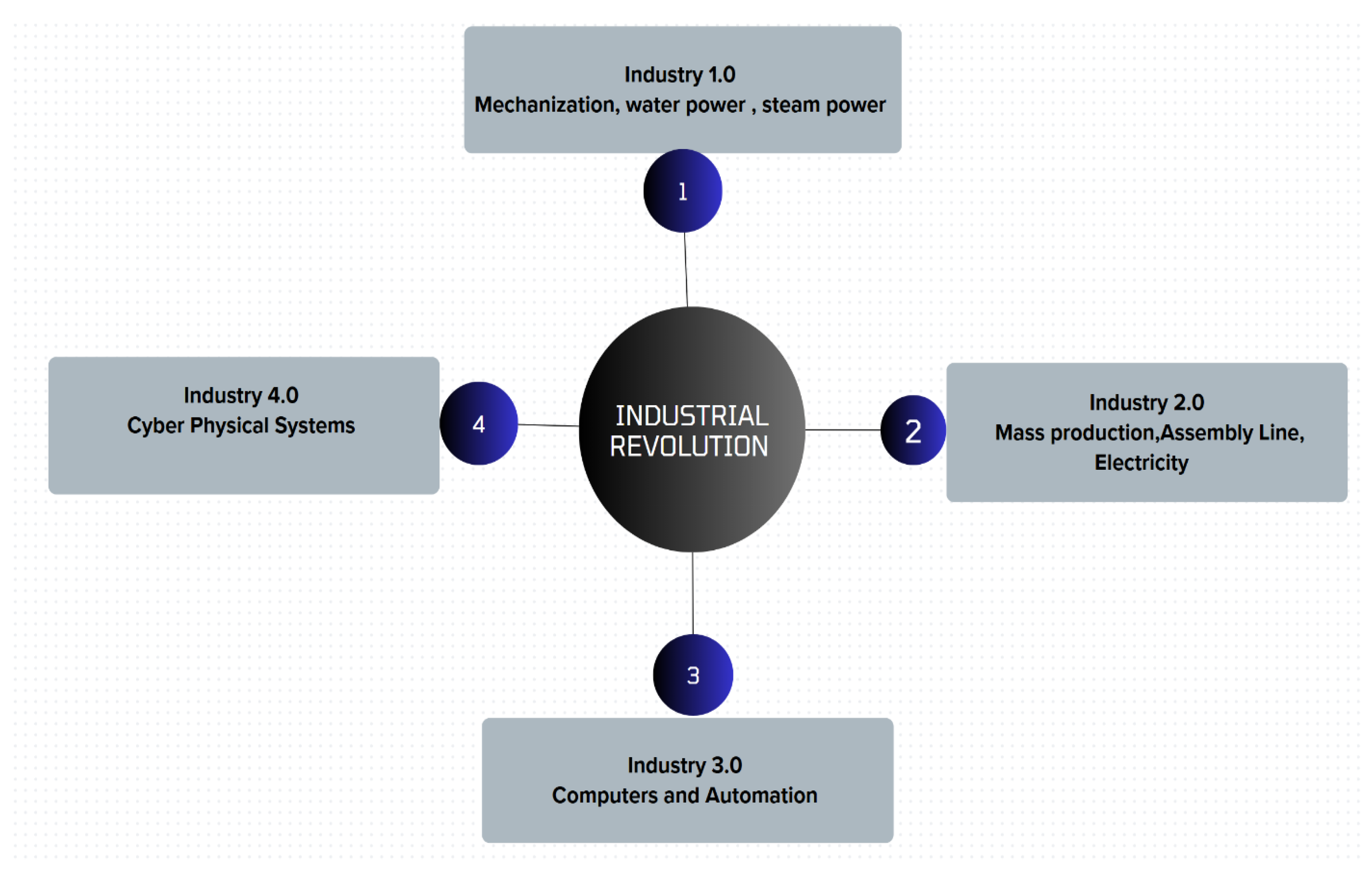
Figure 2.
Application of Digital Technologies in fourth industrial Revolution to education 4.0.
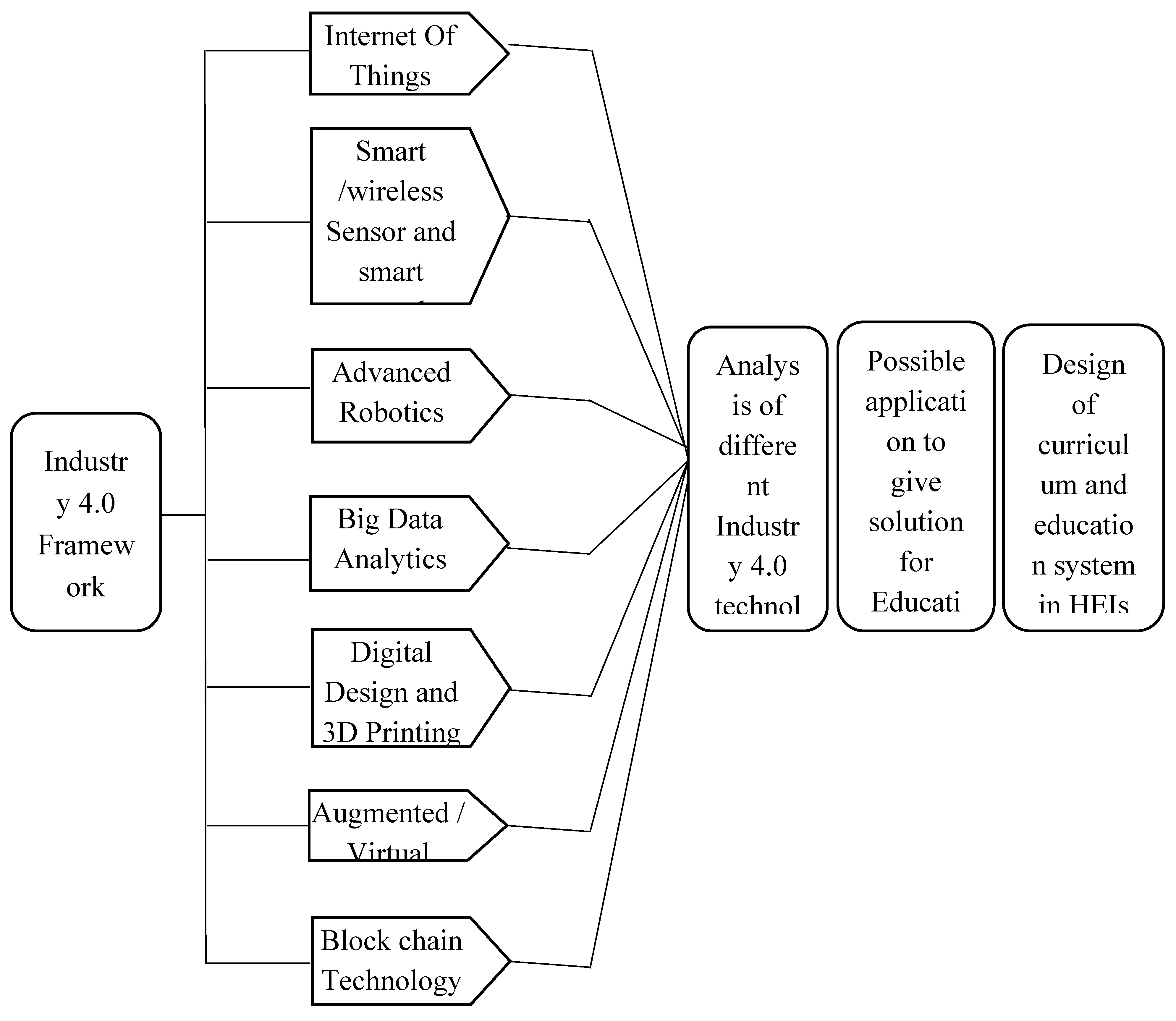
Figure 3.
Filtered literature for the automation of Education 4.0 using Industry 4.0 Technologies.
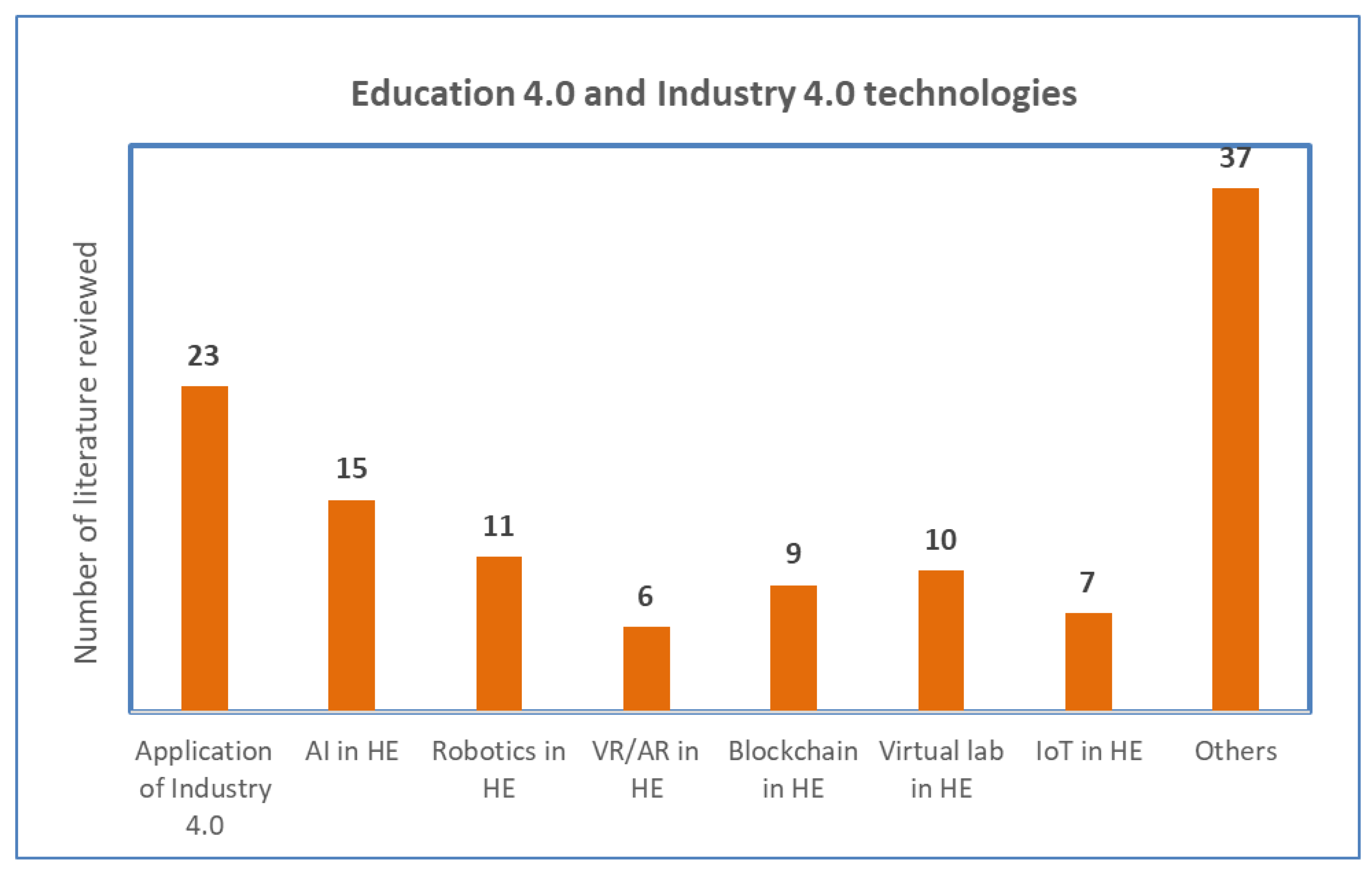
Figure 4.
Perspective of Education 4.0 (Das, Shuvra & Kleinke, Darrell & Pistrui, David, 2020) [11].
Figure 4.
Perspective of Education 4.0 (Das, Shuvra & Kleinke, Darrell & Pistrui, David, 2020) [11].
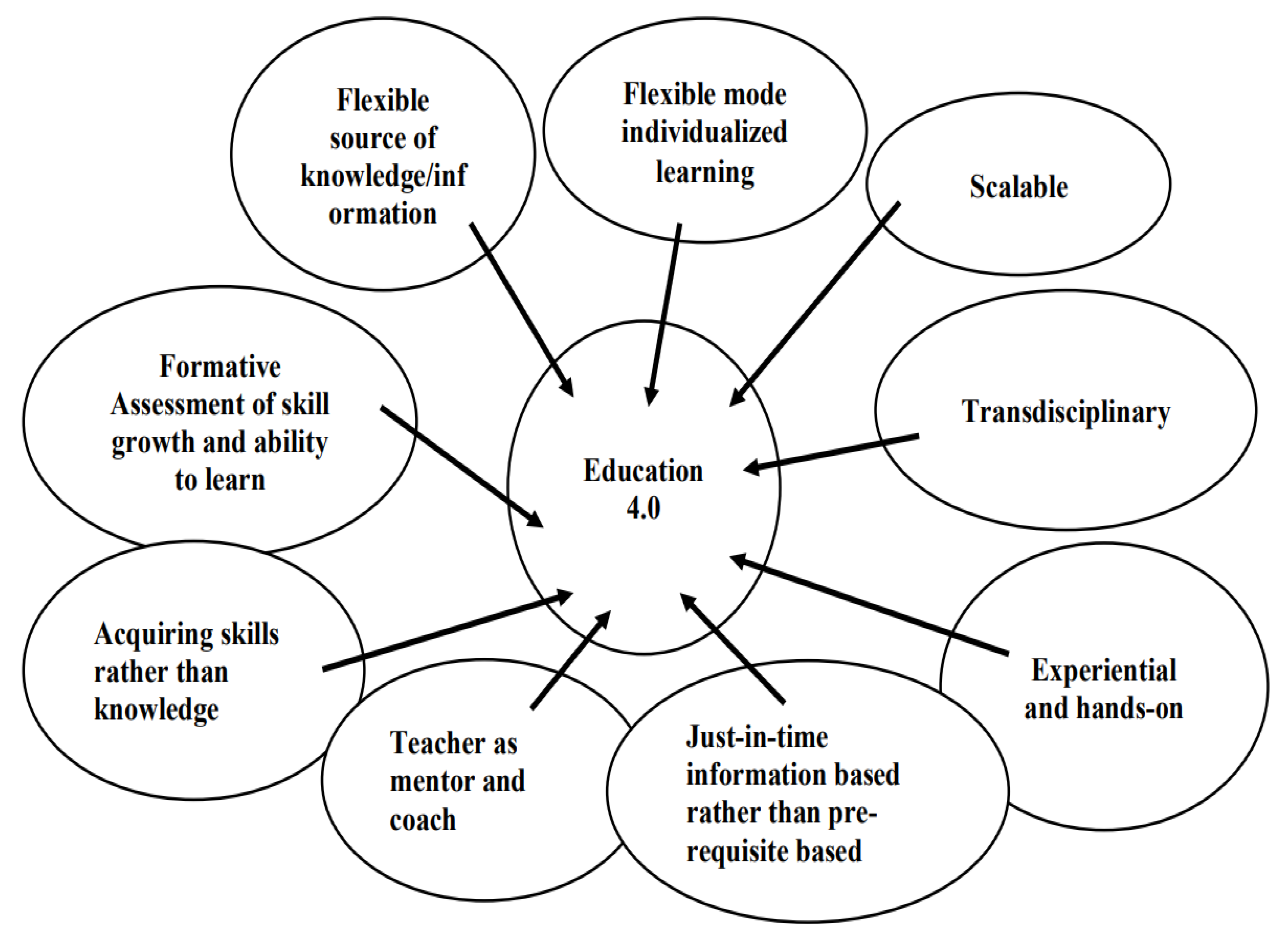
Figure 5.
Artificial Intelligence in Education systems.

Figure 6.
Block chain in Education Technology (Atienza-Mendez and Bayyou,2019)[92].
Figure 6.
Block chain in Education Technology (Atienza-Mendez and Bayyou,2019)[92].
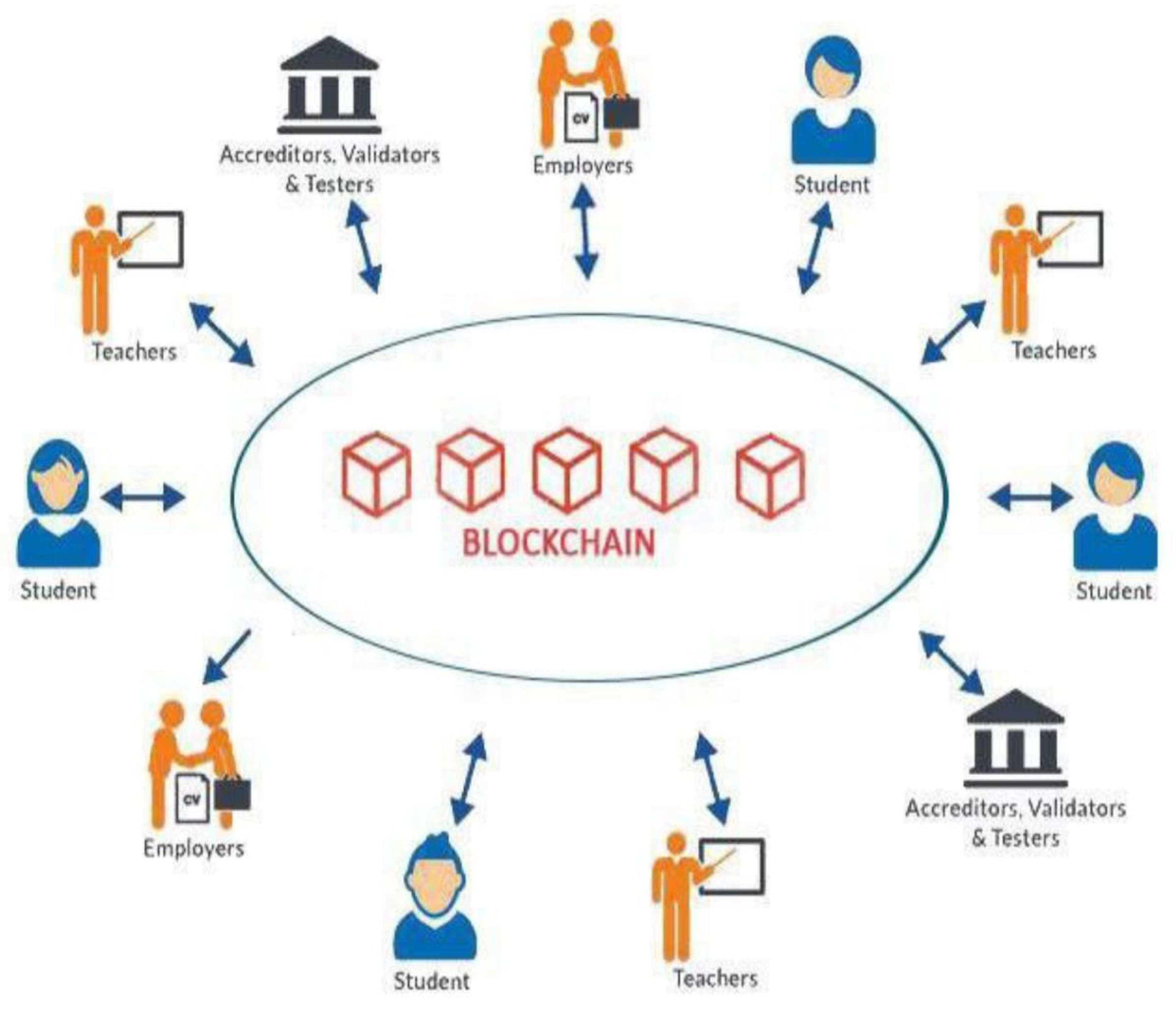
Figure 7.
Implementation of the digital laboratory (Cordero-Guridi et al., 2022)[104].
Figure 7.
Implementation of the digital laboratory (Cordero-Guridi et al., 2022)[104].
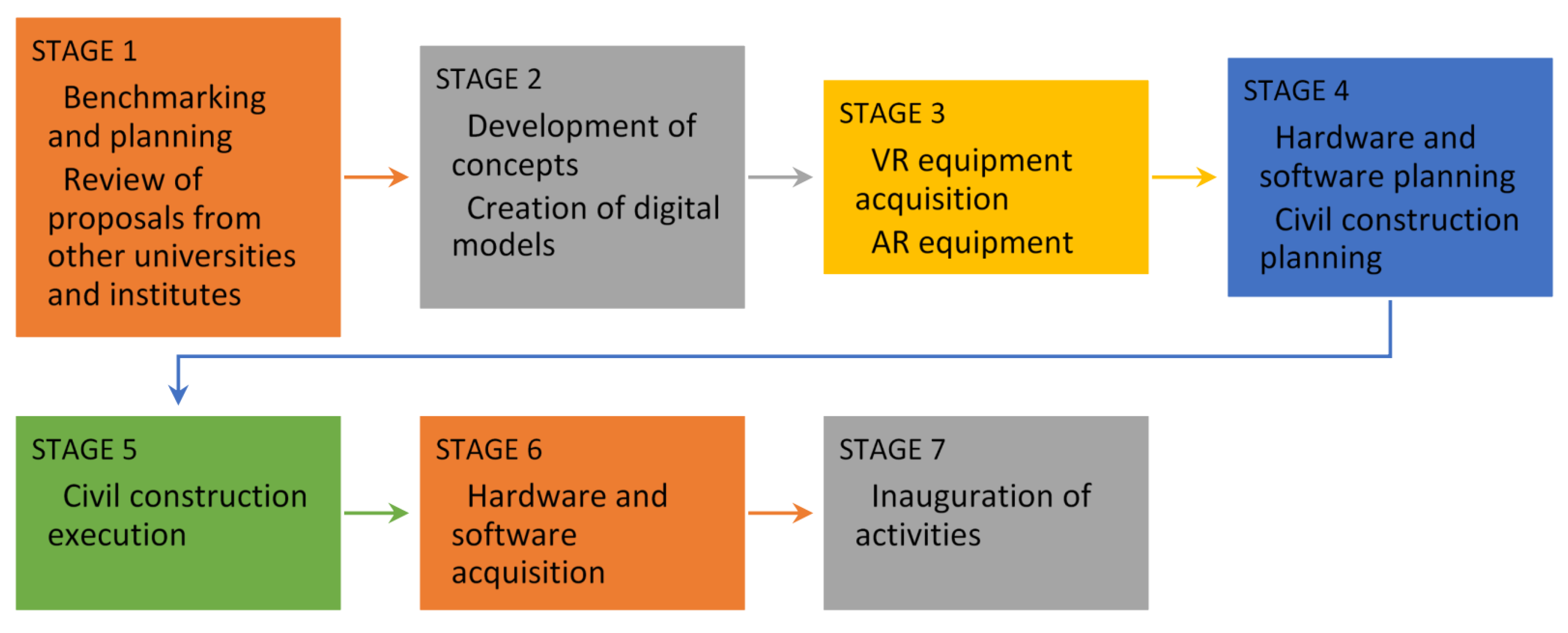

Table 1.
Review papers related to Application of Industry 4.0 in HEIs.
| No | Author | Year | Title | Journal/Conference | Theme |
|---|---|---|---|---|---|
| 1. | Alex Sander Clemente de Souza, Luciana Debs, , [6] | 2024 | Concepts, innovative technologies, learning approaches and trend topics in education 4.0: A scoping literature review | Social Sciences & Humanities Open |
Education 4.0 - Review paper |
| 2. | Butt, R., Siddiqui, H., Soomro, R.A. and Asad, M.M. [34] | 2020 | Integration of industrial revolution 4.0 and IOTs in academia: a state-of-the-art review on the concept of education 4.0 in Pakistan [review]”, | Interactive Technology and Smart Education | Education 4.0 - Review paper |
| 3. | González-Pérez, L.I. and Ramírez-Montoya, M.S.[35] | 2022 | Components of Education 4.0 in 21st century skills frameworks: systematic review. | Sustainability , MDPI | Education 4.0 - Review paper |
| 4. | Hariharasudan, A. and Kot, S., 2018[36] | 2018 | A scoping review on Digital English and Education 4.0 for Industry 4.0 | Social sciences , MDPI | Digital English and Education 4.0 - Review paper |
| 5. | Huk, T. [37] | 2021 | From education 1.0 to education 4.0 – challenges for the contemporary school | The New Educational Review | Education 1.0 to Education 4.0 – review and analysis |
| 6. | Krstikj, A., Sosa Godina, J., García Bañuelos, L., González Peña, O.I., Quintero Milián, H.N., Urbina Coronado, P.D. and Vanoye García, A.Y. [38] | 2022 | Analysis of competency assessment of educational innovation in upper secondary school and higher education: a mapping review |
Sustainability
, MDPI |
Competency assessment – mapping review |
| 7. | Lai, J.W.M. and Bower, M. [39] | 2020 | Evaluation of technology use in education: findings from a critical analysis of systematic literature reviews | Journal of Computer Assisted Learning |
Use of technology in education- Review and analysis - Review paper |
| 8. | Liu, C., Zowghi, D., Kearney, M. and Bano, M. [40] | 2021 | Inquiry-based mobile learning in secondary school science education: a systematic review | Journal of Computer Assisted Learning |
Mobile learning –Review paper |
| 9. | Müller F, Denk A, Lubaway E, Sälzer C, Kozina A, Perše TV, et al. [41] |
2020 | Assessing social, emotional, and intercultural competences of students and school staff:A systematic literature review. | Educational Research Review, Elsevier | Competency analysis of students - Review paper |
| 10. | Parmaxi, A. and Demetriou, A.A. [42] | 2020 | Augmented reality in language learning: a state-of-the-art review of 2014–2019” | Journal of Computer Assisted Learning |
Augmented reality in learning - Review paper |
| 11. | Qureshi, M.I., Khan, N., Raza, H., Imran, A. and Ismail, F.[43] | 2021 | Digital technologies in education 4.0. Does it enhance the effectiveness of learning? A systematic literature review | International Journal of Interactive Mobile Technologies |
Digital technologies in Education 4.0 - Review paper |
| 12. | Ramírez-Montoya, M.S., Castillo-Martínez, I.M., Sanabria-Z, J. and Miranda, J. [32] | 2022 | Complex thinking in the framework of Education 4.0 and Open Innovation—A systematic literature review | Journal of Open Innovation: Technology |
Framework of Education 4.0- Review paper |
| 13. | Silva, D.E., Lopes, T., Sobrinho, M.C. and Valentim, N.M.C., 2021. [33] | Investigating initiatives to promote the advancement of education 4.0: A systematic mapping study. | 13th International Conference on Computer Supported Education (CSEDU 2021) | Advancement of education 4.0 – Review and mapping study | |
| 14. | Verma, A. and Singh, A. [31] | 2021 | New era of technology empowered education: education 4.0 a systematic review. |
9th International Conference on Reliability, Infocom Technologies and Optimization (Trends and Future Directions) (ICRITO) |
Education 4.0 - Review paper |
| 15. | Costan,E.;Gonzales, G.; Gonzales, R.;Enriquez,L.;Costan, F.; Suladay, D.; Atibing,N.M.;Aro,J.L.;Evangelista,S.S.; Maturan, F.; et al [44] |
2021 | Education 4.0 in Developing Economies: A Systematic Literature Review of Implementation Barriers and Future Research Agenda. | Sustainability , MDPI | Education 4.0 in economy development - Review paper |
| 16. | Arnold, M.G.; Vogel, A.; Ulber, M. [45] | 2021 | Digitalizing Higher Educatio n in Light of Sustainability and Rebound Effects—Surveys in Times of the COVID-19 Pandemic. | Sustainability ,MDPI | Digitizing Higher Education |
| 17. | Chiu, W.-K. [46] | 2021 | Pedagogy of Emerging Technologies in Chemical Education during the Era of Digitalization and Artificial Intelligence: A Systematic Review. | Education sciences, MDPI | AI in education - Review paper |
| 18. | Tselegkaridis , S.; Sapounidis, T. [47] |
2021 | Simulators in Educational Robotics: A Review. Educ. Sci. | Education science,MDPI | Education robots – Review paper |
| 19. | López-Chila, R.; Llerena-Izquierdo, J.; Sumba-Nacipucha, N.; Cueva-Estrada, J. [48] | 2024 | Artificial Intelligence in Higher Education: An Analysis of Existing Bibliometrics. | Education Science, MDPI | AI in higher education – Review paper |
| 20. | Thurzo, A.; Strunga, M.; Urban, R.; Surovková, J.; Afrashtehfar, K.I. [48] | 2023 | Impact of Artificial Intelligence on Dental Education: A Review and Guide for Curriculum Update. | Education Science , MDPI | AI in dental education – Review paper |
| 21. | Mukul,E Büyüközkan,G, [5] |
2023 |
Digital transformation in education: A systematic review of education 4.0, |
Technological Forecasting and Social Change, Elsevier |
Education 4.0 – Review Paper |
| 22. | Laura Icela, G. P., María Soledad, R. M., & Juan Antonio, E. G. [50] |
2023 | Education 4.0 Maturity Models for Society 5.0: Systematic literature review. | Cogent Business & Management | Education 4.0 and Society 5.0 – Review Paper |
| 23. | Ghobakhloo, M., Iranmanesh, M., Tseng, M. L., Grybauskas, A., Stefanini, A., & Amran, A. [51] | 2023 | Behind the definition of Industry 5.0: a systematic review of technologies, principles, components, and values. |
Journal of Industrial and Production Engineering |
Industry 5.0 – Review paper |
Table 2.
Review papers related Application of Artificial Intelligence in HEIs.
| No | Author | Year | Title | Journal/Conference | Theme |
|---|---|---|---|---|---|
|
1 |
Caratozzolo, P. and Membrillo-Hernández, J., [12] | 2021 | Challenge based learning approaches for education 4.0 in engineering |
In Proceedings of the 2021 SEFI Conference |
Education 4.0 in engineering |
| 2 | Ciolacu, M., Tehrani, A.F., Binder, L. and Svasta, P.M., [58] | 2018 | Education 4.0-Artificial Intelligence assisted higher education: early recognition system with machine learning to support students' success. | In 2018 IEEE 24th International Symposium for Design and Technology in Electronic Packaging(SIITME) | AI in higher education |
| 3 | Eichinger, P., Hofig, B. and Richter, C [59] | 2017 |
Education 4.0 for mechatronics–agile and smart. |
In 2017 International Conference on Research and Education in Mechatronics (REM) | Education 4.0 for Mechatronics |
| 4. | Adel, A.; Ahsan, A.; Davison, C. [57] | 2024 | ChatGPT Promises and Challenges in Education: Computational and Ethical Perspectives. | Education Sciences,MDPI | Challenges of Chatgpt in Education |
| 5. | Ahmad, S.F. et al.,[58] | 2021 | Artificial Intelligence and Its Role in Education |
Sustainability,MDPI |
AI in education |
| 6. | Parmaxi and Demetriou [42] | 2020 | Augmented reality in language learning: a state-of-the-art review of 2014–2019 | Journal of Computer Assisted Learning | AR in education – Review |
| 7. | Ellahi, R.M., Ali Khan, M.U. and Shah, A. [60] |
201`9 | “Redesigning curriculum in line with industry 4.0”, | Procedia Computer Science, | Change of curriculum using Industry 4.0 techniques |
| 8. | Hussin, A.A., [61] | 2018 | Education 4.0 made simple: Ideas for teaching. |
International Journal of Education and Literacy Studies |
Education 4.0 implementation |
| 9. | Hımmetoglu, B., Aydug, D. and Bayrak, C., [62] |
2020 | Education 4.0: Defining the teacher, the student, and the school manager aspects of the revolution. | Turkish Online Journal of Distance Education. | Education 4.0 for schools |
| 10. | Haderer, B. and Ciolacu, M., [63] | 2022 | Education 4.0: Artificial intelligence assisted task-and time planning system. | Procedia computer science. | AI based Education 4.0 |
| 11. | Sonntag, D et al.,[64] | 2019 | Hybrid learning environments by data-driven augmented reality | Procedia Manufacturing | AR in education |
| 12. | Lye, C.Y. and Lim, L. [65] | 2024 | Generative Artificial Intelligence in Tertiary Education: Assessment Redesign Principles and Considerations | Education Sciences | AI in education |
| 13. | Zairon, I.Y., Wook, T.S.M.T., Salleh, S.M., Dahlan, H.A. and Rahmat, M., [69] |
2021 | Analysis of Behaviour and Learning Style on Education 4.0 in Virtual Mentoring using Gamification. | In 2021 International Conference on Electrical Engineering and Informatics (ICEEI) | Analysis of Education 4.0 |
| 14. | Akinwalere, Susan & Ivanov, Ventsislav. [71] |
2022 | Artificial Intelligence in Higher Education: Challenges and Opportunities. | Border Crossing. | Challenges of AI in education |
| 15 | Sîrghi, Nicoleta; Voicu, Mirela-Catrinel; Noja, Gratiela Georgiana; Socoliuc, OanaRamona [72] | 2024 |
Challenges of artificial intelligence on the learning process in higher education, |
Amfiteatru Economic, The Bucharest University of Economic Studies, Bucharest. | Challenges of AI in education |
Table 3.
Review papers related to Robotics in HEIs.
| No | Author | Year | Title | Journal/Conference | Theme |
|---|---|---|---|---|---|
| 1 | E.Luiz,L., et al [73] | 2022 | Robot at factory lite-a step-by-step educational approach to the robot assembly | In Iberian Robotics Conference | Robotics in education |
| 2 | Karalekas, G. et al [75] | 2023 | Teaching Machine Learning in K–12 Using Robotics | Education Sciences,MDPI | Robotics in education |
| 3 | Braun,J et al. [76] | 2022 | A robot localization proposal for the RobotAtFactory 4.0: A novel robotics competition within the Industry 4.0 concept | Frontiers in Robotics and AI | Robotics and Industry 4.0 |
| 4 | Ferreira ,T et al [77] | 2022 | Robot at factory 4.0: an auto-referee proposal based on artificial vision | In Iberian Robotics conference | Robotics and Industry 4.0 |
| 5 | Schiavo, F et al [78] | 2024 | Educational Robots, Emotion Recognition and ASD: New Horizon in Special Education | Education Sciences | Robotics in education |
| 6 | Purdue University Article [79] | 2024 |
The Use of Robotics and Simulators in the Education Environment |
https://online.purdue.edu/blog/education/robotics-simulators-education-environment)[79] |
Robotics in the education environment |
| 7 | Lima, J., Kalbermatter, R.B., Braun, J., Brito, T., Berger, G. and Costa, P., [80] |
2022, | A realistic simulation environment as a teaching aid in educational robotics. | In 2022 Latin American Robotics Symposium (LARS), 2022 Brazilian Symposium on Robotics (SBR), and 2022 Workshop on Robotics in Education (WRE) | Teaching using Education robot |
|
8 |
Makers' muse [81] | 2023 | Overcoming Challenges in Implementing Robotics Education in Schools |
https://medium.com/@makermuse3/overcoming-challenges-in-implementing-robotics-education-in-schools-de147ff7b685 |
Challenges in implementing robots in education |
| 9 | Marcial, C.H et al, (2023), [82] | 2023 |
Challenges of Educational Robotics: A Perspective from the Teacher's Home, |
Social science Journal, RES MILITARIS. | Challenges in implementing robots in education |
| 10 | Khanlari, Ahmad. [83] | 2015 |
Teachers’ perceptions of the benefits and the challenges of integrating educational robots into primary/elementary curricula. |
European Journal of Engineering Education. | Challenges in implementing robots in education |
| 11 | Vivas Fernandez, L., & Sáez López, J. M. [84] |
2019 | Integration of educational robotics in Primary Education. Latin American Journal of | Educational Technology | Challenges in implementing robots in education |
Table 4.
Review papers related to Virtual reality and Augmented reality in HEIs.
| No | Author | Year | Title | Journal/Conference | Theme |
|---|---|---|---|---|---|
| 1. | Vergara, D et al [85] | 2021 | Assessment of Virtual Reality as a Didactic Resource in Higher Education. | Sustainability,MDPI | VR in education |
| 2. | Hermandez-chavez et al. [86] | 2021 | Development of Virtual Reality Automotive Lab for , Training in Engineering Students. | Sustainability, MDPI | VR in education |
| 3. | Adnan, A.H.M et al [87] | 2020 | 360 Degree videos, VR experiences and the application of education 4.0 technologies in Malaysia for exposure and immersion | Advances in Science, Technology and Engineering Systems Journal | VR in education |
| 4. | Hoole, R and Jahankhani, H [88] | 2021 | Security Framework for Delivery of Training, Using VR Technology | Information Security Technologies for Controlling Pandemics (Book chapter) | VR for Information Security |
| 5. | Martin,J., Bohuslava,J and Igor,H [89] | 2018 | Augmented reality in education 4.0 | 13th international scientific and technical conference on computer sciences and information technologies | AR in education |
| 6. | Caroline Graeske & Sofia Aspling Sjöberg , [90] | 2021 | VR-Technology in Teaching: Opportunities and Challenges , | International Education Studies;Published by Canadian Center of Science and Education | Challenges in implementation of VR in education |
Table 5.
Review papers to related Block chain in HEIs.
| No | Author | Year | Title | Journal/Conference | Theme |
|---|---|---|---|---|---|
| 1. | Nazari, Z.; Vahidi, A.R. and Musilek, P [91] | 2024 | Artificial Intelligence Non-Formal Education System | Education Sciences | Blockchain and AI in education |
| 2. | Atienza-Mendez and Bayyou [92] | 2019 | Blockchain technology applications in education | International Journal of Computing and Technology | Blockchain in education |
| 3. | Al – Zoubi, Dmour and Aldmour Al-Zoubi, A. Y., Dmour, M. ., & Aldmour, R. .[93] | 2022 | Blockchain as a Learning Management System for Laboratories 4.0. | International Journal of Online and Biomedical Engineering | Blockchain in education |
| 4. | Rahardja,U et al [94] | 2022 | A mapping study research on block chain technology in education 4.0. | IEEE Creative Communication and Innovative Technology | Blockchain in education |
| 5. | Supriati et al [95] | 2022 | Utilizing the potential of blockchain technology for leading education 4.0. | International Conference on Science and Technology | Blockchain in education |
| 6. | Mohammad, A.; Vargas, S. [96] |
2022 | Barriers Affecting Higher Education Institutions’ Adoption of Blockchain Technology: A Qualitative Study. | Informatics 2022, 9, 64. https://doi.org/10.3390/informatics9030064 | Challenges in applying block chain in learning and teaching |
| 7. | Raimundo R, Rosário A. [97] |
2021 | Blockchain System in the Higher Education. | Eur J Investig Health Psychol Educ. 2021 Mar 16;11(1):276-293. doi: 10.3390/ejihpe11010021. PMID: 34542464; PMCID: PMC8314340. | Challenges in applying block chain in learning and teaching |
| 8. | Dwivedi, S., & Vig, S.. [98] |
2023 | Blockchain adoption in higher-education institutions in India: Identifying the main challenges. | Cogent Education, 11(1). https://doi.org/10.1080/2331186X.2023.2292887 | Challenges in applying block chain in learning and teaching |
| 9. | Ninda Lutfiani , Qurotul Aini , Untung Rahardja , Lidya Wijayanti , Efa Ayu Nabila , Mohammed Iftequar Ali [99] | 2021 | Transformation of block chain and opportunities for education 4.0, |
International Journal of Education and Learning, Vol. 3, No. 3, December 2020, pp. 222-231, DOI:10.31763/ijele.v3i3.283 | Challenges in applying block chain in learning and teaching |
Table 6.
Review papers related to virtual laboratories in HEIs.
| No | Author | Year | Title | Journal/Conference | Theme |
|---|---|---|---|---|---|
| 1. | Garcia-Loro, F., Plaza, P., Quintana, B., San Cristobal, E., Gil, R., Perez, C., Fernandez, M. and Castro, M.,[100] | 2021, | Laboratories 4.0: Laboratories for emerging demands under industry 4.0 paradigm | 2021 IEEE Global Engineering Education Conference (EDUCON) | Digital Laboratories 4.0; |
| 2. | Soni, K.M., Hasteer, N. and Bhardwaj, A., [101] | 2020 | Aspects to foster competences for engineering graduates: Education 4.0 paradigm. | In 2020 9th International Conference System Modeling and Advancement in Research Trends (SMART) | Competencies requirement in the implementation of Digital Laboratories 4.0; |
| 3. | Grodotzki, J., Ortelt, T.R. and Tekkaya, A.E. [102] | 2018 | Remote and virtual labs for engineering education 4.0: achievements of the ELLI project at the TU Dortmund university”, | Procedia Manufacturing, | Remote and virtual labs – a case study |
| 4. | Ciolacu, M.I., Binder, L. and Popp, H., , [103] | 2019 | Enabling IoT in Education 4.0 with biosensors from wearables and artificial intelligence. | In 2019 IEEE 25th international symposium for design and technology in electronic packaging (SIITME) | IoT and AI based laboratories. |
| 5. | Cordero-Guridi, J.D.J., Cuautle-Gutiérrez, L., Alvarez-Tamayo, R.I. and Caballero-Morales, S.O.,. [104] | 2022. | Design and development of a i4. 0 engineering education laboratory with virtual and digital technologies based on iso/iec tr 23842-1 standard guidelines. | Applied Sciences | Engineering Education Laboratory – Design and development |
| 6. | Miranda, J., López, C.S., Navarro, S., Bustamante, M.R., Molina, J.M. and Molina, A., , [105] | 2019 | Open innovation laboratories as enabling resources to reach the vision of education 4.0. | In 2019 IEEE International Conference on Engineering, Technology and Innovation | Digital Laboratories in education 4.0; |
| 7. | Prieto, M.D., Sobrino, Á.F., Soto, L.R., Romero, D., Biosca, P.F. and Martínez, L.R., [66] | 2019, | Active learning based laboratory towards engineering education 4.0. | In 2019 24th IEEE international conference on emerging technologies and factory automation (ETFA) | Digital Laboratories 4.0; |
| 8. | Deriba FG, Saqr M and Tukiainen M (2024) [106] | 2024 | Assessment of accessibility in virtual laboratories: a systematic review. | Front. Educ. 9:1351711. | Virtual laboratories- Review |
| 9. | Alnagrat, A. J. A., Ismail, R. C., and Idrus, S. Z. S.[107] | 2021 | Extended reality (XR) in virtual laboratories: a review of challenges and future training directions. | J. Phys. Conf. Ser. |
Virtual laboratories- Review |
| 10. | Misiejuk, K., Khalil, M., and Wasson, B. [108] | (2023): | Tackling the challenges with data access in learning analytics research: a case study of virtual labs | Proceedings of the Technology-Enhanced Learning in Laboratories workshop (TELL 2023). | Challenges in implementation of Virtual laboratories- case study |
Table 7.
Review papers related to IoT in HEIs.
| No | Author | Year | Title | Journal/Conference | Theme |
|---|---|---|---|---|---|
| 1. | Aldowah, H., Rehman, S.U., Ghazal,S and Umar, I.N., [109] |
2017 | Internet of Things in Higher Education: A Study on Future Learning | Journal of Physics, Conference Series, The 6th International Conference on Computer Science and Computational Mathematics (ICCSCM 2017) |
IoT in higher education |
| 2. | Ciolacu, M.I., Binder, L. and Popp, H.,[110] |
2019 | Enabling IoT in Education 4.0 with biosensors from wearables and artificial intelligence. | In 2019 IEEE 25th international symposium for design and technology in electronic packaging (SIITME) | IoT in higher education |
| 3. | Som, S. and Rana, A., [11] |
2020 | IoT Based Educational Model for Better Teaching-Learning Environment. | In 2020 8th International Conference on Reliability, Info com Technologies and Optimization (Trends and Future Directions) (ICRITO). |
IoT based education model |
| 4. | Ramlowat, Dosheela & Pattanayak, Binod.[112] | 2019 | Exploring the Internet of Things (IoT) in Education: A Review: | Proceedings of Fifth International Conference INDIA 2018 . | IoT in higher education – review paper |
| 5. | Souza, A. S. C. de, & Debs, L.[113] | 2024 | Concepts, innovative technologies, learning approaches and trend topics in education 4.0: A scoping literature review | Social Sciences & Humanities Open |
IoT and AI in higher education – review paper |
| 6. | Nur Fitria, Tira & Simbolon, Nurmala & Afdaleni,.[114] | 2023 | Internet of Things (IoT) in Education: Opportunities and Challenges. | Conference: Teknologi Informasi Sebagai Sebuah Peluang atau Ancaman Bagi Dunia Usaha di Indonesia at Institut Teknologi Bisnis AAS Indonesia, December 2023 | Challenges in implementing IoT in HEIs |
| 7. | Saudamini Mowade, [115] | 2024 | Internet of Things (IOT) in Education Sector: Challenges and Opportunity, | International Journal of Scientific Engineering and Research (IJSER) |
Challenges and opportunities in implementing IoT in HEIs |
Disclaimer/Publisher’s Note: The statements, opinions and data contained in all publications are solely those of the individual author(s) and contributor(s) and not of MDPI and/or the editor(s). MDPI and/or the editor(s) disclaim responsibility for any injury to people or property resulting from any ideas, methods, instructions or products referred to in the content. |
© 2024 by the authors. Licensee MDPI, Basel, Switzerland. This article is an open access article distributed under the terms and conditions of the Creative Commons Attribution (CC BY) license (http://creativecommons.org/licenses/by/4.0/).
Copyright: This open access article is published under a Creative Commons CC BY 4.0 license, which permit the free download, distribution, and reuse, provided that the author and preprint are cited in any reuse.


