

Submitted:
12 October 2024
Posted:
14 October 2024
You are already at the latest version
Abstract
The establishment of Ministry of Natural Resources and Ministry of Agriculture and Rural Affairs of China, marks integrated installation of centralized and unified supervision of agricultural natural resources assets. The value goal of comprehensive supervision of agricultural natural resource assets should include process-oriented, multi-participation, assets accretion and technological innovation. However, different supervision departments have different objectives and interest gambling. From the perspective of game equilibrium, effective balance between development and use and comprehensive supervision of agricultural natural resource assets, promote the reconstruction of structure of rights(powers), form a practical systematic selection. Take comprehensive supervision legislation as solution path, take central and local comprehensive cohesion as realization mechanism, highly integrated and coordinate in legislation, to implement institution allocation which efficient use of agricultural natural resources assets and rural green ecological environment protection are considered.
Keywords:
agricultural natural resource assets
; comprehensive supervision
; process-oriented
; game equilibrium
; comprehensive legislation
1. Introduction
Report to the 20th National Congress of the Communist Party of China emphasizes the importance of “pursuing green development and promoting harmony between humanity and nature”, and “taking a holistic and systematic approach to the conservation and improvement of mountains, waters, forests, farmlands, grasslands, and deserts”. The agricultural ecosystem comprises various natural resource assets, including mountains, water bodies, forests, fields, lakes, grasslands, and sand, each exhibiting different ecological characteristics. It represents a complex structure and multifunctional biological community, characterized by mutual interconnectivity, transformation, and influence, embodying a holistic and systematic nature [1]. In 2018, China established the Ministry of Ecology and Environment, the Ministry of Agriculture, the Ministry of Natural Resources, and its affiliated National Forestry and Grassland Administration. The reform of the supervision system for agricultural natural resource assets in China is trending towards a departmental consolidation approach. With the institutional restructuring of Chinese state sectors, comprehensive supervision of agricultural natural resource assets has become an inherent goal. Compared to decentralized supervision, comprehensive supervision exhibits differences in supervision subjects and methods. Comprehensive supervision promotes the protection and governance of natural resource assets through a systematic approach, which considers all natural resource assets within the entire ecological system as the supervision subject. This method has also been referred to by some scholars as “unified management” [2] or “integrated management” [3]. However, the current supervision system for natural resource assets in Chinese agriculture remains predominantly agency-driven, employing a decentralized supervision approach across various categories of natural resource assets. Given the externalities associated with natural resource assets, on April 14, 2019, the General Office of the Central Committee of the Communist Party of China and the General Office of the State Council issued the “Guiding Opinions on Coordinating the Advancement of the Reform of the System of Property Rights of Natural Resource Assets”, this document mandates the engagement of the people’ s congress, administrative bodies, auditing institutions, judicial systems, and social oversight to ensure dynamic and effective supervision and management throughout the entire process of market transactions involving natural resource assets. It is to enhance the legal supervision system governing these assets and to establish a multifaceted supervision synergy.
Currently, research on the supervision system governing natural resource assets in agriculture mainly focuses on two perspectives: law and economics. Legal scholars focus on sorting out the ownership system of natural resource assets [4], natural resource asset management system [5], legal governance [6], and local protection of natural resource assets [7]. Some researchers have attempted to establish a property rights system for natural resource assets based on the idea of “separation of ownership rights, contractors’ rights, and land management rights”, they want to clarify the relationship of rights, responsibilities, and interests among the owners, agents, and users of natural resource assets, among other [8], this perspective rarely delves into the specific arguments regarding the ownership system and supervision system of agricultural natural resource assets. Economists focus on analyzing the productivity effect of reallocating agricultural resources [9], comprehensive utilization of agricultural resources and green development of the agricultural sector [10], temporal and spatial evolution characteristics and influencing factors of agricultural resource and environment efficiency [11], among others. The subject of this perspective has achieved specialization in agricultural resources, but most studies rely on economic methods for quantitative analysis, with a notable lack of qualitative research on the evolution of supervision systems for agricultural natural resource assets. As one of the research methods of law science, economic analysis regards the individuals who make legal choices as “rational economic persons”, and the combined verification of law science and economics can guarantee the scientific and practical nature of the legal system. Agricultural natural resources assets have legal, economic, and ecological attributes. The legal system design of ownership and supervision should consider “legal rationality”, “economic rationality” and “ecological rationality”. Under the process of super ministry system restructuring in China, the objectives system for comprehensive supervision of agricultural natural resource assets is unclear, and the benefit game and the goal difference exist among the subjects, in addition, the construction of the concrete system also lacks comprehensive special legislation and cohesive mechanism. Based on this, under the background of super ministry system restructuring in China, this paper intends to construct the objectives system for comprehensive supervision of agricultural natural resource assets. Then from the perspective of game theory equilibrium, this paper also studies the reasonable expected utility of multi-parties in the comprehensive supervision of agricultural natural resources assets, and proposes the normative structure of the legal system of the comprehensive supervision of agricultural natural resources assets in China, to bring into full play the effect of comprehensive supervision of agricultural natural resources and assets and promote the revitalization of rural ecology, and protect the safety of agricultural resources.
2. The Value Objective of Comprehensive Supervision of Agricultural Natural Resource Assets in China
Defining the concept related to comprehensive supervision of agricultural natural resources, sorting out the laws and supervisions related to the existing supervision system, and recognizing the reform trend in the supervision of agricultural natural resources and the objectives system of comprehensive supervision is the premise for the normative construction of a legal system for comprehensive supervision of agricultural natural resources.
2.1. Supervision Concept and System Status Quo of Agricultural Natural Resource Assets
2.1.1. Agricultural Natural Resource Assets and Their Characteristics
China currently has seven normative documents involving the “comprehensive supervision of agricultural natural resources assets”, none have been elevated to the status of law or department regulation. Specifically include: the “Regulation on Comprehensive Management of Agricultural Natural Resources of Zhejiang Province” in 2004; the “Regulation on Comprehensive Management of Agricultural Natural Resources of Hubei Province” in 2007; the “Implementation Opinions on Promoting the Application and Development of Land and Resources Big Data” issued by the Ministry of Land and Resources in 2016; the Ministry of Land and Resources issued the “13th Five-Year Plan for Science and Technology Innovation Development of Land and Resources” in 2016; the National Administration of Surveying and Mapping and Geographic Information issued the “13th Five-Year Plan for the Development of Surveying, Mapping and Geographic Information Technology” in 2016; the General Office of the Ministry of Land and Resources issued the “Implementation Plan of the Ministry of Land and Resources” in 2016; the General Office of the Ministry of Land and Resources issued the “Notice on the Selection of the Third Batch of the High-level Innovative Scientific and Technological Talents Training Project in Land and Resources” in 2017. Most normative documents only treat the comprehensive supervision of natural resources as an important field of scientific and technological innovation and theoretical exploration.
Only Hubei Province and Zhejiang Province have formulated local regulations on comprehensive supervision of agricultural natural resources in China. Article 2 of the local supervision of the said two provinces defines agricultural natural resources as land, water, forest, biology, climate, and other natural resources related to the production activities of crop farming, animal husbandry, forestry, and fishery. However, there is no unified conclusion in the academic community about the connotation of “agricultural natural resources assets”. However, there is no unified conclusion in the academic community about the connotation of “agricultural natural resources assets”. Based on semantic interpretation, it can be regarded as a composite designation formed by the three elements of “natural resources”, “assets”, and “agriculture”. This concept comprises three distinct hierarchical levels of progression: “natural resources”, “natural resource assets”, and “agricultural natural resource assets”. The conception is fundamentally defined by the essence of “assets” within the scope of “natural resources” and is specifically limited to the agricultural industry. Its characteristics can be summarized as follows: first, the industrial attributes are confined to agriculture, including sectors such as crop cultivation, livestock, forestry, and fisheries; second, the ecological attributes are restricted to natural resources such as land, water, forests, biodiversity, and climate; third, the essential attributes focus on economic characteristics manifesting in property relations, such as profitability, controllability, and measurability [12].
2.1.2. Conceptual Elements of Comprehensive Supervision
Article 4 of “Regulation on Comprehensive Management of Agricultural Natural Resources of Zhejiang Province” points out that “the principle of combining comprehensive management with professional management shall be adopted for agricultural natural resources”, but the concept and scope of “comprehensive management” are not defined. Article 2 of the “Regulation on Comprehensive Management of Agricultural Natural Resources of Hubei Province” clearly defines comprehensive management as “to conduct comprehensive investigation, monitoring, assessment, zoning, and planning of agricultural natural resources and to coordinate and supervise the development, utilization, and protection of agricultural natural resources”. The components of the conceptual framework may encompass the following five aspects: firstly, the objective element, which includes sustainable development, process orientation, and participatory management, among others; secondly, theory elements, such as the systematic idea of the integrated development, and new thinking on great land perspective, great resource perspective, great geology perspective, and great ecology perspective; thirdly, subject elements, such as government agencies (departments of natural resources, environment, and urban and rural administration), non-government organizations, research institutions, communities, and other stakeholders; fourthly, object factors, such as agricultural natural resources, nature reserve or protected area, natural ecological community, biological community, ecosystem structure; finally, elements of nature, such as management methodologies, cognitive approaches, and strategies for natural resource management, etc.
2.1.3. Laws and Supervisions on Supervision Systems of Natural Agricultural Resource Assets in China
At present, agricultural natural resource assets are still subject to individual legislation mainly based on the categories of natural resources in China, which specify the supervision of the exploitation, utilization, management, and costs of the agricultural natural resource assets. For example, Articles 57 to 66 of the “Agriculture Law” of China (2012 Amendment) stipulate “agricultural resources and protection of the agricultural environment”. Articles 2 to 11 of the “Contracting of Rural Land Law” of China (2018 Amendment) stipulate the ownership and the rural land contract management system. Articles 6 to 9 of the “Fisheries Law” of China (2013 Amendment) stipulate the department in charge of fishery administration as well as its institutions for the supervision and administration of fishery. Articles 28 to 37 are specific provisions for the protection of fishery resources and fishing. Articles 38 to 49 deal with liability for violation of the Act, etc. Other legal provisions on the supervision of agricultural natural resources assets are scattered in separate laws, such as the “Use and Management Law of Sea Areas”, “Mineral Resources Law”, “Renewable Energy Law”, “Grassland Law”, “Water Law”, “Coal Law”, “Land Management Law”, and “Forest Law”, etc. Concerning the conservation of agricultural g"enetic resources, such as the provisions outlined in Chapter II of the “Animal Husbandry Law” of China (2022 Revision) concerning the protection of livestock and poultry genetic resources. Provisions on the security of human genetic resources and biological resources are outlined in Chapter VI of the “Biosecurity Law” of China (2024 Amendment); provisions on the protection of germplasm resources are outlined in the supervisions on the supervision on the “Regulation on Protection of New Varieties of Plants” of China (2014 Revision), etc. In addition, some economic laws and supervisions contain relevant provisions on the supervision and administration system regarding the ownership of rights, development, and utilization of agricultural natural resource assets, as well as supervision objectives and the labor division among supervision bodies. For instance, the “State-Owned Assets of Enterprises Law” of China, the “Circular Economy Promotion Law” of China (2018 Amendment) and the “Cleaner Production Promotion Law” of China (2012 Amendment) all contain provisions regarding the enhancement of resource use efficiency.
2.1.4. Current State of Supervision Systems of Natural Agricultural Resource Assets in China
Although legal system for the supervision of agricultural natural resource assets in China has been formed, the laws and supervisions on the supervision are still scattered in the process of the super ministry system restructuring in China, and there are still some problems such as legislation lag, cross supervision, and lower legal level. Specific supervision systems still need to be improved and perfected. Currently, legal system for the supervision of agricultural natural resource assets in China is short of a proclamation in the legal system for comprehensive supervision of agricultural natural resources assets. The laws and supervisions governing the exploitation, utilization, supervision, and management of agricultural natural resource assets are relatively scattered, the regulatory standards for various natural resource assets are different, and the institutional arrangements are inconsistent, which is not conducive to the realization of a comprehensive supervision system of agricultural natural resource assets under the conception of super ministry system restructuring in China. Second, under the current regulatory system, the supervision of various agricultural natural resource assets lacks concentration. Different competent departments are specified in separate laws governing various natural resources, and various regulatory authorities and their duties and responsibilities are unclear, giving rise to cross-supervision. As a result, there is a lack of unified and systematic coordination between the development, utilization, and protection of agricultural natural resource assets. Thirdly, based on the lag of legislation, the current laws and supervision of China on agricultural natural resource assets cannot cover the entire scope of agricultural natural resources. With the progress of society and the development of science and technology, the cognitive ability of natural resources has gradually improved. The existing legislative framework on agricultural natural resource assets is inadequate to address all the emerging resource types anticipated in the future, leading to potential regulatory gaps. In addition, the revision of the “Legislation Law” of China has resulted in a significant expansion of the scope of the subjects enjoying the local legislation and the authority to legislate (including environmental protection). For example, the protection and management of coastal wetlands. In terms of local legislation, there are only two local regulations, the supervision of Lianyungang City on Coastal Wetland Protection and the supervision of Yancheng City on Yellow Sea Wetland Protection. In terms of central legislation, the “Administrative Measures for the Protection of Coastal Wetlands (Draft for Comment)”, formulated by the former State Oceanic Administration (SOA), is still in the public input process. In addition, departmental rules and local supervision represent different interests. There are also differences in the provisions on specific protection management agencies and law enforcement supervision and inspection subjects. These reasons make it difficult to achieve the purpose of comprehensive supervision of coastal wetland resources assets [13].
2.2. Value Objective of Comprehensive Supervision under the Framework of Super Ministry System Restructuring in China
The value objective model of comprehensive supervision of agricultural natural resource assets should be designed based on the requirements of the central government of China, it observes the laws and supervisions, and the reality of the supervision of agricultural natural resource assets in China, this also absorbs experience of framework design in international integrated natural resource management to promote the realization of the theory of the rule of law in ecological civilization [14]. The system structure of comprehensive supervision of agricultural natural resource assets is a combination of several factors, including laws and supervisions on supervision of agricultural natural resource assets and relevant supporting systems for supervision of resources assets. Its function is, through a clear definition of property rights, to realize the transformation from the ownership of agricultural natural resource assets to the right to use resource assets in the sense of private law. It promotes the reasonable utilization of agricultural natural resource assets, as well as maintenance and increment of value, to realize ecological justice while maintaining fair trade.
Under the macro guidance of the reform of the super ministry system restructuring, the strategy of rural revitalization, and a holistic view of national security in China, the comprehensive supervision of agricultural natural resource assets should be process-oriented, multiple participation, assets accretion, and technical innovation.
The first aspect is process-oriented. Comprehensive supervision of agricultural natural resource assets is a fundamental process by examining the availability of agricultural natural resources within a specific region and utilizing these assets, rather than on singular factors or commodities. Its orientation is comprehensive supervision for the process of market transactions of agricultural natural resource assets, so it enables resource managers to evaluate from a holistic perspective the impacts of various natural or social disturbances on the ecosystems and core populations of these agricultural natural resources.
The second aspect is multiple participation. Comprehensive supervision of agricultural natural resource assets involves multiple stakeholders. The effective operation of a comprehensive supervision system faces three challenges: firstly, how to promote a flexible mechanism that is viable, conducive to reconciliation, and recognized as legitimate; secondly, how to coordinate the competing interests of different entities such as local, national, and international organizations; thirdly, how to include more stakeholders in natural resource supervision activities. There is a common thread that connects the aforementioned three challenges, which involves empowering the public with oversight capabilities and establishing robust organizational structures. This approach is intended to cultivate their confidence and skills to actively manage the agricultural natural resources upon which they depend for their livelihoods.
The third aspect is to ensure the preservation and appreciation of agricultural natural resource assets. The comprehensive supervision of agricultural natural resource assets pays attention to the ecological environment and the market stage of social economy, emphasizing the importance of viewing agricultural natural resource assets as one of the critical material components in the development process of the market economy. The interplay and collaborative advancement of natural capital with social capital, human capital, and other elements contribute positively to the preservation and appreciation of agricultural natural resource assets, ensuring the security of national resource assets.
The fourth aspect is technical innovation. It is a technical requirement for advancing rural revitalization on all fronts and industrial revitalization in agriculture that we should invigorate the seed industry and support the development of agricultural science, technology, and equipment. By leveraging information technology and participatory techniques, entities develop innovative approaches aimed at enhancing ecosystem resilience, facilitating multiscale collaboration, and reconciling the diverse needs of multiple stakeholders. Advancement in technology is driving the development of simulation technologies and other model types, signifying a breakthrough in our capacity to address complex system issues. This progress contributes to our understanding of the changing mechanisms within agricultural natural resource ecosystems and enhances our ability to predict the potential outcomes of various regulatory schemes.
The comprehensive supervision of agricultural natural resource assets is conducted through the following methods to achieve multi-objective compatibility and trade-offs. First, it is important to expand and refine the objective dimension. As human understanding of nature evolves and technology advances, supervision objectives have expanded from environmental, economic, and social dimensions to encompass areas such as resources, politics, culture, military affairs, and so on. Based on the specific natural geographical area (such as ecological zones) and the various entities involved, the value objectives of comprehensive supervision exhibit both an expandable dimension in terms of natural resources and a transformation that evolves from material to the spirit, and from the tangible to the intangible in the services provided by these resources. Second, it is essential to specify and refine the degree of the objectives. The comprehensive supervision of agricultural natural resource assets further specifies and refines the objectives of each dimension through an understanding of the managed entities. For instance, the integrity of agricultural ecosystems can be specifically categorized into ecosystem structure, composition, processes, and connectivity. Different levels of ecological integrity can be determined based on factors such as landscape characteristics, external pressure sources, vegetation structure, and scale. This categorization allows for the establishment of a “scale” for the objectives, which can not only measure the targets but also indirectly indicate the direction for achieving those targets. Third, it is essential to propose management tools that can balance various objectives. Currently, the concept of integrating diverse goals across political, environmental, economic, social, and cultural dimensions has gained widespread acceptance. When a natural resource management or planning scheme is confronted with various conflicting objectives, determining which management techniques to employ for effective trade-offs becomes the central issue for the comprehensive supervision of agricultural natural resources. Given the characteristics of such supervision, it is paramount to utilize tools for ecosystem-based assessments or for the valuation of agricultural natural resource assets to compare the ecological and economic benefits resulting from different scenarios.
3. The Game Analysis of Comprehensive Supervision of Agricultural Natural Resource Assets in China
The establishment of a robust regulatory framework for agricultural natural resource assets is crucial for enhancing the efficiency of market transactions involving these assets, as well as for maintaining the stability of the trading order within the market. Based on the varying interests of market participants and their distinct strategic choices, a dynamic trading order for agricultural natural resource assets is established. If realization is made both in the expected utility of all parties and societal expectations, then the market transactions related to resource assets would reflect a cooperative game. Conversely, if this achievement fails, it will lead to a non-cooperative game, which can easily trigger unfair competitive practices and undermine the stability of market transaction order. So, game-theoretic analysis of comprehensive supervision of natural resource assets in agriculture revolves around action decision-making between individual interests and social interests, which is essential in achieving a balanced game equilibrium and catering to the diverse interests of various market participants.
3.1. The Discrepancies in Objectives and the Interest Game among Various Regulatory Agencies
During the supervision of natural resource assets in agriculture, variations in supervision objectives emerge across different supervision bodies due to their distinct domains of authority. This divergence is evident not only between various departments at the same administrative level but also among regulatory agencies at different hierarchical levels, predominantly reflecting the negotiations among competing interests. The differentiation in the supervision objectives for agricultural natural resource assets, specifically illustrated by the conflicts of interest among various regulatory agencies, manifests in the following two aspects.
Firstly, different regulatory agencies at the same level exhibit variations in their supervision objectives concerning agricultural natural resource assets, driven by their respective departmental interests. The development, utilization, and conservation management processes of similar agricultural natural resource assets, often involve multiple regulatory bodies. In the specific performance of planning duties or exercise of regulatory powers, due to the diversification of supervision objectives and supervision priorities, each regulatory department represents different interests, resulting in overlapping powers or supervision loopholes, resulting in a deadlock in the development and utilization of agricultural natural resource assets. The establishment of Ministry of Natural Resources and Ministry of Agriculture and Rural Affairs of China has greatly improved the status quo of target differentiation and guided the balance of interests among different regulatory authorities at the same level. However, from the perspective of implementation effect, the solution of the problem only stays at the value guidance level, it is just in the aspect of unifying the supervision objectives of resource assets, it has not yet substantially solved the problem of overlapping powers of different regulatory departments. Therefore, the relevant administrative regulatory departments of agricultural natural resource assets should have a more thorough understanding of the characteristics of different types of natural resource assets as well as their links and impacts, and realize the overall coordination of the interests and regulatory objectives of various regulatory departments at a higher level from the perspective of the integrity of rural ecosystem and agricultural natural resource assets as well as the coordination of comprehensive supervision, to maximize the effectiveness of comprehensive supervision of agricultural natural resource assets.
Secondly, the differentiation of supervision objectives among various tiers of supervision agencies primarily manifests as a struggle of interests between the central and local governments. As the property rights holder of natural resource assets, the state should earnestly fulfill the ownership functions and improve the efficiency of market allocation and supervision. The state should entrust them to the central government, and the State Council should exercise ownership on behalf of the state. Because of the complexity of the natural ecosystem and the diversity of agricultural natural resources, the ministries and commissions of the State Council and the local governments become the agents of the central government. Then the local government may authorize other departments or organizations to exercise the power of supervision and administration. Through the agency by a mandate by multi-level government departments, the exercising of the rights of asset supervision and administration of agricultural natural resources results in overlapping duties, especially the top-down entrustment, and authorization. In the end, it is often impossible to verify the specific agent. Meanwhile, when power agents in different regulatory links conduct supervision activities over agricultural natural resource assets, they tend to act according to the maximization of their interests, and their objectives may run counter to the original intention of client so that short-term opportunistic individual behaviors of agents would occur. Using fisheries resources as an example, the supervision objectives of central government are strategic and encompass broad, long-term goals that focus on sustainable development and inter-generational equity. In contrast, local governments typically pursue short-term regional objectives focused on local development and economic profit. This approach often neglects the sustainability of agricultural natural resource asset development and utilization, leading to a singular pursuit of local revenue, which can easily result in the “tragedy of the commons”.
It is important to note that the differentiation in supervision objectives between the central government and local authorities would also give rise to the following two dilemmas. One issue is that the supervision scope of central and local government departments concerning agricultural natural resource assets remains ambiguous. The exact job of supervision is unclear. Second, in recent years, the central government of China has successively promulgated several normative documents on the reform of government institutions, the reform of the market-oriented allocation of rural factors, and the reform of the property rights system of natural resources assets. However, the priority of the application of these normative documents to each other is relatively vague. Because of the lack of specific implementation plans, under the guidance of this situation, local practical measures are difficult to truly achieve the central system reform goals. Therefore, the regulatory authority and benefit distribution of agricultural natural resource assets between the central and local governments should be very clear, and the specific work items should be exactly divided, so that the supervision objectives of agricultural natural resource assets are consistent between different institutions at the same level or between different regulatory bodies at different levels, so that it can implement and achieve the comprehensive supervision of agricultural natural resource assets of various policies and mechanisms.
3.2. Reasonable Expected Utility of Comprehensive Supervision from the Perspective of Game Equilibrium
According to the legal economist Posner, maximizing wealth is the ultimate goal of legal pragmatism. Here wealth includes tangible and intangible assets, not only the simple figures or money, but also the collection of all the valuable assets that can be evaluated in the whole process of social development. The “reasonable expectation” of a person in the legal sense is like the “rational economic man” in the economic sense. Assuming that both organizations or enterprises developing and utilizing agricultural natural resources assets and the pluralistic bodies supervising and administering activities related to the utilization of natural resources assets are “reasonable persons”, both sides would then define their different “reasonable expectations” of the agricultural natural resource assets based on their respective interests. The former aims at maximizing economic effectiveness, while the latter aims at balancing interests and stabilizing society. Based on the outcomes derived from the mutual benefit game, subsequent actions or inactions can be taken by the equilibria established within the game theory context.
Assuming that the supervision subjects carry out comprehensive supervision of agricultural natural resource assets with a probability of ‘a’, the probability of maintaining the status quo is ‘1-a’. Due to the implementation of comprehensive supervision over agricultural natural resource assets, the positive utility for fair market transactions is represented as ‘U’, while the associated negative utility from the same supervision is denoted as ‘U1’. The expected utility of the regulatory entity regarding the comprehensive oversight of agricultural natural resource assets is expressed as ‘E(g)’.
Assuming the probability of an organization or enterprise developing and utilizing the exploitation of agricultural natural resource assets is ‘b’, the probability of not engaging in exploitation is therefore ‘1-b’. The utility of agricultural natural resource assets when unexploited is ‘R’, while the surplus utility generated by an organization or enterprise through the exploitation of these resources is ‘R1’. The detrimental effects resulting from resource exploitation activities are denoted as ‘R2’. The expected utility of agricultural natural resource asset development and utilization organizations or enterprises is denoted as ‘E(s)’.
Formulate a utility-based game model for different rights (power) subjects concerning agricultural natural resource assets, based on the aforementioned assumptions. The primary characteristic lies in the assumption that the participants in the game cannot fully comprehensively understand information and knowledge of each other, meaning that there exists uncertainty of information during the game. In the context of dynamic games involving expected utility, the choices of different entities regarding agricultural natural resource assets are sequential. If one party takes action first, the other party would adjust its strategic decisions based on the specifics of that initial action.
The fundamental pathways of the game-theoretic interactions among various rights (power) subjects regarding the exploitation and comprehensive supervision of agricultural natural resource assets are illustrated as Figure 1.
Based on the analysis of the game tree in Figure 1, the expected utility values for different behavioral strategies of both the natural resource extraction entities and the regulatory bodies in agriculture can be derived.
The expected utility of entities or companies engaged in the exploitation of agricultural natural resources is:
From this, the first-order partial derivative of the expected utility concerning ‘b’ is obtained:
Setting equation (2) to zero:
Consequently, the expected utility of the regulatory entity implementing comprehensive supervision is:
From this, the first-order partial derivative of the expected utility concerning ‘a’ is obtained:
Setting equation (5) to zero:
Consequently, the probability of a unit or enterprise opting to exploit agricultural natural resource assets under conditions of incomplete information is derived:
The likelihood of the regulatory entity implementing comprehensive supervision is:
This indicates that the exploitation of agricultural natural resource assets by organizations or enterprises and the decision-making regarding the adoption of a comprehensive regulatory strategy by regulatory authority would fluctuate based on the variations in the strategic behavior of counterpart and anticipated utility, the two sides affect each other. Typically, the state usually uses legal frameworks and supervision to regulate the selection of the exploitation strategy of the organizations or enterprise. This macro-regulatory approach is relatively stable, resulting in ‘U’ and ‘R2’ often appearing static.
Based on Equation (8), if the surplus utility ‘R1’ generated from the exploitation of agricultural natural resource assets by an organization or enterprise increases, under the condition of maintaining ‘R2’, the likelihood of comprehensive supervision over agricultural natural resource assets by regulatory entities would consequently increase. In light of the enhanced comprehensive supervision exerted by the governing entities, due to the early stage of comprehensive supervision, the specific supervision system is not sound, and the resulting negative utility ‘U1’ would increase. With the gradual improvement of the legal system of comprehensive supervision of agricultural natural resource assets, in addition, to the innovation of regulatory means and tools that have improved the efficiency of comprehensive supervision, the negative utility of ‘U1’ is gradually decreased. Under the condition that the comprehensive legal system for the supervision of agricultural natural resource assets is perfect, the regulatory entity would opt to maintain the current status quo.
The exploitation of agricultural natural resource assets by an entity or enterprise brings ecological or economic risks as well as excessive profits, so the regulatory entity thus began to strengthen comprehensive supervision. Under this increasingly effective supervision, the exploitation strategy of agricultural natural resource assets by entities or enterprises may go loose. Using ‘b’ and ‘a’ depict that the probability of exploitation of agricultural natural resource assets by entities or enterprises initially rises and subsequently declines, and the probability of comprehensive supervision by regulatory entities ascends. At this point, two equilibrium strategies have been established: the first is (b, a), referring to (exploitation of agricultural natural resource assets, comprehensive supervision); the second is (1-b, a), indicating (non-exploitation of agricultural natural resource assets, comprehensive supervision).
4. The Legal Approach of Comprehensive Supervision of Agricultural Natural Resource Assets in China
Currently, the issues surrounding natural resource and environmental challenges are increasingly severe, it requires appropriate government intervention to establish an external order in response to the failure of the endogenous market system [15]. To maintain the stability of the market order of agricultural natural resource assets competition, safeguard national interests, and promote the sustainable development of rural economy and society in China, it is necessary to formulate an exogenous order that corresponds to the endogenous order and regulate agricultural natural resource asset development and utilization through the rule of law.
4.1. Comprehensive Supervision Legislation and Its Core Contents
The perfection of the legal system for comprehensive supervision of agricultural natural resource assets is the foundation for ensuring the steady implementation of various regulatory policies and measures. To promote the super ministry system restructuring of natural resource assets and solve the deep-seated problems existing in the stage of ownership and transaction of agricultural natural resource assets, it must promote the construction of the legal system of comprehensive supervision of agricultural natural resources assets. Finally, it can take a holistic and systematic approach to the conservation and improvement of mountains, waters, forests, farmlands, grasslands, and deserts. It is necessary to accelerate the legislative process of comprehensive supervision of agricultural natural resource assets in China, establish a long-term mechanism conducive to the sustainable development of the agricultural ecological environment, and conduct dominant and comprehensive supervision of several elements in the life community such as mountain, water, forest, land, lake, grass, and sand.
Firstly, special legislation concerning the comprehensive supervision of agricultural natural resource assets should be issued as soon as possible, and the improvement and revision of laws and supervision concerning single categories of natural resource assets should be steadily promoted [16]. The codification of the “Civil Code” of China marked the beginning of the era of codification in China, so moderate codification is a possible choice for legislation of natural resources. Based on existing laws and supervision, China should take the implementation of the “Yangtze River Protection Law” of China and the “Yellow River Protection Law” of China as an opportunity to speed up specialized legislation for the comprehensive supervision of agricultural natural resources. There is also a need to move forward on the drafting of comprehensive laws on the management and supervision of agricultural natural resources assets, the national parks laws, and the nature reserves laws, or establish a basic law for natural resources and provide a separate chapter there of a comprehensive system for supervision of agricultural natural resources assets. Then, the legislative branches of China revise the single laws and supervisions concerning various natural resource assets promptly and speed up the issuance of the supporting rules, specific systems, and supervisions for comprehensive supervision [17].
Secondly, it is required to promptly identify and provide remedies to address problems, such as the low legal rank of the current unified right confirmation or registration system and the lack of certain regulatory subject functions. Basic legal systems such as the “rights bundle” of the property rights of agricultural natural resources and the valuation of agricultural natural resources and assets should be explicit legislation particularly, so that there is a legal basis for comprehensive supervision. Meanwhile, the legislation adds relevant legal provisions on the diversified governance of natural resource assets to grant the function of supervising and administering the development and utilization of agricultural natural resource assets to the villagers’ committees and peasant associations. We would combine the planning and coordination at the central level and the initiation of pilot programs at the local level and give full play to the initiative of multi-subject supervision and the enthusiasm of participation in supervision by diversified subjects in the legislation, law enforcement and judicature of comprehensive supervision of agricultural natural resource assets. Besides, it optimizes the systems and mechanisms for social public participation in supervision. To force the course of the legislation on basic natural resources law or agricultural natural resources supervision and administration law of China, the local experiences and current prominent problems in supervising agricultural natural resources assets in China should be systematically summarized. It should establish a sound multi-governance system of laws and supervisions for the comprehensive supervision of agricultural natural resource assets to ensure the coherence of legal system for natural resources and environmental protection in China.
If the comprehensive legislation on the supervision of agricultural natural resources assets only takes the original separate laws of various natural resources assets as decentralized chapters, it is simply combined without substantial adjustment, and there is no difference with the current situation of decentralized supervision of individual legislation of various categories of natural resources. A market economy is a total factor economy. Only by smoothing out the difference of every factor of production and restoring its capital attribute, can there be growth and development of the capital economy [18]. Therefore, the core feature of the legislation for comprehensive supervision of agricultural natural resource assets should be process-oriented, which should be distinguished from the traditional legislation for decentralized supervision of natural resource assets.
Firstly, in the aspect of legislative purposes and principles, under the guidance of externality theory and public trust theory, comprehensive regulatory legislation should be based on the concept of rural ecological revitalization and implement the principles of sustainable development and green ecology. The comprehensive supervision of agricultural natural resource assets should be targeted at process orientation, multi-party participation, asset appreciation, and technological innovation. In the process of developing and utilizing agricultural natural resources, it should pay attention to the balance of interests among the pluralistic market players and between economic development and ecological protection [19].
Secondly, in terms of the content of rights and obligations, to solve the situation of unequal rights and obligations, the public and other market subjects should, when exercising supervision and administration over the process of the exploitation and utilization of agricultural natural resource assets, prevent the damage to the agricultural ecological environment caused by the abuse of rights (powers). There should also be a provision for the obligation to safeguard national interest and maintain “ecological rationality”.
Thirdly, in the arrangement of chapters, to avoid policy conflicts between different regulatory authorities and reduce repetitive regulation and multi-regulatory authorities, the corresponding entity department should be based on the different stages of the participation of agricultural natural resource assets in market transactions. With process-oriented, it should stipulate various functions of supervision and management and stress in some respects. In the determination of rights, which means the transformation from resources to assets, we should clarify the composition and ownership of the “bundle of rights” of the property rights of agricultural natural resource assets as well as the exercising subject on behalf of such rights. Relevant provisions of the need to refine the scope of registration and registration of the specific process to improve the unified registration of the authority of the legal system. In the market flow stage, the following provisions should be included to ensure the fairness of transactions on the market: compilation and implementation of space plans, administrative licensing or examination and approval authorities and procedures for exploitation of agricultural natural resource assets, the levying subjects and procedures for taxes or fees related to development and utilization, periodic behaviors of subject and process in valuation of resource assets, as well as the right to know of public and the way of public participation in supervision. The stage of judicial practice consists of improper behavior in the process of exploitation and utilization of agricultural natural resource assets and their handling and punishment, audits of natural resources assets, preparation of the balance sheet of natural resources, natural resources public interest litigation, as well as the legal responsibilities of multiple regulatory subjects in the above two stages of right confirmation and transaction.
4.2. Multilayer Linking Mechanism of Comprehensive Coordination between the Central Government and the Local Government
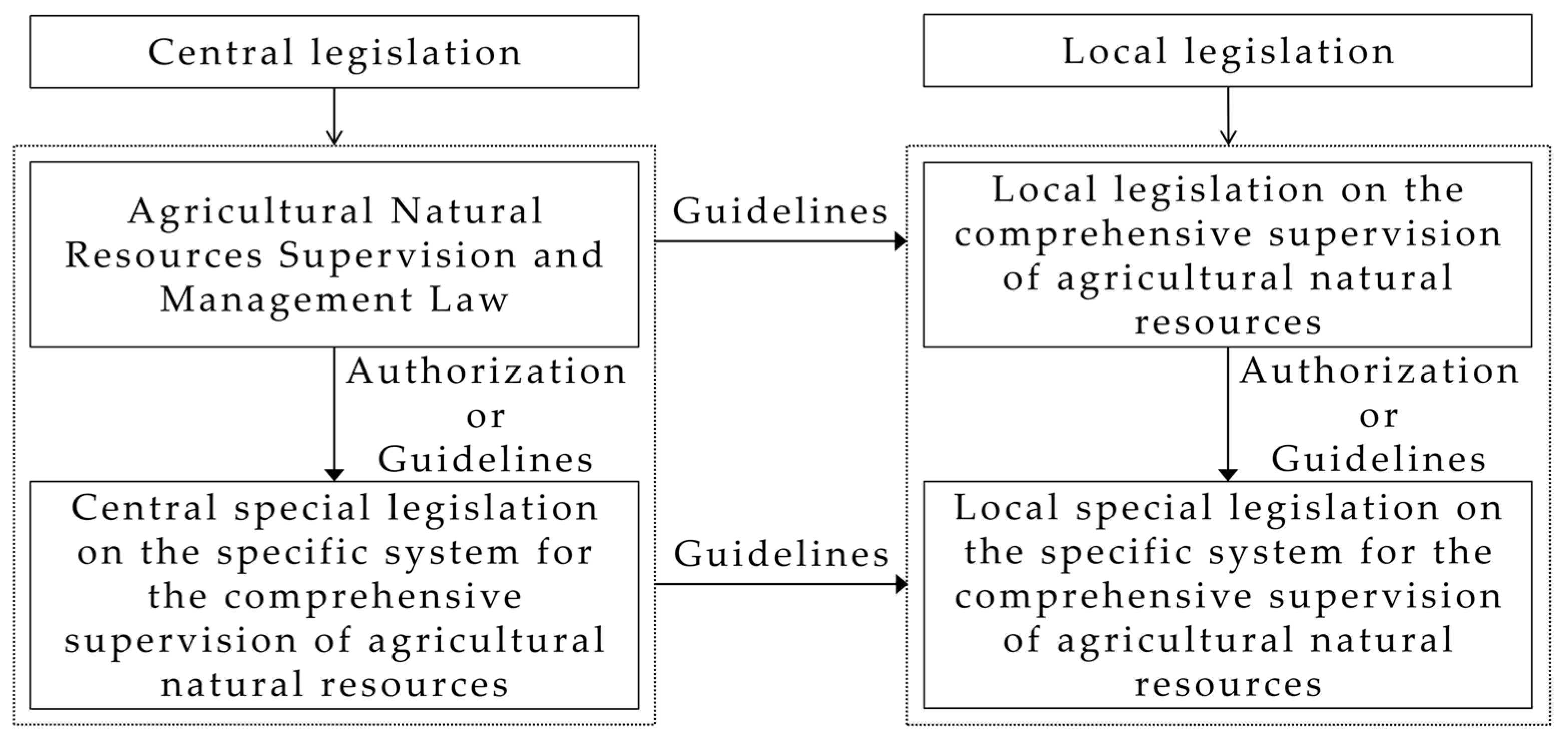
The comprehensive supervision of agricultural natural resource assets crosses the international, national, and local levels; therefore, it cannot be realized independently only by central legislation or local legislation. The perfection of the legal system of agricultural natural resources assets comprehensive supervision in China should focus on the establishment of a comprehensive coordination mechanism of legislation between the central government and the local government, as Figure 2. In the connecting mechanism, with the basic law on the supervision of agricultural natural resources as the center, the central legislation guides the local legislation. The specialized legislation authorizes or guides the regulatory documents of various specific systems for the comprehensive supervision of agricultural natural resources. Central and local legislations can effectively leverage their respective functions and roles, complementing and coordinating with one another harmoniously. Only by linking the macro-guidance of central legislation with local legislation tailored to local conditions and matching the needs of diversified governance, can we effectively respond to the challenges of natural ecological environment change.
First, we should give full play to the coordinating and guiding role of central legislation. To cope with the complex and changing ecological environment system, special legislation on the comprehensive supervision of agricultural natural resource assets has been formulated on time, and specific guiding opinions have been issued to guide local special legislation and coordinate the interest balance between economic value and ecological value. Through the formulation of relevant management methods and supporting mechanisms, the current policy and strategic characteristics of agricultural natural resource asset spatial planning in China need to be highlighted, the standards and models of spatial planning are unified, and the potential vicious contradictions between different levels of planning are resolved, and the mutual constraints between different levels of planning are allowed.
The coordinating and guiding function of the central legislation is mainly embodied in the overall unity and principal guidance, to avoid the loss of agricultural natural resources assets from the source. Firstly, the comprehensive unity of the central agricultural natural resource assets comprehensive regulatory legislation can realize the coordinated allocation of agricultural natural resource assets in different stages of market transactions, different types of agricultural natural resource assets, and different distribution regions from the national perspective. In addition to mandatory obligations, it can also provide incentives in many aspects such as circular economy and clean production to promote the transformation of energy structure and leave space and time for the sustainable development of green agriculture in China. Secondly, the principle guiding nature of the central agricultural natural resource assets comprehensive supervision legislation is conducive to comprehensively considering the national development strategy and guiding the development, utilization, protection, and supervision of agricultural natural resource assets from the fundamental principle. Central establishes the basic policy of the state for the supervision of agricultural natural resource assets at the macro level and promotes the preservation and appreciation of agricultural natural resource assets on the premise of maintaining the ecological attributes of natural resource assets to realize the sustainable development of rural economy and society.
Second, we should give full play on the refining and complementary role of local legislation. Guided by the Basic Law on natural resources at the central level, with legislation on the comprehensive supervision of agricultural natural resources assets as the core, supplemented by special laws and regulations on specific supervision systems, and considering the stability and flexibility of legislation at the central and local levels, a coordinated and unified legal system for the comprehensive supervision of agricultural natural resources assets would be established. Taking climate resources as an example, the competent Department of Natural Resources of the central government of South Korea has the responsibility to support local governments, and the national adaptation plan adopted by it also requires local governments to develop and implement local adaptation plans [20].
The refinement and complement of local legislation should be reflected in the following two aspects: firstly, to reflect the local characteristics as the focus. Local agricultural natural resources assets comprehensive supervision legislation should be an important embodiment of local characteristics and local realistic needs. For example, in energy-rich provinces such as Shanxi Province, legislation should focus on energy use control; in the western ecologically fragile provinces, emphasis should be placed on ecosystem protection and environmental change assessment, and risk early warning should be issued in time. Secondly, local joint legislation is the way. To prevent the “localization” or “fragmentation” of local legislation on the comprehensive supervision of agricultural natural resources assets, local legislatures in a certain region can jointly legislate through regional legislative coordination committees or joint meeting systems. A multi-party consensus was formed through joint meetings on the same interest demands in the coordinated development of the regional economy [21]. For example, the Pearl River Delta, Beijing-Tianjin-Hebei, and other regions in China can adopt regional collaborative legislation for the comprehensive supervision of natural resource assets. Compared with local interests, regional cooperative interests are more consistent with national interests and social interests, reducing the friction cost caused by legislative differences, and more conducive to the improvement of comprehensive supervision efficiency of agricultural natural resource assets and government governance efficiency.
5. Conclusions
Improving the legal system for the supervision of agricultural natural resources assets is a requirement for the construction of ecological civilization system and an inherent requirement for the implementation of the rural revitalization strategy of China [22]. Douglas North pointed out that the demand generated by the new institutional norms lies in the fact that the provisions on people’s rights and obligations and production and business activities in the existing institutional norms can no longer meet the needs of social development and people’ s living standards. In addition, agricultural natural resource assets are externality and irreplaceability [23]. On the one hand, the development and utilization behavior of any resource asset in the living community would have an impact on other elements in the ecosystem. In the absence of comprehensive regulation of the use of agricultural natural resource assets, this impact would manifest itself as external diseconomy or negative externalities. On the other hand, the irrational development and utilization of agricultural natural resource assets, such as arbitrarily filling lakes and seas, blasting mountains, and indiscriminate deforestation, if the rural ecological environment system is damaged, would often cause difficulty repair and irreplaceable consequences. Therefore, given the current regulatory duplication, conflict and lag, and other problems, the supervision of agricultural natural resource assets urgently needs to pay attention to “common sharing and co-governance”, emphasize “reasonable and sustainable use”, and build a “fair trading market”. To promote the preservation and appreciation of agricultural natural resource assets, maintain fair trading in the resource market, and improve the co-governance of multiple entities, we would design comprehensive legislation on the supervision of agricultural natural resource assets, improve the comprehensive coordination mechanism between central and local governments, provide an operable comprehensive supervision path for the advancement of super ministry system restructuring in China, and provide legal guarantee for the Chinese-style modernization featuring harmonious coexistence between man and nature.
Author Contributions
W.Z. is primarily responsible for conceptualizing the research questions, financial support, manuscript revisions, and project management; L.Z. is mainly responsible for data collection and analysis and the initial writing of the manuscript. All authors have read and agreed to the published version of the manuscript.
Funding
This research was funded by the Research Youth Foundation of Humanities and Social Sciences of the Ministry of Education of China, grant number: 23YJC820055; and the Central University Basic Research Funds of China, grant number: 2662021WFQD002.
Institutional Review Board Statement
Not applicable.
Informed Consent Statement
Not applicable.
Data Availability Statement
The data are available upon request from the corresponding author.
Conflicts of Interest
The authors declare no conflicts of interest.
References
- Cheng, J.; You, Z. Scientific connotation and practical paths about the principle of “taking mountains, rivers, forests, farmlands, lakes, and grasslands as a life community”. China Population, Resources and Environment 2019, 29, 1–6. [Google Scholar]
- Sun, X.; Liu, X.; Liu, X.; et al. Classification system of natural resources for integrated management. Resources Science 2020, 42, 1860–1869. [Google Scholar] [CrossRef]
- Ma, Y.; Wu, C.; Qiang, H.; et al. Research on improving the natural resource convergence management mechanism. China Soft Science 2022, 12–18. [Google Scholar] [CrossRef]
- Cheng, X. Perfection of property right exercise mechanism of state-owned natural resources assets. Chinese Journal of Law 2018, 40, 145–160. [Google Scholar]
- Ma, Y.; Wu, C.; Cao, Q. Research on the reform of natural resources management system. Beijing: China Economic Press 2017, pp. 18–20.
- Potts, R.; Vella, K.; Dale, A.; et al. Evaluating governance arrangements and decision making for natural resource management planning: an empirical application of the governance systems analysis framework. Society & Natural Resources 2016, 29, 1325–1341. [Google Scholar] [CrossRef]
- Mogende, E.; Kolawole, O. Dynamics of local governance in natural resource conservation in the Okavango Delta, Botswana. Natural Resources Forum 2016, 40, 93–102. [Google Scholar] [CrossRef]
- Guo, G.; Cui, J.; Li, X. Design of property right system of “Three Rights Separation” of natural resource assets of the whole people: from the perspective of principal-agent theory. Journal of Natural Resources 2021, 36, 2684–2693. [Google Scholar] [CrossRef]
- Zheng, H.; Li, G. Assessment of the productivity effect of agricultural resource reallocation. Journal of Huazhong Agricultural University (Social Sciences Edition), 2021, 45-53. [CrossRef]
- Fu, L.; Mao, X.; Mao, X.; et al. Research on evaluation of the green agriculture development in Zhejiang Province under the background of rural revitalization——from the perspective of comprehensive utilization of agricultural resources. Chinese Journal of Agricultural Resources and Regional Planning 2020, 41, 23–34. [Google Scholar]
- Guo, X.; Zhou, R.; Li, J.; et al. Spatial-temporal evolution characteristics and influencing factors of agricultural resources and environment efficiency in the Yellow River Basin. Journal of Ecology and Rural Environment 2021, 37, 332–340. [Google Scholar] [CrossRef]
- Huang, X. Unified management of natural resources: a new era, new characteristics, and new trend. Resources Science 2019, 41, 1–8. [Google Scholar] [CrossRef]
- Li, X.; Zhang, W. An analysis of the approach to the conflict resolution between regulations of marine-related departments and local laws and regulations. Journal of Beijing Administration Institute 2021, 84–90. [Google Scholar] [CrossRef]
- Lv, Z. Ecological civilization rule of law theory of Xi Jinping Thought on the Rule of Law. China Legal Science 2021, 48–64. [Google Scholar] [CrossRef]
- Deng, Z. Dualistic view of social order rules——the study of legal theory of Hayek. Peking University Law Review 1999, 395–445. [Google Scholar]
- Lv, Z. Selection and development of codification mode of environmental legislation in China. Oriental Law 2021, 70–82. [Google Scholar] [CrossRef]
- Meng, L.; Li, X. Draft and construction of The Natural Resources Basic Law. Journal of Chinese Academy of Governance 2018, 103–108. [Google Scholar] [CrossRef]
- Xiao, G. Re-exploration on historical evolution regard to property rights system of natural resources in China. Journal of Political Science and Law 2021, 47–57. [Google Scholar] [CrossRef]
- Yan, J.; Wang, X.; Xia, F. Remold new pattern of natural resource management: target orientations, value guidelines and strategic choices. China Land Science 2018, 32, 1–7. [Google Scholar] [CrossRef]
- Tian, D.; Zheng, W. Progress and enlightenment of foreign climate change legislations. Climate Change Research 2020, 16, 526–534. [Google Scholar]
- Wang, C. A study on local joint legislation under the background of regional cooperation. Beijing: China Economic Press 2014, pp. 139–201.
- Yang, D. New Institutional Economics (2nd ed.). Beijing: China Renmin University Press 2019, pp. 234–260.
- Song, M.; Cui, L.; Zhou, Y. Management system and institution of natural resources in China: status, problems and prospects. Journal of Natural Resources 2022, 37, 1–16. [Google Scholar] [CrossRef]
Figure 1.
Game tree of exploitation of agricultural natural resource assets and comprehensive supervision.
Figure 1.
Game tree of exploitation of agricultural natural resource assets and comprehensive supervision.
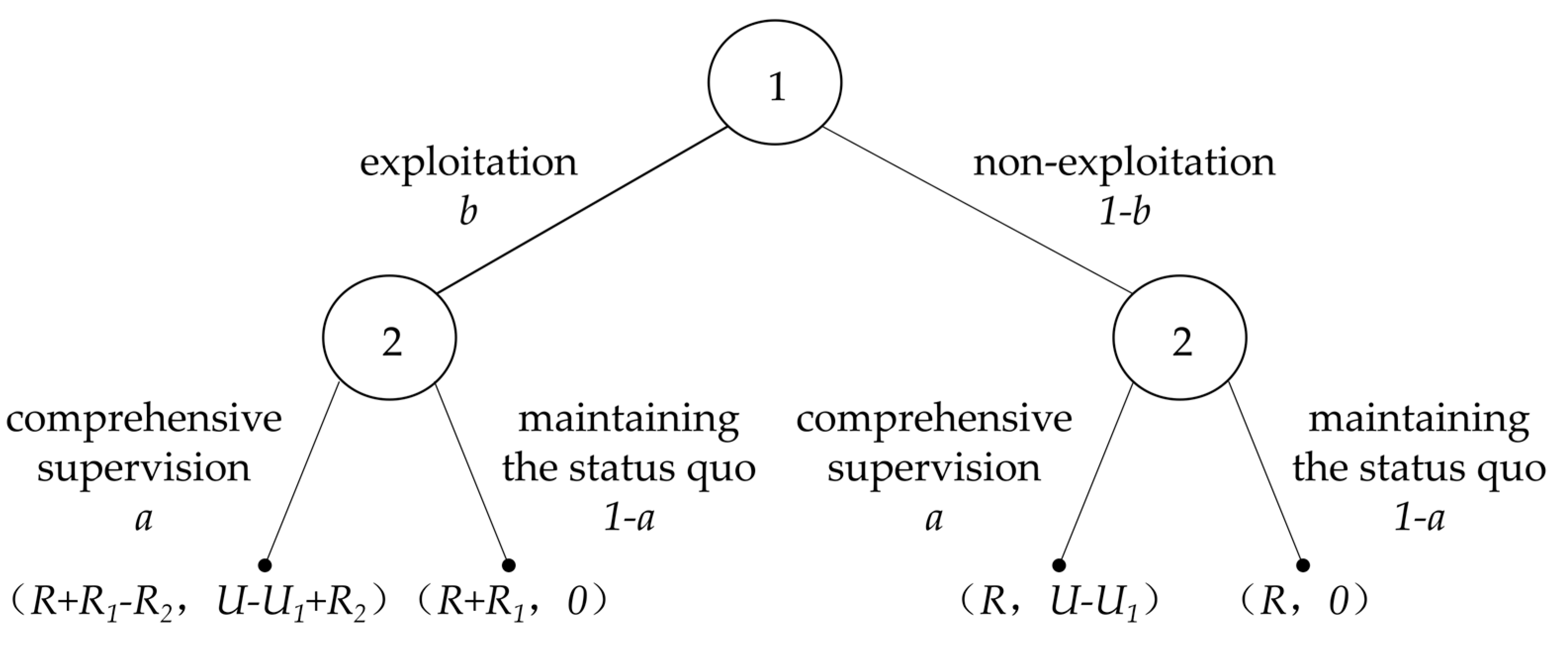
Figure 2.
Relational graph of central and local legislation of comprehensive supervision of agricultural natural resources assets.
Figure 2.
Relational graph of central and local legislation of comprehensive supervision of agricultural natural resources assets.
Disclaimer/Publisher’s Note: The statements, opinions and data contained in all publications are solely those of the individual author(s) and contributor(s) and not of MDPI and/or the editor(s). MDPI and/or the editor(s) disclaim responsibility for any injury to people or property resulting from any ideas, methods, instructions or products referred to in the content. |
© 2024 by the authors. Licensee MDPI, Basel, Switzerland. This article is an open access article distributed under the terms and conditions of the Creative Commons Attribution (CC BY) license (https://creativecommons.org/licenses/by/4.0/).
Copyright: This open access article is published under a Creative Commons CC BY 4.0 license, which permit the free download, distribution, and reuse, provided that the author and preprint are cited in any reuse.


