

Submitted:
07 November 2024
Posted:
08 November 2024
You are already at the latest version
Abstract
The National Cancer Institute (NCI) recognizes the potential of technologies based on the use of nanoparticles (NPs) in revolutionizing clinical approaches in the diagnosis and prognosis of cancer. Recent research suggests that once NPs come into contact with a biological fluid of cancer patients, they are covered by proteins, forming a "protein corona", composed of hundreds of plasma proteins. The concept of a personalized, disease-specific protein corona, demonstrating substantial differences in NP corona profiles between cancer and non-cancer patients has been introduced. We developed the design of an experimental prospective single center study with patients allocated in a 1:1:1 ratio of one of three arms: untreated patients with benign prostatic hyperplasia (BPH); untreated patients with non-metastatic prostate cancer (PCa); metastatic prostate cancer patients starting systemic therapies with new androgen-targeted agents or taxanes.. The protocol will aim to develop and implement sensitive nanotools with two distinct objectives. First, by designing NPs capable of selectively binding and detecting biomarkers in order to build a predictive diagnostic model to effectively discriminate between patient sera affected by BPH and PCa. Secondly, within the population with PCa, in case of initial advanced metastatic diagnosis, the objective will be to find biomarkers capable of predicting the response to systemic treatments to improve the precision and efficiency of monitoring treatment outcomes. For protein and metabolite corona experiments, we developed a cross-reactive sensor array platform with cancer detection capacity made of three liposomal formulations with different surface charges. For proteomics-NPs studies, proteins will be identified and quantified by nano-high-performance LC (nanoHPLC) coupled to MS/MS (nanoHPLC−MS/MS). Metabolites will be instead analyzed by an untargeted metabolomic approach.
Keywords:
protein corona
; nanoparticles
; prostate neoplasm
1. Protein Corona Nanoparticle: Definition and Mechanism of Action
1.1. How Protein Corona Nanoparticles Are Defined
According to the International Organization for Standardization (ISO), nanoparticles (NPs) are nano-objects with all similar length external dimensions, global sizing around 1 to 100 nm. They differ in shape, size, and structure, being spherical, cylindrical, conical, tubular, irregular. NPs can be either crystalline or amorphous, lose or agglomerated, resulting in a uniform complex rather than a composition of multiple layers, such as the surface layer (made by metal ions, surfactants or polymers), the shell layer and the core layer [1].
NPs have unique properties compared to the larger dimension of the same materials, in terms of mechanical, thermal, magnetic, catalytic, electronic and optical properties: this makes NPs suitable for many applications.
NPs are classified in different groups by their composition: organic, carbon-based and inorganic NPs. Organic NPs are made of proteins, carbohydrates, lipids, polymers and other organic matrix: examples are liposomes, micelles, exosomes, dendrimers and protein complexes. They are bio-degradable, sensitive to thermal and electromagnetic radiation, more labile in nature due to non-covalent intermolecular interactions, typically not toxic: these features make organic NPs suitable for many biomedical applications such as target drug delivery and cancer therapy [1].
Carbon-based NPs are carbon atoms complexes, such as fullerenes, carbon black NPs and carbon quantum dots. These NPs have unique optical-thermal-sorption properties, electrical conductivity, high strength, electron affinity, due to sp2-hybridized carbon bonds: their applications include drug delivery, energy storage, bioimaging, photovoltaic devices, environmental sensing applications [1].
Inorganic NPs include all the rest of NPs, typically metal, ceramic and semiconductor NPs: this category is made by materials with different physical, chemical and biochemical properties, so that inorganic NPs are important in material and device creation [1].
NPs in general can be found in various locations within the body. Naturally occurring NPs may be biological molecules (i.e.,: proteins and DNA), exosomes, environmental particles (entering the body through inhalation, ingestion or skin contact). The largest accumulations of NPs belong to blood, liver and spleen; the greatest is the NP, the faster it accumulates [2].
In particular, exosomes are extracellular nanovesicles secreted by all mammalian cells either in physiological or pathological conditions; they are carriers of different biomolecules such as lipids, proteins nucleic acids, representing extracellular messengers through intercellular communication and the processes modulation [3].
Over time research developed synthetic NPs: they may be drug delivery systems, imaging agents, vaccines, diagnostic tools.
In vivo, over different conditions, NPs interact with bodily fluids so that a high level of proteins surrounds to their surface and creates a complex, variable and dynamic coating so called “protein corona” [4]. According to different adsorption theories, this process is energetically favorable due to a rather higher net binding energy than the surrounding environment, increasing NP size by 3-35 nm and NP surface charge to 10-20 mV [5].
Protein corona is composed by an inner layer of tightly bound/stronger affinity proteins with a longer lifetime (“hard corona”, HC) and an outer layer of weakly bound proteins with a shorter lifetime (“soft corona”, SC). HCs are more easily isolated and characterized: examples of NPs with HC are liposomes, quantum dots, metallic NPs, silica NPs, polymeric NPs, and 2D materials [5].
1.2. Mechanism of Action
NPs can interact with body throughout skin and oral penetration, or inhalation, then moving to other body districts [1]. Once they interact with body fluids, it develops the NP-protein corona complex.
Even though protein adsorption on NPs is an almost instantaneous mechanism, it is a dynamic and ongoing process, led by unceasing protein adsorption and exchange on corona surface: blood composition changes continuously in time due to convection and cellular metabolism, so that protein corona composition varies continuously [4].
When a NP interacts with a cell membrane, it forms a very heterogeneous NP-cell interface which may influence inter-cellular interactions, cellular uptake, biodistribution and immunogenicity all over the body. Typically, NP physicochemical identity, the exposure time and the local thermodynamic exchanges drive this process [4].
More specifically, the adhesion forces can derive from either specific (such as recognition and binding of the ligands coated on the NP surface to the complementary receptors on the cell membrane) or nonspecific interactions (driven by pH and ionic strength, resulting in general attraction or repulsion between molecules), or both [6].
An example of a specific mechanism may be offered by protein coronas expressing opsonins, immunoglobulin G (IgG) and immunoglobulin M (IgM), so that they may drive to different patterns of recognition, phagocytosis, circulation and internalization processes [4].
2. How to Detect: Methods for Analysis
2.1. Main Technologies Analyzing Protein Corona-Nanoparticles
Many techniques are used to characterize all protein-NP interactions, as to the fact that the analysis involves heterogeneous features (such as size distribution, density, composition, molecular weight) and it is a long and difficult process [7].
Reproducible methods should be used, and particles should be isolated without losing the attached proteins. Main methods for NP-protein corona isolation are centrifugation, magnetism and chromatography [8].
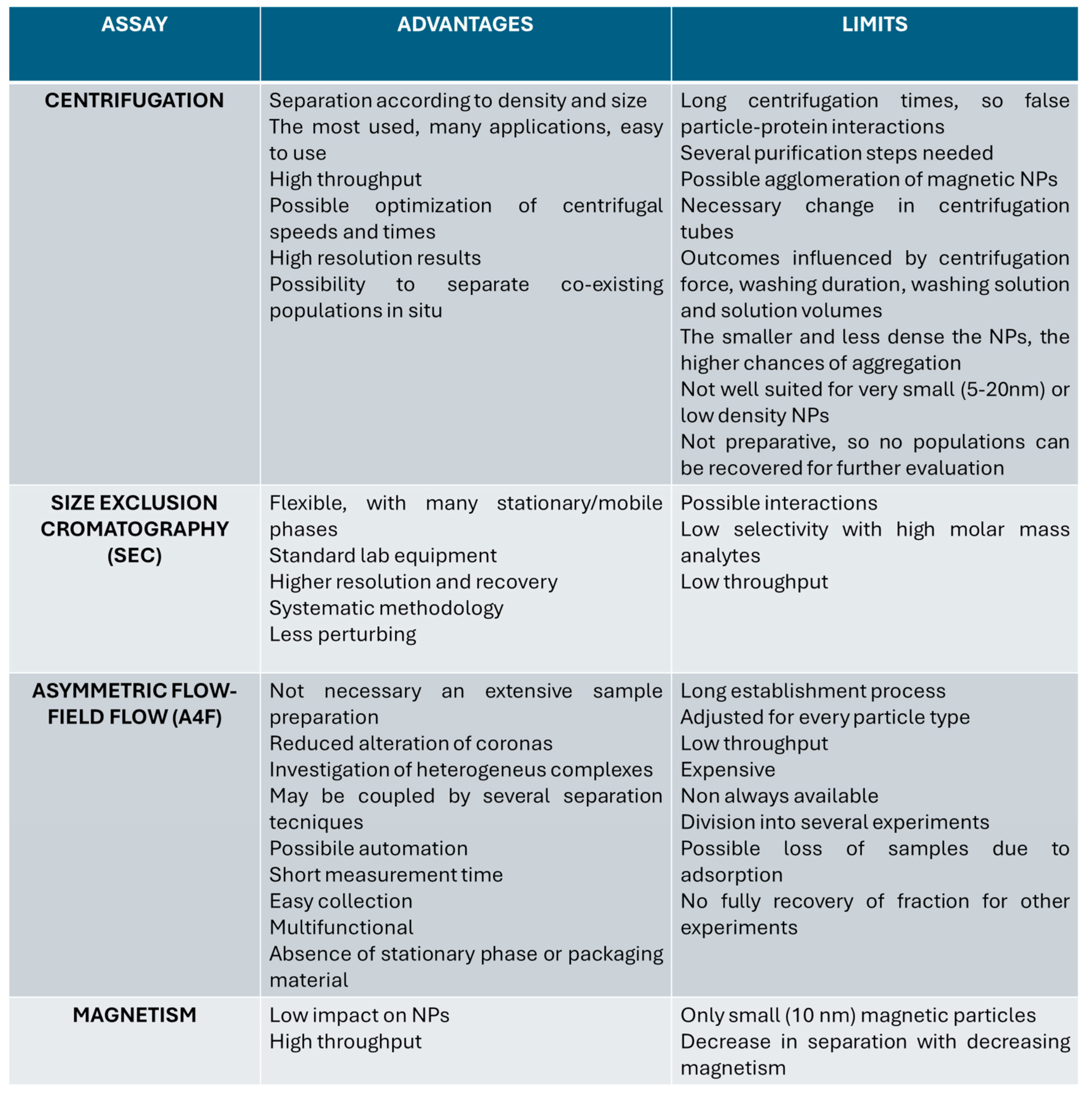
Centrifugation is the most common way to separate particles from a matrix. It is all balanced in speed, duration and washing time, optimized to every particle feature to prevent their precipitation and at >100 000 g, it is ultracentrifugation. Ultracentrifugation is mostly used for lower density particles, and it can be analytical (monitoring concentration of an analyte in the sample in real life) or preparative. In recent years many method variations have been introduced [8].
Magnetism is the second most used method, exploiting magnetic forces and resulting in an easier and faster way of separation. Iron oxide provides magnetic properties to NPs, and it can be also coated with other materials. The benefit under this method is the less impact on NPs-corona structure.This methos reduces false-positive cases due to aggregation under centrifugal forces, and it reduces the loss of proteins after multiple washing steps [8].
Chromatography provides an investigation on association/dissociation rates and affinity of individual proteins bound to NPs, also allowing collection of different fractions of a sample with less perturbation to particle-protein complexes. The first method is size exclusion chromatography: it is based on separation by hydrodynamic volume of the analyte, so that smaller particles interact more with the stationary phase while bigger ones go faster. A second method is flow-field-flow fractionation, such as asymmetric flow-field-flow fractionation (A4F): it separates analytes in a wide size range, helping in reducing potential nonspecific interactions, through a liquid flow that is established in a channel with a nonporous and a porous wall so that particles are exposed to a laminar flow (pushing along the tube) and a cross flow (leading to the bottom of the channel). It is used especially for complex samples and stable protein coronas, without having so much perturbation [8].
2.2. Materials and Substrates for Analysis
In corona analytics, blood is the most studied biological fluid, especially human plasma or serum. Also, the animal blood derived from common test animal species (i.e.,: rat or mouse, bovines) is used in studies with animal trials or as a comparator to human blood [8].
Another matrix of study is buffers with individual or mixed proteins, investigating the specific binding behavior of a target protein (i.e.,: albumin) [8].
Other biological matrices are cell culture medium with blood serum, cell and tissue homogenate, lung and nasal fluids. In literature there are few studies dealing with gastrointestinal fluids, food components, urine, or the lymphatic system. Anyway, there are many ongoing studies upon comparisons of the protein corona formation after incubating with different matrices [8].
2.3. Limits of Technologies
Using centrifugation there are many risks of false positiveness (proteins, protein complexes originally not bound to the particle, or proteins that bind to particle-attached proteins but not to the particle itself, may sediment during the process together with the particles and their corona), and of false negatives (centrifugation forces may lead to dissociation of proteins from the NP-corona complex). Generally, one centrifugation step is not sufficient [8].
Through magnetism, the risk of agglomeration increases with particle size. In fact, it is not recommended to use it for NPs with diameters greater than 10 nm. Other disadvantages are represented by the limited number of suitable particles species and the possibility of interaction between magnetic particles and other required methods [8].
Despite its potential, chromatography is the less method used because of a more time-consuming and cost-intensive approach. It allows only a low throughput of samples at time, and many particles are not suitable (especially bigger sizes, polydisperse molecules, and particles adherent to the column material). Nonetheless, establishment methods are requested, and this is very time-consuming. In addition, ultracentrifugation yields false positives or negatives due to dissociation of proteins due to centrifugal forces [8].

Table 1.
advantages and limits of different methodologies
 |
3. Potential Diagnostic Role in Oncology
Early cancer detection methods are needed: currently available tests can detect only a small fraction of potential biomarkers. In particular many methods were developed to arrange the best possible proteomic analysis and one promising way taken is nanotechnology-based platforms [9]
Nowadays it is well known that the protein pattern in the blood of cancer patients differs from healthy donors, and the molecular composition of protein corona around NPs could change between cancer and non-cancer patients, although exact causes are not clearly defined. Hundreds of plasma proteins are differentially expressed, whether increase or decrease, as a cause or consequence of cancer, so that identity of NPs might be affected by protein alteration in the blood of cancer patients [10]. Researchers demonstrated that the protein corona composition could be also influenced by tumor size and the presence of distant metastases [11]. Routinary blood tests are not able to characterize each profile. The NPs’ corona characterization could detect minor changes in protein concentration either in early cancer stages or even after primary treatment (chemotherapy, surgery, etc.) [9]. It has been developed a platform for detection combining the basic ideas of diseases-specific protein corona and sensor array technology (consisting of three cross-reactive liposomes with systematic changes in surface charge). Liposomes are then incubated with plasma collected from diagnosed cancer patients and coronas were thoroughly characterized by several methods [11].
In literature, there are different examples regarding the potential role of protein corona-NPs as biomarkers for neoplasms.
PEGylated polystyrene nanoparticles (PEG-PNs) were widely used to evaluate the influence of protein corona composition in patients with non-small cell lung cancer (NSCLC) [12]. In 2022 Xu W et al. used PEG-PNs to evaluate the influence of protein corona composition in patients rather with NSCLC comorbid with type 2 diabetes mellitus (T2DM) than NSCLC alone [12]. They collected human plasma samples which were isolated by centrifugation from heparinized venous blood, obtained from the two groups of patients. Then fluorescent labeled polystyrene NPs were synthesized by microemulsion polymerization, and there were modifications arranging pegylated (PEG) and Transferrin (Tf) NPs. These PEG-NPs and Tf-NPs were cultured with NSCLC with comorbidity group plasma, to obtain derived protein corona -NPs. Thus, different NPs’ coronas were characterized using nano-liquid chromatography-tandem mass spectrometry. PEG-NPs and Tf-NPs were intravenously injected into NSCLC mice and NSCLC comorbid with T2DM mice to study NPs behavior in vivo, by fluorescence imaging. It was seen how the state of the disease affected NPs distribution: NPs accumulated in the tumor tissue at 1 h post-injection and remained into tumor area for 24 h. In particular Tf-PNs accumulated more in the tumor area than PEG-PNs, and more in the NSCLC comorbid with T2DM group than the NSCLC group. Researchers investigated the cellular uptake of various types of protein-coated NPs in A549 cells (a model for NSCLC), including bare NPs (PEG- and Tf-NPs), those coated with human plasma-derived proteins from NSCLC patients, and those from NSCLC patients with T2DM. A549 cells showed a time-dependent increase in NPs uptake: Tf-NPhad higher uptake than PEG-NPs at 1 and 2 h h (P < 0.01), so that Tf modifications may enhance cellular uptake. It was also seen how pre-treatment with free Tf reduced Tf-NPs uptake, suggesting how uptake may occur via the Tf-receptor through endocytosis. Tf-NPs coated coronas from NSCLC comorbid with T2DM showed greater accumulation in A549 cells. This study suggested how comorbidity clinical status varied the protein corona composition so to affect the bio-behavior of NPs, providing a new idea for improving target ability of NPs [13].
In breast cancer were analyzed the rare-earth-doped nanoparticles (RENPs)-cell interactions at earliest stage of tumor, showing how the protein corona coating of RENPs determines the unique pathways by which RENPs accumulates in cancer cells [13]. Voronovic et al., investigated the corona composition and its impact on the cellular uptake of citrate-, silica- and phospholipid micelle-coated RENPs, selecting two cell lines (MDA-MB-231 and MCF-7, as breast cancer model systems) and utilizing confocal fluorescence microscopy images evaluation of their emission intensity after incubation. It was stated that protein corona around RENPs may play a major role in their stability, accumulation dynamics and cellular uptake mechanisms, as MDA-MB-231 cells accumulated RENPs in greater quantities than the MCF-7 cell line, mostly citrate-coated ones. In addition, they find that proteins found in RENPs corona may activate the mechanism of micropinocytosis in both breast cancer cell lines [13].
Another study evidenced how hard corona (HC: high binding affinity and slow dissociation rate) formed on lipid NPs after pancreatic cancer blood exposure is different from control blood, in terms of major protein bands expressed, by using the SDS/PAGE method for corona separation [9]. In 2016 Caputo et al., researched new applications of nano-bio-interactions to find new diagnostic approaches for pancreatic cancer. Twenty tumor and 5 no-tumor blood samples were collected to interact with designed lipid NPs, so that specific protein corona may coat NPs. These patterns were isolated and then analyzed by using SDS-PAGE and results showed how protein coronas of pancreatic cancer patients were more enriched than the control ones, with a rate of discrimination of 88% [9].
There were also findings concerning the relation between expressed corona molecular weight and the pancreatic cancer stage according to the TNM, so that size may be the main factor determining the prognosis of the tumor since it reflects tumor biology [14]. Caputo et al. aimed to investigate the effect of pancreatic ductal adenocarcinoma tumor size and distant metastases on protein corona composition by collecting 20 tumor blood samples and making them interact with lipid NPs, then characterizing molecules by using SDS-PAGE. Results allowed to distinguish T1-T2 (according to TNM staging system) cases from T3 and above all from metastatic ones (p < 0.05), in particular due to molecular weight (25-50 and 50-120 kDa) [15].
4. Potential Therapeutic Role in Oncology
The therapeutics based on NPs have been widely explored, as to the fact that nowadays we find many applications in clinical practice.
Recently, many studies have focused on the potential therapeutic role of NPs, especially utilizing them as vectors for drug delivery. Findings have shown how there are general requirements for an effective system for cancer treatments: NPs must be biocompatible, highly bioavailable and stable under physiological conditions. They should be able to target only tumor cells without interfering with surroundings cells and to release their load as soon as they reach the target site [15].
NPs’ size is the most influential factor in biodistribution and so in delivery-drug therapy. Due to their size, NPs are very efficient in crossing membrane pores. Tumors have leaky vasculature, letting NPs easily penetrate tumor small vessels, at the same time preventing extravasation from normal blood vessels to avoid agglomeration in other parts of the body. In general, smaller-sized particles (<50nm) have better antitumoral efficiency. Anyway, different organs have different size uptake specifications and research is focusing on this concept for development of a more specific cancer treatment [16].
NPs’ shape is important in controlling interactions between molecules by influencing fluid dynamics in terms of cellular uptake: reticuloendothelial system (RES) is the main site of nanomedicine storage, influencing toxicity and immunogenicity of injected drugs [15].
The complexity of NPs surface leads to various surface interactions, degradation, agglomeration rates and cellular uptake so that the protein corona-NP complex plays a main role in biodistribution-biocirculation-biocompatibility of potential carried drugs. Researchers found out that different kinds of cancer and different stages of the same cancer type can require different surface properties. To date, many strategies have been developed for tumor uptake of NPs, such as manipulating NPs design (influencing tumor infiltration and/or retention of drugs), modifying tumor microenvironment by coadjutant retention of drugs and modifying tumor microenvironment by coadjutant treatments such as photodynamic therapy, radiotherapy and immunotherapy [4].
Applications in clinical practice may be the utilization of gold NPs because of their optical and tunable properties, with an easy modifiability due to their negative surface charge. For instance, Methotrexate (MTX) conjugated with gold NPs has higher cytotoxicity than MTX alone. Doxorubicin (DOX) has higher potential against the multidrug resistant MCF-7/ADR breast cancer cell-line if conjugated with gold-NPs. Other examples may include the conjugation of gold-NPs with peptide-drug-conjugates (PDCs) and phytochemicals as kaempferol [17]. In 2007 Chen YHP et al. [17], proposed a new MTX formulation ( MTX-AuNP conjugate) to retain the drug into tumor cells for longer time and alter its pharmacokinetic behavior. Spectroscopic examinations were conducted revealing how MTX accumulation is faster and higher in tumor cells treated with MTX-AuNP than that treated with free MTX; moreover MTX-AuNP showed higher cytotoxic effects on several tumor cell lines compared with an equal dose of free MTX. Researchers also determined in mouse models of ascites Lewis lung carcinoma (LL2) how administration of MTX-AuNP (p=0.0041) suppresses tumor growth despite of the same dose of free MTX [15].
NPs have the ability to overcome solubility and stability problems of anticancer drugs by encapsulating the compound within a hydrophilic nanocarrier. Drugs can be also encapsulated in nanocarriers and can be paired, if perishable, with synthetic ones. NPs’ physicochemical properties can also improve drug penetration and redirection, also in a selective way, managing passive or active targeting. Additionally, the circulation time of a drug can be manipulated by nanocarriers, as to the fact that they may expel their cargo on the very beginning over specific environmental factors (such as pH), resulting in a stimuli-sensitive treatment [16].
An example of targeting is represented by the optimization of Anti-HER2 monoclonal antibodies, creating “nanobodies”: they consist of the antigen-binding domain of heavy chain-only camelid antibody, showing greater stability, assembled through covalent binding [16] . In 2017, D’Hollander et al. demonstrated a chemical strategy to overcome protein corona-targeting issue in vivo biological systems by reducing their thickness. Nanobodies were covalently bound to AuNPs through a self-assembled monolayer interface. They found an optimal blocking agent (2-mercapto ethanol) interfering with the active groups of the self-assembled monolayer on AuNPs. Two cell lines were used to test this approach in vitro and in vivo in a mouse model: an ovarian cancer cell line (SKOV3) showing high expression of HER2 receptors and a hamster ovarian cancer cell line (CHO) as a negative control. Using darkfield microscopy and photoacoustic imaging, it was seen how the specificity of the functionalized molecules to HER2 expressing tumor cells was high by decreasing the protein corona size, as a promising theragnostic tool [16].
Immunotherapy may exploit these findings as protein corona coating on NPs surface could modulate immune response: it is possible to create precoated molecules such as liposomes, which may reduce immunogenicity. It is also possible to enhance NPs immunogenic capacity by protein corona acting as the ligand of immune receptors, arising cytokine storm and inducing macrophages to produce a pro-inflammatory response [17]. Cai R. et al. found out how interleukin-1β (IL-1β) is positively correlated with the abundance of immune-related proteins in the protein corona coating [18]. Since the surface chemistry-induced specific protein corona affects the phagocytosis and immune responses of macrophages, it was seen how protein corona influences internalization pathways thus the cytokine secretion profile of macrophages. The macrophage release of the interleukin-1β (IL-1β) is directly dependent on the amount of proteins involved in immune responses, such as acute phase, complement, and tissue leakage proteins, present in the acquired nanoparticle corona [19].
5. Advances in Prostate Cancer
Currently, there are few studies in existing literature specifically focused on the application of NPs in prostate cancer (PCa) treatment, either as diagnostic or therapeutic tools.
5.1. Diagnostic Applications
Recently, the concepts of protein corona, sensor arrays, and supervised classifiers were merged to create the concept of a “protein corona sensor array”, aimed at effectively identifying and distinguishing diseases.
Digiacomo L. et al. [19], in 2020 established the experimental validation capabilities of the protein corona sensor network in oncology and neurodegenerative disorders. This research assesses the viability of identifying breast and prostate cancers using the protein corona sensor array platform. To achieve this goal, they utilized three cross-reactive liposomal formulations with unique physicochemical characteristics, leading to varying affinities for specific plasma proteins. This strategy can significantly enhance the quantity and diversity of plasma proteins potentially linked to cancer. By utilizing arrays of NPs with unique physiochemical traits, distinct protein corona profiles can be produced. This indicates that a single NP type’s protein corona composition could yield unique ‘fingerprints’ for each condition. In this investigation, three liposomal formulations with differing lipid compositions and surface charges were exposed to human plasma from patients diagnosed with two prevalent cancer types, breast cancer and PCa, alongside a control group of healthy donors. Instead of targeting a specific biomarker, they examined alterations in the protein profiles that facilitate the differentiation between cancer and non-cancer patients. Overall, the size, zeta potential, and nano-Liquid Chromatography-tandem mass spectrometry findings suggest that the liposome corona is influenced by the liposomes’ surface chemistry and varies across different cancer types. Utilizing statistical methods, they were ranked based on their capability to distinguish between cancerous and non-cancerous individuals. Significantly, the proteins demonstrating the highest discrimination potential were clearly linked to various cancer aspects. One important process in tumor development is angiogenesis, the physiological mechanism through which new blood and lymph vessels arise from pre-existing vessels, supplying tumors with necessary nutrients and cytokines for the growth and systemic spread of cancer cells. The coronas of cancer patients revealed several proteins associated with angiogenesis. The corona from cancer patients showed substantial differences from that of healthy individuals in its levels of FBLN1, which belongs to the fibulin family, a class of proteins involved in organizing the stromal matrix. The results showed a clear separation of cancer patients and control subjects in two-dimensional spaces with axes defined by corona proteins with the highest discrimination ability. Following incubation with HP from healthy individuals, 178, 256 and 179 proteins were identified in the coronas of L1−HP, L2–HP, and L3–HP complexes, respectively. The percentage of proteins common to all three formulations spanned from ≈50% (L2–HP complexes) to ≈72% (L1–HP and L3–HP complexes). However, unique proteins comprised a minor fraction of the coronas with the coverage percentage ranging from ≈7% (L1–HP complexes) to ≈29% (L2–HP complexes). After their interaction with HP from breast cancer and prostate cancer patients, similar results were obtained. Coronas from cancer patients and healthy individuals were compared and RPA values of breast cancer and control groups were statistically different in 172 proteins (L1: n = 62, L2: n = 71, and L3: n = 39). This number was 157 when the coronas of PCa patients and control subjects were compared (L1: n = 55, L2: n = 58, and L3: n = 44). This characterization has potential for improving the early detection of cancer using a simple blood test [19].
Huo Qu et al. [20] in 2011 developed a NPs immunoassay for serum protein biomarker detection and analysis in which a serum sample was first mixed with a citrate-protected AuNP solution. Proteins from the serum were adsorbed to the AuNPs to form a protein corona on the NPs surface. An antibody solution was then added to the assay solution to analyze the target proteins of interest that were present in the protein corona. The protein corona formation and the subsequent binding of antibody to the target proteins in the protein corona were detected by dynamic light scattering (DLS). They discovered multiple molecular aberrations associated with PCA from mice and human blood serum samples. From the mice serum study, they observed differences in the size of the protein corona and mouse IgG level between different mice groups. The experiment enclosed the mice implantation of the rapidly proliferating prostate cancer cell line PC3, the slowly progressing tumor cell line LnCaP and a third group of mice treated with phosphate-buffered saline (PBS) solution as a control. Mice implanted with PC3 cells developed significantly larger tumors (measured in grams) than those injected with LnCaP cells (weighing in the tens to hundreds of milligrams) The average weight ratio of tumor over the body weight was approximately 5% for the PC3 mice, and less than 0.3% for the LnCaP mice. The average particle size increase of the healthy control group was 75 nm, significantly higher than the PC3 mice with an average particle size increase of 24 nm and the average particle size increase for LnCaP mice of 43 nm. It was also noticed that within the healthy control or LnCaP mice group, there were substantial variations between individual mice: the particle size increase varied from 20-110 nm for the LnCaP mice, and 40-120 nm for the healthy control mice with no prostate tumors in the control mice. Three groups of human serum samples were included in this study: normal healthy donors (n = 15); patients diagnosed with BPH (n = 10); and patients diagnosed with PCa with stages from T1c to T3b (n = 25). It was found from both the mice model and the human serum sample study that the level of vascular endothelial growth factor adsorbed to the AuNPs was decreased in cancer samples compared to non-cancerous or less malignant cancer samples.This research demonstrates a notable disparity in the “size” of the serum protein corona that forms on the surface of AuNPs between cancerous and non-cancerous or less aggressive tumor-bearing mouse models [20].
Ahmadianpour et al. [21] in 2020, studied the application of AuNPs for the early detection of PCa. In this study, blood samples of 60 male subjects aged 40–90 years were collected from 20 healthy, 20 BPH and 20 PCa patients. Optical scattering changes were measured by the level of AuNPs mixed with different sera, and the responses were compared with the PSA index (Prostate Specific Antigen) of the subjects. No significant differences were found in the size of the corona protein structure between the three groups of males with PCA, BPH and healthy males. No correlation was found between the dynamic light scattering (DLS) concentration and PSA serum level due to changes in ambient temperature, prolonged test duration or high IgG levels in apparently healthy individuals. They ascertained that DLS has major limitations for PCa detection, so it cannot be a simple and accurate method for the early detection of this tumor [21].
Lately, researchers focused on tumor-linked exosomes through liquid biopsy evaluation, obtaining PSA exosomes with more sensitivity and specificity than traditional PSA blood analysis and representing a promising biomarker [3].
Logozzi et al. demonstrated how analyzing PSA-expressing exosomes can differentiate between healthy patients and those with prostate disease, also discerning into benign and malign pathology. The study enrolled 240 patients, of which 80 control, 80 BPH, and 80 PCa males. Exosomes were extracted from an EDTA-treated blood sample using centrifugation, then they were qualified and quantified using different methods. In particular, the IC-ELISA method had a 98.57% sensitivity and an 80.28% specificity in discriminating malignant from benign prostatic pathology. Also, combining IC-ELISA and NFSC led to an increase of up to 96% in sensitivity and 100% in specificity. Moreover, it was seen a significant (p<0.0001) increase in the number of exosomes and a lower size in prostate cancer patients [3].
5.1. Therapeutic Applications
An ongoing clinical trial, active from 2020 is AuroLase® NCT04240639, which provides ultra-focused tissue ablation therapy for solid tumors [22], aims to enhance treatment effectiveness while reducing the side effects [23] commonly linked to surgery, radiation, and conventional focal therapies. It employs the “optical tunability” of a novel class of NPs known as AuroShells, which absorb near infrared wavelengths of light that harmlessly infiltrate human tissue and expose the tumor to a near infrared laser. The NPs selectively seize the photonic laser energy, transforming the light into heat, effectively obliterating the tumor and its nourishing blood vessels while preserving adjacent tissues. AuroLase Therapy utilizes an FDA-approved laser that produces near-infrared energy within clinically defined parameters (output, duty cycle, duration) and incorporates an FDA-sanctioned fiber optic probe for percutaneous energy delivery. AuroShell particles (also referred to as “nanoshells”) feature a gold metal shell surrounding a non-conductive silica core, functioning as the external absorber of the near-infrared laser energy channeled by the probe. These AuroShells are introduced intravenously, and due to their diminutive size, they can gather in the tumor through its porous vasculature. NPs cannot penetrate normal blood vessels, hence they do not accumulate in healthy tissues. Once concentrated in the tumor, the region is targeted with a near-infrared laser at carefully selected wavelengths to ensure maximum light penetration through tissues. The AuroShells are engineered to absorb this specific wavelength and convert the photonic laser energy into sufficient heat to ablate the tumor [23]. Nanospectra’s proprietary nanoshells navigate freely in the bloodstream and converge in the tumor. Utilizing cutting-edge imaging technology, the clinician precisely locates the prostatic lesion and positions the optical fiber probe through targeted MRI-Ultrasound fusion technology on the prostate gland. PCa tissue could be ablated while preserving adjacent healthy tissue. Currently, AuroShell particles are investigational and can only be accessed through designated, FDA-authorized clinical study sites [23].
6. Experimental Trial: Protocol Design
6.1. Premise
Despite advances in genomics, proteomics, metabolomics and lipidomics, to date there is still an absence of predictive protein and metabolic biomarkers. Proteomics and metabolomics approaches, based on mass spectrometry techniques, are undoubtedly of high interest but face challenges such as low sensitivity and specificity due to the low concentration levels of biomarkers in human plasma. Clinical application is further hampered by factors such as sample size, intra-individual variability, presence of bias, and overall cost. These challenges highlight the complexity of using proteomic and metabolomic approaches for effective detection and treatment of PCa. The National Cancer Institute (NCI) recognizes the potential of technologies based on the use of nanoparticles in revolutionizing clinical approaches in the diagnosis and prognosis of cancer. Recent research suggests that once nanoparticles (NPs) come into contact with a biological fluid of cancer patients, they are covered by proteins, forming a “protein corona”, composed of hundreds of plasma proteins. Hajipour and colleagues [24] introduced the concept of a personalized, disease-specific protein corona, demonstrating substantial differences in NP corona profiles between cancer and non-cancer patients. As the protein corona field grew, limited interest in the metabolite corona began to emerge with investigations into the lipid composition of the corona around inhaled nanomaterials and, eventually, more holistic analyses of the metabolite corona. Chetwynd and co-workers [25] suggested that the metabolite corona coexists with the protein one since these smaller molecules can fit between proteins and are often bound into protein complexes. The metabolite corona is complementary to protein coronas, following similar rules of adsorption based on abundance and affinity, leading to metabolite fingerprints akin to protein fingerprints. Understanding how NPs interact with the metabolites in the biological milieu, particularly in cancer patients, holds promise for advancing diagnostic capabilities. The metabolite corona can provide valuable information about the individual’s metabolic profile, offering insights into the unique metabolic characteristics associated with cancer. In conjunction with the protein corona and other emerging concepts, it contributes to a more comprehensive understanding of the complex interactions between NPs and biological components. These insights may pave the way for innovative diagnostic approaches and personalized medicine strategies in cancer diagnosis and treatment.
6.2. Study Design
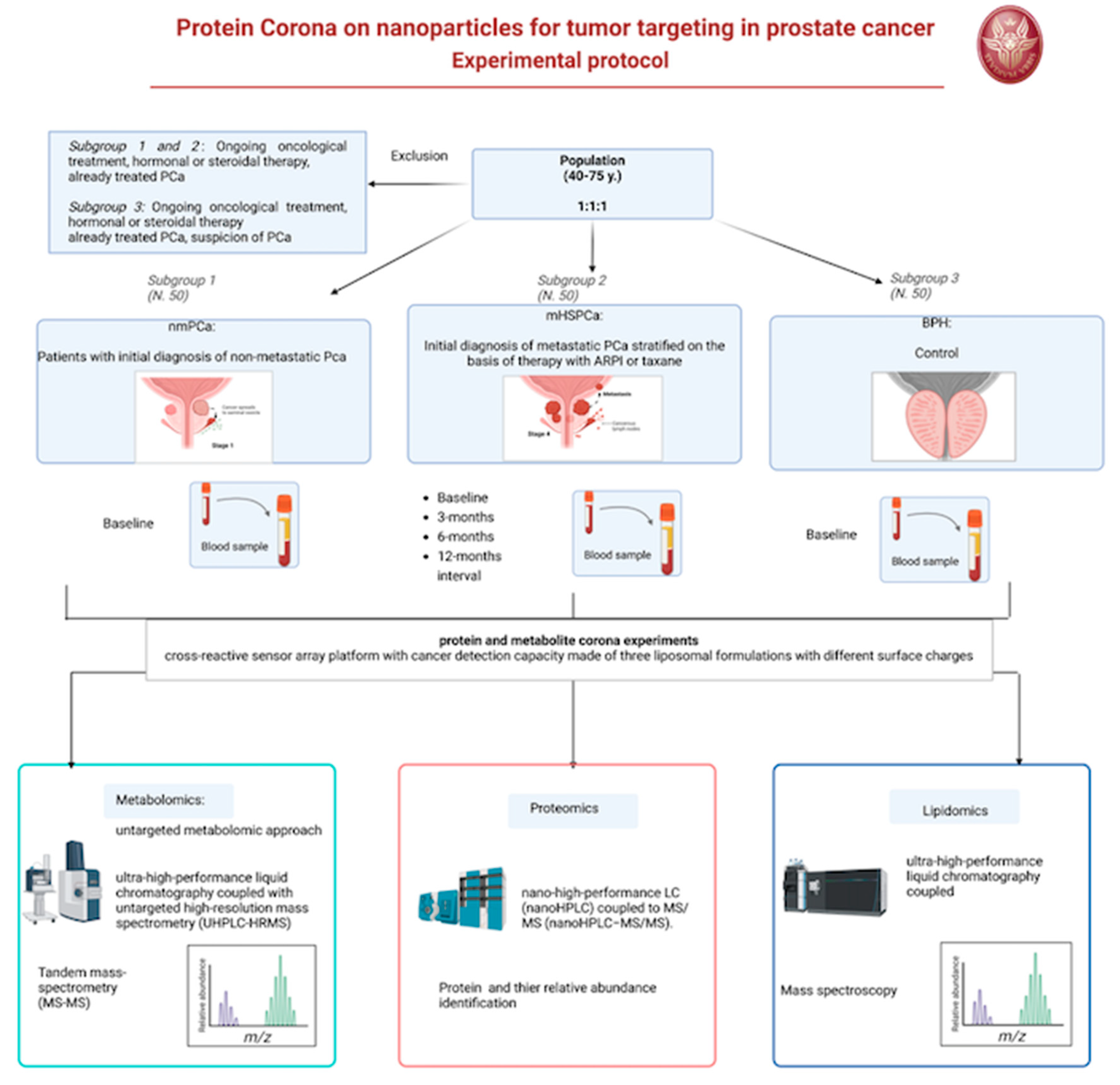
We developed the design of an experimental prospective single center study with patients allocated in a 1:1:1 ratio of one of the three arms. A longitudinal analysis will be also applicated on a 12-month interval observation.The protocol has been approved by our Ethic Committee Prot 0919/2021.The protocol will start on January 2025.
6.3. Endpoints
6.3.1. Overall Aim
The protocol will aim to develop and implement sensitive nanotools with two distinct objectives. First, by designing nanoparticles (NPs) capable of selectively binding and detecting biomarkers in order to build a predictive diagnostic model to effectively discriminate between patient sera affected by benign prostatic hyperplasia (BPH) and prostate cancer (PCa). This initiative is driven by improving diagnostic precision and accuracy, enabling early and accurate differentiation between these two conditions. Secondly, within the population with PCa, in case of initial advanced metastatic diagnosis (mHSPC = metastatic hormone sensitive prostate cancer), the objective will be to find biomarkers capable of predicting the response to systemic treatments to improve the precision and efficiency of monitoring treatment outcomes, leveraging the aforementioned nanotechnology and leading to the development of personalized therapeutic strategies for patients.
6.3.2. Primary Endpoints
Construction of predictive diagnostic models on serum from patients with histological diagnosis of PCa versus patients with BPH using proteomics, metabolomics and lipidomics of the biomolecular coronas that form between nanoparticles and serum.
Construction of a predictive model for the response to treatment of patients with initial diagnosis of mHSPCa for the personalization of therapies and for the stratification of such patients considering individual characteristics such as genetics, lifestyle and more, as foreseen by precision medicine, using metabolomics and lipidomics of the biomolecular coronas that form between nanoparticles and serum.
6.3.3. Secondary Endpoints
Construction of mathematical models for the correlation of proteomic, metabolomic and lipidomic data with clinical data of the three patient populations (non-metastatic PCa, BPH and mHSPCa).
6.4. Population and Eligibility Criteria
Three different populations will be considered and compared.
- Subgroup 1: patients with initial histological diagnosis from prostate biopsy of PCa considered for radical prostatectomy as primary therapy, as a therapeutic choice shared with the doctor and in accordance with international guidelines. This treatment will follow normal clinical practice for this pathology and regular clinical and therapeutic procedure. Staging of these patients will be non- metastatic PCa at imaging (multiparametric magnetic resonance of the prostate).
- Subgroup 2: patients with initial histological diagnosis from prostate biopsy of advanced metastatic PCA (mHSPC) to be subjected to standard pharmacological treatments with androgen deprivation (ADT) and new androgen-targeted treatments (ARPI) or chemotherapy with taxanes, as a therapeutic choice shared with the doctor and in accordance with international guidelines. This treatment will follow normal clinical practice for this pathology and regular clinical and therapeutic procedure. Staging of these patients will be metastatic at imaging (PET CT scan or bone scan and CT scan).
-Subgroup 3: patients with initial diagnosis of BPH who have not undergone treatments. A healthy control population was not included but the BPH population will be used as a control. The clinical comparison in male subjects of the same age (40-75 years) to determine the expression of a potential marker for prostatic neoplasia, involves the evaluation of differences with a population with benign prostatic pathology such as BPH and not healthy subjects (without BPH) of mismatched age.
Subgroup 1 and 2:
Inclusion criteria: male patients aged between 40 and 75 years, any ethnicity, initial histological diagnosis of PCa from prostate biopsy. Non-metastatic versus metastatic clinical stage, intermediate or high-risk class according to d’Amico, indication as primary treatment for radical prostatectomy (subgroup 1) or systemic therapy with androgen deprivation and ARPI or taxanes (subgroup 2)
Exclusion criteria: local or systemic therapies for PCa, other neoplasms in the active phase or undergoing treatment, ongoing oncological therapies (chemotherapies, target therapies, radiotherapies), hormonal or steroid therapies in progress or with drugs known to interfere with the evaluation foreseen in the study.
Subgroup 3
Inclusion criteria: male patients aged between 40 and 75 years, any ethnicity, initial diagnosis of BPH.
Exclusion criteria: local or systemic therapies for BPH, suspicion or diagnosis of prostatic neoplasia, other neoplasms in the active phase or undergoing treatment, ongoing oncological therapies (chemotherapies, target therapies), hormonal or steroid therapies in progress or with drugs known to interfere with the assessment intended for the study.
6.5. Methods
Under a regime of fasting from liquids and solids from midnight the previous evening, in the morning around 8.00 AM a blood sample will be taken from all patients. In Subgroup 1 and 3, the blood sample will be obtained only at baseline. In Subgroup 2, the blood sample will be obtained at baseline before the beginning of therapy and at 3-, 6-, 12-month interval during systemic therapy. Sample storage will be performed at room temperature for 30 min,and centrifugation of the sample (3000 g; duration: 15 min) and subsequent separation to obtain plasma sample. The plasma samples will be transported within 30 minutes to the chemistry laboratory in a suitable refrigerated container with ice at a temperature of 4°C after centrifugation of the blood to remove the erythrocytes. As soon as they will be delivered to the laboratory, the plasma samples appropriately labeled with the sample identification code will be stored at -80°C until analysis.
For protein and metabolite corona experiments, in collaboration with the nanodelivery Lab of Sapienza of Rome, we developed a cross-reactive sensor array platform with cancer detection capacity made of three liposomal formulations with different surface charges, i.e., cationic 1,2-Dioleoyl-3-trimethylammonium propane (DOTAP), anionic 1,2-Dioleoyl-sn-glycerol-3-phosphoglycerol (DOPG) and the zwitterionic mixture made of dioleoylphosphatidylcholine (DOPC) and cholesterol [19]
For proteomics-NPs studies, proteins will be identified and quantified by nano-high-performance LC (nanoHPLC) coupled to MS/MS (nanoHPLC−MS/MS). The acquired raw MS/MS data files from Xcalibur software (version 2.2 SP1.48, Thermo Fisher Scientific) will be searched against the Swiss-Prot human database by the MaxQuant search engine with the automatic setting for tryptic peptide matching and label-free analysis. For each NP type, a list with all the identified proteins and their relative protein abundance (RPA, a quantitative estimation of their abundance within the protein corona) will be provided. The list of proteins will be utilized to discover new biomarkers associated with the PCa using sensor-array technology [19].
Metabolites will be instead analyzed by an untargeted metabolomic approach. Before analysis, Quality Control (QCs) samples will be prepared for further instrumental system conditioning and sample normalization over time. Data acquisition for samples, controls, and QCs will be obtained by ultra-high-performance liquid chromatography coupled with untargeted high-resolution mass spectrometry (UHPLC-HRMS). Data acquisition worklist will comprehend a QC run every 5 sample runs for subsequent QC-based normalization. At the end of the data acquisition worklist, a series of QCs will run in data-dependent acquisition tandem mass spectrometry (MS/MS) for subsequent compound tentative identification. All samples will be acquired in positive and negative ion mode for maximum compound coverage. After raw data collection, pre-processing analysis using Compound Discoverer software on samples, controls, and QCs will be needed to extract the m/z from the raw files, to align the variables (features) among all acquired runs, normalize each feature over time, and remove contaminants present in the blank sample. After data pre-processing, a data matrix will be obtained for further statistical analysis. Features that will be selected from statistical analysis as putative biomarkers, will be then tentatively identified by matching the experimental MS/MS spectra to those present in databases, such as Human Metabolome Database (HMDB), Lipid Maps, Kyoto Encyclopedia of Genes and Genomes (KEGG pathway) and Metabolika. Lipidomics will be carried out using a similar approach to metabolomics, but all instrumental parameters will be adjusted to lipids, including chromatography (C8 column, mobile phases, and gradient), MS tuning and parameters (m/z range and injection time), and preprocessing and identification tools.
Figure 1.
Experimental protocol design.
6.6. Statistical Analysis
In the analytical field we often work with complex problems in which the variables are numerous and sometimes uncontrollable; furthermore, information may be difficult to extract due to the presence of experimental noise, random or systematic correlations between variables, and useless or redundant variables. It is therefore essential, for a correct interpretation of the analytical data, to eliminate redundant and superfluous information to evaluate which are the most significant variables and considering any correlations between them.
For proteomics analysis a statistics and multivariate data processing will be carried out. A three-dimensional data matrix consisting of sample information, identified peptides, and the normalized ion intensity will be generated. The resultant three-dimensional matrix will be imported to the SIMCA-P 14.1 software (Umetrics AB, Umeå, Sweden) for multivariate statistical analysis, including principal component analysis and orthogonal partial least-squares discriminant analysis (OPLS-DA). The functional analysis of differentially expressed proteins will be performed using the Gene Ontology (GO). The strength of this approach lies not only in pinpointing individual predictors (i.e., single biomarkers) but also in the pattern recognition enabled by a protein corona sensor array. The differentiation between the groups of samples may arise due to a “global change” involving several predictors that systematically alter simultaneously, resulting in distinctive global protein patterns unique to the pathological conditions. By concentrating on unique patterns derived from a large number of subjects through a set of informative predictors, we will achieve more accurate predictions of PCa and different stratified mHSPCa patients than current methods allow.
For metabolite-corona a principal components analysis (PCA) and discriminant analysis (Partial Least Squares Discriminant Analysis, PLS-DA) will be in general applied. For the purposes of the project, the first step will be the application of the unsupervised PCA technique, to understand the tendency of the samples to divide into different clusters depending on whether they belong to the group of healthy subjects or to the group of pathological subjects, and to highlight the possible presence of outliers (for example very diluted samples). To further characterize differences between groups, supervised PLS-DA methods will be used. The application of PLS-DA could allow to obtain a clear separation between different groups consistent with the characteristics of the pathology.
7. Conclusions and Future Prospectives
In recent years, the management of patients with PCa has undergone epochal changes and advances in the results obtained. Clinical management has benefited from research results which are leading to the application of three interconnected concepts: intensification, anticipation, precision medicine. In the different stages of PCa we are witnessing a selection of patients based on precision medicine concepts so as to tailor the therapy by identifying a population in which the intensification and anticipation of treatment leads to significant advantages in terms of survival, compared to a population in which a deintensification of care is more useful.
These concepts require parameters that increasingly allow patients to be stratified into risk classes and precisely identify the therapeutic choice among multiple options. The genetic analysis of the pathogenetic variants (VPs) of the homologous recombination Repair (HRR) genes currently represents the most effective means in the prognostic evaluation of the individual patient with PCA and is associated with effective precision medicine such as PARP (Poli-(ADP-ribosio)-polimerasi) inhibitors.
The research and use of nanoparticles has high potential in the definition of predictive proteins or molecular biomarkers. In particular, the isolation of a protein corona developed by the contact of nanoparticles with biological fluids coming from neoplastic cells can allow the identification of disease-specific systems and significant differences between benign and neoplastic conditions. Consequently, the isolation of specific protein corona nanoparticles could represent a further tool for the concept of precision medicine and targeted therapeutic choice in patients with PCA.
To date, the data present in the literature, in particular studies on the application of this concept in PCA, both at the level of basic research and even more so in clinical research, are limited and in an initial phase. Research is more focused on the identification of disease-specific protein corona nanoparticles with prognostic capacity and markers of response to therapy than on possible therapeutic applications. The major limitation of these analyzes is and probably could remain soon, the complexity of the methodology and technology required for their isolation, the complex accessibility and diffusion in case of significant results coming from the research.
Our experimental design, which we are starting to apply in a comparative and longitudinal research on patients with PCa, will be able to make a significant contribution in the field of specific protein corona nanoparticles as molecular biomarkers between benign and malignant prostatic pathology but above all as an indicator of response to systemic therapy for metastatic PCa, in a sector where the therapeutic choices are numerous and require increasingly valid precision medicine.
The hypothesis is that the identification of a disease-specific protein corona nanoparticle system could be associated with the genetic analysis in the tailoring of therapeutic options for PCa patients.
Author Contributions
All authors significantly contributed to the research and the manuscript. Stefano Salciccia, Martina Moriconi: contributing to writing manuscript (literature research, figure). Valerio Santarelli, Valentina Brunelli, Beatrice Sciarra: collecting data, writing manuscript, figures and tables. Giulio Bevilacqua, Roberta Corvino: contributing to clinical trial definition and progression, writing manuscript, literature research. Anna Laura Capriotti, Carmela Mria Montone, Aldo Lagana’: conceptualization, contributing to experimental design, definition of methods, writing manuscript. Alessandro Sciarra, Daniele Santini, Alessandro Gentilucci: organizing the review; data collection, Writing the manuscript, data interpretation, study design, supervision.
Funding
This research received no external funding.
Institutional Review Board Statement
The experimental protocol was approved by our internal ethical committee Prot 0919/2021.
Informed Consent Statement
all patients will gave their informed consensus for each procedure. All diagnostic and therapeutic procedures will reflect our routine clinical practice in a department at high-volume for the management of PC disease.
Acknowledgments
no acknowledgments.
Conflicts of Interest
The authors declare no conflicts of interest. None of the contributing authors have any conflict of interest, including specific financial interests or relationships and affiliations relevant to the subject matter or materials discussed in the manuscript.
References
- Joudeh N, Linke D. Nanoparticle classification, physicochemical properties, characterization, and applications: a comprehensive review for biologists. J Nanobiotechnology. 2022 Jun 7;20(1):262. [CrossRef]
- Hoshyar N, Gray S, Han H, Bao G. The effect of nanoparticle size on in vivo pharmacokinetics and cellular interaction. Nanomedicine (Lond). 2016 Mar;11(6):673-92. [CrossRef]
- Salciccia S, Frisenda M, Bevilacqua G, Gobbi L, Bucca B, Moriconi M, Viscuso P, Gentilucci A, Mariotti G, Cattarino S, Forte F, Fais S, Logozzi M, Sciarra B, Sciarra A. Exosome Analysis in Prostate Cancer: How They Can Improve Biomarkers’ Performance. Curr Issues Mol Biol. 2023 Jul 21;45(7):6085-6096. [CrossRef]
- Singh P, Pandit S, Mokkapati VRSS, Garg A, Ravikumar V, Mijakovic I. Gold Nanoparticles in Diagnostics and Therapeutics for Human Cancer. Int J Mol Sci. 2018 Jul 6;19(7):1979. [CrossRef]
- Wang X, Zhang W. The Janus of Protein Corona on nanoparticles for tumor targeting, immunotherapy and diagnosis. J Control Release. 2022 May;345:832-850. [CrossRef]
- Zhang S, Gao H, Bao G. Physical Principles of Nanoparticle Cellular Endocytosis. ACS Nano. 2015 Sep 22;9(9):8655-71.
- Kopac, T. Protein corona, understanding the nanoparticle-protein interactions and future perspectives: A critical review. Int J Biol Macromol. 2021 Feb 1;169:290-301.
- Böhmert L, Voß L, Stock V, Braeuning A, Lampen A, Sieg H. Isolation methods for particle protein corona complexes from protein-rich matrices. Nanoscale Adv. 2020 Jan 9;2(2):563-582.
- Caputo D, Papi M, Coppola R, Palchetti S, Digiacomo L, Caracciolo G, Pozzi D. A protein corona-enabled blood test for early cancer detection. Nanoscale. 2017 Jan 7;9(1):349-354.
- Colapicchioni V, Tilio M, Digiacomo L, Gambini V, Palchetti S, Marchini C, Pozzi D, Occhipinti S, Amici A, Caracciolo G. Personalized liposome-protein corona in the blood of breast, gastric and pancreatic cancer patients. Int J Biochem Cell Biol. 2016 Jun;75:180-7.
- Caputo D, Caracciolo G. Nanoparticle-enabled blood tests for early detection of pancreatic ductal adenocarcinoma. Cancer Lett. 2020 Feb 1;470:191-196.
- Xu W, Xu M, Xiao Y, Yu L, Xie H, Jiang X, Chen M, Gao H, Wang L. Changes in target ability of nanoparticles due to protein corona composition and disease state. Asian J Pharm Sci. 2022 May;17(3):401-411.
- Voronovic E, Skripka A, Jarockyte G, Ger M, Kuciauskas D, Kaupinis A, Valius M, Rotomskis R, Vetrone F, Karabanovas V. Uptake of Upconverting Nanoparticles by Breast Cancer Cells: Surface Coating versus the Protein Corona. ACS Appl Mater Interfaces. 2021 Aug 25;13(33):39076-39087.
- Caputo D, Cartillone M, Cascone C, Pozzi D, Digiacomo L, Palchetti S, Caracciolo G, Coppola R. Improving the accuracy of pancreatic cancer clinical staging by exploitation of nanoparticle-blood interactions: A pilot study.Pancreatology. 2018 Sep;18(6):661-665.
- Sell M, Lopes AR, Escudeiro M, Esteves B, Monteiro AR, Trindade T, Cruz-Lopes L. Application of Nanoparticles in Cancer Treatment: A Concise Review. Nanomaterials (Basel). 2023 Oct 31;13(21):2887.
- D’Hollander A, Jans H, Velde GV, Verstraete C, Massa S, Devoogdt N, Stakenborg T, Muyldermans S, Lagae L, Himmelreich U. Limiting the protein corona: A successful strategy for in vivo active targeting of anti-HER2 nanobody-functionalized nanostars. Biomaterials. 2017 Apr;123:15-23.
- Chen YH, Tsai CY, Huang PY, Chang MY, Cheng PC, Chou CH, Chen DH, Wang CR, Shiau AL, Wu CL. Methotrexate conjugated to gold nanoparticles inhibits tumor growth in a syngeneic lung tumor model. Mol Pharm. 2007 Sep-Oct;4(5):713-22.
- Cai R, Ren J, Ji Y, Wang Y, Liu Y, Chen Z, Farhadi Sabet Z, Wu X, Lynch I, Chen C. Corona of Thorns: The Surface Chemistry-Mediated Protein Corona Perturbs the Recognition and Immune Response of Macrophages. ACS Appl Mater Interfaces. 2020 Jan 15;12(2):1997-2008.
- Digiacomo L, Jafari-Khouzani K, Palchetti S, Pozzi D, Capriotti AL, Laganà A, Zenezini Chiozzi R, Caputo D, Cascone C, Coppola R, Flammia G, Altomare V, Grasso A, Mahmoudi M, Caracciolo G. A protein corona sensor array detects breast and prostate cancers. Nanoscale. 2020 Aug 20;12(32):16697-16704.
- Huo Q, Colon J, Cordero A, Bogdanovic J, Baker CH, Goodison S, Pensky MY. A facile nanoparticle immunoassay for cancer biomarker discovery. J Nanobiotechnology. 2011 May 23;9:20.
- Mohammad Vahid Ahmadianpour, Javad Mowla, Fattah Sotoodehnejadnematalahi and Jamshid Raheb. Study of the application of gold nanoparticles for early detection of prostate cancer. Human Antibodies, 2020 March 20, -1 (2020) 1–8.
- Rastineahd A.R, Anastos H, Wajswol E, Halas N. Gold nanoshell-localized photothermal ablation of prostate tumors in a clinical pilot device study. Proc Natl Acad Sci U S A. 2019 Aug 26;116(37):18590–18596.
- Stern JM., Kibanov Solomonov V , Goodrich G. et al. Initial Evaluation of the Safety of Nanoshell-Directed Photothermal Therapy in the Treatment of Prostate Disease. American College of Toxicology 2015 August 21; 35 (1): 47-56.
- Hajipour MJ, Laurent S, Aghaie A, Rezaee F, Mahmoudi M. Personalized protein coronas: a “key” factor at the nanobiointerface. Biomater Sci. 2014 Sep 29;2(9):1210-1221.
- Chetwynd AJ, Zhang W, Thorn JA, Lynch I, Ramautar R. The Nanomaterial Metabolite Corona Determined Using a Quantitative Metabolomics Approach: A Pilot Study. Small. 2020 May;16(21):e2000295.
Disclaimer/Publisher’s Note: The statements, opinions and data contained in all publications are solely those of the individual author(s) and contributor(s) and not of MDPI and/or the editor(s). MDPI and/or the editor(s) disclaim responsibility for any injury to people or property resulting from any ideas, methods, instructions or products referred to in the content. |
© 2024 by the authors. Licensee MDPI, Basel, Switzerland. This article is an open access article distributed under the terms and conditions of the Creative Commons Attribution (CC BY) license (http://creativecommons.org/licenses/by/4.0/).
Copyright: This open access article is published under a Creative Commons CC BY 4.0 license, which permit the free download, distribution, and reuse, provided that the author and preprint are cited in any reuse.


