

Submitted:
12 November 2024
Posted:
12 November 2024
You are already at the latest version
Abstract
The Ministry of Housing, Urban-Rural Development (MOHURD) of the People’s Republic of China (住房和城乡建设部) is responsible for developing building codes and regulations. As of 2024, the building codes requiring water traps are not followed, and there is no requirement to install vertical outlet toilets on a flange to ensure a tight connection with the sewer pipe. This has led to a catastrophic situation with sewer gas leaks throughout the country. This paper describes the results of the major renovation of the third floor of the Dinis hotel in Luoyang and the entire Anhui Tower hotel in Beijing in 2023. The Dinis hotel has exposed sewer pipes because of unsealed toilets installation, and drains of sinks, showers, and floors installed without water traps. As a result, the hotel rooms and hallways smell of sewer gas. A similar situation is observed throughout China as of 2024. Sewer gas is dangerous to human health and causes many diseases. On a national scale, sewer gas leakage problems cannot be solved without the involvement of government agencies, which must enforce building codes with the mandatory use of water traps and the correct installation of toilets.
Keywords:
China
; sewage
; drains
; sewer gas
; water trap
; public health.
1. Introduction
The problem of sewer gas leakage in China has existed for decades [1]. The main reasons are exposed sewer pipes due to non-compliance with building codes and regulations to install water traps and leaky installation of vertical outlet toilets. For various reasons, the Chinese population does not pay attention to these problems. Sewer gases are hazardous to human health [2] and in high concentrations can cause death [3]. Long-term exposure to low concentrations of sewer gases causes fatigue, headaches, loss of appetite, irritability, dizziness, and even pneumonia [4]. Sewer gas contains hydrogen sulfide, ammonia, carbon dioxide, methane, nitrogen oxides, and sulfur dioxide. Sewer gases can be flammable. The hydrogen sulfide in sewer gas dulls the sense of smell, causing a person to lose the ability to smell. At concentrations >300 ppm hydrogen sulfide causes loss of consciousness, and very high concentrations >1000 ppm cause collapse [3]. Sewer gas is heavier than air and therefore accumulates in basements and ground floors of buildings. This is why many underground garages in Chinese supermarkets stink and are dangerous to stay in for long periods of time.
The author has been visiting various cities in China on a regular basis since 2007 and was struck by the problem of sewer gas odor in buildings, apartments, hotel rooms and underground garages. The source of sewer gas in Chinese buildings are unsealed sewer pipes because of improper toilet installation and other plumbing fixtures installed without water traps. In the summer of 2024, the author visited China again and observed that the problem of sewer gas leaks is present even in new buildings. The paper describes the results of major renovations of hotels in Luoyang and Beijing, after which sewer gas leaks continue due to improper installation of plumbing fixtures and failure to comply with relevant building codes and regulations in China.
2. Dinis Hotel Renovation
The author has been visiting Luoyang since 2010 and stayed at Dinis Business hotel at Kaiyuan Branch Luoyang, 1009 Zhou Shan Da Dao, Luoyang 471023, China. In 2023, the hotel underwent a major renovation of the third floor. The bathrooms were refinished with new tiles and all plumbing fixtures. The rooms were re-carpeted and new furniture was installed. The lobby was also refurbished with modern carpeting and new doors to the rooms. In the summer of 2024, the lobby and rooms smelled of sewer gas.
A previous publication described the shortcomings of sewer and ventilation systems in China, and ways to temporarily stop sewer gas leaks locally using plastic bags filled with water [1]. These measures did not produce the desired results, which were video recorded [5]. The only remaining source of sewer gas leakage in the hotel room was the toilet. The hotel management was accommodating, and the building maintenance staff lifted the toilet in the newly remodeled room 8326, so it became apparent that the seal between the toilet and the sewer pipe was missing in Figure 1(a). The plumber replaced the gasket under the toilet, but it didn’t help. The standard gasket wasn’t thick enough to form a tight seal between the toilet and the drainpipe.
To the author’s knowledge, there is no requirement in China to use a flange on a sewer pipe for installing a vertical outlet toilet, as specified by the international building code [6]. Figure 1(b) shows that during installation the toilet was moved to the right of the pipe center by more than 5 cm in room 8623. The correct installation of a vertical outlet toilet without a flange is possible but requires additional effort and the qualifications of a plumber to center the toilet over the sewer pipe, making sure that there is a tight seal between the toilet and the flange. Sewer gas leaks are unacceptable in any hotel room, as they spread throughout the hotel.
3. Anhui Tower Hotel Renovation
Anhui Tower hotel in Beijing located at No. 1 West Huixin Street, Chaoyang District, Beijing, 100029, China underwent major renovation in 2023. The author stayed at this hotel in the summer of 2024. Unlike the Dinis hotel, where only one floor was renovated, the entire building was subject to major remodel with a complete replacement of plumbing. The rooms had air traps installed in the shower and floor drains in Figure 2(a). However, such devices allow sewer gases to escape, especially when the sewer pipes experience pressure changes when a toilet or sink are flushed. The video shows gas bubbles escaping underneath a plastic bag with water placed over a floor drain as the sink is drained [7].
The top of Figure 2(a) shows an old drain insert with an air valve stuck in the open position due to corrosion. Unlike a water seal, an air valve cannot provide complete protection against sewer gas leakage [8]. If there is no water seal built into the drainpipe, an insert with a water seal can be used, as shown in Figure 2(b). The dimensions of the water trap insert must be determined by the relevant building codes to ensure proper drainage of water, prevent clogging and water drying out in the trap.
4. Discussion
In developed countries, there are building codes, regulations and laws, as well as government agencies and organizations that ensure that sewer pipes are properly sealed and that sewer gases do not leak, having a negative impact on public health [6,9]. These laws are usually enforced by local government.
Similar laws exist in China. For example, the Chinese national standard GB 50015-2019 (Standard for design of building water supply and drainage) in section “4. Drainage” states that building sewerage systems must prevent backflow, pollution, and odor spread [10]. Each plumbing fixture should have an appropriate trap to prevent odor escape. The standard also requires floor drains to be installed in rooms where plumbing is used, such as bathrooms and kitchens. The standard specifies a minimum water seal depth of 50 mm.
China professional standard CJ/T 186-2018 (Floor drain) specifies the design, installation and maintenance of floor drains used in residential and commercial buildings to ensure proper drainage and prevent odors [11]. Drains must include anti-backflow mechanisms to prevent sewage from backing up. Anti-odor seals must be used to block unwanted smells from entering the building. It is interesting to note that these standards do not use the term sewer gas, but use the words odor and smell, which is not quite correct.
The Chinese national standard GB 6952-2015 (Sanitary wares) provides specifications for the dimensions and design of sanitary fixture openings, but it does not cover how to install them correctly [12]. The author was unable to find a Chinese standard requiring the use of a flange on the sewer pipe for installing vertical outlet toilets.
In the US, toilets are installed on top of the waste pipe using a flange and a wax ring. Two brass bolts center the toilet in relation to the waste pipe and prevent it from moving in Figure 3(a). A wax ring is used to create a tight seal between the toilet and the flange. Experienced plumbers know that in many cases two such rings are needed to ensure a tight seal.
According to plumbing code, toilets must be securely attached to the floor by means of a closet flange. The flange must be made of corrosion-resistant material and should be securely fastened to the sanitary sewer pipe. The toilet drain and gasket must comply with the ASME A112.4.3 joint leak test and shall be installed in accordance with the manufacturer’s instructions. The flange must be attached to the drain and secured to the pipe structure. The toilet must be secured to the flange with corrosion-resistant bolts or screws. Joints must be sealed with an approved elastomeric gasket complying with ASME A112.4.3 or an approved curing compound.
In Europe toilets have horizontal outlets discharged from the outside of the toilet, connected to the sewer pipe using a sealed collar in Figure 3(b). Since the connection is external, any damage or installation flaws of the toilet are visible without having to remove it.
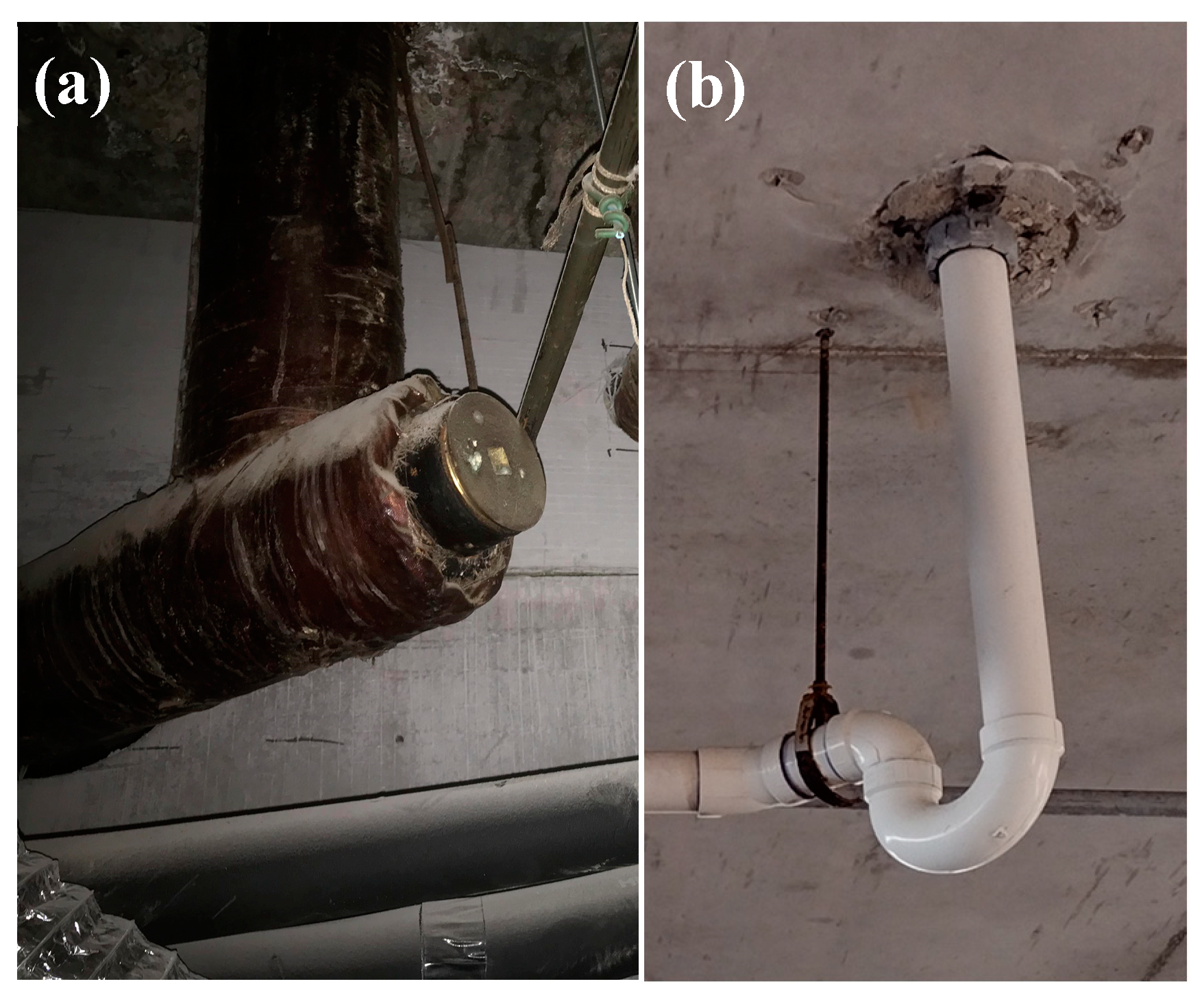
One can see in Figure 4(a) that the drainpipe of the shower drain does not have a water trap. A typical bathroom usually has a bathtub or shower, a sink, and a toilet. According to China’s national standards, the bathroom must have a floor drain. The siphon is built into the toilet and sink drain, so an additional water trap built into the sewer pipes is not required. However, the bathtub or shower drain, and the bathroom floor drain do not have a trap, so it is a part of the sewer pipe in Figure 4(b). The shower drain does not have a water trap, in violation of China’s national standard GB 50015-2019 in Figure 4(a). As a result, sewer gases enter the bathroom through the shower and floor drains, even though there is an air valve installed in both drains.
The Florida Building Code requires that all plumbing fixtures be equipped with a trap [10]. The most common trap is a p-trap, and there are several installation rules. Traps must be self-cleaning and not rely on movable parts to maintain the water seal. Trap outlets cannot be larger than the fixture drain they connect to. The water seal should be between 2 and 4 inches. Traps must be installed level in relation to their water seal. Fixtures cannot be double trapped. The vertical distance from the fixture outlet to the trap weir should not exceed 24 inches, and the horizontal distance should not exceed 30 inches. There is also a specification for the maximum slope of horizontal sewer pipes so that water does not leave the siphon due to inertia when draining a large volume of water, for example from a filled bathtub. All these requirements are provided to ensure the correct operation of sewer systems and prevent leakage of sewer gases.
In the United States, building codes are periodically updated, published, and are freely available. Failure to comply with building codes in the United States can result in administrative or even criminal liability. Compliance with building codes and regulations is monitored by local authorities represented by the inspectors from the construction department of a particular city. Construction and remodeling of buildings must be approved in advance by the construction department, which monitors the quality of the work by inspections.
One can only guess why construction standards are not followed in China. The Ministry of Housing, Urban-Rural Development (MOHURD) is responsible for developing building codes and regulations in China, but it is not the body that controls their proper implementation. Residential apartments in China are usually sold with bare walls, and the owners hire contractors to finish the rest. Quality control of such works is not carried out by the government. Apparently, the Chinese people have been accustomed to sewer gases since childhood and simply do not notice their smell. This is an interesting phenomenon that is impossible in other developed countries. If a hotel smells like sewage, customers will complain, and the hotel will be forced to fix the problem. The smell of sewage gases in the parking garages of supermarkets in China is a disgrace, since the planning, construction and operation are carried out by professional organizations that are obliged to comply with building codes and regulations. China should study and adapt international experience in the field of ventilation and sewerage of industrial and civil buildings. The sooner this happens, the better for maintaining the huge volumes and pace of construction in China and preserving the health of the population.
Timely recommendations for the construction of energy-efficient buildings [13] led to the adoption of the national standard GB 55015-2021 (General code for building energy efficiency and renewable energy utilization) [14]. However, as of 2024, the regulations for the use of water traps in industrial and civil construction in China have not been implemented, resulting in new buildings in China having sewer gas leakage problems.
5. Conclusions
This paper discusses the problems of sewer gas leakage in China due to the lack of water traps and unsealed toilet installation. To solve these global problems, the Chinese government must enforce relevant laws, building codes, and regulations. It is sad that China, with a large population and developed economy, has not solved the problem of sewer gas leakage for decades. It is unfortunate that newly constructed buildings have problems with sewer gas leakage, putting people’s health at risk. There is a lot of work to be done in China to prevent sewer gas leakage. The first step is to enforce relevant building codes, as has been done in other developed countries.
Acknowledgments
The author thanks the management and service staff of the Dinis hotel in Luoyang for their cooperation in identifying problems with improper installation of toilets.
References
- Volinsky, A.A. , Why China stinks. Deficiencies in plumbing and ventilation systems in China, International Journal of Civil Engineering and Technology, Vol. 11(7), pp. 16-20, 2020, https://iaeme.com/MasterAdmin/Journal_uploads/IJCIET/VOLUME_11_ISSUE_7/IJCIET_11_07_002.pdf.
- Sewer gas. Wikipedia. Web-source: en.wikipedia.org/wiki/Sewer_gas. Access date: November 6, 2024.
- Yalamanchili, C. , Smith M.D., Acute hydrogen sulfide toxicity due to sewer gas exposure, The American Journal of Emergency Medicine 26(4), 518.e5-518.e7, 2008, https://pubmed.ncbi.nlm.nih.gov/18410836/.
- Hydrogen sulfide gas, Illinois Department of Public Health fact sheets. Web-source: https://www.idph.state.il.us/envhealth/factsheets/hydrogensulfide.htm. Access date: November 6, 2024.
- Dinis Business Hotel after remodel. YouTube video. Web-source: www.youtube.com/shorts/mh6YB7d9n9c. Access date: November 6, 2024.
- 2024 International Plumbing Code (IPC), 405.4 Floor and wall drainage connections. Web-source: https://codes.iccsafe.org/s/IPC2024P1/chapter-4-fixtures-faucets-and-fixture-fittings/IPC2024P1-Ch04-Sec405.4. Access date: November 6, 2024.
- Anhui Tower hotel sewer gas escaping from the floor drain with a magnetic flapper air valve. YouTube video. Web-source: https://youtube.com/shorts/2SGvCfSLUzM. Access date: November 6, 2024.
- Air valve magnetic flapper insert for the shower drain in China. YouTube video. Web-source: https://youtube.com/shorts/Kf0WcgR-Qy8. Access date: November 6, 2024.
- 2023 Florida Building Code, Plumbing, Eighth Edition. Chapter 7, Sanitary Drainage, 2023 Florida Building Code - Plumbing, Sixth Edition. Web-source: https://codes.iccsafe.org/content/FLPC2023P1/chapter-7-sanitary-drainage. Access date: November 6, 2024.
- Chinese national standard GB 50015-2019. Standard for design of building water supply and drainage. 2019. https://www.chinesestandard.net/PDF/English.aspx/GB50015-2019.
- Professional standard of the People’s Republic of China CJ/T 186-2018. Floor drain. 2018. https://www.chinesestandard.net/PDF/English.aspx/CJT186-2018.
- Chinese national standard GB 6952-2015. Sanitary wares. 2015. https://www.chinesestandard.net/PDF.aspx/GB6952-2015.
- Feng W., Zhou N., de la Rue du Can S., Bendewald M., Franconi E. Building energy codes in China: Recommendations for Development and Enforcement, Ernest Orlando Lawrence Berkeley National Laboratory, LBNL-1005669, 2015, https://eta-publications.lbl.gov/sites/default/files/building_code_roadmap_english_oct_20_2015_formatted.pdf.
- Chinese national standard GB 55015-2021. General Code for Building Energy Efficiency and Renewable Energy Utilization. 2021. https://codeofchina.com/standard/GB55015-2021.html.
Figure 1.
(a) Floor drainpipe under a vertical outlet toilet in remodeled room 8326 showing signs of leakage and poor seal; (b) Improperly installed toilet off the drainpipe center in room 8623 at Dinis Hotel.
Figure 1.
(a) Floor drainpipe under a vertical outlet toilet in remodeled room 8326 showing signs of leakage and poor seal; (b) Improperly installed toilet off the drainpipe center in room 8623 at Dinis Hotel.
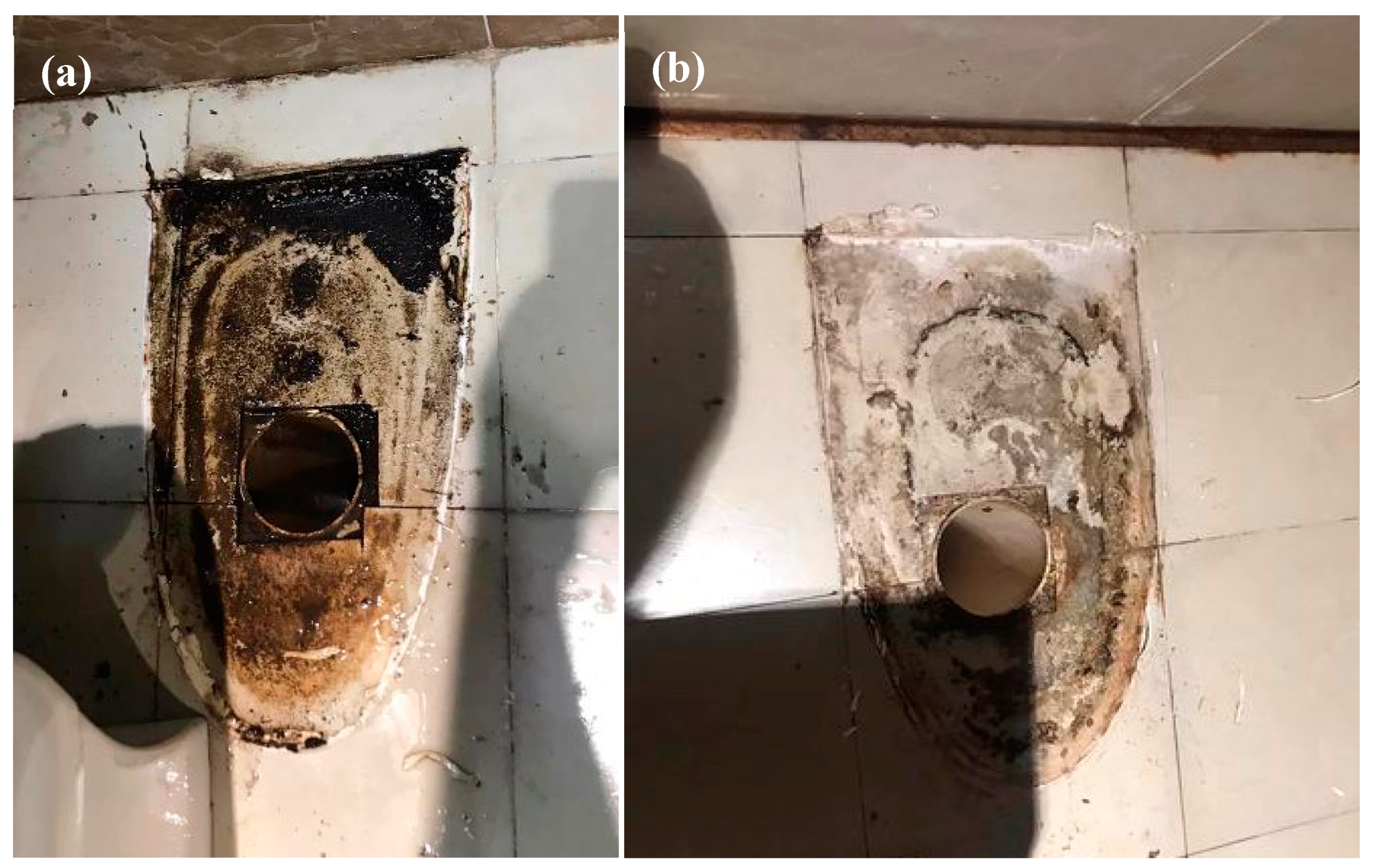
Figure 2.
(a) New drain insert with an air valve and magnetic flap. Above is the old drain insert with the air valve stuck in the open position due to corrosion; (b) Inserts with water trap for floor or shower drains.
Figure 2.
(a) New drain insert with an air valve and magnetic flap. Above is the old drain insert with the air valve stuck in the open position due to corrosion; (b) Inserts with water trap for floor or shower drains.
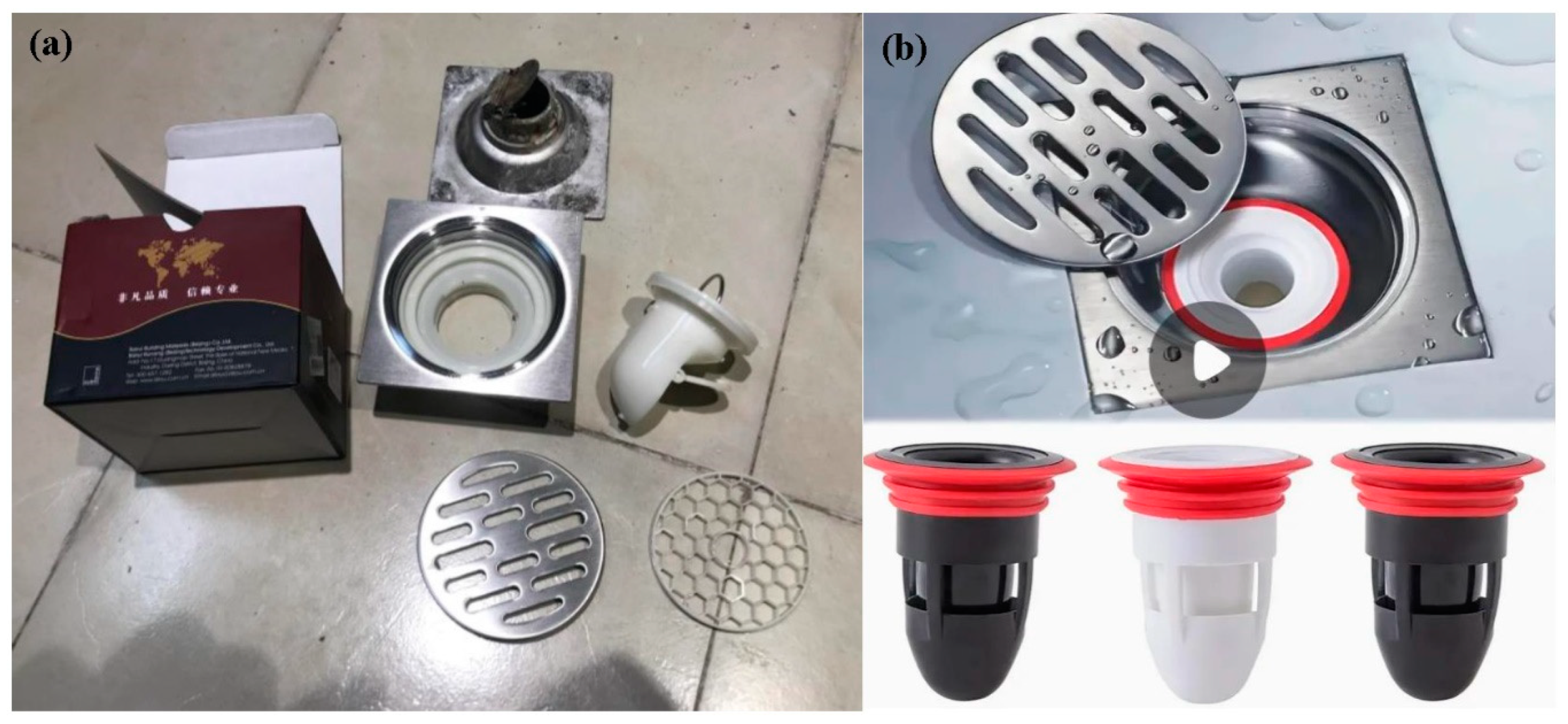
Figure 3.
(a) Flange with gasket and guide bolts for installing a toilet onto a sewer pipe in the USA; (b) Flexible pipe for connecting a sewer pipe outside the horizontal outlet toilet in Europe.
Figure 3.
(a) Flange with gasket and guide bolts for installing a toilet onto a sewer pipe in the USA; (b) Flexible pipe for connecting a sewer pipe outside the horizontal outlet toilet in Europe.
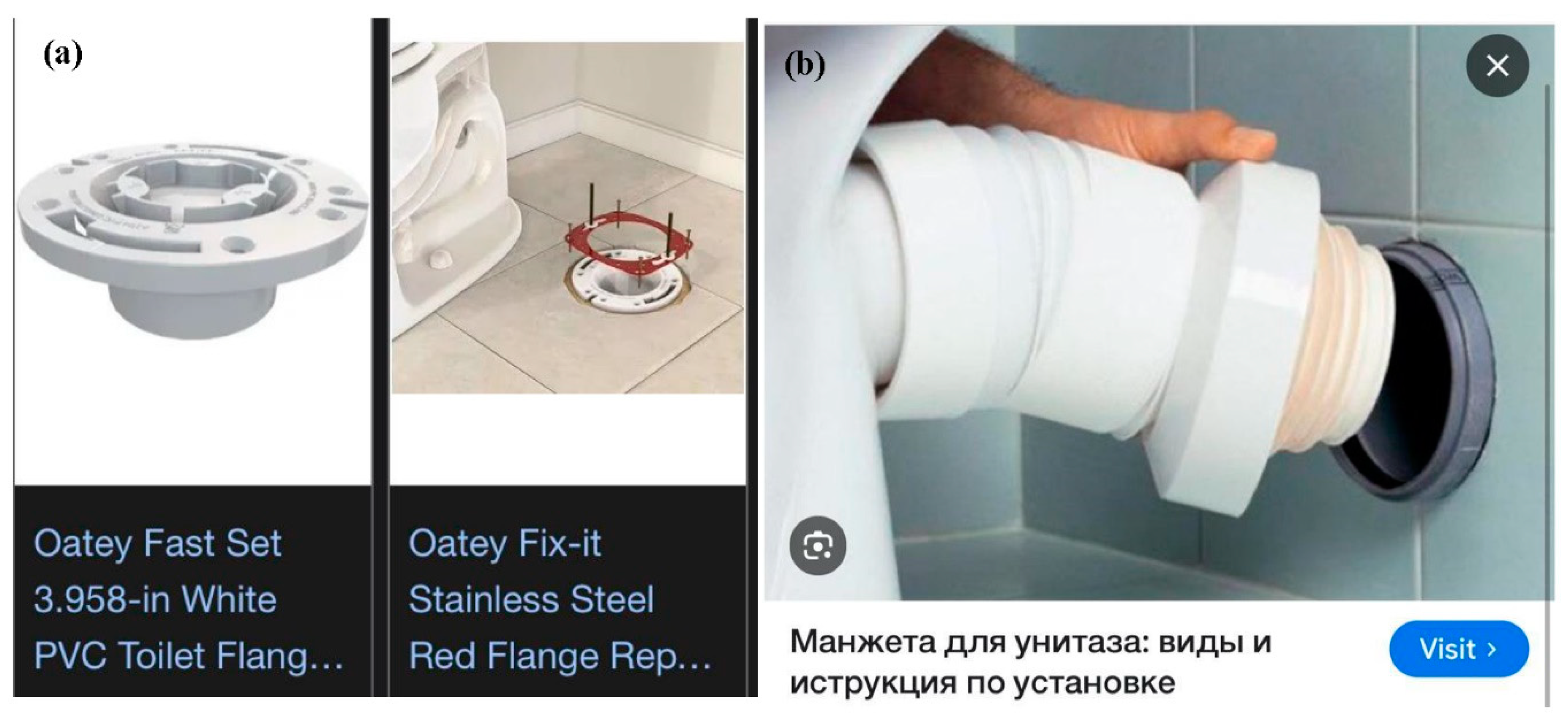
Figure 4.
(a) Shower drain sewer pipe in Anhui Tower hotel without a water trap; (b) Sewer pipe with a built-in p-trap.
Figure 4.
(a) Shower drain sewer pipe in Anhui Tower hotel without a water trap; (b) Sewer pipe with a built-in p-trap.
Disclaimer/Publisher’s Note: The statements, opinions and data contained in all publications are solely those of the individual author(s) and contributor(s) and not of MDPI and/or the editor(s). MDPI and/or the editor(s) disclaim responsibility for any injury to people or property resulting from any ideas, methods, instructions or products referred to in the content. |
© 2024 by the author. Licensee MDPI, Basel, Switzerland. This article is an open access article distributed under the terms and conditions of the Creative Commons Attribution (CC BY) license (https://creativecommons.org/licenses/by/4.0/).
Copyright: This open access article is published under a Creative Commons CC BY 4.0 license, which permit the free download, distribution, and reuse, provided that the author and preprint are cited in any reuse.


