
Submitted:
12 November 2024
Posted:
19 November 2024
You are already at the latest version
Abstract
This paper offers an in-depth analysis of the role of the Internet of Things (IoT) in fire safety systems, emphasizing fire detection, localization, and evac- uation. Through a bibliometric analysis, we identify pivotal research trends and advancements in IoT-based sensors and devices. We discuss the integration of emerging technologies to enhance fire safety system performance and delve into the primary network architectures and communication protocols vital for efficient IoT-based fire safety systems. The paper concludes by highlighting challenges, research gaps, and prospective directions for IoT in fire safety.
Keywords:
Internet of Things (IoT)
; fire safety systems
; fire detection
; fire localization
; evacuation
; bibliometric analysis
1. Introduction
The Internet of Things (IoT) has ushered in a transformative era, enabling devices, sensors, and actuators to interconnect and autonomously facilitate data collection and exchange. This paradigm, originating from basic peer-to-peer connections, has evolved profoundly with the rise of the World Wide Web and mobile devices. Kevin Ashton, during his tenure at MIT in 1999, introduced the term "IoT" [1].
By 2024, projections suggest that the global IoT device count will approach 60 billion, a significant increase from the 15 billion in 2015 [2,3]. The expansive growth of IoT, with roots in early innovations like the telegraph, is depicted in Figure 1, capturing its milestones from 1830 to the anticipated developments in 2024.
While IoT’s applications are vast, its profound impact on fire safety systems is undeniable. The increasing global fire incidents, coupled with urbanization challenges and the intricacies of modern infrastructure, necessitate advanced fire safety solutions. IoT-based fire safety systems, integrating cutting-edge sensors, devices, and communication protocols, emerge as a beacon of hope. They promise enhanced efficiency in fire management, from detection to evacuation, bolstered by real-time data analytics.
However, a comprehensive grasp of IoT-based fire safety systems remains elusive. This paper endeavors to address this gap, presenting both a bibliometric and systematic survey. Our primary research questions are:
- What are the main research topics, categories, and trends in the application of IoT for fire detection, localization, and evacuation stages, as revealed by a bibliometric analysis?
- What are the latest advancements in IoT-based fire safety sensors and devices? Which emerging technologies are making strides in this domain, and how do they augment the performance, efficiency, and effectiveness of fire safety systems?
- Which network architectures and communication protocols are predominant in IoT-based fire safety systems, ensuring attributes like low latency, scalability, reliability, and security?
- What are the primary challenges, research gaps, and potential future directions in the development and deployment of IoT-based fire safety systems?
Distinct from recent surveys [4,5,6,7,8,9,10], our contributions are manifold. We offer a bibliometric analysis of the IoT-based fire safety literature, delve into the integration of emerging technologies, and thoroughly investigate suitable network architectures and communication protocols, as shown in Table 1:
To address our research questions, we adopted a multifaceted approach: bibliometric analysis, literature review, online searches, and insights from our professional experiences. We utilized VosViewer for the bibliometric analysis and sourced literature from diverse research databases.
In our online searches, we prioritized credible sources by assessing website reputations and the credentials of authors. Our firsthand experiences in the field complement and deepen our research. It’s worth noting, however, that our study is primarily anchored in English-language sources and leans towards academic and industry viewpoints, which may present certain limitations.
This paper unfolds as follows: In Section 2, we delve into a bibliometric analysis, shedding light on the landscape of IoT-based fire safety literature, pinpointing key contributors, seminal works, and prevailing research trends. Section 3 offers systematic reviews of selected scientific articles. Section 4 introduces pivotal sensors and devices in IoT-based fire safety, alongside emerging technologies poised to bolster fire safety measures. Section 5 provides an in-depth exploration of communication protocols and network architectures tailored for IoT fire systems, emphasizing design considerations. Section 6 discusses prevailing challenges, research gaps, and potential avenues for future exploration in the realm of IoT-based fire safety. We draw our conclusions in Section 7.
2. Bibliometric Analysis
The objective of this section is to reveal the opportunities and challenges associated with using IoT for building fire detection, localization, and evacuation by providing quantitative insights through bibliometric analysis. This study allows for a statistical examination of research trends and facilitates a thorough understanding of the challenges and requirements associated with IoT applications in building fire detection, localization, and evacuation. Figure 2 outlines the analysis methodology employed in the bibliometric research section. The process begins with data collection and retrieval from the research database.
We utilized the Scopus database in this research due to its comprehensive coverage of interdisciplinary research and journal papers. Scopus is an extensive database of academic research encompassing a broad array of disciplines, including science, technology, medicine, social sciences, and arts and humanities. Its interdisciplinary nature is particularly beneficial for research projects like this paper, as it includes content from various fields. Moreover, Scopus comprises journal articles, conference papers, book chapters, and other forms of scholarly literature, making it an all-encompassing source for research papers.
Our bibliometric analysis is structured into three stages to delineate the author’s keywords map for each stage in the building fire event. These stages include Detection, Localization, and Evacuation, representing the sequential progression from fire detection, and identification of the emergency location, to evacuation from the building. The keywords were selected based on evaluations of previously published literature [11,12,13,14,15]. To identify related journal articles, these chosen keywords were employed to search within the titles, abstracts, and keywords sections. The search was limited to publications from 2010 to 2022 in the fields of engineering and computer science, and to articles in the English language. Subsequently, a bibliometric analysis was utilized to examine the statistical properties of articles focused on IoT for fire emergency research. This quantitative bibliometric study employed citation mapping and author keyword co-occurrence. VOSviewer software, capable of executing and visualizing a map of co-occurrence authors, keywords, and citations, was selected for bibliometric analysis [11,12].
2.1. Detection Stage
In this section, we present the results of the detection stage, focusing on author keywords co-occurrence and citation analysis in the context of IoT applications for fire events.
2.1.1. Author Keywords Co-occurrence
Journal publications related to IoT applications for fire events were collected using keywords such as "Internet of things" OR "IoT," "Fire," and "detection" in the Scopus database. The results for stage one (detection) are depicted in Figure 3.
Based on the author keywords of 219 academic publications selected for analysis, a keyword co-occurrence network was created using VOSviewer. The minimum number of keyword occurrences was set to 1 to include all 795 author keywords. Furthermore, the 50 keywords with the highest total link strength were chosen for display in the map. Semantically similar terms were merged to enhance the map’s outcomes. The keyword co-occurrence network, comprising 249 links, a total link strength of 409, and 50 keyword clusters, identifies the main study areas for IoT applications in fire detection. The keyword clusters are divided into three categories: IoT (blue and turquoise clusters), machine learning/deep learning (red and purple clusters), and sensor (yellow and green clusters). The keywords from the co-occurrence network are listed in Table 2.
Category One: IoT (blue and turquoise clusters)
As depicted in Figure 3, numerous studies have explored IoT in fire detection. The IoT clusters form the largest cluster on the author keywords co-occurrence map, featuring frequent keywords such as drone, security, video processing, Raspberry Pi, edge computing, blockchain, and forest fire. This cluster of studies indicates that IoT is essential for fire detection in the construction and building industries. Table 2 shows the average occurrence for the word “IoT” is 128 with a total link strength of 165.
Category Two: Machine learning/ Fire detection (red and purple clusters)
Machine learning is a vital technique for processing fire detection data. Clusters display author keywords related to machine learning, classification, feature extraction, integrate and fire, event-driven, deep learning, fire detection, energy efficiency, disaster management, and image classification. The word "machine learning" has been studied for its use in fire detection data processing, with an occurrence of 8 and a total link strength of 25. The word "deep learning" has also been investigated in fire detection research, with an occurrence of 18 and a total link strength of 27.
Category Three: Sensor (yellow and green clusters)
Sensors play a crucial role in IoT for fire detection. Various sensor types significantly contribute to fire detection, allowing timely detection and preventing potential disasters. The word "sensor" has been used in research over the past 12 years with an occurrence of 12, "fire sensor" with an occurrence of 4, "wireless sensor network" with an occurrence of 29, and "temperature sensor" with an occurrence of 4. These clusters include words such as monitoring, GPS, and Wi-Fi, which have been used in fire detection research.
2.1.2. Citation Analysis
Citation analysis for the chosen papers was performed to identify significant publications on IoT for fire detection. The top ten cited documents are shown in Table 3. The documents were classified based on the three categories of the author occurrence map: IoT, Machine learning/ Fire detection, and Sensor. For instance, documents 1 and 2 are related to security and surveillance with IoT, which belong to category one. Publications number 3, 4, 5, 6, 7, and 9 belong to category one as they discuss smart cities and intelligent systems.
Paper number 8 is classified with categories one and two, as it relates to image processing and fire detection. Paper number 10 is related to IoT, fire detection, and fuzzy logic, belonging to categories one, two, and three.
2.2. Localization Stage
In this section, we present a comprehensive analysis of the localization stage in IoT applications for fire detection, focusing on the co-occurrence of author keywords, and the citation analysis of prominent publications.
2.2.1. Author Keywords Co-occurrence
Using the Scopus database and keywords such as "Internet of Things" OR "IoT," "Fire," and "localization," journal articles related to IoT applications for fire events were identified. Figure 4 presents the results of the second stage (localization). VOSviewer was employed to generate a keyword co-occurrence network based on the author keywords of 12 academic articles selected for analysis. The software requires at least one keyword occurrence to generate the total number of author keywords, which is 174. Furthermore, 50 keywords with the highest overall link strength were chosen for visualization on the map. To improve the map’s output, all phrases with the same semantic meaning were combined. Figure 4 displays a map of keyword co-occurrence for 50 of the 174 author keywords. This network, consisting of 508 links, 550 total link strength, and 50 keyword clusters, represents the primary research topics for IoT applications in fire localization. The keyword clusters are divided into three categories, each with a distinct color: IoT/localization (blue clusters), fire/emergency responders (red clusters), and deep learning/data acquisition (green clusters). Table 4 contains a list of terms derived from the co-occurrence network.
Category One: IoT (blue clusters)
Numerous studies, as seen in Figure 4, have explored the potential of IoT in fire localization. The IoT and localization clusters are the largest on the author keywords co-occurrence map, including related terms such as deforestation, sensor nodes, object detection, wireless sensor networks, genetic algorithms, iterative methods, indoor positioning systems, and emergency services. This cluster of research demonstrates that IoT is valuable for fire localization in the construction and building sectors, thus facilitating a timely response. The average number of occurrences of "IoT" is 11 with a total link strength of 74, while the average number of occurrences of "localization" is 10 with a total link strength of 52.
Category Two: Deep Learning/Data Acquisition (green clusters)
Deep learning is a critical technique for analyzing fire location data. Author keywords related to learning algorithms, environmental parameters, environmental information, sensors and actuators, multilayer neural networks, support vector machines, learning systems, occupancy prediction, prediction analysis, long short-term memory, time series, feedforward neural networks, forecasting, and real-time data acquisition and image classification are organized into clusters. The term "deep learning" has been investigated for its potential as a data processing technique for fire location data, with an occurrence of 4 and a total link strength of 29. Additionally, the author used the term "data acquisition" in studying fire localization, with an occurrence of 2 and a total link strength of 27.
Category Three: Fire/Emergency Responders (red clusters)
Fire localization and rapid emergency responses are crucial aspects that IoT can enhance. IoT sensors play a vital role in fire localization, allowing for the prompt identification of a fire’s source, thereby preventing potential disasters caused by fires. The authors used the term "emergency responders" with an occurrence of 2 and a total link strength of 29. These clusters include terms such as fire, fire detection systems, fire extinguishers, controlled fires, flame detection, rescue personnel, human, indoor pollution, carbon dioxide, risk management, real-time interventions, remote monitoring, sensing technology, smoke, air navigation, robots, integrated solutions, and location-based services.
2.2.2. Citation Analysis
Citation analysis for the selected papers was conducted to identify significant publications on IoT for fire localization. Table 5 displays the top ten most frequently cited documents. Based on the three categories of the author occurrence map (IoT, Deep Learning/Data Acquisition, and Fire/Emergency Responders), the documents were categorized. For example, publications 2, 3, 7, and 8 discuss data collection and data analysis relevant to category (2). Furthermore, articles 1, 4, 5, and 9, which discuss indoor localization and localization based on the use of wireless network systems, are related to category (1). Additionally, papers number 6 and 10 belong to category (3) because they deal with emergency responders. This citation analysis not only highlights the key publications in each category but also demonstrates the interconnected nature of these research areas and their collective contribution to the advancement of IoT-based fire localization systems.
2.3. Evacuation Stage
This section presents an analysis of academic publications related to IoT applications for fire evacuation, focusing on author keywords co-occurrence, and citation analysis.
2.3.1. Author Keywords Co-occurrence
A bibliometric review was conducted on journal articles related to IoT applications for fire events using the Scopus database, with keywords such as "Internet of things" OR "IoT" and "Fire" and "Evacuation." The third stage (evacuation) is presented in Figure 5. Using the author keywords of the 24 academic publications selected for analysis, VOSviewer was employed to create a keyword co-occurrence network. A total of 288 author keywords were generated, each with a minimum occurrence of one. The 50 keywords with the highest total link strength were selected for display on the map. The final map was refined by merging phrases with the same semantic meaning. Figure 5 presents a map of keyword co-occurrence for 50 out of the 288 author keywords, featuring 464 links, 548 total link strengths, and 50 keyword clusters. These clusters are categorized into three groups: IoT (blue clusters), data handling (red clusters), and fire/fire evacuation (green clusters).
Category One: IoT (blue clusters)
Research efforts in the realm of IoT for fire evacuation are evident in Figure 5. The IoT cluster is the largest, accompanied by terms such as evacuation system, fire detection system, emergency services, wireless sensor network, hazards, building evacuation, emergency response, and intelligent buildings. These studies indicate that IoT is an effective tool for fire evacuation in the building sector. The term "IoT" has an average occurrence of 19 and a total link strength of 99.
Category Two: Data handling (red clusters)
Effective data handling is crucial for a smooth fire evacuation process. This category encompasses author keywords related to emergency evacuation, disasters, smart cities, data analytics, reference architectures, electric sparks, social networking online, spark, proposed architectures, emergency traffic control, disaster prevention, pollution, smart data analytics, disaster management, vehicle actuated signals, implementation models, Hadoop, big data, disaster resilient smart city, advanced analytics, and geo-social media analytics. In the context of IoT, the term "data handling" has been investigated concerning fire evacuation data, with an occurrence rate of 3 and a total link strength of 38.
Category Three: Fire/fire evacuation (green clusters)
Optimizing fire evacuation strategies is a critical area where IoT can contribute significantly. IoT sensors play a vital role in quickly identifying fire sources, minimizing potential disasters caused by fires, and determining the most efficient evacuation routes from a building. The terms "fire" and "fire evacuation" are used by authors, each with occurrences of 10 and 4, and total link strengths of 49 and 20, respectively. This category includes terms such as smoke, complex building, intelligent systems, sensor networks, information management, real-time systems, smart firefighting, fire extinguishers, deep learning, artificial intelligence, user interface, BIM, closed-circuit television, and visualization.
2.3.2. Citation Analysis
To identify crucial articles on IoT for fire evacuation, citation analysis of the selected papers was conducted. Table 6 lists the 10 most frequently cited documents. These publications were categorized based on the three groups—IoT, data handling, and fire/fire evacuation—identified in the author keyword co-occurrence map. For example, publications 3, 5, 6, and 7 pertain to group (1) as they discuss IoT for fire detection, smart evacuation services based on IoT, and emergency response systems for building fire hazards. Articles 2, 4, 8, 9, and 10, which cover BIM, Artificial Intelligence, and safety monitoring systems, are associated with group (3). Lastly, paper number 1 belongs to group (2) as it focuses on big data analytics in the context of fire evacuation.
2.4. Interpreting Trends and Future Implications
2.4.1. Potential for Interdisciplinary Research
Based on the bibliometric analysis of the document, we can observe several trends and potential future implications in the field of IoT applications for fire safety:
2.4.2. Increasing Role of IoT in Fire Safety
The analysis shows a significant focus on IoT (Internet of Things) in the context of fire safety. This trend is likely to continue as IoT devices become more sophisticated and widespread. We can expect future research and development to focus on enhancing the capabilities of IoT devices in detecting, localizing, and responding to fire emergencies.
2.4.3. Integration of Machine Learning and Deep Learning Techniques
The bibliometric analysis also highlights the integration of machine learning and deep learning techniques in fire safety applications. These techniques can help improve the accuracy and efficiency of fire detection and localization. Future research might delve deeper into the application of these techniques, exploring ways to optimize their performance in real-world scenarios.
2.4.4. Importance of Efficient Data Handling
The analysis underscores the importance of efficient data handling in IoT applications for fire safety. This is particularly relevant in the context of real-time fire detection and evacuation, where timely and accurate data processing can significantly impact the outcome. Future studies might focus on developing more efficient data handling and processing algorithms for these applications.
2.4.5. Role of Sensor Nodes and Wireless Sensor Networks
The analysis indicates a significant focus on sensor nodes and wireless sensor networks in the context of fire safety. These technologies play a crucial role in detecting and localizing fire incidents. Future research might focus on enhancing the performance and reliability of these technologies, possibly through the integration of advanced machine learning techniques or the development of new sensor technologies.
The bibliometric analysis suggests a potential for interdisciplinary research in this field. The integration of IoT, machine learning, data handling, and sensor technologies requires expertise in multiple disciplines, including computer science, engineering, and fire safety. This interdisciplinary approach can lead to more innovative and effective solutions for fire safety.
As depicted in Figure 6, the key trends identified from the bibliometric analysis are interconnected, with IoT in Fire Safety serving as the overarching theme. The increasing importance of Machine Learning and Deep Learning techniques is evident, as they enhance the capabilities of IoT devices in fire safety applications. Efficient Data Handling emerges as a crucial element, particularly for real-time fire detection and evacuation, indicating a likely focus for future research. Sensor Nodes and Wireless Sensor Networks play a pivotal role in detecting and localizing fire incidents. The integration of IoT, machine learning, data handling, and sensor technologies necessitates expertise across multiple disciplines, highlighting the potential for interdisciplinary research in this field.
3. Systematic Review
This systematic review aims to provide a comprehensive survey of the current state of research on IoT-based fire safety systems, focusing on emerging technologies and advancements in sensors, devices, and communication protocols.
3.1. Detection Stage
In this section, we concentrate on the published research that aim to develop mechanisms for the fire detection stage. We classify these works based on the methodologies or strategies they employ.
3.1.1. Smoke Detectors
Smoke detectors, primarily ionization, photoelectric, and optical sensors, are essential in both residential and commercial spaces. The integration of these detectors with IoT technology offers enhanced monitoring and response capabilities [45,46,47,48,49,50,51,52,53,54,55]. Tambe et al. [56] introduced advanced techniques, FallTime and DriftTestButton, to identify faults in smoke detectors, proving more effective than traditional methods. Another innovation [57] combined various sensors and modules to create a comprehensive fire and smoke detection system. Research on ionization chamber smoke detectors [58] confirmed their minimal radiological risk. Photoelectric smoke detectors’ sensitivity was found to vary with the type of smoke and light source [59]. A cost-effective, low-power smoke detector system was also proposed [60].
3.1.2. Acoustic Sensors
Acoustic sensors, capable of detecting sounds like breaking glass or alarms, are increasingly being integrated with IoT for real-time fire monitoring [61,62,63,64,65,66,67,68,69,70]. Martinsson’s study [71] utilized machine learning to detect fire events through acoustic emissions, achieving a 98.4% F-score. Xiong’s research [72] proposed a sound-field fire monitoring model based on alarm attenuation. These sensors also find applications in environmental monitoring, such as traffic detection and forest fire alerts [73]. Zhang et al. [74] introduced a self-diagnostic system for monitoring industrial boiler flames, ensuring accurate measurements and fault detection. A unique application using smartphones’ acoustic sensors detected smoking events while driving, achieving a 93.44 percent accuracy [75].
3.1.3. Thermal Sensors
Thermal sensors, including thermal cameras, infrared (IR) sensors, and thermocouples, are pivotal for early fire detection, especially in commercial and industrial settings. Their integration with IoT systems has been explored in various studies [76,77,78,79,80,81,82,83,84,85]. While thermal infrared remote sensing technologies show promise for forest fire detection [86], their cost and accuracy can be limiting factors [87]. A multi-sensor fire protection system demonstrated rapid fire detection and control [88]. Other innovations include temperature management in lithium-ion batteries [89] and UAVs equipped with thermal cameras for forest fire detection [87].
3.1.4. Flame Sensors
Flame sensors, detecting infrared radiation from flames, can be enhanced with IoT for real-time alerts. Their efficacy and potential for IoT integration are evident in numerous studies [90,91,92,93,94,95,96,97,98,99]. Innovations include an embedded glove assisting the visually impaired [100], a water-saving fire extinguishing system [101], and a near-zero power flame detector [102].
3.1.5. Gas Sensors
Gas sensors detect specific gases like carbon monoxide (CO) and methane (CH4) and are essential for industrial and residential safety. Their integration with IoT has been explored in various studies [103,104,105,106,107,108,109,110,111,112]. Notable implementations include a system for gas leak detection and prevention [113], an industrial monitoring system with remote alerts [114], and a smart kitchen management system for gas spillage and fire detection [115].
3.2. Localization Stage
This section reviews research focused on enhancing the fire localization stage, categorized by their adopted methods or strategies.
3.2.1. Wireless sensor networks
WSNs, comprising multiple sensor nodes, have been explored for fire localization [116,117,118,119,120,121,122,123,124,125]. Notable advancements include SVM-based sensor node localization with 90% accuracy [126], fuzzy-based unequal clustering with glow-worm swarm optimization [127], and innovative LoRaWAN communication modules [128].
3.2.2. Indoor Localization Techniques
Indoor localization, vital for emergency response, employs techniques like Wi-Fi fingerprinting and BLE beacons [129,130,131,132,133,134]. Noteworthy implementations include a BLE-based positioning application [135], a Wi-Fi module-based hazard detection system [136], and an opensource IoT localization architecture, A4IoT [137].
3.2.3. Global Positioning System
GPS has been extensively studied for outdoor fire localization [138,139,140,141,142,143,144,145,146,147]. Innovations include a greedy algorithm-based route planner [148], an IoT-based forest fire prediction system [149], and a combination of GPS and sensor networks for indoor firefighter scenarios [150].
3.2.4. Autonomous vehicles
Drones and robots equipped with sensors offer potential for fire-fighting [151,152,153,154,155,156,157,158,159,160,161]. Notable advancements include deep learning-enhanced fire detection [162], a prototype robot for autonomous fire detection [163], and voice-controlled robots for the physically challenged [164].
3.2.5. Computer Vision
3.2.6. Acoustic and sound-based localization
Acoustic techniques locate fire sources by analyzing emitted sound waves [178,179,180,181,182,183,184,185,186,187]. Significant advancements include DNN-based flame detection with acoustic fire extinguishing [188,189] and the prediction of emergency alarm sound propagation in high-rise buildings [190].
3.3. Evacuation Stage
This section reviews research focused on the fire evacuation stage, categorized by their methodologies or approaches.
3.3.1. Emergency notifications
Emergency notifications, delivered via SMS, email, or push notifications, alert individuals to emergencies like fires [191,192,193,194,195,196,197,198,199,200]. Notable advancements include automated IoT-based fire detection systems [201], and smart fire evacuation systems integrating building information modeling (BIM) [202].
3.3.2. Autonomous vehicles
Autonomous vehicles, including drones and robots, are increasingly used for fire-fighting and evacuation [203,204,205,206,207,208,209,210,211,212]. Key contributions include an STM32-based intelligent fire-fighting robot [213], and an IoT-based smart sensing system with guiding robots for evacuation [214].
3.3.3. Intelligent Evacuation System
Intelligent Evacuation Systems (IES) guide evacuees using real-time fire data [44,215,216,217,218,219,220,221,222,223]. Noteworthy systems include a reinforcement learning (RL) environment for fire evacuation [224], and a Bluetooth Low Power (BLE) localization system for accurate indoor evacuation [225].
3.3.4. Mobile Applications
Mobile apps offer real-time guidance during fire evacuations [226,227,228,229,230,231,232,233,234,235]. Innovations include an AR-based evacuation guidance system [236], a water level monitoring system for natural disasters [237], and a QR code and RFID-based indoor localization system for fire evacuation [238].
3.3.5. Virtual Reality
4. Recent Developments
This section highlights the most recent advancements and innovations in IoT-based fire safety systems. In addition, we will explore the integration of various sensors and devices, as well as discuss the roles and potential benefits of state-of-the-art technologies.
4.1. Sensors and devices
This subsection provides an overview of various sensors and devices crucial to IoT-based fire safety systems. The integration of these sensors and devices enhances the performance and efficiency of fire detection, prevention, and mitigation across various environments and scenarios, including residential, industrial, wildfire monitoring, and emergency response and evacuation.
4.1.1. IoT Fire Detection Technologies
IoT-enabled fire detection technologies have significantly improved the accuracy and efficiency of early fire detection and localization. Ambient temperature and humidity sensors can monitor environmental conditions and detect abnormal fluctuations, which may indicate the presence of a fire. By analyzing the spatial distribution of these fluctuations, these sensors can help pinpoint the location of the fire.
Smoke detectors, heat detectors, and flame detectors can work together to rapidly identify fires and localize them by analyzing multiple parameters simultaneously. For example, by comparing the intensity of smoke and heat across various sensors, the system can triangulate the fire’s position. Moreover, particulate matter (PM) sensors, carbon monoxide (CO) sensors, and gas sensors can detect harmful substances in the air, providing additional information about potential fire hazards and helping to refine the fire’s location estimation.
Advanced IoT fire detection systems also incorporate acoustic sensors, which can identify unique sound signatures produced by fires and determine their distance and direction based on the time delay between sensors. Video-based flame and smoke detection systems utilize image processing techniques to analyze visual data and identify the source of fire and smoke in real-time.
Infrared and thermal imaging cameras provide another layer of fire detection and localization by capturing temperature variations in real-time, facilitating early detection of potential fire hotspots and mapping their positions. Air quality sensors can measure various air pollutants, helping to identify potential fire-related emissions and triangulating their sources.
4.1.2. IoT Fire Suppression Systems
IoT fire suppression systems enhance the effectiveness of traditional fire suppression methods by incorporating intelligent control and decision-making capabilities. Smart sprinkler systems, for instance, can be triggered more selectively, minimizing water damage and targeting the fire more effectively. IoT-enabled fire extinguishers can provide real-time status monitoring and automatic alerts, ensuring readiness in case of an emergency.
Firefighting robots and drones are emerging technologies that can assist firefighting efforts in hazardous environments, providing real-time data and performing tasks that are too dangerous for human firefighters. Additionally, firefighter wearables, such as smart helmets and suits, can monitor vital signs, track location, and provide real-time information to improve safety and situational awareness.
4.1.3. IoT Occupant Safety and Evacuation Aids
IoT technologies play a critical role in occupant safety and evacuation processes by providing real-time information and guidance during emergencies. Occupancy sensors can monitor the number and location of individuals in a building, facilitating efficient and targeted evacuation strategies. Intelligent fire doors can control access and egress points, helping to prevent the spread of fire and smoke while guiding occupants to safety.
IoT-integrated emergency lighting can adapt to changing conditions and direct occupants towards safe exit routes. Alarm devices and IoT-integrated public address (PA) systems can provide timely alerts and instructions, while wearable IoT devices for evacuation assistance can offer personalized guidance and location-based information to individuals during an emergency.
4.1.4. Localization in Fire Safety Technologies
Localization is a crucial aspect of fire safety systems, as it enables the accurate identification of a fire’s origin and supports efficient response efforts. The technologies mentioned in Table 8 play a pivotal role in localizing fires across various stages, including detection, suppression, and evacuation.
4.1.4.1. Localization in Detection Stage
IoT-enabled fire detection technologies, such as ambient temperature and humidity sensors, smoke detectors, heat detectors, flame detectors, and acoustic sensors, can collectively contribute to the precise localization of fires. By examining the spatial distribution of their respective parameters, these sensors can estimate the fire’s position. Moreover, video-based flame and smoke detection systems, infrared and thermal imaging cameras, and air quality sensors can supply critical information to refine fire localization further.
4.1.4.2. Localization in Suppression Stage
In the suppression stage, firefighting robots, drones, and firefighter wearables play a substantial role in fire localization by providing real-time data on the fire’s extent and location. This information ensures efficient and targeted firefighting efforts, minimizing property damage and loss of life.
4.1.4.3. Localization in Evacuation Stage
During the evacuation stage, IoT-based technologies such as occupancy sensors, intelligent fire doors, and IoT-integrated emergency lighting systems not only facilitate the safe evacuation of occupants but also deliver real-time updates on fire spread and localization. This data enables emergency responders to plan and execute optimal response strategies, further enhancing the effectiveness of their efforts.
4.2. Emerging technologies
This subsection provides an understanding of the concepts, roles, and potential benefits of the recent integrating emerging technologies into IoT-based fire safety systems.
4.2.1. Edge computing
Edge computing is a paradigm shift that aims to decentralize data processing by moving it closer to the source, thereby reducing latency and network congestion. In the context of IoT-based fire safety systems, this distributed approach enables real-time processing of sensor data, leading to faster decision-making and analytics. By integrating Edge computing, fire safety systems can benefit from improved response times, better resource allocation, and enhanced situational awareness, ultimately contributing to minimized fire-related damage and casualties.Edge computing is essential for improving fire safety systems. It enables real-time data processing and decision-making at the data source, reducing latency [250]. This technology facilitates early fire hazard detection and local responses based on sensor data, saving critical seconds. It also adds redundancy and resilience to the system[251], ensuring continuous functionality even in the event of central server failures. Edge computing optimizes bandwidth usage and integrates AI and machine learning for enhanced fire risk identification. Moreover, it allows for remote monitoring and control [252], enabling centralized management. Overall, edge computing enhances the efficiency and reliability of fire safety systems.
4.2.2. 5G and beyond
The next-generation communication technology, 5G and its successor, 6G, hold the promise of ultra-reliable, low-latency, and high-capacity communication. These advancements create a solid foundation for IoT-based fire safety systems, enabling seamless communication among sensors, actuators, and control units. Integrating 6G into these systems can significantly improve data rates, decrease latency, and enhance connectivity, resulting in superior situational awareness and more effective firefighting operations. However, ensuring dependable, low-latency, and high-speed communication remains crucial for emergency response[253], especially in remote areas like forests and national parks. While 5G is designed for urban areas with limited range, solutions like 3.5G frequencies have been proposed for rural coverage [254], though challenges persist in providing reliable and extensive coverage.
4.2.3. Artificial Intelligence and Machine Learning
Artificial Intelligence (AI) and Machine Learning (ML) are powerful tools that can augment fire safety systems by analyzing sensor data to detect fire patterns, predict fire spread, and optimize resource deployment. By integrating AI and ML, fire safety systems can benefit from reduced false alarms, improved resource allocation, and more effective firefighting and prevention strategies. The implementation of these technologies not only increases the system’s overall efficiency but also contributes to saving lives and property. Different machine learning algorithms can be used in fire system, with varying levels of effectiveness. AI is used in all steps in fire safety systems. It is used in fire detection [255,256,257] localization[258,259,260], and evacuation [261,262,263].
4.2.4. Blockchain technology
Blockchain, a decentralized and distributed ledger technology, offers a secure and transparent means of storing and sharing data. In the context of IoT-driven fire safety systems, Blockchain empowers secure data storage and collaboration among various parties. Its integration into these systems enhances data security, accelerates response times, and elevates fire safety management through verifiable and unalterable data sharing. This is vital because the integrity of fire protection systems is paramount, fostering trust in these systems, as referenced in [264], and preventing the occurrence of false alarms, as highlighted in [265].
4.2.5. Augmented and virtual reality
Augmented Reality (AR) and Virtual Reality (VR) are immersive technologies that can significantly impact fire safety systems. AR overlays digital information onto the real world, while VR creates fully immersive, simulated environments. Both technologies can enhance situational awareness and training by providing real-time information and creating realistic training simulations. By incorporating AR and VR, fire safety systems can improve decision-making, enhance firefighter training, and ultimately contribute to more effective firefighting operations.
4.2.6. Drones and robotics
Drones, or unmanned aerial vehicles, and robotics can play vital roles in fire safety systems. These technologies can be employed for assessment [266], monitoring[267], and firefighting operations in hazardous environments, thus reducing risks to human firefighters. By integrating drones and robotics, fire safety systems can enhance the efficiency and safety of firefighting operations, potentially saving lives and preserving property in the process.
4.2.7. Advanced materials and nanotechnology
Advanced materials, characterized by their novel properties, and nanotechnology, the manipulation of matter at the atomic and molecular scale, can revolutionize fire safety systems. These technologies can be employed for the development of fire-resistant materials, highly sensitive sensors, and innovative firefighting equipment. By integrating advanced materials and nanotechnology, fire safety systems can improve fire detection and prevention, reduce the spread of flames, and enhance the overall performance of firefighting equipment, ultimately contributing to greater fire safety and reduced damage. Table 10 concisely presents the roles and benefits of the recent emerging technologies in enhancing IoT-based fire safety systems.
5. Networking and Communication
This section provides a comprehensive review of the communication protocols and networks, including networks type, analysis of network Types, and network architecture consideration.
5.1. Types of Networks
Different types of networking and communication have been developed for fire safety, each with its own strengths and weaknesses. The commonly used types are Wired, Wireless, and Hybrid networks. Wired networks offer reliable data transmission and high data transfer rates. However, their installation can be complex and costly, especially in large or intricate environments. Moreover, they may be susceptible to damage in the event of a fire, potentially disrupting the network.
Wireless networks provide flexibility and ease of installation, making them a cost-effective solution for large areas. However, they may suffer from signal interference and have lower data transfer rates compared to wired networks. Environmental factors can also affect the reliability of wireless networks.
Hybrid networks combine the advantages of wired and wireless networks. They offer high data transfer rates and reliability, while also being flexible and easy to install. However, they can be more complex to design and manage. Table 11 summarizes the strengths, weaknesses, and considerations for each type of network in the context of fire safety. It can serve as a reference when evaluating which network type is most suitable for specific fire safety requirements.
5.2. Analysis of Network Types
This subsection offers a comprehensive and in-depth overview of communication networks commonly utilized in IoT fire systems. These networks enable the efficient exchange of information between various devices, sensors, and control units in fire safety systems, facilitating effective monitoring and response during emergencies.
5.2.1. Zigbee
Zigbee is a low-power, low-data-rate, and short-range wireless mesh network protocol designed for automation and control applications. Widely adopted in smart homes and building automation systems. There has been serveral system the propose fire protection systems that utilize zigbee networks.[268,269,270,271] Zigbee’s robustness, scalability, and resilience make it suitable for fire safety systems. Although the protocol’s limited range necessitates numerous devices to form an effective network, its low power consumption and mesh networking capabilities provide a reliable solution.
5.2.2. Wi-Fi
Wi-Fi is one of the most popular wireless networking protocol that people use to access networks. It Provides high-speed internet access and data transmission. Wi-Fi is ubiquitous special in buildings making it a great existing choice for network communications for fire protection systems [272,273,274]. In IoT fire systems, Wi-Fi facilitates efficient data communication between devices such as sensors, control panels, and mobile devices. However, it may face interference in congested environments and consumes more power than alternatives like Zigbee or Thread.
5.2.3. Ethernet
Ethernet connections offer dependable data communication, but their installation demands extensive wiring and connections, limiting flexibility in the placement of fire protection devices. Research has explored the integration of Ethernet into fire protection systems [275][276]. It’s worth noting that Ethernet may have limitations in terms of communication flexibility and can be vulnerable to fire damage. Nevertheless, it excels in providing a reliable connection to network backends.
5.2.4. LoRaWAN
LoRaWAN, a wireless network protocol designed for low-power, long-range IoT applications, plays a vital role in scenarios with limited infrastructure. This makes LoRaWAN an appealing choice for fire protection systems in wide-area fire safety applications [277,278,279]. It is also well-suited for deployment in expansive campuses and industrial facilities. While LoRaWAN’s extended coverage range is a notable advantage, it does come with trade-offs in terms of reduced data rates and potential transmission delays. Moreover, reliability concerns may arise in LoRaWAN deployments, especially in situations characterized by coverage limitations, interference, and battery life constraints.
5.2.5. Thread
Thread is an emerging wireless mesh networking protocol designed for low-power, IPv6-based communication, primarily tailored for home automation and IoT applications. Despite its limited current implementation, Thread has significant potential for enhancing the communication of fire protection systems in smart homes and buildings. Thread boasts seamless internet connectivity thanks to its native IPv6 support, all while maintaining low power consumption. The primary drawback lies in its restricted market adoption. However, this situation may evolve in the future, especially as more smart buildings already incorporate Thread mesh networks into their infrastructure.
5.2.6. Bluetooth Low Energy (BLE)
BLE, or Bluetooth Low Energy, represents an energy-efficient variant of the Bluetooth wireless communication standard, primarily designed for short-range, device-to-device interaction. In IoT fire systems, BLE plays a pivotal role in enabling communication among sensors, control panels, and mobile devices. Nonetheless, its limited coverage range may present difficulties in more extensive areas [280]. Nevertheless, it can be a favorable choice for specific fire protection units, like generators [280]. One noteworthy consideration is that BLE operates within the widely adopted 2.4 GHz frequency range, which exposes it to potential interference, potentially affecting communication reliability.
5.2.7. Z-Wave
Z-Wave is a wireless communication protocol optimized for home automation and IoT applications. It operates at low data rates and bolsters its capabilities through mesh networking. Z-Wave’s impressive range, spanning up to 800 meters[281], renders it particularly apt for facilitating communication within IoT fire systems. Its utilization of a sub-GHz frequency band offers the advantage of minimized interference from other devices. However, Z-Wave’s proprietary design could potentially impede widespread adoption and hinder seamless integration with other systems and actuators.
5.2.8. Cellular Networks
Cellular networks, like 4G and 5G, offer extensive connectivity options for IoT fire systems[282], facilitating remote monitoring and control. They play a crucial role in ensuring coverage in remote regions, such as for forest fire protection [283,284], and serve as a reliable backup communication channel should other networks encounter issues [285,286]. The various generations of cellular communication differ in terms of range, data rates, and reliability. However, it’s important to acknowledge that cellular networks have their drawbacks, including increased power consumption, associated data plan expenses, and the potential for coverage gaps in specific areas [287].
5.3. Analysis of protocols
This section thoroughly examines communication protocols used in IoT fire systems, promoting efficient data exchange among devices, sensors, and control units to improve emergency monitoring and response.
5.3.1. MQTT (Message Queuing Telemetry Transport)
MQTT is a lightweight messaging protocol designed for IoT applications with low bandwidth, high latency, or unreliable networks. Employing a publish-subscribe model, MQTT ensures efficient and reliable data transmission in IoT fire systems, even over unreliable networks. MQTT is widely used in IoT systems, including fire protection [46]. However, its dependence on a central broker may introduce a single point of failure, potentially increasing the risk of system failure in fire protection scenarios.
5.3.2. CoAP (Constrained Application Protocol)
CoAP is a web transfer protocol designed for constrained environments, like low-power sensors and actuators. In IoT fire systems, CoAP’s request-response model is ideal for resource-limited devices, making it suitable for fire protection systems[288,289]. However, its main drawback is its comparatively limited adoption when compared to other IoT protocols like MQTT.
5.3.3. HTTP/HTTPS (Hypertext Transfer Protocol)
Among the Internet’s widely adopted protocols, HTTP finds significant utility in IoT systems. HTTP employs a client/server architecture where IoT devices can either transmit data to the IoT server (Push) or retrieve data from it (Pull). HTTPS, an enhanced variant, brings essential attributes that ensure security, data integrity, and data privacy within these IoT ecosystems.
5.3.4. AMQP (Advanced Message Queuing Protocol)
AMQP provides efficient and dependable communication between devices and the cloud. It enables seamless message and data exchange, allowing devices to send information to and receive commands from remote servers and other connected devices. Its queuing system efficiently handles large data volumes, ensuring reliable and ordered message delivery. While AMQP can be applied to fire protection systems [290], it may face challenges due to complexity and resource-intensiveness, including added overhead, which can limit its implementation for such applications.
In summary, Selecting the optimal communication network and protocol for an IoT-based fire safety system is a multifaceted process governed by a range of critical considerations. These factors encompass the need for effective range, power efficiency, data transfer rates, interoperability, and application-specific requirements. Cost also exerts a significant influence over this decision-making process. Amid the array of communication technologies available, distinct contenders emerge. Zigbee, Wi-Fi, and Ethernet enjoy widespread adoption, each renowned for its particular strengths: resilience, data transmission speed, and reliability. In contrast, scenarios requiring extensive coverage find solutions in LoRaWAN and cellular networks, addressing the demands of more expansive deployments. Meanwhile, Thread, BLE , and Z-Wave serve the precise requirements of home automation and specialized IoT applications. For protocols, MQTT and CoAP are preeminent. These lightweight messaging and web transfer solutions have been painstakingly honed to deliver maximum efficiency within resource-constrained environments, rendering them the ideal choices for IoT fire systems. When designing an IoT fire system, it’s crucial to carefully evaluate the trade-offs of each protocol. This thoughtful process empowers architects to make informed decisions, ensuring that the selected protocol aligns perfectly with the system’s specific needs and limitations. Ultimately, choosing the right protocol is the key to achieving top-notch performance and reliability in IoT-based fire safety systems.
Table 12 compares the protocols and networks based on their range, power consumption, data rates, and application suitability as well as their key advantages and disadvantages. This will assist to better understand the trade-offs involved in choosing a particular protocol or network for their IoT fire system.
5.4. Network Architecture Considerations
When designing a network architecture for an IoT fire safety system, several considerations come into play. These include latency, scalability, reliability, energy efficiency, security, interoperability, and adaptability. Each of these factors plays a crucial role in the overall performance and effectiveness of the system. In this section, we discuss these considerations in detail, providing insights into their impact on network design.
5.4.1. Latency
In emergency situations, latency, or the delay between data transmission and reception, becomes a critical factor. Real-time data delivery facilitated by low-latency communication allows for expedited decision-making and response. Techniques such as edge computing, optimized routing protocols, and prioritization of time-sensitive data can be employed to minimize latency. For instance, edge computing can process sensor data on-site, reducing latency and enabling quicker responses.
5.4.2. Scalability
Scalability is the ability of a system to handle increased workloads or additional devices. IoT-based fire safety systems should support seamless integration of new sensors and devices while managing growing data volumes. Hierarchical architectures, efficient data aggregation techniques, and adaptive communication protocols can ensure scalability. For instance, a hierarchical architecture can efficiently manage a large number of sensors in a building.
5.4.3. Reliability
Reliability is paramount in fire safety systems, as failures can lead to catastrophic consequences. Network designers must ensure that the architecture is fault-tolerant and robust against communication failures. This can be achieved by incorporating redundancy, diverse routing paths, and self-healing mechanisms. For example, employing multiple communication paths can ensure that vital data reaches its destination even if a primary path fails.
5.4.4. Energy Efficiency
Energy efficiency is vital for battery-powered IoT devices. Network designers should consider energy-efficient communication protocols, duty-cycling, and energy harvesting techniques to prolong device lifetime and reduce operational costs. For instance, duty-cycling can enable a sensor to operate at low power by alternating between active and sleep modes.
5.4.5. Security
IoT-based fire safety systems must be secure from malicious attacks and unauthorized access. Network designers should implement robust encryption, authentication, and access control mechanisms to protect sensitive data and ensure system integrity. For example, using public key cryptography can help secure communications between devices and control centers.
5.4.6. Interoperability and Standardization
Interoperability is essential for integrating diverse IoT devices and systems from different manufacturers. Standardized communication protocols and data formats should be adopted to facilitate seamless data exchange and system integration. For example, adopting the MQTT protocol can enable efficient communication between devices from various vendors.
5.4.7. Adaptability
Finally, network designers must consider the unique requirements of each IoT-based fire safety system and adapt the architecture to meet specific needs. Factors such as building size, layout, and occupancy, as well as local regulations and environmental conditions, should be taken into account during the design process. For instance, a fire safety system in a high-rise building might require additional measures to handle complex evacuation scenarios and communication challenges. In Table 13, we evaluate common communication protocols and networks utilized in IoT fire systems against the key aspects of Latency, Scalability, Reliability, Energy Efficiency, Security, and Interoperability using the evaluation words "high," "moderate," and "low". This will assist to better understand the strengths and weaknesses of each protocol or network in these key aspects.
6. Challenges and Research Gaps
The growing integration of IoT in fire safety mechanisms presents an intricate nexus of novel challenges and uncharted research horizons. Beyond the foundational issues, this section elucidates cutting-edge, under-explored concerns that remain underrepresented in contemporary research, hinting at future trajectories for inquiry.
6.1. Real-time Dynamic System Adaptability
While current IoT systems operate based on predefined protocols, how these systems adapt in real-time to unforeseen fire emergencies is scarcely discussed. Future research should delve into the dynamic adaptability of systems. Imagine a scenario where a building’s blueprint changes or temporary structures are added, which aren’t updated in the system. How does the IoT adapt?
6.2. Cross-domain Synergies
The symbiotic relationship between IoT in fire safety and other domains such as health monitoring (like smoke inhalation impact on inhabitants) or structural integrity assessment of burning edifices remains largely uncharted. Such synergies could usher in a paradigm shift in holistic disaster management.
6.3. Quantum Computing in Fire Safety Analytics
Traditional data analytics may soon find themselves outpaced by the sheer volume and complexity of data from IoT devices. The advent of quantum computing offers promise in processing this vast influx. Yet, how we leverage quantum mechanics in predictive fire analytics remains a tantalizing unknown.
6.4. Bio-inspired Fire Safety Mechanisms
Nature has evolved various mechanisms to deal with fire, such as the fire-adaptive traits of certain plants. The integration of these bio-inspired strategies into IoT fire safety could be revolutionary. Yet, this amalgamation remains on the fringes of current research.
6.5. IoT in Post-fire Analysis and Forensics
Post-fire analysis, including understanding the origin, spread, and aftermath of a fire, is pivotal for prevention and litigation. Harnessing the latent potential of IoT not just during but after the fire could transform forensic fire investigations.
6.6. Linguistic and Cultural Barriers in Research
The predominance of English-language sources in many research undertakings is a limiting factor, often overshadowing significant findings and innovations presented in other languages. To foster a more inclusive and holistic understanding of IoT-based fire safety, it is pivotal to bridge these linguistic and cultural gaps. Collaborating with multilingual researchers, leveraging diverse databases with non-English literature, consulting native experts for guidance, and understanding the cultural contexts behind research findings are some actionable strategies. Such endeavors can ensure that crucial insights from non-English sources are not sidelined, further enriching the research.
7. Conclusions
In this comprehensive survey, we have explored the intricate nexus between the IoT and fire safety systems, painting a multifaceted portrait of the field’s evolution, current state, and potential future trajectory. Our investigation has bridged the gap between theory and practice, providing an in-depth analysis that we hope serves both as a valuable resource and a catalyst for future research and development.
Our bibliometric review has revealed a dynamic landscape in the application of IoT for fire localization and evacuation stages. We have tracked the progress from its nascent stages, highlighting key research topics, categories, and trends that have shaped the field. This analysis underscores the importance of continuous review and adaptation in the face of fast-evolving technological developments and challenges.
We have illuminated the most recent advancements and integrations involving IoT-based fire safety sensors and devices, with a particular focus on emerging technologies. The advent of novel technologies such as artificial intelligence, machine learning, and blockchain has been identified as pivotal in enhancing the performance, efficiency, and effectiveness of fire safety systems. These advancements have paved the way for more sophisticated, resilient, and reliable systems, underscoring the transformative potential of IoT.
Our exploration of the predominant network architectures and communication protocols used in IoT-based fire safety systems has shed light on the complex interplay between various elements that ensure low latency, high scalability, reliability, energy efficiency, security, interoperability, and adaptability. This understanding is critical to the development of robust, efficient, and secure IoT-based fire safety systems.
Finally, we have identified key challenges, research gaps, and potential future directions. This exercise has not only highlighted the hurdles we must overcome but also the potential pathways that lead to innovative solutions and further advancements in the field.
In conclusion, the integration of IoT in fire safety systems holds tremendous promise, yet it also presents significant challenges. It is our hope that this survey will inspire and guide researchers, practitioners, and policymakers in their quest to harness the power of IoT to create more effective, efficient, and adaptable fire safety systems. As we stand on the cusp of a new era in fire safety, we must strive to leverage the full potential of IoT, while mindful of the complexity and challenges that this integration entails.
References
- Kramp, T.; van Kranenburg, R.; Lange, S. Introduction to the Internet of Things; Springer Berlin Heidelberg: Berlin, Heidelberg, 2013. [Google Scholar] [CrossRef]
- Hodson, C. Cyber Risk Management: Prioritize Threats, Identify Vulnerabilities and Apply Controls; Kogan Page, 2019.
- Routray, S.; Mohanty, S. Principles and Applications of Narrowband Internet of Things (NBIoT); Advances in Wireless Technologies and Telecommunication, IGI Global, 2021.
- Menzemer, L.W.; Ronchi, E.; Karsten, M.M.V.; Gwynne, S.; Frederiksen, J. A scoping review and bibliometric analysis of methods for fire evacuation training in buildings. Fire Safety Journal 2023, 103742. [Google Scholar] [CrossRef]
- Silva, J.; Marques, J.; Gonçalves, I.; Brito, R.; Teixeira, S.; Teixeira, J.; Alvelos, F. A Systematic Review and Bibliometric Analysis of Wildland Fire Behavior Modeling. Fluids 2022, 7, 374. [Google Scholar] [CrossRef]
- Savitha, N.; Malathi, S. A survey on fire safety measures for industry safety using IOT. 2018 3rd International Conference on Communication and Electronics Systems (ICCES). IEEE, 2018, pp. 1199–1205.
- Kodur, V.; Kumar, P.; Rafi, M.M. Fire hazard in buildings: review, assessment and strategies for improving fire safety. PSU research review 2020, 4, 1–23. [Google Scholar] [CrossRef]
- Ta, V.M.; Frattaroli, S.; Bergen, G.; Gielen, A.C. Evaluated community fire safety interventions in the United States: a review of current literature. Journal of community health 2006, 31, 176–197. [Google Scholar] [CrossRef]
- Vijayalakshmi, S.R.; Muruganand, S. A survey of Internet of Things in fire detection and fire industries. 2017 International Conference on I-SMAC (IoT in Social, Mobile, Analytics and Cloud) (I-SMAC), 2017, pp. 703–707. [CrossRef]
- GRARI, M.; YANDOUZI, M.; IDRISSI, I.; BOUKABOUS, M.; MOUSSAOUI, O.; AZIZI, M.; MOUSSAOUI, M. Using IoT and ML for Forest Fire Detection, Monitoring, and Prediction: a Literature Review. Journal of Theoretical and Applied Information Technology 2022, 100. [Google Scholar]
- Sulaiman, M.; Liu, H.; Bin Alhaj, M.; Abudayyeh, O. UAV Applications in the AEC/FM Industry: A Review. Proceedings of the Canadian Society of Civil Engineering Annual Conference 2021: CSCE21 Construction Track Volume 2. Springer, 2022, pp. 249–259.
- Liu, H.; Abudayyeh, O.; Liou, W. BIM-Based Smart Facility Management: A Review of Present Research Status, Challenges, and Future Needs. Construction Research Congress 2020: Computer Applications. American Society of Civil Engineers Reston, VA, 2020, pp. 1087–1095.
- Hilal, M.; Maqsood, T.; Abdekhodaee, A. A scientometric analysis of BIM studies in facilities management. International Journal of Building Pathology and Adaptation 2019, 37, 122–139. [Google Scholar] [CrossRef]
- Pärn, E.A.; Edwards, D.J.; Sing, M.C. The building information modelling trajectory in facilities management: A review. Automation in construction 2017, 75, 45–55. [Google Scholar] [CrossRef]
- Gao, X.; Pishdad-Bozorgi, P. BIM-enabled facilities operation and maintenance: A review. Advanced engineering informatics 2019, 39, 227–247. [Google Scholar] [CrossRef]
- Muhammad, K.; Hamza, R.; Ahmad, J.; Lloret, J.; Wang, H.; Baik, S.W. Secure Surveillance Framework for IoT Systems Using Probabilistic Image Encryption. IEEE Transactions on Industrial Informatics 2018, 14, 3679–3689. [Google Scholar] [CrossRef]
- Muhammad, K.; Khan, S.; Elhoseny, M.; Hassan Ahmed, S.; Wook Baik, S. Efficient Fire Detection for Uncertain Surveillance Environment. IEEE Transactions on Industrial Informatics 2019, 15, 3113–3122. [Google Scholar] [CrossRef]
- Saeed, F.; Paul, A.; Rehman, A.; Hong, W.H.; Seo, H. IoT-based intelligent modeling of smart home environment for fire prevention and safety. Journal of Sensor and Actuator Networks 2018, 7, 11. [Google Scholar] [CrossRef]
- Sajjad, M.; Nasir, M.; Muhammad, K.; Khan, S.; Jan, Z.; Sangaiah, A.K.; Elhoseny, M.; Baik, S.W. Raspberry Pi assisted face recognition framework for enhanced law-enforcement services in smart cities. Future Generation Computer Systems 2020, 108, 995–1007. [Google Scholar] [CrossRef]
- Khan, S.; Muhammad, K.; Mumtaz, S.; Baik, S.W.; de Albuquerque, V.H.C. Energy-efficient deep CNN for smoke detection in foggy IoT environment. IEEE Internet of Things Journal 2019, 6, 9237–9245. [Google Scholar] [CrossRef]
- Shah, S.A.; Seker, D.Z.; Rathore, M.M.; Hameed, S.; Yahia, S.B.; Draheim, D. Towards disaster resilient smart cities: Can internet of things and big data analytics be the game changers? IEEE Access 2019, 7, 91885–91903. [Google Scholar] [CrossRef]
- Ahmad, A.; Paul, A.; Rathore, M.M.; Chang, H. Smart cyber society: Integration of capillary devices with high usability based on Cyber–Physical System. Future Generation Computer Systems 2016, 56, 493–503. [Google Scholar] [CrossRef]
- Sharma, A.; Singh, P.K.; Kumar, Y. An integrated fire detection system using IoT and image processing technique for smart cities. Sustainable Cities and Society 2020, 61, 102332. [Google Scholar] [CrossRef]
- Khan, M.; Din, S.; Jabbar, S.; Gohar, M.; Ghayvat, H.; Mukhopadhyay, S. Context-aware low power intelligent SmartHome based on the Internet of things. Computers & Electrical Engineering 2016, 52, 208–222. [Google Scholar]
- Listyorini, T.; Rahim, R. A prototype fire detection implemented using the Internet of Things and fuzzy logic. World Trans. Eng. Technol. Educ 2018, 16, 42–46. [Google Scholar]
- Liu, G.X.; Shi, L.F.; Chen, S.; Wu, Z.G. Focusing matching localization method based on indoor magnetic map. IEEE Sensors Journal 2020, 20, 10012–10020. [Google Scholar] [CrossRef]
- Rahman, T.; Yao, X.; Tao, G. Consistent data collection and assortment in the progression of continuous objects in iot. IEEE Access 2018, 6, 51875–51885. [Google Scholar] [CrossRef]
- Hitimana, E.; Bajpai, G.; Musabe, R.; Sibomana, L.; Kayalvizhi, J. Implementation of IoT framework with data analysis using deep learning methods for occupancy prediction in a building. Future Internet 2021, 13, 67. [Google Scholar] [CrossRef]
- Facchinetti, D.; Psaila, G.; Scandurra, P. Mobile cloud computing for indoor emergency response: The IPSOS assistant case study. Journal of Reliable Intelligent Environments 2019, 5, 173–191. [Google Scholar] [CrossRef]
- Mirza, G.F.; Ahmed, A.; Bohra, N.; Khan, S.; Memon, A.R.; Talpur, A. Performance analysis of location based smart catastrophe monitoring system using wsn. Wireless Personal Communications 2018, 101, 405–424. [Google Scholar] [CrossRef]
- Rodriguez-Sanchez, M.C.; Fernández-Jiménez, L.; Jiménez, A.R.; Vaquero, J.; Borromeo, S.; Lázaro-Galilea, J.L. Helpresponder—System for the security of first responder interventions. Sensors 2021, 21, 2614. [Google Scholar] [CrossRef] [PubMed]
- Bashir, S.; Malik, O.A.; Lai, D.T.C. Accurate Location Estimation of Smart Dusts Using Machine Learning. CMC-COMPUTERS MATERIALS & CONTINUA 2022, 71, 6165–6181. [Google Scholar]
- Javadi, S.H.; Guerrero, A.; Mouazen, A.M. Source localization in resource-constrained sensor networks based on deep learning. Neural Computing and Applications 2021, 33, 4217–4228. [Google Scholar] [CrossRef]
- Alikh, N.; Rajabzadeh, A. Using a lightweight security mechanism to detect and localize jamming attack in wireless sensor networks. Optik 2022, 271, 170099. [Google Scholar] [CrossRef]
- Boyle, A.; Tolentino, M.E. Localization within hostile indoor environments for emergency responders. Sensors 2022, 22, 5134. [Google Scholar] [CrossRef]
- Chen, X.S.; Liu, C.C.; Wu, I.C. A BIM-based visualization and warning system for fire rescue. Advanced Engineering Informatics 2018, 37, 42–53. [Google Scholar] [CrossRef]
- Ryu, C.S. IoT-based intelligent for fire emergency response systems. International Journal of Smart Home 2015, 9, 161–168. [Google Scholar] [CrossRef]
- Jiang, H. Mobile fire evacuation system for large public buildings based on artificial intelligence and IoT. IEEE Access 2019, 7, 64101–64109. [Google Scholar] [CrossRef]
- Roque, G.; Padilla, V.S. LPWAN based IoT surveillance system for outdoor fire detection. IEEE Access 2020, 8, 114900–114909. [Google Scholar] [CrossRef]
- Yan, F.; Jia, J.; Hu, Y.; Guo, Q.; Zhu, H. Smart fire evacuation service based on Internet of Things computing for Web3D. Journal of Internet Technology 2019, 20, 521–532. [Google Scholar]
- Seo, S.H.; Choi, J.I.; Song, J. Secure utilization of beacons and UAVs in emergency response systems for building fire hazard. Sensors 2017, 17, 2200. [Google Scholar] [CrossRef] [PubMed]
- Wu, X.; Zhang, X.; Jiang, Y.; Huang, X.; Huang, G.G.; Usmani, A. An intelligent tunnel firefighting system and small-scale demonstration. Tunnelling and Underground Space Technology 2022, 120, 104301. [Google Scholar] [CrossRef]
- Cheng, J.C.; Chen, K.; Wong, P.K.Y.; Chen, W.; Li, C.T. Graph-based network generation and CCTV processing techniques for fire evacuation. Building Research & Information 2021, 49, 179–196. [Google Scholar]
- Xie, K.; Liu, Z.; Fu, L.; Liang, B. Internet of Things-based intelligent evacuation protocol in libraries. Library Hi Tech 2020, 38, 145–163. [Google Scholar] [CrossRef]
- Jadon, A.; Omama, M.; Varshney, A.; Ansari, M.S.; Sharma, R. FireNet: a specialized lightweight fire & smoke detection model for real-time IoT applications. arXiv 2019, arXiv:1905.11922. [Google Scholar]
- See, Y.C.; Ho, E.X. IoT-based fire safety system using MQTT communication protocol. International journal of integrated engineering 2020, 12, 207–215. [Google Scholar]
- Khan, R.H.; Bhuiyan, Z.A.; Rahman, S.S.; Khondaker, S. A Smart and Cost-Effective Fire Detection System for Developing Country: An IoT based Approach. International Journal of Information Engineering & Electronic Business 2019, 11. [Google Scholar]
- Raffei, A.F.M.; Awang, N.S.; Rahman, N.S.A.; Zulkifli, N.S.A. Internet of Things (IoT) Based Fire Alert Monitoring System for Car Parking. 2020 7th International Conference on Electrical and Electronics Engineering (ICEEE). IEEE, 2020, pp. 290–293.
- Lule, E.; Mikeka, C.; Ngenzi, A.; Mukanyiligira, D. Design of an IoT-based fuzzy approximation prediction model for early fire detection to aid public safety and control in the local urban markets. Symmetry 2020, 12, 1391. [Google Scholar] [CrossRef]
- Sassani, B.A.; Jamil, N.; Villapol, M.; Abbas Malik, M.; Tirumala, S.S. FireNot–An IoT based Fire Alerting System: Design and Implementation. Journal of Ambient Intelligence and Smart Environments 2020, 12, 475–489. [Google Scholar] [CrossRef]
- Prabha, B. An IoT Based Efficient Fire Supervision Monitoring and Alerting System. 2019 Third International Conference on I-SMAC (IoT in Social, Mobile, Analytics and Cloud)(I-SMAC). IEEE, 2019, pp. 414–419.
- Nisarga, B.; Manishankar, S.; Sinha, S.; Shekar, S. Hybrid IoT based Hazard detection system for buildings. 2020 International Conference on Electronics and Sustainable Communication Systems (ICESC). IEEE, 2020, pp. 889–895.
- Ho, E.X. IOT-based Smoke Alarm System. PhD thesis, UTAR, 2019.
- Mahgoub, A.; Tarrad, N.; Elsherif, R.; Al-Ali, A.; Ismail, L. IoT-based fire alarm system. 2019 Third World Conference on Smart Trends in Systems Security and Sustainablity (WorldS4). IEEE, 2019, pp. 162–166.
- Nakip, M.; Güzelíş, C.; Yildiz, O. Recurrent trend predictive neural network for multi-sensor fire detection. IEEE Access 2021, 9, 84204–84216. [Google Scholar] [CrossRef]
- Tambe, A.; Nambi, A.; Marathe, S. Is your smoke detector working properly? robust fault tolerance approaches for smoke detectors. Proceedings of the 19th Annual International Conference on Mobile Systems, Applications, and Services, 2021, pp. 310–322.
- Shah, R.; Satam, P.; Sayyed, M.A.; Salvi, P. Wireless smoke detector and fire alarm system. International Research Journal of Engineering and Technology (IRJET) 2019, 6, 1407–1412. [Google Scholar]
- Malain, D.; Kanchana, P. Evaluation of radiation safety for ionization chamber smoke detectors containing Am-241. Journal of Physics: Conference Series. IOP Publishing, 2019, Vol. 1285, p. 012047.
- Wei, M.C.; Lin, B.R.; Lin, Y.Y.; Chiou, G.J.; Kuo, W.K. Experimental Study on Effects of Light Source and Different Smoke Characteristics on Signal Intensity of Photoelectric Smoke Detectors. 2021 IEEE 3rd Eurasia Conference on IOT, Communication and Engineering (ECICE). IEEE, 2021, pp. 518–522.
- Mohani, M.F.A.; Halim, A.K.; Idros, M.F.M.; Al Junid, S.A.M.; Razak, A.H.A.; Osman, F.N.; Kharuddin, N. Low Power Smoke Detector and Monitoring System Using Star Topology for IoT Application. 2021 IEEE Symposium on Industrial Electronics & Applications (ISIEA). IEEE, 2021, pp. 1–9.
- Litvinov, I.; Sharaborin, D.; Shtork, S. Reconstructing the structural parameters of a precessing vortex by SPIV and acoustic sensors. Experiments in Fluids 2019, 60, 1–18. [Google Scholar] [CrossRef]
- Law, B.; Kerr, I.; Gonsalves, L.; Brassil, T.; Eichinski, P.; Truskinger, A.; Roe, P. Mini-acoustic sensors reveal occupancy and threats to koalas Phascolarctos cinereus in private native forests. Journal of Applied Ecology 2022, 59, 835–846. [Google Scholar] [CrossRef]
- Svanström, F.; Englund, C.; Alonso-Fernandez, F. Real-time drone detection and tracking with visible, thermal and acoustic sensors. 2020 25th International Conference on Pattern Recognition (ICPR). IEEE, 2021, pp. 7265–7272.
- Andracher, L.; Giuliani, F.; Paulitsch, N.; Moosbrugger, V. Progress on combined optic-acoustic monitoring of combustion in a gas turbine. Turbo Expo: Power for Land, Sea, and Air. American Society of Mechanical Engineers, 2020, Vol. 84140, p. V005T05A024.
- Lyu, N.; Jin, Y.; Miao, S.; Xiong, R.; Xu, H.; Gao, J.; Liu, H.; Li, Y.; Han, X. Fault Warning and Location in Battery Energy Storage Systems via Venting Acoustic Signal. IEEE Journal of Emerging and Selected Topics in Power Electronics 2021. [Google Scholar] [CrossRef]
- Dagallier, A.; Cheinet, S.; Cosnefroy, M.; Rickert, W.; Weßling, T.; Wey, P.; Juvé, D. Long-range acoustic localization of artillery shots using distributed synchronous acoustic sensors. The Journal of the Acoustical Society of America 2019, 146, 4860–4872. [Google Scholar] [CrossRef]
- Atanassova, M.; Sonkin, A.; Khamukhin, K.; Marinov, A.A. Intercriteria Analysis as Tool for Acoustic Monitoring of Forest for Early Detection Fires. Uncertainty and Imprecision in Decision Making and Decision Support: New Challenges, Solutions and Perspectives: Selected Papers from BOS-2018, held on September 24-26, 2018, and IWIFSGN-2018, held on September 27-28, 2018 in Warsaw, Poland 2020, 1081, 205. [Google Scholar]
- Still, L.; Oispuu, M. Field experiments on shooter state estimation accuracy based on incomplete acoustic measurements. 2020 IEEE International Conference on Multisensor Fusion and Integration for Intelligent Systems (MFI). IEEE, 2020, pp. 121–126.
- Pires, I.M.; Marques, G.; Garcia, N.M.; Pombo, N.; Flórez-Revuelta, F.; Spinsante, S.; Canavarro Teixeira, M.; Zdravevski, E. Recognition of activities of daily living and environments using acoustic sensors embedded on mobile devices. Electronics 2019, 8, 1499. [Google Scholar] [CrossRef]
- Narayana, C.L.; Singh, R.; Gehlot, A. 73 Analysis of IoT sensors for monitoring the oil pipeline parameters. Intelligent Circuits and Systems, 2021; 477. [Google Scholar]
- Martinsson, J.; Runefors, M.; Frantzich, H.; Glebe, D.; McNamee, M.; Mogren, O. A Novel Method for Smart Fire Detection Using Acoustic Measurements and Machine Learning: Proof of Concept. Fire technology 2022, 58, 3385–3403. [Google Scholar] [CrossRef]
- Xiong, C.; Wang, Z.; Huang, Y.; Shi, F.; Huang, X. Smart evaluation of building fire scenario and hazard by attenuation of alarm sound field. Journal of Building Engineering 2022, 51, 104264. [Google Scholar] [CrossRef]
- Duque, D.; Dederichs, S.; Muhasilovic, M. The Potential of Acoustic Sensors to Foster the Ecological Sustainability of a City: A Case Study in Medellin. Student Engineering Conferences, p. 1.
- Zhang, Y.; Yan, Y.; Bai, X.; Wu, J. A Self-diagnostic Flame Monitoring System Incorporating Acoustic, Optical, and Electrostatic Sensors. 2022 IEEE International Instrumentation and Measurement Technology Conference (I2MTC). IEEE, 2022, pp. 1–5.
- Xie, Y.; Li, F.; Wu, Y.; Yang, S.; Wang, Y. HearSmoking: Smoking Detection in Driving Environment via Acoustic Sensing on Smartphones. IEEE Transactions on Mobile Computing 2022, 21, 2847–2860. [Google Scholar] [CrossRef]
- Nithyavathy, N.; Kumar, S.A.; Rahul, D.; Kumar, B.S.; Shanthini, E.; Naveen, C. Detection of fire prone environment using Thermal Sensing Drone. IOP Conference Series: Materials Science and Engineering. IOP Publishing, 2021, Vol. 1055, p. 012006.
- Nádudvari, A.; Abramowicz, A.; Fabiańska, M.; Misz-Kennan, M.; Ciesielczuk, J. Classification of fires in coal waste dumps based on Landsat, Aster thermal bands and thermal camera in Polish and Ukrainian mining regions. International Journal of Coal Science & Technology 2021, 8, 441–456. [Google Scholar]
- Abramowicz, A.; Chybiorz, R. Fire detection based on a series of thermal images and point measurements: the case study of coal-waste dumps 2019.
- Yusuf, A.; del Río, J.S.; Ao, X.; Olaizola, I.A.; Wang, D.Y. Potential energy-assisted coupling of phase change materials with triboelectric nanogenerator enabling a thermally triggered, smart, and self-powered IoT thermal and fire hazard sensor: Design, fabrication, and applications. Nano Energy 2022, 103, 107790. [Google Scholar] [CrossRef]
- Aathithya, S.; Kavya, S.; Malavika, J.; Raveena, R.; Durga, E. Detection of Human Existence Using Thermal Imaging for Automated Fire Extinguisher. International Conference on Emerging Current Trends in Computing and Expert Technology. Springer, 2019, pp. 279–287.
- Sousa, M.J.; Moutinho, A.; Almeida, M. Thermal infrared sensing for near real-time data-driven fire detection and monitoring systems. Sensors 2020, 20, 6803. [Google Scholar] [CrossRef]
- Bjervig, J.; Slagbrand, J. Thermal Imaging Platform for Drones: Cost-effective localization of forest fires, 2019.
- Ma, Y.; Feng, X.; Jiao, J.; Peng, Z.; Qian, S.; Xue, H.; Li, H. Smart fire alarm system with person detection and thermal camera. International Conference on Computational Science. Springer, 2020, pp. 353–366.
- Saputra, F.O. Design of New Electrical Network Safety Device Based on Thermal Camera. Master’s thesis, South China University of Technology, 2019.
- Durgapurohit, S.; Granthi, J.; Daware, S.; Dange, V.; Mhetre, M.; Kadu, A. Real Time Electric Hazard Detection System Using Thermal Imaging. 2022 4th International Conference on Smart Systems and Inventive Technology (ICSSIT). IEEE, 2022, pp. 624–629.
- Hendel, I.G.; Ross, G.M. Efficacy of remote sensing in early forest fire detection: A thermal sensor comparison. Canadian Journal of Remote Sensing 2020, 46, 414–428. [Google Scholar] [CrossRef]
- Sadi, M.; Zhang, Y.; Xie, W.F.; Hossain, F.A. Forest fire detection and localization using thermal and visual cameras. 2021 International Conference on Unmanned Aircraft Systems (ICUAS). IEEE, 2021, pp. 744–749.
- Habib, M.R.; Khan, N.; Ahmed, K.; Kiran, M.R.; Asif, A.; Bhuiyan, M.I.; Farrok, O. Quick Fire Sensing Model and Extinguishing by Using an Arduino Based Fire Protection Device. 2019 5th International Conference on Advances in Electrical Engineering (ICAEE), 2019, pp. 435–439. [CrossRef]
- Wang, J.; Hu, D.; Shen, H.; Yang, T.; Wang, Y. Optimization methodology for lithium-ion battery temperature sensor placement based on thermal management and thermal runaway requirement. 2020 11th International Conference on Mechanical and Aerospace Engineering (ICMAE). IEEE, 2020, pp. 254–259.
- Diwanji, M.; Hisvankar, S.; Khandelwal, C. Autonomous Fire Detecting and Extinguishing Robot. 2019 2nd International Conference on Intelligent Communication and Computational Techniques (ICCT), 2019, pp. 327–329. [CrossRef]
- Agarwal, N.; Rohilla, Y. Flame sensor based autonomous firefighting robot. Proceeding of Fifth International Conference on Microelectronics, Computing and Communication Systems. Springer, 2021, pp. 641–655.
- Wang, M.H.; Lu, S.D.; Ho, P.Y.; Wei, S.E.; Hsieh, C.C. Applying Internet of Things (IoT) Technology to Automatic Fire-extinguishing System in Machine Rooms. 2020 International Symposium on Computer, Consumer and Control (IS3C). IEEE, 2020, pp. 17–18.
- Jalani, J.; Misman, D.; Sadun, A.; Hong, L. Automatic fire fighting robot with notification. IOP Conference Series: Materials Science and Engineering. IOP Publishing, 2019, Vol. 637, p. 012002.
- Putra, N.P.U.; Firdaus, A.A.; Winarno, W.; Prasaja, A.; Setiawati, K.J. The Home Security Monitoring System with Passive Infrared Receiver, Temperature Sensor and Flame Detector Based on Android System. INTEGER: Journal of Information Technology 2021, 6. [Google Scholar]
- Yahaya, S.; Zailani, M.M.; Soh, Z.C.; Ahmad, K. IoT Based System for Monitoring and Control of Gas Leaking. 2020 1st International Conference on Information Technology, Advanced Mechanical and Electrical Engineering (ICITAMEE). IEEE, 2020, pp. 122–127.
- Sheth, M.; Trivedi, A.; Suchak, K.; Parmar, K.; Jetpariya, D. Inventive fire detection utilizing raspberry Pi for new age home of smart cities. 2020 Third International Conference on Smart Systems and Inventive Technology (ICSSIT). IEEE, 2020, pp. 724–728.
- Khalaf, O.I.; Abdulsahib, G.M.; Zghair, N.A.K. IOT fire detection system using sensor with Arduino. AUS 2019, 26, 74–78. [Google Scholar]
- Brito, T.; Azevedo, B.F.; Valente, A.; Pereira, A.I.; Lima, J.; Costa, P. Environment monitoring modules with fire detection capability based on IoT methodology. International Summit Smart City 360°. Springer, 2021, pp. 211–227.
- Lal, A.; Prabu, P. ‘Fire detection and prevention in agriculture field using IoT. J. Xi’an Univ. Archit. Technol 2020, 12, 3708–3719. [Google Scholar]
- Simatupang, J.W.; Prasetya, B.R. Embedded Smart Glove using Ultrasonic and Flame Sensors for Helping Visually Impaired People. 2021 International Conference on Radar, Antenna, Microwave, Electronics, and Telecommunications (ICRAMET), 2021, pp. 115–119. [CrossRef]
- Kurniawan, E.; Nurdiansari, H.; Siahaan, R.N.; Alia, D.; Arif, M.Z.; Wibowo, P.M.P.R. BUILDING SYSTEM OF SAVING WATER FIRE EXTINGUISHER BASED ON MICROCONTROLER ARDUINO MEGA 2560. Jurnal Maritim Malahayati 2023, 4, 16–19. [Google Scholar]
- Calisgan, S.D.; Rajaram, V.; Kang, S.; Risso, A.; Qian, Z.; Rinaldi, M. Temperature-Independent Near-Zero Power Flame Detector Based on MEMS Photoswitch. 2022 Joint Conference of the European Frequency and Time Forum and IEEE International Frequency Control Symposium (EFTF/IFCS), 2022, pp. 1–3. [CrossRef]
- Xiao, G.; Weng, H.; Ge, L.; Huang, Q. Application Status of Carbon Nanotubes in Fire Detection Sensors. Frontiers in Materials 2020, 7, 588521. [Google Scholar] [CrossRef]
- Kumar, R.; Goel, N.; Hojamberdiev, M.; Kumar, M. Transition metal dichalcogenides-based flexible gas sensors. Sensors and Actuators A: Physical 2020, 303, 111875. [Google Scholar] [CrossRef]
- Kumar, R.; Liu, X.; Zhang, J.; Kumar, M. Room-temperature gas sensors under photoactivation: from metal oxides to 2D materials. Nano-Micro Letters 2020, 12, 1–37. [Google Scholar] [CrossRef]
- Rivai, M.; Rahmannuri, H.; Rohfadli, M.; Pirngadi, H. ; others. Monitoring of Carbon Monoxide and Sulfur Dioxide Using Electrochemical Gas Sensors Based on IoT. 2020 International Seminar on Intelligent Technology and Its Applications (ISITIA). IEEE, 2020, pp. 61–65.
- Madaro, F.; Mehdipour, I.; Caricato, A.; Guido, F.; Rizzi, F.; Carlucci, A.P.; De Vittorio, M. Available Energy in Cars’ Exhaust System for IoT Remote Exhaust Gas Sensor and Piezoelectric Harvesting. Energies 2020, 13, 4169. [Google Scholar] [CrossRef]
- Nath, S.; Dey, A.; Pachal, P.; Sing, J.K.; Sarkar, S.K. Performance analysis of gas sensing device and corresponding IoT framework in mines. Microsystem Technologies 2021, 27, 3977–3985. [Google Scholar] [CrossRef]
- Hsu, W.L.; Jhuang, J.Y.; Huang, C.S.; Liang, C.K.; Shiau, Y.C. Application of Internet of Things in a kitchen fire prevention system. Applied Sciences 2019, 9, 3520. [Google Scholar] [CrossRef]
- Sarwar, B.; Bajwa, I.S.; Jamil, N.; Ramzan, S.; Sarwar, N. An intelligent fire warning application using IoT and an adaptive neuro-fuzzy inference system. Sensors 2019, 19, 3150. [Google Scholar] [CrossRef]
- Kavitha, M.; Raju, S.H.; Waris, S.F.; Koulagaji, A. Smart gas monitoring system for home and industries. IOP Conference Series: Materials Science and Engineering. IOP Publishing, 2020, Vol. 981, p. 022003.
- Salhi, L.; Silverston, T.; Yamazaki, T.; Miyoshi, T. Early detection system for gas leakage and fire in smart home using machine learning. 2019 IEEE International Conference on Consumer Electronics (ICCE). IEEE, 2019, pp. 1–6.
- Ghosh, P.; Dhar, P.K. GSM based low-cost gas leakage, explosion and fire alert system with advanced security. 2019 International Conference on Electrical, Computer and Communication Engineering (ECCE). IEEE, 2019, pp. 1–5.
- Jamadagni, S.; Sankpal, P.; Patil, S.; Chougule, N.; Gurav, S. Gas Leakage and Fire Detection using Raspberry Pi. 2019 3rd International Conference on Computing Methodologies and Communication (ICCMC), 2019, pp. 495–497. [CrossRef]
- Anika, A.M.; Akter, M.N.; Hasan, M.N.; Shoma, J.F.; Sattar, A. Gas Leakage with Auto Ventilation and Smart Management System Using IoT. 2021 International Conference on Artificial Intelligence and Smart Systems (ICAIS). IEEE, 2021, pp. 1411–1415.
- Ateeq, Z.; Momani, M. Wireless sensor networks using image processing for fire detection. 2020 5th International Conference on Innovative Technologies in Intelligent Systems and Industrial Applications (CITISIA). IEEE, 2020, pp. 1–10.
- Bhat, S.J.; Santhosh, K. Priority based localization for anisotropic wireless sensor networks. 2020 IEEE International Conference on Distributed Computing, VLSI, Electrical Circuits and Robotics (DISCOVER). IEEE, 2020, pp. 52–56.
- Benzekri, W.; Moussati, A.E.; Moussaoui, O.; Berrajaa, M. Early forest fire detection with low power wireless sensors networks. Advances in Smart Technologies Applications and Case Studies: Selected Papers from the First International Conference on Smart Information and Communication Technologies, SmartICT 2019, September 26-28, 2019, Saidia, Morocco. Springer, 2020, pp. 696–704.
- Grover, K.; Kahali, D.; Verma, S.; Subramanian, B. WSN-based system for forest fire detection and mitigation. In Emerging Technologies for Agriculture and Environment: Select Proceedings of ITsFEW 2018; Springer, 2019; pp. 249–260. [Google Scholar]
- Akhil, K.; Sinha, S. Self-localization in large scale wireless sensor network using machine learning. 2020 International Conference on Emerging Trends in Information Technology and Engineering (ic-ETITE). IEEE, 2020, pp. 1–5.
- Chowdary, V.; Deogharia, D.; Sowrabh, S.; Dubey, S. Forest fire detection system using barrier coverage in wireless sensor networks. Materials Today: Proceedings, 2022. [Google Scholar]
- Basu, S.; Pramanik, S.; Dey, S.; Panigrahi, G.; Jana, D.K. Fire monitoring in coal mines using wireless underground sensor network and interval type-2 fuzzy logic controller. International Journal of Coal Science & Technology 2019, 6, 274–285. [Google Scholar]
- Dasari, P.; Reddy, G.K.J.; Gudipalli, A. Forest fire detection using wireless sensor networks. International Journal on Smart Sensing and Intelligent Systems 2020, 13, 1–8. [Google Scholar] [CrossRef]
- Mohan Vaishnav, P.; Sai Haneesh, K.; Sai Srikanth, C.; Koundinya, C.; Duttagupta, S. Disaster Site Map Generation Using Wireless Sensor Networks. Inventive Computation Technologies 4. Springer, 2020, pp. 306–314.
- Jilbab, A.; Bourouhou, A.; others. Efficient forest fire detection system based on data fusion applied in wireless sensor networks. International Journal on Electrical Engineering and Informatics 2020, 12, 1–18. [Google Scholar]
- Vikram, R.; Sinha, D.; De, D.; Das, A.K. EEFFL: energy efficient data forwarding for forest fire detection using localization technique in wireless sensor network. Wireless Networks 2020, 26, 5177–5205. [Google Scholar] [CrossRef]
- Vinodhini, R.; Gomathy, C. Fuzzy Based Unequal Clustering and Context-Aware Routing Based on Glow-Worm Swarm Optimization in Wireless Sensor Networks: Forest Fire Detection. Wireless Personal Communications 2021, 118, 3501–3522. [Google Scholar] [CrossRef]
- Brito, T.; Pereira, A.I.; Lima, J.; Valente, A. Wireless sensor network for ignitions detection: An IoT approach. Electronics 2020, 9, 893. [Google Scholar] [CrossRef]
- Zheng, J.; Li, K.; Zhang, X. Wi-Fi Fingerprint-Based Indoor Localization Method via Standard Particle Swarm Optimization. Sensors 2022, 22, 5051. [Google Scholar] [CrossRef] [PubMed]
- Lin, H.; Su, L.; Luo, Y. Fire Early Warning System Based on Precision Positioning Technology. In Smart Innovations in Communication and Computational Sciences; Springer, 2021; pp. 247–253.
- Luna, P.; Gutiérrez, S.; Espinosa, R. Design and Implementation of a Node Geolocation System for Fire Monitoring through LoRaWAN. 2020 IEEE International Autumn Meeting on Power, Electronics and Computing (ROPEC), 2020, Vol. 4, pp. 1–6. [CrossRef]
- Lazaroiu, C.; Roscia, M. BLE To Improve IoT Connection in the Smart Home. 2021 10th International Conference on Renewable Energy Research and Application (ICRERA), 2021, pp. 282–287. [CrossRef]
- Qiaoyun, S.; Yu, X.; Hong, R.; Shuguang, Z.; Min, W. The Realization of Intelligent Fire Extinguishing Device based on Mobile Phone Bluetooth Communication. 2021 IEEE 5th Information Technology,Networking,Electronic and Automation Control Conference (ITNEC), 2021, Vol. 5, pp. 945–948. [CrossRef]
- Kuznetsov, G.; Kopylov, N.; Sushkina, E.; Zhdanova, A. Adaptation of fire-fighting systems to localization of fires in the premises. Energies 2022, 15, 522. [Google Scholar] [CrossRef]
- Lee, C.W.; Kuo, C.G.; Liu, B.P. Development of Indoor Positioning Application for Rescue based on Bluetooth Low Energy Beacons.
- Kodali, R.K.; Yerroju, S. IoT based smart emergency response system for fire hazards. 2017 3rd International Conference on Applied and Theoretical Computing and Communication Technology (iCATccT), 2017, pp. 194–199. [CrossRef]
- Huang, G.; Hu, Z.; Wu, J.; Xiao, H.; Zhang, F. WiFi and vision-integrated fingerprint for smartphone-based self-localization in public indoor scenes. IEEE Internet of Things Journal 2020, 7, 6748–6761. [Google Scholar] [CrossRef]
- Zhao, X.; Xu, Y.; Lovreglio, R.; Kuligowski, E.; Nilsson, D.; Cova, T.J.; Wu, A.; Yan, X. Estimating wildfire evacuation decision and departure timing using large-scale GPS data. Transportation research part D: transport and environment 2022, 107, 103277. [Google Scholar] [CrossRef]
- Sullivan, P.R.; Campbell, M.J.; Dennison, P.E.; Brewer, S.C.; Butler, B.W. Modeling wildland firefighter travel rates by terrain slope: results from GPS-tracking of type 1 crew movement. Fire 2020, 3, 52. [Google Scholar] [CrossRef]
- Kinaneva, D.; Hristov, G.; Raychev, J.; Zahariev, P. Early forest fire detection using drones and artificial intelligence. 2019 42nd International Convention on Information and Communication Technology, Electronics and Microelectronics (MIPRO). IEEE, 2019, pp. 1060–1065.
- Lu, K.; Xu, R.; Li, J.; Lv, Y.; Lin, H.; Liu, Y. A Vision-Based Detection and Spatial Localization Scheme for Forest Fire Inspection from UAV. Forests 2022, 13, 383. [Google Scholar] [CrossRef]
- Fukushima, F.; Moriya, T. Objective evaluation study on the shortest time interval from fire department departure to hospital arrival in emergency medical services using a global positioning system―potential for time savings during ambulance running. IATSS research 2021, 45, 182–189. [Google Scholar] [CrossRef]
- Lazzeri, G.; Frodella, W.; Rossi, G.; Moretti, S. Multitemporal Mapping of Post-Fire Land Cover Using Multiplatform PRISMA Hyperspectral and Sentinel-UAV Multispectral Data: Insights from Case Studies in Portugal and Italy. Sensors 2021, 21, 3982. [Google Scholar] [CrossRef]
- Setiawan, M.D. LOCATION BASED FIRE DETECTION, WITH NEAREST FIRE FIGHTER FINDER. Proxies: Jurnal Informatika 2019, 2, 77–88. [Google Scholar] [CrossRef]
- Bioco, J.; Fazendeiro, P. Towards forest fire prevention and combat through citizen science. New Knowledge in Information Systems and Technologies: Volume 1. Springer, 2019, pp. 904–915.
- Sheeba, A.; Vinora, A.; Ananth, P.; Nithya, K.; Nisha Jenipher, V.; Surya, U. Tracking and Monitoring of Soldiers Using IoT and GPS. In Pervasive Computing and Social Networking: Proceedings of ICPCSN 2022; pp. 202253–63.
- Venkatesh, M.; Hemanth, M.; Shankar, N.U.; Loknadh, P.; Rajeswari, N. Fire alarm system with location using IoT. International Journal of Scientific Research in Computer Science, Engineering and Information Technology 2019, 5, 73–876. [Google Scholar]
- Zhang, Z. Path planning of a firefighting robot prototype using GPS navigation. Proceedings of the 2020 3rd International Conference on Robot Systems and Applications, 2020, pp. 16–20.
- Jayaram, K.; Janani, K.; Jeyaguru, R.; Kumaresh, R.; Muralidharan, N. Forest Fire Alerting System With GPS Co-ordinates Using IoT. 2019 5th International Conference on Advanced Computing & Communication Systems (ICACCS), 2019, pp. 488–491. [CrossRef]
- Yu, Q. Indoor location methods of fire personnel based on GPS and sensor network. 4th International Conference on Informatics Engineering & Information Science (ICIEIS2021). SPIE, 2022, Vol. 12161, pp. 357–363.
- RAJESWARI<sup>1</sup>, J.; Balaji, V.; Balavigneshwaran, M.; Kumar, T.S. IoT Based Fire Extinguishing System with Visual Surveillance 2019.
- Vyshnavi, C.; Natesh, N. Monitoring and Controlling of Fire Fighthing Robot using IOT.
- Kumar, A.; Singh, P.; Akansha, A.K.S.; Saxena, S.; Singh, D.; Singh, A.; Shukla, P.K.; Kapse, V.M. Design and Implementation of Automatic Fire Sensing and Fire Extinguishing Robot using IoT.
- Kirubakaran, M.; Kumar, S.A.; Sasikala, S.; Gohithmugilan, S.; Muralidhar, M. Towards Building Intelligent Robotic Systems to Enhance the Safety of Firefighters. Journal of Physics: Conference Series. IOP Publishing, 2021, Vol. 1997, p. 012040.
- Saini, B.S.; Khosla, C.; Pateriya, P.K. Fire Detecting and Extinguishing System Based on IoT. Think India Journal 2019, 22, 2240–2245. [Google Scholar]
- Sarishma., *!!! REPLACE !!!*; Tiwari, R.; Sharma, R.; Chamoli, S. Sarishma.; Tiwari, R.; Sharma, R.; Chamoli, S. Smart fire fighting robot for public places. AIP Conference Proceedings. AIP Publishing LLC, 2022, Vol. 2481, p. 050011.
- Jijesh, J.; Palle, S.S.; Bolla, D.R.; Penna, M.; Sruthi, V.; Alla, G. Design and Implementation of Automated Fire Fighting and Rescuing Robot. 2020 International Conference on Recent Trends on Electronics, Information, Communication & Technology (RTEICT). IEEE, 2020, pp. 320–323.
- Vasanthkumar, P.; Arunraj, P.; Khan, N.M.B.; Akash, A.; Mukunthan, R.; Babu, R.H. Fuzzy logic algorithm and GSM IoT based fire fighting robot. Journal of Physics: Conference Series. IOP Publishing, 2021, Vol. 2040, p. 012045.
- HOSSAIN, M.F.; SEN, S.S.; ASHIK, A.C.; ISLAM, M.Z. DESIGN AND IMPLEMENTATION OF AN IOT BASED FIRE AND SURVIVOR DETECTION DRONE. PhD thesis, Faculty of Engineering, American International University–Bangladesh, 2023.
- Zhang, J.; Wang, W. Research on fire robot detection system based on Internet of Things technology. 2nd International Conference on Internet of Things and Smart City (IoTSC 2022). SPIE, 2022, Vol. 12249, pp. 42–46.
- Aliff, M.; Sani, N.S.; Yusof, M.; Zainal, A. Development of fire fighting robot (QROB). International Journal of Advanced Computer Science and Applications 2019, 10. [Google Scholar] [CrossRef]
- Ramasubramanian, S.; Muthukumaraswamy, S.A.; Sasikala, A. Fire detection using artificial intelligence for fire-fighting robots. 2020 4th International Conference on Intelligent Computing and Control Systems (ICICCS). IEEE, 2020, pp. 180–185.
- Al Rakib, M.A.; Rahman, M.M.; Anik, M.S.A.; Masud, F.A.J.; Rahman, M.A.; Hossain, M.S.; Abbas, F.I. Fire Detection and Water Discharge Activity for Fire Fighting Robots using IoT. European Journal of Engineering and Technology Research 2022, 7, 128–133. [Google Scholar] [CrossRef]
- Reddy, P.M.; Kalyan Reddy, S.P.; Sai Karthik, G.R.; Priya, B. Intuitive Voice Controlled Robot for Obstacle, Smoke and Fire Detection for Physically Challenged People. 2020 4th International Conference on Trends in Electronics and Informatics (ICOEI)(48184), 2020, pp. 763–767. [CrossRef]
- Muhammad, K.; Ahmad, J.; Lv, Z.; Bellavista, P.; Yang, P.; Baik, S.W. Efficient Deep CNN-Based Fire Detection and Localization in Video Surveillance Applications. IEEE Transactions on Systems, Man, and Cybernetics: Systems 2019, 49, 1419–1434. [Google Scholar] [CrossRef]
- Nguyen, A.Q.; Nguyen, H.T.; Tran, V.C.; Pham, H.X.; Pestana, J. A Visual Real-time Fire Detection using Single Shot MultiBox Detector for UAV-based Fire Surveillance. 2020 IEEE Eighth International Conference on Communications and Electronics (ICCE), 2021, pp. 338–343. [CrossRef]
- Sadi, M.; Zhang, Y.; Xie, W.F.; Hossain, F.M.A. Forest Fire Detection and Localization Using Thermal and Visual Cameras. 2021 International Conference on Unmanned Aircraft Systems (ICUAS), 2021, pp. 744–749. [CrossRef]
- Imteaj, A.; Rahman, T.; Hossain, M.K.; Alam, M.S.; Rahat, S.A. An IoT based fire alarming and authentication system for workhouse using Raspberry Pi 3. 2017 International Conference on Electrical, Computer and Communication Engineering (ECCE), 2017, pp. 899–904. [CrossRef]
- Rohith, B.N. Computer Vision and IoT Enabled Bot for Surveillance and Monitoring of Forest and Large Farms. 2021 2nd International Conference for Emerging Technology (INCET), 2021, pp. 1–8. [CrossRef]
- Sridhar, P.; Sathiya, R. Real Time Fire detection and Localization in Video sequences using Deep Learning framework for Smart Building. Journal of Physics: Conference Series. IOP Publishing, 2021, Vol. 1916, p. 012027.
- Wu, H.; Wu, D.; Zhao, J. An intelligent fire detection approach through cameras based on computer vision methods. Process Safety and Environmental Protection 2019, 127, 245–256. [Google Scholar] [CrossRef]
- Chen, H.; Hou, L.; Zhang, G.K.; Moon, S. Development of BIM, IoT and AR/VR technologies for fire safety and upskilling. Automation in Construction 2021, 125, 103631. [Google Scholar] [CrossRef]
- Saponara, S.; Elhanashi, A.; Gagliardi, A. Real-time video fire/smoke detection based on CNN in antifire surveillance systems. Journal of Real-Time Image Processing 2021, 18, 889–900. [Google Scholar] [CrossRef]
- Wu, D.; Zhang, C.; Ji, L.; Ran, R.; Wu, H.; Xu, Y. Forest Fire Recognition Based on Feature Extraction from Multi-View Images. Traitement du Signal 2021, 38. [Google Scholar] [CrossRef]
- Zhu, J.; Li, W.; Da, L. A Variable Baseline Distance Stereo Vision System for Fire Localization Based on Sub-pixel Detection. 2019 9th International Conference on Fire Science and Fire Protection Engineering (ICFSFPE), 2019, pp. 1–9. [CrossRef]
- Shen, Z. Design of Fire Recognition System based on ZYNQ. International Core Journal of Engineering 2021, 7, 48–56. [Google Scholar]
- Mpeis, P.; Hadjichristodoulou, A.; Vicario, J.B.; Zeinalipour-Yazti, D. SMAS: a smart alert system for localization and first response to fires on ro-ro vessels. Proceedings of the 16th ACM International Conference on Distributed and Event-Based Systems, 2022, pp. 182–185.
- Vovchuk, T.; Wilk-Jakubowski, J.; Telelim, V.; Loboichenko, V.; Shevchenko, R.; Shevchenko, O.; Tregub, N. Investigation of the use of the acoustic effect in extinguishing fires of oil and petroleum products. 2021.
- Jain, S.; Ranjan, A.; Fatima, M. ; others. Performance evaluation of sonic fire fighting system. 2021 7th International Conference on Advanced Computing and Communication Systems (ICACCS). IEEE, 2021, Vol. 1, pp. 1510–1514.
- Stawczyk, P.; Wilk-Jakubowski, J. Non-invasive attempts to extinguish flames with the use of high-power acoustic extinguisher. Open Engineering 2021, 11, 349–355. [Google Scholar] [CrossRef]
- Arslan, Y.; Canbolat, H. Sound based alarming based video surveillance system design. Multimedia Tools and Applications 2022, 81, 7969–7991. [Google Scholar] [CrossRef]
- Tiwary, A.; Jain, S.; Jain, S.; Sheikh, S.; Khan, S.; Rathore, S.; Patel, R.; Soni, S. Portable Sound Wave Fire Extinguisher.
- Xiong, C.; Liu, Y.; Xu, C.; Huang, X. Acoustical extinction of flame on moving firebrand for the fire protection in wildland–urban interface. Fire technology 2021, 57, 1365–1380. [Google Scholar] [CrossRef]
- Xiong, C.; Liu, Y.; Fan, H.; Huang, X.; Nakamura, Y. Fluctuation and extinction of laminar diffusion flame induced by external acoustic wave and source. Scientific Reports 2021, 11, 1–12. [Google Scholar] [CrossRef]
- Ali, S. A Design, Verification, and Testing (DVT) Protocol for a Detection System of Acoustic Signals.
- Jamadar, A. ; others. Applicability of acoustic waves in extinguishing fire 2021. [Google Scholar]
- Mei, J.; Cheng, K. A Study on Influencing Factors of Low Frequency Sound Wave Fire Extinguisher. 2020 8th International Conference on Power Electronics Systems and Applications (PESA). IEEE, 2020, pp. 1–4.
- Wilk-Jakubowski, J.; Stawczyk, P.; Ivanov, S.; Stankov, S. The using of deep neural networks and natural mechanisms of acoustic wave propagation for extinguishing flames. International Journal of Computational Vision and Robotics 2022, 12, 101–119. [Google Scholar] [CrossRef]
- Ivanov, S.; Stankov, S.; Wilk-Jakubowski, J.; Stawczyk, P. The using of Deep Neural Networks and acoustic waves modulated by triangular waveform for extinguishing fires. New Approaches for Multidimensional Signal Processing: Proceedings of International Workshop, NAMSP 2020. Springer, 2021, pp. 207–218.
- Jeong, J.H. Prediction and reduction of alarm sound propagation through escape stairways. Fire technology 2022, 58, 251–279. [Google Scholar] [CrossRef]
- Gales, J.; Champagne, R.; Harun, G.; Carton, H.; Kinsey, M. Fire Evacuation and Exit Design in Heritage Cultural Centres; Springer, 2022.
- Choi, M.; Chi, S. Optimal route selection model for fire evacuations based on hazard prediction data. Simulation Modelling Practice and Theory 2019, 94, 321–333. [Google Scholar] [CrossRef]
- Doermann, J.L.; Kuligowski, E.D.; Milke, J. From social science research to engineering practice: Development of a short message creation tool for wildfire emergencies. Fire Technology 2021, 57, 815–837. [Google Scholar] [CrossRef]
- Hou, J.; Gai, W.m.; Cheng, W.y.; Deng, Y.f. Statistical analysis of evacuation warning diffusion in major chemical accidents based on real evacuation cases. Process Safety and Environmental Protection 2020, 138, 90–98. [Google Scholar] [CrossRef]
- Hoskins, B.L.; Mueller, N. Evaluation of the Responsiveness of Occupants to Fire Alarms in Buildings: Phase 1; Fire Protection Research Foundation, 2019.
- Zualkernan, I.A.; Aloul, F.A.; Sakkia, V.; Al Noman, H.; Sowdagar, S.; Al Hammadi, O. An IoT-based emergency evacuation system. 2019 IEEE International Conference on Internet of Things and Intelligence System (IoTaIS). IEEE, 2019, pp. 62–66.
- Bjelland, H.; Njå, O.; Heskestad, A.W.; Braut, G.S. Emergency preparedness for tunnel fires–A systems-oriented approach. Safety science 2021, 143, 105408. [Google Scholar] [CrossRef]
- Katal, A.; Sharma, K.; Sethi, V. IoT based Safety System: LPG/CNG Detection and Alert. 2021 International Conference on Intelligent Technologies (CONIT), 2021, pp. 1–6. [CrossRef]
- Shamrat, F.J.M.; Khan, A.A.; Sultana, Z.; Imran, M.M.; Abdulla, A.; Khater, A. An Automated Smart Embedded System on Fire Detection and Prevention for Ensuring Safety. 2021 2nd International Conference on Smart Electronics and Communication (ICOSEC), 2021, pp. 978–983. [CrossRef]
- Razali, S.N.; Fariza Abu Samah, K.A.; Ahmad, M.H.; Riza, L.S. IoT Based Accident Detection And Tracking System With Telegram and SMS Notifications. 2021 6th IEEE International Conference on Recent Advances and Innovations in Engineering (ICRAIE), 2021, Vol. 6, pp. 1–5. [CrossRef]
- Mekni, S.K. Design and Implementation of a Smart fire detection and monitoring system based on IoT. 2022 4th International Conference on Applied Automation and Industrial Diagnostics (ICAAID). IEEE, 2022, Vol. 1, pp. 1–5.
- Wehbe, R.; Shahrour, I. A bim-based smart system for fire evacuation. Future Internet 2021, 13, 221. [Google Scholar] [CrossRef]
- Wagner, A.R. Robot-Guided Evacuation as a Paradigm for Human-Robot Interaction Research. Frontiers in Robotics and AI 2021, 8. [Google Scholar] [CrossRef] [PubMed]
- Uchiya, T.; Sugie, R.; Takumi, I. Evaluation of Evacuation Guidance by Robots Using Multi-Agent Simulation. 2019 IEEE 8th Global Conference on Consumer Electronics (GCCE), 2019, pp. 1034–1035. [CrossRef]
- Hombe, M.; Uchiya, T. Proposal of Robot-Guided Evacuation Method Considering Congestion at Stairs. 2022 IEEE 11th Global Conference on Consumer Electronics (GCCE), 2022, pp. 428–429. [CrossRef]
- C. Basilan, M.L.J.; https://orcid.org/0000-0003-3105-2252.; Padilla, M.; https://orchid.org/0000-0001-5025-12872, maleticiajose.basilan@deped.gov.ph, maycee.padilla@deped.gov.ph, Department of Education- SDO Batangas Province, Batangas, Philippines. Assessment of teaching English Language Skills: Input to Digitized Activities for campus journalism advisers. International Multidisciplinary Research Journal 2023, 4. [Google Scholar]
- Edlinger, R.; Föls, C.; Nüchter, A. An innovative pick-up and transport robot system for casualty evacuation. 2022 IEEE International Symposium on Safety, Security, and Rescue Robotics (SSRR), 2022, pp. 67–73. [CrossRef]
- Sheeran, B.; Wagner, A.R.; Holbrook, C.; Holman, D. Robot Guided Emergency Evacuation from a Simulated Space Station. AIAA SCITECH 2023 Forum, 2023, p. 0156.
- Edlinger, R.; Föls, C.; Nüchter, A. An innovative pick-up and transport robot system for casualty evacuation. 2022 IEEE International Symposium on Safety, Security, and Rescue Robotics (SSRR). IEEE, 2022, pp. 67–73.
- Desarda, K.; Oza, Y.; Bagul, P. ; others. RBFF: Rocker Bogie Fire-Fighter. 2022 International Conference on Signal and Information Processing (IConSIP). IEEE, 2022, pp. 1–5.
- Leino, M.; Merilampi, S.; Kortelainen, J.; Valo, P.; Lehtinen, T.; Virkki, J. Mobile robot-integrated machine vision and RFID systems for improving fire safety in care environments. 2022 7th International Conference on Smart and Sustainable Technologies (SpliTech), 2022, pp. 1–5. [CrossRef]
- Shafaei, S.M.; Mousazadeh, H. Development of a mobile robot for safe mechanical evacuation of hazardous bulk materials in industrial confined spaces. Journal of Field Robotics 2022, 39, 218–231. [Google Scholar] [CrossRef]
- Ye, Z.; Su, F.; Zhang, Q.; Wan, L. Intelligent Fire-fighting robot based on STM32. 2019 Chinese Automation Congress (CAC). IEEE, 2019, pp. 3369–3373.
- Sangeetha, S.T.; Nagayo, A.M.; Mohamed, A.B.J.S.; Al-Shukaili, N.S.; Al-Jahwari, Y.J.; Al-Mazroui, Z.A.; Al-Oufi, M.K.M.S.; Al-Miqbali, N.A. IoT based smart sensing and alarming system with autonomous guiding robots for efficient fire emergency evacuation. 2021 2nd International Conference for Emerging Technology (INCET). IEEE, 2021, pp. 1–6.
- Yen, H.H.; Lin, C.H.; Tsao, H.W. Time-aware and temperature-aware fire evacuation path algorithm in IoT-enabled multi-story multi-exit buildings. Sensors 2020, 21, 111. [Google Scholar] [CrossRef]
- Lee, H.; Chung, D.; Kim, S.; Lim, J.; Bahng, Y.; Park, S.; Smith, A.H. Beacon-based Indoor Fire Evacuation System using Augmented Reality and Machine Learning. 2022 Sixth IEEE International Conference on Robotic Computing (IRC). IEEE, 2022, pp. 87–90.
- Wang, J. Bidirectional ACO intelligent fire evacuation route optimization. Journal of Ambient Intelligence and Smart Environments.
- Didar, N.; Abbaspour, M. Integrated Evacuation and Rescue Management System in Response to Fire Incidents. European Journal of Engineering and Technology Research 2023, 8, 1–12. [Google Scholar] [CrossRef]
- Yang, Y.; Yu, J.; Liu, D.; Lee, S.A.; Namilae, S.; Islam, S.; Gou, H.; Park, H.; Song, H. Multiagent Collaboration for Emergency Evacuation Using Reinforcement Learning for Transportation Systems. IEEE Journal on Miniaturization for Air and Space Systems 2022, 3, 232–241. [Google Scholar] [CrossRef]
- Mirahadi, F.; McCabe, B. A real-time path-planning model for building evacuations. ISARC. Proceedings of the International Symposium on Automation and Robotics in Construction. IAARC Publications, 2019, Vol. 36, pp. 998–1004.
- Joyce, M.S.; Lawrence, P.J.; Galea, E.R. Hospital evacuation planning tool for assistance devices (HEPTAD). Fire and materials 2021, 45, 564–582. [Google Scholar] [CrossRef]
- Gomaa, I.; Adelzadeh, M.; Gwynne, S.; Spencer, B.; Ko, Y.; Benichou, N.; Ma, C.; Elsagan, N.; Duong, D.; Zalok, E.; others. A framework for intelligent fire detection and evacuation system. Fire technology 2021, 57, 3179–3185. [Google Scholar] [CrossRef]
- Balboa, A.; González-Villa, J.; Cuesta, A.; Abreu, O.; Alvear, D. Testing a real-time intelligent evacuation guiding system for complex buildings. Safety Science 2020, 132, 104970. [Google Scholar] [CrossRef]
- Sharma, J.; Andersen, P.A.; Granmo, O.C.; Goodwin, M. Deep Q-Learning With Q-Matrix Transfer Learning for Novel Fire Evacuation Environment. IEEE Transactions on Systems, Man, and Cybernetics: Systems 2021, 51, 7363–7381. [Google Scholar] [CrossRef]
- Rozum, S.; Kufa, J.; Polak, L. Bluetooth low power portable indoor positioning system using simo approach. 2019 42nd International Conference on Telecommunications and Signal Processing (TSP). IEEE, 2019, pp. 228–231.
- Hayes, C.; Jiang, A.; Prodanoff, Z.; Kaushal, H. Safe Route: A Mobile App-Based Intelligent and Personalized Fire Evacuation System 2021.
- Raju, T.; Kim, W.S. Mobile Guidance System for Evacuation based on Wi-Fi System and Node Architecture. Journal of Information Technology Applications and Management 2019, 26, 41–56. [Google Scholar]
- John, A.V. Mobile fire evacuation system for buildings. International journal of applied engineering research 2020, 15, 631–633. [Google Scholar]
- Yoo, S.J.; Choi, S.H. Indoor ar navigation and emergency evacuation system based on machine learning and iot technologies. IEEE Internet of Things Journal 2022, 9, 20853–20868. [Google Scholar] [CrossRef]
- Yan, F.t.; Hu, Y.h.; Jia, J.y.; Guo, Q.h.; Zhu, H.h.; Pan, Z.g. RFES: a real-time fire evacuation system for Mobile Web3D. Frontiers of Information Technology & Electronic Engineering 2019, 20, 1061–1074. [Google Scholar]
- Wei, L.; Zhang, N.; Feng, J.; Wang, Y.; Zhu, G. Research on Intelligent Evacuation APP of Mobile Phone under BIM Platform. 3rd International Conference on Computer Engineering, Information Science & Application Technology (ICCIA 2019). Atlantis Press, 2019, pp. 365–368.
- Choi, S.e.; Bang, J.h. The Design and Implementation of Mobile Application Solution for Forest Fire based on Drone Photography and Amazon Web Service (AWS). Journal of Internet Computing and Services 2020, 21, 31–37. [Google Scholar]
- Joshi, G.; Pal, B.; Zafar, I.; Bharadwaj, S.; Biswas, S. Developing intelligent fire alarm system and need of UAV. Proceedings of UASG 2019: Unmanned Aerial System in Geomatics 1. Springer, 2020, pp. 403–414.
- Gokulakrishnan, K.; Kumar, J.M.; Ashim, A.M. Smart fire detection system in a large building using Lora WAN. 2021 International Conference on Artificial Intelligence and Smart Systems (ICAIS). IEEE, 2021, pp. 1111–1115.
- Shin, D.; Jeon, S.; Lee, S.; Cho, B. Simulation of Fire Evacuation Induction System Using Smartphone Navigation Application. Journal of the Korea Society of Computer and Information 2020, 25, 243–251. [Google Scholar]
- Nam, G.H.; Seo, H.S.; Kim, M.S.; Gwon, Y.K.; Lee, C.M.; Lee, D.M. AR-based Evacuation Route Guidance System in Indoor Fire Environment. 2019 25th Asia-Pacific Conference on Communications (APCC), 2019, pp. 316–319. [CrossRef]
- Kimpan, W.; Kasetvetin, S.; Kimpan, C. Water Level Monitoring and Evacuation Guideline Using Ant Colony Optimization on Mobile Application. 2020 IEEE 3rd International Conference on Computer and Communication Engineering Technology (CCET). IEEE, 2020, pp. 44–48.
- Kantawong, S. Indoor Fire Evacuation Guidance Using QR Code Vision-based combine with an Adaptive Routing Localization. 2022 International Electrical Engineering Congress (iEECON). IEEE, 2022, pp. 1–4.
- Arias, S.; Wahlqvist, J.; Nilsson, D.; Ronchi, E.; Frantzich, H. Pursuing behavioral realism in Virtual Reality for fire evacuation research. Fire and materials 2021, 45, 462–472. [Google Scholar] [CrossRef]
- Guo, Y.; Zhu, J.; Wang, Y.; Chai, J.; Li, W.; Fu, L.; Xu, B.; Gong, Y. A virtual reality simulation method for crowd evacuation in a multiexit indoor fire environment. ISPRS International Journal of Geo-Information 2020, 9, 750. [Google Scholar] [CrossRef]
- Cao, L.; Lin, J.; Li, N. A virtual reality based study of indoor fire evacuation after active or passive spatial exploration. Computers in Human Behavior 2019, 90, 37–45. [Google Scholar] [CrossRef]
- Andersen, K.; Gaab, S.J.; Sattarvand, J.; Harris, F.C. METS VR: Mining evacuation training simulator in virtual reality for underground mines. 17th International Conference on Information Technology–New Generations (ITNG 2020). Springer, 2020, pp. 325–332.
- Tang, Z.; Zhang, D.; Du, J.; Bao, W.; Zhang, W.; Liu, J. Investigation of fire-fighting evacuation indication system in industrial plants based on virtual reality technology. Complexity 2022, 2022. [Google Scholar] [CrossRef]
- Li, J.; Mei, X.; Wang, J.; Xie, B.; Xu, Y. Simulation experiment teaching for airport fire escape based on virtual reality and artificial intelligence technology. 2020 IEEE 2nd International Conference on Civil Aviation Safety and Information Technology (ICCASIT. IEEE, 2020, pp. 1014–1017.
- Saghafian, M.; Laumann, K.; Akhtar, R.S.; Skogstad, M.R. The evaluation of virtual reality fire extinguisher training. Frontiers in Psychology 2020, 11, 593466. [Google Scholar] [CrossRef]
- Mossberg, A.; Nilsson, D.; Wahlqvist, J. Evacuation elevators in an underground metro station: A Virtual Reality evacuation experiment. Fire Safety Journal 2021, 120, 103091. [Google Scholar] [CrossRef]
- Knapstad, T.; Njå, O. Exploring Learning Effects of Virtual Reality in the Context of Tunnel Fire Evacuation. Available at SSRN 423 7151. [CrossRef]
- Lorusso, P.; De Iuliis, M.; Marasco, S.; Domaneschi, M.; Cimellaro, G.P.; Villa, V. Fire emergency evacuation from a school building using an evolutionary virtual reality platform. Buildings 2022, 12, 223. [Google Scholar] [CrossRef]
- Arias, S.; La Mendola, S.; Wahlqvist, J.; Rios, O.; Nilsson, D.; Ronchi, E. Virtual reality evacuation experiments on way-finding systems for the future circular collider. Fire Technology 2019, 55, 2319–2340. [Google Scholar] [CrossRef]
- Mahgoub, A.; Tarrad, N.; Elsherif, R.; Ismail, L.; Al-Ali, A. Fire alarm system for smart cities using edge computing. 2020 IEEE International Conference on Informatics, IoT, and Enabling Technologies (ICIoT). IEEE, 2020, pp. 597–602.
- Avgeris, M.; Spatharakis, D.; Dechouniotis, D.; Kalatzis, N.; Roussaki, I.; Papavassiliou, S. Where there is fire there is smoke: A scalable edge computing framework for early fire detection. Sensors 2019, 19, 639. [Google Scholar] [CrossRef] [PubMed]
- Kalatzis, N.; Avgeris, M.; Dechouniotis, D.; Papadakis-Vlachopapadopoulos, K.; Roussaki, I.; Papavassiliou, S. Edge computing in IoT ecosystems for UAV-enabled early fire detection. 2018 IEEE international conference on smart computing (SMARTCOMP). IEEE, 2018, pp. 106–114.
- Markakis, E.; Politis, I. 5G emergency communications, 2018.
- Lun, J.; Frenger, P.; Furuskar, A.; Trojer, E. 5G New Radio for Rural Broadband: How to Achieve Long-Range Coverage on the 3.5 GHz Band. 2019 IEEE 90th Vehicular Technology Conference (VTC2019-Fall), 2019, pp. 1–6. [CrossRef]
- Park, J.H.; Lee, S.; Yun, S.; Kim, H.; Kim, W.T. Dependable fire detection system with multifunctional artificial intelligence framework. Sensors 2019, 19, 2025. [Google Scholar] [CrossRef] [PubMed]
- Kinaneva, D.; Hristov, G.; Raychev, J.; Zahariev, P. Early forest fire detection using drones and artificial intelligence. 2019 42nd International Convention on Information and Communication Technology, Electronics and Microelectronics (MIPRO). IEEE, 2019, pp. 1060–1065.
- Ramasubramanian, S.; Muthukumaraswamy, S.A.; Sasikala, A. Fire Detection using Artificial Intelligence for Fire-Fighting Robots. 2020 4th International Conference on Intelligent Computing and Control Systems (ICICCS), 2020, pp. 180–185. [CrossRef]
- Latif, A.; Chung, H. Fire Detection and Spatial Localization Approach for Autonomous Suppression Systems Based on Artificial Intelligence. Fire Technology.
- Wu, X.; Park, Y.; Li, A.; Huang, X.; Xiao, F.; Usmani, A. Smart detection of fire source in tunnel based on the numerical database and artificial intelligence. Fire Technology 2021, 57, 657–682. [Google Scholar] [CrossRef]
- Fang, H.; Xu, M.; Zhang, B.; Lo, S. Enabling fire source localization in building fire emergencies with a machine learning-based inverse modeling approach. Journal of Building Engineering 2023, 78, 107605. [Google Scholar] [CrossRef]
- Jiang, H. Mobile fire evacuation system for large public buildings based on artificial intelligence and IoT. IEEE Access 2019, 7, 64101–64109. [Google Scholar] [CrossRef]
- Hsieh, Y.C.; You, P.S. Evolutionary artificial intelligence algorithms for the one-way road orientation planning problem with multiple venues: an example of evacuation planning in Taiwan. Science progress 2021, 104, 00368504211063258. [Google Scholar] [CrossRef]
- Peng, Y.; Li, S.W.; Hu, Z.Z. A self-learning dynamic path planning method for evacuation in large public buildings based on neural networks. Neurocomputing 2019, 365, 71–85. [Google Scholar] [CrossRef]
- Kumar, S.; Dohare, U.; Kaiwartya, O.; others. FLAME: Trusted fire brigade service and insurance claim system using blockchain for enterprises. IEEE Transactions on Industrial Informatics 2022. [Google Scholar]
- Datta, S.; Das, A.K.; Kumar, A. ; Khushboo.; Sinha, D. Authentication and privacy preservation in IoT based forest fire detection by using blockchain–a review. 4th International Conference on Internet of Things and Connected Technologies (ICIoTCT), 2019: Internet of Things and Connected Technologies. Springer, 2020; pp. 133–143. [Google Scholar]
- Nithyavathy, N.; Kumar, S.A.; Rahul, D.; Kumar, B.S.; Shanthini, E.; Naveen, C. Detection of fire prone environment using Thermal Sensing Drone. IOP Conference Series: Materials Science and Engineering. IOP Publishing, 2021, Vol. 1055, p. 012006.
- Allauddin, M.S.; Kiran, G.S.; Kiran, G.R.; Srinivas, G.; Mouli, G.U.R.; Prasad, P.V. Development of a surveillance system for forest fire detection and monitoring using drones. IGARSS 2019-2019 IEEE International Geoscience and Remote Sensing Symposium. IEEE, 2019, pp. 9361–9363.
- Huang, L.C.; Chang, H.C.; Chen, C.C.; Kuo, C.C. A ZigBee-based monitoring and protection system for building electrical safety. Energy and Buildings 2011, 43, 1418–1426. [Google Scholar] [CrossRef]
- Islam, T.; Rahman, H.A.; Syrus, M.A. Fire detection system with indoor localization using ZigBee based wireless sensor network. 2015 international conference on informatics, electronics & vision (ICIEV). IEEE, 2015, pp. 1–6.
- Mudunuru, S.; Nayak, V.; Rao, G.; Ravi, K. Real time security control system for smoke and fire detection using ZigBee. Int. J. Comp. Sci. and Info. Techno 2011, 2, 2531–2540. [Google Scholar]
- Zhang, J.; Li, W.; Han, N.; Kan, J. Forest fire detection system based on a ZigBee wireless sensor network. Frontiers of Forestry in China 2008, 3, 369–374. [Google Scholar] [CrossRef]
- Mahgoub, A.; Tarrad, N.; Elsherif, R.; Al-Ali, A.; Ismail, L. IoT-based fire alarm system. 2019 Third World Conference on Smart Trends in Systems Security and Sustainablity (WorldS4). IEEE, 2019, pp. 162–166.
- Siregar, B.; Purba, H.; Efendi, S.; Fahmi, F. Fire extinguisher robot using ultrasonic camera and wi-fi network controlled with android smartphone. IOP Conference Series: Materials Science and Engineering. IOP Publishing, 2017, Vol. 180, p. 012106.
- Ahlawat, H.D.; Chauhan, R. Detection and monitoring of forest fire using serial communication and Wi-Fi wireless sensor network. Handbook of Wireless Sensor Networks: Issues and Challenges in Current Scenario’s.
- Dewi, S.S.; Satria, D.; Yusibani, E.; Sugiyanto, D. Design of web based fire warning system using ethernet Wiznet W5500. Proceedings of MICoMS 2017; Emerald Publishing Limited, 2018; Vol. 1; pp. 437–442. [Google Scholar]
- Chaudhari, R.; Dhumal, A.V. Ethernet based Addressable Fire Alarm System. International Journal of Engineering and Management Research (IJEMR) 2015, 5, 271–274. [Google Scholar]
- Sendra, S.; García, L.; Lloret, J.; Bosch, I.; Vega-Rodríguez, R. LoRaWAN network for fire monitoring in rural environments. Electronics 2020, 9, 531. [Google Scholar] [CrossRef]
- Gokulakrishnan, K.; Kumar, J.M.; Ashim, A.M. Smart fire detection system in a large building using Lora WAN. 2021 International Conference on Artificial Intelligence and Smart Systems (ICAIS). IEEE, 2021, pp. 1111–1115.
- Safi, A.; Ahmad, Z.; Jehangiri, A.I.; Latip, R.; Zaman, S.K.U.; Khan, M.A.; Ghoniem, R.M. A fault tolerant surveillance system for fire detection and prevention using LoRaWAN in smart buildings. Sensors 2022, 22, 8411. [Google Scholar] [CrossRef]
- de Almeida Melo, O.; de Lima, A.A.; Maquiné, A.F.; Barreto, C.R.; Mendonça, H.R.; de Morais, J.W.F.; Cavalcante Filho, R.N.F.; da Silva Reis, L.; Pauxis, F. Fire against rural areas-proposal: Protection of rural properties against forest fires. Research, Society and Development 2021, 10, e574101220952–e574101220952. [Google Scholar] [CrossRef]
- Paetz, C. Z-Wave Essentials; eBook Partnership, 2017.
- Jarwan, A.; Sabbah, A.; Ibnkahla, M.; Issa, O. LTE-based public safety networks: A survey. IEEE communications surveys & tutorials 2019, 21, 1165–1187. [Google Scholar]
- Liu, W.; Yang, Y.; Hao, J. Design and research of a new energy-saving UAV for forest fire detection. 2022 IEEE 2nd International Conference on Electronic Technology, Communication and Information (ICETCI). IEEE, 2022, pp. 1303–1316.
- Pandey, S.; Singh, R.; Kathuria, S.; Negi, P.; Chhabra, G.; Joshi, K. Emerging Technologies for Prevention and Monitoring of Forest Fire. 2023 International Conference on Innovative Data Communication Technologies and Application (ICIDCA). IEEE, 2023, pp. 1115–1121.
- Bo, Y.; Yong-gang, W.; Cheng, W. A GIS-based simulation for occupant evacuation in an amusement building. 2010 2nd International Asia Conference on Informatics in Control, Automation and Robotics (CAR 2010), 2010, Vol. 3, pp. 274–277. [CrossRef]
- Popović, R.; Maksimović, A. THE ROLE AND IMPORTANCE OF INTEGRATION OF FUNCTIONAL TELECOMMUNICATION SYSTEMS IN EMERGENCIES. ARCHIBALD REISS DAYS.
- Zhang, L.; Yuan, M. Application of 4G (LTE) Private Network Technology in Fire Emergency Communications. 2018 8th International Conference on Mechatronics, Computer and Education Informationization (MCEI 2018). Atlantis Press, 2018, pp. 254–258.
- Divya, M.; Korlepara, R.; others. Performance evaluation of CoAP and UDP using NS-2 for fire alarm system. Indian Journal of Science and Technology 2016, 9, 1–6. [Google Scholar] [CrossRef]
- Kim, H.S.; Seo, J.S.; Seo, J. Performance Evaluation of a Smart CoAP Gateway for Remote Home Safety Services. KSII Transactions on Internet & Information Systems 2015, 9. [Google Scholar]
- Song, C.J.; Park, J.Y. Development of the Fire Analysis Framework for the Thermal Power Plant. International Conference on Computer Science and its Applications and the International Conference on Ubiquitous Information Technologies and Applications. Springer, 2022, pp. 89–95.
Figure 1.
Timeline of IoT Developments
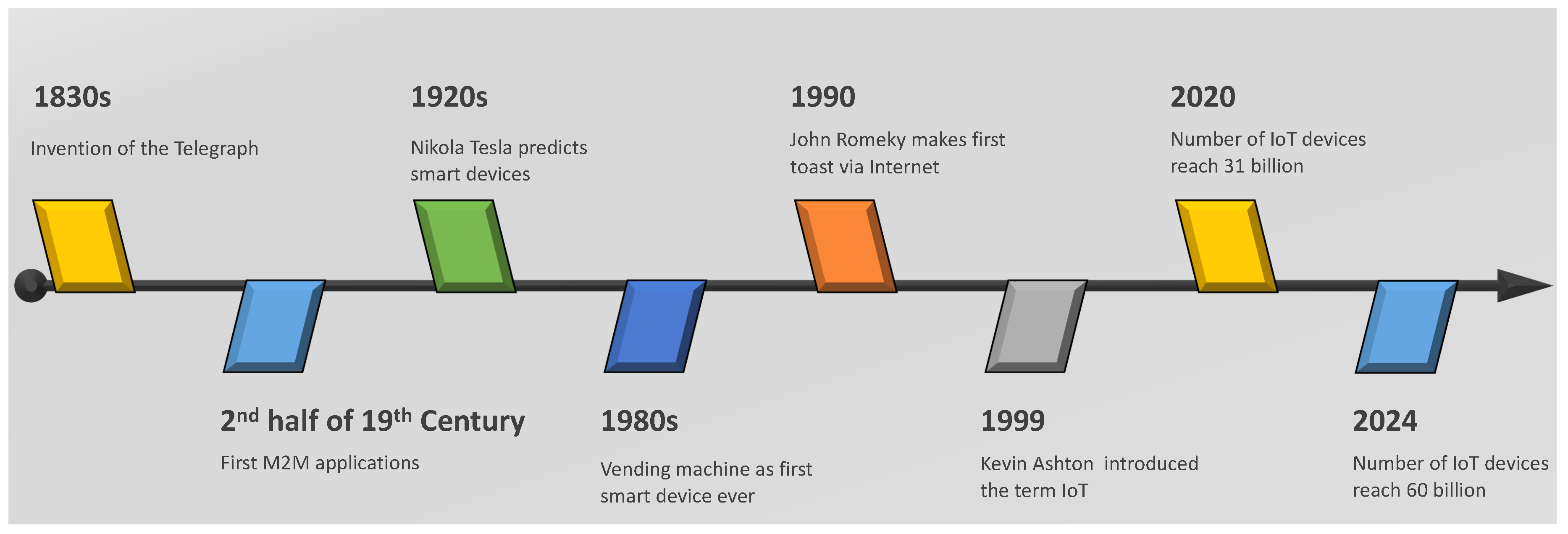
Figure 2.
Analysis Methodology
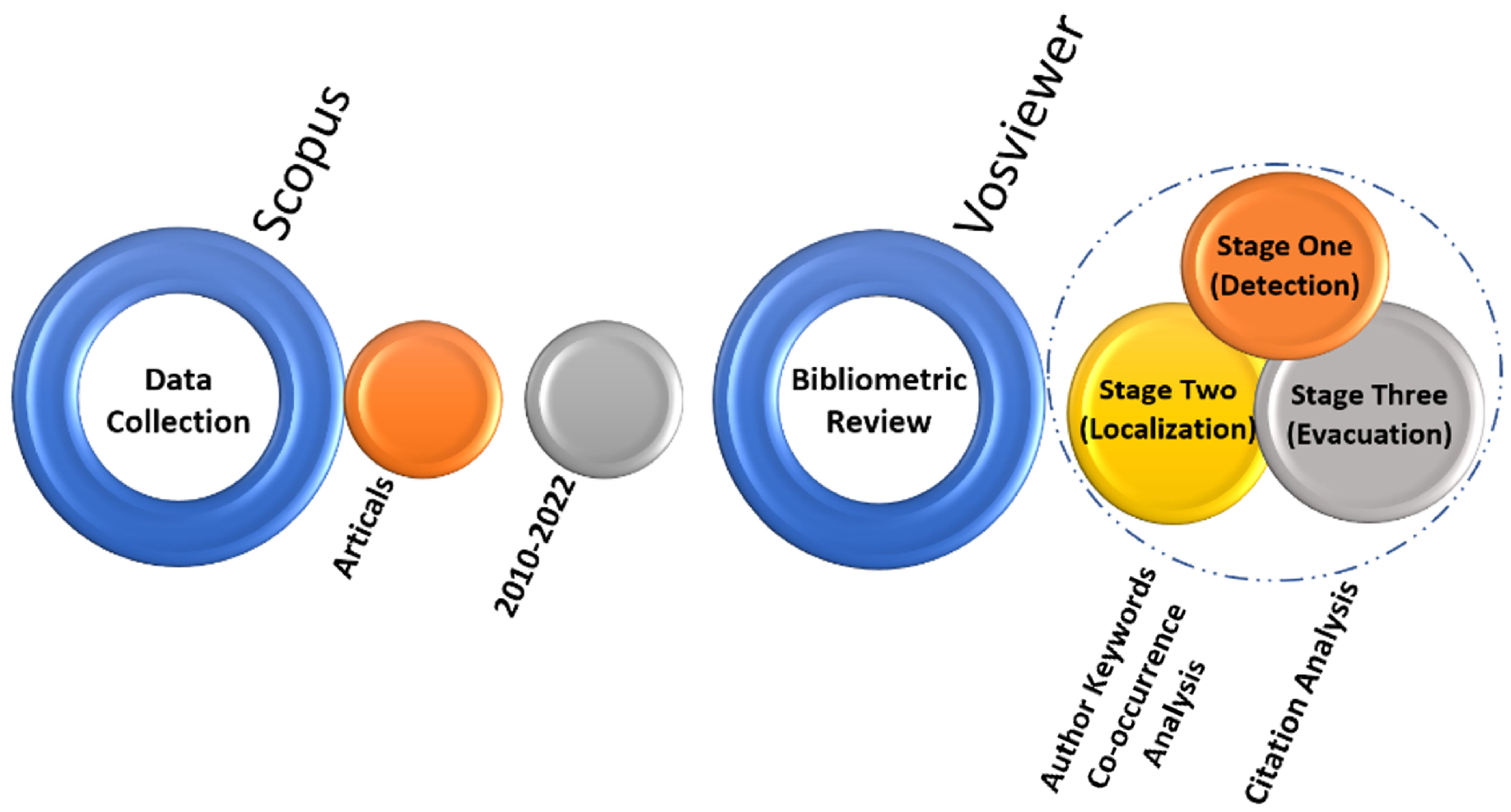
Figure 3.
Author Keywords Co-occurrence Stage One
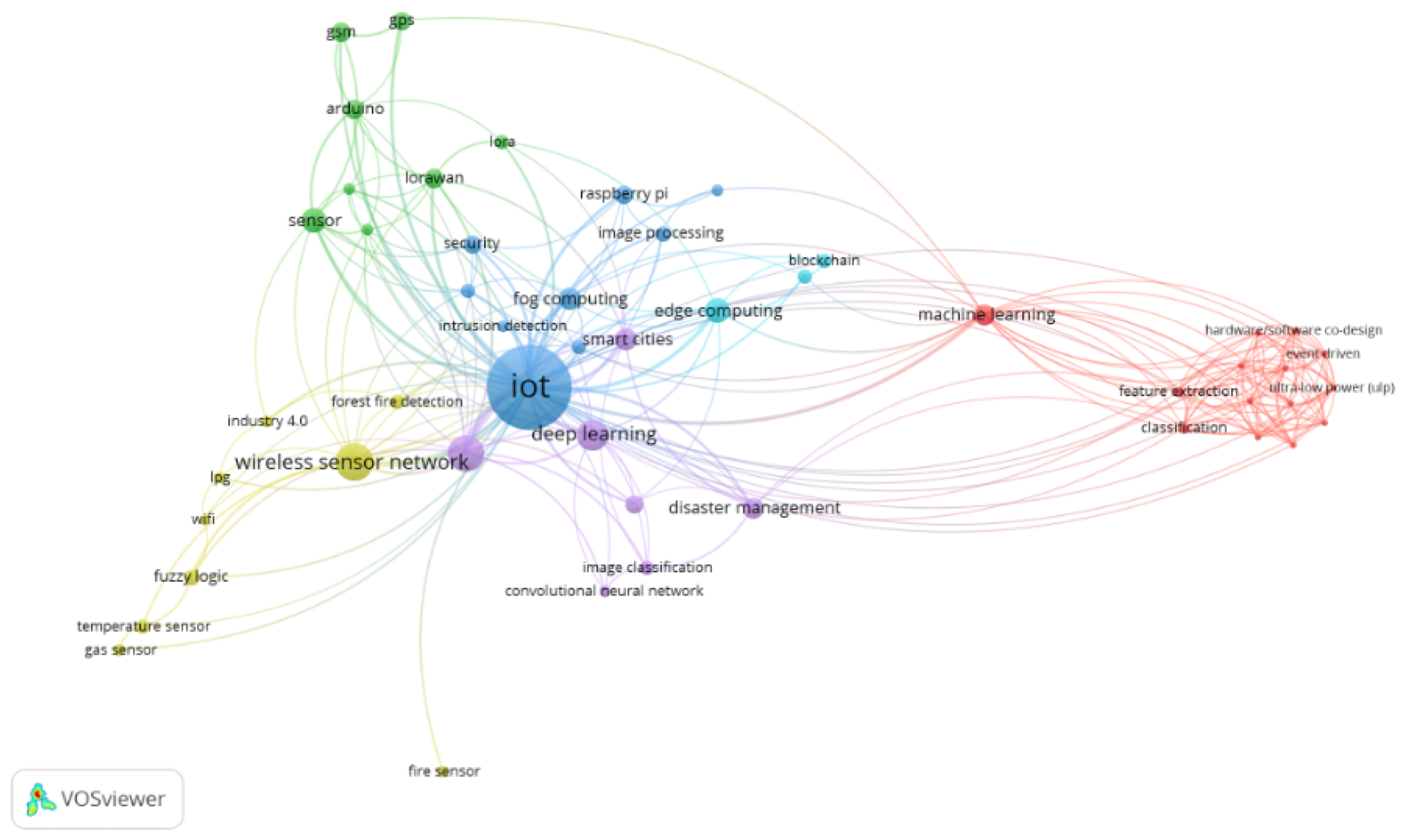
Figure 4.
Author Keywords Co-occurrence Stage Two
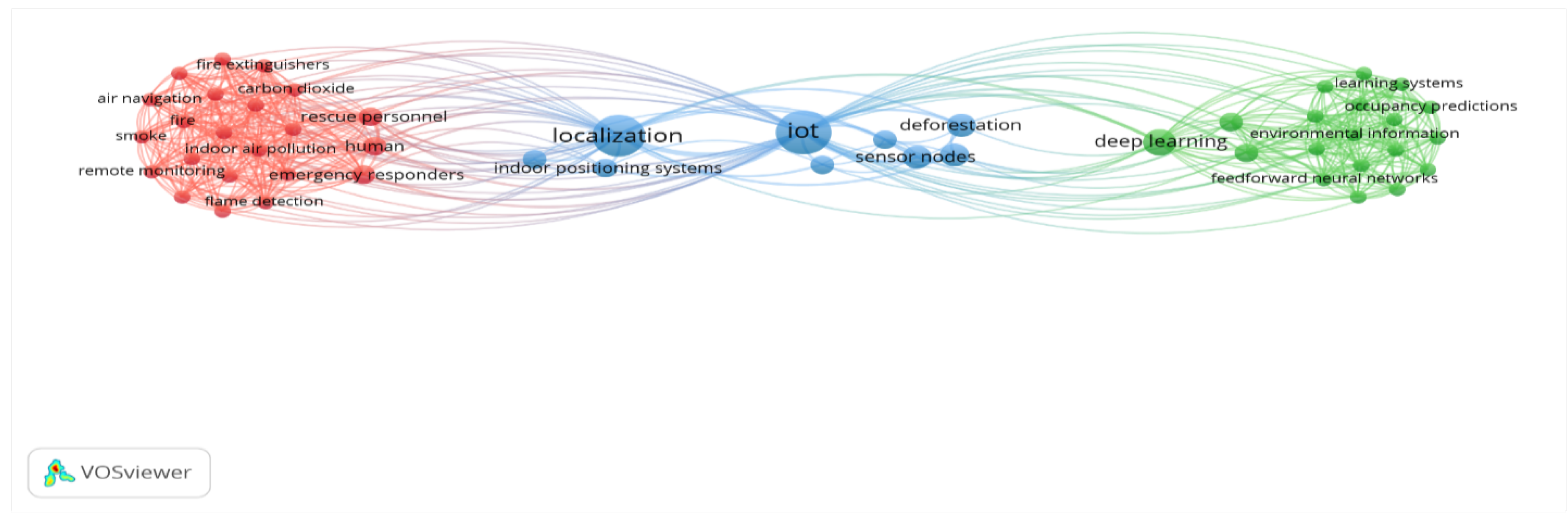
Figure 5.
Author Keywords Co-occurrence Stage Three
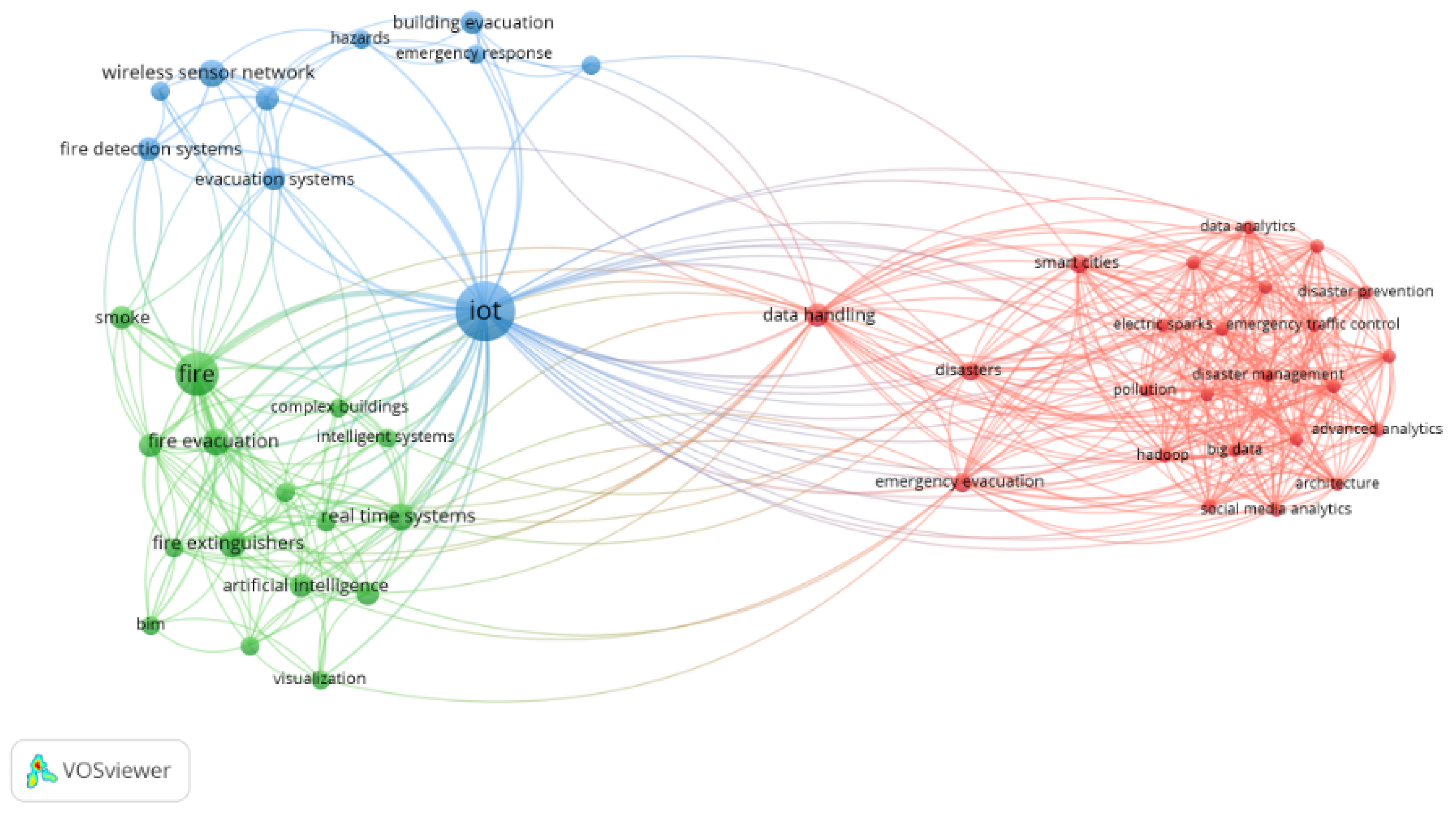
Figure 6.
Trends and Future Implications based on Bibliometric Analysis
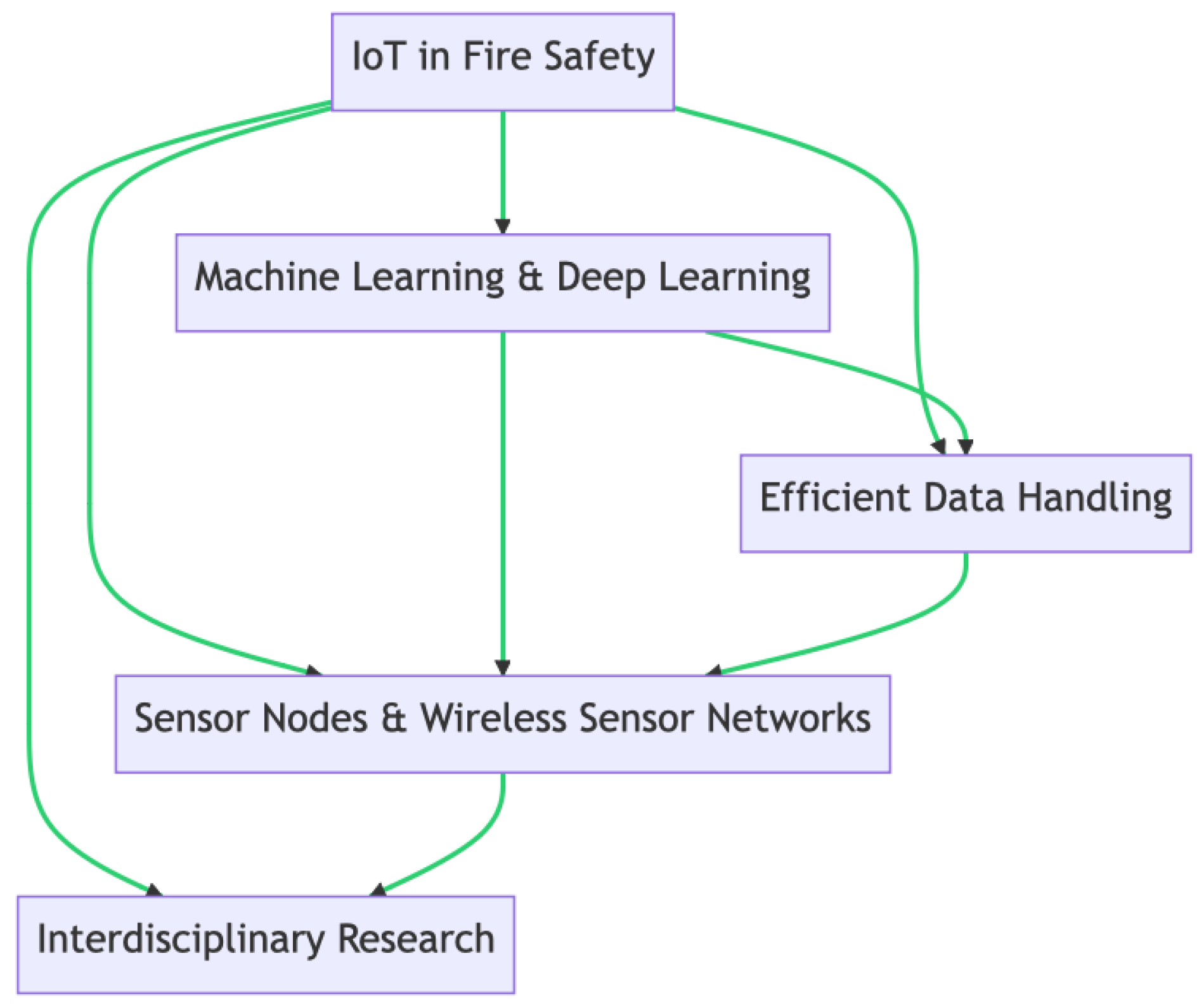

Table 1.
Comparison with other surveys, where ✓: cover the topic, ✗: does not cover the topic, and ✓ cover partially
Table 1.
Comparison with other surveys, where ✓: cover the topic, ✗: does not cover the topic, and ✓ cover partially
| Study | Bibliometric Analysis | Systematic Review | Sensors & Devices | Emerging Technologies | Protocols | Network Architecture |
|---|---|---|---|---|---|---|
| [4] | ✓ | ✓ | ✓ | ✗ | ✗ | ✗ |
| [5] | ✓ | ✓ | ✓ | ✗ | ✗ | ✗ |
| [6] | ✗ | ✓ | ✓ | ✗ | ✗ | ✗ |
| [7] | ✗ | ✓ | ✗ | ✗ | ✗ | ✗ |
| [8] | ✗ | ✓ | ✓ | ✗ | ✗ | ✗ |
| [9] | ✗ | ✓ | ✗ | ✗ | ✗ | ✗ |
| [10] | ✗ | ✓ | ✗ | ✗ | ✓ | ✗ |
| Ours | ✓ | ✓ | ✓ | ✓ | ✓ | ✓ |
Table 2.
Detection Stage
| Keyword | Occurrences | Total Link Strength |
|---|---|---|
| Anomaly detection | 4 | 10 |
| Arduino | 7 | 16 |
| Binarized neural network (bnn) | 1 | 14 |
| Blockchain | 4 | 4 |
| Classification | 2 | 17 |
| Computer-aided design | 1 | 14 |
| Convolutional neural network | 3 | 6 |
| Deep learning | 18 | 27 |
| Disaster management | 8 | 14 |
| Drone | 4 | 10 |
| Edge computing | 11 | 24 |
| Energy efficiency | 6 | 9 |
| Event driven | 1 | 14 |
| Feature extraction | 2 | 17 |
| Fire detection | 25 | 48 |
| Fire sensor | 3 | 2 |
| Fog computing | 9 | 18 |
| Forest fire | 4 | 8 |
| Forest fire detection | 4 | 8 |
| Full-wave rectifier (fwr) | 1 | 14 |
| Fuzzy logic | 5 | 10 |
| Gas sensor | 3 | 4 |
| Gps | 6 | 10 |
| Gsm | 7 | 10 |
| Hardware/software co-design | 1 | 14 |
| Image classification | 4 | 9 |
| Image processing | 5 | 9 |
| Industry 4.0 | 3 | 6 |
| Integrate and fire (iaf) | 1 | 14 |
| Intrusion detection | 3 | 4 |
| Iot | 128 | 165 |
| Localization | 4 | 9 |
| Lora | 4 | 8 |
| Lorawan | 7 | 19 |
| Low-noise amplifier (lna) | 1 | 14 |
| Lpg | 3 | 5 |
| Machine learning | 8 | 27 |
| Monitoring | 3 | 10 |
| Multilayer perceptron (mlp) | 1 | 14 |
| Raspberry pi | 6 | 10 |
| Security | 6 | 11 |
| Sensor | 12 | 24 |
| Smart cities | 9 | 21 |
| Temperature sensor | 4 | 7 |
| Ultra-low power (ulp) | 1 | 14 |
| Video processing | 3 | 5 |
| Voice activity detection (vad) | 1 | 14 |
| Wearable electronics | 1 | 14 |
| Wifi | 2 | 4 |
| Wireless sensor network | 29 | 48 |
Table 3.
Most 10 Cited Documents in Detection Stage
| Study | Citations | Links |
|---|---|---|
| [16] 2018 | 178 | 3 |
| [17] 2019 | 124 | 6 |
| [18] 2018 | 92 | 8 |
| [19] 2020 | 89 | 0 |
| [20] 2019 | 80 | 4 |
| [21] 2019 | 79 | 0 |
| [22] 2016 | 77 | 0 |
| [23] 2020 | 63 | 3 |
| [24] 2016 | 50 | 0 |
| [25] 2018 | 46 | 1 |
Table 4.
Localization Stage
| Keyword | Occurrences | Total Link Strength |
|---|---|---|
| IoT | 11 | 74 |
| Localization | 10 | 52 |
| Deep learning | 4 | 29 |
| Deforestation | 3 | 11 |
| Sensor nodes | 3 | 12 |
| Wireless sensor network | 3 | 14 |
| Data acquisition | 2 | 23 |
| Emergency responders | 2 | 29 |
| Emergency services | 2 | 7 |
| Genetic algorithms | 2 | 9 |
| Human | 2 | 29 |
| Indoor positioning systems | 2 | 9 |
| Iterative methods | 2 | 9 |
| Learning algorithms | 2 | 23 |
| Rescue personnel | 2 | 29 |
| Air navigation | 1 | 23 |
| Carbon dioxide | 1 | 23 |
| Controlled fires | 1 | 23 |
| Environmental information | 1 | 19 |
| Environmental parameter | 1 | 19 |
| Feedforward neural networks | 1 | 19 |
| Fire | 1 | 23 |
| Fire detection systems | 1 | 23 |
| Fire extinguishers | 1 | 23 |
| Flame detection | 1 | 23 |
| Forecasting | 1 | 19 |
| Indoor air pollution | 1 | 23 |
| Integrated solutions | 1 | 23 |
| Integrated systems | 1 | 23 |
| Learning systems | 1 | 19 |
| Location-based service | 1 | 23 |
| Long short-term memory | 1 | 19 |
| Object detection | 1 | 13 |
| Multilayer neural networks | 1 | 19 |
| Multivariate time series | 1 | 19 |
| Occupancy predictions | 1 | 19 |
| Parametric calibration | 1 | 19 |
| Position and orientations | 1 | 23 |
| Prediction analysis | 1 | 19 |
| Real time data acquisition | 1 | 19 |
| Real-time interventions | 1 | 23 |
| Remote monitoring | 1 | 23 |
| Risk management | 1 | 23 |
| Robots | 1 | 23 |
| Sensing technology | 1 | 23 |
| Sensors and actuators | 1 | 19 |
| Smoke | 1 | 23 |
| Support vector machines | 1 | 19 |
| Time series | 1 | 19 |
| Video processing | 1 | 23 |
Table 5.
Most 10 Cited Documents in Localization Stage
| Study | Citation | Link |
|---|---|---|
| [26] (2020) | 17 | 0 |
| [27] (2018) | 12 | 0 |
| [28] (2021) | 11 | 0 |
| [29] (2019) | 6 | 0 |
| [30] (2018) | 3 | 0 |
| [31] (2021) | 2 | 0 |
| [32] (2022) | 1 | 0 |
| [33] (2021) | 1 | 0 |
| [34] (2022) | 0 | 0 |
| [35] (2022) | 0 | 0 |
Table 6.
Most 10 Cited Documents in Evacuation Stage
| Study | Citation | Link |
|---|---|---|
| [21] (2019) | 79 | 0 |
| [36] (2018) | 66 | 0 |
| [37] (2015) | 30 | 1 |
| [38] (2019) | 28 | 2 |
| [39] (2020) | 19 | 0 |
| [40] (2019) | 15 | 0 |
| [41] (2017) | 14 | 1 |
| [42] (2022) | 11 | 0 |
| [43] (2021) | 7 | 0 |
| [44] (2020) | 5 | 1 |
Table 7.
Evacuation Stage
| Keyword | Occurrences | Total Link Strength |
|---|---|---|
| IoT | 19 | 99 |
| Fire | 10 | 49 |
| Fire evacuation | 4 | 20 |
| Fire extinguishers | 4 | 26 |
| Real time systems | 4 | 24 |
| Wireless sensor network | 4 | 11 |
| Artificial intelligence | 3 | 18 |
| Building evacuation | 3 | 8 |
| Data handling | 3 | 38 |
| Emergency services | 3 | 15 |
| Evacuation systems | 3 | 15 |
| Fire detection systems | 3 | 12 |
| Sensor networks | 3 | 21 |
| Smoke | 3 | 13 |
| User interfaces | 3 | 23 |
| BIM | 2 | 10 |
| Closed circuit television | 2 | 12 |
| Complex buildings | 2 | 16 |
| Deep learning | 2 | 16 |
| Disasters | 2 | 30 |
| Emergency evacuation | 2 | 30 |
| Emergency response | 2 | 8 |
| Hazards | 2 | 7 |
| Information management | 2 | 17 |
| Intelligent buildings | 2 | 6 |
| Intelligent systems | 2 | 13 |
| Internet | 2 | 6 |
| Smart cities | 2 | 26 |
| Smart firefighting | 2 | 17 |
| Visualization | 2 | 10 |
| Advanced analytics | 1 | 24 |
| Architecture | 1 | 24 |
| Big data | 1 | 24 |
| Data analytics | 1 | 24 |
| Disaster management | 1 | 24 |
| Disaster prevention | 1 | 24 |
| Disaster resilient smart city | 1 | 24 |
| Electric sparks | 1 | 24 |
| Emergency traffic control | 1 | 24 |
| Geo-social media analytics | 1 | 24 |
| Hadoop | 1 | 24 |
| Implementation models | 1 | 24 |
| Pollution | 1 | 24 |
| Proposed architectures | 1 | 24 |
| Reference architecture | 1 | 24 |
| Smart data analytics | 1 | 24 |
| Social media analytics | 1 | 24 |
| Social networking (online) | 1 | 24 |
| Spark | 1 | 24 |
| Vehicle actuated signals | 1 | 24 |
Table 8.
IoT Fire Safety Technologies
| Stage | Technologies |
|---|---|
| Detection |
|
| Suppression |
|
| Evacuation |
|
Table 9.
Applications of IoT in Fire Safety Systems
| Stage of Used Tech | Applications and Benefits |
|---|---|
| Detection |
|
| Suppression |
|
| Evacuation |
|
Table 10.
Summary of Emerging Technologies in IoT-based Fire Safety Systems
| Technology | Role | Benefits |
|---|---|---|
| Edge Computing | Real-time processing of sensor data | - Improved response times - Better resource allocation - Enhanced situational awareness |
| 5G and beyond | Seamless communication between system components | - Improved data rates - Reduced latency - Enhanced connectivity |
| AI and ML | Analyzing sensor data for fire patterns | - Reduced false alarms - Optimized resource deployment |
| Blockchain | Secure data storage and sharing | - Enhanced data security - Faster response times - Transparent data exchange |
| AR and VR | Enhancing situational awareness and training | - Improved decision-making - Enhanced firefighter training |
| Drones and Robotics | Assessment, monitoring, firefighting operations | - Increased efficiency - Improved safety - Potential life-saving capabilities |
| Advanced Materials and Nanotechnology | Development of fire-resistant materials, sensors, and equipment | - Improved fire detection and prevention - Reduced fire spread |
Table 11.
Comparative of Network Types
| Type | Advantages | Disadvantages |
|---|---|---|
| Wired |
|
|
| Wireless |
|
|
| Hybrid |
|
|
Table 12.
Comparative Analysis of Communication Protocols and Networks for IoT Fire Systems
| Protocol/Network | Range | Power Consumption | Data Rates | Application Suitability | Key Advantages | Key Disadvantages |
|---|---|---|---|---|---|---|
| Zigbee | Short | Low | Low |
|
|
Limited range |
| Wi-Fi | Medium | High | High |
|
|
High power consumption |
| Ethernet | Short | Low | High | Data communication in LANs |
|
Limited to wired connections |
| LoRaWAN | Long | Low | Low | Wide-area systems in large facilities |
|
Lower data rates |
| Thread | Short | Low | Low |
|
|
Limited market adoption |
| BLE | Short | Low | Low | Short-range communication among devices |
|
Limited range |
| Z-Wave | Short | Low | Low |
|
|
Proprietary nature may limit interoperability |
| Cellular Networks | Wide-area | High | High | Remote monitoring and control |
|
|
Table 13.
Evaluation of Communication Protocols and Networks for IoT Fire Systems
| Protocol/Network | Latency | Scalability | Reliability | Energy Efficiency | Security | Interoperability |
|---|---|---|---|---|---|---|
| Zigbee | Low | High | High | High | Moderate | Moderate |
| Wi-Fi | Low | Moderate | Moderate | Low | High | High |
| Ethernet | Low | High | High | Moderate | High | High |
| LoRaWAN | Moderate | High | High | High | Moderate | Low |
| Thread | Low | High | High | High | High | Moderate |
| BLE | Low | Moderate | Moderate | High | High | Moderate |
| Z-Wave | Low | High | High | High | Moderate | Low |
| Cellular Networks | Moderate | High | High | Low | High | Moderate |
| MQTT | Low | High | Moderate | Moderate | Moderate | High |
| CoAP | Low | High | Moderate | High | Moderate | Low |
Disclaimer/Publisher’s Note: The statements, opinions and data contained in all publications are solely those of the individual author(s) and contributor(s) and not of MDPI and/or the editor(s). MDPI and/or the editor(s) disclaim responsibility for any injury to people or property resulting from any ideas, methods, instructions or products referred to in the content. |
© 2024 by the authors. Licensee MDPI, Basel, Switzerland. This article is an open access article distributed under the terms and conditions of the Creative Commons Attribution (CC BY) license (http://creativecommons.org/licenses/by/4.0/).
Copyright: This open access article is published under a Creative Commons CC BY 4.0 license, which permit the free download, distribution, and reuse, provided that the author and preprint are cited in any reuse.


