
Submitted:
02 December 2024
Posted:
03 December 2024
You are already at the latest version
Abstract
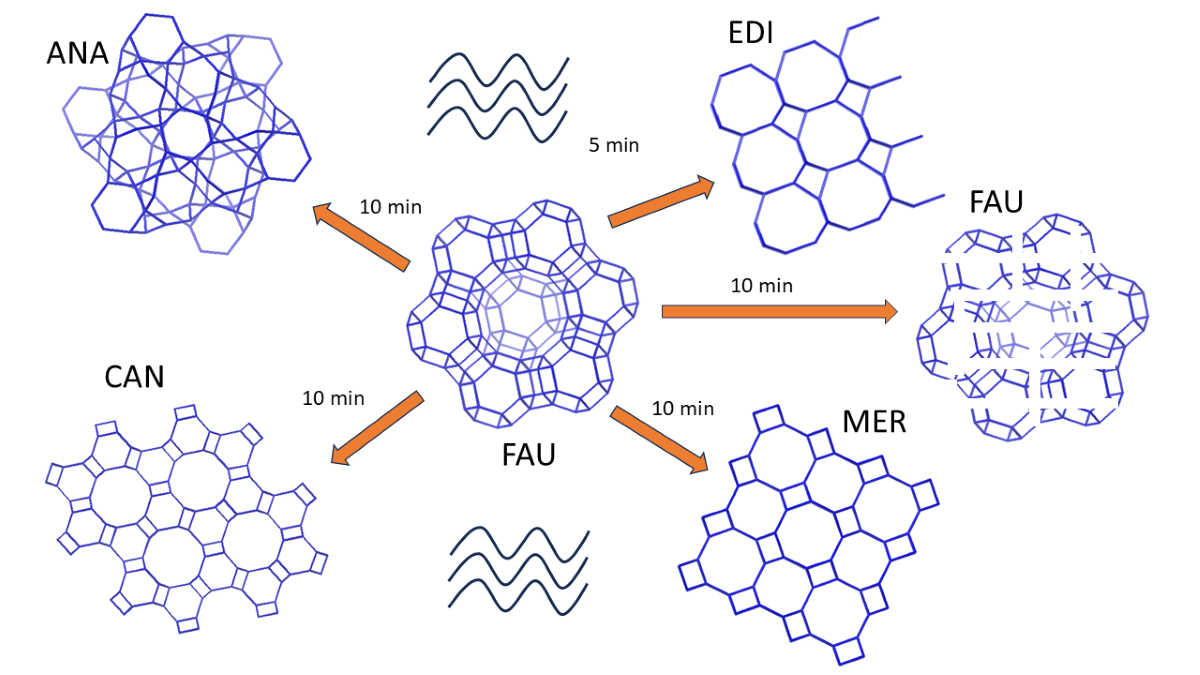
Zeolite crystallization involves complex and overlapping kinetic and thermodynamic processes, posing significant challenges to achieving precise control, especially during short crystallization periods. Microwave-assisted heating has proven effective in acceleration of zeolite crystallization from gel growth media, but its application to synthesis by interzeolite transformations is unknown. Herein, microwave-assisted heating is introduced as a method for interzeolite transformation demonstrating transformation of FAU zeolite to CAN, ANA, EDI, and MER zeolites. The microwave approach ensures interzeolite transformations within 5-10 min, which is tenths of times faster than transformations by conventional heating. This work also shows how at identical synthesis conditions the concentration of KOH directs the structure of the run product. Furthermore, the temperature control of the interzeolite transformation allows the production of pseudomorphic hierarchical particles of FAU zeolite in just 10 min without using any templating additives.
Keywords:
microwave synthesis
; interzeolite transformation
; hierarchical zeolites
; pseudomorphism
; zeolite engineering
; top-down hierarchization
1. Introduction
Zeolites are hydrated aluminosilicates whose active
synthesis began in the 1950s, driven by their commercialization in separation
and purification processes [1]. Initially, the
zeolite production has been based on the hydrothermal conversion of
aluminosilicate gels. Over time, this method proved effective not only for
zeolites but also for a variety of chemically different zeolite-like materials [2,3] and for many years, gel-based synthesis
remained the dominant method. However, in the pursuit of faster, more
sustainable, and better-controlled synthesis, an alternative technique -
interzeolite transformation (IZT) has reemerged, building on the early works of
Barrer [4]. The IZT method involves the
hydrothermal [5] or room temperature [6] transformation of a pre-existing (“parent”)
zeolite into a structurally different "daughter" zeolite. This
approach has gained significant attention due to its simplicity and potential
advantages, including faster crystallization, the ability to produce frameworks
with a high Si/Al ratio and advanced pore chemistry, the creation of hierarchical
structures, and the ability to achieve low synthesis temperatures that are
often difficult to reach using conventional gel-based zeolite synthesis [6,7,8,9,10,11]. It is important to note that IZT should not
be confused with the polymorphic transformations that occur during zeolite
crystallization from a gel medium, where no parent phase is involved. Among the
parent phases, FAU-type zeolite is one of the most studied due to its wide
availability, cost-effective synthesis, and low-density framework, which allows
transformations into a range of lower-density zeolites [12]. One such transformation is the conversion of FAU
to MER-type zeolite, reported by Kirschhock and colleagues in 2013 [13]. They used an Rb- and Na-containing hydroxide
solution and FAU zeolite with a Si/Al ratio of 2.6, obtaining MER zeolite
after 96 hours at 95 oC. Similarly, Chengyu et al. later reported the
synthesis of MER zeolite by transforming NaY and HY-FAU (Si/Al =
2.4-2.6) zeolites in a K-containing solution at 100–150 oC for 96
hours [14]. MER zeolite was also
obtained under dry conditions by the mechanochemical treatment of FAU
zeolite (Si/Al = 2.4) with KOH at 110 oC for 120 min [15]. Additionally, the conversion of
clinoptilolite-rich natural zeolite to MER has been reported [16].
EDI zeolite, another potassium-containing
zeolite, was recently synthesized by IZT of FAU in concentrated KOH
solutions, either at room temperature for 11–35 days or at 60 oC for
6–27 hours [6]. The IZT resulting in ANA-type
structures was reported in 1999 by Chiyoda and Davis, who transformed NaY
(Si/Al = 2.0–3.0) into ANA zeolite using sodium-containing solutions [17]. In 2010, Wang et al. synthesized ANA
zeolite crystals with a regular icositetrahedron morphology by transforming
ultrastable zeolite Y (Si/Al = 6.7) in NaOH solution at 100 oC for
42–288 hours [18]. In 2013, Kirschhock and
colleagues also synthesized synthetic pollucite (Cs-ANA) by IZT of FAU
zeolite (Si/Al = 2.6) in CsOH solution at 95 oC for 48 hours [13] More recently, ANA zeolite was
synthesized through mechanochemically-assisted transformation of commercial FAU
(Si/Al = 2.4) using CsOH or NaOH at 110°C for 120 min [15]. CAN zeolite was also synthesized under
similar conditions using KOH [15]. Notably,
the mechanochemically-assisted transformations of FAU are faster than
the conventional synthesis of MER and ANA, which typically take 6
hours [19] and 5–10 hours [20], respectively.
While various types of radiation, such as UV light [21,22], gamma rays [23],
and microwaves [24], have been used to control
and accelerate zeolite crystallization from gel media, similar methods have not
yet been applied to IZT-based synthesis. Microwave-assisted synthesis has been
effective in accelerating conventional zeolite synthesis, including MER
(180 oC for 12 min) [25], ANA
(120 oC for 5h) [26], and Li-EDI
(90 oC for 60 min) [27], among many
others. However, this approach remains unexplored for IZT-based zeolite
synthesis.
This work aims to introduce the first examples of
microwave-assisted interzeolite transformation and show how this method can
significantly accelerate crystallization. It also explores its potential for
controlling zeolite crystal morphology, particle size, and crystal structure.
2. Results and Discussion
Four single-phase zeolite-type structures (EDI,
MER, CAN, and ANA) were obtained by the transformation of FAU
zeolite through hydrothermal treatment under microwave radiation. Table 1
compares the fastest reported IZTs leading to EDI, MER, CAN,
and ANA zeolites and the same phases obtained in this work. The
microwave-assisted synthesis at higher temperatures assures at least 20 times
faster crystallization than the mechanochemically-assisted and at least 70
times faster than the conventional heating approach. Additionally, a
non-zeolitic aluminosilicate with a Kalsilite (KAlSiO4) [28] structure was obtained.
EDI-type zeolite was obtained for 5 min (160 oC), 10 min (160 oC), 1h (80 oC), 6h (60 and 80 oC), and 22h (60 oC) at two different KOH/FAU and H2O/KOH ratios (Figure 1a). In the system where KOH/FAU= 8.94, H2O/KOH = 0.87 at 80 oC and within 22h occurs the transformation FAU-EDI-Kalsilite (Figure 1b) that follows a path from a more porous to less porous structure (FAU 12MR > EDI 8MR > Kalsilite 6MR) (Figure 1c). The framework density (FD) change also follows the general rule of transformation from less to more dense structure (FDSi: FAU 13.3 T/1000 > EDI 16.3 T/1000 > Kalsilite 19.9 T/1000 Å3) indicating that the thermodynamically more stable phase has more framework atoms per unit volume. From a symmetry point of view, FAU (cubic) -EDI (tetragonal) -Kalsilite (hexagonal) transformations represent a sequence of change from higher to lower symmetry. At 60 °C, FAU-EDI transformation takes 6 h and after its formation EDI structure remains stable up to 22 hours, with the main difference being the relatively higher peak intensity when the synthesis time is longer (Figure 1d). At the same (6h) or shorter (10 min) time for synthesis but at higher temperatures (120 oC and 160 oC) the run product of FAU transformation is Kalsilite (Figure 1e). These results highlight the importance of temperature for control of FAU-EDI zeolite. The agitation speed during crystallization was found also to influence the IZT. While at 10 rpm and 60 oC FAU transforms to EDI, when the agitation speed is increased to 600 rpm the run product is an amorphous phase (Figure 1f). In the studied systems it was observed that at low temperatures (60-80 oC), a low homogenization speed (10 rpm) favors the formation of a single daughter phase while a high homogenization speed (1200 rpm) at higher temperatures (150-170 oC) favors the formation of a single phase, which determined the choices of homogenization speed listed in Table 2.
Figure 2a shows the time-temperature dependence of transformations of FAU zeolite in a system where KOH/FAU = 8.94 and H2O/KOH = 0.87. In general, the higher temperature accelerates the FAU-EDI transformation and at 80 oC it occurs just in 1h while at 60 oC the same process takes 6h. At more prolongated times for crystallization (22h) the low temperature (60 oC) results in EDI zeolite while for the same time of crystallization at 80 oC is formed Kalsilite. At much high temperatures (120 oC, 160 oC) the transformation FAU-Kalsilite occurs rapidly (10-60 min), and no EDI zeolite was captured. Figure 2b shows a field of crystallization with compositions that yield a single phase EDI, MER zeolite, and Kalsilite at 160 oC for 10 min of synthesis. The powder XRD patterns of phases obtained after synthesis at different H2O/KOH ratios are shown in Figure 2c. It appears that at short times for crystallization and higher temperature, the capturing of EDI zeolite requires lower KOH/FAU (2) and higher H2O/KOH (2) ratios compared to those at the low-temperature conditions in Figure 2a. The crystallization of phase pure MER zeolite is localized at KOH/FAU = 0.7-2.0 and H2O/KOH = 4.5. Compared to EDI zeolite it is clear that the synthesis of MER zeolite requires a higher H2O/KOH ratio. Independent of the KOH/FAU ratio (2-9) the high temperature promotes the crystallization of Kalsilite. Figure 2b demonstrates how adjusting the H2O/KOH ratio, while maintaining a constant KOH/FAU ratio of 2, influences the crystallization process. As the amount of KOH in the synthesis mixture decreases, the sequence of zeolite formation shifts. In particular, the sequence of formation of Kalsilite, EDI and MER follow the progressive reduction of KOH concentration, with a low amount of KOH favoring the crystallization of MER, while a high one favors the transformation into EDI zeolite and Kalsilite, respectively. When the H2O/KOH ratio deviates from the optimal value needed for the crystallization of a single-phase zeolite, secondary phases like GIS and PHI (HAR) begin to form. This is shown in Figure 2c,d, where varying the H2O/KOH ratio from the optimal value results in secondary phases. The appearance of these phases reveals the importance of alkalinity for selection of the daughter phase.
From thermodynamic perspective, the alkalinity of the solution directly impacts the Gibbs free energy (ΔG) of dissolution and hence the availability of silica and alumina species for zeolite formation. Therefore, the fine balance of solubility of silica and alumina controlled by the KOH concentration determines the availability of these species for formation of certain zeolite structure. The relationship between the H2O/KOH ratio in the growth solution and the K/(Al+Si) ratio in the parent phase shows that higher KOH concentrations reduce the free energy of formation for K-rich phases, making their formation thermodynamically favorable (Figure 2e). Considering these results one can suggest that the alkalinity not only lowers the nucleation barrier but also influences which crystalline phase forms by affecting the supersaturation levels for different phases (different polymorphs or phases have distinct solubility products and free energy profiles), interfacial energy surfaces (high alkalinity can reduce the surface energies for specific phase, thus lowering the nucleation barrier compared to other phases) and finally promote kinetically favorable phases due to rapid nucleation under high supersaturation.
Compared to the same IZT using conventional heating [6], the transformation of FAU to EDI via microwaves shows different results. At low temperature (60 oC), the transformation time (6 hours) is similar for both microwave and conventional heating methods. However, when the temperature is increased to 80 oC, microwave heating drastically reduces the crystallization time to just 1 hour, whereas with conventional heating, the product remains amorphous after the same duration (Figure S2). These results suggest that above a certain temperature, microwaves play a crucial role in accelerating crystallization.
Figure 3a shows the powder XRD patterns of samples obtained from kinetic studies conducted at KOH/FAU = 2.0 and H2O/KOH = 4.5 at 160 oC. The changes in the diffractograms reveal that the IZTs are highly sensitive to the crystallization time. After 1 min of synthesis, the parent FAU structure is mostly preserved, but a peak shift towards smaller 2-theta angles is observed. The refinement of the unit cell shows a lattice parameter a = 24.93 Å, which corresponds to Si/Al = 1.3 and indicates a transformation of the parent zeolite Y into zeolite X. After 5 min of synthesis, the FAU structure transforms into a mixture of MER, CHA and GME zeolites. After 10 min of heating crystallize phase pure MER zeolite, which, after 60 min, transforms into a mixture of MER and NAT zeolites (Figure 3b). These results demonstrate that the IZTs are effectively controlled by the crystallization time.
MER zeolite was also obtained after 5 min at 150 oC and 1h at 160°C (Figure S1). The synthesis of MER zeolite is temperature-sensitive: at 150 oC, 160°C, or 170 oC, MER crystallizes in 10 min, but when the temperature is reduced to 140 oC, the parent FAU zeolite is preserved but with larger unit cell.
Figure 3c shows powder XRD patterns of the phases obtained after 10 min of synthesis at different temperatures in the system KOH/FAU = 2 and H2O/KOH = 4.5. At 130 oC and 140 oC, the parent FAU structure is maintained, but there is a shift of XRD reflections (in the 20-35° 2θ range) towards smaller angles. The refined powder XRD pattern revealed a FAU unit cell (a = 24.91 Å) that corresponds to a Si/Al ratio of 1.3. This value is slightly lower than the value determined by EDS analysis (1.7), which indicates the presence of an amorphous silica. The lowest temperature at which MER zeolite crystallizes is 150 oC. At 160 oC, MER zeolite also forms but with lower crystallinity compared to the phase obtained at 170 oC.
Figure 3d shows the powder XRD patterns for the transformation of FAU to ANA and FAU to CAN zeolites. The FAU-ANA IZT was achieved at CsOH/FAU = 2.7 and H2O/CsOH = 2.59 (at 170 oC for 1 hour), resulting in Cs-ANA with a Si/Al ratio of 3.3. A similar FAU-ANA transformation occurred at CsOH/FAU = 1.42 (at 160 oC for 10 min) with H2O/CsOH = 4.9, producing Cs-ANA with a Si/Al ratio of 2.6. The shorter synthesis time and lower temperature led to more intense XRD reflections, indicating improved crystallinity. These results demonstrate that both the framework composition and crystallinity can be effectively controlled by adjusting the synthesis conditions. CAN zeolite was synthesized at NaOH/FAU = 2 and NaOH/CsOH = 4.5 at 160 oC for 10 min, resulting in framework with a Si/Al ratio of 1.2.
Figure 4a shows an SEM image of the parent FAU zeolite transformed into hierarchical FAU (Figure 4a-c) and MER zeolites (Figure 4d-f). The FAU samples obtained after synthesis at 130 oC (Figure 4b) and 140 oC (Figure 4c) (with KOH/FAU = 2 and H2O/KOH = 4.5) exhibit hierarchical structures formed by the dissolution of the parent FAU phase. This dissolution occurs in such a way that the initial shape of the FAU particles is retained, but numerous nanofins are carved into the psrent particles. Compared to previous examples of post-synthetic treatment of FAU zeolites that result in hierarchal structures [10,30,31], the microwave-assisted approach show potential for more simple (organic-free) and faster crystal hierarchization. By keeping the initial batch composition, the same but increasing the synthesis temperature to 150 oC (Figure 4d), 160 oC (Figure 4e), or 170 oC (Figure 4f), the FAU zeolite transforms into MER zeolite with Si/Al ratio = 1.6–1.7. At the higher synthesis temperature (170 oC), the MER zeolite crystals are better faceted and more abundant compared to those obtained at the lower temperatures.
Figure 5 shows a schematic model of the pathways of FAU transformation where the parent FAU can be selectively transformed to hierarchal FAU with a lower Si/Al ratio or to a MER zeolite. The transformation is controlled by simple temperature adjustment that has previously been shown to have a significant effect on the crystallization route [32].
Figure 6 shows SEM images of EDI zeolite obtained through IZT under different conditions. The FAU-EDI transformation (KOH/FAU = 8.94 and H2O/KOH = 0.87) at 60 oC, regardless of the synthesis time (6 or 22 hours), results in nanoparticles (Figure 6a,b). At 80 oC, short synthesis times (1 hour) also lead to nanoparticles (Figure 6c), but when the synthesis time is increased to 6 hours, larger prismatic particles form (Figure 6d). Figure 6e,f shows EDI zeolite obtained at 160 oC (KOH/FAU = 2.0 and H2O/KOH = 2.0), after 5 and 10 min of crystallization, respectively. Despite the relatively short crystallization times, the EDI zeolite forms well-shaped, intergrown prismatic particles that range from submicron to micrometric sizes. These results demonstrate that, although the higher temperature accelerates the crystallization process, faster crystallization does not result in smaller crystals.
Figure 7a,b shows SEM images of ANA zeolites synthesized by the transformation of FAU zeolite under two different conditions: (1) 170 oC for 1 hour (with CsOH/FAU = 2.7 and H2O/CsOH = 2.59) (Figure 7a) and (2) 160 oC for 10 min (with CsOH/FAU = 1.42 and H2O/CsOH = 4.9) (Figure 7b). In both cases, ANA zeolite crystallizes as aggregates of submicron, sphere-like particles. In the first system (170 oC for 1 hour), the submicron particles are decorated with second-generation nanoparticles (50-70 nm). This feature is absent in the second system (160 oC for 10 min), suggesting that the differences in supersaturation lead to secondary nucleation and growth in the first system, but not in the second. Additionally, in a system where NaOH/FAU = 2 and H2O/NaOH = 4.5, FAU zeolite transforms into a CAN-type structure at 160 oC in 10 min. The resulting phase crystallizes as micrometric intergrowths of prismatic crystals, which is typical for CAN-type materials [33].
3. Experimental
The IZT transformations were performed using a parent FAU zeolite with Si/Al ratio close to 3.0 (±0.1) synthesized by a previously reported procedure [6]. The obtained parent phase was placed in alkaline solutions of NaOH (≥98%, Sigma-Aldrich), KOH (90%, Sigma-Aldrich), and CsOH∙H2O (≥90%, Sigma-Aldrich) following the conditions described in Table 2. As a base for all synthesis was used 0.5 g of FAU zeolite. The crystallization was performed using a microwave reactor Monowave 400 (Anton Paar) and a SiC autoclave. The time for reaching the desired temperature was 5 min for all synthesis. After the synthesis, each sample was filtered and washed with distilled water.
The powder X-ray diffraction (XRD) patterns were obtained using a Bruker D8 Discover diffractometer working with copper radiation (λ1 = 1.5406 Å, λ2 = 1.5444 Å) in θ-2θ mode and using step size 0.04°, time per step 0.2 s and a LynxEye detector. Phase identification and quantification were carried out using the EVA software (Bruker AXS) with integrated database of the International Center for Diffraction Data (ICDD). Unit cell parameters were refined using the Le Bail method with TOPAS-3 (Bruker AXS) software. The Si/Al ratios in the FAU samples were calculated by the Breck-Flanigen correlation: Si/Al = ((192 × 0.00868)/(a0 – 24.191)) – 1) [34]. Scanning electron microscopy (SEM) micrographs and energy dispersive spectroscopy (EDS) chemical analysis were performed on a NanoSEM-FEI Nova 200 equipped with an EDAX Pegasus X4M detector.
4. Conclusions
This work introduces microwave radiation in the synthesis of zeolites by interzeolite transformation. This approach provides control over the particle size and fast access to zeolite structures such as EDI, MER, ANA and CAN. An additional derivate of the microwave-assisted IZT is the introduction of an alternative pathway to hierarchical faujasites by fast desilication of a parent zeolite in a short time. In perspective, further development of the microwave-assisted IZT is expected to result in other zeolite framework types.
Supplementary Materials
The following supporting information can be downloaded at the website of this paper posted on Preprints.org.
Funding
This research was funded by Fundação para a Ciência e Tecnologia: UIDB/04650/2020–2023.
Institutional Review Board Statement
Not applicable.
Informed Consent Statement
Not applicable.
Data Availability Statement
The data presented in this study are available in this article.
Acknowledgments
S.F. thanks SEMAT (University of Minho) for the support.
Conflicts of Interest
The author declares no conflicts of interest.
References
- Mallette, A.J.; Shilpa, K.; Rimer, J.D. The Current Understanding of Mechanistic Pathways in Zeolite Crystallization. Chemical Reviews 2024, 124, 3416–3493. [Google Scholar] [CrossRef]
- Ferdov, S.; Shivachev, B.; Koseva, I.; Petrova, P.; Petrova, N.; Titorenkova, R.; Nikolova, R. Metastable microporous lanthanide silicates – Light emitters capable of 3D-2D-3D transformations. Chemical Engineering Journal 2024, 492, 152355. [Google Scholar] [CrossRef]
- Rocha, J.; Anderson, M.W. Microporous titanosilicates and other novel mixed octahedral-tetrahedral framework oxides. European Journal of Inorganic Chemistry 2000, 801–818. [Google Scholar] [CrossRef]
- Barrer, R.; Hinds, L.; White, E. 299. The hydrothermal chemistry of silicates. Part III. Reactions of analcite and leucite. Journal of the Chemical Society (Resumed) 1953, 1466–1475. [Google Scholar] [CrossRef]
- Sano, T.; Itakura, M.; Sadakane, M. High Potential of Interzeolite Conversion Method for Zeolite Synthesis. Journal of the Japan Petroleum Institute 2013, 56, 183–197. [Google Scholar] [CrossRef]
- Ferdov, S. Interzeolite Transformation from FAU-to-EDI Type of Zeolite. Molecules (Basel, Switzerland) 2024, 29, 1744. [Google Scholar] [CrossRef] [PubMed]
- Devos, J.; Robijns, S.; Van Goethem, C.; Khalil, I.; Dusselier, M. Interzeolite Conversion and the Role of Aluminum: Toward Generic Principles of Acid Site Genesis and Distributions in ZSM-5 and SSZ-13. Chem. Mater. 2021, 33, 2516–2531. [Google Scholar] [CrossRef]
- Jain, R.; Mallette, A.J.; Rimer, J.D. Controlling Nucleation Pathways in Zeolite Crystallization: Seeding Conceptual Methodologies for Advanced Materials Design. J Am Chem Soc 2021, 143, 21446–21460. [Google Scholar] [CrossRef] [PubMed]
- Pornsetmetakul, P.; Coumans, F.J.A.G.; Heinrichs, J.M.J.J.; Zhang, H.; Wattanakit, C.; Hensen, E.J.M. Accelerated Synthesis of Nanolayered MWW Zeolite by Interzeolite Transformation. Chemistry – A European Journal 2024, 30, e202302931. [Google Scholar] [CrossRef] [PubMed]
- Mendoza-Castro, M.J.; De Oliveira-Jardim, E.; Ramírez-Marquez, N.-T.; Trujillo, C.-A.; Linares, N.; García-Martínez, J. Hierarchical Catalysts Prepared by Interzeolite Transformation. J. Am. Chem. Soc. 2022, 144, 5163–5171. [Google Scholar] [CrossRef] [PubMed]
- Barbosa, J.C.; Correia, D.M.; Salado, M.; Gonçalves, R.; Ferdov, S.; de Zea Bermudez, V.; Costa, C.M.; Lanceros-Mendez, S. Three-Component Solid Polymer Electrolytes Based on Li-Ion Exchanged Microporous Silicates and an Ionic Liquid for Solid-State Batteries. Advanced Engineering Materials, 2023; 25, 2200849. [Google Scholar] [CrossRef]
- Bruter, D.V.; Pavlov, V.S.; Ivanova, I.I. Interzeolite Transformations as a Method for Zeolite Catalyst Synthesis. Petroleum Chemistry 2021, 61, 251–275. [Google Scholar] [CrossRef]
- Van Tendeloo, L.; Gobechiya, E.; Breynaert, E.; Martens, J.A.; Kirschhock, C.E.A. Alkaline cations directing the transformation of FAU zeolites into five different framework types. Chem. Commun. 2013, 49, 11737–11739. [Google Scholar] [CrossRef] [PubMed]
- Hu, C.; Yan, W.; Xu, R. Phase Transition Behavior of Zeolite Y under Hydrothermal Conditions. Acta Chimica Sinica 2017, 75, 679–685. [Google Scholar] [CrossRef]
- Jakupec, N.; Ardila-Fierro, K.J.; Martinez, V.; Halasz, I.; Volavšek, J.; Algara-Siller, G.; Etter, M.; Valtchev, V.; Užarević, K.; Palčić, A. Mechanochemically Induced OSDA-Free Interzeolite Conversion. ACS Sustainable Chemistry & Engineering 2024, 12, 5220–5228. [Google Scholar] [CrossRef]
- Pérez González, N.K.; Díaz Guzmán, D.; Vargas Ramírez, M.; Legorreta García, F.; Chávez Urbiola, E.A.; Trujillo Villanueva, L.E.; Ramírez Cardona, M. Interzeolite conversion of a clinoptilolite-rich natural zeolite into merlinoite. Boletín de la Sociedad Española de Cerámica y Vidrio 2024. [Google Scholar] [CrossRef]
- Chiyoda, O.; Davis, M.E. Hydrothermal conversion of Y-zeolite using alkaline-earth cations. Micropo. Mesopor. Mater. 1999, 32, 257–264. [Google Scholar] [CrossRef]
- Wang, Y.; Li, X.; Xue, Z.; Dai, L.; Xie, S.; Li, Q. Preparation of Zeolite ANA Crystal from Zeolite Y by in Situ Solid Phase Iso-Structure Transformation. The Journal of Physical Chemistry B 2010, 114, 5747–5754. [Google Scholar] [CrossRef]
- Hu, Z.; Zhao, B.; Zhang, S.; Tan, Z.; Liu, X.; Cao, J. Rapid and high efficient synthesis of zeolite W by gel-like-solid phase method. Microporous and Mesoporous Materials 2019, 281, 75–83. [Google Scholar] [CrossRef]
- Novembre, D.; Gimeno, D. Synthesis and characterization of analcime (ANA) zeolite using a kaolinitic rock. Scientific Reports 2021, 11, 13373. [Google Scholar] [CrossRef]
- Ferdov, S.; Marques, J.; Tavares, C.J.; Lin, Z.; Mori, S.; Tsunoji, N. UV-light assisted synthesis of high silica faujasite-type zeolite. Micropo. Mesopor. Mater. 2022, 336. [Google Scholar] [CrossRef]
- Shi, D.; Xu, L.; Chen, P.; Ma, T.; Lin, C.; Wang, X.; Xu, D.; Sun, J. Hydroxyl free radical route to the stable siliceous Ti-UTL with extra-large pores for oxidative desulfurization. Chemical Communications 2019, 55, 1390–1393. [Google Scholar] [CrossRef] [PubMed]
- Chen, X.; Qiu, M.; Li, S.; Yang, C.; Shi, L.; Zhou, S.; Yu, G.; Ge, L.; Yu, X.; Liu, Z.; et al. Gamma-Ray Irradiation to Accelerate Crystallization of Mesoporous Zeolites. Angewandte Chemie International Edition 2020, 59, 11325–11329. [Google Scholar] [CrossRef]
- Yoshioka, T.; Liu, Z.; Iyoki, K.; Chokkalingam, A.; Yonezawa, Y.; Hotta, Y.; Ohnishi, R.; Matsuo, T.; Yanaba, Y.; Ohara, K.; et al. Ultrafast and continuous-flow synthesis of AFX zeolite via interzeolite conversion of FAU zeolite. Reaction Chemistry & Engineering 2021, 6, 74–81. [Google Scholar] [CrossRef]
- Cheong, Y.-W.; Wong, K.-L.; Ling, T.C.; Ng, E.-P. Rapid synthesis of nanocrystalline zeolite W with hierarchical mesoporosity as an efficient solid basic catalyst for nitroaldol Henry reaction of vanillin with nitroethane. Materials Express 2018, 8, 463–468. [Google Scholar] [CrossRef]
- Tatlier, M.; Barış Cigizoglu, K.; Tokay, B.; Erdem-Şenatalar, A. Microwave vs. conventional synthesis of analcime from clear solutions. Journal of Crystal Growth 2007, 306, 146–151. [Google Scholar] [CrossRef]
- Sathupunya, M.; Gulari, E.; Wongkasemjit, S. Microwave preparation of Li-zeolite directly from alumatrane and silatrane. Materials Chemistry and Physics 2004, 83, 89–95. [Google Scholar] [CrossRef]
- Khomyakov, A.P.; Nechelyustov, G.N.; Sokolova, E.; Bonaccorsi, E.; Merlino, S.; Pasero, M. Megakalsilite, a New Polymorph of KAISiO4 from the Khibina Alkaline Massif, Kola Peninsula, Russia: Mineral Description and Crystal Structure. The Canadian Mineralogist 2002, 40, 961–970. [Google Scholar] [CrossRef]
- Yuan, J.; Ma, H.; Luo, Z.; Ma, X.; Guo, Q. Synthesis of KAlSiO4 by Hydrothermal Processing on Biotite Syenite and Dissolution Reaction Kinetics. Minerals 2021, 11, 36. [Google Scholar] [CrossRef]
- Verboekend, D.; Nuttens, N.; Locus, R.; Van Aelst, J.; Verolme, P.; Groen, J.C.; Pérez-Ramírez, J.; Sels, B.F. Synthesis, characterisation, and catalytic evaluation of hierarchical faujasite zeolites: Milestones, challenges, and future directions. Chemical Society Reviews 2016, 45, 3331–3352. [Google Scholar] [CrossRef] [PubMed]
- Verboekend, D.; Vilé, G.; Pérez-Ramírez, J. Hierarchical Y and USY Zeolites Designed by Post-Synthetic Strategies. Advanced Functional Materials 2012, 22, 916–928. [Google Scholar] [CrossRef]
- Ferdov, S. Conventional synthesis of layer-like zeolites with faujasite (FAU) structure and their pathway of crystallization. Micropo. Mesopor. Mater. 2020, 303. [Google Scholar] [CrossRef]
- Amin, I.I.; Wahab, A.W.; Mukti, R.R.; Taba, P. Synthesis and characterization of zeolite type ANA and CAN framework by hydrothermal method of Mesawa natural plagioclase feldspar. Applied Nanoscience 2023, 13, 5389–5398. [Google Scholar] [CrossRef]
- Breck, D.W.; Flanigen, E.M. Synthesis and properties of union carbide zeolites L, X and Y. In Molecular Sieves; Society of Chemical Industry: London, 1968; pp. 47–60. [Google Scholar]
Figure 1.
(a) Powder XRD patterns of EDI zeolite obtained by IZT of FAU zeolite for 5 min (160 oC), 10 min (160 oC) [KOH/FAU= 2, H2O/KOH = 2], 1 h (80 oC), 6 h (60 oC) and 22 h (60 oC) [KOH/FAU= 8.94, H2O/KOH = 0.87] (the vertical lines show the calculated peak positions). (b) Powder XRD patterns showing time-dependent FAU-EDI-Kalsilite transformation at 80 oC (KOH/FAU = 8.94 and H2O/KOH = 0.87). (c) A diagram showing the changes of framework density and pore size during FAU-EDI-Kalsilite transformation. (d) Powder XRD patterns showing time-dependent FAU-EDI transformation at 60 oC. (e) Powder XRD patterns showing EDI-Kalsilite transformation at different temperatures [KOH/FAU= 8.94, H2O/KOH = 0.87]. (f) Powder XRD patterns show the influence of homogenization speed on the EDI-FAU transformation at 60 oC [KOH/FAU= 8.94, H2O/KOH = 0.87].
Figure 1.
(a) Powder XRD patterns of EDI zeolite obtained by IZT of FAU zeolite for 5 min (160 oC), 10 min (160 oC) [KOH/FAU= 2, H2O/KOH = 2], 1 h (80 oC), 6 h (60 oC) and 22 h (60 oC) [KOH/FAU= 8.94, H2O/KOH = 0.87] (the vertical lines show the calculated peak positions). (b) Powder XRD patterns showing time-dependent FAU-EDI-Kalsilite transformation at 80 oC (KOH/FAU = 8.94 and H2O/KOH = 0.87). (c) A diagram showing the changes of framework density and pore size during FAU-EDI-Kalsilite transformation. (d) Powder XRD patterns showing time-dependent FAU-EDI transformation at 60 oC. (e) Powder XRD patterns showing EDI-Kalsilite transformation at different temperatures [KOH/FAU= 8.94, H2O/KOH = 0.87]. (f) Powder XRD patterns show the influence of homogenization speed on the EDI-FAU transformation at 60 oC [KOH/FAU= 8.94, H2O/KOH = 0.87].
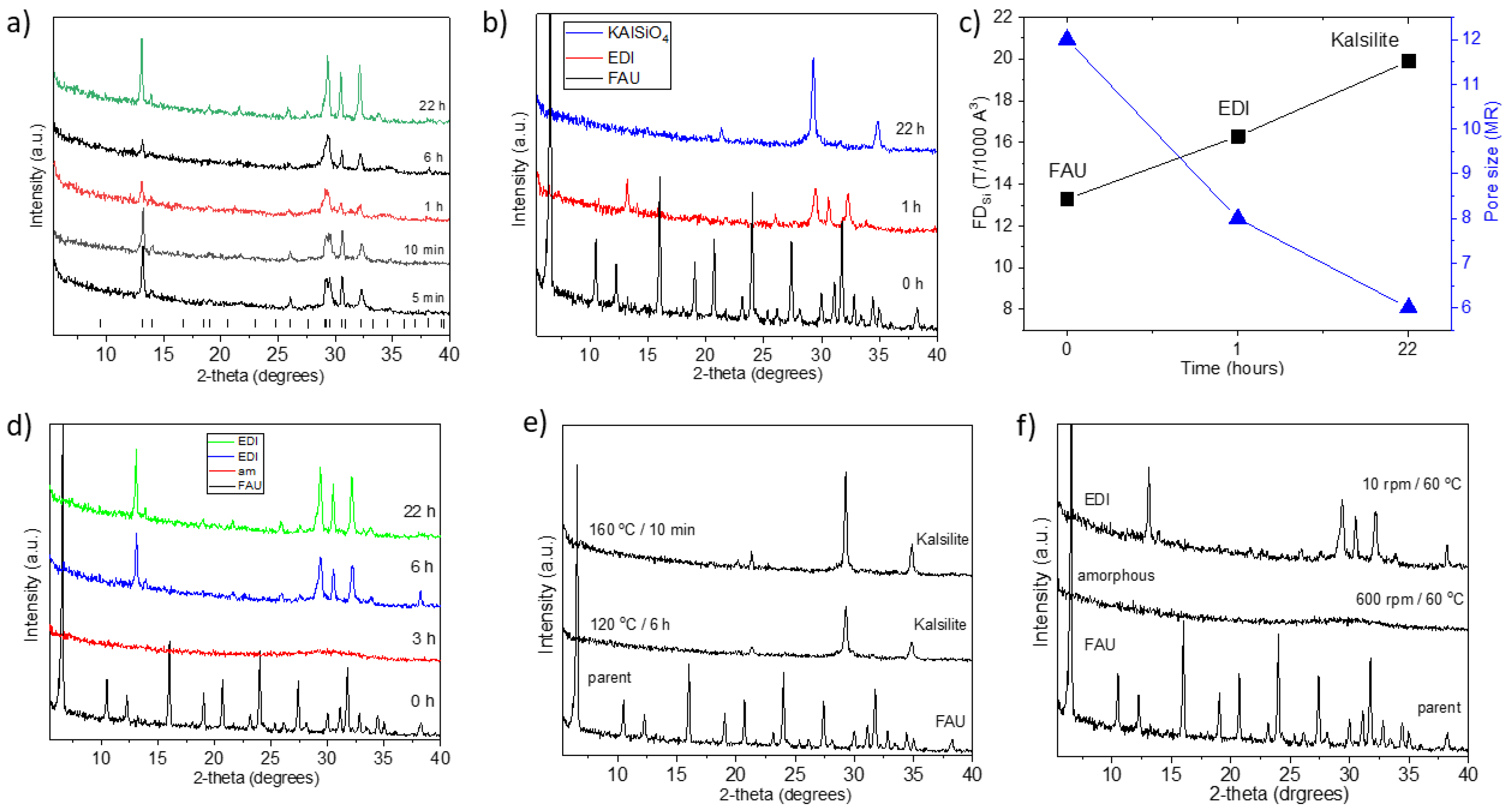
Figure 2.
(a) Time/temperature relationships during IZT of FAU at KOH/FAU = 8.94 and H2O/KOH = 0.87. (b) Selected compositions from the field of crystallization yielding phase pure materials at 160 oC for 10 min. (c) Powder XRD patterns showing the transformation of FAU zeolite at 160 oC for 10 min after changing the H2O/KOH ratio at fixed KOH/FAU = 2. (d) Composition of the run product obtained after transformation of FAU zeolite at 160 oC for 10 min at different H2O/KOH ratio. (e) Relationship between the H2O/KOH ratio in the growth solution and the K/(Al+Si) ratio in the parent phase. Rising alkalinity affects both the nucleation barrier and phase selection.
Figure 2.
(a) Time/temperature relationships during IZT of FAU at KOH/FAU = 8.94 and H2O/KOH = 0.87. (b) Selected compositions from the field of crystallization yielding phase pure materials at 160 oC for 10 min. (c) Powder XRD patterns showing the transformation of FAU zeolite at 160 oC for 10 min after changing the H2O/KOH ratio at fixed KOH/FAU = 2. (d) Composition of the run product obtained after transformation of FAU zeolite at 160 oC for 10 min at different H2O/KOH ratio. (e) Relationship between the H2O/KOH ratio in the growth solution and the K/(Al+Si) ratio in the parent phase. Rising alkalinity affects both the nucleation barrier and phase selection.
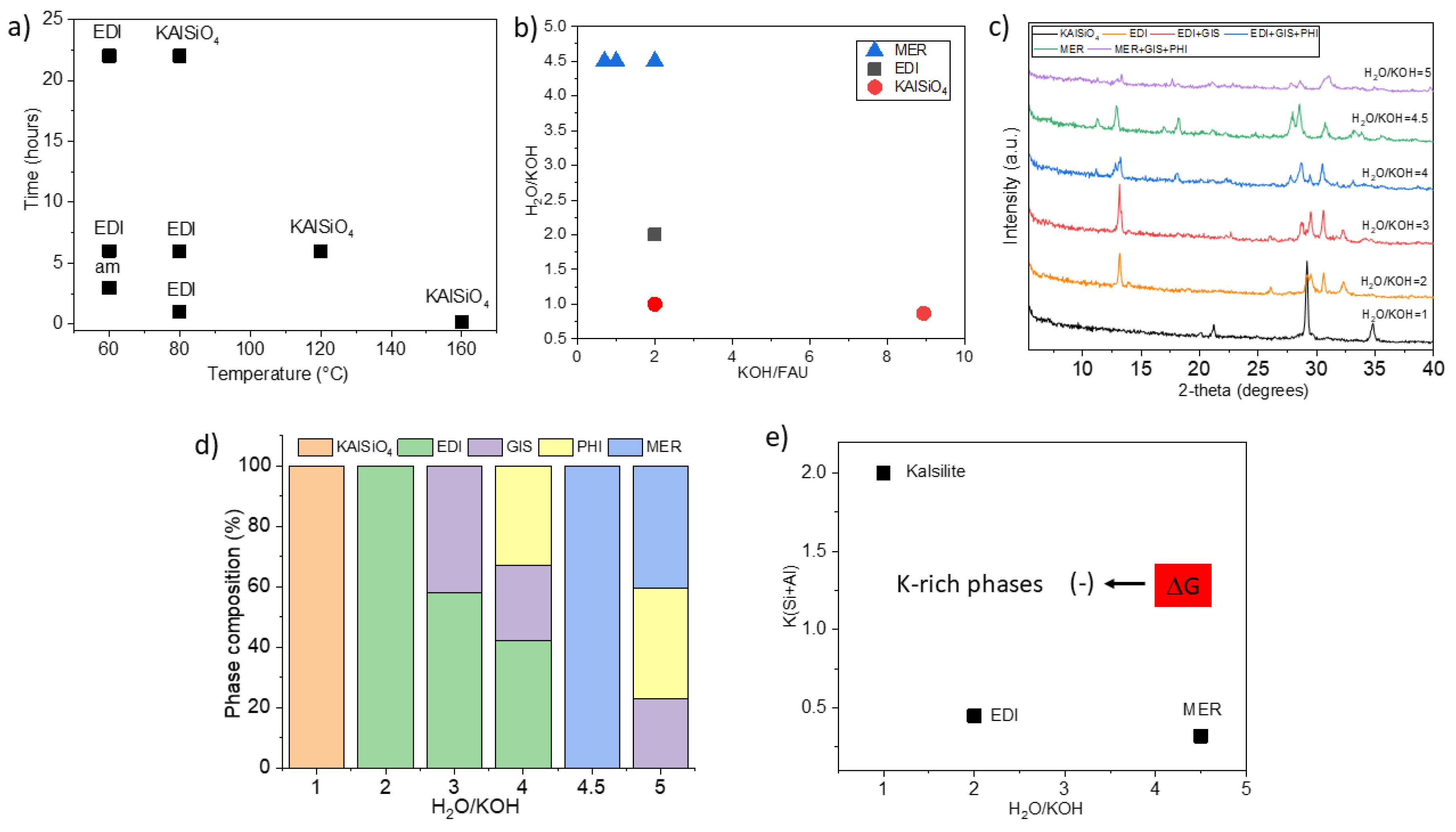
Figure 3.
(a) Powder XRD patterns showing the transformation of FAU zeolite at different times at 160 oC KOH/FAU = 2 and H2O/KOH = 4.5. (b) Phase composition of the run product after different times for synthesis. (c) Powder XRD patterns of zeolites obtained by IZT of FAU at different temperature in the system KOH/FAU = 2 and H2O/KOH = 4.5. (d) Powder XRD patterns of transformation of (i) FAU to ANA zeolite at CsOH/FAU = 2.7 and H2O/CsOH = 2.59 (170 oC for 1h). (iii) ANA zeolite at CsOH/FAU = 1.42 (160 oC for 10 min) and H2O/CsOH = 4.9. (iv) CAN zeolite obtained at NaOH/FAU = 2 and NaOH/CsOH = 4.5 at 160 oC for 10 min.
Figure 3.
(a) Powder XRD patterns showing the transformation of FAU zeolite at different times at 160 oC KOH/FAU = 2 and H2O/KOH = 4.5. (b) Phase composition of the run product after different times for synthesis. (c) Powder XRD patterns of zeolites obtained by IZT of FAU at different temperature in the system KOH/FAU = 2 and H2O/KOH = 4.5. (d) Powder XRD patterns of transformation of (i) FAU to ANA zeolite at CsOH/FAU = 2.7 and H2O/CsOH = 2.59 (170 oC for 1h). (iii) ANA zeolite at CsOH/FAU = 1.42 (160 oC for 10 min) and H2O/CsOH = 4.9. (iv) CAN zeolite obtained at NaOH/FAU = 2 and NaOH/CsOH = 4.5 at 160 oC for 10 min.
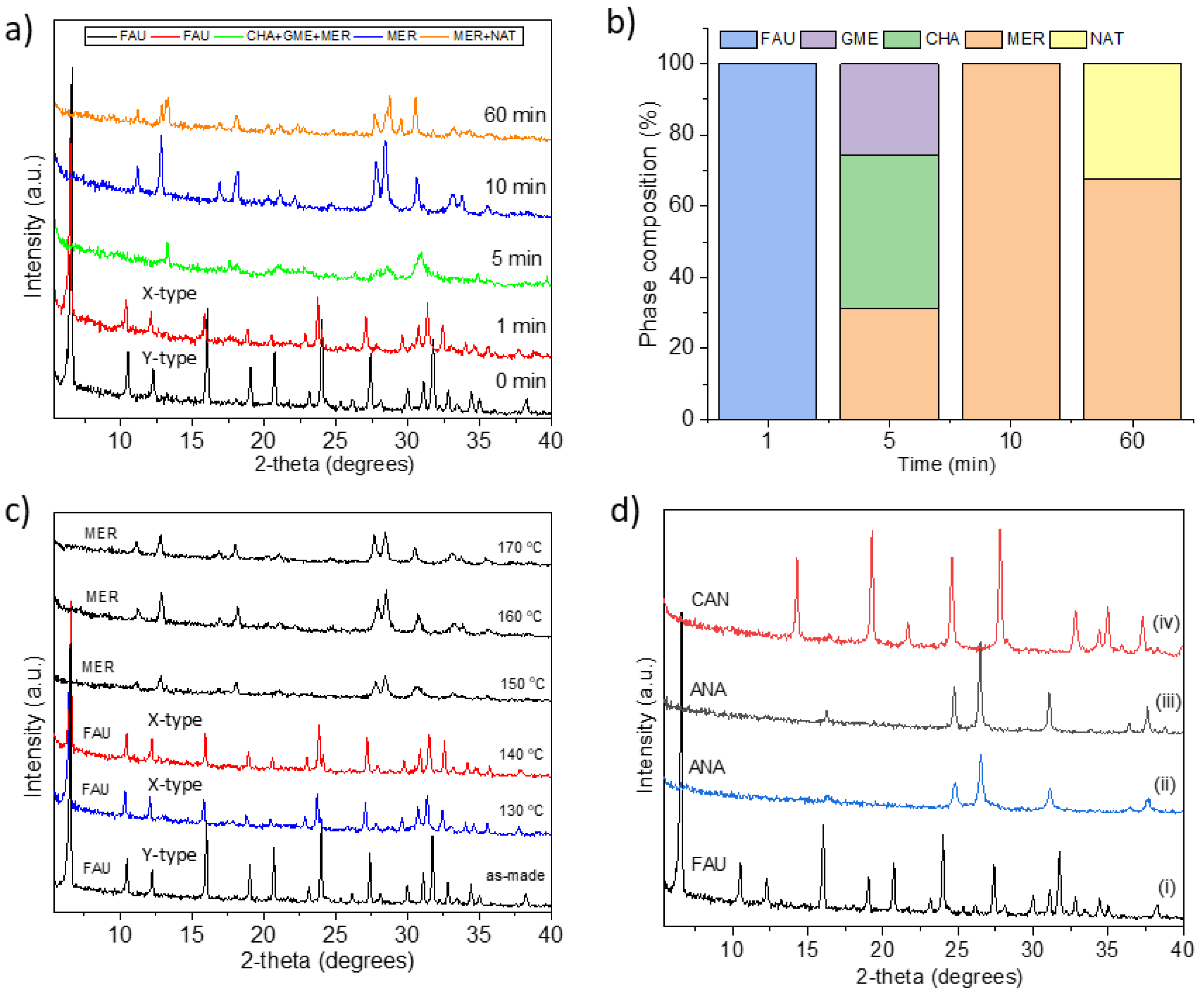
Figure 4.
SEM images of (a) the parent and the daughter hierarchical FAU zeolites obtained at (b) 130 oC and (c) 140 oC. Daughter MER zeolites obtained at (d) 150 oC, and (e) 160 oC and (f) 170 oC. Bar = 2 µm.
Figure 4.
SEM images of (a) the parent and the daughter hierarchical FAU zeolites obtained at (b) 130 oC and (c) 140 oC. Daughter MER zeolites obtained at (d) 150 oC, and (e) 160 oC and (f) 170 oC. Bar = 2 µm.

Figure 5.
Schematic model showing how the parent FAU zeolite transforms to a hierarchal pseudomorphic FAU zeolite or to MER zeolite by controlling the temperature of IZT.
Figure 5.
Schematic model showing how the parent FAU zeolite transforms to a hierarchal pseudomorphic FAU zeolite or to MER zeolite by controlling the temperature of IZT.
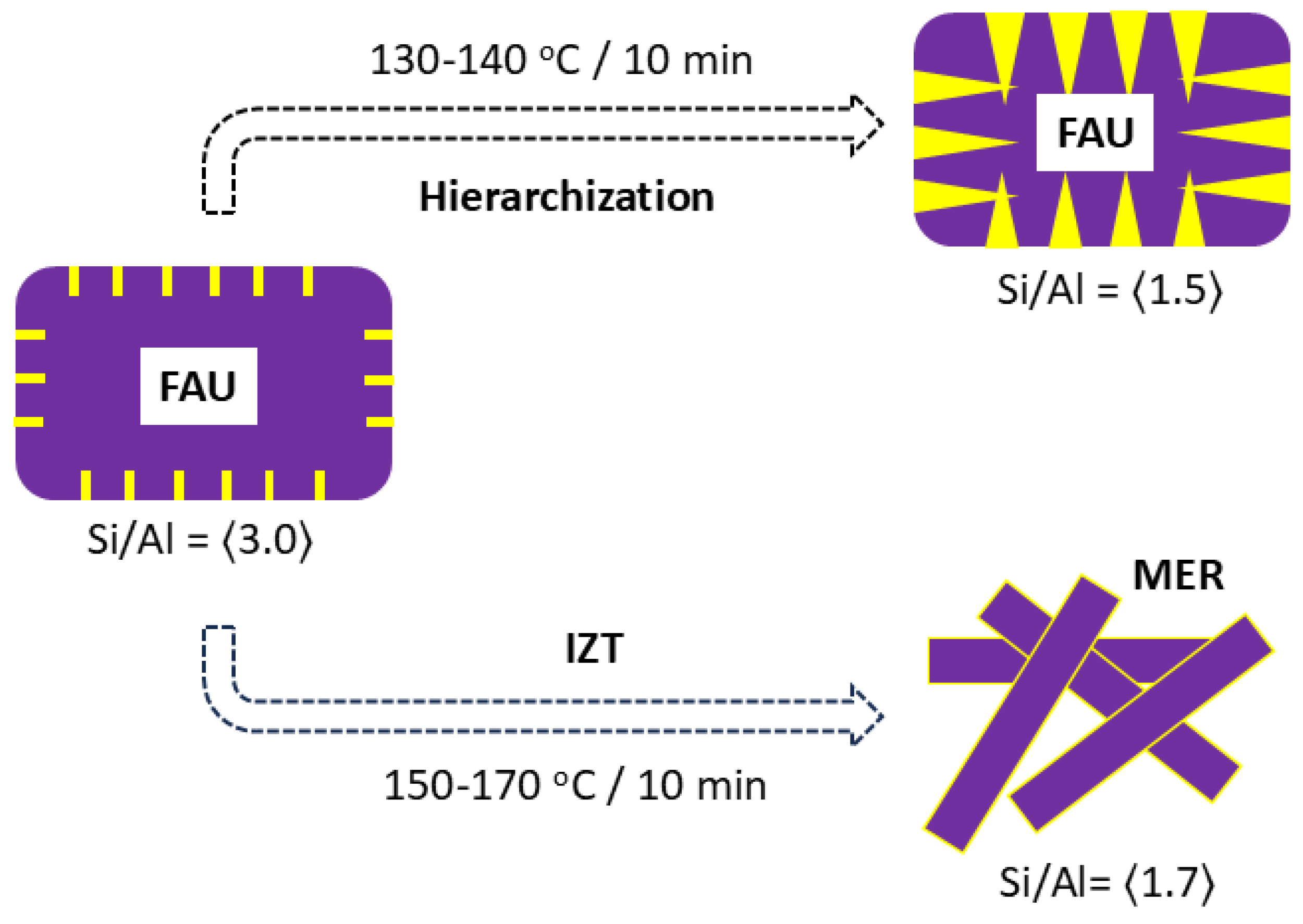
Figure 6.
SEM images of EDI zeolites obtained by IZT in the system KOH/FAU = 8.94 and H2O/KOH = 0.87 at (a) 60 oC/6h, (b) 60 oC/22h, (c) 80 oC/1h, (d) 80 oC/6h. EDI zeolites obtained in the system KOH/FAU = 2 and H2O/KOH = 2 at (e) 160 oC/5 min and (f) 160 oC/10 min.
Figure 6.
SEM images of EDI zeolites obtained by IZT in the system KOH/FAU = 8.94 and H2O/KOH = 0.87 at (a) 60 oC/6h, (b) 60 oC/22h, (c) 80 oC/1h, (d) 80 oC/6h. EDI zeolites obtained in the system KOH/FAU = 2 and H2O/KOH = 2 at (e) 160 oC/5 min and (f) 160 oC/10 min.
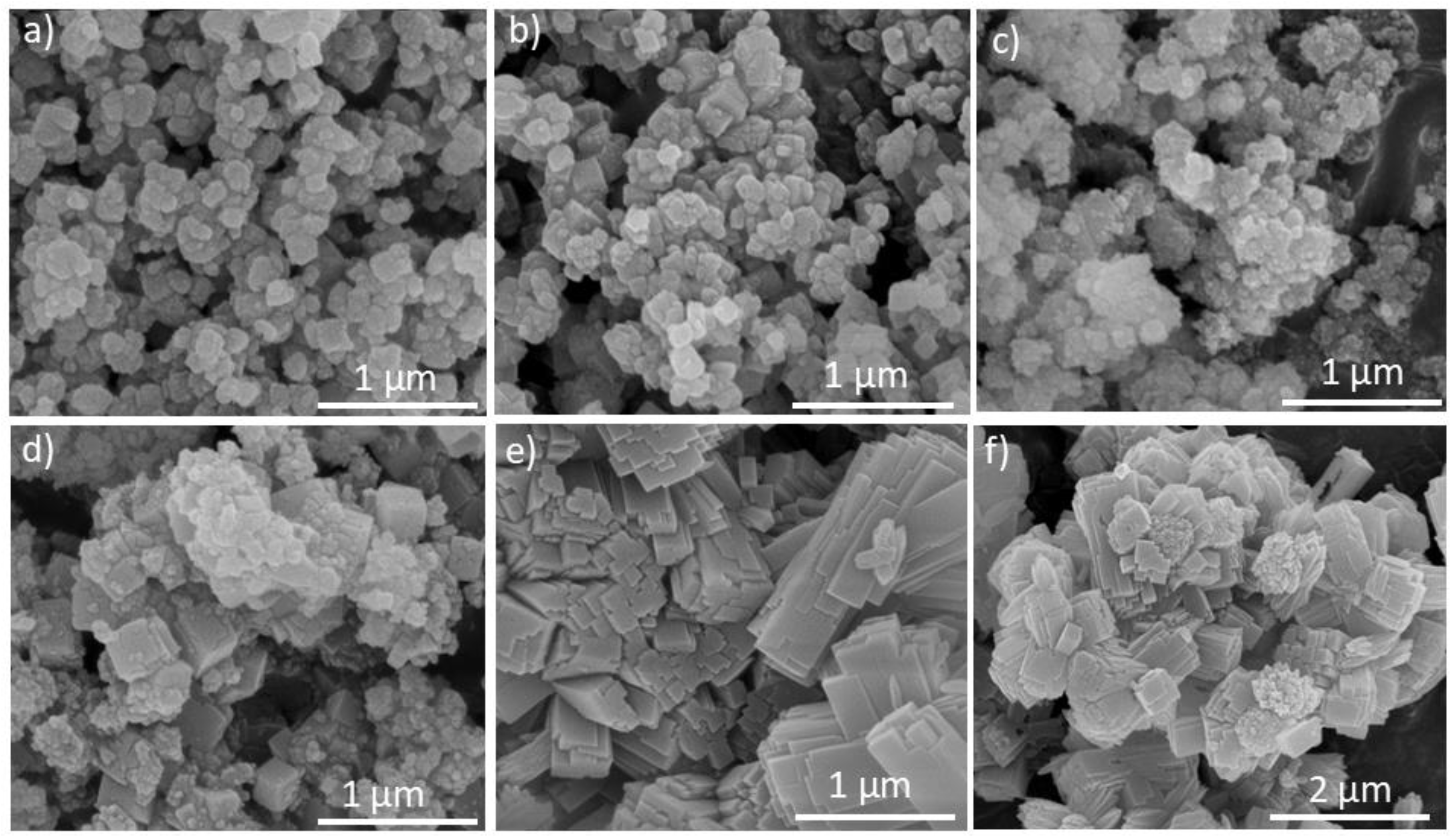
Figure 7.
SEM images of (a) Cs-ANA zeolite obtained at 170 oC/1h in the system CsOH/FAU = 2.7 and H2O/FAU = 2.59, (b) Cs-ANA zeolite obtained at 160 oC/10 min in the system CsOH/FAU = 1.24 and H2O/FAU = 4.9 and (c) CAN zeolite obtained at 160 oC/10 min the system NaOH/FAU = 2 and H2O/FAU = 4.5.
Figure 7.
SEM images of (a) Cs-ANA zeolite obtained at 170 oC/1h in the system CsOH/FAU = 2.7 and H2O/FAU = 2.59, (b) Cs-ANA zeolite obtained at 160 oC/10 min in the system CsOH/FAU = 1.24 and H2O/FAU = 4.9 and (c) CAN zeolite obtained at 160 oC/10 min the system NaOH/FAU = 2 and H2O/FAU = 4.5.
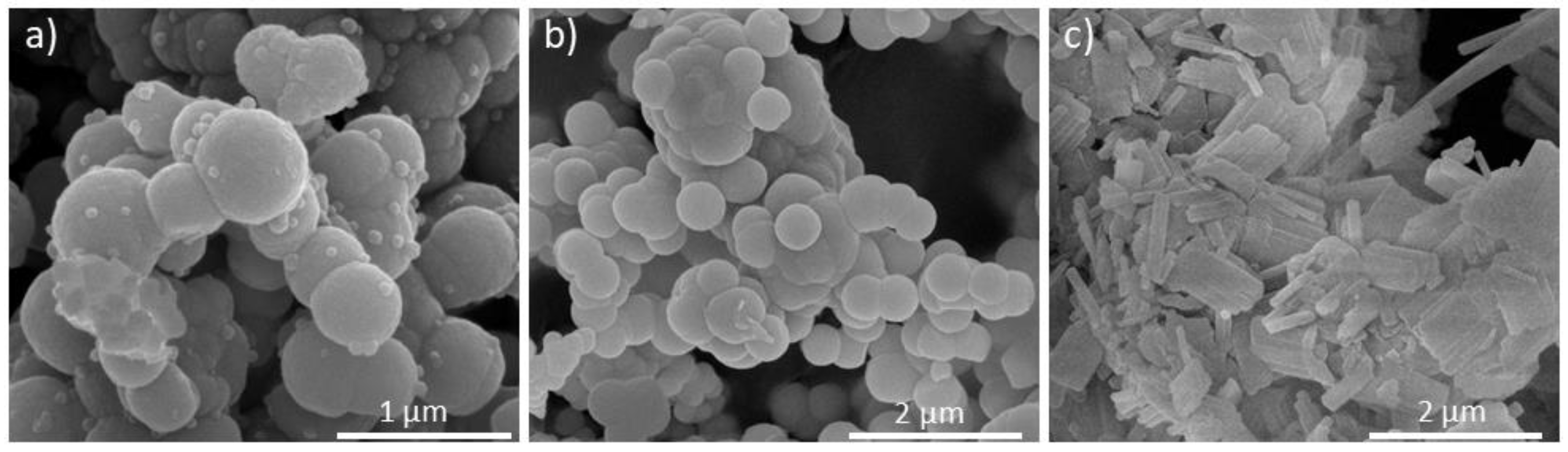

Table 1.
Comparison of the time and temperature of interzeolite and related transformations starting from FAU zeolite.
Table 1.
Comparison of the time and temperature of interzeolite and related transformations starting from FAU zeolite.
| IZT | Heating | Time | Temp (oC) | Ref. |
|---|---|---|---|---|
| FAU→MER | Conventional | 4 d | 95 | [13] |
| FAU→Cs-ANA | Conventional | 2 d | 95 | [13] |
| FAU→EDI | Conventional | 6 h | 60 | [6] |
| FAU→Na-ANA | Conventional & MC | 2 h | 110 | [15] |
| FAU→Cs-ANA | Conventional & MC | 2 h | 110 | [15] |
| FAU→MER | Conventional & MC | 2 h | 110 | [15] |
| FAU→ANA | Conventional & MC | 2 h | 110 | [15] |
| FAU→CAN | Conventional & MC | 2 h | 110 | [15] |
| FAU→Kalsilite* | Microwave | 10 min | 160 | This work |
| FAU→MER | Microwave | 5 min | 150-170 | This work |
| FAU→Cs-ANA | Microwave | 10 min | 160 | This work |
| FAU→EDI | Microwave | 5 min | 160 | This work |
| FAU→CAN | Microwave | 10 min | 160 | This work |
MC – mechanochemical; * K-feldspar [29].
Table 2.
Synthesis condition and phases obtained by IZT.
| Parent Phase | Temperature (°C) | rpm | KOH/FAU | H₂O/KOH | Time | Daughter Phase/s |
|---|---|---|---|---|---|---|
| FAU | 60 | 10 | 8.94 | 0.87 | 3 h | am |
| FAU | 60 | 600 | 8.94 | 0.87 | 6 h | am |
| FAU | 60 | 10 | 8.94 | 0.87 | 6 h | EDI |
| FAU | 60 | 10 | 8.94 | 0.87 | 22 h | EDI |
| FAU | 80 | 10 | 8.94 | 0.87 | 6 h | EDI |
| FAU | 80 | 10 | 8.94 | 0.87 | 22 h | KAlSiO4 |
| FAU | 80 | 600 | 8.94 | 0.87 | 10 min | am |
| FAU | 80 | 10 | 8.94 | 0.87 | 3 h | KAlSiO4 |
| FAU | 80 | 10 | 0.4 | 19.5 | 22 h | FAU, CHA |
| FAU | 80 | 10 | 8.94 | 0.87 | 1 h | EDI |
| FAU | 80* | 8.94 | 0.87 | 1 h | am | |
| FAU | 100 | 10 | 2 | 4.5 | 10 min | FAU |
| FAU | 100 | 20 | 0.62 | 12.6 | 11 h | CHA, GME, MER, NAT |
| FAU | 100 | 20 | 0.62 | 12.6 | 15 h | CHA, GIS, MER |
| FAU | 100 | 20 | 0.60 | 13 | 22 h | CHA, GME, MER |
| FAU | 120 | 10 | 8.94 | 0.87 | 6 h | KAlSiO4 |
| FAU | 120 | 10 | 2 | 4.5 | 10 min | FAU |
| FAU | 130 | 1200 | 2 | 4.5 | 10 min | FAU |
| FAU | 140 | 1200 | 2 | 4.5 | 10 min | FAU |
| FAU | 150 | 10 | 2 | 4.5 | 10 min | CHA, GME, GIS |
| FAU | 150 | 1200 | 2 | 4.5 | 5 min | MER |
| FAU | 160 | 10 | 1 | 4.5 | 5 min | CHA, GME, MER |
| FAU | 160 | 10 | 1 | 9 | 10 min | GME, GIS, AMI, CHA |
| FAU | 160 | 10 | 2 | 4.5 | 10 min | CHA, GME |
| FAU | 160 | 10 | 2a | 4.5 | 10 min | CAN |
| FAU | 160 | 10 | 8.94 | 0.87 | 10 min | KAlSiO4 |
| FAU | 160 | 1200 | 0.56 | 16.1 | 10 min | ANA, GIS |
| FAU | 160 | 1200 | 0.6 | 15 | 1 h | MER |
| FAU | 160 | 1200 | 0.7 | 4.5 | 10 min | MER |
| FAU | 160 | 1200 | 1 | 4.5 | 10 min | MER |
| FAU | 160 | 1200 | 1.42b | 4.9 | 10 min | Cs-ANA |
| FAU | 160 | 1200 | 2 | 1 | 10 min | KAlSiO4 |
| FAU | 160 | 1200 | 2 | 2 | 5 min | EDI |
| FAU | 160 | 1200 | 2 | 2 | 10 min | EDI |
| FAU | 160 | 1200 | 2 | 3 | 10 min | EDI, GIS |
| FAU | 160 | 1200 | 2 | 4 | 10 min | EDI, GIS, PHI |
| FAU | 160 | 1200 | 2 | 4.5 | 1 min | FAU |
| FAU | 160 | 1200 | 2 | 4.5 | 5 min | CHA, GME |
| FAU | 160 | 1200 | 2 | 4.5 | 10 min | CHA, MER |
| FAU | 160 | 1200 | 2 | 5 | 10 min | GIS, PHI, MER |
| FAU | 170 | 10 | 2 | 4.5 | 10 min | PHI, MER, NAT, Na₂Si₄O₉ |
| FAU | 170 | 20 | 2.7b | 2.59 | 1 h | ANA |
| FAU | 170 | 1200 | 2 | 4.5 | 10 min | MER |
a NaOH, b CsOH, am - amorphous.
Disclaimer/Publisher’s Note: The statements, opinions and data contained in all publications are solely those of the individual author(s) and contributor(s) and not of MDPI and/or the editor(s). MDPI and/or the editor(s) disclaim responsibility for any injury to people or property resulting from any ideas, methods, instructions or products referred to in the content. |
© 2024 by the authors. Licensee MDPI, Basel, Switzerland. This article is an open access article distributed under the terms and conditions of the Creative Commons Attribution (CC BY) license (http://creativecommons.org/licenses/by/4.0/).
Copyright: This open access article is published under a Creative Commons CC BY 4.0 license, which permit the free download, distribution, and reuse, provided that the author and preprint are cited in any reuse.


