

Submitted:
18 December 2024
Posted:
19 December 2024
You are already at the latest version
Abstract
Neonatal methicillin-resistant Staphylococcus aureus (MRSA) colonization and infection remain a major concern in the neonatal intensive care unit (NICU). MRSA is associated with significant neonatal morbidity and mortality globally, whereas prematurity and low birth weight are the main risk factors. We aimed to review the existing evidence regarding the molecular characteristics, epidemiology, risk factors, clinical manifestations, decolonization strategies, and treatment options of MRSA infection in neonates. Healthcare-associated (HA)-MRSA and community-acquired (CA)-MRSA strains differ in their synthesis of toxins, including Panton-Valentine leukocidin, molecular characteristics, and resistance to antibiotics. Colonization with MRSA is the main risk factor, associated with high risk of infection. The clinical impact of MRSA infection includes bacteremia, sepsis, endocarditis, pneumonia, osteomyelitis, septic arthritis, skin and soft tissue infections, and toxic shock syndrome. To lower MRSA colonization, infection, and transmission, customized approaches are required, including continuous local surveillance of MRSA clinical and molecular epidemiology, new techniques for MRSA identification, and the application of basic preventive measures. To identify the best empirical antimicrobial treatments, antibiotic susceptibility monitoring is essential. The growing antibiotic resistance of MRSA remains challenging, while vancomycin is still the best option. Further extensive research and surveillance are warranted to explore the genetic variety and prevalence of MRSA.
Keywords:
multi-drug resistance
; neonatal unit
; staphylococcus
; vancomycin
1. Introduction
Staphylococcus aureus, initially identified by Ogston, is widely recognized as a significant human pathogen [1]. Staphylococcus which is resistant to penicillin was first reported in the 1940s [2,3], while a strain resistant to methicillin, methicillin-resistant Staphylococcus aureus (MRSA), was discovered in 1961 in UK hospitals [4]. In 1981, a neonate with MRSA osteomyelitis, the first case of neonatal MRSA infection, was described in the U.S. [5]. MRSA is associated with significant neonatal morbidity and mortality globally [6], while it is one of the antibiotic-resistant strains of S. aureus that have become prevalent in neonatal intensive care units (NICUs) [7].
MRSA has been frequently associated with potentially fatal, healthcare-associated (HA) infections in NICUs [8,9]. Several NICUs have reported epidemiological data of neonatal MRSA after surveillance measures, transmission control, and decolonization policies [10,11,12,13,14]. According to a nationwide cohort study conducted in the U.S., the rate of methicillin-susceptible Staphylococcus aureus infections was significantly reduced over the past 20 years, whereas the rate of MRSA infections has stayed consistent at about 10 per 10,000 hospitalized neonates [7]. Recent epidemiologic studies have also reported the evolution of MRSA clones underscoring the growing resistance of MRSA to antimicrobial agents [15].
According to the National Nosocomial Infections Surveillance System, late-onset MRSA infections in NICUs significantly increased by 300%, from 0.7 to 3.1 cases/10,000 days, between 1995 and 2004 [16,17]. Also, between 1992 and 2003, the percentage of HA-MRSA infections in intensive care units in the U.S. increased from 35.9% to 64.4% [9,18]. An estimated 1.7 million HA infections, including over 33,000 infections in the NICU, occur in U.S. hospitals annually, according to the Centers for Disease Control and Prevention (CDC) [19]. Up to 2016, there were more than 20 MRSA outbreaks in NICUs worldwide, most of which were in the U.S. and Europe [20,21,22,23,24,25]. To lessen the burden of neonatal MRSA infections, we should thoroughly examine the epidemiology, clinical traits, and toxicity of MRSA considering these difficulties.
Our aim was to review the existing evidence and provide novel insights into the molecular characteristics, epidemiology, risk factors, clinical manifestations, decolonization strategies, and treatment options of MRSA infection in neonates. Our study is organized into (1) exploring the molecular characteristics of MRSA, (2), providing the epidemiological data of MRSA burden (3) reviewing the risk factors and clinical manifestations of MRSA infection to neonates, (4) providing a summary of existing recommendations for the decolonization strategies and treatment options of MRSA colonization and disease, and (5) discussing challenges related to MRSA infections to neonates and directions for future study (Figure 1).
2. Materials and Methods
2.1. The Literature Search Strategy
A literature search was conducted by two researchers in November 2024 in PubMed. Only human studies and English-language articles were considered. The terms ‘Methicillin-resistant Staphylococcus aureus’ OR ‘MRSA’ AND ‘neonate’ OR ‘newborn’ OR ‘infant’ OR ‘Neonatal Intensive Care Unit’ OR ‘Neonatology’ were utilized. The retrieved studies were assessed according to their titles, abstracts, and suitability for this narrative review.
3. Molecular Characteristics of MRSA
This HA-MRSA that was transmitted inside hospital environments was formerly responsible for the majority of MRSA infections. MRSA was thought to be common exclusively in healthcare environments until the 1990s [15]. For the first time in the 1990s, MRSA colonization or infection was discovered in patients who had not been previously hospitalized or had a history of contact with HA-MRSA [26,27,28]. Since then, communities all around the world have experienced epidemic waves of MRSA infections [15,29]. Subsequent genetic investigations of these strains revealed that different strains of MRSA are also present in the community [9].
The staphylococcal cassette chromosome (SCCmec) typing is utilized to identify types that are more prevalent in hospital or community settings [30]. It has been demonstrated that HA-MRSA and community-aquired (CA)-MRSA differ from one another in both genotype and phenotype (Table 1) [31]. Distinct patterns of antibiotic resistance are conferred by the SCCmecA types carried by HA-MRSA and CA-MRSA, which encode for the penicillin-binding protein 2A (PBP2A) [31]. SCCmecA types I–III are associated with HA-MRSA clones, whereas SCCmecA types IV, V, and VII to CA-MRSA clones [8,31]. Unlike the HA-MRSA phenotype, CA-MRSA is susceptible to a wide range of antibiotics, including clindamycin, quinolones, and trimethoprim-sulfamethoxazole [8,32,33,34]. The phenotypic difference between HA and CA-MRSA is also underlined by the carriage of Panton-Valentine leukocidin (PVL) and the greater expression of additional toxins in CA-MRSA compared to HA-MRSA [30,35]. Compared to strains linked to healthcare, CA strains are more frequently linked to infections of the skin and soft tissues [31]; however, CA-MRSA has recently emerged in healthcare settings, including NICUs, following MRSA’s development and transmission [15,29,30,36,37,38].
2.2. Genetic Flexibility
The pulsed-field gel electrophoresis (PFGE) typing system can be used to classify S. aureus and examine the molecular characteristics and the epidemiology of MRSA, especially during outbreaks [30]. PFGE can be supplemented by multilocus sequence typing (MLST) for additional comparisons with sequences described in available databases. To produce a distinctive banding pattern, PFGE uses a restriction enzyme to break the bacterial DNA, which is then subjected to an electrical gradient [39,40]. According to the CDC typing scheme created in Atlanta, the majority of CA-MRSA infections in the U.S. have been associated with two types of PFGE, USA300, and USA400, that are different from the MRSA genotypes commonly found in HA-MRSA infections [41].
USA300 is thought to be the most common MRSA type in the U.S. and Europe [22]. It is produced when an ancestral sequence type (ST) 8 strain absorbs SCCmec type IV, a PVL-encoding locus, and an arginine catabolic mobile element. The arginine catabolic mobile element helps MRSA evade the immune system and increase its ability to survive inside the host, whereas SCCmec and PVL give USA300 antibiotic resistance and invasiveness [30,42]. In addition, a phenol-soluble modulin is responsible for the synthesis of toxins and resistance to antibiotics. USA300 is the strain most frequently associated with MRSA infections in previously healthy newborns, while USA400 is a less frequent variety [43,44]. Recent infections in NICUs have been caused by 15-21 MRSA strains that share microbiological traits common to strains that have surfaced in the community [45,46]. There have been prior reports of USA400-caused outbreaks of skin and soft tissue infections in full-term neonates, associated with transmission in neonatal nurseries and postnatal wards [47,48]. A recently discovered gene locus called sasX has been seen to spread from ST239 to other MRSA clones like ST5 [49]. This locus may play a role in MRSA nasal colonization, lung infections, and the development of abscesses [6].
2.3. Pathogenic Factors
Epidemiologic research conducted in the last ten years has revealed that specific clonal lineages cause the most MRSA infections globally [15]. ST 1, 5, 8, and 22 are the most frequently isolated MRSA strains in neonatal wards (Figure 1) [21,22,23,37,38,44,50,51,52,53,54,55]. The ability to produce toxins, build biofilm, and have genetic plasticity are characteristics of many of these clones [56]. It has been shown that the two most common MRSA clones in the U.S. and Europe, ST8 and ST22, are potent biofilm makers [57]. Clumping factors and proteins that bind collagen, fibronectin, and elastin play a major role in the aggregation of MRSA on indwelling devices and host tissues [56].
MRSA produces several different types of toxins, including leukotoxins PVL, LukED, and LukAB/DH, hemolysins, exfoliative toxins, staphylococcal enterotoxins, phenol-soluble modulins, and toxic-shock syndrome toxin-1 [58]. Proinflammatory cytokine generation, tissue injury, infection recurrence, and MRSA persistence in the host are all possible outcomes of toxins [57,59]. It is still unclear how the newborn immune system reacts to MRSA [60]. According to certain findings, newborns are more likely to experience hyperinflammation when they have staphylococcal infections [61,62]. Long-term neonatal morbidities such as cerebral palsy, retinopathy of prematurity, necrotizing enterocolitis, and bronchopulmonary dysplasia have been linked to this unbalanced inflammation as a major underlying mechanism [6].
2.4. Antimicrobial Resistance
HA-MRSA and CA-MRSA strains differ in their synthesis of PVL, SCCmec trait, and resistance to non-beta-lactam antibiotics [6]. Clinical diagnosis now relies on the availability of sensitive and precise techniques for accurately identifying antibiotic resistance in these microorganisms. Molecular typing is warranted as phenotypic typing techniques are extremely reliant on growth conditions and are not capable of reliable discrimination [63,64]. A potential helpful molecular indicator of MRSA is the mecA gene that encodes PBP2A [65]. The overexpression of PBP2A, which has a low affinity for β-lactam antibiotics, is the main cause of methicillin resistance. Nevertheless, other mechanisms, such as efflux pumps, are associated with methicillin resistance [66].
Vancomycin-resistant Staphylococcus aureus (VRSA) was initially detected in 1996 in Japan, but numerous reports from throughout the world indicate that it has since spread, including several reports since 2002, in the U.S., Portugal, India, and Pakistan. The thicker cell wall, which trapped a lot of vancomycin molecules, was thought to be the cause of the resistance. Complete resistance to vancomycin is achieved when the trapped molecules obstruct the peptidoglycan plexus, which serves as a physical barrier against vancomycin molecules. Plasmid-borne vanA is a component of an operon encoding enzymes that cause the vancomycin-binding site to be altered or eliminated, giving resistance to vancomycin.
4. Epidemiology of MRSA Burden
Over the past few decades, there has been a conceptual evolution in Staphylococcus aureus epidemiology [6]. According to available data, hospitalized neonates have a greater rate of MRSA colonization than the general newborn population, with rates varying from 0.3 to 32% among institutions [23,24,37,38,51,67,68,69]. The higher frequency of MRSA in healthcare environments as opposed to the general population may help to explain these findings [34]. Of note, the MRSA carriage rate among healthcare personnel, with whom hospitalized neonates have close contact, appears to be 2-3 times greater than that of the general population [25,50].
MRSA incidence in invasive S. aureus infections was found to be more than 25% in 8 out of 30 European countries [70]. According to previous reports, 33-67% of S. aureus infections in newborns were caused by MRSA, and 3.9-8.4% of neonates had neonatal MRSA colonization, with one-fourth of those individuals developing MRSA infections [38,44]. The prevalence of MRSA nasal colonization in neonates usually ranges from 2% to 4%, but it might reach up to 8% during an MRSA epidemic investigation [8,13,14,38,71]. Also, previous studies have found that between 0.6% and 8.4% of neonates were colonized or infected with MRSA during respective periods [11,14,44,72,73,74,75].
Finally, a recent meta-analysis by Zervou et al. reported that the pooled prevalence of MRSA colonization was 2.3%, based on 11 studies that were conducted in the U.S., compared to 1.3%, based on studies conducted in Asia [71]. The prevalence of MRSA colonization on admission was 1.5%; interestingly, the prevalence of MRSA colonization in outborn neonates was 5.8%, compared to 0.2% in inborn neonates. Overall, the study suggested that, compared to non-colonized newborns, colonized neonates have a 24.2-fold higher chance of contracting an MRSA infection while in the NICU.
5. Risk Factors and Clinical Manifestations of MRSA Infection in Neonates
5.1. Colonization
NICU patients are particularly vulnerable to MRSA colonization and infection due to specific hosts and environmental factors, such as their immature immune system, close contact with healthcare providers, exposure to multiple invasive procedures, prolonged hospitalization, NICU overcrowding, and understaffing [12,76,77,78]. Concurrent infection of both the mother and neonate is not uncommon; in a previous report, 20% of newborns who had been infected with MRSA had maternal infections; however, there was no correlation between the severity of maternal and neonatal infection [44].
Newborns who are born vaginally are susceptible to acquiring S. aureus through the birth canal [79,80]. According to one study, pregnant women had a rate of 2.8% of vaginal MRSA colonization, which enables them to transmit the infection to their neonate following delivery [81]. In addition, maternal MRSA chorioamnionitis was linked to neonatal MRSA sepsis, indicating maternal vertical transmission of MRSA [82]. Also, vaginal delivery and female sex were associated with increased S. aureus colonization, antibiotic administration in the week before delivery was associated with a lower risk of MRSA transmission, whereas newborn origin (e.g., home vs. hospital transfer) was not associated with colonization [69]. It has also been demonstrated that multiple gestation is a risk factor for MRSA colonization and infection [73,83].
After birth, newborns are exposed to Staphylococcus aureus following contact with adult skin [84,85]. Human carriers of Staphylococcus aureus range from 30 to 70%. MRSA has historically been shown to spread horizontally through contact with medical personnel or the hospital setting [48,86,87]. Other factors, like NICU overcrowding and understaffing, have been linked to a higher risk of colonization and transmission, which could result in MRSA outbreaks [77,78]. It has also been demonstrated that mothers can vertically transfer MRSA to their babies through breast milk [88,89], while fathers through direct contact with their infants [90].
Among neonatal factors, prematurity and low birth weight are the main risk factors for MRSA colonization and infection [16,37,51,91]. According to a previous report, the prevalence of MRSA infections in neonates weighing less than 1,000 g was 53.4 per 10,000 infants, while the corresponding rates for neonates weighing 1,001–1,500, 1,501–2,500, and > 2,500 g were 23.2, 7.9, and 5.0 per 10,000 infants, respectively [16]. Similarly, numerous studies have shown that low birth weight was associated with an increased risk of MRSA colonization and/or infection [72,73,75,83,92]. Previously, Duffy et al. analyzed 21,736 surveillance specimens from 3,784 admissions to a tertiary newborn hospital, within eight years [93]. The authors showed that neonates with MRSA nasal or both nasal and groin colonization were of lower gestational age and birth weight compared to neonates who were positive on groin swabs only [93].
Prolonged hospitalization, overcrowding in the newborn ward, understaffing of personnel, long-term ventilation support, intravascular catheters, antibiotics, total parenteral nutrition, and surgical interventions are additional risk factors for MRSA infections [6,23,38,51]. Neonates in NICUs frequently need several devices and procedures during their hospital stay, including endotracheal tube insertion, mechanical ventilation, central vascular catheterization, and surgery [72]. A previous study demonstrated that compared to non-MRSA-colonized infants, MRSA-colonized infants experienced a greater incidence of late-onset sepsis, and were more likely to be intubated or mechanically ventilated [17]. An increased risk of MRSA infection has also been associated with feeding practices, such as parenteral nutrition [92] and gavage feeding [83]. Moreover, other independent risk factors for MRSA infection are the longer hospital stay [83], and kangaroo care [75].
Most significantly, colonization with MRSA is the main risk factor for the development of an MRSA infection later on in neonates. According to Huang et al., MRSA-colonized neonates had a considerably greater rate of MRSA infection (26%) than non-colonized neonates (2%) [73], while, as suggested by the metanalysis by Zervou et al., MRSA colonization was associated with a 24.2-fold higher risk of MRSA infection [71].
5.2. Clinical Manifestations
Neonates who are not colonized at admission may be colonized with MRSA within a median of 9 days, with a range of 1-91 days [23]. Besides, the median interval between MRSA colonization and beginnig of infection is 4 to 9 days [38,67]. In a previous report from a New York NICU, MRSA colonization was detected at a median of 17 days, with a range of 4 to 159, while nearly two-thirds of the neonates developed colonization during the first three weeks of life [17].
MRSA infection has a significant clinical impact, including bacteremia, sepsis, endocarditis, pneumonia, osteomyelitis, septic arthritis, central nervous system disorders, skin and soft tissue infections (SSTIs), and toxic shock syndrome [9,94,95,96]. Although SSTIs are common manifestations of MRSA infections in neonates, invasive diseases like bacteremia, necrotizing pneumonia, osteomyelitis, myositis, empyema, meningitis, and septic shock were also identified and frequently accompanied by complications [43,97]. Most cases of invasive MRSA disease (75%) are associated with bacteremia [19]. Late-onset sepsis is a common clinical manifestation of MRSA infection, which can range from a moderate focal infection to severe invasive disease [91,98,99]. Among neonates with S. aureus bacteremia in a ten-year retrospective research in the UK, between 1993–2003, MRSA was detected in nearly one-third of bacteremic neonates [100]. Similarly, among neonates with S. aureus bacteremia in the U.S., MRSA was found in 47% of the cases, indicating that MRSA has emerged as a major cause of neonatal sepsis [46]. Finally, Dolapo et al. reported that the prevalence of MRSA bloodstream infections in neonates increased from 24 to 55%, with more severe consequences [101].
Infectious endocarditis, formation of abscesses in the myocardium, liver, spleen, or kidneys, necrotizing pneumonia, osteomyelitis, septic thrombophlebitis, venous thrombosis and sustained bacteremia, severe ocular infections, including endophthalmitis, sepsis with purpura fulminans, and Waterhouse-Friderichsen syndrome are just a few of the numerous MRSA manifestations that have been reported [102,103,104,105,106].
CA-MRSA infections typically manifest as SSTIs, in contrast to HA-MRSA infections, although more severe, invasive manifestations can also occur [107]. In comparison to HA-MRSA, CA-MRSA contains the virulence genes lukS-PV/lukf-PV that generate PVL, and produce a pore-forming cytotoxin that causes leukocyte death and tissue necrosis [108]. In a geographically diversified network of emergency rooms in the U.S., CA-MRSA was the most frequent cause of SSTIs [94,95,96]. Clinical manifestations of SSTIs can vary from cellulitis or a simple abscess to more serious soft-tissue infections such as necrotizing fasciitis, pyomyositis, and mediastinitis as a consequence of retropharyngeal abscess [109,110,111,112].
Careful patient monitoring and prompt access to microbiological and laboratory tests are crucial since the clinical symptoms and indicators at the beginning of MRSA infections can be non-specific [91]. Also, MRSA-infected newborns may have a higher readmission rate and a longer infection course than methicillin-susceptible Staphylococcus aureus cases [36,113], even though there appears to be no difference between MRSA and methicillin-susceptible Staphylococcus aureusin terms of clinical presentation and mortality [7,91,114]. In very immature preterm neonates in particular, infections increase the risk of both short-term morbidity and mortality as well as unfavorable long-term outcomes [115,116,117]. The mortality rate of MRSA infections ranges from 2.9 to 28%, with significant variation across institutions [7,21,51,91]. According to earlier research, the case fatality risk for neonatal MRSA sepsis varied between 9.5 and 55% [118]. A previous study also reported that among MRSA infections, sepsis had a mortality rate of 16%, pneumonia of 32.1%, and necrotizing enterocolitis of 27.3% [119].
6. Decolonization Strategies and Treatment Options of MRSA
6.1. Precautions Against Colonization
Neonates are colonized when passing through the maternal birth canal. Moreover, newborns who are placed on the mother’s breast as soon as possible after delivery are colonized with maternal skin microbiome, in addition to encouraging the flow of the maternal breast milk. Among several bacteria, Streptococcus species and Neisseria rapidly colonize the neonatal mouth. According to Fukuda et al., newborns who were breastfed exhibited a sharp rise in common α or Á-Streptococcus in their mouths [120]. Importantly, Uehara et al. showed that precolonization of neonatal mouth and nostrils with common α- and/or Á-Streptococcus prevented MRSA colonizing [121]. Additionally, it has been demonstrated that distributing the mother’s breast milk over and into the mouths of extremely low birth weight neonates as soon as they are admitted into the NICU can greatly reduce the colonization rate of MRSA in their mouths [119].
According to a previous study, neonates born via cesarean section had greater rates of infection and were infected earlier than neonates born vaginally [122]. This suggested that MRSA may colonize aseptic skin considerably more readily than maternal-derived Staphylococcus epidermidis colonized skin following a vaginal delivery. Therefore, skin-to-skin contact between the newborn and the mother should be established in the delivery room as soon as possible following birth, regardless of the mode of delivery. Besides, this could be regarded as the initial phase of newborn neonatal skin infection control.
The most crucial infection control measure is strict hand hygiene before and after handling neonates; however, this is one of the least followed. Hand hygiene with flowing tap water alone can significantly reduce the risk of infection even in the absence of a disinfectant. Nonetheless, hospitals should be informed that the use of chlorhexidine gluconate and other similar disinfectants in soap is not an efficient preventive measure and is only as effective as using tap water because many strains of MRSA are resistant to these disinfectants.
6.2. Decolonization
As of right now, prevention rather than treatment is the most effective way to handle neonatal MRSA infections. Preventing MRSA transmission in the NICU is essential since colonization with MRSA is the major risk factor for the development of MRSA infection [12,73]. Strict hand hygiene is well acknowledged to be crucial in preventing MRSA spread, in addition to surveillance and decolonization [124]. Cohorting and isolating MRSA-positive patients, taking barrier precautions, educating healthcare professionals, avoiding crowded wards, and, in certain units, monitoring and decolonizing parents and healthcare workers are additional strategies that may help prevent MRSA infections [23,25,50,92,124,125].
To stop MRSA transmission and reduce infection rates, many NICUs have instituted active detection and isolation programs, which use surveillance to quickly identify impacted patients, followed by cohorting and isolation with routine contact precautions. Decolonization is the key to preventing infection since MRSA colonization precedes infection. NICUs following policies of active MRSA surveillance swabs and decolonization using nasal mupirocin with or without an antiseptic bath have reported varying degrees of success [6]. Since healthcare providers, parents, family members, and visitors are asymptomatically colonized and unintentionally act as reservoirs for transmission, controlling MRSA transmission in NICUs is challenging [126]. Furthermore, it is more difficult to restrict transmission in NICUs because S. aureus can live on environmental surfaces for extended periods [127]. According to the CDC 2021 S. aureus NICU recommendation, which is supported by moderate evidence from two diagnostic trials, NICU patients should at minimum have their anterior nares swabbed [126]. The recommendation that the umbilicus and neck be expressly listed as preferred screening sites in neonates has been deleted from the recently updated National Institute of Clinical Excellence (NICE) guidelines on the management of MRSA due to a lack of evidence [128].
However, targeted MRSA decolonization techniques might have limitations. First, 42% of infected neonates had no previous positive MRSA screening swab, preventing any chance of decolonization, even with weekly monitoring cultures [13]. Second, many newborns had a small window of opportunity for decolonization because the median time between colonization and infection was only 5 days. Third, the effectiveness of decolonization to eliminate MRSA colonization and prevent MRSA infections may be restricted because, according to previous reports, 38% of neonates who had decolonization treatment became recolonized during their NICU stay, and 16% contracted an MRSA infection [77]. To effectively lower MRSA infections in neonates, some authors have suggested treating all newborns with mupirocin [7]. Many NICUs have established protocols to identify and isolate colonized children since MRSA-colonized infants frequently act as a reservoir for transmission to other infants [13,129]. Of note, in certain contexts, a universal approach has resulted in the development of mupirocin resistance, and it is unknown how treating all neonates, including those not colonized, may alter the neonatal microbiome in the long run [130]. It has been noted that controlling MRSA outbreaks in NICUs can be challenging [73,126]. Such outbreaks have only been successfully contained by the application of strict infection control measures, sometimes in conjunction with mupirocin treatment. Decolonization methods (Table 3), in addition to continuous reinforcement of hygienic measures, should include (1) mupirocin twice a day for five to ten days to decolonize the nasal cavity, and (2) topical body decolonization regimens using a skin antiseptic solution, such as chlorhexidine for 5–14 days.
6.3. Antimicrobial Therapy
Antibiotic susceptibility monitoring in NICUs is essential to obtain the best empirical antimicrobial treatments for neonates suspected of having an MRSA infection. Numerous antibiotics, including β-lactams, have been shown to have reduced effectiveness against MRSA [16,37], primarily as a result of bacterial genetic changes and plasmid acquisition [15,49]. According to several studies, individuals with MRSA bacteremia may benefit from taking a beta-lactam in addition to vancomycin or daptomycin to reduce the duration of their illness and prevent recurrences [131]. While the majority of MRSA isolates were susceptible to trimethoprim-sulfamethoxazole, tetracycline, rifampin, linezolid, ceftaroline, chlorhexidine, and mupirocin, surveillance studies over the past ten years have revealed high resistance rates to erythromycin, clindamycin, and ciprofloxacin [17,38,132].
An overview of the treatment option for MRSA infection is depicted in Table 4. In full-term neonates, topical mupirocin therapy may be sufficient for minor cases of localized pustulosis [133]. Vancomycin or clindamycin is recommended, at least initially, until bacteremia is ruled out in cases of localized disease in premature or very low-birthweight newborns or more extensive disease involving many sites in full-term infants. When a full-term infant has localized pustulosis with no signs or symptoms of sepsis, lumbar puncture is not required [97].
Although numerous antibiotics have been explored with varying degrees of efficacy, the best treatment for severe MRSA infections in newborns is vancomycin [6,134]. The use of combination therapy with rifampin, gentamicin, or daptomycin in neonatal sepsis should be decided on an individual basis because there is little evidence of its possible benefits [133]. There have been reports of vancomycin-intermediate Staphylococcus aureus (VISA) and even VRSA, even though vancomycin is thought to be the medication of last resort for staphylococcal infections [49,135]. These strains have acquired the vanA resistance gene from strains of vancomycin-resistant enterococci. Since vancomycin is the empirical antibiotic of choice for neonates presenting with sepsis and extensive skin infections, particularly in areas with a high MRSA prevalence, its decreased susceptibility to MRSA presents a significant challenge [133,136]. Although their effectiveness and safety in the neonatal population have not yet been confirmed, strategies that target the virulent determinants of MRSA may show promise [58].
There is little experience using clindamycin and linezolid for severe MRSA infections in newborns; however, these medications may be used to treat neonates with susceptible isolates who have non-endovascular infections [133,137,138]. The U.S. Food and Drug Administration (FDA) has approved clindamycin for the treatment of severe S. aureus infections. It has gained widespread use for treating SSTIs and has been effectively used to treat invasive susceptible CA-MRSA infections in children, including osteomyelitis, septic arthritis, pneumonia, and lymphadenitis, despite not being specifically approved for the treatment of MRSA infections [138,139,140,141]. It is not recommended for endovascular infections such as septic thrombophlebitis or infective endocarditis due to its bacteriostatic properties. Although its entry into the cerebrospinal fluid is restricted, clindamycin has exceptional tissue penetration, especially in bone and abscesses [133].
Synthetic oxazolidinone linezolid prevents the 50S ribosome from initiating protein synthesis. The FDA has approved it for the treatment of nosocomial pneumonia caused by MRSA and SSTIs in both adults and children. It is active against VRSA and VISA in vitro [142,143]. Although an outbreak of MRSA infection resistant to linezolid has been reported, linezolid resistance is uncommon [144]. Long-term use usually results in resistance through a mutation in the 23S ribosomal RNA (rRNA) binding site for linezolid or methylation of adenosine at position 2503 in 23SrRNA caused by the cfr gene [145,146].
Daptomycin is an antibiotic of the lipopeptide class that causes bactericidal action in a concentration-dependent manner by interfering with the function of cell membranes through calcium-dependent binding. Daptomycin’s pharmacokinetics, safety, and effectiveness in children are still being studied and have not been determined [147]. Due to a lack of research on daptomycin’s effectiveness and safety in newborns, it is not frequently used in neonates. However, a large number of examples have demonstrated the advantages and relative safety of daptomycin usage in newborns [148,149]. When vancomycin fails clinically, daptomycin may be taken into consideration. Due to their synergistic impact, daptomycin and beta-lactams have been demonstrated to be more successful when used together to treat invasive MRSA infections, including bacteremia and endocarditis [150,151,152]. However, according to a randomized clinical investigation conducted between 2015 and 2018, there was no correlation between beta-lactams and lower treatment failure and death when used in conjunction with regular vancomycin or daptomycin therapy [153]. According to a meta-analysis, the combined treatment might enhance certain microbiological outcomes but not mortality [154].
Rifampicin exhibits bactericidal action against S. aureus and reaches high intracellular levels, in addition to penetrating biofilms [155]. It should not be used as monotherapy due to the quick development of resistance, but in some situations, it may be used in conjunction with another active antibiotic.
Telavancin, a parenteral lipoglycopeptide, prevents the formation of cell walls by attaching itself to peptidoglycan chain precursors and depolarising cell membranes [156]. MRSA, VISA, and VRSA are all susceptible to its bactericidal effects.
Trimethoprim-sulfamethoxazole has not been authorized by the FDA to treat any staphylococcal infections. However, it has emerged as a significant option for the outpatient treatment of SSTIs even though 95%–100% of CA-MRSA strains are sensitive in vitro [107,157]. A small number of studies have proposed a role for methicillin-susceptible S. aureus in infections of the bones and joints [158]. Because trimethoprim-sulfamethoxazole increases the risk of kernicterus, it is not advised during the first few months of life.
7. Discussion
Over the past 40 years, MRSA has become a major pathogen that is spread in hospitals and the general public. It is the primary cause of HA infections including bacteremia, endocarditis, SSTIs, and infections of the bones and joints [159]. Even though the prevalence of MRSA has decreased, it still poses a serious clinical risk, thus special attention is required. Therefore, it is crucial to conduct routine surveillance and accurately detect MRSA strains to provide the best antibiotic therapy, comprehend the evolution of nosocomial transmission control, and implement preventative measures. Furthermore, public health in Europe continues to prioritize S. aureus or MRSA, as evidenced by the fact that 10 out of 30 countries, including Greece [160], report prevalence rates of MRSA >25% [161]. The significant rise in MRSA colonization upon admission may support some centers’ practice of isolating their outborn population until their MRSA status is determined, even though the CDC does not list interhospital transfer of neonates as one of the clinical conditions for transmission-based precautions [67,162]. Significantly, compared to non-colonized neonates, those who are MRSA carriers at the time of admission to the NICU have a 24.2-fold increased risk of contracting an MRSA-associated infection while in the hospital.
Neonatal MRSA colonization and infection remain a major concern in the NICU. To lower MRSA rates and lessen the transmission of the disease, numerous NICUs have implemented active detection and isolation programs [17]. Attempts have been made in various healthcare settings to implement universal MRSA-targeted decolonization. Several NICUs try either targeted or general decolonization as an MRSA infection prevention technique because of the strong association between strains that colonize newborns and cause subsequent infections [73,129,163]. The results of these policies have been, however, inconsistent. One of the possible drawbacks of these strategies is the development of resistance. Larger studies are required to determine the cytotoxicity status of S. aureus isolates to better understand whether these are potentially useful markers to take into consideration in future decolonization programs, especially in light of recent investigations into the potential role of virulence ascertained using comparable in vitro assays [69]. Previous studies have also demonstrated that several MRSA strains can be detected in NICUs, even in a setting that is not experiencing an outbreak [13]. Carey et al. recorded the molecular epidemiology of MRSA strains obtained from neonates who were colonized and infected with MRSA, finding that colonization and infection with several strain types occurred over eight years, even though they lacked data from routine weekly surveillance cultures to assess periods when MRSA infections were absent [72].
Mupirocin decolonization of neonates is effective for colonized newborns and has few side effects [164]. Another tactic that has recently been assessed to reduce neonatal MRSA colonization and subsequent infection is parental decolonization. Decolonization of S. aureus-colonized parents reduced the incidence of infants acquiring a S. aureus strain concordant with a parental strain by 57%, according to a randomized controlled trial carried out in a NICU in Baltimore [126]. Strict commitment to neonatal decolonization methods combined with parent decolonization may be required to decrease infant colonization and infection [165].
A shift in epidemiology with CA SCCmec genotypes becoming more frequently linked to hospital infections is shown by the SCCmec typing results, which indicate a mix of CA-MRSA and HA-MRSA genotypes in the hospital [166]. Similar shifts from HA-MRSA strains to CA-MRSA strains have been noted in other NICUs after Healy et al. published the first report of CA-MRSA infections in NICU patients in 2004 [17,46].
To identify the best empirical antimicrobial treatments for use in patients with suspected infections, antibiotic susceptibility monitoring in individual NICUs is essential. Vancomycin is still the best option for the treatment of MRSA infections, although VISA and VRSA have emerged as examples of MRSA strains that are resistant to vancomycin. The co-occurrence of the MRSA and VRSA phenotype has been reported in previous studies, in Asia, Europe, and North America, raising significant concerns. Human-origin isolates showed a susceptibility trend indicating that linezolid should be the final medication of choice for multidrug resistant-MRSA. Besides, oxacilline susceptible (OS)-MRSA is becoming more and more associated with infections in humans [167,168,169]. Traditional susceptibility testing may mistakenly identify OS-MRSA strains as methicillin-sensitive Staphylococcus aureus, making it more difficult to diagnose and treat Staphylococcus aureus infections, underscoring that public health should prioritize surveillance for such new pathogens.
8. Conclusion
There is an increasing number of neonates at risk for MRSA colonization and infection following the higher survival rate of very immature preterm neonates. Multicenter or population-based studies to elucidate the epidemiology and clinical features of neonatal MRSA colonization and infections are lacking, despite the abundance of data reported from NICUs worldwide. Such information is essential for precisely estimating the MRSA disease burden and supporting surveillance and preventative decision-making.
MRSA colonization, transmission, and infection in the NICU are complicated issues. The significance of lowering the colonization rate in the NICU is highlighted by the 24.2 relative risk of recurrent infection among MRSA carriers as opposed to non-carriers. To lower MRSA colonization, infection, and transmission in hospitalized neonates, customized approaches are required. Data from prospective randomized multicenter trials and continuous local surveillance of MRSA clinical and molecular epidemiology must be combined to effectively control MRSA in the NICU. It is crucial to address the quick changes in MRSA population structure and pathogenic factors; therefore new techniques for MRSA identification and eradication are required. Basic preventive measures remain the key to controlling newborn MRSA infections because of the growing antibiotic resistance of MRSA and the lack of certainty regarding the safety and effectiveness of decolonization techniques in neonates. New strategies to stop MRSA from endangering NICU patients should be developed, including molecular analysis of the strains, shifting patterns of antibiotic susceptibility, and the existence of possible virulence factors. Further extensive research and surveillance are warranted to explore the genetic variety and prevalence of MRSA.
Author Contributions
Conceptualization, D.R. and V.G.; methodology, D.R.; validation, D.R. and V.G.; formal analysis, D.R.; investigation, D.R.; writing—original draft preparation, D.R.; writing—review and editing, N.D., M.B, K.K. and V.G.; supervision, V.G. All authors have read and agreed to the published version of the manuscript.
Funding
This research received no external funding.
Acknowledgments
None.
Conflicts of Interest
The authors declare no conflicts of interest.
References
- Ogston, A. „On Abscesses”. Clinical Infectious Diseases 1984, 6, 122–128. [Google Scholar] [CrossRef]
- Barber, M. Sensitisation of Penicillin-Resistant Staphylococci. The Lancet 1948, 251. [Google Scholar] [CrossRef] [PubMed]
- Barber, M.; Rozwadowska-Dowzenko, M. Infection by Penicillin-Resistant Staphylococci. The Lancet 1948, 252, 641–644. [Google Scholar] [CrossRef] [PubMed]
- Jevons, M.P. “Celbenin” - resistant Staphylococci. Br Med J 1961, 14, 124–125. [Google Scholar] [CrossRef]
- Weeks, J.L.; Garcia-Prats, J.A.; Baker, C.J. Methicillin-resistant Staphylococcus aureus osteomyelitis in a neonate. JAMA 1981, 245, 1662–1664. [Google Scholar] [CrossRef] [PubMed]
- Dong, Y.; Glaser, K.; Speer, Christian, P. New Threats from an Old Foe: Methicillin-Resistant Staphylococcus aureus Infections in Neonates. Neonatology 2018, 114, 127–134. [Google Scholar] [CrossRef] [PubMed]
- Ericson, J.E.; Popoola, V.O.; Smith, P.B.; Benjamin, D.K.; Fowler, V.G.; Benjamin, D.K.; Clark, R.H.; Milstone, A.M. Burden of InvasiveStaphylococcus aureusInfections in Hospitalized Infants. JAMA Pediatrics 2015, 169. [Google Scholar] [CrossRef] [PubMed]
- Carey, A.J.; Long, S.S. Staphylococcus aureus: A Continuously Evolving and Formidable Pathogen in the Neonatal Intensive Care Unit. Clinics in Perinatology 2010, 37, 535–546. [Google Scholar] [CrossRef]
- Nelson, M.U.; Gallagher, P.G. Methicillin-Resistant Staphylococcus aureus in the Neonatal Intensive Care Unit. Seminars in Perinatology 2012, 36, 424–430. [Google Scholar] [CrossRef] [PubMed]
- Carey, A.J.; Della-Latta, P.; Huard, R.; Wu, F.; Graham, P.L.; Carp, D.; Saiman, L. Changes in the Molecular Epidemiological Characteristics of Methicillin-ResistantStaphylococcus aureusin a Neonatal Intensive Care Unit. Infection Control & Hospital Epidemiology 2015, 31, 613–619. [Google Scholar]
- Gregory, M.L.; Eichenwald, E.C.; Puopolo, K.M. Seven-Year Experience With a Surveillance Program to Reduce Methicillin-Resistant Staphylococcus aureus Colonization in a Neonatal Intensive Care Unit. Pediatrics 2009, 123, e790–e796. [Google Scholar] [CrossRef]
- Maraqa, N.F.; Aigbivbalu, L.; Masnita-Iusan, C.; Wludyka, P.; Shareef, Z.; Bailey, C.; Rathore, M.H. Prevalence of and risk factors for methicillin-resistant Staphylococcus aureus colonization and infection among infants at a level III neonatal intensive care unit. American Journal of Infection Control 2011, 39, 35–41. [Google Scholar] [CrossRef] [PubMed]
- Popoola, V.O.; Budd, A.; Wittig, S.M.; Ross, T.; Aucott, S.W.; Perl, T.M.; Carroll, K.C.; Milstone, A.M. Methicillin-Resistant Staphylococcus aureus Transmission and Infections in a Neonatal Intensive Care Unit despite Active Surveillance Cultures and Decolonization: Challenges for Infection Prevention. Infection Control & Hospital Epidemiology 2016, 35, 412–418. [Google Scholar]
- Seybold, U.; Halvosa, J.S.; White, N.; Voris, V.; Ray, S.M.; Blumberg, H.M. Emergence of and Risk Factors for Methicillin-Resistant Staphylococcus aureus of Community Origin in Intensive Care Nurseries. Pediatrics 2008, 122, 1039–1046. [Google Scholar] [CrossRef] [PubMed]
- Uhlemann, A.-C.; Otto, M.; Lowy, F.D.; DeLeo, F.R. Evolution of community- and healthcare-associated methicillin-resistant Staphylococcus aureus. Infection, Genetics and Evolution 2014, 21, 563–574. [Google Scholar] [CrossRef] [PubMed]
- Lessa, F.C.; Edwards, J.R.; Fridkin, S.K.; Tenover, F.C.; Horan, T.C.; Gorwitz, R.J. Trends in Incidence of Late-Onset Methicillin-Resistant Staphylococcus aureus Infection in Neonatal Intensive Care Units. Pediatric Infectious Disease Journal 2009, 28, 577–581. [Google Scholar] [CrossRef]
- Nelson, M.U.; Bizzarro, M.J.; Baltimore, R.S.; Dembry, L.M.; Gallagher, P.G.; Burnham, C.A.D. Clinical and Molecular Epidemiology of Methicillin-Resistant Staphylococcus aureus in a Neonatal Intensive Care Unit in the Decade following Implementation of an Active Detection and Isolation Program. Journal of Clinical Microbiology 2015, 53, 2492–2501. [Google Scholar] [CrossRef] [PubMed]
- Klevens, R.M.; Edwards, J.R.; Tenover, F.C.; McDonald, L.C.; Horan, T.; Gaynes, R. Changes in the Epidemiology of Methicillin-Resistant Staphylococcus aureus in Intensive Care Units in US Hospitals, 1992-2003. Clinical Infectious Diseases 2006, 42, 389–391. [Google Scholar] [CrossRef] [PubMed]
- Klevens, R.M.; Edwards, J.R.; Richards, C.L.; Horan, T.C.; Gaynes, R.P.; Pollock, D.A.; Cardo, D.M. Estimating Health Care-Associated Infections and Deaths in U.S. Hospitals, 2002. Public Health Reports® 2007, 122, 160–166. [Google Scholar] [CrossRef] [PubMed]
- Giuffrè, M.; Bonura, C.; Cipolla, D.; Mammina, C. MRSA infection in the neonatal intensive care unit. Expert Review of Anti-infective Therapy 2014, 11, 499–509. [Google Scholar] [CrossRef] [PubMed]
- Ilczyszyn, W.M.; Sabat, A.J.; Akkerboom, V.; Szkarlat, A.; Klepacka, J.; Sowa-Sierant, I.; Wasik, B.; Kosecka-Strojek, M.; Buda, A.; Miedzobrodzki, J.; et al. Clonal Structure and Characterization of Staphylococcus aureus Strains from Invasive Infections in Paediatric Patients from South Poland: Association between Age, spa Types, Clonal Complexes, and Genetic Markers. Plos One 2016, 11. [Google Scholar] [CrossRef] [PubMed]
- Köser, C.U.; Holden, M.T.G.; Ellington, M.J.; Cartwright, E.J.P.; Brown, N.M.; Ogilvy-Stuart, A.L.; Hsu, L.Y.; Chewapreecha, C.; Croucher, N.J.; Harris, S.R.; et al. Rapid Whole-Genome Sequencing for Investigation of a Neonatal MRSA Outbreak. New England Journal of Medicine 2012, 366, 2267–2275. [Google Scholar] [CrossRef] [PubMed]
- Nübel, U.; Nachtnebel, M.; Falkenhorst, G.; Benzler, J.; Hecht, J.; Kube, M.; Bröcker, F.; Moelling, K.; Bührer, C.; Gastmeier, P.; et al. MRSA Transmission on a Neonatal Intensive Care Unit: Epidemiological and Genome-Based Phylogenetic Analyses. PLoS ONE 2013, 8. [Google Scholar] [CrossRef] [PubMed]
- Ramsing, B.G.U.; Arpi, M.; Andersen, E.A.; Knabe, N.; Mogensen, D.; Buhl, D.; Westh, H.; Østergaard, C. First Outbreak with MRSA in a Danish Neonatal Intensive Care Unit: Risk Factors and Control Procedures. PLoS ONE 2013, 8. [Google Scholar] [CrossRef] [PubMed]
- Scheithauer, S.; Trepels-Kottek, S.; Häfner, H.; Keller, D.; Ittel, T.; Wagner, N.; Heimann, K.; Schoberer, M.; Schwarz, R.; Haase, G.; et al. Healthcare worker-related MRSA cluster in a German neonatology level III ICU: A true European story. International Journal of Hygiene and Environmental Health 2014, 217, 307–311. [Google Scholar] [CrossRef]
- From the Centers for Disease Control and Prevention. Four pediatric deaths from community-acquired methicillin-resistant Staphylococcus aureus--Minnesota and North Dakota, 1997-1999. JAMA 1999, 282, 1123–1125. [Google Scholar]
- Herold, B.C. Community-Acquired Methicillin-Resistant Staphylococcus aureus in Children With No Identified Predisposing Risk. Jama 1998, 279. [Google Scholar] [CrossRef] [PubMed]
- Naimi, T.S. Comparison of Community- and Health Care–Associated Methicillin-Resistant Staphylococcus aureus Infection. Jama 2003, 290. [Google Scholar] [CrossRef] [PubMed]
- DeLeo, F.R.; Otto, M.; Kreiswirth, B.N.; Chambers, H.F. Community-associated meticillin-resistant Staphylococcus aureus. The Lancet 2010, 375, 1557–1568. [Google Scholar] [CrossRef] [PubMed]
- Otto, M. Community-associated MRSA: What makes them special? International Journal of Medical Microbiology 2013, 303, 324–330. [Google Scholar] [CrossRef] [PubMed]
- Diederen, B.; Kluytmans, J. The emergence of infections with community-associated methicillin resistant Staphylococcus aureus. Journal of Infection 2006, 52, 157–168. [Google Scholar] [CrossRef] [PubMed]
- Carey, A.J.; Saiman, L.; Polin, R.A. Hospital-Acquired Infections in the NICU: Epidemiology for the New Millennium. Clinics in Perinatology 2008, 35, 223–249. [Google Scholar] [CrossRef] [PubMed]
- Daum, Robert S.; Ito, T.; Hiramatsu, K.; Hussain, F.; Mongkolrattanothai, K.; Jamklang, M.; Boyle-Vavra, S. A Novel Methicillin-Resistance Cassette in Community-Acquired Methicillin-Resistant Staphylococcus aureus Isolates of Diverse Genetic Backgrounds. The Journal of Infectious Diseases 2002, 186, 1344–1347. [CrossRef] [PubMed]
- Salgado, C.D.; Farr, B.M.; Calfee, D.P. Community-Acquired Methicillin-Resistant Staphylococcus aureus: A Meta-Analysis of Prevalence and Risk Factors. Clinical Infectious Diseases 2003, 36, 131–139. [Google Scholar] [CrossRef] [PubMed]
- Vandenesch, F.; Naimi, T.; Enright, M.C.; Lina, G.; Nimmo, G.R.; Heffernan, H.; Liassine, N.; Bes, M.; Greenland, T.; Reverdy, M.-E.; et al. Community-Acquired Methicillin-ResistantStaphylococcus aureusCarrying Panton-Valentine Leukocidin Genes: Worldwide Emergence. Emerging Infectious Diseases 2003, 9, 978–984. [Google Scholar] [CrossRef] [PubMed]
- Engelman, D.; Hofer, A.; Davis, J.S.; Carapetis, J.R.; Baird, R.W.; Giffard, P.M.; Holt, D.C.; Tong, S.Y.C. Invasive Staphylococcus aureus Infections in Children in Tropical Northern Australia. Journal of the Pediatric Infectious Diseases Society 2014, 3, 304–311. [Google Scholar] [CrossRef]
- Kuo, C.-Y.; Huang, Y.-C.; Huang, D.T.-N.; Chi, H.; Lu, C.-Y.; Chang, L.-Y.; Chi, C.-Y.; Ho, Y.-H.; Huang, Y.-C.; Liu, C.-C.; et al. Prevalence and Molecular Characterization of Staphylococcus aureus Colonization among Neonatal Intensive Care Units in Taiwan. Neonatology 2014, 105, 142–148. [Google Scholar] [CrossRef] [PubMed]
- Reich, P.J.; Boyle, M.G.; Hogan, P.G.; Johnson, A.J.; Wallace, M.A.; Elward, A.M.; Warner, B.B.; Burnham, C.A.D.; Fritz, S.A. Emergence of community-associated methicillin-resistant Staphylococcus aureus strains in the neonatal intensive care unit: an infection prevention and patient safety challenge. Clinical Microbiology and Infection 2016, 22, 645.e641–645.e648. [Google Scholar] [CrossRef] [PubMed]
- Hornik, C.P.; Fort, P.; Clark, R.H.; Watt, K.; Benjamin, D.K.; Smith, P.B.; Manzoni, P.; Jacqz-Aigrain, E.; Kaguelidou, F.; Cohen-Wolkowiez, M. Early and late onset sepsis in very-low-birth-weight infants from a large group of neonatal intensive care units. Early Human Development 2012, 88, S69–S74. [Google Scholar] [CrossRef] [PubMed]
- Olsen, I.E.; Groveman, S.A.; Lawson, M.L.; Clark, R.H.; Zemel, B.S. New Intrauterine Growth Curves Based on United States Data. Pediatrics 2010, 125, e214–e224. [Google Scholar] [CrossRef] [PubMed]
- McDougal, L.K.; Steward, C.D.; Killgore, G.E.; Chaitram, J.M.; McAllister, S.K.; Tenover, F.C. Pulsed-Field Gel Electrophoresis Typing of Oxacillin-Resistant Staphylococcus aureus Isolates from the United States: Establishing a National Database. Journal of Clinical Microbiology 2003, 41, 5113–5120. [Google Scholar] [CrossRef] [PubMed]
- Planet, P.J.; LaRussa, S.J.; Dana, A.; Smith, H.; Xu, A.; Ryan, C.; Uhlemann, A.-C.; Boundy, S.; Goldberg, J.; Narechania, A.; et al. Emergence of the Epidemic Methicillin-Resistant Staphylococcus aureus Strain USA300 Coincides with Horizontal Transfer of the Arginine Catabolic Mobile Element and speG-mediated Adaptations for Survival on Skin. mBio 2013, 4. [Google Scholar] [CrossRef] [PubMed]
- Martin, J.A.; Hamilton, B.E.; Osterman, M.J.; Driscoll, A.K.; Mathews, T.J. Births: Final Data for 2015. Natl Vital Stat Rep 2017, 66, 1. [Google Scholar] [PubMed]
- Song, X.; Cheung, S.; Klontz, K.; Short, B.; Campos, J.; Singh, N. A stepwise approach to control an outbreak and ongoing transmission of methicillin-resistant Staphylococcus aureus in a neonatal intensive care unit. American Journal of Infection Control 2010, 38, 607–611. [Google Scholar] [CrossRef] [PubMed]
- Eckhardt, C.; Halvosa, J.S.; Ray, S.M.; Blumberg, H.M. Transmission of Methicillin-Resistant Staphylococcus aureusin the Neonatal Intensive Care Unit From a Patient With Community-Acquired Disease. Infection Control & Hospital Epidemiology 2015, 24, 460–461. [Google Scholar]
- Healy, C.M.; Hulten, K.G.; Palazzi, D.L.; Campbell, J.R.; Baker, C.J. Emergence of New Strains of Methicillin-Resistant Staphylococcus aureus in a Neonatal Intensive Care Unit. Clinical Infectious Diseases 2004, 39, 1460–1466. [Google Scholar] [CrossRef] [PubMed]
- Bratu, S.; Eramo, A.; Kopec, R.; Coughlin, E.; Ghitan, M.; Yost, R.; Chapnick, E.K.; Landman, D.; Quale, J. Community-associated Methicillin-resistant Staphylococcus aureus in Hospital Nursery and Maternity Units. Emerging Infectious Diseases 2005, 11, 808–813. [Google Scholar] [CrossRef] [PubMed]
- Saiman, L.; Keefe, M.O.; Graham, P.L.; Wu, F.; Salim, B.S.; Kreiswirth, B.; LaSala, A.; Schlievert, P.M.; Latta, P.D. Hospital Transmission of Community-Acquired Methicillin-Resistant Staphylococcus aureus among Postpartum Women. Clinical Infectious Diseases 2003, 37, 1313–1319. [Google Scholar] [CrossRef] [PubMed]
- Hafer, C.; Lin, Y.; Kornblum, J.; Lowy, F.D.; Uhlemann, A.-C. Contribution of Selected Gene Mutations to Resistance in Clinical Isolates of Vancomycin-Intermediate Staphylococcus aureus. Antimicrobial Agents and Chemotherapy 2012, 56, 5845–5851. [Google Scholar] [CrossRef] [PubMed]
- Brennan, G.I.; Shore, A.C.; Corcoran, S.; Tecklenborg, S.; Coleman, D.C.; O’Connell, B. Emergence of Hospital- and Community-Associated Panton-Valentine Leukocidin-Positive Methicillin-Resistant Staphylococcus aureus Genotype ST772-MRSA-V in Ireland and Detailed Investigation of an ST772-MRSA-V Cluster in a Neonatal Intensive Care Unit. Journal of Clinical Microbiology 2012, 50, 841–847. [Google Scholar] [CrossRef] [PubMed]
- Giuffrè, M.; Amodio, E.; Bonura, C.; Geraci, D.M.; Saporito, L.; Ortolano, R.; Corsello, G.; Mammina, C. Methicillin-resistant Staphylococcus aureus nasal colonization in a level III neonatal intensive care unit: Incidence and risk factors. American Journal of Infection Control 2015, 43, 476–481. [Google Scholar] [CrossRef] [PubMed]
- Li, S.; Ning, X.; Song, W.; Dong, F.; Zheng, Y.; Chen, Q.; Qiao, Y.; Li, J.; Wang, L.; Wang, Q.; et al. Clinical and molecular characteristics of community-acquired methicillin-resistant Staphylococcus aureus infections in Chinese neonates. Apmis 2014, 123, 28–36. [Google Scholar] [CrossRef] [PubMed]
- Park, S.-H.; Kim, S.-Y.; Lee, J.-H.; Park, C.; Lee, D.-G. Community-genotype strains of methicillin-resistant Staphylococcus aureus with high-level mupirocin resistance in a neonatal intensive care unit. Early Human Development 2013, 89, 661–665. [Google Scholar] [CrossRef] [PubMed]
- Sax, H.; Posfay-Barbe, K.; Harbarth, S.; Francois, P.; Touveneau, S.; Pessoa-Silva, C.L.; Schrenzel, J.; Dharan, S.; Gervaix, A.; Pittet, D. Control of a cluster of community-associated, methicillin-resistant Staphylococcus aureus in neonatology. Journal of Hospital Infection 2006, 63, 93–100. [Google Scholar] [CrossRef] [PubMed]
- Schlebusch, S.; Price, G.R.; Hinds, S.; Nourse, C.; Schooneveldt, J.M.; Tilse, M.H.; Liley, H.G.; Wallis, T.; Bowling, F.; Venter, D.; et al. First outbreak of PVL-positive nonmultiresistant MRSA in a neonatal ICU in Australia: comparison of MALDI-TOF and SNP-plus-binary gene typing. European Journal of Clinical Microbiology & Infectious Diseases 2010, 29, 1311–1314. [Google Scholar]
- Otto, M. MRSA virulence and spread. Cellular Microbiology 2012, 14, 1513–1521. [Google Scholar] [CrossRef] [PubMed]
- Baldan, R.; Testa, F.; Lorè, N.I.; Bragonzi, A.; Cichero, P.; Ossi, C.; Biancardi, A.; Nizzero, P.; Moro, M.; Cirillo, D.M. Factors Contributing to Epidemic MRSA Clones Replacement in a Hospital Setting. PLoS ONE 2012, 7. [Google Scholar] [CrossRef] [PubMed]
- Kong, C.; Neoh, H.-m.; Nathan, S. Targeting Staphylococcus aureus Toxins: A Potential form of Anti-Virulence Therapy. Toxins 2016, 8. [Google Scholar] [CrossRef] [PubMed]
- Kretschmer, D.; Nikola, N.; Dürr, M.; Otto, M.; Peschel, A. The Virulence Regulator Agr Controls the Staphylococcal Capacity to Activate Human Neutrophils via the Formyl Peptide Receptor 2. Journal of Innate Immunity 2012, 4, 201–212. [Google Scholar] [CrossRef] [PubMed]
- Power Coombs, M.R.; Kronforst, K.; Levy, O. Neonatal Host Defense against Staphylococcal Infections. Clinical and Developmental Immunology 2013, 2013, 1–9. [Google Scholar] [CrossRef]
- Glaser, K.; Speer, C.P. Toll-like receptor signaling in neonatal sepsis and inflammation: a matter of orchestration and conditioning. Expert Review of Clinical Immunology 2014, 9, 1239–1252. [Google Scholar] [CrossRef] [PubMed]
- Zhang, J.-P.; Yang, Y.; Levy, O.; Chen, C. Human Neonatal Peripheral Blood Leukocytes Demonstrate Pathogen-Specific Coordinate Expression of TLR2, TLR4/MD2, and MyD88 During Bacterial Infection In Vivo. Pediatric Research 2010, 68, 479–483. [Google Scholar] [CrossRef] [PubMed]
- van Belkum, A.; Tassios, P.T.; Dijkshoorn, L.; Haeggman, S.; Cookson, B.; Fry, N.K.; Fussing, V.; Green, J.; Feil, E.; Gerner-Smidt, P.; et al. Guidelines for the validation and application of typing methods for use in bacterial epidemiology. Clinical Microbiology and Infection 2007, 13, 1–46. [Google Scholar] [CrossRef] [PubMed]
- Dendani Chadi, Z.; Dib, L.; Zeroual, F.; Benakhla, A. Usefulness of molecular typing methods for epidemiological and evolutionary studies of Staphylococcus aureus isolated from bovine intramammary infections. Saudi Journal of Biological Sciences 2022, 29. [Google Scholar] [CrossRef] [PubMed]
- Kashef, M.T.; Helmy, O.M. Development of a Multiplex Polymerase Chain Reaction-Based DNA Lateral Flow Assay as a Point-of-Care Diagnostic for Fast and Simultaneous Detection of MRSA and Vancomycin Resistance in Bacteremia. Diagnostics 2022, 12. [Google Scholar] [CrossRef] [PubMed]
- Fishovitz, J.; Hermoso, J.A.; Chang, M.; Mobashery, S. Penicillin-binding protein 2a of methicillin-resistant Staphylococcus aureus. IUBMB Life 2014, 66, 572–577. [Google Scholar] [CrossRef] [PubMed]
- Kim, Y.H.; Chang, S.S.; Kim, Y.S.; Kim, E.A.-R.; Yun, S.C.; Kim, K.S.; Pi, S.Y. Clinical Outcomes in Methicillin-Resistant Staphylococcus aureus-Colonized Neonates in the Neonatal Intensive Care Unit. Neonatology 2007, 91, 241–247. [Google Scholar] [CrossRef] [PubMed]
- James, L.; Gorwitz, R.J.; Jones, R.C.; Watson, J.T.; Hageman, J.C.; Jernigan, D.B.; Lord, Y.; Caballes, N.; Cortes, C.; Golash, R.G.; et al. Methicillin-resistant Staphylococcus aureus infections among healthy full-term newborns. Archives of Disease in Childhood - Fetal and Neonatal Edition 2008, 93, F40–F44. [Google Scholar] [CrossRef] [PubMed]
- Geng, W.; Qi, Y.; Li, W.; McConville, T.H.; Hill-Ricciuti, A.; Grohs, E.C.; Saiman, L.; Uhlemann, A.-C. Epidemiology of Staphylococcus aureus in neonates on admission to a Chinese neonatal intensive care unit. Plos One 2020, 15. [Google Scholar] [CrossRef] [PubMed]
- European Centre for Disease Prevention and Control: Antimicrobial resistance surveillance in Europe in 2014: annual report of the European Antimicrobial Resistance Surveillance Network (EARS-Net). . 2015.
- Zervou, F.N.; Zacharioudakis, I.M.; Ziakas, P.D.; Mylonakis, E. MRSA Colonization and Risk of Infection in the Neonatal and Pediatric ICU: A Meta-analysis. Pediatrics 2014, 133, e1015–e1023. [Google Scholar] [CrossRef] [PubMed]
- Carey, A.J.; Duchon, J.; Della-Latta, P.; Saiman, L. The epidemiology of methicillin-susceptible and methicillin-resistant Staphylococcus aureus in a neonatal intensive care unit, 2000–2007. Journal of Perinatology 2009, 30, 135–139. [Google Scholar] [CrossRef] [PubMed]
- Huang, Y.-C.; Chou, Y.-H.; Su, L.-H.; Lien, R.-I.; Lin, T.-Y. Methicillin-Resistant Staphylococcus aureus Colonization and Its Association With Infection Among Infants Hospitalized in Neonatal Intensive Care Units. Pediatrics 2006, 118, 469–474. [Google Scholar] [CrossRef] [PubMed]
- McAdams, R.M.; Ellis, M.W.; Trevino, S.; Rajnik, M. Spread of methicillin-resistant Staphylococcus aureus USA300 in a neonatal intensive care unit. Pediatrics International 2008, 50, 810–815. [Google Scholar] [CrossRef] [PubMed]
- Sakaki, H.; Nishioka, M.; Kanda, K.; Takahashi, Y. An investigation of the risk factors for infection with methicillin-resistant Staphylococcus aureus among patients in a neonatal intensive care unit. American Journal of Infection Control 2009, 37, 580–586. [Google Scholar] [CrossRef] [PubMed]
- Cohen, B.; Saiman, L.; Cimiotti, J.; Larson, E. Factors associated with hand hygiene practices in two neonatal intensive care units. Pediatric Infectious Disease Journal 2003, 22, 494–498. [Google Scholar] [CrossRef] [PubMed]
- Andersen, B.M.; Lindemann, R.; Bergh, K.; Nesheim, B.I.; Syversen, G.; Solheim, N.; Laugerud, F. Spread of methicillin-resistant Staphylococcus aureus in a neonatal intensive unit associated with understaffing, overcrowding and mixing of patients. Journal of Hospital Infection 2002, 50, 18–24. [Google Scholar] [CrossRef] [PubMed]
- Shiojima, T.; Ohki, Y.; Nako, Y.; Morikawa, A.; Okubo, T.; Iyobe, S. Immediate control of a methicillin-resistant Staphylococcus aureus outbreak in a neonatal intensive care unit. Journal of Infection and Chemotherapy 2003, 9, 243–247. [Google Scholar] [CrossRef] [PubMed]
- Peacock, S.J.; Justice, A.; Griffiths, D.; de Silva, G.D.I.; Kantzanou, M.N.; Crook, D.; Sleeman, K.; Day, N.P.J. Determinants of Acquisition and Carriage ofStaphylococcus aureusin Infancy. Journal of Clinical Microbiology 2003, 41, 5718–5725. [Google Scholar] [CrossRef] [PubMed]
- Roca, A.; Bojang, A.; Camara, B.; Oluwalana, C.; Lette, K.; West, P.; D’Alessandro, U.; Bottomley, C. Maternal colonization with Staphylococcus aureus and Group B streptococcus is associated with colonization in newborns. Clinical Microbiology and Infection 2017, 23, 974–979. [Google Scholar] [CrossRef] [PubMed]
- Chen, K.T.; Huard, R.C.; Della-Latta, P.; Saiman, L. Prevalence of Methicillin-Sensitive and Methicillin-Resistant Staphylococcus aureus in Pregnant Women. Obstetrics & Gynecology 2006, 108, 482–487. [Google Scholar]
- Pimentel, J.D.; Meier, F.A.; Samuel, L.P. Chorioamnionitis and Neonatal Sepsis from Community-associated MRSA. Emerging Infectious Diseases 2009, 15, 2069–2071. [Google Scholar] [CrossRef] [PubMed]
- Khoury, J.; Jones, M.; Grim, A.; Dunne, W.M.; Fraser, V. Eradication of Methicillin-ResistantStaphylococcus AureusFrom a Neonatal Intensive Care Unit by Active Surveillance and Aggressive Infection Control Measures. Infection Control & Hospital Epidemiology 2016, 26, 616–621. [Google Scholar]
- Bizzarro, M.J.; Gallagher, P.G. Antibiotic-Resistant Organisms in the Neonatal Intensive Care Unit. Seminars in Perinatology 2007, 31, 26–32. [Google Scholar] [CrossRef] [PubMed]
- Cimolai, N. Staphylococcus aureus Outbreaks Among Newborns: New Frontiers in an Old Dilemma. American Journal of Perinatology 2003, 20, 125–136. [Google Scholar]
- Eveillard, M.; Martin, Y.; Hidri, N.; Boussougant, Y.; Joly-Guillou, M.-L. Carriage of Methicillin-Resistant Staphylococcus aureus Among Hospital Employees: Prevalence, Duration, and Transmission to Households. Infection Control & Hospital Epidemiology 2015, 25, 114–120. [Google Scholar]
- Geva, A.; Wright, S.B.; Baldini, L.M.; Smallcomb, J.A.; Safran, C.; Gray, J.E. Spread of Methicillin-Resistant Staphylococcus aureusin a Large Tertiary NICU: Network Analysis. Pediatrics 2011, 128, e1173–e1180. [Google Scholar] [CrossRef] [PubMed]
- Behari, P.; Englund, J.; Alcasid, G.; Garcia-Houchins, S.; Weber, S.G. Transmission of Methicillin-Resistant Staphylococcus aureus to Preterm Infants Through Breast Milk. Infection Control & Hospital Epidemiology 2015, 25, 778–780. [Google Scholar]
- Gastelum, D.T.; Dassey, D.; Mascola, L.; Yasuda, L.M. Transmission of Community-Associated Methicillin-Resistant Staphylococcus Aureus from Breast Milk in the Neonatal Intensive Care Unit. The Pediatric Infectious Disease Journal 2005, 24, 1122–1124. [Google Scholar] [CrossRef] [PubMed]
- Al-Tawfiq, J.A. Father-to-Infant Transmission of Community-Acquired Methicillin-Resistant Staphylococcus aureus in a Neonatal Intensive Care Unit. Infection Control & Hospital Epidemiology 2016, 27, 636–637. [Google Scholar]
- Vergnano, S.; Menson, E.; Smith, Z.; Kennea, N.; Embleton, N.; Clarke, P.; Watts, T.; Health, P.T. Characteristics of Invasive Staphylococcus aureus in United Kingdom Neonatal Units. Pediatric Infectious Disease Journal 2011, 30, 850–854. [Google Scholar] [CrossRef] [PubMed]
- Gerber, S.I.; Jones, R.C.; Scott, M.V.; Price, J.S.; Dworkin, M.S.; Filippell, M.B.; Rearick, T.; Pur, S.L.; McAuley, J.B.; Lavin, M.A.; et al. Management of Outbreaks of Methicillin-Resistant Staphylococcus aureus Infection in the Neonatal Intensive Care Unit: A Consensus Statement. Infection Control & Hospital Epidemiology 2016, 27, 139–145. [Google Scholar]
- Duffy, D.; Garbash, M.; Sharland, M.; Kennea, N. Surveillance swabbing for MRSA on neonatal intensive care units – is weekly nasal swabbing the best option? Journal of Infection Prevention 2012, 13, 120–124. [Google Scholar] [CrossRef]
- Noskin, G.A.; Rubin, R.J.; Schentag, J.J.; Kluytmans, J.; Hedblom, E.C.; Smulders, M.; Lapetina, E.; Gemmen, E. The Burden of Staphylococcus aureus Infections on Hospitals in the United States. Archives of Internal Medicine 2005, 165. [Google Scholar] [CrossRef] [PubMed]
- Purcell, K.; Fergie, J.; Peterson, M.D. Economic Impact of the Community-Acquired Methicillin-Resistant Staphylococcus Aureus Epidemic on the Driscoll Children’s Health Plan. Pediatric Infectious Disease Journal 2006, 25, 178–180. [Google Scholar] [CrossRef] [PubMed]
- Moran, G.J.; Krishnadasan, A.; Gorwitz, R.J.; Fosheim, G.E.; McDougal, L.K.; Carey, R.B.; Talan, D.A. Methicillin-Resistant S. aureus Infections among Patients in the Emergency Department. New England Journal of Medicine 2006, 355, 666–674. [Google Scholar] [CrossRef] [PubMed]
- Fortunov, R.M.; Hulten, K.G.; Hammerman, W.A.; Mason, E.O.; Kaplan, S.L. Evaluation and Treatment of Community-Acquired Staphylococcus aureus Infections in Term and Late-Preterm Previously Healthy Neonates. Pediatrics 2007, 120, 937–945. [Google Scholar] [CrossRef] [PubMed]
- Filleron, A.; Lotthé, A.; Jourdes, E.; Jeziorski, E.; Prodhomme, O.; Didelot, M.-N.; Parer, S.; Marchandin, H.; Cambonie, G. Atypical Pneumonia Linked to Community-Acquired Staphylococcus aureus Cross-Transmission in the Nursery. Neonatology 2013, 104, 156–160. [Google Scholar] [CrossRef] [PubMed]
- Isaacs, D. Staphylococcus aureus infections in Australasian neonatal nurseries. Archives of Disease in Childhood - Fetal and Neonatal Edition 2004, 89, F331–F335. [Google Scholar] [CrossRef] [PubMed]
- Denniston, S.; Riordan, F. Staphylococcus aureus bacteraemia in children and neonates: A 10 year retrospective review. Journal of Infection 2006, 53, 387–393. [Google Scholar] [CrossRef] [PubMed]
- Dolapo, O.; Dhanireddy, R.; Talati, A.J. Trends of Staphylococcus aureus bloodstream infections in a neonatal intensive care unit from 2000-2009. BMC Pediatrics 2014, 14. [Google Scholar] [CrossRef]
- Gonzalez, B.E.; Teruya, J.; Mahoney, D.H.; Hulten, K.G.; Edwards, R.; Lamberth, L.B.; Hammerman, W.A.; Mason, E.O.; Kaplan, S.L. Venous Thrombosis Associated With Staphylococcal Osteomyelitis in Children. Pediatrics 2006, 117, 1673–1679. [Google Scholar] [CrossRef]
- Rutar, T.; Chambers, H.F.; Crawford, J.B.; Perdreau-Remington, F.; Zwick, O.M.; Karr, M.; Diehn, J.J.; Cockerham, K.P. Ophthalmic Manifestations of Infections Caused by the USA300 Clone of Community-Associated Methicillin-Resistant Staphylococcus aureus. Ophthalmology 2006, 113, 1455–1462. [Google Scholar] [CrossRef] [PubMed]
- Kravitz, G.R.; Dries, D.J.; Peterson, M.L.; Schlievert, P.M. Purpura Fulminans Due to Staphylococcus aureus. Clinical Infectious Diseases 2005, 40, 941–947. [Google Scholar] [CrossRef] [PubMed]
- Adem, P.V.; Montgomery, C.P.; Husain, A.N.; Koogler, T.K.; Arangelovich, V.; Humilier, M.; Boyle-Vavra, S.; Daum, R.S. Staphylococcus aureus Sepsis and the Waterhouse–Friderichsen Syndrome in Children. New England Journal of Medicine 2005, 353, 1245–1251. [Google Scholar] [CrossRef] [PubMed]
- Lim, W.H.; Lien, R.; Huang, Y.-C.; Lee, W.J.; Lai, J.Y. Community-associated methicillin-resistant Staphylococcus aureus necrotizing pneumonia in a healthy neonate. Journal of Microbiology, Immunology and Infection 2014, 47, 555–557. [Google Scholar] [CrossRef] [PubMed]
- Fridkin, S.K.; Hageman, J.C.; Morrison, M.; Sanza, L.T.; Como-Sabetti, K.; Jernigan, J.A.; Harriman, K.; Harrison, L.H.; Lynfield, R.; Farley, M.M. Methicillin-Resistant Staphylococcus aureus Disease in Three Communities. New England Journal of Medicine 2005, 352, 1436–1444. [Google Scholar] [CrossRef] [PubMed]
- Fujita, Y.; Matsudera, S.; Watanabe, S.; Yamaguchi, T.; Suzuki, K.; Ohkusu, M.; Ishiwada, N.; Yoshihara, S. Extensive Subcutaneous Abscess due to Panton-Valentine Leucocidin-Positive Community-Associated Methicillin-Resistant Staphylococcus aureus in an Infant. The Tohoku Journal of Experimental Medicine 2022, 258, 303–307. [Google Scholar] [CrossRef] [PubMed]
- Lee, T.C.; Carrick, M.M.; Scott, B.G.; Hodges, J.C.; Pham, H.Q. Incidence and clinical characteristics of methicillin-resistant Staphylococcus aureus necrotizing fasciitis in a large urban hospital. The American Journal of Surgery 2007, 194, 809–813. [Google Scholar] [CrossRef]
- Miller, L.G.; Perdreau-Remington, F.; Rieg, G.; Mehdi, S.; Perlroth, J.; Bayer, A.S.; Tang, A.W.; Phung, T.O.; Spellberg, B. Necrotizing Fasciitis Caused by Community-Associated Methicillin-ResistantStaphylococcus aureusin Los Angeles. New England Journal of Medicine 2005, 352, 1445–1453. [Google Scholar] [CrossRef] [PubMed]
- Pannaraj, P.S.; Hulten, K.G.; Gonzalez, B.E.; Mason, J.E.O.; Kaplan, S.L. Infective Pyomyositis and Myositis in Children in the Era of Community-Acquired, Methicillin-Resistant Staphylococcus aureus Infection. Clinical Infectious Diseases 2006, 43, 953–960. [Google Scholar] [CrossRef] [PubMed]
- Wright, C.T.; Stocks, R.M.S.; Armstrong, D.L.; Arnold, S.R.; Gould, H.J. Pediatric Mediastinitis as a Complication of Methicillin-Resistant Staphylococcus aureus Retropharyngeal Abscess. Archives of Otolaryngology–Head & Neck Surgery 2008, 134. [Google Scholar]
- Rana, D.; Abughali, N.; Kumar, D.; Super, D.; Jacobs, M.; Kumar, M. Staphylococcus aureus, including Community-Acquired Methicillin-resistant S. aureus, in a Level III NICU: 2001 to 2008. American Journal of Perinatology 2012, 29, 401–408. [Google Scholar] [CrossRef] [PubMed]
- Wisgrill, L.; Zizka, J.; Unterasinger, L.; Rittenschober-Böhm, J.; Waldhör, T.; Makristathis, A.; Berger, A. Active Surveillance Cultures and Targeted Decolonization Are Associated with Reduced Methicillin-Susceptible Staphylococcus aureus Infections in VLBW Infants. Neonatology 2017, 112, 267–273. [Google Scholar] [CrossRef] [PubMed]
- Schlapbach, L.J.; Aebischer, M.; Adams, M.; Natalucci, G.; Bonhoeffer, J.; Latzin, P.; Nelle, M.; Bucher, H.U.; Latal, B. Impact of Sepsis on Neurodevelopmental Outcome in a Swiss National Cohort of Extremely Premature Infants. Pediatrics 2011, 128, e348–e357. [Google Scholar] [CrossRef] [PubMed]
- Shah, P.; Lee, S.; Yoon, E.; Jefferies, A.; Shah, J. Risk Factors and Outcomes of Late-Onset Bacterial Sepsis in Preterm Neonates Born at < 32 Weeks’ Gestation. American Journal of Perinatology 2014, 32, 675–682. [Google Scholar] [PubMed]
- Stoll, B.J. Neurodevelopmental and Growth Impairment Among Extremely Low-Birth-Weight Infants With Neonatal Infection. Jama 2004, 292. [Google Scholar] [CrossRef]
- Kayange, N.; Kamugisha, E.; Mwizamholya, D.L.; Jeremiah, S.; Mshana, S.E. Predictors of positive blood culture and deaths among neonates with suspected neonatal sepsis in a tertiary hospital, Mwanza- Tanzania. BMC Pediatrics 2010, 10. [Google Scholar] [CrossRef] [PubMed]
- Kitajima, H. Prevention of methicillin-resistant Staphylococcus aureus infections in neonates. Pediatrics International 2003, 45, 238–245. [Google Scholar] [CrossRef] [PubMed]
- Inoue, M.; Kuga, A.; Shimauchi, C.; Yano, H.; Okamoto, R. Why do antimicrobial agents become ineffectual? Yonsei Medical Journal 1998, 39. [Google Scholar] [CrossRef] [PubMed]
- Uehara, Y.; Kikuchi, K.; Nakamura, T.; Nakama, H.; Agematsu, K.; Kawakami, Y.; Maruchi, N.; Totsuka, K. Inhibition of Methicillin-Resistant Staphylococcus aureus Colonization of Oral Cavities in Newborns by Viridans Group Streptococci. Clinical Infectious Diseases 2001, 32, 1399–1407. [Google Scholar] [CrossRef] [PubMed]
- Takahashi, N.; Nishida, H.; Kato, H.; Imanishi, K.i.; Sakata, Y.; Uchiyama, T. Exanthematous disease induced by toxic shock syndrome toxin 1 in the early neonatal period. The Lancet 1998, 351, 1614–1619. [Google Scholar] [CrossRef]
- Fujimura, S.; Kato, S.; Hashimoto, M.; Takeda, H.; Maki, F.; Watanabe, A.; Fujimura, S. Survey of methicillin-resistant Staphylococcus aureus from neonates and the environment in the NICU. Journal of Infection and Chemotherapy 2004, 10, 131–132. [Google Scholar] [CrossRef] [PubMed]
- Newnam, K.M. Surveillance and Isolation of Methicillin-Resistant Staphylococcus aureus Colonization in the Neonatal Intensive Care Unit. Advances in Neonatal Care 2016, 16, 298–307. [Google Scholar] [CrossRef]
- Popoola, V.O.; Colantuoni, E.; Suwantarat, N.; Pierce, R.; Carroll, K.C.; Aucott, S.W.; Milstone, A.M. Active Surveillance Cultures and Decolonization to Reduce Staphylococcus aureus Infections in the Neonatal Intensive Care Unit. Infection Control & Hospital Epidemiology 2016, 37, 381–387. [Google Scholar]
- Milstone, A.M.; Voskertchian, A.; Koontz, D.W.; Khamash, D.F.; Ross, T.; Aucott, S.W.; Gilmore, M.M.; Cosgrove, S.E.; Carroll, K.C.; Colantuoni, E. Effect of Treating Parents Colonized With Staphylococcus aureus on Transmission to Neonates in the Intensive Care Unit. Jama 2020, 323. [Google Scholar] [CrossRef] [PubMed]
- Coughenour, C.; Stevens, V.; Stetzenbach, L.D. An Evaluation of Methicillin-ResistantStaphylococcus aureusSurvival on Five Environmental Surfaces. Microbial Drug Resistance 2011, 17, 457–461. [Google Scholar] [CrossRef] [PubMed]
- Coia, J.E.; Wilson, J.A.; Bak, A.; Marsden, G.L.; Shimonovich, M.; Loveday, H.P.; Humphreys, H.; Wigglesworth, N.; Demirjian, A.; Brooks, J.; et al. Joint Healthcare Infection Society (HIS) and Infection Prevention Society (IPS) guidelines for the prevention and control of meticillin-resistant Staphylococcus aureus (MRSA) in healthcare facilities. Journal of Hospital Infection 2021, 118, S1–S39. [Google Scholar] [CrossRef] [PubMed]
- Milstone, A.M.; Budd, A.; Shepard, J.W.; Ross, T.; Aucott, S.; Carroll, K.C.; Perl, T.M. Role of Decolonization in a Comprehensive Strategy to Reduce Methicillin-Resistant Staphylococcus aureus Infections in the Neonatal Intensive Care Unit: An Observational Cohort Study. Infection Control & Hospital Epidemiology 2015, 31, 558–560. [Google Scholar]
- Carey, A.J. War on Staphylococcus aureus. Journal of Perinatology 2014, 34, 803–804. [Google Scholar] [CrossRef]
- García Aragonés, L.; Blanch Sancho, J.J.; Segura Luque, J.C.; Mateos Rodriguez, F.; Martínez Alfaro, E.; Solís García del Pozo, J. What do beta-lactams add to vancomycin or daptomycin in the treatment of patients with methicillin-resistantStaphylococcus aureusbacteraemia? A review. Postgraduate Medical Journal 2022, 98, 48–56. [Google Scholar] [CrossRef]
- Murai, T.; Okazaki, K.; Kinoshita, K.; Uehara, Y.; Zuo, H.; Lu, Y.; Ono, Y.; Sasaki, T.; Hiramatsu, K.; Horikoshi, Y. Comparison of USA300 with non-USA300 methicillin-resistant Staphylococcus aureus in a neonatal intensive care unit. International Journal of Infectious Diseases 2019, 79, 134–138. [Google Scholar] [CrossRef] [PubMed]
- Liu, C.; Bayer, A.; Cosgrove, S.E.; Daum, R.S.; Fridkin, S.K.; Gorwitz, R.J.; Kaplan, S.L.; Karchmer, A.W.; Levine, D.P.; Murray, B.E.; et al. Clinical Practice Guidelines by the Infectious Diseases Society of America for the Treatment of Methicillin-Resistant Staphylococcus aureus Infections in Adults and Children. Clinical Infectious Diseases 2011, 52, e18–e55. [Google Scholar] [CrossRef] [PubMed]
- Lowy, F.D. Antimicrobial resistance: the example of Staphylococcus aureus. Journal of Clinical Investigation 2003, 111, 1265–1273. [Google Scholar] [CrossRef] [PubMed]
- Pogorzelska-Maziarz, M.; Carter, E.J.; Manning, M.L.; Larson, E.L. State Health Department Requirements for Reporting of Antibiotic-Resistant Infections by Providers, United States, 2013 and 2015. Public Health Reports® 2016, 132, 32–36. [Google Scholar] [CrossRef] [PubMed]
- Sivanandan, S.; Soraisham, A.S.; Swarnam, K. Choice and Duration of Antimicrobial Therapy for Neonatal Sepsis and Meningitis. International Journal of Pediatrics 2011, 2011, 1–9. [Google Scholar] [CrossRef] [PubMed]
- Deville, J.G.; Adler, S.; Azimi, P.H.; Jantausch, B.A.; Morfin, M.R.; Beltran, S.; Edge-Padbury, B.; Naberhuis-Stehouwer, S.; Bruss, J.B. Linezolid versus vancomycin in the treatment of known or suspected resistant Gram-positive infections in neonates. Pediatric Infectious Disease Journal 2003, 22, S158–S163. [Google Scholar] [CrossRef] [PubMed]
- MartÍNez-Aguilar, G.; Hammerman, W.A.; Mason, E.O.; Kaplan, S.L. Clindamycin treatment of invasive infections caused by community-acquired, methicillin-resistant and methicillin-susceptible Staphylococcus aureus in children. The Pediatric Infectious Disease Journal 2003, 22, 593–599. [Google Scholar] [CrossRef] [PubMed]
- Arnold, S.R.; Elias, D.; Buckingham, S.C.; Thomas, E.D.; Novais, E.; Arkader, A.; Howard, C. Changing Patterns of Acute Hematogenous Osteomyelitis and Septic Arthritis. Journal of Pediatric Orthopaedics 2006, 26, 703–708. [Google Scholar] [CrossRef]
- Frank, A.L.; Marcinak, J.F.; Mangat, P.D.; Tjhio, J.T.; Kelkar, S.; Schreckenberger, P.C.; Quinn, J.P. Clindamycin treatment of methicillin-resistant Staphylococcus aureus infections in children. The Pediatric Infectious Disease Journal 2002, 21, 530–534. [Google Scholar] [CrossRef]
- Marcinak, J.F.; Frank, A.L. Treatment of community-acquired methicillin-resistant Staphylococcus aureus in children. Current Opinion in Infectious Diseases 2003, 16, 265–269. [Google Scholar] [CrossRef] [PubMed]
- Howe, R.A.; Wootton, M.; Noel, A.R.; Bowker, K.E.; Walsh, T.R.; MacGowan, A.P. Activity of AZD2563, a Novel Oxazolidinone, against Staphylococcus aureus Strains with Reduced Susceptibility to Vancomycin or Linezolid. Antimicrobial Agents and Chemotherapy 2003, 47, 3651–3652. [Google Scholar] [CrossRef] [PubMed]
- Wootton, M. In vitro activity of 21 antimicrobials against vancomycin-resistant Staphylococcus aureus (VRSA) and heteroVRSA (hVRSA). Journal of Antimicrobial Chemotherapy 2002, 50, 760–761. [Google Scholar] [CrossRef] [PubMed]
- Sánchez García, M.; De la Torre, M.; Morales, G.; Peláez, B.; Tolón, M.; Domingo, S.; Candel, F.; Andrade, R.; Arribi, A.; García, N.; et al. Clinical Outbreak of Linezolid-Resistant Staphylococcus aureus in an Intensive Care Unit. Jama 2010, 303. [Google Scholar] [CrossRef] [PubMed]
- Arias, C.A.; Vallejo, M.; Reyes, J.; Panesso, D.; Moreno, J.; Castañeda, E.; Villegas, M.V.; Murray, B.E.; Quinn, J.P. Clinical and Microbiological Aspects of Linezolid Resistance Mediated by the cfr Gene Encoding a 23S rRNA Methyltransferase. Journal of Clinical Microbiology 2008, 46, 892–896. [Google Scholar] [CrossRef] [PubMed]
- Pillai, Satish K.; Sakoulas, G.; Wennersten, C.; Eliopoulos, George M.; Moellering, J.Robert C.; Ferraro, Mary J.; Gold, Howard S. Linezolid Resistance in Staphylococcus aureus: Characterization and Stability of Resistant Phenotype. The Journal of Infectious Diseases 2002, 186, 1603–1607. [CrossRef] [PubMed]
- Abdel-Rahman, S.M.; Benziger, D.P.; Jacobs, R.F.; Jafri, H.S.; Hong, E.F.; Kearns, G.L. Single-Dose Pharmacokinetics of Daptomycin in Children With Suspected or Proved Gram-Positive Infections. Pediatric Infectious Disease Journal 2008, 27, 330–334. [Google Scholar] [CrossRef] [PubMed]
- Chan, J.I.; Noor, A.; Clauss, C.; Aggarwal, R.; Nayak, A. Methicillin-Resistant Staphylococcus aureus Endovascular Infection in a Neonate: Prolonged, Safe, and Effective Use of Daptomycin and Enoxaparin. The Journal of Pediatric Pharmacology and Therapeutics 2020, 25, 68–74. [Google Scholar] [CrossRef] [PubMed]
- Gawronski, K.M. Successful Use of Daptomycin in a Preterm Neonate With Persistent Methicillin-Resistant Staphylococcus epidermidis Bacteremia. The Journal of Pediatric Pharmacology and Therapeutics 2015, 20, 61–65. [Google Scholar] [CrossRef]
- Corcione, S.; Lupia, T.; Pallotto, C.; Giacobbe, D.R.; De Benedetto, I.; Stroffolini, G.; Mornese Pinna, S.; Tascini, C.; Bassetti, M.; De Rosa, F.G. Beta Lactams Plus Daptomycin Combination Therapy for Infective Endocarditis: An Italian National Survey (BADAS). Antibiotics 2022, 11. [Google Scholar] [CrossRef]
- Duss, F.-R.; Garcia de la Mària, C.; Croxatto, A.; Giulieri, S.; Lamoth, F.; Manuel, O.; Miró, J.M. Successful treatment with daptomycin and ceftaroline of MDR Staphylococcus aureus native valve endocarditis: a case report. Journal of Antimicrobial Chemotherapy 2019, 74, 2626–2630. [Google Scholar] [CrossRef] [PubMed]
- Geriak, M.; Haddad, F.; Rizvi, K.; Rose, W.; Kullar, R.; LaPlante, K.; Yu, M.; Vasina, L.; Ouellette, K.; Zervos, M.; et al. Clinical Data on Daptomycin plus Ceftaroline versus Standard of Care Monotherapy in the Treatment of Methicillin-Resistant Staphylococcus aureus Bacteremia. Antimicrobial Agents and Chemotherapy 2019, 63. [Google Scholar] [CrossRef] [PubMed]
- Tong, S.Y.C.; Lye, D.C.; Yahav, D.; Sud, A.; Robinson, J.O.; Nelson, J.; Archuleta, S.; Roberts, M.A.; Cass, A.; Paterson, D.L.; et al. Effect of Vancomycin or Daptomycin With vs Without an Antistaphylococcal β-Lactam on Mortality, Bacteremia, Relapse, or Treatment Failure in Patients With MRSA Bacteremia. Jama 2020, 323. [Google Scholar] [CrossRef] [PubMed]
- Yi, Y.-H.; Wang, J.-L.; Yin, W.-J.; Xu, W.-H. Vancomycin or Daptomycin Plus a β-Lactam Versus Vancomycin or Daptomycin Alone for Methicillin-Resistant Staphylococcus aureus Bloodstream Infections: A Systematic Review and Meta-Analysis. Microbial Drug Resistance 2021, 27, 1044–1056. [Google Scholar] [CrossRef] [PubMed]
- Zimmerli, W.; Frei, R.; Widmer, A.; Rajacic, Z. Microbiological tests to predict treatment outcome in experimental device-related infections due to Staphylococcus aureus. Journal of Antimicrobial Chemotherapy 1994, 33, 959–967. [Google Scholar] [PubMed]
- Saravolatz, Louis D.; Stein, Gary E.; Johnson, Leonard B. Telavancin: A Novel Lipoglycopeptide. Clinical Infectious Diseases 2009, 49, 1908–1914.
- Cenizal, M.J.; Skiest, D.; Luber, S.; Bedimo, R.; Davis, P.; Fox, P.; Delaney, K.; Hardy, R.D. Prospective Randomized Trial of Empiric Therapy with Trimethoprim-Sulfamethoxazole or Doxycycline for Outpatient Skin and Soft Tissue Infections in an Area of High Prevalence of Methicillin-Resistant Staphylococcus aureus. Antimicrobial Agents and Chemotherapy 2007, 51, 2628–2630. [Google Scholar] [CrossRef]
- Euba, G.; Murillo, O.; Fernández-Sabé, N.; Mascaró, J.; Cabo, J.; Pérez, A.; Tubau, F.; Verdaguer, R.; Gudiol, F.; Ariza, J. Long-Term Follow-Up Trial of Oral Rifampin-Cotrimoxazole Combination versus Intravenous Cloxacillin in Treatment of Chronic Staphylococcal Osteomyelitis. Antimicrobial Agents and Chemotherapy 2009, 53, 2672–2676. [Google Scholar] [CrossRef] [PubMed]
- Kourtis, A.P.; Hatfield, K.; Baggs, J.; Mu, Y.; See, I.; Epson, E.; Nadle, J.; Kainer, M.A.; Dumyati, G.; Petit, S.; et al. Vital Signs: Epidemiology and Recent Trends in Methicillin-Resistant and in Methicillin-Susceptible Staphylococcus aureus Bloodstream Infections — United States. MMWR. Morbidity and Mortality Weekly Report 2019, 68, 214–219. [Google Scholar] [CrossRef] [PubMed]
- Nikolaras, G.P.; Papaparaskevas, J.; Samarkos, M.; Tzouvelekis, L.S.; Psychogiou, M.; Pavlopoulou, I.; Goukos, D.; Polonyfi, K.; Pantazatou, A.; Deliolanis, I.; et al. Changes in the rates and population structure of methicillin-resistant Staphylococcus aureus (MRSA) from bloodstream infections: A single-centre experience (2000–2015). Journal of Global Antimicrobial Resistance 2019, 17, 117–122. [Google Scholar] [CrossRef] [PubMed]
- Gu, F.; He, W.; Xiao, S.; Wang, S.; Li, X.; Zeng, Q.; Ni, Y.; Han, L. Antimicrobial Resistance and Molecular Epidemiology of Staphylococcus aureus Causing Bloodstream Infections at Ruijin Hospital in Shanghai from 2013 to 2018. Scientific Reports 2020, 10. [Google Scholar] [CrossRef] [PubMed]
- Morioka, I.; Yahata, M.; Shibata, A.; Miwa, A.; Yokota, T.; Jikimoto, T.; Nakamura, M.; Lee, J.J.; Yoshida, H.; Yamada, H.; et al. Impact of pre-emptive contact precautions for outborn neonates on the incidence of healthcare-associated meticillin-resistant Staphylococcus aureus transmission in a Japanese neonatal intensive care unit. Journal of Hospital Infection 2013, 84, 66–70. [Google Scholar] [CrossRef] [PubMed]
- Huang, Y.-C.; Lien, R.-I.; Su, L.-H.; Chou, Y.-H.; Lin, T.-Y. Successful Control of Methicillin-Resistant Staphylococcus aureus in Endemic Neonatal Intensive Care Units—A 7-Year Campaign. PLoS ONE 2011, 6. [Google Scholar] [CrossRef] [PubMed]
- Kotloff, K.L.; Shirley, D.-A.T.; Creech, C.B.; Frey, S.E.; Harrison, C.J.; Staat, M.; Anderson, E.J.; Dulkerian, S.; Thomsen, I.P.; Al-Hosni, M.; et al. Mupirocin for Staphylococcus aureus Decolonization of Infants in Neonatal Intensive Care Units. Pediatrics 2019, 143. [Google Scholar] [CrossRef] [PubMed]
- Schuetz, C.R.; Hogan, P.G.; Reich, P.J.; Halili, S.; Wiseman, H.E.; Boyle, M.G.; Thompson, R.M.; Warner, B.B.; Fritz, S.A. Factors associated with progression to infection in methicillin-resistant Staphylococcus aureus-colonized, critically ill neonates. Journal of Perinatology 2021, 41, 1285–1292. [Google Scholar] [CrossRef] [PubMed]
- Patil, S.; Dong, S.; Sharma, D.; Lopes, B.S.; Hanafiah, A.; Chen, X.; Wen, F. Molecular Epidemiology and Characterization of Multidrug-Resistant MRSA ST398 and ST239 in Himachal Pradesh, India. Infect Drug Resist 2023, 16, 2339–2348. [Google Scholar] [CrossRef] [PubMed]
- Pournaras, S.; Stathopoulos, C.; Tsakris, A. Oxacillin-Susceptible MRSA: Could it become a Successful MRSA Type? Future Microbiology 2013, 8, 1365–1367. [Google Scholar] [CrossRef] [PubMed]
- Ho, C.-M.; Lin, C.-Y.; Ho, M.-W.; Lin, H.-C.; Chen, C.-J.; Lin, L.-C.; Lu, J.-J. Methicillin-resistant Staphylococcus aureus isolates with SCCmec type V and spa types t437 or t1081 associated to discordant susceptibility results between oxacillin and cefoxitin, Central Taiwan. Diagnostic Microbiology and Infectious Disease 2016, 86, 405–411. [Google Scholar] [CrossRef] [PubMed]
- Conceição, T.; Coelho, C.; de Lencastre, H.; Aires-de-Sousa, M. Frequent occurrence of oxacillin-susceptible mecA-positive Staphylococcus aureus(OS-MRSA) strains in two African countries. Journal of Antimicrobial Chemotherapy 2015. [Google Scholar] [CrossRef] [PubMed]
Figure 1.
Overview of the study organization.
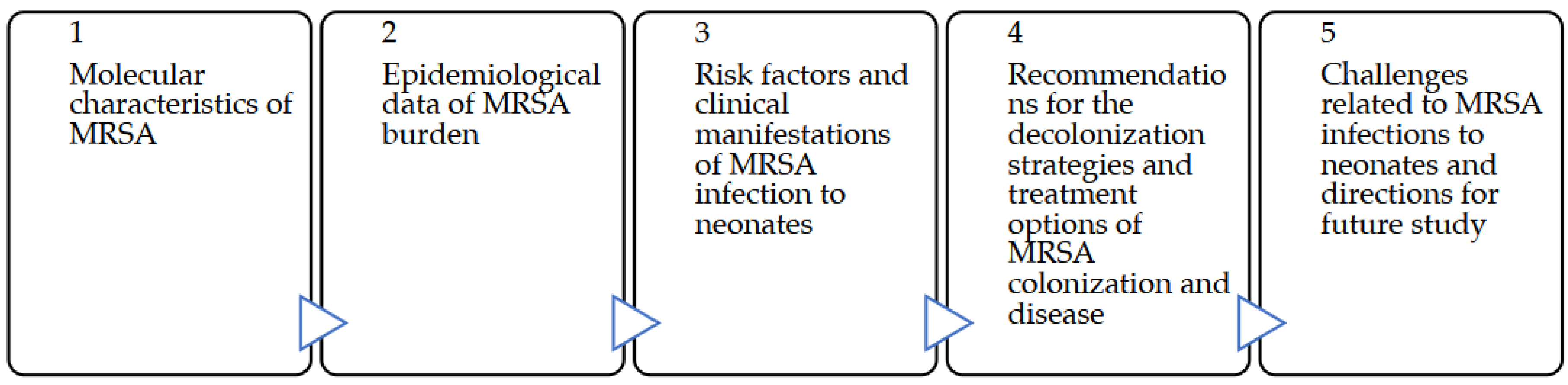

Table 1.
Differences between the two types of MRSA.
| HA-MRSA | CA-MRSA | |
|---|---|---|
| SCCmec | Types I, II, III | IV, V, VII |
| Pulsed-field gel electrophoresis typing | USA300, USA400 | |
| Sequence types | 1, 5, 8, 15-21, 22 | 5, 8, 239 |
| Toxin carriage | Panton-Valentine leukocidin | |
| Clinical manifestations | Bacteremia, sepsis, endocarditis, pneumonia, osteomyelitis, septic arthritis, central nervous system infections | Skin and soft tissues infections, toxic shock syndrome |
| Antibiotic susceptibility | Vancomycin, linezolid, daptomycin, telavancin | Clindamycin, quinolones, trimethoprim-sulfamethoxazole, vancomycin, linezolid, daptomycin, telavancin |
MRSA, methicillin-resistant Staphylococcus aureus; HA-MRSA, hospital-associated MRSA; CA-MRSA, community-acquired MRSA, SCCmec, staphylococcal cassette chromosome.
Table 2.
Precautions against MRSA colonization.
| Policy | |
|---|---|
| Nasal and throat bacterial flora | Placement on maternal breast as soon as possible after delivery Precolonization of the common α- and/or Á-Streptococcus by distributing the mother’s breast milk over and into the mouth of extremely low birth weight neonates as soon as they are admitted into the NICU |
| Bacterial flora of the skin | Skin-to-skin contact between the newborn and the mother should be established in the delivery room as soon as possible following birth, regardless of the mode of delivery Kangaroo care |
| Hand hygiene | Strict hand hygiene before and after handling neonates |
| Wearing gloves | MRSA isolation rate decreases when gloves are used as an infection control method |
| Avoid overcrowding / Cohorting | Cohorting and isolating MRSA-positive neonates, taking barrier precautions, educating healthcare professionals, and avoiding crowded wards |
MRSA, methicillin-resistant Staphylococcus aureus; NICU, neonatal intensive care unit
Table 3.
Measures for MRSA decolonization.
| Indications | Limitations | |
|---|---|---|
| Mupirocin nasal | Twice a day for five to ten days to decolonize the nasal cavity | 42% of infected neonates had no previous positive MRSA screening swab Many newborns had a small window of opportunity for decolonization because the median time between colonization and infection was only 5 days The effectiveness of decolonization to eliminate MRSA colonization and prevent MRSA infections may be restricted because several neonates who had decolonization treatment became recolonized during their NICU stay, and a few contracted an MRSA infection |
| Chlorexidine antiseptic solution | Topical body decolonization regimens using a skin antiseptic solution, such as chlorhexidine for 5–14 days |
MRSA, methicillin-resistant Staphylococcus aureus; NICU, neonatal intensive care unit.
Table 4.
Antimicrobial therapy against MRSA.
| Indications | Limitations | |
|---|---|---|
| Mupirocin | Topical therapy may be sufficient for minor cases of localized pustulosis | For localized pustulosis in full-term neonates |
| Vancomycin | Is thought to be best treatment for severe MRSA infections | There have been reports of VISA and VRSA infections |
| Clindamycin | Treatment of severe S. aureus infections | Use for treating SSTIs and invasive susceptible CA-MRSA infections in children, including osteomyelitis, septic arthritis, pneumonia, and lymphadenitis, despite not being specifically approved for the treatment of MRSA infections It is not recommended for endovascular infections such as septic thrombophlebitis or infective endocarditis Although its entry into the cerebrospinal fluid is restricted, it has exceptional tissue penetration, especially in bone and abscesses |
| Linezolid | Severe MRSA infections in newborns. Acts by preventing the 50S ribosome from initiating protein synthesis |
Approved for the treatment of nosocomial pneumonia caused by MRSA and SSTIs Long-term use usually results in resistance through a mutation in the 23S ribosomal RNA binding site for linezolid or methylation of adenosine at position 2503 in 23SrRNA caused by the cfr gene |
| Daptomycin | Severe MRSA infections in newborns. Causes bactericidal action in a concentration-dependent manner by interfering with the function of cell membranes through calcium-dependent binding |
Pharmacokinetics, safety, and effectiveness in children are still being studied and have not been determined |
| Rifampicin | Exhibits bactericidal action against S. aureus and reaches high intracellular levels, in addition to penetrating biofilms | It should not be used as monotherapy due to the quick development of resistance In some situations, it may be used in conjunction with another active antibiotic |
| Telavancin | Severe MRSA infections in newborns. Prevents the formation of cell walls by attaching itself to peptidoglycan chain precursors and depolarising cell membranes |
Should be reserved for MRSA, VISA, and VRSA |
| Trimethoprim-sulfamethoxazole | Option for the outpatient treatment of SSTIs | Increases the risk of kernicterus; thus, it is not advised during the first few months of life |
MRSA, methicillin-resistant Staphylococcus aureus; VISA, vancomycin-intermediate Staphylococcus aureus; VRSA, vancomycin-resistant Staphylococcus aureus; SSTI, skin and soft tissue infection;CA-MRSA, community-acquired MRSA.
Disclaimer/Publisher’s Note: The statements, opinions and data contained in all publications are solely those of the individual author(s) and contributor(s) and not of MDPI and/or the editor(s). MDPI and/or the editor(s) disclaim responsibility for any injury to people or property resulting from any ideas, methods, instructions or products referred to in the content. |
© 2024 by the authors. Licensee MDPI, Basel, Switzerland. This article is an open access article distributed under the terms and conditions of the Creative Commons Attribution (CC BY) license (http://creativecommons.org/licenses/by/4.0/).
Copyright: This open access article is published under a Creative Commons CC BY 4.0 license, which permit the free download, distribution, and reuse, provided that the author and preprint are cited in any reuse.


