

Submitted:
20 December 2024
Posted:
23 December 2024
You are already at the latest version
Abstract
Background: A person's self-efficacy is crucial because it is an evaluation, belief, or confidence in one's ability to carry out activities and to plan or carry out a course of action in order to achieve the intended goals. The issue is that although people know they are susceptible to Diabetes Mellitus (DM), they frequently fail to take preventative measures. This is why this writing survey was created.Method: Use PubMed, ProQuest, and Scopus to find reviews of previous research. The search criteria that were utilised to locate papers were diabetic, diabetes mellitus, interventions, improving, and self-efficacy. Search parameters for English-language, full-text, open-access publications released between 2019 and 2024.Results: The results of the study show that self-efficacy, which leads to metabolic management and a responsible attitude, is correlated with managed blood glucose levels in DM patients. The implementation of education carried out by health workers with the methods of health literacy, training according to planned behavior theory and web-based intervention is the best way to improve the self-efficacy of DM patients.Conclusion: The provision of health literacy training programs for glycaemic control in patients with diabetes mellitus and the development of solid partnerships between health network partners and health-related agencies should be the main priorities of healthcare practitioners.
Keywords:
Self Efficacy
; Diabetes Mellitus
Introduction
One of the non-communicable degenerative diseases that will become more prevalent in the future is diabetes mellitus (DM). 230 million people worldwide suffer with diabetes mellitus. In Indonesia, the number of people with diabetes mellitus rises by 3% year, or 7 million patients. By 2045, the number of deaths from DM will have doubled (IDF, 2021; PERKENI, 2021).
According to the International Diabetes Federation, 537 million persons globally between the ages of 20 and 79 would have diabetes in 2022. According to projections, this number will rise to 643 million (1 in 9 adults) by 2023 and 784 million (1 in 8 adults) by 2045. Of the estimated 240 million individuals with diabetes, 44% go undiagnosed. One in ten persons worldwide suffers from poor glucose tolerance. This raises the chance of getting DM (IDF, 2021). Based on ASIK data, Indonesia's Diabetes Mellitus Early Detection Survey yielded 14.05% outcomes (13,470,556 out of 95,900,441 targets). With a total score of 14.80%, East Java is ranked 12th out of 35 Indonesian provinces (Kementerian Kesehatan RI, 2023). In Surabaya, the number of diabetics rose from 102,599 in 2017 to 115,460 in 2018.
Diabetes Mellitus (DM) prevention efforts can be done by managing risk factors. DM is known to have several risk factors including factors that cannot be changed, namely age and heredity and factors that can be changed, namely eating wrong, lack of physical activity or lack of movement, obesity, stress, and the use of drugs. Other factors associated with DM are people with metabolic syndrome, having a history of cardiovascular disease, always consuming alcohol, smoking, always consuming coffee (Alam, 2021). Of the many risk factors, most are modifiable, which also means that prevention through risk factor modification provides an opportunity for prevention. On the other hand, the gradual and long relevant course of DM also provides opportunities for individuals to make efforts to manage risk factors (Budreviciute, 2020).
In terms of preventive behavior, individuals are influenced by many factors. According to Bandura (1997) individual behavior is influenced by self-efficacy. Self efficacy is a person's belief and ability to perform a form of example of the person's own function and events in the environment, self-efficacy can be formed in developing through four processes, namely cognitive, motivational, affective, and selection (Bandura, 1997).
Self efficacy is very important for a person because self efficacy is an assessment, belief or confidence to perform tasks and to organize or implement a program of action in achieving the desired goals. Self efficacy can also influence a person to have the ability to survive and be resilient in the face of adversity. Self efficacy can help a person in making choices, persistence, forward efforts and perseverance in maintaining their tasks. Self efficacy also determines how a person thinks, feels, motivates himself and behaves. A person with high self-efficacy will be able to accomplish goals and find several solutions to challenges. On the other hand, a person with poor self-efficacy will encounter more challenges (Hattie, J., 2020).
Culturally, people in Indonesia tend not to go to health services if there are no symptoms or feel serious symptoms (Subandi, 2021). In fact, if there are symptoms, it could be that a disease is already in an advanced condition that is difficult to treat. From the above phenomenon, the problem arises that individuals are aware that they are at risk of suffering from DM but tend not to take prevention. Therefore, it is important to examine how confident individuals are able to prevent DM. Knowing whether or not individuals are confident in carrying out DM prevention efforts can be the basic data for health facilities to develop programs to improve individual confidence in carrying out DM prevention efforts. This is the motivation behind this writing survey.
Design and Method
Sources of information and search methodology
Original research publications published between January 2019 and December 2024 were the focus of the literature search. 25 credible journal publications from various nations provided the secondary data used in this investigation. The Pubmed, ProQuest, and SCOPUS databases are the four journal databases from which these articles were retrieved. Using the "MeSH terms," the precise keywords that were found were "diabetic" OR "diabetes mellitus" AND "self efficacy."
Examine the requirements for eligibility and selection
The PICOS framework was used to select the papers and assess their suitability. Articles that met the following requirements would be chosen: The study should demonstrate the outcome of the intervention for self-efficacy for the outcome (O). The population (P) should consist of DM patients who have received a self-efficacy intervention (I).
The studies could use any type of research design, including descriptive, cross-sectional, observational, quasi-experimental, RCT, and mixed methods. English should be used for all studies. According to the exclusion criteria, research articles were disqualified if they used non-English language, were published as reviews (literature review, narrative review, scoping review, systematic review, etc.), did not address self-efficacy interventions, or had a population of chronic disease patients without diabetes mellitus. After that, we looked over a few chosen articles that were found using preset keywords.
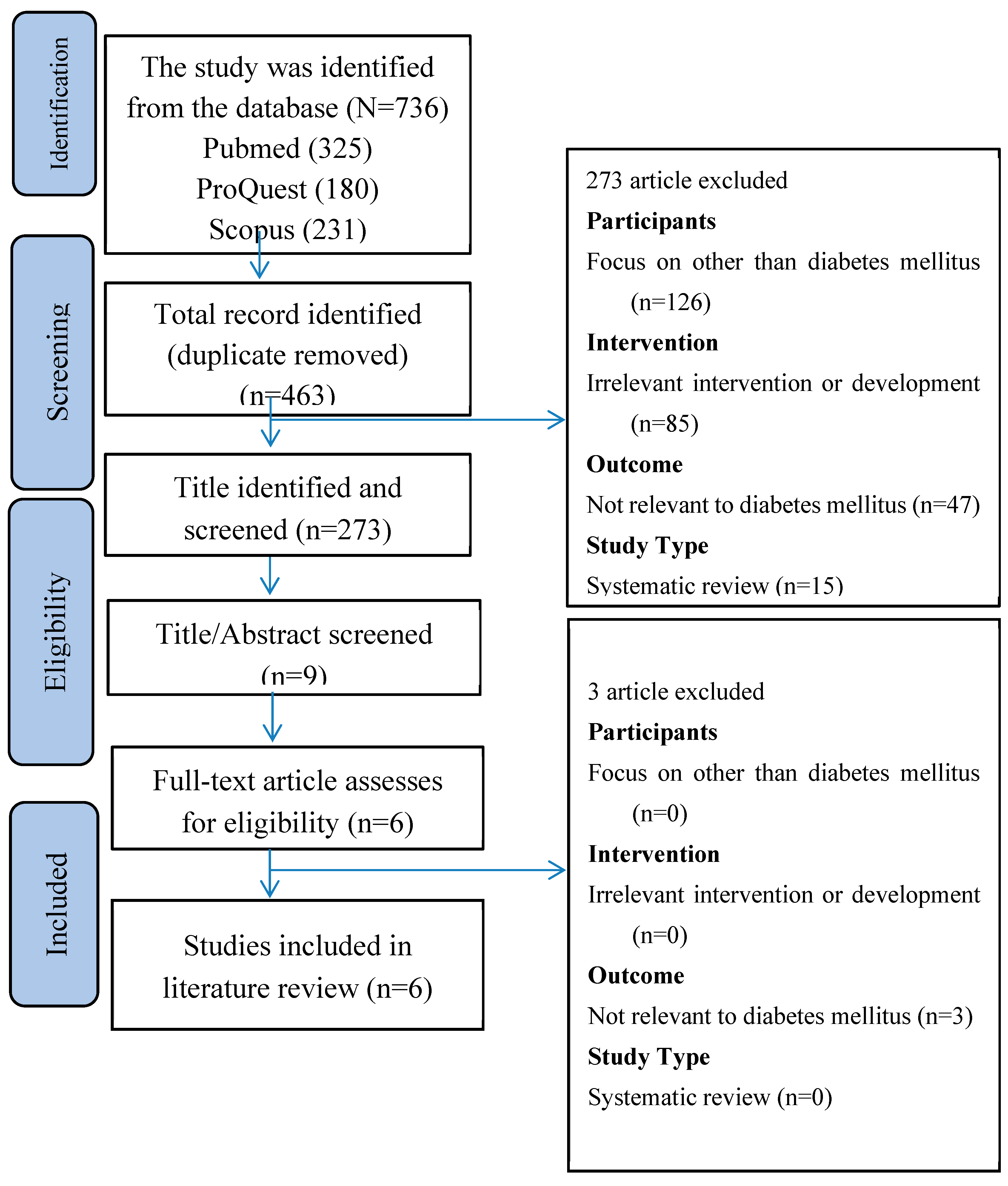
We found that 325 papers from Pubmed, 180 from Proquest, and 231 from the Scopus database all matched predefined keywords. Six research papers were found after examining the inclusion criteria and the 736 publications that the keyword search had turned up. The article selection process utilising the PRISMA flowchart is depicted in Figure 1.

Table 1.
Articles on Strategies for Increasing Self Efficacy in Individuals with Diabetes Mellitus.
| No | Title and Author | Method | Results |
|---|---|---|---|
| 1 | Health literacy, self-efficacy, self-care behaviors, and glycemic control among older adults with type 2 diabetes mellitus: a cross-sectional study in Thai communities (Ong-Artborirak et al., 2023) | D : Cross-sectional. S : The study consisted of 414 older adults aged 60 years and above who had been diagnosed with T2DM. Participants were selected through simple random sampling from the list of patients registered in the Java Health Center Information System (JHCIS) program in Phayao Province. V : Depended variables: glycemia control (fasting blood glucose and HbA1c), BMI, SBP & DBP, and eGFR. Independent Variables: Health Literacy, Self-Efficacy, Self-Care Behaviors I : The questionnaire consisted of: General characteristics of participants; Health literacy, which included six health-related skill areas; Self-efficacy for diabetes prevention; Self-care behaviors related to diabetes prevention, which included questions on food consumption, exercise, stress management, and medication behaviors. A : Pearson's correlation coefficient (r) and Simple Linear Regression. |
The results of this study provide important insights into factors affecting diabetes control and emphasize the need for a more holistic approach in diabetes management, including improved health literacy and support for self-care behaviors. Patients with better health literacy tend to have lower HbA1c levels, indicating better glycemic control. |
| 2 | The effect of training to diabetes patients according to planned behavior theory on self-efficacy and patient empowerment: A randomized study (Göger, Şener and Ci̇ngi̇l, 2024) | D : experimental design with active control, pre-test-post-test, and single-blind. Participants were randomly divided into an intervention group and a control group. S : consisted of 92 participants, of which 45 people were in the intervention group and 47 people in the control group. Participants involved were individuals with type 2 diabetes who were aged 40 years and above, had been diagnosed at least one year previously, and met the inclusion criteria. V : Independent variable: Training based on Theory Planned Behavior (TBP). Independent Variables: self-efficacy, patient empowerment, and HbA1c levels I : The questionnaires consisted of: Diabetes Management Self-Efficacy Scale (DMSS); Patient Empowerment Scale (PES); HbA1c. A : Chi-square test and t/Wilcoxon test for within-group comparisons, and t/Mann Whitney test for between-group comparisons. |
The training provided based on the theory of planned behavior contributed positively to diabetes disease management, improving self-efficacy and patient empowerment, although it did not have a significant impact on HbA1c levels within the specified observation period. |
| 3 | Effects of an educational program on self-efficacy towards type 1 diabetes mellitus disease among parents and adolescents in Jordan (Al-Shorman et al., 2023) | D : Quasi-experimental with a one-group pre-test-post-test approach. S : consisted of 44 participants, comprising 29 parents of young children and 15 adolescents with type 1 diabetes. V : The main variable measured in this study was parents' and adolescents' self-efficacy in managing type 1 diabetes. This variable was measured before and after the education program to assess the effectiveness of the intervention. I : DMT1 Parents' and Adolescents' Self-Efficacy Scale, which consists of 21 items with a five-point Likert scale (1 = “not at all capable” to 5 = “very capable”). The instrument was developed by the researcher with the collaboration of a diabetes health educator and has undergone a validation process. A : T-test for paired samples |
Overall, the results of this study support the importance of diabetes education in improving the self-efficacy and knowledge of parents and adolescents living with type 1 diabetes. These results suggest that a structured diabetes education program effectively improves participants' ability to manage type 1 diabetes, including in terms of understanding blood glucose targets, insulin types, and other diabetes management practices. |
| 4 | Diabetes Self-Efficacy on Glycemic Control and Well-Being of Patients With Type 2 Diabetes Mellitus: An Analytical Cross-Sectional Study (Aseela et al., 2024) | D : Cross-sectional analytic. S : The study consisted of 400 adult patients with T2DM who had been diagnosed for more than one year. The sampling technique used was consecutive sampling, and participants with a history of depression were excluded from the study. V : Self-Efficacy, Glycemic Control dan Well-Being of Patients I : Stanford Diabetes Self-Efficacy Scale (DSES), and the WHO-5 Well-Being Index Scale. A : Chi-Square Test and Pearson Correlation |
The results of this study show that high self-efficacy is associated with better glycemic control and higher well-being, and identify factors that can improve self-efficacy in patients with T2DM. |
| 5 | The mediating role of diabetes stigma and self-efficacy in relieving diabetes distress among patients with type 2 diabetes mellitus: a multicenter cross-sectional study (Xing et al., 2023) | D : Multicenter cross-sectional study. S : The study involved collecting data from 431 patients with type 2 diabetes drawn from several medical centers. V : Social Support, Diabates Stigma, Self Efficacy, and Diabetes Distress I : Perceived Social Support Scale to measure social support; Type 2 Diabetes Stigma Assessment Scale to assess diabetes stigma; Self-Efficacy for Diabetes Scale to measure self-efficacy in diabetes management; Diabetes Distress Scale to assess the level of diabetes-related stress. A : Pearson Correlation and Structural Equation Modeling (SEM) |
The model tested using structural equation modeling showed a good fit, with indicators meeting the established criteria (e.g., chi-square, NFI, GFI, and RMSEA), indicating that the proposed hypothesized model can explain the relationship between the variables well. The results of this study provide important insights for the development of interventions that can increase social support and reduce diabetes stigma, as well as improve patients' self-efficacy, which may ultimately reduce diabetes-related stress. |
| 6 |
The Effect of Web-based Diabetes Education on the Metabolic Control, Self-efficacy and Quality of Life of Adolescents with Type 1 Diabetes Mellitus in Turkey (Ayar et al., 2021) |
D : pre-test/post-test quasi-experimental approach. S : Teenagers between the ages of 11 and 18 who were registered at the paediatric endocrinology polyclinic of a university hospital in western Turkey and had a diagnosis of type 1 diabetes were included in the study. Thirty of the 62 teenagers that took part were in the intervention group, while thirty-two were in the control group. V : Independent variable: type of education (web-based education and standard care). Dependent variable: self efficacy, quality of life, and A1C levels I : Self-Efficacy Scale, Quality of Life (QOL) Inventory, and A1C Measurement A : To compare the mean A1C, quality of life, and self-efficacy levels over time between the intervention and control groups, the study used analysis of variance (ANOVA). This analysis assisted in assessing the web-based education program's efficacy. |
Although it had no discernible effect on A1C levels, the study found that web-based diabetes education is a useful tool for improving quality of life and self-efficacy in teenagers with type 1 diabetes. The results confirm the need for more easily available online learning materials for teenagers with diabetes. When compared to teenagers in the control group, who received standard care, the self-efficacy levels of the intervention group, who received web-based teaching, increased dramatically. This implies that teenagers with type 1 diabetes benefit greatly from web-based education in terms of improving their self-management practices. |
Results And Discussion
- Diabetes Health Literacy
It was discovered that older adults with diabetes had a modest level of self-efficacy. Because they believe in their own ability to do particular tasks, people with greater levels of self-efficacy are more motivated to engage in a behaviour; as a result, self-efficacy has a favourable impact on health behaviours (Farmer, 2022). Cognitive and social skills must be included in order to support self-efficacy in diabetic patients, and it should be appropriate for the study setting. Patients with diabetes will cooperate more with prevention and treatment initiatives as a result (Rosli, 2022).
Poor self-care behaviours were linked to low self-efficacy, according to a study on diabetic patients in Iran. According to another study, 16% of participants had low self-efficacy scores, indicating a lack of confidence in their ability to control their diabetes. Furthermore, this study's findings showed an intriguing correlation between health literacy and self-efficacy. It demonstrated a relationship between health literacy and the self-efficacy of older diabetics in managing their blood glucose levels. According to a prior study, health literacy was positively correlated with self-efficacy and may be a significant predictor of self-efficacy in diabetic patients (Ong-Artborirak et al., 2023).
The results of this study demonstrated how self-efficacy and diabetes health literacy relate to blood glucose control in older DM patients. The findings imply that in order to inspire and encourage older patients to seek the desired objectives, medical departments and public health organisations should give priority to health literacy and diabetes-related experience and knowledge (Ong-Artborirak et al., 2023).
Better decision-making and sustained behavioural improvements result, for example, from having access to health information, comprehending the illness and its implications, and interacting with peers and medical professionals. Furthermore, encouraging appropriate self-care practices and raising health literacy levels not only improve health outcomes but also have a beneficial economic impact that benefits both individuals and national health systems (Aseela et al., 2024).
- 2.
- Training According to Planned Behavior Theory
The relationship between social support and diabetes discomfort was mediated by self-efficacy and diabetes stigma. Social support and diabetes stigma had a direct impact on diabetic discomfort. The model's output can serve as a guide for creating treatments that are grounded in theory and evidence (Xing et al., 2023).
According to research in the literature, people with type 2 diabetes who receive training based on planned behaviour theory see an increase in their average Perceived Behavioural Control score. According to the findings, TPB is thought to be essential for the beginning and maintenance of healthy behaviours in diabetic patients and to demonstrate self-efficacy in persons. According to the study, the term "patient empowerment" describes how a person gains competence, control, and self-care abilities in relation to their illness. Therefore, it is essential to provide trainings that raise the patient's level of awareness and give them self-care skills in order to manage a chronic disease like diabetes (Göger, Şener and Ci̇ngi̇l, 2024).
The impact of training based on Planned Behaviour Theory in patients with type 2 diabetes was examined in a study, and it was shown that when the health literacy levels of the participants in the intervention group increased, self-care behaviours improved. Damanyanti et al. claimed that the patient's self-care management in diabetes is directly impacted by the trainings they receive, and that using Planned Behaviour Theory in the classroom will empower the patient. They also claimed that incorporating Planned Behaviour Theory into patient empowerment trainings would help diabetes patients develop self-care behaviours (Göger, Şener and Ci̇ngi̇l, 2024).
Using the Planned Behaviour Theory to organise patient trainings will empower diabetic patients by boosting their self-efficacy. In this situation, health professionals should apply the Planned Behaviour Theory to care in order to influence patients' behaviour and make their interventions more successful by giving them a scientific foundation (Göger, Şener and Ci̇ngi̇l, 2024).
- 3.
- Web-Based Diabetes Education
Diabetic education could try to reduce these differences by offering patient-specific training. Additionally, nurses should work with a multidisciplinary team and take a holistic approach when caring for children and adolescents with diabetes (Al-Shorman et al., 2023).
It was discovered that teenagers with diabetes could improve their self-efficacy for diabetic self-management with web-based diabetes education. Since more teenagers in Turkey are using the Internet and web access enables them to seek information whenever they need it and from any location, it is thought that web-based instructional programs for persons with type 1 diabetes should become more widely available (Ayar et al., 2021).
Based on the findings of this study, we think that web-based diabetes education will assist to guarantee that teens with diabetes and medical professionals will make better use of their time together. Additionally, Web-based methods might make diabetes education more accessible. Since there was no web-based education program for teenagers with type 1 diabetes that was established and accessible to diabetic nurses in Turkey, our study adds to the body of knowledge on diabetes education. (Ayar et al., 2021).
Conclusion
Literature review with an emphasis on interventions to help people with diabetes mellitus become more self-sufficient. This study can show that health care professionals should prioritise establishing robust connections between health network partners and health-related agencies, as well as offering health literacy, training programs to help patients with diabetes manage their blood glucose levels. In this situation, health professionals should use the Planned Behavior Theory in care to help patients alter their behaviour and make their interventions more effective by giving them a scientific foundation.
Acknowledgments
We would like to express our appreciation to Universitas Airlangga and all participants in this literature study. Governmental, commercial, and nonprofit funding agencies did not offer a specific grant for this study of the literature.
Conflicts of Interest
The authors have no conflict of interest.
References
- Alam, S.; Hasan, M.K.; Neaz, S.; Hussain, N.; Hossain, M.F.; Rahman, T. Diabetes Mellitus: insights from epidemiology, biochemistry, risk factors, diagnosis, complications and comprehensive management. Diabetology 2021, 2, 36–50. [Google Scholar] [CrossRef]
- Al-Shorman NA, D.; Atiyeh, H.; Kassab, M.; Al-Rjoub, S.F. Effects of an educational program on self-efficacy towards type 1 diabetes mellitus disease among parents and adolescents in Jordan. Journal of Pediatric Nursing 2023, 71, 66–72. [Google Scholar] [CrossRef] [PubMed]
- Ayar, D. , Öztürk, C., & Grey, M. (2021). The effect of web-based diabetes education on the metabolic control, self-efficacy and quality of life of adolescents with type 1 diabetes mellitus in Turkey.
- Aseela, S.; Santhi, S.; Anish, T.S.; Mahadevan, S. Diabetes Self-Efficacy on Glycemic Control and Well-Being of Patients With Type 2 Diabetes Mellitus: An Analytical Cross-Sectional Study. Cureus 2024, 16, e64005. [Google Scholar]
- Bandura, A. Social cognitive theory of self-regulation. Organizational Behavior and Human Decision Processes 1997, 50, 248–287. [Google Scholar] [CrossRef]
- Budreviciute, A.; Damiati, S.; Sabir, D.K.; Onder, K.; Schuller-Goetzburg, P.; Plakys, G.; Kodzius, R. Management and prevention strategies for non-communicable diseases (NCDs) and their risk factors. Frontiers in public health 2020, 8, 574111. [Google Scholar] [CrossRef] [PubMed]
- Farmer, H. , Xu, H., & Dupre, M. E. (2022). Self-efficacy. In Encyclopedia of Gerontology and Population Aging (pp. 4410–4413). Cham: Springer International Publishing.
- Göger, S.; Şener, Ş.; Ci̇ngi̇l, D. The effect of training to diabetes patients according to planned behavior theory on self-efficacy and patient empowerment: A randomized study. Primary Care Diabetes 2024, 18, 486–492. [Google Scholar] [CrossRef] [PubMed]
- Hattie, J.; Hodis, F.A.; Kang, S.H. Theories of motivation: Integration and ways forward. Contemporary Educational Psychology 2020, 61, 101865. [Google Scholar] [CrossRef]
- International Diabetes Federation. IDF Diabetes Atlas. 10th ed. Boyko EJ, Magliano DJ, Karuranga S, Piemonte L, Saeedi PRP, Sun H, editors. 2021. Available from: www.diabetesatlas.org.
- Kementerian Kesehatan Republik Indonesia. DITJEN P2P (Direktorat Jendral Pencegahan dan Pengendalian Penyakit) Laporan Kinerja Semester 1 Tahun 2023. 2023.
- Ong-Artborirak, P.; Seangpraw, K.; Boonyathee, S.; Auttama, N.; Winaiprasert, P. Health literacy, self-efficacy, self-care behaviors, and glycemic control among older adults with type 2 diabetes mellitus: a cross-sectional study in Thai communities. BMC geriatrics 2023, 23, 297. [Google Scholar] [CrossRef] [PubMed]
- PERKENI (2021) Konsensus Pengelolaan dan Pencegahan Diabetes Melitus Tipe 2 di Indonesia 2015. PB. Perkeni.
- Rosli, N.A.; Mazapuspavina, M.Y.; Ismail, Z.; Elkudssiah Ismail, N. Relationship of Self Efficacy in Medication understanding with Quality of Life among Elderly with type 2 diabetes Mellitus on Polypharmacy in Malaysia. International Journal of Environmental Research and Public Health 2022, 19, 3031. [Google Scholar] [CrossRef] [PubMed]
- Subandi, M.A.; Praptomojati, A.; Marchira, C.R.; DelVecchio Good, M.J.; Good, B.J. Cultural explanations of psychotic illness and care-seeking of family caregivers in Java, Indonesia. Transcultural Psychiatry 2021, 58, 3–13. [Google Scholar] [CrossRef] [PubMed]
- Xing, S.; Liu, Y.; Zhang, H.; Li, B.; Jiang, X. The mediating role of diabetes stigma and self-efficacy in relieving diabetes distress among patients with type 2 diabetes mellitus: a multicenter cross-sectional study. Frontiers in Psychology 2023, 14, 1147101. [Google Scholar] [CrossRef] [PubMed]
Figure 1.
Preferred Reporting Items for Systematic Review.
Disclaimer/Publisher’s Note: The statements, opinions and data contained in all publications are solely those of the individual author(s) and contributor(s) and not of MDPI and/or the editor(s). MDPI and/or the editor(s) disclaim responsibility for any injury to people or property resulting from any ideas, methods, instructions or products referred to in the content. |
© 2024 by the authors. Licensee MDPI, Basel, Switzerland. This article is an open access article distributed under the terms and conditions of the Creative Commons Attribution (CC BY) license (http://creativecommons.org/licenses/by/4.0/).
Copyright: This open access article is published under a Creative Commons CC BY 4.0 license, which permit the free download, distribution, and reuse, provided that the author and preprint are cited in any reuse.


