

Submitted:
23 December 2024
Posted:
23 December 2024
You are already at the latest version
Abstract
Recycled concrete aggregate (RCA) has been widely adopted in construction and emerged as a sustainable alternative to conventional natural aggregates in the construction industry. This review paper aims to provide a comprehensive analysis of RCA, highlighting its properties, applications, and overall sustainability benefits. The paper explores the manufacturing process of RCA, examines its mechanical and durability characteristics, and investigates its environmental impacts. Furthermore, it delves into the various applications of RCA, such as road construction materials, pavement bases, and concrete materials, considering their life cycle performance and economic considerations. This review reveals that there is a need for systemic data collection that could enable automated concrete mix design. The findings of this review shed light on the potential of RCA as a viable solution to reduce resource depletion and waste generation while promoting sustainable construction practices. The critical research gaps now are durability of RCA concrete, feasibility analysis, and implementation of treatment methods for RCA improvement. An effective life cycle assessment tool, digitalization technologies, can be applied to enhance its sustainability. The equivalent mortar volume method to calculate the RCA concrete mix design, which can contain metakaolin and fibers, needs further assessment.
Keywords:
Recycle aggregate
; concrete
; mix design
; construction and demolition waste
; sustainability
; circular economy
1. Introduction
The The concept of a circular economy in the construction industry aims to minimize waste and maximize resource efficiency throughout the entire life cycle of a building [1]. It involves designing, constructing, and managing buildings in a way that promotes the reuse, recycling, and recovery of materials, reducing the reliance on raw materials, and minimizing the environmental impact of the construction sector. The construction sector is already known as a major consumer of natural resources. Estimates suggest that the sector consumes about 50% of global steel production, 25% of global water resources, and 40% of global energy [2,3,4]. In a circular economy approach, buildings are seen as repositories of valuable resources that can be harvested and reused rather than being treated as disposable structures [5]. This means that instead of demolishing buildings and sending the materials to landfills, components and materials are carefully deconstructed and salvaged for reuse or recycling. The circular economy encourages the use of renewable and sustainable materials, promotes modular and flexible design, and emphasizes efficient resource management practices. The Ellen MacArthur Foundation [6] estimates that by adopting circular principles, the global construction industry could generate savings of $630 billion annually by 2025, and the European Commission estimated that the circular economy could create around 1.2 million additional jobs in the European Union's construction sector by 2030 [7]. The Royal BAM Group [8] assessed the feasibility of their construction projects using circular economy principles and reported that a 96% recycling rate could potentially be achieved for their projects in 2020.
However, despite the potential benefits, the implementation of circular economy principles in the construction industry faces several challenges, including a lack of technical solutions [9]. One of the key obstacles is the fragmentation of the construction sector, where numerous stakeholders, including architects, engineers, contractors, and suppliers, operate independently and often with limited communication and collaboration. This lack of integration hampers the adoption of circular practices as it requires coordination among various actors. Previous studies [10,11] have shown that the current reuse and recycling rates in the construction industry are relatively low. In some countries, such as Iran, less than 10% of construction and demolition waste (CDW) is recycled or reused [12].
Another challenge lies in the technical complexity of deconstruction and material recovery processes [13,14,15]. Traditional construction methods and materials often make it difficult to disassemble and separate components for reuse or recycling. Many existing buildings were not designed with circularity in mind, and their structural systems and material compositions can pose challenges for efficient resource recovery. Additionally, there is a lack of standardized systems and protocols for material identification, sorting, and quality control [16]. For example, the European Union reports recycling rates ranging from 30% to 90% for CDW across member states, demonstrating inconsistencies in material handling and quality control [17,18]. Without clear guidelines and industry-wide standards, it becomes harder to ensure the quality and safety of recycled or reused materials. The absence of robust certification systems for recycled construction products further hampers market acceptance and consumer confidence. Furthermore, the economic viability of circular practices can be a barrier [7,19]. At present, the cost of implementing circular economy strategies such as deconstruction, sorting, and reprocessing can be higher than conventional construction methods. Demolition enterprises frequently salvage historical brandings that are deemed valuable and can be sold at a premium compared to items lacking such perceived worth [20]. The initial investments required for specialized equipment, skilled labor, and advanced technologies often deter stakeholders from embracing circularity. Ma, et al. [21] also advocated that recycled concrete was priced at a premium of 0-10% in comparison to normal concrete. In Spain, the RCA cost varies between 3 to 6 € per ton (equivalent to US $3.65–7.30 per ton), whereas the NA cost ranges from 5 to 7.5 € per ton (equivalent to US $6.08–9.12 per ton) [22].
Addressing these challenges requires a multi-faceted approach. It involves promoting collaboration among stakeholders, investing in research and development of innovative technologies for material recovery and reuse, establishing industry-wide standards and certifications, and creating economic incentives to encourage the adoption of circular practices. Governments, industry associations, and research institutions play crucial roles in driving innovation and providing the necessary support to overcome these technical limitations and enable the successful implementation of circular economy principles in the construction industry [23].
The global construction industry faces significant challenges in the form of resource scarcity and environmental concerns. Traditional construction practices heavily rely on the extraction of natural aggregates, such as gravel, limestone, and sand, which leads to the depletion of finite resources and disruption of ecosystems [24]. A recent study determined taxing strategies of using natural aggregate (NA) in Sweden, Denmark and the United Kingdom [25]. The implementation of such a strategy may entail negative consequences in terms of inadequate incentives and restricted policy legitimacy. Additionally, the disposal of CDW, particularly concrete waste, contributes to the growing problem of landfill congestion. According to a report by the World Economic Forum, CDW accounts for around 40% of the total solid waste generated worldwide [26]. In this context, the concept of recycled concrete aggregate (RCA) has gained considerable attention as a sustainable solution to address these challenges.
RCA production refers to the process of transforming waste concrete into usable aggregate for construction purposes. The adoption of RCA presents a range of advantages such as the minimization of waste, preservation of natural resources, and mitigation of environmental footprint. Through the diversion of concrete waste from landfills and its subsequent reuse as aggregate, the construction sector can effectively mitigate its carbon emissions and alleviate the burden on natural resources. According to the U.S. Environmental Protection Agency (EPA), RCA accounts for approximately 35% of all CDW generated in the United States [27]. The images of RCA and concrete containing RCA with different magnification levels is shown in Figure 1.
The production of RCA involves collecting and processing concrete waste generated from demolition sites or construction projects. The applicability of RCA is greatly influenced by the nature and composition of the source concrete. To avoid compromising the quality and function of the produced RCA, care must be taken to ensure that the source concrete does not include pollutants or excessive concentrations of dangerous elements. With rapid economic growth of mega cities and built environments, the per capita consumption of concrete materials is soaring day by day. Concrete is mainly composed of coarse aggregate (stone) and fine aggregate (sand). These two aggregates account for about 75% of the total concrete [28]. The applications of RCA to concrete are thus instrumental to enable a pathway for circular economy.
Through a production series of crushing, screening, and separation processes, the concrete waste is transformed into different gradations of aggregate. Specialized equipment, such as crushers and screens, are utilized to break down the concrete into smaller particles and separate them from other materials, such as reinforcement steel or debris. Additional pre-processing treatments may be employed to enhance the cleanliness and quality of the RCA, including the removal of surface coating or attached cement paste. The resulting RCA can be categorized into different gradations based on particle size distribution, which can be tailored to meet specific construction requirements. Coarse RCA (cRCA), fine RCA (fRCA), or a combination of both can be produced, depending on the intended applications. The utilization of RCA in construction projects offers a range of opportunities, such as road construction [29], pavement base [30], and concrete production [31], demonstrating its versatility and potential to replace NA. This systematic review paper aims to provide a comprehensive analysis of RCA from the state-of-the-art review and meta-analysis articles, focusing on their mix designs. It explores the production process of RCA, including the factors influencing its quality and characteristics. The mechanical and durability properties of RCA concrete are examined, shedding light on its performance compared to conventional concrete. The environmental impact of RCA production and use is evaluated, considering factors such as energy consumption, greenhouse gas emissions, and waste reduction. Moreover, the various applications of RCA in construction are explored, along with the sustainability and circular economy considerations associated with its implementation. By consolidating the existing knowledge and research on RCA, this review paper aims to highlight the potential of RCA as a sustainable alternative to NA. It emphasizes the need for further research, standardization, and awareness to promote the widespread adoption of RCA in the construction industry. The findings presented in this review paper can guide practitioners, policymakers, and researchers in making informed decisions regarding the implementation of RCA in construction projects, ultimately contributing to a more sustainable and resource-efficient construction sector.
1.1. Scope of the Review Paper
In recent times, there has been a growing trend in technical and review literature towards the integration of RCA in cementitious materials. The technical publications underscored the utilization of RCA as a substitute, either in part or in entirety, for conventional normal-weight coarse and fine aggregates. Unfortunately, a systemic (umbrella) review publication summarizing \ overall aspects of review publication is neither fully presented nor discussed for difficulties and constraints in various aspects, including their mix design. Hence, this systemic review paper aims to accumulate, summarise and brief the pertinent 181 review publications of RCA material technology in construction.
The scope of this review consists of concrete and mortar mixtures containing RCA that were designed using ordinary Portland cement (OPC) and geopolymer, and other mix proportions entail fRCA, chemical and mineral by-products, silica fume (SF), rubber, polymer, and fiber. Concrete mixtures containing these discussed additives and admixtures aim to develop special concretes such as self-consolidating concrete (SCC), 3D concrete printing (3DCP), pervious concrete, and ultra-high-performance concrete (UHPC). The performance, workability, mechanical properties, microstructure, and durability have been analyzed and discussed. The processes of quality improvement of RCA in concrete are elaborated. Moreover, up-to-date environmental studies focusing on life cycle assessment and the circular economy have been reported. This systemic review article can offer knowledge that has already been understood in the field and what research should be assessed for future technical issues.
1.2. Significance of the Review
A systematic review paper of review publications, referred to as umbrella review, is a type of systematic review that summarizes and evaluates existing systematic reviews and meta-analyses on a certain research area [32]. Papatheodorou [33] asserted that this type of review had the potential to offer the superior quality of evidence. In comparison to individual studies or narrative reviews, the umbrella review offers a more in-depth degree of synthesis and analysis and serves as a thorough summary of the data that is currently available on the concrete mix design containing RCA topic. The significance of this work is to summarize and synthesize current evidence on RCA concrete mix design themes that have been obtained from trustworthy and certified sources. The information gaps and contradictions were investigated as a thorough blueprint for future research. It aids in making educated judgments and guiding future research efforts for academics, policymakers, designers, and technical professionals.
2. Methodology
To determine the state of the art on this subject, systematic quantitative literature reviews were conducted and reported. A systematic review and meta-analysis of all relevant publications on concrete mix design containing recycled aggregate were conducted. Google Scholar, Scopus, and Emerald database searches were investigated. This search for systematic reviews was conducted in publications that included the term "review" in their titles, abstracts, and/or keywords, with no constraints on date or language. The terms searched herein were "recycled concrete aggregate" and "mix design," as given in Table 1.
As depicted in Figure 2, this systematic review has been conducted using the Preferred Reporting Items for Systematic Reviews and Meta-Analyses (PRISMA) reporting checklist [34]. Initial searches of the aforementioned databases yielded 108 publications. After deleting duplicates, limiting the publishing time, including just English, and incorporating the mix design content, the number of relevant publications decreased to 103. When analyzing the title and abstract, some papers are focused on asphalt applications, are outside the topic of the study, the full-text version cannot be downloaded, and low-quality conference review papers were sorted out; 32 publications were valid. Finally, after a full-text review and quality paper check, 23 important reviewed papers that have been published were analyzed next. A comprehensive literature search was conducted to identify systematic review publications for this investigation. Specifically, these journals include Science of the Total Environment, Polymers, Cement, and Concrete Composites, Sustainability, Crystals, Recycling, Journal of Building Engineering, Construction, and Building Materials, Journal of Cleaner Production, Infrastructures, Materials, Construction Innovation, Clean Technologies, and Environmental Policy, and Jurnal Teknologi. 23 journals were subsequently considered.
During the publication analysis, the title, abstract, keywords, authors' names and affiliations, journal name, and publication year of the detected records are exported to a Microsoft Excel spreadsheet. Two independent reviewers separately examine the titles and abstracts of the records. Then, the two reviewers individually screen the entire texts of the remaining papers to assess their eligibility. During this step, reviewer differences have been discussed and resolved through consensus. In the event that no consensus could be reached, the opinions of a third reviewer would have been considered. We include all review articles that demonstrated, to some extent, that the processes used to discover and choose the literature were explicit, replicable, and devoid of a priori assumptions regarding the relevance of the selected literature [35]. Specifically, we use reviews that identified and chose papers by scanning journal databases for preselected keywords (Pickering & Bryne, 2014). Also eliminated are studies that examine publications published in a single journal. In contrast to systematic literature reviews, narrative literature reviews identify and select literature based on the authors' assessment, without often disclosing the search criteria. We recognize that several of the writers of the studies we identified and included in this study did not designate their reviews as "systematic." As a result of the fact that all of the selected publications reported identifying literature using keywords and databases/journals rather than subjectively, they can be termed systematic reviews. By evaluating these "grey reviews," this study not only enhances our understanding of systematic reviews (which would increase the validity of the conclusions of such studies) but also provides guidance for conducting a systematic review.
After defining the relevant review articles within a 10-year period, as shown in Figure 3a, the majority of review publications were released within this five-year period, and the number of publications increases dramatically each year. As technology and development have evolved, it is important to highlight that this study focuses solely on review papers published within this decade. Prior publications that are involved may lead to erroneous analysis, and review articles that are of poor quality may present impartial and unwarranted outcomes. The quality of the review articles was then evaluated, as shown in Figure 3b. The Scopus database Q1, Q2, and Q3 paper classifications were established as A, B, and C papers, respectively. The conference review articles and Q4 review papers were excluded here. Approximately three-fourths of the articles published were of A quality.
Additionally, Table 2 presents the quantity of papers analyzed in each review article and their corresponding review classification. The narrative review methodology lacks a pre-defined prototype and provides a broader overview of concrete mix design incorporating the topic of recycled concrete aggregate. On the other hand, the systematic review methodology adheres to a pre-defined protocol such as PICO and utilizes data synthesis methods to minimize bias, following formal guidelines such as PRISMA [37]. In contrast, the meta-analysis adheres to a structured protocol for synthesizing data and employs statistical techniques to evaluate information gathered from a variety of empirical studies [38]. The number of papers scrutinized for each review article varies between 30 and 253 papers. The mean value is 135.5 documents. In the realm of review classification, this narrative review paper has been the subject of the majority of studies, accounting for 56.5% of the total. This is followed by meta-analysis at 34.8%, and systematic review at 8.7%. The overview of published timeline and review classification is exhibited in Figure 4.
3. RCA
Cement-based materials are one of the most widely used man-made materials worldwide [39]. Every year, a substantial number of varieties of cement-based materials are manufactured. Due to the widespread application of this material, numerous researchers are investigating its nano-, micro-, and macroscale engineering properties [40,41]. However, cement-based materials are among those that use the most natural resources and leave the largest carbon footprint on our planet. It is reported that in 2017, cement and concrete production accounted for approximately 5–8% of greenhouse gas emissions worldwide, with an annual CO2 output of 2.2 Gt [42,43]. Therefore, material scientists, chemists, and civil and construction engineers made numerous attempts to reuse and recycle this material by incorporating agricultural and industrial byproducts into their mix designs. To attain the objective of a carbon footprint of less than 0.8 Gt/year in the cement sector by 2050, it is plausible to consider the recycling of CDW as a viable and economical alternative [44]. This approach has the potential to significantly reduce global CO2 emissions by up to 1.3 Gt/year [45]. Investigation programs have been implemented by the CDW in the concrete industry over a period of time, specifically RCA, as a binder, filler, or aggregate in civil engineering, architectural, and construction applications.
3.1. Definition of RCA
CWD is produced on a global scale, consisting of RCA, brick, plastering, gypsum, glass, asphalt, stone, steel, fiber, and polymeric materials (Vilaboa Daz et al., 2022). A considerable amount (about 80 percent) of CWD is comprised of recycled concrete [46]. On the basis of particle size, RCA may be divided into three categories: recycle concrete fine, which is less than 0.15 mm; fRCA, which is smaller than 4.75 mm; and cRCA, which is greater than 4.75 mm. This categorization has been proposed in prior scholarly works (Singh et al. 2022; Burdier et al. 2022). RCA has evolved as a viable alternative to natural fine and coarse aggregates during the past decade. This strategy is regarded as an environmentally viable method for disposing of CDW in landfills, with the potential to minimize CO2 emissions and nonrenewable energy consumption by up to 65% and 58%, respectively (de Barros Martins et al. 2023).
3.2. Production Process of RCA
The production process of RCA, as illustrated in Figure 5, involves the transformation of waste concrete into usable aggregate for various construction applications. The process typically begins with the collection and transportation of concrete waste from demolition sites or construction projects. Then, the waste is separated into each type. The quality and composition of the source concrete play a crucial role in determining the potential of RCA. It is important to ensure that the source concrete does not contain contaminants or excessive amounts of hazardous materials that could affect the properties of the resulting RCA. Most of these processes are performed onsite.
Once the concrete waste is separated and collected, it undergoes a series of crushing, screening, and separation procedures to separate the aggregate from other materials, such as reinforcement steel or debris. It is common that the price of reinforcement steel is comparatively higher when it is usually sold to a recycling plant. These processes can be done at the factory or onsite using mobile equipment. Initially, the concrete is crushed using specialized equipment, such as jaw crushers or impact crushers, to reduce the size of the waste material. The crushed concrete is then further processed through a screening mechanism to separate it into various grades based on desired aggregate sizes.
In some cases, pre-processing treatments may be employed to enhance the quality of RCA. These treatments can include removing surface coatings or adhered mortar from the crushed concrete particles to improve their cleanliness and minimize the presence of attached cement paste, as shown in Figure 6. The adhered (old) mortar generally affects the interfacial transition zone (ITZ), which then results in lower concrete performance. Surface treatments like washing or scrubbing may be utilized to achieve this purpose.
The resulting RCA is typically classified into different gradations based on particle size distribution, following the standards and specifications set by relevant regulatory bodies or construction guidelines. The gradations are often categorized as cRCA, fRCA, or a combination of both, depending on the intended applications. It is worth noting that the production process of RCA can vary depending on regional practices, available technologies, and specific project requirements. Different crushing techniques, such as impact crushing, cone crushing, or even mechanical grinding, may be employed to achieve desired aggregate characteristics and gradations.
Overall, the production process of RCA involves the careful collection, crushing, screening, and separation of concrete waste to produce recycled aggregate with specific gradations. The quality and properties of RCA depend on factors such as the quality of the source concrete, the crushing techniques employed, and any pre-processing treatments applied. McGinnis, et al. [48] recommended that preprocessing techniques like washing to remove fine and organic matters, which primarily involve assessing the deteriorated content and absorption, can significantly reduce these drops. Moreover, concrete incorporating RCA may even exhibit strength enhancements. By effectively managing the production process, the construction industry can obtain high-quality RCA that can be used as a sustainable alternative to natural aggregates.
3.3. Mechanical Properties of RCA
The mechanical and durability properties of RCA play a crucial role in determining its suitability as a replacement for natural aggregates in concrete production. This section presents a comprehensive analysis of the existing studies that have evaluated the mechanical and durability characteristics of concrete incorporating RCA. The focus is on key properties such as compressive strength, tensile strength, modulus of elasticity, shrinkage, and creep behavior. Furthermore, the influence of factors such as water-cement ratio, replacement levels of RCA, and curing conditions on the performance of RCA concrete is thoroughly examined.
Compressive strength is one of the most important mechanical properties of concrete and serves as a fundamental parameter in structural design. Numerous studies have investigated the compressive strength of RCA concrete and compared it with conventional concrete. The findings suggest that the incorporation of RCA can lead to a reduction in compressive strength compared to natural aggregate concrete. However, the extent of this reduction depends on various factors, including the quality of the RCA, replacement levels, and curing conditions. Proper quality control measures and optimized mix design can help mitigate the reduction in compressive strength and ensure the acceptable performance of RCA concrete. This analysis reviewed 41 papers that studied the influence of the replacement levels of cRCA and fRCA on compressive strength. It is noted that the concretes that incorporate RCA are not used in equivalent applications. Consequently, these mixtures were evaluated independently to determine their impact on 28-day compressive strength. The calculation of the normalized 28-day compressive strength values was conducted by taking into account the values of , with the aim of mitigating the potential impact of material-related variables deriving from diverse origins. Equation 1 depicts the model for simple regression of the concrete mixtures containing different RCA.
where x is an independent variable for prediction in the regression model, which is defined as the normalized 28-day compressive strength, a is an intercept value from the linear regression model, and m is a slope value from the model. It is crucial to note that the purpose of the regression model is to demonstrate the trend of the dependent variable, specifically the normalized compressive strength, rather than providing an exact prediction.
The meta-analysis of the 28-day compressive strength of concrete mix design containing cRCA and fRCA was conducted, as shown in Figure 7. Results indicate that the normalized 28-day compressive strength of concrete containing both cRCA and fRCA linearly decreases as a function of replacement level. In Figure 7a), the majority of the recorded values fall within the 90% confidence interval, which is visually depicted through the use of grey shading. The reduction of concrete strength is observed to be proportional to the replacement of aggregates with cRCA, resulting in a linear decrease in compressive strength. This is also conformed with the similar patterns of the concrete containing fRCA, as exhibited in Figure 7b).
After conducting the regression model analysis as given in Eq. (1), results exhibited the effects of replacement level concrete containing cRCA and fRCA on the normalized 28-day compressive strength as given in Table 3. The regression model of concrete mixtures containing cRCA and fRCA results contains the number of observations, intercept (a), and slope (m) of 28-day compressive strength and replacement parameters. For the cRCA parameter, results indicate that when the replacement level of the concrete mixture increases by 1%, the normalized 28-day compressive strength decreases by 0.001913 (or 0.1913%). On the other hand, for the fRCA parameter, increasing the replacement level of concrete mixtures by 1% results in a 0.002418 (or 0.2418%) reduction of the normalized 28-day compressive strength. The present analysis avoids interpreting the intercept (a) due to the normalization of the compressive strength data. The slope (m) of the concrete mixture incorporating fRCA exhibits an increase of approximately 26.4% in comparison to the mixture containing cRCA. Meaningfully, for the slope, varying the fRCA replacement of concrete has a greater negative effect on the 28-day compressive strength than that of the cRCA. This assertion is supported by established scientific knowledge, which indicates that cRCA concrete outperforms fRCA concrete owing to its lesser amount of adhered mortar.
In addition to compressive strength, the tensile strength of RCA concrete has also been extensively studied. It has been observed that the presence of RCA can slightly decrease the tensile strength of concrete. However, with appropriate mix design adjustments, including the use of supplementary cementitious materials or chemical admixtures, the tensile strength of RCA concrete can be improved. The modulus of elasticity, which relates to the stiffness of the material, is another important mechanical property. Studies have shown that the incorporation of RCA generally leads to a reduction in the modulus of elasticity, but this reduction can be minimized by adjusting the water-cement ratio and utilizing high-quality RCA.
Durability is a crucial aspect of concrete performance, especially in harsh environmental conditions. Shrinkage and creep are two key durability characteristics evaluated in relation to RCA concrete. Shrinkage refers to the volume change of concrete due to drying and chemical reactions, while creep refers to the time-dependent deformation under sustained loads. Research on RCA concrete has indicated that it may exhibit slightly higher shrinkage and creep compared to conventional concrete. However, the magnitude of these effects is influenced by various factors, including the quality of the RCA, curing conditions, and mix proportions. Proper mix design adjustments, such as incorporating shrinkage-reducing admixtures or using a lower water-cement ratio, can help mitigate these effects.
The water-cement ratio is a critical factor affecting the mechanical properties of RCA concrete. Studies have shown that a higher water-cement ratio can lead to reduced strength and increased permeability in RCA concrete. Therefore, it is essential to carefully optimize the water-cement ratio to achieve the desired performance while considering the specific characteristics of the RCA being used.
Furthermore, the replacement levels of RCA in concrete significantly influence its properties. Higher replacement levels generally lead to a decrease in mechanical strength, but the effect can be mitigated through appropriate mix design adjustments and optimization. Several studies have compensated by adding more cement [49,50,51]. However, the extra material cost and sustainability seems not in balance. It is crucial to strike a balance between maximizing the use of RCA and maintaining the required performance criteria for the specific application.
Curing conditions, including temperature, moisture, and duration, also have a notable impact on the properties of RCA concrete. Adequate curing is essential to promote hydration and achieve optimal strength and durability. Studies have shown that extended curing periods can compensate for the potential strength reduction associated with RCA incorporation [52,53].
In conclusion, the mechanical and durability characteristics of RCA concrete are affected by several factors, including the water-cement ratio, replacement levels of RCA, and curing conditions. While the incorporation of RCA may lead to a reduction in compressive and tensile strengths, proper mix design adjustments and optimization can help mitigate these effects. After analyzing all review articles, the four macro-topics, including performance, sustainability, mix design, and special admixtures and additives, can be distributed and shown in Figure 8. The related key topics for each macro-topic were also provided. It is found that the numbers of review articles on the macro-topics of performance, sustainability, and mix design are similar. However, the articles reviewed on special admixtures and additives showed a smaller number.
4. Mix Proportions
The performance of concrete containing RCA depends significantly on the mortar content of the recycled aggregate, and the mortar content depends on the strength of the original concrete recovered from the recycled aggregate. The amount of mortar adhering to RCAs depends on their crushing processes and the water-cement ratio of the original concrete.
4.1. General Mix Design
Figure 9 shows the number of review publications of concrete mix design topics of concrete incorporating RCA. Analysis indicates that several involved topics entailing by-product, durability, circular economy, geopolymer, Life Cycle Assessment (LCA), fRCA, SCC, methods for quality improvement, steel fiber, pavement, rubber material, 3DCP, microstructural analysis, polymeric material and pervious concrete. The topics that were heavily focused in review paper (> 65%) include by-product, durability, circular economy and LCA. These topics seemingly focus on sustainability and long-term performance. While concrete mix design with special ingredients was reviewed to the lesser extent. The baseline of review publications determining the field of concrete mix design containing RCA is tabulated in Appendix A. The following sections provide technical knowledge and discussion relating to the mentioned topics.
In terms of concrete mix designs incorporating RCA, their special proportioning process should be performed. Most of RCA concrete mix designs classically replace NA with the equivalent weight or volume of RA, which are called direct weight replacement and direct volume replacement methods [54]. Such replacements only contribute to the environmental impact difference on altering the aggregate type, without paying attention to the porosity, water absorption, and residual mortar content of RCA. Advanced concrete mix designs are advised to synchronize the technical properties of concrete containing NA and RCA; then the proportion of cement in RCA concrete is changed. Another selection of RCA concrete mix design can be achieved through the utilization of the equivalent mortar volume method. This method operates on the premise that RCA is a composite material consisting of two distinct phases, namely adhered mortar and NA. The method of calculating total mortar volume involves the addition of residual and fresh mortar volumes in concrete that incorporates RCA. This approach is widely accepted in concrete industry. Empirical evidence has confirmed that the mechanical characteristics have undergone experimental validation [55]. In Jimenez study (2018), conducted a comparison between the environmental impact of concrete designed using the equivalent mortar volume method and the direct weight replacement or direct volume replacement methods. Result indicated that RCA concrete designed using the equivalent mortar volume method exhibited superior environmental performance. The effective method for calculating the mix design of RCA concrete should be proposed [56]. The classical direct weight replacement or direct volume replacement methods were not suitable for RCA concrete, as confirmed by Anike, et al. [57].
Additional techniques during material preparation and mixing process have been documented to improve the quality of RCA and its concrete results. These methods include pre-moistening the RCA before mixing with cement, modifying the water-to-binder ratio in concrete blends, incorporating superplasticizers, utilizing an alternative mixing methodology, and introducing supplementary by-products [57,58]. Several discussed methods have been proposed to mitigate this major adverse factor. This factor pertains to the adhered mortar present in RCA, which exhibits a porous nature and has the ability to absorb water [59]. The presence of high porosity in the material has been observed to have a negative impact on the mechanical properties and long-term performance of the resulting concrete.
4.2. RCA Concrete with By-Products
The related review papers of RCA concrete with by-product were conducted by several research teams [56,57,59,60,61]. Many by-products was utilized in RCA concrete include several kinds of supplementary cementing materials (SCM), paper sludge ash, dust polymer waste and rubber waste. The use of by-products in RCA concrete gives significant benefits. The utilization of RCA in the construction industry may not inherently qualify as a sustainable solution, given the lack of apparent direct advantages associated with its implementation.
Xing, Tam, Le, Hao and Wang [61] asserted that the utilization of SCM in conjunction with RCA concrete was found to yield superior sustainability outcomes in comparison to concrete that solely replaces NA. According to González-Fonteboa and Martínez-Abella [62] findings, the compressive strength of RCA concrete was similar to that of NA concrete when an additional 8% SF or 6.2% cement was incorporated. However, regarding the fly ash (FA), Faella, et al. [63] claimed, the presence of a significant amount of FA in concrete was mostly found in several studies to have an adverse impact on its strength after 28 days, despite its positive effect on the durability of RCA concrete. It is noteworthy that the strengths of RCA concrete exhibited a decrease as the amount of FA replacements increased, while fewer studies found the increase. Bottom ash (BA) is another remaining substance that is produced as a result of the operation of a coal-fired power plant. Efforts have been made to incorporate the additions into the RCA concrete [64,65,66]. Nakararoj, et al. [67] claimed that it is possible to substitute 50% of cement with BA while maintaining comparable compressive strength to that of RCA concrete, which can reach up to 95 MPa. Nonetheless, the concern at hand pertains not to the substance per se, but rather to the means by which effective dispersion of its particles can be attained. Oruji, et al. [68] proposed three-stage mixing process to enhance dispersion, resulting in a 12% increase in compressive strength by augmenting the presence of C-S-H in the ITZ region.
Metakaolin (MK) is a widely utilized SCM in concrete applications. Its incorporation into RCA concrete results in an enhancement of its quality. The addition of MK to both NA and RCA concretes results in an improvement in their strength properties and durability [69]. It is recommended to employ a combination of 15% MK and 100% recycled coarse aggregate in order to achieve comparable performance to that of natural aggregate concrete [70,71]. The MK utilization in 100% RCA concrete had the potential to produce concrete of M35 grade, which is suitable for practical construction applications [72].
4.3. Wastes
In the present day, an extensive variety of unconventional solid waste materials have been investigated and harnessed for the production of concrete. The utilisation of waste glass, sugarcane ash, rice husk ash (RHA), and palmleaf ashes as a partial cement replacement has been investigated by researchers in concrete production, as reported in recent studies [73,74,75,76,77]. Various forms of solid waste, including ceramic tile waste, red mud, and waste glass, have been incorporated into concrete blends to enhance their mechanical properties and durability, as reported by Amin, et al. [78], Ismail, et al. [79] and Xu, et al. [80]. However, research regarding the utilisation of waste materials in concrete remains constrained. The objective of this review is to examine the impact of waste materials on the endurance and microstructure of concrete, while also examining the feasibility of substituting conventional materials with waste materials to improve their sustainability and decrease the cost of end products. Ultimately, this review offers direction for the development and formulation of environmentally sustainable concrete materials.
The mining sector generates substantial quantities of solid waste [81]. Mine tailings refer to the residual material that remains after the extraction of valuable minerals from ore. This substance is characterised by its high toxicity and mud-like consistency, necessitating its storage in impounding lakes as a slurry in an isolated environment. The creation and upkeep of these reservoirs for storage purposes incur significant costs. As a result, the recycling of this waste material is a crucial matter of both environmental and financial importance. The extraction activities of mines and quarries make a noteworthy contribution to the overall quantity of industrial waste generated globally. According to Silva, et al. [82], Eurostat reported in 2009 that industrial waste accounts for up to 55% of the total waste generated in Europe. The proper management of waste materials through recycling and reuse is a significant environmental issue that requires attention. The production of geopolymers was carried out by Silva, Castro-Gomes and Albuquerque [82] using tungsten mine waste sourced from a prominent tungsten mine in Europe, with experimentation conducted under diverse conditions. Other waste types from mining include waste from metallic ore deposits, phosphate ores, coal seams, oil shale, and mineral sands [83].
The utilisation of rubber waste in concrete presents undeniable benefits and is a crucial consideration for the construction sector. The utilisation of rubber waste as a substitute for natural aggregates and the potential application of rubber waste as RCA in upcoming times can be observed [84]. Efficient introduction of diversity in rubber waste application can be achieved through the appropriate development of rubber waste surface treatment and concrete mix design optimisation for each specific type of rubber waste application in concrete, with the aim of facilitating potential field applications. The range for optimal replacement of rubber waste, as determined by considerations of mechanical, physical, and durability properties, may differ depending on whether the replacement is for fine or coarse aggregates. Specifically, replacement of fine aggregates may fall within the range of 10-20%, while replacement of coarse aggregates may be limited to 5% [85]. The study has validated with other waste polymer such as nylon, expanded polystyrene (EPS) beads, polyurethane (PU) and polyethylene terephthalate (PET) [86,87,88,89].
Furthermore, the impact of waste paper sludge ash on the characteristics of RCA was examined in Bui et al.'s [90] study. The findings indicated that the inclusion of waste paper sludge ash resulted in a significant enhancement of the mechanical properties of RCA concrete during the initial stages of development. Furthermore, the incorporation of waste paper sludge ash led to a substantial improvement in the durability of RCA concrete against acid and sulfate attacks.
4.4. Fine-RCA
fRCA constitutes a major constituent of RCA, characterized by a substantial proportion of attached mortar. The use of adhered mortar in conjunction with a fresh concrete mixture results in increased water absorption and porosity, which negatively impact the ITZ region. In a study conducted by Khatib (2005), concrete was produced by incorporating fRCA with a particle size of less than 5 mm as a substitute for natural fine aggregates. The results indicated a decrease in compressive strength but an increase in strength development after 28 days. Additionally, the concrete exhibited higher shrinkage compared to conventional concrete. Studies conducted by Aytekin and Mardani-Aghabaglou [91] and Sim and Park [92] have claimed that the degradation of various fresh, mechanical and long-term properties, such as water absorption, resistance to chloride-ion penetration, water sorptivity, and water penetration under pressure. Furthermore, particle shape and sizes of the fRCA can play a key role in the fresh and hardened performance of a resulting concrete. The irregular morphology of the fRCA particles exacerbated the viscosity, resulting in a 20% increase in viscosity due to raised internal friction among the constituents of the mixture [93]. The limit content of fRCA was reported at 30% as structural as the modulus of elasticity, drying shrinkage and sorptivity properties limited the maximum percentages of recycled aggregate [94].Therefore, the utilisation of fRCA in concrete has typically been restricted to products with lower grades. One potential application of controlled low strength materials is the integration of fRCA, which is attributed to its low strength requirement [95,96,97].
However, the benefit of using fRCA in concrete when the water sorptivity and porosity are high is that it can offer internal curing benefit. Internal curing of the mechanical treated fRCA or simply pre-soaked fRCA which can be based on the theory of the capillary mechanism. The internal curing benefit demonstrated remarkable efficacy in mitigating chloride penetration, as evidenced by the significant reduction in values across all replacement percentages, water-to-cement ratios (w/c), and RCA particle morphology [98]. Results also exhibited a significant reduction in drying shrinkage strain values in comparison to their respective reference mixtures but were less influenced by flexural strength [99,100].
4.5. Geopolymer
Several review works have been done on geopolymers incorporated with RCA [4,81,101,102]. As shown in Figure 8, the research on mix design has extensively investigated RCA geopolymer concrete. Geopolymers are a type of inorganic material that possess the properties of being non-combustible, heat-resistant, and capable of rapidly transforming and adopting a shape at low temperatures that are synthesised through a chemical reaction between alumino-silicate oxides as a precursor and an alkaline solution, resulting in the formation of a three-dimensional network polymeric Si-O-Al bonds. [81,103,104]. The precursors may have a natural origin, such as clay and kaolinite, or may be derived from by-products like fly ash, MK and slag [105,106,107,108,109,110]. These materials are no longer considered waste due to their extensive and effective use in the concrete industry as distinct pozzolanic substances. This information is supported by reference 16. These precursor substances have the potential to be utilised either individually or in combination with one another. Consequently, there is a growing focus on exploring alternative resources like RCA that can be effectively utilised in geopolymers to alleviate the substantial reliance on by-products.
Geopolymer concrete containing RCA has been extensively studied with the goal of minimizing environmental impacts. Several types of RCA can be replaced with NA with some addition of additives and admixtures [111,112,113,114,115,116]. Their results revealed that the inclusion of 100% fRCA in geopolymer resulted in increased yield stresses, plastic viscosity, and rigidity in comparison to natural sand and slag geopolymers. However, this also led to higher thixotropy, which may have a significant impact on improved constructability during the initial stages of geopolymerization [116]. Furthermore, using RCA could improve the mechanical characteristics of geopolymer concrete. This is due to the increased number of nucleation sites for geopolymerization reactions. In terms of the durability of RCA geopolymer, Nikmehr and Al-Ameri [102] reported that RCA geopolymer is better than NA geopolymer in terms of freeze-thaw resistance. Although its permeability, acid attack, and chloride ion penetration were higher, these could be mitigated by increasing NaOH molarity and the ratio of the alkali activator to the binder [114,117].
4.6. Self-Consolidating Concrete
RCA has been adopted in SCC to increase sustainability. According to the review of Revilla-Cuesta, et al. [118], when incorporating RCA, SCC had lower flowability which can be compensated by adding more water. Nonetheless, there is no observable pattern of employing RCA leading to a reduction in compressive strength or mechanical properties. Uncertainty persists with respect to the durability of the results. However, Liu, et al. [119] reported that the challenge of producing SCC products lay in the high water absorption, resulting in high porosity, which weakened the performance and durability. According to Martínez-García, et al. [120], the structural viability of SCC with RCA was found to be fully satisfactory based on EFNRARC standards. The fresh properties of this type of concrete were also reported to meet the required criteria for structural applications. However, it is necessary to have restricted content for each combination in order to regulate the quality of the final SCC product [79].
Several research investigations have incorporated additives as a means of mitigating the impact of inhomogeneity in SCC that contains RCA [121,122,123]. In a recent study, Sharma [121] investigated the efficacy of incorporating Wollastonite microfiber in SCC that contained RCA. The findings suggested that the use of microfiber had the potential to serve as a viable approach for incorporating RCA with elevated levels in SCC. The use of FA has been shown to enhance the workability and hardened characteristics of SCC when compared to the use of NA [122]. In addition, SCC with RCA and limestone powder as a filler was investigated [123]. Results indicated that the mixtures were feasible to utilize SCC containing a maximum of 50% fRCA for structural purposes. However, it is advised to restrict the RCA content to 25% due to service requirements related to deformability. The inclusion of fRCA in SCC mixtures resulted in a decline in both compressive strength and permeability characteristics. The addition of 10% by weight of SF to cement proved effective in mitigating the loss of permeability properties, even when substituting 50% of both fRCA and cRCA [123].
The study conducted by Omrane, et al. [124] involved the development of SCC utilising a combination of cRCA and fRCA in equal proportions of 50%, alongside a natural pozzolan. The study assessed two durability attributes, namely the capacity to withstand chloride ion penetration under full immersion and the ability to resist H2SO4 attack. The results indicate that the concrete specimens containing elevated proportions of RCA and natural pozzolan exhibited reduced levels of ion penetration in both tests. Moreover, Boudali, et al. [125] assessed the impact of sulphate attack on concrete specimens. The results of the conducted tests indicate that the SCC with RCA exhibited superior performance in comparison to the SCC used as a reference. The observed enhancement can be attributed to the sustained progress of the matrix hydration reaction, facilitated by the presence of non-hydrated cement that adhered to the aggregate. This phenomenon resulted in the formation of obstructive barriers that impeded the ingress of extraneous agents. The compressive strength was enhanced by the hydrated cement, which filled the voids, notwithstanding the impact of said agents.
4.7. Other Mix Designs with RCA for 3D Concrete Printing, Pervious Concrete and Ultra-High-Performance Concrete
Other mix designs incorporating RCA have been studied and reviewed including 3DCP, pervious concrete and UHPC. The analysis derived from the review indicates that the aforementioned topics have been addressed to some extent, albeit not extensively. There is still scope for further investigation.
The utilisation of automated systems in 3DCP is an innovative construction technique aimed at addressing the issue of labour shortage [126]. Several studies have been conducted to develop a concrete mix design that is suitable for printing and laying, as well as to determine appropriate design and construction methods. Its mix design showed varieties of binders and additives such as calcium aluminate cement, calcium sulfoaluminate cement, retarder, superplasticizer, FA, slag, MK, and SF [127,128,129]. A recent scholarly article by Hou et al. (2021) has been identified that specifically examines the use of 3DCP in conjunction with RCA. The analysis conducted in the review indicates that printability and interlayer bond are crucial factors to consider when examining the properties of 3DCP products. According to Mechtcherine et al. (2019), it is recommended to incorporate cRCA with a diameter greater than 8 or 15 mm into mix designs. Nonetheless, the dimensions were restricted by the diameter of the nozzle. According to Ivanova Ivanova and Mechtcherine [130] and Mechtcherine, et al. [131], various research studies have indicated that the content, surface area, and morphology of RCA have a significant impact on the extrudability and buildability of the final product in 3DCP. Wu et al. [132] determined the time-dependent behavior of the yield stress and shear modulus of 3DCP with RCA. The yield stress exhibited an exponential increase with time, whereas the shear modulus displayed a linear increase with time. During the initial 15-minute printing period, the buildability of RCA concrete exhibited an upward trend as the RCA replacement rate increased.
Only one review publication has been conducted by Singh, et al. [133]. Pervious concrete is composed of materials that are comparable to those found in traditional concrete, with the exception that the inclusion of fine aggregates is restricted or eliminated to produce a material that is highly permeable, thereby facilitating the infiltration of stormwater. Further information regarding the significance of aggregate gradation, type and size, cementitious materials and their ratios, and admixture types and quantities in pervious concrete mix design can be found elsewhere [134,135]. Furthermore, it is imperative that potable water be utilized in the production of pervious concrete mixtures. Insufficient water content results in the formation of rigid blends that exhibit poor workability. Conversely, excessive water content causes the cement paste to flow off the surface of the aggregates. Bonicelli, et al. [136] developed pervious concrete with fine rubber as fRCA. Results indicated that the increase in concrete density was accompanied by a reduction in permeability and indirect tensile stresses when fRCA was utilised. The acquisition of fRCA led to an augmentation in indirect tensile stresses and resulted in an appropriate level of density.
UHPC has been extensively utilised in specific civil engineering contexts, including skyscrapers, bridges, and infrastructure, for some time. Due to the high cement content required in its mix proportion relative to normal concrete, it is commonly believed that UHPC is not sustainable. There have been multiple efforts to incorporate RCA in UHPC blends with the aim of mitigating adverse environmental effects. However, additional techniques for improvement should be devised [137]. The durability of UHPC that is based on solid waste can be significantly enhanced through the process of grinding and activation when the waste is utilised as a binder. The incorporation of RCA in UHPC has the potential to yield favourable outcomes, including improved performance attributed to the coarse texture, possible reactivity, and internal curing properties of RCA. These benefits are derived from the rough surface and water retention capacity of the RCA [138,139]. Due to its compact microstructure, it is capable of efficiently encapsulating the hazardous elements, such as heavy metal ions, from solid waste [140].
5. Performance Aspect
5.1. Durability
The performance of concrete is significantly impacted by its durability, particularly in adverse environmental circumstances [141]. It is known that adding RCA to concrete lowers its long-term performance because of its high porosity and wider ITZ region. The durability attributes of RCA concrete are commonly assessed through the examination of shrinkage and creep. The process of shrinkage pertains to the change in volume of concrete as a result of dehydration and chemical reactions, whereas creep denotes the deformation that occurs over time when subjected to sustained loads. In study conducted by Yang and Lee [142], the conventional RCA concrete exhibited a drying shrinkage deformation of 1204 mm/m after 41 days, indicating a 42% increase compared to that of the NA concrete. While the 100% cRCA concrete had 20.5%–76.9% higher than NA concrete, and this is reported due to the adhered mortar of RCA particle [143,144]. Research on RCA concrete has indicated that it may exhibit higher shrinkage and creep compared to conventional concrete. However, the magnitude of these effects is influenced by various factors, including the quality of the RCA, curing conditions, and mix proportions.
Common techniques for reducing drying shrinkage have been identified. The implementation of appropriate mix design modifications, such as the integration of shrinkage-reducing admixtures and a small quantity of nanomaterial, utilisation of coarse aggregate with a larger size, or application of surface coating, can be feasibly accomplished [145,146]. There are three viable techniques for reducing drying shrinkage, namely, implementing a controlled moist curing period, utilising a surfactant with a concentration of less than 3% to decrease surface tension, and incorporating an expansive additive with a concentration of less than 3% to counteract volume shrinkage [147]. Maltese, et al. [148] evaluated the integrated utilisation of a calcium oxide-based expanding agent and a propyleneglycol ether-based shrinkage reducing admixture facilitates the production of mortars that exhibit reduced sensitivity to drying. The combined impact of both additives exhibits a synergistic effect that can effectively operate collectively.
Although there are other qualities of durability like wear, erosion, and corrosion. When RCA is present, they are usually found to have detrimental effects. The adhere mortars in RCA cause the final RCA to have a wider ITZ and higher porosity. These make RCA concrete more vulnerable to surface abrasion as well as acid or salt attack. Therefore, the limitation of using RCA as structural concrete should be addressed such as the limit of RCA concrete in coastal area and the top surface of solid pavement [149,150].
5.2. Methods to Improve RCA Quality and Reliability
The section mainly presents treatment methods to improve the RCA quality. Present narrative review articles from Liu et al. [151] and meta-analysis from Zhang et al. [152] demonstrated that various treatment techniques could be employed to decrease the porosity and sorptivity of RCA and its resultant concrete product. Various techniques can be employed to achieve pre-treatment of RCA surfaces, including coating with sodium silicate, cement paste, polymer, wax, bio-deposition, and concentrated acid solution [153,154,155,156,157,158,159,160]. Additionally, mechanical grinding and thermal or microwave heating of adhered mortar of RCA, as well as CO2 mineralization methods such as carbonation at high CO2 concentration conditions, gas-solid carbonation, and liquid-solid accelerated carbonation, are also viable options [161].
The utilisation of CO2 mineralisation techniques by RCA has drawn significant interest as a means of advancing the sustainable and circular economy within the construction sector. Numerical findings of the study suggest that the process of chemical carbonation has a notable impact on various properties of RCA, including water absorption, permeable void volume, workability, and compressive strength of the cementitious system [162,163,164]. The process of carbonation in cement paste that is adhered to mortar results in the formation of calcite and an amorphous alumina-silica gel. However, the quality of the resulting outcome is influenced by various factors, such as the CO2 mineralization method, the surrounding environment, and the RCA itself.
6. Environmental Impact Aspect
The environmental impact of RCA production and use is a critical aspect to consider when assessing its sustainability. This section delves into the various environmental factors associated with RCA, focusing on LCA and carbon footprint analyses that evaluate the environmental benefits of utilizing RCA as a substitute for NA. The circular economy, which is the main topic relating to sustainability in any industry, was elaborated on next.
6.1. Life Cycle Assessment
LCA provides a comprehensive evaluation of the environmental impact of a product or process throughout its entire life cycle, from raw material extraction to disposal. Several studies have employed LCA to compare the environmental performance of RCA concrete with conventional concrete. These assessments consider various environmental indicators, including energy consumption, resource depletion, greenhouse gas emissions, cost, and waste generation. [165] assessed the cost and potential reduction in embodied CO2 (ECO2) emissions achieved by incorporating recycled aggregates in four different types of buildings, specifically focusing on apartments with 31 distinct characteristics. The ECO2 can be reduced by 5%–10% of the applied buildings.
One of the significant environmental benefits of RCA is the reduction in energy consumption. The use of RCA eliminates the need for virgin aggregate extraction and processing, which are energy-intensive processes when considering the overall life cycle environmental impacts. By recycling concrete, agricultural, and industrial wastes and incorporating RCA into concrete production, a substantial amount of energy can be saved, contributing to a more sustainable construction industry [18]. The utilization of prefabricated slabs can result in a reduction of approximately 40% in embodied energy, despite an increase in transportation requirements for the concrete structure [166].
Greenhouse gas emissions are another crucial aspect of the environmental impact. The production of cement, a primary component of concrete, is associated with CO2 emissions. By reducing the demand for virgin aggregates and cement through RCA utilization, the carbon footprint of concrete can be significantly lowered. Several studies have indicated that incorporating RCA into concrete can lead to notable reductions in CO2 emissions, primarily due to the avoided emissions from aggregate extraction and processing. Using RCA in concrete production can lead to a 20% to 50% reduction in CO2 emissions compared to using natural aggregates [167].
Landfill space reduction is another key environmental benefit of RCA adoption. The disposal of CDW, including concrete, contributes to landfill congestion. By diverting concrete waste from landfills and recycling it into RCA, the volume of waste requiring landfill disposal is significantly reduced. This helps mitigate the strain on landfill capacity and reduces the associated environmental risks and costs. For instance, in New York City, the landfilled waste or RCA used in ready-mixed concrete might not affect carbon footprint emissions. However, the indicators for acidification and smog formation show, in lieu, a reduction of 16% and 17%, respectively [168].
It is important to note that the environmental benefits of RCA can vary depending on various factors, such as the quality of the source concrete, the recycling process, and transportation distances. To maximize the environmental advantages, it is crucial to establish efficient recycling systems and optimize the logistics involved in the collection and processing of concrete waste. Knoeri, et al. [169] found RCA concrete decreased environmental impact by 30%. RCA concrete transportation of 15 km with 22–40 kg/m3 cement has the same environmental impact as NA concrete manufacturing. Cradle-to-cradle LCA for entirely recyclable concrete [170] showed a 66%–70% and 7%–35% reduction in global warming potential for high and medium-strength entirely recyclable concrete, respectively.
While RCA offers substantial environmental benefits, it is essential to consider potential environmental challenges as well. Contamination in the source concrete can pose environmental risks if not properly identified and addressed. Contaminants such as hazardous materials or pollutants can leach into the environment if RCA is not carefully produced and used. Therefore, quality control measures and strict monitoring are necessary to ensure the suitability of RCA for various applications and prevent any potential environmental hazards. Quantitative analysis can involve testing and measuring the concentrations of contaminants in the source concrete. This analysis may include laboratory testing methods, such as chemical analysis and spectroscopy, to identify and quantify hazardous materials or pollutants present in the concrete.
The initial step in this process involves the development of an estimation methodology for the quantification of CO2 emissions resulting from the generation of RCA and other waste materials. The aforementioned value can be linked to the concepts of digital twins and building information modeling (BIM) in order to provide carbon credit, carbon trading, and taxation [161,171,172]. Furthermore, there are several digital technologies, including machine learning and blockchain, that are presently being scrutinized in this regard [173,174,175,176].
The qualitative LCA has also been assessed, especially for risks and uncertainty level at different stages of life cycle. Streamlined LCA has revealed that the use phase often causes significant risks to the ability to reuse, repurpose and recycling the DCW at the end of life phase. Most common actions during the use phase of life cycle are those that potentially cause ettringite, disturb asbestos, break down micro plastics, and/or contaminate the constituent materials. These have terribly raised the danger to public health & safety and natural ecosystems stemming from reuse, repurpose and recycling activities [177]
In conclusion, the environmental impact of RCA is a crucial aspect to consider in promoting sustainable construction practices. LCA and carbon footprint analyses have shown that RCA utilization can lead to significant reductions in energy consumption, greenhouse gas emissions, and landfill space. By diverting concrete waste from landfills and incorporating RCA into concrete production, the construction industry can contribute to resource conservation and mitigate environmental degradation. However, proper quality control measures and monitoring are necessary to address potential contaminants and ensure the environmental suitability of RCA.
6.2. Circular Economy
As previously mentioned, there has been significant research on the efficacy of cement systems that incorporate RCA. Based on a review by Silva, et al. [178], circular economy construction initiatives across the globe have incorporated RCA into their concrete mix designs, with several projects employing it at a full replacement rate of 100%. The successful application of this material in civil engineering applications has been verified to yield advantageous results. Presently, there is a growing global emphasis on environmental issues, with a focus on sustainable development for the goal of achieving a circular economy (Berger, 2050). Roland Berger (2050) has identified these concerns as the primary focus of attention from the present until 2050. These developments are crucial development objectives for every industry, including the civil engineering and construction industries.
In contemporary industry, it is imperative for manufacturers and service providers across all sectors to furnish Environmental Product Declarations (EPD) in order to ensure that their products and services are subjected to a thorough evaluation of their environmental impact [179,180,181]. This includes the products and services in the building and construction industries, which are followed per ISO 21930 and EN 15804 standards.
The International Federation for Structural Concrete (FIB) begins developing a "design for sustainability" code. The implementation of this "design for sustainability" in concrete structural codes remains a distant goal. The FIB Model Code for Concrete Structures has incorporated sustainability as a performance criterion in the design of concrete structures, in addition to structural safety and serviceability [182,183].
Kadawo, et al. [184] conducted a calculation of the circular index for RCA concrete produced in Sweden. The results indicated that the circularity values for concrete with a 100% RCA replacement level and a 50% RCA replacement level were determined to be 0.5 and 0.6, respectively. Nonetheless, it has been contended that the transportation of RCA to the location and its supply chain constitute the principal factors that are considered to be risks of its circularity [185]. The instruments utilized for assessing LCA and the circular index ought to concentrate on meticulous examination of the logistical, equipment, and handling procedures. Yu, et al. [186] studied the circular economy RCA industry in Dutch and found that the context of RCA circular economy businesses required supply chain management, enabling companies to effectively implement and enhance their circular economy business strategies. Additionally, it establishes a solid foundation for governmental entities to customize circular economy policies based on scientific principles before taxation can be implemented. The circular economy of RCA business has many facets to develop, and this takes some time before an effective implementation can be achieved.7 Discussion on implication and research gaps.
The discussion of each macro-topic and research gap is detailed in this section. Figure 10 outlines the important research trends of the macro-topics and their explanations. For the topic related to RCA performance, the current research trend pertaining to the performance of RCA reveals a significant extent of literature that focuses on the evaluation of fresh properties and mechanical properties. The durability of the material presents ambiguous results with regards to practical implementations and the experimental assessment associated with microstructural features such as the ITZ. The quality method of CO2 mineralization still requires refinement and implementation in both production and commercial contexts.
The validation of the sustainability of RCA is comprised of two distinct components, namely LCA and the circular economy. The present methodology for assessing the quantity of carbon dioxide emissions associated with individual stages of a product's life cycle is deemed to be suboptimal. The present launch of EPD in construction is massively impacted by any stakeholder. Hence, there is a requirement for an improved prognostic instrument for LCA techniques. The Digital Twin and BIM are contemporary technological advancements that can facilitate the evaluation of carbon credit, carbon trade, and carbon taxation at both national and global levels once implemented. The integration of machine learning algorithms and blockchain technologies has the potential to facilitate the digitalization shift aimed at promoting the sustainability of RCA.
Concerning the concrete mix design incorporating RCA, studies have revealed that the normal calculation of the concrete mix design by directly replacing RCA into concrete mixtures is not totally satisfied. In lieu of this, the new calculation of its mix design based on the equivalent mortar volume method, of which the adhered mortar is concerned, should be used for the assessment of RCA mix proportions. Normal RCA concrete, geopolymer, and SCC are the known research topics in this area. Future work should be evaluated regarding innovative concrete technologies such as 3D concrete printing, pervious concrete, and UHPC.
Lastly, there is a relatively limited body of research on the macro-topic of special admixtures and additives, whereas a significant amount of research has been conducted on the utilization of fRCA in various applications. This highlights the importance of fully leveraging the potential of RCA in any given context. One potential opportunity for future research could involve an examination of the efficacy of incorporating MK in order to enhance the quality of the resultant RCA products. It is recommended that the research gap be directed towards the incorporation of steel, glass, and cellulose into both natural and synthetic fibers in order to enhance product quality.
8. Conclusion
This systematic review of reviews and meta-analyses examines the advantages and drawbacks of incorporating RCA into concrete mix designs. The review covers a range of topics, including the use of RCA with by-products and waste, the use of fRCA, geopolymer concrete, SCC, and other concrete mix designs. This review examines the performance aspects of RCA quality, specifically focusing on durability and improvement methods. The significance of environmental concerns was deliberated in relation to LCA and the circular economy. The present discourse pertains to a comprehensive analysis of the primary annotations derived from a state-of-the-art review publication. The subsequent discussion shall expound upon the aforementioned annotations.
As per the review, the utilization of RCA from CDW in cement blends presents a distinct function in civil engineering and construction management practices for the promotion of sustainable development. The technical comprehension concerning the fresh and mechanical performance appears to be adequately comprehended. The utilization of RCA is aimed at sustainability. Numerous waste materials and by-products were incorporated with the aim of enhancing either performance or sustainability. Despite certain advancements in the field, the complete adoption of measuring instruments and policy execution for the circular economy is yet to be realized in the realm of production.
Further exploration can be conducted on the implementation of recent digital technologies, such as machine learning, BIM, digital twins, and 3DCP processes, in the cement mixture that incorporates RCA. Currently, there persist challenges in the industry with regards to the implementation of RCA, specifically in addressing the global environmental impacts.
Author Contributions
Conceptualization, L.P..; methodology, L.P. W.T.; validation, T.H.-K.K. and S.K.; formal analysis, L.P. W.T.; resources, L.P..; writing—original draft preparation, L.P.; writing—review and editing, T.H.-K.K. and S.K.; project administration, L.P.; funding acquisition, L.P.
Funding
This project was funded by National Research Council of Thailand (NRCT) and Chulalongkorn University (Grant No. N42A660629), Thailand Science Research and Innovation Fund, Chulalongkorn University (Grant No. SOC_FF_68_017_2500_001), and Exchange Faculty Travel Grant (Grant No. CTG367003).
Data Availability Statement
Data available on request.
Conflicts of Interest
The authors declare no conflicts of interest.
Abbreviations
The following abbreviations are used in this manuscript:
| RCA | recycle concrete aggregate |
| CDW | construction and demolition waste |
| NA | natural aggregate |
| EPA | U.S. Environmental Protection Agency |
| cRCA | coarse recycle concrete aggregate |
| fRCA | fine recycle concrete aggregate |
| OPC | Ordinary Portland Cement |
| SF | silica fume |
| SCC | self-consolidating concrete |
| 3DCP | 3D concrete printing |
| UHPC | ultra-high-performance concrete |
| PRISMA | Preferred Reporting Items for Systematic Reviews and Meta-Analyses |
| ITZ | interfacial transition zone |
| LCA | Life Cycle Assessment |
| SCM | supplementary cementing material |
| FA | fly ash |
| BA | bottom ash |
| MK | metakaolin |
| RHA | rice husk ash |
| EPS | expanded polystyrene |
| PU | polyurethane |
| PET | polyethylene terephthalate |
| ECO2 | embodied CO2 |
| BIM | Building Information Modelling |
| EPD | Environmental Product Declarations |
| FIB | International Federation for Structural Concrete |
Appendix A. Baseline Characteristics of Reviews Assessing Concrete Mix Design Containing RCA
| Authors | Title | Source title | Outcome | Suggestion | Future research |
| Hamada et al. | Recycling solid waste to produce eco-friendly ultra-high-performance concrete: A review of durability, microstructure and environment characteristics | Science of the Total Environment | Typical UHPC generated high carbon and consume natural resources | Internal curing, filling, pozzolan can used to reduce large ITZ and microcracks from RCA | Performance in aggressive environments, design methods and testing standards |
| Zhang et al. | Mechanical Properties and Durability of Geopolymer Recycled Aggregate Concrete: A Review | Polymers | Better quality of RCA geopolymer can be made by changing the curing temperature, using different precursor materials, adding fibers and nanoparticles, and setting optimal mix ratios | Use several ingredients in geopolymer is better than using one added ingredient | Treatment for removing mortar, effects from adding MK, regulation establishment |
| Zhang et al. | Roles of carbonated recycled fines and aggregates in hydration, microstructure and mechanical properties of concrete: A critical review | Cement and Concrete Composites | Through physical interlocking and chemical bonding, carbonated recycled aggregates improve concrete's interfacial transition zone micromechanical characteristics. | RCA concrete varies from region to region and thus reasonable transportation network and high-efficient carbonation process are essential | low-carbon concrete with recycled concrete as a carbon sink |
| Singer et al. | Permeable Pavement Systems for Effective Management of Stormwater Quantity and Quality: A Bibliometric Analysis and Highlights of Recent Advancements | Sustainability (Switzerland) | Innovative permeable pavement Systems using recycled aggregates have good mechanical and hydrologic qualities and were more sustainable. | Lack of models to predict their long-term performance. | Incorporate both model and experimental simulations to simulate field experiments |
| Liu et al. | Review of the Strengthening Methods and Mechanical Properties of Recycled Aggregate Concrete (RAC) | Crystals | Performance was improved by adding superplasticizer and SF | Each RAC mix design method has advantages such that consensus between methodologies and standardized RAC mix design would be helpful | Shotcrete containing RCA and its alkali-aggregate reaction |
| Nikmehr et al. | A State-of-the-Art Review on the Incorporation of Recycled Concrete Aggregates in Geopolymer Concrete | Recycling | RCA derived from concrete lab specimens, CDW landfilled, and demolished buildings. Specific gravity, density, dry density, saturated density, bulk density, and apparent density of RCA are less than NA | Alumina silicates like slag and MK, the Na2SiO3/NaOH ratio, and the alkali-activator-to-binder ratio improve hardened geopolymer concrete. However, increasing the ratios reduce its workability. | SCC, effect of RCA on their compressive strength, optimum amount of their mix components |
| Alhawat et al. | Properties of geopolymers sourced from construction and demolition waste: A review | Journal of Building Engineering | Due to the many geopolymer mix design characteristics, trial-and-error is still the most typical method. | fRCA, notably those under 75 μm, have higher compressive strengths, and thermal curing at 60–90 °C improves mechanical performance and durability. | possibility of efflorescence formation or formation of salt on the surface of concrete |
| Zhang et al. | A scientometric analysis approach to analyze the present research on recycled aggregate concrete | Journal of Building Engineering | RCA concrete has inferior mechanical and durability performance than normal concrete. Improvements methods can improve RCA concrete: mixing process modification, pre-coating and adding admixtures | Due to its poor mechanical and durability features, high improving process costs, and lack of standards for RCA processing, manufacture, and mix design, RCA concrete is yet not suitable for large-scale applications. | Large-scale production and applications and economic viability |
| Xing et al. | Life cycle assessment of recycled aggregate concrete on its environmental impacts: A critical review | Construction and Building Materials | Numerous inconsistencies and uncertainties existing in LCA processes that avoid LCA results from comparisons | Cement manufacture dominates concrete's environmental impact, followed by mix design and raw material treatment technique. LCA phase selections, system boundary, allocation rule, LCI, and LCIA methodology are subjective, creating further ambiguities that prevent study comparisons. | Mix design modifications and LCA procedure inconsistencies might create a holistic and multi-criteria study for comparison. |
| Prasittisopin et al. | Review of concrete with expanded polystyrene (EPS): Performance and environmental aspects | Journal of Cleaner Production | Many product types such as concrete brick, lightweight masonry mortar, rendering mortar, SCC, and gypsum-based materials can be added | Cement-based systems with polymers are currently considered unsustainable. The polymer releases hazardous gas during combustion. | Data-driven techniques and additive manufacturing |
| Kim | Properties of recycled aggregate concrete designed with equivalent mortar volume mix design | Construction and Building Materials | Adoption of the equivalent mortar volume method leads to savings in raw materials. | Environmental pollution can be mitigated with the equivalent mortar volume mix design | Accurately measuring adhered mortar content from RCA |
| Kara De Maeijer et al. | Crumb rubber in concrete—the barriers for application in the construction industry | Infrastructures | Concrete has high dampness ratio, which is suitable for railway sleepers, seismic-prone constructions, concrete columns and bridges due to its vibration absorption and moisture absorption. | Barriers of utilizing RCA rubber (1) the cost of rubber recycling, (2) mechanical properties reduction, (3) insufficient research about leaching criteria and ecotoxicological risks and (4) recyclability of rubber | Study the cost-effectiveness of various surface treatment procedures. |
| Nedeljkovic et al. | Use of fine recycled concrete aggregates in concrete: A critical review | Journal of Building Engineering | Challenged properties of fRCA are identified as their high-water absorption, moisture state, agglomeration of particles and adhered mortar. | More continuity in terms of chemistry | Concrete mix design must account for fRCA's limiting features using advanced characterisation and concrete technology methods. |
| Vitale et al. | Mortars with recycled aggregates from building-related processes: A ‘four-step’ methodological proposal for a review | Sustainability (Switzerland) | Mortars were mostly characterized by their physical and mechanical properties, with limited durability and thermal evaluations. | Lack of confidence in RCA, a survey could be conducted involving the main stakeholders of the building process—designers, end customers, construction companies, and producers—to investigate, by questionnaire, opinions, confidence, and difference about waste reuse. | Distinguishment of RCA types best for rendering mortars or lighter applications. |
| Hou et al. | A review of 3D printed concrete: Performance requirements, testing measurements and mix design | Construction and Building Materials | Recycled sand can be applied in 3DCP to improve its performance | Recycled sand significantly affected early mechanical behavior. Green strength and buildability increased while open time decreased. | Recycled materials need to be considered in their mix design |
| Martínez-García et al. | Influence of design parameters on fresh properties of self-compacting concrete with recycled aggregate—a review | Materials | SCC with RCA has good structural qualities according to EFNRARC criteria. | RCA would improve concrete manufacturing sustainability and benefit construction and the CE. | Its qualities and the creation of RA concrete guidelines and standards |
| Singh et al. | A review of sustainable pervious concrete systems: Emphasis on clogging, material characterization, and environmental aspects | Construction and Building Materials | Full replacement of NA with RA increased waste recycling to 73% by volume and decreased carbon emissions by 24%. | Permeability depended more on portland cement mix porosity than aggregate type. | Their long-term performance evaluation |
| Revilla-Cuesta et al. | Self-compacting concrete manufactured with recycled concrete aggregate: An overview | Journal of Cleaner Production | RCA may make a good SCC using meticulous designs for optimal performance. | The higher amount of RCA implies higher dispersion in the hardened performance. | combination of SCC and RCA is still needed |
| Kirthika et al. | Alternative fine aggregates in production of sustainable concrete- A review | Journal of Cleaner Production | Concrete with RCA increases economic, sustainability, and social benefits. | Mineral admixtures including FA, SF, micro silica, MK, and others improve concrete mechanics and durability regardless of alternative fine aggregate type. | Environmental imbalance, waste management, and fRCA should be aware. Needs to gather experimental data and create guidelines/codes, policies |
| Anike et al. | The potency of recycled aggregate in new concrete: a review | Construction Innovation | RCA contributes less strength than NA. RA's mortar increases water absorption and lowers density compared to NA's. | Controlled RCA quantity, mixing and proportioning procedures, admixtures, and strengthening ingredients like steel fibres can improve their mechanical and durability. | Construct a mix design for RAC that incorporates all RA traits like correct gradation. |
| Zhang et al. | A review of life cycle assessment of recycled aggregate concrete | Construction and Building Materials | LCA issues include mixture design approach, functional unit selection, inventory allocation, CO2 uptake, and recycled aggregate transport distance. | When comparing concrete with NA and RCA environmental impact, distance from transportation can be a key factor | Investigate an allocation approach that combines quality, mass, and market pricing. |
| Mohajerani et al. | Recycling waste materials in geopolymer concrete | Clean Technologies and Environmental Policy | Geopolymeric binders are stronger due to their chemical matrix than aggregate interaction. | Potassium silicate solutions are more user-friendly and thus better for industry uptake. | Extremely changeable character of waste materials and mix designs that use locally avail |
| Ismail et al. | A review on performance of waste materials in self-compacting concrete (SCC) | Jurnal Teknologi | RCA increases water absorption and decreases compressive strength in SCC. | Fresh and hardened SCC should match. | Exploring design efficiency, practicability, and economic worth |
References
- Mies, A.; Gold, S. Mapping the social dimension of the circular economy. Journal of Cleaner Production 2021, 321, 128960. [CrossRef]
- Kim, J.; Sovacool, B.K.; Bazilian, M.; Griffiths, S.; Lee, J.; Yang, M.; Lee, J. Decarbonizing the iron and steel industry: A systematic review of sociotechnical systems, technological innovations, and policy options. Energy Res. Soc. Sci. 2022, 89. [Google Scholar] [CrossRef]
- Santamouris, M.; Vasilakopoulou, K. Present and future energy consumption of buildings: Challenges and opportunities towards decarbonisation. e-Prime-Advances in Electrical Engineering, Electronics and Energy 2021, 1, 100002. [CrossRef]
- Alhawat, M.; Ashour, A.; Yildirim, G.; Aldemir, A.; Sahmaran, M. Properties of geopolymers sourced from construction and demolition waste: A review. J. Build. Eng. 2022, 50. [Google Scholar] [CrossRef]
- Yang, M.; Chen, L.; Wang, J.; Msigwa, G.; Osman, A.I.; Fawzy, S.; Rooney, D.W.; Yap, P.-S. Circular economy strategies for combating climate change and other environmental issues. Environ. Chem. Lett. 2022, 21, 55–80. [Google Scholar] [CrossRef]
- Ellen MacArthur Foundation. Reimagining our buildings and spaces for a circular economy. Available online: https://ellenmacarthurfoundation.org/topics/built-environment/overview (accessed on 31 Mar).
- Hinton-Beales, D. EU circular economy could create two million jobs by 2030. Available online: https://www.theparliamentmagazine.eu/news/article/eu-circular-economy-could-create-two-million-jobs-by-2030#:~:text=The%20commission%20has%20calculated%20that,economy%20also%20strengthens%20our%20security. (accessed on 31 Mar).
- The Royal BAM Group. Circularity. Available online: https://www.bam.com/en/sustainability/circularity (accessed on 31 Mar).
- Salmenperä, H.; Pitkänen, K.; Kautto, P.; Saikku, L. Critical factors for enhancing the circular economy in waste management. Journal of cleaner production 2021, 280, 124339. [CrossRef]
- Turkyilmaz, A.; Guney, M.; Karaca, F.; Bagdatkyzy, Z.; Sandybayeva, A.; Sirenova, G. A comprehensive construction and demolition waste management model using PESTEL and 3R for construction companies operating in Central Asia. Sustainability 2019, 11, 1593. [CrossRef]
- Giorgi, S.; Lavagna, M.; Campioli, A. Guidelines for effective and sustainable recycling of construction and demolition waste. Designing sustainable technologies, products and policies: From science to innovation 2018, 211-221.
- Asgari, A.; Ghorbanian, T.; Yousefi, N.; Dadashzadeh, D.; Khalili, F.; Bagheri, A.; Raei, M.; Mahvi, A.H. Quality and quantity of construction and demolition waste in Tehran. J. Environ. Heal. Sci. Eng. 2017, 15, 1–8. [Google Scholar] [CrossRef]
- Goldsworthy, K. Design for Cyclability: pro-active approaches for maximising material recovery. Making Futures 2014, 3. [Google Scholar]
- Duangmanee, V.; Tuprakay, S.; Kongsong, W.; Prasittisopin, L.; Charoenrien, S. Influencing Factors in Production and Use of Recycle Concrete Aggregates (RCA) in Thailand. J. Inform. Technol. Manag. Innov 2018, 5, 203–215. [Google Scholar]
- Kittinaraporn, W.; Tuprakay, S.; Prasittisopin, L. Effective Modeling for Construction Activities of Recycled Aggregate Concrete Using Artificial Neural Network. J. Constr. Eng. Manag. 2022, 148, 04021206. [Google Scholar] [CrossRef]
- Huang, B.; Wang, X.; Kua, H.; Geng, Y.; Bleischwitz, R.; Ren, J. Construction and demolition waste management in China through the 3R principle. Resour. Conserv. Recycl. 2018, 129, 36–44. [Google Scholar] [CrossRef]
- Sáez, P.V.; Osmani, M. A diagnosis of construction and demolition waste generation and recovery practice in the European Union. J. Clean. Prod. 2019, 241, 118400. [Google Scholar] [CrossRef]
- Gálvez-Martos, J.-L.; Styles, D.; Schoenberger, H.; Zeschmar-Lahl, B. Construction and demolition waste best management practice in Europe. Resources, conservation and recycling 2018, 136, 166–178. [CrossRef]
- Purchase, C.K.; Al Zulayq, D.M.; O’Brien, B.T.; Kowalewski, M.J.; Berenjian, A.; Tarighaleslami, A.H.; Seifan, M. Circular economy of construction and demolition waste: A literature review on lessons, challenges, and benefits. Materials 2022, 15, 76. [CrossRef] [PubMed]
- O'Grady, T.; Minunno, R.; Chong, H.-Y.; Morrison, G.M. Design for disassembly, deconstruction and resilience: A circular economy index for the built environment. Resour. Conserv. Recycl. 2021, 175, 105847. [Google Scholar] [CrossRef]
- Ma, M.; Tam, V.W.; Le, K.N.; Osei-Kyei, R. Factors affecting the price of recycled concrete: A critical review. J. Build. Eng. 2022, 46. [Google Scholar] [CrossRef]
- Martínez-Lage, I.; Vázquez-Burgo, P.; Velay-Lizancos, M. Sustainability evaluation of concretes with mixed recycled aggregate based on holistic approach: Technical, economic and environmental analysis. Waste Manag. 2020, 104, 9–19. [Google Scholar] [CrossRef] [PubMed]
- Ghaffar, S.H.; Burman, M.; Braimah, N. Pathways to circular construction: An integrated management of construction and demolition waste for resource recovery. J. Clean. Prod. 2020, 244. [Google Scholar] [CrossRef]
- Bendixen, M.; Iversen, L.L.; Best, J.; Franks, D.M.; Hackney, C.R.; Latrubesse, E.M.; Tusting, L.S. Sand, gravel, and UN Sustainable Development Goals: Conflicts, synergies, and pathways forward. One Earth 2021, 4, 1095–1111. [CrossRef]
- Söderholm, P. Taxing virgin natural resources: Lessons from aggregates taxation in Europe. Resour. Conserv. Recycl. 2011, 55, 911–922. [Google Scholar] [CrossRef]
- Akhtar, A.; Sarmah, A.K. Construction and demolition waste generation and properties of recycled aggregate concrete: A global perspective. Journal of Cleaner Production 2018, 186, 262–281. [CrossRef]
- EPA. Construction and Demolition Debris Generation in the United States, 2015; Office of Resource Conservation and Recovery, U.S. Environmental Protection Agency: 2018; p. 26.
- Makul, N. Recycled Aggregate Concrete: Technology and Properties; CRC Press: 2023.
- Sereewatthanawut, I.; Prasittisopin, L. Environmental evaluation of pavement system incorporating recycled concrete aggregate. Int. J. Pavement Res. Technol. 2020, 13, 455–465. [Google Scholar] [CrossRef]
- Tahmoorian, F.; Samali, B. Laboratory investigations on the utilization of RCA in asphalt mixtures. Int. J. Pavement Res. Technol. 2018, 11, 627–638. [Google Scholar] [CrossRef]
- Wijayasundara, M.; Mendis, P.; Crawford, R.H. Methodology for the integrated assessment on the use of recycled concrete aggregate replacing natural aggregate in structural concrete. J. Clean. Prod. 2017, 166, 321–334. [Google Scholar] [CrossRef]
- Aromataris, E.; Fernandez, R.; Godfrey, C.M.; Holly, C.; Khalil, H.; Tungpunkom, P. Summarizing systematic reviews: methodological development, conduct and reporting of an umbrella review approach. JBI Evidence Implementation 2015, 13, 132–140. [Google Scholar] [CrossRef]
- Papatheodorou, S. Umbrella reviews: what they are and why we need them. Eur. J. Epidemiology 2019, 34, 543–546. [Google Scholar] [CrossRef] [PubMed]
- Liberati, A.; Altman, D.G.; Tetzlaff, J.; Mulrow, C.; Gøtzsche, P.C.; Ioannidis, J.P.; Clarke, M.; Devereaux, P.J.; Kleijnen, J.; Moher, D. The PRISMA statement for reporting systematic reviews and meta-analyses of studies that evaluate health care interventions: explanation and elaboration. Annals of internal medicine 2009, 151, W-65–W-94. [Google Scholar] [CrossRef] [PubMed]
- Boell, S.K.; Cecez-Kecmanovic, D. On being ‘systematic’in literature reviews in IS. Journal of Information Technology 2015, 30, 161–173. [Google Scholar] [CrossRef]
- Moher, D.; Liberati, A.; Tetzlaff, J.; Altman, D.G.; PRISMA Group*, t. Preferred reporting items for systematic reviews and meta-analyses: the PRISMA statement. Annals of internal medicine 2009, 151, 264–269. [Google Scholar] [CrossRef]
- Pae, C.-U. Why systematic review rather than narrative review? Psychiatry investigation 2015, 12, 417. [Google Scholar] [CrossRef]
- Field, A.P.; Gillett, R. How to do a meta-analysis. British Journal of Mathematical and Statistical Psychology 2010, 63, 665–694. [Google Scholar] [CrossRef]
- Habert, G.; Miller, S.A.; John, V.M.; Provis, J.L.; Favier, A.; Horvath, A.; Scrivener, K.L. Environmental impacts and decarbonization strategies in the cement and concrete industries. Nat. Rev. Earth Environ. 2020, 1, 559–573. [Google Scholar] [CrossRef]
- Wu, Z.; Zhang, J.; Fang, Q.; Yu, H.; Haiyan, M. Mesoscopic modelling of concrete material under static and dynamic loadings: A review. Constr. Build. Mater. 2021, 278. [Google Scholar] [CrossRef]
- Sheikh, T.; Behdinan, K. Insight of discrete scale and multiscale methods for characterization of composite and nanocomposite materials. Archives of Computational Methods in Engineering 2023, 30, 1231-1265. [CrossRef]
- Hansen, A.D.; Kuramochi, T.; Wicke, B. The status of corporate greenhouse gas emissions reporting in the food sector: An evaluation of food and beverage manufacturers. J. Clean. Prod. 2022, 361, 132279. [Google Scholar] [CrossRef]
- Mishra, A.; Humpenöder, F.; Churkina, G.; Reyer, C.P.O.; Beier, F.; Bodirsky, B.L.; Schellnhuber, H.J.; Lotze-Campen, H.; Popp, A. Land use change and carbon emissions of a transformation to timber cities. Nat. Commun. 2022, 13, 4889. [Google Scholar] [CrossRef] [PubMed]
- Müller-Casseres, E.; Edelenbosch, O.Y.; Szklo, A.; Schaeffer, R.; van Vuuren, D.P. Global futures of trade impacting the challenge to decarbonize the international shipping sector. Energy 2021, 237, 121547. [CrossRef]
- Shah, I.H.; Miller, S.A.; Jiang, D.; Myers, R.J. Cement substitution with secondary materials can reduce annual global CO2 emissions by up to 1.3 gigatons. Nat. Commun. 2022, 13, 5758. [Google Scholar] [CrossRef]
- Robalo, K.; Costa, H.; Carmo, R.D.; Júlio, E. Experimental development of low cement content and recycled construction and demolition waste aggregates concrete. Constr. Build. Mater. 2020, 273, 121680. [Google Scholar] [CrossRef]
- Etxeberria, M.; Vázquez, E.; Marí, A. Microstructure analysis of hardened recycled aggregate concrete. Mag. Concr. Res. 2006, 58, 683–690. [Google Scholar] [CrossRef]
- McGinnis, M.J.; Davis, M.; de la Rosa, A.; Weldon, B.D.; Kurama, Y.C. Strength and stiffness of concrete with recycled concrete aggregates. Constr. Build. Mater. 2017, 154, 258–269. [Google Scholar] [CrossRef]
- Sosa, M.E.; Zaccardi, Y.A.V.; Zega, C.J. A critical review of the resulting effective water-to-cement ratio of fine recycled aggregate concrete. Constr. Build. Mater. 2021, 313, 125536. [Google Scholar] [CrossRef]
- Verian, K.P.; Ashraf, W.; Cao, Y. Properties of recycled concrete aggregate and their influence in new concrete production. 2018, 133, 30–49. [CrossRef]
- Hayles, M.; Sanchez, L.F.; Noël, M. Eco-efficient low cement recycled concrete aggregate mixtures for structural applications. Constr. Build. Mater. 2018, 169, 724–732. [Google Scholar] [CrossRef]
- Ismail, S.; Kwan, W.H.; Ramli, M. Mechanical strength and durability properties of concrete containing treated recycled concrete aggregates under different curing conditions. Constr. Build. Mater. 2017, 155, 296–306. [Google Scholar] [CrossRef]
- Berndt, M.L. Properties of sustainable concrete containing fly ash, slag and recycled concrete aggregate. Constr. Build. Mater. 2009, 23, 2606–2613. [Google Scholar] [CrossRef]
- Pradhan, S.; Tiwari, B.; Kumar, S.; Barai, S.V. Comparative LCA of recycled and natural aggregate concrete using Particle Packing Method and conventional method of design mix. Journal of Cleaner Production 2019, 228, 679-691. [CrossRef]
- Xiao, J.; Li, W.; Fan, Y.; Huang, X. An overview of study on recycled aggregate concrete in China (1996–2011). Construction and Building Materials 2012, 31, 364–383. [CrossRef]
- Zhang, Y.; Luo, W.; Wang, J.; Wang, Y.; Xu, Y.; Xiao, J. A review of life cycle assessment of recycled aggregate concrete. 2019, 209, 115–125. [CrossRef]
- Anike, E.E.; Saidani, M.; Ganjian, E.; Tyrer, M.; Olubanwo, A.O. The potency of recycled aggregate in new concrete: a review. Constr. Innov. 2019, 19, 594–613. [Google Scholar] [CrossRef]
- Li, L.; Xuan, D.; Sojobi, A.; Liu, S.; Poon, C.S. Efficiencies of carbonation and nano silica treatment methods in enhancing the performance of recycled aggregate concrete. Constr. Build. Mater. 2021, 308. [Google Scholar] [CrossRef]
- Zhang, B.; Ahmad, W.; Ahmad, A.; Aslam, F.; Joyklad, P. A scientometric analysis approach to analyze the present research on recycled aggregate concrete. J. Build. Eng. 2022, 46, 103679. [Google Scholar] [CrossRef]
- Vitale, F.; Nicolella, M. Mortars with Recycled Aggregates from Building-Related Processes: A ‘Four-Step’ Methodological Proposal for a Review. Sustainability 2021, 13, 2756. [Google Scholar] [CrossRef]
- Xing, W.; Tam, V.W.; Le, K.N.; Hao, J.L.; Wang, J. Life cycle assessment of recycled aggregate concrete on its environmental impacts: A critical review. Constr. Build. Mater. 2022, 317. [Google Scholar] [CrossRef]
- González-Fonteboa, B.; Martínez-Abella, F. Concretes with aggregates from demolition waste and silica fume. Materials and mechanical properties. Build. Environ. 2008, 43, 429–437. [Google Scholar] [CrossRef]
- Faella, C.; Lima, C.; Martinelli, E.; Pepe, M.; Realfonzo, R. Mechanical and durability performance of sustainable structural concretes: An experimental study. Cem. Concr. Compos. 2016, 71, 85–96. [Google Scholar] [CrossRef]
- Kumar, P.; Singh, N. Influence of recycled concrete aggregates and Coal Bottom Ash on various properties of high volume fly ash-self compacting concrete. Journal of Building Engineering 2020, 32, 101491,. [CrossRef]
- Singh, N.; M, M.; Arya, S. Utilization of coal bottom ash in recycled concrete aggregates based self compacting concrete blended with metakaolin. Resour. Conserv. Recycl. 2019, 144, 240–251. [Google Scholar] [CrossRef]
- Singh, N.; M. , M.; Arya, S. Influence of coal bottom ash as fine aggregates replacement on various properties of concretes: A review. Resour. Conserv. Recycl. 2018, 138, 257–271. [Google Scholar] [CrossRef]
- Nakararoj, N.; Tran, T.N.H.; Sukontasukkul, P.; Attachaiyawuth, A.; Tangchirapat, W.; Ban, C.C.; Rattanachu, P.; Jaturapitakkul, C. Effects of High-Volume bottom ash on Strength, Shrinkage, and creep of High-Strength recycled concrete aggregate. Constr. Build. Mater. 2022, 356, 129233. [Google Scholar] [CrossRef]
- Oruji, S.; Brake, N.A.; Hosseini, S.; Adesina, M.; Nikookar, M. Enhancing Recycled Aggregate Concrete Using a Three-Stage Mixed Coal Bottom Ash Slurry Coating. J. Mater. Civ. Eng. 2023, 35, 04023061. [Google Scholar] [CrossRef]
- Muduli, R.; Mukharjee, B.B. Performance assessment of concrete incorporating recycled coarse aggregates and metakaolin: A systematic approach. Constr. Build. Mater. 2019, 233, 117223. [Google Scholar] [CrossRef]
- Singh, N.; Singh, S. Carbonation and electrical resistance of self compacting concrete made with recycled concrete aggregates and metakaolin. Constr. Build. Mater. 2016, 121, 400–409. [Google Scholar] [CrossRef]
- Muduli, R.; Mukharjee, B.B. Effect of incorporation of metakaolin and recycled coarse aggregate on properties of concrete. J. Clean. Prod. 2018, 209, 398–414. [Google Scholar] [CrossRef]
- Rais, M.S.; Khan, R.A. Strength and durability characteristics of binary blended recycled coarse aggregate concrete containing microsilica and metakaolin. Innov. Infrastruct. Solutions 2020, 5, 114. [Google Scholar] [CrossRef]
- Soliman, N.; Tagnit-Hamou, A. Development of ultra-high-performance concrete using glass powder – Towards ecofriendly concrete. Construction and Building Materials 2016, 125, 600–612,. [CrossRef]
- Faried, A.S.; Mostafa, S.A.; Tayeh, B.A.; Tawfik, T.A. The effect of using nano rice husk ash of different burning degrees on ultra-high-performance concrete properties. 2021, 290, 123279. [CrossRef]
- de Siqueira, A.A.; Cordeiro, G.C. Properties of binary and ternary mixes of cement, sugarcane bagasse ash and limestone. Constr. Build. Mater. 2022, 317. [Google Scholar] [CrossRef]
- Prasittisopin, L.; Trejo, D. Effects of Mixing Time and Revolution Count on Characteristics of Blended Cement Containing Rice Husk Ash. J. Mater. Civ. Eng. 2018, 30, 04017262. [Google Scholar] [CrossRef]
- Trejo, D.; Prasittisopin, L. Chemical Transformation of Rice Husk Ash Morphology. ACI Mater. J. 2015, 112. [Google Scholar] [CrossRef]
- Amin, M.; Zeyad, A.M.; Tayeh, B.A.; Agwa, I.S. Effects of nano cotton stalk and palm leaf ashes on ultrahigh-performance concrete properties incorporating recycled concrete aggregates. Constr. Build. Mater. 2021, 302, 124196. [Google Scholar] [CrossRef]
- Ismail, I.; Jamaluddin, N.; Shahidan, S. A review on performance of waste materials in self compacting concrete (SCC). Jurnal Teknologi 2016, 78, 29-35. [CrossRef]
- Xu, K.; Huang, W.; Zhang, L.; Fu, S.; Chen, M.; Ding, S.; Han, B. Mechanical properties of low-carbon ultrahigh-performance concrete with ceramic tile waste powder. Constr. Build. Mater. 2021, 287. [Google Scholar] [CrossRef]
- Mohajerani, A.; Suter, D.; Jeffrey-Bailey, T.; Song, T.; Arulrajah, A.; Horpibulsuk, S.; Law, D. Recycling waste materials in geopolymer concrete. Clean Technol. Environ. Policy 2019, 21, 493–515. [Google Scholar] [CrossRef]
- Silva, I.; Castro-Gomes, J.P.; Albuquerque, A. Effect of immersion in water partially alkali-activated materials obtained of tungsten mine waste mud. Constr. Build. Mater. 2012, 35, 117–124. [Google Scholar] [CrossRef]
- Miraldo, S.; Lopes, S.; Pacheco-Torgal, F.; Lopes, A. Advantages and shortcomings of the utilization of recycled wastes as aggregates in structural concretes. Constr. Build. Mater. 2021, 298, 123729. [Google Scholar] [CrossRef]
- Kara De Maeijer, P.; Craeye, B.; Blom, J.; Bervoets, L. Crumb rubber in concrete—the barriers for application in the construction industry. Infrastructures 2021, 6. [CrossRef]
- Valadares, F.; Bravo, M.; de Brito, J. Concrete with used tire rubber aggregates: Mechanical performance. ACI Materials Journal-American Concrete Institute 2012, 109, 283. [Google Scholar]
- Prasittisopin, L.; Termkhajornkit, P.; Kim, Y.H. Review of concrete with expanded polystyrene (EPS): Performance and environmental aspects. J. Clean. Prod. 2022, 366. [Google Scholar] [CrossRef]
- Shin, S.-K.; Um, N.; Kim, Y.-J.; Cho, N.-H.; Jeon, T.-W. New policy framework with plastic waste control plan for effective plastic waste management. Sustainability 2020, 12, 6049. [CrossRef]
- Perera, S.; Arulrajah, A.; Wong, Y.C.; Horpibulsuk, S.; Maghool, F. Utilizing recycled PET blends with demolition wastes as construction materials. Construction and building materials 2019, 221, 200–209. [CrossRef]
- Gillani, S.T.A.; Hu, K.; Ali, B.; Malik, R.; Elhag, A.B.; Elhadi, K.M. Life cycle impact of concrete incorporating nylon waste and demolition waste. Environ. Sci. Pollut. Res. 2023, 30, 50269–50279. [Google Scholar] [CrossRef]
- Bui, N.K.; Satomi, T.; Takahashi, H. Influence of industrial by-products and waste paper sludge ash on properties of recycled aggregate concrete. J. Clean. Prod. 2019, 214, 403–418. [Google Scholar] [CrossRef]
- Aytekin, B.; Mardani-Aghabaglou, A. Sustainable Materials: A Review of Recycled Concrete Aggregate Utilization as Pavement Material. Transp. Res. Rec. J. Transp. Res. Board 2021, 2676, 468–491. [Google Scholar] [CrossRef]
- Sim, J.; Park, C. Compressive strength and resistance to chloride ion penetration and carbonation of recycled aggregate concrete with varying amount of fly ash and fine recycled aggregate. Waste Manag. 2011, 31, 2352–2360. [Google Scholar] [CrossRef] [PubMed]
- Revilla-Cuesta, V.; Faleschini, F.; Zanini, M.A.; Skaf, M.; Ortega-López, V. Porosity-based models for estimating the mechanical properties of self-compacting concrete with coarse and fine recycled concrete aggregate. Journal of Building Engineering 2021, 44, 103425. [CrossRef]
- Vintimilla, C.; Etxeberria, M. Limiting the maximum fine and coarse recycled aggregates-Type A used in structural concrete. Constr. Build. Mater. 2023, 380. [Google Scholar] [CrossRef]
- Kaliyavaradhan, S.K.; Ling, T.-C.; Guo, M.-Z. Upcycling of wastes for sustainable controlled low-strength material: A review on strength and excavatability. Environ. Sci. Pollut. Res. 2022, 29, 16799–16816. [Google Scholar] [CrossRef] [PubMed]
- Ali, H.A.; Zhang, B.; Xiao, C.; Zhao, B.; Xuan, D.; Poon, C.S. Valorization of fine recycled C&D aggregate and incinerator bottom ash for the preparation of controlled low-strength material (CLSM). Clean. Waste Syst. 2022, 3, 100061. [Google Scholar] [CrossRef]
- Fauzi, M.A.; Arshad, M.F.; Nor, N.M. The need of statistical approach for optimising mixture design of controlled low-strength materials. Analytical methods 2021, 28, 29. [CrossRef]
- Wang, X.; Wang, W.; Huang, J.; Wang, Z.; Ma, S.; Liu, Y. Relationship between internal humidity and drying shrinkage of recycled aggregate thermal insulation concrete considering recycled aggregate content. Constr. Build. Mater. 2022, 355. [Google Scholar] [CrossRef]
- Oikonomopoulou, K.; Savva, P.; Polydorou, T.; Demetriou, D.; Nicolaides, D.; Petrou, M.F. Effect of Mechanically Treated and Internally Cured Recycled Concrete Aggregates on Recycled Aggregate Concrete. In Proceedings of the Building for the Future: Durable, Sustainable, Resilient, Cham, 2023; 2023//; pp. 957–966. [Google Scholar]
- Singh, R.; Nayak, D.; Pandey, A.; Kumar, R.; Kumar, V. Effects of recycled fine aggregates on properties of concrete containing natural or recycled coarse aggregates: A comparative study. J. Build. Eng. 2022, 45, 103442. [Google Scholar] [CrossRef]
- Zhang, P.; Sun, X.; Wang, F.; Wang, J. Mechanical Properties and Durability of Geopolymer Recycled Aggregate Concrete: A Review. Polymers 2023, 15, 615. [Google Scholar] [CrossRef]
- Nikmehr, B.; Al-Ameri, R. A State-of-the-Art Review on the Incorporation of Recycled Concrete Aggregates in Geopolymer Concrete. Recycling 2022, 7, 51. [Google Scholar] [CrossRef]
- Liu, C.; Deng, X.; Liu, J.; Hui, D. Mechanical properties and microstructures of hypergolic and calcined coal gangue based geopolymer recycled concrete. Construction and Building Materials 2019, 221, 691–708. [CrossRef]
- Thomas, B.S.; Yang, J.; Bahurudeen, A.; Chinnu, S.; Abdalla, J.A.; Hawileh, R.A.; Siddika, A.; Hamada, H.M. Geopolymer concrete incorporating recycled aggregates: A comprehensive review. Clean. Mater. 2022, 3, 100056. [Google Scholar] [CrossRef]
- Sukmak, P.; Sukmak, G.; De Silva, P.; Horpibulsuk, S.; Kassawat, S.; Suddeepong, A. The potential of industrial waste: Electric arc furnace slag (EAF) as recycled road construction materials. Constr. Build. Mater. 2023, 368. [Google Scholar] [CrossRef]
- Lin, Y.; Maghool, F.; Arulrajah, A.; Horpibulsuk, S. Alkali activation of recycled concrete and aluminum salt slag aggregates for semi-rigid column inclusions. Constr. Build. Mater. 2022, 366. [Google Scholar] [CrossRef]
- Prasittisopin, L.; Sereewatthanawut, I. Effects of seeding nucleation agent on geopolymerization process of fly-ash geopolymer. Front. Struct. Civ. Eng. 2017, 12, 16–25. [Google Scholar] [CrossRef]
- Zerzouri, M.; Hamzaoui, R.; Ziyani, L.; Alehyen, S. Influence of slag based pre-geopolymer powders obtained by mechanosynthesis on structure, microstructure and mechanical performance of geopolymer pastes. Constr. Build. Mater. 2022, 361. [Google Scholar] [CrossRef]
- Nuaklong, P.; Jongvivatsakul, P.; Pothisiri, T.; Sata, V.; Chindaprasirt, P. Influence of rice husk ash on mechanical properties and fire resistance of recycled aggregate high-calcium fly ash geopolymer concrete. 2019, 252, 119797. [CrossRef]
- Prasittisopin, L. Power plant waste (fly ash, bottom ash, biomass ash) management for promoting circular economy in sustainable construction: emerging economy context. Smart and Sustainable Built Environment 2024, ahead-of-print. [CrossRef]
- Ahmed, T.W.; Aljubory, N.H.; Zidan, R.S. Properties and Performance of Polypropylene Fiber Reinforced Concrete : A review. Tikrit J. Eng. Sci. (TJES) 2021, 27, 82–97. [Google Scholar] [CrossRef]
- Nuaklong, P.; Wongsa, A.; Boonserm, K.; Ngohpok, C.; Jongvivatsakul, P.; Sata, V.; Sukontasukkul, P.; Chindaprasirt, P. Enhancement of mechanical properties of fly ash geopolymer containing fine recycled concrete aggregate with micro carbon fiber. J. Build. Eng. 2021, 41. [Google Scholar] [CrossRef]
- Damrongwiriyanupap, N.; Srikhamma, T.; Plongkrathok, C.; Phoo-Ngernkham, T.; Sae-Long, W.; Hanjitsuwan, S.; Sukontasukkul, P.; Li, L.-Y.; Chindaprasirt, P. Assessment of equivalent substrate stiffness and mechanical properties of sustainable alkali-activated concrete containing recycled concrete aggregate. Case Stud. Constr. Mater. 2022, 16, e00982. [Google Scholar] [CrossRef]
- Koushkbaghi, M.; Alipour, P.; Tahmouresi, B.; Mohseni, E.; Saradar, A.; Sarker, P.K. Influence of different monomer ratios and recycled concrete aggregate on mechanical properties and durability of geopolymer concretes. Construction and Building Materials 2019, 205, 519–528. [CrossRef]
- Nuaklong, P.; Sata, V.; Chindaprasirt, P. Influence of recycled aggregate on fly ash geopolymer concrete properties. J. Clean. Prod. 2016, 112, 2300–2307. [Google Scholar] [CrossRef]
- Mahmoodi, O.; Siad, H.; Lachemi, M.; Dadsetan, S.; Şahmaran, M. Extensive rheological evaluation of geopolymer mortars incorporating maximum amounts of recycled concrete as precursors and aggregates. Constr. Build. Mater. 2023, 390. [Google Scholar] [CrossRef]
- Tang, Z.; Li, W.; Tam, V.W.; Luo, Z. Investigation on dynamic mechanical properties of fly ash/slag-based geopolymeric recycled aggregate concrete. Compos. Part B: Eng. 2020, 185, 107776. [Google Scholar] [CrossRef]
- Revilla-Cuesta, V.; Skaf, M.; Faleschini, F.; Manso, J.M.; Ortega-López, V. Self-compacting concrete manufactured with recycled concrete aggregate: An overview. J. Clean. Prod. 2020, 262, 121362. [Google Scholar] [CrossRef]
- Liu, Y.-X.; Ling, T.-C.; Mo, K.-H. Progress in developing self-consolidating concrete (SCC) constituting recycled concrete aggregates: A review. Int. J. Miner. Met. Mater. 2021, 28, 522–537. [Google Scholar] [CrossRef]
- Martínez-García, R.; Jagadesh, P.; Fraile-Fernández, F.J.; Pozo, J.M.M.; Juan-Valdés, A. Influence of design parameters on fresh properties of self-compacting concrete with recycled aggregate—a review. Materials 2020, 13, 1-24. [CrossRef]
- Sharma, S.K. Properties of SCC containing pozzolans, Wollastonite micro fiber, and recycled aggregates. Heliyon 2019, 5, e02081. [Google Scholar] [CrossRef]
- Sua-Iam, G.; Makul, N. Recycling prestressed concrete pile waste to produce green self-compacting concrete. J. Mater. Res. Technol. 2023, 24, 4587–4600. [Google Scholar] [CrossRef]
- Revilla-Cuesta, V.; Ortega-López, V.; Skaf, M.; Manso, J.M. Effect of fine recycled concrete aggregate on the mechanical behavior of self-compacting concrete. Constr. Build. Mater. 2020, 263, 120671. [Google Scholar] [CrossRef]
- Omrane, M.; Kenai, S.; Kadri, E.-H.; Aït-Mokhtar, A. Performance and durability of self compacting concrete using recycled concrete aggregates and natural pozzolan. J. Clean. Prod. 2017, 165, 415–430. [Google Scholar] [CrossRef]
- Boudali, S.; Kerdal, D.; Ayed, K.; Abdulsalam, B.; Soliman, A. Performance of self-compacting concrete incorporating recycled concrete fines and aggregate exposed to sulphate attack. Constr. Build. Mater. 2016, 124, 705–713. [Google Scholar] [CrossRef]
- Prasittisopin, L. How 3D Printing Technology Makes Cities Smarter: A Review, Thematic Analysis, and Perspectives. Smart Cities 2024, 7, 3458–3488. [Google Scholar] [CrossRef]
- Zhang, C.; Nerella, V.N.; Krishna, A.; Wang, S.; Zhang, Y.; Mechtcherine, V.; Banthia, N. Mix design concepts for 3D printable concrete: A review. Cem. Concr. Compos. 2021, 122. [Google Scholar] [CrossRef]
- Prasittisopin, L.; Jiramarootapong, P.; Pongpaisanseree, K.; Snguanyat, C. Lean manufacturing and thermal enhancement of single-layer wall with an additive manufacturing (AM) structure. ZKG Intern 2019, 4, 64–74. [Google Scholar]
- Sereewatthanawut, I.; Pansuk, W.; Pheinsusom, P.; Prasittisopin, L. Chloride-induced corrosion of a galvanized steel-embedded calcium sulfoaluminate stucco system. Journal of Building Engineering 2021, 44, 103376. [CrossRef]
- Ivanova, I.; Mechtcherine, V. Effects of volume fraction and surface area of aggregates on the static yield stress and structural build-up of fresh concrete. Materials 2020, 13, 1551. [CrossRef]
- Mechtcherine, V.; Nerella, V.N.; Will, F.; Näther, M.; Otto, J.; Krause, M. Large-scale digital concrete construction–CONPrint3D concept for on-site, monolithic 3D-printing. Automation in construction 2019, 107, 102933. [Google Scholar] [CrossRef]
- Wu, Y.; Liu, C.; Liu, H.; Zhang, Z.; He, C.; Liu, S.; Zhang, R.; Wang, Y.; Bai, G. Study on the rheology and buildability of 3D printed concrete with recycled coarse aggregates. J. Build. Eng. 2021, 42. [Google Scholar] [CrossRef]
- Singh, A.; Sampath, P.V.; Biligiri, K.P. A review of sustainable pervious concrete systems: Emphasis on clogging, material characterization, and environmental aspects. Constr. Build. Mater. 2020, 261. [Google Scholar] [CrossRef]
- Gowda, S.B.; Goudar, S.K.; Thanu, H.; Monisha, B. Performance evaluation of alkali activated slag based recycled aggregate pervious concrete. Mater. Today: Proc. 2023. [CrossRef]
- Strieder, H.L.; Dutra, V.F.P.; Graeff. G.; Núñez, W.P.; Merten, F.R.M. Performance evaluation of pervious concrete pavements with recycled concrete aggregate. Constr. Build. Mater. 2022, 315, 125384. [Google Scholar] [CrossRef]
- Bonicelli, A.; Fuentes, L.G.; Bermejo, I.K.D. Laboratory investigation on the effects of natural fine aggregates and recycled waste tire rubber in pervious concrete to develop more sustainable pavement materials. In Proceedings of the IOP Conference Series: Materials Science and Engineering, 2017; p. 032081. [CrossRef]
- Hamada, H.M.; Shi, J.; Abed, F.; Al Jawahery, M.S.; Majdi, A.; Yousif, S.T. Recycling solid waste to produce eco-friendly ultra-high performance concrete: A review of durability, microstructure and environment characteristics. Sci. Total. Environ. 2023, 876, 162804. [Google Scholar] [CrossRef]
- Zou, D.; Que, Z.; Su, D.; Liu, T.; Zhou, A.; Li, Y. Sustainable use of recycled autoclaved aerated concrete waste as internal curing materials in ultra-high performance concrete. J. Clean. Prod. 2022, 373, 133910. [Google Scholar] [CrossRef]
- Dixit, A.; Gupta, S.; Pang, S.D.; Kua, H.W. Waste Valorisation using biochar for cement replacement and internal curing in ultra-high performance concrete. J. Clean. Prod. 2019, 238, 117876. [Google Scholar] [CrossRef]
- Alonso, C.; Castellote, M.; Llorente, I.; Andrade, C. Ground water leaching resistance of high and ultra high performance concretes in relation to the testing convection regime. 2006, 36, 1583–1594. [CrossRef]
- Kim, J. Properties of recycled aggregate concrete designed with equivalent mortar volume mix design. Constr. Build. Mater. 2021, 301. [Google Scholar] [CrossRef]
- Yang, S.; Lee, H. Structural Performance of Reinforced RCA Concrete Beams Made by a Modified EMV Method. Sustainability 2017, 9, 131. [Google Scholar] [CrossRef]
- Guo, Z.; Jiang, T.; Zhang, J.; Kong, X.; Chen, C.; Lehman, D.E. Mechanical and durability properties of sustainable self-compacting concrete with recycled concrete aggregate and fly ash, slag and silica fume. Construction and Building Materials 2020, 231, 117115. [CrossRef]
- Mao, Y.; Liu, J.; Shi, C. Autogenous shrinkage and drying shrinkage of recycled aggregate concrete: A review. J. Clean. Prod. 2021, 295, 126435. [Google Scholar] [CrossRef]
- Tran, N.P.; Gunasekara, C.; Law, D.W.; Houshyar, S.; Setunge, S.; Cwirzen, A. A critical review on drying shrinkage mitigation strategies in cement-based materials. J. Build. Eng. 2021, 38. [Google Scholar] [CrossRef]
- Hu, H.-B.; He, Z.-H.; Shi, J.-Y.; Liang, C.-F.; Shibro, T.-G.; Liu, B.-J.; Yang, S.-Y. Mechanical properties, drying shrinkage, and nano-scale characteristics of concrete prepared with zeolite powder pre-coated recycled aggregate. Journal of Cleaner Production 2021, 319, 128710. [CrossRef]
- Qaidi, S.; Najm, H.M.; Abed, S.M.; Özkılıç, Y.O.; Al Dughaishi, H.; Alosta, M.; Sabri, M.M.S.; Alkhatib, F.; Milad, A. Concrete Containing Waste Glass as an Environmentally Friendly Aggregate: A Review on Fresh and Mechanical Characteristics. Materials 2022, 15, 6222. [Google Scholar] [CrossRef]
- Maltese, C.; Pistolesi, C.; Lolli, A.; Bravo, A.; Cerulli, T.; Salvioni, D. Combined effect of expansive and shrinkage reducing admixtures to obtain stable and durable mortars. Cem. Concr. Res. 2005, 35, 2244–2251. [Google Scholar] [CrossRef]
- Ting, M.Z.Y.; Wong, K.S.; Rahman, M.E.; Meheron, S.J. Deterioration of marine concrete exposed to wetting-drying action. J. Clean. Prod. 2020, 278, 123383. [Google Scholar] [CrossRef]
- Cheela, V.S.; John, M.; Biswas, W.; Sarker, P. Combating urban heat island effect—A review of reflective pavements and tree shading strategies. Buildings 2021, 11, 93. [CrossRef]
- Liu, C.; Wang, Y.; Gao, X.; Zhang, G.; Liu, H.; Ma, C.; Sun, J.; Lai, J. Review of the Strengthening Methods and Mechanical Properties of Recycled Aggregate Concrete (RAC). Crystals 2022, 12, 1321. [Google Scholar] [CrossRef]
- Zhang, T.; Chen, M.; Wang, Y.; Zhang, M. Roles of carbonated recycled fines and aggregates in hydration, microstructure and mechanical properties of concrete: A critical review. Cem. Concr. Compos. 2023, 138. [Google Scholar] [CrossRef]
- Ouyang, K.; Liu, J.; Liu, S.; Song, B.; Guo, H.; Li, G.; Shi, C. Influence of pre-treatment methods for recycled concrete aggregate on the performance of recycled concrete: A review. Resour. Conserv. Recycl. 2023, 188. [Google Scholar] [CrossRef]
- Wu, C.-R.; Hong, Z.-Q.; Zhang, J.-L.; Kou, S.-C. Pore size distribution and ITZ performance of mortars prepared with different bio-deposition approaches for the treatment of recycled concrete aggregate. Cem. Concr. Compos. 2020, 111, 103631. [Google Scholar] [CrossRef]
- He, Z.; Shen, A.; Wu, H.; Wang, W.; Wang, L.; Guo, Y. Properties and mechanisms of brick-concrete recycled aggregate strengthened by compound modification treatment. Constr. Build. Mater. 2021, 315, 125678. [Google Scholar] [CrossRef]
- Esen, Y.; Orhan, E. Investigation of the effect on the physical and mechanical properties of the dosage of additive in self-consolidating concrete. KSCE J. Civ. Eng. 2016, 20, 2849–2858. [Google Scholar] [CrossRef]
- Shaban, W.M.; Yang, J.; Su, H.; Mo, K.H.; Li, L.; Xie, J. Quality improvement techniques for recycled concrete aggregate: A review. J. Adv. Concr. Technol. 2019, 17, 151–167. [Google Scholar] [CrossRef]
- Santos, W.F.; Quattrone, M.; John, V.M.; Angulo, S.C. Roughness, wettability and water absorption of water repellent treated recycled aggregates. Constr. Build. Mater. 2017, 146, 502–513. [Google Scholar] [CrossRef]
- Prasittisopin, L.; Thongyothee, C.; Chaiyapoom, P.; Snguanyat, C. Quality improvement of recycled concrete aggregate by a large-scale tube mill with steel rod. J. Asian Concr. Fed. 2018, 4, 12–21. [Google Scholar] [CrossRef]
- Khushnood, R.A.; Qureshi, Z.A.; Shaheen, N.; Ali, S. Bio-mineralized self-healing recycled aggregate concrete for sustainable infrastructure. Sci. Total. Environ. 2020, 703, 135007. [Google Scholar] [CrossRef]
- Villagrán-Zaccardi, Y.A.; Marsh, A.T.; Sosa, M.E.; Zega, C.J.; De Belie, N.; Bernal, S.A. Complete re-utilization of waste concretes–Valorisation pathways and research needs. Resources, Conservation and Recycling 2022, 177, 105955. [CrossRef]
- Dündar, B.; Tuğluca, M.S.; İlcan, H.; Şahin, O.; Şahmaran, M. The effects of various operational- and materials-oriented parameters on the carbonation performance of low-quality recycled concrete aggregate. J. Build. Eng. 2023, 68, 106138. [Google Scholar] [CrossRef]
- Zajac, M.; Skocek, J.; Skibsted, J.; Ben Haha, M. CO2 mineralization of demolished concrete wastes into a supplementary cementitious material – a new CCU approach for the cement industry. RILEM Tech. Lett. 2021, 6, 53–60. [Google Scholar] [CrossRef]
- Li, L.; Liu, Q.; Huang, T.; Peng, W. Mineralization and utilization of CO2 in construction and demolition wastes recycling for building materials: A systematic review of recycled concrete aggregate and recycled hardened cement powder. Sep. Purif. Technol. 2022, 298, 121512. [Google Scholar] [CrossRef]
- Shin, B.; Kim, S. CO2 emission and construction cost reduction effect in cases of recycled aggregate utilized for nonstructural building materials in South Korea. J. Clean. Prod. 2022, 360, 131962. [Google Scholar] [CrossRef]
- Roth, L.; Eklund, M. Environmental evaluation of reuse of by-products as road construction materials in Sweden. Waste Manag. 2003, 23, 107–116. [Google Scholar] [CrossRef]
- Tam, V.W.; Butera, A.; Le, K.N. Carbon-conditioned recycled aggregate in concrete production. J. Clean. Prod. 2016, 133, 672–680. [Google Scholar] [CrossRef]
- Yazdanbakhsh, A.; Bank, L.C.; Baez, T.; Wernick, I. Comparative LCA of concrete with natural and recycled coarse aggregate in the New York City area. Int. J. Life Cycle Assess. 2017, 23, 1163–1173. [Google Scholar] [CrossRef]
- Knoeri, C.; Sanyé-Mengual, E.; Althaus, H.-J. Comparative LCA of recycled and conventional concrete for structural applications. Int. J. Life Cycle Assess. 2013, 18, 909–918. [Google Scholar] [CrossRef]
- De Schepper, M.; Van den Heede, P.; Van Driessche, I.; De Belie, N. Life Cycle Assessment of Completely Recyclable Concrete. Materials 2014, 7, 6010–6027. [Google Scholar] [CrossRef]
- Cox, B.; Innis, S.; Kunz, N.C.; Steen, J. The mining industry as a net beneficiary of a global tax on carbon emissions. Commun. Earth Environ. 2022, 3, 17. [Google Scholar] [CrossRef]
- Kaewunruen, S.; AbdelHadi, M.; Kongpuang, M.; Pansuk, W.; Remennikov, A.M. Digital Twins for Managing Railway Bridge Maintenance, Resilience, and Climate Change Adaptation. Sensors 2022, 23, 252. [Google Scholar] [CrossRef]
- Celik, Y.; Petri, I.; Barati, M. Blockchain supported BIM data provenance for construction projects. Comput. Ind. 2022, 144. [Google Scholar] [CrossRef]
- Hamledari, H.; Fischer, M. The application of blockchain-based crypto assets for integrating the physical and financial supply chains in the construction & engineering industry. Autom. Constr. 2021, 127, 103711. [Google Scholar] [CrossRef]
- Vijayeta, M. BIM: blockchain interface framework for the construction industry. International journal of sustainable real estate and construction economics 2021, 2, 46–60. [Google Scholar] [CrossRef]
- Valaskova, K.; Ward, P.; Svabova, L. Deep learning-assisted smart process planning, cognitive automation, and industrial big data analytics in sustainable cyber-physical production systems. Journal of Self-Governance and Management Economics 2021, 9, 9–20. [Google Scholar]
- Serrano, L.P.d.S.; Lewandrowski, T.; Liu, P.; Kaewunruen, S. Environmental risks and uncertainty with respect to the utilization of recycled rolling stocks. Environments 2017, 4, 62. [Google Scholar] [CrossRef]
- Silva, R.V.; de Brito, J.; Dhir, R.K. Use of recycled aggregates arising from construction and demolition waste in new construction applications. J. Clean. Prod. 2019, 236. [Google Scholar] [CrossRef]
- Foschi, E.; Bonoli, A. The Commitment of Packaging Industry in the Framework of the European Strategy for Plastics in a Circular Economy. Adm. Sci. 2019, 9, 18. [Google Scholar] [CrossRef]
- Ibáñez-Forés, V.; Pacheco-Blanco, B.; Capuz-Rizo, S.; Bovea, M.D. Environmental Product Declarations: exploring their evolution and the factors affecting their demand in Europe. J. Clean. Prod. 2016, 116, 157–169. [Google Scholar] [CrossRef]
- Sereewatthanawut, I.; Panwisawas, C.; Ngamkhanong, C.; Prasittisopin, L. Effects of extended mixing processes on fresh, hardened and durable properties of cement systems incorporating fly ash. Sci. Rep. 2023, 13, 1–13. [Google Scholar] [CrossRef]
- Du Béton, F.I. fib model code for concrete structures 2010; Wiley-vch Verlag Gmbh: 2013.
- Marinković, S.; Josa, I.; Braymand, S.; Tošić, N. Sustainability assessment of recycled aggregate concrete structures: A critical view on the current state-of-knowledge and practice. Struct. Concr. 2023, 24, 1956–1979. [Google Scholar] [CrossRef]
- Kadawo, A.; Sadagopan, M.; During, O.; Bolton, K.; Nagy, A. Combination of LCA and circularity index for assessment of environmental impact of recycled aggregate concrete. J. Sustain. Cem. Mater. 2023, 12, 1–12. [Google Scholar] [CrossRef]
- Prakash, S.; Wijayasundara, M.; Pathirana, P.N.; Law, K. De-risking resource recovery value chains for a circular economy – Accounting for supply and demand variations in recycled aggregate concrete. Resources, Conservation and Recycling 2021, 168, 105312. [CrossRef]
- Yu, Y.; Yazan, D.M.; Bhochhibhoya, S.; Volker, L. Towards Circular Economy through Industrial Symbiosis in the Dutch construction industry: A case of recycled concrete aggregates. Journal of Cleaner Production 2021, 293, 126083. [CrossRef]
Figure 1.
Opical images of RCA (a , b) and SEM iamges of concrete with RCA (c, d).
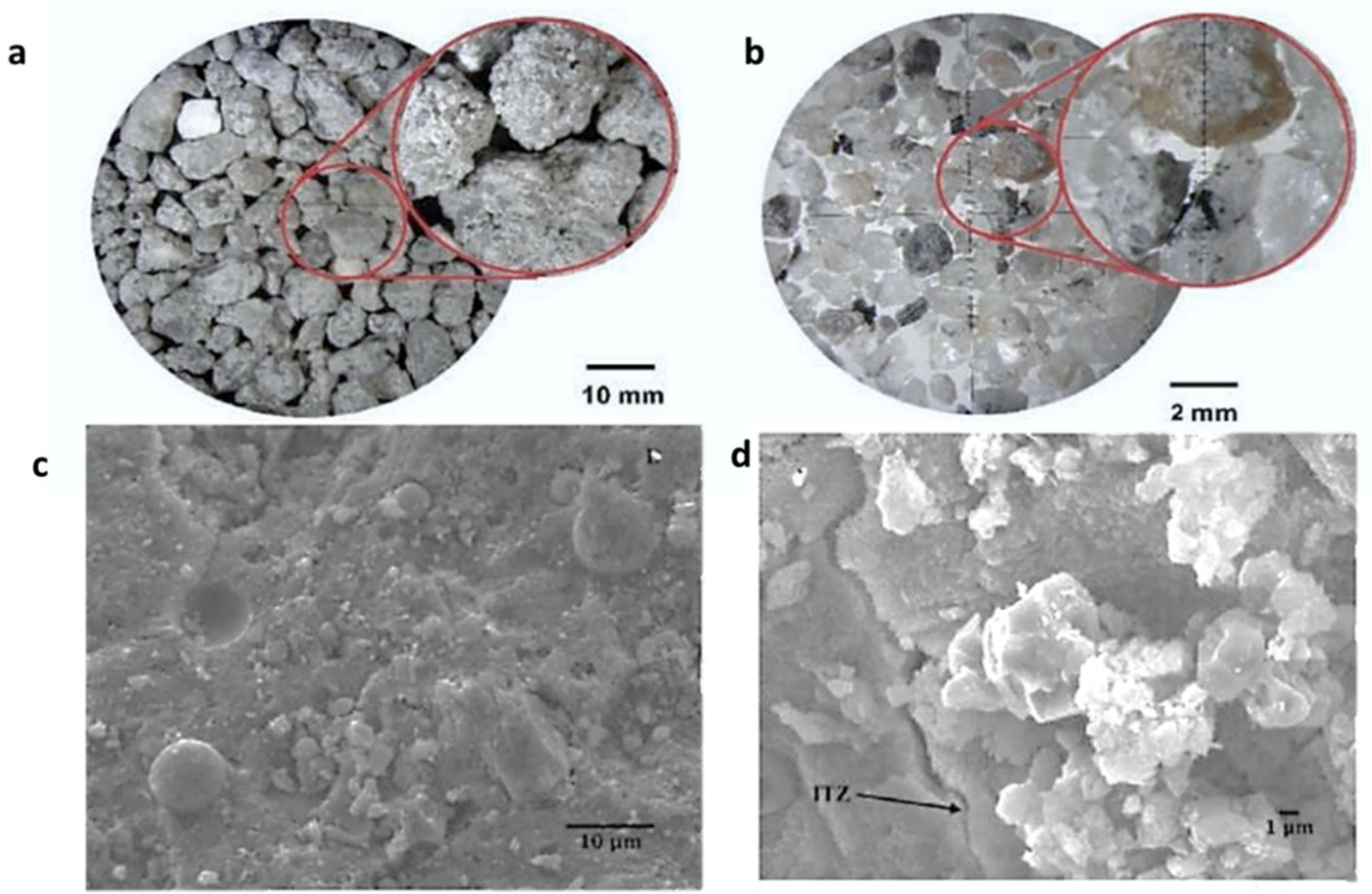
Figure 2.
Flowcharts for the studies were identified, displayed, and included in the study.
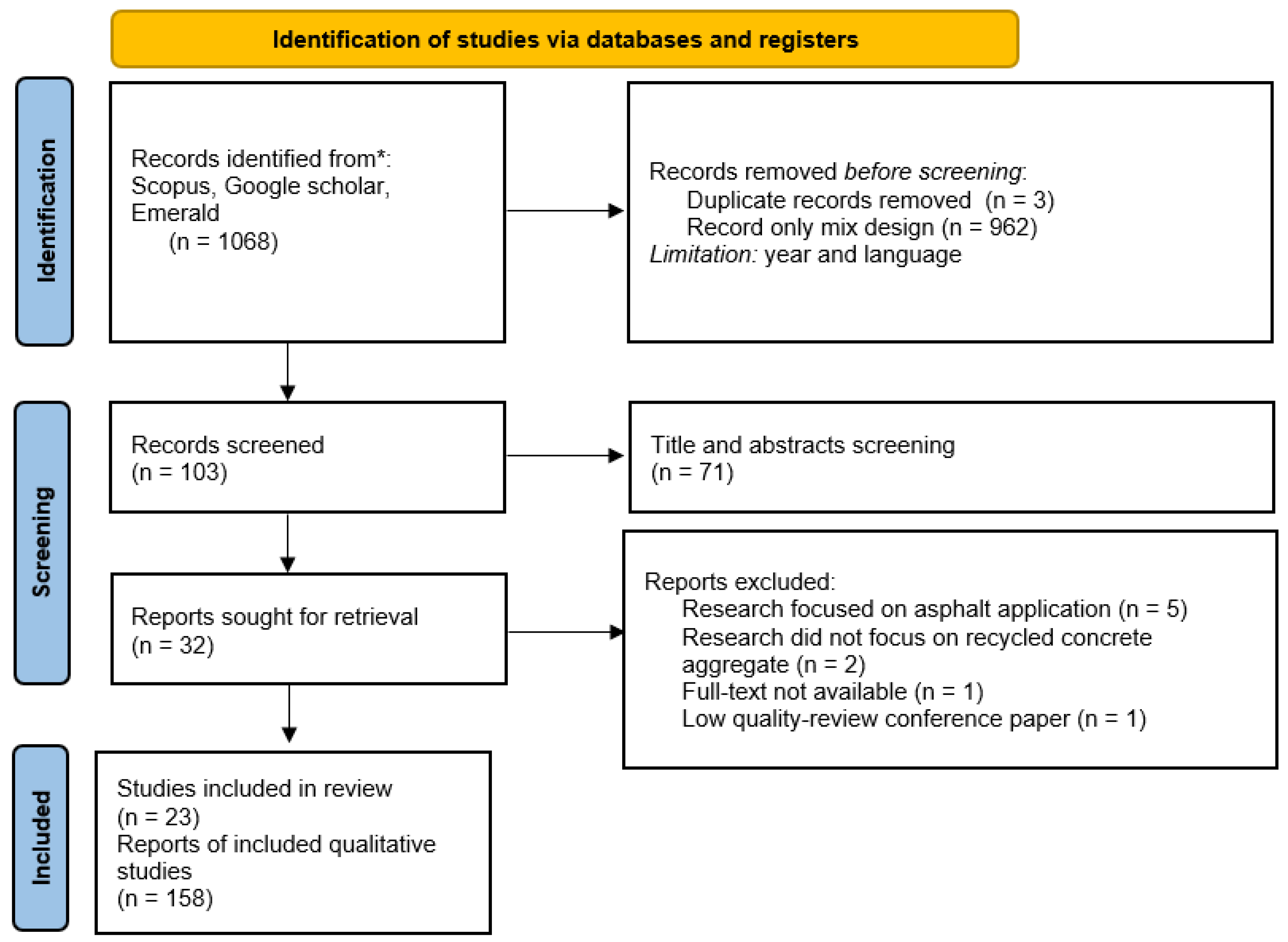
Figure 3.
a) Year published and b) quality of review publications.
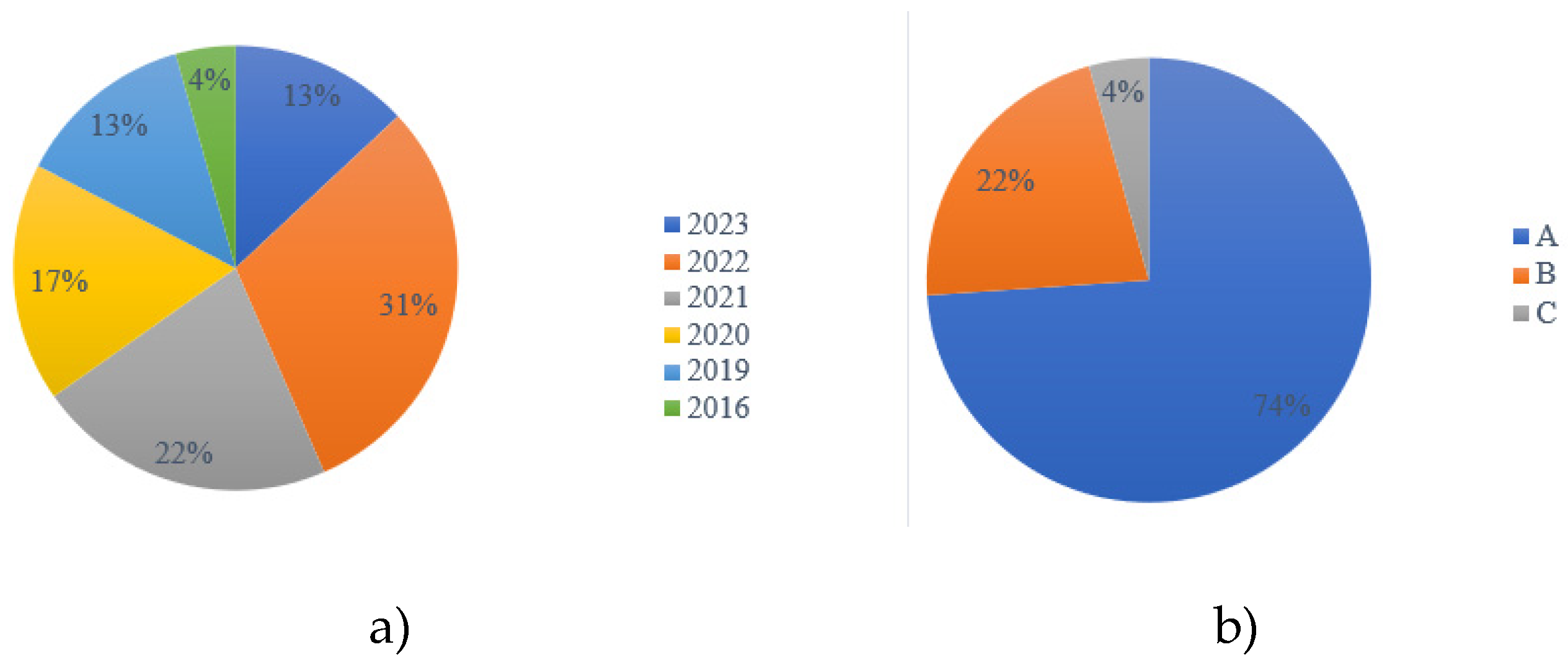
Figure 4.
Timeline and review classification of the review papers.
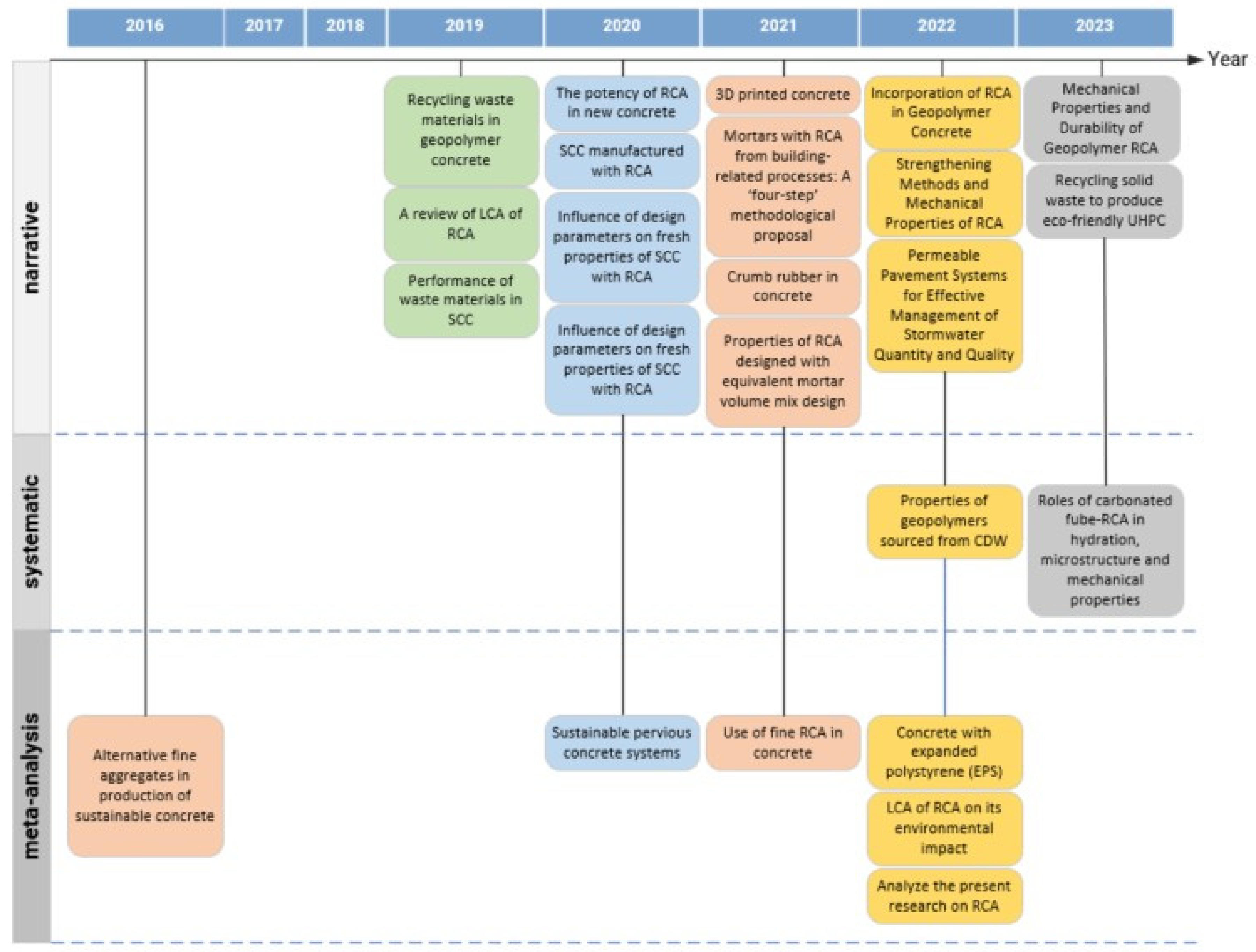
Figure 5.
Manufacturing process of RCA.
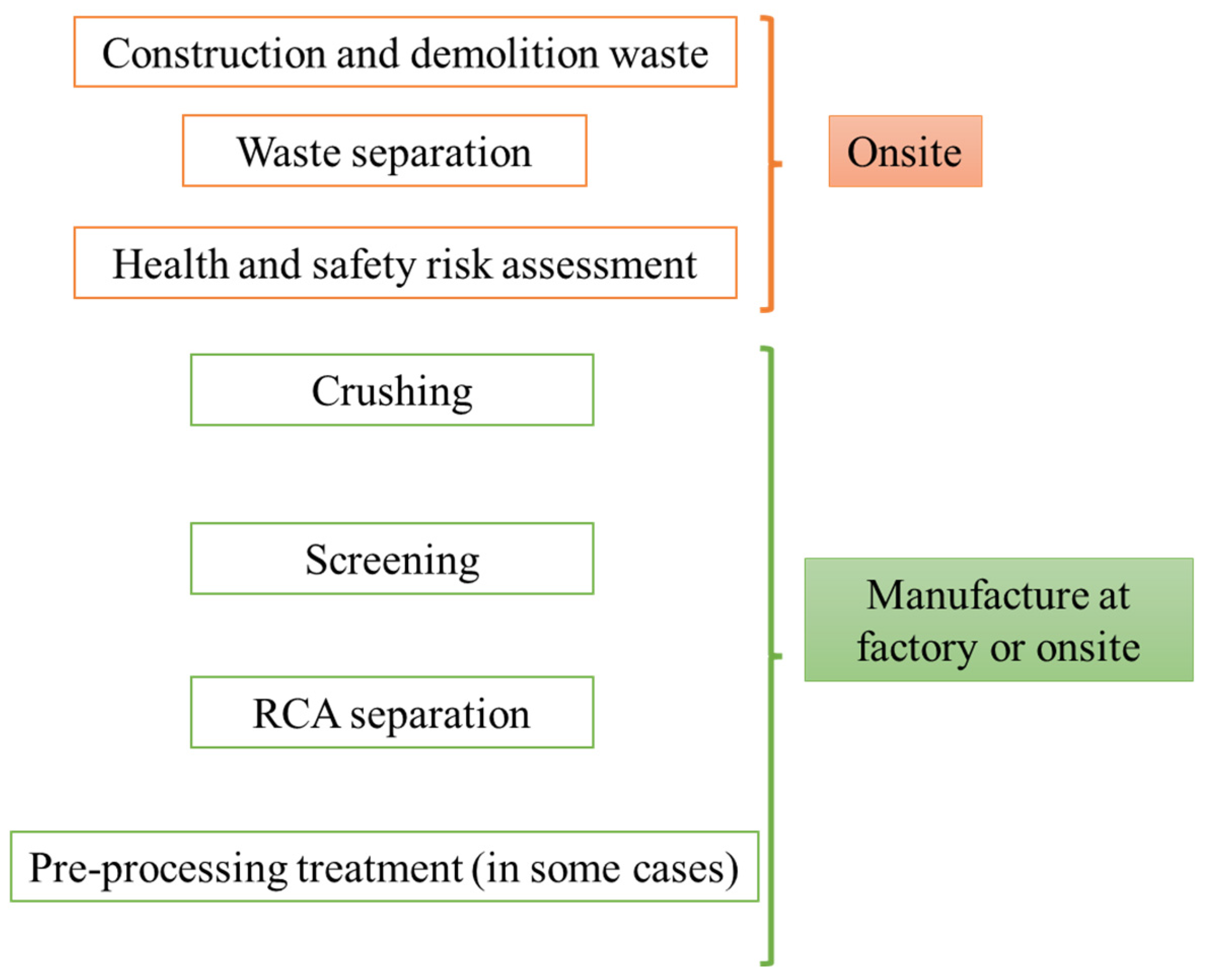
Figure 6.
Overview of concrete meso-structure containing RCA [47].
Figure 6.
Overview of concrete meso-structure containing RCA [47].
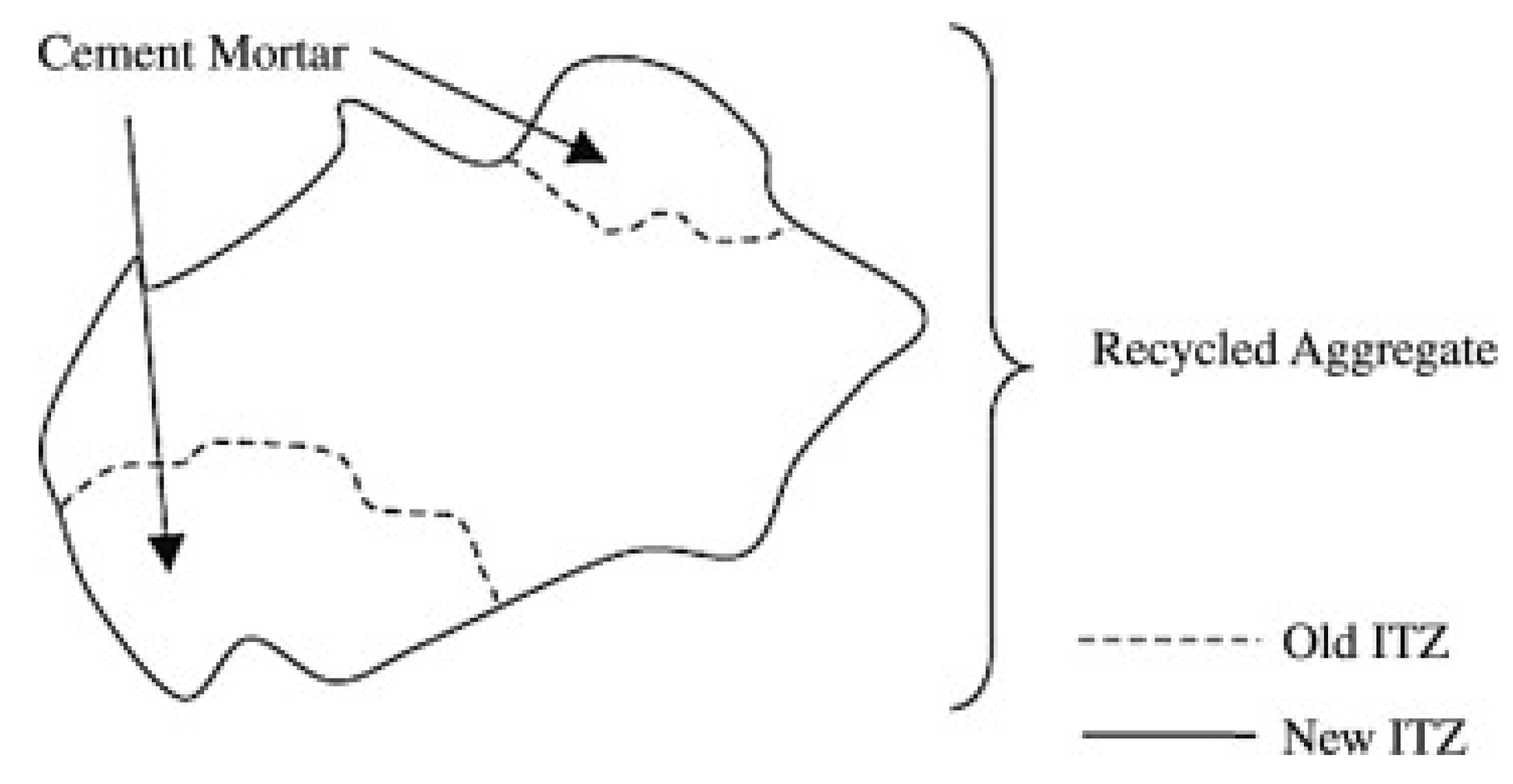
Figure 7.
Plots between replacement level and normalized compressive strength of concrete containing a) cRCA and b) fRCA with regression model and confidence interval (C.I.) of 95%.
Figure 7.
Plots between replacement level and normalized compressive strength of concrete containing a) cRCA and b) fRCA with regression model and confidence interval (C.I.) of 95%.
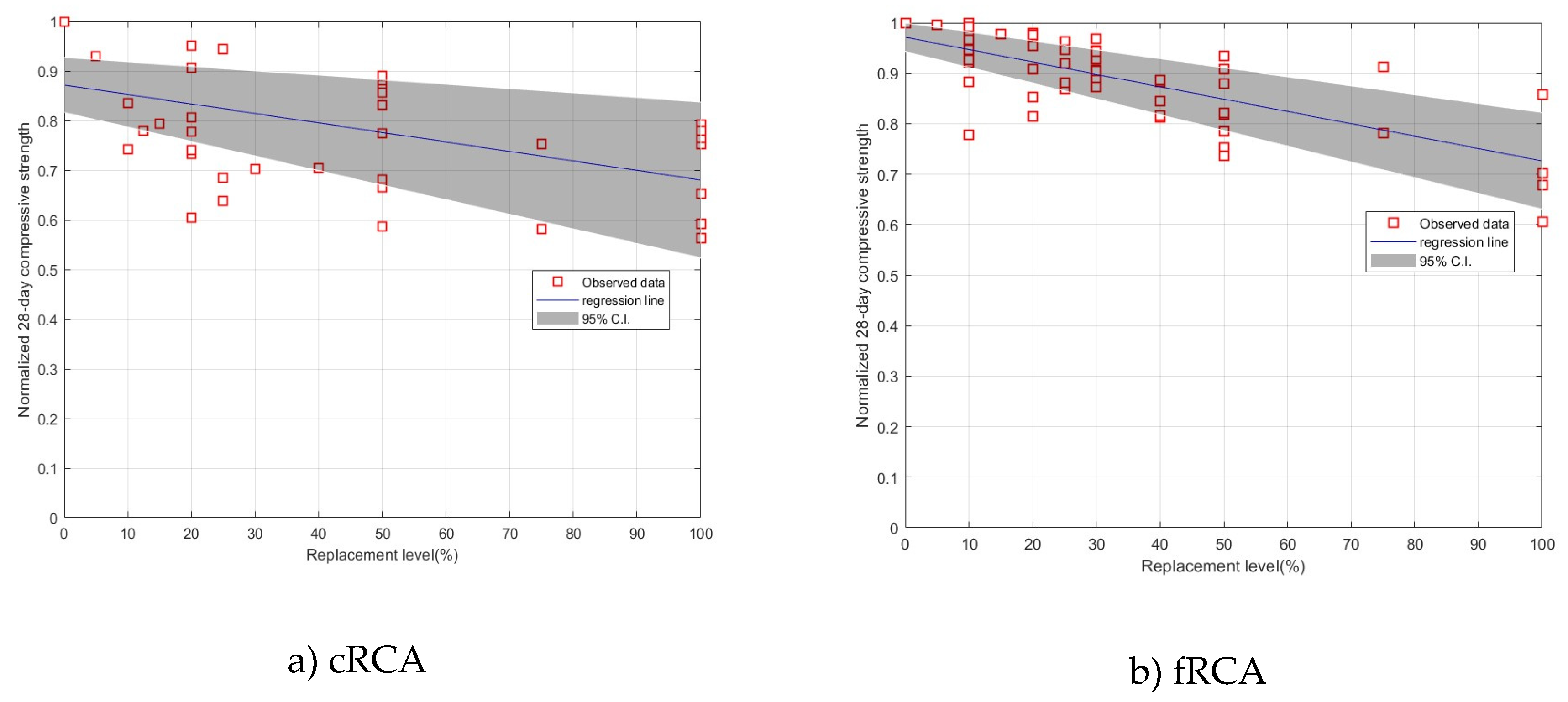
Figure 8.
RCA macro-topics and relevant topics involved by the review publications. Notes: the size of the circles is proportional to the sum of the amount of publications of the macro-topics in the macro-topic. Consider in circles (related topic; number of publications reviewed; percentage).
Figure 8.
RCA macro-topics and relevant topics involved by the review publications. Notes: the size of the circles is proportional to the sum of the amount of publications of the macro-topics in the macro-topic. Consider in circles (related topic; number of publications reviewed; percentage).
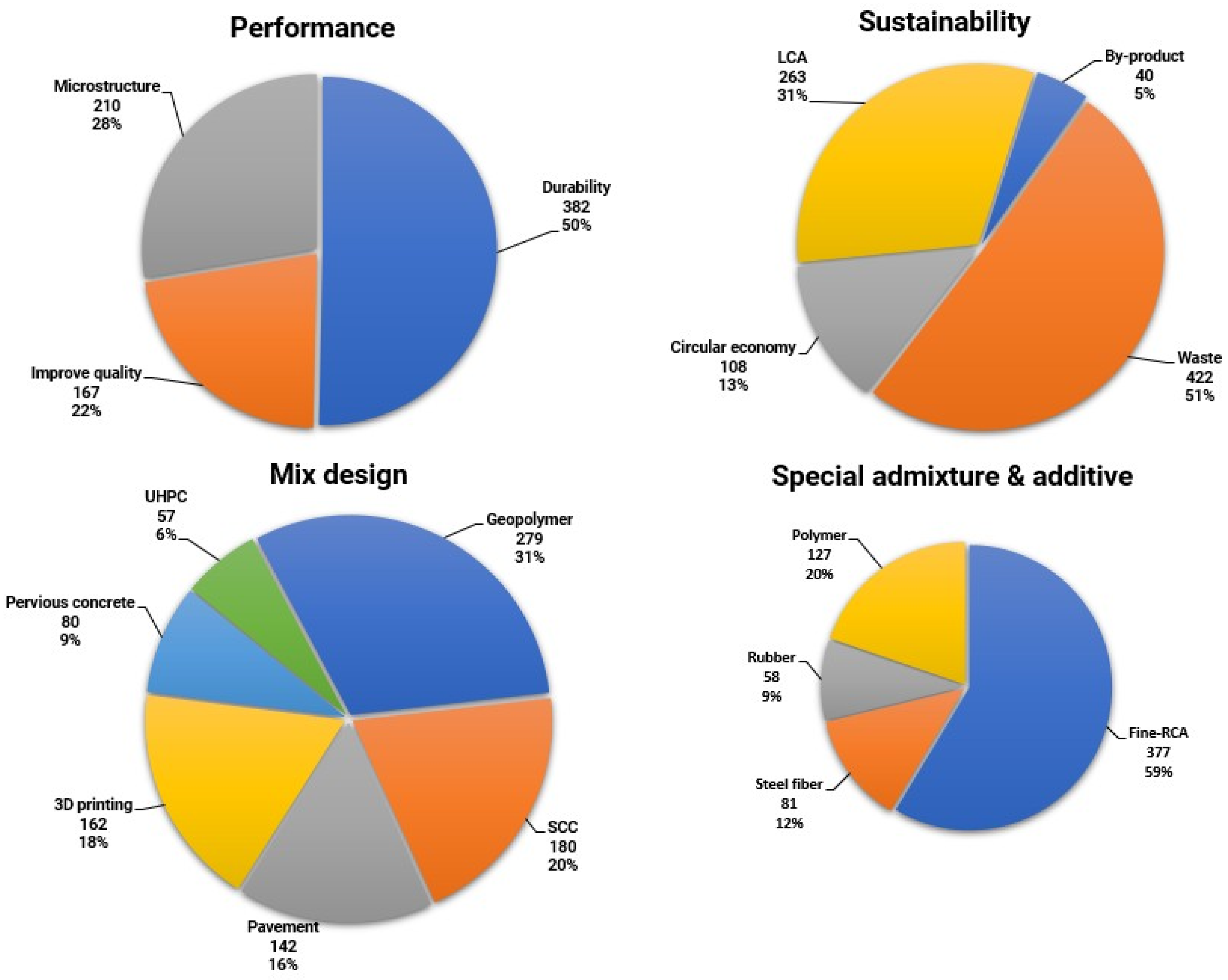
Figure 9.
Relative review number of mix design for cement-based materials containing RCA.
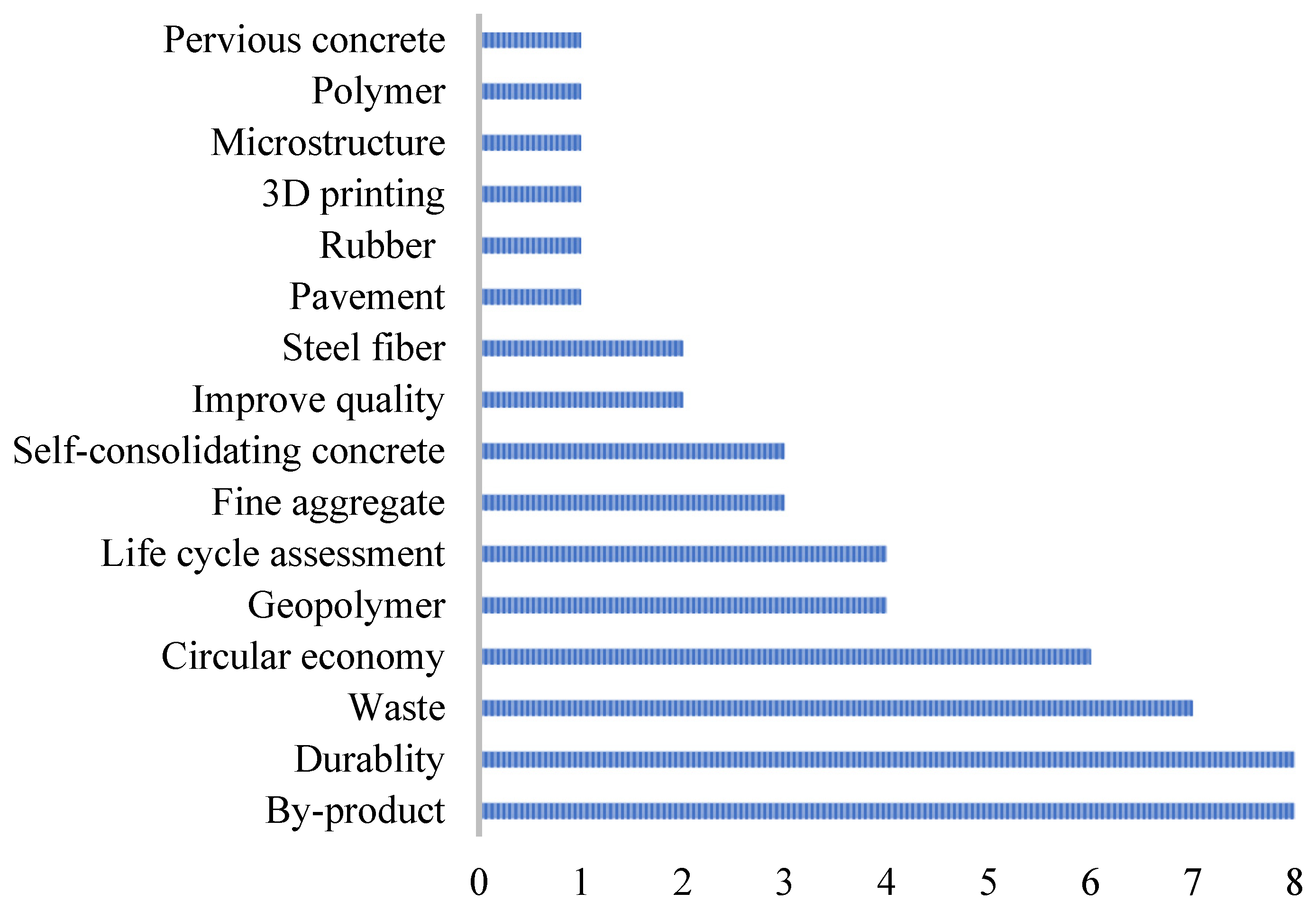
Figure 10.
Outline of the research trend and the explaian relating to RCA.
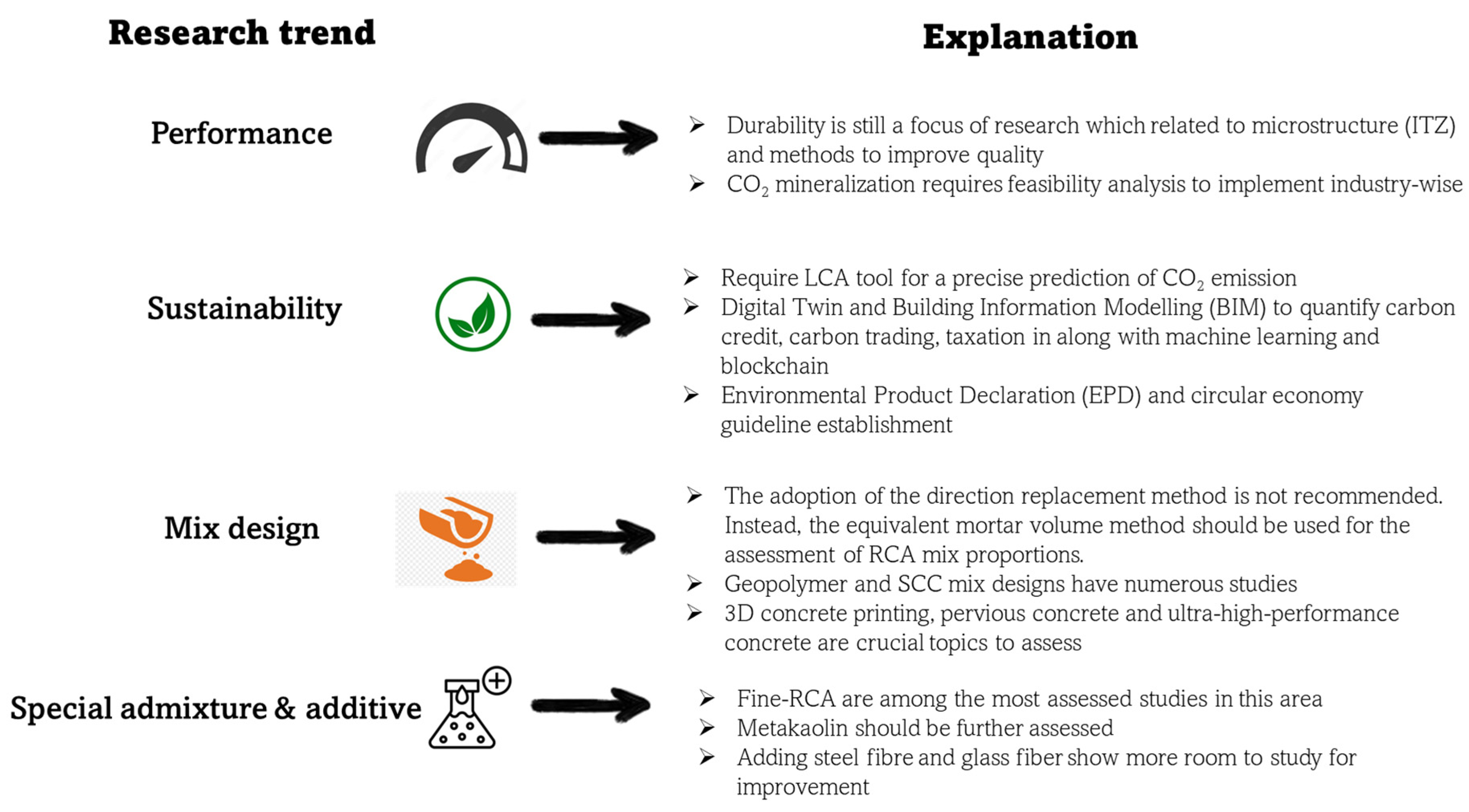

Table 1.
Search strategy for electronic databases.
| Study type | TITLE-ABS-KEY ( review ) |
| AND | |
| Recycled concrete aggregate | TITLE-ABS-KEY ( recycl* AND aggregate ) |
| OR TITLE-ABS-KEY ( recycl* AND aggregate AND concrete ) | |
| OR TITLE-ABS-KEY ( recycl* AND concrete ) | |
| OR TITLE-ABS-KEY ( reclaime* AND aggregate ) | |
| AND | |
| Mix design | TITLE-ABS-KEY ( mix* AND design ) |
| OR TITLE-ABS-KEY ( mix* AND proportion* ) |
Table 2.
Quatity of analysed papers and classification of review of this studied review article.
| Authors | Quality of papers reviewed | Classification of review |
| Hamada et al. | 85 | Narrative |
| Zhang et al. | 111 | Narrative |
| Zhang et al. | 142 | Systematic |
| Singer et al. | 162 | Narrative |
| Liu et al. | 133 | Narrative |
| Nikmehr et al. | 192 | Narrative |
| Alhawat et al. | 210 | Systematic |
| Zhang et al. | 90 | Meta-analysis |
| Xing et al. | 253 | Meta-analysis |
| Prasittisopin et al. | 108 | Meta-analysis |
| Kim | 174 | Narrative |
| Kara De Maeijer et al. | 171 | Narrative |
| Nedeljkovic et al. | 30 | Meta-analysis |
| Vitale et al. | 162 | Narrative |
| Hou et al. | 97 | Narrative |
| Martínez-García et al. | 159 | Meta-analysis |
| Singh et al. | 108 | Meta-analysis |
| Revilla-Cuesta et al. | 107 | Narrative |
| Kirthika et al. | 103 | Narrative |
| Anike et al. | 95 | Narrative |
| Zhang et al. | 57 | Narrative |
| Mohajerani et al. | 196 | Meta-analysis |
| Ismail et al. | 172 | Meta-analysis |
Table 3.
Summary of regression model of effects of concrete containing cRCA and fRCA on normalized compressive strength.
Table 3.
Summary of regression model of effects of concrete containing cRCA and fRCA on normalized compressive strength.
| Parameter | Number of observations | a | M |
| cRCA | 42 | 0.871657 | -0.001913 |
| fRCA | 54 | 0.969544 | -0.002418 |
Disclaimer/Publisher’s Note: The statements, opinions and data contained in all publications are solely those of the individual author(s) and contributor(s) and not of MDPI and/or the editor(s). MDPI and/or the editor(s) disclaim responsibility for any injury to people or property resulting from any ideas, methods, instructions or products referred to in the content. |
© 2024 by the authors. Licensee MDPI, Basel, Switzerland. This article is an open access article distributed under the terms and conditions of the Creative Commons Attribution (CC BY) license (http://creativecommons.org/licenses/by/4.0/).
Copyright: This open access article is published under a Creative Commons CC BY 4.0 license, which permit the free download, distribution, and reuse, provided that the author and preprint are cited in any reuse.


