Introduction
The psychological well-being of university students has a direct impact on their academic performance and the quality of their professional training [
1]. Students’ mental health not only affects their ability to face academic challenges but can also determine their future success as healthcare professionals [
2]. Nursing students, in particular, face a significantly demanding study load, which includes not only theoretical learning but also complex practical experiences such as clinical internships and group work in healthcare settings characterized by high-stress levels. These challenges are often accompanied by strong emotional pressure arising from the difficulties in dealing with critical situations, such as providing care to patients in emergency conditions or treating severe illnesses, which can significantly affect their motivation and stress management [
3,
4].
Perceived stress, time management, and study motivation are key factors that influence academic performance. However, when these factors are hindered by high-stress levels, students become more susceptible to burnout, a phenomenon characterized by emotional exhaustion due to the inability to cope with the high demands of academic work. Burnout not only reduces motivation and study effectiveness but can also compromise the quality of interactions with teachers and classmates. The relationship between motivation and burnout can create a vicious cycle, where stress and low motivation further hinder time management, worsening academic performance [
5,
6].
Moreover, the literature suggests that students with low self-esteem may, for example, perceive their abilities in a distorted way, fueling the cycle of stress and decreased motivation [
7]. On the other hand, it has been shown that good self-esteem and a positive perception of one's abilities contribute to greater self-efficacy, facilitating stress management and improving study motivation [
8,
9].
This study aims to analyze the interactions between study skills, motivation, perceived stress, and self-esteem in a sample of nursing students. The analysis aims to provide an in-depth understanding of the psychological dynamics influencing these students and suggest potential interventions to improve their psychological well-being and academic performance. Finally, the study intends to develop recommendations for targeted interventions that can support students in managing stress, preventing burnout, and improving their motivation, to foster their engagement in studies and, consequently, their professional training.
Materials and Method
Procedure
Data collection was conducted through a self-administered questionnaire during the academic period, ensuring participants' privacy and anonymity. The questionnaire was distributed via the Google Forms platform, and completion took approximately 40 minutes.
Instruments
For data collection, standardized and scientifically validated instruments were used, each designed to measure specific psychological and behavioral dimensions of students:
Participants
The participants were 331 students (70.7% female) enrolled in the Bachelor’s Degree in Nursing and the Master’s Degree in Nursing and Obstetric Sciences at the University of Salerno. The average age of the sample was 23 years, with an age range between 18 and 40 years, and a mean of 23 years. The most common age group was between 20 and 25 years (65%).
Specifically, 220 students were enrolled in the Bachelor’s Degree in Nursing, while 110 were enrolled in the Master’s Degree in Nursing and Obstetric Sciences.
Participation was voluntary and based on informed consent. Students with documented clinical diagnoses of severe psychiatric disorders that could compromise the reliability of the data collected were not included in the study.
Data Analysis
Data analysis was performed using IBM SPSS v.23 software. Means, standard deviations, and ranges were calculated for each construct, and normality tests were conducted for each variable. Subsequently, bivariate correlation analyses (Pearson correlations) were carried out to explore the relationships between the study variables.
Results
Study Approach
The assessment of the scores obtained on the QAS, considering the subscales, highlights different aspects of the learning strategies adopted by the participants. Regarding the "Organization" subscale, the average score of 2.77 (SD = 0.408) indicates a moderate level of organization in their studies. The low standard deviation reflects minimal variability in the results, suggesting that most participants have similar organizational skills. The "Elaboration" subscale recorded an average score of 3.46 (SD = 0.586), indicating that participants have a good ability to process information. However, the higher standard deviation compared to the previous subscale indicates greater variability in the responses. Regarding the "Self-Evaluation" subscale, the average score of 2.73 (SD = 0.373) reflects a moderate tendency to self-assess in the study process. Again, the relatively low standard deviation suggests that most participants score close to the mean. The "Strategy" subscale, with an average score of 2.26 (SD = 0.360), shows a relatively low adoption of study strategies. The low variability in the scores suggests some homogeneity in the sample's responses. Finally, for the "Metacognition" subscale, the average score of 3.47 (SD = 0.526) indicates good metacognitive awareness among the participants. The moderately higher standard deviation reflects variability in the responses, suggesting that some individuals are more inclined to reflect on and monitor their learning than others.
Perceived Stress Scale
The scores obtained from the PSS-10 (M = 20; SD = 5.465) suggest a moderate level of perceived stress in the sample, with the standard deviation indicating some variability, with some individuals perceiving high levels of stress while others report lower levels.
Self-Esteem Construct
The scores obtained from the Rosenberg Self-Esteem Scale show an average score of 19.30 (SD= 4.821), indicating a moderate self-esteem evaluation. The standard deviation of 4.821 suggests that the scores of the individuals in the sample are distributed but not extremely varied (i.e., there is no significant variability from the mean).
Correlations between Variables
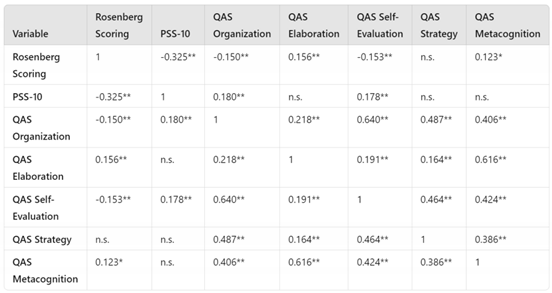
Table 1 shows the Pearson correlation matrix between the Rosenberg Scoring (self-esteem), PSS-10 (perceived stress), and the different aspects assessed by the Strategic Learning Questionnaire (QAS), namely Organization, Elaboration, Self-Evaluation, Strategy, and Metacognition.
Table 1.
This is a table.
Table 1.
This is a table.
The correlations between the analyzed variables highlight significant relationships consistent with psychological literature. High self-esteem, measured through the Rosenberg Scale, is associated with lower perceived stress (r= −0.325, p< 0.01), greater information elaboration (r= 0.156, p< 0.01), and greater metacognitive awareness (r= 0.123, p< 0.05). However, it is negatively correlated with the use of organizational strategies (r= −0.150, p< 0.01) and the frequency of self-evaluation (r= −0.153, p< 0.01), suggesting that those with greater self-confidence tend to rely less on structured approaches.
Perceived stress (PSS-10) is positively correlated with the use of organizational strategies (r= 0.180, p< 0.01) and the frequency of self-evaluation (r= 0.178, p< 0.01), indicating that stress may stimulate the adoption of compensatory strategies to manage difficulties.
Finally, the dimensions of the QAS show a strong interconnectedness: organization is closely related to self-evaluation (r= 0.640, p< 0.01), while information elaboration is associated with metacognitive awareness (r= 0.616, p< 0.01). These relationships highlight the importance of an integrated approach to learning, where strategies mutually reinforce each other.
Discussion
The results of this study suggest that psychological variables such as self-esteem, perceived stress levels, and metacognitive skills significantly influence the academic performance [
13] and well-being of nursing students. The positive correlations between the QAS scales "Organization," "Elaboration," and "Metacognition" indicate that students who apply effective metacognitive strategies tend to be more organized and reflect better on their study practices. This finding confirms the importance of metacognitive skills in improving academic performance. The ability to monitor, evaluate, and adapt one's study strategies is crucial in a challenging learning environment like nursing science, where efficient management of both theoretical and practical information is required (7). On the other hand, the perceived stress level (PSS-10) was found to be negatively correlated with various psychological variables, such as self-esteem, suggesting that high levels of stress can hinder the cognitive and behavioral abilities needed for effective learning [
1,
2,
3]. These results are consistent with literature that highlights how chronic stress can impair working memory and executive functions, which are essential for adequate organization and planning of tasks [
4,
13].
Conclusions
In conclusion, this study confirms that self-esteem, metacognitive skills, and stress management are key factors in the academic success of nursing students. Low self-esteem is associated with difficulties in academic performance, while good stress management and the adoption of metacognitive study strategies contribute positively to well-being and learning effectiveness. Therefore, educational and psychological support interventions for nursing students should include activities aimed at improving self-esteem, reducing perceived stress, and developing metacognitive skills to optimize study strategies. Future research could explore the effectiveness of specific intervention programs designed to strengthen these psychological skills, in order to further enhance academic performance and the overall well-being of students in this highly demanding field.
Ethics considerations
This study was conducted according to the Declaration of Helsinki (1964) and the recommendations of the Association Italian School of Psychology (AIP). This study was approved by the local Ethics Committee (number 01/2021).
Consent to Participate
Informed consent was obtained from all subjects involved in the study.
Author Contributions
Conceptualization, G.S. and L.C.; methodology, G.S. and L.C.; formal analysis, L.C.; investigation, M.M. and D.D., resources, G.S.; data curation, N.P. and L.C.; writing—original draft preparation, G.S. and L.C.; writing—review and editing, M.M. and N.P.; supervision, D.D.; project administration, G.S. and L.C. All authors have read and agreed to the published version of the manuscript.
Data availability statement
The data that support the findings of this study are available from the corresponding author (G.S.) upon reasonable request.
Conflicts of Interest
The authors declare no competing interests.
References
- Savarese, G., Pecoraro, N., Fasano, O., Mollo, M., Carpinelli, L. (2023). The Attention to Student Well-Being: The University Psychological Counseling. In: Marsico, G., Tateo, L. (eds) Humanity in Psychology. Theory and History in the Human and Social Sciences. Springer, Cham. [CrossRef]
- Savarese, G., Iannaccone, A., Mollo, M., Fasano, O., Pecoraro, N., Carpinelli, L., Cavallo, P. (2019). “Academic performance-related stress levels and reflective awareness: the role of the elicitation approach in an Italian University’s psychological counselling”. British Journal Of Guidance & Counselling, 47, pp.1-10. ISSN:0306-9885. SCOPUS: 2-s2.0-85062404490. [CrossRef]
- Riley, J. M., Collins, D., & Collins, J. (2019). Nursing students' commitment and the mediating effect of stress. Nurse education today, 76, 172-177. [CrossRef]
- Zhang, Z., Zhang, X., & Chen, J. (2022). The influence of emotional intelligence on nursing students' academic achievement and psychological stress. Journal of Nursing Education and Practice, 12(4), 54-61.
- Schaufeli, W. B., Salanova, M., González-Romá, V., & Bakker, A. B. (2021). The measurement of engagement and burnout: A two sample confirmatory factor analytic approach. Journal of Happiness Studies, 22(2), 329-344. [CrossRef]
- Sharma, R., & Kaur, S. (2018). The impact of stress and burnout on academic performance in nursing students. Nursing & Health Sciences, 20(1), 68-73.
- Schunk, D. H. (2021). Self-regulated learning and academic achievement: Theory, research, and practice. Springer.
- Bandura, A. (1997). Self-efficacy: The exercise of control. W.H. Freeman.
- Barkley, R. A. (2014). Attention-deficit hyperactivity disorder: A handbook for diagnosis and treatment. Guilford Publications. [CrossRef]
- Di Stefano, G., & Tomasi, S. (2010). Misurare la motivazione allo studio. Rivista Italiana di Educazione, 36, 45-52.
- Cohen, S., Kamarck, T., & Mermelstein, R. (1983). A global measure of perceived stress. Journal of Health and Social Behavior, 24(4), 385-396).
- Rosenberg, M. (1965). Society and the adolescent self-image. Princeton, NJ: Princeton University Press.
- Miller, A. L., Fassett, K. T., & Palmer, D. L. (2021). Achievement goal orientation: A predictor of student engagement in higher education. Motivation and Emotion, 45(3), 327–344. [CrossRef]
|
Disclaimer/Publisher’s Note: The statements, opinions and data contained in all publications are solely those of the individual author(s) and contributor(s) and not of MDPI and/or the editor(s). MDPI and/or the editor(s) disclaim responsibility for any injury to people or property resulting from any ideas, methods, instructions or products referred to in the content. |
© 2024 by the authors. Licensee MDPI, Basel, Switzerland. This article is an open access article distributed under the terms and conditions of the Creative Commons Attribution (CC BY) license (http://creativecommons.org/licenses/by/4.0/).