

Submitted:
25 December 2024
Posted:
26 December 2024
You are already at the latest version
Abstract
Transdermal drug delivery systems (TDDS) offer an alternative to conventional oral and injectable drug administration by bypassing the gastrointestinal tract and liver metabolism, improving bioavailability, and minimizing systemic side effects. However, widespread adoption of TDDS is limited by challenges such as the skin's permeability barrier, particularly the stratum corneum, and the need for optimized formulations. Factors like skin type, hydration levels, and age further complicate the development of universally effective solutions.
Advances in artificial intelligence (AI) address these challenges through predictive modeling and personalized medicine approaches. Machine learning models trained on extensive molecular datasets predict skin permeability and accelerate the selection of suitable drug candidates. AI-driven algorithms optimize formulations, including penetration enhancers and advanced delivery technologies like microneedles and liposomes, while ensuring safety and efficacy. Personalized TDDS design tailors drug delivery to individual patient profiles, enhancing therapeutic precision.
Innovative systems, such as sensor-integrated patches, dynamically adjust drug release based on real-time feedback, ensuring optimal outcomes. AI also streamlines the pharmaceutical process, from disease diagnosis to the prediction of drug distribution in skin layers, enabling efficient formulation development. This review highlights AI's transformative role in TDDS, including applications of models such as Deep Neural Networks (DNN), Artificial Neural Networks (ANN), BioSIM, COMSOL, K-Nearest Neighbors (KNN), and Set Covering Machine (SVM). These technologies revolutionize TDDS for both skin and non-skin diseases, demonstrating AI's potential to overcome existing barriers and improve patient care through innovative drug delivery solutions.
Keywords:
Artificial Intelligence
; Transdermal Drug Delivery
; Machine Learning
; Formula optimization
; BioSIM
1. Introduction
By enabling drugs to permeate through the skin and enter systemic circulation, TDDS provide significant advantages over traditional oral and injectable routes [1]. One key benefit is bypassing the first-pass metabolism in the liver, which can degrade active drug compounds, leading to reduced bioavailability [2]. Additionally, TDDS supports controlled and sustained drug release, maintaining therapeutic drug levels over an extended period and improving patient compliance by reducing the frequency of administration [3,4,5,6,7,8].
Despite these advantages, the efficacy of TDDS is limited by several critical factors. The most formidable challenge is the stratum corneum, the outermost layer of the skin, which acts as a robust barrier to most drugs [9]. Its low permeability restricts the passage of large and hydrophilic molecules, necessitating the use of penetration enhancers, advanced delivery systems, or chemical modifications of the drug [10,11,12]. Furthermore, developing effective TDDS formulations is complex, requiring a delicate balance between drug stability, release rates, and compatibility with skin physiology.
Over the past decade, research and technological advancements in transdermal drug delivery systems (TDDS) have significantly expanded. This area has seen the publication of numerous research articles and the development of innovative technologies, reflecting a strong global interest in overcoming the challenges associated with TDDS. Studies indicate a substantial increase in TDDS-related research over the past ten years, with emphasis on addressing limitations such as skin permeability and the delivery of macromolecular drugs. Techniques such as microneedles, chemical penetration enhancers (CPEs), and nanotechnology have garnered considerable research attention. Microneedles, for example, have been extensively studied for applications ranging from vaccine delivery to pain management, making them a central focus of TDDS research [13,14,15,16]. Over the past decade, research in TDDS, particularly for vaccine delivery using microneedles, has significantly increased [17]. Studies highlight advances in materials, fabrication techniques, and integration with biologics, reflecting TDDS's growing role in non-invasive, patient-friendly vaccine administration [18]. Emerging technologies in transdermal drug delivery systems (TDDS) are transforming the field with innovative approaches [19]. Nanocarriers such as liposomes and nanoparticles improve drug stability and targeted delivery for applications in cancer and dermatology. Techniques like electroporation and photomechanical waves temporarily disrupt the skin barrier for molecule delivery, while thermal ablation employs localized heat to enhance penetration, enabling rapid and localized drug administration [20,21]. Integrating these novel approaches with AI and machine learning is also emerging as a transformative trend, facilitating formulation optimization, real-time adjustments, and enhanced patient-specific solutions. The growing body of TDDS research and innovative technology development highlights its potential to revolutionize non-invasive drug delivery.
In developing a modern TDDS for effective disease treatment, employing a predictive computational model that accurately simulates material interactions and the drug's skin permeability and release profile over time can save both time and resources [22]. Over the last decade, drug delivery has increasingly leveraged computational technology to create innovative and targeted delivery systems [23].
As we progress into a new century marked by remarkable technological advancements, Machine Learning (ML) and Artificial Intelligence (AI) have emerged as powerful tools for managing and analyzing scientific data. The introduction of AI and ML methodologies has revolutionized various sectors within the medical field, mainly benefiting the pharmaceutical industry. The term "Artificial Intelligence" was first coined by John McCarthy in 1956 [24,25,26]. AI is the capacity of the computer to mimic human cognitive skills and thought processes and to translate into informative solutions from complex sets of data [27].
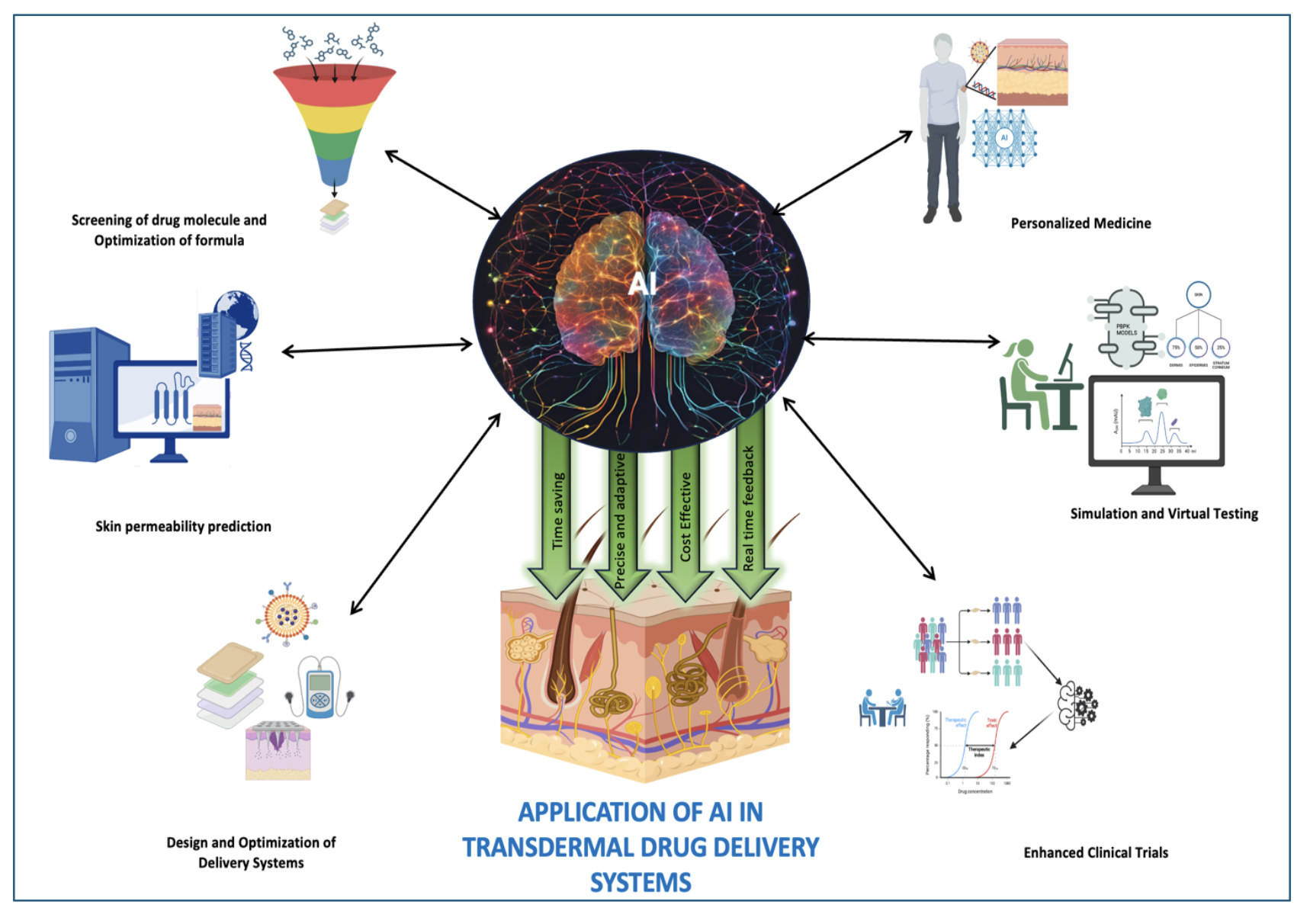
AI is a computer system to replicate human cognitive functions and thought processes, transforming complex data sets into meaningful insights [27]. Artificial intelligence (AI) and machine learning (ML) advancements have begun changing the landscape of TDDS research and development. These technologies streamline the design and optimization processes by analyzing large datasets, predicting drug-skin interactions, and identifying ideal formulation components. AI algorithms can model the permeation behavior of drugs, assess the impact of excipients, and optimize the physical and chemical properties of delivery systems. With the rising interest in AI's capabilities to analyze and interpret a wide range of information—from genetic data to clinical applications of therapeutics—AI has the potential to significantly accelerate the traditionally lengthy drug discovery-to-marketing process Figure 1 [28,29].
AI can significantly transform the process of determining drug suitability for skin delivery formulation, impacting everything from drug manufacturing to marketing. As a powerful tool, AI presents a remarkable opportunity for advancements in drug discovery, redesigning, formulation, and testing of pharmaceutical dosage forms [30].
With deep neural network (DNN) models, AI can detect skin diseases and predict the condition of the skin based on digital images. This AI-assisted information plays a crucial role in making informed decisions at the early stages of drug discovery and formulation and in modulating a drug's therapeutic exposure within the body. AI is particularly valuable in formulation design and optimization, focusing on smart drug-carrier choices for dermal delivery, which has become a trend in addressing various dermal diseases and enhancing the skin-care cosmetic industry. The accurate prediction of drug deposition in the skin from various transdermal drug delivery systems (TDDS) is essential information for formulation development. AI and machine learning (ML) algorithms now provide the means to unlock this vital information, offering actionable insights for effective disease detection and formulation design [22] [31,32,33].
Dynamic AI and ML-derived models are discussed in this review, for example, the pharmacokinetic prediction model BIOiSIM for drug exposure & distribution prediction [34], a computation model COMSOL providing estimates about the temperature effect on the skin-absorption of the drug [35], utilization of a computation model referenced as ANN (Artificial Neural Network) for predicting the efficacy of two medications for COVID-19 [36], have fueled the importance of such AI and ML based approaches in a pharmaceutical field. Other ML-based models such as K-Nearest Neighbors (KNN), Set Covering Machine (SVM), and Deep Neural Network (DNN) are discussed for their ability to predict the active protease inhibitor site for the treatment of HIV-1 [37].
Furthermore, AI-driven systems enable the development of smart transdermal devices that monitor physiological parameters in real time and adjust drug release dynamically to ensure consistent therapeutic outcomes. This convergence of AI and TDDS holds the potential to overcome traditional barriers and pave the way for innovative, personalized, and efficient drug delivery solutions.
2. Emerging TDDS for the Treatment of Viral Infections and Other Vital Organ Disorders
2.1. TDDS for the Treatment of Viral Infections
TDDS are particularly effective for treating skin-based viral infections, as it allows for targeted application directly to affected areas. This method also minimizes systemic absorption and reduces related side effects [38]. By utilizing advanced techniques to deliver innovative nanocarriers to the target site, the goal is to significantly lower viral loads more effectively than standard drug dosage forms [39,40,41]. Transdermal administration is considered the most suitable for controlling cutaneous viral infections such as herpes, chickenpox [40,42], warts [41,43] , and influenza [44]. Recent studies suggest that transdermal delivery could be an alternative route for administering COVID-19 vaccines [40,42,44,45]. A penciclovir-loaded hydrogel nanoemulsion (HN) was developed for transdermal herpes simplex treatment, demonstrating double the permeation efficiency of a marketed cream in vitro using porcine skin. This promising formulation demonstrated enhanced drug delivery through comparative percutaneous absorption studies [46]. A comparative study examined binary ethosomes (ETHOs) and elastic liposomes (ELPs) for transdermal delivery of sodium salt Acyclovir (ACV-Na). The evaluation included in-vitro release, ex-vivo permeation, and skin deposition, showing that optimized ETHOs significantly enhanced permeation flux and drug deposition compared to ELPs. Safety assessments through hemolysis and skin irritation analyses indicated that ETHOs are a promising alternative to traditional vesicular systems for improved skin permeation and stability in transdermal applications. A study formulated an oil-in-water (o/w) microemulsion using these enhancers for transdermal delivery of acyclovir, which was tested for efficacy in a murine model of zosteriform cutaneous HSV-1 infection [44,47]. Influenza vaccine-loaded egg microneedles (FLU-EMN) were designed and characterized, highlighting their potential for effective and minimally invasive delivery of therapeutic drugs without the need for cold storage [48]. This microneedle system could become an effective method for nationwide vaccination, making the process more cost-effective, safe, and feasible. Microneedles rapidly activate therapeutic properties. A minimally invasive microneedle array patch (MAP) was developed to deliver Zanamivir, achieving higher lung tissue concentrations and demonstrating potential as an innovative treatment for seasonal influenza [49]. Microneedle drug delivery has shown promise in treating plantar warts caused by HPV. Ghonemy et al. reported that combining microneedling with 5-fluorouracil (5-FU) achieved an 86.7% complete response rate, outperforming intralesional 5-FU (76.7%) and microneedling alone (70%), with improved patient satisfaction due to reduced discomfort [43]. Numerous SARS-CoV-2 vaccines have been developed since the COVID-19 outbreak, with 242 candidates in clinical development and 11 approved for emergency use by WHO. While most vaccines require subcutaneous or intramuscular administration, transdermal delivery offers a promising alternative, particularly for self-administration in resource-limited areas. A fluorocarbon-modified chitosan-based transdermal system was shown to effectively deliver the SARS-CoV-2 vaccine, generating immune responses comparable to subcutaneous injections by activating immune cells and targeting lymph nodes [50]. A microneedle array (MNA) was developed for delivering the SARS-CoV-2 S1 subunit vaccine, targeting the spike protein to prevent infection. MNAs expedite vaccine production and reduce costs by requiring fewer doses. These MNA-based vaccines generated strong antibody responses, and stability studies suggested that integrating vaccine components into the MNA polymer matrix preserves their structure and binding functions. These MNAs are designed for self-administration, eliminating the need for specialized equipment [45]. A comprehensive list of viral infections treated using TDDS is presented in Table 1 below.
2.2. TDDS for the Treatment of Central Nervous System (CNS) Disorders
Significant Progress has been made in developing transdermal formulations for treating central nervous system disorders. Transdermal drug delivery systems (TDDS) that include nicotinic agonists, particularly nicotine, are commonly used to assist in smoking cessation and to help manage withdrawal symptoms [52,53]. These agents have also shown potential in alleviating cognitive impairments associated with neurodegenerative diseases and psychiatric conditions such as schizophrenia and attention disorders [54,55,56]. Transdermal nicotine has been observed to improve symptoms of ADHD, although the underlying mechanisms remain unclear. This improvement may be linked to nicotine's ability to increase dopamine release, which is also enhanced by conventional ADHD treatments like methylphenidate and amphetamine [56]. Research conducted by eminent scientists has introduced a new methylphenidate patch designed for long-term Attention-Deficit/Hyperactivity Disorder (ADHD) management. This patch functions as both an adhesive and a drug reservoir, allowing dosage adjustments based on patch size and wear duration to personalize treatment [54].
Furthermore, a study led by Sittl et al. demonstrated the effectiveness of a transdermal buprenorphine system for managing severe chronic pain from conditions like cancer, reducing the need for oral medications. This system has been associated with improved sleep duration and generally mild to moderate side effects commonly seen with opioid therapy [52]. Another notable development is a transdermal system integrating the antidepressant selegiline, which effectively inhibits central monoamine oxidase A (MAO-A) and B (MAO-B) enzymes. While its antidepressant effects are modest, it avoids metabolism by the liver and intestines, enhancing its therapeutic advantage [57]. Several commercially available TDDSs target the central nervous system (CNS), such as Neupro, a rotigotine system for early-stage Parkinson's disease, and nicotine patches (Nicotinell, Nicodern, Prostep) for smoking cessation. Other products include Matrifen and Duragesic systems containing fentanyl for pain management and Transderm-Scop for motion sickness. There are also specialized transdermal buprenorphine devices for treating sickle cell disease-related pain [58]. Early clinical trials have shown limited success for acetylcholinesterase inhibitors (AChEIs) like TTS-physostigmine and TTS-tacrine, lacking sufficient evidence of efficacy beyond a placebo [59,60]. However, transdermal rivastigmine has been effective in reducing cognitive and functional impairments in Alzheimer's disease patients [61]. A comprehensive list of drugs administered through TDDS is detailed in tabular column 2.
2.3. TDDS for the Treatment of Cardiovascular (CV) Diseases
In a heart failure (HF) scenario, the drug's pharmacokinetics (PK), pharmacodynamics (PD), and tolerability are frequently impacted by the changes in the body's physiological parameters from hypoperfusion systemic conditions due to reduced cardiac ejection fraction [80]. In addition, drug metabolism and metabolite clearance are reduced in renal failure [81]—co-morbid conditions like hypoalbuminemia and hepatic congestion impair drug absorption [82].
Therefore, transdermal patch delivery systems may offer an effective solution for drug administration. Propranolol, a nonselective beta-adrenergic blocker, undergoes significant hepatic first-pass metabolism when taken orally, leading to a bioavailability of about 23% [83]. An animal study with rabbits demonstrated that oral propranolol achieved a Cmax of 56.4 ng/mL within 13.2 minutes, but due to liver metabolism, its bioavailability was only 12.3% [84]. Conversely, the transdermal propranolol patch reached a steady-state plasma concentration (Css) of 9.3 ng/mL after an initial lag time of 8 hours, with a bioavailability that was 74.8% higher than that of oral propranolol [85].
Nitroglycerin is another significant drug in cardiovascular therapy. Lauder & Blanton used nitroglycerin to relieve angina pectoris and first observed drug resistance after repeated doses in 1867 [86]. Ferid Murad discovered that nitric oxide (NO) from nitroglycerin acts on vascular smooth muscle by activating cyclic guanosine monophosphate (cGMP), leading to vasodilation [87]. A two-way crossover study was conducted on twenty-five healthy males using Nitro-Dur and another type of nitroglycerin transdermal patch, Nitro-Dur II, which showed average Cmax values of 0.383 ng/mL and 0.432 ng/mL, respectively [88].
Bisono® Tape is a transdermal patch containing bisoprolol as an active ingredient [89], used to manage conditions such as aortic dissection [90], premature ventricular contraction [91], orthostatic hypotension due to heart failure [92], and atrial fibrillation [93]. A comparative study involving edematous and non-edematous patients using the Bisono® Tape 4 mg patch showed that the Cmax was 13.3 ng/mL in the edema group and 17 ng/mL in the non-edema group [94]. This study aimed to investigate the effect of systemic edema on the absorption of beta-blockers from skin patches in critically ill patients. However, it was found that systemic edema of the lower extremities did not affect the blood levels or the heart rate-lowering effects of bisoprolol after applying the bisoprolol skin patch.
Another antihypertensive drug that utilizes transdermal patch delivery is clonidine. Clonidine is an α2-adrenergic agonist initially used to treat hypertension [94]. It has also been used for conditions such as attention-deficit hyperactivity disorder (ADHD) [95] and drug withdrawal syndrome [96]. The transdermal clonidine patch was introduced in 1983 and approved by the FDA in 1984 [97,98]. Since then, a comparative study of oral and transdermal clonidine has been conducted [99]. The results showed no difference in Cmax between oral clonidine (0.39 ng/mL) and transdermal clonidine (0.3 ng/mL), but the half-life of transdermal clonidine was longer than that of oral clonidine (31.9 hours vs. 10.8 hours). Additionally, there was no difference in the antihypertensive effect [99].
Losartan, an angiotensin II receptor blocker (ARB), is also being developed for transdermal drug delivery. A previous study on rat skin with proniosome transdermal drug delivery showed that transdermal losartan achieved a Cmax of 141 ng/mL compared to 152 ng/mL when taken orally. However, the bioavailability of transdermal losartan was 1.93 times that of oral losartan [100]. Various cardiovascular drugs formulated as transdermal delivery systems are listed in tabular column 3.
2.4. TDDS for the Treatment of Other Complications Such as Hormonal Imbalance and Autoimmune Disorders
Transdermal drug delivery systems (TDDS) have shown promise in managing conditions like hormonal imbalances and autoimmune disorders. For hormonal imbalances, TDDS offers an effective method for administering hormones such as estrogen, testosterone, and progesterone, often in patches or gels [112]. These systems allow for controlled, continuous release of the hormone, bypassing first-pass metabolism in the liver and providing a steady, more predictable therapeutic effect. For example, transdermal patches for hormone replacement therapy (HRT) are widely used for menopausal symptoms and androgen deficiency in men [113]. In autoimmune disorders like rheumatoid arthritis and psoriasis, TDDS has been explored to deliver anti-inflammatory and immunosuppressive drugs directly to the affected areas, minimizing systemic side effects [114]. Recent innovations, such as microneedles and smart patches, enhance the precision of drug delivery, improve patient compliance, and allow personalized treatments. The potential for integrating AI-driven formulation optimization further enhances the effectiveness of TDDS in managing these chronic and complex conditions. Tabular column 4 is focused on TDDS for the treatment of hormonal imbalance and pain management with examples of drugs and transdermal drug delivery systems (TDDS), along with references:
3. Application of AI in Various Stages of TDDS
3.1. Screening of Drug Molecules and Optimizing Formula
AI can identify molecules with ideal physicochemical properties (e.g., solubility, lipophilicity) for transdermal delivery, saving time and resources in drug development. Machine learning (ML) algorithms predict the optimal formulation of drugs and excipients, enhancing drug permeation through the skin [30]. Techniques like quantitative structure-activity relationships (QSAR) modeling and advanced deep learning methods allow researchers to predict molecular interactions and properties [127], streamlining the identification of suitable candidates for TDDS. Machine learning (ML) algorithms can predict the optimal formulation of drugs and excipients, enhancing drug permeation through the skin.
3.2. Skin Permeability Prediction
AI models analyze large datasets of skin permeability for various compounds, predicting their suitability for transdermal delivery. AI helps adjust formulations based on the skin type, condition (e.g., hydration), and target drug. The study conducted by Abdallah et al. focuses on using AI algorithms to predict skin permeability (LogKp) for FDA-approved drugs based on molecular structures. It applies regression models and clustering techniques to analyze permeability patterns, aiding in selecting drug candidates for transdermal formulations [31]. A study conducted by Defraeye et al. focuses on using AI algorithms to predict skin permeability (LogKp) for FDA-approved drugs based on molecular structures [128]. A recent review of developments in modeling the skin's microstructure using finite element modeling emphasized integrating advanced techniques to simulate the absorption of drugs and cosmetics, improving the representation of the skin's physical properties [129]. A comprehensive dataset on FDA-approved drugs was analyzed using advanced machine learning techniques such as ensemble methods (e.g., Random Forest, XGBoost) and artificial neural networks (ANNs). These models predicted skin permeability (LogKp values) and demonstrated enhanced accuracy for drug diffusion properties in transdermal systems [31].
3.3. Design and Optimization of Delivery Systems
AI significantly enhances the design and optimization of transdermal patches by analyzing multiple parameters such as geometry, adhesive properties, and material composition [32]. AI-driven models predict the impact of patch design variables on drug release profiles, ensuring consistent delivery rates. For instance, machine learning algorithms can identify the optimal combination of adhesive layers and matrix materials to balance adhesion with drug diffusion. Moreover, AI enables the customization of patches for specific patient needs, such as varying skin types and drug absorption rates. Advanced simulation techniques also allow researchers to predict patch performance under different environmental and physiological conditions [130]. The design of microneedles benefits from machine learning, which refines parameters such as length, tip sharpness, and material selection to maximize efficiency while minimizing discomfort. AI tools assess the interaction between microneedles and skin to optimize penetration depth and drug diffusion without causing significant pain or damage. Moreover, AI facilitates the development of biodegradable microneedles, ensuring safe and effective drug delivery. Simulation-based approaches allow rapid prototyping of microneedle arrays, reducing development time and resource usage. These innovations make microneedles suitable for applications ranging from vaccine delivery to hormone therapies [131,132,133,134].
3.4. Personalized Medicine
Smart patches integrated with AI-enabled sensors can monitor drug levels in the body and adjust delivery dynamically. Smart patches with AI-enabled sensors represent a revolutionary leap in TDDS [135]. These systems dynamically monitor drug levels in real-time and adapt delivery rates as needed, ensuring that therapeutic levels are maintained consistently. This feedback mechanism minimizes risks of over- or under-dosing while improving patient outcomes. The integration of such technologies not only enhances treatment efficacy but also improves patient adherence by reducing complexity. AI systems analyze patient data (e.g., skin type, age, medical history) to tailor drug doses and delivery schedules. AI algorithms leverage patient-specific data, including skin characteristics, genetic profiles, and medical history, to design individualized drug regimens. These systems could be used to analyze variations in skin permeability and health conditions, enabling precise optimization of drug dosage and delivery schedules tailored to each patient's unique needs [136].
3.5. Simulation and Virtual Testing
Skin Models: There are multiple test models for predicting dermal absorption, many of which depend on ex vivo animal or human models. However, growing restrictions on animal and human skin use, combined with significant differences in dermal composition—such as hair follicle density and skin thickness between various species—complicate accurate predictions of pharmacokinetics (PK) in humans. In recent years, the incorporation of AI algorithms has transformed the pharmaceutical industry, reinventing drug development through large-scale systems and a big data-driven approach. AI studies how computers and machine learning systems imitate human intelligence using computational techniques to solve human problems. Hence, using AI and machine learning, one can explore predicting dermal exposure of therapeutics and evaluating the impact of different formulations on transdermal disposition.
AI-driven simulations replicate drug interactions with skin layers, including the stratum corneum, epidermis, and dermis. These models provide detailed insights into the mechanisms of drug permeation, reducing dependency on traditional in vitro or in vivo experiments. For instance, computational techniques such as compartmental and diffusion models use differential equations to describe the movement of drugs through skin layers [137]. These simulations effectively assess the penetration of various drug types and evaluate their potential for transdermal delivery, often replacing or complementing "skin-on-a-chip" technologies [138]. AI-powered predictive models forecast outcomes of drug delivery in diverse scenarios, such as varying patient conditions and drug formulations. Such models utilize large datasets to train machine learning algorithms that evaluate parameters like drug permeability, stability, and absorption. By predicting the performance of formulations before physical trials, these methods streamline the development process and minimize costs. Recent innovations, such as microfluidic "skin-on-a-chip" systems, mimic the physiological properties of human skin more accurately than traditional methods [139]. These devices integrate sensors to monitor real-time changes and effects of drug delivery, providing high-resolution data for validating AI-based predictions. These advancements underscore the potential of combining AI with advanced simulation techniques to revolutionize TDDS, making drug development faster, more cost-effective, and ethically sustainable. In a study by Maharao et al., a revolutionary transdermal model was developed and validated using a BIOiSIM platform. This platform operates on dynamic drug pharmacokinetic predictions driven by biological inputs. Integrating machine learning and physiological modeling, BIOiSIM offers a scalable computational solution to make accurate and rapid predictions. It employs a 16-compartment model to simulate and predict the exposure of three distinct drug-like compounds—morphine, buprenorphine, and nicotine—both chemically and biologically. The model effectively predicts their distribution with an average fold error of less than two, showcasing its accuracy in forecasting compound distributions through the skin [140].
3.6. Efficiency in Clinical Trials
AI has significantly enhanced the efficiency of clinical trials in various aspects, especially for transdermal drug delivery systems (TDDS). Regarding patient recruitment, AI excels by analyzing vast datasets, including electronic health records (EHRs), social media platforms, and genetic data, to identify suitable candidates faster and more accurately. This targeted approach improves trial validity by ensuring that participants are more likely to benefit from the tested treatment [141]. Moreover, AI can enhance retention by detecting at-risk patients early and providing timely interventions, such as automated reminders, thus improving adherence to the trial protocol. AI also streamlines data collection and analysis, minimizing errors and significantly reducing the time required for these processes. By automating data integration from various sources like medical records and wearables, AI ensures consistency and accuracy, which is crucial for maintaining high-quality data. Additionally, AI aids in predictive modeling, helping researchers anticipate trial outcomes and adapt designs based on interim results, thus preventing delays or protocol failures. These AI-driven advancements have the potential to shorten trial durations, reduce costs, and improve overall trial success rates, especially by optimizing recruitment, data analysis, and outcome prediction [142].
3.7. Addressing Challenges
AI significantly enhances drug penetration and reduces variability in transdermal drug delivery systems (TDDS). Penetration enhancers are critical for improving the skin's permeability to drugs, especially those with low natural penetration properties. AI aids in identifying new enhancers by analyzing molecular interactions and predicting their effectiveness. For instance, AI-based models can predict how certain compounds, like dimethyl sulfoxide (DMSO) or azone, influence the structure of the stratum corneum and promote better drug transport across the skin. Additionally, AI helps address variability in skin response, which varies across populations due to age, skin type, and environmental conditions. Machine learning algorithms can analyze large datasets of skin responses to different transdermal systems, identifying patterns that lead to more consistent and effective drug delivery across diverse patient groups. These technologies enable the development of more personalized and efficient TDDS tailored to specific patient needs and conditions [31].
Over the decades, various mechanisms have been proposed to explain how temperature influences skin permeability and flux in ex vivo human skin. However, there is still limited understanding of why temperature influences drug absorption. However, understanding the specific reasons behind temperature affecting drug absorption remains limited. Therefore, connecting the transient and steady-state temperature changes to drug transport across the stratum corneum (SC) and its effects on dermal clearance and systemic pharmacokinetics (PK) is crucial. La Count et al. introduced a model to address simultaneous heat and mass transport using COMSOL software, focusing on the effects of transient and steady-state temperatures on nicotine absorption in the skin. Their model, grounded in extensive literature analysis, was validated against human in vivo and in vitro data for nicotine. Notably, the results indicated that a 10°C increase in skin surface temperature correlates with a twofold increase in nicotine absorption, suggesting an activation energy of 50–65 kJ/mol for diffusion in the stratum corneum, which acts as the main barrier to nicotine absorption [35]. This model holds promise for applications in designing transdermal delivery systems, particularly for estimating how heat affects systemic drug levels in experimental IVPT data and systemic PK data.
4. Future Potential of AI in Overcoming Obstacles in TDDS
With advancements in AI, TDDS can become more efficient, precise, and adaptable, paving the way for breakthroughs in drug delivery technology. For instance, integrating AI with nanotechnology in TDDS may lead to novel delivery platforms that can target diseases with unparalleled specificity.
Author Contributions
Nubul Albayati and Sesha Rajeswari Talluri: Contributed equally to the article in conceptualizing, writing and data analysis; Nirali Dholaria: conducted the literature search, reviewed the manuscript and provided crital feedback; Dr.Bozena Michniak Kohn: Supervised the work and contributed to the final editing of the manuscript.
Funding
Funding for writing this review was provided by Center for Dermal Research, Rutgers-The State University of New Jersey, 145 Bevier Road, Piscataway, NJ 08854.
Conflicts of Interest
“The authors declare no conflicts of interest.”.
References
- Alkilani, A.Z.; Nasereddin, J.; Hamed, R.; Nimrawi, S.; Hussein, G.; Abo-Zour, H.; Donnelly, R.F. Beneath the skin: a review of current trends and future prospects of transdermal drug delivery systems. Pharmaceutics 2022, 14, 1152. [Google Scholar] [CrossRef] [PubMed]
- Zaid Alkilani, A.; McCrudden, M.T.; Donnelly, R.F. Transdermal drug delivery: innovative pharmaceutical developments based on disruption of the barrier properties of the stratum corneum. Pharmaceutics 2015, 7, 438–470. [Google Scholar] [CrossRef]
- Jeong, W.Y.; Kwon, M.; Choi, H.E.; Kim, K.S. Recent advances in transdermal drug delivery systems: A review. Biomaterials research 2021, 25, 24. [Google Scholar] [CrossRef] [PubMed]
- Kumar, N.; Dubey, A.; Mishra, A.; Tiwari, P. Ethosomes: A Novel Approach in Transdermal Drug Delivery System. International journal of pharmacy & life sciences 2020, 11. [Google Scholar]
- Prausnitz, M.R. A practical assessment of transdermal drug delivery by skin electroporation. Advanced drug delivery reviews 1999, 35, 61–76. [Google Scholar] [CrossRef]
- Phatale, V.; Vaiphei, K.K.; Jha, S.; Patil, D.; Agrawal, M.; Alexander, A. Overcoming skin barriers through advanced transdermal drug delivery approaches. Journal of controlled release 2022, 351, 361–380. [Google Scholar] [CrossRef]
- Ramadon, D.; McCrudden, M.T.; Courtenay, A.J.; Donnelly, R.F. Enhancement strategies for transdermal drug delivery systems: Current trends and applications. Drug delivery and translational research 2021, 1–34. [Google Scholar] [CrossRef] [PubMed]
- Sala, M.; Diab, R.; Elaissari, A.; Fessi, H. Lipid nanocarriers as skin drug delivery systems: Properties, mechanisms of skin interactions and medical applications. International journal of pharmaceutics 2018, 535, 1–17. [Google Scholar] [CrossRef]
- Patel, B.A. Permeation enhancement and advanced strategies: a comprehensive review of improved topical drug delivery. International Research Journal of Modernization in Engineering Technology and Science 2024, 6, 6691–6702. [Google Scholar]
- Goswami, D.S.; Uppal, N.; Goyal, S.; Mehta, N.; Gupta, A.K. Permeation enhancer for TDDS from natural and synthetic sources: a review. J Biomed Pharm Res 2013, 2, 19–29. [Google Scholar]
- Matharoo, N.; Mohd, H.; Michniak-Kohn, B. Transferosomes as a transdermal drug delivery system: Dermal kinetics and recent developments. Wiley Interdisciplinary Reviews: Nanomedicine and Nanobiotechnology 2024, 16, e1918. [Google Scholar] [CrossRef] [PubMed]
- Xue, Y.; Chen, C.; Mi, X.; Tan, R.; Wang, J.; Wu, S.; Wang, Y.; Xiong, R.; Chen, M.; Tan, W.-Q. Transdermal drug delivery system: current status and clinical application of microneedles. ACS Materials Letters 2024, 6, 801–821. [Google Scholar] [CrossRef]
- Ali, R.; Mehta, P.; Arshad, M.; Kucuk, I.; Chang, M.; Ahmad, Z. Transdermal microneedles—a materials perspective. Aaps Pharmscitech 2020, 21, 1–14. [Google Scholar] [CrossRef] [PubMed]
- Priya, S.; Singhvi, G. Microneedles-based drug delivery strategies: A breakthrough approach for the management of pain. Biomedicine & Pharmacotherapy 2022, 155, 113717. [Google Scholar]
- Van Der Maaden, K.; Jiskoot, W.; Bouwstra, J. Microneedle technologies for (trans) dermal drug and vaccine delivery. Journal of controlled release 2012, 161, 645–655. [Google Scholar] [CrossRef]
- Bala, P.; Jathar, S.; Kale, S.; Pal, K. Transdermal drug delivery system (TDDS)-a multifaceted approach for drug delivery. J Pharm Res 2014, 8, 1805–1835. [Google Scholar]
- Tran, K.T.; Gavitt, T.D.; Farrell, N.J.; Curry, E.J.; Mara, A.B.; Patel, A.; Brown, L.; Kilpatrick, S.; Piotrowska, R.; Mishra, N. Transdermal microneedles for the programmable burst release of multiple vaccine payloads. Nature Biomedical Engineering 2021, 5, 998–1007. [Google Scholar] [CrossRef]
- Yadav, P.R.; Munni, M.N.; Campbell, L.; Mostofa, G.; Dobson, L.; Shittu, M.; Pattanayek, S.K.; Uddin, M.J.; Das, D.B. Translation of polymeric microneedles for treatment of human diseases: Recent trends, Progress, and Challenges. Pharmaceutics 2021, 13, 1132. [Google Scholar] [CrossRef] [PubMed]
- Chen, Y.; Chen, B.Z.; Wang, Q.L.; Jin, X.; Guo, X.D. Fabrication of coated polymer microneedles for transdermal drug delivery. Journal of Controlled Release 2017, 265, 14–21. [Google Scholar] [CrossRef] [PubMed]
- Alvi, I.A.; Madan, J.; Kaushik, D.; Sardana, S.; Pandey, R.S.; Ali, A. Comparative study of transfersomes, liposomes, and niosomes for topical delivery of 5-fluorouracil to skin cancer cells: preparation, characterization, in-vitro release, and cytotoxicity analysis. Anti-cancer drugs 2011, 22, 774–782. [Google Scholar] [CrossRef]
- Parhi, R.; Mandru, A. Enhancement of skin permeability with thermal ablation techniques: concept to commercial products. Drug delivery and translational research 2021, 11, 817–841. [Google Scholar] [CrossRef] [PubMed]
- Bajwa, M.N.; Muta, K.; Malik, M.I.; Siddiqui, S.A.; Braun, S.A.; Homey, B.; Dengel, A.; Ahmed, S. Computer-aided diagnosis of skin diseases using deep neural networks. Applied Sciences 2020, 10, 2488. [Google Scholar] [CrossRef]
- Wang, W.; Ye, Z.; Gao, H.; Ouyang, D. Computational pharmaceutics-A new paradigm of drug delivery. Journal of Controlled Release 2021, 338, 119–136. [Google Scholar] [CrossRef] [PubMed]
- Tyagi, S.; Pathak, A.; Rao, N.R.; Nehra, S.; Asthana, A.; Sharma, V.; Katyal, G.; Bhardwaj, A.; Sharma, L.; Prakash, S. AI-assisted Formulation Design for Improved Drug Delivery and Bioavailability. Pakistan Heart Journal 2023, 56, 149–162. [Google Scholar]
- Hamet, P.; Tremblay, J. Artificial intelligence in medicine. metabolism 2017, 69, S36–S40. [Google Scholar] [CrossRef] [PubMed]
- Mech, D.J.; Murugappan, S.; Buddhiraju, H.S.; Eranki, A.; Rengan, A.K.; Rizvi, M.S. AI on DDS for regenerative medicine. In Artificial Intelligence in Tissue and Organ Regeneration, Elsevier, 2023; pp 133-153.
- Elder, A.; Cappelli, M.O.D.; Ring, C.; Saedi, N. Artificial intelligence in cosmetic dermatology: An update on current trends. Clinics in Dermatology 2024, 42, 216–220. [Google Scholar] [CrossRef]
- Hassanzadeh, P.; Atyabi, F.; Dinarvand, R. The significance of artificial intelligence in drug delivery system design. Advanced drug delivery reviews 2019, 151, 169–190. [Google Scholar] [CrossRef] [PubMed]
- Dara, S.; Dhamercherla, S.; Jadav, S.S.; Babu, C.M.; Ahsan, M.J. Machine learning in drug discovery: a review. Artificial intelligence review 2022, 55, 1947–1999. [Google Scholar] [CrossRef] [PubMed]
- Vora, L.K.; Gholap, A.D.; Jetha, K.; Thakur, R.R.S.; Solanki, H.K.; Chavda, V.P. Artificial intelligence in pharmaceutical technology and drug delivery design. Pharmaceutics 2023, 15, 1916. [Google Scholar] [CrossRef]
- Abdallah, R.M.; Hasan, H.E.; Hammad, A. Predictive modeling of skin permeability for molecules: Investigating FDA-approved drug permeability with various AI algorithms. PLOS Digital Health 2024, 3, e0000483. [Google Scholar] [CrossRef]
- Serrano, D.R.; Luciano, F.C.; Anaya, B.J.; Ongoren, B.; Kara, A.; Molina, G.; Ramirez, B.I.; Sánchez-Guirales, S.A.; Simon, J.A.; Tomietto, G. Artificial intelligence (AI) applications in drug discovery and drug delivery: revolutionizing personalized medicine. Pharmaceutics 2024, 16, 1328. [Google Scholar] [CrossRef] [PubMed]
- Jones, O.; Matin, R.; Van der Schaar, M.; Bhayankaram, K.P.; Ranmuthu, C.; Islam, M.; Behiyat, D.; Boscott, R.; Calanzani, N.; Emery, J. Artificial intelligence and machine learning algorithms for early detection of skin cancer in community and primary care settings: a systematic review. The Lancet Digital Health 2022, 4, e466–e476. [Google Scholar] [CrossRef] [PubMed]
- Antontsev, V.; Jagarapu, A.; Bundey, Y.; Hou, H.; Khotimchenko, M.; Walsh, J.; Varshney, J. A hybrid modeling approach for assessing mechanistic models of small molecule partitioning in vivo using a machine learning-integrated modeling platform. Scientific Reports 2021, 11, 11143. [Google Scholar] [CrossRef] [PubMed]
- LaCount, T.D.; Zhang, Q.; Hao, J.; Ghosh, P.; Raney, S.G.; Talattof, A.; Kasting, G.B.; Li, S.K. Modeling temperature-dependent dermal absorption and clearance for transdermal and topical drug applications. The AAPS journal 2020, 22, 1–13. [Google Scholar] [CrossRef]
- Shanbehzadeh, M.; Nopour, R.; Kazemi-Arpanahi, H. Developing an artificial neural network for detecting COVID-19 disease. Journal of education and health promotion 2022, 11, 2. [Google Scholar] [CrossRef]
- Li, Y.; Tian, Y.; Qin, Z.; Yan, A. Classification of HIV-1 protease inhibitors by machine learning methods. ACS omega 2018, 3, 15837–15849. [Google Scholar] [CrossRef] [PubMed]
- Wang, F.-Y.; Chen, Y.; Huang, Y.-Y.; Cheng, C.-M. Transdermal drug delivery systems for fighting common viral infectious diseases. Drug delivery and translational research 2021, 11, 1498–1508. [Google Scholar] [CrossRef]
- Joshi, N.; Machekposhti, S.A.; Narayan, R.J. Evolution of transdermal drug delivery devices and novel microneedle technologies: A historical perspective and review. JID Innovations 2023, 100225. [Google Scholar] [CrossRef] [PubMed]
- Whitley, R.J.; Roizman, B. Herpes simplex virus infections. The lancet 2001, 357, 1513–1518. [Google Scholar] [CrossRef] [PubMed]
- Konicke, K.; Olasz, E. Successful treatment of recalcitrant plantar warts with bleomycin and microneedling. Dermatologic Surgery 2016, 42, 1007–1008. [Google Scholar] [CrossRef] [PubMed]
- Alshehri, S.; Hussain, A.; Altamimi, M.A.; Ramzan, M. In vitro, ex vivo, and in vivo studies of binary ethosomes for transdermal delivery of acyclovir: A comparative assessment. Journal of drug delivery science and technology 2021, 62, 102390. [Google Scholar] [CrossRef]
- Ghonemy, S.; Ibrahim Ali, M.; Ebrahim, H.M. The efficacy of microneedling alone vs its combination with 5-fluorouracil solution vs 5-fluorouracil intralesional injection in the treatment of plantar warts. Dermatologic Therapy 2020, 33, e14179. [Google Scholar] [CrossRef] [PubMed]
- Zhang, L.; Xiu, X.; Li, Z.; Su, R.; Li, X.; Ma, S.; Ma, F. Coated Porous Microneedles for Effective Intradermal Immunization with Split Influenza Vaccine. ACS Biomaterials Science & Engineering 2023, 9, 6880–6890. [Google Scholar]
- Kim, E.; Erdos, G.; Huang, S.; Kenniston, T.W.; Balmert, S.C.; Carey, C.D.; Raj, V.S.; Epperly, M.W.; Klimstra, W.B.; Haagmans, B.L. Microneedle array delivered recombinant coronavirus vaccines: Immunogenicity and rapid translational development. EBioMedicine 2020, 55. [Google Scholar] [CrossRef]
- da Silva Meira, A.; Battistel, A.P.; Teixeira, H.F.; Volpato, N.M. Development of nanoemulsions containing penciclovir for herpes simplex treatment and a liquid chromatographic method to drug assessment in porcine skin layers. Drug Analytical Research 2020, 4, 22–27. [Google Scholar] [CrossRef]
- Kaur, A.; Sharma, G.; Gupta, V.; Ratho, R.K.; Shishu; Katare, O. P. Enhanced acyclovir delivery using w/o type microemulsion: preclinical assessment of antiviral activity using murine model of zosteriform cutaneous HSV-1 infection. Artificial Cells, Nanomedicine, and Biotechnology 2018, 46, 346–354. [Google Scholar] [CrossRef] [PubMed]
- Kang, G.; Kim, M.; Lee, Y.; Yang, H.; Seong, B.-L.; Jung, H. Egg microneedles for transdermal vaccination of inactivated influenza virus. Biomaterials Science 2024, 12, 907–918. [Google Scholar] [CrossRef] [PubMed]
- Reyna, D.; Bejster, I.; Chadderdon, A.; Harteg, C.; Anjani, Q.K.; Sabri, A.H.B.; Brown, A.N.; Drusano, G.L.; Westover, J.; Tarbet, E.B. A five-day treatment course of zanamivir for the flu with a single, self-administered, painless microneedle array patch: Revolutionizing delivery of poorly membrane-permeable therapeutics. International Journal of Pharmaceutics 2023, 641, 123081. [Google Scholar] [CrossRef]
- Sinani, G.; Sessevmez, M.; Şenel, S. Applications of chitosan in prevention and treatment strategies of infectious diseases. Pharmaceutics 2024, 16, 1201. [Google Scholar] [CrossRef] [PubMed]
- Shan, S.; Hu, J.; Zheng, Z.; Gui, S.; Long, Y.; Wu, D.; He, N. Development and Assessment of Acyclovir Gel Plaster Containing Sponge Spicules. Journal of Pharmaceutical Sciences 2023, 112, 2879–2890. [Google Scholar] [CrossRef]
- Kennedy, G.M.; Lhatoo, S.D. CNS adverse events associated with antiepileptic drugs. CNS drugs 2008, 22, 739–760. [Google Scholar] [CrossRef]
- de Gage, S.B.; Bégaud, B.; Bazin, F.; Verdoux, H.; Dartigues, J.-F.; Pérès, K.; Kurth, T.; Pariente, A. Benzodiazepine use and risk of dementia: prospective population based study. Bmj 2012, 345. [Google Scholar]
- Rezvani, A.H.; Levin, E.D. Cognitive effects of nicotine. Biological psychiatry 2001, 49, 258–267. [Google Scholar] [CrossRef] [PubMed]
- Quik, M. Smoking, nicotine and Parkinson's disease. Trends in neurosciences 2004, 27, 561–568. [Google Scholar] [CrossRef]
- Singh, N.; Pillay, V.; Choonara, Y.E. Advances in the treatment of Parkinson's disease. Progress in neurobiology 2007, 81, 29–44. [Google Scholar] [CrossRef]
- Amsterdam, J.D. A double-blind, placebo-controlled trial of the safety and efficacy of selegiline transdermal system without dietary restrictions in patients with major depressive disorder. Journal of Clinical Psychiatry 2003, 64, 208–214. [Google Scholar] [CrossRef] [PubMed]
- Indermun, S.; Luttge, R.; Choonara, Y.E.; Kumar, P.; Du Toit, L.C.; Modi, G.; Pillay, V. Current advances in the fabrication of microneedles for transdermal delivery. Journal of controlled release 2014, 185, 130–138. [Google Scholar] [CrossRef]
- Möller, H.-J.; Hampel, H.; Hegerl, U.; Schmitt, W.; Walter, K. Double-blind, randomized, placebo-controlled clinical trial on the efficacy and tolerability of a physostigmine patch in patients with senile dementia of the Alzheimer type. Pharmacopsychiatry 1999, 32, 99–106. [Google Scholar] [CrossRef] [PubMed]
- Jaskari, T.; Vuorio, M.; Kontturi, K.; Urtti, A.; Manzanares, J.A.; Hirvonen, J. Controlled transdermal iontophoresis by ion-exchange fiber. Journal of controlled release 2000, 67, (2–3). [Google Scholar] [CrossRef] [PubMed]
- Winblad, B.; Cummings, J.; Andreasen, N.; Grossberg, G.; Onofrj, M.; Sadowsky, C.; Zechner, S.; Nagel, J.; Lane, R. A six-month double-blind, randomized, placebo-controlled study of a transdermal patch in Alzheimer's disease––rivastigmine patch versus capsule. International Journal of Geriatric Psychiatry: A journal of the psychiatry of late life and allied sciences 2007, 22, 456–467. [Google Scholar] [CrossRef] [PubMed]
- Kamsani, N.H.; Hasan, M.S.; Rullah, K.; Haris, M.S. Nicotine-Loaded Polyvinyl Alcohol Electrospun Nanofibers as Transdermal Patches for Smoking Cessation: Formulation and Characterization. Pharmaceutical Chemistry Journal 2024, 57, 1637–1646. [Google Scholar] [CrossRef]
- Levy, A.; Brandeis, R.; Treves, T.; Meshulam, Y.; Mawassi, F.; Feiler, D.; Wengier, A.; Glikfeld, P.; Grunwald, J.; Dachir, S. Transdermal physostigmine in the treatment of Alzheimer's disease. Alzheimer Disease & Associated Disorders 1994, 8, 15–21. [Google Scholar]
- Walter, K.; Muller, M.; Barkworth, M.; Nieciecki, A.; Stanislaus, F. Pharmacokinetics of physostigmine in man following a single application of a transdermal system. British journal of clinical pharmacology 1995, 39, 59–63. [Google Scholar] [CrossRef] [PubMed]
- Utsuki, T.; Uchimura, N.; Irikura, M.; Moriuchi, H.; Holloway, H.W.; Yu, Q.-S.; Spangler, E.L.; Mamczarz, J.; Ingram, D.K.; Irie, T. Preclinical investigation of the topical administration of phenserine: transdermal flux, cholinesterase inhibition, and cognitive efficacy. Journal of Pharmacology and Experimental Therapeutics 2007, 321, 353–361. [Google Scholar] [CrossRef] [PubMed]
- Sadeghi, M.; Ganji, F.; Taghizadeh, S.M.; Daraei, B. Preparation and characterization of rivastigmine transdermal patch based on chitosan microparticles. Iranian journal of pharmaceutical research: IJPR 2016, 15, 283. [Google Scholar] [PubMed]
- Patel, N.; Jain, S.; Madan, P.; Lin, S. Influence of electronic and formulation variables on transdermal iontophoresis of tacrine hydrochloride. Pharmaceutical development and technology 2015, 20, 442–457. [Google Scholar] [CrossRef]
- Rapoport, A.M.; Freitag, F.; Pearlman, S.H. Innovative delivery systems for migraine: the clinical utility of a transdermal patch for the acute treatment of migraine. CNS drugs 2010, 24, 929–940. [Google Scholar] [CrossRef] [PubMed]
- Wang, Y.; Yu, X.; Zhang, P.; Ma, Y.; Wang, L.; Xu, H.; Sui, D. Neuroprotective effects of pramipexole transdermal patch in the MPTP-induced mouse model of Parkinson's disease. Journal of Pharmacological Sciences 2018, 138, 31–37. [Google Scholar] [CrossRef] [PubMed]
- Larkin, H.D. First donepezil transdermal patch approved for Alzheimer disease. JAMA 2022, 327, 1642–1642. [Google Scholar] [CrossRef] [PubMed]
- Raeder, V.; Boura, I.; Leta, V.; Jenner, P.; Reichmann, H.; Trenkwalder, C.; Klingelhoefer, L.; Chaudhuri, K.R. Rotigotine transdermal patch for motor and non-motor Parkinson’s disease: a review of 12 years’ clinical experience. CNS drugs 2021, 35, 215–231. [Google Scholar] [CrossRef] [PubMed]
- Yang, Y.; Song, W.; Wang, N.; Ren, Y.; Liu, H. Tip-concentrated microneedle patch delivering everolimus for therapy of multiple sclerosis. Biomaterials advances 2022, 135, 212729. [Google Scholar] [CrossRef]
- Verana, G.; Tijani, A.O.; Puri, A. Nanosuspension-based microneedle skin patch of baclofen for sustained management of multiple sclerosis-related spasticity. International Journal of Pharmaceutics 2023, 644, 123352. [Google Scholar] [CrossRef] [PubMed]
- Zhou, M.; Derakhshanian, S.; Rath, A.; Bertrand, S.; DeGraw, C.; Barlow, R.; Menard, A.; Kaye, A.M.; Hasoon, J.; Cornett, E.M. Asenapine transdermal patch for the management of schizophrenia. Psychopharmacology Bulletin 2020, 50, 60. [Google Scholar] [PubMed]
- Iwata, N.; Ishigooka, J.; Kim, W.-H.; Yoon, B.-H.; Lin, S.-K.; Sulaiman, A.H.; Cosca, R.; Wang, L.; Suchkov, Y.; Agarkov, A. Efficacy and safety of blonanserin transdermal patch in patients with schizophrenia: a 6-week randomized, double-blind, placebo-controlled, multicenter study. Schizophrenia research 2020, 215, 408–415. [Google Scholar] [CrossRef]
- Shafaat, K.; Kumar, B.; Das, S.K.; Ul Hasan, R.; Prajapati, S. Novel nanoemulsion as vehicles for transdermal delivery of Clozapine: In vitro and in vivo studies. Int J Pharm Pharm Sci 2013, 5 (SUPPL 3), 126–134. [Google Scholar]
- Das, B.; Sen, S.O.; Maji, R.; Nayak, A.K.; Sen, K.K. Transferosomal gel for transdermal delivery of risperidone: Formulation optimization and ex vivo permeation. Journal of Drug Delivery Science and Technology 2017, 38, 59–71. [Google Scholar] [CrossRef]
- Babu, M.K.; Sireesha, R.; Mounica, N.; Divya, K.; Hemprasad, M. Design and characterization of olanzapine transfersomes for percutaneous administration. Indian Journal of Research in Pharmacy and Biotechnology 2015, 3, 151. [Google Scholar]
- Patel, H.K.; Shah, C.V.; Shah, V.H.; Upadhyay, U.M. Design, development and in vitro evaluation OF controlled release gel for topical delivery of quetiapine using box-behnken design. International Journal of Pharmaceutical Sciences and Research 2012, 3, 3384. [Google Scholar]
- Ogawa, R.; Stachnik, J.M.; Echizen, H. Clinical pharmacokinetics of drugs in patients with heart failure: an update (part 1, drugs administered intravenously). Clinical pharmacokinetics 2013, 52, 169–185. [Google Scholar] [CrossRef] [PubMed]
- Lainscak, M.; Vitale, C.; Seferovic, P.; Spoletini, I.; Trobec, K.C.; Rosano, G.M. Pharmacokinetics and pharmacodynamics of cardiovascular drugs in chronic heart failure. International journal of cardiology 2016, 224, 191–198. [Google Scholar] [CrossRef]
- Mangoni, A.A.; Jarmuzewska, E.A. The influence of heart failure on the pharmacokinetics of cardiovascular and non-cardiovascular drugs: a critical appraisal of the evidence. British Journal of Clinical Pharmacology 2019, 85, 20–36. [Google Scholar] [CrossRef] [PubMed]
- Ahad, A.; Aqil, M.; Kohli, K.; Sultana, Y.; Mujeeb, M.; Ali, A. Interactions between novel terpenes and main components of rat and human skin: mechanistic view for transdermal delivery of propranolol hydrochloride. Current drug delivery 2011, 8, 213–224. [Google Scholar] [CrossRef]
- Corbo, M.; Liu, J.-C.; Chien, Y.W. Bioavailability of propranolol following oral and transdermal administration in rabbits. Journal of pharmaceutical sciences 1990, 79, 584–587. [Google Scholar] [CrossRef]
- Alwossabi, A.M.; Albegali, A.A.; Al-Ghani, A.M.; Albaser, N.A.; Alnamer, R.A. Advancements in Transdermal Drug Delivery Systems: Innovations, Applications, and Future Directions. Al-Razi University Journal for Medical Sciences 2024, 8. [Google Scholar]
- Marsh, N.; Marsh, A. A short history of nitroglycerine and nitric oxide in pharmacology and physiology. Clinical and Experimental Pharmacology and Physiology 2000, 27, 313–319. [Google Scholar] [CrossRef] [PubMed]
- Nicholls, M. Nitric oxide discovery Nobel Prize winners: Robert F. Furchgott, Louis J. Ignarro, and Ferid Murad shared the Noble Prize in 1998 for their discoveries concerning nitric oxide as a signalling molecule in the cardiovascular system. European Heart Journal 2019, 40, 1747–1749. [Google Scholar] [CrossRef] [PubMed]
- Noonan, P.K.; Gonzalez, M.A.; Ruggirello, D.; Tomlinson, J.; Babcock-Atkinson, E.; Ray, M.; Golub, A.; Cohen, A. Relative bioavailability of a new transdermal nitroglycerin delivery system. Journal of pharmaceutical sciences 1986, 75, 688–691. [Google Scholar] [CrossRef] [PubMed]
- Matsuoka, H.; Kuwajima, I.; Shimada, K.; Mitamura, H.; Saruta, T. Comparison of efficacy and safety between bisoprolol transdermal patch (TY-0201) and bisoprolol fumarate oral formulation in Japanese patients with grade I or II essential hypertension: randomized, double-blind, placebo-controlled study. The Journal of Clinical Hypertension 2013, 15, 806–814. [Google Scholar] [CrossRef]
- Hara, T.; Yagi, S.; Akaike, M.; Sata, M. Transdermal patch of bisoprolol for the treatment of hypertension complicated with aortic dissection. International Journal of Cardiology 2015, 198, 220–221. [Google Scholar] [CrossRef] [PubMed]
- Shinohara, M.; Fujino, T.; Koike, H.; Kitahara, K.; Kinoshita, T.; Yuzawa, H.; Suzuki, T.; Fukunaga, S.; Kobayashi, K.; Aoki, J. Assessment of a novel transdermal selective β1-blocker, the bisoprolol patch, for treating frequent premature ventricular contractions in patients without structural heart disease. Journal of cardiology 2017, 70, 212–219. [Google Scholar] [CrossRef]
- Kiuchi, S.; Hisatake, S.; Kabuki, T.; Oka, T.; Dobashi, S.; Fujii, T.; Sano, T.; Ikeda, T. Bisoprolol transdermal patch improves orthostatic hypotension in patients with chronic heart failure and hypertension. Clinical and Experimental Hypertension 2020, 42, 539–544. [Google Scholar] [CrossRef] [PubMed]
- Yasui, T.; Oka, T.; Shioyama, W.; Oboshi, M.; Fujita, M. Bisoprolol transdermal patch treatment for patients with atrial fibrillation after noncardiac surgery: A single-center retrospective study of 61 patients. SAGE open medicine 2020, 8, 2050312120907817. [Google Scholar] [CrossRef] [PubMed]
- Onesti, G.; Bock, K.D.; Heimsoth, V.; Kim, K.E.; Merguet, P. Clonidine: a new antihypertensive agent. The American Journal of Cardiology 1971, 28, 74–83. [Google Scholar] [CrossRef]
- Groom, M.J.; Cortese, S. Current pharmacological treatments for ADHD. New Discoveries in the Behavioral Neuroscience of Attention-Deficit Hyperactivity Disorder, 2022; 19–50. [Google Scholar]
- Gossop, M. Clonidine and the treatment of the opiate withdrawal syndrome. Drug and alcohol dependence 1988, 21, 253–259. [Google Scholar] [CrossRef] [PubMed]
- Popli, S.; Stroka, G.; Daugirdas, J.; Norusis, M.; Hano, J.; Gandhi, V. Transdermal clonidine for hypertensive patients. Clinical Therapeutics 1983, 5, 624–628. [Google Scholar] [PubMed]
- Elliott, W.J.; Prisant, L.M. Drug delivery systems for antihypertensive agents. Blood Pressure Monitoring 1997, 2, 53–60. [Google Scholar] [CrossRef]
- Fujimura, A.; Ebihara, A.; Ohashi, K. i.; Shiga, T.; Kumagai, Y.; Nakashima, H.; Kotegawa, T. Comparison of the pharmacokinetics, pharmacodynamics, and safety of oral (Catapres) and transdermal (M-5041T) clonidine in healthy subjects. The Journal of Clinical Pharmacology 1994, 34, 260–265. [Google Scholar] [CrossRef] [PubMed]
- Thakur, R.; Anwer, M.K.; Shams, M.S.; Ali, A.; Khar, R.K.; Shakeel, F.; Taha, E.I. Proniosomal transdermal therapeutic system of losartan potassium: development and pharmacokinetic evaluation. Journal of drug targeting 2009, 17, 442–449. [Google Scholar] [CrossRef]
- Cilurzo, F.; Minghetti, P.; Gennari, C.G.; Casiraghi, A.; Selmin, F.; Montanari, L. Formulation study of a patch containing propranolol by design of experiments. Drug Development and Industrial Pharmacy 2014, 40, 17–22. [Google Scholar] [CrossRef]
- Gul, R.; Khan, Y.; Aman, T. Formulation and Evaluation of Bisoprolol Hemifumarate Emulgel for Transdermal Drug Delivery. DISSOLUTION TECHNOLOGIES 2022, 29, 38–44. [Google Scholar] [CrossRef]
- Ammar, H.; Ghorab, M.; El-Nahhas, S.; Kamel, R. Design of a transdermal delivery system for aspirin as an antithrombotic drug. International journal of pharmaceutics 2006, 327, (1–2). [Google Scholar] [CrossRef] [PubMed]
- Darwhekar, G.; Jain, D.K.; Patidar, V.K. Formulation and evaluation of transdermal drug delivery system of clopidogrel bisulfate. Asian J Pharm Life Sci ISSN 2011, 2231, 4423. [Google Scholar]
- Burger, C.; Gerber, M.; Du Preez, J.L.; Du Plessis, J. Optimised transdermal delivery of pravastatin. International Journal of Pharmaceutics 2015, 496, 518–525. [Google Scholar] [CrossRef] [PubMed]
- Vitorino, C.; Almeida, J.; Gonçalves, L.; Almeida, A.; Sousa, J.; Pais, A. Co-encapsulating nanostructured lipid carriers for transdermal application: from experimental design to the molecular detail. Journal of controlled release 2013, 167, 301–314. [Google Scholar] [CrossRef]
- Sabareesh, M.; Khan, P.R.; Sudheer, B. Formulation and evaluation of lisinopril dihydrate transdermal proniosomal gels. Journal of applied pharmaceutical science 2011, (Issue), 181–185. [Google Scholar]
- Quinn, H.L.; Bonham, L.; Hughes, C.M.; Donnelly, R.F. Design of a dissolving microneedle platform for transdermal delivery of a fixed-dose combination of cardiovascular drugs. Journal of pharmaceutical sciences 2015, 104, 3490–3500. [Google Scholar] [CrossRef] [PubMed]
- Kaur, M.; Ita, K.B.; Popova, I.E.; Parikh, S.J.; Bair, D.A. Microneedle-assisted delivery of verapamil hydrochloride and amlodipine besylate. European journal Of pharmaceutics and biopharmaceutics 2014, 86, 284–291. [Google Scholar] [CrossRef]
- Sardesai, M.; Shende, P. Engineering of nanospheres dispersed microneedle system for antihypertensive action. Current Drug Delivery 2020, 17, 776–786. [Google Scholar] [CrossRef] [PubMed]
- Li, Y.; Liu, F.; Su, C.; Yu, B.; Liu, D.; Chen, H.-J.; Lin, D.-a.; Yang, C.; Zhou, L.; Wu, Q. Biodegradable therapeutic microneedle patch for rapid antihypertensive treatment. ACS applied materials & interfaces 2019, 11, 30575–30584. [Google Scholar]
- Xu, C.; Wu, Y.; Zhao, L.; Zhou, W.; Li, Y.; Yi, X.; Wang, Y.; Zhang, Q.; Hu, H.; Wang, Z. Transdermal hormone delivery: Strategies, application and modality selection. Journal of Drug Delivery Science and Technology 2023, 104730. [Google Scholar] [CrossRef]
- Files, J.; Kling, J.M. Transdermal delivery of bioidentical estrogen in menopausal hormone therapy: a clinical review. Expert Opinion on Drug Delivery 2020, 17, 543–549. [Google Scholar] [CrossRef] [PubMed]
- Gupta, P.; Özel, B.; Stanczyk, F.Z.; Felix, J.C.; Mishell Jr, D.R. The effect of transdermal and vaginal estrogen therapy on markers of postmenopausal estrogen status. Menopause 2008, 15, 94–97. [Google Scholar] [CrossRef]
- Shafi, O. Engineering for Obstetrics and Gynaecology: Fabrication of the Transdermal Progesterone Patch. UCL (University College London), 2024.
- Suriyaamporn, P.; Aumklad, P.; Rojanarata, T.; Patrojanasophon, P.; Ngawhirunpat, T.; Pamornpathomkul, B.; Opanasopit, P. Fabrication of controlled-release polymeric microneedles containing progesterone-loaded self-microemulsions for transdermal delivery. Pharmaceutical Development and Technology 2024, 29, 98–111. [Google Scholar] [CrossRef]
- Banov, D.; Biundo, B.; Ip, K.; Shan, A.; Banov, F.; Song, G.; Carvalho, M. Testosterone Therapy for Late-Onset Hypogonadism: A Clinical, Biological, and Analytical Approach Using Compounded Testosterone 0.5–20% Topical Gels. Pharmaceutics 2024, 16, 621. [Google Scholar] [CrossRef] [PubMed]
- Varnum, A.A.; van Leeuwen, L.; Velasquez, D.A.; Ledesma, B.; Deebel, N.A.; Codrington, J.; Evans, A.; Diaz, A.; Miller, D.; Ramasamy, R. Testosterone replacement therapy in adolescents and young men. Journal of men's health (Amsterdam) 2024, 20, 24–31. [Google Scholar]
- Vashishth, R.; Chuong, M.C.; Duarte, J.C.; Gharat, Y.; Kerr, S.G. Two Sustained Release Membranes Used in Formulating Low Strength Testosterone Reservoir Transdermal Patches. Current Drug Delivery 2024, 21, 438–450. [Google Scholar] [CrossRef]
- Fini, A.; Bergamante, V.; Ceschel, G.C.; Ronchi, C.; De Moraes, C.A.F. Control of transdermal permeation of hydrocortisone acetate from hydrophilic and lipophilic formulations. AAPS PharmSciTech 2008, 9, 762–768. [Google Scholar] [CrossRef]
- Febrianti, N.Q.; Aziz, A.Y.R.; Tunggeng, M.G.R.; Ramadhany, I.D.; Syafika, N.; Azis, S.B.A.; Djabir, Y.Y.; Asri, R.M.; Permana, A.D. Development of pH-Sensitive Nanoparticle Incorporated into Dissolving Microarray Patch for Selective Delivery of Methotrexate. AAPS PharmSciTech 2024, 25, 70. [Google Scholar] [CrossRef] [PubMed]
- Xu, Y.; Zhao, M.; Cao, J.; Fang, T.; Zhang, J.; Zhen, Y.; Wu, F.; Yu, X.; Liu, Y.; Li, J. Applications and recent advances in transdermal drug delivery systems for the treatment of rheumatoid arthritis. Acta Pharmaceutica Sinica B 2023, 13, 4417–4441. [Google Scholar] [CrossRef]
- Xu, P.-G.; Lei, X.-F.; Ren, B.-D.; Lv, S.-Y.; Zhang, J.-L. Diclofenac transdermal patch versus the sustained release tablet: A randomized clinical trial in rheumatoid arthritic patients. Tropical Journal of Pharmaceutical Research 2017, 16, 477–482. [Google Scholar] [CrossRef]
- Zhang, Y.; Gao, Z.; Chao, S.; Lu, W.; Zhang, P. Transdermal delivery of inflammatory factors regulated drugs for rheumatoid arthritis. Drug Delivery 2022, 29, 1934–1950. [Google Scholar] [CrossRef]
- Cao, J.; Zhang, N.; Wang, Z.; Su, J.; Yang, J.; Han, J.; Zhao, Y. Microneedle-assisted transdermal delivery of etanercept for rheumatoid arthritis treatment. Pharmaceutics 2019, 11, 235. [Google Scholar] [CrossRef]
- Jacobse, J.; Ten Voorde, W.; Tandon, A.; Romeijn, S.G.; Grievink, H.W.; van der Maaden, K.; van Esdonk, M.J.; Moes, D.J.A.; Loeff, F.; Bloem, K. Comprehensive evaluation of microneedle-based intradermal adalimumab delivery vs. subcutaneous administration: results of a randomized controlled clinical trial. British journal of clinical pharmacology 2021, 87, 3162–3176. [Google Scholar] [CrossRef] [PubMed]
- Matsuzaka, Y.; Uesawa, Y. A Deep Learning-Based Quantitative Structure–Activity Relationship System Construct Prediction Model of Agonist and Antagonist with High Performance. International Journal of Molecular Sciences 2022, 23, 2141. [Google Scholar] [CrossRef]
- Defraeye, T.; Bahrami, F.; Rossi, R.M. Inverse mechanistic modeling of transdermal drug delivery for fast identification of optimal model parameters. Frontiers in Pharmacology 2021, 12, 641111. [Google Scholar] [CrossRef]
- Yazdi, S.J.M.; Baqersad, J. Mechanical modeling and characterization of human skin: A review. Journal of biomechanics 2022, 130, 110864. [Google Scholar]
- Ali, K.A.; Mohin, S.; Mondal, P.; Goswami, S.; Ghosh, S.; Choudhuri, S. Influence of artificial intelligence in modern pharmaceutical formulation and drug development. Future Journal of Pharmaceutical Sciences 2024, 10, 53. [Google Scholar] [CrossRef]
- He, W.; Kong, S.; Lin, R.; Xie, Y.; Zheng, S.; Yin, Z.; Huang, X.; Su, L.; Zhang, X. Machine Learning Assists in the Design and Application of Microneedles. Biomimetics 2024, 9, 469. [Google Scholar] [CrossRef] [PubMed]
- Biswas, A.A.; Dhondale, M.R.; Agrawal, A.K.; Serrano, D.R.; Mishra, B.; Kumar, D. Advancements in microneedle fabrication techniques: artificial intelligence assisted 3D-printing technology. Drug Delivery and Translational Research 2024, 14, 1458–1479. [Google Scholar] [CrossRef]
- Biswas, A.A.; Dhondale, M.R.; Singh, M.; Agrawal, A.K.; Muthudoss, P.; Mishra, B.; Kumar, D. Development and comparison of machine learning models for in-vitro drug permeation prediction from microneedle patch. European Journal of Pharmaceutics and Biopharmaceutics 2024, 199, 114311. [Google Scholar] [CrossRef]
- Bagde, A.; Dev, S.; Sriram, L.M.K.; Spencer, S.D.; Kalvala, A.; Nathani, A.; Salau, O.; Mosley-Kellum, K.; Dalvaigari, H.; Rajaraman, S. Biphasic burst and sustained transdermal delivery in vivo using an AI-optimized 3D-printed MN patch. International journal of pharmaceutics 2023, 636, 122647. [Google Scholar] [CrossRef]
- Prakashan, D.; Kaushik, A.; Gandhi, S. Smart sensors and wound dressings: Artificial intelligence-supported chronic skin monitoring–A review. Chemical Engineering Journal 2024, 154371. [Google Scholar] [CrossRef]
- Li, Y.-H.; Li, Y.-L.; Wei, M.-Y.; Li, G.-Y. Innovation and challenges of artificial intelligence technology in personalized healthcare. Scientific reports 2024, 14, 18994. [Google Scholar] [CrossRef] [PubMed]
- Lundborg, M.; Wennberg, C.; Lidmar, J.; Hess, B.; Lindahl, E.; Norlén, L. Skin permeability prediction with MD simulation sampling spatial and alchemical reaction coordinates. Biophysical Journal 2022, 121, 3837–3849. [Google Scholar] [CrossRef]
- Risueño, I.; Valencia, L.; Jorcano, J.; Velasco, D. Skin-on-a-chip models: General overview and future perspectives. APL bioengineering 2021, 5. [Google Scholar] [CrossRef] [PubMed]
- Sutterby, E.; Thurgood, P.; Baratchi, S.; Khoshmanesh, K.; Pirogova, E. Microfluidic skin-on-a-chip models: Toward biomimetic artificial skin. Small 2020, 16, 2002515. [Google Scholar] [CrossRef] [PubMed]
- Kumar, P.T.; Budha, R.R.; Kumar, G.R.; Nagamani, B.; Rao, G.K. Exploring Nano-Based Therapeutics by Quantum Computational Modeling. Drug Delivery Systems Using Quantum Computing 2024, 93–139. [Google Scholar]
- Fultinavičiūtė, U. AI benefits in patient identification and clinical trial recruitment has challenges in sight. Clinical Trials Arena https://www. clinicaltrialsarena. com/features/ai-clinical-trial-recruitment, 2022. [Google Scholar]
- Alowais, S.A.; Alghamdi, S.S.; Alsuhebany, N.; Alqahtani, T.; Alshaya, A.I.; Almohareb, S.N.; Aldairem, A.; Alrashed, M.; Bin Saleh, K.; Badreldin, H.A. Revolutionizing healthcare: the role of artificial intelligence in clinical practice. BMC medical education 2023, 23, 689. [Google Scholar] [CrossRef]
Figure 1.
Integration of AI and ML in TDDS based therapies.
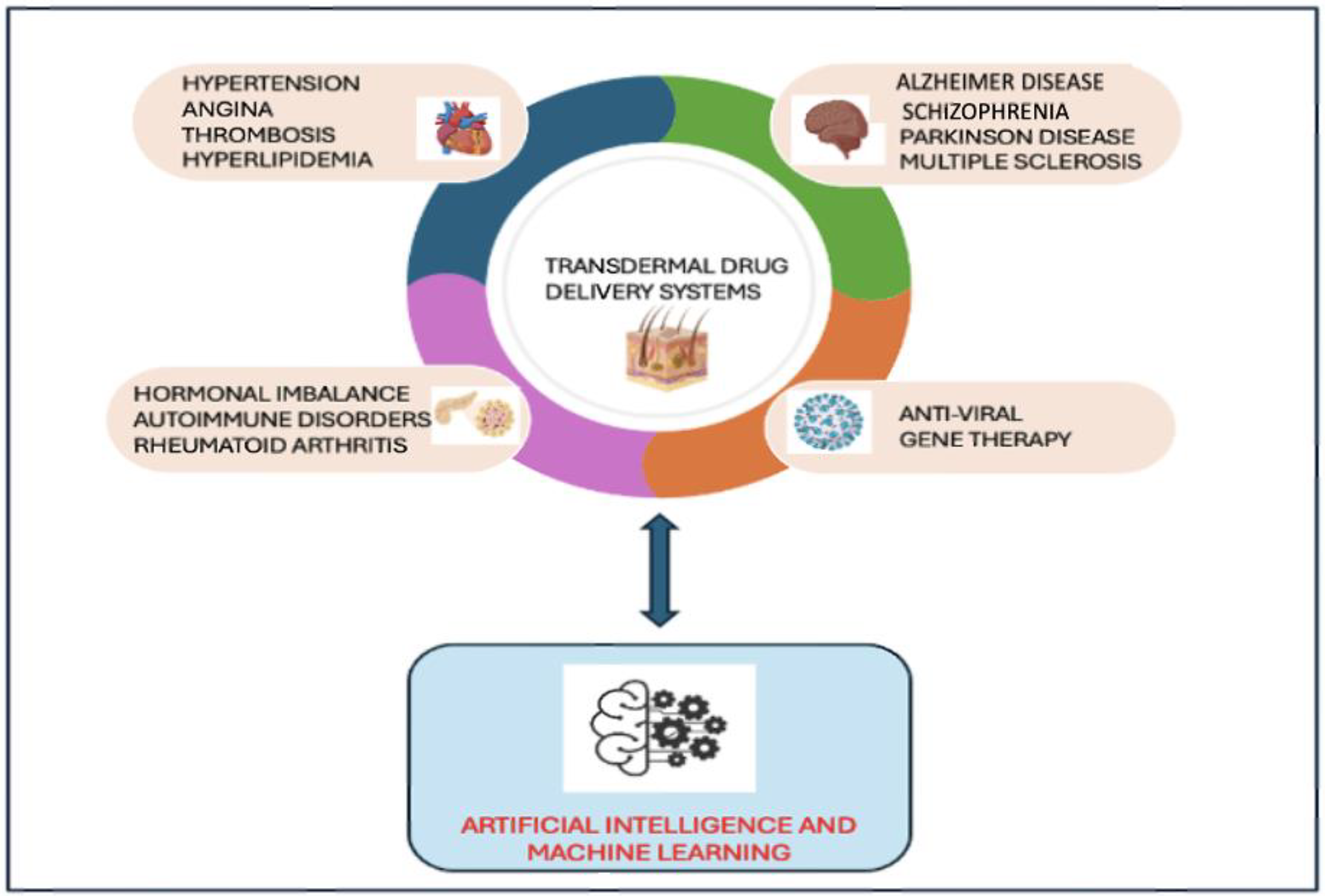

Table 1.
Transdermal drug delivery systems (TDDS) for common viral infectious diseases.
| Diseases | Virus | TDDS | TDDS role | References |
|---|---|---|---|---|
| Herpes simplex | Herpes simplex viruses (HSV) | Binary Ethosome | Drug delivery of acyclovir sodium | [42] |
| Water-in-oil microemulsion containing acyclovir | Enhanced acyclovir delivery using w/o type microemulsion | [47] | ||
| Acyclovir gel plaster containing sponge spicules (AGP-SS) | To achieve synergistic improvements in skin absorption and deposition of acyclovir | [51] | ||
| Hydrogel Nanoemulsion containing penciclovir | Develop Nanoemulsion containing penciclovir for transdermal drug delivery | [46] | ||
| Influenza | Influenza virus | Influenza vaccine loaded egg microneedles. | Influenza vaccine | [48] |
| The microneedle array patch (MAP) is loaded with ZAN. | Drug delivery of zanamivir | |||
| Warts | HPV | Solid microneedles | Facilitated penetration of topical 5-FU |
[50] |
| COVID-19 | SARS-CoV-2 | Fluorocarbon-modified chitosan (FCS)based transdermal delivery platforms of SARS-CoV-2 vaccines |
COVID-19 Vaccines | [50] |
| Dissolving microneedles containing embedded SARS-CoV-2-S1 subunits |
COVID-19 vaccines | [45] |
Table 2.
Transdermal drug delivery systems (TDDS) for Central Nervous System (CNS) disorders.
| Drug | Indication | TDDS | References |
|---|---|---|---|
| Nicotine | Dementia, Alzheimer's disease | Transdermal patch-matrix | [62] |
| Physostigmine | Alzheimer disease | Transdermal patch-control release | [63,64] |
| Phenserine | Cognition impairment | Transdermal patch-reservoir type | [65] |
| Rivastigmine | Behavioral disorders | Transdermal patch-control release | [66] |
| Tacrine | Alzheimer disease | TDDS by iontophoresis | [67] |
| Sumatriptan | Migraine | Transdermal patch-control release | [68] |
| Pramipexole | Parkinson’s disease | Transdermal patch | [69] |
| Donepezil | Alzheimer disease | Transdermal patch | [70] |
| Rotigotine | Parkinson’s disease | Transdermal patch | [71] |
| Everolimus | Multiple sclerosis | Microneedle-based transdermal patch | [72] |
| Baclofen | Multiple sclerosis | Nanosuspension-based microneedle skin patch | [73] |
| Asenapine | Schizophrenia | Transdermal patch | [74] |
| Blonaserin | Schizophrenia | Transdermal patch | [75] |
| Clozapine | Schizophrenia | Nanoemulsion-based transdermal drug delivery system | [76] |
| Risperidone | Antipsychotic | Transferosomal gel-transdermal | [77] |
| Olanzapine | Antipsychotic | Transferosomal TDDS | [78] |
| Quetiapine | Antipsychotic | Liposomal TDDS | [79] |
Table 3.
Transdermal drug delivery systems (TDDS) for Cardiovascular (CV) diseases.
| Drug | Indication | TDDS | References |
|---|---|---|---|
| Nitroglycerin | Angina pectoris | Microneedle Transdermal patch | [88] |
| Propranolol | Antihypertensive | Gel-based transdermal patch | [101] |
| Bisoprolol | Atrial fibrillation | Gel-based transdermal patch | [102] |
| Clonidine | Attention-deficit hyperactivity disorder | Polymeric transdermal patch | [99] |
| Losartan | Antihypertensive | Proniosome TDDS | [100] |
| Aspirin | Antithrombotic | Hydrocarbon gel-based TDDS | [103] |
| Clopidogrel | Antithrombotic | Polymeric transdermal patch | [104] |
| Pravastatin | Antithrombotic | emulgel based transdermal patch | [105] |
| Simvastatin | Hypercholesterolemia | Nanostructured lipid carrier-based TDDS | [106] |
| Lisinopril | Congestive heart failure | Lipid-based transdermal gels | [107] |
| Atorvastatin | Hypercholesterolemia | Microneedle based TDDS | [108] |
| Verapamil hydrochloride and amlodipine besylate | Chronic hypertension | Microneedle-based transdermal patch | [109] |
| Diltiazem and nifedipine | Chronic hypertension | Nanosphere-based microneedle TDDS | [110] |
| Sodium nitroprusside | Hypertensive emergency | Dissolvable microneedle patch | [111] |
Table 4.
Transdermal drug delivery systems (TDDS) for hormonal imbalance and autoimmune disorders.
| Drug | Indication | Formulation | References |
|---|---|---|---|
| Estrogen, Progesterone | Hormonal imbalance, Menopause | Transdermal patches, gels | [114,115,116] |
| Testosterone | Hormonal imbalance | Transdermal gels, patches | [117,118,119] |
| Hydrocortisone | Inflammation, Hormonal imbalance | Transdermal creams, gels | [120,121] |
| Methotrexate | Autoimmune Rheumatoid Arthritis (RA) | Transdermal patches | [121] |
| Hydrocortisone | Autoimmune (RA), inflammation | Transdermal patches, creams | [122] |
| Diclofenac (NSAID) | Autoimmune (RA), pain relief | Transdermal patches | [123] |
| Etanercept (TNF inhibitor) | Autoimmune (RA) | Transdermal patches, microneedles | [124,125] |
| Adalimumab (TNF inhibitor) | Autoimmune (RA) | Transdermal patches, microneedle | [126] |
Disclaimer/Publisher’s Note: The statements, opinions and data contained in all publications are solely those of the individual author(s) and contributor(s) and not of MDPI and/or the editor(s). MDPI and/or the editor(s) disclaim responsibility for any injury to people or property resulting from any ideas, methods, instructions or products referred to in the content. |
© 2024 by the authors. Licensee MDPI, Basel, Switzerland. This article is an open access article distributed under the terms and conditions of the Creative Commons Attribution (CC BY) license (http://creativecommons.org/licenses/by/4.0/).
Copyright: This open access article is published under a Creative Commons CC BY 4.0 license, which permit the free download, distribution, and reuse, provided that the author and preprint are cited in any reuse.


