

Submitted:
07 January 2025
Posted:
09 January 2025
You are already at the latest version
Abstract
This study 1) examines the job satisfaction, resilience, and self-efficacy profiles of school music educators in mainland China and 2) further analyses the relationship between these qualities and teachers’ well-being amid the ongoing national curriculum reform. The research surveyed 448 school music teachers from thirteen cities across China to complete a questionnaire incorporating five validated scales. The PERMA questionnaire assessed the general well-being of the teachers, while the Teacher Job Satisfaction Scale (TJSS), Multidimensional Teachers’ Resilience Scale (MTRS), and Music Teacher Self-Efficacy Scale (MTSS) gathered data on job satisfaction, resilience, and self-efficacy, specifically. The data were analysed by structural equation modelling, with well-being as the dependent variable and the dimensions of the composite scale as independent variables, to investigate the predictive influence of these parameters on well-being and the interrelationship among these variables. The research categorised the questionnaire items into personal, professional, and organisational factors underpinning the teachers' professional well-being concept. Add Path analyses were also conducted to investigate the multifaceted influences on teachers' professional well-being and to determine the interrelationships among these factors. The study's results offer an empirical foundation for educational administrators to identify and optimise key factors influencing teachers' professional well-being, thereby enhancing their working environment and augmenting job satisfaction and psychological well-being.
Keywords:
School music teacher
; Well-being
; Resilience
; Professional development
1. Introduction
1.1. School Music Teacher’s Professional Well-being
Both physical and mental health are integral to an individual's well-being. Positive psychology characterises well-being as an emotional outcome marked by positive feelings (Ryan & Deci, 2001; Hascher & Waber, 2021). Professional well-being is a metric for assessing an individual's overall well-being, typically classified into three domains: individual, organisational, and professional characteristics (Yildirim, 2014; Figure 1). The interplay between the individual and the environment fosters teachers' professional well-being. Educational professionals' well-being is markedly weaker than that of the general population, which states that educators encounter different expectations from students, parents, and school officials in their working setting, potentially resulting in mental health issues and work-related burnout. Moreover, workload continues to be a critical determinant of teachers' well-being (Kang & Yoo, 2019; Benevene et al., 2020).
The professional attributes of music educators differ from those of teachers in other subjects. Most music teachers exhibit dual identities: one as a musician as well as one of an instructor. Many teachers receive training as musicians and performers in the early stages of the profession (Isbell, 2008). Consequently, novice teachers often encounter reality shock (Ballantyne & Canham, 2022; Yang, 2023). Teachers indicated that their work environment did not meet their expectations. Research indicates that skills are crucial to improving teachers' confidence and managing challenging situations while offering opportunities for professional development (Reppa & Gournelou, 2012). The school environment promotes constructive relationships with peers, and student evaluations could influence a teacher's decisions, actions, and emotions (Bolat & Toytok, 2023). Teachers who experience happiness and appreciation in their workplace will enhance their job satisfaction and professional well-being (Li & Tinmaz, 2024).
1.2. Importance of Teacher Well-being Studies in China
Despite several studies on "general well-being," there is a lack of research specifically addressing professional well-being, particularly concerning teachers' professional well-being. Teacher turnover in China has significantly increased, marked by migration from undeveloped to developed regions and from rural to urban locales (Chen, 2022). In a study of teachers' professional well-being in Canada, China, Finland, Japan, and Singapore, teachers' teaching practice and professional practice significantly predicted teachers' professional well-being (Kouhsari et al., 2023). Studies indicate that teachers are more prone to leave the profession when they lack a sense of professional identity and fail to derive satisfaction from teaching (Si, 2024; Chen, 2022). Mainland China offers a specific professional progression framework. Teachers' salaries are linked to their performance and are closely tied to promotion opportunities and student enrolment rates (Yu et al., 2022; Loerbroks et al., 2014). Students in schools prioritise attaining excellent results in school, making music, as a non-examinable subject matter, less appealing to them. This is particularly apparent in high schools, as students' enthusiasm and drive for music learning diminish due to escalating pressure to advance (Yu & Leung, 2019). Negative comments from students may reduce instructors' professional excitement, consequently affecting their professional well-being (Li, 2024). Music teachers frequently have the challenge of lacking recognition within the educational institution and experiencing a weakened position. Concurrently, music teachers are anticipated to handle additional non-instructional and administrative duties. Furthermore, the low impact of music courses on student enrollment rates hinders the career advancement of music educators. Consequently, the professional well-being of music teachers is inevitably compromised.
1.3. Policy, Educational, and Professional Development Context
Teacher professional development is essential for strengthening teacher progression (Trent, 2020), and teacher well-being can be influenced by educational reform and professional development (Ao et al., 2023). For in-service teachers, professional development is an ongoing endeavour (Angeline, 2014). In China, teacher professional development is an institutional practice requiring teachers to engage in standardised training to effectively implement the curriculum (Yang, 2022; Ao et al., 2023). This three-tiered training program system (national, provincial, and local) compelled teachers to concentrate on external curricular improvements. In 2022, the Ministry of National Education officially published the Art Curriculum Standards for Compulsory Education (2022 Edition). Compared to the 2011 Edition of the Compulsory Music Curriculum Standards for Compulsory Education, the 2022 curriculum standards set up an agenda that incorporated the five arts subjects: music, art, dance, drama, and film and television, and explicitly mandated that art be provided from grades one to nine. The curriculum objectives have evolved from the original 'three-dimensional objectives' (emotion/attitude/value, process and method, knowledge and skills) to cultivating students' 'core competencies,' including aesthetic perception, artistic expression, creativity, and cultural understanding. The enrichment of the arts curriculum is a challenge for music teachers. Official statistics from the Ministry of Education show that, by 2020, there were 380,000 music teachers in compulsory education, nearly half of the 770,000 teachers in aesthetic education. Nevertheless, among these music teachers, roughly 10,000 primary and secondary school teachers possessed a degree in drama, dance, theatre, film, and television. Music teachers encounter higher professional development obligations as the cornerstone of their teaching activities.
1.4. Literature Review (TJSS & MTSS & MTRS & MCIQ)
Educators’ professional development encompasses the actual execution of information and competencies in educator activities, ultimately enhancing the learners’ learning (Darling-Hammond et al., 2017). Well-being describes peoples’ individual constructive professional experience, and it includes five eudemonic dimensions, such as relational skill at work, development at work, the feeling of capability, discerned appreciation at work, and a desire to participate at work (Wang et al., 2021). Educators’ well-being is a constructive emotional situation caused by a balance among the amplitude of specific contextual factors, personal requests, and expectations considering the school (Engels et al., 2004). Professional identity is a group of understandings and notions concerning how people consider themselves educators (Fejes and Köpsén, 2014). The educator’s professional identity is the educator’s picture of themselves, and it recognises that they belong to the professional educators (Li and Qiu, 2016) and includes their professional favourites, objectives, values, and ideas (Ruohotie & Moate, 2016). The relationship between the three can be summarised as follows: teachers' professional development continues to contribute to forming professional identity, and an enhanced sense of professional identity contributes to teachers' well-being. The selection of the four scales effectively covers psychological (MTSS) and behavioural (MTRS) aspects of school music teachers’ well-being, along with their work experience (TJSS) under the current curriculum reform (MCIQ).
1.5. Well-Being (Psychological)
Well-being is a multifaceted concept comprising cognitive, affective, physical, and mental components; it encompasses dispositional, personal, organisational, and environmental factors. Professional well-being is accepted as a dimension of the general well-being of an employee, whereas professional development provides an opportunity to promote the psychological, social, and physical health tools teachers require to maintain teacher well-being. The importance of an indicator comes from the reasons that generate it. If we know these reasons, proper intervention will be carried out when the problem arises. Different from other professional groups, the teaching profession naturally has some distinctive characteristics. Therefore, factors affecting it should differ from those of other professions. Identifying factors influencing professional well-being might enable administrators, political decision-makers and supervisors to undertake actions to enhance it (Yildirim, 2014). In teaching professions, well-being links to individual, professional, and organisational factors (Figure 1). Addressing protective factors may help to develop resilience and more effective ways of addressing the impact caused by negative factors in the teaching workplace. Among these factors, professional identity and development are essential and relatively easy to optimise quickly.
1.6. Job Satisfaction (Professional)
Teachers’ Job Satisfaction Survey (TJSS). Literature on job satisfaction abounds in the field of organisational psychology. Job satisfaction refers to an employee’s positive affective state from assessing one’s job experiences (Locke, 1976). The dominant view assumes that job satisfaction plays a dual role as a contributing factor to commitment and as an intervening variable that mediates the influences of demographic and organisational determinants on commitment (Price, 1997). The meta-analysis that examined job satisfaction and employee intent to leave among public and private sectors provided moderately strong effects (ρ = −.47 and −.53, respectively) (Hellman, 1997). Additionally, the literature has long demonstrated a positive relationship between job satisfaction and performance (Liu & Ramsey, 2008). The original item was the adaptation of the Job Satisfaction Survey (JSS) questionnaire developed by Spector (1997). After an exploratory factor analysis, the 32 original items decreased to 22, and the sub-construct reduced from 8 to 4. Unidimensional, validity and reliability indices were evaluated to ensure that the job satisfaction measurement model. Fitness indexes for Absolute Fit, Incremental Fit, and Parsimonious Fit all meet the requirements for all CR values of more than 0.6.
1.7. Self-Efficacy (Psychological)
Music Teacher Self-Efficacy Scale (MTSS). Music teachers’ effectiveness is a multidimensional construct that includes professional and personal features; it is a complex phenomenon characterised by several hidden variables that contribute in an interrelated way. Professional self-efficacy is a good indicator of teachers’ effectiveness and can be used to analyse professional and personal factors (Biasutti et al., 2021). The Music Teacher Identity Scale (MTIS), a researcher-constructed data-gathering instrument, was developed to measure two constructs of music teacher identity: Music Teacher Self-Efficacy and Music Teacher Commitment. Teacher commitment refers to an individual's willingness to invest money, time, and effort in teaching activities. Teacher self-efficacy and teacher commitment have been found to be important factors influencing teacher retention and teaching effectiveness, and these two constructs can further determine which factors influence the construction of music teachers' professional identity (Wagoner, 2015).
1.8. Teacher’s Professional Identity (Aspiration, Motivation, Authority; Situational)
Professional identity is generally defined as the collective identity of a profession (Feen-Calligan, 2005), which emphasises a composite sense of who one is and who one wishes to become as an occupational being (Kielhofner, 2008, p. 106). Autonomy and free choice are assumed to be universal in a socio-cultural process of identity formation through which professional values are developed collectively (Phelan & Kinsella, 2009). The resulting integrative conceptual framework considers the following categories of influencing factors on PID: professional image (Aspiration), perceived congruence with the profession, personal development and self-engagement (Motivation) (MTRS); educational context, professional experience, social experience (MCIQ); demographic characteristics, (Barbarà-i-Molinero et al., 2017). A teacher’s professional identity consists of two aspects: self-identity and other identity (Garnett, 2014; Isbell, 2008). Music teachers’ “self-identity” comprises musician and teacher trainee identities, presenting physical, psychological, and social attributes influenced by individual attitudes, habits, beliefs, and ideas. For music teachers, “other identity” comprises teacher apprentice and employee identities. It refers to socially constructed group prototypes inferred from others, which describe and prescribe beliefs, attitudes, feelings, and behaviours following group membership (Terry et al., 1999). In mainland China, in-service teacher professional development is primarily influenced by two channels in the education system: the official NTTP and voluntary teaching-study groups. To enhance the teaching quality of primary and secondary school teachers in public schools, the NTTP was developed on a five-level hierarchical training network (national, provincial, municipal, district, and school) in 2010 by the Ministry of Education and Finance (2010). In secondary socialisation, occupation-oriented professional development was reported to be the most influential source of career choice, and education policy is a powerful compass at a macro level (Yang, 2021). The studied cohort showed an identity development process characterised by a strong influence of policy-reinforced professionalism. Because all music teacher education curricula are accredited and regularly assessed by the Ministry of Education, the alignment of macro and micro policies on teacher education is assured in most cases. However, the quality of professional development fundamentally depends on the teacher’s versatility in negotiating the differences between curriculum objectives and teaching practices.
1.9. Music Curriculum Implementation (Environmental)
Multidimensional Teachers’ Resilience Scale. The Music Curriculum Implementation Questionnaire (MCIQ) adopted a 49-item diagnostic research instrument initially developed for science subjects (SCIQ; Lewthwaite & Fisher, 2005). It was used to analyse how teachers perceive the effectiveness of their colleagues and the schools where they work to implement and deliver subject-based lessons within the national curriculum in different education systems (Sharp et al., 2011). Corresponding to the identified factors that affected the application of the music curriculum in mainland China (Yu & Leung, 2019), the MCIQ provides teachers and researchers with a means of evaluating music teaching provisions in terms of strategic planning and decision-making in school contexts from personal and environmental dimensions.
1.10. Resilience (Behavioural)
Multidimensional Teachers’ Resilience Scale (MTRS). Professional resilience is the capacity to thrive in demanding situations, including (a) choice-making in response to difficulties, (b) attitude and willingness to act, and (c) returning to a state of internal equilibrium or well-being in career development (Ashby et al., 2013; Hodges et al., 2005). Teacher professional resilience refers to an individual’s positive adaptation and development in challenging circumstances (Luthar et al., 2000). It is a multidimensional psychological construct that is socially constructed (rather than an innate quality) and is relative, developmental, and dynamic (Gu & Day, 2007). From a cognitive–behavioural perspective, it comprises a set of flexible cognitive, behavioural, and emotional responses to unusual or commonplace challenges (Neenan, 2017). Professional resilience is the capacity to thrive in demanding situations, including (a) choice-making in response to difficulties, (b) attitude and willingness to act, and (c) returning to a state of internal equilibrium or well-being in career development (Ashby et al., 2013; Hodges et al., 2005). In general, resilience (a) mitigates the effects of emotional, cognitive, physiological, and behavioural stress factors in the work environment and (b) helps practitioners adopt strategies that reduce vulnerability while maintaining professional values that ensure career sustainability (Colligan & Higgins, 2006; McDonald & Hite, 2018; Robertson et al., 2015). Mansfield's model of resilience involves the process of resilience that involves environmental and personal resources. Mansfield's model explains the constructs of resilience and well-being in educational settings and can help educational practitioners better understand the resilience process (Hascher et al., 2021).
1.11. PERMA (Framework)
PERMA is a prominent model of well-being in positive psychology (Seligman, 2011). Seligman defines well-being as a construct. It consists of five components: positive emotions, engagement, relationships, meaning, and accomplishment. The scale focuses on exploring the positive aspects of well-being (Hascher & Waber, 2021). A high PERMA is an optimal state of health called flourishing (Seligman, 2012; Turner & Theilking, 2019). Research has shown a moderately high correlation between each of the elements of PERMA, which form the basis for achieving high levels of well-being (Seligman, 2018). Highly satisfied teachers can influence student performance (Gray et al., 2017).
Positive emotions are the basis for individuals to experience a sense of well-being, and positive emotions refer to hedonic emotions such as pleasure and comfort. Several studies have shown that when individuals are in positive emotions, they can effectively counteract negative emotions, such as stress and anxiety (Miksza et al., 2022) and that positive emotions have an impact on both physical and psychological well-being, such as resilience and self-confidence (Kun & Gadanecz, 2022). Engagement, which refers to an individual’s total commitment to the functioning of something, is a high level of engagement in which the individual feels fulfilled and happy, which increases overall subjective well-being (Bakker, 2005; Appleton et al., 2006). On the other hand, positive relationships are essential for individuals to maintain high levels of well-being. Individuals feel a sense of belonging when they feel supported and valued in their work environment and when they can contribute to helping other relationships (Cadima et al., 2021; Gregersen et al., 2023). Several studies have shown that supportive communication with colleagues and school management improves teachers’ job satisfaction. In addition, maintaining good relationships with students can increase motivation to teach and improve teachers’ well-being (Auliah et al., 2021; Rooda et al., 2011). Meaning is the state of an individual when they have a purpose in life, which gives the individual a sense of direction in life (Turner & Theilking, 2019; Cadima et al., 2021). Research has shown a significant correlation between purpose and psychological resilience. When faced with setbacks, teachers with a sense of purpose are more likely to adjust their mindset to cope with stress at work (Park & Baumeister, 2017). Accomplishment is the ability of an individual to achieve a goal through effort. In self-accomplishment, individuals increase their competence and confidence through continuous effort and perseverance. In educational settings, teachers with a high sense of accomplishment can learn from setbacks and ultimately achieve their personal goals (Butler & Kern, 2015; Auliah et al., 2021). People with high levels of well-being perform better at work, are more satisfied with their jobs, and are better able to cope with stress at work (Turner & Theilking, 2019). Both resilience and job satisfaction can act as protective factors to reduce teachers’ negative emotions, and good resilience can help teachers maintain their professional values and ensure career sustainability. Meanwhile, well-being shows a high positive correlation with job satisfaction, and teachers with high job satisfaction reduce burnout (Skaalvik & Skaalvik 2011).
In a qualitative study, researchers used the PERMA framework to conduct in-depth interviews with five Australian teachers at different times. They asked the teachers to use positive psychology strategies consciously during their work. This study explained how teachers receive social support at work (Turner et al., 2022). The study results showed that when teachers use positive psychology strategies in the workplace, they feel more relaxed and can focus more on their students’ positive qualities, which leads to better relationships. In addition, teachers’ altruistic behaviour, i.e., supporting colleagues, is important for teachers’ well-being. In a mixed-methods study, Kun & Gadanecz (2022) used positive psychology theories to investigate the factors that increase Hungarian teachers’ well-being at work and to examine the relationship between the factors. The quantitative study results indicated that teachers’ positive emotions were mainly related to well-being at work (Kun & Gadanecz, 2022) and that implementing interventions to increase positive emotions could increase well-being to some extent. Teaching and learning in the classroom continue to be stressful for school music teachers (Gray et al., 2017).
However, although there has been a considerable amount of research using the PERMA well-being framework to explore teachers’ well-being, relatively little research has been conducted on music educators, especially in the context of mainland China. Music teachers face unique challenges and pressures in the teaching and learning process, so different factors likely affect their well-being. However, existing studies tend to examine the effects of job satisfaction, resilience, and self-efficacy on teachers’ well-being individually, while comprehensive analyses of the interactions between these factors are lacking. Integrating these factors into a systematic theoretical framework remains an underexplored area.
1.12. Research Questions
Q1: To what extent do self-efficacy, resilience, and job satisfaction predict the well-being of music teachers?
Q2: Which of these variables best predicts and possibly teachers’ professional well-being?
2. Materials and Methods
2.1. Participants
The school music teacher participants were invited via work connections from various regions, including Guangdong, Fujian, Beijing, Inner Mongolia, and Shandong. Among them, 42.6% were primary school teachers, 23.9% were middle school teachers, and 33.5% were high school teachers. Additionally, 59.8% of the participants were female. The sample included teachers with varying years of experience: 39.3% had 1-3 years, 37.1% had 4-10 years, and 23.7% had more than 10 years of teaching experience. Ethical considerations were strictly observed before and during the study. The purpose and content of the research were explained to the subject leader in each district, who then communicated this information to the teachers. The names of the participating schools and teachers were kept confidential. Participants were assured they could withdraw from the study at any time and for any reason.
2.2. Research Toolkit
Multi-construct survey (TJSS & MTSS & MTR & MCIQ + PERMA)
Research data collection questionnaires include the Multidimensional Teachers’ Resilience Scale (MTRS), Music Teacher Self-Efficacy Scale (MTSS), Teachers’ Job Satisfaction Survey (TJSS), and PERMA (positive emotion, engagement, relationships, meaning, and accomplishment). The MTRS consists of 11 items distributed across four dimensions: emotional (3 items), social (1 item), motivational (5 items), and professional (2 items). It has been used to explore the complexity of the relationships between multiple levels of personal and contextual factors that influence teachers’ resilience-building processes in different education systems (Beltman & Mansfield, 2018; Flores, 2018; Gu & Day, 2011; Peixoto et al., 2020). The MTSS assesses an individual’s beliefs about their ability to perform a specific task and is usually closely related to their motivation, effort, and persistence. The Teachers’ Job Satisfaction Scale consists of 19 items distributed across 10 dimensions: nature of work (2 items), recognition (3 items), working conditions (1 item) and professional development (2 items), autonomy (1 item), relationships with students (2 items), supervisory support (2 items), earnings (2 items), resources and equipment (2 items), and workload (2 items). The five dimensions of PERMA are positive emotions, engagement, relationships, meaning, and achievement. The researchers translated the English questionnaire into a Chinese version, which another two field experts then double-checked. The wording of some items was adjusted slightly to better suit the teaching environment in mainland China. For example, “My department chair can help me with my teaching when I need it” was modified to “My music subject head can help me when I need it”. The final survey consisted of 49 questions ranked by the level of agreement on a 5-point Likert scale ranging from “strongly disagree” to “strongly agree.”
2.3. Procedure
2.3.1. Data Collection
An online survey was conducted using Questionnaire Star with participants between October 15 and November 15, 2024. The consent form and the questionnaire link were initially shared with regional teacher coordinators via WeChat, who then distributed them to individual music teachers for voluntary participation. Participants were informed about the purpose of the study before taking part and remained anonymous throughout the process. After collecting the data, the researchers screened it to exclude outliers and unreliable responses, such as when participants provided the same answer consecutively or completed the questionnaire in under 30 seconds. At last, 448 valid cases were included in the analysis.
2.3.2. Data Analysis
We conducted all statistical analyses using Jamovi. First, confirmatory factor analyses were performed to assess the stability of the structural validity of each sub-scale. Next, exploratory factor analysis was used to examine the structure and groupings within the composite questionnaire. Finally, structural equation modelling was applied to identify the relationships among teachers’ job satisfaction, self-efficacy, resilience, and well-being. Additionally, based on Yildirim's (2014) concept of teachers’ professional well-being, the items were re-grouped into personal, professional, and organisational aspects for a second path analysis. This analysis aimed to provide practical suggestions for enhancing well-being.
3. Results
3.1. Reliability, Validity, CFA, and EFA Analysis
First, reliability analyses were conducted for all scales. McDonald’s omega values ranged from 0.89 to 0.94 for each subscale, indicating sufficient internal consistency. The results of the Confirmatory Factor Analysis showed that the χ²/df ratios were between 1 and 3 for all subscales, indicating a good model fit. All fit measures were optimal (CFI > .95, TLI > .95, SRMR < .06, and RMSEA < .06), confirming good construct validity (see Table 1). Next, an exploratory factor analysis was conducted with the five scales combined, extracting four distinct factors (see Table 2). One item, MTSS_PV.StSuccess, which contained cross-loadings, was excluded from subsequent analyses.
3.2. Structural Equation Modelling & Path Analysis
3.2.1. SEM1: Profiling Music Teachers’ Well-Being
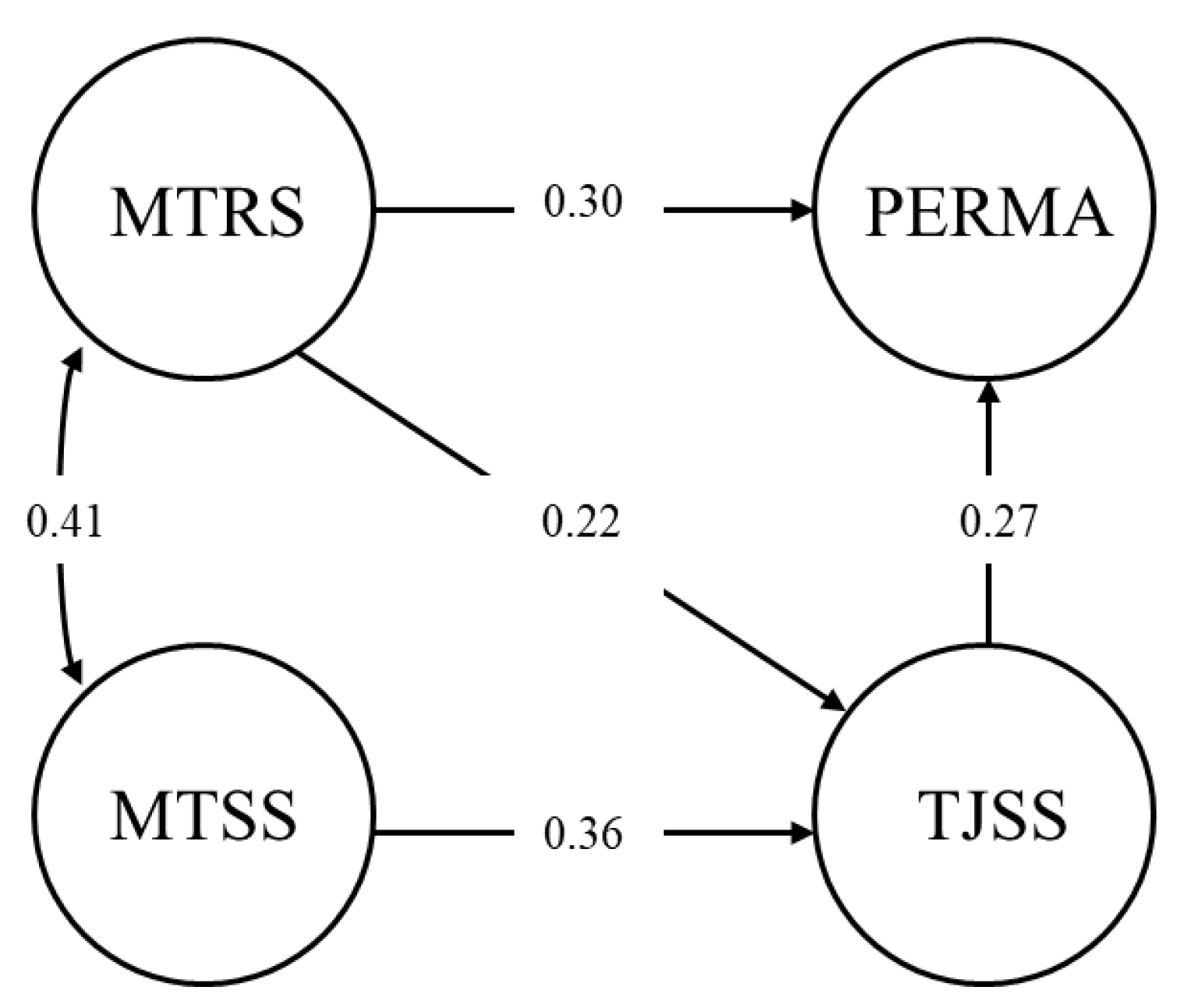
To address Question 1, this study analyzed the four dimensions of job satisfaction, resilience, self-efficacy, and well-being using structural equation modelling (SEM). In this model, self-efficacy, resilience, and job satisfaction were treated as independent variables, while well-being was the dependent variable. The overall SEM demonstrated a good fit (χ²/df = 1.978, p < .001, CFI = 0.941, TLI = 0.937, SRMR = 0.048, RMSEA = 0.047). The results indicated that self-efficacy and resilience significantly positively affected job satisfaction (β = 0.36, p < .001; β = 0.22, p < .001). Additionally, job satisfaction significantly positively affected well-being (β = 0.27, p < .001), while persistence also had a significant positive effect on well-being (β = 0.30, p < .001). The mediation analysis revealed that teachers’ job satisfaction was a significant mediator between self-efficacy and well-being, with a mediation effect value of 0.057. The 95% confidence interval for this effect was [0.046, 0.143], which does not include zero, and p < .001, indicating a significant mediation effect of job satisfaction in this pathway.
Figure 2.
SEM-1 for Techer’s Well-being Sub-scales.
3.2.2. SEM2: Functional Model for Music Teachers’ Well-Being Development
To address research question 2, the researcher categorised the items into three aspects based on the concept of teachers’ professional well-being (Figure 3): Personal, Professional, Organisational. These areas encompassed teachers’ job satisfaction, self-efficacy, and resilience. This analysis treated organisational characteristics as independent variables, while individual and professional factors served as dependent variables. The results indicated that the structural equation model had good fit indices (χ²/df = 1.364, SRMR = 0.024, RMSEA = 0.029, CFI = 0.993, IFI = 0.993, NFI = 0.976, TLI = 0.991). Specifically, organisational characteristics significantly and positively influenced individual factors (β = 0.31, p < 0.001) and professional factors (β = 0.28, p < 0.001). Additionally, individual factors significantly and positively influenced professional factors (β = 0.28, p < 0.001).
3.2.3. Path Analysis
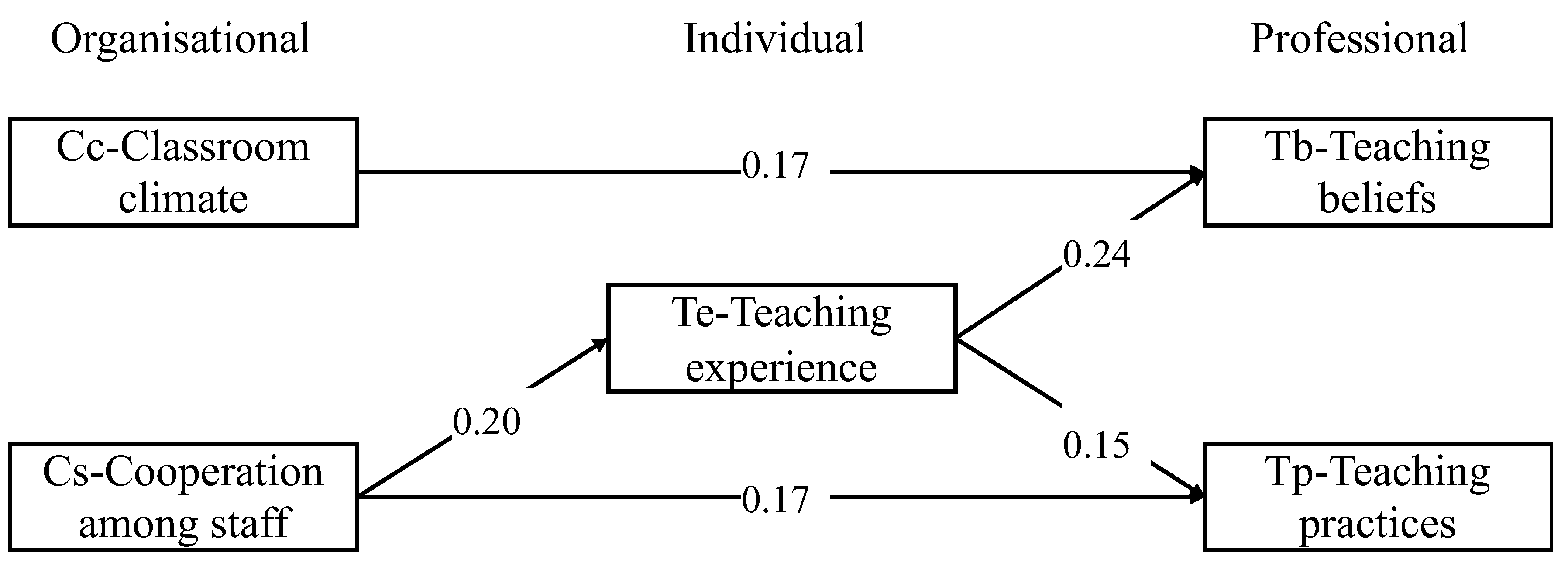
The researcher conducted a path analysis to identify significant predictors of teacher well-being. The results indicated a good model fit (χ²/df = 1.505, CFI = 0.997, TLI = 0.989, RMSEA = 0.034, SRMR = 0.020). The path coefficients revealed the following relationships (Figure 4): 1) The effect of relationships with colleagues on teaching practices was 0.17 (p < 0.01). 2) The effect of classroom climate on teaching beliefs was 0.17 (p < 0.01). 3) Individual factors had a path coefficient of 0.24 (p < 0.01) on teaching beliefs and 0.15 (p < 0.01) on teaching practices. 4) The path coefficient for the relationship with colleagues on individual factors was 0.20 (p < 0.01). These findings highlight the importance of colleague relationships and classroom climate in influencing teaching practices and beliefs and individual factors that contribute to teacher well-being.
Figure 5.
Path analysis of Organisational, Professional and Individual Factors4. Discussion.
Authors should discuss the results and how they can be interpreted from the perspective of previous studies and of the working hypotheses. The findings and their implications should be discussed in the broadest context possible. Future research directions may also be highlighted.
4. Discussion
4.1. RQ1: Individual Aspects
This study aimed to explore the relationship between job satisfaction, self-efficacy, resilience, and professional well-being, identifying key factors influencing teachers’ professional well-being in mainland China. The study's results indicated that teachers’ job satisfaction and resilience directly affect their professional well-being. The findings confirm previous research suggesting a strong link between teachers’ job satisfaction and their well-being and effective school functioning (Shim et al., 20-22). Job satisfaction significantly impacts the quality of teaching and educational outcomes (Umuzdaş, 2020; Shim et al., 2022; Lopes & Oliveira, 2020). Teachers who are content with their jobs exhibit greater motivation and enthusiasm in their teaching (May et al., 2004; Saks, 2006). Job satisfaction is a multidimensional concept influenced by external conditions: Salary, benefits, working environment, and career development opportunities (Timms & Brough, 2013; Lopes & Oliveira, 2020; Han et al.), as well as internal factors: Teachers’ autonomy and self-efficacy (Ryan & Deci, 2000; Dou et al.). Improving teachers’ job satisfaction can be achieved through enhancements in salary, benefits, and career development opportunities.
It was also found that self-efficacy influences teachers’ professional well-being via job satisfaction. According to self-efficacy theory, teachers with high self-efficacy demonstrate positive coping strategies when facing challenges. Expanding teachers’ knowledge and skills through training can enhance their confidence (Calik, 2013; Lazarides & Warner, 2020). However, Ortan et al. noted that while in-service training can boost self-efficacy, individual beliefs may become rigid with experience. Resilience includes both internal factors (e.g., self-efficacy) and external factors (e.g., administrative support) (Mullen et al., 2017). Resilience is an important factor for teachers, who often face stressors daily (Education Support, 2019) and is positively associated with teachers' job satisfaction and professional well-being and negatively associated with teachers' propensity to leave the profession (Chen, 2024). The teaching profession is more vulnerable to mental health problems than other professions (Han, 2022; Richards et al., 2016). Resilience can help teachers cope with challenges and maintain a positive outlook, thereby increasing job satisfaction and overall well-being (Mullen et al., 2021).
4.2. RQ2: Organizational Aspects
The results of the analysis indicate that music teachers’ teaching practices and beliefs are significantly influenced by four organisational characteristics: Appraisal and feedback, classroom climate, collaboration with staff, and school support. These findings suggest that school leaders are crucial in creating supportive work environments. Providing timely evaluations and assistance to music teachers can enhance their effectiveness (Tickle et al., 2011) and reduce career turnover (Luekens, 2004). Similarly, a notable finding from a 2019 survey in the UK highlighted that teacher feeling undervalued emerged as a new reason for leaving the profession (Education Support, 2019). This sentiment likely stems from a lack of recognition for teachers’ contributions by school management, colleagues, and students, as well as insufficient opportunities for professional development. Interestingly, teachers’ income status does not influence their well-being. Music teachers may need to cultivate positive emotions more than income status, and Kwong’s study found that once basic needs are met by salary, teachers’ attitudes, enjoyment, and sense of achievement are more important factors in influencing teachers’ teaching practices and well-being (Kwong et al., 2010). Therefore, school administrators must pay attention to teachers’ emotional problems and provide mental health resources and support to help teachers cope with stress and anxiety.
4.3. Interpersonal Relationships
The findings also confirmed the importance of collegiality and teacher-pupil relationships. Good collegiality, communication, and cooperation can support music teachers emotionally (OECD, 2009; Yıldırım, 2014). This is consistent with the findings of Kouhsari et al. (2023) that in a collectivist country like China, teachers are dependent on each other. Teachers' professional well-being will increase if they feel recognised and needed in the collective. On the other hand, teacher-student relationships are an essential source of classroom climate, and the positive interactions generated between teachers and students make teachers more committed to their work (Turner, 2021; Falk et al., 2022) and influence their teaching practices and philosophies. However, building a classroom climate does not depend solely on teachers’ efforts but also requires support from the school. Schools can support classroom management and pedagogical innovations by providing modern teaching and learning equipment, rich teaching and learning materials, and professional development opportunities.
The results of the path analyses showed that relationships with colleagues and teaching experience influence teaching practice, while classroom climate and teaching experience influence teachers’ teaching beliefs. At the same time, collegiality also influences teachers’ resilience and optimism. The findings suggest that good collegiality, classroom climate, and personal emotions significantly predict the well-being of the music teachers who participated in this study. These factors significantly influence teachers’ teaching practices and philosophies.
The findings of this study highlight the need for action at individual, professional, and organizational levels. For schools, the following initiatives can be addressed:
- Professional Development and Collaboration: Provide access to external training and exchange programs while encouraging group cooperation among teachers to share resources and experiences.
- Recognition and Support: Regularly acknowledge outstanding performance and offer timely feedback, fostering a sense of achievement and belonging among teachers.
- Improved Working Conditions: Enhance the working environment with comfortable office spaces, necessary teaching resources, and reduce administrative workloads to allow teachers to focus on teaching.
- Transparent Evaluation and Mental Health Support: Establish clear evaluation mechanisms with transparent criteria and provide psychological counselling services to support teachers' mental health and help them cope with stress.
5. Conclusion
This study holds great value because it constructs an integrated framework based on the PERMA model, combining job satisfaction, self-efficacy, and resilience theories. It explores the interplay among these four factors, offering fresh insights into the psychological mechanisms affecting teachers within their work environments. This theoretical foundation will support new approaches for further research in this area. From a practical standpoint, the findings present actionable recommendations for organisations and individuals to enhance teachers' psychological well-being. These improvements are expected to influence student learning and psychological development positively. Meanwhile, the empirical evidence is valuable for educational administrators and policymakers, promoting a more supportive teaching and learning environment in school education. Such initiatives can enhance music teachers' professional well-being, reduce burnout, and improve retention rates.
6. Limitations
This study has several limitations that should be acknowledged. First, the research primarily focused on music teachers in mainland China, which may limit the generalizability of the findings to other educational contexts or disciplines. Second, the study's cross-sectional design restricts the ability to draw causal conclusions about the relationships among job satisfaction, self-efficacy, resilience, and professional well-being. Longitudinal studies would provide more robust insights into these dynamics over time. Additionally, relying on self-reported data may introduce biases, as teachers might have provided socially desirable responses rather than fully accurate reflections of their experiences. Future research could address these limitations by expanding the participant pool and employing diverse methodologies to better understand the factors influencing teachers' well-being.
References
- Aelterman, A.; Engels, N.; Van Petegem, K.; Pierre Verhaeghe, J. The well-being of teachers in Flanders: the importance of a supportive school culture. Educational studies 2007, 33, 285–297. [Google Scholar] [CrossRef]
- Appleton, J.J.; Christenson, S.L.; Kim, D.; Reschly, A.L. Measuring cognitive and psychological engagement: Validation of the Student Engagement Instrument. Journal of school psychology 2006, 44, 427–445. [Google Scholar] [CrossRef]
- Angeline, V.R. Motivation, Professional Development, and the Experienced Music Teacher. Music Educators Journal 2014, 101, 50–55. [Google Scholar] [CrossRef]
- Ao, N.; Zhang, S.; Tian, G.; Zhu, X.; Kang, X. Exploring teacher well-being in educational reforms: A Chinese perspective. Frontiers in Psychology 2023, 14, 1265536. [Google Scholar] [CrossRef]
- Auliah, A.; Thien, L.M.; Kho, S.H.; Abd Razak, N.; Jamil, H.; Ahmad, M.Z. Exploring positive school attributes: evidence from school leader and teacher perspectives. SAGE Open 2021, 11, 21582440211061572. [Google Scholar] [CrossRef]
- Ballantyne, J.; Canham, N. Understanding music teachers’ perceptions of themselves and their work: An importance–confidence analysis. International Journal of Music Education 2022, 41, 455–471. [Google Scholar] [CrossRef]
- Bakker, A.B. Flow among music teachers and their students: The crossover of peak experiences. Journal of vocational behavior 2005, 66, 26–44. [Google Scholar] [CrossRef]
- Benevene, P.; De Stasio, S.; Fiorilli, C. Well-being of schoolteachers in their work environment. Frontiers in Psychology 2020, 11, 1239. [Google Scholar] [CrossRef] [PubMed]
- Bolat, Ö. Bolat, Ö. & Toytok, E.H. (2023) Exploring teacher’s professional identity in relationship to leadership: A latent profile analysis [Preprint]. [CrossRef]
- Butt, R.; Retallick, J. Professional well-being and learning: A study of administrator-teacher workplace relationships. The Journal of Educational Enquiry 2002, 3. [Google Scholar]
- Butler, J. & Kern, M.L. (2015). The PERMA profiler: A brief multidimensional measure of flourishing. Kern Publications.
- Bonner, A.D. (2023). Special Education Teachers’ Self-Efficacy and Resilience as Predictors of Well-being (Doctoral dissertation, Grand Canyon University).
- Botha, M.G. (2022). Challenges, rewards and coping strategies associated with teachers’ well-being in the 21st century (Doctoral dissertation, University of Pretoria (South Africa)).
- Calik, M. 2013. “Effect of Technology-Embedded Scientific Inquiry on Senior Science Student Teachers’ Self-Efficacy.” Eurasia Journal of Mathematics, Science & Technology Education 9 (3): 223–232. [CrossRef]
- Cadima, J.; Guedes, C.; Grande, C.; Charalambous, V.; Agathokleous, A.; Vrasidas, C. ;... & Halamandaris, R. (2021). Literature review on early childhood teachers’ careers and professional development, teachers’ well-being (PERMA) and children’s socio-emotional support (SWPBS).
- Chen, F.X. “Persistence” or “escape” - qualitative study based on the investigation of rural teachers’ turnover intention. Advances in Education 2022, 12, 3575–3582. [Google Scholar] [CrossRef]
- Chen, J. Reimaging teacher resilience for flourishing. The Asia-Pacific Education Researcher.
- Dreer, B. Teachers’ well-being and job satisfaction: The important role of positive emotions in the workplace. Educational Studies 2024, 50, 61–77. [Google Scholar] [CrossRef]
- Education Support. (2019). Teacher well-being index 2019. Education Support.
- Falk, D.; Shephard, D.; Mendenhall, M. “I always take their problem as mine”–understanding the relationship between teacher-student relationships and teacher well-being in crisis contexts. International Journal of Educational Development 2022, 95, 102670. [Google Scholar] [CrossRef]
- Fernandes, L.; Gouveia, M.J.; Silva, J.C.; Peixoto, F. Positive education’: A professional learning programme to foster teachers’ resilience and well-being. Cultivating teacher resilience 2021, 103. [Google Scholar]
- García-Álvarez, D.; Soler, M.J.; Cobo-Rendón, R.; Hernández-Lalinde, J. Teacher professional development, character education, and well-being: multicomponent intervention based on positive psychology. Sustainability 2023, 15, 9852. [Google Scholar] [CrossRef]
- Gray, C.; Wilcox, G.; Nordstokke, D. Teacher mental health, school climate, inclusive education and student learning: A review. Canadian Psychology/Psychologie Canadienne 2017, 58, 203–210. [Google Scholar] [CrossRef]
- Gregersen, T.; Mercer, S.; MacIntyre, P.; Talbot, K.; Banga, C.A. Understanding language teacher well-being: An ESM study of daily stressors and uplifts. Language Teaching Research 2023, 27, 862–883. [Google Scholar] [CrossRef]
- Hascher, T.; Waber, J. Teacher well-being: A systematic review of the research literature from the year 2000–2019. Educational Research Review 2021, 34, 100411. [Google Scholar] [CrossRef]
- Hascher, T.; Beltman, S.; Mansfield, C. Teacher well-being and resilience: Towards an integrative model. Educational research 2021, 63, 416–439. [Google Scholar] [CrossRef]
- Hascher, T.; Waber, J. Teacher well-being: A systematic review of the research literature from the year 2000–2019. Educational research review 2021, 34, 100411. [Google Scholar] [CrossRef]
- Han, W. Chinese English as a foreign language teachers’ job satisfaction, resilience, and their psychological well-being. Frontiers in Psychology 2022, 12, 800417. [Google Scholar] [CrossRef]
- Hoy WK, Miskel CG (2010). Educational administration: theory, research and practice. (Trans. Ed. Turan S). Ankara: Nobel. (Original work published 1998).
- Hong, J.Y. (2010a) ‘Pre-service and beginning teachers’ professional identity and its relation to dropping out of the profession’, Teaching and Teacher Education, 26, pp. 1530–1543. /: http. [CrossRef]
- Huang, S.; Yin, H.; Lv, L. Job characteristics and teacher well-being: the mediation of teacher self-monitoring and teacher self-efficacy. Educational psychology 2019, 39, 313-331.Isbell, D.S. Musicians and Teachers: The Socialization and Occupational Identity of Preservice Music Teachers. Journal of Research in Music Education 2008, 56, 162–178. [Google Scholar] [CrossRef]
- Kang, S.; Yoo, H. Music Teachers’ Psychological Needs and Work Engagement as Predictors of Their Well-being. Bulletin of the Council for Research in Music Education 2019, 221, 58–71. [Google Scholar] [CrossRef]
- Klassen, R.M.; and M., M. Chiu. 2010. “Effects on Teachers’ Self-Efficacy and Job Satisfaction: Teacher Gender, Years of Experience, and Job Stress.” Journal of Educational Psychology 102 (3): 741–756. [CrossRef]
- Kouhsari, M.; Chen, J.; Baniasad, S. Multilevel analysis of teacher professional well-being and its influential factors based on TALIS data. Research in Comparative and International Education 2023, 18, 395–418. [Google Scholar] [CrossRef]
- Kun, A.; Gadanecz, P. Workplace happiness, well-being and their relationship with psychological capital: A study of Hungarian Teachers. Current Psychology 2022, 41, 185–199. [Google Scholar] [CrossRef]
- Lazarides, R.; Warner, L.M. Teacher self-efficacy. Oxford research encyclopedia of education 2020, 1e22. [Google Scholar]
- Loerbroks, A.; Meng, H.; Chen, M.-L.; Herr, R.; Angerer, P.; Li, J. Primary school teachers in China: associations of organisational justice and effort–reward imbalance with burnout and intentions to leave the profession in a cross-sectional sample. International archives of occupational and environmental health 2014, 87, 695–703. [Google Scholar] [CrossRef]
- Liu, s. , & Teddlie, C. Case studies of educational effectiveness in rural China. Journal of Education for Students Placed at Risk (JESPAR) 2009, 14, 334–355. [Google Scholar]
- Li, H.; Li, Z.; Tinmaz, H. The influence of professional identity and occupational well-being on retention intention of rural teachers in China. International Journal of Chinese Education 2024, 13, 2212585X241253918. [Google Scholar] [CrossRef]
- Luekens, M.T. (2004). Teacher attrition and mobility: Results from the teacher followup survey. 2000e01. Washington, DC: National Center for Education Statistics, U.S. Dept. of Education, Institute of Education Sciences. E.D.
- Liu, L.B.; Song, H.; Miao, P. Navigating individual and collective notions of teacher well-being as a complex phenomenon shaped by national context. Compare: A Journal of Comparative and International Education 2018, 48, 128–146. [Google Scholar] [CrossRef]
- Luthans, F.; Avey, J.B.; Avolio, B.J.; Norman, S.; Combs, G. Psychological capital development: Toward a micro-intervention. Journal of Organizational Behavior 2006, 27, 387–393. [Google Scholar] [CrossRef]
- Luthans, F.; Avey, J.B.; Patera, J.L. (2008). Experimental analysis of a web-based intervention to develop positive psychological capita.
- McCallum, F.; Price, D. (2016). Nurturing well-being development in education: From little things, big things grow. London: Routledge.
- Mullen, C.A.; Shields, L.B.; Tienken, C.H. Developing teacher resilience and resilient school cultures. Journal of Scholarship & Practice 2021, 18, 8–24. [Google Scholar]
- Miksza, P.; Parkes, K.; Russell, J.A.; Bauer, W. The well-being of music educators during the pandemic Spring of 2020. Psychology of Music 2022, 50, 1152–1168. [Google Scholar] [CrossRef]
- OECD (2009). Creating effective teaching and learning environments: First results from TALIS, Paris: OECD Publication.
- Ortan, F.; Simut, C.; Simut, R. Self-efficacy, job satisfaction and teacher well-being in the K-12 educational system. International journal of environmental research and public health 2021, 18, 12763. [Google Scholar] [CrossRef]
- Park, J.; Baumeister, R.F. Meaning in life and adjustment to daily stressors. The Journal of Positive Psychology 2017, 12, 333–341. [Google Scholar] [CrossRef]
- Pretsch, J.; Flunger, B.; Schmitt, M. Resilience predicts well-being in teachers, but not in non-teaching employees. Social Psychology of Education 2012, 15, 321–336. [Google Scholar] [CrossRef]
- Qianli, L. Occupational Environment, Professional Development, and Well-being of High School Teachers in China. Sustainable Development 2024, 12, 73–85. [Google Scholar]
- Reppa, P.G. and Gournelou, P. (2012) ‘The professional identity of primary and secondary school music teachers in Greece’, Procedia - Social and Behavioral Sciences, 46, pp. 2611–2614. [CrossRef]
- Richards, K.A. R.; Levesque-Bristol, C.; Templin, T.J.; and Graber, K. The impact of resilience on role stressors and burnout in elementary and secondary teachers. Soc. Psychol. Educ. 19 2016, 511–536. [Google Scholar] [CrossRef]
- Roorda, D.L.; Koomen, H.M.; Spilt, J.L.; Oort, F.J. The influence of affective teacher–student relationships on students’ school engagement and achievement: A meta-analytic approach. Review of educational research 2011, 81, 493–529. [Google Scholar] [CrossRef]
- Seligman, M. PERMA and the building blocks of well-being. The Journal of Positive Psychology 2018, 13, 333–335. [Google Scholar] [CrossRef]
- Seligman M. E., P.; Csikszentmihalyi, M. (2000). Positive Psychology: An introduction. American Psychological Association. https://doi.org/. [CrossRef]
- Seligman M. E., P. (2011). Flourish: A visionary new understanding of happiness and well-being. Free Press.
- Song, H.; Lin, M.; Ou, Y.; Wang, X. Reframing teacher well-being: A case study and a holistic exploration through a Chinese lens. Teachers and Teaching 2024, 30, 818–834. [Google Scholar] [CrossRef]
- Si, J. Higher education teachers’ professional well-being in the rise of managerialism: Insights from China. Higher Education 2024, 87, 1121–1138. [Google Scholar] [CrossRef]
- Skaalvik, E.M.; and, S. Skaalvik. 2011. “Teachers’ Feeling of Belonging, Exhaustion, and Job Satisfaction: The Role of School Goal Structure and Value Consonance.” Anxiety, Stress, and Coping 24 (4): 369–385. [CrossRef]
- Trent, J. Wither teacher professional development? The challenges of learning teaching and constructing identities across boundaries in China. Asia Pacific Journal of Education 2020, 40, 315–329. [Google Scholar] [CrossRef]
- Turner, K.; Theilking, M. Teacher well-being: Its effects on teaching practice and student learning. Issues in Educational Research 2019, 29, 938–960. [Google Scholar]
- Turner, K.; Thielking, M.; Prochazka, N. Teacher well-being and social support: A phenomenological study. Educational Research 2022, 64, 77–94. [Google Scholar] [CrossRef]
- Tickle, B.R.; Chang, M.; Kim, S. Administrative support and its mediating effect on US public school teachers. Teaching and Teacher Education 2011, 27, 342–349. [Google Scholar] [CrossRef]
- Turner, K.; Thielking, M.; Meyer, D. Teacher well-being, teaching practice and student learning. Issues in Educational research 2021, 31, 1293–1311. [Google Scholar]
- Wagoner, C.L. Measuring music teacher identity: Self-efficacy and commitment among music teachers. Bulletin of the Council for Research in Music Education, (205).
- Yang, Y. Professional identity development of preservice music teachers: A survey study of three Chinese universities. Research Studies in Music Education 2022, 44, 313–330. [Google Scholar] [CrossRef]
- Yang, Y. Challenges in teachers’ professional identity development under the national teacher training programme: An exploratory study of seven major cities in Mainland China. Music Education Research 2023, 25, 468–484. [Google Scholar] [CrossRef]
- Yıldırım, K. Main factors of teachers professional well-being. Educational Research and Reviews 2014, 9, 153–163. [Google Scholar] [CrossRef]
- Yu, D.; Chen, J.; Li, X.; Yan, Z. Trajectory of Teacher Well-being Research between 1973 and 2021: Review Evidence from 49 Years in Asia. International Journal of Environmental Research and Public Health 2022, 19, 12342. [Google Scholar] [CrossRef]
Figure 1.
The conceptual model of teachers’ professional well-being (Yildirim, 2014).
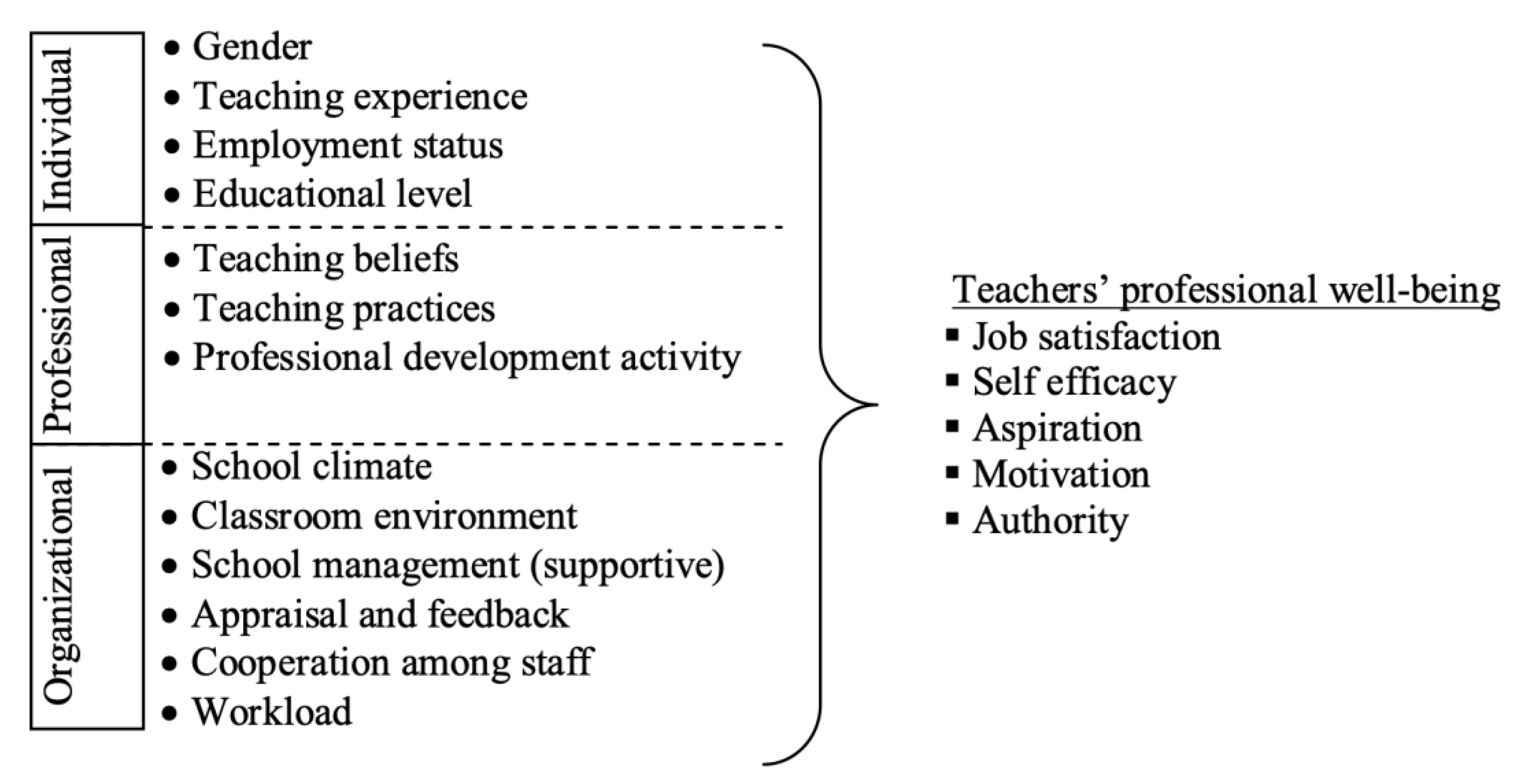
Figure 3.
SEM-2 for Organisational, Professional and Individual Factors.
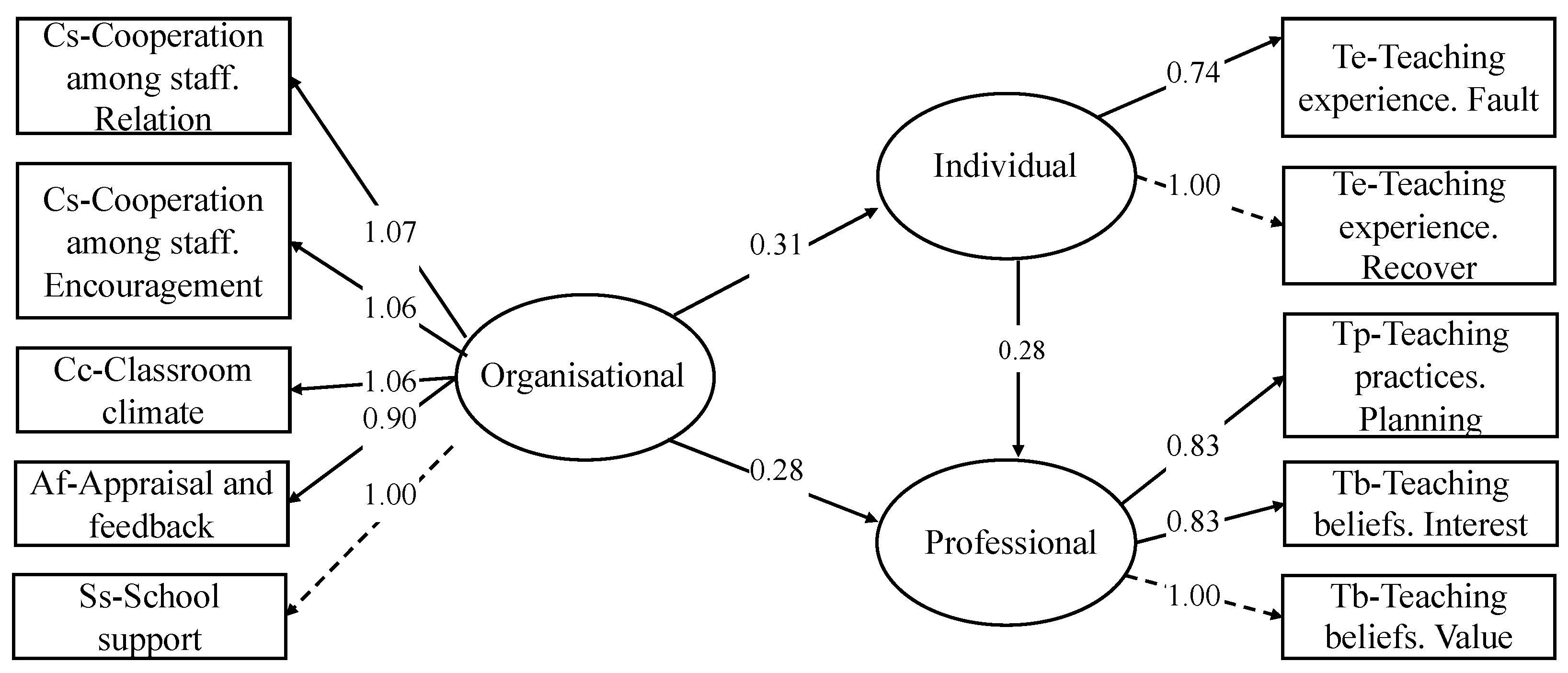

Table 1.
Subscale Reliability and Confirmatory Factor Analysis Results.
| Reliability | Fit Measures | |||||||
|---|---|---|---|---|---|---|---|---|
| RMSEA 90% CI | ||||||||
| Cronbach’s α | McDonald’s ω | CFI | TLI | SRMR | RMSEA | Lower | Upper | |
| TJSS | 0.941 | 0.942 | 0.994 | 0.979 | 0.0131 | 0.0503 | 0.0238 | 0.0763 |
| MTSS | 0.893 | 0.894 | 0.992 | 0.984 | 0.0161 | 0.0507 | 0.0218 | 0.0789 |
| MTRS | 0.930 | 0.930 | 0.990 | 0.981 | 0.0181 | 0.0546 | 0.0311 | 0.0784 |
| MCIQ* | 0.821 | 0.833 | 0.988 | 0.975 | 0.0265 | 0.0490 | 0.0176 | 0.0788 |
| PERMA | 0.937 | 0.937 | 0.993 | 0.985 | 0.0147 | 0.0479 | 0.0242 | 0.0709 |
* All selected MCIQ items are covered in the other subscales.
Table 2.
Exploratory Factor Analysis (Minimum residual extraction & promax rotation).
| SEM | EFA Factors | |||||||
|---|---|---|---|---|---|---|---|---|
| 1 | 2 | Path | Items codes by subscales | 1 | 2 | 3 | 4 | Uniqueness |
| O-Ss | TJSS_SS / MCIQ_S.Helping | 0.797 | 0.395 | |||||
| * | O-Cs | TJSS_RC.Encouragement | 0.776 | 0.391 | ||||
| * | O-Af | TJSS_SS.Supervising | 0.769 | 0.381 | ||||
| P-Pda | TJSS_PD.Training | 0.764 | 0.430 | |||||
| * | P-Pda | TJSS_PD / MCIQ_S.Support | 0.739 | 0.469 | ||||
| I-Emp | TJSS_RM.Income | 0.737 | 0.491 | |||||
| O-Cc | TJSS_RE.Resource | 0.731 | 0.432 | |||||
| * | O-Wl | TJSS_WL.Workload | 0.723 | 0.452 | ||||
| * | O-Cs | * | TJSS_RC.Relation | 0.718 | 0.409 | |||
| O-Cc | TJSS_RS.Respect | 0.718 | 0.435 | |||||
| O-Af | TJSS_RC.Recognition | 0.710 | 0.450 | |||||
| * | O-Ss | TJSS_RE.Equipment | 0.710 | 0.482 | ||||
| I-Emp | TJSS_RM.Financing | 0.692 | 0.471 | |||||
| P-Tp | TJSS_WI / MCIQ_K.Skill | 0.679 | 0.499 | |||||
| O-Cc | TJSS_RS.StRelation | 0.678 | 0.427 | |||||
| * | O-Sc | TJSS_WC.Improvement | 0.677 | 0.634 | ||||
| * | P-Tp | TJSS_WI / MCIQ_S.Opportunity | 0.673 | 0.517 | ||||
| * | P-Tp | TJSS_TA / MCIQ_K.Autonomy | 0.673 | 0.486 | ||||
| O-Wl | TJSS_WL.Admin | 0.645 | 0.646 | |||||
| * | * | MTRS_E.Calm | 0.869 | 0.295 | ||||
| * | MTRS_S.Understanding | 0.831 | 0.341 | |||||
| * | MTRS_E.Growth | 0.816 | 0.359 | |||||
| * | MTRS_P / MCIQ_M.Scheduling | 0.796 | 0.328 | |||||
| P-Tp | MTRS_M.Improve | 0.794 | 0.329 | |||||
| P-Tb | MTRS_M.Expectation | 0.772 | 0.408 | |||||
| * | I-Te | MTRS_M.Fault | 0.765 | 0.392 | ||||
| P-Tb | MTRS_M.Confident | 0.756 | 0.371 | |||||
| I-Te | MTRS_E.Recover | 0.755 | 0.466 | |||||
| P-Tp | * | MTRS_M.Challenge | 0.753 | 0.458 | ||||
| P-Tp | * | MTRS_P.Reflection | 0.746 | 0.381 | ||||
| P-Tp | MTRS_P.Flexibility | 0.713 | 0.412 | |||||
| * | * | MTRS_M.Target | 0.709 | 0.395 | ||||
| P-Tp | PERMA_E.Concentrate | 0.853 | 0.304 | |||||
| P-Tb | * | PERMA_M.Value | 0.828 | 0.334 | ||||
| O-Cs | PERMA_R.Satisfaction | 0.820 | 0.350 | |||||
| * | O-Cs | MCIQ_S / PERMA_R.PeerSupport | 0.819 | 0.304 | ||||
| P-Tp | * | PERMA_M.Planning | 0.816 | 0.410 | ||||
| P-Tb | PERMA_A.Goals | 0.783 | 0.369 | |||||
| P-Tb | PERMA_E.Interest | 0.775 | 0.358 | |||||
| O-Cs | PERMA_R.Prease | 0.771 | 0.367 | |||||
| * | PERMA_P.Happiness | 0.764 | 0.409 | |||||
| * | PERMA_P.Positive | 0.756 | 0.376 | |||||
| P-Tb | * | MTSS_AB / MCIQ_A.Confidence | 0.894 | 0.275 | ||||
| * | P-Tp | * | MTSS_AB.Objectives | 0.825 | 0.333 | |||
| P-Tp | * | TJSS_TA / MTSS_PS.Innoviation | 0.813 | 0.370 | ||||
| * | MTSS_AB.Competance | 0.788 | 0.380 | |||||
| * | MTSS_AB.Participation | 0.772 | 0.366 | |||||
| * | MTSS_AB.LifeValue | 0.707 | 0.434 | |||||
| * | MTSS_AC.Activity | 0.660 | 0.538 | |||||
| * | * | * | MTSS_PV.StSuccess | 0.322 | 0.389 | 0.620 | ||
* suggest an item is not used for the specified analysis (SEM-1, SEM-2, or Path).
Disclaimer/Publisher’s Note: The statements, opinions and data contained in all publications are solely those of the individual author(s) and contributor(s) and not of MDPI and/or the editor(s). MDPI and/or the editor(s) disclaim responsibility for any injury to people or property resulting from any ideas, methods, instructions or products referred to in the content. |
© 2025 by the authors. Licensee MDPI, Basel, Switzerland. This article is an open access article distributed under the terms and conditions of the Creative Commons Attribution (CC BY) license (http://creativecommons.org/licenses/by/4.0/).
Copyright: This open access article is published under a Creative Commons CC BY 4.0 license, which permit the free download, distribution, and reuse, provided that the author and preprint are cited in any reuse.


