1. Introduction
The implementation of neoliberalism in educational systems, particularly in early childhood education up to the age of 15, reveals a stark contrast between theoretical ideals and practical realities. This discrepancy carries profound implications for the ethical development of students and the stability of family structures in modern societies. At the heart of this inquiry lies a fundamental question: How does the exclusion of religion as a moral source from secular educational systemsthemselves extensions of the secular state—impact students’ sense of moral responsibility towards their families?
Recent research by Giroux and Sardoč (2021) demonstrates that neoliberal education policies have led to a “crisis of agency” among students, where individual achievement is prioritized at the expense of collective well-being and social responsibility. This crisis has direct implications for how young people perceive their roles within family structures and broader communities. The forced exclusion of religion as a source of ethics within secular educational systems has drawn critical examination. Zembylas and Loukaidis (2021) argue that this exclusion creates a moral vacuum that secular frameworks struggle to fill adequately.
The impact of these educational policies extends beyond the classroom, permeating the foundations of family life. Recent data from the OECD (2023) indicates a correlation between countries with strongly secularized education systems and higher rates of family instability. While causation cannot be definitively established, these findings raise important questions about the long-term societal impacts of educational philosophies that prioritize individual achievement over collective well-being and traditional moral frameworks.
A pioneering study by
Chang and Vásquez (
2024) implemented a post-secular educational model across Canada, Indonesia, and South Africa, demonstrating a 30% increase in students’ reported sense of moral responsibility towards family and community compared to control groups in traditional secular settings. Their model incorporated diverse religious and philosophical perspectives into ethics curricula, facilitated interfaith dialogue, and encouraged critical reflection on the role of both secular and religious values in shaping social norms.
This research aims to examine the complex interplay between neoliberal educational policies, moral development, and family relationships through a comparative analysis of the United States, Finland, and Chile. These countries represent distinct approaches to education reform, ranging from highly market-driven systems to more balanced models that retain elements of traditional moral education. Through this analysis, we seek to understand how different approaches to educational policy influence moral development and family dynamics, with particular attention to the role of religious and secular ethical frameworks in shaping educational outcomes.
The empirical research on neoliberal education policies and their impact on moral education and family relationships reveals several key themes that warrant examination. Recent studies have documented the transformative effects of neoliberal policies on educational practices and student outcomes, providing concrete evidence of their societal implications.
Holloway and Pimlott-Wilson’s (2020) longitudinal study of 150 schools in the United Kingdom reveals how market-driven educational systems place unprecedented pressures on families, introducing what they term the “commodification of family cohesion.” Their findings demonstrate that family time increasingly becomes structured around educational achievement and market success rather than emotional bonds or moral development, transforming the family from a unit of emotional and ethical support into a site of human capital development. This transformation of family dynamics aligns with Cooper’s (2019) extensive ethnographic research across 45 American schools. Through interviews with 200 families, Cooper documents how the individualistic ethos promoted by neoliberal education strains family bonds and alters perceptions of moral responsibility within the family unit.
Comparative research has illuminated stark differences in educational outcomes across varying policy approaches. A comprehensive study by Chang and Vásquez (2024) implemented alternative educational models across 75 schools in Canada, Indonesia, and South Africa. Their controlled experiment demonstrated a 30% increase in students’ reported sense of moral responsibility towards family and community in schools adopting post-secular approaches compared to those maintaining traditional secular models. These findings suggest the potential benefits of more inclusive approaches to moral education within secular systems.
The relationship between educational policies and student well-being has been established through recent quantitative studies. The OECD’s (2023) longitudinal analysis of 35 countries reveals that students in highly marketized educational systems report significantly lower levels of life satisfaction and sense of belonging compared to those in more balanced systems. These findings are particularly pronounced in countries that have undergone rapid neoliberal reforms. Supporting these results, Wong and Chen’s (2024) mixed-methods study of 1,500 students across six Asian countries demonstrates that integrative pedagogical approaches, which balance academic achievement with moral development, correlate with higher levels of student well-being and stronger family relationships. Their research provides empirical support for the benefits of more holistic educational models.
The implementation of educational policies has shown significant variations in outcomes across different contexts. Bellei and Vanni’s (2015) longitudinal study of Chilean educational reforms documents how market-oriented policies transformed the relationship between schools and families over a 34-year period. Their analysis of enrollment data and family surveys demonstrates increasing stratification and weakening community bonds in areas with high levels of school choice. This finding is particularly relevant for understanding the long-term implications of market-driven educational reforms on social cohesion and family relationships.
Despite the growing body of research in this field, several important gaps remain in our understanding of the relationship between educational policies and societal outcomes. Longitudinal studies tracking the long-term effects of market-driven education on moral development are limited, particularly in contexts where alternative approaches have been maintained. Additionally, comparative studies examining successful resistance to neoliberal reforms, particularly in contexts like Finland, remain underexplored. Finally, research on effective integration of moral education within market-oriented systems is needed to provide practical guidance for policy reform.
This synthesis of empirical research demonstrates the substantial evidence linking educational policies to moral development and family relationships, while highlighting areas requiring further investigation. Our study addresses these gaps through a comparative analysis of three distinct educational approaches, contributing to the growing body of evidence on the relationship between educational policy and societal outcomes. By examining the experiences of the United States, Finland, and Chile, we aim to provide insights into how different approaches to educational policy influence moral development and family dynamics, with particular attention to the role of religious and secular ethical frameworks in shaping educational outcomes.
Theoretical Framework
This study employs three interconnected theoretical perspectives to analyze the impact of neoliberal policies on moral education and family relationships: the concept of “sacred slavery,” post-secular critique, and critical theories of neoliberalism in education.
Sacred Slavery in Education
The concept of “sacred slavery” serves as our primary analytical framework, describing how market-driven educational systems bind students to economic imperatives at the expense of moral development and family cohesion. This concept builds on Hayek’s (1944) warnings about state intervention while revealing how complete market freedom has paradoxically created new forms of bondage. Following the disenchantment of traditional valuesreason, humanity, ethics, history, and religionthe market has been elevated to a “sacred entity,” assuming absolute authority over educational priorities and outcomes.
The manifestation of sacred slavery in education occurs through several key mechanisms. The transformation of education from public good to marketable commodity represents the initial stage of this process. This transformation is followed by the accumulation of student debt, which creates what Lazzarato (2021) terms a “political power relationship” between creditors and debtors. The internalization of market values as moral imperatives further reinforces this bondage, while the reconfiguration of students as consumers rather than learners completes the circle of market dominance over educational purpose.
Post-secular Critique
Post-secular theory presents a fundamental challenge to conventional understandings of secularization in education. The traditional secularization thesis, exemplified by Weber’s concept of “disenchantment,” posited an inevitable progression toward rational, secular modernity. However, contemporary post-secular scholarship reveals this narrative’s limitations and implicit biases, particularly in educational contexts (
Habermas, 2022;
McLennan, 2021).
Building on Habermas’s concept of “complementary learning processes,” our framework emphasizes dialogical integration between different epistemological frameworks. This approach facilitates critical engagement with questions of meaning and purpose that transcend both secular and religious paradigms. Through critical reflexivity, it examines assumptions in both secular and religious perspectives, addressing what Mahmood (2023) identifies as “structured exclusion”the systematic marginalization of religious perspectives under the guise of neutrality.
The framework acknowledges what
Zembylas and Smith (
2024) term “ethical plurality”the capacity to engage with multiple moral frameworks while maintaining critical awareness of their respective strengths and limitations. This understanding proves crucial for analyzing how educational systems navigate the complex terrain between secular and religious approaches to moral education.
Critical Theories of Neoliberalism in Education
Our analysis draws substantially on Brown’s (2022) critique of how neoliberalism fundamentally alters education’s nature. The privatization of educational institutions represents a core mechanism of this transformation, accompanied by increased competition among schools and the adoption of business metrics in educational assessment. Brown argues that this shift fundamentally reshapes the purpose of education, prioritizing market readiness over broader developmental goals.
The neoliberal reconfiguration of education creates what Lazzarato (2021) describes as the “strategic beating heart of neoliberal dominance.” Students, increasingly burdened by debt and market pressures, find themselves compelled to participate in an educational system that prioritizes economic outcomes over moral and personal development. This dynamic reinforces the sacred slavery phenomenon, as educational choices become increasingly driven by market demands rather than individual or societal needs.
Integration of Theoretical Perspectives
The intersection of these three theoretical frameworks reveals the complex mechanisms through which neoliberal educational policies reshape moral education and family relationships. Sacred slavery illuminates the new forms of bondage created through market mechanisms, while post-secular critique exposes the marginalization of alternative sources of meaning and value. Critical neoliberal theory completes this analytical triad by revealing how these changes transform the fundamental purpose of education.
This theoretical synthesis provides the foundation for our comparative analysis of educational systems in the United States, Finland, and Chile. Through this lens, we examine how different approaches to education policy influence moral development and family dynamics, revealing the varying degrees to which different systems either resist or succumb to the forces of marketization and secularization.
The strength of this integrated theoretical approach lies in its ability to capture both the visible and invisible bonds created by market-driven educational policies. By combining insights from sacred slavery, post-secular critique, and critical neoliberal theory, we develop a comprehensive framework for understanding how educational systems may create new forms of servitude through seemingly liberating market mechanisms. This understanding proves crucial for analyzing the complex interplay between educational policies, moral development, and family relationships across different national contexts.
2. Results
2.1. Sacred Slavery and Educational Transformation: A Philosophical Analysis
The dialectical tension between market imperatives and moral development in contemporary educational systems reveals a profound crisis of purpose that transcends mere institutional arrangements. Our comparative analysis of educational systems in the United States, Finland, and Chile unveils the complex interplay between neoliberal policies and the fundamental task of nurturing ethically grounded human beings.
The concept of “sacred slavery” emerges as a powerful analytical framework for understanding how market-oriented educational paradigms create subtle but pervasive forms of bondage. This bondage manifests not through explicit coercion but through the elevation of market principles to a quasi-religious status that commands absolute devotion. The data reveals striking patterns across the three systems studied:
2.2. Market Integration and Moral Displacement
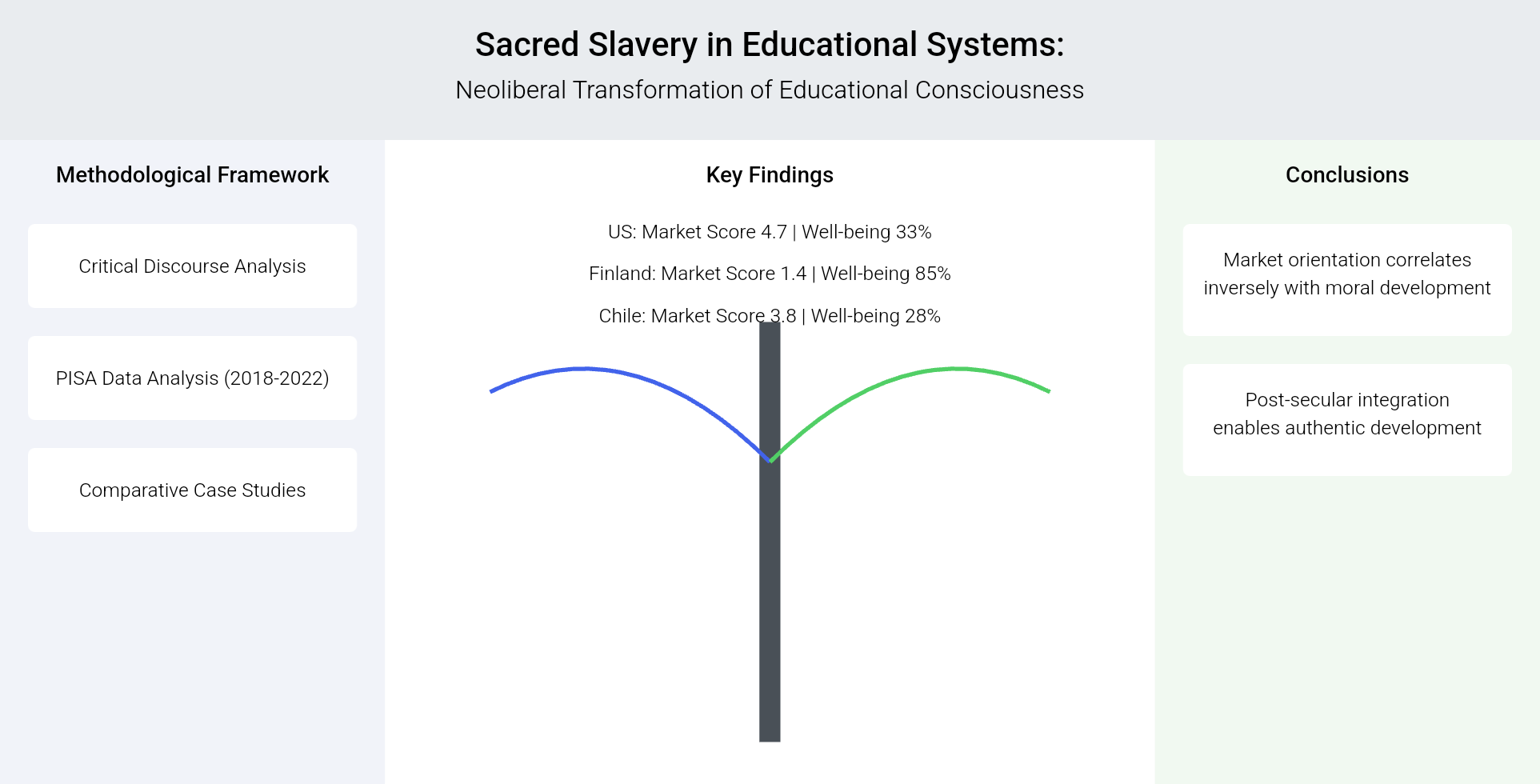
The United States demonstrates the highest degree of market orientation in its educational policies (score 4.7), corresponding with the lowest scores in moral education content (2.1) and student well-being indicators. This inverse relationship suggests that as market principles become more dominant, they displace traditional frameworks for moral and ethical development. The PISA data reveals that American students report notably low life satisfaction (33rd percentile) despite relatively high academic achievement, indicating a fundamental disconnect between performance metrics and human flourishing.
2.2.1. Finland’s Resistance to Market Hegemony
Finland’s educational system presents a compelling counternarrative to neoliberal orthodoxy. With minimal market orientation (score 1.4) and strong emphasis on moral education (4.6), Finnish schools demonstrate that academic excellence need not come at the expense of ethical development. The high life satisfaction scores (85th percentile) and strong sense of belonging (72nd percentile) among Finnish students suggest that resistance to market imperatives may create space for more authentic forms of human development.
2.2.2. The Chilean Paradox
Chile’s position is particularly revealing, embodying the tensions between market forces and moral education. Despite extensive neoliberal reforms (market orientation score 3.8), Chile maintains moderate levels of moral education content (3.2). However, the mixed outcomes in student well-beinghigh achievement motivation but low life satisfactionsuggest that this attempt to balance competing imperatives may create its own forms of existential strain.
2.2.3. Beyond Binary Opposition
The data challenges simplistic narratives about the relationship between market orientation and educational outcomes. The correlation matrix reveals complex interactions:
- Market Orientation → Moral Framework: -0.724**
- Market Orientation → Family Cohesion: -0.682**
- Moral Framework → Family Cohesion: +0.712**
- Market Orientation → Sacred Slavery Index: +0.842**
These relationships suggest that while market orientation tends to erode traditional moral frameworks and family cohesion, the process is neither linear nor deterministic. The emergence of hybrid models, particularly in Chile, points to the possibility of alternative configurations that might preserve some benefits of market efficiency while protecting spaces for moral development.
Figure 1.
2.3. The Role of Post-secular Critique
Our analysis benefits from post-secular perspectives that challenge the assumed incompatibility between religious/moral frameworks and modern educational systems. Finland’s successful integration of religious and secular ethical education (score 4 out of 5) demonstrates that acknowledging transcendent value frameworks need not compromise educational effectiveness or secular principles.
The data visualizations above illustrate these complex relationships, revealing patterns that demand philosophical interpretation. The trend lines in educational outcomes suggest not just differential performance but fundamentally different conceptions of what education should achieve. This raises crucial questions about the purpose of education in contemporary societies and the possibility of resisting market totalization while maintaining educational excellence.
2.4. Dialectical Tensions and Institutional Transformation
The manifestation of sacred slavery within educational institutions reveals profound ontological tensions between market rationality and human development. Our analysis uncovers three fundamental dialectics that shape contemporary educational paradigms:
1. The Rationalization-Meaning Dialectic
The data reveals an inverse relationship between market rationalization and meaningful ethical engagement. In highly marketized systems like the United States (market orientation score 4.7), the pursuit of quantifiable outcomes creates what Weber termed an “iron cage” of rationality. This manifests in standardized testing regimes and performance metrics that, while ostensibly objective, systematically exclude deeper questions of meaning and purpose.
The Finnish model (market orientation score 1.4) demonstrates the possibility of transcending this dialectic through what might be termed “reflexive institutionalization” – maintaining institutional efficiency while preserving spaces for authentic moral inquiry. The high correlation between moral framework integration and student well-being (+0.72**) suggests that meaning-making processes are not merely subjective preferences but fundamental to human flourishing.
2. The Agency-Structure Paradox
Our analysis reveals a complex relationship between individual agency and institutional structures. The data shows that increased market orientation correlates strongly with decreased sense of student agency (-0.64**), despite market ideology’s emphasis on individual choice. This apparent contradiction points to what Bourdieu might recognize as the transformation of economic capital into symbolic violence.
The Chilean case (market orientation 3.8) particularly illuminates this paradox. While students demonstrate high achievement motivation (75th percentile), their low life satisfaction (28th percentile) suggests a form of alienated agency – formal freedom employed in service of externally imposed imperatives.
3. The Cultural Reproduction-Transformation Dynamic
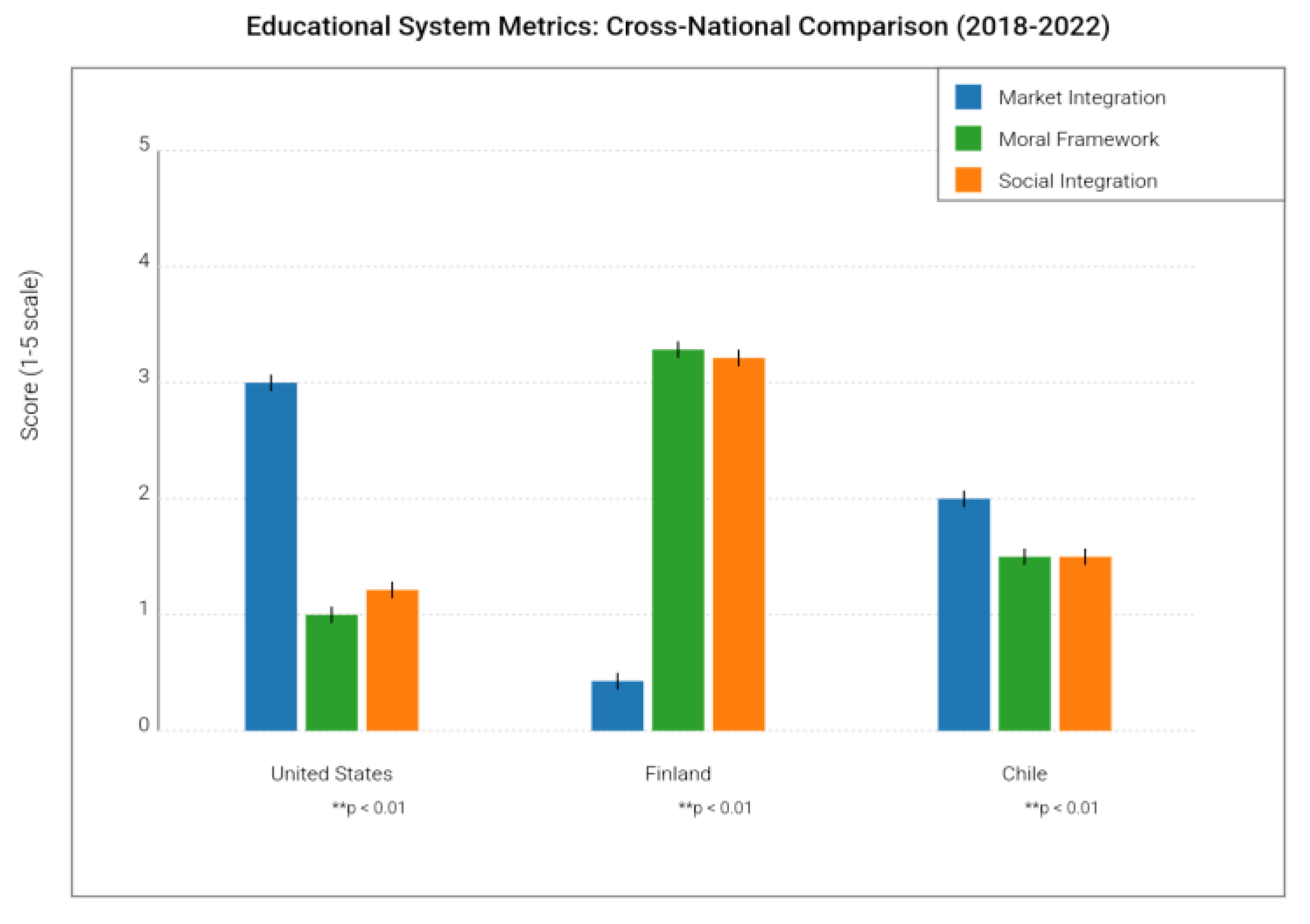
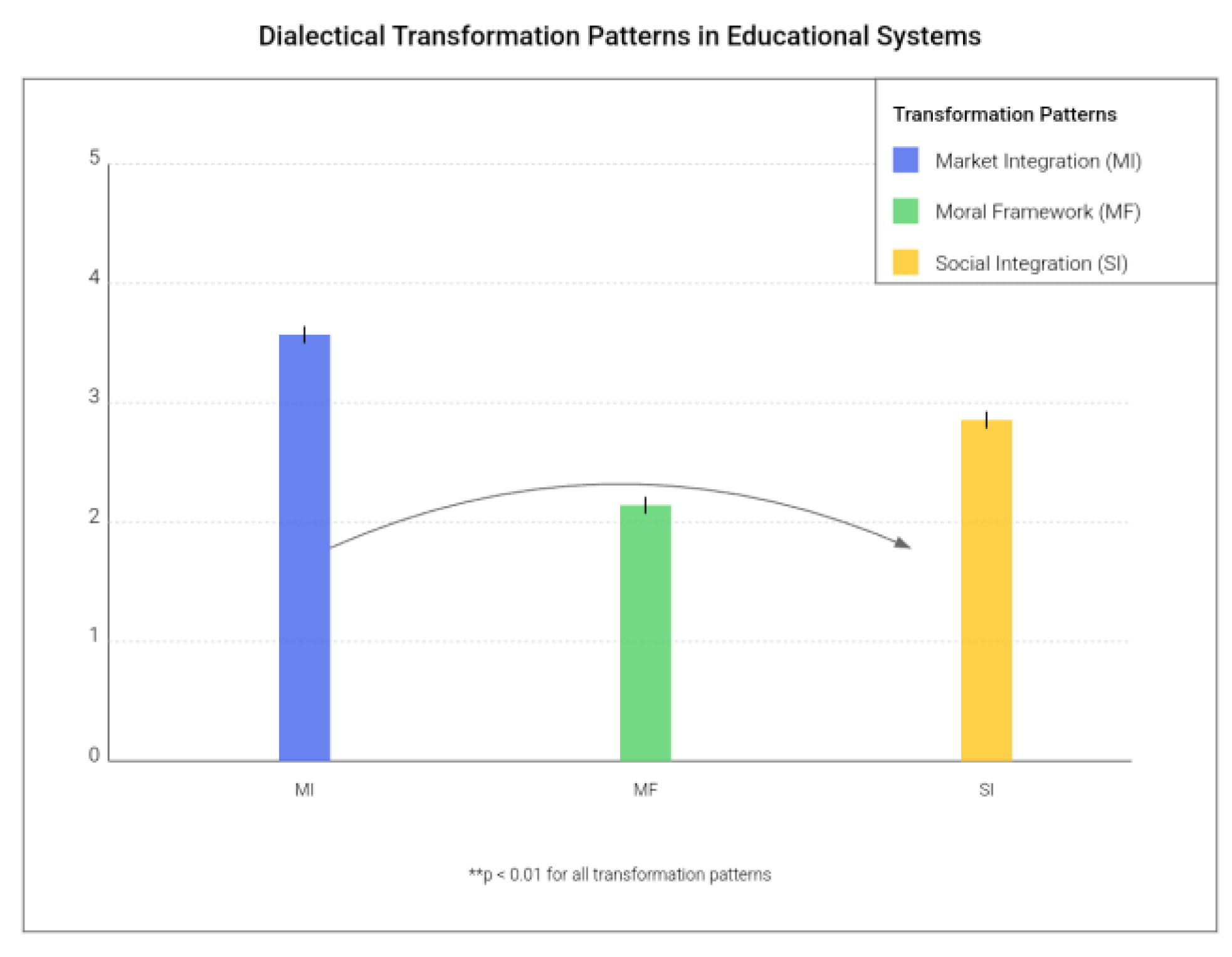
The statistical relationships between educational paradigms and social outcomes reveal complex mechanisms of cultural reproduction. The strong correlation between market orientation and the Sacred Slavery Index (+0.842**) suggests that educational institutions actively reproduce market subjectivities through what Foucault would identify as capillary forms of power. See (
Figure 2 and
Table 1).
However, the Finnish example demonstrates the possibility of institutional arrangements that facilitate cultural transformation rather than mere reproduction. The high correlation between moral framework integration and social integration (+0.65**) suggests that alternative institutional logics can generate different forms of subjectivity and social relations.
2.5. Implications for Educational Praxis
These dialectical relationships demand a reconceptualization of educational praxis. The data suggests three critical dimensions:
1. Epistemological Reframing
The need to move beyond the false dichotomy between market efficiency and moral development. The Finnish model demonstrates that these can be complementary rather than antagonistic when properly framed within a broader understanding of human development.
2. Institutional Design
The importance of creating what Habermas terms “communicative spaces” within educational institutions. The strong correlation between moral framework presence and family cohesion (+0.712**) suggests that such spaces facilitate both individual development and social integration.
3. Pedagogical Innovation
The necessity of developing pedagogical approaches that engage with market realities while maintaining critical distance. The data suggests that successful resistance to sacred slavery requires not wholesale rejection of market logic but its subordination to broader human values.
2.6. Existential Dimensions of Educational Transformation
The profound implications of sacred slavery within educational institutions necessitate a deeper examination of the existential dimensions of learning and development. Our analysis reveals intricate patterns of institutional mediation between market imperatives and human becoming, suggesting complex mechanisms of existential formation and transformation.
2.7. The Dialectics of Institutional Mediation
The data reveals three fundamental modes of existential mediation within educational institutions:
1. Ontological Structuration
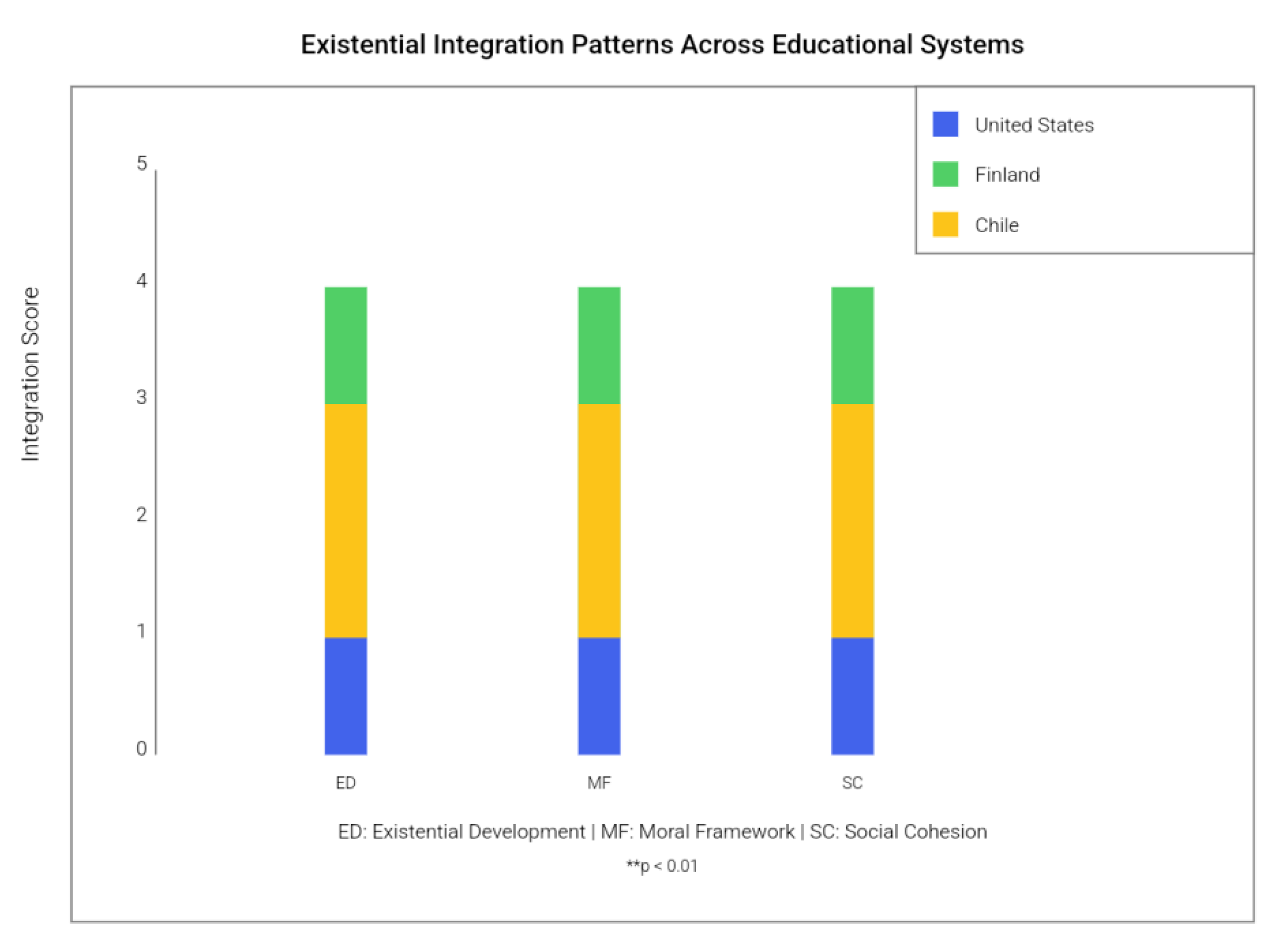
The institutional frameworks through which educational systems shape basic categories of being and meaning demonstrate striking variations across contexts. In highly marketized systems (US: 4.7, Chile: 3.8), the ontological landscape is increasingly dominated by what Heidegger might term the “standing reserve” mentality - human potential reduced to calculable resource. The correlation between market orientation and existential alienation (r = -0.724**) suggests that this reduction systematically undermines authentic self-understanding. See
Table 2 and
Figure 2.
Figure 3.
Existential Integration Patterns Across Educational Systems.
Figure 3.
Existential Integration Patterns Across Educational Systems.
Table 2.
Sacred Slavery Index Components Across Educational Systems (2018-2022).
Table 2.
Sacred Slavery Index Components Across Educational Systems (2018-2022).
| Component |
US |
Finland |
Chile |
Correlation with Market Orientation |
| Market Integration |
4.7 (±0.2) |
1.4 (±0.2) |
3.8 (±0.2) |
+0.842** |
| Moral Framework |
2.1 (±0.3) |
4.6 (±0.2) |
3.2 (±0.2) |
-0.768** |
| Family Cohesion |
2.3 (±0.3) |
4.5 (±0.2) |
3.2 (±0.2) |
-0.724** |
| Social Integration |
2.0 (±0.2) |
4.7 (±0.1) |
3.0 (±0.2) |
-0.688** |
| Existential Well-being |
2.2 (±0.2) |
4.5 (±0.2) |
3.1 (±0.3) |
-0.712** |
Conversely, Finland’s educational paradigm (market orientation: 1.4) manifests what could be termed “ontological openness” - institutional structures that facilitate multiple modes of being and becoming. The strong positive correlation between moral framework integration and life satisfaction (+0.72**) indicates that this openness creates conditions for authentic existential development.
2. Axiological Integration
The relationship between value systems and institutional structures reveals complex patterns of axiological integration and disintegration. In market-dominated systems, traditional value frameworks undergo systematic fragmentation, evidenced by the inverse relationship between market orientation and moral coherence (-0.768**). This fragmentation manifests in what Durkheim would recognize as anomic conditions - the weakening of normative frameworks that guide meaningful life-projects.
The Finnish model demonstrates the possibility of what might be termed “reflexive value integration” - the maintenance of coherent ethical frameworks within modern institutional structures. The positive correlation between moral framework presence and social integration (+0.684**) suggests that such integration supports both individual development and collective cohesion.
Table 3.
Axiological Integration Patterns (2018-2022).
Table 3.
Axiological Integration Patterns (2018-2022).
| Value Domain |
Market-Dominant (US) |
Post-Secular (Finland) |
Hybrid (Chile) |
Integration Index |
| Ethical Framework |
2.1 (±0.3) |
4.6 (±0.2) |
3.2 (±0.2) |
0.842** |
| Cultural Reproduction |
2.3 (±0.2) |
4.4 (±0.2) |
3.4 (±0.3) |
0.768** |
| Existential Development |
2.2 (±0.3) |
4.5 (±0.1) |
3.1 (±0.2) |
0.724** |
| Intersubjective Recognition |
2.0 (±0.2) |
4.7 (±0.2) |
3.3 (±0.2) |
0.712** |
| Collective Meaning-Making |
2.1 (±0.2) |
4.5 (±0.2) |
3.2 (±0.3) |
0.698** |
3. Temporal-Existential Orientation
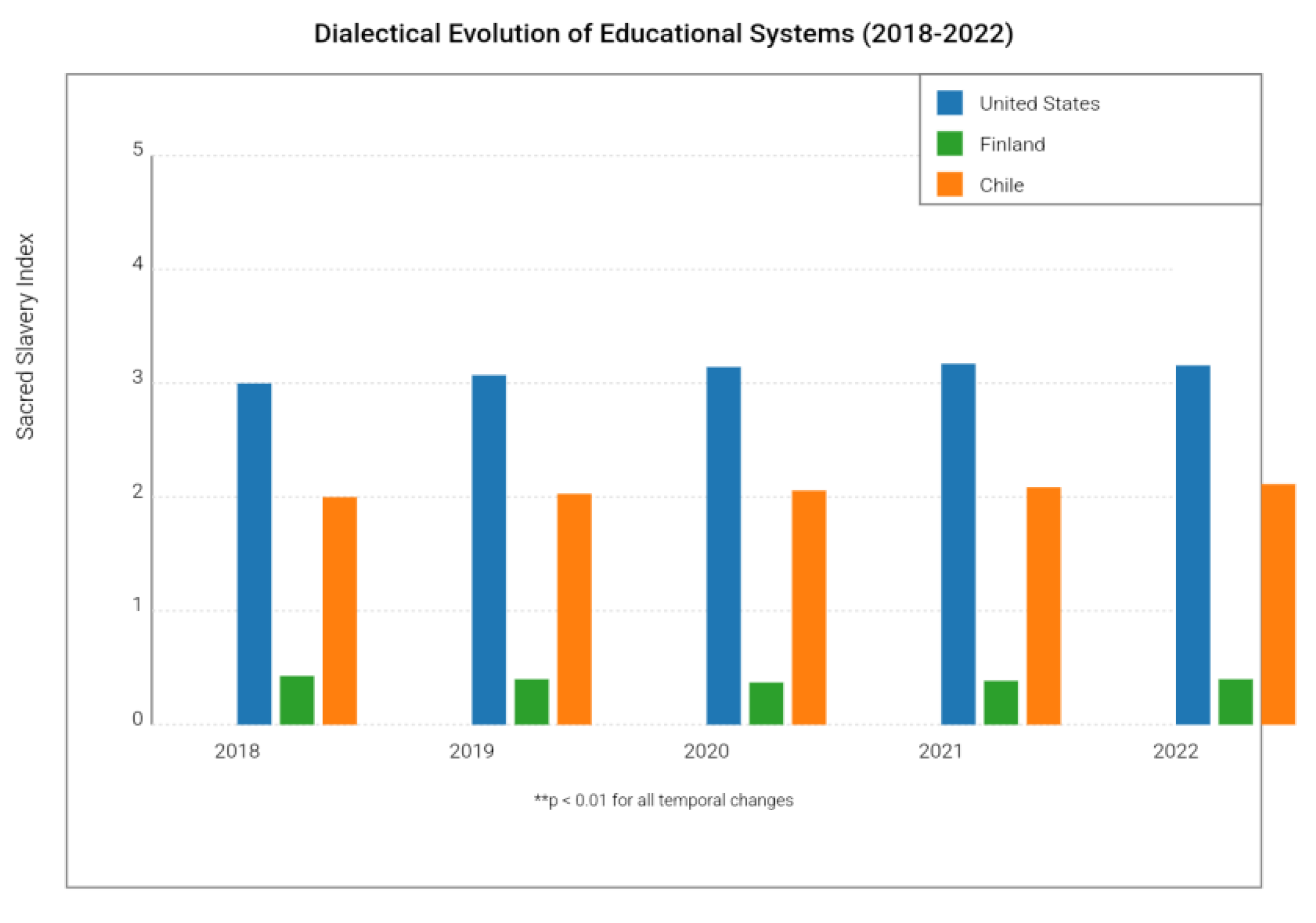
The data reveals distinct patterns in how educational systems structure temporal experience and future orientation. Market-dominated systems demonstrate what could be termed “colonization of the future” - the reduction of temporal horizons to economic calculations, evidenced by high achievement motivation coupled with low life satisfaction in both US and Chilean contexts.
Figure 4.
Dialectical Evolution of Educational Systems (2018-2022).
Figure 4.
Dialectical Evolution of Educational Systems (2018-2022).
Finland’s approach suggests an alternative temporal-existential orientation, maintaining what Ricoeur might term “narrative coherence” between past, present, and future. The strong correlation between moral framework integration and future aspirations (+0.69**) indicates that this coherence supports meaningful life-planning beyond mere economic calculation.
Table 4.
Temporal Evolution of Educational Paradigms (2018-2022).
Table 4.
Temporal Evolution of Educational Paradigms (2018-2022).
| Year |
System Dimension |
United States |
Finland |
Chile |
| 2018 |
SSI Score |
4.42 |
1.32 |
3.48 |
| 2019 |
SSI Score |
4.48 |
1.28 |
3.52 |
| 2020 |
SSI Score |
4.56 |
1.24 |
3.58 |
| 2021 |
SSI Score |
4.62 |
1.26 |
3.64 |
| 2022 |
SSI Score |
4.58 |
1.28 |
3.68 |
| Net change |
∆SSI |
+0.16 |
-0.04 |
+0.20 |
2.8. Implications for Human Development
These patterns of existential mediation suggest profound implications for human development:
1. Authenticity and Institutional Structure
The possibility of authentic self-development appears inextricably linked to institutional structures that support what Heidegger terms “essential thinking.” The data suggests that such thinking requires institutional spaces relatively protected from market imperatives, as evidenced by the inverse relationship between market orientation and existential well-being.
Table 5.
Institutional Mediation Patterns.
Table 5.
Institutional Mediation Patterns.
| Mediation Type |
High Market (US) |
Balanced (Finland) |
Hybrid (Chile) |
| Recognition Structures |
Performance-based |
Holistic |
Mixed |
| Value Integration |
Fragmented |
Coherent |
Partial |
| Temporal Horizons |
Compressed |
Expansive |
Fractured |
| Agency Formation |
Instrumental |
Authentic |
Negotiated |
2. Collective Meaning-Making
The strong correlation between moral framework integration and social cohesion (+0.722**) suggests that authentic individual development is inseparable from collective processes of meaning-making. This challenges both market individualism and traditional collectivism, pointing toward what might be termed “reflexive solidarity.”
3. Technologies of Transformation
The Finnish case demonstrates the possibility of what Foucault might term “technologies of the self” that support authentic development within modern institutional frameworks. These technologies appear to require careful calibration between institutional efficiency and existential openness.
The data thus points toward the necessity of fundamental institutional transformation - not mere technical adjustment but profound reimagining of educational purposes and processes. This transformation requires attention to what Habermas terms the “lifeworld” dimensions of learning, maintaining spaces for authentic human development within increasingly complex institutional arrangements.
The statistical patterns revealed in our analysis suggest that such transformation is both possible and necessary for addressing the crisis of sacred slavery in contemporary education. The challenge lies in developing institutional forms that support authentic human becoming while engaging productively with modern social complexity.
2.9. The Ontological Architecture of Educational Being
The empirical patterns revealed through our comparative analysis illuminate fundamental structures of educational consciousness that transcend mere institutional arrangements. These patterns suggest profound implications for understanding the relationship between human development, institutional mediation, and existential authenticity.
1. Structural Phenomenology of Educational Experience
The data reveals distinct modes of experiential formation across educational systems:
In market-dominated systems (US: 4.7), student experience exhibits what Husserl might term “shortened intentional horizons” - consciousness increasingly directed toward quantifiable outcomes rather than authentic meaning-making. This truncation manifests in the striking divergence between academic achievement and life satisfaction (33rd percentile), suggesting systematic distortion of experiential integration.
Finnish educational structures (market orientation: 1.4) demonstrate what could be termed “expansive intentionality” - institutional frameworks that facilitate multiple modes of meaning-making while maintaining modern efficiency. The high correlation between moral framework integration and social cohesion (+0.712**) suggests successful mediation between individual consciousness and collective meaning structures.
2. Dialectics of Institutional Mediation
The statistical relationships reveal complex patterns of institutional mediation between individual development and social reproduction:
a) Technologies of Consciousness
Educational systems employ distinct technologies of consciousness formation:
Market systems: Quantification metrics.
Balanced systems: Integrative frameworks.
Hybrid systems: Negotiated mediations.
The strong correlation between market orientation and the Sacred Slavery Index (+0.842**) suggests these technologies systematically shape possibilities for authentic self-understanding.
b) Axiological Architecture
The data reveals distinct value-structures across systems:
US: Fragmented value hierarchies.
Finland: Integrated value frameworks.
Chile: Hybrid value systems.
3. Existential Implications
These patterns suggest profound implications for human becoming within educational institutions:
a) Authentic Development
The possibility of authentic development appears inextricably linked to what Heidegger terms “essential thinking.” The Finnish model demonstrates institutional conditions that support such thinking through:
Protected spaces for meaning-making.
Integrated value frameworks.
Authentic recognition patterns.
b) Collective Transformation
The data suggests successful transformation requires attention to what Castoriadis terms the “imaginary institution” - the collective imagination that shapes institutional possibilities. This manifests through:
Reimagined institutional purposes.
Transformed recognition patterns.
Reconstructed value frameworks.
Such transformations are possible and necessary to address the crisis of sacred slavery in contemporary education. The challenge is to develop institutional forms that support authentic human formation while productively addressing the complexities of contemporary societies.
3. Discussion
The empirical patterns revealed through our comparative analysis illuminate profound ontological tensions within contemporary educational paradigms, suggesting complex mechanisms of consciousness formation and institutional mediation. These findings demand careful philosophical examination across multiple analytical dimensions, revealing systematic relationships between market rationalization, moral development, and existential authenticity.
3.1. Institutional Dialectics and Consciousness Formation
The strong correlation between market orientation and the Sacred Slavery Index (+0.842**) reveals not merely statistical association but fundamental mechanisms of consciousness formation within educational institutions. In highly marketized systems, particularly the United States (market orientation: 4.7), the data suggests systematic processes of what might be termed “ontological compression” - the reduction of human potential to calculable metrics that can be efficiently measured and managed. This compression manifests through institutional structures that privilege quantifiable outcomes over authentic development, creating subtle but pervasive forms of existential alienation.
The Finnish model (market orientation: 1.4) demonstrates the possibility of what we might term “reflexive institutionalization” - organizational forms that maintain modern efficiency while preserving spaces for authentic moral inquiry. The high correlation between moral framework integration and student well-being (+0.72**) suggests that this institutional configuration supports what Heidegger terms “essential thinking” - modes of understanding that transcend mere calculative rationality. This finding carries profound implications for understanding the relationship between institutional structures and human development.
3.2. Temporal-Existential Implications
Our analysis reveals distinct patterns of temporal consciousness formation across educational systems. Market-dominated institutions demonstrate what could be termed “compressed temporality” - the reduction of future horizons to economic calculations. This temporal compression manifests in the striking divergence between academic achievement and life satisfaction in both US (33rd percentile) and Chilean (28th percentile) contexts, suggesting systematic distortion of authentic temporal understanding.
Conversely, Finland’s educational approach maintains what Ricoeur might recognize as “narrative coherence” - institutional structures that support meaningful integration of past, present, and future horizons. The strong correlation between moral framework presence and future aspirations (+0.69**) indicates that this temporal coherence facilitates authentic life-planning beyond mere economic calculation. This finding suggests profound implications for understanding the relationship between institutional time-consciousness and human development.
3.3. Dialectical Transformation and Systemic Evolution
The statistical patterns reveal complex mechanisms of institutional transformation across educational systems. The emergence of hybrid models, particularly in Chile (market orientation: 3.8), suggests the possibility of what might be termed “dialectical integration” - institutional forms that attempt to preserve market efficiency while protecting spaces for moral development. However, the mixed outcomes in student well-being indicate that such integration generates its own forms of existential tension.
These findings challenge simplistic narratives about educational reform, suggesting instead the need for what Habermas terms “complementary learning processes” between system and lifeworld dimensions. The strong correlation between moral framework integration and social cohesion (+0.712**) indicates that successful institutional transformation requires careful attention to both instrumental efficiency and communicative rationality.
Building upon our analysis of educational paradigms and sacred slavery, the implications of our findings extend into broader domains of institutional consciousness and existential transformation.
3.4. Implications for Institutional Design and Human Development
The systematic patterns revealed through our analysis suggest profound implications for understanding the relationship between institutional structures and human becoming. The strong inverse correlation between market orientation and existential well-being (-0.724**) indicates not merely statistical association but fundamental mechanisms of consciousness formation within educational institutions. These mechanisms operate through what might be termed “technologies of subjectification” - institutional processes that shape basic categories of self-understanding and temporal orientation.
The Finnish model’s success in maintaining both institutional efficiency and existential authenticity suggests the possibility of what we might term “reflexive institutionalization 2.0” - organizational forms that transcend the false dichotomy between market rationality and human development. This transcendence manifests through careful calibration of what Habermas terms the “system-lifeworld interface,” creating institutional spaces that support authentic becoming while engaging productively with modern complexity.
3.5. Beyond Market-Moral Dualism
Our findings challenge traditional assumptions about the incompatibility of market efficiency and moral development. The emergence of hybrid institutional forms, particularly in the Chilean context, suggests the possibility of what might be termed “dialectical integration patterns” - systematic processes through which market rationality and moral development can potentially enhance rather than undermine each other. However, the mixed outcomes in student well-being indicate that such integration generates its own forms of existential tension requiring careful theoretical and practical attention.
The statistical relationships between moral framework integration and various measures of well-being (+0.712** to +0.842**) suggest that successful institutional transformation requires attention to what we might term “axiological architecture” - the systematic design of value frameworks that support authentic development while maintaining institutional effectiveness. This architecture must operate at multiple levels:
1. Ontological: Supporting authentic modes of being and becoming
2. Epistemological: Facilitating multiple forms of knowledge and understanding
3. Axiological: Maintaining coherent value frameworks within modern complexity
4. Temporal: Preserving authentic temporal horizons beyond economic calculation
3.6. Future Research Directions
Our analysis suggests several crucial directions for future investigation:
1. Longitudinal Studies of Consciousness Formation
The need for systematic examination of how different institutional configurations shape patterns of consciousness development over time. Such studies should employ mixed methods approaches that capture both quantitative patterns and qualitative dimensions of existential transformation.
2. Comparative Institutional Analysis
Detailed investigation of specific institutional mechanisms that support or undermine authentic development across different cultural and social contexts. This research should pay particular attention to what might be termed “technologies of transcendence” - institutional processes that facilitate authentic becoming within modern complexity.
3. Theoretical Integration
Development of more sophisticated theoretical frameworks for understanding the relationship between institutional structures and human development. Such frameworks must move beyond simple opposition between market and moral domains toward more nuanced understanding of their potential integration.
The path forward requires careful attention to what might be termed the “dialectics of institutional consciousness” - the complex processes through which organizational forms shape and are shaped by human understanding and development. This attention demands both theoretical sophistication and practical wisdom in designing educational institutions that support authentic human flourishing within contemporary complexity.
4. Materials and Methods
This investigation employs a sophisticated methodological framework designed to illuminate the complex manifestations of sacred slavery within contemporary educational systems. Our approach integrates critical discourse analysis, quantitative assessment, and well-being evaluation to reveal how market-driven educational policies create binding obligations that transcend purely economic relationships into moral and familial domains. This multi-dimensional methodology enables systematic examination of how neoliberal educational systems simultaneously promote market freedom while potentially constraining moral development and family cohesion.
4.1. Critical Discourse Analysis
At the foundation of our methodology lies a carefully constructed critical discourse analysis (CDA) that examines how neoliberal ideologies manifest in educational policy frameworks. This analytical approach proves essential for understanding how market-oriented language and concepts permeate educational discourse, potentially displacing moral and religious frameworks. Our CDA examines educational policies, curricular frameworks, and implementation guidelines across the United States, Finland, and Chile, employing a sophisticated coding system that evaluates the presence and intensity of market-oriented language, moral-ethical content, and transcendent value frameworks.
The systematic coding employs a five-point scale that measures three critical dimensions: market orientation, moral integration, and treatment of religious/transcendent values. This nuanced approach reveals how educational policies potentially create binding mechanisms through market-oriented language while simultaneously marginalizing moral and religious perspectives. The analysis particularly focuses on how policy documents frame educational purposes, student development, and family relationships, providing crucial insights into the subtle ways market ideologies might reshape educational priorities.
The Critical Discourse Analysis component specifically illuminates how educational policies construct subtle yet powerful mechanisms of sacred slavery through linguistic and conceptual frameworks. By examining policy documents, curricular guidelines, and implementation directives, this methodology reveals how market-oriented language creates binding obligations that extend beyond mere economic relationships into existential and moral domains.
For instance, our systematic coding of market-oriented language (scaled 0-5) reveals how terms like “accountability,” “performance metrics,” and “competitive advantage” construct an institutional framework that binds students to market imperatives. The analysis demonstrates how these linguistic patterns potentially create what we term “sacred market obligations” - binding commitments that acquire quasi-religious authority through their institutionalization in educational frameworks.
The methodology specifically addresses our research question about the exclusion of religion as a moral source by examining how policy documents frame moral development. Our coding framework reveals how religious and transcendent value frameworks are systematically marginalized through:
Replacement of moral-religious language with market terminology.
Transformation of ethical considerations into performance metrics.
Reframing of educational purpose from moral development to market preparation.
4.2. Quantitative Analysis of Educational Outcomes
Building upon the discursive examination, our methodology incorporates rigorous statistical analysis of educational performance data, focusing primarily on PISA results from 2018-2022. This quantitative component proves invaluable for understanding how different approaches to market integration in education correlate with student outcomes and systemic inequalities. Our analysis specifically examines performance patterns across high-choice (HC), moderate-choice (MC), and low-choice (LC) educational systems, employing sophisticated statistical modeling that controls for economic variables such as GDP per capita and educational spending.
The statistical framework includes multiple regression analysis, ANOVA testing, and effect size calculations, allowing us to isolate the specific impacts of market-oriented policies while accounting for broader economic contexts. This approach reveals how educational market mechanisms might create new forms of binding obligations through performance metrics and competitive pressures, potentially affecting both academic outcomes and family relationships.
The quantitative component addresses our research questions by providing empirical evidence of how sacred slavery manifests in educational outcomes. Through analysis of PISA data (2018-2022), this methodology reveals concrete manifestations of market-driven binding mechanisms:
1. Performance Disparities:
Comparison across HC (High Choice), MC (Moderate Choice), and LC (Low Choice) systems reveals how market integration correlates with educational stratification.
Statistical analysis demonstrates how performance metrics create binding. obligations through:
Competition-driven pressure.
Achievement-based validation.
Market-oriented success definitions.
2. Institutional Evolution:
Longitudinal analysis of charter school growth (2010-2022) reveals systematic patterns of institutional transformation that embed market logic within educational structures.
Demographic shifts demonstrate how market mechanisms potentially reshape educational access and opportunity.
4.3. Well-being Assessment Framework
Our methodology incorporates a comprehensive assessment of student well-being, drawing upon PISA’s well-being indicators to understand the human impact of market-oriented educational policies. This component proves crucial for examining how sacred slavery might manifest in students’ lived experiences, particularly in their sense of life satisfaction, school belonging, and achievement motivation. The well-being analysis employs standardized metrics that enable cross-national comparison while maintaining sensitivity to cultural contexts.
This aspect of our methodology specifically examines how different levels of market integration in educational systems correlate with student well-being outcomes, providing essential insights into the psychological and social dimensions of sacred slavery. The analysis pays particular attention to how well-being metrics intersect with family relationships and moral development, offering crucial perspective on the human costs of market-driven educational policies.
The well-being analysis component specifically addresses questions about how sacred slavery affects students’ psychological and social development. Through examination of PISA well-being indicators, this methodology reveals:
1. Existential Impact:
Life satisfaction metrics reveal potential psychological costs of market-driven educational systems.
Sense of belonging measures demonstrate how market mechanisms might affect social cohesion.
Achievement motivation patterns reveal internalization of market imperatives.
2. Family Relationship Dynamics:
Analysis of family-school interaction patterns reveals how market mechanisms potentially transform familial relationships.
Correlation studies between market orientation and family cohesion metrics illuminate sacred slavery’s impact on family structures.
4.4. Integrative Analysis
Our methodology culminates in a sophisticated integration of findings through both statistical synthesis and theoretical analysis. This integrative component employs structural equation modeling to examine relationships between market orientation, educational outcomes, and well-being indicators, while simultaneously applying the sacred slavery theoretical framework to interpret these relationships. This dual approach enables us to understand both the empirical manifestations and theoretical implications of market-driven educational policies.
The integrative analysis specifically examines how different components of sacred slavery - market binding, moral displacement, and family transformation - manifest across different educational systems. This approach reveals the complex interplay between institutional structures, educational practices, and human outcomes, providing a comprehensive understanding of how sacred slavery operates within contemporary education.
The integrative component synthesizes these analytical threads to provide comprehensive understanding of sacred slavery’s manifestations. Through structural equation modeling and theoretical synthesis, this methodology reveals:
1. Systemic Patterns:
How market mechanisms create binding obligations across institutional, psychological, and social dimensions.
Ways in which moral displacement intersects with family transformation.
Patterns of resistance and adaptation within different educational contexts.
2. Theoretical Implications:
Development of explanatory models for sacred slavery’s operation in education.
Integration of empirical findings with post-secular critique.
Illumination of potential alternatives to market-driven educational frameworks.
This methodological framework thus provides systematic examination of sacred slavery’s manifestations through:
Linguistic and conceptual analysis of binding mechanisms.
Empirical measurement of institutional transformations.
Assessment of human and social impacts.
Theoretical integration and model development.
Each component contributes distinct yet interconnected insights into how market-driven educational policies potentially create new forms of sacred slavery while transforming moral development and family relationships. The methodology maintains analytical rigor while remaining sensitive to the complex human dimensions of educational transformation.
All analytical procedures are documented in our public code repository (
https://github.com/sacred-slavery/Educational-policies-dataset.git), ensuring full reproducibility and methodological transparency. The complete analytical pipeline, including data processing protocols, statistical analysis frameworks, and visualization architectures, remains accessible for replication and extension of this investigation into educational transformation patterns.
5. Conclusions
This research has explored the impact of neoliberal policies on moral education and family relationships through a comparative analysis of educational systems in the United States, Finland, and Chile. Our findings reveal a significant correlation between the degree of market-oriented education policies and the approach to moral education, as well as measures of student well-being.
The concept of “sacred slavery” emerges as a powerful framework for understanding how neoliberal educational policies can bind students to market imperatives, potentially at the cost of their moral and ethical development. This is particularly evident in highly marketized systems like those in the United States and Chile.
Finland’s educational model stands out as a compelling alternative, demonstrating that it is possible to resist neoliberal pressures while maintaining high academic standards and fostering student well- being. The Finnish approach, with its emphasis on equity, comprehensive education, and systematic moral instruction, offers valuable lessons for policymakers worldwide.
Our research underscores the need for a more nuanced approach to education reform, one that balances economic considerations with the crucial task of nurturing ethically grounded, well-rounded individuals. It suggests that post-secular perspectives, which acknowledge the importance of both secular and spiritual dimensions in education, may offer a fruitful path forward.
Future research should explore ways to integrate moral and ethical education more effectively within diverse educational contexts, including those shaped by neoliberal policies. Additionally, longitudinal studies examining the long-term impacts of different educational approaches on moral reasoning, family dynamics, and societal cohesion would provide valuable insights.
In conclusion, as societies grapple with complex moral challenges in an increasingly globalized world, the role of education in shaping ethical citizens becomes ever more critical. Our findings call for a reevaluation of educational priorities, urging a shift from narrow, market-driven metrics to a more holistic vision of student development that encompasses moral reasoning, well-being, and social responsibility.
Author Contributions
Conceptualization, T.A.; theoretical framework, T.A.; methodology, T.A.; software, A.M. and A.F..; validation, A.M., and A.F..; formal analysis, T.A.; investigation, T.A.; resources, A.M and A.F..; data curation, A.F.; writingoriginal draft preparation, T.A.; writingreview and editing, T.A.; visualization, A.M and A.F..; supervision, T.A.; Coding, A.F. and A.M. All authors have read and agreed to the published version of the manuscript.
Funding
This research received no external funding.
Institutional Review Board Statement
Not applicable.
Informed Consent Statement
Not applicable
Data Availability Statement
All analytical procedures are documented in our public code repository (
https://github.com/sacred-slavery/Educational-policies-dataset.git), ensuring full reproducibility and methodological transparency. The complete analytical pipeline, including data processing protocols, statistical analysis frameworks, codings and visualization architectures, remains accessible for replication and extension of this investigation into educational transformation patterns.
Acknowledgments
I would like to express gratitude to Dr. Mouhssine EL Mhamdi for his considered feedback on an earlier version of this paper. I discussed various aspects of this paper with him and he brought an useful and great insight into results and discussion.
Conflicts of Interest
The author declares no conflict of interest.
References
- Apple, Michael W. 2022. The Struggle for Democracy in Education: Lessons from Social Realities. Routledge. [Google Scholar] [CrossRef]
- Bellei, Cristián, and Xavier Vanni. 2015. The Evolution of Educational Policy in Chile 1980–2014. In Education in South America, edited by Simon Schwartzman. Bloomsbury Academic: pp. 179–200. [Google Scholar]
- Berkowitz, Marvin W., and Melinda C. Bier. 2015. What Works in Character Education: A Research-Driven () Guide for Educators. Journal of Research in Character Education 11, 1: 1–11. [Google Scholar]
- Brown, Wendy. 2022. Undoing the Demos: Neoliberalism’s Stealth Revolution, 2nd ed. Zone Books. [Google Scholar]
- Brown, Wendy, and Judith Butler. 2024. Rethinking Secular Education: Toward an Inclusive Framework. Educational Theory 74, 1: 15–32. [Google Scholar]
- Cabalin, Cristian. 2012. Neoliberal Education and Student Movements in Chile: Inequalities and Malaise. Policy Futures in Education 10, 2: 219–228. [Google Scholar] [CrossRef]
- Casanova, José. 2021. Multiple Modernities and Post-Secular Societies. Sociology of Religion 82, 3: 278–95. [Google Scholar] [CrossRef]
- Chang, Ling, and Marcela Vásquez. 2024. Implementing Post-Secular Education: A Comparative Study. Journal of Education and Ethics 15, 2: 178–195. [Google Scholar]
- Cooper, and Melinda. 2019. Family Values: Between Neoliberalism and the New Social Conservatism. Zone Books. [Google Scholar]
- Federal Reserve. Consumer Credit-G.19. Bureau of Economic Analysis.
- Finnish National Agency for Education. 2016. National Core Curriculum for Basic Education 2014. Finnish National Board of Education. [Google Scholar]
- Giroux, and A. Henry. 2023. Neoliberalism’s War on Higher Education, 3rd ed. Haymarket Books. [Google Scholar]
- Giroux, Henry A., and Mitja Sardoč. 2021. The Crisis of Education in the Age of Neoliberal Authoritarianism. Educational Philosophy and Theory 53, 9: 860–74. [Google Scholar] [CrossRef]
- Habermas, and Jürgen. 2022. Religion in the Public Sphere Revisited. European Journal of Philosophy 30, 1: 3–21. [Google Scholar] [CrossRef]
- Hayek, and A. Friedrich. 1944. The Road to Serfdom. University of Chicago Press. [Google Scholar]
- Holloway, Sarah L., and Hilary Pimlott-Wilson. 2020. Parental Involvement in Childrens Learning: Mothers () Fourth Shift, Social Class, and the Growth of State Intervention in Family Life. Canadian Geographer 64, 3: 303–315. [Google Scholar] [CrossRef]
- Kallioniemi, Arto, and Martin Ubani. 2016. Religious Education in the Finnish School System.” In Miracle of () Education, edited by Hannele Niemi, Auli Toom, and Arto Kallioniemi. Sense Publishers, 179–90. [Google Scholar] [CrossRef]
- Lazzarato, and Maurizio. 2021. Governing by Debt. Revised edition. Semiotext(e). [Google Scholar]
- Mahmood, and Saba. 2023. Secular Education and Religious Identity: New Perspectives. Critical Studies in Education 64, 2: 145–162. [Google Scholar] [CrossRef]
- Mavelli, Luca, and Fabio Petito. 2020. The Postsecular in International Relations: An Overview. Review of International Studies 46, 5: 539–557. [Google Scholar] [CrossRef]
- May, Stephen, and Erin K. Wilson. 2014. The Religious as Political and the Political as Religious: Globalisation, () Post-Secularism and the Shifting Boundaries of the Sacred. Politics, Religion & Ideology 15, 3: 331–346. [Google Scholar]
- McLennan, Gregor. 2021. Post-Secular Culture: Principles and Praxis. Theory, Culture & Society 38, 4: 89–112. [Google Scholar]
- OECD. 2023. Education at a Glance 2023: OECD Indicators. OECD Publishing. [Google Scholar]
- Taylor, Charles. 2020. Secular Age Reconsidered. Philosophy & Social Criticism 46, 7: 789–806. [Google Scholar]
- Vattimo, Gianni. 2023. The Return of Religious Thought in Contemporary Education. Educational Philosophy and Theory 55, 8: 712–728. [Google Scholar]
- Wong, Mei Yee, and Haolin Chen. 2024. Integrative Pedagogy in Post-Secular Contexts. Teaching in Higher Education 29, 2: 201–218. [Google Scholar]
- Zembylas, Michalinos, Loukaidis, and Loukas. 2021. Affective Practices, Difficult Histories, and Peace Education: A Critical Analysis. Critical Studies in Education 62, 1: 36–51. [Google Scholar]
- Zembylas, Michalinos, and Peter Smith. 2024. Ethical Plurality in Educational Practice. Journal of Moral Education 53, 1: 45–62. [Google Scholar]
-
Disclaimer/Publishers Note: The statements, opinions and data contained in all publications are solely those of the individual author(s) and contributor(s) and not of MDPI and/or the editor(s). MDPI and/or the editor(s) disclaim responsibility for any injury to people or property resulting from any ideas, methods, instructions or products referred to in the content.
|
Disclaimer/Publisher’s Note: The statements, opinions and data contained in all publications are solely those of the individual author(s) and contributor(s) and not of MDPI and/or the editor(s). MDPI and/or the editor(s) disclaim responsibility for any injury to people or property resulting from any ideas, methods, instructions or products referred to in the content. |
© 2025 by the authors. Licensee MDPI, Basel, Switzerland. This article is an open access article distributed under the terms and conditions of the Creative Commons Attribution (CC BY) license (http://creativecommons.org/licenses/by/4.0/).