Preprint
Article

This version is not peer-reviewed.

Classical Layer Resolving Scheme for a System of Two Singularly Perturbed Time-Dependent Problems with Discontinuous Source Terms and Spatial Delay

A peer-reviewed article of this preprint also exists.

Submitted:

13 January 2025

Posted:

14 January 2025

You are already at the latest version

Abstract
In this paper we formulate a Classical layer resolving finite difference scheme to solve a system of two singularly perturbed time-dependent problems with discontinuity occurs at (y; t) in the source terms and Robin initial conditions. The delay term occurs in the spatial variable and leading term of spatial derivative of each equation is multiplied by a distinct small positive perturbation parameter, inducing layer behaviors in the solution domain. The formulation of finite difference scheme involves discretization of temporal and spatial axis by uniform and piecewise uniform meshes respectively. Due to presence of perturbation parameters, discontinuous source terms and delay terms, initial and interior layers occur in the solution domain. In order to capture the abrupt change occurs due to the behavior of these layers, the solution is further decomposed into two components. Layer functions are also formulated in accordance with layer behavior. At last, to bolster the numerical scheme, an example problem is computed to prove efficacy of our scheme.
Keywords: 
;  ;  ;  ;  ;  

1. Introduction

Solving Singular perturbation problems (SPPs) is very tedious due to presence of layer phenomena in the solution domain and presence of discontinuity in the source term makes it further more difficult since the solution behaves uneven or non–smooth at the discontinuity point. This leads to formation of interior layer at the region in the domain where the discontinuity occurs. To tackle such difficulties in estimating the solution of SPPs, classical numerical schemes are modified in such a way it uses highly refined meshes (i.e., Shishkin mesh, Bakhvalov mesh) to give numerical approximation by preserving the monotonicity of the original problem. Many specialized techniques are introduced by researches across the globe in order to overcome difficulties arising in solving SPPs.
Abagero et al. [1] employed a fitted nonstandard numerical method to solve SPPs with Robin type boundary conditions and discontinuous source terms. Sahoo & Gupta [8] employed a first–order upwind scheme on a Shishkin Mesh to sol-ve convection–diffusion SPPs with discontinuous convective and source terms. They further employed Richardson extrapolation Scheme to enhance order of convergence. Singh et al. [10] have devised a Spline-based numerical technique such Crank–Nicolson scheme and trigonometric B–spline basis function to solve two–parameter SPPs with discontinuity in convection coefficient and source term. Richardson extrapolation scheme is used by the authors to enhance accuracy in spatial direction. Chawla et al. [5] employed a backward difference scheme on Shishkin and Bakhvalov meshes to solve first order Singularly perturbed differential equations (SPDEs) with discontinuous source term. Cen et al. [4] developed a quadratic B–spline collocation method on Shishkin–type mesh to solve semilinear reaction–diffusion SPP with discontinuous source term. Soundararajan et al. [11] employed backward Euler Method for time discretization and streamline–diffusion Finite Element Method (FEM) on Shishkin mesh to solve 1D parabolic SPPs with discontinuous source term. Ajay Singh Rathore & Vembu Shanthi [2] proposes an exponentially fitted mesh method to solve the singularly perturbed Fredholm Integro–differential equation with discontinuous source term. Paramasivam et al. [7] formulated a classical numerical scheme employing finite difference Method on Shishkin mesh to solve second–order reaction-diffusion SPPs with discontinuous source terms.
Inspired from pioneer research outlined in the above literature review and method formulated in [9], we have crafted a classical layer resolving finite difference scheme (FDS) to solve a system of two time-dependent delay SPPs with a discontinuity occurring at ( y , t ) in the source terms and Robin initial conditions. The subsequent section outlines organizing framework of the paper. Section 2 outlines the problem statement. Solution components and layer functions are discussed in Section 3. In Section 4, bounds on solutions and its components are derived. Discrete solution components and error estimates are discussed in Section 5. Numerical scheme is constructed for an example problem in Section 6.

2. The Problem Statement

In this article, we consider the following problem with discontinuous source term ( y , t ) in the domain Λ ˜
L ϑ ( ϰ , t ) = ( ϑ t + E ϑ ϰ + R ϑ ) ( ϰ , t ) + S ( ϰ , t ) ϑ ( ϰ 1 , t ) = f ( ϰ , t ) on Λ ˜ 1 Λ ˜ 7
with
ξ ϑ ( ϰ , t ) = ϑ ( ϰ , t ) E ϑ ϰ ( ϰ , t ) = ϖ L ( ϰ , t ) o n Λ ˜ *
ϑ ( ϰ , 0 ) = ϖ B ( ϰ ) o n Ω ϰ .
The following symbols represent the key notation utilized throughout the text.
Λ ˜ = ( 0 , 2 ] × ( 0 , T ] , Λ ˜ * = [ 1 , 0 ] × ( 0 , T ] , Λ ˜ 1 = ( 0 , y ) × ( 0 , T ] , Λ ˜ 2 = ( y , 1 ] × ( 0 , T ] , Λ ˜ 3 = ( 1 , 1 + y ) × ( 0 , T ] , Λ ˜ 4 = ( 1 + y , 2 ] × ( 0 , T ] , Λ ˜ 5 = ( 0 , 1 ] × ( 0 , T ] , Λ ˜ 6 = ( 1 , y ) × ( 0 , T ] , Λ ˜ 7 = ( d , 2 ] × ( 0 , T ] , Λ ˜ 8 = ( 1 , 2 ] × ( 0 , T ] , Λ ˜ ¯ 1 = [ 0 , y ] × [ 0 , T ] , Λ ˜ ¯ 2 = [ y , 1 ] × [ 0 , T ] , Λ ˜ ¯ 3 = [ 1 , 1 + y ] × [ 0 , T ] , Λ ˜ ¯ 4 = [ 1 + y , 2 ] × [ 0 , T ] , Λ ˜ ¯ 5 = [ 0 , 1 ] × [ 0 , T ] , Λ ˜ ¯ 6 = [ 1 , y ] × [ 0 , T ] , Λ ˜ ¯ 7 = [ y , 2 ] × [ 0 , T ] , Λ ˜ ¯ 8 = [ 1 , 2 ] × [ 0 , T ] , Λ ˜ ¯ = Λ ˜ Ω , Ω = Ω t Ω ϰ where Ω t = 0 × [ 0 , T ] , Ω ϰ = [ 0 , 2 ] × 0 . Λ ^ * = Λ ˜ 1 Λ ˜ 2 Λ ˜ 3 Λ ˜ 4 , Λ ^ = Λ ˜ 5 Λ ˜ 6 Λ ˜ 7 , Λ ^ * ¯ = Λ ˜ ¯ 1 Λ ˜ ¯ 2 Λ ˜ ¯ 3 Λ ˜ ¯ 4 and Λ ^ ¯ = Λ ˜ ¯ 5 Λ ˜ ¯ 6 Λ ˜ ¯ 7 . For all ( ϰ , t ) Λ ˜ ¯ , ϑ ( ϰ , t ) = ( ϑ 1 ( ϰ , t ) , ϑ 2 ( ϰ , t ) ) T , f ( ϰ , t ) = ( f 1 ( ϰ , t ) , f 2 ( ϰ , t ) ) T , E = d i a g ( ε ) , ε = ( ε 1 , ε 2 ) with 0 < ε 1 < ε 2 1 , R ( ϰ , t ) is 2 × 2 matrix , and S = d i a g ( s ) , s = ( s 1 ( ϰ , t ) , s 2 ( ϰ , t ) ) . The jump at ( y , t ) is denoted by a function g where [ g ] = g ( y + , t ) g ( y , t ) . The functions r ι j ( ϰ , t ) , s ι ( ϰ , t ) , 1 ι , j 2 are assumed to be in C ( 2 ) ( [ 0 , 2 ] × [ 0 , T ] ) and L can operate on functions in the domain C ( 0 ) ( [ 0 , 2 ] × [ 0 , T ] ) C ( 1 ) ( ( 0 , y ) × ( 0 , T ] ( y , 2 ] × ( 0 , T ] ) . Furthermore, for all ( ϰ , t ) [ 0 , 2 ] × ( 0 , T ] , the components r ι j ( ϰ , t ) , s ι ( ϰ , t ) of R ( ϰ , t ) and S ( ϰ , t ) respectively satisfy the following conditions
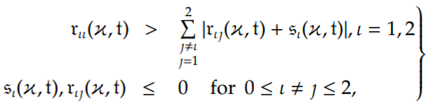
Preprints 145985 i001
and for any positive number δ ,
0 < δ < min ϰ Λ ˜ ¯ 0 ι 2 j = 1 2 r ι j ( ϰ , t ) + s ι ( ϰ , t ) .
The function f ( ϰ , t ) is discontinuous at ( y , t ) due to a finite jump. So the solution ϑ does not possess a continuous first order derivative at ( y , t ) . We have to deal with two different cases due to the presence of ( y , t ) in the domain.
Case 1: ( y , t ) ( 0 , 1 ] × ( 0 , T ]
The problem (1) can be reformulated as

Preprints 145985 i002
where χ ( ϰ , t ) = f ( ϰ , t ) S ( ϰ , t ) ϖ L ( ϰ 1 , t ) .
For the problem (6) and (7), the solution components ϑ 1 and ϑ 2 exhibit an initial layer at ϰ = 0 and interior layers at ϰ = 1 , ϰ = y and ϰ = 1 + y , each of width O ( ε 2 ) . Furthermore, the solution component ϑ 1 exhibits additional layers of width O ( ε 1 ) at ϰ = 0 , ϰ = 1 , ϰ = y and ϰ = 1 + y .
Case 2: ( y , t ) ( 1 , 2 ] × ( 0 , T ]
The problem (1) can be reformulated as

Preprints 145985 i003
For the problem (8) and (9), the solution components ϑ 1 and ϑ 2 exhibit an initial layer at ϰ = 0 and interior layers at ϰ = 1 and ϰ = y , each of width O ( ε 2 ) . Furthermore, the solution component ϑ 1 exhibits additional layers of width O ( ε 1 ) at ϰ = 0 , ϰ = 1 , and ϰ = y .
Theorem 1.
The system of equations (1)-(3) has a solution  ϑ C  where  C = C ( 0 ) ( [ 0 , 2 ] × [ 0 , T ] ) C ( 1 ) ( ( 0 , 2 ] × [ 0 , T ] { y } ) .
Proof. 
The proof is by construction.
Case 1: Let u 1 , v 1 , u 2 , v 2 be the particular solutions of 
u 1 t + E u 1 ϰ + R u 1 ( ϰ , t ) = f ( ϰ , t ) S ( ϰ , t ) φ t ( ϰ 1 , t ) on Λ ˜ 1 , v 1 t + E v 1 ϰ + R v 1 ( ϰ , t ) = f ( ϰ , t ) S ( ϰ , t ) φ t ( ϰ 1 , t ) on Λ ˜ 2 , u 2 t + E u 2 ϰ + R u 2 ( ϰ , t ) = f ( ϰ , t ) S ( ϰ , t ) u 2 ( ϰ 1 , t ) on Λ ˜ 3 , v 2 t + E v 2 ϰ + R v 2 ( ϰ , t ) = f ( ϰ , t ) S ( ϰ , t ) v 2 ( ϰ 1 , t ) on Λ ˜ 4 .
Consider the function 
ϑ ( ϰ , t ) = u 1 ( ϰ , t ) + ξ ( ϑ ( 0 , t ) u 1 ( 0 , t ) ) Ξ 1 ( ϰ , t ) on Λ ˜ 1 v 1 ( ϰ , t ) + P Ξ 2 ( ϰ , t ) on Λ ˜ 2 u 2 ( ϰ , t ) + Q Ξ 3 ( ϰ , t ) on Λ ˜ 3 v 2 ( ϰ , t ) + U Ξ 4 ( ϰ , t ) on Λ ˜ 4
where Ξ 1 , Ξ 2 , Ξ 3 and Ξ 4 are solutions of
Ξ 1 t + E Ξ 1 ϰ + R Ξ 1 ( ϰ , t ) = 0 on Λ ˜ 1 , ξ Ξ 1 ( 0 , t ) = 1 , Ξ 1 ( ϰ , 0 ) = 0 Ξ 2 t + E Ξ 2 ϰ + R Ξ 2 ( ϰ , t ) = 0 on Λ ˜ 2 , ξ Ξ 2 ( y , t ) = 1 , Ξ 2 ( ϰ , 0 ) = 0 Ξ 3 t + E Ξ 3 ϰ + R Ξ 3 ( ϰ , t ) = 0 on Λ ˜ 3 , ξ Ξ 3 ( 1 , t ) = 1 , Ξ 3 ( ϰ , 0 ) = 0 Ξ 4 t + E Ξ 4 ϰ + R Ξ 4 ( ϰ , t ) = 0 on Λ ˜ 4 , ξ Ξ 4 ( 1 + y , t ) = 1 , Ξ 4 ( ϰ , 0 ) = 0
and u 1 ( 0 , t ) = α 1 , v 1 ( 1 , t ) = α 2 , u 2 ( y , t ) = α 3 , v 2 ( 1 + y , t ) = α 4 , where α ι , ι = 1 , 2 , 3 , 4 are any particular vector constants. P , Q , U can be derived in the following way so as to have ϑ C .
P = u 1 ( y , t ) + ξ ( ϑ ( 0 , t ) α 1 ) Ξ 1 ( y , t ) v 1 ( y + , t ) Q = v 1 ( y , t ) + P u 2 ( 1 + , t ) U = u 2 ( ( 1 + y ) , t ) + Q Ξ 3 ( ( 1 + y ) , t ) α 4 .
The product between vectors is the Schur product of vectors.
Case 2: Let u 1 , v 1 , v 2 be the particular solutions of
u 1 t + E u 1 ϰ + R u 1 ( ϰ , t ) = f ( ϰ , t ) S ( ϰ , t ) φ t ( ϰ 1 , t ) on Λ ˜ 5 , v 1 t + E v 1 ϰ + R v 1 ( ϰ , t ) = f ( ϰ , t ) S ( ϰ , t ) u 1 ( ϰ 1 , t ) on Λ ˜ 6 , v 2 t + E v 2 ϰ + R v 2 ( ϰ , t ) = f ( ϰ , t ) S ( ϰ , t ) u 1 ( ϰ 1 , t ) on Λ ˜ 7 .
Consider the function
ϑ ( ϰ , t ) = u 1 ( ϰ , t ) + ξ ( ϑ ( 0 , t ) u 1 ( 0 , t ) ) Ξ 1 ( ϰ , t ) on Λ ˜ 5 v 1 ( ϰ , t ) + P Ξ 2 ( ϰ , t ) on Λ ˜ 6 v 2 ( ϰ , t ) + Q Ξ 3 ( ϰ , t ) on Λ ˜ 7
where Ξ 1 , Ξ 2 and Ξ 3 are solutions of
Ξ 1 t + E Ξ 1 ϰ + R Ξ 1 ( ϰ , t ) = 0 on Λ ˜ 5 , ξ Ξ 1 ( 0 , t ) = 1 , Ξ 1 ( ϰ , 0 ) = 0 Ξ 2 t + E Ξ 2 ϰ + R Ξ 2 ( ϰ , t ) = 0 on Λ ˜ 6 , ξ Ξ 2 ( 1 , t ) = 1 , Ξ 2 ( ϰ , 0 ) = 0 Ξ 3 t + E Ξ 3 ϰ + R Ξ 3 ( ϰ , t ) = 0 on Λ ˜ 7 , ξ Ξ 3 ( y , t ) = 1 , Ξ 3 ( ϰ , 0 ) = 0
and u 1 ( 0 , t ) = α ^ 1 , v 1 ( 1 , t ) = α ^ 2 , v 2 ( y , t ) = α ^ 3 , where α ^ ι , ι = 1 , 2 , 3 be any particular vector constants. P , Q can be determined as follows to ensure that ϑ C .
P = u 1 ( 1 , t ) + ξ ( ϑ ( 0 , t ) α ^ 1 ) Ξ 1 ( 1 , t ) v 1 ( 1 + , t ) Q = v 1 ( y , t ) + P Ξ 2 ( y , t ) α ^ 3 .
A similar approach confirms the existence of a solution for ( y , t ) = ( 1 , t ) . When ( y , t ) ( 1 , t ) , ϑ ( 1 , t ) exists and is continuous at ( 1 , t ) as f ( 1 , t ) is both well-defined and continuous at this point. The proof of the theorem is complete. □

2.1. Uniqueness and Stability Analysis

Continuous case
Lemma 1.
Let R ( ϰ , t ) and S ( ϰ , t ) satisfy (4) and (5). Consider φ ( ϰ , t ) = ( φ 1 ( ϰ , t ) , φ 2 ( ϰ , t ) ) T as a function defined in the domain of L , such that it satisfies ξ φ ( ϰ , t ) 0 on Λ * and φ ( ϰ , 0 ) 0 on Ω ϰ . Then L φ ( ϰ , t ) 0 on Λ ˜ 1 Λ ˜ 7 , [ φ ] ( y , t ) = 0 , [ φ ϰ ] ( y , t ) 0 implies that φ ( ϰ , t ) 0 on Λ ¯ .
Proof. For ι ´ , ϰ ´ , t ´ , let us consider φ ι ´ ( ϰ ´ , t ´ ) = min ι = 1 , 2 min Λ ¯ φ ι ( ϰ , t ) . If φ ι ´ ( ϰ ´ , t ´ ) 0 , there is nothing to prove. Let us assume that φ ι ´ ( ϰ ´ , t ´ ) < 0 . Suppose ϰ ´ = 0 , then
( ξ φ ) ι ´ ( 0 , t ´ ) = φ ι ´ ( 0 , t ´ ) ε ι ´ φ ι ´ ϰ ( 0 , t ´ ) < 0 ,
 which contradicts our assumption and for t ´ = 0 , φ ι ´ ( ϰ ´ , 0 ) < 0 , which also contradicts our assumption. Therefore ( ϰ ´ , t ´ ) Ω . Also, φ ι ´ ϰ ( ϰ ´ , t ´ ) 0 and φ ι ´ t ( ϰ ´ , t ´ ) 0 .
 Thus, for ( ϰ ´ , t ´ ) Λ ˜ 5 { y } , we have
( L φ ) ι ´ ( ϰ ´ , t ´ ) = ( L 1 φ ) ι ´ ( ϰ ´ , t ´ ) = φ ι ´ t ( ϰ ´ , t ´ ) + ε ι ´ φ ι ´ ϰ ( ϰ ´ , t ´ ) + r ι ´ ι ´ ( ϰ ´ , t ´ ) φ ι ´ ( ϰ ´ , t ´ ) + j = 1 j ι ´ 2 r ι ´ j ( ϰ ´ , t ´ ) φ j ( ϰ ´ , t ´ ) j = 1 2 r ι ´ j ( ϰ ´ , t ´ ) φ ι ´ ( ϰ ´ , t ´ ) < 0 ,
 which contradicts our assumption.
 For ( ϰ ´ , t ´ ) Λ ˜ 8 { y } , we get
( L φ ) ι ´ ( ϰ ´ , t ´ ) = ( L 2 φ ) ι ´ ( ϰ ´ , t ´ ) = φ ι ´ t ( ϰ ´ , t ´ ) + ε ι ´ φ ι ´ ϰ ( ϰ ´ , t ´ ) + r ι ´ ι ´ ( ϰ ´ , t ´ ) φ ι ´ ( ϰ ´ , t ´ ) + j = 1 j ι ´ 2 r ι ´ j ( ϰ ´ , t ´ ) φ j ( ϰ ´ , t ´ ) + s ι ´ ( ϰ ´ , t ´ ) φ ι ´ ( ϰ ´ 1 , t ´ ) j = 1 2 r ι ´ j ( ϰ ´ , t ´ ) φ ι ´ ( ϰ ´ , t ´ ) + s ι ´ ( ϰ ´ , t ´ ) φ ι ´ ( ϰ ´ , t ´ ) < 0 ,
 which contradicts our assumption. If ( ϰ ´ , t ´ ) = ( y , t ) , then j = 1 2 r ι j ( y , t ) + s ι ( y , t ) φ ι ( y , t ) < 0 , and there exists a neighborhood N h = ( y h , y ) × ( 0 , T ) such that j = 1 2 r ι j ( ϰ , t ) + s ι ( ϰ , t ) φ ι ( ϰ , t ) < 0 for all ( ϰ , t ) N h . If φ ι ´ t ( ϰ * , t ) < 0 for any point ( ϰ * , t ) N h , then ( L φ ) ι ´ ( ϰ * , t ) < 0 . If φ ι ´ t ( ϰ , t ) > 0 for all ( ϰ , t ) N h , then we notice that φ ι ´ is an increasing function in N h , as a consequence φ ι ´ ( ϰ , t ) cannot attain its minimum at ( ϰ , t ) = ( y , t ) , which contradicts our assumption. This implies that φ ι ´ ( ϰ ´ , t ´ ) 0 and for all ( ϰ , t ) Λ ¯ , then φ ( ϰ , t ) 0 . The proof of the lemma is complete. □
Lemma 2.
Let conditions (4) & (5) hold for R ( ϰ , t ) and S ( ϰ , t ) . Consider a function φ ( ϰ , t ) = ( φ 1 ( ϰ , t ) , φ 2 ( ϰ , t ) ) T in the domain of L , then
| φ ( ϰ , t ) | max ξ φ ( 0 , t ) , φ ( ϰ , 0 ) , 1 α L φ Λ ˜ 1 Λ ˜ 7 .
Proof. Consider the barrier functions
± ( ϰ , t ) = max ξ φ ( 0 , t ) , φ ( ϰ , 0 ) , 1 α L φ Λ ˜ 1 Λ ˜ 7 ± φ ( ϰ , t ) ± ( ϰ , t ) = M ± φ ( ϰ , t ) ,
where M = max ξ φ ( 0 , t ) , φ ( ϰ , 0 ) , 1 α L φ Λ ˜ 1 Λ ˜ 7 .
ξ ± ( 0 , t ) = ± ( 0 , t ) E ± ϰ ( 0 , t ) ± ξ φ ( 0 , t ) = ± ( 0 , t ) E ( 0 ) ± ϖ L ( 0 , t ) 0 . ± ( ϰ , 0 ) = M ± φ ( ϰ , 0 ) = M ± ϖ B ( ϰ , 0 ) 0 .
If ( ϰ , t ) Λ ˜ 1 Λ ˜ 7 , then
L ± ( ϰ , t ) = ± t ( ϰ , t ) + E ± ϰ ( ϰ , t ) + R ( ϰ , t ) ± ( ϰ , t ) + S ( ϰ , t ) ± ( ϰ 1 , t ) ± L φ ( ϰ , t ) 0
and
[ ± ] ( y , t ) = ± [ φ ± ] ( y , t ) = 0 and [ ± ϰ ] ( y , t ) = ± [ φ ± ϰ ] ( y , t ) 0 .
Lemma 1 implies that ± ( ϰ , t ) 0 on Λ ¯ . Then,
| φ ( ϰ , t ) | max ξ φ ( 0 , t ) , φ ( ϰ , 0 ) , 1 α L φ Λ ˜ 1 Λ ˜ 7 .
The proof of the lemma is complete. □

3. Solution Components and Layer Functions

The continuous solution ϑ ( ϰ , t ) of (1) is decomposed into γ ( ϰ , t ) + ς ( ϰ , t ) .
The smooth component γ = ( γ 1 ( ϰ , t ) , γ 2 ( ϰ , t ) ) T represents the solution of the following equation.
L γ ( ϰ , t ) = γ t + E γ ϰ + R γ ( ϰ , t ) + S ( ϰ , t ) γ ( ϰ 1 , t ) = f ( ϰ , t ) on Λ ˜ 1 Λ ˜ 7 .
We have to deal with two different cases due to the presence of ( y , t ) term in the domain.
Case 1:
Preprints 145985 i004
Case 2:
Preprints 145985 i005
ξ γ ( ϰ , t ) = ξ ϑ 0 ( ϰ , t ) , γ ( ϰ , 0 ) = ϑ o ( ϰ , 0 ) ,
γ ( 0 , t ) = R 1 ( 0 , t ) [ f ( 0 , t ) S ( 0 , t ) ϖ L ( 1 , t ) ] ,
γ ( y + , t ) = R 1 ( y , t ) [ f ( y + , t ) S ( y , t ) ϖ L ( y 1 , t ) ] .
The singular component ς = ( ς 1 ( ϰ , t ) , ς 2 ( ϰ , t ) ) T represents the solution of the following equation.
L ς ( ϰ , t ) = ς t + E ς ϰ + R ς ( ϰ , t ) + S ( ϰ , t ) ς ( ϰ 1 , t ) = 0 on Λ ˜ 1 Λ ˜ 7 .
We have to deal with two different cases due to the presence of ( y , t ) term in the domain.
Case 1:
Preprints 145985 i006
Case 2:
Preprints 145985 i007
with ς = ϑ γ ,
ξ ς ( ϰ , t ) = ξ ( ϑ γ ) ( ϰ , t ) , ς ( ϰ , 0 ) = ϑ ( ϰ , 0 ) γ ( ϰ , 0 ) ,
ς ( 0 , t ) = ϑ ( 0 , t ) γ ( 0 , t ) ,
ς ( y + , t ) = ς ( y , t ) [ γ ] ( y , t ) .
We introduce Ψ 0 , ι , Ψ 1 , ι , ι = 1 , 2 , known as layer functions, which are associated with the solution ϑ ι as follows
Ψ , ι ( ϰ ) = e α ( ϰ ) / ε ι , = 0 , 1 , y , 1 + y , ι = 1 , 2 on ( ϰ , t ) Λ ˜ ¯
where
Case 1 : Ψ 0 , ι ( ϰ ) = e α ϰ / ε ι on Λ ˜ ¯ 1 , Case 2 : Ψ 0 , ι ( ϰ ) = e α ϰ / ε ι on Λ ˜ ¯ 5 , Ψ y , ι ( ϰ ) = e α ( ϰ y ) / ε ι on Λ ˜ ¯ 2 , Ψ 1 , ι ( ϰ ) = e α ( ϰ 1 ) / ε ι on Λ ˜ ¯ 6 , Ψ 1 , ι ( ϰ ) = e α ( ϰ 1 ) / ε ι on Λ ˜ ¯ 3 , Ψ y , ι ( ϰ ) = e α ( ϰ y ) / ε ι on Λ ˜ ¯ 7 . Ψ 1 + y , ι ( ϰ ) = e α ( ϰ ( 1 + y ) ) / ε ι on Λ ˜ ¯ 4 .

4. Solution Bounds

Theorem 2.
Let conditions (4) & (5) hold for R ( ϰ , t ) and S ( ϰ , t ) . Let ϑ represents the solution of the problem (1), (2) and (3). Then for each ι , ι = 1 , 2 , there exists a constant C such that, for all ( ϰ , t ) Λ ˜ ¯ { ( y , t ) , ( 1 + y , t ) }
| ϑ ι t ( ϰ , t ) | C ϖ L ( t ) + ϖ B ( ϰ ) + q = 0 q f t q Λ ^ * , = 0 , 1 , 2 | ϑ ι ϰ ( ϰ , t ) | C ε ι 1 ϖ L ( t ) + ϖ B ( ϰ ) + q = 0 1 q f t q Λ ^ * | 2 ϑ ι ϰ t ( ϰ , t ) | C ε ι 1 ϖ L ( t ) + ϖ B ( ϰ ) + q = 0 2 q f t q Λ ^ * | 2 ϑ ι ϰ 2 ( ϰ , t ) | C ε ι 2 ϖ L ( t ) + ϖ B ( ϰ ) + f ϰ Λ ^ * + q = 0 2 q f t q Λ ^ *
for case 1 and for all ( ϰ , t ) Λ ˜ ¯ { ( y , t ) } ,
| ϑ ι t ( ϰ , t ) | C ϖ L ( t ) + ϖ B ( ϰ ) + q = 0 q f t q Λ ^ , = 0 , 1 , 2 | ϑ ι ϰ ( ϰ , t ) | C ε ι 1 ϖ L ( t ) + ϖ B ( ϰ ) + q = 0 1 q f t q Λ ^ | 2 ϑ ι ϰ t ( ϰ , t ) | C ε ι 1 ϖ L ( t ) + ϖ B ( ϰ ) + q = 0 2 q f t q Λ ^ | 2 ϑ ι ϰ 2 ( ϰ , t ) | C ε ι 2 ϖ L ( t ) + ϖ B ( ϰ ) + f ϰ Λ ^ + q = 0 2 q f t q Λ ^ for case 2 .
Proof. 
The bounds on the solutions are derived by employing steps and techniques analogous to those of Theorem 4.1 in [3]. □
The succeeding lemmas deal with finding bounds on γ , ς and their derivatives.
Lemma 3.
Let conditions (4) & (5) hold for R ( ϰ , t ) and S ( ϰ , t ) . Then, γ and its derivatives satisfy the following bounds, for all ( ϰ , t ) Λ ˜ ¯ { ( y , t ) , ( 1 + y , t ) } , for case 1 and ( ϰ , t ) Λ ˜ ¯ { ( y , t ) } , for case 2
| γ ( ϰ , t ) | C | γ t ( ϰ , t ) | C , for = 1 , 2 | 2 γ ϰ t ( ϰ , t ) | C | γ ι ϰ ( ϰ , t ) | C ε ι 1 , for = 1 , 2 , ι = 1 , 2 .
Proof. 
The bounds on the γ and its derivatives are derived by employing steps and techniques analogous to those of Lemma 5.1 in [3]. □
Lemma 4.
Let conditions (4) & (5) hold for R ( ϰ , t ) and S ( ϰ , t ) . Then, ς and its derivatives satisfy the following bounds.
Case 1:For all ( ϰ , t ) Λ ^ * , ι = 1 , 2 and = 0 , y , 1 , 1 + y
| ς ι t ( ϰ , t ) | C Ψ , 2 ( ϰ ) , for = 0 , 1 , 2 | ς ι ϰ ( ϰ , t ) | C q = ι 2 Ψ , q ( ϰ ) ε q | 2 ς ι ϰ 2 ( ϰ , t ) | C ε ι 1 q = 1 2 Ψ , q ( ϰ ) ε q .
Case 2:For all ( ϰ , t ) Λ ^ , ι = 1 , 2 and = 0 , 1 , y
| ς ι t ( ϰ , t ) | C Ψ , 2 ( ϰ ) , for = 0 , 1 , 2 | ς ι ϰ ( ϰ , t ) | C q = ι 2 Ψ , q ( ϰ ) ε q | 2 ς ι ϰ 2 ( ϰ , t ) | C ε ι 1 q = 1 2 Ψ , q ( ϰ ) ε q .
Proof. 
The bounds on the ς and its derivatives are derived by employing steps and techniques analogous to those of Lemma 5.2 in [3]. □

4.1. Sharper Estimates

Definition 1.
For each ι , j , 1 ι j 2 , = 0 , y , 1 , 1 + y for Case 1 and = 0 , 1 , y for Case 2, the unique point ϰ ˜ * in ( 0 , 2 ] is defined by
Ψ , ι ( + ϰ ˜ * ) ε ι = Ψ , j ( + ϰ ˜ * ) ε j .
Definition 2.
For all ι , j such that 1 ι < j 2 , there exist points ϰ ˜ * that are uniquely defined and satisfy the inequalities presented below for Case 1 and Case 2.
Case 1:
Ψ 0 , ι ( ϰ ) ε ι > Ψ 0 , j ( ϰ ) ε j for ϰ [ 0 , ϰ ˜ * ) , Ψ 0 , ι ( ϰ ) ε ι < Ψ 0 , j ( ϰ ) ε j for ϰ ( ϰ ˜ * , y ) , Ψ y , ι ( ϰ ) ε ι > Ψ y , j ( ϰ ) ε j for ϰ ( y , y + ϰ ˜ * ) , Ψ y , ι ( ϰ ) ε ι < Ψ y , j ( ϰ ) ε j for ϰ ( y + ϰ ˜ * , 1 ) , Ψ 1 , ι ( ϰ ) ε ι > Ψ 1 , j ( ϰ ) ε j for ϰ ( 1 , 1 + ϰ ˜ * ) , Ψ 1 , ι ( ϰ ) ε ι < Ψ 1 , j ( ϰ ) ε j for ϰ ( 1 + ϰ ˜ * , 1 + y ) , Ψ 1 + y , ι ( ϰ ) ε ι > Ψ 1 + y , j ( ϰ ) ε j for ϰ ( 1 + y , 1 + y + ϰ ˜ * ) , Ψ 1 + y , ι ( ϰ ) ε ι < Ψ 1 + y , j ( ϰ ) ε j for ϰ ( 1 + y + ϰ ˜ * , 2 ] .
Case 2:
Ψ 0 , ι ( ϰ ) ε ι > Ψ 0 , j ( ϰ ) ε j for ϰ [ 0 , ϰ ˜ * ) , Ψ 0 , ι ( ϰ ) ε ι < Ψ 0 , j ( ϰ ) ε j for ϰ ( ϰ ˜ * , 1 ) , Ψ 1 , ι ( ϰ ) ε ι > Ψ 1 , j ( ϰ ) ε j for ϰ ( 1 , 1 + ϰ ˜ * ) , Ψ 1 , ι ( ϰ ) ε ι < Ψ 1 , j ( ϰ ) ε j for ϰ ( 1 + ϰ ˜ * , y ) , Ψ y , ι ( ϰ ) ε ι > Ψ y , j ( ϰ ) ε j for ϰ ( y , y + ϰ ˜ * ) , Ψ y , ι ( ϰ ) ε ι < Ψ y , j ( ϰ ) ε j for ϰ ( y + ϰ ˜ * , 2 ] .
Lemma 5.
Let conditions (4) & (5) hold for R ( ϰ , t ) and S ( ϰ , t ) . Then, for each ι = 1 , 2 , there exists a decomposition
ς ι = m = 1 2 ς ι , m
for which the following estimates hold for each m .
Case 1:For all ( ϰ , t ) Λ ^ * and = 0 , y , 1 , 1 + y
| ς ι , 1 ϰ ( ϰ , t ) | C ε ι 1 Ψ , m ( ϰ ) | 2 ς ι , 2 ϰ 2 ( ϰ , t ) | C ε ι 1 ε 2 1 Ψ , 2 ( ϰ ) .
Case 2:For all ( ϰ , t ) Λ ^ and = 0 , 1 , y
| ς ι , 1 ϰ ( ϰ , t ) | C ε ι 1 Ψ , m ( ϰ ) | 2 ς ι , 2 ϰ 2 ( ϰ , t ) | C ε ι 1 ε 2 1 Ψ , 2 ( ϰ ) .
Proof. 
The required estimates are derived by employing steps and techniques analogous to those of Lemma 10.3 in [3]. □

4.2. Domain Discretization

Temporal domain is meticulously discretized into a uniform mesh Λ ˜ ¯ t M = { t κ } κ = 0 M , composed of M mesh intervals on Ω t and Λ ˜ t M = { t κ } κ = 1 M . Now to capture the intricate layer behavior of the solutions, we discretized the spatial domain Ω ϰ into a piecewise-uniform Shishkin mesh Λ ˜ ¯ ϰ N = { ϰ j } j = 0 N composed of N mesh intervals and we have to deal with two different cases because of the presence of the discontinuous source term ( y , t ) .
For Case 1, the interval Ω ϰ is partitioned into 12 sub-intervals, outlined as follows
[ 0 , η 1 ] ( η 1 , η 2 ] ( η 2 , y ] ( y , y + τ 1 ] ( y + τ 1 , y + τ 2 ] ( y + τ 2 , 1 ] [ 1 , 1 + η 1 ]
( 1 + η 1 , 1 + η 2 ] ( 1 + η 2 , 1 + y ] ( 1 + y , 1 + y + τ 1 ] ( 1 + y + τ 1 , 1 + y + τ 2 ] ( 1 + y + τ 2 , 2 ] .
The transition parameters η 1 , η 2 , τ 1 , τ 2 are defined as:
η 1 = min η 2 2 , ε 1 δ ln N , η 2 = min y 2 , ε 2 δ ln N ,
τ 1 = min τ 2 2 , ε 1 δ ln N , τ 2 = min 1 y 2 , ε 2 δ ln N .
The sub-intervals ( η 2 , y ] , ( y + τ 2 , 1 ] , ( 1 + η 2 , 1 + y ] and ( 1 + y + τ 2 , 2 ] are discretized using a uniform mesh consisting of N 8 mesh points. A uniform mesh consisting of N 16 mesh points is deployed on each of the sub-intervals [ 0 , η 1 ] , ( η 1 , η 2 ] , ( y , y + τ 1 ] , ( y + τ 1 , y + τ 2 ] , [ 1 , 1 + η 1 ] , ( 1 + η 1 , 1 + η 2 ] , ( 1 + y , 1 + y + τ 1 ] and ( 1 + y + τ 1 , 1 + y + τ 2 ] .
For Case 2, the interval Ω ϰ is partitioned into 9 distinct sub-intervals, outlined as follows
[ 0 , η 1 ] ( η 1 , η 2 ] ( η 2 , 1 ] [ 1 , 1 + τ 1 ] ( 1 + τ 1 , 1 + τ 2 ] ( 1 + τ 2 , y ] ( y , y + ρ 1 ] ( y + ρ 1 , y + ρ 2 ] ( y + ρ 2 , 2 ] .
The transition parameters η 1 , η 2 , τ 1 , τ 2 , ρ 1 , ρ 2 are defined as:
η 1 = min η 2 2 , ε 1 δ ln N , η 2 = min 1 2 , ε 2 δ ln N ,
τ 1 = min τ 2 2 , ε 1 δ ln N , τ 2 = min y 1 2 , ε 2 δ ln N ,
ρ 1 = min ρ 2 2 , ε 1 δ ln N , ρ 2 = min 2 y 2 , ε 2 δ ln N .
The sub-intervals ( η 2 , 1 ] , ( 1 + τ 2 , y ] and ( y + ρ 2 , 2 ] are discretized using a uniform mesh consisting of N 6 mesh points. A uniform mesh consisting of N 12 mesh points is deployed on each of the sub-intervals [ 0 , η 1 ] , ( η 1 , η 2 ] , [ 1 , 1 + τ 1 ] , ( 1 + τ 1 , 1 + τ 2 ] , ( y , y + ρ 1 ] and ( y + ρ 1 , y + ρ 2 ] .
The following symbols represent the key notation utilized throughout the text.
Case 1: Here ϰ N 4 = y , ϰ N 2 = 1 and ϰ 3 N 4 = 1 + y ,
Λ ˜ ϰ 1 N = { ϰ j } j = 1 N 4 1 , Λ ˜ ϰ 2 N = { ϰ j } j = N 4 + 1 N 2 , Λ ˜ ϰ 3 N = { ϰ j } j = N 2 + 1 3 N 4 1 , Λ ˜ ϰ 4 N = { ϰ j } j = 3 N 4 + 1 N , Λ ˜ ¯ ϰ 1 N = { ϰ j } j = 0 N 4 , Λ ˜ ¯ ϰ 2 N = { ϰ j } j = N 4 N 2 , Λ ˜ ¯ ϰ 3 N = { ϰ j } j = N 2 3 N 4 , Λ ˜ ¯ ϰ 4 N = { ϰ j } j = 3 N 4 N , Λ ˜ ϰ N = Λ ˜ ϰ 1 N Λ ˜ ϰ 2 N Λ ˜ ϰ 3 N Λ ˜ ϰ 4 N , Λ ˜ ¯ ϰ N = Λ ˜ ¯ ϰ 1 N Λ ˜ ¯ ϰ 2 N Λ ˜ ¯ ϰ 3 N Λ ˜ ¯ ϰ 4 N , Λ ˜ M , N = Λ ˜ t M × Λ ˜ ϰ N , Λ ˜ ¯ M , N = Λ ˜ ¯ t M × Λ ˜ ¯ ϰ N , and Ω M , N = Ω Λ ˜ ¯ M , N , Λ ˜ 1 M , N = Λ ˜ t M × Λ ˜ ϰ 1 N , Λ ˜ ¯ 1 M , N = Λ ˜ ¯ t M × Λ ˜ ¯ ϰ 1 N , Λ ˜ 2 M , N = Λ ˜ t M × Λ ˜ ϰ 2 N , Λ ˜ ¯ 2 M , N = Λ ˜ ¯ t M × Λ ˜ ¯ ϰ 2 N , Λ ˜ 3 M , N = Λ ˜ t M × Λ ˜ ϰ 3 N , Λ ˜ ¯ 3 M , N = Λ ˜ ¯ t M × Λ ˜ ¯ ϰ 3 N , Λ ˜ 4 M , N = Λ ˜ t M × Λ ˜ ϰ 4 N , Λ ˜ ¯ 4 M , N = Λ ˜ ¯ t M × Λ ˜ ¯ ϰ 4 N .
Case 2: Here ϰ N 3 = 1 and ϰ 2 N 3 = y ,
Λ ˜ ϰ N = Λ ˜ ϰ 5 N Λ ˜ ϰ 6 N Λ ˜ ϰ 7 N where Λ ˜ ϰ 5 N = { ϰ j } j = 1 N 3 , Λ ˜ ϰ 6 N = { ϰ j } j = N 3 + 1 2 N 3 1 , Λ ˜ ϰ 7 N = { ϰ j } j = 2 N 3 + 1 N , Λ ˜ ¯ ϰ N = Λ ˜ ¯ ϰ 5 N Λ ˜ ¯ ϰ 6 N Λ ˜ ¯ ϰ 7 N where Λ ˜ ¯ ϰ 5 N = { ϰ j } j = 0 N 3 , Λ ˜ ¯ ϰ 6 N = { ϰ j } j = N 3 2 N 3 , Λ ˜ ¯ ϰ 7 N = { ϰ j } j = 2 N 3 N , Λ ˜ ¯ M , N = Λ ˜ ¯ t M × Λ ˜ ¯ ϰ N , Λ ˜ M , N = Λ ˜ t M × Λ ˜ ϰ N , and Ω M , N = Ω Λ ˜ ¯ M , N , Λ ˜ 5 M , N = Λ ˜ t M × Λ ˜ ϰ 5 N , Λ ˜ ¯ 5 M , N = Λ ˜ ¯ t M × Λ ˜ ¯ ϰ 5 N , Λ ˜ 6 M , N = Λ ˜ t M × Λ ˜ ϰ 6 N , Λ ˜ ¯ 6 M , N = Λ ˜ ¯ t M × Λ ˜ ¯ ϰ 6 N , Λ ˜ 7 M , N = Λ ˜ t M × Λ ˜ ϰ 7 N , Λ ˜ ¯ 7 M , N = Λ ˜ ¯ t M × Λ ˜ ¯ ϰ 7 N .
Also, H j = ϰ j ϰ j 1 , H j + = ϰ j + 1 ϰ j , J = { ϰ j : H j H j + } and μ κ = t κ t κ 1 .
For the problem (1)–(3), we develop a classical layer resolving finite difference scheme using the aforementioned discretization.
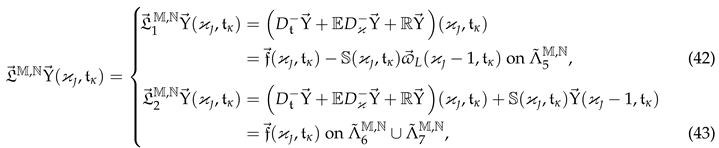
L M , N S = ( D t S + E D ϰ S + R S ) ( ϰ j , t κ ) + S ( ϰ j , t κ ) S ( ϰ j 1 , t κ ) = f ( ϰ j , t κ ) on Λ ˜ M , N ,
ξ M , N S ( ϰ j , t κ ) = ( S E D ϰ + S ) ( ϰ j , t κ ) = ϖ L ( ϰ j , t κ ) on Λ ˜ * , S ( ϰ j , 0 ) = ϖ B ( ϰ j ) on Λ ˜ ¯ ϰ N .
The problem represented in (29) is reformulated for case 1 and case 2 is as follows:
Case 1:
L 1 M , N S = D t S + E D ϰ S + R S ( ϰ j , t κ ) = f ( ϰ j , t κ ) S ( ϰ j , t κ ) ϖ L ( ϰ j 1 , t κ ) on Λ ˜ 1 M , N Λ ˜ 2 M , N ,
L 2 M , N S = D t S + E D ϰ S + R S ( ϰ j , t κ ) + S ( ϰ j , t κ ) S ( ϰ j 1 , t κ ) = f ( ϰ j , t κ ) on Λ ˜ 3 M , N Λ ˜ 4 M , N ,
ξ M , N S ( ϰ j , t κ ) = ( S E D ϰ + S ) ( ϰ j , t κ ) = ϖ L ( ϰ j , t κ ) on Λ ˜ * , S ( ϰ j , 0 ) = ϖ B ( ϰ j ) on Λ ˜ ¯ ϰ N ,
ε ι ( D ϰ + D ϰ ) S ι ( ϰ j , t κ ) = [ f ι ] ( ϰ j , t κ ) , where j = N 4 , N 2 , 3 N 4 .
Case 2:
L 1 M , N S = D t S + E D ϰ S + R S ( ϰ j , t κ ) = f ( ϰ j , t κ ) S ( ϰ j , t κ ) ϖ L ( ϰ j 1 , t κ ) on Λ ˜ 5 M , N ,
L 2 M , N S = D t S + E D ϰ S + R S ( ϰ j , t κ ) + S ( ϰ j , t κ ) S ( ϰ j 1 , t κ ) = f ( ϰ j , t κ ) on Λ ˜ 6 M , N Λ ˜ 7 M , N ,
ξ M , N S ( ϰ j , t κ ) = ( S E D ϰ + S ) ( ϰ j , t κ ) = ϖ L ( ϰ j , t κ ) on Λ ˜ * , S ( ϰ j , 0 ) = ϖ B ( ϰ j ) on Λ ˜ ¯ ϰ N ,
ε ι ( D ϰ + D ϰ ) S ι ( ϰ j , t κ ) = [ f ι ] ( ϰ j , t κ ) , where j = N 3 , 2 N 3 .
where
D t S ι ( ϰ j , t κ ) = S ι ( ϰ j , t κ ) S ι ( ϰ j , t κ 1 ) t κ t κ 1 D ϰ S ι ( ϰ j , t κ ) = S ι ( ϰ j , t κ ) S ι ( ϰ j 1 , t κ ) ϰ j ϰ j 1 D ϰ + S ι ( ϰ j , t κ ) = S ι ( ϰ j + 1 , t κ ) S ι ( ϰ j , t κ ) ϰ j + 1 ϰ j
for 1 ι 2 , 1 j N and 1 κ M .
Lemma 6.
Let conditions (4) & (5) hold for R ( ϰ , t ) and S ( ϰ , t ) . Let us consider Θ ˇ be any mesh function, such that ξ M , N Θ ( 0 , t κ ) 0 , Θ ( ϰ j , 0 ) 0 , L 1 M , N Θ 0 on Λ ˜ 1 M , N Λ ˜ 2 M , N , L 2 M , N Θ 0 on Λ ˜ 3 M , N Λ ˜ 4 M , N , ( D ϰ + D ϰ ) Θ ( ϰ j , t κ ) 0 , j = N 4 , N 2 , 3 N 4 in case 1 and L 1 M , N Θ 0 on Λ ˜ 5 M , N , L 2 M , N Θ 0 on Λ ˜ 6 M , N Λ ˜ 7 M , N , ( D ϰ + D ϰ ) Θ ( ϰ j , t κ ) 0 , j = N 3 , 2 N 3 in case 2. Then, it implies that Θ 0 on Λ ˜ ¯ M , N .
Proof. 
For ι ´ , j ´ , κ ´ , let Θ ι ´ ( ϰ j ´ , t κ ´ ) = min ι , j , κ Θ ι ( ϰ j , t κ ) and consider the case where the lemma does not hold. Then Θ ι ´ ( ϰ j ´ , t κ ´ ) < 0 . From the stipulated hypotheses, it is simple to establish that ( ϰ j ´ , t κ ´ ) Ω M , N , Θ ι ´ ( ϰ j ´ , t κ ´ ) Θ ι ´ ( ϰ j ´ 1 , t κ ´ ) 0 , Θ ι ´ ( ϰ j ´ + 1 , t κ ´ ) Θ ι ´ ( ϰ j ´ , t κ ´ ) 0 and Θ ι ´ ( ϰ j ´ , t κ ´ ) Θ ι ´ ( ϰ j ´ , t κ ´ 1 ) 0 .
If ( ϰ j ´ , t κ ´ ) = ( 0 , t κ ´ ) , then
ξ M , N Θ ( 0 , t κ ´ ) = Θ ( 0 , t κ ´ ) E D ϰ + Ξ ( 0 , t κ ´ ) < 0 ,
which is a contradiction. For t κ ´ = 0 , Θ ( ϰ j ´ , 0 ) < 0 , which leads to a contradiction.
Case 1: For ( ϰ j ´ , t κ ´ ) Λ ˜ 1 M , N Λ ˜ 2 M , N ,
( L 1 M , N Θ ) ι ´ ( ϰ j ´ , t κ ´ ) = D t Θ ι ´ ( ϰ j ´ , t κ ´ ) + ε ι ´ D ϰ Θ ι ´ ( ϰ j ´ , t κ ´ ) + = 1 2 r ι ´ ( ϰ j ´ , t κ ´ ) Θ ( ϰ j ´ , t κ ´ ) < 0 ,
which contradicts our assumption. For ( ϰ j ´ , t κ ´ ) Λ ˜ 3 M , N Λ ˜ 4 M , N , we get
( L 2 M , N Θ ) ι ´ ( ϰ j ´ , t κ ´ ) = D t Θ ι ´ ( ϰ j ´ , t κ ´ ) + ε ι ´ D ϰ Θ ι ´ ( ϰ j ´ , t κ ´ ) + = 1 2 r ι ´ ( ϰ j ´ , t κ ´ ) Θ ( ϰ j ´ , t κ ´ ) + β ι ´ ( ϰ j ´ , t κ ´ ) Θ ι ´ ( ϰ j ´ 1 , t κ ´ ) D t Θ ι ´ ( ϰ j ´ , t κ ´ ) + ε ι ´ D ϰ Θ ι ´ ( ϰ j ´ , t κ ´ ) + = 1 2 r ι ´ ( ϰ j ´ , t κ ´ ) Θ ι ´ ( ϰ j ´ , t κ ´ ) + β ι ´ ( ϰ j ´ , t κ ´ ) Θ ι ´ ( ϰ j ´ , t κ ´ ) < 0 ,
which contradicts our assumption.
Case 2: For ( ϰ j ´ , t κ ´ ) Λ ˜ 5 M , N ,
( L 1 M , N Θ ) ι ´ ( ϰ j ´ , t κ ´ ) = D t Θ ι ´ ( ϰ j ´ , t κ ´ ) + ε ι ´ D ϰ Θ ι ´ ( ϰ j ´ , t κ ´ ) + = 1 2 r ι ´ ( ϰ j ´ , t κ ´ ) Θ ( ϰ j ´ , t κ ´ ) < 0 ,
which contradicts our assumption. For ( ϰ j ´ , t κ ´ ) Λ ˜ 6 M , N Λ ˜ 7 M , N , we get
( L 2 M , N Θ ) ι ´ ( ϰ j ´ , t κ ´ ) = D t Θ ι ´ ( ϰ j ´ , t κ ´ ) + ε ι ´ D ϰ Θ ι ´ ( ϰ j ´ , t κ ´ ) + = 1 2 r ι ´ ( ϰ j ´ , t κ ´ ) Θ ( ϰ j ´ , t κ ´ ) + β ι ´ ( ϰ j ´ , t κ ´ ) Θ ι ´ ( ϰ j ´ 1 , t κ ´ ) D t Θ ι ´ ( ϰ j ´ , t κ ´ ) + ε ι ´ D ϰ Θ ι ´ ( ϰ j ´ , t κ ´ ) + = 1 2 r ι ´ ( ϰ j ´ , t κ ´ ) Θ ι ´ ( ϰ j ´ , t κ ´ ) + β ι ´ ( ϰ j ´ , t κ ´ ) Θ ι ´ ( ϰ j ´ , t κ ´ ) < 0 ,
which contradicts our assumption.
If ϰ j ´ , j ´ = N 4 , N 2 , 3 N 4 for case 1, then
D ϰ Θ ι ´ ( ϰ j ´ , t κ ´ ) 0 D ϰ + Θ ι ´ ( ϰ j ´ , t κ ´ ) .
Also,
D ϰ + Θ ι ´ ( ϰ j ´ , t κ ´ ) D ϰ Θ ι ´ ( ϰ j ´ , t κ ´ ) ,
and so
Θ ι ´ ( ϰ j ´ 1 , t κ ´ ) = Θ ι ´ ( ϰ j ´ , t κ ´ ) = Θ ι ´ ( ϰ j ´ + 1 , t κ ´ ) .
Then ( L M , N Θ ) ι ´ ( ϰ j ´ , t κ ´ ) < 0 , which contradicts our assumption.
If ϰ j ´ , j ´ = N 3 , 2 N 3 for case 2, then
D ϰ Θ ι ´ ( ϰ j ´ , t κ ´ ) 0 D ϰ + Θ ι ´ ( ϰ j ´ , t κ ´ ) .
Also,
D ϰ + Θ ι ´ ( ϰ j ´ , t κ ´ ) D ϰ Θ ι ´ ( ϰ j ´ , t κ ´ ) ,
and so
Θ ι ´ ( ϰ j ´ 1 , t κ ´ ) = Θ ι ´ ( ϰ j ´ , t κ ´ ) = Θ ι ´ ( ϰ j ´ + 1 , t κ ´ ) .
Then ( L M , N Θ ) ι ´ ( ϰ j ´ , t κ ´ ) < 0 , which contradicts our assumption. This implies that Θ ι ´ ( ϰ j ´ , t κ ´ ) 0 . The proof of the lemma is complete. □
Lemma 7.
Let conditions (4) & (5) hold for R ( ϰ , t ) and S ( ϰ , t ) . Let us consider Θ be any mesh function, then for Case 1
| Θ ( ϰ j , t κ ) | max { ξ M , N Θ ( 0 , t κ ) , Θ ( ϰ j , 0 ) , 1 δ L 1 M , N Θ Λ ˜ 1 M , N Λ ˜ 2 M , N , 1 δ L 2 M , N Θ Λ ˜ 3 M , N Λ ˜ 4 M , N } ,
for 0 j N , 0 κ M and for Case 2,
| Θ ( ϰ j , t κ ) | max { ξ M , N Θ ( 0 , t κ ) , Θ ( ϰ j , 0 ) , 1 δ L 1 M , N Θ Λ ˜ 5 M , N , 1 δ L 2 M , N Θ Λ ˜ 6 M , N Λ ˜ 7 M , N } ,
for 0 j N , 0 κ M .
Proof. 
Define barrier functions
θ ± ( ϰ j , t κ ) = max { ξ M , N Θ ( 0 , t κ ) , Θ ( ϰ j , 0 ) , 1 δ L 1 M , N Θ Λ ˜ 1 Λ ˜ 2 , 1 δ L 2 M , N Θ Λ ˜ 3 Λ ˜ 4 } ± Θ ( ϰ j , t κ ) .
It is evident that ξ M , N θ ± ( 0 , t κ ) 0 on Λ ˜ * , θ ± ( ϰ j , 0 ) 0 and also L 1 M , N θ ± 0 on Λ ˜ 1 M , N Λ ˜ 2 M , N , L 2 M , N θ ± 0 on Λ ˜ 3 M , N Λ ˜ 4 M , N and for j = N 4 , N 2 , 3 N 4 , we get
D ϰ + θ ι ´ ( ϰ j ´ , t κ ´ ) D ϰ θ ι ´ ( ϰ j ´ , t κ ´ ) = D ϰ + Θ ι ´ ( ϰ j ´ , t κ ´ ) D ϰ Θ ι ´ ( ϰ j ´ , t κ ´ ) = 0 .
Hence, by the result of Lemma 6, we get θ ± 0 on Λ ˜ ¯ M , N for Case 1. By applying analogous procedure used in Case 1, we get the required result θ ± 0 on Λ ˜ ¯ M , N for Case 2. The proof of the lemma is complete. □

5. Discrete Solution Components and Error Estimates

The discrete solution S ( ϰ j , t κ ) of (29) are decomposed into Υ ( ϰ j , t κ ) + ζ ( ϰ j , t κ ) , where Υ and ζ are discrete smooth and discrete singular components respectively.
L M , N Υ ( ϰ j , t κ ) = D t Υ + E D ϰ Υ + R Υ ( ϰ j , t κ ) + S ( ϰ j , t κ ) Υ ( ϰ j 1 , t κ ) = f ( ϰ j , t κ ) on Λ ˜ M , N ,
L M , N ζ ( ϰ j , t κ ) = D t ζ + E D ϰ ζ + R ζ ( ϰ j , t κ ) + S ( ϰ j , t κ ) ζ ( ϰ j 1 , t κ ) = 0 on Λ ˜ M , N .
The problem represented in (35) and (36) is reformulated for Case 1 and Case 2 are as follows:
Case 1:
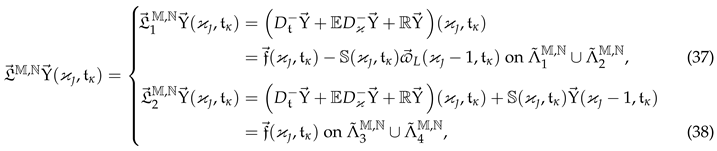
Preprints 145985 i008
ξ M , N Υ ( ϰ j , t κ ) = ξ γ ( ϰ j , t κ ) , Υ ( ϰ j , 0 ) = γ ( ϰ j , 0 ) ,
L 1 M , N ζ = 0 on Λ ˜ 1 M , N Λ ˜ 2 M , N , L 2 M , N ζ = 0 on Λ ˜ 3 M , N Λ ˜ 4 M , N ,
ξ M , N ζ ( ϰ j , t κ ) = ξ ς ( ϰ j , t k ) , ζ ( ϰ j , 0 ) = ς ( ϰ j , 0 ) ,
D ϰ ζ ( ϰ ϰ j , t κ ) + D ϰ Υ ( ϰ ϰ j , t κ ) = D ϰ + ζ ( ϰ ϰ j , t κ ) + D ϰ + Υ ( ϰ ϰ j , t κ ) , for j = N 4 , N 2 , 3 N 4 .
Case 2:
Preprints 145985 i009
ξ M , N Υ ( ϰ j , t κ ) = ξ γ ( ϰ j , t κ ) , Υ ( ϰ j , 0 ) = γ ( ϰ j , 0 ) ,
L 1 M , N ζ = 0 on Λ ˜ 5 M , N , L 2 M , N ζ = 0 on Λ ˜ 6 M , N Λ ˜ 7 M , N ,
ξ M , N ζ ( ϰ j , t κ ) = ξ ς ( ϰ j , t k ) , ζ ( ϰ j , 0 ) = ς ( ϰ j , 0 ) ,
D ϰ ζ ( ϰ ϰ j , t κ ) + D ϰ Υ ( ϰ ϰ j , t κ ) = D ϰ + ζ ( ϰ ϰ j , t κ ) + D ϰ + Υ ( ϰ ϰ j , t κ ) , for j = N 3 , 2 N 3 .
The error at each point ( ϰ j , t κ ) Λ ˜ M , N is given by e ( ϰ j , t κ ) = S ( ϰ j , t κ ) ϑ ( ϰ j , t κ ) . For j N 4 , N 2 , 3 N 4 in Case 1 and j N 3 , 2 N 3 in Case 2, the local truncation errors L M , N e ( ϰ j , t κ ) can be expressed as follows.
L M , N e ( ϰ j , t κ ) = L M , N ( Υ γ ) ( ϰ j , t κ ) + L M , N ( ζ ς ) ( ϰ j , t κ ) , ( L M , N e ) ι ( ϰ j , t κ ) = ( t D t ) ϑ ι + ε ι ( ϰ D ϰ ) ϑ ι , ( L M , N ( Υ γ ) ) ι ( ϰ j , t κ ) = ( t D t ) γ ι + ε ι ( ϰ D ϰ ) γ ι , ( L M , N ( ζ ς ) ) ι ( ϰ j , t κ ) = ( t D t ) ς ι + ε ι ( ϰ D ϰ ) ς ι .
| ( L M , N ( Υ γ ) ) ι ( ϰ j , t κ ) | = | ( t D t ) γ ι ( ϰ j , t κ ) | + | ε ι ( ϰ D ϰ ) γ ι ( ϰ j , t κ ) | ,
| ( L M , N ( ζ ς ) ) ι ( ϰ j , t κ ) | = | ( t D t ) ς ι ( ϰ j , t κ ) | + | ε ι ( ϰ D ϰ ) ς ι ( ϰ j , t κ ) | .
| ( ξ M , N ( Υ γ ) ) ι ( 0 , t κ ) | = | ε ι ( ϰ D ϰ + ) γ ι ( 0 , t κ ) | ,
| ( ξ M , N ( ζ ς ) ) ι ( 0 , t κ ) | = | ε ι ( ϰ D ϰ + ) ς ι ( 0 , t κ ) | .
| ( t D t ) Φ ( ϰ j , t κ ) | C ( t κ t κ 1 ) max s [ t κ 1 , t κ ] | 2 Φ t 2 ( ϰ j , s ) | ,
| ( t D t + ) Φ ( ϰ j , t κ ) | C ( t κ + 1 t κ ) max s [ t κ , t κ + 1 ] | 2 Φ t 2 ( ϰ j , s ) | ,
Preprints 145985 i010
Preprints 145985 i011
Theorem 3.
Let conditions (4) & (5) hold for R ( ϰ , t ) and S ( ϰ , t ) . Let γ represents the solution of (10) and let Υ represents the solution of (35). Then, for Case 1
| ( L M , N ( Υ γ ) ) ι ( ϰ j , t κ ) | C ( M 1 + N 1 ) , j N 4 , N 2 , 3 N 4
and for Case 2
| ( L M , N ( Υ γ ) ) ι ( ϰ j , t κ ) | C ( M 1 + N 1 ) , j N 3 , 2 N 3 .
Proof. 
From the expressions (49) and (55), and using Lemma 3, for ι = 1 , 2 , we get
| ( ξ M , N ( Υ γ ) ) ι ( 0 , t κ ) | = | ε ι ( ϰ D ϰ + ) γ ι ( 0 , t κ ) | C ε ι ( ϰ 1 ϰ 0 ) max s [ ϰ 0 , ϰ 1 ] | 2 γ ι ϰ 2 ( s , t κ ) | C ε ι N 1 C ε ι 1 C N 1 .
| ( L M , N ( Υ γ ) ) ι ( ϰ j , t κ ) | | ( t D t ) γ ι ( ϰ j , t κ ) | + | ε ι ( ϰ D ϰ ) γ ι ( ϰ j , t κ ) | C μ κ max s [ t κ 1 , t κ ] | 2 γ ι t 2 ( ϰ j , s ) | + C ε ι H j max s [ ϰ j 1 , ϰ j ] | 2 γ ι ϰ 2 ( s , t κ ) | C M 1 + C N 1 ε ι C ε ι 1 , using Lemma C ( M 1 + N 1 ) .
The proof of the theorem is complete. □
Theorem 4.
Let conditions (4) & (5) hold for R ( ϰ , t ) and S ( ϰ , t ) . Let ς represents the solution of (16) and let ζ represents the solution of (36). Then, for Case 1
| ( L M , N ( ζ ς ) ) ι ( ϰ j , t κ ) | C ( M 1 + N 1 ln N ) , j N 4 , N 2 , 3 N 4
and for Case 2
| ( L M , N ( ζ ς ) ) ι ( ϰ j , t κ ) | C ( M 1 + N 1 ln N ) , j N 3 , 2 N 3 .
Proof. 
The procedure outlined in Theorem 10.5 of [3] is employed in this theorem, as it leads to a similar result. □
From the above results, we concluded that for Case 1, j N 4 or N 2 or 3 N 4 and for Case 2, j N 3 or 2 N 3 ,
| ( L M , N e ) ι ( ϰ j , t κ ) | C ( M 1 + N 1 ln N ) .
Now at the point ( ϰ j , t κ ) , j = N 4 or N 2 or 3 N 4 for case 1 and j = N 3 or 2 N 3 for case 2, we get
| ( L M , N e ) ι ( ϰ j , t κ ) | C ε ι H + max [ ϰ j , ϰ j + 1 ] | ϑ ι ( ν ) | + C ε ι H max [ ϰ j 1 , ϰ j ] | ϑ ι ( β ) | , where ϰ j < ν < ϰ j + 1 , ϰ j 1 < β < ϰ j C N 1 ln N .
Theorem 5.
Let ϑ represents the solution of (1), (2), (3) and S represents the solution of (29), (30). Thus, for N sufficiently large,
| | ( S ϑ ) ( ϰ j , t κ ) | | C ( M 1 + N 1 ln N ) .
Proof. 
For Case 1, consider the two mesh functions
Θ ι ± ( x j , t κ ) = C ( M 1 + N 1 ln N ) ( 1 + 2 ϰ j ) ± e ι ( ϰ j , t κ ) , j N 4 or N 2 or 3 N 4 C ( M 1 + N 1 ln N ) ( y + ϰ j ) ± e ι ( ϰ j , t κ ) , j > N 4 or N 2 or 3 N 4
and for Case 2,
Θ ι ± ( ϰ j , t κ ) = C ( M 1 + N 1 ln N ) ( 1 + 2 ϰ j ) ± e ι ( ϰ j , t κ ) , j N 3 or 2 N 3 C ( M 1 + N 1 ln N ) ( y + ϰ j ) ± e ι ( ϰ j , t κ ) , j > N 3 or 2 N 3
where C is suitably chosen sufficiently large constant. Hence for Case 1, j < N 4 or N 2 or 3 N 4 and for Case 2, j < N 3 or 2 N 3 ,
( ξ M , N Θ ± ) ι ( 0 , t κ ) = Θ ι ± ( 0 , t κ ) ε ι D ϰ + Θ ι ± ( 0 , t κ ) ± ( ξ M , N e ) ι ( 0 , t κ ) = C ( M 1 + N 1 ln N ) ( 1 + 2 ϰ j ) ε ι D ϰ + C ( M 1 + N 1 ln N ) ( 1 + 2 ϰ j ) ± C ( M 1 + N 1 ln N ) 0
( L M , N Θ ± ) ι ( ϰ j , t κ ) = D t C ( M 1 + N 1 ln N ) ( 1 + 2 ϰ j ) + ε ι D ϰ C ( M 1 + N 1 ln N ) ( 1 + 2 ϰ j ) + = 1 2 r ι ( ϰ j , t κ ) C ( M 1 + N 1 ln N ) ( 1 + 2 ϰ j ) + s ι ( ϰ j , t κ ) C ( M 1 + N 1 ln N ) ( 1 + 2 ϰ j 1 ) ± C ( M 1 + N 1 ln N ) 0
and for Case 1, j > N 4 or N 2 or 3 N 4 and for Case 2, j > N 3 or 2 N 3 ,
( ξ M , N Θ ± ) ι ( 0 , t κ ) = Θ ι ± ( 0 , t κ ) ε ι D ϰ + Θ ι ± ( 0 , t κ ) ± ( ξ M , N e ) ι ( 0 , t κ ) = C ( M 1 + N 1 ln N ) ( y + ϰ j ) ε ι D ϰ + C ( M 1 + N 1 ln N ) ( y + ϰ j ) ± C ( M 1 + N 1 ln N ) 0
( L M , N Θ ± ) ι ( ϰ j , t κ ) = D t C ( M 1 + N 1 ln N ) ( y + ϰ j ) + ε ι D ϰ C ( M 1 + N 1 ln N ) ( y + ϰ j ) + = 1 2 r ι ( ϰ j , t κ ) C ( M 1 + N 1 ln N ) ( y + ϰ j ) + s ι ( ϰ j , t κ ) C ( M 1 + N 1 ln N ) ( y + ϰ j 1 ) ± C ( M 1 + N 1 ln N ) 0 .
For Case 1, j = N 4 or N 2 or 3 N 4 and for Case 2, j = N 3 or 2 N 3 ,
( L M , N Θ ± ) ι ( x ι , t κ ) = C ( M 1 + N 1 ln N ) ( y + ϰ j + h + 1 2 ϰ j ) h + C ( M 1 + N 1 ln N ) ( 1 + 2 ϰ j ) ( 1 + 2 ϰ j h ) h ± ( L M , N e ) ι ( ϰ j , t κ ) 0 .
Thus, for N sufficiently large,
| | ( S ϑ ) | | C ( M 1 + N 1 ln N ) .
The proof of the theorem is complete. □

6. Numerical Illustration

To elucidate the proposed numerical scheme, an example is introduced in this section addresses two distinct cases resulting from the presence of discontinuous source term ( y , t ) in the domain.
Example 1.
Case 1:Consider the following problem, where a discontinuity ( y , t ) presents in the interval ( 0 , 1 ] × ( 0 , T ]
ϑ 1 t ( ϰ , t ) + ε 1 ϑ 1 ϰ ( ϰ , t ) + ( 6 + e t 2 ) ϑ 1 ( ϰ , t ) ϑ 2 ( ϰ , t ) ϑ 1 ( ϰ 1 , t ) = f 1 ( ϰ , t ) , ϑ 2 t ( ϰ , t ) + ε 2 ϑ 2 ϰ ( ϰ , t ) 0.5 ϑ 1 ( ϰ , t ) + ( 5 + e t 2 ) ϑ 2 ( ϰ , t ) 0.5 ϑ 2 ( ϰ 1 , t ) = f 2 ( ϰ , t ) ,
where
f 1 ( ϰ , t ) = 3 for ( ϰ , t ) ( 0 , 0.3 ) × ( 0 , T ] , 2 t for ( ϰ , t ) ( 0.3 , 2 ] × ( 0 , T ] , f 2 ( ϰ , t ) = 2 + 2 t for ( ϰ , t ) ( 0 , 0.3 ) × ( 0 , T ] , 5 for ( ϰ , t ) ( 0.3 , 2 ] × ( 0 , T ] ,
and with
ϑ 1 ( 0 , t ) ε 1 ϑ 1 ϰ ( 0 , t ) = 1 , ϑ 1 ( ϰ , 0 ) = 1 , ϑ 2 ( 0 , t ) ε 2 ϑ 2 ϰ ( 0 , t ) = 1 , ϑ 2 ( ϰ , 0 ) = 1 .
Case 2:Consider the following problem, where a discontinuity ( y , t ) presents in the interval ( 1 , 2 ] × ( 0 , T ]
ϑ 1 t ( ϰ , t ) + ε 1 ϑ 1 ϰ ( ϰ , t ) + ( 6 + e t 2 ) ϑ 1 ( ϰ , t ) ϑ 2 ( ϰ , t ) ϑ 1 ( ϰ 1 , t ) = f 1 ( ϰ , t ) , ϑ 2 t ( ϰ , t ) + ε 2 ϑ 2 ϰ ( ϰ , t ) 0.5 ϑ 1 ( ϰ , t ) + ( 5 + e t 2 ) ϑ 2 ( ϰ , t ) 0.5 ϑ 2 ( ϰ 1 , t ) = f 2 ( ϰ , t ) ,
where
f 1 ( ϰ , t ) = 3 for ( ϰ , t ) ( 0 , 1.3 ) × ( 0 , T ] , 2 t for ( ϰ , t ) ( 1.3 , 2 ] × ( 0 , T ] , f 2 ( ϰ , t ) = 2 + 2 t for ( ϰ , t ) ( 0 , 1.3 ) × ( 0 , T ] , 5 for ( ϰ , t ) ( 1.3 , 2 ] × ( 0 , T ] ,
and with
ϑ 1 ( 0 , t ) ε 1 ϑ 1 ϰ ( 0 , t ) = 1 , ϑ 1 ( ϰ , 0 ) = 1 , ϑ 2 ( 0 , t ) ε 2 ϑ 2 ϰ ( 0 , t ) = 1 , ϑ 2 ( ϰ , 0 ) = 1 .
Y ε N : maximum point-wise two-mesh differences,
Y N : ε - uniform maximum point-wise two-mesh differences,
p N : ε - uniform order of local convergence,
p * : ε - uniform order of convergence and
C p * N : ε - uniform error constant.
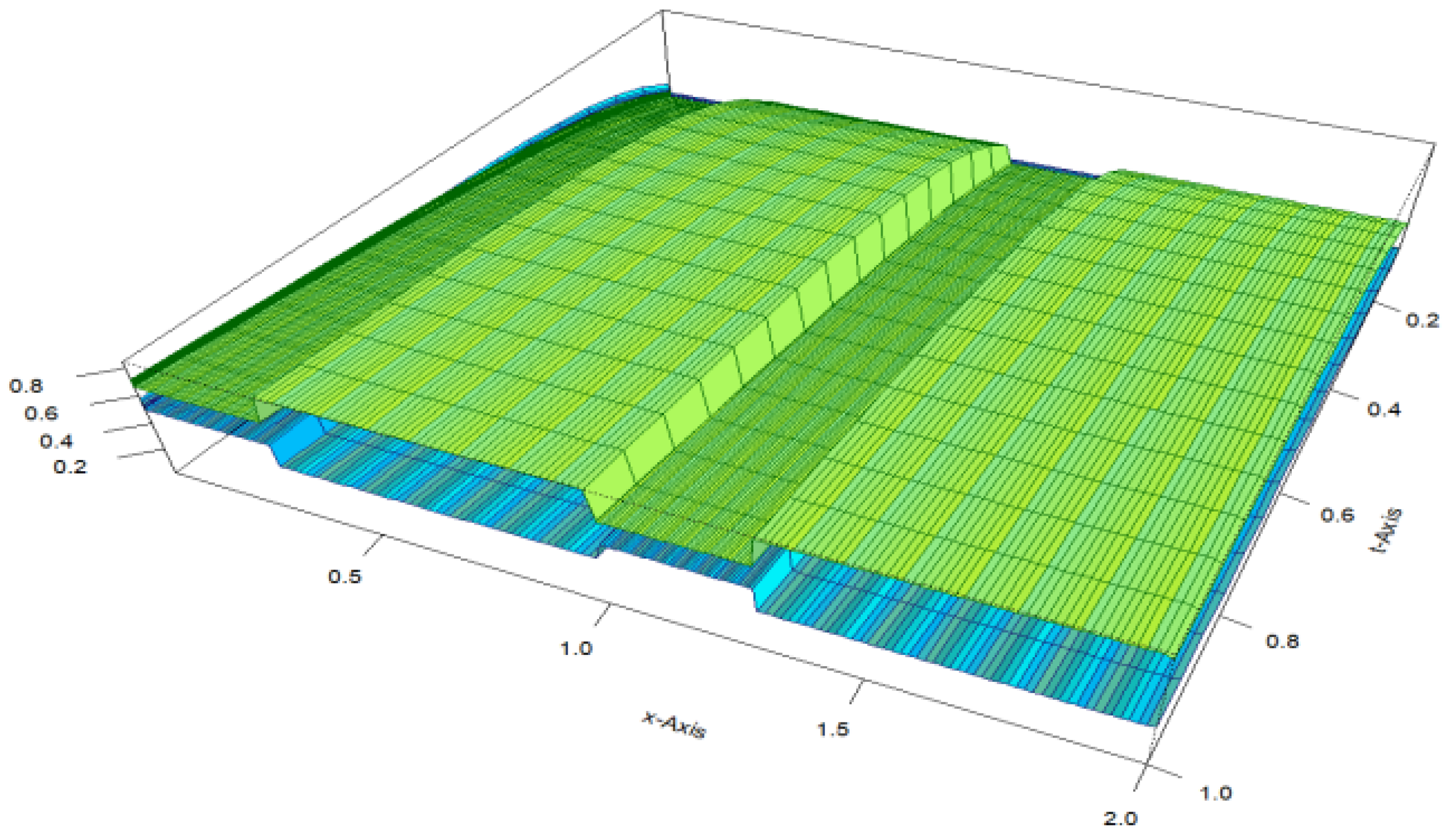
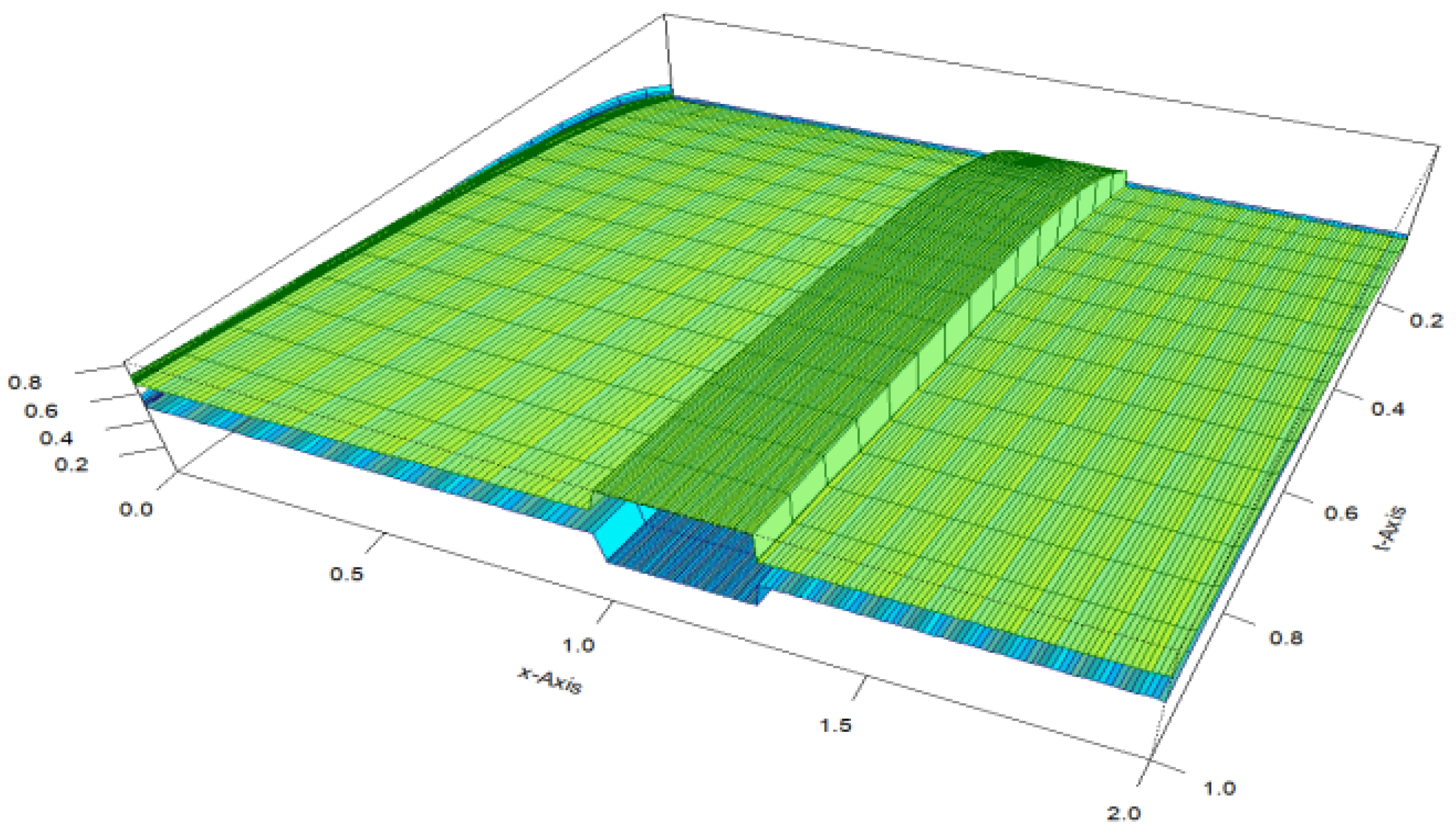
p * and C p * N are computed using a variant of Two mesh algorithm [6] for both Case 1 & Case 2 of Example 1. The results are presented in Table 1 & Table 2.
Figure 1. Visualization of numerical solutions of Case 1 (Example 1), illustrating an initial layer at ( 0 , t ) , and interior layers at ( 0 . 3 , t ) , ( 1 , t ) and ( 1 . 3 , t ) .
Preprints 145985 g001
Figure 2. Visualization of numerical solutions of Case 2 (Example 1), illustrating an initial layer at ( 0 , t ) , and interior layers at ( 1 , t ) and ( 1 . 3 , t ) .
Preprints 145985 g002

7. Conclusions

In this article, a classical layer resolving numerical scheme was constructed for solving a system of two time-dependent delay SPPs with a source term that exhibits a jump at a specific point due to discontinuity and robin initial conditions. This scheme incorporates a specially crafted piecewise uniform mesh to capture layer behaviors, formed in the initial and interior regions of the solution domain owing to the existence of delay and discontinuous source terms. Theoretical analysis and computational outcomes were validated through a numerical experiment, demonstrating strong concordance. Future research work will aim to solve semi-linear and nonlinear problems, with an emphasis on developing advanced numerical methods to improve computational efficiency.

References

  1. Abagero, B., Duressa, G., & Debela, H. (2021). Singularly perturbed Robin-type boundary value problems with discontinuous source term in geophysical fluid dynamics. Iranian Journal of Numerical Analysis and Optimization, 11(2), 351–364.
  2. Ajay Singh Rathore, & Vembu Shanthi. (2024). A numerical solution of singularly perturbed Fredholm integro-differential equation with discontinuous source term. Journal of Computational and Applied Mathematics, 446, 115858. [CrossRef]
  3. Bharathi, K. R., Chatzarakis, G. E., Panetsos, S. L., & Paramasivam, M. J. Robust Layer Resolving Scheme for a System of Two Singularly Perturbed Time-Dependent Delay Initial Value Problems with Robin Initial Conditions. (Accepted for publication in Australian Journal of Mathematical Analysis and Applications).
  4. Cen, Z., Huang, J., & Xu, A. (2023). A quadratic B-spline collocation method for a singularly perturbed semilinear reaction–diffusion problem with discontinuous source term. Mediterranean Journal of Mathematics, 20, 269. [CrossRef]
  5. Chawla, S., Urmil, & Singh, J. (2021). A parameter-robust convergence scheme for a coupled system of singularly perturbed first-order differential equations with discontinuous source term. International Journal of Applied and Computational Mathematics, 7, 118. [CrossRef]
  6. Farrell, P., Hegarty, A., Miller, J. M., O’Riordan, E., & Shishkin, G. I. (2000). Robust computational techniques for boundary layers. Chapman and Hall/CRC.
  7. Paramasivam, M., Miller, J. J. H., & Valarmathi, S. (2014). Parameter-uniform convergence for a finite difference method for a singularly perturbed linear reaction-diffusion system with discontinuous source terms. International Journal of Numerical Analysis and Modeling, 11(2), 385–399.
  8. Sahoo, S. K., & Gupta, V. (2022). Higher-order robust numerical computation for singularly perturbed problems involving discontinuous convective and source terms. Mathematical Methods in the Applied Sciences, 45(8), 4876–4898. [CrossRef]
  9. Selvaraj, D., & Mathiyazhagan, J. P. (2021). A parameter-uniform convergence for a system of two singularly perturbed initial value problems with different perturbation parameters and Robin initial conditions. Malaya Journal of Matematik, 9(1), 498–505. [CrossRef]
  10. Singh, S., Choudhary, R., & Kumar, D. (2023). An efficient numerical technique for two-parameter singularly perturbed problems having discontinuity in convection coefficient and source term. Computational and Applied Mathematics, 42(62). [CrossRef]
  11. Soundararajan, R., Subburayan, V., & Wong, P. J. Y. (2023). Streamline diffusion finite element method for singularly perturbed 1D-parabolic convection-diffusion differential equations with line discontinuous source. Mathematics, 11(9), 2034. [CrossRef]

Table 1. For Case 1, Values of p * and C p * N generated for ε 1 = 512 , ε 2 = 128 .
N : Number of mesh points
96 192 384 768
0.100E-01 0.106E+00 0.673E-01 0.406E-01 0.236E-01
0.100E-03 0.106E+00 0.673E-01 0.406E-01 0.236E-01
0.100E-05 0.106E+00 0.673E-01 0.406E-01 0.236E-01
0.100E-07 0.106E+00 0.673E-01 0.406E-01 0.236E-01
0.100E-09 0.106E+00 0.673E-01 0.406E-01 0.236E-01
Y N 0.106E+00 0.673E-01 0.406E-01 0.236E-01
p N 0.655E+00 0.730E+00 0.782E+00
C p N 0.577E+01 0.577E+01 0.548E+01 0.501E+01
p * = 0.6548207 E + 00
C p * N = 0.5768543 E + 01
Table 2. For Case 2, Values of p * and C p * N generated for ε 1 = 512 , ε 2 = 128 .
N : Number of mesh points
144 288 576 1152
0.100E-01 0.634E-01 0.385E-01 0.225E-01 0.128E-01
0.100E-03 0.634E-01 0.385E-01 0.225E-01 0.128E-01
0.100E-05 0.634E-01 0.385E-01 0.225E-01 0.128E-01
0.100E-07 0.634E-01 0.385E-01 0.225E-01 0.128E-01
0.100E-09 0.634E-01 0.385E-01 0.225E-01 0.128E-01
Y N 0.634E-01 0.385E-01 0.225E-01 0.128E-01
p N 0.721E+00 0.774E+00 0.812E+00
C p N 0.579E+01 0.579E+01 0.558E+01 0.524E+01
p * = 0.7206871 E + 00
C p * N = 0.5793366 E + 01
Disclaimer/Publisher’s Note: The statements, opinions and data contained in all publications are solely those of the individual author(s) and contributor(s) and not of MDPI and/or the editor(s). MDPI and/or the editor(s) disclaim responsibility for any injury to people or property resulting from any ideas, methods, instructions or products referred to in the content.
Copyright: This open access article is published under a Creative Commons CC BY 4.0 license, which permit the free download, distribution, and reuse, provided that the author and preprint are cited in any reuse.
Prerpints.org logo

Preprints.org is a free preprint server supported by MDPI in Basel, Switzerland.

Subscribe

Disclaimer

Terms of Use

Privacy Policy

Privacy Settings

© 2025 MDPI (Basel, Switzerland) unless otherwise stated