1. Overview and Existing Research
Jincheng Erxian Temple is located in the southeast village of Jincun Town, Zezhou County, Jincheng City, Shanxi Province. Its main hall is the most ancient part, built between the fourth year of Song Shaosheng (1097 AD) and the seventh year of Zhenghe (1117 AD). There are precious small wooden account niches and colored sculptures of the Song Dynasty in the hall. In 1996, it was included in the fourth batch of national key cultural relics protection units, and the cultural relics protection information mainly focuses on the Song Dynasty.
In September 2009, Shanxi Ancient Building Protection Engineering Co., Ltd. undertook the renovation project of this temple, which was completed in August 2011. In March 2019, the "Completion Report of the Renovation Project of Erxian Temple in Jincheng" was published, announcing the repair process and surveying and mapping drawings of the temple(SXZDGJ 2019). Most of the data in this article are cited from this source.
From 2013 to 2015, the National Heritage Center of Tsinghua University conducted 3D laser scanning and surveying. In October 2017, the "Investigation and Research Report on the Small Wooden Tent Niche of Jincheng Erxian Temple" was published, and the survey information and measured data were published, and the analysis and fitting scale was 314 mm(Lü,Zheng,and Jiang 2017). Some of the data in this article are cited here.
The belief in the two immortals is a unique local belief in the southeast of Shanxi Province, and it has a broad and lasting base of believers in the local area. There are many temples of two immortals in the southeast of Shanxi, and There are many that are included in the national protection list, and the naming is generally distinguished by the village where it is located. In 1996, when the temple was included in the national security, the village was named Xiaonan Village, and later renamed Southeast Village. The above two documents refer to this temple as the Erxian Temple in Jincheng(SXZDGJ 2019;Lü,Zheng,and Jiang 2017), and this article also uses this name.
2. Construction Ruler and Appearanc
2.1. Constraints on the Fitted Ruler Length
Architecture serves people, so the preferred measurement standards for construction should also be commonly used. In ancient China, the commonly used units of measurement included zhang (丈), chi (尺), cun (寸), fen (分), etc., and these should have been the main units for measurement. The "Yingzao Fashi" ((The Methodology of Official Architecture in the Northern Song Dynasty)) stipulated the cai-fen system(Pan and He 2017), which essentially took cun and fen as units and was flexibly converted into fen values according to proportional relationships. The construction ruler is of great significance for the study of ancient architecture. There are several constraints that need to be clarified when fitting and calculating the construction ruler.
First is the length of the ruler. The length of the ruler in the Song Dynasty was quite variable(Lu and Qiu 2001). Modern scholars have conducted textual research on the Song Dynasty rulers. Taking into account the regions and the existing structures of the same period, the length of the ruler is limited to the range from 28 centimeters to 32 centimeters.
Second is the large and small cun system. All dynasties after the Tang Dynasty adopted the long and short ruler system. In the north, 100 grains of broomcorn millet made up a short ruler, while 120 grains made up a long ruler. The long ruler was the official and commonly used ruler, and the short ruler was used for measuring in rituals, music, astronomy, and medicine. Among the 41 Tang Dynasty rulers recorded in "Science and Civilisation in China: Volume on Weights and Measures", one was a short ruler and 40 were long rulers. Each ruler was divided into 10 grids. Obviously, the commonly used rulers were long rulers, which were decimal-based, with each ruler having 10 cun, equivalent to 12 small cun. The length of a small cun was equal to 10 grains of broomcorn millet(Lu and Qiu 2001). This is quite similar to the relationship between inches and feet.
Third, the Yingzao Fashi stipulates the use of "fen" (份). This represents a rule that gives precedence to proportion over size when it comes to "cai" (材) and "qi" (栔). The relationship between the regulations in the Yingzao Fashi and folk construction is still unclear, but they surely influence and permeate each other. Thus, the measurement in terms of "fen" should be taken into account.
Fourth is the proportional relationship and integer dimensions. Integer dimensions are a measurement method, and the proportion of each part is the soul of architecture. It is difficult to have both, and a choice must be made during construction. Considering problems from these two aspects is the key to unlocking ancient architecture.
2.2. Calculate the Construction Ruler
Timber framing(Damuzuo) forms the skeleton, which is the foundation of the exterior shape, so it should be the starting point. The main framework data are listed in
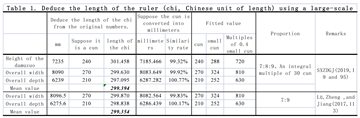
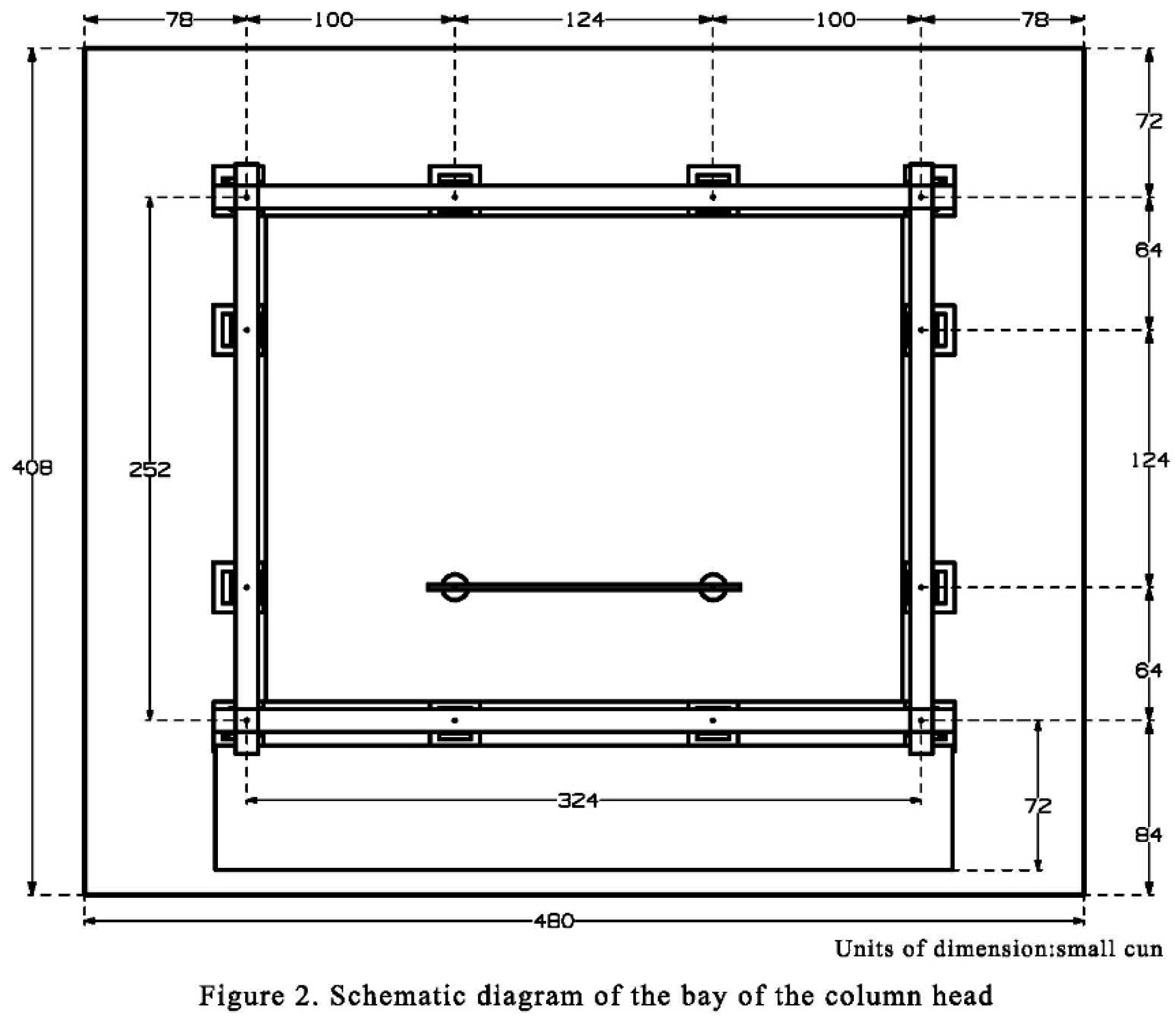
Table 1.Generally speaking, calculated from the column top, the ratio of the width, depth, and overall height is approximately 9:7:8. The simplest fit within the specified measuring scale is 27 chi(324 small cun), 21 chi(252 small cun), and 24 chi(288 small cun). The fitting is shown in
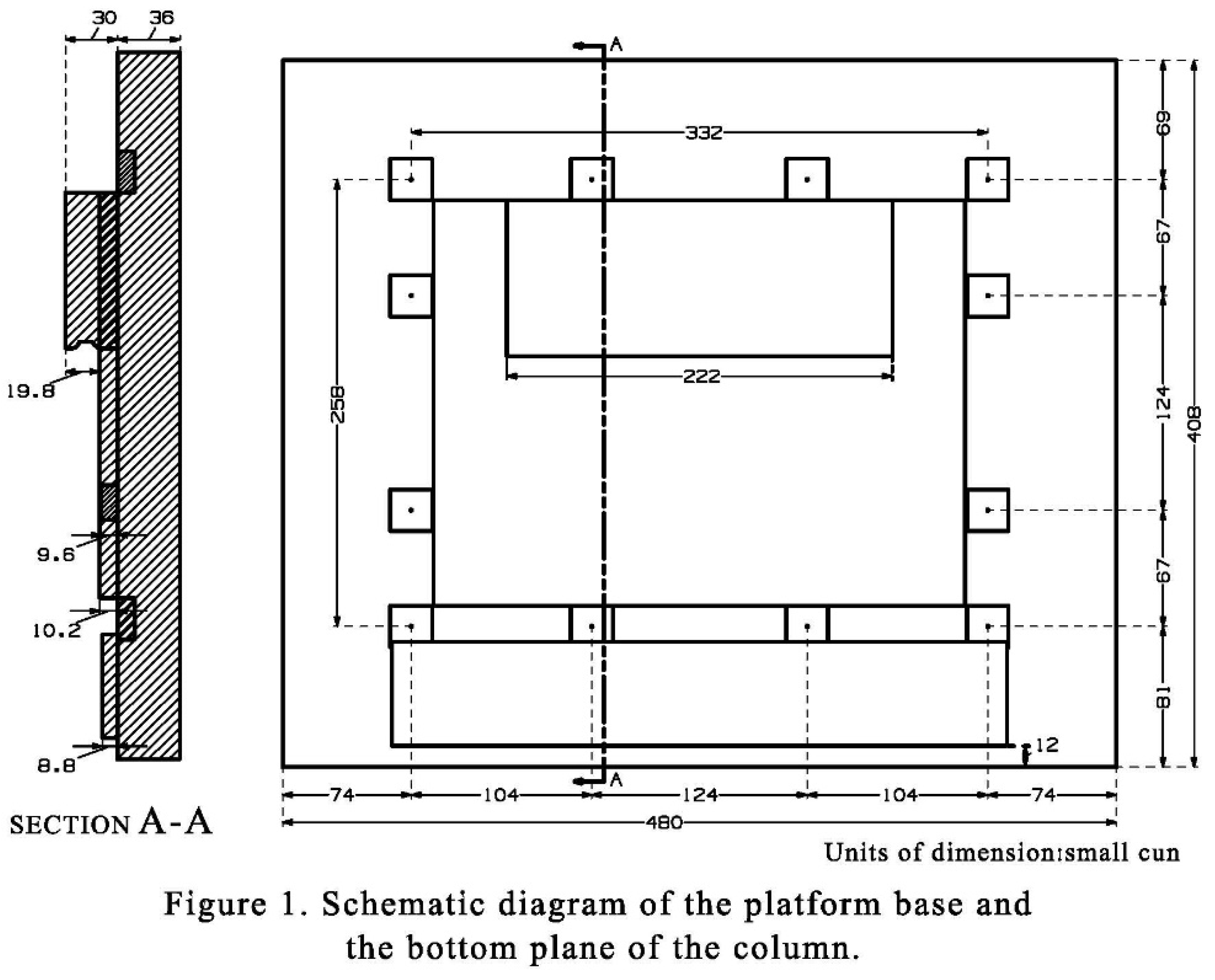
Figure 1 and
Figure 2.
SXZDGJ(2019,19 and 95) provides data calculated from the column base, including the width, depth, and Cejiao (inclination of the corner col- umn), based on which the data of the column top can be obtained.The calculated construction ruler (Yingzao chi) is 299.39 mm accordingly. In Lü,Zheng ,and Jiang(2017,113), only the overall width and overall depth data are available, and the deduced construction ruler is 299.35 mm. When comparing the data from the two sources, the differences are negligible, and the fitted lengths of the chi (a traditional Chinese unit of length) are strikingly similar, which can be determined to be approximately 299 millimeters. The data from SXZDGJ (2019) is complete, and as it will be cited more frequently hereinafter, the fitted length of the construction chi is taken as 299.39 millimeters.
As shown in
Figure 1 and
Figure 2 and
Table 1, the three main data of the timber framing are not only integer chi, but can also be converted into integral small cun. They are also integral multiples of 0.4 small cun, and of course, integral multiples of 4 small cun as well.
Table 1.
Deduce the length of the ruler (chi, Chinese unit of length) using a large-scale timberwork(Damuzuo) framework.
Table 1.
Deduce the length of the ruler (chi, Chinese unit of length) using a large-scale timberwork(Damuzuo) framework.
3. Taiming (The Part of the Foundation That Protrudes Above the Ground Level) and Bay Width
3.1. Xia Taiming (Lower Salient Part of Foundation)
The Taiming has two layers. For the lower layer, only one layer of rectangular stone slab has been detected, and its height remains unascertainable. The inscription recorded in SXZDGJ(2019,129), which was engraved in the seventh year of Zhenghe during the Song Dynasty (1117 AD), states: "The palace steps are three chi high, following the remaining foundation of the Yao court." It is assumed that the height of the Xia Taiming is 30 cun, which equals 36 small cun.
As shown in
Figure 1 and
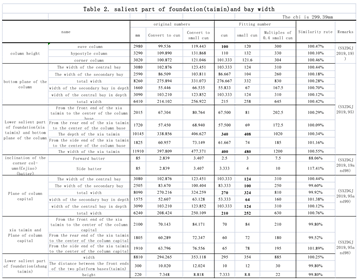
Table 2, based on the original data,The Xia Taiming has a depth of building of 34 chi and a width of 40 chi.
Figure 1.
Schematic diagram of the platform base and the bottom plane of the column.
Figure 1.
Schematic diagram of the platform base and the bottom plane of the column.
Table 2.
salient part of foundation(taimin)and bay width.
Table 2.
salient part of foundation(taimin)and bay width.
3.2. Shang Taiming (Upper Salient Part of Foundation)
The Taiming has two layers. In addition, there are old altars and wooden pedestals in the shape of a sumeru in the main hall. with a complex stratigraphic relationship. with a complex stratigraphic relationship. The sequence can inferred according to the original data and the structure.
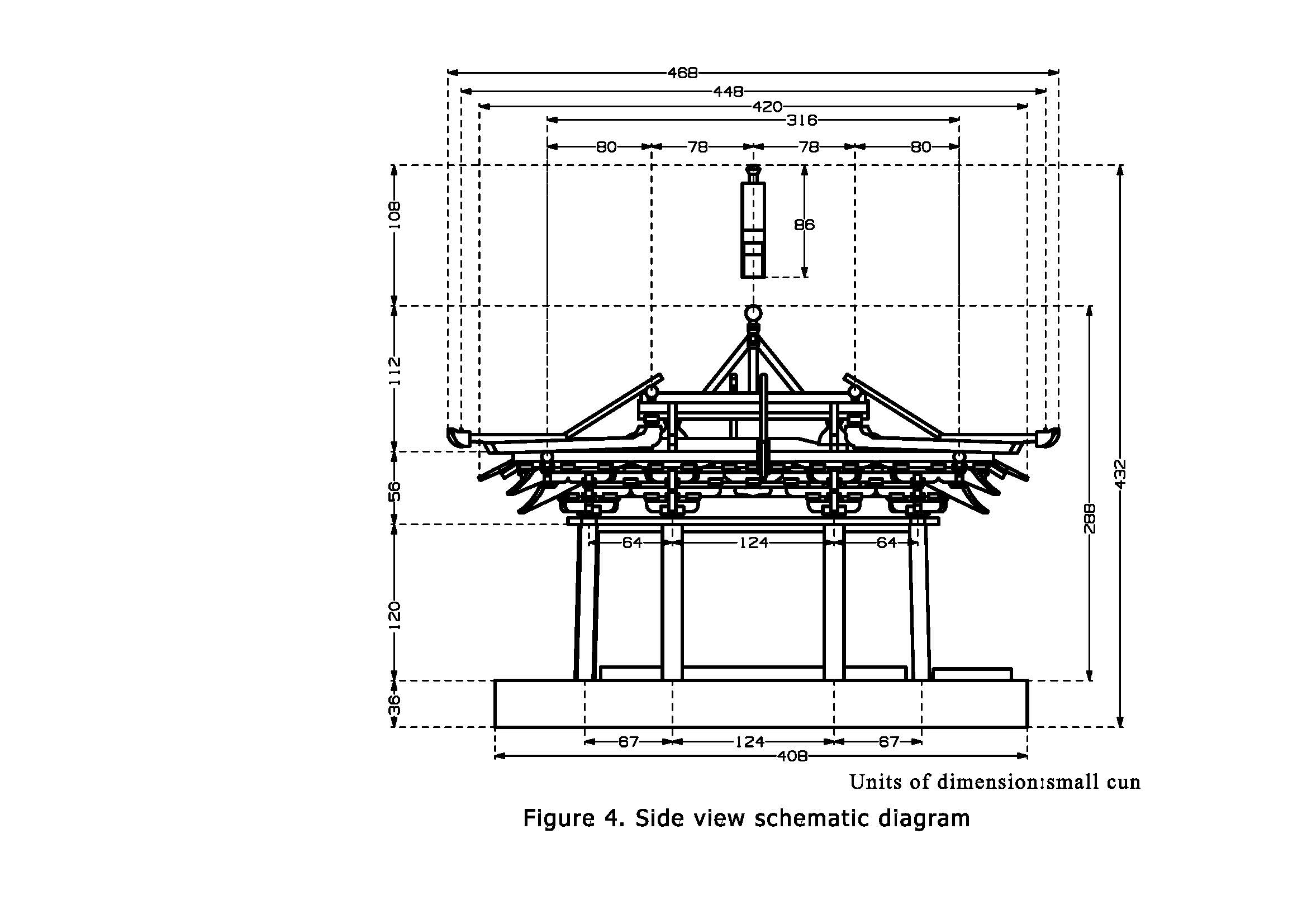
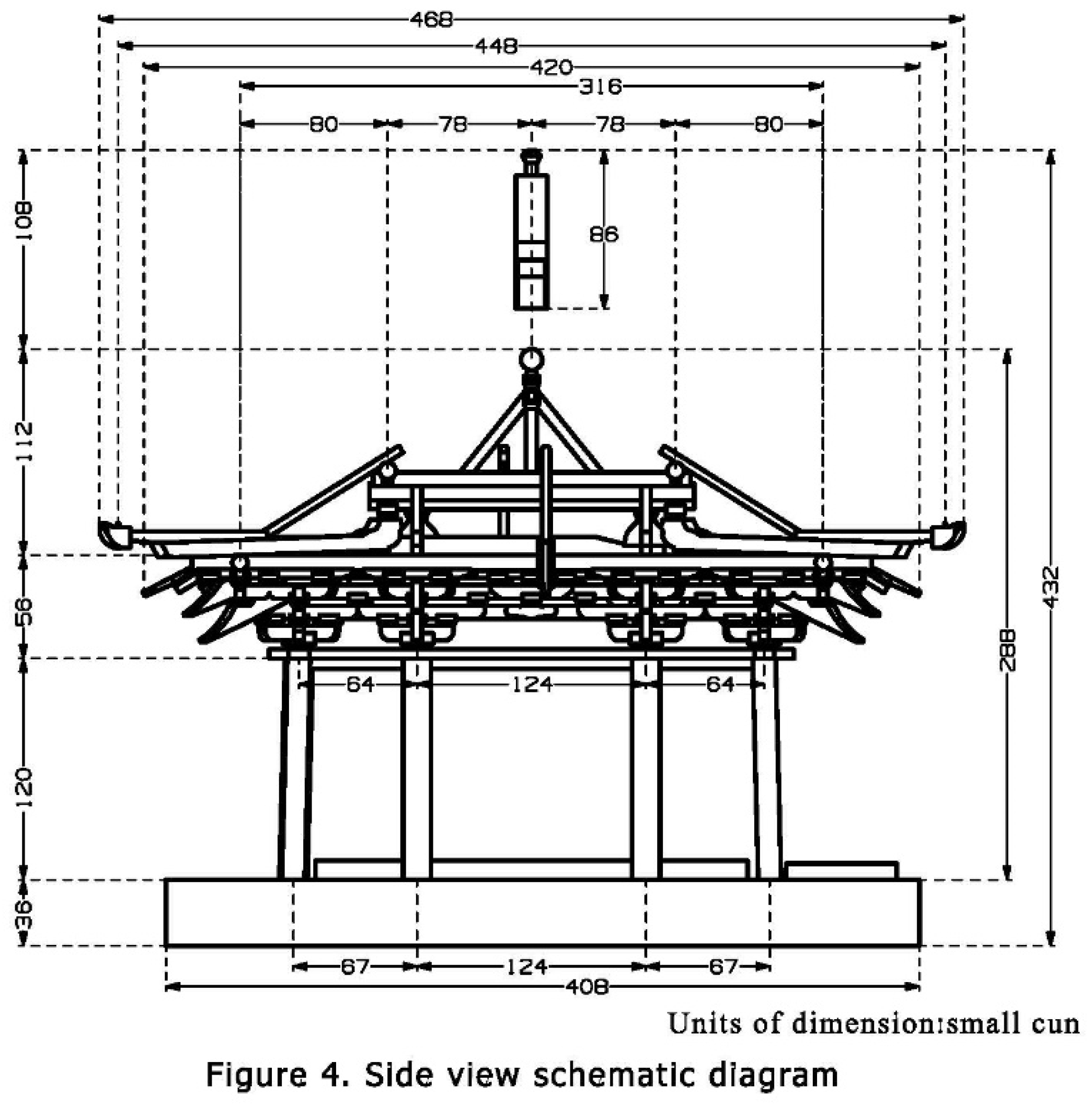
As shown in
Figure 1,
Figure 2,
Figure 3 and
Figure 4 and
Table 2, when the main hall was initially constructed, the divine altar was built first, taking the Xia Taiming as the reference. Its clear height was 30 small cun, which is equivalent to 25 cun. Afterwards, the ground indoors and outdoors was raised. The cushion layer serves as the Shang Taiming. This buried the hypostyle column(Indoor columns) bases and a small section of the column bottoms. The distance from the hypostyle column bottoms to the lower platform base is 9.6 small cun. Subsequently, the shrines were added.
Figure 4.
Side view schematic diagram.
Figure 4.
Side view schematic diagram.
3.3. Bay Width
As shown in
Table 2 and
Figure 2,the width of the central bay and the width of the central bay in the depth direction are both 124 small cun, which is equivalent to 31 units of 4 small cun. The widths of other bays are not in integer chi, but they are all divisible by 4 small cun.
Figure 2.
Schematic diagram of the bay of the column head.
Figure 2.
Schematic diagram of the bay of the column head.
3.4. Cejiao(Inclination of the Corner Col- Umn)
The Cejiao is 85 millimeters, approximately between 3 and 4 small cun. In the Yingzao Fashi ,the Cejiao was calculated as a proportion of the column height.After more than 900 years of wind and rain,the surveying and mapping data can no longer reflect the original calculation method for Cejiao. Proportionally, the Cejiao is approximately between 1/40 and 1/30 of the column height. It is estimated that the Cejiao in the facade width direction is 4 small cun, and 3 small cun in the depth direction, as shown in
Table 2. See
Figure 1,
Figure 2,
Figure 3 and
Figure 4.
3.5. The Height of the Column
As shown in
Table 2,
Figure 3 and
Figure 4,The eave columns are 120 small cun, which is exactly 10 chi. The corner columns have a rise. Based on the original data, they are estimated to be 121.6 small cun, with a rise of 1.6 small cun. For the convenience of drawing, the rise of the corner columns is not shown.
The clear height of the hypostyle column is 3290 millimeters, which is approximated to 132 small cun, exactly 120 cun. As shown in
Figure 1, the upper surface of the hypostyle column base is 9.6 small cun higher than that of the outer column base.
4. Cai(Dimension Lumber) and Puzuo (Bracket Set)
4.1. Cai and Fen
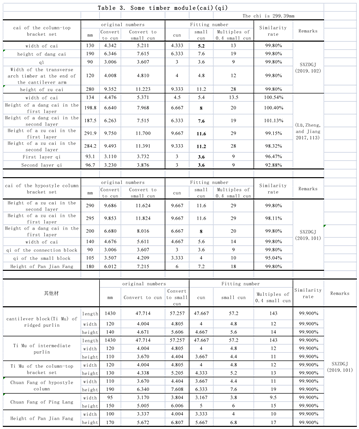
The data of "cai" is listed in
Table 3. The data from SXZDGJ (2019,101and102) is comprehensive, while the data from Lü, Zheng, and Jiang (2017) is more detailed. SXZDGJ (2019, 101) doesn't pay special attention to the differences in zucai (full-sized timbers) of each layer of the column - head bracket set, with the zucai of the first and second layers being the same. The surveying and mapping in Lü, Zheng, and Jiang (2017) takes the average value from multiple samples. The height of the dang cai (single - sized timbers) of the first-layer hua-gong and nidao-gong is 198.8 mm, which is significantly larger than that of others. Based on this, it is fitted to a dangcai of 8 small cun. Lü, Zheng, and Jiang (2017) recorded 23 data of the width of timbers. There are 16 data of the width of timbers at the end of the first jump, with an average value of 135.3 mm. There are 7 data of the width of shua-tou, with an average value of 130.85 mm.
As shown in
Table 3, the differences in the cai are not limited to the first and second floors. There are also variations in other positions. Generally speaking, the timbers can be classified into several types.
First, for the first layer of cai in the column-top bracket set, the dang cai component measures 8 small cun in height, 5.4 small cun in width, with a qi of 3.6 small cun, and the zu cai component is 11.6 small cun. This type of component includes the first-layer hua-gong (flower-shaped bracket arms) and nidao-gong (axial bracket arm).
Second, for the second to fourth layers of cai in the column-top bracket set, the zu cai timbers are 11.2 small cun, the qi is 3.6 small cun, the dang cai timbers are 7.6 small cun, and the width of the timbers is 5.2 small cun.
Third, for the transverse brackets at the end of the bracket-arms in the column-top bracket set, including the guazi-gong, guazi-man-gong, and ling-gong, all of which are moxie-gong. Their width is 4.8 small cun, equivalent to 4 cun. The dang cai timbers are 7.6 small cun, the qi is 3.6 small cun, and the zu cai timbers are 11.2 small cun.
Fourth, for the timbers used in the inner-column bracket sets, the dang cai are 8 small cun, and the width is 5.6 small cun. The qi measurements are surprisingly different. The qi of the jiaohu-dou (a type of block) at the end of the hua-gong bracket-arms is 3.6 small cun, and the zu cai timbers are 11.6 small cun. The qi of the sandou (a type of block) on the nidao-gong is 4 small cun, and the full-sized timbers are 12 small cun. Here, the heights of the zu cai timbers of the nidao-gong and the hua-gong are different.
Fifth, for other cai on the upper frame, the width ranges from a minimum of 3.8 small cun to a maximum of 4.4 small cun, and the height of the timbers also varies.
As shown in
Table 3, all the cross-sectional data of the timbers can be expressed as multiples of 0.4 small cun. The unit "fen" originated from the Yingzao Fashi. It is a measurement unit that was flexibly adjusted according to a unified proportion after the timbers were measured in cun. It is inappropriate to rigidly apply the rules in the Yingzao Fashi to this hall. However, using 0.4 small cun as a measurement unit is worth a try. Here, borrowing the concept of "cai-fen" from the Yingzao Fashi, we take 0.4 small cun as one "fen". This "fen" is the one restricted by the construction ruler, which is a sub-modulus in the architectural modular system, rather than the "fen" in the Yingzao Fashi.
Table 3.
Some timber module(cai)(qi).
Table 3.
Some timber module(cai)(qi).
4.2. Bearing Block(Dou)
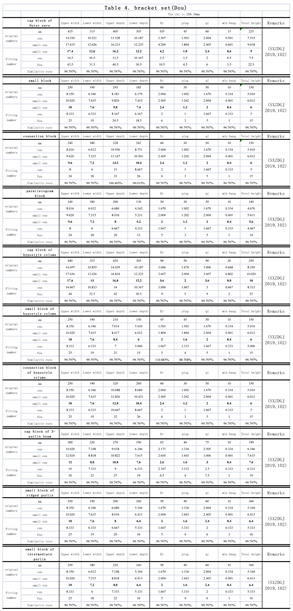
The data of the dou are listed in
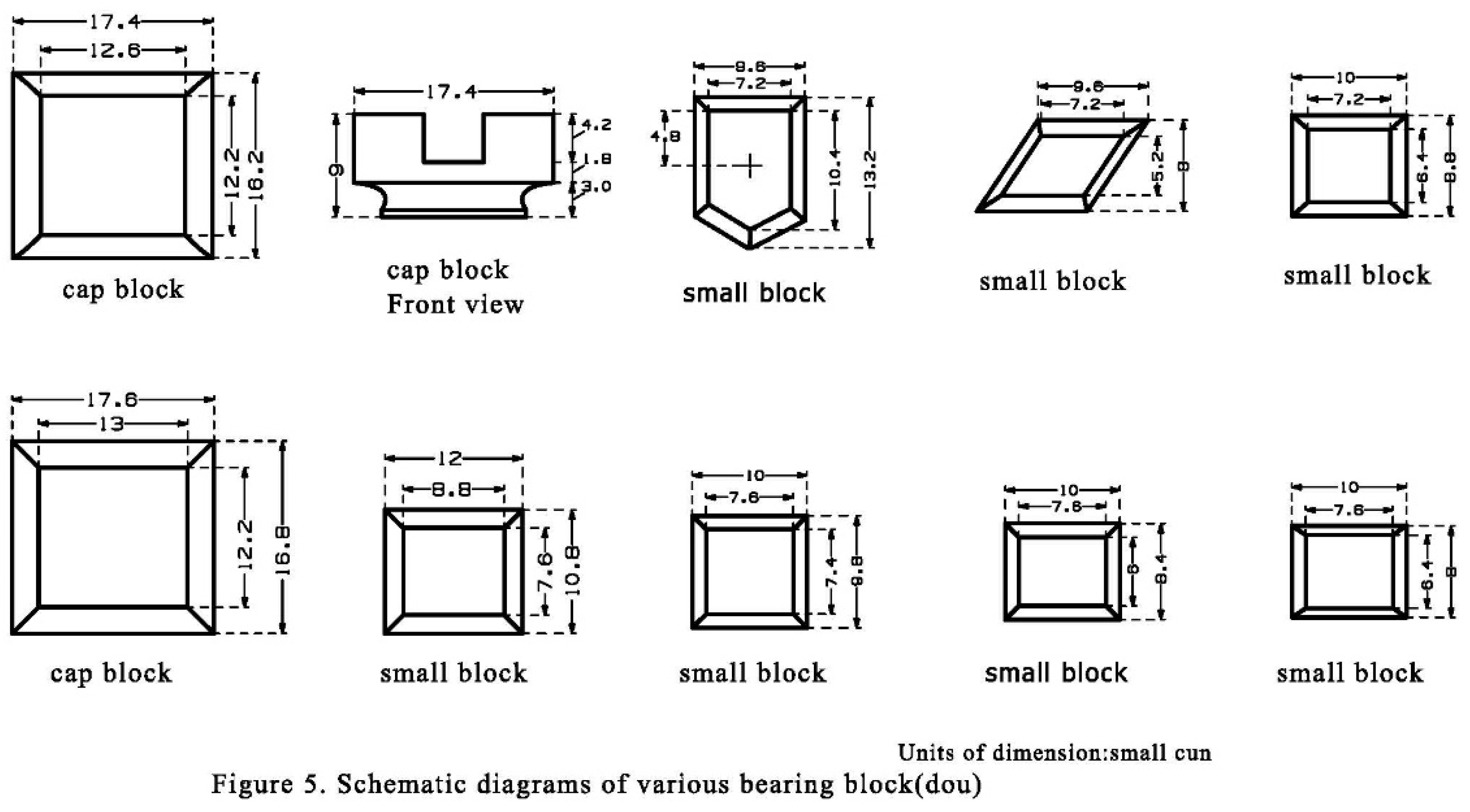
Table 4. By comparison, it can be seen that each part of the dou can also be measured in two ways: small cun and fen. The size of the dou also varies slightly according to its position. Macroscopically, it can be classified into two categories: large and small.As shown in
Figure 5.
Although there are differences between the cap block(ludou) on the outer eaves and those on the hypostyle columns,their dimensions are close and their shapes are relatively large, Fall into a large category.The widths at the upper part of the intersecting dou, diagonal dou, and scattered dou are quite close, about 25 fen. Since they are similar in size, they are classified into the same category.
Overall, the sizes of the dou are not uniform. This lack of uniformity may be due to precision errors, but the differences are clearly noticeable. The dou does not have fixed proportions and specifications; essentially, it varies according to the material and the requirements of the structure.
Figure 5.
Schematic diagrams of various bearing block(dou).
Figure 5.
Schematic diagrams of various bearing block(dou).
Table 4.
bracket set(Dou).
Table 4.
bracket set(Dou).
4.3. Length of the Out-Jump, Xin Chang (The Center - to - Center Distance of the Assembly Joints), and Length of Thebracketarm (Gong).
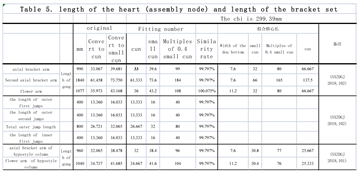
The length of the gong minus the bottom length of the small dou (bearing block) gives the length of the gong's center part(xin chang). The data are listed in
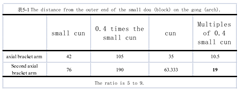
Table 5, measured in chi, and converted into small cun and fen, and then fitted as shown in
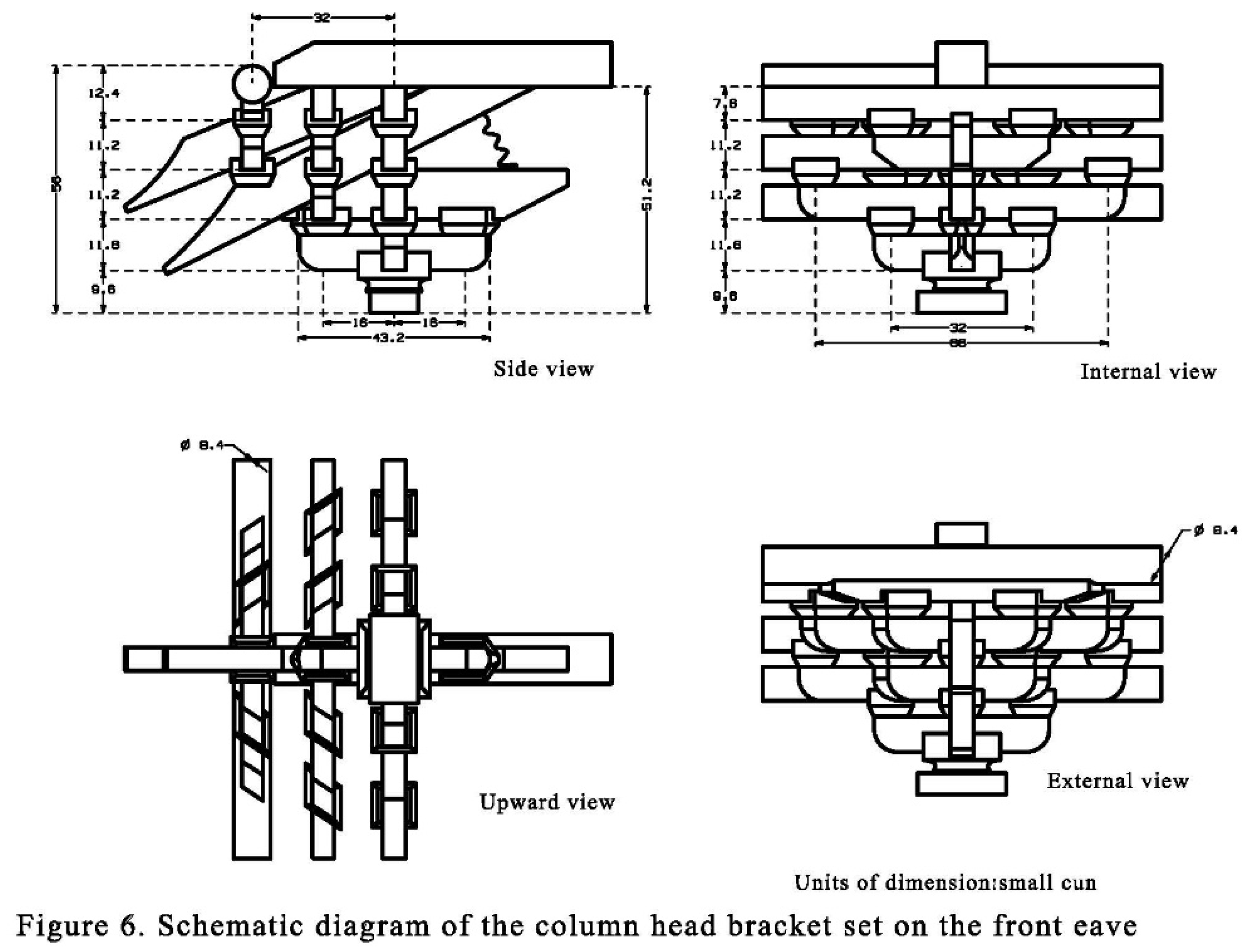
Figure 6 and
Figure 7.
For the bracket set on columns, the length of both the inner and outer first jumps is 16 small cun, and the length of the second jump is also 16 small cun. The total length of the outer jumps is 32 small cun, which is equivalent to 80 fen.
The length of the center part(xin chang) of the nidao-gong (axial bracket arm) in the exterior eave bracketing is 32 small cun, which is the same as the length of the center part of the first-layer hua gong.
The length of the xin chang of the nidaomang-gong(The second-layer axial bracket arm) in the exterior eave bracketed construction is 66 small cun, which is equivalent to 165 fen. This gong is the longest horizontally. Although it is incised(yin ke), it is related to the spacing between the bracket set (puzuo) and is a major parameter.
As shown in Tables 5-1 and 5, the width of the nidaomang-gong, which represents the width of the bracket set, is set according to the distance between the outer ends of the two small dou on it. The distance between the outer ends of the two dou of the nidaomang-gong is 76 small cun, which is exactly 19 times 4 small cun. This is set using the modular unit of 4 small cun. As for the other gongs in
Table 5, they are all multiples of 0.4 small cun but rarely multiples of 4 small cun. This is because the construction of the bracket sets needs to take into account structural relationships and proportional relationships, so it cannot be set as multiples of 4 small cun.
4.4. The Height of the Exterior Eave Bracket Set(Puzuo)
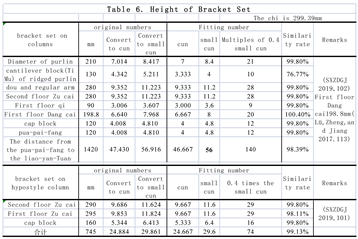
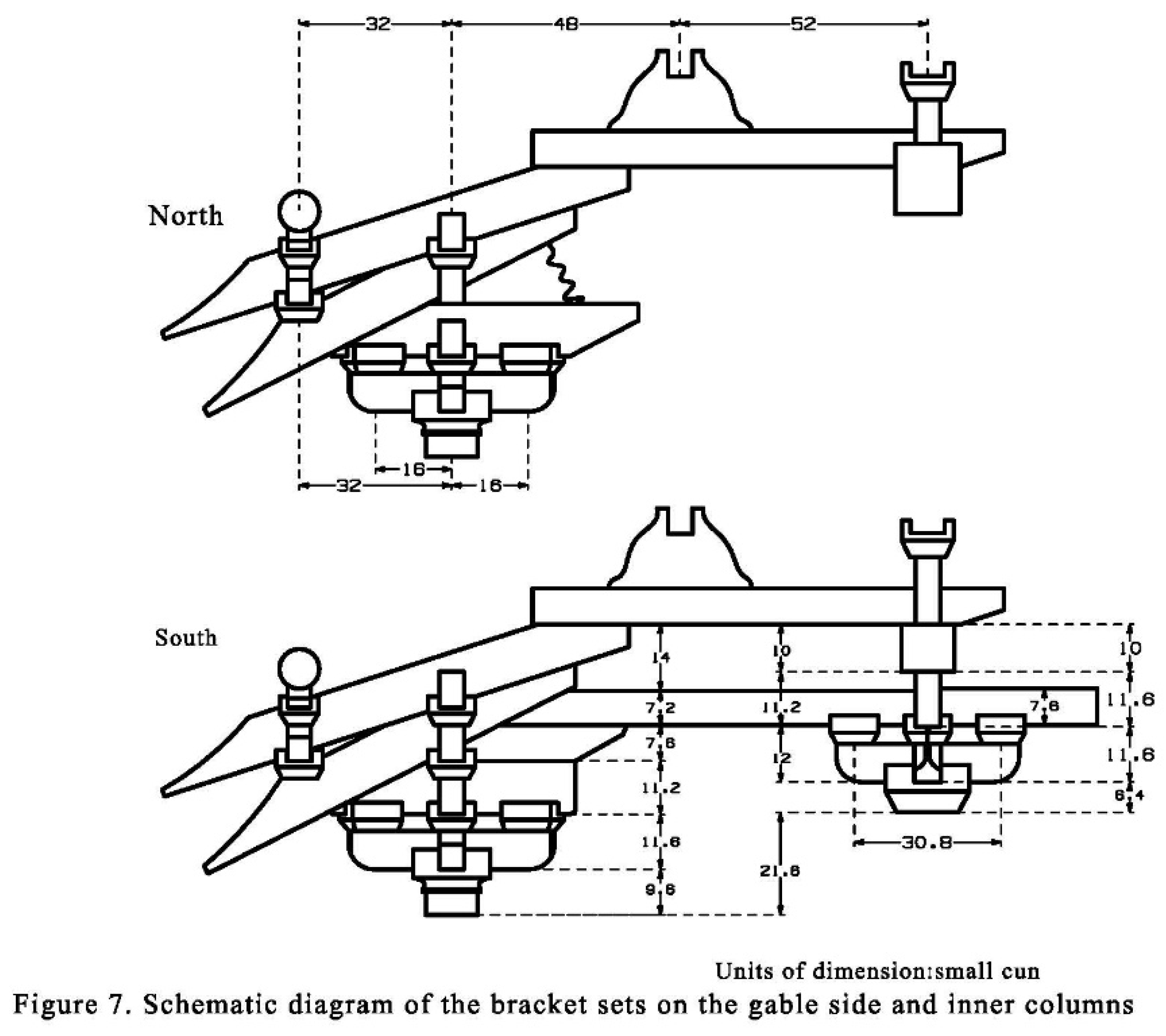
As shown in
Table 6 and
Figure 4,
Figure 5,
Figure 6 and
Figure 7, the sizes of the various levels of timbers are clearly defined. The distance from the pua-pai-fang to the liao-yan-tuan(eave purlin) is 56 small cun, which is a multiple of 4 small cun.
Table 6.
Height of Bracket Set.
Table 6.
Height of Bracket Set.
Figure 6.
Schematic diagram of the column head bracket set on the front eave.
Figure 6.
Schematic diagram of the column head bracket set on the front eave.
Figure 7.
Schematic diagram of the bracket sets on the gable side and inner columns.
Figure 7.
Schematic diagram of the bracket sets on the gable side and inner columns.
4.5. Arrangement of Bracket Set Parameters and Distances
The main parameters of the bracket set are as follows: the Length of the out-jump is 32 small cun. the width, measured from the outer ends of the two small dou on the gong , is 76 small cun.The height of the bracket set is 56 small cun. For large-scale timber framing, the bracket set is a distinctive feature, and the bay width is the key to the structure. The bay width, the length of the xin chang of the nidaomang-gong(The second-layer axial bracket arm),and the length of the out-jump of the bracket set are a set of related data.
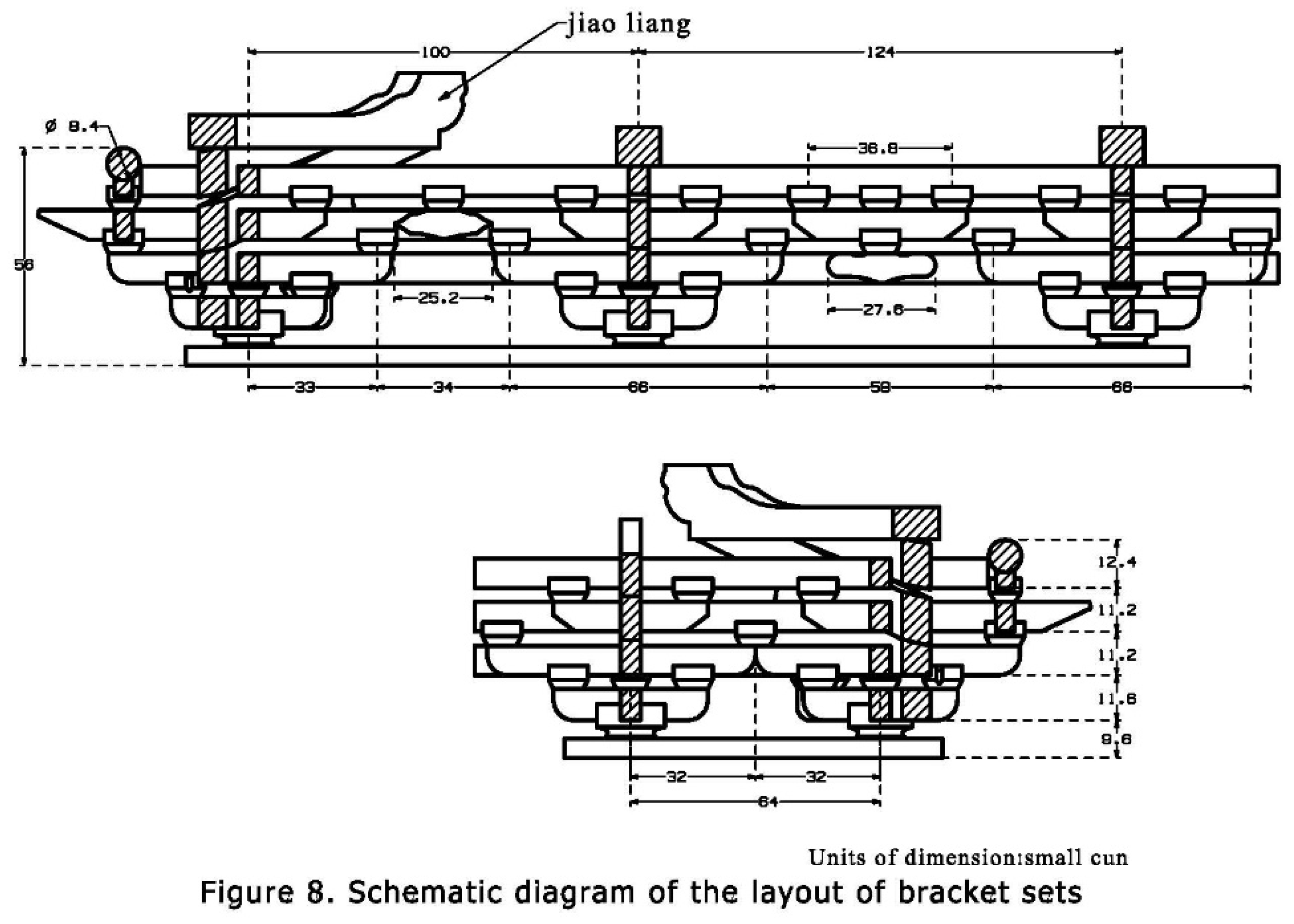
There are three types of bay widths in this hall: 124 small cun, 100 small cun, and 64 small cun. The lengths of the gongs are shown in
Table 5, and their arrangements are illustrated in
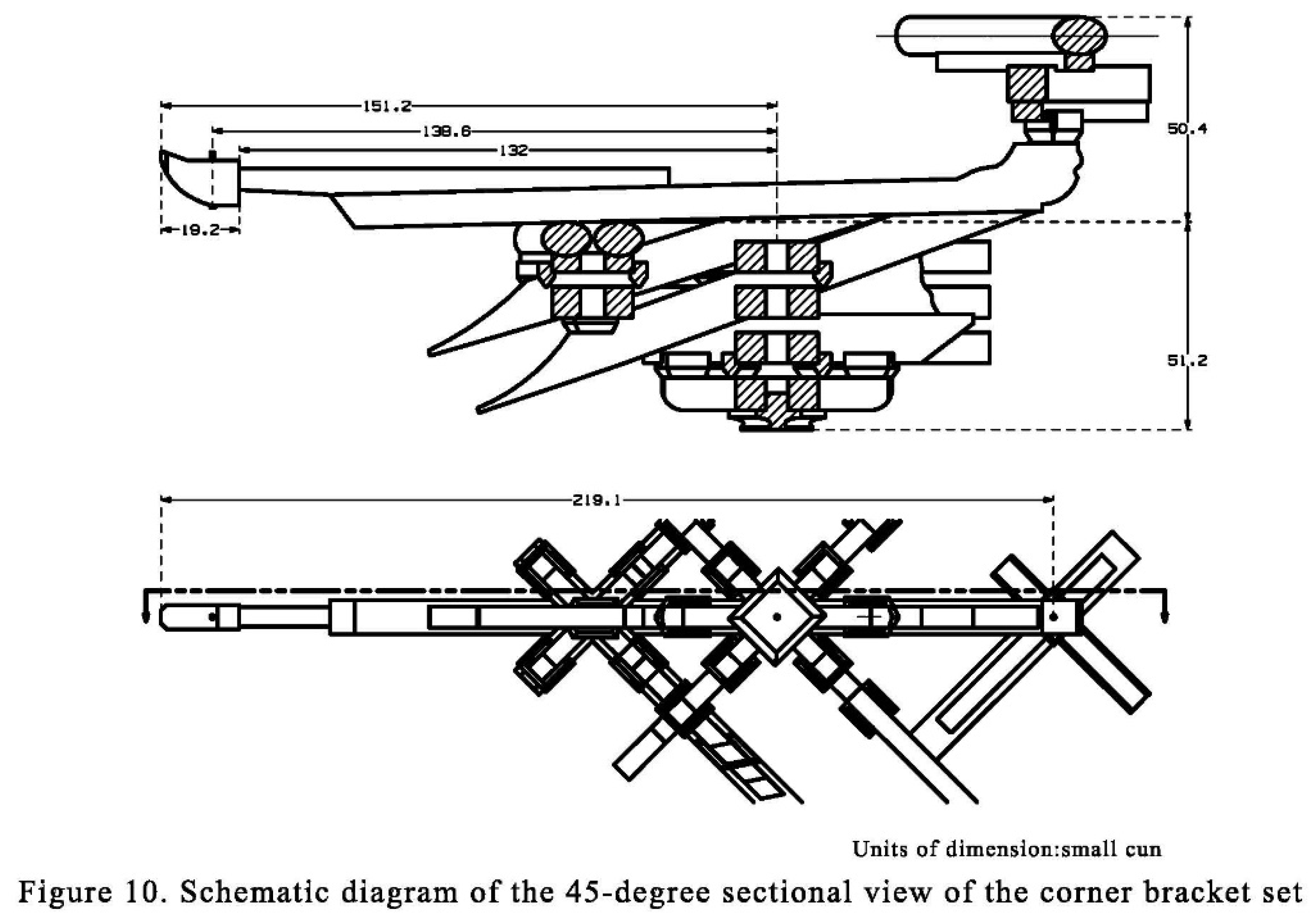
Figure 8,
Figure 9 and
Figure 10. This layout is logical and practical. The underlying design concept is to prioritize ensuring the large framework and large dimensions, while small components are adjusted according to the structure and requirements. It is not the case that the width of the bracket set is specified first, and then the distance between the bracket sets and the bay width are coordinated.
Table 5.
length of the heart (assembly node) and length of the bracket set .
Table 5.
length of the heart (assembly node) and length of the bracket set .
Figure 8.
Schematic diagram of the layout of bracket sets.
Figure 8.
Schematic diagram of the layout of bracket sets.
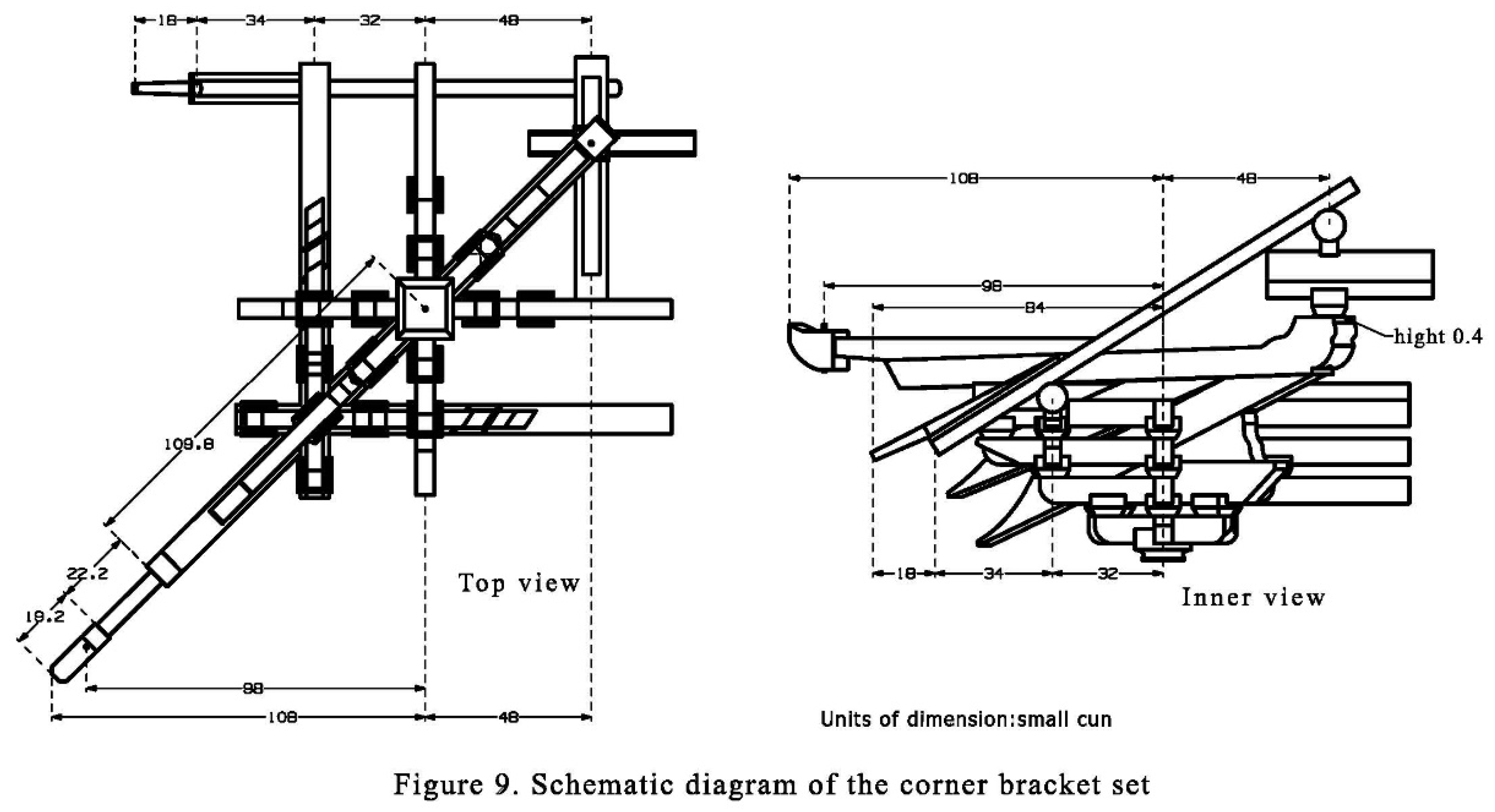
Figure 9.
Schematic diagram of the corner bracket set.
Figure 9.
Schematic diagram of the corner bracket set.
Figure 10.
Schematic diagram of the 45-degree sectional view of the corner bracket set.
Figure 10.
Schematic diagram of the 45-degree sectional view of the corner bracket set.
5. Beam Frame(shang jia)
5.1. Adjustment of the Jia Dao(Horizontal Spacing Between Purlins)
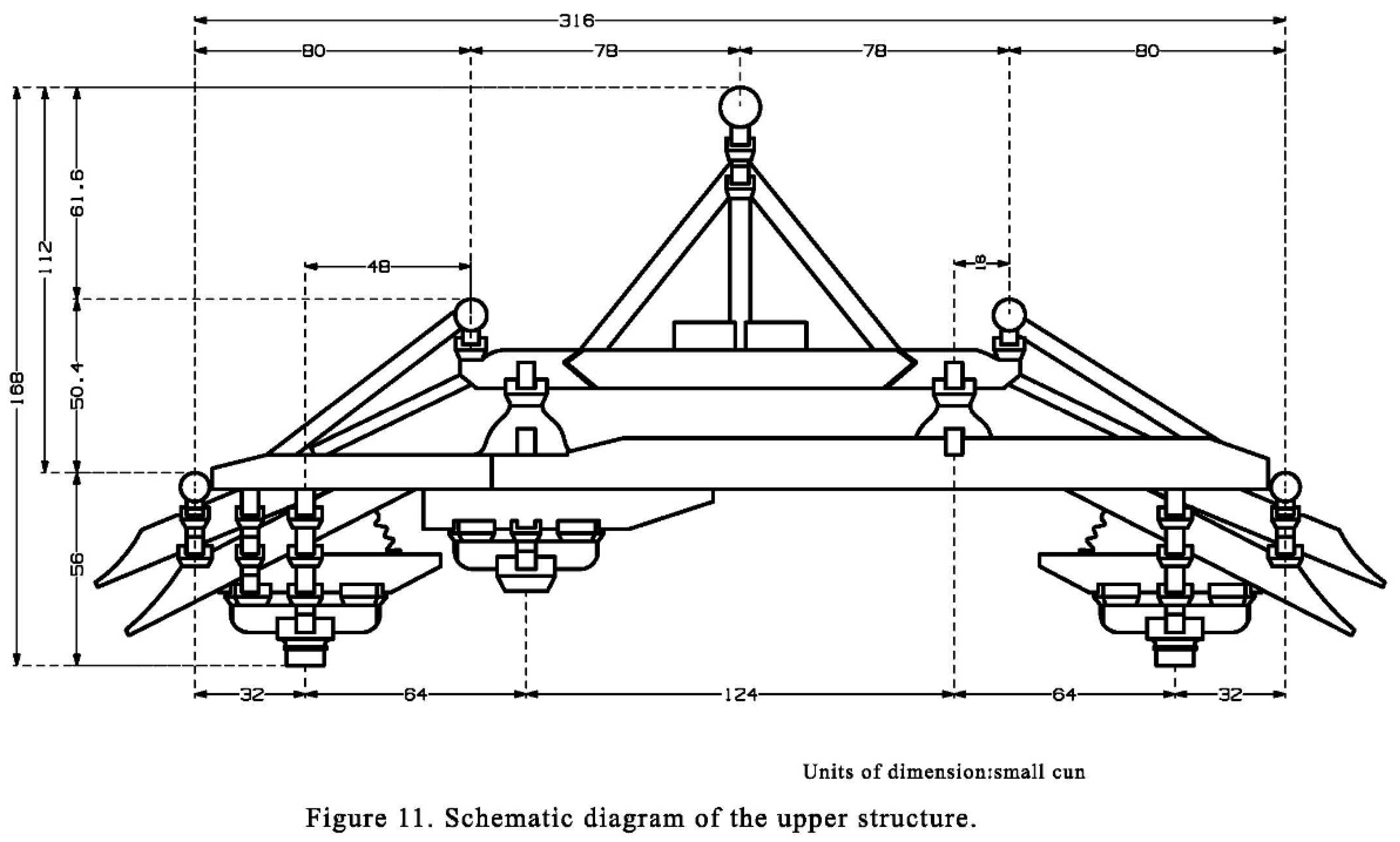
As shown in
Figure 11.A prominent feature of this hall is that the horizontal beams (3-purlin beam) cantilever and jump outwards. and the intermediate purlin is not aligned with the gable column.This technique is similar to that of Nanchan Temple. The difference is that in Nanchan Temple, the horizontal beam (3-purlin beam) does not project outward; instead, the position of the camel-hump shaped support (tuofeng) is adjusted.This adjustment is made to make the jia dao uniform.
Figure 11.
Schematic diagram of the upper structure.
Figure 11.
Schematic diagram of the upper structure.
5.2. Raising the Purlin(Ju Zhe)
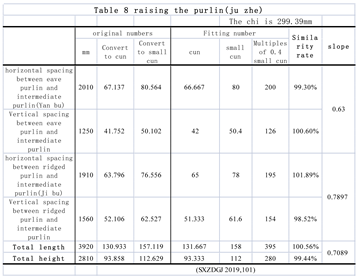
As shown in
Table 8 and
Figure 3,
Figure 4 and
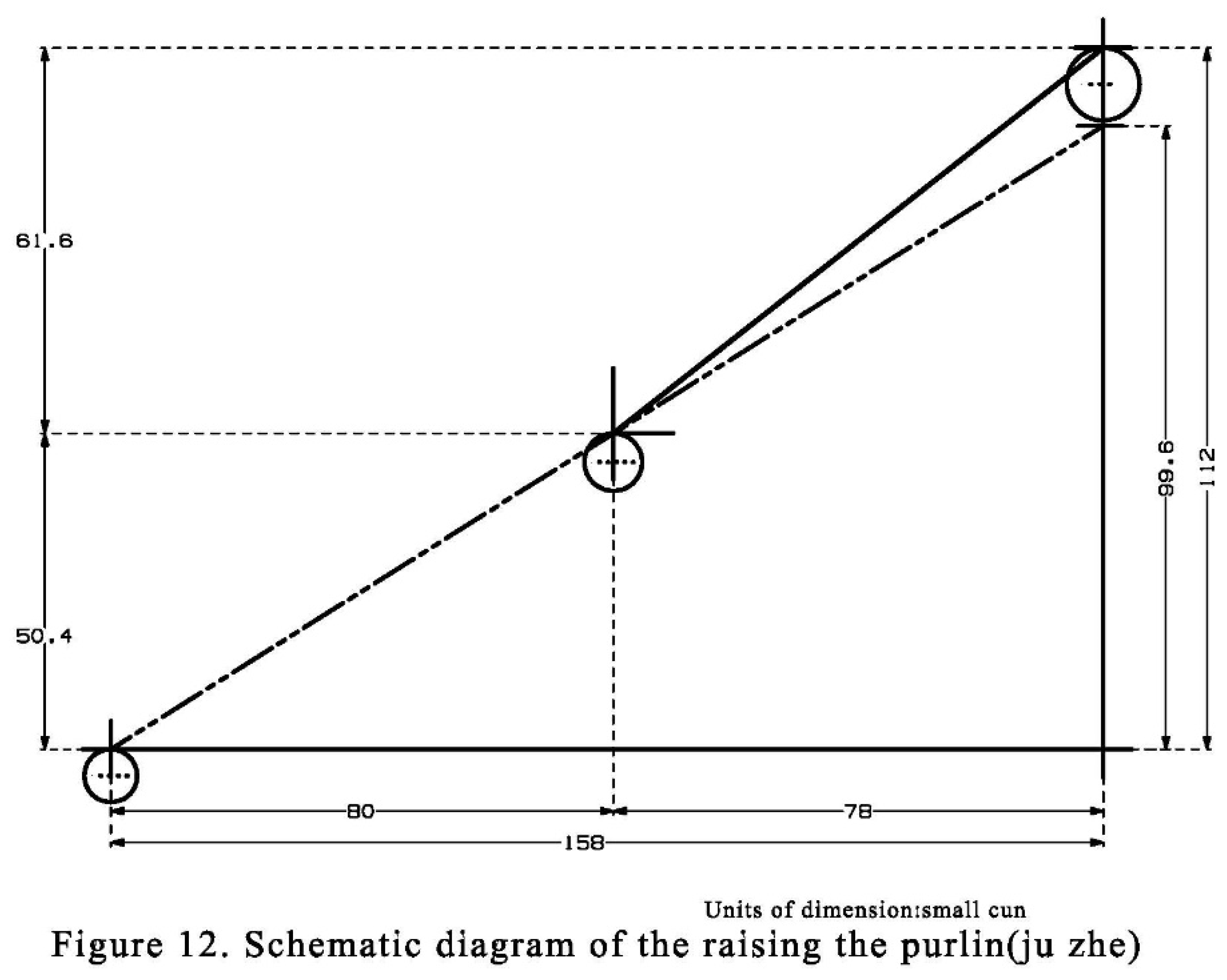
Figure 12.The total lift is 112 small cun. Taking 8/9 of the total lift and connecting it to the upper surface of the eaves purlin, the lift height of the intermediate purlin can be known as 50.4 small cun. The essence of this algorithm is proportional distribution.
Table 8.
raising the purlin(ju zhe).
Table 8.
raising the purlin(ju zhe).
5.3. side Beam Frame(Xitou Fu)
the Xitou fu is associated with the 3-purlin beam and the hip rafer(jiao liang)。As shown in
Figure 3,
Figure 4,
Figure 9 and
Figure 10. As listed in
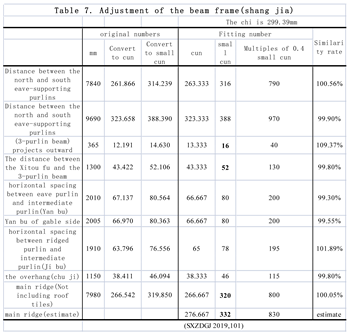
Table 7.Based on the original data, the fitted distance between the Xitou fu and the 3-purlin beam is 52 small cun.The principal ridge is based on two Xitou fu,The distance between the left and right Xitou fu is 228 small cun.The ratio of this number to the overall width of the Damuzuo is 19:27.
6. Parameters of Building Appearance
Eave rafter, flying rafters, small corner beams(zi jiao liang), animal-shaped ornaments on the eaves corners(Tao shou), chiwen (ornamental ridge-end tiles), tile, etc. are located at the outermost part of the building. Exposed to the wind and rain, they are extremely vulnerable to damage and were very likely to be repaired or replaced throughout history. SXZDGJ(2019,24) speculates that the two chiwen should be relics from the Ming Dynasty, while the drawings reflect the current state since modern times and may not necessarily be the original components from the initial construction. However, there must be a basis for every repair of these components. When replacing old ones, craftsmen would always find a similar-sized substitute. Even if it was simply sawed short, it was an adaptation to local conditions, embodying the restoration methods of different periods and under various circumstances. These components represent the appearance of the building, are the image presented to the public, and are the key parameters in design and construction. It would be a pity not to explore these parameters. Fortunately, ancient Chinese buildings are exquisitely shaped, and the ancients must have paid attention to proportional and structural relationships. Taking the current state as a reference, this article will analyze and discuss from the aspects of proportion and integral dimensions, so as to fathom the thinking of the ancients.
6.1. Parameters of Building Appearance
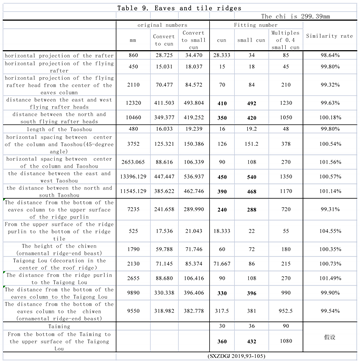
As shown in
Table 9 and
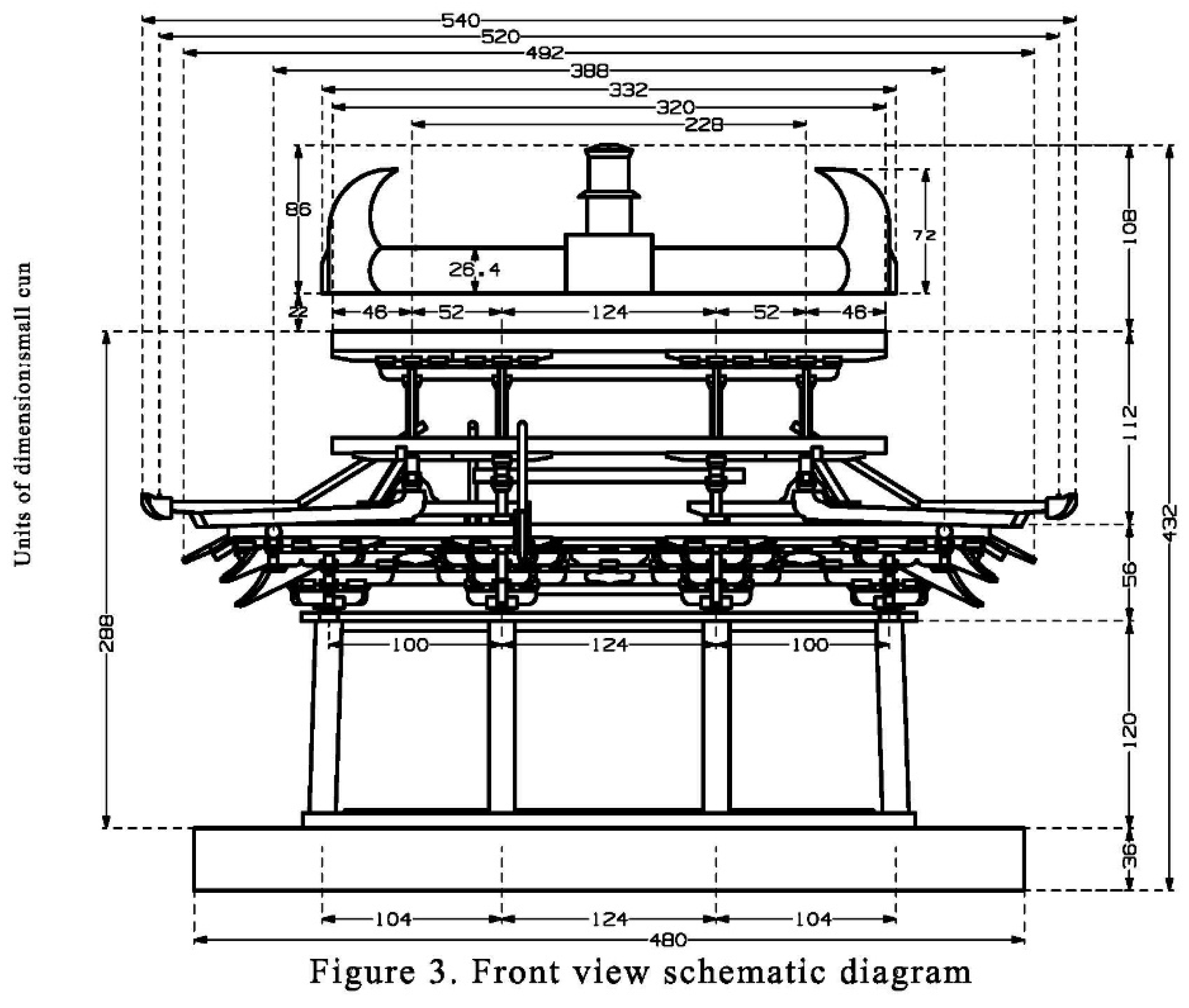
Figure 9, the rafter cantilevers 34 small cun, the flying rafter cantilevers 18 small cun, the bracket set cantilevers 32 small cun, and the head of the flying rafter cantilevers 84 small cun from the center of the eaves column, which is exactly 7 chi. As shown in
Figure 3 and
Figure 4, the distance between the east and west flying rafter heads is 492 small cun, equivalent to 41 chi. The distance between the north and south flying rafter heads is 420 small cun, equivalent to 35 chi.
Table 9.
Eaves and tile ridges.
Table 9.
Eaves and tile ridges.
6.2. Animal-Shaped Ornaments on the Eaves Corners(Tao Shou)
As shown in
Table 9 and
Figure 9, the horizontal length from the center of the column to the front and side of the taoshou is 108 small cun, which is equal to 9 chi. The dimensions of the building's four boundaries are crucial parameters, as they are related to the floor area occupied by a single building, the planning and layout of the temple, and may also involve land donations, grants, or transactions. Therefore, designers must prioritize these data. As shown in Figures 3,4, and 12, and
Table 9, the distance between the east and west Tao shou is 540 small cun, equivalent to 45 chi, and the distance between the north and south ones is 468 small cun, equivalent to 39 chi. These are the four boundaries of the building.
6.3. Overhanging Eaves(chu ji) and Main Ridge
As shown in
Table 7, the overhang eaves(chu ji), which measures 1150 millimeters, is converted to 46 small cun. Excluding the tile, taking the outer surface of the gable fascia board as the boundary, the length of the main ridge (between the overhangs) is 320 small cun. When including the tile components, the estimated length of the main ridge is 332 small cun. As shown in
Figure 3, the distance between the east and west taoshou (animal-shaped ornaments at the eaves) is 540 small inches. The ratio of the length of the main ridge to this distance is 0.61111, which meets the golden ratio.
Table 7.
Adjustment of the beam frame(shang jia).
Table 7.
Adjustment of the beam frame(shang jia).
Figure 3.
Front view schematic diagram.
Figure 3.
Front view schematic diagram.
6.4. Height
As shown in
Table 9,
Figure 3 and
Figure 4. The distance from the bottom of the eaves column to the upper surface of the ridge purlin is 288 small cun, and the distance from the upper surface of the ridge purlin to the upper surface of the Taigonglou(The decorative tile pieces in the middle of the roof ridge) is 108 small cun. The overall height, including the terrace, is 432 small cun, which is equivalent to 36 chi.
The sum of the column and the bracket set is 176 small cun. The height from the bottom of the column to the upper surface of the ridge purlin is 288 small cun. The ratio between the two is 0.611111, which conforms to the golden ratio. The height from the base of the hall to the upper surface of the eaves purlin is 212 small cun, and the total height is 432 small cun. The ratio between the two is 0.49074, close to 1:2.
7. Architectural Modulus
Review
Table 1,
Table 2,
Table 3,
Table 4,
Table 5,
Table 6,
Table 7,
Table 8,
Table 9 and
Table 10 and
Figure 1,
Figure 2,
Figure 3,
Figure 4,
Figure 5,
Figure 6,
Figure 7,
Figure 8,
Figure 9,
Figure 10,
Figure 11 and
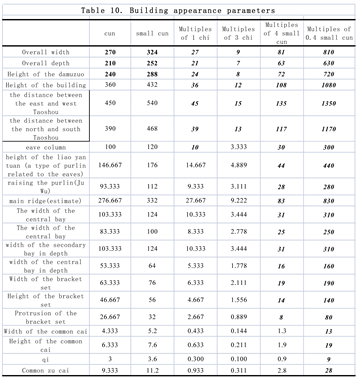
Figure 12. The measurement units used for this hall include cun, small cun, and 0.4 small cun. The Building module exists in modern architecture(MOHURD 2013). It may be advisable to sort things out with modern concepts.
The main external shape of this hall can be constrained by integer chi, with the basic module being 1 chi.
For the Damuzuo, the ratio of width, depth, and height is 270:210:240, which simplifies to 9:7:8. The common divisor is 30 cun, which is equivalent to 36 small cun The width of the building is 450 cun, the depth is 390 cun, and the overall height is 360 cun. These dimensions also form simple ratios, with a common divisor of 30 cun. Here, 30 cun is three times the basic module of 1 chi, and this serves as an multi-module for the main frame and the exterior.
The widths of each bay, the length of the main ridge, the horizontal lengths of the purlin intervals, the height of the eaves columns, the height and width parameters of the bracket sets, and the total pitch of the roof can all be expressed as integral multiples of 4 small cun. Since 4 small cun is one-third of 1 chi, 4 small cun is a sub-module of the basic module of 1 chi.
For components such as cai, dou, gong, and bracket sets, the unit of measurement is 0.4 small cun, which is one thirtieth of the basic module. This is also a sub-module.
Figure 12.
Schematic diagram of the raising the purlin(ju zhe).
Figure 12.
Schematic diagram of the raising the purlin(ju zhe).
Table 10.
Building appearance parameters.
Table 10.
Building appearance parameters.
8. Summary
the original construction rule is calculated to be29.939centimetres long.It conforms to the long and short ruler system since the Tang and Song dynasties,Each Ruler length is 10 cun[寸], which is 12 small cun.
the construction module was used. The basic modulus is 1 chi. 4 small cun is the infra module, which is 1/3 of the basic modulus. 0.4 small cun is also a infra module, which is 1/30 of the basic modulus. 30 cun is the multi-module, which is three times the basic modulus of 1 chi. This module is very similar to modern building modules.
The architecture follows proportional relationships under the constraint of integer dimensions. The ratio between the length of the main ridge and the distance to the east and west ornamental beast heads (taoshou) is approximately the golden ratio. The height from the bottom of the columns to the upper surface of the liao yan bo is 176 small cun, and the overall height of the large wooden structure is 288 small cun. The ratio between the two is 0.6111, very close to the golden ratio.
References
- Lu,Jx,.and Gm,Qiu. 2001. History of Science and Technology in China.Vol.of Metrology. Beijing: Science Press.
- Lü,Z,.Y,Zheng .and Z,Jiang.2017. Investigation and Research Report on the Small Wooden Tent Niche of Jincheng Erxian Temple. Beijing: Science Press.
- MOHURD(Ministry of Housing and Urban-Rural Development of the People's Republic of China).2013. GB/T 50002 – 2013, Standard for modular coordination of building.
- Pan,G,.and Jz,He.2017. Interpretation of Yingzao Fashi.2rd ed.Nanjing: Southeast University Press.
- SXZDGJ(Shanxi Zhongde Ancient Architecture Planning and Design Institute Co., Ltd).2019. Completion Report of the Renovation Project of Erxian Temple in Jincheng. Taiyuan. Beiyue Literature and Art Publishing House.
|
Disclaimer/Publisher’s Note: The statements, opinions and data contained in all publications are solely those of the individual author(s) and contributor(s) and not of MDPI and/or the editor(s). MDPI and/or the editor(s) disclaim responsibility for any injury to people or property resulting from any ideas, methods, instructions or products referred to in the content. |
© 2025 by the authors. Licensee MDPI, Basel, Switzerland. This article is an open access article distributed under the terms and conditions of the Creative Commons Attribution (CC BY) license (http://creativecommons.org/licenses/by/4.0/).