Preprint
Article

This version is not peer-reviewed.

Precision Elimination: Proof-of-Concept In Silico Testing of a Novel Construct for Optimizing HIV-1 Eradication

Submitted:

28 March 2025

Posted:

28 March 2025

You are already at the latest version

Abstract

Background/Objectives: Human immunodeficiency virus type 1 (HIV-1) persists in individuals on combination antiretroviral therapy (cART) due to the existence of latent reservoirs that evade immune detection. Although shock-and-kill strategies utilizing latency-reversing agents (LRAs) aim to reactivate and eliminate these reservoirs, their effectiveness is limited by cART's lack of cytotoxicity, which means LRA treatments fail to eliminate the infected cell population. As a result, treatment cessation results in rapid viral rebound. This study introduces and evaluates a novel HIV-1 LTR-driven therapeutic construct that reactivates latent HIV-1 cells and directly eliminates both latent and active infected cells, independent of immune clearance. Methods: We employed a dual computational modeling approach to assess the efficacy of the HIV-1 LTR-driven therapeutic construct. A system of SBML-based ODE models was used to analyze population-level trends in viral suppression and reservoir reduction over time. Additionally, ABMs implemented in NetLogo provided insights into spatial and stochastic interactions between infected cells and therapeutic agents. Both models compared the novel construct to conventional cART and LRA-based shock-and-kill strategies by tracking changes in both detectable and total active, reactivated, and latent HIV-1 reservoirs. Results: The novel treatment monotherapy reduced the HIV-1 population by 96.26% (p < 0.0001), with a cytotoxic efficacy of 99.27% (p < 0.0001). This resulted in a 93.17% greater reduction in the viral reservoir compared to the cART-LRA polytherapy. Sensitivity analyses highlighted the role of key kinetic parameters in treatment efficacy. Variations in k₃ and kLRA in the novel treatment model showed a consistent reduction in the viral reservoir, with higher values leading to greater efficacy. ABM results demonstrated that in the experimental group, treatment resulted in a 1.39% increase in healthy CD4+ T cells, a 12.00% reduction in latent HIV-1 cells, and a statistically significant decline in active HIV-1 cells. Conclusions: This study demonstrates that the novel HIV-1 LTR-driven therapeutic construct significantly improves upon current shock-and-kill strategies by directly eliminating both latent and active HIV-1-infected cells with high cytotoxic efficacy. By utilizing the diphtheria toxin A (DTA) suicide gene, this construct overcomes the limitations of cART and LRA polytherapies, which fail to eradicate infected cells, rather depending on suppression. Computational modeling results show that the construct substantially reduces both detectable and total viral reservoirs, providing a promising adjunct to existing HIV-1 treatment strategies. These findings serve as a foundation for future in vitro and in vivo research and contribute to the development of a functional cure for HIV-1.

Keywords: 
;  ;  ;  ;  ;  

1. Introduction

The human immunodeficiency virus type 1 (HIV-1) is a lentivirus that primarily infects CD4+ T- T-lymphocytes, leading to progressive immune system deterioration and, if left untreated, the onset of acquired immunodeficiency syndrome (AIDs). In 2023, approximately 1.3 million people contracted HIV, and 630,000 deaths were attributed to HIV-related complications [1].
Combination antiretroviral therapy (cART) is considered the standard for HIV treatment, working to suppress viral replication of infected cells, thereby preventing the virus from replicating and infecting adjacent cells. cART is composed of 6 primary drug classes, each of which targets a phase of the HIV-1 life cycle in active HIV-1 cells [2,3]. cART has been shown to be extremely effective in reducing the detectable viral reservoir, as measured by the number of virion-producing cells. However, it is important to recognize that while cART is highly effective in reducing viremia, it has no cytotoxic impact on the cells it affects. Therefore, while cART can severely diminish the number of detectable cells, the actual active cell population remains stable and remains viable (even if they are undetectable), capable of rekindling infection or seeding new reservoirs upon treatment cessation [4,5,6,7,8,9,10,11,12].
This phenomenon is corroborated by several recent studies which propose that during antiretroviral therapies, non-quiescent cells retain the capacity for replication within certain “sanctuary sites” in lymphoid tissues, thus sustaining the presence of the viral reservoir [13,14]. Lorenzo-Redondo et al. (2016) provided evidence that HIV-1 can continue to replicate in such tissues even when potent cART is being implemented. Through longitudinal analysis of peripheral blood and lymph node samples from patients over a six-month period, they posit that viral rebound detected in blood may arise not from the stochastic reactivation of latent cells, but from ongoing replication within these sanctuary sites [12].
Moreover, cART is unable to achieve complete viral eradication of HIV-1 from infected individuals due to the persistence of quiescent reservoirs. Latency is maintained when HIV-1 integrates itself into the host’s genome but does not produce virions, hampering the ability of cART treatments to detect and attack it, therefore necessitating lifelong cART treatment to maintain viral suppression. Then, at any given moment, the latent reservoir can reactivate and proliferate throughout the body [15,16]. Since cART is only able to prevent viral replication and the spread of HIV-1 when the virus is active, latency is the downfall of such treatments and the primary focus of contemporary HIV-1 research [2].
To address the challenge of persistent HIV-1 reservoirs, researchers have developed “shock-and-kill” treatments, which aim to induce viral reactivation, thereby exposing latently infected cells to immune clearance and antiretroviral-mediated suppression. These approaches rely on latency-reversing agents (LRAs) to disrupt viral latency, followed by cART and immune-mediated cytotoxicity to eliminate reactivated cells [15,17]. Despite their promise, LRAs remain a developing field and have shown relatively low efficacy in reactivating latent HIV-1 [18]. Although recent breakthroughs in chromatin-modulating drugs, such as histone deacetylase inhibitors (HDACis), have improved LRA potency, their effectiveness in clearing reservoirs remains limited, with most treatments showing little to no reduction in the viral reservoir following LRA treatment [19]. Even when LRAs successfully induce reactivation, cART is still incapable of eliminating the reactivated cells. Instead, it merely suppresses new virion production, preventing further infection but leaving both active and reactivated cells intact and capable of reseeding reservoirs [7,8,9,10,12,13,14].
These challenges underscore that while LRAs are becoming increasingly effective at reactivating latent HIV-1, their practical ability to eliminate active and reactivated cells remains minimal due to the lack of cytotoxicity from cART. Consequently, there is a growing demand for treatments capable of directly killing both active and reactivated HIV-1 cells with high cytotoxic efficacy, addressing the fundamental limitations of current LRA and cART-based approaches [20,21]. The research that has been done on directly eliminating active and reactivated HIV-1 cells largely focuses on CRISPR-mediated strategies [22,23,24]. One widely cited study utilizes a CRISPR activation (CRISPRa) mediated shock-and-kill approach to eliminate reactivated HIV- 1 cells. In this approach, CRISPRa targets the HIV-1 long terminal repeat (HIV-1 LTR) promoter, inducing latent HIV-1 transcription and upregulating the expression of Tat and Rev, two viral regulatory proteins. Tat then binds to the HIV-1 LTR, further amplifying transcription, while Rev facilitates the nuclear export of viral mRNA. This dual activation triggers the expression of a tBid suicide gene, leading to the apoptosis of reactivated cells [23]. While this study exemplifies the commonly presented CRISPR-mediated shock-and-kill approaches, they also come with a number of challenges, such as immunogenicity, delivery, and high mutation rates [25,26,27,28]. Therefore, although such CRISPR-mediated strategies have shown potential in targeting latent HIV-1, further research is needed to assess their feasibility, safety, and effectiveness in clinical settings.
Given these challenges concerning latent HIV-1 clearance and room to grow in the field of shock-and-kill treatment methods, this study aims to introduce and evaluate the effectiveness of a novel HIV-1 LTR-driven therapeutic construct capable of directly reactivating latent cells and then eliminating these reactivated cells, as well as directly eliminating active HIV-1 cells, without reliance on immune clearance. This marker system uses the HIV-1 LTR promoter to drive the expression of the diphtheria toxin A (DTA) suicide gene. Upon reactivation, LTR transcription triggers DTA expression, which inhibits protein synthesis and induces apoptosis in infected cells. Unlike cART, which only suppresses viral replication, this system actively kills HIV-1-infected cells with supreme cytotoxicity, offering a more direct and effective approach to reducing the infected cell population. Through computational simulations validated with experimental data, we assess its impact on viral reservoir depletion, active HIV-1 suppression, and CD4+ T-cell restoration. Our findings indicate that the novel construct, particularly in combination with cART, significantly reduces latent and active HIV-1 populations while improving immune function. These results highlight its potential as a promising adjunct to existing shock-and-kill strategies, addressing key limitations in current HIV-1 eradication efforts.

2. Results

2.1. Treatment Effectiveness Analysis

2.1.1. cART and LRA Combination Therapy Model

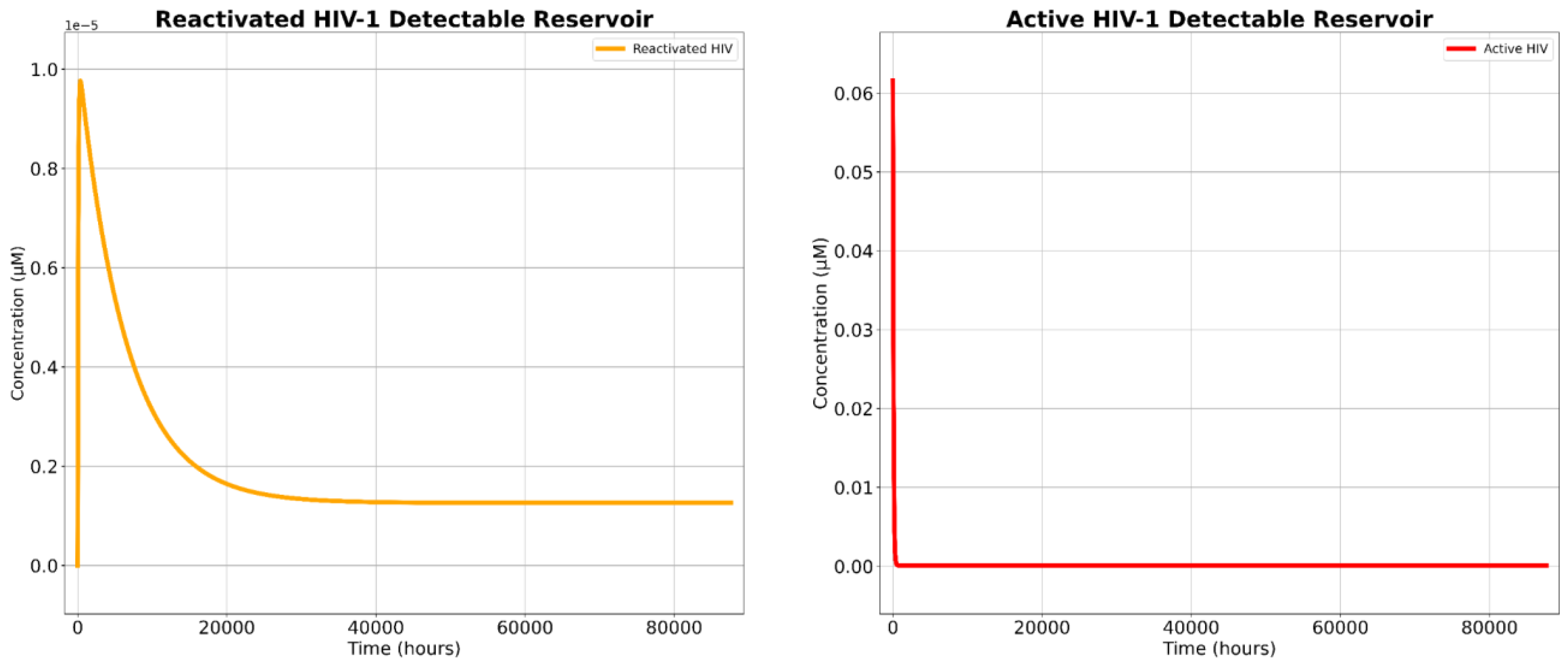
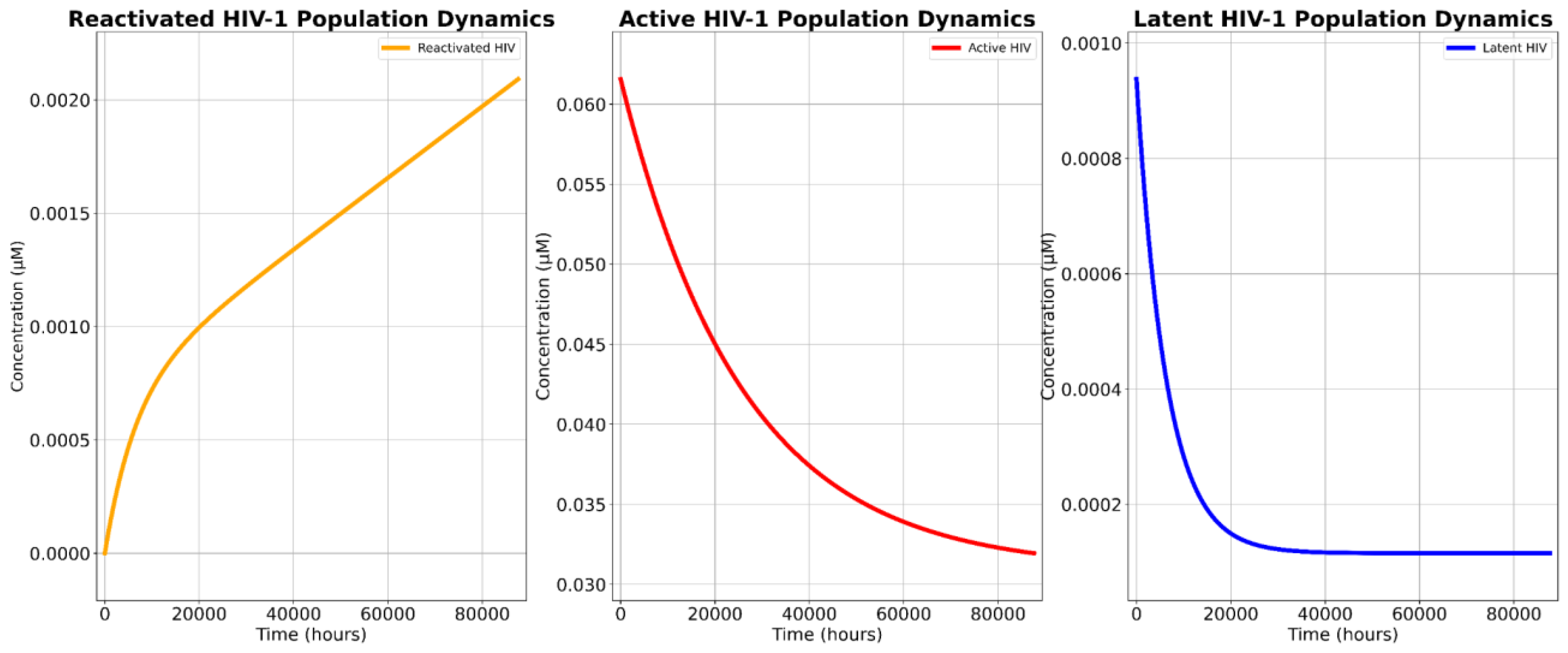
In this model, a latency-reversing agent (LRA) was introduced alongside cART to evaluate its impact on reducing both the detectable HIV-1 reservoir and the true HIV-1 population. Table 1 details the results displayed by this combination therapy in reducing both HIV-1’s reservoir populations and in reducing HIV-1 detectable virus levels. The polytherapy’s effectiveness in reducing the detectable viral reservoir was calculated to be 99.66% ( p < 0.0001). Its effectiveness in reducing the viral reservoir’s population was calculated to be 44.72% ( p < 0.0001).
Table 1. cART and LRA Combination Therapy SBML Simulation Results.
Category Detectable Virus (µM) p-value (Detectable) Viral Reservoir Population (µM) p-value (Population)
Final Latent HIV Cells N/A N/A 0.00011509 <0.0001*
Final Active HIV Cells 0.00009566 <0.0001* 0.03194142 <0.0001*
Final Reactivated HIV Cells 0.00000126 <0.0001* 0.00209120 <0.0001*
* Indicates statistical significance.
Figure 1. cART and LRA Combination Therapy Impact on Detectable HIV-1 Reservoirs.
Preprints 153918 g001
Figure 2. cART and LRA Combination Therapy Impacts on HIV-1 Reservoir Populations.
Preprints 153918 g002

2.1.3. Novel Treatment Monotherapy Model

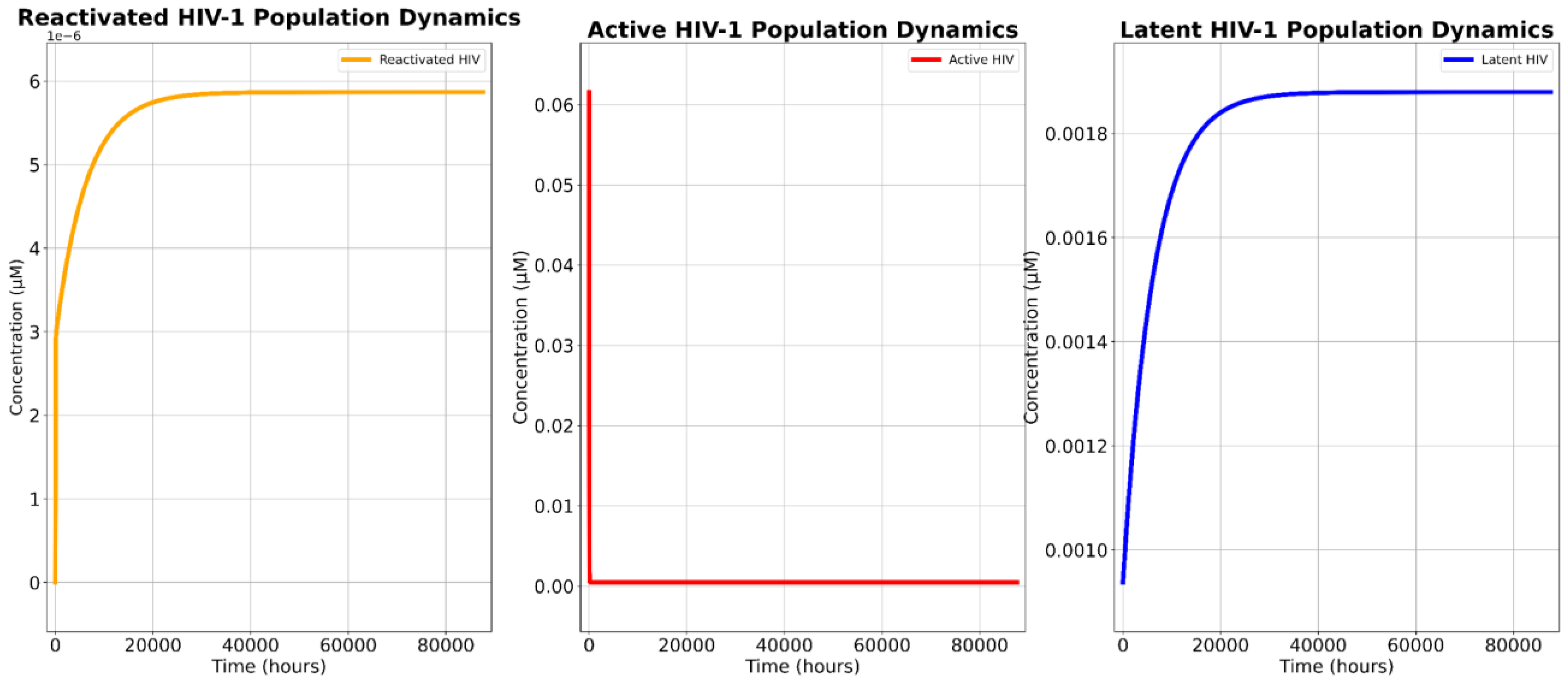
To isolate the novel construct's effects, this model simulated its administration without cART. Table 2 details the results displayed by the novel treatment in reducing both HIV-1’s reservoir populations and its ability to reduce HIV-1 detectable virus levels. The treatment was able to reduce the viral population by 96.26% ( p < 0.0001) and the cytotoxic efficacy of the marker was found to be 99.27% ( p < 0.0001). Therefore, the novel treatment was projected to be 93.17% more effective in reducing the HIV-1 population when compared to the cART-LRA polytherapy.
Figure 3. Treatment Monotherapy Impact on HIV-1 Reservoir.
Preprints 153918 g003

2.2. Sensitivity Analyses

A sensitivity analysis was performed to delineate the impact of key kinetic parameters on treatment efficacy, focusing on the two critical rate constants modelled for the novel treatment: k3 and kLRA (derivations detailed in Appendix A). We also ran a sensitivity analysis on the kLRA rate constant for the cART and LRA combination therapy model in order to compare the results with the sensitivity analyses of the treatment monotherapy.

2.2.1. Impact of k3 on HIV-1 Dynamics - Treatment Monotherapy

The parameter k3 regulates the dynamics of active and reactivated HIV-1 cells while having minimal impact on the latent reservoir, aside from reducing infection spread. The model began with initial concentrations of 9.375 × 10⁻⁴ μM latent HIV, 0.0615625 μM active HIV, and 0 μM reactivated HIV. Table 3 displays the results of the k3 sensitivity analysis on the reactivated cell population, active cell population, latent cell population, and the effectiveness of the marker in reducing the overall viral reservoir.

2.2.2. Effect of kLRA on HIV-1 Dynamics - Treatment Monotherapy

Latent HIV-1 reactivation was modulated by kLRA. The model started with 9.375 × 10⁻⁴ μM latent HIV and 0 μM reactivated cells. Table 4 displays the results of the kLRA sensitivity analysis on the reactivated cell population, active cell population, latent cell population, and the effectiveness of the novel treatment in reducing the overall viral reservoir.

2.2.3. Effect of kLRA on HIV-1 Dynamics - cART and LRA Combination Therapy

Table 5. kLRA Sensitivity Analysis on cART and LRA Polytherapy.
% Change LatentHIV ActiveHIV ReactivatedHIV Reservoir Reduction
-10% 1.0 × 10⁻⁵ µM 3.1978 × 10⁻² µM 2.483 × 10⁻³ µM 44.848%
-8% 9.0 × 10⁻⁶ µM 3.1978 × 10⁻² µM 2.484 × 10⁻³ µM 44.847%
-6% 9.0 × 10⁻⁶ µM 3.1978 × 10⁻² µM 2.484 × 10⁻³ µM 44.846%
-4% 9.0 × 10⁻⁶ µM 3.1978 × 10⁻² µM 2.485 × 10⁻³ µM 44.845%
-2% 9.0 × 10⁻⁶ µM 3.1978 × 10⁻² µM 2.486 × 10⁻³ µM 44.844%
0% 9.0 × 10⁻⁶ µM 3.1978 × 10⁻² µM 2.487 × 10⁻³ µM 44.843%
2% 9.0 × 10⁻⁶ µM 3.1977 × 10⁻² µM 2.487 × 10⁻³ µM 44.843%
4% 8.0 × 10⁻⁶ µM 3.1978 × 10⁻² µM 2.488 × 10⁻³ µM 44.841%
6% 8.0 × 10⁻⁶ µM 3.1978 × 10⁻² µM 2.488 × 10⁻³ µM 44.841%
8% 8.0 × 10⁻⁶ µM 3.1978 × 10⁻² µM 2.489 × 10⁻³ µM 44.840%
10% 8.0 × 10⁻⁶ µM 3.1978 × 10⁻² µM 2.490 × 10⁻³ µM 44.839%

2.3. ABM Population Dynamics

2.3.1. Control Group Analysis

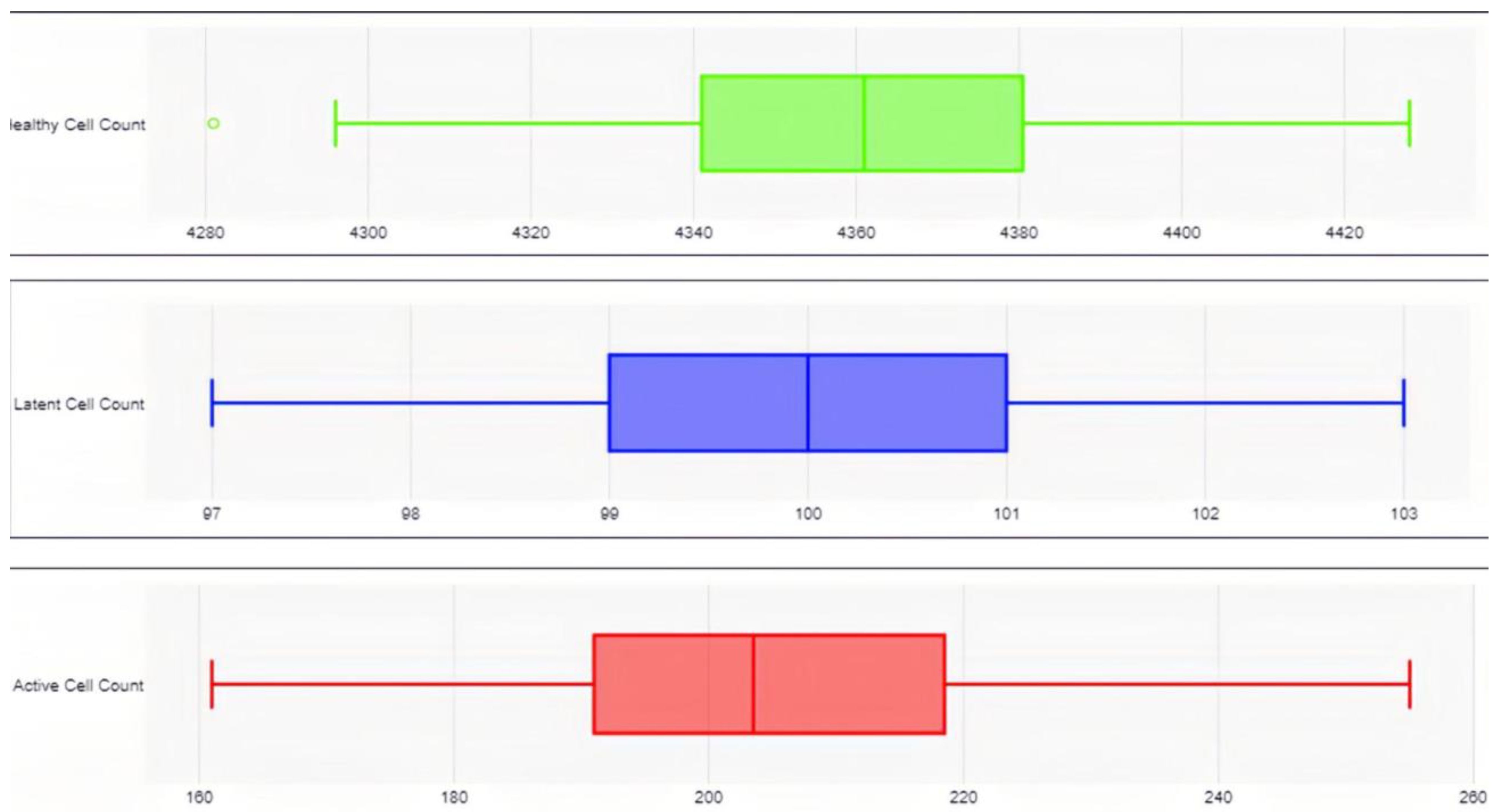
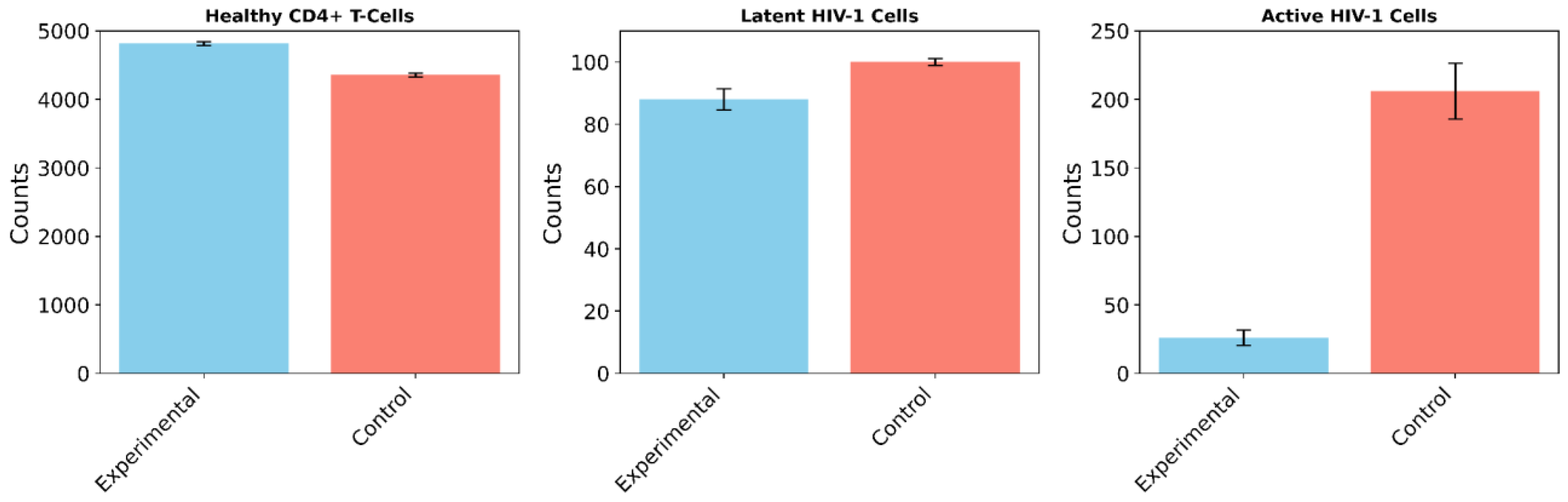
This simulation began with initial values of 4,750 healthy CD4+ T-cells, 100 latent HIV-1 cells, and 400 active HIV-1 cells. The results, gathered from 100 independent trials for each condition, provide compelling insights into the potential of the treatment as a therapeutic intervention. Table 3 depicts the average cell counts derived from the control model. Across 100 trials, the population of healthy cells decreased by an average of 8.25% (from 4,750 to 4,358 ± 29.18 cells; paired t-test: t(99) = 134.3, p < 0.0001, 95% CI [387.2, 396.8]), the latent HIV-1 cell population, on average, remained unchanged at 0% (100 ± 1.07 cells; paired t-test: t(99) = 0, p = 1, 95% CI [-0.21, 0.21]), and the active cell population decreased, on average, by 48.50% (from 400 to 206 ± 20.22 cells; paired t-test: t(99) = 95.9, p < 0.0001, 95% CI [190.0, 198.0]). Therefore, the total HIV-1 reservoir population reduction was 41.20%.
Table 3. Control Group Average Values.
Cell Type Mean ± Standard Deviation Minimum Maximum
Healthy CD4+ T-Cells 4358 ± 29.18 4281 4428
Latent HIV-1 Cells 100 ± 1.07 97 103
Active HIV-1 Cells 206 ± 20.22 161 255
Figure 5. Distribution of All HIV-1 Reservoirs in Control Group.
Preprints 153918 g004

2.3.2. Experimental Group Analysis

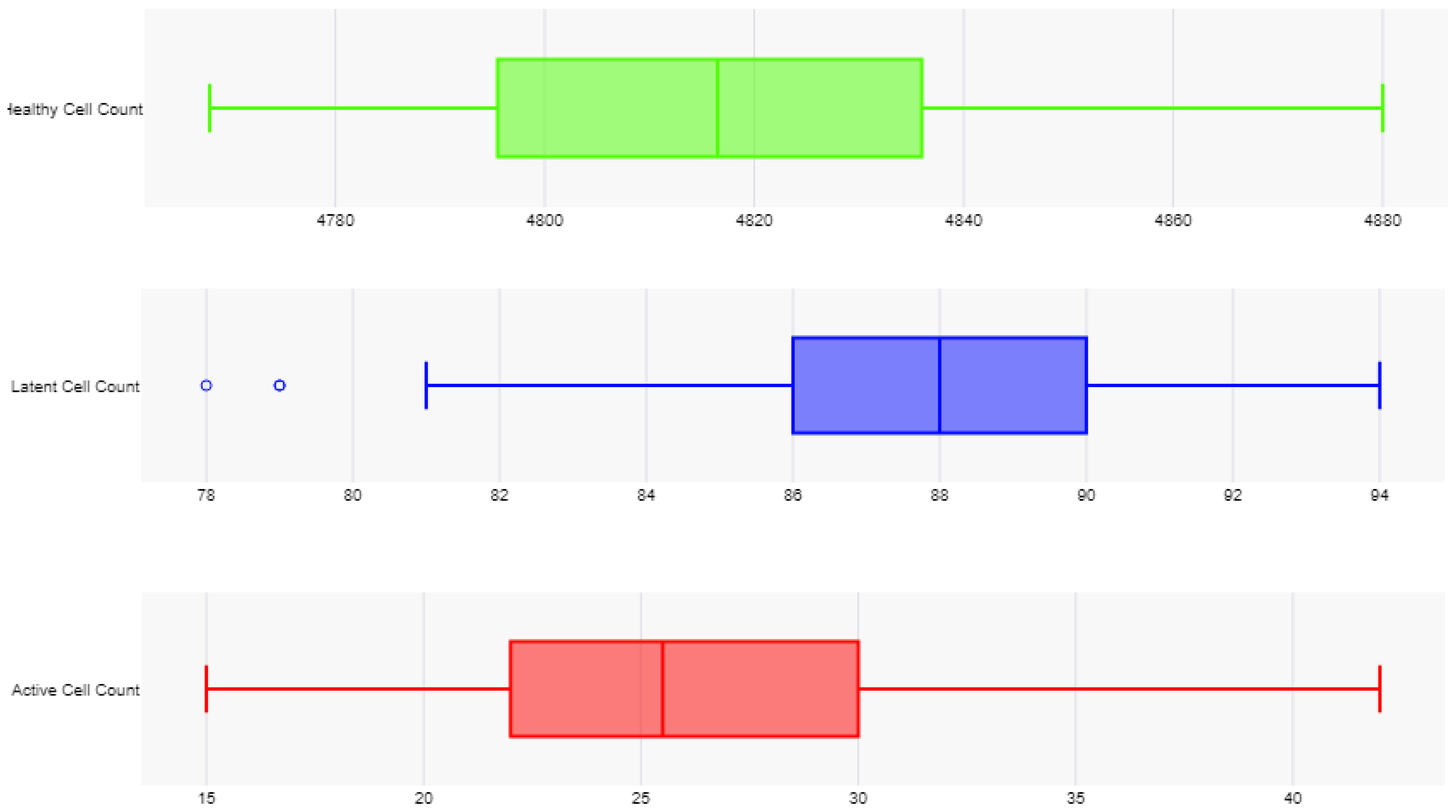
This simulation began with initial values of 4,750 healthy CD4+ T-cells, 100 latent HIV-1 cells, and 400 active HIV-1 cells. The results, gathered from 100 independent trials for each condition, provide insights into the potential of the treatment as a therapeutic intervention. Table 4 depicts the average cell counts derived from the experimental model. Across 100 trials, healthy cells increased by an average of 1.39% (to 4,816 ± 26.01 cells; paired t-test: t(99) = 25.4, p < 0.0001, 95% CI [60.8, 71.2]), the latent HIV-1 cell population decreased by an average of 12.00% (88 ± 3.40 vs. 100 ± 1.07 cells; Mann-Whitney U = 0, p < 0.0001, r = 0.86), and the active HIV-1 cell population decreased by 93.50% (26 ± 5.80 vs. 206 ± 20.22 cells; Mann-Whitney U = 0, p < 0.0001, r = 0.86), on average. Therefore, the total HIV-1 reservoir population reduction, on average, was 77.20%.
Table 4. Experimental Group Average Values.
Cell Type Mean ± Standard Deviation Minimum Maximum
Healthy CD4+ T-Cells 4816 ± 26.01 4768 4880
Latent HIV-1 Cells 88 ± 3.40 78 94
Active HIV-1 Cells 26 ± 5.80 15 42
Figure 6. Distribution of All HIV-1 Reservoirs in Experimental Group.
Preprints 153918 g005
Figure 7. Control vs. Experimental Group Comparisons with Error Bars.
Preprints 153918 g006

3. Discussion

Current shock-and-kill treatments consist of CRISPR-based interventions, as explained in Section 1. However, CRISPR-based therapies face substantial logistical and mechanistic barriers. One challenge presents in the form of HIV-1's high mutation rate, which facilitates the emergence of CRISPR-resistant escape variants [25,28]. Additionally, CRISPR components pose immunogenicity risks due to their bacterial origin, which can provoke host immune responses thus reducing therapeutic efficacy [27]. Finally, delivery remains a critical obstacle. CRISPR constructs are large and complex genetic systems and therefore require large genetic payloads, which often exceed the packaging capacity of clinically approved vectors [25].
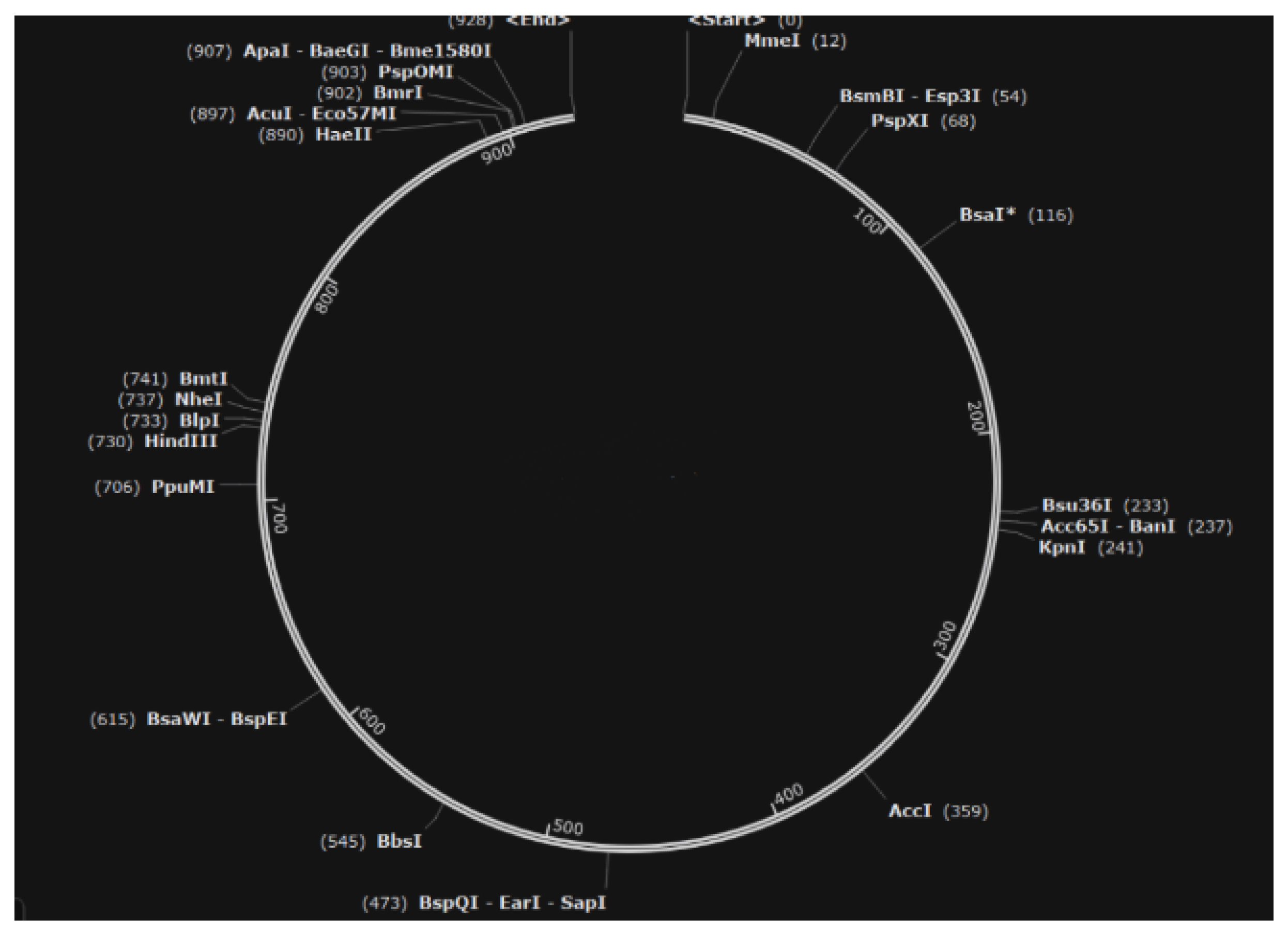
To overcome these challenges, our study presents a novel HIV-1 LTR-driven therapeutic construct designed to exploit the virus’s own transcriptional machinery. This construct targets both latent and active HIV-1 reservoirs through a cytotoxic, all-in-one, shock-and-kill mechanism, which triggers apoptosis in HIV-infected cells via the expression of a diphtheria toxin A (DTA) suicide gene under the control of the HIV-1 long terminal repeat (LTR) promoter. The construct was designed specifically to overcome aforementioned challenges with current shock and kill treatments. Immunogenicity is not a barrier for this construct given its reliance on human and viral regulatory elements rather than bacterial components, thus avoiding host immune activation and the compact, streamlined structure of the construct (only 928 basepairs) enhances the efficiency of delivery, as it requires a smaller genetic payload compared to CRISPR systems (5000-6000 base pairs), making it compatible with clinically approved viral vectors.
Figure 8. Structure of the Novel Construct (modeled with Snapgene 7.2.1).
Preprints 153918 g007
To test the efficacy of our marker in reducing both the detectable and total viral reservoir, we carefully constructed two in silico models. The first utilized ABMs to simulate based population dynamics in an HIV-1 system. The second utilized Tellurium, a Systems Biology Markup Language (SBML) Python platform, which enabled us to precisely simulate intracellular kinetics and cell to cell interactions. To capture system level dynamics, we employed NetLogo, an agent based model that simulates the behavior of individual cells in a heterogeneous population over time. The ABM simulations allowed us to assess the construct’s impact on the overall CD4+ T-cell, latent HIV-1 reservoirs, and active HIV-1 reservoir dynamics. These programs work together to validate the treatment on both a cellular level and a wider, systemic level. The convergence of these independent methodologies provides robust evidence that our HIV-1 LTR-driven construct effectively targets both latent and active HIV-1 reservoirs, supporting its potential as a transformative strategy for HIV-1 eradication.
Our SBML simulations projected the novel treatment’s potent cytotoxicity, confirming its ability to significantly deplete both the detectable HIV-1 reservoir and the total HIV-1 reservoir population.
The two critical parameters for assessing the therapeutic viability of this novel approach are (1) the projected cytotoxic effect in targeted cells and (2) its capacity to reduce both the total and detectable reservoir populations. Our findings validate the first criterion, but not the second. Comparative analyses reveal that the novel therapy reduced the total viral reservoir by 96.26% and exhibited a cytotoxic efficacy of 99.27%. This indicates that nearly ten out of ten infected cells targeted by the construct were eradicated, even when accounting for mutational escape pathways, which is a persistent obstacle in conventional shock-and-kill strategies [17]. In contrast, cART-LRA combination therapy resulted in a reduction of the total reservoir population by 44.72% due to cART’s lack of cytotoxic ability [6,7,8,9,10,11]. Consequently, the novel therapy demonstrated a 93.17% greater efficacy in reservoir depletion compared to the cART-LRA polytherapy.
However, cART-LRA polytherapy was capable of reducing the detectable reservoir by 99.66% while the novel treatment was only capable of reducing the detectable reservoir by 99.27%, indicating that the cART-LRA polytherapy is 0.39% better at mitigating the detectable reservoir when compared to the novel therapy. Yet, this marginally greater reduction in the detectable reservoir does not undermine the therapeutic potential of the proposed construct. The primary limitation of cART-based regimens remains their inability to eliminate the latent reservoir, leading to inevitable viral rebound upon treatment cessation [4,6]. Although cART-LRA polytherapy is 0.39% more effective in reducing the detectable reservoir, this advantage is clinically insignificant in the context of long-term viral control, as cART alone does not contribute to reservoir eradication. In contrast, the novel therapy’s ability to reduce the total reservoir by 96.26% suggests a fundamental shift in treatment outcomes, as a smaller latent reservoir and infectious reservoir directly correlates with a lower likelihood of post-treatment viral resurgence [29,30]. Given that sustained viral suppression under cART necessitates lifelong adherence, the novel approach has the potential to minimize or even prevent viral rebound, rather than delaying it, thus shifting HIV treatment away from indefinite management and towards curative intervention.
The superior efficacy of the novel approach in reducing the population stems from its mechanistic advantage over cART-LRA therapy. LRAs facilitate latency reversal by inducing the transition of quiescent infected cells into a transcriptionally active state thus transiently increasing the size of the reactivated reservoir. While cART is capable of effectively inhibiting viral replication and preventing de novo infection, it lacks direct cytotoxicity, allowing reactivated and actively infected cells to persist, maintaining the potential for viral rebound upon treatment cessation [6,7,8,9,10,11]. In contrast, the novel construct exhibits direct cytotoxicity against infected cells, leading to both depletion of the detectable reservoir and substantial reduction of the total viral reservoir. This dual mechanism not only prevents ongoing viral propagation but also serves to actively eradicate HIV-infected cells, whether latent, reactivated, or actively replicating, rather than merely suppressing them.
The sensitivity analyses provided crucial insights into the mechanistic drivers of treatment efficacy, particularly regarding the impact of latent cell reactivation (kLRA) and DTA-induced apoptosis (k₃).
The findings derived from the sensitivity analyses underscore a distinct advantage of the novel construct over contemporary therapies: the efficacy of the novel treatment is directly enhanced by improvements in latency reversal whereas cART-LRA combination therapy becomes less effective under the same conditions.
The sensitivity analysis of kLRA in the novel treatment monotherapy revealed that as the efficacy of the LRA increased, so did the overall reservoir depletion, with HIV-1 population reductions improving from 95.98% to 96.51% as kLRA increased by 20% (-10% to +10% range). This indicates that a 1% increase in LRA efficacy correlates with a 0.027% rise in reservoir reduction. Yet, this trend suggests that as the field of LRA development advances and we develop the ability to reactivate more latent cells, the cytotoxic effects of the marker will become even more pronounced. However, the findings also highlight that, while the novel treatment demonstrates strong cytotoxicity, the persistence of the latent reservoir remains dependent on effective reactivation. Even at the highest kLRA tested, a residual latent population persisted, indicating that current LRAs may still be suboptimal for achieving full eradication, a severe limiting factor for the novel treatment. In stark contrast to the marker-based monotherapy, increasing kLRA in the cART-LRA combination therapy paradoxically expanded the total viral reservoir, with reductions ranging from 44.848% to 44.839% (-10% to 10%). This result aligns with the fundamental limitation of cART: while it prevents viral replication, it lacks intrinsic cytotoxicity, meaning that the reactivation of latent cells simply increases the pool of infected cells rather than eliminating them. In other words, cART is unable to keep up with higher efficacy rates of LRA. This phenomenon is particularly problematic given that persistent reactivated cells remain viable and capable of viral rebound upon treatment cessation. Thus, a key distinction between the two therapies emerges. For the marker-based treatment, increasing kLRA enhances efficacy by exposing more infected cells to cytotoxic elimination. In contrast, For cART-LRA therapy, increasing kLRA exacerbates the challenge of persistence by expanding the infected cell population. These findings indicate that cART-LRA therapy may become less effective as LRA potency improves, while the novel construct continues to grow in efficacy. The primary limitation of the marker-based treatment lies in the current effectiveness of LRAs, but this constraint is only temporary. As next-generation LRAs with greater potency and specificity are developed, the novel construct will disproportionately benefit, further enhancing its ability to eliminate the reservoir and reduce detectable HIV. This adaptability makes it a more scalable and future-proof strategy for long-term HIV-1 eradication. Meanwhile, as LRAs with greater potency and specificity are developed, cART-LRA polytherapies will not yield an enhanced ability to eliminate HIV-1 reservoirs without some complementary cytotoxic therapy [20,21].
The sensitivity analysis of k₃ further confirmed the robustness of the novel treatment. Table 3 reveals that increasing k₃ (rate of DTA-induced apoptosis) enhances viral reservoir reduction, albeit marginally (96.20% to 96.33% over a ±10% k₃ range). Active cell populations decrease monotonically with higher k₃, while reactivated cells show minimal fluctuations (5.45–6.35 × 10⁻⁶ µM). The marker’s cytotoxicity is robust but not highly sensitive to k₃ variations, suggesting its efficacy depends more on reactivation efficiency (k_LRA) than apoptosis kinetics. Notably, the latent reservoir remained largely unchanged across k₃ variations, reinforcing the conclusion that LRA efficacy, rather than marker-induced cytotoxicity alone, is the primary bottleneck for complete reservoir clearance.
While SBML modeling captures molecular-level kinetics, Agent Based Modeling (ABM) simulations provide insight into population-level dynamics over time, allowing us to evaluate the broader effects of the construct across multiple cell populations and introduce stochasticity not seen in the SBML models.
In the cART-only control group, 100 independent trials demonstrated an 8.25% decline in healthy CD4+ T-cells (from 4,750 to 4,358 ± 29.18 cells; paired t-test: t(99) = 134.3, p < 0.0001, 95% CI [387.2, 396.8]), no significant change in the latent reservoir (100 ± 1.07 cells; paired t-test: t(99) = 0, p = 1, 95% CI [-0.21, 0.21]), and a 48.50% reduction in active HIV-1 cells (from 400 to 206 ± 20.22 cells; paired t-test: t(99) = 95.9, p < 0.0001, 95% CI [190.0, 198.0]). These findings align with known cART dynamics seen in experimental studies, where active replication is suppressed but latent reservoirs persist, further validating both models [2].
In the experimental group, which simulated the novel treatment monotherapy, the results showed a 1.39% increase in healthy CD4+ T-cells (to 4,816 ± 26.01 cells; paired t-test: t(99) = 25.4, p < 0.0001, 95% CI [60.8, 71.2]), a 12% reduction in the latent reservoir (88 ± 3.40 vs. 100 ± 1.07 cells; Mann-Whitney U = 0, p < 0.0001, r = 0.86), and a 93.50% reduction in active HIV-1 cells (26 ± 5.80 vs. 206 ± 20.22 cells; Mann-Whitney U = 0, p < 0.0001, r = 0.86). Notably, all of these changes, from the increased proliferation of healthy CD4+ T-cells to the reduction in the active HIV-1 reservoir were statistically significant.
Comparing the two groups, the experimental treatment resulted in a 10.51% increase in healthy CD4+ T-cells relative to the control (4,816 vs. 4,358 cells; unpaired t-test: t(198) = 123.7, p < 0.0001, 95% CI [451.7, 464.3]), a 12% reduction in the latent reservoir compared to no change in the control, and an 87.38% greater reduction in active HIV-1 cells compared to the control group. In total, it mitigated the total HIV-1 reservoir 72.20% better than the cART-LRA combination therapy.
This statistically significant reduction in the overall HIV-1 reservoir population suggests that the construct effectively clears actively replicating, latent, and reactivated cells. The CD4+ T-cell rebound reflects the impacts of the novel construct on reducing infection spread, thus promoting an increase in healthy cell proliferation.
Although these findings are promising, computational models inherently oversimplify the biological complexity of HIV-1 infection. For instance, our models assume ideal delivery and sustained construct expression which are factors that may vary in vivo. In vivo studies are therefore critical to validate these results, particularly to assess pharmacokinetics and tissue distribution of cells expressing the construct and to capture the unpredictability of such HIV-1 systems.
To mitigate the inherent limitations of in silico modeling and establish a robust foundation for experimental validation, we ensured that all control simulations accurately reflected empirical findings. Specifically, we implemented a baseline SBML simulation to isolate the effects of cART on latent and active HIV-1 reservoirs and compare the results to those derived from experimental studies. The simulation demonstrated that cART monotherapy reduced the detectable viral reservoir by 99.84%, a finding consistent with numerous experimental studies [31,32]. Notably, the cART-LRA polytherapy model also yielded biologically consistent results, projecting a detectable reservoir reduction of 99.66%, a calculation that closely aligns with the 99.84% projection found in the baseline cART monotherapy simulation. These close alignments corroborate experimental evidence that LRA administration alongside cART does not significantly alter the HIV-1 viral reservoir [15]. Similarly, control simulations for the ABM model exhibited strong concordance with experimental data, as previously mentioned. By validating these control models against established benchmarks, we ensured confidence in our experimental simulations, wherein the only variables that changed were those associated with the novel therapeutic intervention, whose parameters were also derived from empirical data [33,34,35].
An additional consideration in the development of novel HIV-1 therapeutics is off-target cytotoxicity [36]. While the HIV-1 LTR promoter provides a degree of HIV-1 specific targeting, there remains a potential risk of unintended apoptosis in uninfected cells. Further experimental validation is therefore required to assess the construct’s specificity and quantify any collateral cytotoxicity. However, it is also important to note that existing research on DTA demonstrates a low incidence of off-target effects coupled with a high cytotoxic efficacy against infected cells. Given that unintended cytotoxicity in shock-and-kill strategies primarily stems from the lytic mechanism (in this case DTA), these findings suggest that the proposed therapy is unlikely to exhibit significant off-target effects [37,38]. Nevertheless, in vitro and in vivo studies remain essential to confirm its safety profile.
Beyond off-target toxicity, the emergence of viral resistance represents a substantial challenge in contemporary HIV-1 therapeutics [17]. The high mutation rate of HIV-1 raises the concern that genetic variants with altered LTR sequences could evade construct recognition, thereby compromising treatment efficacy. While we have included rate constants for HIV-1 LTR mutations in the SBML models (see Appendix A.7), HIV-1 mutations are unpredictable and vary from cell to cell making it hard to predict the probability that a mutation will occur that hampers the efficacy of the novel treatment [39]. However, our calculated mutation rate is an overestimation which serves to provide a degree of certainty for the result.
Beyond off-target toxicity, the potential for viral resistance remains a significant challenge in contemporary HIV-1 therapeutics. Given the high mutation rate of HIV-1, there is concern that genetic variants with altered LTR sequences would enable HIV-1 to evade construct recognition, ultimately diminishing treatment efficacy. While our SBML models incorporate rate constants for HIV-1 LTR mutations (see Appendix A.7), the stochastic nature of viral mutations makes it difficult to precisely determine the likelihood of resistance-compromising mutations. However, our calculated mutation rate represents a deliberate overestimation, providing a conservative framework that enhances the robustness of our findings. Additionally, CRISPR-based approaches for HIV treatment are inherently more vulnerable to viral mutations due to their dependence on precise DNA sequence recognition [40]. Given HIV’s exceptionally high mutation rate, empirical studies have demonstrated the rapid emergence of CRISPR-resistant HIV-1 strains, as even single-nucleotide variations can disrupt Cas9 target recognition [23,28]. In contrast, the novel construct is structurally simpler and less susceptible to resistance development since the primary avenue for potential resistance is limited to mutations within the LTR sequence, significantly narrowing the potential for viral escape.
Finally, from a translational perspective, delivery optimization is paramount. Current gene therapy platforms face practical barriers such as vector size limitations and immunogenicity [25,41]. Ensuring scalable, cost-effective delivery will be crucial for advancing this therapeutic toward clinical trials. In line with several other shock-and-kill strategies, we propose a lentiviral vector to be developed for effective delivery of this construct. Their efficiency in transducing non-dividing cells makes them well-suited for targeting latent HIV reservoirs. [6,23].
Our study demonstrates that the HIV-1 LTR-driven therapeutic construct achieves significant viral reservoir depletion by directly targeting both actively infected and latent cells. SBML kinetic modeling and ABM simulations consistently revealed a substantial reduction in the total and detectable HIV-1 reservoir, alongside a marked increase in healthy CD4+ T-cell populations – an outcome not observed with the cART-LRA polytherapy. Sensitivity analyses further highlighted the construct’s mechanistic advantages, showing that its efficacy scales with improvements in latency reversal, unlike cART-LRA therapy, which paradoxically expands the reservoir under enhanced LRA potency. While concerns regarding off-target toxicity and viral resistance remain, existing evidence suggests that the construct exhibits a high degree of specificity and is less prone to resistance emergence compared to CRISPR-based approaches. Although further in vitro and in vivo studies are essential to validate these findings, particularly in optimizing delivery mechanisms and assessing long-term efficacy, this study represents a significant advancement in the development of a scalable and durable HIV-1 eradication strategy.

4. Materials and Methods

4.1. Overview of Modeling Approaches

This study investigates HIV-1 latency reversal and targeted cell elimination using two complementary computational models: a system of ordinary differential equation (ODE)-based SBML models and an agent-based model (ABM) implemented in NetLogo. These models serve distinct but interconnected purposes in understanding HIV-1 dynamics under different therapeutic conditions [42,43,44].
The SBML models provide a structured mathematical framework for analyzing population-level trends over time. These models simulate the effects of combination antiretroviral therapy (cART), latency-reversing agents (LRAs), and a novel marker-based therapeutic strategy. Specifically, we examine two key outcomes in these models:
  • We first measure trends in the detectable virus reservoir, measured by tracking changes in active and reactivated HIV-1 levels over time, as these are virion producing cells. This metric represents how well a treatment suppresses virion production and, consequently, how effective it is in reducing detectable HIV levels.
  • The second outcome we measure is reservoir population dynamics, which account for the actual number of surviving active, reactivated, and latent HIV-infected cells regardless of if they are producing virions or not.
The ABM model provides a complementary approach by incorporating spatial and stochastic interactions between individual cells and treatment agents to track reservoir population dynamics. While the SBML models allow us to analyze broad trends in HIV population dynamics, the ABM model offers insight into how localized interactions influence infection progression and treatment efficacy. The results from these two models may differ, but both are valid because they capture different aspects of the HIV-1 infection process. SBML models focus on average population-level changes, whereas ABM models account for individual cellular interactions [42,43].
Importantly, we distinguish between detectable virus and actual virus population. Detectable virus is measured by virion levels, which cART effectively suppresses by preventing new virion production. However, cART does not clear infected cells, meaning the actual HIV-infected cell population (active, reactivated, and latent cells) remains and can lead to viral rebound upon treatment cessation. The novel therapeutic construct aims to eliminate these infected cells, significantly reducing the reservoir and preventing future viral resurgence.

4.2. SBML Models

The SBML models were designed using the software Tellurium and simulated the progression of HIV-1 infection and the effects of therapeutic interventions. The model tracks four distinct cellular populations: healthy CD4+ T cells, latent HIV-infected cells, active HIV-infected cells, and reactivated HIV-1 cells. The interventions incorporated in the model include cART monotherapy, which suppresses active and reactivated HIV-1 replication but does not eliminate infected cells; LRAs, which induce reactivation of latent cells; and a novel shock-and-kill treatment that selectively targets HIV-infected cells for apoptosis. Again, each model was designed to first track detectable virus levels and then track the reservoir population dynamics regardless of virion production.

4.2.1. Model Design: Equations and Parameters

The mathematical framework consists of a system of differential equations governing viral infection, latency dynamics, active infection progression, mutation rates, reactivation, and therapeutic effects. The infection spread rate, apoptosis rate, and pharmacokinetic effects of therapeutic agents were parameterized based on experimental data (Refer to Appendix A for detailed equation and parameter derivations).
Simulations were conducted over a 87,600-hour period (ten years) under three therapeutic conditions: (1) cART alone (baseline model), (2) cART and LRA, and (3) the novel treatment monotherapy.

4.2.2. Baseline SBMLModel: cART Monotherapy

This model serves as a validation benchmark, as its results align with experimental data. It simulates HIV-1 dynamics under cART monotherapy, tracking three variables: Latent HIV-1 (LatentHIV), Active HIV-1 (ActiveHIV), and Healthy CD4+ T Cells (HealthyCells). The interactions between these variables are governed by differential equations detailing viral replication, suppression, and immune system interactions (Further calculations are detailed in Appendix B). cART is modeled to effectively suppress viral replication but does not induce apoptosis of infected cells.

4.2.3. cART with LRA SBML Model

This SBML model expands upon the baseline cART montherapy model by incorporating the effects of cART and LRA combination therapy on HIV-1 dynamics. The model tracks four main variables: Latent HIV-1, Active HIV-1, Reactivated HIV-1, and Healthy CD4+ T Cells. Reactivated HIV-1 cells start at 0 and grow as LRA reactivates other latent HIV-1 cells. This leads to a reduction in the number of latent cells and an expansion in the number of reactivated cells. These variables interact through a system of ODEs that describe the complex dynamics of HIV-1 infection, viral suppression, latency reversal, and cell regeneration under the combined influence of cART and LRAs. View Appendix B for in depth explanations of each differential equation.
A key addition to this model is the introduction of the latency-reversing agent (LRA) activation rate, represented by kLRA. This constant, set at 1.37 × 10⁻⁴, models the rate at which latent HIV-1 cells are reactivated due to the LRA treatment. This addition is crucial for understanding the impact of LRAs on reducing the latent HIV-1 reservoir.

4.2.4. Novel Treatment Monotherapy SBML Model

This SBML model focuses on the effects of a novel “shock-and-kill” treatment on HIV-1 dynamics without the use of combination antiretroviral therapy (cART). The model tracks four main variables: Latent HIV-1 (LatentHIV), Active HIV-1 (ActiveHIV), Reactivated HIV-1 (ReactivatedHIV), and Healthy CD4+ T Cells (HealthyCells). These variables interact through a system of ODEs that describe the complex dynamics of HIV-1 infection spread, latency reversal, mutation, and targeted cell death under the influence of the shock and kill treatment alone. View Appendix B for in depth explanations of each differential equation.
A key addition to this model is the introduction of the ‘kill’ portion of the shock and kill treatment, represented by the parameter k3 (0.031875). Another key addition to this model is an LTR mutation rate. This mutation rate was calculated via examining experimental HIV-1 mutation rates. It examines the rate at which HIV-1 mutates its HIV-1 LTR region and assumes that any mutations to this region would result in the treatment being inneffective, thereby idealizing the efficacy of mutations for HIV-1. The mutation rate is set at 4.96 × 10⁻⁴.
The effectiveness of the novel marker in reducing both the detectable viral reservoir and the overall HIV-1 reservoir population is also evaluated in this model. To assess marker efficacy, we calculate the proportion of active and reactivated HIV-1 cells eliminated by the marker (see Appendix B for detailed formulas). This calculation focuses specifically on active and reactivated cells, in order to isolate the cytotoxic effect of the marker. The efficacy of the latency-reversing agent (LRA) is therefore not included in this measure, as it has already been accounted for separately.
In addition to evaluating marker-specific effects, we calculate the overall reduction in the HIV-1 reservoir population which includes all three HIV-1 populations (latent HIV-1, active HIV-1, and reactivated HIV-1). This measure includes both the LRA and marker effects as described in Appendix B.
To quantify the marker's ability in reducing the detectable viral reservoir compared to cART, we compute the relative difference between the final detectable reservoir sizes under each treatment condition (see Appendix B for calculation details).
These calculations allow us to directly compare the novel treatment's efficacy against cART in reducing both virion-producing cells and the broader HIV-1 reservoir. This comprehensive evaluation provides insight into the marker's potential to achieve deeper reservoir clearance and reduce the likelihood of viral rebound following treatment cessation.

4.3. Agent Based Modeling

4.3.1. Model Structure

An agent-based simulation was developed in NetLogo to capture spatial heterogeneity and stochastic interactions. The model initializes with 5,250 total cells, consisting of:
  • 4,750 Healthy CD4+ T Cells
  • 100 Latent HIV-Infected Cells
  • 400 Active HIV-Infected Cells
300 treatment agents (LRA and/or marker-based therapy) were introduced into the environment depending on the model being simulated.

4.3.2. Agent Based Modeling Control Group

The control simulation models untreated HIV-1 infection using a two-dimensional spatial framework where cells interact through infection, reactivation, immune clearance, and therapeutic interventions. The key biological processes simulated over 50 time steps include:
  • LRA-Induced Reactivation of Latent HIV-1 Cells: Each LRA molecule scans for a nearby latent HIV-1 cell within a fixed interaction radius of 1 unit. If a latent HIV-1 cell is located, it undergoes reactivation with a 10% probability. Reactivated cells then transition from latent to reactivated HIV-1 cells, and immediately start producing virions.
  • HIV-1 Transmission from Reactivated and Active Cells: Both reactivated HIV-1 cells and active HIV-1 cells attempt to infect nearby healthy cells within a radius of 2 units. Each infected healthy cell has a 4% chance of becoming a new latent HIV-infected cell and a 96% chance of becoming an actively infected HIV-1 cell. After successful infection, the infecting HIV-1 cell dies, mimicking the natural lifecycle of the virus.
  • cART Treatment of Active HIV-1 Cells: cART is capable of effectively suppressing both reactivated and active HIV-1 cells, including both pre-existing and newly infected ones. cART is able to suppress 90% of these cells from infecting other cells, thus increasing the number of healthy cells and decreasing the number of active and latent cells. This serves to “rewind” the simulation and remove the impact of cART effected active and reactivated cells.
  • Progression to the Next Time Step: Once all infection, reactivation, and treatments are executed, the simulation advances by one tick, and the cycle repeats until the trial reaches 50 ticks.
All parameter derivations can be found in Appendix C.

4.2.3. Agent Based Modeling Experimental Model

Following initialization, the effects of the novel treatment monotherapy are simulated by allowing each marker to check its local environment and probabilistically modify the state of any eligible targets within its interaction radius. The infection spread process detailed in Section 4.2.2 remains consistent in this experimental model. They key variations between the control and experimental ABM groups are the addition of the novel shock-and-kill marker and the removal of cART. The treatmemnt functions by reactivating latent HIV-1 cells while simultaneously attempting to eliminate them. In each iteration:
  • Marker molecules randomly select nearby cells (excluding other markers) within a radius of 1.
  • If a latent cell is targeted, there is a 10% chance that the LRA within the marker is able to reactivate the cell.
  • If successfully reactivated, there is a 87.93% chance that the marker successfully eliminates the cell.
  • If the cell is not eliminated, but is reactivated, it becomes either a latent or active cell and then infects other cells.
  • All active HIV-1 cells begin viral replication and contribute to further infection spread.
  • Additionally, marker molecules target active HIV-1 cells directly with a 87.93% probability of elimination.
The simulation executes over 100 independent trials, each running 50 ticks, representing an approximate six-month period.

4.4. Statistical and Sensitivity Analyses

4.4.1. Statistical Methods

Statistical analyses were performed using GraphPad Prism version 8.0.2 for Windows, GraphPad Software, San Diego, California USA, www.graphpad.com. Data normality was assessed using the Shapiro-Wilk test. For normally distributed variables, independent t-tests were used to compare outcomes across different treatment conditions; effect sizes were quantified using Cohen's d. For data meeting assumptions of equal variance, as confirmed by Levene's test, one-way ANOVA was employed, followed by Tukey's HSD post-hoc tests for pairwise comparisons; effect sizes for ANOVA were assessed using eta-squared (η²). For non-normally distributed variables, Mann-Whitney U tests were employed to assess differences between the two groups; effect sizes were quantified using Cliff's delta. For comparisons of multiple non-normal groups, the Kruskal-Wallis test was used, followed by Dunn's post-hoc tests with Bonferroni correction for multiple comparisons. The threshold for statistical significance was set at p < 0.05.

4.4.2. Sensitivity Analyses

To assess the robustness of the model, sensitivity analyses were conducted by systematically varying key kinetic parameters directly related to the novel treatment. The analysis focused on the following factors:
  • Varying k3: Examined how changes in the apoptosis rate influenced HIV-1 population dynamics.
  • Varying kLRA: Assessed how variations in LRA efficacy affected latent HIV-1 reactivation and marker efficacy.
For each variation, the final concentrations of latent and active HIV-1 cells were recorded and compared across 50 independent simulation iterations.

4.5. Adherence with F.A.I.R Guidelines

To ensure the reproducibility and reusability of our research, we adhered to the FAIR (Findable, Accessible, Interoperable, Reusable) data principles:
  • Findable: All model code and parameter sets are available on a GitHub repository created for this research article (https://github.com/A-desai-1/All-Models/tree/main).
  • Accessible: The Tellurium model is provided in SBML format, while the NetLogo model uses the standard .nlogo ABM file format.
  • Interoperable: We adopted common ontologies used in HIV-1 research, such as the HIV-1 Ontology, to ensure compatibility with other datasets and models.
  • Reusable: The Appendices follow the MIRIAM guidelines, detailing all data sources, parameter derivations, and model assumptions.
The code is released under the MIT License, and the data compilation is available under CC-BY 4.0. For inquiries about restricted datasets used in this study, please contact the corresponding author

4.6. Materials

The following materials were used to conduct this study:
  • Tellurium Spyder (Python 3.11): Used for simulating the ODE-based models.
  • NetLogo (Version 6.4.0): Implemented for agent-based modeling.
  • Snapgene (Version 7.2.1): Utilized to model the novel construct.
  • GraphPad (Version 8.0.2): Used for statistical testing and Monte Carlo sensitivity analysis.
  • CSV Data Files: Stored simulation outputs for statistical analysis.

5. Conclusion

Funding

This research received no external funding.

Institutional Review Board Statement

Not applicable.

Informed Consent Statement

Not applicable.

Data Availability Statement

The datasets used and/or analyzed during the current study are available from the corresponding author on reasonable request.

Conflicts of Interest

The authors declare no conflicts of interest.

Abbreviations

The following abbreviations are used in this manuscript:
ABM Agent Based Models / Agent Based Modeling
cART Combination antiretroviral therapy
DTA Diptheria Toxin A
HIV-1 Human Immunodeficiency Virus type 1
LRA Latency reversal agent
ODE Ordinary differential equations
SBML System Biology Markup Language

Appendix A

This appendix provides detailed calculations used to derive the parameters for the SBML models:

A.1 kLRA Constant Calculation

The reactivation rate of latent HIV-1 cells was derived from experimental data on HIV-1 latency reversal kinetics in CD4+ T cells treated with the HDAC inhibitor romidepsin, as reported by Petravic et al. (2019) in PLOS Pathogens. This study found that the average efficacy of latency-reversing agents (LRAs) is 10% within 48 hours [45]. The LRA-induced reactivation rate constant (kLRA) was determined using first-order kinetics:
N t = N 0     e k t
Where;
  • N(t) represents the concentration of latent HIV-1 cells at time t
  • N0 is the initial concentration
  • k is the rate constant
Given an initial reservoir concentration of 0.0625 μM and a 10% reactivation rate within 48 hours, we solve for kLRA:
0.9 = e k L R A     48
k L R A = l n .9   /   48
k L R A = 0.002193
This value was implemented in the model to simulate LRA-induced latency reversal dynamics.

A.2 k6 Constant Calculation

The k6 constant describes the rate of HIV-1 virion production by a single HIV-1 cell. Active HIV-1-infected cells produce virions for approximately 24 hours [46]. During this time they generate enough virions to infect an average of eight new cells [47]. Given this information and given an initial viral load of 0.0625 μM, the infection rate constant (k6) can be calculated using first order kinetics:
N t = N 0     e k t
l n 0.5 = k 6 24 + l n 0.0625
Solving for k6, we approximate the rate of HIV-1 virion production to be 0.00542 μM/hr-1.

A.3 k7 Constant Calculation

Mohri et al. (1998) in PNAS quantified CD4+ T cell repopulation following antiretroviral therapy (ART), reporting an average increase of cells per day [48]. Converting this to uM/hr-1 we performed the following calculations:
1.1     10 8   c e l l s / d a y = 1.1     10 8 24   c e l l s / h o u r = 4.58   x   10 6   c e l l s / h o u r = 4.58   x   10 6   µ M / h o u r

A.4 nat_death Constants Calculations

The half-life of latently infected CD4+ T cells is approximately 44 months [49]. This corresponds to a decay rate of 5.2 × 10⁻⁴ per day. Converting this to uM/hr-1:
5.2     10 4 24 = 2.17     10 5   µ M / h o u r
Similarly, active HIV-1 cells have a natural death rate of 0.3 per day [50]:
0.3 24 = 0.0125   µ M / h o u r  

A.5 k_cART_eff Constant Calculation

cART efficacy was modeled using a logistic function with a baseline efficacy of 75%, consistent with 19 et al. (2023) in Nature Reviews Clinical Oncology [51]. The decay of cART effectiveness over time follows an exponential decay function. Experimental studies estimate a cART half-life of 48 hours [52]. Using:
λ = 0.693 H a l f l i f e
we calculate:
λ = 0.014437 hr−1
Thus, the cART decay constant​ was set to 0.014437 hr⁻¹ to match observed pharmacokinetic data for cART drugs.

A.6 k3 Constant Calculation

The k3 constant describes the rate of DTA induced apoptosis. DTA has been found to induce apoptosis in 40% of affected cells within 60 minutes [53]. Given this and given an initial viral load of 0.0625 μM, we can use the first-order kinetics equation to calculate the k3 constant:
N t = N 0     e k t
Thank you for providing the initial cell density. Let's recalculate the rate constant using this information.
k 3 = l n 0.6     0.0625
Solving for k6:
k = 0.031875   μ M / h r 1

A.7 Mutation Rate

This constant describes the rate of mutation specifically within the HIV-1 LTR region of HIV-1 cells. Experimental studies have found that the HIV-1 LTR region has a mutation rate of 1.2 × 10⁻⁵ bases per site per day [54].
Therefore, the per hour rate of mutation utilized in the SBML models was 4.8 × 10⁻⁷.

Appendix B

This appendix provides all the equations utilized across the SBML Models:

B.1 Infection Spread ODE

For cART SBML models, infection spread was modeled via the following ODE:
i n f e c t i o n _ s p r e a d = A c t i v e H I V     k 6     1 t h e r a p e u t i c   i n t e r v e n t i o n + R e a c t i v a t e d H I V   k 6     1 t h e r a p e u t i c   i n t e r v e n t i o n
For the treatment monotherapy SBML model, infection spread was modeled via the following ODE:
i n f e c t i o n _ s p r e a d = A c t i v e H I V     k + R e a c t i v a t e d H I V   k 6
The logistic growth models demonstrated here are consistent with experimental findings that delve into the mechanisms of HIV-1 infection spread [55].

B.2 cART Efficacy ODE

The efficacy of cART is modeled using a logarithmic function to represent the gradual onset of drug effects:
k _ c A R T _ e f f = k _ c A R T _ b a s e   /   1 + e x p k _ c A R T _ l o g     t i m e T _ m i d
  • k_cART_base: Baseline cART efficacy (0.75 or 75%)
  • k_cART_log: Logarithmic growth rate (0.014437)
  • T_mid: Midpoint of cART effect onset in hours (450)

B.3 Latent HIV-1 Dynamics ODE

In all models, the dynamics of latent HIV-1 were calculated via the following ODE:
LatentHIV' = (infection_spread * 0.015) - (nat_deathl * LatentHIV) - (k_LRA * LatentHIV)
This equation represents the change in the latent HIV-1 population, with 1.5% of new infections becoming latent, minus the natural death of latent cells and minus the latent cells being reactivated.

B.4 Active HIV-1 Dynamics ODE

For cART SBML models, the dynamics of active HIV-1 were modeled via the following ODE:
ActiveHIV' = (infection_spread * 0.985) - (nat_death * ActiveHIV)
For the treatment monotherapy SBML model, the dynamics of active HIV-1 were modeled via the following ODE:
ActiveHIV' = (infection_spread * 0.985) - (nat_death * ActiveHIV) - (k3 * ActiveHIV) + (mutation_rate * ActiveHIV)
These equations describe the change in active HIV-1 population, with 98.5% of new infections becoming active, minus natural cell death. cART-induced suppression takes effect via its role in infection spread. The novel treatment takes effect through direct cytoxic impact and some of its effects are counteracted by mutations in the HIV-1 LTR region.

B.5 Reactivated Cell Dynamics ODE

For cART SBML models, the dynamics of active HIV-1 were modeled via the following ODE:
ReactivatedHIV' = (LatentHIV*k_LRA) - (nat_death * ReactivatedHIV)
For the treatment monotherapy SBML model, the dynamics of active HIV-1 were modeled via the following ODE:
ReactivatedHIV' = (LatentHIV*k_LRA) - (nat_death * ReactivatedHIV) - (k3 * ReactivatedHIV) + (mutation_rate * ReactivatedHIV)
These equations describe the change in the reactivated HIV-1 population, with new reactivated cells being added via LRA activation of latent cells. cART-induced suppression takes effect via its role in infection spread. The novel treatment takes effect through direct cytoxic impact and some of its effects are counteracted by mutations in the HIV-1 LTR region.

B.6 Marker Efficacy Calculations

To calculate the rate of treatment efficacy in terms of cytotoxicity, the following formula was used:
i n i t a l   H I V   c o n c e n t r a t i o n f i n a l   r e a c t i v a t e d   a n d   a c t i v e   H I V   c o n c e n t r a t i o n   i n i t i a l   H I V   c o n c e n t r a t i o n   100
To calculate the overall effectiveness of the treatment, the following formula was used:
i n i t a l   H I V   c o n c e n t r a t i o n f i n a l   H I V   c o n c e n t r a t i o n   i n i t i a l   H I V   c o n c e n t r a t i o n   100
The difference between these two formulas lies in the fact that the cytotoxic efficacy equation does not include latent HIV-1 cell counts since latent cells are not impacted by cytotoxicity and instead only the LRA. However, latent HIV-1 cell counts are included in the overall treatment efficacy calculation.

Appendix C

This appendix details the parameters utilized in both ABM Models

C.1 ABM Model Parameter Derivations

Experimental studies estimate cART efficacy between 90-99% [33,34,35,56]. For this model, cART efficacy was set at 95%, converted to a per-tick rate of 5.82%. The probability of reactivating a latent HIV-1 cell through the use of an LRA is cited as 10% [45], converted to 0.21% per tick. The per-tick probabilities were calculated using:
1-(1-x)0.02
Where x is the experimental value.

References

  1. Boomgarden, A. C.; Upadhyay, C. Progress and Challenges in HIV-1 Vaccine Research: A Comprehensive Overview. Vaccines 2025, 13, 148. [Google Scholar] [CrossRef] [PubMed]
  2. Kemnic, T. R.; Gulick, P. G. HIV Antiretroviral Therapy. In StatPearls; StatPearls Publishing: Treasure Island (FL), 2025. [Google Scholar]
  3. Hernández-López, A.; Olaya-Vargas, A.; Bustamante-Ogando, J. C.; Meneses-Acosta, A. Expanding the Horizons of CAR-T Cell Therapy: A Review of Therapeutic Targets Across Diverse Diseases. Pharmaceuticals 2025, 18, 156. [Google Scholar] [CrossRef]
  4. Rausch, J. W.; Le Grice, S. F. J. Characterizing the Latent HIV-1 Reservoir in Patients with Viremia Suppressed on cART: Progress, Challenges, and Opportunities. Curr HIV Res 2020, 18, 99–113. [Google Scholar] [CrossRef]
  5. Sloan, D. D.; Lam, C.-Y. K.; Irrinki, A.; Liu, L.; Tsai, A.; Pace, C. S.; Kaur, J.; Murry, J. P.; Balakrishnan, M.; Moore, P. A.; Johnson, S.; Nordstrom, J. L.; Cihlar, T.; Koenig, S. Targeting HIV Reservoir in Infected CD4 T Cells by Dual-Affinity Re-Targeting Molecules (DARTs) That Bind HIV Envelope and Recruit Cytotoxic T Cells. PLOS Pathogens 2015, 11, e1005233. [Google Scholar] [CrossRef] [PubMed]
  6. Hong, F. F.; Mellors, J. W. Changes in HIV Reservoirs during Long-Term Antiretroviral Therapy. Curr Opin HIV AIDS 2015, 10, 43–48. [Google Scholar] [CrossRef] [PubMed]
  7. Joos, B.; Fischer, M.; Kuster, H.; Pillai, S. K.; Wong, J. K.; Böni, J.; Hirschel, B.; Weber, R.; Trkola, A.; Günthard, H. F. The Swiss HIV Cohort Study. HIV Rebounds from Latently Infected Cells, Rather than from Continuing Low-Level Replication. Proceedings of the National Academy of Sciences 2008, 105, 16725–16730. [Google Scholar] [CrossRef]
  8. Qi, J.; Ding, C.; Jiang, X.; Gao, Y. Advances in Developing CAR T-Cell Therapy for HIV Cure. Front. Immunol. 2020, 11. [Google Scholar] [CrossRef]
  9. Jiang, Z.; Liang, H.; Pan, H.; Liang, Y.; Wang, H.; Yang, X.; Lu, P.; Zhang, X.; Yang, J.; Zhang, D.; Shen, X.; Wang, J.; Liang, Z.; Lin, Q.; Wang, Y.; Zhao, L.; Zhong, Y.; Lu, H.; Zhu, H. HIV-1-Specific CAR-T Cells With Cell-Intrinsic PD-1 Checkpoint Blockade Enhance Anti-HIV Efficacy in Vivo. Front. Microbiol. 2021, 12. [Google Scholar] [CrossRef]
  10. Cohn, L. B.; Chomont, N.; Deeks, S. G. The Biology of the HIV-1 Latent Reservoir and Implications for Cure Strategies. Cell Host Microbe 2020, 27, 519–530. [Google Scholar] [CrossRef]
  11. Ke, R.; Conway, J. M.; Margolis, D. M.; Perelson, A. S. Determinants of the Efficacy of HIV Latency-Reversing Agents and Implications for Drug and Treatment Design. JCI Insight 2018, 3. [Google Scholar] [CrossRef]
  12. Lorenzo-Redondo, R.; Fryer, H. R.; Bedford, T.; Kim, E.-Y.; Archer, J.; Pond, S. L. K.; Chung, Y.-S.; Penugonda, S.; Chipman, J.; Fletcher, C. V.; Schacker, T. W.; Malim, M. H.; Rambaut, A.; Haase, A. T.; McLean, A. R.; Wolinsky, S. M. Persistent HIV-1 Replication Maintains the Tissue Reservoir during Therapy. Nature 2016, 530, 51–56. [Google Scholar] [CrossRef] [PubMed]
  13. Anaya-Saavedra, G.; Ramirez-Amador, V. Challenges in HIV-Persistent Viral Replication Regardless of Potent Antiretroviral Therapy. Oral Diseases 2016, 22, 585–586. [Google Scholar] [CrossRef]
  14. Fletcher, C. V.; Staskus, K.; Wietgrefe, S. W.; Rothenberger, M.; Reilly, C.; Chipman, J. G.; Beilman, G. J.; Khoruts, A.; Thorkelson, A.; Schmidt, T. E.; Anderson, J.; Perkey, K.; Stevenson, M.; Perelson, A. S.; Douek, D. C.; Haase, A. T.; Schacker, T. W. Persistent HIV-1 Replication Is Associated with Lower Antiretroviral Drug Concentrations in Lymphatic Tissues. Proc Natl Acad Sci U S A 2014, 111, 2307–2312. [Google Scholar] [CrossRef] [PubMed]
  15. Tanaka, K.; Kim, Y.; Roche, M.; Lewin, S. R. The Role of Latency Reversal in HIV Cure Strategies. J Med Primatol 2022, 51, 278–283. [Google Scholar] [CrossRef]
  16. Khanal, S.; Schank, M.; El Gazzar, M.; Moorman, J. P.; Yao, Z. Q. HIV-1 Latency and Viral Reservoirs: Existing Reversal Approaches and Potential Technologies, Targets, and Pathways Involved in HIV Latency Studies. Cells 2021, 10, 475. [Google Scholar] [CrossRef]
  17. Kim, Y.; Anderson, J. L.; Lewin, S. R. Getting the “Kill” into “Shock and Kill”: Strategies to Eliminate Latent HIV. Cell Host Microbe 2018, 23, 14–26. [Google Scholar] [CrossRef]
  18. Mbonye, U.; Karn, J. The Cell Biology of HIV-1 Latency and Rebound. Retrovirology 2024, 21, 6. [Google Scholar] [CrossRef] [PubMed]
  19. Lopes, J. R.; Chiba, D. E.; Dos Santos, J. L. HIV Latency Reversal Agents: A Potential Path for Functional Cure? European Journal of Medicinal Chemistry 2021, 213, 113213. [Google Scholar] [CrossRef]
  20. Denton, P. W.; Long, J. M.; Wietgrefe, S. W.; Sykes, C.; Spagnuolo, R. A.; Snyder, O. D.; Perkey, K.; Archin, N. M.; Choudhary, S. K.; Yang, K.; Hudgens, M. G.; Pastan, I.; Haase, A. T.; Kashuba, A. D.; Berger, E. A.; Margolis, D. M.; Garcia, J. V. Targeted Cytotoxic Therapy Kills Persisting HIV Infected Cells During ART. PLOS Pathogens 2014, 10, e1003872. [Google Scholar] [CrossRef]
  21. Mitsuyasu, R. Curing HIV: Lessons from Cancer Therapy. Curr Opin HIV AIDS 2013, 8, 224–229. [Google Scholar] [CrossRef]
  22. Xiao, Q.; Guo, D.; Chen, S. Application of CRISPR/Cas9-Based Gene Editing in HIV-1/AIDS Therapy. Front Cell Infect Microbiol 2019, 9, 69. [Google Scholar] [CrossRef] [PubMed]
  23. Klinnert, S.; Schenkel, C. D.; Freitag, P. C.; Günthard, H. F.; Plückthun, A.; Metzner, K. J. Targeted Shock-and-Kill HIV-1 Gene Therapy Approach Combining CRISPR Activation, Suicide Gene tBid and Retargeted Adenovirus Delivery. Gene Ther 2024, 31, 74–84. [Google Scholar] [CrossRef]
  24. Saayman, S.; Ali, S. A.; Morris, K. V.; Weinberg, M. S. The Therapeutic Application of CRISPR/Cas9 Technologies for HIV. Expert Opin Biol Ther 2015, 15, 819–830. [Google Scholar] [CrossRef] [PubMed]
  25. Hussein, M.; Molina, M. A.; Berkhout, B.; Herrera-Carrillo, E. A CRISPR-Cas Cure for HIV/AIDS. Int J Mol Sci 2023, 24, 1563. [Google Scholar] [CrossRef]
  26. Ewaisha, R.; Anderson, K. S. Immunogenicity of CRISPR Therapeutics—Critical Considerations for Clinical Translation. Front Bioeng Biotechnol 2023, 11, 1138596. [Google Scholar] [CrossRef]
  27. Kwarteng, A.; Ahuno, S. T.; Kwakye-Nuako, G. The Therapeutic Landscape of HIV-1 via Genome Editing. AIDS Res Ther 2017, 14, 32. [Google Scholar] [CrossRef]
  28. Wang, G.; Zhao, N.; Berkhout, B.; Das, A. T. CRISPR-Cas9 Can Inhibit HIV-1 Replication but NHEJ Repair Facilitates Virus Escape. Molecular Therapy 2016, 24, 522–526. [Google Scholar] [CrossRef]
  29. Conway, J. M.; Perelson, A. S.; Li, J. Z. Predictions of Time to HIV Viral Rebound Following ART Suspension That Incorporate Personal Biomarkers. PLOS Computational Biology 2019, 15, e1007229. [Google Scholar] [CrossRef] [PubMed]
  30. Li, J. Z.; Melberg, M.; Kittilson, A.; Abdel-Mohsen, M.; Li, Y.; Aga, E.; Bosch, R. J.; Wonderlich, E. R.; Kinslow, J.; Giron, L. B.; Di Germanio, C.; Pilkinton, M.; MacLaren, L.; Keefer, M.; Fox, L.; Barr, L.; Acosta, E.; Ananworanich, J.; Coombs, R.; Mellors, J.; Deeks, S.; Gandhi, R. T.; Busch, M.; Landay, A.; Macatangay, B.; Smith, D. M. Predictors of HIV Rebound Differ by Timing of Antiretroviral Therapy Initiation. JCI Insight 9, e173864. [CrossRef]
  31. Hoen, B.; Cooper, D. A.; Lampe, F. C.; Perrin, L.; Clumeck, N.; Phillips, A. N.; Goh, L.-E.; Lindback, S.; Sereni, D.; Gazzard, B.; Montaner, J.; Stellbrink, H.-J.; Lazzarin, A.; Ponscarme, D.; Staszewski, S.; Mathiesen, L.; Smith, D.; Finlayson, R.; Weber, R.; Wegmann, L.; Janossy, G.; Kinloch-de Loes, S.; QUEST Study Group. Predictors of Virological Outcome and Safety in Primary HIV Type 1–Infected Patients Initiating Quadruple Antiretroviral Therapy: QUEST GW PROB3005. Clinical Infectious Diseases 2007, 45, 381–390. [Google Scholar] [CrossRef]
  32. Jain, V.; Hartogensis, W.; Bacchetti, P.; Hunt, P. W.; Hatano, H.; Sinclair, E.; Epling, L.; Lee, T.-H.; Busch, M. P.; McCune, J. M.; Pilcher, C. D.; Hecht, F. M.; Deeks, S. G. Antiretroviral Therapy Initiated Within 6 Months of HIV Infection Is Associated With Lower T-Cell Activation and Smaller HIV Reservoir Size. J Infect Dis 2013, 208, 1202–1211. [Google Scholar] [CrossRef] [PubMed]
  33. Selik, R. M.; Linley, L. Viral Loads Within 6 Weeks After Diagnosis of HIV Infection in Early and Later Stages: Observational Study Using National Surveillance Data. JMIR Public Health Surveill 2018, 4, e10770. [Google Scholar] [CrossRef]
  34. Lee, J. S.; Cole, S. R.; Richardson, D. B.; Dittmer, D. P.; Miller, W. C.; Moore, R. D.; Kitahata, M.; Mathews, C.; Mayer, K.; Geng, E.; Achenbach, C. J.; Eron, J. J.; Center for AIDS Research Network of Integrated Clinical Systems. Incomplete Viral Suppression and Mortality in HIV Patients after Antiretroviral Therapy Initiation. AIDS 2017, 31, 1989–1997. [Google Scholar] [CrossRef] [PubMed]
  35. Leite, T. F.; Delatorre, E.; Côrtes, F. H.; Ferreira, A. C. G.; Cardoso, S. W.; Grinsztejn, B.; de Andrade, M. M.; Veloso, V. G.; Morgado, M. G.; Guimarães, M. L. Reduction of HIV-1 Reservoir Size and Diversity After 1 Year of cART Among Brazilian Individuals Starting Treatment During Early Stages of Acute Infection. Front. Microbiol. 2019, 10. [Google Scholar] [CrossRef]
  36. Deeks, S. G.; Archin, N.; Cannon, P.; Collins, S.; Jones, R. B.; de Jong, M. A. W. P.; Lambotte, O.; Lamplough, R.; Ndung’u, T.; Sugarman, J.; Tiemessen, C. T.; Vandekerckhove, L.; Lewin, S. R. Research Priorities for an HIV Cure: International AIDS Society Global Scientific Strategy 2021. Nat Med 2021, 27, 2085–2098. [Google Scholar] [CrossRef] [PubMed]
  37. Lange, M. J.; Lyddon, T. D.; Johnson, M. C. Diphtheria Toxin A-Resistant Cell Lines Enable Robust Production and Evaluation of DTA-Encoding Lentiviruses. Sci Rep 2019, 9, 8985. [Google Scholar] [CrossRef]
  38. Ni, F.; Hu, K.; Li, M.; Yang, M.; Xiao, Y.; Fu, M.; Zhu, Z.; Liu, Y.; Hu, Q. Tat-Dependent Conditionally Replicating Adenoviruses Expressing Diphtheria Toxin A for Specifically Killing HIV-1-Infected Cells. Molecular Therapy 2024, 32, 2316–2327. [Google Scholar] [CrossRef]
  39. Holtz, C. M.; Mansky, L. M. Variation of HIV-1 Mutation Spectra among Cell Types. J Virol 2013, 87, 5296–5299. [Google Scholar] [CrossRef]
  40. Yoder, K. E.; Bundschuh, R. Host Double Strand Break Repair Generates HIV-1 Strains Resistant to CRISPR/Cas9. Sci Rep 2016, 6, 29530. [Google Scholar] [CrossRef]
  41. Nelson, A. G.; Zhang, X.; Ganapathi, U.; Szekely, Z.; Flexner, C. W.; Owen, A.; Sinko, P. J. Drug Delivery Strategies and Systems for HIV/AIDS Pre-Exposure Prophylaxis (PrEP) and Treatment. J Control Release 2015, 219, 669–680. [Google Scholar] [CrossRef]
  42. Anderle, R. V.; Oliveira, R. B. de; Rubio, F. A.; Macinko, J.; Dourado, I.; Rasella, D. Modelling HIV/AIDS Epidemiological Complexity: A Scoping Review of Agent-Based Models and Their Application. PLOS ONE 2024, 19, e0297247. [Google Scholar] [CrossRef] [PubMed]
  43. Dada, J. O.; Spasić, I.; Paton, N. W.; Mendes, P. SBRML: A Markup Language for Associating Systems Biology Data with Models. Bioinformatics 2010, 26, 932–938. [Google Scholar] [CrossRef]
  44. Vieira, L. S.; Laubenbacher, R. C. Computational Models in Systems Biology: Standards, Dissemination, and Best Practices. Curr Opin Biotechnol 2022, 75, 102702. [Google Scholar] [CrossRef]
  45. Grau-Expósito, J.; Luque-Ballesteros, L.; Navarro, J.; Curran, A.; Burgos, J.; Ribera, E.; Torrella, A.; Planas, B.; Badía, R.; Martin-Castillo, M.; Fernández-Sojo, J.; Genescà, M.; Falcó, V.; Buzon, M. J. Latency Reversal Agents Affect Differently the Latent Reservoir Present in Distinct CD4+ T Subpopulations. PLOS Pathogens 2019, 15, e1007991. [Google Scholar] [CrossRef]
  46. Mohammadi, P.; Desfarges, S.; Bartha, I.; Joos, B.; Zangger, N.; Muñoz, M.; Günthard, H. F.; Beerenwinkel, N.; Telenti, A.; Ciuffi, A. 24 Hours in the Life of HIV-1 in a T Cell Line. PLOS Pathogens 2013, 9, e1003161. [Google Scholar] [CrossRef]
  47. Ribeiro, R. M.; Qin, L.; Chavez, L. L.; Li, D.; Self, S. G.; Perelson, A. S. Estimation of the Initial Viral Growth Rate and Basic Reproductive Number during Acute HIV-1 Infection. J Virol 2010, 84, 6096–6102. [Google Scholar] [CrossRef]
  48. Zhang, Z.-Q.; Notermans, D. W.; Sedgewick, G.; Cavert, W.; Wietgrefe, S.; Zupancic, M.; Gebhard, K.; Henry, K.; Boies, L.; Chen, Z.; Jenkins, M.; Mills, R.; McDade, H.; Goodwin, C.; Schuwirth, C. M.; Danner, S. A.; Haase, A. T. Kinetics of CD4+ T Cell Repopulation of Lymphoid Tissues after Treatment of HIV-1 Infection. Proceedings of the National Academy of Sciences 1998, 95, 1154–1159. [Google Scholar] [CrossRef]
  49. Brodin, J.; Zanini, F.; Thebo, L.; Lanz, C.; Bratt, G.; Neher, R. A.; Albert, J. Establishment and Stability of the Latent HIV-1 DNA Reservoir. eLife 2016, 5, e18889. [Google Scholar] [CrossRef]
  50. Little, S. J.; McLean, A. R.; Spina, C. A.; Richman, D. D.; Havlir, D. V. Viral Dynamics of Acute HIV-1 Infection. J Exp Med 1999, 190, 841–850. [Google Scholar] [CrossRef]
  51. Cappell, K. M.; Kochenderfer, J. N. Long-Term Outcomes Following CAR T Cell Therapy: What We Know so Far. Nat Rev Clin Oncol 2023, 20, 359–371. [Google Scholar] [CrossRef] [PubMed]
  52. Hendrix, C. W. The Clinical Pharmacology of Antiretrovirals for HIV Prevention. Curr Opin HIV AIDS 2012, 7, 498–504. [Google Scholar] [CrossRef] [PubMed]
  53. Kato, I.; Pappenheimer, A. M. An Early Effect of Diphtheria Toxin on the Metabolism of Mammalian Cells Growing in Culture. J Exp Med 1960, 112, 329–349. [Google Scholar] [CrossRef]
  54. Zanini, F.; Puller, V.; Brodin, J.; Albert, J.; Neher, R. A. In Vivo Mutation Rates and the Landscape of Fitness Costs of HIV-1. Virus Evol 2017, 3, vex003. [Google Scholar] [CrossRef] [PubMed]
  55. Hu, L.; Nie, L.-F. Dynamics of a Stochastic HIV Infection Model with Logistic Growth and CTLs Immune Response under Regime Switching. Mathematics 2022, 10, 3472. [Google Scholar] [CrossRef]
  56. Chohan, K. L.; Siegler, E. L.; Kenderian, S. S. CAR-T Cell Therapy: The Efficacy and Toxicity Balance. Curr Hematol Malig Rep 2023, 18, 9–18. [Google Scholar] [CrossRef]
Table 2. Novel Treatment Monotherapy SBML Simulation Results.
Category Detectable Virus (µM) p-value (Detectable) Viral Reservoir Population (µM) p-value (Population)
Latent HIV Cells N/A N/A 0.00140950 <0.0001*
Active HIV Cells 0.00044642 <0.0001* 0.00044642 <0.0001*
Reactivated HIV Cells 0.00000440 <0.0001* 0.00000440 <0.0001*
* Indicates statistical significance.
Table 3. k3 Sensitivity Analysis Results.
Value Latent Active Reactivated Viral Reservoir Reduction
-10% 1.88582 × 10⁻³ µM 4.8297 × 10⁻⁴ µM 6.35 × 10⁻⁶ µM 96.20%
-8% 1.88458 × 10⁻³ µM 4.7521 × 10⁻⁴ µM 6.25 × 10⁻⁶ µM 96.21%
-6% 1.88334 × 10⁻³ µM 4.6769 × 10⁻⁴ µM 6.15 × 10⁻⁶ µM 96.23%
-4% 1.88211 × 10⁻³ µM 4.6038 × 10⁻⁴ µM 6.05 × 10⁻⁶ µM 96.24%
-2% 1.88087 × 10⁻³ µM 4.5330 × 10⁻⁴ µM 5.96 × 10⁻⁶ µM 96.26%
0% 1.87963 × 10⁻³ µM 4.4642 × 10⁻⁴ µM 5.87 × 10⁻⁶ µM 96.27%
2% 1.87839 × 10⁻³ µM 4.3974 × 10⁻⁴ µM 5.78 × 10⁻⁶ µM 96.28%
4% 1.87715 × 10⁻³ µM 4.3324 × 10⁻⁴ µM 5.70 × 10⁻⁶ µM 96.29%
6% 1.87592 × 10⁻³ µM 4.2693 × 10⁻⁴ µM 5.61 × 10⁻⁶ µM 96.31%
8% 1.87468 × 10⁻³ µM 4.2079 × 10⁻⁴ µM 5.53 × 10⁻⁶ µM 96.32%
10% 1.87345 × 10⁻³ µM 4.1482 × 10⁻⁴ µM 5.45 × 10⁻⁶ µM 96.33%
Table 4. kLRA Sensitivity Analysis on Treatment Monotherapy.
Value Latent Reactivated Active Viral Reservoir Reduction
-10% 2.05718 × 10⁻³ µM 4.4642 × 10⁻⁴ µM 5.78 × 10⁻⁶ µM 95.98%
-8% 2.01904 × 10⁻³ µM 4.4642 × 10⁻⁴ µM 5.80 × 10⁻⁶ µM 96.05%
-6% 1.98229 × 10⁻³ µM 4.4642 × 10⁻⁴ µM 5.82 × 10⁻⁶ µM 96.10%
-4% 1.94685 × 10⁻³ µM 4.4642 × 10⁻⁴ µM 5.84 × 10⁻⁶ µM 96.16%
-2% 1.91265 × 10⁻³ µM 4.4642 × 10⁻⁴ µM 5.85 × 10⁻⁶ µM 96.22%
0% 1.87963 × 10⁻³ µM 4.4642 × 10⁻⁴ µM 5.87 × 10⁻⁶ µM 96.27%
2% 1.84773 × 10⁻³ µM 4.4642 × 10⁻⁴ µM 5.88 × 10⁻⁶ µM 96.32%
4% 1.81690 × 10⁻³ µM 4.4642 × 10⁻⁴ µM 5.90 × 10⁻⁶ µM 96.37%
6% 1.78708 × 10⁻³ µM 4.4642 × 10⁻⁴ µM 5.91 × 10⁻⁶ µM 96.42%
8% 1.75822 × 10⁻³ µM 4.4642 × 10⁻⁴ µM 5.93 × 10⁻⁶ µM 96.46%
10% 1.73027 × 10⁻³ µM 4.4642 × 10⁻⁴ µM 5.94 × 10⁻⁶ µM 96.51%
Disclaimer/Publisher’s Note: The statements, opinions and data contained in all publications are solely those of the individual author(s) and contributor(s) and not of MDPI and/or the editor(s). MDPI and/or the editor(s) disclaim responsibility for any injury to people or property resulting from any ideas, methods, instructions or products referred to in the content.
Copyright: This open access article is published under a Creative Commons CC BY 4.0 license, which permit the free download, distribution, and reuse, provided that the author and preprint are cited in any reuse.
Prerpints.org logo

Preprints.org is a free preprint server supported by MDPI in Basel, Switzerland.

Subscribe

Disclaimer

Terms of Use

Privacy Policy

Privacy Settings

© 2025 MDPI (Basel, Switzerland) unless otherwise stated