

Submitted:
28 February 2025
Posted:
03 March 2025
You are already at the latest version
Abstract
Wireless Sensor Networks (WSNs) have become essential in modern applications such as smart cities, industrial automation, and environmental monitoring. However, their effectiveness is significantly influenced by the efficiency of routing protocols, which must operate within the constraints of limited energy, memory, and computational power. This paper presents a comprehensive evaluation of routing protocols tailored for resource-constrained WSN nodes, focusing on energy efficiency, computational overhead, communication performance, scalability, and security. A comparative analysis of major routing protocols—including AODV, LEACH, GPSR, DSDV, and PEGASIS—is conducted to highlight their suitability for different WSN applications. Furthermore, optimization strategies are proposed to enhance protocol efficiency, including adaptive duty cycling, hybrid routing models, hierarchical clustering, and lightweight security enhancements. The insights provided in this study offer a structured approach for selecting and optimizing routing protocols to meet the diverse demands of realworld WSN deployments.
Keywords:
I. Introduction
- Define a comprehensive set of evaluation metrics for assessing the performance of routing protocols in resource-constrained WSNs.
- Compare and analyze major routing protocols in terms of energy consumption, CPU utilization, packet delivery ratio (PDR), control overhead, and forwarding delay.
- Classify routing protocols based on WSN use cases, such as energy-limited, real-time, large-scale, mobile, and security-sensitive networks.
- Propose optimization strategies to enhance the efficiency of routing protocols by minimizing energy consumption, reducing latency, improving scalability, and securing communication.
- Provide recommendations for selecting appropriate routing protocols based on specific network constraints and application requirements.
II. Motivation
III. Classification and Mechanisms of WSN Routing
- Scalability: WSNs can consist of hundreds or even thousands of nodes, requiring routing protocols that efficiently scale with the network's size [15].
- Dynamic Topology: Nodes may fail, move, or new nodes may be added, causing frequent changes in network topology. Routing protocols must be adaptive to these fluctuations [16].
- Data Aggregation: To reduce energy consumption, routing protocols often integrate data aggregation techniques, combining data from multiple nodes before transmission [17].
- Quality of Service (QoS) Requirements: Certain applications demand specific performance criteria, such as minimal delay, high throughput, or reliability. Routing protocols should be capable of meeting these QoS standards [18].
- Lack of a Global Addressing Scheme: Unlike traditional networks, WSNs do not usually follow a global addressing framework, making node identification and data routing challenging. Consequently, location-based or data-centric routing methods are commonly employed [15] .
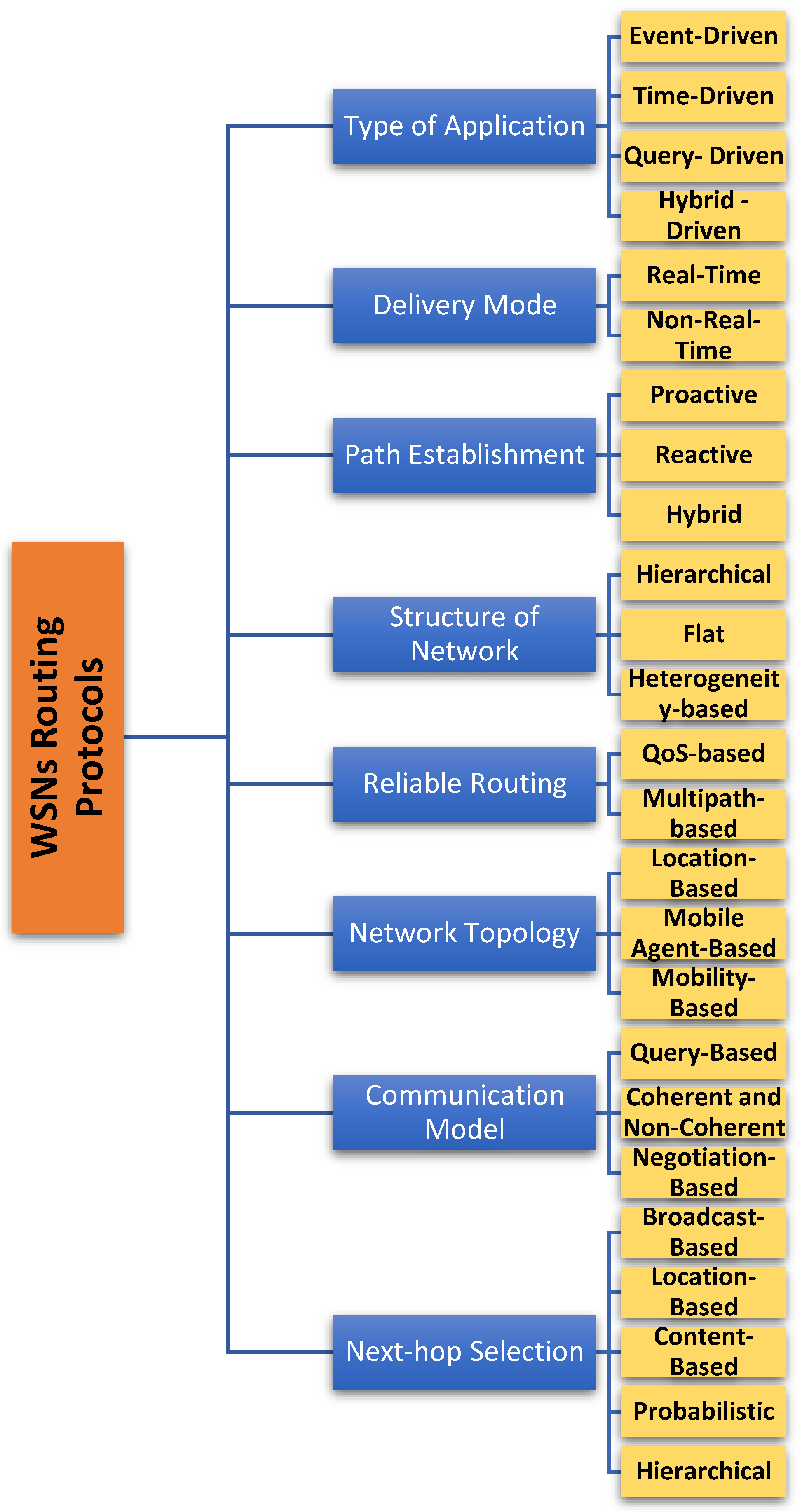
- Flat Routing: All nodes have the same status and transmit data through multi-hop communication. While simple, these protocols suffer from high redundancy and excessive energy consumption. Examples include Flooding, Gossiping, and SPIN routing protocols [23].
- Hierarchical Routing: Nodes are organized into clusters where cluster heads aggregate and forward data, reducing energy consumption and improving scalability. Examples include LEACH and PEGASIS [23] .
- Location-Based Routing: These protocols leverage geographical information to enhance data routing efficiency by forwarding data through nodes closest to the destination. Notable examples include GEAR and GPSR [24].
IV. Comparative Analysis and Optimization Strategies for Routing Protocols in Resource-Constrained Wsns
- Issue: Excessive energy consumption reduces node lifespan.
-
Optimization:
- ○
- Implementing adaptive duty cycling to increase sleep-to-active ratio.
- ○
- Utilizing data aggregation techniques (e.g., PEGASIS) to minimize redundant transmissions.
- Issue: High latency in some protocols affects time-sensitive data.
-
Optimization:
- ○
- Using priority queuing mechanisms for urgent packets.
- ○
- Implementing hybrid routing (LEACH for local clusters, GPSR for global routing) to reduce hop delays.
- Issue: Routing tables become large and unmanageable in large networks.
-
Optimization:
- ○
- Using geographic-based routing (GPSR) instead of maintaining large routing tables.
- ○
- Implementing hierarchical clustering (LEACH) to reduce per-node routing complexity.
- Issue: High control overhead increases vulnerability to network attacks.
-
Optimization:
- ○
- Reducing control packet exchange frequency to minimize exposure to attacks.
- ○
- Implementing lightweight encryption (e.g., TinySec) to prevent malicious packet injection.
V. CONCLUSION
References
- Fahmy, H.M.A. Concepts, Applications, Experimentation and Analysis of Wireless Sensor Networks; In Signals and Communication Technology; Springer International Publishing: Cham, Switzerland, 2021. [Google Scholar]
- Ojeda, F.; Mendez, D.; Fajardo, A.; Ellinger, F. On Wireless Sensor Network Models: A Cross-Layer Systematic Review. J. Sens. Actuator Networks 2023, 12, 50. [Google Scholar] [CrossRef]
- Ali, Q.I. Realization of a Robust Fog-Based Green VANET Infrastructure. IEEE Syst. J. 2022, 17, 2465–2476. [Google Scholar] [CrossRef]
- Adu-Manu, K.S.; Abdulai, J.-D.; Engmann, F.; Akazue, M.; Appati, J.K.; Baiden, G.E.; Sarfo-Kantanka, G. WSN Architectures for Environmental Monitoring Applications. J. Sensors 2022, 2022, 7823481. [Google Scholar] [CrossRef]
- Gulati, K.; Boddu, R.S.K.; Kapila, D.; Bangare, S.L.; Chandnani, N.; Saravanan, G. A review paper on wireless sensor network techniques in Internet of Things (IoT). Mater. Today: Proc. 2022, 51, 161–165. [Google Scholar] [CrossRef]
- Alhabib, M.H.; Ali, Q.I. Internet of autonomous vehicles communication infrastructure: A short review. Diagnostyka 2023, 24, 1–9. [Google Scholar] [CrossRef]
- Basha, A.R. A Review on Wireless Sensor Networks: Routing. Wirel. Pers. Commun. 2022, 125, 897–937. [Google Scholar] [CrossRef]
- Marietta, J.; Mohan, B.C. A Review on Routing in Internet of Things. Wirel. Pers. Commun. 2019, 111, 209–233. [Google Scholar] [CrossRef]
- Kandris, D.; Nakas, C.; Vomvas, D.; Koulouras, G. Applications of Wireless Sensor Networks: An Up-to-Date Survey. Appl. Syst. Innov. 2020, 3, 14. [Google Scholar] [CrossRef]
- H. Goud and R. Anitha, “A Comprehensive Survey on the Advancements in Routing Protocols for Wireless Sensor Networks,” Feb. 15, 2024, Social Science Research Network, Rochester, NY: 4727234. [CrossRef]
- Akyildiz, I.; Su, W.; Sankarasubramaniam, Y.; Cayirci, E. Wireless sensor networks: a survey. Comput. Networks 2002, 38, 393–422. [Google Scholar] [CrossRef]
- Al-karaki, J.N.; Kamal, A.E. Routing techniques in wireless sensor networks: a survey. IEEE Wirel. Commun. 2004, 11, 6–28. [Google Scholar] [CrossRef]
- Ali, Q.I.; Jalal, J.K. Practical Design of Solar-Powered IEEE 802.11 Backhaul Wireless Repeater. 2014 6th International Conference on Multimedia, Computer Graphics and Broadcasting (MulGraB); pp. 9–12.
- Nakas, C.; Kandris, D.; Visvardis, G. Energy Efficient Routing in Wireless Sensor Networks: A Comprehensive Survey. Algorithms 2020, 13, 72. [Google Scholar] [CrossRef]
- Akkaya, K.; Younis, M. A survey on routing protocols for wireless sensor networks. Ad Hoc Networks 2005, 3, 325–349. [Google Scholar] [CrossRef]
- Rady, A.; El-Rabaie, E.L.M.; Shokair, M.; Abdel-Salam, N. Comprehensive survey of routing protocols for Mobile Wireless Sensor Networks. Int. J. Commun. Syst. 2021, 34, e4942. [Google Scholar] [CrossRef]
- Anisi, M.H.; Abdullah, A.H.; Razak, S.A.; Ngadi, A. Overview of Data Routing Approaches for Wireless Sensor Networks. Sensors 2012, 12, 3964–3996. [Google Scholar] [CrossRef]
- Uthra, R.A.; Raja, S.V.K. QoS routing in wireless sensor networks—a survey. ACM Comput. Surv. 2012, 45, 1–12. [Google Scholar] [CrossRef]
- Ali, Q.I. Securing solar energy-harvesting road-side unit using an embedded cooperative-hybrid intrusion detection system. IET Inf. Secur. 2016, 10, 386–402. [Google Scholar] [CrossRef]
- Batool, R.; Bibi, N.; Alhazmi, S.; Muhammad, N. Secure Cooperative Routing in Wireless Sensor Networks. Appl. Sci. 2024, 14, 5220. [Google Scholar] [CrossRef]
- Singh, S.P.; Sharma, S. A Survey on Cluster Based Routing Protocols in Wireless Sensor Networks. Procedia Comput. Sci. 2015, 45, 687–695. [Google Scholar] [CrossRef]
- Radi, M.; Dezfouli, B.; Abu Bakar, K.; Lee, M. Multipath Routing in Wireless Sensor Networks: Survey and Research Challenges. Sensors 2012, 12, 650–685. [Google Scholar] [CrossRef]
- Liu, X. A Survey on Clustering Routing Protocols in Wireless Sensor Networks. Sensors 2012, 12, 11113. [Google Scholar] [CrossRef]
- Kumar, A.; Shwe, H.Y.; Wong, K.J.; Chong, P.H.J. Location-Based Routing Protocols for Wireless Sensor Networks: A Survey. Wirel. Sens. Netw. 2017, 09, 25–72. [Google Scholar] [CrossRef]
- Zagrouba, R.; Kardi, A. Comparative Study of Energy Efficient Routing Techniques in Wireless Sensor Networks. Information 2021, 12, 42. [Google Scholar] [CrossRef]
- Sahar, G.; Abu Bakar, K.; Rahim, S.; Khani, N.A.K.K.; Bibi, T. Recent Advancement of Data-Driven Models in Wireless Sensor Networks: A Survey. Technologies 2021, 9, 76. [Google Scholar] [CrossRef]
- Biswas, P.; Samanta, T. True Event-Driven and Fault-Tolerant Routing in Wireless Sensor Network. Wirel. Pers. Commun. 2020, 112, 439–461. [Google Scholar] [CrossRef]
- Tabassum, M.; Razzaque, A.; Miazi, N.S.; Hassan, M.M.; Alelaiwi, A.; Alamri, A. An energy aware event-driven routing protocol for cognitive radio sensor networks. Wirel. Networks 2015, 22, 1523–1536. [Google Scholar] [CrossRef]
- Sutagundar, A.; Manvi, S. Location aware event driven multipath routing in Wireless Sensor Networks: Agent based approach. Egypt. Informatics J. 2013, 14, 55–65. [Google Scholar] [CrossRef]
- Cengiz, K.; Dag, T. Energy Aware Multi-Hop Routing Protocol for WSNs. IEEE Access 2018, 6, 2622–2633. [Google Scholar] [CrossRef]
- Shahraki, A.; Rafsanjani, M.K.; Saeid, A.B. Hierarchical distributed management clustering protocol for wireless sensor networks. Telecommun. Syst. 2017, 65, 193–214. [Google Scholar] [CrossRef]
- Jain, S.; Pattanaik, K.; Shukla, A. QWRP: Query-driven virtual wheel based routing protocol for wireless sensor networks with mobile sink. J. Netw. Comput. Appl. 2019, 147, 102430. [Google Scholar] [CrossRef]
- Khan, A.W.; Bangash, J.I.; Ahmed, A.; Abdullah, A.H. QDVGDD: Query-Driven Virtual Grid based Data Dissemination for wireless sensor networks using single mobile sink. Wirel. Networks 2019, 25, 241–253. [Google Scholar] [CrossRef]
- Huang, C.; Wang, G. Contention-Based Beaconless Real-Time Routing Protocol for Wireless Sensor Networks. Wirel. Sens. Netw. 2010, 02, 528–537. [Google Scholar] [CrossRef]
- Li, Y.; Chen, C.S.; Song, Y.-Q.; Wang, Z.; Sun, Y. Enhancing Real-Time Delivery in Wireless Sensor Networks With Two-Hop Information. IEEE Trans. Ind. Informatics 2009, 5, 113–122. [Google Scholar] [CrossRef]
- He, T.; Stankovic, J.; Lu, C.; Abdelzaher, T. SPEED: a stateless protocol for real-time communication in sensor networks. 23rd International Conference on Distributed Computing Systems, May 2003; pp. 46–55. [Google Scholar] [CrossRef]
- Al-Karaki, J.N.; Al-Mashaqbeh, G.A. Energy-centric routing in wireless sensor networks. Microprocess. Microsystems 2007, 31, 252–262. [Google Scholar] [CrossRef]
- Liu, X.; Zhao, H.; Yang, X.; Li, X. SinkTrail: A Proactive Data Reporting Protocol for Wireless Sensor Networks. IEEE Trans. Comput. 2013, 62, 151–162. [Google Scholar] [CrossRef]
- Q. I. Ali, "Design, implementation & optimization of an energy harvesting system for VANETs’ road side units (RSU)," IET Intelligent Transport Systems, vol. 8, no. 3, pp. 298-307, 2014.
- Q. Ibrahim, "Design & Implementation of High-Speed Network Devices Using SRL16 Reconfigurable Content Addressable Memory (RCAM)," Int. Arab. J. e Technol., vol. 2, no. 2, pp. 72-81, 2011.
- Alhabib, M.H.; Ali, Q.I. Internet of autonomous vehicles communication infrastructure: A short review. Diagnostyka 2023, 24, 1–9. [Google Scholar] [CrossRef]
- Ali, Q.I. Realization of a Robust Fog-Based Green VANET Infrastructure. IEEE Syst. J. 2022, 17, 2465–2476. [Google Scholar] [CrossRef]
- Q. I. Ali and J. K. Jalal, "Practical design of solar-powered IEEE 802.11 backhaul wireless repeater," in Proc. 6th Int. Conf. on Multimedia, Computer Graphics and Broadcasting, 2014.
- Q. I. Ali, "Security issues of solar energy harvesting road side unit (RSU)," Iraqi Journal for Electrical & Electronic Engineering, vol. 11, no. 1, 2015.
- Ali, Q.I. An efficient simulation methodology of networked industrial devices. In Proceedings of the 2008 5th International Multi-Conference on Systems, Signals and Devices (SSD); pp. 1–6.

| Use Case | Key Requirements | Best Routing Protocol(s) | Justification |
|---|---|---|---|
| Energy-Constrained Networks (e.g., environmental monitoring, smart agriculture) | Low power consumption, extended network lifetime | PEGASIS, LEACH | These protocols use data aggregation and clustering, significantly reducing energy consumption. |
| Real-Time Applications (e.g., healthcare, industrial automation) | Low latency, high Packet Delivery Ratio (PDR) | PEGASIS, LEACH | Fast packet forwarding (8-10 ms delay) and high PDR (92-95%). |
| Scalable Networks (e.g., large-scale IoT deployments) | Efficient operation with high node density | GPSR, LEACH | GPSR uses geographic-based routing, reducing routing table size. |
| Highly Dynamic Networks (e.g., military surveillance, vehicular WSNs) | Fast route adaptation, fault tolerance | AODV, GPSR | AODV enables on-demand route discovery, adapting quickly to topology changes. |
| Security-Critical Applications (e.g., industrial control, smart grid) | Low control overhead, resistance to attacks | PEGASIS, LEACH | Lower control overhead (10-12%) reduces attack surface. |
| Routing Protocol | Energy Consumption (µJ) | CPU Utilization (%) | Packet Delivery Ratio (PDR, %) | Control Overhead (%) | Packet Forwarding Delay (ms) |
|---|---|---|---|---|---|
| AODV | 120 | 30 | 85 | 18 | 15 |
| LEACH | 80 | 15 | 92 | 12 | 10 |
| GPSR | 95 | 25 | 88 | 15 | 12 |
| DSDV | 110 | 28 | 83 | 20 | 14 |
| PEGASIS | 70 | 12 | 95 | 10 | 8 |
| Network Constraint | Recommended Protocol | Justification |
|---|---|---|
| Low Power Consumption | PEGASIS | Uses data aggregation, reducing transmissions. |
| Low Latency (Real-Time Applications) | LEACH | Cluster-based structure optimizes packet forwarding time. |
| Scalability (Large IoT Deployments) | GPSR | Uses geographic routing, avoiding large routing tables. |
| Mobility & Dynamic Networks | AODV | Quickly finds new routes when nodes move or fail. |
| Security-Conscious Networks | PEGASIS, LEACH | Low control overhead reduces attack risk. |
Disclaimer/Publisher’s Note: The statements, opinions and data contained in all publications are solely those of the individual author(s) and contributor(s) and not of MDPI and/or the editor(s). MDPI and/or the editor(s) disclaim responsibility for any injury to people or property resulting from any ideas, methods, instructions or products referred to in the content. |
© 2025 by the authors. Licensee MDPI, Basel, Switzerland. This article is an open access article distributed under the terms and conditions of the Creative Commons Attribution (CC BY) license (http://creativecommons.org/licenses/by/4.0/).


