

Submitted:
03 March 2025
Posted:
04 March 2025
You are already at the latest version
Abstract
The quest for effective pedagogical practices in mathematics education has increasingly highlighted the flipped classroom model. This model has been shown to be particularly successful in higher education settings within developed countries, where resources and technological infrastructure are readily available. However, its implementation in secondary education, especially in developing nations, remains a critical area of investigation. Building on our earlier research which found that students rated flipped classroom model positively, this mixed-method study explored teachers’ experiences with implementing the model for mathematics instruction at the senior secondary level. Since teachers play a pivotal role as facilitators of this pedagogical approach, their understanding and perceptions of it can significantly im-pact its effectiveness. To gather insights into teachers’ experiences, this study employed both close-ended questionnaires and semi-structured interviews. Quantitative analysis of participants’ responses to the questionnaires, including mean scores, standard de-viations and Kruskal-Wallis H tests, revealed that teachers generally gave positive evaluations of their experiences with flipped classrooms, but also pinpointed notable differences in their assessments. Qualitative findings from the thematic analysis of the interview data provided insights into the specific support systems teachers require for successful adoption of the flipped classroom model for senior secondary mathematics instruction.
Keywords:
Teachers’ experiences
; flipped classroom (FC) model
; senior secondary mathematics instruction
; student engagement and achievement
; flipped classroom benefits
; flipped classroom challenges
; teacher support needs
1. Research Overview
1.1. Introduction
The rise of technology has transformed education, altering how knowledge is imparted and acquired. Integrating technology into mathematics education has significantly enhanced student engagement and understanding [1,2]. Mathematics is foundational to several disciplines, fostering critical thinking and problem-solving skills that are vital for success in the present-day complex and dynamic world [3,4]. The flipped classroom (FC) model exemplifies a modern, technology-enhanced approach that reverses traditional teaching dynamics. In this model, students study independently outside of class through video lessons and readings, completing brief online activities selected by their teachers. This strategy allows in-class time to focus on applying concepts through problem solving and peer interaction. During classroom sessions, students engage in various individual and group activities with teacher support, promoting active learning [1,5,6]. This method not only boosts academic performance but also promotes positive attitudes toward learning [7,8].
The FC model accommodates diverse learning styles, enabling students to learn at their own individual speed – particularly beneficial in mathematics where concepts build on one another [8,9]. However, its successful implementation demands thoughtful planning and sufficient support for students facing challenges with self-directed learning [2,10,[2,10,]. Popularized in the early 2000s through educators like Jonathan Bergmann and Aaron Sams, the FC model has evolved from addressing challenges in high school chemistry to becoming a widely adopted strategy across various subjects globally [5,8,11]. By giving students access to instructional materials at their own pace – often via video lessons – the model facilitates active learning and allows teachers to offer personalized support to students [7,9].
Globally recognized for enhancing student engagement and performance [12], the FC model has shown promising outcomes in educational settings across countries like the United States, Canada, and Australia [13]. Despite its broad adoption in the higher education settings, further exploration of its impact on teaching practices and student learning experiences is necessary at the secondary level especially in developing countries [14,15,16]. In Africa, while countries like South Africa and Ghana have made progress with the model, challenges such as resource disparities and inadequate teacher training persist [17]. Similarly, Kenya and Uganda report increased student engagement through the FC model, but face issues related to internet connectivity and technology access [18,19]. These examples highlight the need to adapt innovative learning models like the FC to local conditions across Africa for maximum effectiveness.
This study focuses on Nigeria, where the National Policy on Education officially transitioned from the former 6-3-3-4 structure to the present 9-3-4 system as of 2006. This reform targets harmonizing educational practices with the Education for All (EFA) initiative under the Millennium Development Goals [20] and developing a more streamlined curriculum based on skill acquisition for workforce readiness [21,22]. The initial phase of the 9-3-4 system, commonly referred to as Universal Basic Education (UBE), offers nine years of education that is both free and mandatory for every Nigerian child [21,23]. As stipulated in the 9-3-4 policy, mathematics is a mandatory subject for advancement to higher education and scientific development, with every student required to achieve a credit pass (50%) in it to qualify for tertiary education [21,24,25]. Despite its critical role, students' mathematics results in the Senior School Certificate Examinations (SSCE) has remained consistently unimpressive, even with the various intervention initiatives put in place by the government and stakeholders [26].
Under these circumstances, the FC model might be considered a potential solution. In a quantitative study, [27] concluded that implementing the learning model substantially improved mathematics achievement among senior secondary students in Lagos. Likewise, [28] noted that the model shifts education from teacher-led to student-centered approaches, increasing student engagement through hands-on activities. With less direct instruction, students benefit from greater opportunities for peer collaboration. These researchers underscore the role of technology in teaching and urges policymakers to adopt the model to support teachers. Ultimately, the findings aim to deepen understanding of flipped classrooms and improve mathematics education in secondary schools. [29] also confirm FC model’s ability to improve both achievement and interest levels in secondary mathematics learning. Despite these promising findings, there is limited research on teachers' perspectives about their experiences with the model’s application in secondary mathematics education in Nigeria, pointing to a demand for further inquiry.
Therefore, the current study intends to address this gap by examining teachers’ experiences with the FC model for mathematics instruction in Nigerian senior secondary schools. The study opted to gather teachers' perspectives, recognizing that teachers are crucial facilitators in implementing the model, and that their skills and commitment directly affect its success [30]. This study accepts that teacher insights help manage classroom dynamics and encourage active learning while accommodating diverse student needs for inclusiveness. Furthermore, teacher feedback is vital for refining instructional strategies that lead to better educational outcomes [7]. It is anticipated that the findings will make beneficial contribution to existing literature and inform instructional policy within Nigeria's educational framework and probably beyond too. With technology reshaping educational practices around the world, having awareness of how innovative models like the FC are effectively applied across different educational settings is key to advancing mathematics education and student success.
1.2. Contextualizing the Current Research with Insights from Our Previous Study
Contextualizing new inquiries within prior studies is useful in framing educational research [31]. Our earlier research examined senior secondary students' mathematics learning experiences in flipped classrooms, providing foundational insights that inform our present study on teachers' perspectives on the instructional model. While students reported positive evaluations, we consider it valuable to also explore how teachers view and implement the FC model. This gap underlines the rationale for surveying teachers' assessments of the approach as well, given their critical role in its implementation. Besides, their insights can further enrich our understanding of its use, benefits, challenges, and areas for improvement [14,32].
The earlier study evaluated 266 senior secondary school year-two (SSS2, called Grade 11 in most other countries) students' experiences with receiving their mathematics instruction in flipped classrooms for ten weeks. Executed in a Local Government Area (LGA) of Oyo State, Nigeria, only nine out of the thirteen secondary schools in the LGA agreed to participate in the inquiry. By random sampling, four schools with a total population of 794 students were selected. These schools – anonymized as P, Q, R, and S for participant privacy [33] – had varying numbers of SSS2 classes: two of them had four classes each, one had three, and one had five. The final sample consisted of 266 students from eight SSS2 classes (two from each school), each with one mathematics teacher. These eight classes were coded as Q1, Q2, R1, R2, S1, S2, T1 and T2 (e.g. Q for a set of two classes from a school). According to [34], proper sampling is necessary for equal representation and strong statistical findings.
Drawing on the hint from [35] that training teachers is crucial for effective implementation of educational interventions, before the commencement of that research, participating teachers received training on how to implement the FC model to enhance student engagement and active learning. They were taught how to incorporate technology into their classroom practices, utilize assessment strategies, and adapt lessons for diverse learning needs. This training was designed to equip them with the necessary skills to clearly communicate the model’s dynamics to improve students’ overall learning experience. The Primary Researcher (PR) later visited the teachers’ classrooms to confirm that the teachers appropriately applied the strategies learned during training.
In consistency with research ethics as hinted by [36], necessary approvals and written informed consents were secured prior to conducting the inquiry. Data collection instruments included a questionnaire, classroom observation protocol, and semi-structured interview guide, all informed by analyses of similar studies and expert consultations. Input from three experienced mathematics educators and a psychometrist enhanced the tools' face and content validity. [37] underscore the importance of expert validation in the research process, noting that face and content validity are key qualitative techniques that ensure accurate measurement of the intended constructs. Pilot testing with 78 students (from two classes of a school outside those involved in the main study) yielded Cronbach’s Alpha coefficients of 0.71, 0.74, and 0.77 for the questionnaire, observation protocol, and interview guide respectively, indicating acceptable reliability level [38].
The Flipped Mathematics Classroom Student Feedback Questionnaire (FMC-SFQ) assessed participants’ demographic details and experiences with flipped classrooms using a 4-point Likert scale. The Flipped Mathematics Classroom Observation Protocol (FMC-OP) evaluated classroom environments, teaching practices, student interactions, and overall implementation. Lastly, the Flipped Mathematics Classroom Semi-structured Interview Guide (FMC-SIG) contained ten open-ended questions – five focused on benefits and challenges experienced during flipped learning of mathematics and five aimed at gathering suggestions for improving the model. The study adopted a mixed-method approach featuring an explanatory sequential design, which took place in two phases: quantitative data collection first, followed by qualitative data gathering. Commenting, Creswell (2021) states that this design enriches the interpretation of statistical findings.
The first phase utilized questionnaires to gather data on participants’ views about the FC model for senior secondary mathematics, analyzing it quantitatively with descriptive statistics and paired t-tests. The second stage utilized the qualitative data from classroom observations and semi-structured interviews to provide a deeper understanding and validate the quantitative results. In consonance with [39] on the criticality of mitigating research biases, the following actions were taken during the previous investigation: only willing schools were involved in the inquiry to counter selection bias; anonymity in questionnaire responses minimized response bias. A standardized classroom observation protocol limited observer bias, while support was provided to participants facing difficulties with the FC model to reduce attrition bias. All data-gathering instruments were validated to prevent measurement bias, and objectivity was prioritized during data analysis to lessen confirmation bias. These measures collectively strengthened the study's validity and reliability in clarifying student feedback on the FC approach.
Findings revealed a strong consensus among participants regarding their positive experiences with the FC model. With an overall mean score of 3.65, they regarded the model as an effective instructional strategy that offers flexibility in learning tailored to individual student’s needs and schedules; facilitates active engagement during class; and allows more time for addressing challenging concepts through peer collaboration. Participants also identified challenges such as high self-discipline requirements for managing pre-class tasks, limited access to resources, and learning disparities due to varying prior knowledge. To improve the approach, they suggested more examples for pre-class tasks, additional tutoring sessions and study groups, practical problem-solving activities, enhanced feedback practices, and greater attention to individual learning needs.
This context validates our current research into teachers' viewpoints on the use of FC model for mathematics instruction in senior secondary schools. While our previous inquiry highlighted students' positive experiences with the instructional model, understanding how teachers implement and evaluate it is equally vital for successful adoption. By delving into teachers' insights, the present research deepens discourse surrounding the model while providing practical implications for improving teaching practices and student engagement in mathematics. The insights may inform the design of supportive teacher training initiatives that promote productive pedagogical practices and a more collaborative learning culture. Summarily, the current study stresses the essence of a holistic view of educational innovations that incorporate both student and teacher experiences in achieving quality mathematics instruction.
1.3. Focus of the Present Study
Adoption of flipped classrooms in senior secondary mathematics education in Nigeria has gained significant attention as a method to enhance student engagement and performance [28,29]. However, there is limited understanding of teachers’ perceptions and evaluations of this instructional model. Initial observations (from our earlier study) indicate that teachers face challenges such as creating appropriate pre-class materials, ensuring student preparedness, selecting suitable technological resources, and managing classroom activities during interactive sessions [1,6,28]. Therefore, this study aims to examine teachers’ experiences with the FC model in the context of senior secondary mathematics education in Nigeria. The insights gained may guide the development of professional training programs and educational policies that support effective practices in this teaching framework.
1.4. Research Questions
To actualize its goal, the study set out to answer the questions below:
RQ-1: What assessments do teachers report on their experiences with teaching senior secondary mathematics through flipped classrooms?
RQ-2: What are the differences in teachers’ assessments of their experiences with teaching senior secondary mathematics through flipped classrooms?
RQ-3: What support or resources do teachers need to effectively implement flipped classrooms in senior secondary mathematics?
1.5. Literature Review
The FC model represents a vital innovation in education, shifting traditional teaching toward active, student-centered, technology-driven learning. With technology at its core, this approach enhances student engagement, motivation, and achievement while modernizing teaching methods [2,9]. Understanding teachers' perspectives on implementing flipped classrooms for senior secondary mathematics is essential for evaluating its effectiveness and addressing its challenges [11]. This literature review explores relevant past studies on teachers' perceptions of this model and its implications, particularly for teaching and learning of senior secondary mathematics.
[40] assessed the FC model in undergraduate mathematics by interviewing 19 faculty members from 14 institutions. They concluded that while instructors shared similar motivations to enhance student engagement and improve learning outcomes, their implementation strategies varied widely, often relying on video lectures. Instructors viewed the model as effective for creating a more interactive learning environment that deepens students' understanding of mathematical concepts. This suggests a need to investigate whether Nigerian senior secondary mathematics teachers are motivated to adopt this approach and whether their implementation levels differ. [41] carried out a qualitative case study with eight mathematics instructors who had implemented the FC model. The instructors reported that while the model is effective for mathematics instruction, it may not suit all subjects. The study explores the advantages and challenges of implementing the learning model for mathematics instruction.
[11] explored perceptions among 57 middle school teachers regarding flipped classrooms. Their findings indicated that science and mathematics teachers were more receptive to implementing this approach than English language and social sciences teachers. The study emphasized that teachers need to enhance their knowledge and skills to be able to adopt the FC model effectively. Analyzing how K-12 teachers perceived the model, [42] noted variations by content area and grade level. Data from a survey of 44 teachers in Minnesota revealed that participants viewed FC model as employing diverse instructional techniques, promoting active learning and higher-order thinking, and enhancing student-teacher interaction. These insights imply that Nigerian mathematics teachers might share similar views on the model's benefits, underscoring the importance of considering grade level and content area when evaluating its effectiveness.
[32] conducted a mixed-method investigation into teachers' perceptions of the benefits and challenges of adopting the FC model. Teachers reported that it facilitates student engagement and creates dynamic classroom environments, but they also pointed out serious obstacles related to technology and increased teacher workload. They called for institutional support and professional development to improve implementation. [43] explored teachers' perceptions of the FC model in Yogyakarta, through qualitative interviews with five public and private school teachers. The study found that the model motivates students and fosters active learning, critical thinking, and problem-solving skills. These findings provide a framework for analyzing how Nigerian mathematics teachers evaluate the model's effectiveness in developing these skills among senior secondary students.
These collective findings highlight potential benefits such as increased student engagement while revealing challenges like workload management for teachers, varying digital literacy levels among students, and the need for institutional support. Addressing these concerns is crucial for understanding how teachers perceive the effectiveness of flipped classrooms in enhancing student learning outcomes. While existing literature provides useful insights into the impact of this model across various contexts, further research focusing specifically on its application in Nigerian senior secondary schools – particularly in mathematics – is warranted. Bridging these gaps will significantly contribute to improving pedagogical practices aimed at enhancing student outcomes in mathematics education while informing future educational policies that support innovative teaching methods.
1.6. Theoretical Structure
In this study, the Technological Pedagogical Content Knowledge (TPACK) framework, developed by [44] provides a theoretical foundation for examining the integration of technology in flipped classrooms (See Figure 1). TPACK mainly emphasizes the interconnection of Technological Knowledge (TK), Pedagogical Knowledge (PK), and Content Knowledge (CK), positing that effective teaching requires a deep understanding of how these elements interact to create impactful learning experiences. The current study adopts TPACK as a lens through which teachers perceive and implement the FC model to enhance mathematics instruction in senior secondary schools. The model enables students to engage with instructional content outside the classroom, fostering more interactive and collaborative learning during class time. By leveraging TPACK, teachers can select appropriate technological resources that align with their pedagogical strategies and the specific content being taught, such as instructional videos and interactive online exercises.
Research suggests that teachers possessing robust TPACK competence tend to utilize technology more efficiently, enhancing student engagement and learning achievement [44,45]. This framework promotes critical thinking by encouraging students to engage deeply with mathematical concepts. When students access learning materials before class, they can reflect on the content and formulate questions, leading to more meaningful discussions during face-to-face class sessions. By moving from passive to active learning, students develop enhanced critical thinking skills and participate in a collaborative setting that promotes sharing of ideas. To impactfully integrate TPACK in the application of the FC model, teachers should adopt best practices that blend technology with pedagogical practices. This includes selecting digital tools that facilitate interactive learning and designing lesson plans that incorporate technology to enhance understanding. Professional development programs focused on TPACK can equip teachers with the skills necessary for successful implementation of flipped classrooms.
Recent research signifies a compelling connection between TPACK and the FC model, enhancing secondary mathematics education. [46] maintain that the quality of education obtainable within the FC model hinges on teachers' ability to integrate technology, pedagogy and subject expertise. [47] studies the impact of teachers' self-efficacy on technology integration, underlining its relevance in the flipped classroom context. [48] stress the essence of technology readiness and adaptation, framing these competencies as crucial for effective TPACK application in the flipped learning of mathematics. [16] link TPACK to teachers’ confidence levels, arguing that a strong TPACK foundation contributes to successful adoption of the FC model. These findings collectively underscore that leveraging TPACK to strengthen the model not only improves instructional quality but also cultivates deeper student engagement and understanding in mathematics education. By synthesizing both TPACK and FC model, teachers can create more effective learning contexts that meet diverse student needs.
In this study, TPACK serves as a support system for the FC model by providing a structured approach for blending technology, pedagogy, and content knowledge. This integration allows for differentiated instruction tailored to diverse learning needs, allowing students to engage with mathematical concepts at their own pace. Again, TPACK encourages teachers to reflect on their practices and modify them based on student feedback and performance data. Specific technologies effective within the FC setting include dynamic geometry software like GeoGebra, online collaborative platforms such as Google Classroom, and multimedia resources like instructional videos. These tools facilitate interactive learning and help students visualize complex mathematical concepts. Additionally, online quizzes give immediate feedback, reinforcing students' understanding of key concepts.
Deploying TPACK in flipped classrooms presents opportunities for enhanced engagement; however, teachers may encounter challenges such as limited access to technological resources, insufficient training on effective integration, and resistance from students accustomed to traditional methods. Addressing these challenges demands ongoing teacher professional development and institutional support to foster an environment conducive to successful implementation. This study explores teachers' appraisal of their experiences with the FC model considering TPACK as a framework. By assessing how teachers perceive the effectiveness of the model, this research aims to identify the strengths and challenges associated with its implementation in Nigerian senior secondary schools. Understanding these perspectives is crucial for informing future policies and practices related to technology integration in mathematics education. Ultimately, applying the TPACK framework in this study offers a holistic approach to integrating technology into flipped classrooms, contributing to better learning outcomes for students in Nigerian senior secondary schools.
2. Methodology
2.1. Research Design
The current research followed an explanatory sequential mixed-method design, combining quantitative data from questionnaires and qualitative insights from semi-structured interviews across two stages. The first stage focused on analyzing the quantitative data on teachers' experiences in flipped mathematics classrooms collected through questionnaires. The second stage utilized the qualitative data from the interviews to enrich and corroborate the quantitative findings, aligning with studies like [49,50,51] which document that this research approach improves credibility, captures both broad statistical patterns and in-depth perspectives, and helps uncover unexpected insights, making it especially valuable in fields like education and social sciences. Figure 2 illustrates the study's design.
2.2. Sampling
The participants were eight mathematics teachers from four secondary schools. Out of the thirteen secondary schools in the LGA, only nine expressed interest in the research. Of these willing nine schools, four were randomly chosen and involved in the earlier study. As a result, the number of participants in the present study could not be more than eight teachers because each participating school had only two mathematics teachers assigned to its senior secondary classes. Identifier codes Q1, Q2, R1, R2, S1, S2, T1 and T2 were assigned to the teachers based on their respective classroom names.
2.3. Instrument Development and Validation
The researchers of this study created the questionnaire and semi-structured interview guide utilized for data collection through a thorough literature search and expert consultations. Input from four specialists (one experienced psychometrist and three senior secondary mathematics teachers) enabled substantial improvements in the measuring tools, giving them face and content validity. Pilot testing with four teachers from two senior secondary schools outside the main study demonstrated reliability, achieving Cronbach’s Alpha coefficients of 0.72 for the questionnaire and 0.74 for the interview guide. These reliability index values indicate acceptable internal consistency across both instruments [38].
The questionnaire, named Flipped Mathematics Classroom Teacher Appraisal Questionnaire (FMC-TAQ), had two sections – Sections A and B. While Section A focused on participants’ demographics, Section B examined their FC teaching experiences. The demographic data presented in Table 1 showed a balanced representation by gender (4 males and 4 females) as well as in teaching experiences – each teacher had at least ten years’ experience teaching SSS 2 (Grade 11) with a minimum qualification of a Bachelor’s degree in Mathematics Education. Gathering participants’ demographic details enhances contextualization, analytical robustness of findings and generalizability while highlighting participant diversity for meaningful conclusions and actionable recommendations [52,53].
The other sections (B to E) consist of eighteen questions probing relevant aspects such as teaching practices, opportunities, challenges and teacher perceptions of flipped classrooms. The questionnaires utilized a 5-point Likert scale (Strongly Disagree: SD = 1; Disagree: D = 2; Neutral: N = 3; Agree: A = 4; Strongly Agree: SA = 5) to measure teachers’ experiences with the FC model. According to [54], this scale provides clarity and facilitates quantitative data analysis while reducing ambiguity. Similarly, [55] state that questionnaires are reliable tools for quantifying responses and simplifying administration, enabling researchers to gather information from larger samples without direct researcher influence.
The Flipped Mathematics Classroom Semi-structured Interview Guide (FMC-SIG) was designed to collect additional information about participants' experiences with the FC model, specifically on the support or resources teachers need to be able to effectively implement flipped classrooms for senior secondary mathematics. As hinted by [56], the interview guide includes questions that facilitate in-depth exploration of participants' experiences for effective data collection. It consists of seven open-ended questions aimed at prompting participants to expand on their questionnaire responses. By integrating quantitative and qualitative insights, this study aims to enhance the effectiveness of flipped classrooms for senior secondary mathematics instruction and contribute to better educational outcomes.
2.4. Prominent Strategies Implemented in the Flipped Mathematics Classrooms
Before each in-class lesson, teachers introduced the upcoming topics and shared relevant video lessons, worked examples, and worksheets mainly through platforms such as WhatsApp, Bluetooth and email. They sourced most instructional materials from YouTube's Online Education Resources (OER) and created additional resources to closely align with lesson objectives. Teachers instructed students to engage in the video lessons and study the supplementary materials at their own pace as part of their out-of-class activities, typically conducted at home. This approach allows students to familiarize themselves with the content, grasp fundamental concepts before class session, and apply the knowledge gained during class.
In the previous study, the lesson observation visits made by the Primary Researcher (PR) to participating schools revealed that teachers found students arriving to classes with both digital and printed materials, which they utilized considerably during class discussions and activities. This preparation enabled spending in-class time on tackling complex problems and discussing challenging concepts. The teachers facilitated interactive quizzes and group work activities designed to promote collaboration in their individual classrooms. The seating arrangement encouraged peer interaction, allowing students to learn from one another while tackling higher-order questions.
Following each in-class session, teachers implemented post-class activities aimed at reinforcing and expanding on the concepts learned. These activities included assessment tasks such as quizzes and assignments to evaluate students' comprehension of the material covered. Teachers also involved students in individual and group projects that applied mathematical concepts to real-world scenarios, fostering deeper learning. They provided additional practice exercises to help solidify students' skills while incorporating reflection activities that encouraged students to assess their learning experiences and identify areas for improvement.
Teachers facilitated online discussions, creating a platform for ongoing interaction about the learning material. This environment allowed students to ask questions and share ideas beyond the classroom setting. Feedback sessions conducted by teachers on post-class assessments guided students in enhancing their understanding. Together, these components sustained engagement with the content beyond the classroom experience, leading to improved learning outcomes.
2.5. Procedure for GatheringTeachers’ Flipped Mathematics Classroom Experiences
After implementing the flipped classroom approach in their respective mathematics classes for ten weeks, the eight teachers were asked to evaluate their experiences with this learning method. On the Friday of the 11th week, just before the start of the students' examinations, each teacher received a copy of the FMC-TAQ to complete over the weekend. All participants returned their copies of the questionnaire the following Monday as planned. Later that week, at their convenience, each teacher was engaged in a thirty- minute semi-structured interview to elaborate on their questionnaire responses. [57] describes a semi-structured interview as an exploratory method that allows for flexibility around a central topic. This approach enables researchers to deviate, when necessary, from their prepared interview guide to explore emerging themes, providing deeper insights. While interviewing the eight teachers, the Primary Researcher leveraged this flexibility to adjust questions based on participants' responses and captured diverse contexts and behavior. The questionnaires and interview data collected were analyzed in the subsequent section.
3. Results
This study investigated teachers' experiences with flipping mathematics classrooms in senior secondary schools. Participants' feedback was evaluated mainly through mean scores, standard deviations and Kruskal-Wallis H tests. Thematic analysis of interview responses highlighted the necessary supports they require for effectiveness. To provide context for the results, participants' demographic information is first analyzed.
3.1. Analysis of Participants’ Demographic Details (n = 8)
Participant demographics are crucial for the researcher to assess whether the sample accurately reflects the larger population. Gathering useful demographic data on participants – such as age, gender, race, income, and education – enhances the generalizability of findings and reveals variations among subgroups. Demographic context is essential for accurately interpreting research results [58,59]. In the present study, we collected data on participants’ gender, age, highest qualification, and years of teaching experience. As illustrated in Table 1, the sample consists of eight mathematics teachers, demonstrating balanced gender representation, with an equal number of male and female teachers. This balance is a positive indicator of diversity within the sample. Six out of the eight participants were aged between 30 and 50 years. All of them had also taught mathematics at the secondary school level for at least eleven years. Their ages and years of teaching experience suggest that they were both active and experienced. In terms of teacher qualifications, all participants met the National Policy on Education requirement stipulating that every teacher at senior secondary level in Nigeria must possess either a Bachelor's degree in Education (B.Ed.) or another relevant Bachelor's degree combined with a Postgraduate Diploma in Education [21,60]. Expectedly too, they were registered with the Teachers’ Registration Council of Nigeria (TRCN). Overall, the sample appears diverse and representative of the population and could be considered appropriate for the investigation and precise description of the experimental results, their interpretation, as well as the experimental conclusions that can be drawn.
3.2. Analysis of Teachers’ Responses to Questionnaire Items
RQ-1: What assessments do teachers report on their overall experiences with teaching senior
secondary mathematics through flipped classrooms?

Table 3.
Likert Scale Scoring Range Adapted from [68].
Table 3.
Likert Scale Scoring Range Adapted from [68].
| Rating Description | Score | Mean Rating | Interpretation |
| Strongly Disagree (SD) | 1 | 1.00 - 1.80 | Very Negative |
| Disagree (D) | 2 | 1,81 - 2.60 | Negative |
| Neutral (N) | 3 | 2.61 - 3.40 | Moderate |
| Agree (A) | 4 | 3.41 - 4.20 | Positive |
| Strongly Agree (SA) | 5 | 4.21 5.00 | Very Positive |
Table 4.
Total Weighted Scores Per Category (n = 8).
| S/N | Questionnaire-item | SD | D | N | A | SA | Mean | SD | Rating |
| 1 | 2 | 3 | 4 | 5 | x̅ | σ | |||
| Section B: Teaching Practices in Flipped Classrooms | |||||||||
| 1. | I find teaching in an FC setting easy, exciting and enjoyable. | 0 | 2 | 6 | 8 | 15 | 3.88 | 1.13 | Positive |
| 2. | I often provided structured guidance to my students for pre-class tasks. | 0 | 0 | 6 | 8 | 20 | 4.25 | 0.89 | Very Pos. |
| 3. | FC has enhanced my ability to clarify complex mathematics concepts. | 0 | 2 | 3 | 8 | 20 | 4.13 | 1.13 | Positive |
| 4. | I encouraged group work during in-class sessions. | 0 | 0 | 0 | 12 | 25 | 4.63 | 0.52 | Very Pos. |
| 5. | I adopted after-class online discussion for continued collaboration. | 0 | 0 | 0 | 12 | 10 | 4.63 | 0.52 | Very Pos. |
| 6. | The FC model has positively impacted my teaching practices. | 0 | 0 | 3 | 12 | 20 | 4.38 | 0.74 | Very Pos. |
| Rating Average | 4.32 | 0.82 | Very Pos. | ||||||
| Section C: Opportunities in Flipped Mathematics Classrooms | |||||||||
| 7. | Adopting FC model has resulted in a higher student engagement. | 0 | 0 | 0 | 12 | 25 | 4.63 | 0.52 | Very Pos. |
| 8. | FC approach fosters a greater student ownership of learning. | 0 | 2 | 3 | 8 | 20 | 4.13 | 1.13 | Positive |
| 9. | FC approach promotes collaborative learning among students | 0 | 0 | 3 | 8 | 25 | 4.5 | 0.76 | Very Pos. |
| 10. | FC strategies develop students’ critical thinking & problem-solving skills | 0 | 0 | 3 | 8 | 25 | 4.5 | 0.76 | Very Pos. |
| 11. | FC enables me to meet my students' individual needs better. | 0 | 0 | 6 | 12 | 15 | 4.13 | 0.83 | Positive |
| Rating Average | 4.38 | 0,8 | Very Pos. | ||||||
| Section D: Challenges in Flipped Mathematics Classrooms | |||||||||
| 12. | Developing instructional materials such as video lessons and online content for flipped classes is challenging for me. | 2 | 4 | 0 | 8 | 10 | 3 | 1.69 | Moderate |
| 13. | Students often struggle with completing their pre-class tasks before class | 2 | 4 | 0 | 8 | 10 | 3 | 1.69 | Moderate |
| 14. | Limited technological resources hinder successful adoption of the FC model | 0 | 0 | 0 | 16 | 20 | 4.5 | 0.53 | Very Pos. |
| 15. | Utilizing FC makes effective management of class time more difficult compared to traditional teaching methods. | 2 | 4 | 0 | 12 | 5 | 2.88 | 1.55 | Moderate |
| 16. | With FC, assessing student learning outcomes is more difficult relative to traditional teaching methods. | 3 | 4 | 0 | 8 | 5 | 2.5 | 1.6 | Negative |
| Rating Average | 3.18 | 1.41 | Moderate | ||||||
| Section E: General Perception of flipped mathematics classrooms | |||||||||
| 17. | FC approach can help senior secondary students understand and perform better in mathematics than traditional teaching methods. | 1 | 2 | 0 | 8 | 20 | 3.88 | 1.55 | Positive |
| 18. | I recommend the adoption of the FC model in senior secondary schools. | 0 | 2 | 3 | 8 | 20 | 4.13 | 1.13 | Positive |
| Rating Average | 4.01 | 1.34 | Positive | ||||||
| Overall | 3.98 | 1.04 | Positive | ||||||
Note: The total weighted score for each category in Table 4 is computed by multiplying the weight of the response given (SD = 1; D = 2; N = neutral = 3; A = 4; SA = 5) by each frequency value given in Table 3. For example, for qeuestion 1, 0 participant chose SD = 1 (1 × 0 = 0); 1 participant chose D = 2 (2 × 1 = 2); 2 participants chose N = Neutral = 3 (3 × 2 = 6); 2 participants chose A = 4 (4 × 2 = 8) and 3 participants chose SA = 5 (5 × 3 = 15).
Table 4 indicates a predominantly positive trend in participants' responses regarding their FC teaching practices. In Section B, four out of six questions received very positive responses, while two were rated positively. This pattern is consistent with Section C, where three questions garnered very positive feedback and two received positive ratings. These findings suggest that participants generally recognized the benefits of implementing flipped classrooms for senior secondary mathematics. The data in Section C (on the perceived benefits of the FC model) imply that teachers perceive it can enhance student engagement, promote collaborative learning, motivate students to be more accountable for their learning, develop critical thinking and problem-solving skills, and enable teachers to better meet individual students' needs. Despite this positivity, all participants, in Section D, acknowledged that teaching senior secondary mathematics through flipped classrooms has its challenges.
Specifically, four of the eight participants found developing video lessons and other digital content challenging (questions 12 and 15); four participants noted difficulties with students completing pre-class tasks (question 13) and managing class time effectively; all the eight participants highlighted challenges related to technological resources (question 14); three participants agreed that assessing student learning outcomes was more difficult in flipped classrooms than traditional ones (question 16), while the remaining five stated otherwise. On average, according to Table 4, participants rated their challenges with the FC model as moderate. Referring to questions 17 and 18 about their general perceptions of the model for mathematics instruction and its recommendability, six out of eight participants responded positively (see Table 4). In summary, a combined mean score of 3.98 with a standard deviation of 1.04 indicates that teachers generally had an overall positive experience adopting flipped classrooms for senior secondary mathematics education. Thus, question 1 has been answered.
RQ-2: What are the differences in teachers’ assessments of their experiences with teaching senior secondary mathematics through flipped classrooms?
Based on this research question, the following research hypothesis is formulated:
H0: There are no significant differences in the teachers’ assessments of their experiences with teaching senior secondary mathematics through flipped classrooms?
Table 5.
Analysis of Participants’ Responses to Each Questionnaire Item.
| S/N | Questionnaire Item | Q | R | S | T | ||||
| Section B: Teaching Practices in Flipped Mathematics. Classroom | Q1 | Q2 | R1 | R2 | S1 | S2 | T1 | T2 | |
| 1. | I find teaching in a FC setting easy, exciting and enjoyable. | SA | SA | D | N | N | A | A | SA |
| 2. | I often provided structured guidance to my students for pre-class tasks. | SA | SA | N | N | A | SA | A | SA |
| 3. | FC has enhanced my ability to clarify complex mathematics concepts. | A | SA | N | D | A | SA | SA | SA |
| 4. | I encouraged group work activities during in-class sessions. | SA | SA | A | A | A | SA | SA | SA |
| 5. | I adopted after-class online discussion for continued collaboration. | SA | SA | A | A | A | SA | SA | SA |
| 6. | FC model has positively impacted my teaching practices. | A | SA | N | A | SA | SA | SA | A |
| Section C: Opportunities in Flipped Mathematics Classrooms | |||||||||
| 7. | Adopting FC has resulted in a higher student engagement in my classes. | SA | SA | A | A | A | SA | SA | SA |
| 8. | FC approach fosters a greater student ownership of learning. | SA | A | D | N | A | SA | SA | SA |
| 9. | FC promotes collaborative learning among students | SA | SA | D | A | A | SA | SA | SA |
| 10. | FC strategies develop students’ critical thinking and problem-solving skills. | SA | SA | D | A | A | SA | SA | SA |
| 11. | FC enables me to meet my students' individual needs better. | SA | A | D | A | A | SA | SA | SA |
| Section D: Challenges in Flipped Mathematics Classrooms | |||||||||
| 12. | Developing instructional materials such as video lessons and online content for flipped classes is challenging for me. | SD | SD | SA | SA | A | A | D | D |
| 13. | Students often struggle with completing their pre-class tasks before class. | SD | D | SA | SA | A | A | D | SD |
| 14. | Limited technological resources hinder successful adoption of the FC model. | SA | SA | A | SD | A | A | A | SA |
| 15. | Utilizing FC approach makes effective management of class time more difficult compared to traditional teaching methods. | SD | SD | SA | A | A | A | D | D |
| 16. | With FC, assessing student learning outcomes is more difficult relative to traditional teaching methods. | SD | SD | SA | A | A | D | D | SD |
| Section E: General Perception of flipped mathematics classrooms | |||||||||
| 17. | FC approach can help senior secondary students understand and perform better in mathematics than traditional teaching methods. | SA | SA | SD | D | A | A | SA | SA |
| 18. | I recommend the adoption of the FC model in senior secondary schools. | SA | SA | D | N | A | A | SA | SA |
Table 6.
Weighted Analysis of Participants’ Responses to Each Questionnaire Item.
| S/N | Questionnaire-item | Q1 | Q2 | R1 | R2 | S1 | S2 | T1 | T2 |
| Section B: Teaching Practices in Flipped Mathematics Classrooms | |||||||||
| 1. | I find teaching in an FC setting easy, exciting and enjoyable. | 5 | 5 | 2 | 3 | 3 | 4 | 4 | 5 |
| 2. | I often provided structured guidance to my students for pre-class tasks. | 5 | 5 | 3 | 3 | 4 | 5 | 4 | 5 |
| 3. | FC has enhanced my ability to clarify complex mathematics concepts. | 4 | 5 | 3 | 2 | 4 | 5 | 5 | 5 |
| 4. | I encouraged group work activities during in-class sessions. | 5 | 5 | 4 | 4 | 4 | 5 | 5 | 5 |
| 5. | I adopted after-class online discussion for continued collaboration. | 5 | 5 | 4 | 4 | 4 | 5 | 5 | 5 |
| 6. | FC model has positively impacted my teaching practices. | 4 | 5 | 3 | 4 | 5 | 5 | 5 | 4 |
| Section C: Opportunities in Flipped Mathematics Classrooms | |||||||||
| 7. | Adopting FC model has resulted in a higher student engagement in my classes. | 5 | 5 | 4 | 4 | 4 | 5 | 5 | 5 |
| 8. | FC approach fosters a greater student ownership of learning. | 5 | 4 | 2 | 3 | 4 | 5 | 5 | 5 |
| 9. | FC approach promotes collaborative learning among students | 5 | 5 | 2 | 4 | 4 | 5 | 5 | 5 |
| 10. | FC strategies develop students’ critical thinking and problem-solving skills. | 5 | 5 | 2 | 4 | 4 | 5 | 5 | 5 |
| 11. | FC enables me to meet my students' individual needs better. | 5 | 4 | 2 | 4 | 4 | 5 | 5 | 5 |
| Section D: Challenges in Flipped Mathematics Classrooms | |||||||||
| 12. | Developing instructional materials such as video lessons and online content for flipped classes is challenging for me. | 1 | 1 | 5 | 5 | 4 | 4 | 2 | 2 |
| 13. | Students often struggle with completing their pre-class tasks before class. | 1 | 2 | 5 | 5 | 4 | 4 | 2 | 1 |
| 14. | Limited technological resources hinder successful adoption of the FC model. | 5 | 5 | 4 | 1 | 4 | 4 | 4 | 5 |
| 15. | Utilizing the FC approach makes effective management of class time more difficult compared to traditional teaching methods. | 1 | 1 | 5 | 4 | 4 | 4 | 2 | 2 |
| 16. | With FC, assessing student learning outcomes is more difficult relative to traditional teaching methods. | 1 | 1 | 5 | 4 | 4 | 2 | 2 | 1 |
| Section E: General Perception of flipped mathematics classrooms | |||||||||
| 17. | FC approach can help senior secondary students understand and perform better in mathematics than traditional teaching methods. | 5 | 5 | 1 | 2 | 4 | 4 | 5 | 5 |
| 18. | I recommend the adoption of the FC model in senior secondary schools. | 5 | 5 | 2 | 3 | 4 | 4 | 5 | 5 |
The Kruskal-Wallis H test was performed (at α = .05 significance level) on Table 4 data. The Kruskal-Wallis test was selected over ANOVA because the study’s data violated ANOVA normality assumption, as confirmed by the Shapiro-Wilk test (p-value as low as 0.00000675). Given our small sample size of eight participants, this non-parametric approach (considered equivalent to ANOVA) is more appropriate. Table 7 provides a summary of the test performed.
3.2.1. Test Interpretation
(i) Null Hypothesis and Assumptions: The Kruskal-Wallis test assumes that all groups have the same mean rank scores or medians if distributions are similar in shapes. In this study, the distributions neither have similar shapes nor the same medians. However, at least one group has a mean rank score different from others. See Table 9 for the specific pairwise differences. Hence, the null hypothesis (H0) is rejected.
(ii) P-value Interpretation: The p-value of 0.002586 indicates a low probability of observing these results by chance if H0were true. This suggests that rejecting H0 is justified with only a 0.26% risk of committing a Type-I error.
(iii) Test Statistic Interpretation: The test statistic, H = 21.9553 is compared to a Chi-square distribution with k – 1 =7 degrees of freedom (k = 8). Since H > 14.0671, which is outside the acceptance region for α = .05, H0 is rejected.
(iv) Omnibus Nature of Kruskal-Wallis Teats and Follow-Up Tests: Kruskal-Wallis is an omnibus test that indicates overall differences without specifying which groups differ significantly from each other in terms of their mean rank scores. Thus, post-hoc Dunn’s tests were conducted to identify specific pairwise differences among all possible pairs.
(v) Conclusion: Given χ2(7) = 21.96, with p = .002586 < < α, we reject the null hypothesis that there are no significant differences in teachers' assessments of their experiences with flipped classrooms across different groups, as evidenced by varying mean rank scores shown in Table 9. This clarifies research question 2.
3.3. Analysis of Teachers’ Responses to Semi-structured Interviews
Interview data underwent the thematic analysis framework proposed by [61], which comprised these six steps: initial familiarization with the data, generating codes, developing themes, review, refinement, and final naming of themes in relation to the research questions. Below are the FMC-SIG questions that participants responded to:
RQ-3: What support or resources do teachers need to effectively implement flipped classrooms in
senior secondary mathematics?
|
1. Can you explain briefly how you implemented the flipped classroom model in your mathematics classes? 2. Have there been any changes in student engagement or performance resulting from flipping your mathematics classroom? Elaborate on your answer please. 3. Can you identify any major factors that adversely affected your ability to implement the approach fully? 4. What tools or resources were most helpful in your adoption of the flipped classroom? 5. How were you able to obtain or develop those tools or resources? 6. Are there particular tools, materials or platforms you wish were available that could have improved your flipped classroom teaching? 7. What changes would you suggest are needed to improve the implementation of flipped classrooms in senior secondary mathematics? |
3.3.1. Teacher Support Needs for Effective Flipping of Mathematics Classrooms
As identified from participants’ responses to the interview questions, teacher support needs for effective implementation of flipped classrooms in senior secondary mathematics fall into the following seven broad thematic categories:
Theme 1: Technological resources
For effective content creation and delivery, teachers require reliable devices, strong and stable internet, and digital tools such as video-recording tools and interactive platforms like Desmos and GeoGebra. Learning management systems (LMS) like Google Classroom and Moodle are essential for organizing content and facilitating communication. Additionally, assessment tools such as Quizizz and Kahoot help track student progress by providing interactive evaluations that support tailored teaching strategies. While all participants recognized the necessity of sufficient technological resources to effectively flip their mathematics classrooms, Teachers R1, R2, S1, and S2 particularly stressed this point. Teacher R1 remarked on the limitations of their equipment: stating, “The projector and interactive whiteboards in my classroom are quite small.” Teacher R2 added, “The desktop computer is outdated and slow.” Teacher S2 pointed out the lack of school Wi-Fi, saying, “We rely on personal data for internet access, and many students have low-speed devices.” Teacher S1 shared similar concern. Even Teachers Q1 and Q2 reported needing additional resources despite having better-equipped classrooms: “Providing us with video-recording tools and editing software would be beneficial”. Teacher S2 expressed, “I strongly wish each student could be given a laptop or tablet with regular data plans for pre-class activities.”
Theme 2: Institutional support
As observed by participants, the success and sustainability of flipped classrooms depends on the level and quality of institutional support provided to them. Thus, schools must formulate supportive policies that foster an environment conducive to innovative learning. This includes equipping classrooms with modern technology such as smart boards and projectors, as well as supplying dependable IT assistance. Moreover, schools should ascertain that all students have equitable access to digital resources. This can be achieved by providing school-owned devices or establishing on-campus learning centers where students can access necessary tools. By doing so, institutions help bridge the digital divide, ensuring that every student has an equal opportunity to engage fully with the flipped classroom model. Teacher T1 emphasized the necessity of a Learning Management System (LMS), stating, “LMS platforms facilitate access to pre-class materials and improve communication between students and teachers.” Teacher R1, whose questionnaire responses are mostly “disagree” and “neutral”, argued, “For effective implementation of the flipped classroom model in mathematics, professional development programs from the school and Ministry of Education are essential, focusing on technology integration, instructional design and active learning strategies.” Teacher S1 similarly suggested, “Schools and the education ministry should promote collaboration among teachers to share best practices.” Additionally, Teacher Q1 pointed out, “Schools should formulate supportive policies that provide clear implementation guidelines and ensure all students have access to necessary technology and tutoring support for those struggling with pre-class tasks.”
Theme 3: Pedagogical training
Teachers demand pedagogical support to effectively structure and deliver lessons. Providing them with comprehensive training on instructional design, active learning techniques, and differentiated instruction equips them with strategies to engage students. Furthermore, offering them guidance on creating engaging video content, integrating problem-solving activities, and scaffolding mathematical concepts ascertains that students benefit maximally from flipped classroom learning environments. Highlighting the importance of training for creating engaging pre-class materials and collaborative activities, Teacher R2 explained, “We really need adequate training on proper ways to design effective pre-class materials and in-class collaborative, problem-solving activities and real-world applications that promote student engagement and active learning.” Other teachers shared similar sentiments; except Teacher S1 whose response is a bit different. As he put it, “Teachers should be equipped with strategies to assist students struggling with technology use in the flipped model and to help them adjust to taking more responsibility for their learning space”.
Theme 4: Professional development and training
Participants believe teachers should be offered regular professional development opportunities to refine their flipped teaching practices. This can include organizing workshops focused on video content creation, student engagement strategies, and interactive assessments. According to Teacher Q1, “such training will not only enhance their skills but also build their confidence in implementing innovative teaching methods.” In his own case, Teacher T2 suggested that setting up professional learning communities and providing access to online courses can further support teacher development. Elaborating on this, Teacher S2 observed that these platforms enable teacher collaboration with colleagues, sharing of best practices, and staying updated on the latest developments in flipped learning. Corroborating this view, Teacher Q1 commented, “By fostering a collaborative environment and keeping educators updated on emerging methodologies, schools can ensure that teachers are well-equipped to deliver effective flipped classroom experiences.
Theme 5: Student engagement and motivation tools
The success of the flipped classroom model hinges on tools that help teachers motivate and engage students effectively. These tools are essential for tracking student accountability, providing timely feedback, and fostering motivation among students. In the opinion of Teacher R1, “By leveraging these resources, educators can create a more interactive and responsive learning environment.” Believing that it is not only teacher effort that can serve as supports for students, Teacher R2 remarked, “Parental involvement initiatives play a crucial role in supporting students outside the classroom.” Buttressing this idea, Teacher T1 said, “Such initiatives can encourage parents to help their children engage with pre-class activities at home and understand the principles of flipped learning.” On this theme, a perspective that is common to all participants is that the collaborative approach offers students steady support in school as well as at home, thereby increasing their engagement with the flipped classroom model.
Theme 6: Curriculum integration and content development
Participants commented that flipped classrooms can maintain consistency with educational standards by integrating curriculum and developing content that support these standards. “A way to attain this is by deploying pre-made educational content from platforms like Khan Academy and CK-12, which reduces the burden on teachers to create materials from scratch.”, contributed Teacher Q2. Teachers Q1, T1 and T2 shared a common viewpoints. “Moreover, making adaptable lesson templates available along with structured guidance on how to integrate flipped learning into the curriculum can considerably improve teaching efficiency,” Teacher S2 noted. This perspective matches the opinions of Teachers R1, R2 and S1. Essentially, participants emphasized that the approach equips teachers with the necessary tools to design effective lessons while aligning with broader educational goals.
Theme 7: Evaluation tools
The availability of suitable evaluation tools is critical for refining teaching strategies in flipped classrooms. Teachers can benefit significantly from analytics tools embedded within Learning Management System (LMS) platforms, which allow them to properly monitor student engagement and comprehension. Again, gathering student feedback and using classroom response systems like Socrative and Plickers provide useful insights into the effectiveness of instructional methods. These insights enable educators to make ongoing improvements, ensuring that their teaching strategies align with student needs and learning outcomes.
Overall Implications of Themes
When equipped with these resources and support systems, teachers can successfully implement flipped classrooms for senior secondary mathematics instruction. This approach allows them to create a highly engaging, student-centered learning environment that enhances both mathematical understanding and critical problem-solving skills. Through the strategic use of technology and interactive tools, educators can adapt instruction to meet varied learning needs, stimulate active participation among students, and encourage students to explore intricate mathematical concepts at their own speed. Consequently, students develop a profound appreciation for mathematics and become more adept at applying theoretical knowledge to practical problems.
4. Discussion
The study’s findings provide valuable insights into teachers' experiences with adopting flipped classrooms for senior secondary mathematics instruction. The results reveal a predominantly positive trend in teachers' assessments of their experiences, with a combined mean score of 3.98. This suggests that the FC model is generally well-received by educators in this context. Despite this positivity, teachers also pinpointed some challenges associated with utilizing this pedagogical approach. The overall positive trend observed in teachers' evaluations of their experiences with the model (mean score = 3.98, SD = 1.04) agrees with findings from prior studies such as [62,63,64]. These studies similarly indicate that teachers perceive the FC model as beneficial for cultivating increasing student engagement and active learning. This study also concurs with [41,65] which reported that despite their positive experiences, teachers acknowledge certain challenges associated with its implementation.
The existence of significant differences in teachers' assessments of their FC experiences across different groups, as evidenced by the Kruskal-Wallis H test result (χ²(7) = 21.96, p = .002586) suggest that various factors influence how educators perceive and adopt this model. These findings parallel those of [11,66], who discovered that factors such as teacher readiness, technological access, and pedagogical confidence play a role in shaping perceptions. Additionally, studies such as [1,29] emphasize how teachers' experiences with flipped classrooms vary based on institutional support, student preparedness, and digital literacy levels. The disparities in assessments observed in this study suggest the need for targeted interventions to bridge gaps in FC adoption.
The findings from the interview data indicate that teachers require support across seven key areas: technological resources, institutional support, pedagogical training, professional development, student engagement tools, curriculum integration, and evaluation methods. This resonates with previous research by [6,67], who highlight the cruciality of comprehensive professional development and institutional backing for successful FC implementation. Moreover, [30] established that access to digital tools and well-structured instructional materials significantly enhances teachers’ ability to implement flipped learning effectively.
Furthermore, the findings underscore the necessity of pedagogical training, as emphasized by [68], who documented that teachers transitioning to flipped instruction requires structured training to navigate new instructional dynamics. The need for student engagement and motivation tools is also reinforced by studies such as [66], which emphasized that student-centered approaches, when well-supported, can enhance mathematics learning outcomes in FC settings.
Finally, the study confirms that while teachers have positive experiences with FCs, significant differences exist in their assessments due to contextual factors such as institutional support, technology access, and pedagogical preparedness. The study’s findings reinforce the need for a multifaceted support system to enhance the effectiveness of flipped classrooms in senior secondary mathematics education. Policymakers and educators should make it a priority to provide teachers with adequate technological resources, institutional backing, and professional development opportunities to effectively implement flipped classrooms in senior secondary mathematics education.
5. Conclusions, Limitations and Recommendations
This study builds upon our previous research, which highlighted that senior secondary students generally have a positive perception of their flipped mathematics learning experiences despite encountering some barriers. By incorporating teachers' experiences and insights, the current study presents complementary perspectives that enhance our knowledge of the flipped classroom model. The findings indicate that teachers generally report an overall positive experience with adopting flipped classrooms for senior secondary mathematics education, although there were significant variations in their assessments. Moreover, this research offers valuable insights into the support systems necessary for effective implementation by teachers. By synthesizing feedback from both students and teachers, we present a comprehensive understanding of how teaching methods influence student engagement. This synergy ultimately enhances student engagement and academic performance while fostering continuous improvement in educational practices, better preparing students for future learning challenges.
However, it is important to acknowledge potential limitations within this study. These include a small sample size and limited demographic diversity, which may impact on the generalizability of our findings. Additionally, the context-specific nature of these results could restrict their applicability to other regions or educational settings outside our study area. Variability in how teachers implement the flipped classroom model may also affect outcomes. Future research should investigate how contextual factors like school location and cultural background affect teachers' experiences with flipped classrooms and develop comprehensive support frameworks to ensure successful implementation. Additionally, conducting longitudinal studies will provide insights into the long-term impact of flipped classrooms on student outcomes and teacher practices, helping to assess the sustainability of this approach.
6. Implications of the Study for Policy and Practice
- ∗
- This research expands current knowledge on innovative pedagogical strategies by examining the implementation of flipped classrooms in Nigerian senior secondary schools, a context typical of developing nations.
- ∗
- By examining teacher-identified opportunities and challenges in flipped mathematics classrooms, this study pinpoints the key factors affecting student engagement and academic achievement, which can optimize the approach to meet students' educational needs more effectively.
- ∗
- Teacher insights may guide recommendations for professional development initiatives supporting successful adoption of the flipped classroom model in Nigerian senior secondary schools, with applications extending beyond Mathematics to other subjects.
- ∗
- The study’s findings offer valuable pedagogical practices for flipped classrooms, shaping future educational policies for improved mathematics education in Nigeria and worldwide
Conflicts of Interests
No conflict of interests to disclose.
Author Contributions
Conceptualization, Adebayo Omoniyi; Formal analysis, Adebayo Omoniyi; Investigation, Adebayo Omoniyi; Methodology, Adebayo Omoniyi; Supervision, Loyiso Jita and Thuthukile Jita; Validation, Loyiso Jita and Thuthukile Jita; Writing – original draft, Adebayo Omoniyi; Writing – review & editing, Adebayo Omoniyi, Loyiso Jita and Thuthukile Jita.
Funding
No external funding received for the study.
Data Availability Statement
The study’s dataset is available with the Corresponding Author.
Acknowledgments
We duly appreciate the schools, teachers and students involved in the study.
References
- Diri, E.A. Flipped classroom model and senior secondary school students’ mathematics achievement in Kolokuma/Opokuma LGA, Bayelsa State, Nigeria. Faculty of Natural and Applied Sciences. Journal of Mathematics, and Science Education 2024, 5, 56–62. [Google Scholar]
- Paragoo, S.; Sevnarayan, K. Flipped classrooms for engaged learning during the pandemic: Teachers' perspectives and challenges in a South African high school. Technology-mediated Learning During the Pandemic 2024, 33–54. [Google Scholar] [CrossRef]
- Bhagat, K.K.; Chang, C.-N.; Chang, C.-Y. The impact of the flipped classroom on mathematics concept learning in high school. Educational Technology & Society 2016, 19, 134–142. [Google Scholar]
- Mazana, M.Y.; Montero, C.S.; Casmir, R.O. Investigating students’ attitude towards learning mathematics. International Electronic Journal of Mathematics Education 2018, 14, 207–211. [Google Scholar] [CrossRef]
- Bergmann, J.; Sams, A. Flip Your Classroom: Reach Every Student in Every Class Every Day. International Society for Technology in Education. 2012.
- Timayi, J.M.; Bolaji, C.; Kajuru, Y.K. Flipped classroom model and multiplicative thinking among middle basic pupils of varied abilities in Gombe State, Nigeria. Faculty of Natural and Applied Sciences Journal of Mathematics, and Science Education 2024, 69–77. [Google Scholar]
- Clark, K.R. The effects of the flipped model of instruction on student engagement and performance in the secondary mathematics classroom. Journal of Educators online 2015, 12, 91–115. [Google Scholar] [CrossRef]
- Igcasama, R.; Amante, E.; Benigay DJ, P.; Mabanag, B.; Monilar, D.I.; Kilag, O.K. A paradigm shift in education: Impact of flipped classrooms on high school mathematics conceptual mastery. Excellencia: International Multi-Disciplinary Journal of Education (2994-9521) 2023, 1, 465–476. [Google Scholar]
- Sablan, J.R.; Prudente, M. Traditional and flipped learning: Which enhances students' academic performance better. International Journal of Information and Education Technology 2022, 12, 54–59. [Google Scholar] [CrossRef]
- Geraets, J. The Effects That a flipped classroom has on engagement and academic performance for high school mathematics students. [Master’s Dissertation, Minnesota State University Moorhead]. 2021. [Google Scholar]
- Unal, A.; Unal, Z.; Bodur, Y. Using flipped classroom in middle schools: Teachers' perceptions. Journal of Research in Education 2021, 30, 90–112. [Google Scholar]
- O'Flaherty, J.; Phillips, C. The use of flipped classrooms in higher education: A scoping review. The Internet and Higher Education 2015, 25, 85–95. [Google Scholar] [CrossRef]
- Satparam, J.; Apps, T. A systematic review of the flipped classroom research in K-12: Implementation, challenges and effectiveness. Journal of Education, Management and Development Studies 2022, 2, 35–51. [Google Scholar] [CrossRef]
- Alahmadi, A.; Saleem, M. Implementation of FCM approach: Challenges before teachers and identification of gaps. Contemporary Educational Technology 2022, 14, ep394. [Google Scholar] [CrossRef]
- Muir, T. Flipping the learning of mathematics: Different enactments of mathematics instruction in secondary classrooms. International Journal for Mathematics Teaching and Learning 2019, 20, 18–32. [Google Scholar] [CrossRef]
- Wu, Y.T.; Chai, C.S.; Wang, L.J. Exploring secondary school teachers’ TPACK for video-based flipped learning: The role of pedagogical beliefs. Education and Information Technologies 2022, 27, 8793–8819. [Google Scholar] [CrossRef]
- Oppong, E.K.; Quansah, F.; Boachie, S. Improving Pre-Service Science Teachers' Performance in Nomenclature of Aliphatic Hydrocarbons Using Flipped Classroom Instruction. Science Education International 2022, 33, 102–111. [Google Scholar] [CrossRef]
- Baingana, J.K. The impact of flipped classroom models on K-12 education in African countries: Challenges, opportunities, and effectiveness. Research Invention Journal of Research in Education 2024, 3, 85–93. [Google Scholar]
- Barakabitze, A.A.; William-Andey Lazaro, A.; Ainea, N.; Mkwizu, M.H.; Maziku, H.; Matofali, A.X.; Sanga, C. Transforming African education systems in science, technology, engineering, and mathematics (STEM) using ICTs: Challenges and opportunities. Education Research International 2019, 2019, 6946809. [Google Scholar] [CrossRef]
- Unterhalter, E. Measuring education for the millennium development goals: Reflections on targets, indicators, and a post-2015 framework. Journal of Human Development and Capabilities 2014, 15, 176–187. [Google Scholar] [CrossRef]
- Federal Republic of Nigeria. National Policy on Education (6th ed.). NERDC Press. 2013.
- Ukpong, J.S.; Alabekee, C.; Ugwumba, E.; Ed, M. The challenges and prospects in the implementation of the national education system: The case of 9-3-4. The Pacific Journal of Science and Technology 2023, 24, 88–96. [Google Scholar]
- Egugbo, C.C.; Salami, A.T. Policy Analysis of the 6-3-3-4 Policy on Education in Nigeria. Journal of Sustainable Development in Africa 2021, 23, 44–53. [Google Scholar]
- Adeyemi, T.O. Credit in mathematics in senior secondary certificate examinations as a predictor in educational management in universities in Ondo and Ekiti States. Nigeria. Middle-East Journal of Scientific Research 2010, 5, 235–244. [Google Scholar] [CrossRef]
- Salman, M.F.; Yahaya, L.A.; Adewara, A.A. Mathematics education in Nigeria: Gender and spatial dimensions of enrolment. International Journal of Embedded Systems 2011, 3, 15–20. [Google Scholar] [CrossRef]
- Agah, M.P. The relevance of mathematics education in the Nigerian contemporary society: Implications to secondary education. Journal of Education, Society and Behavioural Science 2020, 33, 36–43. [Google Scholar] [CrossRef]
- Makinde, S.O. Impact of flipped classroom on mathematics learning outcome of senior secondary school students in Lagos, Nigeria. African Journal of Teacher Education 2020, 9, 23–42. [Google Scholar] [CrossRef]
- Obienyem, B.I.; Ugwuanyi, C.C. Use of flipped classroom instructional approach in teaching and learning of mathematics in secondary schools: Challenges and prospects. African Journal of Science, Technology and Mathematics Education 2024, 10, 204–210. [Google Scholar]
- Egara, F.O.; Mosimege, M. Effect of flipped classroom learning approach on mathematics achievement and interest among 822 secondary school students. Education and Information Technologies 2024, 29, 8131–8150. [Google Scholar] [CrossRef]
- Efiuvwere, R.A.; Fomsi, E.F. Flipping the mathematics classroom to enhance senior secondary students’ interest. International Journal of Mathematics Trends and Technology 2019, 65, 95–101. [Google Scholar] [CrossRef]
- Tavakol, M.; O'Brien, D. The importance of crafting a good introduction to scholarly research: Strategies for creating an effective and impactful opening statement. International Journal of Medical Education 2023, 14, 84–87. [Google Scholar] [CrossRef]
- Subiyantoro, S. Analysis of teachers' perceptions of the benefits and challenges of adopting the flipped learning model. Indonesian Journal of Instructional Media and Model 2023, 5, 96–103. [Google Scholar] [CrossRef]
- Macnish, K. Privacy in research ethics. Handbook of research ethics and scientific integrity 2020, 233–249. [Google Scholar]
- Cohen, L.; Manion, L.; Morrison, K. (2018). Research methods in education (8th ed.). Routledge.
- Holmes, S.R.; Reinke, W.M.; Herman, K.C.; David, K. An examination of teacher engagement in intervention training and sustained intervention implementation. School Mental Health, 2022, 14, 63–72. [Google Scholar] [CrossRef]
- Cohen, L.; Manion, L.; Morrison, K. The ethics of educational and social research. In Research methods in education (8th ed., pp. 111-143). Routledge. 2017.
- Elangovan, N.; Sundaravel, E. Method of preparing a document for survey instrument validation by experts. MethodsX 2021, 8. [Google Scholar] [CrossRef] [PubMed]
- Johnson, A. (2017). Reliability, Cronbach’s alpha. In The SAGE Encyclopedia of Communication Research Methods (Vol. 4, pp. 1415-1417). SAGE Publications, Inc. [CrossRef]
- Arias, F.D.; Navarro, M.; Elfanagely, Y.; Elfanagely, O. (2023). Biases in research studies. In Translational Surgery (pp. 191-194). Academic Press. [CrossRef]
- Naccarato, E.; Karakok, G. Expectations and implementations of the flipped classroom model in undergraduate mathematics courses. International Journal of Mathematical Education in Science and Technology 2015, 46, 968–978. [Google Scholar] [CrossRef]
- Şen E, Ö. Perspectives of mathematics instructors on the flipped learning model. Cukurova University Faculty of Education Journal 2022, 51, 566–589. [Google Scholar] [CrossRef]
- Gough, E.; DeJong, D.; Grundmeyer, T.; Baron, M. K-12 teacher perceptions regarding the flipped classroom model for teaching and learning. Journal of Educational Technology Systems 2017, 45, 390–423. [Google Scholar] [CrossRef]
- Rachmawati, V.; Setyaningrum, W.; Retnawati, H. (2019, October). Flipped classroom in mathematics instruction: Teachers’ perception. In Journal of Physics: Conference Series (Vol. 1320, No. 1, p. 012088). IOP Publishing. [CrossRef]
- Mishra, P.; Koehler, M.J. Technological pedagogical content knowledge: A framework for teacher knowledge. Teachers College Record 2006, 108, 1017–1054. [Google Scholar] [CrossRef]
- Voithofer, R.; Nelson, M.J. Teacher educator technology integration preparation practices around TPACK in the United States. Journal of Teacher Education 2021, 72, 314–328. [Google Scholar] [CrossRef]
- Özdemir, E.; Göre, B.T. A scale development study to use the flipped classroom model in mathematics education. Necatibey Faculty of Education Electronic Journal of Science and Mathematics Education 2024, 18, 503–533.387. [Google Scholar] [CrossRef]
- Yang, X. (2022). Exploring the relationship between teachers’ subjects and technology self-efficacy in the flipped classroom in TPACK framework and Rasch model [Master's dissertation, The Ohio State University].
- Ramadhani, R.; Syahputra, E.; Simamora, E. Ethnomathematics approach integrated flipped classroom model: Culturally contextualized meaningful learning and flexibility. Jurnal Elemen 2023, 9, 371–387. [Google Scholar] [CrossRef]
- Fetters, M.D.; Curry, L.A.; Creswell, J.W. Achieving integration in mixed methods designs-principles and practices. Health Services Research 2013, 48 Pt 2, 2134–2156. [Google Scholar] [CrossRef]
- Haynes-Brown, T.K. Using theoretical models in mixed methods research: An example from an explanatory sequential mixed methods study exploring teachers' beliefs and use of technology. Journal of Mixed Methods Research 2023, 17, 243–263. [Google Scholar] [CrossRef]
- Maforah, N.; Leburu-Masigo, G. (2018). Application of the mixed methods research using sequential explanatory design. In ICERI2018 Proceedings (pp. 9710-9715). IATED.
- Fassett, K.T.; Wolcott, M.D.; Harpe, S.E.; McLaughlin, J.E. Considerations for writing and including demographic variables in education research. Currents in Pharmacy Teaching and Learning 2022, 14, 1068–1078. [Google Scholar] [CrossRef] [PubMed]
- Ziegenfuss, J.Y.; Easterday, C.A.; Dinh, J.M.; JaKa, M.M.; Kottke, T.E.; Canterbury, M. Impact of demographic survey questions on response rate and measurement: A randomized experiment. Survey Practice 2021, 14. [Google Scholar] [CrossRef]
- Asún, R.A.; Rdz-Navarro, K.; Alvarado, J.M. Developing multidimensional Likert scales using item factor analysis: The case of four-point items. Sociological Methods & Research 2016, 45, 109–133. [Google Scholar] [CrossRef]
- Dan, L.; Mohamed, H.B. Enhancing student motivation in a flipped classroom: An investigation of innovative teaching strategies to improve student learning. Educational Administration: Theory and Practice 2023, 29, 510–525. [Google Scholar] [CrossRef]
- Roulston, K.; Choi, M. Qualitative interviews. The SAGE Handbook of Qualitative Data Collection 2018, 233–249. [Google Scholar]
- Kakilla, C. Strengths and weaknesses of semi-structured interviews in qualitative research: A critical essay. 2021. [CrossRef]
- Lee, M.; Schuele, C. (2010). Demographics. In Encyclopedia of Research Design (Vol. 0, pp. 347-347). SAGE Publications, Inc. [CrossRef]
- Richmond, A.S.; Broussard, K.A.; Sterns, J.L.; Sanders, K.K.; Shardy, J.C. Who are we studying? Sample diversity in teaching of psychology research. Teaching of Psychology 2015, 42, 218–226. [Google Scholar] [CrossRef]
- Etebu, E.; Amatari, V.O. Impact of teachers’ educational qualification on senior secondary students’ academic achievement in biology in Bayelsa State. IOSR Journal of Humanities and Social Science (IOSR-JHSS) 2020, 25, 13–28. [Google Scholar]
- Terry, G.; Hayfield, N.; Clarke, V.; Braun, V. (2017). Thematic analysis. In C. Willig & W. S. Rogers (Eds.), The SAGE Handbook of Qualitative Research in Psychology (pp. 17-36). SAGE Publications Ltd. [CrossRef]
- Oakes, D.; Davies, A.; Joubert, M.; Lyakhova, S. Exploring teachers’ and students’ responses to the use of a flipped classroom teaching approach in mathematics. BSRLM Proceedings, King’s Col. London 2018, 38, 1–6. [Google Scholar]
- Şen E, Ö.; Hava, K. Prospective middle school mathematics teachers’ points of view on the flipped classroom. Education and Information Technologies 2020, 25, 3465–3480. [Google Scholar] [CrossRef]
- Weinhandl, R.; Lavicza, Z.; Schallert, S. Towards flipped learning in upper secondary mathematics education. Journal of Mathematics Education) 2020, 5, 1–15. [Google Scholar] [CrossRef]
- Elian, Y.B. Flipped Learning: A teacher’s perspective. 2018. [Google Scholar]
- Attard, C.; Holmes, K. An exploration of teacher and student perceptions of blended learning in four secondary mathematics classrooms. Mathematics Education Research Journal 2022, 34, 719–740. [Google Scholar] [CrossRef]
- Toivola, M.K. Flipped learning – Why teachers flip and what are their worries? Experiences of teaching with Mathematics. Sciences and Technology 2016, 2, 237–250. [Google Scholar]
- Debacco, M. Teachers’ and administrators’ perspectives on the flipped classroom: A qualitative study in a high school setting. [Doctoral thesis, Ashford University]. 2020.
- Suebwongsuwan, W.; Nomnian, S. Thai hotel undergraduate interns’ awareness and attitudes towards English as a lingua franca. Indonesian Journal of Applied Linguistics 2020, 9, 704–714. [Google Scholar] [CrossRef]
Figure 1.
TPACK Framework (Mishra & Koehler, 2006) as Theoretical Support for this Study.
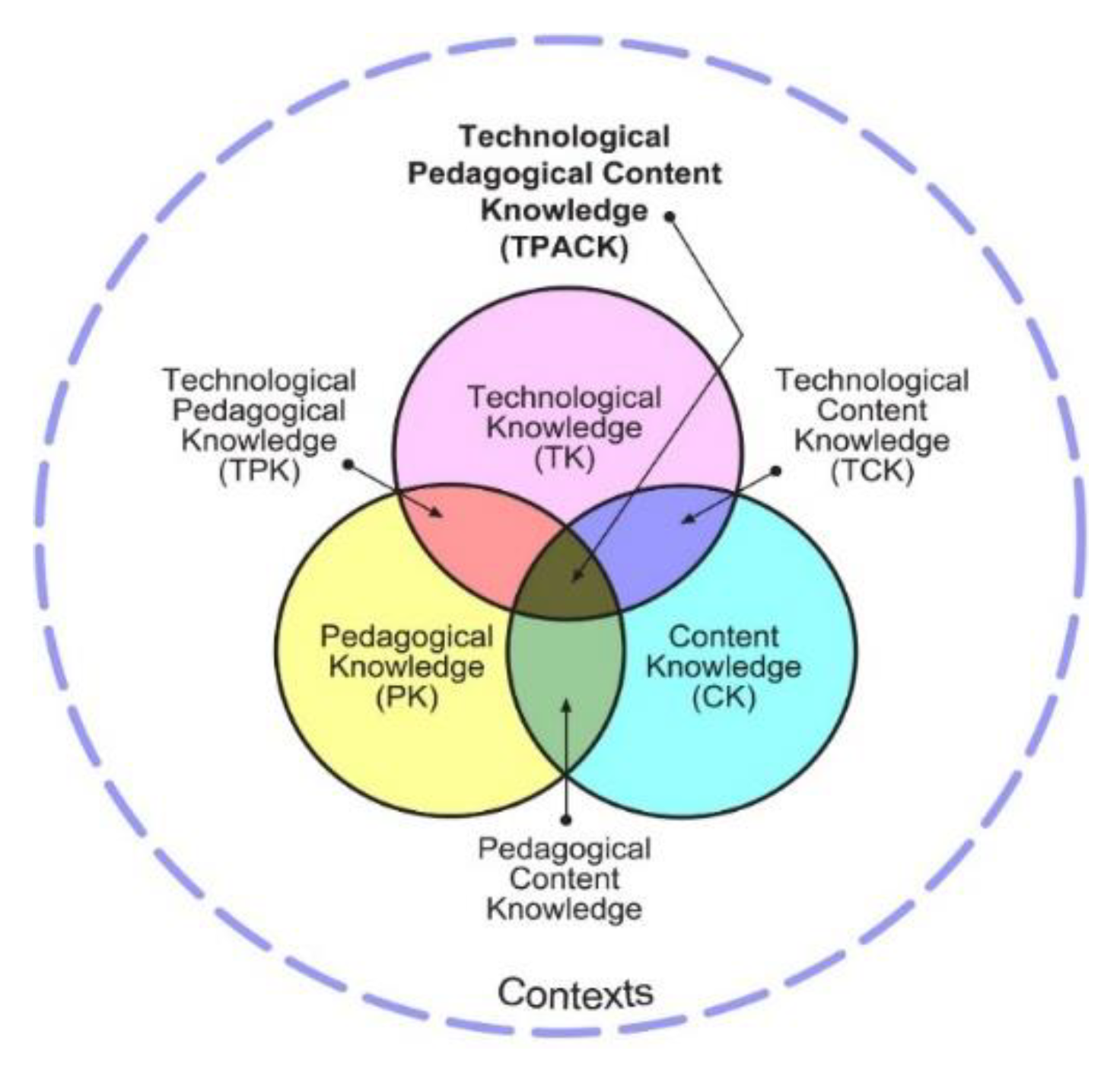
Figure 2.
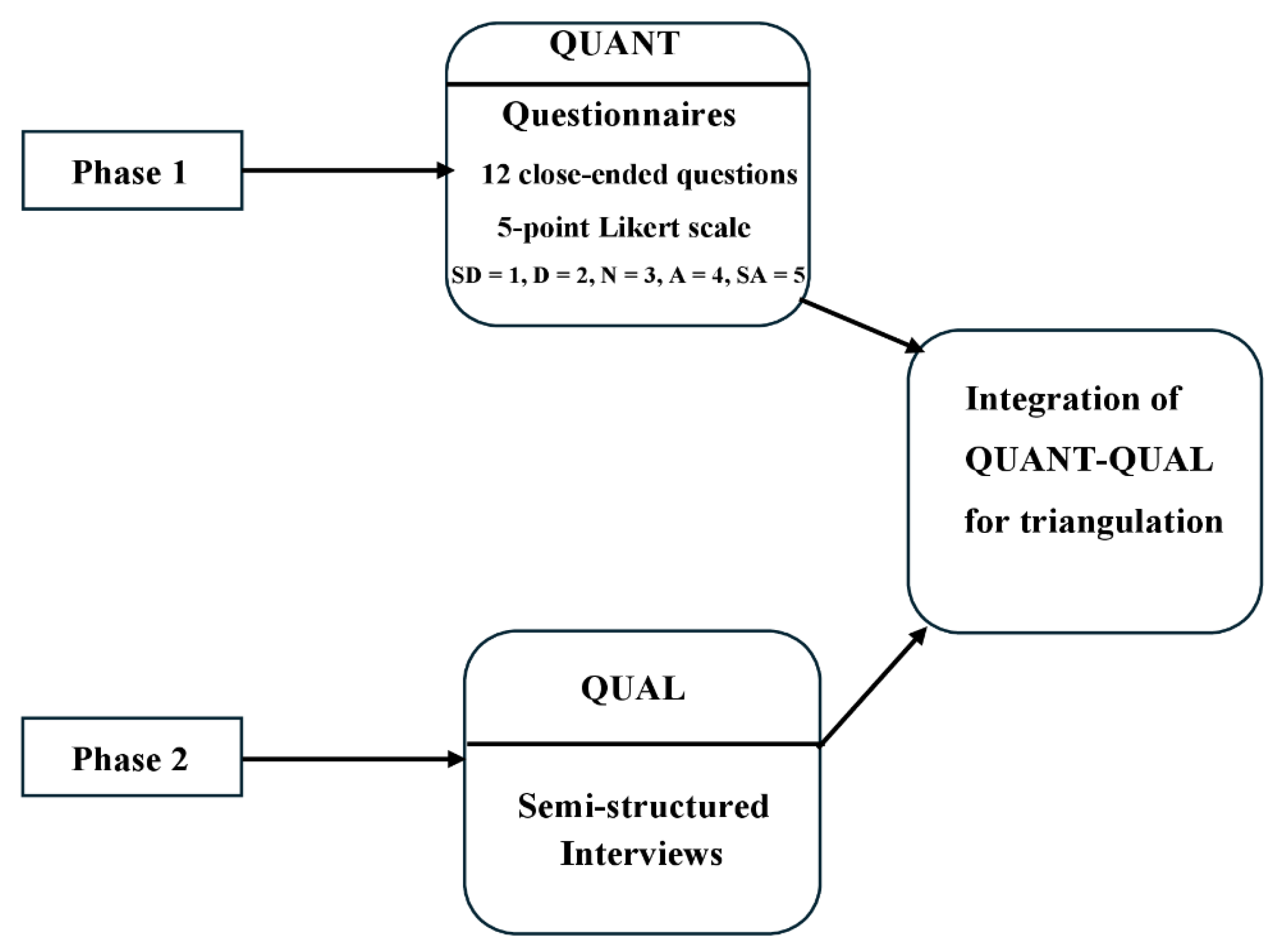
Figure 3.
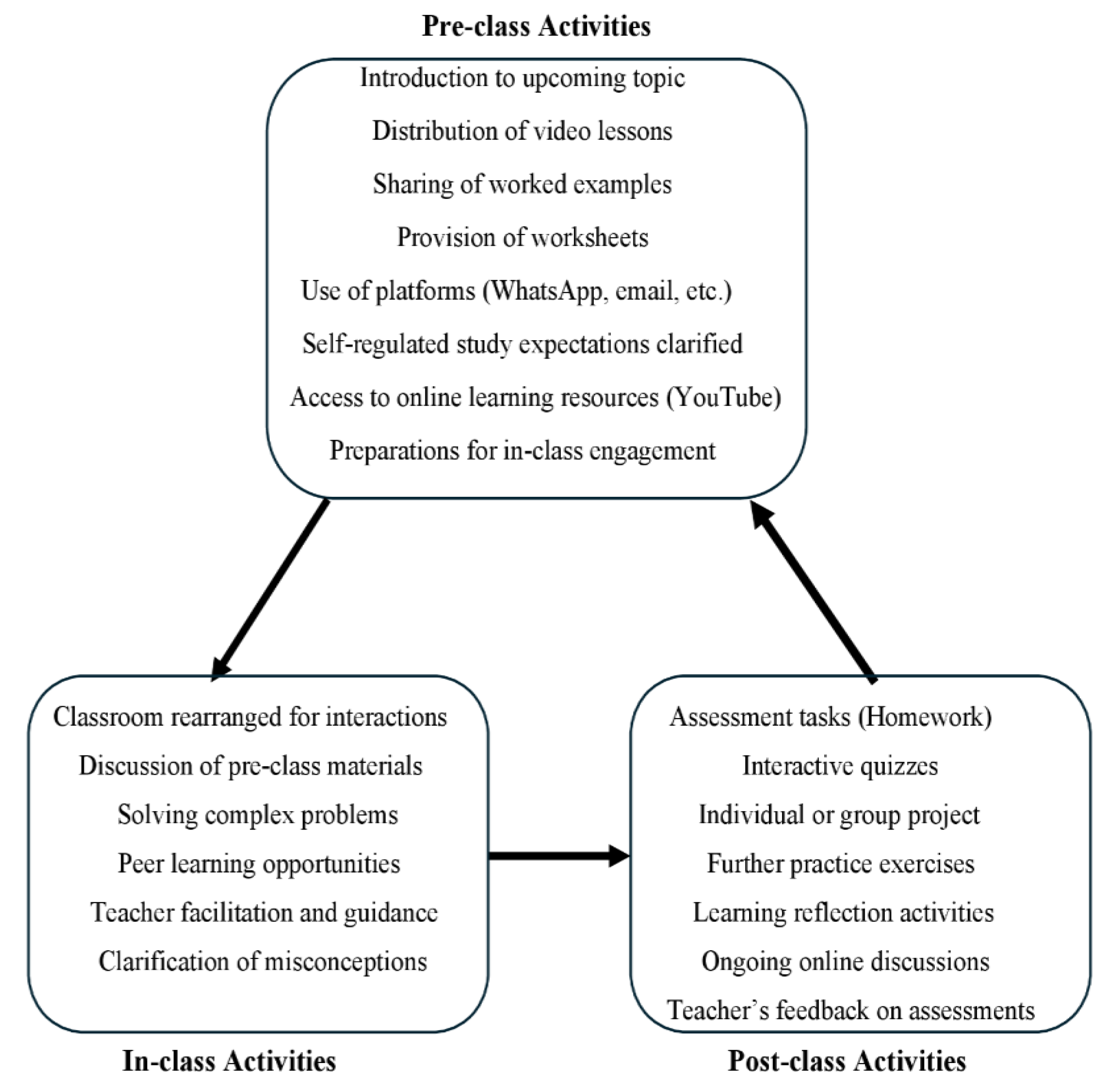
Table 1.
Participants’ Demographic Details.
| Demographics | Category | Q1 | Q2 | R1 | R2 | S1 | S2 | T1 | T2 | Total |
| Gender | Male | 🗸 | 🗸 | 🗸 | 🗸 | 4 | ||||
| Female | 🗸 | 🗸 | 🗸 | 🗸 | 4 | |||||
| Age | Below 30 | 0 | ||||||||
| 30 - 50 | 🗸 | 🗸 | 🗸 | 🗸 | 🗸 | 🗸 | 6 | |||
| 51 - 55 | 🗸 | 🗸 | 2 | |||||||
| Above 55 | 0 | |||||||||
| Years of Teaching Experience |
0 - 10 | 0 | ||||||||
| 11 - 20 | 🗸 | 🗸 | 🗸 | 🗸 | 🗸 | 🗸 | 6 | |||
| 21 - 35 | 🗸 | 🗸 | 2 | |||||||
| Highest Qualification |
B.Ed. | 🗸 | 🗸 | 🗸 | 3 | |||||
| B.A./B.Sc. | 🗸 | 🗸 | 🗸 | 🗸 | 🗸 | 5 |
Table 2.
Frequency of Participants’ Responses Per Category (n = 8).
| S/N | Questionnaire-item | SD | D | N | A | SA |
| 1 | 2 | 3 | 4 | 5 | ||
| Section B: Teaching Practices in Flipped Mathematics Classrooms | ||||||
| 1. | I find teaching in an FC setting easy, exciting and enjoyable. | 0 | 1 | 2 | 2 | 3 |
| 2. | I often provided structured guidance to my students for pre-class tasks. | 0 | 0 | 2 | 2 | 4 |
| 3. | FC has enhanced my ability to clarify complex mathematical concepts during class time. | 0 | 1 | 1 | 2 | 4 |
| 4. | I encouraged group work activities during in-class sessions. | 0 | 0 | 0 | 3 | 5 |
| 5. | I adopted after-class online discussion for continued collaboration. | 0 | 0 | 0 | 3 | 5 |
| 6. | The flipped classroom model has positively impacted my teaching practices. | 0 | 0 | 1 | 3 | 4 |
| Section C: Opportunities in Flipped Mathematics Classrooms | ||||||
| 7. | Adopting FC model has resulted in a higher student engagement. | 0 | 0 | 0 | 3 | 5 |
| 8. | FC approach fosters a greater student ownership of learning. | 0 | 1 | 1 | 2 | 4 |
| 9. | FC approach promotes collaborative learning among students | 0 | 0 | 1 | 2 | 5 |
| 10. | FC strategies develop students’ critical thinking and problem-solving skills. | 0 | 0 | 1 | 2 | 5 |
| 11. | FC enables me to meet my students' individual needs better. | 0 | 0 | 2 | 3 | 3 |
| Section D: Challenges in Flipped Mathematics Classrooms | ||||||
| 12. | Developing instructional materials such as video lessons and online content for flipped classes is challenging for me. | 2 | 2 | 0 | 2 | 2 |
| 13. | Students often struggle with completing their pre-class tasks before class. | 2 | 2 | 0 | 2 | 2 |
| 14. | Limited technological resources hinder successful adoption of FC for mathematics instruction. | 0 | 0 | 0 | 4 | 4 |
| 15. | Utilizing FC approach makes effective management of class time more difficult compared to traditional teaching methods. | 2 | 2 | 0 | 3 | 1 |
| 16. | With FC, assessing student learning outcomes is more difficult relative to traditional methods. | 3 | 2 | 0 | 2 | 1 |
| Section E: General Perception of flipped mathematics classrooms | ||||||
| 17. | FC approach can help senior secondary students understand and perform better in mathematics than traditional teaching methods. | 1 | 1 | 0 | 2 | 4 |
| 18. | I recommend the adoption of the flipped mathematics classrooms in senior secondary schools. | 0 | 1 | 1 | 2 | 4 |
Table 7.
A Summary of Kruskal-Wallis Test Using Chi-Square, χ2, (df:7) Distribution (right-tailed).
| Groups: | Q1 | Q2 | R1 | R2 | S1 | S2 | T1 | T2 |
| Skewness | -1.339 | -1.3872 | .07073 | -.8744 | 0 | -1.856 | -1.1674 |
-1.4822 |
| Excess kurtosis | -.07969 | .1825 | -1.3485 | 0.6432 | 8.5 | 4.5886 | -0.3885 | .4972 |
| Normality | .000006745 | .00001096 | .03274 | .01608 | 5.14e-7 | .00004464 | .00002742 | .000006112 |
| Outliers | 1, 1, 1, 1 | 1, 2, 1, 1 | 1 | 3, 5 | 2 | 2, 2, 2, 2 | 2, 1, 2, 1 |
|
| Median | 5 | 5 | 3 | 4 | 4 | 5 | 5 | 5 |
| Sample size (n) | 18 | 18 | 18 | 18 | 18 | 18 | 18 | 18 |
| Rank sum (R) Mean Rank |
1483 82.39 |
1496.5 83.14 |
895.5 49.75 |
912.5 50.69 |
1063.5 59.08 |
1542 85.67 |
1482.5 82.36 |
1564.5 86.92 |
| R2/n |
122182.72 |
124417.35 | 44551.15 | 46258.68 | 62835.13 | 132098 | 122100.345 | 135981.123 |
χ2(7) = 21.9553, p = .002586, p(x ≤ 21.9553) = .9974.
Table 8.
Multiple Comparisons of all Possible Pairs of Groups through Dunn’s Tests.
| Pair | Mean Rank difference |
Z | SE | Critical value |
p-value | p-value/2 |
|---|---|---|---|---|---|---|
| x1 - x2 | -0.75 | 0.05758 | 13.0254 | 40.6872 | 0.9541 | 0.477 |
| x1 - x3 | 32.6389 | 2.5058 | 13.0254 | 40.6872 | 0.01222 | 0.006109 |
| x1 - x4 | 31.6944 | 2.4333 | 13.0254 | 40.6872 | 0.01496 | 0.007481 |
| x1 - x5 | 23.3056 | 1.7892 | 13.0254 | 40.6872 | 0.07358 | 0.03679 |
| x1 - x6 | -3.2778 | 0.2516 | 13.0254 | 40.6872 | 0.8013 | 0.4007 |
| x1 - x7 | 0.02778 | 0.002133 | 13.0254 | 40.6872 | 0.9983 | 0.4991 |
| x1 - x8 | -4.5278 | 0.3476 | 13.0254 | 40.6872 | 0.7281 | 0.3641 |
| x2 - x3 | 33.3889 | 2.5634 | 13.0254 | 40.6872 | 0.01037 | 0.005183 |
| x2 - x4 | 32.4444 | 2.4909 | 13.0254 | 40.6872 | 0.01274 | 0.006372 |
| x2 - x5 | 24.0556 | 1.8468 | 13.0254 | 40.6872 | 0.06477 | 0.03239 |
| x2 - x6 | -2.5278 | 0.1941 | 13.0254 | 40.6872 | 0.8461 | 0.4231 |
| x2 - x7 | 0.7778 | 0.05971 | 13.0254 | 40.6872 | 0.9524 | 0.4762 |
| x2 - x8 | -3.7778 | 0.29 | 13.0254 | 40.6872 | 0.7718 | 0.3859 |
| x3 - x4 | -0.9444 | 0.07251 | 13.0254 | 40.6872 | 0.9422 | 0.4711 |
| x3 - x5 | -9.3333 | 0.7165 | 13.0254 | 40.6872 | 0.4737 | 0.2368 |
| x3 - x6 | -35.9167 | 2.7574 | 13.0254 | 40.6872 | 0.005826 | 0.002913 |
| x3 - x7 | -32.6111 | 2.5037 | 13.0254 | 40.6872 | 0.01229 | 0.006146 |
| x3 - x8 | -37.1667 | 2.8534 | 13.0254 | 40.6872 | 0.004325 | 0.002163 |
| x4 - x5 | -8.3889 | 0.644 | 13.0254 | 40.6872 | 0.5195 | 0.2598 |
| x4 - x6 | -34.9722 | 2.6849 | 13.0254 | 40.6872 | 0.007255 | 0.003627 |
| x4 - x7 | -31.6667 | 2.4312 | 13.0254 | 40.6872 | 0.01505 | 0.007525 |
| x4 - x8 | -36.2222 | 2.7809 | 13.0254 | 40.6872 | 0.005421 | 0.00271 |
| x5 - x6 | -26.5833 | 2.0409 | 13.0254 | 40.6872 | 0.04126 | 0.02063 |
| x5 - x7 | -23.2778 | 1.7871 | 13.0254 | 40.6872 | 0.07392 | 0.03696 |
| x5 - x8 | -27.8333 | 2.1369 | 13.0254 | 40.6872 | 0.03261 | 0.0163 |
| x6 - x7 | 3.3056 | 0.2538 | 13.0254 | 40.6872 | 0.7997 | 0.3998 |
| x6 - x8 | -1.25 | 0.09597 | 13.0254 | 40.6872 | 0.9235 | 0.4618 |
| x7 - x8 | -4.5556 | 0.3497 | 13.0254 | 40.6872 | 0.7265 | 0.3633 |
Table 9.
The Resulting Mean Rank Differences from Group Pairs Comparison.
| Group | Q2 | R1 | R2 | S1 | S2 | T1 | T2 |
| Q1 | -0.75 | 32.64 | 31.69 | 23.31 | -3.28 | 0.028 | -4.53 |
| Q2 | 0 | 33.39 | 32.44 | 24.06 | -2.53 | 0.78 | -3.78 |
| R1 | 33.39 | 0 | -0.94 | -9.33 | -35.92 | -32.61 | -37.17 |
| R2 | 32.44 | -0.94 | 0 | -8.39 | -34.97 | -31.67 | -36.22 |
| S1 | 24.06 | -9.33 | -8.39 | 0 | -26.58 | -23.28 | -27.83 |
| S2 | -2.53 | -35.92 | -34.97 | -26.58 | 0 | 3.31 | -1.25 |
| T1 | 0.78 | -32.61 | -31.67 | -23.28 | 3.31 | 0 | -4.56 |
Disclaimer/Publisher’s Note: The statements, opinions and data contained in all publications are solely those of the individual author(s) and contributor(s) and not of MDPI and/or the editor(s). MDPI and/or the editor(s) disclaim responsibility for any injury to people or property resulting from any ideas, methods, instructions or products referred to in the content. |
© 2025 by the authors. Licensee MDPI, Basel, Switzerland. This article is an open access article distributed under the terms and conditions of the Creative Commons Attribution (CC BY) license (http://creativecommons.org/licenses/by/4.0/).
Copyright: This open access article is published under a Creative Commons CC BY 4.0 license, which permit the free download, distribution, and reuse, provided that the author and preprint are cited in any reuse.


