

Submitted:
10 March 2025
Posted:
11 March 2025
You are already at the latest version
Abstract
Through the solid-state reactions method the Na0.89Co0.9Me0.1O2 (Me = Cr, Ni, Mo, W, Pb, Bi) ceramic samples were prepared and their crystal structure, microstructure, electrical, thermal and thermoelectric properties were investigated. The effect of nature of doping metal (Me = Cr, Ni, Mo, W, Bi) on the structure and properties of layered sodium cobaltite Na0.89CoO2 was analyzed. The largest Seebeck coefficient (616 (μV/K) at 1073 K ) and figure-of-merit (1.74 at 1073 K) values among the samples studied demonstrated the Na0.89Co0.9Bi0.1O2 solid solution, which also characterized by lowest value of dimensionless relative self-compatibility factor about 8% within 673–873 K temperature range. The obtained results demonstrate that doping of layered sodium cobaltite by transition and heavy metal oxides improves its microstructure and thermoelectric properties, which showes the prospectiveness of used doping strategy for development of new thermoelectric oxides with improved thermoelectric characteristics.

Keywords:
thermoelectric oxides
; layered sodium cobaltite
; microstructure
; electrical properties
; thermal properties
; figure-of-merit
1. Introduction
About two-third of energy consumed by factories, transport, and households, is dissipated into environment and, in fact, lost for humanity [1]. This high-potential waste heat can be partially transferred into electrical energy using thermoelectrogenerators (TEGs). To produce TEGs one need so-called thermoelectric materials, which should possess a complex of unique properties, such as low electrical resistivity (ρ) and thermal conductivity (λ), high values of Seebeck coefficient (S) etc. [2,3,4,5]. Traditional thermoelectrics based on the layered chalcogenides of bismuth, lead etc. possess a number of drawbacks as they content toxic, rare and expensive components as well as unstable in air at elevated temperatures. These drawbacks are absent for oxide thermoelectrics [6,7,8,9,10], one of well-known representative of them is layered sodium cobaltite NaxCoO2, firstly described by Jansen and Hoppe [11] and characterized as thermoelectric by Terasaki et al. [12]. Its structure consists of [CoO2] layeres (CdI2 structure) with sodium atoms in between them [13]. According to Viciu et al. [14], the concentration of oxygen vacancies in [CoO2] layers is negligible, so oxidation state of cobalt ions in it is only determined by the sodium content (xNa). Due to its unique transport properties, NaxCoO2 is considered as potential material for p-branches of TEGs and ceramic (oxide) thermocouples [15,16], cathode material of sodium-ion batteries (SIBs) [17,18,19,20], and its crystal hydrate, NaxCoO2⋅yH2O, below 4 K indergoes into a superconducting state [21]. Crystal structure, electrotransport, thermal, and functional characteristics of NaxCoO2 strongly depend on the sodium content in it [22,23,24,25].
Functional, including thermoelectric, characteristics of the ceramic samples of the layered sodium cobaltite are worse than for moncrystals, but they can be improved using different approaches: i) doping in sublattices of cobalt [26,27,28] or/and sodium [29,30,31], ii) modification by particles of metals [32,33] or semiconductors [34], iii) using so-called soft synthesis methods [7,35,36], iiii) using of special sintering techniques [37] resulting in improving of ceramics microstructure which enhances its electrotransport and mechanical properties.
Partial substitution of cobalt by copper in NaCo2–xCuxO4 ceramics improves its sinterability, lowers electrical resistivity and enhances Seebeck coefficient, resulting in essential increase of power factor values of these solid solutions comparing to the unsubstituted sodium cobaltite [38,39], which reache maximal value for NaCo1.8Cu0.2O4 phase – 3.08 mW/(m⋅K2) at 1073 K [38]. Substitution of cobalt by nickel deteriorates sinterability of NaCo2–xNixO4 phases, but decreases their ρ and strongly enlarges S, and P value for NaCo1.9Ni0.1O4 at 1073 K reaches 2.36 mW/(m⋅K2), which is 8 times larger than for base NaCo2O4 phase [40,41]. When zinc substitutes cobalt in NaCo2–xZnxO4, electrical resistivity and Seebeck coefficient of ceramics increase, and power factor reaches 1.7 mW/(m⋅K2) at 1073 K for NaCo1.9Zn0.1O4 solid solution, which is 4 times larger than for NaCo2O4 cobaltite [42].
Earlier we estimated the possibility to improve the thermoelectric performance of NaxCoO2 by increasing of sodium content in it [25] as well as by doping of sodium-poor Na0.55CoO2 cobaltite with oxides of different transition and non-transition metals [16,43].
In this work the effect of the nature of different transition or heavy metals partially substituting cobalt in the sodium-rich Na0.89CoO2 layered cobaltite on its crystal structure, microstructure, thermophysical, electrophysical, and thermoelectric (functional) properties was studied.
2. Materials and Methods
Ceramic samples of Na0.89Co0.90Me0.10O2 (Me = Cr, Ni, Mo, W, Pb, and Bi) materials were obtained using solid-state reaction method according to the reaction scheme:
1.335 Na2CO3 + 0.3/x MexOy+ 0.9 Co3O4+(0.5325 − 0.15 y/x) O2 =
= 3 Na0.89Co0.90Me0.10O2 + 1.335 CO2
= 3 Na0.89Co0.90Me0.10O2 + 1.335 CO2
The powders of Na2CO3 (99%), Co3O4 (99%), Cr2O3 (99%), NiO (99.99%), MoO3 (99.99%), WO3 (99.99%), PbO (99.99%), and Bi2O3 (99.99%) were taken in the ratio of Na : Co : Me = 1.2 : 0.9 : 0.1 (the excess of Na2CO3 in the initial mixture is taken to compensate for the loss of Na2O from the samples during their thermal treatment and allows to obtain ceramics of the specified composition [25,44]). The powdered samples were milled in a planetary mill PM 100 Retsch (material of beakers and grinding balls – ZrO2) for 90 minutes at 300 rpm with the addition of C2H5OH (~3–5 wt.%). The resulting slurries were air-dried at a temperature of 323 K, and then pressed into tablets with a diameter of 19 mm and a thickness of up to 5 mm. After that, the obtained samples were calcined in air for 12 hours at a temperature of 1133 K. Subsequently, after calcination, the blanks were ground in an agate mortar and re-milled in a planetary mill, then pressed into bars measuring 5 × 5 × 30 mm³ and tablets with a diameter of 15 mm and a thickness of 2–3 mm, which were sintered in air for 12 hours at a temperature of 1203 K [43].
The real sodium content (xNa) and the average oxidation state of cobalt (Co+Z) in the obtained ceramic materials were determined using iodometric [44] and reverse potentiometric titration [45], as well as spectrophotometrically according to the method described in [46] (see Supplementary Information).
The phase composition of the samples and calculation of the crystal lattice parameters of the Na0.89Co0.90Me0.10O2 layered cobaltites were performed by means of X-ray diffraction analysis (XRD) using Bruker D8 XRD Advance X-ray diffractometer (CuKα radiation (λ = 1.5406 Å)).
The values of the coherent scattering area for the Na0.89Co0.90Me0.10O2 ceramics were calculated using the Debye–Scherrer equation (DS) (2) [47] and the size-strain method (DSS) (3) [48]
where d is the interplanar distance, nm; β is the full width of the reflex at its half maxima, rad; Θ is the diffraction angle, °; ε is the microstrain.
The degree of crystallographic orientation of the grains of the Na0.89Co0.90Me0.10O2 ceramics was evaluated using the Lotgering factor according to Equation (4) [49]:
where p= ΣI(00l)/ΣI(hkl) (ΣI is the sum of the counts of X-ray diffraction peaks of the synthesized samples); p0 = ΣI0(00l)/ΣI0(hkl) (ΣI0 is the sum of the counts of X-ray diffraction peaks of the reference phase JCPDC #00-030-1182).
The apparent density of the Na0.89Co0.90Me0.10O2 ceramic samples (dEXP) was determined based on their mass and geometric dimensions, and their total porosity (Πt) was calculated as follows
where dXRD is the X-ray density of the samples, g/cm3.
The open porosity of the sintered samples (ΠO) was determined by weighing the ceramic samples of Na0.89Co0.90Me0.10O2, which were saturated with ethyl acetate for 60 minutes under a vacuum of 25–30 Pa, and then weighed in ethyl acetate according to Equation (6):
where m is the mass of the dry ceramic sample, g; m1 and m2 are the masses of the sample saturated by the liquid ethylacetate at weighing in air and introduced into the liquid ethylacetate, respectively, g.
The microstructure and chemical composition of the Na0.89Co0.90Me0.10O2 samples were studied using scanning electron microscopy (SEM) by a Tescan MIRA 3 LMH scanning electron microscope equipped with an AZtecLIVE Advanced energy dispersive microanalysis system with a nitrogen-free Ultim Max 100 standard detector (Oxford Instruments Analytical Ltd., UK).
The thermal expansion, electrical resistivity (ρ) and Seebeck coefficient (S) of the sintered ceramics were measured in air within a temperature range of 323–1073 K using the methodology described in [39,50,51]. Values of the average linear thermal expansion coefficient (α, LTEC) were calculated from the linear parts of Δl/l0 = f(T) plots.
The thermal diffusivity (η) of the Na0.89Co0.90Me0.10O2 layered cobaltites was studied in a helium atmosphere over a temperature range of 323–1073 K using the LFA 457 Micro-Flash device (NETZSCH). The thermal conductivity (λ) of the Na0.89Co0.90Me0.10O2 sintered ceramics was calculated using the Equation (7).
where Ср – is heat capacity, calculated by the Dulong–Petit law, J/(g⋅K). Thus, according to the data of works [16,52], the heat capacity of layered sodium cobaltite near 300 K becomes slightly dependent on temperature and reaches a plateau.
The phonon (λph) and electron (λe) parts of the thermal conductivity of the Na0.89Co0.90Me0.10O2 ceramics were roughly approximated by Equations (8) and (9)
where L is Lorentz number (L=2.45∙10–8 W∙Ω∙K–2).
The values of the power factor (P) and figure of merit (ZT) of the Na0.89Co0.90Me0.10O2 solid solutions were calculated as follows
and
The self-compability factor (s) and the dimensionless relative self-compatibility factor (Δs) [53] for the Na0.89Co0.90Me0.10O2 ceramics were calculated using equations (12) and (13)
and
3. Results and Discussion
The sodium content in the obtained samples (xNa), determined by iodometry, reverse potentiometry, and spectrophotometry methods, was approximately 0.89 for all the investigated samples (Table 1, Table S1). The average oxidation state of cobalt in the Na0.89Co0.90Me0.10O2 (Me = Cr, Co, Ni, Mo, W, and Bi) layered cobaltites varied within 2.78–3.23 (Table 1, Table S1), increasing with the substitution of an acceptor character (Ni instead of Co) and decreasing with the substitution of a donor character (Mo, W, Pb, or Bi instead of Co), which was also observed for the Na0.55Co0.90Me0.10O2 samples in the study [16].
According to the XRD results, all the ceramic samples were single-phase, within the XRD accuracy. The ceramic samples of Na0.89Co0.90Me0.10O2 (Me = Cr, Ni, Mo, W, Bi) obtained in the study, like the base Na0.89CoO2 cobaltite, exhibited a hexagonal structure corresponding to the γ-NaxCoO2 phase structure [11,29,54,55,56] (Figure 1а).
The values of the lattice constants for the Na0.89Co0.90Me0.10O2 solid solutions varied within the ranges of a = 2.822–2.831 Å and c = 10.92–10.97 Å (Table 1), which are close to the parameters of the Na0.89CoO2 base cobaltite (a = 2.826 Å, c = 10.94 Å) [26,57,58]. As a result, the values of volume of the unit cell for the phases of Na0.89Co0.90Me0.10O2 with partial cobalt substitution by transition or heavy metals changed very little, but their axial ratio significantly decreased only with the substitution of cobalt by nickel in the Na0.89CoO2 structure. Thus, partial substitution of cobalt with other metals in the Na0.89CoO2 phase does not lead to significant changes in the size and shape of the unit cell for the Na0.89Co0.90Me0.10O2 (Me = Cr, Mo, W, and Bi) solid solutions compared to the unsubstituted phase of layered sodium cobaltite.
The apparent density values of the Na0.89Co0.90Me0.10O2 ceramic ranged within 3.18–3.47 g/cm³ and decreased with the partial substitution of Co with Cr, Mo, W, or Pb, while they increased with the substitution of Co with Ni and Bi (Table 2). The values of open porosity of the ceramics varied within 16%–22% and were close for samples with different cationic compositions, but values of closed porosity were minimal for the base Na0.89CoO2 phase (13%) and Na0.89Co0.90Ni0.10O2 solid solution (7%) and for other samples varied within 17−24% and were close each other (Table 2).
The values of the Lotgering factor increased from 0.31 for the Na0.89CoO2 base cobaltite (moderate orientation) to 0.69–0.76 for the Na0.89Co0.90Me0.10O2 solid solutions (Me = Ni and Bi) (good orientation) and 0.87–0.92 for the Na0.89Co0.90Me0.10O2 (Me = Cr, Mo, W, and Pb) ceramics of composition (very good orientation) (Table 1). Thus, doping Na0.89CoO2 with various transition or heavy metal oxides increases the degree of crystallographic orientation of the ceramic grains (the degree of its texturing). The most pronounced effect among the samples synthesized in this work was observed for Na0.89Co0.90W0.10O2, with the partial substitution of cobalt by tungsten in the Na0.55CoO2 phase leading to a similar effect [16,43].
The coherent scattering area of the Na0.89Co0.90Me0.10O2 materials, synthesized in the study, calculated using different approaches (Figure 1b), was larger (up to 6–25% and 33 60% according to the Debye−Scherrer and the size-strain method, respectively) comparing to the base layered sodium cobaltite phase (Figure 1b, Table 1). In turn, the values of microstrains for the Na0.89Co0.90Me0.10O2 ceramics were slightly (Me = Cr and Pb) or significantly (Me = Ni, Mo, W, and Bi) lower compared to the initial Na0.89CoO2 cobaltite (Table 1). So, partial substitution of cobalt by transition or heavy metals in Na0.89CoO2 results in formation of ceramics possess the grains with larger dimensions and less strained.
According to the results of SEM, the grains of the Na0.89CoO2 base unsubstituted cobaltite had a plate-like shape with dimensions (l) of 6 – 15 μm and a thickness of 2.5 – 3 μm (with an average size (lav) of about 7 μm and an aspect ratio (AR) of approximately 3.9) (Figure 2b). The microstructure of the Na0.89Co0.90M0.10O2 materials was similar to that of Na0.89CoO2, but it differed in the size and aspect ratio (shape) of the grains (Figure 2a, c–f).
The grain sizes of the Na0.89Co0.90Me0.10O2 (Me = Cr, Ni, W) ceramics varied within 6–23 μm with a thickness of 6–10 μm. The average dimension (lav (AR)) was approximately 17 μm (2.8) for Me = Cr, 22 μm (3.3) for Me = Ni and 14 μm (3.2) for Me = W. Doping of the layered sodium cobaltite ceramics with bismuth or lead oxides resulted in an increase in grain size to 35–60 μm and decrease of the thickness of the grains by up to 1–3 μm. For Na0.89Co0.90Pb0.10O2 and Na0.89Co0.90Bi0.10O2, the lav (AR) values were around 43 μm (14.3) and 52 μm (15.6), respectively. Consequently, the anisotropy of the grains in the sodium cobaltite ceramic increased with doping by heavy metal oxides (PbO2, Bi2O3).
Enhancing of Lotgering factor and improving of anisotropy degree (AR) of the grains of Na0.89Co0.90Me0.10O2 ceramics may causes both by the differences in the sizes of subsituting and substituted ions (size effect) and in their charges (charge redistribution). The first results in localized lattice strain promoting preferential alignment of grains along specific crystallographic planes (in our case, (00l)), but the second alters charge distribution in the structure of Na0.89Co0.90Me0.10O2 phases, enhances interlayer charge screening, reduces electrostatic repulsion of CoO2-layers, and stabilizes (00l)-oriented stacking. The maximal values of f and AR were observed, in the whole, for the samples of layered sodium cobaltite, doped by heavy metal oxides (Pb, W etc.) (Table 1, Figure 2), as namely in these cases maximal difference in the sizes and charges of substituting and substituted ions take place.
According to EDX results, the cationic composition of the Na0.89Co0.90M0.10O2 synthesized compounds was close to the target values, and the distribution of elements within the ceramic was nearly uniform (Figure 3, Figure S2 (see Supplementary Information)).
Temperature dependences of the relative elongation of Na0.89Co0.9Me0.1O2 ceramic samples were linear practically, which proves the absence of the structural phase transitions in the complex oxides investigated within all the temperature interval studied. LTEC values of the Na0.89Co0.9Me0.1O2 solid solutions varied within (1.25–1.68)·10–5 K–1 and were lower (for Me = Pb, and Bi), slightly (for Me = W) and essentially larger (for Me = Cr, Ni, and Mo) than for unsubstituted sodium cobaltite Na0.89CoO2 (1.34·10–5 K–5) (Table 2).
Obtained increasing of LTEC values of Na0.89Co0.90Me0.10O2 derivatives in comparison to the Na0.89CoO2 base phase possibly is due to the high values of their porosity (Table 2) as well as to the increasing of anharmonicity degree of metal–oxygen vibrations in their structure at partial substitution of cobalt by other metals.
As can be seen from the Figure 4a, the Na0.89CoO2 layered sodium cobaltite and its Na0.89Co0.90Me0.10O2 derivatives exhibited metallic-like conductivity character (∂ρ/∂T>0) (except Na0.89Co0.90W0.10O2 solid solution, which possesses semiconducting conductivity character within all the temperature interval studied), which for the Na0.89Co0.90Bi0.10O2 and Na0.89Co0.90Mo0.10O2 solid solutions near 923 K changed into a semiconducting one (∂ρ/∂T<0) like the conductivity crossover in layered calcium cobaltite of Ca3Co4O9+δ [60,61]. A similar effect was also observed in several Na0.55Co0.90Me0.10O2 layered sodium cobaltites earlier [16]. The doping of Na0.89CoO2 layered sodium cobaltite by different metal oxides results in increasing its electrical resistivity values, except NiO, as ρ values of Na0.89Co0.90Ni0.10O2 solid solution were essentially less than for the unsubstituted layered sodium cobaltite (Figure 4a, d). As can be seen, electrical resistivity values of ceramics increased at increasing of oxidation state of the substituting cobalt metal Me (ρ(Na0.89Co0.90Ni0.10O2) < ρ(Na0.89CoO2) < ρ(Na0.89Co0.90Pb0.10O2)). This can be explained by a decrease in the concentration of main charge carriers (holes) as the average oxidation state of cations in the conducting (Co,Me)O2 layers of the crystal structure Na0.89Co0.90Me0.10O2 phases increases (Figure 4a, d, Table 2).
The Seebeck coefficient of the Na0.89Co0.90Me0.10O2 (Me = Cr, Ni, Mo, W, Pb, and Bi) solid solutions was positive throughout the temperature range studied, indicating that the main charge carriers are holes, and these materials are classified as p-type conductors. It is also noteworthy that at high temperatures, the change in thermo-EMF for all materials studied was nearly linear. This relationship of the Seebeck coefficient corresponds to Equation (14), which is commonly used to describe the thermoelectric properties of metals and degenerate semiconductors [62]
where kB is the Boltzmann constant, J/K; m* is the density of a state effective mass, kg; h is the Planks constant, J∙s; e is the charge of the electron, C; T is the absolute temperature, K; n is the charge carrier’s concentration, cm–3.
Partial substitution of cobalt with ions of various transition or heavy metals in the structure of Na0.89CoO2 leads to an increase in its Seebeck coefficient, which is more pronounced at high temperatures for tungsten- or bismuth-substituted solid solutions (Figure 4b,e and Table 2). This is likely due to the increase in configurational entropy provided by the presence of cobalt ions in different charge (Co2+, Co3+, and Co4+) and spin states (high-, intermediate-, and low-spin). The highest values of S among all investigated samples were demonstrated by the Na0.89Co0.90W0.10O2 and Na0.89Co0.90Bi0.10O2 oxides (519 and 616 µV/K at 1073 K, respectively), which are 1.18 and 1.40 times larger than that of the parent Na0.89CoO2 phase (Figure 4e and Table 2). So, these phases can be considered as prospective materials for p-legs of ceramic (oxide) thermocouples. It should also be noted that similar results were obtained when studying the Seebeck coefficient of cobalt-substituted derivatives of the Na0.55CoO2 layered cobaltite [16,38].
Value of weighted mobility (μp) and concentration (p) of the main charge carriers («holes») in the samples studied, calculated on the base of experimentally determined ρ and S values according to the methodics described in [63] (see Supplementary Information, Equations (S8) and (S9)), varied with temperature changing and essentially and nonmonotonusly changed when Na0.89CoO2 was doped by different metal oxides. For the base Na0.89CoO2 cobaltite at 1073 K values of μp and p were equal ~48 cm2/(V∙s) and ~5∙10–20 cm–3 respectively which is in a good accordance with the literature date [63]. Weighted mobility values of the Na0.89Co0.90Me0.10O2 solid solutions were less, close to, end large, than for Na0.89CoO2 for Me = Cr, Mo, Pb, Me = Ni, W, and Me = Bi respectively. Charge carriers concentration in Na0.89Co0.90Me0.10O2 cobaltites was large, close to, and less, than for Na0.89CoO2 phase for Me = Cr, Me = Mo, Ni, Pb, and Me = W, Bi respectively, that is in good accordance with the results of measurements of Seebeck coeffisient of ceramics, for example, with the sharp increasing of S values of the layred sodium cobaltite at partical substitution of cobalt by bismuth or tungsten in it, and with the scharp decreasing of S at partical substitution of cobalt by chromium in Na0.89CoO2 (Figure 4b,e).
The power factor values of Na0.89Co0.90Me0.10O2 sintered ceramics increased with rising temperature and changed non-monotonically with the changing of nature of metal substituting cobalt in the Na0.89CoO2 structure (Figure 4c,f and Table 2). The maximum P value was achieved for the Na0.89Co0.90Ni0.10O2 nickel-substituted solid solution (0.910 mW/(m⋅K²) at 1073 K), which is 1.15 times larger than that of the undoped Na0.89CoO2 layered sodium cobaltite, and was determined both by low values of its electrical resistivity and high values of its Seebeck’s coefficient.
The thermal diffusivity and thermal conductivity values of the Na0.89Co0.10Me0.10O2 ceramics decreased with increasing of temperature (Figure 5a,b) and changed nonmonotonously at the doping of Na0.89CoO2 by various metal oxides, increasing at substitution of Co by Cr, and Ni, and decreasing at substitution of Co by Mo, W, Pb, and Bi (Figure 5d,e). The first is perhaps associated with an increase in the grain size of the ceramics, which led to a decrease in the density of grain boundaries that serve as effective phonon scattering regions, but the last took place due to the partial replacing of lighter cobalt ion by heavier ions of molibdenium, tungsten, lead, or bismuth, serving as effective scattering centers. The electronic part of the thermal conductivity of the ceramics was relatively small (λe/λ=0.03–0.13) and increased with the rising of temperature, and for the Na0.89Co0.10Me0.10O2 solid solutions, except Na0.89Co0.90Ni0.10O2 one, it was lower than that of the Na0.89CoO2 base oxide. Thus, the main part of the heat in the Na0.89Co0.10Me0.10O2 phases was carried by lattice vibrations (phonons) (λph/λ ≈(0.87–0.97)) (Figure 5c,f). As can be seen from the Figure 5, both thermal diffusivity and conductivity values of the doped cobaltites (except Cr- and Ni-doped) are less than that of the base Na0.89CoO2 phase. It should be noted, that for sodium-poor samples (Na0.55Co0.90Me0.10O2) the contraversal effect was found, namely increasing of η and λ values of doped with transition or heavy metal oxides ceramics comparing to the undoped Na0.55CoO2 phase [16,38].
Figure of merit values of the investigated materials sharply increased with rising temperature, and doping of layered sodium cobaltite with various transition and heavy metal oxides had different effect – ZT increased at substitution in Na0.89CoO2 of cobalt by nickel and bismuth and decreased when cobalt was partially substituted by chromium, molibdenium, tungsten, and lead (Figure 6a and Table 2). The highest thermoelectric characteristics were demonstrated by Na0.89Co0.90Ni0.10O2 and Na0.89Co0.90Bi0.10O2 solid solutions, with ZT values reaching 1.65 and 1.74 at 1073 K, which is about 4% and 9% respectively higher than that of the Na0.89CoO2 phase (Figure 6c). It should be noted, that though for the Na0.89Co0.90W0.10O2, Na0.89Co0.90Mo0.10O2 and Na0.89Co0.90Pb0.10O2 ceramics ZT values were less than for Na0.89CoO2 phase, at 1073 K they were equal to 1.09, 0.97, and 0.84 respectively, which is close to the theoretical criterion (ZT > 1) that defines materials of practical interest for thermoelectric conversion (Figure 6a and Table 2).
The self-compatibility factor values (s) of the ceramics studied increased at temperature increasing and within temperature interval 673–873 K slightly vary (except for Na0.89Co0.90Cr0.10O2 compound) (Figure 6b), and dimensionless relative self-compatibility factor (Δs) of Na0.89Co0.90Me0.10O2 layered cobaltites within 673–873 K varies within 8–29% (Figure 6d), which is, in the whole, less than for the Mg2Si0.6–ySn0.4Sby (25-40%) thermoelectric alloy [64] and states the good self-compatibility of the obtained in this work thermoelectric oxide ceramics. Note, that Δs values for the doped sodium cobaltites, except Na0.89Co0.90Mo0.10O2, were less (8–21%) than for the base layered sodium cobaltite (26%), which shows the effectiveness of doping of Na0.89CoO2 by transition or heavy metal oxides in increasing of its self-compatibility.
4. Conclusions
Combining the obtained in this study results one can conclude that doping (up to 10 mol.%) of Na0.89CoO2 layered soldium cobaltite by different transition (Cr2O3, NiO) and heavy metal oxides (MoO3, WO3, PbO, Bi2O3) did not changed its crystal structure and slightly affects its lattice constants values, but increasing coherent scattering area, grain size as well as grain orientation degree of Na0.89Co0.10Me0.10O2 solid solutions comparing to the parent Na0.89CoO2 phase.
Such a doping lead, in the whole, to the decrease of elecrical resistivity of the samples and complex changing of Seebeck cofficient and thermal properties of the ceramics, which determined both the nature of metal substituting cobalt in the Na0.89CoO2 and the peculiarities of the microstructure of the ceramics. The maximal values of S possess the Na0.89Co0.90W0.10O2 and Na0.89Co0.90Bi0.10O2 cobaltites (519 and 616 µV/K at 1073 K, respectively), which are 18% and 40% higher than that of the parent Na0.89CoO2 phase. So, these materials can be recommended as potential materials for p-legs of ceramic thermocouples.
Maximal power factor was observed for the Na0.89Co0.90Ni0.10O2 compound (0.910 mW/(m⋅K²) at 1073 K), which is 15% higher than that of the base Na0.89CoO2 layered sodium cobaltite, and was determined both by low values of its electrical resistivity and high values of its Seebeck’s coefficient. The maximal thermoelectric performance demonstrate the Na0.89Co0.90Ni0.10O2 and Na0.89Co0.90Bi0.10O2 phases, which ZT values is equal 1.65 and 1.74 at 1073 K, that is about 4% and 9% respectively higher than for Na0.89CoO2 phase. So, these materials can be considered as potential materials for the p-branches of the modules of high-temperature thermoelectrogenerators.
The obtained results demonstrate the effectiveness of the doping strategy of cobalt by heavy metals in layered sodium cobaltite for the enhancement of the thermoelectric performance of its derivatives. It was also found that dimensionless relative self-compatibility factor of the Na0.89CoO2 layered sodium cobaltite essentially reduced at its doping by transition or heavy metal oxides.
Supplementary Materials
The following supporting information can be downloaded at the website of this paper posted on Preprints.org, Figure S1: Absorption spectra and calibration graphs for determining cobalt content in the form of complexes [Co(SCN)4]2–(а, с) и [CoY]– (b, d); Figure S2: Element mapping images of the Na0.89Co0.90M0.10O2 ceramic samples (M = Cr (a), Ni (b), Pb (c), Bi (d)); Table S1: Sodium content (xNa) and average oxidation state of cobalt (Z) in Na0.89Co0.90M0.10O2 layered cobaltites samples determined by various methods.
Author Contributions
Conceptualization, A.I.K.; methodology, A.I.K., E.A.C. and N.S.K.; software, N.S.K.; validation, A.I.K., E.A.C., Н.W.; formal analysis, N.S.K., E.A.C.; investigation, N.S.K., Y.A.Z., A.V.B.; resources, A.I.K.; data curation, A.I.K.; writing—original draft preparation, N.S.K., A.I.K.; writing—review and editing, A.I.K., Н.W.; visualization, N.S.K.; supervision, A.I.K.; project administration, A.I.K.; funding acquisition, A.I.K., N.S.K. All authors have read and agreed to the published version of the manuscript.
Funding
This work was supported by the Ministry of Education of the Republic of Belarus, under project number 20111575, and by the Belarusian Republican Foundation for Fundamental Research, under project number 20122443.
Data Availability Statement
All data generated or analyzed during this study are included in this published article.
Acknowledgments
The authors would like to thank Dzmitry S. Kharytonau for fruitful discussions of research results and Dzmitry Darashchuk for technical support.
Conflicts of Interest
The authors declare no conflict of interest.
References
- Klyndyuk, A.I.; Kharytonau, Dz.S.; Matsukevich, I.V.; Chizhova, E.A.; Lenčéš, Z.; Socha, R.P.; Zimowska, M.; Hanzel, O.; Janek, M. Effect of cationic nonstoichiometry on thermoelectric properties of layered calcium cobaltite obtained by field assisted sintering technology (FAST). Ceramics International. 2024, 50, 30970–30979. [Google Scholar] [CrossRef]
- Polevik, A.O.; Sobolev, A.V.; Glazcova, Ia.S.; Presniakov, I.A.; Verchenko, V.Yu.; Link, J.; Stern, R.; Shevelkov, A.V. Interplay between Fe(II) and Fe(III) and Its Impact on Thermoelectric Properties of Iron-Substituted Colusites Cu26–xFexV2Sn6S32. Compounds. 2023, 3, 348–364. [Google Scholar] [CrossRef]
- Yu, J.; Chen, K.; Azough, F.; Alvarez-Ruiz, D.T.; Reece, M.I.; Freer, R. Enhancing the thermoelectric performance of calcium cobaltite ceramics by tuning composition and processing. ACS Applied Materials Interfaces. 2020, 12, 47634–47646. [Google Scholar] [CrossRef] [PubMed]
- Zhang, W.; Zhu, K.; Liu, J.; Wang, J.; Yan, K.; Liu, P.; Wang, Y. Influence of the phase transformation in NaxCoO2 ceramics on thermoelectric properties. Ceramics International. 2018, 44, 17251–17257. [Google Scholar] [CrossRef]
- Li, Z.; Xiao, C.; Xie, Y. Layered thermoelectric materials: Structure, bonding, and performance mechanisms. Applied Physics Review. 2020, 9, 011303. [Google Scholar] [CrossRef]
- Kuzanyan, A.S.; Margani, N.G.; Zhghamadze, V.V.; Mumladze, G.; Badalyan, G.R. Impact of Sr(BO2)2 Dopant on Power Factor of Bi2Sr2Co1.8Oy Thermoelectric. Journal of Contemporary Physics. 2021, 56, 146–149. [Google Scholar] [CrossRef]
- Oopathumpa, Ch.; Boonthuma, D.; Smith, S. M. Effect of Poly(Vinyl Alcohol) on Thermoelectric Properties of Sodium Cobalt Oxide. Key Engineering Materials. 2019, 798, 304–309. [Google Scholar] [CrossRef]
- Mallick, M.M.; Vitta, V. Enhancing Thermoelectric Figure-of-Merit of Polycrystalline NayCoO2 by a Combination of Non-stoichiometry and Co-substitution. Journal of Electronic Materials. 2018, 47, 3230–3237. [Google Scholar] [CrossRef]
- Yu, J.; Chang, Y.; Jakubczyk, E.; Wang, B.; Azough, F.; Dorey, R.; Freer, R. Modulation of electrical transport in calcium cobaltite ceramics and thick films through microstructure control and doping. Journal of the European Ceramic Society. 2021, 41, 4859–4869. [Google Scholar] [CrossRef]
- Noudem, J.G.; Xing, Yi. Overview of Spark Plasma Texturing of Functional Ceramics. Ceramics. 2021, 4, 97–107. [Google Scholar] [CrossRef]
- Jansen, M.; Hoppe, R. Notiz zur Kenntnis der Oxocobaltate des Natriums. Zeitschrift für anorganische und allgemeine Chemie. 1974, 408, 104–106. [Google Scholar] [CrossRef]
- Terasaki, I.; Sasago, Y.; Uchinokura, K. Large thermoelectric power in NaCo2O4 single crystals. Physical Review B. 1997, 56, R12685–R12687. [Google Scholar] [CrossRef]
- Koumoto, K.; Terasaki, I.; Funahashi, R. Complex Oxide Materials for Potential Thermoelectric Applications. MRS BULLETIN. 2006, 31, 206–210. [Google Scholar] [CrossRef]
- Viciu, L.; Huang, Q.; Cava, R.J. Stoichiometric oxygen content in NaxCoO2. Physical Review B 2006, 73, 212107. [Google Scholar] [CrossRef]
- Han, Yu.; Ruan, Yo.; Xue, M.; Shi, M.; Song, Zh.; Zhou, Y.; Teng, J. Effect of Annealing Time on the Cyclic Characteristics of Ceramic Oxide Thin Film Thermocouples. Micromachines. 2022, 13, 1970. [Google Scholar] [CrossRef]
- Krasutskaya, N.S.; Klyndyuk, A.I.; Evseeva, L.E.; Gundilovich, N.N.; Chizova, E.A.; Paspelau, A.V. Enhanced thermoelectric performance of Na0.55CoO2 ceramics doped by transition and heavy metal oxides. Solids. 2024, 5, 267–277. [Google Scholar] [CrossRef]
- Molenda, J.; Baster, D.; Milewska, A.; Świerczek, K.; Bora, D.K.; Braun, A.; Tobola, J. Electronic origin of difference in discharge curve between LixCoO2 and NaxCoO2 cathodes. Solid State Ionics. 2014, 271, 15–27. [Google Scholar] [CrossRef]
- Pohle, B.; Gorbunov, M.; Lu, Q.; Bahrami, A.; Nielsch, K.; Mikhailova, D. Structural and electrochemical properties of layered P2-Na0.8Co0.8Ti0.2O2 cathode in sodium-ion batteries. Energies. 2022, 15, 3371. [Google Scholar] [CrossRef]
- Nguyen, L.M.; Nguyen, V.H.; Nguyen, D.M.N.; Le, M.K.; Tran, V.M.; Le, M.L.P. Evaluating electrochemical properties of layered NaxMn0.5Co0.5O2 obtained at different calcined temperatures. Chemengineering. 2023, 7, 33. [Google Scholar] [CrossRef]
- Baster, D.; Zająс, W.; Kondracki, Ł.; Hartman, F.; Molenda, J. Improvement of electrochemical performance of Na0.7Co1–yMnyO2–cathode material for rechargeable sodium-ion batteries. Solid State Ionics. 2016, 288, 213–218. [Google Scholar] [CrossRef]
- Banobre-López, M.; Rivadulla, F.; Caudillo, R.; López-Quintela, M.A.; Rivas, J.; Goodenough, J.B. Role of doping and Dimensionality in the Superconductivity of NaxCoO2. Chemistry of Materials. 2005, 17, 1965–1968. [Google Scholar] [CrossRef]
- Akram, R.; Khan, J.; Rafique, S.; Hussain, M.; Maqsood, A.; Naz, A.A. Enhanced thermoelectric properties of single phase Na doped NaxCoO2 thermoelectric material. Materials Letters. 2021, 300, 130180. [Google Scholar] [CrossRef]
- Assadi, M.H.N.; Katayama-Yoshida, H. Restoration of long range order of Na ions in NaxCoO2 at high temperatures by sodium site doping. Computational Materials Science. 2015, 109, 308–311. [Google Scholar] [CrossRef]
- Lee, M.; Viciu, L.; Li, L.; Wang, Y.; Foo, M.L.; Watauchi, S.; Pascal, R.A., Jr.; Cava, R.J.; Ong, N.P. Enhancement of thermopower in NaxCoO2 in the large-x regime (x ≥ 0.75). Physica B. 2008, 403, 1564–1568. [Google Scholar] [CrossRef]
- Krasutskaya, N.S.; Klyndyuk, A.I.; Evseeva, L.E.; Tanaeva, S.A. Synthesis and properties of NaxCoO2 (x = 0.55, 0.89) oxide thermoelectric. Inorganic Materials. 2016, 52, 393–399. [Google Scholar] [CrossRef]
- Pohle, B.; Gorbunov, M.; Lu, Q.; Bahrami, A.; Nielsch, K.; Mikhailova, D. Structural and electrochemical properties of layered P2-Na0.8Co0.8Ti0.2O2 cathode in sodium-ion batteries. Energies. 2022, 15, 3371. [Google Scholar] [CrossRef]
- Devi Meena, J.; Gayathri, N.; Bharathi, A.; Ramachandran, K. Effect of nickel substitution on thermal properties of Na0.9CoO2. Bulletin of Materials Science. 2007, 30, 345–348. [Google Scholar] [CrossRef]
- Tian, Z.; Wang, X.; Liu, J.; Lin, Zh.; Hu, Ya.; Wu, Yi.; Han, Ch.; Hu, Zh. Power factor enhancement induced by Bi and Mn co-substitution in NaxCO2 thermoelectric materials. Journal of Alloys and Compounds. 2016, 661, 161–167. [Google Scholar] [CrossRef]
- Ono, Ya.; Kato, N.; Miyazaki, Yu.; Kajitani, T. Transport Properties of Ca-doped γ-NaxCoO2. Journal of Ceramic Society of Japan. 2004, 5, S626–S628. [Google Scholar] [CrossRef]
- Assadi, M.H.N.; Katayama-Yoshida, H. ; Restoration of long order of Na ions in NaxCoO2 at high temperatures by sodium site doping. Computational Materials Science. 2015, 109, 308–311. [Google Scholar] [CrossRef]
- Yang, X.; Wang, X.; Liu, Ju.; Hu, Zh. Power factor enhancement in NaxCoO2 doped by Bi. Journal of Alloys and Compounds. 2014, 582, 59–63. [Google Scholar] [CrossRef]
- Seetawan, T.; Amornkitbamburg, V.; Burinprakhon, Th.; Maensiri, S.; Kurosaki, K.; Muta, H.; Uno, M.; Yamanaka, Sh. Thermoelectric power and electrical resistivity of Ag-doped Na1.5Co2O4. Journal of Alloys and Compounds. 2006, 407, 314–317. [Google Scholar] [CrossRef]
- Hussein, M.; Assadi, N. Hf doping for enhancing the thermoelectric performance in layered Na0.75CoO2. Materials Today: Proceedings. 2021, 42, 1542–1546. [Google Scholar] [CrossRef]
- Nakhowong, R. Effect of reduced graphene oxide on the enhancement of thermoelectric power factor of γ-NaxCo2O4. Materials Science &Engineering B. 2020, 261, 114679. [Google Scholar] [CrossRef]
- Ito, M.; Nagira, T.; Furumoto, D.; Katsuyama, Sh.; Nagai, H. Synthesis of NaxCoO2 thermoelectric oxides by the polymerized complex method. Scripta Materialia. 2003, 48, 403–408. [Google Scholar] [CrossRef]
- Suan, M.S.M.; Farhan, M.A.; Lau, K.T.; Munawar, R.F.; Ismail, S. Structural and Electrical Properties of NaxCoO2 Thermoelectric Synthesized via Citric-Nitrate Auto-Combustion Reaction. Journal of Physics: Conference Series. 2018, 1082, 012033. [Google Scholar] [CrossRef]
- Matsubara, Ic.; Zhou, Yu.; Takeuchi, T.; Funahashi, R.; Shikano, M.; Murayama, N.; Shin, W.; Izu, N. Thermoelectric Properties of Spark-Plasma-Sintered Na1+xCoO2 Ceramics. Journal of Ceramic Society of Japan. 2003, 111, 238–241. [Google Scholar] [CrossRef]
- Park, K.; Jang, K.U.; Know, H. –C.; Kim, J.–G.; Cho, W.–S., Y. Influence of partial substitution of Cu for Co on the thermoelectric properties of NaCo2O4. J. of Alloys and Compounds. 2006, 419, 213–219. [Google Scholar] [CrossRef]
- Terasaki, I.; Tsukada, I.; Iguchi, Y. Impurity-induced transition and impurity-enhanced thermopower in the thermoelectric oxide NaCo2–xCuxO4. PHYSICAL REVIEW B. 2002, 65, 195106–7. [Google Scholar] [CrossRef]
- Park, K.; Choi, J.W.; Lee, G.W.; Kim, S.-J.; Lim, Y.-S.; Choi, S.-M.; Seo, W.-S.; Lim, S.M. Thermoelectric Properties of Solution-Combustion-Processed Na(Co1–xNix)2O4. Materials Letters 2012, 18, 1061–1065. [Google Scholar] [CrossRef]
- Park, K.; Jang, K.U. Improvement in High-Temperature Properties of NaCo2O4 through Partial Substitution of Ni for Co. Materials Letters. 2006, 60, 1106–1110. [Google Scholar] [CrossRef]
- Park, K.; Lee, J.H. Enhanced Thermoelectric Properties of NaCo2O4 by Adding Zn. Materials Letters. 2008, 62, 2366–2368. [Google Scholar] [CrossRef]
- Klyndyuk, A.I.; Krasutskaya, N.S.; Chizhova, E.A.; Evseeva, L.E.; Tanaeva, S.A. Synthesis and properties of Na0.55Co0.9M0.1O2 (M =Sc, Ti, Cr-Zn, Mo, W, Pb, Bi) solid solutions. Glass Physics and Chemistry. 2016, 42, 100–107. [Google Scholar] [CrossRef]
- Klyndyuk, A.I.; Krasutskaya, N.S.; Dyatlova, E.M. Influence of sintering temperature on the properties of NaxCoO2 ceramics. Proceedings of BSTU. (in Russian). 2010, XVIII, 99–102. [Google Scholar]
- Pyatnitsky, I.V. Analitical chemistry of cobalt. Science: Moscow, 1965, 292 p (in Russian).
- Sopicka-Lizer, M.; Kozłowska, K.; Bobrowska-Grzesik, E.; Plewa, J.; Altenburg, H. Assessment of Co(II), Co(III) and Co(IV) content in thermoelectric cobaltites. Arhives of Metallurgy and Materials. 2009, 54, 881–888. [Google Scholar]
- Azad, S.; Kumar, N.; Chand, S. Structural, morphological, optical and dielectric properties of Ti1–xFexO2 nanoparticles sythesized using sol-gel method. Journal of Sol-Gel Science and Technology. 2022, 105, 1–13. [Google Scholar] [CrossRef]
- Marwah, T.J. Using the size strain plot method to specity lattice parameters. Haitham Journal for Pure and Applied Science. 2023, 36, 123–129. [Google Scholar] [CrossRef]
- Lotgering, F.K. Topotactical reactions with ferrimagnetic oxides having hexagonal crystal structures. Journal of Inorganic and Nuclear Chemistry. 1959, 9, 113–123. [Google Scholar] [CrossRef]
- Klyndyuk, A.I.; Chizhova, E.A.; Latypov, R.S.; Shevchenko, S.V.; Kononovich, V.M. Effect of the addition of copper particles on the thermoelectric properties of the Ca3Co4O9+δ ceramics produced by two-step sintering. Inorganic Materials. 2022, 67, 237–244. [Google Scholar] [CrossRef]
- Klyndyuk, A.I.; Petrov, G.S.; Poluyan, A.F.; Bashkirov, L.A. Structure and Physicochemical Properties of Y2Ba1–xMxCuO5 (M = Sr, Ca) Solid Solutions. Inorganic Materials. 1999, 35, 512–516. [Google Scholar] [CrossRef]
- Zorkovská, A.; Feher, A.; Sébek, J.; Šantavá, E.; Bradaric, I. Non-Fermi-liquid behavior in the layered NaxCoO2. Low Temperature Physics. 2007, 33, 944–947. [Google Scholar] [CrossRef]
- Snyder, G.J.; Ursell, T.S. Thermoelectric Efficiency and Compatibility. Physical Review Letters. 2003, 91, 148301. [Google Scholar] [CrossRef]
- Delmas, C.; Braconnier, J.-J.; Fouassier, C.; Hagenmuller, P. Electrochemical intertcalation of sodium in NaxCoO2 bronzes. Solid State Ionics. 1981, 3, 165–169. [Google Scholar] [CrossRef]
- Liu, P.; Chen, G.; Cui, Y.; Zhang, H.; Xiao, F.; Wang, L.; Nakano, H. High temperature electrical conductivity and thermoelectric power of NaxCoO2. Solid State Ionics. 2008, 179, 2308–2312. [Google Scholar] [CrossRef]
- Matsubara, I.; Zhou, Yu.; Takeuchi, T.; Funahashi, R.; Shikano, M.; Murayama, N.; Shin, W.; Izu, N. Thermoelectric properties of spark-plasma-sintered Na1+xCo2O4 ceramics. Journal of Сeramic Society of Japan. 2003, 111, 238–241. [Google Scholar] [CrossRef]
- Li, N.; Jiang, Ya.; Li, G.; Wang, Ch.; Shi, J.; Yu, D. Self-ignition route to Ag-doped Na1.7Co2O4 and its thermoelectric properties. Journal of Alloys and Compounds. 2009, 467, 444–449. [Google Scholar] [CrossRef]
- Yang, X.; Wang, X.; Liu, J.; Hu, Zh. Power factor enhancement in NaxCoO2 doped by Bi. Journal of Alloys and Compounds. 2014, 582, 59–63. [Google Scholar] [CrossRef]
- Baster, D.; Zająс, W.; Kondracki, Ł.; Hartman, F.; Molenda, J. Improvement of electrochemical performance of Na0.7Co1–yMnyO2–cathode material for rechargeable sodium-ion batteries. Solid State Ionics. 2016, 288, 213–218. [Google Scholar] [CrossRef]
- Klyndyuk, A.I.; Matsukevich, I.V. Synthesis, structure and properties of Ca3Co3.85M0.15O9+δ (M – Ti–Zn, Mo, W, Pb, Bi). Russian Journal of Inorganic Chemistry. 2015, 51, 1025–1031. [Google Scholar] [CrossRef]
- Lin, Y.-H.; Lan, J.; Shen, Z.; Liu, Y.; Nan, C.-W.; Li, J.-F. High-temperature electrical transport behaviors in textured Ca3Co4O9-based polycrystalline ceramics, Appl. Phys. Lett. 2009, 94, 072107. [Google Scholar] [CrossRef]
- Zhang, W.; Zhu, K.; Liu, J.; Wang, J.; Yan, K.; Liu, P.; Wang, Y. Influence of the phase transformation in NaxCoO2 ceramics on thermoelectric properties. Ceramics International. 2018, 44, 17251–17257. [Google Scholar] [CrossRef]
- Snyder, G.J.; Snyder, Al.H.; Wood, M; Gurunathan, R.; Snyder, B.H.; Niu, Ch. Weighted Mobility. Advanced Materials 2020, 200, 1537. [Google Scholar] [CrossRef]
- Wang, Sh.; Chen, Sh.; Liu, F.; Yan, G.; Chen, J.; Li, H.; Wang, J.; Yu, W.; Fu, G. Laser-induced voltage effects in c-axis inclined NaxCoO2 thin films. Applied Surface Science 2012, 258, 7330–7333. [Google Scholar] [CrossRef]
- Liu, W.; Tang, X.; Sharp, J. Low-temperature solid state synthesis and thermoelectric properties of high-performance and low-cost Sb-doped Mg2Si0.6Sn0.4. Journal of Physics D: Applied Physics. 2010, 43, 085406. [Google Scholar] [CrossRef]
Figure 1.
X-ray powder diffractograms (CuKα–radiation) (a), size-strain plots (b) and coherent scatting area (c) for Na0.89CoO2 (1) layered sodium cobaltite and Na0.89Co0.9Me0.1O2 (Me = Cr (2), Ni (3), Mo (4), W (5), Pb(6), Bi (7)) solid solutions.
Figure 1.
X-ray powder diffractograms (CuKα–radiation) (a), size-strain plots (b) and coherent scatting area (c) for Na0.89CoO2 (1) layered sodium cobaltite and Na0.89Co0.9Me0.1O2 (Me = Cr (2), Ni (3), Mo (4), W (5), Pb(6), Bi (7)) solid solutions.
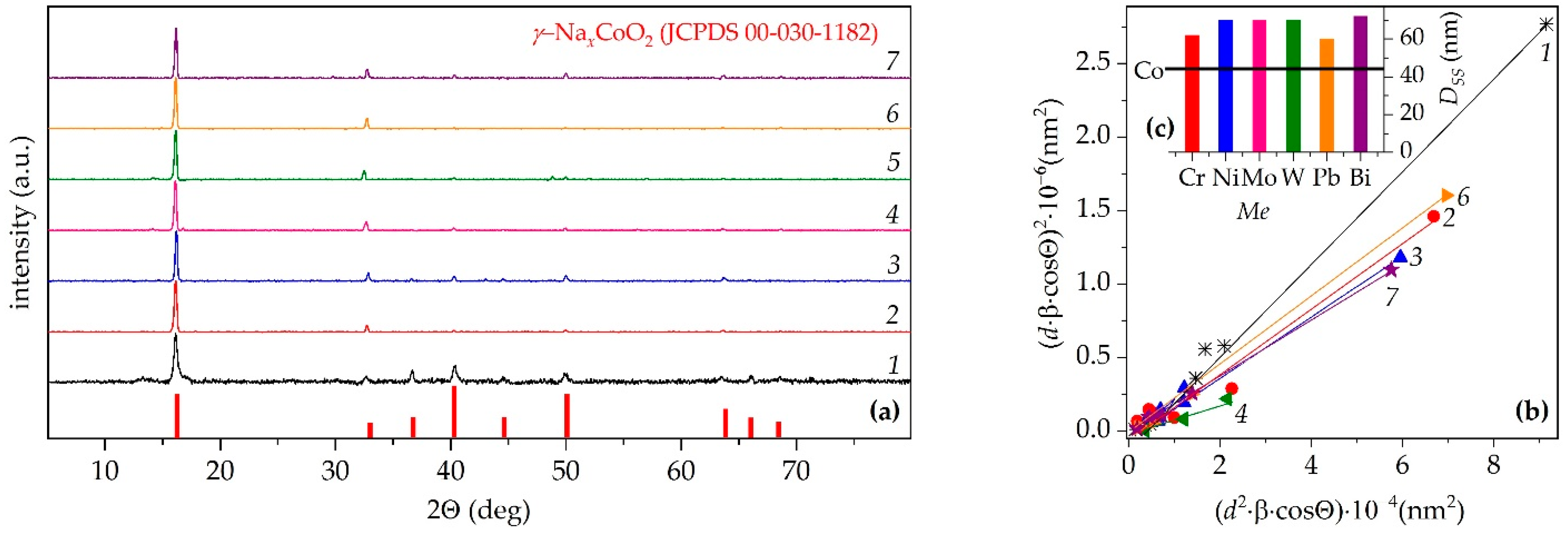
Figure 2.
Electronic micrographs of ceramic cleavage of Na0.89Co0.9M0.1O2 (M = Cr (a), Co (b), Ni (c), W (d), Pb (e), Bi (f)).
Figure 2.
Electronic micrographs of ceramic cleavage of Na0.89Co0.9M0.1O2 (M = Cr (a), Co (b), Ni (c), W (d), Pb (e), Bi (f)).
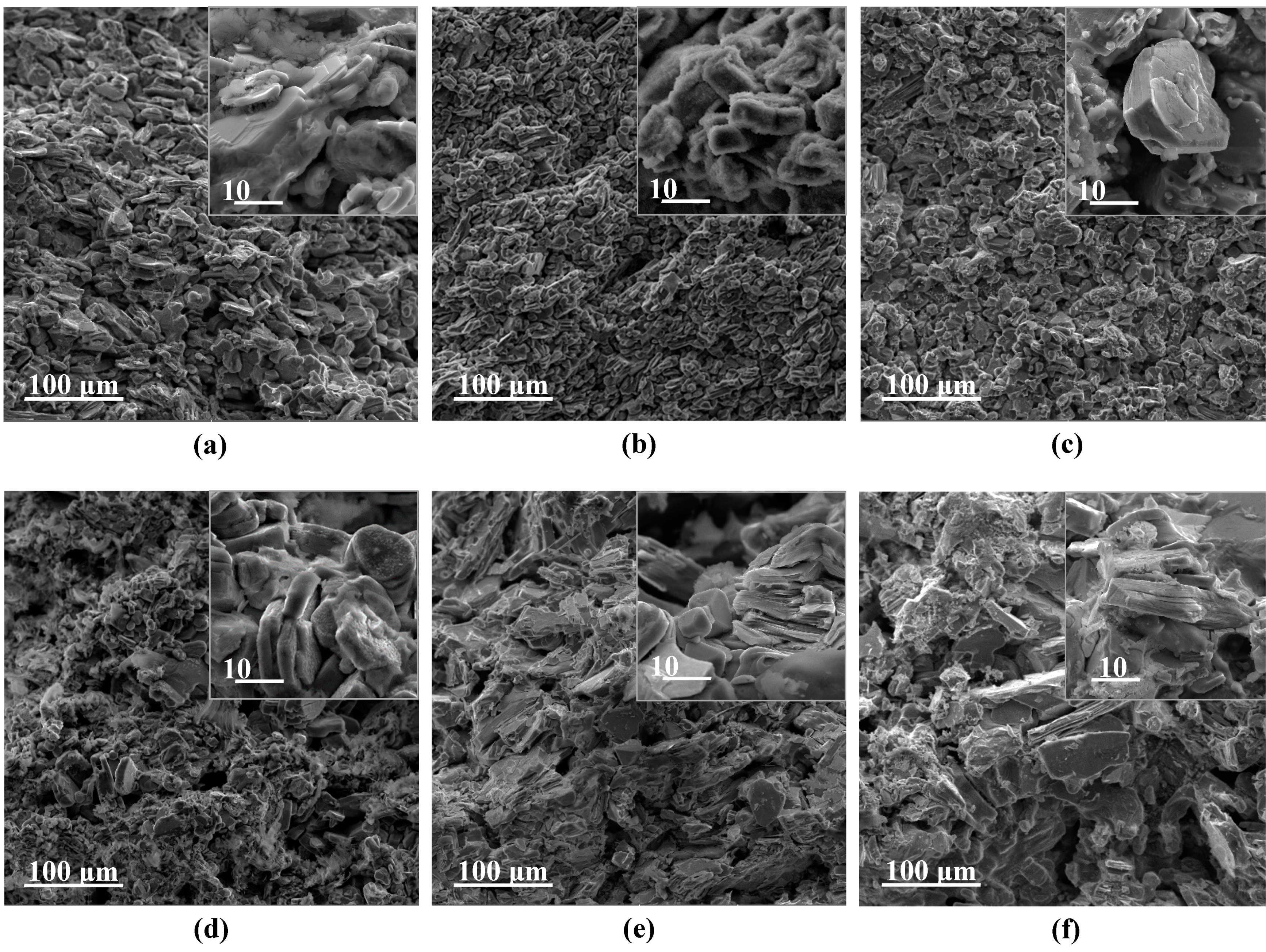
Figure 3.
Element mapping images of the Na0.89CoO2 (a) and Na0.89Co0.9W0.1O2 (b) ceramic samples.
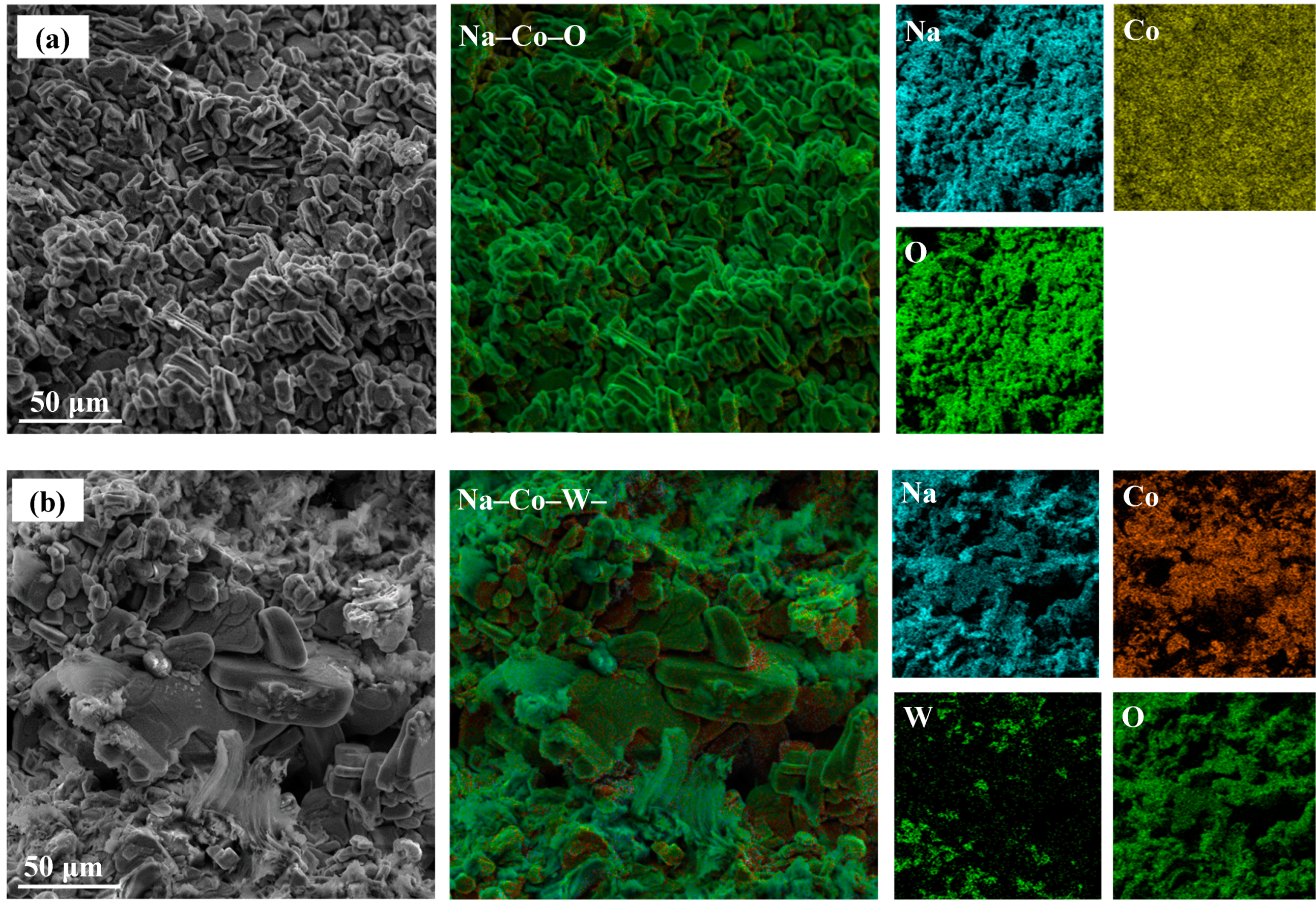
Figure 4.
Temperature dependences of electrical resistivity ρ (а), Seebeck’s coefficient S (b) and power factor P (c) of ceramic samples of Na0.89Co0.9Me0.1O2 (Me = Cr (1), Co (2), Ni (3), Mo (4), W (5), Pb (6), Bi (7)). Insets show the electrical resistivity ρ1073 (d), Seebeck’s coefficient S1073 (e) and power factor P1073 (f) values of Na0.89Co0.9Me0.1O2 phases.
Figure 4.
Temperature dependences of electrical resistivity ρ (а), Seebeck’s coefficient S (b) and power factor P (c) of ceramic samples of Na0.89Co0.9Me0.1O2 (Me = Cr (1), Co (2), Ni (3), Mo (4), W (5), Pb (6), Bi (7)). Insets show the electrical resistivity ρ1073 (d), Seebeck’s coefficient S1073 (e) and power factor P1073 (f) values of Na0.89Co0.9Me0.1O2 phases.
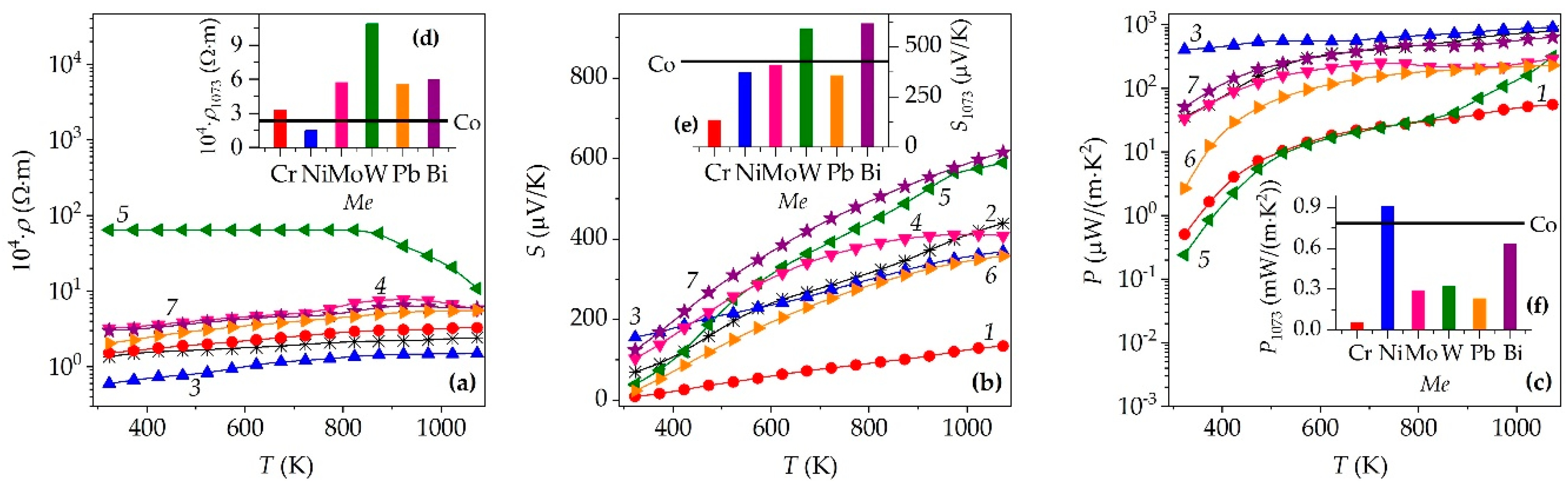
Figure 5.
Temperature dependences of thermal diffusivity η (а), total thermal conductivity λ (b), phonon λph and electron λe contributions (c) in thermal conductivity of Na0.89Co0.9Me0.1O2 (Me = Cr (1), Co (2), Ni (3), Mo (4), W (5), Pb (5), Bi (6)) ceramic samples. Insets show the thermal diffusivity η1073 (d), total thermal conductivity λ1073 (e) and phonon thermal conductivity λph,1073 of Na0.89Co0.9M0.1O2 materials.
Figure 5.
Temperature dependences of thermal diffusivity η (а), total thermal conductivity λ (b), phonon λph and electron λe contributions (c) in thermal conductivity of Na0.89Co0.9Me0.1O2 (Me = Cr (1), Co (2), Ni (3), Mo (4), W (5), Pb (5), Bi (6)) ceramic samples. Insets show the thermal diffusivity η1073 (d), total thermal conductivity λ1073 (e) and phonon thermal conductivity λph,1073 of Na0.89Co0.9M0.1O2 materials.
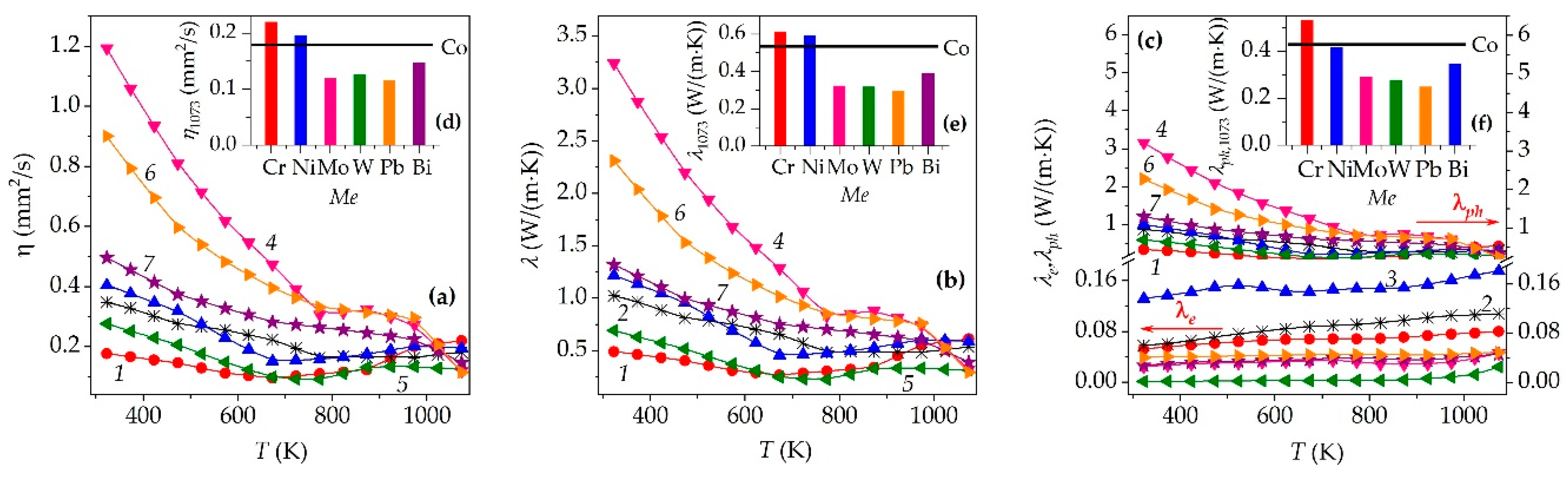
Figure 6.
Temperature dependences of figure-of-merit ZT (а) and self-compability factor s (b) of Na0.89Co0.9Me0.1O2 (Me = Cr (1), Co (2), Ni (3), Mo (4), W (5), Pb (6), Bi (7)) ceramic samples. Insets show the figure-of-merit ZT1073 (c) and dimensionless relative self-compatibility factor Δs673–873K (d) (within 673–873 K temperature range) of Na0.89Co0.90Me0.10O2 ceramics.
Figure 6.
Temperature dependences of figure-of-merit ZT (а) and self-compability factor s (b) of Na0.89Co0.9Me0.1O2 (Me = Cr (1), Co (2), Ni (3), Mo (4), W (5), Pb (6), Bi (7)) ceramic samples. Insets show the figure-of-merit ZT1073 (c) and dimensionless relative self-compatibility factor Δs673–873K (d) (within 673–873 K temperature range) of Na0.89Co0.90Me0.10O2 ceramics.
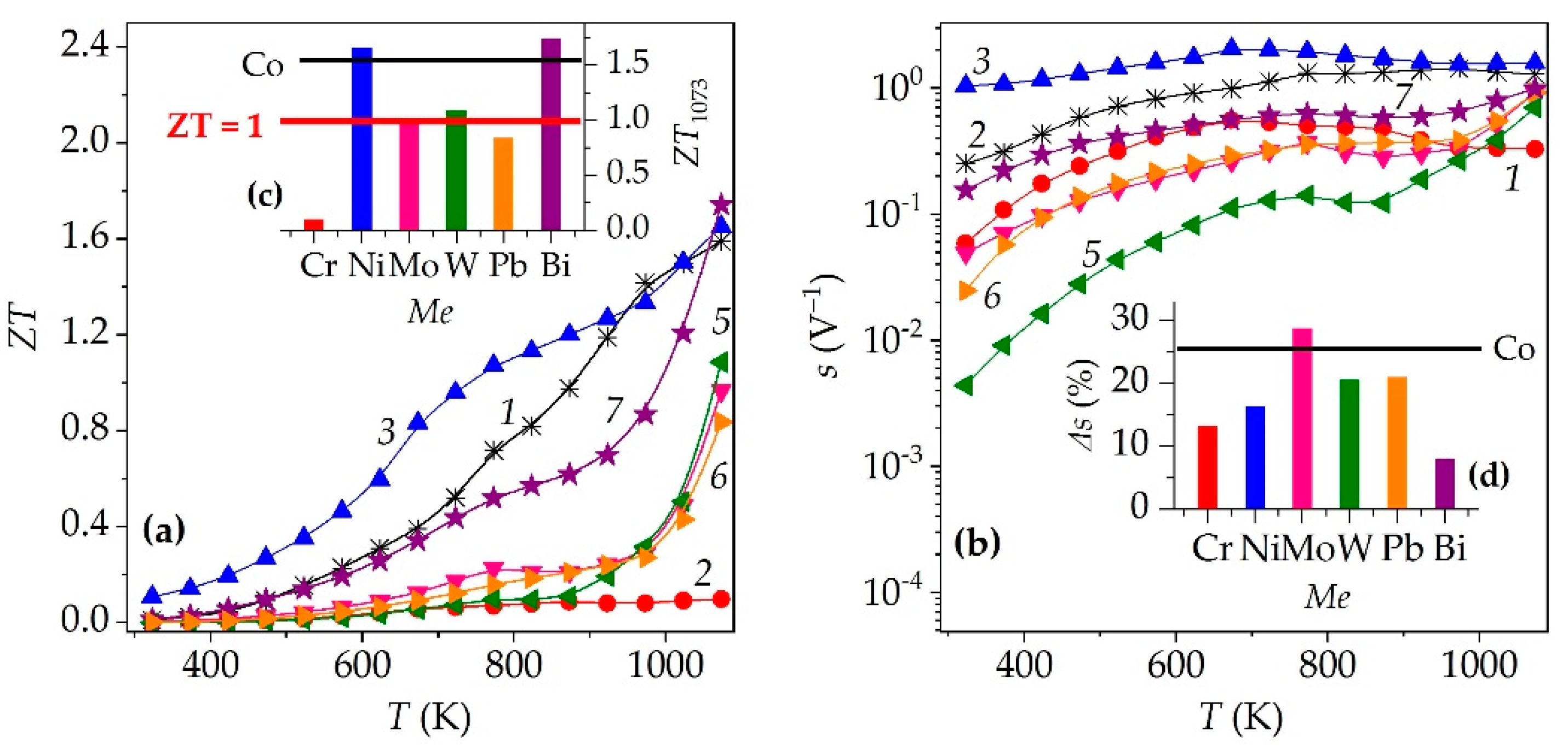

Table 1.
Values of sodium content (xNa), the average oxidation state of cobalt (Co+Z), lattice constants (a, c, c/a, V), Lotgering factor (f), size of the coherent scattering area obtained using the Debye−Scherrer equation (Ds) and the size-strain method (DSS), microstrain (ε) and X-ray density (dXRD) of Na0.89Co0.9Me0.1O2 (Me = Cr, Co, Ni, Mo, W, Pb, Bi) ceramic samples.
Table 1.
Values of sodium content (xNa), the average oxidation state of cobalt (Co+Z), lattice constants (a, c, c/a, V), Lotgering factor (f), size of the coherent scattering area obtained using the Debye−Scherrer equation (Ds) and the size-strain method (DSS), microstrain (ε) and X-ray density (dXRD) of Na0.89Co0.9Me0.1O2 (Me = Cr, Co, Ni, Mo, W, Pb, Bi) ceramic samples.
| Me | xNa | Co+Z | a, Å | c, Å | c/a | V, Å3 | f | Ds, nm | DSS, nm | ε×104 | dXRD, g/cm3 |
|---|---|---|---|---|---|---|---|---|---|---|---|
| Cr | 0.893 | 3.11 | 2.825 | 10.93 | 3.870 | 75.53 | 0.90 | 69 | 62 | 3.43 | 4.86 |
| Co | 0.891 | 3.11 | 2.826 | 10.94 | 3.872 | 75.71 | 0.31 | 63 | 45 | 4.56 | 4.98 |
| Ni | 0.889 | 3.23 | 2.831 | 10.92 | 3.856 | 75.75 | 0.69 | 70 | 70 | 2.61 | 4.88 |
| Mo | 0.894 | 2.78 | 2.822 | 10.96 | 3.883 | 75.57 | 0.87 | 73 | 70 | 1.41 | 5.06 |
| W | 0.889 | 2.78 | 2.825 | 10.97 | 3.884 | 75.80 | 0.92 | 67 | 69 | 1.50 | 5.43 |
| Pb | 0.888 | 3.01 | 2.825 | 10.94 | 3.873 | 75.64 | 0.92 | 79 | 60 | 3.22 | 5.55 |
| Bi | 0.894 | 2.90 | 2.823 | 10.93 | 3.872 | 75.45 | 0.76 | 77 | 72 | 2.49 | 5.56 |
Table 2.
Values of apparent (dEXP) density, total (Πt), open (Πo) and closed (Πc) porosity, linear thermal expansion coefficient (α), electrical resistivity (ρ1073), Seebeck coefficient (S1073), power factor (P1073) and figure-of-merit (ZT1073) of Na0.89Co0.9Me0.1O2 (Me = Cr, Co, Ni, Mo, W, Pb, Bi) ceramics.
Table 2.
Values of apparent (dEXP) density, total (Πt), open (Πo) and closed (Πc) porosity, linear thermal expansion coefficient (α), electrical resistivity (ρ1073), Seebeck coefficient (S1073), power factor (P1073) and figure-of-merit (ZT1073) of Na0.89Co0.9Me0.1O2 (Me = Cr, Co, Ni, Mo, W, Pb, Bi) ceramics.
| M |
dEXP, g/cm3 |
Πt, % | Πo, % | Πc, % | 105×α, К–1 | 104×ρ1073, Ω·m |
S1073, μV/K |
P1073, mW/(m·K2) |
λ1073, W/(m·K) |
ZT1073 |
|---|---|---|---|---|---|---|---|---|---|---|
| Cr | 3.18 | 35 | 16 | 19 | 1.68 | 3.28 | 134 | 0.055 | 0.613 | 0.10 |
| Co | 3.38 | 32 | 19 | 13 | 1.34 | 2.43 | 439 | 0.794 | 0.536 | 1.59 |
| Ni | 3.46 | 29 | 22 | 7 | 1.42 | 1.50 | 369 | 0.910 | 0.591 | 1.65 |
| Mo | 3.22 | 36 | 19 | 17 | 1.47 | 5.73 | 408 | 0.291 | 0.323 | 0.97 |
| W | 3.20 | 41 | 17 | 24 | 1.39 | 10.9 | 519 | 0.320 | 0.316 | 1.09 |
| Pb | 3.34 | 40 | 18 | 22 | 1.26 | 5.58 | 358 | 0.230 | 0.295 | 0.84 |
| Bi | 3.47 | 38 | 18 | 20 | 1.25 | 5.97 | 616 | 0.636 | 0.392 | 1.74 |
Disclaimer/Publisher’s Note: The statements, opinions and data contained in all publications are solely those of the individual author(s) and contributor(s) and not of MDPI and/or the editor(s). MDPI and/or the editor(s) disclaim responsibility for any injury to people or property resulting from any ideas, methods, instructions or products referred to in the content. |
© 2025 by the authors. Licensee MDPI, Basel, Switzerland. This article is an open access article distributed under the terms and conditions of the Creative Commons Attribution (CC BY) license (http://creativecommons.org/licenses/by/4.0/).
Copyright: This open access article is published under a Creative Commons CC BY 4.0 license, which permit the free download, distribution, and reuse, provided that the author and preprint are cited in any reuse.


