Preprint
Article

This version is not peer-reviewed.

U-Pb Zircon Age Constraints on the Paleozoic Sedimentation, Magmatism and Metamorphism of the Sredogriv Metamorphics, Western Balkan Zone, NW Bulgaria

A peer-reviewed article of this preprint also exists.

Submitted:

11 March 2025

Posted:

12 March 2025

You are already at the latest version

Abstract

The Sredogriv greenschist facies rocks belong to the Western Balkan Zone in northwestern Bulgaria. The low-grade rocks consist of clastic-tuffaceous precursors and presumably olistostromic magmatic bodies. We present U-Pb LA-ICP-MS zircon age constraints for the Sredogriv metaconglomerate, intruding metaalbitophyre and a breccia-conglomerate of the sedimentary cover. Detrital zircons in the Sredogriv metaconglomerate yielded a maximum depositional age of 523 Ma, with a prominent Neoproterozoic-Early Cambrian detrital zircon age clusters derived from igneous sources. The metaalbitophyre crystallized at 308 Ma and contains the same age clusters of inherited zircons. A maximum age of deposition is defined at 263 Ma for a breccia-conglomerate of the Smolyanovtsi Formation from the sedimentary cover that recycled material from the Sredogriv metamorphics and Carboniferous-Permian magmatic rocks. Proximity to Cadomian island arc sources and provenance from the northern periphery of Gondwana outline the depositional setting of the Sredogriv sedimentary succession. The timing of the Variscan greenschist facies metamorphism of the Sredogriv metamorphics is bracketed between 308 Ma and the depositional age of 272 Ma of another adjacent clastic formation. The results obtained allow us to identify the timing of the Cadomian sedimentary history and the Variscan magmatic and tectono-metamorphic evolution in part of the Western Balkan Zone.

Keywords: 
;  ;  ;  

1. Introduction

The Balkan Zone forms crucial part of the Alpine fold-and-thrust belt exposed in northwestern Bulgaria, and it is considered to represent Balkan terrane, together with other two large-scale Moesian and Thracian terranes on the territory of Bulgaria that have been linked to Gondwana geodynamic evolution [1,2,3,4] (Figure 1). This evolution involves oceanic crust formation, island arc development and collision of Gondwana-derived crustal blocks with the Laurasia continental margin during the Late Neoproterozic to Early Paleozoic times [2,3,4,5,6], which testifies for the presence of tectono-magmatic elements of the Avalonian-Cadomian orogeny [3,6,7,8,9], as well as the same elements of the Variscan orogeny [6,10,11] in the Balkan Zone. Hovewer, despite that the Late Carboniferous-Early Permian crystallization ages of Variscan magmatism in the Balkan Zone is relatively well-known e.g., [7,12,13], the reliable age constraints for pre-Variscan and Variscan sedimentation and Variscan metamorphism are generally scarce or still lacking in most parts of the Balkan Zone. Specifically, the clastic sedimentation of the Permian red beds is inferred only from the stratigraphic position to the underlying Lower Paleozoic strata for some of which biostratigraphic ages exist [10,14], while the knowledge of the Carboniferous high-grade metamorphism at 336.5±5.4 Ma is based only on a single zircon age [6] and its cooling derived by 40Ar/39Ar mica ages in the range of 306-317 Ma [15] in the Sredna Gora Zone south of the Balkan Zone.
In northwestern Bulgaria, the Balkan Zone consists of Forebalkan and Western Balkan units involved in the Alpine fold-and-thrust belt [16] (Figure 1). Other subdivision identifing the Western Balkan Zone includes Alpine thrust-imbricated Berkovitsa, Vratsa, Montana and Belogradchik units [17].
The Western Balkan Zone is built of Neoproterozoic-Cambrian crystalline basement and Late Paleozoic-Mesozoic cover rocks [3,4,8,16,17,18]. In the old Bulgarian geological literature, the low-grade crystalline basement of the Western Balkan Zone is reffered as to the Diabase-Phyllitoid formation [19] or complex [20], in which basalt lenses and blocks were interpreted as olistoliths [21]. The latter complex is inferred of latest Neoproterozoic-Early Paleozoic age based on finds of Lower and Upper Ordovician acritarchs [22] and the stratigraphic relationships with the underlying, presumably older magmatic units (see below). However, in the Diabase-Phyllitoid complex, a recent U-Pb zircon geochronology revealed crystallization of a pillow basalt at 519.9 ± 3.6 Ma [23] and a maximum depositional age of a metaconglomerate at 510 ± 6 Ma and a sandstone at 540 ± 5.9 Ma [4,18], which althogether rather consistently define a Cambrian age of this complex.
In the Diabase-Phyllitoid complex, three lithostratigraphic groups have been subdivided, namely Cherni Vrah, Berkovitsa and Dalgi Djal groups [24,25]. These groups differ among each other in their lithologic character and tectono-stratigraphic relationships.
The Cherni Vrah Group is ophiolitic, and it is traditionally regarded as representing an element of the Balkan-Carpathian complete ophiolite that includes N-MORB type cumulate, mafic inrusive and volcanic section of an oceanic lithosphere [5,26]. The age of the Cherni Vrah Group was defined as Neoproterozoic by a single U-Pb zircon crystallization age of a gabbro at 563±5 Ma [27]. The latter age was interpreted as detrital by Kiselinov et al. [28] that dated the Cherni Vrah gabbro as Devonian at 391.2±1.3 Ma by LA-ICP-MS method on multiple zircon grains. The counterparts of the Balkan-Carpathian ophiolite in Eastern Serbia and Romania demonstrate Devonian U-Pb zircon crystallization ages of Deli Jovan ophiolite gabbro at 405±2.6 Ma [29], an age of 388.1±5.1 Ma for the Zaglavac ophiolite gabbro [30], and 380-390 Ma Sm-Nd isochron ages for Tishovitsa-Jutz ophiolite gabbro [31] (see Figure 1 for location of the ophiolitic bodies).
The Berkovitsa Group is island arc-related, and consists of Ca-alkaline volcanic (metabasalt, metaandesite and metatrachyandesite) and plutonic counterparts and associated sedimentary successesions of an intra-oceanic arc system, for which is inferred pre-Ordovician (latest Neoproterozoic-Cambrian) age based on previously reported acritarchs in the Diabase-Phyllitoid complex [25]. An angular unconformity of the Berkovitsa Group island arc onto the Cherni Vrah Group ophiolite is reported by the latter author. Cambrian age of 493.0±6.6 Ma was defined for the Berkovitsa Group Pilatovo gabbro by U-Pb method on zircons [32]. Similarly, a tuffitic metasiltstone and a metasandstone from the Berkovitsa Group yielded maximum depositional ages of 494.5±5 Ma and 521±5 Ma, respectively [4].
The Dalgi Djal Group is olistostromic, in which alternating metasedimentary lithologies host olistoliths from the Cherni Vrah ophiolite and magmatic rocks of the Berkovitsa island arc system [25]. The inferred early Ordovician age of the Dalgi Djal Group is based on the acritarchs found in similar rock types to this group from other exposed areas of the Diabase-Phyllitoid complex in the Balkan terrane [25]. The Dalgi Djal Group overlies unconformable the Berkovitsa Group and it is interpreted as a sedimentary assemblage formed during the destruction and obduction of the Balkan-Carpathian ophiolite.
The investigated here Sredogriv low-grade metasedimentary rocks have been correlated with the Dalgi Djal Group [25], and for them critical age constraints on the sedimentary depositional history and magmatic components contained in the metasedimentary rocks, as well as for the timing of the experienced low-grade metamorphism are still lacking. This hampers establishing the earlier Paleozoic sedimentary and tectono-metamorphic evolution of some of the low-grade metamorphic units that constitute the important Cadomian and Variscan crustal elements subsequently implicated in the Alpine Balkan fold-and-thrust belt.
In this contribution, we present detrital zircon U-Pb geochronology for the depositional timing of the precursors of the Sredogriv low-grade metamorphic rocks, as well as on the clastic sedimentary rocks of its immediate cover (Figure 2). It is also complemented by U-Pb geochronology of the felsic magmatic rocks contained in these low-grade metamorphic rocks and whole-rock geochemistry of the latter. The aim of this study is to provide age constraints relative to the magmatic protolith and depositional history of the Sredogriv metamorphics as an important crustal element of the Western Balkan Zone, as well as to bracket the temporal frame of the experienced greenschist facies metamorphism using also the depositional history of the Late Paleozoic cover rocks.

2. Geological Setting and Field Observations

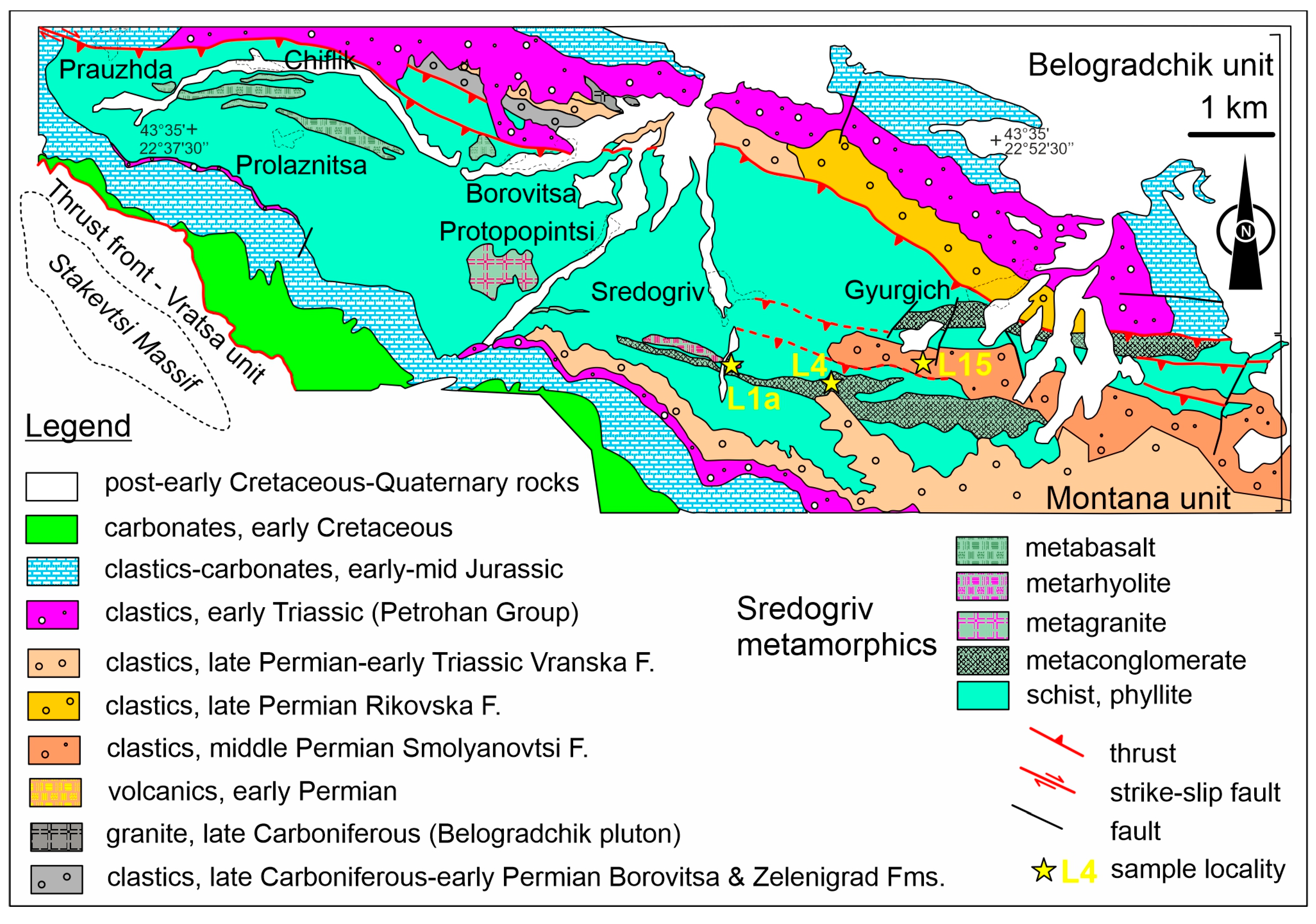
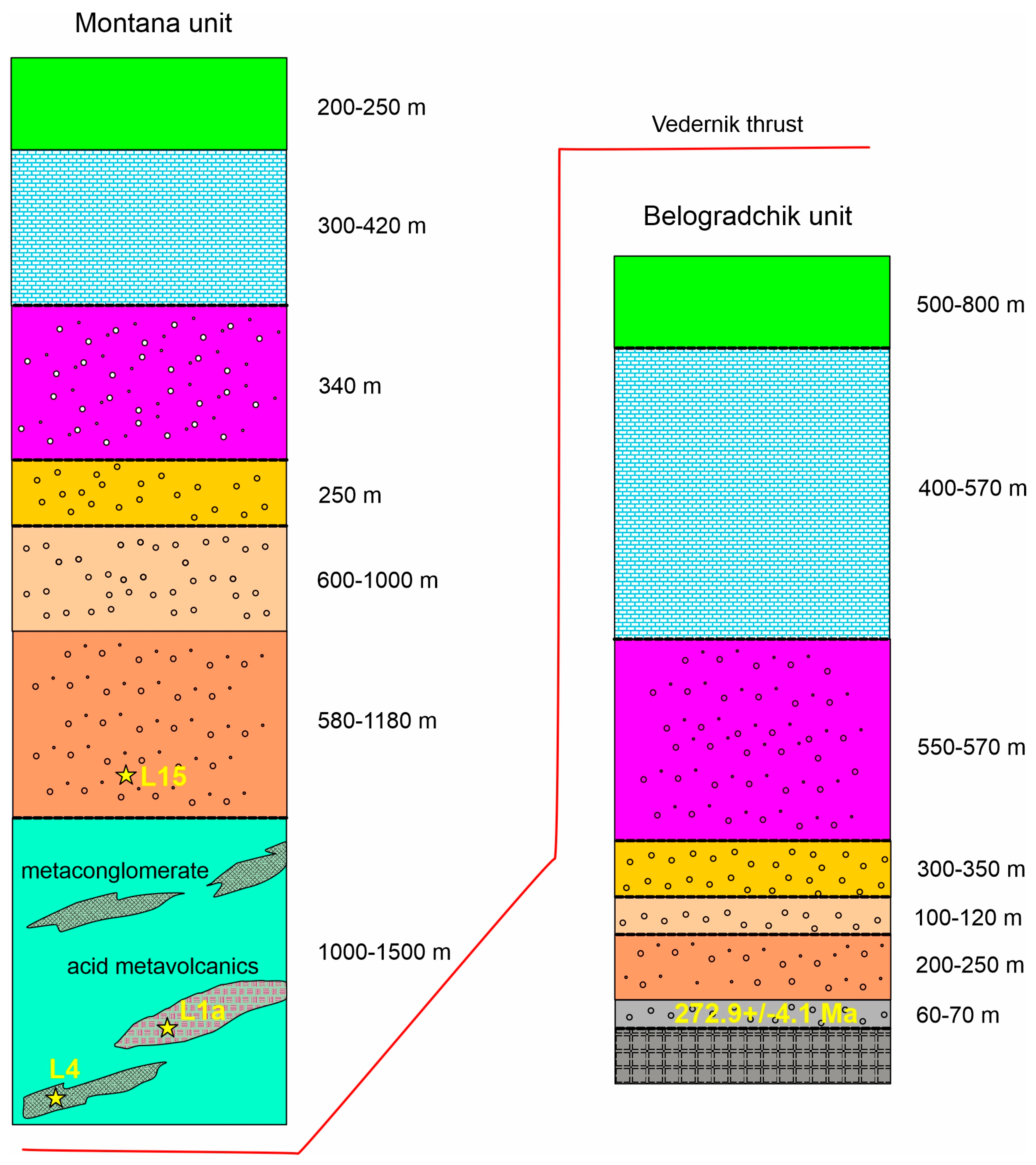
The Sredogriv metamorphics [33,34] belong to the Montana unit, which is a component of the large-scale Western Balkan Zone [17]. They represent NW-SE elongated strip of low-grade metamorphic rocks without exposed base, that appear below the unconformable latest Paleozoic-Mesozoic sedimentary cover rocks (Figure 2). Initially, they have been subdivided into the Sredogriv Formation [35], and later included into the Diabase-Phyllitoid complex [20,36]. The Sredogriv metamorphics, together with presumably Permain in age clastic and volcanic rocks, build up the basement of the Montana unit, which is covered by Lower Triassic and Middle Jurassic-Early Cretaceous clastic-carbonate successions showing internal unconformities among the distinct formations [33,34] (Figure 3). The Montana unit is thrusted over the Belogradchik unit along the late Alpine Vedernik thrust. The age of the Sredogriv metamorphics is inferred to be Silurian [37], Devonian-Early Carboniferous [20], pre-Devonian [35] and Ordovician by analogy with the Dalgi Djal Group [25]. According to Moskovski et al. [35], the Sredogriv Formation consists of a lower terrigenous member and an upper terrigenous-tuffaceous member. Haydoutov [38] unifies the Sredogriv Formation together with four other formations into the terrigenous-volcanogenic suite called “Stara Planina flyschoid Formation”. Intense deformation, greenschist facies metamorphism and modified primary stratification led Angelov et al. [33,34] to unify the parametamorphic rocks along with the allochthonous magmatic rocks into a single unit called the Sredogriv metamorphics. Kiselinov [39] has distinguished six deformational stages (assigned to Cadomian, Variscan and Alpine orogenies) of the Sredogriv metamorphics and obtained a Neoproterozoic U-Pb zircon protolith age of 618±10 Ma for the Protopopintsi metagranitoid, which is considered as an olistolith within these metamorphics. Kiselinov [39,40] studied the geochemical composition of several samples of metabasites, metagranites and metavolcanites included in the Sredogriv metamorphites and interpreted them as having formed in different tectonic settings. These results support the suggestion of an older peri-Gondwanan origin of the igneous olistoliths and olistoplaques that were tectonically included during the late Silurian and Devonian into an epicontinental basin. The obtained Ediacaran age (618 Ma) of the Protopopintsi granite (representing a large olistoplaque in the Sredogriv metamorphites) also testifies to the peri-Gondwanan origin of the basement of the Balkan assemblage [41,42].
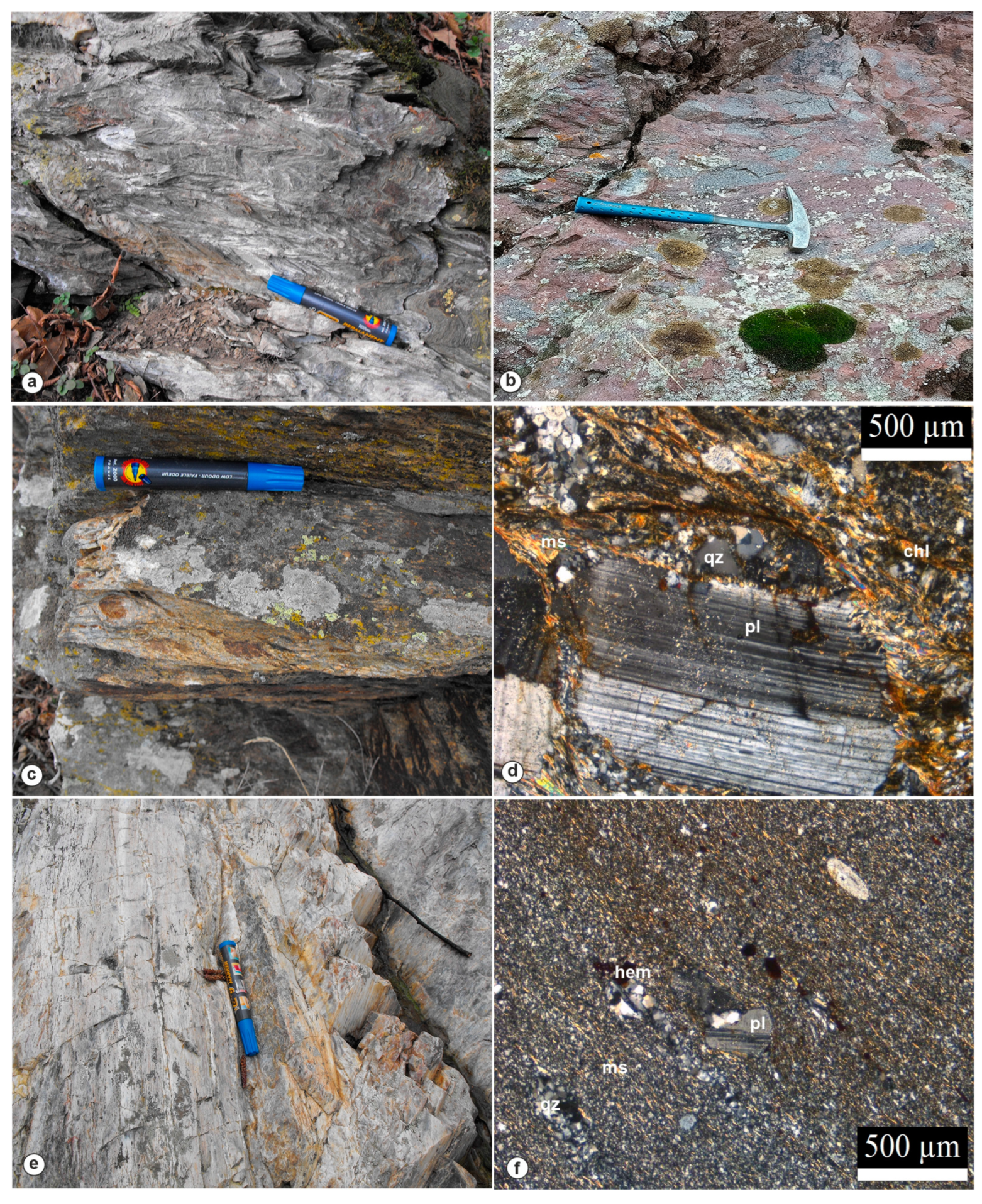
Our field observations confirmed previous data that the Sredogriv metamorphics are strongly deformed in greenschist facies metamorphic conditions (Figure 4a). These metamorphics consist of alternating quartz-sericite schist, sericite-chlorite schist, calc-schist, phyllite, metaaleurolite, metasandstone and metaconglomerate. Basic and acidic metaigneous bodies within this metasedimentary succession are considered allochthonous, representing various olistostromic bodies [33,34]. In the field, it is hardly to identify the olistostomic nature of the magmatic rocks because some demonstrate features of mafic dykes (thin elongated bodies) or felsic sill (foliation/stratification-parallel thin bodies) within the metamorphic succession that shows typical greenschist facies mineral assemblages. Moreover, the mafic dykes shows rather consistent E-W to ESE-WNW strike that implies they represent a conjugate network of mafic igneous bodies (see Figure 2).

3. Materials and Methods

Our investigation focuses on key metamagmatic body and metaclastic rock horizon of the Sredogriv metamorphics and the first sedimentary cover of unconformably overlying Smolyanovtsi Formation built of clastic rocks. The sample numbers mentioned below refer to those shown in Figure 2 and Figure 3. These samples were used for U-Pb zircon geochronology.
A single sample L4 (N43°52945° E22°80330°) is collected from a metaconglomerate from the Sredogriv low-grade metamorphics, which form discontinuous distinct horizon of variable thickness. This polymictic metaconglomerate consists of quartz, gneiss, phyllite, schist, granitoid clasts that range in size from 2 to 6 cm, all set in a medium- to coarse-grained supporting matrix of similar compositon to that of the clasts (Figure 4c). The metaconglomerate demonstrates a well-developed greenschist facies foliation delineated by chlorite-muscovite (sericite) aggregates and recrystallized quartz grains (Figure 4d).
Another sample L1a (N43°533514° E22°784586°) from the Sredogriv low-grade metamorphics comes from a felsic sill-like and foliation parallel metaigneous body reaching thickness up to 20 m that is intercalated within the metamorphic succession (Figure 4e). In thin section, this felsic body represent metaalbitophyre consisting of plagioclase and quartz phenocrysts set in a fine-grained recrystallized groundmass that contains foliation-delineating quartz and sericite, together with altered magnetite to hematite (Figure 4f).
Sample L15 (N43°534928° E22°850475°) is collected from a red-brown clast-supported breccia-conglomerate that belongs to the inferred Lower Permian in age Smolyanovtsi Formation from the first unconformable sedimentary cover of the Sredogriv metamorphics (see Figure 3). The clast-supported breccia-conglomerate consists of quartz, gneiss, phyllite, schist, granitoid and mostly of angular volcanic clasts that range in size up to 20 cm, all set in a coarse-grained matrix of similar compositon to that of the clasts (Figure 4b).
For U-Pb dating zircons were recovered from jaw crushed and milled rock samples using a Wilfley shaker table, followed by magnetic and heavy liquid (CHBr3 and CH2I2) separation at the Geological Institute of the Bulgarian Academy of Sciences. Zircon grains were hand-picked under binocular microscope and thermally annealed at 900° C for 48 h in a muffle and afterwards mounted in epoxy resin and polished. Optical cathodoluminescence (CL) imaging was carried out for identifying inherited cores, cracks and inclusions inside the crystals using motorized optical system Cathodyne NewTec Scientific attached to microscope Leica 2700 at the Geological Institute of the Bulgarian Academy of Sciences. U-Pb in-situ zircon dating was performed at the laser ablation mass-spectrometry (LA-ICP-MS) laboratory of the Geological Institute using a New Wave UP193FX LA coupled to a Perkin Elmer ELAN DRC-e quadrupole ICP-MS. Ablation parameters were set up to diameter of 35 μm, frequency of 8 Hz and detection time within 0.002-0.003 s. Analyses were calibrated with the GEMOC-GJ1 zircon [43] as an external standard for fractionation correction. Plešovice [44] and 91500 [45] zircons were used as unknowns and used to correct systematic errors. Data reduction was processed using Iolite v. 2.5 [46], applying down-hole fractionation correction. Diagram plots and concordia ages were obtained using Isoplot 4.15 [47]. Analytical data derived from the U-Pb zircon geochronology are provided in Table S1 of the Supplementary material.
The Sredogiv metamorphites were sampled with a few samples including metaconglomerate, quartz-chlorite, sericite-chlorite and black schists. The selected for whole-rock geochemistry five samples were crushed to a fine powder following standard procedures. Whole-rock major element analyses by X-ray fluorescence (XRF) were performed on PANalytical (EDXRF, Epsilon 3XLE, Omnian 3SW) instrument at the University of Sofia St. Kliment Ohridski, Bulgaria. XRF analyses were conducted on fused beads of powdered material from the samples of mafic rocks. The fused beads were prepared by mixing approximately 1 g of sample with 3 g of lithium metaborate (LiBO2) and 6 g of lithium tetraborate (Li2B4O7) flux. The melting process was realized using a Claisse LeNeo Fused Bead maker, in 5% Au–95% Pt casting bowls at 1065 °C. The loss of ignition (LOI) at 1000 ºC was expressed as a percentage of sample weight dried in an oven at 110 ºC overnight. Analytical errors for major oxides are within the range of 1%. The trace elements and the rare-earth elements (REE) were measured in fused beads using LA-ICP-MS at the Geological Institute of the Bulgarian Academy of Sciences, using the whole-rock SiO2 content as an internal standard and NIST 610 as an external standard. Whole-rock chemical analyses are given in Table S2 of the Supplementary material.

4. Results

4.1. U-Pb Geochronology

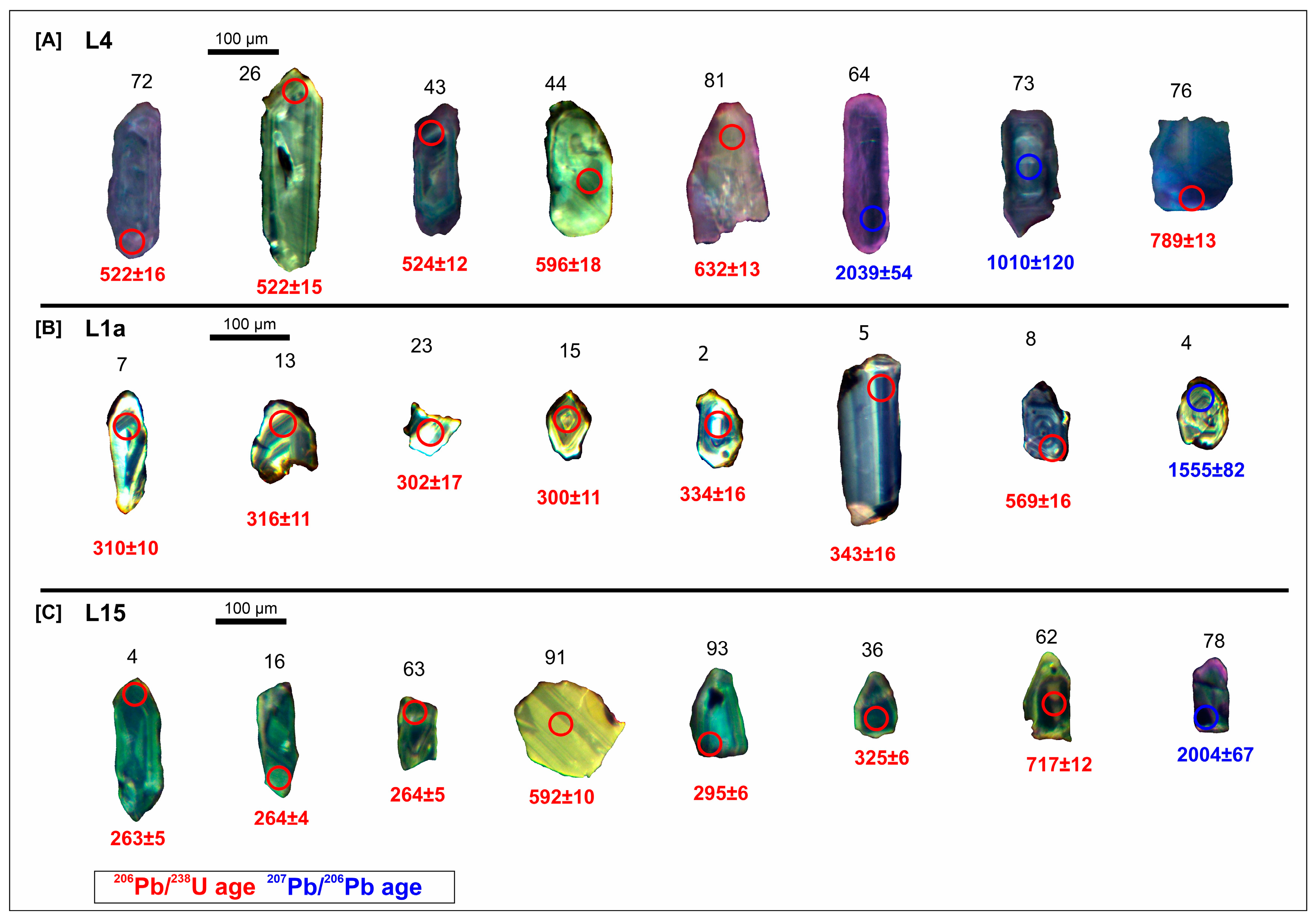
The dated zircons in the metaconglomerate sample L4 vary in size from 150 µm to 350 µm, with an average aspect ratio of 2. They display semi-rounded shapes and preserved mostly oscillatory- and rarely sector zoning patterns, which both are characteristic for a magmatic origin (Figure 5a).
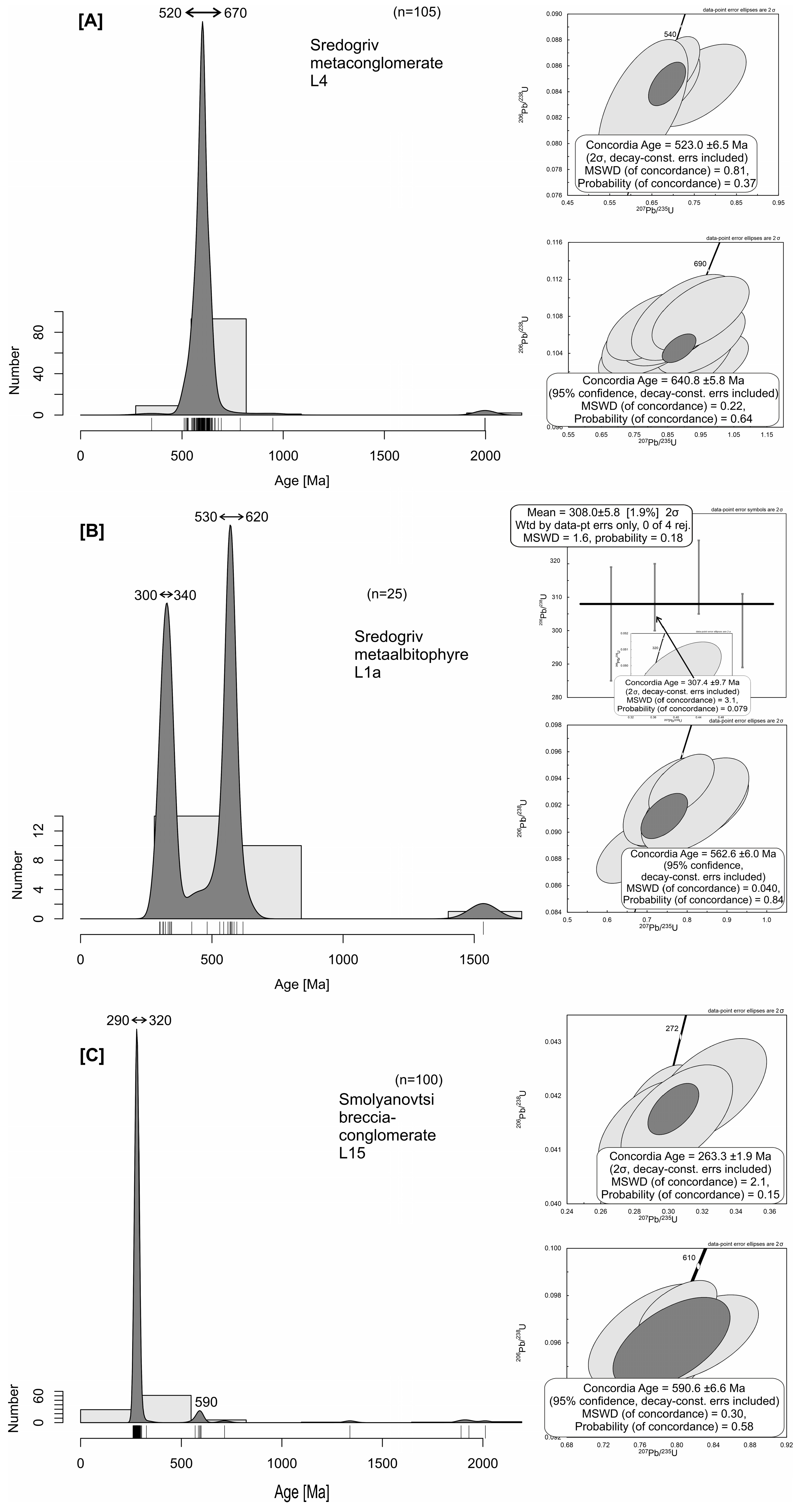
In sample L4, the 206Pb/238U ages obtained from 105 analyses range from 1996 Ma to 516 Ma (Figure 6a, Table S1). From seventy-seven concordant zircons a series of clusters were established with different density and various ages. The main age cluster of twenty-three zircons yielded a concordia age of 597.1±3.3 Ma, followed by a cluster of seventeen zircons that gave a concordia age of 587.5±3.5 Ma, and a cluster of fourteen zircons with a concordia age of 640.8±5.8 Ma (Figure 6a). Eight concordant zircons cluster at 555.5±0.36 Ma, five concordant zircons cluster at 611.3±4.7 Ma and three concordant zircon cluster at 624.6±6.2 Ma. Two zircon pairs gave concordant ages, respectively, at 687±49 Ma and at 1996±12 Ma. Single zircons yielded concordant ages at 944±21 Ma and at 791±12 Ma. The five youngest concordant zircons provided an age of 523±6.5 Ma, and hence, define an early Cambrian maximum depositional age (Figure 6a). The Th/U ratios of the dated zircons of this sample range from 0.14 to 1.77, which is typical for magmatic zircons e.g., [48,49].
Zircons from the metaalbitophyre sample L1a show mainly prismatic and rarely pyramidal crystals varying in size from 70 µm to 250 µm, which have magmatic oscillatory- and sector zoning patterns (Figure 5b). In sample L1a, the 206Pb/238U ages obtained from 25 analyses range from 1532 Ma to 302 Ma (Figure 6b, Table S1). Four youngest zircons yielded a weighted mean age of 308±5.8 Ma (Figure 6b). One out of all four is concordant at 307.4±9.7 Ma confirming the weighted mean age of the youngest population, which is interpreted to date magmatic crystallization of the albitophyre. Inherited zircons gave concordant ages, respectively, at 562.6±6.0 Ma by seven grains (Figure 6b), and single zircon crystals are concordant at 337.5±3.7 Ma, 479±16 Ma, 529±13 Ma, 619±6.0 Ma and 1532±22 Ma (see Table S1). The Th/U ratios of the dated concordant zircons of sample L1a range from 0.36 to 1.22, which is typical for magmatic zircons.
The dated zircons in breccia-conglomerate sample L15 vary in size from 80 µm to 300 µm. They display semi-rounded shapes and preserved mostly oscillatory-zoned pattern, which is characteristic for a magmatic origin (Figure 5c). In this sample, the 206Pb/238U ages obtained from 100 analyses range from 2009 Ma to 261 Ma (Figure 6c). From eighty-three concordant zircons, a series of clusters were established with different density and various ages. The main age cluster of twenty zircons yielded a concordia age of 279.5±1.5 Ma, followed by a cluster of thirteen zircons that gave a concordia age of 285±1.6 Ma, and a cluster of twelve zircons with a concordia age of 271.5±1.6 Ma. Eleven concordant zircons cluster at 292.5±1.7 Ma, seven concordant zircons cluster at 267.4±1.8 Ma, five concordant zircons cluster at 264±2.5 Ma, four concordant zircons cluster at 590.6±6.6 Ma (Figure 6c) and three concordant zircons cluster at 276.1±2.6 Ma. Single zircons yielded concordant ages at 2009±25 Ma, at 720±12 Ma and at 323.5±5.8 Ma (see Table S1). The five youngest concordant zircons delivered an age of 263.3±1.9 Ma, and hence, define a latest middle Permian maximum depositional age (Figure 6c). The Th/U ratios of the dated zircons in this sample range from 0.23 to 0.96 testifying to a magmatic origin.

4.2. Whole-Rock Geochemistry

The selected five samples for whole-rock geochemistry represent different types of clastic metasedimentary rocks that include metaconglomerate, metasandstone, metaleurolite and phyllite.
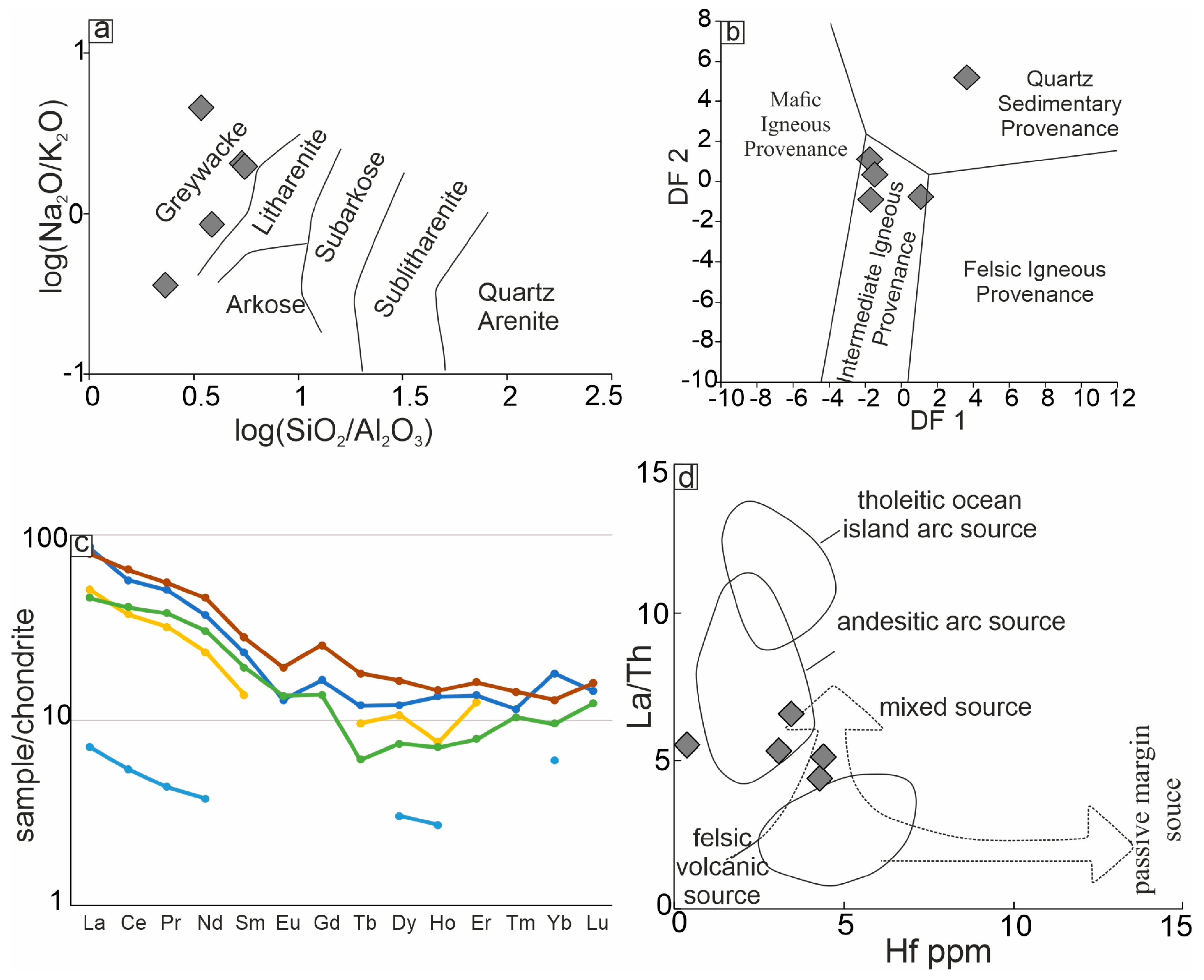
The content of major oxides SiO2 (55.36 – 73.27 wt%), Al2O3 (13.12 – 24.03 wt%), and Fe2O3t (2.66 – 6.57 wt%), MgO (0.64 – 2.28 wt%) is similar to the average upper continental crust composition of Taylor and MacLennan [50]. The higher value of Na2O/Al2O (0.06 – 0.34) compared to K2O/Al2O3 (0.07 – 0.19) confirms the plagioclase predominance over the K-feldspar. The strong negative correlation between SiO2 and Al2O3 (-0.98), and the contents of TiO2 (-0.93) and Fe2O3t (-0.82) could be related to quartz predominance and sorting of the precursory sedimentary rocks. The major minerals (muscovite, chlorite, and plagioclase) induce a pronounced positive dependence between the oxides of Al with K (0.70) and Fet (0.71). The logarithmic values of SiO2/Al2O3 and Na2O/K2O on the classification diagram after [51] comprise greywacke protolith composition (Figure 7a).
The dominance of intermediate igneous input is determined by discrimination functions (DF) used by the diagram of Roser and Korsch [52] (Figure 7b). The moderate degree of alteration corresponds to the Chemical Index of Alteration (CIA = 69 – 80, after [54]).
The trace elements could clarify the provenance origin, depositional settings, and heavy sorting because of their low mobility during diagenesis and metamorphism. Most of them (e.g. V, Rb, Ta, U, Th, and REE) are incorporated into rock-forming minerals (micas) evidenced by positive correlation with major oxides (Al2O3, Fe2O3, K2O, and MgO). The Th/Sc (0.24 – 0.43) and Zr/Sc (6.65 – 12.98) ratios indicate compositional variation consistent with the upper continental crust [55]. The chondrite-normalized REE patterns (Figure 7c) confirm continental crust composition with light REE enrichment (LaN/SmN = 2.37 – 3.71) and heavy REE depletion (GdN/LuN = 1.11 – 1.60) and negative Eu-anomaly (0.66 – 0.83). In the La/Th vs. Hf classification diagram [53] based on the composition of low-mobility elements (La, Th, Hf) assigns a predominance of andesitic arc source (La/Th ~ 5, Hf < 5 ppm, Figure 7d). The high-field strength elements (HFSE) (La, Th, Sc, Zr, Ti) used for discrimination of the tectonic regimes [56] suggest continental island arc tectonic setting.

5. Discussion

The Sredogriv metaconglomerate has an early Cambrian maximum depositional age of 523 Ma. The high Th/U ratios of the detrital zircons reflect a magmatic source, and the documented predominant age clusters of detrital zircons testify for the similar age as the detrital zircon age of 563 Ma for the Cherni Vrah gabbro from the Berkovitsa Group [27] and the age of 618 Ma for the Protopopintsi metagranite [39]. The latter is not hosted by the Sredogriv sedimentary succession, but underlies this succession, and the Protopopintsi metagranite obviously supplied detrital crustal material for the sedimentation of the future Sredogriv siliciclastic succession. This interpretation is further supported by the U-Pb zircon ages of nearby volcanic arc affinity Neoproterozoic gneisses ca. 651-601 Ma hosting 517 Ma-old felsic intrusion [8] in the Stakevtsi metamorphic complex located immediately southwest of the study area, which complex belongs to the Berkovitsa Group of the Vratsa unit (see Figure 2 for the location). Proximity to volcanic arc edifice of the basin that accumulated the Sredogriv sedimentary rocks is indicated by established tuffaceous material in the upper part of the succession [35] that resulted in omnipresent chlorite within this succession (see Figure 4a), as well as substantiated by the geochemical data of the metasedimentary rocks.
The Ediacaran-Early Cambrian major age cluster of detrital zircons (670-520 Ma), together with a single Cryogenian (791 Ma) and Thonian (944 Ma) zircons, and the two Paleoproterozoic (1996 Ma) in the Sredogriv metaconglomerate (Figure 6a), are indistinguishable from the reported detrital zircon age clusters at 496 Ma, 519 Ma, 533 Ma, 568 Ma, 577 Ma, 586 Ma, 601 Ma, 630 Ma, 1.9 Ga and 2.0 Ga in the clastic metasedimentary rocks from the Berkovitsa Group and the Diabase-Phylitoid complex [4]. Moreover, the maximum depositional age of the Sredogriv metaconglomerate is very close or even indistinguishable from the maximum depositional ages of 521±5 Ma and 494±5 Ma of tuffitic metasiltstone and metasandstone of the Berkovitsa Group, respectively, and the maximum depositional age of 510±6 Ma of a metaconglomerate in the Diabase-Phyllitoid complex [4]. Based on statistical analysis of the detrital zircons from the Moesian and Balkan terranes and other Avalonian-Cadomian terranes worldwide Žák et al. [4] defined a provenance of the detrital sedimentary material from trans-Saharan belt and/or Saharan metacraton igneous sources at the northern periphery of Gondwana for the Berkovitsa Group and Diabase-Phyllitoid complex, and for other units in the western and central Balkan zone i.e. the Balkan terrane. These igneous sources and provenance area fully correspond to those recovered by the detrital zircons in the Sredogriv siliciclastic rocks.
To sum up, the Sredogriv siliciclastic rocks were deposited in a basin proximal (e.g. fore-arc/back-arc) to Cadomian arc system (Berkovitsa island arc sensu [25]) during the early Cambrian, where they received rather unimodal major Ediacaran-Early Cambrian crustal material input from adjacent igneous sources at the northern periphery of Gondwana. We therefore correlate the Sredogriv metasiliciclastic rocks with the sedimentary section of the Berkovitsa Group based on their lithologic context and Early Cambrian depositional age.
The Sredogriv metaalbitophyre demonstrates magmatic crystallization in Late Carboniferous around 308 Ma, when it emplaced into the Sredogriv sedimentary succession, and this igneous age is fully comparable to the ages of many others Late Carboniferous magmatic bodies known in the Western Balkan Zone e.g. [7,13] and references therein. In this sense, the metaalbitophyre represents a manifestation of the region-wide Late Carboniferous magmatism linked to the late Variscan tectono-magmatic evolution recorded in this zone. The inherited Ediacaran-Early Cambrian zircons (620-530 Ma, Figure 6b) in the metaalbitophyre are obviously xenocrysts sampled “en route” to the surface from the host Sredogriv sedimentary succession that demonstrates the same major Ediacaran-Early Cambrian detrital zircon age cluster. The inherited in the metaalbitophyre Mesoproterozoic zircons that cluster at 1.5 Ga might well correspond to the reported by Žák et al. [8] zircon peaks at 1.5 Ga and 1.6 Ga in the Ediacaran gneisses of the Stakevtsi Massif.
In turn, the Smolyanovtsi Formation has a latest middle Permian maximum depositional age of 263 Ma as derived from the conglomerate sample L15. This unconformably lying formation contains well-defined crustal components from a Paleo- to Neoproterozoic magmatic sources, the Early Cambrian Sredogriv metasiliciclastic rocks, as well as a detrital material from the Late Carboniferous to Middle Permian intrusive and extrusive bodies well-known in the region and the Western Balkan Zone as a whole (see Figure 3). Thus, the red beds of the Smolyanovtsi Formation recycled the crustal material from all underlying units and unequivocally support their detrital and magmatic crystallization zircon age determinations.
The stratigraphic position and the maximum depositional age of the Smolyanovtsi Formation clearly define the upper age limit of the greenschist facies metamorphism and associated deformation experienced by the Sredogriv metamorphics as pre-middle Permian ca. 263 Ma. On the other side, the magmatic crystallization age of the Sredogriv metaalbitophyre unequvocally provides the lower age limit of the greenschist facies metamorphism and deformation postdating intrusion at 308 Ma. However, the inferred Late Carboniferous in age Zelenigrad Formation of the Belogradchik unit demonstrates a maximum depositional age of 272 Ma and recycles the crustal material of the same Neoproterozoic-Cambrian and Carboniferous and Permian igneous sources [57], see Figure 3. These newly obtained U-Pb zircon age constraints imply that the greenschist facies metamorphism and associated deformation experienced by the Sredogriv metamorphics is temporarily bracketed between 308 Ma and 272 Ma. This ca. 36 Ma-lasting time interval corresponds to the Late Carboniferous-Early Permian tectono-metamorphic phase of the late Variscan orogeny, which is well-known in the Variscan belt of Western and Central Europe e.g. [58,59,60,61,62,63] and to the east in the Black Sea region [64,65]. This Late Carboniferous-Early Permian tectono-metamorphic time interval recorded by the Sredogriv metamorphics adds a new insight into the Variscan collisional evolution and the accretion of the Balkan terrane to the Moesian terrane as suggested by several authors [3,4,10,25,64].

6. Conclusions

Our study allows us to draw the following conclusions regarding the sedimentary and magmatic history and tectono-metamorphic evolution of the Sredogriv low-grade metamorphics as an important crustal element that forms part of the crystalline basement of the Western Balkan Zone.
1. The sedimentation of the Sredogriv siliciclastic succession took place in Early Cambrian around ca. 523 Ma when crustal materials were recycled from limited Paleoproterozoic, and mostly Neoproterozoic-Early Cambrian igneous sources from located nearby volcanic arc, which have a provenance from the Saharan Metacraton at the northern periphery of Gondwana. In terms of the lithology and depositional age, the Sredogriv sedimentary succession can be correlated to the sedimentary section of the Neoproterozoic-Early Cambrian (Cadomian) island arc system of the Berkovitsa Group in the Western Balkan Zone.
2. Intrusion of acidic sill of metaalbitophyre in the Sredogriv sedimentary succession occurred in Late Carboniferous at 308 Ma, as well as the magmatic emplacement of the mafic dykes in this succession possibly occurred at the same time. The metaalbitophyre represents a manifestation of Late Carboniferous magmatism in the Western Balkan Zone. The inherited Neoproterozic-Cambrian zircons recovered in the metaalbitophyre are sampled from the Sredogriv sedimentary succession. The magmatic crystallization age of the albitophyre provides a lower age limit for the greenschist facies metamorphism of the Sredogriv metamorphics.
3. The first unconformable clastic sedimentary cover onto the Sredogriv metamorphics of the Smolyanovtsi Formation deposited in latest middle Permian at 263 Ma. The Smolyanovtsi Formation recycled the crustal material from the underlying Sredogriv metasiliciclastic rocks, Late Carboniferous albitophyre, and the regionally present Late Carboniferous-Middle Permian plutonic and volcanic bodies as derived from the contained detrital zircon populations. The depositional age of the Smolyanovtsi Formation provides an upper age limit for the greenschist facies metamorphism of the Sredogriv siliciclastic rocks.
4. The deposition of the unconformable clastic rocks of the immediately adjacent Zelenigrad Formation at 272 Ma, in turn, further makes lower the upper age limit of the greenschist facies metamorphism of the Sredogriv metasiliciclastic rocks. Thus, the greenschist facies metamorphism of the Sredogriv metamorphics is bracketed between 308 Ma and 272 Ma. This metamorphism spans the late phase of the Variscan tectono-metamorphic evolution, and the obtained age data represent the first evidence for the timing of the Variscan low-grade metamorphism in the Western Balkan Zone.

Supplementary Materials

The following supporting information can be downloaded at the website of this paper posted on Preprints.org, Table S1: U-Pb LA-ICP-MS zircon analyses of the dated samples; Table S2: Whole-rock geochemistry data table.

Author Contributions

Conceptualization, visualization, investigation, validation, writing—original draft preparation N.B.; funding acquisition, formal analysis, visualization, data curation, P.F.; formal analysis, T.V., H.G. and T.S.; writing—review and editing, S.G. and H.K.; investigation, L.M. All authors have read and agreed to the published version of the manuscript.

Funding

This research was funded by NATIONAL SCIENCE FUND, BULGARIA, grant number KP-06-N74/4.

Data Availability Statement

The data collected during the field work are available on request from the first author.

Conflicts of Interest

The authors declare no conflicts of interest.

References

  1. Haydoutov, I. Precambrian ophiolites, Cambrian Island arc and Variscan suture in the South Carpathian-Balkan region. Geology 1989, 17, 905–908. [Google Scholar] [CrossRef]
  2. Haydoutov, I.; Yanev, S. The Protomoesian microcontinent of the Balkan Peninsula- a peri-Gondwanaland piece. Tectonophysics 1997, 272, 303–313. [Google Scholar] [CrossRef]
  3. Haydoutov, I. Pristavova, S.; Daieva, L-A.Some features of Neoproterozoic-Cambrian geodynamics in Southeastern Europe. C. R. Acad. bulg. Sci. 2010, 63, 1597–1608. [Google Scholar]
  4. Žák, J.; Svojtka, M.; Gerdjikov, I.; Vangelov, D.A.; Kounov, A.; Sláma, J.; Kachlík, V. In search of the Rheic suture: detrital zircon geochronology of Neoproterozoic to Lower Paleozoic metasedimentary units in the Balkan fold-and-thrust belt in Bulgaria. Gond. Res. 2023, 121, 196–214. [Google Scholar] [CrossRef]
  5. Savov, I.; Rayan, J; Haydoutov, I.; Schijf, J. Late Precambrian Balkan-Carpathian ophiolite – a slice of Pan-African ocean crust? Geochemical and tectonic insights from the Tcherni Vrah and Deli Jovan massifs, Bulgaria and Serbia. J. Volc. Geoth. Res. 2001, 110, 299–318.
  6. Carrigan, C.; Mukasa, S.B.; Haydoutov, I.; Kolcheva, K. Neoproterozoic magmatism and Carboniferous high-grade metamorphism in the Sredna Gora Zone, Bulgaria: An extension of Gondwana-derived Avalonian-Cadomian belt? Prec. Res. 2006, 147, 404–416. [Google Scholar] [CrossRef]
  7. Carrigan, C.; Mukasa, S.; Haydoutov, I.; Kolcheva, K. Age of Variscan magmatism from the Balkan sector of the orogen, central Bulgaria. Lithos 2005, 82, 125–147. [Google Scholar] [CrossRef]
  8. Žák, J.; Svojtka, M.; Gerdjikov, I.; Ackerman, L.; Kachlík, V.; Sláma, J.; Vangelov, D.A.; Kounov, A. New U-Pb zircon ages from Cadomian basement of the Balkan fold-and-thrust belt of northern Bulgaria. Rev. Bulg. Geol. Soc. 2024, 85, 3, 43–45. [Google Scholar] [CrossRef]
  9. Zagorchev, I. On the Early Paleozoic orogeneses in Bulgaria. Rev. Bulg. Geol. Soc. 2024, 85, 3, 39–42. [Google Scholar]
  10. Yanev, S. Paleozoic terranes of the Balkan Peninsula in the framework of Pangea assembly. Paleogeogr. Paleoclim. Paleoecol. 2000, 161, 151–177. [Google Scholar] [CrossRef]
  11. Cortesogno, L; Gaggero,L.; Ronchi, A.; Yanev, S. Late orogenic magmatism and sedimentation within Late Carboniferous to early Permian basins in the Balkan terrane (Bulgaria): geodynamic implications. Int. J. Earth Sci. 2004, 93, 500–520.
  12. Dyulgerov, M.; Ovtcharova-Schaltegger, M; Ulianov, A.; Schaltegger, U. Timing of high-K alkaline magmatism in the Balkan segment of southeast European Variscan edifice: ID-TIMS and LA-ICP-MS study. Int. J. Earth Sci. 2018, 107, 1175–1192.
  13. Georgiev, S.; Lazarova, A.; Balkanska, E.; Naydenov, K., Broska, I.; Kurylo, S. Time constraints on the Variscan magmatism along Iskar River Gorge and Botevgrad basin, Bulgaria. Rev. Bulg. Geol. Soc. 2024, 85, 2, 159–162.
  14. Boncheva, I.; Lakova, I.; Sachanski, V.; Koenigshof, P. Devonian stratigraphy, correlations and basin development in the Balkan terrane, western Bulgaria. Gond. Res. 2010, 17, 573–582. [Google Scholar] [CrossRef]
  15. Velichkova, S.H.; Handler, R.; Neubauer, F.; Ivanov, Z. Variscan to Alpine tectonothermal evolution of the Central Srednogorie unit, Bulgaria: constraints from 40Ar/39Ar analysis. Schweiz. Meneral. Petr. Mitt. 2004, 84, 133–151. [Google Scholar]
  16. Dabovski, Ch.; Zagorchev, I. Chapter 5.1. Introduction: Mesozoic evolution and alpine structure. In Geology of Bulgaria. Volume 5 part 2. Mesozoic geology; Zagorchev, I. Dabovski, Ch., Nikolov, T. Eds.; Academic Publishing House “Marin Drinov”, Sofia, Bulgaria, 2009, pp. 13–37. (in Bulgarian with English abstract).
  17. Ivanov, Z. Tectonics of Bulgaria. Sofia University Press, Sofia, Bulgaria, 2017, pp. 331 (in Bulgarian with English abstract).
  18. Žák, J.; Svojtka, M.; Gerdjikov, I.; Kounov, A.; Vangelov, D.A. The Balkan terranes: a missing link between the eastern and western segments of the Avalonian-Cadomian orogenic belt? Int. Geol. Rev. 2022, 64, 2389–2415. [Google Scholar] [CrossRef]
  19. Dimitrov, S. Diabase rocks in Iskar gorge between the railroad station Bov and stop Lakatnik. Ann. Univ. Sofia Fac. Phys. Mat. Fac. 1929, 25, 175–273, (in Bulgarian with English abstract). [Google Scholar]
  20. Boyadjiev, S. On the diabase-phyllitoid complex in Bulgaria. Rev. Bulg. Geol. Soc. 1970, 31, 1, 63–74, (in Bulgarian with English abstract). [Google Scholar]
  21. Ivanov, Z.; Kolcheva, K.; Moskovski, S.; Dimov, D. 1987.On the particularities and character of the “Diabase-Phyllitoid Formation”. Rev. Bulg. Geol. Soc. 1987, 48, 1–24, (in Bulgarian with French abstract). [Google Scholar]
  22. Kalvacheva, R. Palynology and stratigraphy of the Diabse-Phyllitoid complex in the West Balkan Mountains. Rev. Bulg. Geol. Soc. 1982, 33, 1, 8–24, (in Russian with English abstract). [Google Scholar]
  23. Georgiev, S.; Popov, M.; Balkanska, E.; Gerdjikov, I.; Vangelov, D. First U-Pb zircon geochronology data of the diabases from the Lower Paleozoic section along Iskar and Gabrovnitsa River valleys. Proceedings of National Conference with international participation “GEOSCIENCES 2016”, Sofia, Bulgaria, 7-8 December 2016, Bulgarian Geological Society, Sofia, Bulgaria, 2016, 55–56.
  24. Haidutov, I.; Tenchov, Y.; Janev, S. Lithostratigraphic subdivision of the Diabase-Phyllitoid complex in the Berkovica Balkan Mountain. Geologica Balc. 1979, 9, 13–25, (in Bulgarian with English abstract). [Google Scholar]
  25. Haydoutov, I. Origin and evolution of the Precambrian Balkan-Carpathian ophiolitic segment. Publishing house of the Bulgarian Academy of Sciences, Sofia, Bulgaria, 1991, 176 p. (in Bulgarian with English abstract).
  26. Haydoutov, I.; Daieva, L.; Nedyalkova, S. Data on the composition and structure of the Stara Planina ophiolite association in Chiprovtsi region. Geotect. Tectonophys. Geodyn, Sofia 1985, 21, 14–25, (in Bulgarian with English abstract). [Google Scholar]
  27. Von Quadt, A.; Peytcheva, I.; Haydoutov, I. 1998.U-Pb dating of Tcherni Vrah metagabbro, West Balkan, Bulgaria. C. R. Acad. Bulg. Sci. 1998, 51, 81–84. [Google Scholar]
  28. Kiselinov, H.; Georgiev, S.; Vangelov, D.; Gerdjikov, I.; Peytcheva. I. Early Devonian Carpathian-Balkan ophiolite formation: U–Pb zircon dating of Cherni Vrah gabbro, Western Balkan, Bulgaria. Proceedings of National Conference with international participation “GEOSCIENCES 2017”, Sofia, Bulgaria, 7-8 December 2017, Bulgarian Geological Society, Sofia, 2017, 59-60.
  29. Zakariadze, G.; Karamata, S.; Korikovsky, S.; Ariskin, A.; Adamia, S.; Chkhotua, T.; Sergeev, S.; Solov’eva, N. The early-middle Paleozoic oceanic events along the southern European margin: the Deli Jovan ophiolite massif (NE Serbia) and paleo-oceanic zones of Great Caucasus. Turkish J. Earth Sci. 2012, 21, 635–668. [Google Scholar] [CrossRef]
  30. Balica, C.; Balintoni, I.; Berza, T. On the age of the Carpathian-Balkan pre-Alpine ophiolite in SW Romania, NE Serbia and NW Bulgaria. In: Proceedings of XX Congress of the Carpathian-Balkan Geological Association, Tirana, Albania. Buletini i Shkencave Gjeologjike, Special Issue 1, 2014, 196–197.
  31. Plissart, G.; Ch. Monnier, Ch.; Diot, H.; Maruntiu, M.; Berger, J.; Triantafyllou, A. Petrology, geochemistry and Sm-Nd analyses on the Balkan-Carpathian Ophiolite (BCO – Romania, Serbia, Bulgaria): Remnants of a Devonian back-arc basin in the easternmost part of the Variscan domain. J. Geodyn. 2017, 105, 27–50. [CrossRef]
  32. Carrigan, C.; Mukasa, S.; Haydoutov, I.; Kolcheva, K. Ion microprobe U-Pb zircon ages of pre-Alpine rocks in the Balkan, Sredna Gora, and Rhodope terranes of Bulgaria: Constraints on Neoproterozoic and Variscan tectonic evolution. J. Czech Geol. Soc. 2003, 48/1-2, 32–33.
  33. Angelov, V., Antonov, M.; Gerdjikov, S.; Klimov, I.; Petrov, P.; Kiselinov, H.; G. Dobrev, G. Explanatory note of geological map of Bulgaria, scale 1:50 000, sheet Rujinzi, (eds. V. Angelov and Ch. Chrischev), Sofia, Bulgaria, Geocomplex, 2006a,107 p. (in Bulgarian with English abstract).
  34. Angelov, V., Antonov, M.; Gerdjikov, S.; Klimov, I.; Petrov, P.; Kiselinov, H.; G. Dobrev, G. Explanatory note of geological map of Bulgaria, scale 1:50 000, sheets Knjazevats and Belogradchik, (eds. V. Angelov and Ch. Chrischev), Sofia, Bulgaria, Geocomplex, 2006b,115 p. (in Bulgarian with English abstract).
  35. Moskovski, S.; Nedyalkova, S.; Harkovska, A.; Tenchov, Y.; Shopov, V.; Yanev, S. Stratigraphic and lithologic investigations in the core and part of the mantle of the Mihaylovgrad antcline between the rivers Chuprenska and Rikovska bara (Northwest Bulgaria). Travaux sur la géologie de Bulgarie, ser. Stratigr. Tect. 1963, 5, 29–67, (in Bulgarian with English abstract). [Google Scholar]
  36. Kounov, A. Petrologic arguments for the assignment of the so-called Pesochnishka and Sredogrivska formations to the Diabase-Phyllitoid Formation. Rev. Bulg. Geol. Soc. 1973, 35, 203–207, (in Bulgarian with English abstract). [Google Scholar]
  37. Bonchev, S. Geology of the Western Stara Planina. II. The main lines of geological structure of the Western Stara Planina. Trudove na Bulgarskoto pririodno drujestvo 1910, 4, 1–59. (in Bulgarian).
  38. Haydoutov, I. Notes on the tectonomagmatic evolution of the and evolution of the Stara Planina eugeosyncline during the Phanerozoic. Bull. Geol. Inst. ser. Geotect. 1973, 21, 5–20, (in Bulgarian with English abstract). [Google Scholar]
  39. Kiselinov, H. Tectonic structure and evolution of the Sredogriv metamorphics. Ph.D. thesis, Geological institute Strashimir Dimitrov, Sofia, Bulgaria, 2011, 215 p. (in Bulgarian).
  40. Kiselinov, H. Evolution of the Paleozoic (Silurian-Devonian?) Sredogriv metamorphics, NW Bulgaria. Geol. Balc. 2024, 53, 77–83. [Google Scholar] [CrossRef]
  41. Kiselinov, H.; von Quadt, A.; Peytcheva, I.; Pristavova, S. U-Pb dating and field relationships of the Protopopintsi metagranite with the Sredogriv metamorphites (NW Bulgaria). Compt. Rend. Acad. Bulg. Sci. 2009, 62, 1571–1580. [Google Scholar]
  42. Haydoutov, I.; Pristavova, S.; Daieva, L.-A. Late Neoproterozoic-Early Paleozoic evolution of the Balkan terrane (SE Europe) – a probable fragment of the Iapetus Ocean. Bulgarian Academy of Sciences, Sofia, Bulgaria, 2012, 132 pp. (in Bulgarian with English abstract).
  43. Jackson, S.E.; Pearson, N.J.; Griffin, W.L.; Belousova, E.A. , 2004, The application of laser ablation-inductively coupled plasma-mass spectrometry to in situ U–Pb zircon geochronology. Chem. Geol. 2004, 211, 47–69. [Google Scholar] [CrossRef]
  44. Sláma, J.; Košler, J.; Condon, D.J.; Crowley, J.L.; Gerdes, A.; Hanchar, J.M.; Whitehouse, M.J. 2008, Plešovice zircon – a new natural reference material for U–Pb and Hf isotopic microanalysis. Chem. Geol. 2008, 249, 1–35. [Google Scholar] [CrossRef]
  45. Wiedenbeck, M.; Alle, P.; Corfu, F.; Griffin, W.; Meier, M.; Oberli, F.; Quadt, A.V.; Roddick, J.; Spiegel, W. Three natural zircon standards for U-Th-Pb, Lu-Hf, trace element and REE analyses. Geost. Newslett. 1995, 19, 1–23. [Google Scholar] [CrossRef]
  46. Paton, C.; Hellstrom, J.; Paul, B.; Woodhead, J.; Hergt, J. Iolite: freeware for the visualization and processing of mass spectrometric data. J. Analytic. Atomic Spectr. 2011, 26, 2508–2518. [Google Scholar] [CrossRef]
  47. Ludwig, K.R. User’s Manual for Isoplot/Ex, Version 4.15. A Geochronological Toolkit for Microsoft Excel. Berkeley Geochronology Center Special Publication No. 4, 2011, 2455 Ridge Road, Berkeley, CA 94709, USA.
  48. Rubatto, D. Zircon trace element geochemistry: partitioning with garnet and the link between U-Pb ages and metamorphism. Chem. Geol. 2002, 184, 123–138. [Google Scholar] [CrossRef]
  49. Tiepel, U.; Eichhorn, R.; Loth, G.; Rohrmülle, J.; Höll, R.; Kennedy, A. U-Pb SHRIMP and Nd isotopic data from the western Bohemian Massif (Bayerischer Wald, Germany): Implications for Upper Vendian and Lower Ordovician magmatism. Int. J. Earth Sci. 2004, 93, 782–801. [Google Scholar] [CrossRef]
  50. Taylor, S.R.; McLennan, S.M. The continental crust: its composition and evolution. 1985, Blackwell, Oxford, pp. 312. [CrossRef]
  51. Pettijohn, F.J; Potter, P.E.; Siever, R. Sand and Sandstone. 1972, Springer-Verlag, Berlin, pp. 553.
  52. Roser, B.P.; Korsch, R.J. Provenance signatures of sandstone-mudstone suites determined using determiantion function analysis of major element data. Chem. Geol. 1988, 67, 119–139. [Google Scholar] [CrossRef]
  53. Floyd, P.A; Leveridge, B.E. Tectonic environment of Devonian Gramscatho basin, south Cornwell: framework mode and geochemical evidence from turbiditic sandstones. J. Geol. Soc. London. 1987, 144, 531–542. [Google Scholar] [CrossRef]
  54. Nesbitt, H.W.; Young, G.M. Prediction of some weathering trends of plutonic and volcanic rocks based on thermodynamic and kinetic considerations. Geochim. Cosmochim. Acta. 1984, 48, 1523–1534. [Google Scholar] [CrossRef]
  55. McLennan, S.M.; Hemming, S.; McDaniel, D.K.; Hanson, G.N. Geochemical approaches to sedimentation, provenance and tectonics. In Processes Controlling the Composition of Clastic Sediments; Johnson, M.J., Basu, A. Eds.; Geol. Soc. Am. Sp. Pap. 1993, 284, London, pp. 21–40. [Google Scholar] [CrossRef]
  56. Bhatia, M.R.; Crook, K.A.W. Trace element charcteristics of graywackes and tectonic setting discrimination of sedimentary basins. Contrib. Minaral. Petrol. 1986, 92, 181–193. [Google Scholar] [CrossRef]
  57. Filipov, P.; Bonev, N.; Vladinova, T.; Kalchev, R.; Georgiev, S.; Macheva, L.; Georgieva, H.; Vlahov, A.; Morin, G. U-Pb detrital zircon geochronology of the late Paleozoic-early Mesozoic sedimentary successions from the Belogradchik Unit in the West Fore-Balkan, NW Bulgaria. Rev. Bulg. Geol. Soc. 2024, 85, 2, 155–158. [Google Scholar]
  58. Matte, P. Tectonics and plate tectonics model for the Variscan belt in Europe. Tectonophysics 1986, 126, 329–374. [Google Scholar]
  59. Franke, W. The mid-European segment of the Variscides: tectonostratigraphic units, terrane boundaries and plate tectonic evolution. In Orogenic Processes: Quantification and Modelling the Variscan belt; Franke, W., Haak, V., Oncken, O., Tanner, D., Eds.; Geological Society, London, Special Publication, London, UK 2000, Volume 179, pp. 35–61.
  60. von Raumer, J.F.; Stampfli, G.M; Busy, F. Gondwana-derived microcontinents – the constituents of Variscan and Alpine collisional orogens. Tectonophysics 2003, 365, 7–22. [Google Scholar]
  61. Stampfli, G.M; Kozur, H.W. Europe from the Variscan to the Alpine cycles. In European Lithosphere Dynamics; Gee, D.G., Stephenson, R.A., Eds.; Geological Society, London, Memoirs, London, UK, 2000 Volume 32, pp. 57–82.
  62. Kroner, U.; Romer, R.L. Two plates-Many subduction zones: The Variscan orogeny reconsidered. Gond. Res. 2013, 24, 298–329. [Google Scholar] [CrossRef]
  63. Stephan, T; Kroner, U.; Romer, R.L.; Rösel, D. From a bipartite Gondwanan shelf to an arcuate Variscan belt: The early Paleozoic evolution of northern peri-Gondwana. Earth Sci. Rev. 2019, 192, 491–512.
  64. Okay, A.I.; Topuz, G. Variscan orogeny in the Black Sea region. Int. J. Earth Sci. 2017, 106, 569–592. [Google Scholar]
  65. Okay, A.I.; Nikishin, A.M. Tectonic evolution of the southern margin of Laurasia in the Black Sea region. Int. Geol. Rev. 2015, 57, 1051–1076. [Google Scholar] [CrossRef]
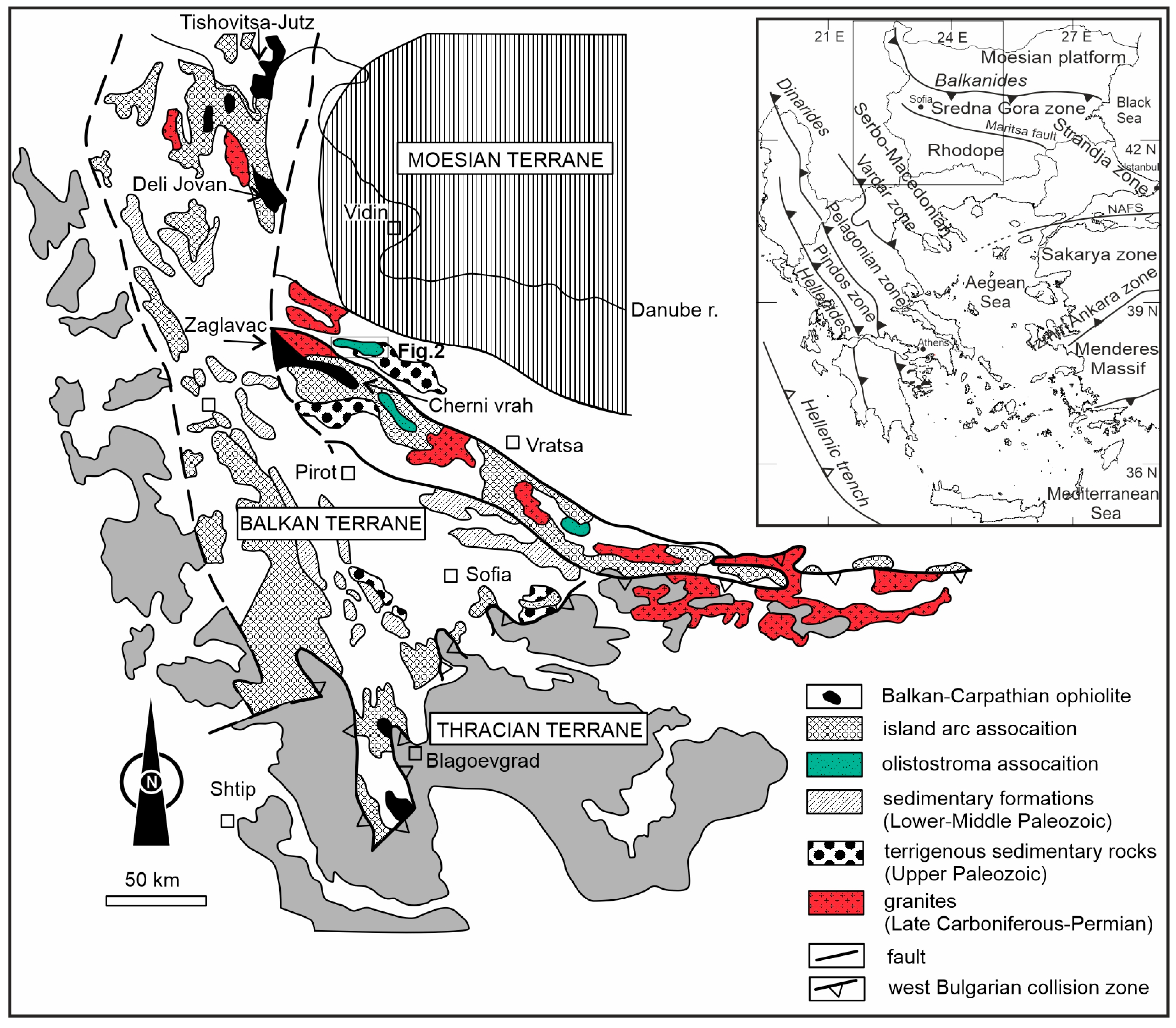
Figure 1. Tectonic scheme of the Moesian, Balkan and Thracian terranes on the territories of Bulgaria, Serbia and Romania, simplified after [3]. Inset: The Alpine belt in the Aegean region of the Eastern Mediterranean. Boxed area in the inset frames the tectonic scheme area, where the location the Sredogriv metamorphics is also shown.
Preprints 151987 g001
Figure 2. Simplified geological map of the Sredogriv metamorphics after [33,34] showing the locations and numbers of the studied samples.
Preprints 151987 g002
Figure 3. Simplified geological column of the Montana and Belogradchik units of the Western Balkan Zone after [33] showing the locations and numbers of the studied samples. See Figure 2 for the ornaments. The maximum depositional age of Zelenigrad Formation is shown in Belogradchik unit column.
Preprints 151987 g003
Figure 4. Field photographs and microphotographs of the studied metamorphic and non-metamorphic rock samples of the Sredogriv metamorphics and its immediate sedimentary cover: (a) field aspect of folded quartz-chlorite-sericite schist; (b) field aspect of breccia-conglomerate sample L15; (c) field aspect of metaconglomerate sample L4; (d) a microphotograph of sample L4; (e) field aspect of metaalbitophyre sample L1a; (f) a microphotograph of sample L1a. Mineral abbreviations: qz, quartz; pl, plagioclase; chl, chlorite; ms, muscovite (sericite); hem, hematite.
Preprints 151987 g004
Figure 5. Selected cathodeluminescence images of dated zircons in the studied samples: (a) sample L4; (b) sample L1a; (c) sample L15.
Preprints 151987 g005
Figure 6. Diagrams of U-Pb zircon analyses of the dated samples: (a) Kernel Density Estimation (KDE) and concordia diagrams of zircons from sample L4; (b) KDE and concordia diagrams of zircons from sample L1a; (c) KDE and concordia diagrams of zircons from sample L15.
Preprints 151987 g006
Figure 7. (a) log SiO2/Al2O3 vs. Na2O/K2O classification diagram after [51]; (b) Discriminant function diagram after [52] of major elements for evaluating the provenance; (c) chondrite-normalized REE diagram (chondrite values after [50]); (d) La/Th vs. Hf diagram to discriminate the source rocks after [53].
Preprints 151987 g007
Disclaimer/Publisher’s Note: The statements, opinions and data contained in all publications are solely those of the individual author(s) and contributor(s) and not of MDPI and/or the editor(s). MDPI and/or the editor(s) disclaim responsibility for any injury to people or property resulting from any ideas, methods, instructions or products referred to in the content.
Copyright: This open access article is published under a Creative Commons CC BY 4.0 license, which permit the free download, distribution, and reuse, provided that the author and preprint are cited in any reuse.
Prerpints.org logo

Preprints.org is a free preprint server supported by MDPI in Basel, Switzerland.

Subscribe

Disclaimer

Terms of Use

Privacy Policy

Privacy Settings

© 2025 MDPI (Basel, Switzerland) unless otherwise stated