

Submitted:
27 March 2025
Posted:
29 March 2025
You are already at the latest version
Abstract
Zoonotic diseases refer to infectious diseases caused by pathogens that infect or parasitize both humans and other vertebrate animals. In recent years, the novel coronavirus disease (COVID-19) has been known to be a zoonotic disease. Academic fields related to zoonotic diseases include veterinary medicine and virology. According to a report by the Food and Agriculture Organization of the United Nations (FAO), approximately 70% of new human infectious diseases identified since 1940 are of animal origin. On the other hand, approximately twice as many pathogens are transmitted from humans to animals as are transmitted from animals to humans. In other words, humans are a major source of infection for animals. Due to increased opportunities for various animals to be imported and kept as pets, pathogens that were previously rare or unknown can suddenly appear in human society. Alternatively, there are ethnic groups in the world who eat wild birds and animals that are not sufficiently cooked, and there have been cases of pathogens infecting wild birds and animals being transmitted to humans. If a zoonotic disease caused by a new pathogen like this becomes prevalent as an emerging infectious disease, there is a high risk of it becoming a pandemic because humans have not yet acquired immunity to the new pathogen. This problem was clearly evident in the Severe Acute Respiratory Syndrome (SARS) pandemic that emerged in 2003 and the COVID-19 pandemic caused by infection with SARS-CoV-2, which was identified in 2019. In this review, we discuss the importance of management practices and current information on zoonotic diseases in outlets selling live wild birds and wildlife for consumption.
Keywords:
highly pathogenic avian influenza
; H5N1
; influenza virus
; bird flu
Introduction
Highly pathogenic avian influenza (HPAI) is a viral disease of birds with zoonotic potential caused by influenza virus belonging to the family orthomyxoviridae. It is one of the most economically important diseases of birds causing a huge economic burden to poultry sectors worldwide and it is endemic in many countries in Asia and Africa [1,2,3,4]. Thus, great strides have been made by different countries to prevent and control HPAI. However, they seem to have failed to effectively control of HPAI, which is partly attributed to the fact that control programs have failed to include some of the key drivers of HPAI transmission such live bird markets (LBMs).
The 5H1N Virus That Infects Dairy Cows Genetically Modifies in the Living Dairy Cow, Increasing Its Infectivity to Humans
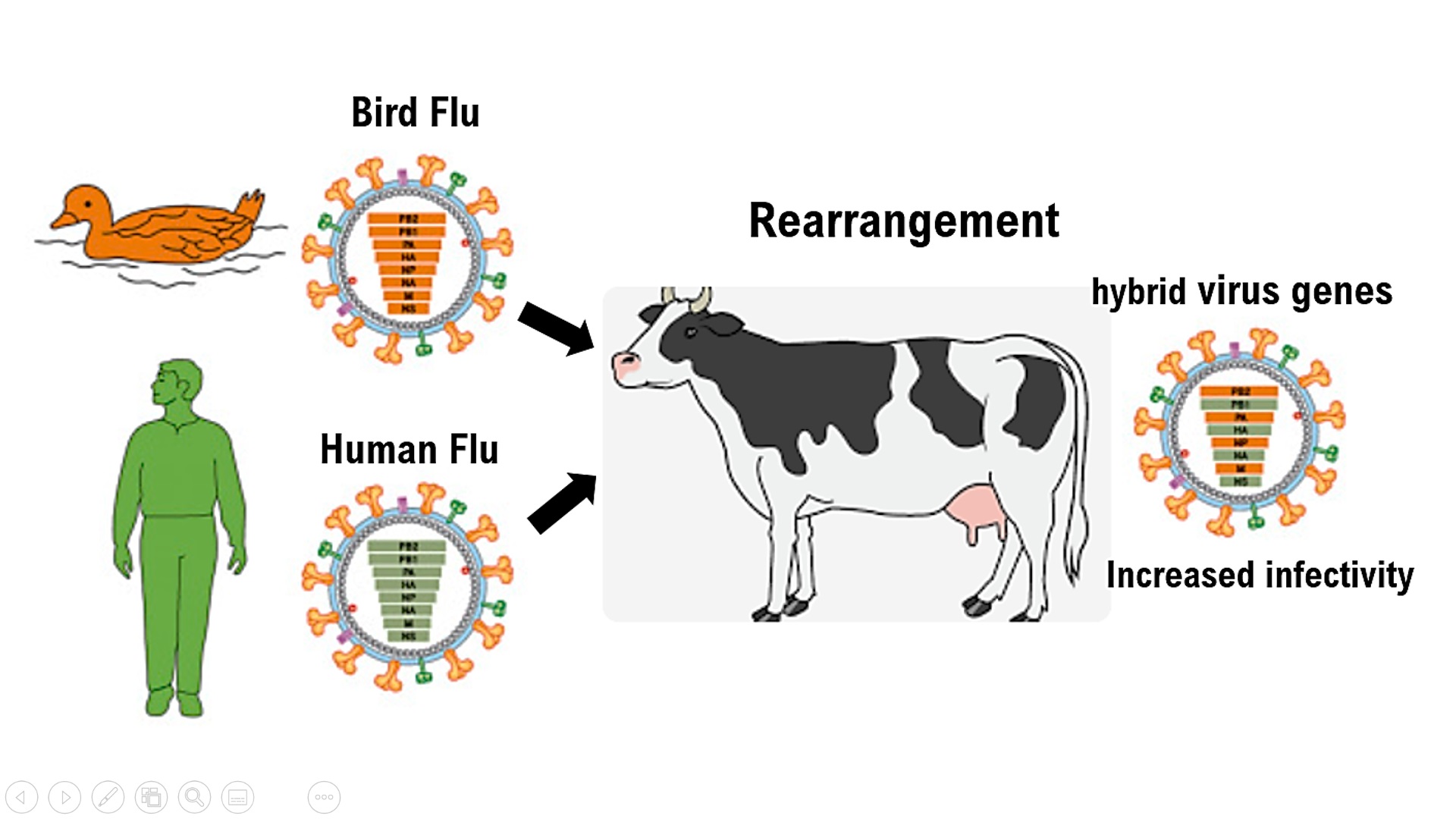
LBMs are an essential component of poultry marketing systems in low- and middle-income countries, where people prefer to purchase live poultry for consumption rather than frozen meat. These LBMs, where birds of different species are brought together from different geographical areas, facilitate the mixed selling of live poultry birds which in turn facilitate the transmission, evolution, and spillover of pathogens carried by marketed birds [5]. Furthermore, LBMs create a network of contacts between poultry birds and the human, which may pose a danger to public health by facilitating the transmission of zoonotic diseases if proper hygiene sanitation and biosecurity measures are not followed. Several previous studies have found that LBMs are hotspots for avian influenza viruses [6,7,8,9,10,11,12] and are linked to outbreaks of HPAI [5,6,13,14,15,16]. For instance, the human outbreak of H5N1 in 1997 [13,14] and the SARS outbreak in 2003 [12,17] were both linked to LBMs. Furthermore, these LBMs are found to have poor hygienic practices, poor biosecurity measures and a high density of birds and humans, all of which facilitate the transmission HPAI virus [6,12,18,19,20,21]. Furthermore, the frequent introduction of susceptible, unimmunized bird populations increases the numbers of susceptible animal populations in LBMs as well as the likelihood of ongoing transmission of viruses to other areas. Besides that, the frequent movement of humans to and from LBMs contributes to their spread to humans. This was the case with H5N1, where the strain was developed through genetic re-assortment in poultry birds and got spillover into humans [22]. Given the close contact, they may spread into susceptible bird populations and humans, entering either the poultry value chain or food chain systems, regardless of how stringent the surveillance systems and biosecurity measures are. Thus, there is a high chance that those live bird markets are helping the spread of the HPAI virus. Furthermore, there could be circulation of more than one strain of virus whose genome may recombine and lead to the development of new novel variants that are more virulent as already evinced in the case of the H5N1 [22,23]. Specifically, when H5N1, which infects farmed poultry, infects dairy cows, genetic modification occurs within the body of the cow. As a result, it has been shown that a strain of H5N1 that is highly infectious to humans is produced (Figure 1). In recent years, there have also been reports of H5N8 [24,25,26,27] and H7N9 [25,28] strains developing through genetic re-assortment and spillover into human population, which could later may turn into a global pandemic by acquiring sustained human-human transmissibility.
Hygiene Management of LBM Is Important to Prevent the Spread of Zoonotic Diseases
Given their role avian influenza transmission dynamics, including that of HPAI, LBMs have been a primary target for AIV control strategies aimed at reducing virus circulation in the LBMs. For example, during a zoonotic outbreak of H7N9 in China in 2013, closing LBMs was shown to be remarkably effective in reducing the risk of human infection by up to 99% [13,15]. Control strategies implemented in LBMs have also been found to significantly reduce AIV detection rates in poultry [13]. A monthly rest days with a routine market closure followed by the slaughter of unsold poultry, a ban on the sale of live quail, and a ban on overnight storage of live poultry all helped to control HPAI in Hong Kong [16]. Therefore, it is clear that LBMs may help in the maintenance and transmission of the HPAI virus, and their role in the transmission of the HPAI virus should not be overlooked.
It is necessary to conduct research to understand the transmission dynamics of HPAI in LBMs while taking into account the local ecological and epidemiological drivers as well as to assess the risk of potential maintenance and transmission to poultry birds and spillover into humans leading to public health risks. It is imperative to develop and implement stringent and meticulous surveillance systems based on “rigorous scientific risk assessment” to detect viruses on time, as well as devise and implement effective preventive and control strategies based on “rigorous scientific risk assessment”, improve the hygiene and sanitation of the LBMs, and prevent mixing of birds of different species, to prevent the transmission and spillover of viruses so as to mitigate the threat of LBMs acting as reservoirs or sources of HPAI and safeguard both the associated animal and public health.
Author contribution
TH, KPA, and SP were involved in the study design, data collection, data review and interpretation, and manuscript writing. TH, KPA, and SP were involved in the literature search, study design, data collection, data interpretation, and manuscript writing. TH, KPA, and SP were involved in data collection and interpretation. TH, KPA, and SP were involved in data collection and interpretation and manuscript writing. TH, KPA, and SP were involved in the study conception and design, data analysis and interpretation, and manuscript writing. TH and IK were the medical leads for AstraZeneca, and they participated in the data collection and evaluation and manuscript writing and editing. TH and IK were the lead physicians and were involved in the study design and conduct, data analysis and interpretation, and manuscript review.
Funding
This clinical research was performed using research funding from the following: Japan Society for Promoting Science for TH (grant no. 19K09840), START-program Japan Science and Technology Agency (JST) for TH (grant no. STSC20001), National Hospital Organization Multicenter Clinical Study for TH (grant no. 2019-Cancer in general-02), and Japan Agency for Medical Research and Development (AMED) (grant no. 22ym0126802j0001), Tokyo, Japan. The funders had no role in the study design, data collection and analysis, decision to publish, or preparation of the manuscript.
Informed Consent Statement
This research is not clinical research, therefore Informed consent is not required.
Data Availability Statement
Data are available on various websites and have also been made publicly available. More information can be found in the first paragraph of the Results section. The transparency document associated with this article can be found in the online version at https://kyoto.hosp.go.jp/html/guide/medicalinfo/clinicalresearch/expand/gan.html (accessed on 18 March 2024).
Acknowledgments
The authors want to thank Dr. Yoshiihiro Kawaoka at the institution of medical science, The University of Tokyo for providing clinical research information. The authors also want to acknowledge all medical staff for clinical research at Kyoto University School of Medicine and the National Hospital Organization Kyoto Medical Center.
Competing interests
The authors declare no conflict of interest.
References
- S. Chowdhury, M.E. Hossain, P.K. Ghosh, S. Ghosh, M.B. Hossain, C. Beard, M. Rahman, M.Z. Rahman, The pattern of highly pathogenic avian influenza H5N1 outbreaks in South Asia, Trop. Med. Infect. Dis. (2019). [CrossRef]
- L.O. Durand, P. Glew, D. Gross, M. Kasper, S. Trock, I.K. Kim, J.S. Bresee, R. Donis, T.M. Uyeki, M.A. Widdowson, E. Azziz-Baumgartner, Timing of influenza a(H5n1) in poultry and humans and seasonal influenza activity worldwide, 2004–2013, Emerg. Infect. Dis. 21 (2015) 202–208. [CrossRef]
- D.U. Pfeiffer, M.J. Otte, D. Roland-Holst, D. Zilberman, A one health perspective on HPAI H5N1 in the Greater Mekong sub-region, Comp. Immunol. Microbiol. Infect. Dis. 36 (2013) 309–319. [CrossRef]
- S.L. Letsholo, J. James, S.M. Meyer, A.M.P. Byrne, S.M. Reid, T.B.K. Settypalli, S. Datta, L. Oarabile, O. Kemolatlhe, K.T. Pebe, B.R. Mafonko, T.J. Kgotlele, K. Kumile, B. Modise, C. Thanda, J.F.C. Nyange, C. Marobela-Raborokgwe, G. Cattoli, C.E. Lamien, I.H. Brown, W.G. Dundon, A.C. Banyard, Emergence of High Pathogenicity Avian Influenza Virus H5N1 Clade 2.3.4.4b in Wild Birds and Poultry in Botswana, Viruses 14 (2022). [CrossRef]
- N. Moyen, M.A. Hoque, R. Mahmud, M. Hasan, S. Sarkar, P.K. Biswas, H. Mehedi, J. Henning, P. Mangtani, M.S. Flora, M. Rahman, N.C. Debnath, M. Giasuddin, T. Barnett, D.U. Pfeiffer, G. Fournié, Avian influenza transmission risk along live poultry trading networks in Bangladesh, Sci. Rep. 11 (2021). [CrossRef]
- G. Fournié, J. Guitian, S. Desvaux, P. Mangtani, S. Ly, V.C. Cong, S. San, D.H. Dung, D. Holl, D.U. Pfeiffer, S. Vong, A.C. Ghani, Identifying live bird markets with the potential to act as reservoirs of avian influenza a (H5N1) virus: A survey in Northern Viet Nam and Cambodia, PLoS One 7 (2012). [CrossRef]
- R. Indriani, G. Samaan, A. Gultom, L. Loth, S. Irianti, R. Adjid, N.L.P.I. Dharmayanti, J. Weaver, E. Mumford, K. Lokuge, P.M. Kelly, Darminto, Environmental sampling for avian influenza virus a (H5N1) in live-bird markets, Indonesia, Emerg. Infect. Dis. 16 (2010) 1889–1895. [CrossRef]
- R.J. Coker, B.M. Hunter, J.W. Rudge, M. Liverani, P. Hanvoravongchai, Emerging infectious diseases in southeast Asia: Regional challenges to control, Lancet 377 (2011) 599–609. [CrossRef]
- N.A. Rimi, M.Z. Hassan, S. Chowdhury, M. Rahman, R. Sultana, P.K. Biswas, N.C. Debnath, S.K.S. Islam, A.G. Ross, A decade of avian influenza in Bangladesh: Where are we now?, Trop. Med. Infect. Dis. 4 (2019). [CrossRef]
- A. Islam, M.Z. Rahman, M.M. Hassan, J.H. Epstein, M. Klaassen, Determinants for the presence of avian influenza virus in live bird markets in Bangladesh: Towards an easy fix of a looming one health issue, One Heal. 17 (2023). [CrossRef]
- F. Pinotti, L. Kohnle, J. Lourenço, S. Gupta, M.A. Hoque, R. Mahmud, P. Biswas, D. Pfeiffer, G. Fournié, Modelling the transmission dynamics of H9N2 avian influenza viruses in a live bird market, Nat. Commun. 15 (2024) 1–10. [CrossRef]
- R.G. Webster, Wet markets - A continuing source of severe acute respiratory syndrome and influenza?, Lancet 363 (2004) 234–236. [CrossRef]
- G.F. Gao, Influenza and the live poultry trade, Science (80-.). 344 (2014) 235. [CrossRef]
- X.-F. Wan, L. Dong, Y. Lan, L.-P. Long, C. Xu, S. Zou, Z. Li, L. Wen, Z. Cai, W. Wang, X. Li, F. Yuan, H. Sui, Y. Zhang, J. Dong, S. Sun, Y. Gao, M. Wang, T. Bai, L. Yang, D. Li, W. Yang, H. Yu, S. Wang, Z. Feng, Y. Wang, Y. Guo, R.J. Webby, Y. Shu, Indications that Live Poultry Markets Are a Major Source of Human H5N1 Influenza Virus Infection in China, J. Virol. 85 (2011) 13432–13438. [CrossRef]
- H. Yu, J.T. Wu, B.J. Cowling, Q. Liao, V.J. Fang, S. Zhou, P. Wu, H. Zhou, E.H.Y. Lau, D. Guo, M.Y. Ni, Z. Peng, L. Feng, H. Jiang, H. Luo, Q. Li, Z. Feng, Y. Wang, W. Yang, G.M. Leung, Effect of closure of live poultry markets on poultry-to-person transmission of avian influenza A H7N9 virus: An ecological study, Lancet 383 (2014) 541–548. [CrossRef]
- Y.H. Connie Leung, E.H.Y. Lau, L.J. Zhang, Y. Guan, B.J. Cowling, J.S.M. Peiris, Avian influenza and ban on overnight poultry storage in live poultry markets, Hong Kong, Emerg. Infect. Dis. 18 (2012) 1339–1341. [CrossRef]
- Y. Guan, B.J. Zheng, Y.Q. He, X.L. Liu, Z.X. Zhuang, C.L. Cheung, S.W. Luo, P.H. Li, L.J. Zhang, Y.J. Guan, K.M. Butt, K.L. Wong, K.W. Chan, W. Lim, K.F. Shortridge, K.Y. Yuen, J.S.M. Peiris, L.L.M. Poon, Isolation and characterization of viruses related to the SARS coronavirus from animals in Southern China, Science (80-.). (2003). [CrossRef]
- G. Fournié, F.J. Guitian, P. Mangtani, A.C. Ghani, Impact of the implementation of rest days in live bird markets on the dynamics of H5N1 highly pathogenic avian influenza, J. R. Soc. Interface 8 (2011) 1079–1089. [CrossRef]
- J.C.M. Turner, M.M. Feeroz, M.K. Hasan, S. Akhtar, D. Walker, P. Seiler, S. Barman, J. Franks, L. Jones-Engel, P. McKenzie, S. Krauss, R.J. Webby, G. Kayali, R.G. Webster, Insight into live bird markets of Bangladesh: An overview of the dynamics of transmission of H5N1 and H9N2 avian influenza viruses, Emerg. Microbes Infect. 6 (2017). [CrossRef]
- N.J. Negovetich, M.M. Feeroz, L. Jones-Engel, D. Walker, S.M.R. Alam, K. Hasan, P. Seiler, A. Ferguson, K. Friedman, S. Barman, J. Franks, J. Turner, S. Krauss, R.J. Webby, R.G. Webster, Live bird markets of bangladesh: H9n2 viruses and the near absence of highly pathogenic h5n1 influenza, PLoS One 6 (2011). [CrossRef]
- P.K. Biswas, M. Giasuddin, B.K. Nath, M.Z. Islam, N.C. Debnath, M. Yamage, Biosecurity and Circulation of Influenza A (H5N1) Virus in Live-Bird Markets in Bangladesh, 2012, Transbound. Emerg. Dis. 64 (2017) 883–891. [CrossRef]
- X. Xu, K. Subbarao, N.J. Cox, Y. Guo, Genetic characterization of the pathogenic influenza A/Goose/Guangdong/1/96 (H5N1) virus: Similarity of its hemagglutinin gene to those of H5N1 viruses from the 1997 outbreaks in Hong Kong, Virology 261 (1999) 15–19. [CrossRef]
- Y. Guan, M. Peiris, K.F. Kong, K.C. Dyrting, T.M. Ellis, T. Sit, L.J. Zhang, K.F. Shortridge, H5N1 influenza viruses isolated from geese in southeastern China: Evidence for genetic reassortment and interspecies transmission to ducks, Virology 292 (2002) 16–23. [CrossRef]
- H.M. Kang, E.K. Lee, B.M. Song, J. Jeong, J.G. Choi, J. Jeong, O.K. Moon, H. Yoon, Y. Cho, Y.M. Kang, H.S. Lee, Y.J. Lee, Novel reassortant influenza a(H5N8) viruses among inoculated domestic and wild ducks, South Korea, 2014, Emerg. Infect. Dis. 21 (2015) 298–304. [CrossRef]
- P. Huang, L. Sun, J. Li, Q. Wu, N. Rezaei, S. Jiang, C. Pan, Potential cross-species transmission of highly pathogenic avian influenza H5 subtype (HPAI H5) viruses to humans calls for the development of H5-specific and universal influenza vaccines, Cell Discov. (2023). [CrossRef]
- J. Jeong, H.M. Kang, E.K. Lee, B.M. Song, Y.K. Kwon, H.R. Kim, K.S. Choi, J.Y. Kim, H.J. Lee, O.K. Moon, W. Jeong, J. Choi, J.H. Baek, Y.S. Joo, Y.H. Park, H.S. Lee, Y.J. Lee, Highly pathogenic avian influenza virus (H5N8) in domestic poultry and its relationship with migratory birds in South Korea during 2014, Vet. Microbiol. 173 (2014) 249–257. [CrossRef]
- ECDC, First identification of human cases of avian influenza A (H5N8) infection, (2021). https://www.ecdc.europa.eu/sites/default/files/documents/First-identification-human-cases-avian-influenza-A-H5N8-infection.pdf.
- J. Chen, J. Zhang, W. Zhu, Y. Zhang, H. Tan, M. Liu, M. Cai, J. Shen, H. Ly, J. Chen, First genome report and analysis of chicken H7N9 influenza viruses with poly-basic amino acids insertion in the hemagglutinin cleavage site, Sci. Rep. 7 (2017). [CrossRef]
Figure 1.
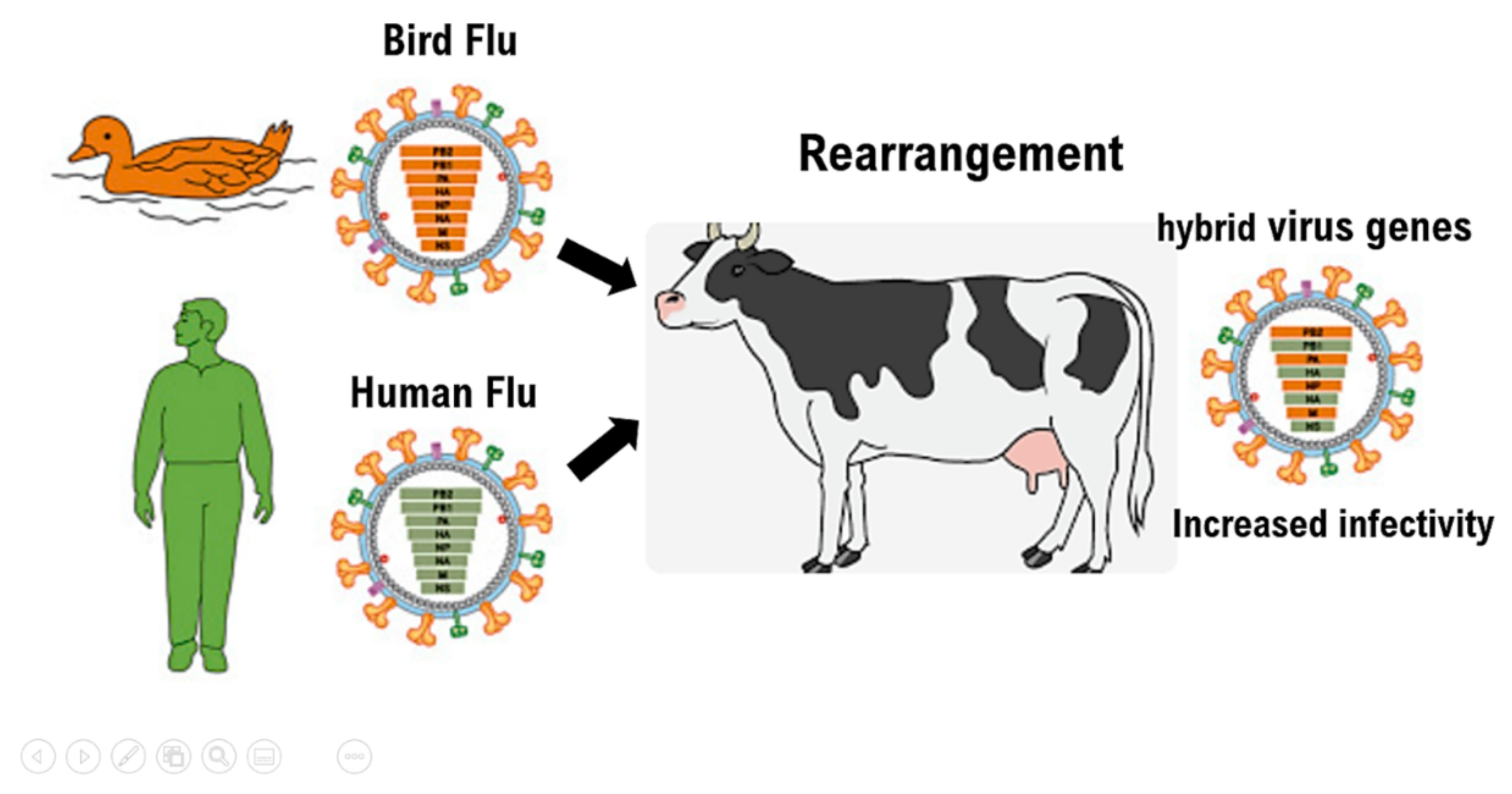
Genetic reassortment. When a given cell is infected by two H5N1 viral strains, hybrid viruses can be generated by exchanging their segmented genome, a mechanism called “genetic reassortment. Dairy cows can be infected by both avian flu and human influenza viruses, because the glycans in the upper respiratory tract express sialic acids with not only an α-2,3 linkage but also an α-2,6 linkage. When avian and human influenza viruses coinfect dairy cows, hybrid viruses could be generated in the body of dairy cows. The infectivity of the hybrid viruses appears to be enhanced.
Figure 1.
Genetic reassortment. When a given cell is infected by two H5N1 viral strains, hybrid viruses can be generated by exchanging their segmented genome, a mechanism called “genetic reassortment. Dairy cows can be infected by both avian flu and human influenza viruses, because the glycans in the upper respiratory tract express sialic acids with not only an α-2,3 linkage but also an α-2,6 linkage. When avian and human influenza viruses coinfect dairy cows, hybrid viruses could be generated in the body of dairy cows. The infectivity of the hybrid viruses appears to be enhanced.
Disclaimer/Publisher’s Note: The statements, opinions and data contained in all publications are solely those of the individual author(s) and contributor(s) and not of MDPI and/or the editor(s). MDPI and/or the editor(s) disclaim responsibility for any injury to people or property resulting from any ideas, methods, instructions or products referred to in the content. |
© 2025 by the authors. Licensee MDPI, Basel, Switzerland. This article is an open access article distributed under the terms and conditions of the Creative Commons Attribution (CC BY) license (http://creativecommons.org/licenses/by/4.0/).
Copyright: This open access article is published under a Creative Commons CC BY 4.0 license, which permit the free download, distribution, and reuse, provided that the author and preprint are cited in any reuse.


