

Submitted:
28 March 2025
Posted:
31 March 2025
You are already at the latest version
Abstract
Background and aims: The role of coffee consumption in upper gastrointestinal (GI) diseases has been a topic of ongoing debate. While some studies suggest a potential association, the causal relationship remains unclear. This critical review evaluated the evidence linking coffee consumption to upper GI diseases via Hill’s criteria for causation.Methods: By performing a comprehensive literature search across many databases, such as PubMed, Scopus, and Google Scholar, the author was able to find relevant papers. Once the article had been downloaded, it was imported into the reference manager. The author then manually screens the article for duplicate references by using author names, journals, and publication years. Studies were identified and critically reviewed using Hill’s criteria to assess the causality of this relationship.Results: The findings remain inconclusive. The strength of the associations between coffee consumption and specific upper GI conditions, such as gastroesophageal reflux disease (GERD), peptic ulcers, and esophageal cancer, varied significantly across studies. Temporality was challenging to establish because of the observational nature of most studies. Biological plausibility exists, supported by evidence of the effect of coffee on gastric acid secretion and motility. However, dose‒response relationships and experimental evidence are inconsistent. Overall, the review concluded that the evidence supports a correlation, but the causal nature of the relationship remains inconclusive.Conclusion: The evidence reviewed suggests a weak correlation between coffee consumption and upper GI diseases, with insufficient support for a direct causal link. While coffee may influence certain GI parameters, confounding factors and study design limitations preclude definitive conclusions.
Keywords:
Coffee intake
; upper gastrointestinal diseases
; causal relationship
; correlational studies
; caffeine effects
Introduction
Caffeine, diterpenes, and chlorogenic acids are bioactive substances found in coffee that can affect gastrointestinal physiology [1]. According to some reports, coffee may worsen symptoms of diseases such as gastritis or gastroesophageal reflux disease (GERD) since it stimulates the production of gastric acid. According to some studies, the antioxidant properties of coffee and its ability to increase stomach motility may help lower the risk of certain diseases, such as gastric cancer [2]. Through processes such as increased acid secretion and relaxation of the lower esophageal sphincter, coffee may contribute to upper GI diseases, indicating a causative association in some situations. The correlational nature of the observed association is frequently impacted by comorbidities or lifestyle variables [3]. Lists of causal criteria have gained popularity, possibly because they seem to offer a guide through complicated observations. When seeking to differentiate between causal and noncausal relationships, Hill criteria are helpful to consider. Hill proposed that several aspects of an association should be evaluated to differentiate between causal and non-causal relationships, including strength, consistency, specificity, temporality, biological gradient, plausibility, coherence, experimental evidence, and analogy [4]. The widely accepted use of these criteria for causal inference highlights the need for their detailed examination. In this study, the authors systematically reviewed original research conducted in experimental and clinical settings to investigate whether coffee consumption could play a causal role in upper gastrointestinal diseases. The Bradford Hill criteria were applied as a framework, integrating data from related fields.
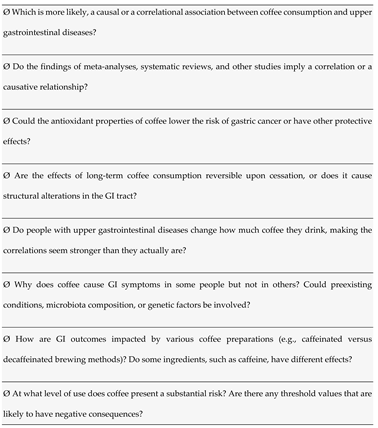
Unanswered Research Query
Methodology
Defining Scope and Objectives
Objective: To investigate the relationship between coffee consumption and upper GI diseases and determine whether the association is causal or merely correlational.
Research question: Does coffee consumption contribute to the development, prevention, or exacerbation of upper GI diseases, or is the relationship coincidental?
Study Design
Type of Review: Narrative review with a structured analysis using the Bradford Hill criteria.
Focus: Examining the potential causal relationship between coffee consumption and upper GI diseases (e.g., gastritis, GERD, peptic ulcers, and esophagitis).
Search Strategy
Articles were searched via the PubMed, Scopus, Web of Science, and Google Scholar databases. Search Terms includes "coffee consumption," AND "upper gastrointestinal diseases,"; "coffee consumption," AND "GERD,"; "coffee consumption," AND "peptic ulcer,"; "coffee consumption," AND "gastritis,"; "coffee consumption," AND "esophageal cancer,"; "coffee consumption," AND" causal relationship,"; "coffee consumption," AND "correlation," "coffee" AND "upper gastrointestinal diseases"). Boolean operators (AND, OR) were used to refine the search. Articles published from 2000--2024 were searched.
Inclusion and Exclusion Criteria
The inclusion criteria included studies published in peer-reviewed journals; research exploring the physiological effects of coffee on the GI tract; articles focused on the relationships between coffee and specific upper GI diseases; studies in humans, including observational studies and experimental studies; systematic reviews; and animal studies, including experimental studies and studies published in English. The exclusion criteria included non-peer-reviewed articles, studies unrelated to upper GI diseases and articles that focused on overall dietary patterns without the isolation of coffee as a factor.
Analysis Framework Using the Bradford Hill Criteria
The Bradford Hill criterion was used to assess the causal link between coffee consumption and upper GI diseases:
Data Extraction
Relevant data, including study type (e.g., observational, experimental), population characteristics (age, sex, geographic location), coffee consumption metrics (e.g., frequency, quantity, preparation methods), and outcomes related to GI health, were collected from selected studies.
Analysis and Synthesis
Narrative synthesis used to summarize findings under each Bradford Hill criterion. The patterns, inconsistencies, and gaps in the evidence are identified. Discuss whether the evidence supports a causal relationship or merely a correlation between coffee consumption and upper GI diseases.
Results and Discussion
An author evaluated the links between coffee and upper gastrointestinal diseases via the Bradford Hill causality criterion framework (Table 1). The headings shown below are based on these requirements.
Criteria 1: Strength of the Association Between Coffee Intake and Upper Gastrointestinal Diseases
Are these associations strong or weak? Strength indicates the degree of risk that a risk factor poses, the degree to which it is associated with an occurrence, and the likelihood that this association is causative [3]. The likelihood that an exposure is causal increases with the strength of the association between the exposure and the result. A strong association helps to rule out the possibility that the observed relationship is solely caused by a single minor unmeasured confounder or a modest source of bias [4]. There are differences in how strongly coffee is linked to upper gastrointestinal diseases [5].
Koochakpoor G et al. (2021) reported that people who drank coffee at least once a week had higher odds of irritable bowel syndrome (IBS) (OR: 1.44; 95% CI: 1.02--2.04) than those who did not. Furthermore, the odds of IBS were 47% greater for participants in the top tertile of caffeine intake (≥106.5 mg/d) than for those in the bottom tertile. However, there was no significant association between caffeine intake and the odds of IBS in men (OR: 1.47; 95% CI: 0.94--2.30) or women (OR for those in the highest tertile vs. lowest tertile: 1.48; 95% CI: 1.10--2.00). Additionally, among patients with a BMI ≥ 25 kg/m², there was a significant positive association between caffeine intake and the odds of IBS (OR for those in the highest tertile vs. lowest tertile: 1.72; 95% CI: 1.20–2.48). Among subjects with a BMI ≥ 25 kg/m², caffeine use was significantly associated with the severity of IBS (OR: 1.04; 95% CI: 1.01–2.62) [6]. This finding revealed a significant positive association between higher caffeine intake and IBS, with odds ratios indicating 44% greater odds of IBS in individuals who drank coffee at least once a week (OR: 1.44). The association was also stronger for those with higher caffeine intake (top tertile), with 47% higher odds (OR: 1.47). Additionally, caffeine intake was associated with greater IBS severity in those with a BMI>/= 25 kg/m2 (OR: 1.04). These odds ratios suggest a moderate to strong relationship between caffeine and IBS, supporting the strength of the association.
According to a 2008 study by Naganuma et al., consuming more than one cup of coffee per day was inversely associated with a lower risk of esophageal cancer [43] than not using any coffee at all (HR 0.51; 95% CI 0.33–0.77) [7]. The strength of the association is reflected by (HR 0.51; 95% CI 0.33–0.77), which indicates a statistically significant and relatively strong inverse association (a 49% reduction in risk for those consuming more than one cup of coffee daily compared with those who do not consume coffee). In a meta-analysis, Shen et al. evaluated the relationship between coffee consumption and the risk of gastric cancer and reported an association (relative risk = 1.24, 95% CI: 1.03–1.49) [8]. The RR of 1.24 suggests a modest increase in the risk of gastric cancer associated with coffee consumption. A relative risk of 1.24 indicates that those who consume coffee have a 24% greater risk of gastric cancer than nonconsumers do, which is relatively modest.
Criteria 2: Consistency of the Association Between Coffee Intake and Upper Gastrointestinal Diseases
Do the results vary? The probability of an effect is increased when consistent results are seen by several people in various locations via various samples. However, because some effects are only produced by their causes in exceptional situations, a lack of consistency does not necessarily rule out a causal association. More specifically, unless the complimentary component causes an act or has previously acted to complete a sufficient cause, the impact of a causal agent cannot occur [2]. Consistency helps rule out the possibility that the observed association is due to a factor that differs between studies [6]. The results from different studies are not consistent for coffee intake and upper gastrointestinal diseases [9].
In the UK Biobank, there was a strong association between the risk of digestive cancer and esophageal cancer (OR 2.79, 95% CI 1.73–4.50). This association was consistent across sensitivity analyses and after controlling for genetically predicted BMI (OR 3.22, 95% CI 1.84--5.63), smoking (OR 2.77, 95% CI 1.71--4.88), and alcohol consumption (OR 2.98, 95% CI 1.56--5.70) [10]. Caffeine intake was genetically predicted to be negatively associated with leukemia risk (OR 0.67, 95% CI 0.47--0.96) but positively associated with GI cancer risk (OR 1.17, 95% CI 1.01--1.35), esophageal cancer risk (OR 2.20, 95% CI 1.43--3.4), and multiple myeloma risk (OR 1.77, 95% CI 1.08--2.91) [10]. In this context, the associations are reported to be consistent across various sensitivity analyses and after controlling for factors such as genetically predicted BMI, smoking and alcohol consumption. The consistency of caffeine risk associations with multiple cancers (e.g., GI, esophageal, and multiple myeloma) adds weight to this criterion
Criteria 3: Specificity of the Effect of Coffee Intake
Does coffee have an impact on several GI problems, or is it just associated with one? If there is a disease and a very specific population at a specific location and no other plausible explanation, then causation is likely [11]. However, because many diseases have complicated interactions between various causes, this criterion is not currently as important [4]. That is, exposure leads to one disease. Most researchers find this rule unworkable because it ignores the reality that variables sometimes represent aggregates of multiple features and assumes that a cause has a single effect. According to the specificity requirement, a cause must result in just one effect rather than several effects. This argument has frequently been made to disprove causal interpretations of exposures that seem to be associated with a wide range of outcomes, particularly by those who are trying to discredit coffee consumption as a contributing factor to upper gastrointestinal diseases. However, the criterion is completely unsound. It defies logic to assume that the causes of one impact will not have other effects. The likelihood of the existence of another effect is not diminished by the existence of one. Specificity does not, therefore, give any causal inference about the exposure effect more validity. Many authors believe that this criterion is deceptive and ineffective [8,9].
Coffee use reduces specificity by affecting several systems and diseases. The effects of coffee on GI health may be mediated by a number of variables, such as level of consumption, brewing technique, and individual tolerance [12]. This means that the effects of coffee on GI health are influenced by variables such as the level of consumption, brewing technique, and individual tolerance, leading to diverse outcomes (e.g., acid reflux, motility changes, or no effect at all). This highlights that coffee impact is mediated by multiple factors, making it a less specific cause of any single GI condition.
In the UK Biobank main analysis, coffee consumption was associated with a greater risk of multiple myeloma (OR 2.25, 95% CI 1.30–3.89). This association remained even after controlling for genetically predicted BMI (OR 2.61, 95% CI 1.37--4.96), smoking (OR 2.25, 95% CI 1.29--3.90), and alcohol use (OR 2.81, 95% CI 1.34--5.93). In the FinnGen consortium, a positive association with multiple myeloma was not confirmed [10]. In this study, UK Biobank findings revealed that coffee consumption was associated with a greater risk of multiple myeloma, even after adjusting for confounding factors such as BMI, smoking, and alcohol use. This finding suggests a potential link between coffee consumption and multiple myeloma, but it does not indicate that coffee consumption is the sole or specific cause of the condition. The findings of the FinnGen Consortium revealed that the association between coffee consumption and multiple myeloma was not replicable, undermining the specificity of the relationship. The lack of consistency across studies suggests that coffee is not uniquely associated with multiple myeloma and that other factors might explain the observed association in the UK Biobank. Specifically, according to the Hills criteria, the observed association in the UK biobank does not meet the criterion of specificity because coffee consumption is not uniquely linked to multiple myeloma and could contribute to or result from other mechanisms. Furthermore, the conflicting findings across datasets (UK Biobank vs. FinnGen) weaken the cause of specificity.
For women and those who were overweight or obese (BMI ≥ 25 kg/m2), the association between caffeine and the odds of IBS was likewise significantly positive. Additionally, the authors reported a strong association between the severity of IBS symptoms in participants who were overweight or obese (BMI > 25 kg/m2) and caffeine consumption [6]. This finding indicates that the association between caffeine and IBS symptoms is not exclusive to IBS but varies across specific groups (e.g., BMI, sex). This lack of exclusivity weakens the application of specificity in this context because caffeine consumption may also be linked to other GI or metabolic disorders. The relationships among caffeine, BMI, and IBS do not fully meet the specificity criterion since the effect (IBS) is not unique to caffeine exposure. However, the stronger association in subgroups (e.g., overweight/obese participants) suggests targeted interaction, which might support a more nuanced interpretation of specificity. These findings suggest that coffee consumption is associated with multiple diseases (e.g., multiple myeloma, IBS), implying a lack of specificity. However, the positive association with IBS symptoms in individuals with a higher BMI suggests that the relationship may be more specific to certain subgroups, such as those with obesity or higher caffeine sensitivity.
Only when consumed during the fasting phase did coffee increase the proportion of acid reflux time in GERD patients but not in healthy people [14]. Specifically, coffee consumption during the fasting phase increases the proportion of acid reflux time, especially in GERD patients, but not in healthy individuals. This specificity strengthens the causal argument because the effect is observed only in individuals with an underlying condition (GERD) and not in the general population. The specific effect is the increase in acid reflux time, a hallmark symptom of GERD. The relationship is specific in that coffee during fasting does not appear to cause unrelated effects or acid reflux in healthy individuals. Context-specific effects are observed during the fasting phase, suggesting a context-dependent relationship. This further supports the specificity criterion, as the interaction between coffee and GERD symptoms is conditional on fasting.
Criteria 4: Temporality of Coffee Exposure and Upper Gastrointestinal Diseases
Does drinking coffee precede the development of or worsen upper gastrointestinal symptoms? Either the exposure occurs before the outcome, or the cause must precede the effect in time. Temporality is the requirement that the cause precedes the effect in time, which is unquestionable. Insofar as any claimed observation of causality must involve the putative cause C preceding the putative effect D. However, this does not imply that a reverse time order is evidence against the hypothesis that C can cause D. The criterion of temporality is an essential requirement for establishing causality: if the supposed cause does not occur before the effect, it undeniably proves that the observed relationship is not causal. However, this does not entirely exclude the possibility of causality in other cases where the cause does precede the effect. Beyond this fundamental condition, which can be seen as integral to the definition of causation, no single criterion is either necessary or sufficient to determine whether an observed association is causal [4,6]. If coffee usually comes before the onset or worsening of GI symptoms, the temporality is frequently met [13].
In 2014, Nordenvall et al. studied the Swedish Men Cohort and the Swedish Mammography Cohort. A total of 71,925 participants took part, including 30,898 women and 40,936 men, and those who were born 1914–1948 included 69,906 controls, 2019 cases, 962 men, and 1057 women. For premenopausal women, 2–3 cups/day, multivariate-adjusted HR: 0.64 (95% CI = 0.41–1.01); 4–5 cups/day, multivariate-adjusted HR: 0.37 (95% CI = 0.21–0.67); and ≥6 cups/day, multivariate-adjusted HR: 0.17 (95% CI = 0.05–0.55). The multivariate-adjusted HR was 0.77 (95% CI = 0.62–0.97) for postmenopausal women who currently use hormone replacement therapy with 2–3 cups per day, 0.59 (95% CI = 0.45–0.78) for those who use 4–5 cups per day, and 0.44 (95% CI = 0.28–0.70) for those who use ≥6 cups per day. Those who had previously used HRT and were postmenopausal had multivariate-adjusted HRs of 1.17 (95% CI = 0.69–1.95) for 2–3 cups per day, 0.75 (95% CI = 0.40–1.39) for 4–5 cups per day, and 0.77 (95% CI = 0.33–1.76) for ≥6 cups per day. Two to three cups per day, multivariate-adjusted HR: 1.09 (95% CI = 0.78–1.53); four to five cups per day, multivariate-adjusted HR: 0.96 (95% CI = 0.66–1.39); and more than six cups per day, multivariate-adjusted HR: 1.09 (95% CI = 0.68–1.74), are postmenopausal and have never used HRT [15]. In this study, the association between coffee consumption and the reduction in risk (e.g., HR for cancer risk in premenopausal and postmenopausal women) shows that exposure (coffee consumption) occurred before the measured health outcomes. Therefore, temporality is satisfactory because exposure (coffee consumption) occurs before the observed effects (health outcomes such as cancer risk), and the temporal nature of the study design supports this relationship.
In 2018, Eamudomkarn et al. conducted a meta-analysis and systematic review of six randomized control studies, including three studies on cesarean sections, 2 on colorectal tumors, and 1 on surgery for gynecologic cancer, with 601 cases regarding the effects of coffee on recovery after abdominal surgery. The time to first flatus was reduced (MD, −7.14 hours; 95% CI, −10.96--−3.33 hours). The time to first bowel sounds for 434 patients who underwent gynecologic cancer surgery or cesarean delivery was shorter than the time to first bowel sounds that could be heard (MD, −4.17 h; 95% CI, −7.88 to −0.47 h). The initial defecation time decreased (MD, −9.98 hours; 95% CI, −16.97--−2.99 hours). The duration of solid food tolerance (476 participants) included a reduced time to solid meal tolerance (MD, −15.55 hours; 95% CI, −22.83-- −8.27 hours). Postoperative nausea in 359 participants who underwent gynecologic cancer surgery or cesarean delivery was not significantly different (RR, 0.61; 95% CI, 0.27–1.36). The hospital stay duration (476 participants) (MD, −0.74 days; 95% CI, −1.14 to −0.33 days) was shorter [16]. In this context, the preceding effect indicates that the intervention in these studies involved the consumption of coffee after abdominal surgery. The observed outcomes, such as reduced time to first flatus, bowel sounds, defecation, and shorter hospital stays, occurred after the coffee was administered. This sequence establishes that the intervention preceded the effects, meeting the temporality criterion. The time relationship shows the measured outcomes (e.g., hours to first flatus). Bowel sounds, defecation) directly indicate the temporal effects of coffee consumption. The significant education at these times strongly supports the temporal relationship between coffee consumption and enhanced recovery. Consistent timing across studies revealed that the meta-analysis included diverse surgical contexts (e.g., gynecologic cancer, cesarean sections, and colorectal surgeries) but consistently reported shorter recovery times after coffee consumption. This consistency strengthens the argument for temporality.
According to a controlled crossover study by Boekema et al., caffeine had no effect on the frequency or duration of postprandial acid reflux in either GERD patients or healthy volunteers. Coffee only increased the percentage of acid reflux time in GERD patients during the fasting phase [17]. In this study, coffee consumption occurred before the observation of acid reflux. The temporal order is maintained, as caffeine intake occurs during both the fasting and postprandial phases. Specifically, the study noted that coffee increased the percentage of acid reflux time during the fasting phase for GERD patients, which suggests that the exposure (coffee) preceded and may have contributed to the observed outcome (acid reflux). However, this effect was not observed in the postprandial phase, indicating that while exposure (coffee) occurred before the outcome in both phases, the relationship was not uniform throughout the different time periods.
Criteria 5. Biological Gradient Effect of Coffee Intake and Upper Gastrointestinal Diseases
Does consuming more coffee result in more severe symptoms, or does the amount drunk affect the effects? The link is more likely to be causal if a dosage response is observed. An increased effect should result from increased exposure [4]. The term "biologic gradient" describes a monotone (unidirectional) dose‒response curve. Because thresholds or nonlinear interactions may occur, a lack of gradient does not necessarily mean that causation is not present. Associations showing a consistent trend in disease frequency as exposure levels increase are not always indicative of causation. Confounding factors can produce such trends if the confounder has a biological gradient in its relationship with the disease. Therefore, a consistent association is neither a required nor sufficient condition to establish causality. Conversely, a non-linear relationship only challenges causal hypotheses that specifically predict a consistent dose-response pattern [6].
The extent of the quantity of coffee and the effects of coffee on the GI system can depend on the volume of intake, frequency of consumption, and individual sensitivity [18]. The amount of coffee consumed, how often it is consumed, and the sensitivity of each individual can affect how much coffee affects the GI system [18].
Lil L. et al. (2015) conducted a meta-analysis of prospective cohort studies via dose‒response analysis and reported that the risk of stomach cancer was 1.03 (95% CI: 0.95–1.11) for every three cups of coffee per day. There was no nonlinear association between coffee consumption and the risk of stomach cancer (P for nonlinearity = 0.68). [19]. This finding indicates a very slight increase in the risk of stomach cancer with increased coffee consumption. However, the study reported that there was no nonlinear association between coffee consumption and the risk of stomach cancer (P for nonlinearity = 0.68), which suggests that the relationship between coffee consumption and stomach cancer risk does not change at different levels of consumption. Essentially, this finding indicates that there is no clear dose‒response gradient in this study because the risk does not vary systematically with increasing coffee intake, as evidenced by the lack of significant nonlinear associations.
In 2015, Zeng, B., S., et al. used a meta-analysis of prospective cohort studies. A total of 1,289,314 participants with mean follow-up periods ranging from 8--18 years had incident cases of stomach cancer identified in 2019. Coffee consumption was not found to have a nonlinear association with the incidence of stomach cancer (P for heterogeneity 0.004; P for nonlinearity 0.53). The combined relative risk (RR) of increasing total coffee consumption by three cups per day was 1.07 (95% CI 0.95–1.21), according to the linear regression model. When the highest category of coffee consumption (median 6.5 cups/day) was compared with the lowest category, the RRs of gastric cancer were 1.18 (95% CI 0.90–1.55) and 1.06 (95% CI 0.85–1.32) for the second highest category (median 3.5 cups/day) and 0.97 (95% CI 0.79–1.20) for the third highest category (median 1.5 cups/day). Subgroup analysis revealed that the US population had a greater risk (RR 1.36, 95% CI 1.06–1.75) and that there was no adjustment for smoking (RR 1.67, 95% CI 1.08–2.59) for 6.5 cups per day. There was no nonlinear association between coffee consumption and the risk of stomach cancer, according to the available data. Nonetheless, excessive coffee intake (more than 6.5 cups per day) may increase the risk of stomach cancer in the American population [20]. This finding indicates a linear trend in coffee consumption and risk, showing that increasing coffee consumption by three cups per day led to a 1.07 RR for stomach cancer, indicating that there was a slight increase in the risk with increasing coffee intake. This suggests a weak dose‒response relationship between coffee consumption and stomach cancer risk, although it was not statistically significant across all categories. The category of consumption indicates that the RR for the highest consumption group (6.5 cups/day) was 1.18 (95% CI: 0.90--1.55), whereas the second and third highest categories had lower RRs (1.06 and 0.97, respectively). These findings suggest that for most categories, increasing coffee consumption does not have a clear dose‒response relationship but still indicates a potentially increased risk with high coffee intake (6.5 cups/day), especially in the American population (RR 1.36). Subgroup analysis: The subgroup analysis indicated that, particularly in the U.S. population, there might be a greater risk associated with greater coffee consumption. This could suggest that there may be a stronger biological gradient for certain populations, especially where other factors such as smoking were not adjusted for. In summary, the biological gradient in this study is weak because there is some association between increasing coffee consumption and the RR of stomach cancer, particularly in the highest consumption category, but this association is not strong enough or consistent enough to draw a definitive conclusion. The data presented did not show a nonlinear association or strong dose‒response relationship overall, but there might be some degree of biological gradient, particularly in certain groups (such as the U.S. population) with high coffee consumption.
Criteria 6: Plausibility of the Mechanism of Coffee Intake and Upper Gastrointestinal Diseases
Is coffee causing upper gastrointestinal diseases based on what is now known about its physiological effects? Coherence between epidemiological and laboratory results raises the possibility of an effect through a plausible mechanism. Because of their small variations, plausibility and coherence are sometimes discussed together [21]. In the gastrointestinal system, coffee may improve the bioavailability of antioxidant and anticancer compounds [22]. Increased gastroesophageal reflux, which is known to occur with coffee use and may encourage inflammation, is one of the harmful outcomes of caffeine-induced esophageal carcinogenesis [10].
The biochemical makeup of coffee supports the scientific plausibility of its chemopreventive properties. It contains phenolic substances such as caffeic acid, chlorogenic acid, and hydroxyhydroquinone that help activate antioxidant enzymes to control oxidative stress both directly (by scavenging radicals) and indirectly (by activating the Nrf2/ARE cellular system). Through antiestrogenic pathways, mitochondrial toxicity, and anti-inflammatory environmental control, it can also inhibit the progression of cancer [23,24]. Coffee also contains two lipids with anti-genotoxic properties, cafestol and kahweol, which scavenge reactive oxygen species and inhibit the effects of carcinogens such as hydrogen peroxide and (4,5-b) pyridine. Furthermore, they increase the production of enzymes that detoxify DNA-reactive compounds (glucuronosyltransferase and glutathione S-transferase) and the enzyme system that repairs DNA damage [25].
According to some studies, coffee may have a negative impact on the lower esophageal sphincter (LES), where a decrease in pressure could make it easier for food to pass back [26]. Coffee caffeine can increase stomach acid production, which can lead to gastritis [27]. Drinking coffee has been shown to increase the diversity of the gut microbiota [12]. The effects of coffee on the motility and production of stomach acid offer tenable explanations for why GERD or gastritis symptoms can worsen [24]. Coffee causes the stomach to produce more stomach acid and actually secretes more gastric acid once it enters the stomach [28]. The consumption of coffee results in the secretion of salivary alpha-amylase (sAA), an enzyme involved in the breakdown of polysaccharides [29]. Coffee may reduce basal lower esophageal sphincter (LES) pressure, which could increase the risk of gastroesophageal reflux disease and heartburn, but not all studies have shown this [30].
Criteria 7: Coherence
Does the association between coffee intake and upper gastrointestinal diseases align with other well-established scientific results? Hill's criteria state that causation should not significantly contradict what is now known about the biology and natural history of disease [4,18]. Hill highlighted that the lack of clear and consistent information should not automatically be viewed as evidence against the possibility of a causal relationship. However, conflicting information could potentially weaken a hypothesis. Nonetheless, it is important to consider that such conflicting data might be incorrect or misinterpreted [5,7]. The relationship between coffee intake and upper gastrointestinal diseases should be consistent with current information, facts, and theories regarding the disease or phenomenon, but it is not universally consistent across all upper gastrointestinal diseases. Compared with 2562 nondrinkers from a healthy population with no history of ulcers, a Japanese cross-sectional investigation reported no effect of coffee consumption on any gastrointestinal-associated disease, including gastric or duodenal ulcers [31]. This finding indicates that coffee consumption does not appear to impact ulcer risk, which aligns with existing knowledge about the pathophysiology of ulcers, suggesting that the results do not contradict established biological and medical understanding. Chlorogenic acids do not change the amount of stomach acid secreted, but they do prevent neutrophils engaged in the immunological response from migrating and increase the ability of antioxidant enzymes to protect cells [32]. The associations between chlorogenic acids and immune responses (such as neutrophil migration) and antioxidant activity aligns well with existing knowledge of their antioxidant properties and potential immunomodulatory effects.
Criteria 8: Experiments on the Effects of Modifying Coffee Intake on Upper Gastrointestinal Diseases
Does coffee have a direct impact on gastrointestinal health, according to limited experimental or interventional studies? The effects of coffee intake on upper gastrointestinal diseases can be strongly supported by data from several controlled experiments, such as randomized trials. There are few controlled trials [33]. The results from experimental studies are inconsistent, especially for GERD, and mostly rely on individual factors [34]. Several experimental studies utilizing animal models have reported no associations between coffee and upper gastrointestinal diseases [17]. According to a mouse study, chlorogenic acid may exert protective effects on the stomach mucosa by decreasing the surface area of the mucosa damaged in an experimental ulcer model [35].
According to a clinical trial performed by Mišík, M. et al. (2010), coffee filtered via paper protects people's DNA from oxidative damage. Using single-cell gel electrophoresis assays, DNA damage was assessed in peripheral lymphocytes. Following coffee consumption, the production of oxidized purines was responsible for a 12.3% (p = 0.006) reduction in DNA migration. Researchers have concluded that drinking coffee inhibits the body's natural production of oxidative DNA damage, which may be the cause of its positive health effects [36]. This finding is an experiment in which the exposure (coffee consumption) is manipulated and its effects on DNA damage are directly assessed. The controlled experimental design strengthens the interpretation of a causal link between coffee and DNA protection.
According to Iriondo-DeHond, A., in 2021, the first research conducted on animals, coffee may have a protective impact. The incidence of spontaneous tumors was reduced in some cases (such as the stomach) but did not increase in others when rodents were fed coffee on a regular basis. The levels of the antioxidant and cytoprotective transferase UGT1A are increased 14-fold in the stomach of transgenic mice, and coffee also protects rats from the effects of carcinogens such as 1,2-dimethylhydrazine in the colon but not in the small intestine [37]. This finding indicates the need for direct experiments involving coffee exposure in rodents, making this an experimental study.
In 2019, Saeed M. et al. reported that rapid absorption of caffeine in the stomach and small intestine lowers the risk of cancer by altering the metabolism of carcinogens such as 2-amino-1-methyl-6-phenylimidazo (4,5-b) pyridine (PhIP), as demonstrated in rats. PhIP has been linked to colorectal cancer since it is an amine that people are heavily exposed to via fried meat and fish. It has been demonstrated that coffee increases the production of enzymes, including glutathione S-transferase (GST), which are involved in the detoxification of PhIP. Caffeine thereby reduced the number of colonic aberrant crypt foci (ACFs) in preneoplastic lesions caused by PhIP [38,39]. The experimental nature of these findings, including the use of rats and the observation of reduced ACF lesions following caffeine exposure, provides direct experimental evidence supporting this hypothesis.
Criteria 9: Analogy
Are there similar substances (such as alcohol and spicy meals) that have comparable effects on gastrointestinal health, indicating that coffee might have the same effect? The impact of comparable factors could be taken into account. The relationship might be causative if similar factors are known to have similar effects [4,18]. An equivalent process is supported by the similar effects of similar food stimulants (such as tea or caffeinated beverages) on the secretion of stomach acid [41]. The creative imagination of scientists, who can discover similarities everywhere, hinders any knowledge that can be gained from analogy [3].
In 2022, P. Carter, S, et al., in a Mendelian randomization study, performed the main analysis: genetically predicted coffee consumption was linked to a higher risk of cancer of the digestive system (OR 1.28, 95% CI 1.09–1.51), with a strong association with esophageal cancer (OR 2.79, 95% CI 1.73–4.50), but it was not linked to any cancer risk (OR 1.05, 95% CI 0.98–1.14). Once smoking, alcohol use, and genetically determined body mass index were taken into account, this association remained consistent. There is insufficient evidence to establish a causal link between coffee consumption predicted by genetics and most of the malignancies examined. Coffee consumption, however, was linked to a lower risk of ovarian cancer (OR 0.63, 95% CI 0.43--0.93) and a higher risk of multiple myeloma (OR 2.25, 95% CI 1.30--3.89) on the basis of genetic predictions. [10]. In this context, coffee consumption and its effects on cancer risk can be compared with other dietary or lifestyle factors that have been shown to have various impacts on cancer risk. For example, alcohol consumption is similarly linked to both increased cancer risk (e.g., esophageal) and decreased risk in some cases (e.g., some types of liver cancer). The analogy here is that coffee, like alcohol or other dietary factors, might have both beneficial and harmful effects depending on the specific cancer type.
In 2019, Tran, K., T., et al. reported that, throughout a 7.5-year follow-up period, 3,567 out of 471,779 people developed intestinal cancer. Eighty-eight cases (HR 0.50, 95% CI 0.29, 0.87) showed a significant correlation between coffee consumption and hepatocellular carcinoma. This correlation was similar for instant coffee (HR 0.51, 95% CI 0.28, 0.93) and ground coffee (HR 0.47, 95% CI 0.20, 1.08). According to a large prospective cohort investigation on coffee intake by type and risk for intestinal cancer, the authors did not consistently find that coffee consumers had significantly lower rates of other particular digestive malignancies [42]. Similar protective effects have been observed for other dietary factors (e.g., green tea and antioxidants) that reduce cancer risk. This analogy with other substances known to have protective effects against cancer supports the idea that coffee may similarly reduce the risk of cancer.
Grosso, G, et al. in 2017, in their umbrella review, reported that coffee was linked to a likely lower risk of cardiovascular disease, type 2 diabetes, Parkinson's disease, and a number of malignancies in 112 meta-analyses of observational studies. Nonetheless, coffee was linked to an increase in blood lipids in the nine meta-analyses of randomized controlled trials that were chosen [43]. These findings may be compared with findings from other studies showing that coffee consumption is associated with a lower risk of other conditions, such as CVD or neurodegenerative disorders.
2022 P. Carter, S, et al. In a Mendelian randomization, genetically predicted coffee consumption was found to be inversely associated with the risk of prostate cancer (OR 0.85, 95% CI 0.72–1.01) and leukemia (OR 0.70, 95% CI 0.47–1.03) [10]. The causal link between coffee consumption and lower cancer risk. However, the effects of specific analogies to coffees on other diseases might be less established in this finding. Godos, J., et al. in 2017, through their dose‒response meta-analysis of prospective cohort studies, reported that an increase of one cup per day is linked to a 14–15% lower risk of liver cancer, indicating an inverse association between coffee consumption and the disease [44]. In this context, coffee has been linked to reduced risks of other types of cancer (such as colorectal cancer), suggesting that the protective effects of coffee could extend to liver cancer.

Table 1.
Evidence for a causal role of coffee intake in GI diseases.
| Criteria | Evidence |
| Strength | Risks, associations, study type, participants (n) |
| RR = 1.07 (0.96–1.19), second meta-analysis, n = 24,94 [2,3,45] RR = 1.05 (0.91–1.22, retrospective studies, n = 24,943 [2,3,45] RR = 1.08 (0.96–1.21, Asian studies, n = 24,943 [2,3,45] RR = 1.1 (0.84–1.21, questionnaire-based, n = 24,943 [2,3,45] RR = 1.01 (0.91–1.12, high-quality studies, n = 24,943 [2,3,45] RR = 1.13 (0.97–1.32, prospective studies, n = 24,943 [2,3,45] RR = 1.54 (0.40–5.93, cross-sectional studies, n = 24,943 [2,3,45] OR = 0.66 (0.29–1.50, multicenter case‒control study, n = 3224 [46] OR = 1.27 (0.78–2.05), multicenter case‒control study, n = 1518 subjects, 832 GERD patients and 686 controls [47] OR = 1.23 (0.76–2.00), epidemiologic, based on questionnaires, n = 2789 [48] OR = 1.18 (0.88–1.58), observational study, data from European participants in the UK Biobank, n = 379,713 [49] OR = 1.04 (0.76–1.42), cross-sectional study, n = 2038 veterans, 310 BE cases, 1728 without BE [50] OR: 0.77 (0.42–1.42), epidemiological study based on questionnaires, n = 2147 participants, 1036 men and 1111 women [51] HR: 0.51 (0.33–0.77), The Miyagi Cohort Study, n = [7] RR: 1.24 (1.03–1.49), meta-analysis, n=312,993 [8] OR 2.79, 95% CI 1.73e4), a Mendelian randomization study, n = 367,561 [10] | |
| Consistency | Settings Chest pain [52] Elderly group (OR = 1.40 (1.09–2.10) [53] Body mass index (OR 3.22 (1.84-5.63) [10] Smoking (OR 2.77 (1.71-4.88) [10] Alcohol consumption (OR 2.98 (1.56-5.70) [10] |
| Specificity | Criterion not met; see text for discussion. |
| Temporality | Coffee intake exposure and GI diseases |
| Postoperative nausea [16] Premenopausal [2] Preoperative [16] Postmenopausal [2] | |
| Biological-gradient | Exposure grade |
| Coffee intake (>1 vs. <1 cup/day) significantly related to chest pain [54]. ≤3 cups/month: PR = 0.93 (0.73–1.18), 1–6 cups/week: PR = 1.04 (0.85–1.29), ≥1 cup/day: PR = 1.02 (0.82–1.26) [55] 1–3 cups/day: OR = 0.92 (0.76–1.12); 4–6 cups/day: OR = 1.01 (0.82–1.25); ≥7 cups/day: OR = 1.10 (0.85–1.43) [56] 1–2 cups/day, OR = 0.88 (0.74–1.04); ≥3 cups/day: OR = 0.84 (0.70–1.01) [57] 1–3 cups/day: OR = 1.0 (0.8–1.1), 3 cups/day: OR = 1.1 (0.9–1.5) [58] 1–3 cups/day: OR = 0.92 (0.76–1.12); 4–6 cups/day: OR = 1.01 (0.82–1.25); ≥7 cups/day: OR = 1.10 (0.85–1.43) [59] OR = 1.06 (0.66–1.70) for those drinking more than 3 cups versus nondrinking or drinking less [2]. ≥2 cups/day: OR = 0.89 (0.52–1.51) [60] 1–3 cups/day: OR = 0.91 (0.73–1.12); 4–6 cups/day: OR = 0.86 (0.69–1.08); ≥7 cups/day: OR = 0.75 (0.57–0.98) [69] 3 cups/day: RR: 1.03 (0.95–1.11) [19] | |
| Plausibility and coherence | Proposed mechanisms of coffee-induced upper GI diseases |
| Enhanced gastroesophageal reflux [10] Prevents the endogenous formation of oxidative DNA damage [36] Anti-genotoxic activity [25] Lower esophageal sphincter (LES) [26] Stimulate the production of stomach acid [27] Increase gut microbiota [12] Stimulate gastric and pancreatic secretion [28] | |
| Experiment | Study design, intervention groups, outcome |
| Paper-filtered coffee, Results of a clinical trial, results of a clinical trial, decrease in DNA migration [36] Animal study, clinical trial: against the effects of carcinogens [37] Animal study, clinical trial: decreased the number of 2-amino-1-methyl-6-phenylimidazo (4,5-b) pyridine (PhIP-)induced colonic aberrant crypt foci (ACF) preneoplastic lesions, [39] Animal study, clinical trial: less gastric tumors [40] | |
| Analogy | Multiple myeloma (OR 2.25 (1.30-3.89) [10] Hepatocellular carcinoma in coffee drinkers (HR 0.50, (0.29-0.87) [10] Reduced ovarian cancer risk (OR 0.63, 95% CI 0.43-0.93 [10] Hepatocellular carcinoma in coffee drinkers (HR 0.50, 95% CI 0.29, 0.87) [42] Leukemia (OR 0.70, 95% CI 0.47-1.03) [10] Prostate cancer (OR 0.85, 95% CI 0.72-1.01) [10] |
RR: relative ratio; OR: odds ratio; GERD: gastroesophageal reflux disorders; DNA: deoxyribonucleic acid; BE: Barrett’s esophagus.
This table shows evidence regarding the relationships between coffee consumption and various health outcomes through several study types, including meta-analyses, retrospective studies, cohort studies, and animal trials. Various studies have shown different results, with relative risks (RRs) and odds ratios (ORs) associated with different factors of coffee intake and gastrointestinal diseases. The RRs ranged from 1.01 to 1.54 in different types of studies (meta-analysis, retrospective, prospective, etc.), with participant numbers ranging from 1,518 to 312,993 or ranging from 0.66 to 2.79 depending on study type (case‒control, epidemiologic, cohort, etc.), with participants ranging from 1,518 to 379,713. The associations remain consistent across different study settings, such as those involving chest pain and specific populations such as elderly individuals or those with high body mass indices. Some criteria are not met for specificity, with further discussion in the text. Exposure to coffee or gastrointestinal diseases is linked to specific time frames (e.g., preoperative and postoperative nausea, premenopausal/postmenopausal differences).
Some studies have reported a dose‒response relationship between coffee consumption and risk, such as varying risks on the basis of the amount consumed per day (e.g., 1–3 cups/day, OR = 0.92, and ≥7 cups/day, OR = 1.10). The mechanisms underlying the effects of coffee on gastrointestinal issues include enhanced gastroesophageal reflux, increased stomach acid production, and changes in the gut microbiota. Multiple studies and clinical trials involving coffee, both with animal and human models, suggest a variety of effects on DNA damage, carcinogenesis, and gastric conditions. The effects of coffee are comparable to those of other conditions, such as cancer risk, with reduced risks for ovarian cancer and liver cancer but increased risks for conditions such as multiple myeloma.
Correlational
Coffee consumption and upper gastrointestinal symptoms are commonly linked in observational studies; however, these findings do not prove causation. According to an observational study, habitual coffee drinkers are more likely to experience GERD symptoms or have a history of ulcers or gastritis [61]. Confounding variables, including diet, smoking, and alcohol intake, are frequently overlooked in these studies, which makes conclusions more complicated. Coffee polyphenolic components, which are well known for their antioxidant properties, may play a secondary role in GI health by protecting against mucosal damage [12]. Think about a few things below:
Confounding factors: Many people who drink coffee also smoke or have a sedentary lifestyle, which increases the risk of upper gastrointestinal diseases. It is challenging to establish a clear cause‒and‒effect link when these aspects are not taken into account [2]. While some people may not suffer any negative effects from coffee, others may be more sensitive to it. This variation implies that coffee may exacerbate the symptoms of upper gastrointestinal diseases for some people but not others. This could be because of environmental or hereditary factors [3]. The impact of coffee on gastrointestinal health may vary depending on the kind of coffee consumed (e.g., caffeinated vs. decaffeinated) and how it is prepared. For example, compared with caffeinated coffee, decaffeinated coffee often has less of an impact on acid secretion, indicating that the association may be more due to the caffeine level than actual coffee [62]. Coffee use and stressful lifestyles may both contribute to upper gastrointestinal diseases [63]. Coffee sensitivity may be self-reported by people with upper gastrointestinal diseases, creating a perceived link. [64]
To account for these variables and elucidate a potential causal association between coffee and stomach cancer, a prospective study is necessary. Similarly, coffee consumption is related to a number of characteristics that are linked to an increased risk of gastric cancer, including lifestyle choices [65], smoking [66], alcohol consumption [67], and obesity. These findings indicate that coffee consumption is correlated with a greater risk of gastric cancer because of its association with lifestyle choices that increase cancer risk. While a correlation exists, it does not imply causality on its own. The relationship is correlational because coffee consumption is linked to certain behaviors or characteristics, 9 smoking, alcohol use and obesity, which are independently associated with gastric cancer. However, this does not prove that coffee directly causes gastric cancer. The association may be due to confounding factors (e.g., smoking, alcohol), which might influence both coffee consumption and the increased risk of gastric cancer.
Gastric cancer development has been demonstrated to be significantly influenced by a number of confounding factors, including diet, lifestyle (including the consumption of fruits, vegetables, red meat, salt, cigarettes, and alcohol, as well as physical activity), socioeconomic status, place of residence, race, health insurance, and Helicobacter pylori infection [68,69]. The relationships between gastric cancer development and the abovementioned factors (diet, lifestyle, socioeconomic status, etc.) are typically expressed in a correlational manner.
Inconclusive
Additionally, there is conflicting information about the potential link between coffee and upper gastrointestinal diseases. According to some studies, coffee has no discernible effect on the development of upper gastrointestinal diseases [54]. Protective effects: According to some studies, the strong antioxidant content of coffee may offer some protection. Compounds such as polyphenols found in coffee may help prevent damage by lowering oxidative stress and inflammation in the digestive tract [70].
Other studies: According to others, there is no discernible difference in the prevalence of gastritis or GERD between coffee drinkers and nondrinkers. This implies that coffee may not always play a substantial role in the onset of upper gastrointestinal diseases [71]. Coffee drinkers and nondrinkers did not significantly differ in the prevalence of GERD according to a large-scale cohort study, which suggests that other factors may be involved. Coffee use does not exacerbate GERD symptoms in other cultures, especially in Asia, indicating the importance of genetics or cultural differences [57]. This statement can be considered inconclusive in expressing the relationship between coffee consumption and GERD symptoms because it highlights mixed findings and suggests the need for additional factors to be considered. Here, Conflicting evidence: A large-scale cohort study revealed no significant difference in GERD incidence between coffee drinkers and nondrinkers, implying that coffee consumption does not directly contribute to GERD. However, in some cultures (e.g., in Asia), coffee does not exacerbate GERD symptoms, which further complicates the interpretation of the relationship. Cultural and genetic factors: Reference to cultural differences and genetic factors introduces the idea that the effect of coffee on GED might be mediated by other variables. This finding suggests that the relationship may not be universal and could depend on factors such as genetic predisposition, diet, lifestyle, or even types of coffee consumed. Lack of causality: The findings do not establish a clear causal link between coffee and GERD, and they leave room for other influencing factors. This is why the evidence remains inconclusive.
Conclusion
In summary, coffee consumption and upper gastrointestinal diseases have complicated and multifaceted relationships. Various studies have reported both causal and correlational effects, making the data inconclusive. Coffee may cause GI symptoms to worsen for some people, but it may have no negative effects on others or even be beneficial for them. Thus, the relationship may be correlational or impacted by individual characteristics, such as coffee type, quantity, and the existence of other health issues, rather than being strictly causal. Although there are few data showing a clear causative link, coffee may have an impact on upper gastrointestinal diseases. Consideration should be given to factors such as comorbid conditions, individual tolerance, and preparation techniques. Although there is some evidence that coffee intake may worsen upper GI disease symptoms (such as GERD), the evidence does not always point to a direct cause‒and‒effect relationship. Individual variables, coffee type, and preparation techniques all seem to have an impact on the association, which seems to be more correlational in nature.
- What is already known about this topic?
Previous studies have indicated that depending on the disease, individual differences, and context of consumption, coffee may have both positive and negative impacts on upper gastrointestinal (GI) health. The results of the widely published literature conflict, with some studies suggesting both potential causal effects and correlational relationships.
- This study's contributions
In this review, the author explores the evidence for the causal role of coffee intake in upper GI diseases using the Bradford Hill criteria as a guideline with data integration from related fields. To properly advise patients on safe coffee consumption on the basis of their individual health profiles, healthcare providers should differentiate between causative and correlational effects. This review adds new insights to the literature on both causal associations and correlational relationships between coffee intake and upper GI diseases and finally concludes that the link between them is neither causal nor correlational; it is inconclusive.
- How this study could impact policy, practice, or research
To definitively determine the nature of the association between coffee and upper gastrointestinal diseases, further thorough research is needed. We propose topics for further investigation, such as large-scale, long-term randomized controlled trials or studies that account for confounding factors, in light of the limitations of the available data. For clinical practice, researchers, and policymakers looking to create evidence-based guidelines, it is essential to understand whether the association between coffee intake and upper gastrointestinal diseases is causative or correlational. Public health recommendations should prioritize a balanced diet and other modifiable risk factors before condemning coffee intake in the absence of strong evidence.
- Gaps in research
Coffee consumption and upper gastrointestinal diseases have not been linked to any conclusive causative relationship or correlational findings. More thoroughly, long-term research that accounts for confounding variables is needed to determine whether coffee has a causal or correlational effect.
Limitations
The association between coffee and gastrointestinal diseases may be complicated by several factors, making identifying coffee as the main cause challenging. Individuals differ greatly in how they drink coffee (e.g., type of coffee, brewing method, frequency, amount). Because of these variations, it is difficult to evaluate exposure and determine the exact effect of coffee intake. The gold standard for confirming causation is randomized controlled trials (RCTs), but because of logistical and ethical concerns, few RCTs on coffee and upper gastrointestinal diseases exist. Coffee use may be linked to an increased risk or worsening of gastrointestinal symptoms, according to some studies, whereas other studies either indicate no discernible effects or even point to potential protective benefits, particularly for diseases such as gastric cancer.
Key Takeaway
It is unclear whether coffee consumption and upper gastrointestinal diseases are causally related. There is insufficient evidence to support a causal relationship between coffee consumption and upper gastrointestinal diseases because of inconsistent studies, weak relationships, and confounding variables. Coffee's propensity to affect gastrointestinal health is likely correlational in nature, with lifestyle factors and individual tolerance being important determinants.
Consent
Not applicable
Author Contributions
G.B. contributed to the preparation of the proposal, conceptualization, and data curation.; formal analysis; investigation; methodology; supervision; and validation; participated in preparing the first draft of the manuscript; and edited the manuscript.
Conflicts of interest
The authors declare that they have no competing interests.
References
- Machado, F.; Coimbra, M.A.; del Castillo, M.D.; Coreta-Gomes, F. Mechanisms of action of coffee bioactive compounds – a key to unveil the coffee paradox. Crit. Rev. Food Sci. Nutr. 2023, 64, 10164–10186. [Google Scholar] [CrossRef] [PubMed]
- Nehlig, A. Effects of Coffee on the Gastro-Intestinal Tract: A Narrative Review and Literature Update. Nutrients 2022, 14, 399. [Google Scholar] [CrossRef] [PubMed]
- Iriondo-DeHond, A.; Uranga, J.A.; Del Castillo, M.D.; Abalo, R. Effects of Coffee and Its Components on the Gastrointestinal Tract and the Brain–Gut Axis. Nutrients 2020, 13, 88. [Google Scholar] [CrossRef]
- Rothman KJ, Greenland S. 6.11 Causation and causal inference.
- Nordestgaard, A.T. Causal relationship from coffee consumption to diseases and mortality: a review of observational and Mendelian randomization studies including cardiometabolic diseases, cancer, gallstones and other diseases. Eur. J. Nutr. 2021, 61, 573–587. [Google Scholar] [CrossRef]
- Koochakpoor, G.; Salari-Moghaddam, A.; Keshteli, A.H.; Esmaillzadeh, A.; Adibi, P. Association of Coffee and Caffeine Intake With Irritable Bowel Syndrome in Adults. Front. Nutr. 2021, 8. [Google Scholar] [CrossRef]
- Naganuma, T.; Kuriyama, S.; Kakizaki, M.; Sone, T.; Nakaya, N.; Ohmori-Matsuda, K.; Nishino, Y.; Fukao, A.; Tsuji, I. Coffee Consumption and the Risk of Oral, Pharyngeal, and Esophageal Cancers in Japan: The Miyagi Cohort Study. Am. J. Epidemiology 2008, 168, 1425–1432. [Google Scholar] [CrossRef]
- Shen, Z.; Liu, H.; Cao, H. Coffee consumption and risk of gastric cancer: An updated meta-analysis. Clin. Res. Hepatol. Gastroenterol. 2015, 39, 245–253. [Google Scholar] [CrossRef]
- Shimonovich, M.; Pearce, A.; Thomson, H.; Keyes, K.; Katikireddi, S.V. Assessing causality in epidemiology: revisiting Bradford Hill to incorporate developments in causal thinking. Eur. J. Epidemiology 2020, 36, 873–887. [Google Scholar] [CrossRef]
- Carter, P.; Yuan, S.; Kar, S.; Vithayathil, M.; Mason, A.M.; Burgess, S.; Larsson, S.C. Coffee consumption and cancer risk: a Mendelian randomisation study. Clin. Nutr. 2022, 41, 2113–2123. [Google Scholar] [CrossRef]
- Hill, A.B. The environment and disease: association or causation? Journal of the Royal Society of Medicine. 2015, 108, 32–37. [Google Scholar]
- Saygili, S.; Hegde, S.; Shi, X.-Z. Effects of Coffee on Gut Microbiota and Bowel Functions in Health and Diseases: A Literature Review. Nutrients 2024, 16, 3155. [Google Scholar] [CrossRef]
- Koterov, A.N.; Ushenkova, L.N.; Biryukov, A.P. Hill’s Temporality Criterion: Reverse Causation and Its Radiation Aspect. Biol. Bull. 2020, 47, 1577–1609. [Google Scholar] [CrossRef]
- Benamouzig R, Airinei G. Diet and reflux. Journal of clinical gastroenterology 2007, 41, S64–S71. [Google Scholar] [CrossRef]
- Nordenvall, C.; Oskarsson, V.; Wolk, A. Inverse Association Between Coffee Consumption and Risk of Cholecystectomy in Women but Not in Men. Clin. Gastroenterol. Hepatol. 2015, 13, 1096–1102.e1. [Google Scholar] [CrossRef] [PubMed]
- Eamudomkarn, N.; Kietpeerakool, C.; Kaewrudee, S.; Jampathong, N.; Ngamjarus, C.; Lumbiganon, P. Effect of postoperative coffee consumption on gastrointestinal function after abdominal surgery: A systematic review and meta-analysis of randomized controlled trials. Sci. Rep. 2018, 8, 17349. [Google Scholar] [CrossRef] [PubMed]
- Larsen, B.; Larsen, L.P.; Sivesgaard, K. , et al. Black or white coffee before anesthesia? A randomized crossover trial. European Journal of Anesthesiology EJA 2016, 33, 457–462. [Google Scholar] [CrossRef]
- Fedak, K.M.; Bernal, A.; Capshaw, Z.A.; Gross, S. Applying the Bradford Hill criteria in the 21st century: how data integration has changed causal inference in molecular epidemiology. Emerg. Themes Epidemiology 2015, 12, 1–9. [Google Scholar] [CrossRef] [PubMed]
- Li, L.; Gan, Y.; Wu, C.; Qu, X.; Sun, G.; Lu, Z. Coffee consumption and the risk of gastric cancer: a meta-analysis of prospective cohort studies. BMC Cancer 2015, 15, 1–14. [Google Scholar] [CrossRef]
- Shao-Bo, Z.; Hong, W.; Meng, Z. , et al. Long-Term Coffee Consumption and Risk of Gastric Cancer A PRISMA-Compliant Dose–Response Meta-Analysis of Prospective Cohort Studies. Medicine 2015, 94, e1640. [Google Scholar]
- Koterov, A.N.; Ushenkova, L.N. Causal Criteria in Medical and Biological Disciplines: History, Essence, and Radiation Aspect. Report 4, Part 2: Hierarchy of Criteria, Criticism of Them, and Other Methods for Establishing Causation. Biol. Bull. 2023, 50, 2881–2934. [Google Scholar] [CrossRef]
- Parra-Lara, L.G.; Mendoza-Urbano, D.M.; Bravo, J.C.; Salamanca, C.H.; Zambrano, Á.R. Coffee Consumption and Its Inverse Relationship with Gastric Cancer: An Ecological Study. Nutrients 2020, 12, 3028. [Google Scholar] [CrossRef] [PubMed]
- Hu, M.-L. Dietary polyphenols as antioxidants and anticancer agents: more questions than answers. Chang. Gung Med. J. 2011, 34, 449–460. [Google Scholar]
- Abraham, S.; Stopper, H. Anti-genotoxicity of coffee against N-methyl-N-nitro-N-nitrosoguanidine in mouse lymphoma cells. Mutat. Res. Toxicol. Environ. Mutagen. 2004, 561, 23–33. [Google Scholar] [CrossRef] [PubMed]
- Gaascht, F.; Dicato, M.; Diederich, M. Coffee provides a natural multitarget pharmacopeia against the hallmarks of cancer. Genes Nutr. 2015, 10, 1–17. [Google Scholar] [CrossRef]
- Taborska, N.; Martyka, A.; Figiel, M.K.; Ujma, P. The impact of consumed coffee on the digestive system - review of the latest research. J. Educ. Heal. Sport 2024, 53, 32–43. [Google Scholar] [CrossRef]
- Santoso, P. Coffee Consumption With The Incident Of Gastritis: Literature Review. J. Appl. Nurs. Heal. 2023, 5, 225–232. [Google Scholar] [CrossRef]
- Seid, A.; Tamir, Z.; Demsiss, W. Uninvestigated dyspepsia and associated factors of patients with gastrointestinal disorders in Dessie Referral Hospital, Northeast Ethiopia. BMC Gastroenterol. 2018, 18, 13. [Google Scholar] [CrossRef]
- Ravisankar, P.; Koushik, O.; Reddy, A. , et al. A Detailed Analysis on Acidity and Ulcers in Esophagus, Gastric and Duodenal Ulcers and Management. IOSR Journal of Dental and Medical Sciences (IOSR-JDMS) 2016, 15, 94–114. [Google Scholar]
- Cuomo, R.; Sarnelli, G.; Savarese, M.; Buyckx, M. Carbonated beverages and gastrointestinal system: Between myth and reality. Nutr. Metab. Cardiovasc. Dis. 2009, 19, 683–689. [Google Scholar] [CrossRef]
- Kacorova, A. How Do People with Inflammatory Bowel Disease Understand their Pain (Doctoral dissertation, UCL (University College London)).
- Liang, N.; Kitts, D.D. Role of Chlorogenic Acids in Controlling Oxidative and Inflammatory Stress Conditions. Nutrients 2016, 8, 16. [Google Scholar] [CrossRef]
- Strayhorn Jr, JM. Virtual controls as an alternative to randomized controlled trials for assessing efficacy of interventions. BMC Medical Research Methodology 2021, 21, 3. [Google Scholar] [CrossRef] [PubMed]
- Fass R, Boeckxstaens GE, El-Serag H, et al. Gastro-esophageal reflux disease. Nature reviews Disease primers 2021, 7, 55. [Google Scholar] [CrossRef]
- Robertson, BC. A systematic evaluation of the psychological and behavioral effects of the combined consumption of glucose and caffeine and comparison to the effects produced by consuming either substance in isolation. Lancaster University (United Kingdom); 2019.
- Mišík, M.; Hoelzl, C.; Wagner, K.-H.; Cavin, C.; Moser, B.; Kundi, M.; Simic, T.; Elbling, L.; Kager, N.; Ferk, F.; et al. Impact of paper filtered coffee on oxidative DNA-damage: Results of a clinical trial. Mutat. Res. Mol. Mech. Mutagen. 2010, 692, 42–48. [Google Scholar] [CrossRef] [PubMed]
- Saeed, M.; Naveed, M.; BiBi, J.; Kamboh, A.A.; Phil, L.; Chao, S. Potential nutraceutical and food additive properties and risks of coffee: a comprehensive overview. Crit. Rev. Food Sci. Nutr. 2019, 59, 3293–3319. [Google Scholar] [CrossRef]
- Turesky, R.J.; Richoz, J.; Constable, A.; Curtis, K.D.; Dingley, K.H.; Turteltaub, K.W. The effects of coffee on enzymes involved in metabolism of the dietary carcinogen 2-amino-1-methyl-6-phenylimidazo[4,5-b]pyridine in rats. Chem. Biol. Interact. 2003, 145, 251–265. [Google Scholar] [CrossRef]
- Carter, O.; Wang, R.; Dashwood, W.M.; Orner, G.A.; Fischer, K.A.; Löhr, C.V.; Pereira, C.B.; Bailey, G.S.; Williams, D.E.; Dashwood, R.H. Comparison of White Tea, Green Tea, Epigallocatechin-3-Gallate, and Caffeine as Inhibitors of PhIP-Induced Colonic Aberrant Crypts. Nutr. Cancer 2007, 58, 60–65. [Google Scholar] [CrossRef]
- Soares, P.V.; Kannen, V.; Junior, A.A.J.; Garcia, S.B. Coffee, but Neither Decaffeinated Coffee nor Caffeine, Elicits Chemoprotection Against a Direct Carcinogen in the Colon of Wistar Rats. Nutr. Cancer 2018, 71, 615–623. [Google Scholar] [CrossRef]
- Alshahrani, S.H.; Atia, Y.A.; Badir, R.A.; Almalki, S.G.; A Tayyib, N.; Shahab, S.; Romero-Parra, R.M.; Abid, M.K.; Hussien, B.M.; Ramaiah, P. Dietary caffeine intake is associated with favorable metabolic profile among apparently healthy overweight and obese individuals. BMC Endocr. Disord. 2023, 23, 1–10. [Google Scholar] [CrossRef]
- Kim Tu Tran, Helen G. Coleman, et al. British Journal of Cancer 2019, 120, 1059–1066. [Google Scholar]
- Grosso, G. , Godos, J., Galvano, F., et al. Coffee, caffeine, and health outcomes: An umbrella review. Annu. Rev. Nutr. 2017, 37, 131–156. [Google Scholar]
- Godos, J.; Micek, A.; Marranzano, M.; Salomone, F.; Del Rio, D.; Ray, S. Coffee Consumption and Risk of Biliary Tract Cancers and Liver Cancer: A Dose–Response Meta-Analysis of Prospective Cohort Studies. Nutrients 2017, 9, 950. [Google Scholar] [CrossRef] [PubMed]
- Chen, Y.; Chen, C.; Ouyang, Z.; et al. Prevalence and beverage-related risk factors for gastroesophageal reflux disease: An original study in Chinese college freshmen, a systemic review and meta-analysis. Neurogastroenterol. Motil. 2021, 34, e14266. [Google Scholar]
- Bhatia, S.J.; Reddy, D.N.; Ghoshal, U.C.; Jayanthi, V.; Abraham, P.; Choudhuri, G.; Broor, S.L.; Ahuja, V.; Augustine, P.; Balakrishnan, V.; et al. Epidemiology and symptom profile of gastroesophageal reflux in the Indian population: Report of the Indian Society of Gastroenterology Task Force. Indian J. Gastroenterol. 2011, 30, 118–127. [Google Scholar] [CrossRef]
- Wang, C.-C.; Wei, T.-Y.; Hsueh, P.-H.; Wen, S.-H.; Chen, C.-L. The role of tea and coffee in the development of gastroesophageal reflux disease. Tzu Chi Med J. 2019, 31, 169–176. [Google Scholar] [CrossRef]
- Wang, J.-H.; Luo, J.-Y.; Dong, L.; Gong, J.; Tong, M. Epidemiology of gastroesophageal reflux disease: A general population-based study in Xi’an of Northwest China. World J. Gastroenterol. 2004, 10, 1647–1651. [Google Scholar] [CrossRef]
- Green, H.D.; Beaumont, R.N.; Wood, A.R.; Hamilton, B.; E Jones, S.; Goodhand, J.R.; A Kennedy, N.; Ahmad, T.; Yaghootkar, H.; Weedon, M.N.; et al. Genetic evidence that higher central adiposity causes gastro-oesophageal reflux disease: a Mendelian randomization study. Leuk. Res. 2020, 49, 1270–1281. [Google Scholar] [CrossRef]
- Sajja, K.C.; El-Serag, H.B.; Thrift, A.P. Coffee or Tea, Hot or Cold, Are Not Associated with Risk of Barrett’s Esophagus. Clin. Gastroenterol. Hepatol. 2016, 14, 769–772. [Google Scholar] [CrossRef]
- Walcher, T.; Haenle, M.M.; Mason, R.A.; Koenig, W.; Imhof, A.; Kratzer, W. The effect of alcohol, tobacco and caffeine consumption and vegetarian diet on gallstone prevalence. Eur. J. Gastroenterol. Hepatol. 2010, 22, 1345–1351. [Google Scholar] [CrossRef]
- Sloots, C.E.; Felt-Bersma, R.J.F.; West, R.L.; Kuipers, E.J. Stimulation of defecation: Effects of coffee use and nicotine on rectal tone and visceral sensitivity. Scand. J. Gastroenterol. 2005, 40, 808–813. [Google Scholar] [CrossRef]
- Martín-De-Argila, C.; Martínez-Jiménez, P. Epidemiological study on the incidence of gastroesophageal reflux disease symptoms in patients in acute treatment with NSAIDs. Expert Rev. Gastroenterol. Hepatol. 2013, 7, 27–33. [Google Scholar] [CrossRef]
- El–Serag, H.B.; Richardson, P.; Pilgrim, P.; Gilger, M.A. Determinants of Gastroesophageal Reflux Disease in Adults With a History of Childhood Gastroesophageal Reflux Disease. Clin. Gastroenterol. Hepatol. 2007, 5, 696–701. [Google Scholar] [CrossRef] [PubMed]
- Pandeya, N.; Green, A.C.; Whiteman, D.C. ; for the Australian Cancer Study Prevalence and determinants of frequent gastroesophageal reflux symptoms in the Australian community. Dis. Esophagus 2011, 25, 573–583. [Google Scholar] [CrossRef]
- Zheng, Z.; Nordenstedt, H.; Pedersen, N.L.; Lagergren, J.; Ye, W. Lifestyle Factors and Risk for Symptomatic Gastroesophageal Reflux in Monozygotic Twins. Gastroenterology 2007, 132, 87–95. [Google Scholar] [CrossRef] [PubMed]
- Shimamoto, T.; Yamamichi, N.; Kodashima, S.; et al. No association of coffee consumption with gastric ulcer, duodenal ulcer, reflux esophagitis, and nonerosive reflux disease: A cross-sectional study of 8013 healthy subjects in Japan. PLoS ONE 2013, 8, e65996. [Google Scholar]
- Kubo, A.; Block, G.; Quesenberry, C.P.; Buffler, P.; A Corley, D. Dietary guideline adherence for gastroesophageal reflux disease. BMC Gastroenterol. 2014, 14, 144–144. [Google Scholar] [CrossRef]
- Ganti, A.; Whitson, M.J. The Foregut. In Nutrition, Weight, and Digestive Health 2022 (pp. 73-87). Springer, Cham.
- Farah, A.; Lima, J.d.P. Consumption of Chlorogenic Acids through Coffee and Health Implications. Beverages 2019, 5, 11. [Google Scholar] [CrossRef]
- Saneei, P.; Esmaillzadeh, A.; Keshteli, A.H.; Roohafza, H.R.; Afshar, H.; Feizi, A.; Adibi, P. Combined Healthy Lifestyle Is Inversely Associated with Upper Gastrointestinal Disorders among Iranian Adults. Dig. Dis. 2020, 39, 77–88. [Google Scholar] [CrossRef]
- Pucci, G.; Forney, K.J. Associations among perceived taste and smell sensitivity, gastrointestinal symptoms, and restrictive eating in a community sample of adults. Eat. Behav. 2022, 46, 101647. [Google Scholar] [CrossRef]
- Tramacere, I.; Negri, E.; Pelucchi, C.; Bagnardi, V.; Rota, M.; Scotti, L.; Islami, F.; Corrao, G.; La Vecchia, C.; Boffetta, P. A meta-analysis on alcohol drinking and gastric cancer risk. Ann. Oncol. 2011, 23, 28–36. [Google Scholar] [CrossRef]
- Ladeiras-Lopes, R.; Pereira, A.K.; Nogueira, A.; Pinheiro-Torres, T.; Pinto, I.; Santos-Pereira, R.; Lunet, N. Smoking and gastric cancer: systematic review and meta-analysis of cohort studies. Cancer Causes Control. 2008, 19, 689–701. [Google Scholar] [CrossRef]
- Abioye, A.I.; Odesanya, M.O.; Abioye, A.I.; et al. Physical activity and risk of gastric cancer: A meta-analysis of observational studies. Br. J. Sports Med. 2015, 49, 224–229. [Google Scholar]
- Withrow, D.R.; Pole, J.D.; Nishri, E.D.; Tjepkema, M.; Marrett, L.D. Cancer Survival Disparities Between First Nation and Non-Aboriginal Adults in Canada: Follow-up of the 1991 Census Mortality Cohort. Cancer Epidemiology Biomarkers Prev. 2017, 26, 145–151. [Google Scholar] [CrossRef]
- Hooi, J.K.Y.; Lai, W.Y.; Ng, W.K.; Suen, M.M.Y.; Underwood, F.E.; Tanyingoh, D.; Malfertheiner, P.; Graham, D.Y.; Wong, V.W.S.; Wu, J.C.Y.; et al. Global Prevalence of Helicobacter pylori Infection: Systematic Review and Meta-Analysis. Gastroenterology 2017, 153, 420–429. [Google Scholar] [CrossRef] [PubMed]
- Tran, K.T.; Coleman, H.G.; McMenamin, Ú.C.; Cardwell, C.R. Coffee consumption by type and risk of digestive cancer: a large prospective cohort study. Br. J. Cancer 2019, 120, 1059–1066. [Google Scholar] [CrossRef] [PubMed]
- Castaldo, L.; Toriello, M.; Sessa, R.; Izzo, L.; Lombardi, S.; Narváez, A.; Ritieni, A.; Grosso, M. Antioxidant and Anti-Inflammatory Activity of Coffee Brew Evaluated after Simulated Gastrointestinal Digestion. Nutrients 2021, 13, 4368. [Google Scholar] [CrossRef] [PubMed]
- Shimamoto, T.; Yamamichi, N.; Kodashima, S. , et al. No association of coffee consumption with gastric ulcer, duodenal ulcer, reflux esophagitis, and nonerosive reflux disease: a cross-sectional study of 8,013 healthy subjects in Japan. PLoS One 2013, 8, e65996. [Google Scholar]
- Alsaleem, M.A.; Awadalla, N.J.; Shehata, S.F.; Alsamghan, A.S.; Alhumaidi, M.M.; Alwadai, M.S.; Althabet, F.S.; Alzahrani, M.S.; Alsaleem, S.A.; Mahfouz, A.A. Prevalence and factors associated with gastroesophageal reflux disease among primary health care attendants at Abha city, southwestern Saudi Arabia. Saudi Pharm. J. 2021, 29, 597–602. [Google Scholar] [CrossRef]
Disclaimer/Publisher’s Note: The statements, opinions and data contained in all publications are solely those of the individual author(s) and contributor(s) and not of MDPI and/or the editor(s). MDPI and/or the editor(s) disclaim responsibility for any injury to people or property resulting from any ideas, methods, instructions or products referred to in the content. |
© 2025 by the authors. Licensee MDPI, Basel, Switzerland. This article is an open access article distributed under the terms and conditions of the Creative Commons Attribution (CC BY) license (http://creativecommons.org/licenses/by/4.0/).
Copyright: This open access article is published under a Creative Commons CC BY 4.0 license, which permit the free download, distribution, and reuse, provided that the author and preprint are cited in any reuse.


