

Submitted:
02 April 2025
Posted:
04 April 2025
You are already at the latest version
Abstract
It is well-known that with the Hopf-Cole (HC) transformation the Kardar-Parisi-Zhang (KPZ) non-linear surface growth equation can be transformed to the regular diffusion equation. The reverse operation is also possible. Along this logic we can transform our new-type of self-similar solutions of the regular diffusion equations - which contain the Kummer’s functions - to solutions which fulfill the KPZ equation. These solutions give us a glimpse into the true origin of the singularities of the KPZ equation. Due to the free self-similar exponent we discuss if our solutions could explain surface erosion additionally to surface growth. We investigate the KPZ equation without any noise term. At the second part of the manuscript we investigate an analytic source term in the diffusion equation and its transformed form in the KPZ equation.
Keywords:
KPZ equation
; self-similar solutions
; diffusion equation
; Hopf-Cole transformation
1. Introduction
It is evident that diffusion processes have an extreme importance both in engineering and science. The same is true for surface growing processes. The corresponding literature of both phenomena is enormous, hence we just mention the most important references for diffusion [1,2,3,4,5,6] and for surface growth [7,8,9,10]. There are existing monographs where both physical processes (diffusion and surface growth) are discussed together [11,12,13,14]. Instability effects handle surface growth phenomena and diffusion processes on the same level as it was shown by different authors [15,16].
In the following study we will investigate the mathematical properties of the KPZ equation [17] which is one of the simplest non-linear model, based on a non-linear partial differential equation (PDE), and among others it is capable to describe surface growth phenomena. This equation has wide application and can be connected to Burgers turbulence as well [18].
It is also known that with the HC transformation [19,20] the non-linear gradient term of the KPZ equation can be eliminated resulting the regular diffusion equation. There exist some theoretical mathematical studies which exhaustively study how the KPZ equation can be solved beyond the HC transformation [21] or with perturbation theory [22] using the standard field theoretical diagram technique.
Later, Hwa and Frey [23,24] investigated the KPZ model with the help of the renormalization group-theory and the self-coupling method which is a precise and sophisticated method using Green’s functions. Various dynamical scaling forms of were considered for the correlation function (where and z are real constants). Kriecherbauer and Krug published a review paper [25], where the KPZ equation was derived from hydrodynamical equations using a general current density relation. Lässig applied the field theoretical approach to derive and investigate the KPZ equation [26].
The Family–Vicsek scaling relation [27] of the roughness gives us the universality class of the KPZ equation in 1+1 dimension with the roughness exponent growth exponent and with the dynamical exponent . KPZ universality class is an even-degree polynomial. A family of processes that are conjectured to be universal limits in the (1+1) KPZ universality class, and govern the long time fluctuations are the Airy processes and the KPZ fixed point. (We added an extra ’hat’^ on the exponents, not to mix with our self-similar exponents later.)
Gladkov [28] investigated the KPZ equation - with general exponents of the gradient term with the self-similar blow-up solution. In a different study Gladkov et al. [29] analyzed the correctness of the KPZ equation with the same Ansatz with unbounded data. As generalization the fractional KPZ equation was also topic of studies [30].
Kersner and Vicsek studied the traveling wave dynamics of the singular interface equation [31], which is closely related to the KPZ equation. Kelling and co-worker intensively investigated the two dimensional KPZ equation with the help of extended dynamical simulations to study the physical aging properties of different systems like polymers or glasses [32].
Additional more recent research results about roughness height and universality can be found in [33].
Numerous models exist, which may lead to similar equations as the KPZ model, i.e., the interface growth of bacterial colonies [34]. More general interface growing models were developed which is so-called Kuramoto-Sivashinsky (KS) [35] equation showing similarities to the KPZ model with and extra fourth order gradient term .
The KPZ equation was investigated recently in periodic setting, which describes the random growth of an interface in a cylindrical geometry [36].
In our former studies we applied the self-similar Ansatz derived and analyzed new type of solutions which are much beyond the well-known Gaussian and error type of functions [37,38,39]. In recent years the field of numerical analysis of diffusion equations made a remarkable step [40,41]. In two other studies we investigated the one dimensional KPZ equation with six different additional source terms (like analytic noises) with the self-similar Ansatz [42] and with the traveling wave ansatz [43] and presented highly non-trivial non-continuous analytic solutions containing a large variety of special functions (like, Kummer’s, Airy, Heun, modified Bessel or Mathieu functions).
In our third study we developed a model in which the Gaussian solution of the regular diffusion acts as a source term for surface growth phenomena [44].
Beyond KPZ and KS continuous models based on partial differential equations (PDEs), there are numerous number of purely numerical methods available to investigate diverse surface growth phenomena. As a view we mention the Lattice-Boltzmann simulations [45], the kinetic Monte Carlo [46] and the etching model [47].
In the following we show how our solutions of the diffusion equation (containing the Kummer’s functions) can be transformed to fulfill the KPZ equation.
All our presented analytic formulas are in complete agreement with the statement A.B. Muravnik [48] giving a rigorous mathematical proof on absence of global positive solutions of elliptic inequalities with KPZ - nonlinearities. All the domains of our results are open sets but never the whole real axis.
2. Theory and Results
To write a consistent and self-supporting study we first outline our self-similar solutions. Later we present the transformation which turn the solutions of the KPZ equation to the solutions of the diffusion equation, and inversly. Lastly, we present and analyze the derived solutions in details.
2.1. Self-Similar Solutions of the Diffusion Equation
First we give an overview how new-type of self-similar solutions can be derived to the regular diffusion equation:
where is the distribution of the particle concentration in space and time, D is the diffusion coefficient and from physical reasons it is a positive real constant. The function fulfills the necessary smoothness conditions with existing continuous first and second derivatives. Numerous physics textbooks gives us the derivation how the fundamental (the Gaussian) solutions can be obtained e.g. [1]. In the well-known work of Bluman and Cole in 1969 [49] numerous analytic solutions were given for the diffusion equation, and they arrived to a certain level. Regarding microscopic aspects of diffusion an important overview have been realized in [50], and there are recent three-dimensional mathematical modeling and simulation of the impurity diffusion process exit under the given statistics of systems of internal point mass sources [51].
In our analysis we apply the self-similar Ansatz in the form of , where and are the self-similar exponents being real numbers describing the decay and the spreading of the solution [52] and is the shape function depending on the reduced variable . After some simple algebraic steps the self-similar Ansatz leads us to the relations of and to the clear-cut time-independent ODE of
With the choice of and setting the first integration constant to zero we get back the well-known Gaussian solution.
This is the so-called fundamental solution and sometimes referred to as solution – by mathematicians – because for the . As far as we know this is the simplest and shortest derivation to obtain the fundamental solution from the original PDE of Equation (1). Therefore this Ansatz is original among others and can help to find physically relevant disperse solutions to other physical systems like the heated boundary layer flow [53]. Using the formula manipulating software package Maple 12 for general real , the solutions for the shape function read as:
where and are the Kummer’s M and Kummer’s U functions. For more details consult the NIST Handbook [54]. For completeness we give the final solution for the concentration distribution as well:
At this point for a better understanding we have to mention that the solutions Equation (4) according to the value of the parameter, can be divided into four separate groups and each is ordered with essentially different properties:
- the M function is a finite polynomial if is integer and larger than two,
- the M function is constant, the decay of solutions are determined by the Gaussian term,
- the solutions have a local maxima and a decay to zero at large arguments,
- the solutions have oscillations proportional to the value of and have quicker and quicker decays to zero at larger values.
It is clear to see that most of the resulting functions have odd symmetry, however it can be shown that for some parameters the Kummer’s U functions can have even symmetry [38] as well, which has far reaching consequences. An exhaustive analysis of Equation (4) and similar systems was done in previous studies [38,39,55]. There are recent results in case of more driving forces are present or reactions occur [56,57].
2.2. The Hopf-Cole Transformation
The HC transformation [19,20] is defined es follows:
where is the concentration of the regular diffusion equation of (1) and is the height profile of the local growth in KPZ equation:
The first term on the right hand side describes relaxation of the interface by a surface tension, which prefers a smooth surface. The second term is the lowest-order nonlinear term that can appear in the surface growth equation justified with the Eden model and originates from the tendency of the surface to locally grow normal to itself and has a non-equilibrium origin.
(Interestingly, we note that the G-equation which describes the front of a flame surface containing the type of non-linearity from geometrical reasoning can be analytically solved with the self-similar Ansatz [58]. )
The last third term is a Langevin noise [59,60] to mimic the stochastic nature of any growth process and usually corresponds to a Gaussian distribution.
It is important to emphasize that in the original KPZ equation the non-linear term is "just a gradient squared" and no additional absolute value is considered. The absence of an absolute value is significant because the KPZ equation is derived based on symmetry arguments and physical principles, such as invariance under spatial rotations and translations. Introducing an absolute value would break these symmetries and alter the universality class of the equation. An early summary work by Halpin-Healy and Zhang from 1995 about kinetic roughening phenomena a stochastic Burgers equation is mentioned with the absolute value of the gradient squared term as a kind of generalization of the KPZ equation [61]. We are going to address the question of the absolute value of the gradient squared term at the end of our study.
The literature and the applications of the KPZ equation due its special universality class [62], fix point [63] and scaling [64] have become widely diversified by 2025 which cannot be cited with completeness. As an additional example we just mention that it can be applied to describe late-time correlators and autocorrelators of certain interacting many-body systems like quantum Heisenberg magnets [64].
We should define a self-similar Ansatz as well, like The and are two free physical parameters. We neglect the noise term of in our forthcoming analysis. It will be important in the following that the HC transformation Equation (5) can be inverted and has the form of:
Evidently this is true at the level of the shape function with the form of Note, that the original HC transformation in continuous on the whole axis, the exponential function is defined on the whole real axis, the logarithmic function is however defined only for positive real numbers. This will be the crucial point in terms of the continuity of the solutions.
(It is worth to mention here that a complex generalization of the Hopf-Cole transformation exists in the form of ) which transforms the Schrödinger equation to Euler type of hydrodynamical equation called the Madelung equation [65]. The real part is the density of the Madelung fluid, and the imaginary part is proportional to the velocity field. With the self-similar Ansatz analytic solutions can be derived for the Madelung equation which can be expressed with the help of the Bessel functions of the first and second kind with quadratic arguments. [66].) The self-similar aspects regarding the non-linear Schrödinger equation have been also discussed by us in Ref. [67].
For completeness we give here the proof of the transformation. We have to directly calculate the first temporal and the first and the second spatial derivatives of , and have to substitute into Equation (6). This gives:
after simplifications are completed, and considered that , and dictate that we get
2.3. The New Solutions of the KPZ via the Hopf-Cole Transformation
After this trivial mathematical proof we just substitute Equation (4) into Equation (7) and have the final form of the solutions of the KPZ equation:
For the shape functions the equation looks more transparent
In most of the cases, we are interested in the solutions which decay in time and which are usually described with . Self-similar Ansatz is a reliable tool to find disperse solutions which decay to zero. The KPZ equation describes the surface growth as a dynamical process where the solutions should increase in time, therefore now will be relevant. The scaling factor was set to unity from now on.
We know from our decade long experience that for positive self-similar exponents the solutions have decaying properties. In most cases these are physically relevant solutions for parabolic and dissipative systems. We are going to discuss if such solutions could describe surface degradation which is another relevant phenomena. Surface erosion is a distinct natural effect with its physical models and scientific literature. We do not go into detail, (that is out of our present scope) just mention some references [46,68].
The KPZ equation is however describes surface growth therefore the extending and divergent solutions are interesting physically. We will analyze our derived solutions within this concept.
The first figure presents shape functions with the Kummer’s M functions for seven different s. Note, that all curves with decay for large arguments . Curves with negative exponents are however divergent. Figure 2 shows the Kummer’s U type of functions for the same seven different s. Here all solutions show decaying properties for increasing arguments. Due to symmetry reasons only positive even numbers define solutions for negative spatial coordinates.
Figure 1.
The Kummer’s M shape functions of Equation (11) for and. The black, red, blue, orange, gray, magenta and green lines are for values, respectively.
Figure 1.
The Kummer’s M shape functions of Equation (11) for and. The black, red, blue, orange, gray, magenta and green lines are for values, respectively.
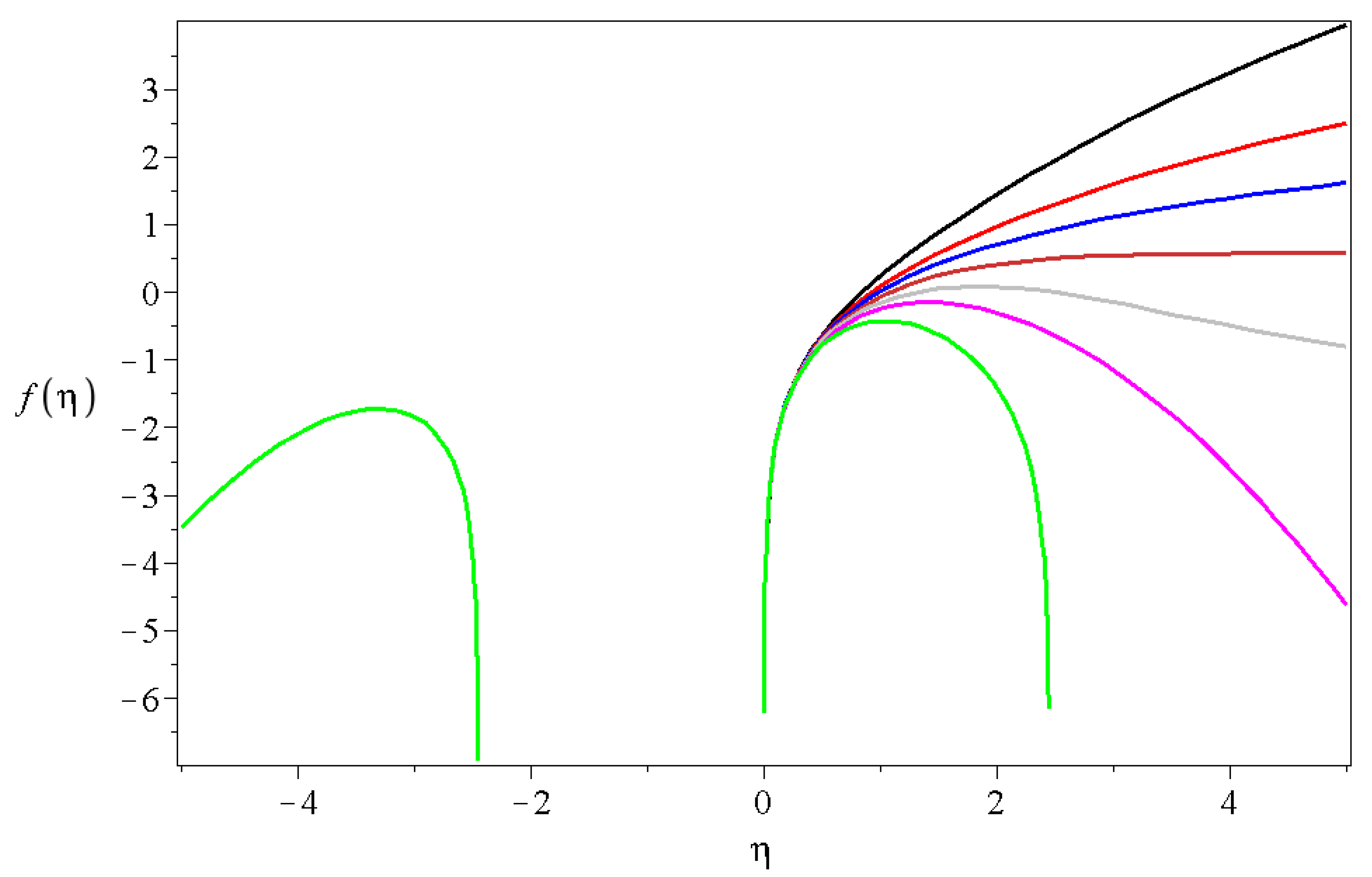
Figure 3 a shows the surface height for the Kummer’s U functions for various s. It is clear to see, that for negative s the solutions are growing for larger and larger times. An island grows up around the origin. Due to the function the difference between and is not so drastic but visible. For the solutions only grow up to an asymptotic zero value. For positive s the solutions become very interesting. Again due to the function, only the positive parts of the oscillating Kummer’s U function remain solutions. Therefore the solutions are defined only on finite supports. At short times, positive " tinny islands" exist as solutions which sink down to negative heights at larger times. These are not physical solutions in the sense of surface growth physics.
Figure 4 a shows the surface height for the Kummer’s M functions for distinct s. The trend of the solutions is very similar. Negative s produce surfaces with growing height, now at large spatial coordinates not in the origin. The gives a constant solution and positive s produce "tinny islands" which disappear in time.
2.4. The Question of Additional Source Terms in the Diffusion Equation
Our personal experience showed that only for the linear source term can we derive analytic self-similar solutions. Therefore the starting PDE is:
the same self-similar Ansatz reduces to the ODE of
The derived exponents and solutions remain the same just the first parameter of both Kummer’s function will be down shifted with the parameter a which is the strength of the source:
(The source strength parameter could have negative real values as well.) Taking into account the transformation formula of Equation (11) after some trivial algebra we arrive to the modified KPZ equation in the next form of:
Note, that the original linear and time dependent diffusion source term is transformed into a constant source term. However, the inverse time dependence remained. At this point we have to add that using the reverse transformation we can produce possible source terms with analytic solutions of the regular diffusion if such terms are known for the KPZ equation. In two of our former studies we investigated the one dimensional KPZ equation with six different additional source terms (like analytic noises) with the self-similar Ansatz [42] and with the traveling wave ansatz [43] and presented highly non-trivial non-continuous analytic solutions containing a large variety of special functions (like, Kummer’s, Airy, Heun, modified Bessel or Mathieu functions). The back transformation is possible and the in-depth analysis could be the topic of our future study.
2.5. The Question of the Absolute Value
The above givens functions are the solutions of the KPZ equation. Due to the logarithm for negative values, the solutions are only defined on some finite number of compact support intervals. In real life surfaces are smooth objects. To fix this problem we may consider an extra absolute value function inside the logarithm in the form of:
the shape function now reads as:
We do not want to reproduce all the problematic sub cases of Figure 3 and Figure 4 so we just show one example. Considering and investigating only the Kummer’s U function we take which reduces it to a finite fourth order polynomial. The surface is now:
On Figure 5 one can see the strongly irregular form of the shape function and the surface, being the basic solution of the problem of KPZ equation, without noise. The absolute value function helps to define all kind of solutions for values as well.
As it was mentioned in [37], in case of the diffusion equation, the linear combination of solutions belonging to different values is also solution of the equation. As a consequence the derived solutions lead to combined possibilities, for instance
2.6. The Question of Surface Erosion
As a final idea we may try to construct solutions which describe surface degradation or erosion. We investigated some solutions in the form of
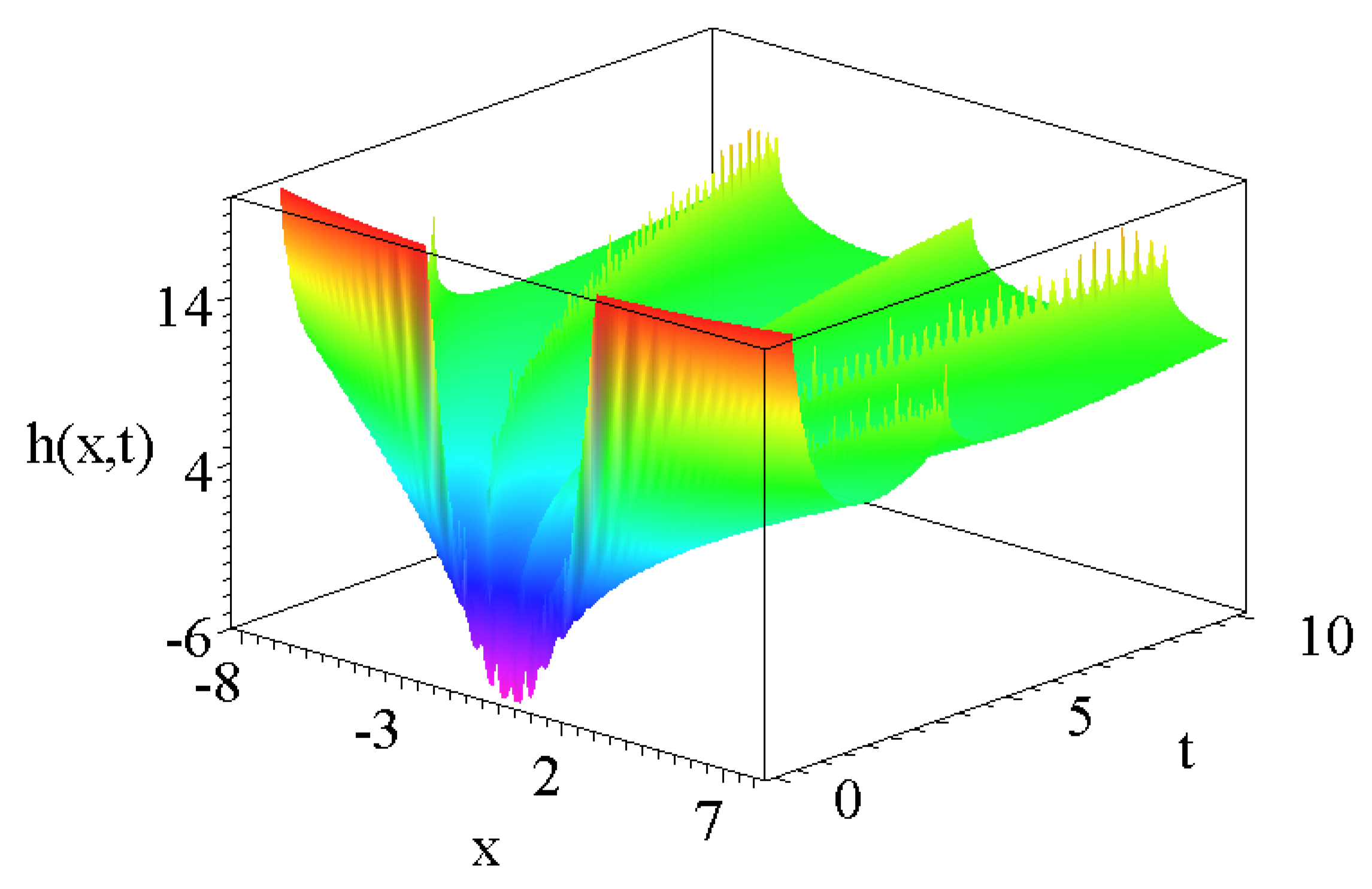
where and . We were looking for solutions which are finite on large part of the spatial coordinate ’x’ at small times, and decay as time grows. Unfortunately, we cannot found such kind of solutions for any neither for Kummer’s U nor for Kummer’s M functions. We found something which is more interesting. The filing up of a finite depth an finite width hole can be modeled in time. Figure 6 shows such a recharge process for with for the Kummer’s M function.
3. Summary and Outlook
In our former studies we derived new type of analytic self-similar solutions for the regular diffusion equations. These are a kind of upper harmonics of the usual Gaussian solution which are defined on the infinite horizon. The solutions contain the regular and irregular Kummer’s functions with quadratic argument. With the help of the Hopf-Cole transformation we could easily transform these new type of solutions for the KPZ equation. Due to the function in the reverse HC transformation we get insight into solution function which have compact support.
In a former publication about regular diffusion equations [38] we found particular solutions with compact support for the Ansatz. To investigate the effect of this trial-function could be the topic of a future study.
Author Contributions
Both authors contributed equaly to all part of the manuscript.
Funding
This study got no extra founding.
Data Availability Statement
All produces and used data are given in the manuscript.
Acknowledgments
One of us (I.F. Barna) was supported by the NKFIH, the Hungarian National Research Development and Innovation Office.
Conflicts of Interest
The authors declare no conflicts of interest.
References
- Crank, J. The Mathematics of Diffusion; Oxford, Clarendon Press, 1956.
- Z. Wu, J. Zhao, J.Y.; Li, H. Nonlinear Diffusion Equations; World Scientific, 2001.
- Favini, A.; Marinoschi, G. Degenerate Nonlinear Diffusion Equations; Springer, 2012.
- Pekalski, A.; Sznajd-Weron, K. Anomalous Diffusion; Springer, 1999.
- Bucur, C.; Valdinoci, E. Nonlocal Diffusion and Applications; Springer, 2016.
- Evangelista, L.; Lenzi, E. Fractional Diffusion Equations and Anomalous Diffusion; Cambridge University Press, 2018.
- Barabási, A.L. Fractal concepts in surface growth; Press Syndicate of the University of Cambridge, 1995.
- Saito, Y. Statistical Physics of Crystal Growth,; World Scientific Press, 1996.
- Pimpinelli, A.; Villain, J. Physics of Crystal Growth; Cambridge University Press,, 1998.
- Einax, M.; Dieterich, W.; Maass, P. Colloquium: Cluster growth on surfaces: Densities, size distributions, and morphologies. Rev. Mod. Phys. 2013, 85, 921–939. [CrossRef]
- Antczak, G.; Ehrlich, G. Surface Diffusion: Metals, Metal Atoms, and Clusters; Cambridge University Press,, 2010.
- Jackson, K.A. Kinetic Processes: Crystal Growth, Diffusion, and Phase Transitions in Materials; John Wiley & Sons, 2014.
- Tadahisa, F. Lectures on Random Interfaces; Springer Singapore, 2016.
- Calabrese, P.; Le Doussal, P. Exact Solution for the Kardar-Parisi-Zhang Equation with Flat Initial Conditions. Phys. Rev. Lett. 2011, 106, 250603. [CrossRef]
- Siegert, M.; Plischke, M. Instability in surface growth with diffusion. Phys. Rev. Lett. 1992, 68, 2035–2038. [CrossRef]
- Amar, J.G.; Lam, P.M.; Family, F. Groove instabilities in surface growth with diffusion. Phys. Rev. E 1993, 47, 3242–3245. [CrossRef]
- Kardar, M.; Parisi, G.; Zhang, Y.C. Dynamic Scaling of Growing Interfaces. Phys. Rev. Lett. 1986, 56, 889–892. [CrossRef]
- Woyczynski, W.A. Burgers-KPZ turbulence; Springer, 1998.
- Hopf, E. The partial differential equation ut + uux = xx. Communications on Pure and Applied Mathematics 1950, 3, 201–230. [CrossRef]
- Cole., J.D. On a quasi-linear parabolic equation occurring in aerodynamics. Quart. Appl. Math. 1951, 9, 225–236. [CrossRef]
- Hairer, M. Solving the KPZ equation. Ann. Math. 2013, 178, 559–664. [CrossRef]
- Wiese, K.J. On the Perturbation Expansion of the KPZ Equation. Journal of Statistical Physics 1998, 93, 143–154. [CrossRef]
- Hwa, T.; Frey, E. Exact scaling function of interface growth dynamics. Phys. Rev. A 1991, 44, R7873–R7876. [CrossRef]
- Frey, E.; Täuber, U.C.; Janssen, H.K. Scaling regimes and critical dimensions in the Kardar-Parisi-Zhang problem. Europhysics Letters 1999, 47, 14. [CrossRef]
- Kriecherbauer, T.; Krug, J. A pedestrian’s view on interacting particle systems, KPZ universality and random matrices. Journal of Physics A: Mathematical and Theoretical 2010, 43, 403001. [CrossRef]
- Lässig, M. On growth, disorder, and field theory. Journal of Physics: Condensed Matter 1998, 10, 9905. [CrossRef]
- Family, F.; Vicsek, T. Scaling of the active zone in the Eden process on percolation networks and the ballistic deposition model. Journal of Physics A: Mathematical and General 1985, 18, L75. [CrossRef]
- Gladkov, A. Self-similar blow-up solutions of the KPZ equation. International Journal of Differential Equations 2015, 2015, 572841. [CrossRef]
- Gladkov, A.; Guedda, M.; Kersner, R. A KPZ growth model with possibly unbounded data: correctness and blow-up. Nonlinear Analysis: Theory, Methods & Applications 2008, 68, 2079–2091. [CrossRef]
- Abdellaoui, B.; Peral, I.; Primo, A.; Soria, F. On the KPZ equation with fractional diffusion: Global regularity and existence results. Journal of Differential Equations 2022, 312, 65–147. [CrossRef]
- Kersner, R.; Vicsek, M. Travelling waves and dynamic scaling in a singular interface equation: analytic results. Journal of Physics A: Mathematical and General 1997, 30, 2457. [CrossRef]
- Kelling, J.; Ódor, G.; Gemming, S. Suppressing correlations in massively parallel simulations of lattice models. Comput. Phys. Commun. 2017, 220, 205–211. [CrossRef]
- Sasamoto, T. The 1D Kardar–Parisi–Zhang equation: Height distribution and universality. Progress of Theoretical and Experimental Physics 2016, 2016, 022A01. [CrossRef]
- Matsushita, M.; Wakita, J.; Itoh, H.; Rafols, I.; Matsuyama, T.; Sakaguchi, H.; Mimura, M. Interface growth and pattern formation in bacterial colonies. Physica A: Statistical Mechanics and its Applications 1998, 249, 517–524. [CrossRef]
- Kuramoto, Y.; Tsuzuki, T. Persistent Propagation of Concentration Waves in Dissipative Media Far from Thermal Equilibrium. Progress of Theoretical Physics 1976, 55, 356–369. [CrossRef]
- Gu, Y.; T. Komorowski, S. accepted in jan 20-. Stochastics and Partial Differential Equations: Analysis and Computations ( 2025, 55.
- Barna, I.F.; Mátyás, L. Advanced Analytic Self-Similar Solutions of Regular and Irregular Diffusion Equations. Mathematics 2022, 10, 3281. [CrossRef]
- Mátyás, L.; Barna, I.F. Even and Odd Self-Similar Solutions of the Diffusion Equation for Infinite Horizon. Universe 2023, 9, 264. [CrossRef]
- Mátyás, L.; Barna, I.F. Self-similar and traveling wave solutions of diffusion equations with concentration dependent diffusion coefficients. Romanian Journal of Physics 2024, 69, 106. [CrossRef]
- Kovács, E. New stable, explicit, first order method to solve the heat conduction equation. Journal of Computational and Applied Mechanics 2020, 15, 3–13. [CrossRef]
- Jalghaf, H.K.; Kovács, E.; Majár, J.; Nagy, A.; Askar, A.H. Explicit Stable Finite Difference Methods for Diffusion-Reaction Type Equations. Mathematics 2021, 9. [CrossRef]
- Barna, I.F.; Bognár, G.; Guedda, M.; Hriczó, K.; Mátyás, L. Analytic Self-Similar Solutions of the Kardar–Parisi–Zhang Interface Growing Equation with Various Noise Terms. Mathematical Modelling and Analysis 2020, 25, 241–256. [CrossRef]
- Barna, I.F.; Bognár, G.; Mátyás, L.; Guedda, M.; Hriczó, K. Travelling-wave solutions of the Kardar–Parisi–Zhang interface growing equation with different kind of noise terms. AIP Conference Proceedings 2020, 2293, 280005. [CrossRef]
- Kovács, E.; Barna, I.; Bognár, G.; Mátyás, L.; Hriczó, K. Analytical and numerical study of diffusion propelled surface growth phenomena. Partial Differential Equations in Applied Mathematics 2024, 11, 100798. [CrossRef]
- Sergi, D.; Camarano, A.; Molina, J.M.; Ortona, A.; Narciso, J. Surface growth for molten silicon infiltration into carbon millimeter-sized channels: Lattice–Boltzmann simulations, experiments and models. International Journal of Modern Physics C 2016, 27, 1650062. [CrossRef]
- Martynec, T.; Klapp, S.H.L. Impact of anisotropic interactions on nonequilibrium cluster growth at surfaces. Phys. Rev. E 2018, 98, 042801. [CrossRef]
- Mello, B.A. A random rule model of surface growth. Physica A: Statistical Mechanics and its Applications 2015, 419, 762–767. [CrossRef]
- Muravnik, A.B. On absence of global positive solutions of elliptic inequalities with KPZ-nonlinearities. Complex Variables and Elliptic Equations 2019, 64, 736–740. [CrossRef]
- Bluman, G.W.; Cole, J.D. The General Similarity Solution of the Heat Equation. J. Math. Mech. 1969, 18, 1025–1042. https://doi.org/https://personal.math.ubc.ca/bluman/jmm%20article%201969.pdf.
- Klages, R. Microscopic Chaos, Fractals and Transport in Nonequilibrium Statistical Mechanics; Advanced Series in Nonlinear Dynamics: Volume 24, 2007. [CrossRef]
- Pukach, P.; Chernukha, O.; Chernukha, Y.; Vovk, M. Three-Dimensional Mathematical Modeling and Simulation of the Impurity Diffusion Process Under the Given Statistics of Systems of Internal Point Mass Sources. Modelling 2025, 6. [CrossRef]
- Sedov, L.I. Similarity and Dimensional Methods in Mechanics; CRC Press, 1993.
- Barna, I.F.; Bognár, G.; Mátyás, L.; Hriczó, K. Self-similar analysis of the time-dependent compressible and incompressible boundary layers including heat conduction. Journal of Thermal Analysis and Calorimetry 2022, 147, 13625–13632. [CrossRef]
- Olver, F.W.J.; Lozier, D.W.; Boisvert, R.F.; Clark, C.W., Eds. NIST Handbook of Mathematical Functions; Cambridge University Press, 2010. https://doi.org/https://dlmf.nist.gov/.
- Yang, X.; Zhang, Y.; Li, W. Dynamics of rational and lump-soliton solutions to the reverse space-time nonlocal Hirota-Maccari system. Romanian Journal of Physics 2024, 69, 102. [CrossRef]
- Ur Rehman, M.I.; Chen, M.I.; Hamid, A. Multi-physics modeling of magnetohydrodynamic Carreau fluid flow with thermal radiation and Darcy-Forchheimer effects: a study on Soret and Dofour phenomena. Journal of Thermal Analysis and Calorimetry 2023, 148, 13883–13894. [CrossRef]
- Timofte, C. A bidomain model for calcium dynamics in living cells. Romanian Reports in Physics 2024, 76, 105. [CrossRef]
- Barna, I.F. Self-Similar Solutions of the G-Equation - Analytic Description of the Flame Surface. Journal of Generalized Lie Theory and Applications 2017, 11. [CrossRef]
- Lax, M. Classical Noise IV: Langevin Methods. Rev. Mod. Phys. 1966, 38, 541–566. [CrossRef]
- Pomeau, Y.; Piasecki, J. The Langevin equation. Comptes Rendus. Physique 2017, 18, 570–582. [CrossRef]
- Halpin-Healy, T.; Zhang, Y.C. Kinetic roughening phenomena, stochastic growth, directed polymers and all that. Aspects of multidisciplinary statistical mechanics. Physics Reports 1995, 254, 215–414. [CrossRef]
- Corwin, I. The Kardar–Parisi–Zhang Equation and Universality Class. Random Matrices: Theory and Applications 2012, 01, 1130001. [CrossRef]
- Konstantin Matetski, J.Q.a.R. The KPZ fixed point. Acta Math., 2021, 227, 15–203. [CrossRef]
- Alexander, G.; Sergei, N.; Alexander, V. KPZ scaling from the Krylov space. Journal of High Energy Physics 2024, 2024, 21. [CrossRef]
- Madelung, E. Eine anschauliche Deutung der Gleichung von Schrödinger. Naturwissenschaften 1926, 14, 1004–1004. [CrossRef]
- Simpao, V. Understanding The Schrödinger Equation: Some [Non]Linear Persectives; Nova Puplisher, 2020; chapter 6 I.F. Barna and L. Mátyás "Self-similar and Travelling-Wave Analysis of the Madelung Equations Obtained from the Free Schrödinger Equation.
- Bakirtaş, I.; Antar, N.; Horikis, D. Parabolic and rectangular self-similar evolution in saturable media. Romanian Reports in Physics 2023, 75, 4468. [CrossRef]
- Dearnley, P. Introduction to Surface Engineering; Cambridge University Press, 2017; chapter 6 Surface Degradation and Its Evaluatio.
Figure 2.
The Kummer’s U shape functions of Equation (11) for and. The black, red, blue, orange, gray, magenta and green lines are for values, respectively.
Figure 2.
The Kummer’s U shape functions of Equation (11) for and. The black, red, blue, orange, gray, magenta and green lines are for values, respectively.
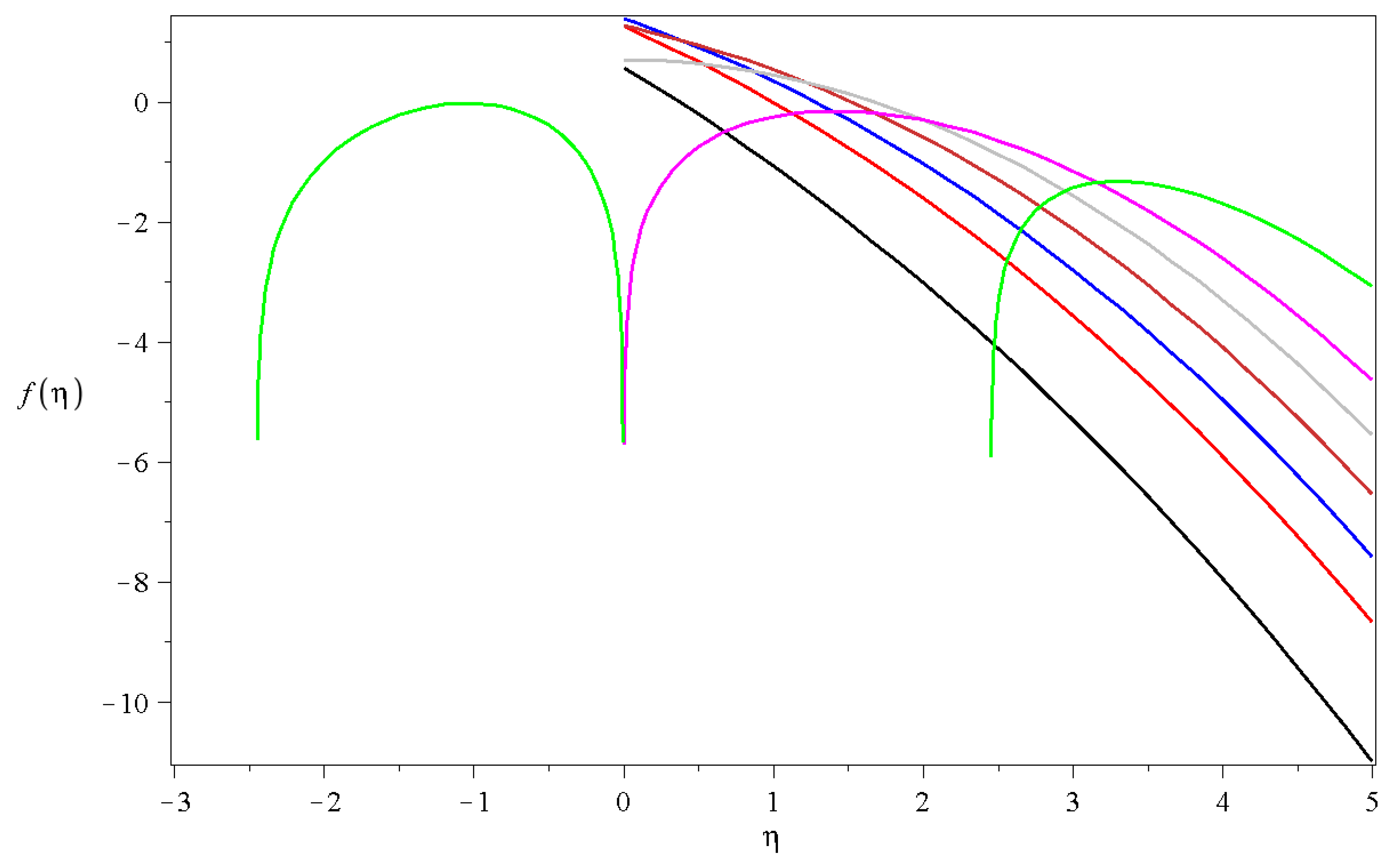
Figure 3.
The surface height for the Kummer’s U function for and for different s, respectively.
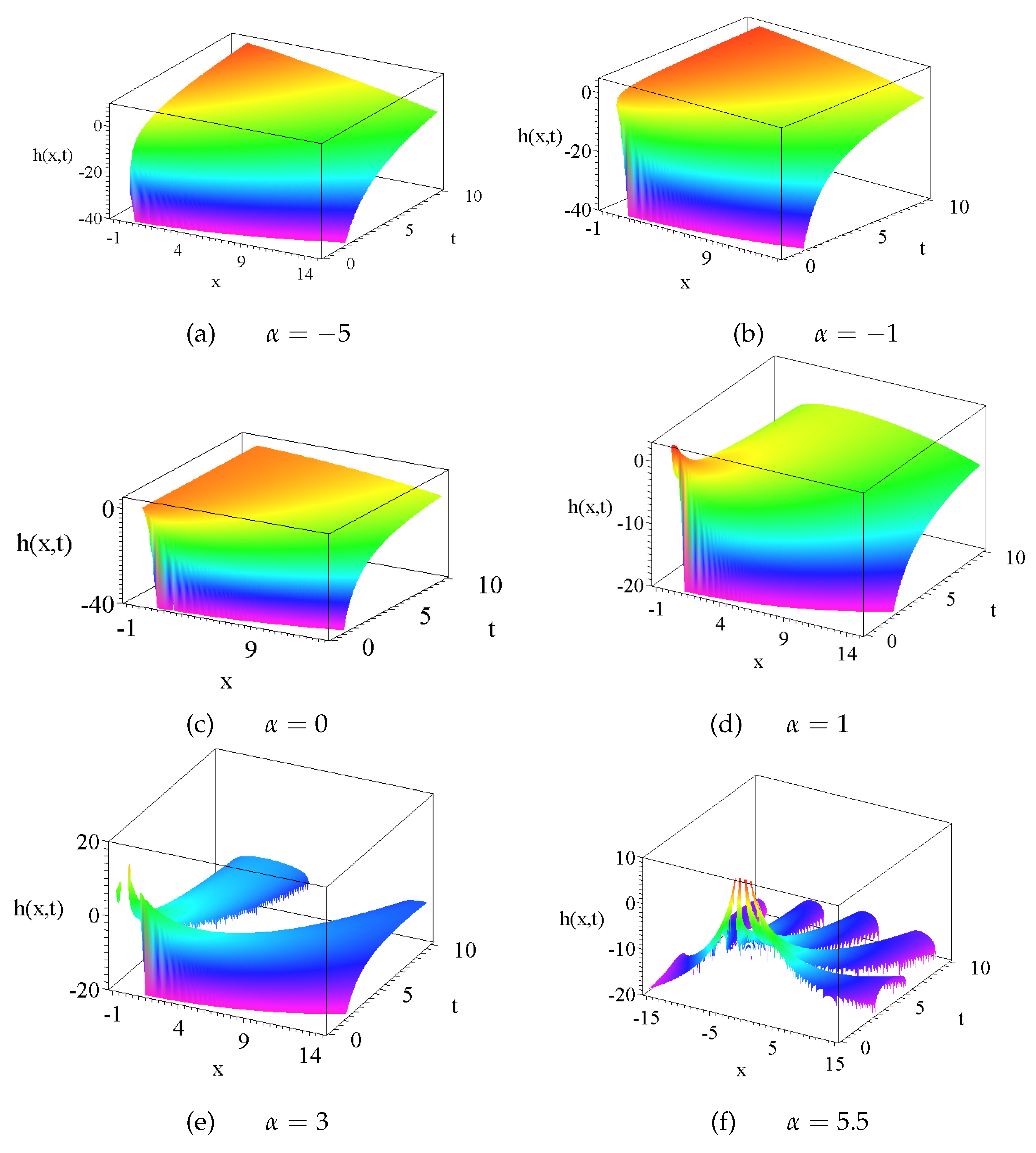
Figure 4.
The surface height for the Kummer’s M function for and for different s, respectively.
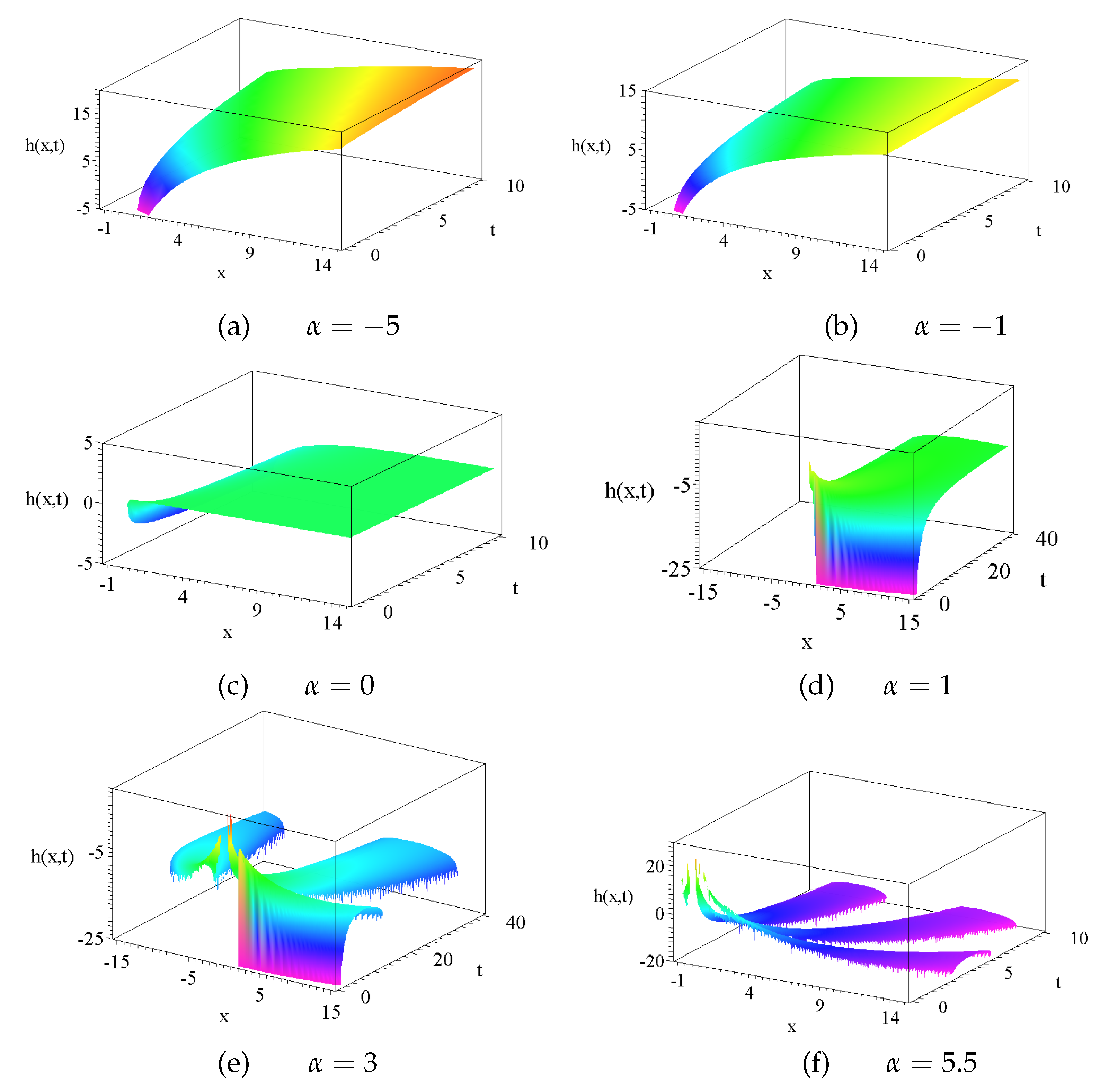
Figure 5.
(a) The shape function of the solution Equation (18), (b) the surface. One can clearly see the irregularities of the surface of the basic equation.
Figure 5.
(a) The shape function of the solution Equation (18), (b) the surface. One can clearly see the irregularities of the surface of the basic equation.
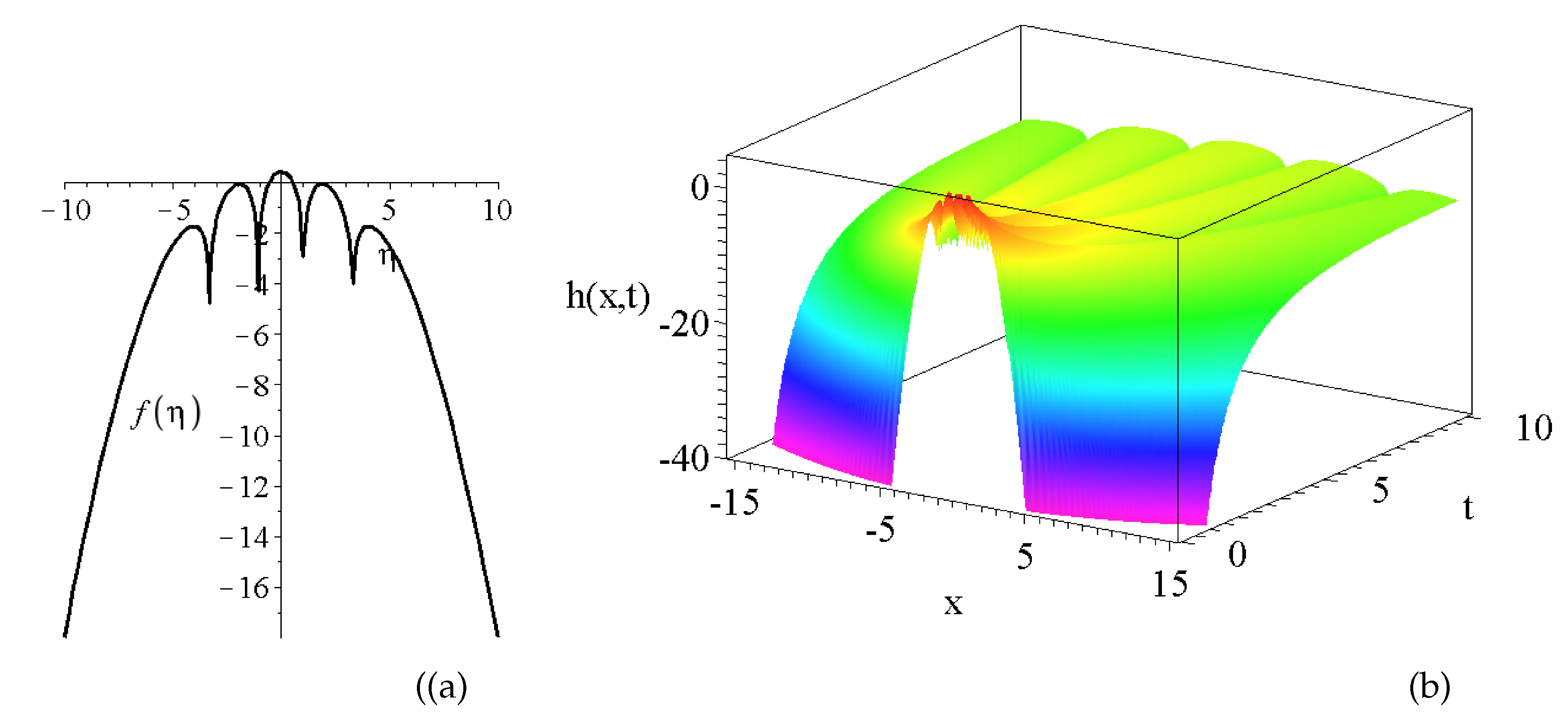
Figure 6.
Filling up of a finite depth and finite deep hole in time, modeled by Equation (20). Calculated for the Kummer’s U functions with the self-similar exponents of .
Figure 6.
Filling up of a finite depth and finite deep hole in time, modeled by Equation (20). Calculated for the Kummer’s U functions with the self-similar exponents of .
Disclaimer/Publisher’s Note: The statements, opinions and data contained in all publications are solely those of the individual author(s) and contributor(s) and not of MDPI and/or the editor(s). MDPI and/or the editor(s) disclaim responsibility for any injury to people or property resulting from any ideas, methods, instructions or products referred to in the content. |
© 2025 by the authors. Licensee MDPI, Basel, Switzerland. This article is an open access article distributed under the terms and conditions of the Creative Commons Attribution (CC BY) license (http://creativecommons.org/licenses/by/4.0/).
Copyright: This open access article is published under a Creative Commons CC BY 4.0 license, which permit the free download, distribution, and reuse, provided that the author and preprint are cited in any reuse.


