

Submitted:
03 April 2025
Posted:
03 April 2025
You are already at the latest version
Abstract
Background/Objectives. Flavonoids are a vast class of phenolic substances. To date, approximately 6000 plant-origin flavonoids have been discovered, and many of them have been used in drug therapy. Therapeutic flavonoids are commonly formulated to conventional “one size fits all” dosage forms, such as conventional tablets or hard cap-sules. However, the current trend in pharmacy and medicine is personalized drug therapy and drug delivery systems (DDSs). Therefore, 3D printing is an interesting technique for designing and preparing novel personalized pharmaceuticals for flavo-noids. The aim of the present study was to develop aqueous polyethylene oxide (PEO) gel inks loaded with plant-origin rutin (vitamin P) for semisolid-extrusion (SSE) 3D printing. Methods. Rutin (a model substance for therapeutic flavonoids), Tween 80, PEO (MW approx. 900,000), ethanol, and purified water were used in PEO gels at different pro-portions. The viscosity and homogeneity of the gels were determined. The rutin-PEO gels were printed with a bench-top Hyrel 3D printer to lattices and discs, and their weight and effective surface area were investigated. Results. The key SSE 3D printing process pa-rameters were established and verified. The results showed the compatibility of rutin as a model flavonoid and PEO as a carrier polymer. The rutin content (%) and content uniformity of the 3D-printed preparations were assayed by UV spectrophotometry and high-performance liquid chromatography (HPLC). Conclusions. The most feasible aqueous PEO gel ink formulation for SSE 3D printing contained rutin 100 mg/ml and Tween 80 50 mg/ml in a 12% aqueous PEO gel. The 3D-printed dosage forms are intended for the oral administration of flavonoids.
Keywords:
3D printing
; semisolid extrusion
; polyethylene oxide
; printing gel ink
; flavonoid
; rutin
1. Introduction
Flavonoids are phenolic substances that are abundant in plants and represent more than 6000 compounds [1,2]. Due to their chemical structure, flavonoids have significant therapeutic properties, including antioxidant, antibacterial, antiviral, and anti-inflammatory effects [3]. Flavonoid-based natural and semi-synthetic drugs are widely represented in the pharmaceutical market for the treatment of e.g., venous insufficiency (Diosmin, Troxerutin, Hesperidin), gastric ulcer and gastritis (Eupatilin), and liver disorders (Silibinin) [4].
Rutin (3,3´,4´,5,7-pentahydroxyflavone-3-rhamnoglucoside), also known as quercetin-3-O-rutinoside and vitamin P, is a flavonol and one of the most common and wide-spread flavonoids [5]. Rutin is also an important nutrient component of plant-based food. The first time, rutin was isolated from the common plant Rue (Ruta graveolens L.), from which it also received its name [3]. So far, it has been reported that more than 70 plant species contain rutin, including buckwheat (Fagopyrum esculentum Moench), Japanese pagoda tree (Sophora japonica L), American elderberry (Sambucus canadensis L.), apricot (Prunus armeniaca L.), orange (Citrus sinensis L. Osbeck), white mulberry (Morus alba L.), rhubarb (Rheum rhabarbarum L.), etc. [5,6,7]. Buckwheat is considered one of the most profitable sources of rutin [8]. The quantitative content of the compound can reach up to 18.67 mg/g (dry weight) [9].
Rutin is an odourless and yellowish-greenish pigment in the form of needle crystals and is almost insoluble in water [3,10]. Due to its low solubility and low oral bioavailability, it has limitations in its use as a therapeutic agent [11,12]. To enhance the oral bioavailability of flavonoids, numerous formulation and delivery strategies have been introduced in the state-of-the-art literature, including structural transformation (glycosylation, prodrugs), nanotechnology-based carriers, crystals, micelles, carrier complexes, microspheres, selfmicroemulsifying drug delivery systems (DDSs), self-nanoemulsifying DDSs [12,13,14].
Numerous scientific papers have reported that rutin possesses a wide range of pharmacological activity [3,6,15,16]. Rutin has been shown to have a strong concentration-dependent antioxidant effect in various in vitro systems and the ability to inhibit lipid peroxidation. Moreover, rutin has been shown to enhance antioxidant status in the liver, kidneys, and brain of diabetic rats [6,17,18]. Rutin is also widely used in capillary fragility treatment, vascular sealing and bleeding prevention, and as an antioxidant and anti-inflammatory agent in combination with ascorbic acid [10,19]. Many studies on rutin formulations have demonstrated significant antimicrobial activity against different strains of bacteria, including Pseudomonas aeruginosa and Klebsiella pneumoniae [6,17,20]. It has been also reported that rutin is an effective antiviral agent, which has shown affinity against the parainfluenza-3 virus, avian influenza virus, HSV-1, and HSV-2 [21]. In addition, rutin is obviously a potent inhibitor of COVID-19 infection treatment [21]. Recently, the anti-proliferative and anti-apoptotic activity of rutin were studied with liquid crystalline nanoparticles loaded with rutin in an in vitro model using a human lung epithelial carcinoma cell line [11]. The 50 mg/kg rutin dose decreased glucose levels by increasing insulin secretion in hyperglycemic rats [5].
Today, virtually all flavonoid(s) containing commercial pharmaceuticals are con-ventional “one size fits all” oral solid dosage forms, such as tablets or hard capsules. Sometimes such traditional formulation approach, however, is not appropriate, and a customized drug therapy and DDSs are needed. Therefore, 3D printing technologies are interesting and promising techniques for preparing novel types of personalized dosage forms for flavonoids [22,23]. By using a science-based material(s) selection, formulation development and computer-assisted design (CAD), modern 3D printing technologies could enable preparing next generation customized oral DDSs for therapeutic flavonoids. [23].
Semisolid extrusion (SSE) 3D printing is a printing technique widely used in pharmaceutical and biomedical applications [24]. SSE 3D printing exploits the sequential deposition of gel (or paste) layers to form the DDS or tissue engineering scaffold with the desired size and shape [24]. The present printing technique has proven efficient in delivering a precise and accurate personalized drug dose(s) and in preparing for example combinatorial DDSs with customized drug release properties [25]. Therefore, it holds considerable promise and potential in drug delivery applications. However, implementing SSE 3D printing technology in clinical practice requires new regulation and proper quality control approaches [26].
Viidik et al. [27] identified and optimized the critical material and process parameters of SSE 3D printing using aqueous polyethylene oxide (PEO) gels as a printing ink. More recently, PEO was successfully used as a printing gel ink former in the SSE 3D printing of novel DDSs of rosmarinic acid [28] and some plant extracts, such as eucalypt [29,30], chamomile [31], motherwort [32] and cranberry [33] extracts. Based on these results, PEO could be a feasible printing gel ink former for the SSE 3D printing of flavonoids, such as rutin (vitamin P).
The aim of the present study was to develop aqueous PEO gel inks loaded with rutin (vitamin P) as a model compound of flavonoids for SSE 3D printing and to investigate the physicochemical and pharmaceutical properties of the corresponding solid DDSs intended for the oral administration of flavonoids. The physical appearance, homogeneity, viscosity and SSE 3D printability of the rutin-loaded PEO gel inks were studied. The rutin content and in-vitro disintegration of SSE 3D-printed oral DDSs were investigated.
2. Materials and Methods
2.1. Preparation of the PEO Gels
For preparing PEO gel inks, rutin (Nanjing NutriHerb BioTech Co, China, purity 95%), Tween 80 (Ferak Berlin GmbH, Germany), PEO (MW approx. 900,000, Sigma-Aldrich, USA), ethanol (Peenviinavabrik, Estonia), and purified water were used at different proportions. The 12% aqueous PEO gel was used as a semisolid ink base for the SSE 3D printing of rutin. First, 12% aqueous PEO gels were prepared, and then the mixture of rutin (0.5 g, 1.0 g and 1.5 g in 1 ml of ethanol) with Tween 80 (at the rutin-Tween 80 ratio of 1:1, 1:2, or 1:3) were loaded in the PEO gel, homogenized and kept at an ambient room temperature (22 ± 2 °C) for at least subsequent 12-14 hours [27].
2.2. Characterisation of the PEO Gels
The viscosity of PEO gels was studied with a Physica MCR 101 rheometer (Anton Paar, Austria) using a cone-plate geometry at 22 ± 2 °C. A rotational shear test at 0.060 1/s was used [29]to measure the gel viscosity. The gel homogeneity and structure were determined with an optical light microscope (Magtex-T Dual Illum., Medline Scientific, United Kingdom) equipped with a digital camera (Industrial Digital Camera UCMOS09000KPB (9.0 MP 1 / 2.4” APTNA CMOS sensor) [28,34].
2.3. SSE 3D Printing
The rutin-PEO gel inks were printed using a bench-top SSE 3D printing system (System 30 M, Hyrel 3D, USA) with a printing head consisting of a steel syringe connected to a blunt needle (Gauge, 21G). The printing plate temperature was kept at 30 °C. The printing head speed (rate) was 0.5 mm/s, and the printing speed was controlled by the software of an SSE 3D printer (Repetrel, Rev3.083_K, Hyrel 3D, USA). The model lattices were composed of a total of eight printed layers, and the round-shaped scaffolds consisted of five layers, which were generated with Autodesk 3ds Max Design 2017 software (Autodesk Inc., USA) [28,29]. Round-shaped special scaffolds (20 mm in diameter) were designed using a FreeCAD software (vers. 0.19 / release date 2021). A square-shaped lattice's dimensions (size) were 30 x 30 x 0.5 mm. For verifying the printability of the gel inks, the weight and area of the 3D-printed lattices were determined. The surface area of the 3D-printed lattices was compared with the theoretical lattice area (324 mm2) [29,34]. The 3D-printed scaffolds were weighed with an analytical scale (Scaltec SBC 33, Scaltec, Germany), and photographed with an ImageJ (National Institute of Health, USA) image analysis software (version 1.51k). The 3D-printed preparations were dried on a heated printing plate at 30 °C for one hour to remove the residual water. After drying, the printed scaffolds were gently removed from the surface of the printing plate by using a special blade.
2.4. Disintegration Test In Vitro
The pilot in-vitro disintegration test for the 3D-printed scaffolds was performed in a petri dish filled with a small amount of purified water at room temperature (22 ± 2 °C) [28,29]. The goal of this pilot disintegration test was to verify it, if the 3D-printed scaffolds were rapidly disintegrating preparations or not. After this, we conducted also the established in-vitro disintegration test described in the European Pharmacopoeia (Ph.Eur.), sub-monograph 2.9.1. “Disintegration of tablets and capsules” (01/2022:20901) [35]. The disintegration test (“test A”) was carried out in a Sotax DT3 CH-4008 apparatus (Sotax AG, Switzerland) without disks, and using purified water (700 ml) as a disintegration medium at 37 ± 2 °C.
2.5. Dissolution Test In Vitro
The in-vitro dissolution test was carried out in line with the method and protocol described in the European Pharmacopoeia, the monograph 2.9.3. “ Dissolution test for solid dosage forms ” [35]. Sotax ASTM Check Set dissolution apparatus (Sotax AG, Switzerland) was used in the test. Purified water (900 ml) was used as a dissolution medium at 37 ± 0.5 °C, and the paddle stirring rate was 50 rpm. The release of an active agent (rutin) was determined with an UV-Vis spectrophotometer (SPECORD 200 PLUS Dissolution, Analytik Jena GmbH+Co. KG, Germany).
2.6. Assay of Rutin Content by UV Spectrophotometry
The assay of rutin in the 3D-printed scaffolds was carried out by UV spectrophotometry after forming complexes with aluminium chloride [35]. The pre-weighed sample of a 3D-printed scaffold (100.00 mg) was dissolved in an aqueous isopropanol solution (50% V/V) R and analyzed using a pharmacopeial method [35,36].
2.7. Assay of Rutin Content by HPLC
The quantitative content of rutin in the 3D-printed scaffolds was determined with a modified high-performance liquid chromatography (HPLC) method according to the European Pharmacopoeia 11.5 “Rutoside trihydarate” monograph [37]. For the content analysis, Chromatograph Prominence Modular HPLC (Shimadzu, Japan) equipped with an online degassing unit (DGU-20ASR, 2 x Solvent Delivery Unit LC-20AD), photo-diode array detector (SPD-M20A), autosampler (Nexera X2 SIL-30AC), Phenomenex Luna 5 µm C18(2) 100Å LC Column (250 x 4,6 mm) and column oven (CTO-20AC), was used. LabSolutions Version 5.97 SP1 (c) 2019 (Shimadzu Corporation, Japan) was used to control the process. Rutin (PhytoLab, Germany, Catalog no 89270, 50 mg, 99.0%, Batch 125820573) was used as a reference standard. The correlation between the peak area and the concentration was verified.
The pre-weighed sample of a 3D-printed scaffold (200.0 mg) was dissolved in an aqueous isopropanol solution (50% V/V) R and filled in with the same solvent to 100.0 mL. A total of 1.0 mL of the solution was filtered through a 0.45 µm nylon syringe filter into a chromatography vial. The analysis used 50 mg of rutin standard (Thermo Scientific, USA) dissolved in 100.0 mL aqueous ethanol (50% V/V) R as a standard solution. Phosphoric acid 1%, acetonitrile 25% and water 74% were used as a mobile phase. The flow rate was 1.0 mL/min. Spectrophotometric detection was carried out at the analytical wavelength of 330 nm. The injected volume was 10 µL, and the run time was 18 min.
2.8. Statistical Analysis
Statistical properties of random variables with n-dimensional normal distribution are given by their correlation matrices, which can be calculated from the original matrices. Statistical data assessment is reported as mean ± SEM. MS Excel (Microsoft Excel 2016, version 16.0, Microsoft Corporation, USA) was used for data analysis. The P values less than 0.05 were considered statistically significant [35,38].
3. Results
In the preliminary tests, we printed 12 % aqueous PEO gels loaded with rutin (vitamin P) without any additional excipients. Rutin is poorly soluble in water [6], so when its ethanolic solution was added to the aqueous PEO gel (without surfactants), the crystallization/sedimentation of rutin occurred immediately. The crystals of rutin were clearly visible on the walls of the vessel. In such cases, it would be impossible to ensure the uniform dosing of active ingredient, and therefore it is not necessary to confirm this phenomenon microscopically. Thus, the results were not satisfactory, since the homogeneity of gels was quite poor, and rutin obviously oxidized partially during a 3D-printing process, which was manifested with brownish-colored areas in the 3D-printed scaffolds. Since rutin is an antioxidant and phenolic compound, it readily undergoes redox reactions [6]. Therefore, we did not continue in this research line and concluded that this approach does not ensure a good printing quality for the final preparations. Consequently, and the reasons mentioned above, eumulgin [28,29] or Tween 80 was added as a surface-active agent at a small concentration in the PEO printing gel ink to improve the homogeneity and printability of the gels. The inclusion of eumulgin in the PEO gel ink resulted in the 3D-printed scaffolds, which were readily removable from the printing plate surface, but sometimes it was even impossible to terminate a SSE 3D printing process. Next, we used Tween 80 at different concentrations (1, 3 and 5% w/w), and found that the most feasible concentrations of Tween 80 in the aqueous PEO gel inks were 3% and 5% (w/w). The corresponding PEO gel inks were homogeneous and showed a great printability without any printing interruptions or flaws. Therefore, the present Tween 80 containing PEO gel ink was chosen for the next experimental gel ink samples loaded with rutin (vitamin P).
Table 1 shows the compositions of the Tween 80 containing aqueous PEO gel inks loaded with rutin (vitamin P), which were prepared and used for SSE 3D printing experiments. To prepare such PEO gel inks, rutin was first dissolved in a small amount of ethanol, and then Tween 80 was added to this solution by gently stirring for 15 minutes. Next, the present mixture was added in driblets in an aqueous PEO gel ink and mixed gradually until a homogeneous gel was formed. Tween 80, as a non-ionic surface-active agent improved the homogeneity of the rutin-loaded aqueous PEO gels and prevented the precipitation and oxidation of rutin.
Table 2 shows the viscosity of the experimental PEO gel inks loaded with rutin (vitamin P). The viscosity of the gel inks was relatively high, but only other hand very feasible for a SSE 3D printing. Decreasing the amount of rutin from 1.00 g to 0.50 g appeared to increase the viscosity of the Tween 80 containing PEO gels. However, the difference in the viscosity of the gel inks loaded with rutin was not statistically significant.
For investigating the homogeneity of the PEO gel inks loaded with rutin (vitamin P), the gels were studied under optical light microscopy immediately after preparation. Figure 1 shows the optical light microscopy images of the experimental PEO gel inks at three different magnifications (50×, 200× and 500×). As seen in Figure 1, rutin was homogeneously dispersed in all Tween 80 containing aqueous PEO gels, thus suggesting the applicability of the present gels as a printing ink in SSE 3D printing. No cluster formation was observed in the gel inks. The PEO gel inks containing rutin (vitamin P) were yellow-to-brownish in color.
Figure 2 shows the physical appearance of the SSE 3D-printed lattices prepared by using the PEO gels loaded with rutin (vitamin P). The two upper photographs present the reference 3D-printed lattices prepared using a 12% PEO gel ink containing Tween 80 as surface active agent 3% or 5% (w/w) and without rutin. The photographs in the three lower rows of Figure 2 show the physical appearance of the SSE 3D-printed lattices (three parallel printings) loaded with rutin (vitamin P) (reference is also made to Table 1). As seen in Figure 2, all three PEO gel inks loaded with rutin at three different concentrations showed very good printability. The lattices containing rutin (vitamin P) were brownish-to-yellow in color.
The surface area and weight of the SSE 3D-printed lattices of rutin (vitamin P) are summarized in Table 3. The weight and surface area variation of the 3D-printed lattices was less than 12% and 10%, respectively.
We also used SSE 3D printing for preparing the round-shaped DDSs and scaffolds of rutin (vitamin P) intended for oral administration (Table 4). The present scaffolds were uniform in color, size, weight and physical appearance. The weight variation of the 3D-printed lattices was less than 5%.
The content of rutin (%) in the SSE 3D-printed scaffolds was studied by means of UV spectrophotometry and HPLC, and the results are shown in Table 5 and Figure 3.
As seen in Table 5, the rutin (vitamin P) content in the SSE 3D-printed scaffolds was close to a theoretically calculated content value of the present flavonoid in the aqueous PEO gels, and the content uniformity was very good. The rutin assay results were also not dependent on the analytical method used. The rutin content determined by UV spectrophotometry and HPLC were comparable with the theoretical content value and the results obtained with each other.
Figure 4 shows the fate of the 3D-printed preparations in the in-vitro disintegration test (a pilot test and an established Ph.Eur. disintegration test). Figure 4A-E showed that the 3D-printed scaffolds disintegrated completely with 30-60 min (a pilot test). Figure 4F-H showed that all 3D-printed preparations with different rutin concentrations (T5_0.5, T5_1 and T5_1.5) clearly deformed within 7 minutes, and the preparations completely disintegrated within 20-35 minutes. The 3D-printed preparations with the lowest rutin load (T5_0.5) disappeared from the tubes within 19-21 minutes, and the corresponding time periods for the 3D-printed preparations with the intermediate rutin load (T5_1) and the highest rutin load (T5_1.5) were 24-26 minutes and 32-35 minutes, respectively.
Figure 5 presents the release behaviour of the active agent (rutin) from the 3D-printed preparations in vitro. According to the European Pharmacopoeia monograph 2.9.3. “Dissolution test for solid dosage forms” [35], the established time period for the dissolution test in vitro is 60 minutes. In our study, however, the preliminary results showed that 81-89% of rutin released from the 3D-printed scaffolds within 60 minutes. Therefore, we continued the dissolution test up to 100 minutes. As seen in Figure 5, approximately 88-103% of rutin was released within 80 minutes, and virtually all active agent load was released within 100 minutes.
4. Discussion
In the present study, we formulated and evaluated aqueous PEO gel inks loaded with plant-origin rutin (vitamin P) for SSE 3D printing. The PEO gel inks loaded with rutin and Tween 80 as a surface-active agent, were found to be homogeneous viscous gels with yеl low color. The addition of rutin (1.0 g) in the 12% aqueous PEO gels (10 g) without any surface-active agent leads to the impaired homogeneity of the gels and to the color changes in the final 3D-printed scaffolds due to the oxidation of rutin. Rutin has low solubility in water [3,6], which caused immediate precipitation when its ethanolic solution was mixed with the 12% aqueous PEO gel (without surfactants). The crystals of rutin were clearly visible on the walls of the vessel. In such cases, it would be impossible to ensure the uniform dosing of active ingredient, and therefore, we did not confirm this phenomenon microscopically. Since rutin is an antioxidant and phenolic compound, it is prone to redox reactions [3,6]. Therefore, to avoid such drawbacks, surface-active agents, such as Emulgin and Tween 80 were used. When Emulgin was added in the PEO gel inks, we found that the 3D-printed scaffolds readily (too quickly) peeled off from the printing plate, which in some cases prevented the successful completion of the 3D printing. Therefore, Tween 80 was selected as a surface-active agent for the PEO gel inks [39]. The use of Tween 80 enabled a more homogeneous distribution of rutin (vitamin P) in the PEO gels. The addition of Tween 80 prevented also the oxidation of rutin and provided very good 3D printing results. Among the three concentration levels of Tween 80 studied, using the two highest concentrations of Tween 80 (3% and 5% w/w) [40] resulted in a good stability and printability of a PEO gel. The PEO gel inks with the lowest concentration level of Tween 80 (1% w/w) were not homogeneous and stable. When preparing the PEO gels loaded with rutin, the order of mixing and adding ingredients was crucial. If the procedure was violated, it was impossible to obtain homogeneous gels. First, rutin was dissolved in a minimal volume of ethanol. This liquid volume needs to be considered and adjusted with the volume of water used in preparing the PEO gel inks for 3D printing. Then, the pre-calculated amount of Tween 80 was added in driblets to this solution and thoroughly mixed. The PEO gel inks should be prepared according to the standard procedure, considering the volume of ethanol used to dissolve the rutin [27]. Finally, the ethanolic rutin solution with Tween 80 was gradually added to the PEO gel while continuously stirring. This procedure ensured the preparation of homogeneous gels, which was confirmed by visual inspection and by means of optical light microscopy (Figure 1).
Our hypothesis is that surface-active agents (Tween 80 and Emulgin) based on their physicochemical properties [40,41,42,43] can help to prevent the oxidation of rutin during SSE 3D printing through several mechanisms: (1) the formation of a protective layer, (2) the stabilisation of rutin in solution, (3) the reduction of free radicals, (4) by regulating pH and (5) by pre-venting shear-induced oxidation. The above-mentioned mechanisms jointly support the chemical stability and integrity of rutin during a 3D-printing process, and consequently, prevent the oxidation of rutin. The mechanical stress of SSE 3D printing may foster oxidation by generating heat or shear forces. Surface-active agents can reduce surface tension and improve the flow properties of printing gel [44], thus minimizing the mechanical stress and reducing the chance of oxidation.
The PEO gels loaded with rutin at all three concentrations and prepared as described in the previous paragraph showed good printability in a SSE 3D printing process (Figure 2, Table 3). We used three different rutin concentrations in the printing gels (0.5, 1.0, and 1.5 g in 10 ml of the gel). In the 3D-printed round scaffolds, the rutin dose was 17 mg, 50 mg or 67 mg based on the concentration of rutin in the printing gel. Using PEO gels with the rutin concentration of 100 mg/ml (T5_1) led to the highest quality of printed scaffolds based on a visual inspection and surface area analysis [27,30]. With the present printing gel, it was possible to print the rutin-loaded preparations of any size, shape and dose. By increasing the number of printed layers in these preparations, the dose of rutin can be increased accordingly.
The results on the pilot disintegration test in vitro showed that the SSE 3D-printed PEO scaffolds completely lost their shape and disintegrated within 15-20 minutes in purified water at a room temperature at 22 ± 2 °C (Figure 4A-E). We conducted also the established in-vitro disintegration test (“test A”) described in the European Pharmacopoeia (Ph.Eur.), sub-monograph 2.9.1. “Disintegration of tablets and capsules” (01/2022:20901) [35]. We showed that all 3D-printed preparations (n = 6) disintegrated completely within 20-35 minutes in this additional in-vitro disintegration test (Ph.Eur.), thus showing a rapid disintegration behaviour (Figure 4F-H). As expected, the disintegration of 3D-printed preparations was dependent on the amount (load) of rutin, since rutin is poorly soluble in water [6]. Increasing the amount (load) of rutin increased also the disintegration time of the preparations. According to the European Pharmacopeia, the specified time period for the disintegration of oral tablets and hard capsules is 15 minutes and 30 minutes, respectively. Our results suggest that the present SSE 3D-printed preparations have potential for oral administration [45,46]. The disintegration of the present 3D-printed preparations can be accelerated by inclusion of disintegrant (or even “super-disintegrant”) in the formulation. Today, European Pharmacopoeia [35] does not have any specific monograph or disintegration/dissolution test methods for the 3D-printed oral solid dosage forms. We found that the European Pharmacopoeia dissolution test method (described in the sub-monograph 2.9.3) is feasible for testing also 3D-printed drug preparations intended for oral administration.
For the quantitative standardization of the present 3D-printed drug preparations, both HPLC and UV spectrophotometry were used as slightly modified Ph.Eur. analytical methods [35]. Both analytical methods developed showed a good reproducibility in the content analysis of rutin (vitamin P) and their potential for use in the standardization of the corresponding 3D-printed oral solid dosage forms of rutin was verified. The assay results of rutin obtained with UV spectrophotometry and HPLC [35] were in line with the theoretical rutin content and comparable with each other. However, it should be noted that both of these analytical methods still need further validation [47,48] for their intended use for the content analysis of the present SSE 3D-printed DDSs.
Since rutin (vitamin P) is an established and well-known representative of the plant-origin flavonoids, the SSE 3D-printed formulations (i.e., a printing gel inks) developed in our study, are most likely feasible also in the SSE 3D printing of other plant-origin flavonoids with a potential therapeutic value and their implementation into pharmaceutical practice.
5. Conclusions
Novel aqueous PEO gel ink compositions were developed for the pharmaceutical SSE 3D printing of plant-origin rutin (vitamin P). The present 3D-printed formulations and customized drug preparations could be used also for the oral administration of other plant-origin flavonoids with a potential therapeutic value. The PEO gel inks loaded with rutin and Tween 80 (as a surface-active agent) showed good printability at the printing head speed (rate) levels of 0.5 mm/s. The most feasible aqueous PEO gel formulation for the SSE 3D printing of rutin (vitamin P) was composed of rutin 100 mg/ml and Tween 80 as a surface-active agent 50 mg/ml (dissolved in a 12% aqueous PEO gel). Further studies are needed to reveal potential physicochemical incompatibilities between the material components in the present PEO gel inks and to verify the in-vitro dissolution properties and storage stability of the SSE 3D-printed DDSs of rutin (vitamin P).
6. Patents
No patents.
Author Contributions
Conceptualization, J.H., O.K., N.S. and A.R.; methodology, J.H., O.K., A.M. and A.R.; software, O.K, A.S., and A.M.; validation, O.K., A.S. and A.M.; formal analysis, O.K., A.S. and A.M.; investigation, O.K., A.S. and A.M.; resources, J.H., N.S. and A.R.; data curation, O.K., A.S. and A.M.; writing—original draft preparation, O.K., A.S., J.H. and A.R.; X.X.; writing—review and editing, O.K., A.S., J.H., N.S. and A.R.; visualization, O.K., A.S.; supervision, J.H. and A.R.; project administration, J.H. and A.R.; funding acquisition, J.H. and A.R. All authors have read and agreed to the published version of the manuscript.
Funding
This work was supported by the Estonian Research Council grant (PRG1903), CurifyLabs project (VMVFA22189), and the European Union in the MSCA4Ukraine project “Design and development of 3Dprinted medicines for bioactive materials of Ukrainian and Estonian medicinal plants origin” [ID number 1232466]. Views and opinions expressed are however those of the author(s) only and do not necessarily reflect those of the European Union. Neither the European Union nor the MSCA4Ukraine Consortium as a whole nor any individual member institutions of the MSCA4Ukraine Consortium can be held responsible for them. The funders had no role in the design of the study; in the collection, analyses, or interpretation of data; in the writing of the manuscript, or in the decision to publish the results.
Data Availability Statement
The data supporting the results of this study can be obtained from the corresponding authors upon reasonable request.
Acknowledgments
Authors thank the Nordic POP (patient-oriented products), a Nordic University Hub project #85352 funded by NordForsk. The authors sincerely thank the Armed Forces of Ukraine for defending Ukrainian statehood and independence, and the partners who stand with Ukraine.
Conflicts of Interest
The authors declare no conflicts of interest.
References
- Wen, K.; Fang, X.; Yang, J.; Yao, Y.; Nandakumar, K.S.; Salem, M.L.; Cheng, K. Recent Research on Flavonoids and Their Biomedical Applications. CMC 2021, 28, 1042–1066. [Google Scholar] [CrossRef]
- Dias, M.C.; Pinto, D.C.G.A.; Silva, A.M.S. Plant Flavonoids: Chemical Characteristics and Biological Activity. Molecules 2021, 26, 5377. [Google Scholar] [CrossRef]
- Prasad, R.; Prasad, S.B. A Review on the Chemistry and Biological Properties of Rutin, a Promising Nutraceutical Agent. Asian J Pharm Pharmacol 2019, 5, 1–20. [Google Scholar] [CrossRef]
- Xu, K.; Ren, X.; Wang, J.; Zhang, Q.; Fu, X.; Zhang, P.-C. Clinical Development and Informatics Analysis of Natural and Semi-Synthetic Flavonoid Drugs: A Critical Review. Journal of Advanced Research 2024, 63, 269–284. [Google Scholar] [CrossRef] [PubMed]
- Hosseinzadeh, H.; Nassiri-Asl, M. Review of the Protective Effects of Rutin on the Metabolic Function as an Important Dietary Flavonoid. J Endocrinol Invest 2014, 37, 783–788. [Google Scholar] [CrossRef] [PubMed]
- Gullón, B.; Lú-Chau, T.A.; Moreira, M.T.; Lema, J.M.; Eibes, G. Rutin: A Review on Extraction, Identification and Purification Methods, Biological Activities and Approaches to Enhance Its Bioavailability. Trends in Food Science & Technology 2017, 67, 220–235. [Google Scholar] [CrossRef]
- Goyal, J.; Verma, P.K. An Overview of Biosynthetic Pathway and Therapeutic Potential of Rutin. MRMC 2023, 23, 1451–1460. [Google Scholar] [CrossRef]
- Wang, L.; Wang, L.; Wang, T.; Li, Z.; Gao, Y.; Cui, S.W.; Qiu, J. Comparison of Quercetin and Rutin Inhibitory Influence on Tartary Buckwheat Starch Digestion in Vitro and Their Differences in Binding Sites with the Digestive Enzyme. Food Chemistry 2022, 367, 130762. [Google Scholar] [CrossRef]
- Wang, L.; Wang, L.; Li, Z.; Gao, Y.; Cui, S.W.; Wang, T.; Qiu, J. Diverse Effects of Rutin and Quercetin on the Pasting, Rheological and Structural Properties of Tartary Buckwheat Starch. Food Chemistry 2021, 335, 127556. [Google Scholar] [CrossRef]
- Pinto, T.M.D.S.; Almeida, F.L.A.; Xavier, J.O.D.L.; Del-Vechio-Vieira, G.; Araújo, A.L.S.D.M.; Pinho, J.D.J.R.G.D.; Alves, M.S.; Sousa, O.V.D. Biopharmacotechnical and Physical Properties of Solid Pharmaceutical Forms Containing Rutin Commercially Acquired in Juiz de Fora City, Brazil. Acta Sci. Health Sci. 2020, 42, e52212. [Google Scholar] [CrossRef]
- Paudel, K.R.; Wadhwa, R.; Tew, X.N.; Lau, N.J.X.; Madheswaran, T.; Panneerselvam, J.; Zeeshan, F.; Kumar, P.; Gupta, G.; Anand, K.; et al. Rutin Loaded Liquid Crystalline Nanoparticles Inhibit Non-Small Cell Lung Cancer Proliferation and Migration in Vitro. Life Sciences 2021, 276, 119436. [Google Scholar] [CrossRef] [PubMed]
- Zhao, J.; Yang, J.; Xie, Y. Improvement Strategies for the Oral Bioavailability of Poorly Water-Soluble Flavonoids: An Overview. International Journal of Pharmaceutics 2019, 570, 118642. [Google Scholar] [CrossRef] [PubMed]
- Ninfali, P.; Antonelli, A.; Magnani, M.; Scarpa, E.S. Antiviral Properties of Flavonoids and Delivery Strategies. Nutrients 2020, 12, 2534. [Google Scholar] [CrossRef] [PubMed]
- Hassani, S.; Maghsoudi, H.; Fattahi, F.; Malekinejad, F.; Hajmalek, N.; Sheikhnia, F.; Kheradmand, F.; Fahimirad, S.; Ghorbanpour, M. Flavonoids Nanostructures Promising Therapeutic Efficiencies in Colorectal Cancer. International Journal of Biological Macromolecules 2023, 241, 124508. [Google Scholar] [CrossRef]
- Yang, J.; Zhang, L.; Ding, Q.; Zhang, S.; Sun, S.; Liu, W.; Liu, J.; Han, X.; Ding, C. Flavonoid-Loaded Biomaterials in Bone Defect Repair. Molecules 2023, 28, 6888. [Google Scholar] [CrossRef]
- Akash, S.R.; Tabassum, A.; Aditee, L.M.; Rahman, A.; Hossain, M.I.; Hannan, Md.A.; Uddin, M.J. Pharmacological Insight of Rutin as a Potential Candidate against Peptic Ulcer. Biomedicine & Pharmacotherapy 2024, 177, 116961. [Google Scholar] [CrossRef]
- Wang, Z.; Ding, Z.; Li, Z.; Ding, Y.; Jiang, F.; Liu, J. Antioxidant and Antibacterial Study of 10 Flavonoids Revealed Rutin as a Potential Antibiofilm Agent in Klebsiella Pneumoniae Strains Isolated from Hospitalized Patients. Microbial Pathogenesis 2021, 159, 105121. [Google Scholar] [CrossRef]
- Kolarevic, A.; Pavlovic, A.; Djordjevic, A.; Lazarevic, J.; Savic, S.; Kocic, G.; Anderluh, M.; Smelcerovic, A. Rutin as Deoxyribonuclease I Inhibitor. Chemistry & Biodiversity 2019, 16, e1900069. [Google Scholar] [CrossRef]
- Gęgotek, A.; Jarocka-Karpowicz, I.; Skrzydlewska, E. Cytoprotective Effect of Ascorbic Acid and Rutin against Oxidative Changes in the Proteome of Skin Fibroblasts Cultured in a Three-Dimensional System. Nutrients 2020, 12, 1074. [Google Scholar] [CrossRef]
- Ganeshpurkar, A.; Saluja, A.K. The Pharmacological Potential of Rutin. Saudi Pharmaceutical Journal 2017, 25, 149–164. [Google Scholar] [CrossRef]
- Ibrahim, M.A.A.; Mohamed, E.A.R.; Abdelrahman, A.H.M.; Allemailem, K.S.; Moustafa, M.F.; Shawky, A.M.; Mahzari, A.; Hakami, A.R.; Abdeljawaad, K.A.A.; Atia, M.A.M. Rutin and Flavone Analogs as Prospective SARS-CoV-2 Main Protease Inhibitors: In Silico Drug Discovery Study. Journal of Molecular Graphics and Modelling 2021, 105, 107904. [Google Scholar] [CrossRef] [PubMed]
- Azad, M.A.; Olawuni, D.; Kimbell, G.; Badruddoza, A.Z.M.; Hossain, Md.S.; Sultana, T. Polymers for Extrusion-Based 3D Printing of Pharmaceuticals: A Holistic Materials–Process Perspective. Pharmaceutics 2020, 12, 124. [Google Scholar] [CrossRef]
- Paccione, N.; Guarnizo-Herrero, V.; Ramalingam, M.; Larrarte, E.; Pedraz, J.L. Application of 3D Printing on the Design and Development of Pharmaceutical Oral Dosage Forms. Journal of Controlled Release 2024, 373, 463–480. [Google Scholar] [CrossRef] [PubMed]
- Seoane-Viaño, I.; Januskaite, P.; Alvarez-Lorenzo, C.; Basit, A.W.; Goyanes, A. Semi-Solid Extrusion 3D Printing in Drug Delivery and Biomedicine: Personalised Solutions for Healthcare Challenges. Journal of Controlled Release 2021, 332, 367–389. [Google Scholar] [CrossRef]
- Peng, H.; Han, B.; Tong, T.; Jin, X.; Peng, Y.; Guo, M.; Li, B.; Ding, J.; Kong, Q.; Wang, Q. 3D Printing Processes in Precise Drug Delivery for Personalized Medicine. Biofabrication 2024, 16, 032001. [Google Scholar] [CrossRef]
- Johannesson, J.; Wu, M.; Johansson, M.; Bergström, C.A.S. Quality Attributes for Printable Emulsion Gels and 3D-Printed Tablets: Towards Production of Personalized Dosage Forms. International Journal of Pharmaceutics 2023, 646, 123413. [Google Scholar] [CrossRef]
- Viidik, L.; Seera, D.; Antikainen, O.; Kogermann, K.; Heinämäki, J.; Laidmäe, I. 3D-Printability of Aqueous Poly(Ethylene Oxide) Gels. European Polymer Journal 2019, 120, 109206. [Google Scholar] [CrossRef]
- Koshovyi, O.; Heinämäki, J.; Kurtina, D.; Meos, A.; Stremoukhov, O.; Topelius, N.S.; Raal, A. Semi-Solid Extrusion 3D Printing of Plant-Origin Rosmarinic Acid Loaded in Aqueous Polyethylene Oxide Gels. J Pharm Pharmacogn Res 2025, 13, 115–126. [Google Scholar] [CrossRef]
- Koshovyi, O.; Heinämäki, J.; Laidmäe, I.; Topelius, N.S.; Grytsyk, A.; Raal, A. Semi-Solid Extrusion 3D-Printing of Eucalypt Extract-Loaded Polyethylene Oxide Gels Intended for Pharmaceutical Applications. Annals of 3D Printed Medicine 2023, 12, 100123. [Google Scholar] [CrossRef]
- Koshovyi, O.; Heinämäki, J.; Raal, A.; Laidmäe, I.; Topelius, N.S.; Komisarenko, M.; Komissarenko, A. Pharmaceutical 3D-Printing of Nanoemulsified Eucalypt Extracts and Their Antimicrobial Activity. European Journal of Pharmaceutical Sciences 2023, 187, 106487. [Google Scholar] [CrossRef]
- Koshovyi, O.; Sepp, J.; Jakštas, V.; Žvikas, V.; Kireyev, I.; Karpun, Y.; Odyntsova, V.; Heinämäki, J.; Raal, A. German Chamomile (Matricaria Chamomilla L.) Flower Extract, Its Amino Acid Preparations and 3D-Printed Dosage Forms: Phytochemical, Pharmacological, Technological, and Molecular Docking Study. IJMS 2024, 25, 8292. [Google Scholar] [CrossRef] [PubMed]
- Botsula, I.; Kireyev, I.; Koshovyi, O.; Heinämäki, J.; Ain, R.; Mazur, M.; Chebanov, V. Semi-Solid Extrusion 3D Printing of Functionalized Polyethylene Oxide Gels Loaded with 1,2,3-Triazolo-1,4-Benzodiazepine Nanofibers and Valine-Modified Motherwort (Leonurus Cardiaca L.) Dry Extract. SR: PS 2024, 40–48. [Google Scholar] [CrossRef]
- Koshovyi, O.; Vlasova, I.; Laur, H.; Kravchenko, G.; Krasilnikova, O.; Granica, S.; Piwowarski, J.P.; Heinämäki, J.; Raal, A. Chemical Composition and Insulin-Resistance Activity of Arginine-Loaded American Cranberry (Vaccinium Macrocarpon Aiton, Ericaceae) Leaf Extracts. Pharmaceutics 2023, 15, 2528. [Google Scholar] [CrossRef] [PubMed]
- Anderspuk, H.; Viidik, L.; Olado, K.; Kogermann, K.; Juppo, A.; Heinämäki, J.; Laidmäe, I. Effects of Crosslinking on the Physical Solid-State and Dissolution Properties of 3D-Printed Theophylline Tablets. Annals of 3D Printed Medicine 2021, 4, 100031. [Google Scholar] [CrossRef]
- European Pharmacopoeia, 11.0 ed.; Council of Europe: Strasbourg, 2022.
- Kukhtenko, H.; Bevz, N.; Konechnyi, Y.; Kukhtenko, O.; Jasicka-Misiak, I. Spectrophotometric and Chromatographic Assessment of Total Polyphenol and Flavonoid Content in Rhododendron Tomentosum Extracts and Their Antioxidant and Antimicrobial Activity. Molecules 2024, 29, 1095. [Google Scholar] [CrossRef] [PubMed]
- European Pharmacopoeia; 11.5 Ed.; C: Strasbourg, 2024; Rutoside Trihydrate. 07/2024:1795. P. 6033-6035. 2024.
- Lapach, S.N.; Chubenko, A.V.; Babich, P.N. Statistical Methods in Biomedical Research Using Excel; MORION: Kyiv, 2000. [Google Scholar]
- Weber, J.; Buske, J.; Mäder, K.; Garidel, P.; Diederichs, T. Oxidation of polysorbates - An underestimated degradation pathway? Int J Pharm X. 2023, 6, 100202. [Google Scholar] [CrossRef]
- Rowe, R.C.; Sheskey, P.J.; Quinn, M.E. Handbook of Pharmaceutical Excipients; Pharmaceutical Press and American Pharmacists Association: Washington, USA, 2009. [Google Scholar]
- Wuchner, K.; Yi, L.; Chery, C.; Nikels, F.; Junge, F.; Crotts, G.; Rinaldi, G.; Starkey, J.A.; Bechtold-Peters, K.; Shuman, M.; et al. Industry Perspective on the Use and Characterization of Polysorbates for Biopharmaceutical Products Part 1: Survey Report on Current State and Common Practices for Handling and Control of Polysorbates. Journal of Pharmaceutical Sciences 2022, 111, 1280–1291. [Google Scholar] [CrossRef]
- Wuchner, K.; Yi, L.; Chery, C.; Nikels, F.; Junge, F.; Crotts, G.; Rinaldi, G.; Starkey, J.A.; Bechtold-Peters, K.; Shuman, M.; et al. Industry Perspective on the Use and Characterization of Polysorbates for Biopharmaceutical Products Part 2: Survey Report on Control Strategy Preparing for the Future. Journal of Pharmaceutical Sciences 2022, 111, 2955–2967. [Google Scholar] [CrossRef]
- Dani, C.; Poggi, C. Antioxidant Properties of Surfactant. In Perinatal and Prenatal Disorders; Dennery, P.A., Buonocore, G., Saugstad, O.D., Eds.; Oxidative Stress in Applied Basic Research and Clinical Practice; Springer New York: New York, NY, 2014; ISBN 978-1-4939-1404-3. [Google Scholar]
- Boddepalli, U.; Gandhi, I.S.R.; Panda, B. Stability of Three-Dimensional Printable Foam Concrete as Function of Surfactant Characteristics. Front. Struct. Civ. Eng. 2023, 17, 935–947. [Google Scholar] [CrossRef]
- Mohalkar, R.; Poul, B.; Patil, S.S.; Hetkar, M.A.; Chavan, S.D. A Review on Immediate Release Drug Delivery Systems. PharmaTutor 2014, 2, 95–109. [Google Scholar]
- Kute, V.G.; Patil, R.S.; Kute, V.G.; Kaluse, P.D. Immediate-release dosage form; focus on disintegrants use as a promising excipient. Journal of Drug Delivery and Therapeutics 2023, 13, 170–180. [Google Scholar] [CrossRef]
- Carvalho, D.; Pinho, C.; Oliveira, R.; Moreira, F.; Oliveira, A.I. Chromatographic Methods Developed for the Quantification of Quercetin Extracted from Natural Sources: Systematic Review of Published Studies from 2018 to 2022. Molecules 2023, 28(23), 7714. [Google Scholar] [CrossRef] [PubMed]
- Świątek, S.; Czyrski, A. Analytical Methods for Determining Psychoactive Substances in Various Matrices: A Review. Crit Rev Anal Chem. 2024, 18, 1–27. [Google Scholar] [CrossRef]
Figure 1.
Optical light microscopy images of the PEO gels with rutin. Magnification 50×, 200× and 500×.
Figure 1.
Optical light microscopy images of the PEO gels with rutin. Magnification 50×, 200× and 500×.
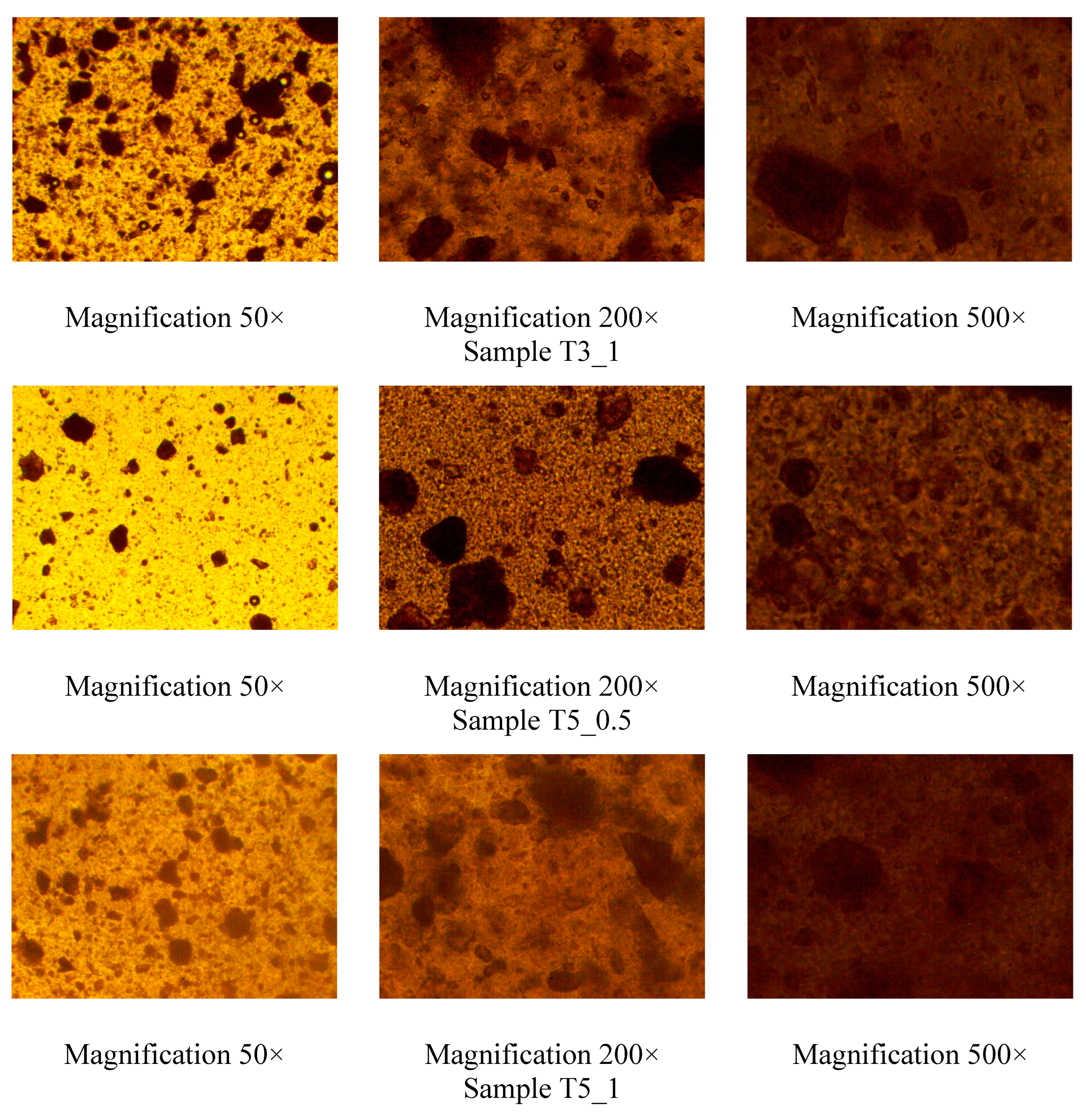
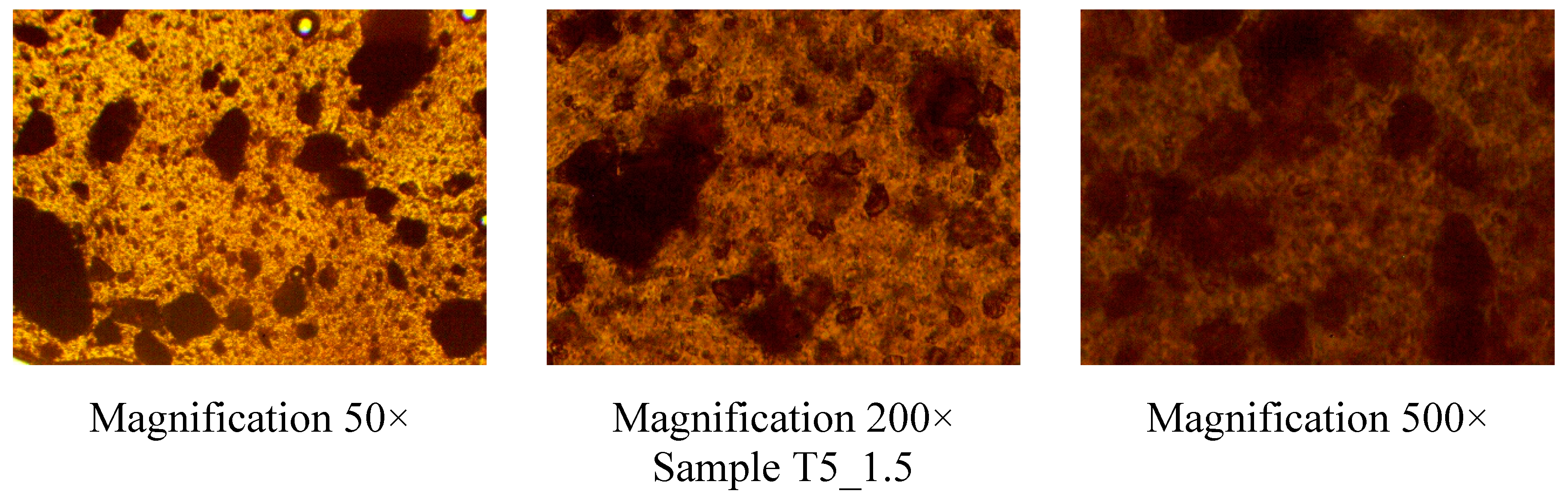
Figure 2.
The SSE 3D-printed lattices were obtained from the rutin-PEO gels.
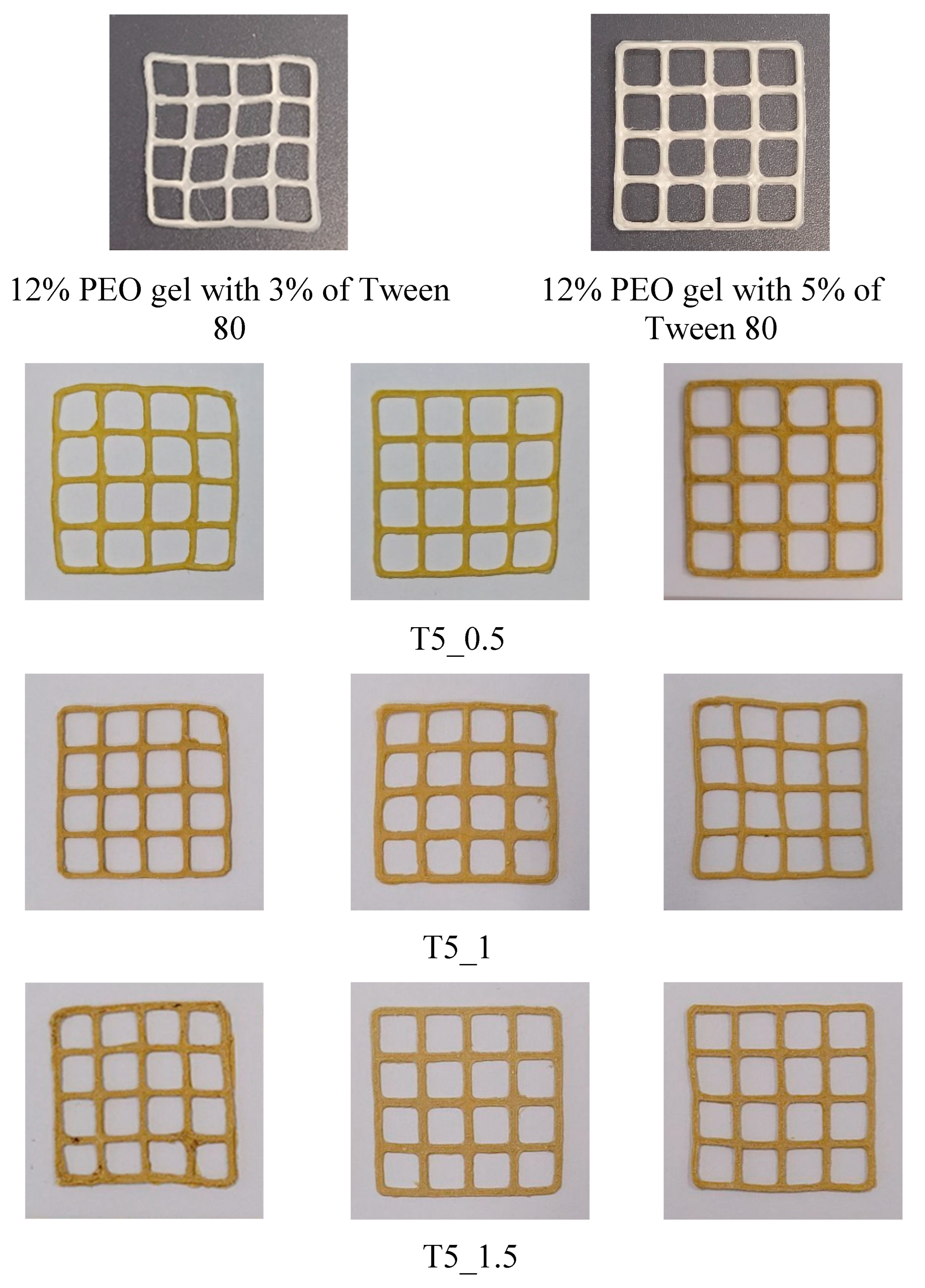
Figure 3.
Typical high-performance liquid chromatography (HPLC) chromatograms for rutin in the assay of the semisolid extrusion (SSE) 3D-printed preparations. Key: rutin reference standard (black chromatogram in the upper figure) and rutin in the SSE 3D-printed preparations (pink and blue chromatograms in the lower figure).
Figure 3.
Typical high-performance liquid chromatography (HPLC) chromatograms for rutin in the assay of the semisolid extrusion (SSE) 3D-printed preparations. Key: rutin reference standard (black chromatogram in the upper figure) and rutin in the SSE 3D-printed preparations (pink and blue chromatograms in the lower figure).
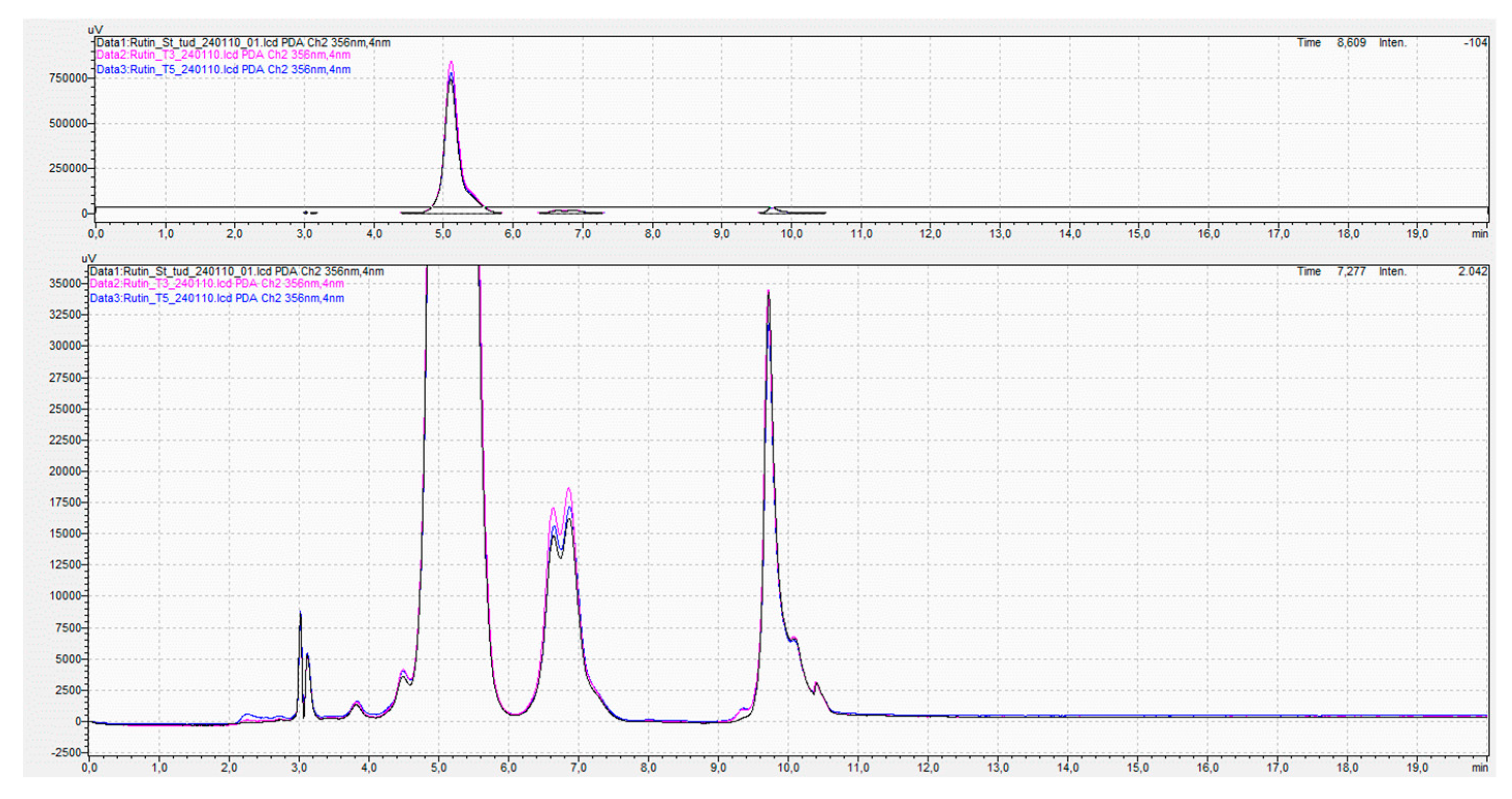
Figure 4.
Disintegration of the SSE 3D-printed PEO scaffolds loaded with rutin in purified water at a room temperature at 22 ± 2 °C (pilot test): (A) 0 min; (B) 10 min; (C) 20 min (without mixing); (D) 20 min (with gentle mixing); (E) 60 min (with gentle mixing) (n = 3). Disintegration test according to the European Pharmacopoeia in purified water at 37 ± 0.5 °C: (F) 0 min; (G) 7 min; (H) 30 min (n = 6).
Figure 4.
Disintegration of the SSE 3D-printed PEO scaffolds loaded with rutin in purified water at a room temperature at 22 ± 2 °C (pilot test): (A) 0 min; (B) 10 min; (C) 20 min (without mixing); (D) 20 min (with gentle mixing); (E) 60 min (with gentle mixing) (n = 3). Disintegration test according to the European Pharmacopoeia in purified water at 37 ± 0.5 °C: (F) 0 min; (G) 7 min; (H) 30 min (n = 6).
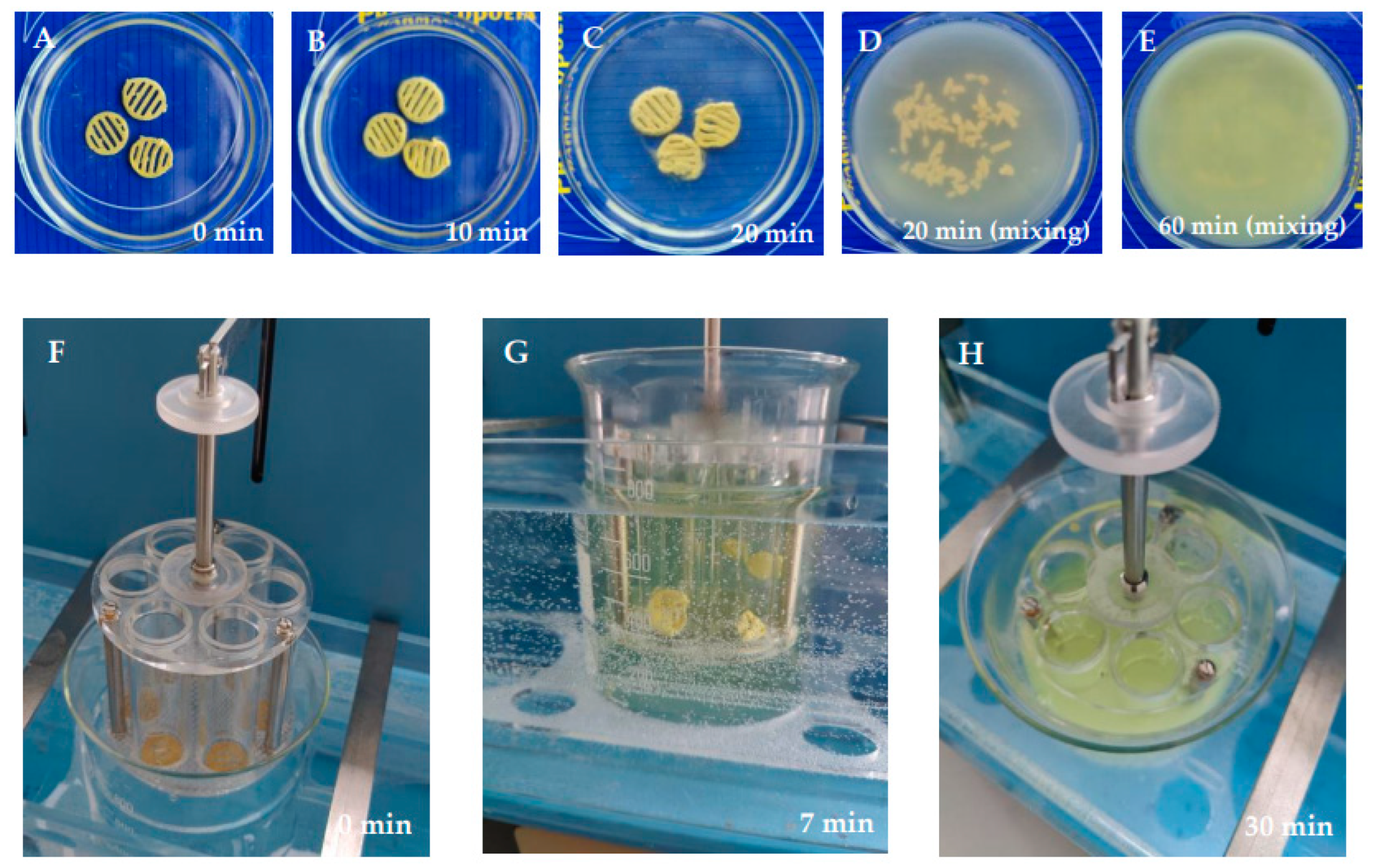
Figure 5.
Dissolution of the SSE 3D-printed PEO scaffolds loaded with rutin in purified water at 37 ± 0.5 °C (n = 4).
Figure 5.
Dissolution of the SSE 3D-printed PEO scaffolds loaded with rutin in purified water at 37 ± 0.5 °C (n = 4).
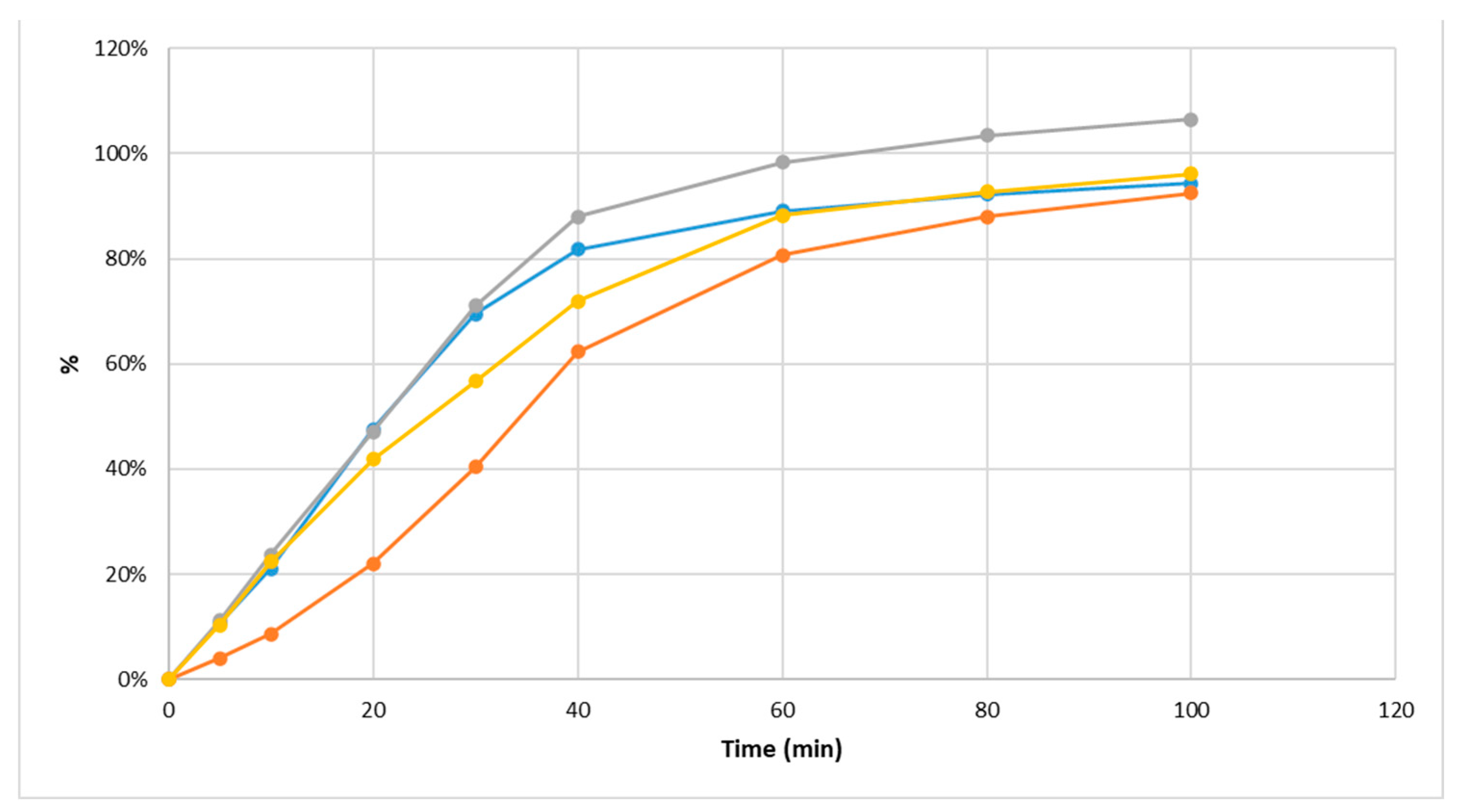

Table 1.
Composition of the PEO gels loaded with rutin.
| Exp. | Rutin, g | Tween 80, g | PEO, g | Ethanol, ml | Water, ml |
|---|---|---|---|---|---|
| T3_1 | 1.00 | 0.30 | 1.20 | 1.00 | 9.00 |
| T5_0.5 | 0.50 | 0.50 | 1.20 | 1.00 | 9.00 |
| T5_1 | 1.00 | 0.50 | 1.20 | 1.00 | 9.00 |
| T5_1.5 | 1.50 | 0.50 | 1.20 | 2.00 | 8.00 |
Table 2.
The viscosity of the PEO gels loaded with rutin.
| Sample | Viscosity, cP (speed 0.03 RPM, shear rate 0.060 1/s, temperature 22 ± 2 °C, n = 3) |
|---|---|
| T3_1 | 219,867 ± 27,380 |
| T5_0.5 | 250,867 ± 13,169 |
| T5_1 | 223,367 ± 14,712 |
| T5_1.5 | 226,567 ± 9,845 |
Table 3.
Weight and surface area of the semisolid extrusion (SSE) 3D-printed polyethylene oxide (PEO) based lattices loaded with rutin (n = 3).
Table 3.
Weight and surface area of the semisolid extrusion (SSE) 3D-printed polyethylene oxide (PEO) based lattices loaded with rutin (n = 3).
| Sample | Weight, mg | Area (S), mm2 | Spractical / Stheoretical |
|---|---|---|---|
| T5_0.5 | 117.7 ± 1.3 | 336.3 ± 28.5 | 1.04 |
| T5_1 | 163.0 ± 18.0 | 339.9 ± 20.8 | 1.05 |
| T5_1.5 | 184.2 ± 16.4 | 389.2 ± 24.4 | 1.20 |
Table 4.
The SSE 3D-printed disc preparations were obtained from rutin-PEO gels.
| Sample | Weight, mg | Photographs |
|---|---|---|
| T5_0.5 | 90.2 ± 4.2 | 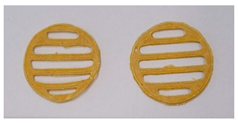 |
| T5_1 | 168.2 ± 8.4 | 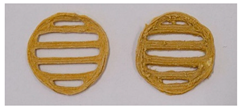 |
| T5_1.5 | 165.7 ± 7.8 | 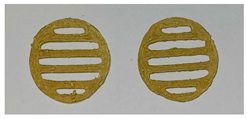 |
Table 5.
Assay of rutin in the semisolid extrusion (SSE) 3D-printed scaffolds by UV spectrophotometric and high-performance liquid chromatography (HPLC) methods.
Table 5.
Assay of rutin in the semisolid extrusion (SSE) 3D-printed scaffolds by UV spectrophotometric and high-performance liquid chromatography (HPLC) methods.
| Sample | Content of rutin, % (n = 3) | ||
|---|---|---|---|
| Theoretical | UV spectrophotometry | HPLC | |
| T5_0.5 | 22.72 | 17.23 ± 0.23 | 18.5 |
| T5_1 | 36.79 | 31.21 ± 0.36 | 30.1 |
| T5_1.5 | 46.42 | 42.35 ± 0.49 | 41.1 |
Disclaimer/Publisher’s Note: The statements, opinions and data contained in all publications are solely those of the individual author(s) and contributor(s) and not of MDPI and/or the editor(s). MDPI and/or the editor(s) disclaim responsibility for any injury to people or property resulting from any ideas, methods, instructions or products referred to in the content. |
© 2025 by the authors. Licensee MDPI, Basel, Switzerland. This article is an open access article distributed under the terms and conditions of the Creative Commons Attribution (CC BY) license (http://creativecommons.org/licenses/by/4.0/).
Copyright: This open access article is published under a Creative Commons CC BY 4.0 license, which permit the free download, distribution, and reuse, provided that the author and preprint are cited in any reuse.


