

Submitted:
05 April 2025
Posted:
08 April 2025
You are already at the latest version
Abstract
The Great Indian Bustards (GIBs) are critically endangered species found in the grassland and arid regions of southern and western India, potentially spanning over around 90,000 square kilometres of Rajasthan, Maharashtra, Gujarat, and Karnataka. The Indian State of Rajasthan is the homeland of GIBs. Recent research reveals a sure extinction of GIBs due to expansion of overhead power line transmission and wind turbines in the region of GIBs habitat. This research paper examines the incorporation of environmental rule of law within the Indian environmental legal frameworks to explore the equilibrium between the human right to development and human rights of the environment informed by international environmental laws. This research paper finds that the expert reports are not in favour of converting overhead power line transmission into underground power line transmission for several reasons, as well as the geospatial capacity of the region for wind energy generation cannot be abandoned to shift from fossil-based energy. The solutions to protect GIBs are ex-situ incubation of GIBs, incentivizing civic engagement in the conservation of GIBs, banning cattle grazing over the GIBs habitat region, banning use of pesticides in agricultural fields near the GIB priority areas, and installation of bird diverters on the overhead power transmission lines.
Keywords:
modalities of GIBs conservation
; causes of GIBs extinction
; overhead power transmission lines and wind turbines
; civic engagement
; ban on cattle grazing and use of pesticides
INTRODUCTION
The debate over conservation of the Great Indian Bustard (GIB) has re-begun after appointment of seven member expert committee by the Supreme Court on 21st March 2024 to explore the possibility of transforming overhead power lines into underground power lines and installation of renewable energy generation alternatives balancing GIB conservation measures in the priority areas of Rajasthan, Maharashtra, Gujarat, and Karnataka.1 The GIB (scientific name is ardeotis nigriceps) is one of the rarest bird in the world belonging to avian species that is profoundly found in the grassland and arid regions of southern and western India potentially spanning over around 90,000 square kilometers area of Rajasthan, Maharashtra, Gujarat, and Karnataka. The State of Rajasthan is homeland of GIB with largest population of 150 GIB.2 Due to rapid and steady decline in the GIB population, the International Union for Conservation of Nature (IUCN) 3 has declared the GIB a ‘critically endangered species’ in 2011 and it is listed in Schedule I of the Wildlife (Protection) Act-1972 (WPA-1972) as protected bird. The WPA-1972 prohibits hunting of GIB4 and declares hunting, keeping or dealing in GIBs punishable with imprisonment not less than one year that may extend to seven years and also with a fine not less than ten thousand rupees.5
The GIBs lay their eggs on open grasslands and scrublands land for near one month. They have wide sideways vision to detect predators precisely at the cost low frontal vision that eventually lead to non-detection of overhead power lines and wind turbines while flying even at a close distance and results into their death due to collision with power wires and wind turbines. The Wildlife Institute of India (WII) reports death of around 16 GIB per year due to collision with overhead power lines and wind turbines that are the major reason of unsustainability of GIB and becoming sure reason for its extinction.6 Overhead power lines and wind turbines have added into traditional threat to the survival of GIBs that includes conversion of grasslands and scrublands into agricultural fields, use of pesticides, hunting and poaching, and predation etc.
The Government of India has introduced the National Guidelines for Recovery of Bustards-2013 in the GIBs inhabitation States. The guideline incorporates a multi-pronged approach such as strict safeguards and maintenance of breeding cages based on research, cohabitation with beneficial land uses and mitigation of unfavourable land uses in priority habitats of nearby landscapes that have been scientifically identified, community involvement in conservation through awareness along with incentives and captive population development as a safeguard against extinction and potential restoration.
This research paper examines environmental rule of law to investigate legitimacy of civic engagement in the conservation of critically endangered GIBs exploring rights of people to actively participate in the developmental activities, right to get timely information related to environmental impacts supposed to be caused by proposed developmental activities.
THE ANATOMY OF ENVIRONMENTAL RULE OF LAW
The rule of law is a pre- Aristotelian era principle of legality that represents existence of certain essential, unchangeable and ubiquitous features in a legal system to operate regardless of space and time. Aristotle argued for ‘rule of law’ over the ‘rule of men’ in his seminal book ‘Politics’ to establish and maintain social order that maximizes wellbeing of people and their ability to achieve the good.7 Aristotle was aware of the fact that a rule is inherently lifeless unless applied by a set of human interventions that enables men to control the rule but not vice-versa.8 Nevertheless, he preferred rule of law over the rule of man since a rule of law is a careful logical and rational scheme of governance that is applied to all societies in all situations. Relying upon Aristotelian idea that rule of law is better than the rule man, Flores and Himma (2013) present a popular expression that no one is higher than law; the rule of law shall prevail, not the rule of people; and the rule of law is nothing but a set of orders created by the law.9 Similarly, Lord Bingham (2007) warns that greater governmental discretion poses greater scope for subjection and arbitrariness and that is antithesis to the rule of law.10
The dominating discourse of rule of law includes restriction on arbitrary use of power and formal legality of a legal system. It has been considered essential for the good governance and protection of human rights across the world. There had been great deal of discourse on the agreement over the essential components of the rule of law to formally legalize a legal system. With the passes of time the concept of rule of law has received universal clarity and acceptance. The rule of law has become a powerful rhetorical tool in the contemporary society.11 The United Nations (UN) has referred rule of law as a principle of governance in which all persons, institutions and public-private entities including State are equally accountable to laws that are publicly manifested, uniformly enforced, and independently adjudicated and that are in consonance with the international human rights norms and standards. Per the UN, the rule of law entails strict adherence with the principles of supremacy of law, equality before the law, separation of powers, civic participation in policy-making, certainty of law, absence of arbitrariness and biasness, fairness of law, procedural and legal transparency, and accountability to law.12 Accordingly, the United Nations presents a sum of criteria for the rule of law that is symmetrical to the Fuller’s eight typical criteria of legality of law. Fuller’s seminal list of legality criteria of law includes (1) the law should be general, publically promulgate and clear; (2) the law should not demand something that is impossible to perform; (3) the law should come into effect with prospectively; (4) the law should be understandable by prudent persons; (5) the law should be free from contradictions; (6) the law should be relatively stable and congruent; (7) the law should be consistent and constantly applicable equally to all persons in all cases; and (8) there should be a congruence between official action and declared rules.13
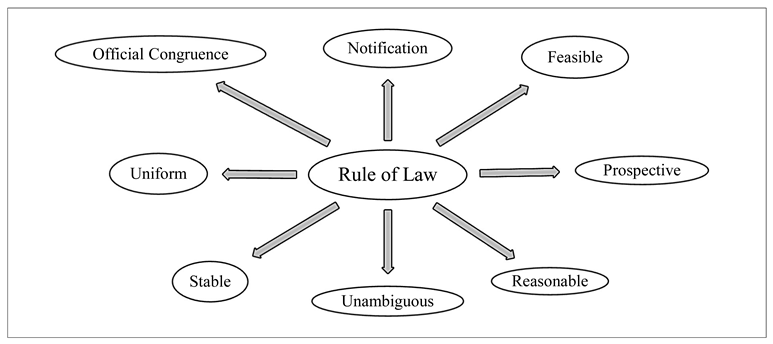
Rule of law is critically considered necessary for the environmental protection and sustainable development and it emerges as ‘rule of law for nature’14 or ‘environmental rule of law’ that reflects one of the paradigms of environmental constitutionalism.15 Environmental rule of law is distinct from environmental governance. Later covers a broad range of principles and approaches concerned with environmental decision making and implementations; whereas, former is anxious for implementation, compliance and enforcement of environmental laws.16
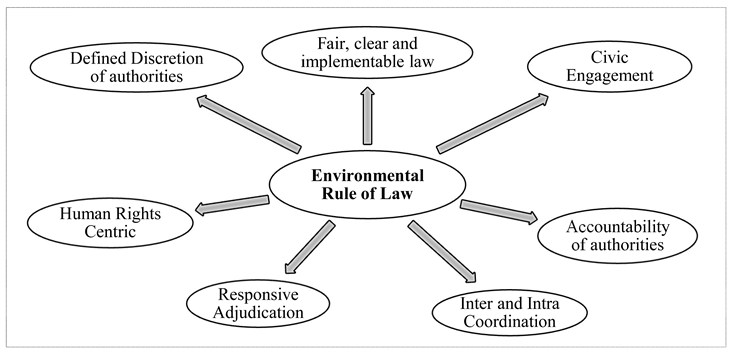
The UN Environmental Programme (UNEP) has developed concept of environmental rule of law forming a part of its normative agenda in 2012 in the Rio+20 Conference.17 The UNEP has considered and declared the environmental rule of law central to the sustainable development. Rule of law does transparent and sustainable management natural resources, which is engine for SD and a platform for the peace and justice.18 The UNEP has made an appeal to the global community in March 2015 to adopt seven core elements of environmental rule law (ERL) for environmental justice (EJ) and sustainable development (SD) to all through a just, efficient and translucent institution. The UNEP (2015) identifies seven core constituents of environmental rule of law that includes:19
- Fair, clear and implementable environmental laws: environmental laws should be fair and non-discriminatory in their development, application and impact, it should be unambiguously understandable and could be implemented to effectively address institutional, cultural and economic context of the nation.
- Right to information, civic involvement and right to justice: right to information enables citizenry to identify environmental violations and determine the methodology to get engaged. Civic involvement in environmental decision-making contributes in formulation of fair and implementable laws and improves public support and compliance. Right to justice calibrates right to environmental information, per Principle 10 of the Rio Declaration, and civic participation and access of people to the adjudicating authorities for enforcement of their rights and resolving disputes.
- Accountability and integrity of institutions and decision makers: environmental institutions must demonstrate accountability, transparency and integrity to ensure public support and compliance and to deliver effective environmental protection.
- Clear and coordinated mandates and roles, across and within institutions: environmental governance is carried out through multiple normative agencies (statutory, customary, and religious), levels (international, national and local) and sectors (air, water, forest, agriculture, waste management etc.) resulting in institutional overlap and gaps. Clear mandates and cross-sectoral coordination are essential for effective implementation of environmental laws.
- Accessible, fair, impartial, timely and responsive adjudication: dispute resolution and enforcement mechanisms that are fair, impartial, timely and responsive increase compliance with environmental regulations and support environmental initiatives and civic trust in the judicial process.
- Recognition of the mutually reinforcing relationship with human rights: environmental rule of law has a mutually reinforcing relationship with constitutional, human and other rights. A healthy environment is necessary for realizing rights to life, property and health as well as cultural, economic and political rights. Constitutional, human and other rights including both substantive and procedural rights provide tools for strengthening and enforcing environmental protection. And
- Specific criteria for the interpretation on environmental law: clear and detailed guidance on environmental laws enable implanting agencies to adopt consistent regulations and enforcement practices and facilitate compliance on the part of regulated communities and the public.
CIVIC RIGHTS TO PARTICIPATE IN THE DEVELOPMENTAL ACTIVITIES
Development is the pre-condition of human survival.20 Right to development has been recognized in the Universal Declaration of Human Rights, 1948 (UDHR) in three different manners; first, individuals are entitled to socio-economic-cultural rights within their national resources for their dignity and free development of personality;21 secondly, State has duty to formulate educational policies that must direct full development of human personality and strengthen respect for human rights,22 and thirdly, individuals shall perform their duties to their communities for free and full development of their personality.23 The right to socio-economic-cultural development of the individuals has been centrally dealt in the International Covenant on Social, Economic and Cultural Rights, 1966 that typically recognizes right of self-determination of people to pursue their socio-economic-cultural development24 and duty of State to formulate technical, vocational and training programmes as well as maintain healthy working conditions25 improve food production, consumption and distribution efficiently utilizing natural resources26 and provide progressive education.27 The United Nations Declaration on the Right to Development, 1986 (UNDRTD) declares right to development an inalienable human rights28 and human beings to be the central subject of development and active participants and beneficiary of the development29 that is carried out, individually or collectively, considering human rights norms30 within the national developmental policies formulated by the States31 exercising their right to self-determination over the natural resources.32 The UNDRTD holds responsibility of the States’ to create international and national development conditions,33 formulate policies,34 eliminate apartheid laws,35 afford equal opportunity to access basic resources-education-health services-food-hosing-employment,36 and encourage civic participation in the developmental activities.37
Active civic engagement in the developmental activities is integral part of the environmental rule of law that has been declared core right in the UNDRTD. The civic engagement is coupled with civic responsibility to carry out development in the pursuit of their right to self-determination utilizing natural resources subject to the national policies in consonance with the International human rights laws.
The environmental rule of law does recognize people’s right to active participatory development with environmental care that suffices needs of present generation without compromising developmental ability of future generation to meet their needs under Principle 2 of the United Nations Conference on Human Environment (UNHCE)-1972, and Principles 10, 20 to 22 of the Rio Declaration-1992.38
CIVIC RIGHTS TO INFORMATION RELATING TO ENVIRONMENTAL IMPACTS OF DEVELOPMENTAL ACTIVITIES
Right to information has emerged as a potent democratic tool for the maintenance of transparency and accountability in the performance of legal liabilities by the public authorities that garners peoples’ confidence in the pursuit of legitimacy of law. The international community has devised the process of environmental impact assessment (EIA) of proposed economic activities. The EIA procedure in builds timely information to the stakeholders relating to the environmental impacts that are likely to occur due to proposed economic activities. The United Nations Conference on Environment and Development-1992 (UNCED) delivers for the people’s right to timely information about the environmental impacts of a proposed economic activity asking signatory States to develop necessary national legal instruments under Principle 17 of the Rio Declaration-1992.39 The Agenda 21 and the Rio Forest Principles also require the EIA process in trade, business and industries for the achievement of SD and mitigation of health stresses.40 The Rio Declaration, Agenda 21 and Rio Forest Principles are non-binding international environmental instruments. The UNCED has delivered two binding international environmental instruments: the Convention on Biological Diversity and the United Frameworks and Climate Change. These two binding environmental laws prescribe for mandatory EIA process to adverse effects of economic activities along with civic engagement.41
GOVERNMENT PLANS FOR THE CONSERVATION OF GIBs
The Central Government through its Ministry of Environment, Forest and Climate Change (MoEFCC) has introduced several plans for the conservation of GIBs. It includes the National Guidelines for Recovery of Bustards-2013; launching of the Bustard Recovery Project in 2016 in collaboration with Government of Rajasthan; signing of tripatie agreement between MoEFCC, Government of Rajasthan and Wildlife Institute of India (WII) in 2018. The National Compensatory Afforestation Fund Management and Planning Advisory (CAMPA) Council funds State Governments, local NGOs and research organizations to recover GIBs, carry out ex-situ incubation of their eggs, release adult GIBs in the wild, track movement of GIBs through telemetry and involve local communities in the conservation of GIBs improving habitat of the GIBs.42
JUDICIAL OBSERVATION ON THE CONSERVATION OF GIBs
The Supreme Court of India has sincerely considered issue of deaths and extinction of GIBs caused by overhead power lines and wind turbines in M.K. Ranjitsingh v. Union of India.43 The court had appointed expert committee on 19th April 2021 to find out possibility of shifting overhead power transmission line into underground and issued orders to immediately install bird diverters on the overhead power transmission lines and wind turbines existing in the priority of potential area of GIB until overhead power lines are converted into underground. The court restricted new expansion of overhead power transmission lines wind turbines in the priority of potential area of GIB. Owing to the impossibility of transforming overhead power transmission lines into underground and necessity to shift from fossil based energy production to renewable energy production for the sake of controlling climate change under India’s international commitment, the Ministry of Environment, Forests, and Climate Change, the Ministry of Power, and the Ministry of New and Renewable Energy filed IA No. 149293 of 2021 to modify direction issued by the court on 19th April 2021.
The court noted India’s commitment to combat with climate change under the international conventions. India has signed the Kyoto Protocol, being a party to the United Nations framework Convention on Climate Change (UNFCCC), and undertaken globally acknowledge common but differentiated responsibility to take steps to reduce human induced global warming to protect the climate system that shall benefit the present generation and generations to come in future as well as to a healthy ecosystem. Precautionary and preventive measures are the key steps in this field of ecological accountability. India, being signatory to the 18th Conference of the Parties (COP) at Doha in 2012, agreed to conclude a binding universal agreement to set timeline for the reduction of level of green house gases (GHGs) emission that is required for prevention of global temperature from increasing more than 20 Celsius above the temperature before the industrial revolution. The COP 21 in 2015 has eventually brought this binding universal agreement with Paris Agreement that required signatory States to submit their nationally determined contribution (NDC) to reduce the emission of GHGs periodically at the interval of five years. India has submitted its NDC in 2015 and pledged to take steps to convert fossil based energy sector into non-fossil renewable energy sectors by 2030.
The preamble of the Paris Agreement has recognized interconnection between the climate change and human right that is reproduced here under
“Acknowledging that climate change is a common concern of humankind, Parties should, when taking action to address climate change, respect, promote and consider their respective obligations on human rights, the right to health, the rights of indigenous peoples, local communities, migrants, children, persons with disabilities and people in vulnerable situations and the right to development, as well as gender equality, empowerment of women and intergenerational equity.”
The court has further noted the significance of clean and healthy environment for the enjoyment of right to life guaranteed under article 21 of the Indian Constitution and duty of State not only to protect the environment bit also improve the environment taking necessary actions.44
The court recognized the geographically arid desert of Rajasthan and Gujarat most suitable spot for the solar power generation that is free from cloud cover and precipitation necessary for uninterrupted solar power generation.
Followed by above observations and serious concern for the conservation of GIBs, the court left the issue of shifting overhead power transmission lines to underground lines with the government agencies and experts. However, the court recorded several other reasons for the decline of GIBs population that includes hunting and poaching, loss of GIB’s habitat due to conversion of grasslands and scrublands into agricultural fields, grazing of GIB’s fodder by animals etc.
CONCLUDING REMARKS
The GIBs are peculiar indicators of biological diversity and ecological health of the region that they occupy. They are part and parcel of the nature. Their conservation is essential for the conservation of environment and nature. Though the developmental programmes pose threat to survival of GIBs, but we can neither stop the development nor turn the clock back. The courts have limited space to oversee such technical issues and deliver certain concrete solution to the problems like shifting of overhead power transmission lines into underground power transmission lines and transforming energy generation from fossil fuels to renewable sources such as solar panels and wind turbines. The court can suggest for fixing of bird diverter devises on the overhead power lines and wind turbines as well as strengthening community involvement programmes only. However, the programmes launched by the Central and State executives have been remarkably effective for the conservation of GIBs in the region. However, there are certain suggestion for the conservation and recovery of GIBs that are listed below:
- Habitat of the GIBs should be protected and improved by incentivizing local community members;
- Habitat of the GIBs should be protected from the predators by capturing and trans-locating predators from the habitat areas of the GIBs;
- Domestic animal grazing should be banned within the region declared for the habitat of GIBs;
- Use of pesticides in the agricultural fields should discouraged by awaking and incentivizing peasants nearby the habitat of GIBs;
- Incentivizing local farmers to use their lands in a manner that is bustard-friendly;
- Local community members should be encouraged and involved to collect eggs of GIBs outside the GIBs sanctuaries and return them to the captive incubation centers;
- Installation of birds diverting tools on the overhead power transmission line and wind turbines should be promoted and caliberized periodically and effectively;
- Captive GIBs breading and incubation should be advanced at the ex-situ centers established and managed by the government agencies or private centers that are controlled by the government agencies; and
- Installation of bird diverters on the overhead power transmission lines and wind turbines.
PROSPECTS OF FUTURE RESEARCH AND DEVELOPMENT
Vulnerability to the GIBs is caused by numerous factors, overhead power transmission line and wind turbines are one of them. The WII and some NGOs are studying in this field; nonetheless there is dearth of literature and data on the conservation of GIBs. The ecological significance of the GIBs and contemporary compelling demand for the development in various sectors including energy sectors offers research and development opportunities to find out a balancing approach to conserve the GIBs and promote safe and clean energy.
| 1 | Ajoy Sinha Karpuram, “How Supreme Court is overseeing conservation of the Great Indian Bustard,” The Indian Express. March 27, 2024. Accessed from https://indianexpress.com/article/explained/explained-law/supreme-court-conservation-great-indian-bustard-9234896/
|
| 2 | Wildlife Institute of India, Habitat improvement and conservation breeding of great Indian bustard: an integrated approach. Accessed from https://wii.gov.in/campa_gib
|
| 3 | Supra note 1. |
| 4 | The Wildlife (Protection) Act, 1972. Section 9. |
| 5 | Ibid. Section 51. |
| 6 | Wildlife Institute of India 2018 Power-Line Mitigation Measures. Second edition (2020). Accessed from https://wii.gov.in/images//images/documents/publications/rr_2020_GIB%20Power-line_mitigation_conserve_bustards.pdf
|
| 7 | Courtney Taylor Hamara, “The Concept of the Rule of Law,” in I. B. Flores, K. E. Himma (eds.), Law, Liberty, and the Rule of Law 11–26 (Springer Netherlands, Dordrecht, 2013), xviii. |
| 8 | J. Hampton, “Democracy and the rule of law,” in I. Shapiro (ed.), The Rule of Law Nomos XXXVI (New York University Press, London, 1994). |
| 9 | Imer B. Flores and Kenneth Einar Himma, “Introduction,” in I. B. Flores, Kenneth E. Himma (eds.), Law, Liberty, and the Rule of Law 1–9 (Springer Netherlands, Dordrecht, 2013), xviii. Accessed from https://doi.org/10.1007/978-94-007-4743-2_1
|
| 10 | Lord Bingham, “The Rule of Law,” 66 The Cambridge Law Journal 67–85 (2007). Accessed from https://doi.org/10.1017/S0008197307000037
|
| 11 | Courtney Taylor Hamara, “The Concept of the Rule of Law,” in I. B. Flores, K. E. Himma (eds.), Law, Liberty, and the Rule of Law 11–26 (Springer Netherlands, Dordrecht, 2013), xviii. |
| 12 | United Nations Secretary-General, The Rule of Law and Transitional Justice in Conflict and Post-Conflict Societies 1–24 (United Nations Security Council, New York, 2004). |
| 13 | Lon L. Fuller, The Morality of Law, Rev. ed (Yale University Press, New Haven, 1977). |
| 14 | Christina Voigt (ed.), Rule of Law for Nature: New Dimensions and Ideas in Environmental Law (Cambridge University Press, Cambridge, United Kingdom, 2013). |
| 15 | Louis J. Kotzé, “Six Constitutional Elements for Implementing Environmental Constitutionalism in the Anthropocene,” 1st ed., in E. Daly, J. R. May (eds.), Implementing Environmental Constitutionalism 13–33 (Cambridge University Press, 2018). https://doi.org/10.1017/9781316691588.003
|
| 16 | United Nations Environment Programme, Environmental Rule of Law: Tracking Progress and Charting Future Directions 15 (United Nations Environment Programme, 2023). https://doi.org/10.59117/20.500.11822/43943
|
| 17 | United Nations Environment Programme, Environmental Rule of Law: Tracking Progress and Charting Future Directions 17 (United Nations Environment Programme, 2023). https://doi.org/10.59117/20.500.11822/43943; Carl Bruch, Environmental Rule of Law: First Global Report (United Nations Environment Programme, Nairobi, 2019). |
| 18 | United Nations Environment Programme, Environmental Rule of Law: Critical to Sustainable Development (Issue Brief). (March 2015). (United Nations Environment Programme. 2015). Accessed from https://wedocs.unep.org/handle/20.500.11822/10664
|
| 19 | United Nations Environment Programme, Environmental Rule of Law: Tracking Progress and Charting Future Directions 17 (United Nations Environment Programme, 2023). https://doi.org/10.59117/20.500.11822/43943; UNEP. (2015). United Nations Environment Programme, Environmental Rule of Law: Critical to Sustainable Development (Issue Brief). (March 2015). (United Nations Environment Programme. 2015). Accessed from https://wedocs.unep.org/handle/20.500.11822/10664
|
| 20 | Saman Narayan Upadhyay, “Global Legal Norms on Environment and Sustainable Development in 21st Century,” in R. Prasad, M. K. Jhariya, et al. (eds.), Advances in sustainable development and management of environmental and natural resources. 59–107 (Apple Academic Press, Palm Bay, FL, USA, 2022), ii. |
| 21 | The Universal Declaration of Human Rights, 1948. Article 22. Accessed from https://www.ohchr.org/sites/default/files/UDHR/Documents/UDHR_Translations/eng.pdf
|
| 22 | Ibid. Article 26. |
| 23 | Id. Article 29 (1). |
| 24 | The International Covenant on the social, economic and cultural rights, 1966. Article 1 (1). Accessed from https://www.ohchr.org/en/instruments-mechanisms/instruments/international-covenant-economic-social-and-cultural-rights
|
| 25 | Ibid. Article 6(2). |
| 26 | Id. Article 11(2)(b). |
| 27 | Id. Article 13(2)(e). |
| 28 | The United Nations Declaration on the Right to Development, 1986. Article 1(1). Accessed from https://www.ohchr.org/sites/default/files/rtd.pdf
|
| 29 | Ibid. Article 2(1). |
| 30 | Id. Article 2(2). |
| 31 | Id. Article 2(3). |
| 32 | Id. Article 1(2). |
| 33 | Id. Article 3(1). |
| 34 | Id. Article 4(1). |
| 35 | Id. Article 5. |
| 36 | Id. Article 8(1). |
| 37 | Id. Article 8(2). |
| 38 | Saman Narayan Upadhyay and Milendra Singh, “Community participation in wildlife conservation to promote environmental constitutionalism and sustainability in India,” 10 International journal for Innovative Research in Multidisciplinary Field 224–32 (2024). https://doi.org/10.2015/IJIRMF/202401036
|
| 39 | Saman Narayan Upadhyay and Milendra Singh, “Environmental clearance and sustainable development: changing paradigm of environmental constitutionalism in Indian” The Journal of Multidisciplinary Research 8–18 (2024). https://doi.org/10.37022/tjmdr.v4i1.560
|
| 40 | Ibid. |
| 41 | Id. |
| 42 | Supra note 2. |
| 43 | Writ Petition (Civil) No. 838 of 2019 along with Civil Appeal No. 3570 of 2022. Accessed from https://main.sci.gov.in/supremecourt/2019/20754/20754_2019_1_25_51677_Judgement_21-Mar-2024.pdf
|
| 44 | The court has already ruled in Virender Gaur v. State of Haryana, (1995) 2 SCC 577 that “The State, in particular has duty in that behalf and to shed its extravagant unbridled sovereign power and to forge in its policy to maintain ecological balance and hygienic environment.”
|
Disclaimer/Publisher’s Note: The statements, opinions, and data contained in all publications are solely those of the individual author(s) and contributor(s) and not of MDPI and/or the editor(s). MDPI and/or the editor(s) disclaim responsibility for any injury to people or property resulting from any ideas, methods, instructions, or products referred to in the content. |
© 2025 by the authors. Licensee MDPI, Basel, Switzerland. This article is an open access article distributed under the terms and conditions of the Creative Commons Attribution (CC BY) license (http://creativecommons.org/licenses/by/4.0/).
Copyright: This open access article is published under a Creative Commons CC BY 4.0 license, which permit the free download, distribution, and reuse, provided that the author and preprint are cited in any reuse.


