

Submitted:
03 April 2025
Posted:
07 April 2025
You are already at the latest version
Abstract
Subterranean habitats in general and caves in particular harbour a unique set of organisms that are adapted to the dark and nutrient-limited environment. The high selection pressure and limited geneflow between semi-isolated caves have generally resulted in a high level of endemicity among the depauperate cave fauna. The cave fauna is vulnerable to a range of anthropogenic factors including mining and excessive usage as show caves. The awareness of the need for conservation of this unique habitats has been growing in recent years, but not uniformly. In this paper, we use Web of Science to look at how the research output in the ecology and conservation area in Southern Africa compares to the rest of the world. We find that while Africa as a whole has a disproportionality low publication rate, Southern Africa is relatively well represented, though driven exclusively by South Africa. However, unlike the development in the rest of the world the number of publications has not risen much in recent years and is mainly focussed on vertebrates. In this paper, we discuss the reason for this discrepancy and use well known show caves in the region as case-studies to identify research priorities and promote more awareness of the conservation need of caves in Southern Africa.
Keywords:
Research trends
; cave biodiversity
; subterranean ecology
; cave tourism
; southern Africa
1. Introduction
Cave ecosystems support unique and vulnerable species that necessitate effective conservation strategies. Obligate cave species are uniquely adapted to the extreme cave conditions including permanent darkness, constantly high humidity and constant temperatures. The lack of primary production inside caves classifies caves as truncated resource-limited ecosystems. Due to the limited food resources, most cave-adapted species occur in low abundances [1]. Cave communities also exhibit high levels of endemism compared to epigean communities, possibly due to the insular nature of cave ecosystems. Consequently, these ecosystems are vulnerable to anthropogenic threats including direct threats from mining and developments arising from cave tourism as well as indirect threats from ground-water pollution and climate change [2]. While efforts have been made to conserve cave biodiversity, there is still a lack of appropriate evidence-based strategies to optimize the implementation and effectiveness of conservation efforts [3,4].
Identification of areas of high biodiversity or endemism levels is essential for the efficiency of biodiversity conservation initiatives as it optimizes the use of resources invested in conservation projects [5,6,7]. There are some frameworks for prioritization of species and habitats for conservation such as The International Union for Conservation of Nature (IUCN) [8,9,10]. However, many countries may have limited access to such data making it difficult to implement conservation initiatives for their habitats, which may be understudied and potentially vulnerable [11].
It is difficult to make evidence-based conservation decisions due to limited funding and capacity [12], therefore, developing effective strategies for prioritizing areas for conservation is critical [13,14]. Examples of efforts to develop such strategies based on specific quantifiable criteria include a bat cave vulnerability index (BCVI) [15]; a rapid assessment tool for identifying caves for conservation priority, developed and tested at caves of the southern Philippines. Using caves in southeastern Brazil, Souza et al. [4] evaluated several cave features as indicators for the biological significance of caves including the phylogenetic diversity, degree of endemism and the vulnerability of the caves, hence informing their prioritization for conservation. Other similar efforts include studies by Deltshev and Blagoev [16] in Bulgarian mountains, Sharratt et al. [17] for sandstone caves in South Africa, Munasinghe and Ranawana [18] in Sri Lanka, and Cardoso et al. [19] in northeast Brazil.
Many of the criteria that are used to identify caves of high conservation significance include the level of cave biodiversity and the degree to which species depend on the cave. Cave-inhabiting species depend on the cave environment to different degrees and hence have different degrees of adaptation to the cave environment [1]. The most prominent and studied adaptations of living in the permanently dark cave environment include loss of eyesight, reduced pigmentation and elongated appendages to enable food searching and finding mates [1,20], although recently a number of more subtle behavioural adaptations have also been well-documented [21,22,23]. According to the Schiner-Racovita system [1], which is based on the morphological adaptations of cave organisms, cave species are categorized as troglobionts, troglophiles and trogloxenes. Troglobionts are obligate cave species, generally exclusively found in the deeper parts of the caves where it is permanently dark and usually with very high humidity. Troglobionts therefore often have more well-defined adaptations for the cave environment (called troglomorphic features). Species that use caves occasionally such as flies and moths are classified as trogloxenes. Troglophiles are species that use caves to complete part of their life cycle but are still able to survive outside the cave including many cave spiders and bats. Trogloxenes and troglophiles are usually found in the entrance or the twilight zone [1]. For many caves in southern Africa, the cave communities are yet to be described in terms of these categories, although the region hosts some well-known endemic cave species such as the cave-dwelling catfish (Clarias cavernicola) from the Aigamas Cave system in Namibia [24].
Many countries are making efforts to conserve cave ecosystems because caves are spectacular geological sites with many of them being of archaeological importance and therefore exploited as tourist attraction sites. Globally, caves receive over 70 million visitors every year [25]. Cave tourism generates important revenue sources for the local communities in many countries [25,26]. Caves are therefore often developed to improve access into the caves and to improve their aesthetic appearance in order to boost cave tourism. Such developments include installing staircases at the entrance and lighting inside the caves [27]. Doors, bars and staircases at the entrance may impact the natural movements of trogloxenes and troglophiles into the cave, and lighting results in the so-called lampenflora, algae, moss and cyanobacteria growth, that changes the nutrient flow in the caves [28]. In caves, where little is known of their ecology, it is difficult to estimate how some of the cave developments will impact the cave ecosystem and its species. Ecological knowledge, including cave species inventories, species distributions within the cave and their interdependencies, is critical to ensure that cave developments are done in parallel to conservation of the ecosystems.
Despite being generally understudied, some caves in southern Africa are important tourist destinations, necessitating cave ecological studies in the region and establishment of conservation priority criteria. South Africa, for example, is one of the African countries with the highest number of show caves (7 caves) (Table 1), which generate an average annual revenue 3.5 million Euros [25]. Tourists visit caves for different purposes including viewing rock art [29] and for their aesthetic geological formations [30]. Some of the caves in southern Africa, such as Cango caves, are visited by about 300 000 tourists annually [27,31]. The Sterkfontein Caves in South Africa have gained international recognition as the cradle of humankind with numerous early hominid skeletons found [32], giving the cave high archaeological importance and potentially drawing international tourists to the region. From the current importance of caves for tourism in the region [29,33,34], it is anticipated that some caves will be developed in future to further increase tourism. This study aims to use case studies from southern African caves to evaluate ecological knowledge of the caves and hence highlight research needs that can inform conservation priorities in the region.
Specifically, we have the following three objectives:
- To examine how temporal trends in cave ecology studies in southern Africa compare with trends from the rest of the world.
- To demonstrate the need for cave biodiversity research in southern Africa using Botswana, Namibia and South Africa as case studies.
- To identify subterranean research and conservation priorities for southern Africa.
2. Materials and Methods
To examine how trends in cave ecological studies in southern Africa compares with trends from other parts of the world, relevant scientific articles were systematically retrived from Web of Science database (https://www.webofscience.com/wos/document/search). The data was searched in March 2023 for relevant peer-reviewed articles published during the period from 2003 to 2022. The search term TS=(„biodivers*” OR „conservation” OR „ecology”) AND TS=(„subterranea*” OR „cave” OR „hypoge*”) AND TS=(Region) were used to retrieve the relevant research articles. Initial results were screened for irrelevant hits (such as papers focusing on soil organisms or focussing on palaeontology or paleoecology). The following search terms were used for different parts; Southern Africa (Region=”Botswana”, Region=”Nambia” and Region=”South Africa”), Africa (Region = “Africa”), The Americas (comprising North and South America, Region = “America”), Asia (Region = “Asia”), Europe (Region = “Europe”) and for the total number of papers, the last search term with region omitted. The resulting hits arising from the specified search terms were manually inspected (title and journal) to remove non-relevant hits (mainly consisting of papers on soil-dwelling mammals and insects and on archaeology and human evolution). After removal, 37% of the Southern Africa hits remained, 26% of African, 68% of American, 63% of Asian, 61% of European and 51% of hits when no region was specified.
To compare the relative research output for microbes, macroinvertebrates and vertebrates in southern Africa, popular show caves in Botswana, Namibia and South Africa, were used as case studies. To examine the distribution of cave research publications between vertebrates, macroinvertebrates and vertebrates in the case study countries, we compared to a similar, in terms of population size, subregion in Europe; the Iberian Peninsula. We used the following search terms in the Web of Science databsase (search conducted on the 13th of June 2024): TS=(biodivers* OR conservation OR ecology) AND TS=(subterranea* OR cave OR hypoge*) AND TS=(Country) AND TS=(organism), where Country was either Botswana, Namibia, Portugal, “South Africa” or Spain, and organism was either (microb* OR bacteri* OR fung*), (vertebrate* OR bat* OR fish* OR salamand*) or (invertebrate* OR arthropod* OR insect* OR spider* OR crustace* OR mollusc*). The resulting hits were manually inspected by looking at title, journal and abstract with non-relevant results (mainly studies from different geographic regions or on non-subterranean or extinct organisms) were omitted from the analysis.
3. Results
3.1. Temporal Patterns of Cave Ecological Studies in Southern Africa and the World
Figure 1 indicates that Africa’s publication rate trails behind the other main continents, and perhaps more worryingly both Africa as a whole and Southern Africa in particular are not showing the growth in publications on subterranean biodiversity and conservation that the other continents have experienced in recent years. This trend remains, when we look at the total number of publications in each continent per one million inhabitants, where Africa has 0.05, The Americas 0.12, and Europe 0.20 although Asia with 0.02 has an even lower publication rate. It is, however, worth noting that the present search only included publications in the English language. Undoubtedly Asia (especially China) would have far more publications if non-English journals were included. Southern Africa, however, performs the best (due to its small population) with a publication rate of 0.67 per million inhabitants, where especially South Africa is a powerhouse with 39 out of 43 (Botswana and Namibia both have two).
Taking into consideration the amount of karst area, which is used in this as a proxy for cave occurrences, African has twice the total karst area compared to Europe. Despite the greater karst area, the African continent has a far lower number of publications per karst area than Europe. Africa’s total karst area is 4,054 000 km2 compared to Europe’s 2,167 000 km2 total karst area. Despite the greater karst area in Africa, it had on average only one publication on subterranean biodiversity and conservation per 100,000 km2 between 1951 and 2022, whereas Europe had a total of eight publications for an equivalent karst area during the same period (Figure 2). Within southern Africa, south Africa doesn’t not only have a greater karst coverage than Botswana and Namibia but it dominates scientific publications such that per 100,000 km2 , South Africa had 43 publications on cave biodiversity within the search period whereas Botswana and Namibia had none.
2.0. The distribution of ecological surveys between three different cave organisms in Botswana, Namibia and South Africa.
The results of our literature search on Web of Science indicate that ecological surveys for cave microbes, invertebrates and vertebrates up to June 2024 numbers less than 10 for each of Botswana, Namibia and South Africa. For all groups of organisms, most surveys are from South Africa, where the highest number of surveys is for vertebrates, followed by invertebrates and microbes in a descending order. In Namibia, no ecological surveys for microbes and invertebrates were found, only one ecological study for vertebrates was found. There was also no ecological survey for microbes in Botswana, while there was one study each on invertebrates and vertebrates (Table 1, Figure 2A). When we compare Southern Africa to a similar region in Europe with approximately the same number of inhabitants, we find that Southern Africa only has far fewer publications than the Iberian Peninsula focusing on microbes (where Spain has an impressive 19 studies) and invertebrates (where Portugal has the highest with 10), but has similar numbers when it comes to vertebrates (Spain only has 2 compared to South Africa’s 5) (Figure 2).
Figure 3.
Number of ecological surveys for different organisms in caves of Botswana, Namibia and South Africa (A) compared to caves in the Iberian Peninsula (B). The number of relevant publications found in the Web of Science database on the 13th of June 2024 with the search terms listed under methodology.
Figure 3.
Number of ecological surveys for different organisms in caves of Botswana, Namibia and South Africa (A) compared to caves in the Iberian Peninsula (B). The number of relevant publications found in the Web of Science database on the 13th of June 2024 with the search terms listed under methodology.
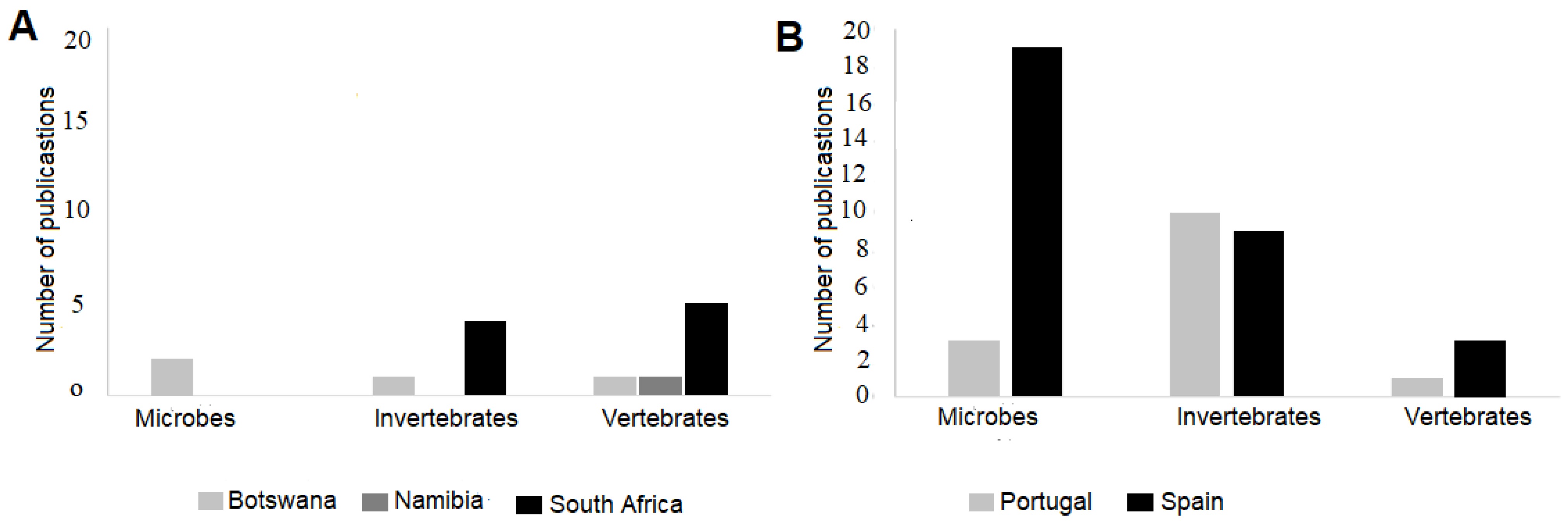
Using sample show caves from Botswana, Namibia and South Africa, it is evident that ecological and conservation research needs are similar across the region. The few ecological studies that have been done in the countries focused on taxa identification and community characteristics. Research on fundamental questions relating to cave ecosystem services, climate change impacts and human impacts on cave ecosystems is still lacking. Research priorities corresponding to these fundamental research questions were identified for each sample show cave across the three countries (Table 1)
4. Discussion
Our survey has shown that Africa as a whole, is behind other continents in terms of the publication rate on subterranean biodiversity and conservation. However, one thing to consider in this context though is the area of karst found in each region. Karst covers about 15% of terrestrial surface area in the world, but it is not evenly distributed with Asia having the largest cover, about 3-4 times the karst area in North America and Europe, which have similar cover. Africa has about double the cover of Europe [37], but had far less publications per karst area compared to Europe. Somewhat surprisingly, southern Africa is doing very well with a publication rate that is higher than that of Europe as a whole (but less than the Iberian Peninsula in terms of studies on microbes and invertebrates), although this is driven by studies on South African caves and is partly a result of a combination of many well-known caves and that a significant part of Africa’s entire karst area is found in the region [37]. However, while other parts of the world have shown a significant growth in the number of publications on cave biodiversity and conservation in recent years, southern Africa does not show a similar trend. In the caves from Botswana, Namibia and South Africa, macroinvertebrates and microbes were less studied compared to vertebrates, despite the former constituting the bulk of cave biodiversity [1]. The relatively low level of cave research in southern Africa in recent years is likely due to multiple factors that affect research generally in the region as well as those that are uniquely related to cave research.
Several factors, including regional politics and economic dynamics, may have influenced the lack of growth in cave biodiversity publications in the late 90’s and early 2000; the years that correspond with the start of exponential growth in scientific output in other continents (Figure 1). Lack of investment in scientific research is one of the main factors keeping research output low in southern Africa. For example, all southern African countries spend less than 0.5% of their gross domestic product (GDP) on research and development [38]. However, the end of apartheid regime in South Africa in 1994 has positively impacted the economies of southern African countries [39], which would be expected to improve scientific activity in the region and increase the number of scientific publications, including on cave biodiversity. Previous work has shown that in the early 2000s, cave research was widely cited by other scientific disciplines [40], showing that not only did scientific output on cave ecology increase, but so did its audience and impact. The HIV virus and AIDS disease hit the region hard during the early 2000s and the need for antiretroviral drugs placed a financial burden on national budgets, something which could have deprived financial resources for cave research during the period. Nevertheless, these challenges should have led to a lag in research growth not a complete lack of it, so other, as of yet unidentified, factors are likely at play as well,
The results of this study show that few cave biodiversity studies have been published in southern Africa with less than ten publications in more than two decades for all the case study caves from Botswana, Namibia and South Africa, suggesting that caves are overlooked as important biodiversity sites. For example, a description of the biodiversity of Africa by Klopper et al [41] does not include cave species. The results also indicate that macroinvertebrates and microbes are less studied than vertebrates, which reflects the aboveground trend in animal biodiversity studies that shows a significant under-representation of invertebrate studies in both temperate and tropical regions [42]. This is likely due to lack of public interest, taxonomic expertise and funding for invertebrates [43]. In the context of cave research in Southern Africa, our results can provide suggestions for how best to utilise the very limited resources to optimise research effort in each country.
In Botswana, the inventory of subterranean biodiversity is still in its infancy owing to few ecological studies on the subterranean ecosystems of Botswana. The few ecological studies we did identify were mostly undertaken at Gcwihaba caves, likely because of its easier accessibility compared to other caves within the Gcwihaba locality [44]. The biodiversity studies at the cave include one quantitative survey of the cave macroinvertebrates [45] and opportunistic collections [44,46,47]. Seasonal patterns in the distribution of macroinvertebrates within the cave have not yet been studied. In terms of microbial research at the cave, there is only one and it focused on describing the diversity of Aspergillus fungi, exclusively [48]. There are also very few studies on bats at Gcwihaba cave [49,50]. The limited number of biodiversity studies at Gcwihaba caves is a concern especially given that the cave is Botswana’s most popular destination for cave tourists and is earmarked for upscaling cave tourism in Botswana by the government [51]. An in-depth knowledge of the cave biodiversity is essential to ensure that biodiversity conservation is considered in parallel with possible cave developments for tourism.
Similar to Botswana, the biodiversity of Namibian caves is understudied. Caves such as the Arnhem cave, the largest in the country, have only a few studies on vertebrates, macroinvertebrates and microbes (Figure 1). Matos et al. [52] observed that the cave biodiversity in Namibia is understudied and emphasized the need for a comprehensive spatial assessment within one or more caves to unveil subtle variations between biotic and abiotic parameters. Organisations such as the Geological Society of Namibia and the Geological Survey have called for sustainable development of geotourism and other natural resources in the country [53], which can only be achieved with sound ecological knowledge of cave ecosystems. The reasons for the limited biodiversity studies on the caves of Namibia are not documented, but they are likely to be linked to the general limited national budget for research. As of 2014, Namibia was committing only 0.35% of its national budget to research and development [54]. Additionally, the implementation of Namibia’s research strategy faces many political and economic challenges [55]. Despite these challenges, more research outputs would be expected given that research institutions focusing on the environment and agriculture are well established and connected to the government [55]. In view of the potential of geotourism development as a sustainable development option in Namibia [56], there is a need for comprehensive studies on cave ecology in the country.
Compared to Botswana and Namibia, South Africa has better research output on cave biodiversity studies (Figure 1), but there is a need to improve cave ecology research given the increasing intensity of human activity in the caves of South Africa and the dated nature of most of the studies. The Cango caves, for example, are very popular for cave tourism, receiving about 300,000 visitors annually. There are, however, limited studies on the biodiversity of these caves. The well-researched showcaves of South Africa include the Wonderwork cave and Sterkfontein cave, but the bulk of the studies are geomorphological and archaeological investigations and do not address fundamental questions in subterranean ecology (Table 1). Archaeological studies at Sterkfontein caves and other surrounding caves have discovered hominin fossils, leading to the area being included as a UNESCO heritage site, best known as the Cradle of Humankind [55]. Currently, archaeological studies (e.g. [58,59,60]) and palaeontological studies (e.g. [60,61,62,63,64]) dominate the research undertaken at the Cradle of Humankind site. Given the high volume of research output in other fields of cave research, South Africa has the capacity to further prioritise cave ecology research, which is needed given the growing interest to develop cave tourism in the country [33,65].
The findings of this work indicate that cave organisms are generally understudied in Southern Africa. From the case study countries, South Africa had better research for invertebrates and vertebrates, but compared to European countries such as Spain and Portugal, South Africa and the other countries from southern Africa have far less research output on cave ecology. In most cases, there are few or no studies addressing fundamental research questions in cave ecology at the selected caves. In Botswana and Namibia there are some studies on the taxa that occur in caves, but there are no studies that address fundamental research questions in cave ecology. We recommend that the countries prioritise research on cave ecosystem services, the link between cave taxa and their aboveground relatives, the impact of climate and anthropogenic pressures on cave taxa in order to better protect these unique habitats from the expected development of geological and cave tourism in the region.
Supplementary Materials
The following supporting information can be downloaded at the website of this paper posted on Preprints.org, Figure S1: The number of publications on subterranean biodiversity and conservation from 1951 to 2022 in the Web of Science database (Advanced Search in the Core Collection) using the search term: TS=(„biodivers*” OR „conservation” OR „ecology”) AND TS=(„subterranea*” OR „cave” OR „hypoge*”) AND TS=(Region).; Figure S1: A comparison of the number of publications on subterranean biodiversity and conservation from 1951 to 2022 in the Web of Science database divided by total karst area between Africa, Europe and southern African case study countries (Botswana, Namibia and South Africa). The total karst area for the regions was obtained from Goldscheider et al. [] and Masilela and Beckedahl [].; Figure S3: Number of ecological surveys for different organisms in caves of Botswana, Namibia and South Africa (A) compared to caves in the Iberian Peninsula (B). The number of relevant publications found in the Web of Science database on the 13th of June 2024 with the search terms listed under methodology; Table S1: Sample caves from Botswana, Namibia and South Africa and studies addressing fundamental questions in subterranean ecology done at the caves; a demonstration of research needs in the region.
Author Contributions
“Conceptualization, R.M and T.H.; methodology, R.M and T.H; writing—original draft, R.M and T.H.; writing—review and editing, R.M., T.H. and K.M. All authors have read and agreed to the published version of the manuscript.”
Funding
This research received no external funding
Data Availability Statement
Data for this study is available on request from the corresponding author.
Acknowledgments
In this section, you can acknowledge any support given which is not covered by the author contribution or funding sections. This may include administrative and technical support, or donations in kind (e.g., materials used for experiments).
Conflicts of Interest
The authors declare no conflicts of interest.
References
- Culver, D. C., & Pipan, T. (2019). The biology of caves and other subterranean habitats. Oxford University Press.
- Mammola, S., Piano, E., Cardoso, P., Vernon, P., Domínguez-Villar, D., Culver, D. C., ... & Isaia, M. (2019). Climate change going deep: The effects of global climatic alterations on cave ecosystems. The Anthropocene Review, 6(1-2), 98-116. [CrossRef]
- Pimm, S. L., Jenkins, C. N., Abell, R., Brooks, T. M., Gittleman, J. L., Joppa, L. N., ... & Sexton, J. O. (2014). The biodiversity of species and their rates of extinction, distribution, and protection. science, 344(6187), 1246752. [CrossRef]
- Souza, M.F.V.R., Alvarenga, D.A., Souza-Silva, M., Ferreira, R.L., 2021. Do different relevance attributes indicate the same conservation priorities? A case study in caves of southeastern Brazil. International Journal of Speleology, 50(3), 223-238.
- Benayas, J. M. R., & de la Montaña, E. (2003). Identifying areas of high-value vertebrate diversity for strengthening conservation. Biological Conservation, 114(3), 357-370. [CrossRef]
- Duke, J. M., Dundas, S. J., & Messer, K. D. (2013). Cost-effective conservation planning: Lessons from economics. Journal of environmental management, 125, 126-133. [CrossRef]
- Hughes, A. C. (2017). Mapping priorities for conservation in Southeast Asia. Biological Conservation, 209, 395-405. [CrossRef]
- Conenna, I., Rocha, R., Russo, D., & Cabeza, M. (2017). Insular bats and research effort: a review of global patterns and priorities. Mammal Review, 47(3), 169-182. [CrossRef]
- Hernández-Quiroz, N. S., Badano, E. I., Barragán-Torres, F., Flores, J., & Pinedo-Álvarez, C. (2018). Habitat suitability models to make conservation decisions based on areas of high species richness and endemism. Biodiversity and Conservation, 27, 3185-3200. [CrossRef]
- Wintle, B. A., Kujala, H., Whitehead, A., Cameron, A., Veloz, S., Kukkala, A., ... & Bekessy, S. A. (2019). Global synthesis of conservation studies reveals the importance of small habitat patches for biodiversity. Proceedings of the National Academy of Sciences, 116(3), 909-914. [CrossRef]
- Chandra, A., & Idrisova, A. (2011). Convention on Biological Diversity: a review of national challenges and opportunities for implementation. Biodiversity and Conservation, 20, 3295-3316. [CrossRef]
- Phalan, B., Onial, M., Balmford, A., & Green, R. E. (2011). Reconciling food production and biodiversity conservation: land sharing and land sparing compared. science, 333(6047), 1289-1291. [CrossRef]
- Pullin, A. S., Knight, T. M., Stone, D. A., & Charman, K. (2004). Do conservation managers use scientific evidence to support their decision-making? Biological conservation, 119(2), 245-252. [CrossRef]
- Zhang, L., Xu, W. H., Ouyang, Z. Y., & Zhu, C. Q. (2014). Determination of priority nature conservation areas and human disturbances in the Yangtze River Basin, China. Journal for nature conservation, 22(4), 326-336. [CrossRef]
- Tanalgo, K. C., & Hughes, A. C. (2018). Important but not a priority? Conservation concerns & priorities for Philippine bats in the Anthropocene. PeerJ Preprints, 6, e27169v1.
- Deltshev, C., Blagoev, G., & Hubenov, Z. (1998). Conservation priorities on biodiversity of invertebrates (non-Insecta) in Bulgarian Mountains. Ambio, 330-334.
- Sharratt, N. J., Picker, M. D., & Samways, M. J. (2000). The invertebrate fauna of the sandstone caves of the Cape Peninsula (South Africa): patterns of endemism and conservation priorities. Biodiversity & Conservation, 9, 107-143. [CrossRef]
- Munasinghe, C. S., & Ranawana, K. B. (2013). Ecology, Diversity and Conservation Priorities of Cave Dwelling Fauna in Mandaramnuwara Cave, Nuwara Eliya District. In Proceedings of International Forestry and Environment Symposium (Vol. 18). [CrossRef]
- Cardoso, G. M., Du Preez, G., Taiti, S., & Ferreira, R. L. (2021). New troglobitic species of Niambia from Botswana and Namibia (Crustacea, Isopoda, Oniscidea). Subterranean Biology, 40, 91-108.
- Engel, A. S. (2019). Chemolithoautotrophy. In Encyclopedia of Caves (pp. 267-276). Academic Press.
- Horváth, G., Kerekes, K., Nyitrai, V., Balazs, G., Berisha, H., & Herczeg, G. (2023). Exploratory behaviour divergence between surface populations, cave colonists and a cave population in the water louse, Asellus aquaticus. Behavioral Ecology and Sociobiology, 77(1), 15. [CrossRef]
- Lunghi, E., Mammola, S., Martínez, A., & Hesselberg, T. (2024). Behavioural adjustments enable the colonization of subterranean environments. Zoological Journal of the Linnean Society, 201(2), 549-559. [CrossRef]
- Simonsen, D., & Hesselberg, T. (2021). Unique behavioural modifications in the web structure of the cave orb spider Meta menardi (Araneae, Tetragnathidae). Scientific Reports, 11(1), 92. [CrossRef]
- Jacobs, F. J., Jacobs, P. G., Hay, C. J., & Naesje, T. F. (2021). Status update of the endemic and critically endangered cave catfish Clarias cavernicola Trewavas 1936, from the Aigamas Cave system, Namibia. African Journal of Aquatic Science, 46(1), 18-21. [CrossRef]
- Chiarini, V., Duckeck, J., & De Waele, J. (2022). A global perspective on sustainable show cave tourism. Geoheritage, 14(3), 82. [CrossRef]
- Ramaano, A. I. (2022). The potential role of cultural heritage resources in tourism and community development at Musina municipality, Limpopo province, South Africa. Journal of Cultural Heritage Management and Sustainable Development, (ahead-of-print). [CrossRef]
- Cigna, A. A., & Burri, E. (2000). Development, management and economy of show caves. [CrossRef]
- Baquedano Estévez, C., Moreno Merino, L., de la Losa Román, A., & Duran Valsero, J. J. (2019). The lampenflora in show caves and its treatment: an emerging ecological problem. International Journal of Speleology, 48(3), 4. [CrossRef]
- Duval, M., Smith, B., Hœrlé, S., Bovet, L., Khumalo, N., & Bhengu, L. (2019). Towards a holistic approach to heritage values: a multidisciplinary and cosmopolitan approach. International Journal of Heritage Studies, 25(12), 1279-1301. [CrossRef]
- Rüther, H., Chazan, M., Schroeder, R., Neeser, R., Held, C., Walker, S. J., ... & Horwitz, L. K. (2009). Laser scanning for conservation and research of African cultural heritage sites: the case study of Wonderwerk Cave, South Africa. Journal of Archaeological Science, 36(9), 1847-1856. [CrossRef]
- Pule, O. J., & Lindsay, R. (2008). Exposure of tour guides to Radon at the Cango caves.
- Clarke, R. J., & Kuman, K. (2019). The skull of StW 573, a 3.67 ma Australopithecus prometheus skeleton from Sterkfontein Caves, South Africa. Journal of Human Evolution, 134, 102634. [CrossRef]
- Ferreira, R. L., Giribet, G., Du Preez, G., Ventouras, O., Janion, C., & Silva, M. S. (2020). The Wynberg cave system, the most important site for cave fauna in South Africa at risk. Subterranean Biology, 36, 73-81. [CrossRef]
- Mumbengegwi, P., Odmell, C., Doreen, M., & Candida, C. (2023). Cave tourism as an alternative form of sustainable tourism and heritage preservation: insights from chirorodziva calabash festival. Gph-International Journal of Social Science and Humanities Research, 6(05), 33-46.
- Goldscheider, N., Chen, Z., Auler, A. S., Bakalowicz, M., Broda, S., Drew, D., ... & Veni, G. (2020). Global distribution of carbonate rocks and karst water resources. Hydrogeology Journal, 28, 1661-1677. [CrossRef]
- Masilela, M., & Beckedahl, H. (2022). Karst geomorphology and related environmental problems in Southern Africa–A review. Journal of African Earth Sciences, 196, 104686. [CrossRef]
- Hollingsworth, E., Brahana, V., & Inlander, E. (2008). Karst Regions of the World (KROW): global Karst datasets and maps to advance the protection of Karst species and habitats worldwide USGS Scientific Investigations Report 2008-5023.
- Teng-Zeng, F. K. (2009). Financing science and innovation in Africa: institutional development and challenges. Science, technology and innovation for public health in Africa, 167-197.
- Petterson, M. G. (2008). Minerals sustainability, emerging economies, the developing world, and the ’truth ‘behind the rhetoric. Estonian Journal of Earth Sciences, 57(2).
- Mammola, S., & Martinez, A. (2020). Let research on subterranean habitats resonate!. Subterranean Biology, 36, 63-71. [CrossRef]
- Klopper, R. R., Smith, G. F., & Van Rooy, J. (2002). The biodiversity of Africa. Rebirth of science in Africa: a shared vision for life and environmental sciences, 60-86.
- Titley, M. A., Snaddon, J. L., & Turner, E. C. (2017). Scientific research on animal biodiversity is systematically biased towards vertebrates and temperate regions. PloS one, 12(12), e0189577. [CrossRef]
- Cardoso, P., Erwin, T. L., Borges, P. A., & New, T. R. (2011). The seven impediments in invertebrate conservation and how to overcome them. Biological conservation, 144(11), 2647-2655. [CrossRef]
- Du Preez, G., Theron, P., & Fourie, D. (2013, July). Terrestrial mesofauna biodiversity in unique karst environments in southern Africa. In Proceedings of the 16th International Congress of Speleology. Brno, Czech Speleological Society (pp. 386-390).
- Mazebedi, R., & Hesselberg, T. (2020). A preliminary survey of the abundance, diversity and distribution of terrestrial macroinvertebrates of Gcwihaba cave, northwest Botswana. Subterranean Biology, 35. [CrossRef]
- Edgecombe, G. D., Akkari, N., Netherlands, E. C., & Du Preez, G. (2020). A troglobitic species of the centipede Cryptops (Chilopoda, Scolopendromorpha) from northwestern Botswana. ZooKeys, 977, 25.
- Harvey, M. S., & Du Preez, G. (2014). A new troglobitic ideoroncid pseudoscorpion (Pseudoscorpiones: Ideoroncidae) from southern Africa. The Journal of Arachnology, 42(1), 105-110.
- Visagie, C. M., Goodwell, M., & Nkwe, D. O. (2021). Aspergillus diversity from the Gcwihaba Cave in Botswana and description of one new species. Fungal Systematics and Evolution, 8(1), 81-89. [CrossRef]
- Dandurand, G., Duranthon, F., Jarry, M., Stratford, D. J., & Bruxelles, L. (2019). Biogenic corrosion caused by bats in Drotsky’s Cave (the Gcwihaba Hills, NW Botswana). Geomorphology, 327, 284-296.
- van der Schyff, V., Serfontein, C., Theron, P., van Rooyen, D., Dickie, B., hew Dickie, M., ... & Stander, R. (2015). Armageddon Cave Survey. South African Spelaeological Associa on, 39.
- Mbaiwa, J. E., & Sakuze, L. K. (2009). Cultural tourism and livelihood diversification: The case of Gcwihaba Caves and XaiXai village in the Okavango Delta, Botswana. Journal of Tourism and Cultural Change, 7(1), 61-75. [CrossRef]
- Matos, D. D., Zastrow, J., Val, A., & Mendelsohn, J. (2023). Caves and their fauna in Highlands and Escarpments of Angola and Namibia. Namibian Journal of Environment. Endemism in the Highlands and Escarpments of Angola and Namibia. Monograph., 8, 323-330.
- Reimold, W. U., Whitfield, G., & Wallmach, T. (2006). Geotourism potential of southern Africa. In Geotourism (pp. 42-62). Routledge.
- Marope, Mmantsetsa Toka. Namibia human capital and knowledge development for economic growth with equity. Washington, DC: World Bank, 2005.
- Geingos-Onuegbu, I. L. (2015). Technology and innovation landscapes in the context of a knowledge-based economy. Journal of Namibian Studies: History Politics Culture, 18, 111-121.
- Dowling, R., & Pforr, C. (2021). Geotourism–a sustainable development option for Namibia. Journal of Ecotourism, 20(4), 371-385. [CrossRef]
- Magnussen, A., & Visser, G. (2003). Developing a World Heritage Site: the cradle of humankind. Africa Insight, 33(1/2), 78-86. [CrossRef]
- Caruana, M. V., & Stratford, D. J. (2019). Historical perspectives on the significance of archaeology in the Cradle of Humankind, South Africa. South African Archaeological Society Goodwin Series, 12, 44-55.
- Dirks, P. H., & Berger, L. R. (2013). Hominin-bearing caves and landscape dynamics in the Cradle of Humankind, South Africa. Journal of African Earth Sciences, 78, 109-131. [CrossRef]
- Gommery, D., Thackeray, J. F., Sénégas, F., Potze, S., & Kgasi, L. (2008). The earliest primate (Parapapio sp.) from the Cradle of Humankind World Heritage site (Waypoint 160, Bolt’s Farm, South Africa). South African Journal of Science, 104(9), 405-408.
- Adams, J. W., Hemingway, J., Kegley, A. D. T., & Thackeray, J. F. (2007). Luleche, a new paleontological site in the Cradle of Humankind, North-West Province, South Africa. Journal of human evolution, 53(6), 751-754. [CrossRef]
- Leichliter, J. (2011). Micromammal paleoecology: Theory, methods, and application to modern and fossil assemblages in the Cradle of Humankind World Heritage Site, South Africa (Doctoral dissertation, University of Colorado at Boulder).
- Pavia, M., Val, A., Carrera, L., & Steininger, C. M. (2022). Fossil birds from Cooper’s D aid in reconstructing the Early Pleistocene paleoenvironment in the Cradle of Humankind (Gauteng, South Africa). Journal of Human Evolution, 167, 103185. [CrossRef]
- Pavia, M. (2020). Palaeoenvironmental reconstruction of the Cradle of Humankind during the Plio-Pleistocene transition, inferred from the analysis of fossil birds from Member 2 of the hominin-bearing site of Kromdraai (Gauteng, South Africa). Quaternary Science Reviews, 248, 106532. [CrossRef]
- Matshusa, K. (2020). The potential for geotourism at the Kruger National Park for social sustainability. University of Johannesburg (South Africa).
Figure 1.
The number of publications on subterranean biodiversity and conservation from 1951 to 2022 in the Web of Science database (Advanced Search in the Core Collection) using the search term: TS=(„biodivers*” OR „conservation” OR „ecology”) AND TS=(„subterranea*” OR „cave” OR „hypoge*”) AND TS=(Region).
Figure 1.
The number of publications on subterranean biodiversity and conservation from 1951 to 2022 in the Web of Science database (Advanced Search in the Core Collection) using the search term: TS=(„biodivers*” OR „conservation” OR „ecology”) AND TS=(„subterranea*” OR „cave” OR „hypoge*”) AND TS=(Region).
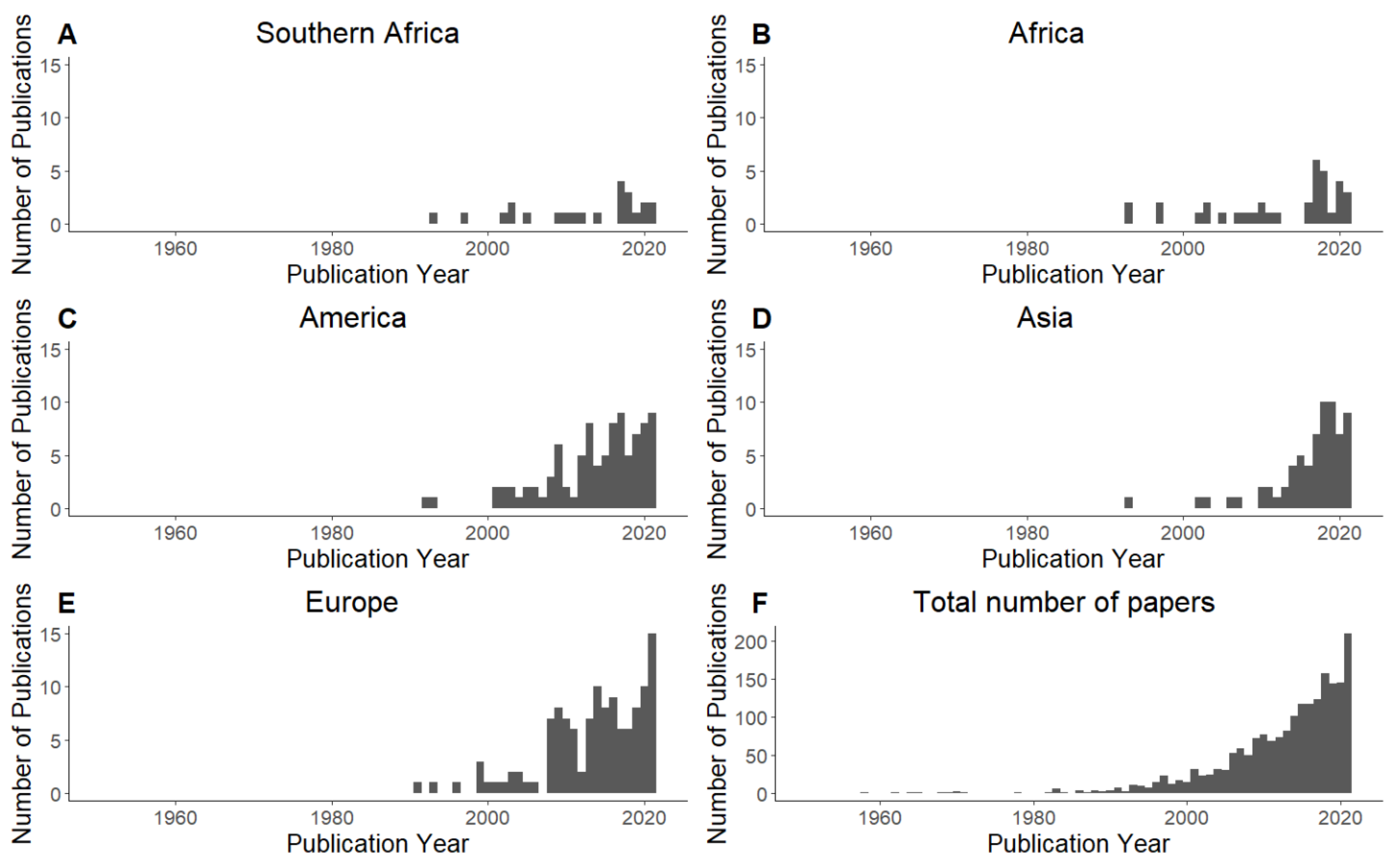
Figure 2.
A comparison of the number of publications on subterranean biodiversity and conservation from 1951 to 2022 in the Web of Science database divided by total karst area between Africa, Europe and southern African case study countries (Botswana, Namibia and South Africa). The total karst area for the regions was obtained from Goldscheider et al. [35] and Masilela and Beckedahl [36].
Figure 2.
A comparison of the number of publications on subterranean biodiversity and conservation from 1951 to 2022 in the Web of Science database divided by total karst area between Africa, Europe and southern African case study countries (Botswana, Namibia and South Africa). The total karst area for the regions was obtained from Goldscheider et al. [35] and Masilela and Beckedahl [36].
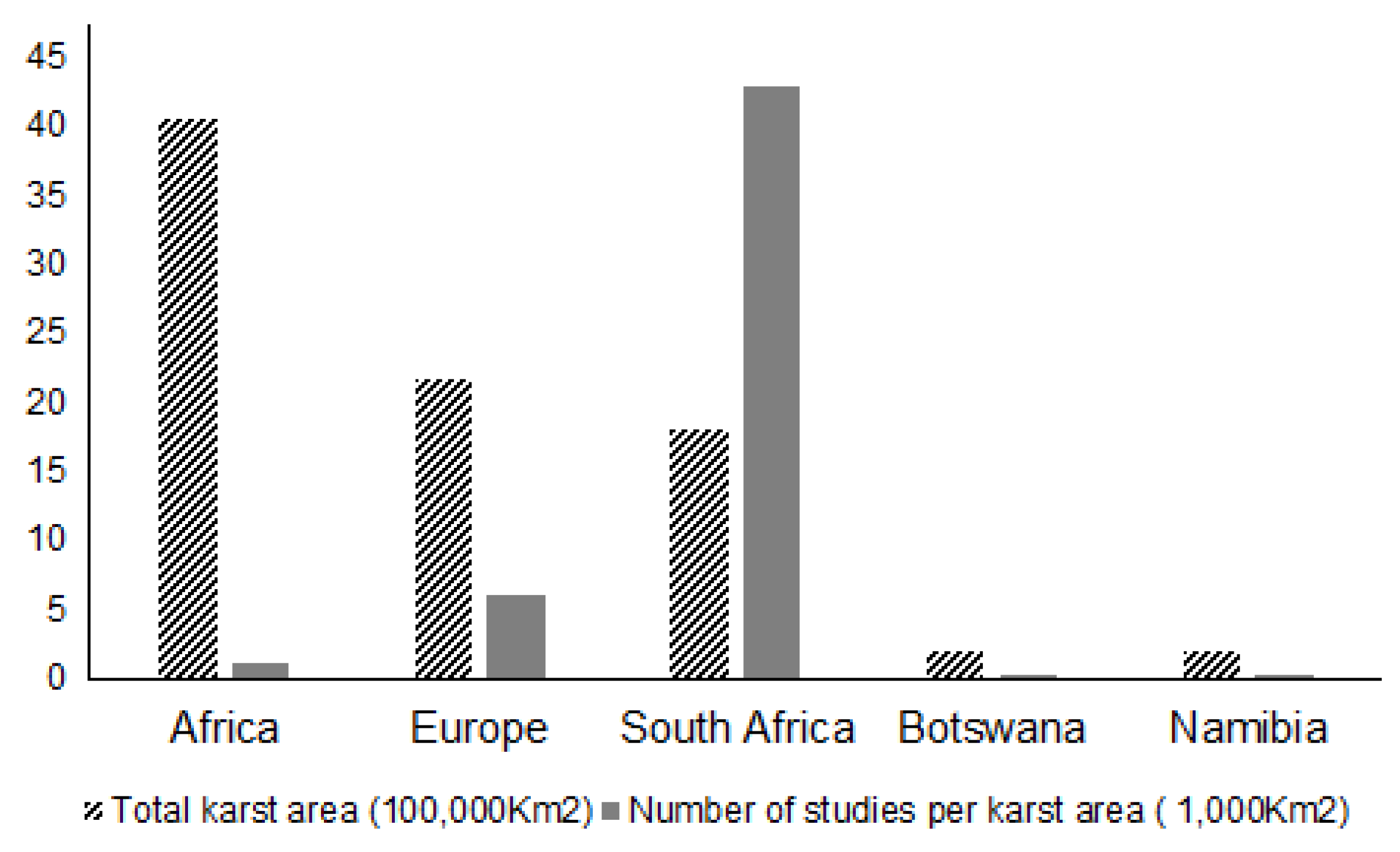

Table 1.
Sample caves from Botswana, Namibia and South Africa and studies addressing fundamental questions in subterranean ecology done at the caves; a demonstration of research needs in the region.
Table 1.
Sample caves from Botswana, Namibia and South Africa and studies addressing fundamental questions in subterranean ecology done at the caves; a demonstration of research needs in the region.
| Cave and its location |
Show cave? | Cave length | No. of visitors per year | Studies addressing fundamental questions in subterranean biology | ||||
|---|---|---|---|---|---|---|---|---|
|
Q1: What are the main ecological and ecosystem services provided by subterranean populations and communities? |
Q2. How do basic life-history characteristics differ among subterranean communities and between subterranean and surface communities? |
Q3. How does climate change affect subterranean-adapted organisms? |
Q4. How does the use of caves by humans (e.g. tourism, religious, therapeutic, and recreational activities) affect subterranean ecosystems? |
Additional Q5. What are the organisms found in subterranean ecosystems? | ||||
|
Gcwihaba cave 20° 01’ 43’‘ S, 21° 21’ 22’’E (Botswana) |
Yes | 400m | ~200 | None | None | None | None | Mazebedi and Hesselberg 2020; Visagie et al. 2021 Cardoso et al 2021; Harvey and Du Preez 2014 |
|
Arnhem cave 22° 70’ 14’‘ S, 18°09’ 65’‘ E (Namibia) |
Yes | ~4,500m | Unknown | None | None | None | None |
aChurchill et al 1997 aMatos et al. 2023 Spriggs et al 2010 |
| Aigamas (19°27’33.9”S, 17°16’59.3”E) (Namibia) |
No | 250m | Not open to tourists | None | None | None | None |
aChurchill et al 1997 aMatos et al. 2023 Jacobs et al 2021 Jacobs et al 2019 Kensley 1995 |
| Cango Caves 33°23′34″S, 22°12′53″E (South Africa) |
Yes | 4km | ~250,000 | None | None | None | Craven 1992, Baker and Genty 1998 | Cipola and Bellini 2016, Babalola et al. 2024 |
| Sterkfontein Caves 26°00′57″S 27°44′05″E (South Africa) |
Yes | 5.23km | Unknown | None | None | Hopley and Maslin 2010 | None | Zumpt, 1950 |
| Wonderwerk cave 27°50′44.7″S 23°33′12.3″E (South Africa) |
Yes | 140 m | Unknown | None | None | None | None | None |
Disclaimer/Publisher’s Note: The statements, opinions and data contained in all publications are solely those of the individual author(s) and contributor(s) and not of MDPI and/or the editor(s). MDPI and/or the editor(s) disclaim responsibility for any injury to people or property resulting from any ideas, methods, instructions or products referred to in the content. |
© 2025 by the authors. Licensee MDPI, Basel, Switzerland. This article is an open access article distributed under the terms and conditions of the Creative Commons Attribution (CC BY) license (http://creativecommons.org/licenses/by/4.0/).
Copyright: This open access article is published under a Creative Commons CC BY 4.0 license, which permit the free download, distribution, and reuse, provided that the author and preprint are cited in any reuse.


