

Submitted:
09 April 2025
Posted:
10 April 2025
You are already at the latest version
Abstract
The agri-food system is faced with numerous challenges of sustainability, calling for the improved evaluation of rural development projects. However, a gap exists in the comprehension of the application of both objective and subjective indicators in project selection criteria among regions. This study aims to bridge this gap by exploring, in detail, the nature and utilization of objective and subjective indicators in the Agricultural Knowledge and Innovation System (AKIS) environment in Italy. The approach entails the analysis of documents, with a focus on data relating to the AKIS initiative across regions. The comparative approach is also used to establish the priority that regions assign to indicators. The results include the use of both objective indicators, such as the number of sectors covered, and subjective ones, such as innovation and responsiveness to local needs. Besides, the comparative approach emphasizes the complexity of the AKIS initiative with some domains tending towards objective indicators while others tend towards subjective indicators. The study contributes to the development of a composite framework for evaluating rural development projects and emphasizes the need for further research to develop evaluation methodologies further so that future frameworks will be standardized as well as sensitive to regional heterogeneity.
Keywords:
content analysis
; agricultural knowledge and innovation system
; AKIS
; evaluation
; resource allocation
1. Introduction
Nowadays, the agri-food and forestry sector face various challenges, such as demographic growth, food security (e.g., ensuring the nutritional needs of future generations), and climate change (e.g., reducing pressures on natural resources at the same time) [1]. To mitigate the negative impacts of these challenges, the European Union promotes productivity and sustainability in the sector by encouraging the generation and dissemination of innovations in agri-food systems [2]. Different scholars [3,4] have investigated the crucial role of technological advancements and digitalization in improving resource efficiency and fostering sustainable, climate-friendly agriculture [5]. However, despite the growing importance of tools aimed at knowledge dissemination in agriculture, they have remained a marginal expense within the overall Common Agricultural Policy (CAP) budget for the 2014-2020 period [6]. Consequently, the adoption of new technologies in the agricultural sector has not reached the expected levels.
To achieve more appropriate solutions considering the sustainability transition as a priority in the policy agenda, different policy measures have been implemented. In particular, one is the European Innovation Partnership AGRI, implemented through the European Fund for Rural Development. The second consists of various Horizon 2020 Research Programs calls aimed at bridging the gap between research and innovation.
These research programs adopt a multi-actor approach, which enhances the practical relevance of scientific research by fostering close collaboration between researchers and practitioners [2] and both of them incorporate this approach within the Agricultural Knowledge and Innovation System (AKIS) framework, promoting knowledge exchange and innovation in the sector.
Considering the need for an efficient allocation of resources, effective projects evaluation is crucial to ensure that fundings are directed towards the best innovations. This primarily involves the selection criteria used to allocate funds for agricultural innovation measures, particularly those related to AKIS. In addition, the AKIS strategy further amplifies the complexity of fund allocation based on selection criteria because there are principles and processes in place for selecting AKIS projects and distributing funds among various groups.
The challenges associated with funds allocation are particularly pronounced in countries like Italy. Indeed, as reported by Cristiano et al., [7] the Italian AKIS is a multi-actor, multi-level system, shaped by the division of responsibilities between the State and the Regions, as well as the Autonomous Provinces (Trento and Bolzano). This structure has led to the creation of 21 regional AKISs, each differing in organizational models, procedures, and content. This multifaceted framework results in varying levels of definition and coordination across regions, reflecting local cultural, political, and administrative contexts.
More practically, the selection principles to allocate resource for AKIS selection are set at the national level and vary only slightly between regions. However, at the regional level, selection criteria differ, each Italian region must establish rules and criteria for deciding which projects to fund within rural development measures. In this highly variable and rather complex situation, the aim of this study is to analyze the project selection process within AKIS, with the intent of understanding how objective and subjective criteria are used to address the specific needs of different territories. Specifically, the analysis focuses on the integration of these criteria and the impact of regional differences in resource management, with the goal of highlighting how political management that acknowledges local peculiarities can contribute to the sustainability and competitiveness of the agricultural and forestry sectors, promoting regional growth.
More practically, the research question addressed in this article is:
RQ1: Do regions balance objective and subjective criteria in AKIS project selection to meet local needs?
To achieve the objective of this paper, a content analysis of the main documents from Italian regions has been implemented, contributing to the development of a comparative evaluation analysis. This structured approach provided a clear understanding of how the regions have approached project selection, shedding light on their alignment with the goals and requirements of the European Union’s rural development strategy.
2. Theoretical Framework
2.1. The debate of Selection Criteria
According to Scriven [8], the process of the evaluation includes four steps: defining the merit dimensions (how the object of evaluation is to be judged), determining the merit standards that specify the level of performance needed for every dimension, comparing the object’s performance against those standards, and finally, integrating these comparisons into an overall assessment and judgment of value. This flow is the basis of any evaluative process, including the awarding of funding calls for AKIS initiatives. In this context, some of the entities under evaluation could be the entire proposal or parts of it (e.g., the project team or the budget and procured components), while standard evaluative criteria are different such as originality, relevance, and feasibility [9]. As different authors have pointed out [9,10], the criteria applied in evaluation processes are often unspecified or ambiguous, resulting in a lack of consistency, which undermines the clarity and credibility of funding decisions. Given these processes’ intricacy and the finances’ potential impact, resource distribution should adopt clearly definable, optimal, and just processes. In this perspective, the use of objective and measurable benchmarks can support analytically sound decisions, while acknowledging that every evaluation inevitably involves an element of judgment. For this reason, understanding the relationship between objective and subjective indicators becomes crucial [11]. According to Veenhoven [12], objective indicators are based on tangible facts and explicit assessments by external observers, whereas subjective indicators concern personal perceptions. Although both types have limitations, subjective data are indispensable for setting policy goals and assessing their overall success. A categorical rejection of subjective indicators risks leaving decision-makers with an information deficit, which is inevitably filled with personal impressions and unsystematic opinions. Therefore, integrating both perspectives represents an essential strategy to guide funding decisions in a conscious and balanced manner.
2.2. Current State of the AKIS Strategy
The AKIS is commonly defined as a network of people and organizations that work together to create, share, and use knowledge and information. The main goal of this system is to improve decision-making, solve problems, and promote innovation in agriculture [13]. The model relies on collaboration among various stakeholders, including researchers, advisors, farmers, foresters, and educators, who contribute complementary expertise to achieving project objectives [14]. The literature on AKIS has been increasing highlight the significant role of this initiative. As well a simply search in an academic database, such as Scopus, using keywords like “Agricultural Knowledge and Innovation System” reveals an important increase in publications. Specifically, several aspects have been explored in the literature. Some studies have focused on advisory services, analysing their implementation and impact on farmers [15,16]. While others have emphasized the importance of community relationships [17] and the role of participatory approaches in addressing farmers’ needs [18]. Although this increase in AKIS publication, to the best of our knowledge, there is a gap on the selection criteria of AKIS initiatives, particularly in the context of Italy, as previously mentioned. Specifically, in Italy, the AKIS is composed of nine key interventions designed to promote innovation and enhance the productivity and sustainability of the agricultural sector. These interventions, which are part of the European Union’s Rural Development Policy, encompass a wide range of activities, from supporting innovation to providing advisory services [19]. Figure 1 summarizes the nine interventions of AKIS in Italy. Among these, SRG01 pays attention to the European Innovation Partnership for Agricultural Productivity and Sustainability (EIP-AGRI) Operational Groups (OGs), which work towards stakeholder cooperation for innovative project implementation. SRG08 promotes the development, testing, and implementation of new research innovations to facilitate their commercialization in the agriculture, agri-food, and forestry industries. SRG09 promotes the formation of collaborative partnerships that seek to serve the needs of rural enterprises by constructively solving problems, promoting innovative practices, and strengthening collaboration through the AKIS. SRH01 helps agricultural businesses through the provision of advisory services; offering help in technical, management, economic, environmental, and social parts while also supporting the transfer of new ideas and findings. SRH02 aims at improving the training skills of the consultants to increase the professional and consequently, the advisory service quality to agricultural clients. SRH03 has the objective to enhance the competency of agricultural entrepreneurs as well as other professionals in agriculture related fields through training to enable them to better practice agriculture, animal husbandry, agri-processing, and rural development. SRH04 focuses on the marketing and public relations activities that communicate innovations and research results to stakeholders, both public and private, in the agriculture and forestry industries. SRH05 has advanced the knowledge and technology transfer through the implementation of education field trials, experiments, and demonstrations. SRH06 provides administrative support to the knowledge system actors for data capture, network monitoring, and digital tool development needed for complicated analysis.
3. Methodology
To address the research objective, the methodological approach followed a multi-step structure that integrates two steps: qualitative content analysis and systematic comparative evaluation.
First step includes two analyses. Firstly, content analysis is conducted as a systematic and replicable technique for coding and categorizing textual to identify recurrent themes, principles, and criteria [20]. A comprehensive document analysis was conducted, specifically focusing on regional planning documents, with particular attention to the Complement to Regional Programming (CSR 23/27). Each CSR defines the regional development strategies that contribute to achieving the objectives outlined in European regulations related to the new CAP. The CSRs are documents that implement the national strategy (PSP) at the regional level. While they do not introduce new choices, they explain how the national strategy is adapted to the specificities of each region. This analysis encompassed the eligibility and selection criteria applied to projects funded through the European Agricultural Fund for Rural Development (EAFRD) within the 2014–2022 programming period. These criteria pertain to specific “types of operations” embedded in the Rural Development Programs (RDPs) and include parameters such as sectoral relevance, geographical targeting, alignment with RDP priorities, measurability, and evaluability of project proposals. Second, a comparative analysis of regional documents was performed. More specifically, regional project calls were examined to assess how the formally defined criteria are translated into practical decision-making processes for project selection.
The second step applied a criteria-based analysis, wherein evaluative criteria were assessed. The evaluation of selection criteria was organized into two dimensions: the subjective versus objective nature of the criteria. Subjectivity refers to the influence of individual perceptions, values, or institutional biases on evaluation outcomes, while objectivity relates to the use of measurable and standardized indicators. The steps followed in this study are summarized in Figure 2.
3. Results
3.1. First Step
The Table 1 summarizes the principles on which Italian regions base the selection of AKIS initiatives. The table presents a column with the 9 AKIS initiatives, alongside which the principles used for selecting each initiative are listed.
Table 1 illustrates that while the principles applied by Italian regions in the selection of AKIS initiatives are largely consistent, each region retains the discretion to select specific principles to adopt for each strategy, thereby tailoring the initiatives to reflect regional peculiarities. This approach is further elaborated in Table 2, which presents a comparative analysis of the regional documents. Following the identification of the selection principles adopted by each region, an in-depth examination was conducted on the calls for proposals issued by the respective regions, with a particular focus on the selection criteria.
The comparative analysis of selection criteria across Italian regions reveals a structured yet flexible evaluation framework for rural development projects. Core principles, like partnership quality (SRG01), project innovation (SRG09), and service provider competence (SRH01), are common applied among the Regions. However, significant regional variations emerge in the adoption of supplementary criteria, particularly in the reward of thematic priorities, exemplified in Piemonte’s forestry focus and digitalization in Lombardia, and the more peripheral specificity like mountain agriculture in Valle d’Aosta which show great regional adoption diversity in supplementary criteria. Such as with other regions, Lazio and Sardegna share the strong focus on local coherence and adaptation to regional agricultural priorities. Team quality and project quality seem to be the most widespread qualifiers which showcase the value derived from having a robust operational structure for the growth of these initiatives. Focusing on project sustainability is the approach taken by some other regions, particularly Autonomous Province of Bolzano, and by others like Veneto and Liguria whose focus is on the economic efficiency of the consultancy service provider. The links with research projects funded at a European and national level stand out as a defining feature for region integration within the broader systems of agricultural innovation. The rewards for specific themes or territorial objectives are especially evident in regions like Sardegna and Umbria, where local policies aim to address specific sectoral challenges, such as enhancing agricultural supply chains and promoting innovative actions for sustainability. Notably, northern regions exhibit more granular scoring methodologies, while southern regions prioritize social sustainability and local stakeholder engagement. These divergences reflect both contextual adaptations and strategic focuses within the shared EU policy framework.
3.2. Second Step
The analysis of the AKIS Initiative data reveals significant variation in the distribution of objective and subjective indicators across different selection criteria and regions (Table 3).
Considering the EIP-AGRI Operational Groups (SRG01), a total of 27 criteria were used, with 38.89% being objective and the remaining 61.11% subjective. This criterium was found in regions like Abruzzo, Trento, Bolzano, and Veneto. In these areas, subjective indicators evaluate how the partnerships were structured or how original the proposed solutions looked. These indicators leaned on qualitative inputs, like the reputation of external experts or just how convincing the project seemed overall. Of course, some objective aspects were considered too, like how many farms or forestry businesses were involved. Moreover, considering the SRG08 — Support for Pilot Actions and Testing of Innovations—it involved 17 criteria, split more or less evenly: 47.06% objective and 52.94% subjective. Interestingly, this was only used in Piemonte. The design here seemed to value both concrete metrics, like how many pilot projects were actually carried out and more open-ended judgments, such as how much innovative potential a proposal might offer in a local setting.
Moreover, SRG09, which focused on Innovation Support Services, used 24 criteria, evenly divided between objective and subjective indicators. These indicators were applied in regions like Toscana, Piemonte, Veneto, Abruzzo, and Campania. While, for Advisory Services (SRH01), 60% of the criteria were objective, and 40% were subjective. The initiative was assessed in Campania, Piemonte, Abruzzo, and Emilia-Romagna. The emphasis on quantitative indicators, such as the number of trained advisors and the geographical spread of services, points to a data-driven approach. On the other hand, Training for Advisors (SRH02) leaned even more into objective metrics: four out of five criteria were objective. This was mainly observed in Piemonte, with attention on the delivery methods and trainer credentials. Training for Farmers and Other Rural Actors (SRH03) had a more mixed approach: 17 criteria total, with 70.59% objective indicators, used across different regions such as Veneto, Marche, Campania, Toscana, Lombardia, Abruzzo, Piemonte, and Emilia-Romagna. Furthermore, to assess the initiative titled SRH04 (Information Actions) it is possible to see that 90% of its nine criteria were objective. It looked mainly at concrete outputs, like attendance numbers at events. This was used in Veneto and Marche.
Moreover, the Demonstration Actions for the Agricultural and Forestry Sectors (SRH05) used 16 assessment criteria, 62.5% of which were objective indicators. It combined quantitative data, such as the number of events held, with qualitative aspects, like the effectiveness of communication plans and the level of stakeholder engagement. This measure was mostly applied in Veneto and Piemonte. Finally, among the Back-office Services for the AKIS (SRH06), two-thirds of its six criteria were subjective. This probably reflects the trickier nature of evaluating internal support structures, where softer, experience-based judgments often make more sense. This approach was used in Veneto, Toscana, Piemonte, and Sicilia.
4. Discussion
The results show that while some regions relied primarily on quantitative assessments, others preferred more subjective methods that were better suited to their specific local contexts. This highlights the need for evaluation systems in agricultural innovation to remain flexible, broad enough to capture diverse on-the-ground realities yet still focused on measurable outcomes where they matter most.
The analysis of documents reveals important insights into the application of objective and subjective indicators, reflecting the complexity of selection criteria across different regions within the Italian context. This variation highlights the different approaches used for evaluating rural development projects and allocating resources.
The results show the different priorities in project evaluation, emphasizing how regions adapt their criteria to address specific territorial issues. For instance, areas like Bolzano and Abruzzo used objective indicators, such as the number of sectors or enterprises involved, which are easier to quantify. On the other hand, regions like Trento and Veneto applied subjective indicators, emphasizing aspects like innovation, technical expertise, and adaptability to local needs.
The distribution of objective versus subjective indicators highlights the differences within the AKIS initiative. Certain actions, like advisor training, were based on objective indicators, focusing on measurable variables such as participant numbers and the number of delivery methods. However, other actions, such as back-office services for AKIS, relied on subjective criteria, reflecting the need for a more flexible approach that accounts for the complexity of this initiative.
Moreover, the mix of objective and subjective indicators creates a comprehensive framework for evaluating rural development projects under the CAP. The findings of this study suggest that regions have different priorities when selecting projects. Some regions applied objective metrics, while others focused on subjective criteria, such as social and environmental sustainability, reinforcing the importance of evaluators. Indeed, while objective indicators play a key role in ensuring transparency and accountability, subjective indicators of the evaluation allow for a deeper understanding of the complexities involved in rural development.
6. Concluding Remarks
Policy makers are recognizing the intrinsic complexities of rural development, using a mix of objective and subjective indicators to create specific solutions to territorial needs. As highlighted in this paper, it is crucial that rural development governance does not reduce the allocation of resources to a statistical view but instead adopts dynamic evaluations requiring tailored, context-sensitive approaches. The criteria used in AKIS project selection have a direct influence on the types of projects funded, which in turn shape innovations within the agricultural and food systems. Indeed, the agri-food sector, being a complex and transversal system, includes a wide range of innovations, from the use of AI in crop planting to the final stages of food consumption. Therefore, the selection of specific indicators has an impact that extends not only to territorial development of specific regions but also to various interconnected sectors.
Despite the different insights offered by this paper, the study presents some limitations that should be considered when interpreting its findings. For example, the analysis relies on data from specific regions involved in the AKIS Initiative, particularly within the Italian context. Notwithstanding these limitations, the paper highlights the importance of including both objective and subjective indicators in evaluating rural development initiatives [12]. The findings suggest that regions should adopt a mixed approach to project selection and resource allocation.
Therefore, future research should focus on refining evaluation methodologies to create a standardized framework that remains flexible enough to account for the unique characteristics of each region, improving the accuracy and comprehensiveness of evaluations in rural development.
Author Contributions
For research articles with several authors, a short paragraph specifying their individual contributions must be provided. The following statements should be used “Conceptualization, X.X. and Y.Y.; methodology, X.X.; software, X.X.; validation, X.X., Y.Y. and Z.Z.; formal analysis, X.X.; investigation, X.X.; resources, X.X.; data curation, X.X.; writing—original draft preparation, X.X.; writing—review and editing, X.X.; visualization, X.X.; supervision, X.X.; project administration, X.X.; funding acquisition, Y.Y. All authors have read and agreed to the published version of the manuscript.” Please turn to the CRediT taxonomy for the term explanation. Authorship must be limited to those who have contributed substantially to the work reported.
Funding
This research received no external funding.
Informed Consent Statement
Not applicable.
Data Availability Statement
We encourage all authors of articles published in MDPI journals to share their research data. In this section, please provide details regarding where data supporting reported results can be found, including links to publicly archived datasets analyzed or generated during the study. Where no new data were created, or where data is unavailable due to privacy or ethical restrictions, a statement is still required. Suggested Data Availability Statements are available in section “MDPI Research Data Policies” at https://www.mdpi.com/ethics.
Conflicts of Interest
The authors declare no conflicts of interest.
Abbreviations
The following abbreviations are used in this manuscript:
| AKIS | Agricultural Knowledge and Innovation System |
| CAP | Common Agricultural Policy |
Appendix A

Table A1.
SRG01: Selection Principles, Criteria, and Indicators.
| Selection Principles | Selection Criteria | Indicator | Region |
Objective/ Subjective |
| Partnership characteristics of the Operational Group in relation to the project | Involvement of a plurality of agricultural, agri-food, and forestry enterprises | Number of agricultural, agri-food, or forestry enterprises involved in the project | Abruzzo/ Trento/Bolzano | Objective |
| Organizational and managerial capacity | Lead partner with administrative/accounting skills in projects funded by the FEASR funds | Trento | Objective | |
| Presence of a consultancy center/expert consultant | Trento | Subjective | ||
| Degree of diversification of sectors represented by the partners | Number of sectors represented by the partners | Bolzano | Objective | |
| Presence of one or more external experts collaborating with the G.O. | Bolzano | Objective | ||
| Partnership | Quality of the partnership | Veneto | Subjective | |
| Incentive for the presence of consultancy providers | Involvement of Consultancy Organizations | Number of Consultancy Organizations | Abruzzo | Objective |
| Presence of a consultancy center or an expert consultant in the specific sector of the project | BolzanoVeneto | Objective | ||
| Consultancy provider partners | Consultancy provider identified as the lead partner | Veneto | Objective | |
| Qualitative Characteristics of the Project | Technical-scientific validity of the project | The project idea presents the main issue and proposed solutions in a fully adequate manner, with technical-scientific references and specificity concerning the regional context as specified in the call. | Abruzzo/Bolzano | Subjective |
| Relevance of the needs and issues addressed | Trento | Subjective | ||
| Level of specialization of the technical-scientific team in relation to the innovative solution | Trento | Subjective | ||
| Degree of innovation and originality of the proposed solution | Trento/Bolzano | Subjective | ||
| Methodological adequacy | Clarity in the description of the project objectives and consistency between objectives and planned activities. | Trento | Subjective | |
| Skills of human resources in relation to planned activities | Trento | Subjective | ||
| Consistency of the implementation timeline with the volume of planned activities, also in relation to the CSR timelines | Trento | Subjective | ||
| Cost analysis | Allocation within the budget of expenses, with a breakdown of actions for each partner, relevance, and appropriateness in relation to the planned activities. | Trento | Subjective | |
| Clarity and completeness of the submitted estimates and comparisons | Trento | Subjective | ||
| Involvement of agricultural/forestry enterprises in proposing project themes | Conducting surveys to analyze needs. | Trento | Objective | |
| Correlation between project content and Specific Objectives of Article 6 Reg. (EU) 2021/2115 | Project content related to the conservation of natural resources, climate, and biodiversity. | Trento | Subjective | |
| Project content related to competitiveness, food, health, employment, and rural area development | Trento | Subjective | ||
| Impact on the agri-food and forestry sector | Bolzano | Subjective | ||
| Involvement of the agri-food/forestry supply chain | Number of stages of the supply chain involved. | Bolzano | Objective | |
| Project aimed at increasing digital skills, the dissemination of digital tools, and the availability of digital services in rural areas | Bolzano | Subjective | ||
| Quality of Dissemination and Dissemination of Results Activities | Presence and quality of communication plans | Adequacy of the objectives presented in the communication plan. | Trento | Subjective |
| Consistency of proposed activities with the objectives presented in the communication plan | Trento | Subjective | ||
| Type of stakeholders involved in communication and dissemination activities | Trento | Subjective | ||
| Plurality of dissemination events or activities | Number of dissemination events or activities. | Bolzano | Objective | |
| dissemination of results | Quality of dissemination and dissemination activities, particularly through the communication channels of the CAP2030 Network. | Veneto | Subjective | |
| Organizational and Managerial Capacity of the Operational Group | Presence of an administrative lead partner | Bolzano | Objective | |
| Experience of the lead partner in projects supported by the European Union | At least one funded project. | Bolzano | Objective | |
| Completeness and clarity of the budget estimate | Bolzano | Subjective | ||
| Involvement of farmers/foresters in proposing project themes (bottom-up) | Bolzano | Objective | ||
| Presence of a SWOT analysis. | Bolzano | Objective | ||
| Sustainability | Environmental Sustainability in the Project | Bolzano | Subjective | |
| Animal Welfare | Bolzano | Subjective | ||
| Social Sustainability | Bolzano | Subjective |
Source: This table presents the selection principles used to assess the AKIS initiative SRG01. It summarizes the indicators into objective and subjective categories, along with the regions where they are applied.
Table A2.
SRG08: Selection Principles, Criteria, and Indicators.
| Selection Principles | Selection Criteria | Indicator | Region |
Objective Subjective |
| Subjective Characteristics of the Partnership | Level and quality of interactions among cooperation group participants and the involvement of partners in project activities | Piemonte | Subjective | |
| Presence within the cooperation group of the various skills necessary to develop activities and transfer project results | Piemonte | Subjective | ||
| Stability of the partnership and the cooperation group’s ability to become independent from public funding | Presence of stable forms of associated management (e.g., associations/consortia, etc.) | Piemonte | Subjective | |
| Number of involved owners or number of new owners associated with existing associative forms | Piemonte | Objective | ||
| Qualitative characteristics of the project | Clear description of the objectives the project proposal aims to achieve; consistency between objectives and planned activities; a realistic and feasible work plan, also considering the organization and coordination of activities. | Piemonte | Subjective | |
| Clear and adequate project documentation in terms of completeness and compliance (with particular reference to the eligibility of expenses), consistency between the documentary part and digital submission, and proper allocation of expenses between activities and partners. | Piemonte | Subjective | ||
| Proportionality between investments and results. | Piemonte | Subjective | ||
| area involved in the interventions subject to funding | Piemonte | Objective | ||
| area covered by management contracts | Piemonte | Objective | ||
| Quality of Dissemination and Communication of Results | Dissemination of project results in terms of quality, diversification of planned methods, appropriateness to project themes, and impact/effect | Piemonte | Subjective | |
| Only for the Forestry Sector: Specific Themes in Regional Planning to Ensure Consistency with Regional Forestry Programming | The ability of project objectives to address issues or create opportunities for forestry sector operators. | Piemonte | Subjective | |
| Innovation content in terms of organization and subject matter. | Piemonte | Subjective | ||
| Economic development effects derived from the project and the cooperation’s ability to generate long-term stable impacts | Duration of the management contract beyond the prescribed minimum. | Piemonte | Objective | |
| Presence of actions for ecosystem services development | Piemonte | Objective | ||
| Sustainable forest management (SFM) and/or traceability | Number of individual | Piemonte | Objective | |
| Quality of wood, woody fuels (ISO 17225), carbon footprint, and environmental sustainabilit | Presence/adoption of a certificate issued by a third party. | Piemonte | Objective | |
| Presence/adoption of product quality certification resulting from the application of a specific standard. | Piemonte | Objective |
Source: This table presents the selection principles used to assess the AKIS initiative SRG08. It summarizes the indicators into objective and subjective categories, along with the regions where they are applied.
Table A3.
SRG09: Selection Principles, Criteria, and Indicators.
| Selection Principles | Selection Criteria | Indicator | Region |
Objective/ Subjective |
| Project Quality | Planned project activities | Number of activities | Toscana | Objective |
| Overall project consistency, clarity, and concreteness of objectives and expected results | Toscana | Subjective | ||
| Methodology for implementing the planned activities | Toscana/Abruzzo | Subjective | ||
| Completeness in describing the communication strategy | Toscana | Subjective | ||
| Structuring of the project into activities that are coherent with each other and with the project objectives | Piemonte/Veneto | Subjective | ||
| The project budget is realistic, and the ratio between the total requested resources and the planned objectives and activities appears appropriate | Piemonte/Veneto | Subjective | ||
| Completeness and level of innovation in the service offering in terms of provided support | Presence of a detailed information sheet for each type of proposed service | Campania | Objective | |
| Presence of a website with one or more sections dedicated to information and knowledge exchange | Campania | Objective | ||
| Presence of one or more social media services with a sufficient level of periodic updates | Campania | Objective | ||
| Presence of an e-learning platform to provide additional services alongside in-person activities and channels for interaction with participants | Campania | Objective | ||
| Tools for third-party monitoring of service quality | Campania | Objective | ||
| Project Team Quality | Complementary and targeted composition of the project partnership | Toscana/Veneto | Subjective | |
| Experience of the lead partner in coordinating cooperation projects | Toscana | Subjective | ||
| Presence of a public or private research organization as a project partner with relevant expertise in relation to the project’s objectives and activities | Toscana/Abruzzo | Objective | ||
| Presence of producer organizations, producer associations, cooperatives, consortia, or food districts as project partners with relevant expertise in relation to the project’s objectives and activities | Toscana | Objective | ||
| Presence of consultancy service providers within the partnership | Toscana/Abruzzo | Objective | ||
| Availability of the necessary competencies | Piemonte | Subjective | ||
| Presence of equipment, services, and facilities required for the implementation of planned activities | Piemonte | Subjective | ||
| Experience of qualified personnel in information activities | Campania | Objective | ||
| Qualified teaching staff | Campania | Objective | ||
| Qualification/experience of consultants | Campania | Objective | ||
| Consistency of the topics addressed with the general and specific objectives of the CAP | The project defines activities/services consistent with the objectives of the CAP 2023-2027 | Number of CAP objectives covered by the project | Toscana/Piemonte/Veneto/Abruzzo/Campania | Subjective |
| Consistency of the topics addressed with the characteristics of the territories and/or supply chains the project refers to | The project defines the consistency of the services/activities it intends to develop with a clear reference to the territory and/or the supply chains involved, and their replicability | Toscana/Piemonte/Veneto/Abruzzo/Campania | Subjective | |
| Presence of AKIS (Agricultural Knowledge and Innovation Systems) | Campania | Subjective | ||
| Ability to engage the target group based on the preliminary identification of specific topics and objectives | Campania | Subjective | ||
| Connection with the projects of the EIP-AGRI Operational Groups (OGs) and those of research and innovation supported by other EU, national, and regional funds | Clear, direct, and consistent connection with project | Toscana/Abruzzo | Subjective | |
| dissemination activities of the EIP-AGRI regional OGs or research and innovation projects funded by other EU, national, and regional funds, and/or contributing to such organizations in collaboration with them | Piemonte | Objective | ||
| Presence in the partnership of the lead partners of the OGs or research organizations responsible for research programs funded by other funds | Campania | Objective |
Source: This table presents the selection principles used to assess the AKIS initiative SRG09. It summarizes the indicators into objective and subjective categories, along with the regions where they are applied.
Table A4.
SRH01: Selection Principles, Criteria, and Indicators.
| Selection Principles | Selection Criteria | Indicator | Region |
Objective/ Subjective |
| Quality of Consultancy Projects | Completeness and innovation of the consultancy project in terms of available support | The score is assigned based on the presence of the following cumulative support tools: - Informational material: At least one detailed fact sheet for each type of consultancy. - Dedicated app: App developed by the organization for consultancy activities. - Website: Website with sections for information exchange and knowledge sharing. |
Campania | Objective |
| Completeness and innovation of the consultancy project in terms of the consultancy offer | Campania/Abruzzo | Subjective | ||
| The project’s ability to demonstrate the alignment between the support needs expressed by potential beneficiaries and the project’s content | Piemonte | Subjective | ||
| Logistics organization of the offered service | Presence of an operational office | Abruzzo | Objective | |
| Description of the project’s objectives | Emilia Romagna | Subjective | ||
| Description and scheduling of activities | Emilia Romagna | Subjective | ||
| Description and preparation of the final report | Emilia Romagna | Subjective | ||
| Quality of the consultancy service provider | Experience of the consultants | Number of years of experience | Campania/ Piemonte/Abruzzo |
Objective |
| Number of consultancies | Campania | Objective | ||
| Presence of recognized operational offices | Campania | Objective | ||
| Environmental impact | Presence of quality certifications for the consultancy provider | Campania/Piemonte | Objective | |
| Quality of the staff | Presence of university professors, staff registered in a relevant professional register, and staff with a degree or diploma in agricultural subjects with at least 3 years of documented experience in the subjects of consultancy | Abruzzo/Emilia Romagna | Objective | |
| Consistency of the proposals with the identified topics | Consistency | Emilia Romagna | Subjective | |
| Incentives for specific topics and/or objectives and/or territorial impact and/or types of actions taken to address prioritized issues | Consultancy hours for specific topics | Number of hours | Piemonte | Objective |
| Experience and training in the context of innovation and research | Curricula | Piemonte | Objective |
Source: This table presents the selection principles used to assess the AKIS initiative SRH01. It summarizes the indicators into objective and subjective categories, along with the regions where they are applied.
Table A5.
SRH02: Selection Principles, Criteria, and Indicators.
| Selection Principles | Selection Criteria | Indicator | Region |
Objective/ Subjective |
| Project quality | Quality of the training methods | Number of bibliographic references | Piemonte | Objective |
| Number of face-to-face lessons | Piemonte | Objective | ||
| Type of lessons (online, blended, in-person) | Piemonte | Objective | ||
| Quality of the project team | Experience of Professors | Level of education | Piemonte | Objective |
| Final evaluation | Presence of customer satisfaction evaluation | Piemonte | Objective | |
| Level of accessibility of online content | Piemonte | Objective | ||
| Stakeholders have a certification system | Piemonte | Objective | ||
| Consistency of the topics addressed with the general and specific objectives of the CAP | Number of CAP objectives covered | Piemonte | Subjective | |
| Incentives for specific topics and/or objectives and/or territorial impact and/or types of actions | Inclusion of topics in the project | Piemonte | Subjective | |
| Connection with the projects of the EIP-AGRI Operational Groups (OGs) and/or with research and innovation projects funded by other EU, national, and regional funds | Funding or project documentation | Piemonte | Objective |
Source: This table presents the selection principles used to assess the AKIS initiative SRH02. It summarizes the indicators into objective and subjective categories, along with the regions where they are applied.
Table A6.
SRH03: Selection Principles, Criteria, and Indicators.
| Selection Principles | Selection Criteria | Indicator | Region | Objective/Subjective |
| Project Quality | Presence of expert instructors | Number of hours | Veneto/Toscana | Objective |
| Presence of degree-holding instructors | Number of hours | Veneto | Objective | |
| Training project with courses to be carried out in collaboration with the EIP-AGRI OGs benefiting from SRG01 intervention | Veneto | Objective | ||
| Training project presented by a certified Training Organization | Veneto/Abruzzo | Objective | ||
| Quality of educational materials and innovative tools | Campania/Toscana/Lombardia | Subjective | ||
| Presence of additional training hours beyond the minimum required in the training project | Number of hours | Campania | Objective | |
| Clarity and completeness of the proposal | Toscana/Lombardia/ Abruzzo/Emilia Romagna |
Subjective | ||
| Structure of distance, blended, or in-person training | Toscana/Piemonte | Objective | ||
| Involvement of industry entities in the training project | Toscana | Objective | ||
| Consistency of the topics addressed with the general and specific objectives of the CAP | Consistency | Number of CAP objectives covered | Piemonte/Lombardia/ Abruzzo/Emilia Romagna |
Subjective |
| Experience of the service provider | Number of hours | Campania | Objective | |
| Adequate experience of the teaching staff | Campania | Subjective | ||
| Incentives for specific topics/objectives and/or territorial impact | Territorial coverage | Number of provinces | Veneto/Marche | Objective |
| Adherence to the project’s themes | Marche/Toscana/Lombardia/ Abruzzo/Piemonte/Emilia Romagna |
Subjective | ||
| Coaching | Marche | Objective | ||
| Courses aimed at acquiring professional knowledge and skills for young people establishing businesses under the SER01 intervention | Number of students | Marche | Objective | |
| Availability of training sites in disadvantaged areas | Number of sites | Campania | Objective |
Source: This table presents the selection principles used to assess the AKIS initiative SRH03. It summarizes the indicators into objective and subjective categories, along with the regions where they are applied.
Table A7.
SRH04: Selection Principles, Criteria, and Indicators.
| Selection Principles | Selection Criteria | Indicator | Region |
Objective/ Subjective |
| Project Quality | Presence of a Service Charter | Veneto | Objective | |
| Completeness of documents | Veneto | Objective | ||
| Quality of the Project Team | Presence of certifications | Veneto/Marche | Objective | |
| Team composition | Presence in the team of a participant in seminars/workshops organized by the European CAP Network. | Veneto | Objective | |
| Presence in the team of a participant in at least one training course as per T.I. | Veneto | Objective | ||
| Expertise characteristics | Level of education | Marche | Objective | |
| Incentives for specific topics and/or objectives and/or territorial impact and/or types of activities based on regional and/or local needs | Territorial distribution | Number of municipalities | Veneto | Objective |
| Territorial structure | Number of operational offices | Veneto | Objective | |
| Adherence to the project’s themes | Marche | Subjective | ||
| Impact of costs for activities outside the region and events | Percentage of contribution allocated to activities outside the region and events | Marche | Objective |
Source: This table presents the selection principles used to assess the AKIS initiative SRH04. It summarizes the indicators into objective and subjective categories, along with the regions where they are applied.
Table A8.
SRH05: Selection Principles, Criteria, and Indicators.
| Selection Principles | Selection Criteria | Indicator | Region | Objective/Subjective |
| Project Quality | Completeness of the activities | Number of types of demonstration activities planned | Veneto | Objective |
| Number of types of demonstration activities planned | Veneto | Objective | ||
| Location of the demonstration activities | Number of activities carried out at private agricultural businesses | Veneto | Objective | |
| Ability of the project proposal to engage a high number of operators | Number of operators involved | Piemonte | Objective | |
| Budget consistency | Piemonte | Subjective | ||
| Suitability of proposed equipment | Piemonte | Subjective | ||
| Quality of the Project Team | Presence of beneficiary certifications | Veneto/Piemonte | Objective | |
| Team qualification | Veneto | Objective | ||
| Type of beneficiary | Level of education | Veneto | Objective | |
| Evaluation of experience gained in demonstration, experimental, and/or dissemination activities | Piemonte | Subjective | ||
| Level of online accessibility | Piemonte | Subjective | ||
| Consistency of the topics addressed with the general and specific objectives of the CAP | Consistency | Number of CAP objectives covered | Piemonte | Subjective |
| Inclusion of topics in the project | Veneto | Subjective | ||
| Incentives for specific topics | Execution method of demonstration actions | Veneto | Objective | |
| Territorial distribution | Number of municipalities | Veneto | Objective | |
| Inclusion of specific topics | Piemonte | Objective |
Source: This table presents the selection principles used to assess the AKIS initiative SRH05. It summarizes the indicators into objective and subjective categories, along with the regions where they are applied.
Table A9.
SRH06: Selection Principles, Criteria, and Indicators.
| Selection Principles | Selection Criteria | Indicator | Region | Objective/Subjective |
| Project Quality | Quality of the drafted budget | Piemonte | Subjective | |
| Quality of the drafted proposal | Piemonte/ Sicilia |
Subjective | ||
| Quality of the Project Team | Level of equipment provided | Piemonte | Subjective | |
| Technical characteristics of the research team | Piemonte | Subjective | ||
| Consistency of the topics addressed with the general and specific objectives of the CAP | Consistency | Piemonte/ Sicilia |
Objective | |
| Inclusion of topics in the project | Piemonte | Objective |
Source: This table presents the selection principles used to assess the AKIS initiative SRH01. It summarizes the indicators into objective and subjective categories, along with the regions where they are applied.
References
- Webb, R.; Buratini, J. Global challenges for the 21st century: The role and strategy of the agri-food sector. Anim. Reprod. 2016, 13, 133–142. [Google Scholar] [CrossRef]
- Knierim, A.; Kernecker, M.; Erdle, K.; Kraus, T.; Borges, F.; Wurbs, A. Smart farming technology innovations – Insights and reflections from the German Smart-AKIS hub. NJAS - Wageningen J. Life Sci. 2019, 90–91, 100314. [Google Scholar] [CrossRef]
- Lidder, P.; Cattaneo, A.; Chaya, M. Innovation and technology for achieving resilient and inclusive rural transformation. Glob. Food Sec. 2025, 44, 100827. [Google Scholar] [CrossRef]
- Klerkx, L.; Rose, D. Dealing with the game-changing technologies of Agriculture 4.0: How do we manage diversity and responsibility in food system transition pathways? Glob. Food Sec. 2020, 24, 100347. [Google Scholar] [CrossRef]
- Reddy, G.S.; Reddy, M.; Krishna, C.; Joshi, A. Environmental Sustainability in the Digital Age: The Role of Smart Technologies in Agriculture, Urban Development, and Energy Management. 2025, 15, 12–24.
- Labarthe, P.; Beck, M. CAP and Advisory Services: From Farm Advisory Systems to Innovation Support. EuroChoices 2022, 21, 5–14. [Google Scholar] [CrossRef]
- Cristiano, S.; Carta, V.; Sturla, A.; D’Oronzio, M.A.; Proietti, P. AKIS and advisory services in Italy - Report for the AKIS inventory (Task 1. 2) of the i2connect project. 2020, 86303, 1–82. [Google Scholar]
- Scriven, M. The Logic of Evaluation. 2007, 1–16. Available online: http://scholar.uwindsor.ca/ossaarchive%5Cnhttp://scholar.uwindsor.ca/ossaarchive/OSSA7/papersandcommentaries/138.
- Hug, S.E.; Aeschbach, M. Criteria for assessing grant applications: a systematic review. Palgrave Commun. 2020, 6, 1–15. [Google Scholar] [CrossRef]
- Vinkenburg, C.J.; Ossenkop, C.; Schiffbaenker, H. Selling science: optimizing the research funding evaluation and decision process. Equal. Divers. Incl. 2021, 41, 1–14. [Google Scholar] [CrossRef]
- Tailbot, K. Objective well-being indicators and subjective well-being measures: How important are they in current public policy? Int J Data Sci Anal 2020, January, 1–13. [Google Scholar]
- Veenhoven, R. Why social policy needs subjective indicators. Soc. Indic. Res. 2002, 58, 33–46. [Google Scholar] [CrossRef]
- Fieldsend, A.F. Agricultural knowledge and innovation systems in European Union policy discourse: Quo vadis? Stud. Agric. Econ. 2020, 122, 115–123. [Google Scholar] [CrossRef]
- Eidt, C.M.; Pant, L.P.; Hickey, G.M. Platform, participation, and power: How dominant and minority stakeholders shape agricultural innovation. Sustain. 2020, 12, 20461. [Google Scholar] [CrossRef]
- Faure, G.; Rebuffel, P.; Violas, D. Systemic evaluation of advisory services to family farms in West Africa. J. Agric. Educ. Ext. 2011, 17, 325–339. [Google Scholar] [CrossRef]
- Ingram, J.; Mills, J. Are advisory services ‘fit for purpose’ to support sustainable soil management? An assessment of advice in Europe. Soil Use Manag. 2019, 35, 21–31. [Google Scholar] [CrossRef]
- Amerani, E.; Nastis, A.S.; Loizou, E.; Michailidis, A. Cross-Analysis of Agricultural Knowledge and Innovation System of Actors’ Interactions in Greece. J. Agric. Ext. 2024, 28, 9–23. [Google Scholar]
- Conway, S.F.; Farrell, M.; Weir, L. All for One and One for All: Dissecting PREMIERE’s Inclusive AKIS Stakeholder Engagement Strategy. Open Res. Eur. 2024, 4, 27. [Google Scholar] [CrossRef]
- National Rural Network. AKIS interventions in the CAP Strategic Plan 2023–2027. 2023. Available at: https://www.reterurale.it/flex/cm/pages/ServeBLOB.php/L/IT/IDPagina/24823 (accessed , 2025). 8 April.
- Duriau, V.J.; Reger, R.K.; Pfarrer, M.D. A Content Analysis of the Content Analysis Literature in Organization Studies. Organ. Res. Methods 2007, 5–34. [Google Scholar] [CrossRef]
Figure 1.
AKIS Interventions in Italy.
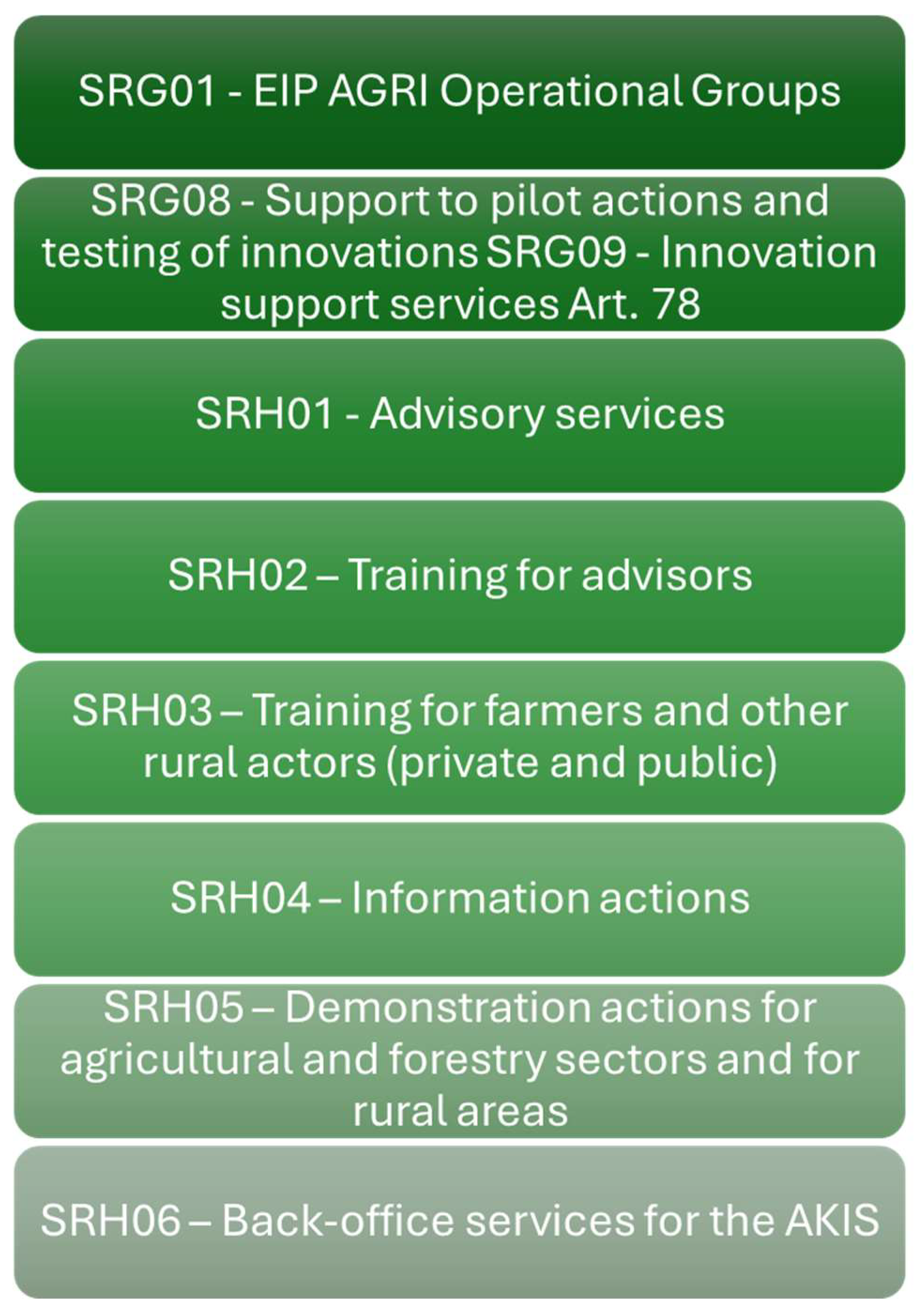
Figure 2.
Methodological procedure.
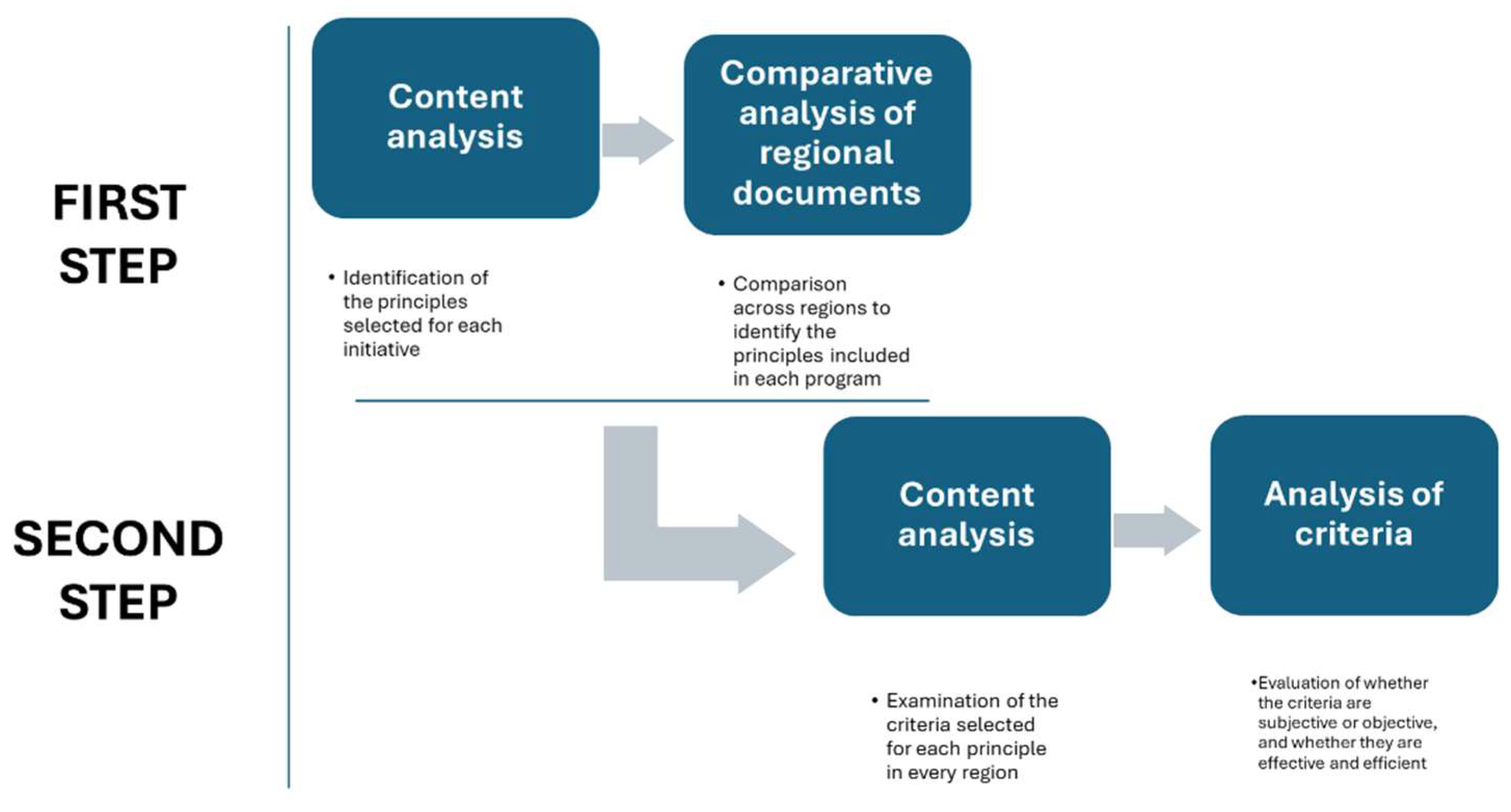
Table 1.
Selection principles adopted by the Italian regions.
| COD | PRINCIPLES |
| SRG01 | 01 – Partnership characteristics of the Operational Group (GO) in relation to the project |
| 02 – Reward for the presence of consulting service providers | |
| 03 – Qualitative characteristics of the project | |
| 04 – Quality of dissemination and communication activities of the results | |
| 05 – Organizational and managerial capacity of the operational group | |
| 05.1 – Reward for specific themes and/or objectives and/or territorial impact and/or types of actions activated | |
| 06 – Sustainability | |
| SRG08 | 01 – Subjective characteristics of the partnership |
| 02 – Qualitative characteristics of the project | |
| 03 – Quality of dissemination and communication activities of the results | |
| 03.1– Characteristics of those accessing the consulting service | |
| 04 – Only for the forestry sector: specific themes in regional programming to ensure coherence with regional forestry programming | |
| 04.1– Alignment with intervention priorities (OS) to be used in the calls | |
| 05 – Impact of the project in terms of stages of the supply chain involved (processing, conservation, storage, packaging, transformation, trade) | |
| SRG09 | 01 – Quality of the project |
| 02 – Quality of the project team | |
| 03 – Consistency of the themes addressed with the general and specific objectives of the CAP | |
| 04 – Consistency of the themes addressed with the characteristics of the territories and/or supply chains to which the project refers | |
| 05 – Connection with the PEI GO projects and with research and innovation projects supported by other EU, national, and regional funds | |
| SRH01 | 01 – Quality of the consultancy projects |
| 02 – Quality of the consultancy provider | |
| 03 – Reward for specific themes | |
| 03.1 – Evaluation of the consultancy recipients | |
| 03.2 – Consistency of the proposals with the identified themes | |
| 03.3 – Consistency of the themes addressed with the characteristics of the territories and/or supply chains to ensure adequate consultancy | |
| 03.4 – Reward for specific themes and/or objectives and/or territorial impact and/or types of actions activated to address priority issues | |
| 03.5 – Characteristics of the consultancy recipients | |
| R/03 – Characteristics of the consultancy service recipients | |
| P03 – Reward based on the recipient | |
| P04 – Reward based on the consultancy theme to ensure more targeted consultancy | |
| SRH02 | 01 – Quality of the project |
| 02 – Quality of the project team | |
| 03 – Consistency of the themes addressed with the general and specific objectives of the CAP | |
| 04 – Reward for specific themes and/or objectives and/or territorial impact and/or types of actions activated | |
| 05 – Connection with PEI GO projects and/or with research and innovation projects supported by other EU, national, and regional funds | |
| SRH03 | 01 – Quality of the training project |
| 02 – Consistency of the themes addressed with the general and specific objectives of the CAP | |
| 03 – Reward for specific themes/objectives and/or territorial impact | |
| 04 – Characteristics of the training recipients in accordance with regional criteria for identifying rewards (localization, structural, managerial targets) | |
| 04.1 – Characteristics of final recipients | |
| 04.2 – Quality of the project team | |
| 04.2 – Quality of the instructors | |
| 04 .3– Quality of the training team | |
| 04 .4– Characteristics of final recipients | |
| 04.5 – Reward for territorial impact | |
| 05 – Quality of the training provider in accordance with regional criteria for identifying rewards (e.g., previous sector experience, quality certification, etc.) | |
| 05.1– Reward based on the recipient and the theme of the training | |
| 05.2– Only for the agricultural sector* | |
| 05.3 – Costs/Benefits of the proposal | |
| 06 – Localization of the final recipients | |
| SRH04 | 01 – Quality of the project |
| 02 – Quality of the project team | |
| 03 – Consistency of the themes addressed with the general and specific objectives of the CAP | |
| 04 – Reward for specific themes and/or objectives and/or territorial impact and/or types of activities based on regional and/or local needs | |
| SRH05 | 01 – Quality of the project |
| 02 – Quality of the project team | |
| 03 – Consistency of the themes addressed with the general and specific objectives of the CAP | |
| 04 – Reward for specific themes and/or objectives and/or territorial impact and/or types of actions activated | |
| 05 – Only for the agricultural sector* | |
| SRH 06 | 01 – Quality of the project; and/or type of activity |
| 02 – Quality of the project team | |
| 03 – Consistency of the themes addressed with the general and specific objectives of the CAP | |
| 04 – Reward for specific themes/objectives and/or territorial impact and/or type of activity | |
| 05 – Characteristics of back-office service recipients (regional criteria for identifying rewards such as localization, structural, and managerial targets) | |
| 06 – Quality of the back-office service provider (regional criteria for identifying rewards such as previous sector experience, quality certification, etc.) |
Table 2.
Comparison of principles across Italian regions.
| COD | PRINCIPLES | VALLE D’AOSTA | PIEMONTE | LIGURIA | LOMBARDIA | P.A. BOLZANO | P.A TRENTO . | VENETO | F.V. GIULIA | EMILIA ROMAGNA | TOSCANA | UMBRIA | MARCHE | LAZIO | ABRUZZO | MOLISE | CAMPANIA | PUGLIA | BASILICATA | CALABRIA | SICILIA | SARDEGNA |
| SRG01 | 01 | 0 | 1 | 1 | 1 | 1 | 1 | 1 | 1 | 1 | 1 | 1 | 1 | 1 | 1 | 0 | 1 | 1 | 1 | 0 | 1 | 1 |
| 02 | 0 | 1 | 1 | 1 | 1 | 0 | 1 | 1 | 1 | 1 | 1 | 0 | 1 | 1 | 0 | 1 | 1 | 1 | 0 | 1 | 1 | |
| 03 | 0 | 1 | 1 | 1 | 1 | 1 | 1 | 1 | 1 | 1 | 1 | 1 | 1 | 1 | 0 | 1 | 1 | 1 | 0 | 1 | 1 | |
| 04 | 0 | 1 | 1 | 1 | 1 | 1 | 1 | 1 | 1 | 1 | 1 | 1 | 1 | 1 | 0 | 1 | 1 | 1 | 0 | 1 | 1 | |
| 05 | 0 | 0 | 0 | 0 | 1 | 0 | 0 | 0 | 0 | 0 | 0 | 0 | 0 | 0 | 0 | 0 | 0 | 0 | 0 | 0 | 0 | |
| 05.1 | 0 | 1 | 1 | 0 | 0 | 0 | 0 | 0 | 0 | 0 | 0 | 0 | 1 | 0 | 0 | 0 | 0 | 0 | 0 | 0 | 0 | |
| 06 | 0 | 0 | 0 | 0 | 1 | 0 | 0 | 0 | 0 | 0 | 0 | 0 | 0 | 0 | 0 | 0 | 0 | 0 | 0 | 0 | 0 | |
| SRG08 | 01 | 1 | 1 | 0 | 1 | 0 | 0 | 1 | 0 | 1 | 1 | 1 | 1 | 0 | 0 | 0 | 0 | 1 | 1 | 1 | 0 | 0 |
| 02 | 1 | 1 | 0 | 1 | 0 | 0 | 1 | 0 | 1 | 1 | 1 | 1 | 0 | 0 | 0 | 0 | 1 | 1 | 1 | 0 | 0 | |
| 03 | 1 | 1 | 0 | 1 | 0 | 0 | 0 | 0 | 1 | 1 | 1 | 1 | 0 | 0 | 0 | 0 | 1 | 1 | 1 | 0 | 0 | |
| 03.1 | 0 | 0 | 0 | 0 | 0 | 0 | 1 | 0 | 0 | 0 | 0 | 0 | 0 | 0 | 0 | 0 | 0 | 0 | 0 | 0 | 0 | |
| 04 | 0 | 1 | 0 | 0 | 0 | 0 | 0 | 0 | 0 | 0 | 0 | 0 | 0 | 0 | 0 | 0 | 0 | 0 | 0 | 0 | 0 | |
| 04.1 | 0 | 0 | 0 | 0 | 0 | 0 | 0 | 0 | 0 | 0 | 1 | 0 | 0 | 0 | 0 | 0 | 0 | 0 | 0 | 0 | 0 | |
| 05 | 0 | 0 | 0 | 0 | 0 | 0 | 0 | 0 | 0 | 0 | 1 | 0 | 0 | 0 | 0 | 0 | 0 | 0 | 0 | 0 | 0 | |
| SRG09 | 01 | 1 | 1 | 0 | 0 | 0 | 0 | 1 | 0 | 0 | 1 | 0 | 0 | 0 | 1 | 0 | 1 | 1 | 0 | 1 | 1 | 1 |
| 02 | 1 | 1 | 0 | 0 | 0 | 0 | 1 | 0 | 0 | 1 | 0 | 0 | 0 | 1 | 0 | 1 | 1 | 0 | 1 | 1 | 1 | |
| 03 | 1 | 1 | 0 | 0 | 0 | 0 | 1 | 0 | 0 | 1 | 0 | 0 | 0 | 1 | 0 | 1 | 1 | 0 | 1 | 1 | 1 | |
| 04 | 1 | 1 | 0 | 0 | 0 | 0 | 1 | 0 | 0 | 1 | 0 | 0 | 0 | 1 | 0 | 1 | 1 | 0 | 1 | 1 | 1 | |
| 05 | 1 | 1 | 0 | 0 | 0 | 0 | 0 | 0 | 0 | 1 | 0 | 0 | 0 | 1 | 0 | 1 | 0 | 0 | 0 | 1 | 1 | |
| SRH01 | 01 | 1 | 1 | 1 | 1 | 0 | 0 | 1 | 0 | 1 | 1 | 1 | 1 | 1 | 1 | 1 | 1 | 1 | 1 | 1 | 1 | 1 |
| 02 | 1 | 1 | 1 | 1 | 0 | 0 | 1 | 0 | 1 | 1 | 1 | 1 | 1 | 1 | 1 | 1 | 1 | 1 | 1 | 1 | 1 | |
| 03 | 0 | 0 | 0 | 0 | 0 | 0 | 0 | 0 | 0 | 0 | 0 | 0 | 0 | 0 | 0 | 0 | 0 | 0 | 0 | 0 | 1 | |
| 03.1 | 0 | 0 | 0 | 0 | 0 | 0 | 0 | 0 | 0 | 0 | 0 | 0 | 0 | 0 | 0 | 0 | 0 | 1 | 0 | 0 | 0 | |
| 03.2 | 0 | 0 | 0 | 0 | 0 | 0 | 0 | 0 | 1 | 0 | 0 | 0 | 0 | 0 | 0 | 0 | 0 | 0 | 0 | 0 | 0 | |
| 03.3 | 0 | 0 | 0 | 0 | 0 | 0 | 0 | 0 | 0 | 0 | 0 | 0 | 1 | 0 | 0 | 0 | 0 | 0 | 0 | 0 | 0 | |
| 03.4 | 0 | 1 | 0 | 0 | 0 | 0 | 0 | 0 | 0 | 0 | 0 | 0 | 0 | 0 | 0 | 0 | 0 | 0 | 0 | 0 | 0 | |
| 03.5 | 0 | 0 | 0 | 0 | 0 | 0 | 0 | 0 | 0 | 0 | 1 | 0 | 0 | 0 | 0 | 0 | 0 | 0 | 0 | 0 | 0 | |
| R/03 | 0 | 0 | 0 | 0 | 0 | 0 | 1 | 0 | 0 | 0 | 0 | 0 | 0 | 0 | 0 | 0 | 0 | 0 | 0 | 0 | 0 | |
| P03 | 0 | 0 | 1 | 0 | 0 | 0 | 0 | 0 | 0 | 0 | 0 | 0 | 0 | 0 | 0 | 0 | 0 | 0 | 0 | 0 | 0 | |
| P04 | 0 | 0 | 1 | 0 | 0 | 0 | 0 | 0 | 0 | 0 | 0 | 0 | 0 | 0 | 0 | 0 | 0 | 0 | 0 | 0 | 0 | |
| SRH02 | 01 | 1 | 1 | 1 | 1 | 0 | 0 | 1 | 0 | 1 | 0 | 0 | 1 | 0 | 1 | 0 | 1 | 1 | 0 | 0 | 1 | 0 |
| 02 | 1 | 1 | 1 | 1 | 0 | 0 | 1 | 0 | 1 | 0 | 0 | 1 | 0 | 1 | 0 | 1 | 1 | 0 | 0 | 1 | 0 | |
| 03 | 1 | 1 | 1 | 1 | 0 | 0 | 1 | 0 | 1 | 0 | 0 | 0 | 0 | 1 | 0 | 1 | 1 | 0 | 0 | 1 | 0 | |
| 04 | 1 | 1 | 1 | 1 | 0 | 0 | 1 | 0 | 1 | 0 | 0 | 1 | 0 | 1 | 0 | 1 | 1 | 0 | 0 | 1 | 0 | |
| 05 | 1 | 1 | 0 | 1 | 0 | 0 | 1 | 0 | 1 | 0 | 0 | 0 | 0 | 1 | 0 | 1 | 1 | 0 | 0 | 1 | 0 | |
| SRH03 | 01 | 1 | 1 | 1 | 1 | 1 | 1 | 1 | 1 | 1 | 1 | 1 | 0 | 1 | 1 | 1 | 1 | 1 | 0 | 1 | 1 | 0 |
| 02 | 1 | 1 | 1 | 1 | 1 | 1 | 1 | 1 | 1 | 1 | 1 | 0 | 1 | 1 | 1 | 1 | 1 | 0 | 1 | 1 | 0 | |
| 03 | 1 | 1 | 1 | 1 | 1 | 1 | 1 | 1 | 1 | 1 | 1 | 1 | 1 | 1 | 1 | 1 | 1 | 0 | 1 | 1 | 0 | |
| 04 | 0 | 0 | 0 | 0 | 0 | 0 | 0 | 0 | 0 | 0 | 1 | 0 | 0 | 0 | 0 | 0 | 0 | 0 | 0 | 0 | 0 | |
| 04.1 | 0 | 0 | 0 | 0 | 0 | 0 | 0 | 0 | 0 | 0 | 0 | 0 | 0 | 0 | 1 | 0 | 0 | 0 | 0 | 0 | 0 | |
| 04.2 | 0 | 1 | 0 | 0 | 0 | 0 | 0 | 0 | 0 | 0 | 0 | 0 | 0 | 0 | 0 | 0 | 0 | 0 | 0 | 0 | 0 | |
| 04.3 | 0 | 0 | 0 | 0 | 0 | 0 | 0 | 0 | 0 | 0 | 0 | 1 | 0 | 0 | 0 | 0 | 0 | 0 | 0 | 0 | 0 | |
| 04 .4 | 0 | 0 | 1 | 0 | 0 | 0 | 0 | 0 | 0 | 0 | 0 | 0 | 0 | 0 | 0 | 0 | 0 | 0 | 0 | 0 | 0 | |
| 04.5 | 0 | 0 | 0 | 0 | 0 | 0 | 0 | 0 | 0 | 0 | 0 | 0 | 0 | 0 | 0 | 0 | 0 | 0 | 0 | 0 | 0 | |
| 04 .6 | 0 | 0 | 0 | 1 | 0 | 0 | 0 | 0 | 0 | 0 | 0 | 0 | 0 | 0 | 0 | 0 | 0 | 0 | 0 | 0 | 0 | |
| 05 | 0 | 0 | 0 | 0 | 0 | 0 | 0 | 0 | 0 | 0 | 1 | 0 | 0 | 0 | 0 | 0 | 0 | 0 | 0 | 0 | 0 | |
| 05.1 | 0 | 0 | 1 | 0 | 0 | 0 | 0 | 0 | 0 | 0 | 0 | 0 | 0 | 0 | 0 | 0 | 0 | 0 | 0 | 0 | 0 | |
| 05.2 | 0 | 1 | 0 | 0 | 0 | 0 | 0 | 0 | 0 | 0 | 0 | 0 | 0 | 0 | 0 | 0 | 0 | 0 | 0 | 0 | 0 | |
| 05.3 | 0 | 0 | 0 | 0 | 0 | 0 | 0 | 0 | 0 | 0 | 0 | 0 | 0 | 0 | 1 | 0 | 0 | 0 | 0 | 0 | 0 | |
| 06 | 0 | 0 | 0 | 0 | 0 | 0 | 0 | 0 | 0 | 0 | 0 | 0 | 0 | 0 | 1 | 0 | 0 | 0 | 0 | 0 | 0 | |
| SRH04 | 01 | 0 | 1 | 1 | 1 | 0 | 0 | 1 | 0 | 1 | 1 | 0 | 0 | 1 | 1 | 1 | 1 | 1 | 1 | 1 | 1 | 1 |
| 02 | 0 | 1 | 1 | 1 | 0 | 0 | 1 | 0 | 1 | 1 | 0 | 1 | 1 | 1 | 1 | 1 | 1 | 1 | 1 | 1 | 1 | |
| 03 | 0 | 1 | 1 | 1 | 0 | 0 | 1 | 0 | 1 | 1 | 0 | 0 | 1 | 1 | 1 | 1 | 1 | 1 | 1 | 1 | 1 | |
| 04 | 0 | 1 | 1 | 1 | 0 | 0 | 0 | 0 | 1 | 1 | 0 | 1 | 1 | 1 | 1 | 1 | 1 | 1 | 1 | 1 | 1 | |
| SRH05 | 01 | 0 | 1 | 1 | 1 | 1 | 0 | 1 | 0 | 1 | 1 | 1 | 0 | 0 | 0 | 1 | 0 | 1 | 1 | 0 | 1 | 0 |
| 02 | 0 | 1 | 1 | 1 | 1 | 0 | 1 | 0 | 1 | 1 | 1 | 0 | 0 | 0 | 1 | 0 | 1 | 1 | 0 | 1 | 0 | |
| 03 | 0 | 1 | 1 | 1 | 1 | 0 | 1 | 0 | 1 | 1 | 1 | 0 | 0 | 0 | 1 | 0 | 1 | 1 | 0 | 1 | 0 | |
| 04 | 0 | 1 | 1 | 1 | 1 | 0 | 1 | 0 | 1 | 1 | 1 | 0 | 0 | 0 | 1 | 0 | 1 | 1 | 0 | 1 | 0 | |
| 05 | 0 | 1 | 0 | 0 | 0 | 0 | 0 | 0 | 0 | 0 | 0 | 0 | 0 | 0 | 0 | 0 | 0 | 0 | 0 | 0 | 0 | |
| SRH 06 | 01 | 1 | 1 | 1 | 1 | 0 | 0 | 1 | 1 | 0 | 0 | 1 | 1 | 0 | 0 | 0 | 1 | 1 | 0 | 0 | 1 | 0 |
| 02 | 1 | 1 | 1 | 1 | 0 | 0 | 1 | 1 | 0 | 0 | 1 | 1 | 0 | 0 | 0 | 1 | 1 | 0 | 0 | 1 | 0 | |
| 03 | 1 | 1 | 1 | 1 | 0 | 0 | 1 | 1 | 0 | 0 | 1 | 0 | 0 | 0 | 0 | 1 | 1 | 0 | 0 | 1 | 0 | |
| 04 | 1 | 1 | 1 | 1 | 0 | 0 | 1 | 1 | 0 | 0 | 1 | 1 | 0 | 0 | 0 | 1 | 1 | 0 | 0 | 1 | 0 | |
| 05 | 0 | 0 | 0 | 0 | 0 | 0 | 0 | 0 | 0 | 0 | 1 | 0 | 0 | 0 | 0 | 0 | 0 | 0 | 0 | 0 | 0 | |
| 06 | 0 | 0 | 0 | 0 | 0 | 0 | 0 | 0 | 0 | 0 | 1 | 0 | 0 | 0 | 0 | 0 | 0 | 0 | 0 | 0 | 0 |
Table 3.
Objective and subjective indicators across selection criteria.
| AKIS Initiative | Total Criteria |
% Objective Indicators |
% Subjective Indicators |
Region | For more details, see |
| SRG01 - EIP AGRI Operational Groups | 27 | 38.89% | 61.11% | Abruzzo | Table A1 in Appendix |
| Trento | |||||
| Bolzano | |||||
| Veneto | |||||
| SRG08 - Support to pilot actions and testing of innovations | 17 | 47.06% | 52.94% | Piemonte | Table A2 in Appendix |
| SRG09 - Innovation support services Art. 78 | 24 | 50% | 50% | Toscana | Table A3 in Appendix |
| Piemonte | |||||
| Veneto | |||||
| Abruzzo | |||||
| Campania | |||||
| SRH01 - Advisory services | 14 | 60% | 40% | Campania | Table A4 in Appendix |
| Piemonte | |||||
| Abruzzo | |||||
| Emilia Romagna | |||||
| SRH02 – Training for advisors | 5 | 80% | 20% | Piemonte | Table A5 in Appendix |
| SRH03 – Training for farmers and other rural actors (private and public) | 17 | 70.59% | 29.41% | Veneto | Table A6 in Appendix |
| Marche | |||||
| Campania | |||||
| Toscana | |||||
| Lombardia | |||||
| Abruzzo | |||||
| Piemonte | |||||
| Emilia Romagna | |||||
| SRH04 – Information actions | 9 | 90% | 10% | Veneto | Table A7 in Appendix |
| Marche | |||||
| SRH05 – Demonstration actions for agricultural and forestry sectors and for rural areas | 15 | 62.50% | 37.50% | Veneto | Table A8 in Appendix |
| Piemonte | |||||
| SRH06 – Back-office services for the AKIS | 6 | 33.33% | 66.67% | Veneto | Table A9 in Appendix |
| Toscana | |||||
| Piemonte | |||||
| Sicilia |
Disclaimer/Publisher’s Note: The statements, opinions and data contained in all publications are solely those of the individual author(s) and contributor(s) and not of MDPI and/or the editor(s). MDPI and/or the editor(s) disclaim responsibility for any injury to people or property resulting from any ideas, methods, instructions or products referred to in the content. |
© 2025 by the authors. Licensee MDPI, Basel, Switzerland. This article is an open access article distributed under the terms and conditions of the Creative Commons Attribution (CC BY) license (https://creativecommons.org/licenses/by/4.0/).
Copyright: This open access article is published under a Creative Commons CC BY 4.0 license, which permit the free download, distribution, and reuse, provided that the author and preprint are cited in any reuse.


