

Submitted:
10 April 2025
Posted:
11 April 2025
You are already at the latest version
Abstract
This paper reports concentrations of Ra-226, Th-232 and K-40 in drinking waters in Pakistan. The aim is to estimate the radiological hazard and assess the safety of drinking water. Radiation hazard indices, and Excess Lifetime Cancer Risks are reported from all measurements. Different water samples have been collected from Islamabad (33o 38'N, 73o 09’E) and analysed using a High Purity Germanium Detector (HPGe). The average concentration values of Ra-226, Th-232 and K-40 were 6+/-0.6 Bq/L, 32+/-1 Bq/L and 74+/-2 Bq/L respectively. The radium equivalent activity was 58 Bq/L, the outdoor external dose was 0.2 nGy/h, the indoor external dose was 46 nGy/h and total average annual dose was 0.2 nGy/h. The excess lifetime cancer risk found equal to 0.8×10^-3. All reported values are lower than the globally calculated values and within recommended limits.
Keywords:
radioactive pollutants
; Ra-226
; Th-232
; K-40
; Radiation Hazard Index
; High Purity Germanium Detector (HPGe)
1. Introduction
Human beings are exposed to a wide range of radionuclides that are present in the environment, including water, air, soil and rock. These radionuclides originate from the earth’s crust and also from man-made sources, such as residues from mining activities [1], products of the fertilizer industry [2] and building materials [3,4]. The natural radionuclides in the environment are very important for public health because their uninterrupted disintegration causes a continuous radiation exposure to humans and yields to radiological hazard. Radionuclides of significance are 226Ra from the 238U series, 232Th (parent nucleus of the same name series) and 40K [5]. Apart from being present in water, air, soil, rock and building materials, they may be naturally transferred, reach water tanks and aquifers and become, hence, sources of extra exposure [1]. This exposure is mainly internal, but can be external as well via water cycle [1]. Importantly, since water is essential for all living organisms, environmental compartments, flora and fauna and all parts of biodiversity, the radiological contamination of water yields to consequent contamination of the food chain [6,7] and, as a result, to more internal exposure. All types of exposure due to these nuclides depend primarily on the geological and geographical conditions [8,9] and may be delivered both outdoors and indoors. Especially the internal contamination from 40K is associated with a significant continuous constant exposure that can be altered by sports activity and diseases [10,11]. Since all aspects of environment contain 226Ra, 232Th and 40K, it is significant that the concentrations of the nuclides are measured and the corresponding exposure and risk are estimated. Together with other radionuclides 226Ra, 232Th and 40K constitute the so-called terrestrial radiation. Because of their very long half-lives (1620 y, 1.4 × 10¹⁰y and 1.2 × 10⁹y), they are still found in significant quantities in the Earth’s crust and, as a result, they continue to emit radiation, expose humans and burden health. By measuring these natural sources of radiation, the background profiles of natural radioactivity can be outlined, the radiation exposure can be estimated and the corresponding health hazard risks can be appraised [12,13] . Moreover, understanding their behaviour, including concentrations and distribution, local authorities and stakeholders are assisted and, most importantly, the worldwide knowledge base of radiation information is broadened. Although a significant amount of the related research is on the concentrations of 226Ra, 232Th and 40K in soil and building materials [4,14,15,16], the corresponding concentrations in water samples are of equal importance [18,19]. This is reinforced by the fact that both 226Ra and 232Th are parent radionuclides for the generation of the most harmful isotopes of environmental radon, viz., 222Rn (from 226Ra) and 220Rn (from 232Th). Both isotopes have been acknowledged [17,21] as serious environmental carcinogenic factors with 222Rn being separated as the most significant natural cause of lung cancer incidence, both at high and, most importantly, at low residential concentrations. Moreover, both 222Rn and 220Rn are found in waters and aquifers, making them very critical for radiological protection. Regarding their physical properties 222Rn, hereafter called radon, is a noble gas with a half-life of 4.5 × 10⁹y whereas 220Rn, hereafter called thoron, has only 55.6 s which means that usually is disintegrated quickly. However the radiological value is not mainly due to the above radon isotopes, but rather because of their short lived progeny. Although the related contribution of thoron in atmosphere is low, this can be altered dramatically in waters rich in 232Th. It becomes hence evident, that the presence of 226Ra and 232Th in waters is a health threat not only due to these precise nuclides, but also due to their daughter nuclei, 222Rn and 220Rn. Specially regarding these latter nuclides, there are people that use groundwater as potable and this imposes significant risk because radon is more enriched in groundwater. This is prolonged more, because during periods of high temperature gradients, radon in groundwater raises abnormally to hundreds of , due to the high amounts of radioactive minerals in the ground. This may yield to abnormal radon anomalies as for example, in the village of Villar de la Yegua in Spain, where significantly higher mean deviation of radon concentration (as high as 15,000 ) was recorded, while the difference between this village and the surrounding regions, was about 818 [18]. For integrity it should be mentioned, that there are contradictory interpretations regarding the causal relationship between radon in drinking water and gastrointestinal malignancy, with studies reporting no correlation between radon in water and stomach cancer while others, positive relationship [19,20]. All these facts provide additional evidence regarding the significance of the measurement of concentrations of 226Ra and 232Th in waters. In Pakistan, the radionuclide content of drinking waters has not been investigated so-far at a national scale. Only some individual limited efforts exist, by few organisations or institutions and for educational purposes only. In view of this situation, measurements have been conducted of the content of 226Ra, 232Th and 40K of waters of Islamabad, Pakistan. The scope was to assess the short-term exposure of inhabitants, to estimate the concentration variations and to find the related health-hazards. Towards this, samples were collected from different sectors of Islamabad along with samples from the most populous areas around the city. Mean annual effective doses are calculated together with exposure and risk estimations via different hazard indices. In the following, the study area is given together with information of sample collection and measurement via High Purity Germanium (HPGe) x-ray spectrometer measurements. The mathematical aspects of exposure, dose and risk estimations are given next. Finally the results are given and their implications are discussed.
2. Materials and Methods
2.1. Experimental Aspects
2.1.1. Area of Study
The study area is Islamabad which is the capital of Pakistan, located at 33o N, 73o E at the edge of the Potohar Plateau in the vicinity of the foothills of Malaria elevated at 507 m above mean sea level. The leading feature controlling the geology of the Islamabad area is the convergence of the Indo-European and Eurasian tectonic plates which began about 20 million years ago. This process produced a complex structure and stratigraphy in the Islamabad area that has been investigated by many local and international geologists. The study area tectonically lies along the significant faults of Margalla and Fateh Jang which form an arc length of several hundred miles (Figure 1).
2.1.2. Sample Collection and Measurement
A total of 50 water samples were obtained from different sectors of the Islamabad region as shown in Figure 1. Specifically, the distance between each sector was kept 2×2 , to remove sample overlapping among different sectors. These sectors are denoted by, E, F, G, H, I together with their adjacent areas, namely, Chak Shehzad (CSD), Nilore (NLR), Barakahu (BKH), Rawal-dam (RWD) and Quaid-e-Azam University (QAU). The activity concentration of the collected samples was measured by a High Purity Germanium (HPGe), x-ray spectrometer. As mentioned, the nuclides of analysis were 226Ra, 232Th, and 40K. The geometry of the detector was a vertical dipstick with a nitrogen cooling arrangement. The length of the HPGe detector was 53.4 and its diameter was 59 . The detector efficiency is 52.3%, the energy resolution is is 1.85 , for the 1.33 photo peak and the Full-Width Half Maximum (FWHM) equals to the x-ray transition of a Cobalt 60Co point source in a 5 × 5 Sodium Iodide NaI (TI). The background level of radioactivity is measured periodically in the laboratory. The activity concentration of 226Ra is measured by the 351 peak of 214Pb and the 609, 1120 and 1749 peaks of 214Bi. The activity concentration of 232Th is measured the 238.63 peak of 212Pb, the 338 and 911 peaks of 228Ac and the 585 peak of 208Tl. The activity concentration of 40K was measured from its single peak of 1460 . Spectra acquisition time was 20,000 s. All spectra were stored on a computer. After collection, each of the water samples was acidified with 11 M HCL solution at the rate of 10 in reference to the sample’s volume. This procedure was followed to avoid absorption of radionuclides as reported by IEAE [21], while it also releases any radionuclides already absorbed, back into the samples. In the laboratory, Marinelli beakers were used to collect the water samples. First of all, each Marinelli beaker with a volume of 1 L was rinsed with dilute sulfuric acid (H2SO4) and then the samples were turned into each beaker with proper labelling, sealed and left for about four weeks. The purpose of this was to achieve a state of secular equilibrium between the parent and daughter nuclides within each sample. After radioactive equilibrium, water samples were analysed and the activity concentration of the radionuclides present in each sample was measured. The soil sample was collected under the well water when it settled down.
2.2. Mathematical Aspects
The Gamma index measures the total gamma-ray radiation emitted by a water sample. It can be calculated by Equation (1):
The , and correspond to the activity concentrations of 226Ra, 232Th and 40K as () respectively.
Radium equivalent activity () was obtained by Equation (2):
If sample has known content of 226Ra, 232Th and 40K ,the external hazard index, , can be calculated by Equation (3):
Again , and are the activity concentrations as in equation 1. A radiation-safe sample has less than unity. For a sample, further from Equation (3), the indoor external dose, , can be calculated using Equation (4)
and the corresponding Annual effective dose, , from Equation (5):
Finally, the excess lifetime cancer risk () was calculated based on the values of annual effective dose by the relationship given in Equation (6):
In this equation is the annual effective dose and is the life expectancy which is on average 66 years for Pakistan. is the fatal risk factor per Sievert, which is 0.05 according to a previous study carried out in this region.
3. Results and Discussion
According to the HPGe measurements, the activity concentrations in the various sectors of Islamabad, ranged from (0.87±0.001) to (17.89±1.02) for 226Ra, from (12.44±0.99) to (47.74±3.02) for 232Th, and from (50.09±3.04 to (98.09±6.00) 40K respectively. The average values obtained from the analysis of samples were (6.35±0.59) for 226Ra, (32.09 ±2.87) for 232Th and (73.87±5.40) for 40K respectively. Accounting that 1 L of water weights 1 , the above values can be compared to the specific activity () reported by several researchers. In this sense the above value ranges are comparable the corresponding ranges reported in Turkey [13], however, with significantly lower maximum values. The ranges of all nuclides are within the corresponding ranges of some sites in Russia [16], with higher maximum values. On the other hand, only the ranges of 226Ra and 232Th are comparable with the ones of other sites in Russia, whereas the ranges of 40K are significantly lower [5]. The value range of 226Ra and 232Th are similar to those reported in Nigeria, however the range of 40K are significantly lower [22]. The ranges of 232Th are similar to those of sediments of rivers in Morocco, but very higher than the samples of the river’s waters [1]. All are within the corresponding global ranges [8,24,27]. The summary of every radionuclide analysis is shown in Table 1. The discrepancies of the activity concentration against sample number are shown in Figure 2. Comparing the activity concentrations within each sample point, the partial concentration values of 40K are higher than the corresponding activity concentration values of 232Th which, in turn, are higher than the ones of 226Ra. Namely, within each sample, . The reader should note here in relation, that a different order, namely has been observed in Russia [16], viz. . On the other hand, similar association with this paper, viz. is reported for other sites in Russia [5]. More significant, however, than the intra-nuclide associations, are the intra-activity relations of each nuclide, namely the the comparisons of the activity concentration distribution between the nuclides. At first, by visually observing the curve activity concentration profiles of Figure 2, it may be supported that the distribution within samples 1-4 and 26-50 is comparable between the three nuclides (226Ra, 232Th and 40K). This can be attributed to the relative positions of these points in association to the Margalla and Fateh Jang arcs. By analytically going trough the values of Table 1, it can be observed that the activity concentration values of F-sector (G-10, G-11, and H-10) in Islamabad are relatively higher when compared with the corresponding values of the other sectors. This is possibly because the Fateh Jang fault is passing through the F-sector, as shown in Figure 1. The total activity concentration () in these sectors was 163.72 , which is very prominent, at least when compared to the total activity concentration values of other parts of the study area. The total activity concentration (153.01 ) was also high for the combination of sectors H-8 and H-9 as well. A possible reason for that, is that these sectors lie on opposite sides of the fault. The total activity concentration () varied from 80.74 to 163.72 for all the sectors of Islamabad.
As far as the radiological potential of Islamabad’s waters concerns, all average activity concentrations are higher than the maximum proposed limit of 11.1 of the United States Environmental protection Agency (EPA) [23], but are within the corresponding value range reported in the related publications of the United Nations Scientific Committee on the Effects of Atomic Radiation (UNSCEAR) for the worldwide ranges of activity concentrations of 226Ra, 232Th and 40K in drinking water [8,24,27]. The hazard of these values is estimated by the radiological indices of Section 2.2. The reader should note here in relation, that similar radiological indices have been followed by other researchers as well. In specific the quantities , and are mentioned by Abd Elkader et al. [4]. All quantities are employed for dosimetry by Aközcan et al. [13]. Many of the related quantities are mentioned by Azeez et al. [2] and elsewhere [3,14,16,22,25,26]. From this point of view, it can be supported hence that the employed quantities are adequate for reference comparisons and dosimetric estimations. The values of the radiological hazard indices are shown in last two columns of Table 1 and in Table 2. The Gamma index has a value less than 0.33 which is lower than the global average value of 1.17 [8,24,27]. The average value of the Radium equivalent activity () was 57.89 whereas, the maximum value reached up to 163.72 . The global average value is 370 [8,24,27], therefore, both values are significantly lower. The external hazard index was 0.17 which is significantly less than 1 and this implies low radiological hazard [2,16,25,26]. The value is also within the value range reported by Azeez et al. [2]. The maximum value of calculated via Equation (4) was 76.83 , which is lower than the global average of 279.64 [8,24]. That means that the maximum dose rate due water is considered low. The value range of is within the range mentioned by Azeez et al. [2] and other references [25,26]. The effective dose includes the effect of 226Ra, 232Th, and 40K in different samples of water. The maximum value of the annual effective dose is calculated to be 0.30 . The range of the annual effective dose comes out to be 0.10-0.30 . The global value of as per the UNSCEAR report comes out to be 1.37 . The variation of is shown in the Figure 3. The calculated in this study has an average value of is lower than the average world value of , which is the probability of cancer incidence due to radioactivity in the indoor environment. All these values are comparable to the international comparison values reported by by Aközcan et al. [13], see Table 4]. All values are also within the value range reported by Azeez et al. [2]. The values are within the range reported by Inoue etal. [12]. They are also comparable to the ranges reported by Yakovlev et al. [16], Abdullahi et al. [3] and Stojanovska and Blazho [14].
This investigation is a radiological study carried out in Islamabad, Pakistan. The activity concentrations of 226Ra, 232Th, and 40K were measured in water samples collected from different sites of Islamabad. The concentrations varied between the measurement sites, most possibly, due to the distance of the main fault across the capital city, which could enhance these perturbations. The concentrations and the corresponding doses were within the ranges reported from various papers and are also within the international ranges. The average concentrations and doses are considered low. This may be attributed to the non-igneous formation around the fault zone in Islamabad. Therefore, the drinking water from wells and tube wells in Islamabad, Pakistan is of relatively low risk. Th radiological estimation was based on samples collected from different wells around Islamabad and therefore it is a characteristic summary of the analysis of drinking water. The direct exposure of the individuals to radionuclides in wells could assess the concentration in the study area. In general the drinking waters of Islamabad are safe.
4. Conclusions
In the current investigation, the concentrations of different radioactive-nuclides were analysed in water samples retrieved from tube wells in different sectors in the capital city of Islamabad, Pakistan.The employed hazard indices (, , and ) in the water samples of the study area are within international ranges lower but are of low average values. is more low than the average concentration and also within the international range.The average is 0.76×10⁻³, which is lower than the global average value of 1.45×10⁻³. Therefore, the radioactivity concentrations in water samples of Islamabad have a low chance of inducing cancer to the local inhabitants. These radioactive nuclides also do not seem to threat the surrounding areas. There are some sectors in Islamabad where radiation index values are slightly high, but that does not impose a threat as well. Hence, Islamabad can be considered as a less radiation prone city as far as drinking water is concerned.
Acknowledgement
The authors are thankful to Department of Physics, COMSATS Institute for Information Technology, Islamabad, Pakistan for providing the lab facility to conduct all the measurements. We are also thankful to our colleagues in collecting the samples from different sectors of Islamabad to complete the project. There is no direct source of funding during the course of this study.
Author Contributions
Conceptualization, J.A, D.N and A.A.; methodology, D.N. and J.A., M.A.S. , W.A.Z. and M.S.; software, D.N. and A.A.; formal analysis, D.N., J.A. and A.A.; investigation, M.A.S,W.A.Z.,M.S and A.A.; resources, W.A.Z.,M.S. and M.A.S..; data curation, J.A. ,M.S.,M.A.S. ,W.A.Z.and M.S.; writing-original draft preparation, D.N., J.A., M.S., W.A.Z. and A.A.; writing-review and editing, D.N., M.S. and J.A.; visualization, D.N., A.A.; supervision, D.N.; project administration, D.N.
Funding
This research received no external funding
Informed Consent Statement
Not applicable
Data Availability Statement
Not applicable.
Acknowledgments
In this section you can acknowledge any support given which is not covered by the author contribution or funding sections. This may include administrative and technical support, or donations in kind (e.g., materials used for experiments).
Conflicts of Interest
The authors declare no conflict of interest.
Abbreviations
The following abbreviations are used in this manuscript:
| MDPI | Multidisciplinary Digital Publishing Institute |
| DOAJ | Directory of open access journals |
| TLA | Three letter acronym |
| LD | Linear dichroism |
References
- Manjón, G.; Mantero, J.; Vioque, I.; Díaz-Francés, I.; Galván, J.A.; Chakiri, S.; Choukri, A.; García-Tenorio, R. Natural radionuclides (NORM) in a Moroccan river affected by former conventional metal mining activities. Journal of Sustainable Mining 2019, 18, 45–51. [Google Scholar] [CrossRef]
- Azeez, H.H.; Mansour, H.H.; Ahmad, S.T. Effect of Using Chemical Fertilizers on Natural Radioactivity Levels in Agricultural Soil in the Iraqi Kurdistan Region. Polish Journal of Environmental Studies 2020, 29, 1059–1068. [Google Scholar] [CrossRef]
- Abdullahi, S.; Ismail, A.F.; Samat, S. Determination of indoor doses and excess lifetime cancer risks caused by building materials containing natural radionuclides in Malaysia. Nuclear Engineering and Technology 2019, 51, 325–336. [Google Scholar] [CrossRef]
- Abd Elkader, M.M.; Shinonaga, T.; Sherif, M.M. Radiological hazard assessments of radionuclides in building materials, soils and sands from the Gaza Strip and the north of Sinai Peninsula. Scientific Reports 2021, 11, 23251. [Google Scholar] [CrossRef] [PubMed]
- Menshikova, E.; Perevoshchikov, R.; Belkin, P.; Blinov, S. Concentrations of Natural Radionuclides (40K, 226Ra, 232Th) at the Potash Salts Deposit. Journal of Ecological Engineering 2021, 22, 179–187. [Google Scholar] [CrossRef]
- Kaewtubtim, P.; Meeinkuirt, W.; Seepom, S.; Pichtel, J. Radionuclide (226Ra, 232Th, 40K) accumulation among plant species in mangrove ecosystems of Pattani Bay, Thailand. Marine Pollution Bulletin 2017, 115, 391–400. [Google Scholar] [CrossRef]
- El-Gamal, H.; Hussien, M.T.; Saleh, E.E. Evaluation of natural radioactivity levels in soil and various foodstuffs from Delta Abyan, Yemen. Journal of Radiation Research and Applied Sciences 2019, 12, 226–233. [Google Scholar] [CrossRef]
- Deliberations of the United Nations Scientific Committee on the Effects of Atomic Radiation at its sixty-seventh session; United Nations, 2000.
- Tzortzis, M.; Tsertos, H. Determination of thorium, uranium and potassium elemental concentrations in surface soils in Cyprus. Journal of Environmental Radioactivity 2004, 77, 325–338. [Google Scholar] [CrossRef]
- Myhre, L.G.; Kessler, W.V. Body density and potassium 40 measurements of body composition as related to age. Journal of Applied Physiology 1966, 21, 1251–1255. [Google Scholar] [CrossRef]
- Avlonitou, E.; Georgiou, E.; Douskas, G.; Louizi, A. Estimation of body composition in competitive swimmers by means of three different techniques. Int. J. Sports Med. 1997, 18, 363–368. [Google Scholar] [CrossRef]
- Inoue, K.; Fukushi, M.; Van Le, T.; Tsuruoka, H.; Kasahara, S.; Nimelan, V. Distribution of gamma radiation dose rate related with natural radionuclides in all of Vietnam and radiological risk assessment of the built-up environment. Scientific Reports 2020, 10, 12428. [Google Scholar] [CrossRef] [PubMed]
- Aközcan, S.; Külahcı, F.; Günay, O.; Özden, S. Radiological risk from activity concentrations of natural radionuclides: Cumulative Hazard Index. Journal of Radioanalytical and Nuclear Chemistry 2021, 327, 105–122. [Google Scholar] [CrossRef]
- Stojanovska, Z.; Boev, B. Risk assessment resulting from radionuclides in soils of the Republic of Macedonia. Prilozi - Makedonska Akademija na Naukite i Umetnostite Oddelenie za Prirodno-Matematichki i Biotehnichki Nauki 2019, 40, 161–168. [Google Scholar]
- Devi, V.; Chauhan, R.P. Estimation of natural radionuclide and exhalation rates of environmental radioactive pollutants from the soil of northern India. Nuclear Engineering and Technology 2020, 52, 1289–1296. [Google Scholar] [CrossRef]
- Yakovlev, E.Y.; Zykova, E.N.; Zykov, S.B.; Malkov, A.V.; Bazhenov, A.V. Heavy metals and radionuclides distribution and environmental risk assessment in soils of the Severodvinsk industrial district, NW Russia. Environmental Earth Sciences 2020, 79, 218. [Google Scholar] [CrossRef]
- Nazaroff, W.W.; Nero, A.J. Radon and its decay products in indoor air; John Wiley and Sons, Incorporated: United States, 1988. [Google Scholar]
- Elío, J.; Cinelli, G.; Bossew, P.; Gutiérrez-Villanueva, J.L.; Tollefsen, T.; De Cort, M.; Nogarotto, A.; Braga, R. The first version of the Pan-European Indoor Radon Map. Natural Hazards and Earth System Sciences 2019, 19, 2451–2464. [Google Scholar] [CrossRef]
- Wilkinson, G.S. Gastric cancer in New Mexico counties with significant deposits of uranium. Arch Environ Health 1985, 40, 307–312. [Google Scholar] [CrossRef]
- Kjellberg, S.; Wiseman, J.S. The relationship of radon to gastrointestinal malignancies. Am Surg 1995, 61, 822–825. [Google Scholar]
- ; Number 295 in Technical Reports Series, INTERNATIONAL ATOMIC ENERGY AGENCY: Vienna, 1989.
- Ibikunle, S.B.; Arogunjo, A.M.; Ajayi, O.S. Characterization of radiation dose and soil-to-plant transfer factor of natural radionuclides in some cities from south-western Nigeria and its effect on man. Scientific African 2019, 3, e00062. [Google Scholar] [CrossRef]
- EPA 1999 National primary drinking water regulations, radon-222 federal register US; Vol. 64, Environmental Protection Agency, 1999; pp. 59245–59294.
- on the Effects of Atomic Radiation, U.N.S.C. Sources and Effects of Ionizing Radiation, United Nations Scientific Committee on the Effects of Atomic Radiation (UNSCEAR) 1993 Report; United Nations, 1993.
- Qureshi, A.A.; Tariq, S.; Din, K.U.; Manzoor, S.; Calligaris, C.; Waheed, A. Evaluation of excessive lifetime cancer risk due to natural radioactivity in the rivers sediments of Northern Pakistan. Journal of Radiation Research and Applied Sciences 2014, 7, 438–447. [Google Scholar] [CrossRef]
- Alzubaidi, G.; Hamid, F.B.S.; Abdul Rahman, I. Assessment of Natural Radioactivity Levels and Radiation Hazards in Agricultural and Virgin Soil in the State of Kedah, North of Malaysia. ScientificWorldJournal 2016, 2016, 6178103. [Google Scholar] [CrossRef] [PubMed]
- on the Effects of Atomic Radiation, U.N.S.C. Sources and Effects of Ionizing Radiation, United Nations Scientific Committee on the Effects of Atomic Radiation (UNSCEAR) 2020/2021 Report; United Nations, 2021.
Figure 1.
The map shows the location of sampling sites. The elevation contours marking the topography of the study area have been digitised from the topo-sheet NI-43-9 series U-502.
Figure 1.
The map shows the location of sampling sites. The elevation contours marking the topography of the study area have been digitised from the topo-sheet NI-43-9 series U-502.
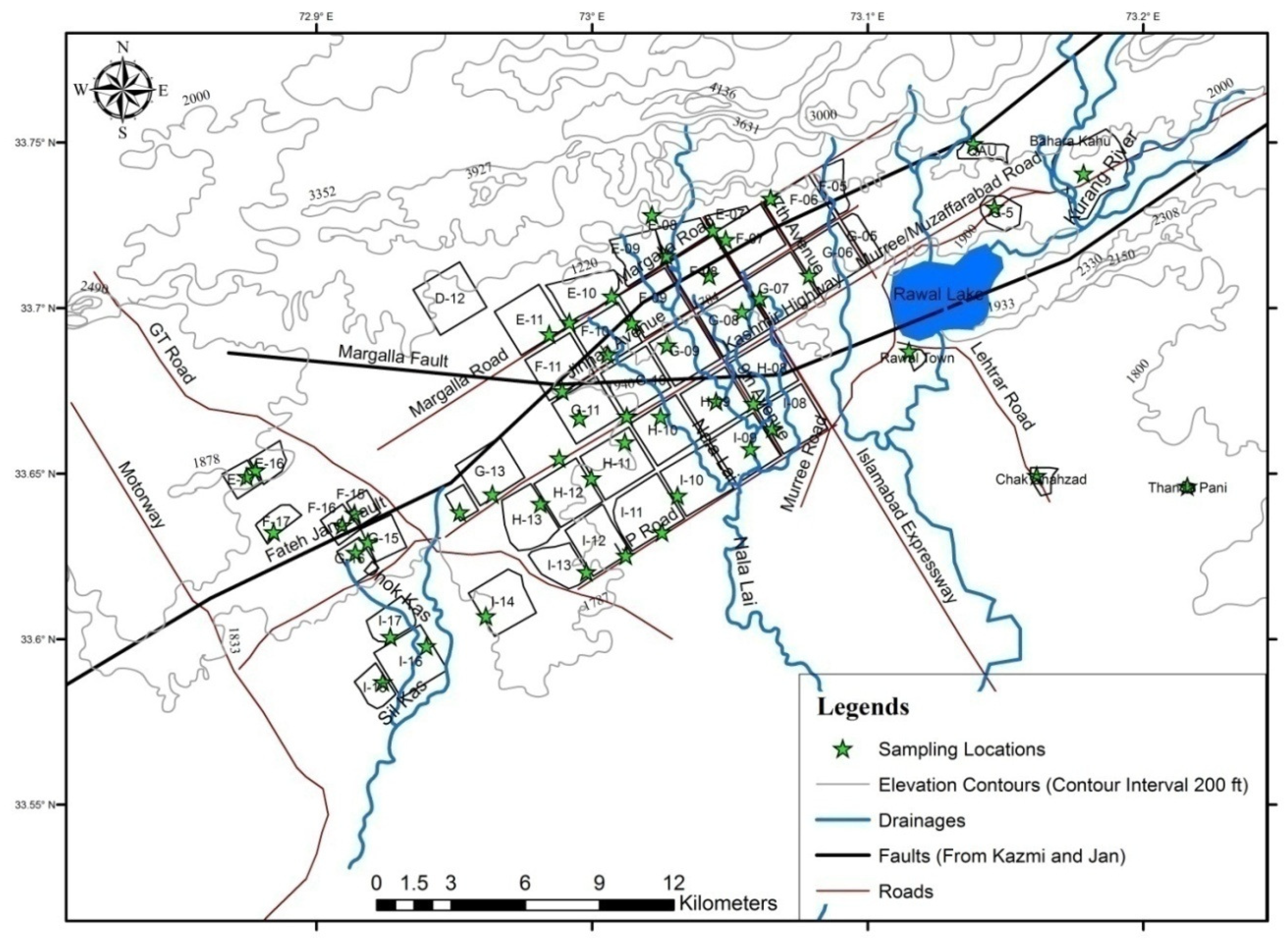
Figure 2.
Variation of activity concentration of 226Ra,232Th, and 40K in different samples of the study area.
Figure 2.
Variation of activity concentration of 226Ra,232Th, and 40K in different samples of the study area.
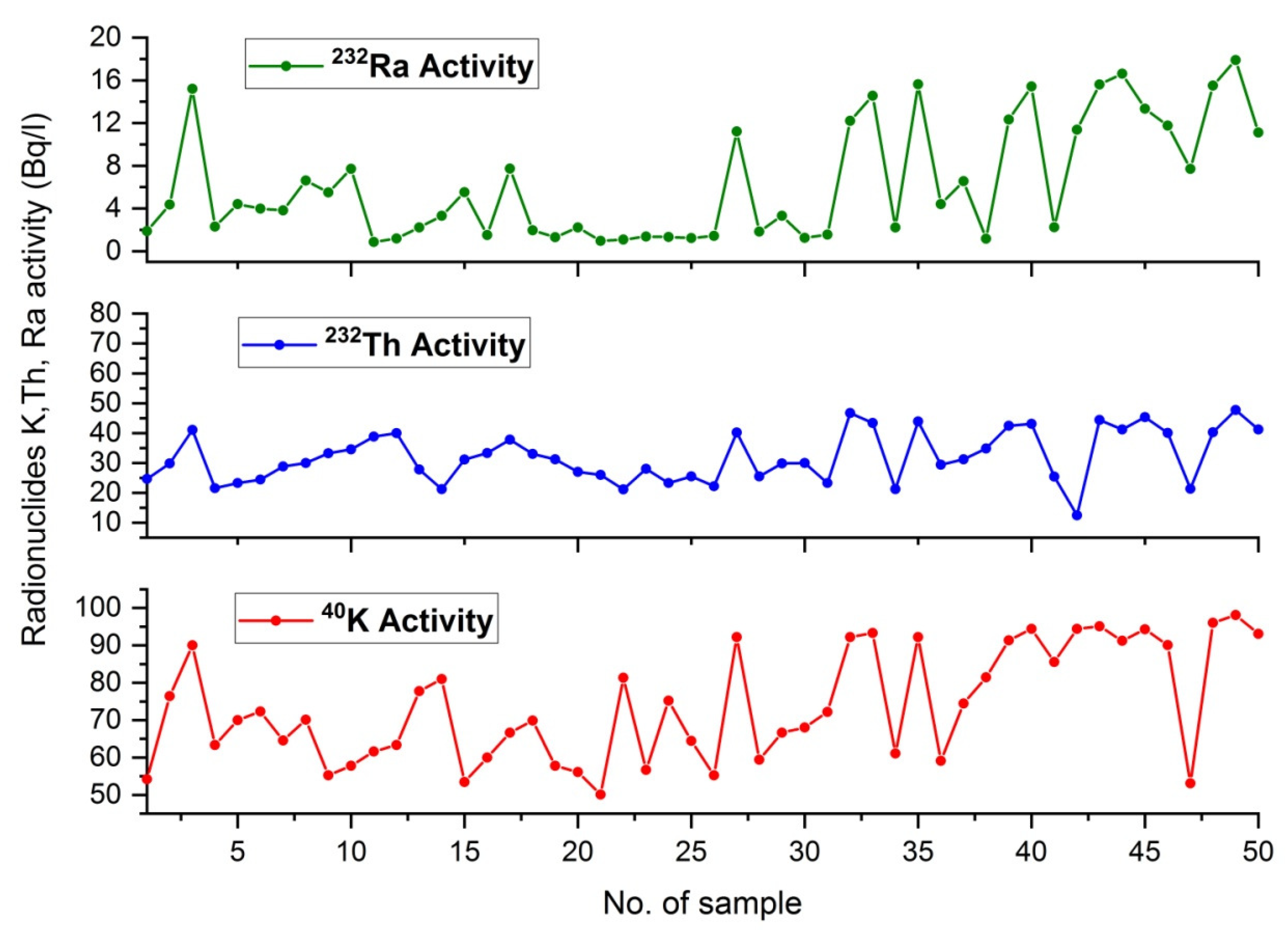
Figure 3.
Variation of activity concentration of represented by black line, represented by red dashed line and cancer risk Hazard with blue line, calculated by internal hazard index and annual effective index of the study area.
Figure 3.
Variation of activity concentration of represented by black line, represented by red dashed line and cancer risk Hazard with blue line, calculated by internal hazard index and annual effective index of the study area.
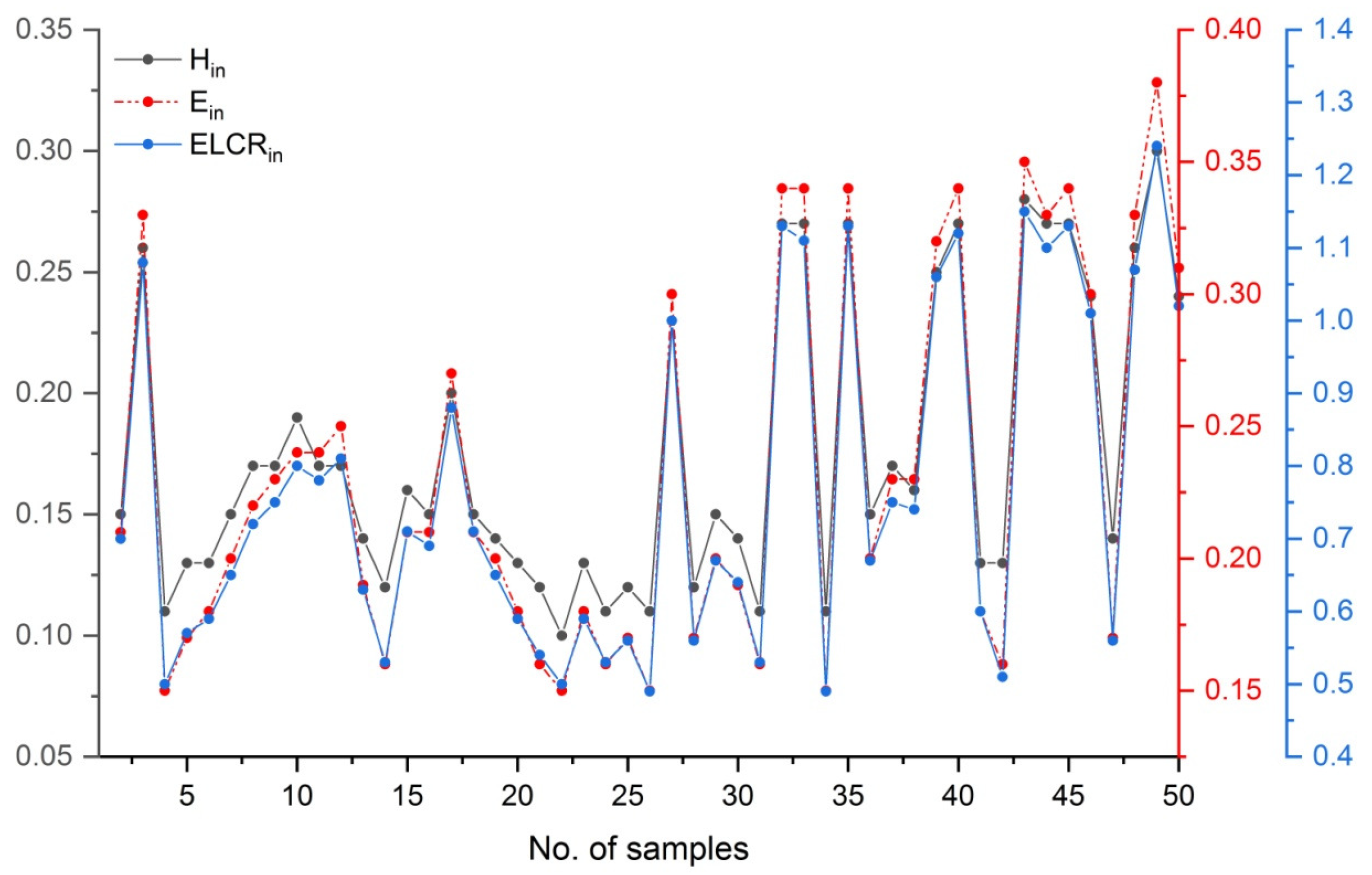

Table 1.
Table 1 Calculation of Gamma activity () concentration of 226Ra, 232Th, and 40K, radiation indices, and the Radium equivalent activity in water samples for the region of Islamabad, Pakistan with indoor internal doses from safe building material index.
Table 1.
Table 1 Calculation of Gamma activity () concentration of 226Ra, 232Th, and 40K, radiation indices, and the Radium equivalent activity in water samples for the region of Islamabad, Pakistan with indoor internal doses from safe building material index.
| No. of sample | Sample location | 226Ra () | 232Th () | 40K () | Raeq () | Din () | |
| 1 | QAU | 1.88 | 24.65 | 54.21 | 41.26 | 33.18 | |
| 2 | NLR | 4.36 | 29.9 | 76.44 | 52.95 | 43.02 | |
| 3 | RWD | 15.21 | 41.11 | 90.03 | 80.86 | 66.42 | |
| 4 | E-7 | 2.31 | 21.56 | 63.33 | 37.98 | 30.91 | |
| 5 | E-9 | 4.41 | 23.33 | 69.99 | 43.12 | 35.32 | |
| 6 | CSD | 3.98 | 24.44 | 72.33 | 44.46 | 36.33 | |
| 7 | E-8 | 3.82 | 28.88 | 64.56 | 50.04 | 40.45 | |
| 8 | BKH | 6.61 | 29.99 | 70.09 | 54.84 | 44.68 | |
| 9 | E-9 | 5.51 | 33.3 | 55.23 | 57.33 | 46.12 | |
| 10 | G-16 | 7.71 | 34.56 | 57.77 | 61.53 | 49.73 | |
| 11 | E-16 | 0.87 | 38.88 | 61.61 | 61.15 | 48.5 | |
| 12 | E-17 | 1.19 | 39.99 | 63.33 | 63.19 | 50.15 | |
| 13 | E-10 | 2.21 | 27.88 | 77.77 | 48.02 | 38.92 | |
| 14 | E-12 | 3.31 | 21.23 | 80.99 | 39.87 | 32.88 | |
| 15 | I-13 | 5.53 | 31.21 | 53.46 | 54.23 | 43.7 | |
| 16 | I-11 | 1.52 | 33.33 | 59.99 | 53.75 | 42.86 | |
| 17 | I-14 | 7.72 | 37.87 | 66.66 | 66.95 | 54.09 | |
| 18 | I-8 | 1.96 | 33.09 | 69.87 | 54.61 | 43.79 | |
| 19 | I-17 | 1.31 | 31.23 | 57.77 | 50.37 | 40.18 | |
| 20 | I-9 | 2.21 | 27.04 | 56.09 | 45.15 | 36.26 | |
| 21 | I-15 | 0.96 | 26.05 | 50.09 | 42.03 | 33.55 | |
| 22 | I-10 | 1.08 | 21.11 | 81.33 | 37.49 | 30.72 | |
| 23 | I-16 | 1.36 | 28.08 | 56.66 | 45.83 | 36.67 | |
| 24 | I-12 | 1.33 | 23.33 | 75.22 | 40.44 | 32.9 | |
| 25 | G-5 | 1.22 | 25.54 | 64.44 | 42.66 | 34.37 | |
| 26 | G-6 | 1.44 | 22.22 | 55.23 | 37.43 | 30.19 | |
| 27 | G-10 | 11.21 | 40.2 | 92.21 | 75.73 | 61.91 | |
| 28 | G-7 | 1.83 | 25.55 | 59.4 | 42.9 | 34.54 | |
| 29 | G-14 | 3.32 | 29.87 | 66.66 | 51.12 | 41.24 | |
| 30 | G-12 | 1.25 | 30 | 68.03 | 49.34 | 39.59 | |
| 31 | G-15 | 1.56 | 23.3 | 72.22 | 40.4 | 32.84 | |
| 32 | G-11 | 12.21 | 46.76 | 92.22 | 86.1 | 70.05 | |
| 33 | G-13 | 14.56 | 43.44 | 93.33 | 83.8 | 68.65 | |
| 34 | G-8 | 2.21 | 21.22 | 61.11 | 37.23 | 30.26 | |
| 35 | G-9 | 15.63 | 43.89 | 92.22 | 85.42 | 70.04 | |
| 36 | H-12 | 4.41 | 29.44 | 59.11 | 51.01 | 41.17 | |
| 37 | H-11 | 6.55 | 31.23 | 74.44 | 56.89 | 46.33 | |
| 38 | H-10 | 1.16 | 34.87 | 81.44 | 57.24 | 45.94 | |
| 39 | H-8 | 12.32 | 42.44 | 91.32 | 79.97 | 65.32 | |
| 40 | H-9 | 15.43 | 43.14 | 94.44 | 84.32 | 69.2 | |
| 41 | H-13 | 2.24 | 25.44 | 85.58 | 45.17 | 36.89 | |
| 42 | F-8 | 11.37 | 12.44 | 94.44 | 36.41 | 31.7 | |
| 43 | F-9 | 15.61 | 44.41 | 95.12 | 86.37 | 70.82 | |
| 44 | F-10 | 16.61 | 41.23 | 91.22 | 82.53 | 67.93 | |
| 45 | F-15 | 13.33 | 45.33 | 94.31 | 85.34 | 69.67 | |
| 46 | F-16 | 11.76 | 40.11 | 90.09 | 75.99 | 62.15 | |
| 47 | F-17 | 7.71 | 21.33 | 53.11 | 42.27 | 34.81 | |
| 48 | F-6 | 15.51 | 40.33 | 96.01 | 80.51 | 66.31 | |
| 49 | F-11 | 17.89 | 47.74 | 98.09 | 93.64 | 76.82 | |
| 50 | F-7 | 11.11 | 41.22 | 93.07 | 77.15 | 63.01 |
Table 2.
Calculation of excessive life-time cancer risk by using internal hazard index and annual effective index for different locations of Islamabad, Pakistan.
Table 2.
Calculation of excessive life-time cancer risk by using internal hazard index and annual effective index for different locations of Islamabad, Pakistan.
| No. of sample | Sample Name | Hin | Ein (mSv) | ELCRin ×10-3 |
| 1 | QAU | 0.12 | 0.16 | 0.54 |
| 2 | NLR | 0.15 | 0.21 | 0.7 |
| 3 | RWD | 0.26 | 0.33 | 1.08 |
| 4 | E-7 | 0.11 | 0.15 | 0.5 |
| 5 | E-9 | 0.13 | 0.17 | 0.57 |
| 6 | CSD | 0.13 | 0.18 | 0.59 |
| 7 | E-8 | 0.15 | 0.2 | 0.65 |
| 8 | BKH | 0.17 | 0.22 | 0.72 |
| 9 | E-9 | 0.17 | 0.23 | 0.75 |
| 10 | G-16 | 0.19 | 0.24 | 0.8 |
| 11 | E-16 | 0.17 | 0.24 | 0.78 |
| 12 | E-17 | 0.17 | 0.25 | 0.81 |
| 13 | E-10 | 0.14 | 0.19 | 0.63 |
| 14 | E-12 | 0.12 | 0.16 | 0.53 |
| 15 | I-13 | 0.16 | 0.21 | 0.71 |
| 16 | I-11 | 0.15 | 0.21 | 0.69 |
| 17 | I-14 | 0.2 | 0.27 | 0.88 |
| 18 | I-8 | 0.15 | 0.21 | 0.71 |
| 19 | I-17 | 0.14 | 0.2 | 0.65 |
| 20 | I-9 | 0.13 | 0.18 | 0.59 |
| 21 | I-15 | 0.12 | 0.16 | 0.54 |
| 22 | I-10 | 0.1 | 0.15 | 0.5 |
| 23 | I-16 | 0.13 | 0.18 | 0.59 |
| 24 | I-12 | 0.11 | 0.16 | 0.53 |
| 25 | G-5 | 0.12 | 0.17 | 0.56 |
| 26 | G-6 | 0.11 | 0.15 | 0.49 |
| 27 | G-10 | 0.23 | 0.3 | 1 |
| 28 | G-7 | 0.12 | 0.17 | 0.56 |
| 29 | G-14 | 0.15 | 0.2 | 0.67 |
| 30 | G-12 | 0.14 | 0.19 | 0.64 |
| 31 | G-15 | 0.11 | 0.16 | 0.53 |
| 32 | G-11 | 0.27 | 0.34 | 1.13 |
| 33 | G-13 | 0.27 | 0.34 | 1.11 |
| 34 | G-8 | 0.11 | 0.15 | 0.49 |
| 35 | G-9 | 0.27 | 0.34 | 1.13 |
| 36 | H-12 | 0.15 | 0.2 | 0.67 |
| 37 | H-11 | 0.17 | 0.23 | 0.75 |
| 38 | H-10 | 0.16 | 0.23 | 0.74 |
| 39 | H-8 | 0.25 | 0.32 | 1.06 |
| 40 | H-9 | 0.27 | 0.34 | 1.12 |
| 41 | H-13 | 0.13 | 0.18 | 0.6 |
| 42 | F-8 | 0.13 | 0.16 | 0.51 |
| 43 | F-9 | 0.28 | 0.35 | 1.15 |
| 44 | F-10 | 0.27 | 0.33 | 1.1 |
| 45 | F-15 | 0.27 | 0.34 | 1.13 |
| 46 | F-16 | 0.24 | 0.3 | 1.01 |
| 47 | F-17 | 0.14 | 0.17 | 0.56 |
| 48 | F-6 | 0.26 | 0.33 | 1.07 |
| 49 | F-11 | 0.3 | 0.38 | 1.24 |
| 50 | F-7 | 0.24 | 0.31 | 1.02 |
Disclaimer/Publisher’s Note: The statements, opinions and data contained in all publications are solely those of the individual author(s) and contributor(s) and not of MDPI and/or the editor(s). MDPI and/or the editor(s) disclaim responsibility for any injury to people or property resulting from any ideas, methods, instructions or products referred to in the content. |
© 2025 by the authors. Licensee MDPI, Basel, Switzerland. This article is an open access article distributed under the terms and conditions of the Creative Commons Attribution (CC BY) license (http://creativecommons.org/licenses/by/4.0/).
Copyright: This open access article is published under a Creative Commons CC BY 4.0 license, which permit the free download, distribution, and reuse, provided that the author and preprint are cited in any reuse.


