

Submitted:
11 April 2025
Posted:
16 April 2025
You are already at the latest version
Abstract
Liquid fuels obtained from CO2 and green hydrogen (i.e. e-fuels) are powerful tools for decarbonization of the economy. Improvements provided by Process Intensification in the existing conventional reactors aim toward a decrease in energy consumption, higher yield and more compact and sure processes. This review describes the advances in the production of methanol, dimethyl ether and hydrocarbons by Fischer-Tropsch using different tools of Process Intensification, mainly membrane reactors, sorption enhanced reactors and structured reactors. Due to the environmental interest, the review on methanol and dimethyl ether synthesis is mainly devoted to systems based in a feed with CO2+H2, while for Fischer-Tropsch the use of syngas (CO+H2) is also considered. Both mathematical models and experimental results are discussed. Achievements in the improvement of catalytic reactor performance are described.
Keywords:
e-fuels
; methanol
; dimethyl ether
; Fischer-Tropsch process
; membrane reactor
; sorption enhanced reactor
; structured catalyst
; process intensification
1. Introduction
Many reasons support the expectation that, in the future, fuels deriving from renewable electricity will gradually replace fuels derived from fossil sources. The most relevant can be listed as follows:
- -
- The progressive depletion of fossil fuels, which is inevitable since they are finite resources. This depletion will reduce the production and increase its price.
- -
- The desire to reduce CO2 emissions, as the main cause of climate change.
- -
- The availability of renewable electric energy at an increasingly lower price, despite the fact that renewable sources such as wind and photovoltaics are intermittent and difficult to control. Hence this availability comes with the drawback of the necessity of storing the surplus energy, which is progressively greater as the percentage of electrical energy produced from renewable sources increases.
- -
- The difficulties of using batteries as energy source in heavy transportation, such as trucks or ships, as well as in aviation. In general, the high weight of batteries (i.e. low energy density) makes unfeasible their use as the main energy source for this type of vehicles.
- -
- The limited amount of biomass available to produce biofuels. Fuels derived from fats and exhausted oils can only cover a small percentage of the energy currently employed in transportation. In most countries, the energy provided by biofuels is only 2-5% of the energy provided by oil. Even if all available biomass, including lignocellulosic residues, was employed, only 10-20% of the energy demand will be obtained [1].
- -
- The decreasing cost of electrolysers [2]. This has progressively decreased over the years, which also had an impact on the ease of obtaining hydrogen via electrolysis. In particular, the electrolysers cost becomes dominant when they are employed for short-time periods [3], as it would happen if only excess of electricity was used (i.e., in periods when the production of renewable energy overcomes the electrical system requirements).
Fuels derived from renewable electrical energy, commonly known as e-fuels, include methanol, dimethyl ether, liquid hydrocarbons obtained by Fisher Tropsch, or ammonia. Synthetic Natural Gas, i.e. methane obtained by the Sabatier reaction between CO2 and H2, and hydrogen itself when it is obtained from renewable electricity, can also be considered as e-fuels. The processes for the e-fuels synthesis are commonly addressed as Power-to-X, where X indicates the target fuel, and can generally be distinguished into Power-to-Gas and Power-to-Liquids. Power-to-X is a process chain technology: in all cases, the first step for e-fuels synthesis is to produce renewable hydrogen by electrolysis, using green energy (deriving from renewable sources – according to the general definition – typically solar or eolic). The second step is the utilization of green-H2 to produce the desired fuel. In the latest year, the preferred carbon source is carbon dioxide, to couple this process with carbon capture and storage (CCS) solutions.
This review will focus on liquid e-fuels that can be obtained from CO2 and renewable hydrogen, i.e methanol, dimethyl ether, and Fisher Tropsch liquid hydrocarbons. Those compounds would make the transition to renewable fuels easier than employing gaseous fuels (like hydrogen and methane), because of the similarity they have with commonly employed fuels like diesel or gasoline. It is worth to specify that CO2 can be employed in other processes [4,5,6], but the amount that could be consumed in the production of chemicals other than fuels would be quite small compared to the huge amounts of CO2 produced in industrial processes (the so-called “Teraton challenge” [7]).
1.1. Types of e-Fuels
1.1.1. Methanol
The vision of a methanol economy was first proposed by the Nobel Prize winner in Chemistry George Olah [8], and the advances in this field have been described in successive works by this author and his collaborators [9,10,11]. Professor Centi's group has also advocated the use of CO2 as a raw material in numerous works [12,13,14,15,16,17]. Aresta has also described his vision in this field in successive publications [18,19,20,21,22,23]. Figure 1 shows a scheme of ways to obtain renewable methanol and its possible derived products. There are plenty of articles available in literature on the research for suitable catalysts for the synthesis of methanol from CO2, which have been recently reviewed [24,25,26,27,28,29,30]. There are also various reviews available on advances in technology for obtaining fuels and chemical products using CO2 as raw material [5,6,31,32,33,34,35,36]. Many reviews focus on the state-of-the-art catalysts [37,38], while others discuss a particular type of catalyst, for example zeolites [39,40], MOFs [28] or bifunctional catalysts [41]. Artz et al. [42] considered also the Life Cycle Assessment (LCA). Despite the large research on direct CO2 hydrogenation, the current industrial catalysts are similar to the classical Cu/ZnO/Al2O3 employed in methanol production from syngas, with small modifications to improve the thermal stability [6]. However, it is clear that selecting the best catalyst is not enough to obtain the best process, but that the most suitable reactor must also be used. At this point a relatively new line of work in the field of Chemical Engineering comes in: Process Intensification.
Finally, although direct hydrogenation of CO2 to methanol or other liquid fuels will be the focus of this review, another alternative is represented by the two-step synthesis: syngas production from CO2 and hydrogen (a reaction named reverse water-gas shift – rWGS) and then producing the target fuel form syngas. In the case of methanol, this is the strategy of the CAMERE Process [43]. The advantage is that methanol from syngas is a well stablished technology, and the reverse water gas shift can be made using conventional catalysts. A comparison of both alternatives provided by Anicic et al. [44] concluded that the direct process is economically preferable.
A track on current methanol projects, including renewable methanol, may be found at the Methanol Institute web page [45]. Among the e-fuels, probably methanol is the one that historically received more attention. The reason can be found in the great advantage of methanol: a) a liquid at ambient temperature and pressure, b) no need for further transformations for its use (while Fischer-Tropsch hydrocarbons need additional treatments), and c) it may be easily converted to other fuels, like dimethyl ether, drop-in hydrocarbons (through the Methanol-to-Gasoline – MTG – process) or to olefins (through the Methanol-to-Olefins – MTO – process).
1.1.2. Dimethyl Ether
Dimethyl ether (DME) has several advantages as e-fuel, compared to methanol [46]: higher energy density, high cetane number (which makes it suitable for diesel engines) and properties similar to those of LPG (Liquefied Petroleum Gas), which are already used by a significative number of vehicles. It is liquid with a small pressure at ambient temperature. A main advantage of DME over methanol production comes from the higher conversion and yield achievable in thermodynamic equilibrium [47].
1.1.3. Fischer-Tropsch Liquid Hydrocarbons
Fischer-Tropsch is a well-known process for the production of hydrocarbons from syngas [48]. The main advantage of hydrocarbons obtained by Fischer-Tropsch is that they, after a suitable treatment, can have the same properties as the current diesel or gasoline, since they are chemically the same. In addition, the diesel obtained by Fischer-Tropsch contains almost no sulfur, and a very small amount of aromatics, which makes it a premium fuel.
1.2. Process Intensification
The concept of Process Intensification was described in a book by Stankiewicz and Mouljin [51], and has given rise to various developments, always seeking more efficient processes with lower consumption of raw materials, lower energy consumption, more compact equipment and with less environmental impact. Many technologies can be considered under the umbrella of Process Intensification. It is often a matter of combining the chemical reaction with a separation, as it occurs in reactive distillation, in membrane reactors or in reaction with adsorption [52]. In other applications, alternative energy sources, such as microwaves or plasma, are employed instead of conventional heating [53,54,55]. Rotating fields are used to increase mass transfer coefficients in multiphase reactions. Structured catalysts may help to achieve better effectiveness and lower pressure drop.
As will be seen in this review, three tools that are widely used in the search for e-fuels synthesis process intensification are: membrane reactors, reaction with adsorption and structured catalysts. Membrane reactors seek to combine the chemical reaction with the action of a membrane. The membrane often has the mission of selectively separating one of the reaction products although, as described in the pioneering articles of Armor [56] and Sirkar [57], many other possibilities are available. The membrane can be a way to distribute a reactant, it can have catalytic activity itself, or it can be used to retain a catalyst. Among these and in relation to this review, it is worth to highlight the zeolite membrane reactors, a relatively recent kind of membrane reactor, which offers many opportunities in processes where CO2 is hydrogenated. A complete review of all the developments in the field of membrane reactors would be outside the scope of this article, but interested readers can refer to any of the numerous books already existing [58,59,60,61,62].
In this work, the use of membrane reactors, reactors with adsorption, and structured reactors, as well as some other possibilities for Process Intensification will be reviewed, discussing the results in the synthesis of methanol, DME and hydrocarbons by Fisher-Tropsch. While in all cases the indirect way for production from CO2 via the reverse water gas shift is possible, in the case of methanol and DME only direct conversion will be considered, but in the Process Intensification for Fischer-Tropsch, the use of CO+H2 mixtures will be discussed.
2. Membrane Reactors
Membrane reactors represent a class of process intensification technologies in which chemical reaction and selective mass transport are coupled within a single unit operation. This integration allows for the dynamic control of reaction equilibria and kinetics, offering significant advantages in terms of conversion, selectivity, and energy efficiency. As briefly discussed in the introduction, membrane reactors utilize a semipermeable membrane—typically made of inorganic (e.g., ceramic, metallic) or advanced polymeric materials—that selectively permits the transport of specific species (reactants or products) based on properties such as molecular size, diffusivity, and chemical potential gradients. The reactor configuration can be categorized broadly into permeation-selective or reactive separation systems, depending on whether the membrane facilitates product removal or reactant dosing.
One of the principal benefits of membrane reactors is their ability to overcome thermodynamic limitations in equilibrium-limited reactions (Le Châtelier’s principle). In case of e-fuels synthesis, many reactions are accompanied by water production; water can be efficiently removed from the reacting system using a suitable membrane, shifting the chemical equilibrium towards the products. A schematic representation of the mechanism of a membrane reactor – applied to methanol synthesis – is given in Figure 2.
2.1. Methanol
2.1.1. Experimental Works
Membrane reactors are used in CO2 hydrogenation to methanol mainly as a way to remove the water formed in the reaction. In fact, industrial methanol synthesis is carried out from the mixture of CO and hydrogen known as synthesis gas, and this reaction does not produce water as co-product, according to Eq.1. When CO2 is used instead of CO, on the other hand, the maximum conversion attainable according to thermodynamic equilibrium is lower, which is a serious drawback because it requires an increase in the flow rate of gases that must be recirculated. In addition, a greater quantity of water is formed (Eq.2) and the usual catalyst in industrial methanol synthesis (Cu/ZnO/Al2O3) is deactivated in the presence of water vapor.
Methanol synthesis in a membrane reactor was initially proposed by Struis et al. [63] by using a Nafion® membrane. It was observed that in methanol synthesis from CO+H2, Nafion® membranes allowed the permeation of methanol selectively compared to CO and hydrogen, thus shifting the equilibrium and allowing a higher yield per step. However, the maximum temperature of use of Nafion® is around 200 ºC, which limits its range of applicability, since at that temperature the kinetics of the reactions are excessively slow. The patent by Menendez et al. [64] described a membrane reactor for methanol synthesis in which a zeolite membrane is used instead of Nafion®. Gomez et al. [65] observed that the selectivity of methanol and water vapors versus permanent gases (hydrogen, CO2) of a zeolite membrane was greater when a mixture with water and methanol was fed than when only methanol was present. The first work describing experimental results on the use of a zeolite membrane for the synthesis of methanol from CO2 was published by Gallucci et al. [66], who showed a significant increase in the conversion of CO2 using a membrane reactor. They also observed that the improvement disappeared when the temperature was higher than 240 °C, which is the critical temperature of methanol. In addition, they found that the selectivity to methanol for a given conversion was higher in the membrane reactor. Sea et al. [67] obtained a 150% increase in CO2 conversion by performing CO2 hydrogenation with a silica/alumina ceramic membrane. However microporous silica membranes are not highly stable under steam, which explains why few further works have not been presented with this material. Chen et al. [68] obtained excellent results with a silicone rubber membrane deposited on a ceramic support. A very significant advance was the article by Li et al. [69] in which they used a zeolite membrane developed from nanoparticles, which provided extraordinary water selectivity over the rest of the compounds at the reaction temperatures. This allowed a large increase in yield (e.g. from 13 to 38) and a second important advantage: The methanol obtained in the retentate had a low water content, which would be very useful to save costs in the subsequent purification stage. In addition, the membrane had a good stability during a 100 h experiment. In addition, those membranes were operated by drawing vacuum on the permeate side, which is much better than the use of a purge in the permeate, as is often found in other works. Seshimo et al. [70] continued with the experimental work with a Si-rich LTA zeolite membrane. The advantage of this kind of zeolite compared with conventional LTA comes from the higher stability, a topic that is scarcely considered. For a given set of operating conditions, the conversion in a membrane reactor was 60% while in the traditional reactor was 20%.
2.1.2. Mathematical Models
Numerous researchers have developed mathematical models for this reaction. Already in the work of Struis et al. [71] a model for the reaction of CO2 with hydrogen was presented. Menéndez et al. [64] calculated the results of fixed bed reactors and compared them with a combination of fixed bed with zeolite membrane reactor, showing better performance with the second combination. Barbieri et al. [72] presented a mathematical model using water permeation values taken from Piera et al. [73] with a composite mordenite/ZSM-5 membrane. The model was based on a series of thermodynamic equilibrium reactors in series. Gallucci et al. [74] discussed the difference between countercurrent and co-current configurations, finding that countercurrent was preferable. Later, they showed the achievable results as a function of the ratio of methanol and water permeabilities, showing that a dynamic equilibrium was obtained in the membrane reactor, with greatest conversion and selectivity than the thermodynamic equilibrium in a traditional reactor [75]. Farse et al. [76,77] presented a model in which the catalyst deactivation was also included, although they assume that only water permeates, which is not the usual experimental result. Hamedi et al. [78], discussed the importance of selectivity in water permeation to obtain improvements in the reactor performance. In addition, they also evaluated the improvements in in power, heating and refrigerant utilities, obtaining 1.5%, 44.5% and 69.4% savings, respectively [79]. Seshimo et al. [70] have also checked the results of his model with their experimental results, obtaining a good agreement. Mathematical models for membrane reactors usually assume plug flow and a constant permeance and selectivity. A few recent models have considered the potential existence of radial concentration or temperature profiles. Ountaksinkul [80] used Comsol® to model a micro-membrane reactor and found that even with a width of 5 mm the radial profiles of concentration were clearly seen. Hauth et al. [81] with a model using CFD (Computational Fluid Dynamics) showed the existence of radial profiles of temperature in a reactor with a diameter of 10 mm, which is similar to the values employed in experimental works. The techno-economic analyses [82] and [83] can also be included within the modeling studies.
Mathematical models for other types of membrane reactors, not using a zeolite membrane for water removal, have been also disclosed. Rahimpour and Ghader [84] modelled a membrane reactor based on a distributed hydrogen feed to shift the equilibrium, using a Pd membrane for hydrogen addition and with variable CO/CO2 ratio in the feed. In a subsequent work [85] they simulated a two-reactors methanol synthesis in which methanol production occurs partially in the first reactor, and the second stage is a membrane reactor with the hydrogen being permeated from a fresh feed. They compared countercurrent and co-current operation, using two sets of reactors: in a case with the system operated as a fixed bed and in the other case operated as a fluidized bed. In the second cases, they obtained an enhancement of approximately 4% in methanol yield. Gong et al. [86] modelled a reactor using an ionic liquid.
2.1.3. Developments in Membrane
A fundamental factor in the efficiency of this type of reactors is the performance of the membrane, which ideally should be (in most applications) highly permeable and highly selective. Although zeolite membranes are a quite new material, with the first functional zeolite membranes appearing in the 1990s [87,88,89], a lot of research has been devoted to the use of zeolite membranes in membrane reactors [90,91,92,93,94]. In many cases, Zeolite A membranes have been used in the experimental work when the aim was to selectively remove water, since this kind of zeolite is highly hydrophilic. Gorbe et al. [95] showed the effect of temperature and water partial pressure on the flux and separation factor with a zeolite A membrane. In particular a clear decrease in the separation factor was found when the temperature was increased from 200 ºC to 260 ºC. The separation factor also decreased when the total pressures was different at both sides of the membrane. Lee et al. [96] found that zeolite A was suitable for separation of water from H2 mixtures at low temperature, but the selectivity decreased at 240 ºC. They also observed that the membrane was stable under these conditions. Li et al. [97] has presented a membrane composed of an ionic liquid and a MOF membrane, with an excellent separation factor H2O/H2 of 603 at 200ªC. The developments by Chen et al. [68] and Juárez et al. [98] are also interesting, since they show the possibility of using a polymer supported on a ceramic material. Pham et al. [99] have also studied polyimide and Matrimid® membranes in the separation of methanol and water from CO2 and hydrogen at high temperature. They found good selectivity but the maximum temperature studied was 200 ºC. Another interesting development is the one proposed by Seshimo et al. [70] who develop a special type of silicon-rich zeolite A membrane. This has the advantage of being more stable to steam than normal zeolite A. Sawamura et al. [100] showed that mordenite membranes also allow selective water permeation in H2/H2O/CH3OH mixtures and Hirota et al. [101] also observed selective water prevention with ZSM-5 membranes. Sodalite, another hydrophilic zeolite with small pore size has also been proposed for water removal in the synthesis of methanol or DME [102]. They studied the separation factor in the interval 125-200 ºC and found that sodalite membranes provided H2O/H2 separation factor of 8 approximately. An interesting point with this membrane was that H2O/CH3OH or H2O/DME selectivities were quite large, in accordance with the small pore of sodalite. Silica membranes have been employed in membrane reactors [67], but the water/H2 permselectivity was between 1 and 3. Otherwise, the stability of silica membranes under a steam atmosphere is quite low, since pores growth due to the transport of silicic acid vapors. Other interesting materials are carbon molecular sieve membranes, such as the one patented by Rahimalimamaghani et al. [103].
A list of experimental results for the separation of vapors (e.g. water, methanol) from permanent gases (e.g. CO2, H2) using zeolite or carbon molecular sieve membranes is given in Table 1. As it may be seen NaA zeolite membrane are widely employed, although mordenite also provides good results. In fact, the values provided by Sawamura et al. [104] were obtained with a total pressure in the feed of 7 bar and with the permeate at atmospheric pressure, while the operation with different total pressure in feed and retentate often causes a loss of selectivity. Although some good results have been described with zeolite NaA, large differences between different authors can be seen, which reflects the effect of defects at temperatures of interest for membrane reactors. The best results at high temperature correspond to zeolite membranes prepared from zeolite nanoparticles, which have very few defects [66].
2.2. DME
DME is currently produced from methanol, but it could be produced from CO2/H2 mixtures according to Eq.3.
This reaction is produced on bifunctional catalysts, that include a metallic active site for methanol production and an acid active site for methanol etherification. It is clear from eq. 3 that a significant amount of water is produced, and therefore the removal of water from the reaction environment will allow higher yield than in a traditional reactor. This idea was firstly proposed by Diban et al. [113], who employed a mathematical model of membrane reactor using the kinetic model for the reaction previously developed at the same group [114]. After the initial proposal, more sophisticated model have been published. Diban et al. [115] improved the previous mathematical model by including the non-ideality of the membrane, i.e. by considering some methanol permeance.
This concept was experimentally proven by Rodriguez-Vega et al. [116], who used a zeolite A membrane and Poto et al. [112,117], who used a carbon molecular sieve membrane. Dong et al. [118] presented a prototype of membrane reactor for DME production using a bundle of hollow fiber zeolite membranes. This reactor provided 1.3 kg/day with a set of 7 membranes with a length of 15 cm each. The use of hollow fibers will be interesting for industrial application, since they can provide very large permeation area per unit of reactor volume. Poto et al. [110] developed a 2D heterogenous reactor model, showing that intraparticle mass transfer may decrease the reaction rate under some operating conditions and that concentration polarization may decrease the permeation rate through the membrane compared with an ideal system without radial concentration profiles.
Brunetti et al. [119] studied DME production in a membrane reactor, but using methanol as feed. They used two ZSM-5 membranes, with two different supports (TiO2 and Al2O3 membranes). In that case the membrane was acting as the catalyst for methanol dehydration to DME and the reactor is operating in a flow-through configuration, i.e. all the feed is permeated through the membrane.
2.3. Fischer-Tropsch
Hydrocarbons are produced from syngas (CO-H2 mixture), derived from fossil fuels, in the Fischer-Tropsch process by various companies (Sasol and Shell). The production from CO2 is a more recent proposal [36,120], that would allow to use captured CO2 and H2 obtained from electrolysis using renewable electricity.
In the classical way, this reaction also produces a large amount of water, as may be seen from Eq. 4.
Membrane reactors for Fischer-Tropsch have been proposed considering a feed of syngas (i.e. CO+H2, with minor amounts of CO2). Experimental results in conditions that simulate the environment in this reaction have shown that zeolite membranes can remove water selectively [121,122] and thus could be employed to reduce the partial pressure of water in the reaction environment. As may be seen form Eq. 4, a large amount of water is formed in the reaction (in molar amounts, much more than hydrocarbons), and thus the water partial pressure can be very high. Water has several negative effects on this reaction: it reduces the reaction rate and, in some cases, may deactivate the catalyst. This concept was experimentally tested by Rhode et al. [123], first using a silica membrane and later [124] using a zeolite membrane (hydroxy sodalite, H-SOD).
Forghani et al. [125] and Rahimpour et al. [126] also have simulated Fischer-Tropsch reaction in a membrane reactor using a hydrogen selective membrane (Pd based membrane). The basis of this reactor is the permeation of hydrogen to the reaction area and feeding the hydrogen depleted feed to the reaction area, where hydrogen is distributed (Figure 3).
Simulation results show 4.45% enhancement in the yield of gasoline production, 6.16% decrease in the undesired product formations, and a favorable temperature profile along the membrane Fischer–Tropsch reactor in comparison with conventional reactor. Rahimpour et al. [127], proposed a dual-type reactor in which a membrane reactor (with a fixed bed of catalyst in it) with a water selective membrane was followed by fluidized bed membrane reactor with a Pd-Ag membrane (selective to hydrogen). The mathematical model predicted a higher yield to gasoline and lower yield to CO2 in this configuration.
Another type of membrane reactor applicable for Fischer-Tropsch synthesis has been presented by Khassin et al. [128]. These authors name it “monolith”, but it is a cylindrical pellet with the feed permeating through the pellet, and this could be named a flow-through membrane reactor. They found high values of the “alfa” parameter, which characterizes the Anderson-Schulz-Flory model, and this high value is an indication of high selectivity to C5+.
When each catalyst particle is surrounded by a membrane, this configuration can also be considered as a membrane reactor. It has been tested in Fischer-Tropsch, showing an improved selectivity to C5-C10 hydrocarbons with a Co/SiO2 catalyst covered by a ZSM-5 membrane, since the exit of larger hydrocarbons from the catalyst particle is hindered by the membrane [129]. An extension of this concept used carbon coated catalysts [130]. A combination of a ZSM-5 membrane covering a Co-Al2O3 monolith [131] showed excellent yield to gasoline while keeping the same conversion as the monolith. In that case the authors say that the membrane contributes with additional catalytic activity (cracking and isomerization). Monoliths are a kind of structured reactor widely employed for Fischer-Tropsch, as will be discussed below.
3. Sorption-Enhanced Reactors
The concept of sorption-enhanced reactions originated from the need to improve the efficiency of chemical processes by simultaneously conducting reaction and separation in a single unit. As well as water removal through membrane separation, the sorption-enhanced reaction (SER) technologies leverage the famous Le Châtelier’s principle to improve a process performance. Unlike the previous configuration, water deletion from the reaction environment is produced by its sorption into a specific solid, which is generally put in contact with the catalyst, according to Figure 4 (exemplificative scheme in case of methanol synthesis enhanced by water removal).
The idea of removing a product from the reaction environment to enhance reaction efficiency is rooted in the principles of pressure-swing adsorption, which allows for the periodic regeneration of the sorbent.
This approach was first explored in processes like the water-gas shift reaction and steam-methane reforming, where the removal of a reaction by-product, such as carbon dioxide, can shift the equilibrium towards the desired products, thereby enhancing conversion rates and product purity. One of the earliest studies on sorption-enhanced reactions involved the equilibrium-controlled reverse water-gas shift reaction for carbon monoxide production. This study demonstrated the feasibility of using a fixed packed column containing a mixture of catalyst and sorbent to selectively remove a reaction by-product from the reaction zone, thereby achieving high conversion rates at lower temperatures than traditional methods [132]. This concept was further developed in the context of hydrogen production via steam-methane reforming, where a chemisorbent was used to selectively remove carbon dioxide, resulting in high-purity hydrogen production [133,134]. Additionally, the sorption-enhanced water-gas shift reaction (SE-WGS) for hydrogen production has been studied, where carbon dioxide is removed through chemisorption on CaO particles, leading to higher-than-equilibrium hydrogen production [135]. This approach has been applied to various processes, including methanol synthesis, where the in-situ removal of water byproduct helps overcome thermodynamic limitations and improve methanol yield [136,137].
In the framework of e-fuels synthesis, water adsorption has the benefits already explained in the previous sections. SER processes, intended as the ones in which water removal is produced by its adsorption onto a specific solid, can produce the same effects in the enhancement of reactions performance than membranes reactor, but with important advantages. To begin with, membranes have the huge drawback of their fragility: once a membrane is damaged in a single point, its separation efficiency is completely disrupted, and it must be entirely substituted. As well, the dispersed and non-continuous nature of a sorbent guarantees that even in the case of partial deactivation, the remaining amount of solid would keep its separation function, with a minor repercussion on the whole process. In addition, SER processes are easier to operate and scale up: they do not need different piping for the retentate side, nor a sweep gas for aiding the separation; furthermore, the spatial limitation than the utilization of a membrane can produce does not exist when working with adsorbent solids. Ultimately, membranes are fragile, thus not optimal in high-pressure processes, and when applied specifically to methanol/DME processes they must fulfill the requisite of high selectivity toward the permeation of water but not methanol, which is still a significant issue in membranes research [138].
On the other hand, sorption-enhanced processes have their drawbacks as well. Since water is trapped into the sorbent, it undergoes saturation overtime; therefore, the process can suffer of a periodic efficiency decrease and surely requires regeneration steps to operate. Furthermore, sorption effectiveness is strictly related to the operating temperature, which is often in contrast with the requirements of the chemical reaction carried out into the process. Even though many reactions are conducted at relatively low temperature, and this is the case of methanol and DME synthesis as well as Fischer-Tropsch process (which are promoted below 300 °C), for kinetic reasons the operating condition cannot involve very low temperatures, impacting on the water adsorption capacity and time of breakthrough.
3.1. Sorption-Enhanced Methanol Synthesis
3.1.1. Experimental Studies
The pioneering work of Westerterp et al. [139] introduced the countercurrent gas–solid–solid trickle bed reactor as an innovative approach to methanol synthesis. As reported by the authors, the trickle flow principle was already well-known in literature, even though mainly applied to the heat exchangers area. In these first applications, the contact between a sand-like solid and a gas was enhanced by a packing material, as it is nowadays widely employed in adsorption columns. This configuration was called as gas–solid–solid trickle flow (GSSTF) contractor. At the time, the possibility of substituting the inert packing with a reaction-involved solid had never been evaluated. Hence, they proposed to create the column packing using a combination of a pellet catalyst and Rashing rings, and to employ a top-to-bottom sorbent stream in countercurrent with the gas. The study was in a first instance performed as a mathematical model, which already assessed the potential of such application to achieve equilibrium conversion by leveraging in-situ water removal. Further experimental validation [140] confirmed the viability of this system, showing that the trickle bed configuration significantly improved methanol yields. In detail, with their experiments the authors demonstrated that complete conversion in single-pass operation is attainable during methanol synthesis. It worth noticing that these works dealt with methanol synthesis from syngas. According to the stoichiometry of the reaction, methanol is the only product of the process, in the absence of competitive reactions. Therefore, in these earlier studies, methanol, and not water, was actually separated via adsorption. Nevertheless, the technology applies the same principle as water separation. These foundational studies set the stage for further advancements in sorption-enhanced methanol synthesis (SEMS).
In the following years, the topic of CO2 utilization has become more and more significant and the studies on methanol synthesis followed this trend. Methanol production from CO2 hydrogenation involves simultaneous water and methanol generation. In this case, selective separation of one of the two reactants is more complicated, and many aspects favor water adsorption instead of methanol. The most conventional sorbents for this application are zeolites, which are generally more selective toward water adsorption [141], even though factors other than the simple molecular sieve mechanism drive the sorption selectivity toward water, since the molecular size are comparable [142].
Among recent studies, Terreni et al. [143] provided an early demonstration of SEMS using 13X zeolite as sorbent for the process intensification and highlighted exactly this issue. The authors observed the enhancement of methanol yields by using hydrophilic sorbents, with a maximum increase of 28% in methanol yield. Nevertheless, they reported that at 200 °C methanol and dimethyl ether, both obtained as products, were completely adsorbed onto the zeolite during the sorption-enhanced process. At higher temperatures, the sorption of the products was not total, but it was still competitive with water: with the increase of temperature, the authors were able to recover half of their products previously adsorbed into the zeolite. Finally, they concluded that 13X zeolite was appropriate for water adsorption and process enhancement, but not ideal for the purpose of SEMS as it adsorbs also other reaction products. Therefore, the Le Châtelier principle is applied to multiple reactions and the control of selectivity is hard. The authors hypothesize that the employment of a zeolite with smaller pores radius could lead to a better selectivity management, since the intra-crystalline activity would be limited.
It is also worth noting that the incorporation of a zeolite into a methanol synthesis system not only induce products sorption. The presence of strong acid sites – particularly Brønsted-type sites – promotes methanol dehydration and the formation of dimethyl ether. Among the key properties of zeolites, their surface acidity, the nature of their acid sites, and their hydrophobicity play a crucial role in this process. H-ZSM-5 zeolites are well known for their efficiency as methanol dehydration catalysts, with their hydrophobicity, as reported by Vanoye et al. [144], being a critical factor for achieving high DME productivity. However, other types of zeolites, such as LTA, FER, and SAPO, also exhibit dehydration activity and are employed in methanol dehydration [145]. Moreover, in addition to DME, light olefins can also be produced over zeolites [146].
To disclose the catalytic effect from sorption, Nikolic et al. [147] extended this research by employing inelastic neutron scattering (INS) techniques to investigate the molecular interactions between catalysts and sorbents. Their study provided fundamental insights into how different sorbents influence reaction pathways, demonstrating that zeolites play a dual role in shifting equilibrium and stabilizing intermediate species. The study was performed using a so-called “sorption catalyst”, constituted by a copper-zeolite-supported formulation, and mixture of commercial CZA catalyst with either 3A or 5A zeolite. Besides the different selectivity due to the employment of one catalytic system or the other (the authors clearly state the higher methanol selectivity when 3A is employed, due to the inaccessibility of the small pores by methanol for its further conversion), they observed a similar evolution in time of the process. Water was quickly formed as the reactants entered the catalytic bed, as the product of the reverse water-gas shift reaction, and it began to saturate the sorbent. Conversely, the formation of methanol and dimethyl ether occurred at a relatively later stage and was not associated with significant water production. This suggests that a substantial amount of intermediates (CO, methoxy, and methyl groups) forms in the early stages, accumulating within the sorption catalyst before ultimately reacting to yield the final products.
From this study, it appears that sorption-enhancement is not really applied directly to methanol formation; instead, it induces CO2 conversion to CO and other intermediates, and their amount and conversion rate finally determines the yields to methanol and/or dimethyl ether.
Maksimov et al. [137] further studied SEMS via CO2 hydrogenation, offering a more macroscopic observation of the reaction enhancement. Based on their experiments and calculations, the enhancement factor resulted to be in the range 150-290 % for methanol and 220-510 % for CO. These results are surely more convincing on the efficiency of the SEMS process, but it worth noticing that they were obtained at higher pressures compared to previous studies (20-70 bar). The authors themselves stated as result that the enhancement factor is remarkably influenced by the operating pressure; furthermore, their result somehow confirms the INS observation, since CO production resulted to be promoted to a higher extent compared to methanol synthesis. It is also worth mentioning that the work involved not only the evaluation of SEMS at different pressures, but also at different space velocity and catalyst-to-zeolite ratios. Besides all the differences in productivity obtained in each condition, the obtainment of a higher enhancement factor for CO production was not affected by any of the variable. Hence, it appears that there is not really a way for tuning the system to enhance methanol production instead of CO.
This can lead to the conclusion that the catalyst formulation is mainly responsible for the selectivity of the system, also in case of SEMS.
Heracleous et al. [148] conducted a detailed experimental investigation into SEMS for CO2 hydrogenation, further validating the efficacy of sorption-enhanced techniques. Their findings confirmed that selective water removal significantly improves methanol selectivity and yield, reinforcing earlier theoretical predictions. By using high pressure and 13X zeolite, their work can be compared to the previous ones separately, concluding that the 60.5% enhancement observed in this work is halfway between previous results, since the type of zeolite has worse selectivity toward methanol, but high pressures improve the results, as already mentioned by Maksimov et al. In a subsequent study, Heracleous et al. [149] explored the impact of different zeolite types on SEMS performance, revealing that sorbent properties such as pore structure and hydrophilicity are key factors in optimizing the process. With this study, the authors highlighted that the better enhancement factor was obtained with 5A zeolite, because of its methanol uptake ability. Nevertheless, the authors did not observe as much of a difference in selective methanol enhancement, compared to the study of Maksimov et el. [137], at least for what concerned the first reaction cycle. Afterwards, the authors evaluated also the stability of sorbents and catalyst over three cycles and observed that all zeolites lost sorption efficiency, leading to lower methanol and CO yields. In addition to the catalyst decrease in activity, among the sorbents the 13X zeolite was the one that exhibited the major yield decrease, while the 4A-CZA was found to be the most stable SEMS system. This result is coherent with the study conducted by Gavrilovic et al. [150], who evaluated various catalyst-sorbent pairings, including CaO, which was firstly considered for SEMS. The study of the sorbents can be considered as preliminary, since it only evaluated the sorption ability of all sorbents, concluding that among zeolites, 13X was the one with the highest adsorption capacity, but it was overcome by CaO. Despite this result, the CaO stability over saturation/desorption cycles was not investigated, and only zeolites 13X and 4A were tested. The authors reported that 4A zeolite outstood 13X in terms of stability, since it almost did not lose adsorption capacity over 100 cycles, while 13X reduced its capacity to the half. These studies mark a critical step toward industrial scalability, demonstrating that careful material selection can lead to substantial process improvements.
From the literature survey, it is possible to observe that SEMS studies have been conducted in a limited range of operating conditions and type of sorbents. Zeolites 3A, 5A and 13X have mostly been studied, and as reported 3A zeolite is the most suitable sorbent for SEMS, especially for its selectivity toward methanol. Many authors have attributed this characteristic to a shape selectivity, since the 3 Å pores of the zeolite allows the adsorption of water but not methanol. On the other hand, 5A zeolite demonstrated to be a significant alternative since it has a strong adsorption capacity. 13X zeolite, despite being the first choice in former studies, demonstrated to have a low selectivity and a scarce stability overtime in cycles of adsorption/regeneration. A resume of the literature SEMS studies is given as bubble graph in Figure 5. This representation allows to observe the most employed combinations of operating conditions (temperatures mostly between 230 and 260 °C and pressures around 30 bar) together with the magnitude of methanol enhancement factor obtained with each kind of zeolite. The dimension of the bubble is proportional to the magnitude, the maximum value is indicated in the figure.
As the previous literature review could have demonstrated, most of the sorption-enhanced applications have been studied so far in fixed bed reactors. The closer to a potential industrial application considers the cycling operations between reaction and regeneration. In recent years, Menéndez et al. [151] proposed and patented a technology to conduct sorption-enhanced reactions in a fluidized bed with continuous flux of one of the solids. The proposed technology involved a fluidized bed reactor in which the sorbent and the catalyst have significant different physical properties – mainly particles size and density – so that they segregate in the fluidized bed. If segregation is optimized, either at the top or to the bottom, a fraction of almost 100% of one of the solid can be reached (100% of flotsam for the top section and 100% of the jetsam for the bottom section). Hence, it is possible to selectively remove either the catalyst or the sorbent from the reactor, to perform the regeneration of the adsorbent without damaging the catalyst. Also, if the sorbent is chosen to be the continuous flux and the catalyst remains fluidized into the reactor, it is possible to operate both the process and the regeneration step continuously. This concept is illustrated in Figure 6. A preliminary assessment of this application was given by Menéndez et al. [152]. In this study the authors only evaluated the feasibility of the proposed technology by continuously segregating a methanol synthesis catalyst and a sorbent (13X zeolite), demonstrating that with opportune fluidization condition an efficient separation is possible, thus the technology can be proficiently employed. Furthermore, since zeolite can provide water removal, the proposed system can be used in all the processes which have water as by-product: Methanol synthesis from CO2 is only one of them, but it can be applied also to DME synthesis and CO production via reverse water-gas shift.
3.1.2. Mathematical Modelling
Mathematical modelling has limitations in predicting the behavior of experimental systems, mainly due to the assumptions made or the equations chosen. Nevertheless, it remains a powerful tool for saving time and costs in experimental work, gaining insight into phenomena that cannot be directly observed, and supporting the scale-up of technologies. Sorption-enhanced processes are particularly studied with mathematical modeling because of their complex nature and the challenges of experimentally capturing all the interacting phenomena involved. Also, mathematical modelling offers to work with a significantly higher amount of data compared to experimental work, which allows a better estimation of the process costs.
Arora et al. [153] presented a detailed modelling study on optimizing methanol production through a sorption-enhanced reaction process, aiming to overcome equilibrium limitations that restrict conversion efficiency in conventional methanol synthesis. The authors proposed a periodic SEMS system that integrates in-situ water removal via selective adsorption, thereby shifting the reaction equilibrium toward higher methanol yields. The study employed a fixed-bed, multi-tubular reactor where a Cu-ZnO-Al₂O₃ catalyst was combined with NaX zeolite adsorbent, designed to selectively capture water during the reaction. To account for the adsorbent finite capacity, the system was modeled to operate in a cyclic manner, alternating between reaction-adsorption and regeneration phases. The model considered operating conditions typical of industrial methanol synthesis, therefore temperatures between 200 and 270 °C, pressures up to 77 bar, and a typical synthesis gas composition (65.9% H₂, 9.4% CO₂, 4.6% CO, and smaller amounts of CH₄, N₂, CH₃OH, and H₂O). The study finds that optimizing the ratio of reactants, particularly adjusting CO₂ and H₂ levels, significantly influences conversion efficiency. By carefully tuning these parameters, the authors demonstrated that SEMS process can allow to achieve remarkable improvements in yield while maintaining competitive production costs. A key finding of the study is the substantial increase in methanol yield compared to conventional processes. Without sorption-enhancement, the base-case methanol yield is reported at 34.02%. When the SEMS process is applied, yield increases to as much as 59.92%, representing a 76.13% improvement. However, this enhancement came with a trade-off. Due to the periodic nature of the adsorption-regeneration cycle, overall production capacity is reduced by 9 to 46% depending on the specific optimization scenario. Despite this reduction, the authors demonstrated that careful process optimization can mitigate losses, with a 7% yield gain achieved in an industrial reactor setup at the cost of only a 2% decrease in production capacity. With these data, the study further explored the techno-economic feasibility of SEMS, showing that the production cost remains competitive with traditional syngas-to-methanol processes. The authors emphasized that the balance between yield improvement and production capacity reduction is a crucial factor in determining the industrial viability of SEMS. They identify synthesis gas composition, reactor temperature, and pressure as primary determinants of process performance. Additionally, they highlight the importance of optimizing the adsorbent regeneration phase to minimize downtime and maintain continuous operation.
Nieminen et al. [154] developed and modeled a full process configuration for CO₂-based sorption-enhanced methanol synthesis. The process was considered as a cyclic system with alternated reaction-adsorption and sorbent regeneration steps, using either adiabatic packed-bed or isothermal boiling-water reactors. According to their findings, considering an operating pressure of 50 bar and a temperature of 220 °C for the isothermal configuration and initial temperature of 215 °C for the adiabatic one, water adsorption shifts the equilibrium toward methanol production, improving per-pass conversion and yield. Many other process parameters, such as flowrate and catalyst/adsorbent ratio, were optimized by the authors to achieve a target purity of methanol. As they reported, the model was able to predict a configuration that eliminated the need for distillation by producing high-purity crude methanol (99 wt.%) through condensation and separation of unreacted gases. This result highlighted the feasibility of trapping all the water produced by the reaction into a suitable sorbent, leading to the condensation of almost pure methanol. Economic analysis suggested that cost reductions could be achieved through further optimization in cycle design, reactor configuration, and separation methods.
Bayat et al. [155] introduced a Fluidized Bed Sorption-Enhanced Thermally Coupled Reactor (FSE-TCR) to enhance methanol synthesis. The system integrates methanol production with in-situ water adsorption in a fluidized bed while using the exothermic heat to drive the dehydrogenation of cyclohexane on the endothermic side. The study employs a multi-objective optimization approach using the NSGA-II algorithm to maximize methanol production and selectivity. the FSE-TCR reactor was further optimized in terms of temperature profile to achieve the maximum enhancement in methanol yield. As reported, optimization results indicate significant improvements in methanol yield (214.3 ton/day) and CO₂ removal (280.5 ton/day) compared to conventional methanol synthesis reactors. Furthermore, temperature-optimized FSE-TCR ensured a 55.97 ton/day higher methanol yield compared to the non-optimized configuration. Even though the results can be seen as hardly replicable in experimental methanol synthesis system, they are still of high interest since they point out the feasibility and the potentiality of the proposed technology.
Abashar and Al-Rabiah [156] investigated the performance of a circulating fast fluidized-bed reactor (CFFBR) for sorption-enhanced methanol synthesis. The study employed a mathematical model, validated using industrial data from a quasi-isothermal Lurgi reactor. The authors simulated reactor conditions with a pressure of 50 bar, a temperature of 201.75 °C, and a stoichiometric feed ratio of H₂/CO₂ = 3:1, evaluating different sorbent-to-catalyst mass fractions. The results demonstrated that the CFFBR significantly enhanced methanol production, with a 14 times higher yield compared to the process without water adsorption conducted in the same type of reactor. The study further revealed that CFFBR offers superior performances compared to fluidized bed reactor, which the authors attributed to bubble bypass and backmixing effects.
In a further study [157], the authors demonstrated that CFFBR has better performances also compared to a reactor with in-situ condensation (IC), with an enhancement of approximately 88% for the former and 60% for the latter. If, of one hand, the sorption was more efficient than condensation in displacing the chemical equilibrium, the authors also demonstrated that excessive sorption inhibited the WGS equilibrium, hence favored the CO existence and lowered the selectivity to methanol of the process.
Moioli and Schildhauer [158] conducted a computational investigation into small-scale SEMS to evaluate the difference in the type of reactor employed for the process. The study evaluated a fixed-bed, an entrained-flow, and a fluidized-bed/entrained reactor. The latter application recalls the one previously described by the patent of Menéndez et al. [151]. While the concept of patent claims to segregate the solids while keeping them both in a fluidized bed regime, this technology involves the full entrainment of one of the solids, specifically the sorbent, which flows across a fluidized/almost-suspended bed of catalyst. The models considered a CO₂/H₂ feed ratio of 1:3, a pressure of 30 bar, and a temperature range of 220–300 °C, simulating conditions relevant to small-scale methanol production. The fixed-bed reactor was modeled as a dynamically operated system, where one reactor was in reaction mode while another underwent regeneration. Results indicated that while the water removal significantly shifted the thermodynamic equilibrium toward methanol formation, the process was limited by the need for frequent reactor switching, making continuous operation complex. The entrained-flow reactor, in contrast, allowed for continuous operation due to simultaneous catalyst and sorbent exchange. However, the short residence time reduced methanol selectivity, favoring the competing reverse water-gas shift (rWGS) reaction, leading to an increased CO yield. The fluidized-bed/entrained reactor, which combined entrained sorbent flow with a suspended catalyst bed, demonstrated the most balanced performance, achieving higher CO₂ conversion and methanol selectivity while maintaining continuous operation. The work is highly valuable, especially to validate the idea of selective removal of one of the solids from the reactor. Nevertheless, it surely can be considered of difficult application, because of the complications of experimentally realize the suspension of a solid and the entrainment of the other. Furthermore, many other factors such as diffusion – which can limit both catalysis and adsorption – will occur experimentally and will probably lead to worse performances compared to the theoretical study.
Nevertheless, comparing the SEMS simulation results with the experimental data in Figure 7 shows that the predicted enhancement factors are reasonably close to the experimental values, suggesting that the simulations provide good predictive capability for existing systems.
3.2. Sorption-Enhanced DME Synthesis
The sorption-enhanced approach has recently been extended to dimethyl ether (DME) synthesis as well. Although interest in DME production emerged later than in methanol or CO synthesis, it has steadily gained a growing share of research attention over the years. Similar to methanol synthesis, DME production benefits significantly from water removal; moreover, due to the higher water-to-DME ratio compared to methanol, the enhancement effect could be even more pronounced.
It is undoubted, however, that sorption-enhanced DME synthesis (SEDMES) involve a higher degree of complication compared to SEMS. Indeed, DME is produced via methanol dehydration, and to perform a single-step conversion from CO/CO2 the systems need two co-working catalysts, one dedicated to methanol synthesis and the other to its dehydration [159]. The properties of these catalysts are significantly different, therefore there is no way of conducting the one-step process on a single formulation. Typically, basic sites are needed for CO2 activation while acid sites are necessary for methanol dehydration [160]. The means in most cases the coexistence of two solids into the reactor, and the presence of a water adsorbent would add a third. The mechanism of reaction+sorption would be the one depicted in Figure 8. Hence, aspects like internal diffusion or heat management must be related to three different components. Some authors have reported the use of a single solid, addressed as bifunctional catalyst, to conduct the direct DME synthesis [161,162]; the employment of such solution would make the SEDMES process more similar to SEMS.
3.2.1. Experimental
Sorption-enhanced DME synthesis conducted in presence of sorbents physically mixed with the catalyst is a novel topic, and there are not many studies on this subject, to the best of our knowledge. One of the earliest studies on SEDMES was given by Liuzzi et al. [163]. This study investigated the direct synthesis of dimethyl ether (DME) from CO₂-rich biomass-derived syngas using a dual catalytic bed composed of Cu/ZnO/Al₂O₃ (CZA) for methanol synthesis and γ-Al₂O₃ for methanol dehydration. Experiments were conducted with a syngas mixture featuring a CO₂/CO molar ratio of 1.9, reflecting typical biomass gasification outputs. In their study, the authors first observed that the addition of promoters (ZrO₂ and Ga₂O₃) to the methanol synthesis catalyst increased the extent of the side reactions, mainly rWGS, leading to higher CO and water production. Then, they reported that the water-rich atmosphere of the system was detrimental for the catalyst stability, therefore the enhancement obtained by doping the catalyst actually led to a worsening of the performances overtime. To mitigate the detrimental effects of water, zeolite 3A was incorporated as an in-situ water sorbent, establishing a sorption-enhanced process. The inclusion of the zeolite shifted reaction equilibria, enhancing both methanol and DME production. Operating at 250 °C and 20 bar, the DME yield increased dramatically from 8.7% without sorption to 70% with the zeolite. Carbon conversion surpassed conventional equilibrium limits due to the continuous water removal, confirming the viability of SEDMES in intensifying DME production from CO₂-rich syngas.
Similar results were obtained by Altinsoy et al. [164], who explored direct CO₂ hydrogenation to DME using a physical mixture of commercial Cu–ZnO/Al₂O₃ (CZA) and synthesized phosphotungstic acid (PTA)/γ-Al₂O₃ catalysts. Both methanol synthesis and dehydrogenation catalysts are similar to the previously revised study, but the authors modified the γ-Al₂O₃ to ensure better dehydrogenation performances. Reaction intensification was achieved by incorporating in-situ steam separation via zeolite 3A adsorption. Experiments were conducted at 225 °C, 30 bar, H₂:CO₂ ratio of 3:1, and a gas hourly space velocity (GHSV) of 1750 h⁻¹ based on the CZA catalyst volume. The study optimized PTA loading, identifying 30 wt.% as optimum concentration. By operating the system with a CZA:PTA/γ-Al₂O₃ mass ratio of 1:2 as the best configuration, achieving ~21% CO₂ conversion and 6.3% DME yield. Integration of 3A zeolite, tested at catalyst-to-adsorbent mass ratios of 1:0.33 to 1:4, elevated CO₂ conversion and DME yield beyond equilibrium values. At the ratio of 1:4, they found that catalyst productivity increased from 5.5×10⁻³ to 2×10⁻² kgDME h⁻¹ kgcat⁻¹. Both catalysts and sorbent demonstrated stability over multiple pressure swing adsorption-regeneration cycles, showcasing the potential of sorption-enhanced systems in overcoming thermodynamic limitations of CO₂ hydrogenation.
Van Kampen et al. [165,166] experimentally validated the SEDMES process at bench-scale under industrially relevant conditions using pressure swing regeneration (PSR). The system operated between 250–300 °C and 25 bar with a catalyst-to-adsorbent mass ratio of 1:4. Also in the case of this study, a CZA catalyst and γ-Al₂O₃ dehydration catalyst were mixed with zeolite 3A for in-situ water adsorption. The study demonstrated that PSR allowed for high-performance water removal, achieving over 80% single-pass carbon selectivity to DME and a fourfold increase in productivity. The authors developed and validated a 1D dynamic reactor model integrating Graaf’s methanol synthesis kinetics [167], Berčič’s methanol dehydration kinetics [168], and a Sips isotherm for water adsorption [169]. The Sips isotherm is a hybrid adsorption model that combines features of both the Langmuir isotherm (which assumes homogeneous adsorption sites with a maximum capacity) and the Freundlich isotherm (which accounts for surface heterogeneity). Cycle optimization indicated that PSR enabled shorter cycles, improving productivity while maintaining high selectivity, confirming SEDMES's potential for efficient CO₂ utilization and intensification.
Ozcan et al. [170] also reported enhancement in DME production using sorption-enhanced processes, even though with a different kind of application. In their study, the authors evaluated the effect of CO2 adsorption onto Huntite, a carbonate mineral with the chemical formula Mg3Ca(CO3)4. They reported an enhancement in DME selectivity from 56% to over 60% due to the removal of CO2. Nevertheless, this result cannot be compared to the effect of Le Châtelier equilibrium displacement obtained with water removal. Indeed, to the best of our knowledge this is the only study that evaluates the adsorption of CO2 instead of water.
As can be observed, according the comments in this paragraph introductive section, all these studies involve the utilization of three solids: a methanol synthesis catalyst (typically CZA), a methanol dehydration catalyst (typically γ-Al₂O₃), and a water sorbent (mainly 3A zeolite). So far, no studies have been reported using a bifunctional catalyst for the one-step DME synthesis and a water sorbent, hence this can be certainly considered one of the challenges for future works on the topic.
The concept of continuous sorbent flow fluidized bed reactors described for sorption-enhanced methanol synthesis [151,152] can be applied also to SEDMES, as far as the solids can be reduced to two. This can be done with the use of bifunctional catalysts or using a sorbent which can also address methanol dehydration. A preliminary assessment of this application has been given by the same research group in [171].
3.2.2. Model
As said in the case of SEMS, also for SEDMES processes many theoretical studies have been published, with the same limitation. Nevertheless, all the previously discussed aspects on the potentiality of the mathematical models apply also in this case. Guffanti et al. [172] developed a detailed 2D+1D heterogeneous dynamic model to investigate the performance of a multitubular fixed-bed reactor for SEDMES. The model described the coupled reaction and adsorption steps and accounted for axial and radial gradients in species concentrations and temperature. Validation was performed using experimental data from a bench-scale unit (2 m length, 3.8 cm internal diameter) operated with a CO/CO₂/H₂ mixture. The system operated at 250 °C and 25 bar, utilizing a physical mixture of Cu/ZnO/Al₂O₃ (CZA) and γ-Al₂O₃ catalysts with LTA zeolite 3A as the water adsorbent. A catalyst-to-sorbent weight ratio of 1:4 was employed also in this case, and 1:1 methanol and dehydration catalysts weight ratio was adopted. Simulations revealed that effective in-situ water removal enabled DME yields of 65–70%, largely independent of the CO/CO₂ ratio in the feed. Increasing CO content slightly raised peak temperatures due to accelerated reaction kinetics. Nonetheless, the use of adsorbent material effectively controlled maximum temperatures, maintaining them 20–30 °C below the 300 °C catalyst stability threshold. Furthermore, the study demonstrated that reactor tubes up to 46.6 mm in diameter could be utilized with less than 2% loss in DME yield, offering potential scale-up benefits. This modeling framework provided essential insights for designing industrial-scale SEDMES reactors with optimized thermal management and performance. A subsequent study [162] performed a comprehensive analysis of the interplay between kinetics, adsorption capacity, and transport phenomena in SEDMES using the 2D+1D dynamic model already validated. The model simulated the cyclic adsorption/reaction step under isobaric conditions at 25 bar and 250 °C with external cooling. The reactor was packed with a physical mixture or advanced structured catalysts (hybrid and core-shell designs) of CZA and γ-Al₂O₃, combined with zeolite 3A as the water adsorbent. Various adsorbent-to-catalyst ratios (2:1 to 16:1 by weight) and pellet configurations were examined to quantify their impact on DME yield, productivity, and thermal behavior. Results demonstrated that increasing the adsorbent ratio enhanced water removal, sustaining higher DME yields (>70%), but reduced productivity due to catalyst dilution. Conversely, low adsorbent ratios led to faster water saturation, diminishing DME yields. Intraparticle diffusion limitations were significant, particularly in conventional pellet mixtures, but were mitigated by decreasing catalyst particle sizes or adopting hybrid/core-shell structures, which improved mass transfer and DME productivity. Thermal analyses showed that maximum temperatures were well-controlled due to the thermal buffering effect of the adsorbent.
Iliuta et al. [173] developed a two-scale, isothermal, unsteady-state model to investigate sorption-enhanced dimethyl ether synthesis with in-situ H₂O removal. The fixed-bed reactor was considered packed with a homogeneous mixture of bifunctional catalysts and zeolite 4A adsorbent, with axial dispersion considered due to low gas velocity. The model coupled bulk-scale mass, momentum, and energy balances with particle-scale diffusion and reaction equations, and used the hypothesis of single species adsorption: only water is considered to be adsorbed by zeolite. The Unilan isotherm [107] described water adsorption. Simulations demonstrated that in-situ water removal remarkably favored methanol and DME yields, and that the unconverted methanol fraction is reduced during SEDMES process compared to conventional DME synthesis. The effect of enhancing DME selectivity was found to be particularly relevant with higher CO₂ feed concentrations due to increased water production and removal.
A recent study of Tyraskis et al. [174] reported the optimization of a plant for conducting SEDMES, using a cycle design based on TNO’s 2023 pilot plant (Petten, The Netherlands) as reference. The impact of pressure, cycle duration, amount of inert gases, tube geometry and feed flow rate was analyzed. Since the conventional DME synthesis without water adsorption was not taken into account, this study cannot give an enhancement factor, but it focuses on detailed optimization of the SEDMES process. The authors demonstrated how the system was tolerant to high concentration of inert gas into the reactant mixture (up to 50%) and that a minor increase in the tube diameter could effectively reduce the gas velocity, thus increasing the contact time and improving the DME selectivity.
3.3. Sorption-Enhanced Fischer-Tropsch Process
A consistent theme across the research on Fischer-Tropsch process is the detrimental effect of water, inherently produced during the reaction, on catalyst stability, conversion efficiency, and selectivity. In detail, in case of cobalt-base catalysts, which are a typical formulation in FT reaction, the presence of a significant amount of water induces the metal’s oxidation, reducing the number of active sites, determining an irreversible deactivation of the catalyst [175]. The same effect has been observed also in presence of iron-based catalysts, where water presence induced the active iron carbides into less active Fe₃O₄ phases, leading to deactivation [176]. Some recent studies explore the concept of Sorption-Enhanced Fischer–Tropsch Synthesis (SE-FTS), focusing on the integration of water removal strategies to improve the catalyst performance and the process efficiency.
Asbahr et al. [177] developed and experimentally evaluated a cold flow model of two interconnected slurry bubble columns designed for SE-FTS. Their study addressed the hydrodynamics of a system, to enable continuous operation by integrating in-situ water removal and sorbent regeneration. By employing artificial intelligence models, they established that the liquid circulation rate (LCR) strongly depended on gas holdup, with minimal influence from the liquid level. This reactor concept demonstrated potential for overcoming the adverse kinetic and thermodynamic impacts of water in Fischer–Tropsch synthesis, thus contributing to process intensification strategies.
Gavrilović et al. [178] experimentally validated the SE-FTS concept using zeolite sorbents (13X and 4A) for water removal under reactive conditions. Their findings revealed that the presence of zeolites enhanced CO conversion by 10% over 65 hours of continuous operation, improved C₅⁺ hydrocarbon selectivity, and mitigated catalyst deactivation. However, they also observed a significant decline in the sorption capacity of zeolite 13X after repeated cycles, attributable to structural degradation. This result agrees well with the stability studies of Heracleous et al. [149], which also reported the weak stability of this type of zeolite in their research on SEMS. Therefore, it can be assumed that the presence of a slurry phase does not impact significantly on the stability of the zeolite, since the same adsorption capacity loss is observed in gas-phase processes.
Bayat et al. [179] contributed to the evaluation of SE-FTS with a mathematical model, somehow recalling the initial idea of SEMS provided by Westerterp et al. [139]. The authors considered a trickle bed flow in which both the gas and the sorbent flows across a packed bed of catalyst pellets (gas-flowing solids-fixed bed reactor —GFSFBR— concept). The sorbent motion allowed for continuous sorbent regeneration, determining the obtainment of a notable advancement over conventional fixed-bed systems. Their simulations predicted a 45% increase in gasoline yield, and the thermal coupling of this reactor with a cyclohexane dehydrogenation gave place to a 57% rise in hydrogen production. These enhancements were attributed to selective in-situ water removal, which shifted the equilibrium and reduced catalyst deactivation. In a subsequent work [180], the authors modeled a system combining membrane and sorption enhanced reaction, with a sorbent composed by fine particles that fall through the spaces of a fixed bed of catalyst.
Collectively, these studies substantiated the necessity of managing water during FT synthesis. Sorption-enhanced approaches demonstrated considerable promise in mitigating water-induced deactivation, enhancing conversion rates, and improving product selectivity. Future research was recommended to optimize sorbent stability, reactor design, and operating conditions to realize the full potential of SE-FTS for sustainable fuel production.
3.4. Summary and Outlooks
The technology of sorption-enhanced reaction, both for methanol and DME synthesis, has been giving outstanding results. Not many studies have been reported so far for these applications, and a special lack of experimental study can be appreciated going over the current literature. Nevertheless, the mathematical studies on the topic are a powerful tool to fill the gap and select the range of operating conditions in which the experimental studies could be conducted, in addition to predict the large-scale behavior and/or the economy of these applications. Less studies have been reported so far on Fischer-Tropsch sorption-enhanced reaction, even though the published ones are particularly encouraging on the feasibility and the advantages that this application could provide.
Over the years, various sorbents and contact strategies have been investigated to optimize materials and process integration based on specific reaction requirements. For what concerns the choice of sorbents, while a broad range of materials is suitable for water adsorption, sorption-enhanced methanol and DME synthesis typically relies on a limited selection of solids. For instance, metal oxides such as CaO are commonly employed in CO₂ hydrogenation to methane [181,182] but only one study, so far, reported its application in the sorption-enhanced synthesis of methanol and DME, whereas zeolites are predominantly used for these processes. The absence of comparative studies makes it unclear whether the preference for zeolites is solely driven by their superior water adsorption capacity or if other factors have contributed to the limited use of alkaline earth oxides. Between them, 3A zeolite appears to be ideal for sorption-enhanced processes. However, challenges such as sorbent saturation, reduced long-term stability (notably with 13X), and competition with methanol adsorption remain limiting factors. Additionally, the dual role of zeolites—acting as both sorbent and dehydration catalyst—complicates selectivity control due to unintended methanol-to-DME conversion. For DME synthesis, sorption-enhanced processes further increase complexity due to the required synergy between methanol synthesis and dehydration catalysts.
An increase in complexity is also produced in the SE-FTS, due to the co-existence of three phases that generate a slurry in which the sorbent is immersed. However, the loss in adsorbing capacity that was observed in the experimental studies is coherent with the findings of other sorption-enhanced application.
Looking ahead, the industrial viability of SEMS, SEDMES and SE-FTS depends on optimizing material selection, cycle design, and reactor configurations. Emerging concepts such as continuous sorbent circulation in fluidized beds and advanced catalysts show potential to address these challenges by improving mass transfer, thermal management, and operational flexibility. Future research should focus on long-term sorbent stability, the economic evaluation of large-scale systems, and the development of materials offering tailored adsorption properties without compromising catalytic performance.
4. Structured Catalyst Reactors
One of the tools for Process Intensification are structured catalyst reactors. This includes any system where the catalyst is not deposited as a random set of particles filling the reactor, but in particular the most employed systems are microreactors and monoliths. Microreactors are characterized for having at least one dimension below 1 mm. This provides a surface to volume ratio much larger than conventional reactors and therefore a great capacity for heat transfer. This characteristic improves the temperature control, which is clearly a great advantage for exothermic reactions [183].
The microreactors have been employed in Fischer-Tropsch by Velocys [184], which has raised the interest of the study [185,186,187]. CompactGTL (an English Provider of gas-to-liquids services) has built a pilot plant for Petrobras (a Brazilian petrochemical industry) using microreactors and has plans for other plants.
Monoliths are composed by many parallel channels in a single block of solid. They are widely employed in the catalytic converters of cars, as they ensure a lower pressure drop compared to a conventional catalytic bed. The use of monoliths for Fischer-Tropsch (using CO+H2 as feed) has been studied by several groups, since the elevated pressure drop is a problem in fixed bed multitubular reactors. Hilmen et al. [188] prepared Co-Re/Al2O3 monoliths showing that the selectivity to C5+ was similar to powder catalysts of 38-53 μm. Guettel and Turek [189] found that a Co-Ru monolith catalyst provided better conversion that the same catalyst as a slurry. The explanation was the excellent mass transfer obtained in monoliths with gas slugs. Deugd et al. [190] claimed (using a mathematical model) that monolith catalyst operating in a recirculation loop would avoid some problems of conventional reactors, such as catalyst attrition and separation, backmixing and large diffusion distances. They also showed that monolith catalysts have a clear decrease in activation energy (from c.a. 100 to c.a. 50 kJ/mol) when the washcoat layer thickness was increased from 20 to 110 nm, which is a clear indication of mass transfer limitations. Although this is generally undesirable, in the case of Fischer-Tropsh synthesis a small concentration gradient inside the catalytic layer may have a positive effect: since the diffusivity of hydrogen is higher than that of CO, the H2/CO ratio would be higher inside the catalytic layer than in the gas phase, and it could increase the selectivity to hydrocarbons in the gasoline range [191]. A problem with monoliths is the difficulty of heat removal. This could be solved with a high velocity in the monolith combined with a recirculation loop and an external heat exchanger or using metallic monoliths [192].
Periodic Ordered Catalysts (POCs) are another alternative in the search for low pressure drop. Visconti et al. [193] demonstrated their performance in a pilot plant of highly conductive packed POCS with a 99 mm long and 28 mm o.d. POCs sample.
Almeida et al. [185] compared microchannels, aluminum foams and monoliths. They found that the thickness of the washcoat layer was a critical factor affecting the selectivity. The C5 selectivity of microchannels was higher than that of structured supports, which is explained by the better temperature control.
5. Other Process Intensification Systems
An alternative method, not industrially employed, for methanol synthesis is to use reaction in liquid phase. Ghosh and Seethamraju [194] combined this reaction with distillation in what is commonly named as reactive distillation.
Mathematical models also predict that Fischer-Tropsch would provide higher selectivity to middle distillate products by using reactive distillation [195].
Other way to increase conversion beyond the thermodynamic equilibrium in a conventional reactor is to condense the products. This has been applied by van Bennekom et al. [196] with a syngas of composition H2/CO/CO2/CH4 = 0.65/0.25/0.05/0.05. At a suitable temperature, total conversion was achieved in a batch reactor.
The combination of Fisher-Tropsch with hydrocracking in a microstructed reactor was experimentally studied by Kirsch et al. [197].
Another technique that sometimes provide improvements in the performance of catalytic reactors is non-steady state operation. In the case of Fischer-Tropsch dynamic operation, in particular hydrogen pulsing seems to be a potentially beneficial operating technique to remove accumulated liquid products, restore initial catalyst activity and increase diesel-range productivity [198].
6. Conclusions
Production of liquid e-fuels is rising a lot of interest among researchers and industry. They include methanol, DME and hydrocarbons from Fischer-Tropsch synthesis, that could be obtained from CO2 and renewable hydrogen. Direct hydrogenation of CO2 is usually considered, although in the case of Fischer-Tropsch synthesis an intermediate step of rWGS to produce syngas (CO+H2) would be probably convenient. The incorporation of Process Intensification tools to the technologies employed in the production of liquid fuels from CO2 will be a way to decrease the cost of the final product and reduce the environmental impact derived from their production. Many promising alternatives have been identified, and the most encouraging ones are membrane reactors, sorption enhanced reactors and structured catalysts. As demonstrated in this review paper, the exploitation of Le Chatelier principle is highly convenient in the production of e-fuels, since it can increment the single-pass conversion and the selectivity toward the desired products. As well, innovative technologies like microreactors and structured catalysts can offer exclusive properties to tune the selectivity and to ensure an adequate heat management of the system.
Author Contributions
Conceptualization, S.R. and M.M.; writing—original draft preparation, S.R. and M.M..; writing—review and editing, S.R. and M.M. All authors have read and agreed to the published version of the manuscript.
Funding
This research is part of the grant no. PLEC2022–009239 funded by the Spanish Ministry of Science and Innovation MCIN/AEI/10.13039/ 501,100,011,033 and EU through the program NextGenerationEU/PRTR. The consolidated research group Catalysis and Reactor Engineering Group (CREG, T43–23 R) has the financial support of Gobierno de Arag´on through the European Social Fund – FEDER. S.R. acknowledges the Spanish Ministry of Science, Innovation and University MCIU/ AEI/10.13039/501,100,011,033 and FSE+ for the Juan de la Cierva fellowship (Grant no. JDC2023-052947-I).
Data Availability Statement
No new data were created for this article.
Conflicts of Interest
The authors declare no conflicts of interest.
Abbreviations
The following abbreviations are used in this manuscript:
| CCS | Carbon Capture and Storage |
| CFFBR | Circulating Fast Fluidized-Bed Reactor |
| CZA | Copper-zinc-alumina |
| DME | Dimethyl Ether |
| GSSTF | Gas–Solid–Solid Trickle Flow |
| LPG | Liquefied Petroleum Gas |
| MTG | Methanol-to-Gasoline |
| MTO | Methanol-to-Olefins |
| POC | Periodic Ordered Catalysts |
| PTA | Phosphotungstic Acid |
| rWGS | Reverse Water Gas Shift |
| SE-WGS | Sorption-Enhanced Water-Gas Shift |
| SEDMES | Sorption-enhanced Dimethyl Ether Synthesis |
| SEMS | Sorption-enhanced Methanol Synthesis |
| SER | Sorption-enhanced Reaction |
| WGS | Water-Gas Shift |
References
- IEA Bioenergy Annual Report. 2021.
- Saba, S.M.; Müller, M.; Robinius, M.; Stolten, D. The Investment Costs of Electrolysis – A Comparison of Cost Studies from the Past 30 Years. Int J Hydrogen Energy 2018, 43, 1209–1223. [Google Scholar] [CrossRef]
- Proost, J. State-of-the Art CAPEX Data for Water Electrolysers, and Their Impact on Renewable Hydrogen Price Settings. Int J Hydrogen Energy 2019, 44, 4406–4413. [Google Scholar] [CrossRef]
- Kamkeng, A.D.N.; Wang, M.; Hu, J.; Du, W.; Qian, F. Transformation Technologies for CO2 Utilisation: Current Status, Challenges and Future Prospects. Chem Eng J 2021, 409, 128138. [Google Scholar] [CrossRef]
- Saravanan, A.; Senthil kumar, P.; Vo, D.V.N.; Jeevanantham, S.; Bhuvaneswari, V.; Anantha Narayanan, V.; Yaashikaa, P.R.; Swetha, S.; Reshma, B. A Comprehensive Review on Different Approaches for CO2 Utilization and Conversion Pathways. Chem Eng Sci 2021, 236. [Google Scholar] [CrossRef]
- Busca, G.; Spennati, E.; Riani, P.; Garbarino, G. Mechanistic and Compositional Aspects of Industrial Catalysts for Selective CO2 Hydrogenation Processes. Catalysts 2024, 14, 1–33. [Google Scholar] [CrossRef]
- Mikkelsen, M.; Jørgensen, M.; Krebs, F.C. The Teraton Challenge. A Review of Fixation and Transformation of Carbon Dioxide. Energy Environ. Sci. 2010, 3, 43–81. [Google Scholar] [CrossRef]
- Olah, G.A. Beyond Oil and Gas: The Methanol Economy. Angew. Chem. Int. Ed. 2005, 44, 2636–2639. [Google Scholar] [CrossRef]
- Olah, G.A.; Goeppert, A.; Prakash, G.K.S. Chemical Recycling of Carbon Dioxide to Methanol and Dimethyl Ether: From Greenhouse Gas to Renewable, Environmentally Carbon Neutral Fuels and Synthetic Hydrocarbons. J. Org. Chem. 2009, 74, 487–498. [Google Scholar] [CrossRef]
- Olah, G.A. Towards Oil Independence through Renewable Methanol Chemistry. Angew. Chem. Int. Ed. 2013, 52, 104–107. [Google Scholar] [CrossRef]
- Goeppert, A.; Czaun, M.; Jones, J.-P.; Surya Prakash, G.K.; Olah, G.A. Recycling of Carbon Dioxide to Methanol and Derived Products – Closing the Loop. Chem. Soc. Rev. 2014, 43. [Google Scholar] [CrossRef]
- Centi, G.; Perathoner, S. Heterogeneous Catalytic Reactions with CO2: Status and Perspectives. Stud Surf Sci Catal 2004, 153, 1–8. [Google Scholar] [CrossRef]
- Centi, G.; Perathoner, S. Opportunities and Prospects in the Chemical Recycling of Carbon Dioxide to Fuels. Catal Today 2009, 148, 191–205. [Google Scholar] [CrossRef]
- Quadrelli, E.A.; Centi, G.; Duplan, J.L.; Perathoner, S. Carbon Dioxide Recycling: Emerging Large-Scale Technologies with Industrial Potential. ChemSusChem 2011, 4, 1194–1215. [Google Scholar] [CrossRef]
- Centi, G.; Quadrelli, E.A.; Perathoner, S. Catalysis for CO2 Conversion: A Key Technology for Rapid Introduction of Renewable Energy in the Value Chain of Chemical Industries. Energy Environ Sci 2013, 6, 1711–1731. [Google Scholar] [CrossRef]
- Perathoner, S.; Centi, G. CO2 Recycling: A Key Strategy to Introduce Green Energy in the Chemical Production Chain. ChemSusChem 2014, 7, 1274–1282. [Google Scholar] [CrossRef]
- Ampelli, C.; Carreon, M.L.; Liu, Y. New Paths and Research Directions in CO2 Conversion by Electro-, Photo- and Plasma Catalysis. J Energy Chem 2024, 99, 300–301. [Google Scholar] [CrossRef]
- Aresta, M. My Journey in the CO2-Chemistry Wonderland. Coord Chem Rev 2017, 334, 150–183. [Google Scholar] [CrossRef]
- Aresta, M.; Dibenedetto, A.; Angelini, A. The Changing Paradigm in CO2 Utilization. J CO2 Util 2013, 3–4, 65–73. [Google Scholar] [CrossRef]
- Aresta, M.; Dibenedetto, A.; Quaranta, E. State of the Art and Perspectives in Catalytic Processes for CO2 Conversion into Chemicals and Fuels: The Distinctive Contribution of Chemical Catalysis and Biotechnology. J Catal 2016, 343, 2–45. [Google Scholar] [CrossRef]
- Arakawa, H.; Aresta, M.; Armor, J.N.; Barteau, M.A.; Beckman, E.J.; Bell, A.T.; Bercaw, J.E.; Creutz, C.; Dinjus, E.; Dixon, D.A.; et al. Catalysis Research of Relevance to Carbon Management: Progress, Challenges, and Opportunities. Chem Rev 2001, 101, 953–996. [Google Scholar] [CrossRef]
- Aresta, M.; Dibenedetto, A. Utilisation of CO2 as a Chemical Feedstock: Opportunities and Challenges. Dalton Trans 2007, 2975–2992. [Google Scholar] [CrossRef] [PubMed]
- Aresta, M.; Dibenedetto, A.; Angelini, A. Catalysis for the Valorization of Exhaust Carbon: From CO2 to Chemicals, Materials, and Fuels. Technological Use of CO2. Chem Rev 2014, 114. [Google Scholar] [CrossRef] [PubMed]
- Tursunov, O.; Kustov, L.; Kustov, A. A Brief Review of Carbon Dioxide Hydrogenation to Methanol Over Copper and Iron Based Catalysts. Oil & Gas Sciences and Technology – Revue d’IFP Energies nouvelles 2017, 72. [Google Scholar] [CrossRef]
- Tursunov, O.; Kustov, L.; Tilyabaev, Z. Methanol Synthesis from the Catalytic Hydrogenation of CO2 over CuO–ZnO Supported on Aluminum and Silicon Oxides. J Taiwan Inst Chem Eng 2017, 78, 416–422. [Google Scholar] [CrossRef]
- Li, W.; Wang, H.; Jiang, X.; Zhu, J.; Liu, Z.; Guo, X.; Song, C. A Short Review of Recent Advances in CO2 Hydrogenation to Hydrocarbons over Heterogeneous Catalysts. RSC Adv 2018, 8, 7651–7669. [Google Scholar] [CrossRef]
- Guil-López, R.; Mota, N.; Llorente, J.; Millán, E.; Pawelec, B.; Fierro, J.L.G.; Navarro, R.M. Methanol Synthesis from CO2: A Review of the Latest Developments in Heterogeneous Catalysis. Materials 2019, 12, 3902. [Google Scholar] [CrossRef]
- Din, I.U.; Usman, M.; Khan, S.; Helal, A.; Alotaibi, M.A.; Alharthi, A.I.; Centi, G. Prospects for a Green Methanol Thermo-Catalytic Process from CO2 by Using MOFs Based Materials: A Mini-Review. J CO2 Util 2021, 43, 101361. [Google Scholar] [CrossRef]
- Zhang, X.; Zhang, G.; Song, C.; Guo, X. Catalytic Conversion of Carbon Dioxide to Methanol: Current Status and Future Perspective. Front Energy Res 2021, 8, 1–16. [Google Scholar] [CrossRef]
- Darji, H.R.; Kale, H.B.; Shaikh, F.F.; Gawande, M.B. Advancement and State-of-Art of Heterogeneous Catalysis for Selective CO2 Hydrogenation to Methanol. Coord Chem Rev 2023, 497. [Google Scholar] [CrossRef]
- Alaba, P.A.; Abbas, A.; Daud, W.M.W. Insight into Catalytic Reduction of CO2: Catalysis and Reactor Design. J Clean Prod 2017, 140. [Google Scholar] [CrossRef]
- Sick, V. Spiers Memorial Lecture: CO2utilization: Why, Why Now, and How? Faraday Discuss 2021, 230, 9–29. [Google Scholar] [CrossRef] [PubMed]
- Guo, L.; Guo, X.; He, Y.; Tsubaki, N. CO2 Heterogeneous Hydrogenation to Carbon-Based Fuels: Recent Key Developments and Perspectives. J Mater Chem A Mater 2023, 11, 11637–11669. [Google Scholar] [CrossRef]
- Álvarez, A.; Bansode, A.; Urakawa, A.; Bavykina, A. V.; Wezendonk, T.A.; Makkee, M.; Gascon, J.; Kapteijn, F. Challenges in the Greener Production of Formates/Formic Acid, Methanol, and DME by Heterogeneously Catalyzed CO2 Hydrogenation Processes. Chem Rev 2017, 117, 9804–9838. [Google Scholar] [CrossRef] [PubMed]
- Kondratenko, E. V.; Peppel, T.; Seeburg, D.; Kondratenko, V.A.; Kalevaru, N.; Martin, A.; Wohlrab, S. Methane Conversion into Different Hydrocarbons or Oxygenates: Current Status and Future Perspectives in Catalyst Development and Reactor Operation. Catal. Sci. Technol. 2017, 7, 366–381. [Google Scholar] [CrossRef]
- Dorner, R.W.; Hardy, D.R.; Williams, F.W.; Willauer, H.D. Heterogeneous Catalytic CO2 Conversion to Value-Added Hydrocarbons. Energy Environ Sci 2010, 3, 884. [Google Scholar] [CrossRef]
- Cui, L.; Liu, C.; Yao, B.; Edwards, P.P.; Xiao, T.; Cao, F. A Review of Catalytic Hydrogenation of Carbon Dioxide: From Waste to Hydrocarbons. Front Chem 2022, 10, 1–25. [Google Scholar] [CrossRef]
- Zhong, J.; Yang, X.; Wu, Z.; Liang, B.; Huang, Y.; Zhang, T. State of the Art and Perspectives in Heterogeneous Catalysis of CO2 Hydrogenation to Methanol. Chem Soc Rev 2020, 49. [Google Scholar] [CrossRef]
- Velty, A.; Corma, A. Advanced Zeolite and Ordered Mesoporous Silica-Based Catalysts for the Conversion of CO2 to Chemicals and Fuels. Chem Soc Rev 2023, 52, 1773–1946. [Google Scholar] [CrossRef]
- Yan, P.; Peng, H.; Vogrin, J.; Rabiee, H.; Zhu, Z. Selective CO2 Hydrogenation over Zeolite-Based Catalysts for Targeted High-Value Products. J Mater Chem A Mater 2023, 11, 17938–17960. [Google Scholar] [CrossRef]
- Dokania, A.; Ramirez, A.; Bavykina, A.; Gascon, J. Heterogeneous Catalysis for the Valorization of CO2: Role of Bifunctional Processes in the Production of Chemicals. ACS Energy Lett 2019, 4, 167–176. [Google Scholar] [CrossRef]
- Artz, J.; Müller, T.E.; Thenert, K.; Kleinekorte, J.; Meys, R.; Sternberg, A.; Bardow, A.; Leitner, W. Sustainable Conversion of Carbon Dioxide: An Integrated Review of Catalysis and Life Cycle Assessment. Chem Rev 2018, 118, 434–504. [Google Scholar] [CrossRef] [PubMed]
- Joo, O.S.; Jung, K.D.; Moon, I.; Rozovskii, A.Y.; Lin, G.I.; Han, S.H.; Uhm, S.J. Carbon Dioxide Hydrogenation to Form Methanol via a Reverse-Water-Gas- Shift Reaction (the CAMERE Process). Ind Eng Chem Res 1999, 38, 1808–1812. [Google Scholar] [CrossRef]
- Anicic, B.; Trop, P.; Goricanec, D. Comparison between Two Methods of Methanol Production Fromcarbon Dioxide. Energy 2014, 77. [Google Scholar] [CrossRef]
- Methanol Institute. https://www.methanol.org/renewable.
- Fleisch, T.H.; Basu, A.; Sills, R.A. Introduction and Advancement of a New Clean Global Fuel: The Status of DME Developments in China and Beyond. J Nat Gas Sci Eng 2012, 9, 94–107. [Google Scholar] [CrossRef]
- Ateka, A.; Rodriguez-Vega, P.; Ereña, J.; Aguayo, A.T.; Bilbao, J. A Review on the Valorization of CO2. Focusing on the Thermodynamics and Catalyst Design Studies of the Direct Synthesis of Dimethyl Ether. Fuel Proc Technol 2022, 233. [Google Scholar] [CrossRef]
- Dry, M.E. The Fischer-Tropsch Process: 1950-2000. Catal Today 2002, 71, 227–241. [Google Scholar] [CrossRef]
- Dell’Aversano, S.; Villante, C.; Gallucci, K.; Vanga, G.; Di Giuliano, A. E-Fuels: A Comprehensive Review of the Most Promising Technological Alternatives towards an Energy Transition. Energies 2024, 17, 3995. [Google Scholar] [CrossRef]
- Dieterich, V.; Buttler, A.; Hanel, A.; Spliethoff, H.; Fendt, S. Power-to-Liquid via Synthesis of Methanol, DME or Fischer–Tropsch-Fuels: A Review. Energy Environ Sci 2020, 13, 3207–3252. [Google Scholar] [CrossRef]
- Stankiewicz, A.; Moulijin, J. Re-Engineering the Chemical Processing Plant: Process Intensification.; CRC Press, 2018.
- Stankiewicz, A. Reactive Separations for Process Intensification: An Industrial Perspective. Chem Eng Technol 2003, 42, 137–144. [Google Scholar] [CrossRef]
- Meloni, E.; Cafiero, L.; Renda, S.; Martino, M.; Pierro, M.; Palma, V. Ru- and Rh-Based Catalysts for CO2 Methanation Assisted by Non-Thermal Plasma. Catalysts 2023, 13. [Google Scholar] [CrossRef]
- Meloni, E.; Iervolino, G.; Ruocco, C.; Renda, S.; Festa, G.; Martino, M.; Palma, V. Electrified Hydrogen Production from Methane for PEM Fuel Cells Feeding: A Review. Energies 2022, 15. [Google Scholar] [CrossRef]
- Muccioli, O.; Meloni, E.; Renda, S.; Martino, M.; Brandani, F.; Pullumbi, P.; Palma, V. NiCoAl-Based Monolithic Catalysts for the N2O Intensified Decomposition: A New Path towards the Microwave-Assisted Catalysis. Processes 2023, 11. [Google Scholar] [CrossRef]
- Armor, J.N. Membrane Catalysis: Where Is It Now, What Needs to Be Done? Catal Today 1995, 25, 199–207. [Google Scholar] [CrossRef]
- Sirkar, K.K. Membrane Separation Technologies: Current Developments. Chemical Engineering Communications 1997, 157, 145–184. [Google Scholar] [CrossRef]
- Sanchez-Marcano, J.G.; Tsotsis, T.T. Catalytic Membranes and Membrane Reactors; Wiley-VCH, 2026.
- Tan, X.; Li, K. Inorganic Membrane Reactors: Fundamentals and Applications; John Wiley & Sons Ltd, 2015.
- Basile, A.; Gallucci, F. Membranes for Membrane Reactors: Preparation, Optimization and Selection; J. Wiley and Sons, 2011.
- Basile, A. Handbook of Membrane Reactors; Woodhead Publ., Ed.; 2013.
- Judd, S.; Judd, C. The MBR Book Principles and Applications of Membrane Bioreactors for Water and Wastewater Treatment; 2nd ed.; Elsevier Ltd., 2011.
- Struis, R.P.W.J.; Stucki, S.; Wiedorn, M. A Membrane Reactor for Methanol Synthesis. J Memb Sci 1996, 113, 93–100. [Google Scholar] [CrossRef]
- Menendez, M.; Piera, E.; Coronas, J.; Santamaría, J. Zeolite Membrane Reactor for the Production of Methanol and Other Alcohols Form Synthesis Gas. OEPM 1999, 2 164 544.
- Gomez, O.; Mallada, R.; Aguado, S.; Bernal, P.; Menéndez, M.; Santamaría, J.; Algieri, C.; Barbieri, G.; Golemme, G. Zeolite Membranes for Methanol Synthesis in Membrane Reactor. In Proceedings of the Proc. European Congress on Chemical Engineering, ECCE’03; 2001; p. O-7.2-022.
- Gallucci, F.; Paturzo, L.; Basile, A. An Experimental Study of CO2 Hydrogenation into Methanol Involving a Zeolite Membrane Reactor. Chem Eng Proc 2004, 43, 1029–1036. [Google Scholar] [CrossRef]
- Sea, B.; Lee, K. Hydrogen Using a Ceramic Membrane Reactor. React.Kinet.Catal.Lett. 2003, 80, 33–38. [Google Scholar] [CrossRef]
- Chen, G. , Yuan, Q. Methanol Synthesis from CO2 Using a Silicone Rubber/Ceramic Composite Membrane Reactor. Sep Purif Technol 2004, 34, 227–237. [Google Scholar] [CrossRef]
- Li, H.; Qiu, C.; Ren, S.; Dong, Q.; Zhang, S.; Zhou, F.; Liang, X.; Wang, J.; Li, S.; Yu, M. Na+–Gated Water-Conducting Nanochannels for Boosting CO2 Conversion to Liquid Fuels. Science 2020, 367, 667–671. [Google Scholar] [CrossRef]
- Seshimo, M.; Liu, B.; Lee, H.R.; Yogo, K.; Yamaguchi, Y.; Shigaki, N.; Mogi, Y.; Kita, H.; Nakao, S.I. Membrane Reactor for Methanol Synthesis Using Si-rich LTA Zeolite Membrane. Membranes 2021, 11. [Google Scholar] [CrossRef]
- Struis, R.P.W.J.; Stucki, S. Verification of the Membrane Reactor Concept for the Methanol Synthesis. Appl Catal A Gen 2001, 216, 117–129. [Google Scholar] [CrossRef]
- Barbieri, G.; Marigliano, G.; Golemme, G.; Drioli, E. Simulation of CO2 Hydrogenation with CH3OH Removal in a Zeolite Membrane Reactor. Chem Eng Commun 2002, 85, 53–59. [Google Scholar] [CrossRef]
- Piera, E.; Salomón, M.A.; Coronas, J.; Menéndez, M.; Santamaría, J. Synthesis, Characterization and Separation Properties of a Composite Mordenite/ZSM-5/Chabazite Hydrophilic Membrane. J Memb Sci 1998, 149, 99–114. [Google Scholar] [CrossRef]
- Gallucci, F.; Basile, A. Co-Current and Counter-Current Modes for Methanol Steam Reforming Membrane Reactor. Int J Hydrogen Energy 2006, 31, 2243–2249. [Google Scholar] [CrossRef]
- Gallucci, F.; Basile, A. A Theoretical Analysis of Methanol Synthesis from CO2 and H2 in a Ceramic Membrane Reactor. Int J Hydrogen Energy 2007, 32, 5050–5058. [Google Scholar] [CrossRef]
- Farsi, M.; Jahanmiri, A. Application of Water Vapor-Permselective Alumina-Silica Composite Membrane in Methanol Synthesis Process to Enhance CO2 Hydrogenation and Catalyst Life Time. J. Ind. Eng. Chem. 2012, 18, 1088–1095. [Google Scholar] [CrossRef]
- Farsi, M.; Jahanmiri, a. Dynamic Modeling of a H2O-Permselective Membrane Reactor to Enhance Methanol Synthesis from Syngas Considering Catalyst Deactivation. J. Nat. Gas Chem. 2012, 21, 407–414. [Google Scholar] [CrossRef]
- Hamedi, H.; Brinkmann, T.; Shishatskiy, S. Membrane-Assisted Methanol Synthesis Processes and the Required Permselectivity. Membranes 2021, 11. [Google Scholar] [CrossRef]
- Hamedi, H.; Brinkmann, T. Rigorous and Customizable 1D Simulation Framework for Membrane Reactors to, in Principle, Enhance Synthetic Methanol Production. ACS Sustainable Chem. Eng. 2021, 9, 7620–7629. [Google Scholar] [CrossRef]
- Ountaksinkul, K.; Vas-Umnuay, P.; Kasempremchit, N.; Bumroongsakulsawat, P.; Kim-Lohsoontorn, P.; Jiwanuruk, T.; Assabumrungrat, S. Performance Comparison of Different Membrane Reactors for Combined Methanol Synthesis and Biogas Upgrading. Chem Eng Proc 2019, 136, 191–200. [Google Scholar] [CrossRef]
- Hauth, T.; Pielmaier, K.; Dieterich, V.; Wein, N. Energy Advances Design Parameter Optimization of a Membrane Reactor for Methanol Synthesis Using a Sophisticated CFD Model. Energy Adv 2025. [Google Scholar] [CrossRef]
- Bazmi, M.; Gong, J.; Jessen, K.; Tsotsis, T. Waste CO2 Capture and Utilization for Methanol Production via a Novel Membrane Contactor Reactor Process: Techno-Economic Analysis (TEA), and Comparison with Other Existing and Emerging Technologies. Chem Eng Proc 2024, 201, 109825. [Google Scholar] [CrossRef]
- Dieterich, V.; Wein, N.; Spliethoff, H.; Fendt, S. Performance Requirements of Membrane Reactors for the Application in Renewable Methanol Synthesis : A Techno-Economic Assessment. Adv. Sust. Systems 2022, 2200254. [Google Scholar] [CrossRef]
- Rahimpour, M.R.; Ghader, S. Theoretical Investigation of a Pd-Membrane Reactor for Methanol Synthesis. Chem Eng Technol 2003, 26, 902–907. [Google Scholar] [CrossRef]
- Rahimpour, M.R.; Bayat, M.; Rahmani, F. Enhancement of Methanol Production in a Novel Cascading Fluidized-Bed Hydrogen Permselective Membrane Methanol Reactor. Chem Eng J 2010, 157, 520–529. [Google Scholar] [CrossRef]
- Gong, J.; Sadat-Zebarjad, F.; Jessen, K.; Tsotsis, T. An Experimental and Modeling Study of the Application of Membrane Contactor Reactors to Methanol Synthesis Using Pure CO2 Feeds. Chem. Eng. Process. 2023, 183, 109241. [Google Scholar] [CrossRef]
- Jia, M.D.; Chen, B.; Noble, R.D.; Falconer, J.L. Ceramic-Zeolite Composite Membranes and Their Application for Separation of Vapor/Gas Mixtures. J Memb Sci 1994, 90, 1–10. [Google Scholar] [CrossRef]
- Kita, H.; Horii, K.; Ohtoshi, Y.; Tanaka, K.; Okamoto, K.-I. Synthesis of a Zeolite NaA Membrane for Pervaporation of Water/Organic Liquid Mixtures. J Mater Sci Lett 1995, 14, 206–208. [Google Scholar] [CrossRef]
- Casanave, D.; Giroir-Fendler, A.; Sanchez, J.; Loutaty, R.; Dalmon, J.A. Control of Transport Properties with a Microporous Membrane Reactor to Enhance Yields in Dehydrogenation Reactions. Catal Today 1995, 25, 309–314. [Google Scholar] [CrossRef]
- Coronas, J.; Santamaria, J. State-of-the-Art in Zeolite Membrane Reactors. Top Catal 2004, 29, 29–44. [Google Scholar] [CrossRef]
- Caro, J.; Noack, M. Zeolite Membranes – Recent Developments and Progress. Microporous and Mesoporous Mater. 2008, 115, 215–233. [Google Scholar] [CrossRef]
- C. Tellez, M.M. Zeolite Membrane Reactors. In Membranes for Membrane Reactors: Preparation, Optimization and Selection; Basile, A., Gallucci, F., Eds.; Wiley, 2011; pp. 243–273.
- Wenten, I.G.; Khoiruddin, K.; Mukti, R.R.; Rahmah, W.; Wang, Z.; Kawi, S. Zeolite Membrane Reactors: From Preparation to Application in Heterogeneous Catalytic Reactions. React Chem Eng 2021, 6, 401–417. [Google Scholar] [CrossRef]
- Gorgojo, P.; de la Iglesia, Ó.; Coronas, J. Preparation and Characterization of Zeolite Membranes. In: Membrane Science and Technology 2008, 13, 135–175. [Google Scholar]
- Gorbe, J.; Lasobras, J.; Francés, E.; Herguido, J.; Menéndez, M.; Kumakiri, I.; Kita, H. Preliminary Study on the Feasibility of Using a Zeolite A Membrane in a Membrane Reactor for Methanol Production. Sep Purif Technol 2018, 200, 164–168. [Google Scholar] [CrossRef]
- Lee, S.M.; Xu, N.; Grace, J.R.; Li, A.; Lim, C.J.; Kim, S.S.; Fotovat, F.; Schaadt, A.; White, R.J. Structure, Stability and Permeation Properties of NaA Zeolite Membranes for H2O/H2 and CH3OH/H2 Separations. J Eur Ceram Soc 2018, 38, 211–219. [Google Scholar] [CrossRef]
- Li, Z.; Deng, Y.; Wang, Z.; Hu, J.; Haw, K.G.; Wang, G.; Kawi, S. A Superb Water Permeable Membrane for Potential Applications in CO2 to Liquid Fuel Process. J Memb Sci 2021, 639. [Google Scholar] [CrossRef]
- Juarez, E.; Lasobras, J.; Soler, J.; Herguido, J.; Menéndez, M. Polymer–Ceramic Composite Membranes for Water Removal in Membrane Reactors. Membranes 2021, 11. [Google Scholar] [CrossRef]
- Pham, Q.H.; Goudeli, E.; Scholes, C.A. Selective Separation of Water and Methanol from Hydrogen and Carbon Dioxide at Elevated Temperature through Polyimide and Polyimidazole Based Membranes. J Memb Sci 2023, 686. [Google Scholar] [CrossRef]
- Sawamura, K.I.; Shirai, T.; Takada, M.; Sekine, Y.; Kikuchi, E.; Matsukata, M. Selective Permeation and Separation of Steam from Water–Methanol–Hydrogen Gas Mixtures through Mordenite Membrane. Catal Today 2008, 132, 182–187. [Google Scholar] [CrossRef]
- Hirota, Y.; Nakai, M.; Tani, K.; Sakane, K.; Ikeda, A.; Hasegawa, Y.; Araki, S. Gas and Steam Permeation Properties of Cation-Exchanged ZSM-5 Membrane. Membranes 2025, 15, 70. [Google Scholar] [CrossRef]
- Wang, N.; Liu, Y.; Huang, A.; Caro, J. Hydrophilic SOD and LTA Membranes for Membrane-Supported Methanol, Dimethylether and Dimethylcarbonate Synthesis. Microporous and Mesoporous Mater. 2015, 207, 33–38. [Google Scholar] [CrossRef]
- Rahimalimamaghani, A.; Gallucci, F.; Pacheco-Tanaka, D.A.; Llosa Tanco, M.A. Carbon Molecular Sieve Membrane Prepared from Hydroquinone and the Method of Manufacturing 2022.
- Sawamura, K.-I.; Shirai, T.; Takada, M.; Sekine, Y.; Kikuchi, E.; Matsukata, M. Selective Permeation and Separation of Steam from Water–Methanol–Hydrogen Gas Mixtures through Mordenite Membrane. Catal Today 2008, 132, 182–187. [Google Scholar] [CrossRef]
- Aoki, K.; Kusakabe, K.; Morooka, S. Separation of Gases with an A-Type Zeolite Membrane. Ind Eng Chem Res 2000, 39, 2245–2251. [Google Scholar] [CrossRef]
- Bernal, M.P.; Piera, E.; Coronas, J.; Menéndez, M.; Santamarı́a, J. Mordenite and ZSM-5 Hydrophilic Tubular Membranes for the Separation of Gas Phase Mixtures. Catal Today 2000, 56, 221–227. [Google Scholar] [CrossRef]
- Zhu, W.; Gora, L.; Van Den Berg, A.W.C.; Kapteijn, F.; Jansen, J.C.; Moulijn, J.A. Water Vapour Separation from Permanent Gases by a Zeolite-4A Membrane. J Memb Sci 2005, 253, 57–66. [Google Scholar] [CrossRef]
- Rezai, S.A.S.; Lindmark, J.; Andersson, C.; Jareman, F.; Möller, K.; Hedlund, J. Water/Hydrogen/Hexane Multicomponent Selectivity of Thin MFI Membranes with Different Si/Al Ratios. Microporous and Mesoporous Mater 2008, 108, 136–142. [Google Scholar] [CrossRef]
- Poto, S.; Endepoel, J.G.H.; Llosa-Tanco, M.A.; Pacheco-Tanaka, D.A.; Gallucci, F.; Neira d’Angelo, M.F. Vapor/Gas Separation through Carbon Molecular Sieve Membranes: Experimental and Theoretical Investigation. Int J Hydrogen Energy 2022, 47, 11385–11401. [Google Scholar] [CrossRef]
- Poto, S.; van den Bogaard, H.; Gallucci, F.; Fernanda Neira d’Angelo, M. Evaluation of the Relevant Mass and Heat Transfer Phenomena in a Packed Bed Membrane Reactor for the Direct Conversion of CO2 to Dimethyl Ether. Fuel 2023, 350. [Google Scholar] [CrossRef]
- Poto, S.; Vink, T.; Oliver, P.; Gallucci, F.; Neira D’angelo, M.F. Techno-Economic Assessment of the One-Step CO2 conversion to Dimethyl Ether in a Membrane-Assisted Process. J CO2 Util 2023, 69. [Google Scholar] [CrossRef]
- Poto, S.; Llosa Tanco, M.A.; Pacheco Tanaka, D.A.; Neira d′Angelo, M.F.; Gallucci, F. Experimental Investigation of a Packed Bed Membrane Reactor for the Direct Conversion of CO2 to Dimethyl Ether. J CO2 Util 2023, 72, 102513. [Google Scholar] [CrossRef]
- Diban, N.; Urtiaga, A.M.; Ortiz, I.; Ereña, J.; Bilbao, J.; Aguayo, A.T.; Ereña, J.; Bilbao, J.; Aguayo, A.T. Influence of the Membrane Properties on the Catalytic Production of Dimethyl Ether with in Situ Water Removal for the Successful Capture of CO2. Chem Eng J 2013, 234, 140–148. [Google Scholar] [CrossRef]
- Aguayo, A.T.; Ereña, J.; Mier, D.; Arandes, J.M.; Olazar, M.; Bilbao, J. Kinetic Modeling of Dimethyl Ether Synthesis in a Single Step on a CuO-ZnO-Al2O3/γ-Al2O3 Catalyst. Ind Eng Chem Res 2007, 46, 5522–5530. [Google Scholar] [CrossRef]
- Diban, N.; Urtiaga, A.M.; Ortiz, I.; Ereña, J.; Bilbao, J.; Aguayo, A.T. Improved Performance of a Pbm Reactor for Simultaneous CO2 Capture and DME Synthesis. Ind Eng Chem Res 2014, 53, 19479–19487. [Google Scholar] [CrossRef]
- Rodriguez-Vega, P.; Ateka, A.; Kumakiri, I.; Vicente, H.; Ereña, J.; Aguayo, A.T.; Bilbao, J. Experimental Implementation of a Catalytic Membrane Reactor for the Direct Synthesis of DME from H2+CO/CO2. Chem Eng Sci 2021, 234, 116396. [Google Scholar] [CrossRef]
- Poto, S.; Gallucci, F.; Neira d’Angelo, M.F. Direct Conversion of CO2 to Dimethyl Ether in a Fixed Bed Membrane Reactor: Influence of Membrane Properties and Process Conditions. Fuel 2021, 302. [Google Scholar] [CrossRef]
- Dong, Q.; Xu, W.L.; Fan, X.; Li, H.; Klinghoffer, N.; Pyrzynski, T.; Meyer, H.S.; Liang, X.; Yu, M.; Li, S. Prototype Catalytic Membrane Reactor for Dimethyl Ether Synthesis via CO2 Hydrogenation. Ind Eng Chem Res 2022, 61, 14656–14663. [Google Scholar] [CrossRef]
- Brunetti, A.; Migliori, M.; Cozza, D.; Catizzone, E.; Giordano, G.; Barbieri, G. Methanol Conversion to Dimethyl Ether in Catalytic Zeolite Membrane Reactors. ACS Sustain Chem Eng 2020, 8, 10471–10479. [Google Scholar] [CrossRef]
- Guo, L.; Sun, J.; Ge, Q.; Tsubaki, N. Recent Advances in Direct Catalytic Hydrogenation of Carbon Dioxide to Valuable C2+ Hydrocarbons. J Mater Chem A Mater 2018, 6, 23244–23262. [Google Scholar] [CrossRef]
- Espinoza, R.L.; Santamarı́a, J.; Menendez, M.; Coronas, J.; Irusta, S. US6403660- 2002.
- Espinoza, R.L., du Toit, E., Santamaria, J. , Menendez, M., Coronas, J. , Irusta, S. Use of Membranes in Fischer-Tropsch Reactors. In Studies in Surface Science and Catalysis 130; Corma,A., Melo, F.V., Mendioroz, S., Fierro, J.L.G., Ed.; Elsevier B.V., 2000; pp. 389–394.
- Rohde, M.P.; Unruh, D.; Schaub, G. Membrane Application in Fischer-Tropsch Synthesis to Enhance CO2 Hydrogenation. Ind Eng Chem Res 2005, 44, 9653–9658. [Google Scholar] [CrossRef]
- Rohde, M.P.; Schaub, G.; Khajavi, S.; Jansen, J.C.; Kapteijn, F. Fischer-Tropsch Synthesis with in Situ H2O Removal - Directions of Membrane Development. Microporous and Mesoporous Mater 2008, 115, 123–136. [Google Scholar] [CrossRef]
- Forghani, A.A.; Elekaei, H.; Rahimpour, M.R. Enhancement of Gasoline Production in a Novel Hydrogen-Permselective Membrane Reactor in Fischer-Tropsch Synthesis of GTL Technology. Int J Hydrogen Energy 2009, 34, 3965–3976. [Google Scholar] [CrossRef]
- Rahimpour, M.R.; Jokar, S.M.; Jamshidnejad, Z. A Novel Slurry Bubble Column Membrane Reactor Concept for Fischer-Tropsch Synthesis in GTL Technology. Chem. Eng. Res. Des. 2012, 90, 383–396. [Google Scholar] [CrossRef]
- Rahimpour, M.R.; Mirvakili, A.; Paymooni, K. A Novel Water Perm-Selective Membrane Dual-Type Reactor Concept for Fischer-Tropsch Synthesis of GTL (Gas to Liquid) Technology. Energy 2011, 36, 1223–1235. [Google Scholar] [CrossRef]
- Khassin, A.A.; Yurieva, T.M.; Sipatrov, A.G.; Kirillov, V.A.; Chermashentseva, G.K.; Parmon, V.N. Fischer-Tropsch Synthesis Using a Porous Catalyst Packing: Experimental Evidence of an Efficient Use of Permeable Composite Monoliths as a Novel Type of the Fischer-Tropsch Synthesis Catalyst. Catal Today 2003, 79–80, 465–470. [Google Scholar] [CrossRef]
- He, J.; Xu, B.; Yoneyama, Y.; Nishiyama, N.; Tsubaki, N. Designing a New Kind of Capsule Catalyst and Its Application for Direct Synthesis of Middle Isoparaffins from Synthesis Gas. Chem Lett 2005, 34, 148–149. [Google Scholar] [CrossRef]
- Liu, Y.; Hou, B.; Chen, C.; Jia, L.; Ma, Z.; Wang, Q.; Li, D. Carbon Coated Cobalt Catalysts for Direct Synthesis of Middle N-Alkanes from Syngas. Fuel 2022, 327, 124889. [Google Scholar] [CrossRef]
- Zhu, C.; Bollas, G.M. Gasoline Selective Fischer-Tropsch Synthesis in Structured Bifunctional Catalysts. Appl Catal B 2018, 235, 92–102. [Google Scholar] [CrossRef]
- Carvill, B.T.; Hufton, J.R.; Anand, M.; Sircar, S. Sorption-Enhanced Reaction Process. AIChE Journal 1996, 42, 2756–2772. [Google Scholar] [CrossRef]
- Hufton, J.R.; Mayorga, S.; Sircar, S. Sorption-Enhanced Reaction Process for Hydrogen Production. AIChE Journal 1999, 45, 248–256. [Google Scholar] [CrossRef]
- Xiu, G.-H.; Soares, J.L.; Li, P.; Rodrigues, A.E. Simulation of Five-Step One-Bed Sorption-Enhanced Reaction Process. AIChE Journal 2002, 48, 2817–2832. [Google Scholar] [CrossRef]
- Živković, L.A.; Pohar, A.; Likozar, B.; Nikačević, N.M. Kinetics and Reactor Modeling for CaO Sorption-Enhanced High-Temperature Water–Gas Shift (SE–WGS) Reaction for Hydrogen Production. Appl Energy 2016, 178, 844–855. [Google Scholar] [CrossRef]
- Arora, A.; Iyer, S.S.; Bajaj, I.; Faruque Hasan, M.M. Optimal Methanol Production via Sorption-Enhanced Reaction Process. Ind Eng Chem Res 2018, 57, 14143–14161. [Google Scholar] [CrossRef]
- Maksimov, P.; Laari, A.; Ruuskanen, V.; Koiranen, T.; Ahola, J. Methanol Synthesis through Sorption Enhanced Carbon Dioxide Hydrogenation. Chem Eng J 2021, 418, 129290. [Google Scholar] [CrossRef]
- Cholewa, T.; Semmel, M.; Mantei, F.; Güttel, R.; Salem, O. Process Intensification Strategies for Power-to-X Technologies. ChemEngineering 2022, 6, 13. [Google Scholar] [CrossRef]
- Westerterpt, K.R.; Kuczynski, M. A Model for a Countercurrent Gas-Solid Trickle Flow Reactor for Equilibrium Reactions. The Methanol Synthesis. Chem Eng Sci 1987, 42, 1871–1885. [Google Scholar] [CrossRef]
- Kuczynski, M.; Oyevaar, M.H.; Pieters, R.T.; Westerterpt, K.R. Methanol Synthesis in a Countercurrent Gas-Solid-Solid Trickle Flow Reactor. An Experimental Study. Chem Eng Sci 1987, 42, 1887–1898. [Google Scholar] [CrossRef]
- Ison, A.; Gorte, R.J. The Adsorption of Methanol and Water on H-ZSM-5. J Catal 1984, 89, 150–158. [Google Scholar] [CrossRef]
- Ullah, A.; Hashim, N.A.; Rabuni, M.F.; Mohd Junaidi, M.U. A Review on Methanol as a Clean Energy Carrier: Roles of Zeolite in Improving Production Efficiency. Energies 2023, 16, 1482. [Google Scholar] [CrossRef]
- Terreni, J.; Trottmann, M.; Franken, T.; Heel, A.; Borgschulte, A. Sorption-Enhanced Methanol Synthesis. En Technol 2019, 7, 1–9. [Google Scholar] [CrossRef]
- Vanoye, L.; Favre-Réguillon, A.; Munno, P.; Rodríguez, J.F.; Dupuy, S.; Pallier, S.; Pitault, I.; De Bellefon, C. Methanol Dehydration over Commercially Available Zeolites: Effect of Hydrophobicity. Catal Today 2013, 215, 239–242. [Google Scholar] [CrossRef]
- Jia Le, N.; Yin Fong, Y. Catalytic Conversion of CO2 to Dimethyl Ether: A Review of Recent Advances in Catalysts and Water Selective Layer. J Ind Eng Chem 2024, 140, 88–102. [Google Scholar] [CrossRef]
- Zapater, D.; Lasobras, J.; Soler, J.; Herguido, J.; Menéndez, M. Counteracting SAPO-34 Catalyst Deactivation in MTO Process Using a Two Zone Fluidized Bed Reactor: Reactor Testing and Process Viability. Catal Today 2021, 362, 155–161. [Google Scholar] [CrossRef]
- Nikolic, M.; Daemen, L.; Ramirez-Cuesta, A.J.; Xicohtencatl, R.B.; Cheng, Y.; Putnam, S.T.; Stadie, N.P.; Liu, X.; Terreni, J.; Borgschulte, A. Neutron Insights into Sorption Enhanced Methanol Catalysis. Top Catal 2021, 64, 638–643. [Google Scholar] [CrossRef] [PubMed]
- Heracleous, E.; Koidi, V.; Lappas, A.A. Experimental Investigation of Sorption-Enhanced CO2 Hydrogenation to Methanol. ACS Sustain Chem Eng 2023, 11, 9684–9695. [Google Scholar] [CrossRef]
- Heracleous, E.; Koidi, V.; Lappas, A.A. Effect of Zeolite Type in Sorption-Enhanced CO2 Hydrogenation to Methanol. Chem Eng J 2024, 502, 157846. [Google Scholar] [CrossRef]
- Gavrilovic, L.; Kazi, S.S.; Cordero-Lanzac, T.; Olsbye, U. Sorption-Enhanced Methanol Synthesis; Proc. 17th Greenhouse Gas Control Tech. Conf. (GHGT-17). 2024.
- Menéndez, M.; Herguido, J.; Soler, J.; Lasobras, J. Patent application: Reactor System for Sorption-Enhanced Catalytic Reactions with Continuous Regeneration of Sorbent and Related Methods. 2023.
- Menéndez, M.; Ciércoles, R.; Lasobras, J.; Soler, J.; Herguido, J. A Preliminary Assessment of Sorption-Enhanced Methanol Synthesis in a Fluidized Bed Reactor with Selective Addition/Removal of the Sorbent. Catalysts 2024, 14, 409. [Google Scholar] [CrossRef]
- Arora, A.; Iyer, S.S.; Hasan, M.M.F. GRAMS: A General Framework Describing Adsorption, Reaction and Sorption-Enhanced Reaction Processes. Chem Eng Sci 2018, 192, 335–358. [Google Scholar] [CrossRef]
- Nieminen, H.; Maksimov, P.; Laari, A.; Väisänen, V.; Vuokila, A.; Huuhtanen, M.; Koiranen, T. Process Modelling and Feasibility Study of Sorption-Enhanced Methanol Synthesis. Chem Eng Proc 2022, 179. [Google Scholar] [CrossRef]
- Bayat, M.; Heravi, M.; Rahimpour, M.R. Sorption Enhanced Process by Integrated Heat-Exchanger Reactor Assisted by Fluidization Concept for Methanol Synthesis. Chem Eng Proc 2016, 110, 30–43. [Google Scholar] [CrossRef]
- Abashar, M.E.E.; Al-Rabiah, A.A. Investigation of the Efficiency of Sorption-Enhanced Methanol Synthesis Process in Circulating Fast Fluidized Bed Reactors. Fuel Proc Technol 2018, 179, 387–398. [Google Scholar] [CrossRef]
- Abashar, M.E.E.; Al-Rabiah, A.A. Highly Efficient CO2 Hydrogenation to Methanol via In-Situ Condensation and Sorption in a Novel Multi-Stage Circulating Fast Fluidized Bed Reactor. Chem Eng J 2022, 439, 135628. [Google Scholar] [CrossRef]
- Moioli, E.; Schildhauer, T. Tailoring the Reactor Properties in the Small-Scale Sorption-Enhanced Methanol Synthesis. Chem Ing Tech 2023, 95, 631–641. [Google Scholar] [CrossRef]
- Krim, K.; Sachse, A.; Le Valant, A.; Pouilloux, Y.; Hocine, S. One Step Dimethyl Ether (DME) Synthesis from CO2 Hydrogenation over Hybrid Catalysts Containing Cu/ZnO/Al2O3 and Nano-Sized Hollow ZSM-5 Zeolites. Catal Letters 2023, 153, 83–94. [Google Scholar] [CrossRef]
- Frusteri, F.; Cordaro, M.; Cannilla, C.; Bonura, G. Multifunctionality of Cu-ZnO-ZrO2/H-ZSM5 Catalysts for the One-Step CO2-to-DME Hydrogenation Reaction. Appl Catal B 2015, 162, 57–65. [Google Scholar] [CrossRef]
- Bonura, G.; Cordaro, M.; Cannilla, C.; Mezzapica, A.; Spadaro, L.; Arena, F.; Frusteri, F. Catalytic Behaviour of a Bifunctional System for the One Step Synthesis of DME by CO2 Hydrogenation. Catal Today 2014, 228, 51–57. [Google Scholar] [CrossRef]
- Guffanti, S.; Visconti, C.G.; Groppi, G. Model Analysis of the Role of Kinetics, Adsorption Capacity, and Heat and Mass Transfer Effects in Sorption Enhanced Dimethyl Ether Synthesis. Ind Eng Chem Res 2021, 60, 6767–6783. [Google Scholar] [CrossRef]
- Liuzzi, D.; Peinado, C.; Peña, M.A.; Van Kampen, J.; Boon, J.; Rojas, S. Increasing Dimethyl Ether Production from Biomass-Derived Syngas: Via Sorption Enhanced Dimethyl Ether Synthesis. Sustain Energy Fuels 2020, 4, 5674–5681. [Google Scholar] [CrossRef]
- Altinsoy, N.S.; Avci, A.K. Sorption Enhanced DME Synthesis by One-Step CO2 Hydrogenation. Chem Eng Proc 2024, 203, 109874. [Google Scholar] [CrossRef]
- van Kampen, J.; Boon, J.; Vente, J.; van Sint Annaland, M. Sorption Enhanced Dimethyl Ether Synthesis under Industrially Relevant Conditions: Experimental Validation of Pressure Swing Regeneration. React Chem Eng 2021, 6, 244–257. [Google Scholar] [CrossRef]
- Van Kampen, J.; Booneveld, S.; Boon, J.; Vente, J.; Van Sint Annaland, M. Experimental Validation of Pressure Swing Regeneration for Faster Cycling in Sorption Enhanced Dimethyl Ether Synthesis. Chem Comm 2020, 56, 13540–13542. [Google Scholar] [CrossRef]
- Graaf, G.H.; Stamhuis, E.J.; Beenackers, A.A.C.M. Kinetics of Low-Pressure Methanol Synthesis. Chem Eng Sci 1988, 43, 3185–3195. [Google Scholar] [CrossRef]
- Berčič, G.; Levec, J. Intrinsic and Global Reaction Rate of Methanol Dehydration over γ-Al2O3 Pellets. Ind. Eng. Chem. Res 1992, 31, 1035–1040. [Google Scholar] [CrossRef]
- Kim, K.M.; Oh, H.T.; Lim, S.J.; Ho, K.; Park, Y.; Lee, C.H. Adsorption Equilibria of Water Vapor on Zeolite 3A, Zeolite 13X, and Dealuminated y Zeolite. J Chem Eng Data 2016, 61, 1547–1554. [Google Scholar] [CrossRef]
- Ozcan, M.C.; Karaman, B.P.; Oktar, N.; Dogu, T. Dimethyl Ether from Syngas and Effect of CO2 Sorption on Product Distribution over a New Bifunctional Catalyst Pair Containing STA@SBA-15. Fuel 2022, 330. [Google Scholar] [CrossRef]
- Renda, S.; Soler, J.; Herguido, J.; Menéndez, M. Effect of Particles Size and Density on the Segregation of Catalyst-Sorbent Mixtures for Direct Sorption-Enhanced DME Synthesis: Experimental and Mathematical Study. Biomass Bioenergy 2025, 197. [Google Scholar] [CrossRef]
- Guffanti, S.; Visconti, C.G.; van Kampen, J.; Boon, J.; Groppi, G. Reactor Modelling and Design for Sorption Enhanced Dimethyl Ether Synthesis. Chem Eng J 2021, 404. [Google Scholar] [CrossRef]
- Iliuta, I.; Iliuta, M.C.; Larachi, F. Sorption-Enhanced Dimethyl Ether Synthesis—Multiscale Reactor Modeling. Chem Eng Sci 2011, 66, 2241–2251. [Google Scholar] [CrossRef]
- Tyraskis, I.; Capa, A.; Skorikova, G.; Sluijter, S.N.; Boon, J. Performance Optimization of Sorption-Enhanced DME Synthesis (SEDMES) from Captured CO2 and Renewable Hydrogen. Frontiers in Chemical Engineering 2025, 7. [Google Scholar] [CrossRef]
- Bertole, C.J.; Mims, C.A.; Kiss, G. The Effect of Water on the Cobalt-Catalyzed Fischer-Tropsch Synthesis. J Catal 2002, 210, 84–96. [Google Scholar] [CrossRef]
- Pendyala, V.R.R.; Jacobs, G.; Mohandas, J.C.; Luo, M.; Hamdeh, H.H.; Ji, Y.; Ribeiro, M.C.; Davis, B.H. Fischer-Tropsch Synthesis: Effect of Water over Iron-Based Catalysts. Catal Letters 2010, 140, 98–105. [Google Scholar] [CrossRef]
- Asbahr, W.; Lamparter, R.; Rauch, R. A Cold Flow Model of Interconnected Slurry Bubble Columns for Sorption-Enhanced Fischer–Tropsch Synthesis. ChemEngineering 2024, 8. [Google Scholar] [CrossRef]
- Gavrilović, L.; Kazi, S.S.; Oliveira, A.; Encinas, O.L.I.; Blekkan, E.A. Sorption-Enhanced Fischer-Tropsch Synthesis – Effect of Water Removal. Catal Today 2024, 432. [Google Scholar] [CrossRef]
- Bayat, M.; Hamidi, M.; Dehghani, Z.; Rahimpour, M.R.; Shariati, A. Sorption-Enhanced Reaction Process in Fischer-Tropsch Synthesis for Production of Gasoline and Hydrogen: Mathematical Modeling. J Nat Gas Sci Eng 2013, 14, 225–237. [Google Scholar] [CrossRef]
- Bayat, M.; Dehghani, Z.; Rahimpour, M.R. Sorption-Enhanced Methanol Synthesis in a Dual-Bed Reactor: Dynamic Modeling and Simulation. J Taiwan Inst Chem Eng 2014, 45, 2307–2318. [Google Scholar] [CrossRef]
- Coppola, A.; Massa, F.; Salatino, P.; Scala, F. Evaluation of Two Sorbents for the Sorption-Enhanced Methanation in a Dual Fluidized Bed System. Biomass Convers Biorefin 2021, 11, 111–119. [Google Scholar] [CrossRef]
- Agirre, I.; Acha, E.; Cambra, J.F.; Barrio, V.L. Water Sorption Enhanced CO2 Methanation Process: Optimization of Reaction Conditions and Study of Various Sorbents. Chem Eng Sci 2021, 237, 116546. [Google Scholar] [CrossRef]
- Renda, S.; Ricca, A.; Palma, V. Insights in the Application of Highly Conductive Structured Catalysts to CO2 Methanation: Computational Study. Int J Hydrogen Energy 2023. [Google Scholar] [CrossRef]
- Leviness, S.; Deshmukh, S.R.; Richard, L.A.; Robota, H.J. Velocys Fischer-Tropsch Synthesis Technology - New Advances on State-of-the-Art. Top Catal 2014, 57, 518–525. [Google Scholar] [CrossRef]
- Almeida, L.C.; Echave, F.J.; Sanz, O.; Centeno, M.A.; Arzamendi, G.; Gandía, L.M.; Sousa-Aguiar, E.F.; Odriozola, J.A.; Montes, M. Fischer-Tropsch Synthesis in Microchannels. Chem Eng J 2011, 167, 536–544. [Google Scholar] [CrossRef]
- Ying, X.; Zhang, L.; Xu, H.; Ren, Y.L.; Luo, Q.; Zhu, H.W.; Qu, H.; Xuan, J. Efficient Fischer-Tropsch Microreactor with Innovative Aluminizing Pretreatment on Stainless Steel Substrate for Co/Al2O3 Catalyst Coating. Fuel Proc Tech 2016, 143, 51–59. [Google Scholar] [CrossRef]
- Almeida, L.C.; Sanz, O.; Merino, D.; Arzamendi, G.; Gandía, L.M.; Montes, M. Kinetic Analysis and Microstructured Reactors Modeling for the Fischer-Tropsch Synthesis over a Co-Re/Al2O3 Catalyst. Proc Catal Today 2013, 215, 103–111. [Google Scholar] [CrossRef]
- Hilmen, A.-M.M.; Bergene, E.; Lindvåg, O.A.; Schanke, D.; Eri, S.; Holmen, A. Fischer-Tropsch Synthesis on Monolithic Catalysts of Different Materials. Catal Today 2001, 69, 227–232. [Google Scholar] [CrossRef]
- Guettel, R.; Turek, T. Comparison of Different Reactor Types for Low Temperature Fischer–Tropsch Synthesis: A Simulation Study. Chem Eng Sci 2009, 64, 955–964. [Google Scholar] [CrossRef]
- De Deugd, R.M.; Kapteijn, F.; Moulijn, J.A. Using Monolithic Catalysts for Highly Selective Fischer-Tropsch Synthesis. Catal Today 2003, 79–80, 495–501. [Google Scholar] [CrossRef]
- Ibáñez, M.; Sanz, O.; Egaña, A.; Reyero, I.; Bimbela, F.; Gandía, L.M.; Montes, M. Performance Comparison between Washcoated and Packed-Bed Monolithic Reactors for the Low-Temperature Fischer-Tropsch Synthesis. Chem Eng J 2021, 425. [Google Scholar] [CrossRef]
- Visconti, C.G.; Tronconi, E.; Groppi, G.; Lietti, L.; Iovane, M.; Rossini, S.; Zennaro, R. Monolithic Catalysts with High Thermal Conductivity for the Fischer-Tropsch Synthesis in Tubular Reactors. Chem Eng J 2011, 171, 1294–1307. [Google Scholar] [CrossRef]
- Visconti, C.G.; Panzeri, M.; Groppi, G.; Tronconi, E. Heat Transfer Intensification in Compact Tubular Reactors with Cellular Internals: A Pilot-Scale Assessment of Highly Conductive Packed-POCS with Skin Applied to the Fischer-Tropsch Synthesis. Chem Eng J 2024, 481. [Google Scholar] [CrossRef]
- Ghosh, S.; Seethamraju, S. Feasibility of Reactive Distillation for Methanol Synthesis. Chem Eng Proc 2019, 145, 889–899. [Google Scholar] [CrossRef]
- Srinivas, S.; Malik, R.K.; Mahajani, S.M. Feasibility of Reactive Distillation for Fischer - Tropsch Synthesis. Ind Eng Chem Res 2008, 47, 889–899. [Google Scholar] [CrossRef]
- Bennekom, J.G. Van; Venderbosch, R.H.; Assink, D.; Lemmens, K.P.J.; Heeres, H.J. Bench Scale Demonstration of the Supermethanol Concept : The Synthesis of Methanol from Glycerol Derived Syngas. Chem Eng J 2012, 207–208, 245–253. [Google Scholar] [CrossRef]
- Kirsch, H.; Lochmahr, N.; Staudt, C.; Pfeifer, P.; Dittmeyer, R. Production of CO2-Neutral Liquid Fuels by Integrating Fischer-Tropsch Synthesis and Hydrocracking in a Single Micro-Structured Reactor: Performance Evaluation of Different Configurations by Factorial Design Experiments. Chem Eng J 2020, 393, 124553. [Google Scholar] [CrossRef]
- Wentrup, J.; Pesch, G.R.; Thöming, J. Dynamic Operation of Fischer-Tropsch Reactors for Power-to-Liquid Concepts: A Review. Renew Sustain Energy Reviews 2022, 162, 112454. [Google Scholar] [CrossRef]
Figure 1.
Methanol production from renewable energy and potential transformation.
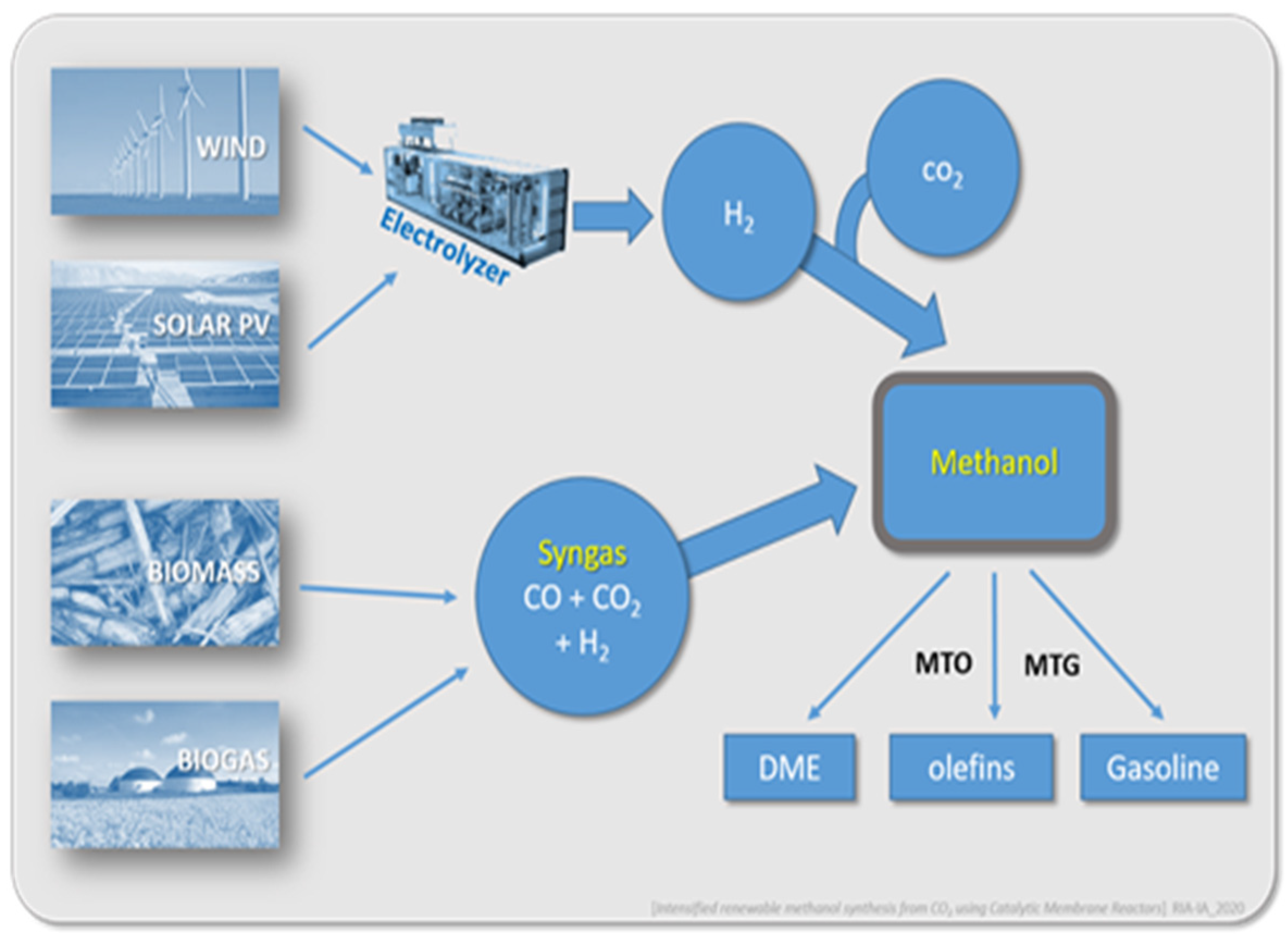
Figure 2.
Schematic representation of the mechanism of a membrane reactor applied to methanol synthesis.
Figure 2.
Schematic representation of the mechanism of a membrane reactor applied to methanol synthesis.
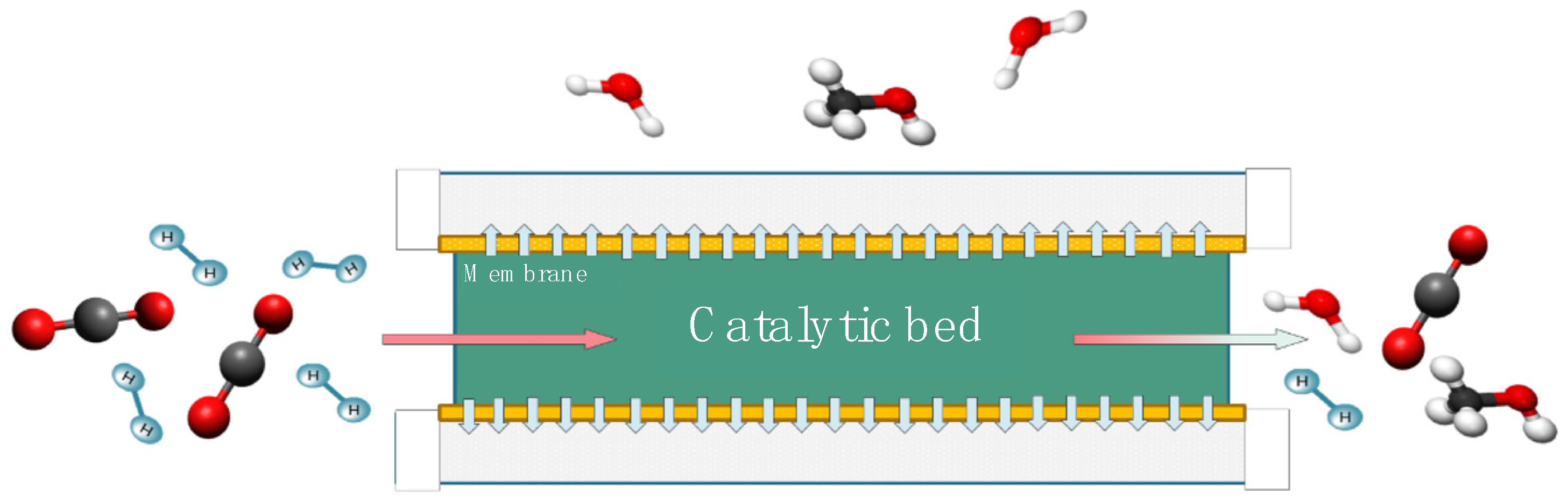
Figure 3.
Membrane reactor for methanol with Pd membrane (selective to H2).
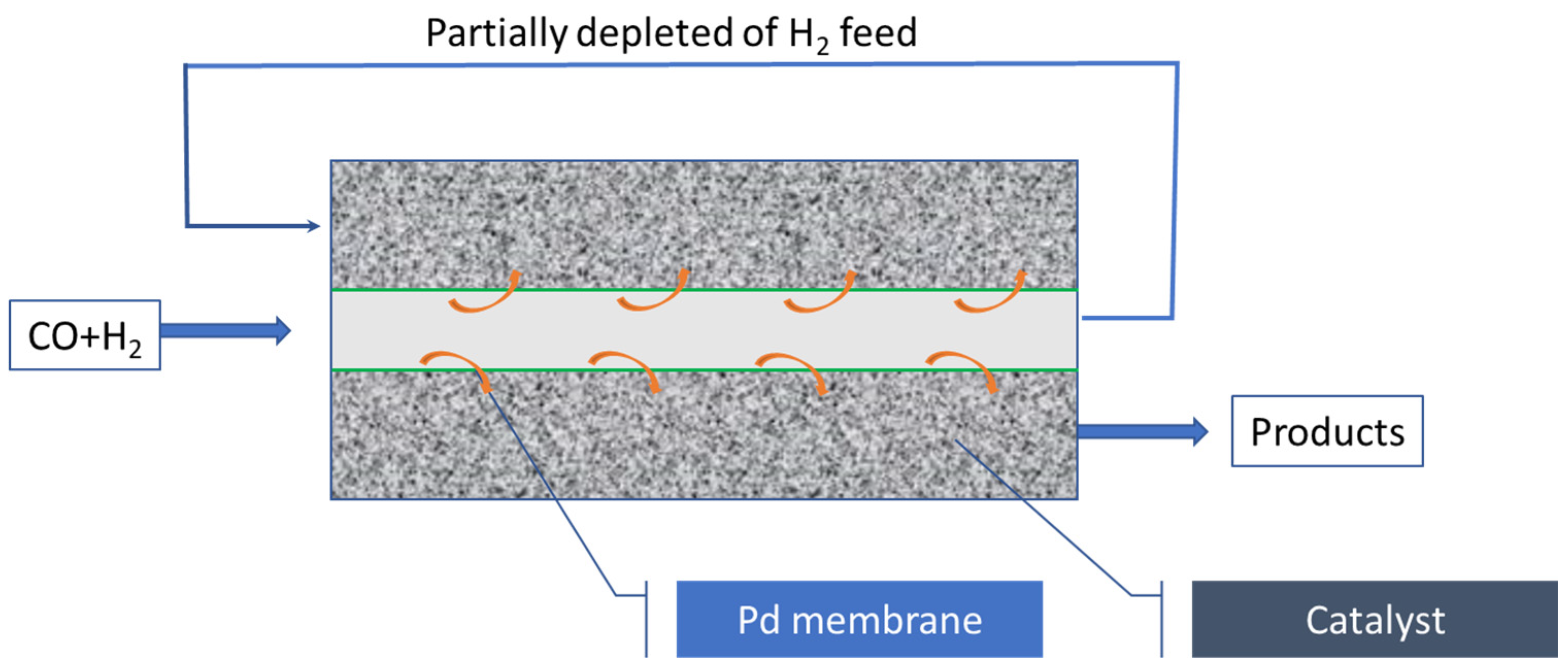
Figure 4.
Scheme of sorption-enhanced processes (example of methanol sorption-enhanced synthesis).
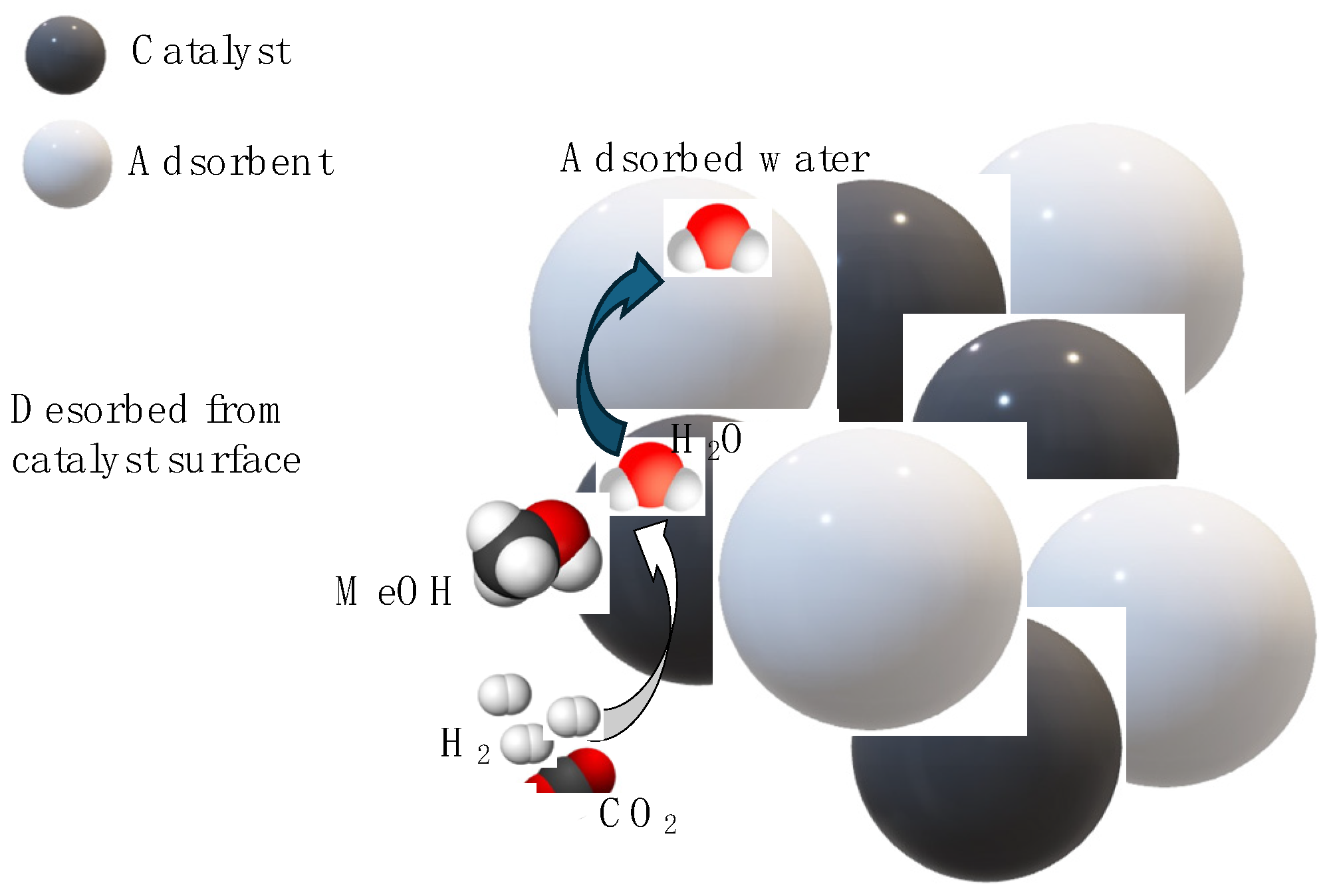
Figure 5.
Methanol enhancement factor in SEMS experimental studies vs operating conditions (temperature and pressure). The dimension of the bubble represents the magnitude.
Figure 5.
Methanol enhancement factor in SEMS experimental studies vs operating conditions (temperature and pressure). The dimension of the bubble represents the magnitude.
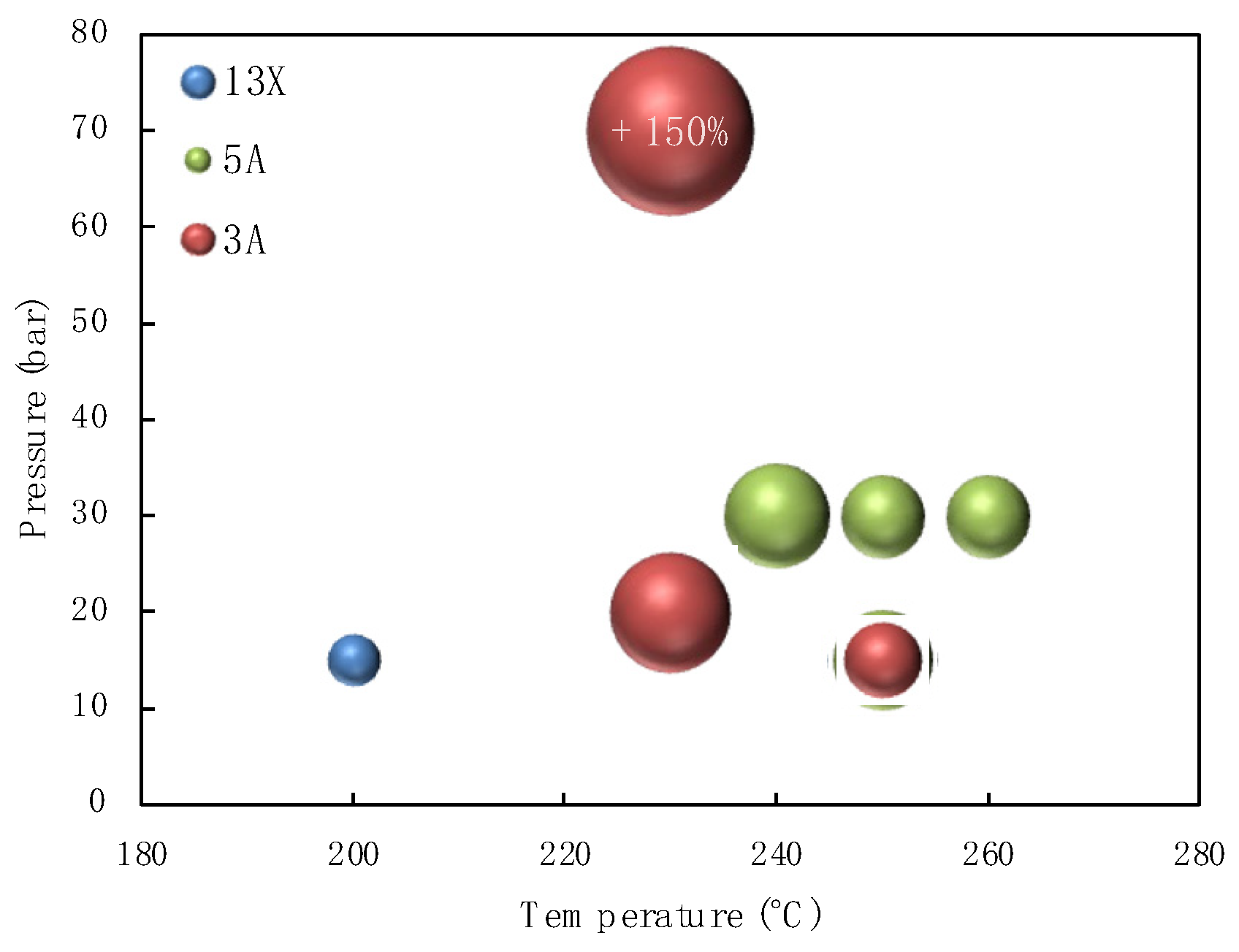
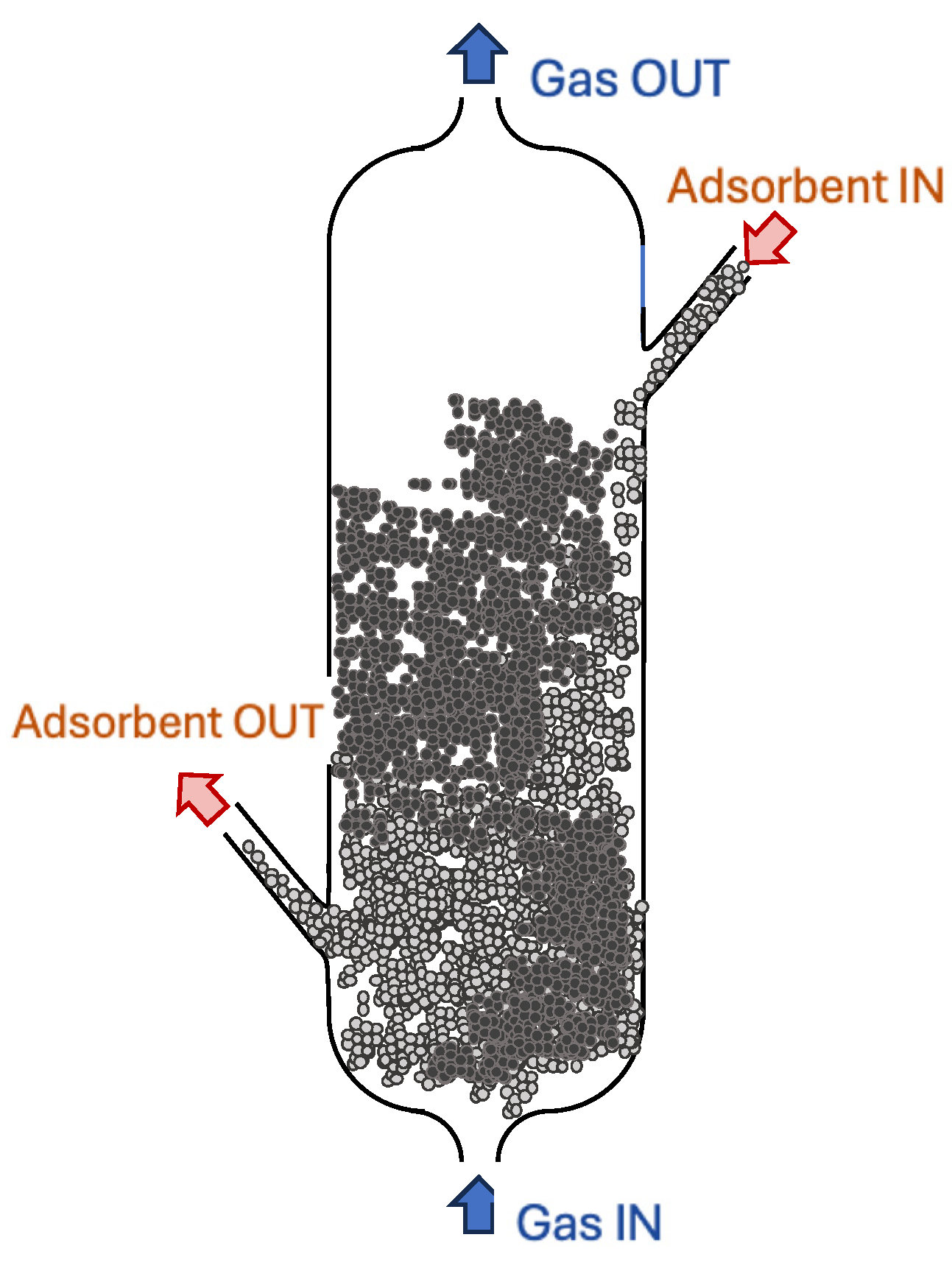
Figure 7.
Methanol enhancement factor in SEMS studies vs operating conditions (temperature and pressure) for experimental and mathematical studies. The dimension of the bubble represents the magnitude.
Figure 7.
Methanol enhancement factor in SEMS studies vs operating conditions (temperature and pressure) for experimental and mathematical studies. The dimension of the bubble represents the magnitude.
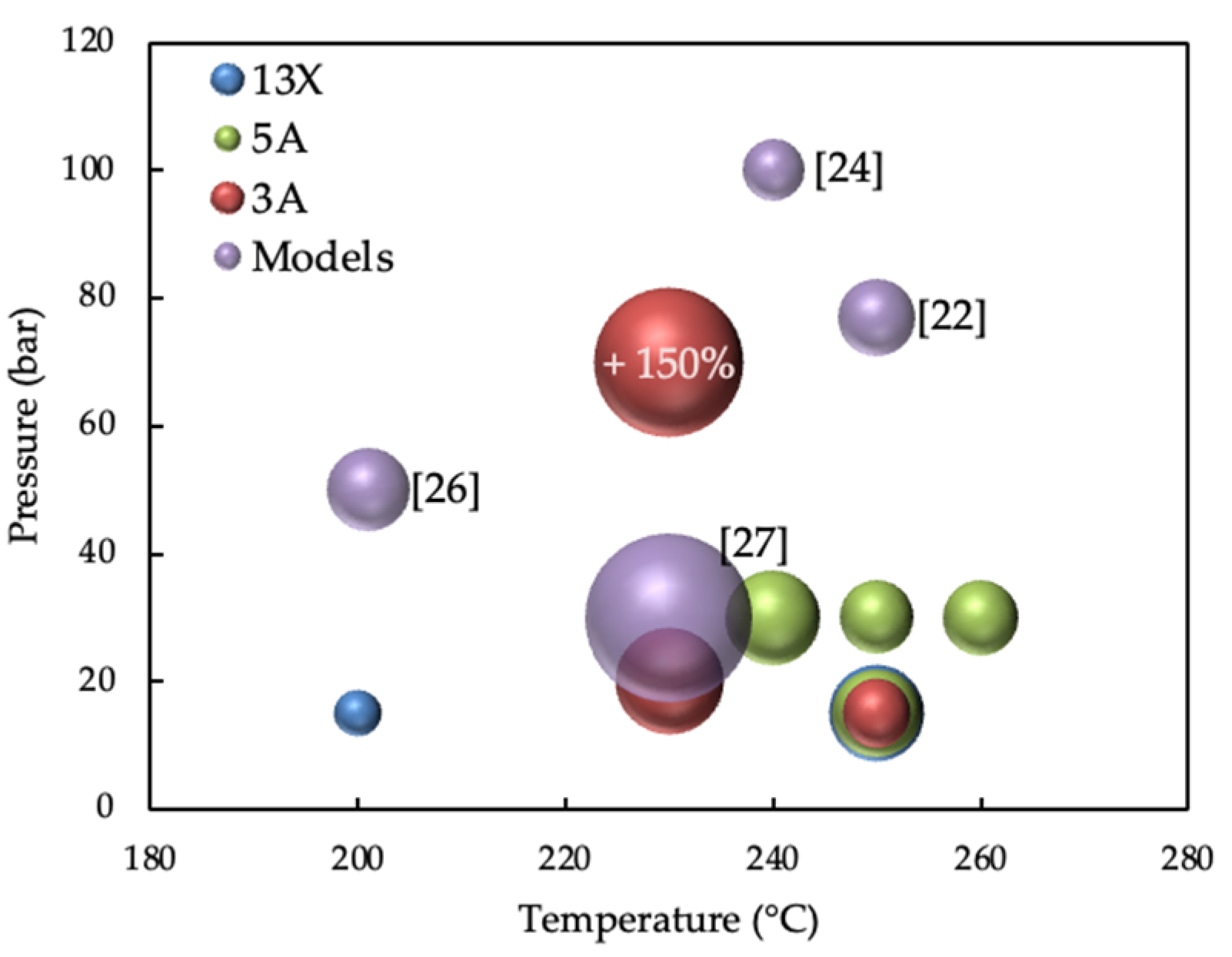
Figure 8.
Scheme of sorption-enhanced DME synthesis in presence of three solids: the methanol synthesis catalyst, the methanol dehydration catalyst and the water adsorbent.
Figure 8.
Scheme of sorption-enhanced DME synthesis in presence of three solids: the methanol synthesis catalyst, the methanol dehydration catalyst and the water adsorbent.
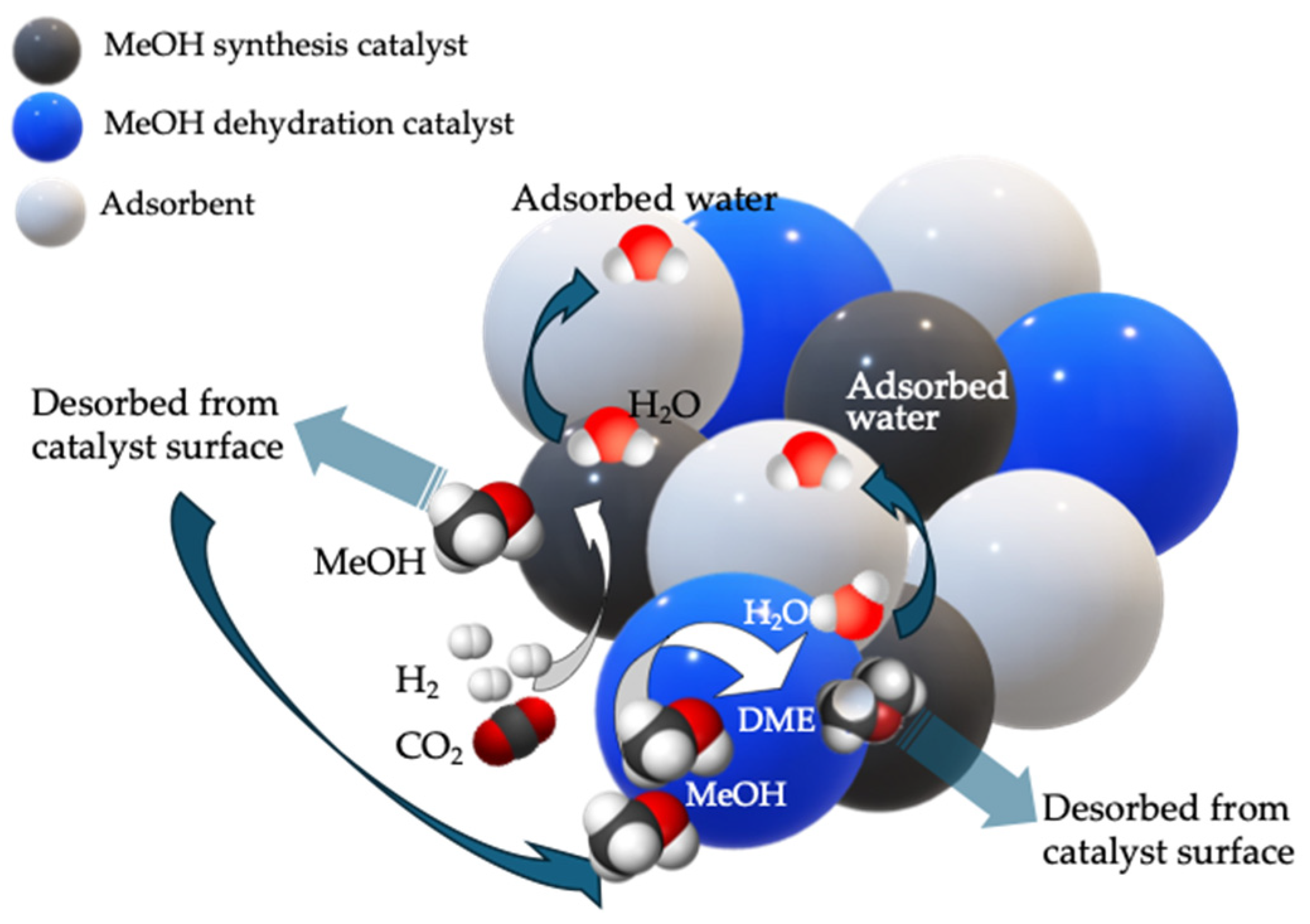

Table 1.
Experimental results for the separation of vapors from permanent gases using zeolite membranes.
Table 1.
Experimental results for the separation of vapors from permanent gases using zeolite membranes.
| Mixture | Temp. | Selectivity | Comments | Ref. |
| H2O /alcohol/O2 (alcohol = MeOH, EtOH, PrOH) |
25 ºC 25 ºC 250 ºC |
H2O/PrOH = 149 H2O/O2 = 47 H2O/O2 = 2.5 |
mordenite/ ZSM-5/ chabazite |
[73] |
| H2O/H2 | 200 ºC |
H2O/CO2 = 22 H2O/H2 = 160 |
NaA | [105] |
| H2O /He | 300 K 500 K |
H2O/He=4.5 H2O/He = 0.5 |
ZSM-5 ZSM-5 |
[106] |
| H2O/H2 = 72 | NaA | [107] | ||
| H2O/MeOH/H2 | 250 ºC | HO/H2 = 49 H2O/MeOH = 73 |
Mordenite | [104] |
| H2O/H2 /C6H12 | 100ºC | H2O/H2 = 3.2 H2O/H2 = 6 |
Silicalite ZSM-5 |
[108] |
| H2O/H2 | 200ªC | H2O/H2 = 4.6 H2O/MetOH = 233 |
Sodalite | [102] |
| H2O/CO2/N2/H2 | 180ºC 260ºC |
H2O/H2 = 200 H2O/H2 = 10 |
NaA | [95] |
| 30ºC 240ºC |
H2O/H2 = ∞ H2O/H2 = 0.18 |
NaA | [96] | |
| H2O/CO2/CO/H2/MeOH | 250 ºC | H2O/CO2 = 550 H2O/H2 = 190 |
NaA | [69] |
| CO2/CO/N2/CH4/H2O | 150 ºC 200 ºC |
H2O/H2 = 12 H2O/H2 = 7 |
Carbon mol. sieve | [109] |
| CO2/CO/H2/H2O/MeOH | 200 ºC | H2O/H2 = 2 | Carbon mol. sieve | [110,111,112] |
Disclaimer/Publisher’s Note: The statements, opinions and data contained in all publications are solely those of the individual author(s) and contributor(s) and not of MDPI and/or the editor(s). MDPI and/or the editor(s) disclaim responsibility for any injury to people or property resulting from any ideas, methods, instructions or products referred to in the content. |
© 2025 by the authors. Licensee MDPI, Basel, Switzerland. This article is an open access article distributed under the terms and conditions of the Creative Commons Attribution (CC BY) license (http://creativecommons.org/licenses/by/4.0/).
Copyright: This open access article is published under a Creative Commons CC BY 4.0 license, which permit the free download, distribution, and reuse, provided that the author and preprint are cited in any reuse.


