

Submitted:
14 April 2025
Posted:
15 April 2025
You are already at the latest version
Abstract
As AI systems become increasingly integrated into society, the relationship between humans and AI is evolving from simple automation toward co-creative collaboration. This shift is particularly significant in education, where human intuition and imagination can synergize with AI’s computational capabilities to enable novel forms of learning and teaching. Building on this potential and grounded in the #ppAI6 model of creative engagement in AI in education, this chapter explores how educators and learners can engage in progressively deeper and more transformative interactions with AI technologies. The #ppAI6 model distinguishes six levels of creative engagement, ranging from passive consumption of AI-generated content to expansive, participatory knowledge co-creation and transformative learning supported by AI. While most current applications in education remain at early levels, such as interactive consumption through Intelligent Tutoring Systems (ITS), this work focuses on exploring and designing for higher levels of engagement. Through a structured formative intervention, preservice teachers and EdTech professionals are guided to co-design AI-enhanced learning activities that not only support learner engagement but also cultivate AI literacy and agency.
Keywords:
creativity
; education
; creative pedagogy
; artificial intelligence
; #ppAI6
; creative en-gagement
1. Introduction
The rapid integration of artificial intelligence (AI) into various sectors of society is reshaping not only how we live and work but also how we learn and teach. Within education, this evolution offers both challenges and unprecedented opportunities [1] AI is no longer confined to automating routine processes, but can be used as a collaborator, capable of augmenting human creativity, supporting problem-solving, and fostering new forms of knowledge production. This shift invites educators to reimagine learning environments in which human intuition, imagination, and ethical reasoning work in concert with AI’s analytical and generative capacities. Moreover, the use of AI in education also raises concerns in relation to the potential dependency that could arise from the cognitive discharge in AI systems for certain teaching and learning tasks [2].
2. Creativity for 21st Century Education
In the context of 21st-century education, creative pedagogy is required rather than optional. Competency frameworks around the world increasingly recognize creativity as a core skill, both at the individual but also at collective level [3]. Creativity involves a dynamic interplay of divergent and convergent thinking, employed across a wide range of activities, from artistic expression to complex problem-solving. This recognition has led to creativity being featured prominently in frameworks for 21st-century skills, reinforcing the need for pedagogical approaches that actively foster creative thinking and action. There is a growing consensus within the learning sciences on the importance of integrating innovative, creative pedagogy across all levels of education [4]. This pedagogical shift has become even more critical with the rapid integration of artificial intelligence (AI) tools into educational contexts. Since the release of tools like ChatGPT in 2022, AI’s role in education has expanded beyond automation and efficiency to include complex cognitive and creative support. As these generative AI tools gain traction among teachers, learners, and caregivers, they raise new ecological, ethical, and pedagogical considerations [5].
Within this evolving landscape, AI is not just a technological addition. Ai has the potential to be a partner in the learning process and some creative learning tasks [1]. Its applications range from assisting with routine tasks to enabling new forms of creative expression and co-creation. AI tools can support varying levels of creative engagement, a form of learning that combines cognitive challenge with active participation, where learners are not passive recipients of information but creative agents capable of producing original ideas or artefacts. At one end of the creative engagement spectrum lies the passive use of AI, where learners consume content generated autonomously by AI with minimal interaction. At the other end, AI becomes a collaborative partner in co-creativity, enhancing the learner’s creative process through interactive and participatory approaches. This paper begins with a comparative analysis of human and artificial creativity, followed by the presentation of a framework that outlines six levels of creative engagement with AI in education, offering a pathway for integrating AI tools meaningfully within creative pedagogy.
3. Human Creativity and Artificial Creativity
Creativity has long been celebrated as a uniquely human cognitive ability. According to Henriksen and colleagues [6], critical thinking is viewed as the cornerstone of 21st-century education due to its transversal nature, which spans across disciplines and facilitates complex problem-solving. This form of critical thinking, intrinsic to human cognition, requires individuals to engage in rational reasoning within specific cultural frameworks and interpersonal relationships [7]. In contrast, contemporary artificial intelligence (AI) systems, although capable of producing creative outputs, necessitate human intervention to address inherent biases present in the datasets they are trained on. These biases can influence the knowledge generated by AI, potentially deviating from human values, including human rights and equality. Therefore, cultivating artificial creativity where AI generates valuable and innovative ideas requires not only advanced technological design but also careful human supervision [8]. This supervision ensures that AI’s creative outputs align with ethical standards and does not perpetuate harmful biases, such as those related to gender, race, or other forms of discrimination. As Dietrich and Haider [9] note, human creativity is characterized by the ability to produce both innovative and practical ideas, with a critical process of evaluation shaped by socio-cultural norms and values. This process is also essential in the realm of artificial creativity.
For AI to generate truly innovative and beneficial outcomes, it is not enough for AI models to simply produce novel ideas; these outputs must be subjected to critical human evaluation to ensure their relevance, fairness, and ethical soundness. This critical oversight is essential for guiding AI toward positive, human-centric creativity, where the technology’s potential to enhance human creative practices is maximized, while minimizing risks of harm or bias. Thus, the development of artificial creativity, much like human creativity, requires ongoing human involvement, specifically through the lens of critical thinking, to avoid unintended negative consequences and ensure that the outcomes serve the broader goals of equity and social good.
4. From Passive to Participatory Creative Engagement in AIED
Creative engagement in educational tasks spans a broad spectrum, with learners often transitioning from passive to active modes of involvement. In traditional, lecture-based activities, learners typically engage in passive listening, absorbing information from the instructor without active participation. In contrast, the active learning paradigm, which has gained widespread adoption in recent decades, emphasizes learner-centered approaches that prioritize cognitive engagement during learning activities. This approach encourages students to engage deeply with content, fostering critical thinking and problem-solving. However, mere cognitive engagement may not be sufficient to develop the 21st-century skills necessary for success in today's rapidly evolving world. To foster creativity, it is essential that learners engage not only cognitively but also creatively with tasks, leading to the creation of unique, valuable, and innovative outputs [10]. Creative engagement requires an active, participatory approach to learning, where the learner's involvement transcends passive reception and moves toward a more hands-on, co-creative process. Importantly, the support for creative engagement can either emerge from within the AI tools themselves or from external pedagogical strategies that guide learners' creativity. For example, the AI CBAL system [11] is designed to assist teachers by providing prompts that facilitate various forms of external regulation of learners' activities. In this system, the creative learningactivity is not conducted within the tool itself, but rather, teachers use the system to guide and structure tasks that stimulate creative thought in learners. This highlights the potential for AI to act as a supportive tool for creative teaching, even when the task itself takes place outside of the system. Similarly, Learning Management Systems (LMS), such as those integrated with the Massive Open Online Course (MOOC) framework [12], can accommodate diverse learner models and activities. These systems enable the application of learning analytics [13], which track and analyze student progress, facilitating intelligent tutoring and providing real-time insights into learner behaviors, such as purchasing patterns. These features hold promises for enhancing creative teaching by enabling instructors to regulate and respond to students' creative engagement more effectively. Without a pedagogical framework that actively emphasizes creativity, such systems risk failing to cultivate genuine creative engagement in both teachers and learners. The degree of creative engagement exhibited by teachers or learners in any given task is shaped by how AI tools are utilized. For instance, Intelligent Tutoring Systems (ITS), Automated Writing Evaluation (AWE), and certain forms of Digital Game-Based Learning (DGBL) are specifically designed to adjust dynamically to students' interactions. In these contexts, the nature of the learning activities the students engage in determines the level of creative involvement. As a result, the impact of AI tools on creativity depends on their integration and application within the educational process.
5. Six Levels of AI-Enhanced Creative Engagement in Education
Building upon the spectrum of creative engagement in educational tasks, this section introduces the #ppAI6 framework to differentiate the six distinct levels of creative engagement when AI tools are integrated into the learning process. While earlier discussions emphasized the range from passive consumption to more active, participatory forms of learning, the #ppAI6 framework further elaborates on the increasing depth of creative engagement that learners can experience through AI-driven educational tools.
The six levels outlined in the #ppAI6 mode reflect a continuum from basic interactions, where learners merely receive or navigate AI-generated content, to more advanced forms of co-creation.
Figure 1 illustrates six distinct levels of creative engagement using artificial intelligence (AI) tools in educational settings, ranging from basic to advanced stages. These levels correspond to varying degrees of creative involvement that a learner may demonstrate during the socio-cognitive process of learning:
- Level 1: Passive Consumer. In this stage, the learner is a passive recipient of AI-generated content, engaging minimally with the material. The learner simply consumes information produced by the AI system without any active participation in the creative process.
- Level 2: Interactive Consumer. The learner interacts with an AI system that provides feedback and influences the progression of activities based on the learner’s actions. However, the learner does not engage in creative tasks per se; instead, they navigate the system’s feedback based on predefined structures, following instructions from the AI without contributing novel ideas.
- Level 3: Individual Content Creation. The learner moves beyond simple interaction to engage in innovative problem-solving, where they generate new ideas or solutions that are not predetermined by the AI system. This stage reflects a deeper form of cognitive engagement, as learners produce original outputs.
- Level 4: Collaborative Content Creation. At this level, a small group of learners collaborates on creative activities, producing various ideas or solutions collectively. While AI may assist or facilitate the process, the outputs are not dictated by the system, highlighting a shift towards cooperative, peer-driven creativity.
- Level 5: Participatory Knowledge Co-Creation. A group of learners engages in a creative participatory activity, where they address complex, challenging problems. In this stage, learners not only collaborate within their own group but also interact with external collaborators, further expanding their collective creative efforts. This level emphasizes community involvement and the integration of diverse perspectives.
- Level 6: Expansive Learning supported by AI. In this advanced level, participants' agency is enhanced or transformed through AI-supported formative interventions. AI tools help identify contradictions in complex problems, generate concepts or artefacts to regulate conflicting stimuli, and foster collective agency and action. The AI system can be used to model activity systems and simulate new actions, enabling expansive visualization of potential solutions and facilitating a deeper level of problem-solving.
The Passive-Participatory model (#ppAI6) of creative engagement in AI tools, as illustrated in Figure 1, bears similarities to Chi and Wylie’s ICAP framework [14] at the initial level, which they classify as "passive." However, the levels from three to five are drawn from the #ppAI6 model [15]. In the first two levels, learners are not directly involved in creative activities: in Level 1, they passively consume AI-generated content; in Level 2, they interact with the AI system, which adjusts based on learner input, yet still offers limited creative engagement. In Level 2, the AI’s feedback and the learner’s actions are based on a predefined task model and learner model embedded within the system. This level often employs AI technologies like Intelligent Tutoring Systems (ITS), where learners follow a structured "programmed instruction" approach, engaging with the system’s feedback rather than generating new ideas. At Level 3, learners begin to demonstrate innovative content creation, producing outputs relevant to the educational context. The progression to Levels 4 and 5 represents a shift toward co-creation and collaboration, where learners contribute collectively to creative endeavors. This collaborative process helps learners better understand the creation and development of new ideas. Level 5 sees learners apply their creative work to real-world problems, promoting community involvement and focusing on local problem-solving [10]. In level 6, AI can be used not only for knowledge co-creation in participatory contexts but also to transform human practices, while conceptualizing differently and developing the participants’ agency, as a shared collaborative process between generative AI tools and human agents. At this sixth level, AI is integrated into the creation of critical knowledge and aims to develop agency and transform human practices.
While the ICAP framework [14] places interactivity at the core of cognitive engagement, the #ppai6 model emphasizes participatory knowledge co-creation as the key differentiator. This level involves learners in socio-constructivist, project-based activities, where they actively engage in identifying, understanding, and addressing challenges in their local or learning communities. This collaborative approach aims to tackle real-world problems [10], thereby positioning learners as agents of change.
6. Research Objectives
This study aims to explore the role of artificial intelligence (AI) tools in fostering creative engagement in educational settings, focusing on both learners and teachers. The research objectives are framed around the #ppAI6 framework, which conceptualizes six levels of creative engagement with AI tools in education, ranging from passive to deep participatory processes. The primary goal is to identify and understand how AI tools influence creative engagement for both learners (Research Objective 1, RO1) and teachers (RO2), assessing their respective roles within this continuum.
6.1. Research Objective 1 (RO1): Identification of Learners’ Creative Engagement
The first objective of this research (RO1) is to investigate how learners engage with AI tools at different levels of creative involvement, as outlined in the #ppAI6 framework. For this objective, the study aims to categorize and analyze the ways in which learners exhibit creative engagement, ranging from passive consumption of AI-generated content to active co-creation and participatory knowledge generation. By examining the various studies in literature, we aim to determine how AI tools either constrain or expand creative involvement in educational tasks, and how this engagement aligns with the levels proposed in the #ppAI6 model. This objective will provide valuable insights into the potential of AI tools to enhance or limit learners' creative agency within educational contexts.
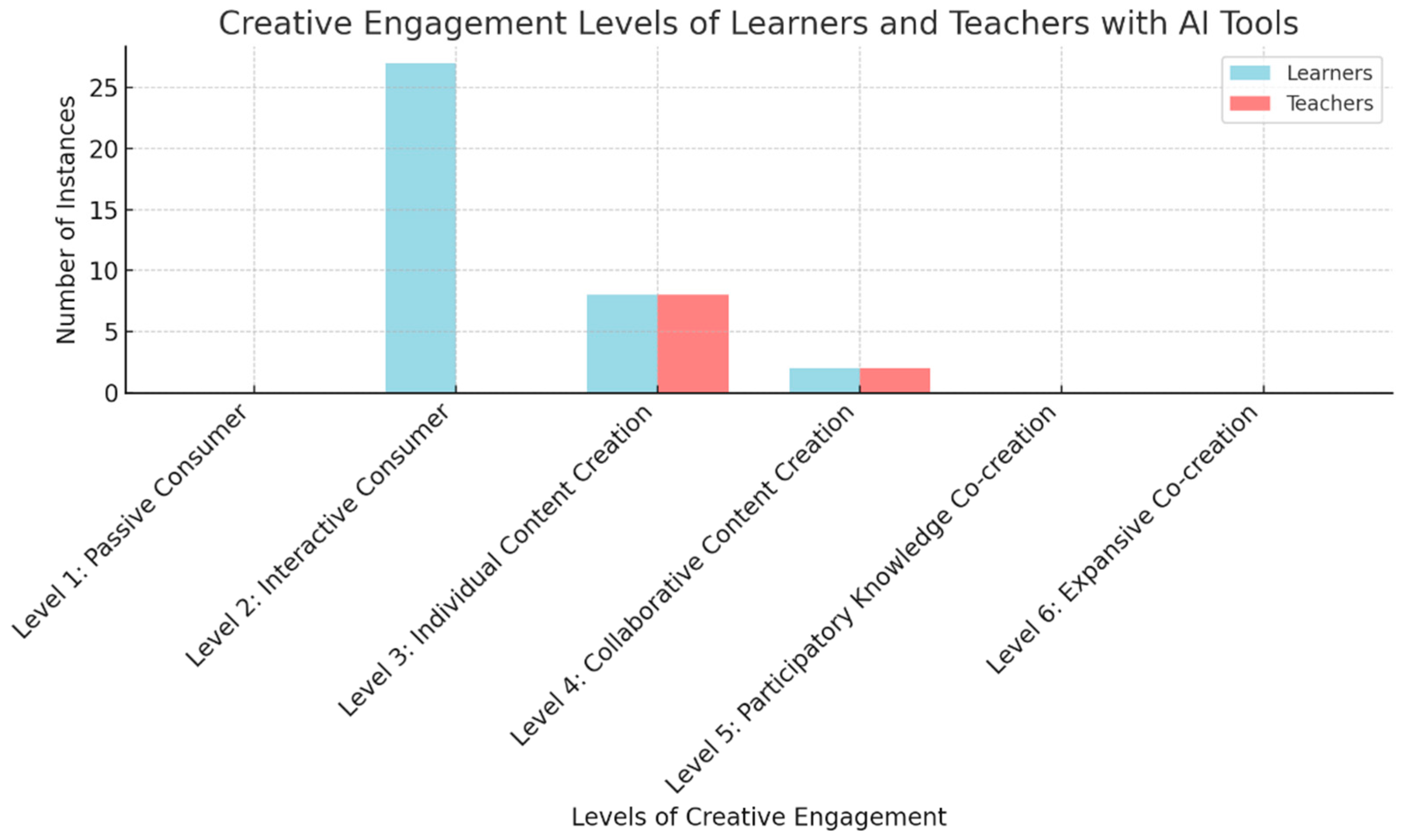
Figure 2 represents the different levels of creative engagement with AI tools for both learners (RO1) and teachers (RO2). The bars display the number of instances at each creative engagement level for both groups, highlighting the differences in engagement across the six levels.
6.2. Research Objective 2 (RO2): Identification of Teachers’ Creative Engagement
The second objective (RO2) focuses on identifying how teachers' creative engagement is supported or influenced by AI tools, as seen through the #ppAI6 framework. Unlike learners, who are the primary users of AI tools in most educational contexts, teachers play a crucial role in designing and facilitating creative tasks. This objective seeks to explore how AI tools support teachers in their creative processes, from the generation of new instructional content to the adaptation of teaching strategies based on real-time learning analytics. By understanding the levels of creative engagement exhibited by teachers when using AI tools, we aim to uncover how AI can empower teachers to be more innovative in their pedagogical approaches, ultimately fostering a more dynamic and creative learning environment for students.
7. Results
We introduce the results of the research objectives 1 (RO1), and 2 (RO2) corresponding to the learners’ creative engagement, and the teachers’ creative engagement, respectively.
- RO1. Identification of Learners’ Creative Engagement
The analysis of 48 studies revealed that most creative engagement instances were centered on the learner's perspective (n=37), with only five instances where AI tools supported teachers' or instructors’ creative engagement. Notably, three studies—BioWorld & HOWARD Platform [16], MiWRITE [17], and English-ABLE & CBAL [18], highlight how AI tools can support both learners and instructors in their creative engagement processes. Regarding passive creative engagement, where learners are not directly involved in creative activities, Lawson et al. [19] explored how students emotionally responded to animated instructors during presentations. The majority of studies (n=27) were found at the "interactive consuming" level (Level 2), where learners use AI tools to assist with predefined learning activities, and the AI system adjusts to the learner’s needs. Examples include systems like Assertions [20] and DME [21]. Intelligent Tutoring Systems (ITS), often recognized under various names such as “Intelligent Learning Tool”, are prominent at this level. For example, de Chiusole et al. [22] observed that Stat-Knowlab, an ITS designed to teach statistics, helped both students and teachers in creative ways by improving self-regulated learning and enabling teachers to adapt content to match students' levels. At the individual content creation level (Level 3), eight studies focused on learners (e.g., Tuglet, Physics Playground), while seven focused on teachers. The BioWorld & HOWARD Platform, MiWRITE, and CBAL systems [16,17] also support both groups in their creative processes. Collaborative content creation (Level 4) was observed in two studies: NoRILLA [23], which employed Augmented Reality (AR) to support STEM education, and HOWARD Platform [16], which enables real-time collaboration between learners and instructors in problem-based learning environments. Additionally, the Teens Online [24] study also demonstrated collaborative engagement in a game-based learning context. However, no studies observed participatory content co-creation (Level 5) and expansive learning (Level 6) in the reviewed papers.
- RO2. Identification of Teachers’ Creative Engagement
Four studies specifically addressed creative teaching. In Kurdi et al. [25], the use of Automated Question Generation (AQG) with AI helped instructors generate diverse quizzes, representing a third level of creative engagement as teachers created new content through the system. In Uto et al. [26], machine learning was employed to analyze writing patterns, providing valuable feedback for instructors. This process helped instructors increase their creative involvement by improving assessment strategies, positioning the study at Level 1 of creative participation. Smith et al. [27] investigated how Machine Learning (ML) could be used to predict which students would benefit from interventions, thus enhancing creative engagement in the classroom. This was recognized as Level 2, where instructors use AI-driven insights to adapt their teaching strategies. The study of TEA [28], an AI tool leveraging visual learning analytics, demonstrated Level 3 creative engagement, where instructors used the tool’s analyses to improve assessments and interventions.
8. Discussion
Our objective has been to investigate the intersection of human and artificial creativity within educational contexts, focusing on how AI tools can support and enhance creative engagement for both learners and teachers. Creativity, a fundamental cognitive process, involves the generation of novel and valuable ideas, solutions, or artefacts. In educational settings, fostering creativity is essential for developing critical 21st-century skills. By applying the #ppAI6 framework, which identifies six levels of creative engagement with AI, this study examines how AI tools facilitate varying degrees of creative involvement.
The findings highlight the varied levels of creative engagement with AI tools in education, focusing on both learners and teachers. For learners (RO1), most studies (n=27) centered on the interactive consuming level (Level 2), where AI tools adapt to learners’ inputs, offering personalized feedback but not requiring creative input. At Level 3 (individual content creation), AI tools like Physics Playground [29] allow learners to generate original solutions, reflecting deeper cognitive engagement. Few studies observed collaborative engagement (Level 4), like NoRILLA [23], but AI's role in collaborative, problem-solving environments remains underexplored. Additionally, participatory knowledge co-creation (Level 5) was not observed, suggesting a gap in AI tool development. For teachers (RO2), AI tools, such as Automated Question Generation [25] and TEA [28], support creative engagement at Levels 2 and 3, helping teachers create personalized content and analyze student performance. However, higher-level creative engagement (e.g., collaborative or participatory creativity) is less common for teachers, indicating room for improvement in AI’s role in supporting co-creative teaching practices.
AI has potential to foster creative engagement, especially for learners in more structured, feedback-driven tasks. For teachers, AI aids in instructional design and adaptive feedback but could further support collaborative teaching strategies. Future development should focus on advancing AI tools for higher levels of engagement and supporting both learners and teachers in more dynamic, co-creative educational processes.
Funding
This research was funded by Horizon Augmented Intelligence for Pedagogically Sustained Training and Education (augMENTOR), Grant agreement ID: 101061509.
Abbreviations
The following abbreviations are used in this manuscript:
| AI | Artificial Intelligence |
| AIED | Artificial Intelligence in Education |
| AQG | Automated Question Generation |
| AWE | Automated Writing Evaluation |
| DGBL | Digital Game-Based Learning |
| ITS | Intelligent Tutoring Systems |
| ITS | Intelligent Tutoring Systems |
| LMS | Learning Management Systems |
| ML | Machine Learning |
| MOOC | Massive Open Online Course |
References
- Urmeneta, A.; Romero, M. Creative Applications of Artificial Intelligence in Education; Springer Nature: 2024; p. 181.
- Gerlich, M. AI Tools in Society: Impacts on Cognitive Offloading and the Future of Critical Thinking. Societies 2025, 15, 6. [Google Scholar] [CrossRef]
- Romero, M. From Individual Creativity to Team-Based Creativity. In Toward Super-Creativity–Improving Creativity in Humans, Machines, and Human–Machine Collaborations; 2019; pp. 1–10.
- Cremin, T.; Chappell, K. Creative Pedagogies: A Systematic Review. Res. Pap. Educ. 2021, 36, 299–331. [Google Scholar] [CrossRef]
- Prem, E. From Ethical AI Frameworks to Tools: A Review of Approaches. AI Ethics 2023, 3, 699–716. [Google Scholar] [CrossRef]
- Henriksen, D.; Mishra, P.; Fisser, P. Infusing Creativity and Technology in 21st Century Education: A Systemic View for Change. Educ. Technol. Soc. 2016, 19, 27–37. [Google Scholar]
- Sternberg, R. J.; Halpern, D. F. Critical Thinking in Psychology; Cambridge University Press: 2020.
- Moruzzi, C. Measuring Creativity: An Account of Natural and Artificial Creativity. Eur. J. Philos. Sci. 2021, 11, 1. [Google Scholar] [CrossRef]
- Dietrich, A.; Haider, H. A Neurocognitive Framework for Human Creative Thought. Front. Psychol. 2017, 7, 2078. [Google Scholar] [CrossRef]
- Isaac, G.; Romero, M.; Barma, S. Understanding Co-Creativity in Real-World Problem Solving in Project-Based Learning in Higher Education. Rev. Int. CRIRES: Innover Dans La Trad. de Vygotsky / CRI_SAS Int. J. Vygotsky’s Heritage Innov. Educ. 2022, 6(3), 86–99. [CrossRef]
- Zapata-Rivera, D. Open Student Modeling Research and Its Connections to Educational Assessment. Int. J. Artif. Intell. Educ. 2021, 31(3), 380–396. [Google Scholar] [CrossRef]
- Alshehri, M.; Alamri, A.; Cristea, A. I.; Stewart, C. D. Towards Designing Profitable Courses: Predicting Student Purchasing Behaviour in MOOCs. Int. J. Artif. Intell. Educ. 2021, 31(2), 215–233. [Google Scholar] [CrossRef]
- Kay, J.; Reimann, P.; Diebold, E.; Kummerfeld, B. MOOCs: So Many Learners, So Much Potential. IEEE Intell. Syst. 2013, 28(3), 70–77. [Google Scholar] [CrossRef]
- Chi, M. T. H.; Wylie, R. The ICAP Framework: Linking Cognitive Engagement to Active Learning Outcomes. Educ. Psychol. 2014, 49(4), 219–243. [Google Scholar] [CrossRef]
- Romero, M. 15. Romero, M. Collaborative Design of AI-Enhanced Learning Activities. IRMBAM. arXiv 2024, arXiv:2407.06660.
- Lajoie, S. P. Student Modeling for Individuals and Groups: The BioWorld and HOWARD Platforms. Int. J. Artif. Intell. Educ. 2021, 31(3), 460–475. [Google Scholar] [CrossRef]
- Wilson, J.; Huang, Y.; Palermo, C.; Beard, G.; MacArthur, C. A. Automated Feedback and Automated Scoring in the Elementary Grades: Usage, Attitudes, and Associations with Writing Outcomes in a Districtwide Implementation of MI Write. Int. J. Artif. Intell. Educ. 2021, 31(2), 234–276. [Google Scholar] [CrossRef]
- Zapata-Rivera, D. Open Student Modeling Research and its Connections to Educational Assessment. Int. J. Artif. Intell. Educ. 2021, 31(3), 380–396. [Google Scholar] [CrossRef]
- Lawson, A. P.; Mayer, R. E.; Adamo-Villani, N.; Benes, B.; Lei, X.; Cheng, J. Do Learners Recognize and Relate to the Emotions Displayed By Virtual Instructors? Int. J. Artif. Intell. Educ. 2021, 31(1), 134–153. [Google Scholar] [CrossRef]
- Maniktala, M.; Cody, C.; Barnes, T.; Chi, M. Correction to: Avoiding Help Avoidance: Using Interface Design Changes to Promote Unsolicited Hint Usage in an Intelligent Tutor. Int. J. Artif. Intell. Educ. 2021, 31(1).
- Tacoma, S.; Drijvers, P.; Jeuring, J. Combined Inner and Outer Loop Feedback in an Intelligent Tutoring System for Statistics in Higher Education. J. Comput. Assist. Learn. 2021, 37(2), 319–332. [Google Scholar] [CrossRef]
- de Chiusole, D.; Stefanutti, L.; Anselmi, P.; Robusto, E. Stat-Knowlab. Assessment and Learning of Statistics with Competence-Based Knowledge Space Theory. Int. J. Artif. Intell. Educ. 2020, 30, 668–700. [Google Scholar] [CrossRef]
- Yannier, N.; Hudson, S. E.; Koedinger, K. R. Active Learning is About More Than Hands-On: A Mixed-Reality AI System to Support STEM Education. Int. J. Artif. Intell. Educ. 2020, 30(1), 74–96. [Google Scholar] [CrossRef]
- Yusri, R.; Abusitta, A.; Aïmeur, E. Teens-Online: A Game Theory-Based Collaborative Platform for Privacy Education. Int. J. Artif. Intell. Educ. 2021, 31(4), 726–768. [Google Scholar] [CrossRef]
- Kurdi, G.; Leo, J.; Parsia, B.; Sattler, U.; Al-Emari, S. A Systematic Review of Automatic Question Generation for Educational Purposes. Int. J. Artif. Intell. Educ. 2020, 30, 121–204. [Google Scholar] [CrossRef]
- Uto, M.; Miyazawa, Y.; Kato, Y.; Nakajima, K.; Kuwata, H. Time- and Learner-Dependent Hidden Markov Model for Writing Process Analysis Using Keystroke Log Data. Int. J. Artif. Intell. Educ. 2020, 30(2), 271–298. [Google Scholar] [CrossRef]
- Smith, B. I.; Chimedza, C.; Bührmann, J. H. Global and Individual Treatment Effects Using Machine Learning Methods. Int. J. Artif. Intell. Educ. 2020, 30(3), 431–458. [Google Scholar] [CrossRef]
- Arruarte, J.; Larrañaga, M.; Arruarte, A.; Elorriaga, J. A. Measuring the Quality of Test-based Exercises Based on the Performance of Students. Int. J. Artif. Intell. Educ. 2021, 31(3), 585–602. [Google Scholar] [CrossRef]
- Shute, V. J.; Smith, G.; Kuba, R.; Dai, C.-P.; Rahimi, S.; Liu, Z.; Almond, R. The Design, Development, and Testing of Learning Supports for the Physics Playground Game. Int. J. Artif. Intell. Educ. 2021, 31(3), 357–379. [Google Scholar] [CrossRef]
Figure 1.
Six Levels of AI-Enhanced Creative Engagement (#ppAI6).
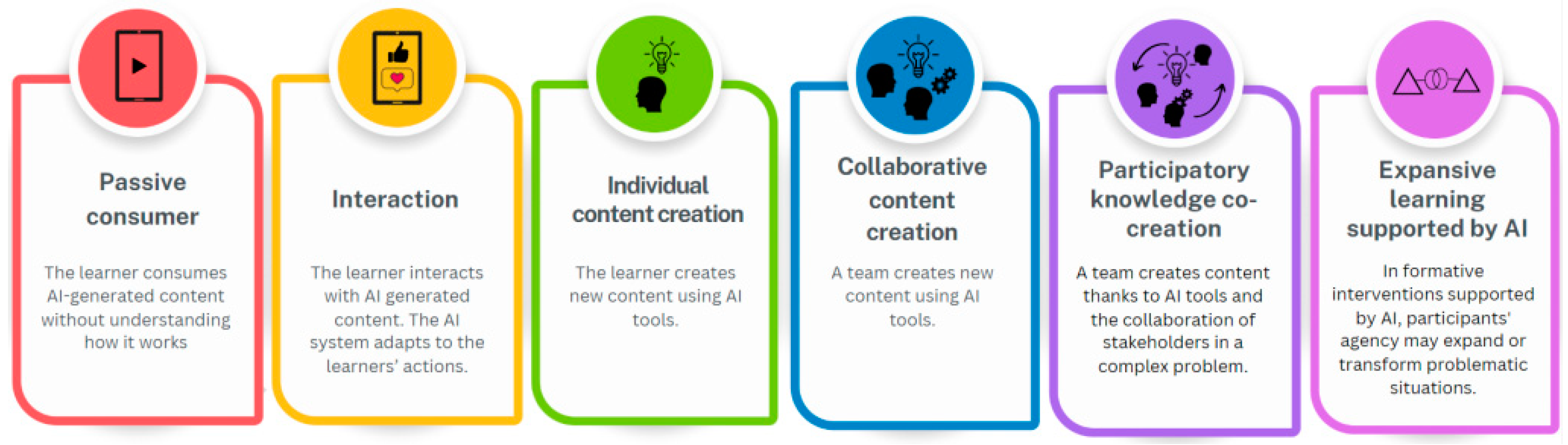
Figure 2.
Six Levels of AI-Enhanced Creative Engagement (#ppAI6) for learners (RO1) and teachers (RO2).
Figure 2.
Six Levels of AI-Enhanced Creative Engagement (#ppAI6) for learners (RO1) and teachers (RO2).
Disclaimer/Publisher’s Note: The statements, opinions and data contained in all publications are solely those of the individual author(s) and contributor(s) and not of MDPI and/or the editor(s). MDPI and/or the editor(s) disclaim responsibility for any injury to people or property resulting from any ideas, methods, instructions or products referred to in the content. |
© 2025 by the authors. Licensee MDPI, Basel, Switzerland. This article is an open access article distributed under the terms and conditions of the Creative Commons Attribution (CC BY) license (http://creativecommons.org/licenses/by/4.0/).
Copyright: This open access article is published under a Creative Commons CC BY 4.0 license, which permit the free download, distribution, and reuse, provided that the author and preprint are cited in any reuse.


