

Submitted:
15 April 2025
Posted:
16 April 2025
You are already at the latest version
Abstract
With the global shift toward greener transportation, the automotive industry is rapidly adopting lightweight materials to enhance fuel efficiency and reduce greenhouse gas emissions. Weight reduction not only improves recyclability but also enhances vehicle performance, including driving dynamics, braking efficiency, and crash safety. A key enabler of this transition is the integration of lightweight, high-performance materials such as advanced polymer composites as sustainable alternatives to conventional automotive components. As the future of mobility increasingly leans toward electric vehicles (EVs), the demand for eco-friendly materials has never been greater. This review provides an extensive analysis of natural fibers and fillers derived from agro/food waste—such as banana, coir, corncob, date palm, pineapple leaf fiber (PALF), and sugar bagasse—as potential reinforcements for biocomposites in EV interior applications. It explores the extraction processes, as well as the physical, chemical, mechanical, and thermal characterization of these fibers and their reinforced composites. Additionally, the article presents a comprehensive review of automotive interior requirements, evolving market trends, and key considerations for adopting biocomposites in vehicle interiors. Finally, this review highlights the future research scope and challenges associated with integrating agriculture waste-based biocomposites into electric vehicle applications, paving the way for a more sustainable and environmentally responsible automotive industry.
Keywords:
Natural fiber
; Bio-composites
; Sustainability
; Waste valorization
; Electric Vehicle
1. Introduction
The Earth faces escalating challenges from carbon emissions and the depletion of oil reserves. Among various sectors, transportation significantly impacts energy consumption and the environment, accounting for over 25% of global energy use and greenhouse gas (GHG) emissions. Notably, ground transportation contributes to more than 70% of the emissions within this sector [1,2]. With fossil fuels comprising over 80% of the world’s energy consumption and transportation being predominantly reliant on oil, the eventual exhaustion of global reserves is a critical concern [3,4]. The rapid growth of transportation has led to significant oil consumption and poses challenges to environmental protection. The sector is the second-largest source of anthropogenic greenhouse gas emissions, with road transportation contributing approximately 93% through vehicle emissions [5]. Additionally, transportation accounts for 40% of the global daily oil consumption of nearly 75 million barrels. As a result, research on energy efficiency and emission reduction, particularly in the automotive industry, has become increasingly prominent. The growing energy demand, particularly from developing nations, intensifies concerns about resource depletion and emissions [6]. In response, governments are setting targets under the Paris Agreement to cut GHG emissions by 2030. For instance, Europe’s ‘Fit-for-55’ initiative aims to reduce carbon emissions by 55% from 1990 levels by 2030 [7]. To comply with vehicle CO2 regulations, automakers are adopting the Worldwide Harmonized Light Vehicle Test Procedure (WLTP) as the global standard for light vehicles [8]. India is advancing towards leadership in the road transport sector with its Nationally Determined Contribution under the Paris Agreement, aiming to phase out petrol and diesel vehicles by 2030. A 2018 Coal India report highlights that promoting lightweight vehicles and solar energy use can significantly and swiftly reduce carbon emissions [9]. Leading car manufacturers are increasingly focusing on electric and hydrogen-powered vehicles to reduce global GHG emissions. In parallel, advancements in urban air mobility (UAM) are shaping the future of transportation. These innovations rely on batteries, with hydrogen-powered vehicles also requiring high-voltage batteries as backups [10]. With EV batteries weighing 300–700 kg, including 100–160 kg from metal parts, the use of lightweight materials becomes imperative. Alongside improving battery cell energy density, optimizing battery pack design and replacing traditional aluminium and steel with composites and polymers are key to achieving significant weight reductions [11]. Gregory Keoleian from the University of Michigan highlights that advancements in fuel efficiency will come from vehicle electrification and lightweight. Reducing vehicle weight by 10% can improve fuel economy by 6% or increase the driving range of electric vehicles (EVs) by 14%. This highlights the importance of lightweight materials in vehicle design [12]. In 2016, the global market for lightweight materials was valued at approximately USD 113.78 billion and is projected to grow at a compound annual growth rate (CAGR) of 8.9% over the forecast period. The rising vehicle demand in North America, particularly in the U.S. and Canada, is expected to drive this growth, largely due to the presence of leading automotive manufacturers in the region [13]. One effective strategy for reducing EV weight is replacing interior metal components with polymers. However, polymers present challenges in terms of end-of-life disposal and their potential to contribute to environmental pollution [14]. To address these issues, natural fiber-based bio or green composites have emerged as a sustainable alternative [15].
Composites are materials consisting of two distinct phases: the reinforcement phase and the matrix phase. The reinforcement phase, which provides strength and stiffness, can be fiber-based or particulate (filler) in form, while the matrix acts as a binder to hold the reinforcement together [16]. Depending on their source, reinforcement materials can be classified as synthetic or natural. Synthetic fibers like Kevlar, carbon, and glass are commonly used for their strength and durability. However, natural fibers are emerging as a sustainable alternative, derived from plants and animals. Plant-based fibers such as bamboo, banana, coir, jute, flax, hemp, kenaf, pineapple leaf, sisal, and ramie are obtained from stems, leaves, seeds, and agricultural residues, providing a renewable cellulose-based resource. Animal fibers like wool, silk, alpaca, cashmere, horsehair, and even human hair are protein-based, offering another natural option[17]. When these natural fibers or fillers are combined with non-degradable polymer matrices, they form bio-composites. Alternatively, green composites are created when both the reinforcement and matrix are derived from natural, biodegradable resources [18]. This shift toward natural fibers underscores their growing potential in developing eco-friendly materials that balance sustainability with functionality. The increasing adoption of these materials is driven by their cost-effectiveness, recyclability, non-toxicity, eco-friendliness, and superior strength-to-weight ratio compared to synthetic alternatives [19]. However, a significant challenge in natural fiber-reinforced composites (NFRCs) is the poor compatibility between the hydrophilic, polar natural fibers and the hydrophobic, non-polar polymer matrices, which can result in weak interfaces and poor dispersion. To address this, researchers have explored various methods, such as chemical treatments and surface modifications, to improve fiber-matrix compatibility [20]. In countries like India, significant agricultural waste, including rice husk, wheat husk, coconut, corncob, pineapple leaves, and bagasse, remains underutilized. This waste presents an opportunity to develop composites for various industries, including construction, furniture, packaging, automotive, and biomedical applications [21]. The growing emphasis on circular economy principles is reshaping industrial processes and product designs, with concepts like the bioeconomy, bio-based society, and green economy guiding strategic planning [22]. As stricter global regulations and higher taxes make landfilling industrial waste increasingly untenable, waste is now being either incinerated or repurposed for higher value uses [23]. Developing sustainable applications using waste materials, while considering both environmental and economic impacts, has become essential. The evolution of biocomposites in the recent decades has made them viable alternatives to conventional materials [24]. The rising market demand for natural fiber-based composites highlights the need for political incentives and a steady supply of raw materials. However, competition with petroleum-based materials remains a challenge, requiring not only environmentally friendly solutions but also affordable biomass resources [25].
This review provides a comprehensive analysis of various agricultural wastes which are easily and abundantly available in the Indian subcontinent, their treatment processes, and their potential as reinforcements in thermoplastic and thermoset polymers. It explores the development processes of these composites and highlights their viability as replacements for traditional materials in automobile interiors. Additionally, the article includes a detailed overview of automobile manufacturers and the possible applications of biocomposites in interior components. Furthermore, it envisions the future role of waste biomass in advancing innovative technologies like Electric Vehicles, showcasing its potential to contribute to sustainable and eco-friendly solutions.
2. Natural Fibers
Fibers are thread-like, linear structures with distinct cross-sectional and longitudinal shapes, commonly used in composite materials. Natural fibers, sourced from plants, animals, and minerals, offer numerous advantages such as environmental sustainability, lightweight, strength, renewability, cost-effectiveness, and biodegradability. They are often used as reinforcements in both thermoset and thermoplastic matrices, providing a cost-effective alternative to high-cost synthetic fibers like glass, especially in low-load applications such as construction, packaging, and automotive interiors. However, synthetic fibers pose risks to human health and the environment, potentially leading to conditions like skin irritations and respiratory illnesses, including lung cancer.
Natural fibers, with their low density and superior mechanical properties, are lighter than synthetic fibers and metals, making them well-suited for weight-sensitive applications requiring high strength, such as in the transportation industry. When incorporated into polymeric or biodegradable matrices, natural fibers enhance functionality, offering improved thermal and acoustic insulation compared to glass fibers. These composites are non-hazardous to the skin and respiratory system, making them safer than synthetic alternatives. In the automotive industry, natural fiber composites reduce vehicle costs, fuel consumption, and energy requirements, while offering better ecological sustainability and mechanical strength. The major sources of the natural fiber are discussed in the next section.
2.1. Sources of Natural Fiber
Natural fibers (NFs) play a significant role in the development of green composites, offering a sustainable alternative for various applications [26]. These fibers can be classified based on their source, as illustrated in Figure 1, and are derived from plants, animals, or minerals. Plant-based fibers, also known as lignocellulosic fibers, are primarily composed of cellulose fibrils embedded in a lignin matrix, providing strength and flexibility. [27,28]. They are categorized by origin, such as stalk, grass, wood, leaf, fruit, bast, and seed, with key examples including jute, flax, hemp, sisal, kenaf, coir, banana, abaca, areca nut, cotton, and oil and date palm. These fibers hold significant commercial and technological value, with initial research in natural fiber composites focusing on jute and flax. Over time, the scope has expanded to include a diverse range of plant fibers for various advanced applications. [29]. Animal fibers, on the other hand, are protein-based and can be divided into two categories: α-keratin fibers, such as hair, wool, and feathers, and fibroin fibers, like silk and spider silk. These fibers are primarily sourced from mammals, including sheep (wool), goats (cashmere, alpaca), and horses. Lastly, mineral fibers, which occur naturally, are predominantly composed of asbestos. [30,31]. The composition and anatomical structure of plant-based natural fibers and fillers are explored in detail in the next section.
2.2. Constituents and Anatomy of Plant Based Natural Fiber/Filler
Plant based natural fibers are complex in composition, primarily comprising cellulose, hemicellulose, lignin, pectin, waxes, and other extractives [19,32]. Plant fibers consist of a primary and a secondary cell wall, each serving distinct roles. The primary wall, composed of hemicellulose, pectins, proteins, and disordered cellulose microfibrils, provides flexibility and supports cell growth. In contrast, the thicker secondary wall, divided into three layers (S1: 100–200 nm, S2: 0.5–8 µm, S3: 70–100 nm), imparts rigidity and superior mechanical properties due to its higher cellulose and lignin content [33]. The secondary wall features concentric layers of helically arranged cellulose microfibrils, where lignin acts as a matrix binding the rigid cellulose structure. Microfibrils, measuring 2–20 nm in diameter, comprise crystalline cellulose chains linked by amorphous regions. Figure 2 (a) shows typical structure of plant fiber and (b) represents microfibril and cellulose inside the fibril [47]. The composition and properties of natural fibers vary based on factors such as plant species, climate, maturity, and extraction methods [34].
Cellulose: Cellulose serves as the fundamental structural backbone of natural fibers, playing a pivotal role in their mechanical properties such as strength, stiffness, and stability [35]. This natural polymer, composed of carbon, hydrogen, and oxygen, breaks down into glucose molecules linked through long molecular chains [36]. Its semi-crystalline nature, governed by hydrogen bonding between hydroxyl groups, forms crystalline zones that enhance rigidity and confer a high modulus of elasticity (~136 GPa, surpassing fiberglass at ~75 GPa) [37]. As the most abundant organic compound in nature and a key component of plant cell walls, cellulose is a polysaccharide with the formula C6H10O5, composed of D-anhydro glucopyranose (AGU) units connected by β 1→4 glycosidic bonds. Figure 3 (a) represents the degree of polymerization in cellulose. In its native state, cellulose exhibits a high degree of polymerization (~14,000), which reduces to ~2,500 upon purification [38]. These macromolecules aggregate into semi-crystalline microfibrils, forming the structural framework of fibers, with crystallinity varying based on the cellulose source. Two primary forms of cellulose exist: native cellulose (cellulose I) and regenerated cellulose (cellulose II). The latter is produced by treating cellulose I with sodium hydroxide (NaOH), altering its semi-crystalline structure and creating new allomorphic arrangements. This transformation underscores cellulose’s adaptability and its critical role in diverse structural applications [39,40].
Hemicelluloses: Hemicelluloses are low molecular weight polysaccharides (DP: 200–10,000) that strengthen natural fiber cell walls by bonding with lignin and cellulose [41]. These branched, hydrophilic polymers, primarily found in plant bark, consist of various sugars such as D-xylose, D-mannose, D-glucose, and glucuronic acid. Figure 3 (b) represents the molecular structure of xyloglucan. Their amorphous and flexible structure, resulting from a mix of monomers, makes them water-soluble and less resistant to hydrolysis [42]. Acting as a matrix, hemicellulose embeds cellulose microfibrils, contributing to fiber cohesion and stability. However, their solubility and lower molecular weight compared to cellulose increase their susceptibility to biodegradation, moisture absorption, thermal degradation, and flammability [43]. Despite these limitations, the helical structure of hemicellulose enhances its flexibility and reinforces its role in the fiber’s structural framework [44].
Lignin: Lignin, the second most abundant renewable organic compound after cellulose, constitutes approximately 15–30% of plant biomass. It is a three-dimensional amorphous phenolic polymer formed by the polymerization of p-coumaryl, sinapyl, and coniferyl alcohols, resulting in short-chain structures with an average molecular weight of about 20,000 monomer units [45]. The density and composition of lignin vary depending on the source of the natural fibers and their location, whether in the fiber walls or lamella [46]. This hydrophobic polymer provides water resistance to plants and contributes to their rigidity and hardness, particularly in wood and other structural tissues. Its high resistance to biological degradation forms a protective morphological barrier that inhibits pathogen penetration and growth, safeguarding plants from chemical and bacterial attacks. Predominantly located in the secondary walls of natural fibers, lignin is also present in the stem and bark [47]. As a hydrocarbon polymer, lignin imparts stiffness and structural reinforcement to natural fibers. Its formation through the irreversible removal of water from sugars strengthens the fiber and promotes chemical bonding within the fiber matrix. Additionally, lignin helps mitigate UV-induced degradation, enhancing the durability and performance of natural fibers in various applications [48,49]. Figure 3 (c) and (d) represents the molecular structure of lignin and primary alcohol in lignin, respectively.
Pectin: Pectins are carbohydrate macromolecules primarily composed of galacturonic acid, found exclusively in plants [50]. Although present in smaller quantities than cellulose and lignin, they are crucial to plant fiber structure, particularly in the middle lamella, which connects neighbouring cells [51]. Pectins, highly hydrophilic due to their carboxylic acid groups, serve various roles depending on their location. In the primary layer, they help maintain cell cohesion, while in the secondary layer, they bind cellulose microfibrils with hemicellulose, acting as “intercellular cement” to reinforce fiber structure [52,53]. Found mostly in bast fibers, pectin enhances fiber flexibility and contributes to overall strength. Figure 3 (e) represents the molecular structure of pectin.
Wax: Plant waxes, composed of long-chain aliphatic hydrocarbons like ketones, fatty acids, and alcohols, play a crucial role in reducing moisture absorption and influencing the fiber’s surface properties [54]. While these waxes and other extractives are non-structural, they can affect the wettability and adhesion of fibers with polymer matrices, often leading to poor interfacial interactions. The structural framework of natural fibers is predominantly formed by cellulose, which imparts strength and elasticity. Non-cellulose components such as hemicellulose, lignin, and pectin act as filling materials, binding microfibrils and ensuring the even distribution of external loads [55]. Together, these components create a composite structure that balances mechanical performance, flexibility, and durability, making natural fibers a robust and sustainable option for eco-friendly material development [56].
Lila et al. [57] Observed that the technical fiber of munja consists of multiple microfibrils, also referred to as the original single fibers or elementary fibers. The SEM image of the munja fiber is shown in Figure 4(a). These individual fibers are aligned and bonded along their length, with the non-cellulosic components playing a key role in this bonding process. The surface of the fiber was found to feature sectional voids, with the fibrils interconnected through a lignin-rich medial lamella. A similar observation was made by Saha and Kumari [32], who studied bamboo fibers. The SEM image of the bamboo fiber is shown in Figure 4. (b), where comparable structural features were identified. The physical and chemical properties of natural fibers, including their cell wall structure, growth patterns, thickness, cell size, shape, cross-sectional profile, and luminal features, are crucial in determining the overall characteristics of the fibers. These properties are directly linked to the fiber’s anatomy and composition.
Furthermore, the constituents and anatomy of the fiber also significantly influence the interaction between the fiber and the polymer matrix, as well as the performance of natural fiber-reinforced polymer composites. Therefore, understanding these essential parameters is crucial for evaluating the reinforcing potential of any natural fiber or filler in biopolymers. This knowledge is key to optimizing their use in composite materials [32]. This review emphasizes fibers and fillers derived as byproducts or waste materials from agricultural activities or food processing industries. These materials, often undervalued, offer significant potential for sustainable applications in composite development.
3. Different Agricultural Waste Based Natural Fiber/Filler
Addressing the environmental challenges posed by agricultural and food waste is a pressing global concern. In 2012, the total waste generated worldwide amounted to 1.2 × 10¹² kg, with nearly half comprising organic material [58]. Traditionally, landfilling has been the predominant method of waste disposal. However, issues such as odour, limited land availability, greenhouse gas emissions—particularly methane—and residue runoff have raised significant environmental concerns [59]. Additionally, economic factors such as increased landfill fees and restrictions have highlighted the need for alternative approaches. As a result, strategies focusing on energy recovery and secondary utilization of waste are receiving growing attention as sustainable and economically viable solutions for effective waste management [60]. In this section, a detailed description of the agricultural waste which can be used as reinforcing materials for developing bio or green composites is presented. Table 1 presents the annual production of different bio-wastes and their compositions. The possible ways to convert this waste into NFRCs are described in Figure 5 [25,61]. The mechanical performance of natural fiber composites (NFCs) is significantly influenced by fiber length, orientation, and concentration. Common mechanical tests, including tensile (ASTM D638), flexural (ASTM D790), and impact tests (ASTM D256), are used to evaluate these properties. The mechanical properties can be further enhanced through fiber hybridization and surface treatments, which improve fiber-matrix adhesion [62].
3.1. Banana Fiber
Banana (Musa spp.) is the most widely produced agricultural fruit globally, with an annual yield of approximately 119 million tonnes [63]. It serves as a dietary staple in regions such as Africa, the Caribbean, Latin America, the Pacific, and Asia. Various banana cultivars are consumed fresh, cooked, fried, or processed into products like juice and beer [64]. In 2020, global plantain production reached 43 million tonnes [65]. Between 2010 and 2020, India emerged as the largest banana producer, averaging 29 million tonnes annually, while Uganda led in plantain production with 4.9 million tonnes [63]. Banana and plantain plants grow throughout the year, reaching maturity within 11–12 months. They flourish in tropical climates, particularly in deep, well-drained soils with temperatures ranging from 26–30°C. New plantations are established vegetatively using suckers from existing plants, and intercropping with legumes like beans is a common agricultural practice. Soil fertility is preserved, and crop yields are enhanced through mulching, organic fertilizers from livestock waste, and nitrogen-based fertilizers [66,67]. The banana/plantain plant comprises several morphological parts, among which the pseudo stem is the most significant for fiber production. The pseudo stem consists of a soft inner core wrapped in multiple sheath layers that eventually transform into leaves as the plant matures. These sheath layers are the primary source of cellulosic fibers, while the peduncle, emerging from the inner core, supports the fruit bunch. At maturity, harvesting one ton of banana or plantain fruit generates approximately four tons of agro residues (fresh weight), distributed as 75% pseudo stem, 4% peduncle, 12% leaves, and 9% other parts [83]. These residues are often left to decompose, creating pest breeding grounds or being washed into water bodies, causing environmental concerns. However, efficient utilization of these by-products offers opportunities for sustainable applications. Based on 2020 production data, the estimated potential yield of cellulosic fibers, extracted through machine methods, is 12.64 g of dry fiber per 100 g of fresh weight [84].
3.1.1. Extraction of Banana Fiber
There are several approaches are available to extract cellulose fiber from lignocellulose biomass. The extraction processes are grouped into biological, chemical, manual and mechanical processes. The most common extraction process for extracting banana fiber from banana biomass is the manual extraction process and mechanical extraction process. Each extraction process has its benefits and demerits [85].
The manual extraction method, commonly known as stripping, is prevalent in rural cottage industries. It involves manually separating pseudostem layers (tuxying) using hand tools like knives, which makes the process labour-intensive and time-consuming. The layers are cut into small pieces, flattened to remove vegetal matter, and then combed with comb-like tools. The extracted fibers are thoroughly washed with clean water, air-dried, and prepared for various industrial applications [86]. Recently, this approach has also been applied to extract cellulosic fibers from the peduncle [87] And flower bracts. The quality of the extracted fibers largely depends on the worker’s skill. However, due to its low yield, this method remains impractical for large-scale production[88].
Due to its significantly higher fiber output—20–30 times more than manual methods—mechanical decortication is widely adopted for commercial fiber extraction [89,90]. Various decortication machines with different capacities have been developed, typically featuring a rotating drum with circumferential blades mounted on a shaft, powered by an electric motor via a pulley system. The drum’s rotation creates a beating and crushing action that removes the pulpy material. Leaf sheaths are fed into the machine, and the extracted fibers are then washed and dried [91]. A schematic of a decorticator is shown in Figure 6. For high-value applications, these mechanically extracted fibers require additional treatments to eliminate residual non-cellulosic components [89].
Chemical treatment is a common method for processing fibers, involving alkali, acidic, or a combination of media. Key factors such as concentration, duration, temperature, and liquor ratio are optimized for effectiveness [92]. Among these, alkali treatment, also known as mercerization, is the most widely used technique, as it modifies the fiber structure. However, chemical treatments can lead to fiber fibrillation and structural transitions from cellulose I to cellulose II, necessitating careful condition optimization to prevent damage [93]. Despite its advantages, this method generates chemical waste, contributing to pollution and incurring high neutralization costs. Efforts, such as using retting baths to reduce effluent, have shown promise, but further research is essential to enhance chemical recovery and reuse [94].
This eco-friendly technique has gained attention as an alternative to chemical treatments, utilizing microbial retting, enzymatic digestion, and anaerobic processes. Microbial retting employs bacteria like Bacillus sp. and Clostridium sp., along with fungi such as brown, white, and soft rot fungi, to degrade non-cellulosic components [95,96]. Studies report retting durations ranging from 18 to 40 days, with microbial activity influenced by inoculation methods. Large-scale methods, like pond retting, face challenges such as long durations, excess water use, and hygienic issues. Enzymatic treatments focus on lignin-specific enzymes (e.g., laccases, pectinases, peroxidases) for fiber degumming, with optimized conditions such as 24 hours at 45°C using pectin lyase. Laccases have shown effectiveness in reducing surface impurities [97]. Despite benefits like lower energy consumption and improved fiber quality, these methods are process-specific, time-intensive, and costly. Further research is needed for cost-effective industrial scaling and exploring advanced techniques like ionic liquids and deep eutectic solvents. Successful fiber extraction yields long, pure and fine fibers with minimizing the damage, facilitating future green fiber processing from agro residues. Table S1 (in supplementary document) is presenting the effect of different fiber extraction processes on banana fiber.
3.1.2. Properties of Banana Fiber
The technical applications of natural fibers are significantly influenced by their intrinsic characteristics, which define their properties and performance. A comprehensive understanding of their physical, morphological, chemical, and mechanical properties is essential to assess their functionality in various applications. Factors such as harvesting time, plant part, origin, and extraction methods play a crucial role in determining natural fiber properties, including diameter, length, bulk density, color, and moisture content. Mechanically extracted pseudostem fibers exhibit the largest diameters, while chemically extracted fibers have smaller diameters due to the removal of impurities. Fiber length depends on the plant part used; for example, pseudostem fibers range between 900–1100 mm, whereas flower bract fibers measure between 20–276 mm. Bulk density varies from 0.4 to 1.39 g/cm³, with pseudostem, peduncle, and bract fibers displaying optimal densities of 1.35, 0.99, and 1.39 g/cm³, respectively. Notably, banana fibers have lower bulk densities compared to other plant fibers, making them a promising material for lightweight composite applications [98,99].
Moisture content in banana fibers ranges between 7.51% and 13.1%, and alkali treatments are particularly effective in reducing moisture levels by eliminating moisture-retaining impurities. Fiber color, though less frequently studied, is improved with combined enzymatic and chemical treatments. Variability in physical properties is a common phenomenon among natural fibers, often resulting from uncontrolled treatment parameters. The morphology of natural fibers is also profoundly influenced by the extraction method and fiber type. Scanning electron microscopy (SEM) provides insights into surface features such as impurities (wax, lignin, dirt) and structural changes that affect fiber-matrix bonding. Mechanically extracted fibers retain impurities and exhibit rugged surfaces, while alkali-treated fibers show rough, fibrillated surfaces. Acid-treated fibers display damaged walls due to the hydrolysis of cellulosic chains and swelling of microfibrils. Biologically treated fibers, on the other hand, maintain long ridged surfaces with minimal disruption to the hollow structure, resulting in stronger fibers. Peduncle fibers are characterized by small voids, while bract fibers have irregular, scaly surfaces. Cross-sectional SEM imaging reveals that pseudostem and peduncle fibers typically possess consistent hollow structures, whereas bract fibers exhibit dense, rod-like structures. Techniques like cryogenic fracturing enhance the accuracy of cross-sectional imaging [100,101].
The chemical composition of natural fibers plays a pivotal role in determining their thermomechanical and physical properties. Composed mainly of cellulose, hemicellulose, and lignin, the chemical makeup of natural fibers is influenced by species, growth conditions, and extraction methods. Pseudostem fibers, widely used due to their abundance, contain higher cellulose levels compared to other plant parts. This high cellulose content enhances the crystallinity and mechanical properties of banana fibers, making them highly suitable for various applications. X-ray diffraction (XRD) studies indicate that treatments such as acid, alkali, and enzymatic methods improve the crystallinity index (CI) by removing amorphous non-cellulosic components like wax, lignin, and hemicellulose. Several studies have reported CI improvements, with untreated fibers starting at 47.6% and reaching over 60% after treatment, highlighting the positive impact of these processes [102,103]. Figure 7 (a) presented the chemical composite of banana fiber with compared to other natural fiber.
Mechanical properties such as tensile strength, modulus, and elongation at break further underscore the potential of banana pseudostem fibers. As depicted in Figure 7 (b), banana pseudostem fibers exhibit higher specific tensile strength than coir, jute, and sisal, and their performance is comparable to hemp. The specific Young’s modulus of banana pseudostem fibers is similar to that of jute and significantly higher than coir and sisal, emphasizing their competitive mechanical properties. Additionally, the elongation at break of banana pseudostem fibers is higher than that of flax, jute, and hemp, comparable to sisal, and lower than coir. However, these mechanical properties are influenced by extraction methods and generally improve with further treatment, highlighting the importance of optimized processing techniques in enhancing the performance of natural fibers [104].
3.1.3. Properties of Banana Fiber Reinforced Composites
Understanding the behavior of natural fiber-reinforced polymer composites (NFRPCs) under environmental conditions, such as humidity and moisture, is crucial for evaluating their commercial feasibility. Numerous studies have investigated how water absorption affects these composites, revealing significant trends and mitigation strategies. Neher et al. [105] demonstrated that increasing banana fiber content (0–20 wt%) in high-density polyethylene (HDPE) composites results in higher density and water absorption, with rapid uptake in the first 24 hours stabilizing over time. The hydrophilic nature of fibers and interfacial voids facilitate water ingress, primarily through hydrogen bonding between cellulose and water molecules. Similarly, Satapathy and Kothapalli [106] showed that water uptake in banana fiber-reinforced recycled HDPE biocomposites decreases when compatibilizers and fillers such as fly ash cenospheres are introduced, blocking water pathways and enhancing fiber-matrix interaction. Chemical treatments also play a pivotal role. Ghosh et al. [107] observed that ultrasonic treatment of alkali-treated banana fibers in vinyl ester composites initially follows Fickian diffusion but transitions to non-Fickian behavior. Prasad et al. [108] highlighted that acrylic acid-treated fibers and maleic anhydride grafted LDPE improve water resistance by reducing hydroxyl groups and creating stronger fiber-matrix bonds. NaOH-treated nonwoven fibers, as noted by Das et al. [109], reduce permeability by hardening fiber surfaces. Muktha and Gowda [110] reported thickness-dependent water absorption in untreated banana fiber-reinforced polyester composites, with thicker samples absorbing more moisture.
Mechanical properties of NFRPCs depend on factors such as fiber type, orientation, and treatment. Amir et al. [111] found that polypropylene composites reinforced with banana yarn exhibited significant improvements in tensile and flexural strength compared to raw fiber or mat-reinforced composites, owing to superior fiber-matrix bonding. Murugan and Kumar [112]showed that composites with 6 cm fibers and 50% fiber volume fraction achieved optimal tensile and flexural properties, particularly when fibers were alkali-treated. Fiber alignment and laminate configuration also influence mechanical performance. Chandrasekar et al. [113] demonstrated that cross-ply laminates ([0°/90°/0°]) provided superior tensile strength and natural frequency compared to quasi-isotropic configurations. Similarly, author reported that banana fiber-reinforced vinyl ester composites enhanced tensile strength by 67% over pure resin, with fibers distributing the load and resisting crack propagation. Hybridization and filler incorporation further modify properties [114]. Moshi et al. [115] analyzed hybrid banana-sisal composites and found tensile strength improved with higher banana fiber content, while flexural strength diminished. Srinivasan et al. [116] noted that calcium carbonate fillers improved tensile, flexural, and impact properties by filling voids and enhancing matrix bonding. Surface treatments significantly enhance performance. Vardhini et al. [117]reported that enzymatic and alkali-treated banana fabrics in polypropylene composites improved tensile, flexural, and impact strength by up to 69%, with xylanase-treated fibers showing the best results.
Wear affects both microscopic and macroscopic integrity of materials, leading to gradual degradation and performance loss. Studies have underscored the need to optimize fiber-matrix interactions to mitigate wear and extend composite lifespan [118]. Wear gradually weakens materials at both microscopic and macroscopic levels, leading to performance degradation. Though not always causing sudden failure, prolonged wear can result in misalignment and vibrations, sometimes leading to catastrophic failure with financial and human losses. While wear is inevitable, its progression can be delayed. Polymer composites reinforced with fibers and fillers are widely used in wear applications. Chavali and Taru [119] investigated the effect of fiber orientation on the abrasive wear of banana fiber-reinforced epoxy composites using a pin-on-disk tribometer. Wear was minimal at 0° fiber orientation and increased at 90°, as higher contact areas led to greater wear. Badyankal et al. [120] analyzed banana-sisal hybrid composites with varying fiber proportions, revealing that wear was minimized at specific parameter combinations of sliding distance (600 m), normal load (3 kg), and sliding velocity (3 m/s). Different authors [121] compared hybrid composites of jute-glass, flax-glass, and banana-glass fibers, finding that increased fiber content reduced wear, while higher speed and sliding distance increased it. Among the composites, banana-glass exhibited the lowest wear rate. Shivamurthy et al. [122] studied Al (OH)₃-filled banana fiber composites and observed a significant reduction in wear, especially in samples with 2.5 wt% filler and 10 wt% fiber. Mukti and Choubey [123] explored the erosive wear of banana fiber composites under different conditions, using a solid particle erosion apparatus. The study found that impact velocity had the most influence on erosion rate, followed by stand-off distance, fiber content, and erodent size, while erodent temperature and impingement angle had minimal effects. Optimized parameters—30 m/s velocity, 15 wt% fiber, and 40°C erodent temperature—yielded the lowest erosion rates.
3.2. Coir Fiber
The effective utilization of agro/food waste, particularly coconut and pineapple residues, offers a sustainable pathway for biocomposite development, bridging agriculture and industry while enhancing rural economies and mitigating global warming. Coconut biomass, abundantly available in India (the second-largest producer globally), comprises 40% fruit and 60% waste, including shells, husks, and dust [124]. These residues, often discarded, contribute to harmful carbon and methane emissions. However, they possess significant potential for transformation into value-added materials. Coconut shells and husks, with high calorific values and rich chemical composition, are suitable for producing durable, water-resistant biocomposites that can replace traditional materials in various applications. Coconut fibers, extracted from the mesocarp, are characterized by high cellulose and lignin content, making them lightweight, moisture-resistant, and thermally stable, ideal for enhancing composite performance [125]. Unlike other plant fibers, coir fibers can endure heat exposure and delay plastic shrinkage in composites, enhancing thermal conductivity and durability. While challenges such as hydrophilicity and poor adhesion persist, advancements in surface treatment and chemical modification have improved their interfacial bonding and mechanical properties. Despite extensive research on coir fibers, the integration of coconut particles and fibers for biocomposites remains largely unexplored, presenting a promising avenue for sustainable material development [126].
3.2.1. Extraction of Coir
Coir fiber, extracted from the endocarp and exocarp layers of the coconut, is initially golden or reddish-brown and has a diameter of 0.01–0.04 inches. Coconut trees are renewable fiber resources, as other parts, such as petiole bark, leaf sheath, and midrib, also yield fibers. Major producers of coconuts include Indonesia, Sri Lanka, India, and the Philippines, with 80% of global coconut fiber production concentrated in Asia’s coastal regions. Coir fibers are categorized into curled, bristol, and mat types. Curled fibers are short and of lower quality, while bristol fibers are coarse, thick, and extracted from dry husks. Mat fibers, obtained from retted husks, are the finest and most resistant to bacterial degradation, making them the most desirable for high-quality applications [127].
The retting process is the most common fiber extraction process. Coir retting is typically carried out in water-filled canals, rivers, or ponds where coconut husks are submerged and weighted down with soil. The process, illustrated in Figure 8 (a) [69], takes significantly longer than other fibers like jute, requiring 4 to 12 months for biological retting. Once retting is complete, well-retted husks are separated, washed to remove impurities, and manually peeled. The husks are then beaten with wooden mallets or stones to separate the pith from the fibers [128]. This is followed by additional washing, drying, and mechanical combing to clean and align the fibers for spinning. Machines are sometimes used for fiber extraction, ensuring pith removal and producing soft, parallel fibers. Retting in tidal water is more effective than stagnant water, as it facilitates better fiber quality. During retting, components like pectin, fat, pentosan, and tannin degrade, while lignin and cellulose remain intact. Recent advancements, such as closed anaerobic reactor technology, offer pollution-free alternatives for coir fiber processing [129,130]. Various de-husking methods are used to separate coconut husks from fruits. A skilled farmer can manually de-husk about 2,000 coconuts per day, while households manage 1–2, and hotels 10–20 coconuts daily. In contrast, automatic de-husking machines can process approximately 2,000 coconuts per hour [131]. Fiber extraction industries source husks from various suppliers not directly involved in de-husking (Figure 8(a)). In India, husks are often buried near riverbanks in water-filled pits or suspended in nets and weighted to remain submerged in rivers, as described by Prashant et al. These methods ensure effective processing for coir fiber extraction, as outlined schematically in Figure 8(b).
3.2.2. Properties of Coir Fiber
Coir fibers offer numerous benefits, including affordability, high lignin content, low density, availability, significant elongation at break, and a low elastic modulus. These characteristics are crucial for designing fiber-reinforced composites [132]. This section delves into the chemical, physical, mechanical, thermal, and microstructural properties of coir fibers.
Coir fibers are primarily composed of cellulose, hemicellulose, lignin, and pectin. The chemical composition of raw coir fibers, based on various studies, typically includes 32–50% cellulose, 0.15–15% hemicellulose, 30–46% lignin, and approximately 3–4% pectin [133,134]. These findings confirm that cellulose and lignin are the predominant components of plant fibers [135]. Variations in coir fiber properties are influenced by the source of the coconut plant and the extraction methods employed.
The properties of composites are significantly influenced by the characteristics of their constituent materials and the interactions among them [136]. Physical properties of materials include parameters such as diameter, density, and water absorption, while mechanical properties encompass tensile, flexural, and impact strengths. Table S2 (in supplementary document) presents selected physical and mechanical properties of coir fibers as analyzed in various studies. In summary, coir fibers typically exhibit a density of 1.1–1.5 g/cm³, Young’s modulus of 2–8 GPa, tensile strength ranging from 105–593 MPa, water absorption of 10–180%, and elongation at break of 15–51%. These variations can be attributed to differences in fiber sources, pre-treatment processes, and extraction methods [137].
The thermal stability of a material can be assessed using Thermo-Gravimetric Analysis (TGA), which measures its resistance to decomposition at elevated temperatures [138,139]. The thermal stability of fibers corresponds to the maximum temperature they can withstand before degrading. Fiber decomposition is primarily linked to the breakdown of hemicellulose/pectin, cellulose, and lignin. According to Morandim-Giannetti et al. [140], hemicellulose degrades between 200–260°C, cellulose between 240–350°C, and lignin between 280–500°C. Alkali treatment and hybridization of fiber composites have been shown to enhance their thermal stability [141]. Additionally, the inclusion of coir fibers has been observed to reduce the thermal conductivity of composite materials [142]. Studies by Siakeng et al. [143], Essabir et al. [139], and Dong et al. [144] reported that raw coir fibers exhibit thermal stability up to 265°C, 270°C, and 190°C, respectively, highlighting variability depending on treatment and composite structure.
Several researchers have examined the microstructural properties of coir fibers using scanning electron microscopy (SEM). Yan et al. [145] observed that coir fibers had numerous elementary fibers with amorphous shapes and a central lacuna (a large hole), a finding also noted by Chollakup and Smitthipong [135]. Yan [145], Rout, Tripathy [146]nd Chollakup, Smitthipong [135] further reported that raw coir fibers exhibited rough surfaces and evenly spaced pits when viewed under SEM. These pits, referred to as spherical voids by Khan and Ahmad [55], were found to decrease following chemical treatment. Figure 9 (a) shows the SEM image of the coir fiber’s cross-section, while Figure 9 (b) displays the untreated fiber in a longitudinal orientation [145].
3.2.3. Properties of Coir Fiber Reinforced Composites
Conventional fabrication techniques like injection and extrusion molding are widely used to incorporate particles and short fibers into polymer matrices. Along with open molding, these methods dominate the production of natural fiber polymer composites, each offering distinct benefits and challenges [147]. Open Molding, also known as the laminate method, this low-cost process is used for thermoset composites and involves curing liquid resin and fibers on an open mold. It is suitable for large, complex products but faces issues like long curing times, labor intensity, and non-uniformity [148]. Hand lay-up provides better uniformity using pre-formed mats, while spray-up relies heavily on operator skill. In extrusion, polymer and fiber are mixed, melted, and shaped using a screw extruder, making it ideal for thermoplastics. This method improves composite strength, stiffness, and impact resistance and is frequently used for coir fiber-reinforced composites [149]. A common technique for short fiber-reinforced composites, injection molding involves melting composite granules and injecting them into molds. It enhances tensile and flexural properties by ensuring better fiber dispersion. Resin Transfer Molding (RTM) uses vacuum or pressure to infuse resin into fiber preforms, ensuring precise dimensional control and superior surface finish. It is popular in automotive and aerospace industries. Compression Molding is a high-volume, cost-effective process and well-suited for thermoplastics, offering advantages like short cycle times, dimensional accuracy, and uniform density. These techniques, tailored to specific needs, drive innovation in natural fiber polymer composite production [150,151].
Studies on coir-polymer composites reveal that mechanical properties are also influenced by the type of matrix and fiber content used. Structural properties are commonly analyzed using scanning electron microscopy (SEM). Poor fiber-matrix adhesion, often observed in untreated coir fibers, results in fiber pullouts and agglomeration due to strong fiber-fiber interactions. Such phenomena lead to weaker mechanical properties. However, surface treatments, such as alkali or silane treatment, significantly enhance adhesion by reducing surface impurities and hydrophilic characteristics, resulting in improved dispersion and bonding within the matrix. Critical fiber length, determined through pullout tests, is an essential parameter for reinforcing NFCs. Studies indicate an inverse relationship between fiber critical length and interfacial strength. For example, coir fibers exhibit a critical length of 12.4 mm with an interfacial strength of 1.42 MPa. Thermal properties, evaluated using Differential Scanning Calorimetry (DSC) and Thermogravimetric Analysis (TGA), are impacted by fiber content, with increased content reducing thermal stability due to the lower degradation temperature of fibers. Water absorption, influenced by fiber loading, length, and matrix properties, is higher in untreated composites due to the presence of hydrophilic –OH groups. Surface treatments reduce water uptake by converting these groups to hydrophobic structures, enhancing interfacial adhesion and reducing voids in the composites. Table S3 (in supplementary document) presents different mechanical properties of coir fiber reinforced polymer composites. Key factors like fiber loading, treatment, and composite processing significantly influence the mechanical, thermal, and physical properties of NFCs [152,153].
3.3. Corncob Waste
Corncob waste, one of the largest by-products of grain crop production globally, holds significant potential as a bio-filler for biocomposites. It is estimated that around 160–175 Tg of corncob is produced annually, with China, United States, and India being the primary contributors [154]. Despite this abundance, only 18–20% of corncob is utilized, with the remainder often incinerated, leading to biomass wastage and environmental pollution. Corncob has demonstrated promise as a sustainable filler for reducing the environmental footprint and production costs of composite materials [155,156].
3.3.1. Preparation of Corn filler/fiber
The preparation of corn filler typically involves mechanical processing techniques. The corn residues were sourced locally and subjected to a series of preparatory steps to ensure their suitability for use as a filler material [157]. Initially, the residues were thoroughly cleaned using distilled water to remove any adhering impurities, debris, or biological residues. After washing, the cleaned corn residues were air-dried under ambient conditions for approximately six hours to eliminate surface moisture [158]. Once adequately dried, the residues were cut into smaller, manageable pieces to facilitate further processing. These pieces were then ground into finer particles using a ball mill machine. During the grinding process, a 60 mm diameter grinding ball was employed, with the milling carried out at rotational speeds ranging from 300 to 600 revolutions per minute (rpm). The milling process effectively reduced the corn residues into fine particulate matter, ensuring uniformity and optimal size for the intended application. This systematic approach ensures that the corn filler meets the desired specifications for subsequent material development processes [159]. The development process is presented in Figure 10.
3.3.2. Properties of Corncob Filler/Fiber
The morphological characteristics of corn husk, stalk, and cob fibers following isolation and bleaching treatments revealed distinct differences in fiber structure. The husk and stalk fibers displayed irregular lengths and diameters, with average lengths of 218.59 ± 165.36 μm and 218.45 ± 184.05 μm, and diameters of 17.78 ± 15.59 μm and 18.32 ± 9.07 μm, respectively. These variations, particularly in fiber length, likely stem from the isolation and milling processes. Despite their variability, husk and stalk fibers showed similarities in dimensions, suggesting comparable cell wall structures. In contrast, cob fibers exhibited a more uniform size, with average dimensions of 88.29 ± 46.22 μm in length and 22.95 ± 13.28 μm in diameter, though their morphology was more irregular, indicative of differing cell wall structures. Residual lignocellulosic materials observed among the fibers may lead to agglomeration, potentially influencing film properties by affecting particle size and dispersion [160,161,162].
The analysis of corn residues using FTIR spectroscopy highlighted the presence of lignocellulosic content and demonstrated the effectiveness of isolation and bleaching processes through changes in spectral bands. Key bands, such as those around 3330 cm⁻¹ and 1640 cm⁻¹, were attributed to O-H stretching, indicating absorbed water, while the increased intensity of the 2900–2800 cm⁻¹ bands after bleaching reflected higher cellulose concentration [163]. The reduction of the 1730 cm⁻¹ band, associated with hemicellulose components like acetyl groups, suggested partial removal during processing. Additional shifts, including an increase at 1370 cm⁻¹ and 1330 cm⁻¹, indicated altered bonding vibrations linked to cellulose and lignin reduction [164,165]. X-ray diffraction analysis revealed three characteristic peaks for lignocellulosic materials at 2θ angles of 15.4°, 22.7°, and 34.5°, with relative crystallinity highest in corn husk fibers (67.6%), followed by stalk (55.0%) and cob (50.7%) fibers. Increased crystallinity, resulting from lignin removal, enhanced fiber strength by improving molecular packing and intermolecular bonding. These improvements contribute to better mechanical properties, chemical resistance, and optical attributes, making the fibers more suitable for reinforced material applications [166,167].
3.3.3. Properties of Corncob Reinforced Composite
Corncob (CC) residue, a renewable, biodegradable, and abundant agricultural byproduct, is gaining significant attention as a reinforcement material for polymer composites. Its desirable properties, such as high strength, stiffness, low weight, non-toxicity, affordability, and wide availability, make it an attractive choice for sustainable material development. Corncob filler (CCF) has been successfully utilized in different polymer matrices to develop bio-composites [168]. For instance, CCF incorporated into a chitosan matrix has resulted in bio-composite films with promising properties. Similarly, a high-density polyethylene (HDPE) matrix reinforced with CCF particles (size: 195–295 μm) demonstrated increased flexural modulus and impact strength, albeit with a reduction in flexural strength due to the irregular shape of the particles, which hinders effective interlocking with the matrix [169]. When incorporated into polypropylene (PP) composites in powder form (size < 66 μm), CCF led to a reduction in mechanical properties, highlighting the critical role of filler size in performance. However, surface modification of CCF has been shown to improve composite properties. For example, the use of coconut oil as a coupling agent enhanced the mechanical properties of polylactic acid (PLA)-based composites reinforced with CCF. In addition to its mechanical properties, the thermal and flammability characteristics of CCF-based composites remain an area requiring further exploration. Despite reported challenges such as decreased mechanical performance with increasing CCF content, chemical treatments like acrylic modification of CC have mitigated these effects, demonstrating the potential for further optimization [170]. Literature also indicates the need to investigate the influence of different particle sizes and filler loadings on the behavior of PP-based composites, particularly regarding water absorption, diffusion kinetics, and thermal performance. The utilization of CC in polymer composites represents a sustainable approach to value addition for agricultural residues. It not only offers macroeconomic benefits to rural communities but also aligns with the growing demand for environmentally friendly materials in industrial applications [171,172].
3.4. Date Plam Fiber
The date palm tree (Phoenix dactylifera L.), belonging to the family Palmae (Arecaceae), has been cultivated in tropical and subtropical regions for thousands of years [173]. It holds significant cultural and economic importance, particularly in the Arabian Peninsula, where it has played a vital role in daily life for over 7,000 years [174,175]. Major producers of dates include Egypt, Saudi Arabia, Iran, the UAE, and Algeria, contributing substantially to global production and industrial applications. Among the various species, Phoenix dactylifera is the tallest, reaching heights exceeding 30 meters. Date palm trees have unique adaptive features that enable them to thrive in challenging environments. The tree produces elongated pinnate leaves with sharp, needle-like fronds. These leaves are supported by a cylindrical sheath of fibrous material, forming a protective covering for the terminal bud [176]. Approximately 10–20 new leaves are produced annually, well-adapted to hot and arid climates, though the tree requires a substantial water supply. Date palm leaves are compound, divided into three main parts: the midrib (or rachis), the midrib base, and the leaflets. Fibers can be obtained from various parts of the tree, including the mesh (bark or sheath), spadix stems, midribs, and leaflets. This abundance of fibers makes date palms one of the most available and economical natural fiber sources globally. A single female date palm tree can annually produce approximately 9.75 kg of midribs, 7 kg of spadix stems, 8 kg of leaflets, and 1.25 kg of mesh. In addition to its availability, date palm fibers exhibit desirable physical, mechanical, and thermal properties, making them a valuable resource for various industrial applications. Their cost-effectiveness further enhances their appeal as a sustainable material, contributing to advancements in natural fiber-based technologies [177,178].
3.4.1. Extraction of Date Plam Fiber
Several techniques have been reported for extracting fibers from various parts of the date palm, each with its advantages and limitations. These include mechanical methods and chemical or biological treatments. Effective fiber extraction is crucial for obtaining high-performance fibers, characterized by purity, length, fineness, and minimal damage. Among the commonly used methods, mechanical extraction and alkaline treatment with NaOH are the most frequently cited in the literature [179]. Several studies focused on chopping and grinding date palm parts into small pieces without delignifying the fibers. In some cases, leaflets were manually shredded into thin strips or used whole as composite reinforcements. For mesh fibers, separation was typically done manually, either by hand or using water, as their structure allows for easy extraction.
The most commonly used chemical treatment for extracting date palm fibers is alkaline treatment, particularly with NaOH. Typical combinations include 1% NaOH at 100°C for 1 hour or 5% NaOH at 90°C for 3 hours, with the former yielding the highest mechanical properties [180]. Alternative alkaline solutions have been explored, such as Ca (OH)₂, cement solution (Abdel-Rahman et al. 1988), Textone, and CaO [181]. Various chemical treatments have been employed to modify fibers and enhance their properties. A mix of detergent and dioxin has been used, as well as acidic treatments such as hydrochloric acid (HCl), glacial acetic acid combined with hydrogen peroxide, acrylic acid, and nitric and chromic acids. Multiple chemical treatments, including toluene/methanol/acetone, carbon tetrachloride (CCl₄), sodium hydroxide (NaOH), and sodium lauryl sulfate (NaC₁₂H₂₅SO₄), have also been explored. Ethanol/toluene mixtures have been applied for specific fiber modifications. Advanced methods like TEMPO-mediated oxidation have been utilized for cellulose fiber extraction, while oxygen plasma treatment has been used for surface modification at varying power levels and exposure times [182,183].
Biological extraction techniques for date palm fibers can be broadly classified into retting and enzymatic treatments. Retting involves soaking the fibers in water for an extended period before mechanical extraction. Enzymatic treatments utilize specific enzymes, such as xylanase, or apply enzymatic methods without specifying the enzyme type. An innovative process introduced by focused on fibrillating brittle vascular fiber bundles into thin, flexible fibers suitable for woven preforms. This approach highlighted the advantages of using long, treated fibers as composite reinforcements over shorter, chopped ones. It also addressed fiber extraction with an emphasis on removing voids and producing long cellulose microfibrils, while underscoring the need for improved techniques to reduce surface lignin and hemicellulose residues. The following sections of the review discuss the properties of date palm fiber and its reinforced composites [184,185].
3.4.2. Properties of Date Plam Fiber
The performance of date palm fibers, essential for various applications, is determined by their physical, chemical, and mechanical properties. This review examines these properties, providing insights from the literature on date palm fibers extracted from different plant parts, including midribs, spadix stems, leaflets, and mesh fibers [186]. Fibers extracted from date palm midribs exhibit larger diameters and lengths than those from other plant parts. Studies report that mechanically extracted midrib fibers have larger dimensions compared to other extraction techniques, regardless of their type [187]. The bulk density of midrib fibers is relatively low, ranging from 0.13 to 0.289 g/cm³. Spadix stem fibers show similar physical properties, though treated fibers tend to have smaller diameters due to the removal of surface materials. In contrast, leaflet fibers exhibit variability in their physical properties, with inconsistent results for fiber length and diameter. Mesh fibers, found in a pre-formed state, typically have larger diameters and do not exhibit significant dimensional changes due to extraction techniques [188,189]. Overall, the density of date palm fibers is lower than that of other natural fibers like sisal, hemp, and coir.
Surface topography significantly influences the performance of date palm fibers. Treatment techniques such as NaOH help remove lignin and other impurities, improving surface roughness. However, aggressive treatments like HCl acid treatment on mesh fibers can lead to thinning. The fiber structure consists of vascular bundles, which vary depending on the extraction source, with some fibers showing crystalline structures that have been identified as silica [190]. The chemical composition of date palm fibers varies by part, with midribs and mesh fibers having the highest cellulose content. The lignin content, while consistent across different parts, ranges from 22.53% to 36.73%. The cellulose content of date palm fibers, although lower than that of sisal or hemp, is still higher than coir and contributes to the fibers’ desirable properties. Lower lignin content enhances the fiber’s water absorption properties. X-ray diffraction (XRD) analysis shows that the crystallinity index (CI) of date palm fibers is around 76%, indicating a high level of crystallinity [191,192]. Treatment processes like NaOH can improve the CI of some fibers, further enhancing their structural integrity. Date palm fibers exhibit competitive mechanical properties compared to other natural fibers. Their tensile strength surpasses that of bamboo, coir, and sisal, while their specific modulus is close to that of flax fibers. The extraction method, particularly NaOH treatment, improves the mechanical properties of these fibers. However, discrepancies in tensile strength and modulus values are noted due to variations in extraction methods and fiber processing [193]. Thermal stability is enhanced in chemically treated fibers, which have improved resistance to degradation. Thermogravimetric analysis (TGA) reveals that date palm fibers undergo three stages of degradation, with cellulose and hemicellulose breaking down before lignin. Differential scanning calorimetry (DSC) indicates a significant endothermic peak at 369°C, corresponding to the melting point of mesh fibers. The addition of date palm fibers in composites has also been shown to improve thermal insulation properties, as their low thermal conductivity (0.087 W/mK) makes them suitable for use in insulating materials [194,195]. Date palm fibers contribute to enhanced sound absorption when incorporated into starch composites. The moisture buffer values of these composites show that fibers extracted from different parts of the palm (e.g., midribs and trunks) can improve the moisture and sound absorption capacities of the resulting materials [196].
Date palm fibers exhibit a variety of competitive properties that make them valuable for industrial applications. Their physical, chemical, and mechanical characteristics, combined with their low thermal conductivity and sound absorption capabilities, highlight their potential in reinforcing composite materials. However, the variability in results across different studies suggests the need for standardized testing methods to accurately assess the fibers’ performance.
3.4.3. Properties of Date Palm Fiber Reinforced Composite
The incorporation of Date Palm Fibers (DPFs) into polymer composites has gained significant attention for enhancing mechanical and thermal properties, making them a competitive natural fiber reinforcement for diverse applications [197]. Studies reveal that adding DPFs improves tensile strength, modulus, and flexural properties across thermoset and thermoplastic matrices. Thermoplastics like polypropylene, polyethylene, and polylactic acid benefit from DPFs due to their reusability and ease of processing in techniques such as injection molding and extrusion. Similarly, thermoset matrices, including epoxy and phenolic resins, exhibit superior tensile and flexural properties when reinforced with DPFs. Research highlights the importance of optimal fiber loading, as excessive DPF content often leads to reduced mechanical properties due to inadequate fiber wetting, uneven distribution, and higher porosity. For instance, composites with balanced fiber-matrix ratios exhibit effective stress transfer, resulting in improved tensile and flexural performance [198]. Conversely, exceeding the threshold fiber content can cause agglomeration and voids, compromising structural integrity. The specific part of the date palm tree and its chemical composition, including cellulose and hemicellulose content, significantly influences the reinforcement’s efficiency. For example, fruit bunch stalks, midribs, and leaves demonstrate varying tensile and flexural strengths due to differences in interfacial bonding and structural composition. Biodegradable polymer matrices, such as PLA and PBS, reinforced with DPFs, offer sustainable alternatives for semi-structural applications. Studies on enzymatic treatments and fiber surface modifications further emphasize the role of enhanced interfacial adhesion in improving composite performance [199]. Although DPF-reinforced biocomposites show promise for eco-friendly applications like automotive interiors and packaging, challenges remain in optimizing fiber content, ensuring uniform dispersion, and overcoming limitations at higher loadings. Future research should focus on developing advanced treatment techniques and hybrid systems to maximize the potential of DPF-based composites in sustainable material development [200,201]. These properties can significantly show a great possibility to use these composites in automobile interior applications.
3.5. Pineapple Leaf Fiber
Pineapple (Ananas comosus L. Merr.), known as the “Queen of Fruit Crops,” belongs to the Bromeliaceae family and the genera Ananas and Pseudoananas [202]. Originating from Brazil, it is a prominent tropical fruit alongside banana. Its cultivation has expanded globally, with key producers including Thailand, the Philippines, Costa Rica, and India. In 2012, global pineapple production reached 23.33 million metric tons, with Asia leading with a 46.62% share. Pineapple plants are characterized by short stems and spirally arranged fibrous leaves [203]. Upon maturity, the leaves are sword-shaped, dark green, and exhibit built-in stiffness, measuring approximately 3 feet in length and 2–3 inches in width. Pineapple leaf anatomy reveals two distinct fiber bundles: vascular bundles beneath the water storage tissues and finer strands near the lower epidermis. Vascular bundles, measuring 100–460 μm, are predominantly located in the middle lamina, while finer strands (30–80 μm) are distributed longitudinally near the base. The cell walls comprise a middle lamella, primary wall, and secondary wall, with the S2 layer being the thickest and richest in cellulose, imparting significant mechanical strength. Pineapple leaf fiber (PALF) is rich in cellulose type I, with a low microfibrillar angle, yielding exceptional mechanical properties. Table S4 presents the properties of pineapple leaf fiber for different microfibril angle. PALF exhibits a specific modulus and strength comparable to glass fiber, with an aspect ratio (AR) of 450—four times greater than jute. Its unique ultrastructure and high strength make PALF a valuable natural fiber for diverse engineering and material applications [204].
3.5.1. Extraction of PALF
Pineapple leaf fibers (PALF) can be extracted through manual or mechanical methods, each with distinct advantages. Manual extraction, often regarded for its superior fiber quality, involves techniques like hand scraping, where the leaf’s waterproof upper layer is carefully removed using a knife. Retting, another manual approach, involves immersing leaves in water for 20–30 days to break down the fleshy material surrounding the fibers. To expedite this process, methods such as dew retting and bacterial retting utilize fungi and bacteria for efficient material breakdown. In contrast, mechanical extraction employs advanced equipment like rollers, balls, and disc milling machines to crush the leaf’s upper layers, facilitating fiber separation. A cutting-edge approach, steam explosion, revolutionizes the process [205]. In this method, pineapple leaves are subjected to pressurized saturated steam, then rapidly released to atmospheric pressure. This sudden flash evaporation efficiently separates the leaf’s upper layer, fiber bundles, and gummy substances. The flexibility of steam explosion allows it to be integrated at different stages based on the desired fiber quality and extraction time. These diverse methods—manual and mechanical—cater to varying needs, balancing fiber quality, efficiency, and scalability. Whether through the precision of hand scraping, the natural processes of retting, or the technological innovation of steam explosion, PALF extraction continues to evolve, offering sustainable solutions for a wide range of applications [206].
3.5.2. Properties of PALF
The chemical composition of pineapple leaf fiber (PALF) significantly influences its performance and applications. As per Technical Association of Pulp and Paper Industry (TAPPI) standards[207], PALF consists of holocellulose, α-cellulose, lignin, and ash, with variations based on fiber source, age, climatic conditions, and extraction methods. Transmission electron microscopy reveals distinct PALF cell wall layers, including the primary (P) layer and secondary layers (S1, S2, and S3). PALF is predominantly composed of α-cellulose (81.27%), with lower contents of hemicelluloses (12.31%) and lignin (3.46%) [208]. This high cellulose content, surpassing other natural fibers like oil palm fronds, coir, and banana stem fibers, is integral to its superior mechanical properties and its ability to support the high weight of pineapple fruits [209]. The chemical makeup of PALF, including antioxidants, pectin, and pentosans, further enhances its versatility. The degree of polymerization and crystallinity of α-cellulose, coupled with low microfibrillar angles, contributes to its remarkable strength [210]. PALF exhibits exceptional physical and mechanical characteristics, positioning it as a sustainable alternative to synthetic fibers in biocomposites. Its high tensile strength (413–1627 MPa) and modulus (34.5–82.51 GPa) stem from its high α-cellulose content and low microfibrillar angle (14°). The fiber’s elongation at break ranges from 0.8% to 1.6%, offering an excellent balance of strength and flexibility [211,212]. Notably, PALF’s unique behavior includes a reduction in strength by 50% when wet, yet its conversion into yarn enhances its strength by 13% [213]. The fiber’s surface morphology, dielectric properties, and high anisotropy in electrical behavior further highlight its versatility. Additionally, PALF-based polymer composites demonstrate superior stiffness and strength compared to other cellulose-based materials, emphasizing its potential as a high-performance reinforcing material [214,215].
3.5.3. Properties of PALF Reinforced Composite
Natural fibers, such as pineapple leaf fiber (PALF), are increasingly gaining attention among researchers and industries as sustainable alternatives to glass fibers in polymer composites. The rapid growth of environmental concerns has accelerated the adoption of natural fibers in diverse applications, and PALF has emerged as a promising candidate due to its superior mechanical properties. PALF is widely utilized as reinforcement in thermoset, thermoplastic, biodegradable plastics, and natural rubber matrices to develop composites with enhanced mechanical strength. However, PALF’s hydrophilic nature and waxy surface, which lower its adhesion with hydrophobic polymer matrices, pose challenges that necessitate surface modification treatments [210].
Epoxy resin, known for its excellent mechanical strength, adhesion, low shrinkage, and corrosion resistance, is commonly used in composite development. While there is limited work on PALF-epoxy composites, studies show that surface treatments like alkalization, benzoylation, and the application of DGEBA resin significantly enhance fiber-matrix adhesion. These modifications increase the roughness of PALF, improving the mechanical interlocking and overall tensile, flexural, and impact properties of epoxy composites. The combination of alkalization and DGEBA has been particularly effective in boosting interfacial bonding and composite strength [216].
PALF-reinforced polyethylene composites exhibit enhanced performance due to the fiber’s excellent mechanical properties. Chemical treatments such as alkali, saline, and isocyanate reduce PALF’s water absorption and improve compatibility with hydrophobic matrices. Polypropylene composites also show improved mechanical properties, including tensile and flexural strength, though fiber-to-fiber repulsion and dispersion issues pose challenges. Researchers are working on optimizing fiber distribution, volume fraction, and interfacial adhesion to maximize the composite’s performance [217].
Vinyl ester composites reinforced with PALF are gaining traction as substitutes for glass fibers in fiber-reinforced plastics (FRP). Compared to glass fibers, PALF offers advantages like lower density, reduced production energy, and non-toxicity. Vinyl ester composites exhibit high interfacial shear stress (IFSS), resulting in superior fiber-matrix adhesion and mechanical performance. Despite limited research in this area, treated and untreated PALF mats in vinyl ester composites have shown promise for developing eco-friendly, high-performance materials [218].
Polyester composites reinforced with PALF demonstrate significant improvements in tensile, flexural, and impact strength. The incorporation of chemically treated PALF, such as through alkali or benzoyl treatments, enhances fiber roughness and interfacial bonding, achieving toughness comparable to engineering materials. Composites with PALF loadings up to 30% by weight have proven suitable for commercial applications [219].
Polycarbonate (PC) composites benefit from surface treatments like silane coupling agents and maleic anhydride grafting, which improve adhesion and reduce the hygroscopicity of PALF. While limited research exists, these composites show potential for high-performance applications. In LDPE composites, solution mixing techniques outperform melt mixing, and fiber length, orientation, and distribution play crucial roles in determining mechanical properties. Longitudinally oriented PALF in LDPE composites exhibits superior tensile strength and eco-friendly characteristics [220,221].
PALF’s exceptional mechanical properties and sustainability make it a viable alternative to synthetic fibers. Ongoing research into surface modification techniques and advanced processing methods will enable PALF to meet commercial demands and contribute to the development of environmentally friendly composite materials [222]. A comparative study of PALF fiber reinforced different polymer composite has been tabulated in Table S5 (supplementary documentation).
3.6. Sugarcane Bagasse Fiber/Filler
Sugarcane (Saccharum officinarum), a member of the Poaceae family and Saccharum genus, is a perennial grass that thrives in tropical and subtropical regions worldwide. Believed to have originated in New Guinea, sugarcane is characterized by clusters of upright stems, known as tillers, which typically grow to heights of 2–5 meters with diameters ranging from 2–4 centimetres. Each stem consists of distinct nodes and internodes, with root primordia and buds present at every node [223]. The plant has a fibrous root system comprising two types: selt roots and shoot roots. Under suitable conditions of soil and moisture, root primordia—seen as small translucent spots near the cane joints—develop into a robust root network. Beneath the tough, wax-coated bark, sugarcane stores its sugar content within the central pith [224]. After juice extraction, the fibrous by-product known as bagasse remains. Bagasse is a renewable, natural fiber that holds significant potential as a reinforcement material for composites due to its biodegradability, mechanical strength, and sustainability. India, as one of the world’s leading sugarcane producers, generates substantial quantities of bagasse annually. Sugarcane cultivation is concentrated in key states, including Uttar Pradesh, Maharashtra, Karnataka, Tamil Nadu, and Andhra Pradesh. With millions of tons of bagasse produced as a by-product of the sugar industry, this fiber-rich material offers a promising and sustainable alternative to synthetic reinforcements in polymer composites, aligning with the growing demand for eco-friendly materials [225].
3.6.1. Extraction of Sugarcane Fiber
The extraction of fibers from sugarcane bagasse (SCB) involves chemical, retting, and combing techniques to isolate long, fine fibers suitable for composite applications. Chemical extraction involves treating sugarcane bagasse with different concentrations of soda solution under atmospheric pressure. The process parameters include soda concentrations of 0.1 N, 1 N, and 2 N; the use of either salt water or distilled water as solvents; a bath temperature of 25°C; and manual agitation. The pre-treatment and extraction protocols were adapted from Davina’s method to optimize the yield of fine, long fibers [226]. The intensity of the extraction bath’s color increases with higher soda concentrations, which correlates with greater lignin removal. Retting is another fiber extraction technique where sugarcane bagasse is immersed in water for a specified duration to loosen the fibers. The fibers are placed in a beaker containing either distilled or salt water and left for a week. The water type influences the extraction process, with the method aiming to soften and separate the fibers from the plant matrix. The combing method employs a wire brush to manually separate fibers from the inner walls of sugarcane bagasse. This technique involves brushing the inner surface of the bagasse bark to dissociate the fibers, which are then collected. This method is particularly effective for isolating individual fibers from the bagasse structure. These techniques enable the extraction of sugarcane bagasse fibers with unique properties, making them highly suitable for a wide range of sustainable composite applications [227].
3.6.2. Properties of Sugarcane Fiber
Sugarcane bagasse (SCB), a byproduct of sugarcane processing, is a valuable biomaterial with significant potential for sustainable applications. SCB primarily consists of 40–50% cellulose, 25–35% hemicellulose, and 20–25% lignin. The high cellulose content, with a crystallinity of approximately 47%, imparts strength and rigidity, making SCB suitable for composite reinforcement [228]. Hemicellulose contributes to flexibility and water absorption, while lignin enhances durability and thermal stability by acting as a binding agent. Elemental analysis reveals SCB is composed of approximately 45.5% carbon, 45.2% oxygen, 5.6% hydrogen, and 0.3% nitrogen, alongside trace amounts of metals such as aluminum, calcium, magnesium, sodium, and silicon. These metals influence the brittleness of the fibers [229]. Fourier Transform Infrared (FTIR) analysis highlights the chemical structure of SCB, revealing functional groups that further enhance its potential as a composite material. SCB fibers exhibit strong mechanical properties, with tensile strength ranging from 170 MPa to 350 MPa, and Young’s modulus between 5.1 GPa and 27.1 GPa, depending on the quality and processing conditions. The fibers also demonstrate elongation at break ranging from 6.3% to 7.9%, reflecting flexibility. Their density ranges from 1.1 g/cm³ to 1.6 g/cm³, offering a lightweight alternative to traditional materials. SCB fibers’ mechanical strength, biodegradability, and renewability make them a promising eco-friendly substitute for synthetic reinforcements [230,231]. These fibers have found applications in automotive parts, construction materials, and packaging, contributing to greener industrial practices and reducing reliance on synthetic materials. With abundant availability and versatility, SCB plays a vital role in promoting sustainable composite development.
3.6.3. Properties of Sugarcane Fiber Reinforced Composite
The sugarcane bagasse fibers demonstrate high rigidity, low density, and exceptional biodegradability. The long fibers on the inner pith and skin of sugarcane differ in mechanical performance, with the external fibers exhibiting superior strength and elongation [232]. The tensile strength of sugarcane bagasse composites is highly influenced by fiber treatment. Untreated fibers often exhibit poor adhesion to polymer matrices due to their hydrophilic nature, but chemical treatments, such as alkalization, significantly enhance interfacial bonding. Alkaline treatment removes lignin, waxes, and other impurities, increasing fiber surface roughness and improving compatibility with the matrix. For instance, chemically treated sugarcane fibers with a coupling agent like maleated PLA show up to tenfold improved adhesion, resulting in enhanced tensile strength and modulus of elasticity in composites. A detailed analysis of different sugarcane reinforced biocomposite is presented in Table S6 (in supplementary document). Sugarcane bagasse also demonstrates low thermal conductivity, ranging between 0.046–0.049 W/m·K, making it highly suitable for thermal insulation applications [233]. This value is significantly lower than most natural fibers, aligning with general standards for building insulation materials. This thermal behavior positions sugarcane bagasse as a cost-effective and sustainable material for insulation purposes. Studies on sugarcane bagasse reinforced composites reveal a wide range of applications, including asphalt mixtures and bioplastic development [234]. When combined with asphalt, sugarcane bagasse forms a three-dimensional network that strengthens the structure and reduces fluidity. Ultrasonicated bioplastic composites with sugarcane bagasse exhibit increased tensile strength due to uniform fiber distribution [235]. Additionally, when reinforced with fly ash, the mechanical properties of sugarcane bagasse epoxy composites improve, demonstrating higher tensile and flexural strength. Sugarcane bagasse composites have been explored for various applications, from packaging films and construction materials to biodegradable products. As a lightweight, eco-friendly, and low-cost material, sugarcane bagasse provides a sustainable alternative to conventional composites. Its renewable nature, coupled with advancements in chemical and physical treatments, ensures its adaptability to modern engineering applications. The integration of sugarcane fiber into polymer matrices thus represents a promising pathway for developing high-performance, environmentally friendly composite materials [236,237].
4. Application of Different Biocomposites for Automobile Interior Applications
The growing demand for sustainable materials has accelerated the development of biocomposites, offering lightweight and eco-friendly solutions for various industries, particularly automotive applications [238]. These materials provide remarkable advantages, including low cost, reduced weight, and decreased air pollution, making them increasingly attractive for replacing synthetic fibers. As automobile manufacturers adopt green technologies to cut production costs and enhance fuel efficiency, they align with global sustainability goals such as the Paris Agreement [239,240]. For example, India’s commitment to phasing out petrol and diesel vehicles by 2030 underscores the pressing need for lightweight, energy-efficient alternatives [241,242].
4.1. Natural Fibers/Fillers in Biocomposites for Automotive Applications
Natural fiber composites are gaining prominence in automotive and aerospace applications, such as door panels and rudders, due to their cost-effectiveness and ability to reduce weight [243]. A reduction in weight is directly proportional to an improvement in vehicle fuel efficiency [244]. Moreover, biofibers and hybrid composites are increasingly replacing carbon and glass fibers, leading to a substantial decrease in CO₂ emissions and a lower environmental footprint. Advancements in biodegradable composites and nanotechnology, particularly cellulose nanofibers (CNF), are revolutionizing material fabrication. CNF, derived from renewable cellulose, offers high strength, biodegradability, and low density, making it a highly promising reinforcement for green composites. Synthetic polymers dominate automotive plastics, accounting for 25–40% of a vehicle’s weight [245]. When reinforced with natural and synthetic fibers, these polymers combine durability and lightweight properties, enabling the production of components like bumpers, carpets, and door panels. Such innovations not only meet stringent regulatory targets but also reduce carbon footprints, advancing sustainable mobility solutions for the electric vehicle (EV) sector. Life cycle assessments (LCA) emphasize the environmental advantages of these materials. For example, cellulose-reinforced composites provide a 6% renewable energy savings compared to 2.9% for glass and 3.8% for kenaf fiber reinforced polymer. These composites also demonstrate a 9.2% reduction in energy demand with powertrain resizing compared to glass fibers. Natural fibers like kenaf require significantly less energy to produce—6,500 BTUs per pound versus 23,500 BTUs for glass fibers—making them a sustainable alternative to traditional materials. This energy efficiency, combined with reduced emissions of CO₂, NO₂, and SO₂ during production, positions natural fibers as a superior alternative to traditional synthetic fibers [11,246,247]. The use of polylactic acid (PLA) reinforced with natural fibers in automobile interior applications presents several compelling advantages. PLA, a bio-based and biodegradable polymer derived from renewable resources such as sugarcane and agricultural waste, aligns with the global shift toward sustainability in the automotive industry [248]. Its application in vehicle interiors contributes to reducing dependence on fossil fuel-based plastics, lowering carbon emissions, and enhancing the recyclability of components. Natural fiber-reinforced PLA composites, including those incorporating flax, hemp, kenaf, and jute, offer a lightweight alternative to conventional petroleum-based materials such as polypropylene (PP) and acrylonitrile butadiene styrene (ABS). The reduction in vehicle weight leads to improved fuel efficiency and reduced greenhouse gas emissions, a crucial aspect in achieving sustainability goals. Additionally, studies have demonstrated that PLA-based composites provide comparable mechanical properties to synthetic fiber composites when appropriately processed and reinforced [249]. Several automotive manufacturers have already integrated PLA composites into vehicle interiors. For instance, bio-based PLA-PP alloys have been used for side trims, door panels, and dashboard components in models like the Toyota Prius and Lexus CT200h [250]. Additionally, kenaf/PLA composites have been employed in seat covers and package trays, offering both structural integrity and aesthetic appeal. The inclusion of PLA in these applications has also resulted in a significant reduction in volatile organic compounds (VOCs), improving indoor air quality and passenger safety. Despite challenges such as inherent brittleness, heat resistance limitations, and hydrolysis sensitivity, research is advancing solutions to improve PLA composites’ durability [251]. Techniques such as annealing, surface modifications of natural fibers, and the incorporation of impact modifiers have shown promising results in enhancing the mechanical and thermal stability of PLA composites [252]. PLA-based agricultural composites represent a viable and eco-friendly alternative for automotive interiors. Their potential to reduce carbon footprints, enhance recyclability, and meet sustainability targets makes them an attractive choice for next-generation vehicle designs [253,254]. Table S4 (in supplementary document) showcases various automobile parts developed by different companies for both interior and exterior applications, highlighting the advancements in natural fiber-reinforced composites and their diverse applications in the automotive industry. Most interior components of modern automobiles, including seat backs, door panels, cargo floors, noise-isolating inner panels, spare tire covers, instrument panels, ceilings, and dashboards, are traditionally made from synthetic polymers [255]. Common materials include Polypropylene (PP, tensile strength: 20-40 MPa, flexural strength: 30-45 MPa), Acrylonitrile Butadiene Styrene (ABS, tensile strength: 30-50 MPa, flexural strength: 60-85 MPa), Polycarbonate (PC, tensile strength: 55-75 MPa, flexural strength: 90-100 MPa), Nylon (Polyamide, PA, tensile strength: 60-80 MPa, flexural strength: 80-120 MPa), and Polyethylene Terephthalate (PET, tensile strength: 50-100 MPa, flexural strength: 80-120 MPa) [238,256]. The primary goal is to replace these conventional plastics with sustainable, agro-waste-based green composites, promoting eco-friendly and biodegradable alternatives without compromising performance.
4.2. Biocomposites in Automobiles: Market Trends and Sustainability
Bio-based composites are recyclable, nonabrasive, versatile, biodegradable, and compostable. These materials have gained significant demand due to their cost-effectiveness and higher stiffness and specific strength compared to synthetic fibers. Their nonabrasive nature reduces wear on mixing and molding equipment, lowering production costs [6]. Since the 1960s, natural and synthetic fiber-reinforced composites have been developed for automobile applications. However, ongoing research focuses on reducing carbon footprints while maintaining passenger comfort and safety. Despite global advancements, the commercialization of natural fiber-reinforced polymer composites (NFPCs) still faces challenges. Industrial research has explored NFPCs in various automotive applications, leading to rapid growth in recent years. NFPCs are primarily divided into wood and non-wood fibers [257]. The automobile industry predominantly uses non-wood fibers, while wood fibers are more common in the construction sector [123]. Globally, Europe leads in the adoption of NFPCs for automotive applications, whereas India lags due to a lack of advanced processing and manufacturing technologies. Between 2010 and 2016, NFPCs grew at an estimated annual rate of 10%, reflecting their increasing importance in the automotive sector [258]. For instance, Ford Motors developed a prototype carbon fiber-reinforced plastic hood for the Focus wagon. This hood, weighing half as much as a steel component but five times stronger, meets all safety standards, including crash protection and dent resistance. However, carbon fiber-reinforced composites face challenges such as prolonged painting times, leading to higher costs [259]. In contrast, natural fiber-reinforced composites offer a more sustainable and cost-effective alternative. These materials align with industry trends emphasizing eco-friendly solutions and high-volume production. Despite higher raw material costs and extended production times currently limiting NFPC adoption, collaborations between manufacturers and composite suppliers since 2009 indicate growing opportunities. As demand for lightweight, sustainable materials rises, NFPCs hold great promise for shaping the future of automotive design [260,261,262,263].
4.3. Future Scope of Agriculture Waste Biocomposite in Electric Vehicle (EV)
The world is undergoing rapid technological advancements, with the automotive industry at the forefront of transformation. Electric vehicles (EVs) represent the future of transportation, leveraging electricity as a cleaner and more sustainable fuel source. Unlike conventional fossil fuels, electricity can be generated from renewable energy sources such as solar, wind, tidal, and geothermal, thereby reducing dependence on finite fossil-based resources[264]. In India, the government has been actively promoting EV adoption through various policy initiatives. The Faster Adoption and Manufacturing of Electric Vehicles (FAME) scheme has played a crucial role in accelerating the transition to electric mobility. Additionally, regulations like the Bharat NCAP safety standards and the Vehicle Scrappage Policy (2021) encourage citizens to replace high-emission vehicles with environmentally sustainable alternatives [265]. One of the key challenges in EV development is weight reduction, as a lighter vehicle enhances battery efficiency and overall performance. Traditional automotive materials, such as metal alloys and petroleum-based composites, either contribute to excessive weight or pose challenges related to recyclability and end-of-life disposal. As a result, lightweight, bio-based composite materials are emerging as viable alternatives. Market trends strongly indicate that EVs will dominate the future automotive landscape due to their economic and environmental benefits [266]. According to a Global Industry Analysts Inc. report (2020), the global polymer market for EVs was valued at $3.8 billion and is projected to grow at a CAGR of 38.7%, reaching $27.3 billion by 2026. Within this sector, engineering plastics are expected to grow at a CAGR of 40.9%, while elastomers—which constitute approximately 44% of the EV polymer market are anticipated to expand at a 35.5% CAGR. Regional markets also show significant growth potential; the U.S. market accounted for $850 million in 2021 (17.3% of the global share), while China is projected to reach $8.3 billion by 2026, growing at 43.4% CAGR. Similarly, Japan, Canada, and Germany are expected to witness CAGRs of 32.4%, 36.5%, and 34.6%, respectively, with Germany’s EV market estimated to reach $3.1 billion by 2026 [267]. The rising environmental concerns and government-led initiatives supporting greener transportation have positioned the Asia-Pacific region as a dominant player in the EV market. India, in particular, presents a unique opportunity for sustainable material innovation due to its strong agricultural base, with 55–58% of the population directly or indirectly reliant on agriculture. Agricultural waste—including banana fiber, coir, and pineapple leaf fiber (PALF)—is abundantly available in the Indian subcontinent [268]. By converting these byproducts into value-added biocomposites, India can bridge the gap between agriculture and industry, benefiting micro, small, and medium enterprises (MSMEs), which form the backbone of its economy. Moreover, biocomposites derived from agricultural waste offer a sustainable alternative for automotive interior applications, effectively reducing carbon emissions and the overall ecological footprint [269]. The major future scope of these biocomposite to be applicable in various EV components are as below:
- Enhancing sustainability by supporting circular economy philosophy: Using agricultural waste-based biomass to reinforce polymers offers a sustainable alternative to synthetic materials. These biocomposites reduce reliance on petroleum-based plastics, minimizing environmental impact and helping meet stringent sustainability regulations in the automotive sector. Additionally, repurposing waste materials promotes a circular economy, tackling the growing issue of agricultural and food waste in India, which contributes to air and water pollution in major cities like New Delhi.
- Light weight energy efficient materials: Agricultural waste-based biomass is lightweight, with a lower density than traditional polymer matrices. Reinforcing polymers with these low-density materials not only reduces the overall weight of the vehicle but also enhances various mechanical properties, helping maintain the vehicle’s structural integrity. This weight reduction improves the driving range and boosts the energy efficiency of electric vehicles (EVs).
- Acoustic and thermal insulator: Agricultural and food wastes, such as date palm and coir fibers, exhibit excellent thermal and acoustic insulation properties, making them ideal for automobile interior applications. These features enhance passenger comfort in electric vehicles (EVs), providing better temperature regulation and noise reduction for a more enjoyable driving experience.
- Customization through aesthetic design: Now a days peoples are looking for customized design inside their automobiles, these kinds of biocomposites can be engineered by incorporating eco-friendly design philosophies of EVs interior.
- Hybridization and advanced functionalization: Incorporating advanced fillers like nanocellulose and graphene alongside agro/food waste-based biomass can significantly enhance fire resistance, mechanical properties, moisture sensitivity, and UV stability. This combination results in materials with an excellent strength-to-weight ratio, making them ideal for high-performance applications in electric vehicles (EVs).
- Industrial adaptation, market trends and regulatory support: Government regulations increasingly emphasize reducing carbon emissions and incorporating renewable materials in automobile manufacturing. Additionally, consumer demand for sustainable vehicles is on the rise, making bio-based or green composites a strategic material choice for automakers. The European Union’s Green Deal is one such initiative aimed at promoting sustainable automotive practices, encouraging the shift toward eco-friendly materials in vehicle production.
4.4. Challenges and Future Research Direction on Waste Based Biocomposites for EV Interiors
The adoption of agricultural or food-based waste for reinforcing polymer composites presents several environmental, economic, and technical challenges. The key issues are outlined below. Focused research on these areas can help address these challenges and enable the large-scale production of materials for commercial and industrial applications.
- Fiber matrix interfacial interaction: Natural fibers are inherently hydrophilic, while most polymers are hydrophobic. This contrasting nature leads to poor interfacial interaction between the fibers and the matrix in composites. In a composite material, the matrix serves as a binder, transmitting load uniformly from the matrix to the reinforcing fibers. However, when the interfacial interaction is weak, the load transfer becomes inefficient, resulting in a reduction in the mechanical properties of the composite. To address this issue, many researchers use alkalization to enhance the interfacial bonding between fibers and matrix materials. Additionally, other surface treatments, such as silane or enzymatic treatments, may serve as promising directions for future research. For a more sustainable approach, eco-friendly treatments like alkaline water treatment can also be explored. However, challenges remain in optimizing chemical treatment concentrations and addressing variations in surface chemistry, which significantly impact composite fabrication. Establishing proper standards for these treatments is crucial and may be one of the major research works to achieving consistent and effective results.
- Dimensional stability and moisture absorption behaviour: The hydrophilic nature of lignocellulosic materials is responsible for the moisture absorption observed in agricultural and food waste. This property not only affects the fibers themselves but also impacts the water uptake behavior of biocomposites, leading to swelling and dimensional instability. To address this issue, future research should focus on strategies to reduce the moisture absorption of these fibers. Potential approaches include hybridizing natural fibers with a small proportion of synthetic fibers or developing hydrophobic coatings for the fibers. These methods could significantly improve the dimensional stability and durability of biocomposites, offering promising directions for sustainable material development.
- Optimization of mechanical properties: The reinforcement of waste biomass exhibits lower mechanical strength compared to traditional synthetic fibers or fillers. Therefore, optimizing the biomass reinforcement percentage is crucial. Additionally, hybridization with nano- or micro-fillers offers a promising approach to enhance the mechanical properties of the developed composites. Significant research can be conducted on incorporating various organic and inorganic fillers alongside biomass fibers to achieve desirable properties.
- Quality control through standardization: Most biomaterials are adaptive in nature, leading to variations in their properties. For mass production, it is essential to standardize material variability, including fiber diameter, length, and composition. Extensive research is needed to establish standardized testing protocols and define industrial requirements. Further studies on these properties will facilitate global acceptance and regulatory compliance.
- Development towards scalable process: Composites with waste-based biofibers can be manufactured using thermoplastic polymers through injection molding and 3D printing or with thermosetting polymers via hand lay-up and compression molding techniques. While these methods are well established, their standardization for large-scale industrial production remains limited. Extensive research is needed to enhance process scalability and industrial feasibility. Developing an efficient supply chain is essential to bridge the gap between laboratory-scale innovation and market-ready products. This involves streamlining the transition through industrial collaboration, ensuring scalability, and optimizing logistics for commercial viability.
- End life management and recyclability analysis: Biocomposites or green composites are not fully biodegradable; instead, they are better described as biocompostable. Extensive research is needed on end-of-life management strategies for these materials. Additionally, a significant research gap exists in life cycle analysis and understanding how their properties change under varying natural conditions such as pressure, temperature, and humidity.
- Integration of specific properties required for EVs and Smart vehicle: The next generation of electric vehicles should be smarter, featuring self-health monitoring, compatibility with electronic equipment, superior shock and sound absorption, and an advanced thermal management architecture. Research is needed to explore how these properties can be achieved using waste-based materials in future automotive applications.
5. Conclusion
Over recent decades, the push for fuel efficiency and reduced environmental impact has driven a weight-saving revolution in the automotive industry. The rise of electric vehicles (EVs) has further intensified this demand, emphasizing the need for lightweight materials to enhance performance and efficiency. Cost control and recyclability have further influenced material selection and structural design. Replacing traditional materials like cast iron and steel with lightweight alternatives—such as light alloys (aluminum, magnesium, titanium), high-strength steels (HSSs, AHSSs), and composites (synthetic and natural fiber-reinforced plastics)—has proven effective. This review presents a comprehensive exploration of how agro and food waste-based natural fibers can be effectively utilized in developing bio or green composites for electric vehicle (EV) interior applications. It provides an insightful overview of natural fibers, their sources, and structural anatomy, followed by an in-depth analysis of widely available agro-food waste fibers such as banana, coir, corncob, date palm, PALF, and sugar bagasse—particularly abundant in the Indian subcontinent. Additionally, the review examines the thermal, mechanical, and physical properties of composites derived from these waste biomasses and their potential in the automotive industry. Market trends, future prospects, and challenges associated with integrating waste bio-fiber composites into EV interiors are also discussed. To address existing limitations, strategic approaches are proposed to enhance the adoption of lightweight materials. Despite notable advancements in sustainable composites, ongoing collaboration between academia and industry remains crucial for developing high-performance materials and accelerating their transition from research to large-scale manufacturing.
CRediT Authorship Contribution Statement
Abir Saha: Writing-original draft, Conceptualization, Visualization, Methodology. Nicola M Pugno: Writing-review & editing. Lakshminath Kundanati: Writing-review & editing, Conceptualization, Visualization, Resources.
Declaration of Competing Interest
The authors confirm that they have no known financial conflicts of interest or personal relationships that could have influenced the work presented in this paper.
Acknowledgments
The author would like to acknowledge Inspired Lab, IIT Madras for providing necessary support to carry out the current research work.
Data Availability
The data used in this article is available from the authors upon reasonable request.
References
- Oh E, Godoy Zúniga MM, Nguyen TB, Kim B-H, Trung Tien T, Suhr J. Sustainable green composite materials in the next-generation mobility industry: review and prospective. Advanced Composite Materials 2024:1–52. [CrossRef]
- Choi JY, Jeon JH, Lyu JH, Park J, Kim GY, Chey SY, et al. Current Applications and Development of Composite Manufacturing Processes for Future Mobility. International Journal of Precision Engineering and Manufacturing - Green Technology 2023;10:269–91. [CrossRef]
- Tang C, Tukker A, Sprecher B, Mogollón JM. Assessing the European Electric-Mobility Transition: Emissions from Electric Vehicle Manufacturing and Use in Relation to the EU Greenhouse Gas Emission Targets. Environ Sci Technol 2023;57:44–52. [CrossRef]
- Shahzad M, Shafiq MT, Douglas D, Kassem M. Digital Twins in Built Environments: An Investigation of the Characteristics, Applications, and Challenges. Buildings 2022;12. [CrossRef]
- Pelegov D V., Chanaron JJ. Electric Car Market Analysis Using Open Data: Sales, Volatility Assessment, and Forecasting. Sustainability (Switzerland) 2023;15. [CrossRef]
- İnci M, Büyük M, Demir MH, İlbey G. A review and research on fuel cell electric vehicles: Topologies, power electronic converters, energy management methods, technical challenges, marketing and future aspects. Renewable and Sustainable Energy Reviews 2021;137. [CrossRef]
- Zeng X, Li M, Abd El-Hady D, Alshitari W, Al-Bogami AS, Lu J, et al. Commercialization of Lithium Battery Technologies for Electric Vehicles. Adv Energy Mater 2019;9. [CrossRef]
- S. Rangarajan S, Sunddararaj SP, Sudhakar AVV, Shiva CK, Subramaniam U, Collins ER, et al. Lithium-Ion Batteries—The Crux of Electric Vehicles with Opportunities and Challenges. Clean Technologies 2022;4:908–30. [CrossRef]
- Wazeer A, Das A, Abeykoon C, Sinha A, Karmakar A. Composites for electric vehicles and automotive sector: A review. Green Energy and Intelligent Transportation 2023;2. [CrossRef]
- Mata TM, Correia D, Andrade S, Casal S, Ferreira IMPLVO, Matos E, et al. Fish Oil Enzymatic Esterification for Acidity Reduction. Waste Biomass Valorization 2020;11:1131–41. [CrossRef]
- Mata TM, Smith RL, Young DM, Costa CAV. Life cycle assessment of gasoline blending options. Environ Sci Technol 2003;37:3724–32. [CrossRef]
- Robinson AL, Taub AI, Keoleian GA. Fuel efficiency drives the auto industry to reduce vehicle weight. MRS Bull 2019;44:920–2. [CrossRef]
- Zhang W, Xu J. Advanced lightweight materials for Automobiles: A review. Mater Des 2022;221. [CrossRef]
- Kothawale C, Varma P, Kandasubramanian B. Innovations in biodegradable materials: Harnessing Spirulina algae for sustainable biocomposite production. Bioresour Technol Rep 2024;28. [CrossRef]
- Krishna VS, Subashini V, Hariharan A, Chidambaram D, Raaju A, Gopichandran N, et al. Role of crosslinkers in advancing chitosan-based biocomposite scaffolds for bone tissue engineering: A comprehensive review. Int J Biol Macromol 2024;283. [CrossRef]
- Saha A, Kumar S, Zindani D, Bhowmik S. Micro-mechanical analysis of the pineapple-reinforced polymeric composite by the inclusion of pineapple leaf particulates. Proceedings of the Institution of Mechanical Engineers, Part L: Journal of Materials: Design and Applications 2021;235:1112–27. [CrossRef]
- Saha A, Kumar S, Kumar A. Influence of pineapple leaf particulate on mechanical, thermal and biodegradation characteristics of pineapple leaf fiber reinforced polymer composite. Journal of Polymer Research 2021;28. [CrossRef]
- Saha A, Kulkarni ND, Kumar M, Kumari P. The structural, dielectric, and dynamic properties of NaOH-treated Bambusa tulda reinforced biocomposites—an experimental investigation. Biomass Convers Biorefin 2023. [CrossRef]
- Saha A, Kumari P. Effect of alkaline treatment on physical, structural, mechanical and thermal properties of Bambusa tulda (Northeast Indian species) based sustainable green composites. Polym Compos 2023;44:2449–73. [CrossRef]
- Saha A, Kulkarni ND, Kumari P. Development of Bambusa tulda-reinforced different biopolymer matrix green composites and MCDM-based sustainable material selection for automobile applications. Environ Dev Sustain 2023. [CrossRef]
- Saha A, Kulkarni ND, Kumari P. Development of Bambusa tulda fiber-micro particle reinforced hybrid green composite: A sustainable solution for tomorrow’s challenges in construction and building engineering. Constr Build Mater 2024;441. [CrossRef]
- Shanmugam V, Mensah RA, Försth M, Sas G, Restás Á, Addy C, et al. Circular economy in biocomposite development: State-of-the-art, challenges and emerging trends. Composites Part C: Open Access 2021;5. [CrossRef]
- McCormick K, Kautto N. The Bioeconomy in Europe: An Overview. Sustainability (Switzerland) 2013;5:2589–608. [CrossRef]
- Väisänen T, Haapala A, Lappalainen R, Tomppo L. Utilization of agricultural and forest industry waste and residues in natural fiber-polymer composites: A review. Waste Management 2016;54:62–73. [CrossRef]
- Saha, Abir, and Poonam Kumari. “Effect of alkaline treatment on physical, structural, mechanical and thermal properties of Bambusa tulda (Northeast Indian species) based sustainable green composites.” Polymer Composites 2023, 44; 4, 2449-2473. [CrossRef]
- Vijay R, Lenin Singaravelu D, Vinod A, Sanjay MR, Siengchin S, Jawaid M, et al. Characterization of raw and alkali treated new natural cellulosic fibers from Tridax procumbens. Int J Biol Macromol 2019;125:99–108. [CrossRef]
- Madhu P, Sanjay MR, Jawaid M, Siengchin S, Khan A, Pruncu CI. A new study on effect of various chemical treatments on Agave Americana fiber for composite reinforcement: Physico-chemical, thermal, mechanical and morphological properties. Polym Test 2020;85. [CrossRef]
- Madhu P, Sanjay MR, Pradeep S, Subrahmanya Bhat K, Yogesha B, Siengchin S. Characterization of cellulosic fibre from Phoenix pusilla leaves as potential reinforcement for polymeric composites. Journal of Materials Research and Technology 2019;8:2597–604. [CrossRef]
- Chen L, Chen Z, Xie Z, Wei L, Hua J, Huang L, et al. Recent developments on natural fiber concrete: A review of properties, sustainability, applications, barriers, and opportunities. Developments in the Built Environment 2023;16. [CrossRef]
- Elfaleh I, Abbassi F, Habibi M, Ahmad F, Guedri M, Nasri M, et al. A comprehensive review of natural fibers and their composites: An eco-friendly alternative to conventional materials. Results in Engineering 2023;19. [CrossRef]
- Chen L, Chen Z, Xie Z, Wei L, Hua J, Huang L, et al. Recent developments on natural fiber concrete: A review of properties, sustainability, applications, barriers, and opportunities. Developments in the Built Environment 2023;16. [CrossRef]
- Saha A, Kumari P. Functional fibers from Bambusa tulda (Northeast Indian species) and their potential for reinforcing biocomposites. Mater Today Commun 2022;31. [CrossRef]
- Siqueira G, Bras J, Dufresne A. Cellulosic bionanocomposites: A review of preparation, properties and applications. Polymers (Basel) 2010;2:728–65. [CrossRef]
- Ramesh M, Palanikumar K, Reddy KH. Plant fibre based bio-composites: Sustainable and renewable green materials. Renewable and Sustainable Energy Reviews 2017;79:558–84. [CrossRef]
- Kulkarni ND, Saha A, Kumari P. The development of a low-cost, sustainable bamboo-based flexible bio composite for impact sensing and mechanical energy harvesting applications. J Appl Polym Sci 2023;140. [CrossRef]
- Bourmaud A, Beaugrand J, Shah DU, Placet V, Baley C. Towards the design of high-performance plant fibre composites. Prog Mater Sci 2018;97:347–408. [CrossRef]
- Bader QA, Al-Sharify ZT, Dhabab JM, Zaidan HK, Rheima AM, Athair DM, et al. Cellulose nanomaterials in oil and gas industry and bio-manufacture: Current situation and future outlook. Case Studies in Chemical and Environmental Engineering 2024;10. [CrossRef]
- Baley C, Gomina M, Breard J, Bourmaud A, Davies P. Variability of mechanical properties of flax fibres for composite reinforcement. A review. Ind Crops Prod 2020;145. [CrossRef]
- Abolore RS, Jaiswal S, Jaiswal AK. Green and sustainable pretreatment methods for cellulose extraction from lignocellulosic biomass and its applications: A review. Carbohydrate Polymer Technologies and Applications 2024;7. [CrossRef]
- Sharma R, Nath PC, Mohanta YK, Bhunia B, Mishra B, Sharma M, et al. Recent advances in cellulose-based sustainable materials for wastewater treatment: An overview. Int J Biol Macromol 2024;256. [CrossRef]
- Azwa ZN, Yousif BF, Manalo AC, Karunasena W. A review on the degradability of polymeric composites based on natural fibres. Mater Des 2013;47:424–42. [CrossRef]
- Akil HM, Omar MF, Mazuki AAM, Safiee S, Ishak ZAM, Abu Bakar A. Kenaf fiber reinforced composites: A review. Mater Des 2011;32:4107–21. [CrossRef]
- John MJ, Francis B, Varughese KT, Thomas S. Effect of chemical modification on properties of hybrid fiber biocomposites. Compos Part A Appl Sci Manuf 2008;39:352–63. [CrossRef]
- Huang J, Yu C. Determination of cellulose, hemicellulose and lignin content using near-infrared spectroscopy in flax fiber. Textile Research Journal 2019;89:4875–83. [CrossRef]
- Zhao Y, Yue J, Tao L, Liu Y, Shi SQ, Cai L, et al. Effect of lignin on the self-bonding of a natural fiber material in a hydrothermal environment: Lignin structure and characterization. Int J Biol Macromol 2020;158:1135–40. [CrossRef]
- Wijaya CJ, Ismadji S, Gunawan S. A review of lignocellulosic-derived nanoparticles for drug delivery applications: Lignin nanoparticles, xylan nanoparticles, and cellulose nanocrystals. Molecules 2021;26. [CrossRef]
- Thielemans W, Wool RP. Kraft lignin as fiber treatment for natural fiber-reinforced composites. Polym Compos 2005;26:695–705. [CrossRef]
- Saha A, Kumar S, Zindani D. Investigation of the effect of water absorption on thermomechanical and viscoelastic properties of flax-hemp-reinforced hybrid composite. Polym Compos 2021;42:4497–516. [CrossRef]
- Saha A, Kumar S, Kumar A. Influence of pineapple leaf particulate on mechanical, thermal and biodegradation characteristics of pineapple leaf fiber reinforced polymer composite. Journal of Polymer Research 2021;28. [CrossRef]
- Blanco-Pérez F, Steigerwald H, Schülke S, Vieths S, Toda M, Scheurer S. The Dietary Fiber Pectin: Health Benefits and Potential for the Treatment of Allergies by Modulation of Gut Microbiota. Curr Allergy Asthma Rep 2021;21. [CrossRef]
- Chokshi S, Parmar V, Gohil P, Chaudhary V. Chemical Composition and Mechanical Properties of Natural Fibers. Journal of Natural Fibers 2022;19:3942–53. [CrossRef]
- Beukema M, Faas MM, de Vos P. The effects of different dietary fiber pectin structures on the gastrointestinal immune barrier: impact via gut microbiota and direct effects on immune cells. Exp Mol Med 2020;52:1364–76. [CrossRef]
- Sgriccia N, Hawley MC, Misra M. Characterization of natural fiber surfaces and natural fiber composites. Compos Part A Appl Sci Manuf 2008;39:1632–7. [CrossRef]
- Xiong X, Shen SZ, Hua L, Liu JZ, Li X, Wan X, et al. Finite element models of natural fibers and their composites: A review. Journal of Reinforced Plastics and Composites 2018;37:617–35. [CrossRef]
- Ye H, Zhang Y, Yu Z, Mu J. Effects of cellulose, hemicellulose, and lignin on the morphology and mechanical properties of metakaolin-based geopolymer. Constr Build Mater 2018;173:10–6. [CrossRef]
- Dorez G, Ferry L, Sonnier R, Taguet A, Lopez-Cuesta JM. Effect of cellulose, hemicellulose and lignin contents on pyrolysis and combustion of natural fibers. J Anal Appl Pyrolysis 2014;107:323–31. [CrossRef]
- Lila MK, Komal UK, Singh Y, Singh I. Extraction and Characterization of Munja Fibers and Its Potential in the Biocomposites. Journal of Natural Fibers 2022;19:2675–93. [CrossRef]
- Saha, S, Kumar S, Mahakur K V, Sharma S, and Saha A. Development and machine learning based prediction of carbon/hemp/ramie sandwich composite as sustainable and ecofriendly solution for automobile application. Materials Today Communications, 2024, 110817, 41. [CrossRef]
- Das O, Sarmah AK, Bhattacharyya D. Nanoindentation assisted analysis of biochar added biocomposites. Compos B Eng 2016;91:219–27. [CrossRef]
- Das O, Sarmah AK, Bhattacharyya D. Nanoindentation assisted analysis of biochar added biocomposites. Compos B Eng 2016;91:219–27. [CrossRef]
- Väisänen T, Das O, Tomppo L. A review on new bio-based constituents for natural fiber-polymer composites. J Clean Prod 2017;149:582–96. [CrossRef]
- Qaiss A, Bouhfid R, Essabir H. Effect of Processing Conditions on the Mechanical and Morphological Properties of Composites Reinforced by Natural Fibres. Manufacturing of Natural Fibre Reinforced Polymer Composites, Springer International Publishing; 2015, p. 177–97. [CrossRef]
- Scott GJ. A review of root, tuber and banana crops in developing countries: past, present and future. Int J Food Sci Technol 2021;56:1093–114. [CrossRef]
- Kumara A, Kanchana K, Senerath A, Thiruchchelvan N. Use of maturity traits to identify optimal harvestable maturity of banana Musa AAB cv. “embul” in dry zone of Sri Lanka. Open Agric 2021;6:143–51. [CrossRef]
- Fernandes ERK, Marangoni C, Souza O, Sellin N. Thermochemical characterization of banana leaves as a potential energy source. Energy Convers Manag 2013;75:603–8. [CrossRef]
- Meya AI, Ndakidemi PA, Mtei KM, Swennen R, Merckx R. Optimizing soil fertility management strategies to enhance banana production in volcanic soils of the Northern Highlands, Tanzania. Agronomy 2020;10. [CrossRef]
- Maseko KH, Regnier T, Meiring B, Wokadala OC, Anyasi TA. Musa species variation, production, and the application of its processed flour: A review. Sci Hortic 2024;325. [CrossRef]
- Akatwijuka O, Gepreel MAH, Abdel-Mawgood A, Yamamoto M, Saito Y, Hassanin AH. Overview of banana cellulosic fibers: agro-biomass potential, fiber extraction, properties, and sustainable applications. Biomass Convers Biorefin 2024;14:7449–65. [CrossRef]
- Hasan KMF, Horváth PG, Bak M, Alpár T. A state-of-the-art review on coir fiber-reinforced biocomposites. RSC Adv 2021;11:10548–71. [CrossRef]
- Kumar S, Saha A. Effects of particle size on structural, physical, mechanical and tribology behaviour of agricultural waste (corncob micro/nano-filler) based epoxy biocomposites. J Mater Cycles Waste Manag 2022;24:2527–44. [CrossRef]
- Okeke FO, Ahmed A, Imam A, Hassanin H. A review of corncob-based building materials as a sustainable solution for the building and construction industry. Hybrid Advances 2024;6:100269. [CrossRef]
- Shokrollahi S, Shavandi A, Valentine Okoro O, Denayer JFM, Karimi K. Sustainable biorefinery development for valorizing all wastes from date palm agroindustry. Fuel 2024;358. [CrossRef]
- Raza M, Mustafa J, Al-Marzouqi AH, Abu-Jdayil B. Isolation and characterization of cellulose from date palm waste using rejected brine solution. International Journal of Thermofluids 2024;21. [CrossRef]
- FN A, M Y. Co-Substrating of Peanut Shells with Cornstalks Enhances Biodegradation by Pleurotus ostreatus. J Bioremediat Biodegrad 2016;07. [CrossRef]
- Sathiparan N, Anburuvel A, Selvam VV. Utilization of agro-waste groundnut shell and its derivatives in sustainable construction and building materials – A review. Journal of Building Engineering 2023;66. [CrossRef]
- Yaradoddi JS, Banapurmath NR, Ganachari S V., Soudagar MEM, Sajjan AM, Kamat S, et al. Bio-based material from fruit waste of orange peel for industrial applications. Journal of Materials Research and Technology 2021. [CrossRef]
- Tsouko E, Maina S, Ladakis D, Kookos IK, Koutinas A. Integrated biorefinery development for the extraction of value-added components and bacterial cellulose production from orange peel waste streams. Renew Energy 2020;160:944–54. [CrossRef]
- Asim M, Abdan K, Jawaid M, Nasir M, Dashtizadeh Z, Ishak MR, et al. A review on pineapple leaves fibre and its composites. Int J Polym Sci 2015;2015. [CrossRef]
- Abbas A, Ansumali S. Global Potential of Rice Husk as a Renewable Feedstock for Ethanol Biofuel Production. Bioenergy Res 2010;3:328–34. [CrossRef]
- Wu G, Qu P, Sun E, Chang Z, Xu Y, Huang H. Composted rice husk properties. vol. 10. 2015.
- Mubarak AA, Ilyas RA, Nordin AH, Ngadi N, Alkbir MFM. Recent developments in sugarcane bagasse fibre-based adsorbent and their potential industrial applications: A review. Int J Biol Macromol 2024;277. [CrossRef]
- Qasim U, Ali Z, Nazir MS, Ul Hassan S, Rafiq S, Jamil F, et al. Isolation of Cellulose from Wheat Straw Using Alkaline Hydrogen Peroxide and Acidified Sodium Chlorite Treatments: Comparison of Yield and Properties. Advances in Polymer Technology 2020;2020. [CrossRef]
- Alejandro Ortiz-Ulloa J, Fernanda Abril-González M, Raúl Pelaez-Samaniego M, Silvana Zalamea-Piedra T. Biomass yield and carbon abatement potential of banana crops (Musa spp.) in Ecuador n.d. [CrossRef]
- Preparation of Cellulose Nanocrystals Bio-Polymer From Agro-Industrial Wastes: Separation and Characterization. n.d.
- Pitchayya Pillai G, Manimaran P, Vignesh V. Physico-chemical and Mechanical Properties of Alkali-Treated Red Banana Peduncle Fiber. Journal of Natural Fibers 2021;18:2102–11. [CrossRef]
- Manimaran P, Pillai GP, Vignesh V, Prithiviraj M. Characterization of natural cellulosic fibers from Nendran Banana Peduncle plants. Int J Biol Macromol 2020;162:1807–15. [CrossRef]
- Manimaran P, Sanjay MR, Senthamaraikannan P, Jawaid M, Saravanakumar SS, George R. Synthesis and characterization of cellulosic fiber from red banana peduncle as reinforcement for potential applications. Journal of Natural Fibers 2019;16:768–80. [CrossRef]
- Manimaran P, Jeyasekaran AS, Purohit R, Pitchayya Pillai G. An Experimental and Numerical Investigation on the Mechanical Properties of Addition of Wood Flour Fillers in Red Banana Peduncle Fiber Reinforced Polyester Composites. Journal of Natural Fibers 2020;17:1140–58. [CrossRef]
- Bar M, Belay H, Alagirusamy R, Das A, Ouagne P. Refining of Banana Fiber for Load Bearing Application through Emulsion Treatment and Its Comparison with Other Traditional Methods. Journal of Natural Fibers 2022;19:5956–73. [CrossRef]
- Jayaprabha JS, Brahmakumar M, Manilal VB. Banana pseudostem characterization and its fiber property evaluation on physical and bioextraction. Journal of Natural Fibers 2011;8:149–60. [CrossRef]
- Mumthas ACSI, Wickramasinghe GLD, Gunasekera USW. Effect of physical, chemical and biological extraction methods on the physical behaviour of banana pseudo-stem fibres: Based on fibres extracted from five common Sri Lankan cultivars. J Eng Fiber Fabr 2019;14. [CrossRef]
- Jose S, Mishra L, Basu G, Kumar Samanta A. Study on Reuse of Coconut Fiber Chemical Retting Bath. Part II---Recovery and Characterization of Lignin. Journal of Natural Fibers 2017;14:510–8. [CrossRef]
- Saha A, Kumar S. Effects of graphene nanoparticles with organic wood particles: A synergistic effect on the structural, physical, thermal, and mechanical behavior of hybrid composites. Polym Adv Technol 2022;33:3201–15. [CrossRef]
- Kumar S, Saha A. Graphene nanoplatelets/organic wood dust hybrid composites: physical, mechanical and thermal characterization. Iranian Polymer Journal (English Edition) 2021;30:935–51. [CrossRef]
- Kohli P, Gupta R. Application of calcium alginate immobilized and crude pectin lyase from Bacillus cereus in degumming of plant fibres. Biocatal Biotransformation 2019;37:341–8. [CrossRef]
- Chen S, Zhang X, Singh D, Yu H, Yang X. Biological pretreatment of lignocellulosics: Potential, progress and challenges. Biofuels 2010;1:177–99. [CrossRef]
- Awedem Wobiwo F, Alleluya VK, Emaga TH, Boda M, Fokou E, Gillet S, et al. Recovery of fibers and biomethane from banana peduncles biomass through anaerobic digestion. Energy for Sustainable Development 2017;37:60–5. [CrossRef]
- Balda S, Sharma A, Capalash N, Sharma P. Banana fibre: a natural and sustainable bioresource for eco-friendly applications. Clean Technol Environ Policy 2021;23:1389–401. [CrossRef]
- Balakrishnan S, Wickramasinghe GLD, Wijayapala US. Investigation on improving banana fiber fineness for textile application. Textile Research Journal 2019;89:4398–409. [CrossRef]
- Karuppuchamy A, K. R, R. S. Novel banana core stem fiber from agricultural biomass for lightweight textile applications. Ind Crops Prod 2024;209. [CrossRef]
- Amutha K, Sudha A, Saravanan D. Characterization of Natural Fibers Extracted from Banana Inflorescence Bracts. Journal of Natural Fibers 2022;19:872–81. [CrossRef]
- Sango T, Cheumani Yona AM, Duchatel L, Marin A, Kor Ndikontar M, Joly N, et al. Step–wise multi–scale deconstruction of banana pseudo–stem (Musa acuminata) biomass and morpho–mechanical characterization of extracted long fibres for sustainable applications. Ind Crops Prod 2018;122:657–68. [CrossRef]
- Ronald Aseer J, Sankaranarayanasamy K, Jayabalan P, Natarajan R, Priya Dasan K. Morphological, Physical, and Thermal Properties of Chemically Treated Banana Fiber. Journal of Natural Fibers 2013;10:365–80. [CrossRef]
- Pickering KL, Efendy MGA, Le TM. A review of recent developments in natural fibre composites and their mechanical performance. Compos Part A Appl Sci Manuf 2016;83:98–112. [CrossRef]
- Neher B, Hossain R, Fatima K, Gafur MA, Hossain MdA, Ahmed F. Study of the Physical, Mechanical and Thermal Properties of Banana Fiber Reinforced HDPE Composites. Materials Sciences and Applications 2020;11:245–62. [CrossRef]
- Satapathy S, Kothapalli RVS. Mechanical, Dynamic Mechanical and Thermal Properties of Banana Fiber/Recycled High Density Polyethylene Biocomposites Filled with Flyash Cenospheres. J Polym Environ 2018;26:200–13. [CrossRef]
- Ghosh R, Ramakrishna A, Reena G, Ravindra A, Verma A. Water Absorption Kinetics and Mechanical Properties of Ultrasonic Treated Banana Fiber Reinforced-vinyl Ester Composites. Procedia Materials Science 2014;5:311–5. [CrossRef]
- Prasad N, Agarwal VK, Sinha S. Banana fiber reinforced low-density polyethylene composites: effect of chemical treatment and compatibilizer addition. Iranian Polymer Journal (English Edition) 2016;25:229–41. [CrossRef]
- Das H, Saikia P, Kalita D. Physico-mechanical properties of banana fiber reinforced polymer composite as an alternative building material. Key Eng Mater 2015;650:131–8. [CrossRef]
- Gowda S KB. Investigation of Water Absorption and Fire Resistance of Untreated Banana Fibre Reinforced Polyester Composites. vol. 4. 2017.
- Amir N, Abidin KAZ, Shiri FBM. Effects of Fibre Configuration on Mechanical Properties of Banana Fibre/PP/MAPP Natural Fibre Reinforced Polymer Composite. Procedia Eng, vol. 184, Elsevier Ltd; 2017, p. 573–80. [CrossRef]
- Laxshaman Rao B, Makode Y, Tiwari A, Dubey O, Sharma S, Mishra V. Review on properties of banana fiber reinforced polymer composites. Mater Today Proc, vol. 47, Elsevier Ltd; 2021, p. 2825–9. [CrossRef]
- Chandrasekar M, Siva I, Kumar TSM, Senthilkumar K, Siengchin S, Rajini N. Influence of Fibre Inter-ply Orientation on the Mechanical and Free Vibration Properties of Banana Fibre Reinforced Polyester Composite Laminates. J Polym Environ 2020;28:2789–800. [CrossRef]
- Pujari S, Srikiran S, Subramonian S. Recent Advances in Material Sciences. n.d.
- Moshi AAM, Madasamy S, Bharathi SRS, Periyanayaganathan P, Prabaharan A. Investigation on the mechanical properties of sisal - Banana hybridized natural fiber composites with distinct weight fractions. AIP Conf Proc, vol. 2128, American Institute of Physics Inc.; 2019. [CrossRef]
- Srinivasan T, Suresh G, Santhoshpriya K, Chidambaram CT, Vijayakumar KR, Munaf AA. Experimental analysis on mechanical properties of banana fibre/epoxy (particulate) reinforced composite. Mater Today Proc, vol. 45, Elsevier Ltd; 2021, p. 1285–9. [CrossRef]
- Vishnu Vardhini KJ, Murugan R, Surjit R. Effect of alkali and enzymatic treatments of banana fibre on properties of banana/polypropylene composites. Journal of Industrial Textiles 2018;47:1849–64. [CrossRef]
- Mohan TP, Kanny K. Compressive characteristics of unmodified and nanoclay treated banana fiber reinforced epoxy composite cylinders. Compos B Eng 2019;169:118–25. [CrossRef]
- Chavali PJ, Taru GB. Effect of Fiber Orientation on Mechanical and Tribological Properties of Banana-Reinforced Composites. Journal of Failure Analysis and Prevention 2021;21:1–8. [CrossRef]
- Laxshaman Rao B, Makode Y, Tiwari A, Dubey O, Sharma S, Mishra V. Review on properties of banana fiber reinforced polymer composites. Mater Today Proc, vol. 47, Elsevier Ltd; 2021, p. 2825–9. [CrossRef]
- Ranakoti L, Gangil B, Rajesh PK, Singh T, Sharma S, Li C, et al. Effect of surface treatment and fiber loading on the physical, mechanical, sliding wear, and morphological characteristics of tasar silk fiber waste-epoxy composites for multifaceted biomedical and engineering applications: fabrication and characterizations. Journal of Materials Research and Technology 2022;19:2863–76. [CrossRef]
- Shivamurthy B, Thimmappa BHS, Monteiro J. Sliding wear, mechanical, flammability, and water intake properties of banana short fiber/Al(OH)3/epoxy composites. Journal of Natural Fibers 2020;17:337–45. [CrossRef]
- Pu Y, Ma F, Zhang J, Yang M. Optimal Lightweight Material Selection for Automobile Applications Considering Multi-Perspective Indices. IEEE Access 2018;6:8591–8. [CrossRef]
- Kumar S, Saha A. Utilization of coconut shell biomass residue to develop sustainable biocomposites and characterize the physical, mechanical, thermal, and water absorption properties. Biomass Convers Biorefin 2024;14:12815–31. [CrossRef]
- Kumaran P, Mohanamurugan S, Madhu S, Vijay R, Lenin Singaravelu D, Vinod A, et al. Investigation on thermo-mechanical characteristics of treated/untreated Portunus sanguinolentus shell powder-based jute fabrics reinforced epoxy composites. Journal of Industrial Textiles 2020;50:427–59. [CrossRef]
- Udaya Kumar PA, Ramalingaiah, Suresha B, Rajini N, Satyanarayana KG. Effect of treated coir fiber/coconut shell powder and aramid fiber on mechanical properties of vinyl ester. Polym Compos 2018;39:4542–50. [CrossRef]
- Vishnudas S, Savenije HHG, Van Der Zaag P, Anil KR, Balan K. Hydrology and Earth System Sciences The protective and attractive covering of a vegetated embankment using coir geotextiles. vol. 10. 2006.
- Abraham E, Deepa B, Pothen LA, Cintil J, Thomas S, John MJ, et al. Environmental friendly method for the extraction of coir fibre and isolation of nanofibre. Carbohydr Polym 2013;92:1477–83. [CrossRef]
- Basu G, Mishra L, Jose S, Samanta AK. Accelerated retting cum softening of coconut fibre. Ind Crops Prod 2015;77:66–73. [CrossRef]
- Manilal VB, Ajayan MS, Sreelekshmi S V. Characterization of surface-treated coir fiber obtained from environmental friendly bioextraction. Journal of Natural Fibers 2010;7:324–33. [CrossRef]
- Prashant Y, Gopinath C, Ravichandran V. DESIGN AND DEVELOPMENT OF COCONUT FIBER EXTRACTION MACHINE. vol. 64. 2014.
- Bettini SHP, Bicudo ABLC, Augusto IS, Antunes LA, Morassi PL, Condotta R, et al. Investigation on the use of coir fiber as alternative reinforcement in polypropylene. J Appl Polym Sci 2010;118:2841–8. [CrossRef]
- Saw SK, Sarkhel G, Choudhury A. Surface modification of coir fibre involving oxidation of lignins followed by reaction with furfuryl alcohol: Characterization and stability. Appl Surf Sci 2011;257:3763–9. [CrossRef]
- Jayavani S, Deka H, Varghese TO, Nayak SK. Recent development and future trends in coir fiber-reinforced green polymer composites: Review and evaluation. Polym Compos 2016;37:3296–309. [CrossRef]
- Chollakup R, Smitthipong W, Kongtud W, Tantatherdtam R. Polyethylene green composites reinforced with cellulose fibers (coir and palm fibers): Effect of fiber surface treatment and fiber content. J Adhes Sci Technol, vol. 27, 2013, p. 1290–300. [CrossRef]
- Pérez-Fonseca AA, Arellano M, Rodrigue D, González-Núñez R, Robledo-Ortíz JR. Effect of coupling agent content and water absorption on the mechanical properties of coir-agave fibers reinforced polyethylene hybrid composites. Polym Compos 2016;37:3015–24. [CrossRef]
- Haque M, Rahman R, Islam N, Huque M, Hasan M. Mechanical properties of polypropylene composites reinforced with chemically treated coir and abaca fiber. Journal of Reinforced Plastics and Composites 2010;29:2253–61. [CrossRef]
- Arrakhiz FZ, El Achaby M, Kakou AC, Vaudreuil S, Benmoussa K, Bouhfid R, et al. Mechanical properties of high density polyethylene reinforced with chemically modified coir fibers: Impact of chemical treatments. Mater Des 2012;37:379–83. [CrossRef]
- Essabir H, Bensalah MO, Rodrigue D, Bouhfid R, Qaiss A. Structural, mechanical and thermal properties of bio-based hybrid composites from waste coir residues: Fibers and shell particles. Mechanics of Materials 2016;93:134–44. [CrossRef]
- Morandim-Giannetti AA, Agnelli JAM, Lanças BZ, Magnabosco R, Casarin SA, Bettini SHP. Lignin as additive in polypropylene/coir composites: Thermal, mechanical and morphological properties. Carbohydr Polym 2012;87:2563–8. [CrossRef]
- Arrakhiz FZ, El Achaby M, Malha M, Bensalah MO, Fassi-Fehri O, Bouhfid R, et al. Mechanical and thermal properties of natural fibers reinforced polymer composites: Doum/low density polyethylene. Mater Des 2013;43:200–5. [CrossRef]
- Arrakhiz FZ, Malha M, Bouhfid R, Benmoussa K, Qaiss A. Tensile, flexural and torsional properties of chemically treated alfa, coir and bagasse reinforced polypropylene. Compos B Eng 2013;47:35–41. [CrossRef]
- Siakeng R, Jawaid M, Ariffin H, Salit MS. Effects of Surface Treatments on Tensile, Thermal and Fibre-matrix Bond Strength of Coir and Pineapple Leaf Fibres with Poly Lactic Acid. J Bionic Eng 2018;15:1035–46. [CrossRef]
- Dong Y, Ghataura A, Takagi H, Haroosh HJ, Nakagaito AN, Lau KT. Polylactic acid (PLA) biocomposites reinforced with coir fibres: Evaluation of mechanical performance and multifunctional properties. Compos Part A Appl Sci Manuf 2014;63:76–84. [CrossRef]
- Yan L, Chouw N, Huang L, Kasal B. Effect of alkali treatment on microstructure and mechanical properties of coir fibres, coir fibre reinforced-polymer composites and reinforced-cementitious composites. Constr Build Mater 2016;112:168–82. [CrossRef]
- Rout J, Tripathy SS, Nayak SK, Misra M, Mohanty AK. Scanning electron microscopy study of chemically modified coir fibers. J Appl Polym Sci 2001;79:1169–77. [CrossRef]
- Azaman MD, Sapuan SM, Sulaiman S, Zainudin ES, Khalina A. Processability of wood fibre-filled thermoplastic composite thin-walled parts using injection moulding. Manufacturing of Natural Fibre Reinforced Polymer Composites, Springer International Publishing; 2015, p. 351–67. [CrossRef]
- Verma D. The Manufacturing of Natural Fibre-Reinforced Composites by Resin-Transfer Molding Process. Manufacturing of Natural Fibre Reinforced Polymer Composites, Springer International Publishing; 2015, p. 267–90. [CrossRef]
- Saba N, Paridah MT, Jawaid M, Abdan K, Ibrahim NA. Manufacturing and Processing of Kenaf Fibre-Reinforced Epoxy Composites via Different Methods. Manufacturing of Natural Fibre Reinforced Polymer Composites, Springer International Publishing; 2015, p. 101–24. [CrossRef]
- Ketabchi MR, Hoque ME, Khalid Siddiqui M. Critical Concerns on Manufacturing Processes of Natural Fibre Reinforced Polymer Composites. Manufacturing of Natural Fibre Reinforced Polymer Composites, Springer International Publishing; 2015, p. 125–38. [CrossRef]
- Julkapli NM, Bagheri S, Sapuan SM. Bio-nanocomposites from natural fibre derivatives: Manufacturing and properties. Manufacturing of Natural Fibre Reinforced Polymer Composites, Springer International Publishing; 2015, p. 233–64. [CrossRef]
- Narendar R, Priya Dasan K, Nair M. Development of coir pith/nylon fabric/epoxy hybrid composites: Mechanical and ageing studies. Mater Des 2014;54:644–51. [CrossRef]
- Haque MM, Hasan M, Islam MS, Ali ME. Physico-mechanical properties of chemically treated palm and coir fiber reinforced polypropylene composites. Bioresour Technol 2009;100:4903–6. [CrossRef]
- Watt E, Abdelwahab MA, Mohanty AK, Misra M. Biocomposites from biobased polyamide 4,10 and waste corn cob based biocarbon. Compos Part A Appl Sci Manuf 2021;145. [CrossRef]
- Mohanty AK, Vivekanandhan S, Pin J-M, Misra M. Composites from renewable and sustainable resources: Challenges and innovations. n.d.
- Ikram S, Das O, Bhattacharyya D. A parametric study of mechanical and flammability properties of biochar reinforced polypropylene composites. Compos Part A Appl Sci Manuf 2016;91:177–88. [CrossRef]
- Naik TP, Singh I, Sharma AK. Processing of polymer matrix composites using microwave energy: A review. Compos Part A Appl Sci Manuf 2022;156. [CrossRef]
- Brinchi L, Cotana F, Fortunati E, Kenny JM. Production of nanocrystalline cellulose from lignocellulosic biomass: Technology and applications. Carbohydr Polym 2013;94:154–69. [CrossRef]
- Chun KS, Husseinsyah S. Polylactic acid/corn cob eco-composites: Effect of new organic coupling agent. Journal of Thermoplastic Composite Materials 2014;27:1667–78. [CrossRef]
- Guan J, Hanna MA. Functional properties of extruded foam composites of starch acetate and corn cob fiber. Ind Crops Prod 2004;19:255–69. [CrossRef]
- Gandam PK, Chinta ML, Pabbathi NPP, Velidandi A, Sharma M, Kuhad RC, et al. Corncob-based biorefinery: A comprehensive review of pretreatment methodologies, and biorefinery platforms. Journal of the Energy Institute 2022;101:290–308. [CrossRef]
- Kumar S, Saha A. Effects of particle size on structural, physical, mechanical and tribology behaviour of agricultural waste (corncob micro/nano-filler) based epoxy biocomposites. J Mater Cycles Waste Manag 2022;24:2527–44. [CrossRef]
- Jiang F, Hsieh Y Lo. Cellulose nanocrystal isolation from tomato peels and assembled nanofibers. Carbohydr Polym 2015;122:60–8. [CrossRef]
- Alemdar A, Sain M. Isolation and characterization of nanofibers from agricultural residues - Wheat straw and soy hulls. Bioresour Technol 2008;99:1664–71. [CrossRef]
- Chen YW, Lee HV, Juan JC, Phang SM. Production of new cellulose nanomaterial from red algae marine biomass Gelidium elegans. Carbohydr Polym 2016;151:1210–9. [CrossRef]
- El Halal SLM, Colussi R, Deon VG, Pinto VZ, Villanova FA, Carreño NLV, et al. Films based on oxidized starch and cellulose from barley. Carbohydr Polym 2015;133:644–53. [CrossRef]
- Pelissari FM, Andrade-Mahecha MM, Sobral PJ do A, Menegalli FC. Nanocomposites based on banana starch reinforced with cellulose nanofibers isolated from banana peels. J Colloid Interface Sci 2017;505:154–67. [CrossRef]
- Lenhani GC, dos Santos DF, Koester DL, Biduski B, Deon VG, Machado Junior M, et al. Application of Corn Fibers from Harvest Residues in Biocomposite Films. J Polym Environ 2021;29:2813–24. [CrossRef]
- Gandam PK, Chinta ML, Pabbathi NPP, Velidandi A, Sharma M, Kuhad RC, et al. Corncob-based biorefinery: A comprehensive review of pretreatment methodologies, and biorefinery platforms. Journal of the Energy Institute 2022;101:290–308. [CrossRef]
- Yeng CM, Husseinsyah S, Ting SS. Modified Corn Cob Filled Chitosan Biocomposite Films. Polymer - Plastics Technology and Engineering 2013;52:1496–502. [CrossRef]
- Fuqua MA, Chevali VS, Ulven CA. Lignocellulosic byproducts as filler in polypropylene: Comprehensive study on the effects of compatibilization and loading. J Appl Polym Sci 2013;127:862–8. [CrossRef]
- Silvério HA, Flauzino Neto WP, Dantas NO, Pasquini D. Extraction and characterization of cellulose nanocrystals from corncob for application as reinforcing agent in nanocomposites. Ind Crops Prod 2013;44:427–36. [CrossRef]
- Tioua T, Kriker A, Barluenga G, Palomar I. Influence of date palm fiber and shrinkage reducing admixture on self-compacting concrete performance at early age in hot-dry environment. Constr Build Mater 2017;154:721–33. [CrossRef]
- Shalwan A, Yousif BF. Influence of date palm fibre and graphite filler on mechanical and wear characteristics of epoxy composites. Mater Des 2014;59:264–73. [CrossRef]
- Elbadry EA. Agro-Residues: Surface Treatment and Characterization of Date Palm Tree Fiber as Composite Reinforcement. J Compos 2014;2014:1–8. [CrossRef]
- Al-Oqla FM, Sapuan SM. Natural fiber reinforced polymer composites in industrial applications: Feasibility of date palm fibers for sustainable automotive industry. J Clean Prod 2014;66:347–54. [CrossRef]
- Benallel A, Tilioua A, Garoum M. Development of thermal insulation panels bio-composite containing cardboard and date palm fibers. J Clean Prod 2024;434. [CrossRef]
- Chkala H, Kirm I, Ighir S, Ourmiche A, Chigr M, El Mansouri NE. Preparation and characterization of eco-friendly composite based on geopolymer and reinforced with date palm fiber. Arabian Journal of Chemistry 2024;17. [CrossRef]
- El-Shekeil YA, AL-Oqla FM, Refaey HA, Bendoukha S, Barhoumi N. Investigating the mechanical performance and characteristics of nitrile butadiene rubber date palm fiber reinforced composites for sustainable bio-based materials. Journal of Materials Research and Technology 2024;29:101–8. [CrossRef]
- Saada K, Zaoui M, Amroune S, Benyettou R, Hechaichi A, Jawaid M, et al. Exploring tensile properties of bio composites reinforced date palm fibers using experimental and Modelling Approaches. Mater Chem Phys 2024;314. [CrossRef]
- Elhadi A, Amroune S, Slamani M, Arslane M, Jawaid M. Assessment and analysis of drilling-induced damage in jute/palm date fiber-reinforced polyester hybrid composite. Biomass Convers Biorefin 2024. [CrossRef]
- Chkala H, Kirm I, Ighir S, Ourmiche A, Chigr M, El Mansouri NE. Preparation and characterization of eco-friendly composite based on geopolymer and reinforced with date palm fiber. Arabian Journal of Chemistry 2024;17. [CrossRef]
- Mahomoodally MF, Khadaroo SK, Hosenally M, Zengin G, Rebezov M, Ali Shariati M, et al. Nutritional, medicinal and functional properties of different parts of the date palm and its fruit (Phoenix dactylifera L.)–A systematic review. Crit Rev Food Sci Nutr 2024;64:7748–803. [CrossRef]
- Rajeshkumar G, Hariharan V, Devnani GL, Prakash Maran J, Sanjay MR, Siengchin S, et al. Cellulose fiber from date palm petioles as potential reinforcement for polymer composites: Physicochemical and structural properties. Polym Compos 2021;42:3943–53. [CrossRef]
- Hachaichi A, Kouini B, Kian LK, Asim M, Jawaid M. Extraction and Characterization of Microcrystalline Cellulose from Date Palm Fibers using Successive Chemical Treatments. J Polym Environ 2021;29:1990–9. [CrossRef]
- Hassan R, Alluqmani AE, Badawi AK. An eco-friendly solution for greywater treatment via date palm fiber filter. Desalination Water Treat 2024;317. [CrossRef]
- Faiad A, Alsmari M, Ahmed MMZ, Bouazizi ML, Alzahrani B, Alrobei H. Date Palm Tree Waste Recycling: Treatment and Processing for Potential Engineering Applications. Sustainability (Switzerland) 2022;14. [CrossRef]
- Fenta EW, Tsegaw AA. Study the effects of fiber loading and orientation on the tensile properties of date palm fiber-reinforced polyester composite. Polymer Bulletin 2024;81:1549–62. [CrossRef]
- AL-Oqla FM, Hayajneh MT, Al-Shrida MM. Mechanical performance, thermal stability and morphological analysis of date palm fiber reinforced polypropylene composites toward functional bio-products. Cellulose 2022;29:3293–309. [CrossRef]
- Bezazi A, Boumediri H, Garcia del Pino G, Bezzazi B, Scarpa F, Reis PNB, et al. Alkali Treatment Effect on Physicochemical and Tensile Properties of Date Palm Rachis Fibers. Journal of Natural Fibers 2022;19:3770–87. [CrossRef]
- Priyadharshini GS, Velmurugan T, Suyambulingam I, Sanjay MR, Siengchin S, Vishnu R. Characterization of cellulosic plant fiber extracted from Waltheria indica Linn. stem. Biomass Convers Biorefin 2024;14:20773–86. [CrossRef]
- AL-Oqla FM, Hayajneh MT, Al-Shrida MM. Mechanical performance, thermal stability and morphological analysis of date palm fiber reinforced polypropylene composites toward functional bio-products. Cellulose 2022;29:3293–309. [CrossRef]
- Al-Hasni M, Waly M, Al-Habsi N, Al-Khalili M, Rahman MS. Functional Characterization of Alkaline Digested Date-Pits: Residue and Supernatant Fibers. Waste Biomass Valorization 2023;14:1057–68. [CrossRef]
- Al-Mamari A, Al-Habsi N, Al-Khalili M, Rahman MS. Extraction and characterization of residue fibers from defatted date-pits after alkaline-acid digestion: effects of different pretreatments. J Therm Anal Calorim 2022;147:9405–16. [CrossRef]
- Khlif M, Chaari R, Bradai C. Physico-mechanical characterization of poly (butylene succinate) and date palm fiber-based biodegradable composites. Polymers and Polymer Composites 2022;30. [CrossRef]
- Subhash AJ, Bamigbade GB, Ayyash M. Current insights into date by-product valorization for sustainable food industries and technology. Sustainable Food Technology 2024;2:331–61. [CrossRef]
- Dhakal HN, Khan SH, Alnaser IA, Karim MR, Saifullah A, Zhang Z. Potential of Date Palm Fibers (DPFs) as a Sustainable Reinforcement for Bio- Composites and its Property Enhancement for Key Applications: A Review. Macromol Mater Eng 2024. [CrossRef]
- Awad S, Hamouda T, Midani M, Zhou Y, Katsou E, Fan M. Date palm fibre geometry and its effect on the physical and mechanical properties of recycled polyvinyl chloride composite. Ind Crops Prod 2021;174. [CrossRef]
- Khoudja D, Taallah B, Izemmouren O, Aggoun S, Herihiri O, Guettala A. Mechanical and thermophysical properties of raw earth bricks incorporating date palm waste. Constr Build Mater 2021;270. [CrossRef]
- Alshammari BA, Saba N, Alotaibi MD, Alotibi MF, Jawaid M, Alothman OY. Evaluation of mechanical, physical, and morphological properties of epoxy composites reinforced with different date palm fillers. Materials 2019;12. [CrossRef]
- Sair S, Oushabi A, Kammouni A, Tanane O, Abboud Y, Oudrhiri Hassani F, et al. Effect of surface modification on morphological, mechanical and thermal conductivity of hemp fiber: Characterization of the interface of hemp -Polyurethane composite. Case Studies in Thermal Engineering 2017;10:550–9. [CrossRef]
- Sethupathi M, Khumalo MV, Skosana SJ, Muniyasamy S. Recent Developments of Pineapple Leaf Fiber (PALF) Utilization in the Polymer Composites—A Review. Separations 2024;11. [CrossRef]
- Akter M, Uddin MH, Anik HR. Plant fiber-reinforced polymer composites: a review on modification, fabrication, properties, and applications. Polymer Bulletin 2024;81:1–85. [CrossRef]
- Todkar SS, Patil SA. Review on mechanical properties evaluation of pineapple leaf fibre (PALF) reinforced polymer composites. Compos B Eng 2019;174. [CrossRef]
- Jose S, Salim R, Ammayappan L. An Overview on Production, Properties, and Value Addition of Pineapple Leaf Fibers (PALF). Journal of Natural Fibers 2016;13:362–73. [CrossRef]
- Sethy DP, Sahoo S. A comprehensive review on different leaf fiber loading on PLA polymer matrix composite. Journal of Thermoplastic Composite Materials 2024. [CrossRef]
- Asim M, Abdan K, Jawaid M, Nasir M, Dashtizadeh Z, Ishak MR, et al. A review on pineapple leaves fibre and its composites. Int J Polym Sci 2015;2015. [CrossRef]
- Jain J, Sinha S. Pineapple Leaf Fiber Polymer Composites as a Promising Tool for Sustainable, Eco-friendly Composite Material: Review. Journal of Natural Fibers 2022;19:10031–52. [CrossRef]
- Jose S, Salim R, Ammayappan L. An Overview on Production, Properties, and Value Addition of Pineapple Leaf Fibers (PALF). Journal of Natural Fibers 2016;13:362–73. [CrossRef]
- Mishra S, Misra M, Tripathy SS, Nayak SK, Mohanty AK. Potentiality of pineapple leaf fibre as reinforcement in PALF-polyester composite: Surface modification and mechanical performance. Journal of Reinforced Plastics and Composites 2001;20:321–34. [CrossRef]
- Jain J, Sinha S. Pineapple Leaf Fiber Polymer Composites as a Promising Tool for Sustainable, Eco-friendly Composite Material: Review. Journal of Natural Fibers 2022;19:10031–52. [CrossRef]
- Santulli C, Palanisamy S, Kalimuthu M. Pineapple fibers, their composites and applications. Plant Fibers, their Composites, and Applications, Elsevier; 2022, p. 323–46. [CrossRef]
- Mishra S, Mohanty AK, Drzal LT, Misra M, Hinrichsen G. A review on pineapple leaf fibers, sisal fibers and their biocomposites. Macromol Mater Eng 2004;289:955–74. [CrossRef]
- Ng LF, Yahya MY, Leong HY, Parameswaranpillai J, Dzulkifli MH. Evaluation of physical and mechanical properties of pineapple leaf and kenaf fabrics as potential reinforcement in bio-composites. Biomass Convers Biorefin 2023. [CrossRef]
- Hadi AE, Siregar JP, Cionita T, Norlaila MB, Badari MAM, Irawan AP, et al. Potentiality of Utilizing Woven Pineapple Leaf Fibre for Polymer Composites. Polymers (Basel) 2022;14. [CrossRef]
- Shih YF, Ou TY, Chen ZT, Chang CW, Lau EM. Curing kinetics study of chemically modified pineapple leaf fiber/epoxy composite. Polymers from Renewable Resources 2024;15:90–106. [CrossRef]
- Nassar MMA, Alzebdeh KI, Al-Hinai N, Safy M Al. Enhancing mechanical performance of polypropylene bio-based composites using chemically treated date palm filler. Ind Crops Prod 2024;220. [CrossRef]
- Gunasekhar B, Rajendran S. A comparative study on impact strength of pineapple (Ananas comosus) fiber vinyl ester based on hybrid composite with and without rice husk filler particle. Interactions 2024;245. [CrossRef]
- Viswanathan V;, Subbarayan, Sathiyamurthy. Studies on Mechanical, Morphological, and Water Absorption Properties of Agro Residues Reinforced Polyester Hybrid Composites. vol. 43. 2024.
- Rahman H, Yeasmin F, Khan SA, Hasan MZ, Roy M, Uddin MB, et al. Fabrication and analysis of physico-mechanical characteristics of NaOH treated PALF reinforced LDPE composites: Effect of gamma irradiation. Journal of Materials Research and Technology 2021;11:914–28. [CrossRef]
- Rahman H, Alimuzzaman S, Sayeed MMA, Khan RA. Effect of gamma radiation on mechanical properties of pineapple leaf fiber (PALF)-reinforced low-density polyethylene (LDPE) composites. International Journal of Plastics Technology 2019;23:229–38. [CrossRef]
- Vinoth V, Sathiyamurthy S, Ananthi N, Jayabal S. Mechanical characterization and study on morphological properties: Natural and agro waste utilization of reinforced polyester hybrid composites. Proc Inst Mech Eng C J Mech Eng Sci 2024. [CrossRef]
- Mubarak AA, Ilyas RA, Nordin AH, Ngadi N, Alkbir MFM. Recent developments in sugarcane bagasse fibre-based adsorbent and their potential industrial applications: A review. Int J Biol Macromol 2024;277. [CrossRef]
- Hiranobe CT, Gomes AS, Paiva FFG, Tolosa GR, Paim LL, Dognani G, et al. Sugarcane Bagasse: Challenges and Opportunities for Waste Recycling. Clean Technologies 2024;6:662–99. [CrossRef]
- Chougala V, Gowda AC, Nagaraja S, Ammarullah MI. Effect of Chemical Treatments on Mechanical Properties of Sugarcane Bagasse (Gramineae Saccharum Officinarum L) Fiber Based Biocomposites: A Review. Journal of Natural Fibers 2025;22. [CrossRef]
- Theodore T, Mozer C, Joseph P, Njie J, Clins N, Parfait ZE, et al. Extraction and Characterization of Bagasse Fibres from Sugar Cane (<i>Saccharum officinarum</i>) for Incorporation into a Mortar. Open Journal of Applied Sciences 2020;10:521–33. [CrossRef]
- Antunes F, Mota IF, da Silva Burgal J, Pintado M, Costa PS. A review on the valorization of lignin from sugarcane by-products: From extraction to application. Biomass Bioenergy 2022;166. [CrossRef]
- Valizadeh Kiamahalleh M, Gholampour A, Ngo TD, Ozbakkaloglu T. Mechanical, durability and microstructural properties of waste-based concrete reinforced with sugarcane fiber. Structures 2024;67. [CrossRef]
- Mubarak AA, Ilyas RA, Nordin AH, Ngadi N, Alkbir MFM. Recent developments in sugarcane bagasse fibre-based adsorbent and their potential industrial applications: A review. Int J Biol Macromol 2024;277. [CrossRef]
- Zafeer MK, Menezes RA, Venkatachalam H, Bhat KS. Sugarcane bagasse-based biochar and its potential applications: a review. Emergent Mater 2024;7:133–61. [CrossRef]
- Sharma P, Sharma S, Sharma SK, Jain A, Shrivastava K. Review on recent advancement of adsorption potential of sugarcane bagasse biochar in wastewater treatment. Chemical Engineering Research and Design 2024;206:428–39. [CrossRef]
- Mehrzad S, Taban E, Soltani P, Samaei SE, Khavanin A. Sugarcane bagasse waste fibers as novel thermal insulation and sound-absorbing materials for application in sustainable buildings. Build Environ 2022;211. [CrossRef]
- Zafeer MK, Prabhu R, Rao S, Mahesha GT, Bhat KS. Mechanical Characteristics of Sugarcane Bagasse Fibre Reinforced Polymer Composites: A Review. Cogent Eng 2023;10. [CrossRef]
- Prabhath N, Kumara BS, Vithanage V, Samarathunga AI, Sewwandi N, Maduwantha K, et al. A Review on the Optimization of the Mechanical Properties of Sugarcane-Bagasse-Ash-Integrated Concretes. Journal of Composites Science 2022;6. [CrossRef]
- Madhu S, Devarajan Y, Natrayan L. Effective utilization of waste sugarcane bagasse filler-reinforced glass fibre epoxy composites on its mechanical properties - waste to sustainable production. Biomass Convers Biorefin 2023;13:15111–8. [CrossRef]
- Shabbirahmed AM, Haldar D, Dey P, Patel AK, Singhania RR, Dong C Di, et al. Sugarcane bagasse into value-added products: a review. Environmental Science and Pollution Research 2022;29:62785–806. [CrossRef]
- Kusuma HS, Permatasari D, Umar WK, Sharma SK. Sugarcane bagasse as an environmentally friendly composite material to face the sustainable development era. Biomass Convers Biorefin 2023. [CrossRef]
- Chandgude S, Salunkhe S. In state of art: Mechanical behavior of natural fiber-based hybrid polymeric composites for application of automobile components. Polym Compos 2021;42:2678–703. [CrossRef]
- Chaturvedi V, Ghosh A, Garg A, Avashia V, Vishwanathan SS, Gupta D, et al. India’s pathway to net zero by 2070: status, challenges, and way forward. Environmental Research Letters 2024;19. [CrossRef]
- Mohapatra S, Pohit S. Charting the path to a developed India: Viksit Bharat 2047. 2024.
- Angel Hernandez M Del, Bakthavatchaalam V. Circular economy as a strategy in European automotive industries to achieve Sustainable Development: A qualitative study. n.d.
- Balcioglu YS, Sezen B, İşler AU. Evolving preferences in sustainable transportation: a comparative analysis of consumer segments for electric vehicles across Europe. Social Responsibility Journal 2024;20:1664–96. [CrossRef]
- Mohit, Pawar R. Driving sustainable energy in India: The role of demand-side management in power optimization and environmental conservation. Energy Sources, Part A: Recovery, Utilization and Environmental Effects 2024;46:14089–117. [CrossRef]
- Robinson AL, Taub AI, Keoleian GA. Fuel efficiency drives the auto industry to reduce vehicle weight. MRS Bull 2019;44:920–2. [CrossRef]
- Kopparthy SDS, Netravali AN. Review: Green composites for structural applications. Composites Part C: Open Access 2021;6. [CrossRef]
- Barman P, Dutta L, Bordoloi S, Kalita A, Buragohain P, Bharali S, et al. Renewable energy integration with electric vehicle technology: A review of the existing smart charging approaches. Renewable and Sustainable Energy Reviews 2023;183. [CrossRef]
- Mata TM, Smith RL, Young DM, Costa CAV. Environmental analysis of gasoline blending components through their life cycle. J Clean Prod, vol. 13, Elsevier Ltd; 2005, p. 517–23. [CrossRef]
- Giammaria V, Capretti M, Del Bianco G, Boria S, Santulli C. Application of Poly(lactic Acid) Composites in the Automotive Sector: A Critical Review. Polymers (Basel) 2024;16. [CrossRef]
- Yang Y, Wan H, Wang B, Wang B, Chen K, Tan H, et al. Preparation and properties of bamboo fiber/polylactic acid composite modified with polycarbodiimide. Ind Crops Prod 2024;218. [CrossRef]
- Sanivada UK, Mármol G, Brito FP, Fangueiro R. Pla composites reinforced with flax and jute fibers—a review of recent trends, processing parameters and mechanical properties. Polymers (Basel) 2020;12:1–29. [CrossRef]
- Fang X, Li Y, Zhao J, Xu J, Li C, Liu J, et al. Improved interfacial performance of bamboo fibers/polylactic acid composites enabled by a self-supplied bio-coupling agent strategy. J Clean Prod 2022;380. [CrossRef]
- Bajpai PK, Singh I, Madaan J. Development and characterization of PLA-based green composites: A review. Journal of Thermoplastic Composite Materials 2014;27:52–81. [CrossRef]
- Roy P, Defersha F, Rodriguez-Uribe A, Misra M, Mohanty AK. Evaluation of the life cycle of an automotive component produced from biocomposite. J Clean Prod 2020;273. [CrossRef]
- Melo de Lima LR, Dias AC, Trindade T, Oliveira JM. A comparative life cycle assessment of graphene nanoplatelets- and glass fibre-reinforced poly(propylene) composites for automotive applications. Science of the Total Environment 2023;871. [CrossRef]
- Maurya AK, Manik G. Advances towards development of industrially relevant short natural fiber reinforced and hybridized polypropylene composites for various industrial applications: a review. Journal of Polymer Research 2023;30. [CrossRef]
- Qiao Y, Fring LD, Pallaka MR, Simmons KL. A review of the fabrication methods and mechanical behavior of continuous thermoplastic polymer fiber–thermoplastic polymer matrix composites. Polym Compos 2023;44:694–733. [CrossRef]
- Agarwal J, Sahoo S, Mohanty S, Nayak SK. Progress of novel techniques for lightweight automobile applications through innovative eco-friendly composite materials: A review. Journal of Thermoplastic Composite Materials 2020;33:978–1013. [CrossRef]
- Delogu M, Zanchi L, Dattilo CA, Pierini M. Innovative composites and hybrid materials for electric vehicles lightweight design in a sustainability perspective. Mater Today Commun 2017;13:192–209. [CrossRef]
- Gupta P, Toksha B, Patel B, Rushiya Y, Das P, Rahaman M. Recent Developments and Research Avenues for Polymers in Electric Vehicles. Chemical Record 2022;22. [CrossRef]
- Prasanth SM, Kumar PS, Harish S, Rishikesh M, Nanda S, Vo DVN. Application of biomass derived products in mid-size automotive industries: A review. Chemosphere 2021;280. [CrossRef]
- Yousaf A, Al Rashid A, Polat R, Koç M. Potential and challenges of recycled polymer plastics and natural waste materials for additive manufacturing. Sustainable Materials and Technologies 2024;41. [CrossRef]
- Shanmugam V, Mensah RA, Försth M, Sas G, Restás Á, Addy C, et al. Circular economy in biocomposite development: State-of-the-art, challenges and emerging trends. Composites Part C: Open Access 2021;5. [CrossRef]
- Carvalho D, Ferreira N, França B, Marques R, Silva M, Silva S, et al. Advancing sustainability in the automotive industry: Bioprepregs and fully bio-based composites. Composites Part C: Open Access 2024;14. [CrossRef]
- Singh V, Singh V, Vaibhav S. Analysis of electric vehicle trends, development and policies in India. Case Stud Transp Policy 2021;9:1180–97. [CrossRef]
- Mittal G, Garg A, Pareek K. A review of the technologies, challenges and policies implications of electric vehicles and their future development in India. Energy Storage 2024;6. [CrossRef]
- Nagaraja S, Anand PB, Mohan Kumar K, Ammarullah MI. Synergistic advances in natural fibre composites: a comprehensive review of the eco-friendly bio-composite development, its characterization and diverse applications. RSC Adv 2024;14:17594–611. [CrossRef]
- Gupta P, Toksha B, Patel B, Rushiya Y, Das P, Rahaman M. Recent Developments and Research Avenues for Polymers in Electric Vehicles. Chemical Record 2022;22. [CrossRef]
- Mohammed M, Oleiwi JK, Mohammed AM, Jawad AJM, Osman AF, Adam T, et al. A Review on the Advancement of Renewable Natural Fiber Hybrid Composites: Prospects, Challenges, and Industrial Applications. J Renew Mater 2024;12:1237–90. [CrossRef]
- Islam T, Chaion MH, Jalil MA, Rafi AS, Mushtari F, Dhar AK, et al. Advancements and challenges in natural fiber-reinforced hybrid composites: A comprehensive review. SPE Polymers 2024. [CrossRef]
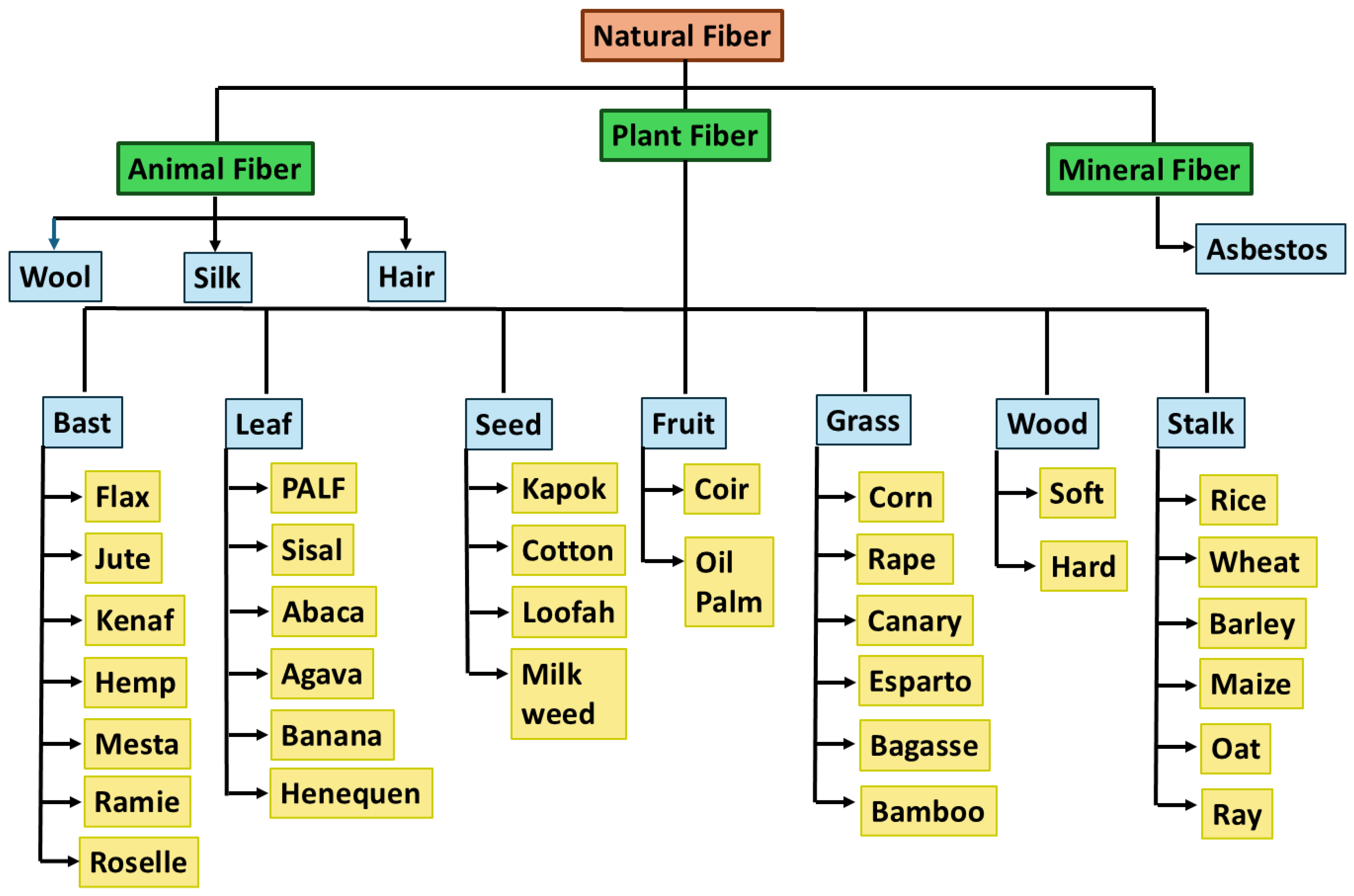
Figure 2.
(a) Typical structure of the natural fiber, (b) microfibril and cellulose inside the fibril [47].
Figure 2.
(a) Typical structure of the natural fiber, (b) microfibril and cellulose inside the fibril [47].
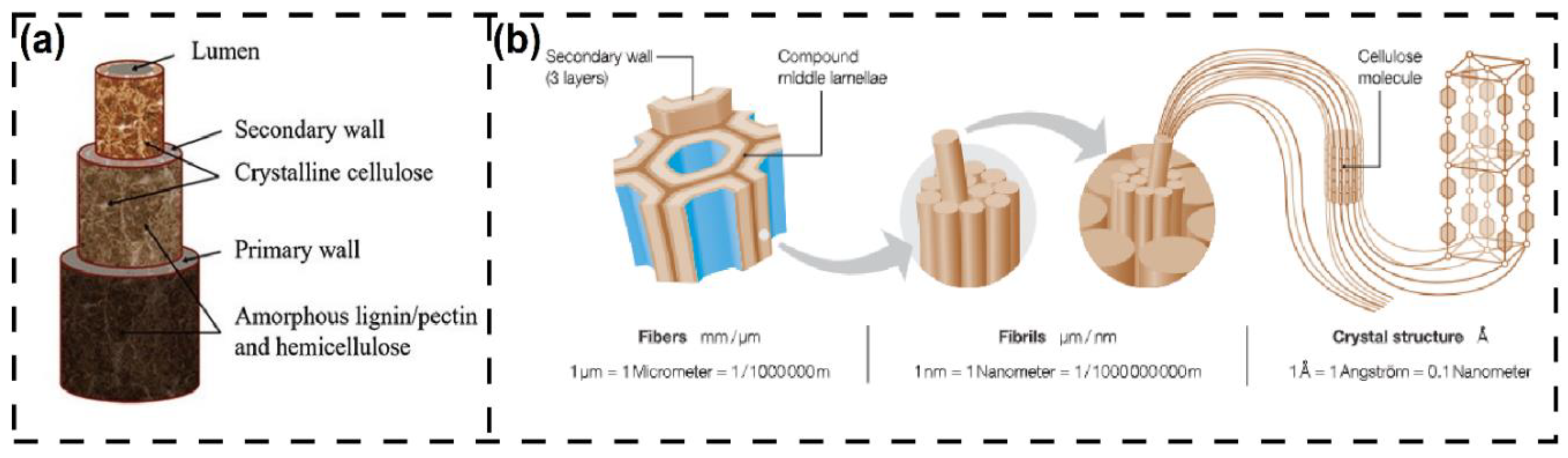
Figure 3.
Molecular structure of (a) cellulose, (b) xyloglucan, (c) lignin, (d) primary alcohol of lignin, (e) Pectin.
Figure 3.
Molecular structure of (a) cellulose, (b) xyloglucan, (c) lignin, (d) primary alcohol of lignin, (e) Pectin.
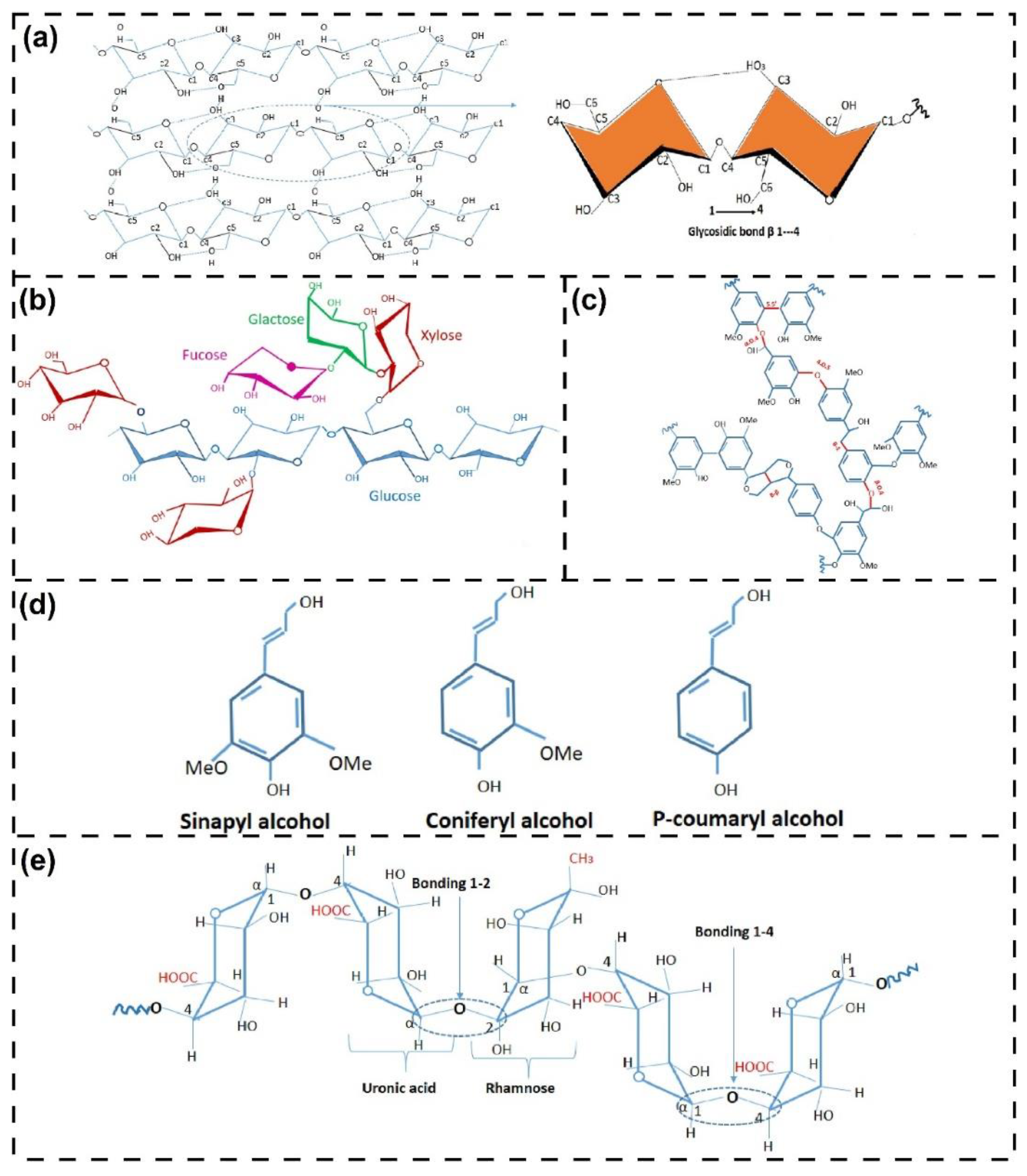
Figure 4.
SEM image of (a) munja fiber, (b) bamboo fiber.
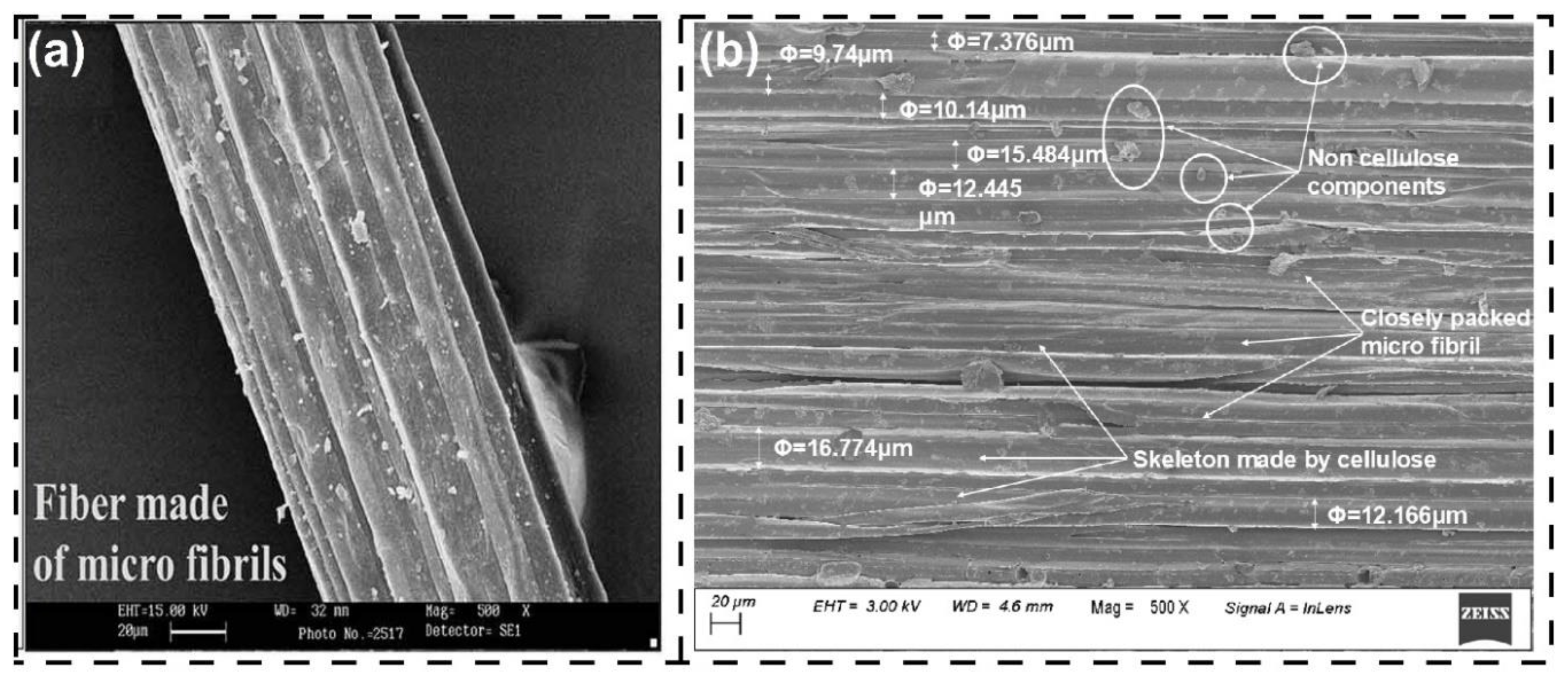
Figure 5.
Different possible ways to convert this waste into NFRCs.
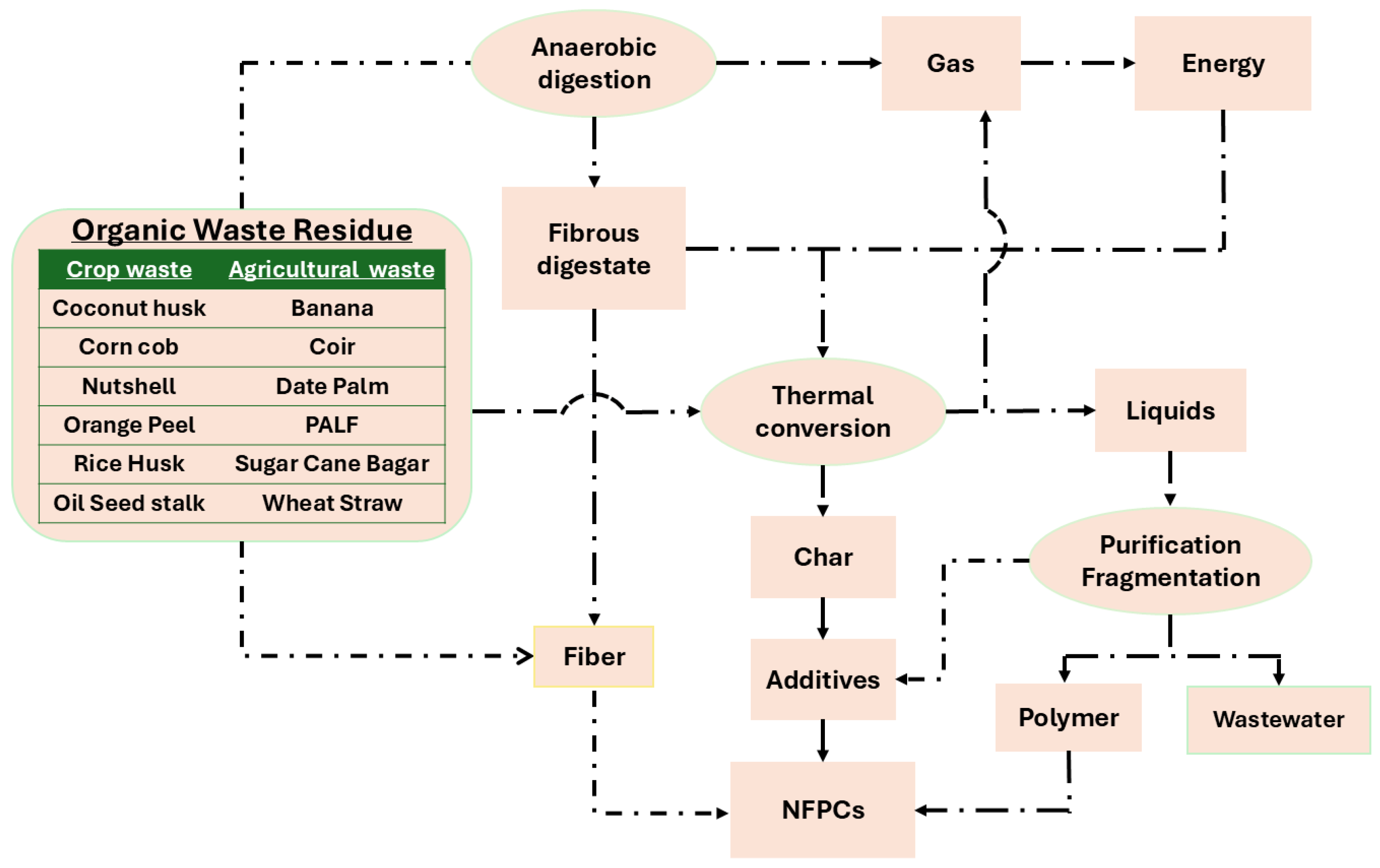
Figure 6.
(a) Machine for mechanical extraction of banana fiber, (b) extracted banana fiber.
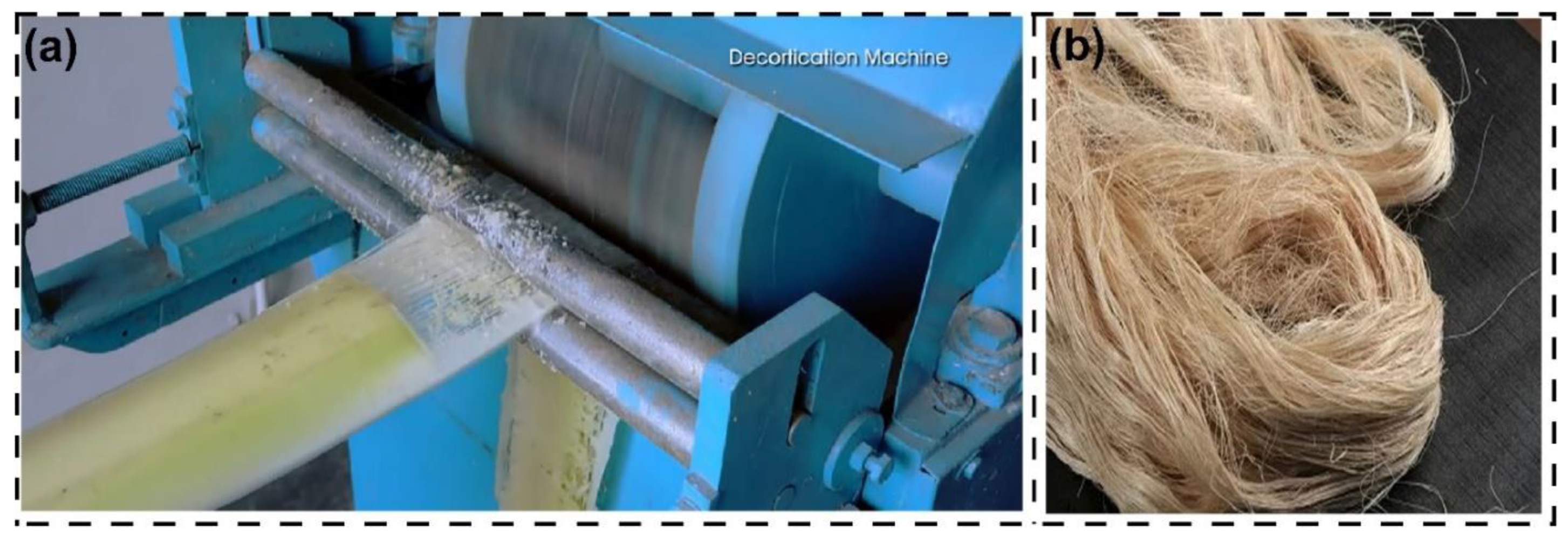
Figure 7.
(a) Composition of natural fiber, (b) Specific strength of banana fiber compared to other natural fiber.
Figure 7.
(a) Composition of natural fiber, (b) Specific strength of banana fiber compared to other natural fiber.
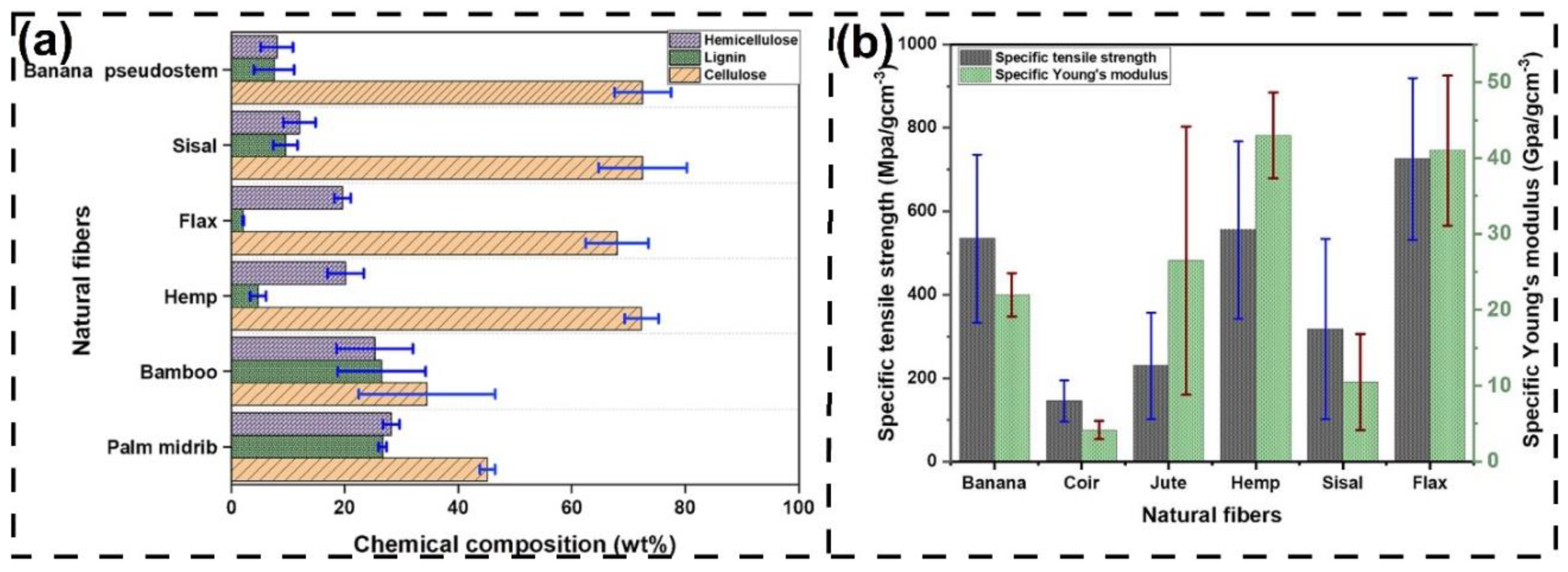
Figure 8.
(a) Coir fiber extraction process, (b) outline of coir fiber extraction process [69].
Figure 8.
(a) Coir fiber extraction process, (b) outline of coir fiber extraction process [69].
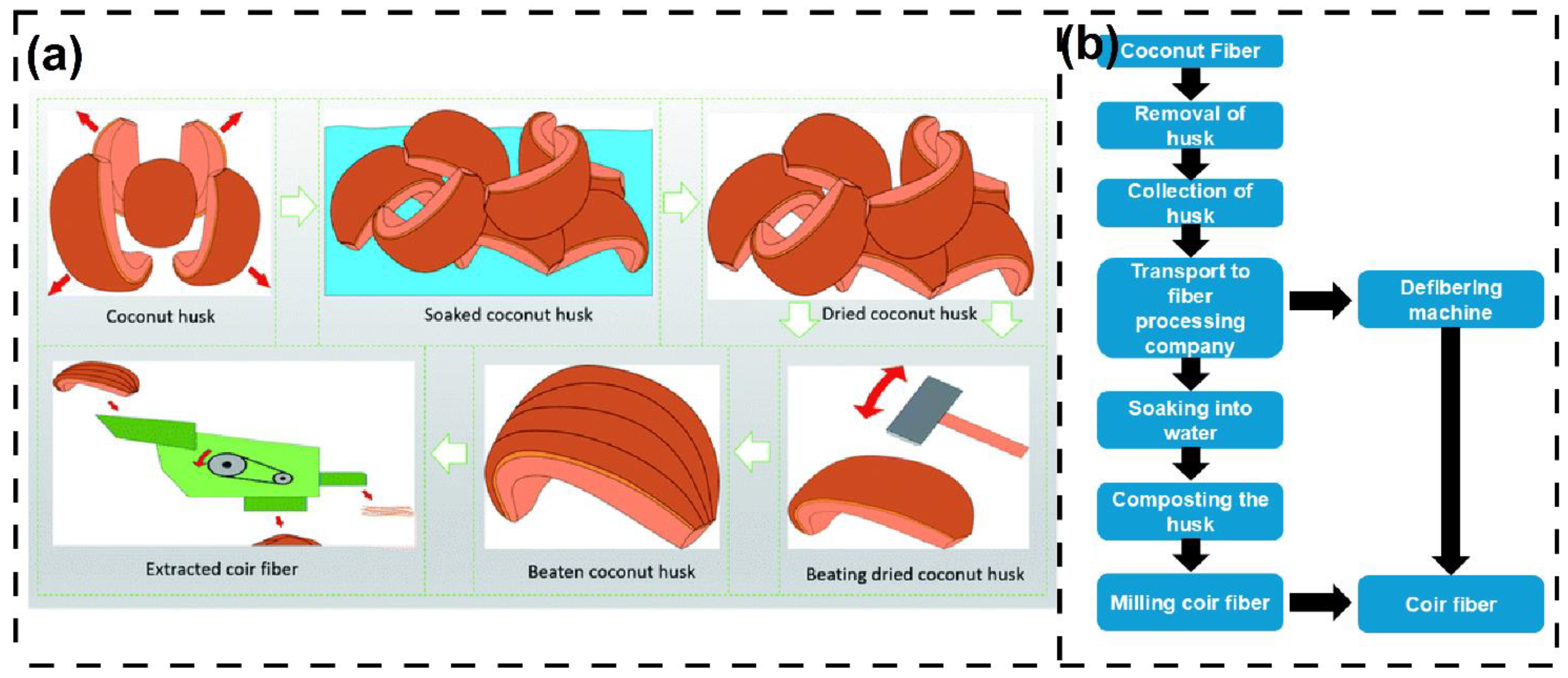
Figure 9.
(a) Cross sectional and (b) longitudinal view of untreated coir fiber [145].
Figure 9.
(a) Cross sectional and (b) longitudinal view of untreated coir fiber [145].
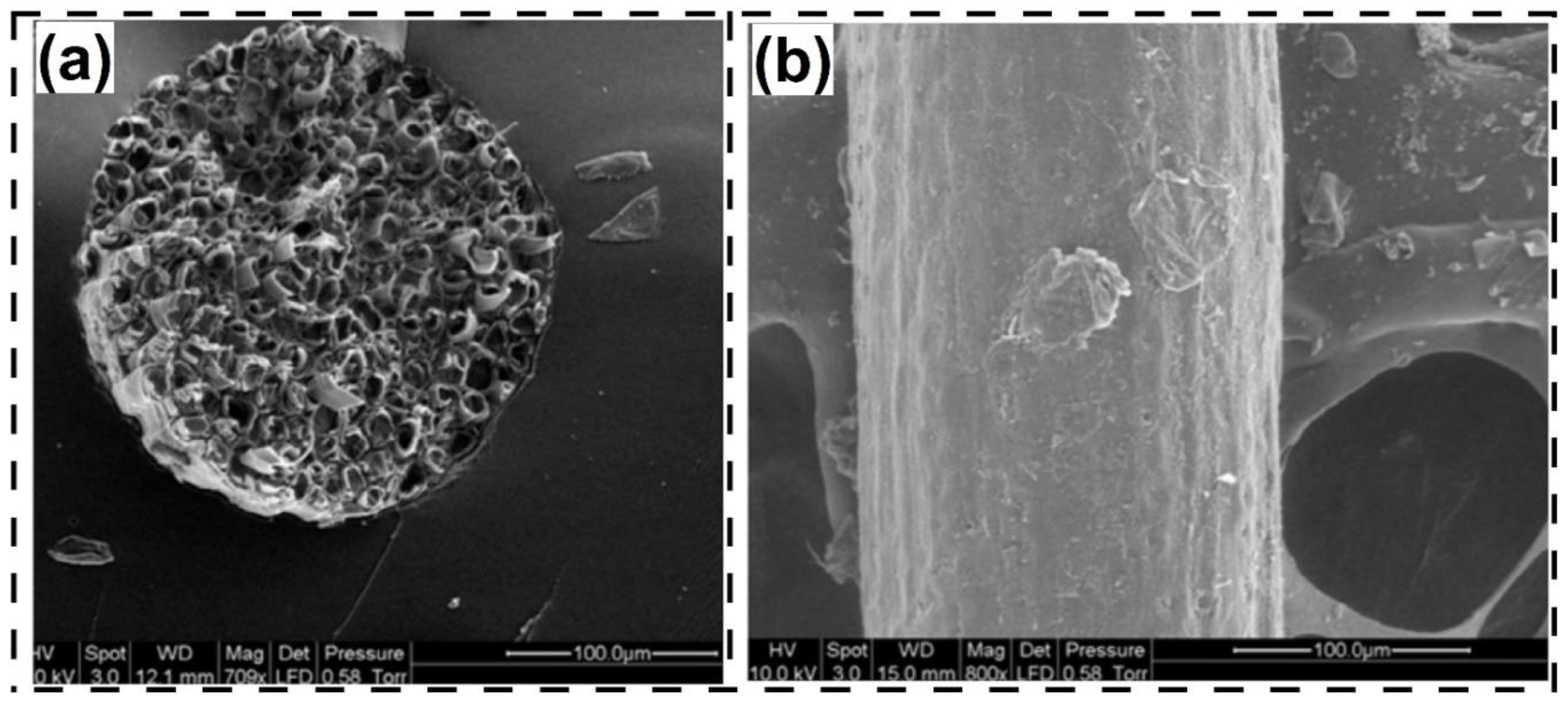
Figure 10.
Development of corncob hub to valuable corn micro particles [70].
Figure 10.
Development of corncob hub to valuable corn micro particles [70].


Table 1.
Annual production of different bio-wastes and their compositions.
| Fiber/Filler | Annual Production (Dry Metric Tons Per Year) |
Cellulose (%) |
Hemicellulose (%) | Lignin (%) |
Pectin (%) |
Waxes (%) |
Extractive (%) |
Moisture Content (%) | References |
|---|---|---|---|---|---|---|---|---|---|
| Banana Fiber | 1,19,000 | 60–85 | 6-8 | 5-10 | 2.5-4 | -- | -- | 10-12 | [68] |
| Coconut Coir | 3,50,000 | 32-43 | 4-12 | 40-49 | 3-8 | -- | -- | 4-8 | [69] |
| Corn Cob | 1,15,000 | 55-65 | 5-8 | 15-18 | -- | -- | 5-8 | 10-13 | [70,71] |
| Date Palm | 4,80,000 | 39.90 | 31.50 | 22.50 | -- | -- | -- | -- | [72,73] |
| Ground nutshell | 3,00,000 | 37 | 9 | 41 | -- | -- | 13 | -- | [74,75] |
| Orange Peel | 5,00,000 | 9.2 | 5.4 | 1.2 | 22.0 | 0.7 | 2.0 | 79.1 | [76,77] |
| PALF | 13,18,000 | 70-80 | 10-15 | 5-12 | 1-1.2 | 3.3 | 6.6 | 2-5 | [17,78] |
| Rice Husk | 120,000,000 | 35-40 | 15-20 | 20-25 | 3-5 | -- | 5-8 | -- | [79,80] |
| Sugarcane Bagasse | 1,50,000 | 36-50 | 16-25 | 25-29 | -- | 0.6-5 | 3-5 | -- | [81] |
| Wheat Straw | 720,000,000 | 33–45 | 19–32 | 8–16 | -- | -- | -- | -- | [82] |
| Wood Floor | 1,750,000,000 | 40–45 | 30 | 25-35 | 0-1 | 0.4-0.5 | 2-5 | -- | [25] |
Disclaimer/Publisher’s Note: The statements, opinions and data contained in all publications are solely those of the individual author(s) and contributor(s) and not of MDPI and/or the editor(s). MDPI and/or the editor(s) disclaim responsibility for any injury to people or property resulting from any ideas, methods, instructions or products referred to in the content. |
© 2025 by the authors. Licensee MDPI, Basel, Switzerland. This article is an open access article distributed under the terms and conditions of the Creative Commons Attribution (CC BY) license (http://creativecommons.org/licenses/by/4.0/).
Copyright: This open access article is published under a Creative Commons CC BY 4.0 license, which permit the free download, distribution, and reuse, provided that the author and preprint are cited in any reuse.


