

Submitted:
21 April 2025
Posted:
22 April 2025
You are already at the latest version
Abstract
The Chaoshan Depression situated in the Dongsha Sea region, is an important Mesozoic residual depression beneath the Cenozoic Pearl River Mouth Basin in the northern South China Sea, showing significant potential for hydrocarbon exploration. However, current drilling efforts have not resulted in hydrocarbon finds due to the absence of high-quality reservoirs. Recent quasi-3D seismic data has allowed for the first identification of Mesozoic bioherms and carbonate platforms on the Middle Low Uplift of the Chaoshan Depression. A thorough analysis was performed on their horizontal sedimentary distribution and vertical evolution. The findings indicate that the seismic reflection patterns of reefs and carbonate platforms in this area are primarily characterized by high-amplitude discontinuous to chaotic reflections, sometimes showing blank reflections or weak, sub-parallel reflections, along with notable high-velocity anomalies. Atolls, stratiform reefs, and patch reefs are found on local topographic highs of the platform, with atolls mainly in the central part of the quasi-3D area, stratiform reefs in the northeast, and patch reefs in the central-eastern region. Four vertical evolutionary stages have been identified: initial development, flourishing, decline, and submergence. The spatial distribution of bioherms and carbonate platforms was influenced by paleotectonic topography, while their developmental scale was affected by changes in relative sea level. Furthermore, reefs limestone reservoirs within the upper part of the Middle Jurassic exhibit excellent conditions for hydrocarbon accumulation, following a "lower source, upper reservoir, and upper seal" model. These reservoirs have favorable geological conditions for the formation of medium- to large-scale hydrocarbon accumulations, suggesting significant exploration opportunities.
Keywords:
Middle Jurassic
; Reefs and carbonate platform
; distribution and evolution
; Hydrocarbon exploration potential
; Chaoshan Depression
1. Introduction
Bioherms and carbonate rocks represent a significant hydrocarbon reservoir system, playing an essential role in petroleum exploration and development, as they account for approximately from 50% to 70% of the global oil gas resources [1,2,3]. The Mesozoic era, specifically the Jurassic and Cretaceous periods, contains the largest known reserves of oil and gas associated with bioherms [4,5], followed by the Neogene-Paleogene and, subsequently, the Paleozoic era, particularly the Devonian period [6,7,8,9]. Large offshore deepwater oil and gas fields associated with bioherms and carbonate formations have emerged as significant targets for global exploration efforts [8,9,10,11,12]. Within the South China Sea (SCS), numerous Cenozoic hydrocarbon-rich basins have demonstrated the presence of reef-related oil and gas deposits of varying magnitudes, exemplified by the LH11-1 reef oil field located in the Pearl River Mouth Basin (northern SCS) [13,14,15] and the L pinnacle reef gas field situated in the Zengmu Basin (southern SCS) [13,16]. These findings underscore the considerable exploration potential for Cenozoic reef reservoirs in the region. Conversely, Mesozoic bioherms and carbonate reservoirs have been infrequently identified and studied in the SCS to date.
The widespread occurrence of Mesozoic marine strata in the northern SCS have been revealed by geophysical surveys and drilling activities. Notably, Early Cretaceous marine deposits were revealed in the Taixinan Basin [17,18], while Early Cretaceous transitional strata and organic-rich Middle-Late Jurassic marine sediments were identified in the Well LF35-1-1 situated on the northern slope of the Chaoshan Depression (Figure 1b) [19,20]. Prior investigations have systematically mapped the spatial distribution of Mesozoic strata, which extend over an area of 100,000 km², and have characterized the structural configurations of residual depressions [21,22]. The Chaoshan Depression is noted for having the most extensive Mesozoic coverage, the thickest residual strata, and the highest degree of exploration maturity (Figure 1) [23,24]. However, to date, no significant oil or gas discoveries have been made, as the existing wells have not encountered large-scale, high-quality reservoirs. The LF35-1-1 borehole revealed thin-bedded oolitic limestone from the Middle Jurassic (Figure 2), suggesting that conditions favorable for the formation of carbonate rocks developed during the evolution of the Chaoshan Depression (Figure 1b) [19,22]. Nonetheless, additional systematic research is necessary to clarify the scale, distribution, and formation mechanisms of these carbonate rocks, which would provide valuable insights for guiding future oil and gas exploration efforts in the region.
In recent years, high-quality quasi-3D multi-channel seismic (MCS) data through the application of single-source/single-cable quasi-3D seismic acquisition technology were successfully acquired by the Guangzhou Marine Geological Survey (GMGS). This technological innovation has significantly enhanced the imaging quality of seismic profiles, which provided a clearer depiction of the seismic reflection structures within Mesozoic strata in the Chaoshan Depression. Based on the detailed quasi-3D seismic stratigraphic interpretation, a series of stably distributed high-amplitude geological bodies were identified in the upper part of the Middle Jurassic located on the Middle Low Uplift in Chaoshan Depression. These geological bodies predominantly exhibit high-amplitude discontinuous to chaotic reflections. Locally, they display blank or sub-parallel weak-amplitude reflections and reveal distinct high-velocity anomaly characteristics (Figure 2). Based on these observations, it is posited that these geological bodies likely correspond to carbonate rock deposits, encompassing platform and bioherm facies. The objective of this study is to systematically investigate the developmental characteristics of Middle Jurassic reefs and carbonate platforms, to explor their formation mechanisms in detail, to elucidate their significance in the context of oil and gas geology, and to assess their potential for hydrocarbon resource exploration.
2. Regional Geological Setting
The Chaoshan Depression, demarcated by the 1,000 m isopach contour of Mesozoic strata and bounded by major fault systems, is the largest preserved Mesozoic residual basin within the continental slope of the northern SCS. It shares northwestern and southwestern boundaries with the Cenozoic Zhu I Depression of the Pearl River Mouth Basin (PRMB), while being separated from the TXNB to the southeast. The depression exhibits water depths ranging from 600 m to 3,000 m, encompassing a total area of approximately 3.7×10⁴ km², with its principal axis oriented in a NE-SW direction (Figure 1a). The tectonic architecture of the Chaoshan Depression reveals two first-order structural units: 1) a shallow structural domains (<4,000 m burial depth), designated as the slope zone, which is further partitioned by major fault systems into three sub-units - the Western Slope, Middle Slope, and Northern Slope; and 2) a deep structural domains (>4,000 m burial depth), termed the depression zone, that contains two primary subsidence centers (Western Sag and Eastern Sag) differentiated by the Middle Low Uplift structure and its associated fault system (Figure 1b). The quasi-3D study area extends approximately 45 km along a NW-SE trend, traversing the Western Sag and Middle Low Uplift structural units (Figure 1b), exhibiting a distinct topographic step (vertical relief exceeding 150 m) in the present-day seafloor morphology (Figure 1d).
Seismic profiles across the Chaoshan Depression reveal the presence of a prominent regional unconformity (Tg) separating Cenozoic and Mesozoic strata, representing a ~35 Ma depositional hiatus spanning from the Late Cretaceous to Paleogene [22,23,24,25]. The overlying Neogene-Quaternary succession (Tg-T0), typically <1000m thick, exhibits high-frequency, laterally continuous and subparallel seismic reflections. In contrast, the underlying Mesozoic sequence (Tj0-Tg), with maximum preserved thickness exceeding 5,000m, displays low-frequency, discontinuous reflections associated with complex fold structures [26,27]. This pre-Cenozoic stratum comprises, in ascending order: 1) Lower Jurassic (Tj0-Tj1), 2) Middle Jurassic (Tj1-Tj2), 3) Upper Jurassic (Tj2-Tk0), and 4) Cretaceous (Tk0-Tg) stratigraphic units, as illustrated in the interpreted seismic section (Figure 1c).
Integrated analysis of gravity, magnetic, and seismic datasets reveals magmatic activity within the Chaoshan Depression [28,29,30]. Based on regional geological correlations, two primary magmatic episodes have been identified: the Yanshanian (Late Jurassic-Cretaceous) and Himalayan (Cenozoic) periods (Figure 1b). The Himalayan volcanism is predominantly distributed in the southwestern and southeastern sectors of the depression, characterized by extrusive intermediate-basic igneous lithologies. In contrast, Yanshanian magmatic activity manifests as intrusive intermediate-acid plutonic complexes concentrated along the northern and central slope regions [31]. Notably, this quasi-3D study area remains unaffected by the development of either Yanshanian or Himalayan igneous rocks (Figure 1b).
The Mesozoic succession penetrated by Well LF35-1-1 (total drilled thickness ~1400 m; Figure 2) comprises a major sedimentary cycle evolving from Middle Jurassic littoral facies through Late Jurassic bathyal-abyssal facies to Early Cretaceous transitional/terrestrial depositional systems [19]. Drilling operations terminated within a Late Cretaceous indurated granite complex (~102 Ma K-Ar age) (Figure 2a), leading to the geological interpretation that the undrilled substratum likely represents Early Jurassic (J1) and/or Upper Triassic (T3) formations based on regional stratigraphic correlations [30].
Integrated with seismic section interpretation through Well LF35-1-1 [19] (Figure 2b), the Lower Jurassic interval (Tj0-Tj1) in Chaoshan Depression is interpreted as dominantly comprising bathyal to neritic deposits. The Middle Jurassic (Tj1-Tj2) witnessed a significant paleogeographic reorganization initiated by Pacific tectonic domain influences, marked by southeast-derived marine transgression. The Lower Member of Middle Jurassic (Tj1-Tj1-1) features coastal swamp facies, while the Upper Member (Tj1-1-Tj2) progressively evolves from NW-SE trending coastal facies through shallow marine shelf deposits to bathyal facies (Figure 1b). The depression center, characterized by distal position from sediment sources and sustained gradual relative sea-level rise during this period (Figure 2a), created optimal conditions for reef-shoal development. This depositional evolution resulted in a Tj1-1-Tj2 sedimentary assemblage dominated by interbedded mudstones, argillaceous siltstones, and limestones. Notably, oolitic limestone exhibiting relatively high P-wave velocities (Vp) was encountered in borehole LF35-1-1 at 1,986-2,028 m [22,23] (Figure 2a). Geological evidence suggests the entire quasi-3D study area, situated approximately 60 km distant from this borehole, resided within shallow marine shelf environments during this phase (Figure 1b). Stratigraphically upward, borehole LF35-1-1 reveals the lower upper Jurassic (Tj2-Tj2-1) consists of bathyal facies intercalated with submarine fan deposits, reflecting a gradual transition from neritic to bathyal environments during the Late Jurassic following continuous water deepening since the Middle Jurassic. This sustained transgression rendered reef development increasingly unfavorable. The overlying Cretaceous succession (Tk0-Tg) displays characteristic fluvial-lacustrine lithofacies associations. Critical to carbonate platform and reef development is the restricted in the upper member of Middle Jurassic (Tj1-1-Tj2), which represents the primary stratigraphic target for carbonate reservoir exploration in the study area.
3. Materials and Methods
3.1. Data
Integrated geophysical data (mainly including MCS, gravity and magnetic data) and borehole LF35-1-1 were used to reveal the development characteristics of Mesozoic strata in the Chaoshan Depression.
MCS data with a long array, including a certain network 2D and one quasi-3D survey area of approximately 600km2, were conducted by GMGS since 2019. The most acquisition parameters are [22]: the 5080 cubic inches source capacity, 2000PSI working pressure of air guns, and source arrays sinking depth of around 8m; fired at 25m intervals, towed streamer length of 6 km and a minimum offset of 175m, and 480 receiver channels and sampled at 2ms, 12.5m intervals in each channel, 120-fold coverage times; cable sinking depth of around 9m, record length of 8s. Additionally, the quasi-3D seismic survey was designed with CMP lines as the basis, incorporating a line spacing of 100m, original bin size measuring 25m×100m, and an overlap rate of 50% between adjacent bins [24]. The MCS data are processed following standard industry procedures, which include pre-processing, pre-stack denoising, surface-related multiple elimination (SRME), high-precision Radon transforms for suppressing sea-surface-induced multiples, diffraction multiple wave suppression, amplitude consistency processing, deconvolution, velocity analysis, and pre-stack time migration. Furthermore, the quasi-3D seismic data are subjected to advanced processing techniques, such as bubble effect elimination, frequency band broadening (for ghost wave suppression), and 3D volume regularization with reasonable parameters [24]. These processing improves the discernibility of signals from shallow, intermediate, and deep layers, leading to more distinct wave train and amplitude characteristics. The enhanced seismic image provides a solid basis for the further analysis of complex geological structures and the identification of reservoirs.
The Bouguer gravity anomaly (ΔG-B) and reduced-to-pole magnetic anomaly (ΔT-RTP) data are derived through systematic calculations based on shipborne gravity and magnetic measurements collected simultaneously during the 2D MCS acquisition process. The Bouguer gravity anomaly reflects deep density contrasts after corrections for elevation, topography, and intermediate layers such as seawater and sedimentary deposits [34]. The magnetic anomaly reduced to the pole employs advanced mathematical techniques to convert oblique magnetization into vertical magnetization, effectively eliminating latitude-induced distortions [35]. In sedimentary basin research, these data are utilized to identify weakly magnetic basement uplifts, which are often associated with deep bioherms or carbonate platforms, and to delineate the structural characteristics of sedimentary layers.
The materials of borehole LF35-1-1 primarily stem from datasets released by CNOOC and previously published studies, and are used to confirm the presence of Mesozoic strata. These materials mainly include original logging data such as lithological descriptions and P-wave velocity
3.2. Methods
The 2D and quasi-3D MCS profiles were interpreted to show detailed sedimentary structures, e.g., unconformities, folds, and faults using the GeoFrame software platform. The stratigraphy is interpreted primarily by correlation with the LF35-1-1 well drilled to the north of Dongsha Island (Figure 1b) and analyzed from seismic stratigraphy. The Chaoshan Depression, a basin characterized by Mesozoic-Cenozoic superposition, is predominantly composed of Mesozoic structural layers. Well-seismic calibration has identified five seismic interfaces (Tj0, Tj1, Tj2, Tk0, Tg) within the Mesozoic strata, ordered from bottom to top. Furthermore, seismic sequence interpretation has delineated the Tj1-1 boundary within the Middle Jurassic and the Tj2-1 boundary within the Upper Jurassic.
Based on the drilling lithology, P-wave velocity, sedimentary environment analysis, and relative sea-level change assessment of LF35-1-1 [26,33], combined with quasi-3D seismic reflection characteristics, the strong-amplitude geological body in the upper part of Middle Jurassic (Tj1-1-Tj2) on the Middle Low Uplift in Chaoshan Depression is interpreted as biogenic reefs and carbonate deposits. The velocity structure and gravity-magnetic responses of these deposits are characterized, and their planar distribution and vertical evolution are systematically analyzed using quasi-3D seismic amplitude attributes and depth horizontal slices.
4. Results
4.1. Seismic Reflection Characteristics
A laterally extensive, high-amplitude seismic anomaly has been identified within the upper Middle Jurassic strata (Tj1-1-Tj2) as revealed by the quasi-3D seismic data (Figure 3 and Figure 4). This anomaly is distinguished by its heterogeneous internal reflection patterns, which exhibit a variation between discontinuous strong and weak reflections, as well as chaotic reflections, and are interspersed with localized blank zones or subparallel low-amplitude reflections. These seismic facies are interpreted as deposits associated with carbonate platforms, which may correlate with limestone or reef structures.
The Tj2 and Tj1-1 boundaries exhibit significant lateral continuity within the quasi-3D seismic region (Figure 3 and Figure 4). The top boundary, Tj2, is characterized by high-amplitude, strong continuous, and parallel seismic reflections. A notable contrast in seismic reflection and facies is evident between the stratigraphic units situated above and below this boundary. The sequence located above Tj2 is marked by low-frequency, weak-amplitude reflections with moderate continuity, which are interpreted as bathyal muddy deposits from the Upper Jurassic period. In contrast, the strata beneath Tj2 exhibit distinct high-frequency, high-amplitude seismic facies with enhanced continuity and subparallel configuration, indicative of the upper part of the Middle Jurassic reef and carbonate platform deposits. The bottom boundary, Tj1-1, of this composite sedimentary succession presents a seismic reflection pattern characterized by moderate-to-weak amplitude, with localized zones displaying laterally discontinuous reflections or even non-reflective features. This phenomenon is primarily attributed to significant attenuation of the seismic signa, which is caused by the strong reflections from the overlying strata. The strata located beneath Tj1-1 reveal low-to-medium frequency seismic reflections with weak amplitude and poor continuity, suggesting a littoral-shallow marine muddy depositional environment during the early Middle Jurassic period.
The distinctive mound-shaped seismic reflections have been interpreted as reefs that formed on the local topographic highs at the margin of the platform. Through an analysis of the developmental regions and the morphological characteristics of the reefs, three distinct types of reefs have been classified: atoll reefs (Figure 3), stratified reefs, and patch reefs (Figure 4).
Atolls are characterized by mound-shaped morphology as observed in seismic profiles. The top boundary of the atolls is featured by continuous high-amplitude seismic reflections, while the internal structure exhibits 1-3 sub-parallel or chaotic reflection events (Figure 3a,b). In comparison to the surrounding contemporaneous sedimentary strata, the reef core of the atolls shows demonstrates a notable thickening phenomenon. The overlying strata on either side of the reef core exhibit overlapping characteristics around the atolls. Lagoon deposits are characterized by continuous and parallel weak reflections. The atoll system comprises multiple encircling reefs and a central lagoon, with a diameter ranging from approximately 5 to 8 km. The progradational reflection configurations observed at the base of the slope have been interpreted as fore-reef landslides, originating from the reefs at the periphery of the atoll system (Figure 3c).
Stratiform reefs are distinguished by predominantly layered seismic reflections that exhibit a blocky morphology in seismic profiles (Figure 4a,b). Both the top and the bottom of stratiform reef complexes are characterized by continuous high-amplitude reflections, which are clearly demarcated from the surrounding medium - weak reflection strata. The overlying strata of the reefs overlapped around the top boundary. The internal structure of stratiform reef complexes comprises 1 to 2 sub-parallel and strong continuous reflection events, which are resulted from the vertical stacking of multiple massive reef phases at identical locations (Figure 4b,c).
Patch reefs are distinguished by their isolated, mound-shaped morphology, exhibiting nearly symmetrical flanks (Figure 4a,b). The top boundary of the patch reef is characterized by continuous high-amplitude reflections, whereas the lower boundary is marked by discontinuous medium to weak reflections, indicating a relatively unclear contact relationship with the underlying strata of the reefs. The internal structure of patch reef is predominantly characterized by weak amplitude or blank reflections. The dimensions of individual patch reefs are relatively small, typically ranging from approximately 1 to 1.5 km in diameter (Figure 4b,c).
4.2. Seismic Velocity Anomaly
The reflection events above and below the reefs structure display upward warping pull-up effects in the time-domain seismic sections attributed to the higher seismic wave propagation velocity within the reef and carbonate (Figure 5a). Compared with the overlying and underlying strata, the reef and carbonate exhibit stronger energy on the seismic stack velocity spectrum of CDP 2068-2077 (Figure 5b), which corresponds to high-amplitude anomalies in the seismic.
Furthermore, the reef and carbonate show high-velocity anomalies on the seismic interval velocity profiles (Figure 5c). The interval velocity are as follows: an interval velocity of 3451.9 m/s in the Upper Jurassic strata (Tk0-Tj2); a pronounced high interval velocity of 5355.3 m/s in the top part of the Middle Jurassic, which contrasts with the lower section velocity of 4824.1 m/s; an interval velocity of 5343.0 m/s int the Lower Jurassic strata (Tj1-Tj0); an interval velocity of 6389.5 m/s in the basement. It is worth noting that the high-velocity layer at the top of the Middle Jurassic sequence is closely correlated with the seismic reflections attributed to reefs and carbonate.
4.3. Gravity and Magnetic Anomaly
Reefs and carbonate complexes exhibit characteristics of unique gravity and magnetic anomaly signatures (Figure 6). The gravity and magnetic anomalies analyzed along 2D seismic profiles that traverse the quasi-3D area exhibit notable patterns of spatial variation. Specifically, the Bouguer gravity anomaly displays a characteristic tripartite pattern, exhibiting an "elevated-depressed-elevated" trend from the northwest to the southeast. Conversely, the reduced-to-pole (RTP) magnetic anomaly shows a consistent decreasing trend along the same section. Quantitative analyses reveal that the reefs and carbonate deposits situated within the central local topographic high regions of the quasi-3D area correspond to positive gravity anomalies reaching +16.5mGal, suggesting high-density characteristics. Simultaneously, the presence of low magnetic anomalies measuring about 36nT indicates weak magnetic characteristics within these carbonate-dominated regions (Figure 6b).
4.4. Distribution and Scale of Reefs and Carbonate Platforms
Based on integrated analysis of seismic reflection configurations and velocity characteristics, the "sum positive amplitude" attribute can provide an effective indirect indicator for mapping the distribution of biogenic reefs and carbonate platform deposits within in the upper part of Middle Jurassic (Tj1-1-Tj2) of the study area.
The "sum positive amplitude" attribute extracted along the Tj2 boundary reveals distinct amplitude difference characteristics, which can be subdivided into two geophysical domains: an eastern high-amplitude zone and a western low-amplitude zone, separated by a dashed purple boundary line (Figure 7a). Integrated seismic facies analysis from corresponding seismic profiles reveals significant differences in depositional environments between these regions. In the eastern high-amplitude zone, seismic facies within the upper member of Middle Jurassic strata are characterized by strong amplitude, moderate-to-high continuity reflections with sub-parallel or slightly chaotic configurations (Figure 3 and Figure 4). These seismic signatures are interpreted to represent carbonate platform depositional environments (Figure 7b). Conversely, the western low-amplitude area exhibits seismic facies characterized by low amplitude, discontinuous reflections, or even blank reflection (Figure 3 and Figure 4). These features suggest the presence of shallow marine shelf facies, primarily composed of mudstone interbedded with argillaceous limestone lithologies (Figure 7b).
Localized ultra-high amplitude anomalies have been observed within the eastern high-amplitude zone (Figure 7a). These anomalies are interpreted as indicative of various reef types that have developed on the carbonate platform, including atolls, stratiform reefs, and dispersed patch reefs (Figure 7b). Notably, atolls are primarily located in the central region of the quasi-3D survey area, covering approximately 60 km². Stratiform reefs are mainly distributed in the northeastern area, with a mapped extent of 36 km², although this is limited by data deficiencies. Patch reefs are concentrated in the central-eastern portion of the study area, displaying a bead-like planar distribution patterns, with individual reef sizes ranging from 9 km² to 11 km² (Figure 7b).
5. Discussion
5.1. Evolution of Reefs and Carbonate Platforms
Seismic reflection phase anomalies associated with the atoll deposit system within the quasi-3D study area are distinctly observable on strata depth slices (Figure 8), serving as indirect indicators of vertical evolutionary patterns in atoll development [36].
Horizontal slice within the strata interval of 2600-3300 meters reveals a clear lateral zonation of sedimentary (sub)facies within the atoll complex development area. Vertically, the evolutionary sequence of both atolls and carbonate platforms can be systematically classified into four developmental phases: 1) the initial colonization stage, 2) the flourishing growth stage, 3) the progressive decline stage, and 4) the final submergence stage (Figure 8).
The 3260 m horizontal slice represents the initial developmental stage, effectively demonstrating the morphological distribution of the early reef-base carbonate platform (Figure 8a). In the Middle Jurassic period, the study area was primarily located within in a shallow marine shelf depositional environment (Figure 1b), which created conducive conditions for the initiation of carbonate platform development. During this stage, fringing carbonate platforms of relatively modest scale began to develop progressively on topographic highs, although reef-building organisms had not yet started to colonize these emerging carbonate platforms (Figure 8e,f).
The 3060 m horizontal slice reveals the mature developmental configuration of the atoll during its flourishing stage (Figure 8b). The blue dashed line delineates the boundary of the reef complex. Internally, large-scale dark red-black alternating reflection patterns, characterized by moderate to strong continuity, signify chaotic seismic facies typical of biogenic framework reef cores. The green dashed enclosure within the reef is associated with weak-amplitude reflections that correspond inter-reef lagoon deposits. The surrounding regions of atoll display dense light red-gray reflections with low seismic amplitudes, which are indicative of sedimentation from argillaceous country rock (Figure 8e,f).
The 2860 m horizontal slice demonstrates the morphological of the reef-top associated with the decline phase (Figure 8c). Two prominent dark red-black reflection units, situated within a matrix of dense light red-gray reflections, indicate a notable thickening of the reef cores. These reef cores are surrounded by bathyal mudstone deposits from the lower Member of the Upper Jurassic, exhibiting a draped depositional pattern with upward-decreasing coverage magnitude (Figure 8e,f). These characteristics suggest rapid relative sea-level rise triggered an environmental transition from a shallow marine shelf to a bathyal depositional regime, marking the decline of reef and carbonate platform.
5.2. Formation Background of Reefs and Carbonate Platforms
Reef and carbonate typically manifest as anomalous geological bodies within layered seismic reflections. However, multiple geological factors can generate such seismic anomalies [15,36,37]. The most commonly encountered and easily confused analog is intrusive igneous bodies, which exhibit remarkably similar seismic characteristics to reef complexes [38], including: 1) strong reflection at the upper interface, 2) flank onlap configurations, 3) internal chaotic reflections, 4) convex morphology with overlying drape structures, 5) distinct velocity anomalies [10,36,38,39,40,41]. Nevertheless, igneous bodies typically exhibit more undulating top surfaces with discontinuous reflections [36,38]. In contrast, the reef complexes in our study area demonstrate continuous top reflections accompanied by characteristic paleo-topographic highs and platform-margin slump progradational reflections (Figure 3 and Figure 4). Additionally, the reefs and carbonate platform limestones show significant high-velocity properties (Figure 5), as well as elevated Bouguer gravity and diminished reduced-to-pole (RTP) magnetic anomalies (Figure 6). These features are markedly different from the geophysical signatures typically associated with igneous bodies. Based on the regional geological analysis, the quasi-3D area within the depression has remained largely unaffected by Yanshanian and Himalayan magmatic activities. The high-velocity, strong-reflection geological bodies in the upper part of the Middle Jurassic can be confidently interpreted as reef complexes rather than igneous intrusions based on planar distribution patterns (Figure 1b).
In terms of carbonate formation, reefs and carbonate platforms typically develop in stable environments [36,37]. The spatial distribution of the Mid-Jurassic reef and carbonate platform in the Chaoshan Depression suggests that their formation and progression were mainly driven by the tectonic paleotopography and fluctuations in relative sea level.
5.2.1. Formation Position of Reefs Controlled by Paleotopography
The upper member of the Middle Jurassic layers drilled in Well LF35-1-1are made up of mudstone with terrestrial sporopollen fossils interspersed with thin layers of oolitic limestone, indicative of shallow marine environments (Figure 2) [19]. The quasi-3D study area, located about 60 km southeast of Well LF35-1-1 in the Middle Low Uplift (Figure 1b), shows that distal shallow-water carbonate deposits formed during the Late Middle Jurassic align with marine environmental distribution patterns.
Under the influence of the first phase of the Yanshan Movement during the Late Early Jurassic, an undulating submarine topography formed during the Early Middle Jurassic period [42]. Isolated shallow-water carbonate platforms began to develop on elevated positive tectonic units far from the sources of clastic sediments, exhibiting characteristics of offshore carbonate rock. Subsequently, the pre-existing topographic high experienced additional uplift induced by the subduction-driven compressional forces from the Paleo-Pacific Plate. Various reef systems, predominantly exhibiting atoll morphologies, emerged on the pre-existing carbonate platforms. Meanwhile, bioclastic shoal facies deposits were developed along the edges of the platforms (Figure 9).
5.2.2. Development Scale of Reefs Influenced by Relative Sea-level Changes
LF35-1-1 has confirmed the sedimentary environment of the Mesozoic strata [26]. The long-term evolution of the Chaoshan Depression shows a relative sea-level rise from Middle Jurassic littoral-shallow marine environments to Late Jurassic bathyal settings. However, short-term fluctuations during the Middle Jurassic reveal an oscillatory pattern of initial sea-level fall followed by subsequent rise (Figure 2 and 9).
In the early Middle Jurassic, argillaceous deposits in coastal-shallow marine areas formed, while the Middle Low Uplift created a clean marine zone away from sediment sources. After the deposition of the Tj1-1, the relative sea level commenced a gradual descent. During this regressive phase, littoral plain facies developed at Well LF35-1-1, which transitioned southeastward into a neritic sedimentary environment. Concurrently, shallow-water carbonate platforms began to be deposited on localized paleo-highs within the Middle Low Uplift. Along the gentle slope, reef-building organisms colonized micro-geomorphic highs, initiating the formation of biogenic reefs and oolitic shoals (Figure 9a). As carbonate platforms development continued amid a sustained and gradual decline in relative sea level, reef-shoal facies dominated by oolitic limestone emerged at Well LF35-1-1 [19]. Extensive reef complexes were formed overlying the carbonate platform in the Middle Low Uplift, including atolls, lagoons, patch reefs, and reef-front slump deposits, which progressively expanded into a flourishing stage (Figure 9b). A subsequent abruptly rapid rise in relative sea level transitioned Well LF35-1-1 to shallow marine conditions, causing the platform to retreat to structural highs. Early-stage reefs experienced drowning and degradation until they were completely submerged under bathyal deposits following the Tj2 deposition (Figure 9c).
The fluctuating rise in relative sea level during the growth of reefs led to the gradual submersion of early reef formations, limiting their size and development. This evolutionary pattern resulted in a retrogradational stacking geometry of reef units, characterized by progressive upward migration of reef growth toward higher topographic positions (Figure 9). From the Middle to Late Jurassic, the relative sea level exhibited a long-term progressive rise, resulting in a continuous increase in accommodation space. This prolonged transgression triggered the sequential submergence of shallow-marine carbonate ramp platform systems, which initially transitioned into shallow-marine shelf environments before being further transformed into bathyal and deep-marine submarine fan depositional systems.
5.3. Hydrocarbon Exploration Potential of Reefs
5.3.1. Favorable Source Rock Beneath the Reservoir Interval
The LF35-1-1 well encountered Middle Jurassic shallow marine source rocks with total organic carbon (TOC) levels between 1% and 1.48% (averaging 1.32%), categorizing them as medium- to high-quality source rocks [19]. This finding confirms the existence of Middle Jurassic source rock sequences in the Chaoshan Depression [19,22,23,24,25]. These source rocks correspond with the weak-to-blank seismic reflections observed in the lower member of the Middle Jurassic (Tj1-Tj1-1) within the quasi-3D area, which are interpreted as shallow marine mudstone interspersed with argillaceous limestone. In comparison to the well site, this region is nearer to the depocenter, showing increased mudstone thickness, better lithological uniformity, less terrigenous input, and greater source rock potential. The upper part of the Middle Jurassic (Tj1-1-Tj2) carbonate platform and reefs limestone reservoirs sit directly above these source rocks, facilitating efficient hydrocarbon charging through vertical migration pathways (Figure 10).
5.3.2. Large-Scale Reef Limestone Reservoirs with Favorable Reservoir Properties
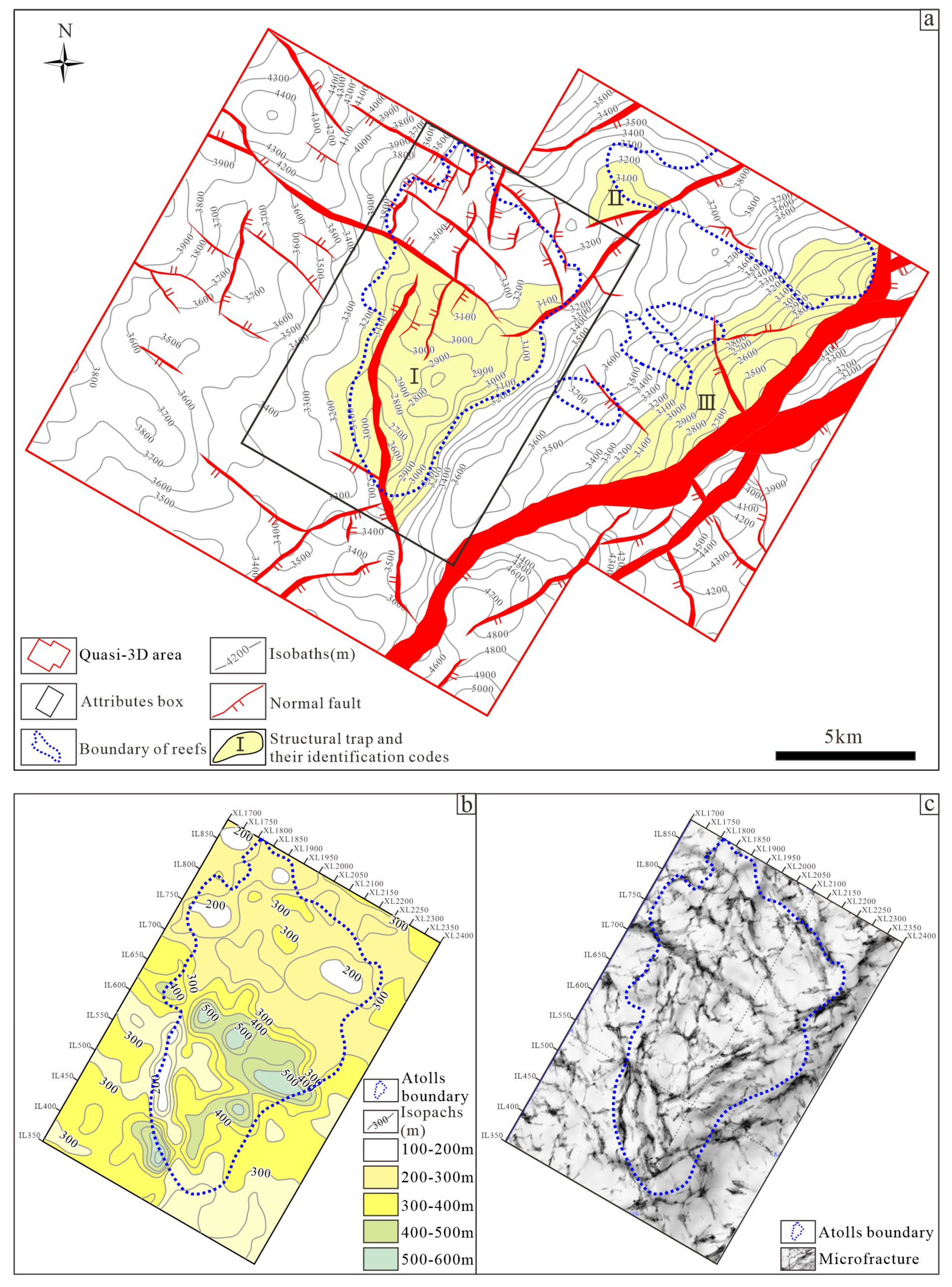
The atolls complexes, oriented in a NW-SE direction within the quasi-3D area have thicknesses ranging from 100 to 600 m, with the thickest accumulations (400–600 m) located at the central portions of the reef structures (Figure 11b). These reservoirs exhibit considerable lateral continuity and potential for vertical stacking. Although primary porosity in limestone is limited, the quality of the reservoir is improved by extensive fracture and cavern systems. Seismic fissure attributes (along Tj2 boundary ±100 m/350 m) reveal the presence of microfractures (depicted in black) in proximity to faults (Figure 11c). This observation suggests that regions adjacent to faults are conducive to the development of secondary porosity, thereby significantly improves the physical characteristics of limestone reservoirs. The development of faults and microfractures has additionally enhanced reservoir connectivity by establishing connections between reef limestone reservoirs and the underlying source rocks, thereby facilitating efficient pathways for hydrocarbon migration.
5.3.3. Effective Mudstone Seals
The overlying strata of the reef limestone (Tj2–Tj2-1) show weak to blank seismic reflections (Figure 10a), which are interpreted as bathyal facies mudstone formed during a rapid transgression in the Early Late Jurassic period. This argillaceous seal demonstrates a stable distribution in the quasi-3D region, with a total thickness reaching 600 m and maximum individual layer thickness up to 30 m. It serves as an effective local caprock for the reef limestone reservoir with favorable vertical sealing capacity. Furthermore, the well-developed Cenozoic regional seals in the study area collectively enhance the conditions for hydrocarbon containment conditions (Figure 10).
5.3.4. Structural and Lithologic Traps
In the quasi-3D area, structural traps are well-defined, with three structural closures (I, II, III) identified on the Tj2 boundary depth structure map (Figure 11a). The largest closure, Trap I, spans 42 km² and aligns with the thickest zone of reefs limestone development, creating ideal conditions for reservoir-trap overlap (Figure 10). This vertical superimposition spatial alignment results in composite structural-lithologic traps, significantly increasing the potential for hydrocarbon accumulation through the combination of structural closure and lithologic reservoir.
The study area presents a complete and advantageous source-reservoir-seal system characterized by a "lower source, upper reservoir, and upper seal" configuration (Figure 10). The presence of high-quality Middle Jurassic source rocks, extensive reefs limestone reservoirs with enhanced secondary porosity, effective local and regional argillaceous caprocks, and structurally controlled trapping mechanisms collectively create favorable conditions for significant hydrocarbon accumulations of large to medium size. These results highlight the considerable exploration potential within the Mesozoic reefs limestone reservoirs of the Chaoshan Depression.
6. Conclusions
The seismic facies of Middle Jurassic reefs and carbonate platforms located on the Middle Low Uplift in the Chaoshan Depression are typically characterized by high-frequency, high-amplitude with continuity and subparallel configuration, sometimes featuring weak, sub-parallel or blank reflections. Various reef systems, including atolls, stratiform reefs, and dispersed patch reefs, emerged on the local topographic highs of the early pre-existing carbonate platforms. The reefs and carbonate platforms limestone show significant high-velocity characteristics, along with high Bouguer gravity and low reduced-to-pole (RTP) magnetic anomalies.
The spatial configuration of sedimentary (sub)facies, as identified through anomalies in seismic amplitude attributes within the quasi-3D area, exhibits distinct zonation characteristics. The shallow marine shelf facies are primarily located in the western region, while carbonate platform deposits are predominantly found in the eastern region. Additionally, atolls with the largest scale are primarily developed in the central area of the platform, stratiform reefs predominantly are mainly distributed the northeastern sector, and point reefs are clustered in the central-eastern region of the platform. The vertical evolution has experienced four distinct stages delineated through seismic stratigraphic depth horizontal slices, encompassing the initial development, flourishing growth, progressive decline, and ultimate submergence phases.
The late Middle Jurassic period in the Chaoshan Depression created favorable conditions for the development of reefs and carbonate platforms. Paleotectonic topography and changes in relative sea level were the two main controlling factors, with the former influencing the formation position and spatial distribution of reefs and platforms, and the latter affecting their scale of development.
The reefs limestone reservoirs within the upper member of the Middle Jurassic exhibit excellent hydrocarbon accumulation conditions, following a "lower source, upper reservoir, and upper seal" model. Hydrocarbons are derived from source rocks dating to the Lower Jurassic or the lower section of the Middle Jurassic period. They migrate vertically through fault systems and are subsequently stored in the reef limestones within the upper member of the Middle Jurassic. The accumulation of these hydrocarbons is further enhanced by the presence of overlying bathyal mudstone caprocks that serve as seals, in conjunction with tectonic uplift that promotes the development of the structural and lithologic traps. The characteristics of these reservoirs present conducive conditions for the formation of medium to large-scale hydrocarbon deposits, thereby suggesting considerable potential for exploration.
Author Contributions
Conceptualization and methodology, M.S. and H.Y.; formal analysis, M.S., H.Y., Z.Z. and G.Z.; data curation, M.S., C.F. and G.T.; writing-original draft preparation, M.S.; writing-review and editing, M.S., H.Y.; visualization, M.S. All authors have read and agreed to the published version of the manuscript.
Funding
This research was funded by the Guangzhou Science and Technology Planning Project (Project No: 2023A04J0241) and the China Geological Survey (Project No: DD20230318, DD20221708).
Institutional Review Board Statement
Not applicable.
Informed Consent Statement
Not applicable.
Data Availability Statement
Data are available on request from the author M.S. (569811200@qq.com).
Acknowledgments
We are grateful to all colleagues who participated in seismic acquisition and processing. We thank JinFeng Ren and Miaomiao Meng for proofreading the manuscript.
Conflicts of Interest
The authors declare no conflicts of interest.
References
- Ahr, W.M. (Eds.) Geology of Carbonate Reservoirs: the Identification, Description and Characterization of Hydrocarbon Reservoirs in Carbonate Rocks. John Wiley & Sons. 2011.
- Li, D.; Chen, H.; Xin, L.; Hong, S.; Jonathan, A.Q.; Qiu, Y. Diagenetic evolution in marine carbonate rocks based on the typical case studies: Review and perspectives. Marine and Petroleum Geology. 2025, 176, 107352. [Google Scholar]
- Li, Y.; Kang, Z.; Xue, Z.; Zheng, S. Theories and practices of carbonate reservoirs development in China. Petroleum Exploration and Development. 2018, 45, 712–722. [Google Scholar] [CrossRef]
- Omar, N.; Julien, M.; Jean, B.; Bertrand, M.G. Global geologic expert system and database forpredicting carbonate reservoirs from seismic: Applicationto the Upper Jurassic. The Leading Edge 2024, 43, 382–396. [Google Scholar]
- Jerzy, S.; Jan, T.; Jan, B. Seismic geomorphology of the karstified Upper Jurassic-Lower Cretaceous carbonate succession in the Carpathian Foredeep area, Poland. Marine and Petroleum Geology. 2025, 174, 107331. [Google Scholar]
- L. Pomar; P. Hallock. Carbonate factories: A conundrum in sedimentary geology. Earth-Science Reviews. 2008; 87, 134–169.
- W. Kiessling, E. Flügel, J. Golonka (Eds.), Phanerozoic Reef Patterns. SEPM Special Publications. 2002, 72, 3–10.
- Moyra, W. Development of Equatorial Delta-Front Patch Reefs During the Neogene, Borneo. Journal of Sedimentary Research. 2005, 75, 114–133. [Google Scholar]
- Zhi, G.; Ze, W.; Su, H.; Hong, W.; Ji, Y.; Ping, H. Tectonic settings of global marine carbonate giant fields and explaration significance. Natural Gas Geoscience. 2012, 23, 106–118. [Google Scholar]
- James, H.; Peter, B.; David, H.; Xavier, J.; Valentina, Z. Seismic characterization of carbonate platforms and reservoirs: an introduction and review. Geological Society, London, Special Publications. 2021, 509, 1–28. [Google Scholar]
- Wen, Z.; An, S.; Jin, Z.; Xiao, W.; Jun, L.; SHEN Anjiang, ZHOU Jingao, et al. Types, characteristics, origin and exploration significance of reef-shoal reservoirs: A case study of Tarim Basin, NW China and Sichuan Basin, SW China. Petroleum Exploration and Development. 2014, 41, 257–267. [Google Scholar]
- Zhi, W.; Xiao, T.; Hua, G.; Zhao, W.; Rui, C.; Cheng, S.; Zheng, H.; Zuo, L.; Hai, K. Build-ups and hydrocarbon accumulation of the isolated carbonate platforms in the eastern Mediterranean. Petroleum Exploration and Development. 2021, 48, 323–336. [Google Scholar]
- Yang, F.; Hong, Q.; Gong, Z.; Ren, P. Seismic interpretation and hydrocarbon accumulations implication of the Miocene Meishan Formation reefs in southern Qiongdongnan Basin, northern South China Sea. Journal of Palaeogeography. 2017, 6, 206–218. [Google Scholar]
- Hong, X.; Jing, S.; Jing, L.; Gang, D.; Jinqing, L.; Hong, S.; Zhen, W.; Zhi, S.; Qing, J.; Li, Z.; Kai, W.; Yu, Z.; Xin, Z. Bioherm petroleum reservoir types and features in main sedimentary basins of the South China Sea. Journal of Earth Science. 2012, 23, 828–841. [Google Scholar]
- Shi, W.; Sheng, Y.; Gong, Z.; Yu, M.; Li, M.; Ning, X. Seismic characteristics of a reef carbonate reservoir and implications for hydrocarbon exploration in deepwater of the Qiongdongnan Basin, northern South China Sea. Marine and Petroleum Geology. 2009, 26, 817–823. [Google Scholar]
- Jia, G.; Xiao, X.; Shi, L.; Yi, W.; Shuang, S.; Wen, Hu.; Long, W.; Ji, L. Cenozoic sedimentary systems in Zengmu Basin, South China Sea. China Petroleum Exploration. 2016, 21, 99–107. [Google Scholar]
- Di, Z.; Zhen, S.; Han, C.; Yuan, Q. Mesozoic lithofacies, paleo-geography, and tectonic evolution of the South China Sea and surrounding areas. Earth Science Frontiers. 2005, 12, 204–218. [Google Scholar]
- Chin, H.; Tung, L.; Ching, L.; Sun, C.; Jong, W.; Ching, T.; Meng, Y.; Suiu, C.; Yu, C.; Ching, H. Structural inversion in the northern South China Sea continental margin and its tectonic implications. Terr. Atmos. Ocean. Sci. 2017, 28, 891–922. [Google Scholar]
- Lei, S.; Hong, Y.; Hu, H.; Guo, W.; Pei, Q.; Yong, L. Petrology and depositional environments of Mesozoic strata in the Northeastern South China Sea. Geological Review. 2007, 02, 164–169. [Google Scholar]
- Yan, W.; Yan, Q.; Pin, Y.; Hong, Z.; Hai, L.; Jun, W. Seismic evidence for Mesozoic strata in the northern Nansha waters, South China Sea. Tectonophysics. 2016, 677–678, 190–198. [Google Scholar]
- Li, Z.; Wei, Z.; Zhen, W.; Zhen, L.; Zhen, L.; Qing, S. The impact of northern South China Sea paleotectonic framework on development of Mesozoic and Cenozoic. Earth Science Frontiers. 2014, 21, 254–263. [Google Scholar]
- Guang, Z.; Chang, F.; Yan, W.; Sheng, C.; Ming, S.; Hai, Y.; Jun, Y.; Jing, Z.; Zhong, Z. Fault bounded models of oil–Gas and gas–Hydrate accumulation in the Chaoshan Depression, the South China Sea. Frontiers in Earth Science. 2022; 10, 965898. [Google Scholar]
- Guang, Z.; Pi, S.; Chang, F.; Sheng, L.; Ming, S.; Hai, Y.; Jing, Z.; Zhong, Z. Mesozoic tectonic characteristics and exploration prospects of the Chaoshan depression in the northeastern South China Sea. Acta Geological Sinica. 2022, 96, 2896–2905. [Google Scholar]
- Zhong, Z.; Guang, Z.; Ming, S.; Chang, F.; Guang, T.; Hai, Y. Hydrocarbon Accumulation Analysis Based on Quasi-3D Seismic Data in the Turbulent Area of the Northern South China Sea. Journal of Marine Science and Engineering. 2023, 11, 338. [Google Scholar]
- Chang, F.; Zhong, G.; Ming, S.; Zhen, L.; Hai, Y.; Zhong, Z. Analysis of the Thermogenic Gas Source of Natural Gas Hydrates Over the Dongsha Waters in the Northern South China Sea. Frontiers in Earth Science. 2022, 10, 873615. [Google Scholar]
- Chao, F.; Shao, X.; Jing, C.; Fang, Z.; Kui, W. Seismic constraints on a remnant Mesozoic forearc basin in the northeastern South China Sea. Gondwana Research. 2022, 102, 77–94. [Google Scholar]
- Ming, S.; Jin, R.; Guang, Z.; Hai, Y. Fold deformations of Mesozoic strata and their genetic mechanism in southwestern Dongsha Waters of Northern South China Sea.Geological Review. 2018, 64, 828–842.
- Hu, H.; Xiang, Z. An application of gravimetric and magnetic data in mesozoic petroleum exploration in Chaoshan sag, South China sea. China Offshore Oil and Gas (Geology). 2003, 17, 128–132. [Google Scholar]
- Wei, H.; Tian, H.; Wei, J.; Ya, X.; Bai, Z.; Di, J. An integrated geophysical study on the Mesozoic strata distribution and hydrocarbon potential in the South China Sea. Journal of Asian Earth Sciences. 2015, 111, 31–43. [Google Scholar]
- Pin, Y.; Yan, W.; Hong, Z.; Da, Z.; Zhong, C. Geophysical features of mud volcanoes in the waters southwest of the Dongsha Islands. Acta Oceanologica Sinica. 2014, 7, 142–148. [Google Scholar]
- Chen, J. Geophysical characteristics of the Chaoshan depression and its hydrocarbon exploration potential. Prog. Geophys. 2007, 22, 147–155. [Google Scholar]
- Sheng, Y.; Yan, Q.; Ben, Z. (Editor-in-Chief). Atlas of geology and geophysics of the South China Sea. China Navigation Press (in Chinese), Tianjing.
- Zhang, L. , Zhang, G., Wang, L., Xu, G., Wang, W., Cheng, R., Zeng, W., Lin, Z., Geng, A., Wei, Z., Wei, C. Mesozoic Distribution and Oil-Gas Resources Prospects in the Northern South China Sea. Geological publishing house, Beijing. 2014.
- Roger, H. Bouguer’s gravity corrections and the shape of the Earth. Preview. 2020, 208, 39–43. [Google Scholar]
- Yao, L.; Dian, X.; Ming, W. Reduction to the Pole at the Geomagnetic Equator. Chinese Journal of Geophysics. 2013, 53, 1082–1089. [Google Scholar]
- Bang, Z.; Xiao, D. Geological Characteristics and Geophysical Identification of Biogenic Reefs. Publisher: Petroleum Industry Press. 2009; 150–157. [Google Scholar]
- Priyadarshi, C.K.; Kalachand, S. Machine learning elucidates the anatomy of buried carbonate reef from seismic reflection data. Artificial Intelligence in Geosciences. 2023, 4, 59–67. [Google Scholar]
- Lennon, I.; Kurt, M. In-context interpretation: Avoiding pitfalls in misidentification of igneous bodies in seismic data. Interpretation. 2018, 6, 1–51. [Google Scholar]
- Eberli, G. P.; J. L. Masaferro; J. F. ‘‘Rick’’ Sarg, 2004, Seismic imaging of carbonate reservoirs and systems. Seismic imaging of carbonate reservoirs and systems: AAPG Memoir. 2004, 81, 1–9.
- Yan, L.; Bing, C.; Tian, X.; Shui, W.; Zhong, Q. A study and application of high-resolution methods for reef reservoir identification. Acta Geophysica. 2017, 65, 907–917. [Google Scholar] [CrossRef]
- Anthony Philpotts; Jay Ague. Principles of igneous and metamorphic petrology. Cambridge University Press. 2009, 52–110.
- Shu, D.; Yue, Z.; Chang, L.; Zhen, Y. , Qiang, J.; Tao, W.; Jian, H.; Xuan, C. Jurassic Tectonic Revolution in China and New Interpretation of the Yanshan Movement. Acta Geologica Sinica. 2007, 81, 1449–1461. [Google Scholar]
Figure 1.
(a) Topography map of the northern SCS (after [32]), showing the location of the Chaoshan Depression (CSD). TXNB is Taixinan Basin, PRMB is Pearl River Mouth Basin. The black dotted box indicates the range of Figure 1b. (b) presents the structural units map of the Chaoshan Depression at the end of Mesozoic, with an overlay of the distribution of Yanshanian and Himalayan volcanic rocks, as well as the predominant sedimentary facies patterns during the Middle Jurassic. (c) is the geological section extending from NW to SE across the Chaoshan Depression, traversing three major structural units: the Middle Slope, Western Sag, and Middle Low Uplift. This profile passes through the quasi-3D seismic study area, with Yanshanian igneous rocks observed at the northern end and Himalayan magmatic complexes exposed at the southern termination [31]. See Figure 1b for location. (d) illustrates the multibeam bathymetric morphological characteristics of the quasi-3D area, with the central area exhibiting pronounced step-like topographic variations. The positions of the main sections mentioned in the text are marked on this diagram.
Figure 1.
(a) Topography map of the northern SCS (after [32]), showing the location of the Chaoshan Depression (CSD). TXNB is Taixinan Basin, PRMB is Pearl River Mouth Basin. The black dotted box indicates the range of Figure 1b. (b) presents the structural units map of the Chaoshan Depression at the end of Mesozoic, with an overlay of the distribution of Yanshanian and Himalayan volcanic rocks, as well as the predominant sedimentary facies patterns during the Middle Jurassic. (c) is the geological section extending from NW to SE across the Chaoshan Depression, traversing three major structural units: the Middle Slope, Western Sag, and Middle Low Uplift. This profile passes through the quasi-3D seismic study area, with Yanshanian igneous rocks observed at the northern end and Himalayan magmatic complexes exposed at the southern termination [31]. See Figure 1b for location. (d) illustrates the multibeam bathymetric morphological characteristics of the quasi-3D area, with the central area exhibiting pronounced step-like topographic variations. The positions of the main sections mentioned in the text are marked on this diagram.
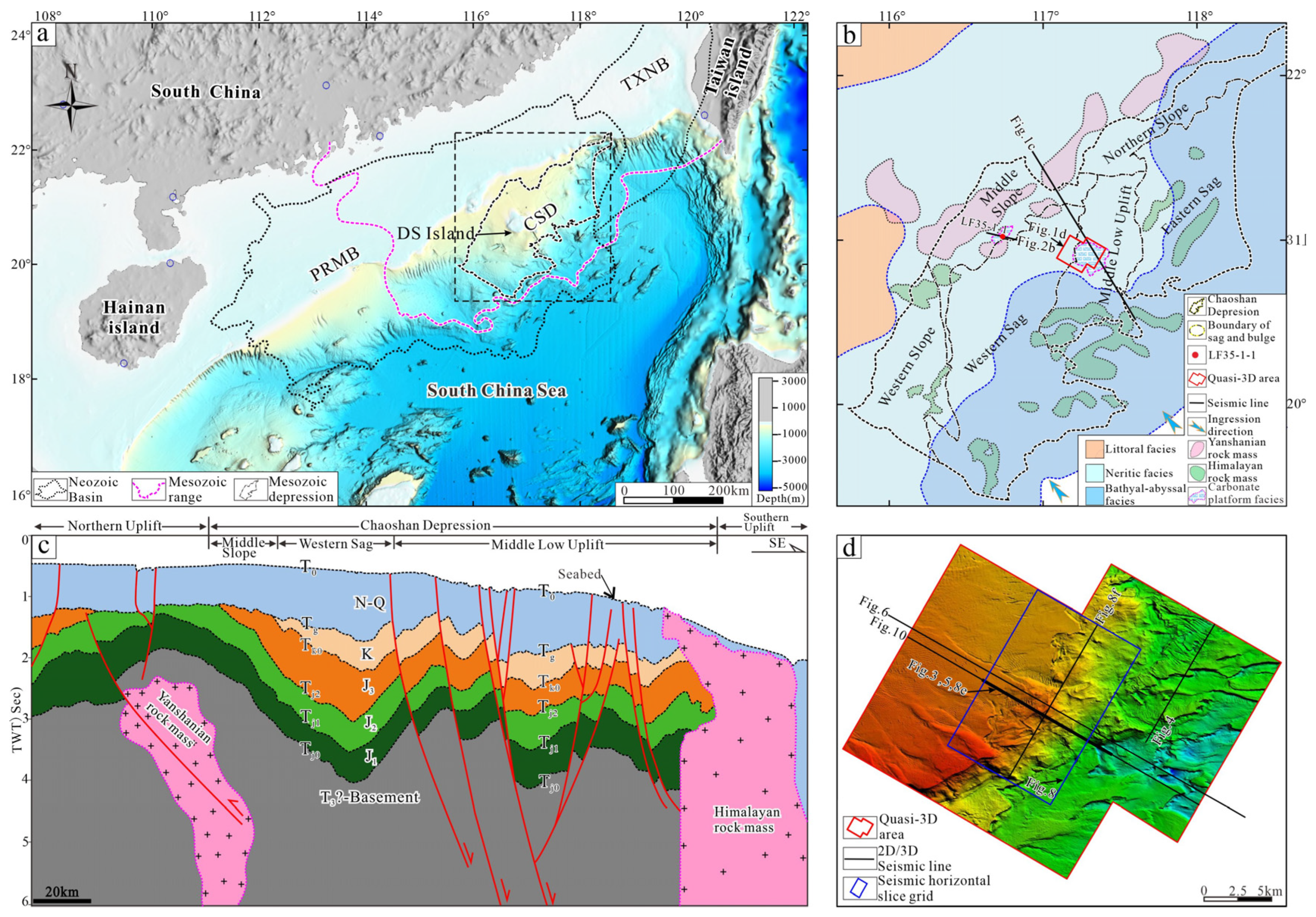
Figure 2.
(a) The LF35-1-1 well showing Jurassic to Early Cretaceous sediments that progress upward from littoral to bathyal abyssal and then to humid-terrestrial facies [19]. The curve of Vp is modified after [26,33]. The relative sea level change curve is modified after [26]. Thin-bedded oolitic limestone developed in the upper part of the Middle Jurassic corresponds to a high Vp exceeding background values by 39%. (b) 2D MSC profile across the Well LF35-1-1 and its interpretation. See Figure 1b for location.
Figure 2.
(a) The LF35-1-1 well showing Jurassic to Early Cretaceous sediments that progress upward from littoral to bathyal abyssal and then to humid-terrestrial facies [19]. The curve of Vp is modified after [26,33]. The relative sea level change curve is modified after [26]. Thin-bedded oolitic limestone developed in the upper part of the Middle Jurassic corresponds to a high Vp exceeding background values by 39%. (b) 2D MSC profile across the Well LF35-1-1 and its interpretation. See Figure 1b for location.
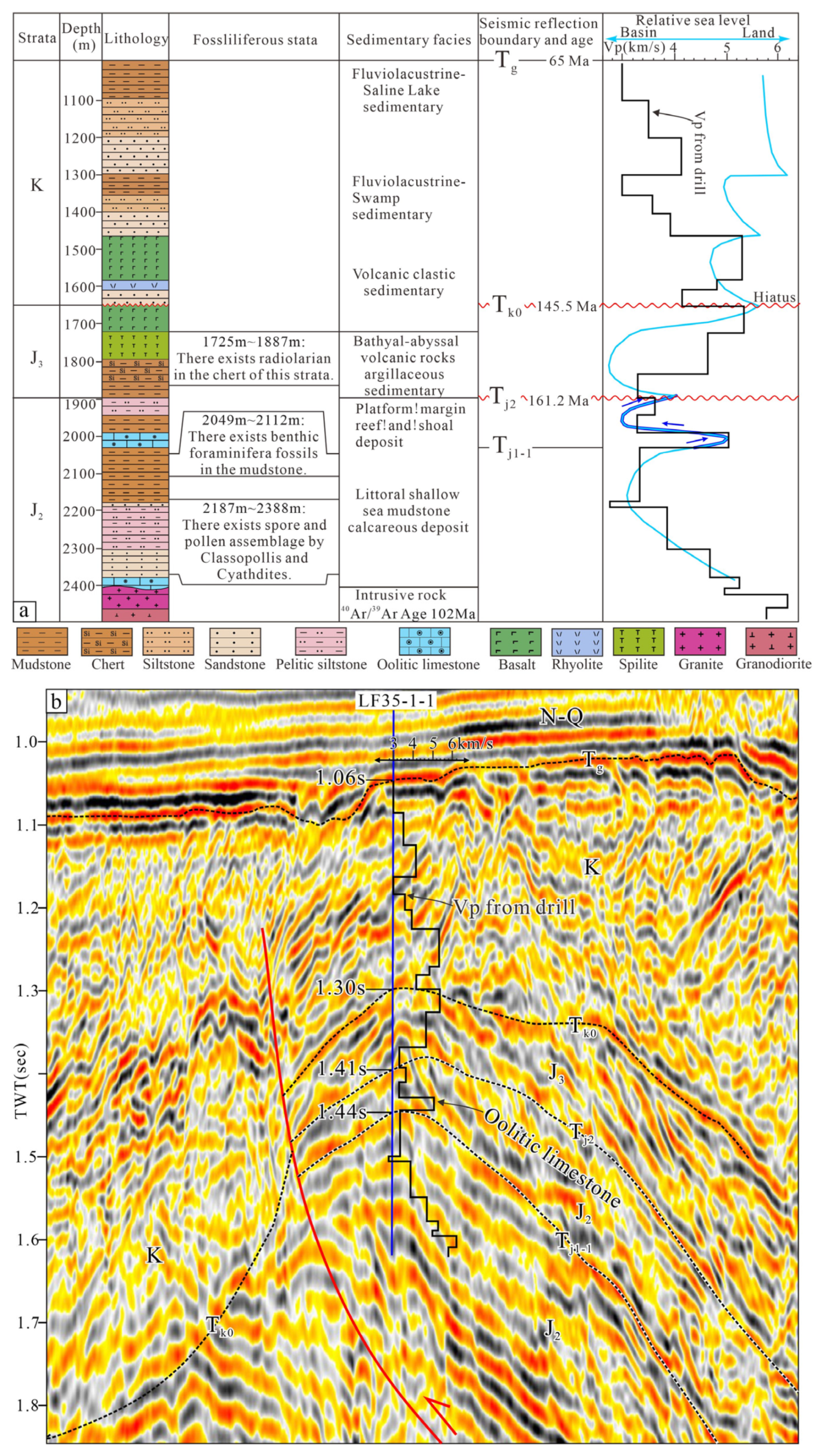
Figure 3.
Seismic reflection characteristics of atolls system and carbonate platform in the upper part of the Middle Jurassic (Tj1-1-Tj2). (a) Quasi-3D MSC reflection profile. (b) Seismic reflection and facies interpretation profile. (c) Seismic and sedimentary facies interpretation profile. See Figure 1d for location.
Figure 3.
Seismic reflection characteristics of atolls system and carbonate platform in the upper part of the Middle Jurassic (Tj1-1-Tj2). (a) Quasi-3D MSC reflection profile. (b) Seismic reflection and facies interpretation profile. (c) Seismic and sedimentary facies interpretation profile. See Figure 1d for location.
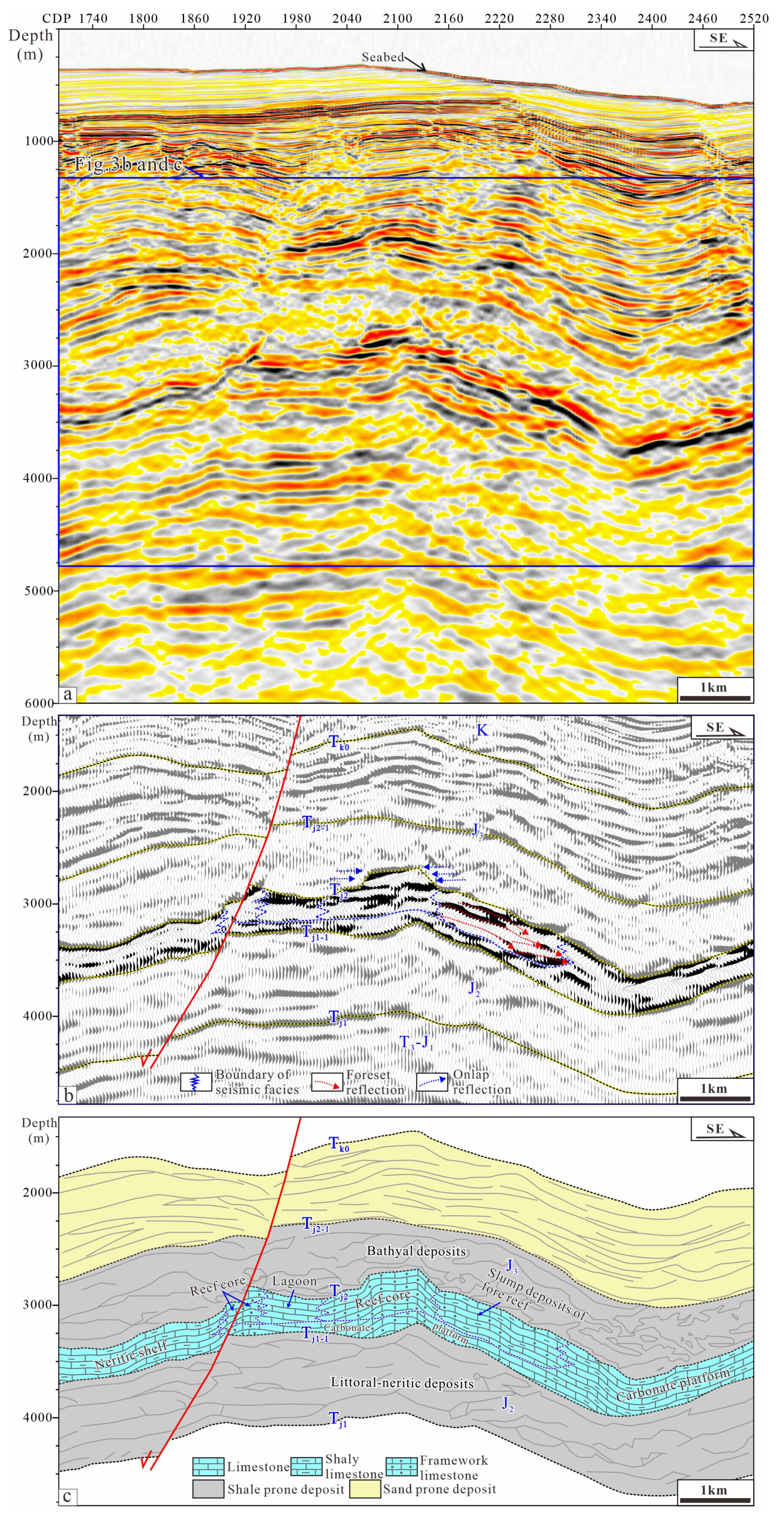
Figure 4.
Seismic reflection characteristics of Stratiform reefs, patch reefs and carbonate platform in the upper part of the Middle Jurassic (Tj1-1-Tj2). (a) Quasi-3D MSC reflection profile. (b) Seismic reflection and facies interpretation profile. (c) Seismic and sedimentary facies interpretation profile. See Figure 1d for location.
Figure 4.
Seismic reflection characteristics of Stratiform reefs, patch reefs and carbonate platform in the upper part of the Middle Jurassic (Tj1-1-Tj2). (a) Quasi-3D MSC reflection profile. (b) Seismic reflection and facies interpretation profile. (c) Seismic and sedimentary facies interpretation profile. See Figure 1d for location.
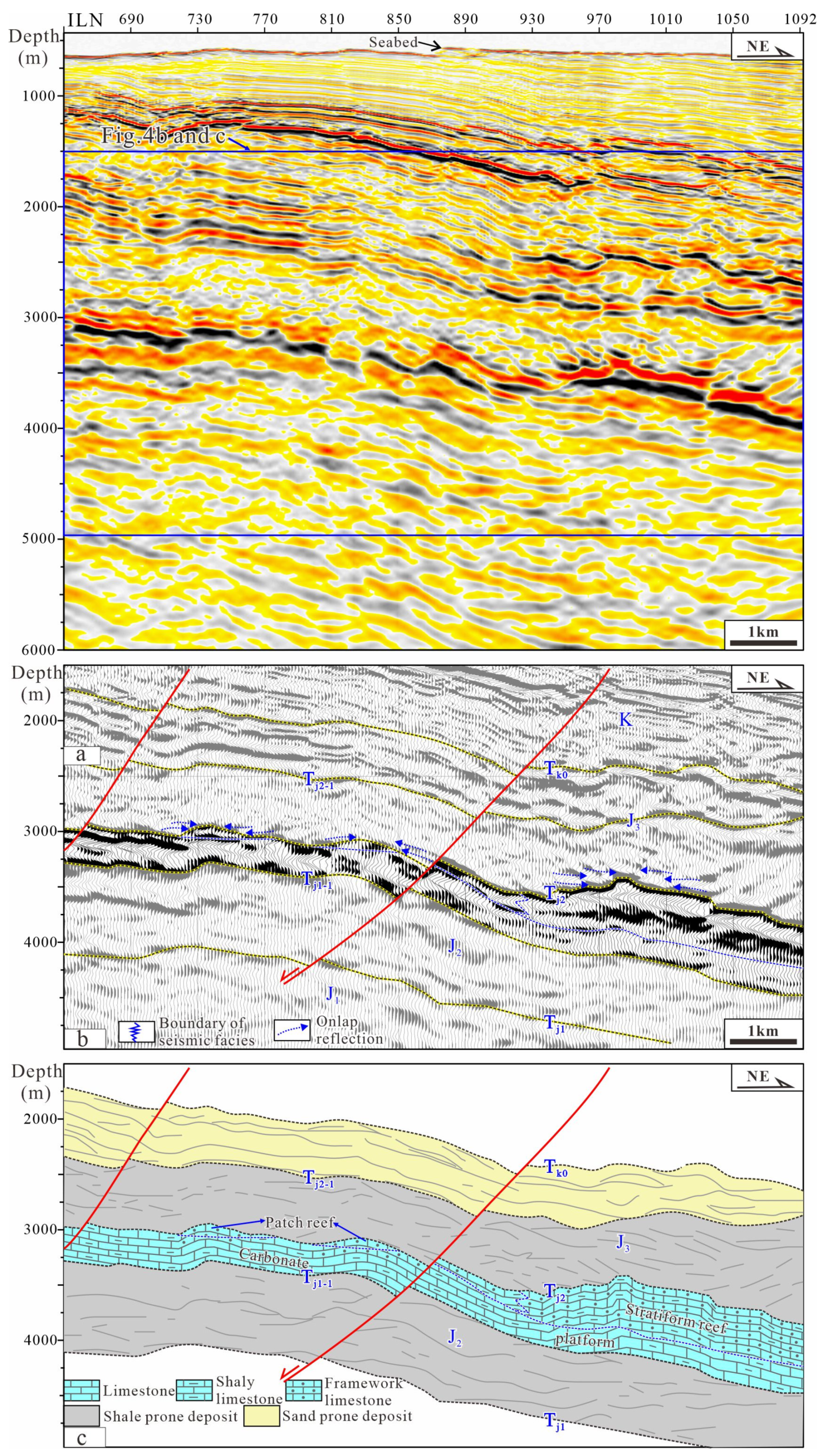
Figure 5.
Seismic velocity anomaly of the reef and carbonate. (a) Time-domain MCS reflection profile and its interpretation. See Figure 1d for location. (b) Seismic stack velocity spectrum of CDP 2068-2077. (c) Interval velocity profiles.
Figure 5.
Seismic velocity anomaly of the reef and carbonate. (a) Time-domain MCS reflection profile and its interpretation. See Figure 1d for location. (b) Seismic stack velocity spectrum of CDP 2068-2077. (c) Interval velocity profiles.
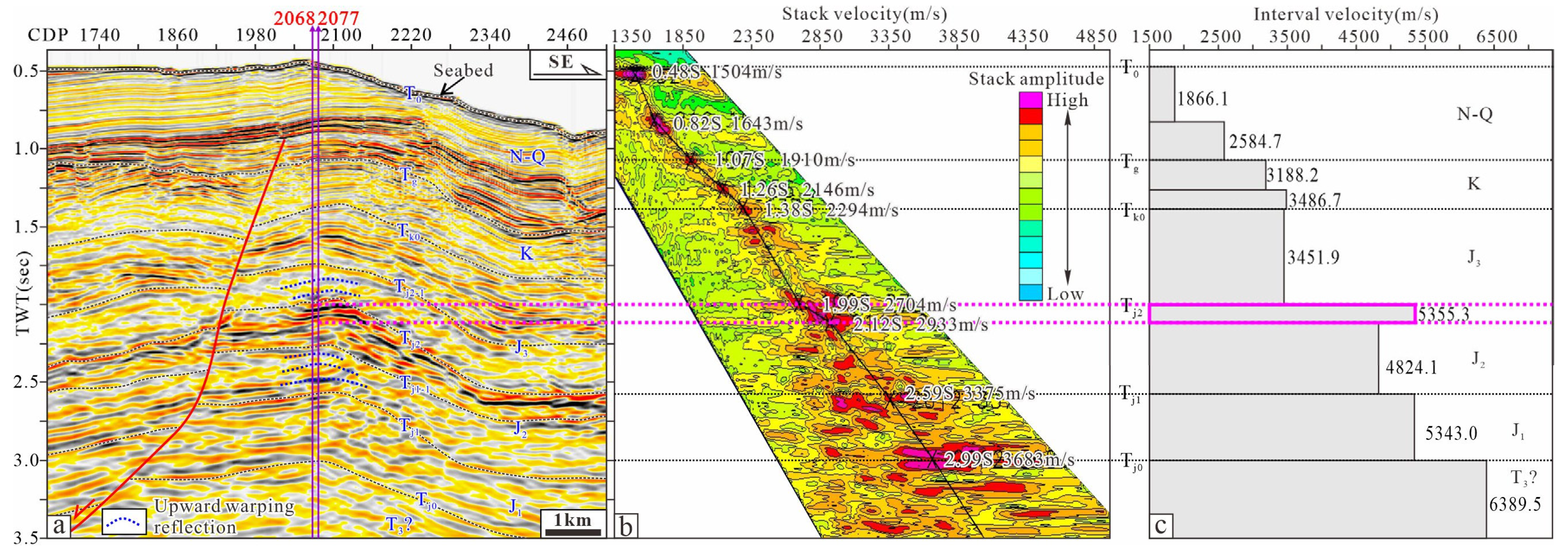
Figure 6.
(a) 2D MCS reflection profile crossing the quasi-3D area and its interpretation. See Figure 1d for location. (b) Curve of the gravity and magnetic anomaly. The blue solid line represents the Bouguer gravity anomaly. ∆G-B (mGal) indicates the Bouguer gravity anomaly measured in mGal. 1 mGal = 10⁻⁵ m/s². The red solid line represents the reduced-to-pole (RTP) magnetic anomaly. ∆T-RTP (nT) indicates the RTP magnetic anomaly measured in nT. .
Figure 6.
(a) 2D MCS reflection profile crossing the quasi-3D area and its interpretation. See Figure 1d for location. (b) Curve of the gravity and magnetic anomaly. The blue solid line represents the Bouguer gravity anomaly. ∆G-B (mGal) indicates the Bouguer gravity anomaly measured in mGal. 1 mGal = 10⁻⁵ m/s². The red solid line represents the reduced-to-pole (RTP) magnetic anomaly. ∆T-RTP (nT) indicates the RTP magnetic anomaly measured in nT. .

Figure 7.
Seismic attribute and sedimentary interpretation of the reef and carbonate platform of the upper part of Middle Jurassic (Tj1-1-Tj2). (a) Seismic attribute of “Sum Positive Amplitude” and sedimentary boundary delineated by amplitude anomaly. (b) Distribution pattern and scale of reefs and carbonate Platforms delineated by sedimentary interpretation.
Figure 7.
Seismic attribute and sedimentary interpretation of the reef and carbonate platform of the upper part of Middle Jurassic (Tj1-1-Tj2). (a) Seismic attribute of “Sum Positive Amplitude” and sedimentary boundary delineated by amplitude anomaly. (b) Distribution pattern and scale of reefs and carbonate Platforms delineated by sedimentary interpretation.
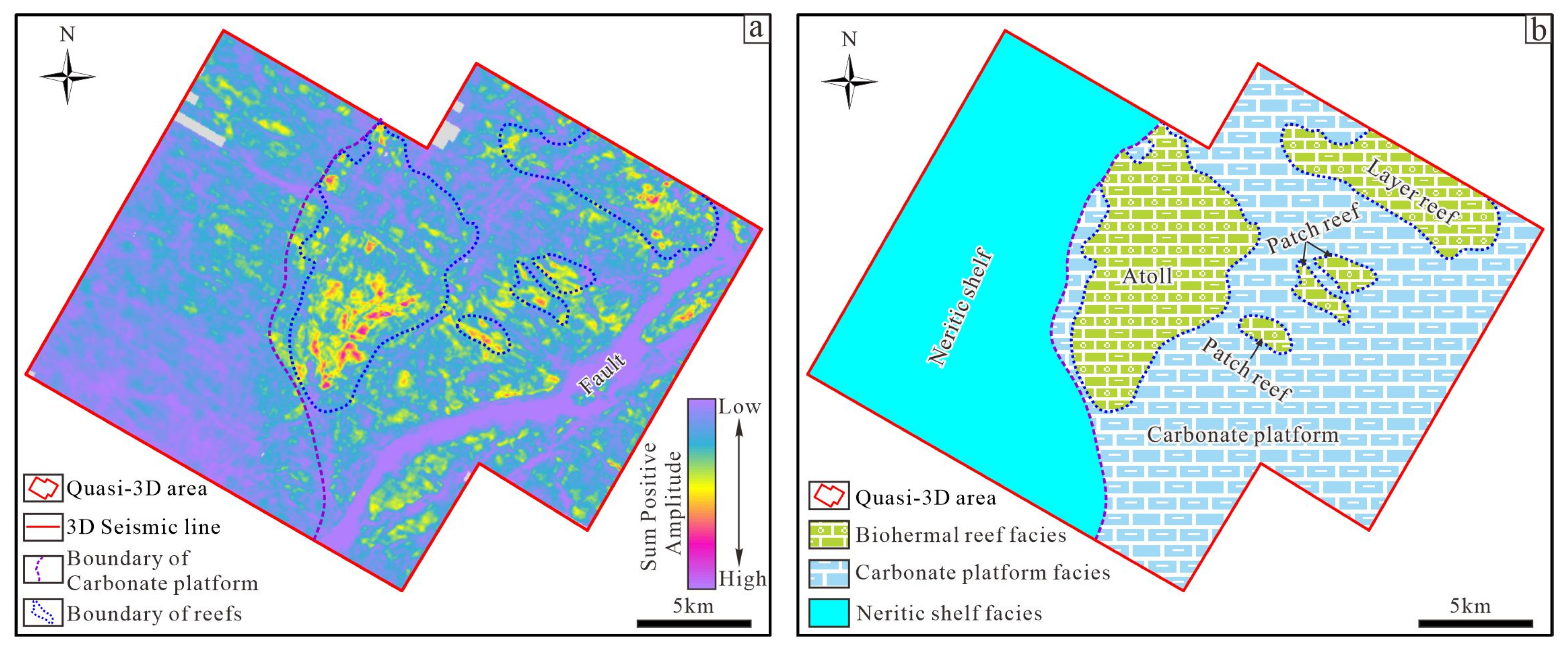
Figure 8.
Vertical evolution of atolls and carbonate platforms. Sedimentary (sub)facies boundary delineated by seismic phase anomaly marked with blue and green dashed line in the strata depth horizontal slice of 3260m (a) initial stage, 3060m (b) flourishing stage, 2860m (c) decline stage and 2660m (d) submergence stage. See Figure 1d for the grid location of slice. See Figure 8e,f for the depth of slice in the profiles. (e) and (f) MCS reflection profile and its interpretation. See Figure 8a for location of the cross profiles.Along with continued relative sea-level rise, the study area transitioned into fully bathyal depositional conditions, resulting in the total submergence of the reef system. The 2660 m horizontal slice exhibits distinctive features indicative of the submergence stage (Figure 8d), wherein light red-gray reflections represent low-amplitude seismic associated with bathyal argillaceous deposits (Figure 8e,f).
Figure 8.
Vertical evolution of atolls and carbonate platforms. Sedimentary (sub)facies boundary delineated by seismic phase anomaly marked with blue and green dashed line in the strata depth horizontal slice of 3260m (a) initial stage, 3060m (b) flourishing stage, 2860m (c) decline stage and 2660m (d) submergence stage. See Figure 1d for the grid location of slice. See Figure 8e,f for the depth of slice in the profiles. (e) and (f) MCS reflection profile and its interpretation. See Figure 8a for location of the cross profiles.Along with continued relative sea-level rise, the study area transitioned into fully bathyal depositional conditions, resulting in the total submergence of the reef system. The 2660 m horizontal slice exhibits distinctive features indicative of the submergence stage (Figure 8d), wherein light red-gray reflections represent low-amplitude seismic associated with bathyal argillaceous deposits (Figure 8e,f).
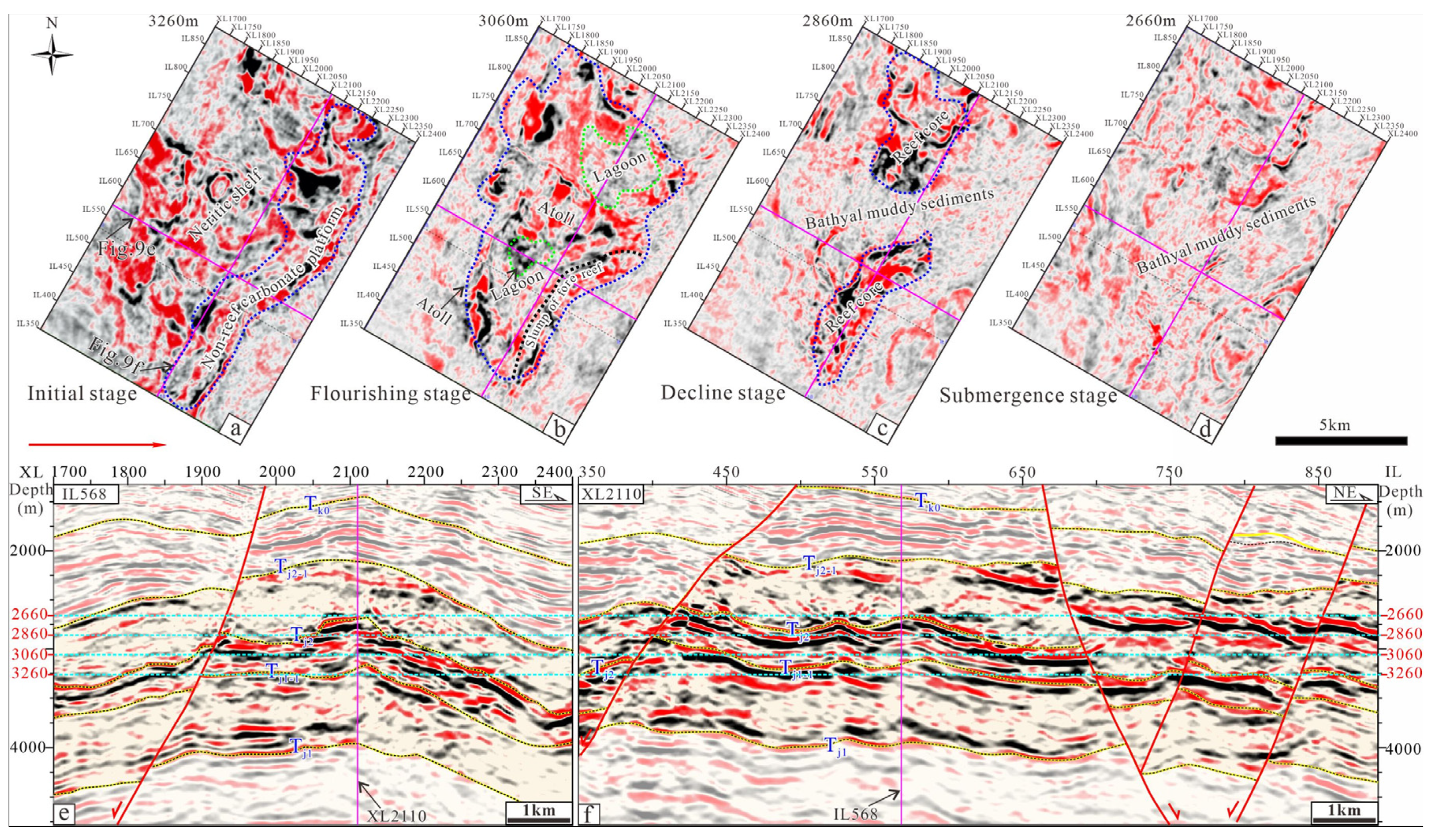
Figure 9.
Evolution model of reefs and carbonate platforms with in the upper part of the Middle Jurassic. (a) Initial development of non-reef carbonate platform occurred on the paleo-highs of the Middle Low Uplift concurrently with a decline in short-term relative sea level. (b) Reef-shoal facies dominated by oolitic limestone emerged at Well LF35-1-1, while reef complexes formed on the carbonate platform in the Middle Low Uplift amid a slow and steady decline in short-term relative sea level. (c) Early-stage reefs and carbonate platforms experienced deline and drowning until they were completely submerged under bathyal muddy deposits resulted from a subsequent rapid rise in sea level.
Figure 9.
Evolution model of reefs and carbonate platforms with in the upper part of the Middle Jurassic. (a) Initial development of non-reef carbonate platform occurred on the paleo-highs of the Middle Low Uplift concurrently with a decline in short-term relative sea level. (b) Reef-shoal facies dominated by oolitic limestone emerged at Well LF35-1-1, while reef complexes formed on the carbonate platform in the Middle Low Uplift amid a slow and steady decline in short-term relative sea level. (c) Early-stage reefs and carbonate platforms experienced deline and drowning until they were completely submerged under bathyal muddy deposits resulted from a subsequent rapid rise in sea level.
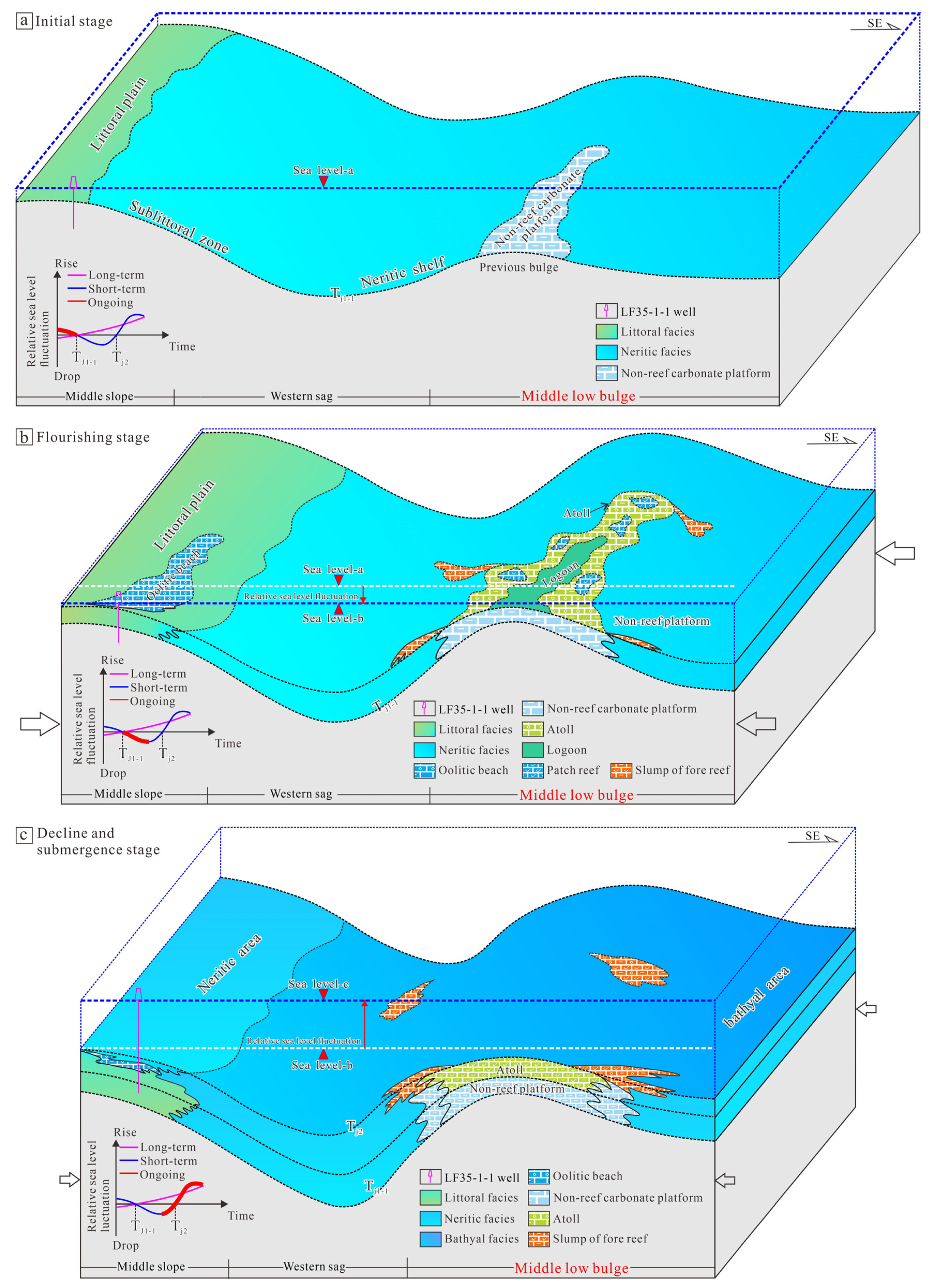
Figure 10.
(a) Quasi-3D MCS reflection profile and its interpretation. See Figure 1d for location of the profile. (b) Prediction of structural and lithologic traps reservoir-forming model displaying elements of the local petroleum system.
Figure 10.
(a) Quasi-3D MCS reflection profile and its interpretation. See Figure 1d for location of the profile. (b) Prediction of structural and lithologic traps reservoir-forming model displaying elements of the local petroleum system.
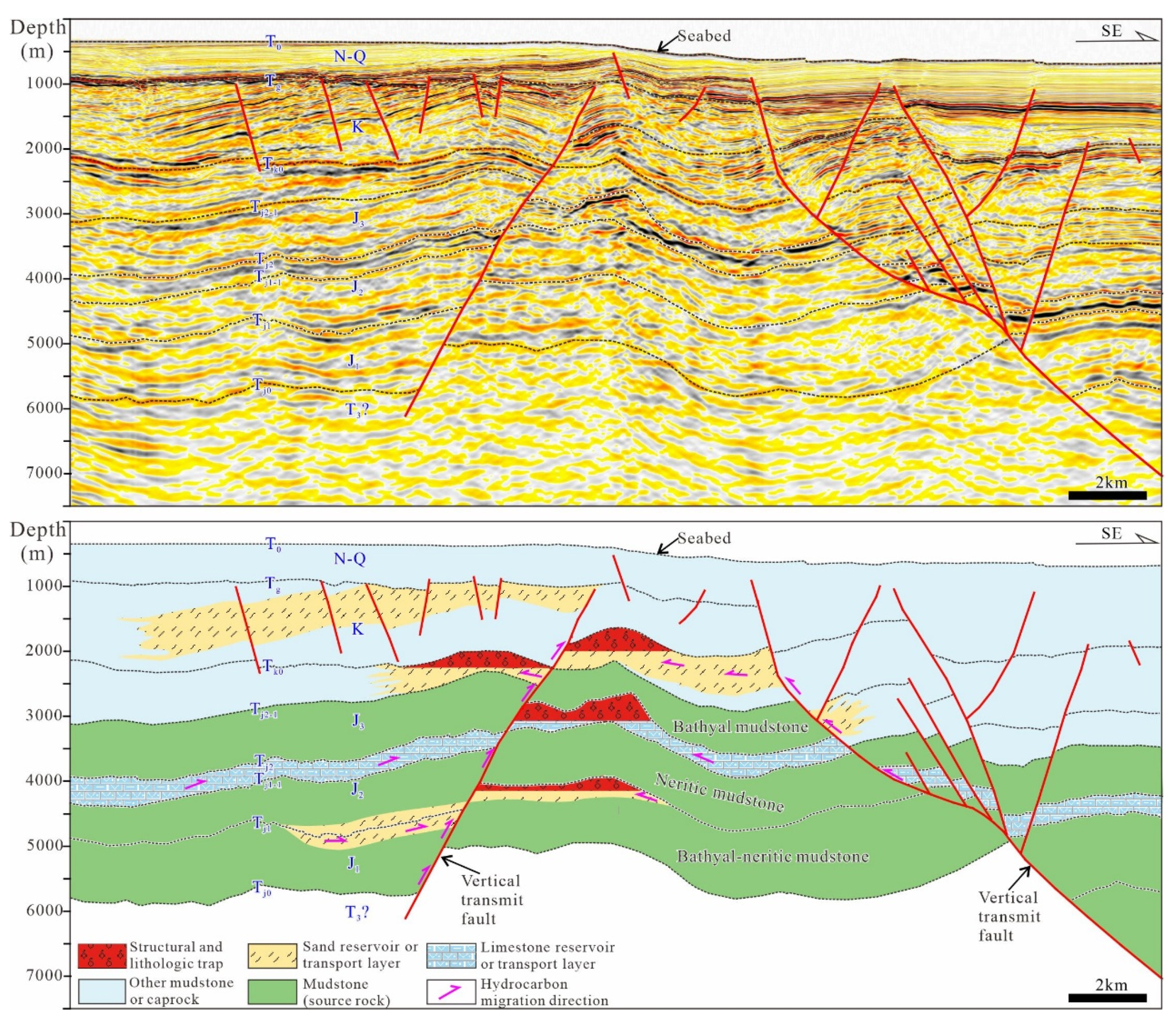
Figure 11.
Structural and lithologic traps condition of the reef within the upper part of the Middle Jurassic. (a) Structural isodepth map of Tj2 shows that the structural traps and the reefs development location present a good vertical superimposition relationship. (b) Thickness map shows the considerable scale of the atolls. (c) Seismic fissure attributes (along Tj2 boundary ±100 m/350 m) shows microfractures (black) development near faults.
Figure 11.
Structural and lithologic traps condition of the reef within the upper part of the Middle Jurassic. (a) Structural isodepth map of Tj2 shows that the structural traps and the reefs development location present a good vertical superimposition relationship. (b) Thickness map shows the considerable scale of the atolls. (c) Seismic fissure attributes (along Tj2 boundary ±100 m/350 m) shows microfractures (black) development near faults.
Disclaimer/Publisher’s Note: The statements, opinions and data contained in all publications are solely those of the individual author(s) and contributor(s) and not of MDPI and/or the editor(s). MDPI and/or the editor(s) disclaim responsibility for any injury to people or property resulting from any ideas, methods, instructions or products referred to in the content. |
© 2025 by the authors. Licensee MDPI, Basel, Switzerland. This article is an open access article distributed under the terms and conditions of the Creative Commons Attribution (CC BY) license (http://creativecommons.org/licenses/by/4.0/).
Copyright: This open access article is published under a Creative Commons CC BY 4.0 license, which permit the free download, distribution, and reuse, provided that the author and preprint are cited in any reuse.


