

Submitted:
24 April 2025
Posted:
25 April 2025
You are already at the latest version
Abstract
Background: Prevention of an irreversible sequalae of neurosyphilis patients requires an immediate high-dosage of intravenous benzylpenicillin administered for prolonged periods of time. However, life-threatening neutropenia has been reported as one of the complications following the extended usage of benzylpenicillin. Case presentation: We report a 54-year-old HIV infected male patient, who developed a high-dose benzylpenicillin induced febrile neutropenia during the neurosyphilis treatment. The patient developed fever of up to 39.8°C, severe leukopenia (< 1x10⁹/L), and neutropenia (0.2x10⁹/L). He also presented with slightly elevated C-reactive protein and procalcitonin but had no clear symptoms of infection. The diagnosis was confirmed by excluding other possible causes of neutropenia: flu, measles, sepsis, and HIV-related neutropenia. The 3rd generation antipseudomonal cephalosporin in combination with vancomycin and granulocyte colony-stimulating factor were administered, and the patient saw a rapid improvement in clinical symptoms and laboratory findings. Conclusions: High-dose benzylpenicillin induced neutropenia should be considered as a complication after prolonged periods of neurosyphilis treatment with high-dose benzylpenicillin, when there is no evidence of other potential causes of neutropenia. Early diagnosis and proper treatment are critical in order to prevent this dangerous condition from deteriorating further.
Keywords:
neurosyphilis
; HIV
; neutropenia
1. Introduction
Prompt therapy with high-dose intravenous benzylpenicillin for a prolonged period is critical for neurosyphilis patients to avoid irreversible sequelae. However, life-threatening neutropenia has been reported as a complication of high-dose benzylpenicillin therapy. This condition is quite uncommon and occurs in approximately 2.42% of neurosyphilis cases treated with high-dose benzylpenicillin. The definite diagnosis could be difficult to establish due to nonspecific symptoms and other possible causes of neutropenia, including infection, neutropenia induced by other medications, nutrition, hematologic malignancies, rheumatologic disorders, autoimmune neutropenia, etc.
2. Case Presentation
A 54-year-old man was referred to the hospital with a 3-week history of headache, nausea, and vomiting. He had lost 8 kg in 3 months. The patient did not measure his temperature while at home. He had complained of a migraine previously, but he had never suffered migraine episodes of such severity before.
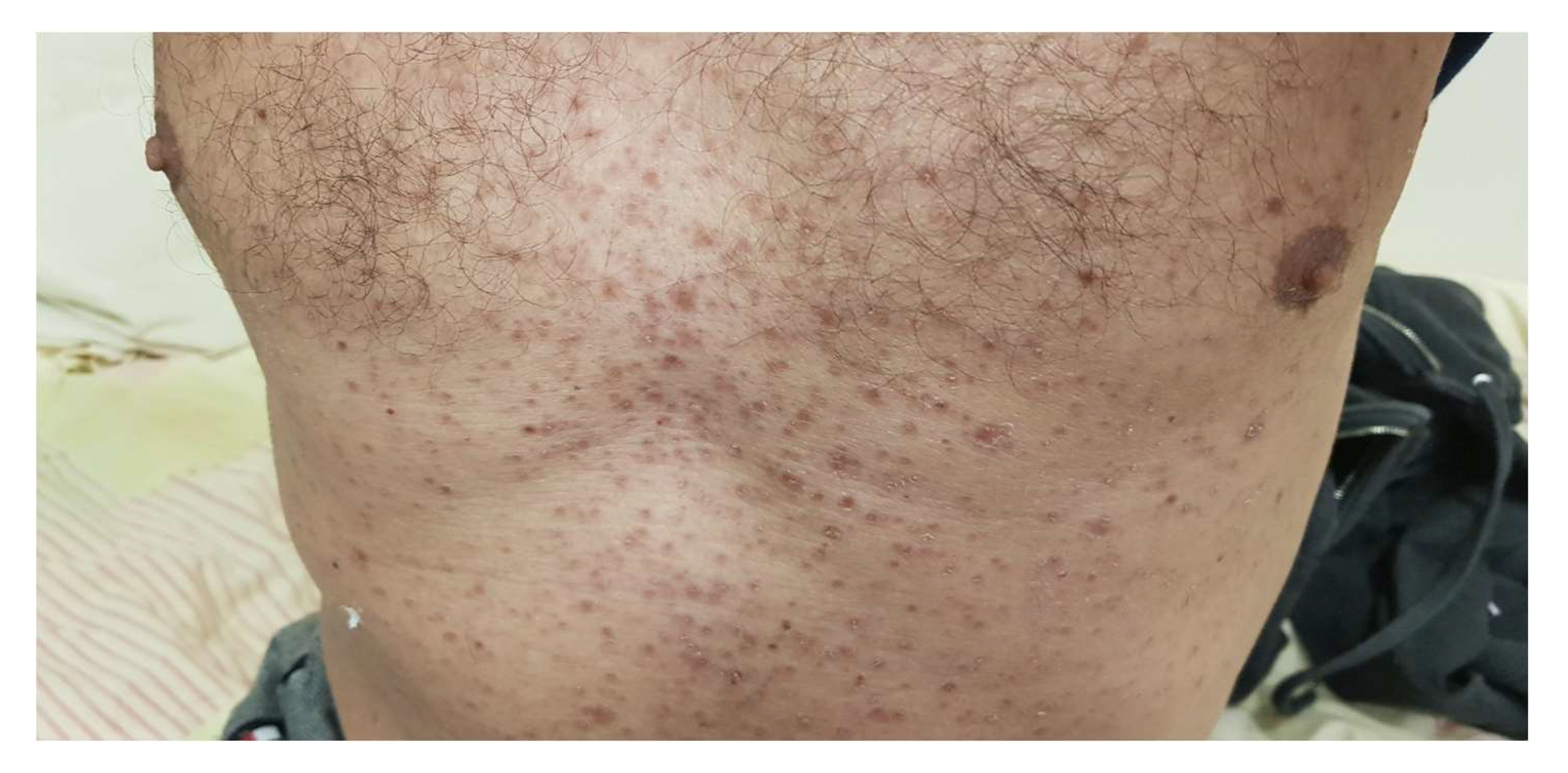
Initially, he was admitted to the emergency department due to disorientation. He could not remember how he got there. Detailed physical examination showed fever of 37.6°C, impaired consciousness with Glasgow Coma Scale score of 12, disorientation, neck rigidity, and no focal neurological symptoms. His hemodynamic was stable and lung auscultation was normal. A maculopapular rash of an unknown duration was observed on the chest and abdomen area (Figure 1). His eye examination did not reveal any abnormalities.
Ultrasound of the abdominal organs and lymph nodes was performed, detecting enlarged lymph nodes in the neck, armpits, and groin. The chest X-ray was normal.
Laboratory tests showed mild elevation of C-reactive protein (CRP) level (24.23 mg/L), normal white blood cell count (WBC) (4.6 x 10⁹/L) and normal platelet count (158 × 109/L). An urgent computed tomography of the head was performed and demonstrated no definite acute intracranial haemorrhage nor midline shift or mass. His cerebrospinal fluid (CSF) examination revealed 71 x 109 cells (lymphocytes 73.2%), total protein 1.01 g/L, lactate 5.2 mmol/L, and glucose 0.59 mmol/L. He was hospitalized in the Department of Infectious Diseases for a more detailed examination and treatment.
The patient’s medical history revealed that, a month ago, he was treated for an unspecified rash on the chest, limbs, and face. A skin biopsy was performed and reported a nonspecific dermatitis. The rash improved after corticosteroid, antibiotic, and antihistamines treatment. His previous medical and socioeconomic history was unremarkable, except for the fact that his mother had suffered from tuberculosis.
Ceftriaxone (2 g twice a day) and ampicillin (3 g four times a day) were administered empirically in combination with acyclovir 750 mg (every 8 hours).
On the next day, the spinal tap was repeated. CSF analysis revealed the following: cell count 89x109, total protein 1.34 g/L, glucose 1.72 mmol/L, and lactate 2.9 mmol/L. To establish the possible etiology of neuroinfection, the following tests were performed: 1) CSF polymerase chain reaction (PCR) for enteroviruses, herpes simplex 1 and 2, varicella-zoster virus, cytomegalovirus, Epstein Barr virus, human herpesvirus-6, human herpesvirus-7, human herpesvirus-8 (negative); 2) CSF staining for acid fast bacteria (negative); 3) CSF cytological examination (did not show atypical cells); 4) CSF and blood cultures (negative). Serology for tick-borne encephalitis (IgM and IgG) were also negative.
Subsequent investigations confirmed the diagnosis of syphilis, as his rapid plasma reagin test was reactive in 1:128 dilution, and his Treponema pallidum haemagglutination assay test was positive (4+). CSF Venereal disease research laboratory test was also positive (1:4). Serological test for HIV was positive as well. After HIV serology came positive, the patient confessed that he was diagnosed with HIV infection eight years ago and has been taking abacavir/lamivudine and efavirenz treatment. His last CD4 cell count was >500 cells/mm3, and viral load undetectable few months ago.
The patient was consulted by a dermatologist and started neurosyphilis treatment with benzylpenicillin. Initially, intravenous benzylpenicillin, 400,000VV every 3 hours, was administered. On the next day, as initial dose was well tolerated, benzylpenicillin was increased to 4 mln every 4 hours. In the course of the disease the patient developed fever of 39°C; he also complained of abdominal pain, general weakness, and a slight rash and redness at the catheter site. The repeated blood analysis revealed leukopenia (0.7 x 10⁹/L), neutropenia (0.2 x 10⁹/L), thrombocytopenia (44 x 109/L), haemoglobin 129 g/L, CRB 50.1 mg/L, procalcitonin 0.91 mcg/L. As there was an influenza season in Lithuania and also an outbreak of measles at that time, additional tests for influenza (PCR from nasopharyngeal swab) and measles (PCR from nasopharyngeal swab and measles virus IgM and IgG in blood) were performed. However, all tests except for measles IgG were negative. Further, blood and urine cultures were taken, but bacterial growth was not detected. A chest X-ray was repeated, and no changes were detected. An abdominal ultrasound was repeated as well, showing a moderately enlarged spleen (13.1 x 6.1cm). Hematologist’s advice to discontinue benzylpenicillin due to febrile neutropenia was taken into consideration, and the treatment was changed to ceftazidime (2 g every 8 hours) in combination with vancomycin (1 g every 12 hours), and filgrastim (300 mcg per day) subcutaneously. After two days of treatment, the patient’s fever receded, the abdominal pain subsided, and the patient’s well-being improved. The treatment was continued for a total of 7 days, while filgrastim was administered for two days only. A repeated blood analysis revealed the positive outcomes of the treatment (WBC 8 x 10⁹/L, neutrophils 6.01 x 10⁹/L, platelets 80 x 109/L), haemoglobin 129 g/L). The patient was discharged home for further HIV treatment and follow-up.
3. Discussion
Beta-lactam induced neutropenia has been observed in cases of infective endocarditis, bowel obstruction, cellulitis, gangrenous appendix, pneumonia, haemangioma, septic arthritis, and pleural empyema [1]. Benzylpenicillin-induced neutropenia in neurosyphillis patients is quite uncommon (approx. 2.42%), while severe neutropenia (as in our case) occurs in only 0.35%. Usually, it is associated with prolonged treatment (10 to 14-day duration), though some data suggest that the duration of beta-lactam therapy prior to the start of neutropenia always exceeds 15 days [2,3]. It is presumed that benzylpenicillin-induced neutropenia in neurosyphilis patients could occur earlier due to exceptionally high daily dose. The antibiotics from the penicillin group were shown to induce inhibition of granulopoiesis [4]. According to some theories on genetic and epigenetic modification, benzylpenicillin-induced neutropenia is considered as a dose-related immunological reaction, thus it may predispose the idiosyncratic drug sensitivity [5,6]. Benzylpenicillin-induced thrombocytopenia is much rarer and only several cases have been documented [7]. Differential diagnosis of benzylpenicillin-induced febrile neutropenia is difficult due to nonspecific symptoms and a great variety of causes of neutropenia, including infection, other medications, nutrition, hematologic malignancies, rheumatologic disorders, autoimmune neutropenia, etc. [8]. In our case, we attempted to differentiate between the most possible causes of neutropenia such as HIV-induced neutropenia, sepsis, flu (as the patient was hospitalized during the flu season) and measles (as there was measles outbreak in Lithuania at the time).
In HIV-infected patients, decreased blood neutrophil count is closely related with a loss of CD4+ T cells and is correlated with the HIV viral load [9]. According to one study, neutropenia could occur at a median CD4 count of 30 cells/mm3 [10]. Due to high CD4 levels (more than 500/mm3) and a low viral load (<40 HIV copies/ml), HIV-induced neutropenia was excluded in our patient.
Sepsis was another possible reason of neutropenia in our patient. However, low procalcitonin, CRP, no visible signs of infection on the chest X-ray or abdominal ultrasound, as well as the negative blood and urine cultures allowed to exclude sepsis as a cause. On the other hand, we were not able to fully exclude sepsis due to intravenous catheter-related infection, since the patient had a mild rash and redness around the intravenous catheter. Nevertheless, the quick Sepsis Related Organ Failure Assessment score was 0 (the actual Sepsis Related Organ Failure Assessment score was not calculated due to unknown bilirubin levels and ratio of arterial oxygen partial pressure to fractional inspired oxygen), suggesting that sepsis diagnosis was not likely indeed. Furthermore, in our case, no other organs and/or systems were damaged, which indirectly confirms that sepsis was very unlikely. Intravenous vancomycin treatment was added to the empirical therapy of neutropenia, due to a possible catheter-related source of infection. As mentioned previously, neither the blood culture nor the urine culture showed positive results.
Flu was one more possible diagnosis we had to rule out. The patient did not recall any recent flu vaccinations he could have received. According to the literature, neutropenia in flu patients is common (around 15.3%), but in the majority of cases are mild, with the WBC remaining >1.0 x 10⁹/L, and transient [11]. In our case, flu was excluded after receiving a negative nasopharyngeal swab PCR test.
Between 2018–2019, there was a measles outbreak in Lithuania with 826 confirmed measles cases [12]. Although measles symptoms include a typical rash, fever, neutropenia, and conjunctivitis, some measles cases without rash and associated with worse outcomes have been reported, mostly in patients with immunosuppression [13]. The patient’s measles vaccination status and his history of previous measles infection were unknown, and so the patient could potentially be infected with measles virus. To test for this possibility, measles IgM and IgG, and measles PCR were performed. PCR appeared to be negative and IgM test was negative. However, the IgG analysis was positive, suggesting that the patient was vaccinated or was previously infected with measles virus.
Febrile neutropenia therapy with ceftazidime and vancomycin was prescribed for this high-risk patient (inpatient status at the time of development of fever, possible catheter-related infection, HIV infection) [14]. As there are no clear guidelines for the treatment of neutropenic non-cancer patients, it could be argued if our decision was the best empirical approach.
4. Conclusions
This case highlights that, although rare, high-dose-benzylpenicillin induced neutropenia should be considered in neurosyphilis patients when there is no evidence of other causes for neutropenia. Early detection and proper treatment are needed to prevent this dangerous condition from deteriorating further and to minimize mortality.
Author Contributions
Conceptualization, D.V. and I.S.; methodology, D.V., I.S., and K.K.; investigation, data curation I.S., K.K. and S.P.; writing—original draft preparation, I.S.; writing—review and editing, E.P., A.M.; supervision, D.V. All authors have read and agreed to the published version of the manuscript.
Funding
This research received no external funding.
Institutional Review Board Statement
This report does not include elements that require approval from the local institutional review board.
Informed Consent Statement
Written informed consent has been obtained from the patient to publish this paper.
Acknowledgments
We acknowledge all healthcare professionals for their outstanding efforts and dedication to the care of the patient.
Conflicts of Interest
The authors declare no conflicts of interest.
Abbreviations
The following abbreviations are used in this manuscript:
| CRP | C-reactive protein |
| CSF | Cerebrospinal fluid |
| PCR | Polymerase chain reaction |
| WBC | White blood cells |
References
- Al-Hadramy M, Aman H, Omer A, Khan M. Benzylpenicillin-induced neutropenia. Journal of Antimicrobial Chemotherapy. 1986; 17(2):251-253. [CrossRef]
- Workowski KA, Bolan GA. Sexually transmitted diseases treatment guidelines, 2015. MMWR Recomm. Rep. 2015 Jun 5; 64(RR-03):1–137.
- STD Association, Chian CDC. The diagnosis and treatment guidelines of syphilis, gonorrhoea, genital herpes and chlamydial trachomatis infection (2014). Chin J Dermatol. 2014; 47(5):365–72.
- Scheetz MH, McKoy JM, Parada JP, Djulbegovic B, Raisch DW, Yarnold PR, et al. Systematic review of piperacillin-induced neutropenia. Drug Saf. 2007; 30(4):295–306. [CrossRef]
- Tesfa D, Keisu M, Palmblad J. Idiosyncratic drug-induced agranulocytosis: possible mechanisms and management. Am J Hematol. 2009 Jul; 84(7):428–34. [CrossRef]
- Johnston A, Uetrecht J. Current understanding of the mechanisms of idiosyncratic drug-induced agranulocytosis. Expert Opin Drug Metab Toxicol. 2015 Feb; 11(2):243–57. [CrossRef]
- Peng R, Wu J, Zhao W, Qi T, Shi M, Guan Z, et al. Neutropenia induced by high-dose intravenous benzylpenicillin in treating neurosyphilis: Does it really matter? PLOS Neglected Tropical Diseases. 2017; 11:e0005456. [CrossRef]
- Berliner N, Newburger P, Rosmarin AG. Approach to the adult with unexplained neutropenia. UpToDate. Last updated: Jan 29, 2018. [cited Sep 12, 2019]. Accessed 12 Sep 2019.
- Xin Shi, Sims MD, Hanna MM, Xie M, Gulick PG, Zheng YH, et al. Neutropenia during HIV Infection: Adverse Consequences and Remedies. Int Rev Immunol. 2014; 33:511–36. [CrossRef]
- Moore DAJ, Sullivan A, Hilstead P, Gazzard BG. A retrospective study of neutropenia in HIV disease. International Journal of STD and AIDS. 2000;11:8-14. [CrossRef]
- Higgins P, Runnegar N, Bird R, Markey K. Rates of neutropenia in adults with influenza A or B: a retrospective analysis of hospitalised patients in South East Queensland during 2015. Internal Medicine Journal. 2016; 46:1328-32. [CrossRef]
- National public health centre. Bendroji informacija apie tymus. 2020. https://nvsc.lrv.lt/lt/naujienos/bendroji-informacija-apie-tymus. Accessed 26 May 2020.
- Lupo J, Bernard S, Wintenberger C, Baccard M, Vabret A, Antona D, et al. Fatal measles without rash in immunocompetent adult, France. Emerg Infect Dis. 2012; 18:521-3. [CrossRef]
- Guidelines in the Management of Febrile Neutropenia for Clinical Practice. AJMC. 2020. https://www.ajmc.com/journals/supplement/2017/clinical-advance-in-the-management-of-febrile-neutropenia/guidelines-in-the-management-of-febrile-neutropenia-for-clinical-practice. Accessed 26 May 2020.
Figure 1.
Rash on the chest on admission.
Disclaimer/Publisher’s Note: The statements, opinions and data contained in all publications are solely those of the individual author(s) and contributor(s) and not of MDPI and/or the editor(s). MDPI and/or the editor(s) disclaim responsibility for any injury to people or property resulting from any ideas, methods, instructions or products referred to in the content. |
© 2025 by the authors. Licensee MDPI, Basel, Switzerland. This article is an open access article distributed under the terms and conditions of the Creative Commons Attribution (CC BY) license (http://creativecommons.org/licenses/by/4.0/).
Copyright: This open access article is published under a Creative Commons CC BY 4.0 license, which permit the free download, distribution, and reuse, provided that the author and preprint are cited in any reuse.


