

Submitted:
25 April 2025
Posted:
25 April 2025
You are already at the latest version
Abstract
Ultraviolet fluorescence imaging represents a simple but powerful technique in cultural heritage studies. It is a relevant nondestructive and non-invasive imaging technique able to supply several useful information to define the state of conservation of an artefact. This also helps to establish the value of an artwork, by observing eventual inpainting, repaired areas, grouting, etc. Generally ultraviolet fluorescence imaging output is made of 2D photographs both in the case of paintings and sculptures. For this reason, a few years ago our idea was to develop a photogrammetric method to create 3D digital twins under ultraviolet fluorescence to address the requirements from restorers who need daily documentation tools for their work that would be simple to use and able to display in a single file the entire 3D object. The method was first applied on a reliquary bust made of papier-mâché and, due to the success of the result and to the positive feedback from the restorers, subsequently on various other 3D artworks. The photogrammetric methodology was based on a digital camera, two filters positioned in front of the lens, two ultraviolet led lamps filtered at 365 nm and processing software for obtaining the 3D models under ultraviolet fluorescence imaging. Ultraviolet 3D models were made available on Sketchfab, a platform for sharing 3D and AR on the web. The 3D models may be observed, rotated, enlarged by accessing Sketchfab through a computer, a tablet or a mobile allowing the restorers to use this tool even during their work in the field.
Keywords:
ultraviolet fluorescence imaging
; cultural heritage
; digital twins
; 3D models
; photogrammetry
; sculptures
1. Introduction
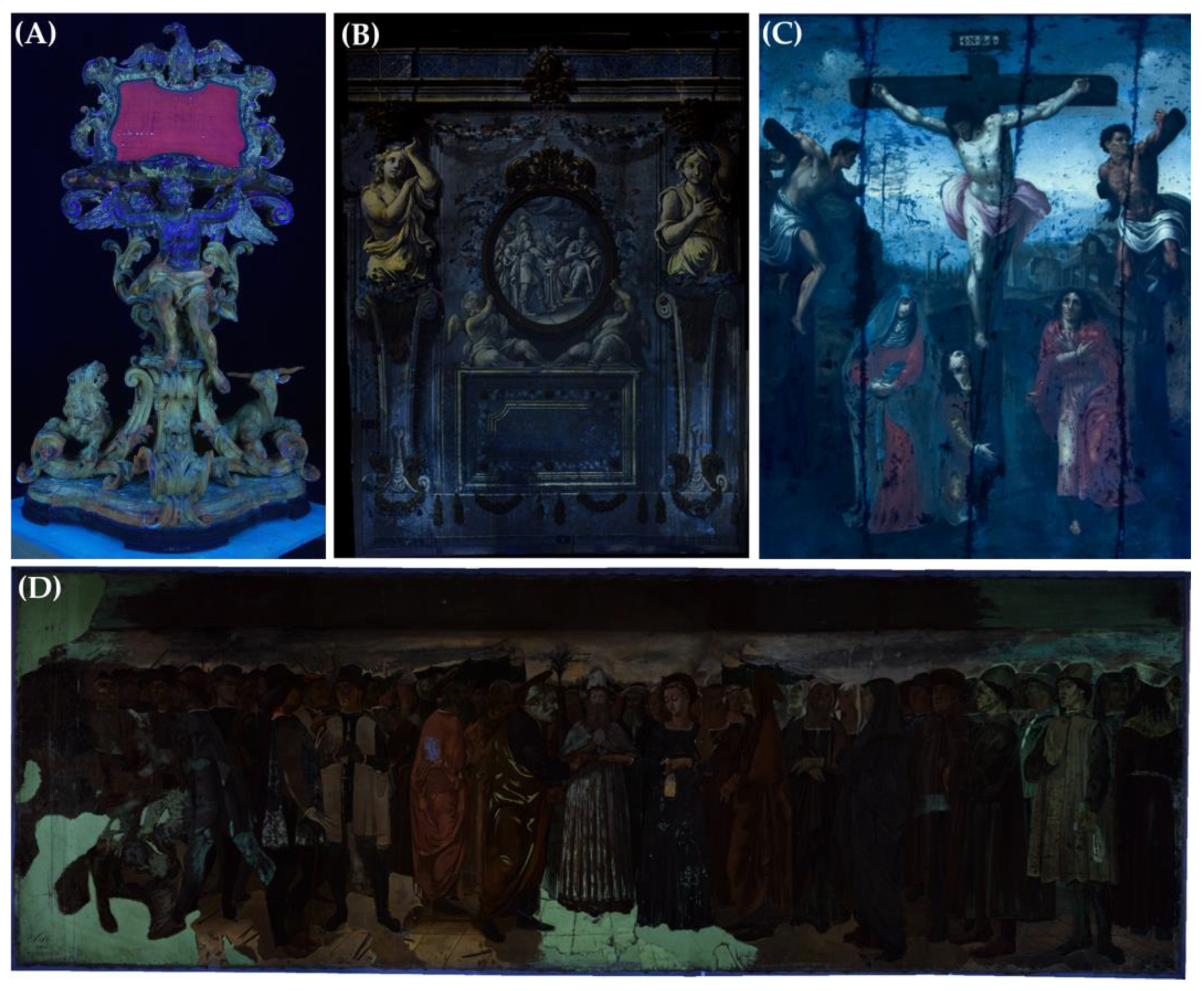
Ultraviolet fluorescence (UVF) imaging, such as other imaging techniques, is a diagnostic tool widely used in conservation and restoration of cultural heritage for obtaining information about the surface state of conservation of artworks in a completely non-invasive and nondestructive modality [1,2,3,4,5,6,7,8]. For this reason, UVF imaging is an almost imperative step to be taken before starting the restoration, as it allows us to reveal the presence of inpainting, grouting, fluorescent materials, previously restored area and in general details not visible at naked eyes [9,10,11,12,13,14,15,16,17,18,19,20,21,22]. In Figure 1 four examples of UVF images are shown to highlight their great utility for the study, the interpretation and the restoration phases of an artwork.
UVF imaging is a simple but at the same time powerful tool for restorers, art historians, archaeologists, archivists, and conservators to “look” at the artwork surfaces under a different way, that is the fluorescence response in the visible range induced by ultraviolet radiation [23,24,25,26]. The great relevance of UVF technique in restoration is demonstrated in pioneering works by Rorimer [27], Eibner [28,29,30], Lyon [31] and other authors such as De la Rie whose papers made the story of UVF photography applied to artworks’ examination [9,10,11].
Figure 1.
Some examples of UVF images from our laboratory archive demonstrating the utility of the technique for the study of the artworks, especially during the restoration activities. (A) a 18th century tetramorphic wooden lectern from the Church of the Certosa of San Martino showing the status of the cleaning operation (upper part cleaned, lower part uncleaned), unpublished photograph; (B) the wall painting in Palazzo Nuzzi at Orte (Central Italy) showing yellow fluorescence in the area interested by inpainting with zinc white [21]; (C) the 16th century panel panting representing a Crucifixion and attributed to Michelangelo’s workshop, exposed in Museum of Colle del Duomo in Viterbo, showing the presence of cracks, inpainting, grouting [22]; (D) a 19th century large canvas representing the wall paintings of Cappella Mazzatosta by Lorenzo da Viterbo showing an interesting use of two different kinds of white: yellow fluorescent zinc white and lead white [12].
Figure 1.
Some examples of UVF images from our laboratory archive demonstrating the utility of the technique for the study of the artworks, especially during the restoration activities. (A) a 18th century tetramorphic wooden lectern from the Church of the Certosa of San Martino showing the status of the cleaning operation (upper part cleaned, lower part uncleaned), unpublished photograph; (B) the wall painting in Palazzo Nuzzi at Orte (Central Italy) showing yellow fluorescence in the area interested by inpainting with zinc white [21]; (C) the 16th century panel panting representing a Crucifixion and attributed to Michelangelo’s workshop, exposed in Museum of Colle del Duomo in Viterbo, showing the presence of cracks, inpainting, grouting [22]; (D) a 19th century large canvas representing the wall paintings of Cappella Mazzatosta by Lorenzo da Viterbo showing an interesting use of two different kinds of white: yellow fluorescent zinc white and lead white [12].
UVF photography has been widely applied for paintings, sculptures, manuscripts, textiles, contemporary artworks, etc. and several papers can be found in the literature where this technique helped in the investigation of the surface state of artworks, but a very limited number of papers can be found for 3D photogrammetric application of UVF, as we will see later in this article.
The research in scientific literature was made by using various keywords: 3D ultraviolet fluorescence imaging for cultural heritage, 3D multi-band imaging, 3D digital twins under ultraviolet fluorescence, ultraviolet fluorescence photogrammetry, ultraviolet 3D models, 3D luminescence imaging. If, on the one hand, several papers can be found concerning UVF imaging in 2D, from the other one a very limited number of articles reporting 3D imaging under UVF were obtained [12,32,33,34,35,36,37,38,39,40,41,42].
Papers concerning topics related to the 3D UVF imaging production such as: ultraviolet image acquisitions, photogrammetry, digital model creation, and applications of UVF imaging will be reported in the references’ section because they are relevant for the topic treated in the present review.
The first published papers proposing an innovative approach to creating 3D digital models under UVF were published in 2017 by Lanteri and Agresti [32], by Lanteri et al. in 2018 [33] and in 2019 [34]. In these papers, the authors reported for the first time a method to output UVF 3D models and to share them with the end-users starting from photogrammetry and Structure from Motion workflow with a variation in the acquisition procedure, as we will see later in the paper, in order to make simpler and more rapid the process. Subsequently other authors presented the same approach for obtaining multispectral and UVF 3D models without citing the original idea previously published and without any proposal on how to share the 3D models [35,36].
It is worth noting that a 3D multi-band approach was also employed for paintings (not for 3D artworks) to produce surface models at different wavelengths, but with a different methodology [43,44].
In the present review the attention will be focused on the papers proposing the use of ultraviolet fluorescence imaging for obtaining 3D digital models of artworks in UVF as a powerful instrument for cultural heritage studies.
Detailed research has been performed on the instrumental set-up used for obtaining ultraviolet fluoresce images by considering the UV sources, the filters and the cameras A focus will be addressed to underline the modalities of making the digital twins usable for restorers and experts in the field to easily observe the fluorescence of the surfaces.
2. Methodologies for obtaining the UVF 3D digital models
The acquisition of photographic images of the fluorescence induced by ultraviolet radiation (UVF), follows a procedure now standardized in the field of diagnostics for cultural heritage: the shots are taken in a darkroom, using digital cameras equipped with lens characterized by intermediate focal length (50 mm), in order to reduce as much as possible the distortions and aberrations that affects wide-angle lens, UV sources, filters and a tripod [12,45].
UVF photography requires the use of a tripod to fix and stabilize the camera during acquisition. This is particularly relevant to ensure the camera stability during quite long exposure times, usually around 15 seconds or higher.
Starting with the UV sources, which are the first essential requirement to obtain UVF images, different kinds of lamps may be used, such as Wood lamp, mercury vapor lamps, xenon arc-lamps, tungsten-halogen lamps, and more recently light-emitting diodes (LEDs) [5,15,38,46,47,48,49,50,51,52,53]. These latter sources offer considerable advantages in terms of handling and the possibility of being powered by rechargeable batteries, to be able to operate in situ, even when there is no power supply available [12,21,54]. Furthermore, LED lamps offer a controlled emission peak at 365 nm, ideal for UVF photography.
Another relevant part of the instrumental set-up is the UV cut filters, mounted in front of the photographic lens [12,55,56,57,58]. Sandwiches composed of UV-IR cut filters are often used to eliminate residual infrared and UV components that could affect the visible fluorescence response [12,46]. A wide panorama of filters used in UVF photography are reported by Crowther in a recent interesting paper [55].
Lastly, a digital camera (Reflex or Mirrorless), must be used for the capture of the images. Also in this case, different kinds of apparatus may be used [12,50,59,60,61,62], including low-cost compact digital camera [63].
The camera typologies and settings are generally detailed in the published papers [36,46,64,65,66,67].
As said in the introduction, UVF photography is widely used as 2D technical documentation and diagnostic tool for painting and 3D objects by using a typical set-up, as reported by Cosentino [3]. But the present review focuses on 3D applications of UVF imaging, particularly useful for sculptures and in general tri-dimensional artworks. The procedure for creating a 3D model in UVF has been proposed for the first time by the group of Lanteri in 2017 [32] and further tested in 2018 and 2019 [33,34].
The technique used does not differ from the Structure from Motion (SfM) workflow, which usually uses images taken in the visible range [68,69,70,71,72]. The basic principles of photogrammetry are still valid, in fact a set of images must be acquired having few important characteristics: 60%-80% overlapping between frames, limited optical and perspective distortions [73,74,75,76,77,78,79,80,81].
The workflow of the SfM process, which by its nature involves reconstructing the 3D digital structure starting from images taken by a moving sensor, involves the creation of a photographic studio set in a darkroom and very long acquisition times for UVF images also due to the continuous movements of the camera and UV lamps (at least two) around the object to be acquired, in order to obtain complete coverage of the surface.
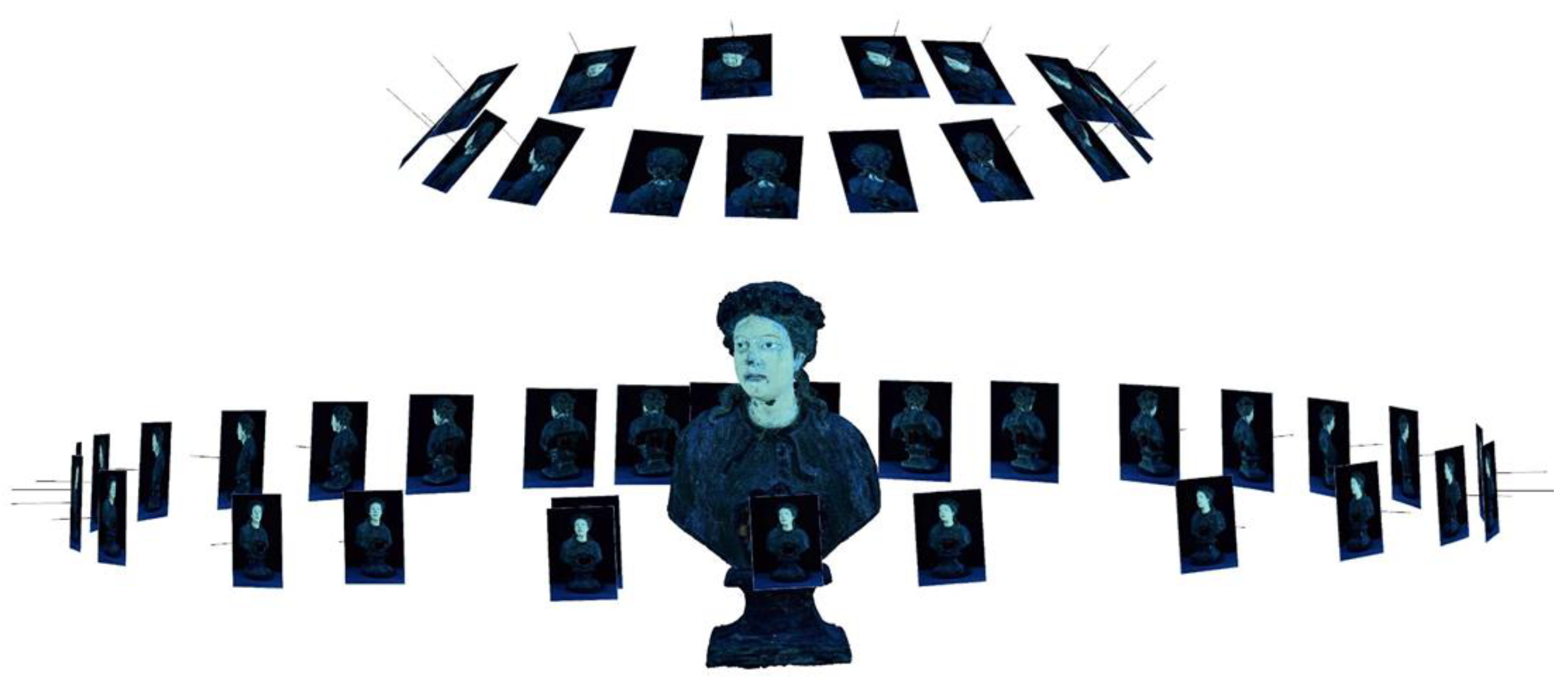
To reduce the acquisition times of the photographic set, it has been proposed by Lanteri [32,33] and subsequently by other authors [35,36,40] to position the subject on a rotating support (360° around the vertical axis), and to keep the camera and lamps in fixed position. The acquisition of the frames and the management of the lighting is much easier and faster, drastically reducing the time to obtain the photographic set of images (Figure 2).
Figure 2.
Creation of the 3D UVF model starting from the images acquired by rotating the object, in this case a reliquary bust representing St. Rosalia, and maintaining fixed the camera and the UV sources [42].
Figure 2.
Creation of the 3D UVF model starting from the images acquired by rotating the object, in this case a reliquary bust representing St. Rosalia, and maintaining fixed the camera and the UV sources [42].
This procedure, in clear contrast with the principle of SfM, is not “perceived” during the image processing phase with the most used commercial software [12].
In a nutshell, if the image matching algorithm should recognize, in the set of images, the object in the foreground with different positions and the background with the same characteristics for the entire set, it would abort the calculation process (because it is based on a fixed object). Fortunately, in the case of UVF photographs this is avoided. This is made possible by the fact that the image matching algorithms, when analyzing UVF images, process only the pixels that have captured the fluorescence of the irradiated surface of the object, therefore recognizable on multiple images, but do not distinguish the background pixels. In fact, the pixels that capture the background, generally very dark, are highly uniform with confidence values so low that they are discarded by the image matching algorithm.
Regardless of the phenomenon described most of the photogrammetry software ae equipped with specific tools that allow to create cutout masks on the individual images, once loaded on the software. The masks allow us to exclude the background pixels from the calculation, concentrating the “image matching” process only on the pixels that represent the fluorescence produced from the object’s surface.
The digital product that is obtained at the end of the workflow is a 3D model characterized by photorealistic rendering and real dimensions, these last obtained by inserting a scale bar in the scene, or by knowing the real distance between two well-defined points of the model [12]. The model, although created with images of UV-induced fluorescence, returns a metrologically correct digital twin, i.e., a faithful 1:1 reproduction of the acquired artwork.
As highlighted in the literature, the photogrammetry software used for the creation of 3D models starting from UVF images are both open-source and commercial.
As emerged from our bibliographic research, the commercial software generally used for creating 3D UVF models is Agisoft Metashape [82]. Open-source available alternative is AliceVision Meshroom [83].
Agisoft Metashape is a stand-alone software that performs photogrammetric processing of digital images and generates 3D spatial data. The software allows processing images from RGB or multispectral cameras, transforming them into spatial information in the form of dense point clouds, textured meshes and orthomosaics.
AliceVision Meshroom is a free and open-source 3D reconstruction software based on the Alice Vision framework. The software has a good quality node-based interface, which allows managing almost the entire workflow: photo alignment, sparse point cloud creation, high-quality mesh and photorealistic texture generation. A limitation of this program is the inability to generate and display a dense point cloud within the program’s workspace. The dense point cloud can be exported, which requires additional work.
The last relevant step of the procedure concerns the use of the 3D UVF models. The question is: how can we make available these models to the end-users, such as conservators, restorers, art-historians, archaeologists, students, scholars, etc.?
In fact, in all examined papers from the literature there are only 2D images extracted from the 3D models. So, our idea was to use Sketchfab on-line platform, specifically developed for uploading and sharing 3D models [84].
Sketchfab is a commercial platform that allows uploading 3D models that could be made available through the specific link so that the end-user can use them from different kinds of devices: laptop, tablet, mobile. For example, a restorer can make a check during work, by simply accessing the model and exploring it (rotating, zooming).
3. Discussion
The present review has been focused on UVF imaging technique due to its great relevance in conservation and restoration field. More in detail, the attention was focused on the production of 3D UVF models that could be interactively explored by end-users for their needs.
The research in the literature gave a very wide numbers of papers on UVF imaging, demonstrating the high relevance and diffusion of this technique in cultural heritage applications. But UVF imaging is generally used as 2D method applied for obtaining information from photographs both for paintings and 3D objects.
On the other hand, very few papers specifically devoted to 3D UVF imaging are published. One of the main obstacles to the production of photorealistic 3D UVF models is the necessity to use a set of overlapped images acquired according to a photogrammetric approach, i.e., the object is fixed, and the acquisitions are made by moving the camera and the irradiation sources around the object. This is difficult in case of UV irradiation because we have to move the sources and the camera in a completely dark environment, necessary for obtaining the UVF acquisitions.
So, some years ago, we proposed an innovative methodology based on a different perspective in respect to traditional acquisition. Why do not maintain the camera and sources fixed and moving the object? Working in a completely dark environment could guarantee that the background is completely black, so the camera acquires only the UVF response of materials, as detailed in paragraph 2 about methodology.
The first application of this idea was successfully performed in 2017 on a reliquary bust made of papier-mâché representing the Pope Pio V (1504-1572 AD) exposed in the Museum of Colle del Duomo in Viterbo (Italy) [32]. From that time, other models were created in collaborations with restorers and students from our course in Conservation and Restoration of Cultural Heritage in Viterbo. The restorers, in fact, found these models much more useful for their daily work in respect to 2D photographs usually employed for diagnostic documentation. In view of this result of practical interest, the same procedure was also tested to obtain a 3D diagnostic model starting from NIR photographic shots, which highlighted the potential of the model to analyze the underdrawings of the wooden polychromatic bust [34].
Other authors [35,36,37,38,40], after our first publication, proposed similar approaches, with some little differences in the experimental conditions and post-processing.
After having found the modality to acquire the UVF set of images and produced the 3D model representing the fluorescence of the object surface, how can we make this model available to the restores or in general to other users? In fact, in all papers reporting 3D models in UVF or in multi-band modality, we have observed 2D images (screenshot) extrapolated during the software workflow for obtaining the digital model, or single UVF frames, without specifying how the 3D models would be displayed and used [40].
To solve this problem, we chose to use a commercially available platform, named Sketchfab [84] where all models produced in our laboratory have been published.
Each model is visible at a specific link of Sketchfab, as reported in Table 1.
By accessing though the link it is possible to observe the model, to rotate it, to zoom on specific zones to check fluorescence details. The models can also be downloaded if authorized by the authors.
Moreover, the original models obtained through the photogrammetric software, are available in our laboratories in the traditional formats (.obj., .ply, .3ds, .pdf and others) to make further processing operations by using 3D modelling and/or mapping software. Mapping is highly relevant in conservation, and it is normally used by restorers to have in graphical form information about the artworks and the operations performed on it such as mapping of the state of conservation, of the cracks, of the surface detachments, cleaning, consolidation, inpainting, etc.
4. Conclusions
To conclude the paper, we can list some key points summarizing the main findings of the research about 3D ultraviolet fluorescence imaging in cultural heritage:
- The literature research revealed the presence of several papers underlying the great utility of ultraviolet fluorescence photography as diagnostic tools to support the restoration, starting from the first published articles about a century ago.
- If from one hand the use of UVF imaging in 2D is widespread, the same one in 3D is much less applied, due to the difficulty of the procedure, especially in the phase of acquisition of the images necessary for creating the 3D model.
- Starting from 2017, some authors proposed an innovative approach aimed at simplifying the acquisition. The approach is based on photogrammetry and SfM but something has been modified. In fact, the camera and the UV sources are fixed and the object to be acquired is rotated on a turntable. The acquisition is possible thanks to the completely dark background required for UVF capture, as described in detail in paragraph 2.
- One relevant aspect is the visualization and use of the 3D UVF models. In fact, the output is generally reported by showing 2D images that are extrapolated from the 3D model workflow or even single frames used for creating the digital model. The use of online platforms, such as Sketchfab, may give valid help in this regard. Sketchfab allows publishing 3D models that can be interactively investigated from simple devices, i.e., mobile, tablet, laptop, etc.
- Lastly the original models can be further used for other applications, such as mapping of the state of conservation in case of restoration activities, this being a usual procedure in the phases of documentation of artworks that precede the practical operations on them.

Table 1.
Sketchfab links to the 3D UVF digital models and the publication place.
| Link to the 3D UVF model | Publication |
|---|---|
| https://skfb.ly/6EMy7 | Lanteri et al. [33] |
| https://sketchfab.com/3d-models/san-icodono-ridotto-623eeb3a3e6c40888f0c9663c5fc4adf | Lanteri and Pelosi [42] |
| https://sketchfab.com/3d-models/san-rodonio-tempo-1-187ef9beb2de45388bde63390591a778 | Lanteri and Pelosi [42] |
| https://sketchfab.com/3d-models/san-filomelo-3ef74f8fe0af4d2291b6898d6f72d391 | Lanteri and Pelosi [42] |
| https://sketchfab.com/3d-models/san-leonardo-7bcff9ed23ae4221a50ba52b06285679 | Lanteri and Pelosi [42] |
| https://sketchfab.com/3d-models/santa-rosalia-8b4cf6c05837433c8c383b6266bf46fb | Lanteri and Pelosi [42] |
| https://sketchfab.com/3d-models/santo-stefano-ac0f26ccea1d466a822a499df5df1d3b | Lanteri and Pelosi [42] |
| https://sketchfab.com/3d-models/pio-v-3d-uvf-model-063c014bb7734581b3ebfca95d1ab85e | Lanteri and Pelosi [12] |
| https://sketchfab.com/3d-models/copricapo-uvf-45e43bcc474b470e8c8b876db917ba3e | Colantonio et al. [39] |
| https://sketchfab.com/3d-models/tomba-degli-scudi-tarquinia-7a183dcbe1e84bb199babcc0b30c3905 | Rinaldi et al. [85] |
| https://sketchfab.com/3d-models/modello-3d-bambinello-corona-8d6a084e53144fb98174b8a0671ca4d5 | Ceci et al. [41] |
| https://sketchfab.com/3d-models/madonna-del-carmine-3d-model-672bf63e67f44f40b102dd789658bb0a | Published on Sketchfab |
| https://sketchfab.com/3d-models/sant-andrea-3d-uvf-5f10ae5fb00242e293aaa297473dad68 | Published on Sketchfab |
Author Contributions
Conceptualization, L.L. and C.P.; methodology, L.L.; software, L.L.; validation, C.P., L.L. and P.P.; formal analysis, L.L.; investigation, C.P.; resources, C.P.; data curation, P.P., C.P.; writing—original draft preparation, C.P.; writing—review and editing, L.L., P.P., C.P.; visualization, L.L.; supervision, C.P.; project administration, P.P.; funding acquisition, C.P. and P.P. All authors have read and agreed to the published version of the manuscript.
Funding
This research was funded by CHANGES project, Spoke 7 “Protection and conservation of Cultural Heritage against climate changes, natural and anthropic risks”, CUP B83D22001210006 and by Rome Technopole Innovative Ecosystem, Spoke 3 “University education, industrial PhD courses, internationalization”, CUP J83C22000810005. The APC was funded by MDPI.
Institutional Review Board Statement
Not applicable.
Data Availability Statement
All 3D models are published on Sketchfab platform.
Acknowledgments
The authors would like to thank the Society Archeoares and the Diocese of Viterbo for having allowed to access the Museum of Colle del Duomo to perform the image acquisition. Furthermore, the authors would like to thank the restorers and the students and graduates of the course in Conservation and Restoration of Cultural Heritage of the University of Tuscia (course LMR/02) for having made the 3D artworks available during the restoration to apply and validate the proposed method to obtain the 3D models in UVF.
Conflicts of Interest
The authors declare no conflicts of interest.
References
- Mairinger, F. The ultraviolet and fluorescence study of paintings and manuscripts. (2000). In Radiation in Art and Archeometry, Creagh, D.C., Bradley, D.A. (Eds.); Elsevier Science B.V., Amsterdam, The Netherlands, 2000, 56-75. [CrossRef]
- Buzzegoli, E.; Keller, A. Ultraviolet fluorescence imaging. In Scientific Examination for the Investigation of Paintings. A Handbook for Conservator-Restorers; Pinna, D., Galeotti, M., Mazzeo, R., Eds.; Centro Di Edifimi srl: Firenze, Italy, 2009; 204–206. [Google Scholar]
- Cosentino, A. Practical notes on ultraviolet technical photography for art examination. Conservar Património 2015, 21, 53–62. [Google Scholar] [CrossRef]
- Mairinger, F. UV-, IR-, and X-ray imaging. In Non-Destructive Micro Analysis of Cultural Heritage Materials, 1st ed.; Elsevier Science: Amsterdam, The Netherlands, 2004; pp. 15–71. [Google Scholar]
- Pelagotti, A.; Pezzati, L.; Bevilacqua, N.; Vascotto, V.; Reillon, V.; Daffara, C. A Study of UV Fluorescence Emission of Painting Materials. In Proceedings of the 8th International Conference on Non-Destructive Investigations and Microanalysis for the Diagnostics and Conservation of the Cultural and Environmental Heritage, Lecce, Italy, 15–19 May 2005; pp. 1–14. [Google Scholar]
- Khan, J.; Yadav, S. Analytical Tools for Multifunctional Materials. In Multifunctional Materials D.B. Tripathy, D.B.; Gupta A., Jain, A.K. (Eds.); Wiley; Hoboken, New Jersey, USA, 2025, 335-364. [CrossRef]
- Angheluță, L.M.; Popovici, A.I.; Ratoiu, L.C. A Web-Based Platform for 3D Visualization of Multimodal Imaging Data in Cultural Heritage Asset Documentation. Heritage 2023, 6, 7381–7399. [Google Scholar] [CrossRef]
- Pogliani, P.; Pelosi, C.; Lanteri, L.; Bordi, G. Imaging Based Techniques Combined with Color Measurements for the Enhancement of Medieval Wall Paintings in the Framework of EHEM Project. J. Imaging 2024, 10, 159. [Google Scholar] [CrossRef] [PubMed]
- De la Rie, E.R. Fluorescence of Paint and Varnish Layers (Part I). Stud. Conserv. 1982, 27, 1–7. [Google Scholar] [CrossRef]
- De la Rie, E.R. Fluorescence of Paint and Varnish Layers (Part II). Stud. Conserv. 1982, 27, 65–69. [Google Scholar] [CrossRef]
- De la Rie, E.R. Fluorescence of Paint and Varnish Layers (Part III). Stud. Conserv. 1982, 27, 102–108. [Google Scholar] [CrossRef]
- Lanteri, L.; Pelosi, C. 2D and 3D ultraviolet fluorescence applications on cultural heritage paintings and objects through a low-cost approach for diagnostics and documentation. In Proceedings of the SPIE 11784, Optics for Arts, Architecture, and Archaeology VIII, Online, 21–26 June 2021; SPIE: Bellingham, WA, USA, 2015; p. 1178417. [Google Scholar] [CrossRef]
- Pearlstein, E. , Paulson, M. A Review of Ultraviolet Induced Luminescence of Undyed Feathers in Cultural Heritage. In: Springer Series on Fluorescence. Springer, Cham., 2023. [CrossRef]
- Pottier, F.; Michelin, A.; Robinet, L. Recovering illegible writings in fire-damaged medieval manuscripts through data treatment of UV-fluorescence photography. J. Cult. Herit. 2019, 36, 183–190. [Google Scholar] [CrossRef]
- Montani, I.; Sapin, E.; Pahud, A.; Margot, P. Enhancement of writings on a damaged medieval manuscript using ultraviolet imaging. J. Cult. Herit. 2012, 13, 226–228. [Google Scholar] [CrossRef]
- Dondi, P.; Lombardi, L.; Invernizzi, C.; Rovetta, T.; Malagodi, M.; Licchelli, M. Automatic Analysis of UV-Induced Fluorescence Imagery of Historical Violins. J. Comput. Cult. Herit. 2017, 10, 12. [Google Scholar] [CrossRef]
- Pearlstein, E.; Hughs, M.; Mazurek, J.; McGraw, K.; Pesme, C.; Riedler, R.; Gleeson, M. Ultraviolet-Induced Visible Fluorescence and Chemical Analysis as Tool for Examining Featherwork. J. Am. Inst. Conserv. 2015, 54, 149–167. [Google Scholar] [CrossRef]
- Ludwig, N.; Orsilli, J.; Bonizzoni, L.; Gargano, M. UV-IR image enhancement for mapping restorations applied on an Egyptian coffin of the XXI Dynasty. Archaeol. Anthrop. Sci. 2019, 11, 6841–6850. [Google Scholar] [CrossRef]
- Piroddi, L.; Abu Zeid, N.; Calcina, S.V.; Capizzi, P.; Capozzoli, L.; Catapano, I.; Cozzolino, M.; D’Amico, S.; Lasaponara, R.; Tapete, D. Imaging Cultural Heritage at Different Scales: Part I, the Micro-Scale (Manufacts). Remote Sens. 2023, 15, 2586. [Google Scholar] [CrossRef]
- Baldia, C.M.; Jakes, K.A. . Photographic methods to detect colourants in archaeological textiles. J. Archaeol. Sci. 2007, 34, 519–525. [Google Scholar] [CrossRef]
- Groppi, F.; Vigliotti, D.; Lanteri, L.; Agresti, G.; Casoli, A.; Laureti, S.; Ricci, M.; Pelosi, C. Advanced documentation methodologies combined with multi-analytical approach for the preservation and restoration of 18th century architectural decorative elements at Palazzo Nuzzi in Orte (Central Italy). Int. J. Conserv. Sci. 2021, 12, 921–934. [Google Scholar]
- Laureti, S.; Colantonio, C.; Burrascano, P.; Melis, M.; Calabrò, G.; Malekmohammadi, H.; Sfarra, S.; Ricci, M.; Pelosi, C. Development of integrated innovative techniques for the examination of paintings: The case studies of The Resurrection of Christ attributed to Andrea Mantegna and the Crucifixion of Viterbo attributed to Michelangelo’s workshop. J. Cult. Herit. 2019, 40, 1–16. [Google Scholar] [CrossRef]
- Picollo, M.; Stols-Witlox, M.; Fuster López, L. (Eds.) UV-Vis Luminescence Imaging Techniques / Técnicas de imagen de luminiscencia UV-Vis. Conservation 360°, No. 1, 342, 2019. [CrossRef]
- McGlinchey Sexton, J.; Messier, P.; Chen, J.J. Development and testing of a fluorescence standard for documenting ultraviolet induced visible fluorescence. In Proceedings of the 42nd Annual Meeting of the American Institute for Conservation, San Francisco, CA, USA, 28–31 May 2014. [Google Scholar]
- Koochakzaei, A.; Nemati Babaylou, A.; Jelodarian Bidgoli, B. Identification of Coatings on Persian Lacquer Papier Mache Penboxes by Fourier Transform Infrared Spectroscopy and Luminescence Imaging. Heritage 2021, 4, 1962–1969. [Google Scholar] [CrossRef]
- Measday, D. A Summary of Ultra-Violet Fluorescent Materials Relevant to Conservation. 2017. Available online: https://aiccm.org.au/national-news/summary-ultra-violet-fluorescent-materials-relevant-conservation (accessed on 3 April 2025).
- Rorimer, J.J. Ultraviolet X Rays and Their Use in the Examination of Works of Art, The Metropolitan Museum of Art: New York, USA, 1931.
- Eibner, A. Lichtwerkungen auf Malerfarben VII, Die Lumineszenzforschung im Dienst der Bilderkunde und Anstrichtechnik. Chemiker Zeitung, 1931, 593-604, 614-615, 635-637, 655-656.
- Eibner, A. Les rayons ultraviolets appliques à l’examen des couleurs et des agglutinants. Mouseion 1933, 21-22, 32–68. [Google Scholar]
- Eibner, A. Zum gegenwartigen Stand der naturwissenschaftlichen Bilduntersuchung, Angewandte Chemie 1932, 45, 301–307.
- Lyon, R.A. Ultraviolet rays as aids to restorers. Technical Studies in the Field of the Fine Arts 1934, 2, 152–157. [Google Scholar]
- Lanteri, L.; Agresti, G. Ultraviolet fluorescence 3D models for diagnostics of cultural heritage. Eur. J. Sci. Theol. 2017, 13, 35–40. [Google Scholar]
- Lanteri, L.; Agresti, G.; Pelosi, C. 3D model and ultraviolet fluorescence rendering: a methodological approach for the study of a wooden reliquary bust. In Proceedings of the 10th European Symposium on Religious Art, Restoration & Conservation, Prague, Magál, S., Mendelova, D., Petranová, D. Apostolescu, N. (Eds.); Lexis Compagnia Editoriale in Torino srl, Torino, Italy, 2018, 31 May - 1 June 2018; pp. 110–113. [Google Scholar]
- Lanteri, L.; Agresti, G.; Pelosi, C. A New Practical Approach for 3D Documentation in Ultraviolet Fluorescence and Infrared Reflectography of Polychromatic Sculptures as Fundamental Step in Restoration. Heritage 2019, 2, 207–215. [Google Scholar] [CrossRef]
- Hedeaard, S.B.; Brøns, C.; Drug, I.; Saulins, P.; Bercu, C.; Jakovlev, A.; Kjær, L. Multispectral Photogrammetry: 3D models highlighting traces of paint on ancient sculptures. In Proceedings of the DHN, Copenhagen, Denmark, 5–8 March 2019; Published in 2024; pp. 181–189. [Google Scholar] [CrossRef]
- Keats Webb, E.; Robson, S.; Evans, E.; O’Connor, A. Wavelength Selection Using a Modified Camera to Improve Image-Based 3D Reconstruction of Heritage Objects. J. Am. Inst. Conserv. 2023, 62, 111–128. [Google Scholar] [CrossRef]
- Mathys, A.; Jadinon, R.; Hallot, P. Exploiting 3D multispectral texture for a better feature identification for cultural heritage. ISPRS Annals of Photogrammetry. Remote Sens. Spat. Inf. Sci. 2019, 4, 91–97. [Google Scholar] [CrossRef]
- Radpour, R.; Fischer, C.; Kakoulli, I. A 3D modeling workflow to map ultraviolet- and visible-induced luminescent materials on ancient polychrome artifacts. Digit. Appl. Archaeol. Cult. Herit. 2021, 23, e00205. [Google Scholar] [CrossRef]
- Colantonio, C.; Lanteri, L.; Ciccola, A.; Serafini, I.; Postorino, P.; Censorii, E.; Rotari, D.; Pelosi, C. Imaging Diagnostics Coupled with Non-Invasive and Micro-Invasive Analyses for the Restoration of Ethnographic Artifacts from French Polynesia. Heritage 2022, 5, 215–232. [Google Scholar] [CrossRef]
- Es Sebar, L.; Lombardo, L.; Buscaglia, P.; Cavaleri, T.; Lo Giudice, A.; Re, A.; Borla, M.; Aicardi, S.; Grassini, S. 3D Multispectral Imaging for Cultural Heritage Preservation: The Case Study of a Wooden Sculpture of the Museo Egizio di Torino. Heritage 2023, 6, 2783–2795. [Google Scholar] [CrossRef]
- Ceci, A.; Lanteri, L.; Pelosi, C.; Pogliani, P.; Sottile, S. Analysis of materials of wax Christ-children from the Monastery of Santa Rosa in Viterbo. In 2023 IMEKO TC-4, International Conference on Metrology for Archaeology and Cultural Heritage, University of Rome 3, Italy, October 19-21, 2023, pp. 468–473. [CrossRef]
- Lanteri, L.; Pelosi, C. Operational methods implemented for the monitoring of the artworks preserved in the Museum and the Conclave Hall of the “Colle del Duomo Museum Complex” of the Viterbo Diocese, Lazio – Italy. In Methodologies and Strategies for Cultural Heritage Protection and Conservation Against Climate Changes, Natural and Anthropic Risks; Di Ciaccio, F., Fiorini L., Tucci, G. (Eds.); Springer Nature Switzerland AG, Cham, Switzerland, 2025, pp. 144–153.
- Grifoni, E.; Legnaioli, S.; Lorenzetti, G.; Pagnotta, S.; Palleschi, V. Image based recording of three-dimensional profiles of paint layers at different wavelengths. Eur. J. Sci. Theol. 2017, 13. [Google Scholar]
- Grifoni, E.; Legnaioli, S.; Nieri, P.; Campanella, B.; Lorenzetti, G.; Pagnotta, S.; Poggialini, F.; Palleschi, V. Construction and comparison of 3D multi-source multi-band models for cultural heritage applications. J. Cult. Herit. 2018, 34, 261–267. [Google Scholar] [CrossRef]
- Keats Webb, E. UV induced luminescence. In UV-Vis Luminescence Imaging Techniques / Técnicas de imagen de luminiscencia UV-Vis; Picollo, M.; Stols-Witlox, M.; Fuster López, L. (Eds.); Conservation 360°, 2020, No. 1, 35-60. https://monografias.editorial.upv.es/index.php/con_360/article/view/67.
- Bonizzoni, L.; Caglio, S.; Galli, A.; Lanteri, L.; Pelosi, C. Materials and Technique: The First Look at Saturnino Gatti. Appl. Sci. 2023, 13, 6842. [Google Scholar] [CrossRef]
- Invernizzi, C.; Fichera, G.V.; Licchelli, M.; Malagodi, M. A non-invasive stratigraphic study by reflection FT-IR spectroscopy and UV-induced fluorescence technique: The case of historical violins. Microchem. J. 2018, 138, 273–281. [Google Scholar] [CrossRef]
- Grifoni, E.; Bonizzoni, L.; Gargano, M.; Melada, J.; Ludwig, N.; Bruni, S.; Mignani, I. Hyper-dimensional Visualization of Cultural Heritage: A Novel Multi-Analytical Approach on 3D Pomological Models in the Collection of the University of Milan. ACM Journal on Computing and Cultural Heritage (JOCCH) 2022, 15, 34. [Google Scholar] [CrossRef]
- Tragni, C.B.; Chen, J.; Kushel, D.; The Use of Ultraviolet-Induced Visible Fluorescence for Examination of Photographs. Capstone Research Project, Advanced Residency Program in Photograph Conservation, George Eastman House/Image Permanence Institute. Rochester, NY. Available online: https://www.eastman.org/advanced-residency-program-photograph-conservation-capstone-research-projects (accessed on 10 Aprile 2025).
- Dyer, J.; Verri, G.; Cupitt, J. Multispectral Imaging in Reflectance and Photo-induced Luminescence modes: A User Manual. Available on line: https://www.britishmuseum.org/pdf/charisma-multispectral-imaging-manual-2013.pdf (accessed 10 April 2025 ).
- Dyer, J.; Sotiropoulou, S. A technical step forward in the integration of visible induced luminescence imaging methods for the study of ancient polychromy. Herit. Sci. 2017, 5, 1–21. [Google Scholar] [CrossRef]
- Verri, G. The application of visible-induced luminescence imaging to the examination of museum objects. In Proceedings of the SPIE 7391, Optics for Arts, Architecture, and Archaeology II, Munich, Germany, 25 June 2009; SPIE: Bellingham, WA, USA, 2015; p. 739105. [Google Scholar] [CrossRef]
- Verri, G.; Saunders, D. Xenon flash for reflectance and luminescence (multispectral) imaging in cultural heritage applications. British Museum Technical Research Bulletin 2014, 8, 83–92. [Google Scholar]
- Daveri, A.; Vagnini, M.; Nucera, F.; Azzarelli, M.; Romani, A.; Clementi, C. Visible-induced luminescence imaging: A user-friendly method based on a system of interchangeable and tunable LED light sources. Microchem. J. 2016, 125, 130–141. [Google Scholar] [CrossRef]
- Crowther, J. Ultraviolet Fluorescence Photography—Choosing the Correct Filters for Imaging. J. Imaging 2022, 8, 162. [Google Scholar] [CrossRef]
- Bravo Pereira, L. UV Fluorescence Photography of Works of Art: Replacing the Traditional UV Cut Filters with Interference Filters. Int. J. Conserv. Sci. 2010, 1, 161–166. [Google Scholar]
- Davies, A. Digital Ultraviolet and Infrared Photography; Routledge: New York, NY, USA, 2018; p. 76. [Google Scholar]
- Reichel, S.; Biertümpfel, R.; Engel, A. Characterization and measurement results of fluorescence in absorption optical filter glass. In Proceedings of the SPIE Volume 9626, Optical Systems Design 2015: Optical Design and Engineering VI, Jena, Germany, September 2015; SPIE: Bellingham, WA, USA, 2015; p. 96260S. [Google Scholar]
- Christens-Barry, W.A.; Boydston, K.; France, F.G.; Knox, K.T.; Easton, J.R.L.; Toth, M.B. Camera system for multispectral imaging of documents. In Proceedings of the SPIE-IS&T 7249, Electronic Imaging: Sensors Cameras and Systems Industrial/Scientific Applications, San Jose, California, United States, 27 January 2009; p. 724908. [Google Scholar] [CrossRef]
- Triolo, P.A.; Spingardi, M.; Costa, G.A.; Locardi, F. Practical application of visible-induced luminescence and use of parasitic IR reflectance as relative spatial reference in Egyptian artifacts. Archaeol. Anthropol. Sci. 2019, 11, 5001–5008. [Google Scholar] [CrossRef]
- Delcourt, J. Un système intégré d’acquisition 3D multispectral : acquisition, codage et compression des données. Thesis, Université de Bourgogne, France, 2018. Available at: https://theses.hal.science/tel-00578448v3. (Accessed 3 April, 2025).
- Keats Webb, E. , Robson, S.; MacDonald, L.; Garside, D.; Evans, R. Spectral and 3D cultural heritage documentation using a modified camera. Int. Arch. Photogramm. Remote Sens. Spatial Inf. Sci. 2018; XLII-2, 1183–1190. [Google Scholar] [CrossRef]
- Crippa, G.; Masini, S. Photography in the ultraviolet and visible violet spectra: Unravelling methods and applications in palaeontology. Acta Palaeontologica Polonica 2022, 67, 685–702. [Google Scholar] [CrossRef]
- Chen, J.J.; Smith, T.J. Documentation of Salted Paper Prints with a Modified Digital Camera. J. Am. Inst. Conserv. 2019, 59(3–4), 271–285. [CrossRef]
- Facini, M.; Heller, D.; Jenkins, A.; King, T.; Orlandini, V.; Salazar, M.; Hugh Shockey, L.; Swerda, K.; Vignaio, A.; Photographing Ultra-Violet Fluorescence with Digital Cameras. Waac Newsletters 2001, 23. Available online: https://cool.culturalheritage.org/waac/wn/wn23/wn23-2/wn23-205.html (accessed on 10 April 2025).
- Cosentino, A. Effects of different binders on technical photography and infrared reflectography of 54 historical pigments. Int. J. Conserv. Sci. 2015, 6, 287–298. [Google Scholar]
- Cosentino, A. Identification of pigments by multispectral imaging; a flowchart method. Herit Sci 2014, 2, 8. [Google Scholar] [CrossRef]
- Lowe, G. Distinctive Image Features from Scale-Invariant Keypoints. Int. J. Comput. Vis. 2004, 60, 91–110. [Google Scholar] [CrossRef]
- Chiabrando, F.; Donadio, E.; Rinaudo, F. SfM for Orthophoto to Generation: A Winning Approach for Cultural Heritage Knowledge. Int. Arch. Photogramm. Remote Sens. Spatial Inf. Sci. 2015; XL-5/W7, 91–98. [Google Scholar] [CrossRef]
- Brandolini, F.; Patrucco, G. Structure-from-Motion (SFM) Photogrammetry as a Non-Invasive Methodology to Digitalize Historical Documents: A Highly Flexible and Low-Cost Approach? Heritage 2019, 2, 2124–2136. [Google Scholar] [CrossRef]
- Pepe, M.; Alfio, V.S.; Costantino, D. UAV Platforms and the SfM-MVS Approach in the 3D Surveys and Modelling: A Review in the Cultural Heritage Field. Appl. Sci. 2022, 12, 12886. [Google Scholar] [CrossRef]
- Barszcz, M.; Montusiewicz, J.; Paśnikowska-Łukaszuk, M.; Sałamacha, A. Comparative Analysis of Digital Models of Objects of Cultural Heritage Obtained by the “3D SLS” and “SfM” Methods. Appl. Sci. 2021, 11, 5321. [Google Scholar] [CrossRef]
- Beraldin, J.-A.; Blais, F.; Boulanger, P.; Cournoyer, L.; Domey, J.; El-Hakim, S.F.; Godin, G.; Rioux, M.; Taylor, J. Real world modelling through high resolution digital 3D imaging of objects and structures. ISPRS J. Photogramm. 2000, 55, 230–250. [Google Scholar] [CrossRef]
- Pollefeys, M.; Koch, R.; Vergauwen, M.; Van Gool, L. Automated reconstruction of 3D scenes from sequences of images. ISPRS J. Photogramm. 2000, 55, 251–267. [Google Scholar] [CrossRef]
- Pieraccini, M.; Guidi, G.; Atzeni, C. 3D digitizing of cultural heritage. J Cult. Herit. 2001, 2, 63–70. [Google Scholar] [CrossRef]
- Remondino, F.; El-Hakim, S. Image-based 3D modelling: A review. Photogram. Rec. 2006, 21, 269–291. [Google Scholar] [CrossRef]
- Scopigno, R.; Callieri, M.; Cignoni, P.; Corsini, M.; Dellepiane, M.; Ponchio, F.; Ranzuglia, G. 3D models for cultural heritage: Beyond plain visualization. Computer 2011, 44, 48–55. [Google Scholar] [CrossRef]
- Yastikli, N. Documentation of cultural heritage using digital photogrammetry and laser scanning. J. Cult. Herit. 2007, 8, 423–427. [Google Scholar] [CrossRef]
- Yilmaz, H.M.; Yakar, M.; Gulec, S.A.; Dulgerler, O.N. Importance of digital close-range photogrammetry in documentation of cultural heritage. J. Cult. Herit. 2007, 8, 428–433. [Google Scholar] [CrossRef]
- Pavlidis, G.; Koutsoudis, A.; Arnaoutoglou, F.; Tsioukas, V.; Chamzas, C. Methods for 3D digitization of cultural heritage. J. Cult. Herit. 2007, 8, 93–98. [Google Scholar] [CrossRef]
- Agosto, E.; Bornaz, L. 3D Models in Cultural Heritage: Approaches for Their Creation and Use. Int. J. Comput. Methods Herit. Sci. 2017, 1, 1–9. [Google Scholar] [CrossRef]
- Agisoft Metashape. Available at: https://www.agisoft.com/.
- AliceVision. Available at: https://alicevision.org/.
- Sketchfab. Available at: https://sketchfab.com/.
- Rinaldi, T.; Arrighi, C.; Cirigliano, A.; Neisje De Kruif, F.; Lanteri, L.; Porcelli, G.; Pelosi, C.; Pogliani, P.; Tomassetti, M.C. Innovative, Multidisciplinary Approach for Restoring Paintings in Hypogeal Environment: Etruscan Tomba Degli Scudi (4th Century Bc) in Tarquinia. In: Current Approaches, Solutions and Practices in Conservation of Cultural Heritage. Emre, G, Yilmaz, A., Pogliani, P., Ogruc Ildiz, G., Fausto, R., Eds.. Istanbul University Press: Istanbul, Turkey, 2024; Chapter 17, pp. 343–373. [CrossRef]
Disclaimer/Publisher’s Note: The statements, opinions and data contained in all publications are solely those of the individual author(s) and contributor(s) and not of MDPI and/or the editor(s). MDPI and/or the editor(s) disclaim responsibility for any injury to people or property resulting from any ideas, methods, instructions or products referred to in the content. |
© 2025 by the authors. Licensee MDPI, Basel, Switzerland. This article is an open access article distributed under the terms and conditions of the Creative Commons Attribution (CC BY) license (https://creativecommons.org/licenses/by/4.0/).
Copyright: This open access article is published under a Creative Commons CC BY 4.0 license, which permit the free download, distribution, and reuse, provided that the author and preprint are cited in any reuse.


