

Submitted:
13 January 2026
Posted:
13 January 2026
You are already at the latest version
Abstract
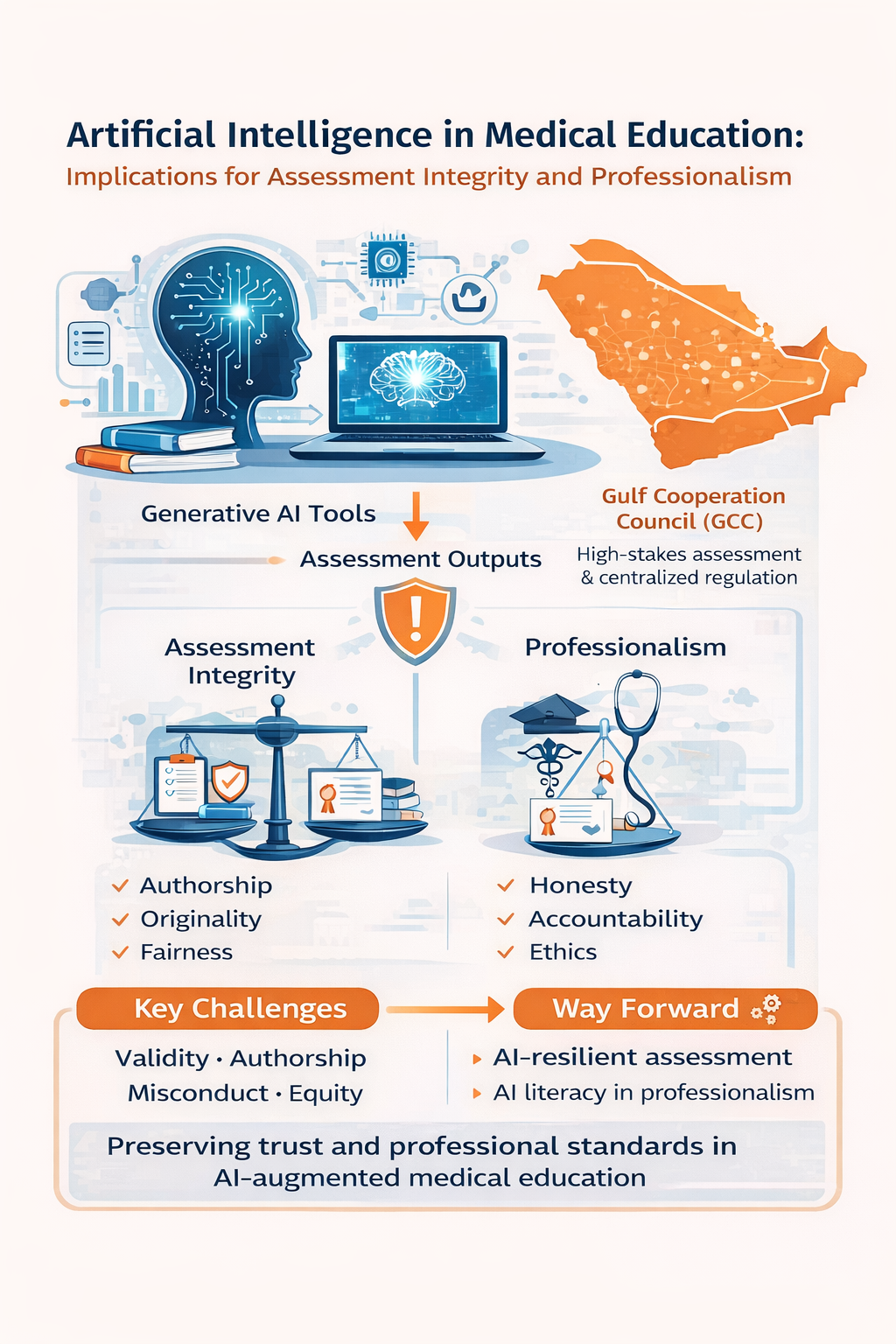
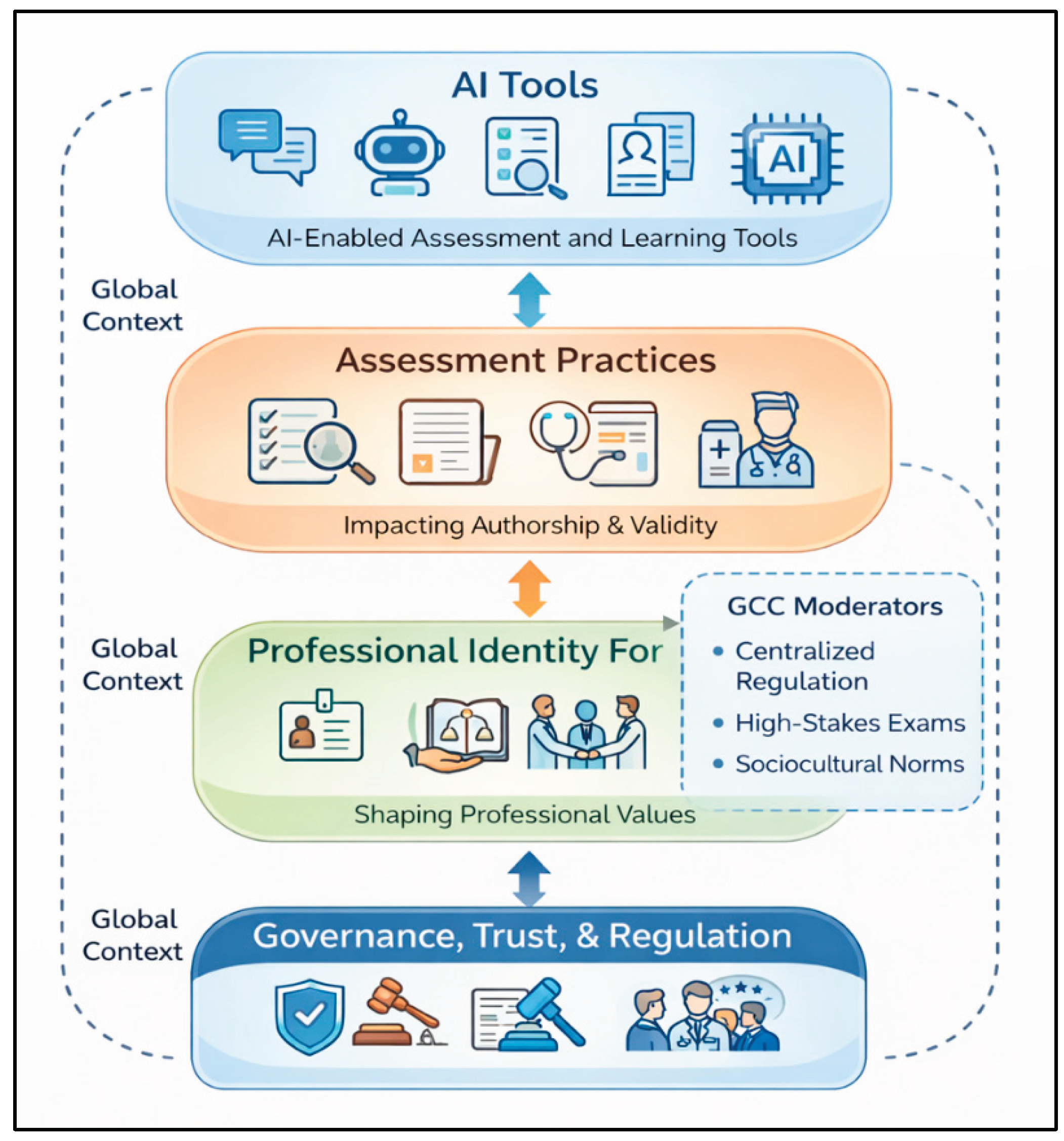
Artificial intelligence (AI), particularly generative AI, is rapidly reshaping medical education worldwide. While AI-enabled tools offer significant opportunities for personalized learning, feedback automation, and clinical reasoning support, they simultaneously challenge foundational principles of assessment integrity and professional conduct. Traditional assessment models—largely predicated on individual authorship, knowledge recall, and observable performance are increasingly strained by AI systems capable of generating sophisticated responses, analyses, and clinical narratives. This disruption has prompted urgent reconsideration of what constitutes academic honesty, valid assessment, and professional identity formation in contemporary medical training. This article critically examines the intersection of AI, assessment integrity, and professionalism in medical education from a global perspective, with particular attention to the experiences and emerging lessons from the Gulf Cooperation Council (GCC). The GCC provides a distinctive context characterized by rapid digital transformation, centralized accreditation and licensing systems, high-stakes assessments, and strong sociocultural norms governing professional behavior. These features make the region an instructive case for understanding how medical education systems respond to AI-driven challenges at scale. Drawing on international literature, policy documents, and regional practices, this paper argues that AI should be understood not merely as a technological tool but as a normative disruptor that compels a re-examination of assessment validity, ethical responsibility, and professional identity. The article proposes a shift from reactive prohibition toward principled integration of AI within assessment and professionalism frameworks. It concludes by outlining future-oriented recommendations for educators, institutions, and regulators aimed at preserving trust, fairness, and professional standards in an AI-augmented educational landscape.
Keywords:
1. Introduction
2. Artificial Intelligence and the Transformation of Assessment
2.1. From Knowledge Testing to AI-Mediated Performance
2.2. Assessment Validity and Reliability in the Age of AI
2.3. Authorship, Originality, and the Crisis of Attribution
2.4. Reframing Academic Misconduct Beyond Binary Models
2.5. Assessment Redesign for AI-Resilient Validity
2.6. Assessment Integrity as a Moral Signal
3. Professionalism and Ethical Identity in the Age of Artificial Intelligence
3.1. Professionalism as a Moral Practice in Medical Education
3.2. Digital Professionalism and the Expansion of Ethical Domains
3.3. Professionalism, Assessment, and Ethical Drift
3.4. The Hidden Curriculum in AI-Augmented Learning Environments
3.5. Trust, Supervision, and Accountability in the AI Era
3.6. Regional and Global Perspectives on Professionalism and AI
4. Global Responses: Policies, Frameworks, and Persistent Gaps
4.1. Institutional Responses to Generative AI in Medical Education
4.2. Accreditation Bodies, Regulators, and Licensing Authorities
4.3. National and International Policy Guidance
4.4. Faculty Preparedness and Capacity Gaps
4.5. Equity, Access, and Global Disparities
4.6. Toward Assessment Resilience Rather than Control
5. Gulf Cooperation Council Perspectives and Lessons
5.1. Rapid Digital Transformation and Medical Education Reform in the GCC
5.2. Centralized Accreditation, Licensing, and High-Stakes Assessment
5.3. Sociocultural Context and Professional Expectations
5.4. Evidence from the Region: Opportunities and Gaps
5.5. Transferable Lessons from the GCC Experience
6. Future Directions and Recommendations
7. Conclusion
Funding
Acknowledgments
Conflicts of Interest
References
- Topol, E.J. High-performance medicine: The convergence of human and artificial intelligence. Nat. Med. 2019, 25, 44–56. [Google Scholar] [CrossRef]
- Masters, K. Artificial intelligence in medical education. Med. Teach. 2019, 41, 976–980. [Google Scholar] [CrossRef]
- Weidener, L.; Fischer, M. Artificial Intelligence Teaching as Part of Medical Education: Qualitative Analysis of Expert Interviews. JMIR Med Educ. 2023, 9, e46428. [Google Scholar] [CrossRef] [PubMed]
- Bearman, M.; Ajjawi, R. Avoiding the dangers of generative AI in assessment. Med. Educ. 2023, 57, 623–625. [Google Scholar]
- Shoja, M.M.; Van de Ridder, J.M.M.; Rajput, V. The Emerging Role of Generative Artificial Intelligence in Medical Education, Research, and Practice. Cureus 2023, 15, e40883. [Google Scholar] [CrossRef] [PubMed]
- Bittle, K.; El-Gayar, O. Generative AI and Academic Integrity in Higher Education: A Systematic Review and Research Agenda. Information 2025, 16, 296. [Google Scholar] [CrossRef]
- Al-Hanawi, M.K.; Khan, S.A.; Al-Borie, H.M. Healthcare human resource development in Saudi Arabia: emerging challenges and opportunities-a critical review. Public Health Rev. 2019, 40, 1. [Google Scholar] [CrossRef]
- Al-Eraky, M.M.; Donkers, J.; Wajid, G.; van Merrienboer, J.J. A Delphi study of medical professionalism in Arabian countries: the Four-Gates model. Med Teach. 2014, 36 Suppl 1, S8–S16. [Google Scholar] [CrossRef]
- Norcini, J.; Anderson, B.; Bollela, V.; Burch, V.; Costa, M.J.; Duvivier, R.; Hays, R.; Kent, A.; Perrott, V.; Roberts, T.; et al. Criteria for good assessment. Med. Teach. 2011, 33, 206–214. [Google Scholar] [CrossRef]
- Fernández Cerero, J.; Montenegro Rueda, M.; Román Graván, P.; Fernández Batanero, J.M. ChatGPT as a Digital Tool in the Transformation of Digital Teaching Competence: A Systematic Review. Technologies 2025, 13, 205–230. [Google Scholar] [CrossRef]
- Start from here.
- Bretag, T.; Harper, R.; Burton, M.; Ellis, C.; Newton, P.; Rozenberg, P.; Saddiqui, S.; van Haeringen, K. Contract cheating and assessment design. Stud. High. Educ. 2019, 44, 123–136. [Google Scholar]
- Kulgemeyer, C.; Riese, J.; Vogelsang, C.; et al. How authenticity impacts validity: Developing a model of teacher education assessment and exploring the effects of the digitisation of assessment methods. Z Erziehwiss. Published online. 7 June 2023. [CrossRef]
- Torre, D.M.; Schuwirth, L.W.T.; Van der Vleuten, C.P.M. Theoretical considerations on programmatic assessment. Medical Teacher, 2020, 42(2), 213-220.Systematic Review. Technologies 2025, 13, 205-230.
- Cotton, D.R.E.; Cotton, P.A.; Shipway, J.R. Chatting and cheating: Ensuring academic integrity in the era of ChatGPT. Innovations in Education and Teaching International 202461, 2, 228239. [Google Scholar] [CrossRef]
- Ginsburg, S.; McIlroy, J.; Oulanova, O.; Eva, K.; Regehr, G. Toward authentic clinical evaluation: pitfalls in the pursuit of competency. Acad Med. 2010, 85, 780–786. [Google Scholar] [CrossRef] [PubMed]
- Lowe, M.; Kerridge, I.H.; McPhee, J.; Fairfull-Smith, H. A question of competence. Age Ageing 2000, 29, 179–182. [Google Scholar] [CrossRef] [PubMed]
- UNESCO Guidance on Generative Artificial Intelligence in Education and Research; UNESCO: Paris, France, 2025.
- Goodwin, A.M.; Oliver, S.W.; McInnes, I.; Millar, K.F.; Collins, K.; Paton, C. Professionalism in medical education: the state of the art. Int J Med Educ. 2024, 15, 44–47. [Google Scholar] [CrossRef]
- Lawrence, C.; Mhlaba, T.; Stewart, K.A.; Moletsane, R.; Gaede, B.; Moshabela, M. The Hidden Curricula of Medical Education: A Scoping Review. Acad Med. 2018, 93, 648–656. [Google Scholar] [CrossRef] [PubMed]
- Lempp, H.; Seale, C. The hidden curriculum in undergraduate medical education: qualitative study of medical students' perceptions of teaching. BMJ. 2004, 329, 770–773. [Google Scholar] [CrossRef]
- Polin BA, Kay A. Academic integrity revisited: A longitudinal perspective. Nurse Educ Pract. 2022;65:103475. Cruess, R.L.; Cruess, S.R. Teaching professionalism. Acad. Med. 2014, 89, 1447-1453.
- Wald, H.S. Professional identity (trans)formation in medical education: reflection, relationship, resilience. Acad Med. 2015, 90, 701–706. [Google Scholar] [CrossRef]
- Monrouxe, L.V. Identity, identification and medical education: why should we care? Med Educ. 2010, 44, 40–49. [Google Scholar] [CrossRef]
- Eaton, S.E. Postplagiarism: transdisciplinary ethics and integrity in the age of artificial intelligence and neurotechnology. Int J Educ Integr 2023, 19, 23. [Google Scholar] [CrossRef]
- Jurāne-Brēmane, A. Developing Pedagogical Principles for Digital Assessment. Education Sciences 2024, 14, 1067. [Google Scholar] [CrossRef]
- Saroha, S. Artificial Intelligence in Medical Education: Promise, Pitfalls, and Practical Pathways. Adv Med Educ Pract. 2025, 16, 1039–1046. [Google Scholar] [CrossRef]
- Mir, M.M.; Mir, G.M.; Raina, N.T.; Mir, S.M.; Mir, S.M.; Miskeen, E.; Alharthi, M.H.; et al. Application of artificial intelligence in medical education: Current scenario and future perspectives. J. Adv. Med. Educ. Prof. 2023, 11(3), 133–141. [Google Scholar] [PubMed]
- World Health Organization. Ethics and governance of artificial intelligence for health: Guidance on large multi-modal models; WHO: Geneva, Switzerland, 2025. [Google Scholar]
- Thurzo, A. Provable AI Ethics and Explainability in Medical and Educational AI Agents: Trustworthy Ethical Firewall. Electronics 2025, 14, 1294. [Google Scholar] [CrossRef]
- Weidener, L.; Fischer, M. Teaching AI Ethics in Medical Education: A Scoping Review of Current Literature and Practices. Perspect Med Educ. 2023, 12, 399–410. [Google Scholar] [CrossRef] [PubMed]
- World Federation for Medical Education (WFME). Global Standards for Quality Improvement; WFME: Copenhagen, Denmark, 2020. [Google Scholar]
- Tekian, A.; Hodges, B.D.; Roberts, T.E.; Schuwirth, L.; Norcini, J. Assessing competencies using milestones along the way. Med Teach. 2015, 37, 399–402. [Google Scholar] [CrossRef]
- Blanco, M.A.; Nelson, S.W.; Ramesh, S.; et al. Integrating artificial intelligence into medical education: a roadmap informed by a survey of faculty and students. Med Educ Online 2025, 30, 2531177. [Google Scholar] [CrossRef]
- Al Zahrani, E.M.; Elsafi, S.H.; Al Musallam, L.D.; et al. Faculty perspectives on artificial intelligence's adoption in the health sciences education: a multicentre survey. Front Med (Lausanne) 2025, 12, 1663741. [Google Scholar] [CrossRef]
- Frenk, J.; Chen, L.; Bhutta, Z.A.; et al. Health professionals for a new century: transforming education to strengthen health systems in an interdependent world. Lancet 2010, 376, 1923–1958. [Google Scholar] [CrossRef] [PubMed]
- Sova, R.; Tudor, C.; Tartavulea, C.V.; Dieaconescu, R.I. Artificial Intelligence Tool Adoption in Higher Education: A Structural Equation Modeling Approach to Understanding Impact Factors among Economics Students. Electronics 2024, 13, 3632. [Google Scholar] [CrossRef]
- Capraro, V.; Lentsch, A.; Acemoglu, D.; et al. The impact of generative artificial intelligence on socioeconomic inequalities and policy making. PNAS Nexus 2024, 3, 191. [Google Scholar] [CrossRef]
- Saudi Commission for Health Specialties. Professional Classification and Registration Manual; SCFHS: Riyadh, Saudi Arabia, 2021. [Google Scholar]
- AlRukban, M.; Alajlan, F.; Alnasser, A.; Almousa, H.; Alzomia, S.; Almushawah, A. Teaching medical ethics and medical professionalism.
- Restini, C.; Faner, M.; Miglio, M.; Bazzi, L.; Singhal, N. Impact of COVID-19 on Medical Education: A Narrative Review of Reports from Selected Countries. J Med Educ Curric Dev. 2023, 10, 23821205231218122. [Google Scholar] [CrossRef] [PubMed]
- Khalil, R.; Mansour, A.E.; Fadda, W.A.; et al. The sudden transition to synchronized online learning during the COVID-19 pandemic in Saudi Arabia: a qualitative study exploring medical students' perspectives. BMC Med Educ. 2020, 20, 285. [Google Scholar] [CrossRef] [PubMed]
- Al-Muhanna, F.A.; Subbaroa, V.V. Standards in medical education and gcc countries. J Family Community Med. 2003, 10, 15–17. [Google Scholar] [CrossRef] [PubMed]
- Garzón, J.; Patiño, E.; Marulanda, C. Systematic Review of Artificial Intelligence in Education: Trends, Benefits, and Challenges. Multimodal Technol. Interact. 2025, 9, 84. [Google Scholar] [CrossRef]
- Forouzadeh, M.; Kiani, M.; Bazmi, S. Professionalism and its role in the formation of medical professional identity. Med J Islam Repub Iran. 2018, 32, 130. [Google Scholar] [CrossRef]
- Al-Zidjali, L.M.; Chiang, K.H.; Macleod, H. Perception and experiences of senior doctors involved in clincal teaching for Oman's medical education sector. BMC Med Educ. 2025, 25, 1446. [Google Scholar] [CrossRef] [PubMed]
- Alsahafi, Z.; Baashar, A. Knowledge, Attitudes, and Practices Related to Artificial Intelligence Among Medical Students and Academics in Saudi Arabia: A Systematic Review. Cureus 2025, 17, e83437. [Google Scholar] [CrossRef] [PubMed]
- Salem, M.A.; Zakaria, O.M.; Aldoughan, E.A.; Khalil, Z.A.; Zakaria, H.M. Bridging the AI Gap in Medical Education: A Study of Competency, Readiness, and Ethical Perspectives in Developing Nations. Computers 2025, 14, 238. [Google Scholar] [CrossRef]

| Domain | Traditional Assumptions in Medical Education | Disruption Introduced by Artificial Intelligence | Implications for Assessment Integrity | Implications for Professionalism | Illustrative GCC-Specific Considerations |
| Authorship & Knowledge Production | Learner-generated work reflects individual effort and understanding | AI generates sophisticated, context-aware responses and narratives | Difficulty verifying originality and competence; weakened construct validity | Challenges honesty, transparency, and accountability | High-stakes assessments amplify consequences of misattributed authorship |
| Assessment Design | Written exams, essays, and reflections signal competence | AI substitutes for reasoning and expression in unsupervised tasks | Increased construct-irrelevant variance; reduced interpretability | Incentivizes performance over integrity if misaligned | Need for alignment with centralized licensure and accreditation standards |
| Validity & Reliability | Scores reflect stable, comparable measures of competence | Unequal AI access and use introduce systematic bias | Threats to fairness, comparability, and defensibility | Erosion of trust in assessment outcomes | Central regulators can coordinate region-wide standards |
| Academic Integrity Frameworks | Misconduct defined as plagiarism or unauthorized collaboration | AI blurs boundaries between assistance and misrepresentation | Binary cheating models become inadequate | Ethical ambiguity may normalize covert misuse | Cultural reluctance to challenge authority may inhibit disclosure |
| Professional Identity Formation | Moral reasoning develops through authentic struggle and reflection | AI shortcuts reduce engagement with uncertainty and responsibility | Assessment fails to capture ethical development | Risk of superficial professionalism and weakened moral agency | Strong normative expectations can support ethical framing if explicit |
| Faculty Role & Supervision | Educators design, judge, and model professional behavior | Faculty vary in AI literacy and ethical confidence | Inconsistent assessment practices and enforcement | Mixed messages contribute to hidden curriculum | Faculty development critical in rapidly expanding institutions |
| Governance & Regulation | Institutional policies guide assessment and conduct | AI adoption outpaces policy development | Fragmented or reactive governance responses | Professional standards may lag behind practice | Centralized governance enables coordinated guidance |
| Equity & Access | Assessment assumes relatively equal resources | Differential AI access advantages some learners | Widening inequities and unfair outcomes | Professional fairness and justice at risk | Variability across public/private institutions |
| Public Trust & Accountability | Medical qualifications signal competence and integrity | AI-mediated assessment weakens public assurance | Threats to legitimacy of certification and licensure | Social contract between profession and society strained | High public expectations heighten accountability pressures |
Disclaimer/Publisher’s Note: The statements, opinions and data contained in all publications are solely those of the individual author(s) and contributor(s) and not of MDPI and/or the editor(s). MDPI and/or the editor(s) disclaim responsibility for any injury to people or property resulting from any ideas, methods, instructions or products referred to in the content. |
© 2026 by the authors. Licensee MDPI, Basel, Switzerland. This article is an open access article distributed under the terms and conditions of the Creative Commons Attribution (CC BY) license (http://creativecommons.org/licenses/by/4.0/).


