
Submitted:
04 February 2026
Posted:
05 February 2026
You are already at the latest version
Abstract
Background: Autobiographical memory undergoes qualitative changes across the lifespan, influencing self-understanding, emotional regulation, and psychological adaptation. Research shows memory is a dynamic process, reconstructed through retrieval, narration, and social interaction. How narrative construction and empathic engagement shape memory reconsolidation and self-continuity remains insufficiently integrated. Objectives: This narrative review synthesizes theoretical, empirical, and applied findings on autobiographical memory, narrative processes, and empathy, proposing an integrative model linking memory reconsolidation, identity reconstruction, and adaptive functioning. Methods: A theory-oriented narrative review was conducted across psychology, neuroscience, gerontology, and narrative research, drawing on literature from PubMed, PsycINFO, Web of Science, Scopus, J-STAGE, and CiNii. Peer-reviewed empirical studies, systematic reviews, and theoretical papers were organized around four domains: (1) autobiographical memory and the self, (2) neurobiological mechanisms of emotion and reconsolidation, (3) narrative construction and empathic social interaction, and (4) evidence from narrative-based and creative interventions. Results: Reviewed literature indicates autobiographical memory functions as a plastic, socially embedded system supporting self-continuity. Narrativization within empathically responsive and psychologically safe contexts enhances narrative coherence, emotional integration, and perspective-taking, promoting psychological stability. Creative narrative activities further facilitate retrieval and meaning reconstruction, extending memory updating beyond recall. Conclusions: We propose an empathy-mediated narrative reconstruction model in which creative activity, narration, empathic response, and retelling interact cyclically to support memory reconsolidation and self-narrative updating. By integrating cognitive, social, and creative dimensions, this model provides a theoretical framework with implications for clinical, educational, gerontological, and creative applications.
Keywords:
autobiographical memory
; narrative reconstruction
; empathy
; memory reconsolidation
; self-narrative
; social cognition
; aging
; narrative intervention
; creative storytelling
1. Introduction
With advancing age, the ways in which autobiographical memories and everyday events are recalled change, influencing self-understanding, emotional regulation, and psychological adaptation. Understanding these changes is crucial not only for promoting psychological well-being in older adults but also for designing effective interventions that support identity continuity and life satisfaction. Memory is not a fixed trace; rather, it is a dynamic process that is continually updated in accordance with current emotional states, social contexts, and self-concepts [1,2]. Research in both animals and humans has shown that memories can become temporarily labile upon retrieval and, through reconsolidation, acquire new meanings [3,4]. Autobiographical memory is therefore not merely a repository of past events but a psychological construct that underpins the sense of “who one is” and how the present self has been formed [5]. Consequently, age-related or stress-related changes in memory may affect not only the quantity or accuracy of remembered information but also the sense of self-continuity and the processes through which meaning is constructed.
Recent studies suggest that what is critical for psychological adaptation and self-integration is not simply the amount of memory retained, but how memories are organized into coherent, causally connected narratives [6]. Memories associated with intense emotion may resist integration, leading to fragmented or poorly contextualized recollections [7]. Narratives provide a framework that situates events along temporal axes, assigns causal relationships, and ascribes meaning. Both clinical approaches, such as narrative therapy and reminiscence therapy, and non-clinical activities, including creative practices, expressive writing, and life review exercises, have been shown to influence memory retrieval and emotional transformation through narrative expression [8]. These interventions facilitate autobiographical reasoning, enhance temporal and causal coherence, and contribute to the reconstruction of a stable and adaptive self-concept.
Importantly, narrative processes are inherently social. Memories and self-evaluations are continually updated through interactions with others, particularly when the narrator experiences understanding and empathic engagement. This social dimension highlights that self-continuity and psychological adaptation are not solely intrapersonal phenomena but emerge through relational processes in which listeners’ responses shape the content, structure, and meaning of recalled experiences. Empathy, in particular, functions as a psychosocial and emotional regulatory condition that supports the reintegration of fragmented memories, reduces defensive responses, and enables reinterpretation of emotionally salient events.
While narrative interventions have long been employed in psychotherapy, gerontology, and educational contexts to facilitate autobiographical memory integration, identity reconstruction, and psychological adaptation, these approaches have traditionally emphasized the act of retelling or creative expression without systematically incorporating the listener’s empathic engagement as an explicit mediating factor. In contrast, the present review focuses on empathy-mediated narrative interventions, in which empathic responses from listeners are deliberately positioned as a core mechanism that supports memory reconsolidation, meaning-making, and self-narrative updating. By highlighting the social and interpersonal conditions that enhance narrative reconstruction, this framework extends existing approaches, providing a theoretical and practical basis for understanding how empathy functions not merely as a supportive background but as an active facilitator of autobiographical memory reintegration.
Based on these considerations, the present review is structured around the hypothesis that empathically grounded narrative practices update the meaning of autobiographical memories and help reconstruct a sense of self-continuity that becomes increasingly fragile with age or psychological stress. The aim is to clarify how retelling is not merely a reproduction of the past but a generative practice that reconnects the present self with the past and future selves, and to examine its potential applications in clinical, educational, and creative workshop settings.
This review therefore examines how empathically grounded narrative practices shape memory reconstruction and self-continuity across contexts.
2. Methods: Literature Selection and Analytical Framework
2.1. Review Design and Scope
This review was conducted as a theory-oriented narrative review aimed at organizing and integrating conceptual frameworks related to the reconstruction of autobiographical memory through narrative processes within empathically mediated social contexts.
Rather than quantitatively aggregating effect sizes or conducting a formal quality appraisal, the primary objective was to synthesize interdisciplinary theoretical perspectives and empirical findings across psychology, neuroscience, psychotherapy, gerontology, and social cognition, in order to develop an integrative explanatory model of empathy-mediated narrative reconstruction.
Accordingly, this review follows established methodological principles for narrative and conceptual reviews, emphasizing theoretical relevance, conceptual clarity, and cross-disciplinary coherence, rather than exhaustive literature coverage or formal risk-of-bias assessment procedures required for systematic reviews.
2.2. Literature Search Strategy
Literature searches were conducted across major international academic databases, including PubMed, PsycINFO, Web of Science, and Scopus, to identify peer-reviewed literature in psychology, neuroscience, and related disciplines.
To ensure comprehensive coverage of relevant scholarship published in Japanese, J-STAGE and CiNii were additionally searched.
Search terms were combined using Boolean operators and included variations of the following keywords:
“narrative,” “autobiographical memory,” “memory reconsolidation,” “empathy,” “social interaction,” “retrieval,” “meaning-making,” “expressive writing,” “reminiscence,” and “life review.”
Google Scholar was used as a supplementary source to identify additional relevant publications, trace citation networks, and screen reference lists of key articles, rather than as a primary database. Reference lists of influential theoretical papers and relevant reviews were also manually examined to identify seminal works not captured through database searches.
2.3. Inclusion Criteria
Studies were eligible for inclusion if they addressed at least two of the following three conceptual domains as central analytical components, rather than as peripheral or metaphorical references:
- Narrative construction or narrative practices, including autobiographical narration, life review, expressive writing, storytelling, or narrative identity formation
- Autobiographical or emotionally salient memory processes, such as episodic memory, emotional memory, reconsolidation, or memory updating
- Empathy or socially mediated processes, including interpersonal interaction, social cognition, empathic engagement, or listener–speaker dynamics
Both theoretical and empirical studies were included, encompassing experimental research, neuroimaging studies, qualitative analyses, intervention studies, and relevant narrative or conceptual reviews.
Priority was given to peer-reviewed publications from 2010 onward to reflect recent theoretical developments and methodological advances. However, foundational theoretical and empirical works published prior to 2010 were intentionally retained when they served as essential conceptual anchors for contemporary models of autobiographical memory, narrative identity, reminiscence, or life review (e.g., self-memory system frameworks and narrative gerontology).
2.4. Exclusion Criteria
Studies were excluded if they met any of the following criteria:
- Research on memory that did not address narrative generation, narrative organization, or meaning-making processes, or that employed the concept of “narrative” solely in a metaphorical or descriptive manner without analytical relevance
- Case reports or single-case studies lacking sufficient theoretical grounding or broader conceptual implications
- Publications for which full-text access was unavailable, preventing adequate evaluation of methodological rigor or theoretical contribution
In addition, purely technical studies focusing exclusively on memory performance without consideration of subjective experience, social context, or narrative integration were excluded.
2.5. Analytical Approach
Selected studies were analyzed using a thematic and conceptual synthesis approach.
Rather than categorizing findings solely by methodological design, studies were organized according to their contribution to understanding:
- The destabilization and updating of autobiographical memory
- The role of narrative coherence and autobiographical reasoning
- The function of empathy and social interaction in memory recall and re-narration
Through this integrative process, recurrent conceptual linkages across disciplines were identified. These linkages form the theoretical foundation for the empathy-mediated narrative reconstruction model proposed in subsequent sections.
3. Autobiographical Memory and Narrative Reconstruction
Autobiographical memory is not necessarily retained in the form in which experiences originally occurred; rather, during retrieval, memories are selectively accessed and reorganized in accordance with the individual’s current psychological state and social context [5]. Through this reconstructive process, memories are transformed from fragmented episodes into narratives that integrate temporal order, causal relationships, and emotional meaning. Such narrativization serves the function of assigning meaning to personal experiences and enhancing an individual’s understanding of their life as a whole, as well as their outlook for the future [8].
Based on this perspective, interventions such as narrative therapy and reminiscence therapy have been implemented to promote psychological stability and the formation of a positive self-image through the retelling of past experiences [9]. More recently, research in psychology and gerontology has proposed integrative approaches that combine narrative and reminiscence, suggesting that reconstructing one’s life as a coherent story and reinterpreting the meaning of past events may enhance a subjective sense of life meaning and self-integration [10].
3.1. Autobiographical Memory and the Self
Autobiographical memory is a core psychological function that integrates personal experiences temporally and meaningfully, thereby supporting self-understanding. Theoretical and clinical research has demonstrated that autobiographical memory is not merely a repository of events but plays an active role in forming and reorganizing the self-concept through narrative structure and coherence [5]. Accordingly, memory is best understood not as static information that is retrieved intact, but as a dynamic process that is continually updated through retelling.
From a neuroscientific standpoint, retrieved memories are known to become temporarily labile and subsequently undergo reconsolidation. This process requires new protein synthesis and depends on several boundary conditions, including retrieval duration, memory strength, and the time elapsed since encoding [1,2,4,11]. These findings support the notion that autobiographical memory reconstruction is sensitive to psychosocial contexts and internal states.
Furthermore, by placing events in temporal sequence and incorporating the narrator’s perspective and evaluations, fragmented sensory traces are transformed into “narrated experiences” [12]. Because narration presupposes an audience and a social background, autobiographical memory is reorganized not only as a personal experience but also as a socially situated representation.
3.2. Narrative and Meaning-Making
In psychotherapy and narrative research, narrative structure and coherence have repeatedly been shown to contribute to psychological recovery and self-understanding [5]. Empirical studies further indicate that narrative coherence is more strongly associated with psychological adaptation than quantitative indices such as recall frequency or level of detail [13]. These findings suggest that narrative functions as a cognitive framework that provides causality, coherence, and meaning to otherwise fragmented memory experiences.
Narrative generation is not confined to intrapersonal cognition but is co-constructed through interaction with listeners [14]. This co-construction model explains how empathic responses from listeners influence narrative content, self-evaluation, and emotional appraisal.
Moreover, higher narrative coherence has been associated with a greater likelihood of receiving supportive and affirming social responses, which may contribute to short-term emotional recovery and stress reduction [15]. In line with this view, theoretical models have conceptualized autobiographical memory as a “distributed autobiographical memory system,” shared and reconstructed through interpersonal interaction [16]. From this perspective, meaning-making and self-understanding are inseparable from social context, and narrative coherence emerges through relational processes rather than solely within the individual.
3.3. Emotional Memory and Reactivation
Emotionally charged events are more readily recalled, and emotional responses are reactivated each time such memories are retrieved. Research has shown that emotional memories can be transformed depending on the mode of expression and retrieval context, with narrativization providing a critical opportunity for updating emotional meaning [17]. This body of work supports the idea that reflective or creative narration can influence both memory content and emotional appraisal.
Neuroscientific studies have demonstrated that negative emotional states selectively impair the integration of associative memory, even when individual sensory elements are strongly retained [7,18]. This pattern is consistent with clinical observations of traumatic memory, in which sensory fragments persist while temporal and semantic integration remains limited.
From a reconsolidation perspective, memories that enter a plastic state during retrieval are strongly influenced by emotional states and contextual information present at that time. Negative emotions have been suggested to hinder the reintegration of contextual and relational information, indicating that memory-related difficulties reflect not only memory strength but also the structural form in which memories are reconsolidated [7].
Within this framework, empathic and psychologically safe interpersonal contexts are thought to reduce emotional hyperarousal and facilitate the reintegration of associative memory networks. Empathy thus functions not only as a psychosocial factor but also as an emotional regulatory condition that supports memory reconsolidation. The empathy-mediated narrative intervention model proposed in this review is consistent with these neuroscientific findings, illustrating how narrative and empathy operate as interrelated mechanisms supporting memory reintegration.
Finally, narrativization of autobiographical memory is always embedded in social contexts. Narrators implicitly anticipate the presence and reactions of listeners when selecting, sequencing, and interpreting events. Memory reconstruction can therefore be understood as a dynamic process shaped by both intrapersonal cognitive operations and interpersonal conditions.
The following section elaborates on how empathy, as a specific form of social interaction, contributes to narrative generation and memory reintegration.
4. Empathy and Social Interaction in Narrative Processes
The narrativization of memory is not a process completed solely within the individual. Rather, narrators continually select, sequence, and interpret events while anticipating the presence and responses of listeners. Experiences of being understood and empathized with during narration have been shown to promote internally focused cognitive processing, while simultaneously updating the narrator’s evaluation of events and self-positioning. Through this process, memory is re-signified, contributing to the stabilization or transformation of self-narratives [19]. Empathy can therefore be conceptualized as a social condition that mediates emotional reactivation and meaning-making during narrative reconstruction.
From a neuroscientific perspective, this social dimension is further supported by findings on the default mode network, which is activated during autobiographical memory retrieval, future simulation, and perspective-taking, including imagining others’ mental states [20]. These overlapping activation patterns suggest that narrative processing and empathy share common neural substrates. Moreover, memories that become destabilized through retrieval and narrativization may undergo reconsolidation more effectively when embedded in supportive social contexts and accompanied by empathic responses [11]. Together, these findings provide a neuroscientific bridge between the reconsolidation processes discussed in Section 3 and social interaction.
4.1. Narration as an Act Directed Toward Others
Narrative storytelling is fundamentally a social act that presupposes an actual or imagined listener. According to the co-construction model, narrators select events, assign causal relations, and incorporate evaluative perspectives while anticipating listeners’ reactions, thereby adapting narratives to interpersonal contexts [14,21]. Memory is thus not merely reproduced but reorganized in a socially meaningful form.
Within this process, empathy functions not only as emotional support but also as metacognitive feedback, signaling that one’s experience is understandable and legitimate to others. Such feedback facilitates the reevaluation of events and the updating of self-positioning, contributing to the formation of more integrated and coherent self-narratives.
4.2. Empathic Responses and Narrative Structure
Empathic responses involve understanding and accepting another person’s emotions and perspectives. Neuroscientific studies have demonstrated neural alignment between speakers and listeners during storytelling, with listeners’ brain activity becoming temporally synchronized with the speaker’s preceding neural states [22]. This neural coupling suggests that narrative meaning is dynamically aligned and adjusted through interpersonal interaction.
Consistent with these findings, psychological research indicates that empathic, affirming, and attentive responses from listeners directly influence narrative coherence and emotional appraisal [23]. Experimental studies have shown that under empathic listening conditions, narratives become more causally integrated and meaningfully organized. These results suggest that empathy does not simply strengthen memory content quantitatively, but instead functions as a regulatory factor that promotes structural reorganization of self-narratives.
Theoretical perspectives conceptualizing autobiographical memory as a “distributed autobiographical memory system” reconstructed through interaction with others provide an integrative framework for these observations [16]. From this viewpoint, memory is transformed through narration and temporarily stabilized through empathic engagement, highlighting its cyclical and dynamic nature. This perspective also underpins the intervention studies discussed in later sections.
4.3. Social Feedback and Self-Reconstruction
The narrativization of autobiographical memory develops from early childhood through adolescence and is shaped by parent–child conversations and culturally shared life scripts [24,25]. This developmental trajectory indicates that narrative construction is not only an intrapersonal cognitive process but also a socially and culturally embedded one.
Social feedback to narratives plays a crucial role in updating self-understanding. In educational contexts, evaluative and emotional responses from listeners have been shown to alter narrators’ self-narratives and motivation [19]. These findings suggest that narrative construction operates as a cyclical process involving the individual, others, and broader social contexts, with empathy functioning as a catalyst that drives this dynamic system.
4.4. Empathy as a Social Condition for Memory Reconstruction
Taken together, these findings indicate that memory retrieval and narrative construction are inherently social processes shaped by listeners’ presence and empathic responses. Empathy mediates emotional reactivation and meaning-making, serving as a social condition that supports the stabilization or transformation of self-narratives.
Behavioral, electrophysiological, and functional magnetic resonance imaging studies have further demonstrated that autobiographical memory is more strongly engaged during empathy-related tasks than during non-autobiographical memory processing. Evidence of autobiographical memory reactivation within empathy-related neural networks—including the anterior cingulate cortex, parietal regions, and prefrontal cortex—provides strong support for a neural linkage between empathy and memory reconstruction [26].
Accordingly, empathy can be understood not merely as an interpersonal attitude, but as a social and neurobiological condition that guides memory reconsolidation and self-reconstruction. Considered alongside the findings on memory plasticity discussed in Section 3, empathy emerges as a psychosocial context that is firmly grounded in neuroscientific evidence and that facilitates adaptive memory reconstruction.
In summary, narrativization of autobiographical memory is a dynamic process shaped by empathically mediated social interaction. Through understanding and responses from listeners, narrators update their evaluations of events and self-narratives, thereby promoting memory reintegration.
The following section examines how creative narrative activities and narrative interventions, grounded in these social and empathic conditions, influence autobiographical memory reconstruction and psychological well-being.
5. Creative Practices and Narrative-Based Interventions
As discussed in the previous sections, the narrativization of autobiographical memory is a dynamic process shaped by empathically mediated social interaction. Through listeners’ understanding and responses, narrators update their evaluations of past events and self-narratives, facilitating memory reintegration. Building on this framework, the present section examines how creative narrative activities and narrative-based interventions influence autobiographical memory reconstruction and psychological well-being.
The creation of new narratives can act as a catalyst for recalling fragments of autobiographical memory that were previously inaccessible. These fragments are gradually organized through narration and social sharing, acquiring temporal order and meaningful coherence via empathic engagement and social feedback. Accumulating empirical evidence from narrative interventions and systematic reviews of creative and reminiscence-based approaches indicates that this process extends beyond theoretical speculation and supports a model of memory reconstruction mediated by narrative, empathy, and social feedback. Such interventions have been associated with positive psychological outcomes, including enhanced psychological stability, self-esteem, and a sense of meaning in life [27,28].
5.1. Empirical Evidence on Autobiographical Memory and Narrative Interventions
Recent empirical studies and systematic reviews have demonstrated that narrative-based interventions exert significant effects on autobiographical memory retrieval frequency, memory specificity, and meaning reconstruction. A systematic review focusing on adults exposed to trauma or chronic stress reported that narrative interventions reduce memory fragmentation and promote temporally and causally integrated narratives [27]. These effects cannot be explained solely by emotional catharsis; rather, they reflect changes in autobiographical reasoning processes.
Autobiographical reasoning plays a central role in maintaining self-identity and psychological continuity through the construction of life stories [29]. Accordingly, interventions that support narrative organization and reinterpretation of past experiences contribute not only to emotional regulation but also to the maintenance and reorganization of self-concept.
Established approaches such as reminiscence therapy and narrative therapy have similarly reported that retelling past experiences enhances psychological stability and supports the formation of a positive self-image. Importantly, the incorporation of creative elements has been suggested to yield broader psychological and cognitive effects than traditional approaches alone, extending the scope of narrative intervention outcomes [9,10,28].
5.2. Narrative Quality and Social Responses
The effectiveness of narration depends not only on the content of memories but also on the structural quality of the narrative. Experimental studies have shown that narratives with higher coherence and clarity are more likely to elicit empathic responses and social support from listeners, which in turn enhance psychological adaptation in narrators [23]. These findings indicate that memory reconstruction is not confined to intrapersonal cognitive processes but is amplified and stabilized through interpersonal interaction.
In addition, the retrieval and retelling of positive autobiographical memories have been shown to promote self-concept and emotional recovery, contributing to the functional reconsolidation of memory through narration. However, counterproductive effects have also been reported when retelling occurs within restrictive belief systems or evaluative frameworks, underscoring the importance of narrative freedom and psychological safety in intervention contexts [30,31].
5.3. Creative and Expressive Narrative Interventions
Growing attention has been directed toward creative narrative activities and storytelling-based interventions aimed at enhancing autobiographical memory, cognitive function, and psychological well-being. Studies involving older adults, individuals with mild cognitive impairment, and those with dementia suggest that interventions incorporating creative elements yield broader benefits than reminiscence therapy alone.
Research using expressive activities such as writing, drawing, and fictional creation has demonstrated greater memory retrieval and emotional integration than simple reproduction of past events [17,32]. Creative reconstruction tasks appear to facilitate the association of retrieved memories with novel meanings, thereby promoting updates to self-narratives. Randomized controlled trials employing Creative Story Therapy have reported significant improvements in cognitive and emotional outcomes, including cognitive function, depressive symptoms, quality of life, and communication abilities, when compared with conventional care [33,34].
5.4. An Integrative Model Supported by Empirical Research
Taken together, these empirical findings support the theoretical framework presented in Section 3 and Section 4, namely, a model of autobiographical memory reconstruction mediated by narrative, empathy, and social feedback. Review studies focusing on digital narrative production have characterized digital storytelling as an intervention that simultaneously promotes memory retrieval, self-expression, and social interaction. In such contexts, the creative act itself functions as a trigger for recall while fostering narrative coherence and social feedback [35].
Furthermore, narrative interventions have been shown to enhance psychological stability and self-esteem, contributing not only to cognitive and emotional outcomes but also to broader processes of meaning-making and self-understanding across the lifespan [10,28]. Overall, these findings indicate that the effectiveness of narrative interventions depends on both how stories are constructed and how they are received, and that empathic and psychologically safe social contexts constitute a core condition for enabling memory reconstruction and the updating of self-narratives.
6. An Integrative Model: Empathy-Mediated Narrative Reconstruction
Narrative-based memory interventions are of particular relevance for populations in whom the retrieval and integration of autobiographical memory have become fragile due to aging, illness, or psychological stress. Narrative practices are not merely acts of recalling the past; rather, they provide a framework for psychological adaptation and self-understanding by reassigning meaning to lived experiences and integrating them into coherent self-narratives [27,29].
Importantly, autobiographical memory reconstruction does not occur solely through intrapersonal cognitive processes. Instead, it unfolds as a dynamic process shaped by interactions with listeners and empathic responses. Such social conditions constitute a critical prerequisite for maximizing memory reintegration, particularly in creative and intervention-based contexts.
Against this theoretical background, the present review proposes an empathy-mediated narrative reconstruction model (Figure 1). The model conceptualizes autobiographical memory reconstruction as a cyclical process involving: autobiographical memory retrieval → narrative creation → partial retelling → empathic social interaction → self-reconstruction → the emergence of new narratives and identity. While conventional retelling may support the recall of coherent narratives, highly distressing memories are often avoided or defensively suppressed, limiting therapeutic engagement. In contrast, empathy-mediated narrative contexts provide psychological safety, reduce defensive reactions, and facilitate deeper memory reconstruction.
Systematic reviews of narrative interventions for trauma-related disorders have demonstrated that retelling experiences and reassigning meaning contribute to symptom reduction and the restoration of future-oriented perspectives [27]. These findings suggest that similar mechanisms may support psychological adaptation in older adults and individuals with dementia, populations in which autobiographical memory integration is often compromised [36,37].
Creative activities such as expressive writing further support this model. Writing has been shown to modulate neural activity in reward-related and emotion-related brain regions during subsequent learning, indicating that verbalizing past experiences influences emotional processing beyond the immediate context [28]. Writing-based interventions are also effective in regulating difficult emotions among individuals with interpersonal avoidance or social inhibition, without requiring intensive face-to-face interaction [38].
Recent studies employing systematic frameworks to classify narrative elements have clarified how characteristics such as emotional vividness and plot structure influence empathic responses to narratives [39]. Empathy is shaped not only by narrative content but also by modes of narration and expression, and it plays a central role in narrative sharing and meaning-making [40]. Furthermore, discrepancies between anticipated narrative content and the outcomes of narration or creative production may function as prediction errors, thereby increasing memory plasticity and enabling reconsolidation.
6.1. Applications in Clinical Contexts: Narrative Interventions and Memory Reintegration
In clinical psychology and psychiatry, narrative therapy and narrative exposure therapy are widely used to facilitate the reintegration of traumatic memories [41,42]. These approaches emphasize temporal and causal reconstruction rather than factual accuracy, allowing fragmented memories to be reorganized and their emotional meanings updated.
Reinterpreting life events from a narrative perspective enables individuals to integrate negative experiences into a continuous sense of identity and to reframe them as part of personal growth [41]. In narrative exposure therapy, retelling experiences within a safe therapeutic context, combined with the therapist’s active engagement as an empathic listener, is thought to strengthen top-down regulation of fear memories [43].
At the same time, concerns regarding symptom exacerbation due to repeated exposure to traumatic memories highlight the importance of careful clinical judgment. Meta-analyses have demonstrated that narrative exposure therapy effectively repositions traumatic memories within temporal context, reduces intrusive symptoms, and produces sustained long-term effects [42,44]. Neurobiological findings further suggest post-intervention changes in emotional regulation, supporting the notion that the act of “telling” itself contributes to memory reconsolidation [43].
In gerontological psychology, reminiscence and life review interventions have been associated with reductions in depressive symptoms and improvements in subjective well-being [36,37]. More recently, creative reminiscence approaches have gained attention for their ability to move beyond simple recall and reconstruct past experiences as new narratives, thereby supporting identity reaffirmation [45].
6.2. Applications in Educational and Developmental Contexts
Autobiographical memory is often conceptualized as a hierarchical structure comprising self-defining memories, narrative scripts, and life stories, which together support self-coherence [46]. Through narrative integration, individual experiences are embedded within broader life stories, facilitating self-understanding and identity reconstruction.
In educational settings, reflective writing, autobiographical storytelling, and collaborative narrative activities are commonly used to support emotional regulation and self-reflection [19]. Sharing narratives with others has been shown to deepen meaning-making through empathic understanding and social feedback [23]. These findings suggest that even in non-clinical contexts, the presence of listeners and opportunities for narrative exchange play a crucial role in memory re-signification.
6.3. Workshop Design Using Creative Activities
Creative workshops incorporating fiction writing, theatrical reenactment, drawing, or collaborative production can indirectly activate autobiographical memory while minimizing the burden of direct self-disclosure. Narratives generated through such activities need not correspond precisely to factual events; emotional memories may be reorganized through imaginative transformation [47].
In these contexts, listener responses function as social scaffolding, enabling narrators to explore alternative meanings and perspectives [47]. Empirical studies integrating art-based participation and reminiscence have shown that creative expression acts as a trigger for memory retrieval and influences both autobiographical memory and emotional experience [48].
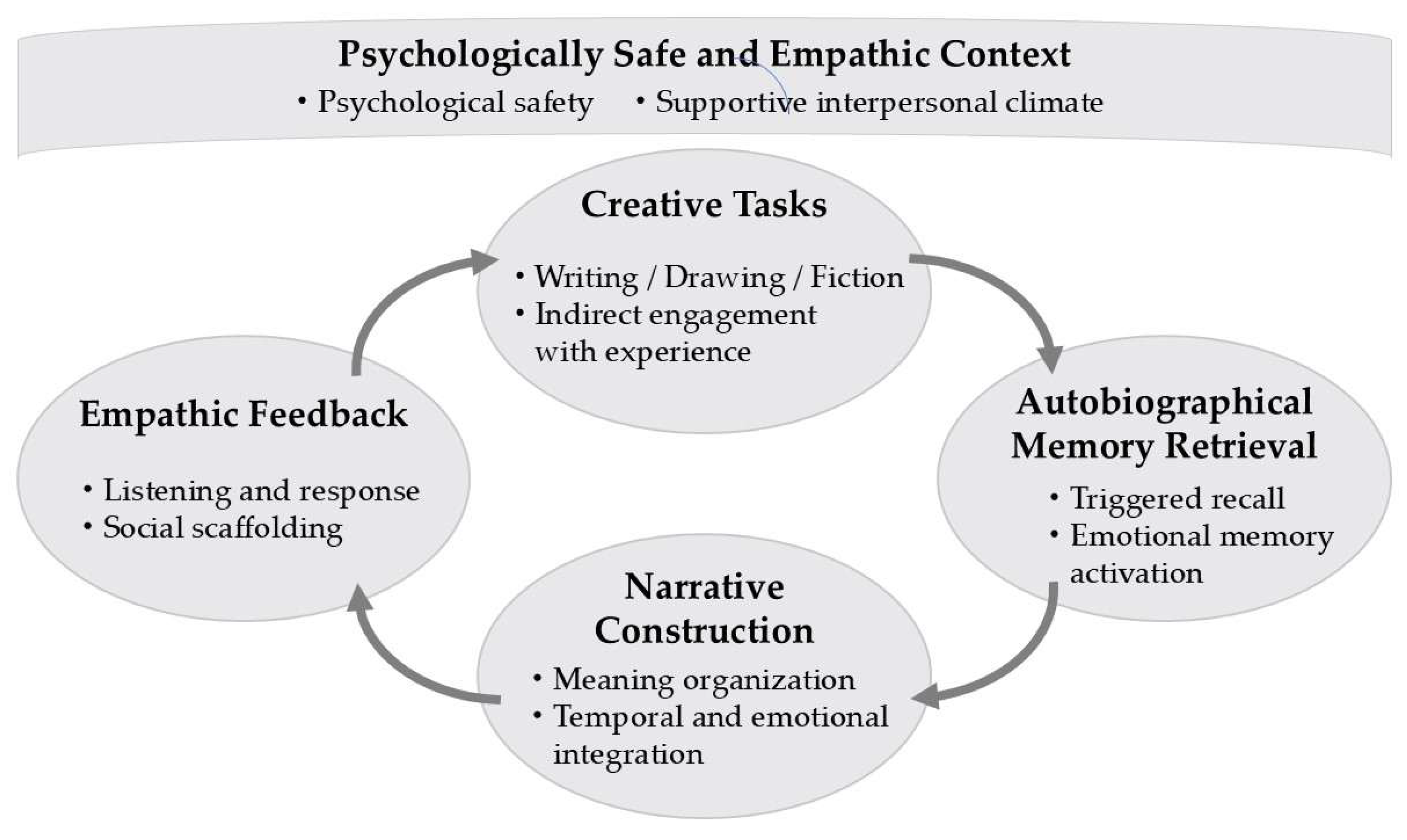
A conceptual workshop model is illustrated in Figure 2. This model emphasizes (1) the structure of creative tasks, (2) the presence of empathic feedback, and (3) qualitative changes in retrieved memories. Game-based fiction-writing formats, for example, allow feedback roles to shift dynamically, enabling participants to experience social empathy through playful and engaging creative interaction.
6.4. A Proposed Practice Model: Empathy-Mediated Narrative Intervention
Based on the reviewed findings, this paper proposes an empathy-mediated narrative intervention model grounded in the principle of prediction error. Memory reconsolidation is not triggered by recall alone but occurs when discrepancies arise between anticipated memory content and new experiential input [49].
Creative activities generate interpersonal interaction and enable individuals to re-evaluate themselves from third-person perspectives through empathic responses. The creation of new narratives disrupts existing predictions and introduces novel interpretations, producing prediction errors that facilitate memory reconsolidation [50,51].
Within this model, a cyclical process consisting of (1) creation, (2) retrieval, (3) narration, (4) empathic response, (5) retelling or new creation, and (6) memory reconstruction is treated as the basic unit of intervention. Empathy is positioned not merely as an emotional reaction but as a social mechanism that supports narrative structuring and memory stabilization.
6.5. From Theory to Practice
This section has demonstrated how theoretical and empirical insights can be translated into clinical, educational, and creative practices. Acts of telling, writing, and creating stories promote memory reconstruction through narrativization and social sharing, and creative interventions can intentionally activate these processes [52].
At the same time, practical applications require continuous critical evaluation. Nevertheless, the framework outlined here provides a foundation for future hypothesis-driven and mechanism-oriented research [53]. As practices that support the retrieval of forgotten memories and the re-signification of difficult experiences, empathy-mediated narrative interventions warrant further systematic investigation.
In summary, autobiographical memory reconstruction can be understood as a cyclical process extending from recall to psychological adaptation through creative activity, narration, and empathic feedback. The empathy-mediated narrative intervention model proposed here suggests that memory reconsolidation is facilitated through the interaction of creation, retrieval, narration, sharing, and reconstruction. The following section situates this model within a broader interdisciplinary context, critically examining empathy as a predictive social function, its consistency with reward learning and neuroscientific findings, and key limitations and future challenges.
7. Discussion
The present review integrates findings from psychology, neuroscience, and narrative research to clarify how autobiographical memory is reconstructed through narrativization within empathically mediated social contexts. By synthesizing evidence on memory reconsolidation, narrative coherence, and social cognition, this review advances a theoretical framework in which memory updating and self-narrative reconstruction are understood as cyclical and socially embedded processes. In the following sections, we first interpret the proposed empathy-mediated narrative reconstruction model in relation to existing theories of memory and identity (Section 7.1), then reconceptualize empathy as a future-oriented predictive function (Section 7.2 and Section 7.3), and finally discuss reciprocity, neurobiological consistency, limitations, and directions for future research (Section 7.4, Section 7.5, Section 7.6 and Section 7.7).
7.1. Integrative Interpretation: A Cyclical Model of Narrative, Empathy, and Memory Reconstruction
This review examined how acts of telling, writing, and creative narrative production facilitate the retrieval and reconstruction of autobiographical memory and contribute to the updating of self-narratives, drawing on theoretical, empirical, and applied perspectives. Autobiographical memory is not a static record of the past but a dynamic system that is reconstructed each time it is recalled or narrated, with narrative meaning-making serving as its central organizing principle.
A key conclusion of this review is that memory reconstruction is not confined to intrapersonal cognitive processes. Rather, it is facilitated and stabilized through social interaction, particularly through mutual understanding and empathic responses from listeners. Narrative structure and coherence elicit comprehension and empathy, and this social feedback, in turn, reshapes the narrator’s interpretation of past experiences and self-concept. This reciprocal and cyclical process constitutes the core mechanism underlying narrative-mediated memory reconstruction and self-transformation.
7.2. Redefining Empathy: Social Cognition as Future-Oriented Prediction
Within this framework, empathy is reconceptualized not merely as emotional resonance but as a cognitive and predictive process. Empathy involves imagining another person’s perspective and situation and internally simulating how one would feel and act under similar conditions. From this viewpoint, anticipating others’ responses and one’s own future reactions is a fundamental component of empathic understanding.
Empathy can therefore be understood as an advanced form of social cognition that draws upon past experiences and autobiographical memory to guide future-oriented behavior. Rather than being limited to the sharing of present emotions, empathy functions as a predictive mechanism that informs relationship formation and behavioral decision-making, thereby linking memory research with broader models of social cognition.
7.3. Empathy and Reward Learning: Implications for Motivation and Relationship Formation
This review further proposes a hypothesis regarding the motivational basis of empathic processes from a developmental and learning perspective. Experiences of being empathically understood activate neural reward systems, suggesting that “being understood” itself may be learned as a rewarding outcome and may motivate individuals to seek further empathic relationships [54].
Within this framework, eliciting empathy from others requires narratives to be structured in a manner that is comprehensible and meaningful to listeners—namely, as temporally and causally coherent stories. When a narrative is understood, the narrator experiences positive affect associated with validation, while the listener experiences satisfaction linked to successful understanding and empathic engagement. This bidirectional reinforcement strengthens interpersonal bonds, supports trust formation, and guides the selection of cooperative behaviors. Empathy thus serves not only to interpret past experiences but also as a mechanism that predicts and shapes future social relationships.
7.4. The Reciprocity of Narrative Communication
Narrative communication not only promotes memory reconstruction in narrators but may also influence the listener’s own memory processes and meaning-making. Receiving a narrative empathically can activate listeners’ autobiographical memories, triggering new associations and personal reinterpretations.
From this perspective, narrative communication is not a unidirectional transmission of experience but a reciprocal process in which memory reconstruction may occur in both participants. Narratives function simultaneously as internal representations of lived experience and as social media through which meaning is co-constructed via interpersonal interaction.
7.5. Neurobiological Consistency: Links to Emotion and Memory Reconsolidation
The proposed model is consistent with neuroscientific findings on emotion and memory reconsolidation. Emotional states are known to influence reconsolidation processes, and intense negative emotions, in particular, can disrupt associative and contextual integration of memories [7].
These findings underscore the importance of empathic and psychologically safe interpersonal contexts as conditions for effective narrative reintegration of fragmented memories. Empathy therefore operates not only as a psychosocial factor but also as a neurobiological condition that supports memory reconstruction by modulating emotional and cognitive processing.
7.6. Critical Considerations: Counterarguments and Cautions Regarding Empathy Models
Despite its explanatory value, the present model warrants careful scrutiny [53]. Excessive emotional resonance may lead to empathic distress or burnout, particularly in caregiving and educational settings, and does not necessarily promote growth or adaptive change.
Moreover, empathy comprises multiple components, including cognitive and affective empathy, which may involve distinct neural mechanisms and social functions. The conception of empathy as future-oriented prediction proposed in this review aligns more closely with cognitive empathy and should not be conflated with affective empathy. Failure to distinguish these components risks overgeneralizing the effects of empathy in narrative contexts.
In addition, narrative coherence and empathic engagement are not inherently ethical or adaptive. While coherent narratives can strongly engage listeners, they may also reduce critical evaluation. The relationship between empathy and narrative construction is therefore not value-neutral and must be examined within broader ethical and social frameworks.
7.7. Limitations and Future Directions
Several limitations should be acknowledged. First, this review does not directly verify memory reconsolidation through neurophysiological or pharmacological measures within creative or narrative interventions. Reconsolidation is employed here primarily as a theoretical framework rather than as a directly observed neurobiological process.
Second, the narrative review approach integrates findings across diverse populations and methodologies, limiting direct comparison of effect sizes and causal inference. Constructs such as empathy and social feedback are operationalized heterogeneously across studies, posing challenges for unified quantification.
Future research should employ experimental designs that systematically manipulate narrative structure and empathic feedback during sharing processes, alongside mechanism-oriented investigations using neuroimaging and electrophysiological methods such as functional magnetic resonance imaging, functional near-infrared spectroscopy, and electroencephalography. Such approaches would facilitate a transition from descriptive models toward causal and mechanistic accounts of the interactions among narrative, empathy, and autobiographical memory reconstruction.
8. Conclusions
In this review, autobiographical memory was conceptualized not as a fixed trace of past experience but as a dynamic process continuously updated through recall, narration, creative activity, and social interaction. We integratively examined theoretical and empirical evidence showing that empathy-based narrative practices play a central role in meaning-making and the reconstruction of self-narratives. Narrative organization functions not only as a cognitive framework for temporally and causally integrating fragmented experiences and supporting psychological continuity, but also as a socially regulated process stabilized through sharing with others and receiving empathic responses.
Narrative interventions incorporating creative activities, expressive writing, and collaborative storytelling extend beyond mere recall. They enable the reinterpretation of past experiences and promote psychological adaptation and self-repositioning. The empathy-mediated narrative reconstruction model proposed here conceptualizes narration, creative production, empathy, and social feedback as interacting in a cyclical process that facilitates memory reconsolidation and the updating of self-narratives. This framework provides a unifying theoretical basis for understanding memory and identity reconstruction across clinical practice, education, and creative engagement.
Furthermore, empathy was conceptualized not simply as emotional resonance but as a cognitive and social function involving prediction and imagination of others’ perspectives, emotions, and potential responses. From this viewpoint, empathy contributes not only to the reinterpretation of past experiences but also to future-oriented behavior, motivation, and relationship formation. Narrative coherence, together with listeners’ comprehension and empathic engagement, supports memory stabilization and may generate psychological reward, reinforcing adaptive self-narratives and interpersonal bonds.
Future research should employ experimental designs that systematically manipulate narrative structure, creative task characteristics, and the presence or absence of empathic feedback during sharing processes. Mechanism-oriented investigations using neural and physiological indicators, alongside applied research in clinical, educational, and creative settings, will be essential for advancing causal and integrative models of narrative-mediated memory reconstruction. By providing a coherent theoretical and methodological foundation, this review aims to contribute to future interdisciplinary developments in the study of memory, empathy, and narrative as interdependent systems.
Author Contributions
Conceptualization, S.H. and T.Y.; methodology, S.H., S.K., and T.Y.; investigation, S.H., S.K., and T.Y.; writing—original draft preparation, S.H. and T.Y.; writing—review and editing, S.H., S.K., and T.Y.; visualization, S.H. and T.Y.; supervision, S.K. and T.Y. All authors have read and agreed to the published version of the manuscript.
Funding
This research received no external funding.
Institutional Review Board Statement
Not applicable.
Informed Consent Statement
Not applicable.
Data Availability Statement
No new data were created or analyzed in this study.
Conflicts of Interest
The authors declare no conflicts of interest.
References
- Nader, K.; Schafe, G.E.; Le Doux, J.E. Fear memories require protein synthesis in the amygdala for reconsolidation after retrieval. Nature 2000, 406, 722–726. [Google Scholar] [CrossRef] [PubMed]
- Wang, S.H.; Ostlund, S.B.; Nader, K.; Balleine, B.W. Consolidation and reconsolidation of incentive learning in the amygdala. J. Neurosci. 2005, 25, 830–835. [Google Scholar] [CrossRef] [PubMed]
- Hupbach, A.; Gomez, R.; Hardt, O.; Nadel, L. Reconsolidation of episodic memories: a subtle reminder triggers integration of new information. Learn. Mem. 2007, 14, 47–53. [Google Scholar] [CrossRef] [PubMed]
- Kida, S. Function and mechanisms of memory destabilization and reconsolidation after retrieval. Proc. Jpn. Acad. Ser. B Phys. Biol. Sci. 2020, 96, 95–106. [Google Scholar] [CrossRef]
- Singer, J.A.; Bonalume, L. Autobiographical memory narratives in psychotherapy: A coding system applied to the case of Cynthia. Pragmatic Case Stud. Psychother. 2010, 6, 134–188. [Google Scholar] [CrossRef]
- Vanderveren, E.; Bijttebier, P.; Hermans, D. The Importance of Memory Specificity and Memory Coherence for the Self: Linking Two Characteristics of Autobiographical Memory. Front. Psychol. 2017, 8, 2250. [Google Scholar] [CrossRef]
- Bisby, J.A.; Burgess, N. Negative affect impairs associative memory but not item memory. Learn. Mem. 2014, 21, 21–27. [Google Scholar] [CrossRef]
- Dings, R.; Newen, A. Constructing the Past: the Relevance of the Narrative Self in Modulating Episodic Memory. Rev. Phil. Psych. 2023, 14, 87–112. [Google Scholar] [CrossRef]
- Butler, R.N. The Life Review: An Interpretation of Reminiscence in the Aged. Psychiatry 1963, 26, 65–76. [Google Scholar] [CrossRef]
- Bohlmeijer, E.T.; Westerhof, G.J.; Emmerik-de Jong, M. The effects of integrative reminiscence on meaning in life: results of a quasi-experimental study. Aging Ment. Health 2008, 12, 639–646. [Google Scholar] [CrossRef]
- Kim, G.; Kwon, M.; Kang, W.; Lee, S.H. Is Reconsolidation a General Property of Memory? Front. Hum. Neurosci. 2021, 15, 643106. [Google Scholar] [CrossRef]
- Conway, M.A.; Pleydell-Pearce, C.W. The construction of autobiographical memories in the self-memory system. Psychol. Rev. 2000, 107, 261–288. [Google Scholar] [CrossRef] [PubMed]
- Waters, T.E.; Fivush, R. Relations Between Narrative Coherence, Identity, and Psychological Well-Being in Emerging Adulthood. J. Pers. 2015, 83, 441–451. [Google Scholar] [CrossRef] [PubMed]
- Hall, J.M.; Powell, J. Understanding the Person through Narrative. Nurs. Res. Pract. 2011, 2011, 293837. [Google Scholar] [CrossRef]
- Vanaken, L.; Smeets, T.; Bijttebier, P.; Hermans, D. Keep Calm and Carry On: The Relations Between Narrative Coherence, Trauma, Social Support, Psychological Well-Being, and Cortisol Responses. Front. Psychol. 2021, 12, 558044. [Google Scholar] [CrossRef]
- Fabry, R.E. Distributed autobiographical memories, distributed self-narratives. Mind Lang. 2023, 38, 1258–1275. [Google Scholar] [CrossRef]
- Talarico, J.M. A tetrahedral model of autobiographical memory research design. Wiley Interdiscip. Rev. Cogn. Sci. 2023, 14, e1615. [Google Scholar] [CrossRef]
- Svoboda, E.; McKinnon, M.C.; Levine, B. The functional neuroanatomy of autobiographical memory: a meta-analysis. Neuropsychologia 2006, 44, 2189–2208. [Google Scholar] [CrossRef]
- Shalom, M.; Gross, Z. The link between memory, narrative and empathy in teaching difficult knowledge. Front. Educ. 2022, 7, 866457. [Google Scholar] [CrossRef]
- Buckner, R.L.; Andrews-Hanna, J.R.; Schacter, D.L. The brain’s default network: anatomy, function, and relevance to disease. Ann. N.Y. Acad. Sci. 2008, 1124, 1–38. [Google Scholar] [CrossRef]
- Lucchi Basili, L.; Sacco, P.L. Fictional Narratives as a Laboratory for the Social Cognition of Behavioral Change: My Ajussi. Humanities 2021, 10, 120. [Google Scholar] [CrossRef]
- Chang, C.H.C.; Nastase, S.A.; Zadbood, A.; Hasson, U. How a speaker herds the audience: multibrain neural convergence over time during naturalistic storytelling. Soc. Cogn. Affect. Neurosci. 2024, 19, nsae059. [Google Scholar] [CrossRef] [PubMed]
- Vanaken, L.; Bijttebier, P.; Hermans, D. I like you better when you are coherent. Narrating autobiographical memories in a coherent manner has a positive impact on listeners’ social evaluations. PLoS One 2020, 15, e0232214. [Google Scholar] [CrossRef] [PubMed]
- Wang, Q. Autobiographical Memory and Culture. Online Readings in Psychology and Culture 2011, 5, 2. [Google Scholar] [CrossRef]
- Fivush, R. The development of autobiographical memory. Annu. Rev. Psychol. 2011, 62, 559–582. [Google Scholar] [CrossRef]
- Meconi, F.; Linde-Domingo, J.; Ferreira, C.S.; Michelmann, S.; Staresina, B.; Apperly, I.A.; Hanslmayr, S. EEG and fMRI evidence for autobiographical memory reactivation in empathy. Hum. Brain Mapp. 2021, 42, 4448–4464. [Google Scholar] [CrossRef]
- Raeder, R.; Clayton, N.S.; Boeckle, M. Narrative-based autobiographical memory interventions for PTSD: a meta-analysis of randomized controlled trials. Front. Psychol. 2023, 14, 1215225. [Google Scholar] [CrossRef]
- DiMenichi, B.C.; Ceceli, A.O.; Bhanji, J.P.; Tricomi, E. Effects of Expressive Writing on Neural Processing During Learning. Front. Hum. Neurosci. 2019, 13, 389. [Google Scholar] [CrossRef]
- Habermas, T.; Köber, C. Autobiographical reasoning in life narratives buffers the effect of biographical disruptions on the sense of self-continuity. Memory 2015, 23, 664–674. [Google Scholar] [CrossRef]
- Moscovitch, D.A.; White, K.; Hudd, T. Hooking the Self Onto the Past: How Positive Autobiographical Memory Retrieval Benefits People With Social Anxiety. Clin. Psychol. Sci. 2024, 12, 882–902. [Google Scholar] [CrossRef]
- Ikeda, K.; Nihei, Y. Retelling harsh days as being happy: its effects on autobiographical memories. Shinrigaku Kenkyu 2009, 79, 481–489. [Google Scholar] [CrossRef] [PubMed]
- Sugimori, E.; Yamaguchi, M.; Kusumi, T. Writing to your past-self can make you feel better. Front. Psychol. 2024, 15, 1327595. [Google Scholar] [CrossRef] [PubMed]
- Ma, J.; Wang, Q.; Lang, Y.; Lv, S.; Xu, Y.; Wei, B. Effectiveness of creative story therapy for dementia: a systematic review and meta-analysis. Eur. J. Med. Res. 2023, 28, 342. [Google Scholar] [CrossRef] [PubMed]
- Phillips, L.J.; Reid-Arndt, S.A.; Pak, Y. Effects of a creative expression intervention on emotions, communication, and quality of life in persons with dementia. Nurs. Res. 2010, 59, 417–425. [Google Scholar] [CrossRef]
- Zhu, D.; Al Mahmud, A.; Liu, W. Digital Storytelling Intervention for Enhancing the Social Participation of People With Mild Cognitive Impairment: Co-Design and Usability Study. JMIR Aging 2024, 7, e54138. [Google Scholar] [CrossRef]
- Westerhof, G.J.; Bohlmeijer, E.T. Celebrating fifty years of research and applications in reminiscence and life review: state of the art and new directions. J. Aging Stud. 2014, 29, 107–114. [Google Scholar] [CrossRef]
- Zhong, Q.; Chen, C.; Chen, S. Effectiveness on Quality of Life and Life Satisfaction for Older Adults: A Systematic Review and Meta-Analysis of Life Review and Reminiscence Therapy across Settings. Behav. Sci. 2023, 13, 830. [Google Scholar] [CrossRef]
- Ruini, C.; Mortara, C.C. Writing Technique Across Psychotherapies-From Traditional Expressive Writing to New Positive Psychology Interventions: A Narrative Review. J. Contemp. Psychother. 2022, 52, 23–34. [Google Scholar] [CrossRef]
- Shen, J.; Mire, J.; Park, H.; Breazeal, C.; Sap, M. HEART-felt Narratives: Tracing Empathy and Narrative Style in Personal Stories with LLMs. In Proceedings of the 2024 Conference on Empirical Methods in Natural Language Processing, Miami, FL, USA, 12–16 November 2024; pp. 1026–1046. [Google Scholar]
- Bal, P.M.; Veltkamp, M. How does fiction reading influence empathy? An experimental investigation on the role of emotional transportation. PLoS One 2013, 8, e55341. [Google Scholar] [CrossRef]
- Lilgendahl, J.P.; McAdams, D.P. Constructing stories of self-growth: how individual differences in patterns of autobiographical reasoning relate to well-being in midlife. J. Pers. 2011, 79, 391–428. [Google Scholar] [CrossRef]
- Robjant, K.; Fazel, M. The emerging evidence for Narrative Exposure Therapy: a review. Clin. Psychol. Rev. 2010, 30, 1030–1039. [Google Scholar] [CrossRef] [PubMed]
- Adenauer, H.; Catani, C.; Gola, H.; Keil, J.; Ruf, M.; Schauer, M.; Neuner, F. Narrative exposure therapy for PTSD increases top-down processing of aversive stimuli--evidence from a randomized controlled treatment trial. BMC Neurosci. 2011, 12, 127. [Google Scholar] [CrossRef] [PubMed]
- Siehl, S.; Robjant, K.; Crombach, A. Systematic review and meta-analyses of the long-term efficacy of narrative exposure therapy for adults, children and perpetrators. Psychother. Res. 2021, 31, 695–710. [Google Scholar] [CrossRef] [PubMed]
- Kenyon, G.; Randall, W. Introduction: Narrative gerontology. J. Aging Stud. 1999, 13, 1–5. [Google Scholar] [CrossRef]
- McAdams, D.P.; McLean, K.C. Narrative Identity. Curr. Dir. Psychol. Sci. 2013, 22, 233–238. [Google Scholar] [CrossRef]
- Hass-Cohen, N.; Clay, J.C. Memory reconsolidation: a proposed change mechanism for the arts therapies. Front. Cognit. 2025, 4, 1518743. [Google Scholar] [CrossRef]
- Healy, T.L.; Thompson, G.; Archibald, M.M. The Role of Reminiscence in Arts-Based Interventions for Dementia Care: A Scoping Review. Dementia 2025, 24, 1334–1351. [Google Scholar] [CrossRef]
- Sevenster, D.; Beckers, T.; Kindt, M. Prediction error governs pharmacologically induced amnesia for learned fear. Science 2013, 339, 830–833. [Google Scholar] [CrossRef]
- Sinclair, A.H.; Manalili, G.M.; Brunec, I.K.; Adcock, R.A.; Barense, M.D. Prediction errors disrupt hippocampal representations and update episodic memories. Proc. Natl. Acad. Sci. U. S. A. 2021, 118, e2117625118. [Google Scholar] [CrossRef]
- Pupillo, F.; Ortiz-Tudela, J.; Bruckner, R.; Shing, Y.L. The effect of prediction error on episodic memory encoding is modulated by the outcome of the predictions. NPJ Sci. Learn. 2023, 8, 18. [Google Scholar] [CrossRef]
- de Muijnck, D. Narrative, Memory and PTSD. A Case Study of Autobiographical Narration After Trauma. European Journal of Life Writing 2022, 11, AN75–AN95. [Google Scholar] [CrossRef]
- Strang, C.E. Art therapy and neuroscience: evidence, limits, and myths. Front. Psychol. 2024, 15, 1484481. [Google Scholar] [CrossRef]
- Kawamichi, H.; Tanabe, H.C.; Takahashi, H.K.; Sadato, N. Activation of the reward system during sympathetic concern is mediated by two types of empathy in a familiarity-dependent manner. Soc. Neurosci. 2013, 8, 90–100. [Google Scholar] [CrossRef]
Figure 1.
Empathy-mediated narrative reconstruction model. This schematic illustrates the empathy-mediated narrative reconstruction model, depicting the cyclical updating of autobiographical memory across past, present, and future dimensions. Autobiographical memory retrieval brings past experiences into the present, where retrieved memories temporarily enter a labile and modifiable state. These memories are processed within the present self-state, conceptualized as a cognitive and neural processing hub involving the default mode network, introspection, meaning-making, and narrative integration. From this present hub, narrative projection supports future-oriented imagination, anticipation, and simulation, enabling the construction of prospective narratives. Empathic sharing and re-telling represent socially mediated processes through which narratives are selectively expressed, shared, and refined in interaction with others. Social empathy, positioned as an overarching contextual condition, provides psychological safety, mutual understanding, and emotional resonance that facilitate memory reintegration and adaptive narrative updating. Solid arrows indicate the primary cyclical flow linking memory retrieval, present self-state processing, narrative projection, and empathic sharing. The model is presented at a conceptual level, with specific narrative practices and creative activities subsumed within the processes of present self-state processing and empathic social interaction. Together, the model emphasizes how cognitive, social, and narrative processes interact dynamically to support autobiographical memory reconsolidation and the continuous updating of self-narratives.
Figure 1.
Empathy-mediated narrative reconstruction model. This schematic illustrates the empathy-mediated narrative reconstruction model, depicting the cyclical updating of autobiographical memory across past, present, and future dimensions. Autobiographical memory retrieval brings past experiences into the present, where retrieved memories temporarily enter a labile and modifiable state. These memories are processed within the present self-state, conceptualized as a cognitive and neural processing hub involving the default mode network, introspection, meaning-making, and narrative integration. From this present hub, narrative projection supports future-oriented imagination, anticipation, and simulation, enabling the construction of prospective narratives. Empathic sharing and re-telling represent socially mediated processes through which narratives are selectively expressed, shared, and refined in interaction with others. Social empathy, positioned as an overarching contextual condition, provides psychological safety, mutual understanding, and emotional resonance that facilitate memory reintegration and adaptive narrative updating. Solid arrows indicate the primary cyclical flow linking memory retrieval, present self-state processing, narrative projection, and empathic sharing. The model is presented at a conceptual level, with specific narrative practices and creative activities subsumed within the processes of present self-state processing and empathic social interaction. Together, the model emphasizes how cognitive, social, and narrative processes interact dynamically to support autobiographical memory reconsolidation and the continuous updating of self-narratives.
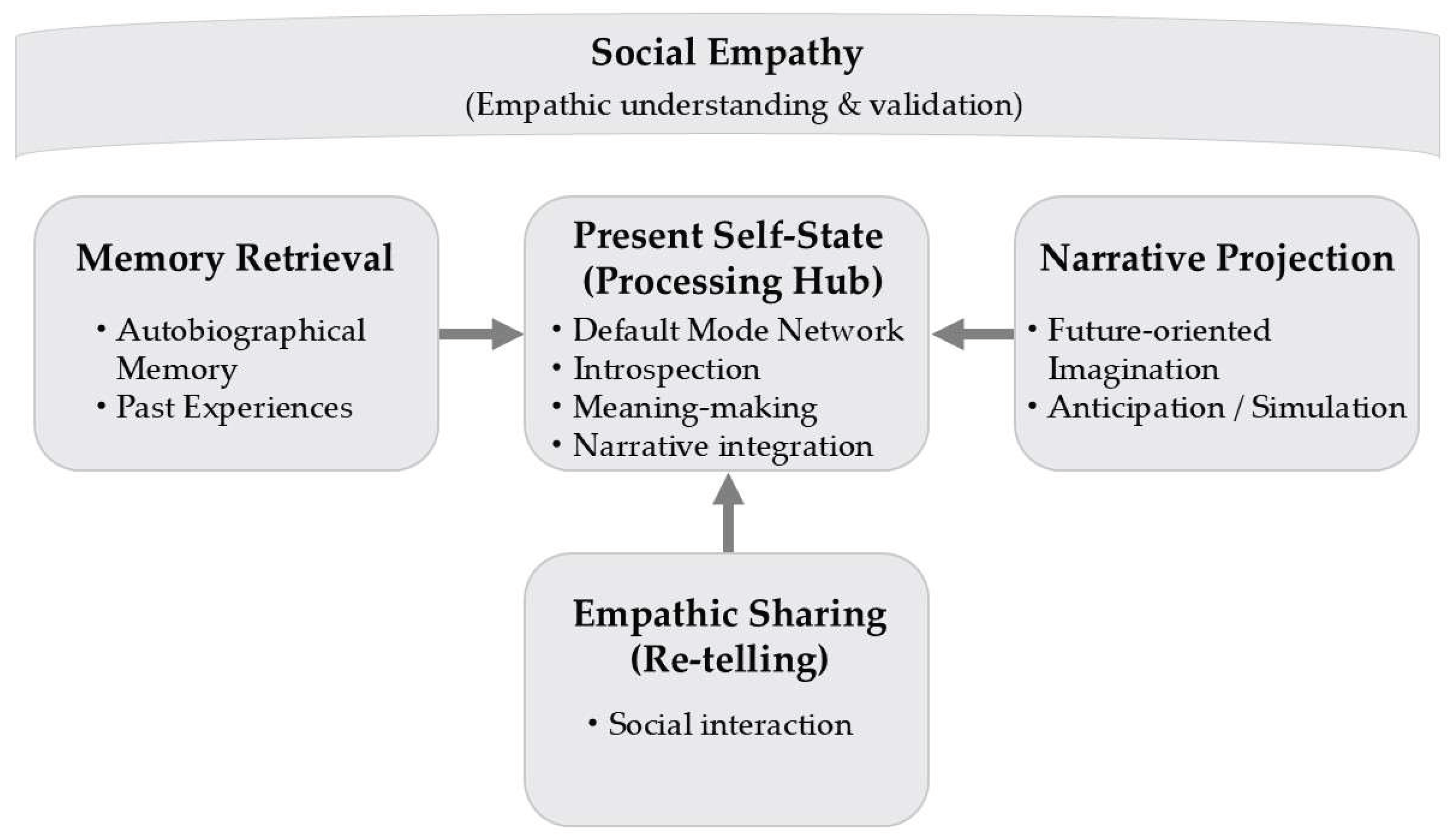
Figure 2.
Conceptual model of a creative workshop for empathy-mediated narrative reconstruction. This schematic illustrates a workshop-based implementation of the empathy-mediated narrative reconstruction framework. Creative tasks—such as fiction writing, drawing, theatrical reenactment, and collaborative production—serve as indirect triggers for autobiographical and emotional memory activation while reducing the burden of direct self-disclosure. Retrieved memories enter a malleable state and are transformed through imaginative narrative construction and meaning-making. Empathic feedback from others, including attentive listening, validation, and perspective-taking, functions as social scaffolding that supports emotional regulation, psychological safety, and narrative refinement. Through this iterative process, qualitative changes in autobiographical memory emerge, including memory reintegration, emotional reappraisal, and the reconstruction of self-narratives. The cyclical structure highlights how creative activity, empathic interaction, and narrative transformation dynamically interact to facilitate adaptive memory updating.
Figure 2.
Conceptual model of a creative workshop for empathy-mediated narrative reconstruction. This schematic illustrates a workshop-based implementation of the empathy-mediated narrative reconstruction framework. Creative tasks—such as fiction writing, drawing, theatrical reenactment, and collaborative production—serve as indirect triggers for autobiographical and emotional memory activation while reducing the burden of direct self-disclosure. Retrieved memories enter a malleable state and are transformed through imaginative narrative construction and meaning-making. Empathic feedback from others, including attentive listening, validation, and perspective-taking, functions as social scaffolding that supports emotional regulation, psychological safety, and narrative refinement. Through this iterative process, qualitative changes in autobiographical memory emerge, including memory reintegration, emotional reappraisal, and the reconstruction of self-narratives. The cyclical structure highlights how creative activity, empathic interaction, and narrative transformation dynamically interact to facilitate adaptive memory updating.
Disclaimer/Publisher’s Note: The statements, opinions and data contained in all publications are solely those of the individual author(s) and contributor(s) and not of MDPI and/or the editor(s). MDPI and/or the editor(s) disclaim responsibility for any injury to people or property resulting from any ideas, methods, instructions or products referred to in the content. |
© 2026 by the authors. Licensee MDPI, Basel, Switzerland. This article is an open access article distributed under the terms and conditions of the Creative Commons Attribution (CC BY) license (http://creativecommons.org/licenses/by/4.0/).
Copyright: This open access article is published under a Creative Commons CC BY 4.0 license, which permit the free download, distribution, and reuse, provided that the author and preprint are cited in any reuse.


