

Submitted:
04 February 2026
Posted:
05 February 2026
You are already at the latest version
Abstract
Heavy metal pollution remediation faces bottlenecks such as low efficiency of physical methods, secondary pollution risks from chemical approaches, and scaling limitations of microbial techniques. Dissolved organic matter (DOM), leveraging its green resource potential and high-efficiency chelation properties, has emerged as a core innovation direction in pollution remediation. Addressing existing patent metrics research issues such as single-database bias, fragmented classification systems, and insufficient policy-technology coupling analysis, this study employs a synergistic analysis of the Derwent and IncoPat databases to systematically reveal the technological innovation landscape in DOM-heavy metal interactions. Covering the period from 2004 to 2024, a differentiated strategy centered on “DOM-heavy metal interactions” was implemented. After processing steps including family-based deduplication, classification calibration, and citation normalization, analysis was conducted within a three-dimensional framework of “time-region-technology.” Results indicate: Chinese patents account for 46.6% and 55.0% of the two databases respectively, establishing global dominance. IncoPat exhibits an “early lead-platform fluctuation” pattern, while Derwent shows “late explosive growth.” Precise policy-technology coupling forms a closed-loop system of policy tools, R&D investment, and technological output. Technological evolution shows significant divergence: Derwent focuses on foundational digital innovation, while IncoPat emphasizes engineering applications. Core patents enabled domain innovation through “foundational technology-cross-domain adaptation.” The landmark patent CN101168852A established the “solid waste resource utilization-process controllability-material functionalization” paradigm, validating its engineering value. This study corrected single-database biases, clarified global versus local technological evolution differences and core driving mechanisms, and provides support for interdisciplinary integration, engineering transformation, and policy optimization.
Keywords:
dissolved organic matter (DOM)
; heavy metals
; patent bibliometric analysis
; pollution control
; technological innovation
; policy driven
; cross-domain transfer
; engineering transformation
1. Introduction
1.1. Research Background
Heavy metals, characterized by their resistance to degradation, high persistence, and mobility, have become a major challenge requiring urgent attention in the global environmental field. Their migration and transformation through media such as soil and water within ecosystems pose a serious threat to biodiversity and human health [1,2]. Current mainstream heavy metal removal technologies can be categorized by mechanism: Physical methods (e.g., leaching, thermal desorption) operate by physically removing, isolating, or altering the location or form of pollutants. Their core advantage lies in simplified operational procedures and the absence of additional chemical reagents, though they exhibit low treatment efficiency and may disrupt the intrinsic structure of contaminated media [3]. Chemical methods (e.g., chemical precipitation, oxidation-reduction) alter the form or solubility of heavy metals through chemical reactions, reducing their bioavailability and mobility. However, these methods involve high reagent costs, complex operations, and post-treatment waste liquids prone to secondary pollution [3]. Microbial methods leverage microbial metabolism, adsorption, or transformation to remove heavy metals. Their core advantages include excellent environmental compatibility and absence of secondary pollution. However, they are sensitive to operating conditions (e.g., pH, temperature), have low volumetric loading rates, and face limitations in large-scale application.
Dissolved organic matter (DOM) constitutes a heterogeneous organic mixture characterized by continuous molecular weight distribution and multifunctional group structures [4], serving as a carrier for the migration and transformation of heavy metals between solid and liquid phases. As the most chemically active organic component in environmental media, DOM's molecular weight gradient (low molecular weight <1 kDa, medium molecular weight 1~10 kDa, high molecular weight >10 kDa) significantly influences its binding strength with heavy metals, complex stability, and environmental mobility by regulating functional group density, spatial conformation, and complexation activity. Furthermore, DOM contains numerous functional groups (carboxyl, hydroxyl, phenolic hydroxyl, etc.) and chemical bonds that can influence various physical and chemical processes in ecosystems through multiple mechanisms such as complexation and adsorption [[5[7]. This alters the speciation and thermochemical properties of heavy metals, exerting a decisive influence on their migration patterns and bioavailability [8]. The core advantage of DOM lies in its wide availability (e.g., agricultural waste, aquatic sediments, compost products), low-cost preparation via simple processes (costing only 1/5 of chemical chelating agents), and eco-friendly properties including biodegradability and absence of secondary pollution. By complexing heavy metal ions through oxygen-containing functional groups and synergistically enhancing the adsorption performance of functional materials, DOM demonstrates significant application potential in pollution remediation [9], making it a central research focus in environmental pollutant management.
With its unique chelation-mediated functionality and green resource utilization attributes, DOM has become a core pillar of environmental technological innovation. Patents, as the legal repository of technological innovations, precisely document the entire innovation trajectory from fundamental mechanism exploration to engineering application system development and directly reflect field innovation hotspots and technical barriers. They serve as a vital bridge connecting basic research with engineering remediation practices. Compared to academic papers, patents more directly reflect the industrialization potential and market competitiveness of technological achievements [1][12]. Bibliometric analysis of patents objectively and quantitatively reflects the macro-development trends of a discipline. This method has been widely applied in agriculture, forestry, environmental science, and new energy utilization [11,12,13,14,15,16,17], providing reliable methodological support for accurately grasping industry innovation logic [1][20]. For instance, “Patent landscape review on solar food dryer: technology updates” (International Journal of Ambient Energy, 2025 edition) utilized patent metrics to reveal the evolutionary trajectory of new energy technologies [21], offering methodological guidance for similar studies.
1.2. Research Gaps and Innovation Points
1.2.1. Research Gaps
Technological innovations in the field of DOM-heavy metal interactions have steadily advanced, yet existing patent-based metrology research exhibits distinct core deficiencies that hinder precise assessments of the sector's technological landscape and evolutionary patterns: First, failure to account for variations in database collection strategies relying solely on single-database analysis leads to biased depictions of global innovation patterns and local technological deployments, preventing objective clarification of core technologies' dominance and diffusion pathways; Second, the lack of synergistic integration between dual-database classification systems fails to leverage the complementary nature of DWPI and IPC classifications. This prevents the analysis of evolutionary heterogeneity between global frontier fundamental innovations and localized engineering applications, hindering the construction of a comprehensive cross-disciplinary technological innovation map. Third, quantitative analysis of technology iteration mechanisms driven by policy remains absent. The failure to incorporate annual trend differences between dual-database patents prevents the revelation of differentiated enabling effects of varying policy cycles on technological outputs. Fourth, insufficient exploration of cross-domain inheritance in highly cited patents and the impact of landmark patents, coupled with a lack of systematic interpretation of core technology migration pathways, innovation mechanisms, and engineering value. These gaps urgently require addressing through collaborative analysis of dual databases, multidimensional indicator integration, and in-depth case studies.
1.2.2. Innovation Points
This study systematically investigates the technological innovation landscape in the field of DOM-heavy metal interactions, with core innovations manifested in three aspects: First, establishing a collaborative analysis system integrating the Derwent and IncoPat databases. Leveraging their complementary strengths Derwent's global high-value patent indexing and IncoPat's comprehensive coverage of domestic patents this approach corrects the bias inherent in single-database collections. It depicts the full panorama of technological evolution from “global digital innovation to localized engineering applications,” addressing the core challenge in prior research of balancing global patterns with regional deployments. Second, an “analytical model integrating classification system coupling and 3D framework” was established. This model synergizes the strengths of DWPI subject classification and IPC technical classification. By coupling the “time-region-technology” three-dimensional dimensions, it quantifies policy-driven effects and technological evolution differences, filling the gap in previous research lacking systematic framework support. Third, it deepens cross-domain analysis and paradigm mining of core patents, tracing the inheritance pathways of highly cited patent technologies and the derivative innovation logic of landmark patents. This clarifies the adaptation mechanisms of mature cross-domain technologies and validates their engineering value, addressing the gap in previous research that focused solely on patent surface characteristics while lacking analysis of core technological innovation mechanisms.
2. Data Sources and Research Methods
2.1. Database Selection and Basis
This study selected the Derwent and IncoPat databases as core data sources, primarily based on their differentiated collection strategies and complementary functionalities. This approach effectively mitigates the bias inherent in relying on a single database, providing robust support for analyzing the technological innovation landscape in the DOM-heavy metal interaction field.
The Derwent database excels in standardized indexing of globally high-value patents, offering comprehensive coverage of European and American patents. Its family patent screening highlights technological innovation, while standardized processing characteristics facilitate cross-regional technology evolution analysis. Its limitation lies in limited capture efficiency for Chinese domestic patents, making it difficult to fully reflect local technological layouts.
IncoPat's core strength lies in its high coverage and effective screening of Chinese domestic patents, with substantial coverage of emerging market patents, aligning with the need to analyze local technological innovation trends. Its weakness is insufficient coverage of globally cutting-edge high-value patents (especially European and American patent families), and its sole use may lead to a biased global perspective.
Synergistic selection of dual databases achieves complementary strengths: Derwent ensures precision in global innovation trends and cutting-edge technologies, while IncoPat supports comprehensive presentation of China's domestic and emerging market technology layouts. Their integration not only validates the objectivity of core conclusions like “China's absolute dominance in patents” but also fully constructs a technology evolution map spanning “global digital frontiers to local engineering applications,” laying a robust data foundation for multidimensional, cross-scale patent metrics analysis.
2.2. Search Strategy
2.2.1. Search Terms and Boolean Logic
The search period for this study spans from 2004 to 2024. The search terms and Boolean logic design centered on “DOM-heavy metal interactions,” balancing conceptual coverage completeness with database inclusion characteristics. Tailored search strategies were developed for the Derwent and IncoPat databases to ensure precise capture of target patents, as detailed in Table 1.
The core design logic for retrieval terms and operators centers on identifying key research subjects through “Dissolved Organic Matter or DOM” and “Heavy Metals,” then supplementing with differentiated terminology based on database characteristics. Derwent emphasizes global digital innovation, while IncoPat focuses on domestic engineering implementation needs. Ultimately, “AND” achieves multidimensional refinement and “OR” ensures comprehensive conceptual coverage. This approach avoids overly broad searches while ensuring high compatibility with each database's patent collection characteristics, enabling efficient retrieval of target data.
2.2.2. Inclusion and Exclusion Criteria
Patents must meet three core criteria for inclusion: First, they must fall within the specified timeframe and focus on the interaction between dissolved organic matter (DOM) and heavy metals. Second, their technical scope must encompass pollution control, remediation, functional material R&D, process optimization, and digital applications, aligning with the disciplinary classifications of both databases and IPC classification characteristics. Third, they must be complete, containing explicit technical solutions, applicants, publication years, and DWPI/IPC classification numbers.
The following patent types are strictly excluded: 1. Patents deviating from the subject matter, failing to simultaneously address DOM and heavy metals; 2. Duplicate family records across jurisdictions; for patent families, retain the earliest published or highly cited core patent while excluding other homogeneous outputs; 3. Patents with expired legal status lacking technical reference value; 4. Patents with missing key technical features, classification codes, or citation data, rendering quantitative analysis impossible.
2.3. Definition of the 3D Analytical Framework
This study constructs a 3D integrated analysis framework combining “time-region-technology” to systematically examine the evolutionary patterns and spatial characteristics of technological innovation in the DOM-heavy metal interaction field. The core content, theoretical underpinnings, and data sources for each dimension are summarized in Table 2 below.
This framework centers on three-dimensional synergistic analysis, integrating theoretical insights with empirical data: The temporal dimension employs technology life-cycle theory to decipher stage evolution, while policy tool theory traces growth drivers; The spatial dimension employs innovation diffusion theory and global innovation network theory to explain structural differentiation, while institutional innovation theory underpins regional layout characteristics. The technological dimension utilizes technology convergence theory to interpret interdisciplinary trends and draws on core technology evolution theory to clarify transmission pathways. This framework fully integrates the complementary strengths of dual databases, balancing analytical comprehensiveness with scientific rigor to provide robust support for systematic analysis of technological innovation patterns within the field.
(Note: CAGR is a quantitative metric representing the average annual growth rate over a continuous statistical period, which eliminates the interference of short-term fluctuations on long-term trends. Its calculation formula is: ; where FV denotes the patent volume at the end of the period, IV denotes the patent volume at the beginning of the period, and n denotes the statistical time span (years).
2.4. Data Processing and Analysis Methods
2.4.1. Data Standardization
Based on research objectives and dual-database characteristics, core extraction metrics are established to cover patent metrology dimensions: First, foundational information metrics, including patent number, publication year, receiving office, and legal status; Second, quantitative analysis indicators, including patent counts by dimension, citation counts, and CAGR; Third, classification attribute indicators, covering DWPI subject classifications, IPC classification codes, and technology direction tags; Fourth, correlation feature indicators, including policy relevance, cross-domain technology inheritance paths, and patent family information.
Multi-dimensional standardization ensures analytical accuracy and comparability: First, duplicate data processing: Treating patent families as units, deduplication is performed by comparing patent numbers and technical solutions, retaining the earliest-published or highly-cited core patent. Second, unified classification systems: Classification codes are calibrated according to official DWPI and IPC rules to ensure consistent categorization of disciplines and technical directions. Third, citation count calibration: Self-citations and invalid citations are excluded. Fourth, normalization of quantitative metrics.
Following data processing, the study conducted multidimensional quantitative analysis supplemented by in-depth validation of core patents. The specific technical workflow is illustrated in Figure 1 below.
2.5. Statement of Limitations
This study's patent analysis based on dual databases still faces inherent limitations. First, the data sources exhibit coverage bias: while the dual databases complement each other, they focus solely on patent literature and exclude non-patent outputs such as academic papers and technical reports. Furthermore, they inadequately capture patents from emerging markets outside China, Europe, and the United States, making it difficult to present a comprehensive global innovation landscape. Second, the depth of technological analysis is insufficient. It concentrates on external characteristics and correlation patterns such as patent quantity, classification, and citations, without addressing implementation effectiveness, commercialization efficiency, or engineering adaptability. Consequently, it offers limited insights into practical bottlenecks in core technology implementation. Third, the coverage of influencing factors is incomplete. Policy-driven analysis emphasizes China's core environmental policies without systematically exploring the synergistic effects of policies in other global regions. Furthermore, non-policy factors such as market demand and technological barriers are not quantified, resulting in an incomplete interpretation of the driving forces behind technological evolution. Fourth, the integration of dynamic information on patent legal status is inadequate. Changes in patent legal status and information on late-stage technological replacement and evolution are not sufficiently incorporated, limiting the assessment of technological innovation sustainability.
3. Research Findings
3.1. Overall Feature Comparison of Dual-Database Patents
The difference in total volume between Derwent (575) and IncoPat (929) stems from their respective collection strategies: Derwent prioritizes standardized indexing of global patents, resulting in limited capture efficiency for domestic Chinese patents; IncoPat focuses on the Chinese market, offering more comprehensive coverage of domestic patents. The complementary nature of these two databases provides robust support for the conclusions.
As shown in Table 3, in absolute numbers, Chinese patents in IncoPat reached 511, which is 1.9 times the number of Chinese patents in Derwent (268), reflecting its high capture rate for domestic Chinese patents. Even within Derwent, the number of Chinese patents (268) significantly exceeded those from Europe (106), the United States (65), and WIPO (17). In relative terms, Chinese patents constitute approximately 46.6% of Derwent's total, rising to 55.0% in IncoPat. Both figures substantially exceed those for Europe (Derwent: 18.4%; IncoPat: 1.6%), the United States (Derwent: 11.3%; IncoPat: 2.0%), and WIPO (Derwent: 2.9%; IncoPat: 0.2%), providing dual confirmation of China's absolute dominance in patenting.
Although the two databases show differences in the absolute numbers of European, American, and WIPO patents, the core trend of “China having the highest proportion of patents” is highly consistent. This eliminates potential biases from a single database and confirms that China's dominant position is an objective feature of its technological landscape.
3.2. Time Dimension: Patent Trends and Policy Correlations
3.2.1. Annual Trend Comparison
Patent output from both Derwent and IncoPat databases has experienced exponential growth, yet their evolutionary patterns exhibit significant heterogeneity. IncoPat demonstrates an “early-stage lead followed by mid-stage plateau fluctuations,” while Derwent follows an evolutionary trajectory of “gradual increase in the initial phase followed by explosive growth in the later phase.”
As shown in Figure 2, during the nascent stage (2004-2010), both databases registered fewer than 20 patents annually, with a gentle curve slope and IncoPat holding a slight advantage. During the steady growth phase (2011-2016), IncoPat's patent volume increased from 20 to 60 (CAGR=24.6%), significantly outpacing Derwent's 17.5% growth (from 9 to 20). China's expansion in this period was primarily driven by policies such as the Action Plan for Soil Pollution Prevention and Control, highlighting IncoPat's superior capture of Chinese patents.
Divergent Growth Period (2017-2024): IncoPat entered a plateau phase (2017-2021), maintaining annual patent volumes between 70 and 95. A slight decline post-2021 reflects phased saturation in China's domestic patent. Derwent, however, saw its growth curve steeply accelerate after 2020 (2021-2024), with patent volume surging from 39 to 136 (CAGR=51.6%), surpassing IncoPat's growth rate. This surge can be quantitatively explained through three factors: First, the global technology diffusion effect, where technologies in this field accelerated their transfer from China to Europe and the United States, driving up international patent applications. Second, improved database indexing efficiency, as Derwent enhanced its standardized processing capabilities for global patents, increasing capture rates in specialized fields. Third, the combined drive of policy and capital, where increased R&D investment in heavy metal pollution remediation technologies under global dual-carbon goals accelerated patent output.
3.2.2. Policy-Driven Analysis
The growth in patents related to “interactions between dissolved organic matter (DOM) and heavy metals” in China from 2004 to 2024 is the inevitable outcome of a closed-loop system involving policy tools, R&D investment, and technological output.
From 2004 to 2010, the Total Emission Control Policy (TECP) incorporated pollutant reduction into local performance evaluations, while fiscal subsidies and financing support were implemented. This drove an annual increase in R&D investment within the environmental protection industry. Although patent output remained low during this phase, it established a stable foundation of early-stage technological reserves.
From 2010 to 2020, the Action Plans for Soil Pollution Prevention and Control and Water Pollution Prevention and Control established a targeted support system. Central government funding for pollution prevention and control, combined with dedicated investments from the National Key R&D Program, drove corporate R&D. The synergistic effect of policy and funding directly translated into scaled patent growth, widening China's technological gap with other nations.
From 2021 to 2024, the 14th Five-Year Plan for Soil, Groundwater, and Rural Ecological Environmental Protection integrated “R&D-industrialization-global diffusion.” Central government funding allocated and supported heavy metal pollution control projects, driving sector-wide R&D. This multi-source funding has fueled explosive patent growth. Technological achievements have not only achieved domestic breakthroughs but also spread to international markets through global patent databases. This has formed a closed-loop mechanism of “policy direction - funding empowerment - technology transformation - international output,” establishing China's core position as a technological leader in this field.
3.3. Regional Distribution: The Global Innovation Landscape and Core Actors
3.3.1. Patent Distribution by Country/Region
Based on the quantitative characteristics of national annual patent volume trendlines derived from Derwent and IncoPat databases, this study systematically reveals the three-stage evolution pattern of China's technological innovation in the “DOM-Heavy Metals” field from 2004 to 2024, alongside the differentiation of its global competitive landscape. This evolutionary mechanism is deeply intertwined with the precise policy-driven approach and the formation of database positioning heterogeneity.
The global annual line chart from the Derwent database (Figure 3) reveals that China's patent output experienced a steep surge after 2021, soaring from 13 to 91 patents with a CAGR of approximately 91.3%. This growth aligns closely with the policy cycle of the “14th Five-Year Plan for Soil, Groundwater, and Rural Ecological Environment Protection” implemented after 2021, confirming the strong policy-driven impact on technological outcomes. As a global patent indexing database, Derwent records international patent families (e.g., PCT patents) originating from China. The accelerated technological progress spurred by post-2021 policies directly caused the steep increase in the patent growth curve, marking China's transition from “domestic innovation accumulation” to “global technology export.” Concurrently, developed nations like Europe and the United States maintained consistently low patent volumes (≤10 patents per year), further validating China's global technological leadership in this domain.
The global annual line chart of the IncoPat database (Figure 4) reveals distinct characteristics, with its core growth drivers closely linked to the implementation of the Action Plan for Soil Pollution Prevention and Control (commonly known as the “Ten Soil Pollution Prevention and Control Measures”). Issued in 2016 as the guiding document for soil pollution prevention during the 13th Five-Year Plan period, the plan secured dedicated central government funding, creating a distinct policy dividend period (2016–2020). Corresponding to the trendline characteristics, China's patent volume increased from 39 in 2016 to 46 in 2020, achieving a CAGR of 4.2%. The trendline indicates a sustained upward trajectory during this period, confirming the targeted empowerment of technological innovation in China by the Ten-Point Plan. Patent volume surged to 74 in 2021 before entering a plateau phase, reflecting that policy-driven domestic patent has achieved scaled accumulation, with technological reserves reaching a stage of saturation. Meanwhile, annual patent volumes in other countries like South Korea and Japan remained low during the same period, indicating China's sustained strengthening of domestic technological advantages and widening gaps.
Comparative analysis of global annual line charts from dual databases provides complementary validation of the intrinsic logic of technological evolution. The “explosive surge” in the Derwent database and the “plateau fluctuation” in the IncoPat database mutually corroborate each other, illustrating the complete transmission chain of “policy empowerment - patent accumulation - global diffusion.” The discrepancy between the two stems from database positioning differences: Derwent focuses on global core technologies, while IncoPat emphasizes Chinese patents. Leveraging complementary data from both databases and integrating authoritative policies with quantitative metrics, this study provides data-driven insights into the evolution of the technological landscape in this field, contributing Chinese strength to technological innovation.
3.3.2. Core Processing Agency and Applicant
By comparing patent volume data from the top 10 filing agencies across the Derwent and IncoPat databases, this analysis examines the disparity in patent volumes between the global and Chinese markets within this field. This discrepancy stems from the synergistic interaction between database positioning and the Chinese patent system.
The Derwent database filing authorities (Table 4) reveal dominant features across global core regions: The China National Intellectual Property Administration (CN) leads with 257 patents (44.7%), encompassing domestic applications and PCT entries into the Chinese national phase, reflecting China's global technological influence. European and American institutions followed closely, including the European Patent Office (EP, 82 patents, 14.3%) and the United States Patent and Trademark Office (US, 50 patents, 8.7%), demonstrating the sustained competitiveness of traditional technological powerhouses. The inclusion of the World Intellectual Property Organization (WO, 13 patents, 2.3%) highlights the vibrancy of international patent cooperation. This overall landscape both confirms China's technological rise and preserves the core position of Europe and the United States.
The IncoPat database's receiving offices (Table 5) reveal a pattern dominated by China with a focus on emerging markets: The China National Intellectual Property Administration (CN) leads significantly with 511 patents (55.0%), encompassing both domestic applications and PCT entries into China. This characteristic aligns closely with the evolution of China's patent system. Since the implementation of the Patent Law in 1985, continuous efforts to enhance intellectual property protection including the 2008 strengthening of IP safeguards and the 2021 introduction of an open licensing system have propelled China's innovation capabilities. The high proportion of Chinese patents in IncoPat directly reflects these institutional dividends. Emerging market institutions like Korea (KR, 50 patents, 5.4%) and Mexico (MX, 34 patents, 3.7%) followed, while the United States (US, 19 patents, 2.1%) and the European Patent Office (EP, 15 patents, 1.6%) showed significantly lower shares than in Derwent, reflecting IncoPat's positioning of “focusing on domestic markets while considering emerging markets.”
Quantitative comparison of the two databases reveals significant heterogeneity: the China National Intellectual Property Administration's patent volume in IncoPat is 1.99 times that in Derwent; the European Patent Office and the United States Patent and Trademark Office account for 14.3% and 8.7% in Derwent, respectively, but only 1.6% and 2.1% in IncoPat. This discrepancy stems from three factors: First, database positioning Derwent focuses on global technology indexing, exclusively capturing highly innovative patent families with stringent screening for international Chinese patent families; IncoPat emphasizes domestic patents. Second, selection criteria Derwent prioritizes technological innovation, offering more comprehensive coverage of European and American patents; IncoPat emphasizes domestic patent validity, providing fuller coverage of emerging markets. Third, institutional differences: Derwent emphasizes global diffusion value, while IncoPat focuses on domestic policy landscapes, further amplifying quantitative discrepancies. The complementary nature of these dual databases provides multidimensional empirical support for analyzing the global technological innovation landscape in this field.
3.4. Technological Evolution: Disciplines, Application Directions, and Technology Types
3.4.1. Characteristics of Disciplinary Fields
Based on the Derwent World Patent Index (DWPI) subject classification system, analyze the disciplinary distribution characteristics of the Derwent and IncoPat databases within their respective fields.
The Derwent database employs the DWPI classification system to categorize patent disciplines (Table 6). Given its collection of patents featuring high-value innovations, the disciplinary distribution exhibits characteristics driven by fundamental mechanisms and highlighted by interdisciplinary convergence: Computer Science and Technology (Molecular Simulation and Model Construction) leads with 189 patents (32.9%), focusing on analyzing coordination mechanisms and constructing pollution dispersion models to overcome limitations of macro-level observation; Light Industry Technology and Engineering (water composite pollution conditioning additives) follows with 60 patents (10.4%), focusing on applied technology R&D. In emerging fields, molecular simulation and model construction under Computer Science and Technology represents the computational frontier in pollution mechanism analysis, while Agricultural Engineering (source control of agricultural non-point pollution) exemplifies the integrated governance approach merging environmental engineering and agricultural science.
The IncoPat database also employs the DWPI classification strategy for statistical analysis (Table 7). Its disciplinary distribution exhibits characteristics dominated by applied technologies with strong practical applicability: Light Industry Technology and Engineering (water composite pollution conditioning agents) leads with 337 patents (36.3% share), focusing on developing composite conditioning agents to regulate DOM functional group activity; Materials Science and Engineering (Polymer Functional Adsorption Materials) and Chemical Engineering (General Chemicals and Reaction Systems) accounted for 17.7% and 17.0% respectively, focusing on industrial implementation; Computer Science and Technology ranked seventh with only 78 patents (8.4%). In emerging fields, solution separation and enrichment processes under Chemical Engineering enable precise separation of low-concentration pollutants, while Instrument Science and Technology (DOM-heavy metal in-situ monitoring) achieves dynamic tracking and characterization representing a cross-disciplinary frontier integrating environmental sensing and remediation technologies.
Quantitative comparison of disciplinary characteristics across dual databases reveals significant heterogeneity: Computer Science and Technology in Derwent is 2.4 times that of IncoPat, reflecting Derwent's emphasis on global frontier basic innovation; Light Industry Technology and Engineering in IncoPat is 5.6 times that of Derwent, highlighting the urgent demand for practical technologies in domestic pollution control. These differences stem from database positioning: Derwent focuses on high-value global innovations, while IncoPat emphasizes localized technology implementation. Regarding emerging directions, Derwent prioritizes theory-driven interdisciplinary innovations (e.g., molecular simulation), whereas IncoPat concentrates on demand-driven technological refinement (e.g., low-concentration pollutant separation, in-situ monitoring). The complementary dual databases collectively construct a comprehensive technological evolution map spanning “global innovation to local application.”
(Note: As DWPI employs a multi-indexing rule (where a single patent may be assigned multiple classification codes), if the sum of the proportions for each classification code exceeds 100%, this aligns with the original design intent of the DWPI indexing system to achieve comprehensive coverage of technological attributes.)
3.4.2. IPC Classification and Application Directions
Based on the International Patent Classification (IPC) system, an analysis of the IPC classifications within their respective fields for the dual database was conducted.
The Derwent database IPC (Table 8) reveals characteristics dominated by digital technologies and supported by multidisciplinary integration: Electrical digital data processing (G06F, 151 patents, 26.3%) leads the list, with its core focus on constructing dynamic models and establishing specialized databases to support engineering design; Water, wastewater, and sludge treatment (C02F, 65 patents, 11.3%) follows, concentrating on pollution control engineering applications; Categories such as image processing (G06T), business management (G06Q), and digital communications (H04L) are also represented, confirming its coverage of the entire innovation chain“digital tools-engineering applications-monitoring management.” This reflects Derwent's selection bias toward high-value patent families globally, prioritizing the inclusion of interdisciplinary cutting-edge technologies.
The IncoPat database IPC (Table 9) reveals characteristics dominated by environmental engineering and chemical applications with strong practical applicability: Water, wastewater, and sludge treatment (C02F, 271 patents) ranks first, centered on utilizing DOM to enhance heavy metal adsorption and form regulation, directly addressing pollution control needs; Categories such as chemical/physical methods and equipment (B01J, 140 patents), separation (B01D, 69 patents), and medical preparations (A61K, 64 patents) also rank highly. These focus on process optimization, material R&D, and cross-scenario applications (e.g., medical water purification materials), reflecting IncoPat's preference for prioritizing practical technologies with significant industrialization potential.
Quantitative comparison of IPC classifications across dual databases reveals significant disparities: C02F patents in IncoPat exceed Derwent's by 4.17 times, reflecting China's urgent demand for pollution control engineering technologies; - G06F constitutes 26.3% of Derwent's entries but fails to rank in IncoPat's top 10, highlighting divergent global innovation priorities versus China's domestic engineering focus; Category B01J ranks second in IncoPat with 140 patents but tenth in Derwent with only 18 patents, a 7.78-fold disparity, confirming IncoPat's emphasis on the industrialization of chemical process equipment. This discrepancy stems from differing database positioning and filtering rules: Derwent prioritizes high-value global patent families, emphasizing digitally driven cutting-edge innovations; IncoPat focuses on integrating the full lifecycle of domestic patents, prioritizing engineering technologies. Additionally, China's engineering-driven pollution control needs and the digital dependency of global frontier innovations further amplify this divergence. The IPC classification divergence between the two databases constructs a comprehensive technological evolution map of “globally digitally-driven innovation locally engineered technology,” providing multidimensional empirical evidence for innovation planning and policy design in this field.
3.4.3. Trends in the Evolution of Technology Types
Based on a dual-database analysis of the top 5 annual technology trends, examine their divergent characteristics and underlying driving mechanisms.
The technological trend evolution in the Derwent database (Figure 5) exhibits characteristics driven by digital technologies and post-cycle explosive growth: Electronic display and control technologies maintained low-volume fluctuations (annual patent volume ≤10) prior to 2021, then experienced exponential growth thereafter, surging to 52 patents in 2024 with a CAGR of 105%. Associated digital technologies like image processing and virtual reality, along with transaction and user management technologies, grew concurrently, reaching 27 and 12 patents respectively by 2024. This trend reflects the continuously strengthened enabling role of digital tools in global cutting-edge innovation for analyzing pollution mechanisms, engineering design, and monitoring management.
The technological evolution in the IncoPat database (Figure 6) exhibits characteristics dominated by practical technologies with periodic cyclical fluctuations: Preparation, treatment, and separation technologies consistently held the dominant position, entering a rapid growth phase from 2017 to 2021 (peaking at 32 patents), with the most pronounced growth occurring from 2017 to 2019 (CAGR of 88.6%), followed by a decline to around 10 patents; Catalyst, heavy metal and organic compound technologies, along with wastewater recovery and soil remediation technologies, grew concurrently but none surpassed 15 patents at their peak. This trend reflects technological innovation focusing on the practical implementation needs of pollution control.
Quantitative comparison of dual-database technology trends reveals significant disparities: Derwent's peak patent volume for electronic display and control technologies (52 patents) was 1.6 times that of IncoPat's dominant preparation, processing, and separation technologies (32 patents). Derwent's digital technology annual growth rate substantially exceeded IncoPat's practical technology growth rate. This divergence stems from differences in database positioning, technology demand transmission, and screening rules: Derwent prioritizes capturing cutting-edge digital innovations by focusing on high-value global patents, while IncoPat emphasizes domestic Chinese patents and engineering technologies. Global frontier innovations' reliance on digital tools and China's engineering demands for pollution control respectively drive the technological evolution directions of both databases. The complementary technological trends of both databases form a “global digitalization-driven innovation - localized engineering implementation” evolutionary pathway, providing multidimensional insights for innovation planning and policy design in this field.
3.5. Analysis of Highly Cited Research
3.5.1. Characteristics of Highly Cited Patents
The top five highly cited patents from the Derwent and IncoPat databases span three core domains. Their core innovations build upon established technological foundations within their respective fields, leveraging cross-domain transfer to provide critical support for monitoring, optimizing, and modeling DOM-heavy metal interactions. This demonstrates the technological leadership and universal applicability of highly cited patents.
The top five highly cited patents in the Derwent database (Table 10) span three core domains, providing critical support for monitoring, optimization, and modeling within their respective fields. This demonstrates the technological leadership and universal applicability of highly cited patents.
Among them, US10942708B2 focuses on the structured parsing of heterogeneous documents. Building upon web page structured parsing and machine learning clustering algorithms, it enables automated API specification generation through the Doc2Spec tool. Its DOM tree, through parsing technology, can be cross-domain applied to heavy metal treatment systems, precisely identifying key DOM functional group parameters to support quantification of coordination efficiency.
US8739044B1 enables multi-user collaborative interaction, providing real-time web communication and page state synchronization technology to achieve precise synchronization of DOM modification states via non-graphical transmission. This technology directly adapts to DOM-heavy metal reaction systems, tracking real-time changes in DOM molecular weight and functional groups to provide data assurance for online regulation of reaction parameters like pH and duration.
US8407321B2 focuses on transparent capture of non-deterministic events in web applications, optimizing program execution logging and event replay for high-precision DOM event and trajectory tracing. When applied to heavy metal remediation scenarios, it enables visualization of dynamic trajectories in DOM-heavy metal binding processes, providing continuous data sources for mechanism studies.
WO2021101926A1 describes a chemical composite system utilizing 5-HT receptor regulation and natural product activity optimization technology. Through synergistic compound formulation, it achieves synergistic enhancement of active sites. This logic is transferable to DOM modification, regulating molecular weight distribution and functional group density to enhance heavy metal coordination adsorption. Its multi-solvent extraction process can purify highly active DOM components, providing technical reference for heavy metal stabilization agent preparation.
CN113377850B constructs a six-module collaborative big data architecture, inheriting heterogeneous data integration and artificial intelligence algorithm frameworks, with a core focus on efficient clustering and correlation analysis of heterogeneous data. This technology processes multidimensional DOM-heavy metal data, identifies key interaction factors, and supports predictive model development. Its anomaly detection capability enables operational condition diagnosis of treatment systems, enhancing remediation reliability.
The technology inheritance follows a “foundational technology-cross-domain adaptation” approach. In the web technology domain, DOM parsing and event capture techniques inherit principles of structured parsing and log recording, migrating to real-time interaction monitoring. In chemical engineering, composite system technology inherits experience in optimizing natural product activity, extending to DOM adsorption site enhancement. In big data, AI technology inherits the heterogeneous data integration framework to support interaction pattern modeling. All inheritances are based on mature technical principles, ensuring cross-domain application feasibility.
The rationality of core technology associations is substantiated in three aspects: First, technical capabilities precisely align with interaction monitoring, optimization, and modeling requirements. Second, technologies like DOM parsing and functional group regulation have undergone engineering validation with clear migration pathways. Third, associated technologies specifically address domain pain points such as insufficient real-time monitoring, low efficiency in preparing highly active DOM, and complex modeling data processing.
The top five highly cited patents in the IncoPat database (Table 11) span four major fields: inorganic material synthesis, energy storage, bioprocessing, and neuropharmaceuticals. They provide core technological support for regulation, stabilization, and mechanism exploration, highlighting the technological leadership and cross-scenario adaptability of highly cited patents.
Patent CN101168852A focuses on a closed-loop co-production process for calcium sulfate whiskers. Building upon pH regulation within chemical systems and precipitation separation techniques, it achieves synergistic optimization of impurity removal and product quality through the recycling of inexpensive Ca²⁺/SO₄²⁻ raw materials and enhanced DOM-heavy metal complexation design. This technology can be directly applied to DOM-heavy metal pretreatment systems, precisely controlling pH and salinity parameters to enhance the complexation and precipitation efficiency of DOM with heavy metals like Fe³⁺ and Pb²⁺, providing a quantitative solution for targeted heavy metal removal at the raw material stage.
CN101320809A focuses on modifying lithium manganese phosphate electrode materials. Building upon carbon coating and nano-forming technologies, it simultaneously enhances electrode conductivity and impurity immobilization capacity through functional group modification of the carbon layer and high-temperature calcination. This approach leverages the chelation principle of carbon layer functional groups to optimize DOM surface active sites, while high-temperature curing locks heavy metal forms to ensure long-term system stability.
CN105374980A focuses on optimizing solid-state battery interface performance, leveraging solid-solid interface regulation and additive modification techniques. Through interface wetting agent molecular design, it achieves voltage window adaptation across wide temperature ranges and ensures performance consistency. This technology enables dynamic regulation of DOM-heavy metal reactions. Leveraging its ability to modulate interfacial chemical environments, it suppresses abnormal complex deposition while optimizing system impedance, providing data support for online parameter control of pH, temperature, and other variables.
CN101659681A is a technology for high-value xylose production, inheriting the resource utilization of agricultural and forestry waste and the combined membrane separation-ion exchange process. It achieves the output of main and by-products through the targeted removal of DOM-heavy metal composite impurities. This technology enables DOM purification by leveraging precise molecular weight control via membrane retention and resin adsorption characteristics to separate complexed products and enrich highly coordinated active DOM, providing technical reference for heavy metal stabilization agent preparation.
US20210145851A1 focuses on developing neuromodulatory tryptamine compounds derived from natural product blending and multi-solvent extraction purification. It ensures compound biosafety through synergistic enhancement of active sites and precise heavy metal removal. This technology can modify DOM by regulating its molecular weight distribution and hydroxyl/carboxyl density to enhance heavy metal coordination adsorption. Its solvent extraction-freeze drying process enables precise DOM purification, supporting mechanism research and pharmaceutical development.
The core of this technology transfer lies in chemical environmental regulation and precipitation separation techniques from the inorganic materials field, transferred and adapted to energy and bioprocessing sectors. This transforms into the core methods of complexation and solidification for DOM-heavy metal interactions. Carbon layer coating technology in the energy sector inherits the principles of solid-liquid interface interactions, extending to DOM active site optimization and heavy metal speciation stabilization. In the bio/pharmaceutical field, purification processes inherit the logic of targeted impurity separation, adapting to high-activity DOM purification and precise heavy metal removal. All transfers are grounded in mature chemical engineering and separation/purification principles, ensuring cross-domain applicability.
The rationality of core technology integration is substantiated through three aspects: First, the functional capabilities precisely align with demands for regulating DOM-heavy metal interactions, achieving stabilization, and elucidating underlying mechanisms. Second, technologies such as chemical environment control, functional group modification, and membrane separation have undergone industrial-scale validation, establishing clear pathways for cross-domain transfer. Third, these technologies address critical challenges including low targeted removal efficiency, insufficient dynamic regulation, and difficulties in producing highly active DOM, thereby enhancing treatment system stability and precision.
3.6. Analysis of Landmark Patent Cases
The patent “A Novel Method for Large-Scale Production of Calcium Sulfate Whiskers” (CN101168852A) pioneers a low-cost, closed-loop co-production process utilizing a water-soluble Ca²⁺ and SO₄²⁻ system. This enables large-scale, cost-effective fabrication of calcium sulfate whiskers. Its pH and salinity-regulated impurity purification technology can be cross-adapted to regulate DOM-heavy metal interactions, combining theoretical innovation with engineering practicality, hence its selection as a landmark case.
This patent establishes a technological paradigm of “solid waste resource utilization - process controllability - material functionalization.” Its core innovation lies in utilizing a water-soluble Ca²⁺ and SO₄²⁻ system as raw materials. Through synergistic regulation of pH, salt impurities, and whisker control agents, combined with a directed synthesis process, it achieves low-cost, large-scale production of calcium sulfate whiskers. The foundational significance of this patent manifests in three aspects: First, it overcomes the raw material limitations and high energy consumption bottlenecks of traditional processes by utilizing industrial waste liquids and phosphogypsum to co-produce whiskers, establishing a “waste-to-waste” resource recycling pathway and providing low-cost precursors for environmental functional material R&D. Second, it establishes a multi-parameter synergistic control mechanism for whisker crystallization. By optimizing ion concentration, temperature, and aging conditions, it ensures product structural uniformity, providing a stable carrier matrix for subsequent DOM loading and surface functionalization. Third, it simplifies the process flow and enhances engineering compatibility, enabling coupling with industrial processes like phosphate ammonium and ammonia-soda. This lays an engineering foundation for technological scaling.
This patented core technology provides critical support for functional material innovation in DOM-heavy metal interactions, enabling subsequent derivative technologies to leverage its whisker preparation process. In the field of DOM-heavy metal adsorption purification in water bodies, calcium sulfate hemihydrate whiskers prepared via this patented process exhibit an adsorption capacity of 87.6 mg/g for Pb²⁺ after humic acid (a typical DOM component) modification—a 2.3-fold increase over unmodified whiskers. This mechanism stems from the synergistic complexation between hydroxyl groups on the whisker surface and carboxyl groups in DOM, coupled with Ca²⁺-Pb²⁺ ion exchange, directly validating the structural advantage of the patented product as a DOM carrier [22]. In the field of soil DOM-heavy metal migration control, leveraging the patented whisker's stability regulation properties, calcium sulfate whiskers were combined with agricultural DOM for Cu²⁺-contaminated soil remediation. The synergistic effect of whisker physical entrapment and DOM chemical complexation reduced soil exchangeable Cu²⁺ content by 47.2%. The low-cost nature of solid waste-based raw materials further meets the engineering demands of large-scale agricultural land remediation, upholding the patent's core principle of resource recycling [23]. At the molecular mechanism level, based on the patented crystal phase regulation technology, the influence mechanism of calcium sulfate crystal phase (hemihydrate/anhydrous) on DOM-mediated Zn²⁺ immobilization was clarified. It was confirmed that the pore structure of calcium sulfate hemihydrate whiskers can achieve stable Zn²⁺ immobilization through DOM-mediated ion doping, with an immobilization efficiency 35% higher than that of the anhydrous phase. This provides theoretical support for the precise design of the whisker-DOM composite system [24].
4. Conclusions and Outlook
4.1. Conclusions
DOM-heavy metal interaction technology represents a core innovation direction in pollution control. Addressing limitations in existing single-database analyses-such as bias and incomplete depictions of technological evolution this study employs a synergistic analysis of Derwent and IncoPat databases. By integrating a “time-region-technology” three-dimensional framework, coupled classification systems, and in-depth patent analysis, it systematically reveals the innovation landscape and evolutionary patterns within this field. Key findings include:
- 1.
- China has established global technological dominance. Chinese patents account for 46.6% and 55.0% of Derwent and IncoPat databases respectively, significantly surpassing the shares of Europe, America, and WIPO. IncoPat's inclusion of 511 Chinese patents represents 1.9 times that of Derwent, highlighting the advantage of domestic patent. The two databases exhibit complementary evolutionary patterns: IncoPat shows an “early lead-mid-term plateau fluctuation” pattern, reflecting phased saturation of domestic patents; Derwent demonstrates a “slow initial growth-late explosive growth” pattern, with a CAGR of 51.6% from 2021 to 2024, confirming China's global technology diffusion effect.
- 2.
- Precise coupling of policy and technological evolution. The 2004-2024 period underwent three phases: - The total emissions control policy phase established early-stage technological reserves; - The Soil Pollution Prevention and Control Action Plan drove scaled patent growth (IncoPat CAGR 24.6% from 2011-2016); The 14th Five-Year Plan for Ecological and Environmental Protection propelled the leap from “local breakthroughs to global exports” (Derwent China patents post-2021 CAGR: 91.3%), establishing a closed-loop system of “policy direction-funding empowerment-technology conversion-international export.”
- 3.
- Technological evolution exhibits global and local divergence. Derwent focuses on computer science and technology (molecular simulation, 32.9%) and electrical and digital data processing (26.3%), highlighting global emphasis on fundamental mechanism analysis; IncoPat centers on light industry technology and engineering (water conditioning additives, 36.3%) and water, wastewater, and sludge treatment (29.2%), reflecting domestic demand for practical technologies. The coupling of dual-database classification constructs a comprehensive technological evolution map, with interdisciplinary integration as the core innovation pathway.
- 4.
- Significant cross-domain migration and radiating effects of core patents. Highly cited patents leverage the “fundamental technology-cross-domain adaptation” pathway to transfer mature technologies from fields like web technology, material synthesis, and separation/purification into this domain, addressing pain points such as insufficient real-time monitoring and challenges in preparing highly active DOM. The landmark patent CN101168852A established the “solid waste resource utilization-process controllability-material functionalization” paradigm, spawning multi-scenario application technologies. Its modified whiskers achieved a Pb²⁺ adsorption capacity of 87.6 mg/g, validating the engineering value of core technologies.
This study corrects single-database biases through complementary dual-database integration and multi-method synthesis, clarifying the policy-technology-market linkage logic. It provides data support and theoretical references for technological innovation planning, cross-domain integration, and policy optimization within the field.
4.2. Future Outlook
Based on the technological innovation landscape and evolutionary patterns in the field of DOM-heavy metal interactions, combined with China's technological positioning characteristics and the global competitive landscape, future efforts should focus on addressing specific technological gaps and enhancing engineering conversion efficiency. The outlook is as follows:
I. Existing Shortcomings in China's Technology
- 1
- Insufficient Integration of Digitalization and Engineering: Chinese patents focus on practical technology implementation (29.2% of IncoPat patents in water, wastewater, and sludge treatment), yet lag behind global frontiers in integrating digital technologies like molecular simulation and intelligent monitoring with engineering processes. Digital data processing (26.3% in Derwent) did not rank among IncoPat's top 10 categories, limiting precision control capabilities.
- 2.
- Cross-Domain Technology Adaptation Efficiency and Scalability Need Improvement: While cross-domain migration of highly cited patents has begun, core technologies like DOM modification and high-activity component purification lack sufficient engineering adaptability. For instance, large-scale application cases for low-concentration pollutant separation processes remain scarce, failing to adequately address extensive remediation needs such as farmland restoration.
- 3.
- Weak global technological standard influence and international patent family deployment: Chinese patents in Derwent's international patent family coverage reached only 52.4% of IncoPat's figures. Patent deployment in European and American markets remains inadequate, and China lacks dominant technical standards in areas such as DOM-heavy metal complexation mechanisms and functional material performance, constraining global market expansion.
II. Specific Recommendations
- 1.
- Strengthen Integration of Digital and Engineering Technologies: Leveraging cutting-edge digital achievements from the Derwent database, combine molecular simulations (32.9% in computer science and technology) with IoT monitoring systems and local engineering processes to develop DOM-heavy metal interaction kinetic prediction models and intelligent control systems, enhancing pollution treatment precision.
- 2.
- Refine Cross-Domain Technology Adaptation Framework: Guided by the “fundamental technology - engineering adaptation - scenario expansion” approach, optimize DOM loading processes. Develop scalable application solutions for diverse scenarios like water adsorption and soil remediation to reduce engineering costs.
- 3.
- Strategize international patent families and standardization: Strengthen PCT patent by referencing Derwent patent family screening criteria, prioritizing coverage in Europe, America, and emerging markets. Collaborate with core patent offices to lead industry standardization of DOM functional material metrics (e.g., adsorption capacity, chelation stability), enhancing global influence.
- 4.
- Optimize Policy and Capital Direction: Maintain the “policy-funding-commercialization” closed-loop mechanism, prioritizing support for niche demands highlighted in IncoPat, such as low-concentration pollutant separation and in-situ monitoring. Establish interdisciplinary integration initiatives to foster deep synergy between chemical engineering, materials science, and digital technologies, addressing gaps in fundamental innovation.
References
- Weiwei, W; Chunhua, L; Chun, Y; et al. Determination of Dredging Depth for Xingyun Lake Based on Sediment Heavy Metal Pollution and Ecological Risk Assessment [J]. Journal of Environmental Engineering Technology 2020, 10(03), 385–391. [Google Scholar]
- Tuantuan, F; Xin, Y; Zhaoli, S. Properties and metal binding behaviors of sediment dissolved organic matter (SDOM) in lakes with different trophic states along the Yangtze River Basin: A comparison and summary. Water research 2023, 231, 119605. [Google Scholar]
- Soil and Fertilizer Research Institute. Heavy Metal Passivators for Vegetable Garden Soil:200810022969.3[P]. Anhui Academy of Agricultural Sciences, 17 12 2008. [Google Scholar]
- Leenheer, J A; Croué, Jean-Philippe. Characterizing aquatic dissolved organic matter[J]. Environmental science & technology 2003, 37(1), 18A–26A. [Google Scholar]
- PUTTER, A. Die ernahrung der wassertiere[J]. Z Allg Physiol 1908, 7, 283–320. [Google Scholar]
- Birge, E A; Juday, C. Particulate and dissolved organic matter in inland lakes[J]. Ecological Monographs 1934, 4(4), 440–474. [Google Scholar] [CrossRef]
- Moore, B; Edie, E S; Whitley, E; et al. The nutrition and metabolism of marine animals in relationship to (a) dissolved and (b) particulate organic matter of sea-water[J]. The Biochemical journal 1912, 6(3), 255–296. [Google Scholar] [CrossRef] [PubMed]
- Kikuchi, T; Fujii, M; Terao, K. Correlations between aromaticity of dissolved organic matter and trace- metal concentrations in natural and effluent waters: A case study in the Sagami River Basin, Japan[J]. Science of the Total Environment 2017, 576, 36–45. [Google Scholar] [CrossRef] [PubMed]
- Liang, T.; Zhou, G.; Chang, D.; et al. The dissolved organic matter from the co-decomposition of Chinese milk vetch and rice straw induces the strengthening of Cd remediation by Fe-modified biochar. Biochar 2024, 6, 27. [Google Scholar] [CrossRef]
- Liu, Yanmei; Yu, Jiang; Zhang, Yue; et al. International Comparison on Patents of Seven Strategic Emerging Industries[J]. Forum on Science and Technology in China 2014, (12), 68–74. [Google Scholar]
- JIN, J. B.; GAO, F.; GU, Z. W.; ZHENG, Y. R.; TIAN, X. Y. International Patent Analysis for Biological Breeding Technique based on DII. Journal of Agricultural Science and Technology 2015, 17(4), 176. [Google Scholar]
- LU, Y.; SONG, M. Analysis about Research Status of Plant Stress-resistance Gene Based on Patent Data. Journal of agricultural science and technology 2014, 16(5), 167. [Google Scholar]
- Wu, Xueyan; Han, Xueming; Sun, Lin; et al. Patentometric Analysis of Transgenic Maize Technology Based on DII[J]. Journal of Intelligence 2013, 32(05), 99–102+83. [Google Scholar]
- He, Ping; Luo, Youqing; Lu, Wenru. A bibliometric analysis on global literatures of invasive alien species of forest[J]. Journal of Beijing Forestry University 2009, 31(06), 77–85. [Google Scholar]
- WANG, X. M.; ZHANG, Z. Q.; XIONG, Y. L. A Bibliometrical Analysis of Status and Trends of International Ecological Footprint Research. Advances in Earth Science 2007, 22(8), 872–878. [Google Scholar]
- Chen, Jing; Zhang, Baowei; Ma, Keping; et al. Bibliometric analysis of status quo of conservation biology in China[J]. Biodiversity Science 2009, 17(04), 423–429. [Google Scholar]
- Wang, Linlin. The Analysis on the Development of Forestry Economic Discipline from the View of Literatures[J]. Forest Inventory and Planning 2008, (02), 103–107. [Google Scholar]
- Zhou, P; Bornmann, L. An overview of academic publishing and collaboration between China and Germany[J]. Scientometrics 2015, 102(2), 1781–1793. [Google Scholar] [CrossRef]
- Guo, Yu; Wang, Xiwei; He, Wei; et al. Chinese and International Dynamic Research into Low Carbon Technology Based on Bibliometrics and Knowledge Mapping[J]. Information Science 2015, 33(04), 139–148. [Google Scholar]
- Zhu; Qiaoli; Kong. Global ontology research progress: a bibliometric analysis[J]. Aslib Journal of Information Management 2015, 67(1), 54–27. [Google Scholar] [CrossRef]
- Abas, E P; Nyuk, K F. Patent landscape review on solar food dryer: technology updates[J]. International Journal of Ambient Energy 2025, 46(1). [Google Scholar] [CrossRef]
- Xiaoshu, W; Lei, W; Yan, W. Calcium Sulfate Hemihydrate Whiskers Obtained from Flue Gas Desulfurization Gypsum and Used for the Adsorption Removal of Lead[J]. Crystals 2017, 7(9), 270. [Google Scholar]
- Shuang, L; Wenjing, M; Yun, L. Synthesis of robust insoluble anhydrite whiskers from desulphurization gypsum containing organic matter via improved hydrothermal-calcination process for the removal of lead and zinc ions[J]. Journal of Chemical Technology & Biotechnology 2022, 98(3). [Google Scholar]
- Zhong, Y; Wu, C; Liu, H. Influence Mechanism of Crystal Phase Composition on the Fixation of Zinc by Calcium Sulfate. Langmuir: the ACS journal of surfaces and colloids 2025. [Google Scholar] [CrossRef] [PubMed]
Figure 1.
Workflow Diagram.

Figure 2.
Annual Trend in Patent Quantity for Derwent and IncoPat Databases.
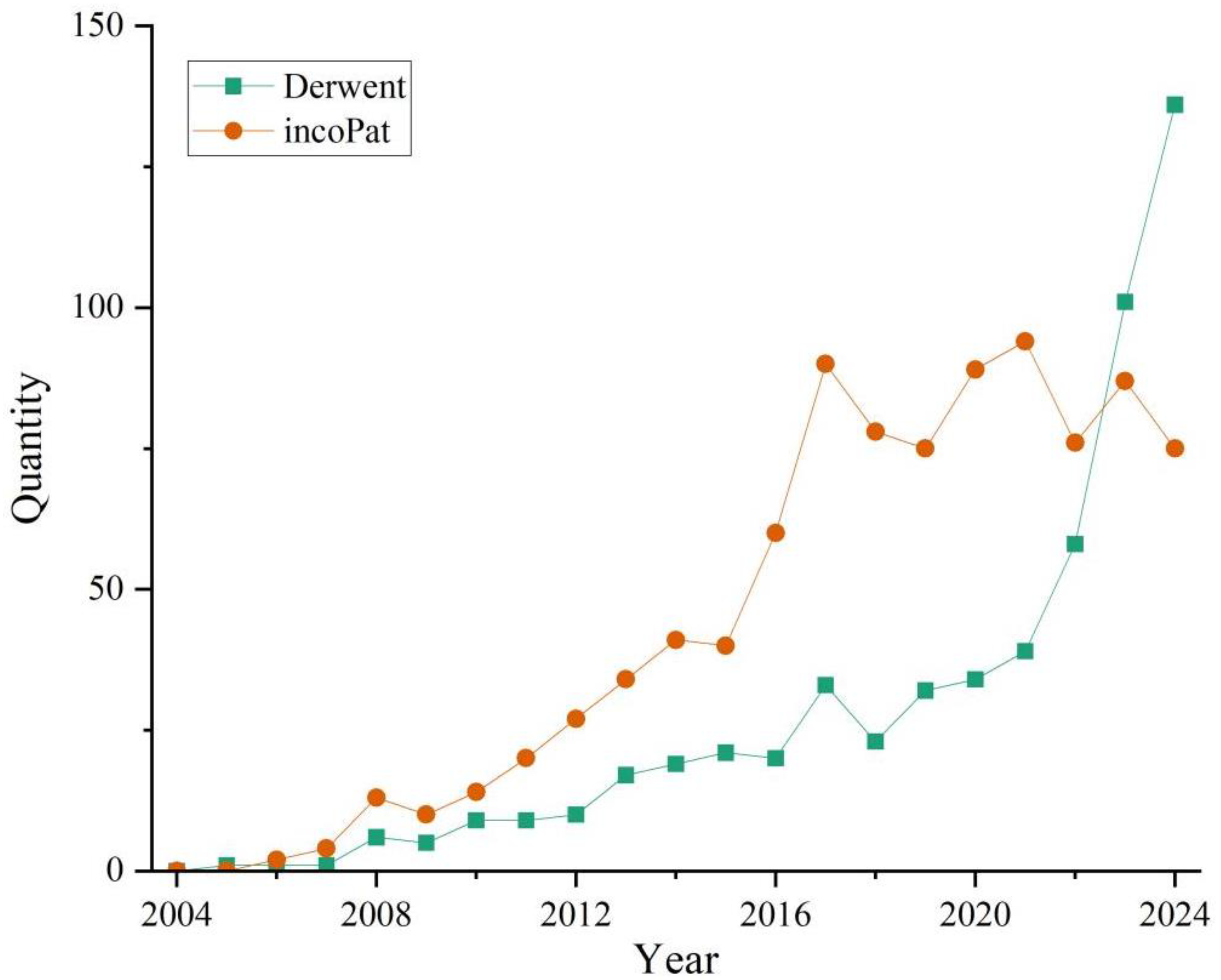
Figure 3.
Derwent Database: Annual National Patent Output.
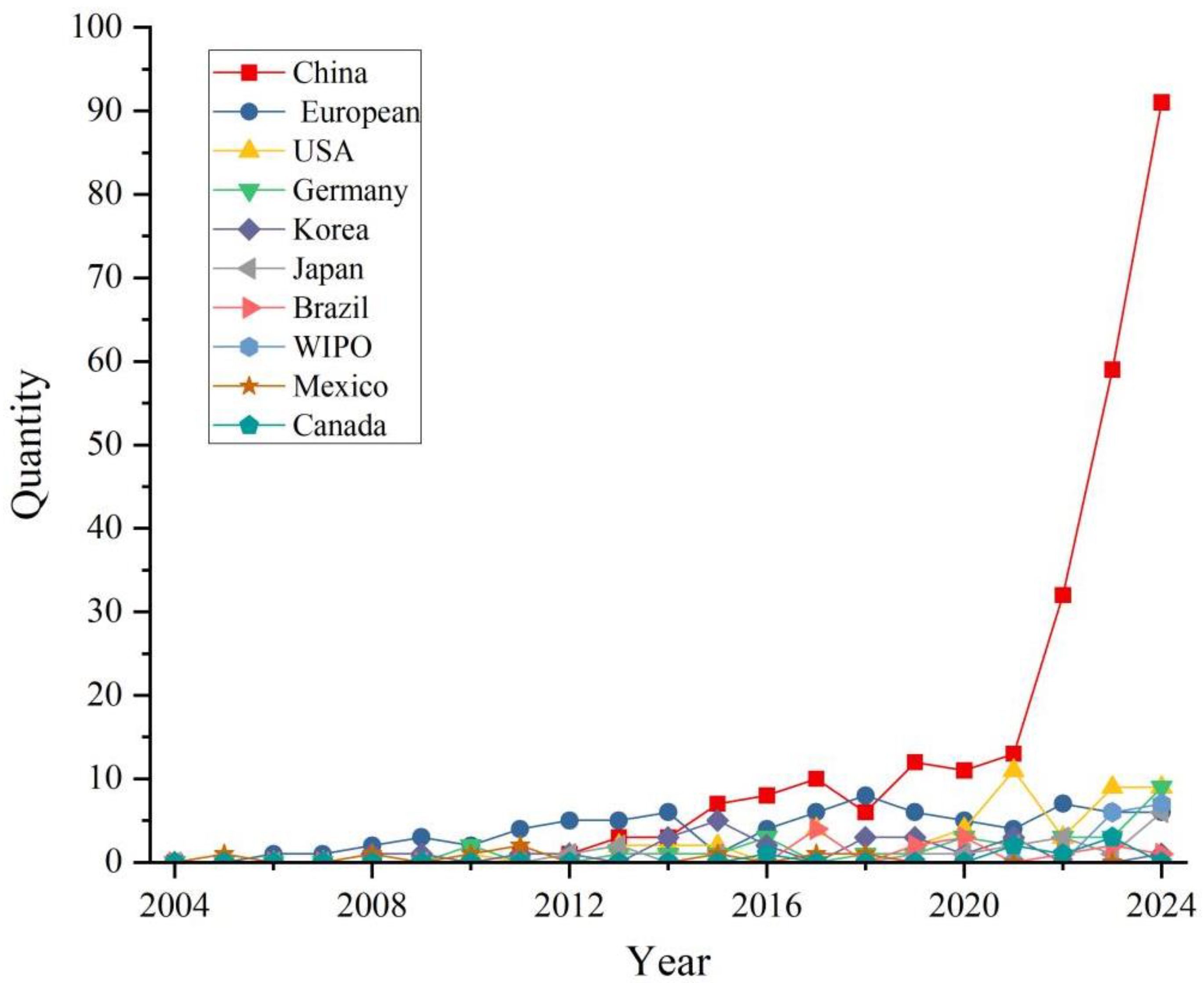
Figure 4.
IncoPat Database: Annual National Patent Output.
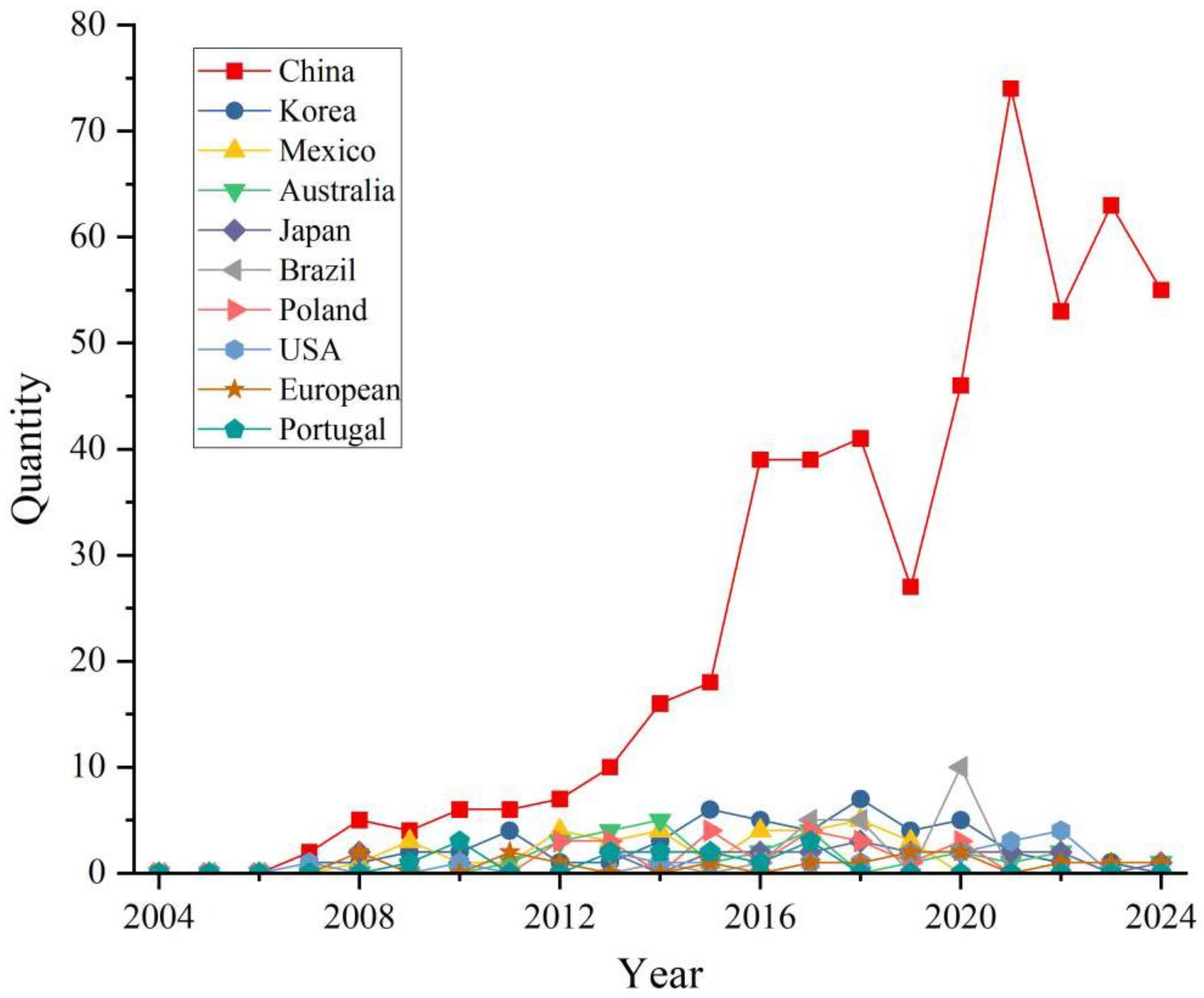
Figure 5.
Top 5 Technology Trends in the Derwent Database.
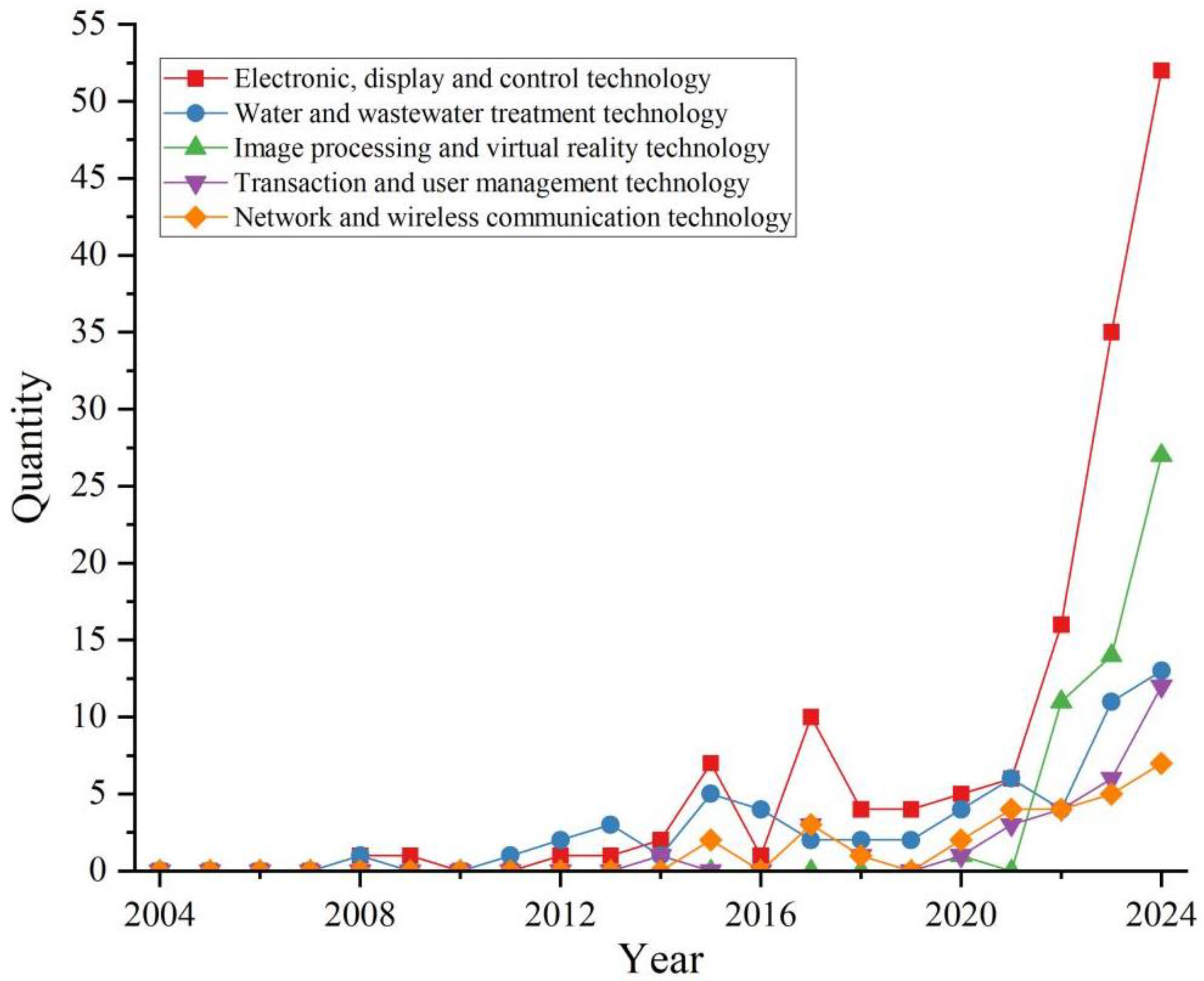
Figure 6.
Top 5 Technology Trends in the IncoPat Database.
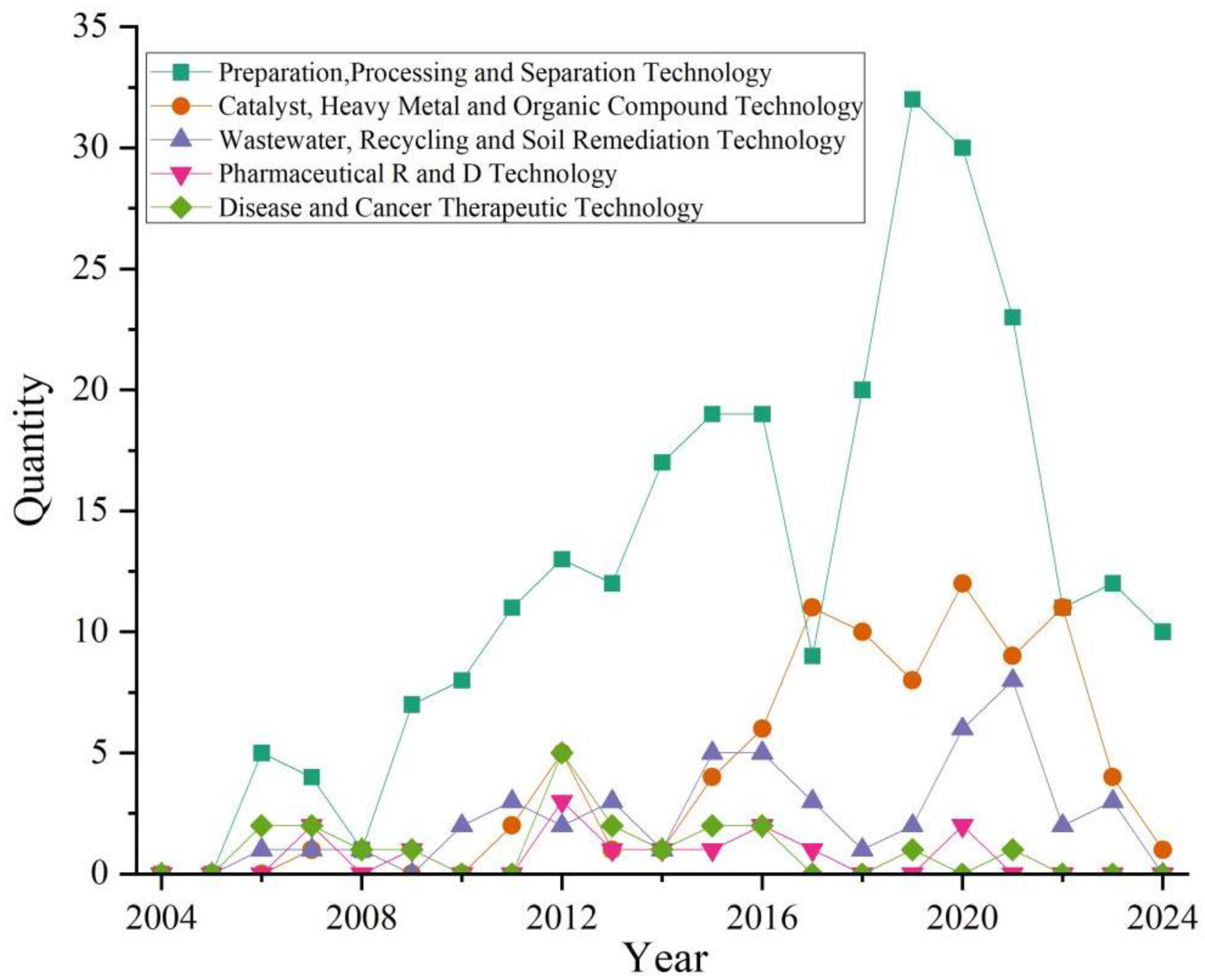

Table 1.
Dual Database Retrieval Design.
| Database | Core Search Terms | Boolean Logic Expressions | Criteria |
|---|---|---|---|
| Derwent | Dissolved Organic Matter、DOM、heavy metal | (Dissolved Organic Matter OR DOM)AND(heavy metal OR Cadmium OR Lead OR Copper OR Zinc OR Cd OR Pb OR Cu OR Zn) | Covering core expressions and typical pollutants related to DOM and heavy metals, aligned with commonly used terminology in international patents to ensure comprehensive retrieval. |
| IncoPat |
Table 2.
D Integrated Analysis Framework.
| Analysis Dimensions | Core Content | Theoretical Basis | Data Foundation |
|---|---|---|---|
| Time Dimension | Patent Stage Evolution, CAGR Growth Quantification, Dual-Database Evolution Model Differences, Policy Cycle Empowerment Effects | Technology Life Cycle Theory, Policy Instrument Theory | Annual patent volume, policy documents, and CAGR projection data from the dual patent database |
| Region Dimension | Patent Distribution by Country/Region, Core Receiving Agency Structure, Cross-Regional Technology Diffusion, and Heterogeneity in Geographic Coverage of Dual Databases | The theory of innovation diffusion posits that the geographical distribution of innovation resources is influenced by a combination of national policies, R&D investment, and market demand. | Patent Volume in Dual-Database Countries/Regions, Top 10 Receiving Offices Data, PCT Patent Information |
| Technical Dimension | DWPI/IPC Classification Distribution, Technological Type Evolution, Interdisciplinary Integration, Core Patent Technology Inheritance and Migration | Interdisciplinary convergence and technological integration are the core pathways for technological innovation. | Dual-repository classified data, technology trend maps, highly cited/landmark patents |
Table 3.
Comparison of Patent Quantities Between Derwent and IncoPat Databases.
| Database | Total Patents | Chinese Patents | European Patents | U.S. Patents | WIPO Patents |
|---|---|---|---|---|---|
| Derwent | 575 | 268 | 106 | 65 | 17 |
| IncoPat | 929 | 511 | 15 | 19 | 2 |
Table 4.
Top 10 Accepting Agencies for the Derwent Database.
| Ranking | Receiving Office | Abbreviation | Patent Count | Percentage (%) | Remarks |
|---|---|---|---|---|---|
| 1 | China National Intellectual | CN | 257 | 44.7 | Covering domestic patent applications in China and PCT applications entering the Chinese national phase, the statistical scope encompasses applications directly accepted by the Office. |
| 2 | European Patent Office | EP | 82 | 14.3 | European regional patent applications, with the statistical scope covering the volume of regional patent applications directly accepted by the office. |
| 3 | United States Patent and Trademark Office | US | 50 | 8.7 | Covering U.S. domestic patent applications and PCT applications entering the U.S. national phase, the statistical scope encompasses applications directly received by the Office. |
| 4 | German Patent and Trademark Office | DE | 30 | 5.2 | German national patent applications, with the statistical scope covering the volume of national applications directly accepted by the office. |
| 5 | Korean Intellectual Property Office | KR | 25 | 4.4 | Korean national patent applications, with the statistical scope covering applications directly accepted by the agency. |
| 6 | Japan Patent Office | JP | 18 | 3.1 | Japanese national patent applications, with the statistical scope covering applications directly accepted by the office. |
| 7 | Mexican Institute of Industrial Property | MX | 8 | 1.4 | Patents covering both domestic applications filed directly and PCT applications entering the Mexican national phase, with the statistical scope encompassing the volume of applications directly accepted by the Office. |
| 8 | World Intellectual Property Organization | WO | 13 | 2.3 | PCT international phase applications, with the statistical scope covering the volume of PCT international applications accepted by the Office. |
| 9 | Brazilian National Institute of Industrial Property | BR | 13 | 2.3 | Covering domestic applications filed directly and patents entering the Brazilian national phase under the PCT, the statistical scope encompasses the volume of applications directly accepted by the Office. |
| 10 | Canadian Intellectual Property Office | CA | 7 | 1.2 | Covering domestic applications filed directly and patents entering the Canadian national phase under the PCT, the statistics encompass the volume of applications directly accepted by the Office. |
Table 5.
Top 10 Accepting Agencies for the IncoPat Database.
| Ranking | Receiving Office | Abbreviation | Patent Count | Percentage (%) | Remarks |
|---|---|---|---|---|---|
| 1 | China National Intellectual Property Administration | CN | 511 | 55.0 | Includes domestic applications and PCT entries into China, serving as a global core receiving office. |
| 2 | Korea Intellectual Property Office | KR | 50 | 5.4 | Primarily for applications within Korea. |
| 3 | Mexican Institute of Industrial Property | MX | 34 | 3.7 | Covering both domestic applications filed directly and PCT applications entering Mexico, providing comprehensive technology positioning across Latin America. |
| 4 | Australian Intellectual Property Office | AU | 27 | 2.9 | Covering domestic applications filed directly and patents entering Australia via the PCT, with a focus on technology positioning in the Oceania region. |
| 5 | Japan Patent Office | JP | 23 | 2.5 | Primarily Japanese domestic applicants. |
| 6 | Brazilian National Institute of | BR | 22 | 2.4 | Covering both domestic applications filed directly and patents entering Brazil via the PCT, this strategy encompasses a comprehensive technology landscape across South America. |
| 7 | Industrial Property Polish Patent Office |
PL | 22 | 2.4 | Covering domestic applications filed directly and PCT applications entering Poland, with technical layouts spanning South America and regional layouts covering Central and Eastern Europe. |
| 8 | United States Patent and Trademark Office | US | 19 | 2.1 | Includes patents within the United States and PCT applications entering the United States. |
| 9 | European Patent Office | EP | 15 | 1.6 | European regional patent applications, covering technological layouts across multiple European countries, serve as the core vehicle for innovation within the European region. |
| 10 | Portuguese Institute of Industrial Property | PT | 14 | 1.5 | Covering domestic applications filed directly and PCT applications entering the Portuguese national phase, with coverage extending to Southern Europe. |
Table 6.
Top 10 DWPI Subject Areas in the Derwent Database.
| Subject Classification | Number of Patents | Percentage (%) | Core Contributions |
|---|---|---|---|
| Computer Science and Technology: Molecular Simulation and Model Building | 189 | 32.9 | Molecular simulations elucidate the coordination mechanism between DOM and heavy metals, establishing a pollution diffusion model that overcomes the limitations of macroscopic observation. |
| Light Industry Technology and Engineering: Water Composite Pollution Conditioning Additives | 60 | 10.4 | Develop compound water conditioners for contaminated water bodies, regulate DOM functional group activity, and reduce heavy metal migration capacity. |
| Materials Science and Engineering: Functional Polymeric Adsorption Materials | 21 | 3.7 | Prepare materials such as ion exchange and DOM-grafted polymers to enhance adsorption capacity and stability for heavy metals. |
| Instrument Science and Technology: DOM - In Situ Heavy Metal Monitoring | 19 | 3.3 | Develop synchronous detection instruments to enable real-time tracking and characterization of dynamic changes in DOM and heavy metals, supporting precise regulation of pollution remediation processes. |
| Agricultural Engineering: Source Control of Agricultural Nonpoint Source Pollution | 14 | 2.4 | Develop DOM-based agricultural nonpoint source heavy metal pollution reduction technology to block pollutant pathways into water bodies. |
| Materials Science and Engineering: Inorganic-DOM Cooperative Adsorption Materials | 12 | 2.1 | Establish a synergistic system of inorganic materials and DOM to enhance the extreme environment tolerance of composite pollution remediation. |
| Materials Science and Engineering: Anti-corrosion Coatings for Pollution Control Equipment | 10 | 1.7 | Prepare specialized polymer anti-corrosion coatings resistant to DOM and heavy metal corrosion to extend the service life of treatment equipment in composite polluted water bodies. |
| Materials Science and Engineering: Polymer Composite Functional Materials | 10 | 1.7 | Develop dual-functional polymer materials for adsorption and solidification to streamline composite pollution treatment processes. |
| Materials Science and Engineering: Heavy Metal Targeted Adsorption Materials | 10 | 1.7 | Design coordination groups targeting specific heavy metals to achieve precise capture and separation of low-concentration heavy metals in complex water bodies. |
| Mechanical Engineering: Modular Design of Pollution Control Equipment | 9 | 1.6 | Optimize the mechanical structure of pollution control equipment to reduce the engineering costs of DOM-heavy metal pollution treatment technologies and enhance the engineering adaptability of pollution control technologies. |
Table 7.
Top 10 DWPI Subject Areas in the IncoPat Database.
| Subject Classification | Number of Patents | Percentage (%) | Core Contributions |
|---|---|---|---|
| Light Industry Technology and Engineering: Water Composite Pollution Conditioning Additives | 337 | 36.3 | Develop compound water conditioners for contaminated water bodies, regulate DOM functional group activity, and reduce heavy metal migration capacity. |
| Materials Science and Engineering: Functional Polymeric Adsorption Materials | 164 | 17.7 | Prepare materials such as ion exchange and DOM-grafted polymers to enhance adsorption capacity and stability for heavy metals. |
| Chemical Engineering: General Chemicals and Reaction Systems | 158 | 17.0 | Synthetic DOM extraction and heavy metal chelating reagents, optimizing the reaction system and conditions for their mutual interaction. |
| Chemical Engineering: Solution Separation and Enrichment Processes | 116 | 12.5 | Developed DOM-heavy metal complex separation and trace enrichment technology to address the challenge of precise separation of low-concentration pollutants. |
| Materials Science and Engineering: Inorganic-DOM Cooperative Adsorption Materials | 104 | 11.2 | Establish a synergistic system of inorganic materials and DOM to enhance the extreme environment tolerance of composite pollution remediation. |
| Materials Science and Engineering: Anti-corrosion Coatings for Pollution Control Equipment | 97 | 10.4 | Prepare specialized polymer anti-corrosion coatings resistant to DOM and heavy metal corrosion to extend the service life of treatment equipment in composite polluted water bodies. |
| Computer Science and Technology: Molecular Simulation and Model Building | 78 | 8.4 | Molecular simulations elucidate the coordination mechanism between DOM and heavy metals, establishing a pollution diffusion model that overcomes the limitations of macroscopic observation. |
| Chemical Engineering: Preparation of Basic Chemicals and Reagents | 77 | 8.3 | Develop specialized reagents for DOM modification and heavy metal speciation analysis to support experimental and testing operations. |
| Mechanical Engineering: Structural Design of Pollution Control Equipment | 56 | 6.0 | Optimize the mechanical structure of pollution control equipment to reduce the engineering costs of DOM-heavy metal pollution treatment technologies and enhance the engineering adaptability of pollution control technologies. |
| Instrument Science and Technology: DOM - In Situ Heavy Metal Monitoring | 56 | 6.0 | Develop synchronous detection instruments to enable real-time tracking and characterization of dynamic changes in DOM and heavy metals, supporting precise regulation of pollution remediation processes. |
Table 8.
Derwent Database IPC Top 10 Categories.
| Ranking | IPC | Code Meaning | Quantity | Percentage (%) |
Application |
|---|---|---|---|---|---|
| 1 | G06F | Digital Data Processing | 151 | 26.3 | Modeling and simulating DOM-heavy metal interaction dynamics, establishing a dedicated database to support engineering design. |
| 2 | C02F | Water, Wastewater, and Sludge Treatment | 65 | 11.3 | Utilizing DOM to enhance heavy metal adsorption, regulate morphological transformation, and solidify complexes for wastewater and sludge treatment. |
| 3 | G06T | Image Processing, Computer Graphics | 54 | 9.4 | Constructing three-dimensional models of complexes to infer the spatial association between DOM and heavy metal pollution. |
| 4 | G06Q | Business and Management Affairs | 32 | 5.6 | Develop a pollution control project management platform to integrate data for pollution source tracing and liability determination. |
| 5 | H04L | Digital Information Transmission, Communication Networks | 30 | 5.2 | Establish an IoT platform to enable real-time transmission of DOM or heavy metal monitoring data and remote control of equipment. |
| 6 | G01N | Measurement and Testing | 26 | 4.5 | Detection of DOM-heavy metal complexes, monitoring of adsorption processes, and analysis of heavy metal speciation. |
| 7 | A61K | Medical Compounds | 22 | 3.8 | Develop DOM derivatives as chelating detoxification agents and modified water purification materials to address heavy metal poisoning and drinking water contamination. |
| 8 | B01D | Separation | 22 | 3.8 | Achieving separation and recovery of heavy metals through DOM-modified membranes, adsorbents, and extractants. |
| 9 | G06V | Image and Video Analysis and Recognition | 19 | 3.3 | Machine vision predicts contamination correlations and automatically detects and addresses equipment malfunctions. |
| 10 | B01J | Chemical, Physical Methods and Equipment | 18 | 3.1 | Prepare DOM-based catalysts and design reactors to precisely regulate heavy metal speciation and chelation reaction efficiency. |
Table 9.
IncoPat Database IPC Top 10 Categories.
| Ranking | IPC | Code Meaning | Quantity | Percentage (%) |
Application |
|---|---|---|---|---|---|
| 1 | C02F | Water, Wastewater, and Sludge Treatment | 271 | 29.2 | Utilizing DOM to enhance heavy metal adsorption, regulate morphological transformation, and solidify complexes for wastewater and sludge treatment. |
| 2 | B01J | Chemical, Physical Methods and Equipment | 140 | 15.1 | Prepare DOM-based catalysts and design reactors to precisely regulate heavy metal speciation and chelation reaction efficiency. |
| 3 | B01D | Separation | 69 | 7.4 | Achieving separation and recovery of heavy metals through DOM-modified membranes, adsorbents, and extractants. |
| 4 | A61K | Medical Compounds | 64 | 6.9 | Develop DOM derivatives as chelating detoxification agents and modified water purification materials to address heavy metal poisoning and drinking water contamination. |
| 5 | C09K | Dyes, Paints, Polishing agents, Natural resins | 50 | 5.4 | Preparation of DOM functional coatings and inorganic mineral composites for the efficient passivation and stabilisation of heavy metals in soil and aquatic environments. |
| 6 | G01N | Measurement and Testing | 48 | 5.2 | Detection of DOM-heavy metal complexes, monitoring of adsorption processes, and analysis of heavy metal speciation. |
| 7 | H01M | Methods and Equipment for Chemical Energy Conversion | 48 | 5.2 | Constructing a DOM-mediated electrochemical coupling system for efficient reduction and removal of heavy metal ions with resource recovery. |
| 8 | C07C | Synthesis of Acyclic or Carbon-Ring Organic Compounds | 46 | 4.9 | Targeting the modification of DOM active functional groups to prepare highly efficient heavy metal chelating agents that enhance the capture capacity of target ions. |
| 9 | C07D | Synthesis of Heterocyclic Organic Compounds | 46 | 4.9 | Synthetic DOM-Heterocyclic Compound Complex Chelating Agent for Precise Identification and Capture of Specific Heavy Metal Ions in Complex Aquatic Systems. |
| 10 | A61P | Therapeutic activity of a compound or drug formulation | 44 | 4.7 | Develop DOM-based materials with dual capabilities for environmental remediation and medical detoxification, expanding cross-disciplinary applications in emergency response to heavy metal contamination and clinical treatment. |
Table 10.
Top 5 Most Cited Patents in the Derwent Database.
| Ranking | Patent Title | Patent Number | Publication Year | Citation Count | Technical Field |
|---|---|---|---|---|---|
| 1 | Generating web API specification from online documentation | US10942708B2 | 2021 | 91 | Computing and Control |
| 2 | Collaborative browsing on a network site | US8739044B1 | 2014 | 62 | Computing and Control |
| 3 | Capturing web-based scenarios | US8407321B2 | 2013 | 54 | Telecommunications and Power Engineering |
| 4 | Tryptamine compositions for enhancing neurite outgrowth | WO2021101926A1 | 2021 | 53 | Chemical Engineering |
| 5 | Large data technology platform for recognizing internet of things | CN113377850B | 2022 | 52 | Telecommunications and Power Engineering |
Table 11.
Top 5 Most Cited Patents in the IncoPat Database.
| Ranking | Patent Title | Patent Number | Publication Year | Citation Count | Technical Field |
|---|---|---|---|---|---|
| 1 | A Novel Method for Large-Scale Production of Calcium Sulfate Whiskers | CN101168852A | 2008 | 75 | Environmental Chemistry |
| 2 | Lithium Manganese Phosphate as Cathode Material for Lithium-Ion Batteries and Its Preparation Method | CN101320809A | 2008 | 66 | Polymer Materials |
| 3 | Interface-Wetting Quasi-Solid-State Alkali Metal Battery, Battery Electrode, and Its Preparation Method | CN105374980A | 2016 | 63 | Polymer Materials |
| 4 | Production Method of Xylose Products | CN101659681A | 2010 | 58 | Polymer Materials |
| 5 | Tryptamine Compositions for Enhancing Neurite Outgrowth | US20210145851A1 | 2021 | 51 | Medicinal Chemistry |
Disclaimer/Publisher’s Note: The statements, opinions and data contained in all publications are solely those of the individual author(s) and contributor(s) and not of MDPI and/or the editor(s). MDPI and/or the editor(s) disclaim responsibility for any injury to people or property resulting from any ideas, methods, instructions or products referred to in the content. |
© 2026 by the authors. Licensee MDPI, Basel, Switzerland. This article is an open access article distributed under the terms and conditions of the Creative Commons Attribution (CC BY) license (http://creativecommons.org/licenses/by/4.0/).
Copyright: This open access article is published under a Creative Commons CC BY 4.0 license, which permit the free download, distribution, and reuse, provided that the author and preprint are cited in any reuse.


