

Submitted:
12 February 2026
Posted:
19 February 2026
You are already at the latest version
Abstract
This article presents a reflective survey of research contributions that are related to functional thin film materials, photovoltaic-related architectures, and energy-oriented applications. By synthesising findings from multiple investigations focused on semiconductors, metal-oxide composite systems, nanostructured coatings, and building relevant constituents, the work concentrates on proceeding of fabrication strategies as well as structure-property interrelationships and application-driven performance metrics. Rather than giving a full review of the literature, the article combines some of the experimental observations to highlight recurrent themes such as process optimisation, interface engineering, and multifunctional material behaviour. Particular emphasis is placed on the modulation of optical, electrical, and functional performance by modest variations in deposition conditions, dopant incorporation strategies, and structural design. A cross-there theme analysis shows practical feasibility, long-term stability, and scalability as important as peak performance in determining the suitability of advanced materials for energy applications. Unlike conventional component-focused reviews, this perspective articulates a translational design logic linking materials processing decisions directly to device reliability and system-level energy performance, providing a conceptual framework for accelerating lab-to-field deployment of sustainable energy technologies. The purpose is to highlight cross-cutting translational challenges and design principles that link functional materials to device- and system-level deployment, with particular relevance to real-world and remote-environment energy applications.
Keywords:
materials-to-systems integration
; translational materials science
; functional thin films
; photovoltaics
; sustainable energy systems
; deployable materials
1. Introduction and Perspective Scope
The shift towards sustainable energy systems has led to extensive research on many areas of technology, such as functional materials, photovoltaic devices, energy-efficient building components, and intelligent energy management strategies [1,2,3,4,5]. While there has been much progress made in each of these areas separately, the sustainability of real-world energy systems will increasingly rely on the successful integration of materials-level innovations with device performance and system-level innovations [6,7,8,9,10,11]. Consequently, there is an increasing interest in approaches that take a materials-to-systems view of energy technologies instead of focusing on individual components.
Functional thin-film and composite materials are important components in many applications of sustainable energy [12,13,14,15,16]. Transparent conductive oxides [17,18,19,20], metal-dielectric nanocomposites [21,22,23,24,25], and low-emissivity coatings [26,27,28,29] play a critical role in optical, electrical, and thermal property control in photovoltaics and building-integrated applications. Parallel developments of photovoltaic materials such as nanostructured III-V semiconductors and solution-processed perovskite thin films have resulted in spectacular improvements in power conversion efficiency. However, challenges concerning stability, scalability, and compatibility with practical deployment environments are major impediments to widespread adoption [30,31,32,33,34].
Beyond materials and devices, the performance of sustainable energy technologies is greatly affected by system-level energy management. The use of intelligent control strategies, especially in the grid-connected and microgrid environments, is needed to guarantee reliable operation, maximise energy utilisation, and support the inherent variability of solar energy [35,36,37,38,39]. Therefore, the combination of advanced material systems, device fabrications, and energy management frameworks has become an important research direction to develop robust and sustainable energy-efficient systems.
1.1. Motivation: Why Materials-to-Systems Integration Has Become the Bottleneck
Over the past decade, materials science has delivered rapid progress in functional thin films, nanomaterials, and nanocomposites for various applications, mostly on a laboratory scale. However, the progress rate of translation into deployable energy technologies remains disproportionately deliberate, which is clearly evident in building-integrated photovoltaics, energy-efficient glazing, and distributed energy systems, where performance metrics optimized at the material level do not automatically translate into system-level gains in energy yield, durability, or lifecycle sustainability. A vital challenge is that materials, devices, and energy systems are often developed in relative isolation. In addition, the absence of an explicit materials-to-systems integration framework leads to mismatches between laboratory design targets and real-world operating constraints such as environmental exposure, long-term degradation, installation practices, and maintenance requirements. These issues become particularly pronounced in remote or harsh environments, ranging from tropical climates to space-adjacent or high-altitude infrastructures, where reliability and robustness are often more critical than peak efficiency.
In this context, the present article is a thematic synthesis of research developments covering functional materials [22], photovoltaic technologies [40,41,42,43], energy-efficient building components [44], and energy management strategies [45]. Rather than presenting a comprehensive overview of each domain, this perspective argues that the next phase of progress in sustainable energy technologies requires a shift from materials-centric optimization toward translational co-design, where material properties are evaluated in the context of devices, built environments, and system-level energy performance from the outset. By bringing together knowledge from a wide spectrum of studies of different but related natures, the aim of this article is to provide a readable and coherent overview for future studies and application-driven development in sustainable energy technologies.
2. Scope and Perspective Methodology
The scope of this perspective is intentionally selective and illustrative, aiming to extract transferable insights rather than to survey the full literature of each domain. Rather than focusing on a single class of materials or a specific use, the investigations chosen here represent a group of studies on the relationship between material properties, device performance, and system-level operation, and the overall energy efficiency and practical deployment of the system.
At the materials level, focus is put on the functional thin films and composite materials that exhibit tuneable optical, electrical, and thermal properties. These include doped transparent conductive oxides, metal-dielectric nanocomposites, and semiconductor-based composites. The current trends in research in these areas are controlled materials processing, including physical vapor deposition, sputtering parameter optimisation, and solution-based processing, followed by controlled characterisation of the structural, optical, and electrical properties. This allows a direct relationship to be established between processing conditions, microstructural features, and functional performance. At the device level, the synthesis takes into consideration photovoltaic technologies in the high-efficiency and emerging material systems. Nanostructured III-V photovoltaic devices are reviewed with respect to their light management and carrier collection benefits, and perovskite thin-film devices are reviewed with respect to processing simplicity and performance enhancements. In these studies, the device performance metrics are usually evaluated simultaneously with one another in conjunction with the material properties, which highlights the dependence of the photovoltaic efficiency and stability on the underlying material design. Beyond the individual devices, however, the scope is taken in energy-efficient building components and energy management strategies at the system level. Functional coatings and laminated glass structures are evaluated in the context of building-integrated applications in which optical control, thermal regulation, and durability are key issues. Parallelly, frameworks for energy management (especially for grid-connected or microgrid systems) are being pondered for their role in optimising energy flow and variable renewable energy generation, as shown in Figure 1.
Methodologically, this paper follows the qualitative synthesis approach. Key findings from each of the research themes are analysed in order to find recurring design principles, performance trade-offs, and practical challenges (Table 1). Rather than replication of detailed methods or numerical models, an emphasis is placed on comparative interpretation and the linking of themes between studies. This approach allows the insights developed in one area, for example, materials processing, to be explored with respect to results in another, such as the performance of the device or the operation of the system. To aid clarity and readability, representative figures and summary tables have been included where they give contextual understanding or help comparison across themes. Figures are used specially to represent material structures, device architectures, and concept system configurations, and tables summarise the important properties, performance, or application perspectives arising from the underlying studies [22,40,41,42,43,44,46,47].
3. Functional Thin-Film and Composite Materials: Illustrative Examples for Translational Insights
Functional thin films and composite materials form a basic layer compared to a wide range of sustainable energy technologies through the possibility of controlled manipulation of optical, electrical, and thermal characteristics. Across the different studies that we have considered in this synthesis, materials design has been based on a common objective: to obtain multifunctionality with relatively simple and scalable processing routes. This section brings together the insights gained from doped oxide thin films, ceramic-semiconductor composites, and metal-dielectric nanocomposite coatings, which can be attributed to compositional and microstructural control of the functional performance.
3.1. Doped ZnO Thin Films (Illustrative Case of Processing–Property Coupling)
Zinc oxide-based thin films have been widely studied in terms of their functionality as materials for energy applications because of their wide bandgap, high optical transparency, and favourable electronic properties [48,49]. Both physical and solution-based doping methodologies have been used to alter ZnO thin films for various roles, especially in optoelectronic and photovoltaic devices. Across the studies they have synthesised in this work, doped ZnO thin films are taken to be representative of the joint effect of compositional modification and processing route on functional performance.
Physical deposition approaches such as sputtering-based techniques allow one to carefully control the film thickness, crystallinity, and carrier concentration by adjusting, for example, working gas composition, flow rate, and deposition geometry. Doping with the group III elements has been shown to result in much lower resistivity without destroying the high visible range transparency, making these films suitable for transparent electrodes and functioning layers in energy-related devices. In parallel, solution-processed doping strategies are an alternative route towards ZnO functionalisation, especially for uses that need to be made at low temperatures, and are compatible with solution-processed photovoltaics. Spin-coated Mg-doped ZnO thin films are effective for use as an electron transport layer in perovskite solar cells. Mg incorporation alters the band alignment, reduces interface recombination, and improves device stability. Compared to undoped ZnO, Mg-doping treatment shows an enhanced electronic selectivity and reasonably good optical transparency, thus showing the usefulness of compositional tuning of a solution-processed system. Together, these physical and chemical doping approaches show the versatility of ZnO as a functional material platform. Importantly, they also show how different roles can be optimised within the same material system, from the transparent conductive coatings to the charge-selective coatings in photovoltaic devices based on the deposition route and dopant chemistry selected. In Figure 2, a comparison has been presented of two different methods of deposition-physical vapor deposition (PVD) and chemical solution deposition (CSD)-as well as two distinct types of dopants that can be incorporated into the zinc oxide (ZnO) thin films. The results show how experimental conditions used to prepare the ZnO thin films were varied to meet the specific requirements of photovoltaic and electron transport layers [41,43].
3.2. Nanocomposite Thin Films (Examples of Multifunctionality and Trade-Offs)
Synthesis of single-phase oxide thin films and nanocomposite architectures introduces an additional degree of freedom through phase interactions, enabling simultaneous optimization of optical absorption, charge transport, and thermal stability. Silver-based nanocomposites, which are deposited by physical vapor deposition techniques, allow control over the incorporation of the metallic phases into the dielectric matrices and hence provide tuneable optical and electrical responses. This reflective review showcases that deposition conditions and layer architecture have a powerful effect on the size, spatiality, and interfacial properties of nanoparticles. These parameters, in turn, control the optical properties such as the reflectivity, absorptance, and wavelength selectivity, all of which are very relevant to energy-efficient coatings and optoelectronic devices. Of particular significance, the multifunctional nature of these nanocomposites enables us to simultaneously control the optical and electrical functionality, thus supporting deployment of the nanocomposites in more advanced energy and building-related applications.
Beyond the usage of monophase thin films, phase composite material systems offer extended degrees of freedom for multifunctional properties engineering. ZnO/SiC composites are an example of this type of strategy, combining the semiconducting and optical properties of ZnO and thermal stability and mechanical properties of silicon carbide [22,46]. The meeting of these phases allows us to selectively modulate structural behaviour, optical behaviour, and, in some cases, dielectric behaviour through interfacial interactions and phase distribution. Empirical investigations of ZnO/SiC composites show that the formation of the composite has a great influence on the crystallite dimensions, defect density, and optical absorption characteristics compared with pristine ZnO (Figure 3). These phenomena are closely linked with the synthetic protocols and the compositional ratios and hence point to the pivotal role of processing in determining composite functionality. From an application point of view, such materials are prospective for a variety of energy-related multifunctional materials, for example, in the form of optoelectronic elements, protective coatings, and sensing elements, where durability and stability have to go together with the functional performance.
3.3. Comparative Insights and Design Considerations
Collectively, doped ZnO thin films, ZnO/SiC composites, and silver-based nanocomposites constitute a stepping stone from single to more and more complex multifunctional systems. Across all these categories of material, there are a number of recurring design considerations. Firstly, processing parameters have a dominant effect on the functional performance, which in many cases overcomes the effects of compositional variations. Secondly, there are unavoidable intrinsic trade-offs between the three factors, such as optical transparency, electrical conductivity, and stability, that must be judiciously balanced in accordance with application-specific requirements. Thirdly, there is the issue of scalability and compatibility with existing fabrication infrastructure, both of which are paramount factors for practical deployment. These observations highlight the realization of comparative analysis between different material systems (Table 2) in which lessons learned from one class, e.g., on controlling defects in oxides with dopants or on interface engineering strategy in composites, can be exploited to benefit design strategies in alternative systems.
Comparable benchmarking trends and trade-offs between transparency, conductivity, stability, and scalability in oxide-based transparent conductors and nanocomposite coatings have been reported across the broader literature [50,51]. Oxide-based systems (such as doped ZnO) typically provide more scalability and compatibility with large area processing than do metal-based nanocomposites, which afford a higher performance than that of oxide-based systems but at a lower cost and lower stability than that of oxide-based systems. This disparity demonstrates the continuing performance-deploy-ability trade-off for all types of materials.
4. Photovoltaic Materials and Devices
Photovoltaic technologies represent a key application domain where advances in functional materials can be directly translated into system-level energy generation. The studies synthesised in this section span both high-efficiency semiconductor photovoltaics and emerging thin-film solar cell technologies, illustrating how materials engineering at the nanoscale influences device performance, stability, and practical applicability. Rather than providing a comprehensive review of photovoltaic physics, the focus here is placed on selected material-device relationships that are most relevant to sustainable energy applications.
4.1. Nanostructured GaAs Solar Cells (Perspective on Light-Management Strategies)
III-V semiconductor materials, particularly gallium arsenide (GaAs) [52,53,54], are well recognized for their high photovoltaic efficiencies and high-quality optoelectronic properties. Nanostructuring methods have been pursued to further increase the light absorption, reduce the reflective losses, and improve carrier collection in the GaAs-based solar cells [47]. Synthesized investigations show that combining nanostructured features like texturing of the surface or the realization of nano-patterned architectures can enable excellent enhancement of the optical coupling while maintaining good electronic transport properties. From a device-centered perspective, these nanostructured GaAs cells have higher short circuit current densities due to enhanced light trapping, however, careful design is needed to reduce excessive surface recombination. These observations highlight a recurring theme in the design of advanced photovoltaics: because performance gains from nanostructuring are accompanied by increased fabrication complexity and possible stability problems, it is necessary to weigh the benefits against the disadvantages. Although such devices are mostly associated with high-performance applications, the basic design principles offer transferable knowledge that can be applied to a wider range of photovoltaic systems. Nanostructured surface engineering has enhanced light-matter interaction, which ultimately reduces optical reflection; enhances the trapping of light; and increases absorption all across the operational wavelength range (shown in Figure 4 for the example of GaAs solar cells). A composite schematic and morphology, along with representative photovoltaic and optical characteristics, confirm that the nanostructures with optimized geometries translate directly to measurable performance improvements.
4.2. Perovskite Thin Film Solar Cells (Perspective on Processing–Stability Trade-Offs)
Organic-inorganic halide perovskites have become promising photovoltaic materials due to their strong light absorption, long carrier diffusion length, and compatibility with low-temperature solution processing [55,56]. In the synthesized body of literature, there has been a focus on processing strategies affecting film quality, interfacial properties, and device stability (rather than focusing on maximizing absolute efficiency metrics). Anti-solvent engineering during film deposition has been shown to play an important role in controlling perovskite crystallisation, grain size, and surface coverage. Increased film uniformity and defect density are among the advantages of improved photovoltaic performance and reproducibility (Figure 5). Importantly, these processing strategies remain compatible with scalable fabrication routes- a key consideration for practical deployment. At the device interface level, the choice of charge transport layers has a huge impact on both efficiency and stability of operation [42]. As discussed in Section 3.1, metal-doped ZnO thin films have been used as an electron transport layer to enhance band alignment and suppress interfacial recombination in perovskite solar cells. Incorporation of metal into ZnO modulates electronic properties without affecting optical transparency, thus demonstrating the potential of targeted material engineering to overcome interfacial limitations in emerging photovoltaic technologies.
4.3. Performance-Stability Considerations
For both GaAs and perovskite-based photovoltaic systems, a similar trade-off between performance enhancement and long-term stability is found to be consistent. Nanostructuring and aggressive processing methods promise near-term improvement in efficiency with the potential of introducing extra pathways or fabrication concerns. In contrast, more conservative material choices and interface optimisation approaches often put reproducibility and stability above performance (Table 3). These observations strengthen the value of application-driven design in photovoltaics research. For sustainable energy systems, especially those that are built into buildings or integrated into distributed energy systems, reliability and durability may be just as important as efficiency. Consequently, the insights acquired from the fields of materials selection, interface engineering, and processing control are playing a central role in the practical deployment of photovoltaic devices.
5. Energy-Efficient Building Components
Energy-efficient building components are the key nexus point between the fields of advanced materials science, photovoltaic technology, and energy consumption. In both building-integrated and retrofit applications, functional materials must not just allow energy to be produced; they are needed to control optical and thermal properties and, at the same time, ensure that they are durable and acceptable to the user [58,59,60]. This section summarises existing research on functional coatings and laminated systems designed to enhance the energy performance in a building with a special focus on low-emissivity glass systems.
5.1. Low-Emissivity Coated Glass Systems
Low-emissivity (Low-E) coatings are used extensively in modern building envelopes to restrict radiative heat transfer while allowing high visible light transmission [61,62,63]. The studies synthesized in this manuscript have shown that the design of thin film coatings, especially in the choice of metallic and dielectric layers, deposition parameters, and layer thickness, plays a decisive role in controlling optical reflectance, emissivity, and solar control characteristics (Figure 6). The physical vapor deposition-based Low-E coatings allow fine-tuning of the spectral response, allowing selective reflection of infrared radiation and transparency of visible. Such spectral selectivity is necessary for the reduction of cooling loads in warm climates and improved overall performance of buildings [44]. Let’s be clear, the multifunctional character of these coatings fits very well into the larger objective of sustainability because you can tackle two problems with one system of materials: thermal comfort and energy consumption.
5.2. Laminated Glass Structures for Retrofit Applications (Modern Infrastructure and Green Mobility)
Beyond the single-layer coatings, there is a range of other configurations of laminated glass, considering that it can be used for other functionalities to provide practical benefits, especially in retrofit situations where you cannot replace any parts of the window system. Laminated Low-E coated glass structures feature functional thin films that are securely combined with interlayers that offer mechanical stability, safety, and improved durability [44]. The synthesised studies show that lamination can affect both the optical performance by interlayer interaction, as well as enhancing resistance to environmental degradation. From a practical standpoint, laminated systems provide better or incremental building upgrades that include energy-efficient glazing systems that can work in association with existing architectural frameworks. These features are especially relevant for the retrofitting of large-scale buildings, where costs, ease of installation, and reliability for the long term are important considerations [65,66]. In the case of building applications, deployment of functional coatings and laminated glass systems presents several considerations related to integration that take on critical importance. Among these considerations are the thermal performance under a variety of climatic regimes, long-term optical stability, and compatibility with building-integrated photovoltaic components and smart transportation systems, as showcased in Figure 7. Although state-of-the-art coatings have the potential to deliver significant energy savings, their realized effectiveness is dependent upon the careful integration into the larger scheme of the architectural design and energy plan.
The literature reviewed underlines the fact that optimization done at the material level should also be complemented by the consideration at the system level, including orientation, shading, as well as interactions with the photovoltaic elements (Table 4). Consequently, the evaluation of energy-efficient building materials should include not only the isolated performance aspects but also the use of the material in a holistic building energy system.
Although the individual studies reported in Sections 2-5 study a variety of materials, device architectures, and application contexts, the studies exhibit a common research philosophy aimed at performance optimisation while at the same time concentrating on functional integration and feasibility. Rather than view these investigations as an isolated contribution, it is instructive to explore common depreciations, flaws, and lessons to be borrowed from one another. Accordingly, the following section synthesises cross-theme observations drawn from these works to highlight common design principles and lessons learnt from the materials development, device engineering, and applied energy technologies.
6. Cross-Theme Insights and Lessons Learned
Based on the synthesis across functional materials, photovoltaic devices, building components, and energy management systems, a simple Materials-to-Systems Translational Loop (M2S-TL) framework is proposed. The framework comprises four interconnected stages: (i) process-aware materials design, (ii) interface-centric device integration, (iii) application-context validation under realistic operating conditions, and (iv) system-level performance feedback. This loop emphasizes that deployment constraints and environmental exposure should inform materials and device design from the outset, rather than being treated as post-optimization considerations.
A major understanding is the overriding role of processing and integration over material composition alone. Across thin film materials, photovoltaic devices, and building components, a relatively modest change in deposition parameters, interface engineering, or structural configuration often results in significant differences in performance. This observation highlights the need for optimisation of process and reproducibility, especially of technologies intended for deployment in the real world rather than on a laboratory scale. Another theme that is a recurring theme deals with the balance between enhancing performance and increasing robustness in terms of what can be practically performed. Newer designs of high-efficiency photovoltaics, nanostructured materials, and new coatings, for instance, are often accompanied by a greater fabrication complexity or more sensitivity to environmental conditions. On the other hand, systems that are more concerned with stability, scalability, and ease of integration may have lower peak performance but may have better long-term reliability. This is a trade-off of great importance where the building-integrated and distributed energy systems are concerned, as durability and maintenance considerations play an important role in the adoption of technology.
Interfacial engineering is a concept that arises from the unification of different themes. Whether it is in doped ZnO layers, for charge transport, composite material interfaces in multifunctional coatings, or in laminated glass structures, interfaces very often control the overall system behaviour. Effective control of interfacial properties can reduce losses in performance, improve stability, and compatibility between disparate system components. This understanding makes integrated design strategies that prioritize interfaces as functional elements instead of passive boundaries necessary. The synthesis also shows the enabling role of system-level energy management in realising the benefits of materials and device innovations. Intelligent control strategies can compensate for the inherent variability of the photovoltaic output and for the material degradation over time, and optimise energy utilisation at the building or microgrid level (Figure 8). Accordingly, energy management must be designed as a complementary layer of design that maximizes the impact of component levels of improvement [68,69,70].
Finally, the collective findings underline the importance of undertaking application-driven research. Materials and device designs that are compatible with realistic operating conditions, regulatory limitations, and installation practices are more likely to make a difference. Cross-disciplinary integration, not optimising one area of study at a time, seems to be a crucial element in bringing the advances that are made in laboratories into practical advancements in sustainable energy.
7. Limitations and Challenges
As a perspective-style synthesis, this section highlights selected limitations that recur across the discussed studies rather than providing an exhaustive critical appraisal of all competing materials systems. The intention is to foreground common translational challenges that hinder large-scale deployment. The limitations discussed here reflect cross-cutting challenges commonly encountered during translation from laboratory-scale materials research to real-world energy systems, rather than a comprehensive evaluation of all alternative materials platforms. As a result, a simple quantitative association of disparate materials and technologies is often impossible to achieve. Variations in fabrication processes, experimental conditions, and performance metrics restrict the possibility of setting universally applicable benchmark standards. An additional serious limitation concerns the scalability and manufacturability. While many thin-film materials and nanostructured structures show promising results at a laboratory scale, the extrapolation of these results to large-area manufacturing or commercial production is problematic. Factors such as process uniformity, long-term durability, supply of materials, and the economics of the process must be addressed more fully before the possibility of this technology being adopted on a large scale.
Environmental stability and durability are other issues of persistence, particularly in the photovoltaic and functional thin-film areas. Exposure to humidity, thermal cycling, and prolonged illumination tends to affect material characteristics and device performance over time. Although various mitigation strategies have been proposed, thorough long-term investigations under realistically working conditions are still rare. At the macro-system level, sophisticated energy management schemes rely on precisely sensing, reliably communicating, and dynamically controlling. Such dependencies inevitably bring a new level of complexity and potential failure modes, especially within a distributed or building-integrated framework. Furthermore, the effectiveness of such strategies is often influenced by end-user behaviour, regulatory requirements, and regional infrastructure features, all of which pose significant standardisation challenges in a wide range of deployment scenarios.
8. Future Research Directions
Based on the collective understanding spelled out in this article, a number of auspicious paths for future exploration open up. From the materials science perspective, future efforts should focus on developing multifunctional materials that possess performance, stability, and scalability criteria all at the same time. Special emphasis should be placed on environmentally benign constituents, reduced reliance on critical raw materials, and simplified fabrication processes since these are indispensable for sustainable deployment. A second pivotal research trajectory is interface-oriented. With improved methods for characterizing the materials and properties of nanostructures, and with the use of sophisticated modeling techniques, it is possible to provide a more comprehensive view of the types of interfacial effects that determine charge transport, optical response, and mechanical stability. Such deeper insights support the rational design of architectures and systems with layers and with composites.
In view of the photovoltaic and building-integrated applications, future studies should have a priority for real-world testing and long-life performance evaluation. Coupling experimental investigations with simulation-based predictive modeling may overcome such a chasm between optimization in the laboratory and deployment in the field. Concurrently, combining energy-efficient materials with intelligent building technologies offers opportunities to ensure maximum benefits from a system perspective. At the systems level, the continual improvement of intelligent energy management strategies (including data-driven and hybrid control strategies) shows promise to help augment the resiliency and adaptability of distributed energy systems. From a practical translational standpoint, progress can be accelerated by introducing standardized durability and environmental stress-testing protocols at the materials development stage, early co-design of materials and device architectures under realistic deployment constraints, and system-level modeling that explicitly incorporates material degradation parameters into energy management strategies. Such measures would help narrow the persistent gap between laboratory-scale optimization and field-level performance of sustainable energy technologies.
9. Conclusions and Perspective Outlook
This article provides a reflective synthesis of research progress in areas of functional materials, PV devices, building integrated components, and energy management strategies. Through an integrated study of these themes, the work explains common design principles, existing challenges, and cooperative functions across diverse branches of technology. A major inference for sustainable energy solutions is that they gain most advantages from integrated design paradigms that view materials, devices, and systems as systems in a way that emphasizes interdependencies among their constituent parts rather than their discrete constituents. Process optimisation, interface engineering, and control at the system level are repeatedly becoming key determining factors in terms of performance and reliability. Despite a lot of progress, issues relating to scalability, durability, and real-world integration remain. Partnership between disciplines and application-driven research will be required to overcome these impediments. In total, the views coming together in this synthesis provide an integrated view of how diversified research initiatives can work in concert to support the efficiency, robustness, and sustainability of an energy system.
Author Contributions
M.N-E-A. wrote the main manuscript text, prepared figures, and reviewed the manuscript.
Acknowledgments
The authors would like to acknowledge the research support provided by the NEC-2025 grant (J510051140, & J510051142) from Universiti Tenaga Nasional, Malaysia.
Author’s note
This article is intended as a reflective perspective based on interconnected recent studies, aiming to stimulate materials-to-systems thinking in sustainable energy research rather than to function as a comprehensive review of the field.
References
- Fatma S. Hafez, Bahaaeddin Sa’di, M. Safa-Gamal, Y.H. Taufiq-Yap, Moath Alrifaey, Mehdi Seyedmahmoudian, Alex Stojcevski, Ben Horan, Saad Mekhilef, Energy Efficiency in Sustainable Buildings: A Systematic Review with Taxonomy, Challenges, Motivations, Methodological Aspects, Recommendations, and Pathways for Future Research, Energy Strategy Reviews, Vol. 45, 2023, 101013. [CrossRef]
- Liu, B.; Wang, Y.; Liu, L. Editorial for This Special Issue on Energy Conversion Materials and Devices and Their Applications. Micromachines 2025, 16, 943. [CrossRef]
- Kuznetsov, V., and Edwards, P. . (2010), Functional Materials for Sustainable Energy Technologies: Four Case Studies. ChemSusChem, 3: 44-58. [CrossRef]
- Patel, Dhirendra. “Emerging Sustainable Materials to Improve Green Energy: Environmental Applications and Future Scope.” Innovations in Energy Efficient Construction Through Sustainable Materials, edited by Roberto Alonso González-Lezcano, IGI Global Scientific Publishing, 2025, pp. 65-82. [CrossRef]
- Agresti, F.; Angella, G.; Arshad, H.; Barison, S.; Barreca, D.; Bassani, P.; Battiston, S.; Biffi, C.A.; Buscaglia, M.T.; Canu, G.; et al. Sustainable Materials for Energy. Nanomaterials 2025, 15, 1388. [CrossRef]
- Reddy, V.J.; Hariram, N.P.; Ghazali, M.F.; Kumarasamy, S. Pathway to Sustainability: An Overview of Renewable Energy Integration in Building Systems. Sustainability 2024, 16, 638. [CrossRef]
- Simin Anvari, Alejandro Medina, Rosa P. Merchán, Antonio Calvo Hernández, Sustainable solar/biomass/energy storage hybridization for enhanced renewable energy integration in multi-generation systems: A comprehensive review, Renewable and Sustainable Energy Reviews, Vol. 223, 2025, 115997. [CrossRef]
- Milan Vujanović, Qiuwang Wang, Mousa Mohsen, Neven Duić, Jinyue Yan, Recent progress in sustainable energy-efficient technologies and environmental impacts on energy systems, Applied Energy, Vol. 283, 2021, 116280. [CrossRef]
- X. Li, Z. Yu, C. Zhang, B. Li, X. Wu, Y. Liu, Z. Zhu, Advancing Energy Sustainability Through Solar-to-Fuel Technologies: From Materials to Devices and Systems. Small Methods 2024, 8, 2400683. [CrossRef]
- Chauhan, Siddharthsingh K., and Vineeta S. Chauhan. “Innovative Materials for Solar Cells, Photocatalysis, and Hydrogen Storage in Renewable Energy Systems.” Innovations in Next-Generation Energy Storage Solutions, edited by Mohsen Mhadhbi, IGI Global Scientific Publishing, 2025, pp. 289-316. [CrossRef]
- Salunkhe, T.T.; Kim, I.T. Editorial for the Special Issue Energy Conversion and Storage Devices: Materials and Applications. Micromachines 2025, 16, 843. [CrossRef]
- Sheila Devasahayam, Chaudhery Mustansar Hussain, Thin-film nanocomposite devices for renewable energy current status and challenges, Sustainable Materials and Technologies, Vol. 26, 2020, e00233. [CrossRef]
- Abdel-Wahed MS, Sayed MH, Gomaa MM. Thin films nanocomposite: multifunctional materials for energy and water purification. Discov Nano. 2025 Nov 5;20(1):198. [CrossRef]
- Sana Gharsallah, Ahmed Kadhim Hussein, Farhan Lafta Rashid, Saif Ali Kadhim, Raad Z. Homod, Ephraim Bonah Agyekum, Obai Younis, Mohammed Kawa Rasul, Mehran Sharifi, Zainab T. Al-Sharify, Sajjad Firas Abdulameer, Awadallah Ahmed, Mahmoud Chemingui, Composite materials in solar energy: a review, Solar Energy, Vol. 297, 2025, 113606. [CrossRef]
- Y. Nie, Y. Zhou, Y. Zhang, D. Sun, D. Wu, L. Ban, S. Nanda, C. Xu, H. Zhang, Sustainable Synthesis of Functional Materials Assisted by Deep Eutectic Solvents for Biomedical, Environmental, and Energy Applications. Adv. Funct. Mater. 2025, 35, 2418957. [CrossRef]
- Yan Luo, Xiaoyan Liu, Yu Fang, Functional Thin Films: From Interfacial Preparation to Applications, Acc. Mater. Res. 2025, 6, 5, 600–614. [CrossRef]
- Alibakhsh Kasaeian, Nastaran Zirak, Seyedmohammad Ghaziasgar, Mojtaba Akbari, Niloufar Fadaei, Kian Khazanedari, Nava Zarkhah, Sheida Khosravi Shahmirzadi, Fathollah Pourfayaz, Application of transparent and semi-transparent photovoltaics in building windows: a review, Applied Energy, Vol. 405, 2026, 127264. [CrossRef]
- Keidy L. Matos, Anthony J. Russo, Adam B. Braunschweig, Chemistry, Properties, and Patterning of Transparent and Conductive Materials, J. Phys. Chem. C 2025, 129, 43, 19207–19225. [CrossRef]
- Rico Gutzler, Chang-Yun Song, Dimitrios Hariskos, Heiko Kempa, Roland Scheer, Roland Wuerz, Erik Ahlswede, Stefan Paetel and Wolfram Witte, Assessment of transparent conductive oxides as back contacts for inline-fabricated Cu(In,Ga)Se2 solar cells, 2025 J. Phys. Energy 7 045018. [CrossRef]
- Wen, H.; Weng, B.; Wang, B.; Xiao, W.; Liu, X.; Wang, Y.; Zhang, M.; Huang, H. Advancements in Transparent Conductive Oxides for Photoelectrochemical Applications. Nanomaterials 2024, 14, 591. [CrossRef]
- Amarnath, M., Mohite, S., Sadalkar, O., Palaskar, S. (2026). Nanocomposites: From Design to Multifunctionality in Modern Applications. In: Kulkarni, S. (eds) Next-Generation Nanomaterials for Sustainable Engineering. Lecture Notes in Nanoscale Science and Technology, vol 43. Springer, Cham. [CrossRef]
- Mohammad Nur-E-Alam, Boon Kar Yap, Mohammad Khairul Basher, Mohammad Aminul Islam, M. Khalid Hossain, Manzoore Elahi M. Soudagar, Narottam Das, Mikhail Vasiliev, Tiong Sieh Kiong, Multifunctional prospects of physical vapor-deposited silver-based metal-dielectric nanocomposite thin films, Journal of Science: Advanced Materials and Devices, Volume 10, Issue 2, 2025, 100871. [CrossRef]
- Hernández, M.A.A.; Ascencio Hurtado, C.; Garcia, F.C.; Lázaro, R.C.A.; Ortega, M.A.C.; Arriaga, C.A.A.; Castillo, A.C. Enhanced Structural, Optical, Electrical, and Dielectric Properties of PVA/Cu Nanocomposites for Potential Applications in Flexible Electronics. Materials 2025, 18, 2087. [CrossRef]
- Vinay Deep Punetha, Mayank Punetha, Parag Sanghani,5 - Electrical, dielectric, optical, and acoustic properties of polyurethane nanocomposites, Editor(s): Kalim Deshmukh, Mayank Pandey,In Woodhead Publishing Series in Composites Science and Engineering, Polyurethane Nanocomposites,Woodhead Publishing,2026,Pages 173-213. [CrossRef]
- Faupel, F., Zaporojtchenko, V., Strunskus, T. and Elbahri, M. (2010), Metal-Polymer Nanocomposites for Functional Applications†. Adv. Eng. Mater., 12: 1177-1190. [CrossRef]
- Fernanda Batista, Ana Sofia Guimarães, Ana Isabel Palmero-Marrero, Building Integrated Photovoltaics: a multi-level design review for optimized implementation, Renewable and Sustainable Energy Reviews, Volume 220, 2025, 115837. [CrossRef]
- Xiao, H.; Lai, W.; Chen, A.; Lai, S.; He, W.; Deng, X.; Zhang, C.; Ren, H. Application of Photovoltaic and Solar Thermal Technologies in Buildings: A Mini-Review. Coatings 2024, 14, 257. [CrossRef]
- Geon-Tae Park, Jin-Woo Cho, Hyung Rae Kim, Qiaoqiang Gan, Young Min Song, Sun-Kyung Kim; Microstructured optical coatings for climate crisis mitigation. Appl. Phys. Rev. 1 September 2025; 12 (3): 031332. [CrossRef]
- Kehinde Temitope Alao, Syed Ihtsham Ul Haq Gilani, Kamaruzzaman Sopian, Taiwo Onaopemipo Alao, Zeshan Aslam, A comprehensive review of radiative cooling technologies and their integration with Photovoltaic (PV) systems: Challenges, opportunities, and future directions, Solar Energy, Volume 292, 2025, 113445. [CrossRef]
- Tan, X.; Li, Y. Innovations and Challenges in Semi-Transparent Perovskite Solar Cells: A Mini Review of Advancements Toward Sustainable Energy Solutions. J. Compos. Sci. 2024, 8, 458. [CrossRef]
- Yang, C., Hu, W., Liu, J. et al. Achievements, challenges, and future prospects for industrialization of perovskite solar cells. Light Sci Appl 13, 227 (2024). [CrossRef]
- Machín, A.; Márquez, F. Advancements in Photovoltaic Cell Materials: Silicon, Organic, and Perovskite Solar Cells. Materials 2024, 17, 1165. [CrossRef]
- Yusuf, A.S., Markwitz, M., Chen, Z. et al. Review of progress in inorganic electron transport layers for perovskite solar cell applications. Appl. Phys. A 131, 859 (2025). [CrossRef]
- Abdelrahman O. Ali, Abdelrahman T. Elgohr, Mostafa H. El-Mahdy, Hossam M. Zohir, Ahmed Z. Emam, Mostafa G. Mostafa, Muna Al-Razgan, Hossam M. Kasem, Mohamed S. Elhadidy, Advancements in photovoltaic technology: A comprehensive review of recent advances and future prospects, Energy Conversion and Management: X, Volume 26, 2025, 100952. [CrossRef]
- Wisam Abu Jadayil, Ghada Shwaheen, Mohamad Ramadan, Mohammad Alkhedher, Beyond energy: Review of innovations in green technologies for resilience and environmental sustainability, Energy Reports, Volume 13, 2025, Pages 5410-5426. [CrossRef]
- Bielecki, S.; Skoczkowski, T.; Wołowicz, M. Microgrids as a Tool for Energy Self-Sufficiency. Sensors 2025, 25, 6707. [CrossRef]
- Aziz, A., Khan, W., Yousaf, M.Z. et al. Integrated energy scheduling for grid-connected microgrids using battery degradation-aware optimization and coordinated control strategies. Sci Rep 15, 44033 (2025). [CrossRef]
- Tarun, S. (2026). Enhancing Smart Grid Sustainability: AI Role in Overcoming Efficiency Barriers. In: Raj, P., Sharma, D.P., Dutta, P.K., Prasad, B.S., Soundarabai, P.B. (eds) Artificial Intelligence (AI) for IT Energy Efficiency and Green AI for Environment Sustainability. Springer, Cham. [CrossRef]
- Paul, K., Jyothi, B., Kumar, R.S. et al. Optimizing sustainable energy management in grid connected microgrids using quantum particle swarm optimization for cost and emission reduction. Sci Rep 15, 5843 (2025). [CrossRef]
- Sherif Salah, Camellia Doroody, Fazliyana ‘Izzati Za’abar, Zheng-Jie Feng, Prajindra Sankar Krishnan, Ahmad Wafi Mahmood Zuhdi, Muhammad Najib Harif, Nur Irwany Ahmad, Yap Boon Kar, Mohammad Nur-E-Alam, Temperature-dependent properties of Cu-doped ZnTe thin films deposited on SLG substrates via RF magnetron sputtering and E-beam techniques, Journal of Science: Advanced Materials and Devices, Volume 10, Issue 3, 2025, 100944. [CrossRef]
- Nur-E-Alam, M., Ferdaous, M.T., Alghafis, A., Vasiliev, M., Yap, B.K., Kiong, T.S., Sapeli, M.M.I., Amin, N., Ibrahim, M.A. and Bin Rafiq, M.K.S. (2025), Tailoring Ga-Doped ZnO Thin Film Properties for Enhanced Optoelectric Device Performance: Argon Flow Rate Modulation and Dynamic Sputtering Geometry Analysis. Sol. RRL, 9: 2400353. [CrossRef]
- Nur-E-Alam, M., Islam, M.A., Kar, Y.B. et al. Anti-solvent materials enhanced structural and optical properties on ambiently fabricated perovskite thin films. Sci Rep 14, 19995 (2024). [CrossRef]
- Nur-E-Alam, M., Yap, B.K., Islam, M.A. et al. Spin-coated Mg-doped ZnO thin films as electron transport layers for efficient and stable perovskite solar cells. Sci Rep 15, 36618 (2025). [CrossRef]
- Mohammad Nur-E-Alam, Mikhail Vasiliev, Boon Kar Yap, Mohammad Aminul Islam, Yasser Fouad, Tiong Sieh Kiong, Design, fabrication, and physical properties analysis of laminated Low-E coated glass for retrofit window solutions, Energy and Buildings, Volume 318, 2024, 114427. [CrossRef]
- Nur-E-Alam, M., Abedin, T., Samsudin, N.A. et al. Optimization of energy management in Malaysian microgrids using fuzzy logic-based EMS scheduling controller. Sci Rep 15, 995 (2025). [CrossRef]
- Nur-E-Alam, M. A Study on the Multifunctional Properties and Application Perspectives of ZnO/SiC Composite Materials. Inorganics 2025, 13, 235. [CrossRef]
- Mohammad Nur-E-Alam, Boon Kar Yap, Tiong Sieh Kiong, Mohammad Khairul Basher, Tarek Abedin, Mohammad Aminul Islam, Mohd Adib Ibrahim, Mayeen Uddin Khandaker, Narottam Das, Enhancing GaAs solar cell efficiency through nanostructured features: A comprehensive review of recent advances, challenges and future outlook, Inorganic Chemistry Communications, Volume 178, Part 1, 2025, 114523. [CrossRef]
- Idris M. Mustapha, Kolo T. Matthew, Olarinoye I. Oyeleke, Ibrahim Sharifat, Muhammad K. Abdul Karim, Suriati Paiman, The role of ZnO in TeO2 thin films for optical and radiation dosimetry applications, Heliyon, Volume 11, Issue 4, 2025, e42664. [CrossRef]
- Gartner, M.; Chelu, M.; Szekeres, A.; Petrik, P. Towards Advanced Materials: Functional Perspectives of Co-Doped ZnO Thin Films. Micromachines 2025, 16, 1179. [CrossRef]
- Ellmer, K. Past achievements and future challenges in the development of optically transparent electrodes. Nature Photon 6, 809–817 (2012). [CrossRef]
- Claes G. Granqvist, Transparent conductors as solar energy materials: A panoramic review, Solar Energy Materials and Solar Cells, Volume 91, Issue 17, 2007, Pages 1529-1598. [CrossRef]
- Javier F. Lozano, Natalia Seoane, J.M. Guedes, Enrique Comesaña, Julian G. Fernandez, Florencia M. Almonacid, Eduardo F. Fernández, Antonio García-Loureiro, Gallium nitride: a strong candidate to replace GaAs as base material for optical photovoltaic converters in space exploration, Optics & Laser Technology, Volume 192, Part A, 2025, 113447. [CrossRef]
- J. Zhuang, M. Zhu, H. Zhang, W. Wang, and X. Lu, “ Gallium-Based Semiconductor Integrated Circuits: Past, Present, and Future for Emerging Optoelectronic Devices.” Advanced Functional Materials (2026): e27869. [CrossRef]
- Drabczyk, A.; Uss, P.; Bucka, K.; Bulowski, W.; Kasza, P.; Mazur, P.; Boguta, E.; Mazur, M.; Putynkowski, G.; Socha, R.P. Gallium Nitride for Space Photovoltaics: Properties, Synthesis Methods, Device Architectures and Emerging Market Perspectives. Micromachines 2025, 16, 1421. [CrossRef]
- N. Pai, D. Angmo, Powering the Future: Opportunities and Obstacles in Lead-Halide Inorganic Perovskite Solar Cells. Adv. Sci. 2025, 12, 2412666. [CrossRef]
- Jonathan, L.; Diguna, L.J.; Samy, O.; Muqoyyanah, M.; Abu Bakar, S.; Birowosuto, M.D.; El Moutaouakil, A. Hybrid Organic–Inorganic Perovskite Halide Materials for Photovoltaics towards Their Commercialization. Polymers 2022, 14, 1059. [CrossRef]
- Lin, WC., Lo, WC., Li, JX. et al. In situ XPS investigation of the X-ray-triggered decomposition of perovskites in ultrahigh vacuum condition. npj Mater Degrad 5, 13 (2021). [CrossRef]
- Khalid Ghazwani, Thomas Beach, Yacine Rezgui, Energy retrofitting using advanced building envelope materials for sustainable housing: A review, Building and Environment, Volume 267, Part A, 2025, 112243. [CrossRef]
- Bošnjaković, M.; Santa, R. Strategic Assessment of Building-Integrated Photovoltaics Adoption: A Combined SWOT-AHP Approach. Energies 2025, 18, 4221. [CrossRef]
- Saleh Abu Dabous, Fatma Hosny, A review of building envelope retrofitting methods for improving energy efficiency, aesthetic, and indoor environmental quality, Energy Nexus, Volume 18, 2025, 100407. [CrossRef]
- Junwu Zhang, Mohd Tajuddin Mohd Rasdi, Nadzirah Zainordin, Yonghui Qin, A comprehensive review of advanced energy-efficient technologies for building envelopes: Focus on walls, windows, and roofs, Energy Reports, Volume 15, 2026, 108981. [CrossRef]
- Wang, Yilin et al., Radiative thermal management material for net-zero buildings, Cell Reports Physical Science, Volume 6, Issue 10, 102903.
- Song, S.; Jeon, J.; Yoon, S. Optimizing Energy Efficiency and Light Transmission in Greenhouses Using Rotating Low-Emissivity-Coated Envelopes. Energies 2025, 18, 1613. [CrossRef]
- Smith, Geoff, Gentle, Angus, Arnold, Matthew and Cortie, Michael. “Nanophotonics-enabled smart windows, buildings and wearables” Nanophotonics, vol. 5, no. 1, 2016, pp. 55-73. [CrossRef]
- Cuce, P.M. Sustainable Insulation Technologies for Low-Carbon Buildings: From Past to Present. Sustainability 2025, 17, 5176. [CrossRef]
- Salim Barbhuiya, Dibyendu Adak, Comingstarful Marthong, John Forth, Sustainable solutions for low-cost building: Material innovations for Assam-type house in North-East India, Case Studies in Construction Materials, Volume 22, 2025, e04461. [CrossRef]
- GMP Photonics & Microtechnology. Spectroscopy Applications. Available at: https://www.gmp.ch/spectroscopy-applications/transmission-characteristics-of-sunglasses-and-tinted-windows. Accessed on 19/02/2026.
- Watari, D., Zhao, D., Taniguchi, I., Catthoor, F. (2025). Multi-Timescale Energy Management Framework. In: Catthoor, F., et al. Energy Production, Load and Battery Management Framework with Supporting Methods for Smart Microgrids. Springer, Cham. [CrossRef]
- Zhang, L.; Yuan, Y.; Yan, S.; Cao, H.; Du, T. Advances in Modeling and Optimization of Intelligent Power Systems Integrating Renewable Energy in the Industrial Sector: A Multi-Perspective Review. Energies 2025, 18, 2465. [CrossRef]
- Mamodiya, U., Kishor, I., Garine, R. et al. Artificial intelligence based hybrid solar energy systems with smart materials and adaptive photovoltaics for sustainable power generation. Sci Rep 15, 17370 (2025). [CrossRef]
Figure 1.
Conceptual illustration of the materials-to-systems scope considered in this thematic synthesis, linking functional materials, photovoltaic devices, building components, and energy management strategies.
Figure 1.
Conceptual illustration of the materials-to-systems scope considered in this thematic synthesis, linking functional materials, photovoltaic devices, building components, and energy management strategies.
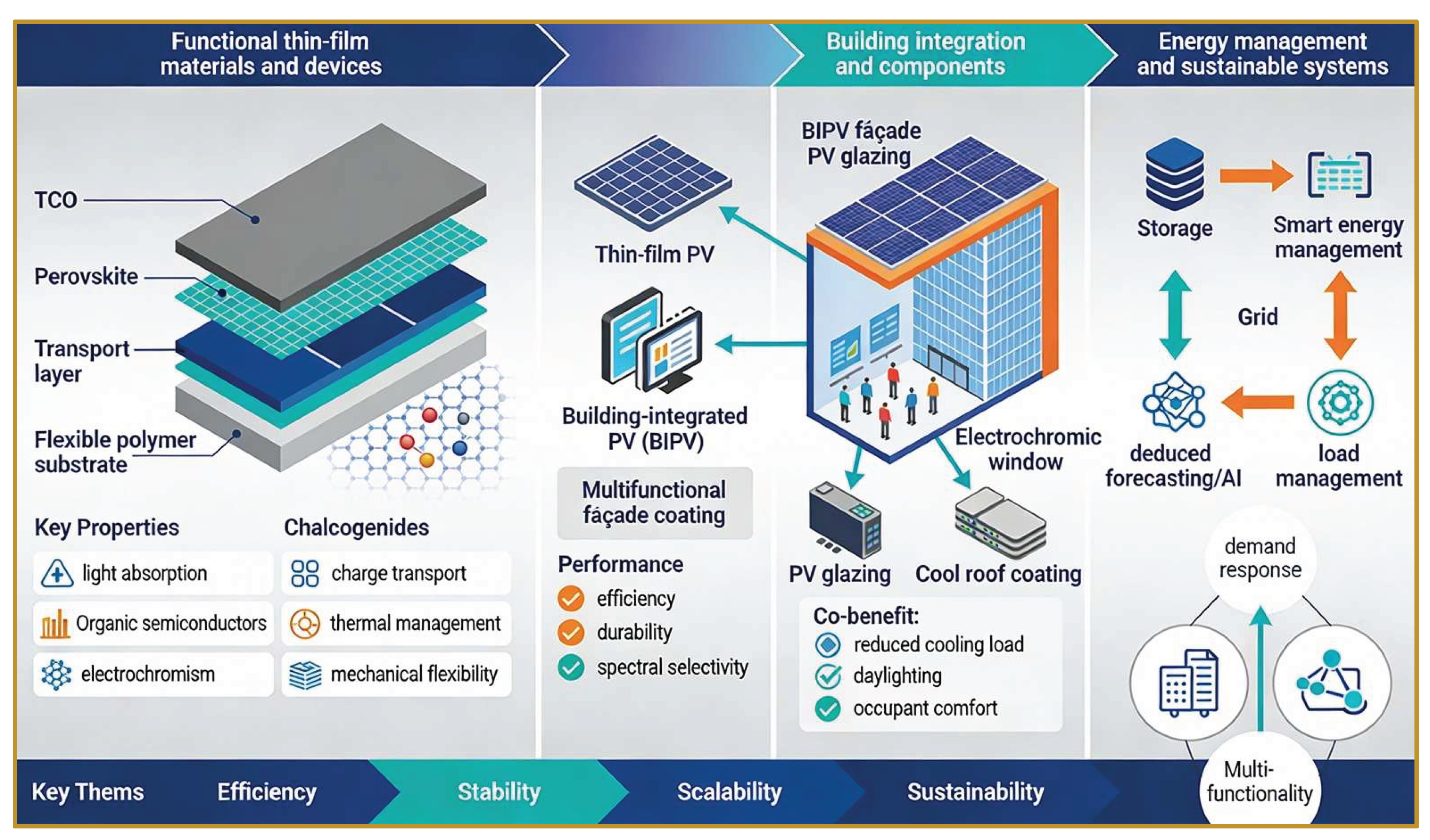
Figure 2.
Structural, optical, and electronic characteristics of doped ZnO thin films prepared via (i) physical vapor deposition (PVD) and (ii) chemical solution deposition (CSD). The figure highlights deposition schematics, morphology evolution, optical transmittance and absorption behavior, bandgap modulation, charge transport parameters, and representative photovoltaic performance, underlining the suitability of sputtered doped ZnO coatings and spin-coated Mg-doped ZnO layers for photovoltaic and electron transport layer applications. Figures are adapted from the Refs [41,43], with the required permission.
Figure 2.
Structural, optical, and electronic characteristics of doped ZnO thin films prepared via (i) physical vapor deposition (PVD) and (ii) chemical solution deposition (CSD). The figure highlights deposition schematics, morphology evolution, optical transmittance and absorption behavior, bandgap modulation, charge transport parameters, and representative photovoltaic performance, underlining the suitability of sputtered doped ZnO coatings and spin-coated Mg-doped ZnO layers for photovoltaic and electron transport layer applications. Figures are adapted from the Refs [41,43], with the required permission.
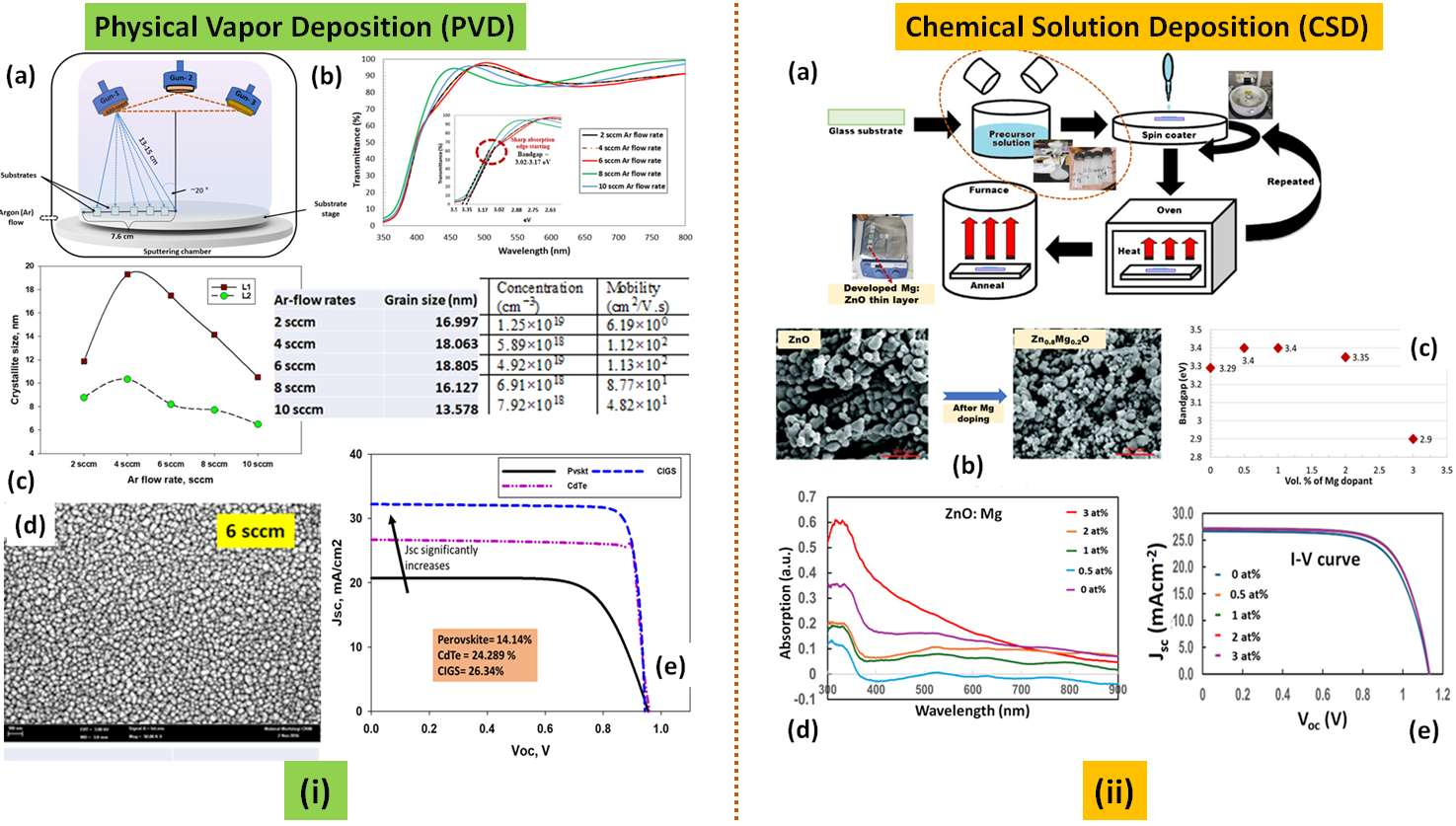
Figure 3.
Microstructural, optical, and electronic characteristics of nanocomposite thin films, including metal–dielectric (Ag–SiC) and all-dielectric (ZnO/SiC) systems. The figure illustrates wavelength-dependent absorption behavior, surface morphology after thermal treatment, bandgap evolution, charge transport parameters, and temperature-dependent conductivity, highlighting microstructure–property relationships in composite thin films for energy and optoelectronic applications [22,46].
Figure 3.
Microstructural, optical, and electronic characteristics of nanocomposite thin films, including metal–dielectric (Ag–SiC) and all-dielectric (ZnO/SiC) systems. The figure illustrates wavelength-dependent absorption behavior, surface morphology after thermal treatment, bandgap evolution, charge transport parameters, and temperature-dependent conductivity, highlighting microstructure–property relationships in composite thin films for energy and optoelectronic applications [22,46].
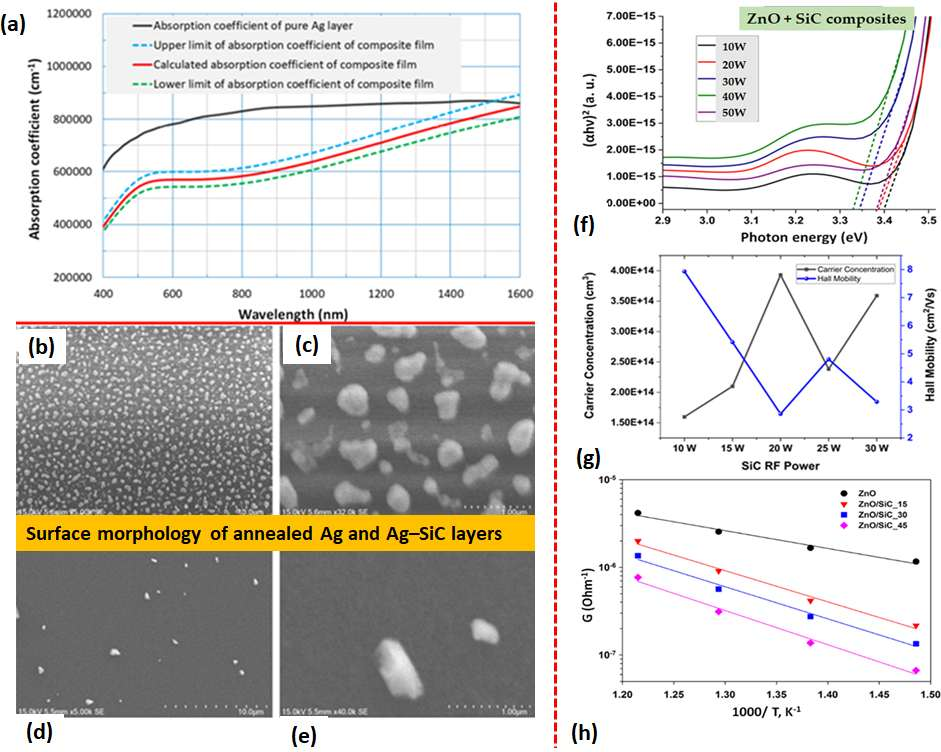
Figure 4.
Schematic representation and performance characteristics of nanostructured GaAs solar cells showing the concepts of light management and representative photovoltaic parameters. (a) Schematic representation of the Nanostructured GaAs Solar Cells with Light Trapping, Decreased Reflection, and Improved Absorption Mechanisms. (b) Typical nanostructured surface Morphology/Simulated Profile Displaying Optical Modulation Induced by Geometry. (c) Current Density-Voltage (J-V) Performance Characteristics Showing the Improvement in Performance from Advanced Light Management Strategies. (d) Wavelength-Dependent Light Reflection and (e) Light Absorption of Different Grating Heights, Indicating Optical Optimization Driven by Structure [47].
Figure 4.
Schematic representation and performance characteristics of nanostructured GaAs solar cells showing the concepts of light management and representative photovoltaic parameters. (a) Schematic representation of the Nanostructured GaAs Solar Cells with Light Trapping, Decreased Reflection, and Improved Absorption Mechanisms. (b) Typical nanostructured surface Morphology/Simulated Profile Displaying Optical Modulation Induced by Geometry. (c) Current Density-Voltage (J-V) Performance Characteristics Showing the Improvement in Performance from Advanced Light Management Strategies. (d) Wavelength-Dependent Light Reflection and (e) Light Absorption of Different Grating Heights, Indicating Optical Optimization Driven by Structure [47].
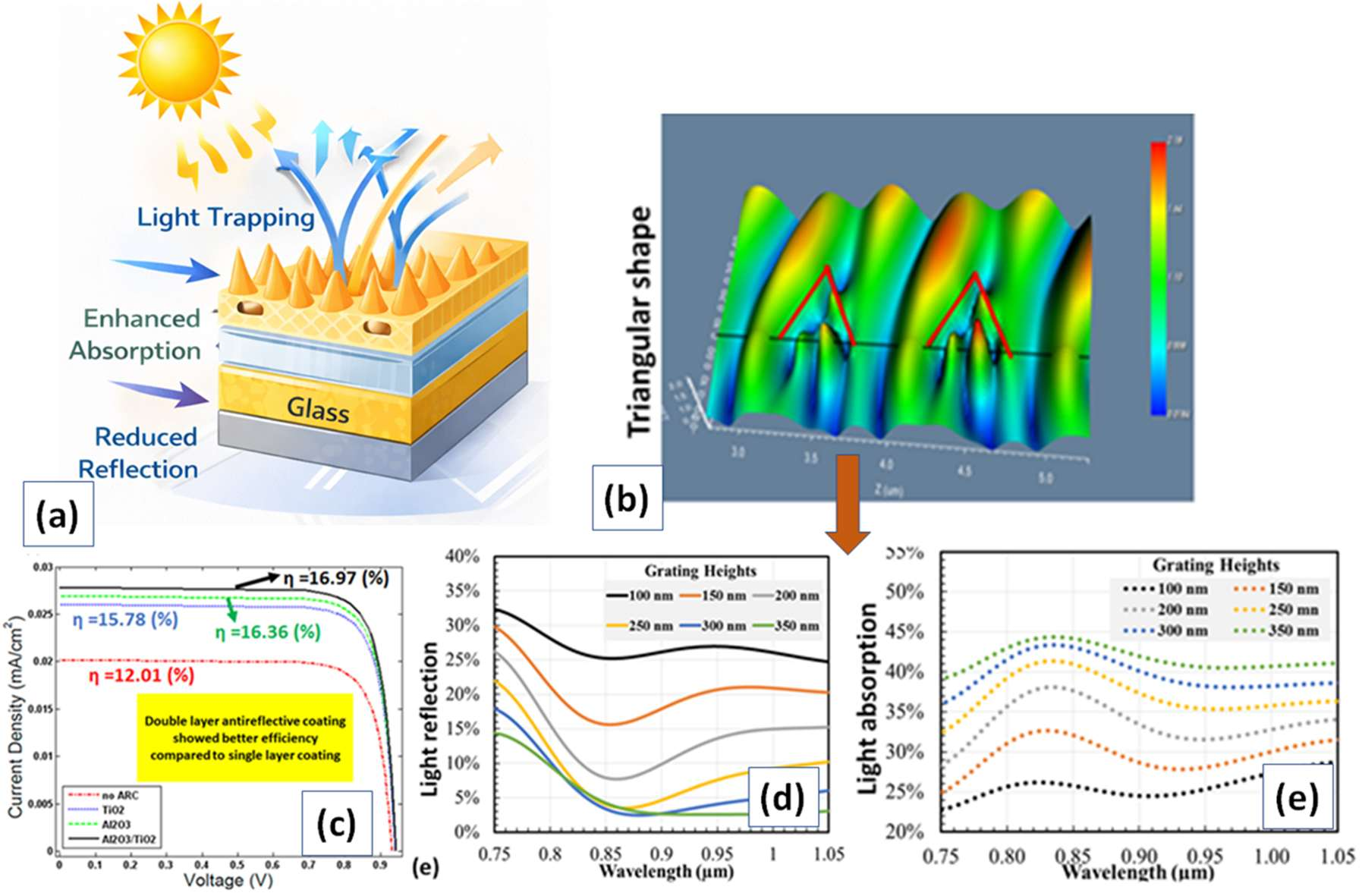
Figure 5.
Representative perovskite thin film morphology and device architecture, underlining the importance of anti-solvent processing and Mg-doped ZnO electron transport layers [42,57].
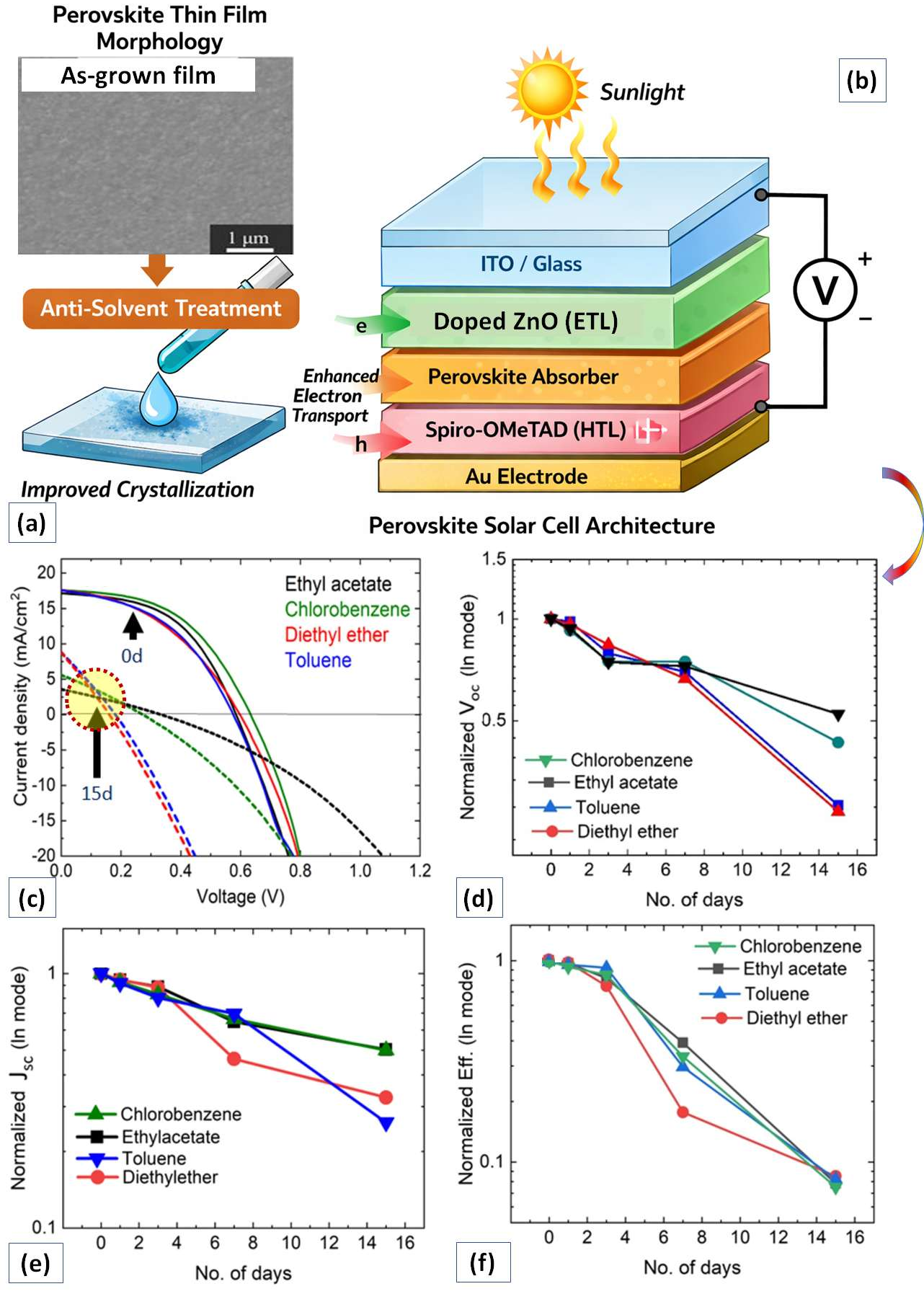
Figure 6.
Optical performance characteristics of Low-E coated glass; (a) single and multiple Ag layers containing conventional coatings, (b) coating of metal-doped Nb2O3:X sol-gel double layers on K-glass, and (c) single-layer metal-dielectric (MDC) containing low-E type coating. The spectral transmittance comparison indicates the achievement of possible spectral engineering with the desired thermal insulation performance [44,64].
Figure 6.
Optical performance characteristics of Low-E coated glass; (a) single and multiple Ag layers containing conventional coatings, (b) coating of metal-doped Nb2O3:X sol-gel double layers on K-glass, and (c) single-layer metal-dielectric (MDC) containing low-E type coating. The spectral transmittance comparison indicates the achievement of possible spectral engineering with the desired thermal insulation performance [44,64].
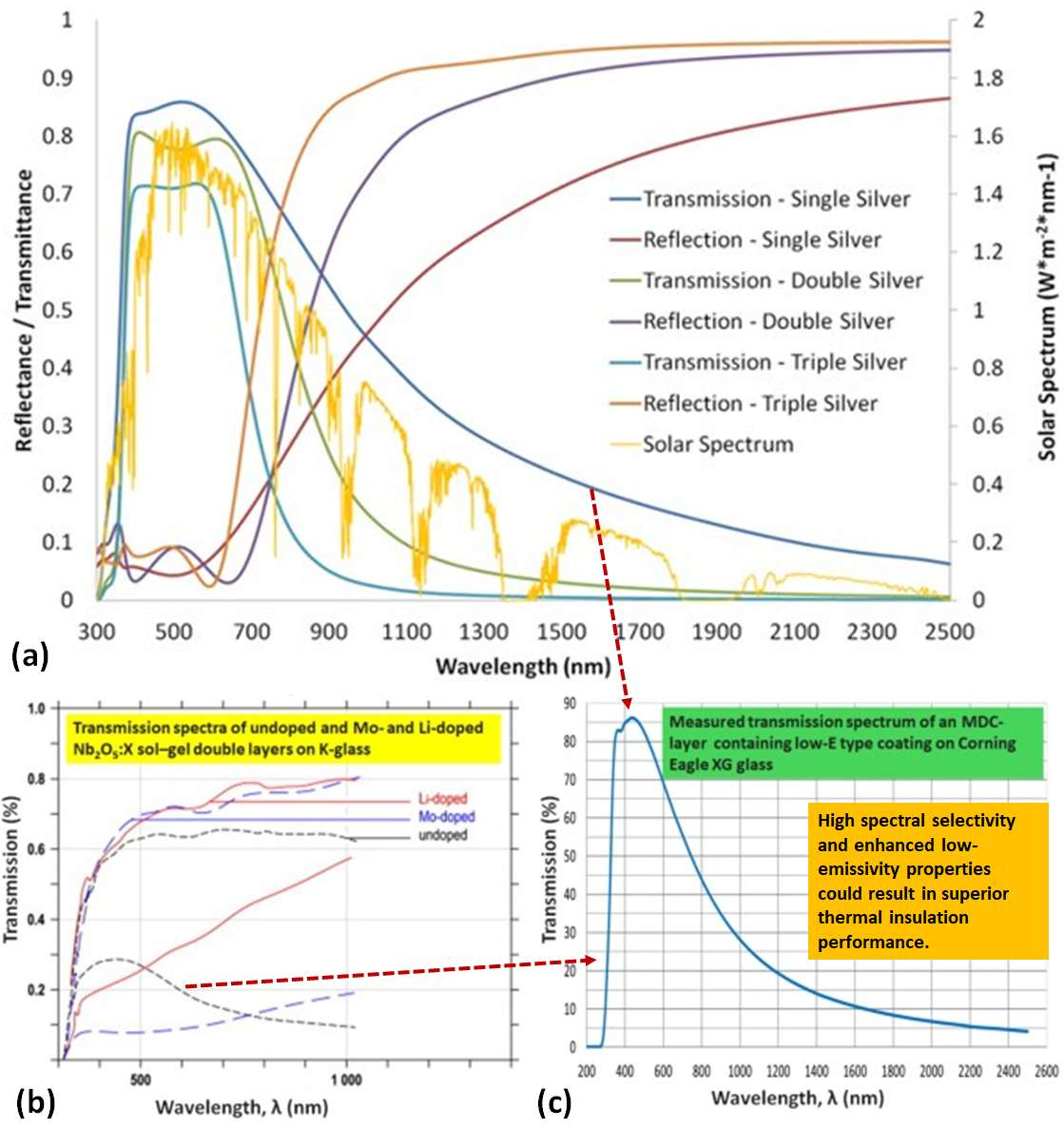
Figure 7.
Schematic of laminated Low-E coated glass architecture and representative optical performance metrics, and future application possibilities [44,67].
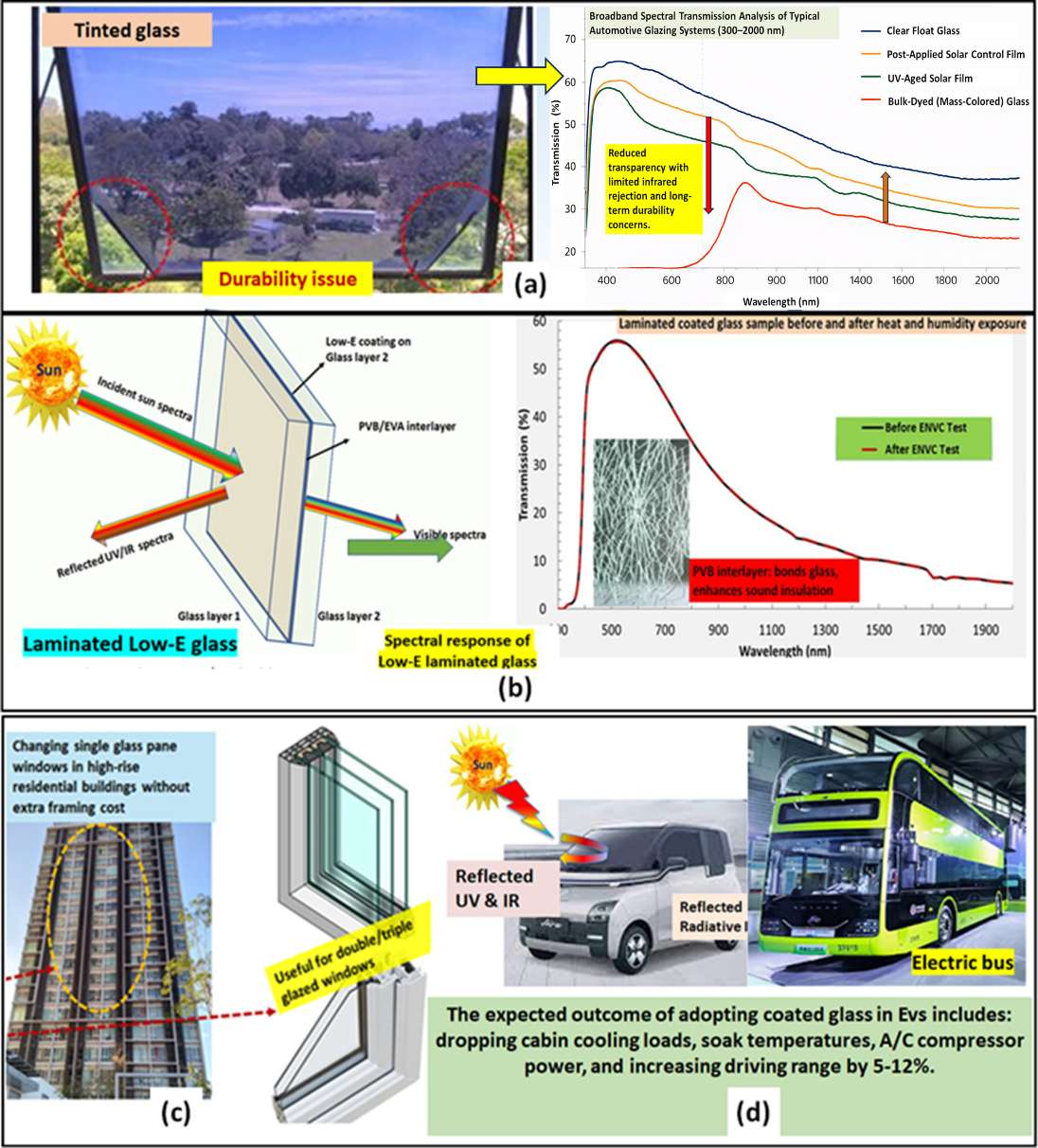
Figure 8.
Integrated materials-to-systems framework illustrating key interactions between functional materials, photovoltaic devices, building components, and energy management strategies.
Figure 8.
Integrated materials-to-systems framework illustrating key interactions between functional materials, photovoltaic devices, building components, and energy management strategies.
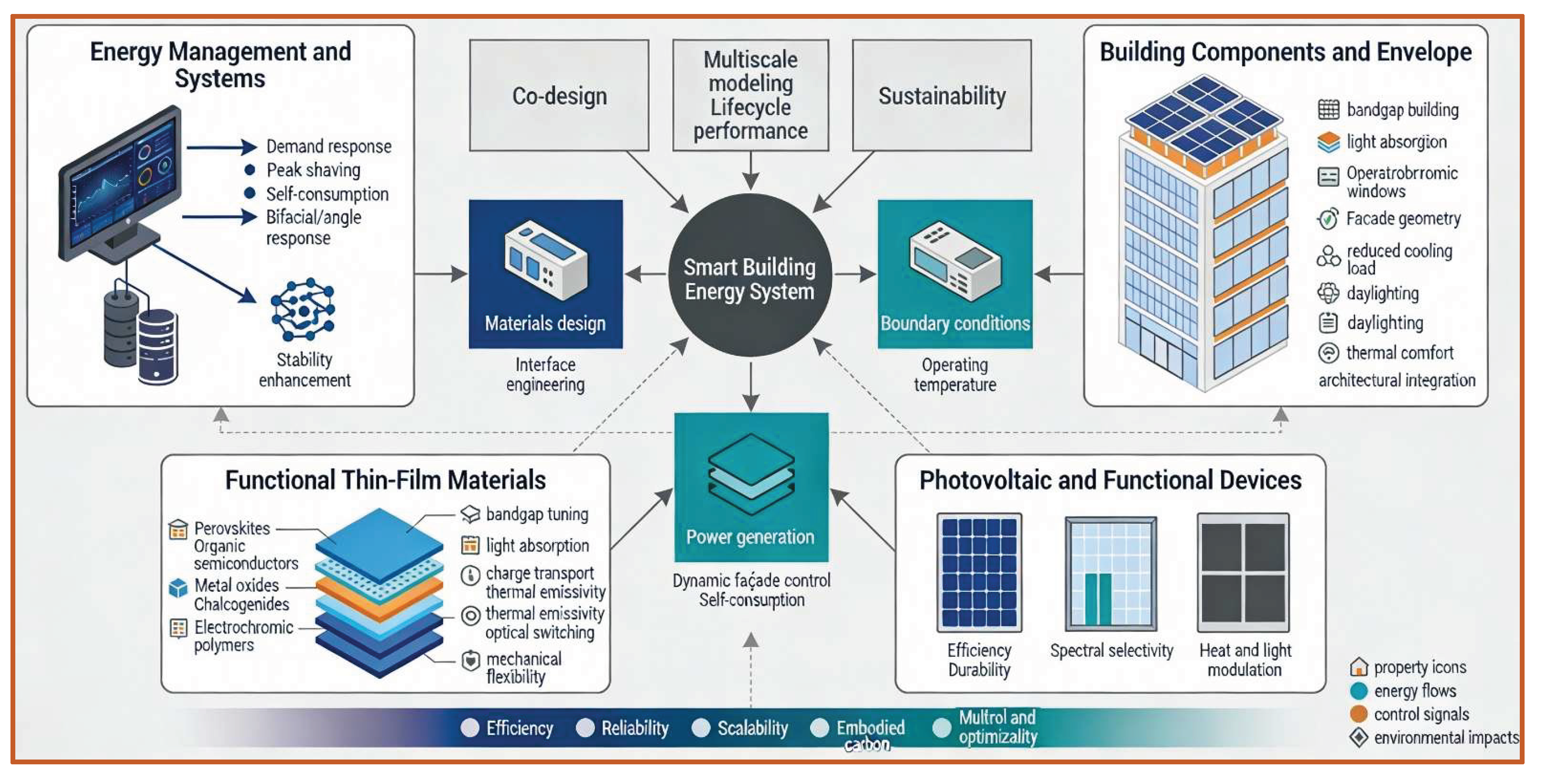

Table 1.
Overview of research themes, material systems, and application domains covered in this article.
Table 1.
Overview of research themes, material systems, and application domains covered in this article.
| Theme | Material / System Type | Primary Focus | Application Context |
|---|---|---|---|
| Functional materials | ZnO-based, Ag-based, composites | Optical/electrical tuning | Energy & buildings |
| PV devices | III–V, perovskite | Efficiency & stability | Solar energy |
| Building components | Low-E coatings, laminated glass | Thermal & optical control | BIPV, retrofit |
| Energy systems | EMS, microgrids | Optimisation & reliability | Grid integration |
Table 2.
Comparative benchmarking of representative functional thin-film and composite materials is discussed in this section, summarising key functional properties, dominant tuning parameters, and application relevance.
Table 2.
Comparative benchmarking of representative functional thin-film and composite materials is discussed in this section, summarising key functional properties, dominant tuning parameters, and application relevance.
| Material system | Key functional properties | Dominant tuning parameter (structure–property linkage) | Representative applications | Key trade-offs / deployment considerations |
|---|---|---|---|---|
| Doped ZnO thin films | High transparency, conductivity | Dopant level, deposition conditions | PV electrodes, glazing | Transparency–conductivity trade-off; stability vs dopant concentration; compatibility with large-area deposition. |
| ZnO/SiC composites | Multifunctionality, stability | Phase ratio, microstructure | Sensors, coatings | Interfacial scattering vs multifunctionality; process complexity; scalability of composite uniformity. |
| Ag-based nanocomposites | Optical selectivity, conductivity | Nanoparticle distribution | Energy-efficient coatings | Optical selectivity vs material cost; nanoparticle aggregation risks; durability under outdoor exposure. |
Table 3.
Summary of photovoltaic material systems and key performance considerations discussed in this section.
Table 3.
Summary of photovoltaic material systems and key performance considerations discussed in this section.
| PV system | Key material strategy | Primary benefit | Main limitation |
|---|---|---|---|
| Nanostructured GaAs | Light trapping via nanostructures | High efficiency | Fabrication complexity |
| Perovskite thin films | Anti-solvent processing | Improved film quality | Stability concerns |
| Perovskite + Mg-doped ZnO | Interface engineering | Reduced recombination | Process sensitivity |
Table 4.
Summary of energy-efficient building components and their functional roles.
| Component type | Key function | Primary benefit | Application context |
|---|---|---|---|
| Low-E coatings | Infrared reflection | Reduced heat transfer | Building envelopes |
| Laminated glass | Thermal & mechanical stability | Retrofit compatibility | Windows, façades |
| Functional glazing | Optical control | Energy savings | BIPV, daylighting |
Disclaimer/Publisher’s Note: The statements, opinions and data contained in all publications are solely those of the individual author(s) and contributor(s) and not of MDPI and/or the editor(s). MDPI and/or the editor(s) disclaim responsibility for any injury to people or property resulting from any ideas, methods, instructions or products referred to in the content. |
© 2026 by the authors. Licensee MDPI, Basel, Switzerland. This article is an open access article distributed under the terms and conditions of the Creative Commons Attribution (CC BY) license (http://creativecommons.org/licenses/by/4.0/).
Copyright: This open access article is published under a Creative Commons CC BY 4.0 license, which permit the free download, distribution, and reuse, provided that the author and preprint are cited in any reuse.


