
Submitted:
16 June 2026
Posted:
18 June 2026
You are already at the latest version
Abstract
In multi-asset UAV safety monitoring scenarios, dynamic threat assessment is challenged by delayed recognition of protected-asset shifts and unstable threat rankings under noisy observations. To address these issues, this paper proposes an approach-directionality-based dynamic UAV threat assessment method that integrates historical trend correction and adaptive exponential moving average (EMA) smoothing. The proposed method takes each UAV–protected asset pair as the basic assessment unit and constructs a threat matrix for multiple UAVs and multiple protected assets. Based on fundamental threat factors, including UAV type, closing speed, altitude, and distance, an approach directionality factor is defined using the geometric relationship between the UAV velocity direction and the bearing direction of each protected asset. To capture shifts in the potentially affected protected asset, the historical directionality sequence is linearly fitted, and the instantaneous directionality is dynamically enhanced or suppressed according to the estimated trend. An adaptive EMA mechanism is then introduced to improve temporal stability under noisy conditions. Simulation results from turning-approach scenarios, Monte Carlo experiments, and noise robustness tests show that the proposed method identifies protected-asset shifts earlier while maintaining high protected-asset identification accuracy and ranking stability. The framework provides interpretable support for threat ranking, situational awareness, and safety-oriented decision-making in non-offensive UAV safety monitoring applications.
Keywords:
UAV safety monitorin
; threat assessment
; approach directionality
; multiple protected assets
; historical trend correction
; adaptive EMA
; threat ranking
1. Introduction
In recent years, unmanned aerial vehicle (UAV) platforms have been widely used in civilian applications such as inspection, mapping, logistics, communication relay, and emergency rescue, owing to their low cost, high maneuverability, ease of deployment, and flexible payload configurations [1,2,3]. However, unauthorized, non-cooperative, or abnormal UAV activities may disrupt airport operations, interfere with emergency response, affect energy or communication facilities, and create safety hazards in densely populated or sensitive areas, as illustrated in Figure 1. Compared with conventional aerial objects, small UAVs usually exhibit a small radar cross section, low flight altitude, flexible velocity variation, and complex maneuvering patterns, which make UAV detection, tracking, identification, and dynamic risk assessment highly challenging. Therefore, dynamic risk assessment for multi-UAV and multi-asset protection scenarios has become an important component of low-altitude airspace safety monitoring, critical infrastructure protection, and public-safety-oriented situational awareness [4,5,6,7,8].
In a typical UAV safety monitoring and protection process, threat assessment lies between target detection/tracking and safety response resource allocation, where the system generally involves a series of functional stages including detection, identification, tracking, threat assessment, warning, mitigation, and response prioritization [9,10]. Its role is to evaluate the threat level posed by different UAVs to different protected assets based on UAV motion states, platform attributes, spatial positions, and potential approach intentions, and to further generate a threat ranking. Accurate threat assessment can assist a defense system in prioritizing the interception of high-risk targets, thereby avoiding resource waste and decision-making delays. Conversely, if a threat assessment model fails to identify a shift in the potentially affected protected asset in a timely manner, or if threat rankings fluctuate frequently due to noise disturbances, safety response may be delayed and protection effectiveness may be degraded. In particular, in multi-asset protection scenarios, the threat posed by the same UAV to different protected assets may vary significantly, while the same protected asset may simultaneously be threatened by multiple UAVs. Therefore, simply providing an overall threat level for each UAV is no longer sufficient for precise defense requirements. It is necessary to establish a many-to-many threat relationship model between UAVs and protected assets.
Existing threat assessment methods can be broadly categorized into evidence reasoning [11], fuzzy reasoning [12,13], bayesian network [14], multi-attribute decision making [15,16,17], cloud model [18], neural network [19]. Table 1(a) and Table 1(b) compares typical threat assessment methods in terms of direction/trend information, multi-asset matrix output, data dependence, noise handling, and interpretability.
In recent years, intention recognition, trajectory prediction, and risk assessment technologies have attracted extensive attention in intelligent transportation, air traffic management, and unmanned system safety. Related studies have shown that motion direction, velocity variation trends, and historical trajectory information can effectively reflect the future behavioral tendency of a target [20,21,22]. In counter-UAV scenarios, when a UAV performs a turning approach, deceptive maneuver, or target redirection, the angle between its velocity direction and different protected assets changes continuously. If a model can capture such a variation trend in directionality, it may identify a shift in the potentially affected protected asset before the UAV has completed its heading adjustment. In contrast, models relying only on instantaneous states often respond only after the UAV has clearly pointed toward a new target, resulting in a relatively large detection delay.
In addition, practical UAV safety monitoring systems typically rely on multi-source sensors, such as radar, electro-optical devices, radio-frequency sensing systems, and acoustic arrays, to obtain UAV state information [23,24,25]. These observations are inevitably affected by measurement noise, target occlusion, trajectory jitter, short-term frame loss, and estimation errors. If a threat assessment model is overly sensitive to instantaneous observations, threat values and ranking results may exhibit high-frequency fluctuations or frequent switching, which may further lead to unstable resource prioritization. Existing studies have indicated that smoothing filters, temporal fusion, and state estimation methods can effectively improve the stability of dynamic decision-making systems [26]. However, a fixed smoothing coefficient often struggles to balance rapid response and stable output: excessive smoothing may delay intention recognition, whereas insufficient smoothing cannot effectively suppress noise. Therefore, adaptively adjusting the smoothing strength according to UAV motion states is a key issue in dynamic threat assessment.
To address the above problems, this paper proposes an approach-directionality-based dynamic threat assessment method for multi-asset protection scenarios. The proposed method takes each UAV–protected asset pair as the basic assessment unit. First, a basic threat value is constructed by integrating UAV type, closing speed, altitude, and distance. Then, the angular relationship between the UAV velocity direction and the bearing direction of each protected asset is introduced to define an instantaneous approach directionality factor. Furthermore, a trend correction factor is constructed using the linear variation slope of the historical directionality sequence, so as to enhance or suppress the current directionality. Finally, an adaptive exponential moving average mechanism is introduced to obtain a smoothed threat matrix that balances dynamic response capability and temporal stability. Based on this threat matrix, the UAV threat ranking for each protected asset and the potential approach tendency of each UAV toward different protected assets can be obtained simultaneously.
The main contributions of this paper are summarized as follows.
- A multi-asset threat matrix modeling method based on approach directionality is proposed. Unlike traditional methods that provide only an overall threat level for each UAV, the proposed method takes each UAV–protected asset pair as the basic unit and explicitly characterizes the geometric relationship between the UAV motion direction and the spatial position of each protected asset. A threat matrix capable of independently representing the threat level of each UAV–protected asset pair is constructed.
- A history-based trend correction mechanism for approach directionality is proposed. By constructing a historical directionality buffer for each UAV–protected asset pair and fitting its variation trend linearly, the proposed method can identify the dynamic process in which approach directionality is strengthened or weakened. This enables earlier identification of shifts in the potentially affected protected asset during turning-approach maneuvers.
- An adaptive EMA-smoothed threat matrix is developed. To address the sensitivity of unsmoothed threat outputs to measurement noise and short-term trajectory disturbances, an adaptive EMA smoothing mechanism based on trend intensity is introduced. The mechanism enhances smoothing when the UAV motion state is stable and increases responsiveness when an obvious turning maneuver occurs, thereby balancing dynamic response capability and temporal stability.
- The effectiveness of the proposed method is systematically validated through multi-scenario simulation experiments. Turning-approach scenarios, static Monte Carlo experiments, dynamic Monte Carlo experiments, and noise robustness experiments are designed to verify the performance advantages of the proposed method in terms of response speed, identification accuracy, and ranking stability.
The remainder of this paper is organized as follows. Section 2 reviews related studies on counter-UAV threat assessment, attack intention recognition, multi-attribute decision making, and dynamic smoothing. Section 3 presents the proposed approach-directionality-based dynamic threat assessment model in detail. Section 4 provides the simulation settings and experimental result analysis. Section 5 concludes this paper and discusses future research directions.
2. Related Work
2.1. Counter-UAV Threat Assessment
In recent years, the safety and security risks posed by small unmanned aerial vehicles in low-altitude airspace and critical infrastructure protection have become increasingly prominent, placing higher requirements on the threat assessment capability of counter-UAV systems. Castrillo et al. [23] systematically reviewed the detection, identification, tracking, and neutralization processes of counter-UAV systems, and pointed out that threat determination should integrate multi-sensor information while considering the diversity of UAV mission patterns. Niu et al. [17] proposed a dynamic threat assessment method for UAV air-defense operations by integrating fuzzy multi-attribute decision-making and intention information. Their method constructs an evaluation index system from the perspectives of capability, opportunity, and intention, indicating that intention-related information and temporal dynamics are important factors in UAV threat assessment.
Compared with conventional aerial targets, the threat level of small UAVs depends not only on their own states, such as position, velocity, and altitude, but also on their spatial relationships with protected assets. Arapoglou et al. [24] proposed a hierarchical fuzzy decision-making framework for counter-UAV systems, which integrates heterogeneous sensor information for threat detection and sensor combination optimization. However, their study mainly focuses on threat detection and system configuration, while the pairwise threat relationship between UAVs and protected assets remains insufficiently explored.
In summary, counter-UAV threat assessment has evolved from rule-based judgment to comprehensive evaluation methods that integrate multi-source information, dynamic intention, and uncertainty reasoning. Nevertheless, most existing methods still regard each UAV as an individual assessment object and mainly output an overall threat level or ranking. They rarely explicitly describe the differentiated threats posed by the same UAV to different protected assets. Therefore, for multi-asset scenarios, counter-UAV threat assessment should be extended from conventional target-level scoring to pairwise UAV–protected asset threat relationship modeling.
2.2. Applications of Multi-Attribute Decision-Making Methods in Threat Assessment
Multi-attribute decision-making methods have been widely adopted in aerial target and UAV threat assessment, including AHP [27], TOPSIS [28], VIKOR [29], grey relational analysis, and fuzzy comprehensive evaluation. Yin et al. [30] combined GRA-TOPSIS with three-way decision theory to achieve joint threat ranking and classification. In recent years, interval intuitionistic fuzzy multi-attribute decision-making [31] and the CRITIC objective weighting method [32] have also been introduced into threat assessment to handle attribute correlation and dynamic information representation.
Although these methods have made considerable progress in uncertainty modeling and target threat ranking, they still have limitations in multi-asset UAV safety monitoring scenarios. First, the weight settings of existing methods mainly rely on expert experience or static calculations, making it difficult to adapt in real time to UAV maneuvers and changes in threat situations. Second, most existing index systems are centered on the UAV’s own state, and therefore cannot accurately characterize its approach tendency toward a specific protected target. In addition, methods such as TOPSIS usually perform threat ranking based on single-time-step attribute values, with insufficient use of temporal continuity and historical trend information. As a result, delayed responses or frequent ranking switches may occur when a UAV turns or shifts its approach toward another protected asset.
Therefore, introducing approach directionality as an independent evaluation dimension can improve the specificity and dynamic responsiveness of multi-asset UAV threat assessment. Unlike conventional indicators such as distance, velocity, and altitude, approach directionality characterizes the geometric relationship between the UAV velocity direction and the bearing of the protected target, thereby more directly reflecting whether the current motion trend of the UAV is oriented toward a protected asset.
2.3. Behavioral Intention Recognition and Trajectory Trend Modeling
The core of approach tendency recognition is to infer a UAV’s future motion tendency based on its historical states and current actions. Zhang et al. [20] proposed a UAV behavior-intention estimation method based on four-dimensional flight trajectory prediction. By using historical flight data and motion equations to construct a combined prediction model, they demonstrated that historical trajectories and spatial relationships can provide effective support for UAV intention recognition. Wang et al. [21] proposed a data-driven method for UAV swarm intention recognition, which employs the Dubins model to characterize swarm motion characteristics and trains the recognition model using simulation data. In the field of autonomous driving, Girase et al. [33] constructed the LOKI dataset to investigate long-term trajectory prediction and intention reasoning, emphasizing the importance of trajectory information, behavior labels, and interaction relationships for future behavior inference.
Compared with directly predicting the complete future trajectory, intention recognition based on approach directionality has the advantages of a simple structure, low computational cost, and clear physical meaning. For each UAV–protected asset pair, the angular relationship between the UAV velocity direction and the asset-bearing vector can be used to measure the degree to which the UAV’s motion direction points toward that protected asset. A continuously increasing directionality value usually indicates that the UAV’s motion trend is more likely to be oriented toward the protected asset, whereas a continuously decreasing value may imply a weakened approach tendency toward that protected asset. Therefore, trend modeling based on the directionality sequence helps capture early signals of protected-asset transfer before the UAV completes its turn.
However, introducing historical trend information may also cause additional bias. In stationary, uniform-motion, or non-maneuvering scenarios, if the trend term is improperly designed, short-term measurement noise or slight trajectory perturbations may be misinterpreted as intention changes, thereby affecting the stability of threat assessment results. Therefore, a key issue in approach-tendency-aware threat assessment is how to exploit historical trend information to enhance the response to actual maneuvering behaviors while maintaining assessment neutrality in static or stable scenarios.
2.4. Dynamic Smoothing and Ranking Stability
In practical UAV safety monitoring systems, threat assessment results usually need to be continuously generated and may directly affect safety response prioritization and resource allocation decisions. Therefore, in addition to assessment accuracy, the temporal stability of threat scores and ranking results is also important. If threat scores or target rankings fluctuate frequently due to sensor noise, trajectory jitter, or short-term observation errors, the safety response system may repeatedly adjust resource priorities, thereby reducing overall response efficiency.
Chen et al. [34] proposed an adaptive variable-structure interacting multiple model filtering and smoothing algorithm. By adaptively constructing model subsets and integrating forward filtering with backward smoothing, their method improves the accuracy and stability of maneuvering target tracking. Hu et al. [35] developed an adaptive filtering and smoothing algorithm based on a variable-structure interacting multiple model framework. By dynamically adjusting model probabilities and state estimates, they demonstrated improved state estimation accuracy and smoothing performance in complex maneuvering scenarios. Wang et al. [36] introduced a confidence-based adaptive exponential moving average method in multi-object tracking, dynamically adjusting the weights between historical and current features to balance response speed and output stability.
Although fixed-coefficient exponential moving average can reduce high-frequency fluctuations, it involves an inherent trade-off between response speed and smoothing strength. Strong smoothing may delay the recognition of threat changes, whereas weak smoothing may fail to sufficiently suppress noise disturbances. For UAV threat assessment in safety monitoring scenarios, when the target state is stable, the model should emphasize the suppression of score fluctuations caused by noise; when the UAV makes a significant turn or its approach tendency changes, the model should respond rapidly to threat changes. Therefore, how to balance threat response speed and ranking stability in dynamic UAV safety monitoring scenarios remains an important issue for multi-target threat assessment.
3. Proposed Model
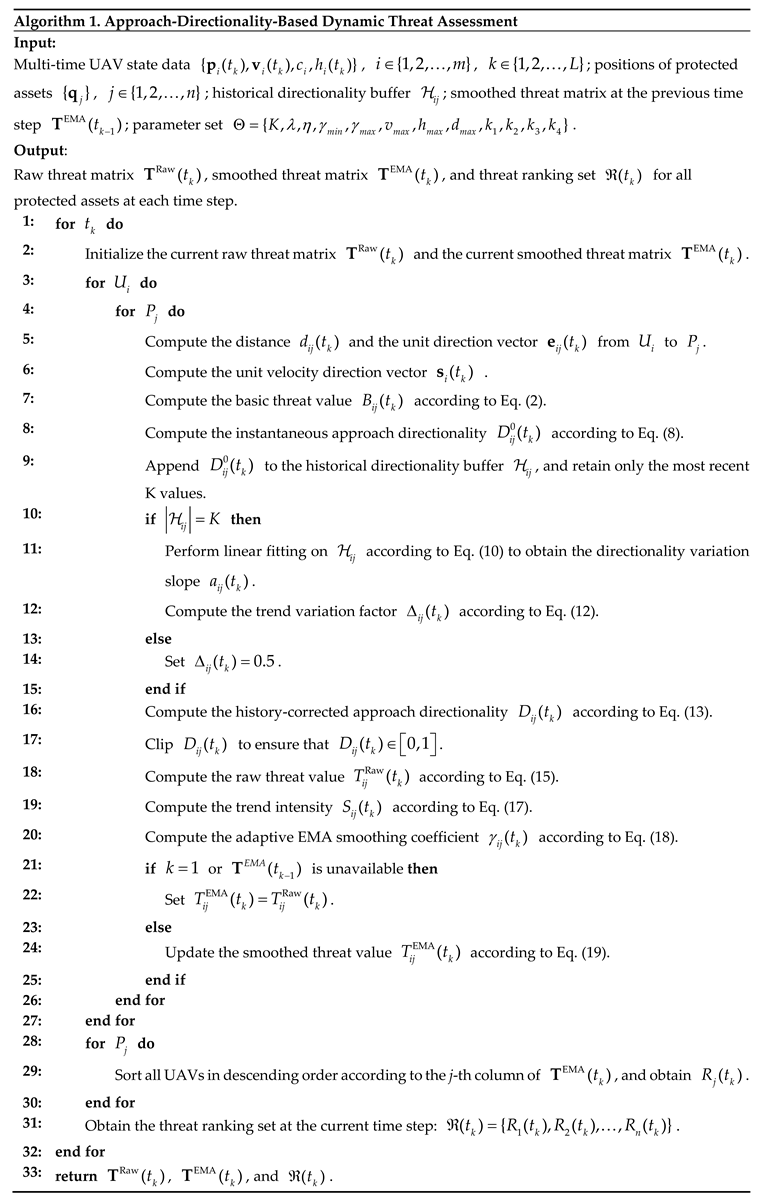
This section presents the proposed approach-directionality-based dynamic threat assessment model for multi-asset low-altitude safety monitoring scenarios. The core idea of the model is to characterize the directional approach relationship between each UAV and each protected asset, while also considering the intrinsic risk-related attributes of the UAV itself. By coupling UAV kinematic states with the spatial positions of protected assets, a UAV–protected asset threat matrix is constructed, enabling independent threat ranking with respect to each protected asset. The evaluation process of the proposed model is illustrated in Figure 2, and the overall threat assessment procedure is implemented through Algorithm 1.
3.1. Problem Description
Consider a multi-asset low-altitude protection scenario involving m UAVs and n protected assets. Let the i-th UAV be denoted by , and the j-th protected asset be denoted by . The state information of the UAV includes its position, velocity, altitude, and UAV type, which are denoted by , , and respectively. The position of is denoted by .
The objective of this paper is to construct, at each time step , a threat matrix between UAVs and protected assets:
where represents the threat level posed by the i-th UAV to the j-th protected asset at time .
This threat matrix can simultaneously describe the many-to-many threat relationships between multiple UAVs and multiple protected assets. On the one hand, for a given , all UAVs can be ranked according to the j-th column of the matrix, thereby identifying the primary threat sources currently faced by that protected asset. On the other hand, for a given , the i-th row of the matrix can be used to analyze the differences in its potential threats to different protected assets, thereby inferring the protected asset that is most likely to be affected.
3.2. Basic Threat Factor Modeling
The threat posed by a UAV to a protected asset is related not only to distance but also to factors such as UAV type, closing speed, and flight altitude. Therefore, this paper first constructs a basic threat value , which is used to describe the basic risk level posed by to without explicitly considering approach directionality.
3.2.1. Basic Threat Value
The basic threat value is defined as:
where denotes the threat weight associated with the UAV type, denotes the normalized closing speed toward protected asset , denotes the altitude threat factor, denotes the distance threat factor, and ,, , and are the weights of the corresponding indicators, satisfying .
The UAV type threat weight is assigned according to the functional category of the UAV. For example, high-risk UAVs with abnormal approach patterns are usually assigned a relatively high threat weight, whereas monitoring, interference, and high-mobility UAVs can be assigned different weights according to their functional characteristics and potential impact on protected assets.
3.2.2. Closing Speed Factor
The closing speed factor is defined as:
where
is the unit direction vector from to , and is the speed normalization parameter.
This definition characterizes the approaching tendency of a UAV relative to a protected asset. When the UAV velocity contains a component directed toward the protected asset, takes a value greater than zero. When the UAV has no approaching tendency or is moving away from the asset, this factor degenerates to zero.
3.2.3. Altitude Threat Factor
The altitude threat factor is defined as:
where is the altitude normalization parameter. This definition reflects the fact that low-altitude UAVs are generally more difficult to detect and track, and therefore usually pose a higher threat.
3.2.4. Distance Threat Factor
The distance threat factor is defined as:
where, denotes the distance between UAV and protected asset , and is the maximum effective distance used for normalization. A smaller distance leads to a larger value of , indicating a higher threat level.
3.3. Instantaneous Approach Directionality Modeling
To characterize the degree to which a UAV is directionally oriented toward different protected assets at the current time step, this paper defines an instantaneous approach directionality factor . This factor is determined by the angle between the UAV velocity direction and the direction from the UAV to the protected asset, as shown in Figure 3.
Let the unit velocity direction vector of the UAV be defined as:
Then, the instantaneous approach directionality factor is defined as:
where represents the cosine of the angle between the UAV velocity direction and the direction toward the protected asset. When the UAV velocity direction is exactly aligned with direction toward the protected asset, we have, and thus, . Therefore, can characterize, within the interval [0,1], the degree to which the current motion direction of a UAV is oriented toward different protected assets.
The threat value based on instantaneous approach directionality is defined as:
3.4. History-Based Directionality Correction Factor
To describe the dynamic variation trend of UAV approach directionality, this paper maintains a historical directionality sequence with length K for each UAV–protected asset pair:
Within this historical window, the instantaneous approach directionality sequence is linearly fitted to obtain its variation slope . A positive slope indicates that the approach directionality of toward is increasing, whereas a negative slope indicates that the approach directionality toward that is decreasing.
To map the slope into a bounded interval, the trend variation factor is defined as:
where λ is the sensitivity parameter of the sigmoid function. According to this definition:
When , , indicating that the approach directionality of the toward is increasing;
When , , indicating that the approach directionality of the toward protected asset is decreasing;
When , , indicating that no obvious variation trend exists.
To prevent the historical trend term from introducing additional bias in static scenarios, this paper does not treat the trend variation factor as an independent source of directionality. Instead, it is used to enhance or suppress the current instantaneous approach directionality. The corrected approach directionality is defined as:
followed by interval clipping:
where η is the trend correction gain. This definition has the following properties:
- First, when the directionality of the UAV toward the protected asset exhibits an increasing trend, , and thus . In this case, the current instantaneous approach directionality is enhanced.
- Second, when the directionality of the UAV toward the protected asset exhibits a decreasing trend, , and thus . In this case, the current instantaneous approach directionality is suppressed.
- Third, when no obvious trend exists,, and thus . In this case, the corrected approach directionality is equal to the instantaneous approach directionality.
Therefore, in static scenarios or scenarios without an obvious maneuvering trend, the corrected approach directionality naturally degenerates to the instantaneous approach directionality and does not introduce spurious trend bias. In contrast, during UAV turning-approach maneuvers or protected-asset shifts, historical trend information can enhance the increasing approach directionality, thereby improving the model’s capability to perceive dynamic changes in the UAV’s approach tendency, as illustrated in Figure 4.
The raw threat matrix based on the corrected approach directionality is defined as:
3.5. Adaptive EMA-Smoothed Threat Matrix
Although Proposed-Raw can respond rapidly to changes in UAV approach directionality, the raw threat values may fluctuate considerably in the presence of sensor noise, UAV attitude jitter, or short-term trajectory perturbations. To improve the temporal stability of threat assessment results, this paper further introduces an adaptive exponential moving average, referred to as adaptive EMA, to obtain the smoothed threat matrix.
The conventional EMA can be expressed as:
where is the smoothing coefficient. A larger makes the output closer to the current value and results in faster response, whereas a smaller makes the output rely more on historical values and produces stronger smoothing.
A fixed cannot simultaneously guarantee dynamic responsiveness and temporal stability. Therefore, this paper adaptively adjusts the smoothing coefficient according to the trend intensity. The trend intensity is defined as:
When is close to 0.5, the directionality variation trend is weak, and is small. When deviates significantly from 0.5, the directionality variation trend is obvious, and is large.
The adaptive smoothing coefficient is defined as:
where and denote the lower and upper bounds of the smoothing coefficient, respectively, satisfying . This constraint avoids excessive smoothing, which may cause response lag, as well as excessive responsiveness, which may amplify noise.
Finally, the Proposed-EMA threat matrix is defined as:
When the UAV motion state is relatively stable and the directionality variation trend is not obvious, is small, and the system emphasizes smoothness. When the UAV exhibits an obvious turning trend, increases, and the model emphasizes response speed.
Accordingly, the proposed method forms a dual-output structure:
- Proposed-Raw: a raw threat matrix that integrates instantaneous approach directionality and historical trend information. It provides faster response and is suitable for rapid warning output.
- Proposed-EMA: a smoothed threat matrix obtained by applying adaptive EMA smoothing to Proposed-Raw. It balances dynamic responsiveness and temporal stability and is suitable for stable safety-oriented decision-making.
3.6. Threat Ranking and Dynamic Stability Metrics
Based on the threat matrix , for each , the threat values of all UAVs can be sorted in descending order to obtain the corresponding threat ranking:
where the first element of represents the UAV with the highest threat score with respect to at time .
To evaluate the stability of threat ranking in dynamic scenarios, this paper adopts three switching metrics: full-ranking switching count, Top-1 switching count, and Top-3 set switching count.
3.6.1. Full-Ranking Switching Count
The full-ranking switching count is defined as:
where L is the number of time steps, and is the indicator function. This metric counts the number of changes in the complete threat ranking.
It should be noted that the full-ranking switching count is sensitive to position exchanges among low-threat UAVs. For example, if two low-threat UAVs at the end of the ranking exchange their positions, this is also counted as one ranking switch. Therefore, this metric can reflect the overall ranking fluctuation, but it should not be used alone as the only indicator of decision stability.
3.6.2. Top-1 Switching Count
In protection resource allocation, the UAV with the highest threat score usually receives the highest priority. Therefore, this paper defines the Top-1 switching count as:
where denotes the posing the highest threat to at time . This metric reflects whether the UAV requiring the highest attention changes frequently at the decision level.
3.6.3. Top-3 Set Switching Count
To further consider scenarios involving multiple high-priority UAVs, this paper defines the Top-3 threat set as:
where , , and denote the top three UAVs in the threat ranking for .
The Top-3 switching count is defined as:
Compared with full-ranking switching, Top-1 and Top-3 switching better reflect the stability of practical decision-making, because position exchanges among low-threat UAVs usually have limited impact on resource prioritization.
Based on the threat matrix output, the proposed method generates a UAV threat ranking for each protected asset. The method remains consistent with the instantaneous approach directionality model in static scenarios, improves protected-asset-shift identification in dynamic turning-approach scenarios by exploiting historical trend information, and enhances the temporal stability of threat assessment results through adaptive EMA smoothing.
4. Simulation Experiments and Result Analysis
4.1. Experimental Setup
4.1.1. Compared Methods
To verify the dynamic threat assessment capability of the proposed method in multi-asset protection scenarios, five compared methods are compared in the experiments: NoDir, TOPSIS, Inst, Proposed-Raw, and Proposed-EMA. To ensure a consistent comparison basis among different methods, all methods output a UAV–protected asset pair-level threat matrix:
where denotes the threat score posed by to at time .
- NoDir denotes the directionality-free baseline, whose threat score is composed solely of basic threat factors — UAV type, closing speed, altitude, and distance — without incorporating approach directionality or historical trend information.
- TOPSIS denotes the traditional multi-attribute decision-making baseline method. In this paper, it is implemented as a UAV–protected asset pair-level threat scoring model. The detailed calculation procedure is provided in Appendix A.
- Inst denotes the baseline method that introduces only the instantaneous approach directionality factor, without historical trend correction or adaptive EMA smoothing.
- Proposed-Raw denotes an ablation version that integrates instantaneous approach directionality and historical trend correction, but does not use adaptive EMA smoothing.
- Proposed-EMA denotes the complete proposed method, which simultaneously integrates instantaneous approach directionality, historical trend correction, and adaptive EMA smoothing.
Data-driven methods, such as neural networks, are not included in the experimental comparison for the following reasons. The performance of such methods highly depends on large-scale labeled data. However, in real-world low-altitude safety monitoring scenarios, UAV behavior patterns and environmental conditions are complex and highly variable, and high-quality labeled data for specific scenarios are often difficult to obtain in advance. Under insufficient labeled data conditions, data-driven models may fail to converge to credible performance, making direct comparison difficult to ensure fairness. A systematic comparison with data-driven methods will be conducted in future work when sufficient labeled data become available.
4.1.2. Experimental Scenarios
To verify the effectiveness of the proposed method in multi-asset counter-UAV scenarios, four groups of simulation experiments are designed.
- Scenario A: Turning-approach scenario. This scenario is used to demonstrate the response speed and output stability of different methods during a UAV turning approach, and to intuitively present the threat matrix and ranking outputs of the proposed method in a multi-asset setting.
- Scenario B: Static Monte Carlo experiment.This scenario is used to verify the consistency of the proposed method in scenarios without an obvious dynamic trend, and to compare it with the alternative methods.
- Scenario C: Dynamic Monte Carlo experiment. This scenario is used to statistically evaluate the proposed method in random dynamic turning-approach scenarios in terms of approach-transfer identification accuracy, detection delay, dynamic Top-1 accuracy, Spearman ranking correlation, and ranking switching count.
- Scenario D: Noise robustness experiment.This scenario is used to analyze the ability of adaptive EMA to suppress threat-value fluctuations and ranking switches under different levels of position and velocity measurement noise.
To establish a unified evaluation benchmark, this paper predefines the true affected protected-asset label for each UAV according to the trajectory generation mechanism. This label does not participate in the computation of the threat assessment model and is used only for subsequent metric evaluation. For static scenarios, the true affected asset is defined as the protected asset specified during trajectory generation. For dynamic turning scenarios, the update time of the true attacked asset is determined according to the preset target-switching rule in the turning transition interval. All methods are evaluated based on the same set of labels to ensure fairness.
4.2. Scenario A: Improved Turning-Approach Scenario
Scenario A constructs a multi-asset scenario consisting of five UAVs and three protected assets. At t = 20 s, gradually changes its heading from the direction of to that of , thereby simulating a dynamic turning-approach behavior.
4.2.1. Analysis of Response Speed and Smoothness in Protected-Asset Shift
Figure 5 shows the temporal evolution curves of for the five methods during the turning maneuver, where, represents the relative threat difference of between and . Specifically, indicates that the model considers more likely to approach ; indicates that the model considers more likely to approach ; and indicates that poses comparable threat levels to and . The zero-crossing point at which the curve changes from negative to positive can be regarded as the time when the model identifies that the potentially affected protected asset has shifted from to . Table 2 summarizes three quantitative metrics for the five methods: zero-crossing time, defined as the first time instant satisfying , detection delay, and smoothness.
The results show that Proposed-Raw detects the approach transfer earliest, with a detection delay of 2.60 s. Proposed-EMA has a detection delay of 6.20 s. Although this delay is slightly larger than that of Proposed-Raw, it is still earlier than those of the other three methods. Compared with NoDir, Proposed-EMA identifies the protected-asset shift 18.5 s earlier, corresponding to a relative reduction of 74.9%. Compared with TOPSIS, Proposed-EMA identifies the protected-asset shift 6.5 s earlier, corresponding to a relative reduction of 51.2%. Compared with Inst, Proposed-EMA identifies the protected-asset shift 1.4 s earlier, corresponding to a relative reduction of 18.4%.
The smoothness metric directly reflects the fluctuation level of the threat scores. A smaller value indicates a smoother output, which is more conducive to avoiding frequent ranking switches caused by instantaneous disturbances and thus improves decision reliability. As shown in Table 2, Proposed-Raw achieves the earliest zero-crossing time but exhibits the poorest smoothness, confirming that unsmoothed outputs contain substantial high-frequency oscillations. Proposed-EMA significantly improves smoothness at the cost of only a slight increase in detection delay, indicating that adaptive EMA effectively suppresses noise disturbance while preserving rapid warning capability, thereby improving the overall stability of approach tendency identification.
It is worth noting that although NoDir has the smallest numerical smoothness value, its zero-crossing time is the latest. This indicates that its apparent smoothness mainly results from insufficient responsiveness to protected-asset shift rather than effective noise suppression. Therefore, method superiority cannot be judged solely by the smoothness value. In contrast, Proposed-EMA maintains a smoothness level close to that of Inst while identifying protected-asset shift significantly earlier.
Among the five compared methods, Proposed-EMA achieves a favorable balance between response speed and temporal stability. Proposed-Raw has the earliest zero-crossing time and responds most rapidly to protected-asset shift; however, because it lacks smoothing, its output is more susceptible to noise-induced fluctuations. By contrast, the baseline methods Inst, NoDir, and TOPSIS all exhibit obvious delays in identifying the turning maneuver. Proposed-EMA adaptively smooths the trend-corrected scores, effectively suppressing spurious oscillations while largely preserving the early-warning capability of Proposed-Raw. Therefore, it combines rapid response with stable output and is recommended as the core method for supporting stable safety-oriented decision-making.
4.2.2. Threat Matrix Heatmaps and Ranking Outputs
Taking Proposed-EMA as an example, Figure 6 shows the threat matrix heatmaps of five UAVs against three protected assets at four representative time instants. Figure 7 presents the corresponding threat rankings. The temporal trajectory of protected-asset shift can be clearly identified from Figure 7. At t = 10 s, before the turning maneuver occurs, has the highest threat score with respect to , with a score of 5, while its threat score with respect to is only 2. By t = 25 s, after the turning maneuver is completed, the threat score of with respect to increases to the highest level, with a score of 5, whereas its threat score with respect to decreases to 2. Meanwhile, the UAV posing the highest threat to changes from before the turn to . On the side, as departs, the highest-threat UAV successively switches to and .
The heatmaps and threat ranking diagrams jointly show that the highest-threat UAV differs across protected assets and changes dynamically over time. The above ranking changes are highly consistent with the zero-crossing behavior of the curve in Figure 5, validating the rationality and interpretability of the proposed method in generating threat rankings in multi-asset scenarios. This also provides a qualitative basis for subsequent statistical experiments. The result further indicates that matrix-based threat modeling can effectively characterize differentiated and dynamic threat relationships in multi-asset protection scenarios.
Based on the above quantitative detection results and qualitative visualization analysis, the proposed method achieves rapid and stable identification of protected-asset shift by integrating approach directionality, historical trends, and adaptive smoothing, while also generating intuitive multi-target threat rankings. This feature is particularly important in complex low-altitude safety monitoring environments. When a UAV exhibits short-term misleading or abrupt maneuvering patterns, methods relying solely on instantaneous directionality are prone to misjudgment or severe oscillation. In contrast, Proposed-EMA uses trend memory and adaptive smoothing to effectively filter short-term disturbances and maintain robust tracking of the underlying approach tendency.
4.3. Scenario B: Static Monte Carlo Experiment
To verify the performance of the proposed method in scenarios without an obvious dynamic trend, 200 static Monte Carlo experiments are conducted. In each experiment, 30 UAVs and 3 protected assets are randomly generated. Different methods are compared in terms of threat-object identification accuracy (TOAcc), Top-1 accuracy, Top-3 accuracy, and Spearman ranking correlation coefficient. The experimental results are shown in Table 3.
Under the static Monte Carlo setting of this paper, because the states of all UAVs remain unchanged within the evaluation window and the EMA initial output is set equal to the Raw output, Proposed-EMA, Proposed-Raw, and Inst produce identical results. This is because, in the absence of an obvious temporal trend, the slope of the historical directionality variation is close to zero, namely,, and therefore .
Accordingly, the history-based directionality correction factor naturally degenerates to instantaneous approach directionality. Meanwhile, in a static single evaluation, the EMA initial output is identical to the Raw output. Therefore, the results of Proposed-EMA, Proposed-Raw, and Inst are exactly the same.
To determine whether the observed differences between competing methods were statistically significant, paired t-tests were conducted on the evaluation results obtained under the same experimental conditions [37]. The paired t-test results are shown in Figure 8. The comparisons between Proposed-EMA and Proposed-Raw, as well as between Proposed-EMA and Inst, are marked as N/A (identical), indicating that the two sets of samples are completely identical and are therefore not suitable for t-testing. In contrast, Proposed-EMA shows significant advantages over NoDir (t = 22.30, p = 5.03×10−56) and TOPSIS (t = 16.91, p = 2.38×10−40) in terms of TOAcc. This result indicates that, in static scenarios, the proposed method does not introduce additional bias from the historical trend correction mechanism. Meanwhile, approach directionality information can significantly improve multi-asset threat identification performance.
4.4. Scenario C: Dynamic Monte Carlo Experiment
To further evaluate the statistical performance of the proposed method in random dynamic turning-approach scenarios, 80 dynamic Monte Carlo experiments are conducted. In each experiment, 15 UAVs are randomly generated, among which some UAVs undergo threat-object transfer during flight. The experimental results are shown in Table 4.
The evaluation metrics include:
- TransferAcc: threat-transfer identification accuracy;
- DetectDelay: threat-transfer detection delay;
- DynTop-1: dynamic Top-1 accuracy;
- Spearman: final ranking correlation coefficient;
- RankSwitch: full-ranking switching count;
- Top1Switch: switching count of the highest-threat UAV;
- Top3Switch: switching count of the Top-3 threat set.
The paired t-test results are shown in Figure 9. From Table 4 and Figure 9, Proposed-EMA achieves a transfer identification accuracy of 0.712 and a detection delay of 15.1 s, indicating that it can identify protected-asset shift rapidly and reliably. Compared with the unsmoothed Proposed-Raw, EMA significantly suppresses noise-induced spurious ranking switches at the cost of only about 0.65% loss in transfer accuracy (p = 2.43×10⁻¹) and an additional delay of 1.5 s (p = 4.82×10⁻²²). Specifically, full-ranking switches are reduced by 7.3% (p = 1.1×10⁻¹⁸), Top-1 switches by 26.3% (p = 5.33×10⁻⁷), and Top-3 switches by 25.9% (p = 1.93×10⁻⁹). These results confirm that adaptive EMA smoothing effectively suppresses output fluctuations at an acceptable cost in detection speed, thereby providing significantly more stable threat rankings for continuous decision-making.
Compared with Inst, which relies only on instantaneous approach directionality, Proposed-EMA achieves higher transfer identification accuracy, with an improvement of 2.05% (p = 2.42×10⁻⁴), and a shorter detection delay, with a reduction of 5.8% (p = 1.01×10⁻⁷), while showing no significant deterioration in ranking stability. The p-values for Top-1 and Top-3 switches are 4.53×10⁻² and 4.01×10⁻², respectively. These gains arise from the introduced historical trend correction mechanism, which captures the accumulated directional variation before the turning behavior, thereby enabling earlier and more accurate identification of protected-asset shift without introducing additional instability.
The relatively poorer performance of NoDir and TOPSIS further demonstrates the necessity of incorporating approach directionality and dynamic trend information. Their transfer accuracies are only 0.472 and 0.330, respectively; their detection delays both exceed 20 s; and their Spearman correlation coefficients are as low as 0.549 and 0.425, respectively. Compared with Proposed-EMA, the corresponding p-values are 1.16×10⁻³⁴ and 1.7×10-42. Although TOPSIS has a relatively low ranking switching count, its low transfer identification accuracy and long detection delay indicate that this stability mainly results from insensitivity to dynamic changes in UAV–asset relationships rather than effective dynamic smoothing. This phenomenon shows that switching counts must be interpreted jointly with identification performance to avoid misleading conclusions.
The paired t-test results demonstrate that the above major performance differences are statistically significant, indicating that the advantages of the proposed method are systematic and repeatable across random scenarios rather than artifacts of specific initial conditions. In summary, the dynamic Monte Carlo experiments statistically verify that the proposed method achieves a favorable balance among identification accuracy, detection delay, and output stability by integrating approach directionality, historical trend modeling, and adaptive smoothing. It consistently outperforms existing baselines and traditional multi-attribute decision-making methods in multi-asset defense scenarios.
4.5. Scenario D: Noise Robustness Analysis
To verify the noise robustness of adaptive EMA, random disturbances are added to the UAV position and velocity measurements under three noise levels: low, medium, and high. The threat-value fluctuations and ranking switching counts are compared between the cases with and without EMA. The noise parameters are characterized by the position standard deviation and the velocity standard deviation . The standard deviation of the threat-value time series, denoted as std, is used to measure the amplitude of output fluctuations, while the full-ranking switching count, denoted as sw, is used to measure ranking-level stability. The experimental results are shown in Table 5.
Figure 10 presents the noise robustness comparison. The results show that EMA effectively reduces both threat-value fluctuations and ranking switching frequency under all noise levels. Under the low-noise condition (, ), EMA reduces the standard deviation from 0.0534 to 0.0430, corresponding to a reduction of approximately 19.5%, and reduces the ranking switching count from 11.65 to 10.80, corresponding to a reduction of approximately 7.3%. Under the medium-noise condition (, ), the standard deviation reduction achieved by EMA increases to 24.6%, and the switching count reduction reaches 15.9%. Under the high-noise condition (, ), the advantage of EMA becomes even more prominent: the standard deviation reduction reaches 27.8%, and the ranking switching count reduction reaches 28.1%. The improvements in both metrics increase as the noise level becomes stronger.
5. Conclusions
To address the challenges of inaccurate identification of potentially affected protected assets, delayed response to dynamic turning maneuvers, and frequent threat-ranking switches under noisy conditions in multi-asset low-altitude protection scenarios, this paper proposes a dynamic threat assessment method based on approach directionality and trend correction. The proposed method first integrates basic threat factors, including UAV type, closing speed, altitude, and distance, to construct the basic threat value of each UAV relative to different protected assets. On this basis, the inner-product relationship between the UAV velocity unit vector and the UAV–protected asset direction unit vector is introduced to define the instantaneous approach directionality factor, thereby explicitly characterizing the directional approach tendency of a UAV toward different protected assets from a geometric perspective. Furthermore, by fitting the historical approach directionality sequence, a trend correction factor is constructed to dynamically enhance or suppress the current approach directionality, thereby improving the early perception capability of the model for turning-approach behaviors and approach transfers. Finally, to address the instability of raw threat assessment results under noise disturbances and short-term trajectory fluctuations, an adaptive exponential moving average smoothing mechanism based on trend intensity is introduced, enabling the threat assessment results to balance rapid response and temporal stability.
Simulation experiments validate the effectiveness of the proposed method from the perspectives of typical scenarios, statistical performance, and noise robustness. In the turning-attack scenario, the unsmoothed Proposed-Raw detects threat-object transfer earliest, confirming that historical trend information can effectively enhance the dynamic responsiveness of the model to changes in attack intention. Although Proposed-EMA introduces a certain response delay due to smoothing, it still identifies the protected-asset shift significantly earlier than NoDir, TOPSIS, and Inst, while producing smaller threat-value fluctuations and better output smoothness. In the static Monte Carlo experiment, Proposed-EMA, Proposed-Raw, and Inst produce exactly the same outputs, indicating that when no obvious dynamic approach trend exists, the proposed trend correction mechanism naturally degenerates to the instantaneous approach directionality model and does not introduce additional bias into static threat ranking. In the dynamic Monte Carlo experiment, Proposed-EMA significantly outperforms NoDir and TOPSIS in terms of threat-transfer identification accuracy, detection delay, dynamic Top-1 accuracy, and Spearman correlation. Compared with Proposed-Raw, it substantially reduces full-ranking switches, Top-1 switches, and Top-3 set switches, demonstrating that a large improvement in ranking stability can be achieved at the cost of an acceptable detection delay. In the noise robustness experiment, Proposed-EMA reduces both the standard deviation of threat values and the number of ranking switches under low, medium, and high noise levels. Moreover, the stronger the noise, the more significant the stability gain brought by the smoothing mechanism.
Overall, the proposed method achieves a favorable balance among three core dimensions: identification accuracy and detection delay for protected-asset shifts, as well as output stability. On the one hand, the approach directionality factor enables the model to characterize many-to-many threat relationships at the UAV–protected asset pair level, avoiding the limitation of ranking UAVs solely according to their intrinsic danger while ignoring their actual approach direction. On the other hand, the historical trend correction mechanism enhances the model’s early perception of protected-asset shift, while the adaptive EMA smoothing mechanism further improves the stability of threat assessment outputs in noisy environments. The proposed method does not rely on large-scale labeled data. Instead, it constructs the threat assessment model based on explicit vector geometric relationships and trend analysis. Therefore, it has clear physical meaning and inherent interpretability, making it suitable for UAV threat assessment and low-altitude safety monitoring scenarios where training samples are scarce, real-time performance is required, and explainable decision support is needed.
Nevertheless, this study still has several limitations. First, the current model mainly constructs approach directionality based on two-dimensional planar motion states and does not fully consider factors in three-dimensional space, such as altitude difference, terrain occlusion, climb rate, and pitch-angle variation. Second, the experiments in this paper are based on simulation scenarios. Although robustness is verified through Monte Carlo experiments and noise perturbations, further validation using real flight data or hardware-in-the-loop simulation platforms is still required. Third, this paper mainly focuses on threat assessment and ranking, and has not yet coupled the proposed method with protection resource allocation and safety response planning in a closed-loop manner. Future work will focus on three-dimensional approach directionality modeling, validation with real-world data, and integrated threat assessment and protection resource allocation decision-making.
Institutional Review Board Statement
The current research is limited to UAV risk assessment, trajectory-based behavior analysis, and low-altitude safety monitoring. It is intended to support civilian infrastructure protection, airport and energy facility security, emergency management, and public safety-oriented situational awareness, and does not provide actionable capabilities that would pose risks to public health or national security. The authors acknowledge the dual-use potential of UAV-related assessment technologies and confirm that all necessary precautions have been taken to prevent potential misuse. Specifically, the study is presented as an abstract and simulation-based risk assessment framework, without providing operational guidance related to weaponization, target engagement, offensive deployment, or combat applications. As an ethical responsibility, the authors strictly adhere to relevant national and international laws and guidelines concerning Dual-Use Research of Concern. The authors advocate responsible deployment, ethical considerations, regulatory compliance, transparent reporting, and human oversight to mitigate misuse risks and foster beneficial outcomes.
Data Availability Statement
The original contributions presented in this study are included in the article. Further inquiries can be directed to the corresponding author.
Conflicts of Interest
The authors declare no conflicts of interest.
Abbreviations
The following abbreviations are used in this manuscript:
| UAV | Unmanned Aerial Vehicle |
| AHP | Analytic Hierarchy Process |
| TOPSIS | Technique for Order Preference by Similarity to Ideal Solution |
| VIKOR | VlseKriterijumska Optimizacija I Kompromisno Resenje (Multi-Criteria Optimization and Compromise Solution) |
| EMA | Exponential Moving Average |
| NoDir | Directionality-Free |
| Inst | Instantaneous |
| TOAcc | Threat-Object Identification Accuracy |
| TransferAcc | Threat-Transfer Identification Accuracy |
| std | Standard Deviation Of The Threat-Value Time Series |
| sw | Full-Ranking Switching Count |
Appendix A
To ensure that the TOPSIS baseline method has an output form consistent with the proposed threat matrix, this paper implements TOPSIS as a UAV–protected asset pair-level multi-attribute decision-making model. Specifically, at each time step , each UAV–protected asset pair is regarded as an evaluation object, and all UAV–protected asset pairs are jointly incorporated into the same TOPSIS decision matrix for calculation, rather than performing TOPSIS ranking independently for each .
This setting is mainly based on two considerations. First, the output of the proposed method is a UAV–protected asset threat matrix. Therefore, the TOPSIS baseline should also output a threat matrix with the same dimensionality to ensure a consistent comparison basis across different methods. Second, in Section 4.2, this paper focuses on the dynamic process in which gradually changes its heading from the direction of to that of after t = 20 s, and uses , to characterize the relative threat variation of between the two protected assets. If TOPSIS were calculated independently for each protected asset, and would be derived from different normalization matrices and different positive and negative ideal solutions. Their difference would therefore lack a strictly consistent comparative meaning. Accordingly, this paper adopts a unified UAV–protected asset pair-level TOPSIS implementation, so that and are calculated under the same decision matrix, ensuring a reasonable relative comparison basis for under the TOPSIS baseline.
For the evaluation object , the TOPSIS indicator vector is defined as
where is the UAV type threat weight, is the normalized closing speed, is the altitude threat factor, and is the distance threat factor. These indicators are defined in Section 3.2 and are normalized to the interval [0,1]. All four indicators are treated as benefit-type indicators, meaning that a larger value indicates a higher threat level.
It should be noted that, to avoid introducing the core innovation mechanisms of the proposed method into the traditional baseline, TOPSIS does not use the instantaneous approach directionality factor, the historical trend correction factor, or the adaptive EMA smoothing mechanism. Therefore, TOPSIS and NoDir use the same basic threat information, but adopt different multi-attribute fusion strategies: NoDir uses linear weighted fusion, whereas TOPSIS calculates relative closeness based on distances to the positive and negative ideal solutions.
At each time step, all evaluation objects are expanded row by row to construct the TOPSIS indicator matrix:
where denotes the evaluation object index, and denotes the indicator index. There is a one-to-one correspondence between the evaluation object index rr and the UAV–protected asset pair .
First, the indicator matrix is normalized using vector normalization:
where ε is a very small positive number used to avoid division by zero. Then, the indicator weight vector is introduced as:
To ensure fairness in the baseline comparison, the indicator weights of TOPSIS are kept consistent with those used in the basic threat model in Section 3.2, namely, .
The weighted normalized matrix is defined as:
Since all four indicators are benefit-type indicators, the positive ideal solution and negative ideal solution are respectively defined as:
The Euclidean distances from evaluation object rr to the positive and negative ideal solutions are respectively calculated as:
Finally, the TOPSIS relative closeness of evaluation object r is defined as:
By mapping back to the corresponding UAV–protected asset pair according to the evaluation object index, the TOPSIS threat matrix can be obtained as:
where,
For a given protected asset , all UAVs can be sorted in descending order according to the j-th column of , thereby obtaining the threat ranking corresponding to that protected asset under the TOPSIS method. Meanwhile, for the turning-maneuver analysis in Scenario A, and can be directly extracted from , and,
can be calculated to characterize the response of the TOPSIS baseline to the process in which the potentially affected protected asset of shifts from to .
References
- Hassanalian, M.; Abdelkefi, A. Classifications, applications, and design challenges of drones: A review. Prog. Aerosp. Sci. 2017, 91, 99–131. [Google Scholar] [CrossRef]
- Mohsan, S.A.H.; Othman, N.Q.H.; Li, Y.; Alsharif, M.H.; Khan, M.A. Unmanned aerial vehicles (UAVs): practical aspects, applications, open challenges, security issues, and future trends. Intell. Serv. Robot 2023, 16, 109–137. [Google Scholar] [CrossRef] [PubMed]
- Shakhatreh, H.; Sawalmeh, A.H.; Al-Fuqaha, A.; Dou, Z.; Almaita, E.; Khalil, I.; Othman, N.S.; Khreishah, A.; Guizani, M. Unmanned Aerial Vehicles (UAVs): A Survey on Civil Applications and Key Research Challenges. IEEE Access 2019, 7, 48572–48634. [Google Scholar] [CrossRef]
- Guvenc, I.; Koohifar, F.; Singh, S.; Sichitiu, M.L.; Matolak, D. Detection, Tracking, and Interdiction for Amateur Drones. IEEE Commun. Mag. 2018, 56, 75–81. [Google Scholar] [CrossRef]
- Lykou, G.; Moustakas, D.; Gritzalis, D. Defending Airports from UAS: A Survey on Cyber-Attacks and Counter-Drone Sensing Technologies. Sensors 2020, 20. [Google Scholar] [CrossRef] [PubMed]
- Park, S.; Kim, H.T.; Lee, S.; Joo, H.; Kim, H. Survey on Anti-Drone Systems: Components, Designs, and Challenges. IEEE Access 2021, 9, 42635–42659. [Google Scholar] [CrossRef]
- Taha, B.; Shoufan, A. Machine Learning-Based Drone Detection and Classification: State-of-the-Art in Research. IEEE Access 2019, 7, 138669–138682. [Google Scholar] [CrossRef]
- Yaacoub, J.P.; Noura, H.; Salman, O.; Chehab, A. Security analysis of drones systems: Attacks, limitations, and recommendations. Internet Things (Amst) 2020, 11, 100218. [Google Scholar] [CrossRef] [PubMed]
- Coluccia, A.; Fascista, A.; Schumann, A.; Sommer, L.; Dimou, A.; Zarpalas, D.; Mendez, M.; de la Iglesia, D.; Gonzalez, I.; Mercier, J.P.; et al. Drone vs. Bird Detection: Deep Learning Algorithms and Results from a Grand Challenge. Sensors 2021, 21. [Google Scholar] [CrossRef] [PubMed]
- Shi, X.; Yang, C.; Xie, W.; Liang, C.; Shi, Z.; Chen, J. Anti-Drone System with Multiple Surveillance Technologies: Architecture, Implementation, and Challenges. IEEE Commun. Mag. 2018, 56, 68–74. [Google Scholar] [CrossRef]
- Benavoli, A.; Ristic, B.; Farina, A.; Oxenham, M.; Chisci, L. An approach to threat assessment based on evidential networks. In Proceedings of the 2007 10th International Conference on Information Fusion, Quebec, QC, Canada, 09-12 July 2007, 2007; pp. 1–8. [Google Scholar]
- Wang, Y.; Liu, S.; Niu, W.; Liu, K.; Liao, Y. Threat assessment method based on intuitionistic fuzzy similarity measurement reasoning with orientation. China Commun. 2014, 11, 119–128. [Google Scholar] [CrossRef]
- Fan, C.; Fu, Q.; Song, Y.; Lu, Y.; Li, W.; Zhu, X. A New Model of Interval-Valued Intuitionistic Fuzzy Weighted Operators and Their Application in Dynamic Fusion Target Threat Assessment. Entropy 2022, 24. [Google Scholar] [CrossRef] [PubMed]
- Di, R.; Gao, X.; Guo, Z.; Wan, K. A Threat Assessment Method for Unmanned Aerial Vehicle Based on Bayesian Networks under the Condition of Small Data Sets. Math. Probl. Eng. 2018, 2018, 1–17. [Google Scholar] [CrossRef]
- Zhang, K.; Kong, W.; Liu, P.; Shi, J.; Lei, Y.; Zou, J. Assessment and sequencing of air target threat based on intuitionistic fuzzy entropy and dynamic VIKOR. J. Syst. Eng. Electron. 2018, 29, 305–310. [Google Scholar] [CrossRef]
- Pires, H.B.; Guimarães, L.N.F. Dynamic Multi-Target Three-Way Threat Assessment in the Context of Air Defense. IEEE Access 2024, 12, 141397–141413. [Google Scholar] [CrossRef]
- Niu, Q.; Ren, S.; Gao, W.; Wang, C. A Dynamic Threat Assessment Method for Multi-Target Unmanned Aerial Vehicles at Multiple Time Points Based on Fuzzy Multi-Attribute Decision Making and Fuse Intention. Mathematics 2025, 13. [Google Scholar] [CrossRef]
- Ma, S.; Zhang, H.; Yang, G. Target threat level assessment based on cloud model under fuzzy and uncertain conditions in air combat simulation. Aerosp. Sci. Technol. 2017, 67, 49–53. [Google Scholar] [CrossRef]
- Yu, X.; Wei, S.; Fang, Y.; Sheng, J.; Zhang, L. Low-Altitude Slow Small Target Threat Assessment Algorithm by Exploiting Sequential Multifeature With Long Short-Term Memory. IEEE Sens. J. 2023, 23, 21524–21533. [Google Scholar] [CrossRef]
- Zhang, H.; Yan, Y.; Li, S.; Hu, Y.; Liu, H. UAV Behavior-Intention Estimation Method Based on 4-D Flight-Trajectory Prediction. Sustainability 2021, 13. [Google Scholar] [CrossRef]
- Wang, Z.; Chen, J.; Wang, J.; Shen, Q. Intention recognition of UAV swarm with data-driven methods. Aerosp. Syst. 2023, 6, 703–714. [Google Scholar] [CrossRef]
- Shukla, P.; Shukla, S.; Kumar Singh, A. Trajectory-Prediction Techniques for Unmanned Aerial Vehicles (UAVs): A Comprehensive Survey. IEEE Commun. Surv. Tutor. 2025, 27, 1867–1910. [Google Scholar] [CrossRef]
- Castrillo, V.U.; Manco, A.; Pascarella, D.; Gigante, G. A Review of Counter-UAS Technologies for Cooperative Defensive Teams of Drones. Drones 2022, 6. [Google Scholar] [CrossRef]
- Arapoglou, F.; Zacharia, P.; Papoutsidakis, M. Intelligent Counter-UAV Threat Detection Using Hierarchical Fuzzy Decision-Making and Sensor Fusion. Sensors 2025, 25. [Google Scholar] [CrossRef] [PubMed]
- Semenyuk, V.; Kurmashev, I.; Lupidi, A.; Alyoshin, D.; Kurmasheva, L.; Cantelli-Forti, A. Advances in UAV detection: integrating multi-sensor systems and AI for enhanced accuracy and efficiency. Int. J. Crit. Infrastruct. Prot. 2025, 49. [Google Scholar] [CrossRef]
- Qin, Z.; Wang, L.; Zhou, S.; Fu, P.; Hua, G.; Tang, W. Towards Generalizable Multi-Object Tracking. In Proceedings of the 2024 IEEE/CVF Conference on Computer Vision and Pattern Recognition (CVPR), 2024; pp. 18995–19004. [Google Scholar]
- Saaty, T.L. The Analytic Hierarchy Process: Decision Making in Complex Environments. In Quantitative Assessment in Arms Control; Springer: Boston, MA, 1984; pp. 285–308. [Google Scholar]
- Hwang, C.-L.; Yoon, K. Multiple Attribute Decision Making Methods and Applications; Springer-Verlag: Berlin, Heidelberg, 1981. [Google Scholar]
- Opricovic, S.; Tzeng, G.-H. Compromise solution by MCDM methods: A comparative analysis of VIKOR and TOPSIS. Eur. J. Oper. Res. 2004, 156, 445–455. [Google Scholar] [CrossRef]
- Yin, Y.; Zhang, R.; Su, Q. Threat assessment of aerial targets based on improved GRA-TOPSIS method and three-way decisions. Math. Biosci. Eng. 2023, 20, 13250–13266. [Google Scholar] [CrossRef] [PubMed]
- Zhang, J.; Shan, Y.; Dong, J. A threat assessment method based on correlation-similarity information and three-way decisions in interval intuitionistic fuzzy environment. Eng. Appl. Artif. Intell. 2024, 135. [Google Scholar] [CrossRef]
- Gao, Y.; Lyu, N. A New Multi-Target Three-Way Threat Assessment Method with Heterogeneous Information and Attribute Relevance. Mathematics 2024, 12. [Google Scholar] [CrossRef]
- Girase, H.; Gang, H.; Malla, S.; Li, J.; Kanehara, A.; Mangalam, K.; Choi, C. LOKI: Long Term and Key Intentions for Trajectory Prediction. In Proceedings of the 2021 IEEE/CVF International Conference on Computer Vision (ICCV), 2021; pp. 9783–9792. [Google Scholar]
- Chen, W.; He, F.; Dong, H. Maneuvering target tracking based on an adaptive variable structure interactive multiple model filtering and smoothing algorithm. AIP Adv. 2023, 13. [Google Scholar] [CrossRef]
- Hu, K.Y.; Wang, J.; Cheng, Y.; Yang, C. Adaptive filtering and smoothing algorithm based on variable structure interactive multiple model. Sci. Rep. 2023, 13, 12993. [Google Scholar] [CrossRef] [PubMed]
- Wang, Y.; Li, R.; Zhang, D.; Li, M.; Cao, J.; Zheng, Z. CATrack: Condition-aware multi-object tracking with temporally enhanced appearance features. Knowl.-Based Syst. 2025, 308. [Google Scholar] [CrossRef]
- Demsar, J. Statistical comparisons of classifiers over multiple data sets. J. Mach. Learn. Res. 2006, 7, 1–30. [Google Scholar]
Figure 1.
Schematic illustration of UAV threat scenarios.
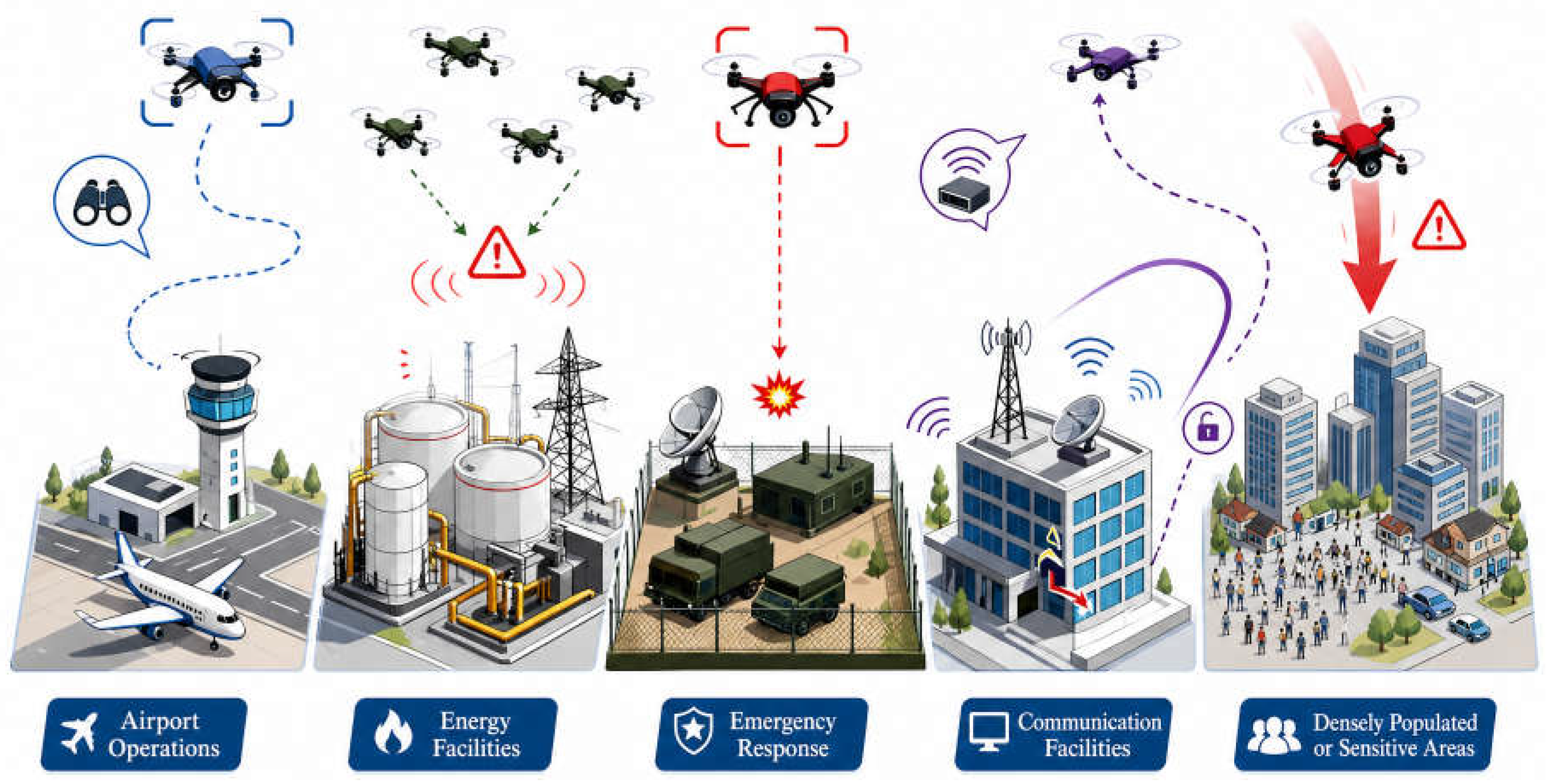
Figure 2.
Evaluation flowchart of the proposed model.
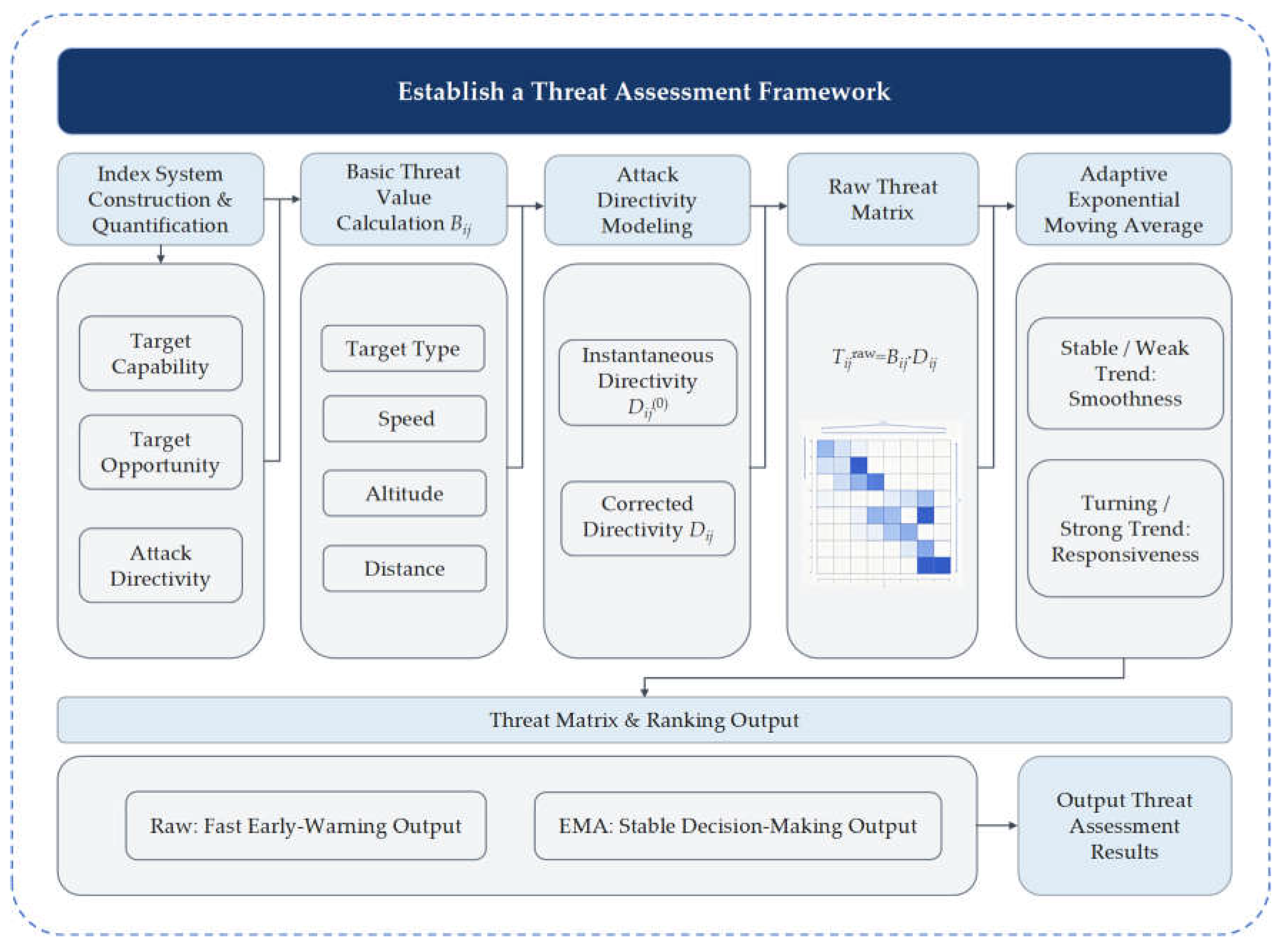
Figure 3.
Illustration of instantaneous approach directionality.
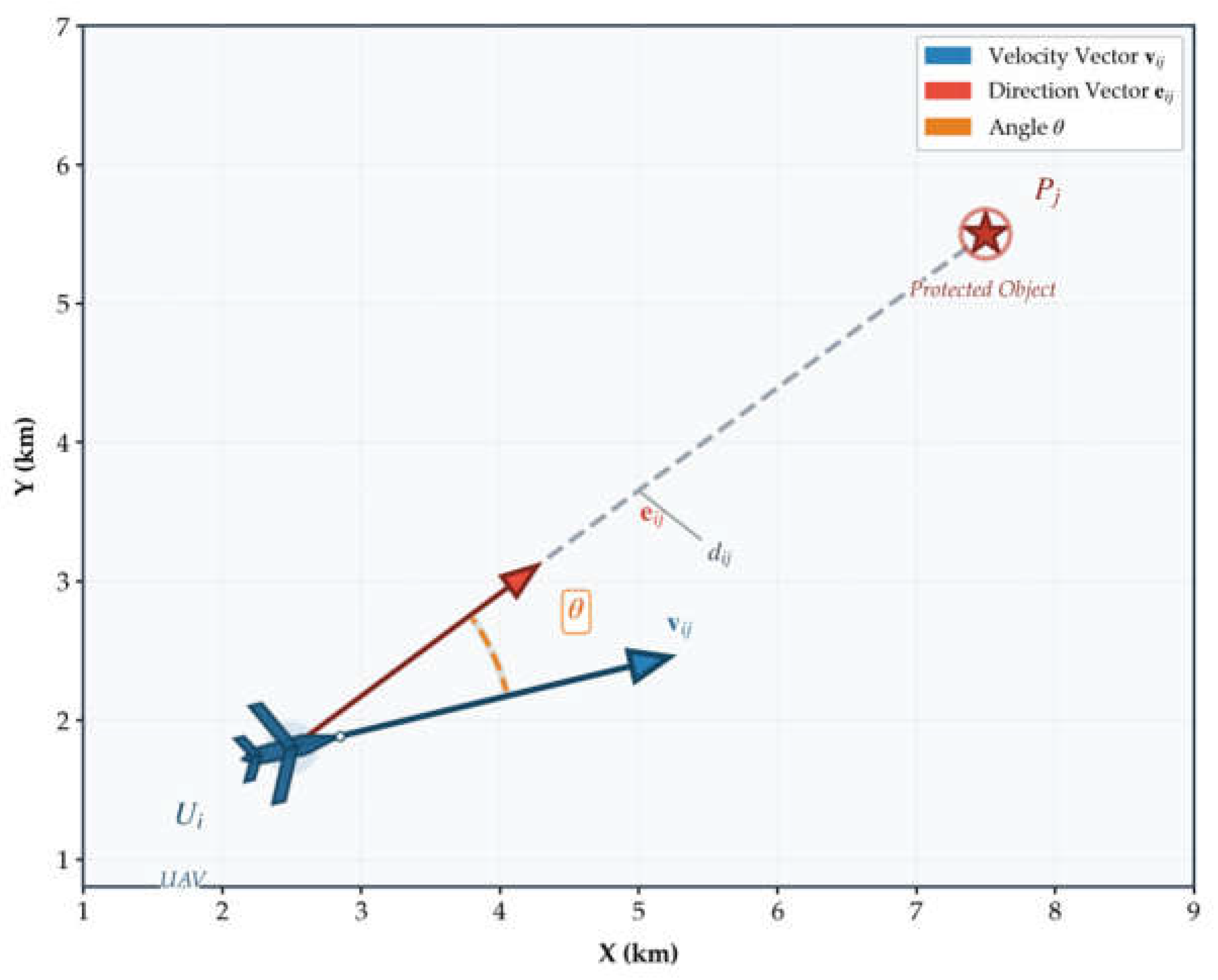
Figure 4.
Illustration of history-based directionality correction.
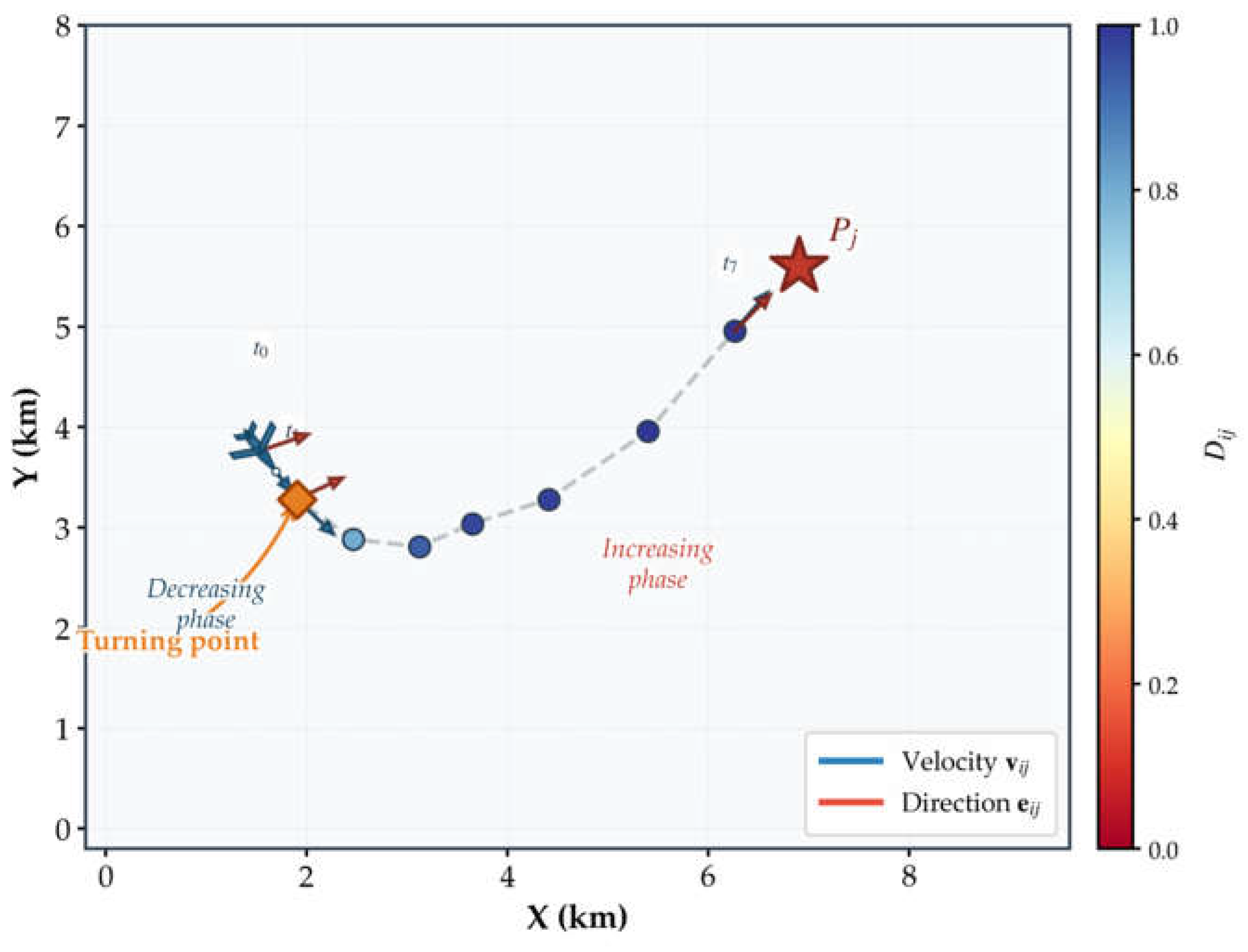
Figure 5.
Comparison of evolution curves for the five methods.
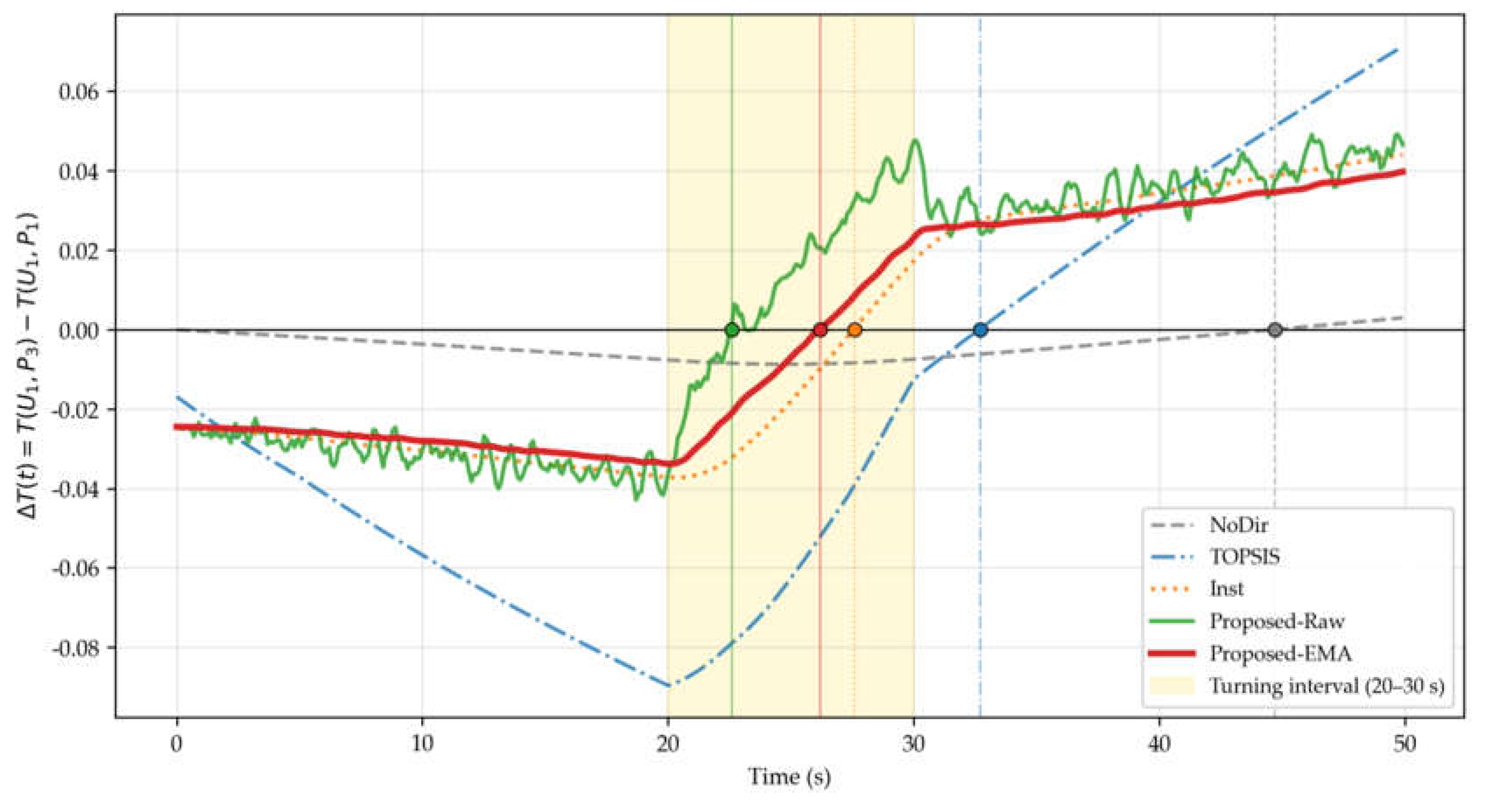
Figure 6.
Threat matrix heatmaps of UAVs against protected assets at representative time instants.
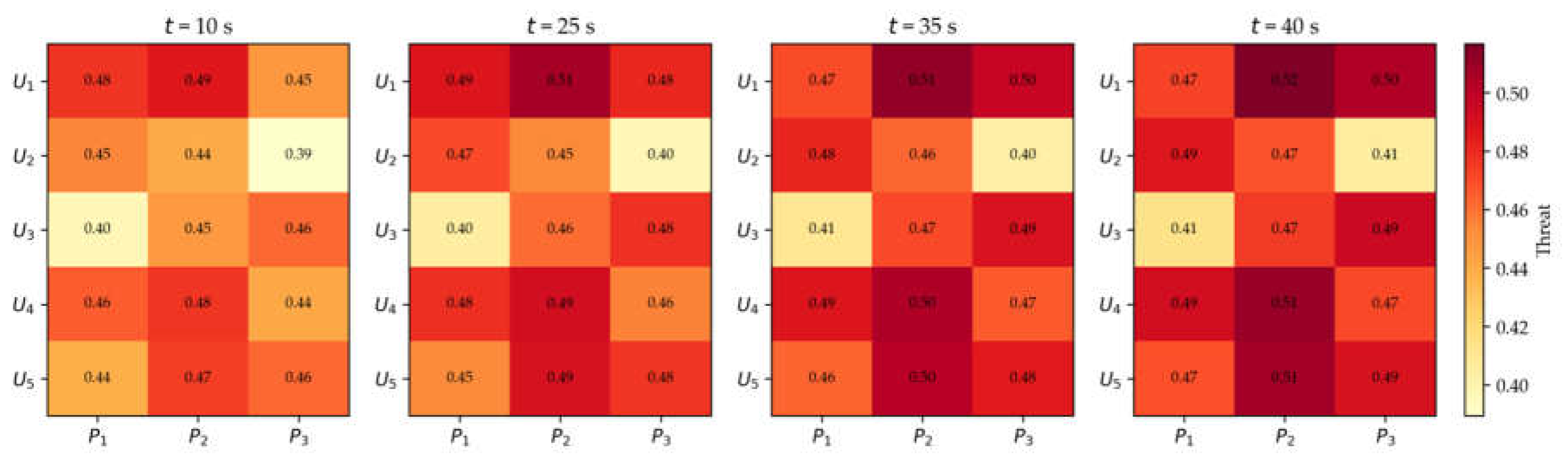
Figure 7.
Threat ranking diagram.
Figure 8.
Paired t-test results for the static Monte Carlo experiment.
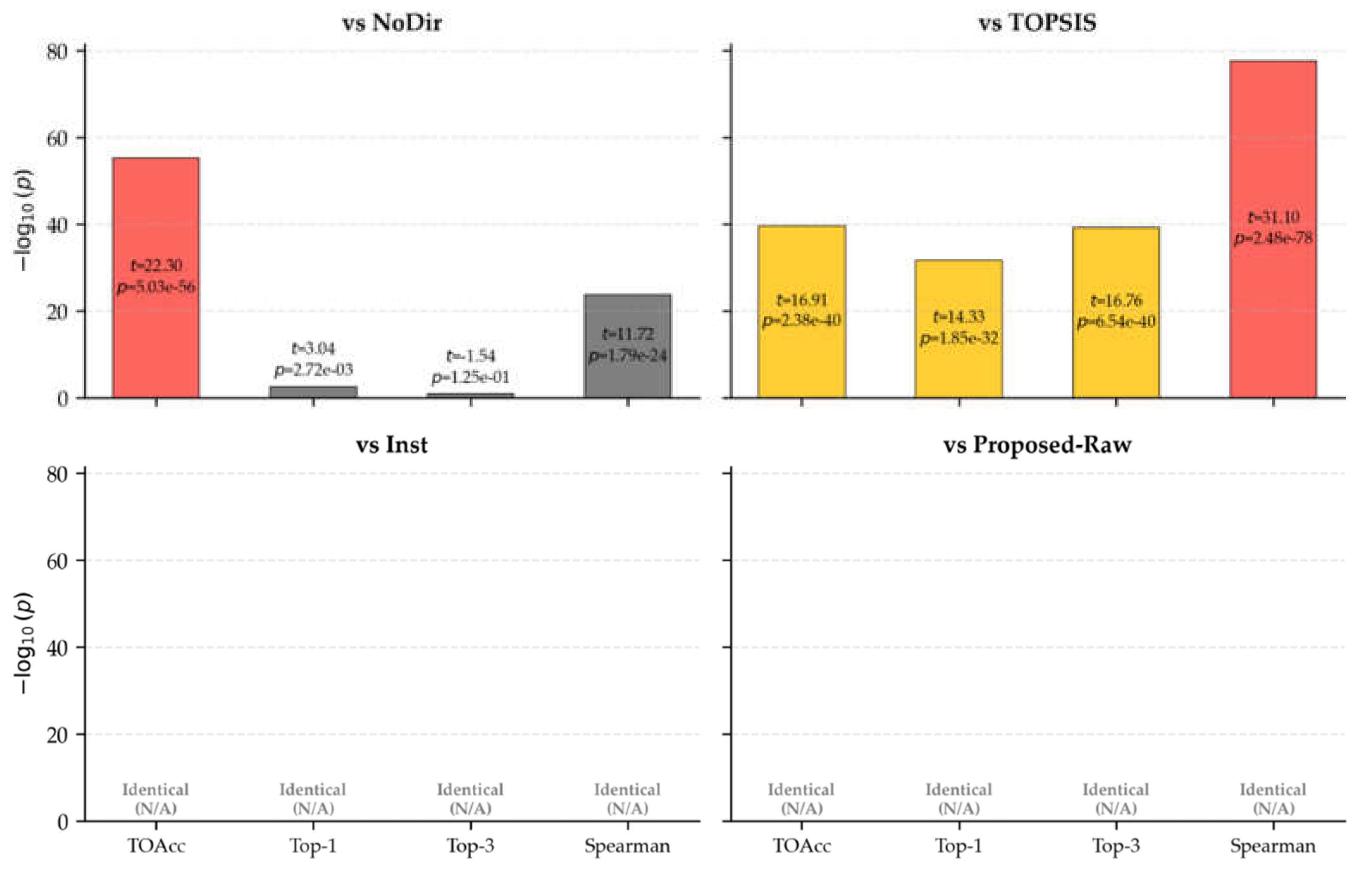
Figure 9.
Paired t-test results for the dynamic Monte Carlo experiment.
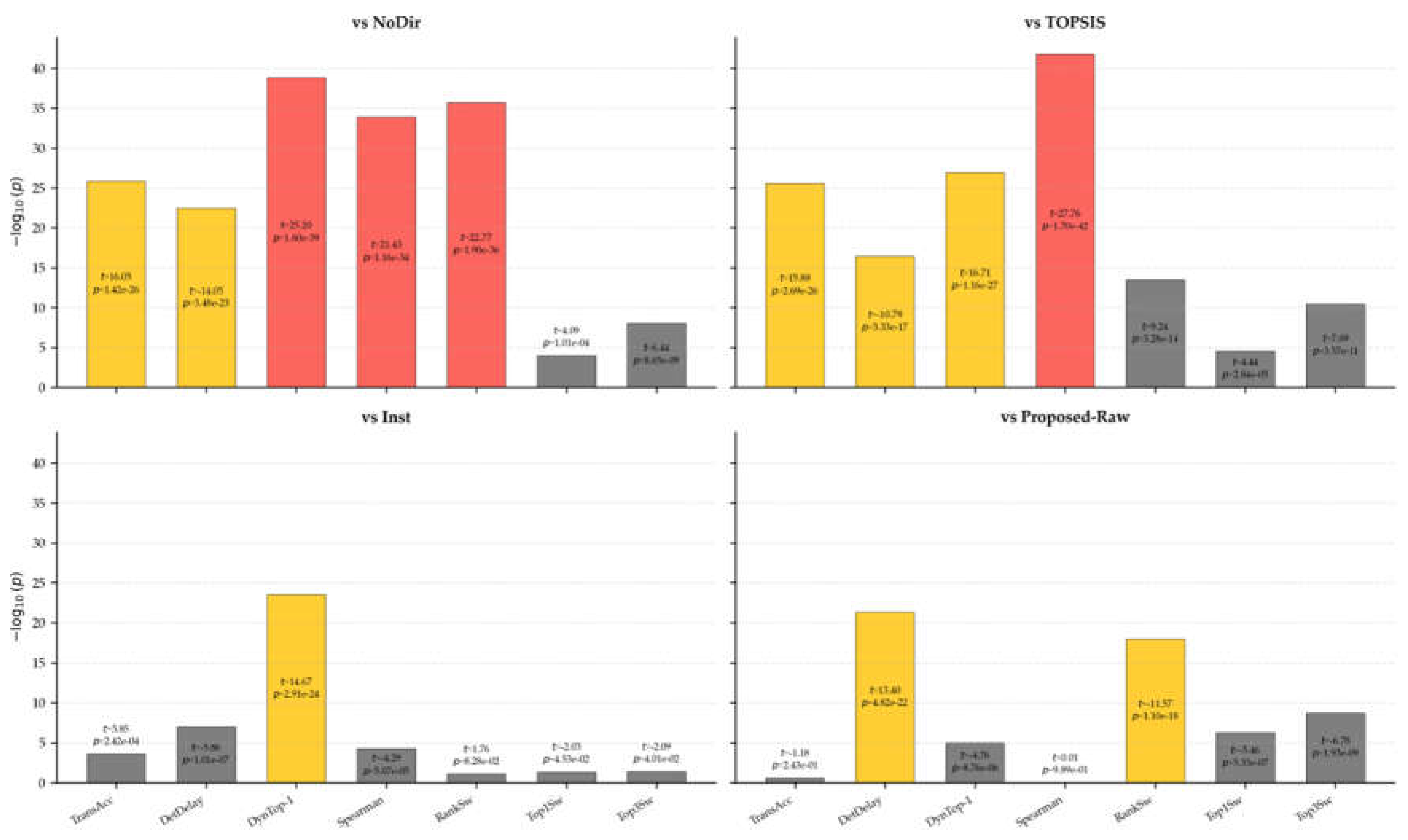
Figure 10.
Noise robustness comparison.
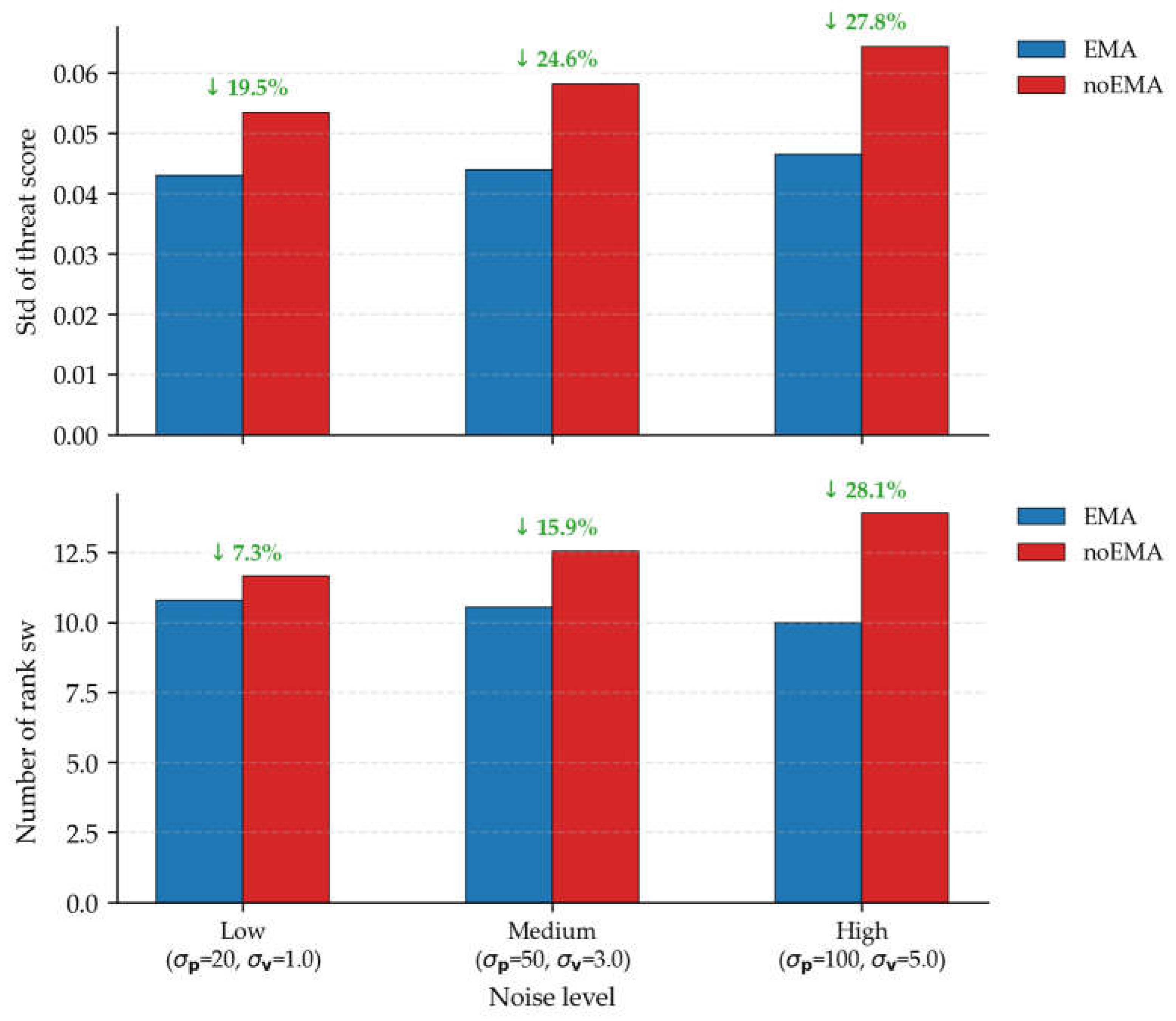

Table 1.
a). Comparison of the applicability of existing threat assessment methods in multi-asset scenarios: direction/trend information, multi-target matrix output, data dependence. b). Comparison of the applicability of existing threat assessment methods in multi-asset scenarios: noise handling, and interpretability.
Table 1.
a). Comparison of the applicability of existing threat assessment methods in multi-asset scenarios: direction/trend information, multi-target matrix output, data dependence. b). Comparison of the applicability of existing threat assessment methods in multi-asset scenarios: noise handling, and interpretability.
| (a) | |||
| Method | Direction/Trend Information | Multi-Target Matrix Output | Data Dependence |
| Evidence reasoning | Not considered | Not explicitly supported | Relies on prior knowledge |
| Fuzzy reasoning | Not considered | Limited support | Relies on expert experience |
| Bayesian network | Indirectly reflected by conditional probabilities | Limited support | Relies on prior data |
| Multi-attribute decision making | Not considered | Limited support | No labeled data required |
| Cloud model | Not considered | Not explicitly supported | Relies on sample data |
| Neural network | Implicitly learned by attention mechanisms | Supported | Requires large amounts of labeled data |
| (b) | |||
| Method | Noise Handling | Interpretability | |
| Evidence reasoning | Uncertainty modeling | Traceable reasoning process | |
| Fuzzy reasoning | Membership functions | Rule-based interpretability | |
| Bayesian network | Probabilistic framework | Clear causal relationships | |
| Multi-attribute decision making | Depends on weight stability | Transparent modeling process | |
| Cloud model | Considers both fuzziness and randomness | Interpretable cloud droplet distribution | |
| Neural network | Depends on training coverage | Relatively weak interpretability; additional tools are required | |
Table 2.
Quantitative comparison of five methods.
| Method | Recog. t (s) | Delay (s) | Smoothness |
|---|---|---|---|
| NoDir | 44.70 | +24.70 | 0.00011 |
| TOPSIS | 32.70 | +12.70 | 0.00026 |
| Inst | 27.60 | +7.60 | 0.00021 |
| Proposed-Raw | 22.60 | +2.60 | 0.00130 |
| Proposed-EMA | 26.20 | +6.20 | 0.00021 |
Table 3.
Results of the static Monte Carlo experiment.
| Method | NoDir | TOPSIS | Inst | Proposed-Raw | Proposed-EMA |
|---|---|---|---|---|---|
| TOAcc | 0.4253 ± 0.0979 | 0.3423 ± 0.0917 | 0.5260 ± 0.0948 | 0.5260 ± 0.0948 | 0.5260 ± 0.0948 |
| Top-1 | 0.5667 ± 0.2749 | 0.3133 ± 0.2252 | 0.6217 ± 0.2553 | 0.6217 ± 0.2553 | 0.6217 ± 0.2553 |
| Top-3 | 0.6328 ± 0.1428 | 0.4111 ± 0.1296 | 0.6194 ± 0.1403 | 0.6194 ± 0.1403 | 0.6194 ± 0.1403 |
| Spearman | 0.8032 ± 0.0535 | 0.6506 ± 0.0975 | 0.8314 ± 0.0420 | 0.8314 ± 0.0420 | 0.8314 ± 0.0420 |
Table 4.
Results of the dynamic Monte Carlo experiment.
| Method | NoDir | TOPSIS | Inst | Proposed-Raw | Proposed-EMA |
|---|---|---|---|---|---|
| TransferAcc | 0.4718 ± 0.1615 | 0.3302 ± 0.1510 | 0.6919 ± 0.1647 | 0.7189 ± 0.1524 | 0.7124 ± 0.1604 |
| DetectDelay(s) | 20.7741 ± 5.1737 | 23.4207 ± 4.8410 | 16.0328 ± 4.6179 | 13.5825 ± 4.5756 | 15.1051 ± 4.7157 |
| DynTop-1 | 0.4390 ± 0.0943 | 0.3354 ± 0.1012 | 0.5908 ± 0.0845 | 0.6142 ± 0.0820 | 0.6092 ± 0.0846 |
| Spearman | 0.5936 ± 0.1383 | 0.4247 ± 0.1790 | 0.8927 ± 0.0821 | 0.8832 ± 0.0856 | 0.8832 ± 0.0922 |
| RankSwitch | 37.6250 ± 7.7385 | 43.8000 ± 11.1908 | 56.1500 ± 6.4306 | 61.3750 ± 5.9380 | 56.9125 ± 6.5825 |
| Top1Switch | 2.4875 ± 2.2803 | 2.2125 ± 2.3114 | 4.0000 ± 2.3927 | 5.0000 ± 2.8417 | 3.6875 ± 1.9013 |
| Top3Switch | 5.4500 ± 3.7279 | 4.5750 ± 3.7342 | 9.2875 ± 3.8801 | 11.5750 ± 4.7979 | 8.5750 ± 3.1256 |
Table 5.
Results of noise robustness analysis.
| Noise Level | Low | Medium | High |
|---|---|---|---|
| 20.0 | 50.0 | 100.0 | |
| 1.0 | 3.0 | 5.0 | |
| Threat Fluctuation with EMA | 0.0430 | 0.0439 | 0.0465 |
| Threat Fluctuation without EMA | 0.0534 | 0.0582 | 0.0644 |
| Ranking Switches with EMA | 10.80 | 10.55 | 10.00 |
| Ranking Switches without EMA | 11.65 | 12.55 | 13.90 |
Disclaimer/Publisher’s Note: The statements, opinions and data contained in all publications are solely those of the individual author(s) and contributor(s) and not of MDPI and/or the editor(s). MDPI and/or the editor(s) disclaim responsibility for any injury to people or property resulting from any ideas, methods, instructions or products referred to in the content. |
© 2026 by the authors. Licensee MDPI, Basel, Switzerland. This article is an open access article distributed under the terms and conditions of the Creative Commons Attribution (CC BY) license (http://creativecommons.org/licenses/by/4.0/).
Copyright: This open access article is published under a Creative Commons CC BY 4.0 license, which permit the free download, distribution, and reuse, provided that the author and preprint are cited in any reuse.


