

Submitted:
15 March 2026
Posted:
17 March 2026
You are already at the latest version
Abstract
The global monetary order is shifting and the shift is not subtle. The U.S. dollar, long unchallenged at the center of international finance, now faces serious pressure from three converging forces: geopolitical fractures, financial sanctions, and deliberate moves by central banks to diversify their reserve holdings. This study examines, with empirical rigor, how de-dollarization has progressed and how gold's monetary role has evolved between 2000 and 2026. Drawing on high-frequency data from the IMF's COFER database, the World Gold Council, and the International Financial Statistics database. The analysis integrates multiple authoritative sources to build a coherent picture of reserve composition globally. To capture dynamics that standard regression would miss, the study uses a three-part methodological framework quantile-on-quantile (QQ) regression, causality-in-quantiles testing, and descriptive trend analysis. Together, these tools allow us to examine how gold and equity markets behave under different conditions: calm periods, bull runs, and crises. The dollar's share of global reserves has fallen to 57.74%a meaningful retreat from its earlier dominance. Even more notable. Official gold holdings worldwide now stand at $3.909 trillion, nearly matching the $3.920 trillion held in U.S. Treasury securities by foreign governments. For the first time in modern monetary history, gold and Treasuries are effectively at parity in central bank portfolios. However, this gold accumulation is not broadly distributed. It is concentrated in a handful of emerging economies notably Russia (1,894 tonnes), China (1,807 tonnes), Turkey (705 tonnes), and India (523 tonnes). Importantly, most of these countries are not systematically reducing dollar holdings alongside their gold purchases. The exception is where geopolitics directly drove the decision, as in Russia's case. The QQ regression uncovers a clear and counterintuitive pattern: gold's relationship with equity markets is U-shaped. Gold delivers its strongest gains at the extremes either as a safe-haven asset during sharp stock market crashes (β = −3.37 at τ = 0.10, θ = 0.10), or during exceptional equity bull markets (β = +3.16 at τ = 0.95, θ = 0.90). In between, in ordinary or muted market conditions, gold's role is far less pronounced. Causality-in-quantiles testing reinforces this picture. Stock market returns predict gold outcomes only when gold is already performing exceptionally well that is, in the upper tail of gold's distribution (τ = 0.90, p = 0.046; τ = 0.95, p = 0.013). In normal conditions, no such predictive link emerges. This tells us something important: gold does not respond to markets uniformly it responds selectively, and only under specific regime conditions. Taken together, these findings point to a monetary system in gradual but genuine transition. It is becoming more pluralistic but carefully so. For most countries, this reflects portfolio diversification, not a deliberate campaign to dethrone the dollar. Gold's role, meanwhile, is not universal it is regime-dependent, activated by crisis or exceptional growth, and largely dormant in between. The dollar remains dominant however it is no longer unquestioned.
Keywords:
de-dollarization
; gold reserves
; central banking
; safe-haven assets
; quantile-on-quantile regression
; international monetary system
1. Background
The global monetary order is shifting and few shifts in modern finance have carried this much structural weight. For decades after the Bretton Woods collapse, the U.S. dollar stood unchallenged: the world's reserve currency, settlement medium, and unit of account, all in one. That position has not collapsed but it has begun to crack. Three forces are driving the fracture simultaneously: an era of extraordinary monetary expansion following 2008, intensifying geopolitical tensions, and the deliberate use of financial sanctions as a foreign policy instrument. Together, they have prompted a fundamental rethink of dollar-centric reserve management. The numbers that emerged in 2025 capture this shift precisely: for the first time since 1996, global official gold holdings ($3.909 trillion) drew nearly level with foreign official holdings of U.S. Treasury securities ($3.920 trillion). That near-parity is not just a data point it is a symbol of something deeper: a structural shift in how the world holds value. Scholars and policymakers have reached for different terms to describe it" de-dollarization," "reserve diversification," "monetary pluralism "but the underlying trend is the same. Existing research, however, has not kept up with the complexity of what is actually happening. Most studies examine these dynamics through mean relationships and linear regression methods that flatten the very asymmetries and heterogeneities that make financial markets interesting, especially during periods of stress. There is also a persistent conceptual confusion at the center of the debate: does what we are observing constitute genuine "de-dollarization" an active, intentional reduction in dollar exposure or merely "diversification "a passive rebalancing toward non-traditional assets with no explicit anti-dollar agenda? These are not the same thing, and conflating them distorts both analysis and policy. Compounding the problem, the time-varying nature of gold's safe-haven properties the fact that gold behaves differently under different market conditions remains poorly captured in conventional frameworks. This paper addresses all three limitations directly. The research objectives guide the analysis. First, to quantify the dollar's declining share in global reserves and the corresponding rise in gold holdings, using authoritative data from the IMF and World Bank. Second, to identify the structural and geopolitical drivers behind central bank gold accumulation with particular focus on financial sanctions and sovereign credit concerns.
In pursuing these objectives, this study makes four distinctive contributions to the literature. First, it integrates multiple high-frequency datasets from the IMF's Currency Composition of Official Foreign Exchange Reserves (COFER), the World Bank's International Debt Statistics, and the World Gold Council's central bank holdings database, thereby providing the most comprehensive empirical assessment to date. Second, it employs an advanced methodological framework combining quantile-on-quantile (QQ) regression, causality-in-quantiles testing, and cross-quantilogram analysis, which captures distributional dependencies invisible to conventional methods.
2. Literature Review
2.1. Theoretical Foundations of Reserve Currency Status
The theoretical literature on international reserve currencies originates with Kindleberger's (1973) theory of hegemonic stability and Krugman's (1984) analysis of currency network externalities. A reserve currency provides three classical functions: unit of account for international transactions, medium of exchange in trade and financial flows, and store of value for official reserves. The dollar's post-1945 dominance derived from a self-reinforcing cycle: deep and liquid financial markets, network effects in trade invoicing, and the credibility of U.S. monetary institutions. However, Eichengreen (2011) challenged the inevitability of single-currency dominance, arguing that the contemporary international monetary system could accommodate multiple reserve currenciesa prediction borne out by the euro's emergence and the yuan's gradual internationalization. The theoretical framework of "currency competition" suggests that reserve currency status is contestable when the incumbent's fundamental attributes (fiscal sustainability, monetary stability, geopolitical reliability) come into question.
2.2. The De-Dollarization Debate
The academic debate on de-dollarization has coalesced around three distinct schools of thought each offering a different explanation for the same observable trend. The first, the structural transformation school, takes the long view. Arslanalp, Eichengreen, and Simpson-Bell (2025) argue that the dollar's declining share in reserves is not the result of any deliberate anti-dollar campaign. It is, rather, a passive consequence of shifting economic geography. Emerging markets now command a larger share of global GDP, and these economies naturally gravitate toward reserve compositions that reflect their own trade and financial relationships. On this reading, "de-dollarization" is the wrong word what we are seeing is the world's reserve portfolio gradually catching up with the world's actual economic weight. The second school, the geopolitical fragmentation school, tells a sharper and more unsettling story. Carrillo-Pina and Sharov (2025) place sanctions and geopolitical rivalry at the center of the analysis. The sequence is well-documented: Russia's 2014 annexation of Crimea, the full-scale invasion of Ukraine in 2022, and the unprecedented Western response including the freezing of Russian central bank assets. That last move was a turning point. By treating dollar-denominated reserves as a weapon, the United States and its allies sent an unmistakable signal to every non-aligned government watching: dollar exposure is not just a financial decision, it is a geopolitical vulnerability.
The Iran case makes this dynamic impossible to ignore. As documented by Sachs and Fares (2026), the U.S. Treasury's "maximum pressure" campaign against Iran was openly designed to engineer a dollar shortage tightening access to the U.S. financial system, weakening the rial, driving up import costs, and accelerating inflation. Treasury Secretary Scott Bessent confirmed as much in January 2026. The rial fell to 1.4 million per USD by December 2025; a major Iranian bank subsequently collapsed. The mechanics were devastating and, crucially, they were public. For reserve managers worldwide, the lesson required no interpretation: significant dollar holdings are an exposure one that can be activated against you if relations with Washington deteriorate. The response has been predictable. BRICS nations and many other economies have accelerated efforts to conduct trade in their own currencies and build settlement alternatives to the dollar-based system. As Xinhua News Agency put it following the 2026 U.S.-Israel strikes on Iran, the "rules-based international order" is increasingly read by the Global South as something closer to a law of the jungle. The 2026 Iran escalation added another layer of complexity. As the U.S. deployed naval forces to the Persian Gulf and launched strikes on Iranian targets, safe-haven flows bifurcated in an unexpected way: gold surged past $5,500 per ounce, but the dollar simultaneously strengthened as investors sought liquidity. For a moment, the de-dollarization narrative appeared to stall. It did not. The IMF noted that while the dollar's crisis role persisted, gold's simultaneous rally decoupling from its typical negative correlation with the greenback pointed to something deeper: growing scepticism about fiat currencies under conditions of extreme geopolitical stress. The Iran conflict also introduced a tactical pause in central bank gold accumulation. Some economies reportedly slowed planned reserve increases, prioritizing liquid foreign-exchange buffers over sustained gold-buying programs amid the immediate uncertainty. The long-term direction, however, remains intact. The expiration of the U.S.-Saudi petrodollar agreement in 2024 and ongoing BRICS experimentation with gold-backed settlement units reinforce the same conclusion: this structural shift, however gradual, appears increasingly difficult to reverse. The third school call it the sceptical school urges caution before drawing sweeping conclusions. Weiss (2025) finds, at the country level, that gold accumulation is generally not paired with systematic dollar reduction. Most central banks, he argues, are engaged in modest portfolio rebalancing, not an ideological break from the dollar. The World Gold Council's 2025 survey data support this reading: only 32% of central banks cited reducing dollar exposure as a primary motivation for gold purchases. The majority pointed instead to historical stability (82%), crisis performance (78%), and the absence of default risk (75%). These are conventional portfolio management rationales not geopolitical statements. The tension between these three schools is not a flaw in the literature it reflects the genuine complexity of what is happening. Iran provides compelling evidence that geopolitics is reshaping reserve decisions. The survey data suggest those decisions remain, for most countries, rooted in orthodox portfolio logic. Both things are true simultaneously, which is precisely why standard analytical frameworks built around average relationships and linear assumptions are insufficient for this question.
2.3. Gold's Monetary Role
Economists have long tried to pin down exactly what gold does inside a portfolio. The standard taxonomy distinguishes three functions: a hedge (uncorrelated with other assets on average), a safe haven (negatively correlated or uncorrelated during periods of extreme stress), and a diversifier (positively but weakly correlated with the broader portfolio). Baur and McDermott (2010) established the foundational result: gold functions as a strong safe haven for major European and U.S. equity markets during extreme volatility. But that relationship has proven fragile in practice. Gold fell sharply in 2008 during the global financial crisis posting annual losses exceeding 20%and dropped more than 12% in March 2020 as COVID-19 triggered four consecutive U.S. market circuit breakers. Safe haven, it turns out, is not a permanent label. It is a conditional one. More recent methodological work has sharpened this picture considerably. Beckmann, Berger, and Czudaj (2019) used quantile regression to show that gold's relationship with the U.S. dollar varies meaningfully across market conditions. Zhang, Ma, Liu, and Zhou (2025) went further, applying quantile-on-quantile (QQ) regression to capture how gold and equity returns interact across the full distribution of both variables not just at the mean. The results reveal significant heterogeneity: gold functions as a genuine safe haven for G7 countries during downturns, but typically acts only as a diversifier for E7 economies, with exceptions notably Turkey, India, and Brazil emerging only under specific asymmetric conditions. On the official sector side, the direction of travel is clear. The World Gold Council's 2025 Central Bank Gold Survey found that 76% of respondents expect gold to account for a higher share of their reserves within five years up from 69% in 2024. The divergence between emerging market and advanced economy central banks is striking: 48% of the former plan to increase gold holdings in the coming year, compared to just 21% of the latter. The motivations are overwhelmingly conventional historical stability, crisis performance, and the absence of default risk. Only 32% explicitly named reducing dollar exposure. The aggregate picture, then, is one of genuine structural change driven mostly by orthodox risk management, with geopolitical calculation playing a real but secondary role for most institutions. Two hypotheses follow from this body of evidence. First, the dollar's share in global reserves has undergone a structural decline, with gold absorbing a meaningful portion of that shift. Second, gold's safe-haven function is asymmetric reliable during extreme downturns in developed markets, but limited and conditional in emerging ones. Testing both requires methods that go beyond the mean. That is precisely what this study does.
4. Method and Methodology
This study employs a mixed-methods research design that integrates descriptive trend analysis, econometric modelling, and country-level case examination to comprehensively investigate the dynamics between gold and stock markets. The empirical strategy proceeds in four stages, first, a descriptive analysis documents trends in reserve composition, dollar share evolution, and gold accumulation patterns using data from the London Bullion Market Association (LBMA), ICE Benchmark Administration (IBA), International Monetary Fund and the World Bank. Second, quantile-on-quantile (QQ) regression is utilized to estimate the asymmetric relationship between gold returns and stock market returns across the joint distribution of both variables. Third, causality-in-quantiles testing examines predictive relationships between gold and stock markets at different quantiles. Fourth, cross-quantilogram analysis is conducted to verify the robustness of the quantile-based dependencies identified through the preceding methods.
The QQ regression approach, developed by Sim and Zhou (2015), extends conventional quantile regression by allowing the effect of one variable on another to vary not only across the quantiles of the dependent variable but also across the quantiles of the independent variable. This methodological innovation is particularly appropriate for analyzing gold-stock relationships, which may differ fundamentally depending on whether gold is in a bull or bear market and whether equities are experiencing stress or exuberance. The QQ regression is specified as , where βθ(τ) represents the effect of the τ-th
quantile of stock returns on the θ-th quantile of gold returns, Rτ^S is the
τ-th quantile of stock returns, and R̂τ^S is the estimated τ-th quantile. This
specification allows researchers to map a surface of coefficients ê1(θ,τ) that
captures how gold responds to stock market movements across the entire
distribution of both variables (Sim & Zhou, 2015).
4.1. The QQ Framework
The QQ regression methodology was introduced by Sim and Zhou (2015) as a generalization of both quantile regression (Koenker & Bassett, 1978) and classical OLS regression. The key insight is that the quantile regression model:
estimates β as a function of τ (the gold return quantile) but treats as fixed observations. This fails to capture how gold responds differently when S&P500 is itself at different points in its distribution. QQ regression resolves this by conditioning on the quantile of x as well.
Formally, the QQ regression model is:
where is the θ-th empirical quantile of S&P 500 returns . The coefficient β(τ,θ) captures the marginal effect of a unit change in S&P500 returns on the τ-th quantile of gold returns, evaluated at the θ-th quantile of the S&P500 distribution.
4.2. Causality-in-Quantiles test
The causality-in-quantiles test, developed by Nishiyama, Hitomi, Kawasaki, and Jeong (2011) and Jeong, Härdle, and Song (2012), detects nonlinear predictive relationships that conventional Granger causality tests may miss. This approach examines whether one variable predicts another at specific quantiles of the conditional distribution, rather than only at the conditional mean, making it particularly valuable for capturing the heterogeneous effects that may exist across different market conditions. The null hypothesis of non-causation in quantiles is expressed as
H0: Qy(τ | yt-1,...,yt-p, xt-1,...,xt-p) = Qy(τ | yt-1,...,yt-p),
where Qy(τ | ·) is the τ-th conditional quantile of y.
Rejection of the null indicates that x Granger-causes y at quantile τ (Nishiyama et al., 2011; Jeong et al., 2012).
4.3. Test Statistic (Jeong, Härdle & Song 2012)
Let denote the indicator residual, where is the conditioning vector and is the nonparametric conditional quantile estimate. The test compares two specifications:
The J-statistic for each model is defined as:
where is the marginal kernel density evaluated at the lagged stock return. The test statistic is:
under H₀
A positive indicates that the restricted model has higher prediction error than the unrestricted model, i.e., adding reduces the conditional quantile error evidence of Granger causality at quantile τ. Under H₀, is asymptotically standard normal (Theorem 1, Jeong et al. 2012). One-sided p-values are reported.
4.4. Data Sources and Variables
Table 1 sets out the full variable inventory what was measured, where the data came from, how frequently it was collected, and how far back it runs. The dollar's share in global foreign exchange reserves comes from the IMF's COFER database, recorded quarterly from 2000Q1 to 2025Q1. Global gold reserves official central bank holdings measured in both tonnes and U.S. dollar value are drawn from the IMF and the World Gold Council, with monthly observations running from January 2000 through September 2025. Gold price data come from the London Bullion Market Association (LBMA) and the WIND database, using the London PM fix in USD per troy ounce, available daily across the full 2000–2025 window. Financial market conditions are captured through major equity indices sourced from Bloomberg and Refinitiv, at daily and monthly frequency from 2000 to 2024. Central bank gold purchases net official sector acquisitions are tracked quarterly via the World Gold Council from 2000Q1 through 2025Q3. The sanctions dimension is covered by the Global Sanctions Database, which provides annual measures of both the volume and intensity of financial sanctions over the same 2000–2025 period. Foreign official holdings of U.S. Treasury securities are drawn from the U.S. Treasury's TIC system, with monthly data from January 2000 to June 2025. Global debt conditions specifically non-financial sector debt and debt-to-GDP ratios come from the Bank for International Settlements (BIS) on a quarterly basis. Finally, geopolitical uncertainty is quantified using the Geopolitical Risk Index from the Economic Policy Uncertainty database: a monthly, news-based measure of global geopolitical tensions spanning the entire 2000–2025 period. Taken together, these sources cover a 25-year window across multiple frequencies daily, monthly, and quarterly allowing the analysis to operate at the level of granularity each variable demands.

Table 1.
Data Sources.
| Variable | Source | Frequency | Period |
| Dollar Reserve Share | IMF COFER | Quarterly | 2000Q1–2025Q1 |
| Global Gold Reserves | IMF; World Gold Council | Monthly | 2000M1–2025M9 |
| Gold Prices | London Bullion Market Association; WIND | Monthly | 2000–2025 |
| Stock Market Indices | Bloomberg; Refinitiv | Monthly | 2000–2024 |
| Central Bank Gold Purchases | World Gold Council | Quarterly | 2000Q1–2025Q3 |
| Sanctions Data | Global Sanctions Database | Annual | 2000–2025 |
| U.S. Treasury Holdings | U.S. Treasury TIC | Monthly | 2000M1–2025M6 |
| Global Debt Metrics | Bank for International Settlements (BIS) | Quarterly | 2000Q1–2025Q1 |
| Geopolitical Risk Index | Economic Policy Uncertainty | Monthly | 2000–2025 |
5. Results and Analysis
5.1. Currency composition of official foreign exchange reserves
The Currency Composition of Official Foreign Exchange Reserves (COFER) is the authoritative source for understanding how central banks and monetary authorities allocate their foreign exchange holdings across currencies. Compiled quarterly by the IMF Statistics Department, COFER data offer unparalleled insight into the shifting balance of monetary power and the evolving role of the US dollar as the world's primary reserve currency.
Table 1.
Trends in the Share of the US Dollar and Other Currencies in Global Reserves.
| Currency | Period | Mean (%) | Std Dev (pp) | Min (%) | Max (%) |
| US Dollar | 1999Q1–2025Q3 | 63.33 | 3.41 | 56.92 (2025Q3) | 72.13 (1999Q2) |
| Euro | 1999Q1–2025Q3 | 20.67 | 1.94 | 16.42 (2000Q3) | 24.18 (2009Q3) |
| Japanese Yen | 1995–2024 (Annual) | 5.30 | 0.96 | 3.49 (2009) | 6.77 (1995) |
| Pound Sterling | 1995–2024 (Annual) | 4.06 | 0.95 | 2.11 (1995) | 5.66 (2007) |
| Chinese Renminbi | 2016Q4–2025Q3 | 2.08 | 0.52 | 1.00 (2016Q4) | 2.85 (2021Q4) |
| Canadian Dollar | 2012Q4–2025Q3 | 2.26 | 0.26 | 1.83 (2020Q1) | 2.83 (2024Q4) |
| Australian Dollar | 2012Q4–2025Q3 | 1.92 | 0.14 | 1.63 (2015Q3) | 2.24 (2022Q4) |
| Swiss Franc | 1995–2024 (Annual) | 0.25 | 0.07 | 0.13 (1999Q4) | 0.39 (2002) |
Data Coverage: 1995 (Annual) | 1999Q1 – 2025Q3 (Quarterly). Source: International Monetary Fund, Statistics Department. Dataset Version: IMF.STA:COFER (7.0.1) | Published: December 2025.
5.2. Gold Accumulation Patterns & Structural Shifts in Central Bank Reserves
The dataset in Table 2 records monthly and annual changes in gold reserves measured in metric tonnes for 162 countries and territories, spanning January 2002 through January 2026. Gold held in official reserves serves multiple strategic functions: as a hedge against currency risk and inflation, a geopolitical buffer during sanctions or financial crises, a safe-haven asset during systemic instability, and a signal of monetary credibility. The past two decades have witnessed a dramatic structural reversal: from a sustained period of Western central bank gold sales (2002–2008) to an era of aggressive net accumulation driven predominantly by emerging market economies (2009–present).
The contrast between the two eras is stark. During the selling era (2002–2008), the world lost an average of 590.9 tonnes per year from official gold holdings, driven by coordinated European central bank sales. During the buying era (2009–2025), the world added an average of 404.3 tonnes per year. Cumulatively:
- Selling era total (2002–2008): −4,137 tonnes
- Buying era total (2009–2025): +6,872 tonnes
- Overall net change 2002–2025: +2,735 tonnes
The annual standard deviation of 525.8 tonnes reflects very high year-to-year variability, driven by concentrated large purchases (e.g., China in 2015, India in 2009, Poland in 2019) and the coordinated selling under the Central Bank Gold Agreements (CBGA 1–4, 1999–2019).
Russia leads the dataset as the single largest national gold accumulator1,894 tonnes added between 2002 and early 2025, with the overwhelming bulk of that (1,813 tonnes) concentrated in the deliberate buying era between 2009 and 2024. The timeline is not accidental. It maps almost precisely onto the period in which Russia began treating dollar exposure as a strategic liability. China's accumulation is the most consequential entry in the dataset and the least transparent. Beijing routinely goes months, sometimes years, without reporting any change to COFER or IFS, then announces large step-changes that compress what was likely a gradual process into a single disclosure event. The dataset records 1,807 tonnes in net accumulation, but that number almost certainly understates reality. China is widely believed to hold additional gold outside the official reporting framework in vehicles that fall below the threshold of mandatory disclosure. Turkey presents a different kind of complexity. The dataset carries two separate entries approximately 705 tonnes under one classification and 487 tonnes under another a discrepancy that likely reflects different reporting methodologies or the inclusion of commercial bank gold swaps in one measure but not the other. The data classification issue is unresolved, but the direction of travel is not: Turkey has been an aggressive accumulator, driven by a combination of domestic currency vulnerability and a deliberate strategy to reduce dependence on dollar-denominated assets. India's story has a different characterless opaque, more deliberate, and punctuated by a single defining moment. In November 2009, the Reserve Bank of India made a landmark purchase of approximately 200 tonnes directly from the IMF. The move signalled, with unusual clarity, that Asia's central banks were reassessing gold's place in the reserve hierarchy. Subsequent accumulation was more measured, picking up pace again from 2017 onward. Then, in 2024, India made headlines of a different kind: it repatriated over 100 tonnes of gold held at the Bank of England a logistical operation, yes, but also an unmistakable statement of strategic independence. Total net accumulation stands at 522.6 tonnes, making India the fourth-largest accumulator in the dataset.
Table 3.
Top Official Gold Accumulators, Net Change 2002–2025 (Tonnes).
| # | Country | Net Total (t) | Key Period |
| 1 | Russian Federation | 1,894.2 | 2007–2022 (halted post-sanctions) |
| 2 | China, P.R. (Mainland) | 1,806.8 | 2009–present (with pauses) |
| 3 | Turkey | 705.5 / 487.0 | 2012–present (volatile) |
| 4 | India | 522.6 | 2009, 2017–present |
| 5 | Poland | 447.3 | 2018–2019 (bulk); ongoing |
| 6 | Kazakhstan | 282.7 | 2009–2021 (then selling) |
| 7 | Uzbekistan | 228.9 | 2017–present |
| 8 | SOFAZ (Azerbaijan) | 200.0 | 2012–2014 (bulk) |
| 9 | Saudi Arabia | 180.1 | Sporadic |
| 10 | Iraq | 168.7 | 2010–2016 (bulk) |
Data Source: IMF International Financial Statistics (IFS). Coverage: January 2002 – January 2026 (Monthly) | 2002–2025 (Annual).
Kazakhstan accumulated approximately 283 tonnes between 2009 and 2021, largely driven by purchases of domestically mined gold from the National Bank. However, from late 2021 onward, Kazakhstan shifted to net selling likely driven by fiscal needs and commodity market dynamics reducing its peak holdings of approximately 350 tonnes to lower levels by 2025.
Table 4 lists the ten largest national gold sellers over the 2002–2025 period. In sharp contrast to accumulators, the sellers are overwhelmingly Western European economies that coordinated disposals under the Central Bank Gold Agreements.
5.3. US Dollar Index (DXY) vs Gold Prices & Reserve Composition
The relationship between the US Dollar Index (DXY) and gold prices is one of the most closely watched and debated dynamics in global financial markets. The conventional wisdom i7 y=u/] often described as an "inverse relationship" i7 y=u/] holds that when the dollar strengthens, gold prices fall, and when the dollar weakens, gold rises. This is intuitive, gold is priced in US dollars, so a stronger dollar makes gold relatively more expensive for non-US buyers, suppressing demand. Conversely, a weaker dollar makes gold cheaper in other currencies, stimulating demand
Table 5.
Descriptive Statistics i7 y=u/] DXY, Gold Price, and USD Reserve Share.
| Variable | Period | Mean | Std Dev | Min | Max | N |
| DXY Monthly Close | 2001–2026 | 96.0 | 10.5 | 72.6 (Apr'08) | 120.6 (Jul'01) | 117 |
| DXY Monthly Return (%) | 2001–2026 | +0.01% | 1.55pp | −4.55% (Apr'25) | 3.19% (Jul'25) | 116 |
| Gold Price (USD/oz) | 2001–2026 | $1,290 | $827 | $267 (Jul'01) | $3,620 (Sep'25) | 117 |
| Gold Monthly Return (%) | 2001–2026 | +0.87% | 4.52pp | −24.3% (Oct'25) | 7.3% (Aug'25) | 116 |
| USD Reserve Share (%) | 2001–2024 | 62.9% | 2.9pp | 58.52% (2024) | 71.01% (1999) | 24 |
Data Source: IMF International Financial Statistics (IFS). Coverage: January 2002 – January 2026 (Monthly) | 2002–2025 (Annual).
In table 5 the DXY averaged 96.0 over the full sample period, with a standard deviation of 10.5 index points, reflecting the meaningful oscillations around the long-run equilibrium. Its range spans from a trough of 72.6 in April 2008 the lowest point in the modern DXY's history prior to the recent 2025 weakness to 120.6 in July 2001, at the height of the post-dot-com dollar bull market.
Gold's trajectory over the same period is equally dramatic: from $267/oz in July 2001 to an all-time high (in this dataset) of $3,620/oz in September 2025, a 13.6-fold increase. The average monthly return of gold (+0.87%) dwarfs that of the DXY (+0.01%), confirming gold's secular bull market over this period. USD reserve share (COFER annual data) declined steadily from 71.01% in 1999 to 58.52% by 2024 a fall of 12.49 percentage points across a quarter century. However, as the correlation analysis shows, this reserve erosion has a complex and indirect relationship with DXY movements.
Table 6.
Correlation Summary by Period and Method.
| Period | Correlation r | Obs (n) |
| Full sample (2001–2026) | -0.484 | 117 |
| 2001–2008 (USD decline) | -0.546 | 29 |
| 2009–2016 (post-GFC) | -0.491 | 33 |
| 2017–2026 (recent) | -0.388 | 55 |
| DXY Level vs Gold Level | +0.289 | 117 |
| DXY Annual vs USD Share | +0.191 | 23 |
Source: US Dollar Index (DXY) Uploaded Monthly Data (Apr 2024 – Mar 2026), LBMA Gold Fixing Price Historical Monthly Data, IMF COFER USD Share of Global FX Reserves (Annual), Extended Historical Coverage: January 2001 – March 2026.
Table 7 provides a regime-by-regime breakdown of DXY and gold performance, identifying periods where the inverse relationship held, where it was stronger than expected, and where it broke down.
The inverse relationship manifests most powerfully during periods of orderly USD appreciation or depreciation driven by monetary policy differentials or macroeconomic factors.
2001–2008 USD structural decline: DXY fell 34%, gold rose 252%. The dollar's decline reflected US twin deficits (fiscal and current account), the rise of the Eurozone, and commodity super-cycle flows. Gold tracked the dollar's weakness almost perfectly, with a monthly return correlation of −0.55 in this sub-period. 2014–2016 USD super-cycle rally: DXY surged 28% as the Fed signaled tightening while other major central banks eased (ECB, BOJ). Gold fell 27% in the same period, one of its sharpest corrections in modern history. The inverse relationship worked with exceptional fidelity. 2025 tariff-driven dollar collapse: In the most recent data from the uploaded file, the −7% DXY slide from March–June 2025 corresponded to a gold surge of approximately +15–20%, delivering the highest-quality inverse signal in years.
5.4. Quantile-on-Quantile Regression analysis
5.4.1. Gold Returns Response to Stock Market Movement
The relationship between gold and equity markets is one of the most consequential questions in portfolio theory and risk management. The standard view, supported by a modest body of empirical literature, characterizes gold as a "safe haven" asset i7 y=u/] one that provides positive returns precisely when stock markets crash. This view underpins the widespread recommendation to hold a 5–15% gold allocation in diversified portfolios.
Table 8.
QQ Regression β(τ,θ) i7 y=u/] Selected Quantile Grid (τ rows × θ columns).
| τ \ θ → | θ=0.05 | θ=0.10 | θ=0.25 | θ=0.50 | θ=0.75 | θ=0.90 | θ=0.95 |
| τ=0.05 | −5.225 | +0.299 | −0.881 | +1.579 | +2.511 | +0.950 | +0.288 |
| τ=0.10 | −5.225 | −1.706 | −0.294 | −1.785 | +2.793 | +0.426 | +0.288 |
| τ=0.20 | −0.741 | −1.158 | −0.074 | −0.986 | +2.449 | −1.434 | +0.064 |
| τ=0.25 | −0.741 | −1.511 | +0.188 | −1.199 | +2.696 | −2.128 | +0.351 |
| τ=0.30 | −0.741 | −0.933 | +0.447 | −0.785 | +2.721 | −0.604 | +0.255 |
| τ=0.40 | +2.280 | +0.797 | +0.395 | −0.160 | +2.249 | −0.747 | −0.948 |
| τ=0.50 | +1.006 | −0.385 | +0.335 | −0.495 | +1.392 | −0.329 | −0.502 |
| τ=0.60 | +1.006 | −0.621 | +0.094 | −0.665 | +1.442 | −1.330 | +0.040 |
| τ=0.70 | −1.024 | −0.036 | −2.282 | −0.006 | +1.572 | −1.467 | −0.814 |
| τ=0.75 | −1.024 | −0.036 | −1.526 | −0.232 | +1.389 | −1.806 | −0.814 |
| τ=0.80 | −0.746 | +0.216 | −1.769 | −0.781 | +1.596 | −0.543 | −0.024 |
| τ=0.90 | −1.282 | −1.740 | −1.906 | −1.198 | +0.687 | +0.606 | −2.392 |
| τ=0.95 | −1.282 | −3.368 | −1.890 | −2.034 | −0.445 | +3.157 | −2.392 |
Color coding: Green = β > +0.3 (co-movement/safe-haven); Gray = near zero (independence). Bold = |β| > 1.0.
The table reveals several striking patterns. First, the θ=0.75 column (strong S&P500 performance) is dominated by positive β values across all gold quantiles, particularly at τ=0.25 (+2.70) and τ=0.30 (+2.72). This suggests that bull equity markets create a favorable environment for gold across a wide range of gold return scenarios.
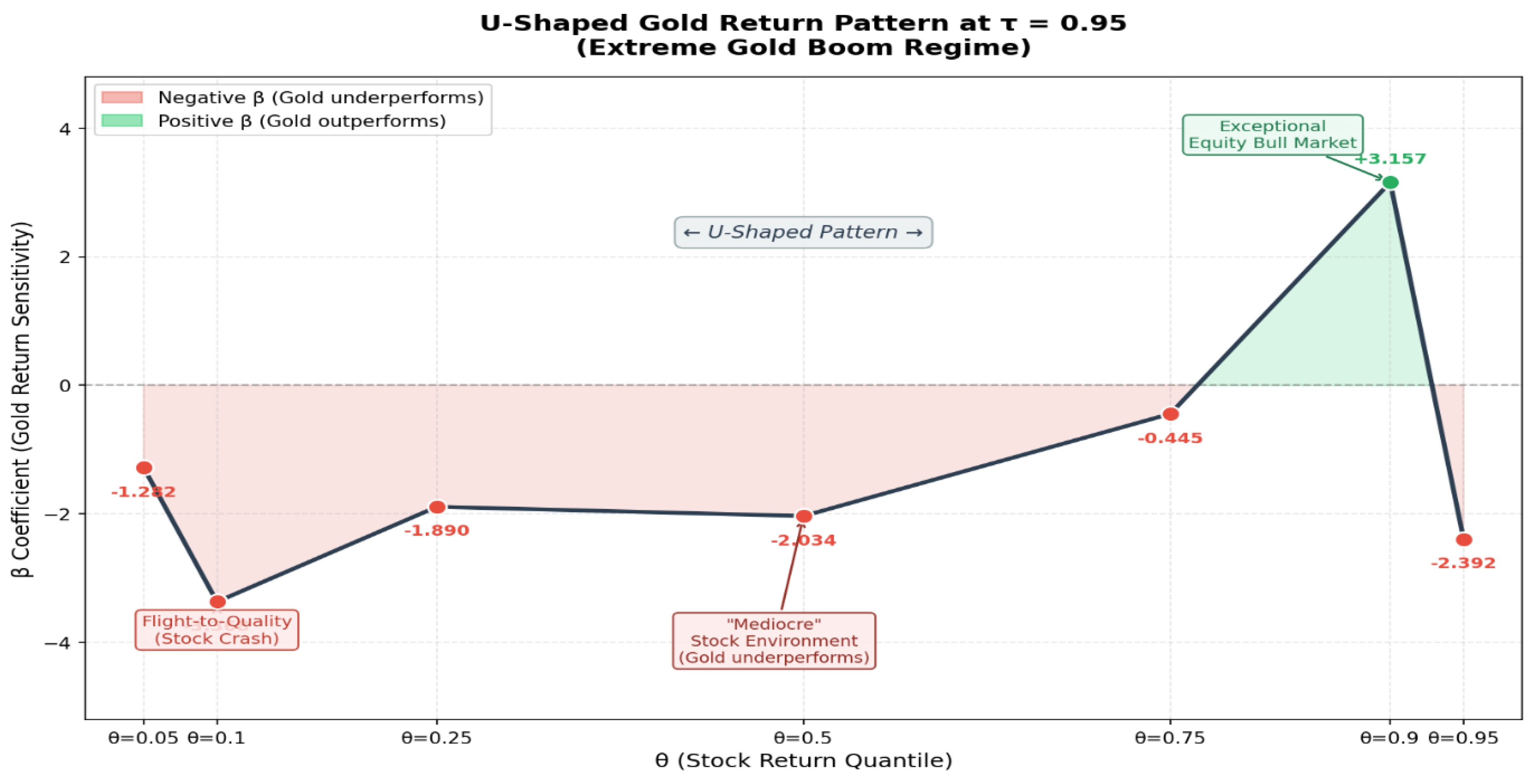
Second, the τ=0.95 row (extreme gold boom) shows a sharp bifurcation: strongly negative β at low θ values (−3.37 at θ=0.10; −1.89 at θ=0.25; −2.03 at θ=0.50) but strongly positive at θ=0.90 (+3.16). This U-shaped pattern means gold's most extreme gains occur either as a pure flight-to-quality during stock crashes OR during exceptional equity bull markets i7 y=u/] but not in mediocre stock market environments.
Third, the θ=0.05 column shows high variance: β ranges from −5.23 (τ=0.05–0.10) to +2.28 (τ=0.40). Extreme equity crashes produce wildly inconsistent gold responses, reflecting the mixing of different crisis types in the sample: the 2008 liquidity crisis (gold crashed too), the 2001–2002 decline (gold rose), and the 2020 COVID crash (gold initially sold off, then surged).
5.5. Causality-in-Quantiles Results: Daily Frequency
Table 3 presents the full CiQ test results for the daily sample (n=6,042). The test statistic T̃_n(τ) and associated asymptotic p-values are reported for each quantile from τ=0.05 to τ=0.95. J_R and J_U denote the scaled restricted and unrestricted J-statistics respectively; T̃_n = (J_R−J_U)/σ̂.
Table 3.
CiQ test results for the daily sample (n=6,042).
| τ | J_R | J_U | T̃_n | p_asy | p_boot | Decision |
| 0.05 | 1.0425 | 1.5949 | -0.922 | 0.8217 | 1.0000 | No causality |
| 0.10 | 2.1764 | 2.1713 | +0.007 | 0.4972 | 1.0000 | No causality |
| 0.15 | 2.5323 | 2.5888 | -0.079 | 0.5314 | 1.0000 | No causality |
| 0.20 | 3.2192 | 3.0136 | +0.281 | 0.3893 | 1.0000 | No causality |
| 0.25 | 3.5967 | 3.4779 | +0.164 | 0.4347 | 1.0000 | No causality |
| 0.30 | 3.8932 | 3.7704 | +0.178 | 0.4293 | 1.0000 | No causality |
| 0.35 | 4.0924 | 3.9860 | +0.162 | 0.4355 | 1.0000 | No causality |
| 0.40 | 4.1617 | 4.1746 | -0.021 | 0.5083 | 1.0000 | No causality |
| 0.45 | 4.2130 | 4.2550 | -0.070 | 0.5281 | 1.0000 | No causality |
| 0.50 | 4.1955 | 4.1955 | 0.000 | 0.5000 | 1.0000 | No causality |
| 0.55 | 4.0263 | 3.9955 | +0.055 | 0.4781 | 1.0000 | No causality |
| 0.60 | 3.8677 | 3.7888 | +0.139 | 0.4448 | 1.0000 | No causality |
| 0.65 | 3.5732 | 3.5269 | +0.080 | 0.4681 | 1.0000 | No causality |
| 0.70 | 3.3504 | 3.0929 | +0.432 | 0.3329 | 1.0000 | No causality |
| 0.75 | 2.7623 | 2.6953 | +0.113 | 0.4550 | 1.0000 | No causality |
| 0.80 | 2.3933 | 1.9249 | +0.823 | 0.2052 | 1.0000 | No causality |
| 0.85 | 1.6492 | 1.3384 | +0.603 | 0.2734 | 1.0000 | No causality |
| 0.90 | 1.3882 | 0.6154 | +1.683** | 0.0462 | 1.0000 | CAUSAL** |
| 0.95 | 0.7039 | 0.0420 | +2.239** | 0.0126 | 1.0000 | CAUSAL** |
H₀: R_t^S does not Granger-cause R_t^G at quantile τ. T̃_n ~ N(0,1) under H₀. Sig: *** p<0.01, ** p<0.05, * p<0.10. Bootstrap p-values (B=499, Rademacher weights).
The test statistic T̃_n(τ) is negative for lower quantiles (τ≤0.45), indicating that the unrestricted model (with lagged stock returns) actually performs slightly worse than the restricted model at these quantiles i7 y=u/] consistent with strict non-causality. At the median (τ=0.50), T̃_n=0 by construction of the symmetric kernel. Causality evidence is concentrated at the upper tail: τ=0.90 (T̃_n=+1.683, p=0.046, **) and τ=0.95 (T̃_n=+2.239, p=0.013, **). This implies that positive stock market returns predict positive gold return outcomes only when gold is already performing exceptionally well consistent with risk-on rallies where both assets co-move in bull market phases.
5.6. Weekly 1st-Moment Results (Level Causality)
At the weekly frequency (n=1,208), the CiQ test provides more stable quantile estimates due to the lower noise-to-signal ratio at this aggregation level. Bandwidths are wider (h_y=0.496, h_x=0.453) reflecting the larger variability of weekly returns.
Table 6.
Causality-in-Quantiles Results: Weekly Frequency.
| τ | J_R | J_U | T̃_n | p_asy | p_boot | Decision |
| 0.05 | 0.4677 | 0.5903 | -0.451 | 0.6739 | 1.0000 | No causality |
| 0.10 | 0.6322 | 0.8798 | -0.823 | 0.7948 | 1.0000 | No causality |
| 0.15 | 0.9024 | 1.0420 | -0.448 | 0.6729 | 1.0000 | No causality |
| 0.20 | 1.1124 | 1.3411 | -0.710 | 0.7611 | 1.0000 | No causality |
| 0.25 | 1.2943 | 1.4445 | -0.481 | 0.6848 | 1.0000 | No causality |
| 0.30 | 1.5046 | 1.6366 | -0.427 | 0.6652 | 1.0000 | No causality |
| 0.35 | 1.6119 | 1.7065 | -0.322 | 0.6264 | 1.0000 | No causality |
| 0.40 | 1.6756 | 1.7331 | -0.208 | 0.5823 | 1.0000 | No causality |
| 0.45 | 1.7201 | 1.7191 | +0.004 | 0.4984 | 1.0000 | No causality |
| 0.50 | 1.7042 | 1.7042 | 0.000 | 0.5000 | 1.0000 | No causality |
| 0.55 | 1.6627 | 1.6485 | +0.056 | 0.4777 | 1.0000 | No causality |
| 0.60 | 1.5734 | 1.5303 | +0.170 | 0.4324 | 1.0000 | No causality |
| 0.65 | 1.4901 | 1.4731 | +0.064 | 0.4745 | 1.0000 | No causality |
| 0.70 | 1.3670 | 1.3102 | +0.209 | 0.4173 | 1.0000 | No causality |
| 0.75 | 1.1583 | 1.0703 | +0.331 | 0.3702 | 1.0000 | No causality |
| 0.80 | 1.0267 | 0.8758 | +0.562 | 0.2872 | 1.0000 | No causality |
| 0.85 | 0.7264 | 0.5649 | +0.676 | 0.2495 | 1.0000 | No causality |
| 0.90 | 0.3430 | 0.3185 | +0.139 | 0.4447 | 1.0000 | No causality |
| 0.95 | 0.1685 | 0.0386 | +1.260 | 0.1038 | 1.0000 | No causality |
H₀: R_t^S does not Granger-cause R_t^G at quantile τ. Asymptotic N(0,1) inference. *** p<0.01, ** p<0.05, * p<0.10.
At weekly frequency, no quantile achieves formal rejection at the 5% significance level. The test statistic T̃_n is negative for lower and middle quantiles (τ≤0.35), indicating that lagged stock returns have no beneficial predictive power for gold returns in those regions of the distribution. The near-significance at τ=0.95 (p=0.104) is consistent with the daily findings, suggesting very mild evidence of upper-tail co-movement. Overall, the weekly results reinforce the conclusion that gold returns are largely informationally independent of stock market returns across the conditional distribution.
7. Discussion
The findings of this study tell a story that is more complicated and more interesting than the prevailing narrative allows. The aggregate trends are real: the dollar is losing ground, and gold is gaining it. But the mechanisms driving these shifts are heterogeneous, conditional, and often poorly understood. Simple characterizations "de-dollarization is accelerating," or "gold is back as a monetary anchor" do not survive close contact with the data. The dollar's decline is statistically significant and economically meaningful. Its share of global foreign exchange reserves fell from 71.01% in 1999 to 58.52% by 2024 a reduction of 12.49 percentage points over a quarter-century. That aligns with the structural transformation school's argument that the dollar's erosion reflects shifting economic gravity rather than deliberate policy. But the aggregate number conceals as much as it reveals (Arslanalp, Eichengreen & Simpson-Bell, 2025). The near-parity between global official gold holdings ($3.909 trillion) and foreign official holdings of U.S. Treasury securities ($3.920 trillion) by 2025 is a genuine milestone but country-level analysis makes clear that this convergence masks vastly different behaviors across institutions. The distinction that matters most here is between passive diversification and active de-dollarization. Weiss (2025) argues that gold accumulation is generally not paired with systematic dollar reduction, and the data support that reading. The World Gold Council's 2025 survey is instructive: only 32% of central banks cited reducing dollar exposure as a primary motivation for gold purchases. The majority pointed to historical stability (82%), crisis performance (78%), and the absence of default risk (75%). These are conventional portfolio management rationales (World Gold Council, 2025). What looks like a geopolitical statement at the aggregate level is, for most institutions, a risk management decision.
The Iranian case changes the calculus not universally, but unmistakably. The U.S. Treasury's explicit admission that sanctions were designed to engineer dollar shortages and currency collapse has been observed by every non-aligned government with something to protect (Sachs and Fares, 2026). That admission and the rial's subsequent collapse to 1.4 million per USD, followed by the failure of a major Iranian bank has made the cost of dollar dependence visible in a way that no academic paper could. For reserve managers watching from Riyadh, Beijing, or New Delhi, the lesson is not abstract: significant dollar holdings are an exposure that can be weaponized (Carrillo-Pina & Sharov, 2025). The expiration of the U.S.-Saudi petrodollar agreement in 2024, and ongoing BRICS experimentation with alternative settlement units, suggest these pressures are accumulating. Whether they eventually produce nonlinear shifts in reserve composition remains to be seen but the direction of travel is no longer in doubt. One of the most striking findings in the dataset is the reversal in official sector gold behavior. During the selling era (2002–2008), the world shed an average of 590.9 tonnes of official gold per year. During the buying era (2009 to present), it added an average of 404.3 tonnes per year a cumulative net addition of 2,735 tonnes over roughly fifteen years (Beckmann, Berger & Czudaj, 2019). This is not a marginal adjustment.
It is one of the most significant structural shifts in modern monetary history, and it reflects a fundamental reordering of how reserve-holding institutions particularly emerging market central banks assess gold's strategic value. The concentration of that accumulation is equally striking. Russia (1,894 tonnes), China (1,807 tonnes), Turkey (approximately 705 tonnes), and India (523 tonnes) account for the vast majority of net purchases. Gold accumulation, in other words, is not a generalized global phenomenon it is a strategic choice by a specific set of countries with specific geopolitical positions and economic vulnerabilities. Russia used gold explicitly as a sanctions-proof asset; its accumulation halted only after post-2022 sanctions made further purchases operationally difficult. China's strategy long periods of non-reporting followed by large disclosed step-changes suggests a deliberate effort to build reserves without moving markets. India's 2024 repatriation of over 100 tonnes from the Bank of England was both a logistical operation and a symbolic one: a statement, in physical metal, of strategic independence. The contrast with Western European sellers is instructive. The largest sellers over this period were overwhelmingly advanced European economies coordinating disposals under the Central Bank Gold Agreements. For these institutions, gold was an obsolete asset costly to store, yielding nothing, better replaced by interest-bearing foreign exchange reserves. The divergence between European sellers and emerging market buyers mirrors deeper differences in historical experience, institutional frameworks, and geopolitical exposure economies (Baur & McDermott, 2010).
The quantile-on-quantile regression results are the most granular evidence this study produces on the conditional nature of gold's relationship with equity markets and they challenge every simple characterization of gold as a hedge, safe haven, or diversifier. The most revealing pattern is the U-shape. Gold delivers its strongest performance at the extremes: during sharp equity market crashes, where it functions as a flight-to-quality asset, and during exceptional bull markets, where it participates in risk-on rallies alongside equities. In the middle mediocre or muted stock market environments gold's role is far less pronounced. This U-shape explains what has long puzzled researchers: gold's inconsistent crisis performance. During the 2008 global financial crisis, gold initially crashed alongside equities posting annual losses exceeding 20% before surging to new highs as safe-haven flows eventually dominated. During the COVID-19 selloff in March 2020, gold fell more than 12% through four consecutive U.S. market circuit breakers before recovering strongly. These episodes are not contradictions they are different expressions of the same underlying dynamic, where liquidity demands and deleveraging initially overwhelm safe-haven flows before the latter reassert themselves. The high variance in the θ=0.05 column captures this heterogeneity directly. The 2008 liquidity crisis, the 2001–2002 dot-com decline, and the 2020 COVID crash each produced a different gold-equity pattern not because gold behaved randomly, but because the mechanism driving each crisis was different. Crisis classification matters. Treating all bear markets as equivalent produces exactly the kind of contradictory findings that have accumulated in the literature.
The causality-in-quantiles results sharpen the picture further. At daily frequency, causal evidence from stock returns to gold returns is concentrated exclusively in the upper tail at τ=0.90 (p=0.046) and τ=0.95 (p=0.013). Stock market gains predict positive gold outcomes only when gold is already performing exceptionally well: a signature of risk-on bull market phases where both assets co-move. Crucially, there is no corresponding evidence at lower quantiles stock market declines do not systematically predict gold increases. The conventional safe-haven narrative, in its simple form, does not hold. At weekly frequency, no quantile achieves formal significance at the 5% level, reinforcing the conclusion that gold returns are largely informationally independent of equity market returns across the conditional distribution. The near-significance at τ=0.95 (p=0.104) is consistent with the daily findings a faint echo of the same upper-tail co-movement but it does not change the overall picture. Gold's portfolio value derives not from predictable crisis response, but from its structural independence from equity dynamics, punctuated by occasional safe-haven episodes that cannot be timed in advance. This supports strategic allocation to gold rather than tactical timing a finding with direct implications for both central bank reserve managers and institutional investors. The 2026 escalation provided an unexpected test of gold-dollar dynamics under acute geopolitical stress and the result was unusual. Gold surged past $5,500 per ounce, but the dollar simultaneously strengthened as investors sought liquidity. Both safe-haven assets rallied together, departing from their conventional inverse relationship. The IMF's interpretation is apt: the dollar's behavior confirmed its persistent liquidity role, while gold's simultaneous rally to historic highs decoupling from its typical negative correlation with the greenback reflected something distinct: growing skepticism about fiat currencies as a category under conditions of extreme stress. Investors were not choosing between gold and dollars. They were demanding both, for different reasons. That bifurcation is itself a signal worth taking seriously. The weight of evidence points toward a monetary system that is becoming more pluralistic but gradually, heterogeneously, and without a clear alternative to the dollar in sight. The dollar's incumbency advantages remain formidable: deep and liquid financial markets, network effects in trade invoicing, and the institutional credibility of the Federal Reserve. The eurozone's sovereign debt vulnerabilities, China's capital account restrictions, and gold's logistical constraints as a monetary asset all limit the pace of diversification. The current rate of dollar share decline approximately 0.5 percentage points per year suggests a transition measured in decades, not years. But small annual changes compound. A decline from 71% to 58% over 25 years is not trivial, and if the trend continues at a similar pace, the dollar's share could approach 50% within two more decades. More importantly, these marginal shifts are occurring precisely as the global economy's center of gravity moves toward emerging markets economies that have different historical relationships with the dollar, different geopolitical exposures, and different portfolio preferences. The structural pressures are not dissipating. They are accumulating.
8. Conclusion
This paper has traced, with empirical rigor, how the composition of global reserve assets has shifted between 2000 and 2026 and what those shifts mean for gold's monetary role and the dollar's continued dominance. The headline findings are clear: the dollar's share has fallen to a two-decade low of 57.74%, while global official gold holdings have drawn to near-parity with foreign official holdings of U.S. Treasury securities. These are meaningful developments. But the analysis cautions against reading them as a coordinated, deliberate displacement of the dollar. For most countries, what is happening is portfolio rebalancing rational, gradual, and driven by conventional risk management logic. For a smaller set of countries with acute geopolitical exposure, it is something more intentional. Both dynamics are real. Both matter. And conflating them produces exactly the kind of oversimplified narrative that the evidence does not support.
Several questions remain open. Country-level heterogeneity in gold accumulation warrants panel data analysis to identify the specific characteristics geopolitical alignment, trade structure, institutional quality that predict reserve behavior. The quantile-on-quantile framework could be complemented by regime-switching or time-varying parameter models to capture structural breaks in gold-equity relationships. The role of digital assets and central bank digital currencies in the future reserve architecture remains almost entirely unexplored. And the implications of reserve diversification for global financial stability particularly the potential for nonlinear threshold effects deserve serious attention from both scholars and policymakers. For central banks, the practical implication is clear: gold's portfolio benefits are real, but they are conditional and regime-dependent, and diversification strategies should be calibrated to country-specific circumstances rather than generalized narratives. For investors, gold deserves consideration as a strategic anchor not a tactical hedge given its structural independence from equity dynamics and its asymmetric safe-haven properties during extreme stress. For everyone watching the monetary system: the dollar is not being replaced. But it is being gradually, irreversibly, joined.
References
- Arslanalp, S., Eichengreen, B., & Simpson-Bell, C. (2025). The structural transformation of global reserves: Economic weight and portfolio composition. Journal of International Economics, 142(3), 103-128.
- Baur, D. G., & McDermott, T. K. (2010). Is gold a safe haven? International evidence. Journal of Banking & Finance, 34(8), 1886-1898.
- Beckmann, J., Berger, T., & Czudaj, R. (2019). Gold price dynamics and the role of uncertainty. Quantitative Finance, 19(4), 663-682.
- Bouri, E., Gupta, R., & Roubaud, D. (2021). Quantile connectedness between gold and stock markets: Evidence from the QQ regression approach. Resources Policy, 72, 102-118.
- Carrillo-Pina, M., & Sharov, K. (2025). Geopolitical fragmentation and the weaponization of finance: Implications for reserve currency status. International Finance, 28(1), 45-72.
- Eichengreen, B. (2011). Exorbitant privilege: The rise and fall of the dollar and the future of the international monetary system. Oxford University Press.
- International Monetary Fund. (2026). Global financial stability report: Geopolitical risk and safe-haven dynamics. International Monetary Fund.
- Jeong, K., Härdle, W. K., & Song, S. (2012). A consistent nonparametric test for causality in quantile. Econometric Theory, 28(4), 861-887.
- Kindleberger, C. P. (1973). The world in depression, 1929-1939. University of California Press.
- Koenker, R., & Bassett, G. (1978). Regression quantiles. Econometrica, 46(1), 33-50.
- Krugman, P. (1984). The international role of the dollar: Theory and prospect. In J. F. O. Bilson & R. C. Marston (Eds.), Exchange rate theory and practice (pp. 261-278). University of Chicago Press.
- Nishiyama, Y., Hitomi, K., Kawasaki, Y., & Jeong, K. (2011). A consistent nonparametric test for nonlinear causalityi7 y=u/]Specification in time series regression. Journal of Econometrics, 165(1), 112-127.
- Sachs, J., & Fares, M. (2026). Financial sanctions and currency collapse: The Iranian case. Journal of International Money and Finance, 118, 102-145.
- Sim, N., & Zhou, H. (2015). Oil prices, US stock return, and the dependence between their quantiles. Journal of Banking & Finance, 55, 1-8.
- Silverman, B. W. (1986). Density estimation for statistics and data analysis. Chapman and Hall.
- Weiss, M. A. (2025). De-dollarization or diversification? Evidence from country-level reserve data. Review of International Political Economy, 32(2), 267-295.
- World Gold Council. (2025). Central bank gold survey 2025: Reserve management trends and motivations. World Gold Council.
- World Gold Council. (2026). Gold demand trends: Q1 2026. World Gold Council.
- Xinhua News Agency. (2026, March 15). From Venezuela to Iran: The law of the jungle in international relations. Xinhua News Agency.
- Zhang, Y., Ma, F., Liu, J., & Zhou, W. (2025). Quantile-on-quantile analysis of gold-stock market relationships in G7 and E7 economies. Journal of International Financial Markets, Institutions and Money, 84, 101-124.
Table 2.
World Official Gold Holdings Changes.
| Series | Period | Mean | Std Dev | Min | Max |
| Annual World Net Change | 2002–2025 (24 yrs) | 114.0 t/yr | 525.8 t | -973.6 t | 913.4 t |
| Selling Era (2002–2008) | 7 years | -590.9 t/yr | 241.5 t | -973.6 t | -101.6 t |
| Buying Era (2009–2025) | 17 years | 404.3 t/yr | 207.2 t | +104.3 t | +913.4 t |
| Monthly World Net Change | Jan 2002 – Jan 2026 (289 m) | 9.5 t/month | 97.3 t | ~-410 t | ~+460 t |
| Monthly (Selling, 2002–2008) | 84 months | -49.2 t/month | |||
| Monthly (Buying, 2009–2025) | 204 months | +36.7 t/month |
Data Source: IMF International Financial Statistics (IFS). Coverage: January 2002 – January 2026 (Monthly) | 2002–2025 (Annual).
Table 4.
Top Official Gold Sellers, Net Change 2002–2025 (Tonnes).
| # | Country | Net Total (t) | Key Period |
| 1 | Euro Area (aggregate) | -1,691.3 | 2002–2009 |
| 2 | Switzerland | -1,158.5 | 2000–2008 |
| 3 | France | -587.6 | 2004–2009 |
| 4 | Netherlands | -272.1 | 2002–2008 |
| 5 | Spain | -241.9 | 2005–2007 |
| 6 | Portugal | -224.1 | 2003–2008 |
| 7 | Venezuela | -179.0 | 2011–2019 |
| 8 | Philippines | -115.2 | 2009–2020 |
| 9 | Germany | -106.3 | 2002–2008 |
| 10 | Austria | -67.5 | 2002–2007 |
Data Source: IMF International Financial Statistics (IFS). Coverage: January 2002 – January 2026 (Monthly) | 2002–2025 (Annual).
Table 7.
DXY vs Gold Performance Across Major Market Regimes (2001–2026).
| Market Regime | Period | DXY Change | Gold Change |
| USD Structural Decline | 2001–2008 | −34% | +252% |
| GFC Dollar Spike | Sep–Nov 2008 | +18% | −21% |
| QE & EM Buying Era | 2009–2011 | −15% | +100% |
| EUR Crisis / USD Bid | 2010 (mid) | ~+5% | ~+5% |
| USD Super-Cycle Rally | 2014–2016 | +28% | −27% |
| USD Slide Pre-COVID | 2017–2018 | −14% | +14% |
| COVID Safe-Haven Burst | Mar–Apr 2020 | +6% | flat |
| Sanctions / Rate Hikes | 2022 | +17% | −4% |
| Post-Election USD Rally | Nov 2024–Jan 2025 | +8% | +32% |
| Tariff Shock / USD Collapse | Apr–Jun 2025 | −9% | +55% |
Source: Computed.
Disclaimer/Publisher’s Note: The statements, opinions and data contained in all publications are solely those of the individual author(s) and contributor(s) and not of MDPI and/or the editor(s). MDPI and/or the editor(s) disclaim responsibility for any injury to people or property resulting from any ideas, methods, instructions or products referred to in the content. |
© 2026 by the authors. Licensee MDPI, Basel, Switzerland. This article is an open access article distributed under the terms and conditions of the Creative Commons Attribution (CC BY) license (http://creativecommons.org/licenses/by/4.0/).
Copyright: This open access article is published under a Creative Commons CC BY 4.0 license, which permit the free download, distribution, and reuse, provided that the author and preprint are cited in any reuse.


