
Submitted:
06 April 2018
Posted:
06 April 2018
Read the latest preprint version here
Abstract
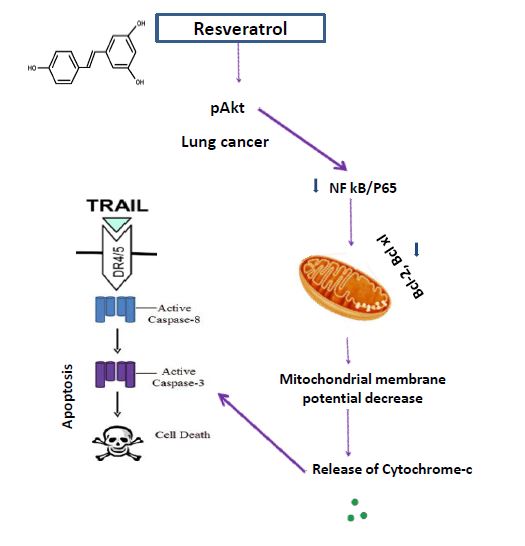
Tumor necrosis factor-related apoptosis-inducing ligand (TRAIL) is a promising anticancer agent that has the potential to sensitize a wide variety of cancer or transformed cells by inducing apoptosis. However, resistance to TRAIL is a growing concern, but it can be mitigated by employing different combination therapies. Resveratrol is a polyphenolic compound annex the outpouring of p53 and its pro-apoptotic modulator PUMA. Here, we showed the p53-independent activation of apoptosis by decrease the expression of phosphorylated Akt-mediated suppression of NF-κB activation that is also substantiated with the downregulation of anti-apoptotic factors Bcl-2 and Bcl-xl in Non-Small Cell lung adenocarcinoma cells (NSCLC), resulting in an attenuation of TRAIL resistance in combined treatment. Furthermore, apoptosis was induced in TRAIL-resistant lung cancer cells via a co-treatment of resveratrol and TRAIL, which was assessed by the loss of mitochondrial membrane potential, resulting in the translocation of cytochrome c from the mitochondria into the cytosol due to mitochondrial dysfunction. Moreover, autophagy flux was not affected by resveratrol-induced TRAIL-mediated apoptosis of lung cancer cells. Overall, targeting the NF-κB (p65) pathway via resveratrol attenuates TRAIL resistance and induces TRAIL-mediated apoptosis which could be the eminent therapeutic strategy to treat lung cancer.
Keywords:
Resveratrol
; autophagy
; TRAIL
; apoptosis
; lung cancer cells
; NF-κB
; Cytochrome c
Copyright: This open access article is published under a Creative Commons CC BY 4.0 license, which permit the free download, distribution, and reuse, provided that the author and preprint are cited in any reuse.


