

Submitted:
22 December 2025
Posted:
23 December 2025
You are already at the latest version
Abstract
The discourse about technology transfer policy in the United States of America assumes the underlying political legitimacy of the federal government’s intervention. Little scholarship has directly challenged this presumption or extensively examined the philosophical basis for it. This paper re-envisions the concept of political legitimacy in the context of technology transfer policy. The analysis illuminates several problems and challenges regarding the traditional economics-based approach to political legitimacy. It subsequently applies the theory of social constructionism and the concept of morality tales to propose an alternative approach to the concept of political legitimacy. The paper argues that there is potentially a broader basis for asserting claims of political legitimacy for U.S. government interventions in technology transfer, there is likely a more expansive range of technology transfer problems with which the government can justifiably concern itself, as well as a more extensive range of possible solutions that policymakers can rightly consider for addressing those problems.
Keywords:
political legitimacy
; policy process
; research policy
; science policy
; technology policy
; technology transfer
; technology commercialization
Introduction
The federal government of the United States of America (U.S.) has implemented a significant amount of public policy regarding the creation and transfer of technologies developed at universities and federal laboratories to the private sector for use that benefits the public interest (i.e., technology transfer). Although the term technology is used regularly in both scholarly and public discourse, its meaning is not precise. For the purposes of this examination, technology is defined as “culturally influenced information that social actors use to pursue the objectives of their motivations, and which is embodied in such a manner as to enable, hinder, or otherwise control its access and use” (Townes, 2022, p. 7). Technology transfer is thus defined as the conveyance of technology (as specified above) from the possession of one social actor (i.e., universities and federal laboratories) to the possession of another social actor (i.e., private sector organizations) for the purpose of applying the technology in a setting in which it has not previously been applied (Townes).
Research and development activity is the primary source of technological development. Currently, the U.S. government outlays more than $150 billion each year for research and development with nearly $40 billion of that being directed to universities and colleges (National Center for Science and Engineering Statistics, 2022). To date, the U.S. government has enacted at least 16 major pieces of legislation regarding technology transfer (see Table 1). Additional major legislation has also been proposed or is contemplated (see e.g., "Endless Frontier Act," 2021; "Energizing Technology Transfer Act," 2021; "United States Innovation and Competition Act," 2021). These facts clearly illustrate that the federal government has taken and will likely continue to pursue significant action regarding technology transfer. The government can only continue with such intervention so long as the public deems it to be legitimate and within the bounds of the power and authority they have conferred to the federal government and their elected officials.
The underlying assumption of the current discourse about technology transfer policy in the U.S. is that government intervention is politically legitimate. As a construct, political legitimacy is the idea that a political authority has the right to take certain actions and expect the people under its governance to accept such actions without the need to employ coercion (see e.g., Coicaud, 2002; Peter, 2023; Stillman, 1974). The governed must (or should) accept the action of the governing authority and the appropriateness of such actions even if they do not agree with it. This conceptualization essentially treats political legitimacy as a quality of the governing authority or its actions.
Scholars and policy makers have used economic theory to support the notion that government action regarding the transfer of technologies from universities and federal laboratories to the private sector is politically legitimate (see e.g., Bozeman, 2000; Link & Scott, 2019; Sampat, 2006). Within this framework, the creation and transfer of technologies are conceptualized as impure public goods. The justification for government action is rooted in the economic concepts of market failures and merit goods. But relying exclusively on an economics-based rationale as the basis for asserting claims of legitimacy for government intervention is tenuous for several reasons.
To begin, political legitimacy is an emergent societal phenomenon. Although economics-based theories are powerful tools for thinking about the efficient use of scarce resources, they model society as a market void of social interaction (Stone, 2012). They do not take into consideration that people “live in a dense web of relationships, dependencies, and loyalties; where they care deeply about at least some other people besides themselves; where they influence each other’s desires and goals; and where they envision and fight for a public interest as well as their individual interests” (Stone, pp. 10-11). These sociological factors must be considered when examining the political legitimacy of government actions regarding technology transfer or any other policy action.
Second, although public policy is dominated by economics (Stone, 2012), there is nothing sacrosanct about the economics perspective. It is only a tool and the decision to use it as the yardstick for making judgements about the legitimacy of government action is simply a normative choice. There are other perspectives that one can use to establish valid standards for making judgements about policies and their political legitimacy.
Finally, only a small portion of the public and elected officials have received the education and training necessary to thoroughly understand the economics-based normative arguments (National Center for Education Statistics, 2017; U.S.A. Facts, 2024). This makes both the public and policymakers heavily reliant on experts in these matters. But rarely do experts have unanimity of opinion on any matter. Moreover, the public’s deference to and reliance on the opinion of experts is not a given.
This is a shaky foundation because political legitimacy, as a substantive objective, is conferred only by the public in a democracy. The public’s confidence in and deference to elected officials, experts, and government institutions can wax and wane, and as of late has been declining (see e.g., Devine, 2024; Hoe et al., 2021; Mihelj et al., 2022; Rainie et al., 2019; Thomas & Buckmaster, 2013). Declining public trust in expert opinion, elected officials, and institutions can undermine the public’s perception of the political legitimacy of government action.
Even if government action in a domain is constitutionally valid and within the bounds of legality, that does not mean that constituents necessarily perceive it as a legitimate use of government power and resources. Technology transfer policy is not immune to such a dynamic. Despite the general belief that the political legitimacy of government intervention in technology transfer is firmly established, there are still plenty of people, both laymen and scholars alike, who have implicitly questioned, and continue to question, the legitimacy of such intervention by the government (see e.g., McManis & Noh, 2011; Sarpatwari et al., 2022). Moreover, there is no guarantee that what the public deems legitimate today will be considered legitimate in the future.
Little scholarship has directly challenged the presumption that government action regarding technology transfer is legitimate or extensively examined the philosophical basis for this presumption. Moreover, other possible dimensions of political legitimacy have not been significantly explored in the context of technology transfer policy.
In a perfect world, politically legitimate actions, legally valid actions, and pursued policies would align but this is not always the case (see Figure 1). These are moving targets with fuzzy boundaries. Often, they are not perfectly aligned, and the perceived degree of misalignment can vary from individual to individual. Moreover, how one perceives the degree of alignment among the three depends to some extent on the lens through which constituents view political legitimacy. If the actions pursued fall too far outside of the boundary for what is considered politically legitimate, there can be serious negative consequences even if those actions are within the bounds of what is deemed legally valid. Additionally, establishing political legitimacy is not a one-time event. Legitimacy must be regularly reaffirmed because the public is often fickle, its memory tends to be short, and the environment in which the government implements public policy is continually changing.
Considering the political legitimacy of government intervention in technology transfer is important for several reasons. It serves to define the boundary for the kinds of problems with which the government should concern itself and provides guidance about the actions that policymakers can justifiably consider for resolving those problems. Moreover, providing a sound conceptual anchoring for the legitimacy of technology transfer policy can help prevent scholarly research from fragmenting into a cacophony of unhelpful noise masking the signals of useful insights.
This conceptual paper examines an important question that undergirds the foundation of claims of political legitimacy for federal technology transfer policy in the United States. On what basis, beyond just neoclassical economics theory, can one assert claims of the political legitimacy of federal intervention in technology transfer? The paper examines how a broader, and perhaps stronger, basis for political legitimacy can be asserted to support the notion that government actions regarding technology transfer are proper and thus government authority in such matters should be respected and obeyed. To address these issues, the paper examines, assimilates, and combines concepts and theories from economics, organization studies, and political philosophy. It contributes to the literature about technology transfer policy by identifying concepts and constructs from these fields and defining their relationship to the phenomenon of government intervention in technology transfer.
Review of the Related Literature
A review of the literature revealed little discourse examining the philosophical basis of the political legitimacy of technology transfer policy at the macro level. Studies generally concentrate on legitimacy as a necessary condition for a administration to justifiably expend public money on particular kinds of technology development projects and ways to assess political legitimacy (see e.g., Bergek et al., 2008; Blankesteijn & Bossink, 2020; Pace et al., 2017). Macro-level and meso-level perspectives in the literature on the political legitimacy of technology transfer policy, particularly as it relates to federal efforts to encourage and facilitate the transfer of technologies from federal laboratories and universities to the private sector, appear to be sparse, cursory, or prescriptive in nature.
Wijnberg (1994) is one of the few works found in the literature that undertakes a more philosophical macro-level exploration of the political legitimacy of technology policy. This was undertaken to warrant legitimacy claims for public support of the arts. The analysis is firmly rooted in neoclassical economics theory that conceptualizes technology as an impure public good and applies the concepts of market failures and merit goods. However, the examination focused on the creation of technology through publicly funded research and development. It did not extend to the transfer of such technologies for use in the private sector.
Innovation scholars have broached the subject of the political legitimacy of government intervention in the transfer of knowledge and technology at the macro- and meso-level (see e.g., Bozeman, 2000; Correa & Zuniga, 2013; Kochenkova et al., 2016; Townes, 2022). Again, neoclassical economics theory is the predominant lens through which the political legitimacy of government intervention in technology transfer is considered.
One might argue that it is necessary to anchor an analysis of the political legitimacy of technology transfer policy within a theory of how technology transfer works. Such an argument is rooted in the assumption that political legitimacy is largely the result of what scientists, policymakers, and society believe is fundamentally true about technology transfer as a phenomenon. This is not the case per se.
Scientists and policymakers do not decide what is politically legitimate by fiat, although they do participate in the discourse that establishes what is and is not politically legitimate. In the end, it is the aggregate consensus of constituents (i.e., the public) that decides whether a governing regime or government action is politically legitimate or not. It is fair to say that the public’s beliefs about the fundamental nature of transferring technology from one social actor to another will affect its judgement of what is and is not politically legitimate. However, a review of the literature did not unearth any sources that have examined the public’s perceptions of how technology transfer works. But it seems reasonable to conclude that those beliefs are likely to be only rudimentary and unlikely to strictly reflect the academic literature on the subject. Research suggests that fewer than half of people rely on experts to form their judgments about policy actions (Rainie et al., 2019). The public certainly is under no obligation to have beliefs that align with the theories of academics and scholars. Therefore, an exploration of the academic literature on theories about the transfer of technology to the private sector is superfluous for the purposes of this discussion.
The Construct of Political Legitimacy
The concept of political legitimacy has been debated for millennia. But because of disciplinary specialization, the term has come to mean different things to philosophers, social scientists, and lawyers (Greene, 2019). Trover (2011) defined legitimacy as “a state of appropriateness ascribed to an actor, object, system, structure, process, or action resulting from its integrations with institutional norms, values, and beliefs” (p. 350). This definition suggests that in some respects, political legitimacy is a reflection of values and preferences. Suchman (1995) defined legitimacy in an organization studies context as “a generalized perception or assumption that the actions of an entity are desirable, proper, or appropriate within some socially constructed system of norms, values, beliefs, and definitions” (p. 574). This definition is broad-based and is quite applicable to government institutions and their actions. More recently, Greene proposed conceptualizing political legitimacy as a system-level property produced when those who are subject to a political regime voluntarily and willingly agree to being ruled by it. In essence, Greene argues that political legitimacy is a social-political good produced when the members of a society willingly provide affirmative consent to being ruled by a regime but offers the caveat that not voluntary willingness to being ruled contribute to political legitimacy.
Scholars seem to agree that there are different kinds of political legitimacy, and each relies on different mechanisms to establish authority. The legitimacy typology that Weber (1922/2020) outlined is probably among the most well-known frameworks. It describes three types of political legitimacy termed legal-rational, traditional, and charismatic. More recently, Lenowitz (2019) argued that there are at least three types of political legitimacy namely moral legitimacy, legal legitimacy, and sociological legitimacy. Other scholars have proposed alternative frameworks and conceptions of legitimacy (see e.g., Beetham, 2012; Habermas, 2015; Lipset, 1969; Stillman, 1974). The predominance of one form of political legitimacy over all others at any given time seems to be implicit in these frameworks.
The common idea among all these conceptions of political legitimacy is that if people (as a collectivity) consider a government action to be legitimate, then they will accept its actions and abide by its requirements even if they are not what the people would have preferred or considered the best course of action in the given circumstances. Legitimacy denotes the reaction of a collectivity to the pattern of behavior of an organization as observed by the collectivity (Suchman, 1995). When political legitimacy exists, a group of interested people accepts, as a whole, what they perceive to be the behavioral pattern of the organization, as a whole, despite the reservations that any single person may have about a single behavior or isolated action of the organization or their knowledge of concerns that other persons might have about such behavior or action (Suchman). This is true not only for organizations, but for government institutions and policy actions as well.
Although most scholarship on political legitimacy is at the macro-level, political legitimacy also applies at the meso-level. For any government policy to be effective and long enduring, a significant majority of the population must deem it legitimate. Otherwise, efforts to undermine or overturn the political order by those who do not consider the policy to be legitimate will gain traction, cause political strife, and destabilize the social order. However, it should be noted that considering a policy ineffective, undesirable, or even harmful is not the same as considering it illegitimate.
Supporting Claims of Political Legitimacy
Many scholars and policymakers have long used neoclassical economics theory, either implicitly or explicitly, to assert claims of political legitimacy for government actions. Economics theory argues that market failures (i.e., when markets are less than Pareto efficient) establish the political legitimacy of such intervention (Stiglitz, 2000; Wijnberg, 1994). According to neoclassical economic theory, six characteristics tend to produce markets that are not Pareto efficient – public goods, negative externalities, failure of competition, incomplete markets, information failures, and macroeconomic disequilibria (Stiglitz).
There are also conditions outside of market failures that neoclassical economics theory considers to be reasonable grounds for government intervention. One is an undesirable distribution of income, and the other is the case of merit goods (Stiglitz, 2000). The criterion of Pareto efficiency does not consider the distribution of income throughout a society (Stiglitz). It is quite possible for markets and economies that are Pareto efficient to leave many people without the resources to achieve a minimally acceptable standard of living according to the values and mores of society. Such circumstances are counter to the generally accepted norms of the population. Moreover, they can lead to social strife. In the case of merit goods, the government forces consumption because, in the absence of such action, individuals will fail to consume goods and services that benefit them (Stiglitz). This kind of government intervention can be warranted. There is no guarantee that people’s perceptions of their own welfare will be accurate and reliable for making judgments about actions that affect their welfare, even when people are fully informed (Stiglitz). Under such circumstances, people’s failure to consume goods and services beneficial to their welfare could also impose negative externalities on society.
Some scholars have argued that dynamic theory (sometimes called Schumpeterian theory or evolutionary theory) is another framework that one can employ to establish the legitimacy claims of government actions. Schumpeterian theory also takes the position that government intervention is politically legitimate only under certain specific circumstances, such as cases of market failures. However, advocates of dynamic theory define an improperly functioning market not as the neoclassical economics concept of a venue in which buyers and sellers exchange goods and services where such exchanges have not achieved and maintained a Pareto efficient equilibrium, but instead as a setting that has not maximized the amount of innovative evolution of goods and services (Wijnberg, 1994). They argue that only a market that is in a state of continuous disequilibrium can achieve such maximization and thus a market that is not continuously in disequilibrium is a market failure. They further contend that the stipulations for what constitutes a perfect market as defined in neoclassical economics theory are impractical and unachievable (Wijnberg). Therefore, employing the neoclassical economics conception of a properly functioning market as the benchmark by which one judges the political legitimacy of government intervention is fundamentally flawed.
Although dynamic theory conceptualizes a properly functioning market differently than neoclassical economics theory, it is still bound to the same ontological anchor found in neoclassical economics theory which reifies political legitimacy by treating it as an absolute, objective characteristic of government action that can be specified by whether and to what degree such action eliminates market failures or facilitates merit good consumption. Neither dynamic theory nor neoclassical economics theory accommodate the fact that the political legitimacy of government intervention is a socially produced judgment. This is because both dynamic theory and neoclassical economics theory model society in a way that ignores the sociological aspects that significantly influence the behaviors and judgements of people.
Both neoclassical economics theory and dynamic theory are economics perspectives. Using them as the basis on which to make normative decisions about the political legitimacy of policy is useful but not without shortcomings. It is important to recognize that arguments supporting their use for making judgments about the political legitimacy of technology transfer policy or any other government intervention are themselves normative in nature. They approach the issue by arguing for “what ought to be.” The analysis presented in this paper seeks to conduct a more descriptive and positivistic examination of political legitimacy in the context of technology transfer. To achieve that end, considering the topic from a sociological perspective is useful.
Sociological Perspectives on Legitimacy
One might be immediately drawn to Kant’s (1785/2018) notion of the categorical imperative when considering the topic of political legitimacy from the sociological perspective. A categorical imperative is an absolute and unqualified requirement that is to be followed in all scenarios and constitutes an end in itself. According to Kant’s first formulation of the categorical imperative, people should only take actions that they would consent to (and in fact want) the underlying principle to become a universal law. Applying this Kantian notion, only government actions that satisfy the categorical imperative criteria are legitimate. However, this too is a normative argument and thus not particularly helpful for the goal of this examination.
In the fields of organization studies and management studies, scholars have developed legitimacy theory to explain what constrains and enables organizational actors within a given society. Suchman (1995) described a typology of three primary kinds of organizational legitimacy (see Figure 2). This typology can be applied in the context of government institutions and public policy.
The typology of legitimacy that Suchman (1995) described is not strictly hierarchical. No one form of legitimacy is necessarily superior to another. However, Suchman postulated that legitimacy is generally expected to be more difficult to establish and influence, harder to notice, more visceral, and more self-reaffirming as one moves from pragmatic to moral to cognitive. This suggests that assertions of political legitimacy for government action in a given policy domain, such as technology transfer, will be more stable and long-lasting if its cognitive form can be established among the public. Moreover, it appears that various kinds of legitimacy can co-exist under this framework.
The discussion that follows in the next section attempts to revise and expound upon extant knowledge by modifying the perspective used to judge claims of political legitimacy in the context of technology transfer policy. The examination begins by problematizing the current relevant theories and concepts. While doing so, it expands upon the need for a reconfiguration or shift of perspective to better align the relevant theories and concepts to the issue at hand. It then attempts to integrate disparate concepts into a more conceptually robust framework to understand and evaluate the claims of political legitimacy for government intervention in technology transfer.
Concerns and Issues
In the United States, it is a deeply ingrained principle that only the people as a whole can bestow legitimacy on power and authority. In Federalist Paper No. 49, James Madison argued that the people are the only legitimate source of power; it is the will of the people that bestows the government with the power to intervene in the activities of society (Madison, 1788/1988). One can argue that the only legitimate use of government power is action intended to realize the will of the people. However, discerning the will of the people as a collectivity is not so straightforward, as Arrow’s (1950) impossibility theorem demonstrates. This is especially true in areas that are not highly visible or top-of-mind topics for citizens, such as technology transfer.
The Traditional Approach
Public sector economics has traditionally been used to warrant claims of political legitimacy for the government’s intervention in technology transfer. The justification for this intervention is rooted in the conception of technology and technology transfer as impure public goods and merit goods. In many respects, technology can be viewed as an impure public good whose consumption is non-rivalrous but excludable. The information and knowledge aspects of technology have public good characteristics (Lall, 2001). Technology, as defined for the purposes of this examination, is non-rivalrous given that use by one party does not diminish the stock for others. Once a technology is developed, its use by one person generally does not impede its use by another. However, technology can be made excludable by the nature of its embodiment or by conferring property rights in the form of intellectual property rights (i.e., patent rights, copyrights, and protections for trade secrets) that one can enforce using the coercive powers of the state.
Generally, technology transfer can also be thought of as an impure public good as well as a merit good. The marginal cost of an additional actor using a given technology is often negligible. Thus, technology transfer can be considered non-rivalrous. However, technology transfer can be made excludable through legal mechanisms such as options and licenses for intellectual property. This combination of non-rivalry and excludability are the characteristics of an impure public good.
A merit good satisfies a public want and could be provided by the market because it can be made excludable but is under-consumed simply because of consumer choice, not necessarily because of market failure (Desmarais-Tremblay, 2017; Musgrave, 1959). Moreover, its consumption produces positive externalities that far outweigh any negative externalities that such consumption might generate (Desmarais-Tremblay; Musgrave). As such, the government intervenes for the purpose of forcing public consumption rather than to mitigate a market failure (Desmarais-Tremblay; Musgrave). Technology transfer seems to satisfy the definition of merit goods. It produces societal, ecological, and economic benefits (Libecap, 2009; Link & Scott, 2019). These benefits appear to far outweigh any negative consequences. Thus, the nation’s elected leaders have decided that more technology transfer should occur than what is ordinarily produced as is evident by the implementation of public policy to encourage and facilitate it.
Shortcomings of the Traditional Approach
There are several concerns and challenges to the traditional approach for considering the political legitimacy of technology transfer policy. They potentially impede theory development and hamper the practical application of the concept of political legitimacy to regulate the actions of policymakers regarding technology transfer and other societal issues.
To begin, the traditional approaches to political legitimacy reify the construct. They treat political legitimacy as something concrete, which it is not. Political legitimacy is not a fundamental phenomenon akin to the fundamental physical interactions of the universe, such as gravitational force or electromagnetic force, that hold true irrespective of human activity. The human tendency for self-preservation is probably the closest thing to a fundamental social principle. People will tend to act and leverage whatever agency and power is available to them in pursuit of self-preservation, self-interest, or the attainment of a larger self-interest. To quote Thucydides – “The powerful exact what they can, and the weak have to comply.” 1 Thus, political legitimacy is not a natural element of material reality. There are only what actions constituents will and will not allow government officials to do, the reasons constituents will and will not allow government officials to do them, and the consequences of defying the will of the people.
Another concern is that the goal of satisfying economics criteria as the primary or sole requirement for government action to be politically legitimate is itself a normative criterion, to which the public has no obligation to abide. There is no reason that people could not or should not use other criteria to make judgments about the political legitimacy of government intervention in technology transfer or any other area of society. A descriptive and positivistic examination makes it clear that “the public makes decisions based on an array of inputs, including but not limited to scientific facts” (Leshner, 2021). Additionally, only a small portion of the population is likely to even have a sufficient understanding of the relevant economics theory. Moreover, there is no requirement that people apply economics theory as the basis for judgments about the legitimacy of government actions regarding technology transfer even when it is explained to them.
It seems that one of the aspects of the economics perspective that its advocates appreciate is the notion of rationality. However, there are in fact several types of rationality that one can apply to establish decision criteria for making judgments about government actions (Dunn, 2016). Economic efficiency is often used as the criterion for selecting policy prescriptions. However, basing such decisions on whether an alternative achieves a valued outcome irrespective of how efficiently it uses resources (i.e., effectiveness) or the extent to which a given level of a valued outcome satisfies a specific standard irrespective of economic efficiency (i.e., adequacy) are also socially justifiable criteria.
Another problem with the traditional approach to political legitimacy is the notion that individuals make assessments about political legitimacy irrespective of the concerns of others. Suchman (1995) also accepts this proposition when applying the construct of legitimacy to organization studies. However, this does not correspond with what has been empirically demonstrated about human behavior. Judgments about political legitimacy are essentially choice decisions. There is a socio-political dimension to decision-making, and social processes such as sensemaking and sense-giving are important factors (see e.g., Balogun et al., 2008; Hodgkinson & Starbuck, 2008). Sociological phenomena can even affect the judgments and decisions of individuals (see e.g., Asch, 1951, 1956).
Most philosophical approaches treat political legitimacy as a regulative ideal, and often an unattainable one (Greene, 2019). It is an abstract normative principle to which people should aspire but sometimes fall short. These treatments of political legitimacy seem to imply an all-or-nothing dichotomy in which an institution and its actions are either legitimate and accepted or illegitimate and rejected in their entirety. This conceptualization is not very useful from a practical perspective. Moreover, it constrains research on the topic and reduces the usefulness of the construct as a guide for elected officials and policymakers.
This conceptualization of the construct of political legitimacy as a binary presence-absence dichotomy is problematic. While conceptualizing social concepts as such dichotomies is a useful way to understand them, social phenomena often manifest in terms of degree (Schneider & Wagemann, 2012). Thus, one technology transfer policy can tend towards legitimacy and another technology transfer policy can tend toward illegitimacy with neither of them being completely legitimate nor completely illegitimate. Moreover, the consequences of the government pursuing actions regarding technology transfer that are more on the illegitimate end of the spectrum may not be as severe as pursuing analogously illegitimate actions in other areas. These are important nuances that seem to have been lost in the general discourse about political legitimacy and technology transfer policy.
There is research that attempts to create knowledge about political legitimacy that is more practically oriented and instrumental. Scholars have undertaken empirically based research that aims to shed light on when and why citizens follow the directives of their political representatives. Much of this research argues that legitimacy is casual for compliance (Tyler, 2019). Some have raised significant challenges to that conclusion (Lenowitz, 2019). But at the very least, this research empirically demonstrates that “individuals are more likely to comply, cooperate, and positively engage with the law when they feel obligated to obey it, when they trust their legal authorities, and when they believe they share moral values with the law and its enforcers, and this effect is greater than when individuals are simply worried about getting punished for law-breaking” (Lenowitz, p. 320).
An Alternative Conceptualization
The examination of the basis of claims for the political legitimacy of government intervention in technology transfer is aided by the lenses of social constructionism and the concept of morality tales. Social constructionism provides a framework for understanding legitimacy as a social phenomenon, which is not a concrete phenomenon like universal physical constants that exist outside of human social interaction. The concept of morality tales facilitates the consideration of how ideology and worldview influence political considerations such as the legitimacy of government actions. These frameworks address the sociological aspects of how political legitimacy is judged, which are lacking in the economics-based perspectives.
Fundamental to social constructionism is the idea that people develop meaning about social phenomena primarily through interactive communication with others and not individually (Littlejohn & Foss, 2009). Political legitimacy is a human construct and not a phenomenon of nature. When studying political legitimacy, one must be cautious about reifying it. Judgments about legitimacy are based on the meaning that people attribute to the actions of institutions. Moreover, social phenomena do not have meaning independent of the historically informed mental and linguistic representations that people ascribe to them (Berger & Luckmann, 1966/1991).
The question of how constituents come to judge government intervention as legitimate or illegitimate is essentially a question of how people apply everyday knowledge to attribute meaning to institutions and their actions. One cannot exist as a fully formed human being without regular interaction and communication with other people through various mechanisms that can be physically or temporally close together or removed (Berger & Luckmann, 1966/1991). Much of this communication employs narratives, which people use to cognitively organize new information, and serves an important function in formulating rationales for individual beliefs and actions (Jones et al., 2014). There is an ongoing correlation between the one’s own comprehension of the world and that of others (Berger & Luckmann). One’s own thinking is invariably influenced by this interaction.
Empirical research demonstrates that people use two distinct modes of thinking when forming judgments and making decisions (Kahneman, 2011). One mode is intuitive and emotionally driven while the other is analytical and intentional. Human decision-making is largely driven by the first thinking mode and the latter mode is often only triggered when the first fails to readily produce a solution (Kahneman). However, the analytical thinking mode defaults to a positive test strategy and tends to be uncritical (Kahneman) and thus does not offer complete inoculation against the vulnerabilities of the intuitive thinking mode. Additionally, people evaluate their options relative to a reference point rather than on an absolute basis when making decisions and formulating judgments (see e.g., Kahneman & Tversky, 1979, 2013; Tversky & Kahneman, 1992). When making judgments about the political legitimacy of government actions, such as technology transfer policy, people are likely to employ morality tales as a component of their referent.
The morality tale is how people understand themselves, their society, and what they desire for themselves and their community. It helps people interpret and explain social reality and informs what people come to expect of their fellow citizens and government (Reich, 1987). Reich’s typology of morality tales comprises four basic types, each with a liberal and a conservative variant (see Figure 3). However, regardless of the specific variation that captures each person’s ideology, the basic theme of all the American morality tales according to Reich is that America is:
“a nation of humble, immigrant origins, built out of nothing and into greatness through hard work; generous to those in need, those who cannot make it on their own; a loner among nations, suspicious of foreign entanglements, but willing to stand up against tyranny; and forever vigilant against corruption and special privilege.” (pp. 4-5).
The primary difference between the liberal and conservative variants of this theme centers around who is assigned to the roles of villain and hero.
An alternative proposition is that political legitimacy is not so much attained, but that illegitimacy is avoided. In this sense, one can conceptualize political legitimacy as a perceived characteristic of a government institution or its actions. Thus, political legitimacy is the perception of an individual or group of individuals that an institution or its actions are not egregiously inappropriate according to the norms of society and thus do not warrant “rebellious action” against the institution. The corollary is that illegitimacy (i.e., not legitimate) is the perception of an individual or group of individuals that a government institution or its actions are egregiously inappropriate according to the norms of society so much so that they are willing to take “rebellious action” against the institution and disrupt the social order.
It is proposed that people, in effect, tend to tacitly assume the political legitimacy of government policy. By analogy, they act like scientists testing the null hypothesis that a governing regime or its actions are legitimate. They only discard it in favor of the alternative hypothesis that the governing regime or its actions are not legitimate if significant evidence causes them to do so. As such, the question becomes what constitutes such evidence?
Given what is understood about decision-making and human sociological processes, one can posit that people do not assess the political legitimacy of the individual actions of a government in isolation. That is, constituents do not assess the political legitimacy of a government policy in a stand-alone fashion. However, constituents may deem any given policy at any given time to be illegitimate in the context of the totality of government actions. A single policy could become the proverbial “straw that broke the camel’s back” and cause a significant majority of constituents to assess the policy, the regime, or even the institution itself, to be illegitimate.
By way of analogy, think of illegitimacy in terms of a large container suspended over the heads of policymakers by twine – something akin to the sword of Damocles.2 In the absence of actions that constituents consider inappropriate, all is well. The container remains suspended, and the policymakers are unaffected. But for every action that constituents do find inappropriate, weight is added to the container and the amount of weight added depends on the degree of the infraction. Weight is removed from the container based on the amount of time that elapses between infractions. But if too much weight accumulates in the bucket the twine will break, and the weight-filled container will fall on the policymakers causing significant harm.
This analysis postulates that people make judgments about the political legitimacy of governing regimes, government institutions, and their actions through a sociological process in which social constructionism and morality tales act as key mechanisms (Figure 4). People filter their observations and the information they receive through one or more morality tales that serve as a referent to help people make sense of the institution and its actions. The morality tales with which a person identifies are distillations of what they perceive as true about the world (i.e., worldview) and what they believe is morally correct (i.e., ideology). How well a policy aligns with a person’s worldview and ideology will influence whether they perceive it to be legitimate or not.
In addition to the influence of one’s own cognitive processes on judgments about political legitimacy, social constructionism suggests that people influence one another’s judgments about legitimacy. Agents of the other two actor groups in the triple helix model of innovation (i.e., industry firms and universities) participate in this interaction as advocates of either the legitimacy or illegitimacy of policy or serve as sources of other data and information that constituents perceive as relevant. In the course of everyday life, people comprehend reality through a variety of typifications that are more abstract as they become more physically and temporally removed from the individual (Berger & Luckmann, 1966/1991). Social order is an ongoing human production (Berger & Luckmann), thus judgments about political legitimacy are ongoing human productions as well.
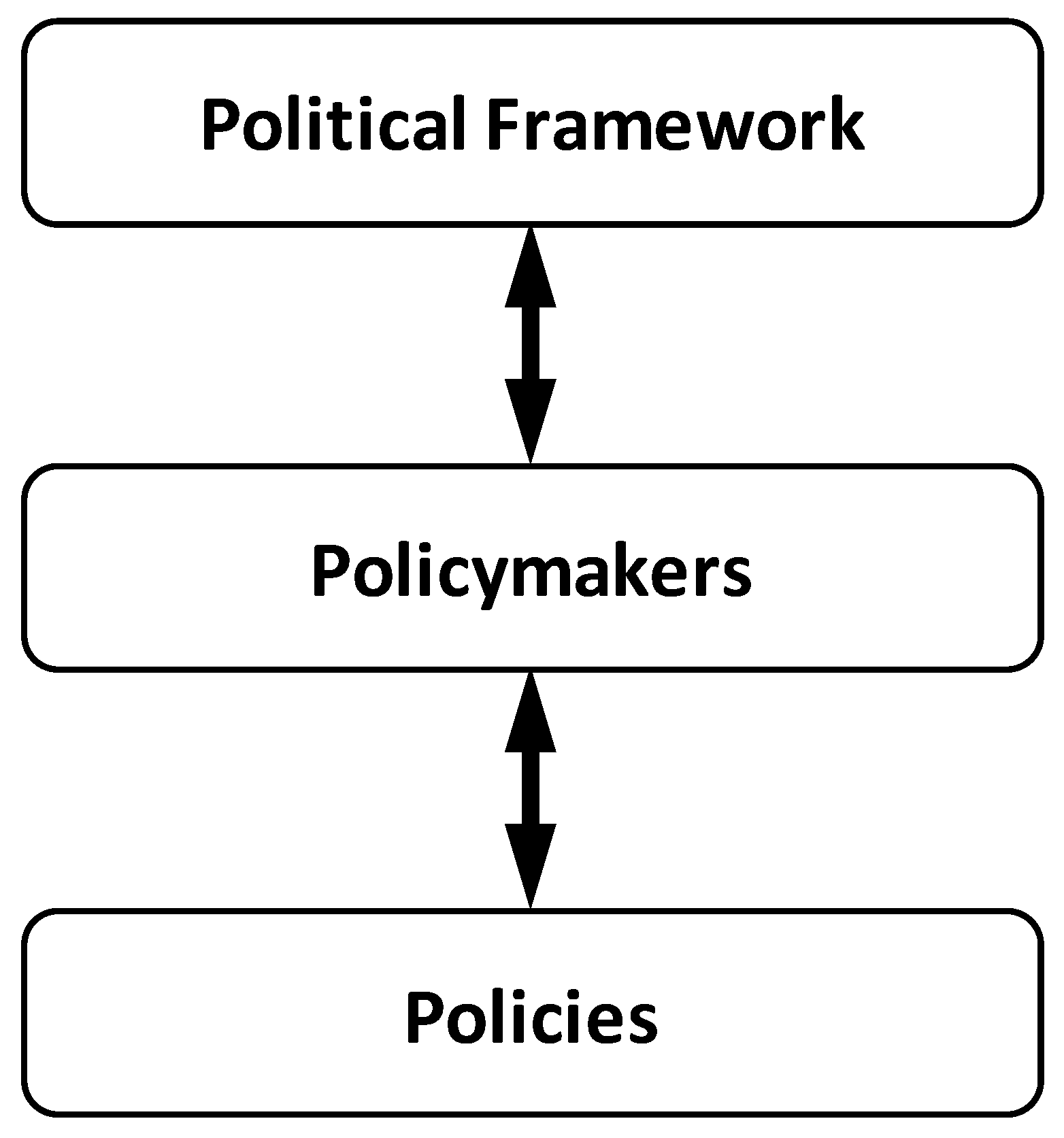
With this alternative conceptualization of political legitimacy, it becomes necessary to reconsider the possible actions and outcomes that may cause people to deem a government institution or policy to be illegitimate. The American political framework affords people recourse short of armed revolt in the face of illegitimate government action. One can think of the political order as consisting of three tiers (see Figure 5). Action can be taken in response to illegitimate government behavior at any of these tiers. However, determining whether citizen actions that are taken against a policy, policymaker, or political framework are indications that people consider them to be illegitimate requires one to consider the reasons for the actions.
At the lowest level, people may rebel against the policy that they believe is not legitimate. If a person considers a policy legitimate, they will accept it as the way things are even if they disagree with the policy. That is, the person will not act rebelliously against the policy even if they disagree with it. However, if a person does judge a policy to be illegitimate, there is a spectrum of rebellious actions they could take from subversive action against the policy to actively working to end or replace the policy. For example, individuals and coalitions might file lawsuits against the government to overturn what they consider to be illegitimate policies or prevent them from taking effect.
People may also rebel against policymakers that they believe have pursued illegitimate policies. The simplest action they can take is to simply withdraw their support by either not voting or voting for another candidate during elections. More severe actions that a person can take include financially supporting opposition candidates and advocacy groups and campaigning against an incumbent.
Finally, people can rebel against the political framework if they believe the situation to be so dire that it cannot be corrected through action at the lower tiers of the political order alone. The quintessential example is probably the American revolution in which the colonies broke away from England through armed revolt and established a new political order because a significant portion of the colonists judged the actions of England to be illegitimate and unlikely to be satisfactorily corrected through less drastic means. A less extreme example is civilian protests at the local level that put pressure on elected officials to make changes such as the Montgomery bus boycott from 1955 to 1956 during the civil rights movement that inspired legal challenges and led to changes in policy regarding racial segregation on public transportation. A more recent example is the protests in Ferguson, Missouri in 2014, which led to Department of Justice investigations into the city’s policing practices and the subsequent implementation of reforms.
The number and variety of typologies that scholars have proposed for the concept of legitimacy most certainly suggests that one should approach political legitimacy as a multidimensional construct. Suchman’s (1995) typology of legitimacy is a useful foundation upon which to build. One can apply this typology to integrate the various aspects of the proposed reconceptualization of political legitimacy. Instead of thinking of Suchman’s typology as a classification of the various kinds of legitimacy, one can apply it as a classification of the dimensionalities of the construct of political legitimacy. One can think of legitimacy (or “not illegitimate”) as the outcome and the various subtypes as causal conditions that can be conjunctively combined to produce the perception of legitimate or illegitimate action. Assuming causal complexity applies (as it usually does with most sociological phenomena), then the various conditions or conjunctions of conditions are either necessary or sufficient to avoid illegitimacy. Another way to reinterpret Suchman’s typological approach is to think of political legitimacy as a higher-order construct in which the various subtypes are components or dimensions of that higher-order construct rather than distinct types of legitimacy. Causal complexity is still applicable with this conceptualization.
Discussion
The traditional approach to political legitimacy treats it as an intrinsic quality of government and its actions. In short, it reifies the construct of political legitimacy. The alternative conceptualization proposed above conceives of political legitimacy as the perception that the actions of a governing regime are within the bounds of its authority and thus the people subject to its rule affirmatively choose not to undermine those actions by disrupting the political order even if they do not agree with them. Moreover, it treats the construct of political legitimacy as multidimensional.
This reconceptualization of political legitimacy accommodates the traditional approaches as well as the sociological aspects of the construct. The economics-based normative arguments are expert opinions that advocates of the legitimacy or illegitimacy of a policy consider and use to craft their narratives. Constituents ultimately decide, as a collectivity, the political legitimacy of a regime or policy, and may or may not consider (or defer to) these expert opinions when forming their judgements. It is not the case that neoclassical economics theory and other economics-based analyses of the political legitimacy or illegitimacy of government intervention do not matter. They just matter in a different way.
Applying this reconceptualization, the traditional neoclassical economics argument for the legitimacy of technology transfer policy is primarily based on the presence of transactional, dispositional, and ethical conditions. Specifically, it appeals to exchange, influence, and plausibility dimensions to convince constituents that technology transfer policy is politically legitimate. The conjunction of the presence of these conditions is sufficient to avoid the perception of egregious illegitimate action. This conceptualization avoids the reification of the construct of political legitimacy that is present in the traditional approaches to the topic.
This would suggest that the basis for which policymakers can assert claims that government intervention in technology transfer is politically legitimate can be more broad-based than the focus on economic rationality of traditional neoclassical economics arguments. Economic rationality is not the only basis for making such claims. There are several other sociological and psychological levers that policymakers can pull to assert claims of the political legitimacy, or avoid the perception of illegitimacy, of technology transfer policy.
Value and Merits
The proposed conceptual framework adds value to the field of technology transfer in several ways. Relative to other approaches, it transforms political legitimacy from an unattainable normative theoretical construct into a practical concept that can be applied instrumentally and understood with descriptive and positivistic methods. The discourse on political legitimacy has been heavily rooted in normative conceptions of morality and what “ought” to be. The alternative conceptualization presented in this paper nudges the discussion toward what is and what will be. Reification of the construct of political legitimacy has led scholars to frame issues as questions of “What government actions are legitimate and what government actions are illegitimate?” However, the alternative conceptualization described above suggests that a more useful question is “Why do constituents deem certain government actions to be sufficiently illegitimate to warrant rebellious action?”
Additionally, the proposed conceptual framework described above can potentially affect technology transfer practice and research. It offers a path for policymakers to address broader technology transfer problems and pursue more creative and impactful policy options. It enables broader problem-structuring analyses. Moreover, the implementation of new policies will undoubtedly affect the way technology transfer is practiced, ideally for the better.
Implications
There are several propositions that one can logically deduce from the proposed alternative conceptualization of political legitimacy described in this paper. One is that political legitimacy is likely far more malleable than previously believed. Additionally, its multidimensionality suggests that it is possible to successfully assert the political legitimacy of a policy without the need to satisfy economics-based criteria. This significantly expands the range of potential problems associated with the phenomenon of technology transfer with which the federal government can justifiably concern itself as well as the kinds of remedies that policymakers can rightly consider for solving or mitigating those problems. The only real limit is the degree to which policymakers can influence the long-term perceptions and beliefs of constituents and avoid the perception of illegitimacy.
In the context of technology transfer, there is likely the opportunity to influence the public’s perceptions about political legitimacy to expand options for government action rather than treat the construct as a quality of the policies considered that predetermines which ones can be pursued and which cannot. Policymakers may be able to use narratives to influence the judgments of constituents about the legitimacy of expanded technology transfer policy.
The range of policy options that people are probably willing to accept likely varies based on the policy problem domain. As previously discussed, strong feelings about an issue do not necessarily result in actions. As such, one can postulate that only those policies that exceed a certain salience threshold will spur constituents to act against government intervention that they believe is inappropriate. When it comes to technology transfer, there may be a greater range of policy options available to policymakers than most currently assume. This is primarily because the topic likely has relatively low saliency to the general public. Policies regarding less salient topics are likely to receive less scrutiny. Consequently, constituents are likely to give the government more leeway in the type and degree of actions it can pursue. The perceptions of interest groups are likely to be of more relevance. There appear to be few interest groups that would oppose more government intervention to encourage and facilitate an increased level of technology transfer based on perceptions of the political legitimacy of such actions.
Recommendations for Future Research
Applying the proposed conceptual framework may help address pertinent research problems in the field of technology transfer. For example, the U.S. government has sought ways to increase the incidence of technology transfer since the end of the Second World War. Perceptions of what actions are politically legitimate options are a constraint on the extent of these efforts. The alternative conceptual framework that this paper presents enables policy analysts to empirically evaluate whether those perceptions are accurate or overly restrictive. If they are overly restrictive, it suggests that policymakers have far more latitude to intervene in technology transfer than initially thought.
The proposed conceptual framework may also support future efforts to develop theories regarding both technology transfer and political legitimacy. Greater clarity regarding the boundaries of politically legitimate actions of the government within the domain of technology transfer will expand the kinds of phenomena that scholars can justifiably investigate. This will enable the generation of new insights that will support theory development.
The alternative conceptualization will also support the further empirical investigation of political legitimacy, within the domain of technology transfer and beyond, to answer several pertinent questions. Given that political legitimacy is a social phenomenon, it is likely subject to causal complexity. Configurational comparative methods can be applied to examine which dimensions are necessary or sufficient to produce perceptions of politically illegitimate actions. Other questions that can be further examined include whether and to what degree the salience of an issue influences the judgments of constituents about the political legitimacy of government action, to what degree are certain dimensions of political legitimacy more malleable than others, what kinds of evidence do constituents consider when making judgments about the political legitimacy or illegitimacy of government actions, and what narrative strategies are most effective in influencing judgments about political legitimacy?
Conclusions
This paper re-examines the concept of political legitimacy in the context of U.S. technology transfer policy. It reimagines political legitimacy as less of an unattainable normative principle of limited practical value to policymakers and more of a descriptively understood positivistic sociological phenomenon that policymakers can apply instrumentally to formulate not only technology transfer policy but other kinds of public policy as well. The examination illuminates several problems and challenges regarding the traditional economics-based approach to warranting government intervention in technology transfer. The theory of social constructionism and morality tales are subsequently applied to formulate an alternative conceptualization of political legitimacy. The paper concludes by briefly discussing the implications of the alternative conceptualization of political legitimacy for technology transfer policy and practice as well as potential avenues for future research.
Funding
This research did not receive any specific grant from funding agencies in the public, commercial, or not-for-profit sectors.
Competing interests
The author has no relevant financial or non-financial interests to disclose.
Data availability
Data sharing is not applicable to this article as no datasets were generated or analyzed during the current study.
Ethics Statement
This research did not comprise any studies performed by the author involving human participants or animals as subjects.
Declaration regarding artificial intelligence (AI) and AI-assisted technologies
During the preparation of this work the author did not use AI or AI-assisted tools to write any text and takes full responsibility for the content of this paper.
Acknowledgments
None
References
- Arrow, K.J. A difficulty in the concept of social welfare. Journal of Political Economy 1950, 58(4), 328–346. [Google Scholar] [CrossRef]
- Asch, S.E. Effects of group pressure upon the modification and distortion of judgments. In Groups, leadership and men: Research in human relations; Guetzkow, H., Ed.; Carnegie Press, 1951; pp. 177–190. [Google Scholar]
- Asch, S.E. Studies of independence and conformity: A minority of one against a unanimous majority. Psychological Monographs: General and Applied 1956, 70(9), 1–70. [Google Scholar] [CrossRef]
- Balogun, J.; Pye, A.; Hodgkinson, G.P. Cognitively skilled organizational decision making: Making sense of deciding. In The Oxford handbook of organizational decision making; Hodgkinson, G. P., Starbuck, W. H., Eds.; Oxford University Press, 2008; pp. 234–249. [Google Scholar]
- Beard, M. Confronting the classics: Traditions, adventures, and innovations; Liveright Publishing Corporation, 2013. [Google Scholar]
- Beetham, D. Political legitimacy. In The Wiley-Blackwell Companion to Political Sociology; Amenta, E., Nash, K., Scott, A., Eds.; Blackwell Publishing, 2012; pp. 120–129. [Google Scholar] [CrossRef]
- Bergek, A.; Jacobsson, S.; Sandén, B.A. Legitimation’and ‘development of positive externalities’: Two key processes in the formation phase of technological innovation systems. Technology Analysis & Strategic Management 2008, 20(5), 575–592. [Google Scholar] [CrossRef]
- Berger, P. L., & Luckmann, T. (1966/1991). The social construction of reality: A treatise in the sociology of knowledge. Penguin Books. (Original work published 1966).
- Blankesteijn, M.; Bossink, B. Assessing the legitimacy of technological innovation in the public sphere: Recovering raw materials from waste water. Sustainability 2020, 12(22), 9408. [Google Scholar] [CrossRef]
- Bozeman, B. Technology transfer and public policy: A review of research and theory. Research Policy 2000, 29(4(5), 627–655. [Google Scholar] [CrossRef]
- Coicaud, J.-M. What is political legitimacy? In Legitimacy and Politics: A Contribution to the Study of Political Right and Political Responsibility; Curtis, D. A., Ed.; Cambridge University Press, 2002; pp. 10–42. [Google Scholar] [CrossRef]
- Correa, P.; Zuniga, P. Public policies to foster knowledge transfer from public research organizations. Innovation, Technology and Entrepreneurship Global Practice. 2013. https://www.researchgate.net/publication/270051305_Public_Policies_to_Foster_Knowledge_Transfer_from_Public_Research_Organizations.
- Desmarais-Tremblay, M. A genealogy of the concept of merit wants [Article]. European Journal of the History of Economic Thought 2017, 24(3), 409–440. [Google Scholar] [CrossRef]
- Devine, D. Does Political Trust Matter? A Meta-analysis on the Consequences of Trust. In Political Behavior; 2024. [Google Scholar] [CrossRef]
- Dunn, W.N. Public policy analysis, 5th ed.; Routledge, 2016. [Google Scholar]
- Endless Frontier Act, H.R.2731, 117th Cong. (1st Sess.). 2021. https://www.congress.gov/bill/117th-congress/house-bill/2731.
- Energizing Technology Transfer Act, H.R.4606, 117th Cong. (2nd Sess.). 2021. https://www.congress.gov/bill/117th-congress/house-bill/4606.
- Greene, A.R. Is political legitimacy worth promoting? In Political Legitimacy; Knight, J., Schwartzberg, M., Eds.; New York University Press, 2019; pp. 65–101. [Google Scholar]
- Habermas, J. (2015). Between facts and norms: Contributions to a discourse theory of law and democracy (W. Rehg, Trans.). John Wiley & Sons. (Original work published 1992).
- The Oxford handbook of organizational decision making; Hodgkinson, G.P., Starbuck, W.H., Eds.; Oxford University Press, 2008. [Google Scholar]
- Hoe, N.W.; Adnan, Z.H.; Fee, L.Y. Political trust study: A review. International Journal of Academic Research in Business and Social Sciences 2021, 11(15), 5–27. [Google Scholar] [CrossRef] [PubMed]
- Jones, M.D.; McBeth, M.K.; Shanahan, E.A. Introducing the Narrative Policy Framework. In The science of stories: Applications of the Narrative Policy Framework in public policy analysis; Jones, M. D., McBeth, M.K., Shanahan, E. A., Eds.; Palgrave Macmillan, 2014; pp. 1–25. [Google Scholar]
- Kahneman, D. Thinking, fast and slow, 1st ed.; Farrar, Straus, and Giroux, 2011. [Google Scholar]
- Kahneman, D.; Tversky, A. Prospect theory: An analysis of decision under risk. Econometrica 1979, 47(2), 263. [Google Scholar] [CrossRef]
- Kahneman, D.; Tversky, A. Prospect theory: An analysis of decision under risk. In Handbook of the fundamentals of financial decision making: Part I; MacLean, L. C., Ziemba, W. T., Eds.; World Scientific Publishing, 2013; pp. 99–127. [Google Scholar] [CrossRef]
- Kant, I. (1785/2018). Groundwork for the metaphysics of morals (A. W. Wood, Trans.). Yale University Press. (Original work published 1785).
- Kochenkova, A.; Grimaldi, R.; Munari, F. Public policy measures in support of knowledge transfer activities: A review of academic literature. The Journal of Technology Transfer(3) 2016, 407. [Google Scholar] [CrossRef]
- Lall, S. (Ed.) The economics of technology transfer; Edward Elgar Publishing, Inc, 2001. [Google Scholar]
- Lenowitz, J.A. On the empirical measurement of legitimacy. In Political Legitimacy; Knight, J., Schwartzberg, M., Eds.; New York University Press, 2019; pp. 293–327. [Google Scholar]
- Leshner, A.I. Trust in science is not the problem. Issues in Science and Technology 2021, 37(3), 16–18. https://issues.org/trust-in-science-is-not-the-problem-engagement-leshner/.
- Libecap, G.D. (Ed.) Measuring the social value of innovation: A link in the university technology transfer and entrepreneurship equation; Jai Press, 2009; Vol. 19. [Google Scholar]
- Link, A.N.; Scott, J.T. The economic benefits of technology transfer from U.S. federal laboratories. The Journal of Technology Transfer 2019, (5), 1416. [Google Scholar] [CrossRef]
- Lipset, S.M. Social conflict, legitimacy, and democracy. In Comparative government: A reader; Springer, 1969; pp. 52–59. [Google Scholar] [CrossRef]
- Littlejohn, S.W.; Foss, K.A. Social construction of reality. In Encyclopedia of communication theory; SAGE Publications, 2009; Vol. 1, pp. 892–894. [Google Scholar] [CrossRef]
- Madison, J. (1788/1988). Federalist paper no. 49. In A. Hamilton, J. Jay, & J. Madison (Eds.), The federalist papers [eBook #1404] (pp. 312-316). Project Gutenberg. https://www.gutenberg.org/ebooks/1404 (Original work published 1788) .
- McManis, C.R.; Noh, S. The impact of the Bayh-Dole act on genetic research and development: Evaluating the arguments and empirical evidence. Washington University in St. Louis Legal Studies Research Paper Series. 2011. https://papers.ssrn.com/sol3/papers.cfm?abstract_id=1840639.
- Mihelj, S.; Kondor, K.; Štětka, V. Establishing trust in experts during a crisis: Expert trustworthiness and media use during the COVID-19 pandemic. Science Communication 2022, 44(3), 292–319. [Google Scholar] [CrossRef]
- Musgrave, R.A. The theory of public finance: A study in public economy; McGraw-Hill, 1959. [Google Scholar]
- National Center for Education Statistics. (2017). Degrees in economics, history, political science and government, and sociology conferred by postsecondary institutions, by level of degree: Selected years, 1949-50 through 2015-16 [Data file]. https://nces.ed.gov/programs/digest/d17/tables/dt17_325.92.asp.
- National Center for Science and Engineering Statistics. (2022). Federal funds for research and development, fiscal years 2020-21 [Data file]. Retrieved July 29, 2022 from http://www.nsf.gov/statistics/fedfunds/. 2022.
- Pace, J.; Pearson, S.-A.; Lipworth, W. Legitimacy of medines funding in the era of accelerated access. International Journal of Technology Assessment in Health Care 2017, 33(6), 700–707. [Google Scholar] [CrossRef] [PubMed]
- Peter, F. Political legitimacy. In The Stanford Encyclopedia of Philosophy;Metaphysics Research Lab, Stanford University; Zalta, E. N., Nodelman, U., Eds.; 2023; https://plato.stanford.edu/archives/win2023/entries/legitimacy/.
- Rainie, L.; Keeter, S.; Perrin, A. Trust and distrust in America Pew Research Center. 2019. https://www.pewresearch.org/politics/wp-content/uploads/sites/4/2019/07/PEW-RESEARCH-CENTER_TRUST-DISTRUST-IN-AMERICA-REPORT_2019-07-22-1.pdf.
- Reich, R.B. Tales of a new America; Times Books, 1987. [Google Scholar]
- Sampat, B.N. Patenting and US academic research in the 20th century: The world before and after Bayh-Dole. Research Policy 2006, 35(6), 772–789. [Google Scholar] [CrossRef]
- Sarpatwari, A.; Kesselheim, A.S.; Cook-Deegan, R. The Bayh-Dole Act at 40: Accomplishments, challenges, and possible reforms. Journal of health politics, policy and law 2022, 47(6), 879–895. [Google Scholar] [CrossRef] [PubMed]
- Schneider, C.Q.; Wagemann, C. Set-theoretic methods for the social sciences: A guide to qualitative comparative analysis; Cambridge University Press, 2012. [Google Scholar]
- Stiglitz, J.E. Economics of the public sector, 3rd ed.; W. W. Norton & Company, 2000. [Google Scholar]
- Stillman, P.G. The concept of legitimacy. Polity 1974, 7(1), 32–56. [Google Scholar] [CrossRef]
- Stone, D. (2012). Policy paradox: The art of political decision making (3rd ed.). W. W. Norton & Company. (Original work published 1988).
- Suchman, M.C. Managing legitimacy: Strategic and institutional approaches. Academy of Management Review 1995, 20(3), 571–610. [Google Scholar] [CrossRef]
- Thomas, M., & Buckmaster, L. (2013). Expertise and public policy: A conceptual guide. (2013-14). Parliamentary Library of Australia. https://www.aph.gov.au/About_Parliament/Parliamentary_Departments/Parliamentary_Library/pubs/rp/rp1314/PublicPolicy.
- Townes, M. S. (2022). The influence of technology maturity level on the incidence of university technology transfer and the implications for public policy and practice (Publication Number 29209868) [Doctoral dissertation, Saint Louis University]. ProQuest.
- Trover, L. Legitimacy. In The concise encyclopedia of sociology; Ritzer, G., Ryan, M. J., Eds.; Wiley-Blackwell, 2011; p. pp. 350. [Google Scholar]
- Tversky, A.; Kahneman, D. Advances in prospect theory: Cumulative representation of uncertainty. Journal of Risk and uncertainty 1992, 5, 297–323. [Google Scholar] [CrossRef]
- Tyler, T.R. Evaluating consensual models of governance: Legitimacy-based law. In Political Legitimacy; Knight, J., Schwartzberg, M., Eds.; New York University Press, 2019; pp. 257–292. [Google Scholar]
- U.S.A. Facts. (2024). Population [Data file]. https://usafacts.org/data/topics/people-society/population-and-demographics/population-data/population/.
- United States Innovation and Competition Act of 2021, S.1260, 117th Cong. (1st Sess.). 2021. https://www.congress.gov/bill/117th-congress/senate-bill/1260.
- Weber, M. (1922/2020). The three types of legitimate domination. In R. Swedberg (Ed.), Essays in Economic Sociology (pp. 99-108). Princeton University Press. (Original work published 1922) . [CrossRef]
- Wijnberg, N.M. Art and technology: A comparative study of policy legitimation. Journal of Cultural Economics 1994, 18(1), 3–13. [Google Scholar] [CrossRef]
- Wikipedia contributors. (2022, August 1). Domacles. In Wikipedia, The Free Encyclopedia. Retrieved August 12, 2022 from https://en.wikipedia.org/w/index.php?title=Damocles&oldid=1101709780.
Figure 1.
Politically Legitimate Actions, Legally Valid Actions, and Pursued Actions. Note. Figure created by author
Figure 1.
Politically Legitimate Actions, Legally Valid Actions, and Pursued Actions. Note. Figure created by author
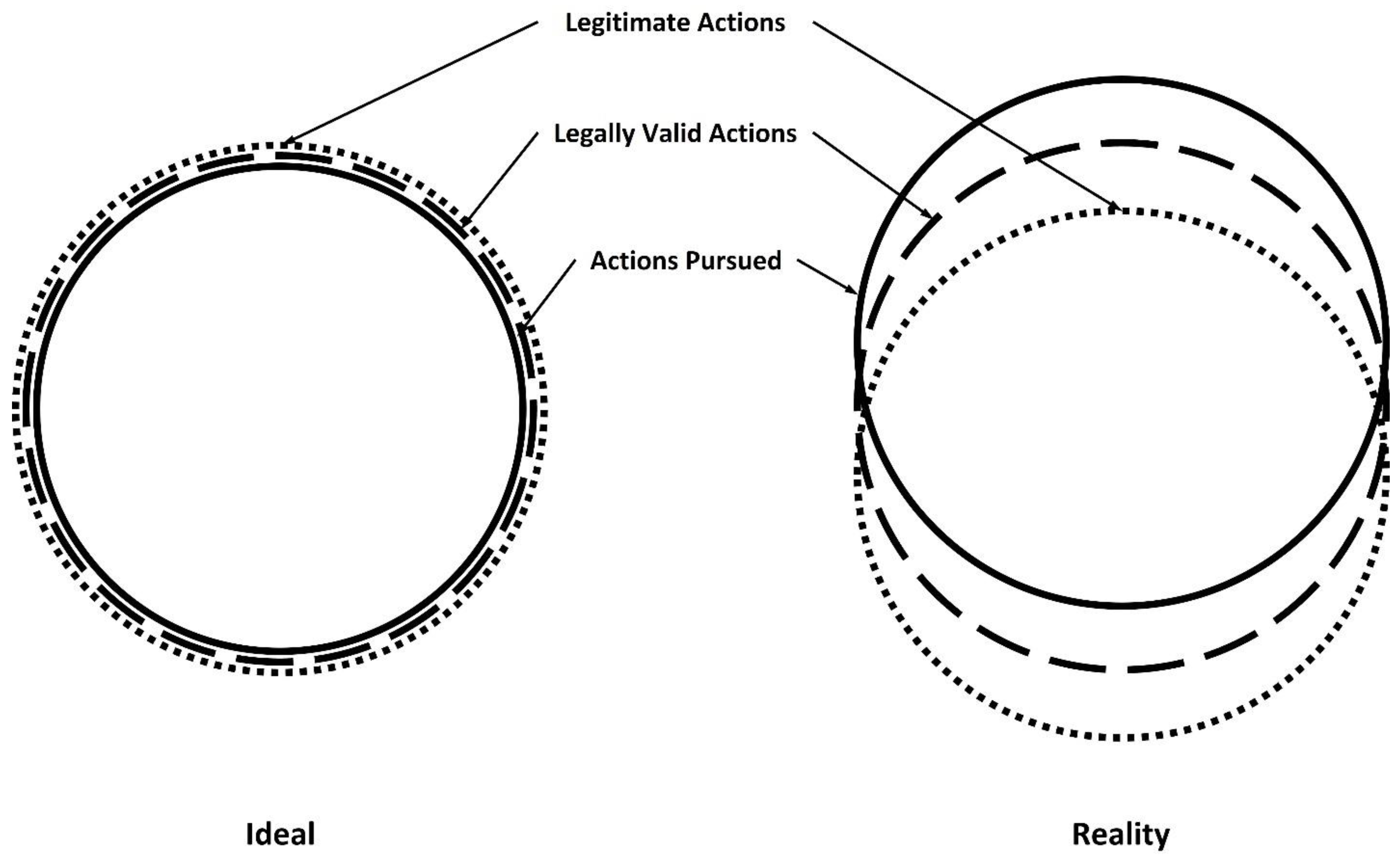
Figure 2.
Typology of Legitimacy. Note. Figure created by author.
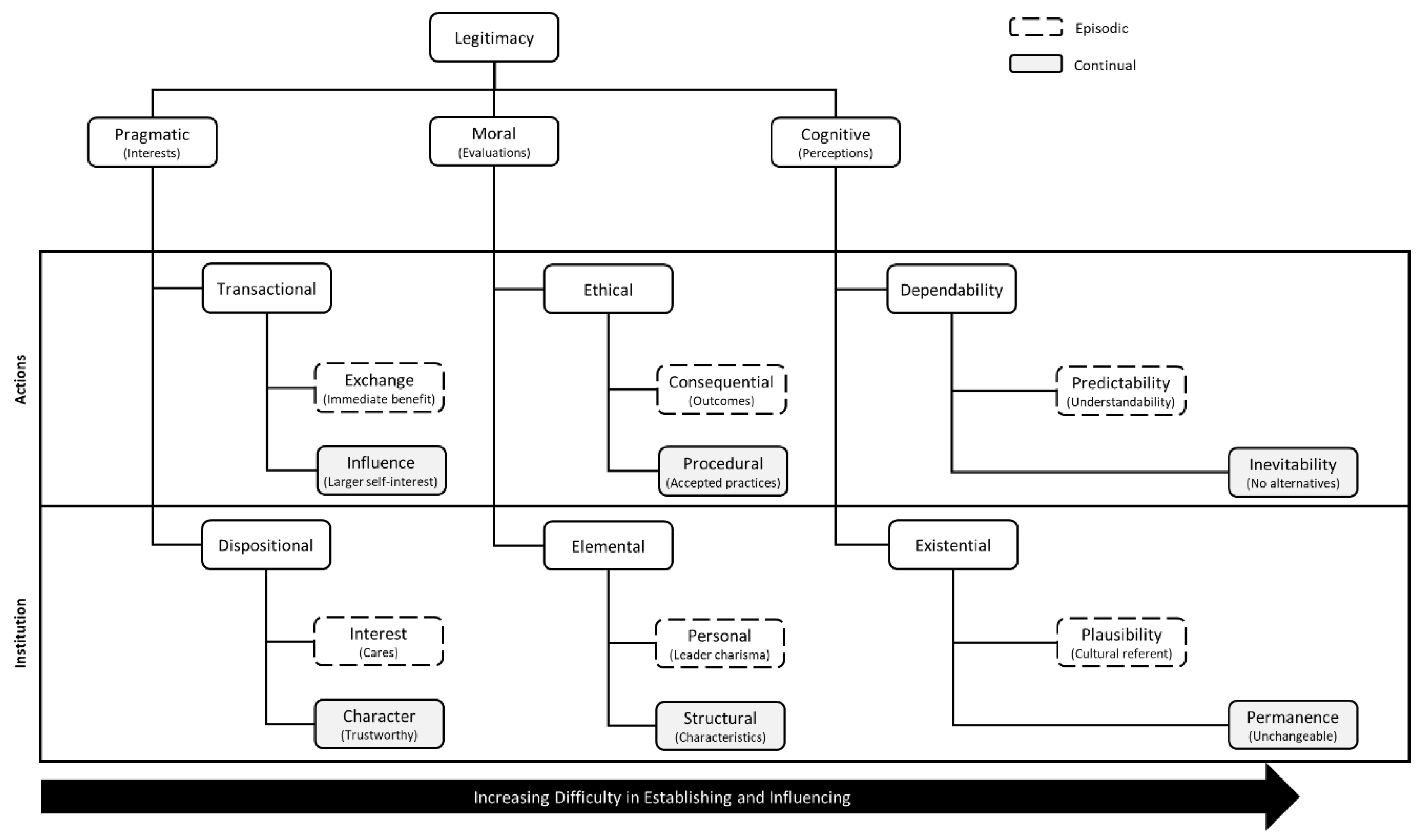
Figure 3.
Typology of Morality Tales. Note. Figure created by author.
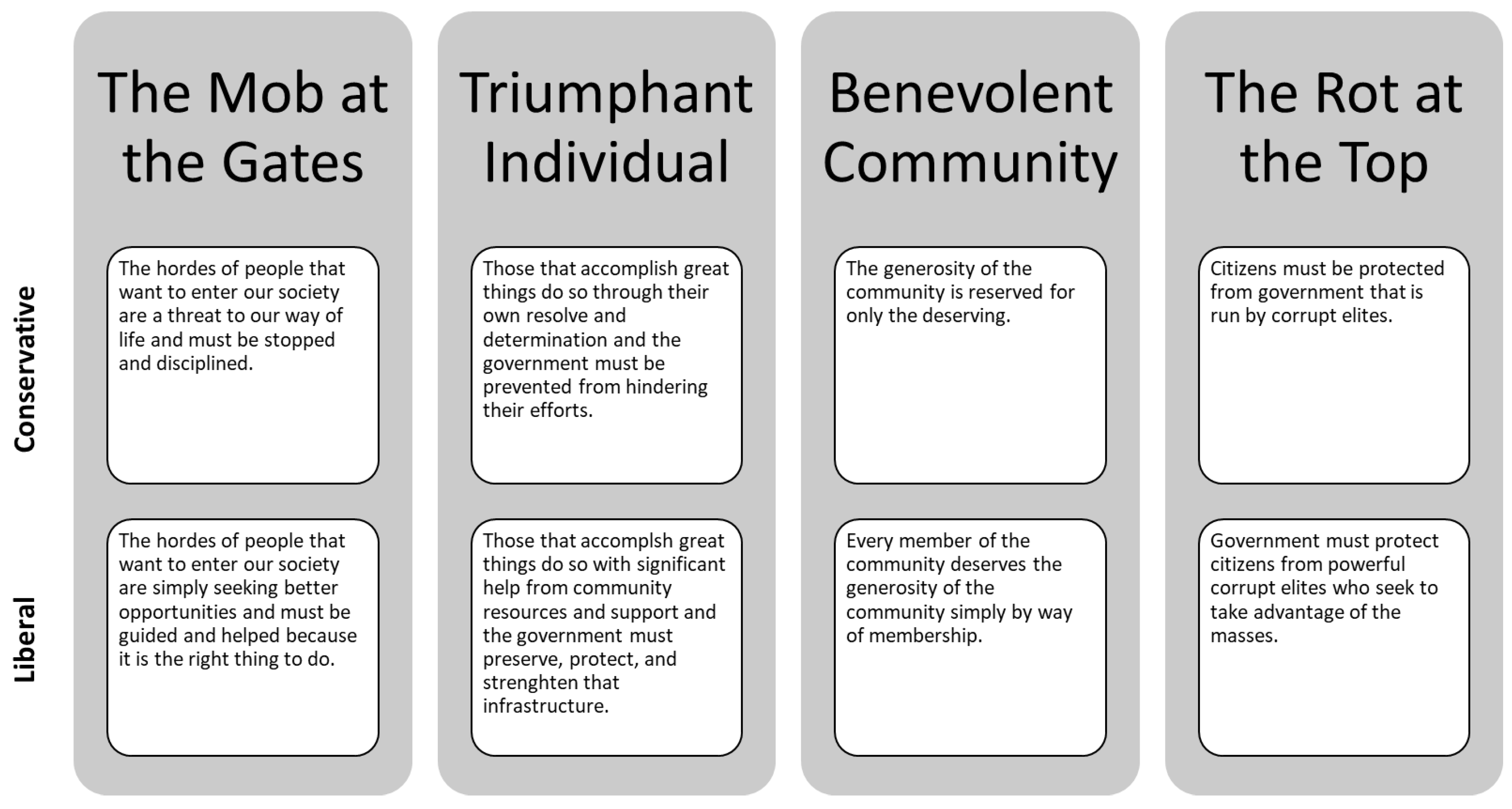
Figure 4.
Model of Political Legitimacy. Note. Figure created by author.
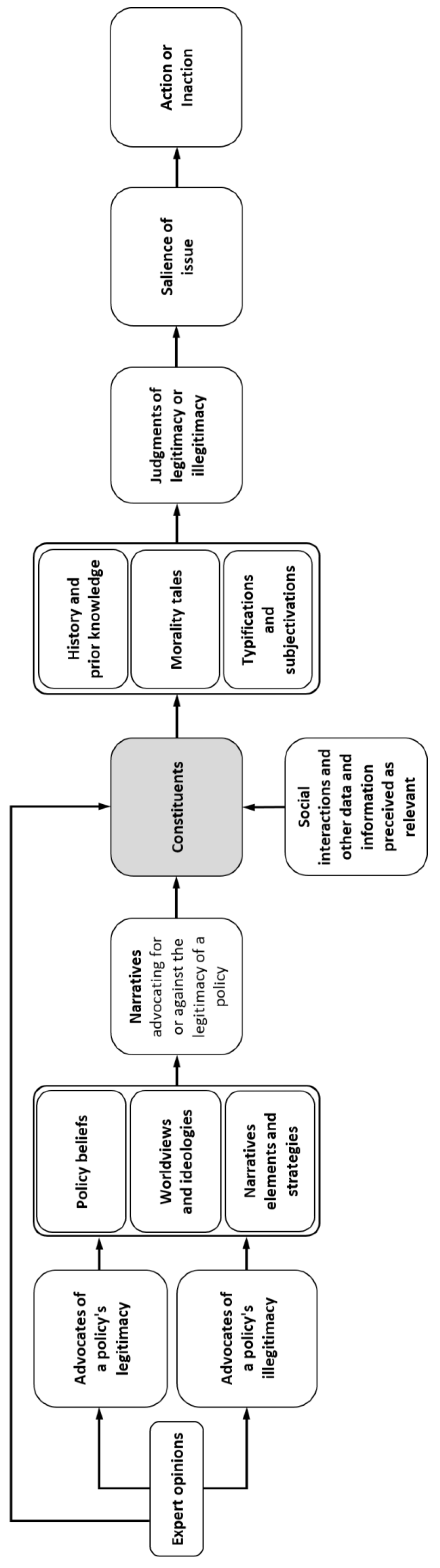
Figure 5.
Elements of the Political Order. Note. Figure created by author.
| 1 | This quote is from Thucydides’ History and has traditionally been translated as “The strong do what they can, the weak suffer what they must,” which Beard (2013, pp. 32-34) argues is a mistranslation. |
| 2 | The Sword of Damocles is an apocryphal anecdote in which Dionysius II of Syracuse demonstrates to Damocles the constantly looming danger that he faces as a ruler by having Damocles sit on the king’s throne not realizing, until Dionysius makes him aware, that a sword hangs above held at the pommel only by a single hair from a horse’s tail (Wikipedia contributors, 2022, August 1). |
Disclaimer/Publisher’s Note: The statements, opinions and data contained in all publications are solely those of the individual author(s) and contributor(s) and not of MDPI and/or the editor(s). MDPI and/or the editor(s) disclaim responsibility for any injury to people or property resulting from any ideas, methods, instructions or products referred to in the content. |
© 2025 by the author. Licensee MDPI, Basel, Switzerland. This article is an open access article distributed under the terms and conditions of the Creative Commons Attribution (CC BY) license.
Copyright: This open access article is published under a Creative Commons CC BY 4.0 license, which permit the free download, distribution, and reuse, provided that the author and preprint are cited in any reuse.


