

Submitted:
07 September 2023
Posted:
07 September 2023
You are already at the latest version
Abstract
In the past years, consumers have increased their interest to buy healthier food products, rejecting those products with more additives and giving preference to the fresh ones. Moreover, the current environmental situation has made society more aware of the importance of reducing the production of plastic and food waste. In this way and considering the Food Industry need of reducing the food spoilage along the food chain, edible coating has been considered as an eco-friendly food packaging that can replace traditional plastic packaging providing an improvement in the product’s shelf-life. Edible coating are thin layers applied straightaway on the food materials’ surface, that are made of biopolymers that usually incorporate other elements, such as nanoparticles or essential oils, to improve their physicochemical properties. These materials must provide a barrier that can prevent the pass of water vapor and other gasses, the microbial growth, the moisture loss, and the oxidation, so the shelf-life could be extended. The aim of this review was to compile the current data available to give a global vision of the formulation process and the different ways to improve the characteristics of the coats applied in both fruits and vegetables. In this way, the suitability of compounds in by-products produced during the Food Industry chain were also considered for the edible coating production.
Keywords:
edible coating
; shelf-life
; biopolymers
; food waste
; fruits
; vegetables
; by-products.
1. Introduction
For the past decades, consumers have been more worried about their food habits, rejecting products with additives and giving preference to fresh ones [1]. Furthermore, society has increased its concern about the environment, leading to an increased interest in reducing plastic consumption and food waste. The food industry has been struggling with quality and quantity loss of food, especially perishable products, between the harvest and consumption steps of the chain [1,2]. The losses are mainly related to food spoilage caused by microbial contamination, molecules oxidation and sensory characteristics deterioration [3,4]. These effects affect the safety of food products, threaten human health and have a negative impact on consumer acceptance [4]. Considering the demands of both consumers and industry, edible coating has been introduced as one alternative food packaging to replace plastic packaging and synthetic preservatives traditionally incorporated to prolong the shelf-life of different food products.
Edible coatings are thin layers applied directly on the food materials’ surface. Food packaging is qualified as “edible” if it is an integral part of a food that may be eaten with it [5]. This material preserves and maximizes food quality, being widely used as a postharvest practice, especially in perishable products such as fruits and vegetables (F&V). Edible coatings protect food products from microbial contaminants, increase shelf-life, decrease deterioration effects, and reduce lipid oxidation and moisture loss [1]. As any other food-film production, edible coating formulation must consider different parameters, such as: barrier properties (oxygen and carbon dioxide permeability); optical properties (they must be transparent and colorless); and sensory characteristics (they must be flavorless, tasteless and odorless) [6]. The principal reason for implementing edible coatings is based on the ability of this material to provide barrier properties, control moisture retention, the interactions between the food product and the environment solvent molecules, and gas exchange. However, edible coatings can also enhance the sensory product attributes, like appearance, biochemical, physicochemical, and microbial stability. The non-toxicity and safety of this material and the low processing cost and feasibility make edible coating a good plastic packaging alternative [5]. It must be noted that coatings do not always provide proper attributes. Sometimes, the mechanical characteristics, the poor transparency or the lack of antimicrobial and oxidation resistance leads to the production of non-suitable films. However, coatings are worthy carriers for food additives like antimicrobials and antioxidants, so adding these molecules may be an alternative to improve both functional and physicochemical properties [3,4]. Moreover, edible coatings are considered environmentally friendly since they replace plastic packaging and reduces food waste by increasing the shelf-life storage of food products [1,6]. To produce edible coatings, various formulations can be used by engaging different structural compounds [6]. Thus, edible coatings can be classified into three groups considering the nature of their elements: hydrocolloids (polysaccharides and comprising proteins), lipids, and blends of these compounds [7]. Furthermore, the usage of food industry by-products to produce biopolymers for edible coatings has been already considered [5]. Chitosan is a widely extended food by-product commonly used in laboratories as the main component of biomaterials for edible coating. This circular economy thinking strategy leads to reducing food waste, lowering the environmental impact of the Food Industry.
Fruits and vegetables (F&V) are products composed of vitamins, dietary fiber, phytochemicals, antioxidants, and minerals, whose consumption is linked to different health benefits such as the maintenance of human body immunity and the reduction of the risk of cardiovascular and cancer diseases, being fundamental for the human nutrition [8,9,10,11]. F&V are widely consumed but problematic to manage along the supply chain since they are living tissues whose metabolic processes, such as CO2 production and O2 consumption during respiration, continue after harvest. Moreover, F&V have a high water content so they are considered highly perishable products [8,9,10,11,12]. Postharvest deterioration can be minimized by controlling respiration rate, ethylene production, moisture loss and microbial load. Both optimal storage conditions and postharvest technologies are needed to guarantee their storage stability and shelf-life extension [8]. F&V are products likely to be infected by Gram + and Gram – bacteria, fungi, yeast and molds, thanks to the physiological and compositional changes occurring in the supply chain, making these products suitable substrates for microbial growth [10]. According to data, the main physico-chemical parameters affecting microbial spoilage of F&V are pH, temperature, and water activity (aw). Fruits’ pH is under 4.5, which promotes fungi growth (pH range between 3-8). Instead, vegetables have a pH range between 4.8 and 6.5, allowing both fungi and bacteria growth [10]. The storage temperature recommended for F&V is between 0-5ºC since high temperatures accelerate the respiration process while low temperatures inhibit or delay microbial growth [10]. Nevertheless, psychotropic bacteria and fungi, and chilling injuries must be considered too [10]. Finally, the liquid water available is a crucial factor for microbial growth (aw between 0.97 and 1.00), even when harsh environmental conditions are applied. F&V have an aw between 0.95-0.99 and are susceptible to microbial spoilage; however, reducing the water content is not an option [10].
F&V physicochemical characteristics lead to high product losses during the supply chain. Different studies have been carried out recently about food loss and waste (FLW). Food loss is the reduction in the quality or quantity of food that takes place in the chain, excluding retail, food service providers and consumers, due to decisions and actions of food suppliers. Food waste is the reduction in the quality or quantity of food resulting from decisions and actions by retailers, food services and consumers [12]. According to different data, more than 20% of F&V production is lost or wasted [13], and 3-18% of the F&V loss occurs in the processing steps due to human errors, poor management and technical failures [12]. In developing economies, food loss is linked to the postharvest and processing level, while developed economies are characterized by losing food at the retail and consumer level, being considered food waste [13]. Considering the population is expected to reach 9.1 billion people by 2050, F&V stability and shelf-life extension have become an issue for the food industry and society since increasing production cannot be the only solution to fulfill the demand [13]. Both stability and shelf life are linked to food quality and safety, being essential parameters for the food industry that affect the sensorial quality of the products [8]. Thus, food packaging is one key factor to prevent F&V waste, which takes place during the supply chain and once F&V are stored by consumers. Edible coatings may be a suitable alternative to traditional plastic food packaging since they can enhance the shelf-life of F&V by reducing their respiration rate and loss of water and protecting from physical damage and microbial spoilage, preventing the post-harvest loss [14]. In this review, the edible coating is presented as an alternative pathway to preserve fruits and vegetables, considering the environmental issues of current plastic packaging and the need for change in the Food Industry to decrease food waste. Moreover, a general vision of the present approaches is given, including the different procedures of edible coating production and the bioactive compounds incorporated into biopolymers used for this packaging.
2. Edible Coatings’ Contextualization
Edible coatings are biopolymer-based layers applied on the food surface that act as primary packaging, considered sustainable novel food packaging. Edible coatings are usually a mixture of film and additives [15]. Biopolymers are usually the main component of edible coatings, and can be made of proteins and polysaccharides, which are excellent barriers against oxygen, lipids, and aromas but have moderate mechanical properties and high-water permeability; or lipids that can be used as cohesive biomaterials thanks to their characteristics when transition temperature is achieved, they provide desirable gloss and an effective barrier for water loss [5]. To obtain a coating with better physicochemical properties, mixtures can be formulated. Moreover, different elements such as essential oils (EOs), bio-nanocomposites, and inorganic nanoparticles (NPs) can be incorporated into the mixture so the functional and physicochemical properties can be improved [5].
2.1. Film Formation and Application of Coat
There are different procedures for film formation, casting and extrusion being the methods most used. The casting method is a wet process used in the laboratory and pilot scale. Casting is a three-step process: first, the biopolymer is solubilized in a solvent; then, the solution is cast in a mold; and finally, the cast solution is dried. Films formed by the casting method are characterized by their better particle-particle interaction, which leads to a more homogeneous film. This method has a low cost and does not need specialized equipment. Meanwhile, it has some drawbacks such as limited forms (only sheets and tubes are allowed), the potential trapping of toxic solvent inside the polymer, the protein denaturation because of the solvent, and the long time needed for the drying of the solvent [1]. On the other hand, the extrusion method, also known as the dry process, is a procedure that achieves better physicochemical properties and is widely used at industrial scale. It starts with the mixture of the film components and after it is compressed. The main advantages of this procedure are the short time and low energy consumption of the process, the better mechanical and optical properties of the film, the minimum usage of solvents, and the wide range of forms that can be obtained. Nevertheless, polymers must be low moisture and tolerant to high temperatures for this method, and the cost and maintenance of the equipment are high [1]. Moreover, the application method of the coat directly affects the quality of the coating. Until now, dipping, spraying and vacuum impregnation (Figure 1) are methods that have been developed:
Dipping: the product is immersed in the coating solution for 30 seconds-5 minutes, and then, the excess solution is drained. This method guarantees the application of the coat through all surfaces, even if it is rough [14].
Spraying: the droplet form coating solution is homogeneously sprayed on the product surface [14]. Moreover, the solution surface is increased thanks to the droplet’s formation [1].
Vacuum impregnation: this method follows the dipping procedure but adding pressure, allowing the vacuum state [14].
2.2. Principle Macromolecules Used for the Edible Coating Formulation
2.2.1. Polysaccharides
Polysaccharide-based coatings are characterized by their efficient O2 barrier due to their well-ordered hydrogen-bonded structure, the colorless and oily-free appearance, and the minimum caloric content, being suitable for the surface application in F&V. However, the moisture barrier capacity is limited due to their hydrophilic nature [16], so the blending with other compounds has also been considered. The polysaccharides most used are chitosan, starch, alginate, pectin, and cellulose, among others.
Chitosan (CH) is a co-polymer formed from deacetylated chitin in an alkaline medium. Chitin is a natural polymer of the exoskeleton structure of marine invertebrates, insects, fungi, algae, and yeast [17,18]. CH is characterized by its suitability for coat and film formation since it has permeable selectivity to CO2 and O2 and remarkable mechanical properties [17]. CH is a safe, natural allergen-free, and biocompatible polymer associated with different health benefits [16]. Moreover, CH coatings are non-toxic, biocompatible, and biodegradable and have antimicrobial effect over broad-spectrum pathogens, antioxidant activities [17], and excellent O2 and CO2 barrier properties [16]. CH film/coatings applied on the F&V surface positively impact their shelf-life since decay-causing fungi, an antimicrobial effect, and an elicit host defense are produced [18]. Furthermore, CH semipermeable capacity can reduce the respiration rate by adjusting O2 permeability consumption and CO2 production, improving antioxidant activity [18]. Nevertheless, CH coatings have high water vapor permeability (WVP) [17], leading to a need to be fortified by incorporating other compounds. CH is also a biopolymer with great application for the food industry since it is a by-product produced during the processing of various exoskeleton crustaceous [19], so the use of these biopolymers for the production of edible coatings would support the circular economy system.
Starch is mainly formed by amylose and amylopectin, being suitable for coating production due to their mechanical and barrier properties [11]. Starch is a potential biopolymer for the food industry, not only for the suitable physicochemical properties but also for the sources in which it can be found, such as cassava, potatoes, sweet potatoes, corn, wheat, rice, and pea [11]. The hydrogen bond network of starch shows an excellent gas barrier for both CO2 and O2, as well as a low permeability of flavoring agents [11,16]. Moreover, starch biopolymers are odorless, tasteless and colorless, suitable for the food industry [11]. Despite these suitable properties, starch biopolymers have high hydrophily [11], leading to an undesirable WVP that has to be improved by adding other molecules.
Alginate is a co-polymer extracted from seaweeds that form a transparent, uniform, water-soluble, high-quality film/coat characterized by its colloidal characteristics, such as thickening, gel-forming, film-forming, and emulsion stabilizing agent, as well as for its low permeability to lipophilic molecules and O2 [16,17]. This leads to the rear of lipid oxidation processes of F&V and, consequently, to a reduction of weight loss and microbial growth [17]. Alginate-based coats also reduce shrinkage, moisture loss, oil absorption, flavor, and color loss [17].
Pectin is a Generally Recognized as Safe (GRAS) molecule by the Food and Drug Administration (FDA). It is an amorphous, white-colored colloidal carbohydrate and the main plant cell wall component [20]. It is characterized by its suitable properties for the packaging sector of the food industry since it is non-toxic, biodegradable, and biocompatible, and because of its permeability properties, gas barrier, and microbial controller abilities. Moreover, pectin has various technological properties such as emulsifier, gelling agent, thickener, and stabilizer [20], and can be obtained from other food sectors by-products, promoting a circular economy.
Cellulose derivatives-based coatings are characterized by the colorless and oily-free appearance and the minimum caloric, while the moisture barrier is low because of their hydrophilic nature [16]. Carboxymethyl cellulose (CMC) is a cellulose derivative anionic linear long-chain water-soluble compound with high strength and structural integrity [21] being suitable for the coating production applied in F&V. The presence of both hydroxyl and carboxylic groups in the CMC structure provides water binding and moisture sorption properties [21]. Moreover, CMC provides moisture, O2, CO2, aroma, and oil barrier improvement, as well as an increment of adhesion of the coating-surface interaction [21]. Finally, the antisenescence property of CMC reduces the ripening process in climacteric fruits [21], enhancing their shelf life.
2.2.2. Proteins
Protein characteristics are suitable for edible film formation due to the amino acids’ position among the chain and the chain-to-chain interaction, which also determines the coatings’ strength and gas and liquid permeability [16]. Protein-based edible coatings are considered excellent O2 blockers, even at low relative humidity, and from a nutritional point of view [16]. Different proteins have been applied in the edible coating formation, soy, whey, gluten and zein corn proteins being especially relevant in F&V. The food industry produces soy protein, zein protein, and gluten as by-products in activities such as soybean processing, defatting soy bean favor, or production of wheat starch [19]. Moreover, casein, keratin, and gelatin are common protein residues from animal product processing [19]. Whey protein-based coatings have accurate hindrance and excellent gas barrier properties at low relative humidity. Moreover, these coatings are suitable blockers of aroma compounds and oil, while the moisture barrier capacity is limited due to their hydrophilic nature [16].
2.2.3. Lipids
Since lipids are good barriers against water migration, lipid-based coatings are excellent moisture barriers. However, the high hydrophobicity of these coatings leads to extra brittle and thicker properties, so the blending of lipids with proteins and polysaccharides is usually applied. Moreover, lipid-based coatings have been noticed with damaged appearance and gloss [16]. Paraffin wax-based coatings are the main lipid-based films used as layers for F&V products. Films obtained with these waxes are characterized by their moisture barrier capacity and improvement of the outer surface appearance of different meals. Nevertheless, these layers are edible only when applied in a thin layer, whereas the thick layer must be disposed of before eating [16].
3. Food By-Products as Materials for the Edible Coating Formation
Edible coating formulation requires at least one macromolecule to act as the biopolymer, which can be a polysaccharide, a protein, or a lipid. The blending of two or more compounds usually allows obtaining the best coat. With the application of these biopolymers on the surface of F&V, FLW is reduced and can be even more notable if the circular economy system is considered. The circular economy approach uses by-products produced by the food industry as sources of biopolymers used in edible coating formation. This policy is promoted by the European Union (EU), encouraging the food industry to upgrade the low-quality by-products obtained during processing to minimize waste. By-products are a source of bioactive compounds that can be introduced in edible coatings formulation. If all or some of the coating components come from the food industry by-products, the efficiency and sustainability of edible packaging will be guaranteed [19].
F&V post-harvest processing also carries high amounts of by-products rich in compounds with suitable characteristics for edible coating formation [22]. These F&V by-products are known as plant-derived food by-products (PDFBPs) and are mainly seeds or kernels, pomace, peels, and leaves containing biopolymers such as cellulose, starch, pectin, and plant based-proteins, which are the main components of coatings and films [23]. Thus, wheat straws, wheat brans, and millet brans are a rich source of arabinoxylan, a hemicellulose polymer, while oat brans are rich in β-glucan. Moreover, fruit seeds or kernels are an excellent source of amylose, the main component of starch. CMC is found in rice stubbles and nanocellulose from wheat brans, obtaining nanofibers with high crystallinity and a large specific surface area rich in hydroxyl groups characterized by good biocompatibility and low cytotoxicity. Furthermore, apple pomace, mango, pineapple, and lime peels are rich in pectin, and lime peel pectin is a rapid-set gel former. Pineapple peel pectin incorporated into a commercial pectin film showed a higher water barrier property and antioxidant capacity. Finally, plant proteins can be extracted from different sources; coconut milk and rice bran are good examples [24].
Although plenty of data confirms the suitability of the by-product compounds generated by the Food Industry for edible coating formation, few studies have been developed using these molecules. In a study by Torres-León et al., the authors used mango peel flour and mango seed kernel to produce edible coatings applied to peach surfaces. For the mango peel flour coating, all compounds were used, while in the mango seed kernel, only the antioxidants were incorporated [25]. In another study by Grimaldi et al., all parts of onions, artichokes, and thistles were selected to incorporate into an edible coating since these vegetables entail a considerable amount of waste in the Italian food industry. Results showed that the coating had excellent mechanochemical properties [22]. Regarding food by-products, leaves are big waste, so different studies have considered these vegetable parts as suitable matrices to obtain bioactive compounds. In 2022, Zhang et al. used loquat leaves to obtain an active extract to incorporate into the formulation of an edible coating applied to tangerines [26]. Aguilar-Veloz et al., Tesfay & Magwaza, and Chong & Brooks obtained leaf extracts of jackfruit, moringa, and haskap to formulate edible coatings to be applied in tomatoes, avocados, grape tomatoes, and bananas, respectively [27].
In summary, food by-products produced during food industry processing have different chemicals in their composition that can be used for edible coating and film production. Using peels, kernels, pomace, or crustaceous exoskeleton to recover polysaccharides and proteins incorporated as edible coatings leads to a promising circular economy achievement, as shown in Figure 2. However, the slight data available on studies that used food by-products for the edible coating formation and its potential exploitation (Table 1), so further research is needed.
4. Improvement of the Physicochemical and Functional Characteristics of the Coatings
Biopolymers used as coats for food packaging are typically hydrocolloids, being alginates and chitosan broadly studied. Taking into account that biopolymers used as coats can be protein based or polysaccharide based and considering that both molecules are characterized for their hydrophilic capacity, the reinforced of these compounds with other materials is convenient [28]. In this way, physicochemical properties of these compounds can be improved by adding other elements, such as nanoparticles, essential oils, and bio-nanocomposites. Thus, the effects achieved with these components’ addition is described below and summarized in Figure 3.
4.1. Essential Oils
Essential oils (EOs) are naturally derivative aromatic compounds that can be extracted from seeds, stems, leaves, flowers and fruits of plants [3]. Moreover, EOs are antimicrobial additives considered GRAS [14] and have attracting features for the edible coating incorporation thanks to the preservative and antimicrobial ability of their compounds towards foodborne pathogens in materials such as vegetables, fruits, and meat products [14,28]. Since EOs are characterized by their hydrophobic substances, they are suitable for reducing vapor penetration by increasing the hydrophobicity of edible coatings [14,29]. EOs features comprise the ability to increase the physical stability of active ingredients, the maintenance of aroma, taste, and flavor when added in nanoemulsions, and the increment of the effectiveness against foodborne pathogens [14]. Furthermore, EOs incorporated into a suitable delivery system are considered more efficient and protect to avoid dependency on other food components [14]. Nano-systems are commonly used as delivery systems of EOs to minimize the negative impact of these compounds in the sensory analysis of food products and to increase their stability in the food matrices [30]. Since EOs have antimicrobial and antioxidant properties, several studies have been developed about these volatile compounds considering different matrices. Thus, cinnamon, oregano, and thyme are examples of matrices in which EOs have been studied with these activities [14,31].
4.2. Nanoemulsions
Nanoemulsions are oil-in-water or water-in-oil solutions that can be used for the edible coating formulation to improve their physicochemical properties. Oil-in-water nanoemulsions are more suitable for this application since they can be easily fused with food-grade components, allowing a better scaling-up process [14]. The nanoemulsion mechanism is based on the nanodroplet formation of the emulsion covered by a film or a layer of a food ingredient. The particle size of these droplets (between 10 to 100 nm) increases the bioavailability and the chemical reactivity. Moreover, the functional qualities of the encapsulated component are improved thanks to the surface area increment [14,32], which is an essential factor for the promotion of the antibacterial EOs characteristics and the improvement of the absorption of additional hydrophobic compounds [14,33]. These droplets are optically clear [14], and their bioavailability and chemical reactivity are higher thanks to the increment of the surface area of the particles [14]. The best incorporation procedure of EOs into edible coatings is in nanoemulsion since this allows a minimum dose addition, leading to no adverse impact on sensory characteristics. Moreover, the nano-scale guarantees the effectiveness of shelf-life prolongation [14]. Oil-in-water nanoemulsions are considered the next-generation edible coatings since they can be fused with food-grade components, allowing more scope for the scaling-up step in the industry by applying a homogenization approach [14,34]. There are two processes for the nanoemulsion incorporation of edible coatings: a single-step nanoemulsion process in which all the ingredients are mixed in a coarse solution and then homogenized to create the nanometric-sized droplets or a two-step nanoemulsion preparation where the aqueous solution is made first, and then, is combined with the biopolymer solution [35]. Nanoemulsions can be applied as edible coatings in different postharvest fruits such as papaya, mango, or strawberries [14].
4.3. Bio-Nanocomposites
Bio-nanocomposites are a mixture of various nanocomponents organized to obstacle the entrance or existence of different molecules, such as oxygen or water vapor, reducing weight loss [36]. The concentration of the mixed materials influences the effect of the overall performance of polymer-based nanocomposites [37]. Moreover, it has been proved that the homogeneous dispersion of nanofillers leads to a better performance of bio-nanocomposites [37]. Nanocomposites also improve different properties of the biopolymers used for edible coating production. Among others, the mechanical properties, the barrier and thermal features, and the antimicrobial activity are improved [36]. Water barrier properties can be improved by adding Ag NPs, chitosan nanofibers, TiO2 NPs, Zein NPs, cellulose nanofillers, and copper oxide NPs, leading to lower solubility and an improved contact water angle. Moreover, NPs create a tortuous pathway by narrowing pore channels, which increases the diffusional path and reduces water diffusion [37]. In the same way, a uniform distribution of nanofillers in bio-nanocomposites leads to an excellent gas barrier by creating a complex pathway that restricts the movement of gas molecules through the material. These nanofillers’ distribution may change the interfacial region of the polymer matrix, improving gas permeability characteristics [37].
4.4. Inorganic Nanoparticles
Inorganic nanoparticles (NPs) are solid colloidal particles of 10-100 nm characterized by their stability, functionality and biological activity [38]. NPs can load functional molecules, improving their stability and performance by encapsulation [38]. NPs obtention methods are ionic crosslinking, covalent crosslinking, precipitation, and polyelectrolyte complexation [38]. These particles are featured by their antimicrobial activity, so their incorporation has a protective function [15,39]. Moreover, the increased surface area leads to a better reinforcement effect in the matrix [36]. Thus, using NPs in the food industry relies on their ability to be easily dispersed into matrices, minimizing the adverse flavor impact while the diffusion and bioavailability are enhanced [39]. In this way, incorporating NPs into edible coatings can be a suitable option to reduce the adverse effects of antimicrobial substances on food odors [39].
5. Application of Edible Coatings in Fruits and Vegetables
5.1. Current Application of Edible Coatings Applied in Fruits and Vegetables
Nowadays, edible coating is studied for perishable food products, such as F&V, meat and poultry, and fresh fish. On the one hand, microbial contamination is common in these products due to their high water content. F&V are prone to water loss, mechanical damage, and sensory changes during storage, leading to economic loss [3]. Mechanical injury, environmental stress, and pathological breakdown are also situations that reduce these perishable food products’ shelf-life [36]. These effects also impact the consumers’ acceptance and health [3]. Different studies have applied biopolymers with bioactive compounds (such as EOs), inorganic NPs, or bio-nanocomposites as edible coatings to prolong these products’ shelf-life. In this section, the current application of edible coatings (Table 2) is discussed, providing several examples where F&V shelf-life is improved (Table 1).
Several studies have been carried out using edible coatings as shelf-life extenders. Polysaccharides are the most common macromolecule used in de EC production. Sucheta et al. studied the tomato’s changes during 30 days of storage at 25ºC using pectin-based edible coating mixed with corn flour and flour-beetroot powder in different proportions. Results showed how the coating produced with 50% pectin and 50% corn flour (PCF) achieved the best weight loss, decay percent, respiration rate, and biochemical quality. Moreover, PCF and P (100% pectin) coating could maintain maximum glossiness and minimum shrinkage of the tomato’s pericarp without causing off-flavors [40]. Rodriguez-Garcia et al. also studied the tomato changes that took place during 12 days of storage at 25ºC. The edible coating was prepared using citrus peel pectin as the main macromolecule and mixed with oregano EO. Results showed the antifungal effect of the EC on inoculated tomatoes thanks to the EO addition. Moreover, the total phenol content and the antioxidant activity were increased without affecting the sensory acceptability of the tomatoes [41]. Another study explored the tomato’s variations after being coated with alginate mixed with Aloe Vera, and ZNO-NPs were measured during 16 days of storage at room temperature. Results showed the applicability of this edible coating since UV-shielding, water-barrier, and thermal, mechanical, and antimicrobial properties were excellent. The authors demonstrated that the improved properties resulted from the synergic action of the alginate mixed with ZnO-NPs and aloe vera [42]. Strawberries were also one of the focus fruits for the shelf-life extension. Khodaei et al. applied an edible coating made of CMC, Persian gum (PG), low methoxyl pectin (LMP), or tragacanth gum (TG) in strawberries stored at fridge temperature (4ºC) for 16 days. To analyze the effect of the different coating treatments on the strawberries’ shelf-life, the TOPSIS method was applied, showing the CMC coating the best results in reducing weight loss and spoilage and preserving nutritional ingredients [43]. The shelf-life prolongation of coated strawberries was also studied. The coatings were made of pullulan (a water-soluble polysaccharide), and cinnamon EO was incorporated in a nanoemulsion structure. The edible coating addition led to different improvements in the mass loss delay, firmness, total soluble solids, and titratable acidity during the 6 days of storage at room temperature [44]. In the same way as strawberries, cherry fruits are highly perishable. Sweet cherries were coated with a polysaccharide-based coat of alginate and chitosan and mixed with olive leaf extract. After 20 days of storage at 25ºC, coated cherries showed retardation of the ripening process and maximum retention of phenolic compounds. Furthermore, the authors determined the correlation between antioxidant activity and the retention of phenolic compounds [45]. Coated grapes have been studied using a polysaccharide-based coating of chitosan (1%) and a combination of chitosan (1%) and gum gutti (1%) applied to the grape’s surface before their storage at fridge storage (1ºC) for 60 days. After comparing the results, the chitosan and gum gutti showed better antifungal activity. This coat also gave good results regarding nutritional properties, phenolic compounds, and antioxidant activity maintenance [46].
Regarding protein-based coatings, fewer studies have been conducted. Protein-based coatings mixed with transglutaminase were applied to apples, potatoes, and carrots cut in slices and stored at fresh temperatures for 10 days. In this study, positive results were shown when the transglutaminase was incorporated into the edible coating, reducing weight loss, preventing microbial growth, and maintaining antioxidant activity during the 10-day storage. Furthermore, apples, carrots, and potatoes showed no significant changes in their hardness and chewiness [47]. Another study compared the addition of lemon oil, lemongrass EO, and non-incorporated oils in whey protein edible coatings applied on the surface of pears. Results showed how the coating with lemon oil (1%) and lemongrass EO (0.5%) reduced weight loss, WVP, oxygen, and carbon dioxide. However, those pears coated with lemon oil had a reduction of firmness after 28 days at fresh storage with 80% humidity, while those coated with lemongrass EO showed higher browniness due to the nature of the oil and its natural yellow color. Regarding acceptability, both coatings showed a slight reduction of acceptability compared with the EC without the oils [48]. Walnut flour protein was applied to the kernel surface of walnuts to improve their storage for 40 days at 84ºC. Edible coating preserved the sensory characteristics, especially those regarding lipid deterioration (e.g., lipidic peroxidation that leads to rancid flavor) [49].
According to Table 1, EOs are commonly chosen to improve the features of the coatings. Olive leaf extract, orange, oregano, thyme, cinnamon, and lemon EOs are broadly incorporated into edible coatings. Reduction in water loss and hardness, fewer color changes, and lower respiration rate are the most common advantages when edible coatings formulated with EOs are applied in F&V products. Moreover, storage time is highly incremented when the edible coating is applied in fruits, especially suitable in those fruits in which a long period passes between the harvest and the selling. Therefore, the edible coating incorporation in the F&V surface improved the shelf-life extension of these perishable products, which may lead to lower waste production and, finally, to fewer economic losses.
5.2. Effects of Edible Coatings in the Sensory Characteristics
Edible coatings seem a suitable pathway for the shelf-life extension of F&V, giving some improvements such as retardation of maturation, inhibition of enzymatic brown reactions, or reduction of respiration rates, among others. However, the impact of the edible coating application on the acceptance of the product, depending on firmness, color, flavor, taste, smell, hardness, and overall acceptability, should be considered. Basaglia et al. studied the changes in color and firmness of coated pineapples, and results showed no significant variations in color until day 7, with a lower decrease in brightness compared to uncoated pineapples. No significant changes were measured in firmness until day 9. Moreover, 12 trained judges analyzed aroma and overall evaluation, finding no significant difference until day 5 [51]. Manzoor et al. determined the firmness of fresh-cut kiwifruit coated with sodium alginate, ascorbic acid, and vanillin, showing slower changes in those coated slices than in the uncoated ones [53]. However, Tabassum et al. determined the changes in color and firmness when guava leaf and lemon extract were applied to bananas using a scale ranging from 1 to 7 and 1 to 5, respectively. Results showed that coated bananas maintained firmness and color for 2 and 5 days more than those uncoated, respectively [50]. In a different study, 15 semi-trained judges evaluated coated tomatoes’ taste, firmness, and visual appearance. After a 15-day storage period, the acceptance rate was higher than uncoated. Nevertheless, a distinct but pleasant difference in the coated tomatoes was detected. Regarding firmness and color, results showed higher visual brightness of coated tomatoes compared with those uncoated. Finally, firmness of coated tomatoes was reduced by 28%, while uncoated tomatoes showed a reduction of firmness of 61% [52]. The sensory changes of tomatoes coated with whey protein, xanthan gum, and clove oil were also analyzed by a trained panelist. Color, texture, taste, flavor, and overall acceptability were evaluated. After 15 days of storage, the coated tomatoes were found acceptable whereas uncoated tomatoes showed a desiccated appearance. The coated tomatoes showed no adverse effect on color, texture, taste, and flavor [56]. Regarding the data available considering sensory characteristics of the F&V coated, positive results are found. Overall, there is an improvement in the firmness, color, flavor, smell, and taste of the samples coated, guaranteeing the consumers’ acceptability of F&V.
6. Conclusions
Edible coating is a suitable alternative to traditional plastic packaging that is being widely studied nowadays, especially in perishable products such as fruits and vegetables. The need for food waste reduction, the consumers’ interest in incorporating more fresh products in their diet, and the awareness of society about the environment are key points and the main reasons why edible coating is receiving so much interest from the scientific community. Different formulations can be used to achieve the best edible coating properties for one specific product. Furthermore, edible coatings are suitable for incorporating substances that provide added value to the product, such as bioactive compounds, essential oils, or nanoparticles, and, in many cases, these compounds can be obtained from food industry by-products, contributing to the circular economy. This review aimed to provide data about edible coating, the formulation, and application procedure and to give an approach to studies considering edible coating applied in fruits and vegetables. The data collected about edible coating shows that this pathway should be considered by the food industry, not only for the advantages from the point of view of prolongation of perishable products’ shelf-life but for the possibility of using other food by-products, such as pectin and chitosan, as biopolymers for coatings’ formulation. Since inorganic nanoparticles and other elements can be incorporated into edible coatings, further investigations considering toxicity must be performed to guarantee consumers’ health.
Author Contributions
Conceptualization: P.B., A.P.-V., M.C., and M.A.P.; methodology, P.B. and A.P.-V.; formal analysis, P.B. and A.P.-V.; investigation, P.B. and A.P.-V.; resources, M.C. and M.A.P.; writing—original draft preparation, P.B. and A.P.-V.; writing—review and editing, M.C. and M.A.P.; visualiza-tion, P.B. and A.P.-V.; supervision, M.C. and M.A.P.; project administration, M.C. and M.A.P.; funding acquisition, M.A.P.
Funding
This research received no external funding.
Institutional Review Board Statement
Not applicable.
Informed Consent Statement
Not applicable.
Data Availability Statement
Not applicable.
Acknowledgments
The research leading to these results was supported by MICINN supporting the Ramón y Cajal grant for M.A. Prieto (RYC-2017-22891) and by Xunta de Galicia for supporting the program EXCELENCIA-ED431F 2020/12 and the pre-doctoral grant of M. Carpena (ED481A 2021/313). The authors thank the Ibero-American Program on Science and Technology (CYTED— GENOPSYSEN, P222RT0117).
Conflicts of Interest
The authors declare no conflict of interest.
References
- Suhag, R.; Kumar, N.; Petkoska, A.T.; Upadhyay, A. Film Formation and Deposition Methods of Edible Coating on Food Products: A Review. Food Res. Int. 2020, 136. [CrossRef]
- Chaudhary, S.; Kumar, S.; Kumar, V.; Sharma, R. Chitosan Nanoemulsions as Advanced Edible Coatings for Fruits and Vegetables: Composition, Fabrication and Developments in Last Decade. Int. J. Biol. Macromol. 2020, 152, 154–170. [CrossRef]
- Shen, C.; Chen, W.; Li, C.; Aziz, T.; Cui, H.; Lin, L. Topical Advances of Edible Coating Based on the Nanoemulsions Encapsulated with Plant Essential Oils for Foodborne Pathogen Control. Food Control 2023, 145. [CrossRef]
- Sun, X.; Wang, J.; Dong, M.; Zhang, H.; Li, L.; Wang, L. Food Spoilage, Bioactive Food Fresh-Keeping Films and Functional Edible Coatings: Research Status, Existing Problems and Development Trend. Trends Food Sci. Technol. 2022, 119, 122–132. [CrossRef]
- Salgado, P.R.; Ortiz, C.M.; Musso, Y.S.; Di Giorgio, L.; Mauri, A.N. Edible Films and Coatings Containing Bioactives. Curr. Opin. Food Sci. 2015, 5, 86–92. [CrossRef]
- Rohasmizah, H.; Azizah, M. Pectin-Based Edible Coatings and Nanoemulsion for the Preservation of Fruits and Vegetables: A Review. Appl. Food Res. 2022, 2, 100221. [CrossRef]
- Pratap Singh, D.; Packirisamy, G. Biopolymer Based Edible Coating for Enhancing the Shelf Life of Horticulture Products. Food Chem. Mol. Sci. 2022, 4, 100085. [CrossRef]
- Sousa-Gallagher, M.J.; Tank, A.; Sousa, R. Emerging Technologies to Extend the Shelf Life and Stability of Fruits and Vegetables. Stab. Shelf Life Food 2016, 399–430. [CrossRef]
- Yousuf, B.; Qadri, O.S.; Srivastava, A.K. Recent Developments in Shelf-Life Extension of Fresh-Cut Fruits and Vegetables by Application of Different Edible Coatings: A Review. LWT 2018, 89, 198–209. [CrossRef]
- Alegbeleye, O.; Odeyemi, O.A.; Strateva, M.; Stratev, D. Microbial Spoilage of Vegetables, Fruits and Cereals. Appl. Food Res. 2022, 2, 100122. [CrossRef]
- Oyom, W.; Zhang, Z.; Bi, Y.; Tahergorabi, R. Application of Starch-Based Coatings Incorporated with Antimicrobial Agents for Preservation of Fruits and Vegetables: A Review. Prog. Org. Coatings 2022, 166, 106800. [CrossRef]
- Facchini, F.; Silvestri, B.; Digiesi, S.; Lucchese, A. Agri-Food Loss and Waste Management: Win-Win Strategies for Edible Discarded Fruits and Vegetables Sustainable Reuse. Innov. Food Sci. Emerg. Technol. 2023, 83, 103235. [CrossRef]
- Anand, S.; Barua, M.K. Modeling the Key Factors Leading to Post-Harvest Loss and Waste of Fruits and Vegetables in the Agri-Fresh Produce Supply Chain. Comput. Electron. Agric. 2022, 198, 106936. [CrossRef]
- Pandey, V.K.; Islam, R.U.; Shams, R.; Dar, A.H. A Comprehensive Review on the Application of Essential Oils as Bioactive Compounds in Nano-Emulsion Based Edible Coatings of Fruits and Vegetables. Appl. Food Res. 2022, 2, 100042. [CrossRef]
- Le, K.H.; Nguyen, M.D.B.; Tran, L.D.; Nguyen Thi, H.P.; Tran, C. Van; Tran, K. Van; Nguyen Thi, H.P.; Dinh Thi, N.; Yoon, Y.S.; Nguyen, D.D.; et al. A Novel Antimicrobial ZnO Nanoparticles-Added Polysaccharide Edible Coating for the Preservation of Postharvest Avocado under Ambient Conditions. Prog. Org. Coatings 2021, 158. [CrossRef]
- Hassan, B.; Chatha, S.A.S.; Hussain, A.I.; Zia, K.M.; Akhtar, N. Recent Advances on Polysaccharides, Lipids and Protein Based Edible Films and Coatings: A Review. Int. J. Biol. Macromol. 2018, 109, 1095–1107. [CrossRef]
- Nair, M.S.; Tomar, M.; Punia, S.; Kukula-Koch, W.; Kumar, M. Enhancing the Functionality of Chitosan- and Alginate-Based Active Edible Coatings/Films for the Preservation of Fruits and Vegetables: A Review. Int. J. Biol. Macromol. 2020, 164, 304–320. [CrossRef]
- Romanazzi, G.; Moumni, M. Chitosan and Other Edible Coatings to Extend Shelf Life, Manage Postharvest Decay, and Reduce Loss and Waste of Fresh Fruits and Vegetables. Curr. Opin. Biotechnol. 2022, 78, 102834. [CrossRef]
- Chiralt, A.; Menzel, C.; Hernandez-García, E.; Collazo, S.; Gonzalez-Martinez, C. Use of By-Products in Edible Coatings and Biodegradable Packaging Materials for Food Preservation. Sustain. Food Syst. Sovereignty, Waste, Nutr. Bioavailab. 2020, 101–127. [CrossRef]
- Rohasmizah, H.; Azizah, M. Pectin-Based Edible Coatings and Nanoemulsion for the Preservation of Fruits and Vegetables: A Review. Appl. Food Res. 2022, 2, 100221. [CrossRef]
- Panahirad, S.; Dadpour, M.; Peighambardoust, S.H.; Soltanzadeh, M.; Gullón, B.; Alirezalu, K.; Lorenzo, J.M. Applications of Carboxymethyl Cellulose- and Pectin-Based Active Edible Coatings in Preservation of Fruits and Vegetables: A Review. Trends Food Sci. Technol. 2021, 110, 663–673. [CrossRef]
- Grimaldi, M.; Pitirollo, O.; Ornaghi, P.; Corradini, C.; Cavazza, A. Valorization of Agro-Industrial Byproducts: Extraction and Analytical Characterization of Valuable Compounds for Potential Edible Active Packaging Formulation. Food Packag. Shelf Life 2022, 33, 100900. [CrossRef]
- Karimi Sani, I.; Masoudpour-Behabadi, M.; Alizadeh Sani, M.; Motalebinejad, H.; Juma, A.S.M.; Asdagh, A.; Eghbaljoo, H.; Khodaei, S.M.; Rhim, J.W.; Mohammadi, F. Value-Added Utilization of Fruit and Vegetable Processing by-Products for the Manufacture of Biodegradable Food Packaging Films. Food Chem. 2023, 405, 134964. [CrossRef]
- Jiang, H.; Zhang, W.; Xu, Y.; Zhang, Y.; Pu, Y.; Cao, J.; Jiang, W. Applications of Plant-Derived Food by-Products to Maintain Quality of Postharvest Fruits and Vegetables. Trends Food Sci. Technol. 2021, 116, 1105–1119. [CrossRef]
- Torres-León, C.; Vicente, A.A.; Flores-López, M.L.; Rojas, R.; Serna-Cock, L.; Alvarez-Pérez, O.B.; Aguilar, C.N. Edible Films and Coatings Based on Mango (Var. Ataulfo) by-Products to Improve Gas Transfer Rate of Peach. LWT 2018, 97, 624–631. [CrossRef]
- Zhang, Y.; Shen, Y.; Chen, C.; Gan, Z.; Chen, J.; Wan, C. (Craig) Loquat Leaf Extract and Alginate Based Green Composite Edible Coating for Preserving the Postharvest Quality of Nanfeng Tangerines. Sustain. Chem. Pharm. 2022, 27, 100674. [CrossRef]
- Aguilar-Veloz, L.M.; Calderón-Santoyo, M.; Carvajal-Millan, E.; Martínez-Robinson, K.; Ragazzo-Sánchez, J.A. Artocarpus Heterophyllus Lam. Leaf Extracts Added to Pectin-Based Edible Coating for Alternaria Sp. Control in Tomato. LWT 2022, 156, 113022. [CrossRef]
- Rivera Calo, J.; Crandall, P.G.; O’bryan, C.A.; Ricke, S.C. Essential Oils as Antimicrobials in Food Systems e A Review. 2015. [CrossRef]
- Sánchez-González, L.; Vargas, M.; González-Martínez, C.; Chiralt, A.; Cháfer, M. Use of Essential Oils in Bioactive Edible Coatings: A Review. Food Eng. Rev. 2011, 3, 1–16. [CrossRef]
- Donsì, F.; Annunziata, M.; Sessa, M.; Ferrari, G. Nanoencapsulation of Essential Oils to Enhance Their Antimicrobial Activity in Foods. [CrossRef]
- Carpena, M.; Nuñez-Estevez, B.; Soria-Lopez, A.; Garcia-Oliveira, P.; Prieto, M.A. Essential Oils and Their Application on Active Packaging Systems: A Review. Resources 2021, 10, 1–20. [CrossRef]
- Huang, M.; Wang, H.; Xu, X.; Lu, X.; Song, X.; Zhou, G. Effects of Nanoemulsion-Based Edible Coatings with Composite Mixture of Rosemary Extract and ε-Poly-l-Lysine on the Shelf Life of Ready-to-Eat Carbonado Chicken. Food Hydrocoll. 2020, 102, 105576. [CrossRef]
- Zhang, R.; Zhang, Z.; Mcclements, D.J. Nanoemulsions: An Emerging Platform for Increasing the Efficacy of Nutraceuticals in Foods. 2020. [CrossRef]
- Aloui, H.; Khwaldia, K. Natural Antimicrobial Edible Coatings for Microbial Safety and Food Quality Enhancement. Compr. Rev. Food Sci. Food Saf. 2016, 15, 1080–1103. [CrossRef]
- Dasgupta, N.; Ranjan, S.; Gandhi, M. Nanoemulsions in Food: Market Demand. Environ. Chem. Lett. 2019, 17, 1003–1009. [CrossRef]
- Jafarzadeh, S.; Mohammadi Nafchi, A.; Salehabadi, A.; Oladzad-abbasabadi, N.; Jafari, S.M. Application of Bio-Nanocomposite Films and Edible Coatings for Extending the Shelf Life of Fresh Fruits and Vegetables. Adv. Colloid Interface Sci. 2021, 291. [CrossRef]
- Jayakumar, A.; Radoor, S.; Kim, J.T.; Rhim, J.W.; Nandi, D.; Parameswaranpillai, J.; Siengchin, S. Recent Innovations in Bionanocomposites-Based Food Packaging Films – A Comprehensive Review. Food Packag. Shelf Life 2022, 33, 100877. [CrossRef]
- Shen, W.; Yan, M.; Wu, S.; Ge, X.; Liu, S.; Du, Y.; Zheng, Y.; Wu, L.; Zhang, Y.; Mao, Y. Chitosan Nanoparticles Embedded with Curcumin and Its Application in Pork Antioxidant Edible Coating. Int. J. Biol. Macromol. 2022, 204, 410–418. [CrossRef]
- Baek, J.H.; Lee, S.Y.; Oh, S.W. Enhancing Safety and Quality of Shrimp by Nanoparticles of Sodium Alginate-Based Edible Coating Containing Grapefruit Seed Extract. Int. J. Biol. Macromol. 2021, 189, 84–90. [CrossRef]
- Sucheta; Chaturvedi, K.; Sharma, N.; Yadav, S.K. Composite Edible Coatings from Commercial Pectin, Corn Flour and Beetroot Powder Minimize Post-Harvest Decay, Reduces Ripening and Improves Sensory Liking of Tomatoes. Int. J. Biol. Macromol. 2019, 133, 284–293. [CrossRef]
- Rodriguez-Garcia, I.; Cruz-Valenzuela, M.R.; Silva-Espinoza, B.A.; Gonzalez-Aguilar, G.A.; Moctezuma, E.; Gutierrez-Pacheco, M.M.; Tapia-Rodriguez, M.R.; Ortega-Ramirez, L.A.; Ayala-Zavala, J.F. Oregano (Lippia Graveolens) Essential Oil Added within Pectin Edible Coatings Prevents Fungal Decay and Increases the Antioxidant Capacity of Treated Tomatoes. J. Sci. Food Agric. 2016, 96, 3772–3778. [CrossRef]
- Abdel Aziz, M.S.; Salama, H.E. Development of Alginate-Based Edible Coatings of Optimized UV-Barrier Properties by Response Surface Methodology for Food Packaging Applications. Int. J. Biol. Macromol. 2022, 212, 294–302. [CrossRef]
- Khodaei, D.; Hamidi-Esfahani, Z.; Rahmati, E. Effect of Edible Coatings on the Shelf-Life of Fresh Strawberries: A Comparative Study Using TOPSIS-Shannon Entropy Method. NFS J. 2021, 23, 17–23. [CrossRef]
- Chu, Y.; Gao, C.; Liu, X.; Zhang, N.; Xu, T.; Feng, X.; Yang, Y.; Shen, X.; Tang, X. Improvement of Storage Quality of Strawberries by Pullulan Coatings Incorporated with Cinnamon Essential Oil Nanoemulsion. LWT 2020, 122, 109054. [CrossRef]
- Zam, W. Effect of Alginate and Chitosan Edible Coating Enriched with Olive Leaves Extract on the Shelf Life of Sweet Cherries (Prunus Avium L.). J. Food Qual. 2019, 2019. [CrossRef]
- Eshghi, S.; Karimi, R.; Shiri, · Azam; Karami, · Mostafa; Moradi, M. Effects of Polysaccharide-Based Coatings on Postharvest Storage Life of Grape: Measuring the Changes in Nutritional, Antioxidant and Phenolic Compounds. 2022, 16, 1159–1170. [CrossRef]
- Rossi Marquez, G.; Di Pierro, P.; Mariniello, L.; Esposito, M.; Giosafatto, C.V.L.; Porta, R. Fresh-Cut Fruit and Vegetable Coatings by Transglutaminase-Crosslinked Whey Protein/Pectin Edible Films. LWT 2017, 75, 124–130. [CrossRef]
- Galus, S.; Mikus, M.; Ciurzyńska, A.; Domian, E.; Kowalska, J.; Marzec, A.; Kowalska, H. The Effect of Whey Protein-Based Edible Coatings Incorporated with Lemon and Lemongrass Essential Oils on the Quality Attributes of Fresh-Cut Pears during Storage. Coatings 2021, 11. [CrossRef]
- Grosso, A.L.; Asensio, C.M.; Grosso, N.R.; Nepote, V. Increase of Walnuts’ Shelf Life Using a Walnut Flour Protein-Based Edible Coating. LWT 2020, 118, 108712. [CrossRef]
- Tabassum, P.; Khan, S.A.K.U.; Siddiqua, M.; Sultana, S. Effect of Guava Leaf and Lemon Extracts on Postharvest Quality and Shelf Life of Banana Cv. Sabri (Musa Sapientum L.). J. Bangladesh Agric. Univ. 2018, 16, 337–342. [CrossRef]
- Basaglia, R.R.; Pizato, S.; Santiago, N.G.; Maciel de Almeida, M.M.; Pinedo, R.A.; Cortez-Vega, W.R. Effect of Edible Chitosan and Cinnamon Essential Oil Coatings on the Shelf Life of Minimally Processed Pineapple (Smooth Cayenne). Food Biosci. 2021, 41. [CrossRef]
- Das, S.; Vishakha, K.; Banerjee, S.; Mondal, S.; Ganguli, A. Sodium Alginate-Based Edible Coating Containing Nanoemulsion of Citrus Sinensis Essential Oil Eradicates Planktonic and Sessile Cells of Food-Borne Pathogens and Increased Quality Attributes of Tomatoes. Int. J. Biol. Macromol. 2020, 162, 1770–1779. [CrossRef]
- Manzoor, S.; Gull, A.; Wani, S.M.; Ganaie, T.A.; Masoodi, F.A.; Bashir, K.; Malik, A.R.; Dar, B.N. Improving the Shelf Life of Fresh Cut Kiwi Using Nanoemulsion Coatings with Antioxidant and Antimicrobial Agents. Food Biosci. 2021, 41, 101015. [CrossRef]
- Alves, M.M.; Gonçalves, M.P.; Rocha, C.M.R. Effect of Ferulic Acid on the Performance of Soy Protein Isolate-Based Edible Coatings Applied to Fresh-Cut Apples. LWT 2017, 80, 409–415. [CrossRef]
- Ghidelli, C.; Mateos, M.; Rojas-Argudo, C.; Pérez-Gago, M.B. Extending the Shelf Life of Fresh-Cut Eggplant with a Soy Protein–Cysteine Based Edible Coating and Modified Atmosphere Packaging. Postharvest Biol. Technol. 2014, 95, 81–87. [CrossRef]
- Kumar, A.; Saini, C.S. Edible Composite Bi-Layer Coating Based on Whey Protein Isolate, Xanthan Gum and Clove Oil for Prolonging Shelf Life of Tomatoes. Meas. Food 2021, 2, 100005. [CrossRef]
- Feng, Z.; Wu, G.; Liu, C.; Li, D.; Jiang, B.; Zhang, X. Edible Coating Based on Whey Protein Isolate Nanofibrils for Antioxidation and Inhibition of Product Browning. Food Hydrocoll. 2018, 79, 179–188. [CrossRef]
- Mendy, T.K.; Misran, A.; Mahmud, T.M.M.; Ismail, S.I. Application of Aloe Vera Coating Delays Ripening and Extend the Shelf Life of Papaya Fruit. Sci. Hortic. (Amsterdam). 2019, 246, 769–776. [CrossRef]
- Poverenov, E.; Zaitsev, Y.; Arnon, H.; Granit, R.; Alkalai-Tuvia, S.; Perzelan, Y.; Weinberg, T.; Fallik, E. Effects of a Composite Chitosan–Gelatin Edible Coating on Postharvest Quality and Storability of Red Bell Peppers. Postharvest Biol. Technol. 2014, 96, 106–109. [CrossRef]
- Sanchez-Gonzalez, L.; Pastor, C.; Vargas, M.; Chiralt, A.; Gonzalez-Martinez, C.; Chafer, M. Effect of Hydroxypropylmethylcellulose and Chitosan Coatings with and without Bergamot Essential Oil on Quality and Safety of Cold-Stored Grapes. Postharvest Biol. Technol. 2011, 60, 57–63. [CrossRef]
- Saberi, B.; Golding, J.B.; Marques, J.R.; Pristijono, P.; Chockchaisawasdee, S.; Scarlett, C.J.; Stathopoulos, C.E. Application of Biocomposite Edible Coatings Based on Pea Starch and Guar Gum on Quality, Storability and Shelf Life of ‘Valencia’ Oranges. Postharvest Biol. Technol. 2018, 137, 9–20. [CrossRef]
- Nawab, A.; Alam, F.; Hasnain, A. Mango Kernel Starch as a Novel Edible Coating for Enhancing Shelf- Life of Tomato (Solanum Lycopersicum) Fruit. Int. J. Biol. Macromol. 2017, 103, 581–586. [CrossRef]
- Tesfay, S.Z.; Magwaza, L.S. Evaluating the Efficacy of Moringa Leaf Extract, Chitosan and Carboxymethyl Cellulose as Edible Coatings for Enhancing Quality and Extending Postharvest Life of Avocado (Persea Americana Mill.) Fruit. Food Packag. Shelf Life 2017, 11, 40–48. [CrossRef]
- Chong, K.Y.; Brooks, M.S.L. Development of Pea Protein-Based Films and Coatings with Haskap Leaf Extracts. Appl. Food Res. 2022, 2, 100102. [CrossRef]
Figure 1.
Schematic representation of the processes used for the coating application in fruits and vegetables.
Figure 1.
Schematic representation of the processes used for the coating application in fruits and vegetables.
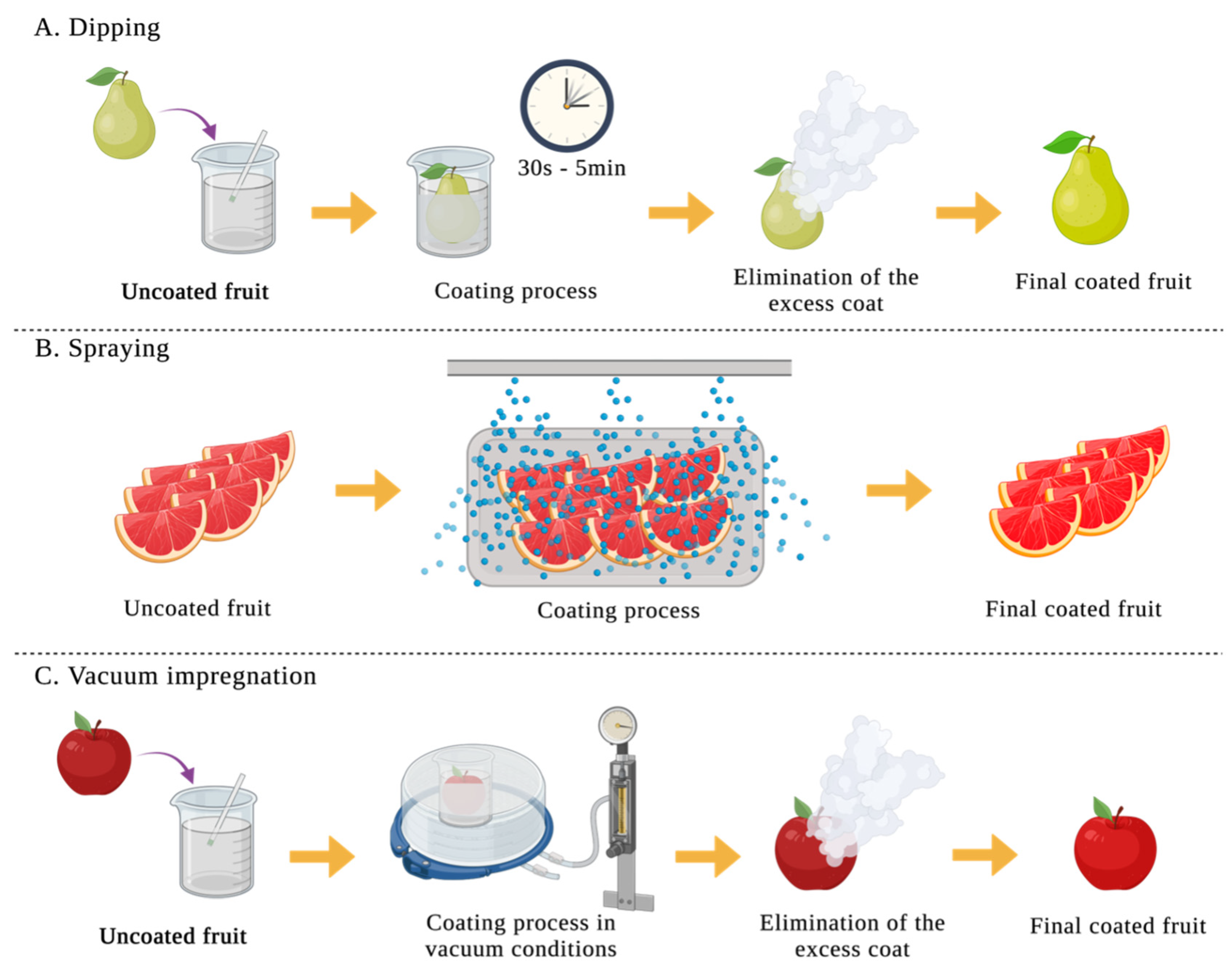
Figure 2.
Application of food industry by-products as potential components to be used as edible coatings and films in fruits and vegetables.
Figure 2.
Application of food industry by-products as potential components to be used as edible coatings and films in fruits and vegetables.
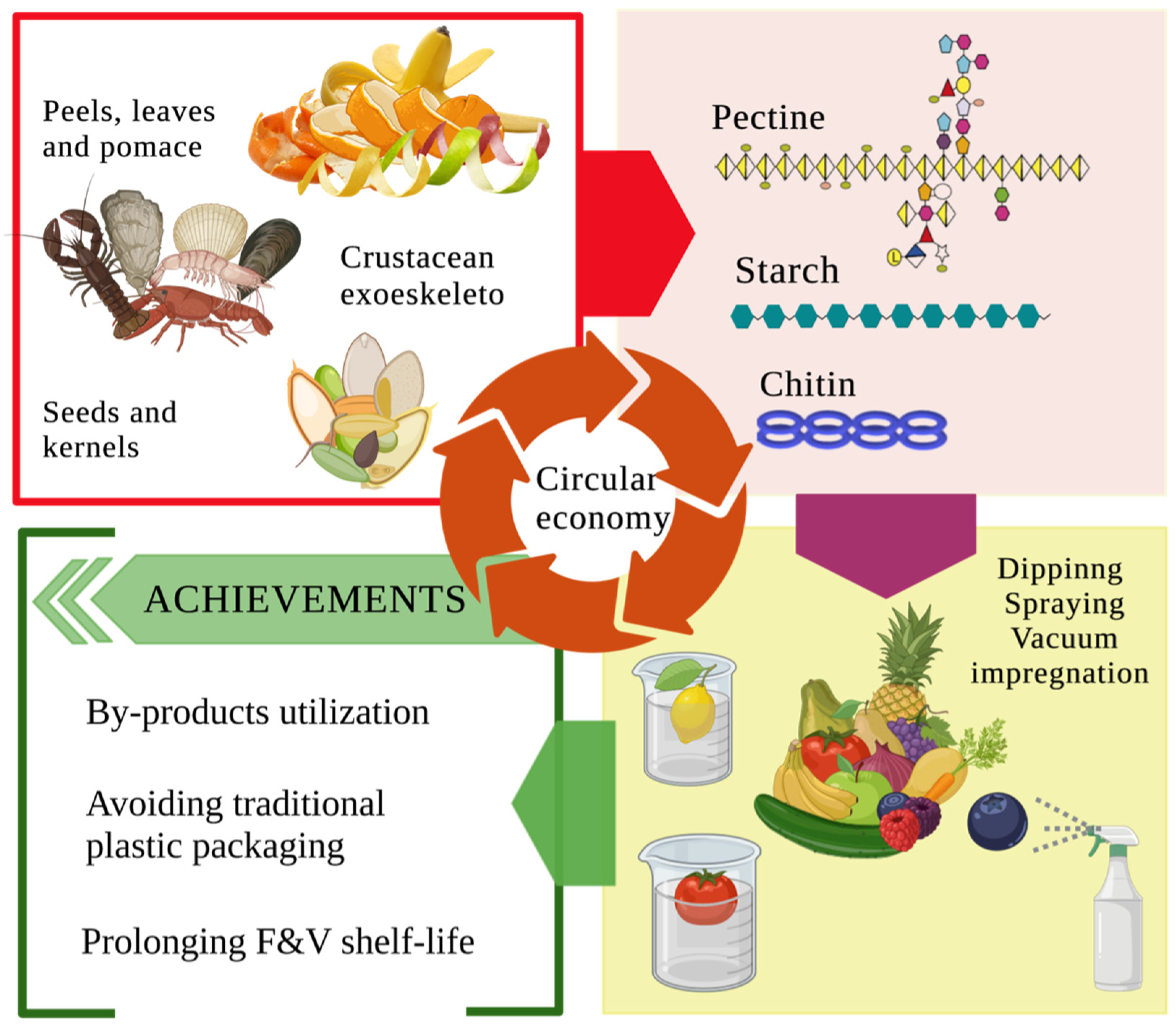
Figure 3.
Principal components used for the improvement of edible coatings and their function.
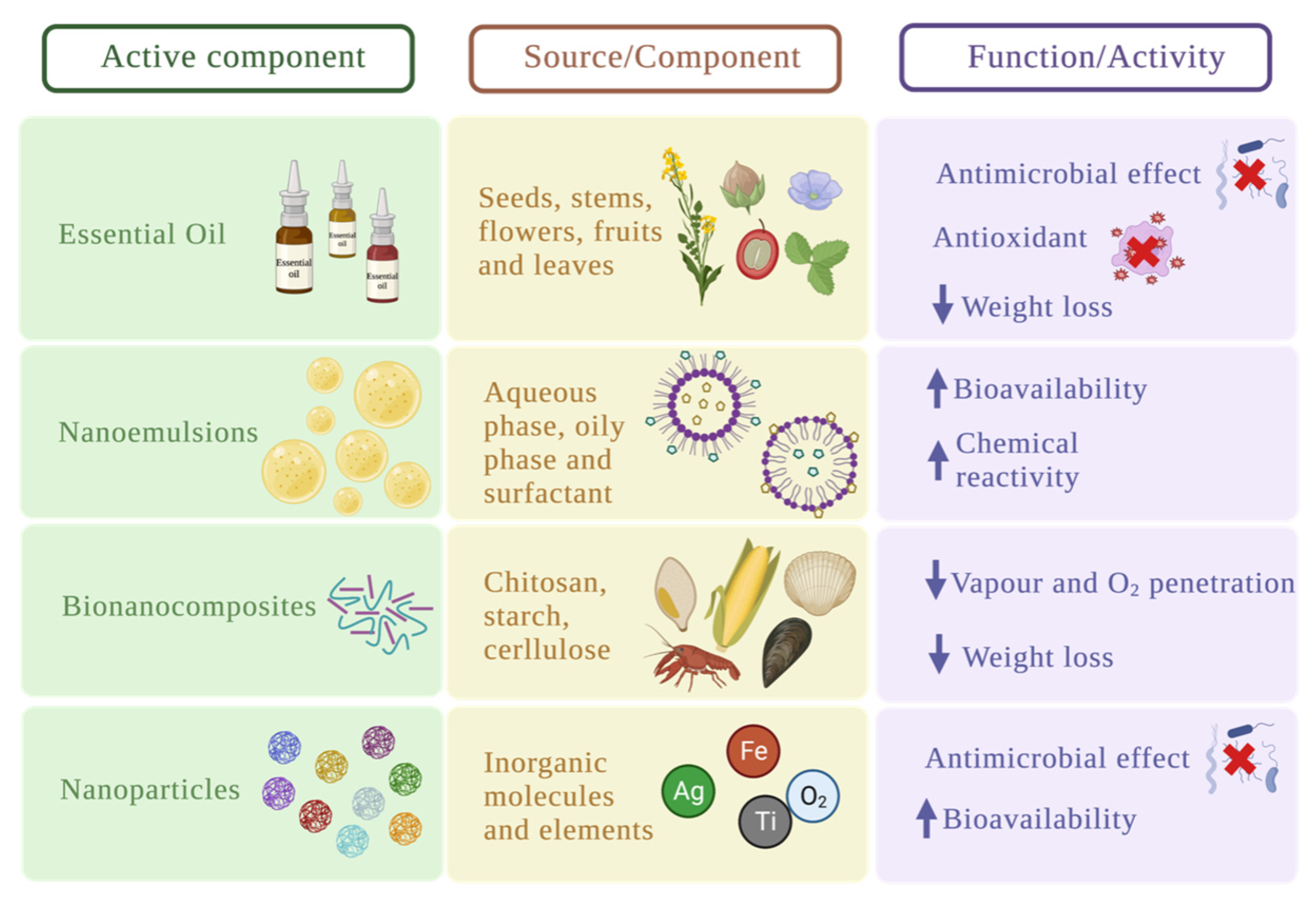

Table 1.
Improvements of different food products after their storage with edible coatings.
| Edible coating | Macro-molecule | Active component | Food product | Improvement | T (ºC) |
t (days) |
RH (%) | Ref. |
|---|---|---|---|---|---|---|---|---|
| Alginate (3%) + Chitosan (1%) + Olive leaf extract | PS | Olive leaf extract | Cherry fruits | Retardation of maturation, Anthocyanin incrementation | 25 | 20 | 65 | [45] |
| Guava leaf extract (20%) + Lemon extract (15%) | - | Guava leaf extract + Lemon extract | Banana | Reduction of color changes, Preservation of vitamin C | NS | 14 | NS | [50] |
| Commercial pectin + corn-flour starch + beetroot powder | PS | Corn-flour starch // Corn-flower-beetroot powder | Tomatoes | Lower weight loss, Lower decay percentage, Lower respiration rate | 25 | 30 | 80-85 | [40] |
| Pectin + Oregano essential oil (36.1 mg/mL) | PS | Oregano EO | Tomatoes | Lower fungal decay, Increasement of antioxidant activity | 25 | 12 | NS | [41] |
| Whey protein pectin + pectin + transglutaminase | PR and PS | Transglutaminase | Apples, Potatoes, Carrots | Lower weight loss, Inhibition of microbial growth, Antioxidant activity preservation | 4-6 | 10 | NS | [47] |
| Glycerol + Tragacanth gum (0.6 %) | PS | Tragacanth gum | Strawberries | Reduction of the rate of deterioration in ascorbic acid, total phenolics and anthocyanins | 4 | 16 | NS | [43] |
| Glycerol + CMC (1%) | CMC | |||||||
| Glycerol +LMP (2%) | LMP | |||||||
| Glycerol + PG (4%) | PG | |||||||
| Whey protein (8%) + lemon oil (1%) | PR | Lemon oil | Pears | Reduction in color changes, Reduction in loss of hardness, Reduction in loss of polyphenols and flavonoids | 4 | 7-28 | 80 | [48] |
| Whey protein (8%) + lemon grass essential oil (0.5%) | PR | Lemongrass EO | ||||||
| Chitosan (1%) + Gum ghatti (1%) | PS | Gum gatthi | Grapes | Retention of phenolic acids content, Reduction in yeast-mold growth | 1 | 60 | 85-90 | [46] |
| Alginate + Aloe vera + ZnO-NPs | PS | Aloe vera ZnO-NPs | Tomatoes | No spoilage during the storage | RT | 16 | NS | [42] |
| PET + Chitosan (2%) + Cinnamon essential oil (0.5%) | PS | Cinnamon EO | Pineapple | Lower weight loss, Lower decrease of L*, Microbial growth retardation | 5 | 15 | NS | [51] |
| Sodium alginate + sweet orange essential oil (5%) | PS | Sweet orange EO | Tomatoes | Eradication of sessile and planktonic forms of Salmonella and Listeria, Lower weight loss | 22 | 15 | NS | [52] |
| Pullulan + cinnamon EO | PS | Cinnamon EO | Strawberry | Delay in mass loss, decay percentage and firmness | 20 | 6 | 70-75% | [44] |
| Sodium alginate (2%) + ascorbic acid (0.5%) + vanillin (1%) | PS | Ascorbic acid, Vanillin | Kiwifruit | Lower decay, Lower ascorbic acid loss | 5 | 7 | NS | [53] |
| Sodium alginate (2%) + ascorbic acid (0.5%) + vanillin (0.5%) | Lower weight loss | |||||||
| Walnut flour protein | PR | - | Walnuts | Protection against lipid deterioration, Preservation of the sensory characteristics | 40 | 84 | NS | [49] |
| Soy protein + ferulic acid | PR | Ferulic acid | Fresh-cut apple | Weight loss control, Firmness control | 10 | 7 | 50 | [54] |
| Soy protein + cysteine (1%) | PR | Cysteine | Fresh-cut eggplant | Enzymatic browning control | 8-9 | 5 | NS | [55] |
| Whey protein +. Xanthan gum + Clove oil | PR | Clove oil | Tomatoes | Improvements in firmness and color, Respiration is inhibited | 15 | 20 | 85 | [56] |
| Whey protein nanofibrils + glycerol + trehalose | PR | Glycerol and trehalose | Fresh-cut apple | Enzymatic browning control | 10 | 4 | NS | [57] |
| Whey protein nanofibrils | - | Hydrophobic and antioxidant activity | ||||||
| Aloe vera 50% gel | Gel | Aloe vera | Papaya fruit | Control disease pathogens, Delay ripening, Water loss control, Respiration rate reduction | 15 | 28 | 68-70 | [58] |
| Chitosan-gelatin | PS | - | Red bell peppers | Microbial spoilage reduction, Respiration rate maintenance, Nutritional content maintenance | 7;20 | 14 | - | [59] |
| 21 | 7 | |||||||
| 14 | 20 | |||||||
| Chitosan + HPMC + bergamot EO | PS | Bergamot EO | Grapes | Weight loss reduction, Respiration rate reduction, Firmness improvement, Antimicrobial effect | 1-2 | 22 | - | [60] |
| Pea starch + guar gum | PS | - | Oranges | Shelf-life extension, Higher perception of off flavors, Better sensory scores | 20 | 7 | 90-95 | [61] |
Abbreviations: T: temperature; t: time; RH: relative humidity; EO essential oil; RT room temperature; NS not specified; CMC methyl cellulose; LMP: Low methoxyl pectin; PG: persian gum; PS: polysaccharide; PR: protein; L: lipids.
Table 2.
Application of by-products compounds in the edible coating production.
| Product | Subproduct | Extraction | Conditions | Compound | Formulation | Application | Product | Ref. |
|---|---|---|---|---|---|---|---|---|
| Mango | Mango peel flour | Drying pretreatment | 60ºC; 48h | - | 1.09% MPF 0.33% Gly |
Casting | Peach | [25] |
| Mango seed kernel | Solvent extraction | EtOH 90%; 75ºC | Antioxidant compounds | 1.09% MPF 0.33% Gly 0.078 g/L EMS |
||||
| Onion | Leaves, stems, flowers | UAE | Acetone | Phenolic compounds | 1% SA 0.3 g/g Gly/SA 0.04 g/g CaCO3/ SA 5.4 g/g GDL/CaCO3 |
- | - | [22] |
| Artichoke | ||||||||
| Thistle | ||||||||
| Mango | Kernel | Solvent extraction | Sodium metabisulphite 0.16% | Amylose; amylopectin | Gly:Sorbitol 1:1 Starch 50% |
Dipping | Tomato | [62] |
| Olive leaf | Leaves | Solvent extraction | EtOH 40%; 60ºC; 120 min | Olive leaf extract | 3% SA 10% Gly 2% CaCl2 0.01g/mL Chitosan 0.02 g/mL OLE |
Dipping | Sweet cherries | [45] |
| Loquat leaf | Leaves | Reflux extraction | EtOH 50%; 196ºC | Loquat leaf extract | 10 g/L SA 0.7 g/L CA 10 g/L SE 0.5 g/L AsA 0.5 g/L PS |
Dipping | Tangerines | [26] |
| Jackfruit leaf | Leaves | MAE | EtOH:H2O 4:1; 840 W; 2min | Jackfruit leaf extract | 1.5% pectin (w/v) 30% w/w) Gly 10% (w/w) Beeswax JLE 5mg/mL |
Wounded | Tomatoes | [27] |
| Moringa leaf | Leaves | NS | - | Moringa leaf extract | MLE 2% Chitosan 0.5% CMC 0.5% |
Dipping | Avocado | [63] |
| Haskap leaf | Leaves | ATPE | Sodium phosphate 10%, EtOH 37%, H2O 53%; min5 | Haskap leaf bioactive compounds | PPC 10% 0.91% Gly 10% SPHLE/ASHLE 1.7 g CA/MA |
Filming | Grape tomatoes | [64] |
| Dipping | Bananas |
Abbreviations: UAE: ultrasound assisted extraction; MAE: microwave assisted extraction; ATPE: aqueous two-phase extraction; MPF: mango peel flour; Gly: glycerol; EMS: extract mango seed; SA: sodium alginate; GDL: D-(+)-gluconic acid-σ-lactone; OLE: olive leaf extract; JLE: jackfruit leaf extract; CA: citric acid; SE: sucrose ester; AsA: ascorbic acid; PS: potassium sorbate; PPC: pea protein concentrate; SPHLE: sodium phosphate haskap leaf extract; ASHLE: ammonium sulphate haskap leaf extract; MA: malic acid; NS: not specified.
Disclaimer/Publisher’s Note: The statements, opinions and data contained in all publications are solely those of the individual author(s) and contributor(s) and not of MDPI and/or the editor(s). MDPI and/or the editor(s) disclaim responsibility for any injury to people or property resulting from any ideas, methods, instructions or products referred to in the content. |
© 2023 by the authors. Licensee MDPI, Basel, Switzerland. This article is an open access article distributed under the terms and conditions of the Creative Commons Attribution (CC BY) license (http://creativecommons.org/licenses/by/4.0/).
Copyright: This open access article is published under a Creative Commons CC BY 4.0 license, which permit the free download, distribution, and reuse, provided that the author and preprint are cited in any reuse.


